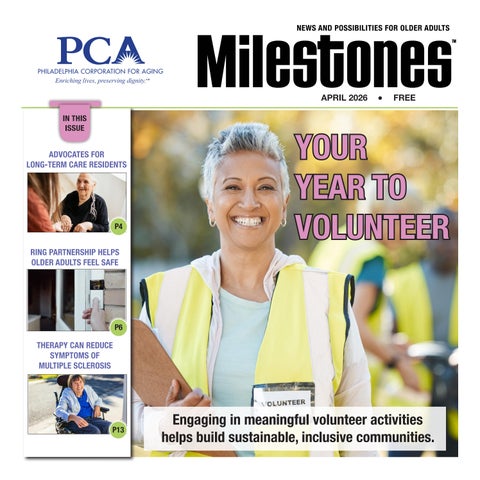
April 2026 Milestones

Page 1


ADVOCATES FOR LONG-TERM CARE RESIDENTS

RING PARTNERSHIP HELPS OLDER ADULTS FEEL SAFE

THERAPY CAN REDUCE SYMPTOMS OF MULTIPLE SCLEROSIS

Philadelphia Corporation for Aging (PCA) is the Area Agency on Aging for Philadelphia County and is dedicated to serving Philadelphia’s older adults and adults with disabilities.

PCA publishes Milestones and offers:

• Care in the home

• Caregiver & grandparent support

• Employment & volunteer programs

• Health education

• Home-delivered meals

• Home repairs & modifications

• Information & referral

• Legal services

• Ombudsman services

• Protective services

• Senior centers

• Transportation

• Veteran-directed care

Report suspected elder abuse 24/7 to the PCA Helpline: 215-765-9040.

For general inquiries about PCA or aging services, email AskHelpline@pcaCares.org or call 215-765-9040.

Published by Philadelphia Corporation for Aging

Najja R. Orr, DBA, FCPP

President and CEO

PCA Board of Directors 2026

Glenn D. Bryan, Chair

Louis G. Colbert, Co-Chair

Jaqueline S. Zinn, Ph.D., Secretary

Denise Adamucci, Treasurer

Satya B. Verma, O.D., Immediate Past Chair

Cheryl Croxton

Patricia Canela-Duckett

Lynette Killen

Sandra McNally

Norma D. Thomas, DSW

Sharlene Waller

Milestones is published monthly and distributed at more than 800 locations throughout Philadelphia.

Check us out online: pcaCares.org

Editorial & Distribution: Alicia M. Colombo 267-507-2168 MilestonesNews@pcaCares.org

Advertising: Kristin Long 215-606-7310 Kristin.Long@pcaCares.org

Subscriptions: Home delivery: $12/year MilestonesNews@pcaCares.org

The views expressed in Milestones are not necessarily those of Philadelphia Corporation for Aging (PCA). Milestones will not knowingly accept or publish fraudulent or misleading advertising. Milestones reserves the right to edit, revise or reject ads. Milestones assumes no responsibility for errors, misprints, omissions or misinformation; for failure to publish an ad; or for any damages of any kind. Neither the publisher nor any other party is rendering expert advice in this publication. No part of this newspaper may be reproduced without the permission of PCA.

Strategic planning improves the future of aging

PCA is focused on strengthening our work and deepening our impact in the community. Our initiative, “PCA 2.0,” is about more than programs. It is about building a stronger, more supportive community where older adults can maintain a high quality of life.

We remain committed to supporting independence, well-being and quality of life for the people we serve. PCA is exploring plans to transform a vacant portion of our building into affordable housing for older adults. If realized, this project would represent an innovative step for an Area Agency on Aging. We are currently pursuing grants and partnerships and hope to move toward construction in the coming years. As planning continues, input from the people we serve will help guide the process to ensure the space reflects the needs and experiences of the community.

Safety at home is a top priority. The PCA Ring Community Program helps older adults feel secure in their homes

and connected to neighbors. It is a strong example of PCA 2.0 in action, combining technology, partnership and community support. (See article on page 6.)

Community is at the heart of PCA 2.0. Every service, program and partnership is designed to strengthen connections. This is so older adults and caregivers are never alone in navigating the journey of aging. Your voice and involvement make all of this possible.

Thank you to everyone who participated in PCA’s Make Your Voices Heard community listening sessions and survey. This community-wide effort enabled us to gather input from older adults, caregivers, and community members about the future of aging services. Your feedback is helping to shape the future of our work at PCA, and we look forward to sharing the results in the coming months. We are thankful to our community that has helped us accomplish so much. We are also excited about what is ahead. With your help, we will continue to innovate and build stronger connections.

Advocates stand up for long-term care residents in Philadelphia

Older adults living in long-term care facilities have a strong advocate. Philadelphia Corporation for Aging’s (PCA’s) Ombudsman Program protects residents’ rights. It also addresses complaints and gives residents a voice.

PCA’s Ombudsman Program gives people living in long-term care settings a voice in their own care. The program offers a confidential way to raise concerns. These range from quality of care to living conditions. Ombudspeople do the following:

• Respond to complaints made by residents and family members

• Make quality-assurance visits to long-term care facilities

• Consult with residents, families and care providers

“Residents in long-term care facilities have basic rights that must be respected,” says Andrea DeLoatch, PCA Ombudsman Program Manager. “Our Ombudsman Program ensures that residents’ rights are upheld. This includes the right

wide range of issues, including:

• Residents’ access to personal funds

• Medicare and Medicaid benefits, charges and billing

• Residents’ concerns about food, physical environment and social activities

• Questions about medications, nursing care, medical services and the use of restraints

cludes bilingual and bicultural volunteers. They will help serve Philadelphia’s diverse communities. Volunteers receive training and ongoing support.

to dignity, privacy and a voice in one’s own care.”

The program is committed to preserving residents’ dignity, well-being and independence. Ombudspeople advocate for residents’ right to be treated with respect and to live free from neglect or discrimination. They also help protect residents’ privacy. This includes matters involving personal life and medical treatment. The program emphasizes residents’ ability to take part in decisions about their care.

“It’s vital that individuals in longterm care settings are not passive recipients of care. They need to be active participants in decisions that impact their daily lives,” DeLoatch says.

A key part of the program is letting residents voice concerns safely. They should feel free to speak up without fear of retaliation. Ombudspeople are impartial advocates. They help with meals, staffing, safety, and other quality-of-life concerns. They work with residents and facility administrators to find solutions.

Ombudspeople may address a

• Rights and policies related to dignity, as well as admission, transfer and discharge procedures

• Referrals to long-term care programs and help to make informed decisions about providers

The need for long-term care advocacy has increased in the past six years. The COVID-19 pandemic showed weaknesses of long-term care facilities.

Through a contract with PCA, Center in the Park provides Ombudsman Program services to all of Philadelphia. Center in the Park is a nonprofit senior community center in Germantown. It previously offered long-term care ombudsman services in Northwest and Northeast Philadelphia for over 12 years.

The Ombudsman Program helps people in Philadelphia’s long-term care facilities. These include:

• Nursing homes

• Personal care homes

• Domiciliary Care homes

• Assisted living communities

• Adult day centers

Center in the Park is looking for volunteer ombudspeople. This in-

With the heightened scrutiny of long-term care facilities, PCA’s Ombudsman Program remains a vital safeguard. Ombudspeople spot recurring issues and support changes. These improvements can boost the quality of life for long-term care residents.

For many residents and families, having an advocate brings great peace of mind. As Philadelphia’s population ages, the Ombudsman Program will remain increasingly important. It will protect residents’ rights and keep their voices central to their care.

Contact the Ombudsman Program

PCA’s Ombudsman Program gives those living in long-term care settings a voice in their own care. An ombudsman handles complaints from residents and families. They visit long-term care facilities for quality checks. They also consult with individuals, families, and care providers. Center in the Park is subcontracted by PCA to provide ombudsman services in Philadelphia. For ombudsman services or to volunteer, contact Center in the Park at 215-844-1829 or www. CenterInThePark.org.

Bill Conallen is the public relations specialist at Philadelphia Corporation for Aging.

Caregiver Navigation Program

About Philadelphia Corporation for Aging

Philadelphia Corporation for Aging (PCA) serves as the statedesignated Area Agency on Aging for Philadelphia County. It coordinates a broad range of services to assist older Philadelphians and those with disabilities in living as independently as possible.

What is a Caregiver Navigation Program

PCA’s Caregiver Navigation Program assists caregivers in connecting and accessing resources they need to support their loved ones while maintaining their own well-being along the caregiving journey. The program provides a range of free services listed below:

Information and referral assistance:

Offer information and referrals to programs and services that best fit the needs of the caregiver.

Personalized care consultation:

Provide recommendations, suggestions, and interventions that are centered on the person and family, as identified and preferred by the caregiver.

Training, workshops, and educational resources: Offer caregiving information and resources, including education and training opportunities.

Who is eligible

• Caregivers of Older Adults: Caregivers, 18 years of age or older, who are caring for an adult that is 60 years of age or older or a person with dementia of any age.

• Older relatives caring for children: Non-parent relatives, over the age of 55, who live with children and are the primary caretaker for them.

• Care receiver must be a Philadelphia County resident.

How it works

1. Request Caregiver Navigation Services by calling the PCA Caregiver Support Program hotline at 215-995-4372 or sending an email CSPPCAreferrals@pcaCares.org.

2. A care manager, who specializes in caregiving, will contact you to discuss your situation and needs.

3. You will receive a follow-up call from the Care Manager to ensure that the information was helpful and to confirm you were able to connect to the services and support discussed. Additional assistance can be provided if needed.

Ring doorbell, camera initiative to help older Philadelphians feel safer at home

Philadelphia Corporation for Aging (PCA) has launched a new initiative to help older Philadelphians feel safer and more secure at home.

In partnership with USAging and Ring, an Amazon company, PCA will receive up to 1,000 Ring devices. Each doorbell or camera comes with a basic Protect subscription for the life of the device. PCA will also receive a $20,000 donation to support its ongoing work across Philadelphia. The contribution totals more than $250,000 in home security products and support.

The initiative will support older adults who may be at greater risk of scams, unwanted visitors or isolation. It will also help family caregivers feel more at ease.

“Philadelphia Corporation for Aging is committed to helping

download the Ring app

• Have access to an email address to create a Ring account

Patricia Clark, a Ring device recipient and Firehouse Active Adult Center member, said the device has already made her feel safer at home.

“I can see who’s at my door, talk to them through the app, and decide whether it’s someone I know before I answer,” Clark said. “That extra level of security gives me peace of mind, especially when I’m home alone.”

older adults by adding a layer of safety and security at home,” said USAging CEO Sandy Markwood. “The Ring device enables older adults to see who is at their door.”

The Philadelphia initiative builds on a broader national partnership. In 2024, Ring donated 5,000 devices to 10 Area Agencies on Aging around the country through USAging. Recipients reported that features, such as Two-Way Talk and Live View, increased their sense of safety and peace of mind.

older Philadelphians remain safe, independent and connected in their own homes,” said PCA President and CEO Najja R. Orr, DBA, FCPP. “This collaboration with USAging and Ring adds a meaningful layer of relief for those most at risk of isolation, scams or unwanted visitors -- while also providing peace of mind for family caregivers.”

Priority to receive a device goes to participants in PCA’s Caregiver Support Program, Domiciliary Care Program, and Home-Delivered Meals Program, as well as members of PCA’s Firehouse Active Adult Center and Southwest Senior Center.

To qualify for the PCA Ring Community Program, applicants must:

• Be age 60 or older

• Live in Philadelphia County

• Have home Wi-Fi

• Have a smartphone that can

The technology can help older adults balance safety with social connection. “Ring is a technology that addresses critical needs of

The program reflects a shared effort to help older Philadelphians remain safe, independent and connected while aging at home.

CARE FOR EVERY AGE, CLOSE TO HOME

Experience top-notch care at Roxborough Family Medicine! Our Philadelphia practice serves teens to seniors, while our Montgomery County locations cater to all ages.

Trust us for personalized, high-quality healthcare!

roxboroughmemorial.com/family-medicine

Bill Conallen is the public relations specialist at Philadelphia Corporation for Aging.
Philadelphia Mayor Cherelle Parker (front, center) joins PCA staff, community partners and members of Firehouse Active Adult Center announce a partnership with USAging and Ring.

Donating safely and avoiding scams

Source: Federal Trade Commission

When you decide to support a cause you care about, you want to make sure your donation goes where you intended. Doing some research and planning your giving can help ensure your donations will do good. Here are tips from the Federal Trade Commission (FTC) to help you plan your donation – and avoid scams.

Do your research

Looking for a charity to support? Do an internet search for a cause you care about. You can type in terms like “hurricane relief” or “children’s resources” You can also use phrases like “best charity” or “highly rated charity.”

When you consider giving to a specific charity, search its name plus “complaint,” “review,” “rating” or “scam.”

These organizations offer reports and ratings about how charitable organizations spend donations and how they conduct business: • BBB Wise Giving Alliance: www.give.org | 703-247-9321

your donation. Review your bank and credit card statements closely to make sure you’re only charged the amount you agreed to donate. Also, make sure that you’re not signed up to make a recurring donation.

nings in exchange for a donation is illegal.

• CharityWatch: www.CharityWatch.org | 773-529-2300

• The IRS Tax Exempt Organization Search tells you if your donation would be tax deductible: www.irs.gov/charities-and-nonprofits (click on “Tax Exempt Organization Search”)

• The Pennsylvania Department of State maintains registration and financial information on more than 13,000 charities in the Commonwealth at www. pa.gov/agencies/dos (click on “Charities”)

Pay wisely

If donations are required by cash, gift card or money transfer, it is likely a scam. These payment methods cannot be stopped or disputed once they are sent. You should only make donations by credit card or check. These payment methods are traceable and easier to recover.

It’s a good practice to keep a record of all donations. Legitimate charities will send you a receipt or other written confirmation of

Before clicking on a link to donate online, check the website address bar for a closed padlock icon and the letters “https” before the website address. These indicate a secure connection so your personal and financial information will be protected when it is sent on this website.

Beware of scam tactics:

• Don’t let anyone rush you into making a donation. That’s something scammers do.

• Some scammers try to trick you into paying them by thanking you for a donation that you never made.

• Scammers can change caller ID to make a call look like it’s from a local area code.

• Some scammers use names or acronyms that sound very similar to real charities. This is one reason it pays to do some research before giving.

• Scammers make lots of vague and sentimental claims but give no specifics about how your donation will be used.

• Bogus organizations may claim that your donation is tax-deductible when it is not.

• Guaranteeing prize win-

If you notice any of these red flags, or if you’re unsure about how a charity will use your donation, consider giving to a different charity. There are many worthy organizations that will use your donation wisely.

Report scams to www.ReportFraud.ftc.gov. Share any information you have – like the name of the organization or fundraiser, phone number, website, email or promises made. In Philadelphia, you can report suspected financial fraud and scams 24/7 to Philadelphia Corporation for Aging’s Older Adult Protective Services at 215-765-9040.

(See page 15 for crossword)

March 2026

THIS MONTH:

NATIONAL VOLUNTEER MONTH

STRESS AWARENESS MONTH

APRIL 1-9: PASSOVER

APRIL 5: EASTER

APRIL 15: TAX DAY

APRIL 22: EARTH DAY

APRIL 6

KNITTING CLASS

Weekly social group works on individual knitting, crochet, needlepoint or related projects. 12:30 p.m. on Mondays. KleinLife: Northeast Philadelphia, 10100 Jamison Ave. 215-698-7300 | Free

APRIL 7

MUSIC THERAPY

Music interventions work to accomplish individualized goals with a credentialed professional. 9 a.m. on Tuesdays. Lutheran Settlement House, 1340 Frankford Ave. 215-426-8610 | Free

APRIL 8

BINGO

Send your calendar items two months in advance to: MilestonesNews@pcaCares.org Questions? Call 267-507-2168.

10 a.m. on Wednesdays. Philadelphia Senior Center – Allegheny, 1900 W. Allegheny Ave. 267-286-1455 | $0.10/board, 6-board minimum

APRIL 9

POETRY CLASS

Engaging & interactive class for older adults who want to discover the joy of selfexpression. Lifelong poets & beginners welcome. 10:30 a.m. Center in the Park, 5818 Germantown Ave. 215-848-772 | Free

APRIL 10

CHAIR ZUMBA

Both sitting & standing (with chair support) exercises to upbeat music. 9:30 a.m. KleinLife: Northeast Philadelphia, 10100 Jamison Ave. 215-698-7300 | Free

APRIL 14

POKENO

Combine the fun of cards & bingo in a lively, social activity that encourages connection, friendly competition & mental engagement. 11 a.m. on Tuesdays. Martin Luther King Older Adult Center, 2100 Cecil B. Moore Ave. 215-685-2715 | Free

APRIL 16

OPEN TECH CENTER

Open computer use with some instruction (if needed) for technology topics, such as iPads, smartphones & Zoom. 10 a.m. KleinLife: Northeast Philadelphia, 10100 Jamison Ave. 215-698-7300 | Free

APRIL 17

CHESS CLUB

Friendly, engaging space to enjoy game play. Noon on Fridays. Martin Luther King Older Adult Center, 2100 Cecil B. Moore Ave. 215-685-2715 | Free

APRIL 21

ENHANCE FITNESS

Low-impact, full-body workout designed to improve strength, flexibility, & mobility while boosting overall health & well-being. 10 a.m. Center in the Park, 5818 Germantown Ave. 215-848-772 | Free

APRIL 22

TOTAL FITNESS CLASS

Total-body workout of standing & sitting exercises with light, hand-held equipment, such as weights & fitness balls. 10:30 a.m. Philadelphia Senior Center – Allegheny, 1900 W. Allegheny Ave. 267-286-1455 | $1

APRIL 23

ART CLASS

Explore various artistic mediums. Participants will learn a variety of techniques, including painting, watercolors, papermache, sketching & collage. 9 a.m. Lutheran Settlement House, 1340 Frankford Ave. 215-426-8610 | Free

APRIL 24

LINE DANCE

Get ready to move & groove in this fun & energetic class. Beginners welcome. 9:30 a.m. Martin Luther King Older Adult Center, 2100 Cecil B. Moore Ave. 215-685-2715 | Free

APRIL 27

SILVER SNEAKERS

Well-known program designed for older adults, focused on strength, flexibility & balance. 8 a.m. on Mondays. Center in the Park, 5818 Germantown Ave. 215-848-772 | Free

APRIL 30

QIGONG CLASS

System of coordinated body-posture & movement, breathing, & meditation. Optimizes energy within the body, mind & spirit to improve & maintain health & well-being. 12:30 on Thursdays. Lutheran Settlement House, 1340 Frankford Ave. 215-426-8610 | Free

Every vote counts: Ensuring access for all

May 19 is the Primary Election in Pennsylvania. The last day to register to vote in the primary is May 4.

This primary will include U.S. House of Representatives — Pennsylvania District 3, Pennsylvania governor and Pennsylvania lieutenant governor.

You must be a U.S. citizen and a resident of Pennsylvania for at least 30 days before the next election to register to vote. For information, call 1-877-VOTESPA (8683772). To register to vote, or to request a mail-in or absentee ballot, go to https://vote. phila.gov.

At Philadelphia Corporation for Aging (PCA), we believe every voice matters. One of the most effective tools we have to create the community and the future we want is voting. For this reason, it is important to make sure that voting is made easy and accessible to all.

Across the country, many efforts are underway to make polling places welcoming and inclusive. Ramps, wide doorways, and voting machines that support people with different needs, including those who use wheelchairs or have low vision. For voters who prefer not to vote in person, mail-in ballots, early voting, or curbside voting of-

fer safe and easy ways to vote in an election. All voters have the opportunity to contribute in the best way for them.

Laws also help protect the right to vote. The Americans with Disabilities Act requires polling places to be accessible, and the Help America Vote Act ensures each location has at least one accessible voting system. These protections help make sure that every voter can cast their ballot privately and independently. Support is available for those who need it. State and local election offices can provide information about accessible polling places and how to request help. Organizations like the U.S Election Assistance Commission and the National Disability Rights Network also offer resources to guide voters through the process.

4 tips for accessible voting:

• Know your voting options.

• Learn about the Philadelphia County voting system.

• Check your polling place accessibility.

• Plan to use the Philly voting map.

When everyone can vote, our communities become better, and each vote is a voice helping to build what’s next. We believe in equality and inclusion at PCA. Together, we can ensure that each person has a chance to vote and give input. Every vote matters. Every voice counts.

Janai Johnson is the multimedia communications specialist at Philadelphia Corporation for Aging.

Engaging in Aging Expo brings Philadelphians together to support older adults

Philadelphia Corporation for Aging and The Sarah Ralston Foundation hosted Engaging in Aging: A Volunteer & Donor Expo on March 4. The free event brought together Philadelphians and nonprofits that support older adults. It focused on enhancing services that help people age safely and with dignity.

Philadelphia is home to more than 316,000 residents age 60 and older. That’s nearly 20% of the city’s population! Many older Philadelphians face significant challenges. One in five live below the poverty level. Nearly half live alone. Almost 30% experience difficulty with mobility or independent living. Language barriers, lack of formal education, unstable housing, and food insecurity make it harder to get care and support. Social isolation raises the risk of

event. Attendees could ask questions, find their best fit, and learn how to get involved.

Volunteer opportunities

Below are just a few of the volunteer opportunities that were presented at Engaging in Aging.

Caring for Friends has offered food and friendship to seniors, kids and adults in the five-county Philadelphia area since 1974. Volunteers assist in several areas:

• Kitchen: prepping, cooking and packing meals

• Warehouse: quality control, sweeping floors and filling boxes

bers connect through fun, educational programs, social activities, and services from volunteers. Penn’s Village serves central Philadelphia. Members can volunteer in many ways:

• Provide companionship or rides.

• Join committees.

• Help with special events or fundraising.

• Complete tasks from home.

For information, go to www. PennsVillage.org (click on “Volunteer”) or call 215-925-7333.

early death. It also increases the chances of dementia, heart disease, stroke, depression, and anxiety. These facts show how important it is to support groups that offer services and build human connections.

About 40 organizations joined, allowing attendees to meet all partners in one spot. They learned about local needs and found ways to get involved. Options included volunteer roles, in-kind donations, financial support, and community outreach. The event was sponsored by Alert Medical Alarms, A-Team Home Care, ArchWell Health, Loving Care Senior Services, The Mendoza Group, Mom’s Meals, and PA Health & Wellness. Featured speakers stressed the need to support older neighbors. They also showed how individuals and families can truly make a difference in Philadelphia. The Nutrition Group presented the

• Office: organizing the pantry, making caring cards, labeling, data entry and phone outreach

To volunteer, call 215-464-2224.

Face to Face started in 1984 when local church members began cooking hot meals for their Germantown neighbors who were food insecure. It is now a onestop-shop of free services, including meals, legal services, health care and social services. In-person volunteer options include meal prep, serving, dishwashing, and activity support (like bingo, arts and computers). To get involved, contact Volunteer Manager Ally Monteiro at 215-439-7939, ext. 203. For information, go to https:// FaceToFaceGermantown.org.

Penn’s Village is a network of neighbors helping neighbors age in place. It helps older Philadelphians live independently. Mem-

Philadelphia Corporation for Aging (PCA) has served as Philadelphia County’s Area Agency on Aging since 1973. PCA is among the city’s largest nonprofits. It partners with about 200 providers to offer more than 30 person-centered programs. These programs support older Philadelphians and adults with disabilities. You can volunteer to help with PCA’s Senior Companion, Ombudsman, PA MEDI, and Health Promotion programs. For more information, call the PCA Helpline at 215-7659040 or go to www.pcaCares.org/ volunteers.

Senior community centers offer a variety of volunteer opportunities. These include serving lunch, program registration, clerical support, and receptionist. To find a senior center near you, call the PCA Helpline at 215-7659040 or go to www.pcaCares.org/ senior-centers.

(Continued on page 12)

Spay and Save, Inc. is a volunteer-run animal welfare and education group. It serves Northwest Philadelphia and Eastern Montgomery County. Volunteers are needed to provide temporary foster homes to adult dogs and cats (food, bedding and litter provided). Other volunteer options are:

• Animal transport.

• Adoption events.

• Habitat maintenance.

• Dog walking.

• Animal care education.

• Clerical work.

To volunteer, call 610-227-6187 or go to www.SpayAndSave.org.

For a list of all the community organizations that participated in the Engaging in Aging Expo, go to www.pcaCares.org/news and click on the Engaging in Aging Expo article.

Contact us for information and resources to assist older adults, caregivers and adults with disabilities in Philadelphia.

PCA Helpline: 215-765-9040 | AskHelpline@pcaCares.org

Call to report elder abuse 24/7.

Learn about our services or request assistance online: www.pcaCares.org

Milestones e-news: Receive Milestones newspaper by email for free.

Email MilestonesNews@pcaCares.org to sign up for the e-news or to share ideas for Milestones.

Bill Conallen is the public relations specialist at Philadelphia Corporation for Aging.
Connect with PCA on social media!

Immunotherapy and physical therapy can reduce symptoms of multiple sclerosis

Multiple sclerosis (MS) is a disease of the immune system. In MS, the body attacks insulation around the nerves, called myelin. The myelin gets stripped or damaged. This causes communication problems between the brain and the rest of the body.

The effects of MS vary with each person. It can affect the motor functioning of the arms and legs. This may lead to subtle clumsiness, mobility challenges or balance problems. Other patients might have tingling, an inability to sense things appropriately or vision issues.

“It’s a whole variety of symptoms. Motor issues, sensory and vision, and balance are the most common first symptoms. (These) might bring patients to seek medical attention,” said Dr. Petra Brayo, assistant professor of clinical neurology in the

Lewis Katz School of Medicine at Temple University.

MS is not fatal. “I always tell patients they are more likely to die with MS than from MS,” Dr. Brayo said. “There can be complications from MS. You can lose your ability to walk or become bedbound. With that, they might have bedsores that end up getting infected and that might lead to other medical complications. But MS in and of itself rarely results in the loss of major functions.”

The first symptoms of multiple sclerosis often start between ages 20 and 40. Women are slightly more likely to get the disease than men.

The oldest person Dr. Brayo has seen with a new diagnosis of MS was in their 70s.

Most people with MS have “disease progression.” The nervous system is trying to compensate for some of the injury that happened.

er complications from suppressing the immune system, Dr. Brayo said.

Another treatment for MS is to work with a physical therapist who can help strengthening weak limbs and other parts of the body.

“For most of my patients, our goal is to optimize the quality of life,” Dr. Brayo said.

A lot of the current research into MS is studying what causes the progression of the disease. “Why do certain patients progress more than others? And with that, the goal would be to find therapies that would slow down that progression or, ideally, stop it,” Dr. Brayo said.

Some medications that are in the clinical trial phase are promising, she added.

“What we call the brain reserve slows down with aging,” Dr. Brayo said. “There are no new attacks, but we end up seeing instead this element of progression. The symptoms that somebody had in the past might slowly get worse over time. So, patients might start noticing that their mobility is getting worse. For example, they would always have issues with the right leg. It would be the right leg getting worse, not necessarily that the left leg would start to have symptoms.”

MS patients are treated with immunotherapy, which can be taken orally, through IV infusion or by injection.

As patients age, the focus is on managing symptoms. It’s less about initiating immunotherapies to quiet the immune system and prevent new attacks. Immunotherapies tend to be stopped as patients get older to avoid the risk of infections and oth-

According to the National Multiple Sclerosis Society, caregivers “may even neglect their health and well-being. But if you are a care partner, paying attention to your needs will actually help you support your loved ones, too.”

The website www.NationalMSSociety.org (see “Caring for Someone with MS” section) has tips for caregivers. The society also has MS Navigators. These skilled, compassionate professionals help connect MS patients and their caregivers with information, resources and support. Resources include respite care, support groups, online communities, health care provider search, financial support and education. To schedule an appointment with an MS Navigator, call 1-800344-4867, weekdays, 9 a.m. to 7 p.m.

Jay Nachman is a freelance writer in Philadelphia who tells stories for a variety of clients.

Easy Pork Ramen Noodles

Ramen noodle soup is a favorite of many, including the Milestones editor. Ordering a bowl from a restaurant may cost $20 or more. Many recipes are complicated with fancy, specialty ingredients. This quick and easy recipe for basic restaurantstyle ramen needs only 10 minutes of prep. Seasoned with the robust flavors of garlic, ginger and pepper, this ramen can be topped with whatever ingredients you like.

Ingredients:

2 tbsp. light brown sugar

2 tsp. garlic powder

½ tsp. ground ginger

2 bone-in, country-style pork ribs

1 tbsp. vegetable oil

6 cups chicken stock

2 tbsp. soy sauce

¼ tsp. ground black pepper

3 tbsp. water

2 tbsp. cornstarch

4 ozs. ramen noodles, cooked

Optional: Crushed red paper, to taste

Directions:

Mix brown sugar, 1 teaspoon of the garlic powder and ginger in a small bowl. Rub on all sides of pork ribs to coat.

Prepare pork ribs as directed. Once cooked, remove bone and shred meat. (Set shredded pork aside.)

Add chicken stock to pan used to cook pork ribs. Stir with whisk to remove browned bits from bottom of pan and pour mixture into a pot. Stir in remaining 1 teaspoon of garlic powder, soy sauce and black pepper. Return pork to pot and cover with lid. Place pot on stove set to high.

Whisk water and corn starch in small bowl. Stir into pot until well blended. Simmer 1 minute, stirring frequently. Divide cooked noodles and shredded pork among serving bowls. Ladle hot broth into bowls. Serve with desired toppings. Popular toppings for ramen noodles include bean sprouts, bamboo shoots, shitake mushrooms, baby corn or corn kernels, sliced scallions (green onions) and soft-boiled eggs.

Source: McCormick Kitchens

Healthy habits for your brain Travel

Your brain is at the center of everything you do. It helps you remember names, follow conversations, think clearly and stay connected with the people you love. Keeping your brain healthy can be simple. Small habits can keep your mind strong, sharp and active as you get older.

One of the easiest ways to support your brain is to stay active. Regular exercise is linked to overall physical and mental wellness. You might take a walk, stretch, dance to music or do chair exercises.

Choose something you enjoy and feel comfortable doing. Even a few minutes of activity a day can make a difference.

A balanced diet is also associated with overall health and well-being. Foods should include vegetables, fruits, whole grains, beans, fish and nuts. Limiting excess salt, added sugars, and highly processed foods is commonly recommended as part of healthy eating.

Your mind also loves connections. Spending time with family and friends, volunteering or joining a club helps keep your mind active and lifts your mood. Even a quick phone call or chat with a neighbor can give your brain a small boost and reduce isolation.

Just as caring for your body is important so is challenging your mind. Puzzles, books, learning a hobby or trying a new recipe can help your brain form new connections.

Consistent, quality sleep is associated with improved focus and memory. Taking a few deep breaths, going for a walk or being outside in nature can help clear your mind and reduce stress. Taking care of your health by managing blood pressure, blood sugar and cholesterol levels can also help your mind stay healthy.

Small steps make it easy to support your brain. Everyday habits, like walking, enjoying a healthy snack or reading, can help you stay independent, alert and engaged for years to come.

Source: Alzheimer’s Association

Janai Johnson is the multimedia communications specialist at Philadelphia Corporation for Aging.

Turn static files into dynamic content formats.

Create a flipbook