Welcome to the latest issue of Project Bridge SciComm’s Charm City Science!
In this edition of our quarterly guide to local science achievement, news, and events, we’re introducing you to local molecular biologist Erin Goley, as interviewed by SciComm team member Ozzy Bagno. We’re excited to begin sharing the personal stories and convictions of the brilliant scientists who make up our Baltimore ecosystem.
At Project Bridge, our goal is to connect scientists to the larger community and help make science accessible to all. If you have questions, like what we do, or want to get involved, please let us know! You can reach out to us via email or check us out on social media (@pbscicomm). Our contact information is on the back cover of this zine, along with the QR code that provides links to some of our other projects (and the online version of this addition).
We’re thrilled to be launching Charm City Science in 2026! We have big plans for the upcoming year and can’t wait to get started.
Stay warm out there!
Project Bridget Science Communication Committee Members:
Ozzy Bagno, PhD Student, Biochemistry, Cellular and Molecular Biology
Juliana Gesztesi, PhD Student, Biochemistry, Cellular and Molecular Biology
Bridget Cassata, PhD Student, Biochemistry, Cellular and Molecular Biology
Colin Gardiner, PhD Student, Biochemistry, Cellular and Molecular Biology
Quinlan Mewborne, PhD Student, Biochemistry, Cellular and Molecular Biology
Malka Svei, PhD Student, Neuroscience, Chair Science Communication Committee Chair
MEET A RESEARCHER: Erin Goley
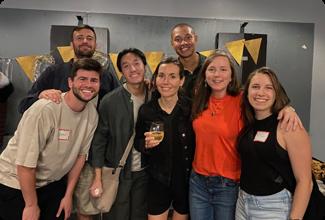
As a professor in Molecular Biology and Genetics at the Johns Hopkins School of Medicine, Dr. Erin Goley runs a research lab (pictured, with Dr. Goley second from right), mentors graduate and post-doctoral researchers and teaches (“a little”). Ozzy Bagno, a student in the same department, asked her some questions for this zine about life and science
[interview lightly edited for length & clarity] What inspired you to become a scientist?
I’ m not sure I appreciated “scientist” as a potential career until college. I enjoyed math and science classes, though, so I majored in biochemistry and math as an undergrad. Once I got into a lab and started doing research, I was hooked on the hands-on nature of science and the ability to explore and discover new things. How did you choose your specific field?
I’ m a bacterial cell biologist. What attracted me to the study of bacteria initially is their incredible diversity. These tiny single-celled organisms have figured out how to thrive in almost every environment on earth. In the process, they’ ve acquired a phenomenal array of shapes, behaviors, features, and abilities. They can do so many cool and unexpected things that studying them never gets boring. What are you currently researching? Why is it relevant to the public?
We study how bacteria grow, divide, and adapt to their environments – all of which are required for bacterial survival. Many human diseases are caused by bacteria, typically treated with antibiotics. Unfortunately, bacteria have figured out how to survive antibiotic treatment – they’ ve become resistant. they’ve become resistant. Our work may identify new targets for antibiotics and allow us to understand the ways bacteria survive stresses like antibiotic treatment so we can fight back.
Who are your scientific role models?
My graduate and postdoc advisors: Matt Welch and Lucy Shapiro. Matt taught me everything I know about research and mentoring. I admire the way he approaches scientific questions and model my science after his. His postdoctoral work included one of my favorite experiments of all time. * Lucy is just the most scientifically passionate and persistent person I know. She started running her lab in the late 1960s, when women weren ’t well-represented in the sciences. She was bold in pursuing her science without letting barriers stand in her way. Lucy is also a master at science communication … always clear, exciting, and dynamic.
Outside of the lab, what are some of your favorite spots in Baltimore?
One of my favorite things to do in nice weather is to just hop on the water taxis and cruise around the harbor. I also hike a lot at Lake Roland and other parks in Baltimore County. I love music, and we ’ ve seen shows at the Meyerhoff, Rams Head, Baltimore Soundstage and other venues. The food and drink scene is also great here –True Chesapeake, Clavel, and WC Harlan are some of my favorites
Can you offer one key piece of advice for future scientists?
Interact as much as possible with other scientists. As a student and postdoc, I was really anxious about going to conferences and interacting with other scientists, especially professors. Now those interactions are some of my favorite parts of being a scientist. Sharing ideas and excitement, learning about new approaches… it ’ s fun and it pushes the science forward. * see pg. 5
Science in the City: A Quarterly Calendar of Events
All events located in Baltimore City. Events are free of charge unless otherwise noted. * we now have a google calendar! subscribe here*
↺ = recurring event, check location website for the most up to date schedule ✎= Registration required. ⛰ = hike/ outdoor activity - dress accordingly
Kids & Families:
Purim Science Spectacular with Eric Energy
Monday, Mar 02, 11:30 AM
Enoch Pratt Library-Govans, 5714 Bellona Avenue, gvn@prattlibrary.org
Family Nature Hike: Signs of Spring //Forest Builders// Wildflowers & Clayprints
Second Saturdays (Mar 14// Apr 11 // May 09), 1:00 PM-3:00 PM
Carrie Murray Nature Center, 1901 Ridgetop Roa*d Nature for Kids: Best Buds↺⛰
Saturday, Mar 21, 11:00 AM-12:00 PM
Masonville Cove, 1000 Frankfurst Ave
IvyKids Saturday: The Great Truffle Snuffle
Saturday, Mar 28, 10:00 AM
The Ivy Bookshop, 5928 Falls Road, Growing Up Green with Wildlife Adventures
Monday, Apr 06, 4:30 PM
Enoch Pratt Library-Southeast Anchor, 3601 Eastern Avenue Grow a Living Necklace
Tuesday, Apr 21, 3:00 PM-4:00 PM
Enoch Pratt Library-Johnston Square, 1132 Greenmount Ave,
In this hands-on program, children will make a “living necklace” and learn about plant growth while creating a wearable science experiment to take home.
Walloping Weather with the Science Guys of Baltimore
Wednesday, Apr 22, 3:00 PM
Enoch Pratt Library-Hamilton, 5910 Harford Road
Seed Story Starters
Saturday, May 09, 11:00 AM-12:00 PM
Enoch Pratt Library-Hampden, 3641 Falls Road
Plant your own seeds and learn how to take care of them at home as they grow into beautiful flowers!
Berry Messy Science with Strawberry DNA!
Tuesday, May 19, 3:30 PM-4:30 PM
Enoch Pratt Library-Cherry Hill, 606 Cherry Hill Road Tree Time↺✎ ($7 registration fee per session)
Amazing Tree Bark: Tuesday March 10// Thursday March 19
Spring Blooms : Tuesday Apr 14 // Thursday Apr 16
Frogs!: Tuesday May 12 // Thursday May 21
10:30 AM-11:30 AM
Cylburn Arboretum, 4915 Greenspring Ave
student in Biochemistry &
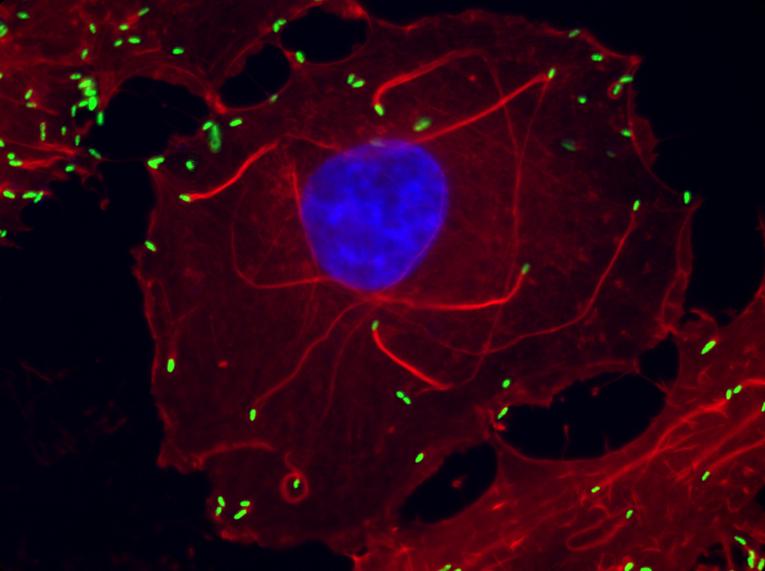
This photograph shows bacteria infecting human epithelial cells. The tiny cells, different kinds of which line skin, blood vessels, and many internal organs, are magnified by 1000X under a light microscope. Specialized stains differentiate the tick-borne bacterium Rickettsia parkeri (green), and the nucleus (blue) and actin cytoskeleton (red) of the host cell. Like bony skeletons do for our bodies, cytoskeletons - rigid, yet flexible assemblies of the protein actingive cells structure and mobility. Ricksettia bacteria take advantage of host actin to move inside and between cells by making little “ comet tails,” which you can see in the picture.
meet a researcher continued (editor’s note):
In case you’re curious about the favorite experiment she mentioned– we certainly were – we asked Dr. Goley about it. She told us that by the 1990s, cell biologists knew that actin protein segments could stack together like building blocks. Long filaments of connected actins come together to form cytoskeleton (see above). Back then, scientists were still trying to discover how those filaments were assembled, or nucleated.
“As a postdoc in Tim Mitchison ’ s lab [at the time]”, Goley says, “Matt Welch took advantage of the fact that some bacteria can force host actin [from infected cells] to form filaments on the bacterial surface that drive bacterial movement. He figured the bacteria must be using something from the host cell to nucleate the actin.” Welch isolated actin and other proteins from human cells, added them to Listeria bacteria, and looked for the comet tail filaments He observed that bacteria would not make long filaments if exposed to actin alone – but they did when he added Arp2/3, a complex of seven proteins “important for everything from human development to immune cell function to cancer metastasis,” as Goley explains. “It turns out bacteria are sometimes better cell biologists than we are - if we watch them closely, we can learn a lot about how our own cells function.”
Image shared by Erin Goley, PhD); Made by Dezmond Cole, Graduate
Molecular Biology at the Goley Lab
Calendar of Events: Continued
Nature/Volunteering:
All-Access Nature Education Program: A Touch of Spring✎
Friday, Mar 06, 10:00 AM-12:00 PM
Carrie Murray Nature Center, 1901 Ridgetop Road*
All ages and abilities welcome.
Friday Night Hike: Owl & Moon Stories↺⛰
Friday, Mar 06, 5:30 PM-7:30 AM
Carrie Murray Nature Center, 1901 Ridgetop Road, Bird Banding (Every Fri, Sat, Sun)↺⛰
Friday, Mar 06, 8:00 AM-10:30 AM
Masonville Cove, 1000 Frankfurst Ave
Registration reserves your spot, walk-ins welcomed.
Eastern Box Turtles of Cylburn
Saturday, Mar 21, 10:00 AM-1:00 PM
Cylburn Arboretum, 4915 Greenspring Ave
All-Access Nature Education Program: Spring Seekers✎
Friday, Apr 10, 10:00 AM-12:00 PM
Carrie Murray Nature Center, 1901 Ridgetop Road*, all ages and abilities welcome.
Field School: Spring Seeding & Transplanting✎
Wednesday, Apr 22, 5:30 PM-7:30 PM
Farm Alliance of Baltimore, 1500 Union Avenue
($20 registration, or $75 for all 5 Spring field school session. More info at farmalliancebaltimore.org).
Field School: Agricultural History & Food Sovereignty✎
Wednesday, May 06, 5:30 PM-7:30 PM
Farm Alliance of Baltimore, 1500 Union Avenue
($20 registration, or $75 for all 5 Spring field school session. More info at farmalliancebaltimore.org).
LGBTQ+ Book Club - Forest Euphoria, by Patricia Ononiwu Kaishian
Thursday, May 28, 6:30 PM-7:30 PM
Snug Books 4717 Harford Road
This event is for LGBTQ+ folks specifically. (snugbooks.com for more details)
Workshops/Activities:
Attracting and Building Homes for Native Pollinators
Saturday, Mar 14, 11:00 AM-12:00 PM
Cylburn Arboretum
Global Recycling Day: Open Craft Session
Wednesday, Mar 18, 3:00 PM-5:00 PM
Enoch Pratt Library- Orleans Street, 1303 Orleans Street
Spring Equinox Celebration
Saturday, Mar 21, 4:00 PM-6:30 PM
Carrie Murray Nature Center, 1901 Ridgetop Road
Water Quality/Climate Change Science: A citizen science opportunity↺⛰✎
Saturday, Mar 28, 10:00 AM-11:30 AM
Masonville Cove, 1000 Frankfurst Ave
Earth Day Terrariums
Wednesday, Apr 22, 4:00 PM-5:00 PM
Enoch Pratt Library-Edmundson Ave, 4330 Edmondson Avenue,
Join us on Earth Day to build your own terrarium and learn how to keep it healthy. Earth Day Celebration & Nature Art Market
Saturday, Apr 25, 12:00 PM-4:00 PM
Carrie Murray Nature Center, 1901 Ridgetop Road
Enjoy guided mini-hikes, meet local eco-artists, and contribute to a collaborative “Forest Mural” made from natural pigments and recycled materials. Bushcraft & Wild Skills Workshop⛰✎
Saturday, May 23, 10:00 AM-2:00 PM
Carrie Murray Nature Center*, 1901 Ridgetop Road, Perfect for ages 12+ (family-friendly adaptations available).
Talks/Lectures:
Science Slam!
Saturday, Mar 07, 7:00 PM-9:00 PM
Location TBD
Learn about the remarkable science happening in Charm City! Come for an afternoon of 5minute talks from local scientists!
End Papers: A mini-book fest on capitalism and the climate crisis
Saturday, Apr 04, 12:00 PM-9:00 PM
Red Emma's, 3128 Greenmount Avenue, Baltimore
A one-day festival of books on capitalism and the climate crisis, + a radical resource fair with local climate organizers!
Coming Next...
DIY Magnetic Resonance Imaging (MRI)✎
Wednesday, Sep 16, 8:00 AM-6:30 PM
The Johns Hopkins University School of Medicine, 733 North Broadway
Learn how to build your own an MRI machine, from scratch Happy Hour wi author Melanie Kaplan: LAB DOG
Saturday, Jun 13, 6:00 PM
The Ivy Bookshop 5928 Falls Road
Dogs welcome! Author and journalist Melanie Kaplan will discuss her reporting on the use of beagles as research subjects and how to envision a brighter future for them and us
*Call the Carrie Murray Nature Center at (410) 396-0808 for more info & help registering
Front Cover Spotlight
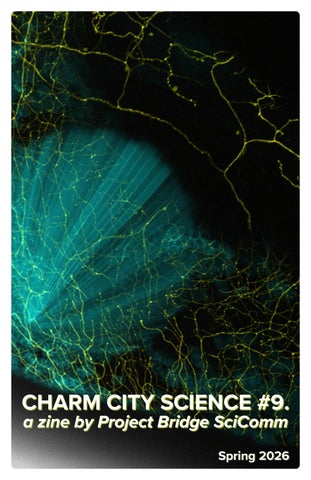
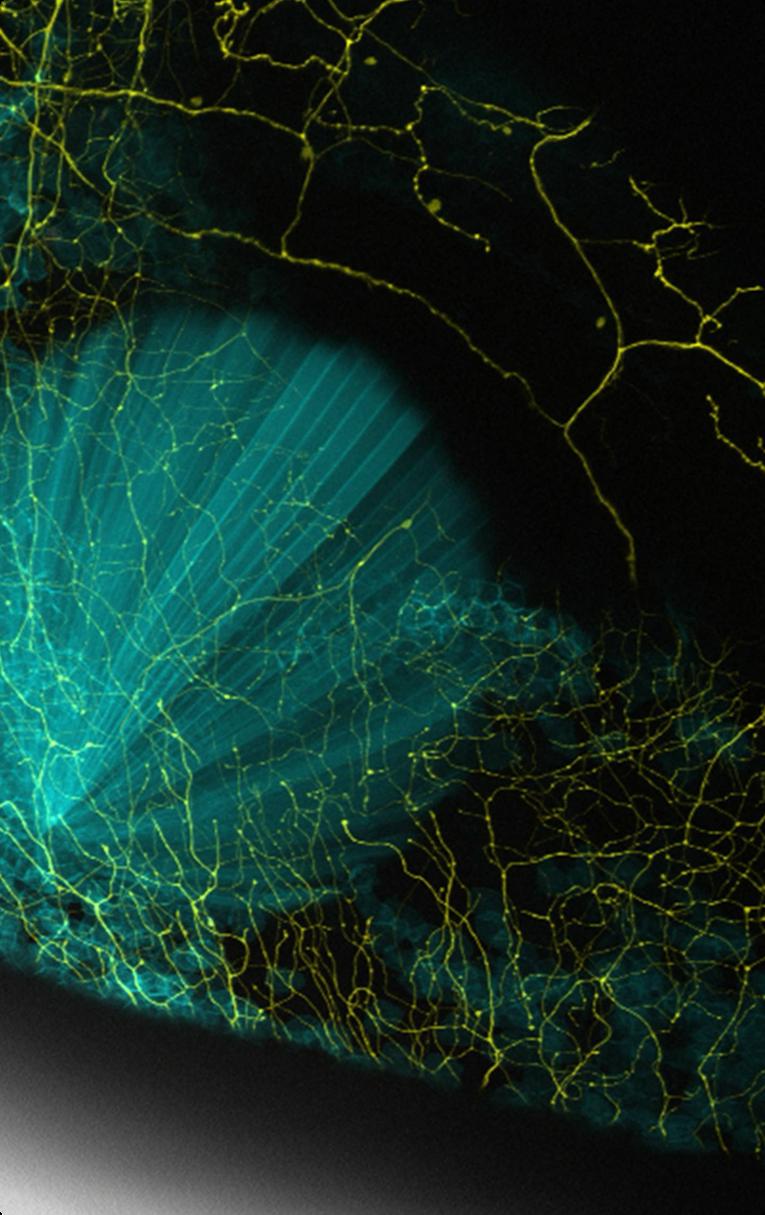
That’s an eye on our front cover, but it’s not naturally blue. Fluorescent proteins - derived from glowing jellyfish - light up cells in the cornea and lens of the eye of a zebrafish, allowing us to clearly distinguish different features in these normally transparent structures. The image shows the eye from the side, with blue protein labelling cells on the surface of the cornea (the tile -like structures) and the lens fibers (the long sickle shaped cells), while the yellow protein labels the nerve that makes the cornea so sensitive to touch. Using a sophisticated microscope, we can determine how conditions associated with diabetes alter the nerves structure over time, in living fish, as a potential early indicator of disease.
Jeff Mumm, Ph.D. Professor of Ophthalmology, Johns Hopkins School of Medicine
if you like this zine, feel free to pass it on! download a PDF file printable on any double - sided printer at bit.ly/CharmCitySci 9