Red-ALERT Research Newsletter - Winter 2025-26, Issue 5
Please send your updates for the Spring 2026 issue
A message from our Newsletter Editors
During the winter period, the Red-ALERT community had been working hard on their respective projects, with many beginning to initiate a new season of fieldwork and conferences. Meanwhile, preparations for the final Cohort 3 are well underway in the background.
We look forward to the months ahead, including the second annual conference, where we will see updates on everyone’s progress and have the opportunity for further networking and collaboration.
We hope you enjoy this issue of Red-ALERT Research and look forward to sharing more news showcasing our community in the next edition.
Best wishes, Eleanor Kirk, Sian Davies, James Milton and Rosie Elliott
Red-ALERT Spotlights
Executive Board Member Cohort 2 Student
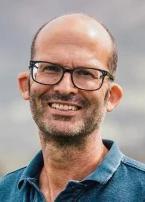
Professor Dave Chadwick (Professor of Sustainable Land Use Systems, Bangor University)
What inspires you?
I’m passionate about creating meaningful impact, whether through policy development or direct engagement with practitioners. My work is driven by a commitment to improving people’s lives and strengthening our natural environment.
What moments stand out in your career?
Securing my job at Bangor University was a real milestone for me. I never imagined back then that I would end up becoming a professor! Additionally, watching students progress through university and go on to meaningful careers is hugely motivating They embody the teaching-to-practice cycle that universities help to build This becomes especially clear when they return to give talks and showcase how their practice is shaped by the teaching they received.
A message for new researchers?
You need to be passionate and resilient. A PhD is, in many ways, about learning how to untangle the knots that inevitably arise in the research journey and not becoming disheartened by setbacks such as paper rejections Determination, steadfastness and resilience are key. Finally, the best research is conducted when we are open-minded and open to collaborating with people from many walks of life.
Working with different people, from different cultural backgrounds. It’s exciting to work in places and work with people who have a passion for different topics of interest. That’s what inspires me most.
What attracted you to your PhD?
I believe a PhD is a huge opportunity to learn new things, meet people, and do what I love, which is research. I’m a careers guy, and I like to learn new things, so it’s like a never-ending career of learning. Working with environmental DNA, I believe, is the next stage for ecology, as you’re not actually sampling individuals but you’re collecting DNA directly from the environment, which is fascinating. So, without harming the community, you can just take your sample and work with it.
What are you most excited about?
I’m keen to learn bioinformatics, because I don’t know anything about it. My background is different, as I worked with statistics and GIS and actually saw the animal every time I did research, but not now. So that’s fascinating, I think. As with bioinformatics you can work with every organism you want, just with more.
Student News
Charlotte Moreira, (Cohort 2 Biosciences student at the University of Exeter) on attending the annual Cefas Studentship Conference
On the 2nd-3rd of December, I attended the annual Centre for Environment, Fisheries and Aquaculture Science (Cefas) studentship conference alongside fellow Red-ALERT students. As my first conference, it was an excellent introduction to scientific events, and the atmosphere was welcoming and supportive throughout. The conference provided a valuable opportunity to meet scientists working across a wide range of disciplines and roles, as well as to learn from the impressive talks and posters presented by more experienced students. Overall, it was an inspiring and encouraging experience that offered real insight into the wider research community. I am grateful to the organisers for creating such an engaging and supportive environment for early-career researchers.
Nathan Strathdee, (Cohort
2 Physical Geography student at the University of Exeter) on his fieldwork around Devon and Somerset
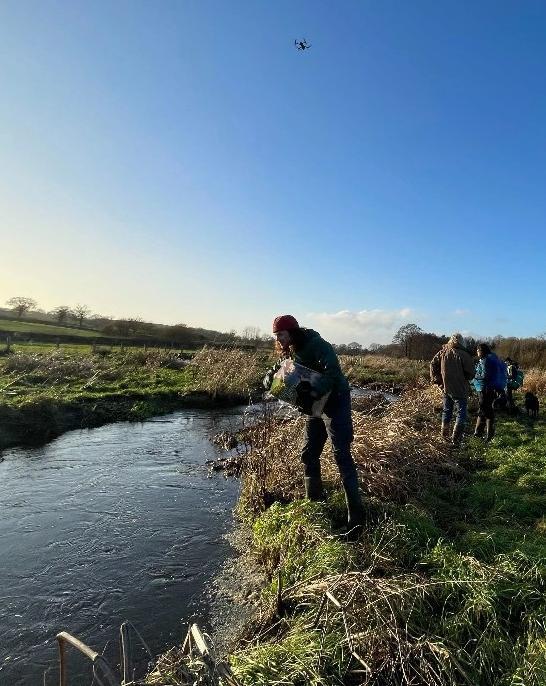
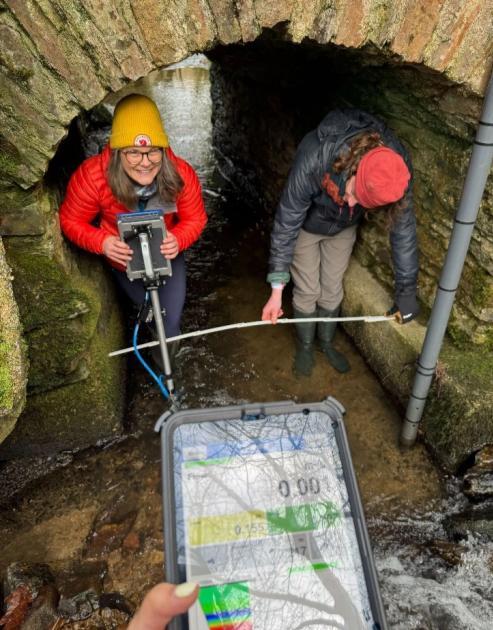
Over the past couple of months, I've been visiting a few of the river restoration sites dotted around Devon and Somerset. CREWW has been conducting hydraulic and hydrological monitoring at these locations for a while, and I have to select a subsection for my water quality monitoring. I'll be trying to draw a link between how restoration influences total nutrient and carbon fluxes and tying this to different mechanisms such as enhanced floodplain connectivity and alterations to the sediment regime. Practically, this has meant learning to deploy this has meant learning to deploy pump samplers, lugging 25 kg of water samples off Dartmoor and trying not get wet feet!
Spreading sawdust for use in large scale particle image velocimetry - a technique for mapping variations in flow using surface patterns. Holnicote - a BEAUTIFUL stage 0 site where the river has essentially been allowed to spread across the entire floodplain. It is covered in false watercress, water marigold, water holes and beavers. My monitoring will involve putting pump samplers upstream and downstream of control (no large wood) and intervention (lots of large wood) river reaches to obtain data on how river restoration projects influence peaks in pollution during storm events.
Maddy McCarthy, (Cohort 1 Red-ALERT aligned student, Univeristy of Bath) on recent fieldwork at Chromhall Integrated Constructed Wetland (ICW)
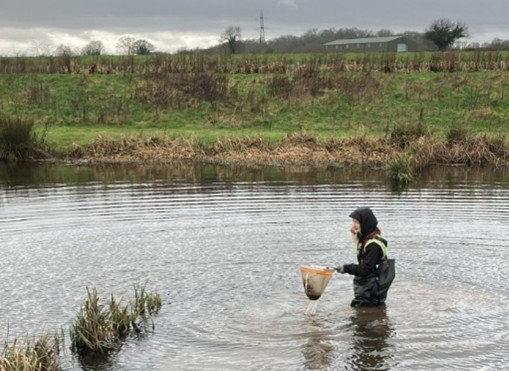
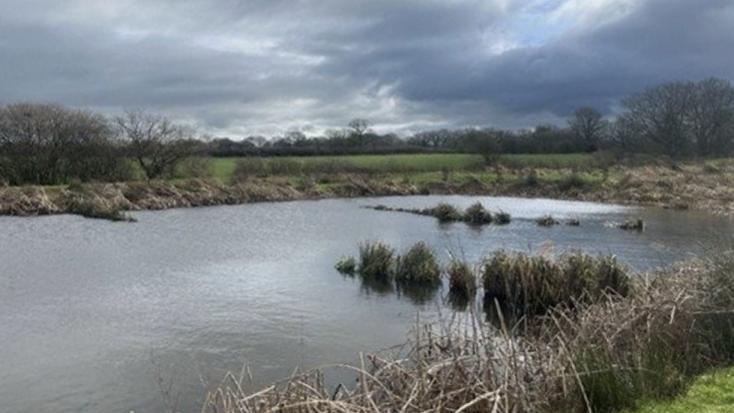
Recently, I collected samples from Chromhall ICW a tertiary Integrated Constructed Wetland created by Wessex Water This was part of a trial survey to test methods and the feasibility of exploring biodiversity within these man-made systems. We focused sampling on Cells 6a and Cell 3, as well as the influent and final effluent to try to understand if the community changes throughout the system.
Firstly, we took water samples from different mesohabitats within the cells to conduct eDNA analysis to identify macroinvertebrates. The second day of sampling involved taking invertebrate sweep samples from within the same mesohabitats, along with sediment and macrophyte biofilm samples to build a picture of the multitrophic ecosystem We will then compare the eDNA results to the macroinvertebrate sweep samples to inform on the best way to capture the system biodiversity whilst minimising disturbance.
Sian Davies, (Cohort 1 Biosciences student at Cardiff University) and Erica Boston, (Cohort 1 Biosciences student at the University of Exeter) on attending the annual British Ecological Society Conference
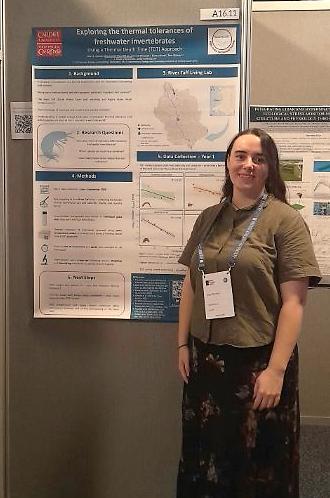
In December 2025, fellow Red-ALERT students, attended the British Ecological Society Annual Meeting in Edinburgh.
It was exciting to attend my first large conference and take part in a busy schedule of talks and workshops In addition to the thematic research sessions, I enjoyed early career sessions on publishing and reproducible coding. It was especially rewarding to present at the poster session, network with other researchers, and be immersed in varied ecological discussions throughout the week! – Sian Davies
There was an exciting, bustling atmosphere, with talks covering a range of topics, from the impacts of wildfire severity on Mediterranean forests, the importance of curriculum-embedded green skills in UK schools, and the impact of veterinary medicines on feeding habits of dung beetles. To me, there seemed to be a disproportionate number of talks and posters discussing acoustic monitoring of biodiversity. I'm excited to see how this technique further develops in the future. – Erica Boston
Time spent during Red-ALERT training at Bangor University (19
- 22/01/2026)
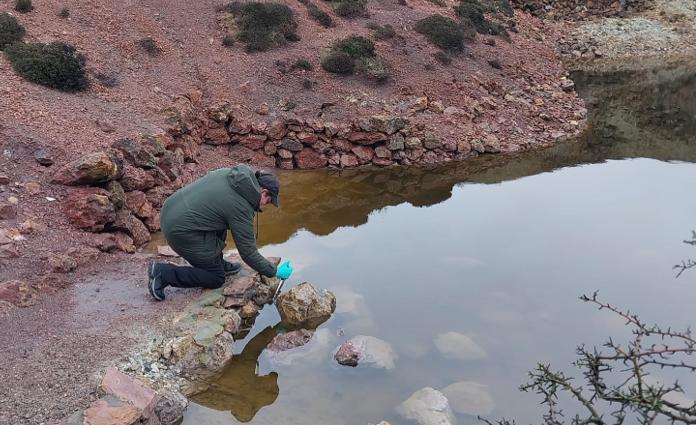
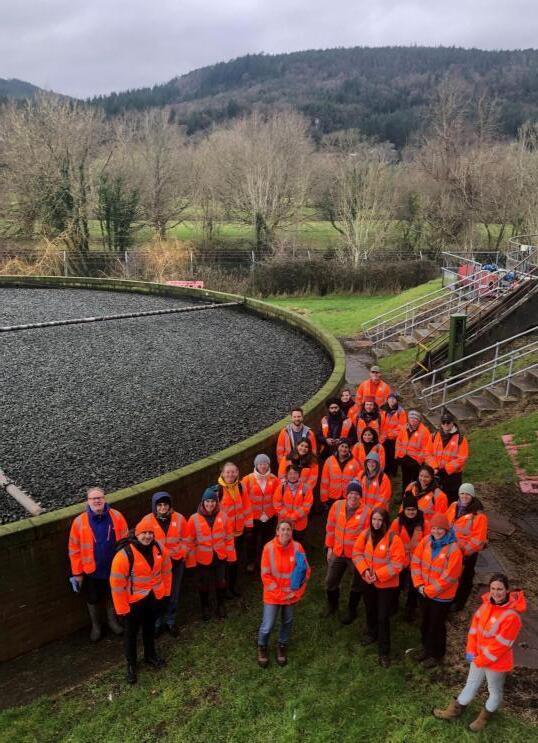
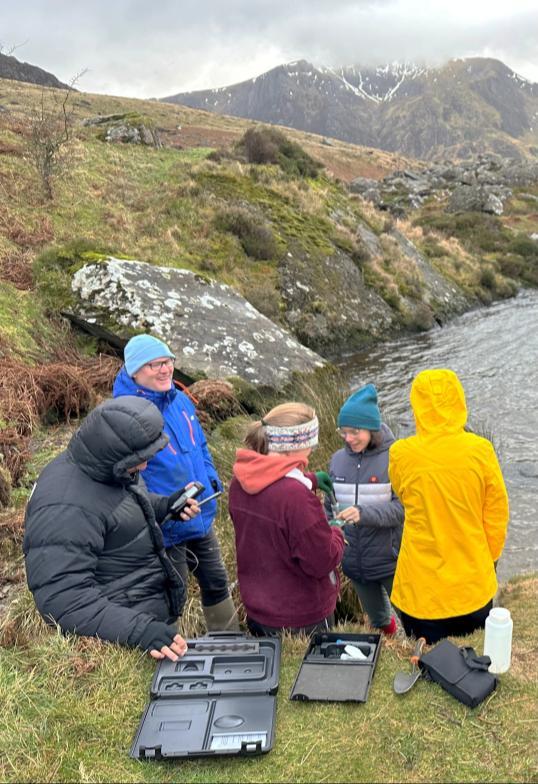
In January, students attended the Bangor University Red-Alert OneHealth Training Week. This successfully wrapped up the training weeks for Cohort 1 and gave Cohort 2 a fantastic chance to meet up again. Engaging field visits to Parys Mountain, Anglesey, and the River Conwy helped deepen students’ understanding of OneHealth and the environmental challenges linked to microbial activity and pollution within the catchment. Throughout the week, students benefited from career discussions with representatives from Dŵr Cymru Welsh Water and Natural Resources Wales, as well as sessions on data visualisation, research integrity, and peer reviewing - all valuable for developing core scientific skills.
Many thanks to everyone involved in delivering this event!
“The training was a great chance to learn about advances in water monitoring through molecular and analytical tools I had a wonderful time visiting sites such as Parys Mountain and Parc Mine to understand the effects of heavy metal toxicity on the water bodies and how that can both impact the environment, and public health!”
– Prapti Chakraborty
“I particularly enjoyed hearing from representatives from Dŵr Cymru Welsh Water and Natural Resources Wales, and to get some hands-on experience into how they conduct their testing of wastewater treatment plant standards” – Eleanor Kirk
“The fieldwork was a particular highlight. It was great to spend time outdoors and to explore the length of the Conwy. I also found the talks on the first day very interesting, they were a good way to ease into the training week.” – Maya Lhoste
“It was an excellent opportunity to explore the real-world context our research supports. Hearing about the range of career paths added real value to the experience. One highlight for me was taking part in the journal club. The guidance on academic writing and research integrity is a vital component of any doctoral programme, equipping us with the tools to critically read and communicate clearly in academic writing ” – Charlotte Moreira
Centre for Doctoral Training News
Aligned Students Join Red-ALERT Cohort 2
We’re delighted to introduce Hannah Boote, aligned student based at the University of Exeter, to Red-ALERT Cohort 2. Their research complements the CDT’s goals and will bring valuable perspectives to our work on water-based systems and environmental health.
Hannah Boote - hb791@exeter.ac.uk
Project: Exploring aspects of bacterial dormancy in the environment.
Supervisors: Dr Sariqa Wagley (University of Exeter), Dr Steve Michell (University of Exeter), Dr David Studholme (University of Exeter), Dr And Powell (CEFAS)
The second annual Red-ALERT Centre for Doctoral Training Conference will be taking place at the beginning of May at the University of Bath. Within this event there will be talks across the associated living labs form Cohort 1 students, 2-minute thesis talks from cohort 2 students and the annual poster competition. Keynote talks will include academic speaker and board member Professor Eduarda Santos for the University of Exeter Then following three external keynote speakers including, Emma Pemberton (Environment Agency), who will provide insight into regulatory and applied perspectives, Grant Stentiford (Cefas), whose work bridges research and policy in aquatic health. Finally, the programme also features a motivational talk from Stephanie Millward
This event will coincide with the second annual CWBE Centre of Excellence in Water-Based Early-Warning Systems for Health protection Conference taking place on the following day.
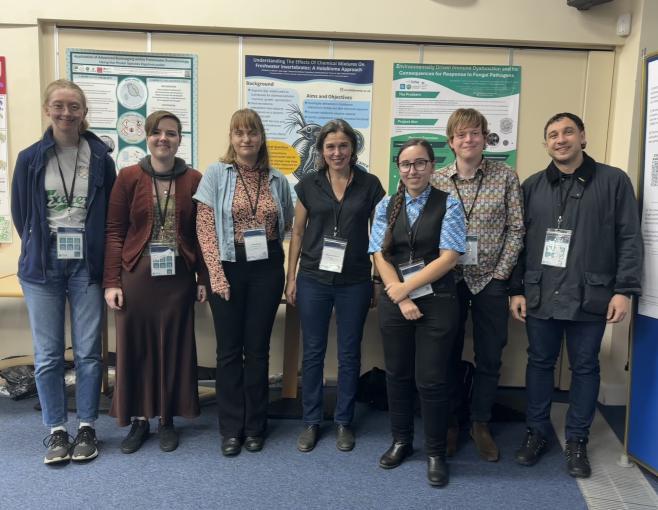
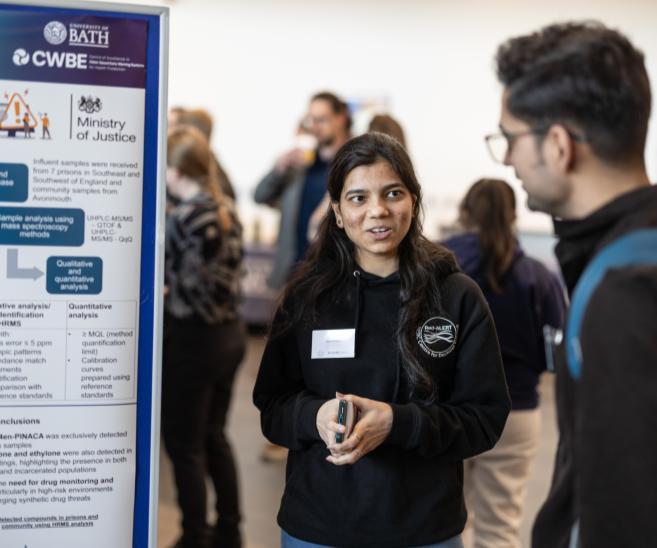
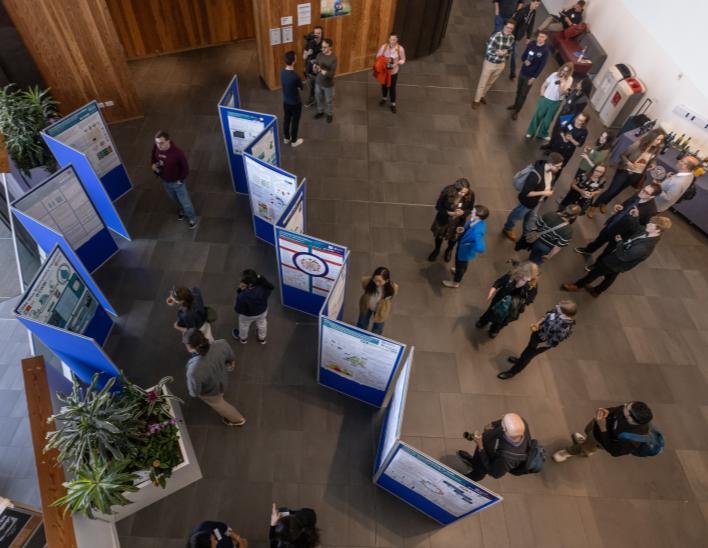
Images taken at the inaugural annual Red-ALERT Conference 2025, featuring Yashi Jain and collective attending members.
Beginnings of Cohort 3
Cohort 3 will be the final intake of students within the Red-ALERT CDT Interviews for these projects took place on the week of 23rd February, concluding a successful round of recruitment. There are a total of 14 projects we hope to see running from 2026/7, which we will be officially confirmed soon on our website and within our next issue of this newsletter.