A message from our Centre for Doctoral Training Manager …
It’s been a fantastic few months for Red-ALERT, with our growing community coming together to share ideas and celebrate progress across disciplines. Welcoming our academic and industrial partners to our first Red-ALERT Conference was a real highlight, and the support shown for our researchers and their work was truly encouraging.
Our students have made a brilliant start to their research journeys, showing great enthusiasm and professionalism in their engagement with the conference and preparing for upcoming public engagement events I’m proud of all they’ve achieved so far and look forward to seeing the CDT continue to grow from strength to strength.
We hope you enjoy this issue of ‘Red-ALERT Research’ and look forward to sharing more with you soon!
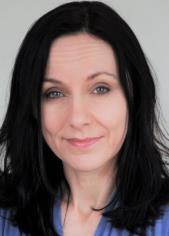
Best wishes,
Paula Buxton
Red-ALERT Spotlights
Executive Board Member Cohort 1 Student
Professor Barbara Kasprzyk-Hordern (Director of CWBE, Director of Red-ALERT, University of Bath)
What inspires you?
I’ve always loved being close to nature, something my parents passed on to me As a teen, I was concerned about the impact we’re making on our planet. I decided to study chemistry hoping I could solve all the world’s pollution problems. I was a dreamer! We talk a lot about climate change, and rightly so. Yet water comes secondary, despite being critical to our survival There is so much that needs to be done in the context of technological innovation, policy, as well as public awareness.
What moments stand out in your career?
In terms of historical projects, it must be EU funded SEWPROF ITN. SEWPROF (an EU Initial Training Network) was a major international collaboration focused on developing innovative methods for wastewater-based epidemiology (WBE) to assess public health. I coordinated this big initiative when I was just a lecturer. Our early career researchers: PhD students and PDRAs then, are now in decision making seats across Europe and beyond. I’m so proud!
A message for new researchers?
Water is critical to our survival and it’s such a unique chemical We have limited understanding of water quality issues and potential health hazards. New tools and approaches are needed to unravel some of the complexities. Interdisciplinary, one health things is the way forward.
Joseph Beaney (Red-ALERT Student Representative, Department of Chemistry, University of Bath)
What inspires you?
I think that the people we work with are really inspiring, seeing all the different aspects of research we can be involved in The real-world impact of research is very important to me, especially because we can do all these experiments in the lab, but if they don't impact policy or help clean up the environment, like we're all trying to do, then in my eyes, what's the point? So having that end goal of positively impacting the environment, that's what really inspires me!
What attracted you to your PhD?
Firstly, it was the fact that the Red-Alert was using living labs to conduct research, and there were also fantastic researchers involved Working with the living labs and water companies means our work has real-world impact. Also, I have a background in biology, but my project links biology and chemistry, enabling me to develop new skills.
What are you most excited about?
What excites me about my PhD is that I'm working on something new, so, I have the opportunity to develop novel methods and publish them. It's also enabling me – not just through my PhD project, but the wider CDT training to develop the skills and confidence I need for my future career. The CDT opens so many doors, so the opportunities really are endless.
Cohort 1 Student News
Holly Roberts, (1st-year PhD in Ecotoxicology, Biosciences, University of Exeter) on her CollaborAcademy trip to London
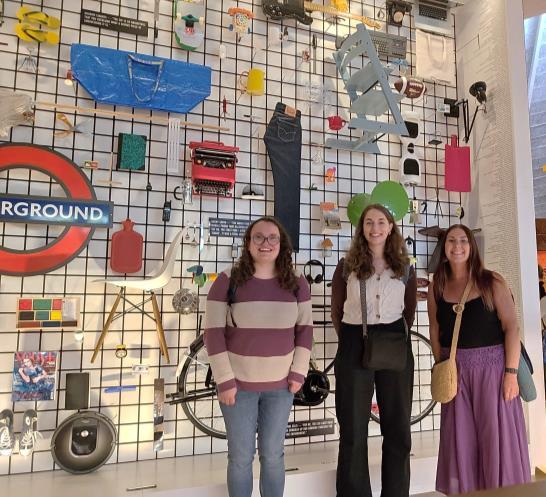
Cross-disciplinary collaboration is a fundamental part of my PhD, so I jumped at the chance to be involved in CollaborAcademy. This FFN+-funded project, led by Dr. Rosie Hornbuckle, aims to co-design a short-course syllabus focused on collaboration between environmental scientists, fashion fashion and textile designers, and engineers. As part of this project, I joined Helen O’Sullivan and Liliana Teale on a field trip to the Design Museum’s Splash! and Tomorrow’s Wardrobe exhibits, as well as the Victoria and Albert Museum. We explored how textile material choices have changed over time, what factors drive these changes, how they might influence microfibre pollution and policy, and what the future of textiles could look like.
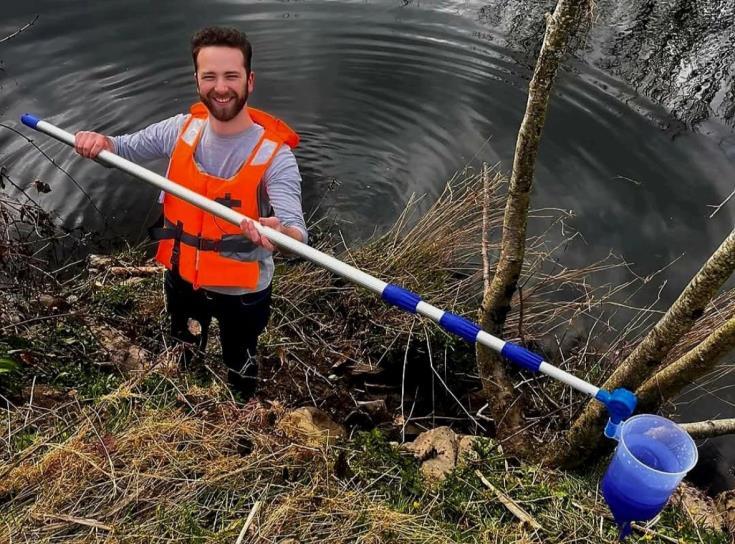
Adam Winrow, (1st-year PhD in Microbiology, Bangor University) on his time sampling the River Conwy alongside fellow Red-ALERT students
Fellow Bangor University Red-ALERT student
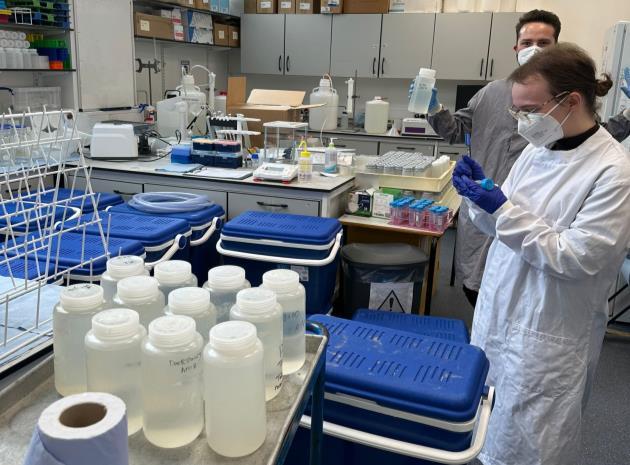
Kate Herridge and I have been working on a citizen science project, arranged by Postdoctoral Research Officer Dr Jessica Kevill, which involves collecting water samples from the River Conwy from 5 locations, covering ~15 km of the river. We have had a great response from the public, who volunteered their time to help collect samples Sampling involved splitting volunteers into 5 groups, which were then positioned along the river and collected 1020 litres of surface water.
In addition, staff collected wastewater samples from the two wastewater treatment plants located on the river (Betws-y-Coed and Llanrwst) Samples were collected every hour for 6 hours to see how the pathogen loads change over time and will be used to validate a model of viral dispersal in the river. We were also able to use the samples for some preliminary work, where I isolated fungi, Yashi Jain (Red-ALERT student) analysed the samples for microplastics, and Kate tested for source-specific indicators.
Eleanor Kirk, (1st-year PhD in Ecotoxicology, Biosciences, University of Exeter) on her time collaborating on a wildfire ecotoxicology experiment
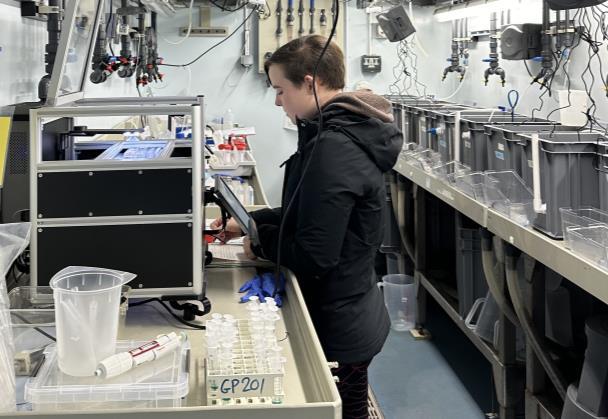
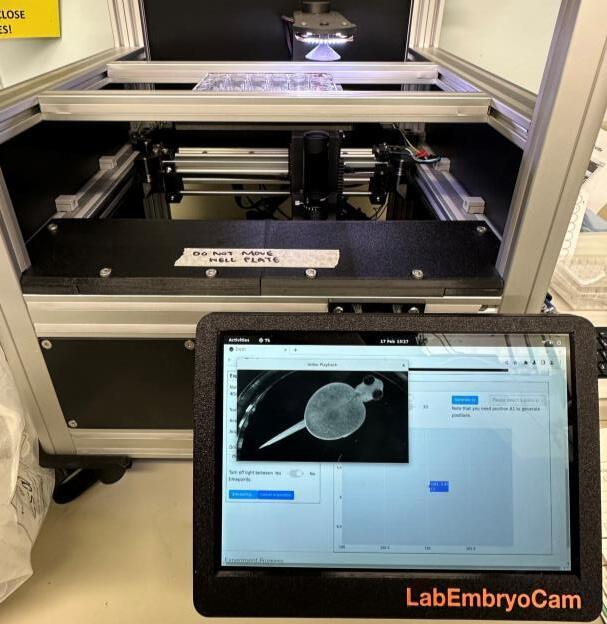
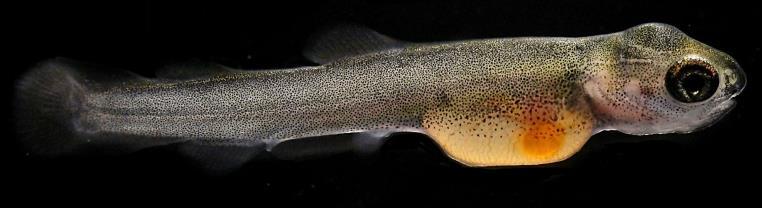
I have been working on an experiment led by Exeter University, Marie Curie Research Fellow Dr Garfield Kwan, alongside Postdoctoral Researcher Dr Dewi Ford. The project investigates the effects of Australian wildfire ash and UK peat and ash on rainbow trout (Oncorhynchus mykiss) pre and post hatching, examining how different exposure levels impact various parameters, including hatch rate, respirometry rates, metabolic rates, and the growth of hatched juveniles (alevins). My role involved using the LabEmbryoCam technology, which the technology is an integral part of my own PhD research associated with the EmbryoPhenomics team. Specifically, I am using this high-resolution imaging technology to measure the heart rates of the hatched alevins for comparison across different treatments This experience has been invaluable, not only for the opportunity to collaborate on a highly topical study but also for developing my own skills and gaining insights into applications across neighbouring research fields
Erica Boston, (1st-year PhD in Ecotoxicology, Biosciences, University of Exeter) on attending a macroinvertebrate ID course in the Lake District
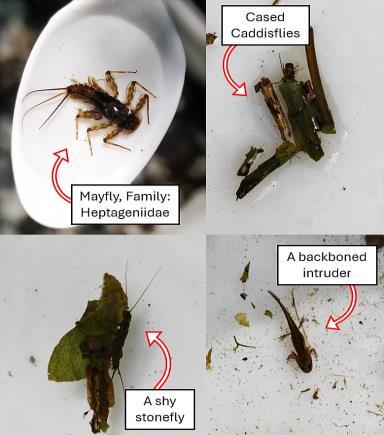
I attended a course to learn about collection and identification of mayfly (Ephemeroptera), stonefly (Plecoptera), and caddisfly (Trichoptera) larvae, taught by Craig Macadam, the Conservation Director at Buglife - Invertebrate Conservation Trust, and hosted by the Freshwater Biological Association (FBA). In my PhD project, I will be collecting a range of macroinvertebrate species from effluent-impacted streams across the Exe, Dart, and Tamar catchments, and analysing their body burdens of key wastewaterderived micropollutants. One question I hope to answer is whether bioaccumulation of certain pollutants is dependent on functional traits, therefore I need to know what exactly I'm looking at. Mayflies, stoneflies, and caddisflies are wellestablishedsceptibility established indicators of water quality, given their high susceptibility to pollution compared to most other macroinvertebrate taxa. However, closely related species may still differ in their life histories and sensitivities, making it useful to be able to identify individuals at finer taxonomic levels. The course was a detailed dive into the taxonomy and morphology of macroinvertebrate orders, mainly utilising the lab space and extensive collection of preserved specimens available at the FBA offices, to become confident in identification well beyond family level.
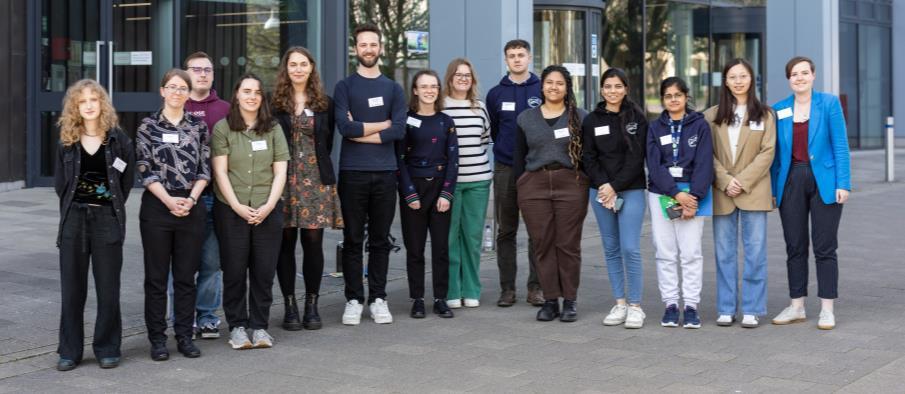
Reflecting on the first Red-ALERT Conference & Centre of Excellence in WaterBased Early-Warning Systems for Health protection (CWBE) launch at the University of Bath (31/03/2025 – 01/04/2025)
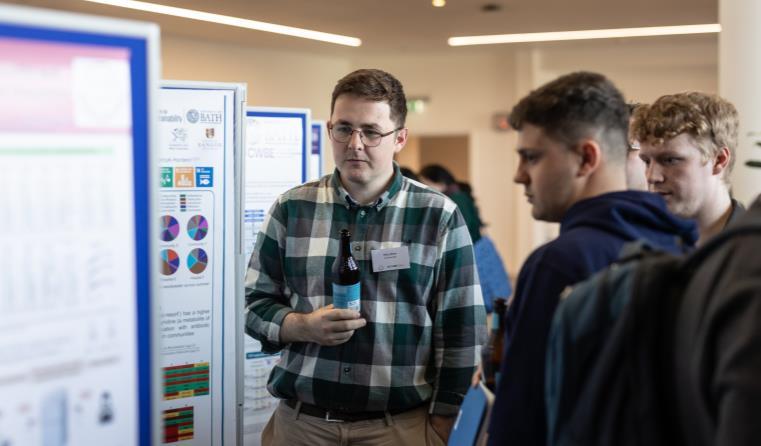
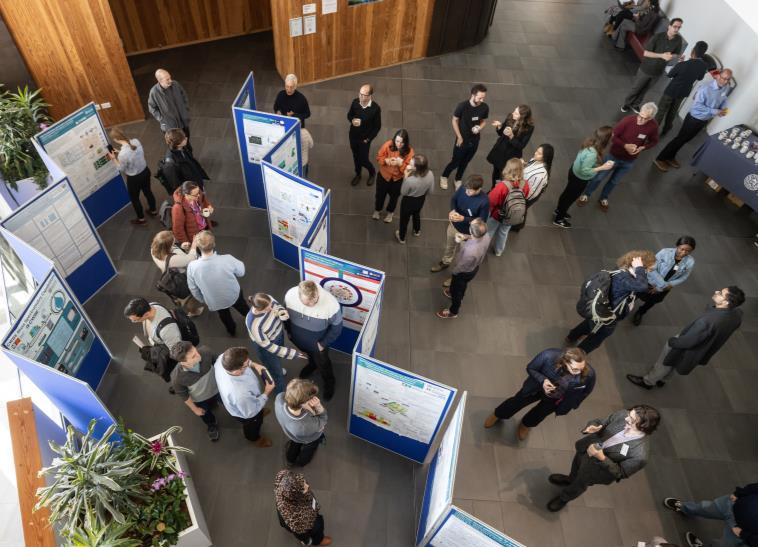
This event brought together academics, students, and industry partners for two engaging days of talks, an interactive workshop, and collaborative sessions focused on advancing water-based health protection. Red-ALERT students and ERCs had the opportunity to present their work and create posters showcasing their research, along with plenty of networking opportunities.
“During the conferences, there were opportunities to hear from various stakeholders, including speakers from DEFRA, the Welsh Government, UKHSA and local councils These talks provided valuable advice for early career researchers and insight into achieving successful collaborations and research impact ” - Sian Davies
"I really enjoyed attending the first RedALERT conference, it was a great opportunity to hear from both students and professionals in the field. I especially valued the chance to connect with our industry partners and learn about the range of projects starting in wastewaterbased epidemiology“ - Adam Winrow
"Meeting water-based researchers and experts in the industry was one of the highlights of the PhD so far - to see a diverse community come together to share their findings and ideas on a common theme was inspiring.“ - Erica Boston
“It was a fantastic opportunity to attend both conferences, highlighting a diverse range of research and there were lots of opportunities for networking and collaboration.” - Kate Herridge
"It was a wonderful experience to hear about so many interesting projects I particularly enjoyed sharing our work and connecting with industry partners It was also an excellent opportunity to learn from others and gain insights from experienced individuals regarding our research ’’ - Yashi Jain
Centre for Doctoral Training News
Aligned Students Join Red-ALERT Cohort 1
We’re delighted to welcome Maddy McCarthy and Evan Johns, aligned students based at the University of Bath, to Red-ALERT Cohort 1. Their research complements the CDT’s goals and will bring valuable perspectives to our work on water-based early-warning systems and environmental health.
Maddy McCarthy - mgm79@bath.ac.uk
Project: Ecology and intertrophic interactions within nature-based solutions, focusing on integrated constructed wetlands and the fate of pollutants within them and downstream.
Supervisors: Prof. Jan Hofman (University of Bath), Dr Jannis Wenk (University of Bath), Prof. Barbara Kasprzyk-Hordern (University of Bath), Dr Thomas Kjeldsen (University of Bath), Prof. Andrew Weightman Cardiff University), Dr Fredrick Windsor (Cardiff University)
Evan Jones - edj22@bath.ac.uk
Project: Portable hybrid Aptamer-MIP sensors for electrochemical detection of per- and polyfluoroalkyl substances (PFAS).
Supervisors: Dr Hannah Leese (University of Bath), Prof. Pedro Estrela (University of Bath), Prof. Tianhong Cui (University of Minnesota)
Red-ALERT CDT Conference & CWBE Launch – 31st March - 1st April 2025
The first Red-ALERT Centre for Doctoral Training Conference took place at the University of Bath, bringing together researchers, industry experts, and policy leaders to share progress on real-time digital water-based monitoring. Congratulations to Eleanor Kirk (University of Exeter), who won the prize for best poster, and Erica Boston (University of Exeter), who received the prize for best 2-Minute Flash Talk award.
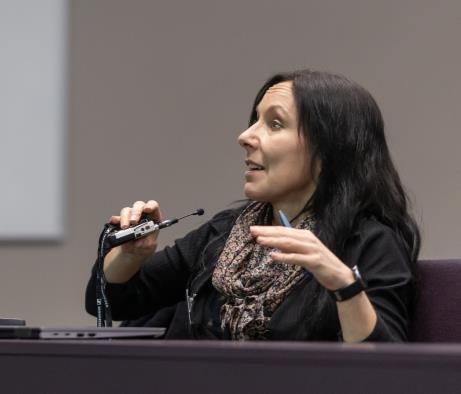
The event also marked the official launch of the Centre of Excellence in Water-Based EarlyWarning Systems for Health Protection (CWBE). The launch was opened by Professor Sarah Hainsworth, Pro Vice-Chancellor at the University of Bath, and introduced by CWBE Director Professor Barbara Kasprzyk-Hordern, alongside fellow Co-Directors. CWBE aims to drive innovation in wastewater-based early-warning systems to protect public and environmental health. With its collaborative approach, the Centre is working closely with Wessex Water, the UK Health Security Agency, and UK government departments to deliver real-world impact across research, policy, and health protection.
Festival of Nature – 7th June 2025
Join us on Saturday 7 June at Southgate Shopping Centre (11:00–16:00), where Red-ALERT Cohort 1 students and CWBE early career researchers will be running two stalls showcasing their research and hands-on activities for all ages. This marks the opening weekend of the UK’s largest free celebration of the natural world, Festival of Nature, running from 7th –15th June 2025. This year’s theme is water, with events highlighting the vital role of rivers and celebrating the launch of the Bath Riverline, a new riverside trail connecting green spaces throughout the city.
Cohort 1 Publications
Comparative impact of sunlight and salinity on human pathogenic virus survival in river estuarine, and marine water microcosms
Kevill, J.L., Herridge, K., Li, X., Farkas, K., Malham, S.K., Robins, P., Jones, D.L., 2025, In: Water Research, 278, 123411