
Potential Economic Policy Changes for 2025
By Dr. Brian K. Strow Dean, Marshall E. Rinker, Sr. School of Business, Palm Beach Atlantic University
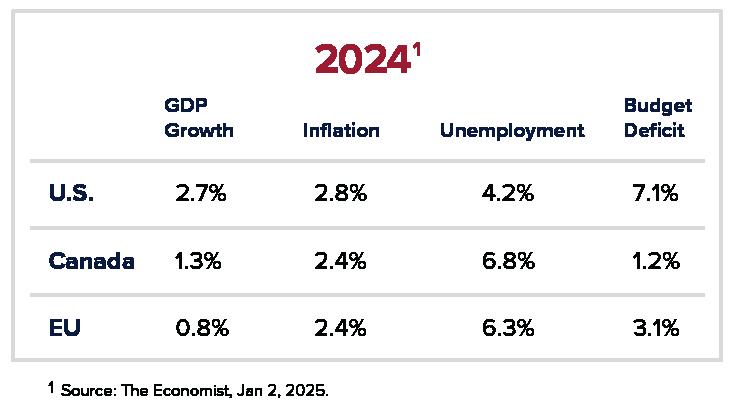
President Trump takes office coming off a year where the U.S. economy grew at a 2.7 percent clip, and unemployment was low (4.2 percent). That’s the good news. The bad news is that inflation for the year (2.8 percent), remained above the Fed’s two percent target while the government continued to borrow money at a pace once reserved for wartime or major financial crashes. Voters demanded a change in economic policy. What economic policy changes can we expect from the Trump Administration in 2025 and what would be their impact?
The $36 Trillion Question
The Trump tax cuts are set to expire at the end of the year. Without action, tax rates will go up for millions of Americans. Even with the Trump tax cuts, federal tax revenues have grown by $1.6 trillion since 2016. At the same time, federal spending has grown by $2.8 trillion. That is unsustainable. It also complicates extension of the Trump tax cuts.

The big question is: Can Congress cut enough government spending to offset Trump’s tax priorities to get a budget through the reconciliation process? Expect the Department of Government Efficiency (DOGE) led by Elon Musk and the Office of Management and Budget (OBM) to play an important role in this year’s budget process. Failure to curb runaway government spending will continue to drive up government debt, interest rates, and inflation. It will also slow long term economic growth.
Governments across the globe have been seeing their cost of borrowing increase. Their collective borrowing binge will leave an economic hangover in the next decade. The US is currently paying $1.1 trillion a year in interest payments on the U.S. debt. That is a whopping one-third of all federal taxes collected!
Merely stopping the rate of growth in government spending is not enough. Real cuts need to occur to prevent the US from creating a self-imposed fiscal crisis. If Republicans look to cut taxes further than in President Trump’s first term, this will need to be offset by even more spending cuts. Disagreement over the appropriate cap on state and local tax (SALT) deductions has the potential to throw a wrench into the budget process. Republican representatives from hightaxed blue states would like to see the SALT cap raised or eliminated. Republicans elsewhere saw Trump’s
imposition of the $10,000 SALT cap in his first term helped drive people and businesses from blue states to red states. Florida and its citizens are net winners when SALT deductions are capped.
Deregulation: A 10 for 1?
President Trump’s first term in office was defined by a desire to reduce federal government control over business and the economy. A goal in his second term is to eliminate 10 regulations for every new one that gets added. As a general rule, government regulations increase the cost of goods and services in the economy.
Deregulation, done prudently, could be a force to help keep inflation in check. It could also serve to increase U.S. productivity.
Expect mergers and acquisitions to be more readily approved now that Lina Kahn will no longer run the Federal Trade Commission. The crypto-currency industry bet big on President Trump. Expect him to have the Securities and Exchange Commission (SEC) to have a change of heart on its need to heavily regulate cryptocurrency.
The Green New Deal? We will likely say goodbye to taxpayer subsidies related to green energy. Fossil fuel development won’t be blocked. Energy costs are the second largest cost (behind labor costs) in the production of goods and services. A more market driven energy sector will help keep prices lower for American consumers.
Tariffs: Trade Wars as Diplomacy or Economic Ruin?
Over 30 percent of U.S. trade is with Canada and Mexico. In his first term, President Trump renegotiated the North American Free Trade
Agreement (NAFTA). Will President Trump follow through on his threats of large tariffs on “enemies” of the U.S.? On our “friends”? Tariffs are a tax on U.S. consumers as well as on foreign producers. When other countries retaliate, U.S. exporters bear the cost of higher taxes as well. If the tariff tax increases are offset by reductions in other capital or labor taxes, this would lower their overall economic drag on the economy.
If the threat of tariffs causes friendly countries to embrace other policies that help the U.S., (such as encouraging Mexico to help stop the flow of undocumented immigrants) there could be political benefit to the bluff of a trade war. Alternatively, actual trade wars have highly negative economic actions. The Smoot Hawley Tariff of 1930 diminished economic activity and helped plunge the nation into the Great Depression, which precipitated World War II. As 19th Century economist Frédéric Bastiat warned, “If goods don’t cross borders, soldiers will.”

Immigration: What is the correct amount?
In 2023, 14.3 percent of those who lived in the U.S. were foreign born. In 1970, the percentage was 4.7 percent. While the Trump Administration will attempt to stem the flow of illegal immigration, it must also determine the appropriate level and composition of legal immigration. U.S. businesses flourish when we allow highly educated and skilled immigrants to bring their human capital to the U.S. Likewise, the U.S. agriculture
and construction industries benefit from the availability of non-college educated immigrants. The presence of these workers helps to lower the cost of food and new housing. Immediate expulsion of the ten million plus undocumented immigrants currently living in the U.S. would radically alter housing and labor markets in the short term. The cost of goods and services that rely heavily on undocumented labor would increase and this cost would be borne by U.S. consumers. Expect a more targeted deportation policy that will limit economic chaos. After all, with an unemployment rate of only 4.2 percent, the U.S. has very little ability to replace the workers we deport unless we replace them with other new legal immigrants.
Conclusion: Trump’s Attempt to Make America Great Again, Again
There is plenty to be optimistic about in 2025 from an economic policy perspective. America’s success will be at the forefront of the administration’s agenda. Burdensome government regulations will likely be rolled back, allowing U.S. companies to produce goods and services more efficiently. The economy is growing, and unemployment is low.
From taxes and spending to tariffs and immigration, important issues will need to be addressed in the first months of President Trump’s second term. Slim Republican majorities in the U.S. House and Senate will require political discipline to get the president’s priorities across the finish line. As author of The Art of the Deal, President Trump will be looking to cut several deals. One thing is certain, what happens to economic policy in the first half of 2025 will impact the economy for years to come.
The LeMieux Center for Public Policy at Palm Beach Atlantic University provides a space for reasoned, thoughtful and civil discourse on pressing public policy issues confronting Florida, the United States and the world.
Your support allows the Center to continue with our mission. We invite you to give today online at pba.edu
LeMieux Center Advisory Board
James Donnelly Castle Group
Frances Fisher Vice-Chair, LeMieux Center Dedicated Volunteer
Mitzi Freidheim Dedicated Volunteer
Margie Helmholdt Lou Church Foundation
James C. Jenkins Esko, Inc.
Josh Kellam The Garcia Companies
Paul M. Lawless Partner, Lawless, Edwards and Warren
Senator George S. LeMieux Chair, LeMieux Center Gunster
William M. Matthews Private Investor
Mario Murgado Brickell Motors
Joe Negron GEO Group, Inc.
John Radtke Zeus Financial, LLC
J. Kimble Vardaman Ratliff, Jr. Lawless, Edwards & Warren
Robert Taylor Burdette Beckmann, Inc.
Karl Watson, Jr. Baker Construction Enterprises, Inc.
From the Desk of Senator LeMieux
Welcome to the latest edition of The Quill and the first publication for 2025.
The Quill provides reasoned and insightful discourse on key public policy issues that affect Florida, the United States, and the global community. Each edition features contributions from academic scholars, policymakers, journalists, and other experts who provide insightful analysis on a topic of current interest.
In this issue, Dr. Brian Strow, dean of the Rinker School of Business at Palm Beach Atlantic University (PBA), explores the issue at the forefront of everyone’s minds: the economic policies of the new Trump administration. He discusses the expiration of the 2017 tax cuts, strategies for managing the national debt, which stands at $36 trillion, and the necessity for substantial reductions in federal spending.
Dr. Strow also examines the implications of tariff policies and trade regulations on domestic pricing alongside the challenges of balancing immigration policy with skilled migrant labor that supports US businesses. These policies are pivotal in shaping the financial outlook for 2025 and beyond.
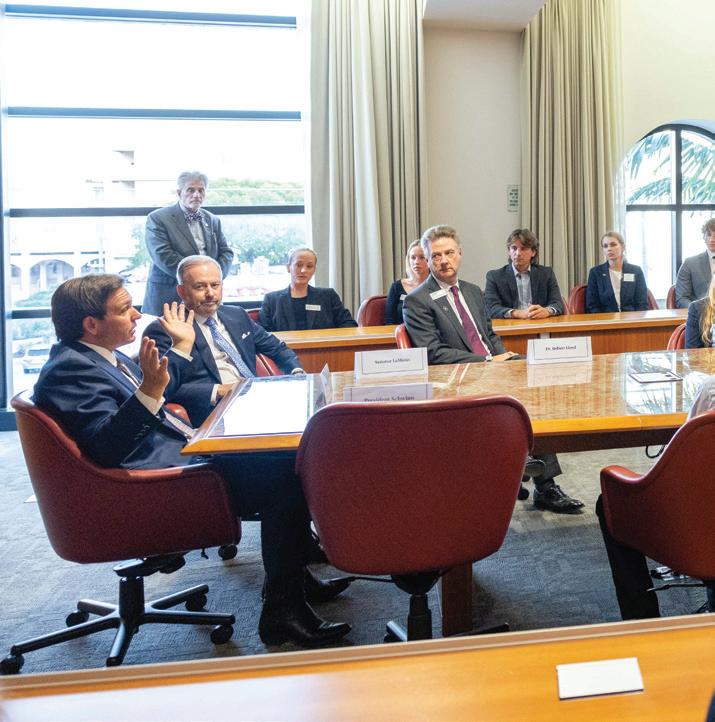
PBA’s LeMieux Center for Public Policy offers numerous opportunities to engage with current affairs through this publication and our events. Our distinguished Speaker Series has featured notable individuals including Doris Kearns Goodwin, presidential historian and Pulitzer Prize-winning author, retired General Frank McKenzie, former commander of the U.S. Central Command, and Florida Governor Ron DeSantis. This year features former U.S. Secretary of Defense Robert M. Gates, national security expert Elizabeth Neumann, and PBA alumna Michelle Rigby Assad, a former CIA operative and security consultant.
Additionally, the Freidheim Fellows Program at the Center is a cornerstone event each year. This initiative selects two PBA students annually to research and present on significant public policy issues, preparing them to lead in their fields. It is always the highlight of my year, a solid reminder of the investment we are making in preparing the leaders of tomorrow.
Our work is possible thanks to the support of our Board of Advisors and others like you, whose commitment to public service continues to inspire and drive our mission forward.
We are grateful for our partnership with PBA and confident that our collaborative efforts will continue to make a meaningful impact. To read other issues of The Quill or learn more about our programs, visit https://www.pba.edu/academics/schools/ centers-of-excellence/lemieux/.

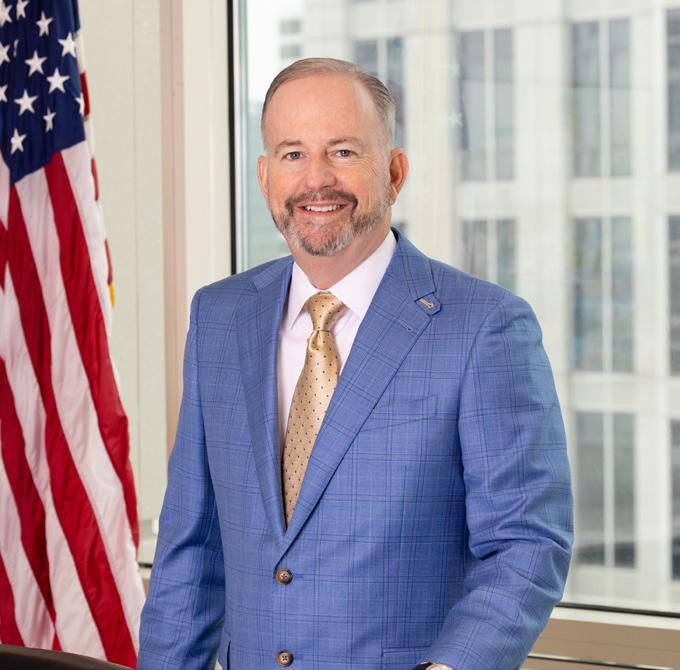
George S. LeMieux
U.S. Senator and Founder of The LeMieux Center for Public Policy lemieuxcenter.org
Palm Beach Atlantic University P.O. Box 24708 West Palm Beach, FL 33416-4708
Tune in: The Quill Podcast is streaming now!
Senator George S. LeMieux and Dr. Robert Lloyd lead The Quill Podcast — in which they tackle conversations of consequence to the political, economic and social realms. Listen and follow today on Spotify and Apple Podcasts: pba.edu/quill