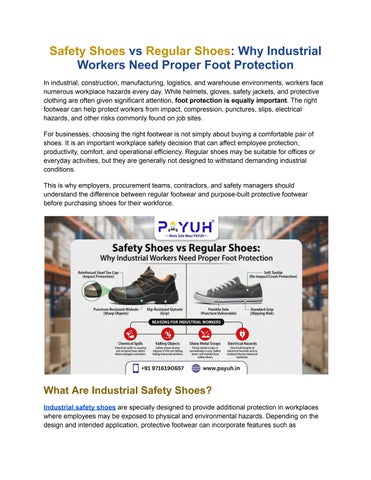
Safety Shoes vs Regular Shoes: Why Industrial Workers Need Proper Foot Protection In industrial, construction, manufacturing, logistics, and warehouse environments, workers face numerous workplace hazards every day. While helmets, gloves, safety jackets, and protective clothing are often given significant attention, foot protection is equally important. The right footwear can help protect workers from impact, compression, punctures, slips, electrical hazards, and other risks commonly found on job sites. For businesses, choosing the right footwear is not simply about buying a comfortable pair of shoes. It is an important workplace safety decision that can affect employee protection, productivity, comfort, and operational efficiency. Regular shoes may be suitable for offices or everyday activities, but they are generally not designed to withstand demanding industrial conditions. This is why employers, procurement teams, contractors, and safety managers should understand the difference between regular footwear and purpose-built protective footwear before purchasing shoes for their workforce.
What Are Industrial Safety Shoes? Industrial safety shoes are specially designed to provide additional protection in workplaces where employees may be exposed to physical and environmental hazards. Depending on the design and intended application, protective footwear can incorporate features such as
reinforced toe protection, slip-resistant soles, durable uppers, puncture-resistant components, and enhanced grip. Unlike ordinary footwear, safety footwear is developed with workplace risks in mind. Different industries can have very different requirements, so businesses should select footwear according to the hazards workers actually encounter. For example, construction workers may need protection from falling objects and sharp materials, while warehouse employees may prioritize impact protection, grip, durability, and long-hour comfort.
Regular Shoes vs Safety Shoes: What Is the Difference? At first glance, regular shoes and safety shoes may look similar. However, their construction, materials, protection features, and intended applications can be significantly different. Regular shoes are primarily designed for comfort, appearance, walking, or general daily use. They are not necessarily engineered to protect the feet against workplace hazards. Safety footwear, on the other hand, is designed around occupational protection. Depending on the model and applicable standards, it may include protective toe caps, reinforced construction, slip-resistant outsoles, or other protective features. For B2B buyers, this distinction is important because selecting footwear based solely on price or appearance can leave employees inadequately protected.
1. Protection Against Falling and Heavy Objects One of the most common reasons businesses choose protective footwear is the risk of objects falling onto workers' feet. Construction sites, factories, warehouses, workshops, and industrial facilities may involve tools, components, machinery parts, boxes, and other heavy materials. A regular shoe typically offers limited protection against these hazards. Protective footwear with an appropriate toe-protection system can provide an additional layer of defense against impact and compression hazards. When purchasing footwear for employees, companies should assess the types of materials workers handle and the potential severity of workplace incidents before deciding which protection level is appropriate.
2. Better Protection Against Sharp Objects Construction and industrial environments can contain nails, metal fragments, broken materials, screws, glass, and other sharp objects.
The sole of an ordinary shoe may not provide sufficient resistance against penetration. Protective footwear designed for hazardous environments can incorporate additional sole protection where required by the application. This feature can be particularly valuable for construction workers, maintenance teams, manufacturing personnel, and other employees who frequently walk across areas containing debris or sharp materials.
3. Improved Slip Resistance Slips and falls are a major workplace concern, particularly in environments where floors may become wet, oily, dusty, or contaminated. Regular footwear may not provide the level of traction needed for industrial environments. Proper protective footwear can feature specially designed outsoles intended to improve grip on appropriate workplace surfaces. However, businesses should remember that slip resistance is not a guarantee against every type of fall. The footwear should be selected according to the actual floor conditions and hazards present at the workplace.
4. Greater Durability for Demanding Workplaces Industrial employees can spend many hours walking, standing, climbing, lifting, or moving materials. Everyday shoes are generally not designed for this level of continuous workplace use. Durable work footwear can help businesses reduce premature footwear replacement when employees work in demanding environments. Strong stitching, appropriate upper materials, reinforced construction, and durable outsoles can all contribute to product longevity. For procurement teams managing large workforces, durability is particularly important because frequent replacement can increase long-term operating costs.
5. Better Support During Long Working Hours Footwear is not only about protection. Comfort matters too. Employees may spend eight or more hours on their feet, depending on their job responsibilities. Poorly fitting footwear can contribute to discomfort and fatigue, potentially affecting concentration and productivity. Businesses should therefore consider factors such as fit, cushioning, weight, breathability, flexibility, and overall ergonomic design when selecting protective footwear.
The objective should be to find a balance between protection, durability, comfort, and workplace suitability.
6. Suitable for Different Industrial Applications Not every workplace has the same hazards. A warehouse, construction project, manufacturing plant, oil and gas facility, workshop, and logistics operation can each require different footwear characteristics. For example: ● ● ● ● ● ●
Construction: Impact protection, grip, durability, and resistance to site conditions Manufacturing: Toe protection, slip resistance, durability, and comfort Warehousing: Grip, lightweight construction, protection, and long-hour comfort Workshops: Protection against mechanical hazards and sharp materials Logistics: Comfort, traction, durability, and impact protection Maintenance: Protection suitable for tools, equipment, and workplace surfaces
Companies should avoid adopting a one-size-fits-all purchasing approach without first assessing the risks associated with each work area.
Why Businesses Should Not Use Regular Shoes for Industrial Work Using regular shoes in hazardous workplaces may create unnecessary exposure to workplace risks. A standard shoe may have a comfortable design, but comfort alone does not make footwear suitable for industrial applications. It may lack protective toe reinforcement, adequate sole construction, slip resistance, or other features needed for a particular work environment. For employers, providing appropriate PPE is also part of creating a stronger workplace safety culture. Employees are more likely to take safety seriously when organizations consistently provide suitable protective equipment and reinforce correct usage. Companies should also establish clear policies requiring employees to wear designated protective footwear in areas where it is necessary.
Choosing the Right Safety Footwear for Your Workforce B2B buyers should consider several factors before placing a bulk footwear order.
1. Identify Workplace Hazards
Start by conducting a workplace risk assessment. Determine whether employees face falling objects, sharp materials, slippery floors, electrical risks, chemicals, heat, or other hazards.
2. Check Applicable Standards Protective footwear should be selected according to relevant workplace requirements and applicable safety standards. Procurement teams should verify product documentation, certifications, and specifications before making a purchase.
3. Consider Employee Comfort Protection should not come at the expense of usability. Shoes that are uncomfortable or poorly fitted may discourage employees from wearing them correctly.
4. Select the Correct Size Range For large workforce purchases, ensure that the supplier can provide an appropriate range of sizes. Consider collecting employee size information before finalizing a bulk order.
5. Evaluate Sole and Grip Requirements Different workplace surfaces require different traction characteristics. Consider whether employees work on concrete, metal platforms, wet floors, dusty surfaces, or other conditions.
6. Assess Durability Businesses should consider expected usage frequency, working conditions, construction quality, and maintenance requirements. A slightly higher initial purchase price may be worthwhile if the footwear offers better suitability and service life.
What Should Procurement Teams Look for in Bulk Purchases? When purchasing footwear for dozens or hundreds of employees, businesses should look beyond the product's unit price. A reliable supplier should be able to provide consistent product quality, multiple sizes, clear specifications, dependable supply, and appropriate documentation. Businesses should also evaluate delivery timelines, replacement policies, customization requirements, and after-sales support where applicable. For example, companies sourcing Safety Shoes for workers should evaluate the product according to their workplace requirements rather than selecting footwear simply because of its name or appearance.
The same principle applies when evaluating different brands and product ranges. Procurement decisions should be based on workplace hazards, required protection, employee comfort, quality, compliance requirements, and overall value.
Why Supplier Reliability Matters for B2B Buyers For a small individual purchase, choosing footwear can be relatively simple. For a company managing a large workforce, procurement becomes more complex. A supplier must be capable of maintaining consistency across bulk orders. If different batches vary significantly in quality, sizing, construction, or availability, it can create problems for safety managers and procurement departments. Businesses should therefore work with suppliers who understand industrial PPE requirements and can support recurring orders. Reliable supply is particularly important for industries with high employee turnover, multiple project locations, or continuous PPE replacement requirements.
Safety Shoes Should Be Part of a Complete PPE Program Foot protection should not be treated as an isolated safety measure. A comprehensive PPE program may include: ● ● ● ● ● ● ● ● ● ●
Safety helmets Reflective safety jackets and vests Protective gloves Safety shoes Coveralls and boiler suits Eye protection Hearing protection Respiratory protection Safety harnesses Other application-specific protective equipment
The right PPE combination depends on the hazards present at each workplace. For businesses, the goal should be to provide employees with PPE that is appropriate for their specific tasks rather than distributing identical equipment across every department.
Why Quality Matters More Than the Cheapest Price
Price is an important consideration for every procurement department, particularly when buying PPE in bulk. However, purchasing the cheapest available footwear may not always provide the best overall value. Poor-quality footwear can wear out faster, provide inadequate protection, or create comfort problems that affect employee acceptance. A better purchasing strategy is to evaluate total value. This includes product quality, protection, durability, comfort, supplier reliability, documentation, replacement requirements, and expected service life. For organizations comparing options such as construction Safety Shoes, the purchasing decision should therefore consider how well the footwear matches the actual working environment and employee requirements.
How PAYUH INDUSTRIES Can Support B2B PPE Requirements PAYUH INDUSTRIES focuses on supplying safety and protective products for industrial, construction, manufacturing, and other demanding workplace environments. Businesses can consider a coordinated PPE procurement approach rather than sourcing every product separately. Depending on workplace requirements, this may include safety jackets, reflective vests, protective footwear, helmets, gloves, coveralls, harnesses, and other workplace safety products. Working with an experienced PPE supplier can make bulk procurement easier by helping organizations evaluate product specifications, quantities, sizes, and application requirements. For companies looking for industrial safety shoes, it is important to communicate the workplace conditions and expected usage to the supplier. This allows the procurement team to select footwear that is better aligned with the actual risks employees face.
Final Thoughts Regular shoes may be appropriate for everyday activities, but industrial workplaces demand a higher level of protection. Construction sites, factories, warehouses, workshops, and other industrial environments can expose workers to falling objects, sharp materials, slippery surfaces, heavy equipment, and other hazards. Proper protective footwear can help businesses reduce unnecessary exposure to these risks while supporting employee comfort and workplace safety.
For B2B buyers, the best approach is to evaluate footwear based on hazard protection, quality, durability, comfort, applicable standards, employee requirements, and supplier reliability rather than price alone. By choosing appropriate PPE and building a structured workplace safety program, organizations can create safer working environments while making more informed long-term procurement decisions. PAYUH INDUSTRIES can help businesses evaluate and source safety products for construction, manufacturing, industrial, warehouse, and other workplace applications. For bulk PPE requirements, businesses should discuss their application, workforce size, product specifications, and delivery requirements with the supplier before placing an order. #IndustrialSafetyShoes #SafetyShoesForWorkers #ConstructionSafetyShoes