Recipe book
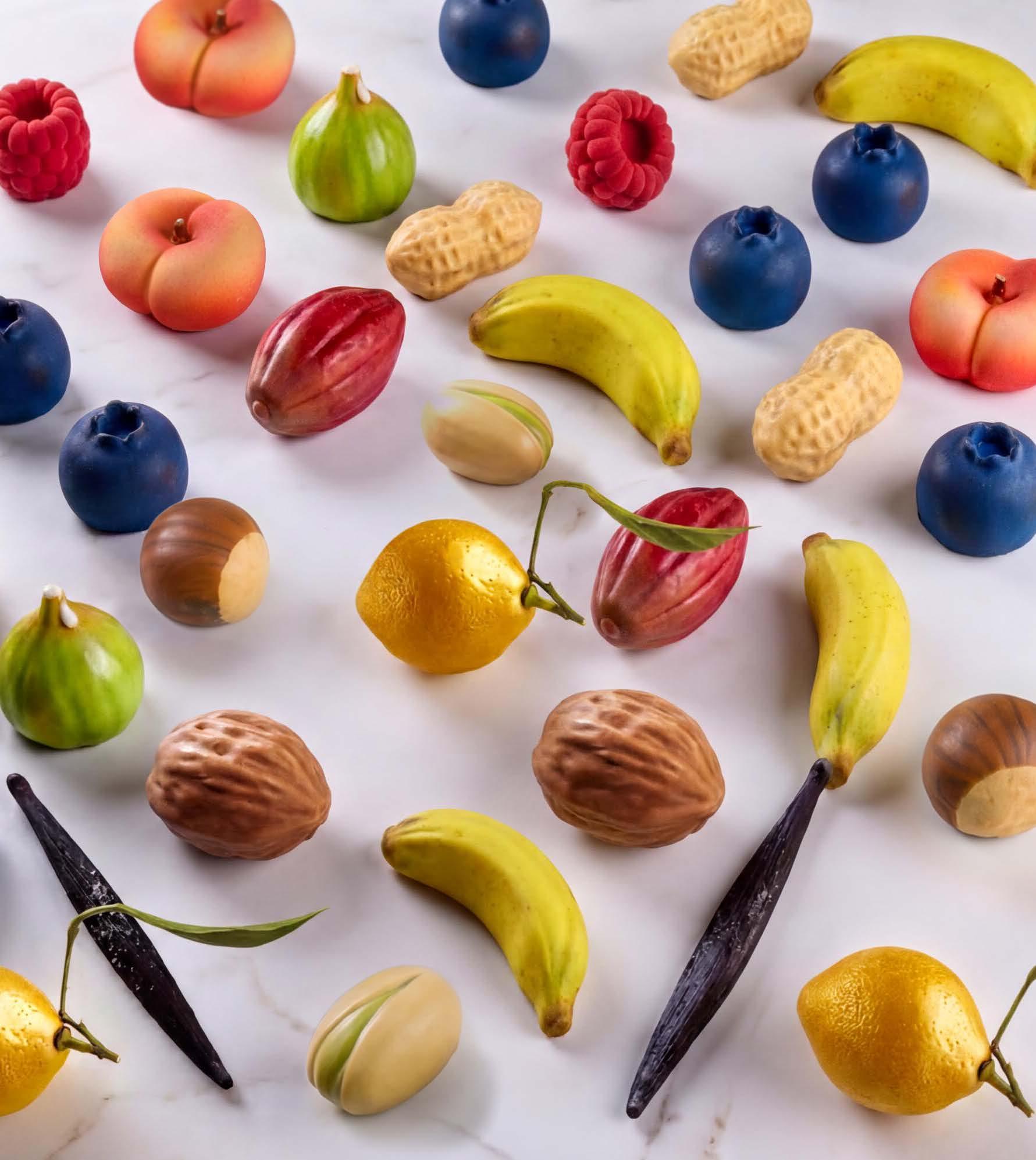
/ Fig
Mirtillo / Blueberry
Pesca tabacchiera / Flat peach
Arachide / Peanut
Noce / Nutshell
Mandorla / Almond
Pistacchio / Pistachio
Nocciola / Hazelnut
Cabossa / Cabosse
Limone / Citron
Vaniglia / Vanilla
Lampone / Raspberry
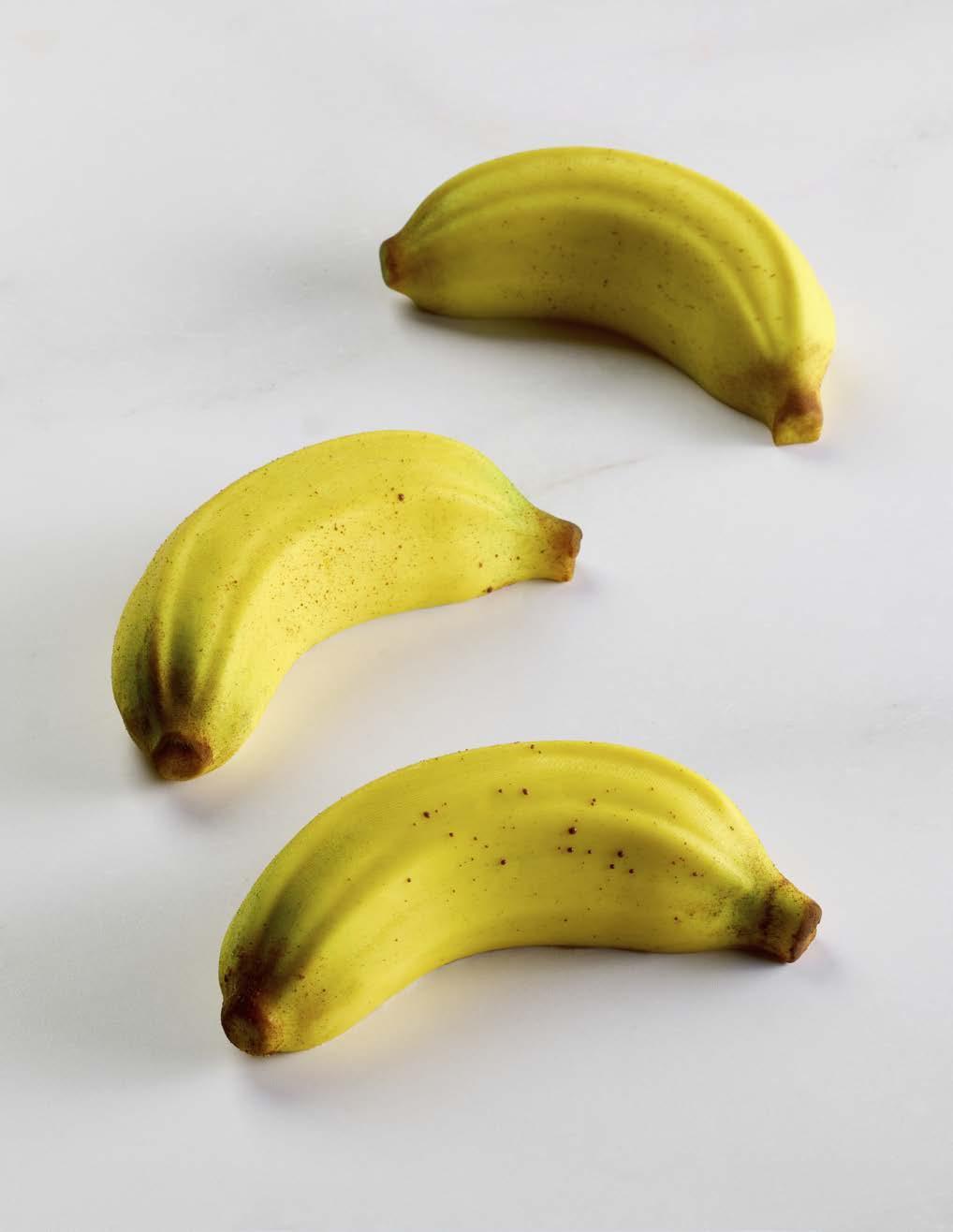
Dacquoise alla Banana
Albumi g 144
Zucchero di canna g 132
Purea di banana g 112
Arachidi in polvere g 104
Zucchero a velo g 40
Farina debole g 56
Banana matura 1
Arachidi tostate
salate q.b.
Montare gli albumi con lo zucchero di canna fino a ottenere una meringa francese stabile. Incorporare delicatamente la purea di banana fredda, quindi aggiungere le polveri precedentemente setacciate.
Stendere il composto in uno spessore di 1 cm su una teglia da 30 × 40 cm.
Tagliare la banana a rondelle di circa 4 mm e distribuirla uniformemente sulla superficie. Completare con alcune arachidi tostate salate. Cuocere a 170°C per circa 17 minuti.
Croccante alla Banana
Cioccolato biondo g 115
Pralinato di arachidi g 235
Pasta di arachidi g 115
Sale fino g 5
Banane essiccate g 100
Caramello Morbido
Panna fresca
35% m.g. g 95
Latte intero (1) g 25
Sciroppo di glucosio (1) g 25
Bacca di vaniglia 1
Sale fino g 1
Zucchero semolato g 45
Sciroppo di glucosio (2) g 50
Burro morbido g 32
Latte intero (2) g 22
Fondere il cioccolato biondo e unirlo al pralinato e alla pasta di arachidi.
Aggiungere il sale e le banane essiccate precedentemente sbriciolate finemente in un cutter.
Stendere uno strato sottile di croccante sulla dacquoise ancora fredda e conservare in congelatore fino all’utilizzo.
Portare a ebollizione la panna, il latte (1), lo sciroppo di glucosio (1), i semi della vaniglia e il sale.
Preparare contemporaneamente un caramello a secco con lo zucchero e lo sciroppo di glucosio (2). Quando il caramello raggiunge 185°C, decuocere versando gradualmente il composto bollente.
Riportare il tutto a 107°C, quindi lasciare raffreddare fino a 70°C.
Aggiungere il burro morbido e il latte (2), quindi emulsionare con un frullatore a immersione fino a ottenere un composto perfettamente liscio.
Inserto alla Banana
Banana matura pulita g 150
Burro g 20
Zucchero
semintegrale g 20
Purea di lime g 15
Rum scuro (40% vol.) g 10
Purea di banana g 200
Amido modificato g 2
Scorza grattugiata di 1 lime
Bacca di vaniglia 1
Fondere il burro con lo zucchero in una casseruola.
Aggiungere la banana tagliata a brunoise e la purea di lime, quindi cuocere a fuoco vivace fino all’evaporazione della parte liquida. Sfumare con il rum e lasciare raffreddare.
Frullare separatamente la purea di banana con l’amido modificato fino a ottenere un gel. Unire il gel alla banana cotta, aggiungendo la scorza grattugiata del lime e i semi della vaniglia. Conservare in frigorifero fino all’utilizzo.
Namelaka
alla Banana
Purea di banana g 200
Massa gelatinosa g 30
Cioccolato biondo g 340
panna fresca
35% m.g. g 400
Glassa Anidra Gialla
Cioccolato bianco g 500
Burro di cacao g 400 Colorante liposolubile
giallo limone Pavoni
Glassa Anidra Fondente
Montaggio e decorazione
Cioccolato bianco g 250
Burro di cacao g 200 Colorante liposolubile nero
Scaldare una parte della purea di banana e sciogliervi la massa gelatinosa.
Fondere il cioccolato biondo e aggiungere la purea calda, quindi incorporare la restante purea fredda fino a ottenere una ganache liscia.
Unire la panna fredda ed emulsionare con un frullatore a immersione evitando di incorporare aria. Coprire con pellicola a contatto e lasciare cristallizzare in frigorifero a 4°C per almeno 8 ore.
Fondere separatamente il cioccolato bianco e il burro di cacao.
Unire i due composti, aggiungere il colorante ed emulsionare con un frullatore a immersione. Utilizzare a 30°C.
Fondere separatamente il cioccolato bianco e il burro di cacao.
Aggiungere il colorante nero ed emulsionare con un frullatore a immersione.
Utilizzare a 35°C.
Cacao in polvere
Burro di cacao verde Pavoni
Montare leggermente la namelaka e trasferirla in una sac à poche.
Rivestire lo stampo con circa 27 g di namelaka. Colare 7 g di caramello morbido e aggiungere 37 g di inserto alla banana.
Ricavare la base di dacquoise e inserirla nello stampo con il lato del croccante rivolto verso l’interno.
Sigillare con altra namelaka e congelare completamente.
Sformare il dolce e immergerlo nella glassa anidra gialla mantenuta a 30°C.
Una volta cristallizzata la glassa, sfumare le estremità con cacao in polvere.
Aerografare leggere sfumature verdi con burro di cacao verde sulle estremità.
Terminare schizzando delicatamente la superficie con la glassa anidra fondente utilizzando uno spazzolino per riprodurre le caratteristiche puntinature della banana.
Banana Dacquoise Egg whites g 144
Brown sugar g 132
Banana purée g 112
Peanut flour g 104
Icing sugar g 40
Cake flour g 56
Ripe banana 1
Toasted salted peanuts, as needed
Banana Crunch
Blonde chocolate g 115
Peanut praline g 235
Peanut paste g 115
Fine salt g 5
Dried bananas g 100
Whip the egg whites with the brown sugar until a stable French meringue forms.
Gently fold in the cold banana purée, followed by the sifted dry ingredients.
Spread the batter to a thickness of 1 cm on a 30 × 40 cm baking tray.
Slice the banana into 4 mm rounds and arrange evenly over the surface. Sprinkle with toasted salted peanuts.
Bake at 170°C for approximately 17 minutes.
Melt the blonde chocolate and combine it with the peanut praline and peanut paste. Add the salt and finely crushed dried bananas. Spread a thin layer over the cooled dacquoise and freeze until required.
Soft Caramel
Heavy cream (35% fat) g 95
Whole milk (1) g 25
Glucose syrup (1) g 25
Vanilla bean 1
Fine salt g 1
Caster sugar g 45
Glucose syrup (2) g 50
Softened butter g 32
Whole milk (2) g 22
Bring the cream, milk (1), glucose syrup (1), vanilla seeds and salt to a boil.
Meanwhile, prepare a dry caramel with the caster sugar and glucose syrup (2).
When the caramel reaches 185°C, carefully deglaze with the hot cream mixture. Cook to 107°C, then allow to cool to 70°C. Add the softened butter and milk (2), then emulsify with an immersion blender until perfectly smooth.
Banana Insert
Ripe banana, peeled g 150
Butter g 20
Raw cane sugar g 20
Lime purée g 15
Dark rum (40% vol.) g 10
Banana purée g 200
Modified starch g 2
Zest of lime 1
Vanilla bean 1
Melt the butter with the sugar in a saucepan. Add the diced banana and lime purée and cook over high heat until most of the moisture has evaporated.
Deglaze with the dark rum and allow to cool. Blend the banana purée with the modified starch until a smooth gel forms.
Fold the gel into the cooked bananas together with the lime zest and vanilla seeds.
Refrigerate until needed.
Banana Namelaka Banana purée g 200
Gelatin mass g 30
Blonde chocolate g 340
Heavy cream (35% fat) g 400
Yellow Anhydrous Glaze
Dark Anhydrous Glaze
White chocolate g 500
Cocoa butter g 400 Yellow fat-soluble food colouring (Pavoni)
Heat part of the banana purée and dissolve the gelatin mass in it.
Melt the blonde chocolate and gradually add the warm purée, followed by the remaining cold purée, to obtain a smooth ganache.
Add the cold cream and emulsify with an immersion blender, avoiding air incorporation.
Cover with plastic wrap in contact and refrigerate at 4°C for at least 8 hours before use.
Melt the white chocolate and cocoa butter separately.
Combine them, add the colouring and emulsify with an immersion blender.
Use at 30°C.
White chocolate g 250
Cocoa butter g 200
Black fat-soluble food colouring
Assembly and Decoration
Cocoa powder Green cocoa butter (Pavoni)
Melt the white chocolate and cocoa butter separately.
Add the colouring and emulsify with an immersion blender.
Use at 35°C.
Lightly whip the namelaka and transfer it to a piping bag.
Pipe approximately 27 g into each mould to create an even coating.
Add 7 g of soft caramel followed by 37 g of the banana insert.
Cut the dacquoise to size and place it into the mould with the crunchy layer facing inward.
Seal with additional namelaka and freeze completely.
Unmould and dip into the yellow anhydrous glaze at 30°C.
Once crystallised, dust both ends with cocoa powder.
Airbrush light green shades onto the ends using green cocoa butter.
Finish by lightly splattering the surface with the dark anhydrous glaze using a toothbrush to recreate the characteristic speckles of a ripe banana.
portions
Bavarese alla ricotta di bufala
Latte intero g 400
Zucchero g 50
Tuorli g 110
Baccello di vaniglia 1
Gelatina animale
170 Bloom g 11
Acqua per gelatina g 50
Ricotta di bufala g 400
Panna 35% g 400
Cuore colante al fico e mela
Glassa croccante verde
Purea di fico
surgelata g 300
Miele di acacia g 30
Cubetti di mela fresca g 100
Cubetti di fico candito g 50
Cioccolato
bianco 35% g 200
Burro di cacao g 180
Colorante in polvere
liposolubile L01SB
verde mela
Pavoni Italia g 1,5
Realizzare una crema inglese con il latte, il baccello di vaniglia, i tuorli e lo zucchero, cuocendo fino a raggiungere la temperatura di 85°C. Aggiungere la gelatina precedentemente idratata e versare il composto sulla ricotta di bufala. Lavorare con un mixer a immersione fino a ottenere una massa liscia e omogenea. Quando il composto raggiunge i 25°C, incorporare delicatamente la panna montata.
Unire il miele alla purea di fico a temperatura ambiente. Aggiungere i cubetti di mela e di fico candito, mescolando delicatamente. Colare negli stampi da inserto e abbattere fino a completo congelamento.
Sciogliere separatamente il cioccolato bianco e il burro di cacao. Unire il colorante e mixare accuratamente fino a ottenere un composto perfettamente omogeneo. Utilizzare la glassa a una temperatura compresa tra 30 e 33°C.
Streusel alla nocciola
Farina debole g 200
Zucchero di canna g 200
Burro morbido g 200
Polvere di nocciole g 200
Sale g 2
Streusel ricomposto
Glassa anidra bianca
Montaggio
Streusel alla
nocciola cotto g 400
Glassa anidra bianca g 100
Cioccolato
bianco 35% g 300
Burro di cacao g 300
Mescolare tutti gli ingredienti nella planetaria fino a ottenere un composto omogeneo. Granellare il composto con una griglia. Congelare. Cuocere a 160°C fino a doratura. Lasciare raffreddare completamente. Aggiungere la glassa croccante fusa e amalgamare bene.
Sciogliere la glassa anidra bianca a 40°C. Versarla sullo streusel cotto e amalgamare accuratamente.
Sciogliere separatamente il cioccolato bianco e il burro di cacao. Unire i due ingredienti e mixare fino a ottenere una glassa liscia. Utilizzare a una temperatura compresa tra 30 e 33°C.
Preparare il cuore colante e congelarlo. Preparare la bavarese.
Riempire lo stampo PX43146 con uno strato di bavarese. Inserire il cuore colante congelato. Coprire con altra bavarese e livellare.
Congelare completamente. Sformare. Glassare con gelatina neutra.
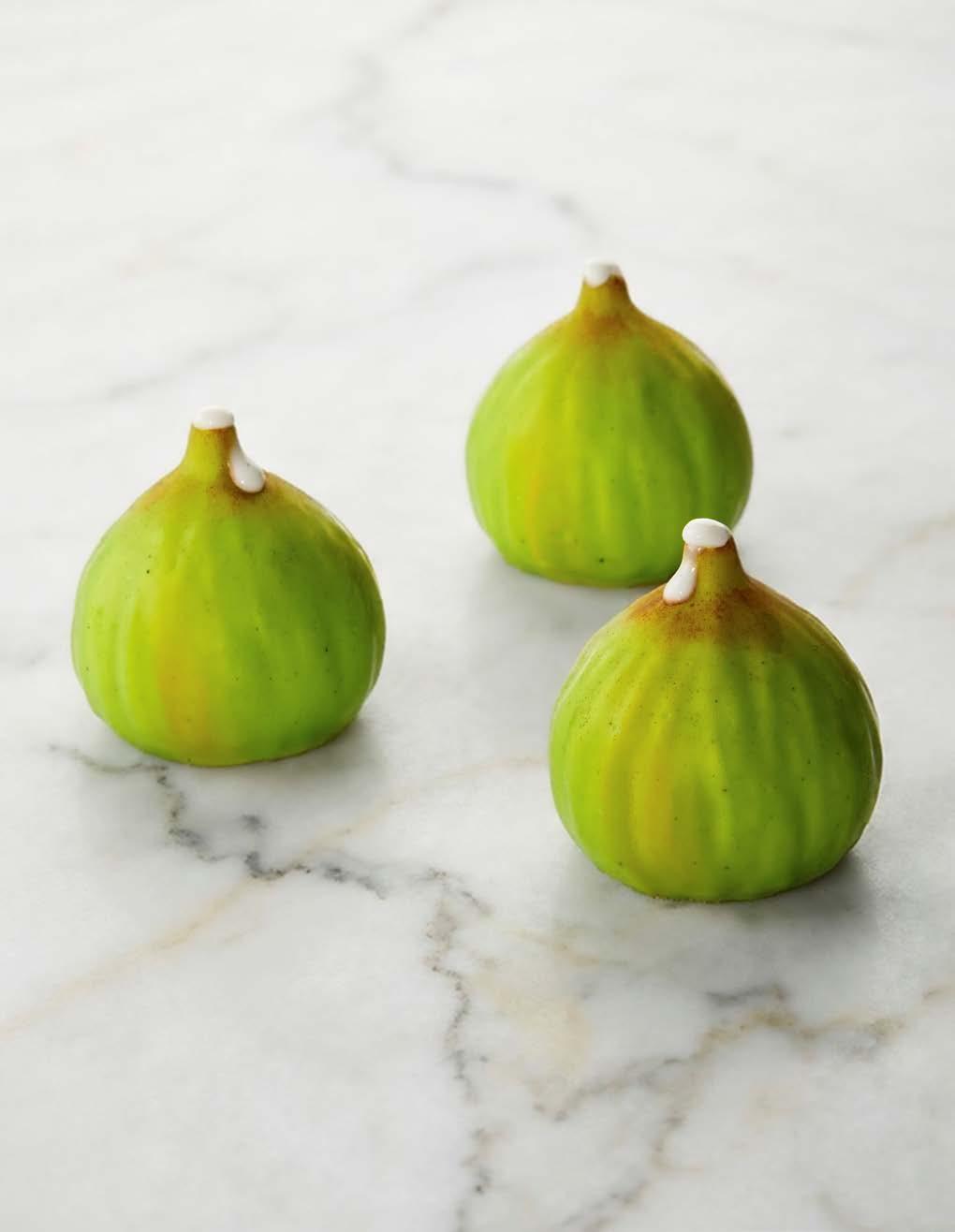
Ricoprire con la glassa croccante verde. Posizionare sul disco di streusel ricomposto. Decorare con burro di cacao giallo limone e cacao.
Buffalo ricotta
bavarois
Fig and apple flowing center
Green crunchy glaze
Whole milk g 400
Sugar g 50
Egg yolks g 110
Vanilla bean 1
Animal gelatin
170 Bloom g 11
Water for gelatin g 50
Buffalo ricotta g 400
35% whipping cream g 400
Frozen fig purée g 300
Acacia honey g 30
Fresh apple cubes g 100
Candied fig cubes g 50
35% white chocolate g 200
Cocoa butter g 180
Pavoni Italia L01SB
Apple Green
fat-soluble powdered coloring g 1.5
Prepare an English custard by combining the milk, vanilla bean, egg yolks, and sugar, cooking until the mixture reaches 85°C. Add the previously hydrated gelatin and pour the mixture over the buffalo ricotta. Blend with an immersion blender until smooth and homogeneous. When the mixture reaches 25°C, gently fold in the whipped cream.
Combine the honey with the fig purée at room temperature. Add the apple cubes and candied fig cubes, mixing gently. Pour into insert molds and blast freeze until completely frozen.
Melt the white chocolate and cocoa butter separately. Add the coloring and blend thoroughly until perfectly homogeneous. Use the glaze at a temperature between 30 and 33°C.
Hazelnut streusel
Weak flour g 200
Brown sugar g 200
Soft butter g 200
Hazelnut powder g 200
Salt g 2
Reconstituted streusel Baked hazelnut streusel g 400
White anhydrous glaze g 100
Mix all the ingredients in a planetary mixer until homogeneous. Pass the dough through a grid to create coarse crumbs. Freeze. Bake at 160°C until golden brown. Allow to cool completely. Add the melted crunchy glaze and mix thoroughly.
Melt the white anhydrous glaze to 40°C. Pour it over the baked streusel and mix thoroughly.
White anhydrous glaze
35% white chocolate g 300
Cocoa butter g 300
Melt the white chocolate and cocoa butter separately. Combine the two ingredients and blend until smooth. Use the glaze at a temperature between 30 and 33°C.
Assembly Prepare the flowing center and freeze it. Prepare the Bavarois. Fill the PX43146 mold with a layer of Bavarois. Insert the frozen flowing center. Cover with additional Bavarois and level the surface. Freeze completely. Unmold. Glaze with neutral glaze. Coat with the green crunchy glaze. Place on the reconstituted streusel disc. Decorate with lemon-yellow cocoa butter and cocoa powder.
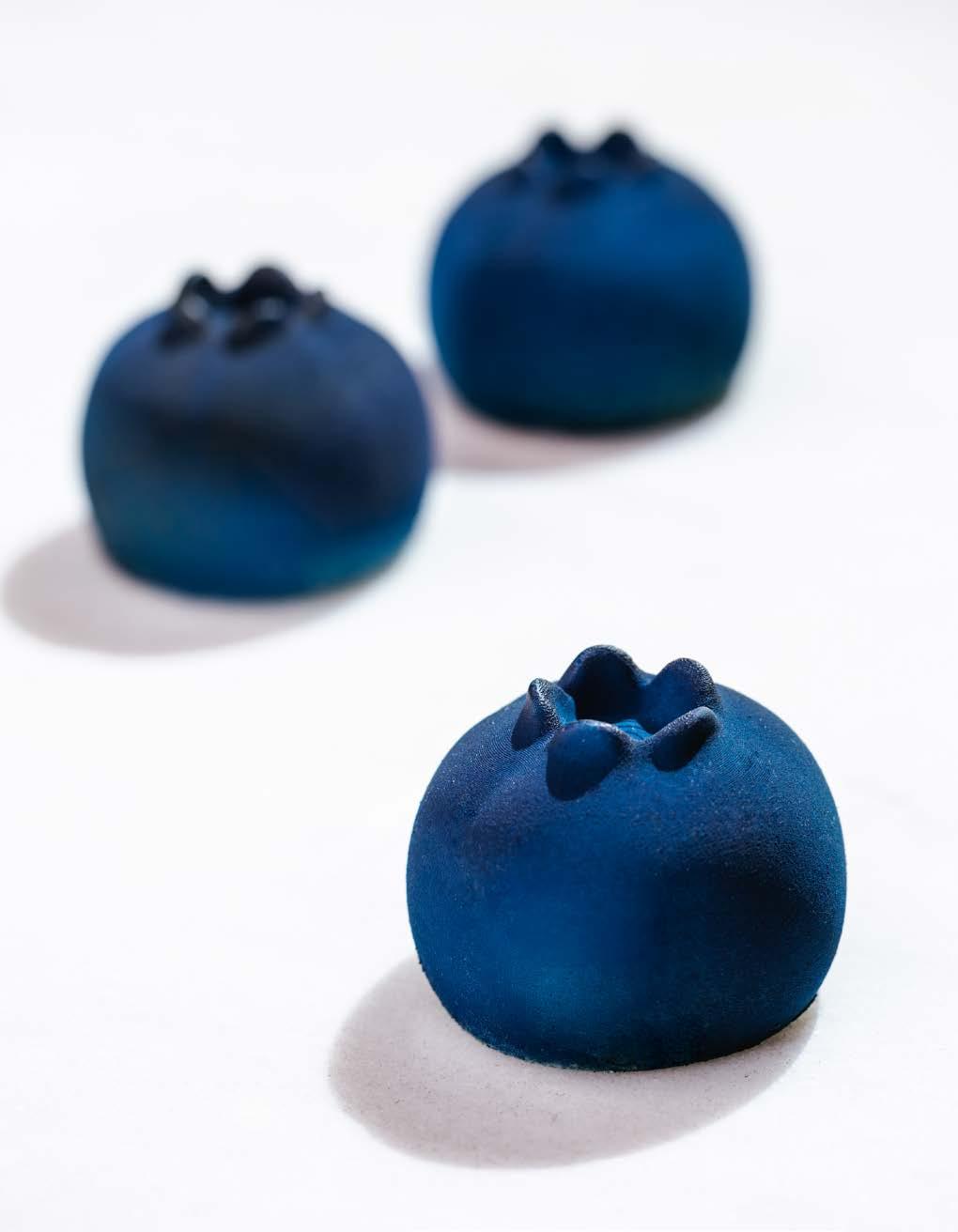
Namelaka
montata vaniglia e limone verde
Biscotto alla panna e mirtilli
Latte g 300
Cioccolato bianco g 400
Panna liquida g 400
Gelatina 170 Bloom g 7
Buccia di limone
verde g 3
Vaniglia g 3
Glassa croccante
Composta di mirtilli
Uova g 250
Zucchero g 250
Panna g 200
Zucchero invertito g 30
Sale g 2
Amido di mais g 215
Polvere di mandorla g 50
Baking g 10
Olio di semi g 165
Mirtilli congelati g 150
Cioccolato bianco g 300
Burro di cacao g 300
Mirtilli freschi g 200
Succo di mirtillo g 300
Acqua g 150
Cristal Mais g 40
Zucchero g 150
Scaldare il latte a 60 °C, aggiungere la gelatina precedentemente idratata ed emulsionare sul cioccolato bianco.
Aggiungere la panna liquida fredda, la vaniglia e la buccia di limone verde.
Lasciare cristallizzare in una placca per 12 ore a 4 °C.
Montare in planetaria utilizzando la foglia fino a ottenere una consistenza cremosa e stabile.
Frullare tutti gli ingredienti insieme nel cutter fino a ottenere un composto omogeneo.
Stendere su Fiberform a uno spessore di 1 cm. Distribuire sopra i mirtilli congelati e cuocere a 210 °C per circa 8 minuti.
Una volta raffreddato, tagliare dei dischi del diametro di 3 cm.
Sciogliere gli ingredienti e unirli insieme fino a ottenere una glassa liscia e omogenea.
Frullare il succo di mirtillo, l’acqua, lo zucchero e il Cristal Mais.
Portare a cottura fino a ottenere la corretta consistenza.
Aggiungere i mirtilli precedentemente cotti e amalgamare.
Versare la composta negli stampi a sfera in silicone PX4313, aggiungendo sulla base il biscotto alla mandorla.
Abbattere e congelare.
Montaggio
Montare la namelaka e dressarla nello stampo.
Per evidenziare i dettagli dello stampo aiutarsi con una spatolina.
Inserire il cuore congelato di mirtillo con il biscotto alla base.
Terminare con altra namelaka, livellare e abbattere.
Smodellare il prodotto congelato e glassare per immersione. Terminare spruzzando con burro di cacao blu.
Whipped Namelaka with Vanilla and Green Lime
Cream and Blueberry Sponge
Milk g 300
White chocolate g 400
Liquid cream g 400
Gelatine 170 Bloom g 7
Green lime zest g 3
Vanilla g 3
Crunchy Glaze
Blueberry Compote
Eggs g 250
Sugar g 250
Cream g 200
Invert sugar g 30
Salt g 2
Cornstarch g 215
Almond powder g 50
Baking powder g 10
Seed oil g 165
Frozen blueberries g 150
White chocolate g 300
Cocoa butter g 300
Fresh blueberries g 200
Blueberry juice g 300
Water g 150
Cristal Mais g 40
Sugar g 150
Heat the milk to 60°C, add the previously hydrated gelatine and emulsify with the white chocolate. Add the cold liquid cream, vanilla and green lime zest.
Leave to crystallise in a tray for 12 hours at 4°C. Whip in a planetary mixer using the paddle attachment until a smooth and stable texture is obtained.
Blend all the ingredients together in a cutter until a smooth mixture is obtained.
Spread onto a Fiberform mat to a thickness of 1 cm.
Scatter the frozen blueberries over the surface and bake at 210°C for approximately 8 minutes. Once cooled, cut into 3 cm diameter discs.
Melt the ingredients and combine together until a smooth and homogeneous glaze is obtained.
Blend the blueberry juice, water, sugar and Cristal Mais.
Cook until the correct consistency is reached. Add the blueberries previously cooked and mix gently.
Pour the compote into PX4313 silicone sphere moulds, placing the almond sponge disc on the base.
Blast freeze and store frozen.
Assembly Whip the namelaka and pipe it into the mould. Use a spatula to define the details of the mould.
Insert the frozen blueberry centre with the sponge base.
Finish with additional namelaka, level and blast freeze.
Once frozen, unmould and dip into the crunchy glaze.
Finish by spraying with blue cocoa butter.
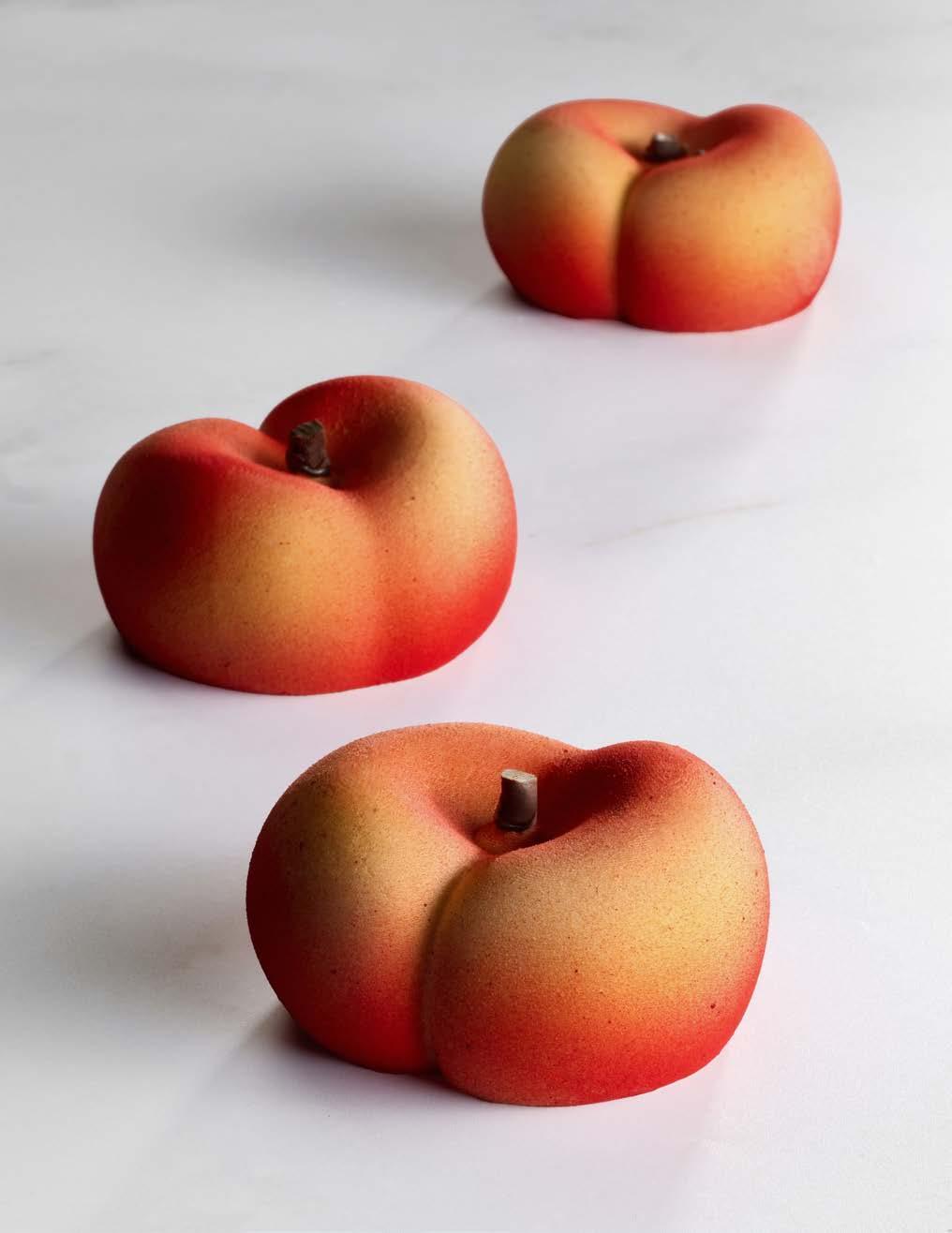
Joconde
alle Mandorle
Burro g 20
Farina di mandorle g 102
Zucchero a velo g 102
Farina debole g 28
Uova intere g 140
Albumi g 95
Zucchero semolato g 17
Bagna alla vaniglia Acqua g 100
Zucchero semolato g 100 ½ bacca di vaniglia
Fondere il burro e lasciarlo intiepidire.
Montare in planetaria la farina di mandorle, lo zucchero a velo, la farina e le uova per circa 5 minuti, fino a ottenere un composto chiaro e voluminoso.
Preparare una meringa francese montando gli albumi con lo zucchero semolato.
Incorporare il burro fuso al primo composto, quindi unire delicatamente la meringa con movimenti dal basso verso l’alto.
Stendere uniformemente l’impasto su una teglia da 30 × 40 cm e cuocere a 190°C per circa 10 minuti.
Portare a ebollizione l’acqua con lo zucchero e i semi della vaniglia fino al completo scioglimento dello zucchero. Utilizzare la bagna ancora tiepida.
Inserto alla pesca tabacchiera
Pesca tabacchiera
pulita g 150
Burro g 15
Zucchero semolato g 15 ½ bacca di vaniglia
Purea di pesca
di vigna g 200
Amido modificato g 10
Sale fino g 1
Namelaka alla Pesca Purea di pesca bianca g 200
Massa gelatinosa g 30
Cioccolato bianco g 340
Panna fresca
35% m.g. g 400
Tagliare la pesca tabacchiera a brunoise.
Rosolarla in padella con il burro, lo zucchero e i semi della vaniglia per alcuni minuti, mantenendo la frutta ancora leggermente consistente.
Frullare la purea di pesca con l’amido modificato e il sale fino a ottenere un gel liscio.
Unire il gel di pesca alla brunoise cotta e conservare in frigorifero fino all’utilizzo.
Scaldare una parte della purea di pesca e sciogliervi la massa gelatinosa.
Fondere il cioccolato bianco e versarvi la purea calda. Aggiungere quindi la restante purea fredda e mescolare fino a ottenere una ganache liscia.
Unire la panna fredda ed emulsionare con un frullatore a immersione evitando di incorporare aria.
Coprire con pellicola a contatto e lasciare cristallizzare in frigorifero a 4°C per almeno 8 ore.
Glassa Anidra Bianca
Cioccolato bianco g 500
Burro di cacao g 400
Fondere separatamente il cioccolato bianco e il burro di cacao.
Unire i due composti ed emulsionare con un frullatore a immersione.
Utilizzare la glassa a 30°C.
Montaggio e decorazione
Burro di cacao rosso Pavoni
Burro di cacao rosa Pavoni
Cioccolato plastico fondente
Sciroppo di glucosio
Montare leggermente la namelaka e trasferirla in una sac à poche.
Rivestire lo stampo creando una camicia con circa 27 g di namelaka.
Inserire 60 g di inserto alla pesca.
Ricavare dalla Joconde un disco da 5 cm di diametro, inzupparlo con la bagna alla vaniglia e adagiarlo sull’inserto.
Sigillare con altra namelaka e congelare completamente.
Sformare il dolce e immergerlo nella glassa anidra mantenuta a 30°C.
Quando la glassa sarà completamente cristallizzata, aerografare con burro di cacao rosa e rosso per riprodurre le sfumature tipiche della pesca tabacchiera.
Realizzare il picciolo con il cioccolato plastico fondente e applicarlo sulla sommità del dolce. Terminare con una piccola goccia di sciroppo di glucosio per simulare la rugiada.
Almond Joconde
Sponge
Butter
g 20
Almond flour g 102
Icing sugar
g 102
Cake flour g 28
Whole eggs g 140
Egg whites g 95
Caster sugar g 17
Vanilla Syrup
Water
g 100
Caster sugar g 100
½ vanilla bean
Saturn Peach Insert Saturn peaches,
peeled
g 150
Butter g 15
Caster sugar g 15
½ vanilla bean
Vineyard peach
purée
Peach Namelaka
g 200
Modified starch g 10
Fine salt g 1
White peach purée g 200
Gelatin mass g 30
White chocolate g 340
Heavy cream (35% fat) g 400
Melt the butter and allow it to cool slightly. Whip together the almond flour, icing sugar, flour and whole eggs for approximately 5 minutes, until the mixture becomes light and doubles in volume. Prepare a French meringue by whipping the egg whites with the caster sugar. Fold the melted butter into the almond mixture, then gently fold in the meringue.
Spread evenly onto a 30 × 40 cm baking tray and bake at 190°C for approximately 10 minutes.
Bring the water, sugar and vanilla seeds to a boil until the sugar has completely dissolved. Use while still warm.
Dice the peeled Saturn peaches into small cubes. Sauté them with the butter, sugar and vanilla until lightly caramelised while maintaining their texture. Blend the peach purée with the modified starch and salt until smooth and gel-like.
Fold the peach gel into the sautéed fruit and refrigerate until needed.
Heat part of the peach purée and dissolve the gelatin mass in it.
Melt the white chocolate and gradually add the warm purée, followed by the remaining cold purée, to create a smooth ganache. Add the cold cream and emulsify with an immersion blender, avoiding air incorporation. Cover with plastic wrap in contact and refrigerate at 4°C for at least 8 hours before use.
White Anhydrous Glaze
White chocolate g 500
Cocoa butter g 400
Melt the white chocolate and cocoa butter separately.
Combine the two mixtures and emulsify with an immersion blender. Use the glaze at 30°C.
Assembly and Decoration
cocoa butter (Pavoni)
Pink cocoa butter (Pavoni)
Dark modelling chocolate
Glucose syrup
Lightly whip the namelaka and transfer it to a piping bag.
Pipe approximately 27 g into each mould, creating an even coating.
Fill with 60 g of the peach insert.
Cut a 5 cm disc of Joconde sponge, soak it with the vanilla syrup and place it over the insert.
Seal with additional namelaka and freeze until completely firm.
Unmould and dip the entremets into the white anhydrous glaze at 30°C.
Once the glaze has crystallised, spray with pink and red cocoa butter to recreate the characteristic shades of a Saturn peach.
Shape a small stem from dark modelling chocolate and attach it to the top of the dessert.
Finish with a small drop of glucose syrup to imitate a dew drop on the surface.
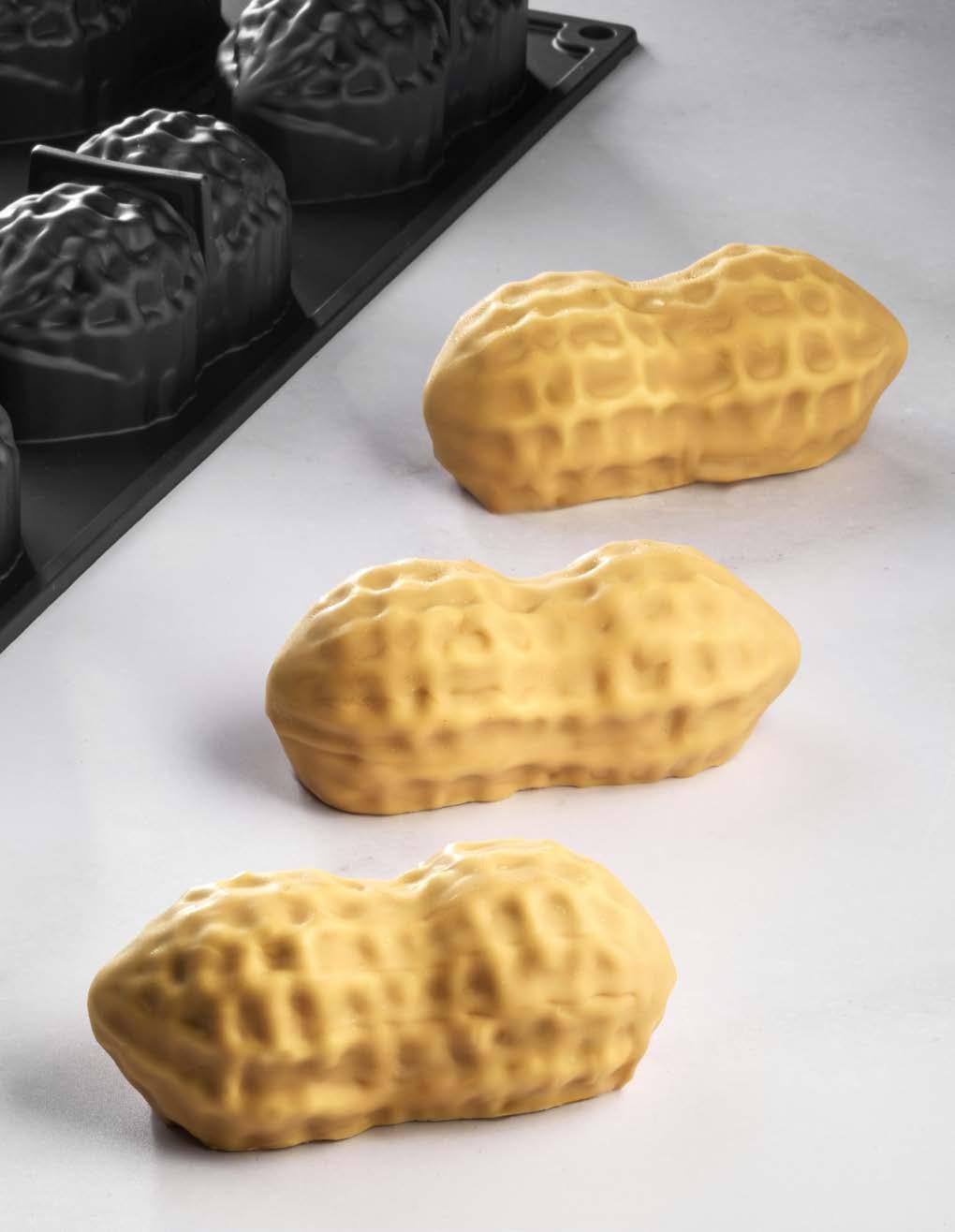
Mousse al caramello
Glassa croccante alle arachidi
Pralinato alle arachidi
Biscotto alla panna
Latte g 500
Cioccolato biondo
al caramello g 1000
Gelatina 200 g 20
Panna g 1000
Vaniglia g 4
Cioccolato al caramello g 1000
Pasta di arachide g 150
Zucchero g 500
Arachidi salate g 500
Vaniglia g 2
Uova g 250
Zucchero g 250
Panna g 100
Zucchero invertito g 30
Sale g 2
Amido di mais g 215
Polvere di mandorla g 50
Baking g 10
Olio di semi g 165
Sciogliere il cioccolato. Preparare la massa gelatina idratando la gelatina in polvere in 5 parti d’acqua. Montare la panna e conservarla in frigo. Scaldare il latte a 60°C quindi sciogliervi la massa gelatina ed emulsionare sul cioccolato. Unire a 35°C la panna semimontata. Colare nello stampo.
Sciogliere il cioccolato a 40°C e unire la pasta di frutta secca.
Cuocere lo zucchero a 185°C quindi versare sulle arachidi. Far raffreddare quindi raffinare al cutter. Conservare in sac a poche.
Pesare tutti gli ingredienti. Frullare tutti gli ingredienti in un cutter fino ad ottenere un composto omogeneo. Cuocere in forno ventilato a 200°C.
Finitura
Dopo aver colato la mousse aiutarsi con una spatolina per evidenziare tutti i dettagli dello stampo. Dressare al centro il pralinato alle arachidi, completare con la mousse e due biscotti alla panna. Abbattere e smodellare. Glassare.
Caramel Mousse Milk
Blonde caramel
g 500
chocolate g 1000
Gelatin 200 Bloom g 20
Cream g 1000
Vanilla g 4
Crunchy Peanut Glaze
Caramel chocolate g 1000 g
Peanut paste 150 g
Peanut Praliné Sugar
g 500
Salted peanuts g 500
Vanilla g 2
Cream Sponge Cake Eggs
g 250
Sugar g 250
Cream g 100
Invert sugar g 30
Salt g 2
Cornstarch g 215
Almond powder g 50
Baking powder g 10
Vegetable oil g 165
Melt the chocolate. Prepare the gelatin mass by hydrating the powdered gelatin with 5 parts water. Whip the cream to a soft peak and keep refrigerated.
Heat the milk to 60°C, dissolve the gelatin mass into it, and emulsify over the melted chocolate. When the mixture reaches 35°C, fold in the semiwhipped cream. Pour into the mold.
Melt the chocolate to 40°C and mix in the peanut paste until smooth.
Cook the sugar to 185°C, then pour it over the peanuts. Allow to cool completely, then process in a food processor until a smooth praliné is obtained. Store in a piping bag.
Weigh all the ingredients. Blend everything in a food processor until smooth and homogeneous. Bake in a convection oven at 200°C.
Assembly After pouring the mousse into the mold, use a small spatula to ensure that all the mold details are fully coated and defined. Pipe the peanut praliné into the center, then finish filling with the mousse and add two layers cream sponge cake.
Blast-freeze until fully set, then unmold.
Glaze with the crunchy peanut glaze before serving.
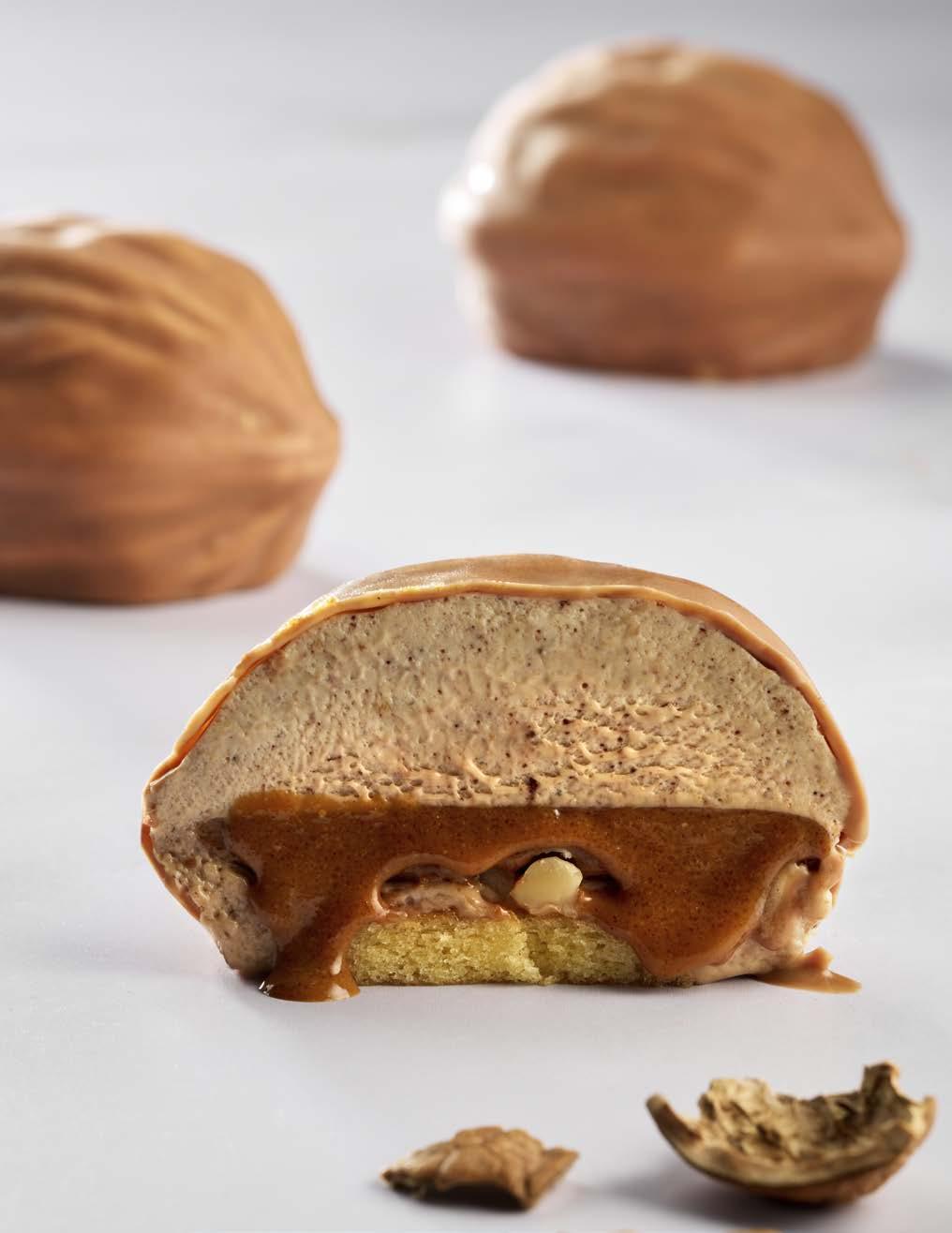
Mousse alla noce
Latte g 500
Cioccolato al latte g 1000
Gelatina 200 g 20
Panna g 1000
Pasta di noce g 200
Glassa croccante alla noce
Pralinato alle noci
Biscotto allo yogurt
Cioccolato al latte g 1000
Pasta di noce g 200
Zucchero g 500
Noce g 500
Vaniglia g 2
Uova g 250
Zucchero g 250
Yogurt g 200
Zucchero invertito g 30
Sale g 2
Amido di mais g 215
Polvere di mandorla g 50
Baking g 10
Olio di semi g 165
Sciogliere il cioccolato. Preparare la massa gelatina idratanto la gelatina in polvere in 5 parti d’acqua. Montare la panna e conservarla in frigo. Scaldare il latte a 60°C quindi sciogliervi la massa gelatina ed emulsionare sul cioccolato e la pasta di frutta secca. Unire a 35°C la panna semimontata. Colare nello stampo.
Sciogliere il cioccolato a 40°C e unire la pasta di frutta secca.
Cuocere lo zucchero a 185°C quindi versare sulle noci e sulla vaniglia. Far raffreddare quindi raffinare al cutter. Conservare in sac a poche.
Pesare tutti gli ingredienti. Frullare tutti gli ingredienti in un cutter fino ad ottenere un composto omogeneo. Cuocere in forno ventilato a 200°C.
Finitura
Dopo aver colato la mousse aiutarsi con una spatolina per evidenziare tutti i dettagli dello stampo. Dressare al centro il pralinato alle noci, completare con la mousse e il biscotto allo yogurt. Abbattere e smodellare. Glassare.
Walnut Mousse
Milk
g 500
Milk chocolate g 1000
Gelatin 200 Bloom g 20
Cream g 1000
Walnut paste g 200
Crunchy Walnut Glaze
Walnut Praliné
Yogurt Sponge Cake
Milk chocolate g 1000
Walnut paste g 200
Sugar g 500
Walnuts g 500
Vanilla g 2
Eggs
g 250
Sugar g 250
Yogurt g 200
Invert sugar g 30
Salt
g 2
Cornstarch g 215
Almond powder g 50
Baking powder g 10
Vegetable oil g 165
Melt the chocolate. Prepare the gelatin mass by hydrating the powdered gelatin with 5 parts water. Whip the cream to a soft peak and keep refrigerated.
Heat the milk to 60°C, dissolve the gelatin mass into it, then emulsify over the melted chocolate and walnut paste. When the mixture reaches 35°C, fold in the semi-whipped cream. Pour into the mold.
Melt the chocolate to 40°C and mix in the walnut paste until smooth.
Cook the sugar to 185°C, then pour it over the walnuts and vanilla. Allow to cool completely, then process in a food processor until a smooth praliné is obtained. Store in a piping bag.
Weigh all the ingredients. Blend everything in a food processor until smooth and homogeneous. Bake in a convection oven at 200°C.
Assembly
After pouring the mousse into the mold, use a small spatula to ensure that all the mold details are fully coated and defined. Pipe the walnut praliné into the center, then finish filling with the mousse and add the yogurt sponge cake. Blast-freeze until fully set, then unmold. Glaze with the crunchy walnut glaze before serving.
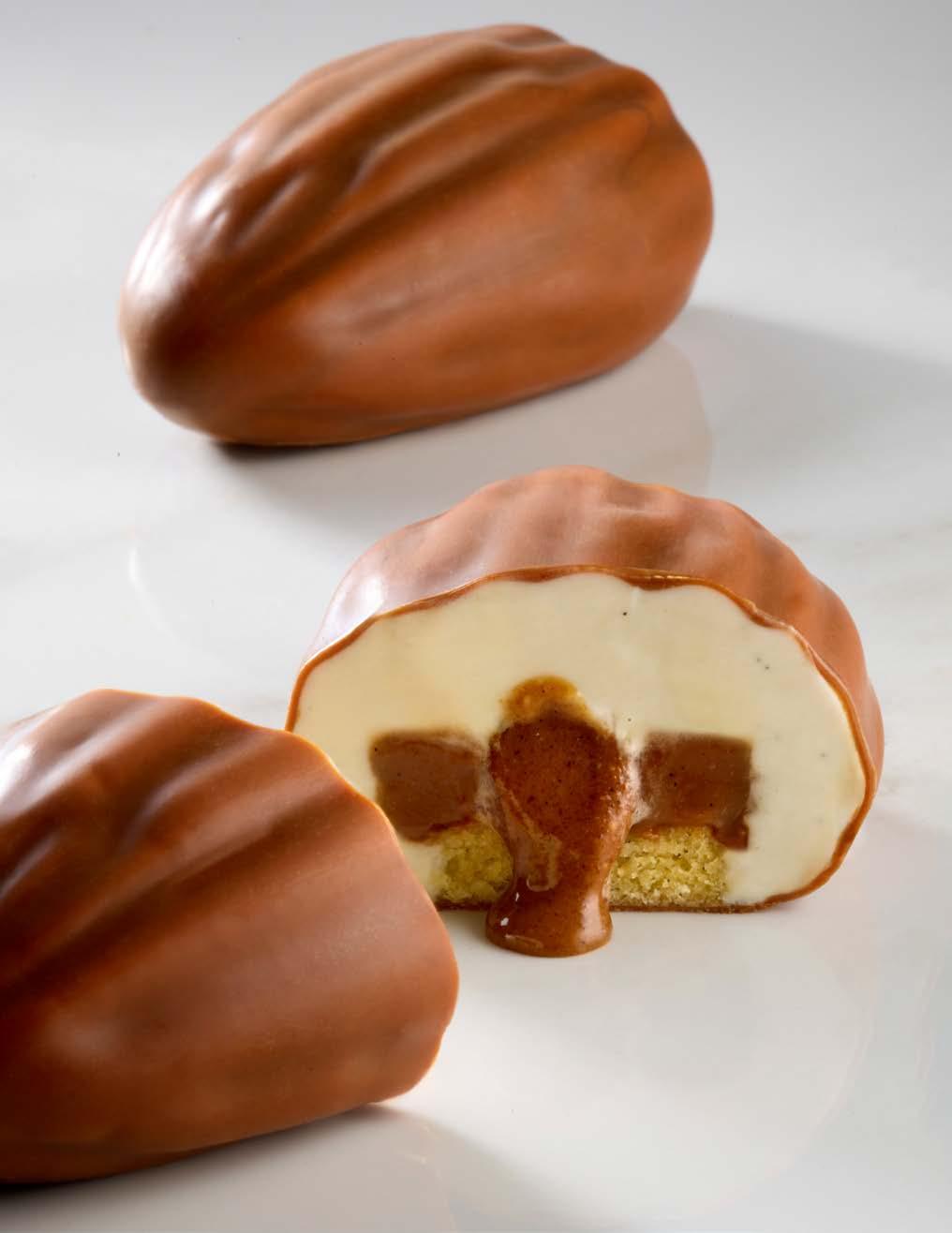
Namelaka montata alla mandorla
Caramello morbido
Latte intero g 280
Sciroppo di glucosio g 20
Gelatina animale
170 bloom g 3
Acqua per gelatina g 15
Cioccolato
bianco 35% g 400
Pasta di mandorle pura g 40
Pasta di mandorla amara g 40
Panna 35% g 500
Baccello di vaniglia g 1
Zucchero g 400
Sciroppo di glucosio g 220
Pectina NH g 3,5
Panna g 630
Sale g 6
Burro g 190
Baccello di vaniglia n 2
Scaldare il latte con il glucosio e la vaniglia, aggiungere la gelatina già reidratata e versare sul cioccolato e la pasta di mandorla. Emulsionare bene ed aggiungere, sempre emulsionando, la panna liquida fredda. Lasciar riposare per 12 ore e montare all’occorrenza in planetaria con la foglia.
Pralinato alla mandorla
Mandorle con la buccia g 250
Zucchero g 250
Baccello di vaniglia g 1
Sale g 3
Miscelare una piccola quantità di zucchero con la pectina etenere in parte. Caramellare insieme lo sciroppo di glucosiocon lo zucchero fino a 190°C. Decuocere con la panna, la va-niglia e il sale riscaldati in microonde. Rimettere sul fuoco eportare il tutto a 105°C. Raffreddare fino a 70°C, aggiungereil burro ed emulsionare bene. Conservare a 4°C.
Far caramellare acqua e zucchero. Versare sulle mandorle con sale e vaniglia. Far raffreddare e raffinare all’interno di un cutter.
Fondo morbido alle mandorle
Glassa anidra al cioccolato al latte
Uova intere g 80
Tuorli g 32
Zucchero g 110
Mandorle in polvere g 140
Farina debole g 32
Baccello di vaniglia n 1
Burro g 70
Albume fresco g 50
Zucchero g 50
Cioccolato al latte 42% g 300
Burro di cacao g 310
Colore rosso
liposolubile
Finitura
Mescolare uova, tuorlo , zucchero , mandorle in polvere e farina de-bole, aggiungere il burro caldo e aggiungere la meringa montata. Cuocere a 170 gradi per 12 minuti.
Sciogliere il burro di cacao ed il cioccolato. Unire ed aggiungere il colorante emulsionando. Utilizzare a circa 35°C.
Montare la namelaka alla mandorla e riempire lo stampo per circa 2/3, aiutandosi con una spatola per far aderire il composto alle pareti e mettere in evidenza tutti i dettagli dello stampo. Inserire con la sac à poche al centro il caramello morbido e il pralinato alla mandorla, coprire con altra namelaka e completare con il fondo morbido alle mandorle leggermente rifilato. Abbattere, smodellare e glassare con la glassa anidra al cioccolato al latte.
Whipped almond namelaka
Soft caramel
Almond praliné
Soft almond base
Whole milk g 280
Glucose syrup g 20
Gelatin 170 bloom g 3
Water for gelatin g 15
35% white chocolate g 400
Pure almond paste g 40
Bitter almond paste g 40
35% cream g 500
Vanilla bean n. 1
Sugar g 400
Glucose syrup g 220
NH pectin g 3.5
Cream g 630
Salt g 6
Butter g 190
Vanilla beans n 2
Almonds with skin g 250
Sugar g 250
Vanilla bean n 1
Salt g 3
Whole eggs g 80
Egg yolks g 32
Sugar g 110
Almond powder g 140
Weak flour g 32
Vanilla bean n 1
Butter g 70
Fresh egg whites g 50
Sugar g 50
Heat the milk with the glucose syrup and vanilla. Add the pre-hydrated gelatin and pour over the white chocolate and almond paste. Emulsify well and, while continuing to blend, gradually add the cold liquid cream. Leave to rest for 12 hours, then whip when needed in a stand mixer fitted with the paddle attachment.
Mix a small amount of sugar with the pectin and set aside. Caramelize the glucose syrup and sugar together to 190°C. Deglaze with the cream, vanilla, and salt previously heated in the microwave. Return to the heat and cook the mixture to 105°C. Cool to 70°C, add the butter, and emulsify well. Store at 4°C.
Make a caramel with water and sugar. Pour over the almonds with the salt and vanilla. Allow to cool, then refine in a food processor until smooth.
Mix the whole eggs, egg yolks, sugar, almond powder, and weak flour. Add the warm butter, then fold in the whipped meringue. Bake at 170°C for 12 minutes.
Anhydrous milk chocolate glaze
42% milk chocolate g 300
Cocoa butter g 310
Fat-soluble red coloring
Melt the cocoa butter and milk chocolate separately. Combine them and add the coloring while emulsifying. Use at approximately 35°C.
Assembly Whip the almond namelaka and fill the mould about 2/3 full, using a spatula to ensure it perfectly coats the sides and captures all mould details. Pipe the soft caramel and almond praline in the centre, cover with more namelaka and finish with the trimmed almond sponge. Freeze, unmould and glaze with the milk chocolate anhydrous glaze.
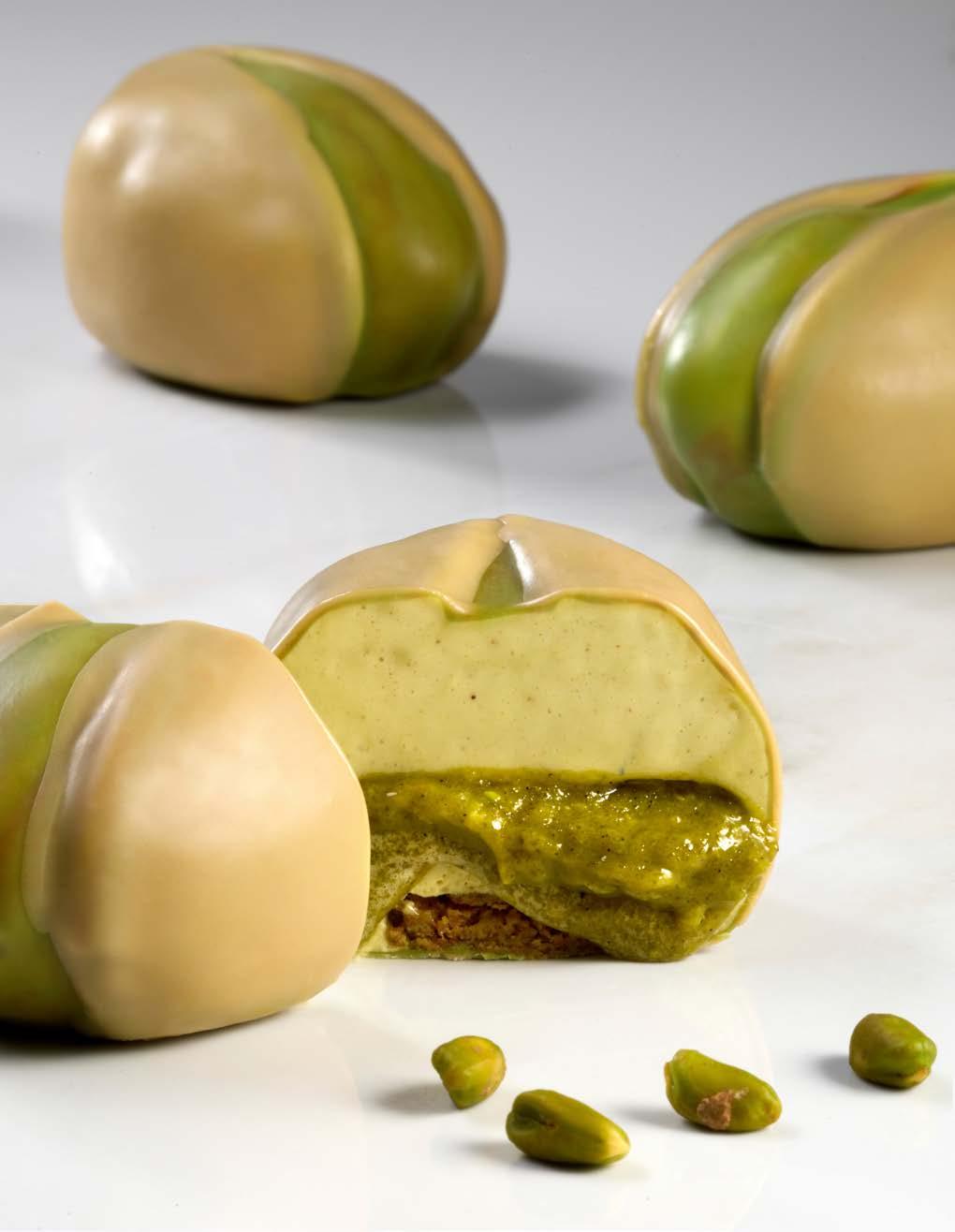
Bavarese al pistacchio con grasso di cocco
Pralinato al pistacchio
Croccantino al pistacchio
Fondo morbido alle mandorle
Glassa anidra verde
Glassa anidra al caramello
Finitura
Latte intero g 140
Panna 35% g 50
Zucchero g 170
Tuorlo g 100
Gelatina animale
170 bloom g 10
Acqua g 50
Panna 35% g 600
Pasta di pistacchio g 100
Olio di cocco g 80
Pistacchi disidratati g 200
Zucchero g 200
Acqua g 50
Olio di vinaccioli g 20
Baccello di vaniglia n 1
Sale g 4
Cioccolato bianco 35% g 75
Pasta di pistacchio pura g 70
Paillette feullettine g 140
Olio di vinaccioli g 30
Uova intere g 80
Tuorli g 32
Zucchero g 110
Mandorle in polvere g 140
Farina debole g 32
Baccello di vaniglia n 1
Burro g 70
Albume fresco g 50
Zucchero g 50
Cioccolato bianco g 300
Burro di cacao g 240
Colorante verde
liposolubile Pavoni
Colorante marrone
liposolubile Pavoni
Cioccolato caramellato g 300
Burro di cacao g 240
Portare ad ebollizione il latte e la panna, versare sui tuorli miscelati con lo zucchero e realizzare una crema inglese cotta ad 82- 83°C. Formare un’emulsione con la crema inglese, la gelatina animale, il grasso di cocco sciolto e la pasta di pistacchio. Quando il composto raggiunge i 25 °C unire la panna semi-montata.
Cuocere acqua e zucchero, fino a caramello biondo, versare sui pistacchi disidratati. Far raffreddare su carta da forno e successivamente raffinare all’interno di un cutter.
Aggiungere l’olio di vinaccioli
Fondere la copertura, unire la pasta pistacchio, l’olio e le paillette feullettine.
Mescolare uova, tuorlo , zucchero , mandorle in polvere e farina de-bole, aggiungere il burro caldo e aggiungere la meringa montata. Cuocere a 170 gradi per 12 minuti.
Sciogliere il burro di cacao ed il cioccolato, unire, aggiungere il colorante ed emulsionare. Utilizzare a circa 35°C.
Sciogliere il burro di cacao ed il cioccolato, unire. Utilizzare a circa 35°C.
Colare la bavarese al pistacchio nello stampo fino a circa 2/3, aiutandosi con una spatola per far aderire il composto alle pareti e mettere in evidenza tutti i dettagli dello stampo. Inserire al centro il pralinato al pistacchio, coprire con altra bavarese e completare con il croccantino al pistacchio e il fondo morbido alle mandorle leggermente rifilato. Abbattere, smodellare e glassare con la glassa anidra verde e la glassa anidra al caramello per creare un effetto decorativo doppio.
Pistachio Bavarian Cream with Coconut Fat
Whole milk g 140
Heavy cream 35% g 50
Sugar g 170
Egg yolks g 100
Gelatin 170 Bloom g 10
Water g 50
Heavy cream 35% g 600
Pistachio paste g 100
Coconut oil g 80
Pistachio Praliné Dehydrated
pistachios g 200
Sugar g 200
Water g 50
Grapeseed oil g 20
Vanilla bean g 1
Salt g 4
Bring the milk and the first quantity of cream to a boil. Pour over the egg yolks previously mixed with the sugar and cook into an anglaise cream at 82–83°C.
Prepare an emulsion by combining the anglaise cream with the gelatin, the melted coconut oil, and the pistachio paste.
When the mixture reaches 25°C, gently fold in the semi-whipped cream.
Cook the water and sugar to a light caramel, then pour over the dehydrated pistachios. Allow to cool on baking paper and then refine in a food processor until smooth.
Add the grapeseed oil and blend until homogeneous.
Pistachio Crunch
White chocolate 35% g 75
Pure pistachio paste g 70
Pailleté feuilletine g 140
Grapeseed oil g 30
Soft Almond Sponge
Whole eggs g 80
Egg yolks g 32
Sugar g 110
Almond powder g 140
Weak flour g 32
Vanilla bean g 1
Butter g 70
Fresh egg whites g 50
Sugar g 50
Melt the white chocolate, then combine with the pistachio paste, grapeseed oil, and pailleté feuilletine.
Mix the whole eggs, egg yolks, sugar, almond powder, and weak flour. Add the warm butter, then gently fold in the whipped meringue made with the egg whites and sugar.
Bake at 170°C for approximately 12 minutes.
Green Anhydrous Glaze
Anhydrous caramel glaze
White chocolate g 300
Cocoa butter g 240
Fat-soluble
green coloring
Fat-soluble
brown coloring
Caramelized
chocolate g 300
Cocoa butter g 240
Melt the cocoa butter and white chocolate together, combine, then add the colorings and emulsify.
Use at approximately 35°C.
Melt the cocoa butter and chocolate together and emulsify.
Use at approximately 35°C.
Assembly Fill the mould about 2/3 full with the pistachio bavaroise, using a spatula to ensure it perfectly coats the sides and captures all mould details. Pipe the pistachio praline in the centre, cover with more bavaroise and finish with the pistachio crunchy layer and the trimmed almond sponge. Freeze, unmould and glaze with the green anhydrous glaze and caramel anhydrous glaze for a decorative finish.
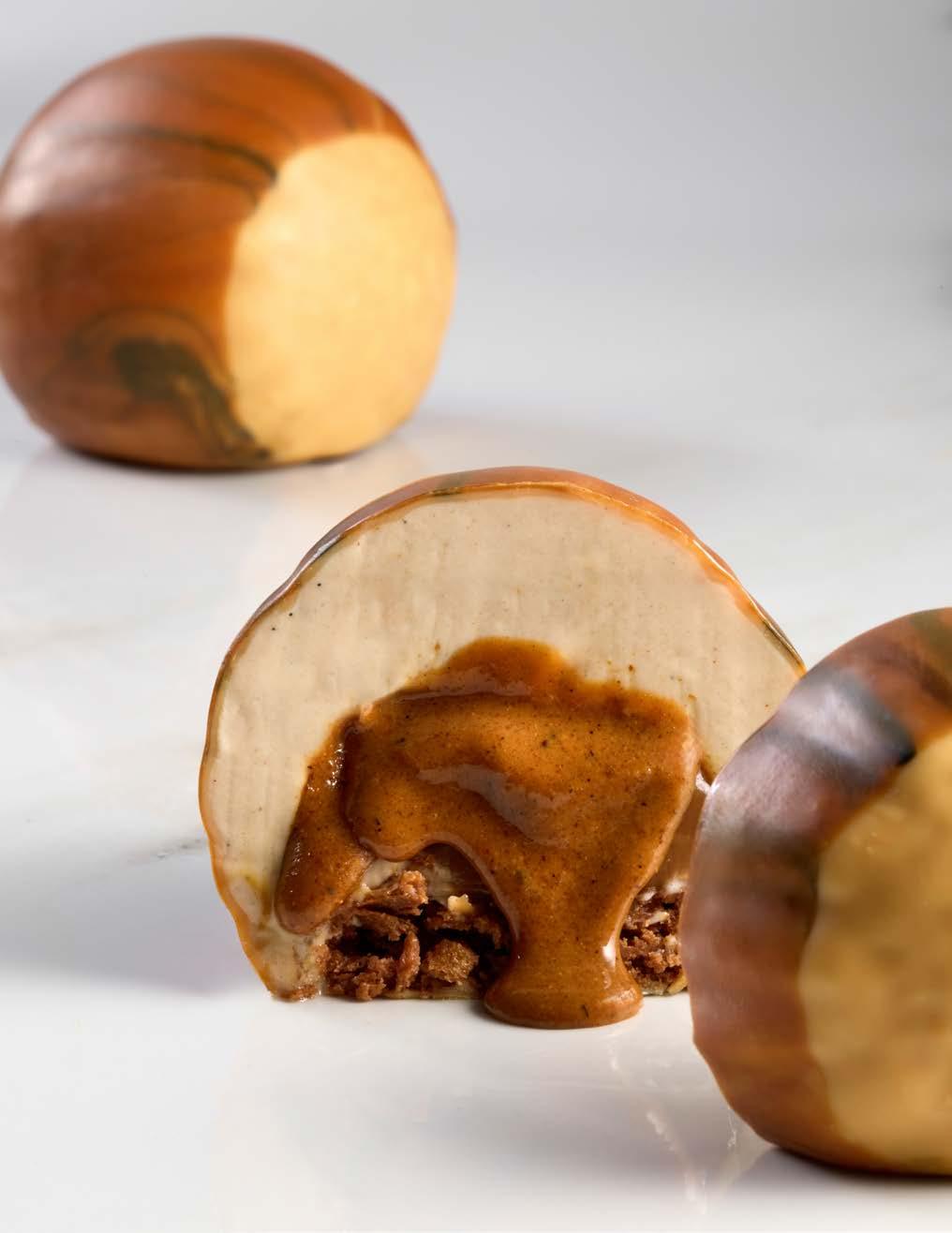
Namelaka montata alla nocciola
Emulsione cremosa al pralinato
Croccantino
Pralinato alla nocciola
Latte intero g 280
Sciroppo di glucosio g 20
Gelatina animale
170 bloom g 4
Acqua per gelatina g 20
Cioccolato
bianco 35% g 400
Panna 35% g 500
Baccello di vaniglia g 1
Pasta di nocciola pura g 120
Pralinato di nocciole g 350
Panna 35% g 400
Latte intero g 50
Pasta di nocciola g 250
Cioccolato al latte g 125
Pasta di nocciola g 80
Pralinato di nocciole al 50% g 50
Paillette feullettine
(scaglie di wafer croccanti) g 250
Burro liquido g 15
Nocciole intere g 600
Zucchero g 400
Acqua g 130
Baccello di vaniglia g 1
Sale g 10
Scaldare il latte con il glucosio e la vaniglia, aggiungere la gelatina già reidratata e versare sul cioccolato e la pasta nocciola. Emulsionare bene ed aggiungere, sempre emulsionando, la panna liquida fredda. Lasciar riposare per 12 ore e montare all’occorrenza in planetaria con la foglia.
Portare ad ebollizione la panna con il latte e versare sul pralinato e la pasta di nocciole. Emulsionare e colare.
Fondere la copertura, unire la pasta ed il pralinato di nocciole e girare bene. Unire la massa croccante e mescolare. Stendere alla misura desiderata ed utilizzare.
Glassa anidra al cioccolato al latte
Glassa anidra al cioccolato fondente
Finitura
Cioccolato al latte 42% g 300
Burro di cacao g 310
Cioccolato fondente 56% g 100
Burro di cacao g 80
Cuocere acqua, zucchero fino a 117°C. Aggiungere le nocciole e far sabbiare. Aggiungere sale e vaniglia e continuare la cottura fino ad un caramello intenso.
Far raffreddare su carta da forno raffinare all’interno di un cutter.
Sciogliere il burro di cacao ed il cioccolato. Utilizzare a circa 35°C.
Sciogliere il burro di cacao ed il cioccolato, unire. Utilizzare a circa 35°C.
Montare la namelaka alla nocciola e riempire lo stampo per circa 2/3, aiutandosi con una spatola per far aderire il composto alle pareti e mettere in evidenza tutti i dettagli dello stampo. Inserire al centro l’emulsione cremosa al pralinato, coprire con altra namelaka e completare con il croccantino alla nocciola. Chiudere con un disco di croccantino leggermente rifilato a misura dello stampo. Abbattere, smodellare e glassare con la glassa anidra al cioccolato al latte mixata con fili di glassa anidra al cioccolato fondente.
Whipped hazelnut namelaka
Creamy praliné emulsion
Crunchy layer
Hazelnut praliné
Whole milk g 280
Glucose syrup g 20
Gelatin 170 bloom g 4
Water for gelatin g 20
35% white chocolate g 400
35% cream g 500
Vanilla bean n 1
Pure hazelnut paste g 120
Hazelnut praline g 350
35% cream g 400
Whole milk g 50
Hazelnut paste g 250
Milk chocolate g 125
Hazelnut paste g 80
50% hazelnut praline g 50
Pailleté feuilletine
(crispy wafer flakes) g 250
Melted butter g 15
Whole hazelnuts g 600
Sugar g 400
Water g 130
Vanilla bean n 1
Salt g 10
Heat the milk with the glucose syrup and vanilla. Add the pre-hydrated gelatin and pour over the white chocolate and hazelnut paste. Emulsify well and, while continuing to blend, gradually add the cold liquid cream. Leave to rest for 12 hours, then whip when needed in a stand mixer fitted with the paddle attachment.
Bring the cream and milk to a boil and pour over the praline and hazelnut paste. Emulsify and pour into the desired mould or container.
Melt the chocolate, add the hazelnut paste and praline, and mix well. Add the crunchy wafer flakes and stir until evenly combined.
Spread to the desired thickness and use as needed.
Cook the water and sugar to 117°C. Add the hazelnuts and continue cooking until the sugar crystallizes around them. Add the salt and vanilla and continue cooking until a deep amber caramel forms.
Allow to cool on baking paper, then refine in a food processor until smooth.
Anhydrous milk chocolate glaze
Anhydrous dark chocolate glaze
42% milk chocolate g 300
Cocoa butter g 310
56% dark chocolate g 100
Cocoa butter g 80
Melt the cocoa butter and milk chocolate separately, then combine.
Use at approximately 35°C.
Melt the cocoa butter and dark chocolate separately, then combine.
Use at approximately 35°C.
Assembly Whip the hazelnut namelaka and fill the mould about 2/3 full, using a spatula to ensure it perfectly coats the sides and captures all mould details. Pipe the praline creamy insert in the centre, cover with more namelaka and add the hazelnut crunchy layer. Seal with a trimmed crunchy disc sized to fit the mould. Freeze, unmould and glaze with the milk chocolate anhydrous glaze, finishing with dark chocolate anhydrous glaze details.
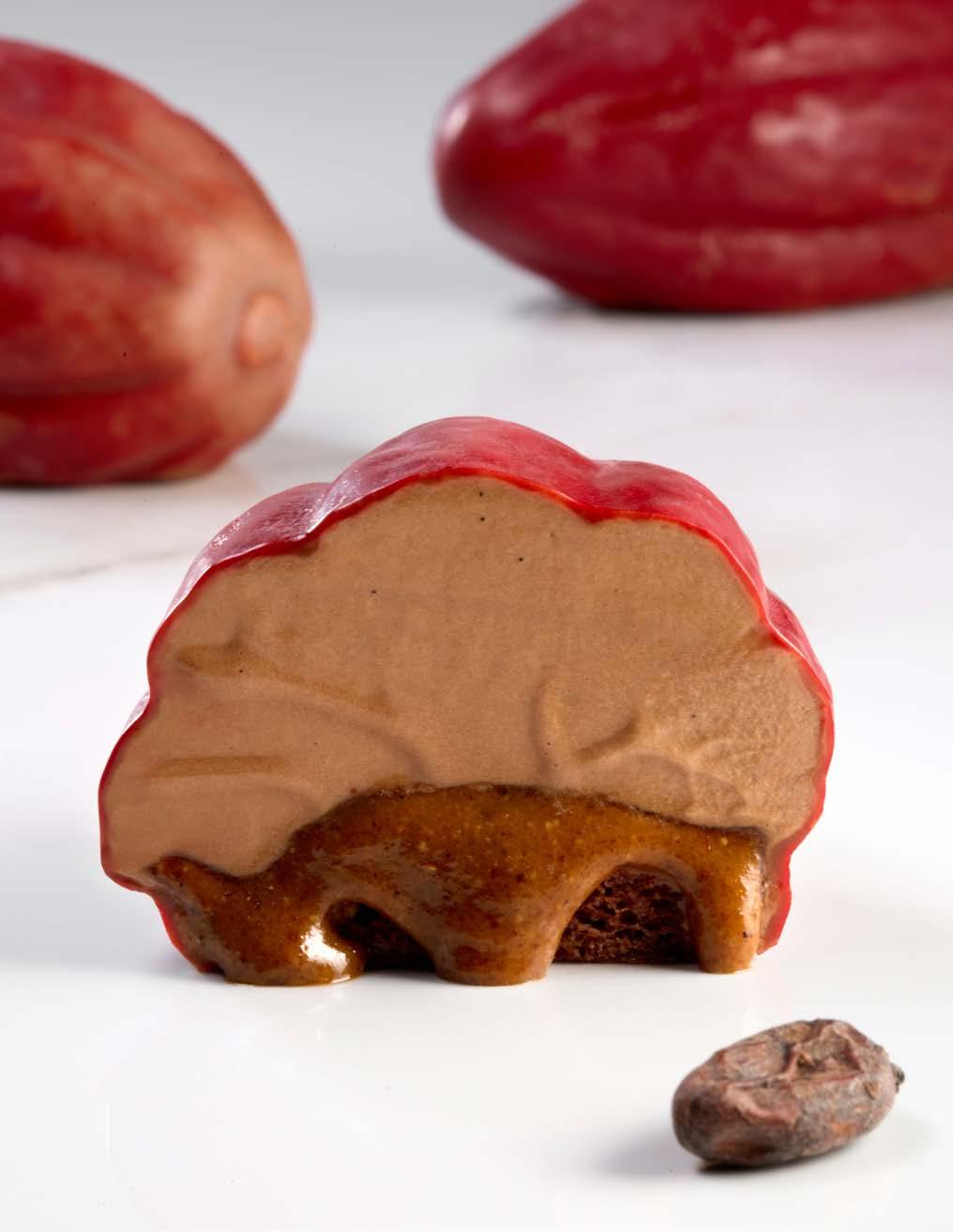
Crema pasticcera
Latte intero g 750
Panna 35% g 250
Tuorlo g 250
Zucchero g 220
Amido di riso g 80
Baccello di vaniglia g 1
Crema diplomatica al cioccolato
Pralinato alla mandorla e grue
Bisquit al cacao
Crema pasticcera g 500
Cioccolato
fondente 56% g 250
Panna 35% g 650
Mandorle
con la buccia g 250
Zucchero g 250
Baccello di vaniglia n 1
Sale g 3
Grue di cacao g 50
Tuorli g 300
Zucchero g 330
Albume fresco g 325
Farina g 65
Fecola g 65
Cacao in polvere g 65
Burro sciolto g 130
Portare ad ebollizione il latte e la panna, versare sui tuorli miscelati con lo zucchero,l’amido e la vaniglia, riportare sul fuoco e terminare la cottura. Abbattere in positivo e successivamente conservare in frigorifero.
Unire la crema pasticcera con il cioccolato fuso e dopo aver reso il composto omogeneo, incorporare delicatamente la panna semi-montata.
Far caramellare acqua e zucchero.
Versare sulle mandorle e grue con sale e vaniglia. Far raffreddare e raffinare all’interno di un cutter.
Finitura
Montare gli albumi con tutto lo zucchero aggiunto in tre step.
Quando la meringa sarà montata, aggiungere a filo i tuorli e montare altri 30 secondi.
Quindi aggiungere gli ingredienti secchi setacciati due volte.
Infine il burro emulsionato con una piccola parte di montata.
Stendere con l’aiuto di una raplette e infornare a 180°C per 15 minuti con la valvola chiusa.
Colare la crema diplomatica al cioccolato nello stampo fino a circa 2/3, aiutandosi con una spatola per far aderire il composto alle pareti e mettere in evidenza tutti i dettagli dello stampo. Inserire al centro il pralinato alla mandorla e grue di cacao, coprire con altra crema diplomatica al cioccolato e completare con il bisquit al cacao leggermente rifilato. Abbattere, smodellare e decorare a piacere con velluto o glassa anidra al cioccolato.
Pastry cream
Whole milk g 750
35% cream g 250
Egg yolks g 250
Sugar g 220
Rice starch g 80
Vanilla bean n 1
Chocolate diplomat cream
Almond and cocoa nib praliné
Cocoa sponge biscuit
Pastry cream g 500
56% dark chocolate g 250
35% cream g 650
Almonds with skin g 250
Sugar g 250
Vanilla bean n 1
Salt g 3
Cocoa nibs g 50
Egg yolks g 300
Sugar g 330
Fresh egg whites g 325
Flour g 65
Starch g 65
Cocoa powder g 65
Melted butter g 130
Bring the milk and cream to a boil. Pour over the egg yolks previously mixed with the sugar, rice starch, and vanilla. Return to the heat and cook until thickened.
Blast chill to positive temperature and then store in the refrigerator.
Combine the pastry cream with the melted chocolate. Once the mixture is smooth and homogeneous, gently fold in the semi-whipped cream.
Make a caramel with water and sugar. Pour over the almonds, cocoa nibs, salt, and vanilla. Allow to cool, then refine in a food processor until smooth.
Whip the egg whites with all the sugar, adding it in three stages.
Once the meringue is whipped, slowly add the egg yolks and continue mixing for another 30 seconds. Then fold in the dry ingredients, sifted twice beforehand.
Finally, incorporate the melted butter previously emulsified with a small portion of the whipped mixture.
Spread evenly using a palette knife and bake at 180°C for 15 minutes with the oven vent closed.
Assembly Fill the mould about 2/3 full with the chocolate diplomatique cream, using a spatula to ensure it perfectly coats the sides and captures all mould details. Pipe the almond and cocoa nib praline in the centre, cover with more chocolate diplomatique cream and finish with the trimmed cocoa biscuit. Freeze, unmould and decorate as desired with dark chocolate, cocoa nibs and chocolate glaze or velvet spray.
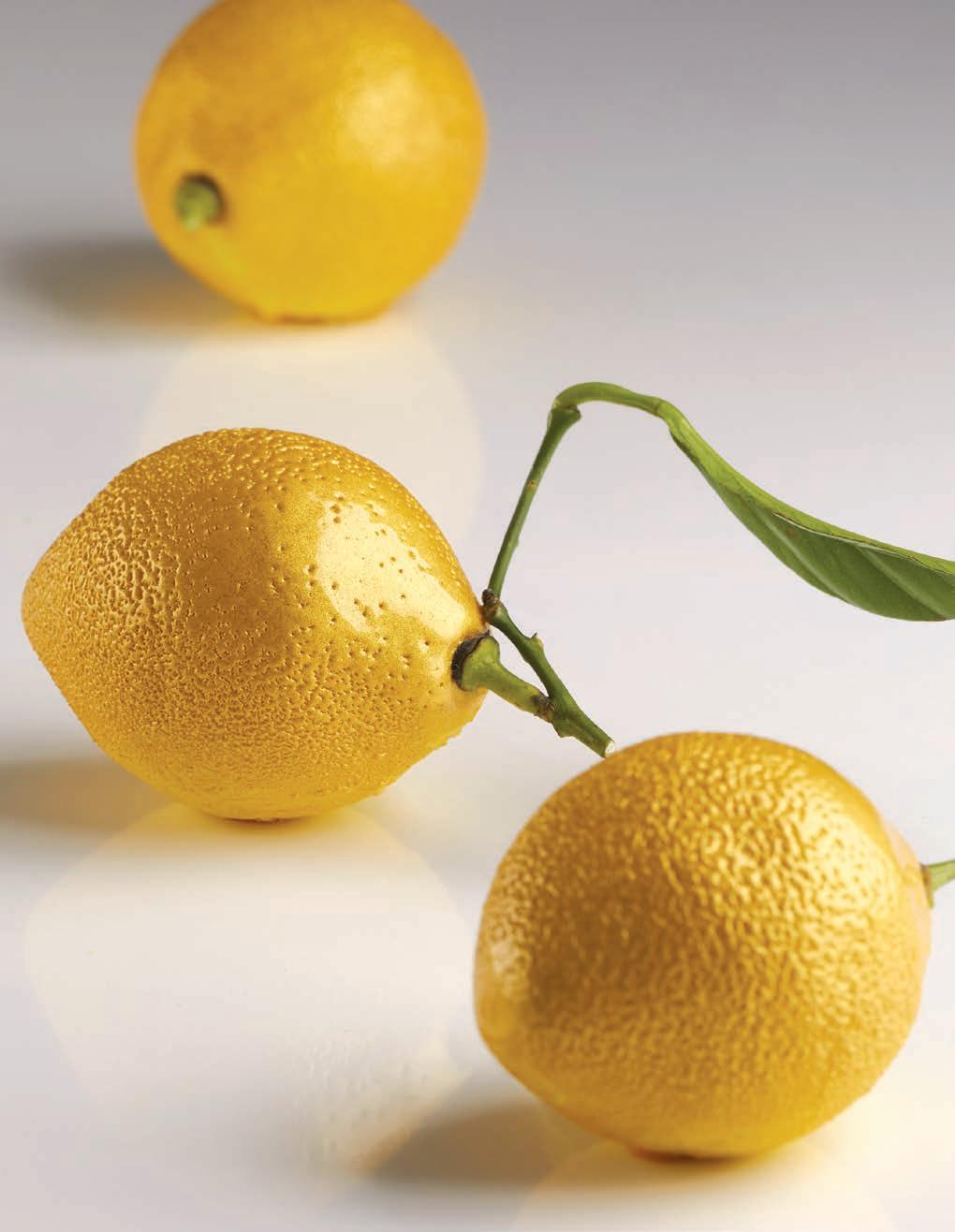
Namelaka montata limone
Latte g 300
Cioccolato bianco g 400
Panna g 400
Gelatina 170 Bloom g 7
Buccia di limone g 10
Buccia di lime g 4
Glassa croccante
Biscotto alla mandorla
Composta di limone
Finitura
Cioccolato bianco g 300
Burro di cacao g 300
Uova g 250
Zucchero g 250
Panna g 200
Zucchero invertito g 30
Sale g 2
Amido di mais g 215
Polvere di mandorla g 50
Baking g 10
Pasta di mandorla pura g 165
Limone candito g 200
Succo di limone g 300
Acqua g 150
Cristal mais g 40
Zucchero g 150
Vaniglia g 3
Sciogliere il cioccolato. Preparare la massa gelatina idratanto la gelatina in polvere in 5 parti d’acqua. Scaldare il latte a 60°C quindi sciogliervi la massa gelatina ed emulsionare sul cioccolato e la pasta di frutta secca. Unire la panna liquida. Far cristallizzare per 12 ore. Montare con la foglia. Dressare nello stampo.
Sciogliere il cioccolato a 40°C e il burro di cacao.
Pesare tutti gli ingredienti. Frullare tutti gli ingredienti in un cutter fino ad ottenere un composto omogeneo. Cuocere in forno ventilato a 200°C.
Frullare il succo di limone, l’acqua, lo zucchero e il cristal mais fino ad ottenere un gel sostenuto. Aggiungere il limone candito tritato. Colare in stampo.
Colare in una delle due metà la namelaka. Posizionare al centro l’inserto con il biscotto alla mandorla. Unire la seconda metà dello stampo quindi completare con la nameka. Abbattere e smodellare.
Whipped Lemon
Namelaka
Crunchy Glaze
Almond Sponge
Milk
g 300
White chocolate g 400
Cream
g 400
Gelatin (170 Bloom) g 7
Lemon zest
Lime zest
g 10
g 4
White chocolate g 300
Cocoa butter g 300
Eggs
Sugar
g 250
g 250
Cream g 200
Invert sugar
Salt
Lemon Compote
g 30
g 2
Cornstarch g 215
Almond powder g 50
Baking powder g 10
Pure almond paste g 165
Candied lemon
Lemon juice
g 200
g 300
Water g 150
Crystal maize
(modified corn starch)
Sugar
Vanilla
g 40
g 150
g 3
Melt the white chocolate. Prepare the gelatin mass by hydrating the powdered gelatin with 5 parts water. Heat the milk to 60°C (140°F), dissolve the gelatin mass into it, then emulsify over the chocolate and nut paste. Add the liquid cream. Allow to crystallize for 12 hours. Whip using the paddle attachment. Pipe into the mold.
Melt the chocolate to 40°C (104°F) and melt the cocoa butter separately.
Weigh all the ingredients. Blend everything in a food processor until smooth and homogeneous. Bake in a convection oven at 200°C.
Blend the lemon juice, water, sugar, and Crystal Maize until a firm gel is obtained. Fold in the finely chopped candied lemon. Pour into the mold.
Assembly Fill one half of the mold with the lemon namelaka. Place the almond sponge insert in the center. Join the second half of the mold and finish filling with the remaining namelaka. Blast-freeze, then unmold.
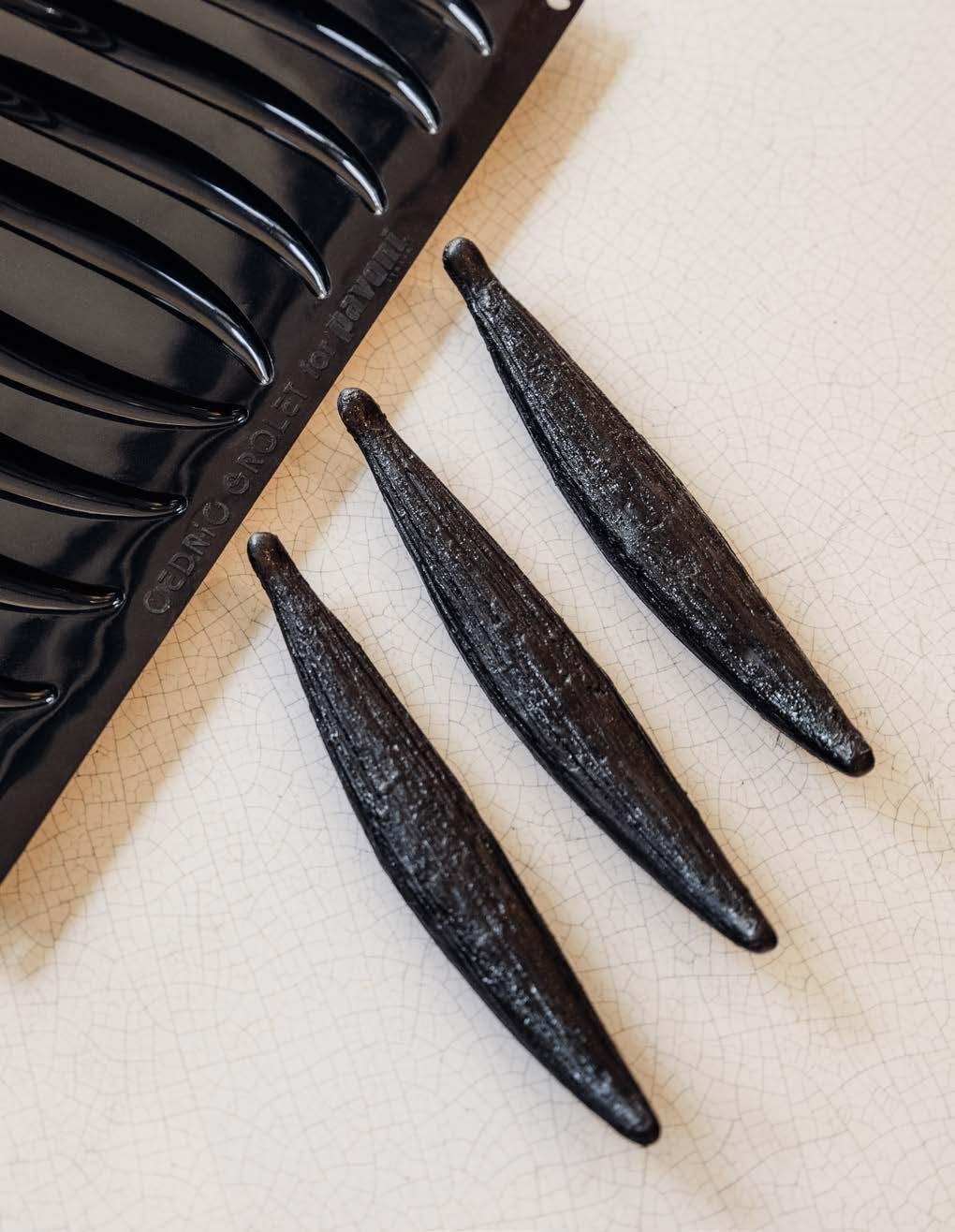
Namelaka montata
vaniglia
Glassa croccante
Biscotto alla vaniglia
Latte g 300
Cioccolato bianco g 400
Panna g 400
Gelatina 170 Bloom g 5
Vaniglia g 10
Mascarpone g 150
Caramello al fior di sale
Cioccolato bianco g 300
Burro di cacao g 300
Uova g 250
Zucchero g 250
Panna g 200
Zucchero invertito g 30
Sale g 2
Amido di mais g 215
Polvere di mandorla g 50
Baking g 10
Olio si semi g 165
Vaniglia g 5
Zucchero g 450
Glucosio g 200
Pectina NH g 4
Panna g 650
Vaniglia g 5
Burro g 200
Fior di sale g 3
Sciogliere il cioccolato. Preparare la massa gelatina idratanto la gelatina in polvere in 5 parti d’acqua. Scaldare il latte a 60°C quindi sciogliervi la massa gelatina ed emulsionare sul cioccolato e la pasta di frutta secca. Unire la panna liquida e il mascarpone. Far cristallizzare per 12 ore. Montare con la foglia. Dressare nello stampo.
Sciogliere il cioccolato a 40°C e il burro di cacao.
Pesare tutti gli ingredienti. Frullare tutti gli ingredienti in un cutter fino ad ottenere un composto omogeneo. Cuocere in forno ventilato a 200°C.
Portare ad ebolizzione la panna e la vaniglia. Cuocere a 185°C lo zucchero ed il glucosio. Decuocere con la panna bollente ed un unire la pectina. Frullare e ricuocere a 105°C. Filtrare e unire il burro ed il sale a 60°C. Conservare in poche.
Finitura Colare la namelaka montata nello stampo, continuare con il caramello salato. Abbattere, unire le due metà e glassare con la glassa croccante addizionata di pigmento lipo nero.
Caramel Mousse Milk
Blonde caramel
g 500
chocolate g 1000
Gelatin 200 Bloom g 20
Cream g 1000
Vanilla g 4
Crunchy Peanut Glaze
Caramel chocolate g 1000
Peanut paste g 150
Peanut Praliné Sugar
g 500
Salted peanuts g 500
Vanilla g 2
Cream Sponge Cake Eggs
g 250
Sugar g 250
Cream g 100
Invert sugar
Salt
Melt the chocolate. Prepare the gelatin mass by hydrating the powdered gelatin with 5 parts water. Whip the cream to a soft peak and keep refrigerated.
Heat the milk to 60°C, dissolve the gelatin mass into it, and emulsify over the melted chocolate. When the mixture reaches 35°C, fold in the semiwhipped cream. Pour into the mold.
Melt the chocolate to 40°C and mix in the peanut paste until smooth.
Cook the sugar to 185°C, then pour it over the peanuts. Allow to cool completely, then process in a food processor until a smooth praliné is obtained. Store in a piping bag.
Weigh all the ingredients. Blend everything in a food processor until smooth and homogeneous. Bake in a convection oven at 200°C.
g 30
g 2
Cornstarch g 215
Almond powder g 50
Baking powder g 10
Vegetable oil g 165
Assembly After pouring the mousse into the mold, use a small spatula to ensure that all the mold details are fully coated and defined. Pipe the peanut praliné into the center, then finish filling with the mousse and place two layers of cream sponge cake.
Blast-freeze until fully set, then unmold.
Glaze with the crunchy peanut glaze before serving.
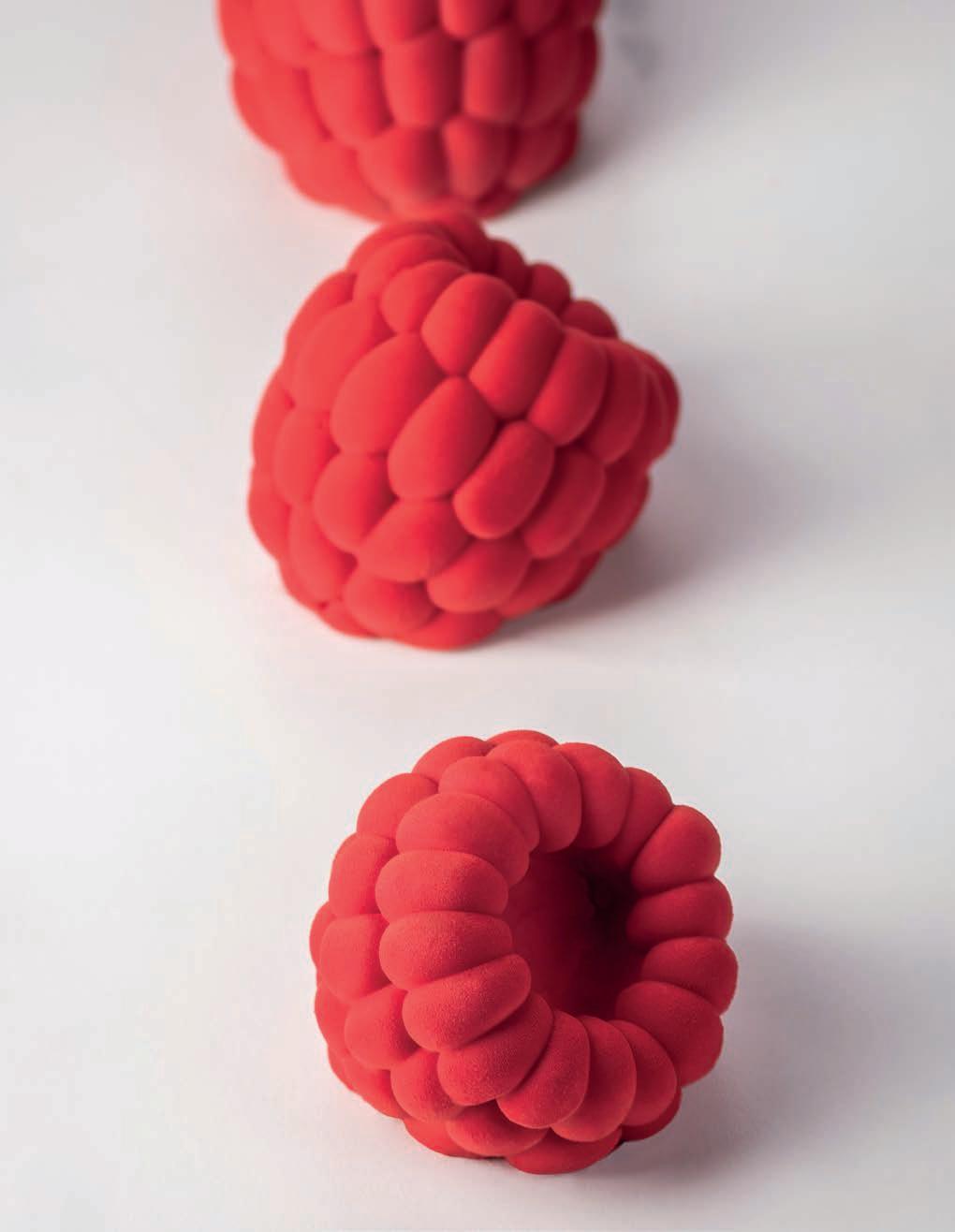
Biscotto
alla panna
Inserto ai lamponi
Uova g 250
Zucchero g 250
Panna g 100
Zucchero invertito g 30
Sale g 2
Amido di mais g 215
Polvere di mandorla g 50
Baking g 10
Olio si semi g 165
Purea di lampone g 500
Destrosio g 75
Gelatina 200 g 11
Buccia di lime g 4
Pesare tutti gli ingredienti insieme in un cutter. Frullare per 1 minuto quindi stendere il composto ottenuto e cuocere a 210°C 8/10 minuti. Coppare dei dischi da 2,5 cm.
Mousse al lampone
Latte g 500
Cioccolato bianco g 500
Cioccolato al lampone g 500
Gelatina 200 g 20
Panna g 1000
Vaniglia g 4
Scaldare la purea ed aggiungervi il destrosio. Aggiungere la gelatina e la buccia di lime. Colare in stampi in silicone PX4313. Abbattere.
Sciogliere i cioccolati e scaldare il latte a 70°C. Sciogliere la gelatina ed emulsionare.
Aggiungere la panna semimontata con la vaniglia quando la ganache è a 35°C.
Glassa rossa
Acqua g 325
Zucchero g 350
Glucosio g 100
Pectina NH g 12
Colorante rosso g 3
Acido citrico in soluzione g 10
Portare tutti gli ingredienti ad ebollizione ad esclusione della soluzione di citrico.
Finitura
Colare la mousse al lampone nello stampo, distribuendola in modo uniforme fino a circa metà altezza. Inserire al centro l’inserto ai lamponi già congelato, premendo leggermente per farlo aderire alla mousse. Coprire con altra mousse fino quasi al bordo dello stampo e livellare bene la superficie. Chiudere con il disco di biscotto alla panna. Abbattere fino a completa congelazione. Sformare il dolce e glassare con la glassa rossa alla temperatura di utilizzo.
Cream Sponge Cake Eggs
Raspberry Insert
g 250
Sugar g 250
Cream g 100
Invert sugar g 30
Salt g 2
Cornstarch g 215
Almond powder g 50
Baking powder g 10
Vegetable oil g 165
Raspberry purée g 500
Dextrose g 75
Gelatin 200 Bloom g 11
Lime zest g 4
Raspberry Mousse Milk g 500
White chocolate g 500
Raspberry chocolate g 500
Gelatin 200 Bloom g 20
Cream g 1000
Vanilla g 4
Weigh all the ingredients together into a food processor. Blend for 1 minute until smooth and homogeneous. Spread the batter evenly and bake at 210°C for 8–10 minutes. Cut out 2.5 cm diameter discs.
Red Glaze
Water g 325
Sugar g 350
Glucose syrup g 100
NH pectin g 12
Red food coloring g 3
Citric acid solution g 10
Heat the raspberry purée and add the dextrose. Stir in the gelatin and lime zest. Pour into PX4313 silicone molds and blast-freeze until set.
Melt both chocolates. Heat the milk to 70°C. Dissolve the gelatin in the hot milk and emulsify with the chocolates to form a smooth ganache. When the ganache reaches 35°C, fold in the semiwhipped cream and vanilla. Use immediately.
Bring all the ingredients to a boil, except for the citric acid solution. Once boiling, remove from the heat and add the citric acid solution. Mix well before use.
Assembly Pour the raspberry mousse into the mold, spreading it evenly up to about half of the height. Place the already frozen raspberry insert in the center, pressing it lightly so it adheres to the mousse. Cover with more mousse almost up to the top and smooth the surface well. Close with the cream sponge biscuit disc. Freeze completely in a blast chiller. Unmold the dessert and glaze with the red glaze at the correct working temperature.