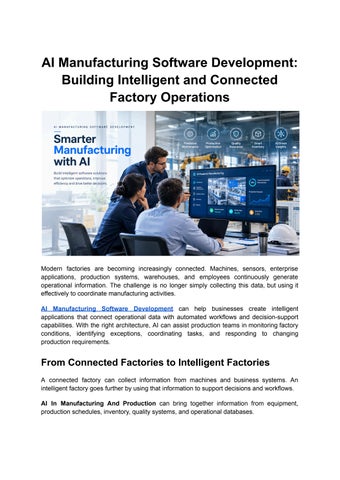
AI Manufacturing Software Development: Building Intelligent and Connected Factory Operations
Modern factories are becoming increasingly connected. Machines, sensors, enterprise applications, production systems, warehouses, and employees continuously generate operational information. The challenge is no longer simply collecting this data, but using it effectively to coordinate manufacturing activities. AI Manufacturing Software Development can help businesses create intelligent applications that connect operational data with automated workflows and decision-support capabilities. With the right architecture, AI can assist production teams in monitoring factory conditions, identifying exceptions, coordinating tasks, and responding to changing production requirements.
From Connected Factories to Intelligent Factories A connected factory can collect information from machines and business systems. An intelligent factory goes further by using that information to support decisions and workflows. AI In Manufacturing And Production can bring together information from equipment, production schedules, inventory, quality systems, and operational databases.
For example, an intelligent manufacturing platform could monitor production performance and identify when an output target is falling behind schedule. Instead of simply displaying the issue on a dashboard, the application could analyze related information and provide the responsible team with possible causes and recommended next steps. This creates a transition from passive monitoring toward proactive operational support.
Real-Time Manufacturing Intelligence Production environments can change quickly. A machine may experience an abnormal condition, a material delivery may be delayed, or an unexpected order may require production schedules to be adjusted. Traditional software often displays these events without providing much context. AI-powered applications can analyze multiple data points together to help employees understand what may be happening. A manufacturing intelligence platform can monitor: ● ● ● ● ● ● ● ●
Machine performance Production output Inventory availability Quality indicators Energy consumption Maintenance conditions Production schedules Order requirements
When these data sources are connected, AI can help identify relationships and operational exceptions that may otherwise require extensive manual analysis.
Agentic AI for Manufacturing Workflows Agentic AI For Manufacturing introduces the possibility of AI systems coordinating multiple steps within predefined workflows. Consider a scenario where a production machine reports an unusual condition. An AI-enabled workflow could: 1. Receive the machine alert 2. Review relevant sensor information 3. Check recent maintenance records 4. Compare the condition with historical events 5. Identify potentially affected production schedules 6. Prepare an operational summary 7. Notify the responsible maintenance or production team
The AI does not necessarily need direct control over the equipment. In many environments, it may be more appropriate for the system to prepare recommendations and require human approval before important actions are taken. This approach can provide automation while maintaining operational controls.
Generative AI for Factory Knowledge Manufacturing organizations contain large amounts of technical knowledge. Operating procedures, maintenance instructions, engineering documents, quality reports, equipment manuals, and training materials can become difficult to navigate. Generative AI In Manufacturing can provide a natural-language interface for accessing approved organizational information. For example, an employee could ask an internal AI assistant about a machine's documented maintenance procedure and receive a summarized response based on authorized company information. Generative AI For Manufacturing can also support: ● ● ● ● ● ●
Shift handover summaries Maintenance report preparation Technical document discovery Production report summarization Internal knowledge search Employee training support
Organizations should use controlled data sources and appropriate access permissions to reduce the risk of exposing confidential or inaccurate information.
AI Building Blocks for Smart Manufacturing A complete manufacturing AI platform may combine several technologies rather than relying on one AI model. Possible components include:
Machine Learning Machine learning models can identify patterns in production, equipment, inventory, and quality data.
Computer Vision Vision models can support automated product inspection and visual anomaly detection.
Generative AI
Generative AI can make technical and operational information easier to search and understand.
Predictive Analytics Predictive models can estimate potential equipment, inventory, or production-related risks.
IoT Integration Industrial sensors and connected devices can provide real-time information to AI applications. Together, these technologies can form a broader Manufacturing AI Software ecosystem.
AI for Energy and Resource Optimization Manufacturing operations consume significant amounts of energy, materials, and other resources. AI can analyze historical and real-time information to identify unusual consumption patterns or potential optimization opportunities. For example, an AI system could compare energy usage across production periods and identify conditions associated with higher consumption. Similarly, production analytics can help organizations understand material usage, waste patterns, and process efficiency. The objective is not simply to automate decisions but to provide production teams with better information about how resources are being used.
Designing Scalable AI Manufacturing Software Successful AI projects need a strong technical foundation. Manufacturing environments frequently contain legacy applications, industrial equipment, databases, and systems from multiple vendors. A scalable solution should therefore consider: ● ● ● ● ● ● ● ●
Data integration API connectivity Real-time processing Application security User permissions AI model monitoring System reliability Integration with existing platforms
Businesses exploring intelligent application development can consider AI Application Development when planning customized AI-powered software.
For broader software engineering and digital transformation requirements, Nextwebi can support organizations developing connected business applications.
The Future of Intelligent Manufacturing AI adoption in manufacturing is moving beyond individual use cases toward interconnected systems that combine production data, machine intelligence, automation, and human decision-making. Future manufacturing platforms may increasingly combine predictive analytics, generative AI, computer vision, digital twins, and agentic workflows within a common operational environment. The most practical implementations will depend on the specific production process, data availability, infrastructure, workforce requirements, and business objectives.
FAQs 1. What is an intelligent manufacturing system? An intelligent manufacturing system uses technologies such as AI, machine learning, analytics, sensors, and automation to analyze production information and support manufacturing operations.
2. How can Agentic AI be used in manufacturing? Agentic AI can coordinate predefined workflow steps, such as analyzing alerts, reviewing production information, preparing reports, and notifying responsible employees. Critical actions can remain subject to human approval.
3. Can Generative AI work with manufacturing documents? Yes. Generative AI can provide natural-language access to approved technical documents, maintenance records, operating procedures, and other organizational knowledge.
4. What technologies are used in Manufacturing AI Software? Manufacturing AI software may combine machine learning, computer vision, predictive analytics, generative AI, IoT integration, data engineering, and enterprise application integration.
5. How can manufacturers start an AI project? Manufacturers can begin by identifying a specific operational challenge, evaluating available data, defining measurable objectives, developing a focused solution, and gradually expanding AI capabilities after validating the initial implementation.