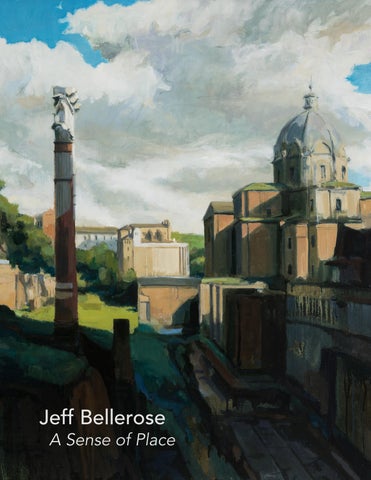
Jeff Bellerose A Sense of Place
Foreword
Rome is the “Eternal City”, and, as any visitor will tell you, it lives up to the moniker. A layered metropolis built on the ruins of the Etruscan and Roman civilizations, as well as the Medieval, Renaissance, and Baroque periods of Christian history, modern day Rome is both a museum and a vibrant living city of over 4.2 million residents. It has drawn painters, poets, scholars, and endless tourists for centuries and doubtlessly will continue to for many to come.
When Jeff Bellerose emailed me in the early part of 2025 to tell me that he had quit his job and was planning an extended trip to Italy, my reaction was both surprise at such an abrupt change and delight at knowing that he was planning to spend a lot of the time in Rome. Bellerose’s experience of Rome was different from that of many other visitors to the city. Eschewing many of the museums and tourist lines for famous monuments, Bellerose preferred to walk the city’s streets with his sketchbooks and watercolors for hours until finding the right vantage to drawn on the page. Then food was had and more walks with his longtime girlfriend followed, with more food and perhaps a jazz concert to fill the rest of their waking hours. Towards the end of their time in Europe, the pair did travel to other locales, including the Czech Republic and France, before returning to the U.S. Landing stateside, the pair travelled to New York and then up to Boston, where Bellerose grew up, for a visit to see his parents before their return to the San Francisco Bay Area. The works selected for his exhibition and this catalogue are largely the fruit of that lengthy trip.
I give my greatest thanks to Jeff Bellerose for our ongoing partnership in presenting his works and for giving us such a handsome exhibition to share with our audience. In the following pages, you will find a condensed and edited transcript of the artist talk Bellerose gave during the opening reception for the exhibition. I thank him also for agreeing to give the talk and for allowing us to publish it here.
I also give many thanks my fellow members of the Paul Thiebaud Gallery team – Colleen Casey, Matthew Miller, and Gregory Hemming – for their continued hard work and dedication to making our exhibitions and catalogues come to life.
Greg Flood, Director February 2026


On A Sense of Place: An Artist Talk with Jeff Bellerose
On January 17, 2026, Jeff Bellerose gave an artist talk during the opening of his exhibition A Sense of Place at Paul Thiebaud Gallery, which was moderated by the gallery’s Director, Greg Flood. The following is a record of that talk that has been condensed and edited for clarity.
Jeff Bellerose: Before I begin, I would like to thank everyone who has joined us today. I really appreciate it.
A couple months ago, when Greg and Colleen came over to my studio to pick out work, they had a good idea, which was to select works that showed the process of how I create my paintings and the ideas I want to paint. We ended up selecting watercolor sketchbooks, plein air oil paintings, a pair of monotypes, and some bigger oils to give the best picture of how I work.
To briefly run you through the story of how the pieces in this show came about, about a year ago I quit my job. It was maybe not the most responsible move, but whatever. Part of the reason I did this was I wanted to spend more time painting. Another part was that I wanted to travel and see what it is like to live for an extended period in another country. My girlfriend and I decided to live for several months in Rome because I really love Italy and wanted to spend some time there in particular. We rented an apartment near the center of the city, and I brought my oils and my watercolors with me. Most of my days were very straight forward... I would wake up and walk around the city for two or three hours, and stop to paint either watercolor sketches in my notebook or small plein air oils. After I filled up sketchbooks, I would then come back to have breakfast. My girlfriend and I then went out on walks during the mid-day. In the later afternoon, I would go out and paint again before dinner. It was so addicting that we basically just kept doing it every day and never traveled elsewhere much.
I spend a lot of time working through sketchbooks and watercolors to developing ideas about a place and what I want to paint. Then, when I came back to the Bay Area, I used those and other aspects of the stuff that I observed to do larger oil paintings with a more finished look.
A basic example, is if you walk out and look down Chestnut Street. It is a pretty street. There are trees, cars, traffic, and people walking on the sidewalks. Those are the first things most people see and a lot of people paint that when they paint cityscapes.
continues on pg. 12


I love those paintings. They are about the motion and movement. I have always been interested in something other than that. If you sit there for long enough, you notice that all the people disappear and the cars move on, and that there is something that is underneath all of it. There is more of a permanent thing underneath, which you identify with the space that you are looking at. I spend a lot of time drawing, painting, and doing watercolors when I travel to get at that thing that I feel is underneath what is happening in front of me. It is a sense of place, which is why chose the show title to be that.
This is why very often there are no people and not a lot of motion in my paintings. Another reason is I usually like painting early in the morning, when there are not a lot of people out. But, it is really about wanting to get past that and see the feeling of the place. This is true of everywhere, but with Rome it is such an ancient place. The painting over here is called Layers, and is of the Forum. It is a good example because for a couple of thousands of years, people have been crawling all over it. There is something about it that remains really permanent, both through the light, the space, and the feeling of the atmosphere.
When I work, I do a lot of watercolors. It is not necessary for the watercolors studies have to be identical to the larger paintings that I do, because they are primarily about capturing the feeling of that place. When I come back to the studio I use a combination of watercolors and oil sketches, with some photo references. Photos are really good at detail, but they do not really get the essence of the thing that you’re looking at. I do not care if I remember how many windows are on that building or whatever. It doesn’t really capture the feeling. The finished paintings are a combination of these things.
Greg Flood: I think an important question is how do you decide which sketches get to become big paintings?
JB: A lot of times when I am walking around, there will be something that strikes me about the view or the space and I’ll do some sketches. It is what speaks to me or what feels the most poignant about it. A lot of times it has to do with the light, the space, and the composition, and how they come together to identify the space. This painting of the Tiber River was probably the first one I made when I came back. In the Tiber River there is a little island called the Isola Tiberina. It is close to where we were staying, so, I walked past it at least eight times a day, and painted it endlessly. It has a lot of personal feel to it, but it also captures something about what I felt spoke to me about being there and about my time there.
GF: You did several paintings of the Forum as well. I think we can all get the allure of it, continues on pg. 15


but it is also a deeply layered place. You have the Etruscan culture, the Roman culture, and the Christian culture on top of them. Then you have modern Italy over all of that. What is it for you, about that in particular, that you are drawn to?
JB: It is hard to explicitly say, but there are all the specific details of that. There is also the light in Italy. It is both temporary and eternal at the same time. It changes all the time, but it is also the same light that has been there for thousands of years. It is part of why people have gone there to paint for centuries. There is something about the Forum where it has this antiquity and ancientness which gives it a sort of fundamental feeling. Then, with the temporary and eternal light at the same time, it is really hard to not want to paint it.
GF: What color is the light? Is it kind of like a yellowish color? Across your paintings, the light changes based because of the different geographies., and your use of color to express it is an important part of your work. Tell us more about your relationship to light and color.
JB: Light is the most important thing for a painter in general. It is why a painter wants to paint, usually. But, each place on earth has a very specific light and atmosphere to it. The Bay Area has its own light and so does the East Coast. I look through a lot of sketches to try and figure out how to capture it. It is not necessarily to paint it exactly like it looks, but to try to get the mood of it.
GF: In this show, I think we are showing for the first time some of your monotypes. Tell us about the process of making those and for how long you have been creating them.
JB: Monotypes are super fun. They are one of those things where, as if painting is not difficult enough, someone said let us come up with a way to make it even more difficult to create an image. That is always really appealing to a painter.
I have a friend in San Francisco who, after I came back, would let me go once a week to their studio and make monotypes for the day. Briefly the process is you paint on a clear glass or plastic plate. You then press it against a piece of paper and peel it back to reveal the result. But, the image is reversed and it comes out looking hardly anything like what you initially painted on the plate. Then you want to fix it, so you try to fix it on the plate and it gets really complicated. It never works out the way you want it to work out. But, as a result, you can build up layers because you can press it multiple times and you can fix a little bit what is on already on the page. Although you end up with only one image,
there are some layers to it that you could not get if you painted it directly. It takes a while to figure it out, but it is really fun to do.
Over the past 10 years, I have gone into my friend’s studio whenever I could to make monotypes, but I used to be employed so I could not go that often. Now I have more time to do it, so it is great. This time, I felt like it helped me to work through some questions or problems. This show has some larger paintings for me in it, which means a very different to approach a painting. When I would be working on a painting, I would do mockups and have to work out ideas like trying to figure out what I wanted to do with that painting or how I wanted to adjust the composition.
Audience Member: When you are out there working in your sketchbook, do you go to the same place repeatedly to come up with the sketches? What is that process? How long does that take?
JB: I am pretty quick, by which I mean they are probably done in about a half hour. You sit down and draw it in watercolor quickly, and then you have to live with the results. If you flip through the sketchbook, not every page is equal. Each has varying degrees of success. But, that is the fun in it. I was in New York last week, and I basically painted every day. It was freezing cold outside, so those sketches were more like ten minutes each. It was really cold outside to be painting and I would stand under the dryer in the bathroom to warm my hands up so I could do it again.
Sometimes I would also have watercolor paper, and I would spend a little bit more time to do a finished watercolor. The small oil paintings take a little longer, so I would sit in one spot and do the oils. The sketchbooks are about getting the idea down fast, so I would go out and do several in one area.
Audience Member: Do you ever use digital programs in working out different aspects of your composition, along with the other things that you mentioned?
JB: I do not, actually. Despite my background in physics and technology, I kind of hate technology, so I try to avoid it as much as possible. I do not have a cell phone. I have never had a cell phone. I am the last hold out. It makes life really difficult, but whatever, it is fine.
When it comes to the work, I try to have more of an organic process to it. I do use some photo reference stuff, but it is more of like a reminder of what it is that I wanted to capture in the painting.
continues on pg. 22


Audience Member: Watercolor and oil paint are such different mediums with such different approaches. I feel like you go back and forth on a regular basis. Is that enriching or difficult? Or how do you approach that?
JB: Many years ago, when I had also just quit my job – there is a trend here – and I was in Oregon, I spent a lot of time doing watercolors, and did more finished watercolors. That is a very different thing. Now I do more oil paintings, and when I go back and forth it is definitely a different approach. If I wanted to do a more finished watercolor, I think it would take me longer to get used to the medium again. But, because I do quicker sketch work, I am used to it as a tool.
Audience Member: In the studio, when you are painting, what comes to mind in terms of a story with the materials, with the canvas, with the drips, with the floor, with the lighting, when you are looking with these paintings? Maybe you’ve had two of them going at once.
JB: I usually work on multiple paintings at the same time. Sometimes I work on one painting primarily for a while, and when I get it about 80% done I start another one. Then I can go back to finish up the first painting. In general, I usually block in my paintings very loosely with darks, water drips, and it is kind of messy. I will then scrape it and move stuff around, and then try to hone it into something that seems interesting and build it from there.
Audience Member: Your paintings are amazing. How do you manage to get them absolutely perfect?
JB: I do not honestly know. There is a film of Gerhard Richter with him painting his squeegee paintings, where he had a really great line. To paraphrase, he said, “some paintings just live for a day, some paintings are good for a week, some paintings are good for a month, and some paintings are good for longer.” I feel like you should experiment with painting. I will take a painting that I have gotten to a certain place and put it away for a little bit in order to work on something else. Later, I will pull it out and realize it did not last. Then I will go back and keep working on it to get it to the point where it lasts.


Plate 13:
Study, 2025
oil-based ink monotype on paper, 8 x 10 inches

Plate 14:
Forum Study, 2025
oil-based ink monotype on paper, 8 x 10 inches


Plate 15:

on sketchbook paper, 8 1/4 x 10 1/4 inches


Plate 16:


watercolor on sketchbook paper, 8 1/4 x 10 1/4 inches


Plate 18:


Plate 21:


Exhibition Checklist
Plate 1: Layers 2025 oil on canvas 30 x 40 inches
Plate 2: Grand Canal 2025 oil on canvas 20 x 20 inches
Plate 3: Ancient 2025 oil on board 11 x 14 inches
Plate 4: Isola Tiberina 2025 oil on canvas 24 x 36 inches
Plate 5: First Light 2025 oil on canvas 24 x 36 inches
Plate 6: Shadow Line 2025 oil on canvas 20 x 26 inches
Plate 7: Beams 2025 oil on board 14 x 11 inches
Plate 8: Edge 2022 oil on board 11 x 14 inches
Plate 9: Teatro, Night 2025 oil on board 6 x 6 inches
Plate 10: Woods, Morning 2023 oil on board 6 x 6 inches
Plate 11: Hills 2023 oil on board 6 x 6 inches
Plate 12: Balcony 2023 oil on board 6 x 6 inches
Plate 13: Layers Study 2025 oil-based ink monotype on paper 8 x 10 inches
Plate 14: Forum Study 2025 oil-based ink monotype on paper 8 x 10 inches
Plate 15: Roma 2025
watercolor on sketchbook paper
8 1/4 x 10 1/4 inches
Plate 16: Czech Church and Tower 2025
watercolor on sketchbook paper
8 5/8 x 12 inches
Plate 17: Still in Rome 2025 watercolor on sketchbook paper
8 1/4 x 10 1/4 inches
Plate 18: Winter Light 2025 oil on canvas
16 x 20 inches
Plate 19: Crossing 2025 oil on canvas
16 x 20 inches
Plate 20: Hudson River 2025 oil on canvas
24 x 30 inches
Plate 21: Reflection 2024 oil on canvas
22 x 28 inches
Works not Exhibited
Plate 22: Rome Forum 2025 oil on canvas
30 x 40 inches
Plate 23: City of Bridges 2025 oil on canvas
24 x 36 inches
Plate 24: Prague Roof Skyline 2025 oil on board
24 1/2 x 18 1/4 inches
Plate 25: Via della Luce 2025 oil on board
12 3/8 x 12 inches
Plate 26: Ponte Sisto over the Tiber 2025 oil on canvas
30 x 24 inches
Plate 27: Slope 2025 oil on canvas
14 x 11 inches