Four Women Trajectories through Art History
22 April – 22 July 2026
22 April – 22 July 2026
by Kate Retford
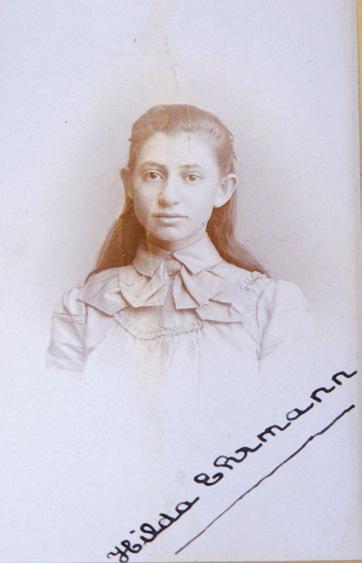
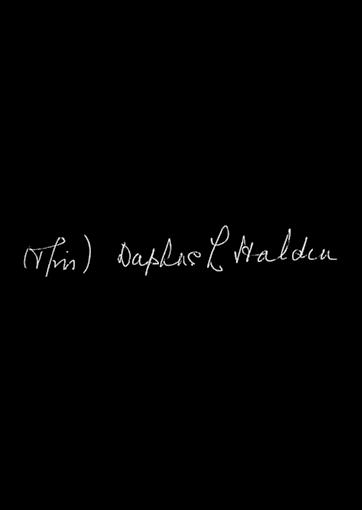
This display arose out of an undergraduate module taught by Dr Hans Hönes at the University of Aberdeen: Women Writing Art History, c.1850–1970. The archives at the Paul Mellon Centre include extensive material across the collections relating to women working in the field of art history – material that it is seeking to expand further. Dr Hönes brought his students to the Centre in Bedford Square to look at a range of materials, and the idea arose for a number of them to curate a display. Leigh Wilson, Lani Garms and Noémi Gottmann each selected a woman on which to focus, respectively Daphne Haldin, Deanna Petherbridge and Luisa Vertova. The first two have their own archive collections at the Paul Mellon Centre; Vertova’s material is contained within the archive of her husband, Benedict Nicolson. The curatorial team was then joined by Ellie Harrold, archives and library assistant graduate trainee at the Centre, who added Hilda Finberg to our quartet, drawing on papers contained in the Frank Simpson Archive. Our four women are represented by portraits displayed – as is traditional – over the fireplace (see items 1a–d). There were numerous images of Petherbridge and Vertova available for us to choose from. Ellie Harrold managed to unearth a school photograph of Finberg. Haldin, however, has remained elusive, and can only be represented by her signature. Over a series of workshops, the material in this display was selected, investigated, discussed and arranged. Dr Hönes drew out the names of some of the many women who contributed to the unpublished Dictionary of British Artists project, an initiative
undertaken by the Paul Mellon Foundation (the Centre’s predecessor) and documented in the Institutional Archive. These were used to compile our ‘wall of names’ (see item 25), creating a foil to the four case studies at the heart of the display.
The result is a nuanced and complex picture of women working as amateurs and professionals from the interwar period through to the 1970s.
by Hans Hönes
This display showcases the lives and careers of four women represented in the Paul Mellon Centre Archives. It features material relating to Hilda Finberg (c.1885–1959) from the Frank Simpson Archive, Daphne Haldin (1899–1973) from the Daphne Haldin Archive, Luisa Vertova (1920–2021) from the Benedict Nicolson Archive and Deanna Petherbridge (1939–2024) from the Deanna Petherbridge Archive. Their work serves as a springboard to reflect on the nature and visibility of women’s work within the field of art history.
The items in the display date from the 1930s to the 1970s – a period when art history in Britain was still a comparatively young discipline. This belated institutionalisation might have opened possibilities for women and allowed them to develop professional opportunities that were not available in more established fields.
The careers of these four women were varied. Some received academic training; others did not. They worked professionally as gallerists, researchers, lecturers, curators and artists – or were unsalaried ‘amateurs’. They all struggled to greater and lesser extents to assert their visibility and standing in fields that were often dominated by men.
The display aims to showcase the archival traces left by these women and to highlight the important ways in which women have shaped British art and art history. These case studies are not intended as celebrations of forgotten ‘heroes’ but rather to illustrate both the opportunities and the structural difficulties faced by women in the art world.
by Ellie Harrold
The papers of Hilda Felicite Finberg are to be found in the Frank Simpson Archive at the Paul Mellon Centre, within the records created by the London office of the art dealers M. Knoedler & Co. Finberg corresponded professionally with Letitia Simpson, who held the post of librarian at Knoedler’s, and the two became great friends. On Simpson’s retirement, Frank – her nephew – took up the role of librarian.
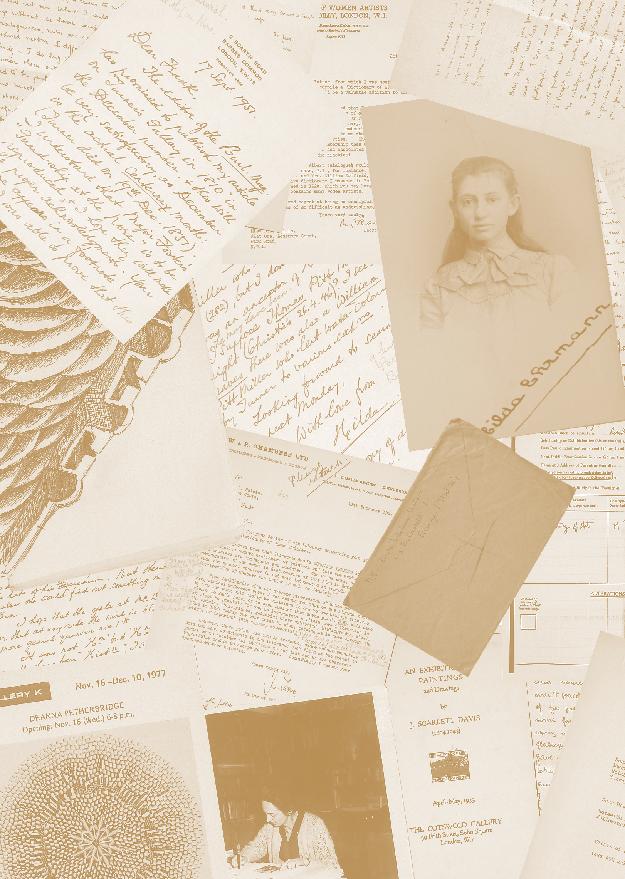
Finberg (c.1885–1959) was born Hilda Ehrmann to parents Ferdinand and Eugene (see item 1a). Ferdinand ran a successful wine merchant in Finsbury Square, Ehrmann’s, so the family was quite wealthy. Finberg was privately educated at the North London Collegiate School for girls between 1895 and 1904, after which she completed matriculation exams with the University of London. It is important to place Finberg in the context of this privilege, as it afforded her access to an education in the arts and the opportunity to pursue a career in the field. In 1914, aged about twenty-nine, Hilda married Alexander Joseph Finberg, still well known today as an authority on J. M. W. Turner.
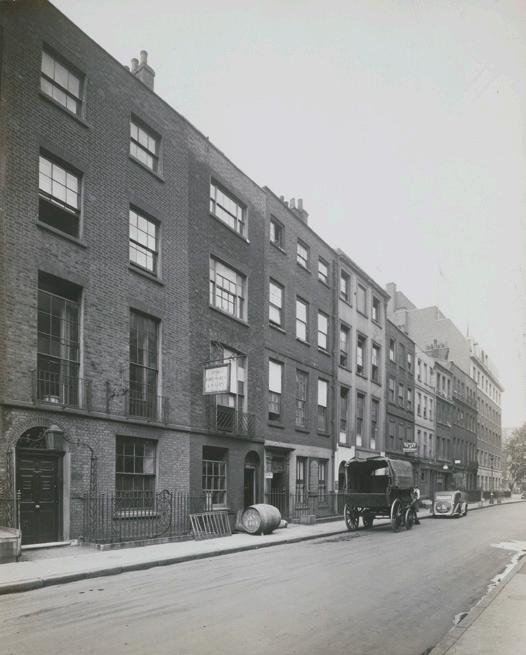
In 1921, the couple opened the Cotswold Gallery on Frith Street in Soho, London (see item 2). Buying and selling prints and running an annual watercolour exhibition each summer, the gallery specialised in historic English art. Research suggests that, while both Finberg and her husband were owners of the gallery, she took a much more instrumental role in the business.
Multiple newspaper articles refer to the opening of ‘Mrs Finberg’s gallery’. Census records also show that, while Alexander remained officially an ‘author, historian and
artist’, Finberg listed her occupation as ‘print seller’, showing that she considered herself first and foremost a gallerist (see item 3).
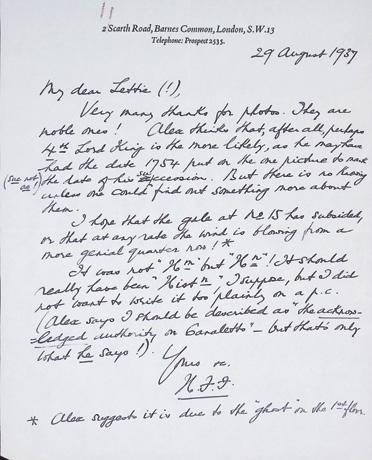
Throughout her career, Finberg wrote extensively on artists such as Canaletto and Turner. In 1919, she published ‘Canaletto in England’ in The Volume of the Walpole Society, an influential article that remains an important source for Canaletto scholars today (see item 5). Despite the article’s success, Finberg was never fully recognised as an expert on the artist. In August 1937, she wrote to (Letitia) Simpson: ‘Alex says I should be described as “the acknowledged authority on Canaletto” - but that’s only what he says!’ (see item 4). This highlights the struggles that women faced to be recognised professionally. While Finberg’s work remained an invaluable source to those who knew of her, she was never fully acknowledged in the wider art historical field.
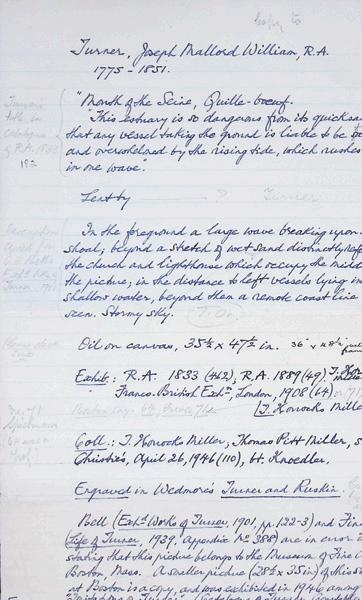
Finberg and Simpson corresponded about various artists and works of art in their professional capacities, as well as about personal matters. Following Alexander’s death in 1939, and the subsequent publishing of his book The Life of J. M. W. Turner, RA, Finberg continued to research and write about Turner. In 1951, she discovered an error in the publication with the ‘pedigree’ provided about Quillebeuf, Mouth of the Seine, which had been wrongly identified as the version at the Museum of Fine Arts Boston (see item 6). Finberg and Simpson both attempted to correct the mistake over several months. While they were eventually able to inform the relevant parties and get the details of the painting updated, it took both women multiple attempts to contact those involved and explain the error (see item 7).
The letters in the Frank Simpson Archive documenting their efforts illustrate how much harder it could be for women to be heard at this time, and how they sometimes had to downplay their professional status to be so. In correspondence with the Boston
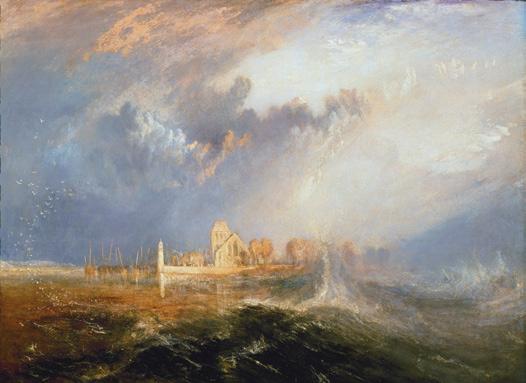
museum, Simpson refers to Finberg as ‘a close personal friend with whom I share information’ and a widow seeking to right the error in her husband’s publication (see item 8). While this demonstrates their closeness, it also positions Finberg solely as a concerned widow, ignoring her status as a professional art historian and expert on Turner who had been working in the field for over three decades.
Above: Item 6
Despite her struggles to be recognised professionally, Finberg did have a highly successful career as a gallerist and art historian over a period of almost forty years. Following her death in 1959, a second edition of The Life of J. M. W. Turner, RA was published that included a new, added supplement authored by her. Finberg is acknowledged in the introduction to this new edition as ‘an art historian of distinction in her own right’.
by Leigh Wilson
Researching and contextualising past lives is core work for the art historian, but recovering past lives with only a modicum of historical information available is always a challenging task. Daphne Haldin was an amateur art historian who is scarcely known today, but four boxes of her papers remarkably survive at the Paul Mellon Centre. The Daphne Haldin Archive reveals details of her project to compile a dictionary of women artists in Europe before 1850. Sadly, one substantial file consists of the rather voluminous collection of rejection letters returned to her from a wide array of British publishers. Contained within these letters are a variety of responses that at times betray signs of sympathy and at other times signal complete disinterest. However, this correspondence still stands as a testament to an aspiring art historian who refused to yield to rejection and embodied a remarkable resilience.
While little is known of Haldin (1899–1973), we do know that she was born in Norwich to parents of Jewish heritage, Alfred and Edith Haldinstein, before moving to London, where she remained for the rest of her life. Whether Haldin moved to the capital for work or academic purposes is unclear. However, we are sure that she made a conscious decision to anglicise her name, though both the purpose and the date of the change are unclear. Little is known of Haldin’s formal education, but student records held in the Special Collections archive at University College London include a 1938 entry form showing that she registered to study a course on the history of art (see item 10). This was not a formally recognised degree
Opposite: Item 11
in the United Kingdom at the time, but it is striking that she took at least one short course in the subject, developing her academic skills. One imagines that she chose to study with a view to improving her research and writing, and her chances of publication.
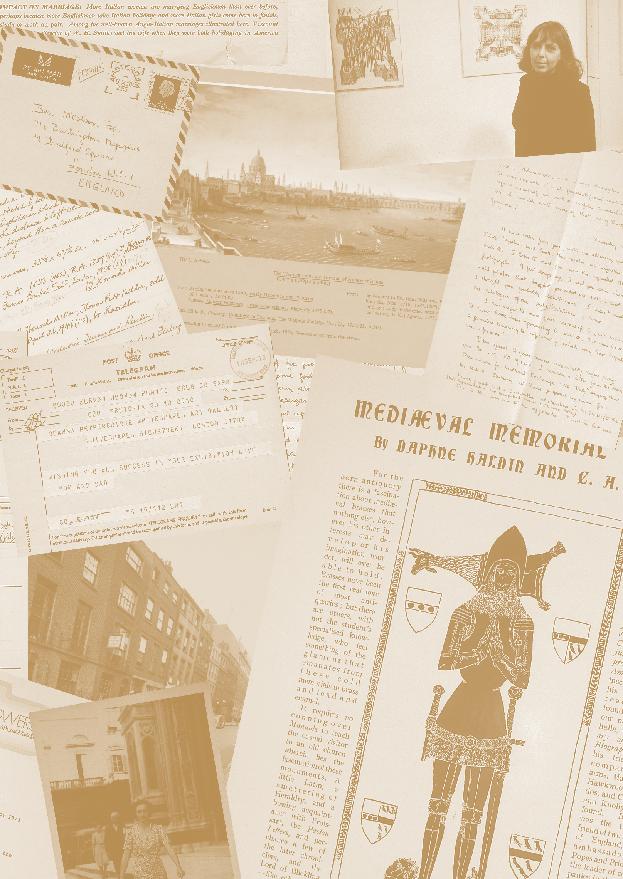
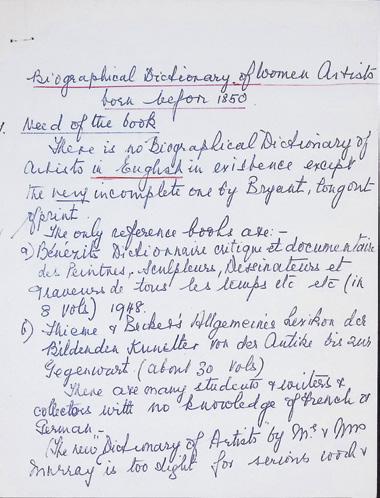
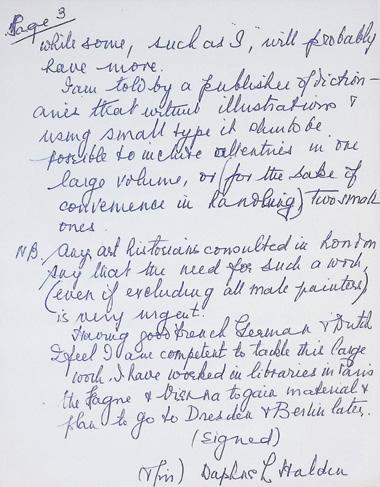
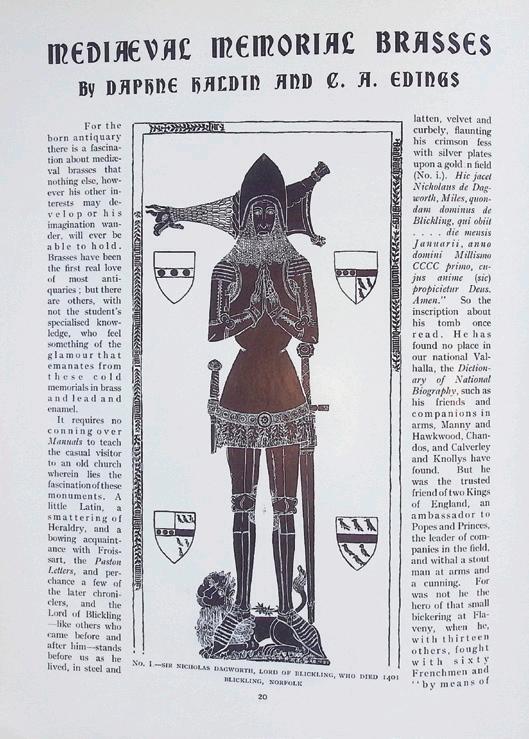
Haldin was only published on one occasion, in The Connoisseur art journal in 1931, with a co-authored piece of research on medieval memorial brasses (see item 11). However, the Daphne Haldin Archive includes quantities of drafted material for the dictionary on which she embarked two decades later. In a surviving document, she outlines her rubric and reasoning for the project. She notes that, while there is no such published dictionary of women artists to date, this only reinforces the need for one (see item 9). Other contemporary publications are ‘too slight’ and unresponsive to the increasing presence of women in the art world. Her papers show a woman, undeterred by rejection, consistently aiming to redress the balance of an art history that at the time was predominantly written by and about men.
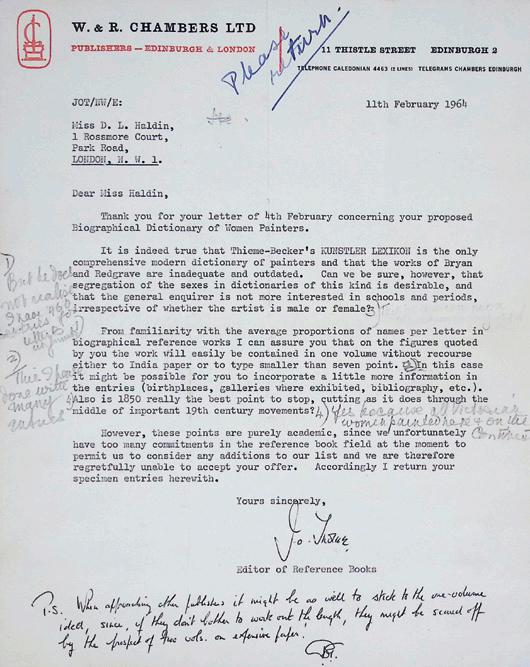
Indeed, on a rejection letter from W. & R. Chambers Ltd, which includes Haldin’s scribbled, acerbic annotations, she refutes the argument that a gender-specific dictionary would be of little value (see item 12). She also notes that she has 595 entries for the letter ‘B’ alone. Although numerous publishers attempted to placate her by signposting her towards alternative outlets that might be more sympathetic to such a project, one senses this was driven by professional decorum rather than any genuine attempt to help her secure publication. Because she sought to exclusively focus on women painters and sculptors, we can now understand Haldin as a feminist art historian ahead of her time, paving the way for future scholars who have produced precisely the type of publication towards which she aspired.
Opposite: Item 17
Overleaf: Item 14
by Noémi Gottmann
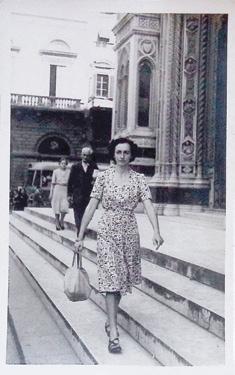
Luisa Vertova (1920–2021) was born in Florence, Italy, to a noble family that held traditional Italian values. Although Vertova was not permitted to follow her dream and become an artist, her father – a philosophy teacher – instilled in her a high regard for education. She chose to pursue her own career as an art historian, despite the social and gender norms of the period. She studied art history and archaeology at the University of Florence in the early 1940s (see item 13) and was later offered the opportunity to work as research assistant to the renowned – although not academically trained – art historian Bernard Berenson at Villa I Tatti in Florence (now a research centre under Harvard University). While in her role at I Tatti, Vertova helped with cataloguing Berenson’s photographic archive and his famous ‘Lists’ – catalogues of Italian Renaissance paintings. During this period in Vertova’s life, she met Benedict Nicolson, a British aristocrat and art historian. Following their subsequent marriage in 1955, an article in The Tatler observed, ‘Mr & Mrs. Benedict Nicolson were introduced in Florence by the man they had both studied with: Bernard Berenson.’ Nicolson had resided at I Tatti while occupied with his own research work and an unpaid internship with Berenson in the 1930s.
After their first encounters, Vertova and Nicolson began exchanging letters. Vertova’s archive is today held at I Tatti, but the correspondence she sent to Nicolson is part of his archive at the Paul Mellon Centre. In these letters to her future husband, Vertova expresses anxiety about the prospects of love,
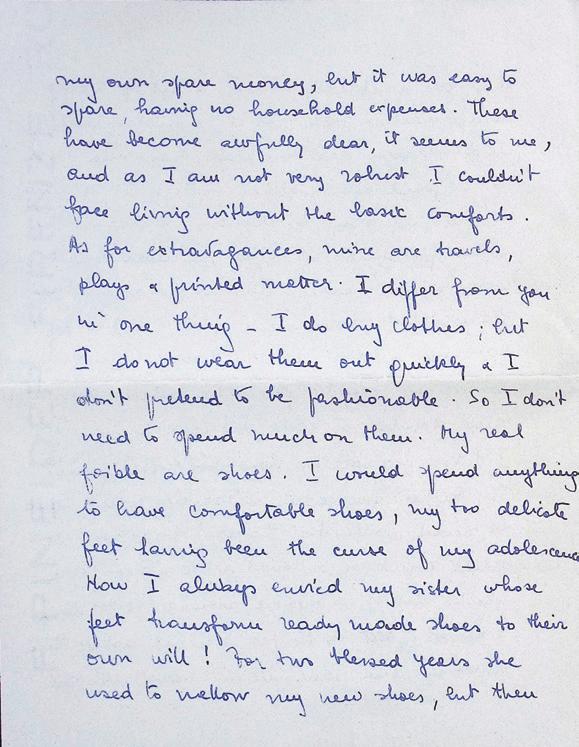
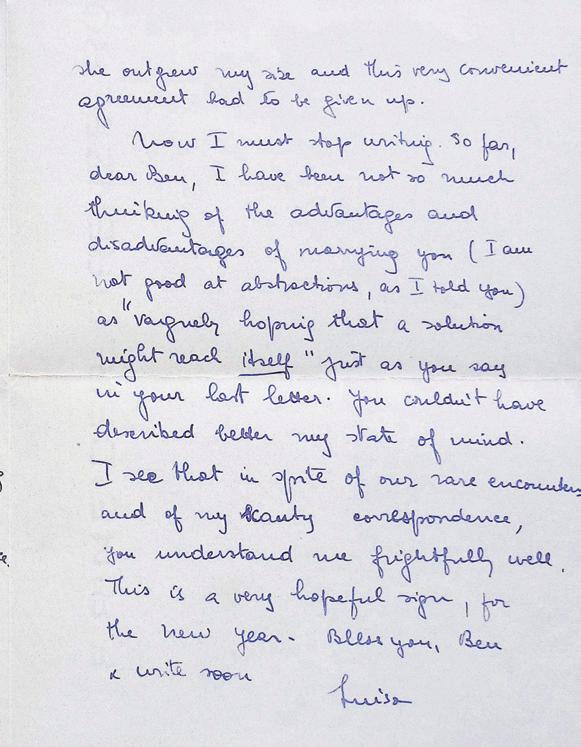
marriage and children in response to his suit. She notes that she has already chosen to give up a ‘very wealthy fiancée’ in order to earn her living, and weighs up the advantages and disadvantages of getting married (see item 14). Despite the well-established structures of accepted gender roles in the mid-twentieth century, she was following her dream to become a research fellow, securing a Fulbright scholarship and travelling to the United States in 1954 (see item 15).
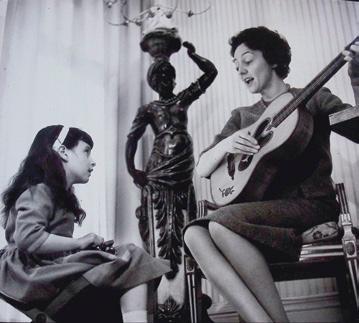
Vertova moved to London when she married Nicolson. Their daughter, Vanessa, was born in 1956 (see item 16). Despite the disruption of the swift breakdown of their marriage, Vertova remained focused on her work. Thanks to her talents as a scholar and her capacity for hard work, and aided by her advantageous social position together with the myriad connections she had built up within the field, she was able to establish a successful career as an art historian, lecturing, curating exhibitions and publishing widely.
Vertova continued to work alongside Berenson until his death in 1959, and helped with the translation of one of his most well-known and important works into Italian in 1961: The Drawings of the Florentine Painters. Later in her life, Vertova continued to specialise in Italian Renaissance and Baroque paintings and drawings. She worked for Christie’s International auction house as a consultant in Italian art and a specialist in Old Master paintings and drawings for many years, up until 1984 (see item 17).
The objects presented in this display have been carefully chosen to represent Vertova’s varied and sometimes conflicting roles as a professional art historian and a wife and mother. They provide rich insight into her life as an ambitious career woman with a rich, complex personal life.
Above: Item 13
Below: Item 16
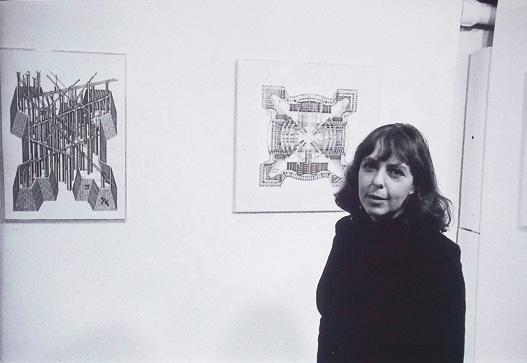
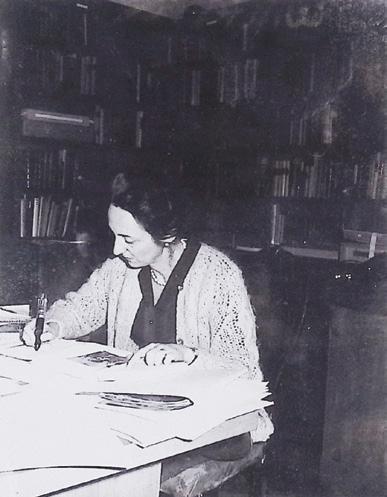
The Deanna Petherbridge Archive at the Paul Mellon Centre showcases Petherbridge’s life and work from the 1960s through to the 2020s. This display focuses on material from the early 1970s, a turning point in her career. After several years living in Greece, Petherbridge (1939–2024) returned to Britain – to which country she had emigrated in 1960 – and began developing what would become a highly successful professional life. Rather than a linear route, she took a portfoliobased approach, combining fine art practice, teaching, research and writing, and curatorial work. Materials from these formative years trace how a woman artist navigated the cultural economy of the 1970s and reveal the foundations for Petherbridge’s later impact on the field of British drawing.
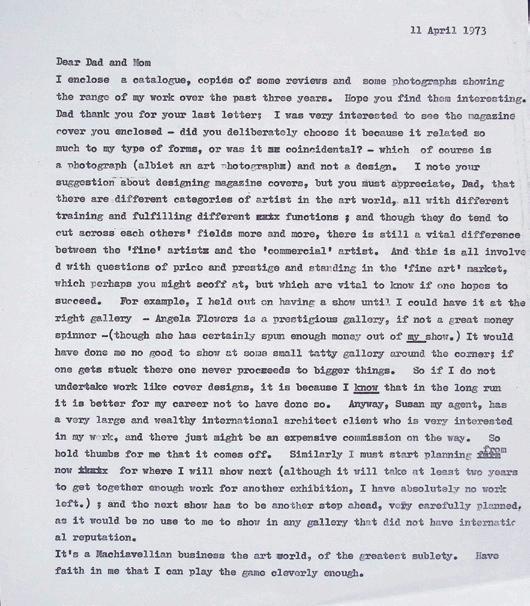
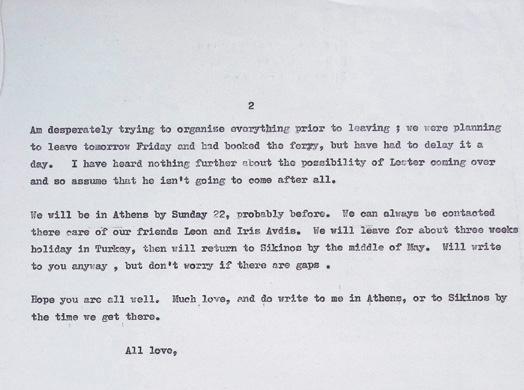
In a 1973 letter to her parents, Harry and Frieda Schwartz, Petherbridge described the art world as a ‘Machiavellian business’, one that required tactical thinking and careful self-positioning. At a time when opportunities were sharply constrained, she emphasised the need to ‘play the game cleverly enough’ (see item 18). Her correspondence within the archive reveals a determined figure, underscoring her struggle for visibility on her own terms. Her success depended on the development of networks, good timing and the ability to read the professional landscape acutely, while not compromising on her principles.
Petherbridge’s early engagement with the Angela Flowers Gallery, then an emerging contemporary art space, demonstrates this awareness. Material in the
archive shows her aligning herself with institutions capable of advancing her ambitions. Concerned not to work with smaller or less reputable venues, Petherbridge understood that ‘if one gets stuck there one never proceeds to bigger things’ (see item 18). For a woman without established institutional support, originally from South Africa and with a deep commitment to the oftendismissed medium of drawing, this assertion of agency reflects both personal resolve and the realities of a competitive, male-dominated sector.
Alongside her studio practice, Petherbridge held several temporary teaching posts in her early career, including at a London secondary school. Such transient roles were common for those working in British art education in this period. While these posts provided paid employment, they also informed ideas that would later underpin her substantial contributions to both drawing and art-school reform. Teaching documents from this period register both the necessity and the intellectual value of such work.
Petherbridge also proactively established international networks. A letter to Bernice Rose at the Museum of Modern Art, New York, signals her initiative in forging connections beyond Britain (see item 19). This correspondence, together with ephemera surviving from her 1977 exhibition at Gallery K in Washington, DC, points to the material outcomes of such exchanges (see item 20). Collectively, these letters chart the formation of international networks that would later support her practice.
Petherbridge’s personal life is also uncovered by the material in this display (see items 21 and 22). Letters and a telegram exchanged with her parents include candid reflections on risk, self-belief and the importance of declining certain opportunities in order to secure better ones (see items 18 and 22). These private communications reveal the emotional resilience that underpinned Petherbridge’s professional decisions during periods of instability.
Opposite: Item 18
Opposite: Item 27
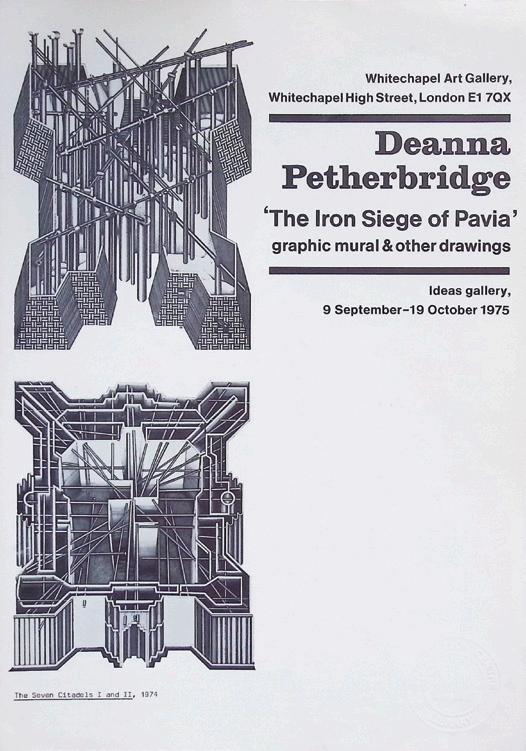
Equally significant was Petherbridge’s commitment to drawing, which had long been dismissed as a ‘lesser’ medium, primarily to be used for preparatory work. By the mid-1960s, she had abandoned painting and sculpture in favour of pen and ink. Her architectural drawings were often rooted in her international travels, including the time spent in North Africa that informed her Cities of Sand series (1971–73) (see items 23 and 24). This work later culminated in politically charged depictions of urban ruin, such as The Destruction of the City of Homs, now in the Tate collection. Later in Petherbridge’s career, she was to battle the marginalisation of drawing within modern art education, championing its inclusive traditions. Together, these materials raise questions about how the world of British art in the 1970s shaped Petherbridge’s career. Was her success the result of personal tenacity, or was that tenacity forged by a system that demanded resourcefulness from such a woman artist? The objects in the display suggest a complex interplay of both factors. These early experiences laid the groundwork for Petherbridge’s successful portfolio career. She was appointed as professor of drawing at the Royal College of Art in 1995; her 2010 publication The Primacy of Drawing has been described as ‘the most comprehensive study of drawing’, with a revised edition issued by Thames & Hudson in 2026; and her drawings are now held in over twenty museum and public collections.
Opposite: Item 25
by Hans Hönes
In 1964, the Paul Mellon Foundation, the precursor of today’s Paul Mellon Centre, began work on a Dictionary of British Artists. This was a large-scale research project, intended to lay scholarly foundations for a reassessment of British art. Based on extensive original research, the Dictionary attempted to document all major and minor artists working in Britain between the fifteenth and early twentieth centuries.
The sheer scale of the project required substantial investment in staff, for archival work, literature reviews and writing up entries. Over the next six years, the Paul Mellon Foundation hired dozens of researchers and research assistants to contribute to this monumental task. In 1970, however, the project was terminated due to spiralling costs, and it now only survives within the Paul Mellon Centre Institutional Archive.
Among the staff employed for this project were many women. In 1968, thirty-one out of sixty-three payments were made to employees titled ‘Mrs’ or ‘Miss’. Other employees, listed with their initials only, might also have been female. But even a conservative estimate suggests virtual parity of gender – a remarkable fact.
The archival documentation of the Dictionary project can serve as a case study for gleaning the depth and breadth of women’s contribution to art historical research. They are an integral part of the ‘dark matter’ (as in the title of a book by Gregory Sholette) that constitutes a discipline and its scholarly community. British art history has been significantly shaped by the work of women.
In the 1960s, art history was still a comparatively young discipline within British academia. In 1961, Benedict Nicolson, the editor of the Burlington Magazine, published a report on the state of the field: only the Courtauld Institute of Art offered a full undergraduate degree in the subject. This belated institutionalisation might have opened opportunities for women and allowed them to gain prominence that was harder to achieve in fields with better prospects for future employment. As an emerging, yet only semiprofessionalised, field of study, art history was open to individuals from various walks of life, with or without formal training.
Highlighting the names of female contributors to the Dictionary allows us to visualise the historical significance of women art historians, many of whom are known only by their surname. This does not, of course, mean that all contributors to the Dictionary remained unknown. Several women who cut their teeth on this project became important and influential historians and critics of art: Clare Henry (Financial Times), Deborah Howard (University of Cambridge) and Mary Bennett (Walker Art Gallery) are just some names worth noting.
In the wall of names (see item 25), however, those names are absorbed in a longer list, without hierarchies of achievement. The contributors to the Dictionary project are presented in the spirit of a memorial, as a commemoration of those –both famous and unsung – who contributed to a major shared endeavour. The wall also serves as a counterpoint to the detailed biographical case studies included in this display.
This arrangement resembles the ‘heritage floor’ in Judy Chicago’s installation The Dinner Party (1974–79). Here, the American artist presented a table set for thirty-nine noteworthy women, but she also included an elaborate tile floor with nearly a thousand names of lesser-known women, who literally serve as the
foundation for the celebrated individuals who gained a seat at the table. This analogy allows us to reflect on the display’s wider theme of the visibility of women’s labour and their career opportunities. For every woman who forged a successful career, dozens of other names linger in the archives.
Photograph of Hilda Ehrmann (later Finberg) taken from a collection of class photographs of form Lower IV A, North London Collegiate School. c.1900
Kindly lent by North London Collegiate School
Framed signature representing Daphne Haldin
Detail from a photograph of Luisa Vertova on the terrace of Via Laura 70, Florence. October 1972
Kindly lent by Vanessa Nicolson
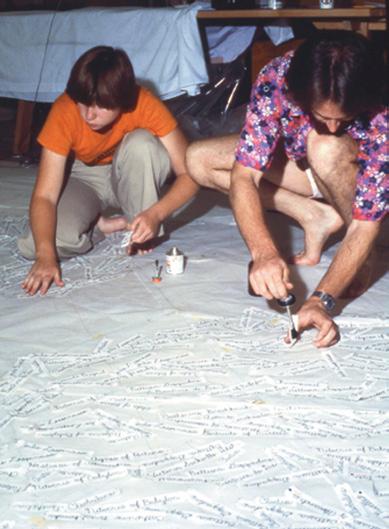
Detail from a photograph of Deanna Petherbridge at the installation of the exhibition The Iron Siege of Pavia and Other Drawings, Whitechapel Art Gallery, 1975. Approx. September 1975
Archive Reference (hereafter AR): DSP/TN/4 © Jonathan Bayer
Item 2
Catalogue for an exhibition of paintings and drawings by John Scarlett Davis held at the Cotswold Gallery, April–May 1933. 1933
AR: APO/1/1/2
Item 3
Photograph of buildings in Frith Street, featuring the Cotswold Gallery. 1943
Digital image courtesy of London Picture Archive
Item 4
Letter from Hilda Finberg to Letitia Simpson concerning Finberg’s status as a Canaletto expert. 29 August 1937
AR: FHS/3/4/14
Item 5
Photographic mount of Antonio Joli, The Thames at the Terrace of Somerset House, 46 × 89 cm. Nineteenth century Paul Mellon Centre Photographic Archive, PA-F05171-0043
Item 6
Reproduction of J. M. W. Turner, Quillebeuf, Mouth of the Seine, oil on canvas, 88 × 120 cm 1833
Collection Museu Calouste Gulbenkian, Lisbon (2362)
Digital image courtesy of Luisa Ricciarini / Bridgeman Images
Item 7
Handwritten notes by Finberg documenting her research into Quillebeuf, Mouth of the Seine. c.1951
AR: FHS/3/1/161
Item 8
Letter from Letitia Simpson to the Boston Museum of Fine Art, explaining the error surrounding the ‘pedigree’ of the painting, Quillebeuf, Mouth of the Seine. c.1951
AR: FHS/3/1/161
Daphne Haldin
Item 9
Handwritten notes by Daphne Haldin outlining the need for a dictionary of women painters. c.1957–67
AR: DLH/1/1
Item 10
First entry form documenting Daphne Haldin’s enrolment on a history of art course at University College London. January 1938
Kindly lent by UCL Special Collections, College Archive
Item 11
First page of C. A. Edings and D. Haldin, ‘Mediaeval Memorial Brasses’, The Connoisseur, vol. 88, 1931, pp. 20–21. July–December 1931 Library Reference: P37
Item 12
Letter from W. & R. Chambers to Daphne Haldin rejecting Haldin’s proposal for a biographical dictionary of women painters. 11 February 1964
AR: DLH/1/2
Luisa Vertova
Item 13
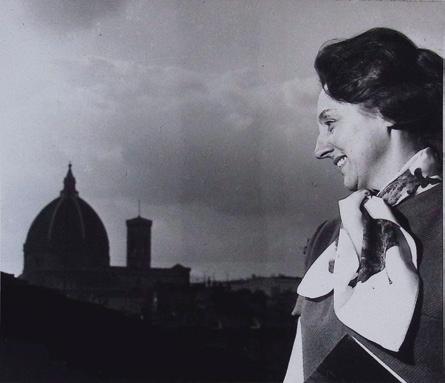
Photograph of Luisa Vertova on the steps of the Cathedral of Santa Maria del Fiore in Florence. c.1940s
Kindly lent by Vanessa Nicolson
Item 14
First and final pages of an eleven-page letter from Luisa Vertova to Benedict Nicolson in which she considers the advantages and disadvantages of marriage.
13 December 1953–1 January 1954
AR: LBN/2/39/2
Item 15
Final two pages of a six-page letter from Luisa Vertova to Benedict Nicolson in which she discusses a potential visit to the United States as a Fulbright scholar. 24 February 1954
AR: LBN/2/39/2
Item 16
Photograph of Luisa Vertova playing the guitar alongside her young daughter, Vanessa Nicolson. c.1962 Kindly let by Vanessa Nicolson © Condé Nast, London © Camera Press Ltd
Item 17
Photograph of Luisa Vertova on the terrace of Via Laura 70, Florence. October 1972
Kindly lent by Vanessa Nicolson
Item 18
Letter from Deanna Petherbridge to her parents discussing her art career and exhibition plans. 11 April 1973
AR: DPS/TN/1
Item 19
Letter from Deanna Petherbridge to Bernice Rose (an American art historian and curator) requesting a meeting to show some of her work while in New York. 18 November 1973
AR: DSP/TN/2
Item 20
Postcard for the exhibition Deanna Petherbridge, held at Gallery K, Washington, DC, 1977. 1977
AR: DSP/TN/3
Item 21
Photograph of Deanna Petherbridge at the installation of the exhibition The Iron Siege of Pavia and Other Drawings, Whitechapel Art Gallery, 1975
Approx. September 1975
AR: DSP/TN/4
© Jonathan Bayer
Item 22
Telegram from Deanna Petherbridge’s parents, Harry and Frieda Schwartz, wishing her success for her exhibition at the Whitechapel Art Gallery 10 September 1975
AR: DSP/TN/5
Item 23
Photograph of a drawing from Deanna Petherbridge’s Cities of Sand series c.1970s
AR: DSP/TN/6
Item 24
Deanna Petherbridge’s sketchbook Cities of Sand: North African Sketches, open at a study for the Cities of Sand series
1970–73
AR: DSP/TN/7
Wall labels
Item 25
Wall of names created using a selection of women’s names from the records of the Paul Mellon Foundation’s unpublished Dictionary of British Artists project (PMC 35/2/1/11)
Item 26
Deanna Petherbridge, Seven Citadels No. II, pen and ink on paper 1974
Collection of Jasia Reichardt
Item 27
Catalogue for Deanna Petherbridge’s exhibition The Iron Siege of Pavia and Other Drawings, held at the Whitechapel Art Gallery, London, 9 September–19 October 1975 1975
Kindly donated by Jasia Reichardt
The Paul Mellon Centre would like to thank Vanessa Nicolson for loaning photographs of Luisa Vertova to this display, and for her ongoing support concerning the Vertova and Benedict Nicolson Archive material held at the Centre more broadly. The Centre is also grateful to Gillian Lazar and Stephen Sacks for their generosity in supporting work on the Deanna Petherbridge Archive, and its inclusion in this display. Jasia Reichardt generously loaned the drawing Seven Citadels no. II, which she acquired from Deanna Petherbridge’s 1975 Whitechapel Art Gallery exhibition, organised under her directorship. She also donated the accompanying catalogue to the Centre’s library.
We would like to thank Robert Winckworth at University College London Special Collections for arranging the loan of Daphne Haldin’s first entry form, and Lara Kirkland, archivist at the North London Collegiate School, for her help with research into and use of the school’s photograph of Hilda Finberg, née Erhmann.
Hans Hönes, Leigh Wilson, Noémi Gottmann, Lani Garms and Ellie Harrold selected the contents of this display, and authored both the display texts and the accompanying brochure. They
received support from Charlotte Brunskill, Hannah Jones, Niki Kalli, Maisoon Rehani, Kate Retford and Nida Shah.
The text was copyedited by Hazel Bird. The display and booklet were designed by Luke Gould.
The Centre is confident that it has carried out due diligence in its use of copyrighted material as required by the UK Copyright, Designs and Patents Act 1988 (as amended). If you have any queries relating to the Centre’s use of intellectual property, please contact: copyright@paul-mellon-centre.ac.uk
For more information about our research collections see our website: www.paul-mellon-centre.ac.uk.
Alternatively contact us by email at collections@paul-mellon-centre.ac.uk or phone 020 7580 0311