SpotOn+
Dear Reader,
Welcome to this first 2023 edition of our SpotON+ Newsletter. The exciting news is the announcement of the publication of the book ‘Physics against Cancer’ detailed on page 4. This was a remarkable endeavor of key contributors that, at some time point, made the whole development of the utilization of radiation, be it with pions or protons, for cancer patients on PSI’s campus a successful one. It is full of anecdotes (such as PSI was the probably first institution to provide a psycho-oncologist in the early 1980s) and has ancillary photographs that have never been published elsewhere. CPT’s team thought that the capture and narration of these extraordinary years was of paramount importance to illustrate what a couple of physicists, engineers and physicians, with limited financial means, could do together. These passionate years, when sometimes emotions flew high, have led to our current proton therapy program, delivering spot scanning or pencil beam scanning, which has treated over 10’000 cancer patients. In ‘Physics against Cancer’, the contributors add depth, texture and facts to the incredible endeavor of treating patients within the structure
of the ETH. The book backbone is a vivid scientific story of scientific projects that ultimately led to the cure of thousands of cancer patients in Switzerland. I hope the read, for those interested in complicated projects, will be as interesting as the challenges to put these individual sub-stories together.
The rest of the newsletter is dedicated to the quality of life (QoL) of Ewing sarcoma patients treated with protons. These analyses are key if one believes on the optimization of the therapeutic ratio with proton therapy, which is particularly important for children, adolescents and young adults who present unfortunately, in a substantial proportion of these, with long-term treatment related adverse events. Interestingly, these patients tended to rate their QoL substantially higher than did their parents/care givers. There is however no room for complacency, as in the longitudinal analysis (at 2 years), children and AYAs rated their Emotional functioning and Body image score poorly highlighting that outcome-improvement is needed even with very conformal radiation delivery. This is in essence why our current clinical research program focusses on treatment efficiency (UHDR, planning automation, spot reduction [see under]), improvement of accuracy

and precision (ADAP/ MRI and PET guidance and tumor tracking) and ultimately outcome improvement.
Finally, a summary of the analysis of spot reduction during the planning process is detailed on page 3. In essence, spot-reduced plans are more sensitive to small positioning inaccuracies of the pencil beams but the resulting shorter delivery times may allow for more rescanning and thus a more effective radiation delivery. Bertschi et al. have observed that spot (and energy-layer) reduced plans were a valuable option to increase the efficiency of 3D volumetric rescanning for motion mitigation. Although this paradigm is not routinely applied to patients, it is definitively a planning strategy that is worth pursing in the not too distant future.
That being said, I hope that this newsletter was of interest to you and I stay tuned for the next edition in 4 months’ time
Sincerely, Prof.
Damien C. Weber, Chairman Center for Proton Therapy, Paul Scherrer Institute
Center for Proton Therapy :: Paul Scherrer Institut :: # 28_03/2023
Radio-Oncology News
Quality of life evaluations in children and adolescents with Ewing sarcoma treated with pencil-beam-scanning proton therapy
Background
Ewing Sarcoma (EWS) is the second most common malignant pediatric bone tumor with a peak incidence in adolescence. The current multimodal treatment strategy consists of riskadapted multi-agent induction and consolidation chemotherapy with sequential local therapy (surgery and/or radiotherapy). Luckily, most EWS patients today will be long-time survivors, so quality of life (QoL) issues have increasingly become the focus of attention. We report the QoL of children with EWS treated with pencil-beam-scanning (PBS) proton therapy (PT) at our institution between 2005 and 2016. The clinical results for this cohort of EWS patients have been previously published by our group (Weber et al. 2017).
Methods and materials
A PEDQOL self/proxy questionnaire was used to prospectively assess the QoL of 23 children 5 - < 18 years with EWS (mean age, 10.7±3.6 years; n=13 (56.5%) boys) treated with PBS PT. This questionnaire is an established, multidimensional, validated instrument for children evaluating eight different domains: Autonomy, Emotional functioning, Body image, Cognition, Physical functioning, Social functioning-peer,
Social functioning-family and subjective well-being. Summary scores for each domain are calculated based on the individual answers per item. Higher scores suggest better QoL, with 100 representing the maximum score per domain. Children (self-rating) and parents (proxy-rating) filled out the questionnaire at the start of PT (E1), 2 months after treatment (E2), and thereafter once yearly (E≥3). For comparison purposes, an independent norm group (n=233) with proxy assessments as well as an independent norm group (n=794) with self-assessments of healthy children was included in the analyses.
Results
Social functioning-peers, p=0.014; Social functioning-family, p=0.016).
At E1, Children rated their QoL from 50.0 (Physical functioning) to 78.6 (Emotional functioning), whereas the corresponding QoL scores in the norm group ranged from 59.9 (Physical functioning) to 76.7 (Emotional functioning). Significant differences between E1 and the norm group were only found for Body image (significantly better, p=0.044) and for Physical functioning (significantly worse, p=0.004). At E4, no significant differences were observed anymore for all domains between the study cohort and the healthy controls.
Self-evaluation QoL scores study cohort vs. healthy controls (N) before (E1) and 2 years (E4) after proton therapy.
Abbreviations: SE: autonomy; EV: emotional functioning; KB: body image; C: cognition; KV: physical functioning; Fr: social functioning-peers; Fam: Social functioning-family; Global: subjective well-being.
and Body image) domains increased, remained stable and decreased, respectively.
Conclusions
Compared with healthy controls, parents rated the QoL of their children at E1 significantly worse in all but two (cognition and social functioning-family) domains. The QoL scores across the 8 domains range from 69.2 (Autonomy) to 82.8 (Body image) in the norm group. At E1, these corresponding scores were substantially lower, ranging from 48.3 (Physical functioning) to 71.5 (Social
functioning-family) for the study cohort.
Two years after PT (E4), significant differences (decreased QoL) between the two groups only remained in 3/8 domains (Body image, p=0.003;
For longitudinal comparison E1 vs. E4, according to parents, scores for 5 domains (Autonomy, Body Image, Physical functioning, Social functioning-family and Subjective well-being) were increased and for 3 other domains (Emotional Functioning, Cognition, Social functioning-peers), scores were decreased. For self-evaluation, scores for 4 (Autonomy, Physical functioning, Social functioning-family and Subjective well-being), 2 (Cognition and Social functioning-peers) and another 2 (Emotional functioning
Children with EWS recovered usually seemingly well to normal QoL levels two years after the end of PT. They tended to rate their QoL substantially higher than did their parents. Two years after PT, difference of QoL scores were observed between the study and healthy control cohorts in 38% and 0% of the domains for proxy- and self-evaluations, respectively. In the longitudinal analysis at 2 years, children rated their Emotional functioning and Body image score however poorly.
This work has recently been published (Weber et al. 2022)
Newsletter of the Center for Proton Therapy :: Paul Scherrer Institut :: March 2023 :: # 27 :: page 2
p=0.044 p=0.004 100 90 80 70 60 50 40 30 20 10 0 E1 N E4 SE E1 N E4 EV E1 N E4 KB E1 N E4 C E1 N E4 KV E1 N E4 Fr E1 N E4 Fam E1 N E4 Global
Medical-Physics News
Impact of spot reduction on the effectiveness of rescanning in pencil beam scanned proton therapy for mobile tumours
Objective
In pencil beam scanning (PBS) proton therapy, individually calculated and positioned proton pencil beams, also referred to as ’spots’, are used to achieve a highly conformal dose distribution to the target. Recent work has shown that this number can be substantially reduced, resulting in shorter delivery times without compromising dosimetric plan quality. However, the sensitivity of spot-reduced plans to tumour motion is unclear. Rescanning is used clinically for motion mitigation, but it can be time consuming, and have limited effectiveness due to the presence of low-weighted, non-rescannable spots. Although previous work has shown that spot-reduced plans are slightly more sensitive to small positioning inaccuracies of the individual pencil beams, the resulting shorter delivery times may allow for more rescanning and thus a more effective and efficient treatment. The aim of this study was to assess the impact of tumour motion and the effectiveness of 3D volumetric rescanning for spot-reduced treatment plans.
Material and Methods
Three liver and two lung cancer patients with non-negligible motion amplitudes were analysed. For each patient, one clinical plan, one
spot-reduced plan and one energy-layer-reduced plan, where also the number of energy layers is reduced, after which spot reduction is performed for the remaining energy layers, were generated using identical field geometries. Conventional and probabilistic internal target volume (ITV) definitions were used for planning considering single or multiple breathing cycles respectively. 4D dynamic dose calculations were performed for 1 (i.e., no motion mitigation) up to 25 rescans. Resulting target coverage (V95%), dose homogeneity (D5%-D95%) and hot spots (D2%) were evaluated for a total of around 138’000 4D dynamic dose calculations.
Results
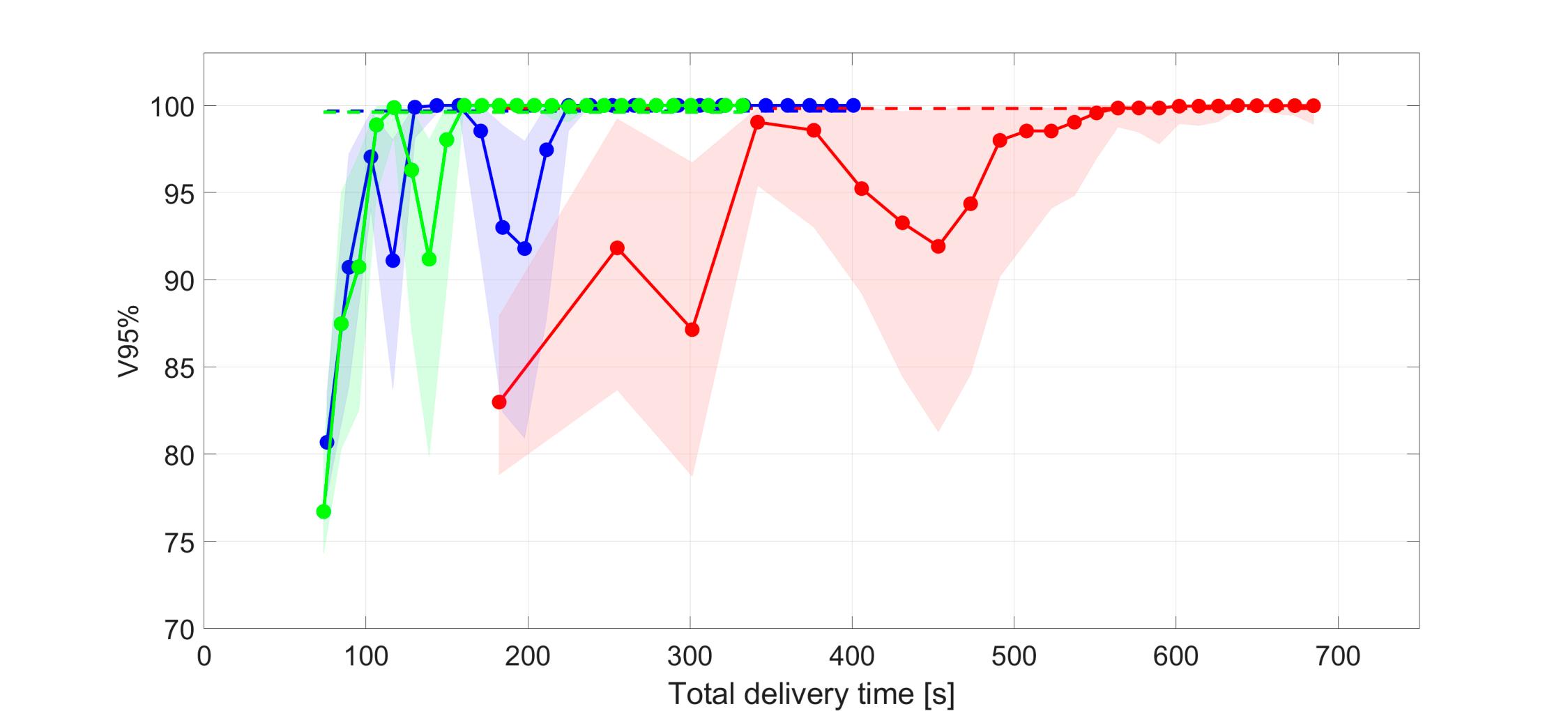
Over all patients investigated, the number of spots was reduced by 91% on average for both the spot and the energy-layer-reduced treatment plans, while the number of energy layers was reduced by 7% for the spot-reduced and by 46% for the energy-layer-reduced treatment plans. As such, delivery time could be shortened by approximately 40 and 50% for the spot- and energy-layer-reduced treatment plans respectively when compared to the clinical plan. This reduction, together with the substantially increased dose per spot resulting from the spot reduction process, allowed for more rescans in
the same amount of time as for clinical plans and typically improved dosimetric parameters, in some cases to values better than the reference static (3D calculated) plans. Due to their regular delivery pattern, spot and energy-layer-reduced plans had an increased possibility of interference with the breathing cycle, especially for simulations of perfectly repeatable breathing, causing the effectiveness to fluctuate as a function of the number of rescans. For non-repeated, and more clinically plausible, motion patterns, some fluctuations in the dosimetric values to the CTV are still observed, however, these are less pronounced than for the repeated motions.
Conclusion
For the patients analysed in this study, spot and energy-layer-reduced plans were found to be a valuable option to increase the efficiency of 3D volumetric rescanning for motion mitigation, if attention is paid to possible interference patterns. We believe that the promising outcomes of this simulation study are an important step towards more effective and efficient proton therapy delivery for challenging treatment sites, such as lung and liver.
This work has recently been published (Bertschi et al. 2022)
Newsletter of the Center for Proton Therapy :: Paul Scherrer Institut :: March 2023 :: # 27 :: page 3
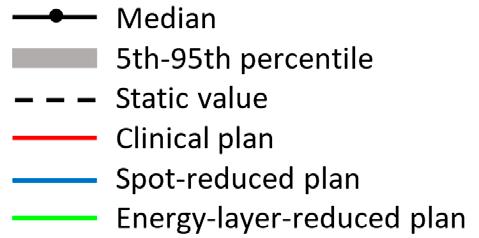
CTV V95% of one example patient shown for 1 (i.e. no motion mitigation) up to 25 rescans (indicated by the dots) as a function of the total delivery time, pointing out the shorter delivery time of spot and energy-layer-reduced treatment plans leading to a faster improvement of the dosimetric parameter.
Physics against Cancer
the Paul Scherrer Institute pioneered modern proton therapy
Physics against Cancer
How the Paul Scherrer Institute pioneered modern proton therapy
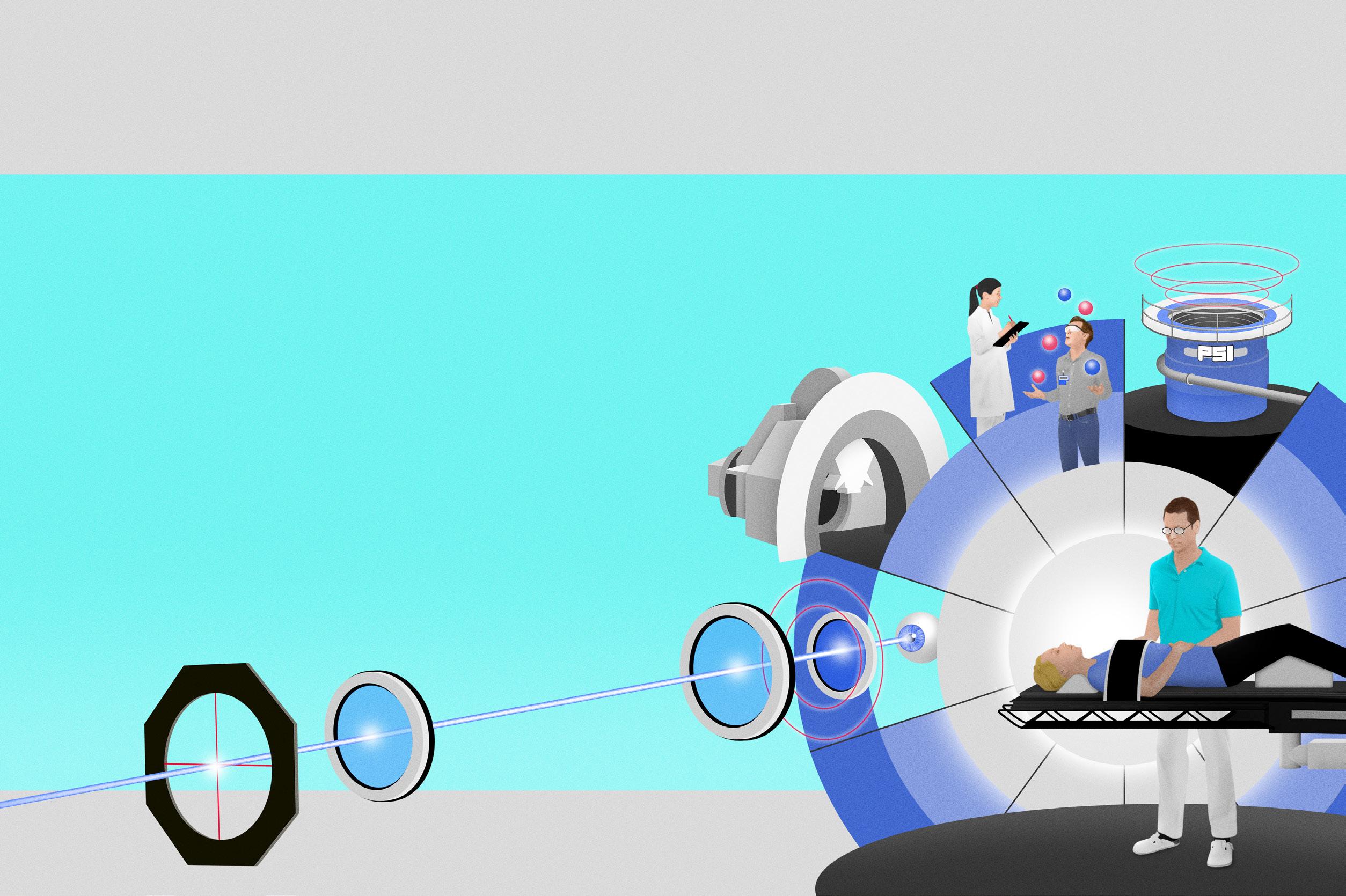
Are you curious to know how and why PSI is currently treating daily many cancer patients with protons? Well, PSI had a book written about the story of proton therapy at PSI which is now available at the book shops. The book was written in English based on research, interviews and written accounts from past and present staff at the Paul Scherrer Institute. It is illustrated by a lot of photographs.
Here is a little appetiser from the back cover «This book is for anyone with an interest in scientists’ continual quest to find out more. It tells the remarkable story, spanning half a century, of the men and women at the Paul Scherrer Institute’s Center for Proton Therapy who had the knowledge, imagination and perseverance to bring their ideas to fruition. It demonstrates, perhaps most of all, just what can be achieved from close collaboration between physicians and scientists – bringing all the powers of physics to bear in the fight against cancer.»
The book was published by vdf Hochschulverlag AG at the ETH Zürich (sales page) and is available as paper copy and e-book. It can also be purchased in book shops and in online retail. We are working on a German translation of the book which will hopefully be available by end of this year.
Enjoy the read!
Newsletter of the Center for Proton Therapy :: Paul Scherrer Institut :: March 2023 :: # 27 :: page 4
Imprint Editor Dr. Ulrike Kliebsch Chairman Prof. Damien C. Weber Chief Medical Physicist Prof. Tony Lomax Contact Center for Proton Therapy CH-5232 Villigen PSI protonentherapie@psi.ch www.protonentherapie.ch Tel. +41 56 310 35 24 Fax +41 56 310 35 15 Villigen PSI, March 2023 Announcement
How
Physics
Cancer
against
happened founded proton tells perseverance achieved at 978-3-7281-4136-1 7 The contributors 5 National foreword ............................................................................................................................... 8 International foreword 10 Introduction: about this story 12 Some important background: radiation therapy 15 A timeline of particle therapy at the Paul Scherrer Institute........................................... 21 Chapter 1 1968–1977 Beginnings: the piotron 23 Chapter 2 1977–1983 Treating in three dimensions 38 Chapter 3 1982–1992 Protons for eye tumours 54 Chapter 4 1984–1992 From pions to protons ....................................................................... 75 Chapter 5 1993–1996 A revolution in cancer patient treatment 99 Chapter 6 1997–2003 Project PROSCAN 127 Chapter 7 2004–2008 A new lifeline for children 150 Chapter 8 2009–2021 The new era of proton therapy ..................................................... 175 Chapter 9 The future of proton therapy at PSI 199 Index 211 About the authors 217 7 The contributors 5 National foreword ............................................................................................................................... 8 International foreword 10 Introduction: about this story 12 Some important background: radiation therapy 15 A timeline of particle therapy at the Paul Scherrer Institute........................................... 21 Chapter 1 1968–1977 Beginnings: the piotron 23 Chapter 2 1977–1983 Treating in three dimensions 38 Chapter 3 1982–1992 Protons for eye tumours 54 Chapter 4 1984–1992 From pions to protons ....................................................................... 75 Chapter 5 1993–1996 A revolution in cancer patient treatment 99 Chapter 6 1997–2003 Project PROSCAN 127 Chapter 7 2004–2008 A new lifeline for children 150 Chapter 8 2009–2021 The new era of proton therapy ..................................................... 175 Chapter 9 The future of proton therapy at PSI 199 Index 211 About the authors 217 Table of Contents
Damien Weber and Simon Crompton Damien Weber Simon Crompton
