Passive House Plus (Sustainable building) issue 51 UK
Wonder down under The passive house birthed by a bushfire
Adaptive comfort Does chasing perfect temperatures make us less resilient to heat?
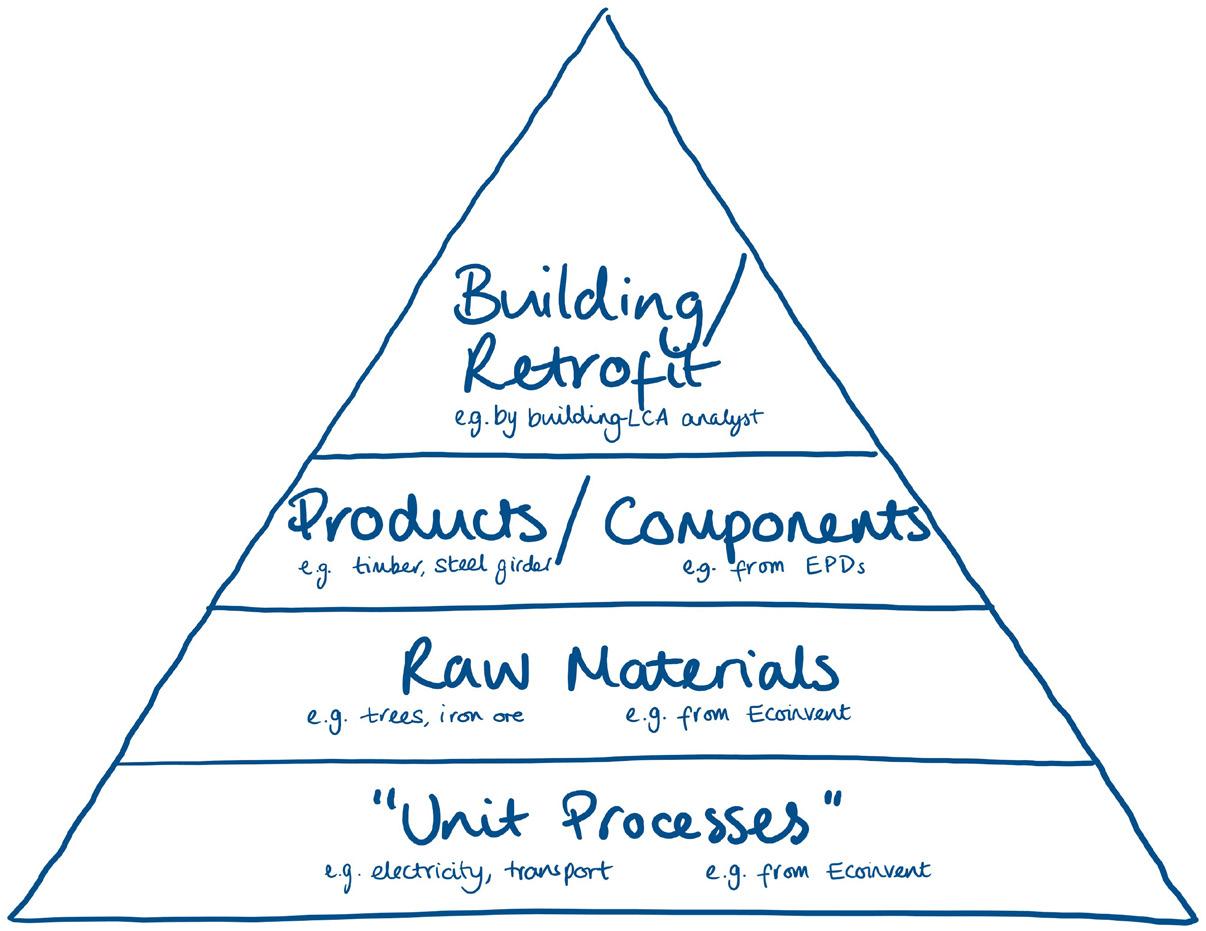
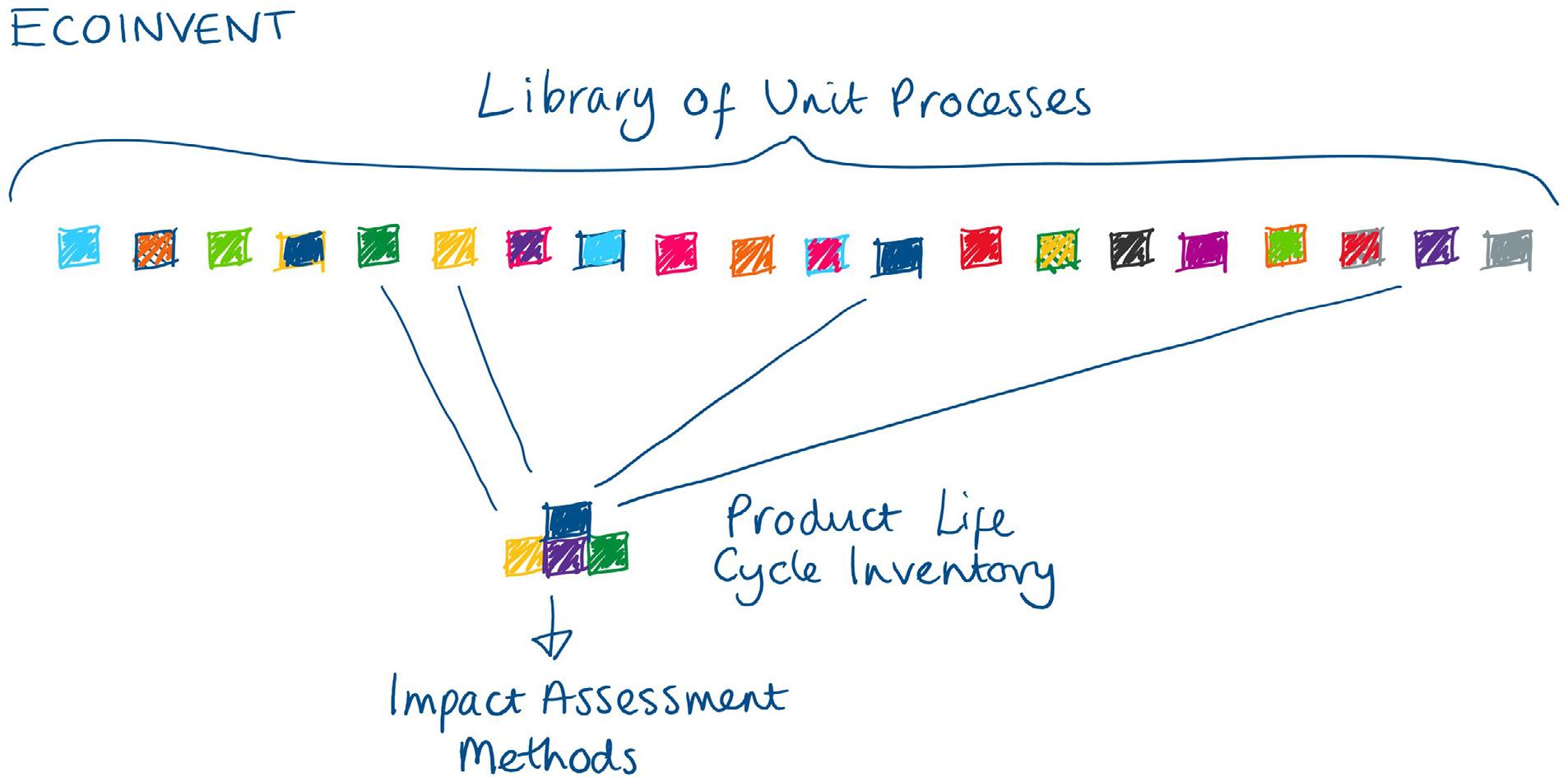
Embodied carbon Taking on a pyramid of uncertain data
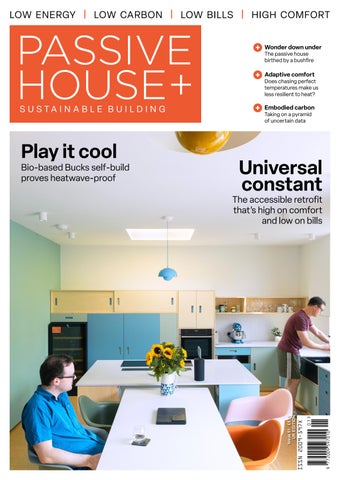
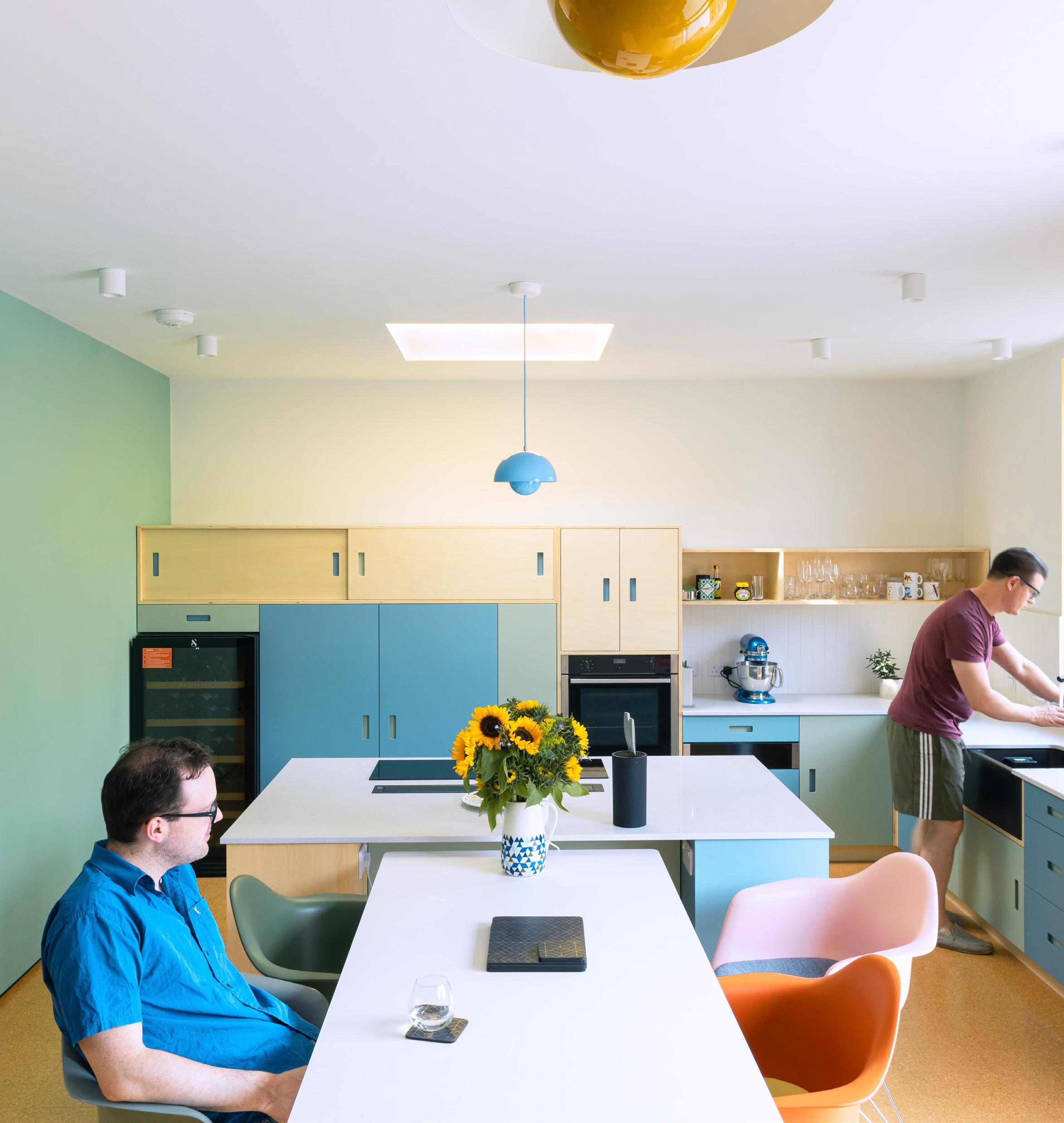
Play
it cool
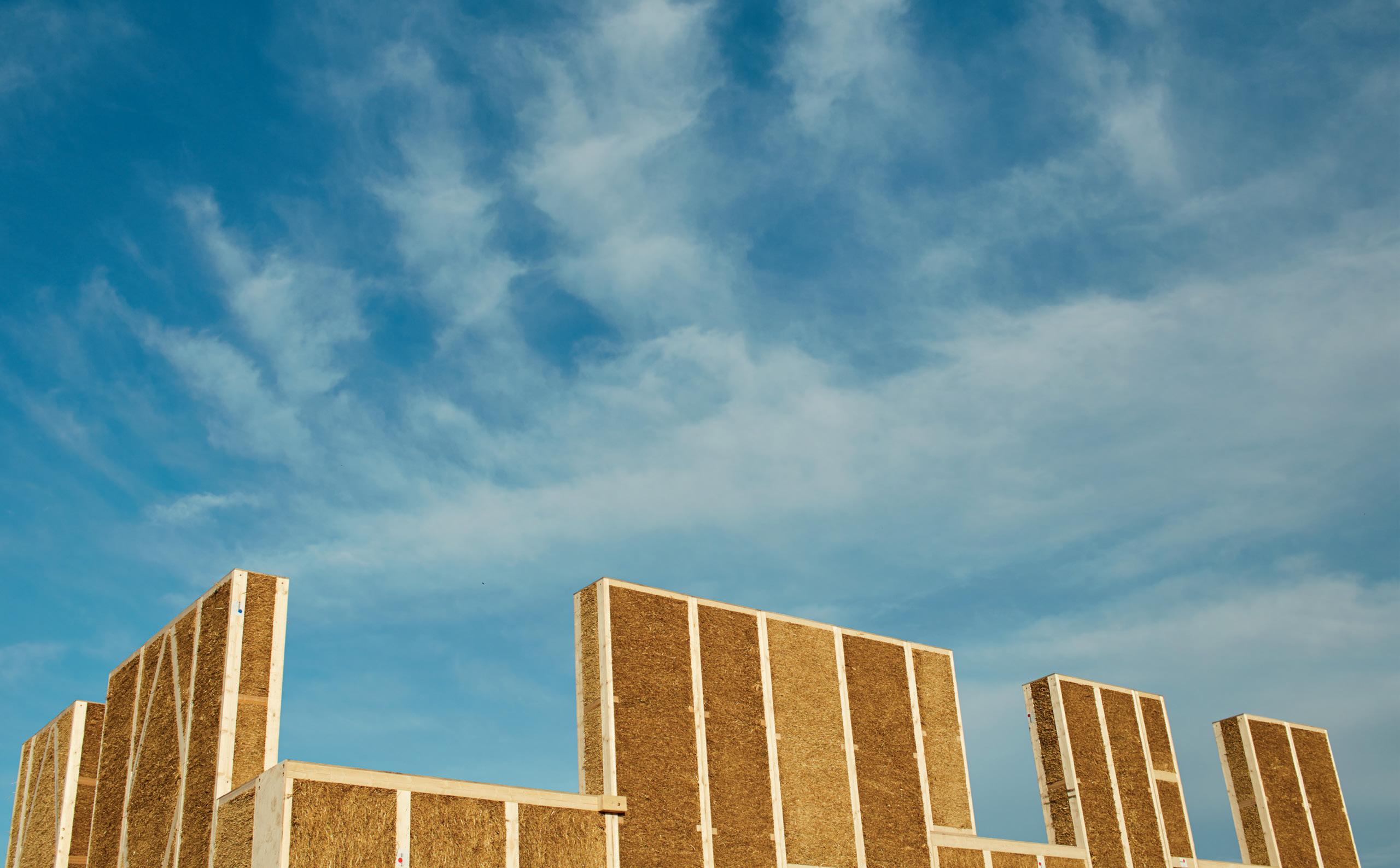
Bio-based Bucks self-build proves heatwave-proof
The Same System: Now With
Full BBA Certification
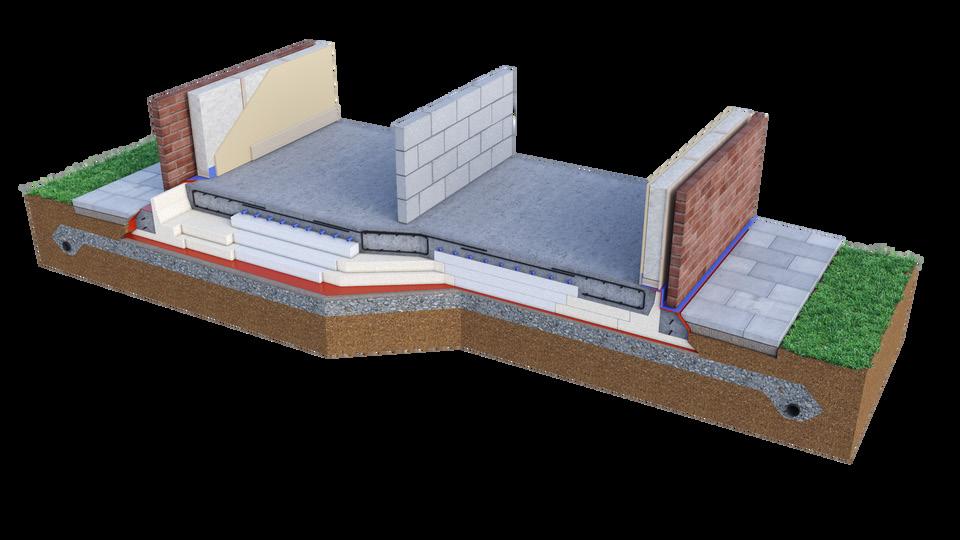
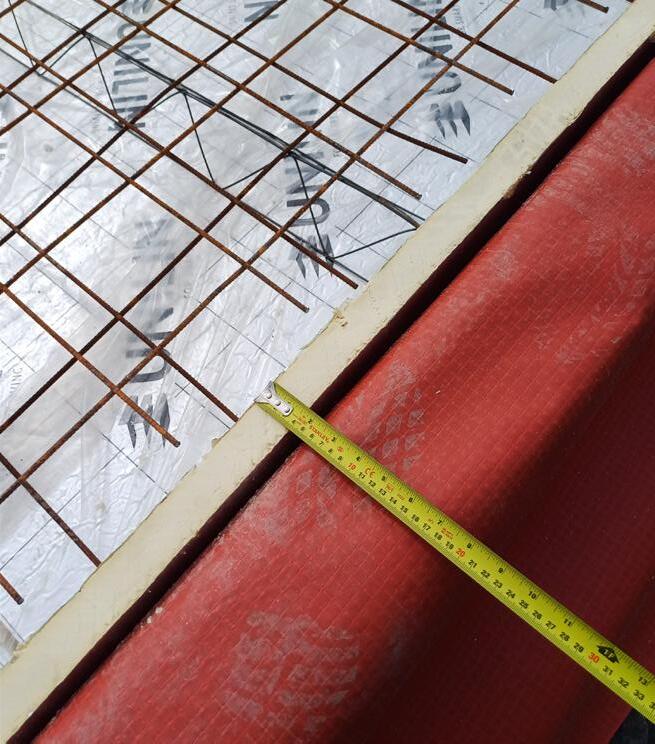
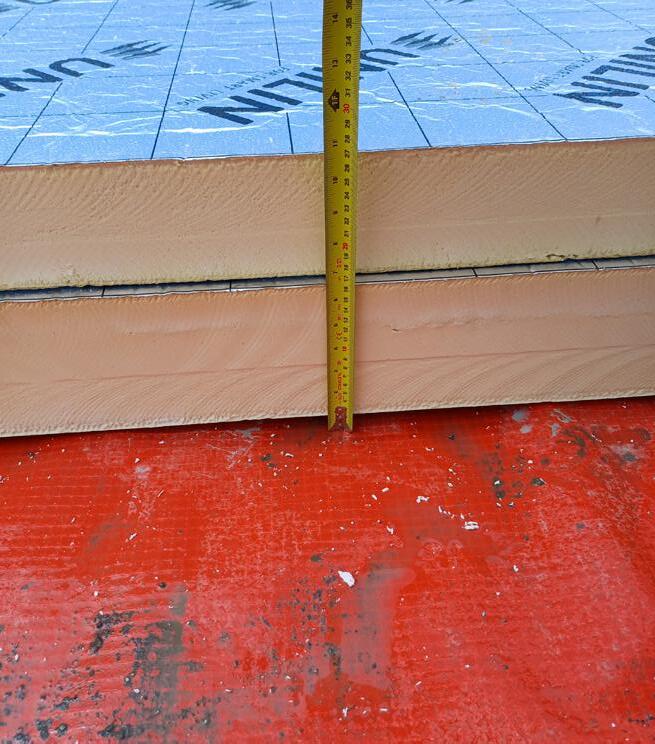
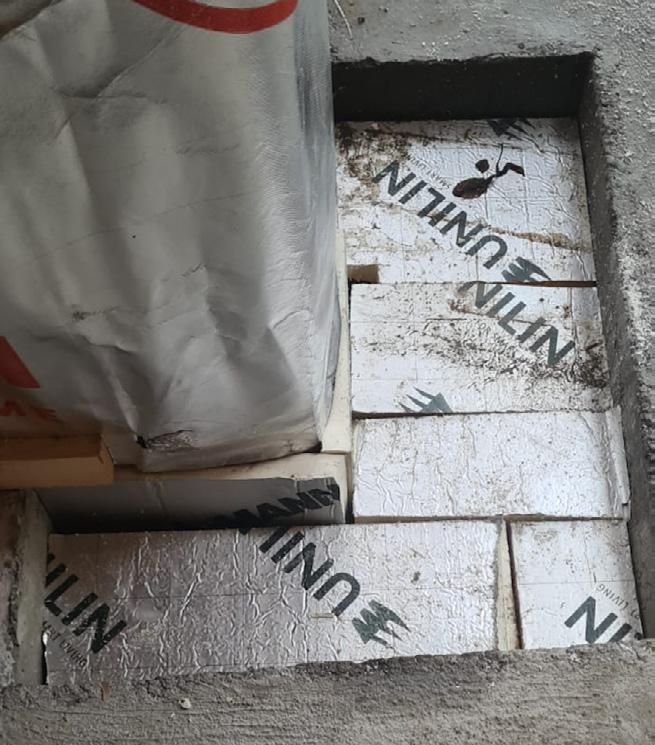
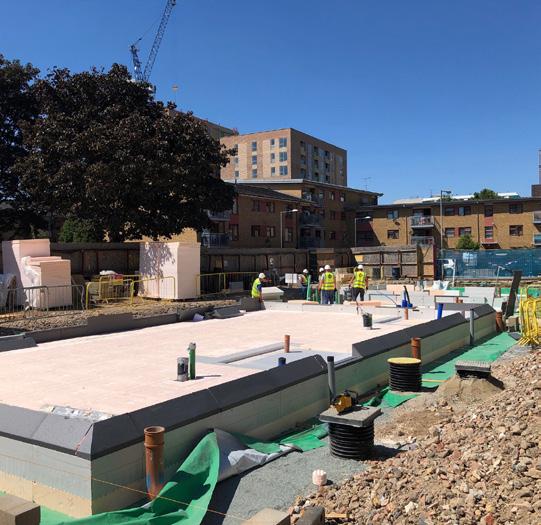
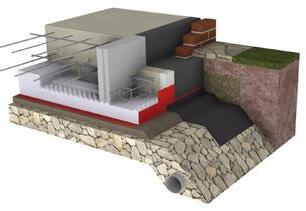
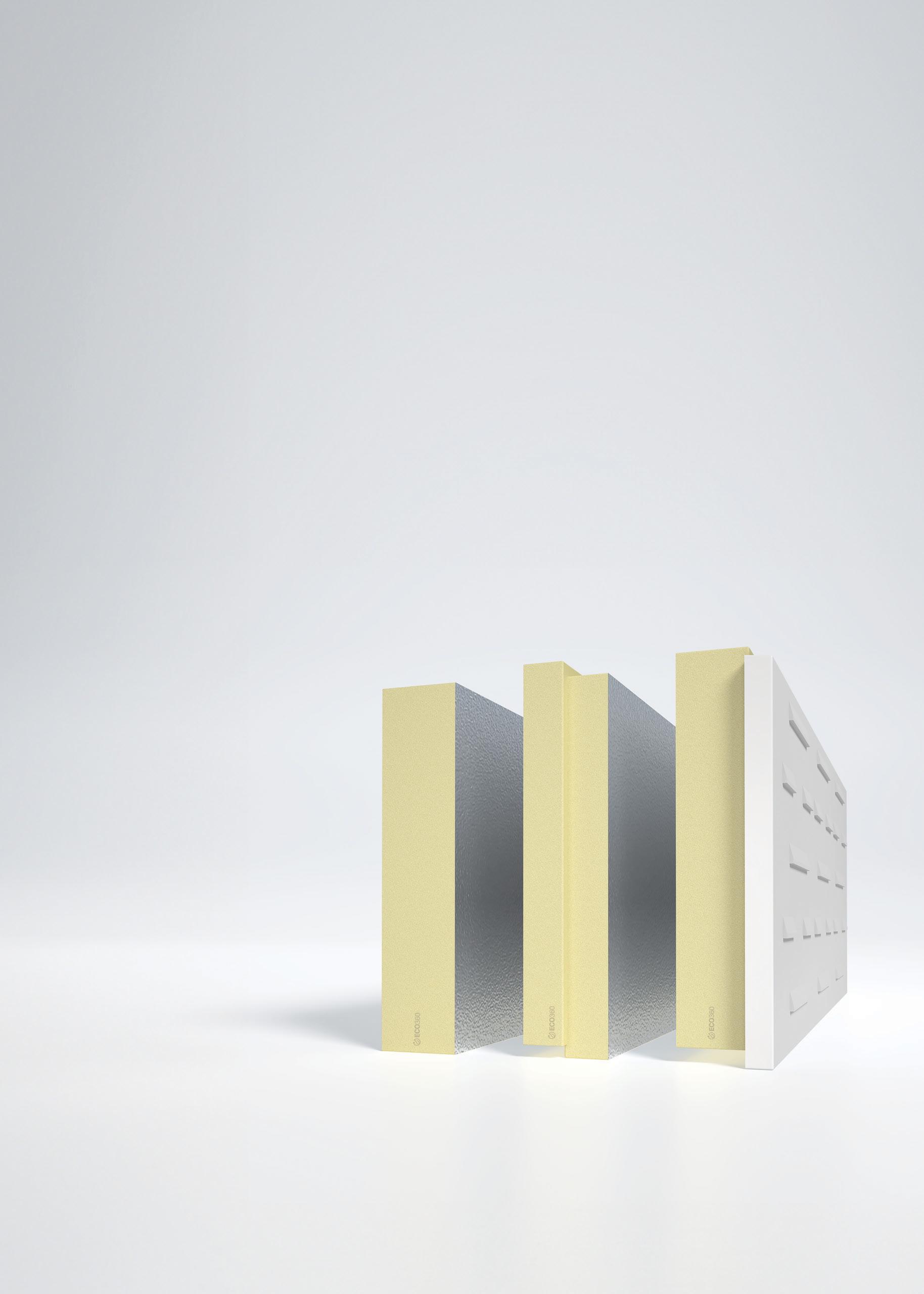
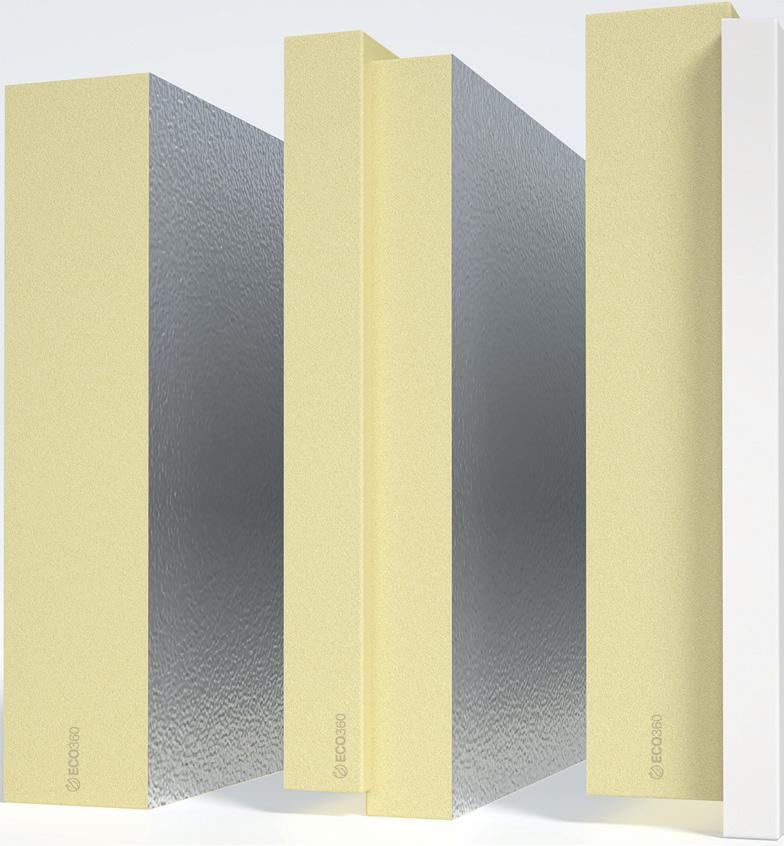
Design for performance, not just compliance and build with a foundation system that insulates from the ground up. KORE’s Insulated Foundation System wraps the entire foundation in a continuous layer of EPS, virtually eliminating thermal bridging while providing ground floor U-values as low as 0.10W/m2K. Maximise efficiencies on-site, speed up foundation construction, reduce labour, waste, concrete and embodied carbon with one high-performance system. If only other parts of the build could be this simple.
Significantly Reduces CO₂e
KORE’s Insulated Foundation System offers reduced embodied carbon by over 31% when compared to a traditional foundation system insulated with PIR - and we have the data to prove it. Contact us today for more information.
Publishers
Temple Media Ltd
PO Box 9688, Blackrock, Co. Dublin, Ireland
t +353 (0)1 210 7513
e info@passivehouseplus.ie www.passivehouseplus.co.uk
Editor Jeff Colley jeff@passivehouseplus.ie
Editorial Manager Jason Walsh jason@passivehouseplus.ie
Reporter John Hearne john@passivehouseplus.ie
Reporter Kate de Selincourt kate@passivehouseplus.ie
Production / IT Dudley Colley dudley@passivehouseplus.ie
Accounts Oisin Hart oisin@passivehouseplus.ie
Art Director Lauren Colley lauren@passivehouseplus.ie
Photo by Adam Hindmarch Photography / Progress in Practice
Publisher’s circulation statement: Passive House Plus (UK edition) has a print run of 9,000 copies, posted to architects, clients, contractors & engineers.
This includes the members of the Passivhaus Trust, the AECB & the Green Register of Construction Professionals, as well as thousands of key specifiers involved in current & forthcoming sustainable building projects.
Disclaimer: The opinions expressed in Passive House Plus are those of the authors and do not necessarily reflect the views of the publishers.
editor’s letter
In what I’m about to say, I hope I’m not setting myself up for a fall.
The purpose of Passive House Plus is to effect change, by showing how to make buildings work for people and planet. The main way we try to fulfil this purpose is by informing clients, designers and tradespeople of the why and how of sustainable building. This involves taking complex information, assessing and digesting it, and trying to find the stories that give it meaning.
We take this work seriously. We know that the information we publish affects design and specification decisions, so we try to ensure the accuracy of the information in the articles we publish – and the quality and relevance of the advertising we accept.
Getting the information in the articles we decide upon into a fit state to publish can be demanding for all concerned. But that process is always educational and enlightening.
Embodied carbon is a particularly demanding case in point – a complex, nerdy new frontier, where fanciful claims get made with little pushback.
The warning signs were there early on. When the RIBA took the laudable step of publishing the 2030 Climate Challenge in 2019, it set an embodied carbon target for domestic buildings of 300 kg CO2e/m2. A second version of the document quickly followed, revising that total up to 625 kg CO2e/m2. Achieving 300 kg CO2e/m2 by 2030 frankly wasn’t realistic – not without improbably profound changes across the construction supply chain.
In the process of reviewing the embodied carbon data on one of the projects in this issue, the architect shared a link to a case study in a leading architectural magazine, because the data in it was “interesting”. A renovation and extension project, the published embodied carbon figure was under 100 kg CO2e/ m2. Perhaps this could be true, I strained to
think, with a very light touch renovation to a large house and a small extension. But a quick review of the article made it clear that this was not the case. The project in question features lots of laudable efforts to reduce embodied carbon, but even if the claimed figure was closer to 300 kg/CO2e/m2, it would warrant serious interrogation.
Errors like this are widespread, even among other credible titles – such as another architectural title publishing indoor air quality data indicating CO2 levels roughly 100 times lower than best practice levels.
I’m being deliberately opaque in describing these examples, but I’m not sure that I should be. On one hand, I respect the publications in question, and their attempt to add sustainability metrics to their articles. But on the other hand, allowing such fanciful claims to be published does everyone a disservice. It allows misinformation to take root, so that when properly conducted calculations are done and the results published, they’re bound to confuse or disappoint.
I don’t mean to be sanctimonious. I can see how such mistakes are made – publishing is hard, and we are not immune to making mistakes ourselves. But as publishers, we should welcome scrutiny. For all the virtues of the internet and social media democratising how information is shared, there are significant downsides too. Everyone from subject matter experts to manic street preacher now has a platform, feeding AI models that can’t be relied upon to weed out the factually incorrect or to properly contextualise facts and opinions. As painstaking as it may be to produce, the need for readable, trustworthy, technical information has never been so great. If we have to work harder to serve this need, so be it.
Regards, The editor
About Passive House Plus is an official partner magazine of The Association for Environment Conscious Building, The International Passive House Assocation and The Passivhaus Trust.
Review
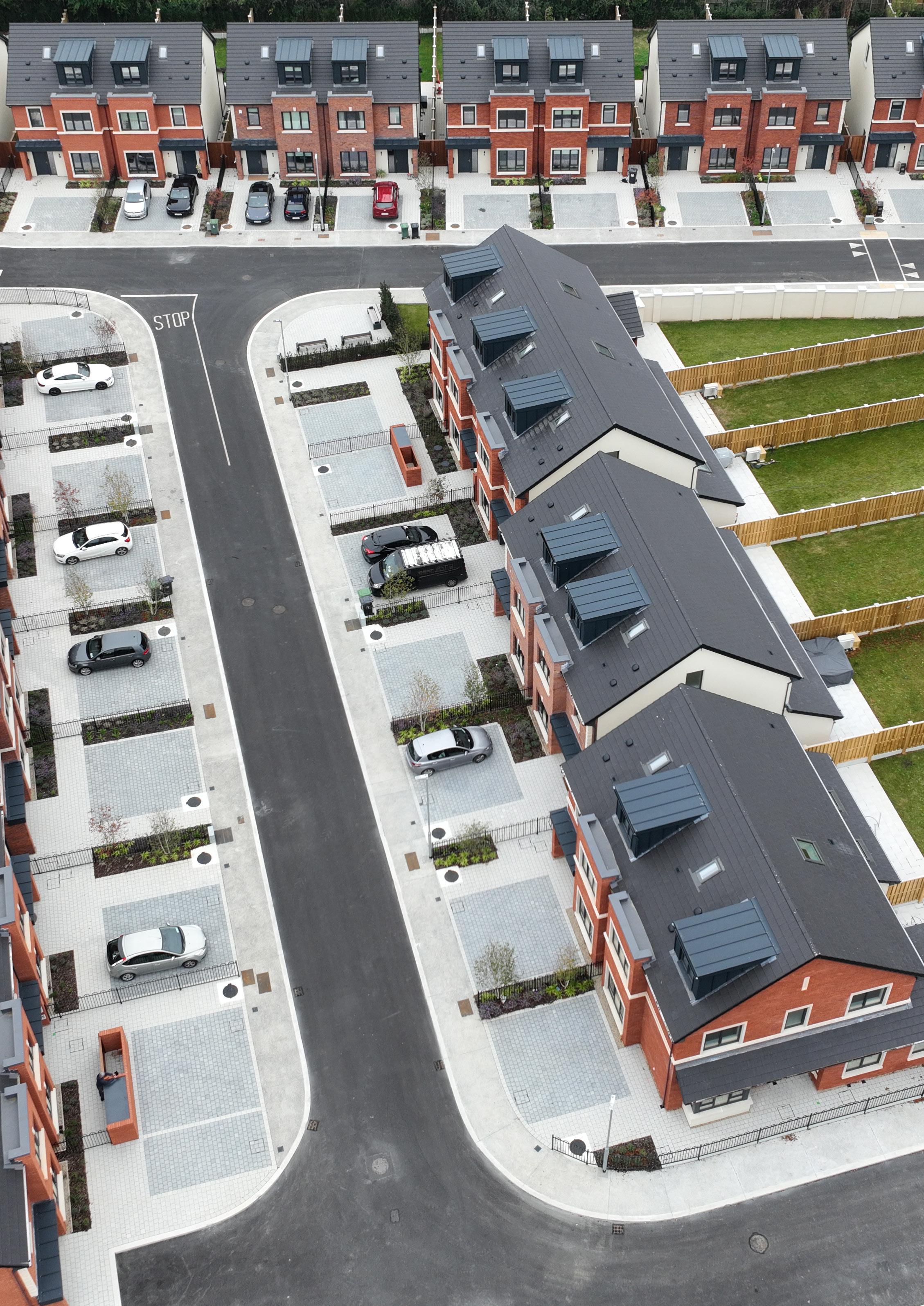
Scale, ale and a tattletale
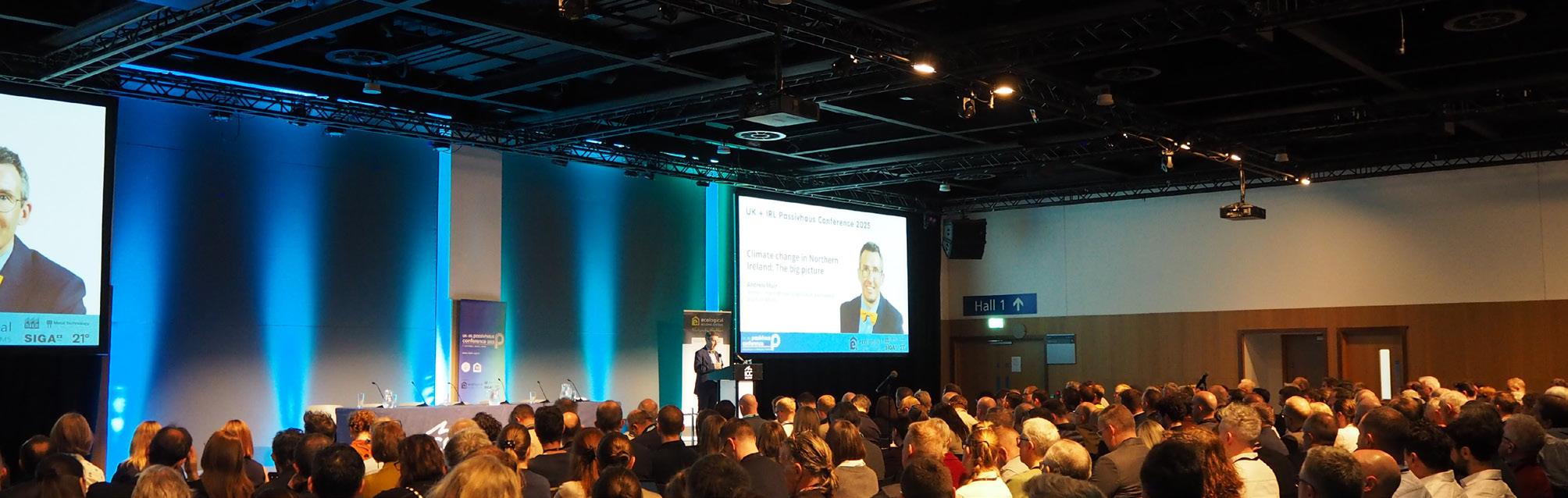
A warts-and-all account of a landmark passive house conference
World-renowned green building writer Lloyd Alter spills the beans on the first ever combined UK and Ireland passive house conference in Belfast.
Big Picture
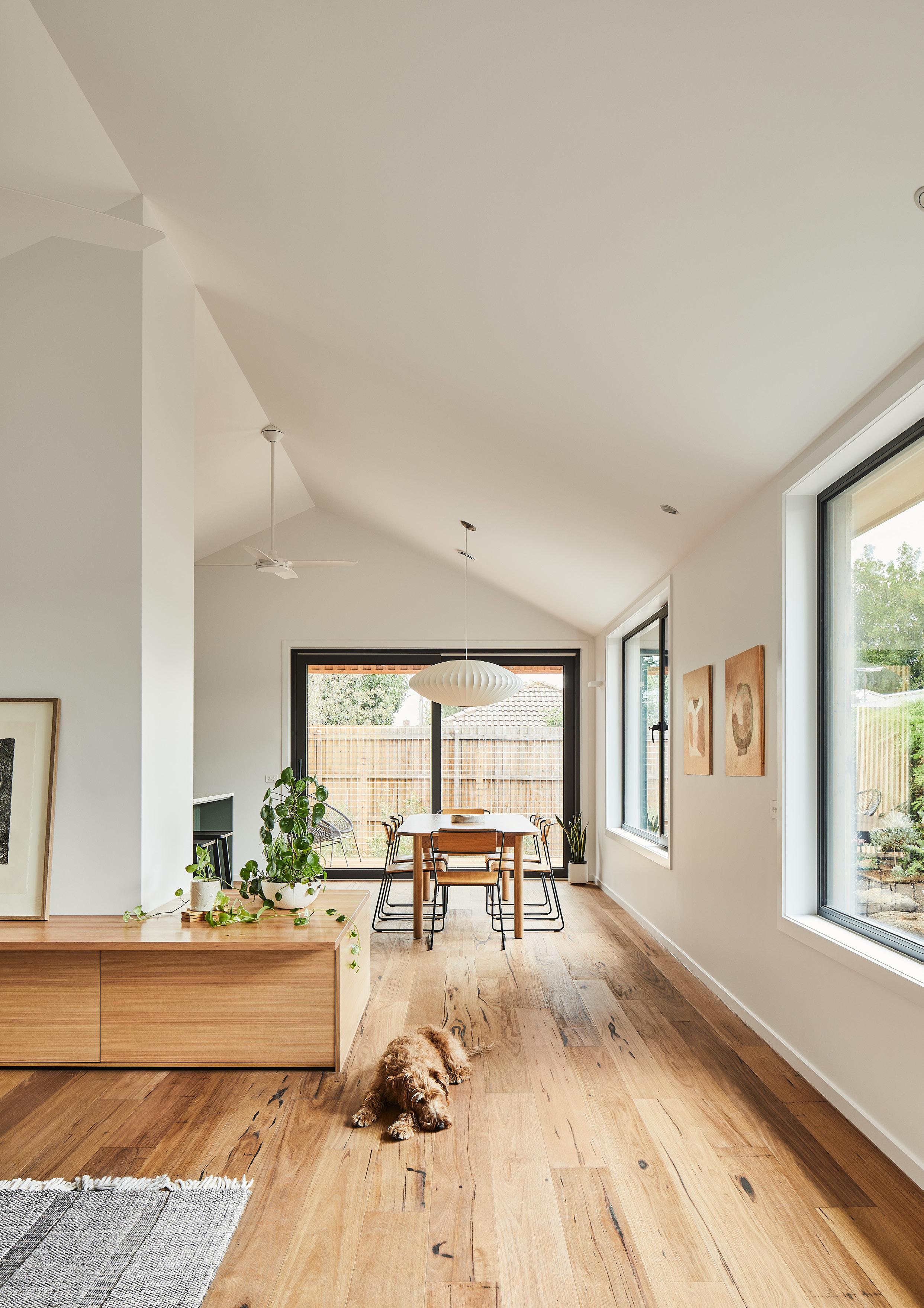
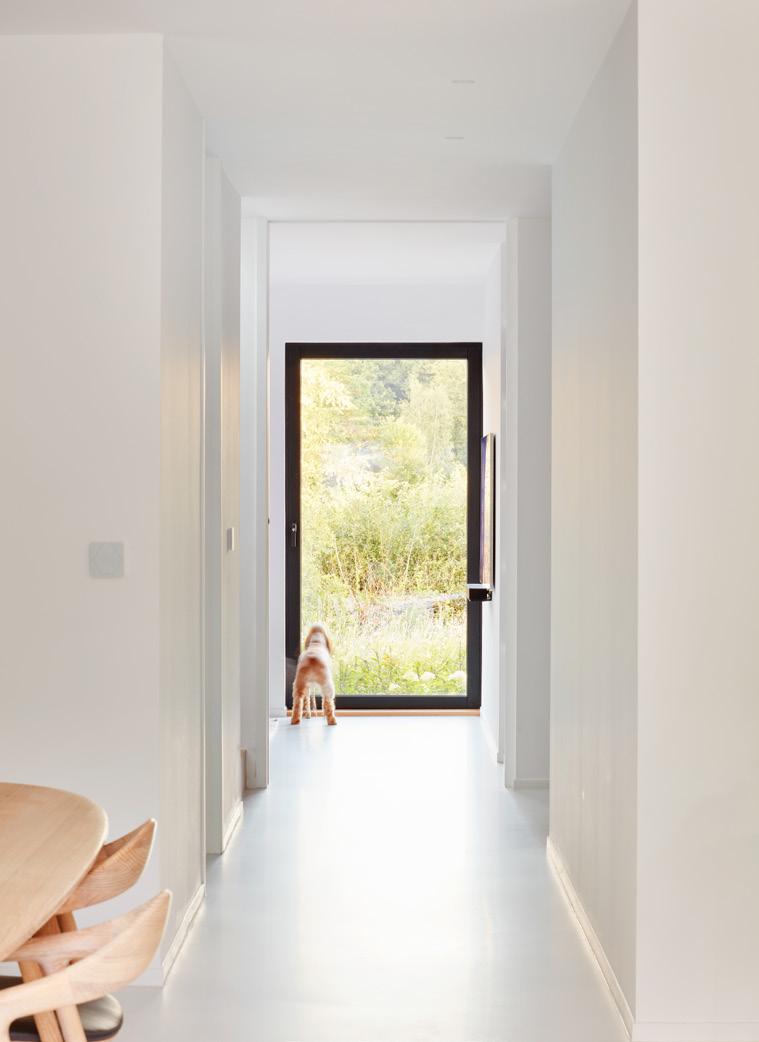
Forrest Passive House: one family’s response to a bushfire
This issue features a new build passive house in Melbourne, which achieves certification while maintaining contemporary family functionality through thoughtful material choices and spatial planning.
News
Historic passive house conference heralds mass housing breakthrough; Homes England standard adopts passive house principles for new housing; AECB conference sparks debate among industry experts; and insulation scheme failures prompt urgent repair call.
Comment
Dr Huda Elsherif explains that British overheating standards don’t reflect real living conditions, risking unnecessary dependence on energy-hungry air conditioning; Simon Jones suggests that only a three-phase lifecycle approach can ensure long-term performance of ventilation systems; and Dr Marc Ó Riain says the construction industry must shift from chasing energy efficiency to building affordable, resilient homes that last.
Case Studies
Universal constant
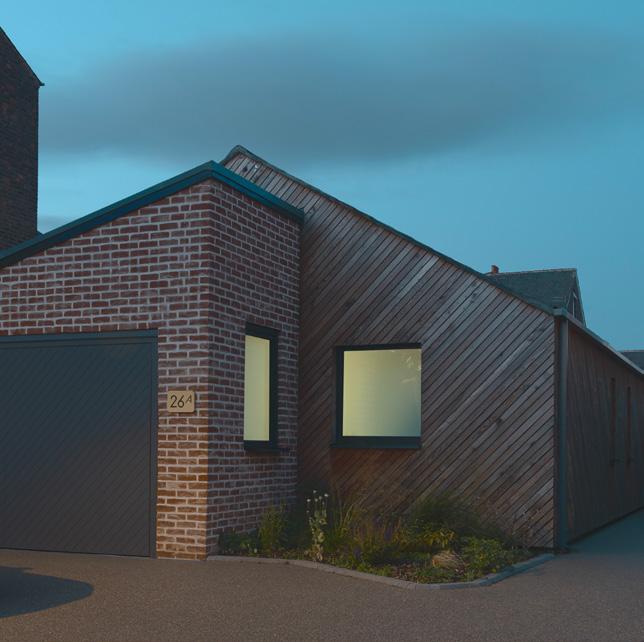
Accessible Manchester retrofit delivers comfort, accessibility and low bills
An award-winning retrofit demonstrates that universal design and ultra-low energy performance are powerful allies, not competing priorities.
Play it cool
Bio-based self-build proves heatwave-proof
Made to look easy on TV, Duncan and Anaya decided to give self-building a go and somehow created the most comfortable house they’ve ever lived in – even in the face of extreme heat events.
Mass appeal
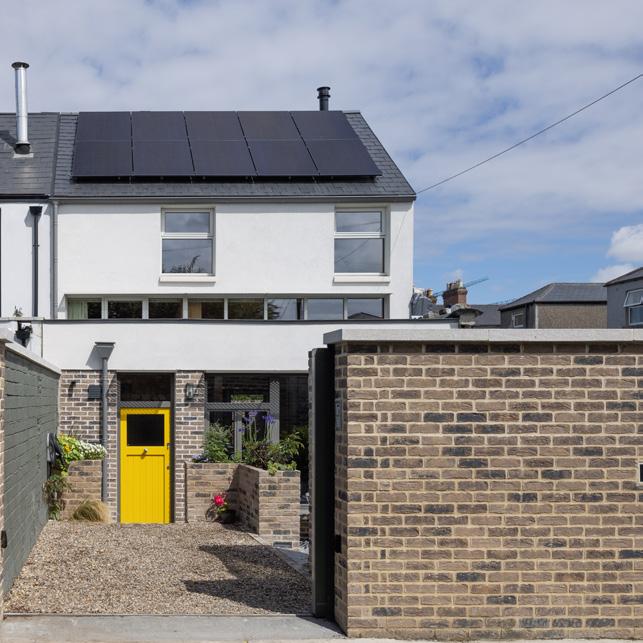
Urban infill house points to mass timber potential
An architect’s four-year quest to build his family home on a Dublin laneway demonstrates how mass timber can maximize space and character in the tightest urban sites - with award-winning results, and fascinating performance insights.
Speculate
to remunerate
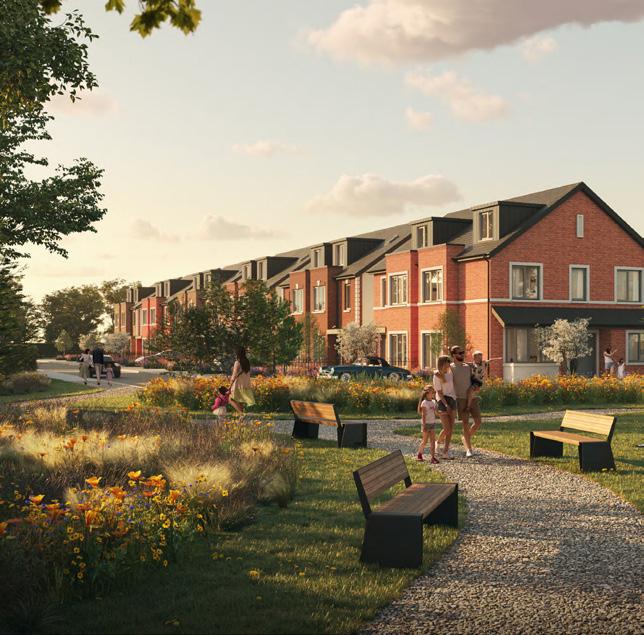
Ballymore scheme brings low-cost comfort to private market
With 35,000 homes under their belt, one of the UK and Ireland’s most prolific developers has just completed its first passive house scheme - aided by an innovative airtightness approach.
78
Embody language part 2: the uncertainty pyramid
Life cycle assessment in construction and retrofit
Life cycle assessments are crucial for sustainable building design, but understanding their inherent limitations is key to making better decisions with imperfect data, writes Dr Lois Hurst.
Marketplace
Keep up with the latest developments from some of the leading companies in sustainable building, including new product innovations, project updates and more.
The
physics of shock
Why opening windows wide beats leaving them ajar
Managing moisture levels in homes with properly designed heat recovery ventilation is one thing, but most homes don’t have this luxury. Toby Cambray explains a solution which may lie in an unpronounceable German word.
Scale, ale and a tattletale
A warts-and-all account of a landmark passive house conference
World-renowned green building writer
Lloyd Alter spills the beans on the first ever combined UK and Ireland passive house conference in Belfast.
Ihad not intended to attend the UK & IRL Passivhaus conference in Belfast; I just happened to be in the neighbourhood, after speaking at the Scottish Ecological Design Association conference in Edinburgh, and Passive House Plus publisher Jeff Colley suggested I pop over. I did not expect much; although it was a joint conference of the UK’s Passivhaus Trust and the Passive House Association of Ireland, I didn’t think very many people would go to Belfast, a city that I only knew about through old news –I am from Toronto, a city so Orange that they banned St Patrick’s Day parades for a hundred years. I was even a bit nervous. I was wrong about everything. I began to suspect I was wrong when I got off the airport bus in the middle of Ulster University and
was surrounded by what seemed like thousands of students, and walked down a narrow street lined with full restaurants selling every kind of food and drink, to the Bullitt Hotel, recommended by the conference organizers, which would have been edgy and fun in Brooklyn or Shoreditch.
I began to suspect that the conference might be different as well, when the local politician who is always rolled out to welcome visitors showed up in a Pewee Herman bow tie and talked of a “Just Transition.” Andrew Muir didn't just speak the usual platitudes but understood who he was talking to. Then there was Passivhaus Trust chair Emma Osmundsen, a force of nature who dominated the conference, and Stephen O’Shea, an architect now working for a major property
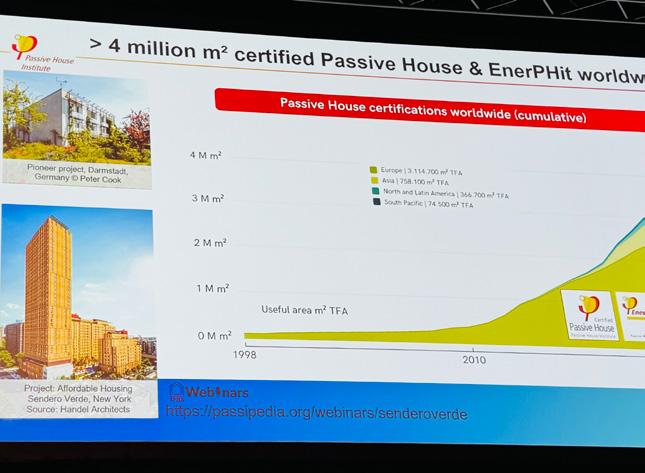
developer, talking about taking passive house mainstream (which Stephen is doing at Cairn Homes). They were followed by the ever-animated Tomas O’Leary of Mosart and Jessica Grove-Smith of the head office, who noted that there were now 4.5 million square meters of certified passive house buildings – it is indeed scaling up and going mainstream. After a break it was then time to make the decision: do I want to learn about non-domestic or residential projects? I hate it when there are multiple streams and you have to choose between when you want to see everything. It didn’t help when the rooms were so different; the non-domestic was in the main hall with lots of room and lots of air, while the residential was in a much smaller room, completely full, with inadequate ventilation
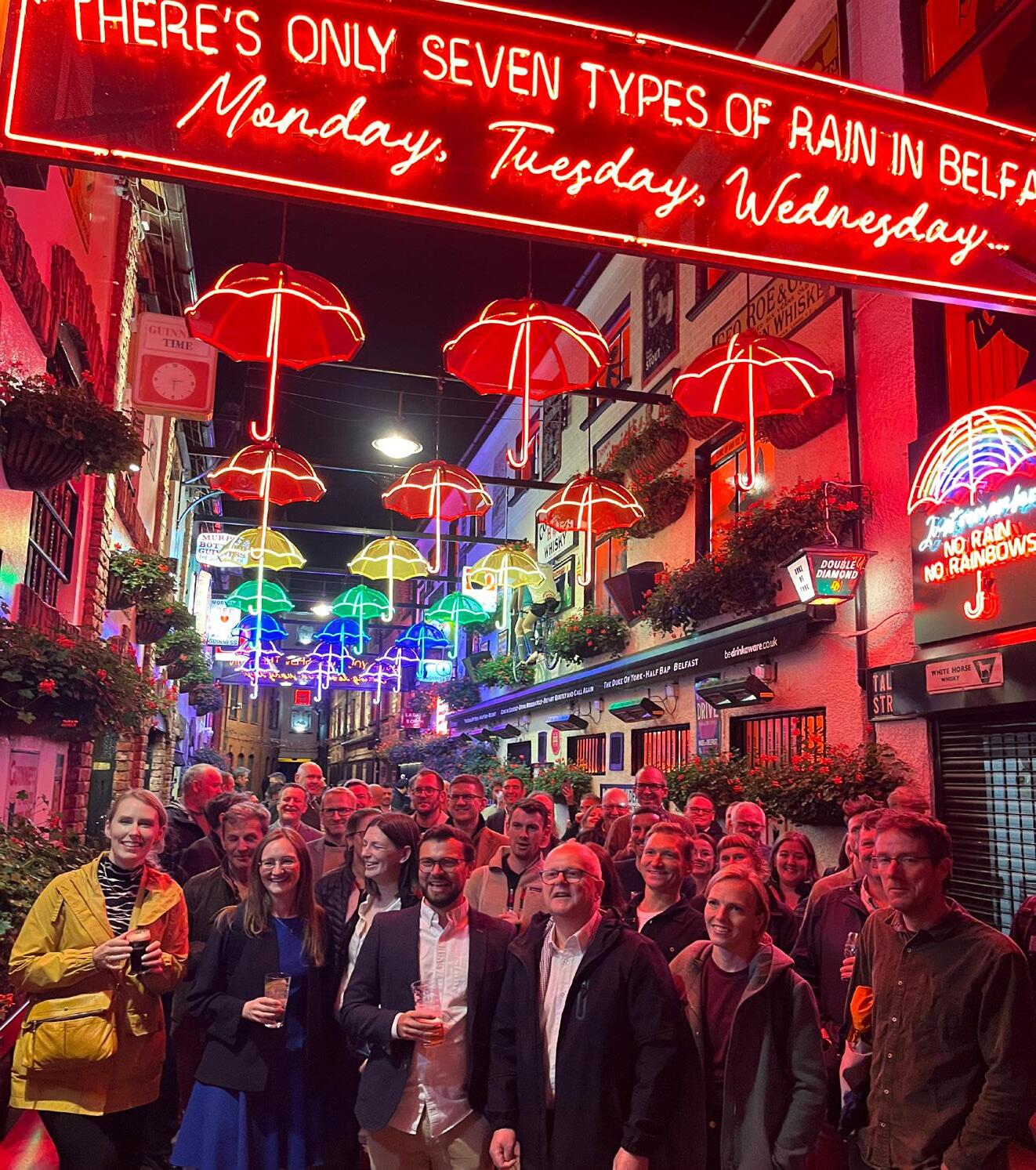
(above l-r) Collective Architecture’s James York, WARM’s Sally Godber, Lloyd Alter, Highland Passive’s Es Tresidder and Passive House Institute joint-MD Jessica Grove-Smith in the Sunflower pub in Belfast; (inset) Lloyd Alter with John Gilbert Architects’ Rupert Daly – with Sally Godber photobombing.
– I wish I had not forgotten my CO2 meter and my mask.
Fortunately, the content was so inspiring that I didn’t doze off; James York of Collective Architecture took my breath away with his social housing retrofits. He was followed by the most entertaining and hilarious speaker of the conference, Iain Stewart of Formative Architecture, who described how to build market-driven private housing to passive house standards. I have never seen anyone do it better.
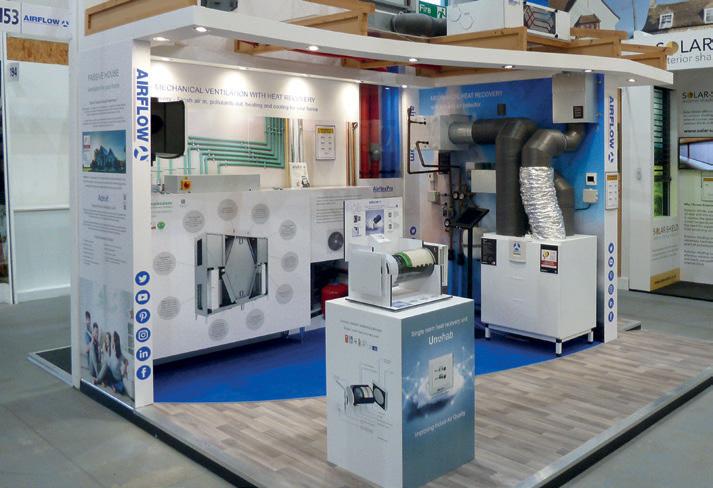
I will ruminate about rooms and multiple streams again; I missed the next seminar because that little room on the third floor was completely full by the time I got there. Fortunately, my time was well spent talking to the sponsors, learning about tapes from Siga and having my mind blown by Airflow's combination kitchen exhaust hood and MVHR for flats and small units, solving a problem I have been writing about for years.
Then it was time for the final panel discussion, and again I was faced with having to choose. Really, you want to end your conference with a bang, with everyone in the same room, building energy and excitement. I picked the panel on costs and standards (neither panel title spoke energy and excitement, so I went for the bigger room and the better air quality), and I am glad I did, because moderator Emma Osmundsen was determined to finish with a bang, and brought out the best in all of the speakers.
Sarah Lewis of the Passivhaus Trust did her
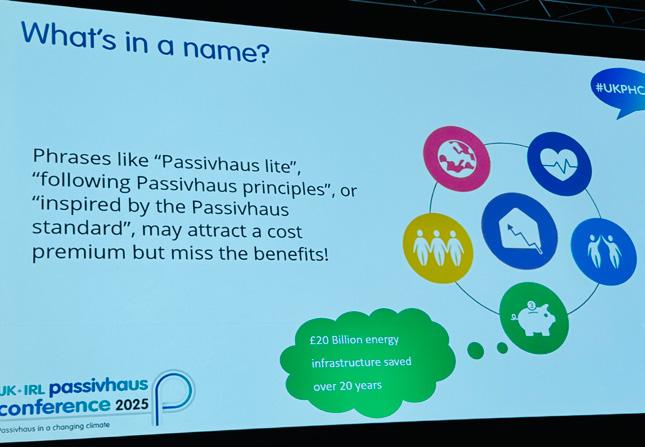
best to get us on our feet with her attack on those who use “passive house principles” instead of getting certified.
I can’t imagine closing out a conference with a topic like “handover to occupants” –this is not going to get people jumping out of their seats.
Fortunately, Dan Hyde (of Zero Ambitions consultancy and podcast) can make reading a telephone book entertaining and weird, and he made this dire topic interesting. He deftly handled Bronwyn Barry’s criticism about “why is this so complicated?” by describing who his audience is in heartfelt terms.
I asked an organizer why they split up the final session, and was told that they expected the speeches over drinks to be the real closer. It didn’t work; by that time, everyone was more interested in talking to each other. But these are small quibbles about what was perhaps the most well-organized, interesting and entertaining passive house conference I have ever attended. Nobody got to drone on; every moderator watched their watches, and the day just flew.
The evenings flew by too, because Belfast is alive with energy and fun, with Sally Godber photobombing all of my photos. One of the closing speakers noted Belfast's history: “30 years ago, this conference could never have happened.”
It’s hard to imagine when you walk through it today. It was a wonderful conference, in a wonderful town.
It was a wonderful conference, in a wonderful town.
About the author
Lloyd Alter has been an architect, real estate developer, and prefab entrepreneur. He now teaches Sustainable Design at Toronto Metropolitan University and is Design Editor at Treehugger. com. Author of Living the 1.5 Degree Lifestyle, and the recently published The Story of Upfront Carbon, Lloyd also has a substack at lloydalter.substack.com
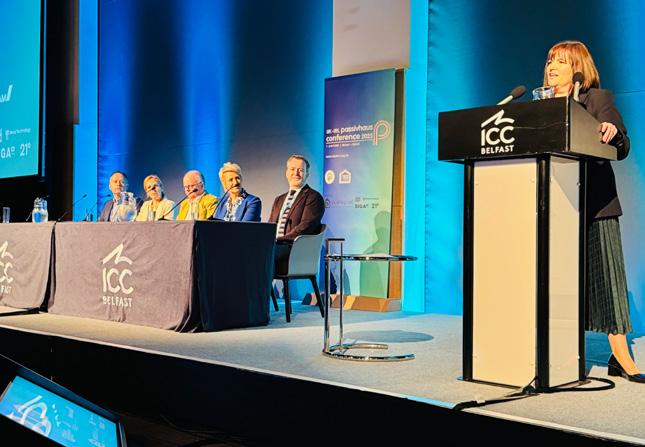
(above from top) A slide from PHI joint MD Jessica Grove-Smith’s presentation showing the growth rate of passive house projects globally; PHAI chair Caroline Ashe-Brady speaking during the opening session on passive house and the climate emergency; Passivhaus Trust director Sarah Lewis warned of using the term passive house too loosely.
Conference delegates at a networking event at Commecial Court in Belfast’s Cathedral Quarter.
Big Picture
Forrest Passive House
One family’s response to a bushfire
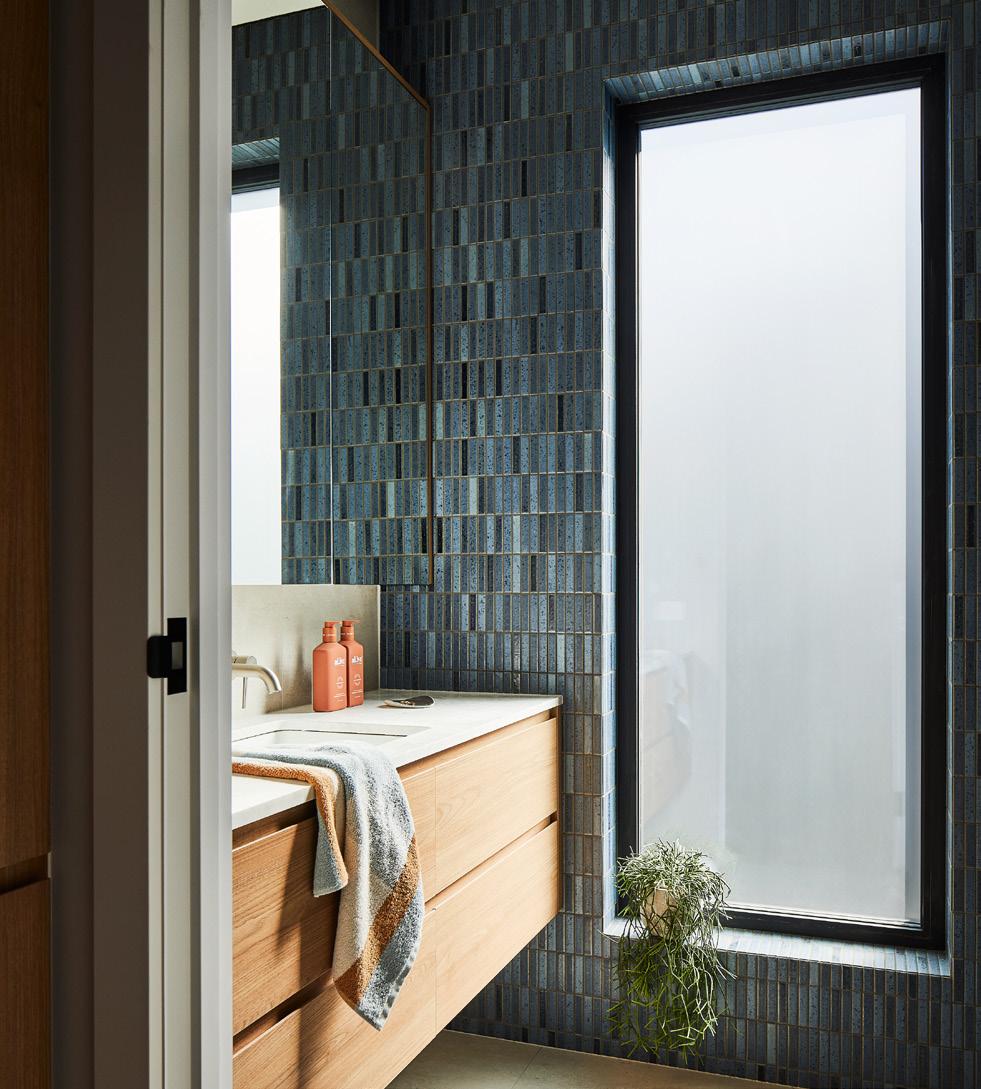
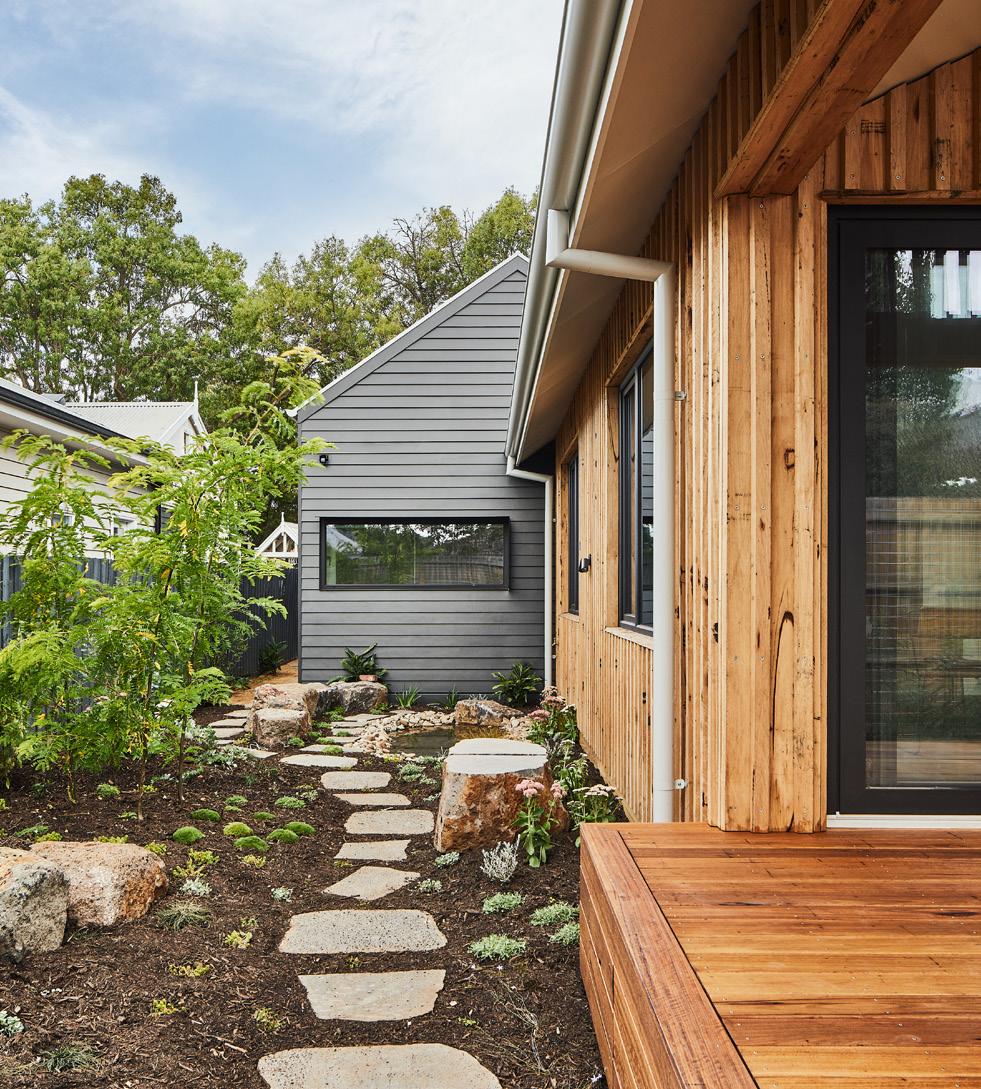
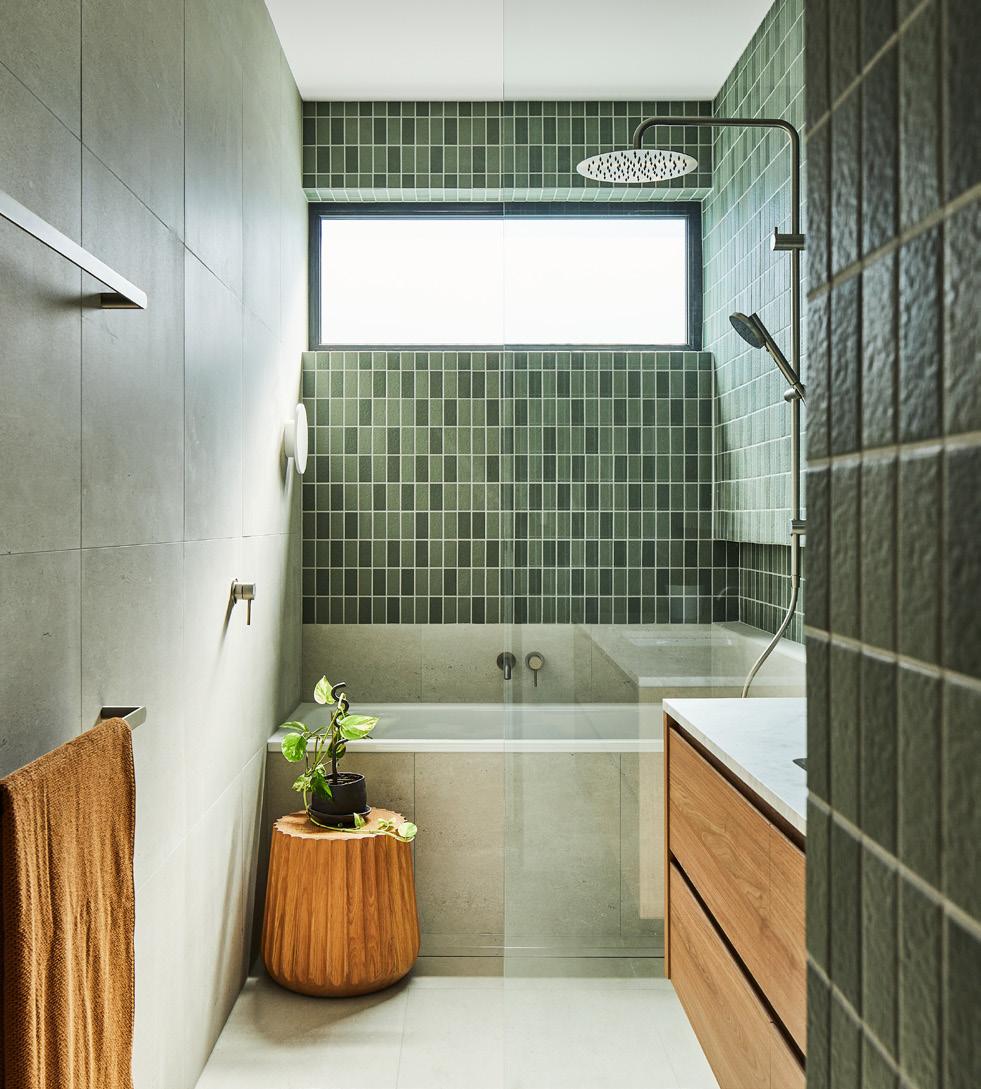
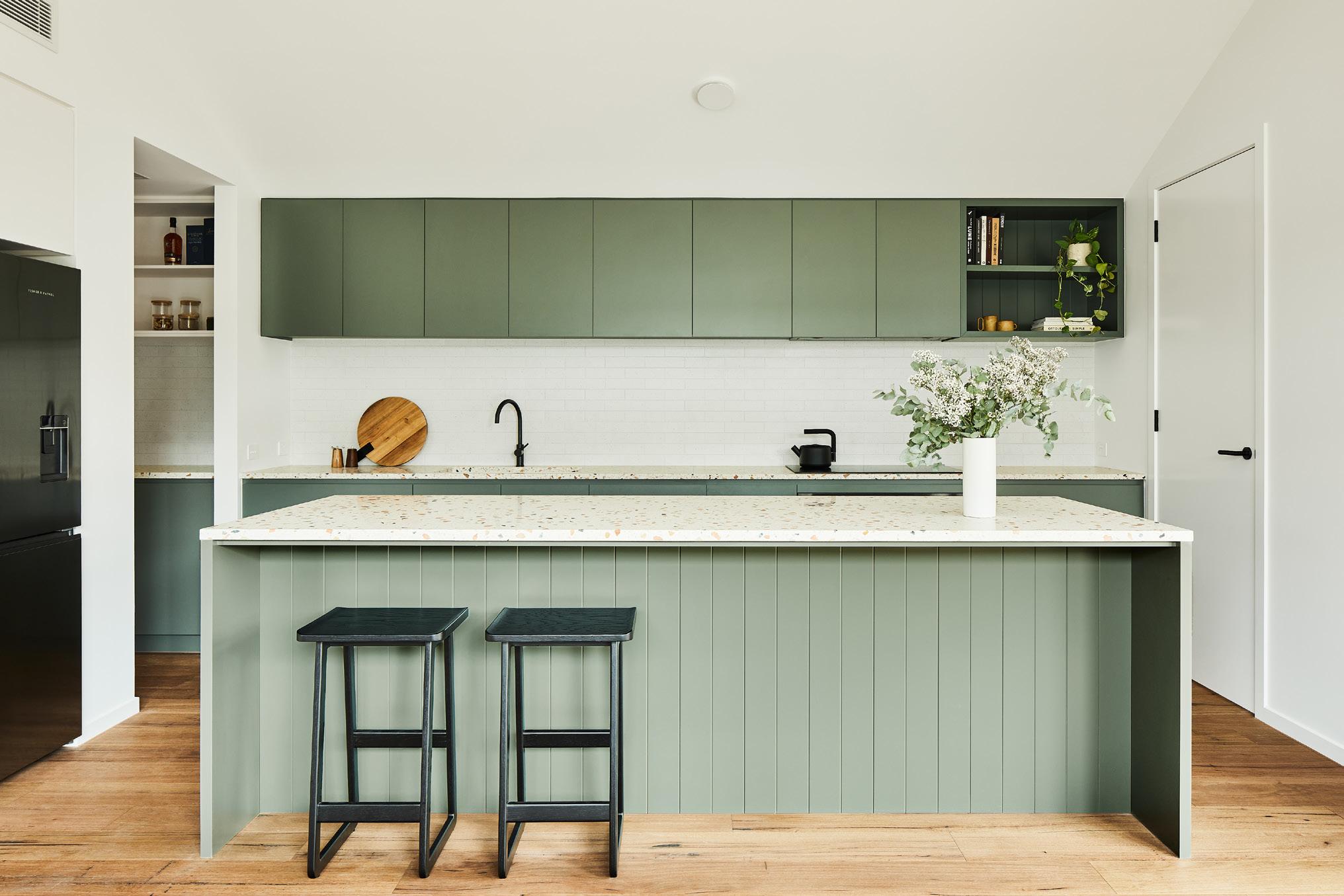
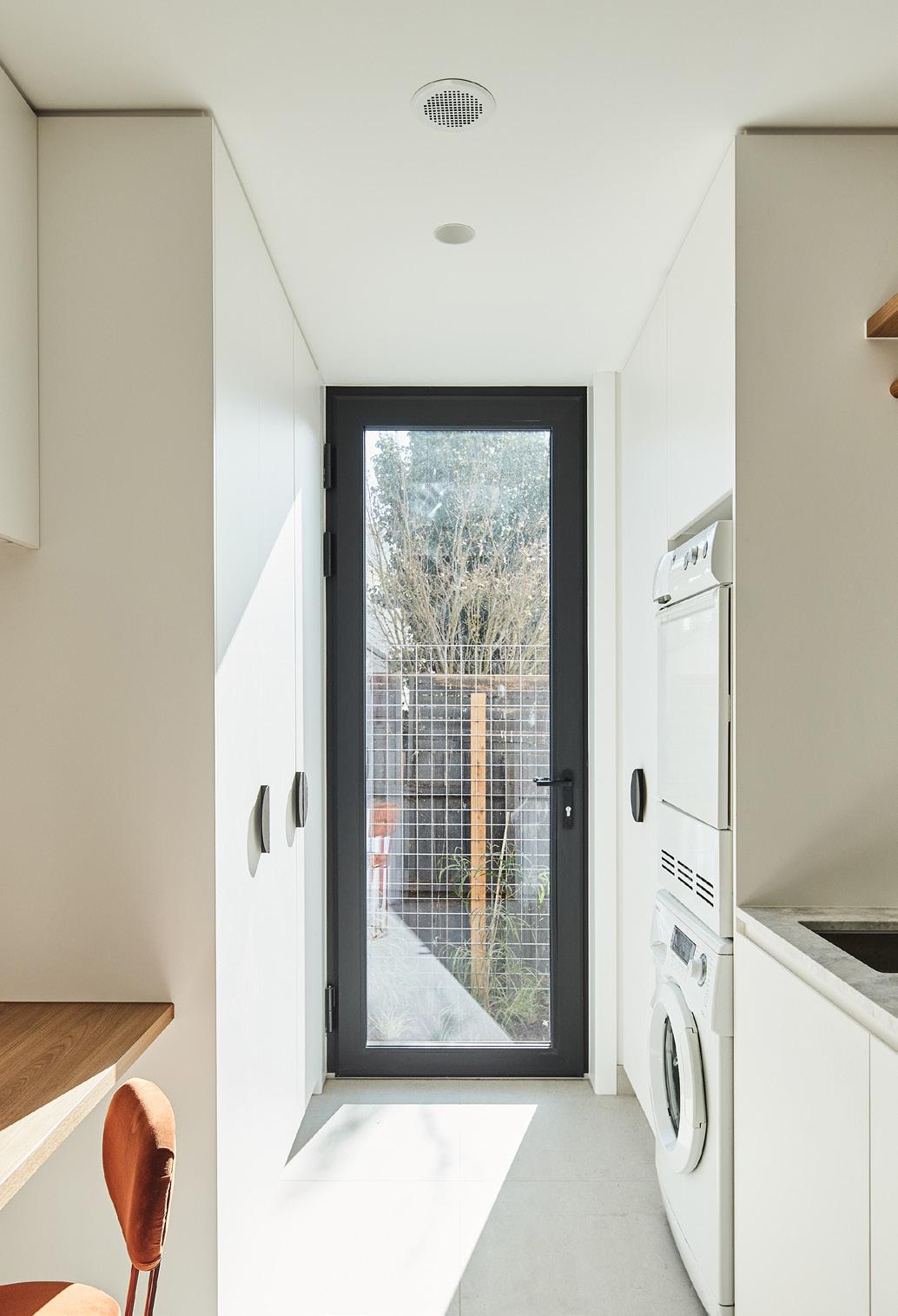
Forrest Passive House in Spotswood achieves certification while maintaining contemporary family functionality through thoughtful material choices and spatial planning.
Photos: Jade Cantwell/Carland Constructions
Even by Australian standards, the Black Summer bushfires of 2019-20 were devastating. Some twenty-four million hectares of land burned – killing an estimated one billion animals and displacing two billion more. Thirty-three people perished in the fires, with bushfire smoke causing the deaths of 417 more.
Before the fires, Melbourne couple Erin and Martin had been planning a substantial renovation and extension to their period cottage in Wurundjeri Country in Melbourne's Inner West, working with architects Altereco Design. When the bushfire smoke rolled in, an air quality monitor in the home showed spikes in particulate matter (PM) readings. With respiratory issues in their family, the failure of their period home to protect air quality in the
home prompted a rethink.
"When that bushfire smoke came through the city, it was shocking to see just how porous our old weatherboard house was," Erin told Sanctuary magazine. Weatherboard-clad it may have been, but the house was doing little to protect the family from the weather, with Erin describing the home as "freezing when it needed to be warm and boiling hot when it needed to be cool."
With respiratory sensitivities in the family and the Inner West's ongoing air quality challenges – from industrial zones and the busy West Gate Freeway to lingering memories of toxic factory fires – a renovation wouldn't suffice. The couple changed tack to designing a new dwelling.
Bushfire smoke from the Black Summer forest fires descending on the suburbs in Melbourne.
Photo: Tsvibrav
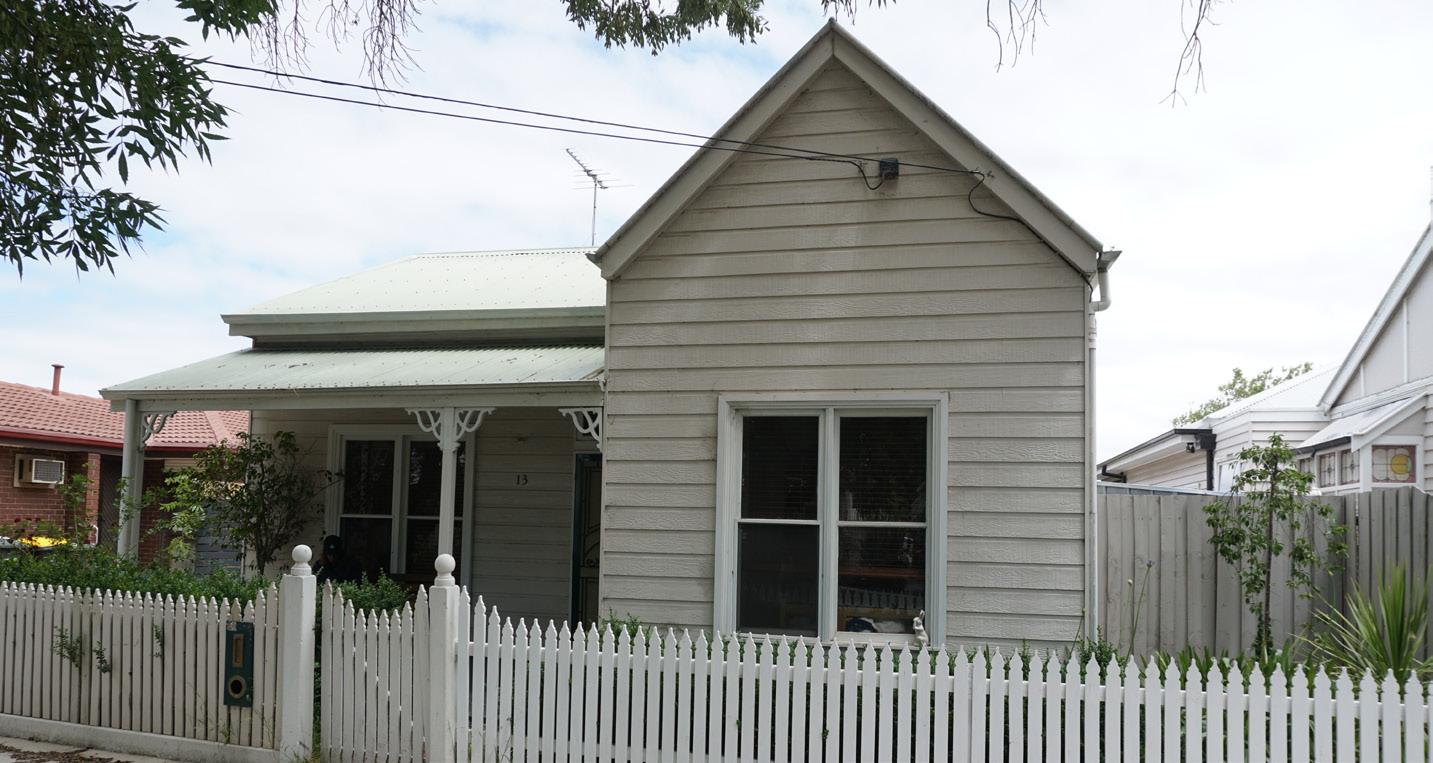
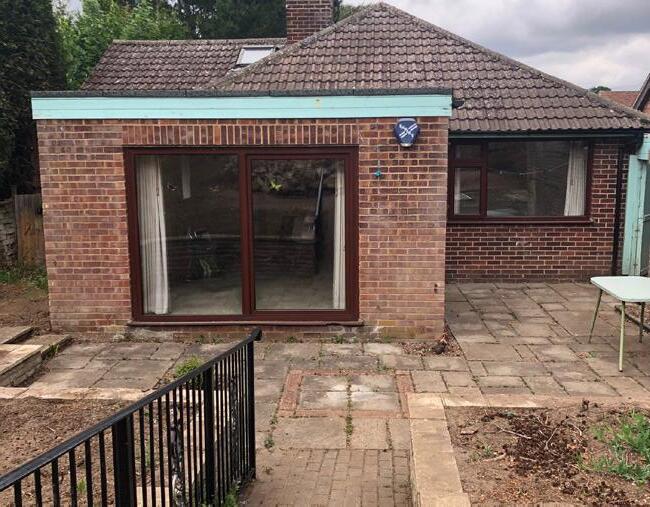
1 The existing weatherboard house on the site, which dated from 1900; 2 the house was lifted and moved by truck to the city of Ballarat.
While opting for new build over renovation can effectively waste the resources and embodied carbon stored in the original structure, in this case something remarkably different happened: rather than demolish the existing cottage, the lightweight house was carefully lifted up whole and relocated 130 km inland to the city of Ballarat, giving the weatherboard home a second life.
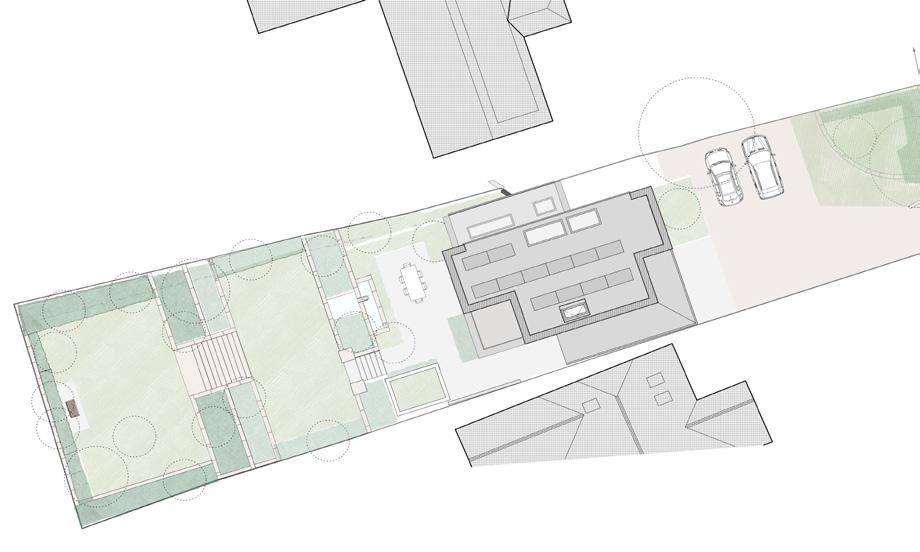
Working within a budget and with an open-minded approach to problem-solving, the couple collaborated with certified passive house builder Carland Constructions and certifier Detail Green. Designing the replacement didn’t cause long delays, as Altereco had something in their back pocket: a ready-made home using the Possum model in their AlterecO2 pre-designed house series, which is based on passive house principles. The result? A new certified passive house at Forrest in Melbourne's Inner West, which effortlessly fuses avant garde energy performance and comfort while filtering particulates from the fresh air, all wrapped up within a sleek contemporary residential design.
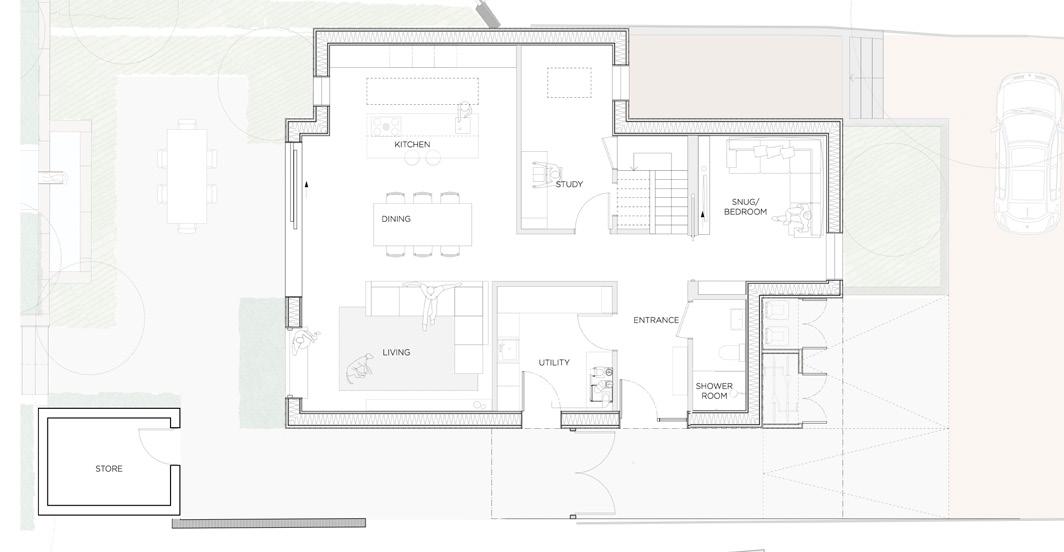
Built by Carland Constructions, the project achieved passive house classic certification through a combination of timber frame technology and careful attention to building envelope quality in a house that, at 167 m2, is comparatively modestly sized when set against the Australian average of 240.8 m2
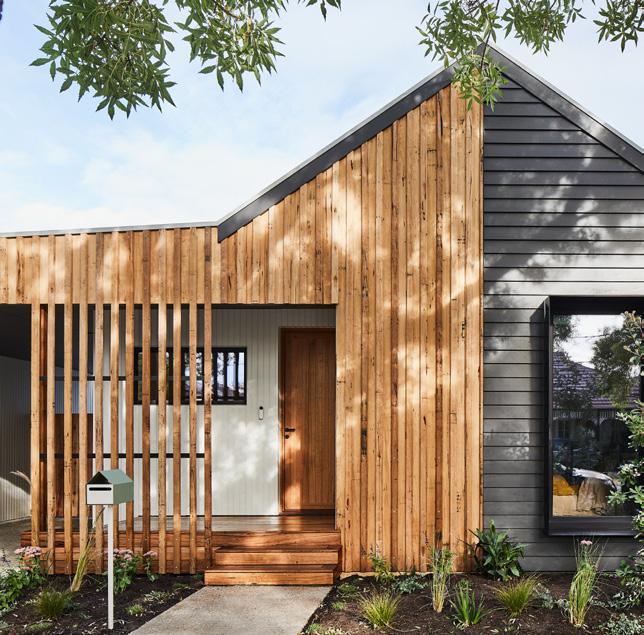
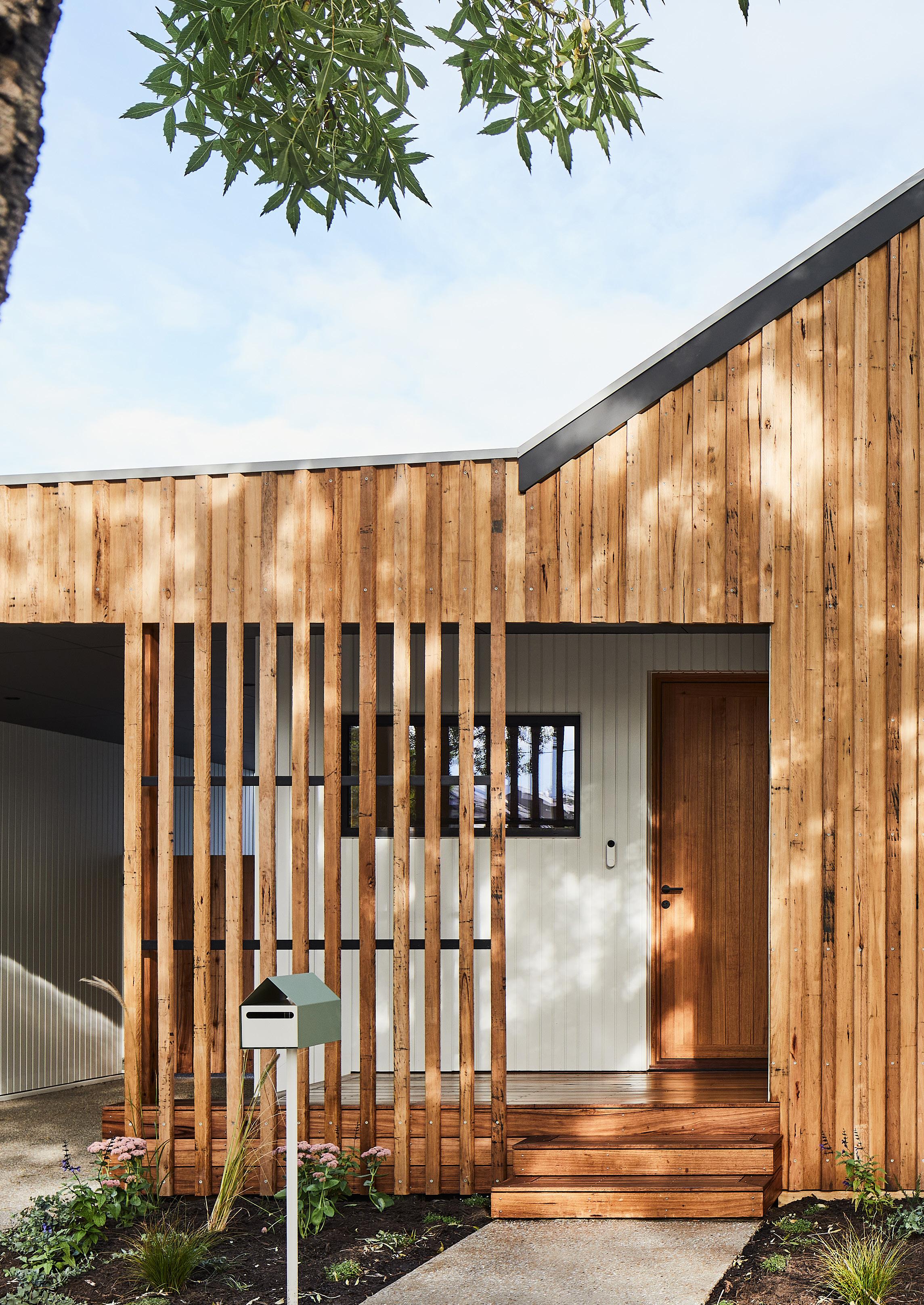
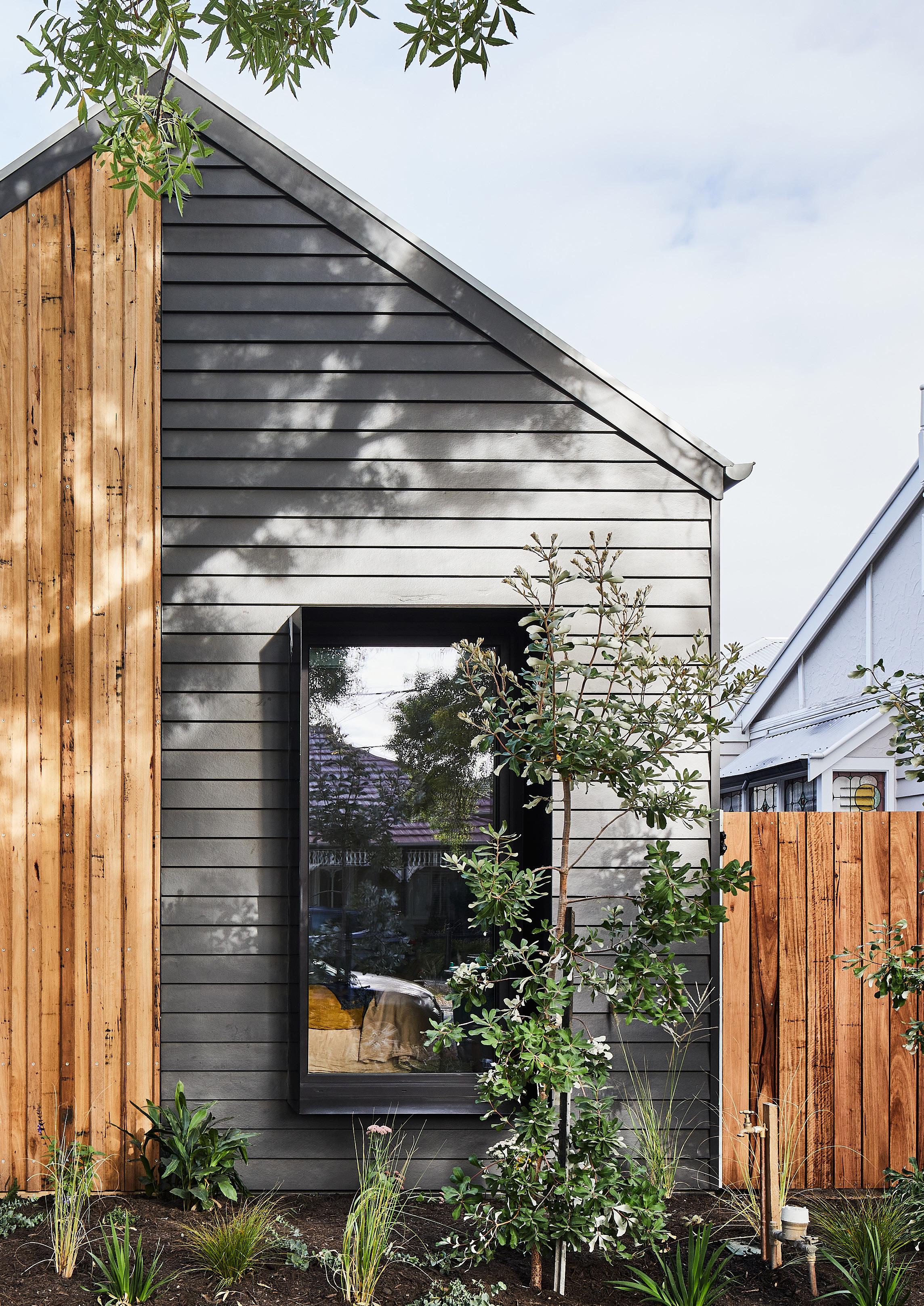
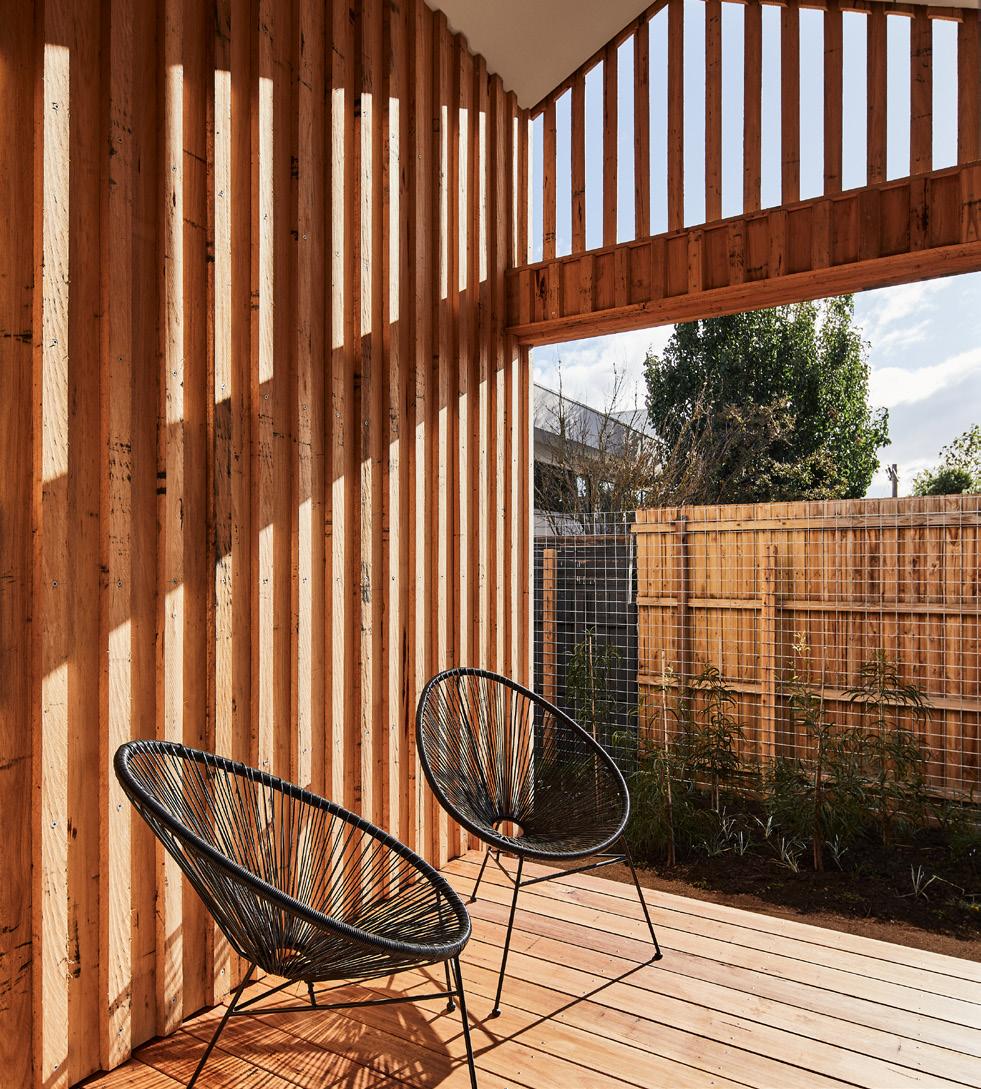
From the street, the two-pavilion composition breaks down what could have been an imposing mass into something more neighbourly. A timber-clad living wing contrasts against the dark horizontal weatherboarding of the bedroom block, while vertical silver top ash timber screening filters light to the covered outdoor areas beyond. Located in Spotswood, an established suburb undergoing gradual densification, this arrangement allows the building to sit comfortably within the suburban streetscape.
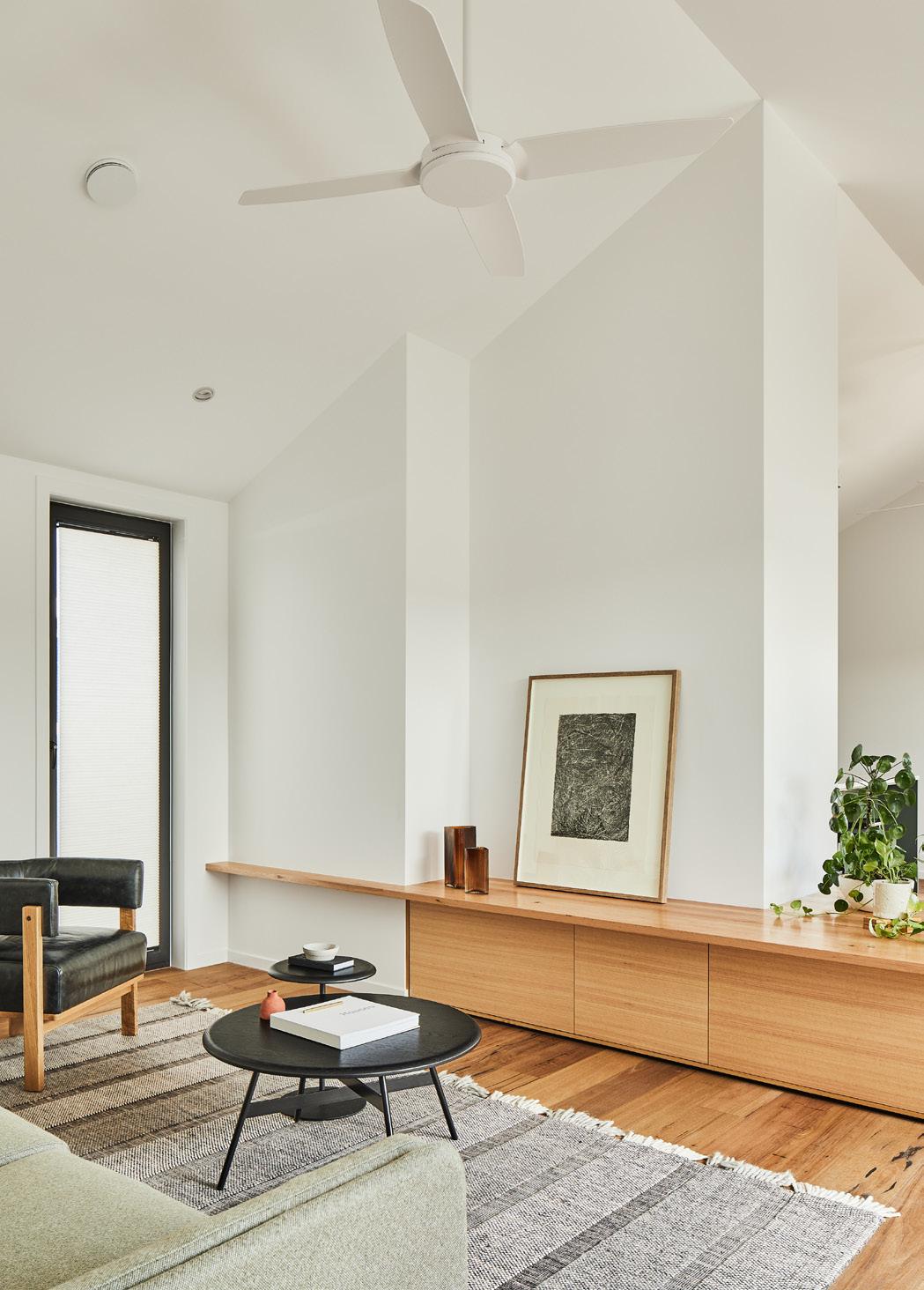
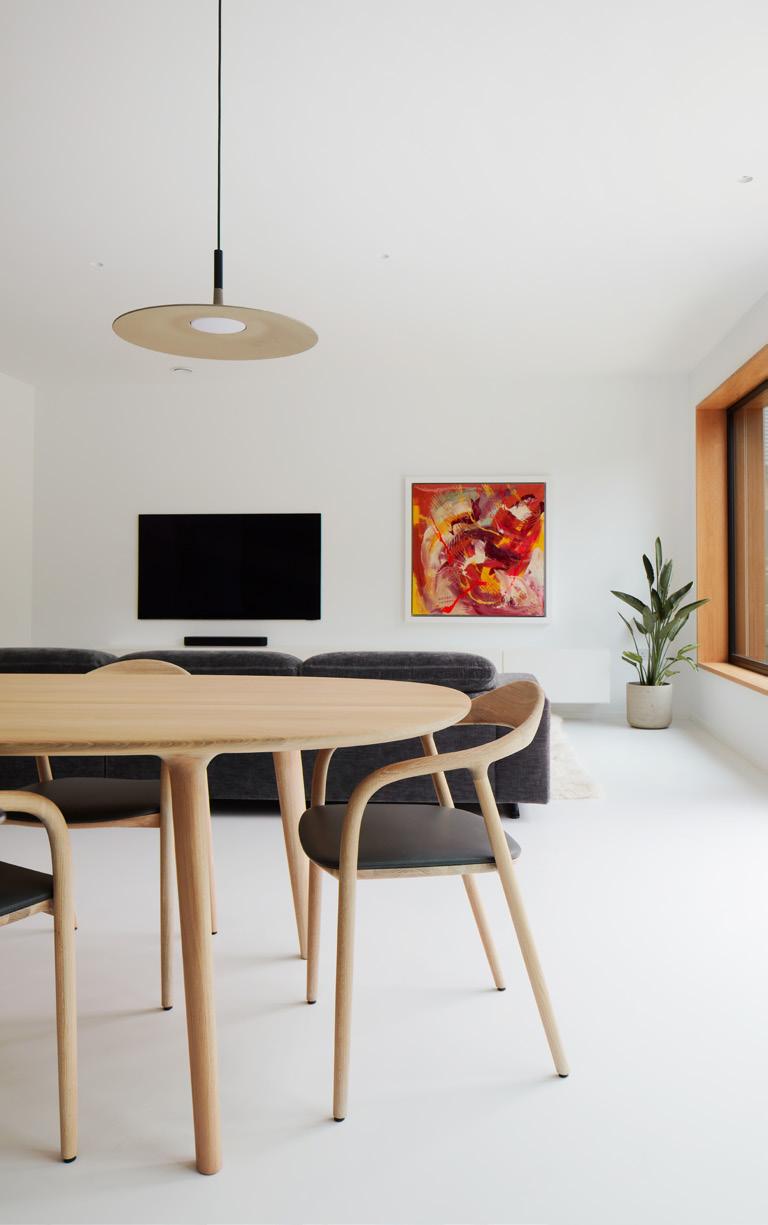
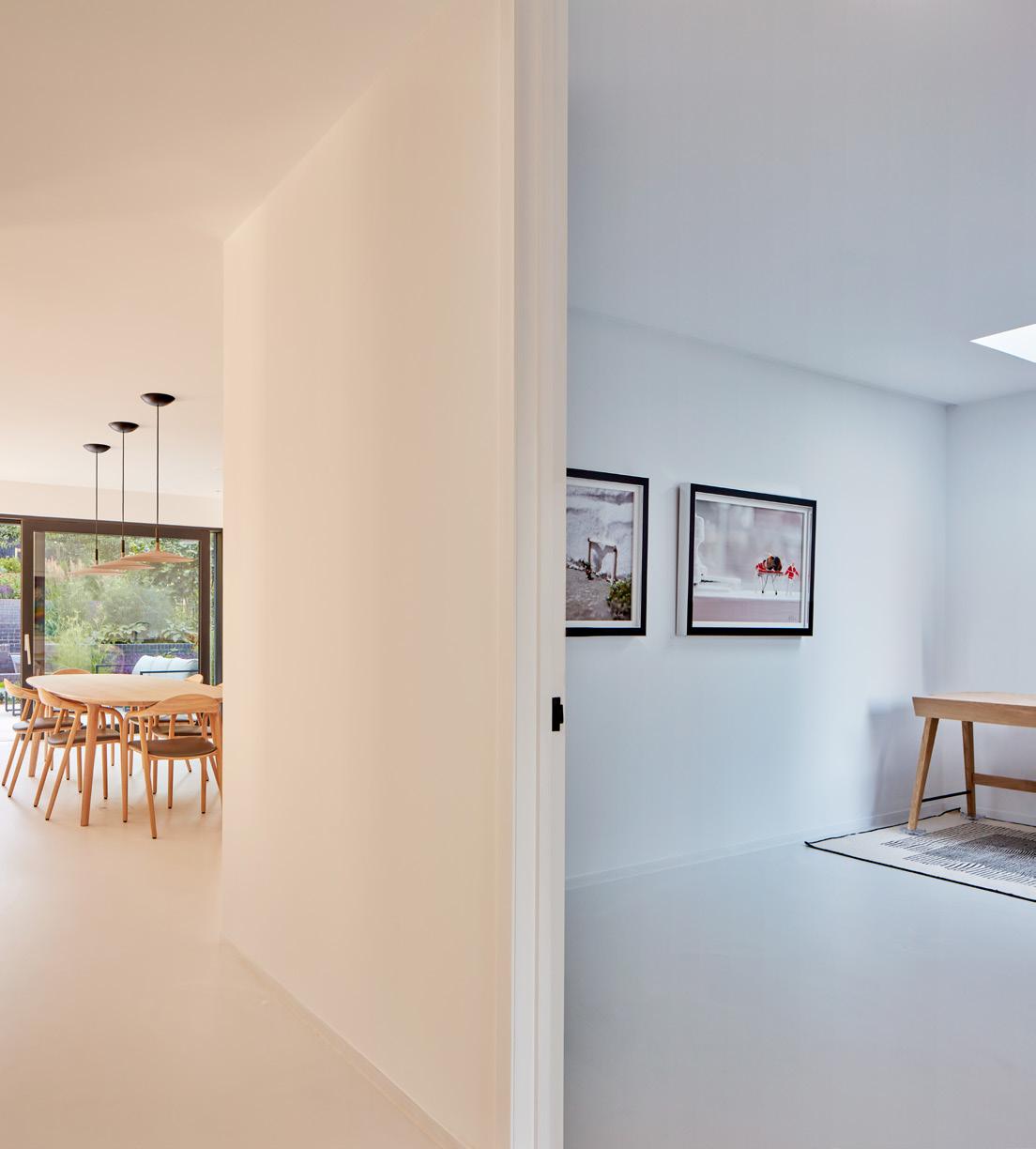
The subdivision into two pavilions is reflected in a thoughtfully-defined interior layout. The timber-clad pavilion houses kitchen, dining and living areas under a vaulted ceiling. The dark weatherboard wing contains bedrooms and bathrooms, creating clear separation between public and private functions. A consistent material palette is intended to create calm throughout.
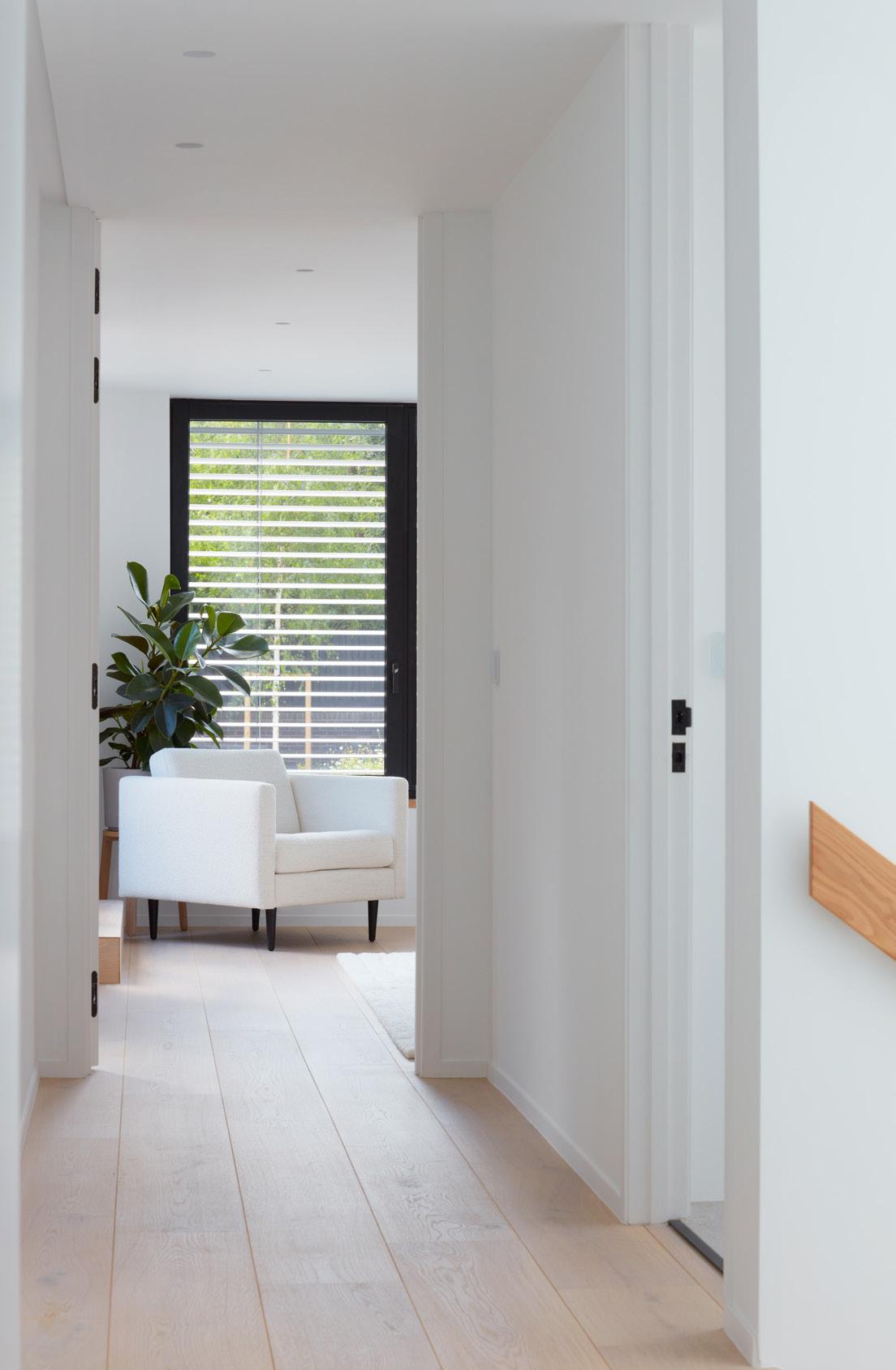
Sage green timber panelling in the main bedroom complements natural oak flooring while glazed doors provide direct access to outdoor spaces – with generously sized windows in the living space too.
"We managed to have these lovely big windows, but we haven't traded off the energy efficiency," Erin said. "I think maybe I did have a perception that passive houses often had little dinky windows, but I feel like I get that big picture window looking out on the garden."
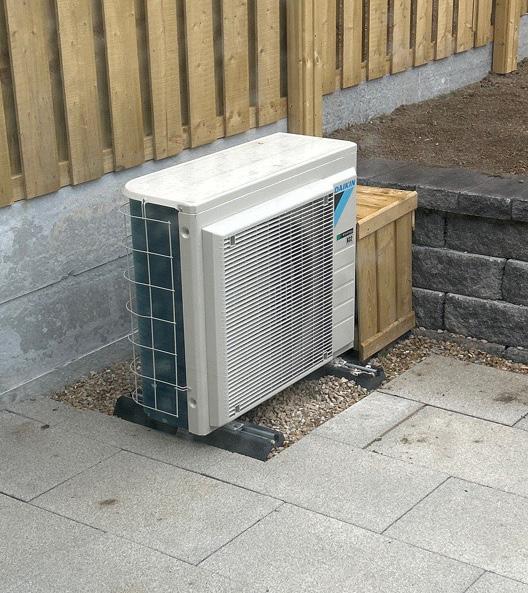
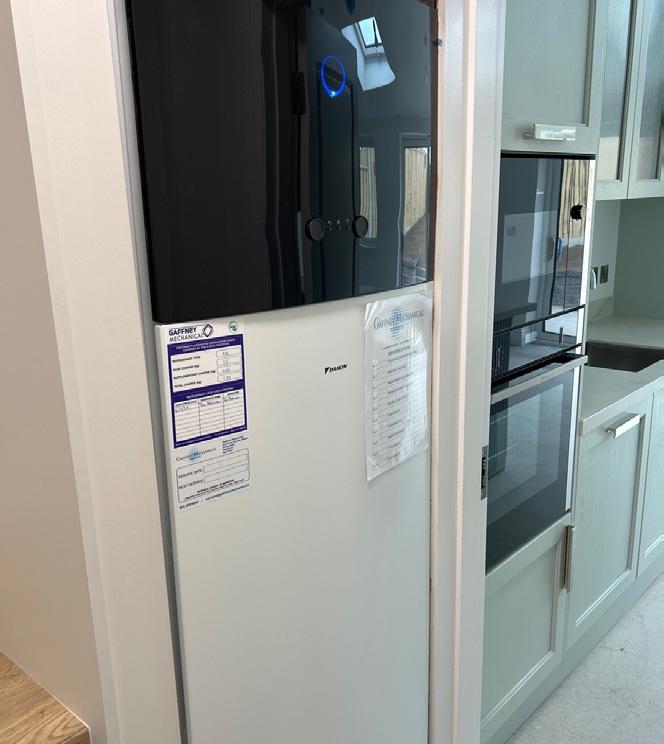
Ceiling fans provide air movement for comfort during warmer months without having to resort to air conditioning. So successful has this strategy been that the 3.5 kW Daikin bulkhead reverse cycle air conditioner hasn’t been turned on for cooling or heating since the family moved in.
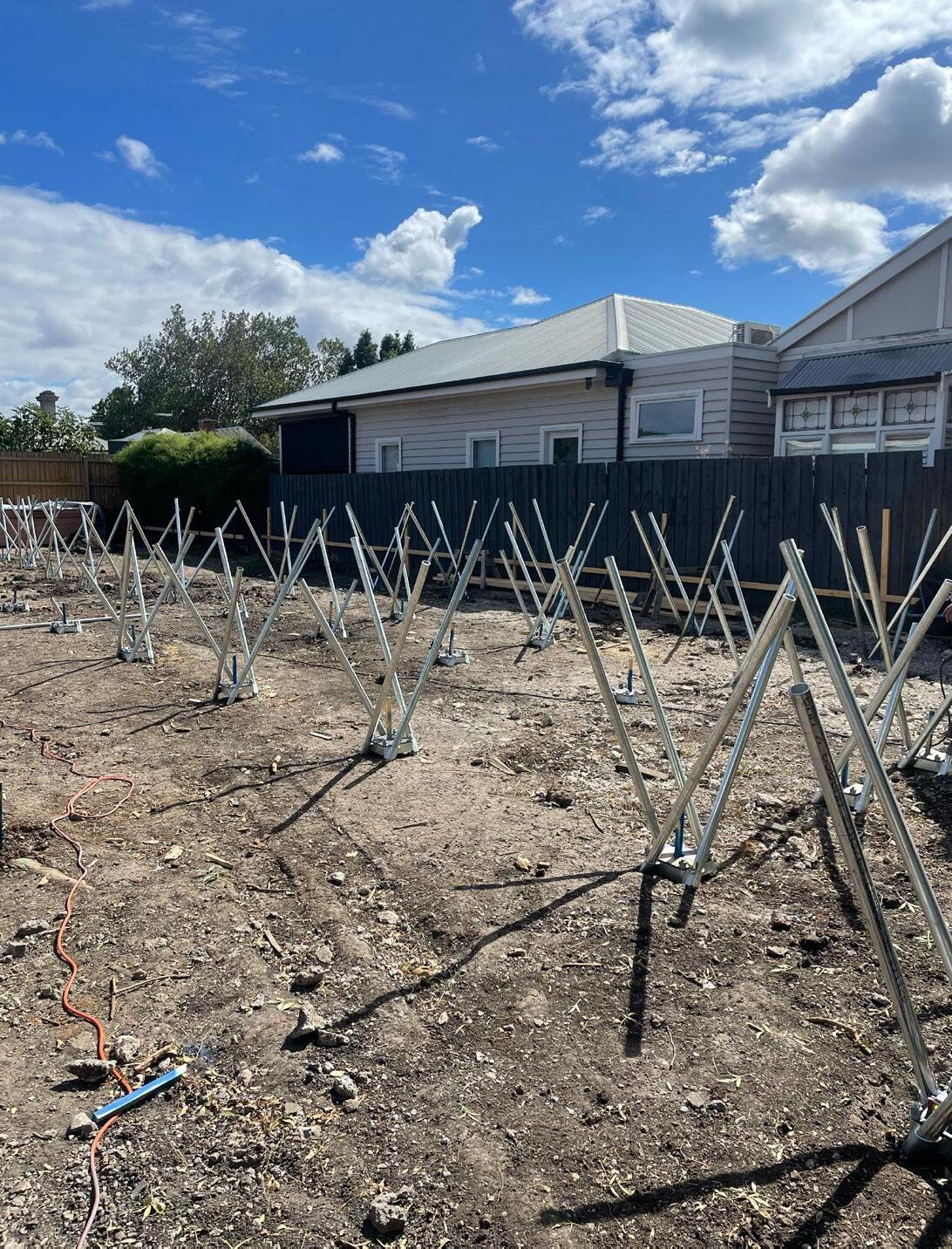
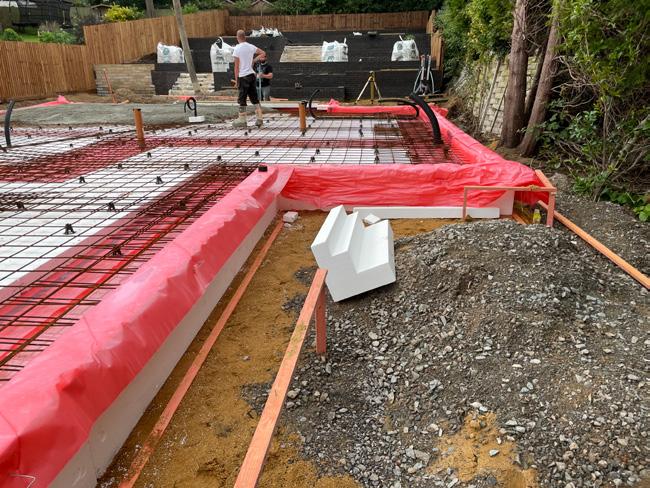
From a UK and Ireland perspective, the Melbourne climate offers certain advantages in terms of insulation levels required to meet compliance. While the roof boasts an impressive U-value of 0.125 W/m2K, the glass wool insulated 140 mm timber frame walls plus service void hits a comparatively modest 0.258 W/m2K, with the subfloor – which sits on concrete-free Allfoot steel footings – coming in at 0.2 W/ m2K. Even the triple-glazed windows used have a relatively high U-value of 1.24 W/m2K, and a G-value of 0.57 providing relatively moderate solar control.
A combination of Altereco’s considered design, Carland
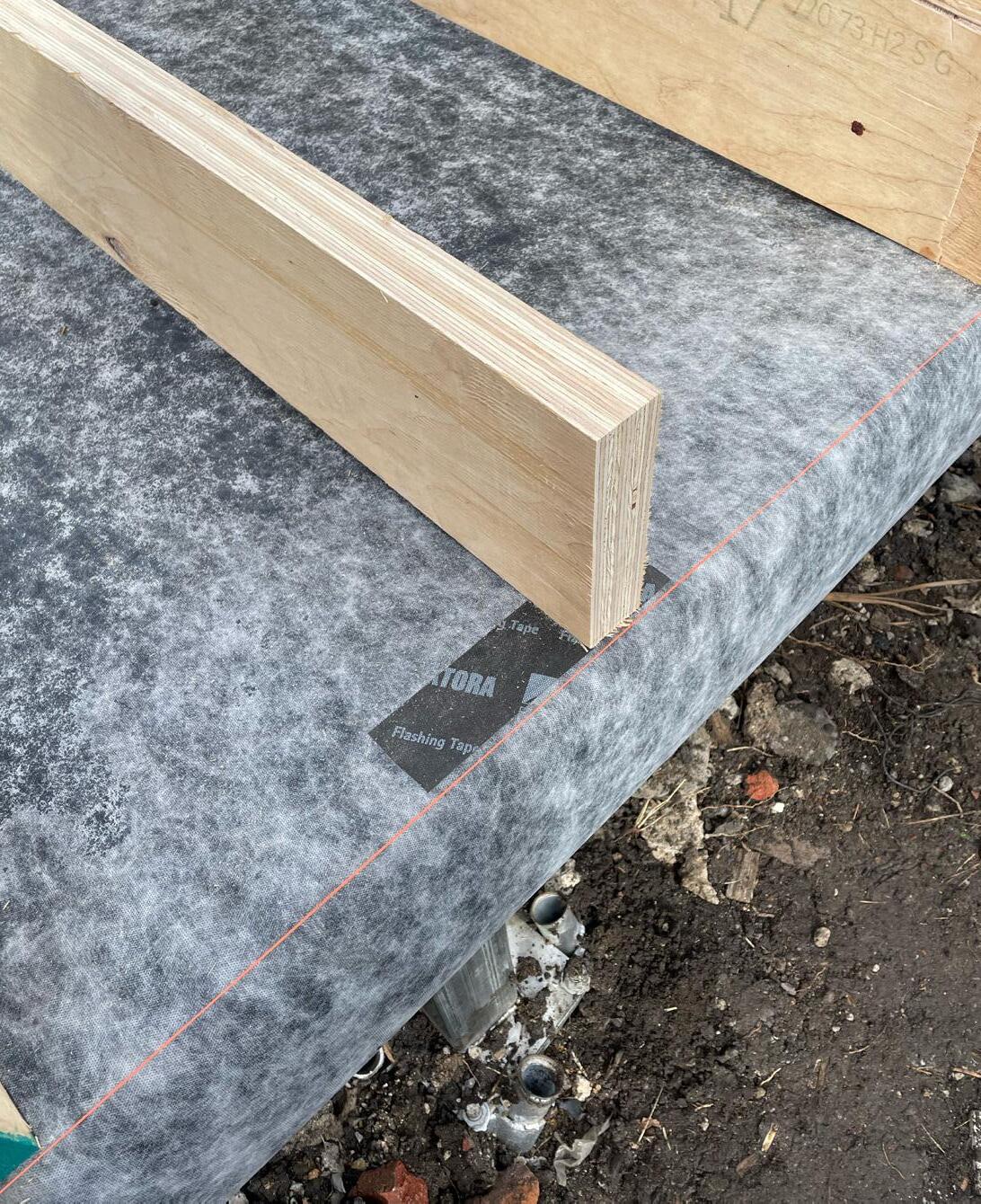
3 The new home’s concrete-free Allfoot steel footings; 4 a modern take on the suspended timber floor.
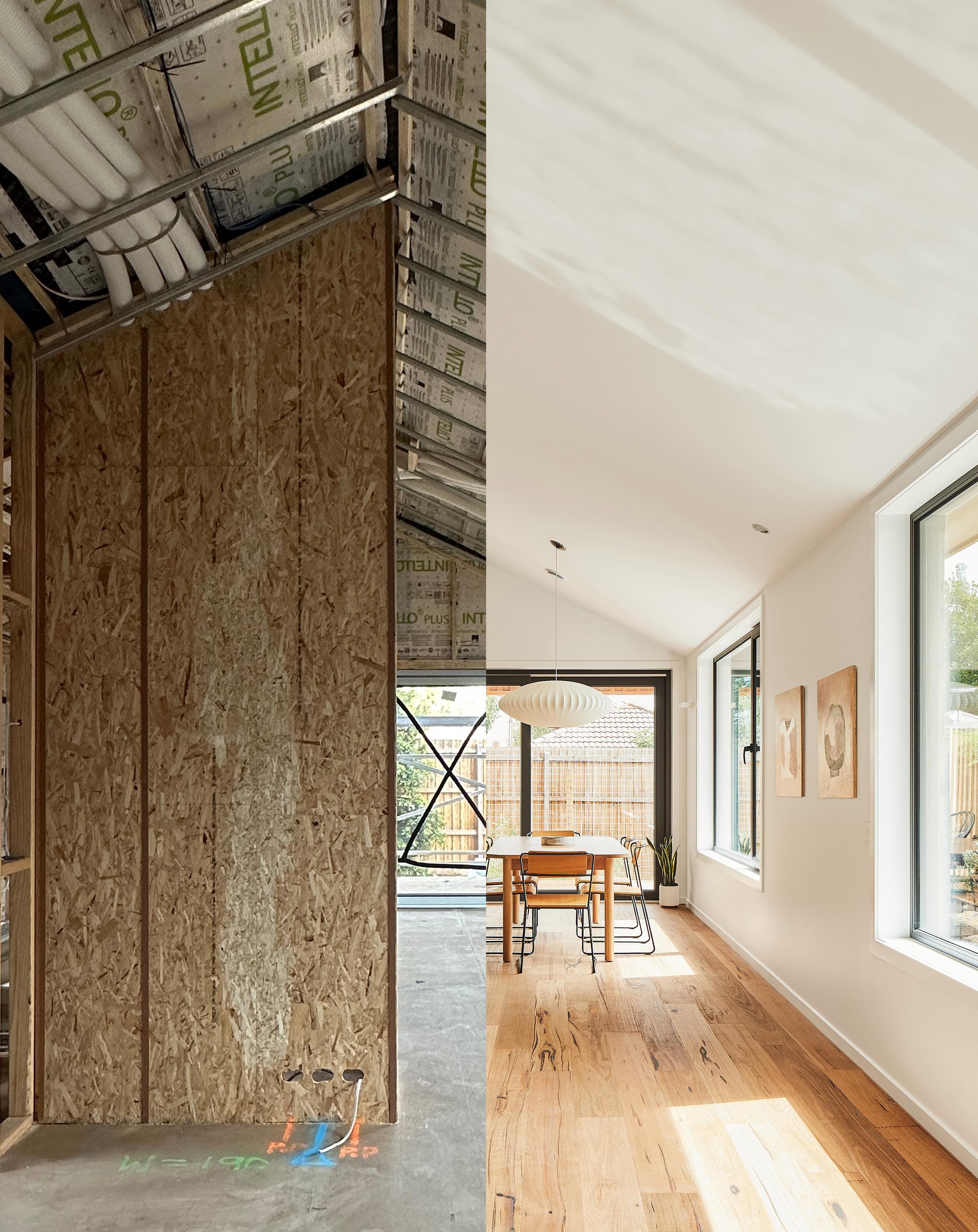
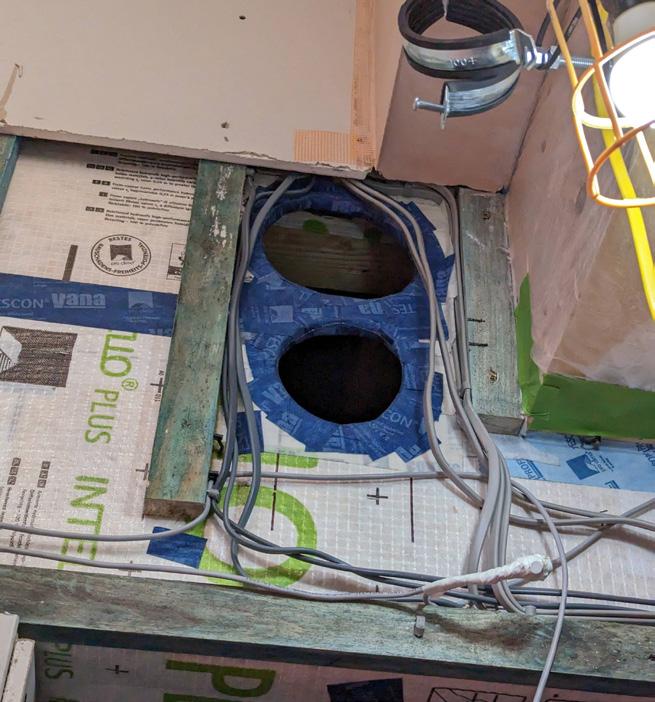
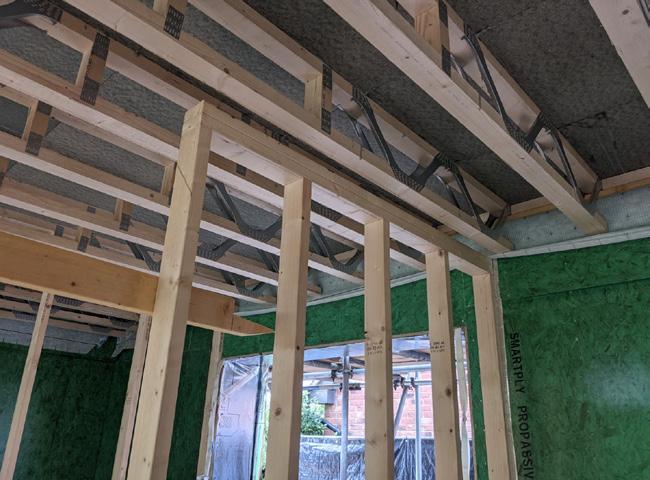
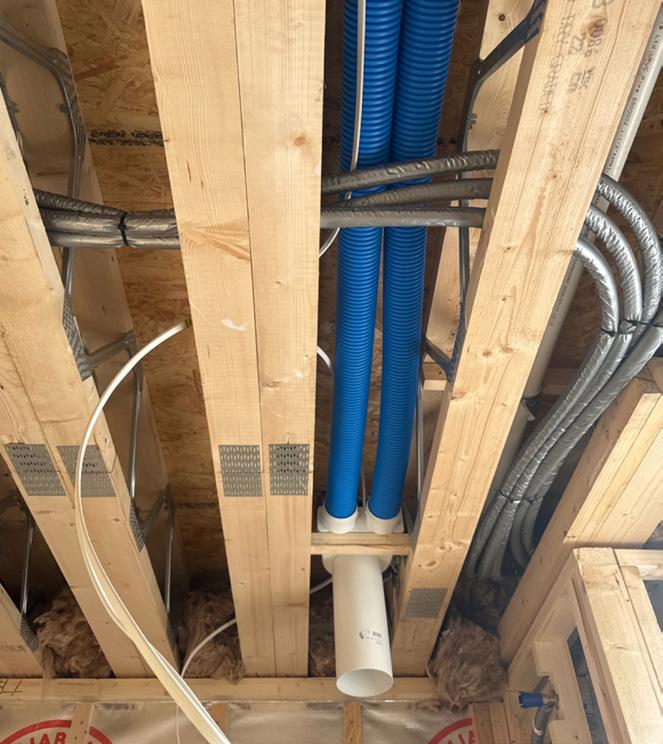
(above) With a passive house, it’s what’s inside that counts. A composite photo shows the airtight layer, with MVHR ductwork housed in a suspended timber ceiling, the hidden best practice which lies beneath the picture-perfect finish.
Construction’s careful workmanship and the familiar excellence of Pro Clima tapes and membranes delivered an impressive airtightness test result of 0.41 air changes per hour at 50 pascals.
The resulting performance metrics are impressive: a calculated space heating demand of just 13.9 kWh per square metre annually and a cooling demand of 7.0 kWh/m2/yr. The building is also designed to use minimal energy in extreme heat and cold too, with a heat load of 11 W/m2 and a cooling load of 14 W/m2.
What’s more even if the air conditioning isn’t used, the house is designed to remain comfortable, passing the 25C threshold specified in the passive house standard less than
11 per cent of the time without air conditioning, with 0 per cent excessive humidity. These aren't hypothetical figures. Through multiple summers and winters, the owners say they have never needed to turn on their air conditioner in heating or cooling mode. Even if climate-induced extreme heat events cause the building to surpass 25C in future, the ceiling fans should help the family feel comfortable without turning on the aircon. Research by the Architecture for Resilient Communities (ARC) programme on low energy buildings in sub-Saharan Africa indicates that evaporation of sweat on the skin caused by air movement from ceiling fans can keep occupants comfortable at tempera-
tures of up to 32 to 35C.
And what about that indoor air quality that the family set out to protect? Given the triple air quality threat posed by freeway, factories and fires, indoor air quality is protected in two ways. First of all, the house’s exceptional airtightness prevents polluted air entering via infiltration, with internal threats reduced via low VOC paints and zero VOC hard wax oil floor finishes. Then the Zehnder Q350 mechanical ventilation with heat recovery (MVHR) system takes over, minimising pollutants entering the home, and exhausting polluted air while recovering heat. The MVHR unit includes high grade filters to reduce inbound pollutants, scrubbing up
to 50 per cent of particulates of between 0.3 and 1.0 microns before the air enters the living space, with the family diligently replacing the filters every three months. “You should see what comes out,” Erin says.
As with any passive house, the ventilation strategy isn’t fully mechanical, given the option of opening windows, with the Kommerling tilt and turn windows lending themselves to cross ventilation, outdoor air quality permitting.
Solar panels on the north-facing roof contribute to the building's energy balance. The 25-panel Sunpower Performance 3 BLK array and Fronius invertor generates 12,175
kWh annually – well above the household's 8,300 kWh annual requirement. In Australia, reduction of emphasis on mains water has long been an environmental imperative. A 3,000litre rainwater harvesting system does much of the heavy lifting here, connected to garden taps, toilet and washing machine. Outside, a covered timber deck extends usable living area without adding to the conditioned floor space that must meet passive house performance requirements. Vertical battens provide solar shading while maintaining airflow. The landscaping uses drought-tolerant native species appropriate for Melbourne's climate,
reducing irrigation requirements while creating privacy and amenity.
Described by its designers as Melbourne's Inner West's first certified passive house, Forrest Passive House suggests that Australian residential projects can achieve international energy performance standards without compromising the lifestyle expectations that drive housing demand. The integration of high-performance building envelope strategies with contemporary spatial planning and material choices demonstrates a pathway for broader adoption of passive house principles in the Australian residential market.
Comfort zone
Cypren Edmunds: “I would outlaw siloed thinking”
In the first instalment of a new feature where we try to get into the heads of prominent people in green building, we asked the president of the European Straw Building Association to peer into the void, peer into his record collection, and peer into the future.
Cypren Edmunds didn’t set out to revolutionise construction. With a background in sport, music, and carpentry, his journey into sustainable building began in a damp-ridden London flat where water dripped from light fittings and mould covered the walls. That experience transformed him from frustrated tenant to housing activist – and now one of Europe’s most passionate advocates for straw construction, as chair of Straw Building UK and president of the European Straw Building Association.
What makes you happy? Small wins.
What keeps you up at night?
The fear that we will retrofit the wrong values into the future and the possibility that we are mistaking momentum for progress.
What makes you think?
The way change feels urgent, but the systems around us stall and, how forests cooperate through fungal networks better than most people do.
What turned you on to sustainable building?
I had seen enough damp walls and weak housing association apologies to last a lifetime.
What is your favourite building?
The straw-insulated fire station in Montreuil, France. It answers the most common question I get about straw buildings – “but what if they catch fire?” – with architectural clarity, public confidence, and pas de merde.
What is the worst thing you have ever seen on a construction site or finished building?
Plastic-wrapped façades sweating into oblivion and builders blamed for failures of regulation and procurement.
If you could change one thing in construction practice, what would it be?
I would outlaw siloed thinking. Then I would make insurance, planning, and procurement climate-literate.
What is your guiltiest pleasure?
Relistening to Talk Talk’s ‘Life’s What You Make It’ as if it were a strategy document.
What is your worst trait as a built environment professional?
I can be impatient with slow systems, sometimes I’m too early with ideas.
Who or what has been the biggest influence on how you work?
I could name it, but then I would lose it.
What is the most unsustainable thing that you do?
Use a smartphone made of conflict minerals.
What technology gets you excited for the future?
A tool that benefits mankind and is not manipulated for cruelty. Anything that redistributes power without ego.
What song would you like played at your funeral?
‘Mr Bojangles’ by John Holt. A song about dignity, memory, and dancing through what life throws at you.
What do you want to be remembered for?
Making straw credible and for building unlikely alliances that made something beautiful happen.
What makes you optimistic about the future?
Young practitioners asking better questions than my generation ever dared.
For information on building with straw visit www.strawbuildinguk.org
NEWS
Historic passive house conference heralds mass housing breakthrough
Attendees at the UK and Ireland Passivhaus Conference 2025 heard that the passive house standard is now being embraced at scale by major developers.
Opened by Passive House Association of Ireland chair Caroline Ashe Brady, at Belfast's International Conference Centre on 8 October, the first joint UK-Ireland event heard that action on the built environment was key to combating climate change. Rethinking housing, she said, requires many individuals working in concert.
"It [climate change] almost feels like a problem that is too big for us to solve," she said, but "the Passive House Institute gifted us a solution: lean in, learn". "We have the power to change the dial," she said.
Her British counterpart, Passivhaus Trust chair Emma Osmundsen, said that some 3,000 social homes under construction in London alone are targeting the passive house standard. People are taking a stronger interest in housing, she said, not only in terms of energy and carbon, "but also in terms of health and welfare issues as well".
Andrew Muir, Northern Ireland's devolved assembly minister for agriculture, environment and rural affairs, underscored the vision for change, saying that passive housing was essential for a "just transition to net zero".
Major developers embrace passive standard
Stephen O'Shea, head of sustainable construction at major Irish homebuilder Cairn, said it was exciting that major developers such as Cairn and Britain's Barratt and Persimmon were taking energy and carbon issues seriously.
"Companies like mine, and like Barratt in London [are turning to passive house]," he said. "We may be late to the party, but we're on the dancefloor; we're here".
The line drew appreciative laughter: for many in the room, hearing a major volume housebuilder publicly commit to passive house standards
represented a watershed moment for the sector.
Addressing potential scepticism, O'Shea posed a rhetorical question: "Why is a big developer going down this road?" The answer, he said, is that "sustainability has to be for the masses".
Mosart managing director and Irish passive house pioneer Tomás O'Leary said he had never imagined 20 years ago that the sector would now be working on schemes of such scale.
Passive House Institute joint managing director Jessica Grove-Smith said the goal was to reach a position where the passive house standard becomes the basic standard for buildings. "Business as usual, the new normal, that's where we want to be," she said.
Practical sessions on construction techniques
Following the morning keynote sessions, the conference split into three streams covering residential projects, non-residential developments and practical construction techniques.
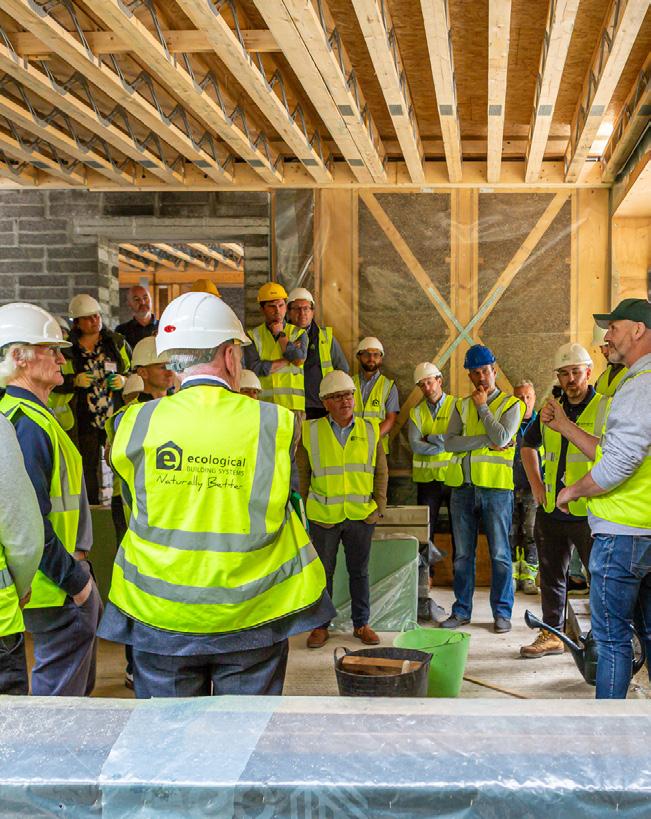
Niall Crossan of Ecological Building Systems led a practical session on low carbon passive house construction, showing attendees building technologies including cross-laminated timber (CLT), an engineered timber product, and a prefabricated straw bale system from EcoCocon.
Residential and non-residential projects showcased
The conference also featured presentations on non-residential passive house projects, including the Northern Ireland Department of Agriculture, Environment and Rural Affairs' 'College of the Future' scheme. The £80 million renovation of the Greenmount and Loughry campuses demonstrates the application of passive house principles to large-scale educational facilities.
Charlie Conlan of housing developer Ballymore said passive house is "going to be the standard" of the future, which is why Ballymore has piloted a passive house development, Drumnigh
Oaks in Portmarnock, County Dublin, as featured in this issue of Passive House Plus.
Stephen Donoghue of Mosart said the cost uplift on recent passive house schemes was working out at between 0.4 and 0.9 per cent. In other words, passive houses are not meaningfully more expensive to build than other forms of dwelling.
The bottom line is the bottom line
The final sessions of the day focused on two key areas: costs and standards, and retrofit and fuel poverty.
Manuel Gonzalez Rodriguez of the CGBC said we need to change the dial on both operational and embodied carbon.
Sinéad Hughes from the Irish Green Building Council and the RIAI noted how legislation is driving change in the energy performance of buildings, but said more work is needed. "We cannot continue with business as usual. We need, collectively, to do better," she said.
Sarah Lewis from the Passivhaus Trust said passive house certification is "the golden thread" running through high-quality buildings. Performance in use is higher in passive house-certified buildings than in other forms of energy-conscious construction.
John O'Connell from OCC Construction said that his company, based in the west of Ireland, focuses heavily on training, arguing that the importance of this cannot be overstated. There is a real learning curve, he said, but it is very worthwhile.
Zero Ambitions Partners co-founder Dan Hyde spoke on the handover of passive houses to end users, drawing from handover guidance the consultancy is developing for Cairn’s passive house schemes. Handover processes are often "dreadful", he said. Key information "requires translation".
The conference was sponsored by businesses including Build Homes Better, Ecological Building Systems, 21 Degrees, Metal Technology Ltd and SIGA.
Northern Ireland environment minister Andrew Muir speaking at the UK and Ireland Passivhaus Conference 2025.
Damp and mould law comes into effect
Millions of tenants across the country will benefit from safer homes thanks to new rules coming into force in October this year, the government has said.
The new rules will protect tenants and force social landlords to urgently fix dangerous homes. Emergency hazards must now be addressed within 24 hours under landmark changes, including serious cases of mould and damp.
The reforms, known as ‘Awaab’s Law’ following the death of two-year-old Awaab Ishak who tragically died in December 2020 from prolonged exposure to mould, will force social landlords to take urgent action to fix dangerous homes or face the full force of the law, improving lives for tenants and families living in all four million of England’s social rented homes.
Housing secretary Steve Reed said that the change reflected the government’s insistence
that “everyone deserves a safe and decent home to live in,” noting that the death of Awaab Ishak was “a powerful reminder of how this can sadly be a matter of life or death”.
The changes will “give tenants a stronger voice and force landlords to act urgently when lives are at risk, ensuring such tragedies are never repeated,” he said.
In an opinion piece published in the Manchester Evening News, Reed described the child’s death as a “moment of shame for Britain”.
In 2026, a second phase of Awaab’s law will expand protections from more hazards, including excess cold and heat, fire and electrical risks and hygiene. Phase 3, planned for 2027, will extend it to all remaining hazards covered by the housing health and safety rating system, with the exception of overcrowding.
However, the legislation only applies to the social rented sector, such as council housing
or those rented from housing associations.
Around 8.6 million UK households rent, equating to around 35 per cent of all households in the UK. Of these, roughly 4.6 million households are renting from private landlords, and about 4 million are social renters.
The government has said it is committed to extending the new rules to the private rented sector under an extension to the provisions of the Renters' Rights Bill. This will ensure all renters in England are empowered to challenge dangerous conditions, the government said. However, no date has been given for the expansion.
A recent survey, the Health Equals report, published by Censuswide and based on a survey of 3,982 adults, found that some 23 per cent of those who said they had problems such as damp, mould or condensation in their homes were social renters, while 21 per cent were in private rented accommodation
Homes England standard adopts passive house principles for new housing
Homes England has published design guidance that makes passive house principles the benchmark for affordable housing developments and mandates whole life carbon assessments – but fails to acknowledge the health impacts of combustion-based heating or cooking.
The Healthy Homes Standard, published on 20 October, becomes mandatory for all Homes England-funded projects and their development partners. The guidance goes beyond current Building Regulations and may influence local planning policy, according to the document.
The standard requires all homes to achieve an EPC A energy rating and recommends passive house performance targets for developments seeking to meet "good practice" levels.
Passive house approach recognised The guidance dedicates a section to passive house methodology, stating there is "significant overlap" between the passive house approach and the aims of the Healthy Homes Standard.
The document cites constant fresh air supply that eliminates condensation and mould risk, reduced overheating risk, quieter internal environments and addressing the "performance gap" between designed and actual building performance as key benefits.
The standard stops short of requiring full
passive house certification. Instead, it adopts performance targets including “space heating demand to be a maximum of 15 kilowatt-hour per metre per year or peak heating load to be a maximum of 10 watts per metre in accordance with the Passivhaus standard” and indoor temperatures not exceeding 25C for more than 10 per cent of the year as "good practice enhancements".
The guidance also recommends the use of another passive house staple: mechanical ventilation with heat recovery.
Standard ignores fossil fuels
The document references the Future Homes Standard, with Building Regulations due to be revised in line with it in 2025.
The guidance does not address combustion-related indoor air quality. Whilst the standard covers volatile organic compounds from paints and finishes, it makes no mention of emissions from gas, oil or solid fuelbased heating or cooking appliances. This is in spite of a growing body of evidence demonstrating that ultra fine particles from sources including combustion may be the most significant health threat in homes.
The standard operates through two levels: "core requirements" mandatory for achieving the Healthy Homes Standard, and "good practice enhancements" representing higher benchmarks. This applies immediately to all Homes England-funded developments, affecting social housing pro-
viders, regeneration projects and affordable housing schemes receiving public investment.
For other developers, the guidance is advisory – but the document notes that local planning authorities may adopt these standards through local plans, potentially making the requirements applicable to developments beyond Homes England's funding remit.
The quality management requirements include inclusive design audits at pre-tender, mid-build and pre-completion stages, alongside post-occupancy evaluations. An inclusive design lead must be appointed across all RIBA work stages, with consultation with user groups required throughout the design process.
Development implications
The standard's five themes—inclusivity, amenity, efficiency, comfort and control— establish requirements beyond current regulations. All homes must meet accessibility standards and conduct whole life carbon assessments. The guidance recommends dual aspect design wherever possible.
The dual aspect requirement could reduce density on constrained urban sites. The standard maintains this preference except where single aspect homes can demonstrate adequate passive ventilation and daylight without overheating or relying on mechanical cooling.
AECB conference sparks debate among industry experts
Industry leaders gathered at the University of East Anglia in September to share practical insights on creating buildings that prioritised environmental performance without compromising design quality or occupant comfort.
The Association for Environment Conscious Building (AECB) hosted its flagship annual conference on Friday, 12 September 2025 in the Enterprise Centre at the University of East Anglia, Norwich, bringing together voices in sustainable construction for a day dedicated to "Environment Conscious Construction: Case Studies and Conversations."
The conference delivered what delegates had consistently requested: more time for networking and meaningful conversations between industry professionals. Responding to this feedback, organisers restructured the programme to maximise interaction opportunities and added an optional evening meal to extend networking beyond the formal sessions.
The day showcased practical approaches to creating buildings that placed environmental considerations at their core whilst maintaining design excellence and ensuring occupant health and comfort. From heritage retrofit challenges to cutting-edge passive house education buildings, the speaker lineup represented a cross-section of the industry's most innovative practitioners.
Leading the morning session, Piers Sadler from Delta Q presented a comprehensive CarbonLite case study focusing on the Hazelmead Housing Development. Sadler, who transitioned from environmental science to specialise in passive house design after earning his Masters in Sustainable Building from Oxford Brookes University, brought over a decade of low-energy building expertise to his presentation.
Purcell head of sustainability Laura Baron addressed the complex challenges of heritage retrofit. Baron, who authored the Heritage Building Retrofit Toolkit in partnership with the City of London Corporation, sat on the Steering Group of Architects Declare and contributed to multiple industry initiatives including the Low Energy Transformation Initiative (LETI).
The programme continued with Ann-Marie Fallon from Architype discussing passive house education buildings across the UK. As an associate director and passive house designer, Fallon had overseen many of Britain’s passive house building firsts and led the growth of Architype's Scotland studio from three to over thirty professionals. Her presentation drew on her role in developing unique methodologies for de-carbonising large estates.
The afternoon session featured Lois Hurst from Lune Retrofit, whose recent PhD explored the embodied and life cycle
impacts of domestic retrofit. Her research, published in peer-reviewed articles, provided critical insights for robust retrofit decision-making. As a Trustee with Lune Valley Community Land Trust, she contributed to developing twenty affordable passive house homes completed in 2023.
James York from Collective Architecture examined "Retrofitting with Purpose: A People-First Approach to Brutalist Tower Blocks," bringing his 18 years of experience as a certified passive house designer and principal energy consultant. His presentation explored collaborative, low-carbon design strategies that balanced performance with affordability and long-term value.
Closing the formal presentations, Fran Bradshaw from Anne Thorne Architects discussed collaborative approaches to achieving high-quality buildings. Her unique Norfolk straw-bale home, designed to meet passive house standards, demonstrated the successful integration of high-performance technologies with natural materials.
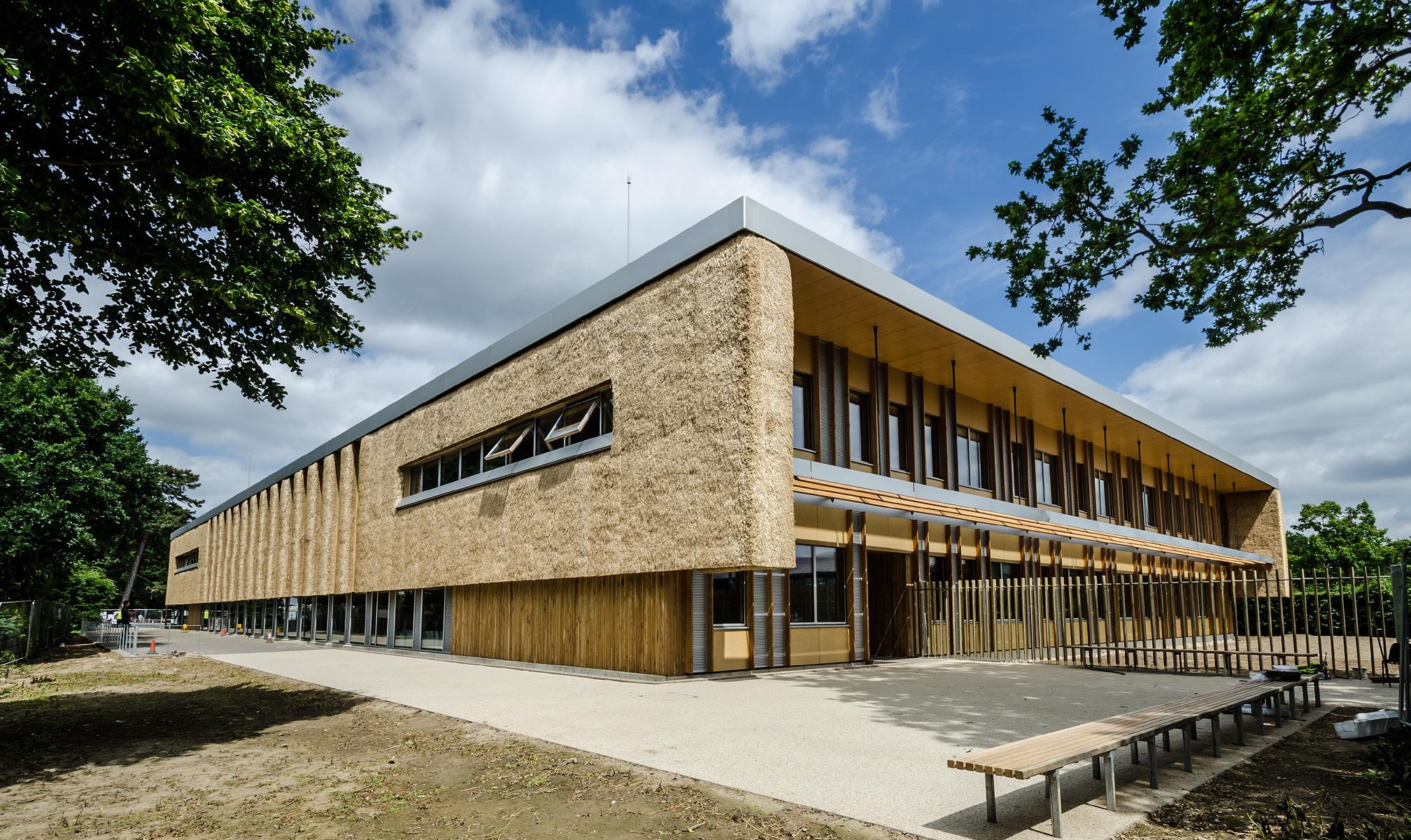
The conference also featured panel discussions on AECB CarbonLite Training and a "Question Time" session allowing delegates to engage directly with speakers. A highlight for many was the building tour of the Enterprise Centre itself, designed to passive house standard by Architype, offering delegates the opportunity to experience the principles discussed in practice.
The Enterprise Centre at the University of East Anglia, Norwich, which hosted the AECB conference in September.
Tens of thousands of homes retrofitted under the government’s Energy Company Obligation scheme will need repair after what the National Audit Office (NAO) has called “clear failures in design and set-up”. The watchdog’s report highlights widespread defects, weak oversight and possible fraud within the decade-old energy efficiency programme.
The NAO’s findings confirm what many in the retrofit sector have long feared: that poor oversight, weak accountability and commercial models built on volume rather than quality have undermined years of progress on home energy efficiency. The failures, affecting tens of thousands of properties, point less to technical shortcomings than to a system that rewards speed and compliance over competence and care.
The NAO found that almost all homes with external wall insulation (EWI) installed under ECO—around 22,000 to 23,000 properties, or 98 per cent—require corrective work to prevent damp and mould. Internal wall insulation (IWI) also performed poorly, with 29 per cent of installations (9,000 to 13,000 homes) needing repair. Some pose immediate health and safety risks.
The Department for Energy Security and Net Zero (DESNZ) now accepts that tens of thousands of households across Great Britain will need remedial action.
The government’s quality control regime, centred on the TrustMark scheme, failed to identify the scale of the problem until October 2024— three years after it began operation. The NAO cited weak departmental oversight, overlapping responsibilities among DESNZ, Ofgem and private certification bodies, and delays to TrustMark’s analytical systems as key causes.
Ofgem also reported between 5,600 and 16,500 falsified ECO claims, potentially worth between £56m and £165m.
AECB chair Kit Knowles, speaking in a personal capacity, said the problem was not insulation itself but a system that rewards poor practice.
“It would be tragic if this report convinces the public that insulation is the problem. It isn’t; poor policy, weak oversight, and delivery models that reward installers for gaming the system to maximise profit are,” he said.
“In truth, every measure — whether conserving or generating energy — is susceptible to failure through poor design, installation, or commission-
ing. We’ve built a framework that values volume over quality, compliance over competence. Until our industry shifts from policing failure to guaranteeing excellence, we’ll keep seeing outcomes like this, especially as the drive to scale up accelerates. Quality assurance must become our foundation.”
Jon Bootland, chief executive of the Passivhaus Trust, said the findings underline the need for rigorous quality assurance.
“The Passivhaus Trust was very disappointed, but not surprised, to read about the failures and difficulties highlighted in the National Audit Office report, arising from sub-standard external wall insulation,” he said.
“Passive house retrofit offers both a methodology for identifying appropriate retrofit measures for adoption and an independently verified quality assurance process to ensure that the installed measures will deliver the intended performance improvements.
“High-quality retrofit can deliver life-changing improvements in health, comfort and energy efficiency, but without a rigorous quality assurance process, such as passivhaus retrofit certification, it is likely that further installations will also be found to be sub-standard, with all the negative impacts that will have on occupant lives.”
For many in the retrofit sector, the findings confirm long-standing concerns about a programme designed to meet targets rather than guarantee performance.
Passive House Plus columnist Toby Cambray said the failures stem from poor design and management rather than technical limitations.
“The findings are shocking but, to those who have been paying attention, not surprising. It is a failure of will, and not for want of technical expertise,” he said.
Cambray added that the data overturned the notion that EWI is inherently ‘safer’ than IWI.
“It's frustrating that the industry seems to lack respect for the climate in which we build and live,” he said, describing a persistent disregard for moisture and rainfall in UK construction practice.
The NAO has recommended that DESNZ take direct responsibility for ECO, set out how affected homes will be repaired, and reform consumer protection for retrofit schemes. The department said lessons from the scheme would be incorporated into its forthcoming Warm Homes Plan.
(above and right) One of the UK's most high profile botched external wall insulation retrofit in Preston's Fishwick area, a failure which was reported by Passive House Plus in 2015.
Ecological Building Systems and EcoCocon Join Forces
Combining EcoCocon’s certified straw panel system with Ecological Building System’s award winning products and technical expertise.
Complete, natural prefabricated wall system
Bio-based, carbonstoring, MMCready solution
Fabric-first design that supports Passive House and circular construction
Supported by decades of experience and technical know-how
Chasing perfect indoor temperatures is making us less resilient to heat
Our overheating standards ignore the reality of British homes and how people actually live in them. This mismatch could drive unnecessary reliance on energy-intensive air conditioning, says Dr Huda Elsherif, building physics engineer at Scotch Partners.
As a child, I never thought twice about the constant movement that came with visiting my grandmother’s village in rural Sudan. Days stretched lazily beneath the shade of a tree or straw canopy, and afternoons melted into heavy siestas indoors — the only time we ever saw the inside of the house.
When the sun dipped low, the whole family came alive. We’d drench the dusty yard with cool water, heave impossibly heavy mattresses onto iron beds, and drift to sleep beneath a sky ablaze with stars — where the night breeze finally soothed the heat stress we’d endured all day. And believe me, if you didn’t get some respite overnight, you would feel it the next day.
To the untrained eye, it might have looked as though we were simply chasing shade, like the goats that wandered the village. But it was more deliberate than that — we were chasing the “coolth.” (Yes, that’s a real word.)
I wasn’t, by any stretch, a seasoned local. For most of the year, I lived in Saudi Arabia, sealed inside an air-conditioned villa like a delicate orchid that wilted at the mere thought of direct sun. This everyday climate ballet was pure survival, one of many strategies in a place where the air shimmered at 40C and air-conditioners (ACs) were as rare as an NHS dentist appointment. Without realising it, we were living proof of what academics now call adaptive thermal comfort — the idea that comfort isn’t one-size-fits-all, but shifts depending on climate and habit.
Years later, when I stumbled across a paper predicting my “comfort sweet spot” at around 30C (based on people living “nomadic”, open-air lives like mine in Sudan), I wasn’t surprised. Science had simply confirmed what my sweat glands already knew.
Then I moved to Britain for my Master’s. Cue the laugh track.
My student digs? A damp 1960s council house with vast single-glazed windows and an opening mechanism so restrictive it felt like the place had been designed as a prison cell rather than student accommodation.
How else do you catch a breeze if the window barely opens far enough to waggle a fin-
ger at your cat? Winters were bone-deep cold, the kind that seeped into your soul. Summers were no better — I was convinced my desk by the window would eventually turn me into Two-Face from Batman.
That so-called 30C sweet spot suddenly felt like a cruel joke. Gone were the tricks I’d grown up with: no heavy curtains, no ceiling fans, no hauling beds into breezy courtyards. Just a feeble Argos fan buzzing like an irritated fly. When I finally moved into a flat where the window opened wide enough to stick my arm out, I thought I’d struck gold — until I realised that leaving it open overnight meant swapping the soothing chorus of crickets I’d grown up with for a rude 3am awakening, courtesy of a stranger revving their engine like a Formula 1 trial run.
And then there was the weather itself. Sudanese heat is a dry, searing blaze — you sweat, it evaporates, and as long as you avoided the sun (the goats really were onto something), you were mostly fine. London heat, by contrast, is sticky, humid, the kind that clings to your skin like clingfilm. That elusive breeze suddenly becomes a lifeline. In that context, the adaptive comfort model felt… a little miscast.
But here’s the twist: it’s not that the model is “wrong.” It’s that Britain needs its own version, one that reflects how people actually live in UK homes. The current standard — TM59 — relies on studies of European office workers. Think: fluorescent-lit cubicles, where the only climate control involves passive-aggressive battles over the thermostat. Not only does that exclude the realities of British housing stock, but “Europe” itself is hardly a consistent benchmark — it spans both the frigid Alps and the baking Mediterranean.
Don’t get me wrong — TM59 is a solid starting point. It recognises a broader comfort range: not assuming I’d be content at 30C in the UK, but still more flexible than a hard cut-off, at least under Criteria A. Criteria B, however — that bedrooms should not exceed 26C — is very much a strict threshold, and the one that projects most often struggle to meet, even some passive houses that stayed
within the 25C limit.
You might think: surely it’s safer to err on the side of caution? In reality, overly strict standards drive an overreliance on active cooling. Passive methods only work up to a point, and air conditioning is energy-intensive enough that places heavily reliant on it — like parts of the US — routinely face power cuts during heatwaves. Worse, AC introduces its own feedback loops: people adapt to higher levels of comfort and become less resilient to heat; waste heat from millions of units spills back into neighbourhoods, intensifying the urban heat island effect.
While the evidence may show passive houses being less prone to overheating than other new builds, this misses an important point. Without using strategies to keep comfortable when temperatures creep higher, an overly narrow focus on a 25C or 26C target may give people unrealistic expectations around comfort in a warming world – leading them to cranking up the AC rather than adapting to keep comfortable, even if it hits 30C. Which is why it’s crucial to address the problem at its root: designing buildings and environments that encourage adaptive behaviours, supported by standards that reflect them. •
London heat clings to your skin, like cling film.
THE SAMEWAY ISN’T ALWAYS THE WISE WAY
Predictable. Reliable. Unquestionably the right choice.
Mr Sameway doesn’t like change he, like many others, follows the crowd. “Insulation is insulation,” he said, confidently selecting the same synthetic insulation he’d always used. As far as he was concerned, thermal performance was the only thing that mattered. If it kept the heat in, that was what it was supposed to do and that was good enough for him.
But what Mr Sameway didn’t realise was that he was missing out—big time.
Meanwhile, Mr Wise took a different approach. He understood that insulation wasn’t just about keeping heat in; it was about creating a comfortable, healthy, and durable building. That’s why he chose Steico Wood Fibre Insulation.
With Steico, Mr Wise’s building breathed naturally, avoiding the trapped moisture and condensation problems that could plague synthetic insulation. His rooms were warmer in winter and cooler in summer, thanks to Steico’s high heat storage capacity, and his home was quieter too.
The day-one ventilation commissioning trap
Current building regulations mandate rigorous commissioning of ventilation systems, but this single-point validation creates a dangerous compliance illusion. A two-phase lifecycle approach is needed to ensure systems perform effectively beyond handover day, says Air Quality Matters founder Simon Jones.
We've become incredibly good at building airtight, energy efficient homes. Spurred on by regulations like Part L, we've sealed our building envelopes to a good standard at scale that was almost unimaginable a generation ago. It's a huge win for energy conservation, but it has created a paradox. In sealing out the draughts, we've also sealed in a host of potential problems, making the ventilation systems one of the most critical life-safety components in a modern home.
Current regulations in both Ireland (TGD F) and the UK (Approved Document F) mandate rigorous commissioning to prove new ventilation systems work. The house is compliant, the developer can sell, and the homeowner gets a certificate promising healthy ventilation.
But here's the problem: that certificate is a snapshot in time. It's a pristine photo of a system on its first day at school, often before the first piece of furniture has arrived and, crucially, while the surrounding area is still a building site. This "compliance illusion" gives us a false sense of security. It validates a system for a single moment but offers no guarantee of its performance in the real world a week, a month, or a year later.
This single-point validation is not fit for purpose. We need to move from a snapshot to a lifecycle approach. I discuss a two-phase commissioning framework to ensure that the ventilation systems we install not only work on handover day but also perform effectively throughout the critical early years of a home's life.
This is especially true on multi-unit schemes where the first occupants move in while construction continues around them for months. The home may be legally compliant, but it quickly becomes functionally non-compliant, failing to provide the healthy environment the certificate promised. This isn't a minor issue; it's a fundamental gap between our regulatory process and the physical reality of a new building on a building site. We are certifying a system for a lifetime of service based on a test conducted under temporary and unrepresentative conditions.
The most immediate threat to a newly commissioned ventilation system is construction dust. The air on a developing site is saturated with fine particulates from cutting, sanding, and
site traffic. This dust is inevitably drawn into the new home by the very system designed to keep the air clean.
The consequences are swift and severe. The standard filters in an MVHR unit are no match for this onslaught. They can become clogged within weeks, turning into a solid mat of gypsum and cement dust. This blockage dramatically increases the resistance in the system. The consequences are swift: reduced airflow rendering homes under-ventilated, increased energy use and noise as fans work harder, and system damage from premature motor wear and dust
assurance step that reduces warranty claims for condensation and mould, and builds trust with the customer.
Beyond construction dust, new homes off-gas volatile organic compounds from paints, adhesives, and furnishings for up to two years. This chemical contamination provides additional justification for the 3-6 month timing of Phase II commissioning, when both dust and initial VOC levels can be addressed together.
The responsibility for arranging and paying for these additional commissioning phases should lie with the developer. The issues they
Beyond construction dust, new homes offgas volatile organic compounds from paints, adhesives, and furnishings for up to two years.
coating the heat exchanger.
This creates a situation where the developer's ongoing work directly contaminates and damages a system they have just certified as working perfectly, unknowingly transferring a significant maintenance liability to the buyer.
The solution is a mandatory Phase II commissioning, a "Post-Construction Reality Check" conducted at the developer's expense, around 3-6 months after occupation. This isn't just a re-test; it's a remediation.
The scope would include, firstly, system decontamination: complete replacement of any clogged filters and inspection of the unit's core components. Secondly, performance re-validation: a full re-balancing of the system to measure and restore the correct airflow rates to every room.
Thirdly, there needs to be occupant engagement: this is the crucial step. The engineer can educate the homeowner on how to use their system, tailor its settings to their lifestyle (e.g., boost timers, humidity sensors), and address any concerns about noise or drafts.
This second phase shifts the focus from simple compliance to sustained performance. It ensures the system works not just in theory, but in the messy reality of a lived-in home on a developing site. For the developer, it's a quality
solve are a direct result of the construction process. This should be written into sales contracts and, crucially, integrated into new home warranty schemes like HomeBond, providing a clear enforcement mechanism.
The cost, a few hundred euros per dwelling, is marginal in the context of a new build and is easily offset by reduced callbacks and the powerful marketing advantage of selling a "Certified Healthy Home."
Our current single-point commissioning process is a job half done. It provides a fragile snapshot of compliance that is shattered by the reality of a live construction site and the internal chemistry of a new building.
A two-phase lifecycle approach is the logical way forward. Phase I establishes the baseline. Phase II cleans up the inevitable construction contamination and tunes the system for the new occupants. It may be that if a site can demonstrate low ambient dust levels, stage two could be dropped.
This isn't about adding red tape; it's about finishing the job properly. It's a shift from a certificate of compliance to a genuine assurance of long-term performance. If we are serious about building homes that are not just energy efficient but genuinely healthy, our practices must evolve. •
From retrofit to resilience: Building for the climate yet to come
The construction industry must shift from chasing energy efficiency to building affordable, resilient homes that last. Drawing on lessons from architectural pioneers, the future lies in thoughtful retrofit and training skilled tradespeople, says Dr Marc Ó Riain
For eight years I have been tracing the history of energy in buildings, a long march from smoky hearths to super-insulated envelopes. Each step in that story has been a response to the pressures of its time, and each innovation has left behind lessons, and sometimes warnings, for the generations that followed. As this series reaches the present, the question is not simply where we have come from, but how we carry those lessons forward. Energy efficiency has been the dominant theme of recent decades, but the real challenge of the future will be broader: resilience, affordability, and longevity.
History is a generous teacher. Maria Telkes’s solar salt house at Dover in the 1950s was dismissed as an odd experiment, but the principle of seasonal energy storage she explored is now being revived in phase-change materials and battery energy storage. Saskatchewan House by Harold Orr in 1977 gave us airtightness and insulation, but also reminded us that without ventilation the indoor environment suffers. Passive house absorbed that warning but today faces a new reckoning, as overheating becomes an uncomfortable reality in summer. Even earlier, Frank Lloyd Wright’s Prairie Houses of the 1900s showed a wisdom that feels more relevant than ever. His deep eaves, cutting solar gain in summer while admitting low winter sun, represent passive design in its purest form. Sometimes the best ideas are not radical at all, but simple, logical and enduring.
If the past twenty years have been about shaving kilowatt-hours from our buildings, the next twenty must be about lifetime extension. We cannot keep replacing buildings. The embodied carbon and waste of demolition is unsustainable. The greatest energy saving is often the simplest: keeping a building in use for another 50 or 100 years, with careful interventions that make it breathable, comfortable, and efficient. Retrofit must evolve from a race to insulate into a strategy that respects the embodied energy of the fabric we already have. That means thinking about the materials we use as much as the heat we save. Lime, timber, hemp, cellulose and wood fibre not only offer lower carbon footprints, but help regulate indoor climates and delay overheating. When combined with good ventilation details, these natural systems
can keep a house cool and healthy without expensive complexity.
And yet, we are making retrofit and new build too expensive. Material prices are rising, professional services are climbing, and the market seems to drift further from affordability with every scheme. In chasing perfection, we risk killing the golden goose. Sustainable housing must not become a boutique service for the wealthy few. We need cheaper and more logical ways of upgrading our homes without breaking the bank. That might mean modular retrofit systems delivered in phases that families can actually afford — a kind of Lego model of sequenced retrofit — while off-site fabricated components may offer similar advantages for new build.
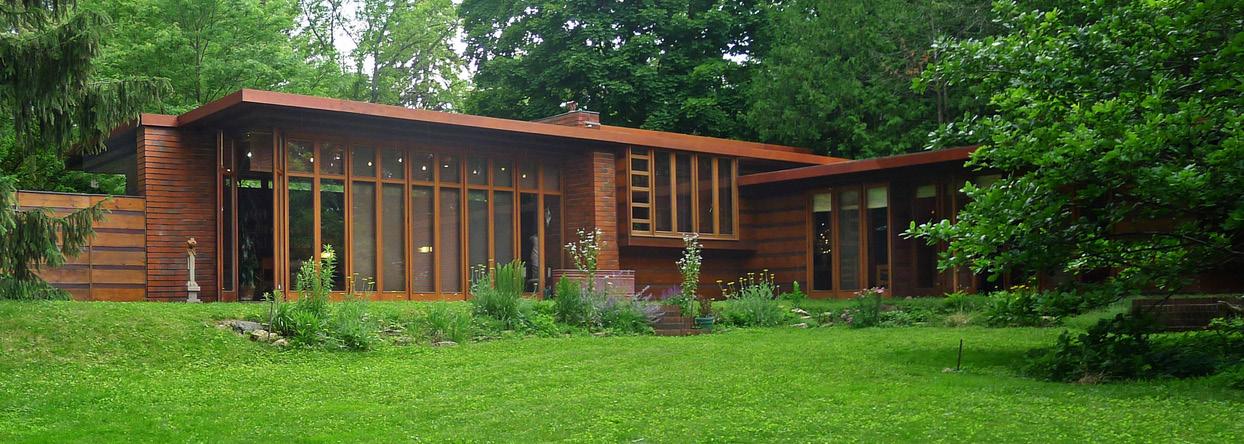
Frank Lloyd Wright’s Usonian Houses of the 1930s come to mind. Conceived as simple, affordable dwellings for ordinary Americans, they were rational in plan, stripped of ornament, built with the modest materials of the time, but spatially generous and dignified. Perhaps what we need now is a Usonian House of the 2030s — modular, breathable and climate-ready, affordable to build, resilient in use, and designed to be extended or reprogrammed as needs change.
But affordability is not just a matter of cost. It is also a matter of capacity. We do not have enough tradespeople to deliver retrofit at the scale required, and we urgently need to train them not just in the careful detailing that low-energy standards demand, but in understanding why we insulate, how we ventilate, and how to avoid risks like interstitial condensation, sweating walls, rising damp and mould. There are few courses, little political recognition, and almost no urgency in government policy to bridge this skills gap. This is the
missing link. Housing crises are not solved by money alone; they are solved by people who can actually build and retrofit.
So perhaps the story that began with insulation and energy conservation must now move into a new chapter. Retrofit must evolve into a culture of climate-readiness, where we extend the life of buildings rather than replace them, where we choose materials for their carbon and their comfort, where shading and ventilation are considered with as much care as U-values, and where we train a new generation of builders capable of delivering quality with respect for the original fabric.
As I look back over this eight-year historical survey, including a few segues, I am struck by how often our predecessors were wrestling with the same concerns that face us today. Telkes experimenting with storage, Harold Orr warning about airtightness and ventilation, Wright drawing deep eaves against the sun. Their solutions may not have been perfect, but their spirit of ingenuity and their commitment to common sense should inspire us now.
Because if we only build for the past, we will fail the future. The task ahead is not simply to conserve energy, but to keep our buildings alive: affordable, resilient, and ready for the climate yet to come. •
Dr Marc Ó Riain is a lecturer in the Department of Architecture at Munster Technological University (MTU). He has a PhD in zero energy retrofit and has delivered both residential and commercial NZEB retrofits In Ireland. He is a director of RUA Architects and has a passion for the environment both built and natural.
A fully referenced version of this article is published on www.passivehouseplus.ie
Jacobs 1 by Frank Lloyd Wright
Photo by James Stakeley
(CC4.0)
SOFTLINE 82 - PASSIVHAUS
Passivhaus Certified.
Proven Performance.
Designed for demanding projects, VEKA Softline 82 - Passivhaus delivers:
U-values as low as 0.79 W/m²K
PAS 24 security & BS 6375 weather performance
Durable, fully recyclable PVCu
Wide colour range to suit any design
Future-proof your project with a window system that combines certified efficiency, durability and sustainability.
Passivhaus
Four years of zero ambitions
ONE PODCAST’S APPROACH TO INDUSTRY DISCOURSE
Jeff Colley and Dan Hyde’s apparently unstructured conversations about retrofit and sustainability have found an audience willing to tolerate tangents, interruptions and the occasional factual dispute.
Taking a break from his work editing Passive house Plus, Jeff Colley adjusts his headphones in his home office in County Dublin, checking the levels on his audio interface as the familiar ping of an incoming Zoom call sounds from his laptop. 500 hundred kilometres and one sea southeast, Dan Hyde settles into his chair in Hastings, testing his microphone with a few taps before the red recording light blinks on. Between them, a shared document lists talking points for today’s episode, though both know the conversation will inevitably drift far from any planned agenda.
This fortnightly ritual – two old friends separated by the Irish Sea but united by cheap microphones and a shared exasperation with industry orthodoxy – has sustained the Zero Ambitions podcast through four years and over 170 episodes.
In a crowded field of construction and sustainability podcasts, their show has pursued a deliberately unpolished approach to industry conversation. What began as a suggestion from Duncan Smith, then housing asset and energy strategy manager for Renfrewshire Council, has evolved into lengthy, meandering discussions that prioritise authentic conversation over structured interviews.
The first 15 episodes of the podcast were hosted by Smith and Colley, before Hyde and his then colleague Alex Blondin was invited on to talk about the key role of communication in order to accelerate the decarbonisation of buildings.
Drawing from their time working in finance-focused agencies in London, Hyde and Blondin had set up Everything Is User Experience, a consultancy which, as the name suggests, aimed to extend user experience (UX) design far beyond its conventional application in web design.
“How many people don’t understand their heating controls?” asks Hyde. “Or how much is quality retrofit undermined by contractors and homeowners put off by bad experience of grant funding schemes?
“UX matters because it’s about how people experience a product, system, or service—it’s
about understanding how people feel when they engage with something. Sustainable construction is all about systems change—and change breeds strong feelings. If we don’t account for how change makes people feel we massively increase the risk of failure. Just like how you’ll never go back to a broken website.” Hyde and Blondin clearly made an impression, as Smith and Colley quickly invited them back on, joining a panel of co-hosts including then-emerging retrofit luminaries Sara Edmonds and Rachael Owens, who have since gone on great things as directors of the National Retrofit Hub, among other roles. When work commitments meant Smith taking a back seat, Hyde stepped into the breach to manage production and co-hosting. “It was like colonialism 2.0”, he says, acknowledging the plundering tendencies of his forebears.
The title reflects aspiration and cynicism. It’s a nod to trying to get to zero emissions, but also to the futility of existence.
(above) Nicola Cronin and Stephen O’Shea came on the podcast in 2024 to discuss Cairn’s passive house plans.
What’s in a name?
The podcast’s title reflects both aspiration and cynicism. “It’s a nod to trying to get to zero emissions,” Colley said. “But there’s also a nod towards the futility of existence in there as well.”
Hyde is more direct: “For all the [net] zero ambitions, there’s little or no ambition to actually do anything about it, and that’s what we want to address” he said.
This sardonic edge places Zero Ambitions within a growing ecosystem of technical podcasts attempting to make specialised subjects accessible. The construction and sustainability podcast space has expanded significantly in recent years, with shows ranging from highly produced corporate offerings to informal industry chat.
Most, Colley argues, struggle with the balance between accessibility and accuracy.
“There are loads of podcasts related to construction and climate, and a lot of them unfortunately are very boring – worthy and boring,” he said.
Two personalities, one goal Colley and Hyde’s partnership stretches back to their university days in Scotland and their collaboration on Construct Ireland magazine, which they established in 2002. After Hyde departed for other ventures – working in landscaping, demolition, local lifestyle magazines, the non-profit sector, and financial services –the podcast reunited them around their shared interest in sustainable building.
Their on-air relationship centres on what Hyde describes as “absolutely no respect between us” – a dynamic that creates what Colley calls “a sort of two-way bullying” that occasionally catches guests in the crossfire.
Hyde’s role as provocateur, which has resulted in stock phrases like “no one cares about the environment and no one cares about poor people,” forces Colley to defend positions that might otherwise remain buried in technical language.
“Dan is good at playing the dummy,” Colley said. “He’ll ask a very direct question while I tend to start with caveats and then finally get to the point at the end.” This approach reflects their belief that complex building science can be made digestible without sacrificing technical accuracy, though the execution doesn’t always achieve that balance.
Beyond the technical brief Zero Ambitions attempts to address the human elements of sustainable building alongside technical concerns. While technical accuracy remains important – building physics are real, as Colley says – the podcast ventures into territory that traditional trade coverage typically avoids.
“Retrofit is predominantly a business-to-consumer proposition,” Colley said. “How do you sell that to a single mother who may be nervous dealing with contractors? Most people don’t want to have their houses turned upside down or their lives turned upside down, and they don’t know who to trust.”
This focus has led to episodes examining everything from communicating retrofit benefits to social housing residents to exploring project failures like the external insulation retrofit disaster in Preston, which Kate de Selincourt’s reporting in Passive House Plus helped bring to national attention in the UK, when the BBC picked up on it. The podcast’s 189 episodes have tackled subjects ranging from defining zero carbon standards to exploring financing models, though the conversational format means coverage can be inconsistent and topics sometimes receive superficial treatment.
The long game
The podcast’s structure reflects its creators’ belief that meaningful conversations require time to develop. Episodes typically run 60 to 90 minutes, with Hyde noting that guests need about 20 minutes to move beyond prepared talking points. “They start off expecting to have to perform,” he said. “After about 20 minutes, they settle down, and Jeff will often ask a question that wrong-foots them. Then they hit a groove, and by the last third of the episode, we’re in really interesting territory that’s slightly unexpected.”
This patience with the conversational process has produced episodes that venture into historical, political, and sociological territory that other industry podcasts typically avoid. The approach has also created space for voices that might otherwise struggle for attention, from platforms supporting women navigating retrofit to rescue projects addressing retrofit-induced damp and mould problems.
At the time of writing the podcast is averaging 4.9 out of 5 stars on Spotify, based on 70 reviews. However, the loose format does come in for criticism at times.
Hyde’s favourite is a sort-of-negative one –detailed discontent from a listener who nonetheless keeps coming back: “Two blokes talking over the guests for 90 minutes. Some interesting bits, but after several years, the hosts still haven’t learned to structure an interview, not talk over the guests, or know how to edit. Four stars out of five.”
Industry reach
Zero Ambitions has found an audience that spans retrofit assessors, coordinators, installers, social housing professionals, policy makers, and finance specialists, though precise listener numbers remain undisclosed. Hyde reports that some listeners have credited the podcast with inspiring their entry into the green building sector, though such testimonials are difficult to verify independently.
The podcast’s influence operates primarily within industry networks rather than broader public discourse. Recent episodes have occasionally been picked up by mainstream media outlets, and the show regularly features organisations and ideas that receive limited attention elsewhere. This role as an industry platform reflects the creators’ belief that meaningful change requires elevating overlooked innovations and honest assessment of failures.
Rather than seeking to eliminate their rough edges, Colley and Hyde present them as evidence of authenticity in an increasingly polished media landscape. “Overproduced podcasts I can’t listen to,” Colley said. “They’re clearly scripted and don’t have that natural flow.”
The broader mission
The podcast operates alongside Zero Ambitions Partners consultancy, which emerged from connections fostered by the show, with Blondin departing and Everything Is User Experience now integrated as a sub-brand. The consultancy helps businesses within the built environment develop sustainability and decarbonisation strategies, beginning with communications but extending to business strategy and partnership development.
This integration of media and consultancy work reflects the creators’ view that effective communication about sustainability requires both technical knowledge and strategic thinking.
“Construction is notoriously poor at communication because its products have traditionally been fungible commodities,” Hyde said.
The podcast serves as both a showcase for industry communication and a testing ground for ideas that inform the consultancy’s work. This relationship creates opportunities for highlighting innovative approaches whilst maintaining editorial independence – the podcast remains uncommercialised, with no sponsors or advertising, though this also limits resources for production improvements.
After four years and 189 episodes, Zero Ambitions has carved out a recognisable position within sustainable building discourse. Its success lies not in production values or broad reach, but in its commitment to extended conversation about an industry facing significant transformation pressures.
The podcast’s approach – what Colley describes as smuggling goodness into accessible packaging – attempts to address technical communication challenges without alienating specialist audiences. By combining industry knowledge with informal conversation, Zero Ambitions has created a format that can engage both technical specialists and newcomers to the field, though the results are necessarily uneven.
For an industry often criticised for poor communication, Zero Ambitions demonstrates both the possibilities and limitations of informal, long-form discussion as a tool for technical education. The podcast space continues to expand, with new shows regularly entering the market, making audience attention increasingly competitive.
Whether Zero Ambitions’ particular mix of technical depth and conversational chaos represents a sustainable model for industry communication remains to be seen. What it has demonstrated over four years is that there exists an appetite for unvarnished discussion of sustainability challenges – provided audiences are willing to tolerate the occasional tangent and interruption along the way.
UNIVERSAL CONSTANT
ACCESSIBLE MANCHESTER RETROFIT DELIVERS COMFORT, ACCESSIBILITY AND LOW BILLS
An award-winning retrofit demonstrates that universal design and ultra-low energy performance are powerful allies, not competing priorities.
Words by Jason Walsh
In brief
Development type Deep retrofit of 1980s bungalow.
Method Fabric-first approach with external wall insulation, timber frame extensions, and mechanical ventilation with heat recovery (MVHR).
Location Suburban Manchester
Standard CarbonLite Retrofit certified
Space heating cost £42/month
(total energy bills – see In detail panel for more)
£42 per month
When homeowner Steve discovered a neglected 1980s bungalow during the pandemic, he faced a dilemma. Born with significant physical differences, the computer programmer and Team GB Paralympian needed a home that would work for him long-term while addressing the rising energy costs that plagued his previous flat. What emerged from this personal challenge would become the 2025 Exemplar Sustainable Buildings Awards winner for retrofit projects—a transformation that proves accessibility and sustainability can be mutually-reinforcing design principles.
Working with Hannah Dixon at Manchester practice Progress in Practice, the Ward Grove project is achieving exceptionally low metered energy use while delivering comprehensive accessibility features. The calculated energy use intensity – which in this all-electric house means the energy imported from the grid, as measured at the meter – is just 38 kWh/m²/yr.
The result is a home where Steve pays just £42 monthly for energy bills and declares simply: "It is a fantastic house."
The project's success lies not in choosing between accessibility and environmental performance, but in recognising how thoughtful design can deliver both. Every decision — from the internal garage access that keeps Steve dry when transferring from his car, to a heating system design that eliminates obstacles in the form of radiators — demonstrates how user-centred design can naturally align with sustainable building principles.
Universal design as environmental strategy
The accessibility requirements that initially seemed like design constraints became catalysts for innovative solutions. Steve's need for an internally connected garage, allowing weather-protected access to his vehicle, required careful integration with the building's thermal envelope. Rather than compromise the insulation strategy, the design team used this as an opportunity to demonstrate how accessibility features could enhance rather than undermine performance.
"The main area accessibility had an impact on was the garage," says Hannah Dixon, architect and director of Progress in Practice. The integration required sophisticated detailing to maintain the continuous insulation layer whilst providing the step-free access Steve required. The solution involved new timber frame construction with wood fibre insulation, ensuring no thermal bridging whilst creating the spatial flow needed for wheelchair accessibility. Interior accessibility features were crucial. Pocket doors sliding into walls eliminate the swing space of traditional doors, creating more efficient room layouts whilst requiring no effort to operate. Steve's lowered kitchen worktops — 80 cm
rather than the standard 90 cm — reduce material use whilst providing the ergonomic access he needs, while a stepped approach to his bath eliminated a ‘high jump’ entry that he wanted to avoid.The underfloor heating distribution proved particularly effective for accessibility. Unlike traditional radiators that can obstruct movement and create uncomfortable hot spots, the even temperature distribution provides consistent comfort throughout the space, delivered through a screed finished with a Granorte cork floor.
Integrated thinking
The transformation of this 1980s bungalow into a certified CarbonLite Retrofit demonstrates how ambitious performance targets can be achieved within existing building constraints. The original property, unoccupied for several years with "dated finishes, direct electric heating system, and all of the usual terrible glazing," presented the typical challenges of its era whilst requiring comprehensive accessibility modifications.
Dixon's team approached the retrofit with a fabric-first strategy, applying external wall
insulation to the existing brick cavity walls whilst constructing new elements in timber frame with wood fibre insulation.
This was part of a conscious choice to use natural materials – including cellulose insulation, cork flooring, and healthy interior finishes.
"We try to use natural materials," Dixon says, noting that fire regulations provided the primary constraints rather than thermal performance requirements. Efforts to reduce embodied carbon also informed the spec, including the glulam beams. “This was initially specified by structural engineer as steel, but changed to glulam for embodied carbon reasons,” says Dixon. “It also looks lovely. The builder initially suggested switching back as a cost saving, but actually the glulam turned out to be cost neutral.” A pragmatic approach to integrating non-standard low carbon materials was necessary, Dixon explains, for a simple reason. “We had to balance this with trying to design the details in a way that is reasonably familiar to most builders, as we didn’t know at the time who was going to build it,” she says. The project's innovative approach initially faced scrutiny during the planning process, requiring specialist inter-
vention to justify the design rationale. Planning consultant Emma Jones of Acer Town Planning was brought in after some early pushback from the local authority during pre-application discussions.
"Hannah of Progress in Practice brought me in because they had initially had some pushback from the local authority," Jones explained. The planning challenges centred on how accessibility needs informed design decisions that departed from standard approaches. Traditional space standards for external areas, for instance, didn't account for Steve's specific requirements to maximise internal accessibility.
"The council has certain space standards for external space, but in this case, because the client had specific needs, it was designed to maximise the internal space," Jones says, noting how she justified the smaller garden by emphasising the innovative fusing of the passive house-informed CarbonLite Retrofit standard with accessibility integration.
The experience highlighted how planning frameworks struggle to accommodate projects that challenge conventional standards, even when delivering superior outcomes.
Balancing ventilation and client needs
The house also eschewed convention in its approach to ventilation, even in the context of the kinds of low energy buildings featured in this magazine. This may not be obvious to the casual reader, as the house features a whole house mechanical ventilation with heat recovery (MVHR) system. However, it is common in low energy buildings to supplement the MVHR with fenestration strategies that facilitate cross ventilation or stack ventilation – most notably to purge ventilate to reduce temperatures during summer nights. At Ward Grove, the bungalow format itself created challenges for natural ventilation due to security concerns—"I can't leave my windows open at night", says Steve. The MVHR was therefore crucial to ensure consistent air quality and thermal comfort – two aspects which natural ventilation alone cannot reliably deliver.
While natural ventilation is inherently inconsistent and arbitrary, ranging from little or no air to the sort of occasional gale force breezes that cause many users to block vents, the house is provided with a constant, predictable supply of filtered fresh air - and at com-
fortable temperatures. The MVHR system brings in fresh air, filters out pollutants before it reaches the home, and simultaneously exhausts stale, moist air — but not before grabbing hold of about 90 per cent of the heat that would otherwise escape, and transferring it to the incoming air. But accommodating a centralised ventilation system within a relatively constrained space without compromising the building envelope proved challenging. The design solution involved a relatively complicated junction taking the MVHR ductwork from the utility up through the airtight layer into the loft – but under the thick insulation layer – and back through the airtight layer into the living space. “A lot of thought and effort was put into the airtightness around these penetrations,” says Dixon, “given the access into the loft space was also challenging. This was not an ideal detail, but we were very constrained by space as the bedroom areas already have a low head height.” It was worth the effort, with the MVHR really proving its worth in winter. Principally, this is because it significantly reduced the home’s exposure to polluted outdoor air. Air pollution often increases in winter due to colder, drier air and increased domestic fuel burning – with
Manchester air quality spiking last winter at a score of 110 AQI on Plume’s air quality index. Plume describes levels of 100 and above as very high pollution, noting that “Everyone may start to experience more serious health effects at these levels”. But last winter, the MVHR served another unexpected function. It proved particularly valuable during the heat pump breakdown that occurred during cold weather — added to the building’s highly insulated, highly airtight nature, the heat recovery ensured the system failure went unnoticed initially, demonstrating the resilience built into the house.
Steve reports "very steady" humidity levels throughout the year, demonstrating how accessibility needs drove the selection of systems that enhance both comfort and performance.
Melissa Edge, MVHR design manager at 21 Degrees, who designed the ventilation system for the project, explains the fundamental shift required in high-performance dwellings: “In the past, people didn't have to consider ventilation; it was just part of our leaky buildings, but as we are now taking airtightness seriously and having proper insulation, you need ventilation. The only way to do it is mechanically.”
However, Edge notes that 21 Degrees' role was limited to system design: “If we don't do the supply, we can't guarantee that the parts we specified have been fit and delivered. It's not the norm for us,” she says. This design-only approach, while ensuring specialist expertise in system specification, places responsibility for installation quality on the main contractor. The distinction between design and installation becomes crucial
when considering system performance. Many homeowners worry about noise from mechanical ventilation, but as Edge points out, this may be because people’s perceptions have been shaped by undersized extract fans that abound in typical new homes. “We design the systems to be inaudible. We guarantee that,” she says. “You might think of an intermittent fan. This is continuous ventilation,” Beyond air quality, the MVHR system contributes directly to the project's energy performance. Edge explains how proper ventilation design supports the overall building strategy: “When it is designed well and installed properly, it is excellent. It also aids in heating, bringing the requirement down slightly.” This connects well to Steve's experience with the underfloor heating system and overall energy performance.
Self-generated electricity to compliment electrified heat
A 5kW rooftop solar array with battery storage provides renewable electricity to power the heat pump and run the house. The net effect? Steve's actual electricity consumption costs just £512 annually – an average of just over £42 per month. The combination of high-performance fabric, a heat pump running at low temperatures and a PV array and battery which either serves the house or sells surplus electricity into the grid means that at times he finds himself 'massively in credit' with his energy supplier. In the summer months, his solar generation covers virtually all his electricity needs, meaning he is essentially only paying standing charges while his
credit balance continues to grow. “The panels are on a bungalow, meaning I get comparatively much worse solar in winter,” says Steve, “not just because of the gloom and shorter daylight, but because of buildings blocking the low sun. Friends round the corner still produce a fair bit in winter, as they often remind me. But they have to use stairs, so I suppose it evens out.”
Future directions
The Ward Grove project's recognition at the Exemplar Sustainable Buildings Awards — competing against established practices including Architype and John Gilbert Architects — signals growing industry appreciation for integrated design approaches.
The underfloor heating proved particularly effective for accessibility by eliminating the obstacles of radiators.
1 Front of house before; 2 Interior kitchen before; 3 New slab throughout. Insulation is to go above, followed by underfloor heating within a wet screed and cork flooring – delivering a
warm surface for
client who will spend
closer to the ground;
up being
9 Viking triple glazing and high performance doors. EPS insulation wraps around reveal to meet frame. Window on left insulation in progress. Door on right insulation fitted; 10 Insulated house with triple glazing (to the right), uninsulated garage (to the left); 11 PIR insulation below screed with 25mm upstand throughout, fitted snuggly with no gaps. It was insisted that Kingspan and Celotex were not specified due to connections with the Grenfell atrocity; 12 A tricky junction necessitated running MVHR ductwork through the airtight layer into the loft (within the thick insulation layer) and back into the living space; 13 Airtightness complete – with the builder so keen to do well on airtightness that he went beyond the original detail by wrapping the internal partition, which was then taped onto the glulams and DPM; 14 Airtightness, showing living space wrapped like a Christmas present, Installed by a female tiler, who was new to retrofit, but excelled at airtightness; 15 Cellulose in loft, used around the repeating trusses – partly for its low embodied carbon and partly because it made it simple/possible to fill all of the little gaps between a lot of complicated structure.
SELECTED PROJECT TEAM MEMBERS
Client: Steve Allen
Architect & passive house certifier: Progress in Practice
MVHR: 21 Degrees
Civil / structural engineer: Mark Edwards Associates
Main contractor: Built Green
Mechanical contractor: Robinsons Plumbing and Heating Engineers Ltd.
Life cycle assessment consultant: Tim Martel
Wall insulation: SPS Envirowall / Pavatex
Roof insulation: Warmcel
Additional roof insulation: Pavatex
Floor insulation: Xtratherm
Airtightness products: Pro Clima
Windows: Viking Windows by Ecospheric
Internal sliding doors: Selo
Entrance doors: Moralt
Roof lights: Fakro
Cladding supplier: SPS Envirowall
Furniture: Edge CNC
Cork flooring: Granorte
The project challenges the conventional separation of accessibility and sustainability consultancy, demonstrating how user-centred design can drive environmental innovation rather than constrain it. Steve's journey from uncertainty — "I didn't really know what I was doing" — to confident building operation and planned improvements illustrates the potential for client empowerment in high-performance building delivery. His background developing environmental video games 15 years earlier, examining scenarios for two degrees of warming, provided climate awareness that aligned with Hannah Dixon's sustainability philosophy.
"When you see the light" of proper sustainable construction, Dixon explains, "it's very hard to go back and do things that are worse." The skills required for passive house construction, she argues, "aren't that hard; it's really about keeping it to a certain level and doing it properly." The challenge lies in industry culture, time pressures, and the individualised working patterns that undermine quality delivery. For Steve, the building's summer performance represents an ongoing design challenge that mirrors broader climate adaptation needs. While "amazing in winter," the building requires active management during heatwaves, though Steve notes his comfort levels matched or exceeded those of friends in Victorian houses during
WANT TO KNOW MORE?
The digital version of this magazine includes access to exclusive galleries of architectural drawings. The digital magazine is available to subscribers on passivehouseplus.ie & passivehouseplus.co.uk
Consistently
Designed
Embodied carbon
Cradle to grave total:407 kgCO2e/m2 GIA
Upfront total excluding sequestration: 263 kgCO2e/m2 GIA
Materials included: Building fabric including exterior walls, roof, ground floor, windows and rooflights, internal and external finishes and internal walls. Building services including PV, MVHR, air source heat pump and refrigerant, copper pipework, ceramics for sanitaryware, MVHR ductwork, but excluding battery and some plumbing). Demolition, some structural steel elements, some plumbing, interior paints and battery were not included.
Embodied carbon notes: The calculation was in accordance with the RICS whole life carbon assessment (WLCA) standard, 2nd edition, using EPDs for actual materials, industry associations, EPDs for similar products, and the ICE database –with data quality scores (WLCA uncertainty factor)attributed in each case. Construction process emissions used the RICS estimate based on GIA. Business as usual scenarios were used rather than projected decarbonisation scenarios for emissions for module B (the building's use phase, including replacement components, repair, etc) and module C (end of life disposal).
extreme temperatures. His planned external blinds and smart home integration demonstrate how high-performance buildings can evolve with occupant understanding and changing climate conditions. The economic implications extend beyond individual project success.
“There is huge economic potential, both in new build and from a retrofit point of view, that could benefit the wider economy,” Dixon says. The building's transformation has resulted in energy abundance. In real terms this means substantial credit accumulation as the solar array generates surplus power, demonstrating the financial sense of taking integrated approaches. Ward Grove's success challenges the retrofit industry to reconsider the relationship between accessibility and sustainability. Rather than treating universal design as a constraint on environmental performance, the project demonstrates how user-centred thinking can drive innovative solutions that deliver both social and environmental benefits. As Steve concludes, the bottom line is simple: "It is a fantastic house." For an industry seeking to scale sustainable retrofit whilst addressing diverse housing needs, Ward Grove provides a compelling template for integrated excellence.
PROJECT OVERVIEW
Completion date: July 2023
Certification: Certified to the AECB’s Carbonlite Retrofit standard. Pre-retrofit Energy Performance
Certificate (EPC): F Post-retrofit EPC: A. (Other than EPC, all energy and overheating calculations done via PHPP.)
Space heating demand: 37kWh/m2/yr
Heat load: 15W/m2
Primary energy non-renewable: 60kWh/m2/yr
Primary energy renewable: 49kWh/m2/yr
Heat loss form factor: 4.1
Overheating: 0% modelled in PHPP
Number of occupants: 1 adult currently.
Designed for small family.
Air quality context: Suburban site, circa 1km away from motorway
Outdoor air quality: An annual average score of 33 AQI (above the “Fair” pollution threshold of 20 AQI), based on Manchester, using the Plume Air Quality Index. peaking at a stage in the winter at 110 AQI, meeting Plume’s Unhealthy threshold, where health effects can be felt immediately by sensitive groups, and even healthy people may experience difficulty breathing or throat irritation with prolonged exposure.
Indoor air quality monitoring results: n/a
Measured energy consumption: From Jan to October Steve has imported at total of 2,767 kWh of electricity from the grid, with surplus generation from his PV array leading to 1,327kW being exported. Energy bills (measured or estimated): As of the end of October 2025, Steve has used £452 of electricity, with £318 paid for export, based on the Octopus Cosy tariff. By year end, the grid usage is projected to increase to circa £650, with exports rising to £330 – totalling £320. Including the standing charge, this is estimated to rise to £512 – for all energy use for heating, hot water, ventilation, lighting and appliance use.
Airtightness: Before: Unknown, but terrible
After: 0.54 air changes per hour at 50 pascals.
Thermal bridging: Traditional timber frame internally
with continuous external insulation to eliminate thermal bridges. EWI extended to footings, with mineral wool connecting to loft insulation. Windows wrapped with reveal insulation in ply boxes. Thermal bridges not modelled as performance already exceeded thresholds with 15 per cent CarbonLite deduction.
Retrofitted ground floor: Before: Suspended timber floor, poorly ventilated with damp joist ends. After: (Bottom up) Existing concrete oversite retained as hardcore, sand, Visqueen DPM, 100 mm Unilin (formerly known as Xtratherm) PIR insulation (0.022W/ mK), separating layer, liquid screed with underfloor heating, Granorte Cork flooring. U-value: 0.21 W/m2K
Extension floor: As above – one continuous slab
Retrofitted (rendered) walls: (Inside out)
Plasterboard with skim, 25 mm service void, Intello Plus airtight VCL, existing plaster, existing blockwork, cavity fully filled with grey EPS beads (0.032W/mK), existing brickwork, 150 mm SPS Envirowall EWI System using Grey EPS (0.032W/mK) or mineral wool (0.032W/mK) where boundary conditions dictate, charcoal render finish. U-value: 0.14 W/m2K
Retrofitted (timber clad) walls: (Inside out)
Plasterboard with skim, 25 mm service void, Intello Plus airtight VCL, existing plaster, existing blockwork, cavity fully filled with grey EPS beads (0.032W/ mK), existing brickwork, 100 mm SPS Envirowall EWI System using Grey EPS (0.032W/mK) between timber battens (0.13W/mK), 50 mm SPS Envirowall EWI System using Grey EPS (0.032W/mK), 50 mm treated s/w battens, 22 mm untreated diagonal larch cladding. U-value: 0.15 W/m2K
Extension walls (rendered): Plasterboard with skim; 25 mm service void; Intello Plus airtight VCL; 12 mm OSB3; 140 mm timber stud fully filled with Pavaflex wood fibre insulation; 150 mm SPS Envirowall EWI System- using Grey EPS (0.032W/mK); charcoal render finish. U-value: 0.12 W/m2K
Extension walls (timber clad): Plasterboard with skim; 25 mm service void; Intello Plus airtight VCL; 12 mm OSB3; 140 mm timber stud fully filled with Pavaflex wood fibre insulation; 100 mm SPS Envirowall EWI System - using Grey EPS between timber battens; 50 mm SPS Envirowall EWI System -
using Grey EPS; 50 mm treated s/w battens; 22 mm untreated diagonal larch cladding: U-value: 0.14 W/m2K
Existing Roof: (Before): Repeating timber trusses with 50 mm glass fibre insulation
After: (Inside out) Plasterboard with skim, existing truss, 600 mm loose fill Warmcel cellulose insulation (0.038W/mK), breather membrane, slate roof with inset PV panels. U-value: 0.068 W/m2K
Extension flat roof: Plasterboard with skim; 25 mm service void; new joists; 18 mm OSB3; Intello Plus airtight VCL; 200 mm PIR insulation (0.022W/m2K); single ply membrane. 0.11 W/m2K
Extension pitched roof: Plasterboard with skim; 25 mm service void; Intello Plus airtight VCL; 160 mm Pavatex Isolair wood fibre insulation (0.043 W/mK); 150 mm rafter stud fully filled with Pavaflex wood fibre insulation; breather membrane; battens and counter battens; slate roof with inset PV panels. 0.15 W/m2K
Windows & doors: Before: Extruded PVC double glazed windows and aluminium sliding door.
After: Viking Windows by Ecospheric. Triple glazed, high performance timber windows. Typical Uw-value: 0.78W/m2K.
New rooflights: Fakro U6 thermally broken triple glazed roof windows with thermally broken timber frames. Overall U-value: 0.92 W/m2K
Heating system: Before: Direct electric heaters
After: 6kW Samsung R32 air-to-water heat pump with hydronic underfloor heating throughout, and 194 litres insulated cylinder.
Ventilation: Before: Trickle vents
After: Ubbink Ubiflux Vigor 225 MVHR (passive house certified) with exposed rigid steel ductwork to the living spaces and concealed ductwork to the bedrooms.
BIO-BASED SELF-BUILD FUSES PASSIVE PRINCIPLES AND CLEVER SHADING PROVES HEATWAVE-PROOF
Made to look easy on TV, Duncan and Anaya decided to give selfbuilding a go and somehow created the most comfortable house they’ve ever lived in – even in the face of extreme heat events.
Words by John Hearne
IN BRIEF
Development type Single family self-build house replacing demolished 1920s bungalow.
Method Timber frame construction with KORE insulated foundation system, externally insulated building envelope with eliminated thermal bridges.
Location Near Milton Keynes
Energy Costs £137/month (total energy costs –including all energy use for home, home office, and EV charging, inclusive of standing charges and VAT)
£137per month
When it was 40C heat outside, the house didn’t get above 26C inside.
It’s two years since Duncan Bush and his wife
Anaya moved into their self-build in Woburn near Milton Keynes. Built using passive systems and principles, it’s an arresting modernist building that still manages to sit elegantly into its suburban setting.
But when it comes to actually living in the house, it’s the comfort levels that are the most striking feature.
“The temperatures are very consistent in the house, no matter what time of year it is,” says Duncan, “and that's different from houses that we've lived in before. When we go and visit friends and relatives – particularly in the wintertime – you really notice fluctuations in temperature that we just don't get in our house.”
Consistent, comfortable temperatures and high air quality are core features of passive house. As both summer and winter temperatures continue to break records, that comfort and consistency stands in stark contrast to conditions in conventional housing.
A report this summer from Citizen’s Advice found that millions of people across the UK suffered sleepless nights and deteriorating health because their homes just can’t deal with soaring temperatures. There were no such problems in Blackwood House, but more about heating and overheating in a minute.
When Duncan and Anaya first began look-
ing for a new home, they were hoping to find either a modern, turnkey home or else one that they might be able to renovate. When nothing suitable turned up, they began to think about building.
“Having watched all these TV programs,” says Duncan, with tongue firmly in cheek, “we thought, oh, that looks easy, we'll give that a go.”
An existing building already stood on the chosen site – what Duncan calls “a tired 1920s bungalow”. This was demolished, to leave a large footprint on which the new house would be constructed. He notes that building where there was already an existing structure made the planning process a little easier.
Duncan then brought Charlie Luxton Design (CLD) on board, and they in turn got passive designer Richard Bendy of The Healthy Home involved. Both have been working together for a number of years and have a track record of creating beautiful, energy efficient homes.
Design for real life
Architect Jonny Gabe of CLD characterises Blackwood House as a ‘pragmatic’ passive house. It’s designed according to passive principles but doesn’t quite hit all the targets. For example, space heating energy demand is 18
kWh/m2/yr compared to the passive standard of 15 kWh/m2/yr. At 3.19, the building has a relatively high heat loss form factor, which made hitting the passive house standard more of a stretch.
“We understand the principles of passive house design,” says Gabe, “but we don't necessarily follow them slavishly. It's not the only objective for us. We put the architectural expression on a level par with the ambition to design incredibly sustainable but incredibly beautiful buildings. That's what we aim to do.”
Richard Bendy puts it like this: “We weren't going to go hell for leather to get passive house, but we did use the whole passive house methodology.”
It’s important to say that this isn’t about a cavalier attitude to passive principles, it’s more to do with confidence in the systems used to achieve key targets like airtightness and building envelope integrity. Both timber frame and KORE insulated foundation system were built and installed by MBC Timber Frame. Their specification is such that passive house standards are more or less guaranteed by their process.
“The basic thing,” says Bendy, “is that if you build one of those buildings and you make it airtight, it probably will be a passive house. It's there by default.”
He points out that aiming for passive house certification is great because it keeps everyone focused on standards that have to be met. But it does add to the cost, so if the client is happy to aim for passive house but without the added layer of rigour that certification brings, well, that’s okay too. And while some variables may have strayed outside passive thresholds, hard targets were met. Airtightness is within passive standards, and a combination of careful detailing and assembly has eliminated thermal bridges. The proof of the pudding of course lies in the lived experience of the Duncan and Anaya, and as we’ve seen, this has been excellent.
This was a self-build project – Duncan managed the sequencing of all trades onsite himself. Building passive for the first time is a daunting challenge for a professional; doubly so for a firsttime self-builder. Again however, by choosing a system that delivers passive by default removed many of those challenges.
Jonny Gabe again: “If you've got a main contractor responsible for the performance level, and they're on top of it, it means that a novice builder doesn't have to really understand that stuff too much.”
And while Duncan might not be a professional builder, he runs his own business and has extensive project management experience. As soon as the house was water-tight, he installed a phone line and began working from
home. Being onsite throughout the day made a significant difference to how smoothly the project ran.
Bringing in tried and trusted suppliers in addition to the main contractor also helped keep risks to a minimum. Moreover, Jonny Gabe says that once you’ve got a water-tight shell, the project instantly becomes a lot more manageable.
“Essentially, they’re now in the realms of fit-out stuff that might be similar to jobs that they’ve done before … Most of our clients are self-builders. It's a dream project that they'll do once in their lives, but they might have done smaller projects and have experience of managing electricians or plumbers, so at that point, you've gone quite far in the project with relatively limited risk.” One trusted supplier who were brought into the project was smart homes and building automation company Wiise, whose involvement in seamlessly managing the building systems in Charlie Luxton Design’s own offices was covered in issue 45 of Passive House Plus. Wiise designed and installed a Loxone system to manage several systems within the building to help maintain comfort levels and simplify the operation of the building, integrating with automated internal and external shading on windows and roof windows, MVHR, lighting, access controls, and the audio system. Asked about the central chal-
lenge of the project, everybody says the same thing – mitigating overheating – meaning the shading systems had their work cut out. Jonny Gabe says that in their experience, clients tend to favour expanses of glass in order to capture views, or to make the most of natural lighting. “If you're in the self-build space,” says Richard Bendy, “you want a one off. You want something which is yours. You want your dream … You want it light and airy. So inevitably, you put roof lights in.” And without due care, Bendy warns, you can run into overheating problems. In other words, you can’t just install them and walk away. You have to think about the solar factor on the glass, and about shading. Nor is it just about how much glass and where it goes. User behaviour is also critical. If you’ve got unshaded roof lights in summer, if you’re away all day and can’t leave windows open for security reasons, you’re going to come home to a very hot house. And it may not be easy to get rid of that extra heat.
Duncan admits that he took quite a bit of convincing that overheating risk was an important thing.
“But having lived in the house for a couple of years, it's definitely an important thing, and the advice that we got at that point has worked really well, it’s been very effective – particularly when you consider the summers we’ve been getting.”
The design team worked with Duncan and Anaya to come up with an optimised glazing strategy that gave a sense of airiness without turning the house into a summer sweatbox. A roof light over the staircase works as a kind of heat chimney. When doors are open downstairs and there’s any kind of outside breeze, an air flow through the open roof light vents overheated air.
To achieve this, the Loxone shading system is crucial. External louvered shutters are triggered automatically when temperatures within the house hit preset levels. “They're incredibly effective,” says Duncan. “On very hot days, we shut them down completely at the back of the house, and we'll tend to shut all the windows and doors as well because then we can keep the heat out of the house completely.”
According to Wiise MD Dan Milne, data from the Loxone system shows quite how remarkably well the house performed during the unprecedented heatwaves that hit the UK in July 2022. “That day when we had 40C heat outside, the logs showed that the house didn’t get above 26C inside. That’s down to the external shading, with a little help from the building’s limited cooling capacity.”
Milne says the Loxone system has an automated sun tracking function, which controls the external blinds and triple glazed windows provided by passive house stalwarts Internorm, and the blinds and triple glazed roof windows from Velux, so that the blinds move into shading position when required. “It’s to protect the inside from overheating. If the system thinks it’s going to overheat from solar gain it’ll automatically shade as the sun comes around. If it doesn’t, such as in winter, it won’t – unless the room temperature happens to be high, like if someone’s having a Christmas party.”
A home for all seasons
Like all passive builds, Blackwood House relies largely on passive strategies to keep summer temperatures in check. But with no sign of an end to extreme summer temperatures, it’s worthwhile asking whether active cooling will have to play a greater role in the future. A recent paper from the Passive House Institute suggests that it might.
“The energy demand and cooling loads in a Passive House building or an existing building renovated to the Enerphit standard are so low due to the high level of energy efficiency that active cooling can be implemented in a technically simple and climate-friendly way.”
The paper goes on to point out that the months in which active cooling is required in Europe generally coincide with the availability of renewable solar energy. “This means that in almost all cases, the additional energy demand can be met easily and efficiently using sustainable resources.” The aforementioned Citizen’s Advice report found that 45 per cent of those surveyed incurred additional costs due to the hot weather. Seven per cent of people said they spent more than £200 in an effort to keep their homes cool. Again, that’s
not an issue in Blackwood House. “When we started building the house,” says Duncan, “it was obviously before the energy crisis, so it was a lifestyle choice rather than a monetary choice…But with the way energy prices have gone, it is a good financial choice as well.” Duncan also invested in a solar PV system with energy storage. The system has the neat advantage of allowing him to buy night rate electricity – which is a third of the price of peak electricity – at times when reduced solar energy leaves capacity in the battery. It says a lot about how smoothly the project went that Duncan says that he would do it again in the morning. He also makes an unexpected point about the emotional dividend of self-building. “I feel a lot more invested in the house because I’ve seen it in detail. I know what’s behind the plaster board, I know where everything is. So, I feel a lot more emotionally invested and knowledgeable about the house that we live in.” Critically, everything works the way it’s supposed to. “You put all these things together on paper and in theory, and it all sounds good, but then to see that it actually works? That’s great.
DETAILS
Client & project manager: Duncan Bush
Architect: Charlie Luxton Design
Build system supplier & airtightness
consultant: MBC Timber Frame
MVHR: CVC Direct / Nilan
Windows and doors: At-Eco Energy consultant: The Healthy Home Ltd
Roof insulation: MBC Timber Frame / Midland Felt Roofing
Roof lights: Hessian Cole
Cladding supplier: Millworks
M & E engineer: Wise
Flooring: Neo Resin Floors / Havwoods
Roofing: Midland Felt Roofing
Landscaping: Marcus Green Design
Furniture: Discover Kitchen Interior Design
design: Dark Light
surveyor: Andrew Bird Associates
1 Rear elevation of the existing bungalow; 2 this was demolished, to leave a large footprint on which the new house would be constructed; 3 KORE insulated foundation system with radon barrier; 4 the timber frame system from passive house specialists MBC Timber Frame, who also supplied the KORE insulated foundation system, radon membrane to damp proof course; 5 MiTek open posi timber joist with airtight membrane wrapped around joist ends; 6 triple glazed windows from passive house stalwarts Internorm, Smartply Airtight board and Partel Izoperm Plus airtight membrane in ceiling.
FORM FACTOR
According to the Passive House Plus glossary: Form factor is the ratio of a building’s total surface area (the walls, roof and ground floor) to its treated floor area. The smaller the form factor, the more efficient the shape of the building and the less surface area from which heat can escape. A lower form factor score also means less work needed to meet the passive house standard, such as reduced insulation thickness. A typical bungalow may have a form factor of circa 3.0, a semi-detached house may be circa 2, whereas a multiunit building may be lower still.
ENERGY EFFICIENT HOMES
Complete Timber Frame Solutions
MBC Timber Frame specialises in designing and building bespoke energy efficient Timber Frame Homes and Passive Houses across the UK.
Our super-insulated, precision engineered timber frame buildings are at the forefront of innovation and design. Perfect for selfbuilders looking to benefit from huge energy savings, which makes MBC the timber frame construction specialists.
With a variety of timber frame construction systems to choose from, including highperformance systems and our awardwinning Passivhaus system. We’ve successfully established a proud reputation as timber frame builders within the UK self-build industry.
Airtightness is included within our bespoke service offering, as well as dedicated support and guidance throughout the construction journey. We also provide the option of our Passive Raft Foundation as well as high-performance windows & doors.
WANT TO KNOW MORE?
The digital version of this magazine includes access to exclusive galleries of architectural drawings.
The digital magazine is available to subscribers on passivehouseplus.ie and passivehouseplus.co.uk
THEY’RE BACK
Some invasions are welcome. This is one of them.
Skamo Wall. Danish Design. British Comfort.
The Danes Have Always Had a Way of Changing
Britain…
A timeline of surprising (and oddly life-improving) invasions.
865 AD – The Danelaw is established They came with axes and stayed for tea.
Result: 200 years of administrative reform, and the word “husband.”
1901 – Lurpak butter is born They came with butter. We never looked back.
Result: Millions of British Sunday breakfasts improved overnight.
1950s – Danish bacon arrives in UK supermarkets They came with rashers.
Result: A national obsession, a full English forever changed.
1958 – The LEGO brick is patented They came with plastic bricks and infinite imagination.
Result: Every British child (and adult) learned to step carefully.
2025 – SkamoWall lands in the UK They came with breathable, mould-resistant insulation boards.
Result: Healthier homes, happier families, and the end of damp walls.
Available in the UK from Ecomerchant
Tel 01793 847 444 info@ecomerchant.co.uk www.ecomerchant.co.uk
PROJECT OVERVIEW
Building type: 180 m2 (TFA) detached two-storey
timber frame house
Site type & location: Suburban brownfield site, Aspley Guise, Milton Keynes
Completion date: March 2022
Budget: £650,000 build cost, £180,000 landscaping and driveway (not including site purchase and pro-fessional fees).
Passive house certification:
Built using passive house methodology and modelling - not certified but provisional PHPP calcu-lations indicate the house is capable of being certified as PHI low energy building or CarbonLite New Build.
Energy performance calculation tool: PHPP
Space heating demand: 18 kWh/m2/yr
Heat load: 12 W/m2
Primary energy non-renewable: 135 kWh/m2/yr
Primary energy renewable: 60 kWh/m2/yr
Heat loss form factor: 3.19
Calculated overheating risk: 3% of year above 25C – calculated by PHPP
Number of occupants: 3 adults
Environmental assessment method: N/A
Embodied carbon: Not calculated
Outdoor air quality: An annual average score of 42 AQI (above the “Fair” pollution threshold of 20 AQI), based on Milton Keynes, using the Plume Air Quality Index. Peaking at 141 AQI at a stage during the winter, meeting Plume’s “Unhealthy” threshold, where health effects can be felt immediately by sensitive groups, and even healthy people may experience difficulty breathing or throat irritation with prolonged exposure.
Air quality context: Suburban site near open countryside set back from road.
Energy bills: Total electricity bill of £1,640/yr (Aug 2024 - July 2025), including all energy use in the home and EV charging. Figures include 14,129 kWh from the grid and 4,312 kWh generated by the PV array. The EV charger used circa 4,300 kWh/yr – enough to run the car’s total usage of
circa 24,0000 KM/yr. (According to Duncan Bush, the battery capacity is circa 80 kWh. 70kWh gives circa 400 KM – meaning 60 charges of 70 kWh – or 4,2000 kWh – would cover 24,000 KM of driving.) These figures include VAT and standing charges, and are based on Octopus Energy’s Intelligent Octopus Go tariff. Thermal bridging: Passive house type thermal bridging details used throughout with total ther-mal bridging being 4 per cent of total heat losses as calculated by PHPP. Thermal bridging mini-mised using Kore Insulated Foundation System and MBC’s timber frame detail, providing continu-ity of slab and wall insulation. Twin stud timber wall joists to external walls to limit thermal bypass. A warm roof detail limits thermal bridging and eliminate risk on moisture buildup. Aluclad windows with insulated timber frames, and Farrat thermal break pad for internal steel post / slab junctions.
Ground floor (top down): Resin floor throughout ground floor; 150 mm power-floated concrete slab with reinforcing steel with edge thickening; KORE insulated foundation; DPM/Radon barrier; 50 mm levelling blinding material; 150 mm hardcore MOT Type 1 (zero fines). U-value: 0.12 W/m2K Walls (outside in): 24 mm larch cladding (stained black); 50+50 mm treated cladding / counter battens; external tear resistant Glidevale Protect TF200 breather membrane; 12.5 Meditevent structural vapour-permeable sheathing board; 300 mm x 38 mm CLS C16 treated twin stud timbers. Factory-built timber frame; 300 mm pressure-pumped cellulose insulation; 12.5 mm Smartply airtight internal board taped and junctions/nail heads. 38 mm service cavity batten supplied & fitted by MBC; plasterboard and skim. U-value: 0.12 W/m2K
Main roof (outside in): IKO bituminous felt roof membrane with underlay / primer; 18 mm OSB deck; treated timber furring strips; 11 mm OSB3 deck; 421 mm MiTek open posi timber joist with metal webs; 400 mm cellulose insulation; VCL / airtight membrane; 22 mm service cavity batten;
plasterboard with skim. U-value: 0.10 W/m2K
Balcony roof (outside in): IKO bituminous felt roof membrane with underlay / primer; IKO cut to fall (1:60) insulation; 11 mm OSB3 deck; 221 mm MiTek open posi timber joist with metal webs; VCL / airtight membrane; 22 mm service cavity batten; plasterboard with skim. 0.11 W/m2K
Lift and slide doors: Internorm HS330 timber aluclad triple glazed lift and slide door.
U-values: 0.73 W/m2K.
Roof windows: 5 x Velux Vario triple glazed windows (four opening, one fixed) with remote-controlled external shading.
U-value : 1.2 W/m2K
Building automation: Loxone system to control shading, ventilation, lighting, acoustics and access controls.
Heating system: Direct electric towel rails in all three bathrooms, and electric underfloor heating in both upstairs bathrooms, with minimal contribution from small air-to-air heat pump integrated with Nilan MVHR system.
Ventilation system: Nilan Combi 302 Polar compact unit, including an MVHR system with a small air-to-air heat pump capable of providing a small amount of supplementary active heating or cooling.
Electricity: 4.38 kWp photovoltaic array, consisting of JA Solar JAM60S21-365/MR i365W half-cell black solar panel modules on a Variosole SE / Variosole+ mounting system. Serving home energy use and electric car charging, with excess electricity exported.
Biodiversity net gain: Not assessed.
MASS APPEAL
URBAN INFILL HOUSE POINTS TO MASS TIMBER POTENTIAL
An architect’s four-year quest to build his family home on a Dublin laneway demonstrates how mass timber can maximize space and character in the tightest urban sites – with award-winning results, and fascinating performance insights.
Words by John Cradden and Jeff Colley
In brief
Development type New-build urban infill terrace.
Method Cross-laminated timber structure with decentralized heat recovery – and insightful monitoring data.
Location Portobello, Dublin City Centre
Standard A1-rated and passive house (pending certification)
Space heating cost €221/year
(see In detail panel for a full breakdown) €2 21 per year
It may look simple enough from the outside, but there’s a whole lot going on inside that makes this three-bedroomed home in the heart of Dublin city a really innovative prototype for modern urban terraced living.
Teach Sprúis is the latest addition to a short row of terraced homes built across a number of adjoining infill sites in one of the laneways off the charming and distinctive Victorian terraced streets of Portobello. The house sits not far from where its owner and architect JohnBarry Lowe grew up in Baggot Street and, having lived all over Dublin, he was keen to settle himself and his family somewhere between the inner city’s Royal and Grand canals.
It’s a four-year labour of love for Lowe, founder of Dublin-based Eden Architects and a certified passive house designer who also teaches at UCD’s School of Architecture. That love is also being reflected back at Lowe: the house won the Best Small-scale Private Building gong at the Wood Awards Ireland 2024 and was Highly Commended in the Sustainability Award at the RIAI Architecture Awards 2025.
Since completion in 2023, construction has already begun on the home of the Lowe family’s new neighbours that will complete this modern terrace. Unlike most terraces, each
of the buildings are standalone developments with very little in common in terms of design, size and construction beyond a very roughly similar footprint. But closer investigation reveals Teach Sprúis to be a real outlander because of its innovative two-and-a-half storey layout built using an internally exposed structure made largely of cross-laminated timber (CLT), and all to the passive house standard.
The first hint of difference that marks this 135 sqm dwelling from its terrace neighbours is the row of clerestory windows positioned directly above the shallow single-storey flatroofed extension at the front, which beams in sunlight into a south-facing double-height front room. A central stair connects four storeys with varying ceiling heights, rising first to a mezzanine at the front, through two levels of bedrooms and ending in the roof terrace to the rear.
An abundance of beautifully finished wood walls and ceilings give off a distinctive timber aroma, largely due to the naturally occurring terpenes in the timber. A selection of walls have been finished in plasterboard to break up the predominance of exposed timber. While CLT offers a number of distinct advantages as a construction material, there’s no doubting that it’s still very expensive, not widely avail-
able and possibly even a bit of an overkill for a modest sized house – as Andy Simmonds and Lenny Antonelli wrote in issue 39 of Passive House Plus, CLT starts to make sense environmentally for buildings of six storeys or more. Below these heights, a lighter weight timber frame, which uses precious resources more sparingly, may be more justified.
Nonetheless in a country which has been slow to embrace mass timber, prominent examples like Teach Sprúis may serve as important exemplars to demystify the approach. And Lowe, who discovered CLT while doing some research for his students at UCD, has his reasons for choosing it.
“The key thing for me was that the house had to be passive house... and passive house is material agnostic, so it doesn’t really care what material you use and there was definitely no need to use it for that reason,” said Lowe.
“But one of the huge advantages of CLT is the aesthetics of it; internally it just imparts a character to the spaces that is very special.”
Lowe believes his house is possibly only one of a handful of houses in Ireland built using exposed CLT. In fact, if it wasn’t possible there would be practically no point in using the material, he said. The lack of voids or empty spaces in the construction also appeals to him.
“As an architect, I like solid construction.”
The second reason for choosing CLT was its strength-to-thickness ratio, meaning that walls could be built thinner – after insulation – so as to optimise the amount of interior space. Specifically, Lowe says he was saving up to 100mm for each wall. “In a countryside site where you’ve loads of land and space it’s not an issue, but in a tight urban site, it helps,” he said.
That strength allowed the floors to be thinner than normal too, further leveraging gains in usable interior space, such as the part of the house where there are two small floors stacked on each other. “That was originally why I wanted to use the CLT as a structural floor, and then I kind of grew into the structural walls and the whole house and I started thinking like that. Its strength versus thinness is, I think, not insignificant. Again, in a countryside where you’ve loads of land it’s not an issue, but it works well for a tight urban site.”
In essence, the use of CLT enabled the creation of an interior layout that is two storey at the front and three storey at the back, which in turn provided the scope to create interesting but still very accessible spaces. “Some architects design floors that drop different floor levels, but that’s not very user-friendly. In a way, if you step the ceilings you almost get the same effect.”
Being the second last build in this row of Portobello terraces, Lowe and his team had the advantage of easy right-side access from the last remaining site, which was just as well as the CLT panels that made up the walls are massive. Another benefit was obtaining permission to store the panels on top of a nearby garage until they were ready to go up.
Room to breathe
The design also called for the partial use of glulam or glued laminated timber beams, a slightly older but stronger form of engineered wood, in areas where standard CLT wasn’t strong enough. Both the CLT panels and glulam beams that make up the structure were supplied and put together by Lee Murphy of UK-based contractors G-Frame, which has recently established an Irish office. Lowe also opted to build non-structural brick walls into the staircase, along with ceramic brick ceilings over the kitchen and dining room for both sound and heat regulation by virtue of their thermal mass. The fabric strategy in this home is very much driven by breathability – the term used to describe the ability of a building to “sweat” and allow vapour to migrate through building fabric, rather than get stuck and cause damage – from the lime mortar bricks that clad the exterior walls front and back to the woodfibre in the pitched roof and the Rockwool wall insulation. “With the wood on the inside I’m obsessed about everything breathing, so the whole fabric has to be vapour diffusion open,” said Lowe. The only exception was the PIR-insulated flat roofs,
which offer protection from moisture damage in the event of a leak. The use of plasterboard on some walls alongside the exposed CLT also facilitated the running of electrical cables behind them without having to use exposed pipes to run along the woodwork given the lack of hollow spaces in the CLT.
The solid construction also had a bearing on the decision to reject a traditional MVHR system with all its supply and delivery pipes in favour of two decentralised heat recovery units, one on the ground floor and the other at the very top floor.
“They literally suck air from the bathrooms and kitchens and deliver heated fresh air back just at the wall where they are located. So, there’s no fresh air being delivered explicitly to any of the rooms, but the fresh air just has to get moved around to get to the rooms, so it means you’ve no supply pipes.”
With the high levels of airtightness and insulation, the heat load is just 1.2 kilowatts, so a standard heat pump was deemed unnecessary. Lowe was aware of alternative solutions that could mix space and hot water heating, but he wanted to keep things simple so, along-
side the decentralised heat recovery units for the kitchen and living areas, space heating is catered for by three direct electric towel rails in the three bathrooms.
The Lowe family look to have adapted nicely to the unique character of their new home over the last two years. “It’s been a joy living in the house, an absolute joy, and it’s very comfortable,” says Lowe. His family is enjoying a layout that essentially embeds the hall and stairs more into the circulation of the house, which encourages mixing while also allowing each member to have their own space and privacy as well.
A permanent bike shelter at the front of the house fits in nicely with a design that’s all about making sure that all spaces are used and that everything is easily accessible. Otherwise, of course, they’ll gather dust and be forgotten about -- not to mention take up valuable space. The only aspect of this home that might see more evolution in the shorter term is the heating, hot-water and ventilation trio, with Lowe intending to fine tune and adapt its workings as the technology develops. “It’s changing all the time as well because it’s constantly improving.”
Photos by Andrew Campion Photography
Unpicking temperature and air quality data
To assess the building’s indoor air quality, Lowe placed a QingPing Air Quality Monitor (Gen 1) on the piano, located in a shady corner of the south-facing living room. To his credit, he shared the unvarnished results for this article, with Passive House Plus reviewing 12 months of monitoring results up to 15 February 2025. Although monitoring began in mid-February 2024, the measurement intervals were changed from 10 minutes to 15 minutes in May. This change made a detailed quantitative analysis of the earlier data too time-intensive for the magazine’s deadline – meaning only data from May on was included. Over the 279-day analysis period, the monitor took a total of 26,449 readings at 15-minute intervals, including temperature data and a number of pollutants, including humidity, carbon dioxide, volatile organic compounds and fine particulate matter.
Temperature analysis: strong summer performance
The living room data indicates good performance against overheating:
→ Readings above 25C
507 readings, translating to a total of 5.3 days.
→ Readings above 26C
68 readings, a total of only 0.7 days.
All readings above 25C occurred between 24 June 24 and 21 October. These results are notable. Despite being a south-facing living room and 2024 being the fourth hottest year on record in Ireland, they suggest the house likely fell far below the calculated passive house limit (which allows no more than 10 per cent of the year above 25C).
No summer overheating, but surprising spring and autumn spikes
Despite the strong overall performance, the data revealed curious anomalies: the highest temperatures did not occur in mid-summer. In fact, from 7 April to 10 September 2024, the temperature never once reached 30C. However, significant spikes occurred outside this summer period:
→ Before 7 April – 58 readings above 30C (indicating up to 14 hours at these temperatures from February to April)
→ In September – 17 readings above 30C (indicating about 4 hours)
Explaining the spikes: sun angles and ventilation
These high-temperature events (totaling seventy-five readings across 15 days) followed a consistent pattern. Without exception, all temperatures above 30C were recorded in the afternoon, with the vast majority occurring between 3 and 5pm in sequential readings lasting about an hour. Lowe, who “noticed this myself and felt it,” provided an explanation for this phenomenon. He points to a combination of factors:
1 Effective summer shading: “The external solar shading is extremely effective in summer at excluding sunlight,” Lowe says. This, combined with open windows allowing for stack ventilation, helps keep the house cooler.
2 Low-angle spring sun: “In April,” he explains, “the windows will still be closed and the low angle of the sun will evade the solar shading.” This low-angle sun hits the large, south-facing window, causing significant heat buildup.
3 Ventilation: This effect is compounded because the
decentralised MVHR units “will be automatically low if the house is empty.”
Helped by housing typology
Lowe acknowledges the advantages a house like his offers. “When at the ZEB Summit, I got a sense of the challenge of designing passive house apartments beside a motorway, where you are avoiding overheating without relying on opening windows due to noise or pollution. In our case the windows are open a lot in summer – basically six months a year. That is lovely. If you open windows in a normal house, even in April to September, you would often experience a cold draught. In passive house, it never seems like more than a warm breeze.”
The bête noire of indoor pollutants: PM2.5
Tiny, fine airborne particles with a diameter of 2.5 micrometers or less, PM2.5 is small enough to be inhaled deep into the lungs and is associated with a range of cardiovascular and respiratory diseases. These particles come from sources like vehicle exhausts, factories, wildfires and combustion devices. A harm index created by world-leading air quality scientists at the University of Nottingham has singled out PM2.5 as the greatest cause of chronic harm among pollutants in homes. Cross referencing the harmfulness off a pollutant against prevalence in homes, the index places PM2.5 first among six key pollutants in the home, along with PM10, NO2, formaldehyde, radon, and ozone.
Teach Sprúis is nestled away down a lane within 100 metres or so of a busy Dublin road, although research indicates that PM2.5 levels from traffic tend to drop significantly within that sort of distance.
→ Overall mean result (May to February): 7.12 μg/m³
→ Summer mean (June to August): 5.23 μg/m³
→ Autumn mean (September to November) :9.06 μg/m³
→ Winter mean (December to February): 6.44 μg/m³
These figures indicate that the home exceeds the WHO Air quality guidelines annual target of 5 μg/m³.
The vast majority of higher readings in the data are occurring in the afternoon or evening, suggesting that the stove in the living area may be the cause.
Spikes in particulate levels
According to the Indoor Air Hygiene Institute, 35 μg/m³ is “unhealthy and can cause issues for people with existing breathing issues such as asthma”. On 46 days PM2.5 levels spiked above 35 μg/m³, all between September and February. In some cases this occurred briefly. In some cases it occurred over several hours, with a trend evident in the data:
→ PM2.5 levels exceeded 35 ug/m3 in mid-afternoon or early evening.
→ Levels quickly spiked – in some cases to levels well above 100 μg/m3 – before gradually declining, eventually falling below 35 μg/m3 after a couple of hours or more.
→ Curiously, most of these days occurred between September and November, with just 11 days with at least an hour above 35 μg/m3 from December on.
→ This is borne out in the feedback from Lowe, conducted before the data analysis. “The stove was used very little,” he said. “It is more of an insurance policy as we have no scalable
heating system. We lit it maybe 10-12 times over December to February when temperatures might only be 18 or 19C.”
Lowe says that an electric under-rug mat now helps this heat deficit more effectively, meaning the stove is “more for ambience”, and has used very little fuel. “I think it is really only about six to eight of the net bags that cost about €7 each, or about €50 for the season.”
Relative humidity and CO2 levels steadily low
40 to 60 per cent relative humidity (RH) is regarded as ideal for occupant health, with ASHRAE Standard 62.1-2016 recommending that “relative humidity in occupied spaces be controlled to less than 65 per cent to reduce the likelihood of conditions that can lead to microbial growth.” The room achieved a mean RH of 56.6 per cent, breaking down as follows:
→ within 40-60 per cent RH for 78 per cent of the time
→ between 60-65 per cent RH for 20.2 per cent of the time
CO2 levels
Guidance on CO2 levels is less consistent, but it’s generally regarded that levels below 800 parts per million (ppm) are ideal, with some guidance suggesting 1000 ppm is the upper end of acceptable indoor CO2 levels. The room achieved the following results:
→ under 800ppm 82 per cent of the time
→ under 1000ppm 97.3 per cent of the time
→ under 1 200ppm 99.7 per cent of the time
Volatile organic compounds
Lowe’s monitor also measures total volatile organic compound (tVOC) levels, which is measured in parts per billion (ppb):
→ 332 ppb mean – above the 100-200 ppb band which the WHO describes as harmless
→ 961 readings above 610 ppb – equivalent to about 10 days above a level describes as unacceptable by the WHO
Summer spikes in tVOCs
Higher levels are much more frequent during warmer months, when higher temperatures may cause evaporation of building materials. But it’s not possible to say which materials this may have come from, or if other household products were involved.
Treating tVOC results with caution
Passive House Plus reached out to indoor air quality expert Simon Jones of Air Quality Matters, who cautioned against drawing conclusions from tVOC monitoring, given the breadth of VOCs it lumps in together. “The only VOC measurements worth doing are speciated ones,” he says.
Only one VOC sits on the aforementioned harm index: formaldehyde. The Stora Enso CLT features a formaldehyde-free binder. But as Jones explains, air chemistry is fiendishly complex. The relatively benign naturally occurring terpenes in timber react to ozone, which enters buildings via infiltration or ventilation. That reaction breaks terpenes down into aldehydes such as formaldehyde and ultra fine particulate matter.
It’s important not to overstate the issue. It’s not clear that high levels of aldehydes and PM are being generated from exposed timber, and the reality is that homes include a variety of materials, technologies and household products which can cause harmful VOCs, particulates and other pollutants to accumulate. And there are positive signs in the IAQ data for this house – as borne out in the RH and CO2 data.
Lower first floor plan
Upper first floor plan
Ground floor plan
Energy use and indoor environmental quality (IEQ)
Air quality context: Urban site, away from car traffic so clients feel there is no issue with opening windows for air quality and noise
Air quality index: an annual average score of 32 AQI (above the moderate pollution threshold of 20 AQI), based on Dublin, using the Plume Air Quality Index - peaking at 102 AQI (very high pollution) at a stage during winter 2024/2025.
IEQ monitoring period:
May 2024-February 2025
Living room
→ Average temperature: 20.9C
→ Percent of period above 25C: less than 1.5 per cent
→ Average CO₂ levels: 641 PPM
→ Percent of period above 1500 PPM: 0 per cent
→ Relative humidity: average of 56.6 per cent (minimum 34.6 per cent, maximum 74.9 per cent)
→ PM2.5: average of 7.1 μg/m³
→ Percent of period above 15 μg/m³: 8.4 per cent
Radon: not measured
Space heating cost (calculated): €187/year (€15.60/month). This is based on:
→ PHPP space heating demand of 14.7 kWh/m2/yr
→ €50/year (bags of logs from petrol station), assumed to cover 20 per cent of demand
→ €46 at night rate electricity (30 per cent of demand at €0.1362c/kWh)
→ €91 at day rate electricity (50 per cent of demand at €0.26919c/kWh)
Total energy costs (actual): €924 annual bill (Oct 2023 to Sep 2024), inclusive of VAT – including all heat, hot water, ventilation, lighting and appliances. This breaks down as:
→ €751 for all electricity use
→ €333 standing charge
→ €210 payment from feed in tariff
→ €50 for purchasing logs
Measured energy consumption (Oct 2023 to Sep 2024):
→ Solar Production: 3,529 kWh
→ Exported: 700 kWh
→ Solar Consumed: 2,829 kWh
→ Grid Consumed: 2,369 kWh
→ Total Consumption (solar and grid): 5,198 kWh
→ Usage: 43 kWh/m²/yr
Grid consumption:
→ Day 8am - 11pm: 960 kWh
→ Night 11pm - 8am: 279 kWh
→ Night boost 2am - 4am: 2,369 kWh
→ No EV charging
Solar production information taken from inverter software. All other data taken from electricity bills.
1 Steel angles bolted to concrete slab and top of rendered rising walls ready to take CLT wall panels; 2 detailed view of completely level CLT wall panel separated from rising wall by packers prior to side fixing of screws in plate; 3 rear of ground floor wall panels with taped internal junctions for airtightness; 4 view from front of upper first floor wall, floor and roof panels under construction; 5 Detailed view of extremely neat corner junction of rear bedroom flat roof and terrace floor panel and walls above and below; 6 CLT frame fully covered in self-adhesive temporary weather protection and airtightness membrane; 7 view of windows to front mounted forward of CLT in external insulation zone on Bosig structural board below; 8 detailed internal view of ground floor door and wall junctions with airtightness tape and brush-applied membrane; 9 detail of ground floor EPS build-up with microbead insulating screed fill around service pipes; 10 rear terrace and roofs during installation of three-layer 240 mm wood-fibre insulation; 11 Detailed view of kitchen ceiling ceramic planks laid on glulam beams prior to pouring of reinforced 50 mm concrete topping; 12 rear brick cavity wall with basalt wall ties and window fully enclosed in 250 mm rockwool insulation on EPS sill.
Embodied carbon
Cradle to grave total: 490 kgCO2e/m2
Upfront total excluding sequestration: 381 kgCO2e/m2
The Reference Study Period has been adjusted from the RICS default of 60 years to 50 years to align with the EU Level(s) framework. This change has been applied consistently across all life cycle modules and is documented in accordance with RICS Section 1.7.
Materials included: All building fabric, including walls, roof, floor, internal walls, intermediate floor; windows; finishes; representative MVHR; wood burning stove and flue; PV. Omissions included ceramics for sinks, WCs, direct electric heaters and FF&E.
Embodied carbon notes: The calculation used EPDs for actual materials or industry association EPDs, along with EPDs for similar products, and default data from the ICE database –with data quality scores (WLCA uncertainty factor) attributed in each case. Construction process emissions used the RICS estimate based on gross internal area (GIA), and all figures are calculated on a kgCO2e/m2 GIA basis.
The digital version of this magazine includes access to exclusive galleries of architectural drawings.
The digital magazine is available to subscribers on passivehouseplus.ie and passivehouseplus.co.uk
It’s been a joy living in the house, an absolute joy. The windows are open a lot in summer. That is lovely.
Building type: 120.6 m² terraced house
Site type and location: Urban, Dublin 8
Completion date: March 2024
Budget: Not disclosed
Passive house certification: Passive house classic certification pending
Space heating demand (PHPP): 14.7 kWh/m²/yr
Heat load (PHPP): 10.8 W/m²
Primary energy non-renewable (PHPP): 52 kWh/m²/yr
Primary energy renewable (PHPP): 19 kWh/m²/yr
Heat loss form factor (PHPP): 2.52
Overheating (PHPP):
4 per cent of year above 25C
Number of occupants: 2.7 (PHPP, but in reality two adults and two children)
Energy performance coefficient (EPC): 0.160
Carbon performance coefficient (CPC): 0.095
BER: A1 (20.8 kWh/m²/yr)
Airtightness: 0.49 ACH at 50 Pa
Thermal bridging: All windows with timber frames, 100 per cent in insulation zone. Passive Sills EPS insulated thresholds to all doors. 330 mm high Roadstone Thermal liteblock wall under CLT frame at ground level. Teplo Tie 315 mm wall ties to cavities. Bosig phonotherm board used at windows.
Ground floor: 22 mm Junkers 2 strip wooden flooring on 50 mm liquid concrete screed on 270 mm Kore EPS Silver (thermal conductivity 0.031 W/mK) on 150 mm concrete slab. Concrete slab and plastered low thermal conductivity block rising walls to create airtight layer.U-Value: 0.11
W/m²K.
Walls: 100 mm brick, 250 mm full fill Rockwool (thermal conductivity 0.037 W/mK), Pro Clima Solitex Adhero airtightness layer on 100 mm CLT. U-Value: 0.148 W/m²K. Render, 300 mm Rockwool slabs (thermal conductivity 0.036 W/mK), Pro Clima Solitex Adhero airtightness layer on 100 mm CLT. U-Value: 0.128 W/m²K.
Pitched roof: LBS Spanish stone slates on 50x35 battens/counter battens on breathable roofing underlay on 240 mm Gutex Multitherm (thermal conductivity 0.040 W/mK) on Pro Clima Solitex Adhero airtightness layer on 100 mm CLT. U-Value: 0.134 W/m²K.
Flat roof: Fibreglass on average thickness 200 mm Xtratherm Sloped PIR (thermal conductivity 0.022 W/mK) on liquid applied vapour barrier on Pro Clima Solitex Adhero airtightness on 120 mm CLT. U-Value: 0.098 W/m²K.
Windows & external doors: Aru triple glazed timber windows and doors. Not PHI Certified. Average window U-value: 0.82 W/m²K
Roof windows: 2 x Fakro DXF DU6 triple glazed roof windows. Not PHI Certified. U-value: 0.7 W/m²K.
Heating system: Direct electric heating and room sealed stove. Electric heating including 1 x 400 W and 1 x 300 W electric towel rail, 1 x 240 W electric underfloor and 1 x 250 W electric underfloor. Additional heat contributed by LED ribbon light drivers, solar inverter and battery and HW cylinder all located in the hot press located in the center of the ground floor with year-round temperatures typically between 25-33C. 3-5 kW solid fuel stove with external air supply
provides back up heating to 4 m high living space. 3 x internal Blauberg 4” fans move air from hot press to kitchen, from south-facing living room to ground floor north facing kitchen and first floor north-facing bedroom.
Ventilation: 2 x Passive House Institute-certified decentralized heat recovery unit. Brick enclosing walls to staircase and ceramic plank ceiling to kitchen and dining room with concrete topping designed to absorb heat and avoid overheating. Window incorporated at the very highest point of the house in the central staircase to encourage natural ventilation outside of heating season.
Cooking fumes ventilation: Overhead cooker hood, S&P Box -600 IX decorative hood with controls but without motor connected by 6” duct to S&P TD-Silent TD 500/150-160 fan with 350/450/550 m³/h speeds. No heat recovery. Always used for frying but not always for boiling as risk of PM2.5 is lower.
Water efficiency measures: Dual flush toilets, gravity only water. First floor shower 2 litres per minute, Ground floor shower 4 litres per minute. Graf 5,000 litre garden underground storage pumped to attic tank for toilets, plants and washing machine. Washing machine can also use mains water.
Electricity: 4 kW Longi solar photovoltaic array with average annual output of 3.5kW. 5 kW battery, Energy prioritised for battery first, then domestic hot water heating via upper and lower immersions and excess electricity exported. Car charging installed but not used. See Energy Bills section for further solar statistics.
SPECULATE TO REMUNERATE
BALLYMORE SCHEME BRINGS LOW-COST COMFORT TO PRIVATE MARKET
With 35,000 homes under their belt, one of the UK and Ireland's most prolific developers has just completed its first passive house scheme - aided by an innovative airtightness approach.
Words: Jason Walsh
Additional reporting: Jeff Colley
In brief
Development type 30-unit residential development comprising three-storey semi-detached houses and two terraced blocks of three units each
Method Timber frame construction with atomised airtight and air source heat pumps
Location Portmarnock, Co. Dublin
Standard Passive house classic
Heating costs €214/year. (Calculated annual space heating costs. See In detail panel for more information).
14 per year
When Charlie Conlan describes Ballymore's Drumnigh Oaks development in Portmarnock as "a boutique compared to the usual 200 units," he's being modest. The 30-home project represents something more significant than its small scale suggests: a serious attempt by a major developer to demonstrate that passive house standards can work commercially in the mainstream housing market.
The development, which completed construction recently, has become a testing ground for sustainable construction techniques that Conlan, Ballymore's sustainability designer, hopes will eventually become standard practice across the company's portfolio. But the project has also exposed fundamental flaws in how Ireland measures and values energy efficiency in homes — and how regulatory barriers may be inadvertently blocking sustainable innovation.
"We're trying to raise the bar across the board and onboard new technologies, practices, software, and so on," Conlan said. "That's part of the innovation team's mandate, and once it graduates, it will become standard practice."
The project's origins reveal something important about how sustainability innovations can emerge in the commercial development sector. Don McMahon, Ballymore's residential construction director, explains that designing to passive house standard wasn't part of the original vision.
"We went in for planning on this development, but the concept of passive house wasn't initially considered," McMahon said. "After the grant of planning, Charles was one of the main drivers, along with Patrick, our MD."
This approach – effectively a design retrofit, with detail design having to work around the restrictions imposed by the approved form, orientation and layout – certainly created challenges. Rather than designing from scratch for optimal passive house performance, the team had to adapt existing plans to meet the exacting standards.
"If you started from a blank page, you would design something that would be fundamentally easier to construct," he said.
A quick glance at the homes reveals the extent of the challenge. Bay windows, lean-tos,
We're confident that we can do any typology to passive house; it's just a matter of getting the recipe right.
parapets and a mix of roof types posed a number of challenges in terms of detailing airtightness and thermal bridging.
But the strategic thinking behind choosing this particular project was clear, McMahon said. "If you look at the scale at which we're delivering houses, it's interesting to see if they can be delivered as passive houses at scale. We have developments that range from 125 to 400 homes. This was a development of 30, so it was ideal in terms of ticking the boxes for a test".
Peter McCaughey, managing director at IJM Timber Frame, puts the scale in perspective.
"This was a pilot for Ballymore. We could have picked something easier to pilot. We're producing about 1,500 units this year, so in those terms, it's small, but it's a big step for developments. I think great vision is being shown," he said.
Technical innovation under pressure
The Portmarnock site presented unique challenges for a passive house development. The 30 units comprise mainly three-storey semi-detached houses alongside two terraced blocks of three units each. The timber frame construction required careful attention to thermal bridging,
particularly where steel portal frames were used for rear lean-to extensions.
"Insulation was packed into the steel sections," Conlan explained, describing how thermal bridges were addressed.
McCaughey confirms that structural steel remains problematic: "Structural steel is normally problematic, causing a cold bridge for a start, which we will try to mitigate, of course."
The building fabric specification included a 150 mm concrete slab on a 250 mm Unilin Xtroliner XT/UF PIR insulation layer, with polythene-bound thermal blocks to form the rising walls -- combined with 35 mm of PIR to the upstand, underneath the IJM timber frame wall. But it was airtightness that proved to be the most critical factor.
"The fact is that airtightness for us was probably the largest factor in achieving the passive certification," McMahon said.
"The timber frame lent itself to doing that."
McCaughey said a factory-controlled approach provides advantages: "A lot of the airtightness is dealt with in the factory, but then it's the joints. The biggest issues, I would say, are things like the base that the timber frame is going onto: Is it adequately level? Is it square?"
Atomised airtightness
Although most of the heavy lifting on airtightness was done in the factory, the challenges posed by the complexities of design of these homes – bay windows, parapets, lean-tos and multiple roof types made hitting the passive house target of 0.6 air changes per hour at 50 Pascals particularly challenging – until Ballymore came across an innovation to get them over the line. "We came across an atomiser that puts a product into the atmosphere when the house is pressurised, and it migrates to weaknesses in the membrane," McMahon explained.
That problem-solving product is AeroBarrier, an airtightness system developed in North America and now gaining a foothold in the UK and Ireland, which was introduced to Ballymore by passive house consultants Mosart. The system, represented on this side of the Atlantic by sister companies Aeroseal UK and Aeroseal Ireland, works by introducing a fine mist of water-based acrylic sealant into a pressurised building.
The system pressurises the building and releases a fine mist of water-based sealant, which
Photos by Jamie Hackett Photography
1 Radon barrier on sand blinding and rising walls – consisting of two courses of Kilsaran K-Block Thermal Lightweight blocks; As passive house certification requires evidence to be provided demonstrating the designed insulation levels have been achieved, measurements showing insulation thickness are common in passive house projects, in this case showing 2 250 mm of Unlin Xtroliner XT UF insulation; 3 40 mm insulation to upstand of thermal block rising walls; 4 the width of IJM’s Ecowall system.
is drawn to gaps and forms a durable film, sealing cracks from visible to pinhole size. Progress is monitored in real time and stops automatically once the target airtightness is reached.
Greenguard Gold certified, AeroBarrier has been tested worldwide and significantly improved airtightness on the project, helping the homes meet the passive house target of 0.6 air changes per hour at 50 Pascals.
While Ballymore had already achieved low air leakage rates with the IJM system, the effects of adding AeroBarrier brought them over the line in terms of the passive house target of 0.6 air changes per hour at 50 pascals. "Our results were 0.7 or 0.8. After 45 minutes, we were at 0.1," McMahon said.
The heating strategy relies primarily on retention of heat – first through high performance building fabric, and second through a Vent Axia Sentinel Econiq mechanical ventilation with heat recovery (MVHR) system, which recovers heat from warm, stale air exhausted from bathrooms and kitchens and passes it onto incoming fresh air. This is supplemented by a Daikin Altherma air source heat pump in each house, which distributes heat via radiators and makes hot water. "Very little heat is needed outside of the MVHR," Conlan said.
The rating system disconnect However, this highlights a critical disconnect between technical performance and market recognition. Ireland's Building Energy Rating (BER) system, which homeowners use to assess energy efficiency, fails to capture the true benefits of passive house design – in part because it enables homes to achieve seemingly excellent scores for homes which fail to achieve anything close to the kinds of comfort levels baked into the passive house standard.
The energy model behind BERs assumes that the living space in a home – which typically makes up circa 20 per cent of the total floor area – is heated to 21C, with the remainder of the home heated to 18C. This translates to an average of 18.6C. What’s more the home is only assumed to be heated to these levels for eight hours per day. During the 16 other unheated hours per day, the temperatures can drop significantly. One hypothetical NZEB-compliant new home analysed by Wain Morehead Architects say the unheated hours dropping to down to less than 15.6C, and a 24 hour average of just 16.5C.
The passive house standard, on the other hand, assumes a far higher comfort level: a whole house average of 20C, 24 hours a day, seven days
a week.
While passive houses have been shown to perform in line with the standard’s ultra-low space heating energy use target, the same cannot be said for BERs. A 2021 study found that homes with higher BER scores (meaning As and Bs) used on average of 39 to 54 per cent more energy more energy for heating, hot water, ventilation and lighting than calculated.
"The BER is the only thing that homeowners are aware of," Conlan said. "But it's not a good tool for measuring performance. A passive house is far less energy intensive than a normal house, but they could both be [classified as] A2."
The danger, he said, is that this can create a market dynamic where genuine energy efficiency improvements aren't recognised by the system buyers rely on. "Our houses could have got an A1 if they had solar panels, as could a lot of other houses, but ours are a lot more energy efficient, whereas the other one could be leaking energy," Conlan observed.
McCaughey said that consumer demand for high-performance buildings is limited by upfront cost considerations.
"The bottom line is that regulation will drive the change. Public demand or need is very difficult to create because there's always an added cost, and when that is built into the cost of regulation, everyone across the board will apply that regulation.
"When you look at that price point, this isn't going to cost you anything to run. It's a bit like electric cars: electric cars are a no-brainer, but people will consider the upfront cost."
Market momentum building
Despite these market challenges, the performance benefits are substantial. The homes achieve dramatic improvements in air quality alongside significant energy savings.
"The air quality benefits are dramatic," Conlan said, referring to the continuous fresh air supply provided by MVHR systems.
More significantly, the project appears to be influencing broader market behaviour. McMahon notes that "given the recent planning changes in Dublin, a number of developers are trying a passive scheme for their apartment structures."
The project's broader significance lies in its role as a learning exercise for Ballymore's innovation team, though.
"When we're doing these pockets of innovation, we are trying to learn," Conlan said.
The collaboration with IJM has also been systematic: "Ballymore brought Mosart down to the factory. We're due to do another review of the manufacturing process to see what we can try to build in to make achieving the airtightness better and easier," McCaughey said.
McMahon said that the development shows that technical challenges are surmountable: “The design, mechanical and electrical, the envelope — that can all be done." The team worked with O'Mahony Pike architects to solve the design constraints imposed by retro-
fitting passive house standards to existing plans.
"We haven't done apartments to passive standard yet," Conlan said. "Houses will have more nuance than apartments, whereas apartments will typically have stricter cost constraints. But we're confident that we can do any typology; it's just a matter of getting the recipe right."
Seen this way, Drumnigh Oaks experiment raises some important questions about Ireland's approach to sustainable development. While the technical achievements are significant, the project highlights how regulatory frameworks and market mechanisms may be hindering rather than supporting genuine sustainability improvements.
The building design featured certain elements which required extra work to address thermal bridging, such as the portal frames for lean-tos, here showing 5 mineral wool insulation fitted into steel beam and; 6 a void in slab to accommodate extra insulation at the base of the portal frame; 7 & 8 steel purlins were a structural element which posed a thermal bridging issue, and were wrapped in PIR insulation.
A timber frame partner prepared to quantify embodied carbon
Conlan is in the process of commissioning whole life carbon calculations on the project – a task which will be made substantially easier by IJM electing to do much of the heavy lifting.
With some of IJM’s clients starting to seek to quantify about embodied carbon, McCaughey embraced the challenge, working with his structural engineer son Sean to produce three separate Environmental Product Declarations using One Click LCA – one for each version of the company’s main wall types with U-values of 0.13, 0.15 and 0.18 W/m2 K.
These EPDs give independently verified embodied carbon scores from cradle to factory gate, in kilogrammes of CO2 per square metre of wall. The EPDs also include calculations for transport to site and the erection process itself.
Given that IJM transport and erect the insulated timber frame system for their buildings, this means the EPDs can include more accurate data rather than generic defaults.
In the process of obtaining the EPDs,
the McCaugheys identified an issue: a value per m2 is a useful reference, but variations to accommodate project-specific details limited their applicability. The steel portal frames and associated thermal bridging detail for lean-tos at Drumnigh Oaks are a case in point.
The route IJM took to obtaining an EPD has enabled the company to use the same process, the same materials data, and the same calculation framework to generate project-specific embodied carbon calculations.
The detailed material quantification feeds directly into the company's manufacturing resource planning (MRP) and enterprise resource planning (ERP) systems for procurement and project management, meaning that the data used for carbon calculations is also used for purchasing and inventory.
The net effect is very positive. Life cycle assessments by IJM on the package they provided for Drumnigh Oaks led to a total of under 285 tonnes of CO2e in total, including manufacture, transport
and assembly – an average per house of just 58 kg CO2e/m2. This total ignores the fact that over 834 tonnes of CO2e are sequestered in the timber and OSB in those homes. According to LCA rules, that stored CO2 will either be regarded as being released into the environment at the buildings’ end of life, or will pass on to the next use if the timber is reused or recycled – meaning it’ll leave the boundary of the calculation rather than showing a benefit here.
The larger a home is, the better its embodied carbon score will tend to look when measured in tonnes per square metre. While the homes at Drumnigh Oaks aren’t obscenely large they’re not small, coming in at 152 to 159 m2. It’s also worth noting what IJM’s package includes: the insulated wall and roof systems, excluding the block rainscreen and roof finish. These items, along with the concrete foundations, windows and building services would invariably drag the total up substantially. But an average of 58 kg CO2e/m2 is nonetheless impressive.
AeroBarrier is an automated air sealing technology that seals gaps and cracks of up to 12mm in walls, ceilings, and floors. It is fast, simple, and cost-effective –and guarantees to achieve your target airtightness.
when used as primary airtightness solution
sealed globally each month using AeroBarrier technology in air leakage
9 A drone’s view showing houses at various stages of construction, from foundations to erection of superstructure, to weathertightness, to approaching completion; 10 Airtightness taping to Fakro roof window; 11 MVHR ductwork and services in metal web joist; 12 & 13 the MVHR system is supplemented by a Daikin Altherma air source heat pump in each house, including an outdoor unit and indoor unit; (p55) architectural rendering of this modern housing development featuring green spaces and community-focused design.
SELECTED PROJECT TEAM MEMBERS
Developer, main contractor & project management: Ballymore Group
Brick and blockwork contractor: DC Nevin & Sons Ltd
Windows and doors: Munster Joinery
Roof lights: Fakro, via Tradecraft
MVHR: Vent Axia, via Lindab
Heat pumps: Daikin
Fit-out: Bespace
Roofing: NBR Roofing
Drainage / paving: Castle Paving
Landscaping: Murphy & Sheanon
WANT TO KNOW MORE?
The digital version of this magazine includes access to exclusive galleries of architectural drawings. The digital magazine is available to subscribers on passivehouseplus.ie & passivehouseplus.co.uk
Be part of something bigger
The Association for Environment Conscious Building (AECB) is an independent, not-for-profit organisation run for its members.
Our vision is to create a world in which everyone in the building industry contributes positively to human and planetary health. We work with our members to inspire, develop and share sustainable and environmentally responsible building practice. Our Standards are a key pillar of the deployment of environmentally responsible building practices and the creation of sustainable low energy, low carbon buildings.
a webinar programme ongoing
to gain knowledge and insight directly from the experts.
Building type: 30-dwelling residential scheme (semi-detached and terraced houses). Brick clad timber frame with enhanced insulation, airtightness, MVHR and air-to-water heat pump.
Site type & location: Suburban site, Portmarnock, Co. Dublin
Completion: August 2025
Budget: Not disclosed
Passive house certification: Passive house classic certification pending
Space heating demand (PHPP): ≤14 kWh/m²/yr
Heat load: 10 W/m²
Primary energy non-renewable (PHPP): 80 kWh/ m²/yr
Primary energy renewable (PHPP): 60 kWh/m²/yr
Heat loss form factor (PHPP): 2.71
Overheating (PHPP): 1.7% of year above 25C
Number of occupants assumed: 3 to 4 per dwelling
Energy performance coefficient (EPC): 0.179
Carbon performance coefficient (CPC): 0.114
BER: All A2 (as low as 25.18 kWh/m²/yr)
Environmental assessment method: N/A
Air quality index: An annual average score of 33 AQI (above the moderate pollution threshold of 20 AQI), based on Portmarnock, using the Plume Air Quality Index -- peaking at 101 AQI (very high pollution) at a stage during winter 2024/2025.
Measured temperature: Pending, after first six months of lived-in data
Air quality context: Urban site away from the road in a residential area under a flight path
Acoustic test results – separating walls between dwellings: 66 dB airborne sound
Embodied carbon
The whole life carbon assessment is still being carried out. In the meantime, cradle-to-practical completion figures have been produced for the
timber frame package, based on LCA info for the IJM wall and roof system used, counting the fabric of the timber panels including all insulations and membranes used, and the steel used.
Measured energy consumption: N/A Energy bills (measured or estimated): Calculated total space heating cost of €214.25 per year. This is based on a house with 151 m² TFA, and PHPP-calculated final electricity demand for space heating of 7 kWh/m²/yr. (In other words, this is calculated energy use by the heat pump to deliver space heating, and it may be a conservative estimate given the efficiency of the heat pump).
The costs are based on the Electric Ireland - Home Electric+ SST Saver 30% tariff from September 2025. The calculations assume the heat pump is programmed to run 50% of usage at night rate (€0.1362 cent) and 50% at day rate (€0.26919 cent) with no usage during the 5-7pm peak rate (€0.27651 cent). On the same basis, the calculated total hot water cost is €183.64. All figures are VAT inclusive, but do not count standing charges, as these are levied on the building irrespective of heating choice -- and choosing electric heating over gas in fact removes a gas bill additional standing charge.
Airtightness: An average of 0.24 ACH at 50 Pa Thermal bridging: ψ-values modelled in PHPP; several junctions optimised. Final construction details were tweaked on site to ensure buildability. Using rigid insulation and mineral wool insulation and thermally broken windows.
Ground floor: (Top to bottom) 150 mm in situ concrete floor slab to engineers design and specification; separation layer; 250 mm Unilin Xtroliner XT/UF insulation; radon control membrane fully sealed and taped at joints and around penetrations and fitted by specialist contractor; sand blinding; compacted hardcore to engineers design and specification. Two courses of Kilsaran K-Block Thermal Lightweight blocks wrapped in polythene in rising wall, with 35 mm Unilin PIR to upstands. U-value: 0.086 w/m²k
Walls: IJM EcoWall timber frame system with brick cladding, comprising (Outside in) 102.5 mm brickwork outer leaf; 50 mm cavity; breather membrane; 9.5 mm Smartply; 140 mm stud with mineral wool insulation; 30 mm EPS insulation with airtightness and vapour control layer; 35 mm treated batten to create service void; 15 mm plasterboard or 12.5 mm Fireline board and skim; with two coats of water-based paint. U-values: 0.175 - 0.189 W/m²K
Main roof detail
(Top down) Selected tiles on sr82 treated battens spaced as instructed by tile manufacturer; roofing membrane; counter battens to form ventilation void; breather membrane; on timber roof trusses; 9 mm OSB board fixed to underside of rafters; 200 mm mineral wool insulation between rafters with 40 mm PIR insulation fixed below rafters/OSB board to achieve required U-value; airtightness membrane + vapour barrier. U-value: 0.143 W/m²K
Dormer roof, flat ceiling and ridge achieved U-values respectively of 0.154 W/m²K; 0.111 W/m²K and 0.076 W/m²K, using mineral wool in thicknesses of up to 600 mm.
Windows & external doors: Munster Joinery PassiV Future Proof triple glazed windows (Uw ~0.73 W/ m²K frame; Ug 0.47 W/m²K) with Planitherm One glazing; g-value 0.37. Doors Uw 1.0.
Heating system: Daikin Altherma 3 air-to-water heat pumps, (EcoDesign & EN14825 compliant) with integrated 230L domestic hot water cylinder, and radiators with a flow temperature of 45C.
Ventilation: Vent Axia Sentinel Econiq MCP MVHR units, Passive House Institute certified with an efficiency of up to 86%.
Potable water use: 120 litres per person per day using the DEAP water calculator
Water efficiency measures: Aerated taps
PROJECT OVERVIEW
Embody language
Part 2: the uncertainty pyramid
Life cycle assessment in construction and retrofit
Life cycle assessments are crucial for sustainable building design, but understanding their inherent limitations is key to making better decisions with imperfect data, writes Dr Lois Hurst.
Irecently wrote about the predominance of life cycle carbon compared with life cycle energy. Now that you are all convinced about the importance of considering both metrics together, I want to press home some of the reasons why you need to be at least a bit sceptical about both measures. From what I can see, life cycle, also known as whole-life, is commonly presented as a sort of gospel truth. The numbers are reported with conviction and authority. It’s true that life cycle studies are the best tool we have, so we really should continue to utilise them. But we should also
be taking the reported figures with a pinch of salt – and at least acknowledge their limitations.
Firstly, when considering how a life cycle study is delivered, we need to understand a few basics. Suppose you commission a life cycle study for a construction project — probably a new or retrofit house/houses, or maybe a commercial or municipal building. To do this, you, or your analyst gathers together the life cycle inventory for the building project. This inventory is the list of materials/products, and quantities you’re
going to use. Then, usually using some software, you draw on data sources – perhaps environmental product declarations (EPDs), or a database like the ICE database – and populate the inventory with impact data. From this, life cycle impacts for that project can be summed together, to produce an impact analysis.
But how do you know whether the data you are using in the analysis is giving certainty in the results? The data you collect to populate your inventory — whether it’s for insulating wall board, aluminium profiles, or bricks — is developed in the same way; identifying the ingredients/components/materials which go into that product, developing an inventory, and attributing impact data. And so it goes, down to each input at each layer of the system. The Ecoinvent database describes assembling a “library of unit processes”, such as “electricity production”, “transport”, or “production of insulation”, illustrated in Figure 2. A software product like SimaPro then uses these to develop embodied impacts for a material, component, or even a building.
So in fact, the life cycle assessment (LCA) undertaken for a building or retrofit, is a bit like a pyramid, comprised of layers and layers, probably amounting to hundreds of LCAs for individual inputs, as illustrated in figure 1 (the image on the title page of this article).
But do we have certainty in our data in each of these layers?
Really, we have two aspects to consider; the building analysis — the top tier of the pyramid — is the bit we building practitioners tend to be involved with; then the lower tiers are usually addressed by the people supplying the data — the consultants hired to evaluate a manufacturing process, or an analyst developing LCA databases and tools.
Figure 1: The multiple layers of LCA undertaken to derive a building’s life cycle carbon or energy impact, illustrating how a building’s LCA may be made up of hundreds of other LCAs.
Let’s start with the more familiar territory in the top tier; once we bring the potential impacts of all these material additions together, we are able to evaluate the life cycle energy or carbon. For a new building, we arrive at a figure combining embodied and operational impacts over the reference service life, and may benchmark that against guidelines, or even mandated values, and redesign if need-be. With a retrofit, there is a more subtle evaluation which considers the balance between the retrofitted operational savings and the embodied costs, which might inform whether we proceed with the retrofit or not .
In relation to this top tier of the pyramid, there are many opportunities for variation and uncertainty. The nuance becomes important here. Where have we drawn the boundaries for the study? In a retrofit, is it the physical limits of the retrofit itself? If so, I assume we are counting the house’s operating energy, and embodied impacts of the insulation, but what about the replaced kitchen tiles (which were looking a bit tired), the re-paved driveway, or the new solar panels? And should we offset the renewable energy from the solar panels when we calculate the operating energy, even though we didn’t do that before because we bought our renewable energy from a mainsprovider? Then there are the lifecycle phases (also referred to as system boundaries – the cradle-factory gate-grave stuff), and — hang on — what about including the existing structure? And was there a truncation error? Did we account for all the components, or did we deem some to be so insignificant as to
be not worth including?
There is a lot here to unpick. When it comes to LCAs for finished buildings or retrofits, we need to know that each of those analyses was delivered in the same way, with comparable methods. This is where guidance like the Royal Institution of Chartered Surveyors (RICS) “Whole life carbon assessment for the built environment” 2nd Ed. come into play. This goes a long way to ensuring continuity of the approach used between one project or another but having reviewed the RICS guidance in detail and used it as the basis for some quantitative analysis, there is still a lot of room remaining for interpretation. This is inevitable, because each analysis will be undertaken for a specific reason, and controlling the variables to the nth degree could lead to the analysis being useless for the purpose it was intended.
Nevertheless, if there is a desire or need to compare results, benchmark etc, it is necessary to absolutely define specific details, even to the point where it might be advantageous to produce a second, parallel analysis to ensure a fully standardised result. But beyond this, RICS also has room for a lot of subjectivity, especially when using the “Scenarios”.
The RICS scenarios are intended to simplify some of the many assumptions which must be made in an analysis, but often, I found it was oversimplified. For example, RICS offers a table of “waste rates” to enable an estimate of the amount of a material which when brought to site, is wasted as offcuts, packaging or surplus.
They offer five types of concrete, three of
timber, but insulation is represented as just one entity; there is no way to differentiate sheet or rigid materials like foil-faced PIR or wood fibre boards from formable products like batts, spray-on products like PU foam or Diathonite, or loose-fill materials like cavity wall beads and cellulose fibre. There is no category for materials like fixings, sealants, membranes and tapes. While in a huge construction project these might be omitted as insignificant, the same shouldn’t be assumed for a small-scale domestic retrofit. These layers of assumptions, simplifications, and subjective interpretations of study boundaries, including physical as well as system boundaries, can lead to ambiguities in the results—especially when there is an intention to compare that result with other projects.
Now considering the data at the product-tier of the pyramid or below, what assumptions were made for that data collection? Was precisely the correct material or product data available? Was that product data geographically or temporally representative of the system being developed? Was the method used for this material or input consistent with, and therefore comparable with another material or input? And at the very basic level of semantics, was the material specified given the same name in the impact datasets?
I found product and material names alone generated a huge amount of ambiguity. While EPDs do include a detailed description of the material in question, between Ecoinvent and the ICE database I was unable to align numerous materials because their names were different and neither gave a description.
Figure 2: A visual representation of how Ecoinvent develops its embodied impacts, via the development of an Inventory, built up from a library of unit processes.
As illustrated in Figure 3, examples include
• mineral wool, Rockwool, rock wool and stone wool, which while similar in application and appearance, are quite different in their embodied energy and carbon values to fibreglass (glasswool) and glass wool mat
• base plaster, stucco, cover plaster, mineral, plasterboard and gypsum plasterboard, with stucco proving to be the most suitable to describe general gypsum plaster
• lime (general) versus hydrated or hydraulic lime or a record was found for simply lime (which transpired to be agricultural lime—usually crushed limestone—so quite unsuitable as a binder in mortar).
It sounds trivial on the face of it, but if a material can’t be identified for what it is, by the name it is known by, representative values for its embodied impacts cannot be used in the analysis. Consider an analyst developing an EPD for your product and having to identify the most representative data point: Either an unsuitable data point is used, or a suitable or unsuitable surrogate or alternative data point is used, thus introducing a new layer of uncertainty. A similar problem lies with data for materials being unavailable, where the brand or product type does not have embodied impact data attributed, or data cannot be found. In these cases, it is necessary to substitute with a proxy material, often with unsuitable technical, or geographical relevance.
For example, in an analysis I undertook in 2023/24, I was unable to find an EPD for quicklime for a UK project. I had to substitute with “lime, hydrated products”, from Australia — a chemically different material, from the wrong side of our planet. Similarly, for a domestic MVHR unit, I resorted to using a similarly-sized product from a Finnish company, rather than the unit specified, because I thought there was no EPD available, instead choosing one that was both technically and geographically less relevant.
As it happens, an EPD by Zehnder was published at around the time I was undertaking that analysis, but I didn’t find the EPD — which perhaps highlights another challenge — sourcing this data is time consuming and oftentimes from widely disparate places, adding to the complexity of the LCA — and potential for user error or oversight.
And then there’s the can of worms of the methodological challenges associated with generating a lifecycle inventory for the materials and products — more uncertainty. Does your data source or EPD explain how complete the estimate is? Was there truncation error at that level, and possibly substantial underestimation
of the embodied impacts? Or perhaps inputoutput analysis was used, which assumes –perhaps fairly – a linear relationship between product price and embodied impact. Waste materials and coproducts are especially relevant when considering end-of-life impacts, but how were they allocated? Were they attributed to this life-cycle, or the next? And of course there’s the biogenic fraction discussion. There’s the inclusion of the energy content of the material itself. There’s bio-derived heat or power for material processing (e.g. using timber offcuts). And there’s the carbon storage possibilities with biogenic materials. Are these things handled comparably across all materials in your inventory? These complexities refer to the methodology behind the data collection. Much of this (for EPDs at least) is prescribed to some degree by product category rules (PCRs), based on ISO 14025 and ISO 14040/44, which do include a “data quality” evaluation. But there is no quantitative determination of data certainty, and not all EPDs report that data quality — so the user has no way of evaluating this, and nor is it brought through to the analysis of your building project. Moreover, if material embodied impacts are derived under different product category rules, then the results are – strictly speaking – not comparable anyway, which means that technically, the impacts shouldn’t be added together when analysing a complete building. So, if we come back to why we might want to undertake a life cycle study in the first place, surely it should be so that we can improve the building’s design in such a way that the life cycle carbon and energy can be minimised? Unless we’re simply box ticking, we want and need to have confidence in the data that we’re using to develop our building life cycle values. But what is the effect of this complexity? The upshot is that through this whole process, incremental layers of ambiguity and
uncertainty are aggregating, compounding and accumulating, to the extent that I sometimes question how much confidence we can really have in the end result. While the contribution to the uncertainty will be small – or perhaps tiny – on the lower tiers of the pyramid, there are many, many contributors, so perhaps it shouldn’t be dismissed too readily. Scientific research has shown that in some cases, the biggest source of variation in embodied impact studies actually arises from study design and methodological choices, rather than inherent variations in the design of the building, and thus emphasises the need for consistency and solid guidance. EPDs and product category rules have done a lot of good in standardising the approach to LCA, and guidance for the building level, such as RICS, is very much needed. However, scope for uncertainty remains in many of the factors I have described. When decisions about building specifications and materials are being made based on the results of LCA – decisions which have upfront and long-lasting carbon emissions associated with them - it is of utmost importance that we can place confidence in the data being used and in the results obtained.
In some cases, the biggest variation in embodied impact studies arises from study design and methodological choices, rather than inherent variations in the design of the building.
Mineral wool (16.6)
Rock wool (no data)
Rockwool (16.8)
Stone wool (17.3)
Fibreglass (glasswool) (28)
Glass wool mat (47)
Glass fibre (39.7)
Lime (general) (5.3)
Lime (0.614)
Lime, Hydraulic (5.09)
Lime, Hydrated (4.75)
Quick lime (?)
Figure 3: Examples of naming ambiguities in LCA datasets; Similar sounding products with in some cases widely different values for embodied energies (given in MJ/kg), or in some cases, e.g. quicklime, with no data found.
Marketplace News
Aeroseal’s groundbreaking airtightness solution helps Ballymore go passive
One of the UK and Ireland’s leading developers has turned to the AeroBarrier airtightness system to blitz passive house airtightness targets.
The innovative system – which introduces a mist-applied acrylic sealant into a pressurised building to seal gaps and cracks has been credited by leading Irish developer Ballymore as playing a key role in driving down air leakage rates in the company’s first passive house development, Drumnigh Oaks in north Dublin. The project is the subject of a detailed case study on page 64-73 of this edition of Passive House Plus.
In widespread use in the US and Canada since 2017 Aeroseal’s AeroBarrier product is gaining a foothold in the UK and Ireland via subsidiary companies Aeroseal UK and Aeroseal Ireland, offering builders a fast, verifiable route to
ultra-low air change rates to passive house targets – and far beyond.
The system was developed in 1994 with US Department of Energy funding to tackle one of the most persistent challenges in low energy building: achieving consistent, verifiable airtightness. AeroBarrier works by automatically sealing leaks from visible cracks down to hairline gaps. The process involves pressurising the building and introducing a fine mist of water-based acrylic sealant, which is drawn precisely to leakage points by escaping air. The particles form a durable mesh at those locations, sealing only where air escapes.
Aeroseal UK head of technical and operations Hugh Franklin says the system works by pressurising a building and releasing a fine mist of sealant from multiple stations, which is drawn to gaps to form a mesh. AeroBarrier can seal gaps of up to 12 mm and can
achieve reduction in air leakage of up to 95 per cent. Franklin adds that the most cost effective installs are on projects with good quality workmanship and start off quite airtight before applying AeroBarrier.
“We pressurise the building and have little, modular sealing stations that atomise our water-based sealant, which hangs in the air like a fog. The escaping air draws the mist to gaps, forming an airtight, durable seal. The modular nature of the system allows it to be scaled according to the size of the unit being sealed. Progress is monitored in real time via software, and the process stops automatically once the target airtightness is reached,” he said.
AeroBarrier is Greenguard Gold certified and holds an A2 fire rating, meaning it has been both tested to ensure ultra-low levels of volatile organic compounds, and is suitable for high-rise buildings.
Franklin said the system has been rigorously tested, including accelerated ageing testing, with the cured seal withstanding pressures up to 5,000 Pascals, equivalent to hurricane-force winds, and performing reliably in climates from Canada to Australia.
With growing emphasis on building performance and energy efficiency, Franklin said the system offers developers a tested, reliable solution for meeting stringent airtightness standards without extensive on-site labour, making it a timely tool as the construction industry heads towards passive house airtightness levels.
(above left) AeroBarrier automates the airtightness process by atomising an acrylic-based sealant.
Proctor guidance clarifies inline PV and underlay spec
New technical guidance from the Proctor Group has clarified the specification of integrated (in-line) solar PV systems when used with Proctor Air, which has an air permeable, low resistance (APLR) underlay.
The guidance addresses technical uncertainty created by the 2024 NHBC Technical Standards, which had led designers to hesitate in specifying APLR products alongside solar panels. This clarification is relevant given the intensification of new-build speci-
fications aimed at meeting the lower carbon emissions required by the Future Homes Standard, where rooftop solar is expected to be mandatory.
Proctor Group commissioned research, including advanced modelling by Glenfeulan Consulting and subsequent validation from the world-renowned building physics experts at the Fraunhofer Institute, to overcome the confusion. The British Board of Agrément (BBA) has reviewed the findings and updated the Proctor Air certificate
to reflect the new recommendation. This independently verified guidance confirms that the underlay can now be specified with in-line PV panels, removing the requirement for additional ventilation in either the loft space or the batten space.
Proctor said the BBA certification provides specifiers and developers with a compliant method for achieving airtight construction while maintaining effective moisture and condensation control in increasingly well-insulated homes.
Ecological and EcoCocon partner for straw panel growth
Pioneering European straw wall panel manufacturer EcoCocon has announced a new, exclusive partnership with Ecological Building Systems, making EcoCocon’s innovative straw-based wall system more accessible to professionals across the UK and Irish construction markets.
Ecological Building Systems, one of the best-established distributors of sustainable building materials in the UK and Ireland, says the partnership combines bio-based innovation with local technical expertise.
“We’re proud to partner with EcoCocon to bring this next-generation ecological wall system to our region,” said Penny Randell, UK director and general manager at Ecological Building Systems. “It aligns perfectly with our mission of supporting healthy, low-impact buildings through science-led guidance and proven building solutions.”
Adrian Crosson, Irish director and general manager at Ecological Building Systems, said: “From the beginning, Ecological has focused on low embodied carbon solutions that are durable, purpose-fit for the UK and Ireland, and supported by expert technical guidance from design through to construction. By combining EcoCocon straw wall panel systems with our trusted technical support, we’re making sustainable building more accessible and
achievable than ever before.” This collaboration marks a significant milestone in the delivery of low-carbon, high-performance wall systems tailored for forward-thinking architects, developers, and builders, the two firms say. Made from natural straw and timber, EcoCocon panels can achieve passive house-level thermal performance while maintaining a remarkably low environmental footprint.
Thanks to a robotic manufacturing process, the system is not only highly precise and scalable but also designed for ease of on-site assembly, making it ideal for both custom homes and large-scale developments. The two companies emphasise that this collaboration is about more than materials.
Rather, it is about enabling the construction sector to meet the growing demand for climate-conscious, human centric buildings. EcoCocon has been used in hundreds of projects across Europe, from schools and apartment buildings to custom homes and co-housing developments. The system supports circular construction, and has been designed for fast on-site assembly, reducing build time and waste.
“This partnership marks a key step toward scaling up ecological construction,” said Paul Lynch, international sales and network manager at EcoCocon. “Our aim is to make sustain-
able, low-carbon buildings not only possible, but practical. With Ecological Building Systems, we have the right partner to support that journey in the UK and Ireland.”
For more information, visit www.ecococon. eu or www.ecologicalbuildingsystems.com
Cork thermal break board targets passive house market
Ahigh-density cork structural thermal break board has launched in the UK market, offering construction professionals a bio-based solution for reducing thermal bridging in low-energy buildings.
Kibrasol 250, manufactured from 95 per cent natural cork, has been developed specifically for use in window frames, door thresholds, lintels and beam junctions where thermal bridges typically occur in building envelopes. The agglomerated cork board delivers a tested compressive strength of 740–860 kPa whilst maintaining a thermal conductivity of 0.063 W/mK.
Launched by Ecomerchant, Kibrasol 250 is positioned as a structural-grade alternative to conventional thermal break materials such as phenolic foam or aerogel products.
The material’s vapour-open and moisture-buffering properties allow junction surfaces to remain warm and dry, addressing a common challenge in high-performance construction where condensation risk at thermal bridges can compromise building fabric. The board’s fully recyclable composition aligns with growing industry emphasis
on circular economy principles and reduced embodied carbon in construction materials.
Installation requires only standard tools, with the board suitable for cutting, drilling, routing, and fixing with screws or nails. The material can be plastered directly without primer, simplifying integration into construction sequences. A proprietary adhesive, Kibrafix, is available for applications requiring bonded installation.
Ecomerchant managing director Will Kirkman said that the UK launch targets the passive house and low-energy construction sectors, where minimising thermal bridging is critical to achieving performance stan dards.
“What this is addressing is the fact that thermal bridges can significantly compro mise the theoretical performance of high ly insulated building envelopes, making effective detailing at junctions a priority for designers and contractors working to strin gent energy efficiency targets,” Kirkman said. The product is manufactured by an estab lished cork processor using what the compa ny describes as a tightly controlled produc-
tion technique designed to ensure consistent strength and durability across batches. Structural engineer approval is required when the board is used in load-bearing applications, following standard construction practice for such elements.
The rollout will make Kibrasol 250 available through UK distribution channels for specification on projects requiring certified thermal break solutions.
(above) EcoCocon international sales and network manager giving a live demonstration of an EcoCocon straw panel building in Meath on the launch day of the partnership with Ecological Building Systems on 6 August.
Pioneering natural paint producer Auro has secured verified environmental product declarations (EPDs) for a core range of its primers and wall paints. EPDs are becoming essential tools for project teams aiming to reduce the environmental burden of their developments, by selecting lower-impact materials and integrate natural finishes into whole life carbon (WLC) assessments. Niall Crosson, group technical director at Ecological Building Systems, Auro’s exclusive distributor in Ireland, said, “Transparent data on embodied carbon is critical as Ireland and the UK move towards net-zero building.”
Auro’s paints are virtually VOC-free, certified “very low emission” by the AgBB Evaluation Scheme, and transparent in their ingredients. The products are also exceptionally vapour open and compatible with breathable materials, and safe for installers, homeowners, and the environment.
A 2022 study by Swiss-based Environmental Action found that paint particles contribute 58 per cent of all microplastics that enter oceans and waterways, with approximately 17 per cent of global microplastics generated from the abrasion of exterior paints and lacquers that use plastic-based binders.
Auro’s Plantodecor Premium Wall Paint (No. 524) reports a very low cradle-to-end-of-life global warming potential (GWP) of just 0.0369 kg CO₂e per square metre per coat over its declared life cycle. The assessed products contain none of the substances of very high concern under the EU’s REACH regulations, and all are low-emission—supporting healthy indoor environments. Auro’s sustainable leadership is further cemented by its zero-carbon manufacturing facility in Braunschweig, Germany, which runs on 100 per cent renewable electricity and uses its proprietary Replebin biogenic binder technology.
Isoquick BBA cert updated to tackle brick support
Build Homes Better has secured an updated KIWA Agrément certificate for its Isoquick insulated foundation system, adding a brick support detail that solves a critical structural requirement set by leading warranty providers including the National House Building Council (NHBC).
The new detail combines supporting a brick outer leaf with maintaining thermal performance and satisfying structural requirements around differential settlement.
Insulated foundation systems like Isoquick eliminate thermal bridging by keeping perimeter EPS insulation continuous with wall insulation. However, brick rainscreen cladding sits outside this perimeter insulation, traditionally requiring builders to create additional formwork and pour a concrete ring beam for support.
During discussions the NHBC identified differential settlement as a key concern, requiring a structural link between the element supporting the bricks and the element supporting the main slab. Without this connection, uneven loading of the insulation beneath the concrete could cause problems.
Build Homes Better’s patented solution uses an I-beam—a resin composite reinforced pultruded profile—that runs horizontally through the perimeter insulation, connecting the exterior ring beam to the main interior slab. The detail functions like a balcony connector applied horizontally in the foundation rather than vertically.
“We realised years ago that for all Isoquick’s strengths, it would never go mainstream without a solution for a brick outer skin,” said Jonathon Barnett, general manager of Build Homes Better and a certified passive house consultant.
“During discussions with NHBC, building control and other warranty providers, it became clear that any solution must address differential settlement, in a robust way, but still needed to perform thermally.”
The resin composite material proves critical to the detail’s performance. While stainless steel could meet Eurocode and NHBC structural requirements, the thermal bridging would be substantial. The resin composite provides the necessary structural connection whilst eliminating thermal bridging entirely.
The solution also allows for a smaller ring beam, reducing concrete con-
sumption, and level groundworks without thickenings whilst maintaining structural integrity.
The system has been deployed at scale on the Willmott Dixon delivered 750-unit Staffordshire University Student Village, where six buildings use Isoquick foundations.
The development features four-storey light gauge steel frame construction with steel-concrete composite floors, with three storeys clad in brick.
The updated brick support detail has also been successfully implemented on NHBC-covered projects, including work for a private housing developer and a 61-home mixed-use passive house scheme for East Suffolk Council.
Manufactured in the UK, the Isoquick system is a certified passive house component featuring an interlocking formwork design that enables simple, fast installation on site. With a track record including high-profile UK projects such as the Architype-designed UEA Enterprise Centre in Norfolk, it is one of the longest-standing brands in passive house construction in the UK.
The updated certification reflects Build Homes Better’s focus on operating at the interface between sustainability ambitions and real-world buildability. Barnett has witnessed problematic on-site workarounds when details fail to align with practical building requirements.
“We’ve watched some block-headed workarounds that site teams have had to turn to when trying to make particular details work,” Barnett said.
“Our approach is about developing solutions that make everyone’s life simpler, reduce built cost and reduce the risk of low-energy buildings failing because of botched execution.”
Isoquick’s
Ejot profile cuts base thermal bridging losses
New independent testing suggests that a small but persistent thermal bridge at the base of external wall insulation (EWI) systems could be undermining performance by the equivalent of 25 mm of missing insulation. The findings, from FIW München, highlight the potential for significant heat loss where conventional metal starter tracks interrupt the insulation layer above the damp proof course.
The issue centres on the horizontal heat flow that is diverted downward at the junction between the main insulation and thin-
ner plinth insulation — a configuration recommended by the Insulated Render and Cladding Association (INCA) to maintain moisture robustness. While aluminium starter tracks have long been relied upon for their rigidity and durability, their high thermal conductivity has drawn increasing scrutiny from system designers.
EJOT’s newly developed Pro-Line range aims to eliminate this thermal weak spot. The company’s patent-pending Pro BSOPHL base profile combines a PVC formulation with a hollow-chamber construction,
designed to overcome the traditional rigidity limitations of PVC while also lowering thermal conductivity. According to EJOT, the result is a profile that not only matches but exceeds the stiffness of aluminium, while offering markedly better thermal performance.
Available in three depths and compatible with matching SOP beads for insulation from 60 mm to 300 mm, the system was independently assessed against rigid PVC and aluminium profiles across small, medium and large detached house typologies, with plinth insulation thicknesses of 50 mm and 100 mm.
FIW München found marginal thermal gains over solid PVC profiles but recorded substantial improvements versus aluminium. For a small detached house with 50 mm plinth insulation, replacing a 2 mm aluminium track with the Pro BSOP-HL/ SOP combination would allow designers to reduce the main insulation thickness by 25 mm while maintaining the same overall performance.
EJOT says the data demonstrates how a relatively small component, properly designed, can deliver meaningful energy, cost and material savings in EWI systems.
To find out more, the detail of this innovation is discussed in depth at www.passivehouseplus.co.uk/ejotprofile or visit www. ejot.co.uk
(above) The combination of the EJOT BSOP-HL base board and Pro-SOP base bead.
The physics of shock why opening windows wide beats leaving them ajar
Managing moisture levels in homes with properly designed heat recovery ventilation is one thing, but most homes don’t have this luxury. Toby Cambray explains a solution which may lie in an unpronounceable German word.
While the German language gifts us wonderfully complex compound words, few are as practically valuable in buildings as Stoßlüften – literally "shock ventilation".
This deceptively simple practice of opening windows wide for short periods rather than leaving them cracked open represents a masterclass in applied building physics. Though German has a dedicated word for it, this practice is common throughout Europe and was standard in the UK just a couple of generations ago.
Stoßlüften relies on basic psychrometrics (the science of air and moisture interaction) and thermodynamics. The key principle is that air has a limited capacity to hold moisture – like sugar dissolving in tea, there's a saturation point. When air exceeds this limit, we get condensation as excess water comes out of the solution.
We often speak about relative humidity (RH) – the amount of moisture in air relative to its potential capacity.
At 50 per cent RH, air is 'half full'. The crucial complication is that this limit depends on temperature: warm air can hold significantly more moisture than cool air. This simple fact underpins much of psychrometrics and the principle of condensation. Absolute humidity, measured in grams per cubic meter, tells us the actual moisture content regardless of temperature.
A typical household releases around 400g per hour of moisture through showering, cooking, and breathing. Without ventilation, this would saturate a 100 m² house in less than six hours – though normally some leakage reduces this effect considerably.
How ventilation removes moisture
These principles show how we can remove excess moisture. Saturated winter air at 0C carries just 4.8g/m³. When warmed to 20C, its relative humidity drops dramatically to 26 per cent. Household activities bring it back up to comfortable levels of around 60 per cent RH, adding roughly 6g/m³ of mois-
ture. When this air flows out, we're removing 6g per cubic meter ventilated.
When outdoor temperatures approach indoor levels, however, this trick becomes less effective - the reduction in RH from warming is much smaller.
Consider opening windows in our 100 m² house, which has 2.5 m ceilings, for one air change. On a cold day at 5C and 80 per cent RH, the outdoor air contains 5.44g/m³ of moisture. If the indoor air is at 20C and70 per cent RH, meaning a moisture total of 12.2g/m³, this ventilation session removes 6.7g/m³ – about 1.7kg of moisture total (literally 1.7 litres of water). This represents 10-30 per cent of a four-person household's daily moisture generation.
On a mild autumn day at 15C and 80 per cent RH, the outdoor air contains 8.5g/m³. The difference is now much smaller, removing only 3.7g/m³ or 0.9kg total – about half the winter amount. You need twice the ventilation to achieve the same moisture removal.
Many building materials and contents are hygroscopic – they constantly exchange moisture with ambient air, seeking equilibrium. When cold air is warmed and its RH drops, materials begin releasing stored moisture, helping them dry while bringing RH back to comfortable levels. This "moisture buffering" is generally beneficial.
The energy implications are interesting. The cold winter exchange costs approximately 1.2 kWh, while removing the same moisture in autumn costs 0.8 kWh. Autumn is cheaper, but not dramatically so, because mild air is less effective at shifting moisture. Either way, one or two air changes costs mere pennies – arguably money well spent to reduce mould risk.
Practical guidance
The key takeaway: pay attention to outdoor temperature. When it's mild, ventilate longer than when it's cold. This won't cost much and could significantly help prevent mould. These principles also explain why clothes dry much slower in autumn. Adding heat along-
These principles explain why clothes dry much slower in autumn.
side ventilation (perhaps in a utility room with a window cracked open and low radiator) effectively overcomes this.
The elephant in the passive house room is mechanical ventilation with heat recovery (MVHR). A properly designed MVHR system should make regular Stoßlüften unnecessary – flow rates control moisture with heat recovery benefits that open windows can't provide.
But even in a passive house, it may be worth remembering Stoßlüften on those five-load washing days. •
Toby Cambray is a founding director at Greengauge and leads the building physics team. He is an engineer intrigued by how buildings work and how they fail, and uses a variety of methods to understand these processes.
ECO360
BIO-ENHANCED PIR INSULATION
AVAILABLE FOR WALLS, FLOORS & ROOFS
The ECO360 product range represents a commitment by Unilin Insulation to continually evolve sustainable products that reduce environmental impact.
Bio-enhanced formulation
Part of a design solution to meet Climate Challenge 2030 Targets
Improved thermal performance of 0.020 W/mK
Verified EPD
Got a vision for your build using natural materials, wanting a healthier, energy efficient home? When it comes to finding a builder, things can get tricky. They’re hesitant, worried about the unfamiliar and want to stick to their usual way of doing things.
At Ecomerchant we provide a full range of healthy building materials and the expertise and reassurance to help you and your builder get it right. With our support, builders can confidently apply their existing skills and embrace the next generation of building. The result? You get the home you want, your builder gains valuable new knowledge and together, we all build better.