PartnersINProgress
AUGUST / SEPTEMBER 2026
SMACNA & SMART—Building a Future Together
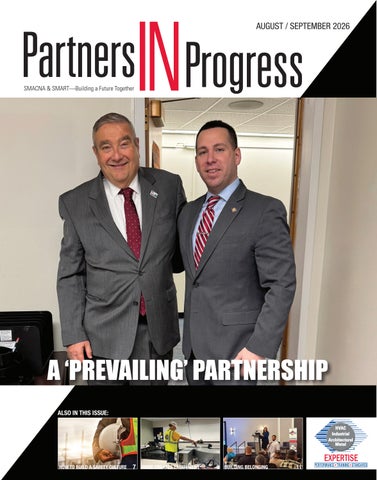
A ‘PREVAILING’ PARTNERSHIP ALSO IN THIS ISSUE:
HOW TO BUILD A SAFETY CULTURE
7
HMSE CREATES EXCITEMENT
9 BUILDING BELONGING
11
PartnersINProgress SMACNA & SMART—Building a Future Together
MICHAEL COLEMAN TODD HILL Co-Publishers JESSICA KIRBY jkirby@pointonemedia.com Editor-in-Chief
9 CONTENTS
August / September 2026 – Volume 20, Number 3
3 CHOOSING AWKWARD, BRAVE, AND KIND This issue features organizational leaders who chose the hard way to a more collaborative industry.
4 A ‘PREVAILING’ PARTNERSHIP SMART Local 38 and SMACNA of Southeastern New York teamed up to ensure workers fabricating off-site receive prevailing wages on public projects.
7 HOW TO BUILD A SAFETY CULTURE SMACNA contractors and Local 33 in Cleveland, Ohio, leverage the JATC and a LMCC to build a strong safety culture.
9 HMSE CREATES EXCITEMENT ABOUT SHEET METAL CAREERS Teaming up with school districts was key to making Heavy Metal Summer
POINT ONE MEDIA INC. artdept@pointonemedia.com Creative Services Cover image Best Practices Market Expansion Task Force
Partners in Progress is a publication of the Sheet Metal Industry LaborManagement Cooperation Fund. All contents ©2026 by the Sheet Metal Industry Labor-Management Cooperation Fund, P.O. Box 221211, Chantilly, VA 20153-1211. Find Partners in Progress online at pinp.org or at issuu.com/ partnersinprogress. An archive of all issues is available. Issues may be downloaded and printed for no fee. For comments or questions, email editor@pinpmagazine.org
Experience a success in San Diego.
11 BUILDING BELONGING The iTi held its first Bias and Belonging Conference, and instructors tackled tough conversations to help shape a stronger industry
14 MY JOURNEY: TOBIAS ROMERO Tobias Romero walked across the stage at Valley High School carrying years of
hard work, accomplishments, and the pressure of a decision most 18-year-olds are not fully prepared to make. . 2 » Partners in Progress » www.pinp.org
S HE E T M E TA L | A I R | R A I L | T R A N S P O R TAT I O N
Choosing
Awkward,brave,and kind By the time you read this issue, the sun will have set on August, and autumn will be unfolding with the promise of crisp air, changing landscapes, and the return to routine. While some of you are shopping for school supplies or starting to plan for the holidays, the Best Practices Market Expansion Task Force will be busily working away at planning the next Partners in Progress Conference, scheduled for February 22-24, 2028, in Las Vegas, Nevada. The foundation of the planning will be feedback from the previous conference—what attendees loved, wished for, and wanted more of. Starting there, the Task Force will be looking to build out an educational, informative, collaborative program that will leave participants with tangible takeaways they can bring back to their organizations and start implementing from day one. Watch these pages for more on this in the coming issues. This issue explores several ways labor and management work together in difficult situations. American academic, author, and podcaster Brené Brown talks a lot about the importance of clarity in navigating difficult situations. One of her most famous quotes, “Clear is kind. Unclear is unkind,” refers to the way avoiding hard truths to save temporary discomfort actually damages trust in the long run. As you read about how contractors, chapters, and locals worked together to correct a prevailing wage law, build a collaborative safety culture, recruit students to the trades, and openly discuss bias and belonging, consider the difficult conversations that must have arisen. How might you deal with adversity in similar situations? It is gloriously simple to fall into old habits of becoming elevated and overspeaking, but Brené Brown also says, in her best-seller Dare to Lead on the role of vulnerability in leadership, “We don’t have to be scary when we’re scared. Let’s choose awkward, brave, and kind.” This is a reminder to stay grounded when tension rises, as did the leaders in the following stories. In “A Prevailing Partnership” on page 5, we look at how Local 38 and SMACNA of Southeastern New York teamed up to change a provision in Connecticut’s prevailing wage law that exempted off-site custom fabrication work from the pay rules. The two organizations worked with a marketing agency that specializes in union clients to mount a campaign to get the law changed, and now sheet metal workers on public projects earn the same wage whether the work is done in a shop or on a job site. When labor and management sit down to discuss wages, benefits, and jurisdiction boundaries, it can go smoothly or it can get loud. But talk about safety, and suddenly everybody’s in agreement. That’s the foundation of “How to Build a Safety Culture,” which explores how contractors and Local 33 in Cleveland, Ohio, trade their “labor and management hats” for “industry hats” when they meet to discuss safety. After all,
nobody wants anyone to be injured on the job, and accidents hurt more than people: morale goes down, and insurance rates go up. Learn more on page 7. We know the profound impact Heavy Metal Sumer Experience (HMSE) has had on recruitment by connecting pre-graduate high school students with the sheet metal trade. What started in 2021 with 28 participants and two pilot locations grew to 51 camps and nearly 800 participants in 2025. Still, attracting student to the trades can be frustrating when they are pushed toward academics at all costs. “HMSE Creating Excitement about Sheet Metal Careers” on page 9 looks at how partnering with school districts opens up word of mouth channels that help organizations make the most of these exciting opportunities. The iTi held its first Bias and Belonging Trainers Conference in 2026, bringing together leaders from across North America to discuss what they gain, wish for, and envision for Bias and Belonging training in the sheet metal industry. “Creating a sense of trust was an important part of the conference approach,” says Tammy Meyen, recruitment and retention specialist for iTi. “When people come into the classroom, they come in with their walls up,” she says. “Building Belonging” on page 11 overviews the conference and how instructors tackled tough conversations to help shape a stronger industry. When Tobias Romero walked across the stage at Valley High School in May, he carried more than the stole resting on his shoulders. He carried years of hard work, accomplishments, and the pressure of a decision most 18-year-olds are not fully prepared to make. Romero is the subject of this issue’s My Journey installment, and his story is touching and hopeful. Don’t miss it on page 14. As always, we are on the lookout for story ideas that reflect your experiences working with your labor or management partner to improve the sheet metal industry for all. If you partner for recruitment, advocacy, market share development, or any other purpose that grow the future for all, please reach out. We would love to highlight your success and share the benefits of your partnership with others. Reach out to jessica.kirby@ pointonemedia.com for more information. Partners in Progress » Volume 20 / Number 3 » 3
A ‘prevailing’ partnership Local 38 and SMACNA of Southeastern New York teamed up to ensure workers fabricating off-site receive prevailing wages on public projects By Michael McConnell
4 » Partners in Progress » www.pinp.org
Southeastern New York don’t always agree, but in 2025, the two had a common foe: a provision in Connecticut’s prevailing wage law that exempted off-site custom fabrication work from the pay rules. The two organizations worked with a marketing agency that specializes in union clients to mount a campaign to get the law changed. They succeeded, and now sheet metal workers on public projects earn the same wage whether the work is done in a shop or on a job site. Connecticut’s prevailing wage law requires contractors on state or local government projects to pay workers the customary— aka “prevailing”—hourly wage, including fringe benefits, for each trade on a project. However, the existing law only applied to work that was done on site. Although some contractors voluntarily paid prevailing wage for off-site fabrication, many didn’t. Workers fabricating in a nearby sheet metal shop could earn as little as a fourth of what they would get if they were working on a public job site. It was a long-time sore spot with Michael Colombo, business manager and president of Local 38 in Brewster, New York. The union’s jurisdiction includes parts of Connecticut. “They could pay their employees anything they wanted,” Colombo says, referring to the previous law. “They didn’t have to pay them the prevailing wage. And that was our argument over the years.” Making a push Local 38 and SMACNA of Southeastern New York, which includes some Connecticut-based contractors among its membership, decided 2025 was the year they would make a serious attempt to get the law changed. The organizations hired a lobbyist. Colombo traveled to the state capital in Hartford to testify in support of a bill that would end the exemption. “This was our first time really pushing it,” Colombo says. In testimony before the Labor and Public Employees Committee, Colombo asked the state’s lawmakers to fix what he called the “critical” issue of unfair pay practices on projects involving custom off-site sheet metal fabrication. “This is not just a matter of fairness,” Colombo told the committee. “It is an issue that impacts the economic health of our communities. The workers who perform these crucial tasks deserve fair compensation for their work, just as much as those working on site. Their labor is just as valuable, and they should not be left behind in a system that values profit over people.” ‘All workers engaged’ In his submitted testimony, Alan Seidman, executive vice president of SMACNA of Southeastern New York, said the issue was also about safety. “SMACNA contractors always pay prevailing wage regardless of where the work is performed, because we believe taxpayer dollars must be used to invest fully in all workers engaged in the successful, efficient, and
The workers who perform these crucial tasks deserve
fair compensation for their work, just as much as those working on site. Their labor is just as valuable, and they should not be left behind in a system that values profit over people. — Michael Colombo, SMART Local 38
Officials with Local 38 and SMACNA of
Michael Colombo, business manager and president of Local 38 in Brewster, New York, testified in front of Connecticut lawmakers to change the state’s prevailing wage law.
NEP Services President Mark Treglio helped Local 38 reach out to Connecticut lawmakers about the prevailing wage law.
Partners in Progress » Volume 20 / Number 3 » 5
A ‘prevailing’ partnership safe completion of our state’s public projects,” Seidman told the committee. Knowing that they would likely need to do more than just testify to get the bill enacted, Local 38 hired NEP Services, a California-based technology and advocacy firm with several union clients. SMACNA SENY and Local 38 used the firm’s software to maximize their outreach efforts. NEP’s Connect Plus+ program matched Local 38 members with their local lawmakers, making it easy for sheet metal workers to get a message about the bill to their state senator or representative. “We had a petition designed, wrote the letter, gave it to the members to send a link, and the members would take action from there,” explains Mark Treglio, president of NEP Services. Stacey Yudin, NEP Services’ CEO, says the campaign was designed to target only the lawmakers who needed to hear about the bill. “It’s more important to reach out to the right audience than just try to blast something on social media and hit everybody’s daughter, dog, and doghouse,” she says. “And so, we built our technology around strategically developing and deploying messaging to organizational members who live and can vote on the issues that matter to that labor union, that local.” In submitted testimony in support of the bill, Alan Seidman, executive vice president of SMACNA of Southeastern New York, pointed out that SMACNA always pays prevailing wages no matter where work is performed.
Behind the scenes NEP also worked behind the scenes, advising Local 38 members on the most effective approaches to take with lawmakers. “This was really about activating and engaging current (union) members who live in Connecticut, whom this issue obviously directly affects, and educating them and asking them to send an email and a text message to their elected officials,” Yudin says. The efforts paid off. Although the original bill was never voted on by the state legislature, its provisions were added to a state budget bill that was passed and signed into law by Gov. Ned Lamont. It took effect July 1, 2025. Seidman says the union and SMACNA worked well together getting the law changed. “I have a great relationship with Michael Colombo,” he says. “Our relationship with the union side is better than it’s ever been. And it continues to improve all the time.” Michael McConnell’s experience encompasses B2B and B2C copywriting, online journalism, and newspaper reporting. The former editor of a monthly magazine for HVAC and sheet metal contractors, he’s always interested in finding out the stories behind interesting people and projects. Contact him at mrmcconnell36@gmail.com.
Stacey Yudin, NEP Services’ CEO, says the campaign was designed to target certain lawmakers.
6 » Partners in Progress » www.pinp.org
How to
Build a Safety Culture By Geoff Williams
When labor and management sit down to discuss wages, benefits, and jurisdiction boundaries, it can go smoothly or it can get loud. But talk about safety, and suddenly everybody’s in agreement. After all, nobody wants anyone to be injured on the job, and accidents hurt more than people: morale goes down, and insurance rates go up. “Who’s going to push back on safety?” asks Tom Martin Jr., the second-generation president of Cleveland, Ohio-based T.H. Martin Inc. He is also a management trustee on both the local Labor Management Cooperation Committee (LMCC) and the Joint Apprenticeship and Training Committee (JATC) in Cleveland. “I’ve never had pushback, and I’ve been doing this for 30 years,” he adds. “It’s that important.” John Sickle Jr., owner and president of Duct Fabricators in Cleveland and Ohio Fabricators in Akron, Ohio, and a JATC cochair representing Local 33 in Cleveland, echoes that sentiment. “Safety is embraced by everyone, both labor and management,” he says. “There are very few items where people disagree— actually, nothing comes to mind where anyone disagrees about safety.” “A lot of that’s because the contractors have actually done what we’re doing,” says Alan Simonitis, a training coordinator at the Local 33 training center. “Many contractors grew up working in sheet metal, so they understand the importance of safety. It’s kind of been ingrained in them.” But agreeing that safety is paramount doesn’t make an industry safe. It sure helps, but if you’re looking for a strong safety culture from the start of each day to the finish, here’s what really makes a difference. Relationships matter Five labor trustees and five management trustees meet every other month for their LMCC meeting, ahead of the JATC meeting, Sickle says. And whenever safety is discussed, whether
they agree or not, everyone agrees that regular communication between labor and management makes challenging issues easier to navigate. “Management walks in wearing their management hat. Labor walks in wearing their labor hat,” Sickle says. “But when the meeting starts, we all put on our industry hats.” Safety meetings should be treated as safe spaces, meaning people know they’re going to be treated with respect and can offer candid opinions. “If somebody’s got to get something off their chest, we let them do that,” Sickle says. “And that happens now and then.” Having several trustees sit on both the LMCC and the JATC helps to build a safety culture, too. By the time a safety question reaches a JATC meeting, there’s a good chance it was brought up at the LMCC meeting. “I know there are areas around the country that kind of look up to Cleveland because of the strong relationship we have between labor and management,” Sickle says. “That started with our LMCC. It gives you a place where you’re always communicating, you’re talking to one another.” Safety should always be on the agenda That’s common sense, but it’s easy to push it aside when there’s a lot to discuss, like training progress, budgets, and financial reports. But safety always needs a prominent spot on the agenda, even if it seems like there isn’t much to say. “Communication, and talking about it monthly or bimonthly, is the key,” Martin says. And then when a safety fix is needed, such as a confined-space certification, a forklift class, or an OSHA eight-hour refresher course, there’s no debate on whether it should be done. The question is simply: How do we get it done? Martin says that typically everybody’s mindset is: “If we can incorporate something in our JATC for training, let’s do it. If we Partners in Progress » Volume 20 / Number 3 » 7
How to Build a Safety Culture don’t have somebody savvy or certified to teach that particular safety initiative, let’s outsource it, and we’ll pay for it. We’ll find a way to pay for it.” The cost of not spending money on safety is more expensive, Martin says. “You don’t want anybody hurt, but if somebody is, your workers’ comp fees goes up, and your insurance fees go up, too.” Simonitis says while everybody’s in favor of nobody being injured on the job, the insurance industry is certainly a powerful motivator to be smart about safety. “They ding you for people getting injured and stuff like that. That money talks, you know? You don’t want to be getting fined.” Sickle says that there are sometimes disagreements over who should pay for safety training—the JATC, the contractor, or labor. “If we’re going to have an argument, which is few and far between, it’s on items like that,” Sickle says. “But the end goal is safety.” Don’t assume all workers are safety aware Assuming that everybody is experienced with safety issues is dangerous. First-year apprentices are especially vulnerable, Martin says. “I’ve got 250 employees,” he says. “Sometimes you forget that maybe an 18-year-old has never stepped on a six-foot ladder. Or they’ve never been on a scissor lift. Maybe they’ve never touched a tool.” Sickle sees a lot of that, as well. They arrive from everywhere, he says, straight out of high school or maybe from another career. “Sometimes they don’t even know what OSHA stands for,” he says. “So, you’ve got to explain to them that the number one entity here is safety.” Fortunately, the Cleveland JATC offers ample education to apprentices and journeypersons, providing things like a 30-hour OSHA card for every apprentice and instruction on how to work a hand brake, hydraulic brake, and power brake; workshops on plasma cutting table procedures; and even Infection Control Risk Assessment (ICRA) training. Borrow experts when you need them Tool manufacturers, like Milwaukee, Hilti, Ridgid, and DeWalt, come to the Local 33 training center to teach both the tool and the safe use of it, and often help outfit the shop floor in the process. Lift rental companies like United Rentals train sheet metal workers on scissor lifts, tie-offs, harnesses, and lanyards. The national resources can also serve as digital experts. Sickle sits on the International Training Institute (iTi) board, and he often encourages trainers to make good use of iTi’s safety library. SMOHIT (Sheet Metal Occupational Health Institute Trust) pushes health and safety bulletins straight to members’ phones—during the heat wave earlier this summer, Sickle says, the notices came through as the temperatures did. Both SMART 8 » Partners in Progress » www.pinp.org
and SMACNA staff full-time safety directors with toolbox talks and jobsite materials ready to go. Contractors and experienced journeypersons also have expertise to share in evaluating safety related situations on site. “If our labor partners want a jobsite audited because they walked it and saw some concerns, we as contractors would be receptive to shop or jobsite walkthroughs, having a collaborative and proactive approach,” Martin says. “If a union employee, labor leader, or any of our employees have a concern, we as contractors should address it.” Safety practices change “Technology changes, thus safety must change,” Sickle says. “Our industry’s technology is changing daily. If we don’t keep up, we’re left in the dust.” The industry’s approach to silica dust is a good example. Drilling concrete to hang ductwork now means getting trained to use vacuum attachments and respirators—a requirement that didn’t exist a generation ago. Another example is the cut-off grinder, which Sickle calls one of the most dangerous tools on a jobsite, if someone decides the guard is optional. “It’s there for a reason,” he says. When a wheel comes apart, he notes, the people who get hurt are often the ones standing nearby. Twenty years ago, nobody wore hi-visibility vests, Martin says. He remembers guys walking around jobsites in sneakers instead of steel-toe boots. “Now, you have to have a vest on, your safety glasses, your hard hat on,” Martin says. “It’s become mandatory, and I think it’s a good thing.” Climate changes are also changing safety practices. Martin says that summer heat has caused businesses like his to offer more flexibility on water and afternoon breaks, and the JATC has offered training on spotting the signs of heat illness in a coworker. “Hygiene on jobs has gotten more important, too,” Simonitis says, noting growing use of mobile restroom trailers (over porta-potties) and hand wash stations. “Those things are low-hanging fruit, but they’re important,” Martin says. A safety culture is a tool for growing the industry Martin says that if management and labor aren’t practicing smart safety habits, clients will demand it. “A lot of times in these scope reviews, they ask me, ‘What’s your safety culture?’” Martin says. “So, safety culture is not only important for the safety of your employees—your customers want to know your safety culture as well.” Geoff Williams is a freelance journalist and author based out of Loveland, Ohio, specializing in business and personal finance. He has written for cnnmoney.com and other well-known publications.
HMSE
Creates Excitement About Sheet Metal Careers By / Sheralyn Belyeu Recruiting teens into the sheet metal industry can be frustrating. “Right now, not a lot of people are looking to get into construction when they get out of high school,” says Wayne Connolly, fabrication manager for San Diego Sheet Metal. But Heavy Metal Summer Experience (HMSE) is overturning old stereotypes about the industry. “The word of mouth was huge for this year, even before we started marketing,” says Lorenzo Miles, Local 206’s training director at the Sheet Metal JATC in San Diego. “When I opened the application, people just started signing up.” The students’ excitement is so contagious that this summer, three California school districts offered HMSE to their students. “My husband is the vice principal at Woodside High School,” says Faith Velschow, work-based learning specialist for the Sequoia Union School District in Redwood City, California. Early in the 2025-2026 school year, a Woodside student told Velschow’s husband that he had traveled two hours to Sacramento and stayed with his grandparents so he could attend HMSE. “This student was so excited. That night my husband asked why we didn’t have something like that, and I told him I would find out.” Within a week of that conversation, Angie Simon of HMSE was in Velschow’s office. “She lives just a few blocks from where I work,” Velschow says. “She came over and explained to me what they do. With Angie’s help, running HMSE has been easy.” Sequoia Union School District covered some costs for the camp, and working with Velschow gave HMSE access to the largest group of teens in the district boundaries. “I sent out an
announcement to our college and career counselors with the information about what the camp entails, the dates, and a flyer about it, most of which I was able to get from the HMSE,” Velschow says. “They had everything available.” So many students applied that the district had to turn applicants away. Velschow already knew Local 104’s outreach coordinator, Henry Funcke, from high school career presentations and career fairs. “I do about 258 events a year,” Funcke says, “so Faith recommended that Angie contact me.” Funcke and training coordinator Nate Vennarucci hosted the sheet metal day of the camp at the Local 104 training center with help from Local 104 business representatives and instructors. Western Allied donated precut patterns for the Sequoia campers to make toolboxes. “It’s a minimal expense,” says
Partners in Progress » Volume 20 / Number 3 » 9
HMSE Creating Excitement About Sheet Metal Careers
Photo courtesy of Local 105 JATC
Randy Freitas, Western Allied’s general superintendent. “We’re donating only a little bit of our time and a little bit of material. I always feel it’s karma. When we help them, it’ll come back to us.” Freitas personally delivered the initial presentation to the campers. “I gave a general safety presentation, but the students started asking about our trade, which was pretty cool.” In the San Diego area, Rebekka Kinder of the Vista Unified School District reached out to HMSE after Simon did a radio spot on the SoCal I-Heart Radio. “Students are eager to gain real-world experience and explore career interests,” Kinder wrote. “I believe partnering with us would provide students with valuable insights.” Like Velschow in Redland, California, Kinder handled recruitment for the Vista Unified School District’s HMSE. “They have access to all the high school students in the school district, so they can push the word out,” says Miles, who ran the HMSE camp at Local 206’s JATC.
Several contractors sponsored lunches, and San Diego Sheet Metal cut the projects for the students. SDSM used 10 galvanized sheets and one sheet of copper to cut toolboxes, shovels, and copper roses for HMSE. “We did some stainless parts for them, too, but I had some drop pieces over,” Connolly says. The donated materials cost less than $1,500. “We’re always looking to help the apprenticeship. I want to make sure that we’re getting good apprentices that turn into good journeypersons. That creates a better reputation for us.” Instead of taking students to the Local 105 JATC for HMSE, the Compton School District in Greater Los Angeles bussed campers to Southland Industries, where they could experience sheet metal, plumbing, and piping at a single location. Bryce Barler, the operations manager for Southland, ran the Compton School District HMSE. About twenty students were on site from 10 am to 3 pm for three days, giving them five hours each day of camp. Compton provided their lunches. “We did safety orientation, gave them a tour, had lunch, and held the hands-on activities in the early afternoon,” Barler says. Every day of camp, one third of the students worked at the sheet metal station, and a new group of students rotated in the following day. “Our superintendents took some of their shop leads for each station to oversee and help the kids, so there were twenty-plusyear people at each station.” “Southland asked the local to be there, to bring tables and representatives, June 8 through 10th,” says Al Hernandez, business manager and president of Local 105. The rep and the organizer were on hand to answer questions. “At the end, the kids got a participation award and refreshments. We spoke not only to the kids, but to the parents. You have to appeal to the parents and make them aware of what’s available to their children if they go into the trades, particularly sheet metal.” All three school districts scheduled their HMSEs shortly after school let out. “I wanted to do camp before they get involved in a vacation or a job,” Velschow says. “I thought if we did it right away, we’d have a better chance of getting more students.” The early start worked well for the JATCs. “It’s easiest right after the apprentices leave, so we can continue like we still have students,” Miles says. “When camp is done, we get back to preparing for the next semester.” Velschow encourages all locals and chapters to consider talking with school districts about HMSE. “Most schools, if they don’t have somebody exactly like me, do have college and career counselors,” she says. Even if schools don’t immediately understand the benefits of HMSE, conversations can build bridges. “Everybody,” Funcke says, “can have a relationship with their schools.” A Colorado native, Sheralyn Belyeu lives and writes deep in the woods of Alabama. When she’s not writing, she grows organic blueberries and collects misspellings of her name.
Photo courtesy of Local 105 JATC
10 » Partners in Progress » www.pinp.org
B
Belonging BUILDING
At iTi’s first Bias and Belonging Trainers Conference, instructors tackled tough conversations to help shape a stronger industry By Natalie Bruckner
Every workplace has moments
where differences in experience and background shape how people interact. In the sheet metal industry, those moments can raise important questions about bias, belonging, and what it takes to create an environment where everyone has the opportunity to succeed. Creating space for those conversations was the goal behind the International Training Institute’s (iTi) first Bias and Belonging Conference, held just outside Washington, D.C. in June. The event brought together approximately 60 instructors and coordinators from across the country to talk about challenges, share experiences, and explore ways to strengthen training environments. “The main thought process behind the conference was that we have instructors out there teaching bias and belonging at their home JATCs,” says John Jackson, administrator of the iTi for SMART. “The best way to understand what’s working and what needs improvement is to bring everyone together and ask them: ‘What do you think we need to add to the program? What more can we do to support trainers in the field?’”
That kind of feedback is becoming increasingly important as Bias and Belonging training continues to reach more members across the industry, with approximately 11,000 participants to date.
Conversations about bias and belonging can be challenging for everyone, including the instructors. For those teaching the course, one hurdle is creating an environment where participants feel comfortable enough to engage honestly in the conversation.
Creating that sense of trust was an important part of the conference approach, and Tammy Meyen, recruitment and retention specialist for iTi, says she was surprised by how open everyone was at the conference. “When people come into the classroom, they come in with their walls up,” she says. “They’re guarded and trying to figure out if they’re in trouble. You have to break through those defenses before you can really teach them. The fact that there were so many people in the room, and they were so open and honest, and willing to share so much with us, was surprising.” Partners in Progress » Volume 20 / Number 3 » 11
Building Belonging
The conference gave instructors a chance to practice how they would respond in real-world situations. Through interactive roleplaying sessions, participants worked through scenarios they may encounter in their classrooms and workplaces, comparing responses and learning from one another. “It was really insightful to hear how different people would approach situations,” says Andre Mayes, International instructor for SMART. “Those kinds of situations can come up unexpectedly, and they’re often complex. Having multiple perspectives on how to handle them gives you a better sense of how you might respond yourself.” Erykka Thompson, director of learning integration at SMACNA, says the exchange really helped instructors consider new perspectives. “Someone might say, ‘I like the way you handled that,’ or ‘I’ll be able to use this with this group of adult learners or this particular scenario that I encountered,’” Thompson says. “It becomes another tool in your bag of tricks—another way to approach something, talk about something, or even recognize something.” Beyond the formal sessions, participants had the chance to
12 » Partners in Progress » www.pinp.org
spend time together and connect with others facing similar challenges. “I think the networking was the biggest part of the whole conference,” says Dale Clark, Occupational Safety and Health Administration (OSHA) specialist at iTi. “It’s realizing that they’re not the only ones going through it. If they have a student who’s not buying in, or they have a student with a question, there are other instructors and coordinators who have faced similar situations and can share what worked for them. That’s what the brother and sisterhood is about.” For Mayes, that opportunity to connect was especially valuable. “My role is delivering Bias and Belonging training to officers within SMART. Most of my work is remote, so having that opportunity to connect was particularly important,” he explains. “Being able to come together with others doing similar work was really helpful. There was a lot of idea-sharing and discussion.” Thompson emphasizes the difference that in-person interaction can make. “Quite honestly, our society right now is struggling,” she says. “We’re at a point where you can’t always believe videos and images because you start wondering, ‘Was that AI-generated? Is that really true?’ The conference was refreshing because you were face-to-face with people, having real conversations.” The conference also highlighted a unique challenge that comes with Bias and Belonging training: the word “bias” itself can create hesitation. For some, the term carries a negative association and can feel like a judgment rather than an opportunity for reflection and understanding. Meyen says that part of their work is helping people recognize that bias is a natural part of being human and that awareness is the first step toward improving how people interact with one another. Thompson agrees, adding, “It doesn’t make you a bad person. Somehow, that message has gotten lost. We’ve come to associate bias as a negative thing, when it’s actually a human thing. It was such a positive experience coming together as it showed me the
“
As an industry, we thrive on teamwork. It starts at the very top between labor and management. That’s really the basic building block. — Erykka Thompson, director of learning integration at SMACNA
tide is really starting to turn, which is contrary to what we are hearing in the media right now.” The conference also gave the iTi team an opportunity to hear directly from instructors about how Bias and Belonging training is being delivered and where the program could be strengthened. One area of focus was timing. While the training is designed to introduce these concepts early in apprentices’ careers, instructors noted that engagement may improve when apprentices have had time to establish a foundation of trust. “Instead of hitting a brand new, very green apprentice, maybe waiting until their second year or later in their first year, once they’ve had time to get to know their classmates, would be more beneficial,” Meyen explains. “Some people have found that refresher courses are helpful, too. They might take the class once as an introduction, then come back to it the following year. Instead of it being a one-time conversation, they’re revisiting the material multiple times, and that has been helpful.” Instructors also discussed ways to make the training fit more easily into the realities of the construction industry. “One of the things Dale and I will be working on in the future is figuring out whether, instead of giving the whole class in one three-hour chunk, there’s a way to break it up into smaller
”
sections like chapter one, two and three,” says Meyen. “When someone’s worn out from work all day long in the heat, and then you have to sit in the classroom and listen to people talking about being good human beings, it’s tough.” With thousands of members already completing the training, the focus now is on continuing to build on that progress. Thompson emphasizes that change takes time and requires continued effort. “It’s a process,” she says. “You’re not going to get everybody on board immediately, but eventually you reach a tipping point where most people have heard the message, understand the message, and support the message. “As an industry, we thrive on teamwork. It starts at the very top between labor and management. That’s really the basic building block. The union construction industry is exceptionally good at producing highly technically skilled individuals. Now that we do that routinely and consistently, the next step is understanding what produces that great work. And that’s great teams.”
Natalie is an award-winning writer who has worked in the United Kingdom, Germany, Spain, the United States, and Canada. She has more than 23 years experience as a journalist, editor, and brand builder, specializing in construction and transportation.
Partners in Progress » Volume 20 / Number 3 » 13
My Journey:
Tobias Romero He Had College Offers. He Chose to Sign with Local 49. By Terry Bierwirth
No debt. No delay. Just work, school, and a plan.
When Tobias Romero walked across the stage at Valley High School in May, he carried more than the stole resting on his shoulders. He carried years of hard work, accomplishments, and the pressure of a decision most 18-year-olds are not fully prepared to make. Tobias graduated fourth in his class with a 4.65 GPA. His record included Advanced Placement courses, student leadership, National Honor Society, and three years inside Valley High School’s Engineering the Future program, where he studied engineering and metals, learned CAD, worked with CNC machines, and became the student other students counted on in the shop. Engineering the Future is a magnet program inside Valley High School in Albuquerque, New Mexico, designed for students interested in engineering, computer science, architecture, wood technology, metals technology, JROTC, and business. Tobias had done everything a high-achieving student was told to do. Because of that, he had choices. He was accepted to several universities, including the University of New Mexico, New Mexico Institute of Mining and Technology, Northern Arizona University, and others. He also received scholarship offers, including a full ride to High Point University in North Carolina. For a time, college seemed like an obvious choice. Then Tobias considered the bigger picture: 14 » Partners in Progress » www.pinp.org
the cost, potential debt, the years before he could earn a steady income, and his family. His mother is a nurse at Presbyterian Hospital and the primary source of income for their family. His father, a former corrections officer, was injured in his previous job. Tobias is the oldest of four children. There is a difference between wanting to leave home and knowing where you are needed. Tobias knew. So, he made a decision that was not easy, but it was clear. He stayed in New Mexico. Not because he lacked ambition, but because he had so much of it. Tobias did not give up on college. He changed the order. He chose to go to work, become a member of Local 49, begin the apprenticeship training program, and take college courses online while earning an income. “I do not want to get into any student debt,” he said. “I do not want to be struggling and paying off these loans later in life.” He also did not want his parents to carry the financial weight of his education. “I feel like parents should not have to pay for your schooling,” he said. “You should be able to figure that out, especially with what you’re wanting to do in your life.” He started working when he was 13 years old for AB Honest One Plumbing, Heating, and Cooling, a local company owned by a family friend from his church community. He began as a
“
For years, students have been celebrated for
laborer, carrying materials and helping wherever he was needed. Over time, he watched, listened, worked, and learned. The owner saw something in him: work ethic, capability, integrity. Tobias carried those habits into school. Now he is carrying them into the sheet metal industry. Inside EtF, Tobias found the place where design and handson work meet. One project was a public stage mural for the Westside Community Center in Albuquerque’s South Valley. Tobias helped with the CAD work and blueprints, making sure the dimensions were right and the design could be cut, assembled, and installed correctly. At first, he was still thinking about college. His former Valley welding instructor, Shawn Coffey, understood why. Coffey, now outreach coordinator for the Local 49 JATC, had taught Tobias at Valley. He knew Tobias had the grades, intelligence, and drive to pursue a traditional college path. “Tobias is a fantastic young man,” Coffey said. “It took some work to help him see the opportunity in the trade because he was originally focused on college. Once he learned about detailing and how he could use his engineering mind in this industry, he became extremely interested.” Coffey also knew Tobias was not the only one who needed to understand the opportunity. His parents had questions too, as most parents would. They wanted to know what their son would be learning, what kind of career path he would have, and whether this decision would support the future Tobias was working so hard to build. Coffey sat down with them and explained the apprenticeship, the trade, the detailing opportunity, and Tobias’s ability to begin earning an income right away. Once they understood the path, they were fully supportive. That was the turning point. Tobias was not being asked to walk away from his interest in engineering. He was being shown a career where he could use it. Through Local 49 and signatory contractor Yearout Mechanical, Tobias learned that sheet metal was not only field work. It was also planning, coordination, CAD, problem solving, and technical design. Then came Signing Day. After Valley honored 60 EtF students for their pathways, the room shifted into Signing Day. One by one, students sat down to sign letters of intent. Eight EtF students signed with signatory contractors of Local 49. For years, students have been celebrated for signing athletic scholarships or committing to universities. James Magofee, director of safety and humanpower for Yearout Mechanical, understood years ago that students committing to work, apprenticeship, and skilled trades careers deserve that same level of recognition. As Tobias sat at the table and signed with Yearout, he knew he was making a real commitment. He was signing with an employer, stepping into Local 49, and beginning a career.
signing athletic scholarships or committing to universities. James Magofee, director of safety and humanpower for Yearout Mechanical, says students committing to work, apprenticeship, and skilled trades careers deserve that same level of recognition.
”
“I was definitely relieved and happy because I knew I was investing into my future,” he said. The work Tobias will begin with Yearout as a detailer is a rare opportunity for someone coming directly out of high school. “Less than one percent of applicants get the opportunity to begin in an office position as a detailer,” said Isaiah Zemke, business manager at Local 49. “Tobias has earned a rare opportunity, and we are excited to see what he does with it.” Cassandra Gonzales, assistant principal for Engineering the Future at Valley High School, is not surprised. “Tobias is a great young man,” Gonzales said. “I believe in him. He was one of our strongest students, and he is capable of doing whatever he puts his mind to.” Yearout saw the same promise. “We are thrilled to have Tobias join our team,” Magofee said. “Of the nine students who signed with Local 49 contractors, he was one of five who committed to work with our company.” Tobias started with Local 49 orientation the week after graduation. He will enter the sheet metal apprenticeship with advanced credit because of his experience in EtF. He will work, attend apprenticeship classes, and take college courses online. It will be a full schedule, but Tobias does not seem like someone who is comfortable standing still. He has a restless kind of curiosity, the kind that wants to learn the next machine, skill, program, and process. Grades matter. Scholarships matter. Recognition matters. But Tobias understands something else too. Work ethic matters more. “I want to be seen as somebody who is reliable and trustworthy and sticks to their word,” he said. “I am continuously ambitious and continuously push myself to grow.” That is what the sheet metal industry needs. Young people who can think and work, understand technology, use tools, earn, learn, build, and belong to something. Terry Bierwirth is the founder and president of Second Story Marketing Group, a niche marketing agency dedicated to strengthening recruitment and retention in the skilled trades. She combines journalism, authentic storytelling, and strategic marketing to help organizations build stronger brands and inspire the next generation. Terry Bierwirth is the founder and president of Second Story Marketing Group, a niche marketing agency dedicated to strengthening recruitment and retention in the skilled trades. She combines journalism, authentic storytelling, and strategic marketing to help organizations build stronger brands and inspire the next generation.
Partners in Progress » Volume 20 / Number 3 » 15
Trying to get your Local, JATC, or company
noticed?
Expertise is more than experience. It is skilled knowledge. Let your customers know there is a reason to hire you. Use Expertise logos on all of your promotional materials. Get the details at pinp.org I-01