Find Partners in Progress online at pinp.org or at issuu.com/ partnersinprogress. An archive of all issues is available. Issues may be downloaded and printed for no fee.
For comments or questions, email editor@pinpmagazine.org
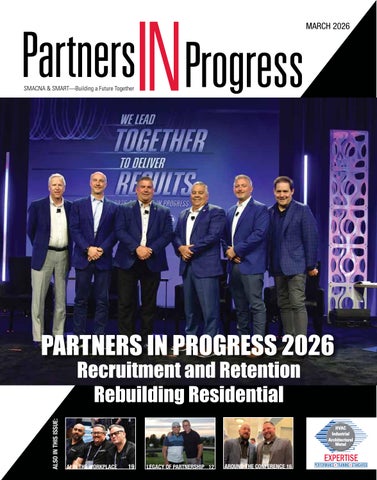
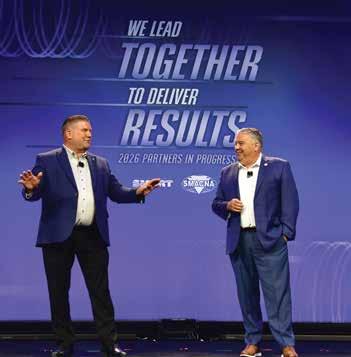
Partners in Progress 2026 Leading Together to Deliver Results
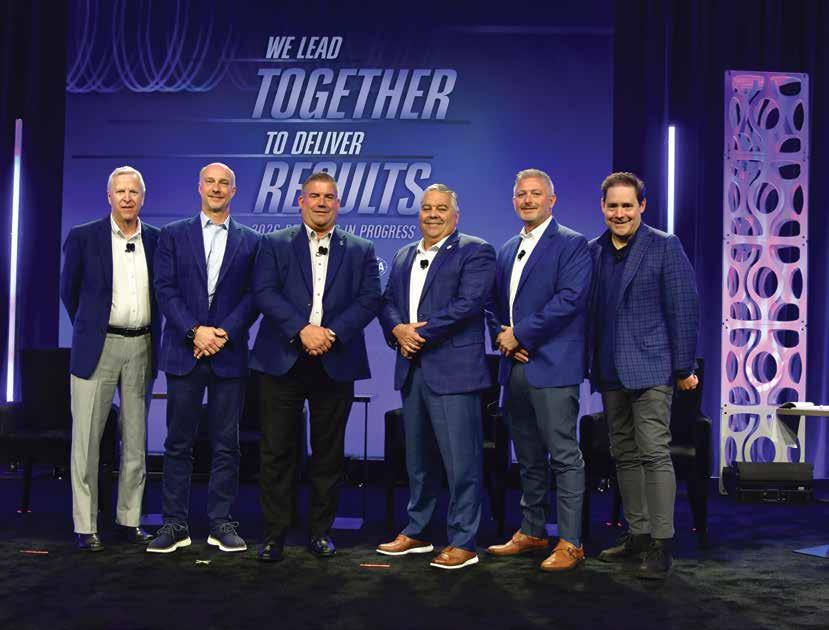
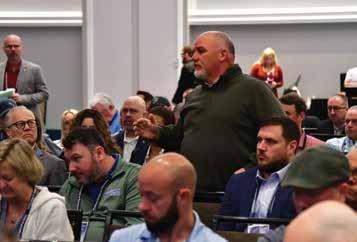
This issue of Partners in Progress is dedicated to the 2026 Partners in Progress Conference, which took place February 16-18 in Orlando, Florida. This two-and-a-half-day event brought labor and management representatives from across North America together to learn, network, connect, and grow. Under the theme, Leading Together to Deliver Results, the presentations and breakout sessions focused on how building the signatory sheet metal industry’s future together is the only way forward. In fact, traveling the road to prosperity and longevity alone is virtually impossible outside of the essential partnerships that foster cooperation and joint problem solving in successful local areas.
This double issue covers some of the topics that filled the rooms at the 2026 Partners in Progress Conference. Anything not covered here will be highlighted throughout the year, and we welcome your feedback on your favourite stories, stories you wish you saw in these pages, and the gist of what is happening in your area that we should be covering here.
We start off with a Conference News section, beginning on page 4, briefly overviewing some of the breakout sessions. It includes Getting Fire Life Safety Done – a Practical Playbook, which touches on efforts in New Mexico to establish FLS legislation (the first of its kind in the United States) and some of the challenges and successes of implementation. We also look at how Career Technical Education programs are kick-starting recruitment and retention in some local areas and how connecting early with prospective students and their families is helping chip away at the labor shortage in these regions. This section also overviews how Local 38 and SMACNA Southeastern New York used digital tools to tackle a legislative issue, as well as market expansion into the clean room sector. Watch for full-length feature stories on these topics over the next several issues.
Our main features cover Recruitment and Retention strategies and their results (page 8), Expanding Residential Market Share (page 10), and how Local 280 and SMACNA British Columbia have leveraged historical ties to further their labor-management partnership (page 12). These stories highlight some of the best examples of Locals and Chapters coming together with real commitment and drive to do better and be better for their common and mutual benefit. In each story there runs a common thread—that real, lasting change and connection comes from facing difficulty with bravery and initiative and that together, real results are possible.
On page 16, we highlight some of the great comments our writers heard around the conference as they checked in with delegates to find out why they attended, what they were most looking forward to, and what they hoped to take away from the experience. The Around in the Conference section is the perfect place to find inspiration for attending the next Partners in Progress Conference, which will be held February 22-24 in Las Vegas, Nevada.
And finally, page 18 begins a Session Review section, which offers longer-form reviews of some of our favourite sessions. The Emerging Leaders panel looked at an exciting new training program from the Best Practices Market Expansion Task Force that helps up-and-coming leaders learn the practical and soft skills they need to lead the next generation of sheet metal organizations. Each participant underwent Emerging Leaders Training and then brought their experiences to the conference. Learn more about this training at pinp.org and start thinking about young leaders in your organizations who may be a fit for the next cohort, scheduled for fall of 2026.
And speaking of leaders, the team in Western Washington, which includes the local SMACNA Chapter, Local 33, and a contractor member, spoke on a new opportunity to give developing leaders something to reach for. The Foreman Upgrade Training program offered by SMACNA-Western Washington provides professional development for forepersons and lead forepersons, who may increase their wage by 12.5% and 17.5%, respectively, upon annual completion of 16 hours of continuing education certified by the JATC. This homegrown program is the perfect example of what a local area can accomplish when everyone works together.
AI in the Workplace was a highly successful session (held twice, actually) that delivered practical tips and software suggestions for helping organizations implement AI into their daily operations. You may love AI or not know anything about it, but either way, it is here for the taking. Used correctly and with human oversight, it can streamline operations and boost productivity in ways you may not have considered. Have questions about AI? Flip to page 20 to learn how to schedule a 30-minute informational meeting with Hugh Seaton, SMACNA National’s AI consultant.
If you have a success story from this conference—a connection you made, a problem solved, inspiration from one of the sessions that you brought home and leveraged to make your labor-management partnership better, please reach out to jessica.kirby@pointonemedia.com to share it. We can’t wait to highlight your success.
CONFERENCE NEWS
Getting Fire Life Safety Regulations Done –A Practical Playbook
By Michael McConnell
Getting a fire life safety bill signed into law isn’t just good for SMACNA members and their union workforce. It might also save lives.
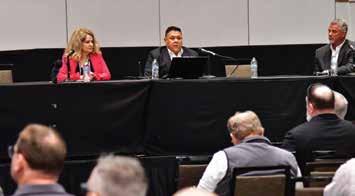
That was a message SMACNA New Mexico and Local 49 brought to Orlando, Florida, during their breakout session, “Getting Fire Life Safety Regulations Done – A Practical Guide.” SMACNA New Mexico Executive Director Ronda GillilandLopez; Tony Kocurek, owner of Energy Balance & Integration LLC; and Local 49 Business Manager/Financial SecretaryTreasurer Isaiah Zemke explained the long, sometimes slow process of getting New Mexico state Senate Bill 143 passed. The bill, which added regular inspection, certification, and ANSI accreditation requirements to the state’s fire code, was passed in 2019. It went into effect four years later, and was the first statewide fire life safety bill enacted in the United States.
Labor and management worked together for years to urge lawmakers for its passage. The bill benefits SMACNA and SMART since it requires regular testing and recognizes the advantages of using highly trained International Certification Board (ICB)/Testing Adjusting and Balancing Bureau (TABB) technicians to spot and fix malfunctioning dampers, ensuring they perform properly.
“You can work to enact similar language in state and local
codes in your area,” Kocurek told the audience. “If you don’t do it, somebody else is going to,” he said. “And that person is not going to be as well trained as you are.”
Kocurek urged members to take local officials into buildings where many smoke and fire dampers malfunction and explain the problem. “These are areas you can take people in very easily and show why we need inspections,” he said.
Zemke reminded the audience of the key message they need to deliver: “This is a public safety measure. The fire life safety issue is one where labor and management can really come together.”
He encouraged members to contact their lawmakers but ensure they are ready before reaching out. Incorrect or unverifiable information could harm the message. “You have to make sure all the information you put forward is sound,” Zemke said. “Remember that fire life safety should not be a partisan issue. Find allies from both political parties and see if other organizations will support your efforts.”
“Another avenue we’ve been trying to work through is getting the insurance industry involved,” Gilliland-Lopez added.
Resources:
• “New Mexico Institutes Nation’s First State-Wide Fire Life Safety Law.” tinyurl.com/2ua2bvcv
• “Local 19 helps ensure fire life safety passage in New Jersey.” smart-union.org/local-19-helps-ensure-fire-life-safety-passage-innew-jersey
• “Fire Life Safety presentations foster open communication, awareness.” smart-union.org/fire-life-safety-presentations-foster-opencommunication-awareness
• Fire, Smoke, and Radiation Damper Installation Guide for HVAC Systems, 6th Edition store.smacna.org/fire-smoke-and-radiationdamper-installation-guide
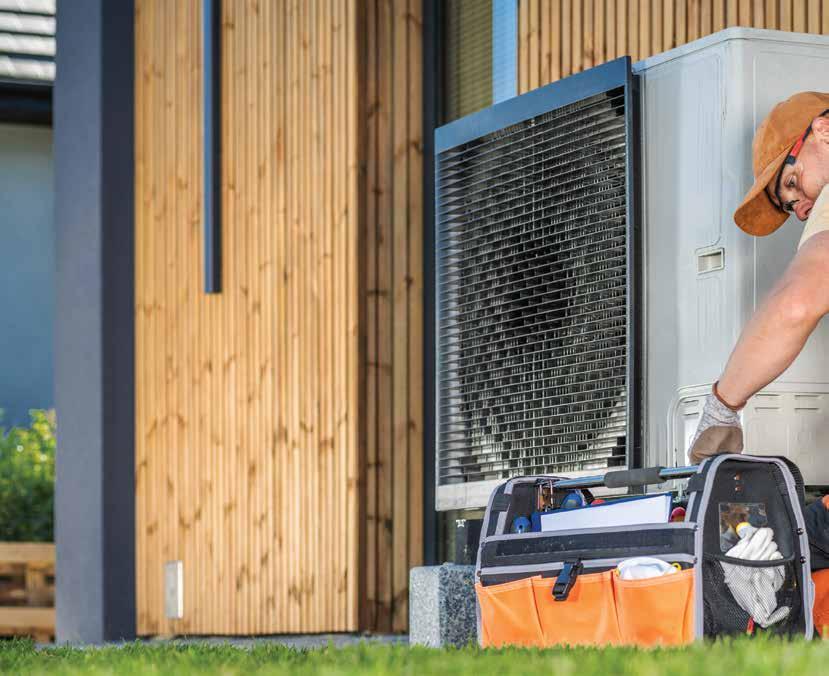
iStock Photo / welcomia
Career Technical Education: ‘A pipeline to apprenticeship’
Promoting and supporting career technical education such as apprenticeship programs is critical to conquering the industry’s worker shortage, officials say.
A number of SMART and SMACNA members brought that message to “National and Local Apprenticeship Panel – Career Technical Education (CTE) as a Pipeline to Apprenticeship,” a panel discussion on how to boost apprentice program participation.
Alex Tiechner, a training director with Local 104 in Livermore, California, said too many students are still not familiar with the industry. “When you say ‘sheet metal’ as a career, they really don’t know what that is,” he said. Local 104’s training center offers tours to prospective students and their families to showcase the industry.
Another panelist, Matthew Smith, president of Smith Heating and Air Conditioning in Stockton, California, said he works closely with Engineering Construction Academy, which is housed at Lincoln High School in Stockton, to promote sheet metal work. The school has a three-year hands-on mechanical systems program.
“It’s truly a one-of-a-kind facility,” Smith said. “We want to highlight and show what sheet metal really means. Our core mission is to build a workforce for California. We are committed to continuous education.”
And that’s the right way to do it, added Michael Marks, planning and development director with Local 104. “You have to start small… Go to that career night with your local labor (or) management partner and maybe get a booth,” he said.
Tiffany Finck-Haynes, a government relations professional with SMART, added that the union and SMACNA are supporting a related bill currently in Congress, House Resolution 1151, the Freedom to Invest in Tomorrow’s Workforce Act. The bill would allow items such as books and supplies in apprenticeship training programs to qualify for reimbursement through tax-advantaged saving accounts such as 529 plans.
“We’re really proud of that,” Finck-Haynes said.
Resources:
• Why Join SMART? Education and Career Training smart-union.org/why-join-smart/education-and-career-training
• LHS Engineering Construction Academy: Building a workforce for California lincolnhigh.org/academics/career-technical-education/lhs-engineeringconstruction-academy
• “SMACNA Supports Proposed Rules to Revise the National Apprenticeship System.” smacna.org/news/member-update/article/2024/03/20/smacnasupports-proposed-rules-to-revise-the-national-apprenticeship-system
• Regulation of the Month: National Apprenticeship System Revisions smacna.org/news/member-update/article/2024/04/17/regulation-ofthe-month-national-apprenticeship-system-revisions
SMACNA National
Leveraging Technology and Partnerships for Industry Advancement
SMACNA and SMART had a common enemy in Connecticut: a loophole in state law that allowed companies to pay less than prevailing wages on public projects involving off-site fabrication work.
Both labor and management wanted the loophole closed. But it wasn’t going to be easy to get it enacted into law. Local 38 and SMACNA of Southeastern New York decided to work with NEP Services, a California-based digital marketing company, to use social media strategies to drum up support for Senate Bill 1370, which would close the loophole permanently.
The breakout session “Leveraging Technology and Partnerships for Industry Advancement” explored how SMACNA and SMART used digital tools to get an issue on the minds of lawmakers and work toward its passage.
With S.B. 1370, the union and management used member engagement software to help contractors find and contact their local representatives and make the case why they needed to support the bill.
“Using tools like the engagement software helps ensure you’re getting the maximum return on your efforts," said Stacey Yudin, CEO of NEP Services. “Your strategy should be from the inside out. You don’t need to hit everyone in Connecticut.”
The goal is getting lawmakers to think, “You know what? This affects the people in my district,” added Mark Treglio, president of NEP Services.
Many people have heard about influencers, people who have a large number of people who watch their content and get paid to promote products and programs. These influencers affect issues and trends. Think of your members in a similar way, Yudin said.
“Your members are your influencers.”
With the prevailing wage campaign, NEP helped members use software to write personalized letters to lawmakers that they considered receptive to the issue. “It wasn’t a great sledgehammer but strategically designed,” Treglio said. “You don’t need to send them five emails a week.”
The campaign was successful. S.B. 1370 was passed in 2025 and signed into law. Treflio credited the union members for the campaign’s success.
“SMART Local 38 was very efficient and super successful in getting the bill passed,” he said.
Resources:
• “The Top 5 Benefits of Investing in Social Media Marketing.” smacna.org/news/smacnews/issue-archive/issue/articles/smacnewsjuly-august-2023/residential--the-top-5-benefits-of-investing-in-socialmedia-marketing
• NEP Services nepservices.com
Breaking In and Building Up: Clean Rooms as a Growth Market
There’s clean—and then there’s clean-room clean.
Laboratory clean rooms, which are so named because they have almost impossibly low levels of dust particles and other airborne contaminants, are widely used in microchip, semiconductor, aerospace equipment, and pharmaceutical manufacturing. People who work in these spaces may wear special suits, gloves, and masks that protect against contamination of these sterling environments.
Because of the unique filtration and climate control requirements of clean rooms, many contractors lack the expertise to work on such projects. But sheet metal and HVAC companies that specialize in constructing clean rooms can find their services in high demand.
That’s according to the panelists who took part in the breakout session, “Breaking In and Building Up: Clean Rooms as a Growth Market.” Tony Kocurek, owner of Energy Balance & Integration LLC; Thomas Fischbach, SMART director of business and management relations; and Ryan Thompson, business manager with Local 235, discussed the opportunities and benefits these special projects offer.
Kocurek, who lives in New Mexico, said the skilled, trained workforce SMART and SMACNA offer is appealing to developers of clean room projects. You just need to explain what makes the union sheet metal contractor unique.
“We’re in a great position to sit with these designers and show how we get it done,” he said. “Take that initiative.”
SMACNA offers numerous training resources, including online courses, dealing with working in critical environments. The sessions and classes cover topics such as dressing to work in clean rooms, room classification, and how to perform inspections.
Thompson, who lives in Ontario just across the river from Detroit, was involved in a 290,000-square-foot project clean room with electric vehicle battery maker LG and European auto company Stellantis. Winning the project required large increases in staffing on a short timetable.
“SMART and SMACNA see these as a growth opportunity,” Thompson said.
Resources:
• “Optimizing IAQ to Create Economic Advantages & Healthier Buildings,” Member Update, Webinar smacna.org/news/member-update/article/2024/10/23/watchoptimizing-iaq-to-create-economic-advantages-healthier-buildings
• Learn more about the speakers at this session: pinp.org/conferences/pinp26/2026-conference-schedule/breaking-inand-building-up-clean-rooms-as-a-growth-market
Recruiting and Retention Success
By Sheralyn Belyeau
In 2026, the construction industry will be short over 430,000 workers across all crafts and trades, and that demand deficit is growing. By 2031, about 41% of current construction workers expect to retire, and only about two younger workers are entering the trades for each five tradespeople who are retiring.
“When our retirees go, they're going to leave a big hole in our pension contributions and the welfare fund contributions, which the locals need to sustain their benefits for their members moving forward,” says Tony Adolfs, executive vice president of SMACNA Greater Chicago. “It’s going to be critical that we continue to backfill the retirees with apprentices and new people coming into the industry.”
“Sheet metal careers are the biggest, best kept secret,” says Stephen Langley, business manager of Local 85 in Georgia. “But we can’t afford to be a secret.”
Several years ago, Local 85 and Georgia-SMACNA teamed up to advertise sheet metal careers by sponsoring Georgia’s high school football tournament, the Corky Kell Dave Hunter Classic. “These games hit both parents and students, just who you need to reach,” says Angie Simon, co-founder of Heavy
Metal Summer Experience and former CEO of Western Allied Mechanical.
At first Ginger Slaick, executive vice president of GeorgiaSMACNA, Florida SMACNA, and North Carolina SMACNA, was skeptical about sponsoring the games, but she has been pleasantly surprised by the results. “It’s been a great partnership with Local 85,” she says.
Potential apprentices can fill out a form on the website that goes directly to Slaick’s office, so she sees for herself that traffic to the recruitment website more than triples during the tournament season. “It’s our busiest time of year,” Langley says. “We’re starting to hold classes year-round to keep up with the workload.”
The interest builds when whole families watch the tournament games together. “It’s important to target the parents, because they will be helping their children make career decisions,” Slaick says. Langley agrees. “In Atlanta, the nonunion shops are advertising,” Langley says. “Parents pay attention to info about our pensions, health insurance, and benefits, and they urge their kids to look into the local.”
Against that bleak national landscape, Local 265 in Greater Chicago is a tower of success. In 2021-2025, 87% of Local 265’s apprentices graduated. Each one of those graduations protected the investment in training, created stability, and protected profitability.
The tournament has grown more popular and visible since Georgia SMACNA and Local 85 became sponsors. “They are ranked number one in their time slot,” Langley says. “This tournament has been so successful that Gray Media is considering taking high school football coverage nationwide.” Langley offered to help more locals become high school football sponsors. “They want all of their sponsors to be union.”
Retention
Recruitment is vital, but it is not enough to solve the demand deficit. According to Department of Labor statistics, current apprenticeship completion rates are simply too low to meet industry needs. In one study, fewer than 35% of all apprentices in the United States completed their apprenticeship within the expected time. A separate review that focused on the construction industry found that by the end of the study period, 40.1% of construction apprentices had cancelled their apprenticeships, 35% were still actively registered, and only 24.8% had completed their courses.
Against that bleak national landscape, Local 265 in Greater Chicago is a tower of success. In 2021-2025, 87% of Local 265’s apprentices graduated. Each one of those graduations protected the investment in training, created stability, and protected profitability.
“In the past, we lost some members,” says Matt Gugala, president and business manager for Local 265, “so we had to reconsider our culture. We want our members to be secure and safe and happy, to be where they thrive.”
Local 265 uses exit interviews to learn how apprentices experience the job and to look for actionable items. They consider the feedback and update the way they run the local, adjusting onboarding and communication as they identify weaknesses. “We put in extra time holding hands at first, then they go to the next step,” Gugala says. “When you retain the apprentices, that’s where the magic happens.” According to the Department of Labor, about 90-93% of apprentices who complete a registered apprenticeship remain employed afterward. “We want to make the hall a home,” Gugala adds. “When you feel at home, you tend to stay at home.”
The LMCC strengthens this stable environment by providing off-site opportunities to build relationships, like doing charitable work together and funding a regular baseball night. “Matt makes everybody feel at home in the union,” Adolfs says. Every week an organizer talks with the apprentices about
navigating the industry and shares the secrets of how to succeed in a sheet metal career. “They teach clear expectations, like it’s better to arrive half an hour early than one minute late,” Gugala says. “Members know they will continue being employed. We will hold classes for three people if a company needs it.”
Local 265 even has a member advocate to help members solve personal problems. “All of our members love the advocate,” Gugala says. The advocate looks outside the local’s benefits for other ways to help members, like finding extra medical support, adding roadside assistance, or providing a free union wellness center that cuts costs.
“Retention starts on the first day that somebody is an apprentice,” Adolfs says. “If they feel safe, if they feel secure, if they feel welcome, then they're going to be around for a long time.”
Recruiting and Retention Success was a breakout session at the 2026 Partners in Progress Conference. It featured a presentation from Ginger Slaick, Georgia, Florida, and North Carolina SMACNA; Stephen Langley, Local 85; Matt Gugala, Local 265; and Tony Adolfs, SMACNA Greater Chicago, moderated by Angie Simon, Heavy Metal Summer Experience. Learn more about these speakers and the conference at pinp.org/ conferences/pinp26
Market your organization with recruitment and retention resources found at pinp.org
A Colorado native, Sheralyn Belyeu lives and writes deep in the woods of Alabama. When she’s not writing, she grows organic blueberries and collects misspellings of her name.
Rebuilding RESIDENTIAL
The housing crash of 2008 knocked most signatory contractors out of the residential market, but a few locals and contractors are showing how management-labor partnerships can bring residential hours back.
“It takes stamina to rebuild the residential side,” says Matt Gugala, president and business manager of Local 265 in Illinois. “When we started, there were no national contractors. Recovering the residential market has been a slow grind.”
But the hard work pays off in work hours. “Both Welsch in St. Louis and my company started out doing commercial work, but we saw new opportunities and moved to residential work,” says Matthew Smith, president of Smith Heating & Air Conditioning, Inc., in Stockton, California. “We’re about 30% residential now, and Welsch is completely residential.”
Signatory contractors are attracting new residential customers with rebate programs that are jointly funded by SMART and SMACNA. “In California, rebates started with the utility
By Sheralyn Belyeau
companies,” Smith says. “But the utility funds were depleted within days or weeks. Utility companies have cut back or discontinued their programs, so our rebates have replaced them.”
Rebates from Local 104 have generated about 30,000 successful projects. “Small incentives can lead to bigger opportunities,” explains Alex Tiechner, training director of Local 104’s Northern California Training Center.
In Greater Chicago, Local 265’s rebates for residential cleaning checks and equipment are so popular that they were temporarily paused. “A replacement boom follows about 15 years after installation as the equipment ages,” Gugala says. “We ramped up the rebate programs to capture that work.”
Customer response drained the fund, forcing the local to consider eliminating rebates for cleaning checks. Rather than cutting the program completely, the contractors suggested reducing the cleaning checks rebate from $50 to $25. “We started running in the red, so we had to adjust the rebates going
out,” says Tony Adolfs, executive vice president of SMACNA Greater Chicago. “This has been a learning process for us.” The local wasn’t certain that the new rates would continue to bring in business, but the customers remained positive. “At that rate, we’ve been able to maintain the rebates,” Gugala says. They spend the same amount of money on cleaning check rebates as they did before the adjustment, but now that money attracts twice as much business. “The program is growing and spreading to other locals. Rebates keep the work rolling.”
Industry leaders in California and Chicago credit their inspiration to the rebate program that Local 36 and SMACNA St. Louis introduced in St. Louis, Missouri. “We saw residential as an opportunity to gain market share, so we invited Butch Welsch to come to California and talk with us about how to identify best practices,” Smith says. “We had a professional facilitator help us design a group strategy” which included collaborating with the local to update the JATC. “In Illinois, we took the St. Louis
program and massaged it a bit to make it our own,” Adolfs says.
Ray Reasons, president and business manager of Local 36, manages rebates for both new construction and residential in St. Louis. “Local 36 residential work is done at building trades rates, and 40% of my total target is geared to residential work,” Reasons says. St. Louis contractors don’t promote the rebates as union programs, says Paul Heimann, vice president of Welsch Heating and Cooling. “But the rebate check says it’s from the union. We have buy-in and the local has buy-in.”
“Our goal is to be the best in St. Louis,” Heimann says. “We want to start with the customer when they are brand new and stay with them through the circle of life. We have skilled technicians who are going to take care of them, and we do whatever the customer needs, including residential architectural work.”
JATCs can tailor their curriculum to teach the unique skills needed to succeed in private homes. “Winning residential hours takes soft skills, like professionalism and using plain language,” Tiechner says. “And you can’t stay in a house for hours and hours to solve an unusual problem. We teach technicians that when they hit a wall, they should leave the home and say that they’ll come back with the answer.”
St. Louis contractors prefer to do their own sales training, so Reasons is very flexible when he works with them. “Every contractor does the work differently, and I don’t come from a world where we’re fighting with contractors all the time,” he says. “We’re competing against everybody who has a van, and I want those work hours for my members.”
“The only way to build the business is through trust,” Heimann says. “We are selling ourselves, and that turns into hours for our team. You have to talk the customer’s language. They call because they have a problem, and we need to solve that problem.”
“We have the most skilled and most talented labor force out there,” Smith says. “We’ve established ourselves as the experts. In my father’s generation, residential work was considered less than other parts of the trade, but residential systems have become so much more sophisticated now. Our engineering expertise, our knowledge of IAQ and of airflow, set us apart from the nonunion, and when we work together with labor, we are able to compete in pricing structures.”
Resources:
goodneighborstockton.com
iwantsmart.com
pinp.org/resources
A Colorado native, Sheralyn Belyeu lives and writes deep in the woods of Alabama. When she’s not writing, she grows organic blueberries and collects misspellings of her name.
Photo / welcomia
Building a Legacy of PARTNERSHIP
SMACNA-BC and Local 280 hold the pinnacle of labormanagement relations, thanks to historical efforts, open communication, and a Labor Management Cooperation Trust
By Jessica Kirby
Steve Davis, business manager and FST for Local 280 in British Columbia, Canada, and Jeremy Hallman, executive director for SMACNA-British Columbia, have set a high bar for their labor-management partnership. They meet nine times a year, attend each other’s events, and rely on a Joint Conference Board for mutual support and resolving issues leading up to negotiations.
But it hasn’t always been that way for these organizations.
In a breakout session at the 2026 Partners in Progress Conference, moderated by Clark Ellis, principle and founding partner at Continuum Group, Davis and Hallman talked about how they inherited a strong relationship that was built from the ground up during less-than-ideal times.
“This session is really close to my heart for a number of reasons,” Ellis said, describing SMACNA-BC and Local 280 as having one of the industry’s most successful labor-management partnerships. “This presentation is going to dig into a great relationship and structure that's actually been set up over a couple of different generations of leadership in Western Canada.”
Growing roots in partnership
Davis has been a member at Local 280 for 29 years. He started out working for his parents’ company in architectural sheet metal, then moved on to a different, full scope company where he spent the next 20 years. There, some of the workers with decades of experience were active on the Local 280 Joint Conference Board
and various union committees, and they encouraged Davis to do the same.
“I started coming out to meetings and participating,” he says. “I learned the importance of making sure you understand the contract when voting and about being proactive in the union.”
It wasn’t long before Davis ran for the executive board, where he sat for 15 years—three as vice president and on the negotiating committee for five contracts. In 2020, he started as Organizer and in 2025 earned the Business Manager FST role.
“Throughout my career, I’ve found that our business managers had this relationship with SMACNA, collaborating on different events and initiatives,” he says. “We always had a good group of people around us that taught us unionism and that when it came
to the contractors, we didn't have to fight with each other.”
Hallman’s family worked in the trades and at sawmills, and Hallman followed suit at 15. He started working at a sawmill and even dropped out of school for a year. He soon realized the value of education and went back to graduate. Near the end of grade 12, he was approached by a family friend and encouraged to give unionized sheet metal a shot, which he did, eventually earning his Red Seal journeyperson certification and working for several years on commercial and industrial projects.
“I started working as a foreman, and after many years of long hours and shutdowns, I moved into the office to do detailing and project management,” he says. “That exposed me to the business side, which you don't often see when you're in the field.”
In 2022, Hallman entered his 27th year in the trade and took on the position of executive director for SMACNA-BC.
Relatively new to their positions, Davis and Hallman give credit to their predecessors—James Paquette and Bruce Sychuk, respectively—for setting the groundwork for a cooperative relationship. “This kind of relationship doesn’t happen overnight,” Hallman says. “Bruce and James forged it over 18 years with a lot of honest conversations, they hired a consultant, and they even went on a traveling road show to share what they learned.”
Uneasy beginnings
Local 280 serves British Columbia and the Yukon Territory. It is approaching its 125th year and currently has around 2,400 members posting approximately 3 million hours a year in HVAC, testing and balancing, production, roofing, damp waterproofing, and architectural sheet metal. The Red Seal is compulsory in British Columbia, which means workers need to have a journeyperson certification to work in the trade. BC’s SMACNA chapter was founded in 1969 and currently has contractors working in 90 shops across the province.
When Sychuk and then-Business Manager Robert Colvin got started in the 90s, they had their work cut out for them. The union was financially unstable, and the industry’s market share was about 28%. When it came to negotiations, neither side encouraged the process, and when they did get together, negotiations were unproductive and often ended in fighting.
“It was definitely a tougher time,” Davis says.
“Bruce felt that SMACNA members were informed and they had good participation, but there was certainly no compassion for the business managers or their interests,” Hallman says. “On both sides, there was a lot of pointing out mistakes and not collectively trying to bring each other together.”
Paquette, who replaced Colvin in 2004, says meeting regularly was certainly instrumental in the relationship’s success, but that was only the beginning. “We have always had the JCB, and it has always met nine times a year, but previous SMACNA-BC and Local 280 leadership carried out a lot of head butting, and that sort of thing.”
Although the parties established “action” items at these meetings, no one ever took any action.
The Partnering Roadshow was developed in 2002, when Sychuk was inspired after listening to Doug McDonald, a sheet metal labor representative who presented on partnership in Vancouver. Sychuk and Colvin hit the road to 10 locations across British Columbia, bringing the labor-management partnership message into shops.
Market share became the common ground to unite parties and demonstrate how one side couldn't be successful without the other.
“The person on the job site isn't always aware of market share if they are employed full-time,” Paquette says. “They need to know that, although they might be working 12 months of the year, that means a person is 100% employed, but it doesn't really indicate that the signatory industry is only getting 35% of the work.”
On the second Road Show, held in 2010, Sychuk and Paquette visited shops and training centers to share what had been accomplished.
“If you can't bring the horse to water, bring the water to the horse,” Paquette says. “That's what the Roadshow was about. We went to places of work and employers excused the employees for the afternoon to attend a presentation from labor and management.”
“We spoke to 900 people about how the employer and union are not enemies, and about what we need to do to accept change,” Sychuk says. “We wanted them to embrace the challenge and not blame others for challenges or for what is happening. Our message was to accept the challenges given and work together toward solving them.”
Read the full story about the Road Show in “How to Build a Labor-Management Partnership” featured in the December issue of Partners in Progress issuu.com/partnersinprogress/ docs/pinp_dec2019-final
“That became the first order of business as the relationship started to change,” Sychuk says. “Committing to action items and ensuring they stayed on the agenda until they were completed. We knew where we needed to go. We just needed the tools to dissolve the ‘us and them’ mentality and replace it with ‘us’.”
Labour Partnership Program
In 2001, SMACNA National ran a pilot program in Ohio and West Virginia that proved an important catalyst for change. The two-day Labor Partnership Program (LPP) was facilitated by Bernie Flaherty of Cornell University. Its focus was on establishing trust and respect, finding ways to make the relationship primary, and developing and strengthening personal relationships.
The program's initial success caught Sychuk’s attention, and he worked with Colvin to bring the program North. “Basically, the program was about listening and understanding the other side's needs, goals, and issues,” Sychuk said. “It was simple and broken down in a straightforward way so that we could absorb it.
“Everyone bared their souls and wore their hearts on their sleeves,” Paquette says. “It was not easy. Some came to the table kicking and screaming, and others came and did their best to encourage those who were apprehensive to take a leap of faith.”
And leap they did. The LPP training resulted in SMACNA and Local 280 creating and signing off on a shared mandate outlining the steps they would commit to moving forward. From there, the partnership grew, as both sides bent a little, initially with changes to the CBA and working together on recruitment initiatives.
And then came the Tin Soldier.
Building community
Around the same time, Colvin was approached by a charity group to do something monumental in New Westminster, a municipality of Vancouver. Local 280, SMACNA-BC, and Austin Metal Fabricators collaborated to build the world’s largest tin soldier, a 32-foot-tall and 10,000 lb sheet metal statue, originally located at the Royal Westminster Regiment Armory and moved to the Westminster Quay in 2001. It still stands as the Largest Tin Soldier in the Guiness Book of World Records.
“This was an important collaboration and where things started to change,” Davis says. “It was a joint venture, and nobody was looking to one-up the other or get something out of it.”
“At that time, it may have been hard to sit across the table from one another, but if you’re just working on sheet metal, that becomes a much easier collective accomplishment,” Hallman says. “Starting with something everyone could agree on, you end up standing shoulder to shoulder and doing good for the community and from there you start thinking about ways to collaborate on making the industry better.”
Strong future
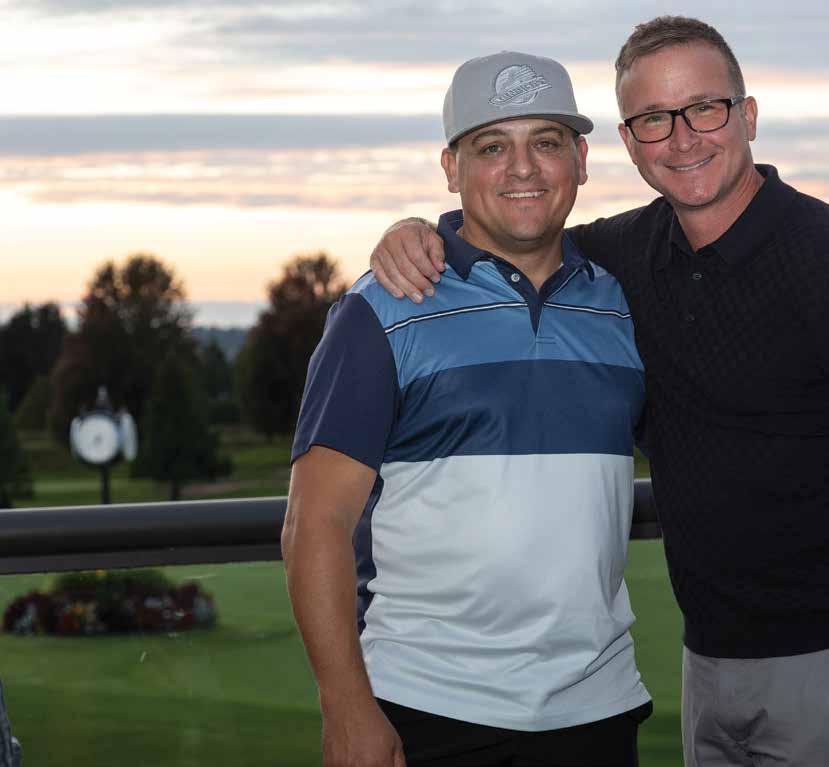
Today, SMACNA-BC and Local 280 attend career fairs, trade shows, Christmas parties, and breakfasts together. They have held and co-attended special events, like golf, dinner meetings,
guest speakers, and even held a Show and Shine. They capitalize on joint social media opportunities, and they attend Partners in Progress, SMACNA National, SMART International, and ASHRAE conferences together.
“You get a lot of business done at the golf course or at dinner or at any event that happens after hours,” Davis says. “Any industry event we can get into, we invite each other.”
“Relationships are built when you are out there meeting one another and their spouses,” Hallman says. “You start to understand that your labor or management partner is a person you can get to know and not someone you just butt heads with all the time.”
They’ve also partnered on market expansion opportunities. British Columbia has had TAB companies since the early 90s, but there is no certification required in the province.
Hallman and Davis realized that training would give their members a professional edge, so they worked together through the Joint Training Board to bring some training to the JATC, the Sheet Metal Workers’ Training Centre Society, which occupies two industry-owned buildings and employs five full-time instructors.
Labor-Management Cooperation Trust
Five members from each side comprise the JCB, which meets to discuss industry issues, successes, challenges, and points of interest leading up to negotiations.
“We might talk about market conditions or what is happening in the industry, or contractors may share news of big projects coming up so the union can prepare,” Hallman says. “Afterward, we have dinner or some other social time.”
When it is time for negotiations, Hallman and Davis go into talks ready to ensure their members are taken care of, and at the end of the day find it much easier to give a little since they’ve each spent the year building social credit.
Of course, the JCB wouldn’t function correctly if it weren’t for open communication and the same deep commitment Sychuk and Paquette established during their tenures. Hallman and Davis speak regularly on the phone, often starting with a quick call to ask a question and ending in a longer conversation covering many issues.
When Davis was an organizer, he would call to let Hallman know when he was going to talk with a company and felt that they might be interested in joining the union. “If I had a connection at that company, I would go in with Steve and have the conversation with the employer together,” Hallman says.
Most importantly, Davis and Hallman are working to ensure that the relationship they inherited from Sychuk and Paquette perseveres into the future.
“Someone from Local 280, the Health Benefits Plan, and I will do a presentation on the first day of apprentice intake class,” Hallman says. “The goal is to show young people the importance of that collaboration, so they know we need each other to get the work done right.”
“We are always trying to get more education to our members and trying to collaborate together so that our messages are the same,” Davis adds. “If our opinions on something aren’t the same, we are willing to listen to each other to decide based on what is right for the membership.”
Read more about this partnership and download the presentation from Partners in Progress 2026 at pinp.org.
Jessica Kirby is editor-publisher for Point One Media, Inc., a small but sturdy family-owned trade magazine creator representing some of North America’s most successful construction associations. She can usually be found among piles of paper in her home office or exploring British Columbia’s incredible wilderness.
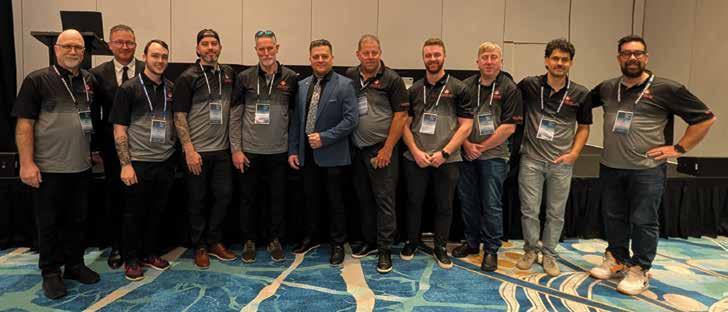
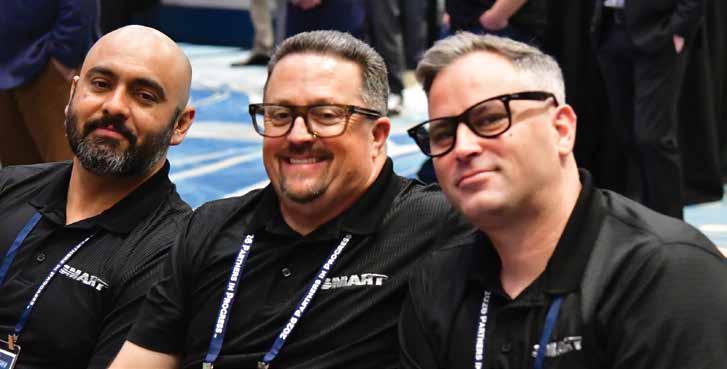
SMACNA-BC and Local 280 members attended the 2026 Partners in Progress Conference dressed in matching attire to show solidarity in their labor-management partnership.
2026 PinP CONFERENCE
• Everyone in this room is here because we care about this industry.
• Focus on opportunity.
• Don’t happen by accident. It happened because this partnership works.
• This industry has given me everything.
• Where we are today is not the finish line.
• We here to grow and invest in our industry, not to stand still.
• We have to be intentional about the people we develop. Our emerging leaders will navigate what comes next.
• Because we believe in partnership, we have turned challenges into success. As long as we keep working together, this industry's best days are ahead.
Michael Coleman, SMART General President
• When we listen and focus on shared goals, we move forward together.
• A toolbox is only as useful as the tools you put in it. The best tool is our partnership.
• When labor and management move forward together, there are no limits to what we can accomplish.
• You see the issues that will shape where the industry goes next.
• Younger people are looking for new solutions, not afraid to try.
• Mike is the kind of leader you want to work with. He works hard to find a path to yes. He makes our work more meaningful.
Todd Hill, SMACNA President
“We came to Orlando to soak it all in and see what Partners in Progress is all about.”
“We are here to learn about artificial intelligence and get tips on retaining workers at our Martinsville, Indiana, company.”
– Jason and Crystal Hilton, Hilton Ventilation and Industrial Co.
“I’m a project manager on the sheet metal side, and I work on a lot of the bigger projects that we have—government jobs, hospitals, homes, anything like that. I want to learn everything I need to know about SMACNA, how to read the industry inside and out.”
– Eric Smith, emerging leader at W. E. Bowers, Bellsville, Maryland.
“Eric needs to see the relationship between the union representatives and the contractor side. He’s young, just starting in the career. Why not start now and build that bond?”
—Tim Aley, vice president at W. E. Bowers, Bellsville, Maryland.
— Sean Mulligan, a JATC trustee with SMART Local 80 in Southfield, Michigan
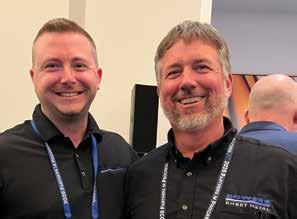
Eric Smith and Tim Aley, W.E. Bowers
WE LEAD TOGETHER TO DELIVER RESULTS
“When Local 12 comes, we come to support them because they support us. We have a great relationship with our local. We have two of our business managers and two of our business agents here. We usually bring four from our side and four from theirs. It’s a good time to go out to dinner and all that happy stuff.”
— Adam Renich, president of Renick Brothers Construction, Slippery Rock, Pennsylvania.
“Just being here is a great opportunity for everybody to network and show the movement of how contractors and the union can work together. This is a great thing to see.”
— Dale Clark, OSHA specialist for the International Training Institute.
“If you don’t do it, somebody else is going to do it. And that person may not be welltrained like you are.”
Integration, Albuquerque, New Mexico.
“We came down here to try to learn something new, to try to pick up some techniques from other locals and other SMACNA chapters. We want to see what works, what doesn’t work, and what we can bring home to our local for negotiations, for working together with our contractors. This is my fourth or fifth Partners in Progress, and every year the keynote speaker gets better and better.”
— Alex Petriccia, business manager of Local 285, Toronto, Ontario.
“Everyone in this room is committed to keeping this industry strong.”
— SMART General President Mike Coleman.
“I came here to spend time with our Local 16 labor partners. I am also interested in learning about AI and securing more work on architectural and megaprojects.”
— Steve Streimer of Portland, Oregon's Streimer Sheet Metal.
“We came to Partners in Progress to see the seminars, and we are especially interested in artificial intelligence and what it can do for our business. We are trying to figure out how to work it in.”
— John Bayne, project manager at CMC Sheet Metal in Capitol Heights, Maryland
— Tony Kocurek, owner of Energy Balance and
Michael Beaudoin (left) and Alex Petricca
SESSIONS IN REVIEW Emerging Leaders in Action: Building the Next Generation of Industry Champions
By Geoff Williams
It isn’t enough for a company to see its profits grow. Your workforce needs to grow, too. Otherwise, the cay may come when leadership has no one truly qualified to promote when experienced talent retires.
That’s where the Emerging Leaders program comes in, an annual Best Practices Market Expansion Task Force program designed to help organizations teach new members in labor and management to become better leaders, helping them to strengthen their skills, improve relationships, and sharpen their industry knowledge.
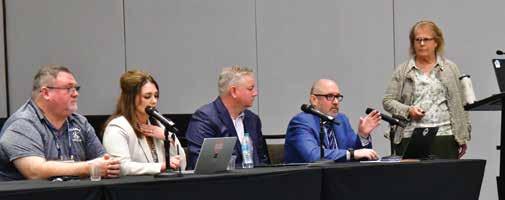
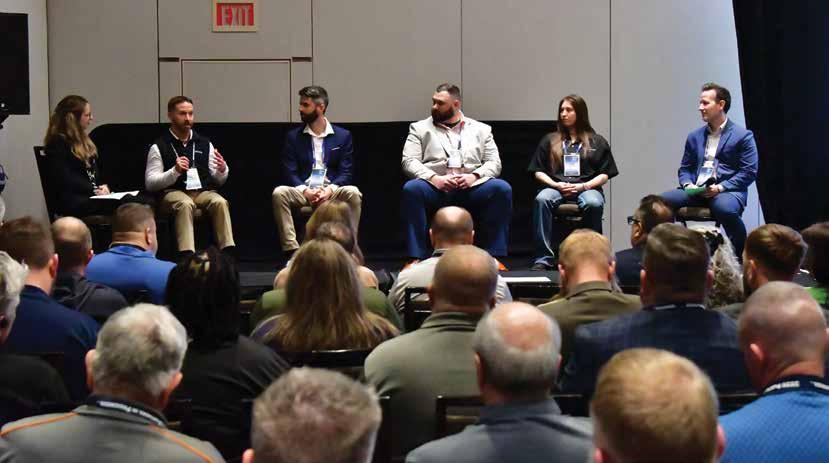
The Emerging Leaders in Action panel at the 2026 Partners in Progress Conference was moderated by Mike Reed, executive coach, and Kristi Kromidas, senior consultant, at TribusAllen, a consultancy that specializes in team building and leadership. They oversaw a panel of participants from the inaugural Emerging Leaders training, held in 2025:
• Doug Poundstone – director of manufacturing operations at DMI Companies and operational programs manager at Ductmate Industries
• Kevin Bartlett – preconstruction manager at F+F Mechanical
• Christopher Demers – Kleeberg Sheet Metal and Local 63
• Dahlia Johnson – U.S. Engineering and Local 9
Reed, Kromidas, and the panel participants walked through some of the training delivered in 2025. For instance, emerging leaders were taught to shift their mindset from trying to be a hero to becoming a coach. The hero mindset is “I must save others from harm,” whereas a coach mindset conveys, “I trust others and their abilities” and “solutions reside within each of us.”
The Emerging Leaders in Action program teaches that a leader’s role is to help employees draw upon their own creative juices to craft strategies to solve problems. But to do that, Reed and Kromidas explained, it can be challenging. Their message was: “Sometimes, you have to conquer your own emotions and go from a fear of not being needed or feeling superior to lesser experienced teammates to one of compassion, engagement and being supportive and non-attached. You need to go from rescuing teammates to empowering them.”
One way to empower a team is to coach by asking the right questions, Reed and Kromidas said, suggesting leaders apply the GROW framework—and acronym for Goal, Reality, Options/ Obstacles, and Way Forward.
For instance, if you’re trying to help a colleague solve a problem, you might ask some goal-related questions:
• What are you hoping to accomplish?
• What would a homerun look like to you?
• What is the worst thing that could happen?
Next, you would follow with reality-related questions:
• What is your part – how might you be contributing or participating in the situation?
• Where are you feeling stuck in this situation?
• How do you think the other party views the situation?
Then you’d pose options and obstacle-related questions:
• Who else can help you with this?
• What is the one thing you can do now to create movement forward?
• What has prevented you from taking the steps you know you need to take?
And finally, ask questions that help your teammate find the “way forward”:
• What are the next steps?
• What resources do you need?
• What can you learn or how might you be able to grow from this?
The training also involves developing leadership in other ways, from communicating with others and processing and engaging with teammates’ emotional triggers to taking action and executing the “mission”.
“Team trust boils down to the two teammates that trust each other the least,” Kromidas said, acknowledging that team building, especially when it’s a mix of labor and management, isn’t easy.
“Emerging Leaders training teaches people to focus and trust our teammates in a way that we can disagree and commit to
SESSIONS IN REVIEW
accomplishing our organization’s mission.”
Spencer Hobson, a 32-year-old project executive at McKinstry in Seattle, who attended the session, said he liked what he heard. “I thought that was interesting,” he said, noting he was invited to the conference as an Emerging Leader. “I’m going to take back the importance of being really self-aware in how I operate and how that’s perceived by other people.”
Resources:
For more information on the Emerging Leaders program, visit: pinp.org/conferences/pinp26/2026-emerging-leaders Watch for information on the Next Emerging Leaders Cohort: September 1-3, 2026.
Geoff Williams is a freelance journalist and author, specializing in business and personal finance, based out of Loveland, Ohio. He has written for cnnmoney.com and the Wall Street Journal’s Buy Sidewould, among other well-known publications.
AI on the Jobsite and in the Classroom: Tools for a Smarter, Stronger Workforce
Interest in artificial intelligence is almost as ubiquitous as the technology’s prevalence in the workplace, training, and union environments. This prompted two AI-themed sessions at the Partners in Progress Conference, led by Hugh Seaton, managing director of construction with Quantum Rise, an AI consultancy based out of Austin, Texas; and Mike Harris, an executive director of ITI, NEMI, and SMOHIT. The two led the audience through the basics of AI, and some of the ways it can help just about anyone in the world of sheet metal.
Seaton explained that while AI can do some extraordinary things, at the end of the day, AI is software. “In some ways, AI is
not all that different from an Excel spreadsheet,” he said. “The big difference is that AI is trained on data rather than explicitly coded for every instruction.”
In layman’s terms, that means that with Excel, users know what they will get—a spreadsheet. With AI, it is more difficult to predict what it will say. But, again, it’s software, Seaton said, and it can’t replace your judgment. “AI is not an easy button,” he continued. “It’s a tool that gets you 80% of the way there.”
But completing that remaining 20% is critical, and Seaton cautioned what many people have probably already discovered— AI gets a lot right, but it can get a lot wrong, too. It can’t be
SESSIONS IN REVIEW
fully trusted to give users the required information, even if it sounds completely authoritative. “It doesn’t know the job you’re working on,” Seaton said. “It doesn’t have intuition.”
Seaton also pointed out why it’s so easy to trust AI, even when AI is wrong: if a human gives information that may be incorrect, they tend to hesitate. They also may not fully look you in the eye. They may not sound so confident. But AI typically always seems very sure of itself when it answers a question.
Seaton reassured everyone that AI is a tool and not likely to take over the world, and he doesn’t think many people will become unemployed because of it. Well, not exactly. “You won’t lose your job to AI, but you’ll lose it to someone using AI,”
Seaton said. In other words, AI will change our industry and world, and so you can’t ignore it. Your competitors won’t.
Harris shared some of the translation AI tools that may benefit employers and the workforce. He focused on four tools:
• PowerPoint now offers an AI-fueled feature that recognizes nine spoken languages and can provide 60 subtitle languages, which can help hearing impaired or non-native language speakers understand a presentation.
• AI translator earbuds (Harris recommends the Timekettle brand) allow a caller to speak one language and the recipient to hear the caller’s message in another language—including regional dialects.
• Smart pen translators and recorders can scan printed text and read it back in selected languages It supports multiple languages, but far fewer dialects compared to the earbuds.
• AI note takers used to transcribe meetings (Harris likes Plaud) can be placed on a phone or clipped to clothing to record every word spoken, and Plaud can transcribe 112 languages.
“You won’t lose your job to AI, but you’ll lose it to someone using AI... In other words, AI will change our industry and world, and so you can’t ignore it. Your competitors won’t."
Harris cautioned users to become familiar with and observe recording laws in their jurisdictions, especially when it comes to recording people anonymously. “So be careful out there,” he said, noting that its important to be cautious about what you say going forward, regardless. “You may not own any AI note taking devices yet, but somebody else may,” he said. “In the near future, I would assume that every meeting you go into is being recorded.”
It’s definitely a new world. Heath Allard, a vice president with Climate Engineers in Eldridge, Iowa, said, “I enjoyed this session because AI just seems to be top of mind with everybody.”
Resources:
Have questions about AI? SMACNA AI Office Hours are now available. Book a free appointment with Hugh Seaton, SMACNA's AI consultant, to answer any question about AI, no matter how small or complex. Visit calendly.com/hseaton/ smacna-office-hourse to visit Seaton’s Calendly page and set up a 30-minute appointment.
Building Tomorrow: Advancing Leadership Through Innovation & Learning
IN REVIEW
Your company may do a good job of finding potential leaders, but they need somewhere to go within your organization. If they don’t, one of two things could happen—they’ll find a new job where they are challenged, or perhaps worse, they’ll stay and stagnate.
So, it’s essential to give current and developing leaders something to reach for and somewhere to go. The Building Tomorrow panel explained how a partnership in Washington state did just that by creating a foreman training program.
The three-person panel consisted of:
• B.J. Giri, managing principal of Holaday Parks, a mechanical, electrical and plumbing contractor, where he leads more than 400 employees at the company’s Seattle/Tukwila location
• Julie Muller, executive vice president of SMACNA-Western Washington
• Devin Leingang, regional council president at Local 66
The Foreman Upgrade Training program offered by SMACNAWestern Washington provides professional development for forepersons and lead forepersons, who may increase their wage by 12.5% and 17.5%, respectively, upon annual completion of 16 hours of continuing education certified by the JATC.
Before the program, many employees simply weren’t interested in becoming a foreperson. Leingang recalls an instance where 30 apprentices were asked if they were interested and only four raised their hands. “To me, that’s shocking,” Leingang said. “It’s scary. As our forepersons age out, who’s stepping up next? We need to fill that gap.
“Gen Z thinks differently,” he added. “I wouldn’t say they don’t want to work hard, but they want to do their 40 hours and go home and do their thing.”
The apprentices who declined didn’t want the added responsibility, Giri said. Or the extra pay. Something needed to be done. “We had to figure out how to get the journeypersons to take on this responsibility and become forepersons,” he said. “You can’t just tell them, ‘Tomorrow, you’re going to be a
foreperson.’ We have to invest some time and educate them— and it was a collaborative effort to get to that.”
Muller says management saw a similar trend in fulfilling foreperson roles. “There was a need for us to motivate and support these individuals into taking on these leadership positions,” she said. Once labor and management began talking to potential candidates, they soon learned, however, that it wasn’t that the younger workers didn’t have ambition. The feedback was that the extra responsibilities simply weren’t worth the extra money. Forepersons were reporting being burned out and under too much pressure, often due to difficult estimates, irregular schedules, and too many projects to juggle at one time.
SMACNA-Western Washington and Local 66 responded with the Foreman Upgrade Training program, which has been a big hit. The training is a shared responsibility model in which SMACNA, the JATC, and Local 33 each partner commits to offering a minimum of four training sessions each year, and the curriculum is locally developed. It also offers continuing education, allowing Local 66 workers to grow and develop, while raising their pay accordingly.
And while the coursework naturally teaches technical skills, like drawing duct floor plans or understanding DOSH and OSHA regulations, it also provides transferable soft skills, such as strengthening leadership skills.
“Soft skills, that was our turning point,” Muller said. “Our JATC has done a fantastic job training the technical side, but the soft skill side, that leadership development and workforce development is what we were really after.”
It was a win-win for everyone. Once potential forepersons were presented with job-specific training and corresponding pay increases, they realized that management and the union had their backs and were investing in them. At the same time, management knew they were getting a robust return on their investment.
Resources:
More information about the Foreman Upgrade Training can be found here: smacnaww.org/foreman-training/how-it-works