REDEFINING THE DEMOCRATIC LANDSCAPE FROM WITHIN PUBLIC SPACE
By Denilyn Arciaga for the purpose of obtaining the degree of MS in Design & Urban Ecologies at Parsons School of Design The New School May 2019
Thesis Advisor: Dr. Gabriela Rendón
Assistant Professor of Urban Planning and Co-Chair
Secondary Advisor: Dr. Miodrag Mitrašinović
Associate Professor of Urbanism and Architecture
Acknowledgements
The continuation and completion of this thesis would not be possible without the invaluable support of the Urban Council. For them, I am forever grateful. Specifically, I would like to express my deepest appreciation to my advisors Gabriela and Miodrag for their encouragement, enthusiasm, and most valuably, their thoughtful time. Gabriela, thank you for helping me move forward and Miodrag, thank you for helping me move upward.
Words cannot express how thankful I am for the support of colleagues throughout this project's journey. First, my thesis studio group consisting of Alexa Jensen, Mariana Bomtempo, Shibani Jadhav, Drew Vanderburg, and Darcy Bender. This extends to Gamar Markarian, Nadine Rachid, Nadia Elokdah, Renata Benigno, Ravi Govada and the rest of the DUE & TUP cohort.
I would also like to thank my friends and family for keeping my spirits up during the external struggles of this project. They are my core and foundation. Especially my partner, Tom.
Lastly, the inspiration of this project would not be possible without the users of Union Square Park who have spoken with me and provided interesting insights about public space. This project is just as much theirs as it is mine. I am especially thankful to chess player "Big John" who, after much time later, continues to ask about my health and well-being. It feels truly special to have Union Square Park feel like a second home in the chaos of this city.
27 I. The First Public-Private Partnership in the Creation of Union Square Park Space of Mass Congregation between Sites of Luxury Consumption & Production (1800s - 1890s)
II. The Second Public-Private Partnership in the Destruction of Union Square Park Space of Mass Dissent between Sites of Affordable Consumption & Production (1900s - 1970s)
III. The Third Public-Private Partnership in the Revitalization of Union Square Park Space of Mass Programming between Sites of Corporate Chained Consumption & Production (1900s - 1970s)
Key Terms / Abbreviation Terminology
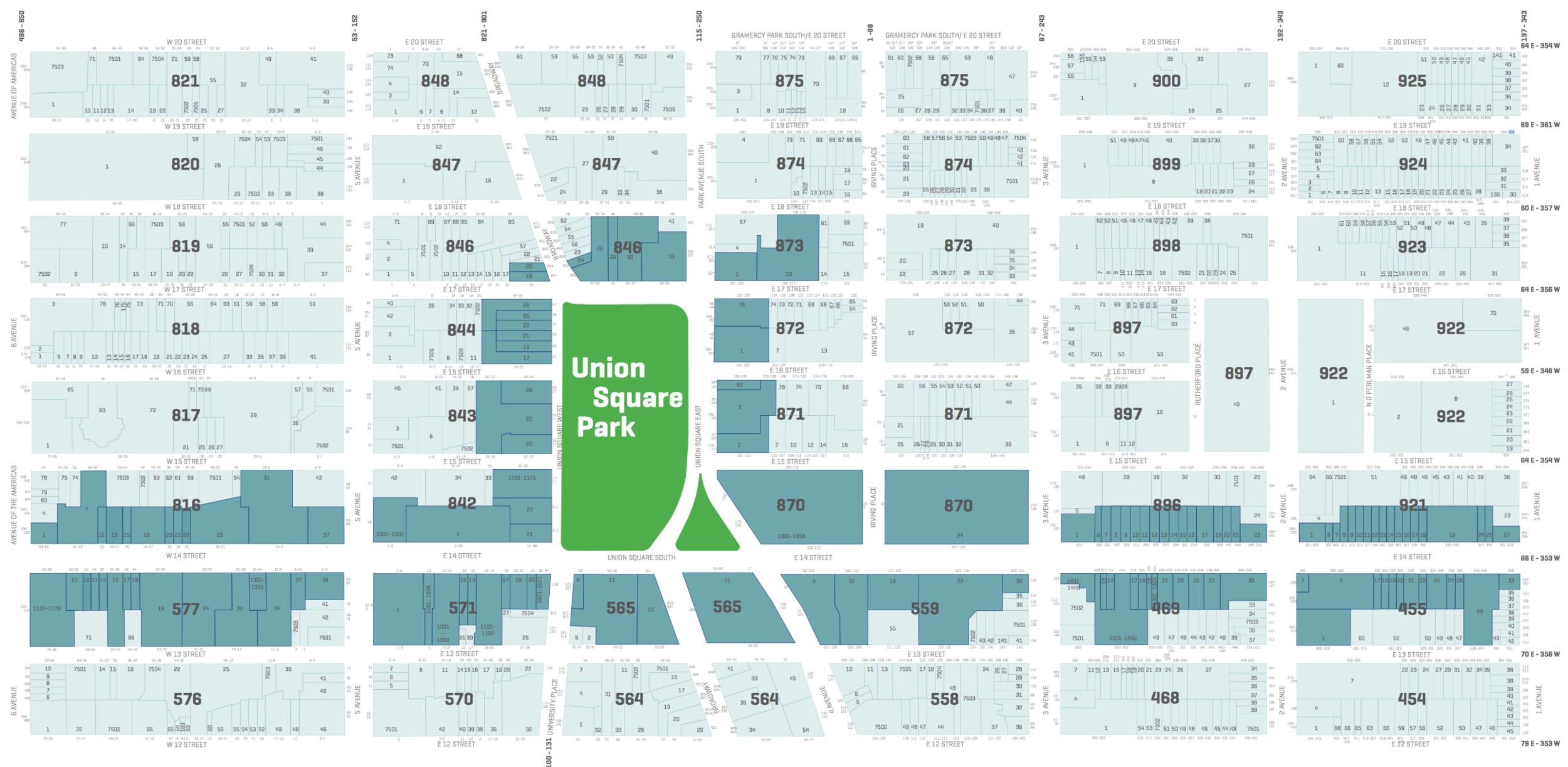
Union Square Park / the Square: Union Square Park, formerly known as Union Place. Located in the neighborhood of Union Square, bounded by 14th Street on the south, Union Square West on the west side, 17th Street on the north, and on the east Union Square East, which links together Broadway and Park Avenue South to Fourth Avenue and the continuation of Broadway.
BID: Business Improvement District.
LCD: Local Development Corporation.
PPP: Public-Private Partnership.
Union Square Partnership / the Partnership: Both a BID (established in 1984) and LCD (formed in 1976).
NYC Department of Parks & Recreation / Parks Dept: Formed in 1870.
NYC Department of Small Business Services / SBS: They oversee the largest network of Business Improvement Districts in the country.
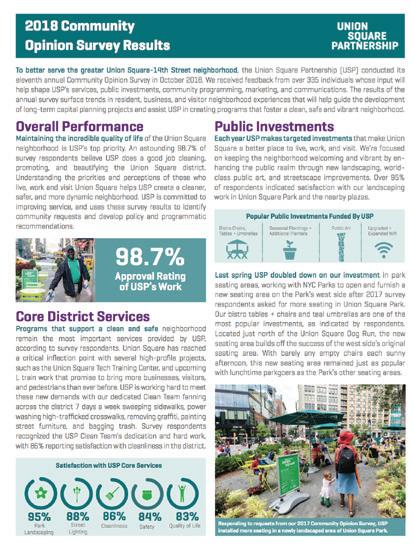
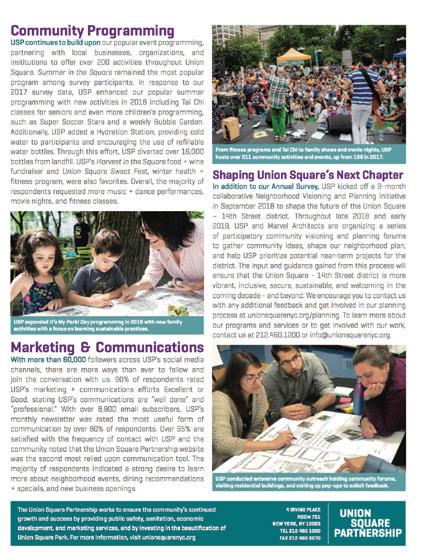
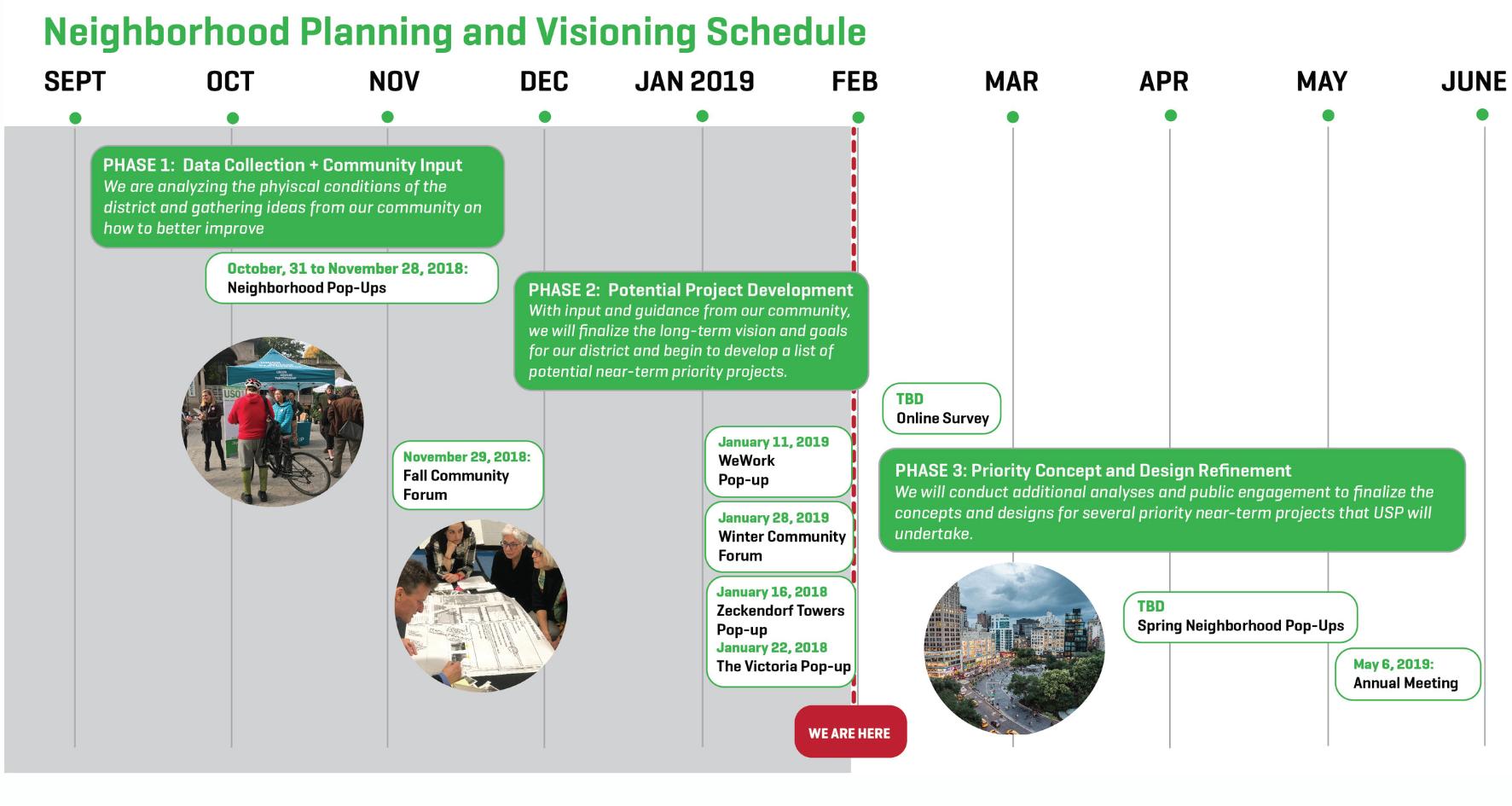
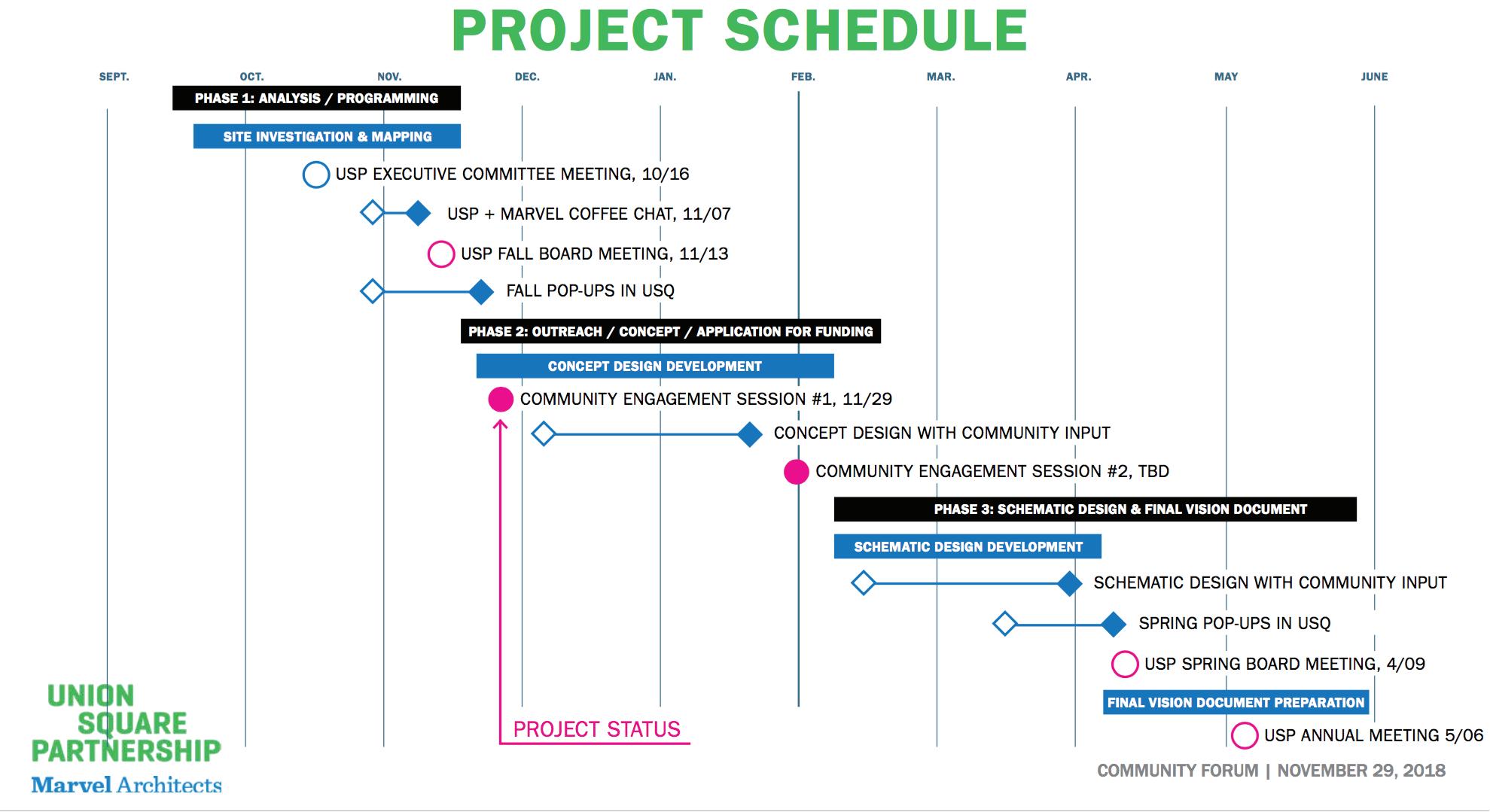
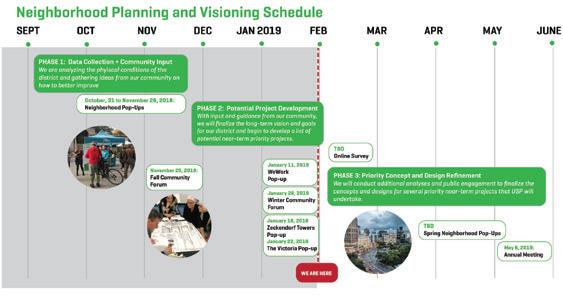
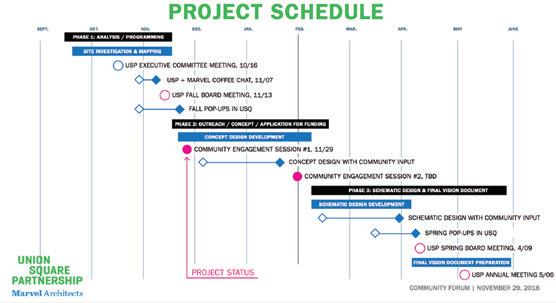
Neighborhood Visioning and Planning Initiative: Created by Union Square Partnership in collaboration with Marvel Architects. September 2018 - May 2019
Ladder of Citizen Participation / LoCP: analytical tool used to assess the gradation of citizen participation.1
1 Sherry R. Arnstein, “A Ladder of Citizen Participation,” Journal of the American Institute of Planners 35, no. 4 (1969): 216-224.
Preface:
My Opening Move into the Thesis Project.
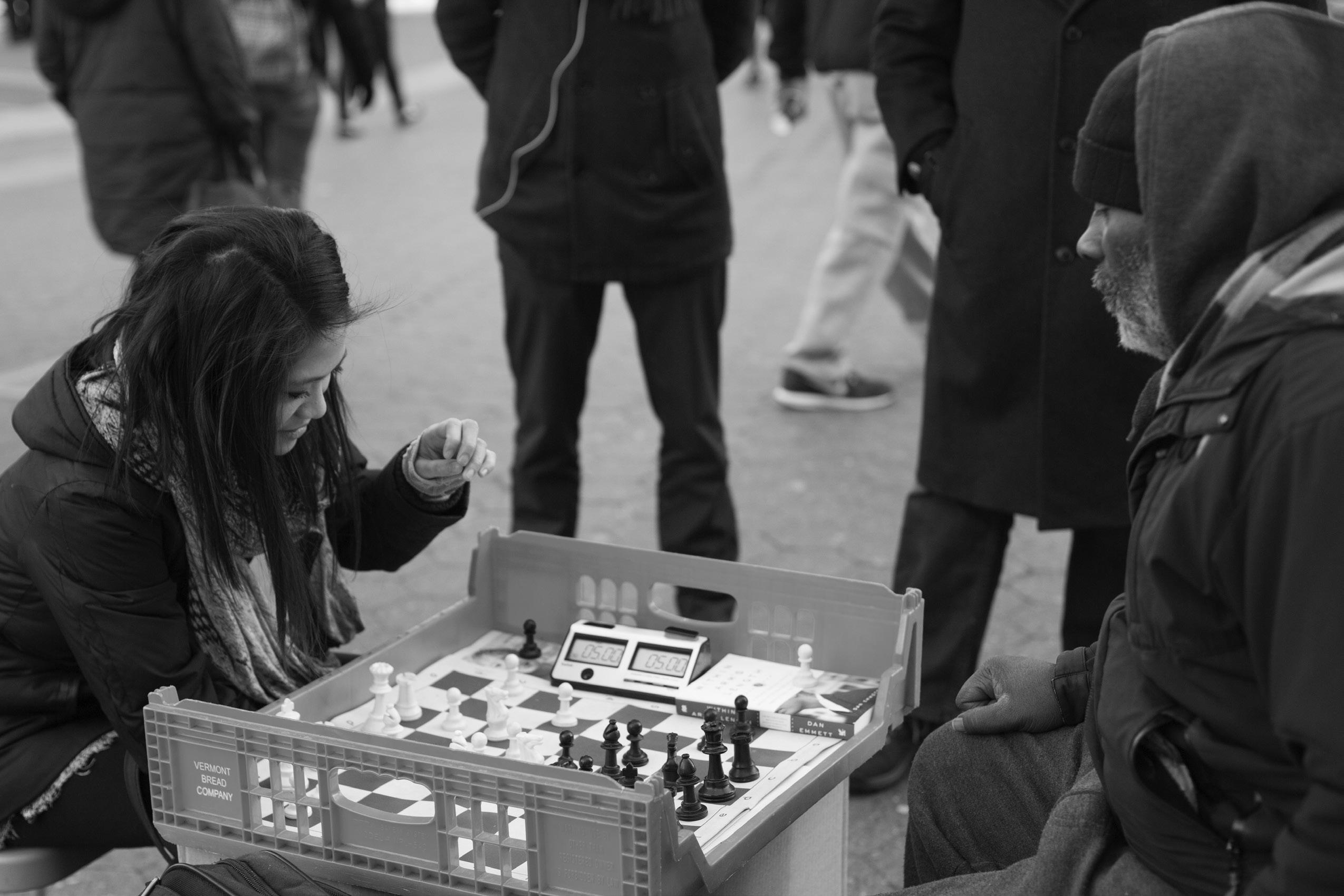
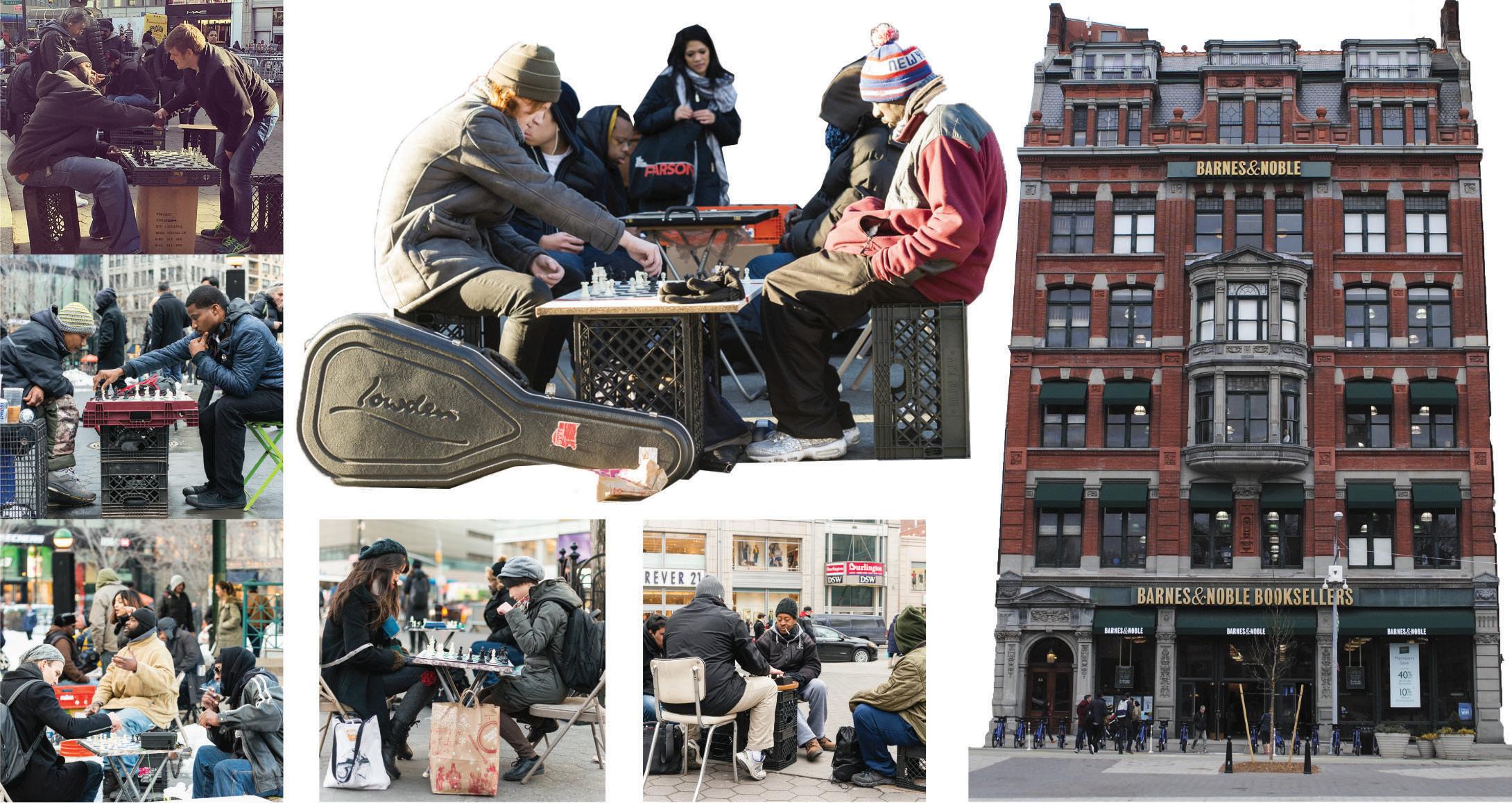
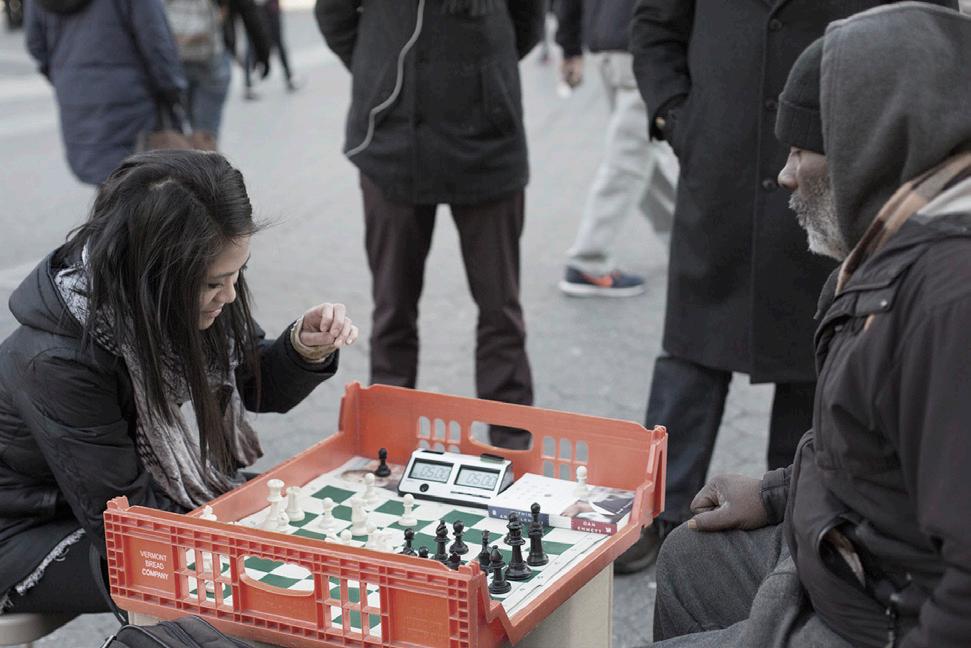
Living here in New York City inspires a bucket list for some people. Though my list consists of simple activities, a few demand a child-like bravery. For a year and a half, I passed through Union Square Park on my way to The New School and saw the chess players routinely playing and occupying the southwest plaza. Like many others that I’ve interviewed throughout the journey of this thesis project, I too, found them intimidating. On my birthday, just before the thesis studio semester began, I muscled up the courage and ventured to the Square.
In less than two minutes, I finally checked off ‘playing chess with the guys at Union Square Park’ from my list. Clearly, I lost. However, it didn’t end there. The chess player critiqued in backward sequence my weak moves and demonstrated alternative combinations that I could have played to stay in the game. During this experience, I saw the chess players interacting not only with each other, but greeting passerbyers’ by name. These interactions
felt like Union Square Park’s own version of Jacobs’ “eyes on the street”.2
Throughout my earlier fieldwork of Union Square Park, I found the group of chess players to be much more dynamic than my initial impression and their presence as a sort of microcosm of the use of urban public space. Like most would agree, my perception was that a majority of them use the space for economic gain and that many aren’t wanted if they display unetiquette behavior. This is true, but there are also other truths about the players: a handful use the space for artistic expression, some use the space to socialize, while others play to cope and heal. To be interwoven into their social fabric is to see the larger importance of public space: many of them, like other users in the park, use it as a site to teach and exchange knowledge. I hope this thesis can be a tool to those who advocate democracy for and within our urban public spaces.
2 Jacobs, Jane. The Death and Life of Great American Cities. (New York: Random House, Inc, 1961), 35.
Opposite Page: Image by Photographer/Passerbyer named Mike, Spring 2016
INTRODUCTION
Abstract
Recent decades have witnessed a paradigmatic shift towards the landscape of privately managed public spaces within New York City and all across the nation. The revitalization of public spaces due to these public-private partnerships, Business Improvement Districts, is a well-rehearsed political instrument used to cultivate public support despite a wide-range of criticism within the scholarship of urban studies; mainly, that these privatized urban practices have resulted in exclusionary and anti-democratic processes.3 Thinking Outside the Square is an exploration in-between the pro-BID and anti-BID duality by re-examining historical conditions in the context of democracy: accessibility within and inclusionary planning for public space. Specifically focusing on Union Square Park as New
3 Zukin, Sharon. Naked City: The Death and Life of Authentic Urban Places. (Oxford: Oxford University Press, 2011,) 128; Madanipour, Ali. Whose Public Space? International Case Studies in Urban Design and Development. (London: Routledge, 2010,) 3; Mitchell, Don. The Right to the City: Social Justice and the Fight for Public Space (New York: Guilford Press, 2003,) 201.
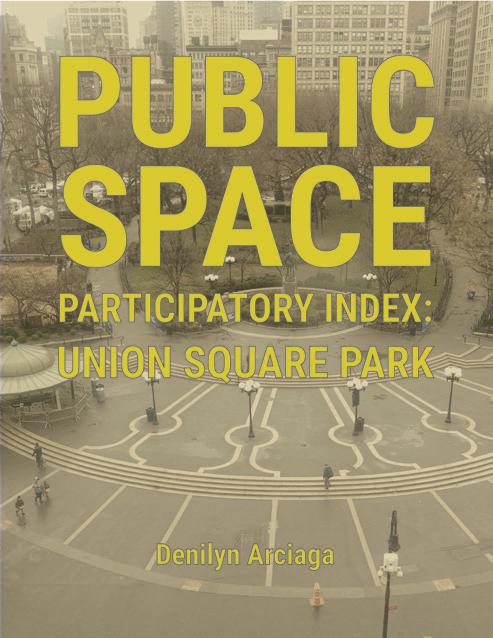
York State’s first BID model4 (Union Square Partnership), the research is a deep exploration revealing unequal forms of public-private partnerships throughout the Square's history. Furthermore, the evolution of democracy has been defined and limited through power dynamics long before the BID's existence. The research leads into a critical evaluation of Union Square Partnership’s current 9-month Neighborhood Vision & Planning Initiative. Drawing on ethnographic fieldwork and adopting Sherry Arnstein’s Ladder of Citizen Participation as the theoretical framework, a Public Space Participatory Index is designed to present to the urban-actors that circulate the Planning Initiative in an attempt to challenge traditional forms of top-down participatory planning processes.
4 New York City, Department of Small Business Services. Business Improvement District NYC 2011. New York City, NY. 4
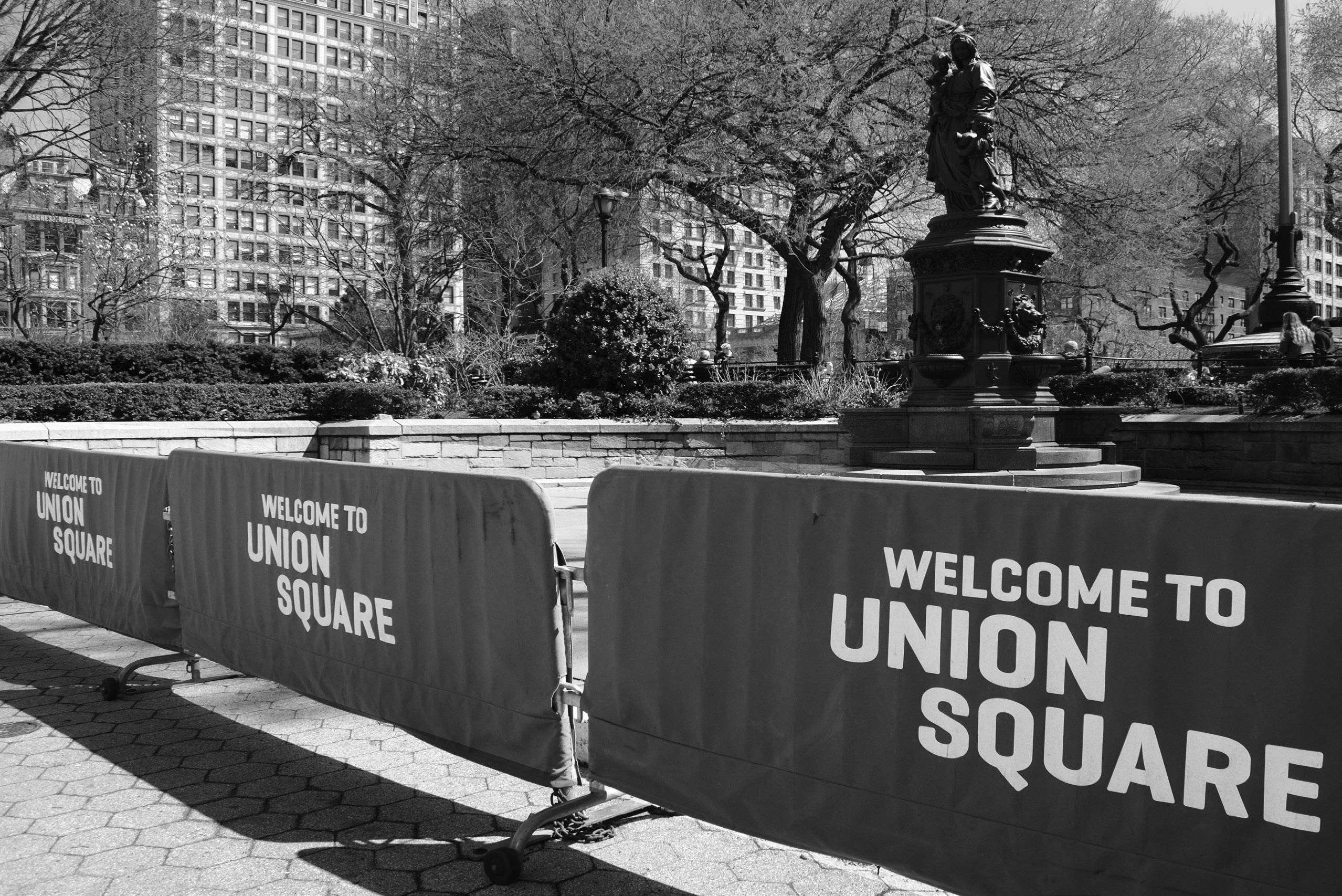
Opposite Page: Image by Denilyn Arciaga, Spring 2019
-Matthew Carmona, Public Space: The Management Dimension “...public space was never as inclusive, democratic and valued as many would have us believe.”
exploration of research
“In this defeat, the public both gains the use of a clean safe space and loses control over it.”
decisions shift to those in power
PRIVATIZATION
unequal development non-democratic process of planning private interests over public assetts
social inequality
loss of local culture loss of affordability rising rents
-Sharon Zukin, Naked City weakens diversity
GENTRIFICATION
commercialization of public space displaces long term residents & businesses victimizing homelessness
highsurveillance of space
Problem Statement & Thesis Aim
This project traces along three problematic areas that are identified throughout the research development surrounding the site of research and intervention. First, the entry point into the research is due to the exponential growth of BIDs and their contested practices of the private management over public spaces. Second, at the core of this historical research, is the repeated neglect of inclusionary, democratic processes within the political dimensions of Union Square Park. These findings weaken the arguments made by urban theorists who claim that the public loses control over public space due to the formations of BIDs.5 Third, a critical analysis is needed of the current methods of participatory planning through the Neighborhood Vision & Planning Initiative due to the low numbers of participants.
As previously mentioned, urban public spaces have transformed into sites of Business Improvement Districts shifting towards privately managed public spaces. These public-private partnerships (PPP) camouflage by other titles such as Community Improvement District, Special Services Area, Business Improvement Area, Business Revitalization Zone, or Special Improvement District but they all perform the same function in supplementing public services provided by the city: to fund the maintenance, improvement, and promotion of their
district within a specific geographic area.6 The main narrative that BID’s manifested as a response to the urban social decline of the mid 20th century legitimizes the political sector and private interest groups who claim that these models have significantly ameliorated decaying and precarious spaces.7 The opposing view critiques these revitalization processes contesting that they are exclusionary, reinforce social inequality, and are undemocratic; mainly, they have privatized urban public spaces for the economic benefit of a particular class identity.8 Furthermore and rarely explored, there is a third viewpoint that argues that the privatization of public spaces has been exaggerated, and that public space was never as inclusive, democratic, and valued as many analysts suggest. While much emphasis has been placed on the positive and negative impacts of BIDs, little research has been conducted about democracy within and for public spaces prior to these particular PPP formations. This thesis engages with the third viewpoint while taking on the position that democracy is necessary for and within public spaces. In this research, I define democracy for public spaces as inclusionary citizen participation in the political spaces
6 New York City, Department of Small Business Services. FY17 Business Improvement District Trends Report. 2017, NYC Business Improvement District Trends Report, New York City, NY.
7 Heather MacDonald, “BIDs Really Work,” City Journal, April 1, 1996, 29-42; Amy Armstrong et al., “The Benefits of Business Improvement Districts: Evidence from New York City.” New York, NY: Furman Center For Real Estate & Urban Policy, New York University, 2007.
5 Zukin, Naked City, 128.
8 Sharon Zukin, Naked City, 128-131.
of planning. Democracy within public spaces is equated to accessibility: for all to enter and congregate these public spaces.
MEASURING DEMOCRACY OF PUBLIC SPACE
The NYC Small Business Services oversees the current 76 Business Improvement Districts, which is the highest in the nation.9 The Union Square Partnership is New York State’s first BID, established in 1984. A decade later in 1994, Union Square Park was designated as a National Historic Landmark (NHL) from the United States Department of the Interior. To achieve this status, the landmark must meet one of six to eight conditions under one of two criterias.10 Due to its classification as a NHL in regards to its significance of American labor history, I deduce that it qualified under the following criteria:
9 New York City, Department of Small Business Services. FY17 Business Improvement District Trends Report. 2017, NYC Business Improvement District Trends Report, New York City, NY. 8-9
10 LII Electronic Code of Federal Regulations (e-CFR) Title 36. Parks, Forests, and Public Property Chapter I. NATIONAL PARK SERVICE, DEPARTMENT OF THE INTERIOR Part 65. NATIONAL HISTORIC LANDMARKS PROGRAM Section 65.4. National Historic Landmark criteria.
Ҥ 65.4 National Historic Landmark Criteria:
(a) “The quality of national significance is ascribed to districts, sites, buildings, structures and objects that possess exceptional value or quality in illustrating or interpreting the heritage of the United States in history, architecture, archeology, engineering and culture and that possess a high degree of: integrity of location, design, setting, materials, workmanship, feeling and association,” and one, two, or all three of the following conditions:
(1) “That are associated with events that have made a significant contribution to, and are identified with or that outstandingly represent, the broad national patterns of the United States history and from which an understanding and appreciation of those patterns may be gained; or”
(2) “That are associated importantly with the lives of persons nationally significant in the history of the United States; or”
(3) “That represent some great idea or ideal of the American people; or”...
It is this third condition, supported by the research development, that illustrates why Union Square Park is one of the most historically significant public spaces in post-colonial America. The site not only represented some great idea or ideal but served as a pluralistic platform for commoners’ ideals that attempted to challenge political norms.
On November 05, 2015, the NYC Landmark Preservation Committee (LPC) held a public meeting about designating Union Square Park as a City Scenic Landscape (CSL).11 The title of a CSL would only allow changes approved by the NYC LPC. According to the
11 Evan Bindleglass, “Preservationists Oppose Making Union Square Park a City Landmark,” New York YIMBY, November 6, 2015, https://newyorkyimby.com/2015/11/preservationists-oppose-makingunion-square-park-a-city-landmark.html (accessed February 28, 2019)
LPC, CSLs must be a city-owned park that meet the following criteria: 1) Be at least 30 years old 2) Have “a special character or special historical or aesthetic interest or value as part of the development, heritage, or cultural characteristics of the City, state, or nation” and 3) Be a landscape feature or aggregate of landscape features. Surprisingly, Jack Taylor from the Union Square Community Coalition and Kelly Carroll from the Historic Districts Council opposed this designation due to the lack of historical integrity. Carroll argues that “with two centuries of changes to the park, it is difficult to determine original historic fabric; moreover, what fabric from which period of time”. She also pleaded that while “entities responsible for the stewardship of the park have been studious about interesting improvements, they have not had a good history of respecting its heritage and unfortunately, the park has been a magnet for accretions”.12
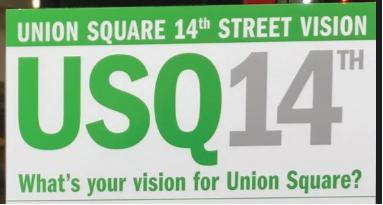
In September of 2018, the Union Square Partnership developed a 9-month “Union Square-14th Street Neighborhood Vision and Planning Initiative” to shape the future of Union Square and selected Marvel Architects to guide the process. They welcome all who have a stake in the community to join them in their effort and that everyone’s voice should be part of the conversation. This is a strong move towards participatory planning. However, it elicits a set of questions that at the center demands to know if the efficacy of these methods is towards a truly democratic process and public space.
12 Bindleglass, “Preservationists Oppose Making Union Square Park a City Landmark,” New York YIMBY, November 6, 2015.
Research Context & Questions
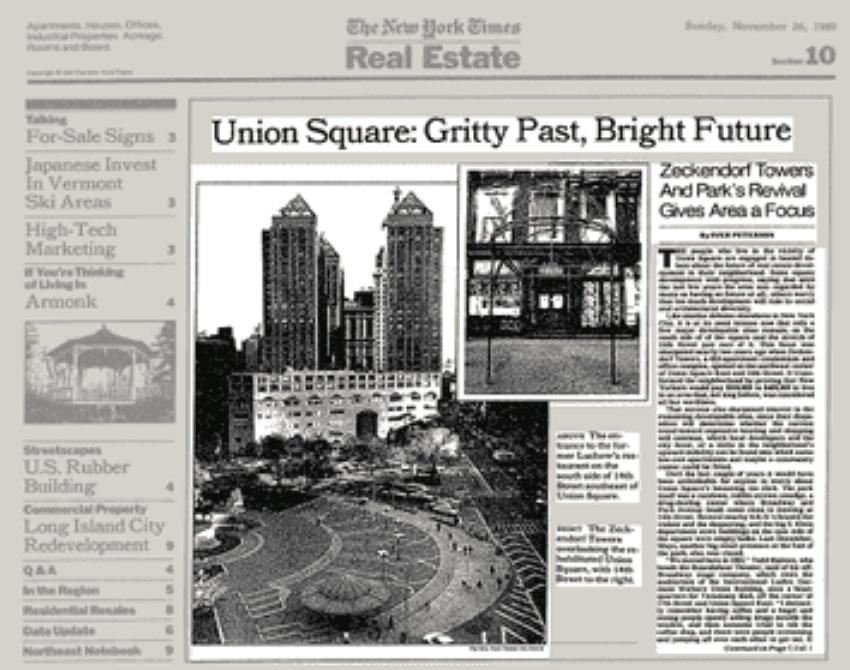
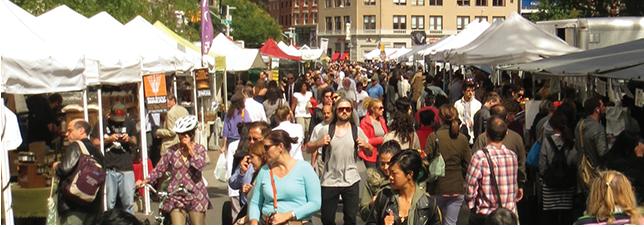
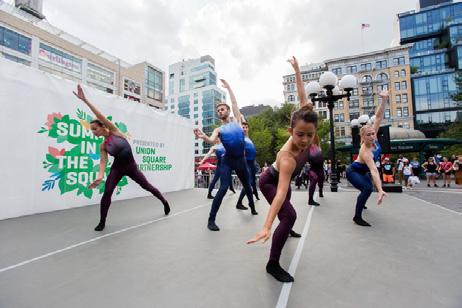
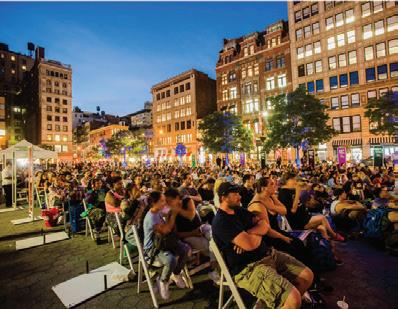
Union Square Park is a bustling, multi-functional square that is highly programmed with special events, Greenmarkets, families playing with children at Evelyn’s playground, pet owners at the dog park, artists, grass loungers, spectators, protestors, chess players, and subway transit users. It wasn’t always this way. Like many other parks in New York City, the urban social decline during the 1970’s paved way for illegal drug activity and homelessness in a Square avoided by many.13 But it wasn’t always this way either. Union Square Park has a deep history entrenched with ebbs and flows between power holders, planners and public-private partnerships that managed the public space, and the groups of users who made it historically famous.
This thesis acknowledges that solely focusing on Union Square Park and the Partnership is similar to observing a drop in the ocean of BIDs. However, its marker is significant in influencing a tide of the current 75 New York City BIDs to date.14 As mentioned in the previous section, the entry point to this thesis research responds to the viewpoint that privatization of public spaces are exaggerated and that public spaces were never as inclusive, democratic, or valued as many analysts suggest. In order to dialectically converse with these
13 Peterson, Ivan, “Union Square: Gritty Past, Bright Future.” The New York Times. November 26, 1989.
14 New York City, Department of Small Business Services. FY17 Business Improvement District Trends Report. 2017, NYC Business Improvement District Trends Report, New York City, NY. 8-9
arguments, the research focuses on Union Square Park as the site of public space by reexamining democracy within the comprehensive histories into the present day.
Two questions guide this research: (1) How have publicprivate partnerships controlled the levels of democracy for and within Union Square Park prior to the BID? (2) Is Union Square Park an example of a public space that was never as inclusive, democratic, or valued as analysts argue?
The research development is compiled with a precontext chapter followed by the three main chapters. The pre-context provides a quick overview of the historical growth of American public spaces and their typologies. Prior to the establishment of the Square, public space identities shifted during colonialism in the early 18th century to post-colonialism in the latter half of the century; and again throughout the parks movement in the 19th century. These epochs illuminated the role of citizens and rendered the functions of use. Parallel and defiant to these epochs, Union Square Park emerges as it disconnects and reconnects with the landscapes of public spaces.
For the rest of the chapters, I divide the history into what I interpret as three eras of public-private partnerships. They are categorized from the 1800’s until 1890’s, 1900’s until 1970’s, and the 1970’s until present day. The three periods that I have defined are chosen to help
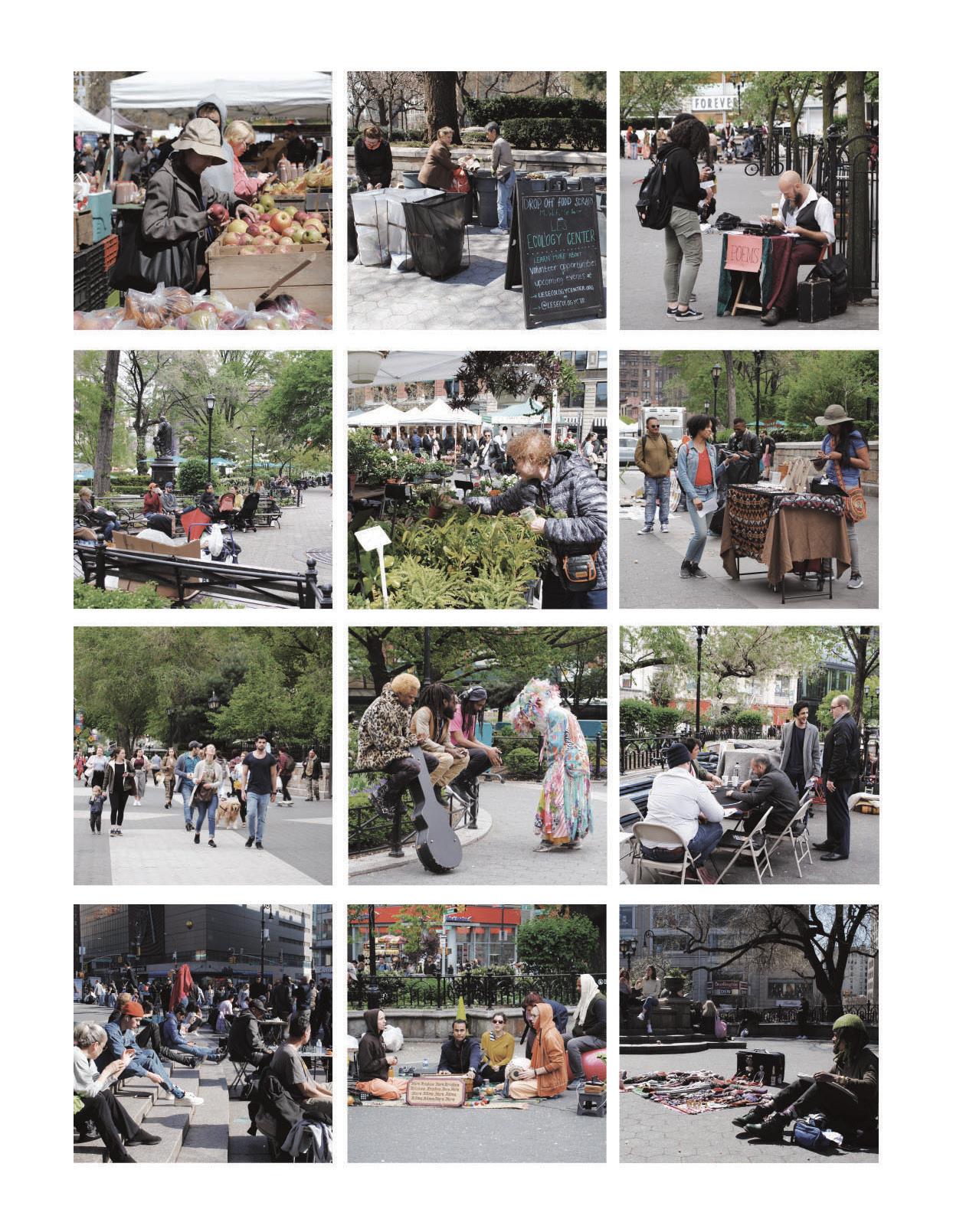
Opposite Page: Images by Denilyn Arciaga, Spring 2019
3 ERA’S OF HISTORICAL RESEARCH IN UNION SQUARE PARK
creation I.
Chapter I. 1800s - 1890s
Chapter II. 1900s - 1970s
Chapter III. 1980s - present
Pre-Context.
structure and organize the complicated and clashing histories of Union Square Park. With that being stated, it is important to note that the PPP in each era is not necessarily an umbrella over the entire period; in fact, the first two public-private partnerships start the large-scale physical transformation of space but other power holders, key actors, and groups of users enter into context. Each chapter title includes a subtitle that analytically describes the site within the surrounding spaces. Oversimplified, the following sections are loosely structured in each chapter to address the primary guiding thesis questions: first, the key actors within the PPP, the purpose of their objective, and how they impacted the public space; second, the decision makers of public space (controllers and managers) and their assigned planners; third, the state of democracy and users in the space; and lastly, a critical assessment of that time frame. Within the writings of the chapters,
there are brief italicized stories. These interruptions serve as a mosaic piece of my fieldwork and ethnography conducted in Union Square Park. These insights are the present day liminal experiences that connect with its related historic content.
Chapter One is titled “The First Public-Private Partnership in the Creation of Union Square Park: Space of Mass Congregation between Sites of Luxury Consumption & Production”. The main argument of this chapter is to demonstrate that, in the case of Union Square Park, public space wasn’t created for the benefit of the public but to incentivize real estate development. Furthermore, civic formation and participatory democracy were marketed in the Square to boost property values. Chapter Two is titled “The Second Public-Private Partnership in the Destruction of Union Square Park: Space of Dissent between Sites of Affordable Consumption & Production”. The primary objective is to complicate the widely
destruction II. revitalization III.
SECONDPUBLIC-PRIVATEPARTNERSHIP
THIRDPUBLIC-PRIVATEPARTNERSHIP
perceived narrative that the urban social decline began in the mid-twentieth century. Instead, the chapter begins the narrative at the beginning of the twentieth century during the destruction of the Square. The creation of underground transit mobility throughout the city transpired the forces that immobilized the democracy of mass gatherings above ground. The final third chapter is titled “The Third Public-Private Partnership in the Revitalization of Union Square Park: Space of Mass Programming between Sites of Corporate Chained Consumption & Production”. The primary objective steers clear of placing the BID structure under a microscope but reconsiders other organizations and local efforts that helped in reactivating Union Square Park which have been contentious with the BIDs historical transformations of the Square. This segways into the current Union Square Partnership’s community-based methodologies, specifically their Planning Initiative. The
pendulum of democracy within the overall landscape of public-private partnership seemingly swings towards inclusionary, participatory planning. However, through this project's design proposal their methods must be evaluated to determine if and how participants impact the outcomes of these processes.
The three chapters are more than a regurgitation of the linear passages of time. They serve to capture the patterns and cycles of traditional practices in the larger paradigmatic shifts of urban planning. The comparison and contrast of the chapters generate insights about the evolution of public space democracy within Union Square Park. This has not been an easy task for a modest urban space that is only 3.5 acres. These passages of time contain a collision of theories that are complicated to disentangle as I will stress in the next section.
UNDER POLITICAL-ECONOMIC ARCS
FIRSTPUBLIC-PRIVATE PARTNERSHIP
Theoretical Framework
Through a Political-Economic Lens
Times and scales are the dimensions that construct the theoretical framework. Essentially, the research development spans about two and a half centuries. Due to the heavily structured research rooted in the historical development of Union Square Park, a set of political-economic lens are applied to magnify the interconnected forces of transformation that shaped the planning.
In the main chapters, there is a correlation with the given time periods as they follow a pattern of the broader economic theories. To understand these larger theories that descend into the area of research, I briefly touch upon the larger economic theories of Classical, Marxian, Neoclassical, and Keynesian structures. Richard Wolff's work is the main source of information as he heavily focuses on how these economic theories contrast and defy each other.15 In the relevance of Union Square Park, the first chapter's time frame is throughout the 1800 where Classical economic theory dominated and Marxian disrupted as a critical response. Keynesian structures emerged as a response to the failure of Neoclassical methodology. Although the second chapter's time frame is between 1900-1970, the end of the Keynesian era in the 1970s significantly impacted the site of study that led into the third chapter which shifted urban practices under the processes of neoliberalism.
15 Wolff, Richard, Contending Economic Theories: Neoclassical, Keynesian, and Marxian, (Cambridge: MIT Press, 2012)
The domino effect of how these larger theories affects the creation of Union Square Park is employed through analyzing the site of study as part of the 'city as a growth machine'.16 Harvey Molotch and John R. Logan coined this phrase when describing the phenomena of the commodification of real estate through urbanization in the 1800s. Their fundamental observation sets the tone of how Union Square Park becomes controlled through various power dynamics.
Assessing the Levels of Participation
Within the current processes of the Partnership’s collaborative Neighborhood Visioning and Planning Initiative, where are the spaces of inclusive planning that define democracy? According to Sherry Arnstein, citizen participation is the foundation for democracy. However, not all forms of citizen participation are synonymous to citizen power. Arnstein was not a planner but her 1969 seminal guideline, "A Ladder of Citizen Participation", pioneered the concept of measuring the levels, or gradation, of citizen participation.17 The power in evaluating the varying degrees of participation helps identify how much or how little of an impact that citizens have in the planning processes. Furthermore, it reveals the power structures, or gaps, between the 'haves' and 'have-nots'. In this way, planners can design participatory methods that better faciliate and create processes that lead to the distribution of decision-making to the 'havenots'. By adopting Arnstein's framework in this project, I 16 John Logan and Harvey L. Molotch, Urban Fortunes: The Political Economy of Place. (California: University of California Press, 1987).
17 Sherry R. Arnstein, “A Ladder of Citizen Participation,” 216.
can assess the various levels of citizen participation throughout the Partnership's Planning Initiative in order to determine the efficacy of their methods towards citizen power or reveal opportunities where those areas can be improved.
Arnstein characterizes 8 levels of participation which is divided into three segments in Ladder of Citizen Participation. The three segments represent the
outcomes by which a citizen has influence in the results of the decision-making process. From bottom to top is: 'non-participation', 'degrees of tokenism', and 'degrees of citizen power'. They specify the following: 'non-participation' includes 1) manipulation and 2) therapy; 'degrees of tokenism' includes 3) informing, 4) consultation and 5) placation; and 'degrees of citizen power' includes: 6) partnership, 7) delegated power and 8) citizen control. It is through the top levels that participants can achieve true empowerment in having
LADDER OF CITIZEN PARTICIPATION
“citizen participation is the cornerstone of democracy.” -Arnstein democratic planning for public space
DEGREES OF CITIZEN POWER
8 citizen control
Total control of the planning and managing of space.
7 delegated power
Citizens hold majority of seats on committees with delegated powers to make decisions.
6 partnership
Power is redestributed through negotiation between citizens and power holders. Planning and decision-making responsibilties are shared.
DEGREES OF TOKENISM
5 placation
Citizens advise or plan but power holders decide.
4 consultation
Opinion surveys, neighborhood meetings, etc.
3 informing
First step to legit participation, but one-way flow of information with no opportunity for feedback
NON-PARTICIPATION
2 therapy
Powerlessness as something that can be ‘cured’.
1 manipulation
Citizens serve on committees but used by power holders to demonstrate citizen participation.
Diagram created by Denilyn Arciaga based off Sherry Arnstein’s “Ladder of Citizen Participation”.
Methodology
real impact to control the decisions.
The methodology of research for this project can be divided into two aspects which led to the analysis and design strategy. Broadly, they were conducted through 1) qualitative methods through field research and 2) literary sources that provided the theoretical frameworks and comphrehensive histories.
Field Research
Participant Observation:
The original inspiration for this project was from a particular group of users and how they interacted within the space and other groups. Due to this, I found it crucial to study the site by actually immersing myself into the site of study. Through open-ended interviews, I gained multiple-perspectives of how and why people used the public space. My focus was on the south/southwest plaza where many of the informal groups of users lounge. After a few weeks, people started recognizing me and telling me their own stories. There is an Argentinian man named Govinda who has been frequenting the space for 7 years due to the Hare Krishna's presence. Tyrone, in his 20's, is friends with some of the chess players but mostly hung around waiting for his girlfriend who is studying her Masters at The New School. Sarah has been a resident for the area for about 20 years and had a lot to say about the Square's transformation during the 1990's. David is an anomaly when it comes to the chess players as he locates himself in the west side plaza behind the
farmers market trucks. He prefers the "quietness" of that spot. He was born in South Korea but grew up in Venezuela and plays in Union Square Friday - Sunday until mid-afternoon. I played with David a few times and a passerbyer said that I've "got a great instructor". For the last 7 years, Uversa sits by the water fountain because of the energy. She is a tarot card reader and has regulars who visit her. I've seen one woman cry while Uversa hugs and consoles her. I spent a lot of time observing the chess players, specifically interacting with a man named John Hill, who became my contact point. His unique perspective on his 'respect of the space' and having been a former worker with the Parks Department led to insightful conversations about him knowing the rules of the park and contesting with operators of the park who told the chess players that they couldn't play.
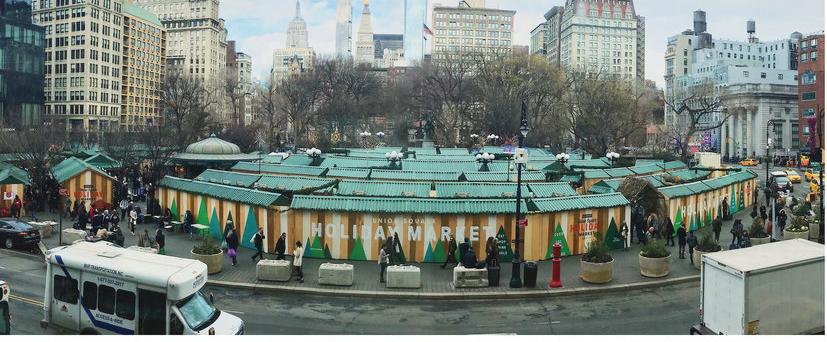
Semi-Structured Interviews with Formal Actors: Besides the open-ended interviews with informal users of the Square, I ventured to the GrowNYC Greenmarket and spoke with a representative, Gabby, about their long-term established relationship to the area. Due to the proximity of Urbanspace's office location two blocks from the Square, a meeting was arranged to speak with one of their workers about the annual Holiday Markets that take place in the south and southwest plaza.
Survey Questionnaire
Over the course of a few days, I passed out one-page questionnaires. I was ambitious to collect 100 responses but underestimated the amount of time people took to
fill out the answers or wanting to speak with me about the purpose of the questionnaire. Of the 52 people asked, 23 agreed to partake in the survey.
Union Square: Crossroads of New York walking tours
As a way to gain a broader understanding of the history of Union Square Park, I attended two separate Crossroads of New York Union Square Park 90-minute walking tours. The company who organizes these tours are very particular of who they hire, making sure the tour guides are subject experts.
Community Board 5: Parks & Open Space meeting
I attended this committee meeting to meet with community board representatives, as well as a Park Dept representative to have logistical questions answered i.e. which channel approves commercial events, etc.
Union Square Partnership's Annual Forum & Networking Reception held May 06, 2019
Further details about my attendance at this meeting is described under the Design Implementation.
Primary and Secondary Literature Review
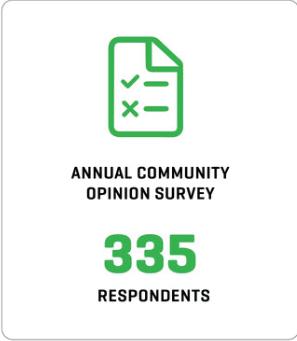
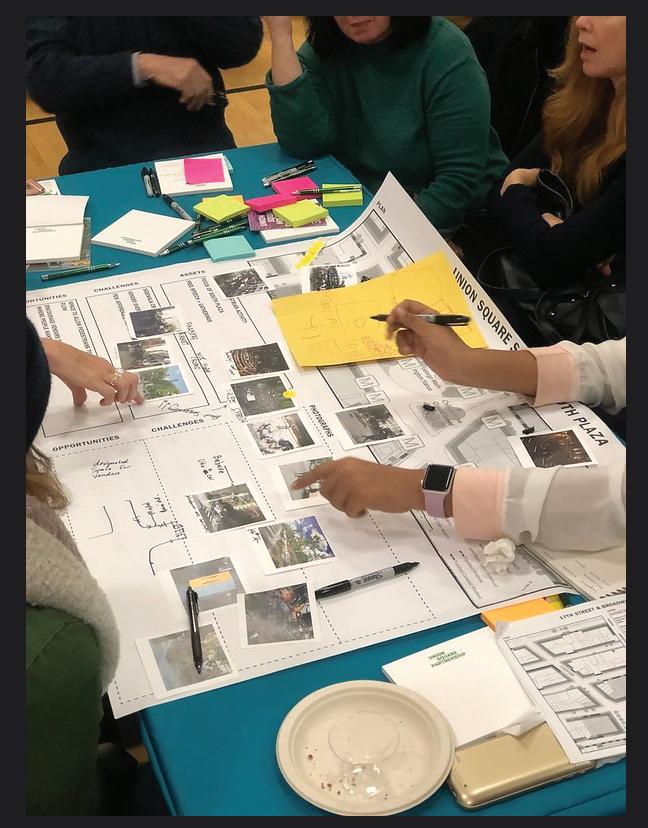
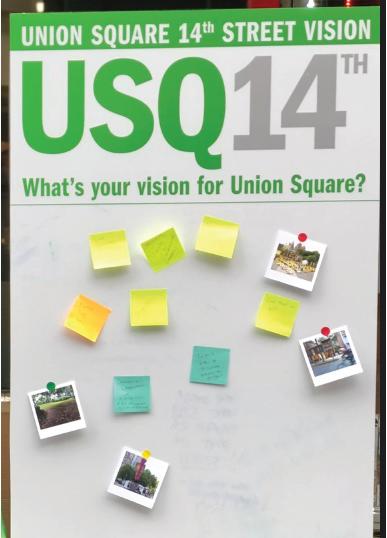
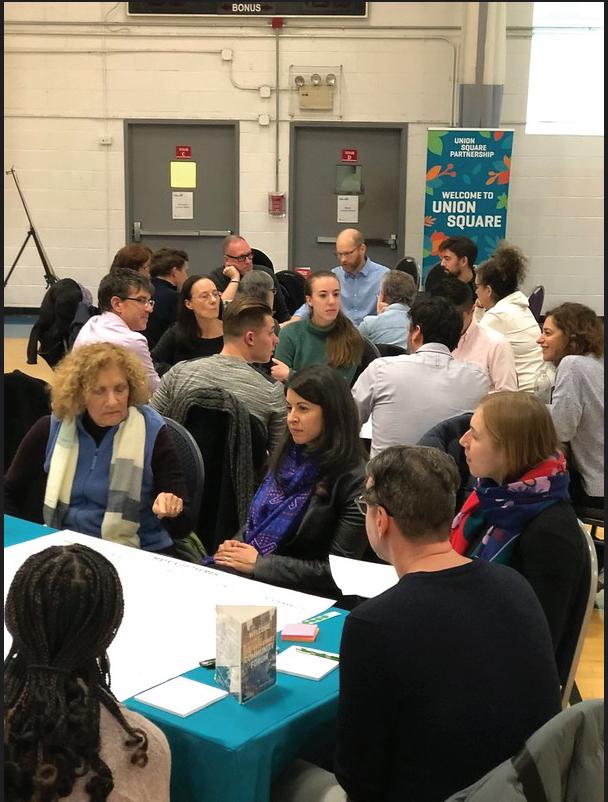
For the primary literature, sources of New York City newspapers throughout the 1980's delivered an original perspective from the media towards Union Square Park. These helped reveal the non-BID, local efforts that helped in reactivating the public space. NYPL digital archives have a substantial amount of historic maps, images, and architectural plans which helped me visualize the physical changes of the space. NYC Small Business Services reports were read to gain basic understanding of the processes and structures of BIDs. Through Union Square Partnership's website, Annual Community Opinion Surveys and Annual Market Reports were downloaded and examined. The site was the main source of information for their Planning Initiative which provided accessibility to photographs of the Neighborhood Pop-ups and Community Forums,
and presentations of both Forums by Marvel Architects. The secondary literature helped define the theoretical political-economic angles that drove the research as well as themes of public space management and public space definitions. The literature was also important in providing a quick overview of American public space typologies in the 1700 to 1800's which helped contrast
Union Square Park's own creation. The secondary sources were the main sources for the in-depth historical account of Union Square Park in regards to protestors and the political representatives as well as emphasizing the political context that led to the the entrance of the
RESEARCH DEVELOPMENT
Pre-Context:
Situating Union Square Park in the Historical Typologies of American Public Spaces
current BID.
Contextualizing Union Square Park in its historical transformation requires acknowledgment of the shift of public space and public identity from colonial and postcolonial America following the American Revolution. This follows with a quick overview of the typologies of postcolonial public spaces in the late 18th and 19th century. The growth of public spaces in these two centuries were a consequence of the growth of cities, as stated by J.B. Jackson.18 Simultaneously, Harvey Molotch captured the components of these growth of cities by framing the ‘city as a growth machine’. The “growth machine as a driving force in U.S. urban development has long been a factor in U.S. history, and is nowhere more clearly documented than in the histories of eighteenth and nineteenth American cities”.19 While Molotch and John Logan’s ‘urban growth machine’ don’t explicitly connect towards public space, there are many parallel factors that will be demonstrated in the next section; the concept is inserted here to frame the pre-genesis of Union Square Park as a public space.
Public derives from the Latin populus which means
18 J.B. Jackson, “The American Public Space,” The Public Interest, no. 74 (1984): 276.
19 Logan and Molotch, Urban Fortunes, 50.
people. In the colonial era, people usually referred to the lower class not part of the ‘nobility’ or the ‘gentry’. Coincidentally, public also referred to some organized form-giving authority, in this case, referring to public building. In the context, public spaces were derived from its adjacent association to the building situated on public land (controlled by authorities). During the shift towards post-colonialism in the late 18th century, “communities more urban in character recognized the need for public spaces that the public could use, but only for the benefit of the community at large”.20 They were well-defined areas that had a common civic function, such as a marketplace, established church, local schools, and held public celebrations or public assembly. People gathered to play some role in these spaces. From these civic functions, the term, people, shed its former identity and revealed its new one: citizen. Jackson states that “the only truly public, or people’s, space was the large central public square where all qualified citizens came together”,21 but what qualifies as a citizen?
Simultaneously developing in the 18th century was that of the public sphere.22 According to Habermas, “citizens
20 Jackson, “The American Public Space,” 277.
21 Ibid, 279.
act as a public when they deal with matters of general interest without being subject to coercion; thus with the guarantee that they may assemble and unite freely, and express and publicize their opinions freely”.23 As will be demonstrated in the next section, this freedom of assemblage is the historical context that made Union Square Park nationally famous; and in the section after, locally adversarial. During the 19th century, American public spaces were going through various stages of park movements. In their own way, they were a response to its predecessor through the need of public amenity. In the early 19th century, increasing populations of cities impacted the rise of inner-city land prices. This along with the overcrowded church burial grounds caused a dilemma with where to place the dead. To solve the planning problem and rival European gardens, the Massachusetts Horticultural Society presented an alternative: the rural garden cemetery.24 And so, the site of the dead in the outskirts of town became the nation’s first urban parks. The proximity yet detachment from the working city created a spot for relaxation and sociability. The unstructured, picturesque, recreational cemetery was filled with people who didn’t have to subscribe to a certain dress code or manner. The informality was a breath of fresh air compared to the late 18th century post-colonial public spaces where citizens had a role, ranked by class in a structured neoclassical square. In NYC, the easy reach of Greenwood Cemetery in Brooklyn attracted tens of thousands of visitors who could have picnics surrounded by artistic plantings and views. While it has not been explicitly stated in literature, the recreational cemetery helped to pave way for the establishment of Union Square Park as
23 Jurgen Habermas, “The Public Sphere,” In Jurgen Habermas on Society and Politics: A Reader, ed. Steven Seidman (Boston: Beacon Press, 1964), 231.
24 Tate Williams, "In the Garden Cemetary: The Revival of America's First Urban Parks," American Forests, June 2, 2014, https://www. americanforests.org/magazine/article/in-the-garden-cemetery-therevival-of-americas-first-urban-parks/. (accessed March 27, 2019).
I will elaborate in the next section.
The mid 19th century saw expressions of disapproval for rural parks in cities speculating that it would be full of troublemakers, or that it was too large and lacked the formal qualities. Eventually, they were accepted as a necessity for public health but there was still a duality between professional designers and local organizers. For the latter, the rural parks created in smaller towns were the work of amateur gardeners or women’s organizations that beautified the community by filling these spaces with small lakes, bandstands, roundabout pathways, upholding the civic tradition of public spaces where concerts and pageants were held, and political speakers. This was the antithesis of Frederick Law Olmsted’s imagined reality: an undisturbed, sculptured work of landscaped art as exemplified by Central Park.
In 1851, the New York State authorized the city to acquire the 840 acres for a public park and in 1858, Olmsted and Calvert Vaux won the design competition for the planning of the park. Olmsted anticipated that the poor would see by example the manners and behavior of the upper-class visitors and even went so far as to execute a special park police force to control misconduct. A little over two decades later, these landscape architects would be hired by the park commissioners for the planning of Union Square Park.
Before I close, I would like to define space and place because some authors have used the terms interchangeably. I prefer Madanipour’s definition as a starting point: “space is abstract and impersonal while place is interpreted as having meaning and value”.25 In this research, the sharp distinction suggests space as a physical geography and place implies a socio-cultural significance. Adopting this definition earlier in the research development helps towards the analysis for design.
25 Ali Madanipour, Whose Public Space, (London: Routledge, 2010), 6.
8 0 0 ’ S - 1 8 30 ’ S
THE 1ST PUBLIC-PRIVATE PARTNERSHIP (1800’s - 1890’s)
COMMISSIONERS’ PLAN OF 1811
1831 STATE DESIGNATED PUBLIC SPACE
1839
UNION SQUARE PARK OPENS
1820
CITY ACQUIRED & ENCLOSED IT 1833 KNOWN AS UNION PLACE / SITE OF A POTTER’S FIELD
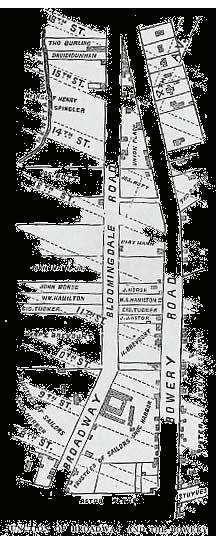
Image Sources: Commissioners’ Plan of 1811: wikipedia; 1920 Image: NYPL Digital Collections Map of Broadway & Junction: https://forgotten-ny.com/2011/01/union-square/ Samuel B. Ruggles: http://www.boweryboyshistory.com/2014/09/the-secrets-of-gramercy-park-and-you.html
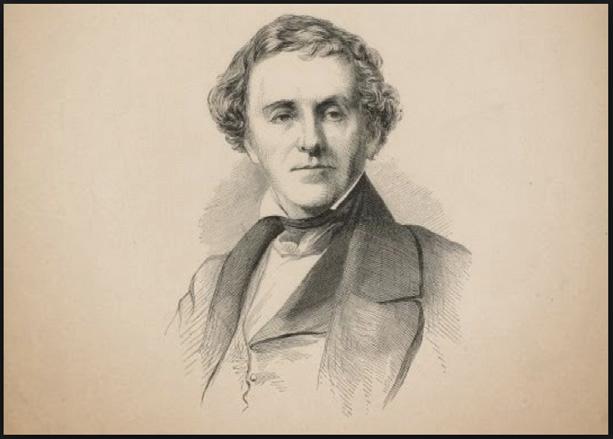
SAMUEL BULKLEY RUGGLES
I.The First Public-Private Partnership in the Creation of Union Square Park:
Space of Mass Congregation between Sites of Luxury Consumption & Production (1800s - 1890s)
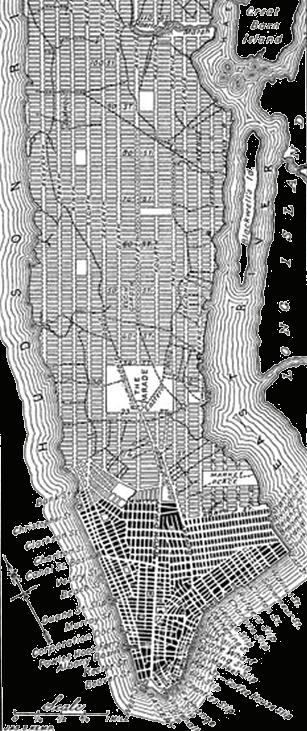
During the development of romantic landscapes, Union Square Park diverged. Unsuitable as farmland, the plot of land was a potter’s field until 1807, but not the kind of recreational cemetery previously mentioned. At the turn of the 19th century, the population of lower Manhattan was rapidly increasing. During this time, the city didn’t stretch up north; rather, it was built around the base. As a response to the limited space of housing and infrastructure, city leaders adopted a new street plan north of Houston Street. Originally called the Commissioners’ Plan of 1811, we now know it today as the Manhattan Street Grid. The misalignment of streets, at the crossing - or union - of Bloomingdale Road (now Broadway) and Bowery (now 4th Avenue), formed an elongated triangle, known as Union Place. The shape itself was an undervalued anomaly to the homogenous Manhattan Grid which was intentionally designed to cultivate efficient land development. The Commissioners’ in charge, including Gouverneur Morris, as well as a committee in charge with reducing wasteful open space suggested eliminating the three acres all together by cutting the streets through it.26
In 1820, the population of Manhattan was 124,000 people 26 Merwood-Salisbury, “Patriotism and Protest”, 543.
and by 1835, the number doubled to 270,000.27 Between these years, there was a rush to acquire and monopolize vast properties of land which fueled the ‘growth machine’. Areas that were once farmlands as weekend getaways now became family-owned wealthy estates. Well-connected figures and real-estate investors such as the Astors, Lenox, Stuyvesants, Livingstons, and Roosevelts all owned giant lands north of the base.28 And so it became that Union Square Park’s first power holder was a single person who owned the surrounding properties.While the name is not memorialized on a NYC hub or institution, one person is consistently mentioned throughout the historical research of this thesis: Samuel Bulkley Ruggles. A Connecticut native, he moved to NYC in 1821 to practice law and married well to Mary Rosalie Rathbone who was plugged into NYC society and wellconnected to people who owned a lot of land. Although he quit law in 1831, he used his tactics of negotiation to persuade the City to acquire Union Place from the State as a public park and open the area north of 17th Street.
This same year, Ruggle’s used his wife’s inheritance money to purchase plots of lands and obtained a 50-year lease; by 1833, he collected 500 lots in the Union Square
27 Meyers, Tom, and Grey Young. Bowery Boys, “#40 Union Square” Podcast audio, December 12, 2008. http://boweryboysarchive.libsyn. com/webpage/2008/12. (5:30-5:45).
28 Meyers and Young, "#40 Union Square" (6:28 - 6:45)
area and Gramercy Park. Predicting that the property values were going to skyrocket significantly due to the railroad systems being built, he was influenced by London developer, Thomas Cubitt, who set the urban development style through the squares which attracted a lot of fancy home developments.29 In 1832, he convinced the city to level the land, grade it, and turn it into a square. Through contractual agreements, he built the curbs, streets, and sidewalks around the park. In similar fashion to the modern day BID, and as Zukin’s claims, he was a forerunner of today’s public-private partnership and reaped the eventual profits from higher property values.30 An argument could be made that without his actions, Union Place might have been another line in the formation of the Manhattan grid. However, as a real estate developer and wealthy lawyer, he floats as a power holder rather than a citizen participant. The term ‘property’ is the key for the development of Union Square Park. When “Ruggles and his colleagues realized that more varied urban forms could be a powerful
29 Meyers and Young, "40 Union Square" (6:28 - 6:45)
30 Zukin, Naked City, 132.
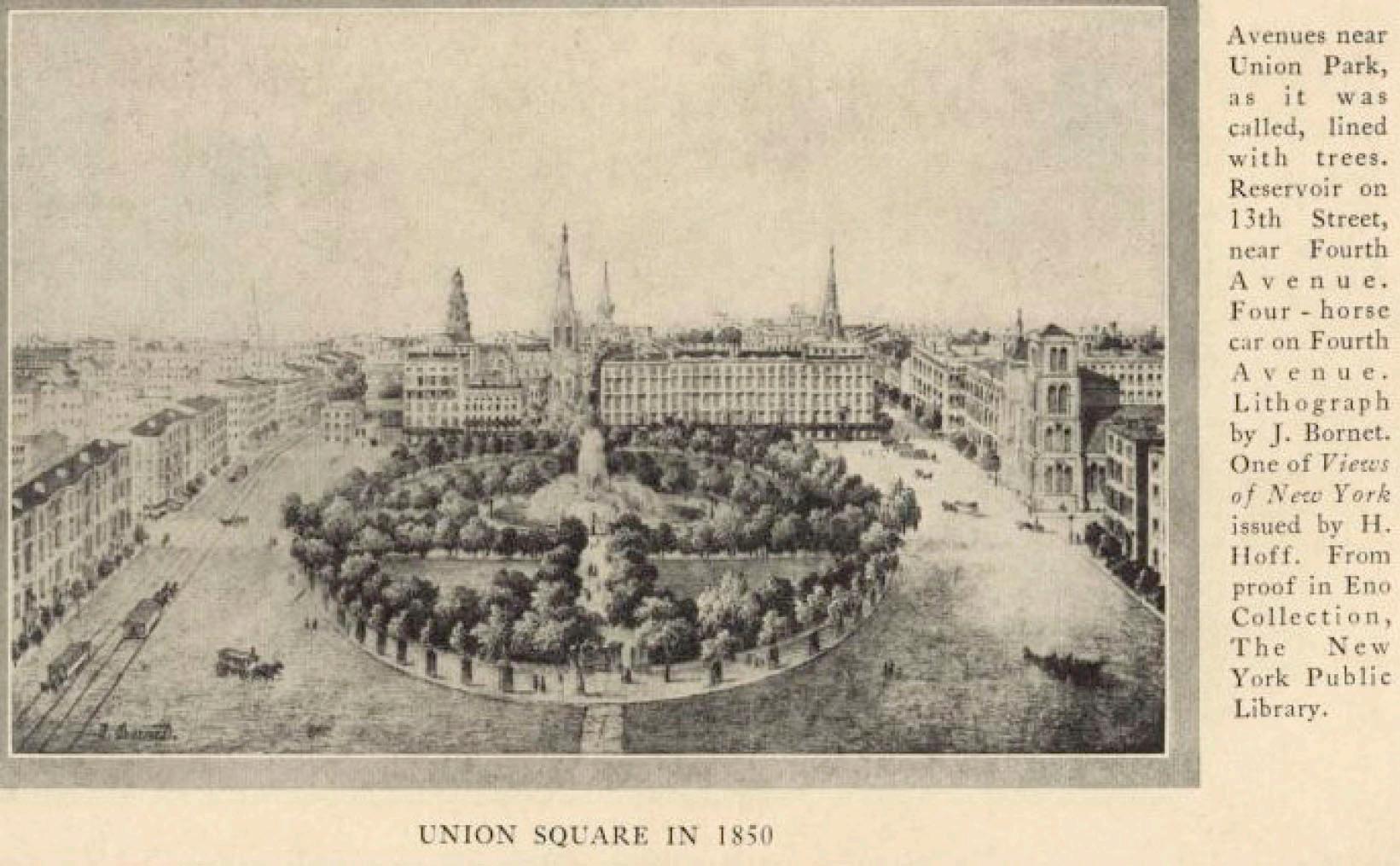
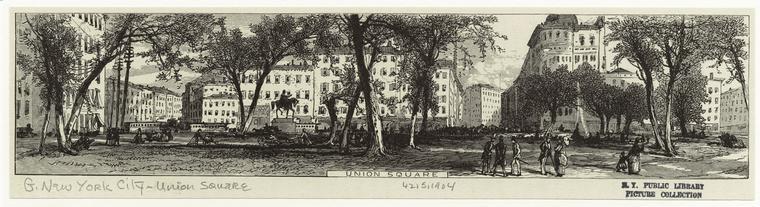
Union Square in 1850 when it was an exclusive residential garden surrounded by wealthy mansions and upscale hotels.
Source: NYPL Digital Collections
Opposite Page:
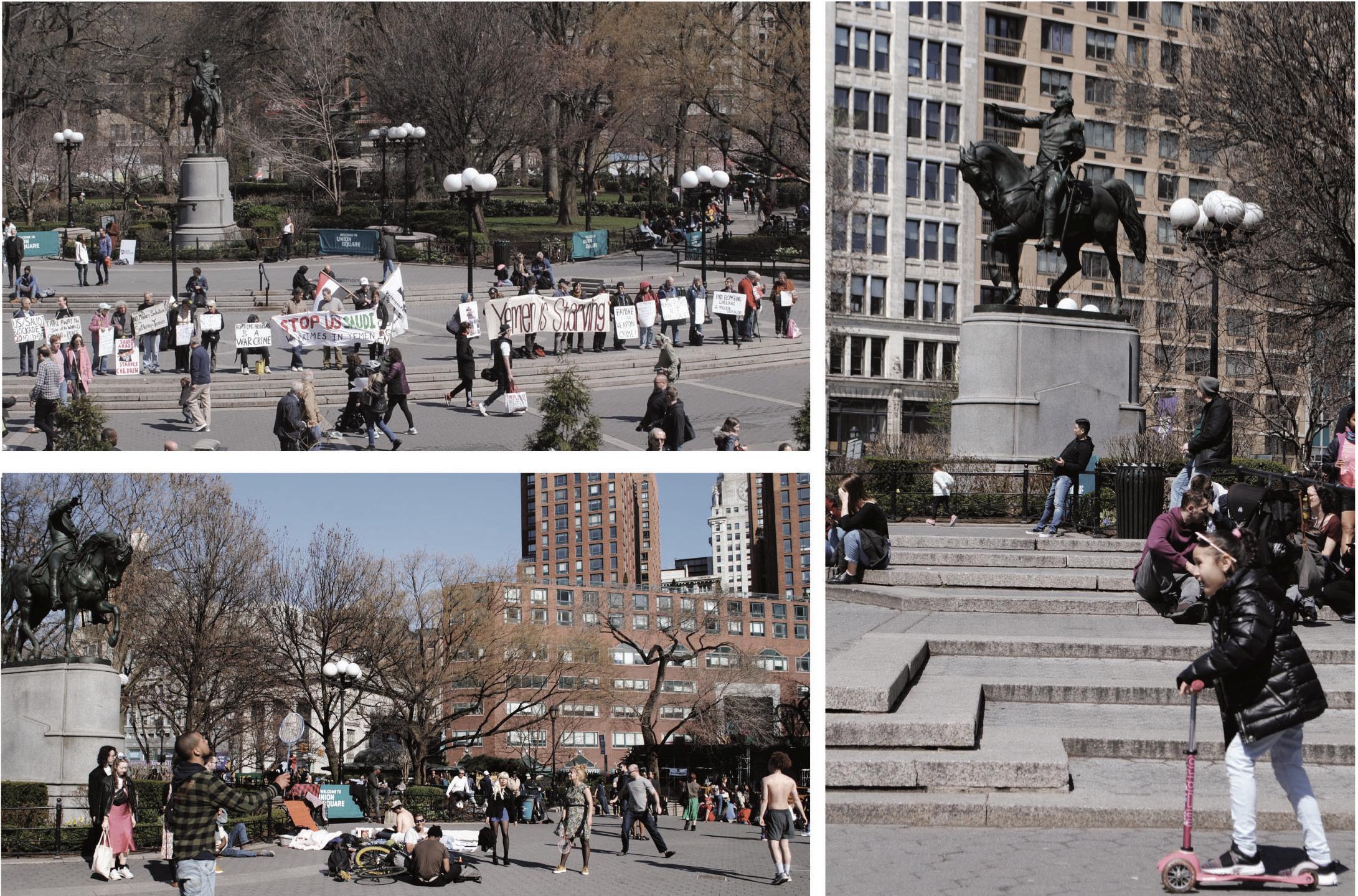
Union Square Park South Plaza.
Source: Denilyn Arciaga, 2019
attraction” they became “part of a movement to improve American cities by building urban parks”.31 Public space, in theory, is created for the public and parks at the time were developed to connect with nature and for public health benefit. In practice, Union Square Park was rooted to incentivize property development for value exchange. His later statements that the Square was “deliberately designed to support participatory democracy”32 is highly contradictory, and false. To extrapolate, in the framework of Molotch and Logan’s ‘growth machine’, Ruggle’s is a place entrepreneur. Growth entrepreneurs are concerned with the exchange of place, commodifying it to be exchanged and bought. In Union Square Park’s case, raising property values, of which he eventually sold all but one. The creation of public space, in this regard, was a critical component towards that growth machine and in effect, democracy did not exist within the public sphere Paradoxically, democracy within the public space is how he promoted the Square. Political patriotism and civic engagement contributed to the rise of property values.
31 Merwood-Salisbury, “Patriotism and Protest”, 543.
32 Ibid.
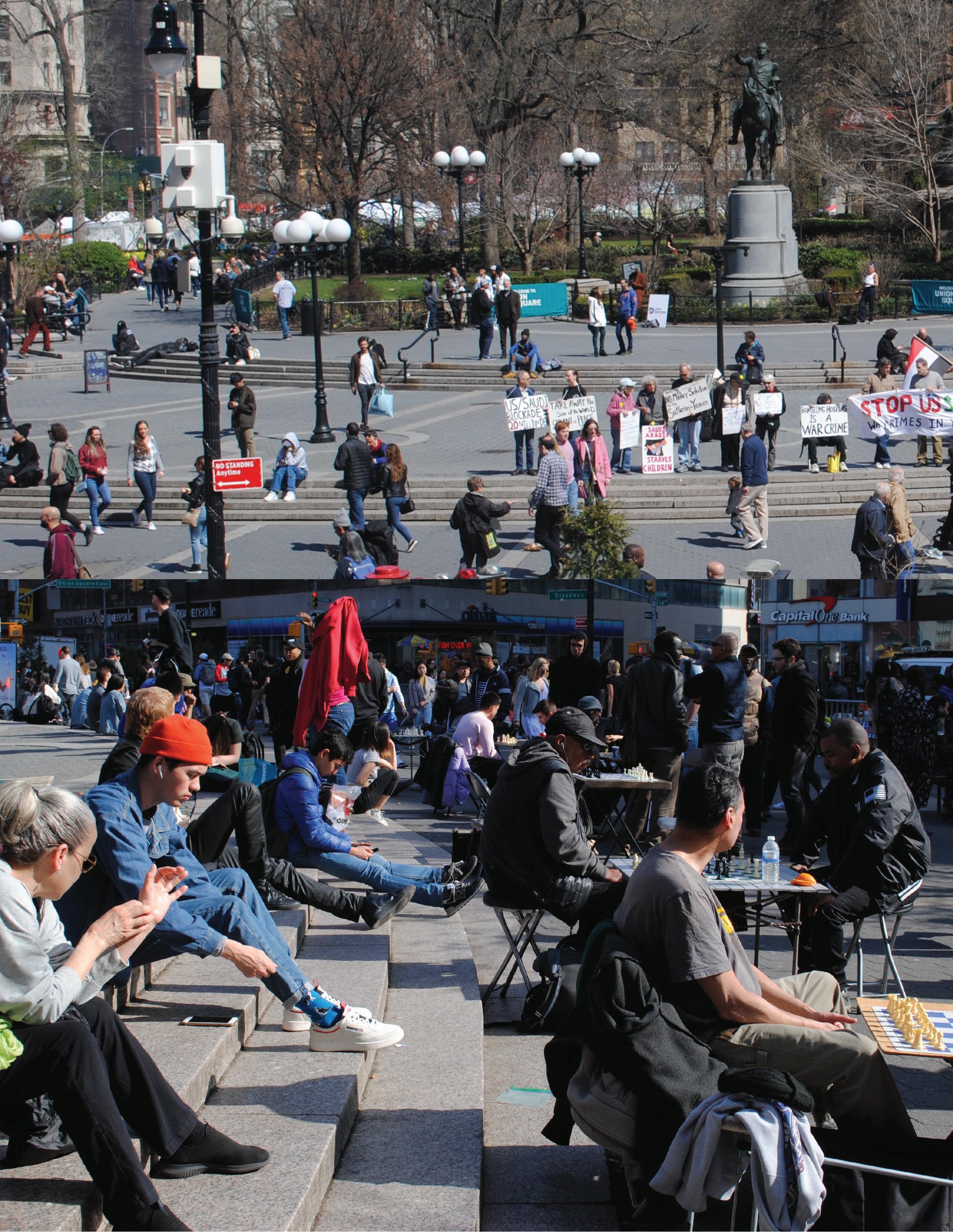
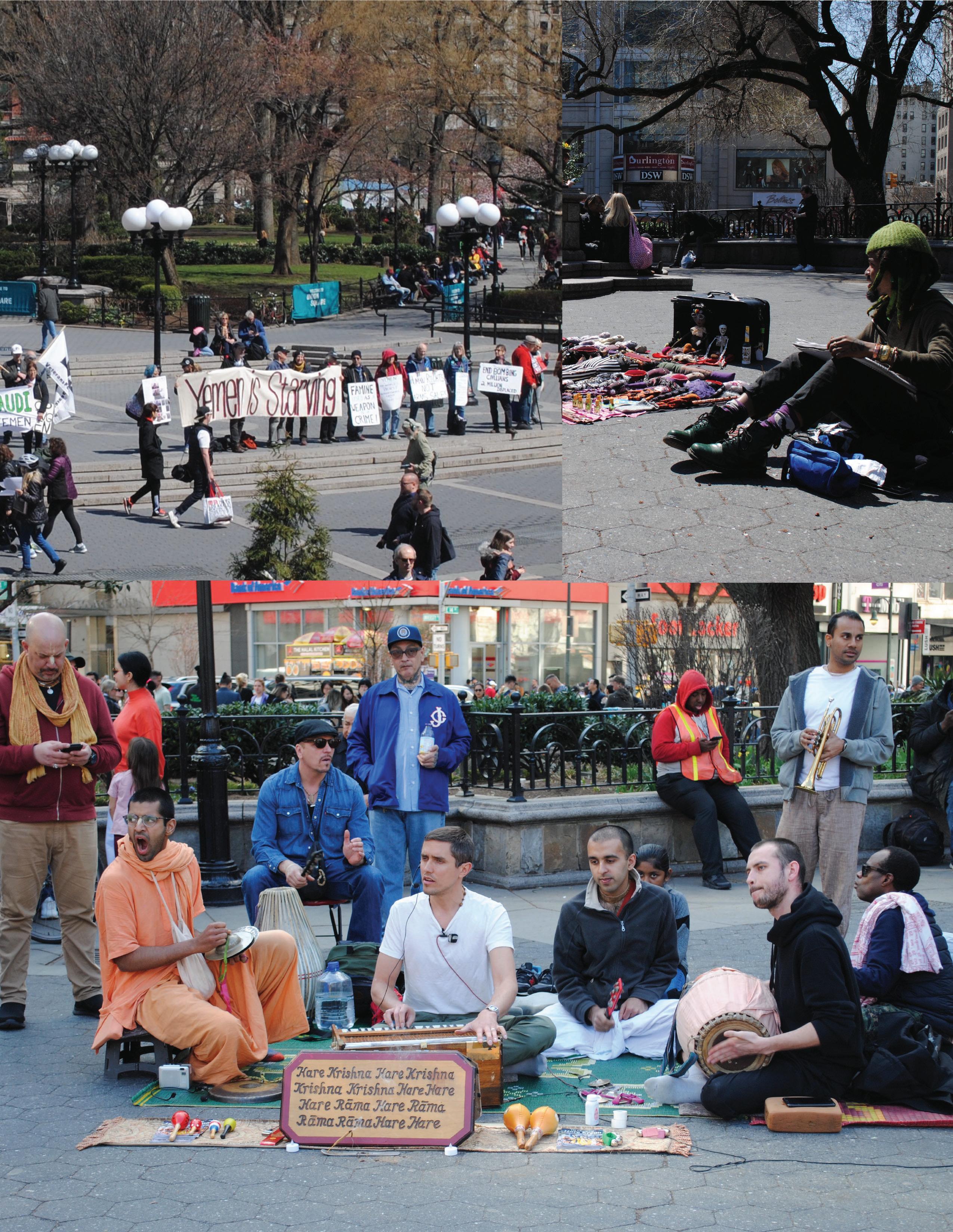
The informality of the south plaza is unlike the other areas of Union Square Park. In other parts, the defined barriers enforce program use by allowing and restricting certain people such as the dog park or children’s playground. Here, one doesn’t need to be an end-user in the transactions of consumership at the Farmer’s Markets or high-end restaurant in the north pavilion. And so, here I sit on the steps of the south plaza taking in the multi-social interactions. I hear the tapping of the jump ropes on concrete as two people play double dutch. The repetitive sound is interrupted by a bell-like ringing of the voice, “Chess players! Chess players!” Near the water fountain, I see a group of Hare Krishna chanting in unison while the incense of jarita flowers infuse a calmness in the air. In front of me, I
see a man in a tiger suit, some group tour, and friends giving hugs as they meet and wander off. Commuters pass by like a choreographed dance scene. Weeks after I had my first game of chess here, I asked the same player, “Why did you guys choose the south plaza?” He tells me that originally, they were on the west side of the square. At the time, it was just a few players who used to play at Tompkins Square. As more players started setting up tables, they needed a bigger space. He ended with, “the south plaza is center stage” as he raises his hands in the air. I look around, admiring the harmony in the ebbs and flows of public space chaos here in the south plaza. And all this happens while a triumphant George Washington stares beyond.33
33 Field research observation, Union Square Park, NYC, March 2016.
Not only did Ruggles have political influence, but he influenced public perception through marketing the square as the nation’s crossroads. The first, unlikely and still questionable form of citizen participation towards the planning of the Square was a mass voice of opposition of what not to put in the space. Rewinding back, during the 1700’s, the area was British farmlands. After the American Revolutionary War, on November 25, 1783, George Washington came back to the city and stood at the convergence of the two roads. Facing south, he was met with victorious crowds and urban myth claims that he made a gesture.34 To celebrate the 100th anniversary of his birth in 1832, a nationwide movement of architects and sculptors proposed the construction of permanent monuments in various cities and Union Square was selected to erect a Washington monument through a campaign started in 1833. In 1843, architect Calvin Pollard proposed a giant gothic tower about 40 stories, composed of granite, whose based covered the entire Square. This was rejected, partially due to money and public protests. Instead, in 1856, an equestrian statue with Washington’s said gesture was placed by sculptor Henry K Brown who was commissioned by the Washington Monument Association. While protests may have partially helped in preserving the open space, according to the LoCP, this process still falls under the lowest form of tokenism, ‘informing’ or one way flow of information. Nevertheless, surrounding homeowners were wealthy citizens who each donated a few hundred dollars towards the creation of the sculpture.35 Washington’s statue served as a symbol of freedom in favor towards the power of the republic and against the ruling aristocracy.36 In an 1864 Metropolitan Fair speech, Samuel Ruggles gave a patriotic speech stating that the “road of American nationhood ran through the Square”
34 Meyers and Young, "#40 Union Square" (4:43-5:15)
35 Ibid (5:48-6:05)
36 Merwood-Salisbury, “Patriotism and Protest”, 543.
by way of the Revolution and historical figures linking to the Constitution.37
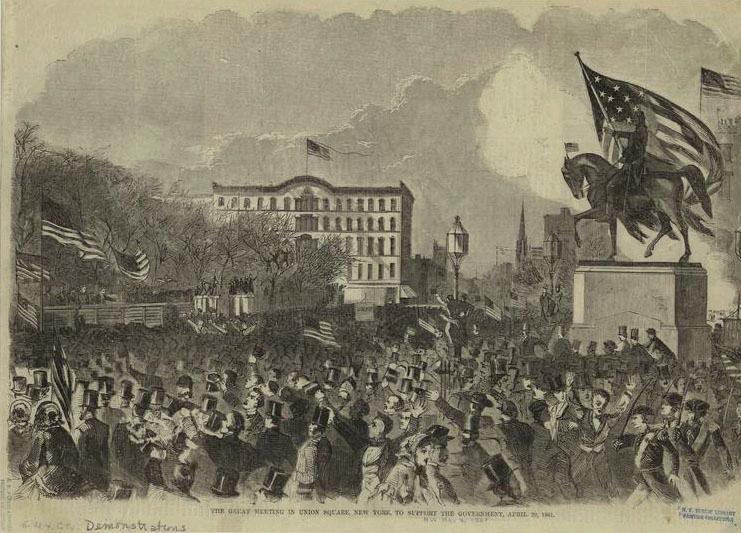
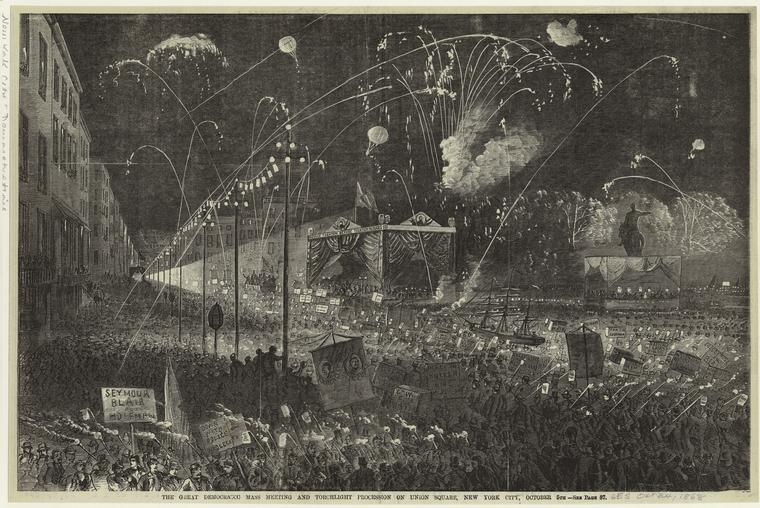
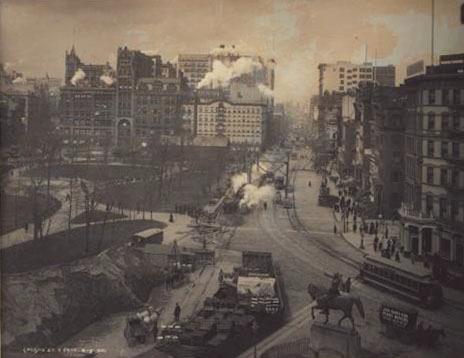
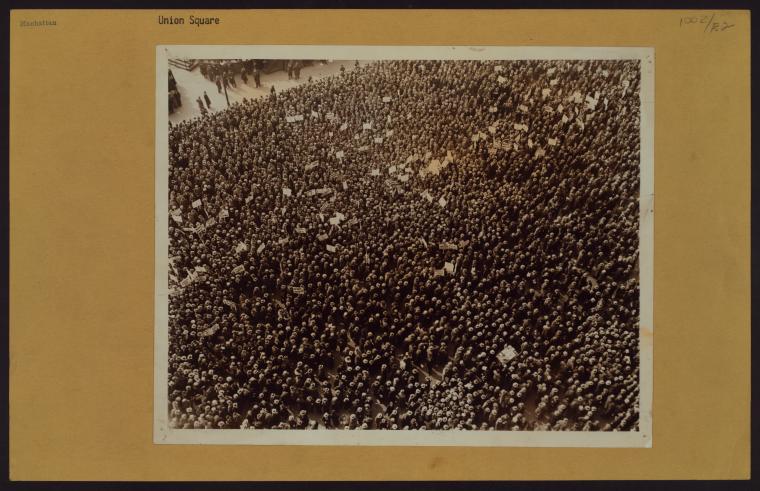
At a time when the spread of communication and news crawled at a slow rate, Union Square became the exchange of information and the public platform for local, national, and global opinion. The mid 1850’s saw protestors rallied at Union Square to support a variety of causes including European political radicals and the distribution of free food to the poor. The highest attendance of supporters in the Square was after the Confederate’s attack on Fort Sumter in 1861.38 A sea of 100,000 people flooded the space in support of the Union. After the Civil War, the Square became a space of solidarity for the working class. Throughout the 1860’s, Union Square hosted regular protest meetings of 10,000 people who advocated for better working conditions, especially concerning the 8-hour work day in the garment industry. Highly-organized and cohesive, immigrants of various ethnicities (Italian, Russian, Jewish, and Eastern European descent) partnered together to join trade unions in the shared vision to improve the lives of laborers. This diversity of groups that came together is where Union Square Park re-converges with J.B. Jackson’s historical analysis of American public space. Union Square Park emerged as part of the landscape of diversity where like-minded people came together to share an identity, primarily working-class identity.39 The contextual dichotomy during these decades is that while the space within the Square saw mass congregation, the surrounding area became a high-end luxury shopping and the city’s entertainment district. The residential oasis became obsolete during the 1840’s-1850’s as middle-class families migrated away. These spaces of production and consumption catered to a higher social class while voices represented the lower economic class.
37 Ibid, 542.
38 Zukin, Naked City, 132.
39 Jackson, “The American Public Space”, 287.
space of mass congregation
1 8 5 0 ’ S - 1 8 9 0 ’ S
THE 1ST PUBLIC-PRIVATE PARTNERSHIP (1800’s - 1890’s)
1850’s
PROTESTORS BEGAN RALLYING IN SQUARE TO SUPPORT NUMBER OF SOCIAL CAUSES
100,000 GATHERED IN SUPPORT OF THE UNION AFTER THE ATTACK OF FORT SUMTER
10,000’S REGULAR MEETINGS OF UNION PROTESTS (WORKING CLASS SOLIDARITY)
CENTENNIAL CELEBRATION
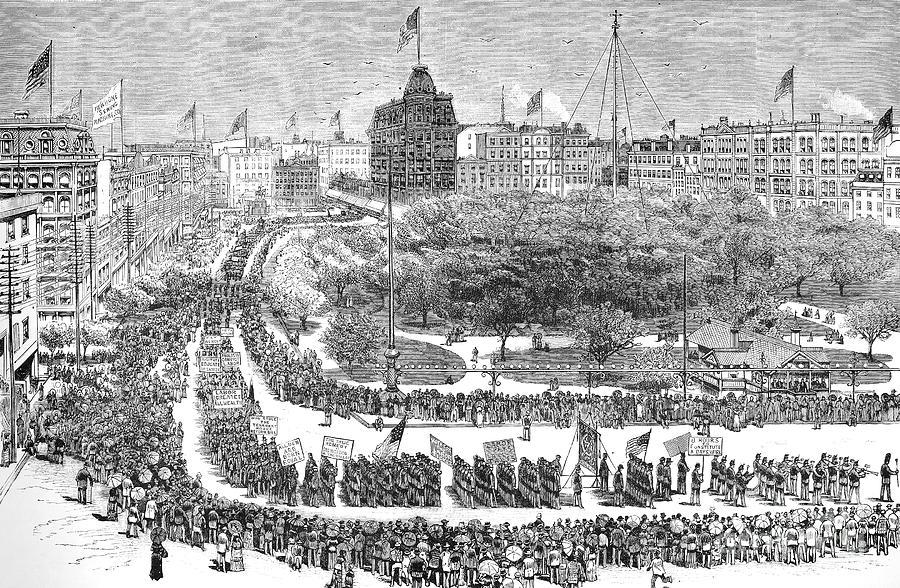
50,000 JOINED IN THE LABOR DAY PARADE
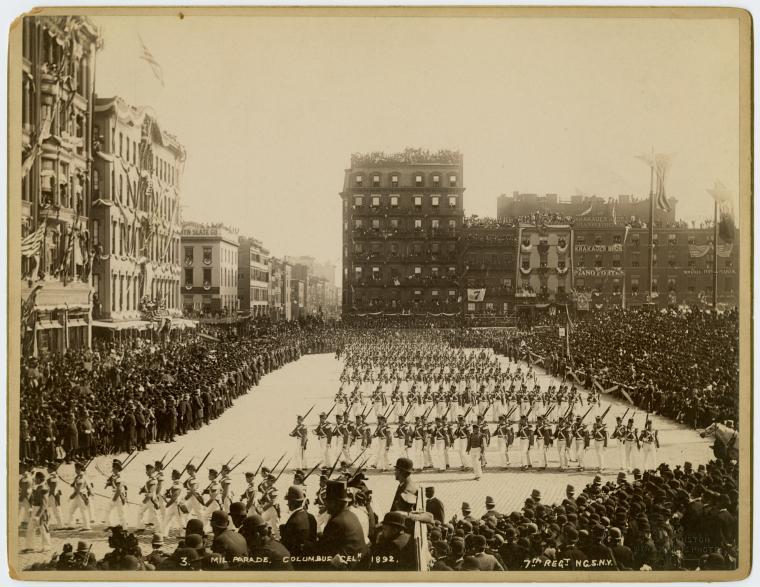
TENS OF THOUSANDS CELEBRATED COLUMBUS DAY
SOCIALISTS BEGAN WORKING-CLASS REVOLTS (LABOR UNIONS JOINED)
Image Sources: 1861, 1876 & 1892: NYPL Digital Collections 1882 illustration: original source unknown
1871 Kellogg and Pollard Proposal of Union Square Park, New York City
Source: William C. Bryant & Co., First Annual Report of the Board of Commissioners of the Department of Public Parks for the Year May 1, 1871.
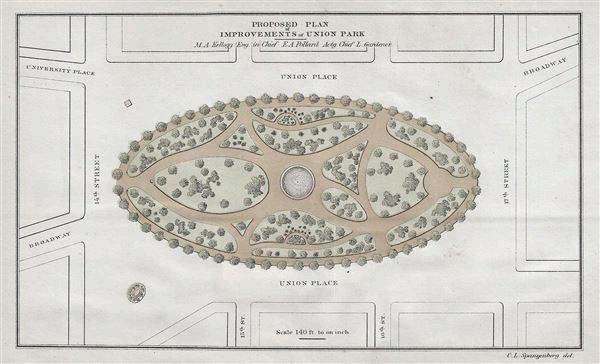
In the control of spaces, Union Square Park fell under the reign of corrupt politicians associated with William “Boss” Tweed. The Tweed Ring, in 1870, held their headquarters near Union Square at Tammany Hall. They claimed authority over city parks and seized the parks budget. Under this regime, parks engineer-in-chief M.A. Kellogg and acting landscape gardener E. A. Pollard drew up a proposal that removed the iron fence and replaced the straight walkways with curved paths. This plan was only partially realized due to the short lived coup. Once authority went back to the original commissioners, they hired two new park designers: Central Park’s famous landscape architects, Olmsted and Vaux. Their design proposal steered clear of the picturesque sculptural park. In the planning history of the Square, their 1873 design proposal was the closest attempt towards democratic inclusionary planning: planning for the mass culture. Taking into consideration the removal of the iron fence, they proposed a muster ground of 300 x 100 feet as a
gathering space and a Cottage which was a stage for political demonstrations. The pragmatic design was a success to activate the public space for mass gatherings, accommodating 20,000 people.
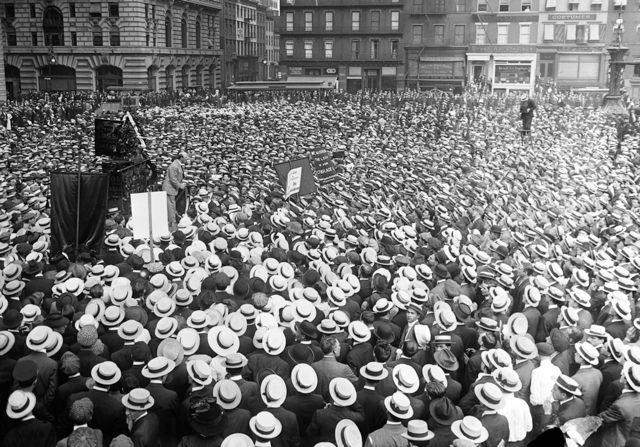
The famous spectacle that contributed to the designation of Union Square Park as a National Historic Landmark was the Labor Day parade. held on September 5, 1882. It was coordinated by the Central Labor Union (CLU) which was a group comprised of representatives from different unions to publicize international solidarity and cross-pollination of multiple trades and ethnic groups.40 50,000 attendees participated in this festival including the 10,000 men and few women who marched in the parade.41 Highly orchestrated parades and civic formations such as this and the Columbus day parade of 1892 were praised and allowed in Union Square Park, especially because they did not challenge the unequal socio-economic realities like some of the other protests simultaneously occurring. These days, the protests in the Square average to a few hundred people. With a rare exception on May 1, 2012, an estimated 8,000 Occupy Wall Street and May Day activists marched through the Square to protest corporate greed and money in politics.42 These protests against Wall Street and the larger financial institutions are part of a long series of demonstrations pre-dating back to the late 18th century at the inception of the First Bank of the United States.43
In the next chapter, I will discuss how these conflicts of political ideals transpired the loss of open and accessible public space.
40 Merwood-Salisbury, “Patriotism and Protest”, 550.
41 Ibid, 549.
42 Adam Martin, “In New York, A Final May Day March Ends at Wall Street”, The Atlantic, May 1, 2012, https://www.theatlantic.com/ national/archive/2012/05/happy-may-day-occupys-first-arrests-aretrickling/328670/ (accessed March 7, 2019)
43 Mike Wallace, “Before Occupy Wall Street,” The Gotham Center for New York City History, The Graduate Center at CUNY & John Jay College of Criminal Justice, January 5, 2012, https://www. gothamcenter.org/past-special-projects/before-occupy-wall-street (accessed March 28, 2019).
I
PLANNINGS OF THE SQUARE
designing for the people
1 8 8 3
THE 1ST PUBLIC-PRIVATE PARTNERSHIP (1800’s
- 1890’s)
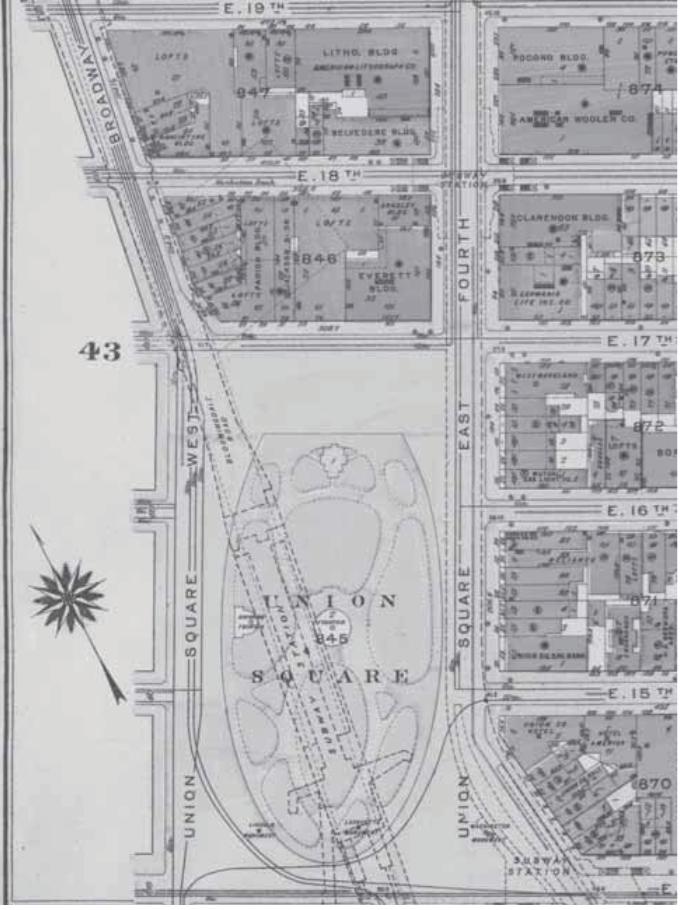
Union Square, from Atlases of New York City (New York: G.W. Bromley, 1916), sect. 3, plate 44
Frederick Law Olmsted and Calvert Vaux, the Cottage at Union Square after an 1893 meeting of the unemployed Source: Merwood-Salisbury, “Patriotism & Protest”, 548.
THE 2ND PUBLIC-PRIVATE PARTNERSHIP (1900’s - 1970’s)
(IBT)
Operator, Acquired by City 1940
Image Sources:
Belmont, Jr: Websource
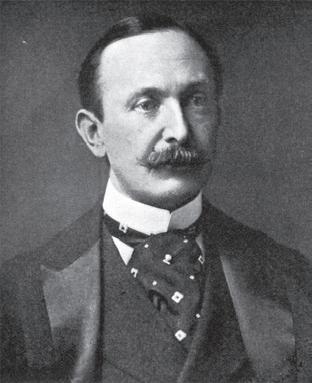
Financier, August Belmont, Jr
II.
The Second-Public Private Partnership in the Destruction of Union Square Park:
Space of Mass Dissent between Sites of Affordable Consumption & Production (1900s - 1970s)
Within the first few decades of the 1900’s, Union Square Park went through an unprecedented amount of transformations on different levels, both figuratively and literally. This second PPP era of this research struggles with dismantling the series of transformations in the first few decades due to the cross-convoluted narratives taking place in Union Square Park. Before the city’s acquisition in 1940, the subway system was privately owned and managed by two companies, the Interborough Transit Line and Brooklyn Rapid Transit. The IRT company opened in 1903 until 1940 while the BRT opened in 1896 and closed in 1923. The BrooklynManhattan Transit Corporation took over the BRTs assets until 1940. The IRT Lexington Line is the oldest, operable line that opened on October 27, 1904. This 4, 5, and 6 line connected 28 stations including 14th Street - Union Square station. In 1917, the BRT opened up the Brooklyn Manhattan Transit (BMT) Broadway Line which consists of the N, Q, R, and W. In 1924, the BMT Canarsie Line opened the L line. The paradox during these decades is that while the underground transit system was creating mass mobilization throughout the city, the protestors above ground became immobilized. The slow destruction of the Square eliminated Olmsted and Vaux’ design for the masses.
Beginning in 1900, the Department of Parks transferred
its strategy of promoting social change in larger parks, like Union Square, to smaller neighborhood parks. Also, in the early 1900’s, demonstrations and protests were becoming less organized and denied. Not only is Union Square Park a materialization of the political ideals, but the controllers of space eliminated any groups that did not share those visions. The political ideals can be understood by applying Wolff’s Contending Economic Theories. These clashing theories matured from the 17th and 18th century when people were trying to understand the new field of economics which studied the production and distribution of goods and services.44 It was an original proposition as “employer–employee relationships that involved wage payments were replacing the previous landlord–peasant–rent system of feudalism”.45 The cornerstone of Wolff’s writing is that Marxism challenged classical political economic theory in the 1800’s and Keynesian economics responded to neoclassical theory in the 1900’s.46 At the heart of Marxian economic theory is his innovative analysis on class structure, particularly “surplus producers” and “surplus appropriators”.47 His main critique is that “the transformation of feudal peasants into capitalist wage laborers occasioned so much suffering and yielded so
44 Wolff, Contending Economic Theories, 12.
45 Ibid, 13.
46 Ibid, 9.
47 Ibid, 27.
little human liberation”.48 The goals of the famous labor union protests and demonstrations in the 1800’s sought to improve the working conditions of employees but they did not threaten the classical capitalist structure. Near the end of the 1800’s, police were known to swing their clubs at the labor unions.49 The press labeled members of the CLU as ‘anarchists’, ‘agitators’, ‘revolutionaries’, and ‘disturbers of peace’ even though their “means were peaceful and aim was equality, surely an American ideal”.50 The response was the highly organized and militarized Labor Day Parade of 1882.
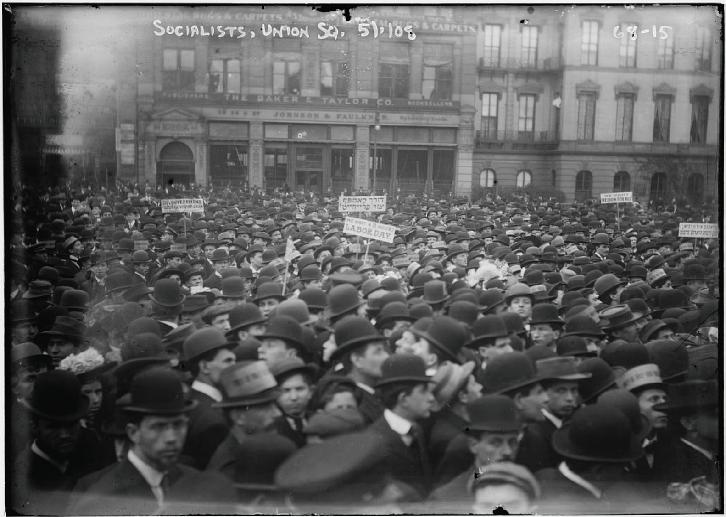
Capitalism is an unstable machine that cycles, producing the illusion of more wealth (periods of inflation) or the reality of less wealth (with unemployment and production cutbacks rising in a recession).51 Some examples of these past instabilities include: the 1792 first stock market crash; the 1837 collapse of firms due to defaults; the 1857 closing of an Ohio life insurance company caused national hysteria amongst banks due to their loans; in 1874, the economy of NYC crumbled and the real estate bubble burst; the fiscal crisis of 1893; and the 1930 Great Depression.52 Influenced by Marxist economics, many socialists, communists, and anarchists protested against these capitalistic instabilities. In 1889, an international socialist call for a march to reduce the workday to 8 hours brought workers to the Square on May 1.53 Socialist and Communist parties were joined by labor unions and anarchists in their annual May Day rallies.
In the 1800’s, the Square played a central role in symbolizing democracy but during the first half of the 1900’s, the controllers of space prohibited certain groups from assembling in the space. Demonstrations
48 Wolff, Contending Economic Theories, 26.
49 Zukin, Naked City, 141.
50 Merwood-Salisbury, “Patriotism and Protest”, 550.
51 Wolff, Contending Economic Theories, 2.
52 Wallace, “Before Occupy Wall Street,” The Gotham Center for New York City History.
53 Zukin, Naked City, 133.
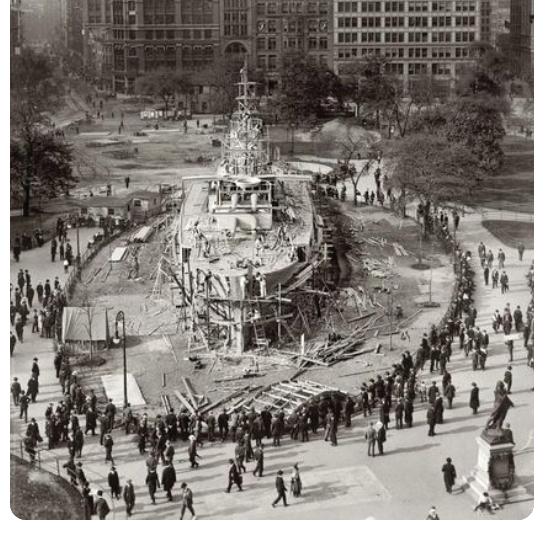
in the Square became “less orderly”, “more raucous”, and dangerous on both sides. In 1907, even though the Department of Park denied permission for the Socialist Conference for the Unemployed to assemble in the Square, 7,000 people gathered anyway and were met with police clubbing them.54 The local merchants’ group also pressured the NYC Police Department to deny May Day parade permits. In 1912, 50,000 May Day members of the Wobblies and Italian Social Federation stormed the platform in front of the Cottage and tore down the American flag, claiming that the Socialists were an international fraternity, with no allegiance to the U.S.55 On May Day of 1954, the police allowed the local merchants’ group to take over the Square for their own day of patriotic activities and renamed it “Union Square U.S.A.”.56 Between the years of 1917 to 1920, the Mayor’s Committee on National Defense docked the USS Recruit in the Square on Memorial Day. This monstrous battleship served as the office for navy and marine recruitment. Across, socialist leaders gave speeches about the American involvement in the war. Since 1920, the open space in front of the Cottage was dedicated to parking.
54 Merwood-Salisbury, “Patriotism and Protest,” 550.
55 Ibid.
56 Zukin, Naked City, 133.
space of mass dissent
1 9 0 0 ’ S - 1 9 5 0 ’ S
THE 2ND PUBLIC-PRIVATE PARTNERSHIP (1900’s - 1970’s) 7,000
50,000
MAY DAY PARADE STILL GATHERED (DEPT OF PARKS DENIED PERMIT)
BATTLESHIP USS RECRUIT PLACED IN SQUARE AS RECRUITMENT OFFICE
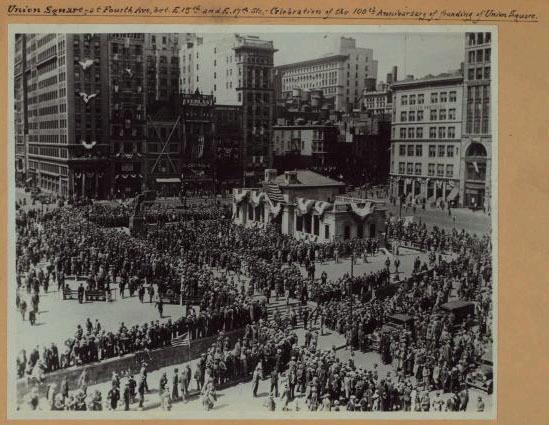
100TH ANNIVERSARY OF THE FOUNDING OF UNION SQUARE
SOCIALIST CONFERENCE FOR THE UNEMPLOYED STILL GATHERED (DEPT OF PARKS DENIED PERMIT)
60,000 COMMUNISTS STILL GATHERED (DEPT OF PARKS DENIED PERMIT)
“UNION SQUARE USA” LOCAL BUSINESS MERCHANTS FESTIVAL
Image Sources:
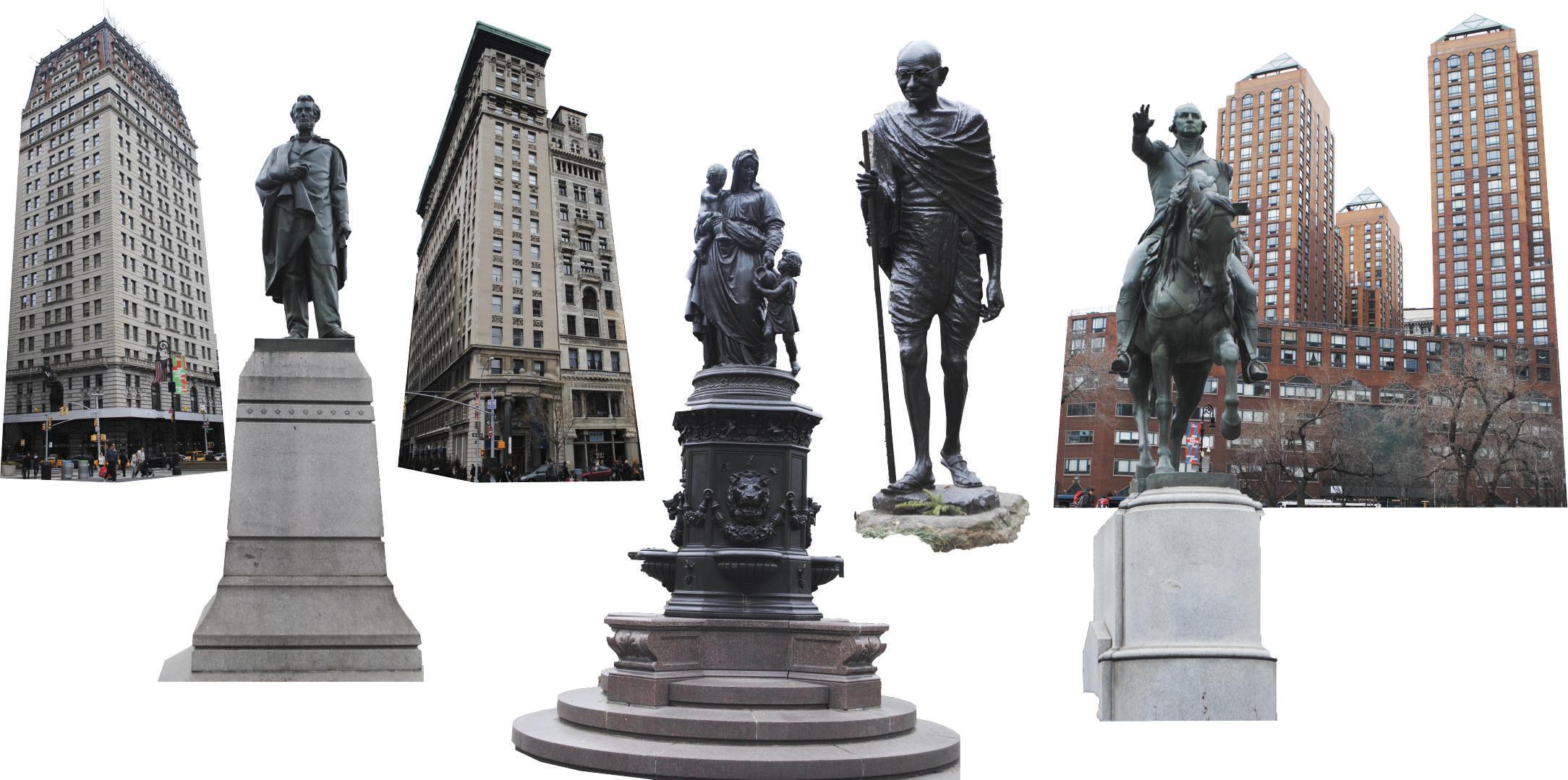
Many of these buildings / statues were explained during the walking tour. While many have a long history in the space, the significant histories of protests and contention did not seem to reflect the visual realities. Images by Denilyn Arciaga, Spring 2016
***
There’s a softness in the volume of the Square this Saturday, or at least the north part. It’s a brisk February afternoon with the winds whispering loudly as Evelyn's Playground remains silent. I am reminded of a film, ‘Children of Men’ that I had to watch during week one, themed Urban Practice Today, for one of my DUE courses, Urban Colloquium I, with Miguel Robles Duran and Mary Taylor. There’s a small but poignant scene that has always stuck with me. Two characters are walking past an abandoned school yard. The woman says to the protagonist, “As the sound of the playgrounds faded, the despair set in. Very odd, what happens in a world without children’s voices”. Since then, I have come to appreciate the sounds of laughter,
and crying while in the subway or passing through a children’s park. My thoughts are interrupted as I see a woman walk towards the Lincoln statue. She holds out a small sign: “Union Square: Crossroads of New York”.
For the next 90 minutes, Caroline, a New York native and P.h.D student at CUNY, will be guiding me and two other women as we explore the social and political histories of Union Square. She informs us that it’s helpful to be really imaginative. For most of the beforeand-after images of New York City that I’ve seen, there is a comparable silhouette. Caroline’s photographs are tools to construct a historical visual but they are disparate to the reality shown.57
57
Field research, "Union Square: Crossroads of New York" walking tour, Union Square Park, February 06, 2016.
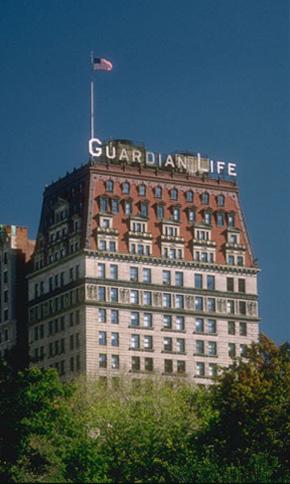
B. W HOTEL FORMER GUARDIAN LIFE BUILDING (1910)
A. LINCOLN STATUE (1870) NUMEROUS RELOCATIONS
D.
DRINKING FOUNTAIN STATUE (1881) TO CELEBRATE FRESH WATER IN NYC THROUGH CROTON RESEVOIR AQUEDUCT IN 1842
C. DECKER BUILDING (1892)
BANK OF METROPOLIS (1902)
E. MOHANDAS GANDHI STATUE (1986)
F. EQUESTRIAN WASHINGTON STATUE (1856) OLDEST NYC PARKS STRUCTURE NUMEROUS RELOCATIONS
G. ZECKENDORF TOWERS (1987)
II
designing for crowd control
1 9 0 0 ’ S - 1 9 5 0 ’ S
THE
2ND
PUBLIC-PRIVATE PARTNERSHIP
(1900’s - 1970’s)
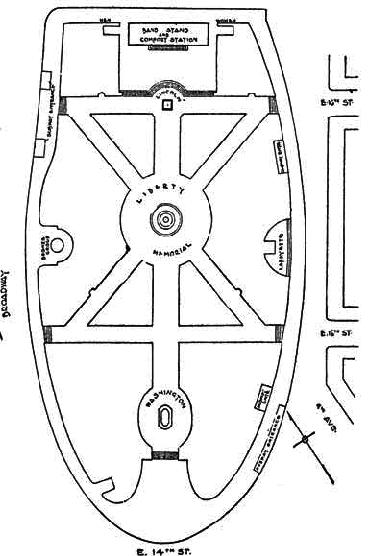
1930 Revised Plan
Source: “Revised Plan for the Improvement of Union Square Park,” New York Times, 4 May 1930 from Merwood-Salisbury, “Patriotism & Protest”, 554.
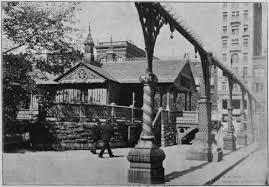
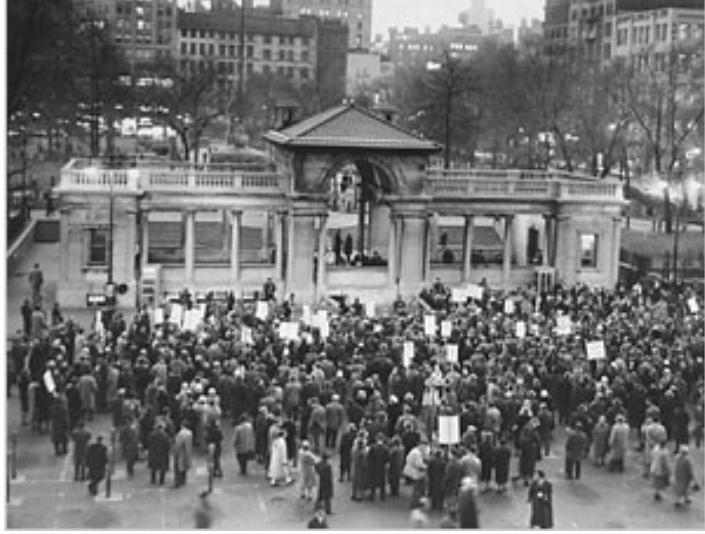
THE COTTAGE THAT OLMSTED & VAUX INTENDED AS A REGULAR MEETING PLACE FOR PROTESTORS WAS DEMOLISHED AND REPLACED WITH AN OPEN AIR PAVILION FOR PAGEANTS AND PATRIOTIC CELEBRATIONS.
“For a Pavilion with a Past Grumbling Over the Future”, New York Times, Jan 28, 2007.
17th Street facing west when automobiles parked in place of the crowds
Image Source: NYPL Digital Collections
The physical destruction in 1928 provided an opportunity for the controllers of the space to redesign the Square according to their vision. The Parks Department along with the local property and business owners had no intention of restoring it back to a space of public gathering. In fact, the Chamber of Commerce and Broadway Association petitioned for a complete ban on public demonstrations. There were several efforts made from the Municipal Arts Society or design & planning journalists who created plans that tried to retain public demonstration by reformatting the pathways or relocating statues in the hopes that it would provide civic unity. The were rejected by the Parks Department. The re-birth of Union Square Park was the lovechild of the City Beautiful Movement and the Progressive Era under the Municipal Reform. Robert Moses was named Parks Commissioner in 1934 by Mayor LaGuardia and supported a 1900 program that promoted social change away from larger parks to small neighborhood parks. To them, civic centers seemed unnecessary in the age of the New Deal since there’d be no need for democratic participation that was fueled by social issues.
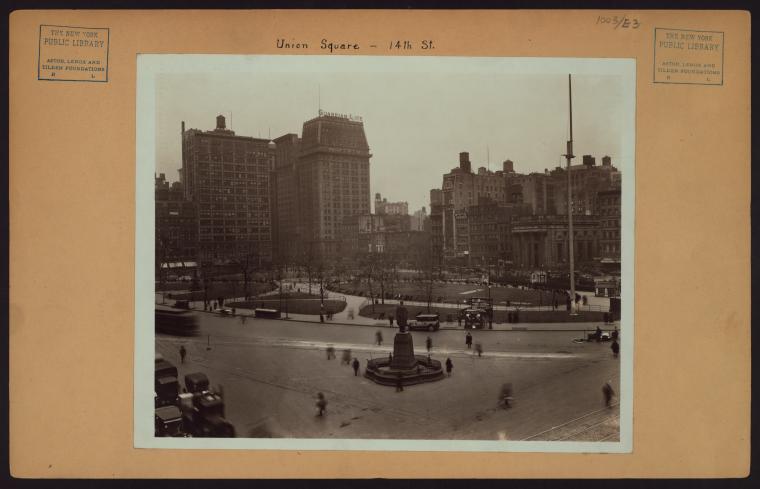
In 1931, Union Square Park was formally opened after the subway work. Statues of historic figures were the focus of the Square rather than the political demonstrators. Lawns and plants replaced the crowds of people. Wide pathways for marches became rows of trees. The Square was raised above grade (eventually creating it to be an island surrounded by traffic) The Cottage, explicitly designed for a public place of address was now a combined bandstand and comfort station.
After the Great Depression, downtown areas seemed drabby and worn out. During this period, the high end shopping and entertainment district moved uptown as the Square became the center of bargain stores for the working poor. Middle class families were moving to the suburbs known as ‘white flight’. The attention on public
space was transferred towards POPS due to the 1961 zoning resolution or ‘parkways’ like Jones Beach under Moses’ park movement. The creation of his highway infrastructure plans allowed for the creation of his stretches of parks accessibility only by private automobile. Middle-class and wealthier people enjoyed these new exclusive public spaces and parks. The Square attracted the class that was left out of these considerations. During the Great Depression, the 1930’s saw a shift in economic theory towards Keynesianism. In the classical and neoclassical economic theories, the instabilities of capitalism were natural cycles that would self-correct due to the private, competitive markets. This was a humanist approach, part of micro-economics. Keynesian economic theory argued for a structuralist approach, part of macro-economics, through state intervention or supervision. The belief was that preventing instabilities would also prevent citizens from following a socialist or Marxist approach. Keynesian and Neoclassical economic theory share the same view that capitalistic economies represent the optimum social arrangement for generating and distributing wealth. The Keynesian structure was not immune to the instabilities. As the neoclassical theory generated the Great Depression, an economy under Keynesianism produced a combined inflation and stagnation, ‘stagflation’, throughout the 1970’s and early 1980’s.
III
revitilization
1 9 8 0 ’ S - 2 0 0 0 ‘ S
THE 3RD PUBLIC-PRIVATE PARTNERSHIP
(1980’s - Present)
1976
LDC FORMED BETWEEN COMMERCIAL PROPERTY OWNERS
NEW YORK STATE PASSES BID LEGISLATURE
UNION SQUARE PARTNERSHIP FIRST BID IN NY STATE
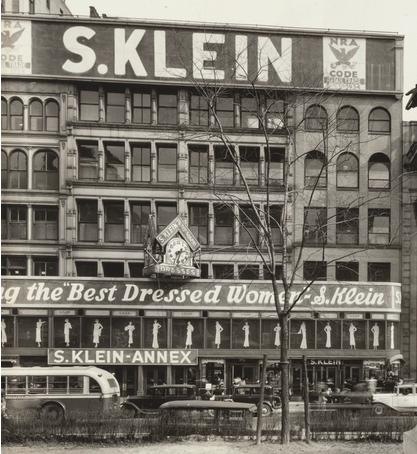
UPZONING FORMER S.KLEIN BLDG TO RESIDENTIAL TOWERS
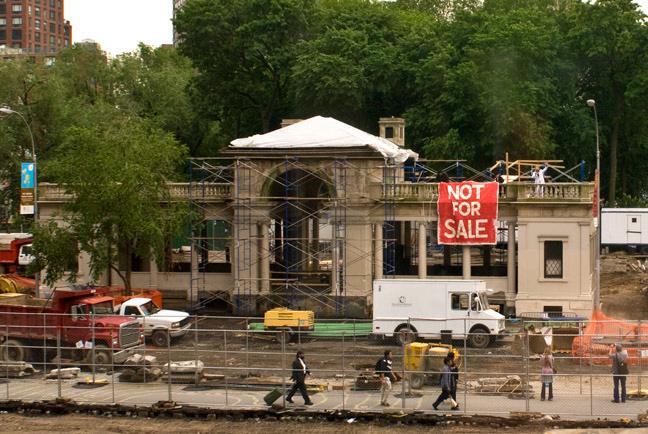
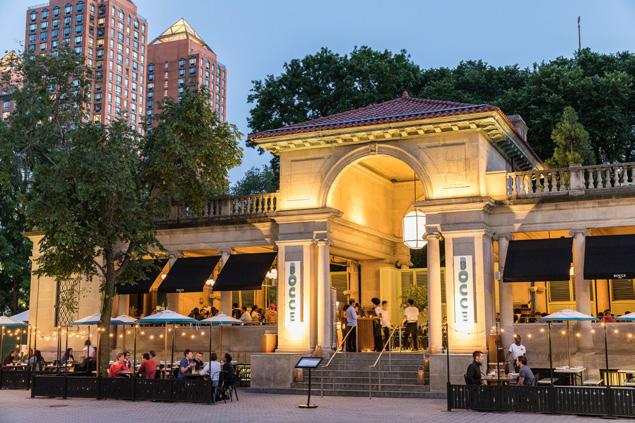
USP PUSHED TO TURN PAVILION INTO UPSCALE RESTAURANT AGAINST LOCAL OPPOSITION
PARKS DEPT & USP SOURCE FUNDS FOR RESTAURANT
Image Sources:
S.Klein: NYPL Digital Collections Not For Sale Pavilion: Source Unknown 2018 Pavilion Restaurant: Union Square Partnership website
The Third Public-Private Partnership in the Revitalization of Union Square Park:
Space of Mass Programming between Sites of Corporate Chained Consumption & Production (1980s - Present)
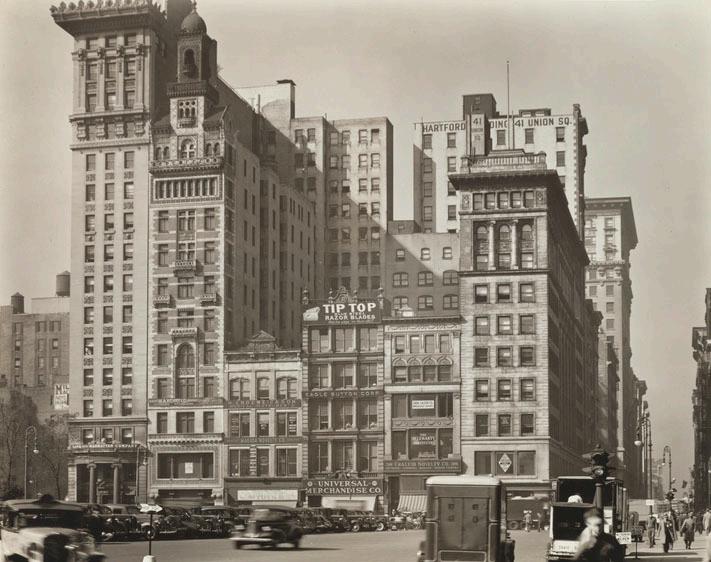
With the state failing to provide the answers to “stagflation”, the Keynesian structure crumbled and the neoclassical theory returned. As a strong critic of Keynesianism during the 1970’s, the economist Milton Friedman influenced the rise of neoliberalism throughout the 1980’s. This economic liberalization included the lowering of taxes, privatization, welfare reform, and deregulation. The establishment of the Union Square Partnership grew from the formation of the Local Development Corporation (LDC) in 1976.58 This LDC was comprised of the larger businesses and commercial building owners such as Con Ed and Guardian Life. After New York State passed legislation for BIDs in 1981, it was a matter of time that the Union Square Partnership would come into existence. The identity of Union Square Park from a space of mass congregation to a space of dissent now became a space of homelessness and drug users/criminal activities during the 1970’s. Years of municipal neglect caused a domino effect leading to the lack of park maintenance and deterioration i.e. graffiti on the bases of the historic statues.
Before the establishment of the BID, local efforts were made to revitalize the Square. According to their website, GrowNYC was created in 1970 as the Council on the Environment of New York City. CENYC was originally 58 Zukin, Naked City, 137.
a policy-based organization dedicated to writing reports about urban quality life such as air quality, traffic, and noise.59 Their Greenmarket program was founded in 1976 as a way to address two issues: to promote regional agriculture by providing small family farms the opportunity to sell their locally grown products directly to consumers, and to ensure that all New Yorkers have access to the freshest, most nutritious locally grown food the region has to offer. The Union Square Greenmarket was the pilot for this program with just a few farmers. At present, 140 regional farmers, fishers, and bakers sell their products to 60,000 market shoppers during peak season.60
In 1980, the Union Square Community Coalition (USCC was established, making it one of the first communitybased groups to protect a NYC park. They organized monthly dinner potlucks as a response to the drug pushers that the local residents weren’t planning on going anywhere. Not only did locals participate but word of mouth and posters attracted residents of other neighborhoods. First timers became regulars after enjoying the fellowship and sense of community that the potlucks provided. These potluck dinners became a traditional event into the late 1980’s with around 25 attendees. The USCC also organized noontime 59 GrowNYC, About Grow, https://www.grownyc.org/about 60 GrowNYC, Greenmarket, https://www.grownyc.org/greenmarket/ manhattan-union-square-m
concerts and helped in the removal of the graffiti markings throughout the Square. When the Union Square Partnership made several proposals for the “improvement” of the Square, they were met with opposition from the USCC.
As mentioned during the first PPP era, ‘property’ is a key term. Not only do property owners and real estate developers profit from rising property values, but so does the City. According to George Sweeting, economic historian and Deputy Director of the NYC Independent Budget Office, property tax is critical to the NYC budget and is the largest revenue source.61 During the first PPP, the Square influenced the migration of higher class residential owners who lived in the elegant mansions. This third PPP succeeded in repeating that practice. However, they needed to beautify and make the Square attractive. This included eliminating criminal activity and the homeless in order to attract middle-class residents. The BID and municipal authorization for the sweeping of the homeless in public spaces was part of the ‘broken window’ concept indicating that lack of care of urban space invited more dangerous, criminal behavior.62 The BID’s presence is not so much the care of public space as it is the ordering of urban life. The ‘city as growth machine’ explains that this ordering is a result of place as a market commodity that can produce wealth and
61 Architectural League, Housing Brass Tacks Series, “The Opaque and Unequal World of Property Taxes”, Attended October 16, 2017. 62 Mitchell, The Right to Public Space, 200. ‘13
Diagram created by Denilyn Arciaga Information from Citizens Budget Commission, Report: “BIDs Organization, Oversight, and Transparency”
power for owners.63
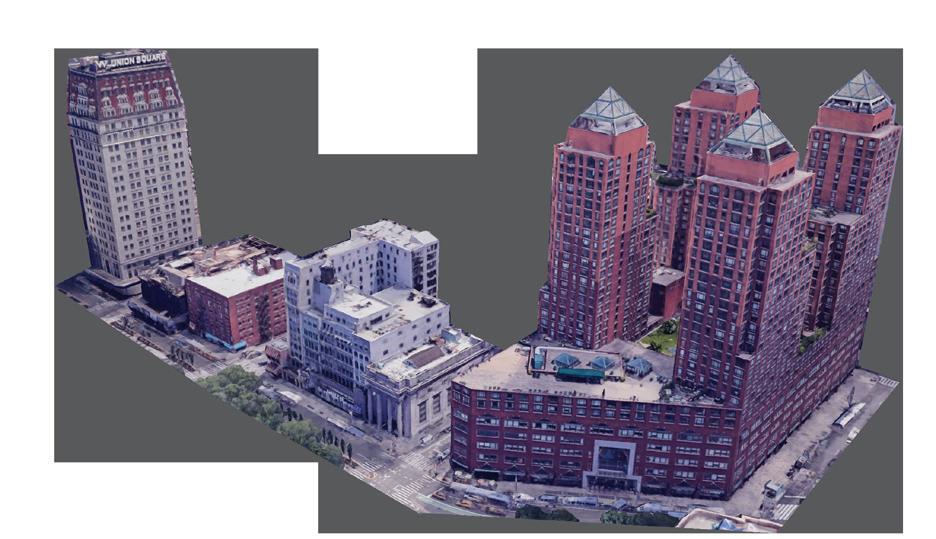
If capitalistic instabilities like rising homelessness is supposed to self-correct through the private mechanisms under neoliberalism in a post-keynes era, then something is fundamentally wrong with the theory when applied into practice. Instead of addressing the homelessness issue, both the city and developer, William Zeckendorf Jr. committed $200 million in 1985 to build his residential development if the city allowed greater densities and cleaned up the park. In return, the city spent $3.8 billion in the first phase of refurbishing the park64 If the purpose of the BID was to provide the financial resources that were unavailable from municipal funding, than the city is a powerful magician in phantoming 19 times the amount of the developer’s investment when resources were supposedly scarce to pay for park and police workers. The former S.Klein building was upzoned to make way for the 654-apartment condominium and office complex, Zeckendorf Towers, in an attempt to prove that New Yorkers would pay $300-400,000 to live in an area once considered worthless.65 Despite the absence of hard data for AMI in Union Square in 1985, the cost speaks volumes for long-term residents who saw signs of gentrification with cleaners charging $2 to wash and iron one shirt.66 The USCC protested against this development but were defeated.
The Square is at its most alive since the beginning of this thesis, which means Spring is underway. Truth be told, on this particular afternoon, I stopped by the south plaza to get some fresh air and enjoy the sun. I merely wanted to be an observer of space, rather than handing out questionnaires or having semi-formal interviews with the various groups. So I was startled when a woman said, “Hey, I recognize you!” referring to my multiple site visits. The woman’s name is Sarah. She has been a resident of the area for over 20 years when she bought an apartment on 5th Ave and 15th St during a time when it was “undesirable and affordable”. When the weather is nicer, she and ‘Gizmo’ visit the Square several times a week. She doesn’t take him to the dog park but to the chess players because he “loves their company”. We make small talk and the topic of my thesis arrives as I explain my recurring presence. She says that she is familiar with Union
Square Partnership and I ask of her thoughts about the organization. Sarah says that the police presence changed everything and that it was “quite clear that a concentrated group of black males were an issue”. She went on saying that they would “follow the same guy for a few days and then on the 5th or 6th day talk to them”. I deduce that she’s referring to the infamous stop-and-frisk encounters. When it comes to the chess players, who are predominantly colored, she perceives them as the “unofficial guardians of the park”. Unlike the surrounding literature or news articles against gentrification, Sarah says that she doesn’t feel that the Zeckendorf Towers transformed the area. It was the opening of Barnes & Noble on the north side. For her, a “literate, educated crowd” symbolized the changing demographics to come. I, with my Parsons bag and Macbook Pro, represented this class.67
67 Field research observation, Union Square Park, NYC, April 16, 2016.
Image Sources: Barnes & Noble: Denilyn Arciaga, Spring 2016 Chess Players Shaking Hands (Top Left): Denilyn Arciaga, Fall 2015
All other images: Farras Abdelnour, Spring 2016
UNION SQUARE PARTNERSHIP
BLOCK & LOT MAP
Image Source: Union Square Partnership Website https://www.unionsquarenyc.org/about-usp
In 2005, another transformation that was met with opposition was the proposal of a white-cloth restaurant in the north pavilion, which was the former political stage area. The USCC along with Save Union Square Park (grass-roots, community-based campaign) and activist “Reverend Billy” fought against the proposal. The term ‘alienation’ is the taking of parkland for non-park use and such activities require state approval.68 Unfortunately, the state supreme court judge ruled that leasing space in a public park to a restaurant is consistent with public purposes. The renovation would be costly at $20 million but the Parks Department would pay $12 million with the Partnership funding the remaining $8 million. In 1985, Danny Meyer opened up Union Square Cafe. There was speculation that the restaurateur was the anonymous donor of the $5 million to the Partnership in hopes that he could lease the space.69 In 2016, he relocated his highend restaurant to Park Ave / 17th St claiming how the fivefold increase forced him out.70 Local opposition
68 New Yorkers For Parks, Park Alienation Brochure, "Hey, That's My Park!", 2007
69 Zukin, Sharon. Naked City, 141.
70 Krader, Kate, and James Tarmy, “How Rent Spikes Are Creating Fine Dining ‘Deserts’ in New York City.” Bloomberg. July 20, 2017
lost and they opened the pavilion in 2014 which further delayed the children’s park. Eventually, it was named Evelyn’s Playground who was an advocate for an increase in playground and the co-chair of USSC. The irony is that, since 2008, Union Square Partnership has been emailing annual community opinion surveys. Excluding 2008, each year is available to download as a 2-3 page PDF from their website. The participants range from 200 - 600, mostly averaging about 300 responses but the feedback only allows participants to answer overall rating of Union Square Partnership as well as satisfaction in their core areas such as cleanliness, safety, park landscaping, and quality of life. The community opinions do not mention the North End Project Renovation and Pavilion Restaurant. However, it is informed as a ‘vibrant, new amenity’ on their 2014 Annual Market Report. (These reports are available since 2010.)
The instabilities of capitalism only add to the need of BIDs. The stock market crash in 1987, early 2000’s recession, or 2008 recession. Dependency is how they remain in power. Furthermore, the Clinton and Bloomberg era pushed for an entrepreneurial approach to public
UNION SQUARE PARTNERSHIP: OFFICERS OF THE BOARD**
**LOCAL DEVELOPMENT CORPORATION
Connection to property & real estate development
Images & Information from Union Square Partnership website https://www.unionsquarenyc.org/board-of-directors
space. In 1993, Urban Space Market set up show in NYC from London and held their first annual winter holiday market in Union Square Park. Union Square Partnership holds promotional/marketing events in the north side, as well as community activities during the seasons like Summer in the Square and Harvest in the Square. The open public space is decreasing by an aggressive over programming of the plazas.
When it comes to the BID structure, it is required that 51% of the Board of Directors must be property or land owners.71 Union Square Partnership has two Board of Directors. For the LDC which controls the Square and 17th - 18th St, they are comprised of 9 males. The BID that controls 14th Street is comprised of 14 members, of which 3 are female. UN-Habitat developed a Global Public Space Toolkit which endorses a Right to the City framework with public space being sustainable for urban development. They provide a ‘working definition’ of public space, acknowledging that it cannot have one
71 Citizens Budget Commission, Report: BIDs Organization, Oversight, and Transparency, November 02, 2017, https://cbcny.org/ research/bids-organization-oversight-and-transparency (accessed April 17, 2019).
single explanation. It is that “public spaces are all places publicly owned or of public use, accessible and enjoyable by all for free and without a profit motive”.72 It is important to mention that under one of their Principles statements, they state that Good Public Space be Generators of Wealth and Income. However, their explanation is that a sustained flow of resources, city-provided “in the form of taxes, derives from economic expansion and increased property values. Economic expansion comes from investment and investment depends on such factors as mobility, safety attractiveness. This is the virtuous public space cycle”. The reality of Union Square Park is that the BID is not going anywhere and their many community programming and efforts create more of their attraction. Their Neighborhood Vision & Planning Initiative is described and critiqued as part of the physical design proposal integrated within this thesis.
72 UN-Habitat, Global Public SpaceToolkit: From Global Principles to Local Policies and Practices, 2015.
William Abramson Co-Chair Buchbinder & Warren
Nicholas Haines Treasurer The Bromley Companies
Bruce C. Blank Paragon Sports
Jeff T. Blau The Related Companies
Terry Coughlin Union Square Hospitality Group
Ken Giddon Rothmans New York
Eric Seiler Friedman Kaplan Seiler & Adelman Tokumbo Shobowale The New School
Herb Streng Orda Management
(2 YRS) NYX (+14 YRS) MCDONALD’S (X) VACANT (1 YR) BARN JOO (3 YRS) DYLAN’S CANDY (X) BLUE WATER GRILL
THE 3RD PUBLIC-PRIVATE PARTNERSHIP (1980’s - Present)
(+20 YRS) PETCO AT&T
(25 YRS) BARNES & NOBLE (+15 YRS) SEPHORA (5 YRS) RED DOOR
NORTH PLAZA: 36,738’
WOK TO WALK (3 YRS)
Storefront Information Collected During Walking Survey, April 2019
GARDEN: 5,524’
EVELYN’S PLAYGROUND / COMFORT STATIONS: 18,430’
WEST SIDE PLAZA: 43,867’ WEST SIDE SEATING AREA: 5,751’
SOUTH PLAZA: 14,368 SF PAVILION: 2,778’
MAIN LAWN: 35,738 SF EAST LAWN: 10,979’
SOUTH LAWN: 10,710 SF DOG PARK: 5,843’
DUNKIN’ DONUTS (8 YRS)
PETITE OPTIQUE (24 YRS)
MAOZ VEGETARIAN (+10 YRS)
CHILDREN’S PLACE (+10 YRS) (3 YRS) BOLTON’S (+9 YRS) FOREVER 21 WHOLEFOODS (10 YRS) (4 YRS) MAC (3 YRS) CAPITAL ONE (8 YRS) CITIBANK DUANE READE (9 YRS) NORDSTROM RACK (9 YRS) BEST BUY
SPACIOUS (1/2 YR)
VITAMIN SHOPPE
RAYMOUR (1 YR)
STARBUCKS
GNC (+ 10 YRS)
PANERA (7 YRS)
AU BON PAIN
FED EX (15 YRS)
VACANT (X)
UNION SQUARE PARK SF: 224,950’
PLAZAS: 94,937’ 42.2%
LAWNS: 62,130’ 26.6%
CORRIDORS: 29,011’ 12.9%
DESIGNATED USE: 27,051’ 12.0% WEST SEATING AREA: 5,751’ 02.6%
SOUTH GARDEN: 5,525’ 02.5%
III
designing for consumers
1 9 7 0 ’ S - P r e s e n t
THE 3RD PUBLIC-PRIVATE PARTNERSHIP (1980’s - Present)
GREENMARKET BY GROWNYC 60,000 SHOPPERS (DURING PEAK) M W F SAT YEAR ROUND since 1976 since late 1970’s
‘SUMMER IN THE SQUARE’ BY UNION SQUARE PARTNERSHIP
NORTH & SOUTH PLAZA
WEEKLY JUNE - AUGUST
SOUTH/SW PLAZA
DAILY NOV - DEC
since 1995 since 1994 HOLIDAY MARKET BY URBAN SPACE
‘HARVEST IN THE SQUARE’ BY UNION SQUARE PARTNERSHIP NORTH PLAZA
ANNUAL TICKET EVENT $150 - $500
Image Sources:
‘Greenmarket by GROWNYC’ from grownyc.org, Union Square Greenmarket page ‘Summer in the Square’ fitness & movie screenings from unionsquarenyc.org, Summer In The Square page ‘Harvest in the Square’ screenshot for promo video from unionsquarenyc.org, Harvest In The Square page ‘Holiday Market’ from urbanspacenyc.com, Union Square Holiday Market page
RESEARCH ANALYSIS
Through a deep exploration of re-examining the historical transformations of Union Square Park, I have acquired and presented a great deal of knowledge surrounding its evolution of democracy, cycles of investment and disinvestment, and repetitive patterns of top-down planning for this public space.
Union Square Park is a reflection of the growth (and decline) of New York City, specifically its politicaleconomic relationships. The urban cycle of the Square is not just a control of financial power, it exemplifies what Zukin defines as ‘cultural power’ “because they reinforce the images in politicians’ rhetoric of growth”73 and through this, cultivate their own ideal users. The beginning was a response to the Manhattan Grid of 1811 which was created by 3 commissioners’ with powerful political connections and who were landowners as well. This signified the race amongst the wealthy to accumulate as much property lots as possible from a grid that laid out its most efficient way of maximizing land value. Diminished from its original size, Union Place was relabeled as Union Square Park and encompasses many identities. After gaining independence from Great Britain during the American Revolution, the development of Union Square Park is still influenced by elegant London residential squares for means of profit. Participatory democracy is welcomed through civic engagement but with limited freedom to protest against the inequality between the lower class workers and upper class employers, or unequal capitalist 73 Zukin, Naked City, 4.
structures. Solidarity of the working classes is formed on space that becomes high-end shopping and an entertainment center. This dichotomy becomes a foreshadow of the continued power dynamics. The mass congregation within the public space becomes mass dissent and as decades progress, the solidarity slowly becomes immobile by police restriction and physical transformation for underground rapid transit. As highend shops move uptown, the surrounding context becomes affordable with bargain shops. After the War, Union Square Park goes through its own form of dissent the following decades due to the urban decline which led to the site being misused and deteriorated with illegal activity. Throughout the 1970’s, local efforts are brought in like the USCC, GrowNYC, and the LDC to help reclaim the space from the effects of decay. The LDC combined with the BID would be Union Square Partnership and the star model for the rest of NYC BIDs.
As presented throughout the historical research, the findings conflict with Zukin’s claim that the “public loses control over it (Union Square Park)” when the public rarely had control over the planning for the site of study and accessibility within the space was regulated long before the existence of Union Square Partnership. And if by “public” she refers to the city agencies being compromised due to the BID, this is also weak because BIDs are enacted by state legislature and endorsed through city policy. Furthermore, prior to the BID, city actors repeatedly worked with power holders since it was a mutually beneficial relationship. These deeply
rooted power dynamics infrequently allowed capacity or considered the actual public to plan, or be decisionmakers. Union Square Partnership is a formation that is part of a long chain of events due to the mechanisms enabled by unequal development.
Context is everything. Union Square Park is unique because it is both a park and a plaza above 7 subway lines. It is defined by buildings with ground retail and commercial facilities. Public spaces with this feature tend to be subject into becoming a BID-managed space.
As the Square developed, more municipal agencies have been involved in the planning and management of the Square. Even more complex are the the multiplicity of stakeholders. Carmona lays out a broad structure of public space stakeholders which fall into four categories: “1) Private, including private property owners and developers, but also utility providers; 2) Public/private, including the range of arms-length pseudo- government agencies and operators (e.g. of public transport); 3) Local government, including a wide range of services across one or more tiers of local government; and 4) Community, including residents and special interest societies and local groups.74 However, the users of the actual public space are missing as stakeholders. These users also range from transitional commuters to highly engaged users and are potential stakeholders. Each PPP era had their own planners with architectural proposals of landscape design. The proposals are static and despite its name, Union Square Park is more than just a square. It is dynamic and fluid with movement and people.
I would be remiss if I didn’t say how naive I was earlier in the selection of this project’s topic. Originally, I found it unjust that chess players had to relocate due to the Holiday Winter Market and that protestors couldn’t occupy the south plaza, or that artists could not set up their spaces due to the Farmer’s Market. In my field work, 74 Carmona et al., Public Space: The Management Dimension, 19.
it seems that most users do not mind accommodating to the programming. There is a co-existence in the Square and it’s difficult to argue against the free community events that Union Square Partnerships coordinates or promotes such as: Earth Day Initiative on April 23, 2019; Thursdays with Summer in the Square (June 13 - August 8) that consists of fitness classes, children’s activities, movies, and live shows including a drag queen event.75 If (and this is a really important if), the data revealed that Union Square Park was historically a publiclycontrolled public space, at the true levels of Arnstein’s measurement then perhaps an intervention would be needed to create an alternative to the BID model.
Motivation For Action
Based on the analysis, this question now deserves to be asked: How might Union Square Park now become an inclusively planned public space?
For the first time in its history, a public-private partnership has created an opportunity for the public to participate for the planning of Union Square Park (and the surrounding 14th Street area) through the Neighborhood Vision & Planning Initiative. This signifies an important step towards democratic planning for the public space but requires critical attention to those who are the target participants and those who should be involved in the process but get overlooked. While it may seem trivial to delineate the Initiative in the absence of a pressing demand for particular voices to heard, it’s important to harness this energy before it becomes another layer of Union Square Park that gets vanished in history.
75 Community Board 5, Parks and Open Space meeting, February 04, 2019
DESIGN PROPOSAL & IMPLEMENTATION
Positionality
Throughout the initial investigation, I had a certain knowledge of uneven urban development and the social ramifications of the BID process in relation to public spaces. As an academic researcher, I maintained a non-biased objective in order to not cloud any preconceived judgement. During the open-ended field research, I found myself being absorbed within the social landscape, which is a normal occurrence in anthropological fieldwork.76 It was increasingly difficult to sustain an external presence as I found myself becoming a regular user of space and familiar face. As a member of the community through The New School, I identify as a student of the area, or a stakeholder, according to Union Square Partnership. As a design strategist, I see an opportunity for engagement with the informal user groups of public space and the entities of those who manage it. It is through these multiple identities that inspire the design proposal and implementation.
Public Space Participatory Index
The proposal presented is a design proposition in lieu of the current participatory planning process. The primary goal of this Public Space Participatory Index is to disseminate knowledge of the Square's planning history in an attempt to signify the importance of inclusionary participatory planning. By sharing this Index on a one-toone procedure with various groups (that are identified in the first section of the Index), my hope is that it will
76 Chris London, Lecture, Research Design, February 02, 2016.
spark a collective consciousness to inspire future, and stronger, participatory planning processes in which user groups will want to actively be involved.
The Index features are a profile of Union Square Park illustrating the political-economic power dynamics of Union Square Park and a map revealing an enormous potential group of user participants; a critique on the existing participatory process; and alternative methodologies towards inclusionary participatory planning. In order to not repeat historic cycles of public space transformation where voices have continuously been left out, this Index aims to facilitate dialogue amongst the Union Square Partnership and the planners, Marvel Architects and other identified urban-actors. My intent is to consider the socio-cultural contributors, or the value assets of public space, who deserve to be included in the vision of Union Square Park. Due to my existing connections with these groups, this Index will be shared with them as well.
[This Public Space Participatory Index is in the following pages but is adaptive as a separate printed document as an integral part of this thesis. Please note that the Content page numbers are applied as the separate document.]
This Public Space Participatory Index: Union Square Park serves as the design component and integral part of the Master Thesis
THINKING OUTSIDE THE SQUARE
REDEFINING THE DEMOCRATIC L ANDSCAPE FROM WITHIN PUBLIC SPACE
By Denilyn Arciaga
for the purpose of obtaining the degree of MS in Design & Urban Ecologies at Parsons School of Design
The New School May 2019
Thesis Advisor: Dr. Gabriela Rendón
Assistant Professor of Urban Planning and Co-Chair
Secondary Advisor: Dr. Miodrag Mitrašinović
Associate Professor of Urbanism and Architecture
INTRODUCTION
DEVELOPING THE PUBLIC SPACE PARTICIPATORY INDEX
BACKGROUND AND POSITIONALITY
This Public Space Participatory Index is a by-product of my thesis research and is inspired by Union Square Partnership’s ‘Neighborhood Vision & Planning Initiative’, a 9-month participatory planning process. They “welcome all who have a stake in the community to join” and that “everyone’s voice should be part of the conversation”. The development of this Index comes from multiple voices: graduate student at The New School (community member); semi-active user of Union Square Park (public space user); and as a design strategist through this thesis project (subject expert).
As a graduate student at The New School, I became a daily commuter passing through the Square. After my first few weeks, what first seemed like urban chaos of the space turned into what I viewed as an informal orchestration of ebbs and flows of public space life. As time progressed, my use of the public space increased as well as my familiarity of the greater Union Square area. A year and a half later, two observations led to the inspiration of my thesis research: 1) playing a game of chess and seeing the cross-interactions amongst the diverse groups of users whom I initially thought were fragmented and 2) the power dynamics of public space in relationship to users and the urban actors who manage it. My research re-examined the historical conditions of Union Square Park in relationship to democracy within and for public space. Based on the historical findings, there has been a repetitive cycle of top-down planning for Union Square Park. At times, these practices disregarded user input or resulted in the elimina-
tion of certain groups. At the beginning of my esearch, I conducted ethnographic fieldwork as an exploration of who uses public space and how they interact with the space. Specifically, I engaged with regular users of the the south/southwest plaza. To me, their informality created a sense of authenticity. It is my contention that these many users of the south/southwest plaza contribute towards the liveliness of the Square by attracting other passerbys or users who regularly visit to engage with them. It is important that their voices be part of the participatory planning process that ultimately shape the public space that they inhabit.
The ‘Neighborhood Vision & Planning Initiative’ is the first time that democratic planning for Union Square Park has been implemented but there are many opportunities to make it more inclusive and meaningful. While their process is promoted as community-driven, the number of those who participated is incredibly low (as shown at the end of the next section, “The Case for Union Square Park”). As an advocate for democratically planned public spaces, a member of the Union Square community, and subject expert through myThesis, the creation of this Public Space Participatory Index is the physical manifestation of a step towards my “vision for Union Square Park”.
From The Perspective Of A Community Member, Public
Space User, and Design Strategist
MEASURING DEMOCRACY OF PUBLIC SPACE
Part of the Thesis Research
DEGREES OF USERS IN UNION SQUARE PARK
Top-Down Planning
PERSONAL ASSESSMENT OF MYSELF AS A USER
Diagram created during my thesis fieldwork when trying to understand who uses the public space. Not only is there a diversity of users but the levels of how they engage with the space and how often they inhabit the space varies. (Throughout my time in the area, my own degrees have shifted.)
ONE OF MY REGULAR INTERVIEWEES
Playing a game of chess with “Big John” (John Hill). Chess players are one of many regular groups in Union Square Park. My open-ended interviews were conducted over a game of chess as I found that John’s conversation overflowed with knowledge when he played. He used to work for the Parks Dept and knew the rules of the park and “respected the space”.
Photo Credit: a photographer named Mike who was kind enough to email this image. He captured it, after he noticed that I drew a small crowd that circlated around the game.
ENVISIONING THE PUBLIC SPACE PARTICIPATORY INDEX
THE NEED FOR INCLUSIONARY PARTICIPATORY PLANNING
Here in NYC, our public spaces are where we connect as an urban and global community. In these spaces, we share our collective identities and promote our shared visions. Simultaneously, these spaces allow us individuals to take a break from the everyday. Although these spaces are majorly accessible, in the case of Union Square Park, rarely were they democratically planned. Participatory planning processes are a key step towards democratically planned spaces as they ensure equitable and sustainable development within these public spaces. However, how these processes are implemented deserves critical attention since the methods may not always be as inclusive.
‘Inclusionary’ in the subtitle is placed before participatory planning because processes that are publicly accessible (all are welcome to participate) are vulnerable to becoming a one-way effort. The term ‘inclusionary’ in this Index is used as a verb; an action that requires those who faciliate the participatory planning to make efforts in reaching out to users who are unaware of these processes. While public space shares the obvious common thread as being a ‘space for the public’ the physical fabrics, intangible processes, and userships are all unique and different from each other. The userships are important because democratically
planned public spaces must consider and involve those who utilize and contribute towards the liveliness of public spaces in the features of that specific site.
Participatory planning that actively includes more users of public space to be part of the process is powerful. At best, this leads to more informed design of projects by allowing their ideas and concerns into the development strategies all while empowering these communities of users. Multiple communities that are part of the planning process help these public spaces regain a sense of collective public ownership. The connections between informal users and managers of public space create a more resilient network and the two-way exchange of knowledge offers unique internal perspectives. In this Index, ‘informal’ is referred to the social infrastructures part of Union Square Park (as shown in the next section). At worst, the responses that people provide about not wanting to participate help generate insight and an iterative process can begin in the improvement of future participatory planning processes.
The Public Space Participatory Index is a package consisting of: the historic profile of Union Square Park in the context of my interpreted definition(s) of public space democracy; a brief overview and evaluation of the current participatory planning process to discover opportunities for better inclusionary planning; and ideas (preliminary recommendations) on how these inclusionary processes might be achieved in the long-term.
Elevating Towards A Level For Democratic Planning
V I S I O N
My would-be post-it response to the ‘Neighborhood Pop-Ups’, part of Union Square Partnership’s Neighborhood Vision & Planning Initiative.
M I S S I O N
Disseminate the Public Space Participatory Index to associated groups at the management level in order to achieve higher levels of participatory planning processes
P R I N C I P L E S
connect:
Extend beyond the comfort zone to establishment new relationships with informal users of public space
communicate: consistently maintain transparency in a two-way channel of communication throughout duration of process
collaborate: inclusively develop meaningful and long-term iterative processes for the planning of public space
contemplate: allow space for collective reflection in order to address areas to improve for future participatory planning processes
This vertical representation is based off Sherry Arnstein’s “Ladder of Citizen Participation”, part of the theoretical framework of the Master Thesis. Through the historical research, most planning falls under the lower levels of tokenism. nonparticipation
IMPLEMENTING THE PUBLIC SPACE PARTICIPATORY INDEX
HOW THE INDEX (aims to) WORK
The Public Space Participatory Index is an experimental approach. The intention of this Index is to serve as a conduit for a two-way exchange of knowledge and insight about democratic planning for our urban public spaces. It is not meant to be a ‘distribute and depart’ booklet. As a public space user of Union Square Park, this Index will be shared with those involved in the decision-making processes in order to facilitate dialogue about the ways in which we can better plan for inclusionary participatory processes. I recognize the irony that this Index is created by a single person rather than through a collective process, which I strongly encourage for a Public Space Participatory Index. Due to this, I plan on sharing this with the people that I have connected throughout the journey of this project whose vision aligns towards participatory planning in public spaces. From their feedback and the decision-makers, this Index wil be revised and updated. It is through these attempts that this Index can then be a collective process.
Through my research, I have discovered key actors surrounding the decision-making processes. Union Square Partnership is the Business Improvement District (BID) that oversees the maintenance, funding, and management of Union Square Park. BIDs are a contentious subject: they vastly improve the quality of public spaces but are notorious in the gentrification of these areas through higher costs of rents for both residences and smaller businesses that are vulnerable of being displaced. It is this reason that their Neighborhood Vision & Planning Intiative is applauded, yet requires critical analysis. Although the Department of Parks & Recreation is the main operator of Union Square Park, and collaborate closely with Union Square Partnership, they only enforce the rules and hours of the park, which is the interior, not exterior plaza since access to the subway station is needed 24 hours.
However, Union Square Park falls under Community Board 5 through the Parks & Open Space committee. After attending a meeting, I learned that all commercial events (which the BID coordinates) must go through CB5 for approval. Union Square Community Coalition is a community-based alliance who formed during the 1970’s decline of Union Square Park (and have had past conflicts with the BIDs transformation of the Square) This is another group that I plan to connect with and share this Index.
LIMITATIONS
Due to the discovery of the Planning Initiative after 6 months into their project schedule, the analysis is heavily based off public information provided by their website. Fortunately, there is sufficient material for assessment and action. At the CB5 Parks & Open Space committee meeting on February 04, 2019, Union Square Partnership had two representatives discuss their annual programming for approval with no update of the Planning Initiative. At that time, I did not ask questions since I was unaware of it and the design proposal of this Master Thesis was not yet clear. Attempts have been made to be part of the process by signing up via email in February, with the hopes to participate in their online survey and spring pop-ups but no information was ever provided. I made several contanct attempts. Over phone, the Administrative Assistant vaguely implied that it was delayed. The Deputy Director of Community Engagement reached out enthusiastically via email but never confirmed status. They are still in receipt of my last two emails. Nevertheless, I am signed up to attend the Partnership’s Annual Meeting & Networking Reception where I plan to fill some knowledge gaps and connect with the associated groups part of the Planning Initiative.
Initiating & Activating A Constructive Dialogue
UNION SQUARE PARK THE CASE FOR
MAKING UNION SQUARE PARK
Multi-Layered Histories
For a modest public space that’s 3.5 acres, the history of Union Square Park is rich with details and overlapping layers of narratives. As a way to dissect and comprehend the information, I found it useful to divide the history into three eras which begin with the formation of a public-private partnership. Not all public-private partnerships served as an overarching umbrella throughout the era, but they influenced a transformation that produced other alterations of the public space.
Evolution of Democracy
Great public space is democratic, but democracy throughout the developments of the Square is intrinsically tied to the power groups who plan the outcomings of the public space. Through the cycles of investment and disinvestment, there are many processes in play that ultimately shape and exclusively decide who and what gets put into the space.
Repetitive Public-Space Cycle
The repetition of top-down planning is seen consistently throughout the Square’s histories. The internal connections that are formed between municipal agencies and power holders make their control over space inpenetrable to external groups.
The Wall around the Square
The influence of transformations within Union Square Park are heavily expressed by its surroundings. Real estate development and the raising of property values is a story told since the beginning of its time.
The Historical Power Dynamics of Union Square Park
S.KLEINS SHOP TO ZECKENDORF TOWERS
(re) DEFINING UNION SQUARE PARK
Political & Social Connections
This diagram attempts to illustrate the various actors that manage or regularly use the public space. The illustration is trying to convey the hierarchy of the programmers of public space and users. Although they interact, through the necessity of permits, or as consumers, there is a large gap when it comes to the political-economic structures and socio-cultural strucutres.
Potential for User Participants
With all of the various informal user groups, there are infinite possibilities for more people to participate in the planning processes. This is only a small percentage of the countless amount who inhabit the Square for various reasons.
FORMAL INFRASTRUCTURES
TAROT CARD READERS
religious groups
HARE KRISHNA
businessmen (lunch break)
other chess players
residents/ friends
ARTISTS solicitors
CHESS PLAYERS
grandmasters children
Composters
Recreational Athletes
passerbyers
Containing the Square: Mapping the Formal and Informal Infrastructures
CB5 Open Space & Parks
Greenmarket
Round (M W F Sat)
Holiday Market Nov - Dec (Daily)
(re)PLANNING UNION SQUARE PARK
Union Square Partnership’s
Neighborhood Vision & Planning Initiative
Who: Union Square Partnership hired Marvel Architects.
What: With the collaboration between the two organizations, they have developed a 9-month community-based vision and participatory planning process for the next decade.
Where: The focus areas are mainly Union Square Park, and two 14th St areas and University Place.
Neighborhood Vision & Planning Initiative
9-Month Schedule and Project Outline 2018-2019
When: September 2018 until May 2019.
Why: Recent developments along 14th St and the closure of the L train (before it was averted) motivated Union Square Partnership to develop this Initiative.
How: Through on online (annual) Community Opinon Survey, Neighborhood Pop-Ups, Community Forums and Stakeholder Working Sessions.
SEPTEMBER - NOVEMBER DECEMBER - FEBRUARY MARCH - MAY
PHASE 1
Data Collection & Community Input
UNION SQUARE PARTNERSHIP
We are analyzing the physical conditions of the district and gathering ideas from our community on how to better improve.
MARVEL ARCHITECTS
ANALYSIS / PROGRAMMING: Site Investigation and Mapping
PHASE 2
Potential Project Development
UNION SQUARE PARTNERSHIP
With input and guidance from our community, we will finalize the long-term vision and goals for our district and begin to develop a list of potential near-term priority projects.
MARVEL ARCHITECTS
OUTREACH / CONCEPT / APPLICATION FOR FUNDING: Concept Design Development
PHASE 3
Priority Concept & Design Refinement
UNION SQUARE PARTNERSHIP
We will conduct additional analyses and public engagement to finalize the concepts and designs for several priority near-term projects that USP will undertake.
Diagram created based off Union Square Parktnership & Marvel Architects’ Project Schedule
Union Square Park’s
First Participatory Planning Process
Neighborhood Vision & Planning Initiative
Focus Areas in regards to Union Square Park
presentation slide from Fall Community Forum Nov 29, 2018
Historic Patterns of Planning
Site of Vulnerability
Give the history of top-down planning where vulnerable communities are being disregarded and displaced from public space planning, I highlighted the area in red where many informal groups of users congregate. This is the focus area to see how they fit into the planning process and to ensure that their presence is maintained and protected throughout the final vision document.
PARTICIPATORY INDEX
Breaking the Top-Down Cycle or Repeating It?
EVALUATING PUBLIC PARTICIPATION
While much applause goes to Union Square Partnership and Marvel Architects for creating a participatory platform, an analysis must be conducted to determine the efficacy of their overall process as well as the level of engagement within their particular methods. Given the histories of Union Square Park, it is important to assess this current participatory process in the hopes that future planning processes of this public space might adopt certain successful methods or strengthen other methods.
LEVEL OF INVOLVMENT
Which Stakeholders are Invited?
What is the Purpose of Each Working Session?
How is Input Received & Collected?
How are the Activities’ Results Filtered?
Based on the Locations, Who do these Pop-ups Attract and Who are Excluded?
What is the Level of User Engagement?
Is there a Method to Record Who Participates & Collate the Responses?
2018 Community Newsletter
What are the Questions?
With more than 60,000 followers on social media and 890 email subscribers, why do so few participate? Who are the Respondents?
Areas of Opportunities:
OPTIMIZING PUBLIC PARTICIPATION
hires planners to guide the process
1 Partnership Project Schedule together develop
2
Community Input
SEPTEMBER - NOVEMBER
PHASE 1
Data Collection & Community Input
UNION SQUARE PARTNERSHIP:
We are analyzing the physical conditions of the district and gathering ideas from our community on how to better improve.
MARVEL ARCHITECTS: Site Investigation and Mapping 3
4
5 Community Forums
Neighborhood Pop-Ups
#1: Establish Community Partnership Prior to the Project
#1: Establish Community Partnership Prior to the Project hires planners to guide the process
PUBLIC PARTICIPATION together hire forms partnership planners / designers / architects Making the Public the Majority of the Partnership for the Planning Process
1 Partnership Top-Down Planning Community-Based Planning X internal existing public space organization 1
#2: Produce a Community-Based Schedule to Implement Annually
Tri-Partnership Based Schedule internal existing public space organization planners / designers / architects hires planners to guide the process 2
Project Schedule One-Time Process Start End Top-Down Planning Balanced Planning X Continuous Participatory Planning 9-Month Schedule
#1: Establish Community Partnership Prior to the Project
PUBLIC PARTICIPATION
#3: Develop Tools To Define Community and Engagement Community Input
SEPTEMBER - NOVEMBER
PHASE 1
Data Collection & Community Input
UNION SQUARE PARTNERSHIP: We are analyzing the physical conditions of the district and gathering ideas from our community on how to better improve.
MARVEL ARCHITECTS: Site Investigation and Mapping
Monitor & Record Who Uses Public Space To Ensure Their Voices Are Heard & Included
Level of Potential Participants that Should be Involved throughout the Planning Process
2) Exercise Warm-Up: Affinity Mapping of Collected Post-Its
Resources User Concerns
This helps the participants decide the matrix & grouping and allows for internal discussion rather than filtered ideas from planners
#4: Tools & Strategies for Community Forums
1) Exercise Warm-Up: Mental Mapping of Union Square
This may be beneficial to see a collective perspective of resources or issues that may be overlooked by planners but are important to the community members
3) Record Who Attends for Data Collection
This helps tabulate which community groups participated and identifies who doesn’t to plan better outreach in the future
PROPOSED SCENARIOS
1) Two-Way Form of Engagement: From Stationary to Mobile
This creates a better flow of knowledge exchange between planners and users of public space
2) Develop Location Schedule Based on Matrix of Users
This helps to encourage more potential and diverse participants
3) Record Who Participates for Data Collection
ANSWER
Connection to Union Square / Park
This helps tabulate who participated and identifies who doesn’t to plan better outreach in the future
CONCLUSION
DOCUMENTING FEEDBACK & INSIGHTS
Union Square Partnership’s Annual Meeting & Networking Reception, Spring 2019
On Monday, May 6, I attended Union Square Partnership’s Annual Meeting & Networking Reception 2019 held at the W Hotel (former Guardian Life building) on the Northeast corner of Union Square Park. Through this meeting, I planned to introduce myself with some of the people who led the Neighborhood Vision & Planning Initiative in hopes to set up meeting times to share this Public Space Participatory Index. Prior to the event, I walked around the Square to reflect within the space which was filled with the typical, diverse users of all ages and backgrounds. This did not reflect those in attendance at the Annual Meeting which was mostly an older, less diverse crowd. After signing in and receiving name tags in the reception area, I noticed that part of it was staged like an outdoor public space filled with the BID iconic green chairs and tables. The line guided towards the main meeting room where a worker greeted and asked people if they were a voting member as they were to sit on the left aisle. Another woman (Libby, early 20’s) and I expressed confusion and through this, connected and sat next to each other discussing our interests in the meeting. She lives on the southeast corner of Union Square Park and has been actively trying to be involved in the Neighborhood Vision & Planning Initiative. Libby attended the Winter Community Forum but has not been updated on the process and said they weren’t very good about updating the community. Later, I learned that the small group of voters were part of the Meeting Agenda to nominate the already existing pool of the Board of Directors. Commercial tenant of “Class B” Jordan Brackett (14th St Y) explained and led this quick process. All in favor and no opposition, from about 10 voters.
During Jennifer Falk’s (Executive Director) opening
monologue, she told the story of Union Square being a place of decline throughout the 1970’s and that with the mobilization of commercial property owners of Guardian Life, (Charles Luce), ConEd, and the then President of The New School formed the 1976 Local Development Corporation and have brought back life into the area. It’s of no surprise that the re-telling of this narrative is to emphasize the importance of Union Square Partnership’s establishment and continued presence as an urban practice of neighborhoods and public space management. What I learned, however, was how deeply networked Union Square Partnership had become with all the businesses, residents, and universities (NYU and The New School) in the area. In fact, David Van Zandt (President of The New School) was the Keynote Speaker and deeply expressed TNS’s appreciation of the Partnership. As an urbanist for social equality, I advocate for community-driven places through local processes and have become knowledgeable about the Partnership’s past and alternative untold story. What I took away from the Annual Forum is that Union Square Partnership’s network organizations view the BID (as well as the BID itself) as Union Square’s main community-based organization. When it came to the Neighborhood Vision & Planning Initiative, Jennifer spoke briefly for 3 minutes, highlighting their well-done efforts, nothing different than what could be read online. Libby and I were both disappointed since we thought Marvel Architects would be presenting an updated vision document. After the Meeting, I was on my way to look for D’arcy Sampson, the woman with whom I had corresponded with via email (my last email went unresponded). From her last email, she said she would try to help answer my questions but if not, could “point
A LIVING ARCHIVE: Field Notes from Sharing the Index
me into the right direction”. Luckily, I found Scott Hobbs, Deputy Director who is Jennifer’s “right-hand” as stated by Board Co-Chair Lynne Brown. I asked him about the status of the Initiative since the project seemed to have halted in Jan/Feb when no online survey was distributed or information released about the spring-pops as mentioned on their online schedule. His response was that there was a lot of staff turnovers that caused delays and that Marvel was only on a 9-month contract but we should hear back sometime this Fall 2019 with the final document. When asked who created the participatory planning process and methods, Scott stated that the Partnership conducted the outreach and collected the data (since they’re part of the community), and that Marvel analyzed the data. In hopes to meet again with Scott to share my Public Space Participatory Index, I learned that this was his last week working with Union Square Partnership. It was difficult trying to connect with Jennifer due to the large groups constantly surrounding her and waiting for their turn to speak but numbers were exchanged with Libby is eager to “meet up and connect” because she wants to “discuss and learn more” about my work.
Union Square Park
Sharing with “Big John” in the Square (chess player)
On Thursday, May 9, 2019, I brought a printed version of this Index to the Square to share with a regular user with whom I interacted during the field research of this project. While John admired about how “beautiful” it looked and brought him “back to remember school”, it didn’t quite elicit the response that I had hoped - a compelling realization of the historical conditions of the space he frequented so often. When I asked if he would consider participating in future planning processes or why so few participated in the recent planning process, he made a comment about how some organization already lobbies for the planning but couldn’t specify further details.
I am not discouraged by the outcome. Rather, I am reconsidering how this Index may have been too academically formal and how it might be altered to easily convey the deeper, complex issues surrounding participatory planning in public spaces.
More to follow as the Index is shared...
CONTRIBUTION
Research
The combination of research components was an attempt to describe and analyze public space in a new light. Although the physical transformations played a role in the development of Union Square Park, my intent was to consider the intangible processes that were shaped by political-economic forces. The research adds to the dialectical conversation about the critique of privately-controlled public spaces by providing an example where public space was originally an amenity to the wealthier class. This complicates the issue but at the same time can open up new conversations about why we might push for the demand for democratically planned spaces through participatory planning. By focusing on Union Square Park, I was able to capture a wide range of qualitative insights through the everyday lived experiences of public space users. Through the design, I hope to change perceptions about about space being an asset to the public towards the public being an asset to space.
Design
Participatory planning can be incredibly impactful and empowering towards communities. The design and strategies provided can not in any way be a final resolution but through the design implementation of actually talking to people, I hope to spark dialogue by sharing my new perspectives and initiating the process of inclusive planning. This journey has developed my own vision as an urban pracititioner through community engagement and how I might begin to approach the design of
participatory planning. Through sharing the Index, I hope to continue learning more about why people participate, why people don't, and the struggles and challenges from both spectrums of public space users and planners. This work does not end with submission of the thesis, or strictly focus within Union Square Park. This month, I received my letter of appointment from the Manhattan Borough President where I will be serving as Board Member for Community Board 11. East Harlem holds many community forums and participatory planning events where I hope to contribute as a design strategist. Through these past engagements, I have connected with the Chair of Environment, Parks and Open Space and have previously shared my work them. They asked that I serve on their committee and I hope to be of service through my own neighborhood's public spaces.
CONCLUSION
In describing and analyzing the intracies of Union Square Park's planning history, I realize that the collective demand for democratically planned public spaces might be a revolutionary act for a site that has accommodated the ideals of power holders and private interests for so long. Originally, I thought that partnerships might be formed at the higher levels of citizen participation but this is impossible if participants have no interest to participate. It is with this insight that the idea of the Participatory Public Space Index came into development. The redistribution of planning power cannot occur unless a bottom-up demand is initiated. The Index is in no way capable of achieving such an ambitious task but it attempts to share and encourage a collective knowledge about the historic and present state of planning for their space. At the same time, I wanted to present these users as valuable assets of public space in order to compel those part of the planning implementation to reconsider how we might better
involve larger groups of user participants. However, this remains a fantasy illusion unless a larger, critical question is discussed: How might voices of the participants of the planning process be enacted in the decision-making so people realize that their involvement matters?
While this project heavily focused on Union Square Park, the circumstances and conditions of private planning aren't singular to this site. While Union Square Park sets the model precedent for BID-managed public spaces, further research could be done to discover case studies that have sucessfully implemented participatory planning within these particular types of public spaces. Furthermore, this project encourages all users, advocates, and managers of public space to connect with each other in these spaces. It is through these processes that we can build alliances and trust and collectively aim towards a shared vision of democratically planned public spaces.
BIBLIOGRAPHY & RESOURCES
Amin, Ash. “Collective Culture and Urban Public Space,” City, no. 1 (2008): 5-24.
Armstrong, Amy, Ingrid Gould Ellen, Amy Ellen Schwartz and Ioan Voicu. The Benefits of Business Improvement Districts: Evidence from New York City. New York: Furman Center for Real Estate & Urban Policy New York University, 2007.
Arnstein, Sherry R. “A Ladder of Citizen Participation,” Journal of the American Institute of Planners 35, no. 4 (1969): 216-224.
Bindleglass, Evan. “Preservationists Oppose Making Union Square Park a City Landmark,” New York YIMBY, November 6, 2015, https://newyorkyimby.com/2015/11/preservationists-oppose-making-union-square-park-a-citylandmark.html Accessed Feb 28, 2019.
Bookchin, M. The Next Revolution: Popular Assemblies and the Promise of Direct Democracy. New York: Verso Press, 2015.
Carmona, Matthew, Claudio De. Magalães, and Leo Hammond. Public Space: The Management Dimension. London: Routledge, 2008.
Citizens Budget Commission, Report: BIDs Organization, Oversight, and Transparency. November 02, 2017, https:// cbcny.org/research/bids-organization-oversight-and-transparency (accessed April 17, 2019).
De Sola Morales, M. “The Impossible Project of Public Space.” February 14, 2013.
Habermas, Jurgen. “The Public Sphere,” In Jurgen Habermas on Society and Politics: A Reader, edited by Steven Seidman, 231-236. Boston: Beacon Press, 1964.
Hackworth, Jason R. The Neoliberal City: Governance, Ideology, and Development in American Urbanism. Cornell University Press, 2006.
Jacobs, Jane. The Death and Life of Great American Cities. New York: Random House, Inc, 1961.
Jackson, J.B. “The American Public Space,” The Public Interest, no. 74 (1984): 52-65.
Krader, Kate, and James Tarmy, “How Rent Spikes Are Creating Fine Dining ‘Deserts’ in New York City.” Bloomberg. July 20, 2017
Logan, John and Harvey L. Molotch. Urban Fortunes: The Political Economy of Place. California: University of California Press, 1987.
Madanipour, Ali. “Introduction.” in Whose Public Space? International Case Studies in Urban Design and Development, edited by Ali Madanipour, 1-14. London: Routledge, 2010.
MacDonald, Heather. “BIDs Really Work.” City Journal, April 1, 1996, 29-42.
Merwood-Salisbury, Joanna. “Design for the Crowd in Union Square,” Scapes 8 School of Constructed Environments. Parsons The New School for Design. Fall 2009.
Merwood-Salisbury, Joanna. “Patriotism and Protest: Union Square as Public Space, 1832-1932,” Journal of the Society of Architectural Historians, no. 68. (2009): 540-559.
Meyers, Tom, and Grey Young. “#40 Union Square” Bowery Boys. Podcast audio, December 12, 2008. http:// boweryboysarchive.libsyn.com/webpage/2008/12.
Mitchell, Don. The Right to the City: Social Justice and the Fight for Public Space. New York: The Guilford Press, 2003.
New York City, Department of Small Business Services. FY17 Business Improvement District Trends Report. 2017, NYC Business Improvement District Trends Report, New York City, NY.
New Yorkers For Parks, Park Alienation Brochure, "Hey, That's My Park!", 2007
Peterson, Iver. “Union Square: Gritty Past, Bright Future,” The New York Times, November 26, 1989, https://www. nytimes.com/1989/11/26/realestate/union-square-gritty-past-bright-future.html. Accessed Feb 02, 2019.
Tate Williams, "In the Garden Cemetary: The Revival of America's First Urban Parks," American Forests, June 2, 2014, https://www.americanforests.org/magazine/article/in-the-garden-cemetery-the-revival-of-americas-first-urbanparks/. (accessed March 27, 2019).
UN-Habitat, Global Public Space Toolkit: From Global Principles to Local Policies and Practices, 2015.
Wolff, R. Contending Economic Theories: Neoclassical, Keynesian, and Marxian. Cambridge: MIT Press, 2012.
Zukin, Sharon. Naked City: The Death and Life of Authentic Urban Places. Oxford: Oxford University Press, 2011.