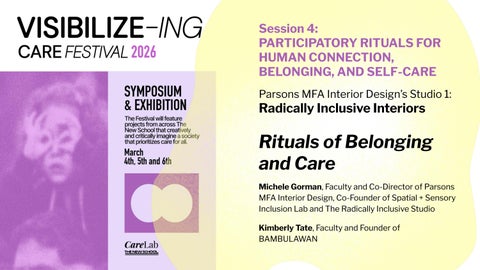
Visibilize-ing Care Festival_The Radically Inclusive Studio's Rituals of Belonging (

Page 1


Session 4: PARTICIPATORY RITUALS FOR HUMAN CONNECTION, BELONGING, AND SELF-CARE

Parsons MFA Interior Design’s Studio 1: Radically Inclusive Interiors

Rituals of Belonging and Care

Michele Gorman, Faculty and Co-Director of Parsons

MFA Interior Design, Co-Founder of Spatial + Sensory

Inclusion Lab and The Radically Inclusive Studio

Kimberly Tate, Faculty and Founder of BAMBULAWAN

Co-taught by faculty, Michele Gorman and Kimberly Tate, the Parsons MFAInterior Design’s

Radically Inclusive Studio redefines interiors as “action settings,” shifting the focus from aesthetic style to the capacity of spaces to facilitate interactions rooted in radical care, equity, and spatial justice. Operating as a Sensory and Spatial Inclusion Lab, the studio investigates the intersection of gender, disability, neurodiversity, and culture to challenge systemic barriers in the built environment. Students prioritize community building withinThe New School by cultivating relationships with accountability partners and building trust through co-creation activities and Memorandums of Understanding (MOU) that ensure reciprocity and interdependence.The featured “Rituals of Belonging” are a series of transformative, participatory installations designed to foster intersectional belonging and joy. Central to this practice is a radically inclusive feedback process that involves surveying feelings and gathering embodied insights from diverse participants and idiosyncratic embodiments to iteratively refine each experience beyond standardADArequirements. Grounded in circularity, these interventions utilize healthy, plant-based, and regenerative materials to reimagine interiors as inclusive spaces that celebrate a full spectrum of identities and embodiments.

Curriculum of Care

Participation as process

Justice as outcome

Community building

Compassionate learning

Co-Authorship, Co-Teaching

Designing AS a community

Participation as process

Community building

Compassionate learning

Compassionate Learning co-authorship

Figure 1: Towards compassionate learning design

ALT TEXT: Venn Diagram: Three intersecting circles, with text “participation as process”, “care as underlying principle” and “justice as outcome” and the intersection is “praxis”

Gachago, D., Bali, M., & Pallitt, N. (upcoming). Compassionate learning design as a critical approach to instructional design. In Janghiani, S. & J. Quinn (Eds.).Toward a Critical Instructional Design. PressBooks.

Compassionate Learning co-authorship

Gachago, D., Bali, M., & Pallitt, N. (upcoming). Compassionate learning design as a critical approach to instructional design. In Janghiani, S. & J. Quinn (Eds.).Toward a Critical Instructional Design. PressBooks.

Compassionate Learning co-authorship

Wehipeihana’s (2013) work on indigenous participation in monitoring and evaluation processes and its application to faculty/educational development, as presented by Carolyn Ives in Longstreet et al (2020), inspired our compassionate learning design model. Wehipeihana’s model can be helpful in showing different approaches to participation. Her model is about Western evaluation with Indigenous groups, and the levels of doing so involve:

● TO: evaluation doneTO indigenous groups, based on the assumption that Western experts know best.This is the most harmful form of evaluation. Participants are not invited to the table.Ameal is prepared for them based on what the designer assumes they need.

● FOR: evaluation done FOR Indigenous groups but by Westerners, which is benevolent but patronising. Participants are not invited to the table.Ameal is prepared for them after perhaps surveying them on dietary requirements.

● WITH: done together but probably with Western ways of doing things.This is the first step towards participation. Participants are invited to the table as guests and offered a variety of prepared meals to choose from.

● BY: done by and led by Indigenous groups (representation) but possibly still using world views of Westerners or needing to explain ways of doing things - i.e. participants are invited to join the preparation for a meal at a table, where they may help prepare the meal, but the ingredients and tools are already there.

● AS: led by Indigenous people and also complete autonomy to do with their worldview without having to justify - i.e. participants design their own table, bring their own ingredients and tools to make the meal their way.

Gachago, D., Bali, M., & Pallitt, N. (upcoming). Compassionate learning design as a critical approach to instructional design. In Janghiani, S. & J. Quinn (Eds.).Toward a Critical Instructional Design. PressBooks.

Body Support / Supporter + Supported

Fall 2023

MFA Interior Design Studio 1 (co-taught by Michele Gorman, Alfred

Zollinger and TA Sydney Moss)

SOMATIC DRAWING

HOW DOES IT FEEL TO BE SUPPORTED?

HOW WAS THIS WARM DATA SHARED?

Care in Assessment

Curriculum of Care and Inclusive Assessment

Fink’s taxonomy of significant learning

Student self assessment

DESIGNING WITH/FROM:

WHAT IS A RADICALLY INCLUSIVE EXPERIENCE AT THE NEW SCHOOL?

Spatially Inclusive Experiences and Installation for a partner community you engage

24 Hours of Mind, Body, and Soul: Spatial Inclusion Lab for mental and cultural inclusion.

Vera List Courtyard: between 65 West 11th Street & 66 West 12th Street

Shreya Kameswaran, Nikitha Naredla, and Pamasha Naik

Inner Realms—Outer Rhythm: Spatial Inclusion Lab for access to mental rest and recovery through meditation and movement. Popup Locations

Amanda Davila and Kevin She

Healing through Breaking: Spatial Inclusion Lab for emotional release.

Parsons East: 25 East 13th Street, E200 studio, Second floor by the windows

Camilo Trujillo Morales, Galya Titova, and Naï Jammal Landsman

Raíces, A ritual around coffee: Spatial Inclusion Lab for nourishment through connection to roots and traditions.

Parsons East: 25 East 13th Street, Third floor by elevator

Ana Carrillo-Batalla Mattar and Carmen Sarg Lanza

Intentional Ceramic Workshop: Spatial Inclusion Lab for home making and belonging in the immigrant diaspora, expanding the need for making spaces, social connection and ceramics, or for anyone looking to create meaning and belonging in NYC.

Parsons East: 25 East 13th Street, Third floor in front of Donghia Gallery

Balbina Pozas and Tulia Torres

Zikra, Memorialization through Textiley: Spatial Inclusion Lab for community building and culturally inclusive storytelling by honoring the stories of women and femme people amongst students in higher design education.

Parsons East: 25 East 13th Street, E200 studio, Second floor by the windows

Anandita Vidyarthi and Jude Qassem

Gather ‘Round the Pot, Stories and Lunch Episodes: Spatial Inclusion Lab for fostering connection through food as our anchor.

Parsons East: 25 East 13th Street, E200 studio, Second floor by the windows

Minhee Kim and Alifiyah (Fia) Nabila

Gentle Fibers, Gentle Minds, A Wool Beading Workshop: Spatial Inclusion Lab for neurodiverse sensory recovery and stimulation spaces: Intersecting mental, spiritual and intellectual access needs.

Parsons East: 25 East 13th Street, E200 studio, Second floor by the meditation corner

Sarah Hyun and Sophie Schumacher

Gather ‘Round the Pot, Stories and Lunch Episodes

Spatial Inclusion Lab for fostering connection through food as our anchor.

Minhee Kim and Alifiyah (Fia) Nabila

Parsons East: 25 East 13th Street, E200 studio, Second floor by the windows

Gather ‘Round the Pot, Stories and Welcome to incoming cohort from over 20 countries

Spatial Inclusion Lab for fostering connection through food as our anchor.

Raíces, A ritual around coffee

Spatial Inclusion Lab for nourishment through connection to roots and traditions.

Parsons East: 25 East 13th Street, Third floor by elevator

Ana Carrillo-Batalla Mattar and Carmen Sarg Lanza

Healing through Breaking Spatial

Inclusion Lab for emotional release.

Camilo Trujillo Morales, Galya Titova, and Naï Jammal Landsman

Parsons East: 25 East 13th Street, E200 studio, Second floor by the windows

Inner Realms—Outer

Rhythm: Spatial Inclusion

Lab for access to mental rest and recovery through meditation and movement.

Davila and Kevin She Popup Locations

Amanda

Sobremesa

Sobremesa is a ritual that connects individuals through the sharing of food and conversation, transmitting the warmth and customs of Latin culture. Using fabric, thrifted plates, and decorative food, it creates a safe and intimate space where community and belonging are fostered. Through this shared act, those far from home can rediscover the comfort and familiarity of their origins.

How can the simple act of sharing a long meal over the day become a bridge back home and for belonging?

Marks We Leave

Designed as an antidote to the restless pace and loneliness of city life, this ritual invites participants to embrace stillness and forge deeper human connections. With this ritual, we invite international students within the Parsons community to take a moment to connect with those around them, not only through conversation but also through self-expression.

After a long coffee session, they are encouraged to dump their coffee grounds directly onto the bio-based Mehndi-motif tabletop and use the painting tools to use henna and coffee to be creative and messy. We seek to create collaboration through self-expression.

Through cultural and memorial exchange,
is it possible to create a community or space that allows for self-expression without judgment?

Fall 2024

Sensory

Recovery Room for the Open Design Studio

Parsons East: 25 East 13th Street, E200 studio, Second floor

Spatial Inclusion Lab for neurodiverse sensory recovery and stimulation spaces: Intersecting mental, spiritual and intellectual access needs. & Workshop: Gentle Fibers, Gentle Minds, A Wool Beading Workshop:

by the meditation corner
Sarah Hyun and Sophie Schumacher

Fall 2025

Low sensory space spruce-up

Tended to and created by Keith

Do you ever feel completely overwhelmed by your surroundings?

In the university environment, in particular, in the open studio environment we are surrounded by “community”. This communal landscape has many pros and many cons. As our educational space is shared, it can lead to sensory overload. The space is alive with people, chatter, activity, moods and energies, good-days, bad-days, stress, echos and sometimes even birds! We are in a community, to some degree, by default. This space allows for a moment of decompression. A private space that provides an opportunity to recenter. However and in whatever way that looks for an individual: prayer, meditation, quiet, rest or escape. This space is intended to support the community, by supporting the people in it.

Resonance

Resonance is a sensory ritual that offers a space for mental decluttering through playful interaction with colorful threads and musical strings. Participants are invited to tangle, untangle, braid, the threads and pluck the strings, engaging their senses of touch, sight, and hearing to find calm and connection amidst the colors and vibrations. The experience transforms stress into rhythm, allowing a moment of grounding, peace, and quiet companionship.

How can a single space be interpreted and experienced in various ways to help your state of mind and sense of belonging via one’s interaction with a harmony of acoustics, color, materiality and people?

Mind Stretching

Through “Mind Stretching” we aim to make students who are pursuing their undergraduate or graduate degrees and consider themselves to be going through a quarter life crisis to reframe their expectations and anxieties over the future through the technique of collage. We want students to leave feeling free, loose, and flexible, the way you would feel after stretching your body, but with your mind. This experience combines metaphysical experience with actual physical action, allowing students to work with their hands to give their minds a mindful break.

How can we, the students of The New School, deconstruct our anxieties and mental pitfalls in order to reframe our expectations and anxieties over the future through the technique of collage?

Soundarya- A Ritual Around Skincare

Soundarya” is an immersive sensory experience that reconnects individuals with their body and mind through the practice of skincare. Using natural ingredients as a playful medium for discovery, the space invites participants to craft their own body masks while engaging with others and the materials around them. It becomes a shared ritual of touch, texture, and connection, where care is both personal and collective.

How can the sensory experience of Indian natural ingredients through skincare reconnect us to our bodies and minds? “

Spice Tent

The Spice Pavilion is a mobile installation designed as a retreat from the high-pressure environment of higher education, offering participants a space to slow down, reconnect with themselves, and engage with others. Through multi-sensory experiences—sight, sound, touch, smell, and taste—participants explore and interact freely with hanging spice installations and chai, finding grounding through active meditation. The project centers accessibility, neurodiverse perspectives, and relational participation, inviting community contribution and ownership while creating a space of open exploration and sensory reflection.

“How might chai serve as a prototype for creating mobile spaces of curiosity, calm, and connection?”

Shadow Boxing: A Ritual of Release

Shadow Boxing is a participatory ritual for graduate students navigating finals stress.

Guided by a projected shadow, participants move through zones of tension, release, and recovery. Inspired by combat sports, this installation transforms physical expression into collective empowerment. “Shadow Boxing” is a participatory ritual designed to engage the graduate community within the School of Constructed Environments. In this gamified, interactive experience, participants follow a projected shadow as it guides them through a sequence of stretching, movement, and rest. The installation features:

Spider webbed roped stretching and warm-up room

Sensory punching bag zone

Breaking zone for symbolic release

Cool-down zone for reflection and recovery

This ritual responds to the heightened stress many graduate students experience during finals. By offering a physical outlet for tension, it invites participants to release pent-up energy in a safe, expressive environment.

The concept emerged from Alex and Omar’s shared experience with combat sports—and their mutual recognition of how liberating it can feel to strike pads or a punching bag. “Shadow Boxing” channels that sense of empowerment into a collective, cathartic design intervention.

How can striking and smashing objects help release tension and stress?

UNNATURAL NATURE:

Dream Space for Reconnecting

Mind and Body

Creators: Isac Blücher, Andrea Miller, Mark Séjourné

The ritual begins outside of the lighting lab on the 3rd floor. Participants are told to remove their shoes and prepare their minds for a period of mental freedom/untethering. The space is one to experience alongside others, but it is not intended for conversation.

Entering the room, participants will walk down a gauzy corridor constructed of fabric hanging from the ceiling, and emerge into a space where projections and

How can we manipulate space to have the same effect on our minds and body as we get from being in nature while using “artificial” elements specific to the human made interior?

Especially within the context of an open-floor plan studio with no spaces dedicated to privacy and sensory recovery, how can we provide a built environment that allows for a sense of community / togetherness without requiring explicit socialization through performance/perception?

Circle of Discovery

This ritual transforms circulation into exploration through a series of playful spatial games where participants search for hidden puzzle pieces throughout the space, guided by visual cues rather than screens. As pieces are found, everyone gathers around a central circular seating structure to assemble the puzzle together, shifting from individual wandering to community interaction. Through shared movement, exploration, and collaboration, the space becomes a site of connection that invites people to talk to each other about their surroundings.

How can play turn a classroom interior space into an environment of discovery, connection, and belonging?

Co-created learning outcomes written on the table.

Add a sticker where you support, extend or disrupt / challenge a learning outcome.

Turn static files into dynamic content formats.

Create a flipbook