![]()


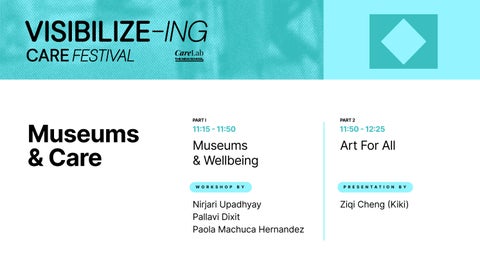
PART I 11:15 - 11:50
PART 2 11:50 - 12:25
WORKSHOP BY
Pallavi Dixit
Paola Machuca Hernandez
PRESENTATION BY Ziqi Cheng
Each Dandelion sheet has four quadrants (four colors).
Each quadrant contains ten words.
Choose one word from each quadrant (four words total) that best reflects how you feel right now.
Mark the intensity of each word using the color scale:
Lightest shade = less intense
Darkest shade = more intense
If you are comfortable allowing your responses to be used for our capstone research, write your name on the back of the sheet (or another name if you prefer).
If you prefer not to share your data, do not write any name (leave it blank).

Can cultural experiences measurably improve wellbeing?


Museums increasingly position themselves not only as spaces of learning, but also as spaces of care, reflection and connection.


useums run prgrams r mental health scial cnnectin and cmmunit ellein
But measuring their impact is still difficult
CULTURAL SPACE AS CARE INFRASTRUCTURE
Museums create shared experiences
Exposure to art activates emotional and cognitive responses studied in neuroaesthetics
Programs often focus on: mindfulness, creative expression, community participation
museums as “third places” for wellbeing : spaces between home and work where people can reconnect with themselves and others.
If museums claim these benefits, how do we measure them in a meaningful way?
Common approaches surveys interviews observation

The University College London Museums Wellbeing Toolkit measures emotional change before and after cultural activities. But: emotions are complex wellbeing is social, emotional, physical, and communal measurement tools often feel too rigid or incomplete
We will start with a short collaborative activity inspired by artworks from various artists around the world.
Look at the inspiration images provided. You can use the colors, styles, or techniques you notice in these works.
Spend 3–4 minutes drawing, sketching, or coloring on your sheet while listening to music.
After 3–4 minutes, pass your sheet to the next person, and continue building on the artwork you receive.
Repeat this process so each artwork becomes a collaborative piece created by multiple people.
Write your name on the back of the sheet so you can take it home with you as a shared artwork created together.

Museums gain increased and sustained funding for wellbeing programs
Reduced loneliness and improved wellbeing among participants
Helping museums measure and articulate the wellbeing impact of their existing programs
Museums can demonstrate program value to boards, donors and funders with credible evidence
More museums adopt the framework and secure greater support for wellbeing initiatives
A standardized approach to measuring wellbeing in museum contexts
Museums are increasingly recognized as spaces that support healing and wellbeing.


Thank you!


A multi-sensory accessibility toolkit that reimagines how visually impaired visitors navigate, experience, and emotionally connect with museums.


Inclusive Design Community Co- Learning


Sensory Design Spring 2025, Picture With Sugandha


Definition
No visual accessibility programs.
Basic accommodation only.
Moderate support with occasional programming.
Examples
No tours, no guides.
Simple readable labels; general ADA compliance.
Occasional verbal description tours; screen-reader PDF labels.
Regular verbal description tours, staff training, tactile + visual aids, screen-reader compatibility. Strong, dedicated low-vision support.
Definition Examples No audio description offered.
Basic audio guide without descriptive content.
Some descriptive audio; available for major exhibitions.
MoMA-style selected descriptive tracks.
Whitney/MoMA-level detailed object descriptions, multi-language options, consistent coverage. Full descriptive audio program.
Examples
No tactile access.
Rare or limited tactile access.
Moderate tactile resources.
Extensive tactile experiences.
Definition No large-print materials.
Occasional or partial large-print labels.
Consistently available for major exhibitions.
High-quality, comprehensive large-print system across galleries.
Definition No Braille at all.
Very limited Braille.
Moderate Braille availability. Strong Braille system. Definition Hard to navigate; poor signage.
Basic ADA navigation only.
Clear wayfinding + accessible maps.
Advanced accessible navigation.
Do not touch everywhere.
One or two touchable items.
Touch tours, tactile replicas for a few exhibits.
Transit Museum ntrepid tactile maps, tactile models, hands-on objects across exhibits.
Examples Most museums.
Provided for one or two touch stations.
Partial Braille maps or select exhibits.
Transit Museum or Intrepid tactile/Braille maps + Braille signage.
examples Tactile maps, audio navigation, detailed floor plans.


physical accessibility
inclusive interpretation
digital accessibility
sensory-friendly programing
Deisgn and Architecture Team


Art in Sight at Home Zoom Program (Dec 10, 2025)

Audience
Older adults with low vision Participants 18 total (incl. 3 staff)

Sixties Surreal Zoom Program (Dec 6, 2025)

Audience
Older adults with low vision Participants 10 total (incl. 2 staff)


How might we enable visitors to interact with artworks in tangible, multi-sensory ways across the museum journey?

A. Your Time & Energy
How much time do you have for your visit today?
45 minutes / 1 hour / 2 hours / flexible
How are you feeling today in terms of energy?
Low energy / steady / ready to explore
B. Your Interests
What kind of art or experience are you in the mood for?
Painting / sculpture / modern art / ancient art / photography
Or: “I’m open to anything.”
Do you prefer a calm, quiet route or a more dynamic, high-energy route?
Calm / balanced / stimulating
C. Your Accessibility Needs
Do you want audio descriptions during your visit?
Yes / No / Depends on the artwork
Do you need assistance with navigation or orientation?
Yes, sound guidance
Yes, step-by-step directions
No, I can navigate independently
Are there any physical or sensory needs I should consider?
Need places to sit
Avoid crowds
Prefer brighter spaces
Prefer dark rooms
Sensitive to noise
No specific needs


How can museums ensure AI and technology support accessibility rather than create new barriers?
How should museums balance innovation with ethics and visitor privacy when using AI tools?
How can museums co-create more inclusive experiences with the community?
What partnerships are needed to develop projects like Art for All into real-world museum tools?


WORKSHOP BY

Nirjari Upadhyay - nirjari.upadhyay.newschool.edu
Pallavi Dixit - dixip849@newschool.edu
Paola Machuca Hernandez - paola.machuca@newschool.edu
PRESENTATION BY
Ziqi Cheng (Kiki) - chenz027@newschool.edu