Creativity in times of Uncertainty _ Research Summary Deck
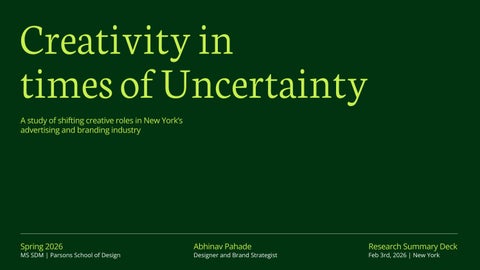
Creativity in
times of Uncertainty
A study of shifting creative roles in New York’s advertising and branding industry
School of Design
Abhinav Pahade Designer and Brand Strategist
Research Summary Deck
Feb 3rd, 2026 | New York
The Question I began with:
How is AI
reshaping
creativity, and what does that mean for creative professionals today?
Expertise, ownership, and identity
Three pillars that define the creative professional.
AI destabilizes all three simultaneously.
The final research question became:
How is generative
AI reshaping
creative identity by altering pathways of ownership, tacit learning, and perceived expertise?
How do different creative identities negotiate these shifts?
How are organizational expectations and cultural norms reforming these identities?
What tensions emerge inside workflows and teams?
Research
Methodology
Primary Method:
18 semi-structured interviews
Across art direction, copywriting, strategy, creative leadership, and experience design. Spanning junior, mid-level, and senior roles.
Secondary Methods:
Notes from 3 industry events
Creativity in Times of Uncertainty | AIGA
People Summit | The Conference Board
Shift Summit | Superside
Tertiary Methods:
Literature Review
Occasional reflective journaling throughout the process
Informal social-media ethnography
Research Summary deck| abhinav pahade
Insights
5 core tensions emerged
Ownership
Ambiguity vs. AI-Accelerated Output
“I want to be very aware of what I give up when I do that.”
Art Director | 3 years of exp.
Creatives described a quiet but pervasive ambiguity around what is theirs when AI can produce polished work early in the process.
This creates a gap between
AI accelerates output,
but not necessarily understanding. the pace
of production and the pace of meaning-making.
Ownership becomes harder to locate. Not because creatives do less, but because the boundary between tool and author becomes opaque.
Ownership Ambiguity vs. AI-Accelerated Output
Shifting Tacit Knowledge Pathways
vs. Increasing Expectations of Speed
“it's like you had to do this tough task, and yes, you saved yourself two days. But would you be a different person if you had struggled through that?”
ASSOC. Director of Experience design, Writer | 25+ Years of EXP.
Creatives described a shift in how they build tacit knowledge, as AI introduces new forms of intuition and experimentation just as expectations for speed and output intensified.
Research Summary Deck | ABHINAV PAHADE
Tacit knowledge is not disappearing — it’s moving.
Traditionally, creatives learned tacitly through AI introduces new tacit skills
Embodied practice
Slow craft
Feedback from seniors
Repetition
Lived experience
Interpreting unexpected outputs
Discerning noise vs. intention
Forming intuition across fast iterations
Curating from abundance, not scarcity
Lived Experience
2
AI disrupts tacit knowledge from both ends: it replaces the repetitive, friction-filled tasks that traditionally built it, while simultaneously accelerating organisational speed. With organisations prioritising speed, they fail to give creatives the time to develop tacit knowledge through new pathways either — ones that require interpreting, discerning, and iterating. If nothing changes, we risk collapsing both routes to building tacit knowledge.
Shifting Tacit Knowledge Pathways vs. Increasing Expectations of Speed
Rigid Creative Identities vs. Adaptive Creative Identities
“It's honestly like building a plane as you learn to
fly
it. It's it's very much a system of trial and error there. There isn't a definitive answer”
AsSOC. Creative director, Writer
Creatives differed not by experience level but by how willing they were to redraw the boundaries of their creative identity as AI entered their workflow.
The real divide is identity-led, not senior vs. junior,
but rigid vs. adaptive creative orientations.
Rigid identities
Fixed creative boundaries
Hesitant to “touch” the tool
Pre-AI mental models
Preference for certainty
Structured workflows
Adaptive identities
Playful experimentation
Flexible boundaries
Co-creation with AI
Comfort with ambiguity
Willingness to reform the process
AI exposes differences in how creatives hold their identity, and those differences shape engagement far more than job titles or experience levels. 3
Rigid Creative Identities vs. Adaptive Creative Identities
Gatekept Taste vs. Democratised Taste Formation
“taste comes from doing and being on set and practice and experience? I don’t believe that at all. I believe taste is created by living. Taste is created by watching films, listening to music, dancing, being out with your family - and then bringing that to the work”
Creatives described building taste as shifting from a slow, hierarchical apprenticeship process to something iterated, tested, and built rapidly through AI-driven experimentation.
Taste is no longer slow or inherited — it’s iterative, distributed, and shaped through rapid feedback loops.
Traditionally, taste developed through
Slow apprenticeship
Top down knowledge transfer
Exposure to varied projects
Critical feedback
Time & exposure
AI introduces new taste pathways
Iterating across dozens of variations
Testing ideas quickly
Refining intuition through output abundance
Algorithmic cultural cues
Peer-level aesthetic discovery
Taste becomes less about expertise, and more about an individual’s ability to navigate, curate, and interpret rapidly generated aesthetic possibilities.
Gatekept Taste vs. Democratised Taste Formation
Identity Reformation vs. The Illusion of Certainty
Creatives across roles described rebuilding their sense of expertise in real time, even as the industry continues to reward confidence and decisiveness.
“There is no blueprint.”
Creative Director and EDUcator | 9 YEARS OF EXP.
Creatives are ,
while legacy expectations still favour certainty. reconstructing identity without stable templates
clarity
direction
confidence
speed
decisive authority
Identity is being re-formed in real time, and the gap between internal uncertainty and external expectations is becoming a central tension of creative work.
Identity Reformation vs. The Illusion of Certainty
Emerging
Questions
How might AI tools be designed to strengthen, rather than dilute, a creator’s sense of ownership?
What would it mean for tools to surface decision pathways, reveal process, and support learning instead of replacing it?
How might creative teams and leaders support identity formation, learning, and authorship in a moment defined by uncertainty?
What new forms of apprenticeship, reflection, and role clarity become necessary?
Find the projects Bibliography here
Follow along this project’s progress on my LinkedIn :)
Find my other work here
Abhinav Pahade
Designer and Brand Strategist| New York