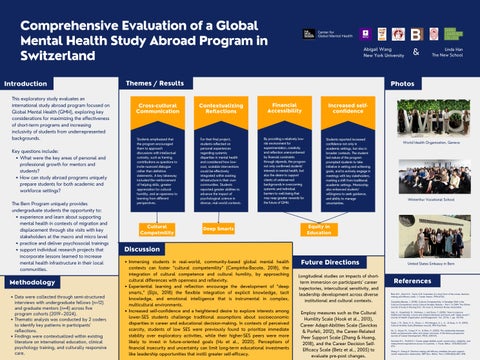
Comprehensive Evaluation of a Global Mental Health Study Abroad Program in Switzerland Introduction This exploratory study evaluates an international study abroad program focused on Global Mental Health (GMH), exploring key considerations for maximizing the effectiveness of short-term programs and increasing inclusivity of students from underrepresented backgrounds. Key questions include: What were the key areas of personal and professional growth for mentors and students? How can study abroad programs uniquely prepare students for both academic and workforce settings? The Bern Program uniquely provides undergraduate students the opportunity to: experience and learn about supporting mental health in contexts of migration and displacement through site visits with key stakeholders at the macro and micro level practice and deliver psychosocial trainings support individual research projects that incorporate lessons learned to increase mental health infrastructure in their local communities.
Methodology Data were collected through semi-structured interviews with undergraduate fellows (n=12) and graduate mentors (n=4) across five program cohorts (2019–2024). Thematic analysis was conducted by 2 coders to identify key patterns in participants' reflections. Findings were contextualized within existing literature on international education, clinical psychology training, and culturally responsive care.
Abigail Wang New York University
Themes / Results
Photos
Cross-cultural Communication
Contextualizing Reflections
Financial Accessibility
Increased selfconfidence
Students emphasized that the program encouraged them to approach discussions with intellectual curiosity, such as framing contributions as questions to invite nuanced dialogue rather than definitive statements. A key takeaway included the reinforcement of helping skills, greater appreciation for cultural humility, and an openness to learning from different perspectives.
For their final project, students reflected on personal experiences regarding systemic disparities in mental health and considered how lowcost, scalable interventions could be effectively integrated within existing infrastructure in their own communities. Students reported greater abilities to advance the impact of psychological science in diverse, real-world contexts.
By providing a relatively lowrisk environment for experimentation, creativity and reflection unencumbered by financial constraints through stipends, the program not only confirmed students’ interests in mental health, but also the desire to support clients of underserved backgrounds in overcoming systemic and individual barriers to well-being that may reap greater rewards for the future of GMH.
Students reported increased confidence not only in academic settings, but also in broader contexts. The studentled nature of the program prompted students to take initiative in setting and achieving goals, and to actively engage in meetings with key stakeholders, marking a shift from traditional academic settings. Mentorship also enhanced students’ willingness to seek guidance, and ability to manage uncertainties.
Cultural Competmility
&
Linda Han The New School
Deep Smarts
World Health Organization, Geneva
Winterthur Vocational School
Equity in Education
Discussion Immersing students in real-world, community-based global mental health contexts can foster “cultural competemility” (Campinha-Bacote, 2018), the integration of cultural competence and cultural humility, by approaching cultural differences with openness and reflexivity. Experiential learning and reflection encourage the development of “deep smarts,” (Eljiz, 2018) the flexible integration of explicit knowledge, tacit knowledge, and emotional intelligence that is instrumental in complex, multicultural environments. Increased self-confidence and a heightened desire to explore interests among lower-SES students challenge traditional assumptions about socioeconomic disparities in career and educational decision-making. In contexts of perceived scarcity, students of low SES were previously found to prioritize immediate stability over exploratory activities, while their higher-SES peers were more likely to invest in future-oriented goals (Hu et al., 2020). Perceptions of financial insecurity and uncertainty can limit long-term educational investments like leadership opportunities that instill greater self-efficacy.
Future Directions Longitudinal studies on impacts of shortterm immersion on participants’ career trajectories, intercultural sensitivity, and leadership development across diverse institutional and cultural contexts. Employ measures such as the Cultural Humility Scale (Hook et al., 2013), Career Adapt-Abilities Scale (Savickas & Porfeli, 2012), the Career-Related Peer Support Scale (Zhang & Huang, 2018), and the Career Decision SelfEfficacy Scale (Betz et al., 2005) to evaluate pre-post changes.
United States Embassy in Bern
References Betz N.E., Klein K.K., Taylor K.N. Evaluation of a short form of the career decisionmaking self-efficacy scale. J. Career Assess. 1996;47(4) Campinha-Bacote, J. (2018). Cultural Competemility: A Paradigm Shift in the Cultural Competence versus Cultural Humility Debate – Part I. In OJIN: The Online Journal of Issues in Nursing (Vol. 24, Issue 1). American Nurses Association. Eljiz, K., Greenfield, D., Molineux, J. and Sloan, T. (2018), "How to improve healthcare? Identify, nurture and embed individuals and teams with “deep smarts”", Journal of Health Organization and Management, Vol. 32 No. 1, pp. 135-143. Hook, J. N., Davis, D. E., Owen, J., Worthington, E. L., Jr., & Utsey, S. O. (2013). Cultural Humility Scale [Database record]. APA PsycTests. Hu, S., Hood, M., Creed, P. A., & Shen, X. (2022). The relationship between family socioeconomic status and career outcomes: A life history perspective. Journal of Career Development, 49(3), 600-615. Savickas M.L., Porfeli E.J. Career adapt-abilities acale: construction, reliability, and measurement equivalence across 13 countries. J. Vocat. Behav. 2012;80(3):661– 673. Zhang H., Huang H. Decision-making self-efficacy mediates the peer supportcareer exploration relationship. SBP (Soc. Behav. Pers.) 2018;46(3):485–498.