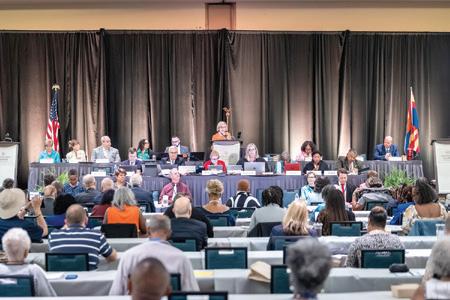
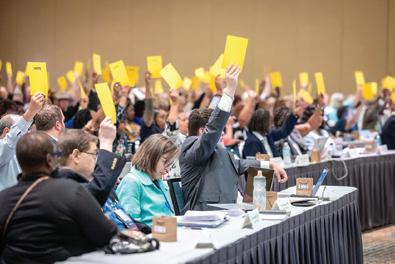
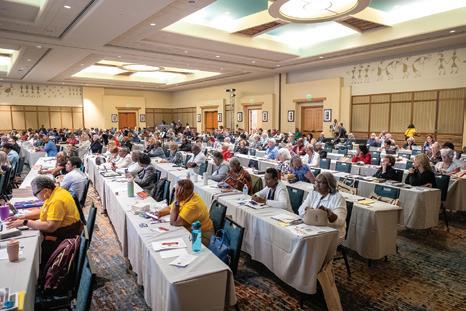
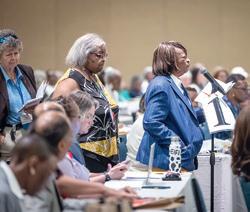
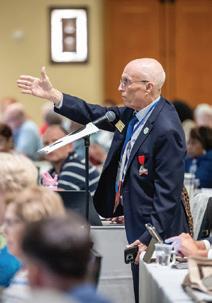
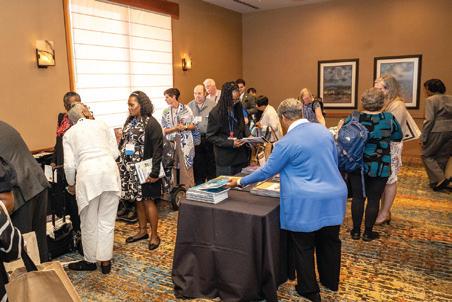
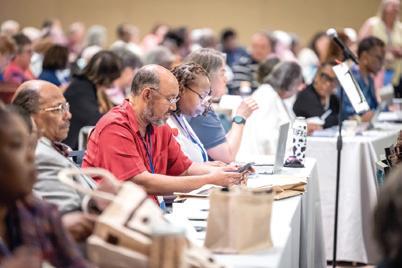
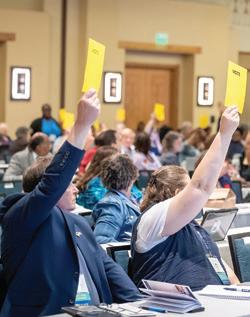
More than 150 years ago, Henry M. Robert recognized the need for uniform meeting procedures for ordinary societies. He researched existing parliamentary authorities and examined the practices of the U.S. Senate and House of Representatives, ultimately publishing the first Pocket Manual of Parliamentary Procedure in 1876. How have these procedures—now commonly known as “Robert’s Rules”—evolved over the past 150 years? What’s changed? What remains the same?
The 2026 NAP Spring Conference offers a unique opportunity for individuals at every level to explore how these enduring principles continue to guide organizations in running effective and orderly meetings. The registration fee, $149 for members and $189 for non-members, includes access to one of three tracks, each featuring five sessions, starting at 10:00 a.m. (CT), and 90-day access to the video recordings for the selected track. For tracks B and C, application has been made for one CEU for each of the five sessions attended with video camera on for verification.
• Track A: Preparing for the NAP Membership Exam—Building a Strong Foundation
Track A is the entry point to understanding and mastering key terms and procedures to confidently prepare for the NAP membership exam. If attendees take and pass the NAP membership exam after the Conference and before April 30, 2026, NAP will pay their first-year dues of $99 from the registration fee. Attendees are encouraged to purchase the spiral-bound copy of Robert’s Rules of Order In Brief (from the NAP Bookstore).
• Track B: NAP Officer’s Roundtable—Skills for Every Office; Building Leadership Roles from Routine to Remarkable Track B combines historical wisdom with current best practices, guided by past and present NAP officers, who will share their experience, insights, and practical strategies for individual officer roles. Attendees are encouraged to purchase the Focus Materials—President, Secretary, Treasurer, Board of Directors, and Committees (from the NAP Bookstore).
• Track C: Enduring Principles—Evolving Practices; Building Your Parliamentary Voice Track C is designed for parliamentarians seeking to sharpen their skills and confidently manage advanced, real-world situations. Attendees are encouraged to purchase the updated Professional Practice in Parliamentary Procedure (from the NAP Book Store).
Save the Date: March 28, 2026. Register early at the NAP website for this opportunity to enhance your knowledge and understanding of parliamentary procedure, which will assist you in becoming a member of NAP, or a more expert credentialed parliamentarian.
NAP SPRING CONFERENCE COMMITTEE
Barbara Proctor, PRP
Stephanie “Sam” King, PRP
President
Mona Y. Calhoun, PRP
Vice-President
C.J. Cavin, PRP
Secretary Donna Mitchell, PRP
Treasurer
Mark Apodaca, PRP
Directors-at-Large
Corliss Baker, RP
Tamara D. Harris, PRP
Ramona Hill, PRP
District Director
Representatives
Steven Cook, PRP
Justin Pappano, PRP
Parliamentarian
Al Gage, PRP
Executive Director
Jessica Herzog
Legal Liaison
Kevin Judd, PRP
NATIONAL PARLIAMENTARIAN
NatioNal ParliameNtariaN®
Official publication of the National Association of Parliamentarians® 213 S. Main Street • Independence, MO 64050-3808 816.833.3892 • 888.627.2929
hq@nap2.org • www.parliamentarians.org
Editor
Carl Nohr, PRP
npeditor@nap2.org
Assistant Editor
Beverly Przybylski, PRP
NP Review Committee
Traci Bransford-Boss, PRP, Chair
Ann Guiberson, PRP
Sandy Olson, PRP
Parliamentary Research Committee
Ronald Dupart, PRP, Chair
Rosalie Stroman, PRP
Al Gage, PRP, Parliamentarian
Special Consultant
Ronald Dupart, PRP
NATIONAL PARLIAMENTARIAN®
(Registered U.S. Patent and Trademark Office, ISSN 8755-7592)
Published quarterly by the National Association of Parliamentarians®
Subscription and change-of-address requests should be directed to NAP at the above address.
Annual subscription: $30 • Single copy: $8
NP Submission Guidelines
National Parliamentarian® generally publishes only original works that have not been published elsewhere. Articles will be edited to conform to The Chicago Manual of Style (18th ed.) and may be edited for content and length. Article text should be submitted in Microsoft Word or rich text format and transmitted via e-mail. Any images, photos, illustrations and graphics should be submitted separately as high resolution files. Any images or other copyrighted materials must be accompanied with permission to use. Materials submitted will not be returned unless special arrangements are made in advance with the editor. Authors should include a short biography note and a high resolution headshot for publication. Contributors must include a completed “Assignment and Transfer of Copyright” form with their submission, granting NAP the copyright or permission to publish.
Submission Deadlines
Volume 87, No. 4 (Summer 2026) May 1, 2026
Volume 88, No. 1 (Fall 2026) ............................... August 1, 2026
Volume 88, No. 2 (Winter 2026)......................... November 1, 2026
FROM THE EDITOR
The strategic plan for an organization provides direction, enhances decision making, and drives growth . The National Association of Parliamentarians® (NAP) adopted its current Strategic Plan on May 9, 2023 . It is available under “Governing Documents” on the NAP website, or scan here:
The Strategic Plan includes NAP’s Vision, Mission, and Core Values Do you know what the Vision is? NAP’s Vision Statement is printed in every edition of the National Parliamentarian® (NP) . Can you find it? The answer is at the end of this editorial .
Six core values are included in the Strategic Plan: professionalism, respect, integrity, continuous improvement, service, and community .
The reader will notice that, starting in this edition, one of the regular features in the NP, “NAP Connections” has been retitled “NAP Community . ” This retitling better captures the breadth, depth, and significance of the interactions we have with fellow members and aligns with one of the six core values in the NAP Strategic Plan—community . What does community mean to us in NAP? Many things . Community captures a sense of identity, of belonging, and of shared values and goals . It includes our elected leaders, parliamentary friends, mentors, students, and of course, the headquarter’s staff . All our in-person and electronic interactions contribute to the NAP society . In our community, we learn together, build relationships, solve problems, and add value to one another We support NAP, our client organizations, and democracy
How do we create and participate in this community? By joining, attending, and serving . Join the NAP and one or more units . There are many to choose from, both local and electronic . Attend meetings, ask questions, share a workshop, and volunteer to serve . Some of the best friends we will have in life are those we serve with .
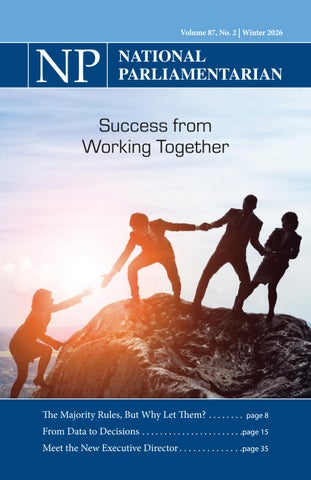
NAP has a strong community legacy, which members can enjoy and enhance by participating . As the president’s theme for this edition states, we can enjoy ”Success from Working Together . ”
Continued on page 5
Success from Working Together
As I reflect on the last six months, I am reminded of a quote by Henry Ford, which states, “Coming together is a beginning, staying together is progress, and working together is success . ” The collective energy and talent assembled on the National Association of Parliamentarians® (NAP) Board of Directors (Board), standing committees, and special committees represent a powerful force . Our committees have assembled and are aligned to execute their charges by planning member-focused and mission-driven events and activities . The unique perspectives and diverse ideas brought by every committee member are the most vital resources for our progress and staying together . Success is working together to ensure that our collective efforts generate maximum value for our members and advance the parliamentary profession .
The dedication of this new leadership is rooted in achieving that success—a success measured only by the value we deliver to you, our members .
To that end, I am excited to share what you can expect this year . We will host “Member Town Halls” to connect directly with you . These virtual forums serve as a platform to share updates from the Board, provide information on committee work, and enable members to ask questions . We are resuming our New Member Orientations to ensure every person joining the NAP family is equipped with the knowledge and resources needed to thrive .
Members can anticipate an exciting calendar of offerings . The Professional Development Committee is hosting ParliPrep 2026, a series of credentialing exam preparation workshops that will run from January 2026 to April 2026 . In March, we encourage young parliamentarians as we celebrate Youth Parliamentary Law Month . We are planning an exciting Virtual
Spring Conference on March 28, 2026, designed to cater to learners of varying learning levels . April is Parliamentary Law Month . We encourage our units, associations, and districts to plan events to recognize the parliamentary profession . In June, we celebrate the 96th anniversary of NAP, marking the founding of our organization and its enduring legacy . Mark your calendars for August 2026! NAP presents the Virtual Leadership Conference August 7-8, offering targeted training for unit and association leaders . From August 27-30, NAP presents the National Training Conference and Annual Meeting in Birmingham, Alabama . I am excited for the work ahead and confident in the talent assembled . The success of NAP is a shared outcome, and we look forward to achieving it together .
And finally, on behalf of the Board and members, I welcome our new Executive Director! We look forward to achieving success from working together .
Mona Y. Calhoun, PRP 2025-2027 NAP President
From the Editor Continued from page 3
To conclude, on behalf of the National Parliamentarian team, we welcome the new Executive Director . We look forward to working together as we pursue the NAP Vision . And the location of the NAP Vision Statement? The Editor is confident you have found it; but just in case, turn to page one and look at the bottom left corner of the contents page .
Yours in service, Carl Nohr, PRP NAP NP Editor, 2025-2027 npeditor@nap2.org
Mace? What Is It?
David Mezzera, PRP
Do you eat it? Hit with it? Spray it? Carry it? How about all of the above? Mace is an interesting word which has its roots in multiple languages with multiple denotations in our own language. Let’s look at each of these.
Can you really eat mace?
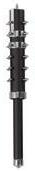
It is used in this way as the reddish, fleshy, stringy outer covering of the nutmeg, dried as a spice and eaten separately from the nutmeg nut itself (which is grated for flavoring) . This use comes from the Latin macir, the name of the red bark from a tree in India . Here is a design of a spiked club, called a mace, and used in medieval times as a weapon strong enough to break through armor . The word in English comes from the Old French word mace meaning a club or a scepter . Mace spray is similar to pepper spray . At first it was called TGASI, for “Tear Gas Aerosol Spray Instrument,” but soon the catchier name of “Chemical Mace” was applied . According to
reports, the name implied that chemicals could produce the same incapacitating effect as a medieval mace but without causing the same brutal injuries, and could easily be carried for self-defense .
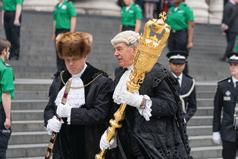
And now to our familiar use of the word mace . Remove the spikes in the weapon and you have a scepter, which would be carried by a victorious monarch in procession to show his power and strength . A mace bearer is an official—or a sergeant-at-arms— who walks before a dignitary during ceremonial occasions, carrying a mace that represents the dignitary’s authority . This has its roots in British ceremonies and is a symbol of the
Photo credit: Paul Hudson
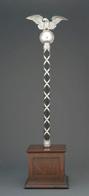
monarch’s authority . Thus, a mace takes its position in the Parliament Chamber to represent that the king is symbolically present during the proceedings in the chamber . Shown here is the official mace used in the U .S . House of Representatives . It is carried by the Sergeant-at-Arms of the House in an opening ceremony each day the House is in session . It precedes the Speaker of the House to the rostrum, after which it sits on the desk of the Sergeant-atArms as a symbol of the office of the Speaker . Note that the U .S . Senate does not have or use a mace .
And here is the NAP emblem® depicting a mace . As you can see, the NAP mace emblem is patterned after the mace used in the House of Representatives .
The NAP mace is prescribed in NAP Standing Rule #18: “The official emblem of NAP shall be a mace . The official design of the mace and the design for official pins and any other emblems shall be approved by the NAP Board of Directors and obtained only through NAP Headquarters . ”
As highlighted in the Summer 2016 issue of the National Parliamentarian®, a special committee was appointed during the 1941-1943 biennium to ascertain the wishes of the membership regarding an emblem to represent NAP. The committee’s recommendation was for a mace . The recommendation was approved by the Board and presented to the delegates at the October 1943 biennial convention in Kansas City . A unanimous vote formally adopted the mace as the official emblem for NAP.
And there you have it—the various uses of mace, one of which is near and dear to the hearts of all NAP members . NP
David Mezzera, PRP, is a past president of the California State Association of Parliamentarians and a past District 8 Director.
The Majority Rules, But Why Let Them?
be, The majority rules, but why let them? After all, the minority is neither powerless nor unprotected from the will of the majority . The majority and the minority must remember a famous quote I paraphrased below from General Henry M . Robert which reminds every voting member of a valuable lesson about governance .
1 . The majority must give the minority a full and free opportunity to present their side of the case .
2 . The minority, having failed to have their position declared the will of the assembly, must submit gracefully .
3 . The minority must recognize the decision as that of the entire organization .
4 . The minority must cheerfully assist in carrying out the will of the assembly,
5 . …until they can secure its repeal. (emphasis added)
Henry M. Robert, Parliamentary Law (1923; reprint, New York: Irvington Publications, 1975), p. 4.
of the minority:
The words majority and minority imply a remarkable difference in power and protection . But I will show how compared to the minority, the power of the majority is not as comprehensive or fixed as it is perceived . Let us look at some overlooked meeting situations, the reason for the 2/3 vote, the requirement of a Previous Notice, the option for the Majority of the Entire Membership, and the power of a demand .
Some overlooked meeting situations:
1 . Some assemblies have the legal power to compel attendance of their members . If a quorum is missing, absent members can be brought to the meeting under arrest with a Call of the House motion by the minority, per a previously adopted rule . This motion is a form of “take measures
Lorenzo R. Cuesta, PRP
to order a vote count . RONR (12th ed .) 44:6 .
3 . Some assemblies may provide for cumulative voting in their bylaws . A minority may coordinate its efforts . For example, when each member has three votes to elect three different directors out of five, instead each member of the minority may cast all his three votes for the same candidate . RONR (12th ed .) 46:43 . These bylaws would conflict with Robert’s one-person-one-vote principle, but then, that is the power of the bylaws .
4 . One of the most common consequences of a weak or unprepared presiding officer is that a minority can bring business to a standstill merely by resorting to frivolous, absurd, or dilatory motions . RONR (12th ed .) 39:3 .
5 . The motion to Lay on the Table is often an effort to kill a motion . But Robert’s specifically protects the minority by prohibiting the fully and freely is protected by a fraction as small as just greater than one-third of the votes cast . RONR (12th ed .) 42:16 .
7 . If a motion requiring a two-thirds vote is lost, it could mean that slightly more than one third of the members voted on the prevailing side . Only the minority could move to Reconsider the vote . RONR (12th ed .) 37:10(a) .
8 . If a bylaw clause negatively impacts the minority, the minority can attempt to show how that clause is clearly identifiable as in the “nature of rules of order . ” If successful, the minority may then protect itself from the bylaw clause by moving to suspend it . RONR (12th ed .) 2:21 .
9 . The act of adhering to the standard order of business as described in the parliamentary authority protects the minority from having the majority exclude agenda sections . RONR (12th ed .) 3:16 .
thwart the efforts of the majority For example, Amend Something Previously Adopted, Rescind a decision, Discharge a Committee, amend the adopted agenda, correct the minutes, etc . RONR (12th ed .) tinted section VI, t48-t49 .
12 . Type two: A motion that has a particularly significant impact may require a 2/3 vote to amend or adopt . The higher voting threshold protects the minority For example, amend the Constitution or Bylaws, create Special Rules of Order, authorize a motion outside the society’s object, amend convention standing rules, impose a disciplinary penalty, or increase membership fees . RONR (12th ed .) tinted section VI, t48-t49 .
All motions that require a Previous Notice protect the minority: Many motions that impact a society require a Previous Notice, or benefit from notice in terms of voting threshold, for example, Rescind,
adopt Special Rules of Order; Discharge a Committee; or amend either an adopted agenda, the Constitution, the Bylaws, or the Convention Standing Rules. RONR (12th ed .) tinted section VI, t48-t49 .
A demand by a minority of one cannot be nullified by the majority: Demands are not encumbered by a requirement of a second or a vote, or by needing to permit debate or amendments:
13 . Call for the Orders of the Day: requires the majority to adhere to the adopted agenda . RONR (12th ed .) 18:1 .
14 . Division: Forces the retake of a vote when the result is dubious . RONR (12th ed .) 29:1 .
15 . Objection to unanimous consent: Prevents the majority from adopting a motion by unanimous consent inhibiting debate . RONR (12th ed .) 4:59 .
16 . Consent Calendar: Allows for pulling a motion from the consent
Allows for voting separately on a specific rule when adopting the Convention Standing Rules. RONR (12th ed .) 59:32 .
19 . Roll Call: Polls delegates when verifying a roll call vote . RONR (12th ed .) 45:53 .
a majority vote for approval empowers the minority to prevail over the majority . The minority is so powerful and so well protected that often the majority finds itself struggling to protect itself from the tyranny of the minority NP
Lorenzo R. Cuesta, PRP, is a past president of the California State Association of Parliamentarians. He has served as a parliamentarian for boards, conventions, and annual meetings in and beyond California for more than 25 years. He is the current chair of the NAP International Services Committee. He typically offers a three-hour interactive parliamentary procedure workshop that focuses on members’ rights and efficient meeting management. (parliam@roberts-rules.com; www.roberts-rules.com)
Parliamentary Resources at Your Fingertips
There is only one place to turn for your parliamentary resources: NAP.
Browse our online store for
• Robert’s Rules of Order Newly Revised and In Brief— we offer spiral-bound versions not available anywhere else!
• Parliamentary reference cards
• Basic information handouts
• Script samples
• Leadership primers for officers
• Credentialing study guides
• Teaching resources
• And so much more
Previous Questions: BASICS
You read that right. I said Previous Questions, so don’t blame the editor!
The basics, of course, include the fact that the motion, Previous Question (PQ), is a motion to close debate, prevent the making of subsidiary motions except the motion Lay on the Table, and move directly to a vote on the immediately pending question . The motion needs a two-thirds vote for adoption . The motion is not debatable . PQ yields only to the motion to Lay on the Table and privileged motions but may be applied to the privileged motion to Recess . RONR (12th ed .) 20:5(1) . PQ is not allowed in committees since one purpose of committees is to discuss issues referred to them or issues arising out of the committees’ duties . For a discussion of which incidental motions may apply to PQ, see RONR (12th ed .) 6:16-24 and sections 23-33 on incidental motions . Now, is PQ amendable? Technically, no. But is there a way around that?
Let’s look at Section 16:5(6) . While PQ is not amendable, other forms of
Lyle A Kleman, PRP-R
Section 16:5(6) suggests two:
• Move the PQ on all pending questions .
• Move the PQ on part of a series of questions included in the motion to move PQ on all pending questions .
Since these are not amendments, but simply variations of PQ, both of these motions require a second and a two-thirds vote .
If several versions of PQ are moved and seconded, the chair would first ask for a vote on the PQ that includes the largest number of motions . If that is not adopted, the chair asks for a vote on the PQ that includes the next largest number of questions and so forth . Much like filling a blank, the first option to receive the required vote, two-thirds, would be the one that guides the assembly .
For example, a main motion, an amendment, a motion to commit, and a motion to limit debate are pending . PQ is moved and would apply only to the motion to limit debate .
Before the assembly votes on that motion, a member moves the PQ on all pending questions . It is seconded . Before the assembly votes on that motion, another member moves the PQ on limit debate and commit, which is part of the series of pending motions . This motion for the PQ is also seconded . There are now three pending versions of the motion for the PQ.
The chair would ask for a vote first on the motion to order the PQ on all pending questions . If that motion is adopted, the assembly would proceed to vote on all pending questions, beginning with limit debate, then commit, then amend (assuming commit is not adopted), and finally the main motion (or the main motion as amended) .
If the motion to order the PQ on all pending questions is not adopted, then the chair asks for a vote on the motion to order the PQ on the motions to limit debate and commit . If adopted, the chair calls for the vote on the motion to limit debate immediately . The chair then processes the motion to commit without further debate or amendment . Finally, the motion to amend and the main motion, which are not subject to the order for the PQ, are processed, allowing debate and amendment on these two motions . If the motion to order the PQ on the motions to limit debate and commit is not adopted, then the chair
asks for a vote on the PQ to vote immediately on the motion to limit debate . If adopted, amendments to the motion to limit debate are prevented, and the chair calls for the vote on the motion to limit debate immediately . After the motion to limit debate is disposed of, the chair continues to process the remaining pending motions that are not subject to the order for the PQ, which in this example are to commit, then amend (if commit is not adopted), and finally the main motion (or the main motion as amended) .
It should be noted that in the process of voting on all pending questions, PQ is said to be interrupted if any of the following motions are adopted: Postpone Definitely, Commit or Postpone Indefinitely
In other words, once the assembly postpones a main motion to, say, the next monthly meeting; or commits the main motion and any adhering proposed amendments to a committee; or postpones the motion indefinitely, then no further action under the PQ order is taken during the current meeting . RONR (12th ed .) 16:9-11 .
The PQ is said to be exhausted when all of the motions included in the order for the PQ have been disposed of . The PQ is also exhausted if those motions under its order have been committed or postponed indefinitely, or when the current session ends, whichever occurs first . RONR (12th ed .) 16:9-11 . If questions
are referred to a committee which reports later, even during the same session, the PQ is exhausted . RONR (12th ed .) 16:12 . However, if the interruption of the order for the PQ occurs by any means other than commit and the questions originally under the order for the PQ come up again later during the same session, the order for the PQ remains in effect and all motions under the PQ order are voted on immediately . RONR (12th ed .) 16:9-11 .
One more thing: has anyone been at a meeting where someone “calls the question?”
Most of us probably have experienced that . When a member does that, the chair should treat it as moving the PQ . The chair could deal with “call the question” by simply asking the assembly if there’s any objection to closing debate and moving immediately to a vote . If there
is no objection, the chair may proceed to ask for a vote on the immediately pending question; if there is an objection the chair asks for a second and then calls for a vote, which requires two-thirds for adoption . Even if a member formally moves the PQ, the chair still may ask if there’s any objection to closing debate and moving immediately to a vote.
Again, if there is no objection, the motion for the PQ is adopted and the chair may proceed to ask for a vote on the immediately pending question . If there is an objection, the motion for the PQ requires a second and a two-thirds vote as usual . RONR (12th ed .) 16:6-7 .
As parliamentarians we know this, but in the heat of the moment during a meeting, we need to remember how to advise the chair regarding making a motion for the PQ or “calling the question . ” NP
Lyle A. Kleman, PRP-R, joined NAP in 1984 and obtained the RP credential in 1986 and PRP in 1991. He served on several NAP committees including the Professional Development Committee, which he chaired from 2013-2015, Communications Committee, Educational Resource Committee, and the National Parliamentarian Parliamentary Research Committee. Lyle also was an instructor/facilitator for the Professional Qualifying Exam and Professional Renewal Courses from 1999-2015.
https://twitter.com/ napparlypro
https://fb.com/ parliamentarians/
Parliamentary procedure endures because it rests on order, fairness, and informed judgment . Those values have guided our deliberations for generations, and they continue to serve us well . What’s changed is the speed and volume of information we must absorb—and the expectations for transparency and engagement from our members and constituents . Digital innovation, when aligned with parliamentary law, can help us meet that challenge without sacrificing tradition . The promise is faster access to authoritative information, clearer records, and more equitable participation . The responsibility is to implement thoughtfully, so our technology serves the meeting rather than steers it .
At its best, technology reinforces the structure our rules of order already demand . Chairs rely on well-prepared agendas and accurate minutes; members depend on fair recognition, disciplined debate, and sound voting practices . Digital methods strengthen each of these;
Tochi Iroku-Malize
From Data to Decisions: Enhancing Parliamentary Research with Digital Innovation
they provide reliable research at our fingertips, organize meeting materials for quick retrieval, and preserve records in secure, searchable archives . They support our commitment to a voice for every member, structured decision making, and accountability for actions taken—principles that remain foundational, no matter how modern our tools become . Many assemblies still rely on manual voting, paper records, and strictly in-person meetings Those practices need not be discarded; they can be complemented by digital workflows that respect procedural requirements . Vetted databases and collaborative platforms make it easier to gather and analyze information . Secure communication tools help distribute agendas, minutes, and committee reports . When documents live inside well-governed repositories— organized, versioned, searchable— members can prepare effectively, and the institution maintains continuity across sessions and leadership transitions . The integration should
From Data to Decisions
be seamless; technology must fit our procedures, not force us to bend our procedures to fit the technology . On the ground, this looks like a series of small, practical improvements . Electronic voting systems, properly authenticated and audited, can increase speed and accuracy, especially in large bodies or hybrid meetings . Digital record keeping reduces transcription errors and improves post-meeting reviews . Virtual meetings—guided by clear rules for recognition, debate limits, and decorum—can expand participation, reduce costs, and add scheduling flexibility . Collaboration platforms support committee drafting with version control and defined responsibilities, while real-time communication channels, used judiciously under the chair’s direction, can resolve quick questions and share documents without distracting from the floor . The outcome is not flashier meetings but better-informed deliberation and cleaner records . Digital transformation also improves collaboration and engagement before, during, and after sessions . When members, staff, and subject matter experts contribute to research in structured environments, the quality of information improves before a motion reaches the floor . Live streaming and accessible archives foster accountability . Feedback
channels—designed to respect members’ rights and the meeting’s order—invite input without overwhelming deliberation . In short, technology creates more touchpoints for participation, but our rules keep those touchpoints in balance .
To make this concrete, here are examples of real tools that parliamentarians and their teams use today—and how those tools can fit into your organization’s workflows:
• Legislative tracking (e .g ., GovTrack .us): Track bills, get updates, set alerts on priority issues; similar tools help any jurisdiction monitor policy changes that affect your organization .
• Collaboration platforms (e .g ., Microsoft Teams, Slack): Enable real-time communication, document co-editing, tasking, and video meetings; reduce email churn; and improve version control for faster report delivery .
• Data visualization (e .g ., Tableau, Google Data Studio): Turn complex data into clear visuals to show trends, add context, and support decisions—useful for committees and membership organizations alike .
• Research databases (e .g ., ProQuest Legislative Insight): Access reports, hearings, and committee prints
with historical context to inform motions, amendments, and debate .
• Public engagement (e .g ., Change .org, Engage): Track petitions and constituent input to gauge sentiment and respond appropriately—supplementing, not replacing, deliberation .
• Social media monitoring (e .g ., Hootsuite, TweetDeck/X Pro): Monitor topics and mentions in real time to understand public opinion and provide timely, measured responses . These examples are not prescriptive; they’re starting points . Each assembly and organization should select tools that fit its procedures, culture, and capacity . The aim is to enhance research and communication so that deliberation is better informed and engagement is purposeful . Global practice provides inspiration . Estonia’s e-governance framework leverages secure identity and integrated digital services to streamline legislative processes while enhancing transparency . The United Kingdom’s open data initiatives, streaming, and public petition systems show that accessibility and formal procedure can coexist . Canada’s robust digital access to debates, committees, and legislative tracking demonstrates how modern transparency can strengthen,
rather than weaken, tradition . In each case, success comes from pairing technology with clear governance, strategic planning, and a culture of accountability . We should also acknowledge the challenges . Resistance to change is understandable, and traditions matter . The task is to preserve what safeguards order while adopting what improves effectiveness . Equitable access is nonnegotiable; digital transformation must not disadvantage members lacking devices, connectivity, or training . Security and privacy demand careful oversight: ballots, member data, and draft documents need protection through strong authentication, sensible permissions, and clear retention policies . Change management deserves the same discipline we apply to our rules: training, documentation, and incremental rollouts reduce errors and build confidence . Looking ahead, technology will play a bigger role in legislative processes . Imagine simulating debates with virtual reality—smoothing rough edges before a proposal reaches the floor . Dialogue platforms like ParlAI (developed by Facebook AI Research) can simulate conversations to train presiding officers and members for complex deliberations . Tools like Otter .ai already help transcribe meetings and debates, making
discussions more accessible and analyzable . Data analytics is transforming how we interpret legislative trends and public sentiment—especially relevant if you support membership organizations . The Australian Parliament, for instance, has used analytics in budget forecasting to improve financial decision making . Platforms like Tableau or Google Data Studio help visualize these insights so leaders can identify patterns and make data-driven decisions . Real-time legislative tracking, with tools such as LegiScan, keeps organizations ahead of the curve, enabling NGOs to mobilize quickly when policy shifts . Integrated decision support systems from platforms like SAP or Oracle can bring disparate data together to evaluate options, simulate outcomes, and make informed choices before implementation . The thread through all of these examples is preparedness: equipping leaders and members with timely, relevant information that clarifies choices and consequences . Because new tools only help if people know how to use them, here is a practical path to get started and keep improving:
• Step 1: Identify relevant tools . Map your needs—tracking, collaboration, visualization, research, engagement, and monitoring—and consult peers for recommendations .
• Step 2: Create accounts . Sign up with official emails on platforms like GovTrack .us, Teams, or Tableau to ensure proper access and notifications .
• Step 3: Explore tutorials and documentation . Use help centers, user guides, and video tutorials to learn features that match your workflows .
• Step 4: Participate in training sessions . Seek webinars and workshops from vendors or your institution; join local sessions tailored to public bodies .
• Step 5: Practice using the tools . Start with basic features, then run mock projects—test legislative tracking or sample data analyses— to build confidence without risk .
• Step 6: Collaborate with colleagues . Adopt tools together, share experiences, and establish regular check-ins to troubleshoot and refine practices .
• Step 7: Seek feedback and adapt . Invite input from users and adjust workflows to maximize effectiveness while staying within procedural bounds .
• Step 8: Stay updated . Subscribe to product updates, join user communities, and remain open to new features and best practices . Supporting resources are plentiful . The National Association of
As we adopt these tools, our guardrails remain the same . We proceed with respect for procedure; we insist on equity, security, and privacy; and we put the meeting’s order ahead of any technological convenience . The payoff is significant: better-informed members, clearer records, more responsive engagement, and decisions that reflect both rigorous research and the will of the body . In conclusion, embracing electronic parliamentary research is not just about keeping up with the times; it’s about enhancing democracy and fostering member engagement . NP
REFERENCES
1. Robert, Henry M., et al. 2020. Robert’s Rules of Order Newly Revised (12th ed.). Relevant sections include Section 1 (Introduction to Parliamentary Law), Section 4 (The Meeting and Its Conduct), Section 21 (Discussion and Debate), and Section 43 (Committees and Their Reports).
2. UK Parliament. Digital strategy and open data materials. Accessed 2024.
3. Government of Estonia. e-Governance and digital services materials. Accessed 2024.
4. Parliament of Canada. Open Parliament resources on debates, committees, and legislative tracking. Accessed 2024.
Tochi Iroku-Malize is a nationally recognized physician leader with experience in global health, clinical informatics, advocacy, leadership and strategic initiatives. She serves as parliamentarian for the Eastern Shore (New York) Chapter of The Links, Incorporated. She is an active member of NAP locally and in District One. She has served as a delegate and presenter at NAP national meetings.
Birmingham Civil Rights Institute
Photo by Leah J. Holder Wiggins, Grace Browning Unit
Parliamentarians Must Become ‘Enemies of Nonsense’
Late last year, the New York Times published an article by one of its national correspondents, Alan Blinder, entitled “Professors Are Uniquely Powerful That May Be Changing ”1 The subject of the article was the long-standing right of faculty members to participate in university decision making, and how their co-management role has been challenged by both university presidents and state politicians, particularly as universities respond to international events and campus protests . You might wonder what this has to do with parliamentarians, but what caught my attention is a single sentence, buried deep in the article: “Critics of shared governance systems—often filled with senates, councils, committees, subcommittees and task forces grappling with motions, resolutions, reports and the finer points of Robert’s Rules of Order—have complained that, well intentioned as they may be, they can be too plodding in a sped-up world . ”2 This, of course, is not the first time Robert’s Rules of Order has been attacked in the media, although it seems to be more frequent in social
Michael Mouritsen, RP
media than in mainstream publications like the New York Times . Regardless of the platform, it’s frustrating and annoying to see rules of order misrepresented in such a casual, dismissive way .
So, my question for parliamentarians is: Why does Robert’s have such a negative reputation in the popular imagination? How has a manual designed to promote efficiency in meetings become synonymous with cumbersome, convoluted, and pedantic decision making? Is it the book itself? Despite many useful revisions over the years, Robert’s Rules does still retain archaic terminology, and its sheer size can intimidate the casual user . But I believe the main reason why Robert’s is viewed so unfavorably has more to do with the personal experiences that many people have when they participate in meetings .
1 Alan Blinder, “Professors Are Uniquely Powerful. That May Be Changing”, New York Times, November 2, 2024, https://www.nytimes.com/2024/11/02/ us/faculty-power-shared-governanceuniversity-presidents.html.
2 Blinder, “Professors Are Uniquely Powerful” [emphasis added].
Most of the meeting-going public do not understand Robert’s Rules (the basics, let alone “the finer points”), but they do understand when a meeting is derailed because of procedural wrangling People often blame “the rules” in such cases, even if the real problem may be poor presiding, or members who abuse the rules, or self-appointed procedural police insisting on rigid compliance with the rules for the sake of form .
If most of one’s experience is with meetings dominated by process rather than substance, it’s understandable that a journalist would choose to use Robert’s Rules of Order as a punchline in a national news article, knowing that his readers would likely smirk in recognition .
So, what’s to be done about it?
We can’t do much about meetings that don’t use a parliamentarian, but we can change our own attitudes and behavior in our various roles as presiding officers, consultants, trainers, and members, thereby influencing how the rules are perceived by those we train and advise, and in the meetings we do attend .
As parliamentarians, our instinctive response to most procedural problems is to cite a rule, but we know that there is more to Robert’s Rules than just rules; there is also important advice on how we should apply the rules—advice that is
often overlooked when we talk about managing meetings .
Here are a few examples, under two categories: advice to presiding officers and advice to members generally All citations are from Robert’s Rules of Order Newly Revised (RONR) (12th ed .), unless indicated otherwise, and any emphasis in the text has been added by this author .
Advice to Presiding Officers
RONR states that the presiding officer “should be chosen principally for the ability to preside . This person should be well versed in parliamentary law and should be thoroughly familiar with the bylaws and other rules of the organization . . . ,” but “[a]t the same time, any presiding officer will do well to bear in mind that no rules can take the place of tact and common sense on the part of the chairman.”3
Robert goes on to say that the chair of a meeting “should never be technical or more strict than is necessary for the good of the meeting . Good judgment is essential [and] . . . strict enforcement of the rules, instead of assisting . . . [might just] greatly hinder business.”4
This is clear, unambiguous, and emphatic advice for the chair of a meeting; knowing the rules is
3 RONR (12th ed.) 47:6.
4 RONR (12th ed.) 47:19.
important, but no rules can replace tact and common sense; good judgment is essential; and strict enforcement of the rules could greatly hinder business .
A specific example of exercising good judgment, of course, is the use where appropriate of unanimous consent to adopt a motion without a vote or “to take action without even the formality of a motion,” based on “the principle that rules are designed for the protection of the minority and generally need not be strictly enforced when there is no minority to protect.”5
When there is no minority to protect—when no one’s rights are being violated—the rules can be relaxed, and the meeting can proceed with less formality .
Advice to Members Generally
In the section at the very beginning of Robert’s Rules of Order Newly Revised entitled “Principles Underlying Parliamentary Law,” the manual states that “. . . there is an underlying assumption of a right that exists even though it may not always be prudent or helpful for it to be exercised . Each individual or subgroup has the right to make the maximum effort to have his, her, or its position declared the will of the assembly to the extent that
can be tolerated in the interests of the entire body.”6
In other words, members have both rights and obligations, and one of those obligations is to at least consider, either individually or as a group, whether or not to pursue a particular course of action, even if they are entitled to do so, particularly if pursuing that action might not be in the best interests of the organization or body as a whole .
More specifically, the manual is clear that “in ordinary meetings, it is undesirable to raise points of order on minor irregularities of a purely technical character, if it is clear that no one’s rights are being infringed upon and no real harm is being done to the proper transaction of business . ”7
Henry Robert reinforced this notion in his supplementary text, Parliamentary Law, when he wrote that “Parliamentary law should be the servant, not the master, of the assembly . The assembly meets to transact business, not to have members exploit their knowledge of parliamentary law. A business meeting is not a class in parliamentary law . It is a nuisance to have the time
5 RONR (12th ed.) 4:58.
6 RONR (12th ed.) p. xlix.
7 RONR (12th ed.) 23:4.
of the assembly wasted by a member’s raising points of order on technical points when no harm is done by the irregularity . ”8
Again, a very clear and strong message: focusing on technicalities is undesirable, a nuisance, a waste of time!
Declaring War on Nonsense
I know that most parliamentarians will be familiar with the examples cited above . And yet, I cannot count the number of times I have seen those claiming to be experts in parliamentary procedure insist on strict enforcement of all the rules all the time, ignoring the parliamentary situation or the context of the meeting; essentially, in my view, refusing to exercise good judgment . 9
I suggest that, as parliamentarians, we need to look within ourselves and consider whether, in insisting on a rigid compliance with the rules in every instance, many of us have been complicit in reinforcing the widespread view that rules of order are an obstacle, rather than an aid, to efficient decision making . We need to reframe rules of order (both in our own minds and in how
we talk about them) so that they are understood to be based on, and need to be applied with, common sense . As Henry Robert originally argued, good judgement is more important than a strict application of the rules . George Orwell, author of 1984 and Animal Farm, used to write for the British Sunday newspaper, The Observer, a publication that he described as “the enemy of nonsense . ” This seems like a useful mission statement for parliamentarians to adopt; we need to see ourselves as ‘enemies of nonsense’ at meetings: not just watching for violations of the rules, but for violations of common sense . It takes a long time for public attitudes to change, but they won’t change if we don’t take the first steps . Let’s start now by declaring a war on nonsense! Who’s with me?
To the barricades! NP
8 Henry M. Robert, Parliamentary Law, 1923, p. 151.
9 Some meetings, of course, require strict formality, such as conventions or meetings with a contentious agenda, but Robert’s advice on tact, common sense and good judgment are relevant for any meeting.
Michael Mouritsen, RP, is a member of the Ontario Association of Parliamentarians and a former president of the Parliamentary Society of Toronto. During his professional career before becoming a parliamentarian, Michael provided advice to boards, committees and conventions in the public and not-for-profit sectors, including working as secretary of a university board of governors, a hospital board of trustees, and a union executive board. He writes a blog on parliamentary procedure at MichaelMouritsen.ca.
Electronic Meetings: What’s the Word?
CJ Mills, PRP
One of the most frustrating aspects of electronic meetings is making sense of all of the jargon . 1 For many people, learning the meaning of parliamentary procedure terms is difficult enough . Adding technology to the mix may be an overload! While computer proficiency or even tech savvy is not required of most attendees, electronic meetings do require additional preparation beyond what is done for in-person meetings . What’s the word?
Understanding. Certain words and terms have different meanings in an electronic meeting than an in-person meeting . It’s important to understand the differences to ensure: 1) the electronic meeting is properly set up on the electronic meeting system; 2) the roles of the attendees are clear; and 3) the meeting is conducted in accordance with the organization’s rules . 2
Here’s a short illustrative exercise . Associate each “parli parlance” word in the left column with a commonly used electronic meeting “tech term” word in the right column . Each word or phrase may only be used once . Good luck!
Parli Parlance Tech Terms
A. Members 1. Delete
B. Electronic 2. Platform
C. Secret 3. Participants
D. Notice 4. Log in
E. Location 5. End the meeting
F. Secretary 6. Host
G. Call to order 7. Invitation
H. Chair 8. Real time
I. Adjourn 9. Anonymous
J. Rights 10. Start the meeting
K. Strike 11. Note Taker
L. Simultaneous 12. Virtual
M. Join the meeting 13. Privileges
1 “words or expressions that are used by a particular profession or group of people and are difficult for others to understand.” www.oxfordlearnersdictionaries.com
2 RONR (12th ed.) 9:30-36 Answers are on page 34.
CJ Mills, PRP, is president of the Montgomery County (Montco) Unit and an affiliate member of the Parliamentarians of Philadelphia, Pennsylvania. She is a past secretary and parliamentarian of the Pennsylvania Association of Parliamentarians. C J is also a member of the American Institute of Parliamentarians Betty S. Green Chapter.
Learning from Mistakes
Beverly Przybylski, PRP
Scenario #1
At an HOA meeting, anticipating potential conflict, the board appointed an outside individual—who was not a credentialed parliamentarian—to preside . During the debate, this individual repeatedly altered speaking time limits, randomly stopped some speakers, and occasionally allowed speakers supporting the board’s position to continue without restriction . When a homeowner challenged the fairness of these actions, noting the clear bias toward the board, the presiding officer defended his conduct by claiming he had the authority to make such adjustments in order to keep the meeting progressing . Is this a mistake? Can we learn from this?
Scenario #2
Disregarding the parliamentarian’s advice to maintain neutrality during the political assembly where candidates were delivering election speeches, the chair stood and emphatically declared his endorsement of one of the candidates . Is this a mistake? Can we learn from this?
Scenario #3
Our president routinely requests a formal motion to adopt the agenda . Is this a mistake? Can we learn from this?
Answers are on page 34.
Beverly Przybylski, PRP, began studying parliamentary procedure when she was faced with taking on a leadership role in a large organization. She joined NAP in 2007 and has been a PRP since 2011. She serves local, state, national, and international organizations as a parliamentarian, bylaws consultant, and presiding officer. She recently completed two terms as president of the Oregon Association of Parliamentarians and now serves as treasurer. She has served two terms as president of the Rose City Unit of Parliamentarians and presently serves as the secretary/treasurer. She also serves on the board of the Washington State Association of Parliamentarians as the MAL representative.
&Questions Answers
The intent of this column is to provide general answers or advice (not formal, official opinions) about the questions asked . The answers are based on the most recent edition of Robert’s Rules of Order Newly Revised, unless otherwise indicated, and do not take into account such governing authorities as statutes, bylaws, adopted special rules of order, other parliamentary authorities, or earlier editions, except as specifically mentioned .
The abbreviations used in these questions and answers are explained in National Parliamentarian, Vol . 87, No . 1, Fall 2025, p . 17 .
Questions should be e-mailed to npquestions@nap2.org.
Asking Questions vs Debating the Question QUESTION
QI have attended meetings of different organizations and observed that members believe that in order to ask questions to get a better understanding of what’s being proposed during a meeting, a motion must first be made and seconded. Shouldn’t there be an opportunity for members to ask questions about a matter prior to making a motion to take a certain action? As an example:
The Property Committee of an organization gives its report at the monthly meeting and recommends that the organization engage in an annual agreement with XYZ Company, in the amount of $xxx.xx, to maintain the heating, ventilation, and air conditioning systems in the organization’s office. Immediately after the committee report, it is moved and seconded to approve the committee’s recommendation. However, members have several questions they would like to ask, such as:
1. Were quotes received from other vendor? If so, how many?
2. Does the organization have any past experience with this company?
3. Does the agreement cover repair parts?
Should these questions be asked and answered before the presiding officer states the question on the motion?
ANSWER
Although members may have questions they want to ask before the presiding officer states the question on the motion, the rules for handling
&Questions Answers
a motion require the presiding officer to state the question on the motion in order to place the motion before the assembly and indicate that the motion is open to debate . The rules of debate explain how the questions the members want to ask can be handled during debate since debate is considered an essential element in making rational decisions on the merits of a pending question—whether the proposal under consideration should, or should not, be agreed to . Until a matter has been brought before the assembly in the form of a motion proposing a specific action, it cannot be debated . RONR (12th ed .) 4:2-3; 43:1 .
Brief discussion outside debate is limited to certain situations including: (1) the making of a motion of any kind—whether debatable or undebatable—may be prefaced, when necessary, by a few words of explanation, which must not become a speech; (2) a member can first request information or briefly indicate the substance of a desired proposal and ask for the chair’s assistance in wording an appropriate motion; (3) business may sometimes be expedited by allowing a few words of factual explanation while an undebatable motion is pending .
RONR (12th ed .) 43:31-34 .
When the motion to Commit is used to send a pending question to a committee for investigation, instructions to the committee can also be included in the motion . These instructions, which are binding on the committee, may involve such matters as the questions members want to ask, how it is to consider the question, whether it is to employ an expert consultant, and when it is to report . After a question has been referred to a committee and at any time before the committee submits its report, even at another session, the assembly by a majority vote can give the committee additional instructions in reference to the referred question .
RONR (12th ed .) 13:8(d), 13:14, 13:22 .
Meaning of “Privilege” in an incidental motion versus a privileged motion
QQUESTION:
Recently, our neighborhood improvement association addressed a policy matter over which the members were deeply divided at a membership meeting. The matter was decided by a slim majority. Two members on the losing side were so unhappy with the decision
continued
&Questions Answers
of the body that they raised a question of privilege (RONR (12th ed.) 10:36, 19:1–17), requesting that their opposition to the vote outcome be recorded in the minutes as a matter of personal privilege. The chair ruled the request out of order (RONR (12th ed.) 19:9), holding that the appropriate motion is an undebatable, incidental motion for an unspecified privilege (RONR (12th ed.) 33:22) and not a request for a personal privilege leading to a question of personal privilege that is amendable and debatable (RONR (12th ed.) 19:3). The members appealed the chair’s ruling (RONR (12th ed.) 19:9). The homeowners’ assembly sustained the ruling of the chair. Did the chair handle the members’ request properly? RONR (12th ed.) is our parliamentary authority.
ANSWER:
The Parliamentary Research Committee previously issued an answer regarding the Procedure for inclusion of an objection to a vote in the minutes, which concluded that the proper motion for disgruntled members to record their opposition to a vote outcome in the minutes is the incidental motion to Request Any Other Privilege. RONR (12th ed .) 33:22 . The previous Question & Answer did not differentiate between the incidental motion and the main motion, arising from a privileged motion to Raise a Question of Privilege .
Both motions use the term “privilege,” but a request for an unspecified privilege (RONR (12th ed .) 33:22), results in an undebatable, unamendable motion, while a question of privilege requesting a personal privilege under RONR (12th ed .) 19:3, 9–10, is a main motion subject to amendment and debate . The question arises whether the meaning of the term privilege is different in each motion, or the use of one motion or the other depends on the circumstances . After all, the example used to exemplify personal privilege as the basis for a question of privilege also arises out of minutes—to correct “an incorrect record of a member’s participation in a meeting contained in minutes approved in his absence,” RONR (12th ed .) 19:7—which seems superficially similar to a request to record an objection to a vote in the minutes . RONR (12th ed ) 19:7 indicates that raising a question of personal privilege “rarely justifies interruption of pending business . ” Nevertheless, questions of privilege address serious matters . “[A] Question of privilege
continued
&Questions Answers
relates in a broad interpretation to the following subjects: the members’ Safety, Health, or Integrity, or Protection of their Property (catchword: S-H-I-P) . ” Demeter’s Manual of Parliamentary Law and Procedure p . 106 . The example in RONR (12th ed .) 19:7 of correcting incorrect minutes raises all the concerns that arise any time that previous action is challenged . (RONR (12th ed .) 6:25) . It also corrects a factual inaccuracy in the minutes regarding that particular member, which implicates his integrity . In other words, the motion is necessary to correct inaccurate information regarding a member that would otherwise become a part of the organization’s official records . The other example of personal privilege in RONR (12th ed .) 19:7—charges against a member’s character—clearly relates to integrity . The matters raised as questions of personal privilege are serious matters requiring debate and, in part, because of the need for serious deliberation if challenged, rarely requiring interruption of business .
RONR (12th ed .) 33:22, on the other hand, provides very little guidance and no examples as to what types of privilege are covered . The other types of requests covered by similar rules (undebatable, unamendable, can interrupt a speaker) are motions requiring expedition—For Permission to Withdraw [or Modify] a Motion (RONR (12th ed .) 33:11–19), which can only be raised after a motion has been made and only with the consent of the maker, and the motion to read papers during debate . (RONR (12th ed .) 33:20–21) . This is like the request to have opposition to a vote outcome recorded, which must be made timely, as discussed above . This is a classic request that is not required for protection of integrity like a correction of an incorrect minute entry, but rather is something that the opposing members would like to have for their own political or personal reasons . The general “privilege” as used in RONR (12th ed .) 33:22 is thus more in the nature of a request for a favor than a request for an established and long recognized privilege arising out of the rights of membership (see AIPSC (2nd) 3 .4–6; Demeter’s Manual of Parliamentary Law and Procedure p . 305) . Recording an opposition to a vote outcome is a matter that warrants only cursory and expeditious consideration consistent with a request for an unspecified privilege under RONR (12th ed .) 33:22 . In these circumstances, the assembly properly sustained the ruling of the chair .
&Questions Answers
Procedure for inclusion of an objection to a vote in the minutes
QQUESTION:
Recently, our neighborhood improvement association addressed a policy matter over which the members were deeply divided at a membership meeting. The matter was decided by a slim majority. Two members on the losing side were so unhappy with the decision of the body that they stood up and announced their objection to the decision and demanded that their objection be recorded in the minutes. The chair ruled that the objecting members had not been recognized and did not raise a point warranting interruption of the meeting. The members said that they had seen board members asking that their objections be included in board minutes and felt that, as members, they should similarly be able to express their strong objection. How should the chair have handled this request? RONR (12th ed.) is our parliamentary authority.
ANSWER:
Until RONR (12th ed .), there was little guidance on how to handle members’ desire to record objection to a vote outcome in the minutes . RONR (12th ed .) 48:3 added new guidance, in response to members’ requests to include nonstandard content in minutes: “[A] majority vote may direct the inclusion of specific additional information [outside that specified as standard in 48:4–5] in the minutes of a particular meeting . ” The policy reasons for excluding member objections to vote outcomes is included in another recent Question & Answer on Mention in the minutes of an objection to a vote announcement . Before RONR (12th ed .), it had been the practice of individual members who from time to time wanted their strong objections to be noted for the record to request a roll call vote by majority vote, which puts all delegates equally on the record by an undebatable, amendable incidental motion requiring a majority vote . RONR (12th ed .) 30:1,3, 48:5(2)(c) . In a convention of delegates, where delegates represent a unit of general members, this is more understandable, and the procedure puts all delegates equally on the record . RONR (12th ed .) 48:5(2)(c) .
A tactical way to get a member’s objection to action on the record is to raise a Point of Order, which must be entered into the minutes . RONR (12th ed ) 48:4(10) However, the Point of Order would have to be ruled
&Questions Answers
out of order and unappealable, because if it is simply a personal disagreement with the result of the vote, it does not relate to a violation of one of the rules of the assembly RONR (12th ed ) 23:1, 23:2(2), 24:3(2)(b) . Repeated use of this tactic would be dilatory and could possibly subject the member to discipline 24:3(2)(b), 39:1-4
The practice of recording objections is sufficiently common, however, that several parliamentary authorities, in addition to RONR (12th ed .), allow members to record their objections in the minutes by a majority vote . For example, see AIPSC (2nd) 23 .16 (“Remarks of a member wishing to state a dissent or position on a motion, or a record of an individual member’s vote other than as part of a roll call vote, are not recorded unless a motion permitting such action is adopted by majority vote or such action is required by law . ”); Demeter’s Manual of Parliamentary Law and Procedure p . 23 (“Demands by a member to record his vote in the minutes is allowable if no one objects . If there is objection, a majority vote is necessary to authorize it . ”) . See also Keesey’s Modern Parliamentary Procedure p . 159 (Abstention may be recorded with a majority vote) .
Other than the requirement for a majority vote to record an objection, however, these references provide no additional detail on the classification of such a motion or the rules concerning the motion
The question then is: What type of motion is this that requires a majority vote, and what descriptive characteristics apply to it? RONR (12th ed .) 7:1 .
AIP Parliamentary Opinions II (1992) q . 264 indicates that recording an objection to a vote outcome is an undebatable incidental motion requiring a majority vote but does not specify the actual motion or indicate what other characteristics are applicable . The casual mention of the motion to record an objection without significant discussion or cross-reference is also consistent with its classification as an incidental motion . RONR (12th ed .) 6:15, describing the nature of incidental motions says, “Incidental motions relate, in different ways, to the pending business or to business otherwise at hand . . . An incidental motion is said to be incidental to the other motion or matter out of which it arises . With few exceptions, incidental motions are related to the main question in such a way that they must be decided immediately, before business can proceed . ” AIPSC (2nd) 7 .8 says, “Incidental motions only arise tangentially out of business before the assembly . They do not relate directly to the main motion or specific-purpose main motions but
&Questions Answers
usually relate to matters that arise from the conduct of the meeting . ” Its classification as an incidental motion would appear to be applicable to a motion to record an objection in the record .
The specific type of incidental motion most applicable in this case would be as a Request for Any Other Privilege . RONR (12th ed .) 33:22 . That would mean that the motion is unamendable and undebatable, requires a second (if the request is not granted by general consent), may interrupt a speaker if of sufficient urgency and has the precedence over the motion with whose purpose they are connected (in this case, the vote on a motion to take action) . RONR (12th ed .) 33:2, 22 . The request should be made after the announcement of the vote and before debate on the next item of business commences . RONR (12th ed .) 30:3 (relating to incidental motions relating to methods of voting), 45:9 (rules on timing of challenges to vote announcements, applicable by reference of other voting-relating situations) . Further, of its nature, a request to record an objection in the minutes only applies to an affirmative vote on a main motion . Strong opposition to an amendment, whether adopted or rejected, does not warrant objection, as the objection can be raised when the applicable main motion is voted on .
In this case, following the opinion above, the chair should have recognized the members to make a request to have their vote recorded . The chair should then have asked if there was any objection, and if there was not, directed the secretary to include the names of the dissenters and their objection to the vote in the minutes of the meeting . If a member objected to the request, the chair should have taken an immediate vote on the incidental motion to request the privilege of recording their objection to the result of the vote in the minutes . If requests of this nature become frequent and are disruptive to the cohesiveness of the organization, the organization could adopt a special rule of order to address the issue .
Questions & Answers Research Team
Ronald Dupart, PRP, Chair
Rosalie Stroman, PRP Al Gage, PRP, Parliamentarian
Answer Key
Electronic Meetings: What’s the Word? from page 25
Answer #1:
Learning from Mistakes from page 26
Yes . If the organization has not adopted a rule relating to the length of speeches, a speaker may not speak for longer than ten minutes . The chair cannot arbitrarily change speaking limits or stop a speaker (who is not breaking debate rules) if they haven’t used the allotted time RONR (12th ed ) 4:29; 15:2; 16:1-2
Answer #2:
Yes . While presiding, the chair should have nothing to say on the merits of the candidates . RONR (12th ed .) 3:9; 43:29 .
Answer #3:
While not technically a mistake, requesting a motion to adopt the agenda is unnecessary . Once the proposed agenda has been presented and any amendments have been considered, the president may proceed by assuming a motion to adopt without requiring a formal motion . This approach streamlines the process and conserves meeting time, aligning with standard parliamentary efficiency . RONR (12th ed .) 4:58 .
MEET THE NEW EXECUTIVE DIRECTOR
Aloha, NAP Members
It is truly an honor to step into the role of Executive Director, and I express my heartfelt gratitude for the trust the Board has placed in me.
More than anything, I am humbled because this position holds a profoundly personal significance for me member, I have had the privilege of meeting extraordinary individuals whose generosity, talent, and dedication have shaped my own growth . Those experiences have strengthened my excitement for our collective future .
NAP has long represented excellence upheld by members who value democratic principles, education, and integrity . My life’s journey has prepared me for this moment, and I am committed to demonstrating— through steady leadership, thoughtful action, and sincere service— that I will give my very best to our organization .
Although I reside in Hawai‘i, I will be fully aligned with our headquarters hours and consistently accessible by phone, email, and Zoom . I am equally committed to being present with you in person . I look forward to NAP events, conferences, and gatherings as meaningful opportunities to connect, collaborate, and strengthen our shared mission .
My goal is to assist NAP President Calhoun (and future NAP presidents) in nurturing a culture of connection, supporting our volunteers, and ensuring that NAP continues to thrive as a responsive, member-centered organization . I am excited for all that we will accomplish together and deeply grateful for the opportunity to serve alongside you .
Mahalo nui loa—a Hawaiian expression of thanks
JESSICA HERZOG
Jessica Herzog is the newly appointed Executive Director of the National Association of Parliamentarians®. An active NAP member, Jessica has a strong record of strengthening member-driven organizations through transparency, systems improvement, and mission-aligned growth. She brings more than two decades of leadership experience across nonprofit governance, administrative operations, and project management. She has served in operational roles, specializing in refining organizational processes, transparent financial stewardship, and sustainable business development. Jessica has a strong record of helping member-driven organizations reach new milestones, deepen member engagement, and achieve mission-aligned growth. She resides in Hawai‘i with her family and is committed to fostering a culture of professionalism, integrity, and service across the association.
NAP Educational Foundation Contributors – Give Over $50,000 and Advance to the Titanium Life Contributor’s Level
NAP Educational Foundation’s (NAPEF) mission is to support educational programs and resources that empower everyone to have efficient, effective, and fair meetings . The contributions received provide the Foundation with the opportunity to award scholarships and grants in support of the mission statement .
Currently over 2,800 contributors have helped the Foundation support educational programs and resources . Life contributors are those individuals who have contributed at least $1,000 to NAPEF. The total number of life contributors as of October 2025 is 135 . Contributor Categories currently are the following:
Titanium Life Contributors ($50,000 up); Platinum Life Contributors ($30,000-$49,999); Double Diamond Life Contributors ($20,000-$29,999); Diamond Ruby Life Contributors ($15,000-$19,999); Diamond Sapphire Life Contributors ($13,000-$14,999); Diamond Life Contributors ($10,000-$12,999); Ruby Life Contributors ($5,000-$9,999); Sapphire Life Contributors ($3,000-$4,999); and Life Contributors .
During 2024-2025, the Foundation has given 15 scholarships totaling over $8,000 . They have also given grants to units, associations, and others totaling over $9,000 . NAPEF annually gives NAP $15,000 for educational development for events and $5,000 for educational programs .
Last year, the Foundation hosted an educational parliamentary Caribbean Cruise and this coming year, they will host another educational cruise to Panama . The cruises allow participants to socialize, travel, and connect with parliamentary education . NAPEF also funds the biennial Membership Manual hard copy .
Prior to the last NAP Biennial Convention, NAPEF hosted Native American parliamentary workshops and received several requests for continuation of similar projects .
Please join Carol Habgood and Kirk Overbey (pictured above) in their generous efforts at supporting the mission statement of the NAP Educational Foundation . For more information, please visit the NAPEF.org website .
Sandy Olson, PRP NAPEF Vice President and Contributions Chairman
Carol Habgood
Kirk Overbey
NAP 45TH BIENNIAL CONVENTION
PHOTO GALLERY
NAP 45TH BIENNIAL CONVENTION
NEW PROFESSIONAL REGISTERED PARLIAMENTARIANS*
NAP congratulates the following individuals for attaining the status of Professional Registered Parliamentarians:
Geoff Alan (SC)
Myra Celestin (IL)
Patricia Clark (GA)
SILENT GAVELS*
Monica FontenotPoindexter (EL)
Alex Meed (TX)
Ceresh Perry (EL)
Patricia Titus (CA)
NAP commemorates members who have passed from our midst; may they rest in peace:
Carole D. Belcher (TX) Sheree McLaughlin-Goodman (MI) Inealia Potts (MI)
NEW MEMBERS*
Tiffany Alston (MD)
Sofia Antonacci (PA)
Kevin Argabright (NC)
Sallie B Austin (SC)
Cheryl Bailey (SC)
Kalli Biegel (WA)
Patrice Birner (NY)
Amanda Bisol (NEAP)
Keishana Blackmon (CA)
Tonia Bohnen (SC)
NAP welcomes our new members:
Valerie Evans (OK)
Michael Franklin (AZ)
Edward Garcia (NEAP)
Lynda Garrison-Carlton (IL)
Tammer Gary (SC)
Tiffany Gary (SC)
Aileen Giesbrecht (AB)
George Gordon (GA)
Sydney Gunter (GA)
Carrie Hackney (MD)
Stephanie Brown-Elder (TX)
Diane Buffington (CA)
Susan Burns (OK)
Allison Campbell (GA)
Karen Campbell (FL)
Britteny Cioni-Haywood (AK)
Donna Coaxum (IL)
Alisha Cole (MO)
Sharon Crockett (IL)
Jenis Dates (AL)
Natalie Davis (MD)
Ariel DeGree (VA)
Jacob Demree (DC)
Anita DeMyers-Hatchel (GA)
Octavia Dickerson (MS)
Cody Egnor (ID)
Denise Hairston (MS)
Janelle Hall (NJ)
Sonia Hall (AZ)
Harriet Hankerson (FL)
Lynette Harper (CO)
Kimber Hattendorf (AZ)
Tim Held (MN)
Monique Helfrich (VA)
Joseph Henchman (DC)
Jennifer Hicks (TX)
Amelia Higgins (TX)
Cheryl Hillman (IL)
Joshua Hoggan (UT)
James Holden-Counts (CA)
Sarah Holland (BC)
Angela Hoover (WA)
Sam Hunter (IN)
Angela S Jackson (LA)
Zakiyo Jackson (MS)
Leslie Jander (FL)
Deborah Johnson-Blake (GA)
Anitrus Jones (VA)
Nicole Jones (EL)
Angela Rosa Jourdain (DE)
Lauri Kingsbury (MI)
Jonathan Koltash (PA)
Cam Laforest (AB)
Trellaney Lane (TN)
Patricia Langford (SC)
Ellis Ledoux (NEAP)
Briana Lee (MN)
Brandy Legomina (WA)
John Litzler (TX)
Thaonne Malone-Kirk (MD)
Felicia McCarty (AL)
Jill McCleary (AZ)
Lindsey McNellis (WA)
Darcell Q Medley-Stokes (NJ)
Deidra Moore (GA)
Angela Moss (GA)
Leslie Neal (MS)
Michele A O’Connell (NY)
Kelly O’Neal (TX)
Latonia Pearson (IL)
* For the period September 9, 2025 through November 2, 2025
NEW MEMBERS* (CONTINUED)
Leanna Pearson (NY)
Richard Peralez (NV)
Shavon Pritchett (IN)
Laura Jean Quintero (WI)
Iris N Ramos-Cofresi (PR)
Pamela Randolph (TX)
Rebecca Regula (AK)
Avice Reid (TN)
Michele Rhett (PA)
Donella Richards (SC)
Lois A Richards (PA)
William Robbins (CO)
Rhonda Robertson (PA)
Madelyn Roy (OK)
Aaron Salt (CO)
Teresa Schlaffer (NC)
Krystal Shed (CO)
Kenneth Siarkiewicz (AZ)
Daniel Silverio (NY)
Catrina Sistrunk (FL)
Janet Smith (NC)
Paul Smith (IN)
Sarah Smith (CO)
Tracy Sondeen (CO)
Rosie Stockwell (TX)
Christopher Thompson (SC)
Jacob Tiegen (FL)
Melissa Tilton (NEAP)
Jeremy Une (WA)
Mapi Vigil (TX)
Synthia Walton (TX)
Deetra Washington (LA)
Denise Williams (VA)
Michelle Williams (MI)
Paul D Williams (DC)
Janet M Wilson (AZ)
Carrie Wood (PA)
Beth Worthington (WA)
Cindy Wu (CA)
Tracy Zambory (SK)
Micah Zeno (LA)
Thank you instructors!
A special thank you to the instructors of the aforementioned new members:
Kay Crews
Ann McFarlane
Deborah Underwood
* For the period September 9, 2025 through November 2, 2025
CORRECTION NOTICE
In our article “NAP History 2023-2025,” National Parliamentarian® 87, no. 1 (Fall 2025), we note the following corrections:
• p. 25, in the second column under the heading “Commission on Credentialing,” insert “, Vice-Chair” after “Susan Eads Role, PRP.”
• p. 26, in the second column under the heading “Communications,” strike out “Eades” and insert “Eads.”
• p. 27, in the second column under the heading “Professional Development,” strike out “Susan Eads Role, PRP.”
• p. 28, in the second column under the additional appointments, add “Susan Eads Role, PRP, Professional Development.”
• p. 29, in the first column under the heading “2025 Convention Appointments”, and p. 32, in the second column under the heading “2025 45th Biennial Convention”, strike out “Kathleen Clark, RP” and insert “Kathleen M. Carter, RP.”
• p. 30, in the first column under the heading “2024 Spring Conference,” strike out the sentence “The Conference Coordinator was Miriam Simmons, PRP. Susan Eads Role, PRP, and Nathan Thompson were the Assistant Conference Coordinators.” and insert “The Conference Coordinator was Susan Eads Role, PRP, and the Assistant Conference Coordinator was Nathan Thompson.”