![]()


Welcome to the first 2026 issue of International Glamping Business! As the new year begins, it feels like a fitting moment to reflect on just how dynamic and collaborative the outdoor hospitality sector continues to be. From new events and partnerships to thoughtful founder stories and future-facing concepts, this issue is rooted in the people shaping what comes next for glamping.
We’re delighted to announce the launch of an exciting new industry event, created in collaboration with The Glamping Show: The Glamping Show European Forum. Designed to bring operators, suppliers and thought leaders together for focused discussion and insight, the Forum marks a new chapter for IGB and our role in supporting the sector through connection and knowledge-sharing.
In this issue, we speak with Marc Juncosa about his vision behind wecamp Reserva Alecrim, exploring how a diverse accommodation mix and respect for landscape come together to create a compelling guest experience.
Benoît Allirol reflects on Tentourage’s evolving role as a supplier in modern hospitality, while Charlie Woodall shares an honest founder story about farm diversification and the realities of balancing multiple revenue streams at The Barn KT9.
Jonny Clothier offers personal insights on his latest treehouse project, exploring what truly defines a great treehouse and how trees communicate with us – if we take the time to listen. Finally, we interview Maja Dimnik ahead of the launch of Nindri Indri, a forest-led wellness resort in Slovenia that places nature, architecture and wellbeing at its core.
We hope this issue inspires reflection, conversation and fresh ideas as you move into a new year.
Editor, International Glamping Business
05 10 12 16 18 22 26 29
INDUSTRY NEWS
THE GLAMPING SHOW EUROPEAN FORUM
INSIDE THE WECAMP APPROACH
TENTOURAGE’S GROWING ROLE IN HOSPITALITY
A DIFFERENT MODEL AT THE BARN KT9 THE DEFINITIVE TREEHOUSE?
THE FOREST-LED VISION FOR WELLNESS AT NINDRI INDRI
SUPPLIER NEWS
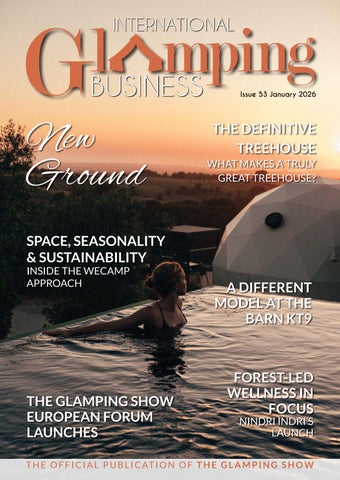
Cover image: wecamp Reserva Alecrim
International Glamping Business is published by: Upgrade Publishing. Registered address: 47 Oliver Close, London W4 3RL
Publisher: Upgrade Publishing, Steph Curtis-Raleigh. e: steph@upgradepublishing.com
Design: Dean Coulter, Design on Tap. www.designontap.co.uk www.glampingbusiness.com Instagram @thisisglamping Facebook @thisisglamping
Other Events:
The Glamping Show w: www.glampingshow.com e: dan.w@swanevents.co.uk
Glamping Show Americas w: www.glampingshow.us e: david@glampingshow.us Eco Resort Network w: www.ecoresort.network e: steph@ecoresort.network © 2026 Upgrade Publishing Ltd. International Glamping Business is published 6 times a year. No reproduction of any part of the magazine is permitted, nor storage in a retrieval system without prior consent of the publisher.
permitted. No warranty is implied in respect of any product or trader mentioned herewith.


Accor is expanding its Mantis brand in the Gulf region following the 2024 opening of Hawar Resort by Mantis on Bahrain’s UNESCO-listed Hawar Island.
The group has confirmed plans to launch new Mantis properties in Saudi Arabia and the UAE in 2026, as part of its wider focus on nature-based and sustainability-led hospitality.
The expansion reflects growing demand for eco-conscious travel. Data from Virtuoso indicates that 64% of high-end travellers actively seek sustainable accommodation, while 42% are willing to pay a premium for environmentally responsible stays. Accor’s upcoming Mantis developments are positioned to meet this demand through low-impact design and experienceled offerings.
In the UAE, Saij Mountain Lodge by Mantis is scheduled to open in Ras Al
Khaimah in Q2 2026. Located on Jebel Jais, the country’s highest mountain, the resort will comprise 70 standalone lodges built using locally sourced materials designed to blend into the surrounding landscape. Planned guest experiences include guided hiking, beekeeping workshops, and farm-to-table dining, with a focus on encouraging engagement with the natural environment.
In Saudi Arabia, Basiqat by Mantis is expected to open in Q4 2026 in Al Uyaynah, approximately 40 minutes from Riyadh. The dual-site development will feature 218 keys, including suites, villas, desert tents, and Zad Palace Suites. Architectural design will draw on local heritage, using natural materials and earth-toned finishes. Amenities are set to include multiple dining venues, indoor and outdoor swimming pools, a hydro spa, yoga pavilion, landscaped gardens, and a heritage-inspired souk.
D.A.T.A Resort by Della operates as a military-themed luxury glamping property in Lonavala, Maharashtra, offering a distinctive take on experiential outdoor hospitality in India.
Developed by the Della Group and conceptualised by designer and hotelier Jimmy Mistry, the resort launched at a time when experience-driven and purpose-led travel was beginning to gain momentum in the domestic market.
Set within a forested landscape overlooking Shirota Lake, the property features 27 permanent luxury tents, each measuring around 500 square feet.
Rather than positioning itself as a traditional glamping resort, D.A.T.A adopts a hybrid model that combines fixed accommodation with structured, activityled programming inspired by military training.
A defining element of the guest experience is its roster of former armed forces personnel, who lead physical training exercises, leadership challenges, and teamwork sessions. These activities are delivered in a controlled environment designed to accommodate a wide range of guests, including families, couples, and corporate groups.
The approach allows the resort to generate revenue beyond accommodation alone, with experiences playing a central role in the value proposition. Despite its premium positioning, D.A.T.A Resort has maintained a deliberately low public profile. According to Bold Outline, the property operates with limited inventory and avoids high-volume tourism, instead focusing on advance bookings and smaller group formats.
This strategy has contributed to its reputation as a “hidden gem,” appealing to guests seeking exclusivity and a departure from mainstream hospitality offerings.
The resort will also incorporate a kids’ club and flexible event spaces, targeting both leisure travellers and the meetings, incentives, conferences, and events (MICE) market.
Qusai Al-Fakhri, CEO of Saudi Arabia’s Tourism Development Fund, said the project establishes “a new standard for hospitality in Saudi Arabia” and supports Vision 2030 objectives to position the kingdom as a global hub for sustainable tourism.
Beyond the Gulf, Accor is also planning to open Mantis Hiddn Addo in South Africa on 1 March 2026. The off-grid lodge will include 12 mountain suites and two private villas set across an 800-hectare private reserve.
The timing of these developments aligns with broader growth in eco-tourism and off-grid hospitality across the region, as operators respond to increasing demand for nature-integrated, sustainability-led travel experiences.

For glamping owners and outdoor hospitality operators, D.A.T.A Resort offers a clear example of niche positioning within a competitive market. Its thematic design, specialist staffing model, and curated programming demonstrate how experiential depth, not scale, can support differentiation and premium pricing.
The use of ex-military professionals also highlights alternative staffing and partnership opportunities for operators looking to build activity-driven guest engagement.
The resort’s model also illustrates the operational trade-offs of limited-inventory properties: lower guest volumes balanced against higher per-guest spend, more complex programming, and increased staffing coordination.


WorldHotels, a global brand of independent luxury and lifestyle hotels, reported a year of growth in 2025, expanding its portfolio to include nearly 100 new properties across 12 countries. The expansion also includes new glamping locations and the development of WorldHotels™ Residences, currently under construction.
“Last year was a watershed year for WorldHotels. We didn’t just grow our portfolio; we continued to innovate and transform our offerings to accommodate the changing luxury traveler’s needs,” said Ron Pohl, president of WorldHotels, in a press release.
“Each property has its own independent soul, history, and unique offering, which continues to resonate with today’s guests. The luxury travel industry is on track to reach $1.7 trillion by 2032, and we’re seeing consumers in this category crave more
The Pacific Asia Travel Association (PATA) and the Asia Pacific Outdoor Lodging Association (APOLA) have entered into a formal strategic partnership following the signing of a Memorandum of Understanding (MOU). The agreement was signed on 22 January 2026 at the Thailand Tourism Forum in Bangkok by Noor Ahmad Hamid, CEO of PATA, and Willem Niemeijer, Executive Committee Member and founding member of APOLA.
APOLA has been established as a notfor-profit organisation with a mission to support sustainable growth, innovation and operational excellence within the Asia Pacific outdoor lodging sector.
Commenting on the partnership, PATA CEO Noor Ahmad Hamid said the collaboration would strengthen international cooperation across the region and encourage the exchange of best practices.
“This partnership with APOLA creates a
personalized, one-of-a-kind experiences. That’s why we’re expanding into branded residences, glamping, and wellness offerings, providing them with the flexibility and authenticity they’re seeking.”
In 2025, WorldHotels’ new properties spanned boutique cultural hotels in Europe, urban lifestyle hubs in key global cities, and island or coastal leisure destinations. Boutique additions included Collini Rooms in Milan, Velvet Hotel in Manchester, and Inverness Palace Hotel & Spa in Scotland.
Urban lifestyle developments included Wenlan Hotel Northern Hangzhou in China, The Florian Amsterdam Schiphol Airport in the Netherlands, and Acueducto Hotel in Guadalajara, Mexico. Leisurefocused properties opened in destinations including Miami, Roatan, Honduras, and Bonaire in the Caribbean Netherlands.
Looking ahead to 2026, WorldHotels plans to continue its expansion with around 40 new properties in development. The brand will debut WorldHotels Residences with Essensia Sky and Parkway Saigon in Ho Chi Minh City, targeting travelers seeking flexible, hotel-style living.
The company also plans to expand its glamping footprint with new naturefocused retreats, including Asheville River Cabins in North Carolina, The Lodge at Pico Bonito in Honduras, and Marangatu Luxury Hotel in Brazil. Wellness offerings will grow with the opening of Soul Spring Sanctuary in Cabo, the brand’s second wellness destination.
For outdoor hospitality operators, glamping owners, and RV resort managers, WorldHotels’ strategy reflects a broader trend in the luxury segment: travelers are increasingly seeking experiences that combine authenticity, flexibility, and access to nature. Investing in differentiated lodging models, such as branded residences or glamping retreats, may offer pathways to capture this demand.
stronger foundation for collaboration across the Asia Pacific region, enabling meaningful knowledge sharing and joint initiatives. We look forward to advancing responsible and sustainable tourism together, while delivering tangible value to our respective members,” he said.
Willem Niemeijer highlighted the rapid growth of the outdoor lodging sector in the region, estimating annual growth at around 11%.
“Outdoor lodging is expanding quickly across Asia Pacific, making it timely for APOLA to work alongside PATA – the region’s leading tourism authority – to highlight the sector’s ability to deliver high-quality, nature-based and responsible tourism experiences,” he said.
Niemeijer added that demand for naturefirst accommodation, including tented camps, cabins, yurts, treehouses and nature pods located in beaches, forests, mountains and other natural settings, has increased

significantly during and since the Covid-19 pandemic. Alongside promoting sustainable practices, APOLA also aims to support the development of industry standards for the sector.
Under the terms of the MOU, areas of cooperation include reciprocal complimentary membership access, allowing both organisations to utilise selected member benefits at an association level. The agreement also covers research and knowledge exchange, with APOLA contributing selected research, tourism insights and travel trends on a quarterly basis via PATA’s members-only communication channels.
Both organisations will support reciprocal promotional activities. Members of PATA and APOLA will also have opportunities to engage through networking initiatives and annual events, with registration support provided in line with the agreement.

Greece has formally introduced a national legal framework to regulate glamping accommodation, bringing standardisation to a sector that has operated for more than a decade without dedicated national rules. The move marks a significant step in recognising glamping as a distinct category within the country’s hospitality industry.
Glamping has been present in Greece since 2012, developing alongside growing demand for nature-based stays that combine outdoor settings with higher service and comfort standards.
The new framework, introduced by the Ministry of Tourism, aims to provide clarity for operators and investors while aligning glamping with the country’s existing accommodation classification system.
Under the regulations, glamping sites will be eligible only for four-star and five-star classifications, placing them
at the premium end of the hospitality market. While aligned with hotel rating structures, the criteria have been adapted specifically for nature-based accommodation.
Operators must meet detailed technical specifications and achieve a minimum points threshold, with 6,000 points required for four-star status and 7,000 points for five-star classification, calculated through a mix of mandatory and optional criteria.
The framework also sets clear capacity and spatial limits designed to preserve the core characteristics of glamping, including privacy and immersion in nature. Individual units are limited to a maximum of four adult beds, with provision for up to two additional child beds.
A minimum distance of ten metres is required between units, and at least 50 percent of each site must be dedicated
to vegetation or plant coverage. Internal transport within glamping sites must use environmentally friendly methods.
Accessibility plays a central role in the new regulations. All units must comply with national “Design for All” standards, ensuring safe and independent access for guests with disabilities or reduced mobility.
According to The Greek Reporter, a minimum of five percent of total unit capacity must be designed specifically for accessible use, and any new glamping development must include a formal accessibility study as part of the approval process.
The Greek model may influence future regulation elsewhere, offering useful benchmarks around classification, site density, environmental integration and accessibility for operators planning highend glamping developments or market expansion.
The UK’s Glamping Industries Trade Association (GITA) has announced another impressive line-up of webinars for its members.
Commencing on 13th January with a webinar on hosting weddings at glampsites, the programme spans a range of topics with which the glamping industry will need to engage in 2026.
From marketing to industry trends; from buying yurts to logs; from asset financing and insurance to OTAs, the slate of topics has resonance across the sector.
“The GITA webinars have been voted one of the key benefits of membership,” commented GITA Executive Manager, John White. “They provide a constant stream of highly relevant knowledge and guidance
for glampsite owners whatever their target market. Not only does this enhance glampsite owners’ skill set, it leads to real world commercial benefit.”
The Programme:
n January 13th: Weddings – Getting Married at First Glamp
n January 27th: Marketing – Getting Seen, Noticed and Booked
n February 10th: Industry Trends and Predictions
n February 24th: Asset and Other Finance
n March 10th: Insurance – How to reduce your premiums.
n March 24th: Buying Decision – Logs for your wood burners and hot tubs
n April 7th: Buying Decsion – Tents, Yurts and Teepees
n April 21st: OTAs – Friend or Foe?

n May 5th: Water – using a precious resource well on your glampsite
n May 12th: GITA SPRING SUMMIT
n May 19th: Enhancing and Developing your Glampsite
n June 2nd: Grounds Maintenance – Rewilding and Environmental Stewardship

The glamping industry has a fresh, game-changing conference.
Designed to accelerate growth, forge valuable connections and deliver actionable strategies for businesses of all sizes across Europe, The Glamping Show European Forum (TGSEF) is a focused, oneday event. Designed for operators, suppliers, innovators and aspiring entrepreneurs, TGSEF will take place on 18 March 2026 at the Lumen Hotel in Lisbon, Portugal. This inaugural edition marks a bold step forward in support of the outdoor hospitality sector’s evolution and pan-European collaboration.
Glamping has transitioned from niche trend to a major segment within the alternative hospitality and outdoor tourism industries. While the market continues to expand, European stakeholders face distinct challenges – from navigating macroeconomic uncertainty to standing out in increasingly competitive landscapes. TGSEF fills a gap: a practical, region-focused forum with a clear purpose. It’s a space built for learning, networking and doing business all within a single day.
TGSEF is built around a tightly curated programme of expert talks, regional insights and panel discussions that are geared toward real business impact.
n The Landscape for Outdoor Hospitality in 2026
Luis Brites from Clever Hospitality Analytics opens the Forum with a data-led overview of the sector — from investment hotspots to how sustainability and guest experience trends are shaping future growth.
n Glamping as an Additional Revenue Stream
Lars Schäfer of Glamping Advisors will share insights into diversifying revenue and maximising the business potential of glamping assets.
n Get Booked Out in Times of Doubt Sarah Riley – a leading voice in glamping marketing strategy with experience across the UK and USA markets – offers a session on building commercial resilience, strengthening visibility and protecting profits in uncertain economic climates.
n Return on Investment for Different Glamping Structures
Ronnie Smith brings a technical and financial perspective, giving operators actionable guidance on how to assess ROI for different kinds of accommodation products.
n The Hinter Story: Nurturing Guests, Partners and Places that Build Brand Value
Emily Padan will explore how thoughtful brand building goes far beyond logos and websites. This session focuses on creating meaningful relationships and how those relationships translate into long-term commercial value by strengthening brand loyalty, elevating pricing power and futureproofing in competitive markets.
n Stretch Your Season with Wellness and Retreats
A panel session featuring Kerry Roy, Mareile Paley and Lídia Isabel Nicolau explores ways to extend guest seasons and add wellness-focused experiences.
In addition to sessions, the event includes dedicated networking breaks, a networking lunch and a post-conference drinks reception – included in the ticket price – all designed to maximise interaction with peers and industry professionals.
European Forum launches 18 March 2026 in Lisbon, Portugal.
A standout feature of TGSEF is its regional focus and mobility. Unlike static trade shows or broad international conferences, the Forum will rotate across European cities each year, making it easier for operators throughout the continent to participate without extensive travel burdens. This mobility aims to meet businesses where they are, foster local ecosystems and promote inclusive growth across markets.
Lisbon – the host city for the first edition – is both an accessible and vibrant setting for this launch. A well-connected travel hub and one of Europe’s most dynamic tourism markets, it offers a fitting backdrop for discussions on the future of outdoor hospitality.
This event is relevant to virtually every stakeholder in the glamping and experiential accommodation markets:
n Glamping site owners and operators seeking fresh ideas and new partnerships.
n Start-ups and new entrants looking for practical guidance on launching and scaling a business.
n Suppliers, manufacturers and service providers eager to showcase innovation and connect with buyers.
n Industry professionals and investors exploring growth opportunities and strategic trends.
TGSEF is intentionally a one-day conference; a concentrated experience that delivers highimpact insights without requiring multiple days away from the business. A single, content-rich

day means attendees can absorb strategies, make connections and return to operations ready to act – keeping travel time and costs down.
The Forum’s structure also ensures that every element (from sessions to networking slots) contributes directly to practical business outcomes, emphasising relevance and value.
The first edition is being supported by Glamping Revolution, one of Portugal’s leading manufacturers and suppliers of glamping structures, signalling strong industry backing and a commitment to elevating outdoor hospitality across Europe.
Organisers, including the team behind The Glamping Show and International Glamping Business, bring deep experience in delivering high-quality trade events that blend innovation with commercial opportunity.

Over the past decade, The Glamping Show has become a cornerstone for the industry, attracting thousands of buyers, decision-makers, suppliers and innovators.
TGSEF sits within a larger ecosystem of events and industry support platforms driven by The Glamping
Show and International Glamping Business. From the flagship three-day trade expo in the UK to cross-market conferences and publications, there’s now a complete suite of resources and gatherings to support growth, innovation and community building across the sector.
n Date: 18 March 2026
n Venue: Lumen Hotel, Lisbon, Portugal n Format: One-day, insight-led conference with talks, panels, networking and social events.
n Audience: Operators, suppliers, service providers, investors and industry professionals. n Tickets: Available through The Glamping Show website.
Not just a conference, but a platform for shared ambition, innovation and commercial momentum in a rapidly growing sector. Built on practical insight, regional relevance and genuine networking opportunity, it offers every attendee a chance to sharpen strategies, build partnerships and future-proof their business in a dynamic European marketplace.
Be part of a forum that promises to reshape how European glamping businesses connect, grow and thrive. Tickets are available at theglampingshow.com/the-glamping-showeuropean-forum.


At wecamp Reserva Alecrim in Portugal’s Alentejo region, CEO Marc Juncosa explains how a landscape-led approach to design, accommodation and operations has shaped a glamping destination built around calm, seasonality and long-term sustainability.
Your accommodation lineup at wecamp Reserva Alecrim includes domes, casas do lago, bungalows & private villas integrated into the landscape. Can you walk us through how you decide which types of structures to offer, and how each one fits into your overall guest experience vision?
At wecamp, the landscape leads the decisionmaking. We design each destination from a close reading of the territory (topography, vegetation and carrying capacity) rather than from a fixed catalogue of accommodation types.
At wecamp Reserva Alecrim, each typology serves a different guest profile and “moment” within the stay. Domes are the entry point to glamping: immersive, sensory and nature-led. Casas do Lago are the most premium option, carefully integrated along the lakeshore with direct water access and a deeply intimate relationship with the environment, ideal for slower, longer stays. Bungalows and private villas add comfort, privacy and flexibility for families or travellers seeking design, wellbeing and services without losing authenticity.
What design and operational principles guided your selection of these accommodation types?
We balance three principles: design coherence, sustainability and operational viability. A key differentiator for wecamp is that we have an in-house architect, which allows us to ensure strong design consistency and make site-specific decisions that truly respond to each landscape.
The core design priority is landscape integration (light architecture, natural materials and tones), and minimal environmental impact.
Operationally, year-round functionality matters: insulation, thermal comfort and durable materials are essential to extend the season. Sustainability is treated as a transversal layer: energy efficiency, responsible resource use and ease of maintenance are part of the design from day one.
Looking back to when you were first developing this site, what do you think has been the single biggest contributor to your success as a glamping destination in the Alentejo region?
The biggest contributor has been building the experience first-beyond accommodation. wecamp Reserva Alecrim was conceived as a place where the environment and the spatial design create an immediate sense of calm and deep rest, close to a retreat.
Instead of adding constant stimulation, the destination itself delivers the value: silence, lakes, pools, generous space and thoughtful integration into nature. In a world driven by speed and hyperconnectivity, the ability to offer a slower, serene and authentic stay has strongly resonated with guests.
Seasonality is a defining challenge for many European glamping operators. How have you designed your accommodation structures and infrastructure to extend the season and maintain profitability beyond peak summer months?
From the start, wecamp Reserva Alecrim was designed to work beyond summer. Accommodation is built for year-round comfort (insulation, efficient climate control and durable materials), aligned with sustainability principles.
Infrastructure plays a key role: the heated Domo Pool helps extend the season, and
wellbeing services such as massages become even more relevant in lower-demand months. The guest mix shifts: couples are especially strong in low season, while summer is primarily families.
Food & beverage supports desaisonalisation through a locally rooted, experience-led approach that remains appealing outside peak summer. Portugal’s mild climate also enables off-season activities such as tastings, hiking, horseback riding and visits to nearby towns, such as Comporta, making spring and autumn strategic periods.
What’s one decision or strategy you are especially glad you made early on that other operators could learn from?
One decision we are especially glad we made early on was defining WeCamp as a concept, not just a collection of sites. From the start, our ambition was to elevate the camping sector by showing that outdoor hospitality can combine sustainability, design and comfort without losing its connection to nature.
That idea became our filter for every decision, from choosing locations and designing architecture to shaping the guest experience, including wellbeing, gastronomy and service. We never impose the concept on a place; instead, we adapt it to each landscape, aiming for the lightest possible footprint so guests can truly enjoy nature without compromising it.
Rather than chasing growth through repetition, we focused on building a


consistent standard and recognisable identity, while letting each destination be shaped by its territory.
Sustainability seems central to your ethos, from eco-friendly structures to partnerships with local producers and a Biosphere certification. How do you measure progress toward your sustainability goals, and what practical advice would you give other operators working toward similar certifications or impact goals?
We see sustainability as an ongoing operational process, measured through clear indicators such as water use, energy efficiency, waste reduction, local sourcing and responsible experience design. It is also a design principle for us: nature defines the design, not the other way around.
Biosphere certification has helped us structure and audit this approach, turning values into measurable processes and highlighting areas for improvement year after year. Team involvement is key, sustainability only works when it is embedded in everyday decisions.
Our advice is not to chase certification as an end goal. Start by understanding your real impact, then improve step by step, with coherence and transparency, so sustainability becomes a genuine part of both the business model and the guest experience.
Looking at the European market as a whole, are there any accommodation formats or guest experiences you believe are currently overused (or underexplored) in glamping developments?
We see strong potential in the evolution of premium pitches, particularly for longer stays by international guests travelling by
motorhome or camper van. These travellers increasingly expect privacy, comfort and well designed infrastructure, and some markets, such as Italy, are already investing heavily in this direction.
On the experience side, some developments overfocus on intensive children’s entertainment. We see a still underexplored alternative: nature-integrated destinations designed for rest—also for adults. At Reserva Alecrim, family experiences exist (kids’ club and activities), but they are more connected to the environment, free play and calm, allowing a balanced stay for everyone.
As part of a growing European outdoor hospitality network, how important is collaboration and knowledge-sharing between operators across borders, and what role do industry events like The Glamping Show European Forum play in that?
Collaboration is essential to professionalising a fast evolving sector like outdoor hospitality. Through camping and tourism associations in Spain and Portugal, we share operational challenges, regulatory updates and strategic learnings with other operators. We also attend national and international fairs to follow market trends and stay connected to both peers and source markets. Events like The Glamping Show European Forum are particularly valuable because they create focused spaces for dialogue and knowledge sharing, helping build a more connected and mature European glamping industry.
For operators or aspiring operators, what practical lessons have you learned about guest expectations and infrastructure planning?
Guests experience the destination as a whole, not just the accommodation. A smooth, coherent journey from arrival to departure
matters as much as design or setting. Small infrastructure details, such as access, paths, signage, lighting and distances, often define whether a place feels calm or stressful. Planning also needs to anticipate how spaces are truly used: common areas, wellbeing zones and F&B should be sized not only for capacity, but for the rhythm and experience you want to create.
Our main learning is that guests value well resolved simplicity: functional infrastructure, clear services and a consistent sense of care.
Finally, as an operator with accommodation variety, guest experiences and sustainable systems in play, what do you see as the next evolution for wecamp Reserva Alecrim?
The next step is to further refine the experience by deepening wellbeing, strengthening nature connected activities and enhancing the quality of time guests spend at the destination.
Sustainability will continue as continuous improvement: optimising processes, reducing impact and reinforcing the relationship with the local environment. The goal is to evolve with traveller expectations while protecting what defines wecamp Reserva Alecrim: a serene, authentic and landscape-led experience.


From music festivals to glamping resorts and vineyards, Tentourage has quietly become one of Europe’s most experienced players in tensile structures. President Benoit Allirol explains how it’s shaping how outdoor events and hospitality spaces are designed, engineered and used.
From festival fields to Europeanscale projects
A Franco-Italian company, Tentourage specialises in tensile structures, Bedouin stretch tents and bell tents for events and hospitality projects across Europe. With more than a decade of experience, the business has grown from its roots in the music festival world into a supplier trusted by event producers, glamping operators, vineyards, hotels and destination venues.
The company was founded by three partners who met while working in the festival scene, an environment where timelines are tight, expectations are high and mistakes are not easily forgiven. That background shaped Tentourage’s approach from the outset. Rather than focusing purely on visual impact, the company set out to combine designled spaces with technical reliability and operational discipline.
“Our philosophy is to blend elegance and functionality to create unique spaces that ensure maximum comfort and safety for guests,” says President Benoit Allirol. Just as important, he adds, is maintaining a professional but “light and happy
atmosphere” with collaborators, even on highpressure projects. From early on, Tentourage positioned itself not simply as a tent supplier, but as a partner capable of supporting clients through consultation, logistics, installation and on-site management.
Two sides of the same business
Today, Tentourage operates across two closely connected areas: short-term event installations and longer-term semi-permanent or seasonal structures. Rather than treating these as separate divisions, the company sees them as complementary.
“We treat them as two faces of the same business,” Allirol explains. Events are fastpaced and intense, where speed, logistics and flawless execution are paramount. Semipermanent structures, by contrast, resemble construction projects. They involve permitting support, detailed site planning, anchoring strategies, weather and load calculations, and long-term thinking around maintenance and durability.
This dual expertise has become increasingly valuable as client expectations have evolved. Operators are no longer looking for structures that simply appear for a weekend and disappear again. Instead, they want solutions that can flex between uses, withstand repeated installation cycles, or remain in place for an entire season or longer.
Hospitality demand on the rise
While events remain central, demand from the hospitality sector has grown steadily over recent years. Glamping resorts, vineyards, agritourism
estates, beach clubs and hotels are increasingly turning to tensile structures to create covered spaces that feel connected to nature without compromising comfort or safety.
Operators want the visual “wow” factor, Allirol notes, but not at the expense of performance. “The expectation today is much higher,” he says. Structures must meet strict safety standards, perform in variable weather conditions and maintain their appearance over time, particularly when used as part of a guest-facing hospitality offer.
For many clients, stretch tents and tensile structures are no longer accessories but core infrastructure – dining areas, tasting rooms, event spaces or social hubs that directly support revenue and guest experience.
Tentourage does not manufacture its tents in-house but works with a long-standing external supplier for standard shapes, a relationship that has remained in place since the company’s earliest days. “Over the years we tried different producers, but we always kept going back to the first one,” Allirol says, pointing to consistent quality as the decisive factor.
For custom projects, Tentourage plays a more hands-on role in shaping the final result. The team studies the installation context and the resulting form of each structure, which is then engineered and produced by its manufacturing partner.
The design language behind its tents draws heavily on traditional shelters used by nomadic populations of the Sahara Desert, particularly Bedouin tents. These influences are reinterpreted using modern materials and engineering techniques to create structures that are more durable, weather-resistant and technically robust, while retaining a sense of softness and fluidity.
A broader and more diverse client base
Tentourage’s client base has expanded significantly as the market has matured. “We have a very wide range of clients nowadays,” Allirol says, from event agencies and corporates to glamping operators, hotels, vineyards and destination venues. Part of this shift is down to increased awareness. Stretch tents and tensile structures are far better understood than they were a decade ago, making them a more mainstream option for operators planning outdoor spaces.
As the product category has matured, so too has the sophistication of client briefs. Projects are often more integrated, longer-term and strategically important than in the past.
Like much of the events and hospitality industry, Tentourage felt the impact of the pandemic. But rather than creating entirely new trends, Allirol believes it accelerated changes that were already underway.
Outdoor concepts, flexible capacity planning and higher expectations around comfort and design have become permanent features of the market. In response, Tentourage expanded its offer beyond standalone structures to provide more complete solutions. This includes adaptable sidewall systems, integrated lighting and interior options, and deeper involvement in the study and delivery of permanent and semi-permanent projects.
Seasonal structures as revenue drivers
Semi-permanent and seasonal installations now represent a growing share of Tentourage’s work. These projects are often driven by operators seeking to extend their operating season, add covered revenue-generating space, or create signature venues that feel embedded in their landscape.
Strong demand is coming from vineyards and agritourism estates, where shaded tasting
and dining areas are essential, as well as from restaurants and event locations hosting weddings and corporate functions. In each case, the structure must balance aesthetics, functionality and regulatory compliance.
Rather than framing sustainability as a marketing message, it’s approached through practical decisions around longevity and installation methods. The company prioritises durable textiles and finishes designed to last over many years. In many cases, tents are fixed for extended periods rather than repeatedly dismantled and reinstalled.
Installation practices are also designed to minimise site impact. “We do not need any mechanical aid to install our tents, only manpower,” Allirol explains. All operations are carried out from the ground, with no cranes, platforms or heavy machinery.
Transport efficiency plays a role too. The structures are notably compact when packed, reducing vehicle size requirements and fuel consumption compared with heavier alternatives.
Circularity has been part of Tentourage’s model from the beginning. Rental tents are routinely resold as second-hand units, and demand for refurbished structures is now higher than ever.
Over time, the company has developed a detailed follow-up system for used tents, including seasonal technical and aesthetic inspections, professional cleaning and precise
usage records that track how many days each tent has been installed – for buyers, this provides transparency and confidence.
After ten years in operation, Allirol outlines two possible paths for the coming years. One is continued expansion, investing in new products and entering new countries, with a particular focus on outdoor living and Europe’s growing glamping market.
The other is consolidation: optimising processes, refining workflows and extracting maximum value from the strong market position the company has already built. Whichever route is chosen, the emphasis remains on quality, safety and long-term thinking.
For glamping operators and event organisers considering a large-scale tented structure for the first time, Allirol offers his advice. “Don’t judge by looks alone,” he says. While lowercost options may appear comparable at first glance, they often use inferior materials and have much shorter lifespans.
Instead, he recommends asking detailed technical questions: what certifications the structure holds for wind resistance, fire safety and waterproofing; how fabrics and structural components are joined and reinforced; and what guarantees and after-sales support are provided.
Finally, professional installation is critical, particularly for public-facing venues. “Having an expert team pitch the structure correctly is a key part of safety,” Allirol says. “In public spaces, safety must always come first.”


From lockdown experiment to multi-stream rural destination, The Barn KT9 in England has grown into a distinctive blend of glamping, fitness, food and community. Co-founder Charlie Woodall shares the realities behind diversifying a family farm, building organically and balancing passion with pragmatism.
What led you to create The Barn KT9, and how did the idea evolve from its origins during lockdown into what it is today?
Our family farm here has become increasingly (as with all farms) unviable as an agricultural business on its own. Camping wasn’t initially on the to-do list, but in the summer of 2020, with international travel no longer an option and a public desperate for anything that gave them an escape into nature, a tiny little campsite experiment was born here at the farm.
Why did you choose to diversify the farm into glamping, wellness classes, a café and events rather than focusing on one stream?
The gym was the only business we were definitely going to pursue. My wife, Emily, qualified as a personal trainer in 2016, and the opportunity to move her business from SW London and open her own studio on the farm was the idea that got the ball rolling. The plan was to get that up and running and then go from there. Covid then focused the mind and led us to trying a few new things perhaps sooner than initially planned. Everyone was going for walks and working from home in the spring of 2021; it was a perfect time to start a little outdoor coffee business, which has evolved into our more permanent on-site café.
Can you talk us through the early days of the business, from the initial idea to welcoming your first guests? What was that period really like behind the scenes?
We didn’t think we’d like having camping here, but with all other options off the table in 2020, we thought we would try it. We worked with a contact in the wedding industry who had a load of bell tents unused in storage, put those up, and rented a couple of portaloos for a month as well as a mobile shower. That little experiment was enough to tell us both that we loved having people stay on site, and that people loved coming here.
What were the biggest early challenges in getting the glamping side of the business up and running?
To be fair, we consciously kept the operation lean and simple. I constructed two hot showers and two flushing loos out of pallets, which cost next to nothing. Three bell tents and their contents cost around £2,500 to start with, so we had a functioning small site for under £3k. We went down the exemption licence route with Woodland Champions Club rather than full planning, which we’ve maintained for five years now.
How has the glamping offering performed compared with the other revenue streams? Has it exceeded expectations or proven harder than you thought?
It’s not a huge part of our business, and I’m sure a consultant or investor would come in and tell us to close it down and focus our energy on more profitable things. But the main thing we love about the campsite is providing a safe and welcoming space for local families, as well as all the international visitors we have. It’s great looking out of the window on an August evening and seeing kids from down the road toasting marshmallows and playing frisbee with kids from the other side of the world.
We’re pretty much booked up through late July and August in the holidays; outside of that six-week period, we tend to have plenty of availability. Most of our bookings are very local and quite spontaneous.
You’re very open on LinkedIn about the realities of running the business, listing yourself as the site’s barista, carpenter, cleaner, marketer, groundsman and childminder (and more). Why did you decide to show up so visibly as a founder?
It’s my favourite thing about running a small business; I get to do an incredibly vast and varied array of jobs on site. As we grow, we have been able to employ a team to help with lots of the day-to-day work, but I absolutely love that I can be a carpenter, groundsman, barista, sales manager and childminder all within the same morning.


Do the different elements feed into each other? Do you find guests cross-engage across services?
Yes and no; it’s something we can definitely be better at. We try to have 360-degree coverage of the business with our marketing and messaging. The café feels like it’s the centre point of the business, and everything else feeds into it. Most people attending classes in the gym will then come and have a coffee and a chat outside, our Barn Hangouts centre around it, and campers are always first in the queue for a flat white and pastry at 7.45am when they’re staying.
That said, the biggest community part of The Barn KT9 is the gym side of things – the retention rate is really high, and it’s so lovely seeing friendships being made off the back of classes. The café team also run the F&B for the corporate events we host.
What have you learned about managing very different business types under one brand?
They each require different management and expertise, but actually the core focus across everything we do is the same. Between Emily and me, we split the business responsibilities: her focus is all things fitness, I manage
the café and camping, and between us we manage corporate events. Initially it was just down to us; however, now we’re getting to a position where we can hire more help to focus on the functioning of the different parts of the business and make them even better.
We don’t do any paid marketing and rely solely on word of mouth and recommendations. The way to make that work is to ensure every cup of coffee, every single gym class, glamping stay and interaction with any member of the team is absolutely on point every time, so that people tell their mates how good it is.
Looking back on the first few years, is there anything you would do differently if you were starting again today?
You have no idea how easy life is with no, one or two kids until you have one, two or three kids. Make the most of the spare time you don’t quite realise you have at the time!
I don’t think we’d do anything differently, though, as there’s a chance things wouldn’t look like they do today. Covid felt like a nightmare at the time, and there were clearly a lot of downsides, but it really helped give

us some focus, time and direction in the early days. Hiring people is really scary at the start – you only see them as an annual salary, which can be very daunting when you can’t even pay yourself – but break it down by the week or month and the right people are more than worth it.
Were there any early-stage decisions that you’d change now?
Our campsite loos are plumbed into our house’s sewage treatment plant, which isn’t really big enough to cope with the summer demand. We get it emptied every couple of months, which means it all works fine, but it would be nice to have one three times the size!
What advice would you give other farm owners considering glamping or diversification? What separates projects that thrive from those that struggle?
What I always say is to give it a go. You don’t have to spend a single penny to open a version of a campsite. The UK’s 56-day rule gives you ample time to trial it, speak to local events companies and see if they have some equipment you can borrow or rent –and if you love it, you can then invest with confidence in the future. If you don’t, you haven’t lost anything.
What’s next for The Barn KT9, and how do you see the glamping side evolving?
We’ve just opened our brand-new Refarmer (Reformer & Tower) Pilates studio, which is our next big thing, along with an all-new, slightly larger café unit. The campsite has grown organically by 10% every year for the past five summers, and if it does the same again this year, that will be ideal for us. A little rebuild on the showers and making the BYO tent pitches a more uniform, larger (10m x 10m) size, are the big to-do-list items for the off-season.


By Jonny Clothier, Owner of The Dome Garden/Zero Zero Treehouse
Part architectural manifesto, part ecological meditation, Jonny Clothier reflects on the uncompromising journey behind creating Zero Zero Treehouse – and what it means to build a treehouse that truly belongs to the forest.
There is no definitive idea about what does, or does not, constitute a treehouse.
It may sound obvious, but the clue is in the title. A treehouse must be about the trees. It could be in the trees, on the trees, or around them. The trees could even be inside the treehouse. Whichever way it is, the treehouse should be the interface that communicates some greater truth about the nature of trees to us, the human visitor.
In its most basic form, the treehouse will normally be located high up, or at least give the impression of height, providing a lofty, woody experience. And that, sadly, is where most treehouse design stops.
For us it seems more complex. Our aim is to find a way to express that in built form; we see it as a bridge that links the woody world to the human one, interpreting each one for the other. In order to do that, we have to think like the trees, to extract the essence of the forest and to build it into the house. By doing so, we hope to create a vibrant connection that will produce a closer, more insightful experience of ‘tree-ness’ than can be found in any other place.
The process of making that happen in the case
of Zero Zero Treehouse has been long – and tortuous!
The only thing everyone agrees on is that a treehouse has to have some element of height. The easiest way to achieve that is either to fix it directly up onto a tree or, as is more often the case, position it on stilts beside it.
In these times of environmental issues and sustainable ambitions you have to ask whether it is justifiable, or responsible, to simply plant a house on top of a tree, where it will sit like some sort of tumorous graft.
Aside from any philosophical considerations, actually building on the tree has practical implications. There are weather sealing issues, weight considerations, problems with toilets and flexible plumbing and of balance when filling a bath with half a ton of water (or more). Is it reasonable to expect the tree to absorb it all?
Our own 30 metre-high black walnut tree moves with the weather and the upper trunk sways up to 2 metres in a big storm. Not only would it be deeply uncomfortable in bad weather, and definitely unsafe, but changes to the loading would inevitably affect the development of the tree itself as it struggles to adapt. Movement and balance are critical to the development of the tree, its trunk and its roots. To interfere with that seems rash, at best.
At first glance, joining one tree to another, might also seem reasonable. It would share out the extra weight, restrict the range of movement and allow one to gain strength from the other. But that introduces a series of unknowns and conflicts, as their contrasting physical requirements become conflated and confined. And what if one tree were to die before the other? It conjures up ghastly images of a ‘Frankenstein-esque’ separation of artificially conjoined twins.
The next issue is attachment. To attach directly to a tree is to physically attack it. They say any damage inflicted by steel pins driven into the ‘heartwood’ of a tree is soon ‘healed’. But the very terminology says otherwise: for a tree to heal, there has to be a wound. The wound will grow over as the tree tries to physically recover and absorb the incursion. That may be fine, but there are unknowns. What of the intricate network of interconnectivity that underpins an entire
woodland? What of the dialogue between trees, that we don’t understand? How does the change in the pattern of one tree’s behaviour affect its relationship with other trees and place within the hierarchy of the forest?
There are tons of theories now about how trees communicate, how they coexist and how groups of trees can act as a single organism. So to build things on them, or through them, or to join them up, is to dabble with the unknown and interrupt a conversation in a language we don’t understand. What is certain is that interventions like this increase the biological burden on the tree and must impact the course of the tree’s life.
The job is to incorporate what we find into the one structure which effectively merges back into the community of trees, reflects it unique sense of place and truly earns the title of ‘Treehouse’ – rather than of ‘Migrant Hybrid Virus Grafted into the Structural Rootstock of a Disabled Host’.
The first consideration was provenance. It was important for us that all the wood used to build the house would come from the trees immediately around it and be processed at the mill just across the road, 200 meters away. The timbers themselves had to be from here. They had to grow up here. They had to belong here.
The Zero Zero Treehouse now reaches up to a height of 11 metres. But we are surrounded on all sides by the grandees of an ancient forest who tower over us at around 25-35 metres.


Everything within the house relates to its verticality. Andrew Birds (even our architect is of the trees!) refers to the design as a “representation of ‘The Vertical Forest’, where strong linear elements reflect the profiles and proportions of the trees around it.” Throughout the structure, everything – from the profile and proportion of the spaces themselves, to the supports, the doors, the windows and the glass screens –is divided into tall, rectilinear elements to emphasise the notion of verticality.
For the visitor, it begins on the approach. Two ramps rise up to an unnerving 4 metre drop beneath an elevated rope bridge. A forest of 63 multi-stemmed clusters of timber posts support the building in front of you which is partly clad in Shu Sugi Ban, or Yakisugi, an ancient treatment of wood that scorches the surface and protects it from fire, weather and decay.
In the natural forest, fire plays a critical role in renewing and refreshing land, re-vitalising flora and allowing the entire environment to reform and redevelop in new ways. From the outset, and throughout the interior of the building, fire is ever present. It is also emblematic of the opportunities that are here for the visitor. One of new perspectives, new ambitions and new outlooks to explore. It can be a fresh start, a rebirth even, for the weary traveller.
Beneath the canopy of any forest lies a network of routes and lives that intersect repeatedly across the whole space. Different animals criss cross, back and forth at different levels, from the forest floor to the sky above; their lives intersecting briefly as they go about their daily chores. It all contributes to the vigour of the life of the forest. A serpentine red path snakes its way down from the entrance to the lower floor, dissecting the route of the bridge above, allowing for chance encounters.
A few metres down, a coal seam runs down the through the valley. For ten centuries, Freeminers of the Forest of Dean have hewn coal under Royal Assent from beneath these same trees. It’s a form of black gold that has powered the forest and provided for the needs of multiple generations.
The external form leans into the rich visual tradition of the plethora of mine workings which, to this day, are still dotted around the forest; rusty metal boxes stacked above each other at different angles with makeshift workings connected by gantries that run into mysterious doorways at different levels.
The intersection and contrast of steel and timber around the building also pays homage to the incredible efforts of Robert Mushet and his father David. In 1868, a mile down the forest track at Darkhill, Robert refined the Bessemer process – which converts iron into steel – developing it into a reliable industrial system to produce the first viable flat sheets of high quality, hardened steel. His work revolutionised industrial metallurgy and without it, we wouldn’t have been able to do so many of the things we take for granted today. So, it is a constant reminder and memorial to their contribution. These two considerations set us firmly within the historical tradition of this exact spot, giving the building a sense of belonging – a right, even – to be where it is.
Once inside, past the rusty steel tree sculpture that welcomes you in, there are real trees on view at every angle, all framed in tall, glass and timber rectangles. This is nature as art. The forest framed for our benefit. The views reach into the depths of the beech wood that surrounds us, and pierce through the trees, not with steel pins, but with highly-focused shafts of dappled sunlight.
Early in the construction process, on arriving to ensure the area was safe, Adam, our tree surgeon, who spends his life up in the high

canopy, bounced onto the first floor deck. “Hang on a minute,” he said, looking around. “This is at my height. This is where I live. This is my view!”
He spent time dancing across the branches, cutting back dead wood here and loose boughs there. He also left others to grow around the house, coddling it in a familial embrace so close that, when it’s windy, a few of them still gently tap on the side of the building. It’s all part of the direct dialogue between us and the trees. On the one hand, they reassert and reinforce their own boundaries. On the other, they reassure us that they are still there protecting us from extreme events and supporting this stumpy upstart, the baby brother, that has suddenly appeared in their midst.
There is a more sinister interpretation too… but that comes later.
At the heart of every tree is its central trunk. Its job is to transport material and nutrients and to communicate with all the various parts of the tree. At Zero Zero, the staircase tower is that trunk. A solid timber core, cut from huge chunks of Douglas fir, encapsulated in a Corten steel skin that represents the bark of a tree. Cables and pipes are concealed, the technological ‘phloem’ that enables power and water, and flow freely through the structure. In the middle level is a library. This is the repository of memory – the thinking part of the treehouse. Our treehouse is still young so, like that of a small child, many of the boxes are still empty. The spaces are designed to change and to fill up over the years as people contribute meaningfully and thoughtfully to their contents. 40 films relating to forests –from Bambi to Sleepy Hollow – sit alongside 50 books – The Jungle Book to The Secret Life of Plants – amidst the beginnings of a rotating display of forest-related puzzles and art that echoes throughout the building. These combined accounts represent the many aspects of our human experience. It is the knowledge bank that we, visitors in an alien
world, can refer to and rely on to interpret and encourage our understanding of the woods around us.
As the contents of this room develop, its references will become more mature. At the moment, just a displaced teddy bear from an unknown child of a guest – who for all we know may still bemoan its fate – sits in one small box, pondering the complexity of life around it and wondering when its owners may return. Or more likely, where and at what time is the picnic, should he decide to go down to the woods today! His silent gaze and unwavering demeanour also serve to remind us that we are still far removed from what goes on in the silence within the life of the things that surround us.
Just next door, along a short corridor lined with birch trunks, a secret cupboard gives access to an inside-out world for a triplet of tree-based bunk beds. The Trunk Room, as it is known, occupies an imaginary space in a graphical woodland where boundaries are blurred. It’s a cross between Neverland and Narnia, where dreams are real and children drift off beneath a skylight that entices them on a journey towards the ‘second star on the left and straight on till morning’.
At the bottom of the treehouse, its roots reach out towards a pond which flows freely over the edges in a small rill. It trickles and seeps through the moss border that grows along the edge and into the ground below, before travelling up to a water garden on the roof, and then back down. Along the way it nourishes the thriving living wall.
Where the building faces the woods, twenty mirrors, each 4 metres high, swathe the base of the treehouse in a glittering shawl. From here, this illusory forest links the building back, inextricably, into the landscape, subsuming it in a leafy apparition of complex forms where one is oddly indistinguishable from the other. The effect is confusing, both visually and cerebrally. It’s almost as if the
forest is claiming it as its own – something that continues in other ways too.
In spring each year, high winds blow through the tallest trees and cover the house in pollen and flying seeds. It’s an inundation that continues through to, and reaches its peak in, autumn. Travelling through the building, apples and plums and pears ripen around the bridge, crab apples hang over the balcony into the kitchen whilst, higher up, the forest rains beech nuts, acorns and walnuts onto the roof.
Some might see this as a harvest of plenty, provided for our benefit by our mighty benevolent neighbours. But that would be to misinterpret a more malign intent.
It is actually an assault; a biological war that has been raging for centuries between the species, an invasion of opposing armies, each numbering in their thousands. They lay siege to our newly claimed territory, attempting to take root and rise up – maybe to supplant or displace this strange new sapling in their midst.
And with that, maybe we really do enter another realm. It is as if the trees can actually see us. They are targeting us and mounting an offensive against us. Zero Zero has mutated. It has become a virtual species, a real living thing and a tangible force to be reckoned with. It is one the other trees are communicating with and doing battle with. But ultimately, hopefully, one they will learn to get along nicely with.


As Nindri Indri prepares to open, Maja Dimnik reflects on the vision behind Slovenia’s newest forest-integrated wellness retreat and the evolving landscape of experiential travel.
How did the vision for Nindri Indri evolve from initial idea to the wellness concept?
Nindri Indri was born from a desire to create a space where nature, architecture and wellbeing coexist in harmony. The vision was never to build a typical accommodation, but to design an immersive retreat that encourages guests to reconnect with themselves and experience nature consciously.
The journey began when the owner, Tomaž, drove two and a half hours to meet in person and present his vision – a meeting that marked the beginning of a shared creative path. Describing the location as exceptionally beautiful, he used the phrase “Nindri Indri,” a term from the local dialect meaning “nowhere else.” That meaning immediately resonated, becoming the foundation of the resort’s identity and storytelling – perfectly capturing the rare, unrepeatable character of the place.
Wellness was integral from the outset, evolving into a one-of-a-kind environment fully integrated into the forest, with private spaces overlooking trees and ponds. Rather than an add-on, wellness became the defining thread of the project, guided by privacy and immersion in nature.
Currently under construction and scheduled to open in August, Nindri Indri will offer a holistic wellness retreat. Early reservations are welcome, with a special opening privilege for the first guests.
What were the biggest opportunities and challenges you encountered while shaping the Nindri Indri concept?
One of the greatest opportunities was the chance to acquire land specifically suited to the project. The main challenge, however, was translating ambitious ideas into reality while respecting the character and privacy of the site.
Bureaucracy and regulations were a constant consideration. Some of our most ambitious ideas – for example, wellness fully integrated into the forest, spaces among the trees, and even partially underground – had to be


adapted to local legislative limits. Despite these constraints, the concept remains exceptional, demonstrating the potential for creativity within boundaries.
How important is storytelling in marketing a place like Nindri Indri, and what stories from Slovenia or the local landscape felt most natural to build the brand around? Storytelling is essential for a project like Nindri Indri; it allows guests to connect emotionally with the place even before arriving. For us, it had to be authentic, drawn directly from the landscape: the forest, ponds, seclusion, and the sound of birds, inspiring our slogan, “Where silence speaks.”
The local Prekmurje dialect and the rare Smrdokavra bird, a regular visitor to the resort and featured in our logo, further bring a tangible sense of place to life. Guests can experience this connection firsthand through birdhouses, binoculars and guides, enjoying nature from their lodge, terrace or sofa.
Was there a specific international guest profile you had in mind when shaping the concept, or did the project start with a more regional audience in focus?
While the project began with a clear opportunity in land acquisition, the audience evolved alongside the concept. Nindri Indri is designed for both regional and international guests seeking a high-level escape, combining private wellness, fine dining and nature-immersive experiences.
The resort also accommodates personal and corporate events, from weddings to retreats, taking full advantage of its unique setting. The focus has always been on creating a timeless, intimate experience rather than appealing to a single demographic.
How do you see the current state of Slovenia’s wellness and glamping market? Are there particular regional strengths or trends you’re excited about?
Slovenia’s wellness and glamping market holds enormous potential, yet the sector is still developing in terms of the luxury and quality experiences seen in other parts of the world.
The country’s strategic location between Croatia, Italy, Austria and Hungary, combined with unspoiled nature, provides fertile ground for high-end resorts. The real opportunity lies in nature-led, immersive experiences that are both authentic and luxurious, allowing international guests to discover something truly distinctive.
I am excited to see innovative projects like Nindri Indri advancing a new standard in Slovenian experiential travel – building on the foundation of past resorts, yet creating highend experiences designed from the ground up, with wellness integrated into forests, curated culinary journeys and local cultural immersion.
Which wellness or glamping projects in Slovenia (existing or upcoming) do you think are most inspiring, and why?
One of the most inspiring wellness projects in Slovenia is Wellness Orhidelia – Terme Olimia, widely recognised as the best wellness in the country. While Orhidelia is more of a hotel-style complex, Thalasso Spa Lepa Vida, an open-air spa centre in the heart of Sečovlje Salina Nature Park which uses natural products such as salt-pan mud and brine, brings wellness directly into nature, which is a unique experience in Slovenia.
For upcoming glamping projects, insights are limited, but the potential for nature-driven luxury is enormous.
From your global experience in experiential lodging, what are the most important elements for making a luxury glamping or wellness resort successful today?
From my experience, the key elements are authenticity, deep connection to nature, and seamless design blending comfort with the environment. Guests value privacy, immersive experiences and curated touches that make them feel genuinely cared for – from wellness rituals beyond the ordinary to fine dining and thoughtfully-designed spaces.

Luxury today is measured in calm, regeneration and the ability to feel at one with the surroundings. Sustainability must be authentic, not performative, and storytelling helps create meaningful, memorable stays.
How do you balance sustainability with luxury when consulting on new hospitality projects? What are the non-negotiables?
True luxury is not excess, but space, calm and a genuine connection to nature. When consulting on new projects, sustainability must be embedded from the very beginning, not added later. We let the land speak first – building with the landscape, not against it –and shaping architecture around what already exists.
My non-negotiables are: respecting the natural environment, working with sustainable and natural materials, designing for longevity rather than trends, sourcing locally, and involving the community to keep the experience authentic.
Guests immediately feel when something is real. The most successful resorts are those where sustainability isn’t advertised, it’s simply experienced. True luxury lies where a place feels effortless, grounded and deeply connected to its surroundings.
What advice would you give to local operators or investors who want to create authentic travel experiences that resonate internationally?
My main advice is: don’t try to copy global trends and build from what is uniquely yours.
International guests don’t travel for something familiar; they travel for a true sense of place. The strongest concepts grow from the local landscape, culture, materials and community. Authenticity can’t be imported – it has to be rooted in what already exists.
At the same time, authenticity must be paired with international standards of comfort, service and design. Warm, genuine hospitality is just as important as architecture or aesthetics; people remember how a place made them feel.
I also always encourage operators to travel, explore and learn from the best projects around the world. Understanding global benchmarks helps you elevate quality while still staying true to your identity.
The balance is where the magic happens: local soul with global standards. At Nindri Indri, this philosophy comes to life through a wide range of immersive experiences – from forestlinked wellness to curated culinary journeys, wine trails, local crafts like pottery, hands-on experiences with regional specialties such as pumpkin oil, and learning cultural traditions like the Šotiš dance. These are all intimate, authentic experiences rooted in the region while maintaining world-class standards.
Slovenia is often described as ‘still undiscovered’. Do you see that as an advantage or a challenge when developing high-end destinations?
I see it primarily as a tremendous advantage. Being “undiscovered” means Slovenia has unspoiled nature, authentic culture and a strategic location, all waiting to be experienced. For high-end destinations, this provides a blank canvas to create unique experiences that can’t be replicated elsewhere.
One of the key challenges remains legislation that has yet to align with contemporary sustainability-driven tourism trends, which can limit ambitious concepts. At Nindri Indri, for example, we envisioned a one-of-a-kind wellness experience fully integrated into the forest – spaces among the trees, even partially underground – but local legislation required us to scale some aspects down. Even with these constraints, the concept remains immersive and exceptional, showcasing what is possible when nature and design are harmonised.


Coir flooring products have been used for centuries due to their durability & longevity. Coir is naturally flame resistant. Nevertheless, all our products have been flammability tested & certified by UKAS to BS 5287:1998/BS 4790:1987.
Perfect for bell tents, yurts, tipis and geodesic domes, our range of half-moon mats are the ideal flooring solution to provide a luxury finish to any structure.
Constructed from 100% unbleached & natural Vycome yarns in a Panama weave, each half-moon is hemmed on the circumference edge and double machinestitched. The mats are reversible weave with no latex backing and are available in 9 sizes from 3.6m to 7m diameter.
For marquees and bigger structures, we currently offer 2 specifications of matting; M4A4 & M2BV3. These are high quality Anjengo or Vycome yarns in Herringbone
weave, and 100% Vycome yarns in a Panama weave. These mats are currently available in 9m, 10m and 12m lengths.
Our ethos at Coir Store is to ensure workers are paid fairly for the work they do. For this reason, we deal with a private supplier in India. The supplier obtains the coir yarns from one source, and then takes that to the village cooperatives for coconut matting production. Ultimately the benefits are felt by all in these small communities.
The aims and objectives of Coir Store are: n To source and supply the highest quality coir products.
n Production workers are paid fairly for their contribution.
n Ensure each enquiry and transaction is dealt with in a fair manner.
n Dispatch orders at the earliest, and to resolve any problems quickly
We welcome early contact from customers so we can fully understand your requirements. This way we can offer advice and a variety of solutions to suit every situation. Coir Store provides free delivery on all orders within the UK mainland, and standard shipping throughout the British Isles and further afield if required.

At Tenthouse Structures, every project begins with peopleour team, our clients, and the environments we are trusted to build within.
As architects, engineers, project managers, and tensile specialists, we are deeply conscious of how our structures perform over time, how they feel to inhabit, and how responsibly they sit within their surrounding landscape. This mindset is fundamental to the T2 Modular® building system.
As luxury resort, glamping, and experiential hospitality architecture continues to evolve, the industry faces a growing tension. Demand for immersive, site-responsive design is rising, while expectations around durability, environmental responsibility, and operational reliability are increasing, particularly in remote or sensitive locations.
The T2 system responds to this challenge through a design-engineered building system that applies modular logic to tensile architecture, while preserving architectural intent and site-specific expression. Crucially, T2 is not a prefabricated product. Rather than imposing fixed outcomes, it provides a flexible framework that can be adapted to diverse climates, terrains, scales, and uses. Each project is individually resolved, supported by a proven structural and engineering logic that brings clarity and confidence to both design and delivery.
Modular Logic as a Design Enabler
Within the T2 system, modularity functions as a tool rather than a constraint. Structural components, spatial planning principles,
and detailing strategies are designed to work cohesively across a wide range of configurations and building sizes. To support early-stage decision-making, we offer pre-designed layouts for one-, two-, and three-bedroom villas, which can be adapted to specific site conditions, operational needs, or architectural ambitions.
For larger resort or glamping developments, this modular logic supports phased delivery, intelligent repetition where appropriate, and a cohesive architectural language across a site, without compromising individuality or guest experience.
For private residences, it enables highly bespoke outcomes while retaining the efficiencies of a systemised approach.
The T2 system draws on Tenthouse’s longstanding expertise in tensile architecture, defined by lightweight structures, material efficiency, and spatial generosity. Large clear spans, controlled natural light, and fluid structural forms create interiors that feel open, refined, and connected to their surroundings.
Luxury in this context is increasingly defined by immersion rather than excess. Guests seek experiences rooted in place, attuned to climate, landscape, and rhythm.
By softening the boundary between inside and outside, the T2 system allows views, airflow, sound, and changing light to become part of everyday experience, contributing to wellbeing and lasting memory.
Every T2 building system is designengineered in direct response to its environment. Wind loading, rainfall, solar exposure, and site-specific conditions are addressed from the outset, ensuring architectural ambition is supported by genuine structural performance.
This engineering rigour underpins long-term resilience. By anticipating environmental forces early, the system helps mitigate issues that often surface later in a building’s lifecycle like premature material fatigue, unplanned maintenance, or operational disruption. Durability, in this sense, is inseparable from design quality.
By combining architectural flexibility with engineering consistency, the T2 Modular® building system supports a more resilient and predictable project lifecycle. Design efficiency, scalability, and environmental performance work together to protect longterm value, whether for a private retreat or a multi-phase hospitality development.
Rather than offering a fixed solution, T2 provides a considered framework, one that enables thoughtful, site-responsive tensile architecture to emerge with confidence. It reflects how we work at Tenthouse Structures: collaboratively, carefully, and with respect for both people and place.
Learn more at


Starting a new glamping business can be daunting, and lead to sleepless nights when going through the new start-up process as a glampsite owner. However, it definitely shouldn’t be that way, especially when getting the ball rolling, and identifying what complementary products you will need in order to stand out from the crowd.
Aat this point, you can take many different approaches to these complementary products, but that all depends on your initial budget, your overall site plan, and whether or not you want to go big or not with your purchases for your new business startup.
Also, it is very important to consider what look you are going for on the site too. Is it a communal area for wellness and health? Or are you looking for a more idyllic space for couples to come and enjoy, enabling them to relax and unwind in a space that is purely for their own benefit?
When you have managed to get these key factors assessed and organised into your site plan, you can then go for the products required to support your overall plan. Now, it is time to create a wonderful thing of beauty.
If you are going for the communal health and wellness area, you will want the larger hot tubs and sauna products, ranging from the Elite and Prime 2m or 2.2m hot tubs, or alternatively larger products like maybe an Eye tub or a similar sized one, that will allow your guests to have that communal shared space for all. In
addition to this, you will also be looking for the larger saunas, like the Oslo with its sleek design, and amazing panoramic viewing window, or alternatively, the more homely Donatelo, that once again has a great space for people to enjoy their relaxing moments, alongside the large panoramic window that would complement any site.
If you are looking to attract couples to your site, where they get a ‘comfier’ and ‘cosy’ experience, then having the traditional Ofuro (larger luxury roll top bath tub) would fit the bill there, or if you wanted to have a smaller Elite (2m size) then this can be used if couples turn into families who decide to stay with you at your wonderful glampsite.
This could further be complemented by having a 1.6m or 2m Barrel Sauna (2m or bigger if you have a wood fired sauna as this is the regulation for wood fired saunas). Whereas if you decide to go down the electric route, then you can have any size sauna that meets your needs. Alternatively, you may want to purchase one of our London saunas, with an electric heater, space saving design and a ‘real feel’ smell of a natural sauna, with the rock salt wall providing a homely smell and feel during your experience.
Whichever route you decide to go down, one thing to remember is that no matter what you choose in terms of Woodpecker products, you can be reassured that you are buying a high quality product, that is bespoke, handcrafted and meets your needs dependent on the plan of choice you take.


Still struggling with the inconveniences of traditional camping? Do you long to immerse yourself in the wondrous beauty of nature while also enjoying the comfort and convenience of home? Now, the Panorama tent from MORE TENT will bring you an unprecedented camping experience!
Imagine yourself in a beautiful national park. As night falls, a crackling campfire dances beside you, and you comfortably lean back, with countless stars seemingly within reach. When you’re tired of playing, you can simply turn around and return to your beautiful and comfortable tent, with its large observation windows.
The Panorama Tent from MORE TENT boasts a uniquely designed exterior. It features large, fully transparent PVC viewing windows paired with sand-colored PVC covers, while the interior utilizes a pure wood frame structure covered with insulation cotton. This isn’t just about aesthetics; more importantly, it provides you with the ultimate comfort of a constant temperature throughout all four seasons. Regardless of whether it’s the scorching heat of summer or the biting cold of winter outside, the tent always remains warm and comfortable inside. The large panoramic
windows are a unique design feature, allowing you to comfortably relax indoors and enjoy unobstructed views of the natural beauty outside, whether it’s sunny or rainy, creating a feeling of being one with nature.
Inside the Panorama tent, the limitations of traditional camping spaces are broken. The column-free design creates a spacious and open environment, free from any feeling of confinement. It can be equipped with a luxurious king-size bed, allowing you to enjoy a good night’s sleep even outdoors; a smart air conditioning system precisely regulates the indoor temperature, maintaining optimal comfort; and a separate, clean, and tidy bathroom eliminates any worries about
hygiene during your camping trip. This series of comprehensive amenities creates a luxurious camping experience, fulfilling all your expectations for high-quality camping.
MORE TENT customizes unique accommodation solutions for cultural tourism campsites, creating distinctive panoramic tents in two sizes: spherical tents with a diameter of 5–8 meters and ellipsoidal tents with a length of 8–15 meters. With interior spaces ranging from 20 to 110 square meters, these tents are designed to suit different terrains, landscapes, and themes, attracting more tourists seeking high-quality camping experiences. This transforms the campsite from just a place to camp into a desirable vacation destination.

As the Great British summer approaches, glamping operators across the UK are looking for new ways to elevate the guest experience, extend seasonal bookings, and add memorable touches that justify premium pricing. Master British stove maker ESSE has unveiled the perfect solution: a beautifully engineered outdoor garden stove complete with an integrated wood-fired pizza oven, designed to deliver both atmosphere and unforgettable alfresco dining.
Combining welcome warmth, mesmerising flames and a wood-fired cooking experience, ESSE’s latest garden stove is purpose-built for outdoor hospitality settings. Guests can enjoy authentic wood-fired pizzas in as little as two minutes, creating an interactive, social experience that transforms an evening under canvas into something truly special. The rectangular cooking chamber above the firebox measures 410mm wide by 395mm deep, comfortably accommodating a 14” sharing pizza, ideal for couples, families or group stays. A retrofit BBQ grill and steel cook top add extra cooking versatility.
As the UK’s oldest stove manufacturer, established in 1854, ESSE brings generations of expertise to a product that understands both the British climate and the demands of outdoor use. Unlike
stone-built pizza ovens that are fixed in place, this portable garden stove is mounted on wheels, allowing glamping site owners to reposition it easily, move it out of poor weather, or store it away when not in use. This flexibility is invaluable for seasonal pitches, communal areas, safari tents and luxury lodges alike.


The ability to move the stove also allows operators to curate experiences: pizza nights on the patio, relaxed lunches on the lawn, or cosy evening gatherings near seating areas. A 1000mm rear flue pipe directs smoke safely away from guests, while a built-in rear air slide allows added control of the burn rate perfect for busy hospitality environments where ease of use matters.
Sustainability is increasingly important to glamping customers, and the wood-fired pizza oven offers a traditional, low-impact way of cooking without electricity or gas. The steel plate construction provides excellent heat retention and even distribution, producing crisp, charred crusts and authentic flavour. High cooking temperatures naturally burn off residue, leaving a clean surface ready for the next guest experience.
ESSE Director Peter Ashby explains:
“We’re extremely proud of our new Garden Stove with Pizza Oven because it brings together practicality, performance and unmistakable style. It creates a natural focal point for outdoor spaces and is proving hugely popular with people who love food, fire and the outdoors. It’s an ideal fit for premium glamping settings.”
Beyond cooking, the stove extends outdoor living well into cooler evenings and shoulder seasons. Its flickering flame pattern, generous large firebox and traditional stove-style door make it perfect for year-round use, helping glamping businesses maximise occupancy and guest satisfaction.
The British-built stove features a grate log bed, ash pan, 1000mm rear flue kit and heat-proof leather mitt as standard.

Bring warmth and soul to your glamping retreat with a beautifully crafted, fully certified, compact cast iron multi-fuel stove. Designed to heat, cook and even provide hot water, these small but mighty stoves keep your space cosy, functional and full of charm all year round.
With the rise of the small-space movement, these little cast iron stoves have found their way into thousands of shepherds’ huts, cabins, vans, tiny homes, bell tents and other small spaces across the world. A small wood burner brings more than just warmth; it adds a heart to your space, a glowing centrepiece that draws people in and makes your retreat inviting through every season.
Salamander Stoves also offer a full range of flue kits designed specifically for glamping installations. Whether you’re fitting out a shepherd’s hut, cabin, tiny home, van or bell tent.
The Story of Salamander Stoves
Tucked away in the rolling hills of Devon, UK, Salamander Stoves is a family-run business dedicated to crafting high-quality cast iron stoves for small spaces. Founded in 2009 by Mark and Gill, the company draws on over 20 years of experience working with antique and modern stoves. Each Salamander Stove carries that heritage, blending timeless design with practical craftsmanship.
Recognising a growing need for a smaller stove that didn’t compromise on quality or performance, they created The Salamander Stove, a compact, multi-fuel stove with all the warmth, efficiency and character of a full-sized wood burner. With its classic styling and solid build, The Salamander Stove fits perfectly into any glamping setup, tiny home or off-grid hideaway.
Following the success of The Salamander Stove came The Little Range Cookstove, a larger model designed to offer the same dependable warmth with greater cooking versatility. Perfect for those who appreciate a stove that combines heating and cooking in one compact design.
Eco Design 2022 is the stove industry’s response to the DEFRA Clean Air Strategy, aiming to improve air quality and reduce emissions. Salamander Stoves achieve an impressive efficiency of over 81% while keeping particulate and gas emissions well below the stringent Eco Design limits. As part of their commitment to giving back to nature, Salamander Stoves partners with TreeSisters, a UK-based reforestation and social change charity based in Bristol. So far, TreeSisters has funded the planting of over 19 million trees across 12 global locations, including Brazil, Borneo, Cameroon, India, Kenya, Mozambique, Madagascar, Nepal and West Papua.
For every stove purchased, Salamander Stoves funds the planting of three trees, at no extra cost to you. Around 20% of every stove is made from recycled iron, and 95% of their packaging is plastic-free, minimising environmental impact while keeping you warm, cosy and connected to the world around you.
‘Recently finished putting a Salamander Stove in my self-build shepherd’s hut. It is a lovely piece of kit and is now successfully blazing away. Grace and the team at Salamander were incredibly supportive. After-sales advice has been really helpful. I highly recommend this company.’ ~ Alexander M
‘What a great company! The Salamander is the best stove out there, had mine for 3 years and it’s been brilliant.’ ~ James B


Gareth Hagan, Owner of Windsor Holiday Park, knows the importance of creating a strong first impression for his guests. That’s why, when it comes to the maintenance of the lawned areas of the site – nestled just outside of Newcastle, County Down - nothing less than a ‘bowling green’ finish is acceptable. Delivering that, alongside significant efficiency and safety benefits and so much more is a ZD1211 from Kubota.
Windsor Holiday Park is proudly a five-star, AA Gold-rated resort, family owned and operated by Gareth, his wife and two children. The commitment to quality extends well beyond hospitality – it’s evident in every blade of grass across their 7-acre site. “The presentation of the grounds is what creates either the right or wrong first impression of someone’s holiday which is why we put so much emphasis on this being perfect” he explains.
“I’ve grown up in the industry and was familiar with Kubota, so turned to Laird Grass Machinery when we needed to replace our previous mower. The team at Laird are absolutely first-class. They knew exactly what we needed and, while we knew the specification of the ZD1211 was going to be spot on, its performance has truly exceeded all expectations.”
“We’ve cut our mowing time by 50%.” Gareth expands, “The productivity of this machine is outstanding, and we can navigate between the statics and glamping pods with such ease that the whole job can be done in just half a day in good weather.” The manoeuvrability of the ZD1211 has also made the day-to-day work much safer and simpler. “Before, we had to reverse in and out of pitches, which isn’t ideal with guests and children moving around. Now, we can turn on the spot, so we’re always forward facing with full line of sight.”
From Kubota’s recently expanded Zero-Turn mower range, the ZD1211 prioritises efficiency with a 60” cutting width and hydraulic-lift deck. Its suspension seat means greater comfort and less operator fatigue – something Gareth and his team of wardens appreciate. “Gone are the days of sore backs… The seat is like nothing else on the market, you could literally have it in your living room!”
To reduce the transportation of clippings around the site, Gareth opted to equip the ZD1211 with Kubota’s mulching kit. “We don’t have capacity to lift grass so this keeps both the site clean and the guests happy.”
He concludes, “We’ve now used the ZD1211 for two seasons and the machine continues to impress. The presentation is consistently where we need it to be, the comments we’ve had from guests are incredibly positive and the back up support we’ve had from Laird is second to none – it just ticks every box.”