All the latest stories and updates from around our State
| 2024
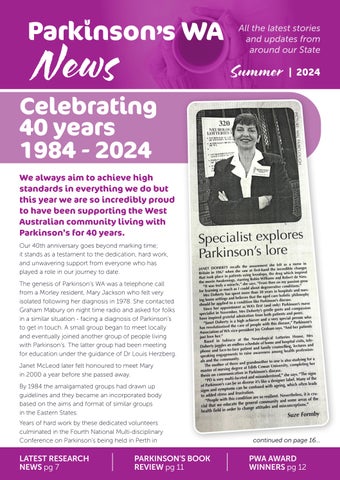
Celebrating 40 years 1984 - 2024 We always aim to achieve high standards in everything we do but this year we are so incredibly proud to have been supporting the West Australian community living with Parkinson’s for 40 years. Our 40th anniversary goes beyond marking time; it stands as a testament to the dedication, hard work, and unwavering support from everyone who has played a role in our journey to date. The genesis of Parkinson’s WA was a telephone call from a Morley resident, Mary Jackson who felt very isolated following her diagnosis in 1978. She contacted Graham Mabury on night time radio and asked for folks in a similar situation - facing a diagnosis of Parkinson’s to get in touch. A small group began to meet locally and eventually joined another group of people living with Parkinson’s. The latter group had been meeting for education under the guidance of Dr Louis Herzberg. Janet McLeod later felt honoured to meet Mary in 2000 a year before she passed away. By 1984 the amalgamated groups had drawn up guidelines and they became an incorporated body based on the aims and format of similar groups in the Eastern States. Years of hard work by these dedicated volunteers culminated in the Fourth National Multi-disciplinary Conference on Parkinson’s being held in Perth in
continued on page 16...
LATEST RESEARCH NEWS pg 7
PWA AWARD WINNERS pg 12
PARKINSON’S BOOK REVIEW pg 11
LOCATION/POSTAL ADDRESS The Niche, 11 Aberdare Road, Nedlands, WA 6009 TELEPHONE (08) 6457 7373 FAX (08) 6457 7374 FREECALL 1800 644 189 EMAIL info@parkinsonswa.org.au WEBSITE parkinsonswa.org.au PRESIDENT Gary Steinepreis VICE PRESIDENT Professor Natalie Gasson TREASURER David Fisher SECRETARY Tamlyn Lennox BOARD MEMBERS Clinical Professor David Blacker, AM, Keith Geers, Alan Gray, Tamlyn Lennox, Kate Roberts, Geoff Waldock CHIEF EXECUTIVE OFFICER Yasmin Naglazas OFFICE MANAGER Toby Gummer FUNDRAISING MANAGER Kerrin Girando FINANCE MANAGER Salil Koonja SENIOR PARKINSON’S NURSE SPECIALIST Janet McLeod PARKINSON’S NURSE SPECIALISTS Amanda Coultous, Fiona Roscoe, Jo Chadwick, Kayleigh Rawle, Rachel Marshall, Donna Mallaby, Sheree Ambrosini NURSE SPECIALISTS’ SECRETARY Lena Divito ADVERTISING ENQUIRIES fundraising@parkinsonswa.org.au Disclaimer - Parkinson’s Western Australia Inc has endeavoured to ensure that the information in this newsletter is accurate; however, we accept no responsibility for any errors, omissions or inaccuracies in respect to the information contained in the material provided by Parkinson’s Western Australia Inc. Nor is the provision of material by Parkinson’s Western Australia Inc. to be construed as any representation that there is no other material or information available in relation to the information provided. Further, Parkinson’s Western Australia Inc. accepts no responsibility for persons who may rely upon this information for whatever purposes.
2 | Parkinson’s Western Australia
FROM THE CEO’S DESK As we step into 2024, I want to express my heartfelt gratitude for the incredible journey we continue on together – members of the Parkinson’s Association, those individuals living with Parkinson’s and their families, partners and loved ones, our staff, our Board, those who fund our service, institutions supporting us in research activities and those who champion what we do with donations and pledges. Now being a year since I commenced as the Chief Executive Officer of Parkinson’s WA, the past year has brought both challenges and triumphs, and I’m proud of each and every one of my team for their unwavering dedication and resilience. As an organisation, we’ve demonstrated that we can adapt and thrive even in the face of uncertainty. Our endeavours continue to ensure we have the appropriate funding for our Specialised Nursing Service as the demand grows, with a particular emphasis on addressing the immediate needs of the newly diagnosed and those in the regional areas. Our collective efforts have not only sustained us but have propelled us forward into new realms of innovation and collaboration. We pride ourselves on ‘thinking outside the square’! In 2024, we will be building on the foundations we’ve laid during 2023 and reach new heights as a team at Parkinson’s WA. Our focus this year will be to improve and innovate in terms of what we are providing for those we serve. We are passionate about the improving the journey for the individual living with Parkinson’s and their families and loved ones and there will be some new initiatives and programs along with an increased suite of benefits for our Association members, inclusive of free, quality member events and functions. Let’s embrace the possibilities that 2024 holds for us and let’s continue to work hand in hand to make 2024 one of growth, prosperity, and shared accomplishments.
Adj Professor Yasmin Naglazas Chief Executive Officer
From the Nurses’ Desks It is definitely a sign of maturity (AKA aging) when time seems to fly past at an increasing rate. This newsletter is focusing on our commitments in March, April and May which is hard to come to terms with. Our Parkinson’s Nurse Specialist service has also reached maturity and that means there will be some changes in the next few months. Janet McLeod (Clinical Nurse Manager) will be retiring as of May 12th this year after 26 years with the organization. The date is significant as it follows a birthday for Janet and it is International Nurses Day marking Florence Nightingale’s birthday. Given that Janet has been nursing since October 1967 she felt the date was appropriate. Janet was appointed as the inaugural PNS in November 1998 for a one year trial period and has enjoyed her long time with PWA. The replacement process is currently being managed and we look forward to news of Janet’s replacement in a future newsletter.
Participants sought for Parkinson’s research at the Perron Institute The Perron Institute is continuing to recruit people living with Parkinson’s to participate in a quality-of-life study for people with this diagnosis.
We have been busy planning for the year ahead and are delighted to say that outreach visits to both Northam and Esperance are planned for the first six months of the year. While we are primarily funded for the metropolitan area, with PWA funding the South West office, we are firmly committed to supporting our members and those living with Parkinson’s in the rural areas when we can. Having a full well qualified and experienced team on board enhances our ability to carry out short visits to areas. Northam has not been on our radar since pre Covid so having Sheree available to visit there in May is very satisfying. Covid is still causing us some challenges mainly because it never strikes at a convenient time so we appreciate your patience if home visits are postponed at short notice. Our main aim is to maintain your safety and avoid transmission within our vulnerable community. Yours, The Nurses
“These differences can change the way people cope with disease progression, as can a patient’s personal characteristics or social context. “Identifying factors that influence patient qualityof-life opens opportunities to expand and improve health services and support, as well as working towards more personalised care. “An individual’s genetic makeup can also influence social, psychological and biological
The study, developed in the UK, is titled Trajectories of Outcome in Neurological Conditions, or TONiC. It is led in WA by Professor Sulev Koks, MD PhD, who heads Genetic Epidemiology Research at the Perron Institute and holds a joint appointment with the Centre for Molecular Medicine and Innovative Therapeutics at Murdoch University. “Parkinson’s is not the same for every patient. People will progress at different rates, or experience certain symptoms that affect their dayto-day life more than those same symptoms affect others with the disease,” Professor Koks said.
TONiC study team at the Perron Institute continued on page 18...
Newsletter Summer 2024 | 3
Nurses’ Updates Farewelling Janet McLeod In 2024 and after 26 years of service to Parkinson’s WA we will be farewelling our much-loved Clinical Nurse Manager, Janet McLeod. Whilst we recognise Janet’s 26 years of service to Parkinson’s WA, her commitment to Parkinson’s care actually commenced an incredible 57 years ago! In October in 1967, Janet was a student nurse who left her home to work and study at the Belfast City Hospital, Northern Ireland, now the Belfast Health and Social Care Trust. On her first medical ward the young naive impressionable Janet was given responsibility for looking after a patient with a diagnosis of Parkinson’s, who was a mother in her late 30s with several children. The mother was considered very young for a medical ward and also very young for someone with severe Parkinson’s. Janet remembers her name to this day. As a young nurse, Janet had to assist with her with meals, provide hygiene care and transfer this young mother out of bed onto a trolley to take her to the bathroom for her weekly bath. The young mother didn’t have advanced Parkinson’s – she had untreated Parkinson’s. This is when Janet’s passion for understanding and caring for patients with Parkinson’s began. In 1998 it was announced that this passionate nurse from Belfast (Janet) had been appointed as the inaugural Parkinson’s Nurse Specialist to be based at Parkinson’s WA. This was when Janet said “I will dedicate the rest of my professional life to the Parkinson’s Community” and the West Australian community has significantly benefitted from this dedication for the last 26 years. During the years of service at Parkinson’s WA, Janet has been instrumental in establishing and growing the Parkinson’s Nurse Specialist service which today supports the 15,000 individuals living with Parkinson’s. Although Janet is now in a management role, she was actually the first of 2 nurses covering the entire metropolitan,
4 | Parkinson’s Western Australia
Janet McLeod and some regional areas of WA, offering support, education and hope for those who find themselves with a diagnosis. In more recent times, she has worked tirelessly to improve and expand the service as the demand grows. Janet’s qualities as a nurse professional can be described as having an amazing ability to effectively communicate with patients, often needing to explain complex information, as patients are often seeking clarity on Parkinson’s progression, medications, and plan of care. In 2012 Janet was awarded the Dr Rana International Award for education in the field of Parkinson’s (Canada) and the Order of Australia Medal for services to the community. She is also an absolute delight to work with, has a high level of integrity and professionalism and we will all miss her terribly! Our heartfelt wishes go to Janet as she moves into retirement and embraces a new chapter in her life.
DEAR NURSES, s ago Dear Nurses, d about three year se no ag di en be having irritating g with Parkinson’s s have been more m le ob I am a person livin pr y m of t well especially to retire at 65. Mos ations are working ic when I was about ed m y m at th el I look happier ing and I fe d my wife tells me an ed rather than distress ttl se s ha or pressed and on time. My trem ed to think I was de when I take them us e Sh . er th oo sm n! Now we can e life a lot of joyful expressio ck la y which makes hom m r fo k or w d facial ed my giving up happier outlook an y m r fo ns io unhappy and blam at ic med for that and thank blame Parkinson’s a nuisance and expression. nning to become gi be is se el ng hi night because somet ake up during the w to g in nn I am writing to you gi be I am anything but I to discuss it with. y wife has not said m r fa I am not sure who So . gs le y m seems inually moving lar occurrence and gu re a g in m because I am cont co be to have a life of e of it. This seems y legs just seem to M . am sure she is awar rly ea e ak aw nger have to be moving around. unfair when I no lo by getting up and f lie re t ge ly on I moving. ialist about their own and keep ould I tell my Spec Sh s? n’ so in rk Pa to this being related Have you heard of blet? ta g in GP for a sleep this or just ask my rough Restless in Scarbo
Dear Restless, We are pleased you have had a good response to Parkinson’s medications and are settling into what we hope is a long retirement. The symptoms you describe sound like what we refer to as Restless Leg Syndrome (RSL) which can occur in Parkinson’s but is also a condition by itself. It is estimated to affect 2% of the population in varying degrees of severity. It presents just how you describe it as an unavoidable urge to move your legs- it is very annoying and often leads to broken sleep ( for both bed partners). This is definitely something you should discuss with your GP as a starting point because he or she may wish to investigate further- such as ordering blood tests. Sometimes Restless Legs may be associated with lowered ferritin (iron) levels so that needs to be investigated. Sometimes it comes as part of the Parkinson’s symptoms and your specialist may suggest adding in some more Parkinson’s medications or a different form of Parkinson’s medication. It is also important to look at other ways of managing RLS - a reduction in both caffeine and alcohol may help. Literature suggests that a cooler sleeping environment may help and at present Perth nights are definitely not cool. Exercise (but not too much) is another suggestion. Two old wife’s tales suggest that putting a cork or a piece of soap in the bed (not necessarily in contact with the legs or feet) may provide relief. The latter suggestions are not evidence based medicine but occasionally old wives have wisdom! Yours The Nurses Newsletter Summer 2024 | 5
Research News Co-designing a conversation partner programme for people with Parkinson’s and their families. Up to 90% of those with Parkinson’s develop communication difficulties which are reported to be one of their most debilitating symptoms. People with Parkinson’s and their families frequently report that they struggle to have meaningful conversations. Members from the support groups at Parkinson’s WA expressed a need for therapy that aims to improve communication for the person with Parkinson’s as well as their partner. Current therapies for those with communication difficulties more frequently focus on addressing the person with Parkinson’s motor speech difficulty. Whilst this is important, this is not the only barrier to effective conversations between a person with Parkinson’s and their partner. In 2022, members of Curtin University, ParkC and Parkinson’s WA teamed up to obtain funding to fund phase 1 of a study in which we worked alongside people with Parkinson’s and their families to co-design a suite of therapy approaches to specifically target conversationbased communication at different stages of
Parkinson’s. Three people with Parkinson’s and 2 family members met with speech pathology researchers from Park C and Curtin University once a fortnight for 12 weeks. Participants came up with two approaches. The first was a website in which people with Parkinson’s and their families would share tips and strategies. The second was a group therapy programme using a strengths-based approach where they can practice speech strategies and techniques to have better conversations. In phase 2 of the study, we ran another series of co-design sessions with 2 people with Parkinson’s and a family member to co-design the website. This group met weekly for 9 weeks. The website is now finished and will be evaluated by people with Parkinson’s and their families in the next phase of this study. If you are interested in hearing about the website, please email Associate Professor Naomi Cocks: naomi.cocks@curtin. edu.au The group therapy programme will be further explored and developed as a part of a PhD project conducted by speech pathologist Ramishka Thilakaratne from Curtin University. If you wish to find out further information about the group therapy programme, please contact Ramishka Thilakaratne on ramishka.thilakaratne@ student.curtin.edu.au.
about how people with Parkinson’s communicate with their health professionals. The randomised controlled trial on brain stimulation and cognitive training for cognitive symptoms in Parkinson’s will be resuming this year following a Covid-induced pause on the study. For information about these and other studies we have, please visit our new website at https://parkc.co/.
Update from ParkC ParkC will be running some exciting new projects in 2024, including a study on Parkinson’s symptoms and brain neurotrophins and a study
6 | Parkinson’s Western Australia
Associate Professor Andrea M Loftus Director, ParkC Discipline of Psychology, School of Population Health, Faculty of Health Sciences Curtin University
The Impact of Drooling on People with Parkinson’s Drooling is a common symptom of Parkinson’s affecting approximately 70% of the Parkinson’s population. It is known that drooling contributes to a range of social and emotional impacts among this population, including decreased self-esteem and social isolation. Previous research has measured the severity of the impacts, however, these impacts were not explored in detail. For example, activities impacted by drooling and the reasons why these activities were impacted were not considered. It was essential to explore the impacts of drooling on the lives of people with Parkinson’s in more detail in order to truly understand how it impacts people’s lives. As part of our honours project associated with our Speech Pathology degree, we interviewed 11 people with Parkinson’s about the impact of drooling on their lives. Our study aimed to thoroughly explore the impact of drooling on the lives of people with Parkinson’s. Three main points arose from 11 interviews. These, along with sub-points, are displayed in Figure 1 below.
Meet our team: Eve Williams, Shelby Hynes, Aimee Elsegood and Elizabeth Barrett-Lennard. Supervised by Dr Naomi Cocks and Associate Professor Andrea Loftus at Curtin University.
participants felt their drooling increased the time taken to carry out everyday tasks. Hobbies, such as exercising, reading and writing were impacted. Social activities and participation were affected by several participant’s drooling, with some noting that drooling affected how their speech sounded. Many participants described how drooling had impacted their relationships. Most participants described how they had strong support from their family members in relation to their drooling. However, some participants felt they wanted to hide drooling from some family members, such as grandchildren. In some cases, physical intimacy was affected. Many participants described that drooling impacted their friendships and desire to form new relationships with others. Some participants found that factors such as a stooped posture, illness, thirst, food, concentration and panic made their drooling worse. Participants felt that the treatment options offered to them, such as Botox injections, were unhelpful and inconvenient. All participants used management techniques to manage their drooling, such as tissues/handkerchiefs, chewing gum and swallowing more. These strategies were effective, however, they were often described as annoying and inconvenient.
Figure 1 All participants expressed emotions such as embarrassment, discomfort and fear related to their drooling. Most participants felt that their drooling impacted their activities and participation. For example,
Through insight into participants’ unique experiences, we aim to spread awareness of the symptom of drooling within the Parkinson’s community. In addition, we hope this information acts to highlight the need for more research that explores effective drooling-related treatment options for people with Parkinson’s.
Newsletter Summer 2024 | 7
Fundraising Rottnest Channel Swim Last year whilst fundraising, for the Rottnest Channel Swim, Adam, Brooke, Chenae, and Maxie had many conversations surrounding Parkinsons which left them surprised just how many people in their circle of friends knew of someone who had Parkinson’s. For the last 10 years Adam and Matt’s Pop and Chenae’s Nan lives were affected with Parkinsons. They were surprised learn that Parkinsons can affect anyone, and they currently have friends diagnosed in their 30 and 40s. They had no idea that some of these people had been diagnosed as they continued playing sport and seemed to be symptom free. It is very personal for Chenae. Her Nan has lived with Parkinsons for the last 10 years of her life and in 2021 her Dad whose Mum also suffered with Parkinsons was diagnosed. It is because of the conversations that started last year that the team decided that yet again they would swim and fundraise for PWA by competing in the 2024 South32 Rottnest Channel Swim on the 24th of February. Chenae said “I had always feared Parkinsons because of my family history and now I am in
my last year studying Physiotherapy and have worked with some PD patients and I am amazed by how much education particularly movement, research and treatments have progressed and that organisations such as Parkinson’s WA can help those that have been diagnosed to live better and more fulfilled lives. We need to keep helping with funding of the organisation as this isn’t a disease of the elderly and you don’t know when someone in your life will need their help.” You can support Chenae’s team The Wetter the Better by donating via this link - https:// rottnestchannelswim24.grassrootz.com/ parkinson-s-wa/the-wetter-the-better
In Memorium
Parkinson’s WA acknowledges the donations that have been given by families and friends in lieu of flowers at their funeral in memory of the following people. The thoughtfulness of these families for arranging for the donations to be given to Parkinson’s is greatly appreciated.
John Piggott Nancy Theunissen
Gaetano (Jim) Delborrello Cathy Gale
Maria Hanson
Please reach out to the us if you would like to set up a digital fundraising page or an In Memory donation box to honour your loved one.
8 | Parkinson’s Western Australia
HBF Run for a Reason Save the Date – Sunday 19 May 2024 It's time to find your reason and run for Parkinson’s WA at the HBF Run for a Reason. Perth's biggest community running and walking event, a wonderful day for all the family to enjoy with three distances to choose from: half marathon, 12km and 4km.
REGISTER NOW - http://tinyurl.com/bddkempu
Leaving a lasting Legacy Leaving a legacy to Parkinson’s WA will ensure your memory will live on and give hope to people who diagnosed with Parkinson's, today, tomorrow, for however long they need us. Right now, hundreds of people are receiving our support because of the generosity of individuals. Parkinson’s WA is proud to partner with Gathered Here to offer you the opportunity to write your Will for free, including making free, unlimited updates to your Will for life. It’s so easy to include a bequest gift for Parkinson’s WA in your Will at the same time. Here is an easy online will writing service that allows you to appoint guardians for your children, divide your estate and leave gifts to charities that matter most to you, like Parkinson’s WA. We understand that writing your will is a private matter, and we treat all enquiries with respect and confidentiality, for a confidential chat or to organise a meeting in your home or for further information, please complete the form below or contact Kerrin Girando on (08) 6457 3745 My family benefited greatly from or email kerrin@parkinsonswa.org.au
the caring and professional support received from Parkinson’s WA’s specialist nurses during my wife, Anne’s journey with Parkinson's.
We both agreed it would be appropriate to recognise this through a bequest in our wills and although Anne is no longer with us, I remain forever indebted for the support from Parkinson’s WA. John McDonald Newsletter Summer 2024 | 9
Staff Spotlight - Donna Mallaby How long have you been with Parkinson’s WA? Nearly 2 years. What part of your job do you appreciate the most? I appreciate the people (and pets) I get to see every day. I love building relationships and trust with each and every visit. Education is one of my passions, so to educate and support people in their own homes as my job is so rewarding. Who or what inspired you to pursue the career you have today? I always wanted to work in the health industry and firstly studied to be a Naturopath and massage therapist. I then studied Nursing; my nursing training led me to the field of Neurology which I quickly fell in love with. With my hospital experience working on the state spinal unit, acute
spinal, orthopaedic trauma, and neurological rehab. My experience has led me here to PWA which I am very grateful for. Favorite place you’ve travelled? My favourite city would have to be Prague, so much beauty and history all in one place. Describe what a perfect day outside of work would look like for you? I would begin the day with a yoga class, head down south for a lovely lunch, maybe a cheeky glass of wine (because life is all about balance) and finish up with a beach walk with my family and Bolt our dog. Share a fun fact or your favourite quote: “Between stimulus and response there is a space. In that space is our power to choose our response. In our response, lies our growth and our freedom” Victor Frankl.
Parkinson’s Golf Championship 30th April & 1st May 2024 Mount Juliet, Co. Kilkenny, Ireland “At the 6th World Parkinson’s Congress in Barcelona I met up with an Irish Emergency doctor who like me has PD and is a keen golfer. He told me about the Irish Parkinson’s Golf Network and their annual tournament. I was thrilled when he invited me to participate in their annual championship for 2024, which is now open golfers with PD from all countries. The Mt Juliet course is magnificent and has hosted major events such as the Irish Open and the Ryder Cup”. If you have the chance to play in this event please let me know; we could try to form an Aussie team! David Blacker AM, MB BS, FRACP Medical Director, Perron Institute Board member, Parkinson’s WA
10 | Parkinson’s Western Australia
Book Review Parkinson’s: How to Reduce Symptoms Through Exercise by Kristine Meldrum, BA, ACE with Jay Alberts, Ph.D., and Daniel M. Corcos, Ph.D. Some of you may have seen our recent Facebook post advertising a recent publication – Here PNS Sheree Ambrosini gives us an overview. Navigating life with Parkinson’s comes with its own set of challenges, and in “Parkinson’s: How to Reduce Symptoms Through Exercise,” Kristine Meldrum offers a compelling guide for incorporating exercise into the management of Parkinson’s symptoms. As Parkinson’s impacts millions globally, this book explores specific exercise approaches that complement traditional medications and surgeries. Meldrum’s guide is designed with our diverse community in mind, ensuring accessibility for all. Whether you prefer reading cover to cover or delving into specific sections, Meldrum provides information tailored to various preferences and abilities. The book serves as an excellent resource of research supporting the effectiveness of exercise in alleviating Parkinson’s symptoms. Personal anecdotes from individuals living with Parkinson’s add a relatable touch, and evidence-based insights strengthen the credibility of exercise in addressing both motor and nonmotor symptoms. Emphasizing the importance of physicians prescribing exercise alongside traditional interventions, Meldrum quotes experts like Professor Bastiaan Bloem, advocating for a holistic approach. Dr. Jay Alberts underscores the significance of early exercise initiation to slow down progression, making this book relevant at all stages of Parkinson’s.
A standout feature is Meldrum’s emphasis on translational research, connecting the research directly to individuals with Parkinson’s. This approach not only makes the content engaging but also reinforces the book’s argument for exercise as a form of medicine for Parkinson’s. For healthcare professionals working with Parkinson’s patients, the book offers research, recommendations and appendices to enhance their practice. Meldrum introduces the concept of a ‘Parkinson’s exercise cocktail plan,’ incorporating various components like high-intensity training, PDspecific work, strength training, flexibility, and enjoyable physical activities. The book encourages proactive engagement in exercise, with numerous case studies illustrating its positive impact on reducing Parkinson’s symptoms. It emphasizes the role of exercise in stimulating neuroplasticity, preventing rapid deterioration due to inactivity, and extends its benefits to other neurodegenerative conditions. “Parkinson’s: How to Reduce Symptoms Through Exercise” provides a comprehensive review of the science behind exercise as a tool for managing Parkinson’s symptoms. Meldrum’s engaging writing style effectively bridges the gap between research and practice, making it an invaluable resource for individuals with Parkinson’s and healthcare professionals seeking evidence-based interventions. Sheree Ambrosini Parkinson’s Nurse Specialist https://www.amazon.com/Parkinsons-ReduceSymptoms-Through-Exercise/dp/B0CPS14SX9
Newsletter Summer 2024 | 11
Annual PWA Award Winners Demonstrate Courage and Passion The Annual Parkinson’s WA Awards was celebrated with four very worthy winners who were presented with their accolades at the 2023 Parkinson’s WA AGM. The Awards are an annual event that allows PWA to formally recognise those individuals or groups that have contributed in a positive way to the PWA cause.
VOLUNTEER OF THE YEAR
HEALTH PROFESSIONAL AWARD
Awarded annually to an individual/collective group that strives to bring positive change to the Parkinson’s community in WA by having a noteworthy involvement in the Parkinson’s community, making a significant impact that adds value to the Parkinson’s Community life and demonstrates inspiring efforts to enhance the Parkinson’s community. All this is undertaken with selfless dedication, hard work, generosity and kindness.
Awarded annually to a health professional who makes an outstanding contribution to clinical excellence, leadership, education, and culture in caring for those individuals living with Parkinson’s. They advocate for evidence-based practice, focus on value-based support and provide safe, quality, and compassionate patient care. They show commitment to supporting, empowering, and upskilling those around them.
WINNER: Angela Sideris A former staff member who finished work at PWA some years back to look after a family member, Angela proceeded to become a volunteer with PWA. She would come in each week to the Parkinson’s WA office, dedicating her time to volunteer and help with crucial administrative tasks. Her commitment to the Parkinson’s community in WA was evident through her excellent attention to detail with respect to the administrative work, conducted diligently and always with a smile.
Angela Sideris receiving her Award from CEO Yasmin Naglazas and Board Chairman, John McDonald
12 | Parkinson’s Western Australia
WINNER: Lesley Pitman Since 1998, Lesley has invited the PWA Nurse Specialist Service to take part in the Hollywood Private Hospital Continence Management course. Her visionary approach ensured that the impact of Parkinson’s on continence management has been included in the education of a generation of Continence Nurse Advisors nationally. She is passionate about spreading the word on continence and neurological conditions thereby breaking down barriers for people living with Parkinson’s.
Lesley Pitman, pictured with Jo Chadwick, Parkinson’s Nurse Specialist
COMMUNITY SPIRIT AWARD Awarded annually for a demonstration of ‘spirit of service’ and citizenship, recognising and honouring an exceptional individual/group of individuals who make ‘giving back’ to the Parkinson’s community a way of life. They have a positive impact upon the direction and success of Parkinson’s WA’s mission and strategic direction, and improve the life of others.
GEOFF PRIDE FUNDRAISER OF THE YEAR Named in honour of a Parkinson’s WA former treasurer Geoff Pride who served the organisation for 16 years, this award recognises hard work and creativity in fundraising ventures in partnership with PWA, based on an uncompromising commitment to ethical standards and timeliness of funds donation.
WINNER: Emily Corti Emily became associated with PWA in 2013 as part of her honours project in Psychology at Curtin University. During her time within the Parkinson’s community, she says that she has been in awe of the time and commitment people gave to her research. Emily made a promise to herself that if people could give up their time, then she too could contribute and help make a difference to the lives of those affected by Parkinson’s. Her passion for making a difference is what fuels her commitment to raising the awareness of Parkinson’s, conducting Parkinson’s research, educating others on Parkinson’s, and supporting the Parkinson’s community.
WINNER: Chenae King Chenae’s grand mother was living with Parkinson’s until she passed away 11 years ago. It was a few years back that Chenae noticed how her family appeared to become surrounded by people living with Parkinson’s and wanted to do something to help. She has now started her own fundraising journey for PWA. Over the last two years, Chenae has completed the Rottnest Swim raising funds for PWA. In 2022, her team raised $4,420 and in 2021, she raised $8,035. Chenae has also committed to again supporting PWA by doing the swim for PWA in 2024. Chenae has also supported her father who has spent many hours refurbishing old army trucks for a friend living with Parkinson’s so that they could travel from Mt Augustus to Uluru in the “Rock to Rock” fundraiser which raised $10,000 for Parkinsons WA.
Emily Corti receiving her Award from CEO Yasmin Naglazas and Board Chairman, John McDonald
Adam Gillie accepting the Award on behalf of Chenae King
JOIN THE CONVERSATION Follow us on our social media channels
Newsletter Summer 2024 | 13
Making the most out of your next visit to your Specialist.
I’d like to share some suggestions about how to make the most of your next specialist visit; these pertain mainly to Parkinson’s, but they could also apply to other specialties. Appointments with specialists such as neurologists tend to be infrequent, typically every 6 months; sometimes more, sometimes less. I observed some people being quite nervous about their visits, speaking quickly and trying to make the most of every minute, only to forget a crucial question they wanted to ask. It’s important to take some time to prepare. I’d suggest the following;
In the weeks before Make sure you have an up to date referral; this will usually mean a visit to your GP. The referral is an integral part of the Australian Medicare system, which should help enable better communication between GP and specialist. Without a referral you will not be able to claim a Medicare rebate. If the specialist has ordered tests (e.g. .scans, blood tests), make sure there is plenty of time for the results to become available- I’d recommend about a week. Never assume that the lab or radiology firms will get the results to the specialist. In my private practice I’d always look up the results the night before to ensure I was ready for the consultation and also to avoid
14 | Parkinson’s Western Australia
If you have paperwork that needs completion, e.g. insurance forms, driver’s license renewals, let the specialist know this before the consultation. Often they will need to ask you questions in order to complete these forms. Don’t assume they know what your occupation is, and what it involves- insurance forms often ask for this. I now understand how important these forms can be; it’s very stressful if your driver’s license is due and you don’t have an appointment. It’s also frustrating for the doctor to be given a huge form that needs to be done urgently during the last minutes of a consultation w
The upside of my experience, which included a bout of COVID, mild depression, five operations and of course Parkinson’s, is that it has given me a lot of think about regarding doctor-patient interactions.
wasting precious time during the consultation.
On the day Make sure you leave plenty of time to get there. Parking is at a premium around most major medical centres, so allow extra time especially in the middle of the day. If you are running late, call the office or clinic; that way the doctor can readjust their list. Sometimes it may be better to reschedule than to see a doctor who is rushing. If your appointment is late morning or late afternoon, it usually means you are one of the last patients to be seen in that doctor’s session of work. Most doctors tend to “get behind” the clock as the session progresses, so don’t be surprised if your allocated time comes up and you are still waiting to be called. Make sure you communicate with the secretary; good secretaries will call you to advise on “how things are going, and if the doctor is running to time.” Emergencies happen, and sometimes an appointment becomes more complicated than expected, so the doctor gets behind time. Rather than getting upset, consider the extra time and attention you would want if something came up that needs extra time. If you are last on the list, you may get bonus extra time; I would sometimes schedule a complex follow up last, so there was no stress about running late and making the next patient wait. Wear clothes that you can remove and put back on easily to allow for examination. Things get
w
I’ve recently retired after 30 years of medical practice, having seen thousands of patients in that time. Over the last 18 months I’ve spent a lot of time on the other side of the desk in the patient’s chair. Most of that has not been related to my Parkinson’s so it’s been eyeopening for me to be in that position. I’ve often felt like I’ve been in a “limbo state”, with colleagues treating me a little different to a patient who is also a doctor. That has not always been a good thing!
w
w
missed if doctors don’t examine you thoroughly, and usually this requires proper exposure. Bring someone with you; spouse, carer, friend. Another set of eyes and ears is invaluable. Make sure you bring an up to date list of medications with doses, and for Parkinson’s medications the times when you take them. The specialist will usually be happy to write scripts for Parkinson’s medication, but may not be comfortable with medications for other conditions they are less familiar with. If you are taking L-dopa, it will be useful for you to think about a few aspects; 1. Do you feel it is making a difference to symptoms, and think of examples e.g. effect on handwriting. 2. Can you feel the effect coming on, or wearing off? 3. When do you take medications in relation to meals?
5. Have you had side effects; e.g. nausea, light headedness? Don’t forget non-motor symptoms; e.g. depression, lack of motivation, changes in mood, intolerance of extreme temperatures, sleep disturbances, bladder and bowel problems. It may also be useful to think about how your overall symptom control compares to 3, 6 and 12 w
w
4. Have you noticed any difference if you have been late on a dose or missed a dose?
months ago, and before and after any medication changes. Think about any change in specific activities you regularly do over time such as how easily a regular walk might be, can you put your pants on whilst standing up, can you still do up buttons unassisted? Importantly, bring a written list of questions, with the most important ones at the top of the list. Don’t be afraid to ask questions. If you don’t understand something, be sure to ask for further explanation. At the end of the consultation be sure you understand if there are to be any changes in medications or tests. Be sure to ask about side effects of new medications. Make sure you have a means of making contact before the next appointment. Most doctors should be prepared to be contacted through work e-mails. Don’t expect to be given a private e-mail address or mobile number. Ask for a copy of the letter from your visit to be sent to you; this will help remind you of what was covered and is useful to keep in your records. Also ask for any results to be copied to you as well. I hope that these suggestions make your next visit the best possible experience. David Blacker AM, MB BS, FRACP Medical Director, Perron Institute Board member, Parkinson’s WA
Newsletter Summer 2024 | 15
...continued from front page
Celebrating 40 years 1984 - 2024 September 1997. It was at this conference that Parkinson’s WA formulated their four pronged vision:
testament to the unwavering commitment to enhancing the quality of life to those affected by the condition.
•
A Parkinson’s Nurse Specialist Service
•
A Centre of Excellence
•
A Specialised Aged Care Setting
•
A Better Diagnosis
This coming year is an opportune period of time to reflect on the collective achievements, milestones and the countless lives positively impacted by Parkinson’s WA. It is a time to recognize the tireless efforts of the Specialist Parkinson’s Nurses, healthcare professionals, volunteers and advocates who have all worked together to make a difference.
You are well aware that the Nurse Specialist Service has just celebrated 25 years and we must remember that the current clinics such as Osborne Park, Fremantle and Armadale grew from the vision of a Centre of Excellence. A better diagnosis remains a goal globally and a specialised Aged Care Setting remains elusive. You can see that since its inception, Parkinson’s WA has been a beacon of hope and a steadfast companion for individuals and their families navigating the challenges posed by a diagnosis of Parkinson’s. This anniversary stands as a
16 | Parkinson’s Western Australia
As Parkinson’s WA looks back on the four decades of service to the West Australian community we also look forward to the future where advancements in research, treatment and support continue to shape a world where Parkinson’s no longer imposes insurmountable barriers. Take a trip down memory lane with the following photos.
Newsletter Summer 2024 | 17
Share your story As part of celebrating our 40 years we would like to reach out to you our community and ask if you are willing to share your Parkinson’s story. You can be a patient, a carer or a loved one, we want you to share your thoughts and experiences as a way of saying Thank you to Parkinson’s WA for looking after the community for 40 years. By sharing your experience, you can help provide understanding, encouragement and hope to others. To share your story please reach out to Kerrin Girando on kerrin@parkinsons.org .au or give Kerrin a call on 6457 7373. ...continued from page 3 responses. We are investigating this as part of the TONiC study for the purpose of early intervention with care plans and treatments. “By investigating genetic factors that influence and contribute to Parkinson’s, it is possible eventually to create targeted treatments and predict disease progression.” In 2022, Parkinson’s WA provided additional funding for a genetic component of the MSWA-funded study. Western Australia is the first site outside the UK to implement the TONiC study. The study team is contributing TONiC Parkinson’s data to the Global Parkinson’s Genetics Program, part of the Aligning Science Across Parkinson’s initiative. This enables data to be analysed in greater detail and increases Western Australia’s contribution to large-scale international genetic investigations. For this study, participants can expect an annual questionnaire, and provide a saliva sample for DNA analysis. The study team is also looking for control subjects who do not have Parkinson’s. If you would like to be involved, or know someone who may be interested, please email tonic@perron.uwa.edu.au.
18 | Parkinson’s Western Australia
DID YOU KNOW? PHARMA FACT...
Some pharmacies will accept empty blister packs for recycling - these are the strips which may contain your Panadol or Blood pressure pills. Ask your pharmacy if they are able to do this.
Parkinson’s Support Groups Have you ever thought about attending one of our support groups? Trish from Kingsley Support Group told us that life changes with Parkinson’s, and it helped to talk about it. “The community support one another. We come together and talk about the condition and how our lives have changed. We understand each other and that makes all the difference,” she said.
Join one of the Parkinson’s WA Support Groups today! NORTH and WEST METRO
SOUTH and EAST METRO
Kingsley Western Suburbs
South of The River Rockingham Mandurah Midland
REGIONAL
Parkinson’s Carers South
Bunbury
55 YEARS and UNDER
Busselton Collie
Find out more about your Support Groups!
Kings Park
(08) 6457 7373 supportgroups@parkinsonswa.org.au www.parkinsonswa.org.au/supportgroups
SAVE THE DATE! → Narrogin Outreach- SW PNS
5-7 March
→ Support Group Leaders Development Day 19 March → Newly Diagnosed Seminar BUNBURY
10 April TBC
→ Seminar – Newly Diagnosed NEDLANDS (see information on back page)
6 April
→ Members General Meeting (to ratify Constitutional changes)
TBC
→ Seminar MANDURAH May TBC → Bunbury Carers Morning Tea 20 May → World Parkinson’s Day 11 April → International Nurses’ Day 12 May Newsletter Summer 2024 | 19
Parkinson’s Newly Diagnosed Seminar for people diagnosed within the last 5 years
HOW TO DONATE
Saturday 6 April 2024 10:00am - 1:00pm (approx) The Niche Building 11 Aberdare Road, Nedlands WA 6009 cnr Aberdare Road and Hospital Avenue, Entry via Hospital Ave
Presenters:
To donate online, scan the QR Code
• Associate Professor Rick Stell Movement Disorder Specialist at St. John of God Hospital and Perron Institute.
Associate Professor. Stell will speak on Parkinson’s and treatment options.
• Parkinson’s Nurse Specialist panel Nurse Specialists from Parkinson’s WA.
A panel of Nurse Specialists will answer questions from the audience.
Or visit: www.parkinsonswa.org.au/ donations
Cost: Parkinson’s WA Members: $15 each; Non-Members: $20 each Morning tea provided.
RSVP: Contact the Parkinson’s WA office by Thursday 28 March 2024 on (08) 6457 7373 or info@parkinsonswa.org.au Bus Service: 24, 25, 26, 103, 998, 999, 950 and Purple Cat buses all stop within 5 minutes walking distance of the Niche.
Parking: Limited parking is available at The Niche (entry to the carpark via Hospital Ave). Alternative parking options include nearby local street parking or the Hospital’s carpark (paid parking; entrance on Winthrop Ave).
JOIN THE CONVERSATION Follow us on our social media channels
The Niche, 11 Aberdare Road, Nedlands WA 6009 P: (08) 6457 7373 F: (08) 6457 7374 E: info@parkinsonswa.org.au www.parkinsonswa.org.au
Would you like to receive your Parkinson’s WA Newsletter digitally? Parkinson’s WA is working towards providing our members with the opportunity to receive their Parkinson’s WA newsletter digitally. We can assure you this will be an opt-in process and if you would like to continue receiving a physical copy of the newsletter, this will still be available to you. Through choosing to receive your newsletter digitally, you will be helping Parkinson’s WA to reduce costs, including printing and mailing related expenses. You will also be helping to reduce your carbon footprint!
If you would like to receive your Parkinson’s WA newsletter via email, please contact the office by email - info@parkinsonswa.org.au or phone - (08) 6457 7373.
11 Aberdare Road, Nedlands WA 6009 Phone: (08) 6457 7373 Email: info@parkinsonswa.org.au
www.parkinsonswa.org.au
ABN: 88 404 764 099