VOLUME 57 - FEB/MARCH/APRIL 2022
NEWS
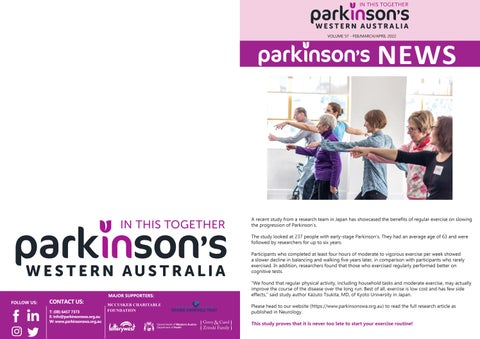
A recent study from a research team in Japan has showcased the benefits of regular exercise on slowing the progression of Parkinson’s. The study looked at 237 people with early-stage Parkinson’s. They had an average age of 63 and were followed by researchers for up to six years. Participants who completed at least four hours of moderate to vigorous exercise per week showed a slower decline in balancing and walking five years later, in comparison with participants who rarely exercised. In addition, researchers found that those who exercised regularly performed better on cognitive tests.
FOLLOW US:
CONTACT US: T: (08) 6457 7373 E: info@parkinsonswa.org.au W: www.parkinsonswa.org.au
MAJOR SUPPORTERS:
“We found that regular physical activity, including household tasks and moderate exercise, may actually improve the course of the disease over the long run. Best of all, exercise is low cost and has few side effects,” said study author Kazuto Tsukita, MD, of Kyoto University in Japan.
MCCUSKER CHARITABLE FOUNDATION
Please head to our website (https://www.parkinsonswa.org.au) to read the full research article as published in Neurology. This study proves that it is never too late to start your exercise routine!
2021 PWA Newsletter I 1
LOCATION/POSTAL ADDRESS THE NICHE, 11 ABERDARE ROAD, NEDLANDS, WA 6009 TELEPHONE (08) 6457 7373 FAX (08) 6457 7374 FREECALL 1800 644 189 EMAIL INFO@PARKINSONSWA.ORG.AU WEBSITE PARKINSONSWA.ORG.AU
Brenda’s Bulletin
Update from the Leeming/Bull Creek Support Group “In May, 2021 our Support Group was chosen by the Commonwealth Bank to receive a Community Grant of $500.00. I attended the bank to receive the official handover of the cheque and have a photo taken for the Bank to use in their advertising for the Community Grant Scheme. Our group decided that $250.00 of the money would be donated to the Parkinson’s Nurse Specialist service, $125.00 going towards the ongoing support of our Parkinson’s Tai Chi group and $125.00 to subsidise the Support Group Christmas Lunch.
PRESIDENT JOHN MCDONALD VICE PRESIDENT PROFESSOR NATALIE GASSON TREASURER (ACTING) JOHN MCDONALD SECRETARY VACANT BOARD MEMBERS DR DON BOLTO, KEITH GEERS, ALAN GRAY ALASTAIR HOPE, TAMLYN LENNOX CHIEF EXECUTIVE OFFICER BRENDA MATTHEWS OFFICE MANAGER TOBY GUMMER DONOR RELATIONS MANAGER DOROTHY KOH FINANCE MANAGER SALIL KOONJA COMMUNICATIONS COORDINATOR EMILY SCOTT SENIOR PARKINSON’S NURSE SPECIALIST JANET MCLEOD PARKINSON’S NURSE SPECIALISTS AMANDA COULTOUS, FIONA ROSCOE, JO CHADWICK, KAYLEIGH RAWLE, LIZ BICKLEY, RACHEL MARSHALL AND NEROLIE LYLE NURSE SPECIALISTS’ SECRETARY LENA DIVITO COUNSELLOR CAITLIN MUNRO
DEADLINE FOR NEXT ISSUE PARKINSON’S NEWS 18 APRIL 2022 ADVERTISING ENQUIRIES INFO@PARKINSONSWA.ORG.AU DISCLAIMER - Parkinson’s Western Australia Inc has endeavoured to ensure that the information in this newsletter is accurate; however, we accept no responsibility for any errors, omissions or inaccuracies in respect to the information contained in the material provided by Parkinson’s Western Australia Inc. Nor is the provision of material by Parkinson’s Western Australia Inc. to be construed as any representation that there is no other material or information available in relation to the information provided. Further, Parkinson’s Western Australia Inc. accepts no responsibility for persons who may rely upon this information for whatever purposes.
Support Groups
Knowns! Unknowns! Unexpected changes at short notice – this will be life in 2022. We will manage this together as a community. We will continue with our Parkinson’s Nurse Specialist Service; activities and seminar programs, with precautions in place as needed. We will keep you updated via our website; E-news; newsletters and social media platforms if any adjustments to normal procedures are needed.
Our Support Group, in conjunction with the Residents of the Rossmoyne Retirement Village, run a Tai Chi for Parkinson’s session every Monday morning at 10.00 a.m. at the Rossmoyne Retirement Village, and this week we welcomed some new participants via Zoom. The other “first” for our Group, was our “Carers Coffee Morning” which we held on the 11th May at Flames Café in Rossmoyne. It was pleasing to see six of our Carers gathered for a friendly, lively chat over coffee and the feedback was that it was a good idea and to keep it going.”
By the time you receive this newsletter, I trust we will have successfully hosted our Twilight Sailing event at the South of Perth Yacht Club and the Support Group Leaders’ Workshop. Pictures to follow very soon. A very big thank you for the generous donations received through the Parkinson’s WA Christmas Appeal – the best ever appeal response to ensure our Parkinson’s Nurse Specialist services continue within the community. Do check out our website to see our third party fundraisers who are supporting the Parkinson’s community. Kate Raston and the Henderson Girls will be taking part in the Rottnest Swim on 26 February and Karen Paddison will be Skydiving, near Jurien Bay – a big thank you to all! To my Nepal followers – as mentioned in the last newsletter, I had a little hint of an idea to return to Nepal in April 2022, but I think that has now been pushed back to October 2022!! Happy New Year! NATURE – Cheaper than therapy!! There is no present like – The Time. Take Care Brenda
2022 PWA Newsletter I 2
Support Group leader, Donna, accepting the CommBank Community Donation from Branch Manager, Sue.
Northern Suburbs Carers catch-up Carers are invited to attend an informal gathering in Stirling to share experiences, ask questions, and chat with other carers, while enjoying coffee/tea and cake/pastries. Meetings are held on the third Wednesday of each month at 10 am at Amico Café - Shop 2, 4 Sanderling Street Stirling (on the corner with Cedric St).
We love hearing about what your support group has been up to - and so does our community! Please don’t hesitate to reach out to Emily at communications@parkinsonswa.org.au, and send through photos and updates from your support group to be included in the newsletter. 2022 PWA Newsletter I 15
Conversations with your Parkinson’s Nurse Specialists Our Parkinson’s Nurse Specialist Team are at the core of what we do at Parkinson’s WA. For this reason, we want to share with you a little bit about each Nurse in our newsletters. For this edition, we had a chat with Clinical Nurse Manager and Senior Parkinson’s Nurse Specialist - Janet McLeod. Janet was the first ever Nurse to become part of the Parkinson’s WA Nurse Specialist Service and has now been with us for 23 years - we are so lucky to have her as part of our Team!
Janet McLeod 1. What is your favourite part about working as a Nurse for Parkinson’s WA? I have loved seeing Parkinson’s WA grow in numbers and skill set. In the early years my entire focus was educating and supporting those living with Parkinson’s. In later years my focus has shifted somewhat to become a role model and support for the nursing team. 2. Do you have a favourite memory from your time working as a Nurse? It is very difficult to choose one memory but overcoming the fear of public speaking at my first international conference in Vienna in 2000 was a great relief. What a privilege it was to represent Parkinson’s WA in that amazing setting – looking out the window from the podium and seeing an ice rink with skaters added to the joy of the moment. Seeing the nursing team grow from one nurse for the entire metropolitan area to the current team of seven nurses is a huge personal satisfaction. 3. What do you like to do on the weekends and in your spare time? Well I have a blended family of grandchildren with an age range of 23-5 so that may answer your question. I also love pilates, yoga and reading.
Update from the PWA Office Update from the Parkinson’s WA Office Meet Toby! Many of our members will have had the pleasure of meeting Toby before. Toby is the first person you see when you walk into the office and the person you hear on the other side of the phone when you call Parkinson’s WA We sat down with Toby and asked him some questions to give you the opportunity to get to know him better!
4. What do you think the Parkinson’s community would be most interested to know about you? My passion in Parkinson’s started in 1967 on my first ward and I still learn something about Parkinson’s every working day. The rest will remain a mystery!
1. What is your role at Parkinson’s WA? I am the Office Manager and I have worked at Parkinson’s WA since December 2019. A normal day sees me complete a number of diverse tasks from solving IT issues to taking patient referrals. If you have ever phoned Parkinson’s WA – chances are you have spoken with me. 2. What is your favourite part about working for Parkinson’s WA? I get great job satisfaction when I am able to assist people who have just been diagnosed with Parkinson’s and let them know that we are here to help. 3. What do you like to do on the weekends and in your spare time? You will often find me hiking and I enjoy collecting wine and trips down to Margaret River. 4. What do you think the Parkinson’s community would be most interested to know about you? I have previously held three Guinness world records and I speak Japanese.
Phone calls As the Parkinson’s WA office is connected to the QEII Medical Centre, our phone calls will show as either a ‘Private Number’ or ‘No Caller ID” when a member of our team contacts you. Many people elect to decline phone calls from Private Numbers or numbers with No Caller ID, however, please first consider that it may be your Parkinson’s Nurse Specialist or a member of our team calling you.
Parkinson’s ‘hacks’ Parkinson’s WA is looking for input from our community to create a series of Parkinson’s ‘hacks’ to benefit people in Western Australia living with Parkinson’s. If you have a ‘hack’, tip or trick that has helped you manage your Parkinson’s, and you would like to share with other people living with Parkinson’s, please reach out to us - we would love to hear from you! You can send us an email at communications@parkinsonswa.org.au or call us on (08) 6457 7373. 2022 PWA Newsletter I 14
For your safety, if the phone call is not from us or someone that you trust, we encourage you to end the call as it may be a scam. Most importantly, never give out personal information to someone you do not trust. For advice on scams, please visit https://www.scamwatch. gov.au/
2022 PWA Newsletter I 3
Update from the Parkinson’s WA Office Would you like to receive your Parkinson’s WA Newsletter digitally? Parkinson’s WA is working towards providing our members with the opportunity to receive their Parkinson’s WA newsletter digitally. We can assure you this will be an opt-in process and if you would like to continue receiving a physical copy of the newsletter, this will still be available to you.
Parkinson’s Newly Diagnosed Seminar for people diagnosed with Parkinson’s in the last five years SEMINAR SERIES 2022
Through choosing to receive your newsletter digitally, you will be helping Parkinson’s WA to reduce costs, including printing and mailing related expenses. You will also be helping to reduce your carbon footprint! If you would like to receive your Parkinson’s WA newsletter via email, please contact the office by email info@parkinsonswa.org.au or phone - (08) 6457 7373.
Saturday 9 April 202277 710.30am - 1pm (approx)7
Research opportunity
Presenters: 7
TONiC (Trajectories of Outcomes in Neurological Conditions) researchers, led by Professor Sulev Koks from Perron Institute and Murdoch University are now recruiting people with Parkinson’s to participate in this quality of life and genetic study. The aim is to improve our understanding of how genetics can impact patient progression and quality of life.
• Dr Soumya Ghosh - Consultant Neurologist at the Perron Institute, Sir Charles Gardner Hospital, Fiona Stanley and Perth Children’s Hospital. Dr Ghosh will discuss Parkinson’s and treatment options. • The Parkinson’s WA Team will discuss their role in helping people with Parkinson’s manage the condition.
Location: The Niche, cnr Aberdare Road and Hospital Avenue, Nedlands Members: $15; Non Members: $20 Morning Tea provided (please advise if you have any dietary requirements) RSVP by Tuesday 5 April, 2022 by phone (08) 6457 7373 or email info@parkinsonswa.org.au Covid-19 precautions: All government guidelines will be adhered to including proof of vaccinations. Bus Service: 24, 25, 26, 103, 995, 998 and 999 all stop within 5 minutes walking distance of the Niche.
2022 PWA Newsletter I 4
Parking: Limited parking is available at The Niche. If parking is unavailable, please use the Hospital Visitor’s carpark (pay parking entrance on Winthrop Ave). The Niche, 11 Aberdare Road, Nedlands WA 6009 P: (08) 6457 7373 F: (08) 6457 7374 E: info@parkinsonswa.org.au 2021 PWA Newsletter I 9 www.parkinsonswa.org.au
A Covid-19 update
Latest research
The last few years have made us all a little apprehensive about making any plans for 2022, but as an organisation we are planning how to move forward, if and when our state borders open again. Some proposed changes are related to our Parkinson’s Nurse Specialist Service. These details are outlined on page six. As you are aware our Nurses visit people with Parkinson’s in their homes and aged care facilities. If we have a Covid-19 outbreak in the community, it is likely that Aged Care facilities will cease having external visitors to their sites. When visiting the Parkinson’s WA office, please ensure that you are wearing a mask at all times and check into the Safe WA or Service WA apps upon entry. Alternatively, you can also register your name in the booklet available as you enter the building and the Parkinson’s WA office. These precautions ensure your safety and the safety of our staff at Parkinson’s WA. All restrictions are subject to change according to guidelines from the Department of Health. Government mandates and guidelines will be adhered to at all times. We trust you understand the rationale behind these plans, and we all hope that no further restrictions will be required. We are looking forward to continuing to support the Parkinson’s
Support Groups SOUTH & EAST METRO
NORTH & WEST MET
RO
BULLCREEK/LEEMING
KINGSLEY
FREMANTLE/MELVILLE
MORLEY
ROCKINGHAM
WESTERN SUBURBS
MANDURAH
PARKINSON’S CARERS NORTH
REGIONAL ALBANY BUNBURY BUSSELTON COLLIE* MANJIMUP
MIDLAND* ARMADALE TH
PARKINSON’S CARERS SOU
55 YEARS AND UNDER
NORTHAM* ESPERANCE*
There has been a lot of local interest in the recent news segment on Channel Seven which gave a brief layman’s look at light therapy also referred to as photobiomodulation (PBM). Some people who contacted us had the impression that this is a new treatment for Parkinson’s so it seemed timely and responsible to give a more detailed overview of the topic and the research study. As you are all aware Parkinson’s is a progressive neurological condition which is currently treated mainly by medication aimed at replacing the neurotransmitter dopamine. In recent years there has been much interest in the gut brain axis and its involvement in Parkinson’s and other conditions. The gut brain axis link is particularly strong in Parkinson’s with gastrointestinal signs being common and often preceding the neurological signs by years. In animal models PBM has been seen to reduce the signs of Parkinson’s and protect the neurons from damage when applied directly to the head or to remote parts of the body. PBM therapy is the use of narrow wavelength bands of nonthermal light, either light emitting diode (LED) or laser, to modulate cellular response including mitochondrial function and downstream cellular signalling. One of the primary effects of PBM is anti-inflammatory which will benefit many body processes. PBM has been known for many years to be safe and free of side effects. The Channel Seven news segment was referring to a small 2019-2020 study carried out in Adelaide, South Australia involving seven subjects being treated with PBM for three times per week for twelve weeks. This study targeted nine abdominal points (one minute each) and the posterior cervical region of the neck for one minute. At the completion of the twelve weeks each participant was given a home treatment laser device and training in its use. The participants then continued the treatment
regime at home for a 33 week period with no supervision. Feedback from the partner/carer was sought regarding compliance at the end of the study. Some of the outcome measures used for this study were the Timed Get Up and Go measure (many of you will be familiar with this), assessment of cognition, balance assessments, monitoring of handwriting size and sense of smell. When the outcome measures were analysed as a group some improvements were seen. Individual assessments were also seen to be positive in the areas of handwriting and sense of smell. The study was also challenged by lockdowns due to Covid 19 meaning that there was no face to face follow up. In spite of this, some improvements were maintained. Mobility improvements were not maintained to the same extent during the home treatment programme. The study indicates that a number of clinical signs of Parkinson’s can be improved by PBM, through targeting the abdomen and neck over a twelve week period. It is for this reason that a larger study is now being carried out in New South Wales and led to the interest from Channel Seven. Reference: Remote Photobiomodulation Treatment for the Clinical Signs of Parkinson’s Disease: A Case Series Conducted During Covid-19 (2021) Liebert A. et al. Photobiomodulation, Photomedicine and Laser Surgery. Vol. XX, Number XX , Pp1-11 *Local Update: The laser device used in these studies are commercially available and is marketed as SYMBYX. For further information and to enquire about a month’s trial and possible discount after the trial please contact Shelley Bernstein: shelleyphysio@gmail.com.
KINGS PARK
* PLEASE CONTACT THE PARKINSON’S WA OFFICE FOR UPDATES. For more information regarding our support groups call (08) 6457 7373 or email info@parkinsonswa.org.au or visit www.parkinsonswa.org.au/whats-on/support-groups/ 2022 PWA Newsletter I 12
2021 PWA Newsletter I 5
FROM THE NURSES’ DESKS
From our Parkinson’s Nurse Specialist - Liz
Welcome to our first newsletter of 2022. We are all facing a year of challenges, most of them unknown. Here in the Nurses office we are preparing for these challenges as best we can. We intend to maintain face to face (home visits) as long as possible but you will become aware of some changes. •
The first telephone contact, when we ring to arrange a visit, will include us checking your vaccination status.
•
If you are unvaccinated then we will be offering Our overall goal is to protect our Parkinson’s a video visit using a service already used by the population so we know that you will be Health Department. This is a very secure and appreciative of the changes. well utilized service. With regard to staff we are all present and correct Going into the future if a lockdown does starting our New Year and hopefully that will occur then this video link will be our common remain the situation for the rest of 2022. practice. It is very simple to use and the nurse will simply send you a link. This can be done using a mobile phone, iPad or laptop.
•
•
This will be a last resort and only introduced to the vaccinated population if there is a government ordered lockdown.
“I heard this beautiful true story last week on Radio National and thought I would share it with you. My apologies to the presenter and people who told this story as I didn’t get their names, but I’m sure they won’t mind me sharing their story.” - Liz
“Singing with frogs” A son “Fred” was walking with his mother “Anne” in the park near the lake when Anne suddenly started to emit these strange loud noises, low “aaaaahhhhhs” and “eeeeeeessss” which he’d never heard her do before. Fred was quite alarmed and asked her what she was doing, concerned people walking by would think she had ”lost the plot”. Anne replied she had been attending her Parkinson’s Speech Therapy group classes and had been told the best place to practice her sounds was out in nature and as loudly as she could.
Reassured, Fred walked along beside Anne and even joined in on a few long low “aaaaaaaahhhhhhhh’s.” They approached the 2021 PWA Newsletter I 3 lake and suddenly from the lake came a curious “aaaaaaarrrrgggghhhhh” sound very like what Anne and Fred had just been doing. They stopped and tried again with their low sounds and sure enough from the lake came the response. They laughed when they realised a frog was calling back to them. Soon a great game evolved with call and response from the lake and even trying out different tones.
Giggling, Fred and Anne decided to walk on for a bit, when they came to the lily pond they thought they would try their luck again with communicating with the frogs and sure enough following a particularly long low “aaaaaaahhhhhhh” from Anne came the same response from the pond. They were delighted and enjoyed another great game singing with frogs. This is now Anne’s method of regular practice for her speech therapy. Apparently male motorbike frogs will start to emit their frog songs anytime there is another male frog in the vicinity, in competition for the females. So next time you are near a pond, try practicing your Speech Therapy sounds and see if you too can “sing with frogs”
2021 Your Parkinson’s Nurse Specialists
2021 2022 PWA PWA Newsletter NewsletterI I66
2022 PWA Newsletter I 11
In the Community Dear Nurses, Christmas Appeal 2021 A big thank you to everyone who donated to our Christmas Appeal. Our goal was to raise $50,000 and we have surpassed that. Your donation enables us to continue to provide the Parkinson’s Nurse Specialist Service and expand to also support the Parkinson’s community in the South West regions including Bunbury, Collie and Augusta. Third Party Fundraising
My question is not so much a problem but a general query. My father was diagnosed with Parkinson’s three years ago at age 81 and is still living at home independently with my mother who is of similar age and is a retired nurse (she has educated me well so I would never refer to her as an old nurse!) When we were chatting about his Parkinson’s medications last week, mum mentioned a term I was unaware of and I cannot find any reference to it. She spoke about something called Kinesia paradoxica which she remembers the neurologists saying when she was working on a neurology ward in the 1960’s. Can you enlighten us about this strange sounding term.
1. Rottnest Channel Swim – Kate Raston The Rottnest Channel Swim on 26 February is a very popular annual swim challenge on WA’s calendar. We are thrilled to have Kate Raston participating and raising funds for us, in honour of her Dad, Donald Raston who lives with Parkinson’s. You can support Kate’s efforts through visiting our website. 2. Skydive Challenge – Karen Paddison 50th Birthday Celebration & Skydive Challenge on 26 February! No better way to celebrate the occasion and the lives of father-in-law, Bruce Paddison, best mate Cathy and a few clients who are all living well, regardless of Parkinson’s. Hop onto our website if you would like to support Karen. 3. Cottesloe Golf Club Charity Day – Barbara Wilmot Barbara Wilmot nominated Parkinson’s WA as a beneficiary for the 2021 Charity Golf Day. Seven not for profit organisations received $5,000 from the generous donations raised on the day. Thank you Barbara for your thoughtful gesture.
Yours, Florence of Ferndale
Dear Florence We must admit that your query made us smile with memories of all the retired or not retired nurses of advancing years that we know and respect. There is something lovely about the language shared by health professionals in years gone by. One of our staff has similar memories and even uses those terms herself. Kinesia paradoxica is a Latin term and is a remarkable phenomenon at times seen in people with advanced Parkinson’s whose mobility is usually impaired but they can suddenly perform very effective movements for a short period of time under unusual circumstances. Our Senior Parkinson’s Nurse Specialist can recall such a situation in a fire at an aged care facility when a patient who normally was immobile got up and walked to remove herself from the area of danger. This can also explain why similar patients will perform well under the watchful eye of the Dr in a hospital setting. There are two main theories to try to explain it. It may be that the movement or motor component in kinesia paradoxica is mediated by non-dopamine systems in the brain such as the neural pathways activated by stress or emergency situations. Another theory is that damaged dopaminergic pathways in the nigrostriatal areas of the brain can be activated by environmental stimuli. This latter theory suggests that kinesia paradoxica reflects a release of psychologically induced endogenous dopamine - this means the dopamine we produce ourselves (not your medication). Animal experiments support this theory as they show that in the presence of arousing stimuli the dopamine producing neurons of the substantia nigra increase the rate of ‘firing’ and release dopamine in the striatum. Your conversation with your mother has certainly raised a huge topic and only goes to show that we should never underestimate the memories of a retired nurse! Yours,
Kate Raston with her dad, Don
The Nurses 2021 PWA2022 Newsletter I 13 PWA Newsletter I 10
2022 PWA Newsletter I 7
Counsellor’s Column: Mental Health and Parkinson’s
Counsellor’s Column - continued: Mental Health and Parkinson’s
Counsellor: Caitlin Munro The new year often prompts reflection about what we want to change in our lives, how we can be more fulfilled, or how we can live more in line with our values. People often set goals or resolutions at the start of the new year. Get fit. Read more books. Do yoga. Spend more time with family. But what can we do to put ourselves in the best position to actually achieve our goals? When setting our resolutions, we need to think about them deeply. Why are we making this goal? What are we willing to do to make a change? What work are we willing to put in? What sacrifices will we have to make? Keep your reason ‘why’ in sight. To quote philosopher Friedrich Nietzsche and psychiatrist Viktor Frankl: “One who has a ‘why’, can endure almost any ‘how.’” Goals are little use without an action plan or system to make that goal a reality. If you want to get fit, what will be your weekly exercise plan? If you want to read more books, when will you read and how many pages each day? These goals could be seen as many little actions that when put together, make up the larger goal [1]. It is better for a change to be sustainable than to be significant. You can always increase your goals once you have created a regular habit. A study investigating exercise goals, found that when people made a specific plan for how and when they would do exercise, they were two to three times more likely to follow through with it [2]. The researchers asked participants to fill out the sentence: I will partake in at least 20 minutes of exercise on [DAY] at [TIME OF DAY] at [PLACE]. Many studies have supported these results which suggest that implementing your intention by planning it specifically, will mean you are more likely to achieve it [3].
021 PWA Newsletter I 12
SMART goals Goals need to be well defined to be achieved. Follow the acronym “SMART” to define your goal further. Specific - Make your goal as specific as possible. Read more books- Read 10 books. Get fit- Walk for 30 minutes without stopping four days a week. Measurable - Ensure you can measure if you have achieved your goal. This is the satisfying part! Measure the time spent doing exercise, or how many reps you can do, or the time it takes you to walk to the letterbox and back. Achievable - Making your goals achievable sets you up for success. Aiming to win a gold medal in the Olympic 100m sprint is probably not achievable. Aiming to walk for 20 minutes four times a week probably is. Ensure your goal challenges you to improve! Relevant - Having a relevant goal that is important to you and in line with your values, will increase your likelihood of following through with it. Why is it relevant to you? Why will it make your life better? Time-bound - Setting a timeline for the goal to be achieved will help with making the action plan. This can also help you track your progress over time. Remember to be flexible with your timeline and change it if needed.
2022 PWA Newsletter I 8
The sweet spot Having the motivation at the start of the year or when you first set a goal is great. However, if we put all our effort into the start, we may not be able to continue with our plan to reach our goal as we can get burnt out. Find the sweet spot between sustainability and effort where you still make progress, but it is manageable. It can help to set a range for this purpose - “I am going to walk for between 25-40 minutes”. You know that this will be manageable and you won’t overdo it. “If - then” technique - Planning for chaos [4] Life can be busy. Appointments, life admin, and keeping up with everything going on is hard enough. Throw in being ill, emergencies, or unforeseen situations arising, and our best intentions for goals can fall by the wayside,
leaving us feeling defeated, unmotivated and disappointed. Using the “if-then” technique can help us, by planning for changes to occur in the schedule. For example, if I don’t go for my 20 minute walk in the morning, then I will do 20 minutes of stretching in front of the TV tonight. Sticking to the schedule and reducing the scope [4] It is more important to stick to the schedule than do it perfectly. If you want to go for a 20 minute walk every morning but have other plans or just don’t feel like it, stick to the schedule and still go for a walk, even if it is only for five minutes. “When you can’t do it all, do something small”James Clear [4], author of Atomic Habits. Try adapting these ideas to suit your own goals for 2022, and don’t forget you can make a goal at any time of the year.
Sources: 1. Clear, J. (n.d.). Achieve Your Goals: Research Reveals a Simple Trick That Doubles Your Chances for Success. James Clear. https://jamesclear.com/implementation-intentions 2. Milne, S., Orbell, S., & Sheeran, P. (2002). Combining Motivational and Volitional Interventions to Promote Exercise 2021 PWA Newsletter I 10 Participation: Protection Motivation Theory and Implementation Intentions. British Journal of Health Psychology. 7, 163–184. 3. Gollwitzer, P., & Sheeran, P. (2006). Implementation Intentions and Goal Achievement: A Meta‐Analysis of Effects and Processes. Advances in Experimental Social Psychology. 38, 69–119. 4. Clear, J. (n.d.). How to Stick to Your Goals When Life Gets Crazy. James Clear. https://jamesclear.com/plan-for-chaos 2022 2021 PWA PWA Newsletter Newsletter I 6 9