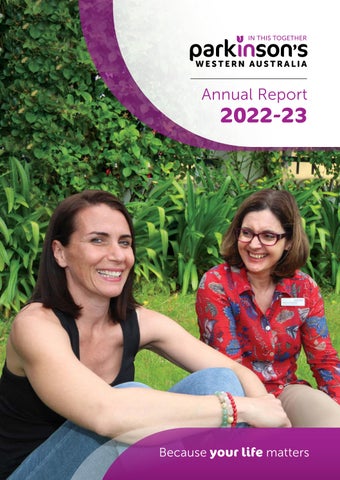
Annual Report
2022-23
Because your life matters
1
Acknowledgement of Country In spirit of reconciliation, Parkinson’s WA acknowledges the Traditional Custodians of the many lands and language groups of Western Australia and their connections to the land, sea and community. We pay our respect to all Aboriginal and Torres Strait Islander peoples today.
Diversity and Inclusion Parkinson’s WA is committed to understanding, embracing and celebrating the rich and multi-dimensional experiences that shape our lives and aims to ensure that everyone who engages with the service feels welcome and included. Our organisation welcomes all people irrespective of ethnicity, lifestyle choice, faith, sexual orientation, ability and gender identity.
2
Parkinson's Western Australia
this report About us
4
President and CEO Report
6
Our Strategic Plan 2023-2027
8
Our Community Impact
12
Our Reach
12
Parkinson’s Nurse Specialists
12
Referral/Navigator Telephone Service
14
Support Groups
15
Education/Capacity Building
16
17
Professional Advisory Panel
Volunteers
17
Listening to the Feedback
18
Research
20
Supporting our Collective Endeavours
22
Living your Best Life
22
A Walk in the Park
26
Twilight Sailing for Parkinson’s
26
Community Seminars Celebrating your Achievements
27 28
Reinvesting for Future Need
30
Our People
31
Annual Report 2022-2023
3
About us Parkinson’s WA is a purpose-for-profit, member-based organisation raising awareness, securing contracts and funds for services and seeking to advance research opportunities to improve quality of life for individuals living with Parkinson’s and Atypical Parkinsonism. Parkinson’s is a chronic neurological condition of unknown cause, with a range of complex symptoms unique to the individual. Neurological disorders are now the leading cause of disabilities in the world and Parkinson’s has become the fastest growing condition. The most common symptoms include stiffened muscles, slowing movement and changing posture. Many people also experience a resting tremor. Other symptoms may include pain, depression, anxiety, speech changes and loss of facial expression.
Our Vision is a nation without Parkinson’s.
Our Mission is to encourage individuals living with Parkinson’s to get the most out of life, to advocate on their behalf and to secure funding to support research.
4
Parkinson's Western Australia
Medication and support from healthcare professionals can help manage these symptoms, however there is limited options to slow the progression or cure Parkinson’s. Atypical Parkinsonism are rare conditions that initially present like Parkinson’s, but which have different causes, symptoms, and rates of progression. They include Progressive Supranuclear Palsy (PSP), Multiple System Atrophy (MSA) and Corticobasal Syndrome (CBS). There are currently no known treatments to cure or slow the progression of PSP, MSA or CBS, or to prevent them. Treatments, therapies, and strategies are available to help individuals manage their symptoms to make the most of living with these conditions.
Fast facts
Australia-wide, there are approximately 150,000 people living with Parkinson’s. In WA, it is estimated to be around 10,000.
Parkinson’s WA deliver a very specialised nursing service with many years of solid experience between the eight Parkinson’s Nurse Specialists (PNS). The PNS team work closely with referring General Practitioners (GPs), Geriatricians and Neurologists along with other members of the multidisciplinary team.
The specialised service sits within a multidisciplinary model of care that refers to other providers – including, but not limited to physiotherapy, occupational therapy and care support workers for assistance with daily living.
The Parkinson’s WA’s team provides specialist advice and support to individuals living with Parkinson’s, their families, carers, and health care professionals through: •
A mobile specialised support/care service by experienced staff.
•
Tailored health education programs and seminars.
•
A confidential health information/ navigator service.
•
Comprehensive web-based information.
•
An extensive peer support group network.
Parkinson’s WA presently has over 3,000 ‘active’ clients. Many more are living with Parkinson’s until they require our assistance. Parkinson’s WA's relationship with individuals living with Parkinson’s can be up to 30 years.
Parkinson’s WA have a metropolitan and regional WA reach with a significant presence in the south west country regions to meet the increasing demand.
Parkinson’s WA has a strong research focus – collaborating with universities and institutes Australia‑wide and internationally, to support and funds key areas that will make a difference to the lives of those living with Parkinson’s.
The PNS work within a capacity-building model – not only with the person living with Parkinson’s, but also to support other providers of care within WA (nursing homes, GP practices, public sector out-patient Parkinson’s clinics, University Schools of Nursing and Medicine).
Parkinson’s WA is a tenant at The Niche Lotteries House located within the QEII Medical Centre Precinct, named the Centre for Neurological Support (CNS). The CNS is recognised as a hub of neurological activity and support, creating a sense of community and a collaborative culture, positively influencing the neurological landscape.
Annual Report 2022-2023
5
President & CEO Report We have great pleasure to provide a summary of Parkinson’s WA (PWA) activities during 2022/2023. The year was marked by the resignation of Brenda Matthews, former CEO who held the organisational leadership position for two decades and successfully steered the organisation to where it is today. The 2022/23 financial year has built on the solid foundations that Ms Matthews established, with a significant focus on future viability and sustainability.
Throughout the 2022/2023 year, Parkinson’s WA continued to invest in strengthening the infrastructure both in the administration and service delivery to the community we support. Further development of the organisation’s digital strategy resulted in the enhancement of our branding strategy, marketing and communication systems and donor, bequest and fundraising.
During the year, the Board endorsed a refreshed Strategic Plan, allowing management to develop detailed Business Plans that focussed on our core business and value‑adding activities.
Our community is at the forefront of all we do. We believe that with strong sector coordination and leadership, and greater community and government support, we can realise better outcomes for individuals living with Parkinson’s.
Parkinson’s WA’s primary source of funding is through the Purchasing and Contracting Unit, Purchasing and System Performance Division, WA Department of Health and our focus remained on the sustainability of contract funds, although our donation and bequest program allowed us to do just that little bit more in the face of an increasing demand for services. With the Specialised Parkinson’s Nursing Service as the primary service provision element of our contract with the WA Department of Health, future funding negotiations continued with further work being conducted by Parkinson’s WA to determine future incidence and prevalence of Parkinson’s and how that can be better reflected in a contract. Without an appropriate level of funding, Parkinson’s WA continued to subsidise the South West/Regional Specialised Parkinson’s Nursing Service along with the Referral/ Navigator Telephone Service conducted from our head office, initiatives that are unsustainable into the longer-term if increased funding is not secured.
6
Parkinson's Western Australia
As the Parkinson’s peak body in WA, our work is with individuals living with Parkinson’s – we know their needs, issues, challenges, and barriers as we deal with their many unmet needs. Parkinson’s WA addresses the needs of those living with Parkinson’s, many of whom would be otherwise left feeling vulnerable and isolated. The services we offer support early intervention and preventative health strategies that in turn helps to alleviate pressures on the government health system. Parkinson’s WA remained committed to making a positive difference during 2022/2023. We are confident in our expertise, reputation, and ability to create systemic change. Parkinson’s WA has identified the value and contribution it can make to peer and sector leadership and consequently has been active with the WA Neurological Leaders Forum, a cross-sector collaboration designed to sharpen the focus and strategy on future planning within the neurological sector.
Parkinson’s WA remained committed to making a positive difference during 2022/2023."
The neurological sector, through this leadership forum, has pledged its support to work closely with the WA Department of Health (and other relevant agencies) to: •
Develop a common understanding and use of data that drives the outcomes of service delivery outcomes and contracting/purchasing of services;
•
Work together to understand, respond and develop medium and long-range plans for innovative models of care/service that utilise the range of clinical resources (e.g. nurse practitioners, care navigators, allied health) to respond positively to equity of service provision, appropriateness of service mix, capacity building and improved clinical governance;
•
Develop a macro-policy framework for neurological care, rehabilitation and community services in Western Australia, referencing the World Health Organisation frameworks and Australia-wide actions in the neurological sector, along with the Sustainable Health Review and other relevant initiatives; and
•
Articulate the public health benefits and cost savings to the WA Health system of effective neurological care, rehabilitation and community services, inclusive of awareness raising.
Parkinson’s WA’s commitment to research was a priority during 2022/2023, with a complete review of all pledges and activities completed and a re-focus of significant areas where support and funds will be directed. The research work strengthened our relationship with organisations such as the Perron Institute, Curtin University, ECU, Notre Dame University, Murdoch University, the Walter and Eliza Hall Institute of Medical Research, the McCusker Foundation, the QEII Medical Centre Neurosciences Unit and others. Our appreciation is extended to the Parkinson’s WA Board who have provided visionary oversight to the activities of the Association, governing in an exemplary way. The successful year of operations would not have been achieved without the work of the wonderful Parkinson’s WA team who come to work each and every day, enthusiastic to make a positive difference to everyone living with Parkinson’s. And of course, there remains an unwavering commitment from our volunteers and sponsors who all work to make Parkinson’s WA achievements just that little bit greater. John McDonald President Yasmin Naglazas CEO
Annual Report 2022-2023
7
Our Strategic Plan 2023-2027 The Board of Parkinson’s WA signed off on a revised Strategic Plan during 2022/2023, which facilitated a renewed focus on all our business activities. This is important, as we are a small to medium sized not-for-profit (or ‘profit-for-purpose’ as we are referred to nowadays) with limited funds, who are trying to do as much as possible to support those individuals living with Parkinson’s. We have observed an increasing demand in terms of numbers of individuals living with Parkinson’s in WA, but also an increasing awareness of what constitutes their ‘new journey’ as individuals determine what support they require through the Parkinson’s WA Specialist Nursing Service (PNS) and associated services. The PNS Service is extremely well regarded, as are the educational resources we provide, keeping our community up-to-date with the latest on Parkinson’s.
We enter the new financial year with a refreshed strategy and renewed focus on five ambitious key areas of priority – diagnosis, treatment and care, support and self-management, cure and organisation/governance. Each day, we work hard to ensure that we are providing what is needed, understanding how we are obliged to show sound stewardship of both government funds and community donations.
The PNS Service is extremely well regarded, as are the educational resources we provide."
Jo Chadwick participates in the monthly PNS meetings held at The Niche
8
Parkinson's Western Australia
The Neurological Leaders gather together at the quarterly Leadership Forum
a higher degree of predictability within the patient journey, that is, pre-empting where support and care will be required, utilising the data to make better decisions around an individual’s care regime.
The strategic considerations by PWA include, but are not limited to: •
A shift in the Model of Care in supporting those living with Parkinson’s that reflects the increasing demand without a matching of an increase in funding noting; – Review assessments ideally initiated by the PNS team rather than leaving it to the individual living with Parkinson’s in all instances. Data is showing that unless a review assessment is planned, there is an increase in crisis interventions; – Balancing telephone assessments and consultations with important in-person, home visits; – The referral/navigator telephone service has developed from the Parkinson’s WA office based on need without the associated contract funding. This service has proved beneficial in terms of making the appropriate referral for clients who have chosen to call or visit the Parkinson’s WA office requiring support/assistance and seeking a referral to the PNS.
•
Succession planning for the PNS Service – recently having to advertise and recruit from interstate for nursing staff due to lack of applications for a vacant PNS role within Parkinson’s WA.
•
Re-configuration of our current client database with the provider Metisc that better reflects the actual client numbers.
•
Enhancing the client database to become a more contemporary client relationship management (CRM) system that allows for
•
Examining the opportunities to have neurologists and GPs better ‘connected’ with the Parkinson’s WA nursing service, by ‘re-introducing’ them to our remit as well as provide more easily accessible information.
•
Collaborating with the Perron Institute on better management of the newly diagnosed individuals with Parkinson’s.
Key activities for the coming few months include, but are not limited to: •
Making it easier for clients/carers to get involved with Parkinson’s WA, wherever living at home or in aged care, and whatever your income, ethnicity or gender. We want to inspire more people in the community to support our work; and
•
Strengthening the way PWA listens to clients in terms of their need for support and collaborate with the Parkinson's community and embed this into our work.
The WA Neurological Leaders Forum has provided an opportunity for Parkinson’s WA to collaborate further with like-minded organisations and become more involved in the policy and planning for neurological conditions in WA. Our CEO Yasmin Naglazas and Clinical Nurse Manager Janet McLeod OAM continued their active involvement in this forum, seeking opportunities to enhance the work associated with the Parkinson’s WA Strategic Plan. Annual Report 2022-2023
9
Our Strategic Plan 2023-2027 Key area 1. DIAGNOSIS
Promote prompt and timely diagnosis, leading to early intervention. 1.1 Work to enhance the skills and understanding of frontline health professionals caring for those with Parkinson’s and their families. 1.2 Build additional capacity in metropolitan and regional communities to enhance quality of life for people living with Parkinson’s. 1.3 Educate the wider public and other health professionals on the signs or symptoms of Parkinson’s. 1.4 Develop a better understanding of the benefits of early intervention. 1.5 Collaborate with strategic partners and alliances to ensure a better understanding of the care trajectory of those living with Parkinson’s and their families/carers.
Key area 2. TREATMENT and CARE
Through the delivery of evidence-based programs.
2.1 Build capacity in GPs, neurologists, nursing staff, allied health professionals, hospital staff, aged care facility staff, service providers, partners/carers and people with Parkinson’s, through Parkinson’s specific education resources on current treatment and care programs. 2.2 Use evidence-based practice to educate and empower the Parkinson’s community, building their capacity to self-manage. 2.3 Deliver person-centred, timely and effective care to those living with Parkinson’s, inclusive of the Parkinson’s Nurse Specialist Service (PNS) that provides one‑on‑one nursing assessment and support. 2.4 Further develop the Parkinson’s WA Model of Care that includes a range of services that have been determined to be of value for the Parkinson’s community. 2.5 Work closely with funders and other strategic alliances to further develop the Parkinson’s Model of Care to ensure sustainability and ‘value of money’.
10
Parkinson's Western Australia
Key area 3. SUPPORT and SELF-MANAGEMENT By empowering people living with Parkinson’s and their families/carers. 3.1 Provide opportunities to the Parkinson’s community to exchange information and contacts about care and treatment programs, through seminars, workshops, newsletters, websites and social media. 3.2 Foster the development of, and provide targeted assistance to local support groups and their leaders throughout the State. 3.3 Enhance the education and information offering to those living with Parkinson’s and their families/carers to ensure contemporary and accessible materials are available. 3.4 Constantly examine modalities that foster selfcare and self-management, based on evidence-based practice. 3.5 Establish strategic partnerships and alliances that allow for the promotion of relevant services to those living with Parkinson’s and their families/carers.
Key area 4.
Key area 5.
CURE
ORGANISATION
Through fundamental research.
By being confident, progressive and trusted.
4.1 Support WA, national and international research programs through direct participation and input of members with Parkinson’s.
5.1 Strengthen financial sustainability through funding security, allowing for diversification and growth.
4.2 Collaborate with our partners (government, research institutions and universities) to determine appropriate research that will build upon the current body of knowledge and contribute to the well-being of those living with Parkinson’s. 4.3 Establish a ‘watching brief’ on national and international research that has relevance for the Parkinson’s community in WA. 4.4 Ensure funds that have been pledged by donors for research result in relevant and applicable research that has the scope to impact on those living with Parkinson’s and their families/carers. 4.5 Support health professionals, through Parkinson’s WA-pledged funds, to build on their knowledge and skills related to Parkinson’s.
5.2 Maintain an active and targeted advocacy role to raise awareness of the needs of people with Parkinson’s and their partners/carers with governments, health professionals. 5.3 Continue to undertake activities that reinforce Parkinson’s WA as the peak body for Parkinson’s in WA. 5.4 Further develop the organisation’s digital strategy to enhance, inter alia, our branding strategy, marketing and communication systems and donor, bequest and fundraising.
The Board of Parkinson's WA signed off on a revised Strategic Plan during 2022/2023, which facilitated a renewed focus on business activities."
5.5 Build a high performance team culture amongst employees, which leads to them being informed and empowered and able to perform at their best.
Annual Report 2022-2023
11
Our Community Impact Our Reach Parkinson’s Nurse Specialists The Parkinson’s Nurse Specialist (PNS) team remained the interface between the Parkinson’s community and the medical and psychosocial systems within Western Australia. The service is now approaching 25 years of continuous, expert nursing care and the high standard, level of enthusiasm and the knowledge demonstrated by our nursing professionals has increased over that time. They are often considered the most experienced team of Parkinson’s nurse specialists in WA. This reporting year featured complete continuity of staffing that allowed PWA not only to meet contractual obligations, but also enhanced the stability of care and support regimes by those living with Parkinson’s. The ability to manage long service leave cover within the current team added to the sense of meaningful therapeutic relationships with our members. All members of the care team continued to be committed to, and proficient with, the electronic documentation and the transfer from paper records to a more available and secure electronic platform.
Janet McLeod OAM Clinical Nurse Manager Digitisation of this function has enhanced the client database capacity to become a more contemporary client relationship management (CRM) system that allows for a higher degree of predictability within the patient journey that is, pre-empting where support and care will be required. The functionality also allows the care team to utilise data to make better decisions around an individual’s care regime. Examining the opportunities to have neurologists and GPs better connected with the Parkinson’s WA PNS Service commenced during the year, by re-introducing them to our remit as well as providing them with more easily accessible information.
The Parkinson’s Nurse Specialist Team – Liz Bickley, Amanda Coultous, Kayleigh Rawle, Rachel Marshall, Jo Chadwick, Fiona Roscoe and Donna Mallaby.
12
Parkinson's Western Australia
960 Parkinson’s Nurse Specialist home visits
3,182
307 Newly
10,263 Telephone
clients
and email consultations
1,205
146 PNS consultations
Referrals into the PNS service during the year
to aged care facilities
1,450 ‘Help desk’/navigator
23 PNS consultations
calls (through PWA office)
17
to hospitals
21 14
Education/capacity building sessions:
Collaboration with other organisations has been an encouraging feature this year. The PNS team was approached by Curtin University Medical School to become involved in precepting 3rd year medical students in a community-based elective. The goals of this venture are not only to expose the students to the medical aspects of Parkinson’s but for our nurses to be exemplars of professional communication and relationships. The rotations already completed were positively received and evaluated both by the students, nurse preceptors and the university. As a result, this collaboration is to be continued into next year. Capacity building remained a strong feature of the PNS service with community groups, hospitals and aged care facilities requesting and featuring our expertise. Part of the role of the Parkinson’s Nurse Specialists is to undertake professional capacity building to improve service delivery reflective of best practice. We have many strong
diagnosed individuals accessed PNS during the year
15
17 community seminars 21 support groups 14 hospital 15 aged care facilities
and established relationships with other health care practitioners working in the neurological sector and remain highly enthusiastic to share the many years of experience and knowledge that our PNS team has achieved. Parkinson’s WA has supported the regional/ south west team through donation/bequest funds that has allowed response to the increasing demands for a Parkinson’s service in country WA. The Parkinson’s WA PNS team has a significant presence at both Bunbury and Busselton Health Services, working alongside the medical specialists and other members of the multidisciplinary team at primarily outpatient clinics. We are privileged to have such a committed, experienced and professional care team. As our organisation turns 40 next year, we look forward to celebrating 25 years of the specialised nursing service in 2023!
Annual Report 2022-2023
13
Our Locations and Reach Office locations Regional access (via telehealth and support visits)
Perth metro: The Niche, 11 Aberdare Rd, Nedlands WA 6009
South West: PO Box 6024 South Bunbury WA 6230
Mid West Goldfields-Esperance
Wheatbelt
Perth Peel
Bunbury South West
Great Southern
Referral/Navigator Telephone Service One of Parkinson’s WA’s strategic intentions is to collaborate with partners and alliances to ensure a better understanding of the care trajectory of those living with Parkinson’s and their families/ carers. Understanding this more will allow us to allocate appropriate resources to meet the increasing needs of those living with Parkinson’s. We are committed to ensuring direct and timely access to support, information and treatments that can help to live better with Parkinson’s.
Kerrin Girando takes a call in the office
14
Parkinson's Western Australia
Aspects of achieving this direct access relate to the current opportunities that we provide for this to happen. Underpinned by very comprehensive referral pathways, Parkinson’s WA provides telephone support/navigation via our main reception 5 days per week.
Parkinson’s WA is passionate about assisting to build a community of support."
The service is immediately supportive for an individual requiring reassurance, but also links to the established referral pathways that are in place to ensure individuals living with Parkinson’s or providing care for someone living with Parkinson’s are provided with the ‘next steps’ to assist with their overall care and well-being. This may involve an initial referral to our Parkinson’s Nurse Specialist Service in the metropolitan area or the south west of WA, followed by our highly experienced nurses organising to connect either initially over the phone (depending on the circumstances) along with a face-to-face or a teleconference visit. Further, there may be other referral pathways to access support with mobility, sleeping, movement etc.
Support Groups One of the areas that Parkinson’s WA is reviewing is the network of the volunteer‑led local support groups, to ensure we are providing what is needed to allow their meetings and gatherings to be effective. Parkinson’s WA is passionate about assisting to build a community of support – whether individuals or their loved one is living with Parkinson's, with the right information and support, they can feel more in control of life with the condition.
A couple of key activities for the coming few months include, but are not limited to: •
Making it easier for clients/carers to get involved with Parkinson’s WA, wherever living at home or in aged care, and whatever your income, ethnicity or gender. We want to inspire more people in the community to support our work; and
•
Strengthening the ways in which Parkinson’s WA listens to clients, to and collaborate with the Parkinson's community, and embed this into our work.
In its commitment to the Parkinson’s community of WA, Parkinson's WA oversees a network of nine support groups in the metropolitan area and three in regional south‑west, including the reformed Collie Support Group, reinvigorated under the guidance of Parkinson's Nurse Specialist Donna Mallaby. These groups, each possessing distinct characteristics, play a pivotal role within the Parkinson’s community by fostering a sense of belonging and shared experiences among individuals affected by Parkinson's and their support networks. In February 2023, Parkinson's WA hosted the Support Group Leader's Workshop, an event that brought together leaders from support groups.
Annual Report 2022-2023
15
The drumming session added a lovely touch to the Support Group Leader’s workshop
Under the expert guidance of Janet McLeod OAM, Clinical Nurse Manager, participants learnt about the latest advancements in Parkinson's treatments, including in-depth discussions on 'Light Therapy and Focused Ultrasound'. The workshop not only facilitated an exchange of valuable insights but also featured a dynamic group drumming session, adding a unique and inspiring element to the event through targeted music therapy. This gathering demonstrated Parkinson's WA's commitment to knowledge exchange and collaborative planning, reinforcing our dedication to enhancing the quality of support and information available within the Parkinson’s community and listening to the voices directly representing those individuals.
Education/Capacity Building As leaders within the Parkinson’s community in WA, we have a deep understanding of the needs and challenges of individuals living with Parkinson’s, and their families/carers.
16
Parkinson's Western Australia
We have adopted evidence and best practice principles to educate and empower our community, building their capacity to self‑manage and help them make informed choices. Parkinson’s WA has the most comprehensive and advanced information, education and support programs that empower people living with Parkinson’s to get the most out of their lives. Hard and soft copy information sheets and brochures are readily available and are updated by the Parkinson’s WA team of expert practitioners. Knowing more about practical strategies, treatments and therapies and where to find the right support all contribute to enabling people to live positively and confidently with their Parkinson’s. Parkinson’s WA empowers the Parkinson’s community so that they are able to make informed choices by enabling them with individualised support and advocacy services that suit their life at every stage.
Professional Advisory Panel PWA’s advisory panel continued its work throughout the year, being a structured and collaborative method for the organisation to engage with external advisors on clinical and care matters associated with Parkinson’s. We are very privileged to have such a highly regarded group of professionals with an ongoing interest and a keenness to contribute. •
Professor Natalie Gasson PhD, Deputy Head of School, School of Population Health / Faculty of Health Sciences, Curtin University
•
Paula McGinley, Senior Occupational Therapist, Parkinson’s & Neurology Outpatients, Fiona Stanley Fremantle Hospitals Group
•
Rebecca Parker, Physiotherapist, Como Health & Fitness
•
Associate Professor Rick Stell, Movement Disorder Specialist, SJOG Healthcare
•
Professor Chris Lind, Neurological Surgery, SJOG Healthcare
•
Dr Barry Vieira, Geriatrician (Aged Care and Rehabilitation)
•
Liz Wason, Optometrist, EyeSense
•
Dr Marianne Pinto, Dentist, Marianne Pinto Dental Clinic
Volunteers The efforts of our volunteers continued to contribute to the Parkinson’s WA Mission and Vision. We celebrated International Volunteer Day on 5 December, acknowledging that our volunteers help to minimise administration costs and ensure that more of the money we raise goes directly to services for individuals living with Parkinson’s in WA.
What I enjoy most about volunteering is meeting and working with other volunteers and knowing that in some way we are helping others.” – Pat Chadbourne
During the year, we celebrated the 20 years of involvement by Pat Chadbourne. Pat has been an amazing contributor and supporter for Parkinson’s WA and over 22 years, she has grown alongside the organisation. On Volunteer’s Day, we thanked volunteers like Pat and her friends for their time, energy and dedication.
Annual Report 2022-2023
17
CEO Neurological Council of WA Etta Palumbo and Clinical Nurse Manager Janet McLeod OAM have forged a new collaborative Neurological partnership over 2022.
Listening to the Feedback Key Results – The Parkinson’s Community Those who are accessing care and support through the Parkinson’s Specialist Nursing Service:
Each year Parkinson’s WA checks‑in with the individuals who use Parkinson’s WA’s services to ensure we are meeting their needs and to give us a roadmap to continually improve.
18
Parkinson's Western Australia
•
96% agree that as a result of the PNS contact, they have an increased knowledge and understanding of Parkinson’s.
•
90% agree that they have an improved understanding of the importance of taking medicationson time.
•
79% agree that having access to the service has reduced the need to attend hospital.
•
88% agreed that the service assisted in navigating the health system to access other services.
•
85% agree that after the contact with the PWA service they have a better understanding of the risk of falls.
Client testimonials
“We receive a wider range of information and news updates and developments from our Nurse than from any other health service. This helps considerably in making choices for the on-going management of Parkinson’s. It is very reassuring.” – Stewart
“The Parkinson’s Nurse Specialist Service is an essential service that needs to be continued. They provide good emotional support, updated knowledge in a holistic sense.” – Emma
“Fiona has been helpful, knowledgeable and caring and it’s great knowing I can always speak to her if I need a question answered about Richard’s condition and care.” – Trish
Key Results – Health Professionals Those health professionals who are referring to the care and support through the Parkinson’s Specialist Nursing Service: •
100% agree that as a result of the PNS service, they felt their patients had an increased knowledge and understanding of Parkinson’s.
•
94% agree that as a result of the PNS service, they felt that patients are more compliant with medications regimes.
•
100% agree that as a result of the PNS service, they felt that patients feel more supported.
•
93% would recommend the PNS service to a colleague.
The Nursing staff regularly check-in at their monthly meetings to discuss their work in the community.
Annual Report 2022-2023
19
Professor David Blacker AM and Adj. Professor Yasmin Naglazas at the Perron Institute
Research Our commitment to research remains a key focus as we strive to improve the lives of the individuals we support. Through the PWA research grant program, we partner with and support universities and institutions in:
Professor Natalie Gasson Chair, Research Committee
20
•
Scientific research that aims to discover more about the cause and potential cure for Parkinson’s and Atypical Parkinson’s; and
•
Applied research to improve the lives of people currently living with Parkinson’s and Atypical Parkinson’s. All requests for research support is by our research committee to ensure the proposal has scientific rigour and is underpinned by ethics approvals to ensure investment fits within the aims of our strategic plan and mission.
As we continue to move out of the most intense phases of the COVID-19 pandemic we are seeing more research projects resuming and new ones getting started. Working with our CEO, we have taken time this year to review Parkinson’s WA’s two research committees (the Research Advisory Committee and the Zrinski Research Committee) and combine into a restructured committee that will be responsible for all submissions and financial support for research.
Parkinson's Western Australia
During the past year we have continued to provide support for new research projects including the following:
Our commitment to research remains a key focus as we strive to improve the lives of the individuals we support."
As part of this review, we have developed a more streamlined and transparent review process. One of the key motivations for doing this was to ensure we make decisions on whether to support researchers in a timelier fashion. To date we have established the broad approach and guidelines for approving research support. This now involves a simplified three‑tier process that depends on the type of support being requested by the researchers. We are now working on the revision of the research committee terms of reference and application process. Appreciation must go to the members of both committees for their valuable insights and contributions to the process.
•
The efficacy of non-invasive brain stimulation on reducing tremor in individuals with Parkinson’s. Dr Jane Tan (Post-Doctoral Researcher, School of Psychology, Murdoch University).
•
Health consumer research study into experiences of people diagnosed with Parkinson’s in Australia. Belina Zipper (Walter & Eliza Hall Institute of Medical Research).
•
Establishing an Australian reference range for striatal binding in patients with Parkinson’s disease and healthy controls with 6-[18f] fluoro-I-3,4dihydroxyphenylalanine (f-dopa) pet. Department of Nuclear Medicine and WAS PET Service (SCGH).
•
Co-designing therapy approaches for conversations between people with Parkinson’s disease and their partners (Phase Two – Website Development). Dr Naomi Cocks (School of Allied Health, Curtin University) and team.
•
Neurological Hub – Co-design of an online health and research platform for the neurological community in WA. Dr Travis Cruickshank (ECU and Perron Institute) and team.
•
Strategies used by people with Parkinson’s and their partners in conversation: A qualitative exploration of their lived experience. Ramisha Thilakarante (PhD student, School of Allied Health, Curtin University).
Annual Report 2022-2023
21
Supporting our collective endeavours Living your Best Life Parkinson’s WA acknowledges that our work changes people for the better and the positive experience and outcomes that the support offers. There is nothing more powerful than the shared experience, and through this, we can highlight our stories. We are fortunate to work with so many inspiring people, from all lifestyles, of all ages, and all experiences. Thank you to everyone who has offered to share their stories of the way PWA has touched their lives. We are so grateful to have been a part of yours.
PNS Rachel checks Irena's blood pressure
22
Parkinson's Western Australia
Irena’s story – Not just an older person’s condition Irena is 38, a mother of two young children and she lives with Parkinson’s. Having been diagnosed three years ago following the birth of her second child and feeling consumed by debilitating post‑natal depression and anxiety, Irena said in those ‘dark days’ everything just stopped. “In the early days, I felt like I couldn’t cope and when we moved back to WA from the Czech Republic, I linked in with Parkinson’s WA to connect with other people and the community, and to seek support and local advice,” she said. Irena said she made a decision to engage the Parkinson’s Nurse Specialist (PNS) service, and said she was initially rather hesitant about it. “At first I thought I didn’t need the Nursing Service – but it was then I realised how much my life had changed and how I lived was different now. The nurses have been such a wonderful support. They provide such good advice and in the comfort of my own home.” Irena keeps busy with her two young boys, aged 3 and 8. She explained with a knowing gaze, that parenting had changed significantly since the Parkinson’s diagnosis. “Parkinson’s made me realise I am not invincible. I have good days and bad days. On most days, the left side of my body is affected. It is slow and becomes quite stiff,” she said. Things have changed a lot since diagnosis and becoming socially connected to her community has become increasingly more challenging, Irena explained. PNS Rachel Marshall said prioritising self-care is particularly important when you have young children and even more when you are living with Parkinson’s in addition to the daily challenges of parenting. “Sometimes it’s hard because that self-care is so individual to the person, and we don’t have all the answers, but we can meet you on your journey and do whatever we can to assist and support,” she said. “We can be that link between the client and the Neurologist. It’s challenging to see young people
My first nurse came into my home, and she was like Mary Poppins – I felt so safe to be surrounded by a wealth of knowledge and care."
unable to make connections with others living with the condition.” Irena said having Rachel as a support in her life had changed so much for her. “It’s having that human side, that is governed by kindness and empathy. Rachel is an experienced empathic, lovely woman who is not just here for me, but provides me with useful information whenever I need it. It’s good to know there’s the PNS service supporting me at every stage of my journey.”
Annual Report 2022-2023
23
John’s story – The value of unwavering support In 2008, John was faced with an expected and unwanted change to his life when an observant physiotherapist sowed the seed of an idea that he may be developing symptoms that were consistent with Parkinson’s. John had gone to see a physiotherapist about his wrist, which he’d broken in a fall from a ladder. “It was a bit of shock. I went to my doctor, who along with a neurologist, formally diagnosed it as Parkinson’s. I didn’t know much about what Parkinson’s was, only that it was an old person’s disease.” John had been working as a Health Officer for a local council at the time and despite protests from his manager, made the hard decision to retire early at just 52 years of age. “I’d started to find it difficult to type. And I was always a fast typist, but I’d reverted to finger typing which got worse and worse. My writing started to go too.” Subsequent to John being given a firm diagnosis by a Perth neurologist, he was guided towards a support system which helped allay his fears.
24
Parkinson's Western Australia
That support system, the Parkinson’s WA Nurse Specialist Service, remains part of his life after so many years. These community-based nurses have been alongside him from diagnosis through brain surgery and managing his condition in a variety of ways. John is very aware that Parkinson’s is a progressive neurological condition for which a cure remains elusive. He knows and experiences a range of symptoms which are unique to him. “Everyone assumes that Parkinson’s is all about tremor and walking difficulties. They are not aware that there are many problems known as non-motor symptoms which can rule my day to day life such as difficulties with sleeping, speech and bladder challenges. These are the things I talk to my nurse about when she visits me at home. My nurse manages to uplift me and gives me confidence for the future.’ Maria, John’s wife, has been a constant with her emotional support and hands on caring over the years since John was diagnosed. His family is tight‑knit and integral to the overall well-being of John.
Client testimonials
John's whole family have supported him every step of the way, including his grandson who ‘Walks for Diddy’
The key ingredient to this journey with Parkinson’s is the support of family and friends." – Maria (John's wife)
These days, John focuses on things to keep him busy like tinkering in the garage or studying philosophy. His face lights up as he talks of his three beautiful girls, Anita, Marika and the youngest Karis along with his grandchildren too. “I’m in the final stages of Parkinsons, so it’s just a matter of choosing what I want to do and doing it.” “So many things he’s had to give up.” Maria shares. “John has lost confidence over a number of things. His walking, his eyes, things have started going downhill. … it’s not easy.” John uses a wheelchair or walker now, and one of his biggest fears is falling. “I’ve been to the hospital three times in the last year because of falls.” “I had to take a driving test and failed that too. It’s amazing how much of an impact that has. I can’t go up the road to the shopping centre without supervision. My medical team are pretty much saying I’m not to be trusted to do the things I love in my final years.” And while Maria and John would love to wave a magic wand and turn back time, they are grateful for all the support they’ve received over 15 years since John has been diagnosed. They completely understand the benefits of harnessing the right support and activities to continue to live well. “The support and care from family and friends, along with the Parkinson’s Nurse Specialists and connections made through Parkinson’s WA is really the key ingredient to this journey.”
Kingsley Support Group Leader Bev said value of life became paramount to their family after her husband Jeff was diagnosed with Parkinson’s in 2005. “Life is much slower, more thoughtful and we are more mindful in what we do each day,” she explained. Bev said Fiona and the PNS service had been of great value to their family. “The Nurse Specialists have always been available at the end of the phone as we need, and the home visits are greatly beneficial in a one-on-one situation,” she said. – Bev
“It’s a good feel overall at Parkinson’s WA and we can see they care more for others than themselves, and the nursing service is no exception. They have so much knowledge, so much guidance to offer. They are so perceptive and always have time for me.” “Parkinson’s WA has done great work, and I want it to continue to grow and offer a lifeline to people diagnosed with Parkinson’s in the community.” – Jean
"The Parkinson’s Nurse Specialist Service is an excellent service. I was advised on the pros and cons of the various therapies. They were positive and reassuring to talk to and is always supportive and caring.” – John
Annual Report 2022-2023
25
A Walk in the Park Our annual signature event continued to provide a platform to unite people living with Parkinson’s, their families, friends, colleagues and medical and healthcare supporters, to create a genuine sense of belonging and celebration of community. This year the enthusiasm remained at the highest of levels, with significant fundraising achieved and sponsor donations pledged.
Twilight Sailing for Parkinson’s We joined the Parkinson's community for the 15th Annual Twilight Sailing event on the Swan River. The event continues in honour of skipper Peter Wilmott who initiated the sail, at a time when he was living with Parkinson’s.
PNS Jo never misses a Twilight Sailing event with the community
26
Parkinson's Western Australia
Parkinson’s WA Board President John McDonald said that on behalf of the Board and the Parkinson’s community, he expressed his heartfelt appreciation for the unwavering support provided by the South of Perth Yacht Club along with Food and Beverage Manager and the staff, and the Skippers and Crew of the Spacesailer 27 Fleet and Flag Officers (including Commodore Troy Dalglish
and Rear Commodore Regatta Victoria Blanckensee) who donated their time and boats to take everyone out on the Swan River. “This year marks the 15th year that this annual event has taken place, and we could not have reached this milestone without your continued support,” he said. “The sail allows us to meet up with other people with Parkinson’s in a casual and non-medical environment, where we can socialise with people we would not normally meet.”
Community Seminars Our community seminar program is central to our commitment to realise possibilities and better outcomes to help people with Parkinson’s to live full and active lives following diagnosis. Connecting with community, including those diagnosed in the last five years, is particularly important. During 2022/2023, Parkinson’s WA conducted 8 seminars and 43 information sessions for support groups/community service groups with over 1,300 attendees, which included the following topics:
Community Member and volunteer videographer Richard records our very first Seminar to host on our YouTube channel, with Professor David Blacker AM
Client testimonials
•
Newly diagnosed;
•
Update on latest research;
“As a carer, I found the Parkinson's Nurse Specialist service particularly supportive when Tony was recently hospitalised and I needed their assistance.”
•
Parkinson’s and brain health;
– Ruth
•
Anxiety and depression;
•
Medications and new treatments;
•
Constipation;
•
PD non-motor symptoms;
•
Diet and exercise;
•
The value of exercise;
•
Deep brain stimulation (DBS);
•
An overview of living with Parkinson’s; and
•
Devise assisted therapies.
One of the seminars which received excellent reviews was presented by Professor David Blacker, Medical Director, Perron Institute, Hollywood Private Hospital and PWA Board Member in February 2023, who spoke about the research-based value of exercise for people living with Parkinson’s.
“Fiona put such a positive spin on understanding the Parkinson’s diagnosis and gave our whole family lots of hope, including my husband, John. She was also able to put his mind at ease after receiving the news. My family and I were still trying to understand and navigate this new space and Fiona had a wealth of knowledge and brought with her a significant amount of warmth, contributing her time generously and patiently, and she made sure to answer all our questions and took the time we needed to feel heard and appreciated.” I’m very grateful for the PNS service and I cannot thank them enough.” – Monique
Annual Report 2022-2023
27
Celebrating your achievements Each year, Parkinson’s WA awards individuals/groups who have made a significant contribution by their volunteering and service. In 2022/2023 the folllowing individuals received awards:
Volunteer of the Year Awarded annually to an individual/collective group that strives to bring positive change to the Parkinson’s community in WA, having: •
A noteworthy involvement in the Parkinson’s community;
•
Made a significant impact that adds value to the Parkinson’s Community life; and
•
Demonstrated inspiring efforts to enhance the Parkinson’s community.
All this is undertaken with selfless dedication, hard work, generosity and kindness.
Health Professional Award Awarded annually to a health professional who makes an outstanding contribution to clinical excellence, leadership, education, and culture in caring for those individuals living with Parkinson’s. They advocate for evidence-based practice, focus on value-based support and provide safe, quality, and compassionate patient care. They show commitment to supporting, empowering, and upskilling those around them. Winner: Sandra Robertson
Winners: Val and Suzanne Saunders Val and Suzanne organised and chaired the monthly Bunbury Parkinson’s WA Support Group as well as the Parkinson’s Group every Friday. For their ongoing effort and support of the Bunbury Parkinson’s community, PWA recognised Val and Suzanne Saunders for the Volunteer of the Year Award. Kara Divito Kara has been volunteering for Parkinson’s WA for the past eight years. Any task that requires doing, we were always able to call on her. From administarion work, helping out at seminars on Saturdays and being a key volunteer at the annual A Walk in The Park event.
28
Parkinson's Western Australia
Community Member Leanne, Sandra Robertson and Donna Mallaby PNS
A Registered Nurse at Collie Hospital, Sandra has helped re-establish the Parkinson’s WA Support Group in Collie. Sandra volunteers her own time every 3rd Tuesday of the month to attend and run the support group. For her assistance in helping Parkinson’s clients and their carers continue to meet monthly, PWA recognised Sandra Robertson for the Allied Health Professional Award.
Community Spirit Award Awarded annually for a demonstration of ‘spirit of service’ and citizenship, recognising and honouring an exceptional individual/ group of individuals who make ‘giving back’ to the Parkinson’s community a way of life. They exemplify the best in community service and demonstrate a sense of caring and responsibility for others that connects the Parkinson’s community, making life that little bit easier for those with a diagnosis of PD. They have a positive impact upon the direction and success of Parkinson’s WA’s mission and strategic direction, and improve the life of others.
Geoff Pride Fundraiser of the Year Named in honour of a Parkinson’s WA former treasurer Geoff Pride who served the organisation for 16 years, this award recognises hard work and creativity in fundraising ventures in partnership with Parkinson’s WA, based on an uncompromising commitment to ethical standards and timeliness of funds donation. Winner: Elizabeth Curtis
Winner: Richard Seale
During 2022, Richard gave his name and artistic talents to Parkinson’s WA by acting as photographer for the Parkinson’s WA nursing service brochures. He introduced newer technology, which makes coping with staff changes seamless. In addition, his work on the video of Raymond’s Story was artistically executed while maintaining accuracy concerning symptoms and portraying a suitable message to the public. For his excellent work and assistance to help the wider Parkinson’s community, Parkinson’s WA recognised Richard Seale for the Community Spirit Award.
Elizabeth Curtis has devoted this entire year to fundraising for Parkinson's WA. Her calendar is filled with an amazing list of fundraising ideas and activities. She organised many small fundraisers throughout the year, ranging from sausage sizzles, raffle draws to laboriously collecting bottles for recycling. Elizabeth’s mantra is ‘together as a community, we can do more to support the Parkinson’s Nurse Specialist service.’ For her dedication PWA recognised Elizabeth Curtis for the Geoff Pride Fundraiser of The Year Award.
Annual Report 2022-2023
29
Re-investing for future needs Parkinson’s WA has continued to identify improvements to service delivery through our systems and processes. This remains a key focus within our business model, seeking to provide choice and control for those living with Parkinson’s. Achieving year-on-year surpluses (however small) allows Parkinson’s WA to reinvest for future activities, growth to meet future demands and sustainability. Partnerships remain a key pillar for our organisational success, creating opportunities that are bigger than us to drive greater impact by partnering with experts in their fields, including research institutions, government departments, like-minded organisations providing care/support and most importantly, partnering to design solutions with the very individuals we exist to support. A culture of quality and safety, core to the way we think and act, improving the way we do things to keep everyone safe and well. We champion a learning culture of innovation and continual improvement. This culture allows us to provide the highest quality support and services to the Parkinson’s community. It affects everything we do, and is supported by our partnerships and alliance, collaborations and research partnerships. We are committed to a high performing, satisfied and enthusiastic workforce, a key to long term client connections. The number of Australians affected by Parkinson’s is growing steadily. The sector is grossly underfunded, and we believe that with better sector coordination, resources could be used more efficiently to provide greater impact.
30
Parkinson's Western Australia
Our People Board of Management
Professor David Blacker AM (commenced November 2022) Board Member Member, Research Committee
John McDonald President and Board Chair Treasurer
Professor Natalie Gasson Vice President and Deputy Board Chair Chair Research Committee
Tamlyn Lennox Secretary Member, Risk Comittee
Alastair Hope Board Member Chair, Risk Committee
Keith Geers Board Member Member, Research Committee
Don Bolto Board Member
Alan Gray Board Member
Ryan O’Connor Board Member (resigned March 2023)
Management Team (Back L-R) Toby Gummer, Office Manager Kerrin Girando, Fundraising Manager/Donor Management Lena Divito, Nurse Specialist Secretary/Finance Officer Jacqui O’Leary, Communications Manager (Front) Janet McLeod OAM, Clinical Nurse Manager Adj Prof Yasmin Naglazas, Chief Executive Officer Absent: Salil Koonja, Finance Manager Dorothy Koh, Donor Relations Manager (resigned May 2023) Brenda Matthews, CEO (resigned January 2023)
Annual Report 2022-2023
31
The Niche, 11 Aberdare Road, Nedlands WA 6009 Phone: (08) 6457 7373 Fax: (08) 6457 7374 Email: info@parkinsonswa.org.au
parkinsonswa.org.au
KEY2_43507_11/23