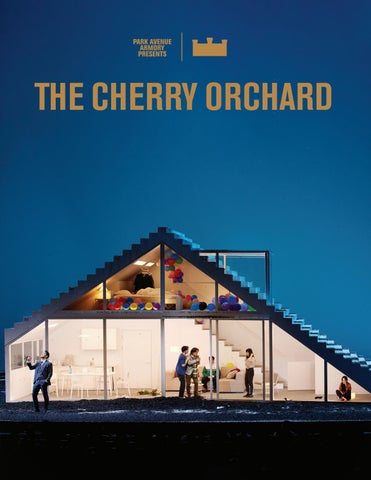
THE CHERRY ORCHARD
WELCOME We are thrilled to welcome award-winning director and dramatist Simon Stone back to the Armory for the North American premiere of his Korean-language adaptation of The Cherry Orchard. Following his unforgettable presentation of Yerma in 2018, Simon now tackles Chekhov’s final play in collaboration with dramaturg Yi Dan-bi. Stone’s masterful adaptation resets the action from Russia to a rapidly transforming modern-day Seoul, serving as a reinterpretation that feels refreshingly new and boldly transforms the source material. With architect Saul Kim’s breathtaking scenic design, Stone gives audiences a voyeuristic and intimate peek into the characters’ private lives within Wade Thompson Drill Hall’s singular architecture. Simon Stone is one of the defining voices of theater in the 21st century, adept at finding new and surprising perspectives within classic texts to reflect our modern anxieties. His collaboration with this remarkable Korean ensemble, including Cannes award-winning
SEASON SPONSOR
PRODUCTION SPONSOR
actress Jeon Do-yeon and Squid Game’s Park Hae-soo, is a feat of transnational storytelling while remaining grounded in the spirit of Chekhov’s masterpiece: equally specific to changing tides in Seoul and universal in its humor and tragedy. We are so thankful to partner with the team from LG Arts Center SEOUL in bringing this production of The Cherry Orchard to New York, giving audiences the chance to witness some of Korea’s finest dramatic actors and a slice of Korean life amidst a global renaissance of Korean culture. We hope this interpretation brings you closer to Chekhov’s story and its enduring impact in a way that at once is deeply South Korean and yet universally moving. Rebecca Robertson Adam R. Flatto Founding President & Executive Producer Deborah Warner Anita K. Hersh Artistic Director
PUBLIC SUPPORT
The Cherry Orchard is made possible with leadership support from Misook Doolittle. Lead Production support is provided by Sulwhasoo. Major support is provided by So-Chung Shinn Lee & Tony W. Lee, and The Arthur F. and Alice E. Adams Charitable Foundation. Additional support is provided by The Tobin Theatre Arts Fund, Jean Sonia Lee, and Netflix. Captioning is being provieded, in part, by a grant from NYSCA/TDF TAP Plus. Bloomberg Philanthropies is Park Avenue Armory’s 2026 Season Sponsor. Leadership support for the Armory’s artistic programming has been generously provided by the Anita K. Hersh Philanthropic Fund, Charina Endowment Fund, Donald A. Pels Charitable Trust, Pinkerton Foundation, the Starr Foundation, the Thompson Family Foundation, and Dance Reflections by Van Cleef & Arpels Major support was also provided by the the Arthur F. and Alice E. Adams Charitable Foundation, the Gladys Krieble Delmas Foundation, the Fan Fox and Leslie R. Samuels Foundation, the Horace W. Goldsmith Foundation, the Howard Gilman Foundation, the Marc Haas Foundation, the Emily Davie and Joseph S. Kornfeld Foundation, The Rockefeller Brothers Fund, The Shubert Foundation, the SHS Foundation, The Harold and Mimi Steinberg Charitable Trust, and Wescustogo Foundation. Additional support has been provided by the Armory’s Artistic Council. Public support is provided by the New York State Council on the Arts with the support of Governor Kathy Hochul and the New York State Legislature as well as the New York City Department of Cultural Affairs in partnership with the City Council under the leadership of Speaker Julie Menin. Photo Credit: © Studio AL, LG Arts Center
NORTH AMERICAN PREMIERE
THE CHERRY ORCHARD September 16 – 26, 2026 Wade Thompson Drill Hall
Simon Stone Text and Direction
Jeon Do-yeon Song Do-young
Anton Chekhov Original Playwrighting
Park Hae-soo Hwang Doo-sik
Yi Dan-bi Dramaturgy
Son Sang-kyu Song Jae-young
Saul Kim Set Design
Moon Choi Kang Hyun-sook
Mel Page Costume & Associate Set Design
Lee Ji-hye Kang Hae-na
James Farncombe Lighting Design
Nam Yun-ho Byun Dong-lim
Jang Young Gyu Music and Sound Design
Yoo Byung-hoon Kim Young-ho
Baek Ji-young Hair & Makeup Design
Lee Se-jun Shin Ye-bin
Sim Ha-youn Associate Direction
Lee Ju-won Lee Joo-dong Park Hee-jung Jung Doo-na
2 hours and 30 minutes, with a 20-minute intermission Performed live in Korean with English supertitles
Originally produced and premiered at LG Arts Center SEOUL Co-Commissioned by Adelaide Festival Adapted by Park Avenue Armory
other happenings Artist Talk: Simon Stone Thursday, September 17, 2026 at 6pm Voices Rising: Korean Diaspora Voices in Performance Thursday, September 24, 2026 at 7:30pm Presented in partnership with The Serica Initiative
KANG HYUN-SOOK
KANG HAE-NA
The eldest daughter of Do-young and the vice president of the company. Despite her strong and confident appearance, she carries deep wounds from feeling alienated and unloved as an adopted child from a young age. Unable to find a sense of belonging both at work and at home, Hyun-sook seeks stability through religion. She is in a relationship with Doo-sik, but their uncertain future only adds to her anxiety.
The second daughter of Do-young, who followed her mother to New York but returned home together. Currently, she is a student in the film department at NYU and is also a graduate of Princeton University. Having lived indulgently in a privileged environment, she is honest about her emotions and desires, enjoying what she wants to do freely. However, deep inside, she carries unresolved conflicts with her mother and an inexplicable sense of emptiness about life. Her encounter with Byun Donglim becomes a source of energy that begins to fill that void. The innocence that once made Hae-na seem like a flower in a greenhouse gradually transforms into a passion to change the world.
adopted older daughter love interests
younger daughter
HWANG DOO-SIK He is the son of the chauffeur who served the former chairman. As a child, being tormented by the violence of an alcoholic father, Do-young provided him with warm words of comfort, soothing his wounds. He is now a successful entrepreneur and influential figure. However, he still displays a servile manner towards the people in this household. To the members of this family, he is still not fully accepted. Deep down, he cannot escape the inferiority complex of being a chauffeur’s son.
CHARACTER MAP
siblings
SONG JAE-YOUNG
Photo Credit: © Lee Seung-hee, LG Arts Center 4
Do-young’s older brother Jae-young lacks decisiveness due to his fragile nature, but possesses an exceptional passion and affection for philosophy and music. Strongly rooted in his own world, he finds it challenging to communicate with others. Despite the responsibility of running his family’s company after his predecessor, he neglects it by placing his college friend in the CEO position without understanding the workings of the business world. Still, he cherishes his family deeply and wishes to uphold tradition. While he seems unable to adapt to a rapidly changing world, he is also someone who holds firmly to his beliefs until the very end.
cousins
BYUN DONG-LIM
tutor of her late son
SHIN YEBIN
He became connected to the Song family as the tutor for Do-young’s youngest son, Hae-jun. The guilt of not being able to prevent Hae-jun’s accident still haunts him. Currently pursuing his third doctoral degree, he is an idealist who seeks to understand the essence of the world. He despises businessmen like Hwang Doo-sik, who pursue only practicality and profit, and believes that in a rapidly changing world, true progress toward the future can only come through gradual change based on past values. However, his intellect does not translate into action family chauffeur and remains merely an ideal.
He is the young chauffeur of this household. Despite his diligent efforts and sincerity in everything he does, he always falls short by 2% and seems somewhat clumsy. Like the goddess of luck has abandoned him, misfortune always seems to follow him. Although he is an adult, he tends to follow his mother’s words and advice rather than making independent decisions. He is always present around people but doesn’t really stand out. However, unlike his calm, lakelike exterior, his inner self is stirred by waves of complex emotions. love interests
SONG DO-YOUNG She has returned to Seoul from New York after five years. Possessing dazzling beauty, she also feels the crisis of middle-aged women, thinking that her prime years have passed. She is the owner of the house that serves as the backdrop for the drama. Given to her by her father as a gift on her sixteenth birthday, the house holds memories of her childhood and happiness. Despite living each day burdened by the weight of the life she must carry, she continues to get through it by relying on alcohol. Yet, she still exudes unusual charm and charisma.
JUNG DOO-NA family housekeeper
love interests cousins
Jung Doona is the housemaid of this household, radiating bright energy. Having started working at a young age, she is quick with her hands and has a sharp mind. Instead of being reserved, she exudes vitality and has a stubborn streak. She is straightforward, sometimes appearing oblivious to social cues. She gets along casually with the family’s daughters, though occasionally she crosses the line. She is attracted to Lee Joodong, who goes by the American name Benjamin and looks sophisticated. She is also someone who makes practical decisions at critical moments.
secretary
KIM YOUNG-HO
LEE JOO-DONG
The cousin of Jae-young and Do-young, Kim Young-ho is a hedonist and opportunist who has spent his life without working, enjoying food, alcohol and leisure until he suddenly finds himself broke. He often visits the Song household, using his daughters as an excuse to borrow money. He once escaped bankruptcy thanks to the zeolite accidentally discovered on his land, and views money as a windfall rather than understanding the value of hard work. Although he sometimes feels fearful due to unexplained chest pains, he deliberately ignores them.
Lee Joodong is Do-young’s personal secretary. He met Do-young while she was staying in New York and has been working as her secretary ever since. He prefers to be called Benjamin, his American name, but Do-young insists on calling him Charles. Although he harbours ambitions for success and advancement, he doesn’t easily reveal them. Young and handsome, Lee Joo-dong exhibits a flirtatious side, constantly making advances toward the family’s housekeeper, Doo-na. However, beyond casual flings, he hesitates to settle down with someone and form a genuine emotional connection. 5
SYNOPSIS Song Do-young does not recognize this version of Seoul— tumultuous, free and unafraid of authority. Having left the country years ago after the death of her son, she returns to a city that is significantly unfamiliar, and a difficult situation: her family’s business is on the verge of bankruptcy, and her family home, gifted to her by her grandfather, is in danger of being lost. Helmed by highly acclaimed director Simon Stone, this reinterpretation of Anton Chekhov’s The Cherry Orchard is set in modern-day Seoul, South Korea. In a time of rapid and brutal change, a Chaebol family struggles to adapt to a world that has moved on without them, suffocated by a rising middle class and wealthy self-made
entrepreneurs. Generational tensions erupt, and caught between hope and despair, tradition and innovation, the family is forced to eventually confront the cost of inaction. Equal parts tragedy and comedy, The Cherry Orchard was Chekhov’s final play, and considered one of his masterpieces. This adaptation by Stone premiered in June 2024 at LG Arts Center SEOUL, and has had subsequent runs at Busan Citizen’s Hall, the Asia+ Festival in Hong Kong, Esplanade Theatre in Singapore, and the Adelaide Festival in Australia. These Armory performances mark the North American premiere of this production.
ACT SUMMARY ACT 1 Song Do-young has returned to Seoul after five years. She reunites with her family at the outbuilding her father gave her as a sixteenth birthday present. While catching up with her older sister Kang Hyun-sook, second daughter Kang Hae-na, who has returned from the United States with Do-young, learns that things aren’t going well at the company. On the same day, Hwang Doo-sik, who was the son of the chauffeur of this house, comes to see Do-young. The kindness Do-young showed him in his childhood remains an unforgettable moment for him, but ironically Do-young doesn’t remember the words she once said. Unlike his humble past, Doo-sik has become wealthy and is currently in a relationship with Hyun-sook. He continues to try to convey to the Song family the fact that there are problems with the company’s operation, but no one pays attention to his words. Do-young’s older brother, Song Jae-young,
has put his college friend in the position of CEO and remains indifferent to running the company, indulging in golf and classical music instead. In this situation, heir cousin Kim Young-ho keeps coming to borrow money, and Do-young eventually sends him a large sum of money. As the day fades, Do-young recognises someone standing in the cherry orchard and feeling possessed, approaches him. She initially thinks of him as the apparition of her late father, but he turns out to be Byun Dong-lim, the private tutor who once taught Do-young’s youngest son, Hae-jun, in this house. Through her encounter with Dong-lim, Do-young is tormented by memories of Hae-jun. Meanwhile, the housemaid, Jung Doo-na, is in a relationship with the chauffeur, Shin Ye-bin, but falls for Lee Joo-dong, Do-young’s personal secretary.
ACT 2 Time passes and it’s a peaceful summer day. Doo-na finds herself torn between Ye-bin and Joo-dong, but her heart leans towards Joo-dong as she dreams of a future with him. Meanwhile, the company’s situation worsens, and despite Doo-sik’s best efforts to persuade the Song family, they remain indifferent and unyielding. Suddenly, Hyun-sook rushes in, announcing that a protest is unfolding in front of the company, with workers demanding job security. Amid the escalating crisis, Do-young suddenly confronts the traumas of the past. She is tormented by guilt for neglecting her husband’s death and blaming herself for not preventing the death of her youngest son, Hae-jun. This agony is also the reason why Do-young can’t go a single day without alcohol. Feeling a sense of warmth towards Doo-sik, who sincerely listened to her
6
story, Do-young finds comfort in him. Suddenly, Young-ho appears, causing a small commotion with his expression of unknown pain. As Young-ho calms down, Dong-lim and Hae-na, engrossed in conversation, appear. When Doo-sik intervenes in their conversation, it escalates into a debate between Dong-lim and Doo-sik, where societal moral ideals clash with corporate ethics. As the debate subsides, the sky is tinged with red, captivating everyone with its beauty. Inside the house, as the family eats dinner and dances, the conversation between Dong-lim and Hae-na deepens outside. Inspired by Dong-lim’s pure, passionate ideals, Hae-na is moved, and the two of them pledge to do whatever it takes to bring about change in the world.
Thompson Arts Center at Park Avenue Armory | 643 Park Avenue at 67th Street
ACT 3 It’s winter. Everyone celebrates Hae-na’s birthday joyfully, singing and dancing, thoroughly intoxicated. Outside the house, Ye-bin spots Doo-na with Joo-dong. Doo-na tries to break up with Ye-bin on this occasion, but Joo-dong persuades her not to. Ye-bin walks away calling his mother. Meanwhile, as the corporate bankruptcy proceedings unfold, the family members are waiting only for Jae-young without knowing the outcome. Amidst the drunken atmosphere, conflicts arise between Do-young and her two daughters. Hyun-sook agonises over feeling unloved as an adopted child. Hae-na yearns for her mother’s approval of her art project, but all she receives from Do-young upon her return is her disapproval, deeming her work terrible and unworthy.
Eventually, driven by a sudden surge of emotions, Do-young impulsively kisses Dong-lim, Hae-na’s boyfriend. As a result, Hae-na is triggered due to her past trauma. She cries out, expressing the difficulty of losing her father, her brother Hae-jun, and possibly her mother as well. Just when it seems that Do-young and Hae-na are dramatically reconciling and the situation is calming down, Jae-young returns home, and everyone is curious who bought out the family’s debt. Right at this moment, the new owner of the house appears: none other than Doo-sik. He plans to build a luxury hotel on this land. Beside the despairing Do-young, Hae-na comforts her mother and encourages her with newfound courage.
ACT 4 Do-young’s small house is now empty. As everyone prepares to leave, Doo-sik arrives with top-tier champagne, raising a toast to the last moments of the Song family in the house. Ye-bin has become Doo-sik’s new chauffeur, and Young-ho hands Do-young a bag full of cash as she prepares to leave for the United States, attempting to repay the money he borrowed earlier. It turns out that the money was lent by Doo-sik. While cleaning the cluttered house, Doo-na informs Joo-dong that she might be pregnant, but he callously rejects her, stating he doesn’t know how to love, leaving Doo-na devastated. Ye-bin silently observes the scene. Following this, Doo-na approaches Ye-bin and requests to meet, but this time, Ye-bin also rejects her. Amidst this turmoil,
Doo-sik declares that he will demolish the house today. Doo-sik then reveals his plans for the luxury hotel and his determination to revive the company on his own. Hae-na, who had planned to go to the United States with Do-young, decides to stay in Seoul with Dong-lim. Subsequently, Hyun-sook confides in Do-young her plan to walk the Santiago pilgrimage route. Then, in a private moment with Doo-sik, Hyun-sook bids him a sincere farewell. Do-young bids farewell to the house and all the memories it holds. In the now-empty space, only the intoxicated Young-ho remains. As he reminisces about the past, he collapses in agony from an unknown chest pain. Doo-sik brings in a bulldozer, starting the demolition of the house. He heralds the beginning of a new era.
ON THE BRINK A NOTE BY ALISA ZHULINA
Anton Chekhov’s last play The Cherry Orchard premiered at the Moscow Art Theatre on January 17, 1904. Six months later, Chekhov died after a long battle with tuberculosis. He did not live to see the First Russian Revolution (1905), which his play foreshadowed. Chekhov was no prophet. All he had to do was observe his country, a country on the precipice of a turbulent transformation. The abolition of serfdom in 1861 led to the decline of the landed aristocracy and to the rise of the bourgeoisie and razhnochintsy (“people of miscellaneous ranks”). By the end of the nineteenth century, social unrest was everywhere in Russia: peasant famine, industrial depression, general strikes of workers, bank frauds, the endless philosophizing of the intelligentsia without any practical action. Chekhov had a unique vantage position. A doctor by profession, he was one generation removed from serfdom. Most of the towering figures of Russian literature, like Tolstoy and Turgenev, came from nobility. And Chekhov had a rather unusual family history among peasants: his grandfather bought his freedom twenty years before the Emancipation through hard work and a bit of luck. No wonder Chekhov frustrated his contemporary critics who could never quite pin him down, never quite identify his political views. Tolstoy tells you how to live your life. But Chekhov? He makes you laugh until you realize you are crying.
Although Chekhov dramatized a specific place and time—the twilight of the Russian Empire—The Cherry Orchard has a long theatrical tradition of directors transposing it into different historical contexts, the American South during the Reconstruction era being one famous example. Chekhov invented a dramatic form ideally fitted to capture historical transformation in real time: a comedy featuring a panoply of characters from various classes and walks of life who must come to terms with sweeping socioeconomic changes and loss. If you pay close attention to the financial figures in the original (and Chekhov, unlike his characters, is always precise with money), it is clear that Ranevskaya has lost the estate before the play even starts. She essentially forfeited the property when she used it as a collateral to take out a risky loan to afford her Parisian lifestyle and lover. Lopakhin’s plan to save the estate relies on speculation and luck. Nowhere is Chekhov’s brilliance of dramatic form more visible than in Simon Stone’s modern-day adaptation of The Cherry Orchard, now set in contemporary Seoul, South Korea. Here too, like in Chekhov’s original, the family at the center is already on the verge of bankruptcy. All the Song family can do is hold onto their family name, and even that requires shady financial footwork. The proposal of Hwang Doo-sik, the entrepreneurial son of their chauffeur, is to sell quickly, before the market catches up to how bad the circumstances truly are.
armoryonpark.org | @ParkAveArmory
7
Present-day South Korea is an uncannily appropriate location for an adaptation of Chekhov’s comedy about a crumbling Russian aristocratic estate. Family and tradition persist even as they clash with modern corporate culture. And, as Simon Stone notes, you can still find in South Korea the equivalent of economic power that the Russian landed gentry enjoyed, wealth that includes “drivers, housekeepers, gardeners.” In place of a ruined estate is a struggling South-Korean chaebol (from the Sino-Japanese “wealth” and “clan”), a massive conglomerate controlled by a wealthy dynastic family. These multifaceted companies were founded with the financial and structural help of the South Korean government in the 1960s to grow the post-war economy and launch the country into the global market, following what Americans call the Korean War (1950-1953), and what is known in South Korea as the 6.25 War. The most famous examples today include Samsung, Hyundai, the SK Group, and the LG Group. While the chaebol system still dominates the South Korean economy, it has been rocked by challenges. The 1997 Asian financial crisis resulted in roughly half of the top thirty chaebols failing or restructuring. Critics of the system point out that the family structure of these companies and close ties to the government foster corruption, tax evasion, and wage gap. The employees of the Song enterprise are certainly not happy, mounting a protest to demand job security. President Park Chung-hee, who steered South Korea into rapid industrialization, which became known as the “Miracle on the Han River,” had served in the Japanese military during the Second World War and was inspired by Japanese financial conglomerates. Before the division into North and South, Korea had been a colony of the Empire of Japan between 1910 and 1945, when the American Occupation dissolved its rule. The “little cherry orchard” of the Song family is a vestige of Japan’s colonial rule. As the family’s former tutor and perpetual graduate student, Byun Dong-lim confesses to Kang Hae-na, the youngest daughter, the cherry trees remind him of “the faces of all the dead,” “everyone who died here during the Japanese occupation,” “everyone who was raped and tortured,” “everyone who struggled through the war and the lean years after it.” The “little house” that they live in was built by a famous Japanese architect, whose name no one remembers anymore. Together, the garden and the house represent the sacrifices of their ancestors. These progenitors, according to Dong-lim, “do not care if you’re privileged or not;” they “care about what you do with that privilege” to give meaning to their suffering. This is a striking inversion from Chekhov’s original, where Trofimov sees the orchard as the symbol of the suffering of all the serfs who
8
toiled and died on the land once owned by Ranevskaya’s family. The story he tells Anya is not about ancestorial sacrifice but about the past crimes of her aristocratic family. Nonetheless, Chekhov’s cherry orchard is also a symbol of beauty. Trofimov’s “All Russia is our orchard” remains one of the play’s most famous lines. Although Chekhov did not have an axe to grind with any of the social classes he depicted, skewering and empathizing with each character more or less in equal measure, the emotional weight of his play tilts ever so slightly toward the loss of the cherry orchard. When a country changes, when progress happens, some things are lost forever. A faint elegiac echo reverberates throughout Chekhov’s chaotic comedy, reaching a crescendo during the mysterious sound of the breaking of an invisible string. Like Astrov, the charismatic and depressed doctor of Uncle Vanya, Chekhov remained deeply susceptible to beauty. The contradictory sense of beauty, borne out of something ugly, exists in this modern-day version as well. In a surprising place. New York. The financial capital of the world. The city of art and temptation. Simon Stone’s New York is not a hazy location like Chekhov’s Moscow or Paris. It’s a concrete city of dreams, made all the more powerful when performed at Park Avenue Armory in New York City. The characters’ flight to and longing for New York represent their desire for global capital and everything that capital makes possible— from the “new exhibition at the Whitney” to the looser forms of intimacy that clash with South Korea’s more conservative sexual culture. To travel to and to live in New York is to be transformed by global capital and its myriad temptations. Just like South Korea in the post-war period, the characters of this electrifying version of The Cherry Orchard open themselves up to American culture and, with it, to the contradictions of contemporary capitalism. Big Tech. The impotency of governments. The ecological crisis. Addictions. Loneliness. But also, the undeniable attraction of a place like New York. Song Do-young, the family’s beautiful and reckless matriarch, puts it best: “My God what a city… Impossible buildings. Impossible feelings. Impossible lovers.” In this Cherry Orchard, there is no South-Korean counterpart to Chekhov’s Firs, an elderly former serf and loyal butler who is forgotten and left to die at the end in the family’s provincial boarded-up house. This is fitting for an urgent and modern adaptation. For us, seated in the Park Avenue Armory’s Wade Thompson Drill Hall, at the center of the world, historical change is in the here and the now. Alisa Zhulina is an Associate Professor of Theatre Studies at NYU and author of Theater of Capital: Modern Drama and Economic Life.
Thompson Arts Center at Park Avenue Armory | 643 Park Avenue at 67th Street
AN INTERVIEW WITH THE DIRECTOR
DIRECTOR SIMON STONE IN CONVERSATION WITH LINE PRODUCER JU KIM AND DRAMATURG AND TRANSLATOR YI DAN-BI THE SCRIPT AND CHARACTERS Yi Dan-bi: When people think of Simon Stone, they think of a director who is well known for reinterpreting classical works by placing them in a contemporary context, breathing new life into them. As a result, the characters in your plays often feel vividly alive. I’m curious about your approach to building the characters during the writing process. Is there a character you feel especially attached to, or one that reflects you? Simon Stone: My wife often uses this phrase to describe the way I write my characters. She says it’s as if I’m writing directly onto the actors’ bodies. I’ve thought about the meaning behind her words, and to me, a character is like a gift from the actor. At the same time, it’s also a gift I give back to them. It’s a mutual exchange of gifts between us. The process of writing characters is the same as falling in love. I fell in love with the actors. You know how there are times when someone does something that can be pretty annoying to you, but if a friend does the same, you just think of it as a unique part of him or her and laugh it off? You can forgive everything because it’s a friend. Things that others would criticize can instead become a blessing with a friend. Personally, getting to know the actors and their unique qualities, and then blessing those aspects to life through the play’s script, is what I would describe as the essence of my character creation process. In
addition, I believe that all the characters I write reflect me. Every scene in The Cherry Orchard contains words I’ve said somewhere in the past. If I were to consider the character that is closest to me, I would say that ultimately, it is as if my own self has been divided into ten different people. Everyone holds a piece of my madness. That is why I feel connected to all the characters. Yi: The actors and I once discussed how the character Byun Dong-lim seems to represent your thoughts. Stone: I think the character Hwang Doo-sik is actually the one closest to the energy I carry. Hwang Doo-sik transforms the longing I feel in the creative process into a longing for business—an unceasing longing and restlessness. And we’re alike in that I still haven’t shown my father whether I’m truly doing well. *laughs* That may be something difficult to prove even over a lifetime, but in any case, these aspects are reflected in the character Hwang Doo-sik. The character Byun Dong-lim reflects certain aspects of my political thoughts. The character Song Do-young reflects my feelings toward trauma. I can be both Shin Ye-bin and Lee Joo-dong. I’ve been the bad one in a relationship, and I’ve also been on the receiving end. I suppose the longer I live, the more diverse characters I’ll be able to create.
TRAGEDY AND COMEDY Yi: You’ve focused mostly on tragedies in the past, but this time, you’ve chosen comedy. I’m curious whether your approach to tragedy differs from your approach to comedy. Stone: No, I don’t see any difference. I believe they’re the same. It’s a matter of the perspective you have. A situation where someone cries out sorrowfully after losing their family can be a tragedy. But if someone cries out in the same way over a scratch on their Maserati, that can be a comedy. I think the approach to both tragedy and comedy is the same; however, the situation must feel real and truly hit home. Many characters in The Cherry Orchard are irresponsible and fail to confront the problems they face straight on or properly. Despite this, if you take Song Do-young’s life as an example, there are certainly justifications for her to feel like a victim of fate. She is a character who has gone through terrible things. However, the comedy arises from the fact that she ignores
everyone else’s problems besides her own. Of course, I think that there are reasons behind her actions. The burden of life she has to bear is so heavy that she doesn’t have the capacity to care about other people’s problems. But when she made those choices to ignore other people’s issues and situations, and we see her choices unfold before us, it’s comedic, but at the same time, from her daughters’ perspectives, it’s hurtful to them. The character Kang Hyun-sook is filled with anger throughout the whole play and overreacts to trivial matters. Yet, the moment her real childhood trauma is revealed, she simply laughs while being drunk. From these aspects, all the characters are expressing their emotions in the wrong way. Eventually, comedic situations become sad, and sad situations become comedic, and these paradoxical aspects seem to make Chekhov’s characters and situations very unique.
armoryonpark.org | @ParkAveArmory
9
UNIVERSAL LANGUAGE Yi: I was surprised that I didn’t feel any language barrier at all during the rehearsal process. For example, whenever actor Park Hae-soo said, “But I feel empty,” you showed the same reaction every time. This made me think that you understood the nuances and details of the Korean language. Do you think there’s a way to communicate beyond the language during rehearsal? Since this production was your first time working in Asia, did you experience any communication problems with the actors? Stone: Firstly, I think language is a series of codes. When you learn part of those codes, they become the key to forming context. The way a child learns the word ‘ball’ is because their parents say “This is a ball” every time they give them one. So, every time actor Park Hae-soo says, “I feel empty,” I recognize those words. It’s easy to pick up. Even though I don’t know Korean grammar, I can now recognize Korean words clearly. I think it also helps that I grew up being bilingual in German and English and that I studied Latin. That’s because I’m already familiar with the fact that the verb comes at the end of the sentence. Many foreigners would find that syntax, where the verb comes at the end of the sentence, to be confusing. But it makes so much sense to me, because you can only know the clear meaning of the sentence by listening to the end. So, in that aspect, should I say that I was kind of prepared. While practicing each scene, I think I learned enough Korean words to recognize what kind of situation it was. And because I wrote the script myself, I know which words are important and need to be emphasized. That’s why I can give the actors direct instructions myself—like asking them to “draw out that word a bit more” or “put more emphasis on that one.” For foreign directors who can’t speak multiple languages, it would be difficult to check if the intonation or nuance of the lines is being expressed properly. In this regard, I think I’m lucky. On the other hand, when you watch the actors closely, you begin to see a kind of universal language in their facial expressions,
tone, and pitch. In the case of actor Park Hae-soo, what moves me every time is how his voice suddenly drops into a deeply melancholic feeling whenever he delivers the line, “I feel empty,” and in that instant, it becomes emotionally so rich. The words may be “I feel empty,” but his voice is actually filled with such a richness of emotion that it creates a beautiful paradox. Every time it repeats, I’m struck again with the thought: “Ah, this actor truly understands what emptiness is.” When you work with highly capable actors like the ones in our team, you get to see what they are thinking and what they are feeling. This is the quality I’m always searching for in actors. I want them to think, rather than try to show me something. Because thinking is what makes understanding possible. So the fact that I don’t know the language actually helps me stay focused, without getting distracted by other technical details. It helps me discern things like, “Ah, that character is really thinking, really connected to their lines,” or, “That actor hasn’t quite gotten there yet.” In fact, the so-called myth of cultural differences is something I have been fighting and resisting my entire life. Of course, differences exist, and people from different cultures sometimes clash because of them. But ultimately, I think these differences are just superficial garments layered over our very animalistic human interactions. When someone from our ‘we’ meets someone from another ‘we’ and exchanges a stone they possess for a drawing the other has, they come to realize, even without any words, that an act of exchange is taking place. I believe this is something we actually experience in our daily lives; however, sometimes language seems to get in the way of the very essence of such simple exchanges. The outstanding point about our actors is the fact that they have that animalistic interaction while also delivering their script properly. As a result, they allow me to see two or more layers every time. This is only possible because they are truly outstanding.
CULTURAL SPECIFICITY, HUMAN UNIVERSALITY Ju Kim: I thought this play contained universal aspects, but you once mentioned that it reflects Korean specificity. I’m curious how you think it might be received and understood in other cultures. Stone: Just by looking at the movie Parasite, we know that it’s full of specific cultural aspects of Korea. While the mise-en-scène and situations reflect Korean specificity, the movie still contains universal themes like social inequality and the established conflict between wealth and poverty. In this sense, there are certainly points that people from all over the world can feel and empathize with; however, there hadn’t been a movie like Parasite that expressed these themes in such an extreme way while still portraying such specifically Korean circumstances. In our production of The Cherry Orchard, it portrays a Korean family that has enjoyed privilege after the war. The people who work for that family are, in fact, characters that are hard to find in Western cultures anymore. It is rare for people to have drivers, housekeepers, or gardeners etc., unless they are incredibly wealthy or famous. In these aspects, even though the characters reflect Korean specificity, ultimately universal human stories are being drawn out. This is because the relationship between the person who serves and the person who is served still exists in other cultures as well. Therefore, this uniquely Korean aspect, which highlights such points, would translate to another culture and audience. 10
However, if I had to choose a work for a new production in the West, I wouldn’t go for The Cherry Orchard. The reason is that the hierarchy found within this family does not exist in the same way in places like Australia, Germany, or the United States. For example, in Germany, even a billionaire drives themselves to work. And there was a statistical survey in Germany to measure wealth, and the rich tended to understate their wealth, while the poor tended to overstate theirs. The psychology behind this was that the rich are ashamed of being rich, and the poor are ashamed of being poor, and both social classes want to exist in a middle ground that appears equal. The myth of being equal is deeply rooted in society, so that, for instance, billionaires try not to look rich. In Korea, unhealthy hierarchies and relationships seem to still exist in many parts of society. But in the same context, I think the Western tradition of trying to completely disregard tradition is also unhealthy. I think this is the fun aspect that this play contains, because people from different cultures can watch this play and analyze it in their own way. Just like the story of Hamlet can still resonate with me, even though I’ve never been and never will be the Prince of Denmark.
Thompson Arts Center at Park Avenue Armory | 643 Park Avenue at 67th Street
THE TRADITION AND POWER OF THEATER Kim: Even though The Cherry Orchard is a play, it shows characteristics of genres like film or TV drama. I wonder if the boundaries between genres get blurred naturally as you have tried various genres, or if you believe that in modern society, theater should have characteristics of other types of media to secure popularity and reflect everyday life. Stone: I would like to push back against the criticism that my work is too much like movies or TV dramas. For example, several characters saying their lines at the same time may seem unique and unusual within a theatrical setting. That’s because people are generally used to the back-and-forth style of dialogue in theater. However, looking at the tradition of theater, I don’t believe that there is an inherent rule that one character must speak and then wait for another to respond. My works may indeed reflect cinematic characteristics, but I would like to ask in return whether you have ever seen a movie that unfolds with a single monologue on an empty, bare white stage. The context of the play itself is fundamentally abstract and theatrical. The interior of the house I pondered over with Saul, the architect, may look cinematic at first glance, but it can also be seen as a minimal sculpture. This is the kind of tension that’s also in the play. This play is not just simply about cinematic realism. It is rather a tremendous poetic and musical world flowing within it. It would be a huge mistake if I intended to make plays like movies or TV dramas. I think the reason people often compare my work to movies or TV dramas is that it is different from the way dialogue is usually delivered in plays. However, I believe that the theatrical context of my works has always existed within the tradition of theater. The stories I write aren’t very radical, and neither is the form of the plays I write. It’s just that the way the lines are being delivered is in a way that audiences have not experienced before, hence it feels completely new to them. A tremendous amount of effort is required to achieve this. In movies, you can shoot a scene, cut, and then edit it together to create a desired chaotic effect. In a play, to make the spontaneous conversations on stage look real, a huge amount of elaborate work with the actors is required. We have to plan meticulously and rehearse the parts where lines are spoken, the parts where everyone speaks at the same time, and the parts where a pause is needed, and so on. The final result feels like a smooth and natural happening—like improvised and spontaneous conversations. But this is achieved through meticulously planned and structured situations. To create this effect every night, to prevent the dialogues from sounding like mere noise, and to deliver the themes the audience needs to understand the play, we can’t just let the actors deliver their lines randomly without planning. Musicality is needed. Through musicality, the audience can distinguish between a crucial moment and a non-crucial
one. At the same time, when a character is going on and on in a somewhat boring, endless monologue intentionally, musicality lets the audience know that it’s okay to look at another character instead. I think the charm of plays is the freedom to look at a character that isn’t speaking if that’s what you want to do. This is not possible in movies, where you see only what the director forces you to see. Movies are essentially an art form with a manipulative nature because they are constantly directing the audience’s gaze. In the case of theater, I think this is part of its appeal and one reason why audiences love it: if an audience member has a favorite actor, let’s say Jeon Doyeon, they can just watch only her the entire night. The choice is open to them. In this sense, theater is a democratic art form, which is never the case with films or TV dramas. So, if I have ten actors on stage, I want to use all of them to create a truly interesting scene. But I think a lot of directors are afraid to try that, because audiences are generally conditioned to look at the person who is speaking in the theater. Directors fear that when the audience does not follow the character speaking the lines, they might not be able to follow the story of the play. But I use the musicality of the text to guide people on where and when to look. The audience is given the freedom to go on their own adventure, in their own preferred way. And if the audience comes to see the performance again, they might follow a different character that day and experience the story through them. In that case, they may experience an entirely different performance. This is also how Chekhov wrote his plays. While one person is in pain and suffering, another character is feeling joy. This allows the audience to choose whether to follow the journey of the character who is suffering or the joyful journey of the other. But if you switch perspectives and watch it again, it will feel like seeing an entirely different performance. People will empathize with different characters depending on their age or personal situation. And when they gather in the lobby afterwards, they will have different opinions on who was right and wrong, and I think that’s where the fun is. I do not want the entire audience to think the same way. I want questions to be raised, and I want the first step towards finding the answers to those questions to start with the audience. However, there are no right answers about who is right and wrong, or who is good and evil. It seems that true tragedy in life occurs when an action we carried out with the best intentions ends in failure. *laughs* Sometimes things go well, too. But these are constant struggles we face throughout life. The gift that actors give us is that they show us honestly how many flaws each character has. So as the audience watches, they get a sense of comfort and reassurance, thinking, “I’m not the only one who feels like a fool. There are others like me in the world.”
armoryonpark.org | @ParkAveArmory
11
THE CHERRY ORCHARD: WHAT WE INHERIT, WHAT WE OUTGROW Park Avenue Armory’s Arts Education programs provide distinctive artistic engagements and educational programming free of charge to under resourced New York City public schools, creating opportunities for students to think expansively, develop confidence in their own aesthetic judgments, and experience the arts as a vehicle for reflection, expression, critical inquiry, and action. The Armory is no stranger to Simon Stone’s visionary reimagining of canonical works. In 2017, his searing adaptation of Yerma transformed the Wade Thompson Drill Hall into an intimate study of desire, agency, and the limits of self-determination. Stone’s work asked a provocative question: When many of society’s visible restrictions have fallen away, what happens when a single unfulfilled desire begins to consume the life built around it? That tension between longing and identity finds a powerful echo in The Cherry Orchard, where questions of home, inheritance, class, and belonging reveal how easily the stories we tell about ourselves can become the very structures that confine us. In Stone’s hands, Chekhov’s world reminds us that home can be sanctuary or burden, inheritance or illusion…a place we preserve, outgrow, or are forced to relinquish. These questions of home, ownership, memory, and transformation anchor the start of the Armory’s Arts Education programming for the 2026–2027 school year, engaging over 500 New York City public high school students with the artistic forms and thematic terrain of The Cherry Orchard through the Armory’s Production-Based Programmings. Students will attend a dedicated student matinee and participate in Teaching Artist-led workshops that deepen their encounters with the production while inviting them to create, question, interpret, and respond through their own artistic practice. Students will explore character, symbolism, and the uneasy tension between what we inherit and what we are willing or able to release, examining Chekhovian character archetypes and recurring symbols as entry points into the play’s emotional and social architecture, all while considering the journey from Chekhov’s original text to Simon Stone’s adaptation and its Korean cultural context. Throughout the pre-performance work, students will hold one deceptively simple question: Is The Cherry Orchard a comedy
12
or a tragedy? Rather, than rushing toward an answer, they will investigate how humor, grief, denial, privilege, aspiration, and displacement can coexist within the same story. Threaded through these explorations is a kind of artistic “family tree.” Students will trace not only how the characters are related, but what has taken root between them: histories, expectations, class structures, memories, loyalties, and unspoken desires. Questions of capitalism and generational power sit beside investigations of cinematic staging, ensemble performance, contemporary realism, design, and technology. These themes, while bold, will beserve as subtle gems that students will have to attune their sights, ears, hearts, and empathy to truly question. This production gives students a reflective question to consider not simply what changes, but who has the power to adapt? Who benefits from change? And, who is left mourning what has disappeared? Following the performance, students will return to The Cherry Orchard’s symbols and central questions through post-visit workshops that invite discussion, reflection, and artistic response. Students from two Partner Schools will extend this exploration throughout the fall through distinct artistic lenses. At Claremont High School, students will investigate Chekhov through stagecraft, structure, and design, using theatrical homage to reimagine scenes for a culminating Scene Share. Their work asks: How can the design of a space reveal what characters are unable or unwilling to say? At Vanguard High School, students will explore the art of translation through Spanish and English, examining how families communicate needs, wants, desires, and conflict across language and culture, and the silences between them. Translation becomes not simply an exchange of words, but an act of interpretation shaped by emotion, relationship, and intention. Their essential question asks: How do we translate what we feel when words alone are not enough? Ultimately, The Cherry Orchard becomes more than a study of a family losing an estate; it becomes an invitation for young people to examine what we inherit, what we cling to, and what remains when familiar identities fall away. When the world asks us to grow beyond what has defined us, what do we carry forward? What must we finally allow to change?
Thompson Arts Center at Park Avenue Armory | 643 Park Avenue at 67th Street
ABOUT THE CREATIVE AND PRODUCING TEAM SIMON STONE TEXT & DIRECTION
Simon Stone is an acclaimed writer and director working across film, theater, and opera. Originally trained as an actor, he founded The Hayloft Project in Australia in 2007, radically reimagining classic works. Stone has worked with many of the world’s leading international companies, creatives, and performers. Yerma, starring Billie Piper (Young Vic, 2016), won the Olivier for Best Revival and later debuted in the US (Park Avenue Armory, 2018). Other highlights include Medea (ITA 2014, BAM 2020) with Rose Byrne and Bobby Cannavale, Phaedra (National Theatre, 2023) starring Janet McTeer, The Lady from the Sea (Bridge Theatre, 2025) with Alicia Vikander and Andrew Lincoln, and The Oresteia (Bridge Theatre, 2026) with Mary-Louise Parker and David Morrissey. This critically lauded adaptation of Chekhov’s The Cherry Orchard has toured from Seoul to Hong Kong, Singapore and Adelaide, before opening at Park Avenue Armory. Opera includes productions for houses across the UK, Europe, and the US. Highlights include La traviata (Paris Opera, 2019), Lucia di Lammermoor (The Metropolitan Opera, LA Opera 2022), and the major international co-production of Kaija Saariaho’s original opera Innocence (Festival d’Aix-en-Provence, 2021), which won the Olivier award for Best New Opera Production and opened at The Met in 2026. Feature films include The Daughter starring Geoffrey Rush and Sam Neill, The Dig starring Carey Mulligan and Ralph Fiennes, and The Woman in Cabin 10 starring Keira Knightley and Guy Pearce. Stone’s upcoming feature, Elsinore, stars Andrew Scott and Olivia Colman.
clear, accessible stage narratives. Her production credits span a wide range of genres, including plays such as Uncle Vanya, The Lives of Others, and A Monster in the Hall, alongside musicals (Mata Hari, The Man Who Laughs) and operas (Die Fledermaus, Fidelio). Collaborative by nature, Yi works closely with both international and local creative teams. Her focus remains on building cohesive story arcs and bringing a clear, contemporary perspective to classical and complex theatrical texts.
SAUL KIM SET DESIGN
Saul Kim is a Korean architectural designer and founder of Saul Kim Studio. His work spans architecture, furniture, exhibition, and set design, exploring how familiar architectural elements can be reinterpreted to create new spatial experiences. Through built projects, research, and design collaborations, his practice investigates the relationship between form, structure, and material across multiple scales. Recent work includes architectural commissions in Europe and Asia, furniture collaborations with international designers, and set design for international theater productions. Since 2020, he has developed “Architecture Anomaly,” an ongoing research project examining architecture through experimentation and the transformation of everyday building components. Alongside his professional practice, Kim teaches architectural design studios and theory at several universities in Seoul, where research, education, and practice continuously inform one another.
MEL PAGE COSTUME & ASSOCIATE SET ANTON CHEKHOV ORIGINAL PLAYWRIGHTING DESIGN Anton Chekhov (1860–1904) was a Russian playwright and writer. His career as a playwright produced four classics, and his best short stories are held in high esteem by writers and critics. Chekhov renounced the theater after the reception of The Seagull in 1896, but the play was revived to acclaim in 1898 by Konstantin Stanislavski’s Moscow Art Theatre, which subsequently also produced Uncle Vanya and premiered his last two plays, Three Sisters and The Cherry Orchard. These four works present a challenge to the acting ensemble as well as to audiences, because in place of conventional action Chekhov offers a “theater of mood” and a “submerged life in the text.” The plays that Chekhov wrote were not complex, but easy to follow, and created a somewhat haunting atmosphere for the audience.
YI DAN-BI DRAMATURGY & TRANSLATION
Yi Dan-bi is a Korean dramaturg and translator specializing in English and German texts for theater, musical theater, and opera. Raised in Europe, she developed a lasting interest in the subtle friction and harmony that occur at the intersection of different cultures. Today, this perspective shapes her practice as she translates rigorous dramatic research and precise linguistic translation into
Mel Page is an Australian set and costume designer working internationally across theater, opera, and film. Her costume design credits for opera include Innocence (Festival d’Aix-en-Provence, Metropolitan Opera, Royal Opera House, San Francisco Opera); Tristan und Isolde (Festival d’Aix-en-Provence); Lear, Médée, and The Greek Passion (Salzburg Festival); Die tote Stadt and The Devils of Loudun (Bayerische Staatsoper). For theater, her costume designs include Phaedra (National Theatre, London); Lady from the Sea (Bridge Theatre, London); Engel in Amerika and Drei Schwestern (Theater Basel); and Les Trois Soeurs (Odéon-Théâtre de l’Europe). As both set and costume designer, her theatrical work includes A Raisin in the Sun and Lethal Indifference (Sydney Theatre Company); as well as Medea, The Spare Room (Belvoir); and A Streetcar Named Desire (Melbourne Theatre Company). Page received the 2024 Premio Abbiati award for design for Mefistofeles (Teatro dell’opera di Roma). Mel Page costume designed the film Elsinore directed by Simon Stone, starring Andrew Scott and Olivia Colman.
armoryonpark.org | @ParkAveArmory
13
JAMES FARNCOMBE LIGHTING DESIGN
James Farncombe is a British lighting designer working internationally in theater, opera, and dance. In opera, his lighting design work includes Innocence and The Makropulos Affair (Metropolitan Opera, San Francisco Opera, Festival d’Aix-en-Provence), Lessons in Love and Violence (Royal Opera House, Dutch National Opera, Liceu Barcelona), Jenůfa (Lyric Opera of Chicago, Royal Opera House), Lucia di Lammermoor (Metropolitan Opera), and La traviata (Opéra National de Paris, Vienna State Opera). His theater credits include Vanya (Duke of York’s Theatre); The Playboy of the Western World, London Road, Land of The Living, Les Liaisons Dangereuses, The Other Place, Phaedra, and When We Have Sufficiently Tortured Each Other (National Theatre); Yerma, Care (Young Vic); Under The Shadow, Richard II (Almeida Theatre); Anatomy of a Suicide (Royal Court); and Henry IV (Donmar Warehouse).
JANG YOUNG GYU MUSIC & SOUND DESIGN
Jang Young Gyu is a Korean composer, music director, and sound designer working across film, theater, and contemporary music. He is currently active with LEENALCHI, a band acclaimed for blending traditional Korean music elements with contemporary soundscapes. His notable film scoring credits include major box-office successes such as Tazza: The High Rollers, The Good, the Bad, the Weird, Jeon Woo-chi: The Taoist Wizard, The Thieves, Assassination, The Wailing, and Train to Busan. In theater, Jang designs soundscapes and music for major national and international stage productions, including multiple projects with the National Theater Company of Korea and LG Arts Center.
LG ARTS CENTER The LG Arts Center is managed by the non-profit LG Yonam Culture Foundation affiliated with LG Group. It has been at the forefront of Korea’s performing arts scene since its opening in 2000. Serving as a vibrant hub for global artistic exchange, the Center presents world-class artists, cutting-edge contemporary works, and continues to expand its commissioning and producing strand through dynamic collaborations among Korean and international artists. In 2022, the Center relocated to a landmark venue in western Seoul designed by world-renowned architect Tadao Ando. Housing the 1,335-seat LG SIGNATURE Hall and the adaptable U+ Stage black box theatre, LG Arts Center SEOUL spans genres from theater and dance to musicals and concerts. The venue bridges creation and presentation through its signature season, CoMPAS (Contemporary Music and Performing Arts Season), by presenting international works and producing large-scale new plays such as The Cherry Orchard (2024), Hedda Gabler (2025), Snow Snow Snow (2025), and Uncle Vanya (2026). These flagship productions affirm LG Arts Center SEOUL’s dual identity as an exceptional producing theater and a vibrant hub of artistic creativity and exchange on the world stage. Tency H. J. Lee Managing and Artistic Director / Executive Producer of The Cherry Orchard Min K. Shin Head of Programming / Producer of The Cherry Orchard Kim Jean Head of PR & Marketing Oh Kyung-eun PR Oh Ji-su Marketing Wouter Van Ransbeek Associate Producer of The Cherry Orchard
BAEK JI-YOUNG HAIR & MAKEUP DESIGN
Baek Ji-young is a South Korean hair and make-up designer working extensively across theater, opera, film, and television. Considered one of the leading figures in contemporary Korean stage design, she specializes in character-driven styling, period realism, and visual transformation. Her notable theatrical design credits include major productions for the National Theater Company of Korea, Seoul Arts Center, and LG Arts Center, including Hamlet, The Cherry Orchard, Othello, The Seagull, and Wife. Recognizing her artistic contribution to the performing arts scene, she received the Stage Design Award at the 56th Dong-A Theater Awards for her exceptional craftsmanship.
SIM HA-YOUN ASSOCIATE DIRECTION
Sim Ha-youn is a South Korean writer-director and associate director whose work spans contemporary theater and international co-productions. Renowned for his precise text analysis, sensitive performer guidance, and seamless integration of complex staging elements, he plays a vital role in bringing large-scale theatrical productions to life. His writer-director credits include The Screwtape Letters and PAINter, and he currently serves as Associate Director for Simon Stone’s Cherry Orchard. Sim Ha-youn has collaborated with leading Korean and international creative teams, bridging artistic visions across diverse cultural and linguistic backgrounds. Through rigorous craftsmanship and a deep understanding of contemporary stage storytelling, he continues to contribute to the evolving landscape of Korean and international performing arts. 14
Thompson Arts Center at Park Avenue Armory | 643 Park Avenue at 67th Street
ABOUT THE COMPANY JEON DO-YEON SONG DO-YOUNG
Jeon Do-yeon is one of Korea’s most celebrated actresses working across film, television, and theater. She received the Best Actress Award at the 60th Cannes Film Festival for Secret Sunshine. Her film credits include The Contact, Happy End, You Are My Sunshine, The Shameless, Kill Boksoon, and Revolver. Her television work includes The Good Wife, Lost, Crash Course in Romance, and The Price of Confession. On stage, she has appeared in Educating Rita and Queen of Tears. Her accolades include the Baeksang Arts Awards and Chevalier de l’ordre des Arts et des Lettres, Okgwan Order of Cultural Merit, and numerous other honors.
PARK HAE-SOO HWANG DOO-SIK
Park Hae-soo is a globally acclaimed Korean actor performing in theater, television, and film. He gained international recognition through drama series including Squid Game, earning a Primetime Emmy Award nomination for Best Supporting Actor. His drama series credits also include Prison Playbook, Narco-Saints, Money Heist: Korea, and Karma. His film work includes Time to Hunt and The Great Flood. On stage, he has performed in Frankenstein, Faust, Hero, and The Chorus – Oedipus. Park is the recipient of numerous accolades, including the Dong-A Theater Award, Blue Dragon Film Award, Chunsa Film Art Award, APAN Star Award, among many others.
SON SANG-KYU SONG JAE-YOUNG
Son Sang-kyu is a Korean theater actor and director. As an actor, his stage credits include Gengangere, Réparer les vivants, The Fall, Othello, Betrayal, Oslo, Death and the Maiden, and Medea. A key member of the acclaimed theater collective Yangson Project, he has created and performed in works such as the Yangson Project Short Story Repertory Exhibition. Expanding his creative scope as a director, he staged The Lives of Others and LG Arts Center’s production of Uncle Vanya. He was awarded the Yu In-chon New Actor Award at the 53rd Dong-A Theatre Awards.
MOON CHOI KANG HYUN-SOOK
Moon Choi is an award-winning Korean actress working across film, television, and theater in South Korea and the United States. Her film credits include Okja, Anarchist from Colony, Our Body, and Sundance-winning Bedford Park. Her television credits include Stranger 2, Now We are Breaking Up, and Mistresses. On stage, she has appeared in The Lives of Others and Army on the Tree. She received both Best New Actress and Best Actress at the Grand Bell Awards, as well as Actress of the Year at the Busan Film Festival, among other honors.
NAM YUN-HO BYUN DONG-LIM
Nam Yun-ho is a Korean actor with a prolific career in theater, film, and television. His extensive stage repertoire includes Macbeth, The Cherry Orchard, Coriolanus, Press Guidelines, Incognito, Equus, Pericles, The Jungle Book, and The Chorus – Oedipus. On screen, he has appeared in films such as 12.12: The Day and series including The Remarried Empress, Our Unwritten Seoul, Law and the City, Nine Puzzles, Karma, and The 8 Show.
YOO BYUNG-HOON KIM YOUNG-HO
Yoo Byung-hoon is a Korean actor with extensive experience in theater, television, and film. His film credits include Double Patty and The Beast. On stage, he has performed in Maeng, The Orphan of Zhao: Seeds of Revenge, Gott, The Dresser, King Lear, SWEAT, and The Chronicles of Alibis. His television appearances include The First Responders, Brain Works, The Fiery Priest, The Guest, Sky Castle, and When Life Gives You Tangerines.
LEE SE-JUN SHIN YEBIN
Lee Se-jun is a Korean actor performing in theater, film, and television. His film work includes Action Hero and The Only Child in the Butchery. His television credits include Mr. Kang, Mask Girl, One Day Off, Kick Kick Kick Kick, and Typhoon Family. On stage, he has appeared in L’Étranger, The Bicycle Thief: The Boy with the Helmet, Phone Dealer, The Government Inspector, and Rocket Candy.
LEE JU-WON LEE JOO-DONG
Lee Ju-won is a Korean theater actor. His stage credits include The art of black tea, Rope, Decision, Himmelweg, and Othello. He has also performed in the Ibagyeom Project short story productions, including “Short Stories of Kim Ae-Ran” and “Sarangset (Three Loves).”
PARK HEE-JUNG JUNG DOO-NA
Park Hee-jung is a Korean actress active in theater and television. Her television credits include The Auditors and Tomorrow. Her theater work includes productions of All My Sons, White Rabbit Red Rabbit, Arcadia, Teddy Daddy Run, K-Men’s Rhapsody, Seagull, I’m a Murderer, and The Series of Events Happening after the Forgery Scandal.
LEE JI-HYE KANG HAE-NA
Lee Ji-hye is a Korean actress in theater and television. Her notable stage credits include Bea, The Monster in the Hall, An Ugly Man and Beautiful Woman, Agnes of God, Can You Forgive Her, Rapture Blister Burn, Rotterdam, and Duel. Her drama series credits include My Youth, The Fourth Love Revolution, and Love Me. She received the Acting Award at the 41st Seoul Theater Festival. armoryonpark.org | @ParkAveArmory
15
PRODUCTION CREDITS ARMORY PRODUCTION STAFF
PRODUCTION ACKNOWLEDGMENTS
Taeuk Kang Stage Manager, Local Kanako Morita Company Manager Eunha Chung Assistant Company Manager Ruby Carmel Production Coordinator Eden Battice Senior Production Assistant Felipe Aguirre, AJ Volkov, Gabriela Gonzalez Production Assistants, Programming Eliya Rostolder Production Assistant, Production
BNW Rigging; Covey Law; Five Ohm Productions; Odeum Labor Services; M Stevens Production Consultants; Lighting, Rigging, and Video Equipment by 4Wall Entertainment; Audio Equipment by Production Resource Group; Tom Carroll Scenery; SteelDeck NY.
Moira McAuliffe Production Carpenter Sean Bertrand, Persephone Sinnis-Bourozikas, Jacob King Deck Carpenters Katie Barnes, Sophia Jacobs Props Run Crew
SPECIAL THANKS Park Yurim; Management SOOP; BH Entertainment; SEM Company; SHOWFREIGHT D&S CO; BBS.
Alex deNevers Lighting Adaptation Nicholas Houfek Lighting Supervisor Dave “Tater” Polato Production Electrician Taylor Jensen Lighting Programmer Andrew Carey Deck Electrician Mark Grey Audio Supervisor Max Helburn, Thomas Ford Audio Systems Engineers Jeff Rowell Production Audio Daniel Santamaria Production Video Victoria Bek Costume Supervisor Caitlynne Simonton Dresser James Tullos Production Rigger Theodore Sarge Seating Supervisor Hyeju Ahn, Jun Kim, Minjae Kim, Youlim Nam, Yeena Sung Translators
TOURING PRODUCTION STAFF Ju Kim Touring Producer Eo Kyoung-jun Technical Director Kim Ho-yeon Touring Manager Oh Yu-min Assistant Direction, Supertitle Operator Song Kyung-geun Stage Manager Lee Hun-seop Deputy Stage Manager Kim Kwan-yang Head Carpenter An Byun-gro, Lee Dong-jun Set Builders Ryu Hank-young Lighting Supervisor Eom Jun-seok Sound Supervisor Kim Won-shim Sound RF Im Jung-suk Prop Supervisor Cho Se-ree Costume Supervisor Baek Ji-young, Lim Yi-yoon Hair & Make-up
16
Thompson Arts Center at Park Avenue Armory | 643 Park Avenue at 67th Street
PARK AVENUE ARMORY STAFF Rebecca Robertson Adam R. Flatto Founding President and Executive Producer Deborah Warner Anita K. Hersh Artistic Director
Jason Moran Curator, Artists Studio Tavia Nyong’o Curator, Public Programming and Scholar-in-Residence
ARTISTIC PLANNING AND PROGRAMMING
DEVELOPMENT
Michael Lonergan Senior Vice President and Chief Artistic Producer Chris Greiner General Manager Rachel Rosado Producer Samantha Cortez Producer Darian Suggs Associate Director, Public Programming Kanako Morita Company Manager/Associate Producer Austin Brannan Production Coordinator
Patrick Galvin Chief Development Officer Liz Bickley Director of Development Caity Miret Executive Assistant to the Chief Development Officer Jessica Pomeroy Rocca Senior Director of Individual Giving Georgia Catechis Individual Giving Coordinator Hans Rasch Manager of Institutional Giving Séverine Kaufman Manager of Special Events Michael Buffer Director of Database and Development Operations Maeghan Suzik Manager of Development Operations
ARTISTIC PRODUCTION Paul E. King Director of Production Claire Marberg Deputy Director of Production Nicholas Lazzaro Technical Director Lars Nelson Technical Director Maciej Lewandowski Technical Director Rachel Baumann Assistant Production Manager
EXECUTIVE OFFICE Lori Nelson Executive Assistant to the President Nathalie Etienne Administrative Assistant, President’s Office Simone Elhart Rentals and Project Manager
FINANCE, HR, AND IT
ARTS EDUCATION Cassidy L. Jones Anita K. Hersh Chief Education Officer Monica Weigel McCarthy Director of Education Naima Warden Associate Director of School Programs Biviana Sanchez School Programs Manager Nadia Parfait Education Programs Manager Ciara Ward Associate Director of Youth Corps Bev Vega Youth Corps Manager Milen Yimer Youth Corps Coordinator Drew Petersen Education Special Projects Manager Emily Bruner, Donna Costello, Alberto Denis, Alexander Davis, Asma Feyijinmi, Shar Galarza, Hawley Hussey, Larry Jackson, Drew Petersen, Leigh Poulos, Neil Tyrone Pritchard, Bairon Reyes Luna, Vickie Tanner, Jono Waldman Teaching Artists Daniel Gomez, Nancy K. Gomez, Maxim Ibadov, sunyoung kim, Amo Ortiz Teaching Associates Arabia Elliot Currence, Sebastian Harris, Oscar Montenegro, Adriana Taboada Teaching Assistants Padraig Henry Bond, Denivia Rivera, Vasialys Rodriguez, Brianna Trivino Teaching Apprentices Eden Battice, Terry Beaupierre, Zeinebou Dia, Azrael Hernandez, Nephthali Mathieu, Elijah Tejeda, AJ Volkov Youth Corps Advisory Board Andrew Duer, Sofia Maza Post High School Advanced Interns Kemet Colbert, Viviana Collado, Noel Conde, Mamoudou Dia, Mya Diaz, Laurin Dieujuste, Ava Englenton, Mariami Enukidze, Alix Francois, Brandon Garcia, Jenesis Martinez, AJ Mayorquin, Ryan Morel, Jayden Rodriguez, Jaylen Ventura High School Youth Corps
BUILDING OPERATIONS Marc Von Braunsberg Chief of Building Operations Samuel Denitz Director of Facilities Xavier Everett Security/Operations Manager Williams Say Superintendent Olga Cruz, Leandro Dasso, Mayra DeLeon, Jeferson Avila, Felipe Calle, Edwin Fell, Jonathan Mays, Tyrell Shannon Castillo Maintenance Staff
Philip Lee Controller Khemraj Dat Accounting Manager Zeinebou Dia Junior Accountant Neil Acharya Human Resources Manager
MARKETING, COMMUNICATIONS, AND AUDIENCE SERVICES Tom Trayer Chief Marketing Officer Nick Yarbrough Associate Director of Digital Marketing Dileiny Cruz Digital Marketing Coordinator Allison Abbott Senior Press and Editorial Manager Mark Ho-Kane Graphic Designer Joe Petrowski Director of Ticketing and Customer Relations Monica Diaz Box Office Manager John Alden Hooper Assistant Box Office Manager Ester Teixeira Vianna Box Office Lead Victor Daniel Ayala, Fiona Garner, Sylvie Goodblatt, Sarah Jack, Matthew Kamen, Emma Komisar, Michelle Meged, Caleb Moreno, Arriah Ratanapan, Dylan Taylor Box Office Associates Caitlin O’Keefe, Anne Wolff Tour Guides Natasha Michele Norton Director of House Management Clayton McInerney, Kimberly Chatterjee, Nancy Gill Sanchez, Rachel Carmona House Managers Becky Ho, Cody Castro, Kyle McClellan, Neda Yeganeh Assistant House Managers Adonai Fletcher-Jones, Aiyana Greene, Alaysia Duncan, Beth Miller, Blue Price, Carolyn Best, Christina Johns, Christine Lemme, Daniela Mendoza-Diaz, Denise Williams, Eboni Greene, Edwin Adkins, Eileen Rourke, Elijah Tejeda, Eliza Goldsteen, Emmett Pryor, Felipe Aguirre, Grace Mannenbach, Glori Ortiz, Hector Rivera, John Summers, Kathleen Rodriguez, Kathleen White, Kin Tam, Lana Hankinson, Mae Cote, Mariel Mercedes, Mathew Tom, Melina Jorge, MJ Ryerson, Myren Mandap, Naomi Santos, Nico Raimont, Regina Pearsall, Sandra Kitt, Sarah Gallick, Shannon Wallace, Tess Kondratiev, Yao Adja, Zulay Calamari Ushers Resnicow + Associates Press Representatives
armoryonpark.org | @ParkAveArmory
17
ABOUT PARK AVENUE ARMORY Part palace, part industrial shed, Park Avenue Armory supports unconventional works in the performing and visual arts that cannot be fully realized in a traditional proscenium theater, concert hall, or white wall gallery. With its soaring 55,000-square-foot Wade Thompson Drill Hall—reminiscent of 19th-century European train stations—and an array of exuberant period rooms, the Armory provides a platform for artists to push the boundaries of their practice, collaborate across disciplines, and create new work in dialogue with the historic building. Across its grand and intimate spaces, the Armory enables a diverse range of artists to create, students to explore, and audiences to experience epic, adventurous, relevant work that cannot be done elsewhere in New York. The Armory both commissions and presents performances and installations in the grand Drill Hall and offers more intimate programming through its acclaimed Recital Series, which showcases musical talent from across the globe within the salon setting of the Board of Officers Room; its Artists Studio series curated by Jason Moran in the restored Veterans Room; Making Space at the Armory, a public programming series that brings together a discipline-spanning group of artists and cultural thought-leaders
around the important issues of our time; and the Malkin Lecture Series that features presentations by scholars and writers on topics related to the Armory and its history. In addition, the Armory also has a year-round Artists-in-Residence program, providing space and support for artists to create new work and expand their practices. The Armory’s creativity-based arts education programs provide access to the arts to thousands of students from underserved New York City public schools, engaging them with the institution’s artistic programming and outside-the-box creative processes. Through its education initiatives, the Armory provides access to all Drill Hall performances, workshops taught by Master Teaching Artists, and in-depth residencies that support the schools’ curriculum. Youth Corps, the Armory’s year-round paid internship program, begins in high school and continues into the critical post-high school years, providing interns with mentored employment, job training, and skill development, as well as a network of peers and mentors to support their individual college and career goals. The Armory is undergoing a multi-phase renovation and restoration of its historic building led by architects Herzog & de Meuron, with Platt Byard Dovell White as Executive Architects.
BOARD OF DIRECTORS Chairman Emeritus Elihu Rose, PhD Co-Chairs Adam R. Flatto Amanda J.T. Riegel President Rebecca Robertson Vice Presidents David Fox Pablo Legorreta Emanuel Stern
Marina Abramović Abigail Baratta Joyce F. Brown Cora Cahan Hélène Comfort Paul Cronson Tina R. Davis Jessie Ding Sanford B. Ehrenkranz Roberta Garza Kim Greenberg Samhita Jayanti Branden Jacobs-Jenkins
Edward G. Klein, Brigadier General NYNG (Ret.) Ralph Lemon Jason Moran Emmanuel Morlet Janet C. Ross Stephanie Sharp Joan Steinberg Dabie Tsai Ku-Ling Yurman Ying Zhou
Avant-Garde Chair Adrienne Katz Directors Emeriti Harrison M. Bains Angela E. Thompson* Wade F.B. Thompson* Founding Chairman, 2000-2009 Deborah Warner Anita K. Hersh Artistic Director
*In memoriam Treasurer Emanuel Stern
armoryonpark.org | @ParkAveArmory
22
Thompson Arts Center at Park Avenue Armory | 643 Park Avenue at 67th Street
JOIN THE ARMORY Become a Park Avenue Armory member and join us in our mission to present unconventional works that cannot be fully realized elsewhere in New York City. Members play an important role in helping us push the boundaries of creativity and expression.
FRIEND $100
SUPPORTER $250
ASSOCIATE $500
BENEFACTOR $1,000
2
2
4
4
• • •
10% discount on tickets* 20% subscription discount* Discounts at local partner restaurants Complimentary art installation admission** Invitation for two to annual Member Event Two tickets to an Armory Public Tour** Free ticket exchanges*
• • •
• • •
Two complimentary passes to Art Fairs*** Patron Lounge Access
• • •
• • • • •
No-wait ticket pick up at the Patron Desk Recognition in Armory programs Ticket service fees waived Invitation for two to a Chairman’s Circle event Two complimentary tickets to the Malkin Lecture Series
*Subject to ticket availability
**Certain restrictions apply
***Reservations required
For information on ticketing, or to purchase tickets, please contact the Box Office at (212) 933-5812 or visit us at armoryonpark.org. For more information about membership, please contact the Membership Office at (212) 616-3958 or members@armoryonpark.org. Each membership applies to one household, and one membership card is mailed upon membership activation.
Thompson Arts Center at Park Avenue Armory | 643 Park Avenue at 67th Street
• • •
• • • • • • • • • •
ARTISTIC COUNCIL The Artistic Council is a culturally adventurous leadership group that champions our season of “only at the Armory” productions in the Wade Thompson Drill Hall.
Chair Lisa S. Miller Abigail and Joseph Baratta Blavatnik Family Foundation♦ Jeanne-Marie Champagne Sasha Cutter and Aaron Hsu Hélène and Stuyvesant Comfort Caroline and Paul Cronson Jessie Ding and Ning Jin Misook Doolittle♦ Lisa and Sanford B. Ehrenkranz The Lehoczky Escobar Family Adam and Abigail Flatto Ella Foshay Robin Fowler♦ Roberta Garza and Roberto Mendoza Lorraine Gallard and Richard H. Levy Barbara and Peter Georgescu Jennifer Goldsmith
Joan Granlund♦ Kim and Jeff Greenberg Lawrence and Sharon Hite Samhita and Ignacio Jayanti Wendy Keys Irene Kohn Fernand Lamesch Almudena and Pablo Legorreta Christina and Alan MacDonald Andrew Martin-Weber and Beejan Land♦ John N. and Lisa S. Miller♦ Emmanuel and Kathryn Morlet Steven Neckman and Larry Rivero Amanda Paret Valerie Pels Susan Pernick Slobodan Randjelović and Jon Stryker♦ Amanda J.T. and Richard E. Riegel Ben Rodriguez-Cubeñas Thomas Rom
Susan and Elihu Rose Janet C. Ross Caryn Schacht and David Fox Stephanie and Matthew Sharp Brian S. Snyder Sarah Billinghurst Solomon Joan and Michael Steinberg Emanuel Stern Christine van Itallie♦ Saundra Whitney Maria Wirth Ku-Ling Yurman Ying Zhou and Run Ye Anonymous (3) ♦ Artistic Council Luminary Member. Recognizes individuals whose generous philanthropic support helps underwrite a specific Drill Hall production in this or future seasons.
LEGACY CIRCLE The Armory’s Legacy Circle is a group of individuals who support Park Avenue Armory through a vitally important source of future funding, a planned gift. These gifts will help support the Armory’s out-the-box artistic programming, Arts Education Programs, and historic preservation into the future.
Founding Members Angela and Wade F.B. Thompson* Co-Chairs Lisa and Sanford B. Ehrenkranz Marjorie and Gurnee* Hart
Members The Estate of Ginette Becker Wendy Belzberg and Strauss Zelnick Emme and Jonathan Deland Lisa and Sanford B. Ehrenkranz Adam R. Flatto Roberta Garza Marjorie and Gurnee* Hart Anita K. Hersh* Ken Kuchin Heidi McWilliams Gwendolyn and Peter Norton
Michelle Perr Amanda J.T. Riegel Rebecca Robertson and Byron Knief Susan and Elihu Rose Francesca Schwartz Joan and Michael Steinberg Angela and Wade F.B. Thompson*
PATRONS Park Avenue Armory expresses its deep appreciation to the individuals and organizations listed here for their generous support for its annual and capital campaigns.
$1,000,000 + Charina Endowment Fund Empire State Local Development Corporation Adam and Abigail Flatto Anita K. Hersh Philanthropic Fund Mr. and Mrs. Peter L. Malkin and The Malkin Fund, Inc.
Richard* and Ronay Menschel New York City Council and Council Member Daniel R. Garodnick New York City Department of Cultural Affairs New York State Assemblymember Dan Quart and the New York State Assembly Susan and Elihu Rose The Arthur Ross Foundation and J & AR armoryonpark.org | @ParkAveArmory
Foundation Joan Smilow and Joel Smilow* Sanford L. Smith* The Thompson Family Foundation Wade F.B. Thompson* Anonymous (3)
$500,000 to $999,999
$25,000 to $99,999
Bloomberg Philanthropies Lisa and Sanford B. Ehrenkranz Almudena and Pablo Legorreta Adam R. Rose and Peter R. McQuillan Marvin and Donna K. Schwartz Emanuel Stern Anonymous
Agnes Gund* Sarah Arison Jody and John Arnhold The Avenue Association Susan and Jeff Campbell The Cowles Charitable Trust Jeanne Donovan Fisher Robin Fowler Amanda and Glenn Fuhrman Lorraine Gallard and Richard H. Levy Elizabeth Morse Genius Foundation Mrs. Heather Hoyt Georges Barbara and Peter Georgescu Howard Gilman Foundation Janet Halvorson Janine and J. Tomilson Hill The Keith Haring Foundation The Lehoczky Escobar Family Gina Maria Leonetti Christina and Alan MacDonald Marc Haas Foundation Andrew Martin-Weber and Beejan Land John N. and Lisa S. Miller Steven Neckman and Larry Rivero New York State Council on the Arts Kate and Bradford Peck Rhodebeck Charitable Trust Genie and Donald Rice Rebecca Robertson and Byron Knief So-Chung Shinn Lee and Tony Lee The SHS Foundation The Shubert Foundation Sydney* and Stanley S. Shuman Amy and Jeffrey Silverman The Society of Memorial Sloan Kettering Sulwhasoo TEFAF NY The Gladys Krieble Delmas Foundation Susan Unterberg Saundra Whitney Anonymous (4)
$250,000 to $499,999 American Express Abigail and Joseph Baratta Michael Field and Doug Hamilton Roberta Garza Ken Kuchin and Tyler Morgan Marshall Rose Family Foundation
$100,000 to $249,999 R. Mark and Wendy Adams Linda and Earle Altman Blavatnik Family Foundation Hélène and Stuyvesant Comfort Caroline and Paul Cronson Jessie Ding and Ning Jin Misook Doolittle Caryn Schacht and David Fox The Fan Fox & Leslie R. Samuels Foundation Horace W. Goldsmith Foundation Joan Granlund Kim and Jeff Greenberg Marjorie and Gurnee* Hart The Hearst Foundations Samhita and Ignacio Jayanti Kirkland & Ellis LLP Julia Ledda Mr. and Mrs.* Lester S. Morse, Jr. Stavros Niarchos Foundation Donald A. Pels Charitable Trust The Pinkerton Foundation Slobodan Randjelović and Jon Stryker Amanda J.T. and Richard E. Riegel Rockefeller Brothers Fund Daniel and Joanna S. Rose Mrs. Janet C. Ross Jordan Roth and Richie Jackson Matthew and Stephanie Sharp Harold and Mimi Steinberg Charitable Trust Joan and Michael Steinberg Jane Toll Mr. William C. Tomson Van Cleef & Arpels Wescustogo Foundation Ku-Ling Yurman Ying Zhou and Run Ye Anonymous (3)
$10,000 to $24,999 The Achelis and Bodman Foundations AECOM Tishman Judith Hart Angelo Kenneth Ashley Anne-Victoire Auriault / Goldman Sachs Gives Milton and Sally Avery Arts Foundation Harrison and Leslie Bains Nelia Barletta Susan Bram David and Peri Clark Ania Coffey Cornelia T. Bailey Foundation David L. Klein, Jr. Foundation Mahendra Durai
The Fan Fox & Leslie R. Samuels Foundation Rick Feldman and Susan Horowitz Ella M. Foshay and Michael B. Rothfeld Jill and Michael J. Franco Elliot Friman Elaine Golin John R. and Kiendl Dauphinot Gordon Harkness Foundation for Dance Lawrence and Sharon Hite Mark Kingdon and Anla Cheng Fernand Lamesch Jean Sonia Lee Leon Levy Foundation James C. Marlas Dr. Nancy Maruyama Michael McCabe Ryan McNaughton and Anastasia Antoniev Danny and Audrey Meyer Cynthia Woods Mitchell Fund of the National Trust for Historic Preservation Netflix Stéphanie and Jesse Newhouse Elyse and Michael Newhouse Sanjay and Leslie Patel Suzanne Peck and Brian Friedman Susan Pernick Michael Peterson Susan Porter The Prospect Hill Foundation Katharine Rayner David and Susan Rockefeller Thomas Rom Valerie Rubsamen and Cedomir Crnkovic Fiona and Eric Rudin Mrs. William H. Sandholm Susan Small Savitsky Cynthia and Tom Sculco Christine and Stephen Schwarzman Lea Simonds Brian S. Snyder Howard & Sarah D. Solomon Foundation The Kovner Foundation Tishman Speyer Tobin Theatre Arts Fund Coralie Toevs Dabie Tsai Michael Tuch Foundation Glenn Van Orden Wendy vanden Heuvel Gregory Annenberg Weingarten, GRoW @ Annenberg Maria Wirth Anonymous (3)
$5,000 to $9,999 Amy and David Abrams Barbara Goldstein Amster Arthur J. Gallagher & Co. Page Ashley Candace and Rick Beinecke
Thompson Arts Center at Park Avenue Armory | 643 Park Avenue at 67th Street
armoryonpark.org | @ParkAveArmory
19
John and Gaily Beinecke Lee Bell and Fotios Pantazis Stephanie Bernheim Jill and Darius Bikoff The Emma and Georgina Bloomberg Foundation Nicholas Brawer Matthew and Marisa Brown Amanda M. Burden Mary and Brad Burnham Canard, Inc. Nancy Coles and Jeffrey Goldstein Judith-Ann Corrente Joshua Dachs / Fisher Dachs Associates Courtney and Jonathan Davis Anna Day Richard K. DeScherer* and Jennie L. DeScherer Therme US Carol and David Domina Sharon Dorram Krause and Damian Krause Eleanor Edelman Dr. Nancy Eppler-Wolff and Mr. John Wolff The Felicia Fund Andrew and Theresa Fenster Amandine Freidheim Bart Friedman and Wendy A. Stein Buzzy Geduld The Georgetown Company Kurt Gilman and Paul Phillips Carrie and Laurence Goldberg Mira Goldberg Suzanne and John Golden Great Performances Holly and Robert Gregory Darren Henault Mr. Joseph C. Hoopes, Jr. Gregg Hymowitz and Marcella Guarino Hymowitz Elizabeth L. Johnson Adrienne Katz Amelia Kaymen Wyatt Koch Kameron Kordestani Douglas and Judith Ann Krupp Chad A. Leat Sherry Lee Gail and Alan Levenstein Jonathan Levin and Vicki Gross Charles and Georgette Mallory Lara Marcon Ellen Michelson Linda Mirels and Gerard Mossé Saleem and Jane Muqaddam Pericles and Neda Navab Mark and Lorry Newhouse Katie O’Boyle Olympic Plumbing and Heating Services, Inc. Orentreich Family Foundation / Dr. Catherine Orentreich Peter and Beverly Orthwein Joan R. and Joel I. Picket
Phyllis Posnick and Paul Cohen Preserve New York, a grant program of Preservation League of New York Diana and Charles Revson Richenthal Foundation Rosenberg & Estis, P.C. Ida and William Rosenthal Foundation Marjorie P. Rosenthal Chuck and Stacy Rosenzweig Jane Fearer Safer Ami Sagy Sara Lee and Axel Schupf Baroness Lulu Dalkanat Sezercan and Derin Sezercan Stephanie and Fred Shuman Denise Simon and Paulo Vieira da Cunha Allyson Tang and Robert Pollock Lenard and Fern Tessler Tiffany & Co. Doris Valle Risso Nina and Nicholas von Moltke Shanshan Xu and George Wang Beth Williams Frances Wilson Wonder Cynthia Young and George Eberstadt Toni Young Anonymous (9)
$2,500 to $4,999 Allen Adler and Frances Beatty Benigno Aguilar and Gerald Erickson Roland Augustine Ashwyn Balani Alexandra Ballard Rick Berndt and Marie-Camille Havard Elaine S. Bernstein Ann Marie E. Carr Lori and Alexandre Chemla Lisa Choi Orla Coleman and Rikki Tahta Scott Corbus Steven and Ellen Corwin Ellie and Edgar Cullman Tina R. Davis Anne Delaney Matilda Diaz Beatrice M Disman Sascha Douglass Anne and Joel Ehrenkranz Martin and Rebecca Eisenberg Foundation Deborah and Ronald Eisenberg Foundation Gwen and Austin Fragomen Eleanor Friedman and Jonathan J. Cohen Nadia Gakou and Jonathan Masci Harriet Goodman T.J. Gottesdiener and Abra Levine Dedrea and Paul Gray Yen Ha and Richard Tesler Rolf Heitmeyer armoryonpark.org | @ParkAveArmory
Marieluise Hessel Barbara Hoffman Patty Horing Brian Hughes Shujaat Islam and Fay Sardjono Les Yeux Art Foundation Jeanne Kanders Leona Kern Andre Kikoski Claire King Jana and Gerold Klauer Jill and Peter Kraus Lizbeth and George Krupp Brittany and Zachary Kurz Camille and Dennis LaBarre Marc Ladanyi Dominique Laffont Wen Li Michael Lonergan and William Beauchamp Jennifer Lum Gina Giumarra MacArthur Veena Mani Andrea Mann and Mitchell Scherzer Bonnie Maslin Nina B. Matis Michael Mattes Anna Maynard Constance and H. Roemer McPhee Peter D. Mensch and Anita Bitton Joyce F. Menschel Julia Moody Susan Numeroff Ellen Oelsner Kathleen O’Grady Arlena Olsten Theo Osborne and Justine Fisher Robert Ouimette and Lee Hirsch Claudia and Gunnar Overstrom Lori and Lee Parks Michéle* and Steve Pesner Marnie Pillsbury Jennifer Reardon The Reed Foundation Joanna Roche Laura and Gerald Rosberg May and Samuel Rudin Family Foundation, Inc. Susan Rudin Paola Saracino Fendi and Aram Ahmed Andrew and Denise Saul Susan and Charles Sawyers Davita Scarlett Benjamin Schor and Isabel Wilkinson Schor Nicholas and Shelley Schorsch Victoria Schorsch Mr. Barry Schwartz / M&F Worldwide Corp. Betsy Scott Nina Shapiro Dr. Ja Hyun Shin Lauryn Siegel R. Brandon Sokol Shelley Sonenberg
Thompson Arts Center at Park Avenue Armory | 643 Park Avenue at 67th Street
$1,000 to $2,499 Marina Abramović Nicole and David Abrams Eric Altmann Diane Archer Ken Barnett Alice + Olivia Judy and Howard Berkowitz Natalie Birnbaum Boehm Family Foundation Jill and Sheldon Bonovitz Denise Bradley-Tyson Sonja and Martin J. Brand Carolyn Brooker Clores James Brooks and Yann Coatanlem Nicholas Brown Spencer Brownstone Vineet Budhraja and Rebecca Bagdonas Valentine and Erich Carey Melinda Carroll Kenneth and Catherine Carroll Katz Ann Clairmont Betsy Cohn Marina Couloucoundis Abby and Andrew Crisses John Charles and Nathalie Danilovich Virginia Davies Sofia Drakotos William J Eisenberg Ellenoff Grossman & Schole LLP Patricia and Joel Ellis Carrie Elston and Ryan Coburn Dasha Epstein Katy Falco Nina and Robert Fallon Mr. and Mrs. Jonathan Farkas Mindy and Marc Feinberg
Femenella & Associates, Inc. Nicholas Firth and Sophie de Brignac Eric Foran David O’Leary and Erica Frontiero Lauren Gaede Lower Patrick Galvin Kristin Gamble Flood Sayuri Ganepola-Kaczynski and Jeff Kaczynski Bruce and Alice Geismar Velandia Giorgio Family Katja Goldman and Michael Sonnenfeldt Laura J. Gregor Frances and Gerard Guillemot Susan Gutfreund Joann Habermann Ross and Ray Hammerman The Hill Family Paul and Else Blum Foundation Christina Hull Harriet Huston Magdalena Rodillo Ibanez Sylvia Jablonski Kathy Jaharis Jake Jamison Weslie and William Janeway Anuradha T. Jayanti Dustee and Justin Jenkins Fainna Kagan and Boris Segalis Hyung Jin Kang Lena Kaplan Boriana Karastoyanova Adrienne Katz Brigadier General Edward G. Klein, NYNG (Ret.) Meghan and Adam Klopp Joyce Kwok Dawn Ladd Thomas and Aleta Laine Joseph Laraia and Mary Motyl Gideon Lazarus Ralph Lemon Matthew Little Jane Lombard Bernard Lumpkin and Carmine Boccuzzi Bill and Jane Macan The Madigan Family John and Paula Mahoney Joanie Martinez Miss Charlotte Martin-Weber Match65 Larry and Mary McCaffrey Imelda McCain Scott McDonald Toni B. & Martin McKerrow Melanie and Matthew McLennan Virginia A. Millhiser Whitney and Andrew Mogavero Ian Moon Angela Morrison Stephanie Neville & Alan Beller
Nancy Newcomb and John Hargraves Olive Numeroff David Orentreich, MD / Orentreich Family Foundation Judith Stern Peck Charmaine and Brian Portis Robert A Press MD Benjamin and Janet Pyne Cami and Tarek Raucci Emily Reifel Chase Reyes Julie and Spencer Rice John and Lizzie Robertshaw Whitney Rouse Michael Ruttledge and Rosana el Sayed Louisa Ryan Alexander and Sarah Saint-Amand Herbert A Satzman Paul H. Scarbrough, Akustiks, LLC. Benjamin and Louise Schliemann Pat Schoenfeld The Binkley-Sebring Fund Norman C. Selby Christina J Sethi Rose Shifke Esther Simon Charitable Trust Ileene Smith and Howard Sobel Winston Smith Max Snow Megan Stackhouse Lauren Stafford Melissa Stewart Dr. Michael Stewart Christine Strumpen-Darrie Alexey Surkov Karen Taylor Barbara D. Tober Elizabeth Tunick Lindsey Turner Robert Turner and Peter Speliopoulos Untitled Future Steven Usdan and Amelia Cottrell Debra Valentine Todd van Stolk-Riley Timothy Wagner and Ola Kvist Kay and Sandy Walker Andrew and Sarah Wetenhall Shelby White Katie Workman Kim and Sam Younes Samiah Zafar and Minhaj Patel Sabrina Zaro Judy Zhou Steven Zhou Jillian Zrebiec Zubatkin Owner Representation, LLC Anonymous (9) List as of August 1, 2026 * In memoriam
Thompson Arts Center at Park Avenue Armory | 643 Park Avenue at 67th Street
18
Andre Spears and Anne Rosen Michael and Marjorie Stern Stella Strazdas and Henry Forrest Michael and Veronica Stubbs Studio Institute A. Alfred Taubman Foundation TDF Tom and Diane Tuft Alessandro Uzielli Cynthia Vahlkamp and Robert Kenyon Deborah van Eck Stephanie Wagner Nora Ann Wallace Ross Weiner Ira and Cecilia Wolfson Amy Yenkin and Robert Usdan Jessie Zhou Bree Zucker Yuan Zhou Anonymous (6)
북미 초연
벚꽃동산 2026년 9월 16일 – 26일 웨이드 톰슨 드릴 홀
안톤 체호프 원작, 사이먼 스톤 각색 및 연출
전도연 송도영
드라마터그, 번역 이단비
박해수 황두식
의상 및 협력 무대 디자인 멜 페이지
최희서 강현숙
무대 디자인 사울 킴
손상규 송재영
조명 디자인 제임스 판콤
이지혜 강해나
음악감독 및 사운드 디자인 장영규
남윤호 변동림
분장 디자이너 백지영
유병훈 김영호
협력연출 심하윤
이세준 신예빈 이주원 이주동 박희정 정두나
공연 시간: 2시간 30분 (인터미션 20분 포함) 한국어 공연 (영어 자막 제공)
LG아트센터 서울 오리지널 제작 및 초연 애들레이드 페스티벌 공동 제작 파크 애비뉴 아모리 어댑테이션 기타 소식
아티스트와의 대화: 사이먼 스톤
2026년 9월 17일 목요일 오후 6:00 보이스 라이징: 공연 예술 속 한국 디아스포라의 목소리 2026년 9월 24일 목요일 오후 7:30
세리카 이니셔티브 (Serica Initiative)와의 파트너십을 통해 선보입니다.
armoryonpark.org | @ParkAveArmory
환영합니다
수상 경력에 빛나는 연출가이자 극작가 사이먼 스톤이 한국어로 각색한〈벚꽃동산〉의 북미 초연으로 파크 애비뉴 아모리를 다시 찾았습니다. 그를 맞이하게 되어 더없이 기쁩니다. 2018년 잊지 못할〈예르마〉를 선보인 데 이어, 스톤은 드라마투르그 이단비와 함께 체호프의 마지막 희곡에 도전합니다. 스톤의 빼어난 각색은 무대를 러시아에서 빠르게 변모하는 오늘의 서울 로 옮겨 놓습니다. 원작을 과감하게 뒤바꾸면서도 놀랍도록 새롭게 다가오는 해석입니다. 건축가 사울 킴의 숨 막히게 아름 다운 무대 디자인에 힘입어, 스톤은 웨이드 톰슨 드릴홀의 유일무이한 건축 공간 안에서 인물들의 은밀한 사생활을 훔쳐보 는 듯한 경험을 관객에게 선사합니다. 사이먼 스톤은 21세기의 연극을 대표하는 목소리로, 고전 텍스트에서 뜻밖의 새로운 시선을 찾아 오늘 우리의 불안을 비추는 데 능한 연출가입니다. 칸영화제 여우주연상 수상 배우 전도연과〈오징어 게임〉의 박해수를 비롯한 출중한 한국 배우들과의 협업은 국경을 넘어선 이야기의 성취인 동시에, 체호프 걸작의 정신에 굳건히 뿌리내리고 있습니다. 변화하는 서울의 시류를 손에 잡힐 듯 구체적으로 담아내면서도, 그 웃음과 비극은 어디에서나 통합니다.
이번〈벚꽃동산〉을 뉴욕에 소개하기까지 함께해 주신 LG아트센터에 깊이 감사드립니다. 한국 문화가 전 세계적으로 다시 꽃 피는 지금, 관객 여러분은 한국 최고의 연극 배우들과 한국인의 삶 한 자락을 만나게 될 것입니다. 깊이 한국적이면서도 누 구에게나 울림을 주는 이 해석이 체호프의 이야기와 그 변함없는 힘에 여러분을 한 걸음 더 가까이 데려다주기를 바랍니다. 레베카 로버트슨 애덤 R. 플래토 창립 대표 겸 총괄 프로듀서 데버라 워너 애니타 K. 허시 예술감독
SEASON SPONSOR
PRODUCTION SPONSOR
PUBLIC SUPPORT
The Cherry Orchard is made possible with leadership support from Misook Doolittle. Lead Production support is provided by Sulwhasoo. Major support is provided by So-Chung Shinn Lee & Tony W. Lee, and The Arthur F. and Alice E. Adams Charitable Foundation. Additional support is provided by The Tobin Theatre Arts Fund, Jean Sonia Lee, and Netflix. Captioning is being provieded, in part, by a grant from NYSCA/TDF TAP Plus. Bloomberg Philanthropies is Park Avenue Armory’s 2026 Season Sponsor. Leadership support for the Armory’s artistic programming has been generously provided by the Anita K. Hersh Philanthropic Fund, Charina Endowment Fund, Donald A. Pels Charitable Trust, Pinkerton Foundation, the Starr Foundation, the Thompson Family Foundation, and Dance Reflections by Van Cleef & Arpels Major support was also provided by the the Arthur F. and Alice E. Adams Charitable Foundation, the Gladys Krieble Delmas Foundation, the Fan Fox and Leslie R. Samuels Foundation, the Horace W. Goldsmith Foundation, the Howard Gilman Foundation, the Marc Haas Foundation, the Emily Davie and Joseph S. Kornfeld Foundation, The Rockefeller Brothers Fund, The Shubert Foundation, the SHS Foundation, The Harold and Mimi Steinberg Charitable Trust, and Wescustogo Foundation. Additional support has been provided by the Armory’s Artistic Council. Public support is provided by the New York State Council on the Arts with the support of Governor Kathy Hochul and the New York State Legislature as well as the New York City Department of Cultural Affairs in partnership with the City Council under the leadership of Speaker Julie Menin. Photo Credit: © Studio AL, LG Arts Center Thompson Arts Center at Park Avenue Armory | 643 Park Avenue at 67th Street
강해나
강현숙
송도영의 첫째 딸이자 이 회사의 부사장 이다. 강인하고 당차 보이지만 어린 시절 입양된 딸로서 느낄 수밖에 없었던 소외 감은 평생 그녀를 짓누르고 있다. 부사장 으로 일하는 회사에서도, 장녀로서 엄마 와 동생을 돌보는 집에서도 정작 현숙의 노력을 인정해주는 사람은 없다. 황두식 과는 연인 사이지만, 미래가 약속되지 않 은 두 사람의 관계는 그녀에게 불안감을 안겨줄 뿐이다. 현숙은 늘 홀로 살아남기 위해 고군분투하고 있다.
adopted older daughter
송도영의 둘째 딸로, 엄마를 따라 뉴욕으 로 떠났다가 함께 귀국한다. 현재 NYU 영화과에 재학중이다. 프린스턴 대학교 를 졸업한 인재이기도 하다. 유복한 환경 속에서 자신이 하고 싶은 것들을 마음껏 누리며 살아온 만큼, 자신의 감정과 욕 망에 솔직하다. 그러나 가슴 한 켠에는 엄마와의 해소되지 못한 갈등과 삶에 대 한 알 수 없는 공허함이 자리한다. 변동 림과의 만남은 이 마음 속 공백을 채워 주는 동력이 된다. 온실 속 화초와 같았 던 해나의 순수함은 어느새 세상을 바꾸 고 싶어하는 열정으로 바뀐다.
younger daughter
love interests
황두식
선대 회장을 모시던 운전기사의 아들이 다. 어린 시절 술주정뱅이 아버지의 폭력 에 시달리던 그에게 따뜻한 위로의 말을 건네며 그의 상처를 어루만져준 송도영 은 하나의 구원과도 같았다. 마치 아물지 않는 상처처럼 남아 있는 그 순간이 그에 게는 삶을 살아가는 원동력이 된다. 황두 식은 이제 성공한 사업가이자 영향력 있 는 인물이다. 그러나 이 집안 사람들에게 그는 여전히 인정받지 못하는 존재이다. 황두식은 비싼 외제차에 고급 샴페인을 소비하지만, 그의 내면은 운전기사의 아 들이라는 열등감에서 벗어나지 못한다.
CHARACTER MAP
siblings
송재영
Photo Credit: © Lee Seung-hee, LG Arts Center
나약한 심성에 결단력은 없지만, 철학과 음악에 대한 남다른 열정과 애정이 있다. 자신만의 세계가 강한 만큼 타인과의 소 통이 쉽지 않다. 선대 회장의 뒤를 이어 회 사를 운영해야 하지만, 세상 물정을 모른 채 대학교 동창을 사장 자리에 앉히고 회 사를 방치한다. 스마트폰을 제대로 사용 할 줄 모르며 타자기를 사용하는 구시대 적 인물로, 현실 감각이 없다. 그러나 가족 을 끔찍하게 아끼고 전통의 가치를 믿으 며 이를 지키고 싶어한다. 빠르게 변해가 는 세상에 적응하지 못하는 듯하지만, 끝 까지 자신의 신념을 고수하는 사람이다.
cousins
변동림
tutor of her late son
막내 아들 해준이의 과외 선생님으로 송 씨 집안과 인연을 맺었다. 해준이의 사고 를 막지 못했다는 죄책감이 그를 여전히 옭아매고 있다. 현재 세 번째 박사 과정을 밟고 있으며, 세상의 이치를 깨닫고 싶어 하는 이상주의자이다. 실리와 이윤만을 쫓 는 황두식 같은 사업가를 경멸하며, 급변 하는 세상 속에서 과거의 가치를 토대로 점진적 변화가 일어나야 진정한 미래로 나아갈 수 있다고 믿는다. 그러나 변동림 의 지성은 실천으로 이어지지 못하며, 하 나의 이상으로 남을 뿐이다.
신예빈
이 집안의 젊은 운전기사이다. 모든 일에 최선을 다하며 성실하게 살아가지만, 늘 무언가 엉성하다. 마치 행운의 여신이 그 를 버린 듯, 늘 불운이 따라다닌다. 다 큰 성인이지만 주체적인 결정보다는 어머니 가 하는 말이나 조언을 따르려 한다. 늘 사 람들 곁에 함께 존재하지만, 별다른 존재 감은 없다. 그러나 잔잔한 호수 같은 외면 과 달리 그의 내면은 알 수 없는 감정들의 굴곡들로 요동친다.
family chauffeur love interests
송도영
5년 만에 뉴욕에서 서울로 돌아왔다. 눈부 신 미모의 소유자이지만, 스스로 인생의 전성기가 지났다 생각하며 중년 여성의 위 기감을 느끼기도 한다. 극 중 배경이 되는 별채의 주인이다. 열여섯 번째 생일날 아 버지에게 선물로 받은 이 공간은 어린 시 절의 추억과 행복을 담고 있다. 무분별했 던 시절에 대한 표상이자, 막내 해준이의 죽음을 끊임없이 떠올리게 하는 트라우마 의 공간이기도 하다. 이곳에서 그저 철없 는 엄마로 보였던 송도영의 아픈 기억들 이 실타래처럼 쏟아져 나온다. 자신이 짊 어져야 하는 삶의 무게로 인해, 하루하루 를 술로 버티며 살아가고 있다. 그럼에도 여전한 끼와 매력을 발산한다.
정두나
이 집안의 가정부로 밝은 에너지를 내뿜 는다. 어린 나이에 일을 시작한 만큼 손도 빠르고 일머리가 좋다. 고분고분하기 보다 는 생활력이 강하고 악착같은 면모가 있 다. 솔직해서 눈치가 다소 없어 보일 때가 있다. 이 집안 딸들과도 격의 없이 지내는 편인데, 때로는 선을 넘을 때가 있다. 벤자 민이라는 미국식 이름을 쓰고 세련되어 보 이는 이주동에게 매력을 느낀다. 정두나 는 결정적인 순간에 실리적인 선택을 하 는 인물이기도 하다.
family housekeeper
love interests
cousins secretary
김영호
평생 일도 안 하고 놀고 먹다가 어느새 돈 이 바닥나고 말았다. 송재영, 송도영과 사 촌 지간이다. 딸들을 핑계로 돈을 빌리러 송씨 집안을 자주 방문한다. 특별한 취향 이 없으며 음식과 술과 쾌락을 쫓는 기회 주의자이자 유쾌한 인물이다. 그의 땅에 서 우연히 발견된 제올라이트 덕분에 한 때의 파산 위기를 모면했던 것처럼, 그는 돈을 횡재 수단으로 여기며 노동의 가치 를 알지 못한다. 이따금 찾아오는 알 수 없 는 가슴 통증에 두려움을 느끼기도 하지 만, 이를 애써 외면한다.
이주동
송도영의 개인비서이다. 도영이 뉴욕에 머물던 시절에 알게 되어 지금까지 비서 로 일하고 있다. 미국식 이름인 벤자민으 로 불리는 것을 좋아하지만, 정작 송도영 은 그를 찰스라 부른다. 출세와 성공에 대한 야망은 있지만 그것을 쉽사리 드러 내지 않는다. 젊고 잘생긴 이주동은 바람 둥이 같은 면모를 보이며 이 집의 가정부 인 두나에게 끊임없이 추파를 던진다. 그 러나 불장난 같은 연애 말고, 누군가에게 정착하고 진정한 감정적 교류를 맺는 것 을 주저한다.
INTERVIEW 연출가와의 인터뷰
사이먼 스톤 SIMON STONE (연출가), 김주연 JU KIM (제작 프로듀서), 이단비 YI DAN-BI (드라마터그 & 번역작가) 대본과 캐릭터
이단비(이하 “단비”) · 사이먼 스톤 하면 고전을 동시대적인 맥락으로 가져와서 새롭게 숨결을 불어넣는 것으로 정평이 나 있다. 그만큼 극 안 에서 캐릭터들이 생생하게 살아 있다. 대본을 쓰는 과정에서 어떠한 방식으로 캐릭터를 구축해 가는지 그 방식이 궁금하다. 가장 애정이 가거나 사이먼 스톤 자신을 반영하는 것처럼 느껴지는 인물이 있는지?
사이먼 스톤(이하 “사이먼”) · 내가 캐릭터들을 쓰는 방식에 대해 아내가 종종 사용하는 표현이 하나 있다. 배우들의 몸에다 직접 글을 쓰는 것 같다고. 아내가 한 말에 담긴 의미를 나는 이렇게 생각한다. 캐릭터는 배우가 나에게 주는 선물이자 내가 배우들에게 돌려주는 선물과 같다고. 배우와 내가 서로 주고 받는 선물인 것이다. 캐릭터를 쓰는 과정은 사랑에 빠지는 과정과 같다. 나는 배우들과 사랑에 빠진다. 왜 간혹 그런 경우 가 있지 않나. 다른 사람이라면 굉장히 거슬렸을 행동도 내 친구가 하는 행동이기 때문에 그만의 독특한 면모라 생각하며 그 모습 마저도 그저 좋고 웃어 넘기게 되는 경우가. 친구이다 보니 모든 걸 용서할 수 있게 된다. 다른 사람에게 비난 받을 일도 친구와는 축복이 될 수 있다. 나한테 는 배우들을 알아가고 그들의 특성을 알아가고, 그런 면모들을 연극 대본을 통해서 축복하는 일이 내가 캐릭터들을 만들어가는 과정의 본질이 라 표현할 수 있을 것 같다. 그리고 내가 쓰는 인물들은 모두 내 모습을 반영하고 있는 것 같다. ‹벚꽃동산› 안의 모든 장면들에는 내가 예전에 어 디선가 했던 말들이 담겨 있다. 나와 가장 가까운 인물을 고민해 보자면, 궁극적으로 내 자신이 열 명의 인물들로 나뉘는 것 같다. 모두가 내 광 기의 일부를 지니고 있다. 그래서 모든 인물들과 연결된 느낌이다. 단비 · 변동림이라는 등장인물이 사이먼 연출의 생각을 대변하는 것 같다고 배우들과 함께 얘기한 적이 있다.
사이먼 · 내가 생각하기에 오히려 황두식이라는 인물이 내가 가지고 있는 에너지에 가장 가까운 것 같다. 내가 창작 과정에서 느끼는 갈망을 황 두식은 비즈니스에 대한 갈망으로 치환하고 있다. 어떠한 끊임없는 갈망과 쉼 없음을. 그리고 내가 잘 하고 있는지, 내 모습을 아버지한테 아직 까지 증명해 보이지 못했다는 점에서도 닮아 있고. (웃음) 그건 평생을 가도 증명해내기 어려운 지점일 것 같지만 아무튼 이러한 측면들이 황두 식이라는 인물에 반영되어 있다. 변동림이라는 인물은 내 정치적 생각들의 일부를 반영하고 있다. 송도영이라는 인물은 트라우마에 대한 내 감 정들을 반영하고 있다. 나는 신예빈이자 이주동 둘 다가 될 수 있다. 연인 관계에서 나쁜 놈이 되어 보기도 했고, 반대의 경우를 당해 보기도 했 다. 아무래도 더 오래 살수록 더 다양한 등장인물들을 쓸 수 있게 될 것 같다.
비극과 희극
단비 · 당신은 주로 비극을 다루어 왔지만 이번에는 희극을 선택했다. 비극과 희극을 접근하는 방식에 있어서 차이가 있는지 궁금하다.
사이먼 · 없다. 같다고 생각한다. 어떠한 관점으로 보느냐의 문제인 것 같다. 가족을 잃은 누군가가 그에 대한 슬픔으로 울부짖는 상황은 비극이 될 수 있다. 그런데 마찬가지로 누군가가 슬픔으로 울부짖는 상황이 마세라티에 스크래치가 난 경우라면 희극이 될 수 있다. 동일한 접근 지점 이라 생각한다. 다만 그 상황이 사실적으로 와 닿을 수 있어야 한다. ‹벚꽃동산›의 많은 인물들은 무책임하고 자신들이 지니고 있는 문제를 제대 로 직시하지 못한다. 그럼에도 예를 들어 송도영의 삶을 들여다 보면, 스스로를 운명의 희생자처럼 느낄 수 있을 만한 정당성이 분명 존재한다. 송도영은 끔찍한 일들을 겪은 인물이다. 다만, 자신의 문제 외에 다른 인물들의 문제들은 모두 무시해 버린다는 점에서 희극성이 발생한다. 물론 그 나름의 이유는 있다고 생각한다. 자신이 감당해야 할 삶의 무게가 너무 커서 다른 사람의 문제까지 신경 쓸 여유가 없는 것이다. 그런데 다른 사람들의 문제나 상황을 무시하기로 결정한 그 선택들이 우리 앞에서 펼쳐질 경우, 이는 희극적이기도 하지만 동시에 딸들의 입장에서는 상처 를 주는 행위가 되기도 한다. 강현숙이라는 인물은 극 내내 분노에 차 있고 사소한 일에도 과하게 반응한다. 그런데 정작 어린시절에 경험한 진 짜 트라우마가 드러나는 순간, 술에 취한 채 그저 웃는다. 이런 점에서 볼 때, 모든 인물들은 자신들의 감정을 잘못된 방식으로 표출하고 있는 것 이다. 그러다 보면 희극적인 상황은 슬퍼지고, 슬픈 상황은 희극적인 것이 되기도 하며 이러한 역설적인 측면들이 체호프의 등장인물들이나 상 황들을 아주 독특하게 만들어주는 것 같다.
보편적인 언어
단비 · 리허설 과정에서, 언어 장벽이 전혀 느껴지지 않는 점이 놀라웠다. 예를 들어 박해수 배우가 ‘그런데 공허해요’라는 말을 할 때마다 당신 이 매번 동일한 반응을 보여서 한국어의 뉘앙스나 디테일을 이해하고 있다는 생각이 들었다. 연습 과정에서 언어를 넘어서는 소통이 존재한다 고 생각하는지? 아시아에서의 첫 작업인데, 배우들과 소통상의 문제는 없었는지?
사이먼 · 우선, 언어는 일련의 코드라 생각한다. 그 코드의 일부를 익히게 되면 그것은 맥락을 형성하는 열쇠가 된다. 어린 아이가 공이라는 말 을 배우게 되는 방식은 부모님이 공을 줄 때마다 ‘이건 공이야’라고 말하기 때문이다. 그래서 박해수 배우가 ‘공허해요’라는 말을 할 때마다 나는 그 말을 인지하게 되는 것이다. 그것은 쉽게 습득이 된다. 한국어 문법을 모르지만, 이제 한국어 단어들은 꽤 명확하게 인지하고 있다. 내가 독일 어와 영어를 이중 언어로 배우며 자라났다는 점과 라틴어를 공부했다는 점도 도움이 되는 것 같다. 왜냐하면 동사가 문장의 끝에 온다는 사실 이 익숙하기 때문이다. 많은 외국인들은 동사가 문장의 끝에 온다는 사실에 혼란을 느낄 것이다. 문장을 끝까지 들어야만 그 명확한 의미를 알 수 있으니까. 이런 점에서 나는 미리 준비가 되어 있었다고나 할까? 각 장면들을 연습하면서 지금이 어떤 상황인지를 인지할 수 있을 정도의 한 국어 단어들을 배운 것 같다. 그리고 직접 대본을 썼기 때문에 어떤 말들이 중요하며 강조해야 하는지 잘 알고 있다. 그래서 배우들한테 이 말을 더 끌어내 달라거나 강조해 달라는 디렉션을 직접 줄 수 있는 것이다. 다중 언어를 사용하지 못하는 외국 연출가들의 경우, 대사의 억양이나 뉘 앙스가 제대로 표현되고 있는지 체크하기는 어려울 것 같다. 이런 점에서 나는 행운아라고 생각한다. 다른 한편으로, 배우들을 집중해서 지켜보면 그들의 얼굴 표정이나 어조나 음조 안에 보편적인 언어가 존재한다고 생각한다. 박해수 배우의 경 우, 내가 매번 감동을 받는 지점은 ‘공허해요’라는 대사를 칠 때마다 목소리가 아주 멜랑꼴리한 느낌으로 훅 떨어지는데, 그 순간 감정적으로 아 Thompson Arts Center at Park Avenue Armory | 643 Park Avenue at 67th Street
주 풍부해진다. ‘공허해요’라고 말하지만 정작 목소리는 너무나 많은 감정들로 채워진다는 점에서 아름다운 역설이 발생하는 것 같다. 그게 반복 될 때마다 놀라웠다. ‘아, 저 배우는 공허함이 무엇인지 제대로 알고 있구나’라는 생각이 들었다. 우리 팀의 배우들처럼 역량이 뛰어난 배우들과 작업을 하게 되면, 그들이 생각하는 것을 볼 수 있고 그들이 감정을 느끼는 것을 볼 수 있게 된다. 이 점은 내가 배우들한테서 늘 찾게 되는 자질 이다. 나는 배우들이 나에게 뭔가를 보여주려 하지 않고, 생각하기를 바란다. 왜냐하면 생각을 하면 이해라는 것을 할 수 있게 되기 때문이다. 그 래서 내가 언어를 모른다는 사실이 오히려 다른 기술적인 정보들로 인해 집중력이 분산되지 않게 하는 데에 도움을 주는 것 같다. 아 저 인물은 생각을 하고 있구나, 자신이 하는 말과 연결이 되어 있구나, 저 배우는 아직 그러지 못하고 있구나를 간파하는데 유용하다.
사실 우리가 문화적 차이라고 부르는 신화가 내가 평생동안 싸워오고 저항해 온 지점이다. 물론 차이라는 것은 존재하고 그로 인해 서로 다른 문화권의 사람들이 부딪치기도 한다. 그런데 궁극적으로는 그 차이라는 것이 인간의 아주 동물적인 상호작용 위에 덧입혀진 피상적인 의상이라 생각한다. 누군가 처음으로 자신의 우리에서 나와 다른 우리에서 나온 누군가를 만나고, 자신이 갖고 있는 돌과 상대방이 갖고 있던 그림을 맞 바꾼다. 그 과정에서 어떻게든 언어적 소통 없이도 지금 교환이라는 행위가 일어나고 있다는 점을 인지하게 된다. 이게 우리가 살면서 실질적으 로 매번 행하고 있는 일이지 않을까 싶다. 그런데 때로는 이러한 단순한 교환의 본질에 있어서 오히려 언어가 방해물이 되는 것 같다. 우리 배우 들이 뛰어난 점은, 이러한 동물적인 상호작용을 보여주는 동시에 대본을 제대로 전달해준다는 사실에 있다. 그래서 매번 두 개 혹은 그 이상의 층위들을 보게 해준다. 진짜로 뛰어난 배우들이기에 가능한 일이다.
문화의 특수성, 인간의 보편성
김주연(이하 “주연”) · 이 작품이 보편적인 면모들을 담고 있다고 생각했는데, 당신은 한국적인 특수성을 반영하고 있다고 언급한 적이 있다. 그 렇다면 이 작품이 다른 문화권에서 어떻게 받아들이고 이해할 수 있을지 궁금하다. 사이먼 · ‹기생충›이라는 영화만 보더라도 한국적인 특수성이 가득하다. 미장센이나 상황은 한국적인 특수성을 반영하고 있지만, 그럼에도 사 회적 불평등이나 부와 가난에 대한 오랜 갈등이라는 보편적인 주제를 담고 있다. 이런 점에서 전 세계의 사람들이 느끼고 공감할 수 있는 지점 이 분명 존재한다. 다만, ‹기생충›처럼 한국적인 상황을 묘사하면서도 극단적인 방식으로 이러한 주제를 표현한 영화가 없었던 것이다. 우리가 만든 ‹벚꽃동산›의 경우, 전쟁 이후에 특권을 누려온 한국 가정이 등장한다. 그 가정을 위해 일하는 사람들은 사실 서구 문화권에서는 더 이상 찾 아보기 어려운 인물들이다. 엄청난 부호이거나 유명인이 아니고서는 운전사나 가정부, 정원사 등을 두는 경우는 드물다. 이런 점에서 등장인물 들은 한국적인 특수성을 반영하고 있지만, 결국에는 인간의 보편적인 이야기들을 끌어내게 된다. 서빙을 하는 사람과 서빙을 받는 사람의 관계 성은 결국 다른 문화권에서도 존재하기 때문이다. 그렇기 때문에 이런 지점을 보여줄 수 있는 한국적 특수성이, 이를테면 호주의 관객들에게도 흥미롭게 다가갔던 것이고, 이곳 뉴욕에서도 마찬가지일 것이라 생각한다.
다만 내가 유럽에서 신작을 위해 작품을 골라야 한다면 ‹벚꽃동산›을 선택하지는 않을 것이다. 그 이유는 이 가족 안에서 발견되는 위계 질서가 더 이상 존재하는 사회들이 아니기 때문이다. 예를 들어, 독일의 경우 억만장자도 직접 운전해서 일터로 간다. 독일에서 자신의 부를 측정하는 통계 조사가 있었는데, 부자들은 자신의 부를 축소시켜 말하고 가난한 자들은 재산을 올려서 말하는 경향이 있었다. 부자는 부자인 게 부끄럽고, 가난한 사람들은 가난한 게 부끄러워서 두 계층 모두 평등해 보이는 중간 지대에 존재하기를 바라는 심리가 드러난 것이다. 평등함에 대한 신화 가 사회 기저에 깔려 있는 것이고, 이를테면 억만장자들은 부자처럼 보이지 않으려고 하는 것이다. 한국의 경우, 건강하지 못한 위계 질서나 관 계성들이 아직 사회 곳곳에 존재하는 것 같다. 그런데 같은 맥락에서 전통을 완전히 무시해 버리려는 서구의 전통도 건강하지 못하다고 생각한 다. 이게 이 공연의 재미라 생각한다. 각 문화권의 사람들이 자신만의 방식으로 이 작품을 읽어낼 수 있기 때문이다. 나는 덴마크의 왕자인 적도 없었고 그럴 일도 없지만, ‹햄릿›의 이야기는 그럼에도 나에게 울림을 줄 수 있듯이. 방해물이 되는 것 같다. 우리 배우들이 뛰어난 점은, 이러한 동물적인 상호작용을 보여주는 동시에 대본을 제대로 전달해준다는 사실에 있다. 그 래서 매번 두 개 혹은 그 이상의 층위들을 보게 해준다. 진짜로 뛰어난 배우들이기에 가능한 일이다.
연극의 전통과 힘
주연 · ‹벚꽃동산›은 연극이지만 영화나 TV 드라마 같은 특성들이 발견된다. 여러 장르를 다루다 보니 자연스럽게 장르 간의 경계가 허물어진 건 지, 아니면 현대 사회에서 연극이 매체의 특성을 수용해서 대중성을 확보하고 일상성을 보여 주어야 한다고 생각하는 건지 궁금하다. 사이먼 · 내 작품들이 영화나 TV 드라마 같다는 비난을 나는 거부하고 싶다. 예를 들어 여러 인물들이 동시에 대사를 치는 부분은 연극의 맥락 안에서 독특해 보일 것이다. 일반적으로 연극에서는 대사를 주고 받는 방식이 익숙하기 때문이다. 그런데 연극의 전통을 보았을 때 연극 안에서 한 인물이 말하고 그 다음에 기다렸다가 다른 인물이 말해야 한다는 법칙이 내재해 있다고 생각하지 않는다. 내 작업에 영상적인 특성들이 반 영되어 있다고 볼 수도 있겠지만, 오히려 반대로 하얀색 빈 무대 위에서 독백을 하며 펼쳐지는 영화를 본 적이 있는지 되묻고 싶다. 공연 자체의 맥락은 본질적으로 추상적이고 연극적이다. 사울 건축가와 고민했던 집의 내부가 얼핏 보기에는 영화적일 수도 있지만 미니멀한 조형물로 보일 수도 있다. 이러한 긴장감이 공연에도 담겨 있다. 이 공연은 단순히 영화적인 사실성을 담고 있는 게 아니라, 오히려 엄청나게 시적이고 음악적 인 세계가 그 안에 흐르고 있다. 연극을 영화나 TV 드라마처럼 만들려고 의도한다면 그것은 큰 실수가 될 것이다. 보통 사람들이 내 작업을 영화 나 TV 드라마에 많이 비교하는데, 그 이유는 일반적으로 연극에서 대사를 치는 방식과 다르기 때문인 것 같다. 그러나 정작 내 작품들의 연극적인 맥락은 언제나 연극의 전통 안에서 존재해 왔다고 생각한다. 내가 쓰는 이야기 자체가 아주 급진적인 것은 아 니다. 그리고 내가 쓰는 연극의 형식도 아주 급진적인 게 아니다. 다만 대사를 전달하는 방식이 관객들이 그동안 경험해 보지 못한 방식이다 보 니, 온전히 새롭다는 느낌을 받는 것이다. 이것을 성취하기 위해서는 엄청나게 많은 노력이 필요하다. 영화라면 촬영을 한 이후에 장면을 커트 하고 하나로 편집해서 원하는 혼란 상태를 만들어낼 수 있다. 연극의 경우, 무대 위에서 즉흥적으로 발생하는 리얼한 대화처럼 보이게 하기 위 해서는 배우들과 엄청나게 공들인 작업 과정이 필요하다. 여기서 대사를 치고, 이 때 다 같이 말하고 여기서는 포즈가 필요하고 등을 세심하게 계획하고 연습해야 하는 것이다. 그 결과물은 마치 하나의 순전한 해프닝처럼, 즉흥적으로 발생되는 동시다발적인 대화가 되는 것이다. 그러나 그 모든 것은 정교하게 짜여진 상황이다. 매일 밤 이러한 효과를 창출하기 위해서, 대사들이 단순히 소음처럼 들리지 않게 하기 위해서, 우리가 이 극을 이해하기 위해서 들어야 하는 주제들을 전달하기 위해서는 배우들이 대사를 무작위로 치게 둘 수는 없는 것이다. 음악성이 필요하다. 그 음악성을 통해서 관객도 지금이 중요한 순간인지 아닌지를 구분 짓고, 저 인물이 끝없는 독백을 치고 있는데 그 독백의 의도가 다소 지루한 말 들을 늘어놓는 것이니 이 때 다른 인물을 바라봐도 되겠구나 등을 알게 해준다. 대사를 치고 있지 않는 인물도 내가 원한다면 지켜볼 수 있는 게 연극의 매력인 것 같다. 반면에 영화에서는 이게 가능하지 않다. 영화에서는 감독이 보라고 강요하는 것을 볼 수 밖에 없다. 영화는 본질적으로 조종하는 특성을 지닌 예술 장르이다. 관객의 시선을 계속해서 지시하고 있기 때문이다. 연극의 경우, 이게 연극의 매력이자 관객들이 연극을 좋 armoryonpark.org | @ParkAveArmory
아하는 이유 중 하나라 생각하는데, 만약에 좋아하는 배우가 있다면 관객은 그날 밤 내내 전도연이라는 배우 한 명 만을 지켜볼 수 있는 것이다. 선택이 열려 있고, 이런 점에서 연극은 본질적으로 민주적인 예술 장르이다. 반면에 영화나 TV 드라마에서는 이게 절대로 가능하지 않다. 그렇 기 때문에 만약 열 명의 배우가 무대 위에 있다면, 나는 그들 모두를 동원해서 진짜 흥미로운 장면을 만들어내고 싶은 것이다. 그런데 많은 연출 가들은 이러한 시도를 두려워하는 것 같다. 왜냐하면 일반적으로 연극에서 관객들은 대사를 치고 있는 사람을 바라보게 되기 때문이다. 연출가 들은 관객이 대사를 치는 인물을 따라가지 않을 경우, 극의 내용을 따라가지 못할 까봐 두려워하는 것이다. 하지만 나는 텍스트의 음악성을 이 용해서 사람들이 언제 어디를 봐야 하는지를 알려준다. 관객의 입장에서는 나만의 모험을 나만의 방식대로 떠날 수 있는 자유가 주어진다. 그리 고 관객이 다시 공연을 보러 오게 된다면 그 날은 다른 인물을 따라가며 이야기를 보게 될 수도 있는 것이다. 그럼 또 온전히 다른 공연을 경험하 게 되는 것이다. 이게 체호프가 극에 써놓은 방식이기도 하다. 한 사람이 아파하고 괴로워하는 상황에서 또 다른 인물은 즐거워하고 있다. 그래 서 관객은 아파하는 인물의 여정을 따라갈 수도, 즐거워하고 있는 인물의 여정을 따라갈 수도 있는 것이다. 그런데 그것을 바꿔서 다시 보게 될 경우, 전혀 다른 공연을 보는 기분이 들 것이다. 사람들은 나이나 자신의 상황에 따라 이입하게 되는 인물들이 제각각 다를 것이다. 그리고 로비 에 모여서 어떤 인물이 옳고 그른지에 대해 서로 다른 의견들을 낼 것이며, 바로 여기에 재미가 있다고 생각한다. 나는 관객 전체가 동일한 생각을 하기를 원하지 않는다. 나는 질문들을 제기하고 싶다. 그리고 그 질문들에 대한 답을 찾아가는 첫 걸음이 관객 들에게서 시작되었으면 좋겠다. 하지만 누가 옳고 그른지, 선하고 악한지에 대한 정답은 없다. 우리가 최선을 의도해서 한 행동이 실패하게 될 경우 진정한 삶의 비극이 이루어지는 것 같다. (웃음) 때로는 잘 할 때도 있다. 하지만 이는 인생을 살아가면서 계속되는 싸움이다. 배우들이 우 리에게 주는 선물은 각 인물들이 얼마나 많은 결점들을 지니고 있는지를 있는 그대로 솔직하게 보여준다는 점이다. 그래서 관객은 그 모습을 지 켜보면서, ‘나만 바보 같은 게 아니구나, 이 세상에는 나 같은 사람이 또 있구나’라는 위로와 확신을 얻게 되는 것이다.
시놉시스
송도영에게 지금의 서울은 낯설기만 하다. 떠들썩하고, 자유롭고, 권위 앞에 주눅 들지 않는 도시다. 아들을 잃은 뒤 한국을 떠났던 그녀가 몇 해 만에 돌아와 마주한 것은 사뭇 달라진 도시, 그리고 만만치 않은 현실이다. 집안의 회사는 파산 직전이고, 할아버지가 물려준 집마저 남의 손 에 넘어갈 처지다.
세계적인 연출가 사이먼 스톤이 안톤 체호프의〈벚꽃동산〉을 오늘날의 서울로 옮겨 새롭게 해석했다. 가파르고 가차 없는 변화의 시대, 한 재벌 가는 자신들을 남겨 둔 채 앞서 나간 세상에 좀처럼 적응하지 못한다. 부상하는 중산층과 자수성가한 신흥 부호들 사이에서 숨이 막혀 온다. 세 대 간 갈등이 터져 나오고, 희망과 절망, 전통과 혁신 사이에 놓인 가족은 끝내 아무것도 하지 않은 대가를 마주하게 된다.
비극이자 희극인〈벚꽃동산〉은 체호프의 마지막 희곡이자 그의 대표작으로 꼽힌다. 스톤이 각색한 이 작품은 2024년 6월, LG아트센터 서울에서 초연된 뒤, 부산을 거쳐 홍콩, 싱가포르, 호주 애들레이드 페스티벌을 투어했다. 이번 파크 애비뉴 아모리 공연은 이 프로덕션의 북 미 초연이다.
막별 줄거리 1막
송도영이 5년 만에 서울로 돌아왔다. 열여섯 번째 생일에 아버지가 선물한 별채에서 가족과 재회한다. 도영과 함께 미국에서 돌아온 둘째 딸 강 해나는 언니 강현숙과 이야기를 나누다 회사 사정이 좋지 않다는 것을 알게 된다. 같은 날, 이 집 운전기사의 아들이었던 황두식이 도영을 찾아온다. 어린 시절 도영이 베푼 다정함은 그에게 잊을 수 없는 순간으로 남아 있지 만, 정작 도영은 자신이 건넸던 말을 기억하지 못한다. 보잘것없던 시절과 달리 두식은 큰 부를 일구었고, 지금은 현숙과 연인 사이다. 그는 회 사 운영에 문제가 있다는 사실을 송씨 집안에 거듭 알리려 하지만, 아무도 그의 말에 귀 기울이지 않는다. 도영의 오빠 송재영은 대학 동창을 대 표이사 자리에 앉혀 놓은 채 경영에는 무관심하고, 골프와 클래식 음악에만 빠져 지낸다. 그런 와중에 사촌 김영호는 돈을 빌리러 계속 찾아오 고, 도영은 결국 그에게 큰돈을 보내 준다.
날이 저물 무렵, 도영은 벚꽃동산에 서 있는 누군가를 발견하고 홀린 듯 그에게 다가간다. 처음에는 돌아가신 아버지의 환영이라 여기지만, 그 는 이 집에서 도영의 막내아들 해준을 가르쳤던 가정교사 변동림이다. 동림과 마주하면서 도영은 해준의 기억에 시달린다. 한편 가정부 정두나 는 운전기사 신예빈과 사귀는 사이지만, 도영의 개인 비서 이주동에게 마음이 기운다.
2막
시간이 흘러, 평화로운 여름날이다. 두나는 예빈과 주동 사이에서 마음이 흔들리지만, 주동과 함께할 앞날을 그리며 그에게 기운다. 그사이 회사 사정은 더 나빠지고, 두식이 온 힘을 다해 설득해 보지만 송씨 집안은 여전히 무심하고 요지부동이다. 그때 현숙이 뛰어 들어와, 고용 보장을 요 구하는 노동자들의 시위가 회사 앞에서 벌어지고 있다고 알린다. 위기가 깊어 가는 가운데, 도영은 불현듯 과거의 상처와 마주한다. 남편의 죽
Thompson Arts Center at Park Avenue Armory | 643 Park Avenue at 67th Street
음을 외면했다는 죄책감, 막내아들 해준의 죽음을 막지 못했다는 자책이 그녀를 짓누른다. 도영이 술 없이는 하루도 견디지 못하는 것도 그 고 통 때문이다. 자신의 이야기를 진심으로 들어 준 두식에게 온기를 느끼며, 도영은 그에게서 위안을 얻는다.
그때 영호가 나타나 알 수 없는 통증을 호소하며 작은 소동을 일으킨다. 영호가 진정될 무렵, 대화에 푹 빠진 동림과 해나가 모습을 드러낸다. 두 식이 그 대화에 끼어들면서, 사회의 도덕적 이상과 기업 윤리가 맞부딪치는 동림과의 논쟁으로 번진다. 논쟁이 잦아들 무렵, 하늘이 붉게 물들고 그 아름다움에 모두가 넋을 잃는다. 집 안에서 가족이 저녁을 먹고 춤을 추는 사이, 밖에서는 동림과 해나의 대화가 깊어 간다. 동림의 순수하고 뜨거운 이상에 감화된 해나는 마음이 움직이고, 두 사람은 세상을 바꾸기 위해서라면 무엇이든 하겠다고 약속한다.
3막
겨울이다. 모두가 해나의 생일을 축하하며 노래하고 춤추고, 흠뻑 취해 간다. 집 밖에서 예빈은 주동과 함께 있는 두나를 목격한다. 두나는 이참 에 예빈과 헤어지려 하지만, 주동이 그러지 말라고 만류한다. 한편 회사의 파산 절차가 진행되는 동안, 가족들은 결과를 알지 못한 채 재영만을 기다린다. 취기가 오른 분위기 속에서 도영과 두 딸 사이에 갈등이 인다. 현숙은 입양된 딸이라 사랑받지 못했다는 생각에 괴로워한다. 해나는 자신의 작업을 어머니가 인정해 주기를 바라지만, 도영은 혹평만 쏟아내다 해나와 크게 다툰다. 결국 도영은 북받친 감정에 휩쓸려 해나의 연인 인 동림에게 충동적으로 입을 맞춘다. 그 일로 해나는 과거의 상처가 되살아난다. 아버지를, 동생 해준을, 어쩌면 어머니마저 잃는다는 것이 얼 마나 힘든 일인지 해나는 울부짖는다. 도영과 해나가 극적으로 화해하며 상황이 가라앉는 듯한 순간, 재영이 집으로 돌아오고, 집안의 빚을 누 가 사들였는지 모두가 궁금해한다. 바로 그때 이 집의 새 주인이 모습을 드러낸다. 다름 아닌 두식이다. 그는 이 땅에 고급 호텔을 지을 계획이 다. 절망에 빠진 도영 곁에서, 해나는 새로 얻은 용기로 어머니를 다독이며 힘을 북돋운다.
4막
도영의 작은 집은 이제 텅 비었다. 모두가 떠날 채비를 하는 사이, 두식이 최고급 샴페인을 들고 나타나 이 집에서 보내는 송씨 집안의 마지막 순 간을 위해 잔을 든다. 예빈은 두식의 새 운전기사가 되었고, 영호는 미국으로 떠나려는 도영에게 예전에 빌린 돈을 갚겠다며 현금이 가득한 가 방을 건넨다. 그 돈은 두식이 빌려준 것이었다. 어질러진 집을 치우던 두나는 주동에게 임신한 것 같다고 알리지만, 그는 사랑할 줄 모른다는 말 로 매몰차게 그녀를 밀어내고, 두나는 무너진다. 예빈은 그 장면을 말없이 지켜본다. 그 뒤 두나가 예빈에게 다가가 만나 달라고 청하지만, 이번 에는 예빈마저 그녀를 거절한다. 그 소란 속에서 두식은 오늘 이 집을 허물겠다고 선언한다. 이어 두식은 고급 호텔 건립 계획과 자신의 힘으로 회사를 되살리겠다는 각오를 밝힌다. 도영과 함께 미국으로 가려던 해나는 동림과 서울에 남기로 한다. 뒤이어 현숙은 산티아고 순례길을 걷겠 다는 계획을 도영에게 털어놓는다. 그리고 두식과 단둘이 남은 자리에서, 현숙은 그에게 진심 어린 이별의 인사를 건넨다. 도영은 이 집과 그 안에 깃든 모든 기억에 작별을 고한다. 텅 빈 공간에는 취한 영호만이 남는다. 지난날을 떠올리던 그는 알 수 없는 가슴 통증 에 괴로워하며 쓰러진다. 두식이 불도저를 불러들여 집을 허물기 시작한다. 그는 새로운 시대의 시작을 알린다.
armoryonpark.org | @ParkAveArmory
벚꽃동산