
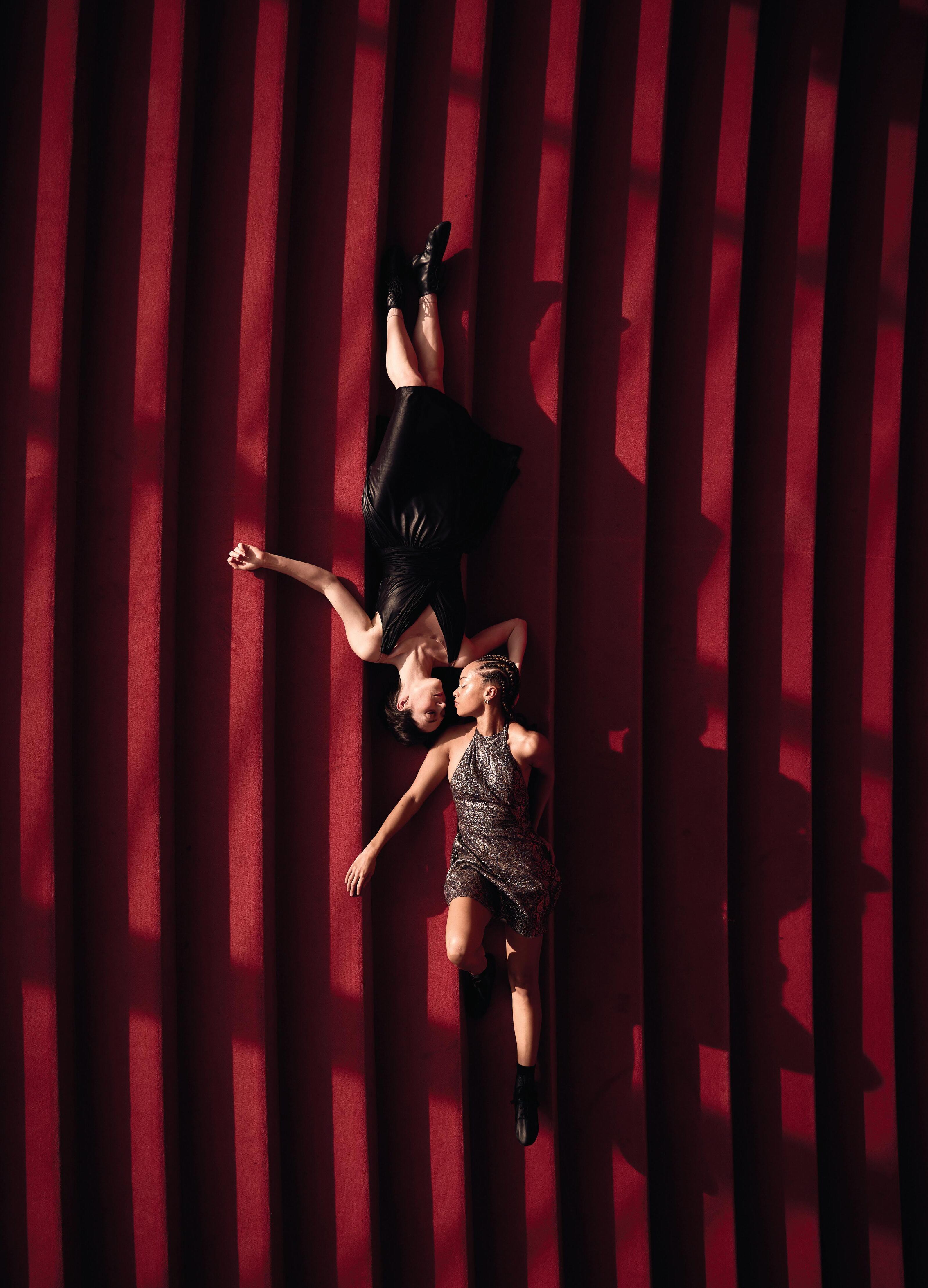

March 2 – 21, 2026
Wade Thompson Drill Hall
Benjamin Millepied Direction, Choreography Sergei Prokofiev Music
François-Pierre Couture Lighting & Scenic Design
Camille Assaf Costume Design
Benjamin Millepied, Olivier Simola Creative Collaboration, Videography
Arcadian Broad, Marissa Brown, Renan Cerdeiro, Courtney Conovan, Addison Ector, Daphne Fernberger, David Adrian Freeland Jr., Kyle Halford, Robert Hoffer, Rachel Hutsell, Shu Kinouchi, Clay Koonar, Giacomo Luci, Morgan Lugo, Audrey Sides, Hope Spears, Emma Spinosi, Noah Wang Company
Sebastien Marcovici Camera Operator
A Park Avenue Armory production in association with L.A. Dance Project and Paris Danse
SEASON SPONSOR PART OF THE FESTIVAL
PUBLIC SUPPORT

Romeo & Juliet Suite is made possible with the support of Dance Reflections by Van Cleef & Arpels and is part of the Dance Reflections by Van Cleef & Arpels Festival.
Additional support for Romeo & Juliet Suite is provided by The Gladys Krieble Delmas Foundation and the Harkness Foundation for Dance.
Bloomberg Philanthropies is Park Avenue Armory’s 2026 Season Sponsor. Leadership support for the Armory’s artistic programming has been generously provided by the Anita K. Hersh Philanthropic Fund, Charina Endowment Fund, Donald A. Pels Charitable Trust, Pinkerton Foundation, the Starr Foundation, the Thompson Family Foundation, and Dance Reflections by Van Cleef & Arpels.
Major support was also provided by the the Arthur F. and Alice E. Adams Charitable Foundation, the Gladys Krieble Delmas Foundation, the Fan Fox and Leslie R. Samuels Foundation, the Horace W. Goldsmith Foundation, the Howard Gilman Foundation, the Marc Haas Foundation, the Emily Davie and Joseph S. Kornfeld Foundation, The Rockefeller Brothers Fund, The Shubert Foundation, the SHS Foundation, The Harold and Mimi Steinberg Charitable Trust, and Wescustogo Foundation. Additional support has been provided by the Armory’s Artistic Council. Public support is provided by the New York State Council on the Arts with the support of Governor Kathy Hochul and the New York State Legislature as well as the New York City Department of Cultural Affairs in partnership with the City Council under the leadership of Speaker Julie Menin. Cover image by Noita Digital. Interior image by Daniel Boud.
We are pleased to welcome you to the first Wade Thompson Drill Hall production of the Armory’s 2026 season, the New York premiere of Romeo & Juliet Suite, choreographer Benjamin Millepied’s immersive and innovative take on Sergei Prokofiev’s classic ballet. This site-specific performance blends dance, film, and theater to immerse audiences in the movement and drama of Shakespeare’s tragic story. Benjamin Millepied is one of the most ambitious dance artists of our time, and we are honored to have him take Armory audiences on a spectacular theatrical journey melding live cinema with performance. Millepied’s choreography for Romeo & Juliet Suite features different casting configurations as the title star-crossed lovers, breaking from traditional gender and pairing norms in a universal, modern celebration of love.
The distinctive Armory spaces serve as a character in the story of this creative production, with scenes unfurling in a number of public and private spaces throughout the building. The Armory, with its grand-scaled Wade Thompson Drill Hall and exquisitely designed historic rooms, provides the massive scale, flexibility, and grandeur needed to present Benjamin’s work at its fullest potential. This live experience beautifully showcases how the Armory can serve as a home for artists whose visions reach far beyond the boundaries of a traditional performance stage, and we are thrilled that New York audiences can come on that journey with us.
Rebecca Robertson
Adam R. Flatto Founding President and Executive Producer
Deborah Warner
Anita K. Hersh Artistic Director
Join us after evening performances for libations with fellow attendees when the bar remains open in one of our historic rooms in a nod to the salon culture of the Gilded Age. You may also get to talk with the evening’s artists, who often greet friends and audience members following their performances.
MARCH 4, 2026
Choreographer and director Benjamin Millepied sits down with dance and performance scholar André Lepecki for a conversation about his artistry, practice, and bringing this immersive production to life at the Armory.
Arts Education at Park Avenue Armory provides unique artistic engagements and educational programming free of charge to underresourced New York City public schools, offering opportunities for students to think creatively and trust their own aesthetic judgments, while encouraging the arts as an avenue for reflection, expression, criticality, and action. Benjamin Millepied’s Romeo & Juliet Suite offers young audiences a wealth of entry points, with the artist’s genuine passion for multiple art forms coming together to tell a universal story of impossible love. Whatever it is that draws students in, be it the choreography, the music, the use of live film, the storytelling, or the inclusion of the Armory building itself as a character in that story, the production’s centering of two young people trying desperately to have love triumph over hate is striking a chord in schools across the city.
Throughout the month of March, over 2,200 New York City public middle and high school students are engaging with Romeo & Juliet Suite through the Armory’s Production-Based Programs, which invite school groups to experience the Armory’s unconventional works of music, theater, dance, visual arts, and more in conjunction with workshops co-facilitated by multi-disciplinary Teaching Artists. Students attend a student-only matinee, which includes a Q&A with members of the company, and participate in teaching artist-led inschool pre- and post-visit workshops, reflecting on their experience with Millepied’s vision and creating their own artistic responses. These master Teaching Artists met with Millepied last year to get insight into his process behind the work to build a foundation for curriculum and engagement planning. Pre-show workshops focus on the concepts of framing—how it creates, changes, or enhances a point of view—and storytelling through movement, while post-performance workshops expand these concepts to other artistic disciplines, asking students to create their own visual art or filmic interpretations of impossible love, connecting their own experiences and inspirations to Millepied’s use of multiple art forms.
Additionally, students from five of the Armory’s Partner Schools are spending their spring semester participating in long-term residencies around the piece, with creative projects inspired by the production and its themes supporting curriculum across English Language Arts classes, theater classes, and dance classes. These residencies integrate performance-based inquiry into core academic curricula, positioning the Armory as an extension of partner school communities. At Williamsburg High School for Architecture and Design, the residency
is supporting their English Language Arts instruction by deepening literary analysis of another Shakespearean tale—King Lear—through character development, narrative arc, and embodied interpretation. At Bronx Envision Academy, the residency enriches the dance curriculum through a comparative study of hip hop, West African Bata dance, and ballet and modern traditions, prompting students to examine lineage, form, and cultural context using the varied influences of Millepied as a touchstone. Students from International High School at Prospect Heights have the opportunity to take a master class with Ballet Master Sebastian Marcovici, while theater students at Claremont International High School are utilizing Millepied’s adaptation as inspiration to create their own devised theatrical pieces exploring the themes of Romeo & Juliet Suite. Across our Partner Schools, the residencies activate multidisciplinary learning that centers student voice and uses artistic practice as a catalyst for critical thinking and meaning making.
The Armory’s Youth Corps Program offers paid and closely mentored internship programs for students ages 16 to 25+. In our Spring 2026 High School Youth Corps Semester, participants are exploring themes of forbidden and lethal love experienced in Romeo & Juliet Suite. Youth Corps met with Millepied to learn about his process and experience art around New York City in various mediums, researching examples of storytelling, film, theater, and sound. Their explorations contribute to their culminating project—a short silent film that retells a modernday love story, highlighting the most pivotal details of the story and utilizing the historic Armory spaces as a character in their retold story. Through distinctive productions such as Romeo & Juliet Suite, students and educators engage rigorously with form, style, historical context, and the enduring lineage of classical works. Rather than encountering performance as a singular event, the Armory’s Arts Education programs support long-term exploration, encouraging students to examine how one work intersects with multiple narratives, disciplines, and lived experiences. There are many reasons why this tragic story continues to resonate through the years, but this production’s particular artistic choices of a lush aesthetic palate with a wordless and stripped-down narrative offers every audience member the opportunity to make their own meaning and take their own lessons, trusting in each of them to carry that with them.
The story of Sergei Prokofiev’s ballet Romeo and Juliet has three acts: its conception, its Soviet transformation, and its long afterlife. Act I is the ballet as he initially conceived it in 1935, then revised it in 1936. Act II begins in 1940, when the music was changed without his permission and choreographed in a manner Prokofiev found offensive. The third and final act unfolds after the composer’s death in 1953, tracing the various adaptations of the ballet; most slim down the Soviet version, a sluggish blockbuster. Design is destiny in the neoclassical treatments: the young lovers are doomed and have no say in the matter, but their anguish is real, and Frederick Ashton made audiences feel their despair in his 1955 retelling. In 1965, Kenneth MacMillan responded to the playfulness of John Cranko’s 1962 version by drenching the ballet in decadence. Rudolf Nureyev’s 1977 setting adds mystical horror to the tragedy: death courts Juliet before Romeo does. In 2008, Mark Morris restored details of the 1935 scenario and music, including the original ending which allows the couple to dance into a starlight elsewhere of eternity. Benjamin Millepied’s production distills the tragedy, excising the bloat of imperial grand ballet as well as the repressive conventions of the art – the gender divisions, the corseted eroticism. Millipied is an artist of our time, but his Romeo and Juliet Suite challenges what Prokofiev himself took on.
Born in Russia, Prokofiev spent eighteen years in the United States and Europe, cutting his teeth as a ballet composer with the modernist Ballets Russes troupe in Paris. He was interested in new theatrical technologies and loved the idea of blending ballet with music hall and cinema, as did the Ballets Russes and its rival, the Ballets Suédois. If things had turned out differently, less horribly, Prokofiev might have become a Hollywood composer. Millipied’s cinematic treatment of Prokofiev’s cinematic music for Romeo and Juliet offers a belated acknowledgment of this moment in the composer’s career.
Instead of working in Hollywood, Prokofiev found himself trapped in the Soviet Union, having been lured to Moscow from Paris in 1935 with promises of commissions and performances. Soon after repatriating, he began work on Romeo and Juliet, commissioned by Vladimir Mutnïkh, general director of the Bolshoi Theater. The composer collaborated with Sergei Radlov, an adventurous director who had staged several Shakespeare plays at his theater in Leningrad, and Adrian Piotrovsky, a dramatist interested in reviving the theater of Ancient Greece and involved in the Leningrad Theater of Working Youth. Prokofiev prepared the outline of the scenario based on his knowledge of the Shakespeare play, which he read in English, transposing the 1597 tragedy from Renaissance Verona to the present-day Soviet Union. (The drama between the Montagues and Capulets was interrupted by a Soviet May Day parade.) A trio of exotic dances, conceived by Radlov, enlivened the penultimate act, and at the end Romeo and Juliet die but live, escaping into the bright new Soviet realm. Prokofiev previewed the score at the piano on October 4, 1935, at the Bolshoi Theater, and again on January 25, 1936, in the editorial offices of the newspaper Sovetskoye iskusstvo (Soviet Art). These were closed-
door run-throughs for officials from the newly formed Committee on Arts Affairs, a watchdog bureaucracy ensuring ideological and aesthetic conformity. The music was met with bewilderment, and doubts about staging the ballet arose even before the music was orchestrated. The Bolshoi delayed the premiere from the 1935-36 season to 1936-37, then cancelled it altogether when Mutnïkh, the director of the Bolshoi, lost his post in a purge of the military. A former Red Army official, he was arrested by the NKVD, the secret police under Stalin, and executed. The ballet itself was then purged. Having been rejected by the Soviet censors, the original scenario and score were both extensively reworked; almost nothing would remain of Prokofiev’s collaboration with Radlov in the years ahead. Platon Kerzhentsev, the zealous bureaucrat who chaired the Committee for Arts Affairs, felt that Prokofiev was not taking the task of composing a ballet based on a classic text seriously. (Shakespeare had a strong influence on Russian writers, including Pushkin, and Stalinist cultural officials rejected efforts to update or alter his plays.) To see Romeo and Juliet performed, Prokofiev had to jettison the happy ending, file down the jarring harmonic shifts, and smooth over the ironic juxtapositions of numbers – for example, by cutting the colorful exotic dances that were to follow Juliet drinking the poison. By 1937, all that remained of Radlov’s input was the name given to one of the exotic dances, “Dance of the Girls from Antilles.” For the eventual 1940 premiere in Leningrad, Prokofiev renamed it “Dance of the Girls with Lilies,” thus removing even this last trace of his collaboration with Radlov from the record.
Even as the ballet languished in the Soviet Union, a premiere of sorts took place in a provincial theater in Brno, Czechoslovakia, on December 30, 1938, a gesture of Soviet cultural support for the nation on the eve of its fall to the Nazis. Ivo Váňa-Psota choreographed the ballet and took the part of Romeo. Zora Šemberová partnered him as Juliet. It was a partial presentation – not of the full score – with a chorus reciting the tragic ending of Shakespeare’s play. In the Soviet Union, Prokofiev continued to promote the music of the ballet on its own, without a scenario or staging, by rearranging it for orchestral and solo piano performance: “Enough!” he said to the ballet historian Yuri Slonimsky in May 1936, drawing a line in the air with his hand. “No ballets! I’ll create suites from Romeo, and they will perform them!”
The two orchestral suites combine different sections of the ballet named after discrete scenes in Shakespeare’s play. The scoring is reduced, and the tempos are adjusted. The first suite was premiered in Paris under the baton of Albert Wolff on December 19, 1936. Prokofiev recalled some in the audience “sighing with regret” over the simplification of his musical language for Soviet consumption. The Second Orchestral Suite was fashioned in 1937. The consensus is that the suites are an impoverished condensation of the ballet, but Prokofiev considered them a concatenation and intensification of the conflicts and struggles that define the principal characters existences. Here too, Millepied’s production is homage to a conception of the ballet that the inflated productions of the twentieth century negated.
On August 28, 1938, just before the Brno Opera House started to rehearse the ballet, Prokofiev received a telegram from the Kirov Theater expressing interest in adding it to the 1939-40 season. The Leningrad production, choreographed by Leonid Lavrovsky and conducted by Isay Sherman, required changes to the scenario and the music that Prokofiev resisted. Some revisions were made without his knowledge on the eve of the January 11, 1940, premiere.
For the dancers, the challenge of the ballet was less aesthetic than practical. The loudest complaint came from ballerina Galina Ulanova in the role of Juliet. She found Prokofiev’s rhythmic sequences difficult to count and pestered him to recompose them. Later, she ascribed the trouble to her training. The dancers in the troupe had been schooled in simple counts, not conflicting meters:
To be honest, we weren’t used to such music, in fact we were a little afraid of it. It seemed to us that in rehearsing the Adagio from Act I, for example, we were following some melodic pattern of our own, something nearer to our own conception of how the love of Romeo and Juliet should be expressed than that contained in Prokofiev’s “strange” music. I confess that we didn’t hear that love in his music then.
Prokofiev listened to the complaints about the score and at first ignored most of them. But then, for the sake of the production, he conceded, tweaking rhythmic sequences, cadences, even the instrumentation. Radlov attended a rehearsal and was appalled: “Bear in mind that I don’t take any responsibility for this disgrace.” That disgrace became a hit in the Soviet Union thanks to Ulanova. “More people didn’t get a ticket than got a ticket,” Prokofiev wrote in his journal before he died. Prokofiev himself was a star-crossed composer, fated to a bad end by external circumstances. So too was his ballet, and the characters in it. Nothing that he wanted to happen ultimately came true. He was told that he could write music about progress toward enlightenment, the universal common good. But there was no such evolution in Stalinist Russia, where his ballet about fundamental forms of human expression, connection, and compassion was challenged, censored, and cut. Still, he poured his love for music into his score. For at least music, he told everyone and anyone, could escape places where “civil blood makes civil hands unclean” to live forever.
Simon Morrison is Professor of Music and Slavic Languages and Literatures at Princeton University. He was published extensively about Prokofiev and other Russian composers. His history of Moscow is forthcoming from Knopf.
Benjamin Millepied is a choreographer, director, and former principal dancer with New York City Ballet. Born in Bordeaux, France, he spent his early childhood in Senegal, where his interest in dance began, inspired by his mother. Millepied trained at the Grand Théâtre de Bordeaux, the Conservatoire National Supérieur de Lyon, and later at the School of American Ballet, where he performed in the original cast of Jerome Robbins’s 2 & 3 Part Inventions. He received the Prix de Lausanne and the Mae L. Wien Award in 1994, joined New York City Ballet in 1995, and was promoted to principal dancer in 2001. Millepied began choreographing in 2001 and has since created works for major companies worldwide. He founded L.A. Dance Project in 2012 and served as director of Paris Opera Ballet from 2013 to 2016. In 2022, he co-founded Paris Dance Project, an initiative integrating dance education into schools and presenting La Ville Dansée, a yearly citywide event. Recent projects include Romeo & Juliet, Be Here Now, Unstill Life, Me.You.We.They, Grace, and Rituel. Millepied made his feature film directorial debut with Carmen and was awarded the French Legion of Honor in 2024.
Sergei Prokofiev (1891–1953) was a Russian composer, pianist, and conductor whose distinctive voice helped shape twentieth-century music. Born in Sontsovka, Ukraine, he showed early musical talent and entered the St. Petersburg Conservatory at thirteen, developing the bold harmonic language, rhythmic vitality, and lyrical clarity that would define his work. After leaving Russia in 1918, Prokofiev lived in the United States and Europe, composing major works and establishing an international reputation. He returned to the Soviet Union in 1936, entering a highly productive period that included the creation of Romeo & Juliet, now considered one of the great masterpieces of the ballet repertoire. Its sweeping melodies, vivid character themes, and dramatic contrasts have made it one of Prokofiev’s most enduring and beloved scores. Prokofiev’s output spans symphonies, concertos, operas, ballets, chamber works, and film scores, reflecting a remarkable range and originality. Despite political pressures and shifting artistic climates, he remained a central figure in twentieth-century music, leaving a legacy of extraordinary breadth and influence.
François-Pierre Couture, originally from Montréal, Canada, has worked as a scenic, lighting, and projection designer in Los Angeles and throughout the United States since 2006. His multidisciplinary approach has allowed him to create work across a wide range of theatrical environments. In addition to his design practice, Couture is a visual artist whose pen-and-pencil street sketches and mixed-media paintings explore the layered vibrancy of Los Angeles, his adoptive home. Couture’s theater design credits include Metamorphoses and Frankenstein at A Noise Within; Our Dear Dead Drug Lord at Center Theatre Group; Romeo & Juliet (touring) with L.A. Dance Project; The Present, The Future, and Invisible Tango at the Geffen Playhouse; and Measure Still for Measure and Everything That Never Happened at Boston Court Theatre. Additional credits include Destiny of Desire, The Mexican Trilogy: An American History, Carmen Jones, and Everything Is Illuminated.
Camille Assaf is a Franco-American costume designer whose work spans opera, theater, dance, and film. She has designed for companies across the United States and internationally, bringing a refined visual sensibility to both classical and contemporary productions. Recent opera projects include Le Roman de Fauvel at the Théâtre du Châtelet, as well as ongoing collaborations with Peter Sellars on Adriana Mater, Médée, and Beatrice di Tenda. Assaf has also designed for Basel Opera, Opera Holland Park, and the Opéra Royal de Versailles, and has created costumes for productions at Santa Fe Opera, Juilliard Opera, and Wolf Trap. In dance, Assaf has collaborated with Benjamin Millepied and L.A. Dance Project, contributing to the company’s distinctive visual world. Her New York work includes productions at the Mint Theater, Ars Nova, and the Joyce Theater. Assaf holds degrees from the Sorbonne and an MFA from the Yale School of Drama.
Olivier Simola is a French dancer and video artist whose work bridges choreography and visual design. After training at the Conservatoire National de Région in Grenoble and the Conservatoire National Supérieur Musique et Danse de Lyon, he began his career performing with choreographers including Andy Degroat, Jean-François Duroure, Joel Borges, and Christophe Salengro. In 1995, Simola joined DCA, the company founded by Philippe Decouflé, becoming a central artistic collaborator and contributing to numerous creations. Simola’s dual expertise in dance and video has led to ongoing collaborations with choreographers such as Benjamin Millepied and Mikhail Baryshnikov, where his projection design plays a key role in shaping each work’s visual world. His projects for Cirque du Soleil include the company’s performance at the 84th Academy Awards, as well as Michael Jackson ONE and IRIS. Simola continues to develop a multidisciplinary practice that merges movement, imagery, and technology.
Arcadian Broad, originally from Titusville, Florida, began training in tap, hip-hop, and jazz before discovering ballet at fifteen. He joined Orlando Ballet at sixteen, becoming its youngest Principal Dancer, and later danced with Cincinnati Ballet and Sarasota Ballet. Broad has performed leading roles in Romeo and Juliet, Swan Lake, The Firebird, and works by Twyla Tharp and Jerome Robbins. A choreographer and composer, he has created contemporary works and two full-length ballets featuring his original scores. Broad also appears in theater and TV/film, including the Amazon series Étoile
Marissa Brown is a dancer, actress, and multidisciplinary artist whose primary language comes from movement of the body. She holds a BFA in Performance and Choreography from the University of California, Irvine, and an MFA from the California Institute of the Arts. Brown has performed with Dimitri Chamblas, Benjamin Millepied’s L.A. Dance Project, Ivo van Hove’s Broadway production of West Side Story, Celia Rowlson Hall, Alexis Blake, Phantom Limb Company, Heidi Duckler Dance, Donald McKayle, Sharp & Fine, Heiner Goebbel’s production of De Materie, Alexandra Pirici, Rosanna Gamson, Patricia Norowol Dance Theatre, Madeline Hollander, and more.
Cerdeiro trained at the Escola de Dança Alice Arja in Rio de Janeiro, Brazil, where he developed a strong classical foundation. In 2008, he was named a finalist at the prestigious Prix de Lausanne in Switzerland and, the same year, received a scholarship to train at the Miami City Ballet School. Within two years, Cerdeiro was invited by the company’s Founding Artistic Director, Edward Villella, to join Miami City Ballet as an apprentice. In 2013, he was promoted to Principal Dancer under the direction of Lourdes Lopez. His career also includes guest appearances with Golden State Ballet, Dance Theatre of Harlem, and Twyla Tharp Dance.
Courtney Conovan (she/they) trained at the SUNY Purchase Conservatory of Dance, performing works by Jie-Hung Connie Shiau, Doug Varone, Annie Rigney, Roderick George, and Rosalind Newman, and studying abroad at the London Contemporary School of Dance. Conovan joined L.A. Dance Project in 2022 and has performed works by Benjamin Millepied, Bobbi Jene Smith and Or Schraiber, Pam Tanowitz, Dimitri Chamblas, Janie Taylor, Madeline Hollander, and Jamar Roberts. Their choreography has been presented at the Made By Women Festival, and Conovan’s practice centers curiosity, collaboration, and the creation of supportive artistic spaces.
Addison Ector (California, USA) trained at the Debbie Allen Dance Academy and The Alvin Ailey School. He danced for five years with Complexions Contemporary Ballet, performing works by Rhoden, Richardson, Joo, and Gomes, and later joined TanzCompany Innsbruck in Austria, performing works by Valga, Kylián, Duato, Bigonzetti, and Scholz. Ector has also guested with Limonada Dance Company in Austria. His credits include Gap’s Fall 2016 Fitness Campaign, Associate Choreographer for Mozart Her Story in London, and features in The Art of Movement and Dancers After Dark. He is a lecturer at Chapman University and assistant to choreographer Jae Man Joo.
Daphne Fernberger is a dancer, choreographer, and movement director, and since 2021 has been a Company Member at L.A. Dance Project. Prior, they were a Company Member of Cedar Lake Contemporary Ballet and the Dresden Frankfurt Dance Company. As a performer, Fernberger has collaborated on new works by Benjamin Millepied, Bobbi Jene Smith, Or Schraiber, Jill Johnson, Rauf “Rubberlegz” Yasit, Jacopo Godani, and Richard Siegel. Fernberger has performed repertoire by William Forsythe, Pina Bausch, Merce Cunningham, and Crystal Pite. Fernberger’s work spans theater, collaborations with visual artists, and film. Fernberger is a graduate of JKO School and The Juilliard School.
David Adrian Freeland, Jr. trained at LaVilla School of the Arts and the Jacksonville Centre of the Arts before attending the Conservatory of Dance at SUNY Purchase College. He danced with Ailey II for three years, performing works by Alvin Ailey, Judith Jamison, and Robert Battle, and later performed with The Metropolitan Opera and Missouri Ballet Theatre. From 2016 to 2024, Freeland danced with L.A. Dance Project, performing works by Benjamin Millepied, Kyle Abraham, Justin Peck, Ohad Naharin, Martha Graham, and Merce Cunningham. He received a Princess Grace Award in 2018 and holds degrees from Saint Mary’s College of California and Rowan University.
Kyle Halford earned his BFA from the University of Arizona and spent two seasons with Eisenhower Dance Detroit prior to moving to New York City. He began working with Twyla Tharp Dance in 2023 and joined her 60th Anniversary Tour in 2025. Halford is a member of PARA.MAR Dance Theatre and has guested with numerous other modern and contemporary dance companies in New York. Other highlights include dancing in the ensemble of the Radio City Christmas Spectacular and appearing on Amazon Prime’s Etoile choreographed by Marguerite Derricks. Halford is excited to be joining L.A. Dance Project for these performances.
Robert Hoffer, originally from Long Island, New York, trained at Fusion Dance Complex under Kyle and Amanda Preiser, with mentorship from Daniel Tidwell. He earned his BFA from the USC Glorya Kaufman School of Dance, performing works by Jiří Kylián, Kyle Abraham, Peter Chu, Roderick George, Bret Easterling, and Micaela Taylor. Hoffer has trained extensively in contemporary and improvisational techniques and participated in programs including Gaga Lab and Gallim L.A. Experience. He has worked in masterclasses with Garen Scribner, Yin Yue, Spenser Theberge, Bobbi Jene Smith, and Or Schraiber. Hoffer currently performs with L.A. Dance Project.
Rachel Hutsell was born in Houston, TX, and joined New York City Ballet in 2015. In 2023 she began performing with State Street Ballet, and she is now a Freelance Artist in based in Southern California. In 2018 while she was at NYCB, Hutsell was featured in Ballet Now, a documentary directed by Steven Cantor, and in 2019 she was the dance double for “Anita” in Steven Spielberg’s West Side Story. Hutsell has been highlighted in articles by Women’s Wear Daily and Dance Spirit, as well as the cover feature of Pointe Magazine’s June/July 2018 issue.
Shu Kinouchi, a Japanese artist, trained at Mayumi Kinouchi Ballet Studio, the Hamburg Ballet School, and the Jacqueline Kennedy Onassis School at American Ballet Theatre, then joined the ABT Studio Company. He has danced with Houston Ballet, Tulsa Ballet, and, since 2020, L.A. Dance Project, performing works by Benjamin Millepied, Bobbi Jene Smith, Or Schraiber, Dimitri Chamblas, Idio Chichava, Rauf Yasit, and Janie Taylor. Kinouchi creates choreography and solo performances, including collaborations with WAKAWAKA on SHU LOVES CHAIR and Hiroshi Kaneko on WALL—BODY. He served as Creative Lead for L.A. Dance Project’s 2025 Summer Dance Intensive.
Clay Koonar trained in ballet, tap, and modern dance at the Richmond Academy of Dance before moving to Germany to study at the Palucca Hochschule für Tanz. He later completed an internship at Saarländisches Staatstheater Saarbrücken and joined the Dresden Frankfurt Dance Company under Jacopo Godani. Over six years with the company, Koonar performed original works, museum installations, and featured roles in pieces by Jacopo Godani, William Forsythe, and Marco Goecke. Since 2023, he has worked as a freelance dancer and performance artist, contributing to projects for the Venice Biennale, Operator, and Oona Doherty.
Giacomo Luci is a dancer, performer, and choreographer. He began his career as a soloist at the Teatro dell’Opera di Roma and continued at the Opéra de Lyon, where he engaged deeply with contemporary dance and performed works by Forsythe, Bausch, Cunningham, Childs, and Brown. Luci has collaborated as both an actor and dancer in cinematic and institutional productions. Since 2018, he has developed his own choreographic research, presented at numerous contemporary performance festivals.
Morgan Lugo is a freelance dance artist, creative and movement director based in Paris, hailing from Wilmington, North Carolina. Educated at the North Carolina School of the Arts, SUNY Purchase, and Taipei National University of the Arts, Lugo has performed and created work internationally with seminal choreographers including Pina Bausch, William Forsythe, Crystal Pite, Akram Khan, Sharon Eyal, Anne Teresa De Keersmaeker, Sidi Larbi Cherkaoui, Damien Jalet, and Benjamin Millepied. A Founding Member of L.A. Dance Project in 2012, Lugo’s practice spans stage, site-specific performance, film, and fashion, grounded in a deeply collaborative, cross-disciplinary approach.
Audrey Sides trained at the Oakland Ballet School, the Oakland School for the Arts, and the San Francisco Ballet School before joining Ballet Austin as a trainee. In 2019, she moved to Chicago to train with the Hubbard Street Professional Program and helped found Little Fire Artist Collective. Sides relocated to Vancouver in 2021, working with Daina Ashbee, Joshua Beamish, the Biting School, Alyssa Favero/VOLT24, and Eilish Shin-Culhane while developing her choreography and training at Modus Operandi. She performed works by Shay Kuebler, Nicolas Ventura, b. Solomon, Brandon Alley, Yin Yue, and Zahra Shahab. Sides joined L.A. Dance Project in 2023.
Hope Spears (she/her) trained in West Palm Beach, Florida, before earning her BFA in Dance from George Mason University, where she performed works by Micaela Taylor, Kyle Abraham, Christopher d’Amboise, and Hope Boykin. She attended programs including Bates Dance Festival, Jacob’s Pillow Contemporary Program, and NW Dance Project’s MOVE program. After graduating in 2021, Spears began guesting with L.A. Dance Project before joining fulltime in 2023. While dancing for LA Dance Project she has performed works by Benjamin Millepied, Bobbi Jene Smith and Or Schraiber, Idio Chichava, Janie Taylor, Jobel Medina, Madeline Hollander, Pam Tanowitz, and Rauf Yasit.
Emma Spinosi is a dancer, choreographer, movement director in fashion and film. In 2019, she joined Ballet Preljocaj, performing Snow White and The Four Seasons while completing the National Superior Diploma in Dance. In 2020, she joined Rambert Dance Company, performing works by Sharon Eyal, Micaela Taylor, Ohad Naharin, Trisha Brown, Andrea Miller, Megan Lawson, and Benoit Swan Pouffer. She earned a Master’s in Professional Dance Performance with Honors. She joined The Theater of Luzern in 2023. In 2025, she began working with Benjamin Millepied on La Ville Dansée with The Paris Dance Project and officially joined the Grace Company in September.
Noah Wang (he/they) trained at the San Francisco Ballet School and the Ruth Asawa School of the Arts before attending The Juilliard School from 2016 to 2020. At Juilliard, Wang performed works by John Higginbotham, Peter Chu, Martha Graham, Stephen Petronio, Twyla Tharp, and José Limón. Since graduation, he has performed with Alonzo King LINES Ballet, ODC Theater, Buglisi Dance Theatre, Peridance Contemporary Dance Company, The Metropolitan Opera, and the award-winning immersive show Sleep No More. He is currently a certified GYROTONIC™ and GYROKINESIS™ trainer, and has joined L.A. Dance Project for the 2025–26 season.
Sebastien Marcovici, born and raised in Paris, began his ballet training at eight and later studied at the School of the Paris Opera Ballet. In 1993, while training at the Chautauqua School of Dance, he was invited by Peter Martins to take class with New York City Ballet, joining the company later that year. Marcovici was promoted to soloist in 1998 and principal dancer in 2002, performing featured roles in works by George Balanchine, Jerome Robbins, and many contemporary choreographers. After retiring in 2014, he served as Rehearsal Director at Paris Opera Ballet and now works with L.A. Dance Project as Associate Artistic Director and Rehearsal Director.
Nathan Shreeve-Moon Director of Production, LA Dance Project
Alisa Wyman Production and Tour Manager, LA Dance Project
Betsy Herst, Alayna McCabe Stage Managers
Kanako Morita Company Manager
Janneurys Colon Assistant Company Manager
Felipe Aguirre, Habib Apo-oyin, Eden Battice Production Assistants, Programming
Ruby Carmel, Jacob King Production Assistants, Production
Clíona Smith Production Carpenter
Adrienne Swan, Courtney Bissonette, Tim Scott, Yedoye Travis
Deck Carpenters
Yung-Hung Sung Lighting Director
Nicholas Houfek Lighting Supervisor
Dave “Tater” Polato Production Electrician
Taylor Jensen Lighting Programmer
Claire Waggoner Board Operator
Andrew Carey, Mikelle Kelly, Colin Hirsch-Wilson Deck Electricians
Mark Grey Audio Supervisor
Max Helburn Audio Systems Engineer
Jeff Rowell Production Audio
Will Bennett Deck Audio
Laurent Radanovic Video Direction
Dan Santamaria Production Video
Pedro Lima Deck Video
Victoria Bek Wardrobe Supervisor
Jeffrey Shirbroun, Caitlynne Simonton Dressers
James Tullos Production Rigger
Theodore Sarge Seating Supervisor
L.A. Dance Project is a non-profit dance company under the Artistic Direction of Benjamin Millepied. Founded in 2012, we opened the doors to our studio and performance space in Los Angeles’ downtown arts district in 2017. L.A Dance Project is dedicated to the pursuit of artistic innovation and excellence in the realm of contemporary dance. Our mission is to explore the boundaries of movement, creativity, and expression. Through experimentation and collaboration, we strive to create captivating performances that challenge, provoke, and inspire audiences worldwide. Grounded in a commitment to artistic integrity and authenticity, we aim to cultivate a culture of curiosity, openness, and growth within our company and beyond. With humility and passion, we seek to contribute to the evolution of dance as a dynamic and transformative art form, enriching lives and fostering connections across cultures and communities.
Benjamin Millepied Artistic Director
Sebastien Marcovici Associate Artistic Director
Christopher Macdougall Director of Legal & Business Affairs
Peter Forbes McDowell Director of Development
Alice Mathis Director of Communications
Rachelle Rafailedes Mucha Director of Foundation & Government
Grants / Director of Artist Residency Program
Chris Tynan Director of Operations & Technology
Nathan Shreeve-Moon Director of Production
Alisa Wyman Production and Tour Manager
Romeo and Juliet, op. 64 (Excerpts)
Music by Sergei Prokofiev
Libretto by Sergei Radlov, Adrian Piotrovsky, Leonid Lavrovsky, and Sergei Prokofiev
Presented under license from G. Schirmer, Inc., copyright owners
BNW Rigging
Five Ohm Productions
Odeum Labor Services
M Stevens Production Consultants
Lighting, Rigging, and Video Equipment by 4Wall Entertainment
Audio Equipment by Masque Sound
SteelDeck NY
Solenne du Haÿs Mascré Co-Founder & CEO, Paris Danse
Part palace, part industrial shed, Park Avenue Armory supports unconventional works in the performing and visual arts that cannot be fully realized in a traditional proscenium theater, concert hall, or white wall gallery. With its soaring 55,000-square-foot Wade Thompson Drill Hall—reminiscent of 19th-century European train stations—and an array of exuberant period rooms, the Armory provides a platform for artists to push the boundaries of their practice, collaborate across disciplines, and create new work in dialogue with the historic building. Across its grand and intimate spaces, the Armory enables a diverse range of artists to create, students to explore, and audiences to experience epic, adventurous, relevant work that cannot be done elsewhere in New York.
The Armory both commissions and presents performances and installations in the grand Drill Hall and offers more intimate programming through its acclaimed Recital Series, which showcases musical talent from across the globe within the salon setting of the Board of Officers Room; its Artists Studio series curated by Jason Moran in the restored Veterans Room; Making Space at the Armory, a public programming series that brings together a discipline-spanning group of artists and cultural thought-leaders around the important issues of our time; and the Malkin Lecture Series that features presentations by scholars and
writers on topics related to the Armory and its history. In addition, the Armory also has a year-round Artists-in-Residence program, providing space and support for artists to create new work and expand their practices.
The Armory’s creativity-based arts education programs provide access to the arts to thousands of students from underserved New York City public schools, engaging them with the institution’s artistic programming and outside-the-box creative processes. Through its education initiatives, the Armory provides access to all Drill Hall performances, workshops taught by Master Teaching Artists, and in-depth residencies that support the schools’ curriculum. Youth Corps, the Armory’s year-round paid internship program, begins in high school and continues into the critical post-high school years, providing interns with mentored employment, job training, and skill development, as well as a network of peers and mentors to support their individual college and career goals.
The Armory is undergoing a multi-phase renovation and restoration of its historic building led by architects Herzog & de Meuron, with Platt Byard Dovell White as Executive Architects.
Rebecca Robertson Adam R. Flatto Founding President and Executive Producer
Deborah Warner Anita K. Hersh Artistic Director
ARTISTIC PLANNING AND PROGRAMMING
Michael Lonergan Senior Vice President and Chief Artistic Producer
Chris Greiner General Manager
Rachel Rosado Producer
Samantha Cortez Producer
Darian Suggs Associate Director, Public Programming
Kanako Morita Company Manager/Associate Producer
Oscar Peña Programming Coordinator
ARTISTIC PRODUCTION
Paul E. King Director of Production
Claire Marberg Deputy Director of Production
Nicholas Lazzaro Technical Director
Lars Nelson Technical Director
Mars Doutey Technical Director
Rachel Baumann Assistant Production Manager
ARTS EDUCATION
Cassidy L. Jones Anita K. Hersh Chief Education Officer
Monica Weigel McCarthy Director of Education
Naima Warden Associate Director of School Programs
Biviana Sanchez School Programs Manager
Nadia Parfait Education Programs Manager
Ciara Ward Associate Director of Youth Corps
Bev Vega Youth Corps Manager
Milen Yimer Youth Corps Coordinator
Drew Petersen Education Special Projects Manager
Emily Bruner, Donna Costello, Alberto Denis, Alexander Davis, Asma Feyijinmi, Shar Galarza, Hawley Hussey, Larry Jackson, Drew Petersen, Leigh Poulos, Neil Tyrone Pritchard, Bairon
Reyes Luna, Vickie Tanner, Jono Waldman Teaching Artists
Daniel Gomez, Nancy K. Gomez, Maxim Ibadov, sunyoung kim, Amo Ortiz Teaching Associates
Arabia Elliot Currence, Sebastian Harris, Oscar Montenegro, Adriana Taboada Teaching Assistants
Shatisha Bryant, Alexus Heiserman, Melina Jorge Teaching Apprentices
Felipe Aguirre, Eden Battice, Terry Beaupierre, Zeinebou Dia, Azrael Hernandez, Nephthali Mathieu, Elijah Tejeda, AJ Volkov Youth Corps Advisory Board
Felipe Aguirre, Habib Apooyin, Eden Battice, Andrew Duer, Annalisa Fortune, Lolo Iberle, Alan Munoz, Elijah Tejeda, Briana Trivino Youth Corps, Post High School Advanced Interns
Justin Amesquita, Medina Anthony, Joaquin Berrio, Julia Childress, Viviana Collado, Noel Conde, Jean Alix Francois, John Guzman, Tatiana Hayes, Jahrye Jalloh, Alejandro Mayorquin, Jacelyn Melendez, Aldahir Morales, Cheyenne Orr, Ayden Rivera, Dante Serpa, Ousmane Tirera Youth Corps, High School
BUILDING OPERATIONS
Marc Von Braunsberg Chief of Building Operations
Samuel Denitz Director of Facilities
Xavier Everett Security/Operations Manager
Williams Say Superintendent
Olga Cruz, Leandro Dasso, Mayra DeLeon, Jeferson Avila,
Felipe Calle, Edwin Fell, Jonathan Mays, Tyrell Shannon
Castillo Maintenance Staff
Jason Moran Curator, Artists Studio Tavia Nyong’o Curator, Public Programming
DEVELOPMENT
Patrick Galvin Chief Development Officer
Alan Lane Director of Development
Caity Miret Executive Assistant to the Chief Development Officer
Jessica Pomeroy Rocca Director of Individual Giving
Georgia Catechis Individual Giving Coordinator
Angel Genares Director of Institutional Giving
Hans Rasch Manager of Institutional Giving
Séverine Kaufman Manager of Special Events
Michael Buffer Director of Database and Development Operations
Maeghan Suzik Manager of Development Operations
EXECUTIVE OFFICE
Lori Nelson Executive Assistant to the President
Nathalie Etienne Administrative Assistant, President’s Office
Simone Elhart Rentals and Project Manager
FINANCE, HR, AND IT
Judy Rubin Chief Financial Officer
Philip Lee Controller
Khemraj Dat Accounting Manager
Zeinebou Dia Junior Accountant
Neil Acharya Human Resources Manager
Oku Okoko Director of IT
MARKETING, COMMUNICATIONS, AND AUDIENCE SERVICES
Tom Trayer Chief Marketing Officer
Nick Yarbrough Associate Director of Digital Marketing
Dileiny Cruz Digital Marketing Coordinator
Allison Abbott Senior Press and Editorial Manager
Mark Ho-Kane Graphic Designer
Joe Petrowski Director of Ticketing and Customer Relations
Monica Diaz Box Office Manager
John Alden Hooper Assistant Box Office Manager
Jordan Isaacs, Ester Teixeira Vianna Box Office Lead
Victor Daniel Ayala, Fiona Garner, Sylvie Goodblatt, Sarah Jack, Matthew Kamen, Emma Komisar, Michelle Meged, Caleb Moreno, Annie Sauerburger, Dylan Taylor, Isabel Velasquez Box Office Associates
Caitlin O’Keefe, Anne Wolff Tour Guides
Natasha Michele Norton Director of House Management
Clayton McInerney, Nancy Gill Sanchez, Rachel Carmona House Managers
Becky Ho, Cody Castro, Kyle McClellan, Neda Yeganeh Assistant House Managers
Adonai Fletcher-Jones, Aiyana Greene, Beth Miller, Billie Martineau, Blue Price, Christina Johns, Christine Lemme, David Lawson,
Denise Williams, Eboni Greene, Edwin Adkins, Eileen Rourke,
Elijah Tejeda, Eliza Goldsteen, Emmett Pryor, Felipe Aguirre, Glori Ortiz, Grace Hazen, Heather Sandler, Hector Rivera, Hillary Ramirez
Perez, John Summers, Joseph Balbuena, Kathleen Rodriguez, Kathleen White, Kedesia Robinson, Kin Tam, Konlan Yenupaak, Lana Hankinson, Mae Cote, Maria Inkateshta, Mariel Mercedes, Mathew Tom, Melina Jorge, MJ Ryerson, Myren Mandap, Naomi
Santos, Regina Pearsall, Sandra Kitt, Sarah Gallick, Sebastian Harris, Shannon Wallace, Tess Kondratiev, Yesenia Mayers, Zulay
Calamari Ushers
Resnicow + Associates Press Representatives
JUNE 10 – AUGUST 2
Acclaimed artist, musician, and composer Céleste Boursier-Mougenot presents the largest iteration to date of his ongoing aquatic and musical installation, featuring a series of circular basins filled with water in which ordinary ceramic bowls float and gently collide to produce melodious chiming sounds. These physical and sonic configurations are constantly changing, creating a bespoke auditory experience that invites audiences to contemplate time and sound as both individual and collective experiences.
NORTH AMERICAN PREMIERE THE CHERRY ORCHARD
SEPTEMBER 14 – 25
The award-winning director and dramatist Simon Stone returns to the Armory with his radical adaptation of Anton Chekhov’s final play about a family in crisis. Reimagined in modern-day South Korea and brought to life in a transparent glass house by an all-Korean cast including Haesoo Park, this tragicomedy offers audiences a voyeuristic view into the characters’ private lives as they navigate change and domestic conflict.
MUSIC FOR 18 MUSICIANS: STAGED VARIATIONS
OCTOBER 14 – 18
In commemoration of the 50th anniversary of its premiere and the 90th birthday of composer Steve Reich, this masterpiece is staged in a durational cycle by enveloping audiences to reveal the intricate structure of the composition, performed by three generations of musicians including the Steve Reich Ensemble and Alarm Will Sound under the baton of Alan Pierson with connective interludes by special guests to hear the iconic composition anew and from within.
NORTH AMERICAN PREMIERE
A PARK AVENUE ARMORY COMMISSION
BALKAN EROTIC EPIC
DECEMBER 8 – 20
Visionary performance artist Marina Abramović returns to the Armory to realize her largest-scale performance work to date, combining dance, song, and ritual to experience dramatic adaptations of Balkan mythology and folklore enacted by a cast of 50 performers. The durational work merges traditional elements of performance with sensuality and eroticism, removing modern taboos to reclaim the body as a site of power, mystery, and transformation.
JAMIRE WILLIAMS
MARCH 25 & 26
Multidisciplinary artist Jamire Williams gives an immersive and experimental solo percussion performance that pushes the boundaries of rhythm, texture, and memory through a dynamic interplay of acoustic instruments, vintage samplers, and analog tape machines. Using a wide array of percussion instruments, found objects, and prepared surfaces, this layered sonic environment blurs the lines between past and present, human and machine, and live and recorded to offer the audience an enveloping, time-bending listening experience for spiritural inquiry and sonic excavation.
JUNE 3 & 4
Joy Guidry is a celebrated artist in the experimental and avant-garde music spaces, representing a convergence of sound, spirit, and radical self-expression. This multifaceted artist comes to the Veterans Room to create a ruminative performance in the spirit of a Southern church revival and based on her ambient album Five Prayers, reimagining it into movements based on different themes of Black American spirituality and artistic expression ranging from jazz and minimalism to opera, ballet, blues, and gospel.
OCTOBER 7 & 8
Raven Chacon is a composer, performer, and visual artist who has developed a practice that connects Diné (Navajo) worldviews and relationship models with Western classical, avant-garde, and art-music traditions. This MacArthur Fellow and winner of the Pulitzer Prize in Music showcases his unique artistry when he comes to the Veterans Room to create a new work that cuts across boundaries of visual art and performance in his ongoing illumination of landscapes, their inhabitants, and histories.
OCTOBER 20 & 21
An author, playwright, director, and dream specialist, IONE is also a noted sound artist who with her late partner Pauline Oliveros redefined the boundaries of music making in the development of experimental and electronic art music. She returns to the Veterans Room to lead a deep listening exercise—Listening with Dreams—with artistic collaborators to explore the difference between the involuntary and voluntary natures of hearing and the selective nature of listening through movement, and interactive sonic meditations.
NOW IS THE TIME: ARTISTS GO TO WORK, PART I
MARCH 28
This kick-off of a two-part convening frames America’s 250th anniversary not as a celebration of completion but as a call for ongoing struggle, creativity, and mutual care across communities. Audiences are invited to gather and hear artists and scholars give testimony on the current state of the arts in America. In advance of the nation’s 250th birthday in July, this happening provides a sneak peek at what remains “unfinished” in America’s promise of freedom, guided by the theme of interdependence. Presented in Partnership with The Toni Morrison Foundation, National Arts Atelier, and Princeton Atelier.
LIVE FROM THE ARMORY
JUNE 6
The Fall of the City by Archibald MacLeish was the first American verse play for radio and was broadcast live from the Armory in 1937, featuring a then unknown Orson Welles. Inspired by the premiere of the radio play new art form, this meetup gathers podcasters before an Armory audience to record episodes for their series on topics related to science and credulity, confidence and conspiracy, and the power of storytelling. Participants include Randy Cohen (Person, Place, Thing), Ramzi Fawaz (Nerd from the Future), and Karen Tongson (The Art of Grief).
SEPTEMBER 24
This convening of company members from The Cherry Orchard and others reflects on Korean and Korean-American diasporas that have shaped the evolution of Asian American theater and performance. The conversation considers how Korean artists are influencing US culture—from the global reach of K-pop and K-drama to the vitality of the contemporary stage—while carrying forward deep artistic traditions. Presented in partnership with the Serica Initiative
OCTOBER 3 & 4
ARTISTS GO TO WORK – PART II
Following the public discussion in Part I earlier in the season, this two-day gathering in the year-long reckoning showcases the fruits of collaborative work on what remains unfinished in American democracy. Audiences are invited to attend keynote conversations, artist salons, open studios, intimate performances, and interactive workshops held in the Armory’s historic rooms. Presented in partnership with the Toni Morrison Foundation | National Arts Atelier
LIV REDPATH & HARRY RYLANCE
MAY 28 & 30
NEW YORK SOLO RECITAL DEBUT
Liv Redpath is a leading soprano leggero who is quickly establishing herself in diverse operatic and symphonic repertoire on operatic stages from Theatro Real, Glyndebourne Festival, and the Royal Opera House to Santa Fe Opera and the Met. She makes her New York solo recital debut in a far more intimate stage the Board of Officers Room with a uniquely curated program of arias and arts songs that beautifully showcase her breathtaking coloratura, agility, and brightness.
CARLO VISTOLI & GIULIO ZAPPA
SEPTEMBER 10 & 12
NORTH AMERICAN RECITAL DEBUT
Since his early days in William Christie’s Jardin des Voix with Les Arts Florissants, Italian singer Carlo Vistoli has carved out a place for himself in the small world of countertenors. Get to know the powerful projection and careful phrasing of this star on the rise when he makes his North American recital debut with a program of arias, art songs, and lieder in the most personal of settings—the Board of Officers Room.
BEN BLISS & CHRISTOPHER ALLEN
OCTOBER 9 & 11
Master Mozartean Ben Bliss has conquered stages from the Metropolitan Opera to Vienna, Barcelona, and Paris—not to mention being the recipient of the Metropolitan Opera’s prestigious Beverly Sills Award as well as other accolades. He comes to the Board of Officers Room to showcase his honeyed, lyric voice and warm, luminous timbre in an intimate evening of arias and art songs.
DEEPA JOHNNY & JONATHAN WARE
NOVEMBER 19 & 21
NORTH AMERICAN RECITAL DEBUT
Expect to witness the undeniable stage presence, velvety bravado, and expressive palette of Omani-born mezzo soprano Deepy Johnny when she makes her North American recital debut in the Board of Officers Room with a thoughtful program of arias and art songs from composers from around the globe that beautifully showcase her gorgeous rich tones and flawless musicality.
STEVEN SCHICK & TYSHAWN SOREY
DECEMBER 4 & 5
WORLD PREMIERE – A PARK AVENUE ARMORY COMMISSION
Steven Schick and Tyshawn Sorey have developed a decades-long personal friendship and musical relationship with fruitful collaborations that push boundaries and extend cultural norms including the Pulitzer Prize in Music finalist Monochromatic Life (Afterlife) which premiered at the Armory in 2023. Sorey and Schick return for the world premiere of a new evening length percussion piece that explores legacy through cross-generational collaboration as a mirror of the past and an illuminated path to the future.
Become a Park Avenue Armory member and join us in our mission to present unconventional works that cannot be fully realized elsewhere in New York City. Members play an important role in helping us push the boundaries of creativity and expression and enjoy the following exclusive benefits.
passes to Art Fairs
complimentary tickets to the Malkin Lecture Series
Chairman’s Circle members provide vital support for the Armory’s immersive arts and education programming and the restoration of our landmark building, and receive unparalleled access to the Armory, including exclusive experiences and intimate engagements with our world-class artists.
The Avant Garde is a dynamic group for adventurous art enthusiasts in their 20s to early 40s. Members enjoy an intimate look at Armory productions, as well as exclusive invitations to forward-thinking art events around New York City.
For more information about membership, please contact the Membership Office at (212) 616-3958 or members@armoryonpark.org. For
or to purchase tickets, please contact the Box Office at (212) 933-5812 or visit us at armoryonpark.org.
The