November Edition 2024 - PantherNOW

Page 1


INVESTIGATIONS

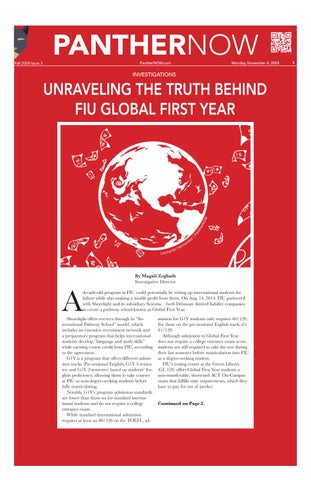
UNRAVELING THE TRUTH BEHIND FIU GLOBAL FIRST YEAR

Adecade-old program at FIU could potentially be setting up international students for failure while also making a sizable profit from them. On Aug. 14, 2014, FIU partnered with Shorelight and its subsidiary Scientia – both Delaware limited liability companies to create a pathway school known as Global First Year.

Shorelight offers services through its “International Pathway School” model, which includes an extensive recruitment network and a preparatory program that helps international students develop “language and study skills” while earning course credit from FIU, according to the agreement.

G1Y is a program that offers different admission tracks (Pre-sessional English, G1Y 3-semester, and G1Y 2-semester) based on students’ English proficiency, allowing them to take courses at FIU as non-degree-seeking students before fully matriculating.

Notably, G1Y’s program admission standards are lower than those set for standard international students and do not require a college entrance exam.

While standard international admission requires at least an 80/120 on the TOEFL, ad-

mission for G1Y students only requires 60/120. For those on the pre-sessional English track, it’s 41/120.

Although admission to Global First Year does not require a college entrance exam score, students are still required to take the test during their last semester before matriculation into FIU as a degree-seeking student.

FIU’s testing center at the Green Library (GL 120) offers Global First Year students a non-transferable, shortened ACT On-Campus exam that fulfills state requirements, which they have to pay for out of pocket.

Continued on Page 2.

IS FIU’S GLOBAL FIRST YEAR A PATHWAY TO SUCCESS — OR A FINANCIAL PITFALL?

G1Y students are instructed that they could get the lowest possible score and still be able to matriculate into FIU as an undergraduate degree-seeking student.

“We were told by Global First Year advisors that the score didn’t matter,” said Diego Tunon, former G1Y student, sophomore and fully matriculated accounting major. “I didn’t study at all.”

“They literally can get a zero on it, all we want is to register that they took the test,” said David Lecon, managing director of Global First Year. PantherNOW inquired about Lecon’s statement about entrance exam scores to Assistant Vice President of Global Learning Initiatives Hilary Landorf, which Landorf denied.

“That’s not true. If I can get a hold of the contract, it’s in the contract that they have to meet the FIU standards,” said Landorf in an interview with PantherNOW.

According to the Pathway Agreement Services, once matriculated, those students are treated

like “other similarly situated international students at FIU” and have completed the same core curriculum classes.

Without reevaluating English proficiency before their matriculation, G1Y students, already admitted with low English test scores, may struggle to keep up academically which can ultimately lead to increased risk of dropping out.

Apart from the difference in the admission criteria, the cost to attend FIU as a Global First Year far outweighs the cost to attend FIU as a standard international student.

FIU’s rate for standard international students, PantherNOW found discrepancies in billing statements that dispute this claim.

There is almost a $1,600 difference between the students’ G1Y tuition on their statement of fees and their tuition on their MyFIU account.

When confronted about discrepancies, Lecon added that the additional charge on tuition was for the additional services the program offers and couldn’t explain what the extra $1,394 charged separately for student fees was for and

In addition to separate semesterly program fees ($1,394), G1Y students are charged significantly more for tuition than what appears on their MyFIU account.

Contrary to Lecon’s claim that G1Y tuition per credit aligns with

mentioned that he would “have to look into it.”

“I was surprised to find out I had to pay separately for the Panther Book Pack during my semesters as a Global First Year student,” Tunon said. “I thought the program fees should already cover that.”

Moreover, a comparison of tuition charges for two former G1Y students, each with a different number of credits, showed that they were billed the exact same amount for tuition.

It is still unclear what those extra charges are for if the program costs doesn’t even include book fees.

On top of extra charges posed on tuition, the program also charges an additional $430 monthly for off-campus housing than the original monthly rent charge and $1000 more for on-campus housing.

When asked about the extra $430 monthly per student, Lecon claimed that the money is used for resident assistants, a trashcan in the room, a curtain for the bathtub, bedding and plastic utensils.

With the exception of the resident assistants, these amenities are one-time purchases, not recurring costs, Lecon said.

So what about the discrepancies with on-campus housing charges given that FIU already provides residential assistants? Is the additional $1,000 fee for G1Y on-campus residents solely for non-recurring costs like bedding and trash cans?

G1Y students interviewed by PantherNOW shared concerns

after they were charged for adjustments on their housing assignment without prior notice.

“I originally paid for the Lakeview on-campus housing option however, during my first semester they assigned me to Parkview, a different on-campus building unit, without informing me of the change and then made me pay $886 extra when the semester started even though I paid everything that was due before coming to FIU,” said Kian Patel, a former G1Y student currently enrolled at FIU.

So what sets the program apart from regular admission through our International Student Scholar Services office at FIU?

“They are taking the same credits, same prerequisites, and they’ll be on track to graduate like any other student but it’s different because they are admitted as a nondegree-seeking status,” added Lecon.

“I didn’t realize the significant difference in my tuition charge until I got matriculated and had to pay my tuition to FIU directly.”

The Student Services Director of the program said that Global First Year charges more than the university but didn’t have any explanation on what the extra charges are for, Patel said.

According to the addendum, the program operates under the authority of a steering committee comprising three Shorelight representatives and three University representatives overseeing decisions related to academic matters and budget approval.

Even with a steering committee granting FIU, through its representation in the committee, ultimate approval rights in evaluating budget matters, PantherNOW was repeatedly told by Hilary to “ask Shorelight” when inquiring about program fees.

FIU’s Global First Year Program aims to support international students in their transition, yet questions remain about its costs, admissions standards, and value.

Whether it serves as a true pathway to success or poses financial challenges is a question worth further consideration.

“They profit too much and can’t even provide clear reasons behind those extra fees,” said Patel.

Scan the code to read the full investigation and keep up with continued coverage.

ONE YEAR LATER, STUDENTS PROTEST ISRAEL-HAMAS WAR

On Oct. 15, dozens of students gathered in front of GC Lawns to protest the Israel-Hamas War, which began on October 7 last year when Hamas attacked Israel, killing 1,200 Israelis and taking hundreds more hostage.

Exactly one year later, over 40,000 Palestinians have been killed by the Israel Defense Forces (IDF) and large portions of Gaza have been destroyed by fighting and bombs. The United Nations and other sources claim the death toll can be higher since it does not account for those buried under the rubble.

The destruction prompted Students for Justice in Palestine (SJP) to organize a rally around the Palestinian cause, with the intent to remind FIU students and staff of the ongoing conflict and draw attention to Israel’s actions, which they claim are genocidal. Originally the walkout was planned for Oct. 8, but was postponed due to weather from Hurricane Milton.

Students lambasted FIU president Kenneth Jessell for his inactions regarding FIU allegedly

holding investments in defense contractors and for his initial support of Israel following the Hamas attacks. Similar calls were made during last year’s Oct. 25 protest.

“FIU has investments in several weapons manufacturers, which profit off the genocide of Palestinians,” said FIU student Summer Jandali. “We want to let FIU know we’re not done, we’ll never stop, we’ll keep fighting until we see some actual positive change.” What was supposed

to be a tabling event promoting Students Supporting Israel (SSI), a Jewish-run organization dedicated to supporting Israel and Jewish life, turned into a counter-protest. SSI waved Israeli and American flags, playing and dancing to Israeli music, and shouting at the walkout members.

“We saw these people gathering and a lot of people wanted to have fun, play music and have fun so we’re here dancing and playing music,” said Yishmael Columna, president of SSI. “We are not counter-protesting, we are dancing.”

“Every single time that we show up, they’re always here. You know, it’s free will on this campus, but we respect them enough, when they have their events where we do not appear. It’s not about us versus them – it’s about getting our point across. Our movement, and our organization, has nothing to do with them,” said Isa Ford, an SJP board member. SJP asserts that their goals are divestment from Israel, and spreading awareness of what Palestinian civilians are struggling with.

The walkout concluded with SJP members gradually leaving GC Lawns, and SSI returned to tabling alongside Turning Point USA.

New Aquatic Center “will essentially kill our observatory”

Renowned FIU astrophysicist James Webb is fighting the placement of the new aquatic center to protect the on-campus observatory, the Stocker AstroScience Center.

In an email statement sent to PantherNOW, Dr. James Webb states he has raised concerns to the Board of Trustees about the damage the new center will bring if built near the observatory (Site 11), but that the board insists on having it there.

According to Webb, if construction on the pool is complete, it would render the million-dollar observatory obsolete and non-functional.

“It’s just going to be totally a disaster for us,” said Webb in an inperson interview with PantherNOW.

While the Faculty Senate unanimously voted to remove Site 11, the Board of Trustees seems to be intent on moving forward with it “in spite of the effect on the observatory and the wishes of the faculty.”

“I sent [the Board of Trustees] an individual letter telling them, look, you know, you destroy our program if you do this. And they voted with me sitting there. They voted to go ahead and do it. So it’s like they’re not considering the effect on students, effects on teaching STEM education. They just want their pool there,” said Webb.

When asked why the Board decided on Site 11, Webb said it was “because the University of Miami and University of Tampa have pools in a

central location, they think it looks really cool, so they want one for us, so students can walk by and see the pool.”

He explained the extensive list of damages the observatory would suffer if the aquatic center were built.

Some examples include the pool’s lights completely blinding the telescope, water evaporation degrading the telescope’s visibility, chlorine

particularly graduate students and scientists, use

Danette Heredia
Isa Ford giving a speech regarding Palestine.
Natalia Bonifaz | PantherNOW
Norman Mayorga | PantherNOW
Luke Hall | PantherNOW

Is this the year for women’s soccer?

One year ago, the FIU women’s soccer team’s season ended with more questions than answers.

A middle-of-the-pack finish and an immediate bow out of the tournament in its first game against Sam Houston left some wondering if things would be any different next year. Can this group of talent really take it all the way?

This season has had all the answers.

If the Panthers were once the flustered, new transfer with their shoes untied on the first day of school, now they’re the know-it-all kid. Opponents can hate them all they want, they’re top of the class.

Sitting near the top of the Conference USA standings, the Panthers are poised to make history as they chase their first-ever tournament title.

The team has dominated nearly all of October. From Oct. 1 to Oct. 27, the team went 4-1-1, their best win being against another top-three team in the conference, New Mexico State, 3-0.

This FIU squad is one of the most talented in recent memory, having several players in the top 10 in shots on goal, goals, assists and saves.

Senior forward Noemi Paquin is having another career year as the team’s leading scorer. With five game-winning goals and 13 goals total as of the team’s game against Western Kentucky, Paquin leads the CUSA.

Her play has earned her four consecutive Offensive Player of the Week nods.

Paquin has been a force on this team since her freshman year, leading the team in points and goals. She was named to the CUSA All-Freshman team.

But let’s not undervalue the contributions from other players that make this team as dangerous on the field as they are.

Senior forward Nikole Solis is tied for seventh in goals to form a dynamic one-two punch on offense alongside Paquin. Graduate forward Camille Sahirul is third in the conference in assists with her consistent playmaking keeping the Panthers humming along.

Like most other sports, soccer isn’t a game of pure offense.

Sophomore goalkeeper Valery Restrepo has been phenomenal with 28 saves, anchoring down a team that’s only allowed 12 goals, second-best in the conference. Restrepo has four Goalkeeper of the Week awards this season. Senior defender Reagan Bridges is also showcasing her defensive prowess, winning two Defensive Player of the Week recognitions.

Credit also has to go to the Head coach Jonathan Garbar.

Named head coach in January of 2021, Garbar has helped the program make significant progress over the last three seasons. His 2023 team finished with eight wins, the most since 2013, and clinched its first tournament appearance.

The CUSA Championships start on Wednesday, Nov. 6, and run until Sunday, Nov. 10. It’s a single-elimination tournament. Six teams enter, and only one comes out as a champion.

Lilimarie Quintanal | PantherNOW

EDITORIAL: “IT’S THE FIRST AMENDMENT, STUPID:”

FLORIDA’S CENSORSHIP OF AMENDMENT 4 IS ALARMING

PantherNOW Editorial Board

It’s becoming more and more dangerous to hold an opinion and voice it in Florida.

Florida Governor Ron DeSantis and the Florida Department of Health have been threatening criminal prosecution for local TV and radio stations for running an ad in support of Amendment 4, which would enshrine abortion rights into the state’s constitution.

This retaliation started after the ad named “Caroline” aired where a woman shared her story of how she was unable to get life-saving surgery which is claimed to be a violation of Florida’s “Sanitary Nuisance” law.

After the ad aired, the department sent letters to the infringing stations claiming it could follow up with criminal proceedings.

These ridiculous intimidation tactics were struck down by federal judge Mark Walker, who summed up his decision with one sentence.

“To keep it simple for the State of Florida: It’s the First Amendment, stupid.”

This is embarrassing. Our governor is being scolded like a petulant child because of his personal bias to keep his political agenda on course.

Whether you agree with abortion or not is irrelevant. This could’ve been about any other issue but what matters here is the fact that a state government intentionally tried to silence the media with threats because it was running ads that it disagreed with.

This is a clear violation of First Amendment principles and it is evident that the state govern-

ment puts partisanship over American values. It is mind-boggling that this institution continues to step on the throats of its own citizens, bent on making the lives of women as miserable as possible.

When it comes to Amendment 4, censorship hasn’t been the only tool in DeSantis’s repertoire of democracy-violating conduct.

For example, those who signed petitions to support Amendment 4 were paid visits by the Election Police, questioning their decision. Imagine signing a petition to support some-

thing you agree with and then having officers knock on your door to ask you why you did it. Who wouldn’t feel scared?

This is insanity. Using your task force of police to strong-arm voters doesn’t sound like what a state government within the United States would do. It sounds like something the mafia would do.

We’ll see if DeSantis’s tactics have any effects on tomorrow’s voting. Regardless of whether it does, DeSantis needs to back off and stop using bully tactics to get what he wants.

LETTER TO THE EDITOR: CLIMATE CRISIS COULD RUIN STUDENT HOUSING

On October 9th, hurricane Milton blew through central Florida, narrowly missing Miami and FIU.

This time around, we got lucky: The storm surges weren’t as bad as predicted, but winds, rain, flooding, and unexpected tornadoes in South Florida contributed to catastrophic property damage and resulted in at least 23 deaths. The overall devastating effects of Florida’s hurricanes, like Milton, show us how the climate crisis will drastically exacerbate the housing crisis, especially for working-class people.

Recently, hurricanes in Florida have contributed to increasing housing prices, causing long-lasting demographic shifts towards wealthier groups. As climate disasters become more frequent, this phenomenon may impact the housing market surrounding FIU, increasing off-campus housing prices. Hurricanes impact on-campus housing too. During Irma, Bayview at BBC suffered

SEND US YOUR LETTERS

Have something on your mind? Send an email to fiusmeditor@gmail.com. Be sure to include your name, major, year and panther ID. Letters must be less than 400 words and may be edited for clarity and length. PantherNOW will only run two letters a semester from any individual.

from extensive water damage and mandatory evacuations. According to students, FIU housing was surprisingly secretive about the extent of the damage.

Unfortunately, hurricanes will only become more extreme as the ongoing climate crisis tightens its grip. Milton’s offshore intensity was exacerbated by record-high water temperatures in the Gulf of Mexico, a trend which will only worsen as warming trends escalate.

FIU is not off the hook for its role in the climate crisis, as evidenced by its financial ties with fossil fuel companies like Chevron. Chevron’s scholarships, panels, and seminars at FIU allow this corporation to pipeline students directly into their fossil-fuel-based industries Additionally, FIU’s ties with Boeing and Lockheed Martin, both of which are involved in international weapons exchange and Palestinian genocide, provide further support for polluting industries.

Lockheed Martin is the US Department of Defense’s largest weapons contractor, which, in turn, is our planet’s biggest fossil

Editorials are the unified voice of the editorial board, which is composed of the editor in chief, management, and the editors of each of the four sections. PantherNOW welcomes any letters regarding or in response to its editorials.

fuel consumer. If FIU really cared about the impacts of the climate crisis on their student body’s housing, they would divest from these fuel-hungry corporations.

But FIU’s students are pushing back. Panthers Unite for Student Housing (PUSH), pioneered by the Young Democratic Socialists of America (YDSA) at FIU, aims to address FIU’s climate-related housing crisis. Under their demand for improved housing quality, PUSH advocates for readily available emergency housing and consistent inspections, including hurricane safety, mold, and water damage check-ups.

Additionally, the PUSH campaign will pressure FIU’s administration to bring off-campus housing with financial ties to FIU (e.g. the One) under university control, protecting off-campus students from the rental increases expected because of hurricane-related price hikes. Through these efforts, PUSH engages FIU’s working-class students to fight for housing rights.

Looking for a job over the semester? Apply today through our website to get a chance to see yourself on PantherNOW.

Lael Licht Earth and Environment Lab Technician
Leonardo Hernandez | PantherNOW

CENSORSHIP IS KILLING HIGHER EDUCATION

Let’s talk about it.

Censorship is putting higher education on life support, and Florida is the ICU.

As a psychology major minoring in English, I’ve seen this firsthand. Imagine signing up for a course only to find out that the syllabus has been gutted because the state thinks it knows better.

What is more devastating is that FIU is following with this ridiculous compliance of SB266, which cuts funding for anything DEI. On Oct. 3, 22 courses were cut and only two trustees voted against the move.

Entire courses are being canceled, not because students don’t need or want them, but because the powers that be have decided that certain topics related to race, gender and sexuality are “too much” for our young minds.

These are subjects that challenge us to think, to grow and understand the world.

Florida institutions, according to

Inside Higher Ed, have slashed general education offerings across the board under the disguise of “protecting” students from materials that might make them feel uncomfortable. Except, that’s not what I signed up for.

This kind of censorship is a direct threat to the essence of higher education. College is supposed to be a place where you encounter new ideas, even those that make you squirm a little because that discomfort is where real learning happens.

The reality is that I didn’t go to college just to reinforce the beliefs I already had, I went to challenge them. And yet, here I am, sitting in classes where entire readings, debates and ideas have been scrubbed out.

It’s frustrating. I didn’t pay thousands of dollars to receive a diet version of my education.

And it’s not just about my own experience. It’s about the broader implications of what’s happening when universities cave to political pressure.

Censorship is not only shortchanging students like me but is hollowing out the integrity of our

“USELESS” COLLEGE DEGREES ARE A MYTH

Kailey Krantz

Everyone believes their major will give them the best opportunities, so why are we judgemental about which majors are deemed “useless?”

First of all, there is no such thing as a “useless” major.

Doing something you’re passionate about is rewarding in the long run, despite what many people say.

Anyone with a not-so-fast money-making major knows the awkwardness of telling someone your major and getting those odd looks. What’s worse? The comments.

“What are you going to do with that?”

When I tell people that I’m an English major, they automatically assume that I would be a librarian or an English teacher because that’s all I can do—which isn’t true at all.

There are a lot of things I want to do like writing and journalism, but I could branch out to do more.

Paralegals, copywriters and translators are some of the other jobs I can pursue with an English degree.

My story is just one example of making what people call a useless major useful, but there are plenty of other majors that students may feel discouraged to pursue.

Majors like journalism, theatre, communications, creative writing and any of the fine and visual arts

”Our

educational institutions. Universities are supposed to be beacons of free thought, places where ideas can be explored without fear of retaliation or political meddling.

But when a state decides it can dictate what can and cannot be taught with harmful bills such as SB266, that mission gets thrown out the window.

They think it’s all about keeping education appropriate and balanced. But let’s be real: it’s about control. It’s about shaping young minds to fit a particular narrative, to avoid challenging the status quo.

It’s ironic that our universities

are being turned into echo chambers that only reflect back what the state deems acceptable. As a student, that feels like a betrayal. It’s time to call this censorship what it is, a dangerous precedent that’s dismantling the foundations of higher education.

This is more than just cutting content from courses but how much control is being taken away from students and their education. We deserve better than that.

also get scrutinized because students are worried about job security and how much money they’ll make.

It’s awful because it places the value of a major on whether or not you’re getting six figures after graduation.

Your major doesn’t define what the rest of your career would look like.

The only time I would think that a major is useless is when a student chooses a major before they know what they want their career to be or they don’t know how to use it to their advantage.

If there’s a major that you are passionate about or you’re very confident in what you want to do post-grad, go for it.

Heidi Cuevas
universities are being turned into echo chambers.”
Alyssa Pelaez | PantherNOW

The Dance of Death: Ryan Chan chimes chills to FIU through Organ performance

Famed organist Ryan Chan graced FIU’s Wertheim School of Music with organ pieces of the macabre and the strange on Oct. 27.

Chan’s accomplishments are far too many to name but his most recent honors goes to his First prize and Audience first Prize 2024 American Guild of Organists National Young Artist Competition in Organ Performance.

Though, how did such a masterful musician come to be?

“I’m originally from Hong Kong, and everybody learns to play an instrument there. I remember being fascinated by the piano, though I didn’t receive any pressure to learn it,” Chan shared regarding his upbringing.

“I picked up the organ at around 14 or 15 and enjoyed the physicality.”

It’s almost like dancing, there’s a lot of foot maneuvers. I originally suffered a lot in the beginning and couldn’t play certain notes,” said Chan.

Life originally wasn’t so clear cut for Chan, since for his undergrad he pursued the sciences and majored in food science before making

the switch to music for grad school.

Chan mentioned that his inspirations came from his great teachers that he learned from in his study exchange programs such as the one he had in Melbourne, Australia who pushed for him to realize his own potential.

“To me, the organ is a rather eclectic instrument that does rather

usual 15 minutes that Chan was accustomed to.

“I hope I will survive this encounter,” Chan laughed.

Modern concert hall organs tend to use electro pneumatic action, a system that relies on electrical signals for keys to be pressed and pipes to open and close without much physical exertion.

everything… it is no surprise that this otherworldly sound was used in churches and cathedrals,” Chan said.

Being his second time playing at a university campus, Chan had originally expressed a slight hesitancy towards the challenge of the event.

This event was to be a 17 minute performance, as opposed to the more

This means musicians can play a bigger sound, with the trade-off being that they have less control over the pipe speech.

But Chan wasn’t playing a modern organ.

17 minutes is an impressive feat when considering that the organ at FIU’s Wertheim school of music is a Schantz pipe organ, a true behemoth of musical practicality. Featuring over 4,255 pipes, the

organ was a true test of skill.

Excitement fueled Chan’s veins as he beheld the organ.

“Yes, this organ can do so many things! I will be using this to its full potential. There’s so much color I can use.

What Chan is referring to as “color” can also be known as “timbre,” or the specific sound that instruments have regardless if they play the same note.

The effusive energy that Chan felt was over the different kinds of pipes the organ had including flute pipes, reed pipes and different types of pipe families as well as trombones, tubes, trumpets, etc.

For the overall selection of the pieces he played, Chan wanted to go bombastically big. He covered big names such as still-relevant composer Mozart to Saint-Saëns’ “Danse Macabre” to even contemporaries like Connor Chee.

“I wanted to open big, and close big,” Chan said.

Ryan Chan not only survived his fight with the organ–he prevailed.

Turn static files into dynamic content formats.

Create a flipbook