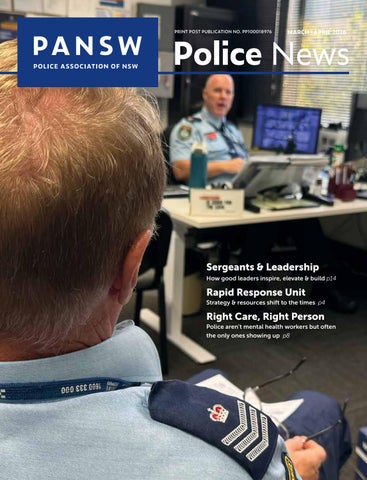
Police aren't mental health workers but often the only ones showing up p8
account-keeping fees
Advertisers Alert: The Police Association of NSW is the publisher of PANSW Police News. The Police Association does not accept any responsibility to any advertiser or consumer in respect to advertising appearing in PANSW Police News. For enquiries re advertising in this publication, please contact the publishers via: elyssa.king@pansw.org.au
Executive Member / Peter Gurr p2
President's Message p3
Government launches Rapid Response Unit p4-5
Recruitment and Retention p6-7
Right Care, Right Person p8-10
First Response Policing Agreements p11
Workforce Allocation p12-13
Sergeants and leadership p14-15
Centrespread p16-17
PANSW Audit Report p18-19
Historic Conference Wins p20-21
Money Matters p23
Margaret Glanville / Legacy p25
March On Challenge p27
Ride for Remembrance p28
Bob Fitzgerald OAM p29
Peter Short - Life after policing p30
Retired interstate officers invited to return p31
How to be a good cop - list from page 15 p32
Crossword p33
Disclaimer: Police Association of New South Wales (“Publisher”) advises that the contents of this publication are the sole discretion of the Police Association of New South Wales and the publication is offered for information purposes only. The publication has been formulated in good faith and the Publisher believes its contents to be accurate, however, the contents do not amount to a recommendation (either expressly or by implication) and should not be relied upon in lieu of specific professional advice. The Publisher disclaims all responsibility for any loss or damage which may be incurred by any reader relying upon the information contained in the publication whether that loss or damage is caused by any fault or negligence on the part of the publisher, its directors and employees. Copyright: All advertisements appearing in this publication are subject to copyright and may not be reproduced except with the consent of the owner of the copyright. Advertising: Advertisements in this journal are solicited
Executive Officers
Member Non-LAC 3
Peter Gurr
■ As demands on policing continue to shift across New South Wales, the NSW Police Academy at Goulburn remains the foundation for developing the state’s future officers. The Academy’s evolution with new educational provider Western Sydney University (WSU) reflects a crucial investment in capability, professionalism, and workforce sustainability.
The Academy stands as a critical educational environment providing recruits a comprehensive blend of scenario-based training utilising a full scenario village, simunition venues, police drivertraining facilities and livefire ranges designed to reflect operational policing. Practical scenariobased training, including daytoday patrol simulations recently undertaken by Class 368, reinforces realworld readiness before attestation. Training infrastructure continues to expand with new capabilities. The purposebuilt Indoor Firing Range designed to accommodate a growing student cohort and deliver flexible, modern firearms training. These upgrades align with the Academy’s aim to prepare officers for complex and dynamic policing environments.
The transition to WSU is staged and gradual. The status of the transition is currently within Year 1 of the two-year associate degree, with WSU delivering session 1 and 2 curriculum by May 2026.
The Associate Degree in Applied Policing (ADAP), delivered with WSU, is a central component of the applied policing education model. This partnership ensures recruits receive not only operational training but also academic grounding in law, ethics, and evidencebased policing, reflecting the profession’s rising expectations, building resilience in individuals and enhanced accountability.
This transition to WSUbased education complements broader reforms aimed at equity and accessibility. Financial barriers were reduced with the introduction of paid training, providing student police officers around $30,984 during their initial 16week Academy course; a significant economic win enabling for a diverse range of applicants. Additional education reforms, including improved flexibility and reduced study costs, support longterm recruitment and retention and help futureproof the workforce.
The Academy’s success is tied to member wellbeing, modern training standards, and attracting and retaining a socially diverse, professional policing workforce. The partnership with WSU ensures recruits enter the field equipped with both practical readiness and academic resilience.
The NSW Police Academy remains the foundation of policing capability in New South Wales. As challenges continue to evolve, sustained investment in facilities, police recruits, tertiary educational partnerships, and in police educators will remain essential to ensuring our frontline is prepared, supported, and future focused to best service the NSW community.
PANSW President Kevin Morton
Bail Division & Conference
■ The PANSW has successfully prevented legal, operational, and safety risks for members that would have resulted from the rushed implementation of the proposed expansion of the Metro Bail Division, and clearly outlined our demands for the Regional Bail Division.Our members will be well acquainted with the challenges associated with the introduction of a centralized bail division.
In July 2025, the Attorney General and Chief Justice ignored issues raised by law enforcement and legal representatives and were set to commence with the rollout of the centralized bail division in metropolitan and regional areas.
At the time, up to six prisoners could be found sleeping on threadbare mattresses for an entire weekend in metropolitan areas, sharing a single cell because correctional facilities were turning police away at the door. In regional locations, police were transporting prisoners hundreds of kilometres in unsuitable vehicles and then guarding them at court.
Commissioner of Police that the proposal was not ready for implementation as crucial details had not yet been settled, which would place police officers in a work environment where expectations are unclear, responsibilities are blurred, and accountability remains fixed.
We therefore outlined we would direct members not to perform the functions contemplated by the proposed model until our conditions for extensive safety, legal and operational protections were
While we reflect on the moments of success that have led us to this point, the future lies ahead. As the frontline, you are the driving force behind the NSWPF’s continued strength as an organization. You have carried the weight of the pressure with tenacity and dedication.
We will discuss issues that impact your core duties. The dire need for other agencies to lift the burden from your shoulders in carrying the load related to prisoner transport and management and mental health callouts continues to be a key priority. The pressing need to modernize first-response agreements and continue to make progress by cutting through the ‘blue tape’, or the administrative burdens, policy roadblocks and technological glitches that must be addressed to enhance your ability to perform at your operational best.
The arbitrary time limits on paperwork set by the Attorney General would inevitably have led to this overcrowding in cells continuing, with police unable to put bail-refused prisoners before the courts until the following day, putting the police and the prisoner who shouldn’t be in their custody at risk.
After our members threatened to stop transporting and guarding court-bailrefused prisoners, the NSWPF agreed that court-bail-refused management was not a policing function.
In November 2025, PANSW representatives alerted the Chief Magistrate to several non-negotiable concerns that were unlikely to be resolved by April, which he undertook to work with Corrective Services NSW to address them.
Court No 8 within the Bail Division was due to commence on 7 April.
The PANSW made it clear to the
in place for all involved police officers. The proposal will not progress until our conditions are met, through a formal Memorandum of Understanding between NSWPF and CSNSW that clearly outlines responsibility for the movement, supervision, presentation, medical requirements and post-determination management of prisoners.
We will continue to update our members as negotiations progress and as the virtual bail court is implemented on a timeline acceptable to all stakeholders. I ask that custody managers and arresting police continue to email feedback and examples of the existing system failing to feedback@pansw.org.au so we can collate and advocate for changes to the system where needed.
As we lead into Conference 2026, this edition serves as a preview of the important themes we will explore in May.
We will hear from your delegates from the floor, representing your interests by speaking to motions that sit at the heart of the challenges you face during your shifts every day. We will also hear from organizational leaders in the NSWPF who will be addressing topics related to your workload and track the actions to follow.
The Premier and other senior government representatives will also be in attendance; I will ensure that they are listening when we say that you, our members, continue to wear too many uniforms and need to return your focus back to your core duties; back to where it began; back to blue. Not only do you need to supported with additional boots on the ground and resources, adding the tools you require to continue to perform your duties to the highest of your abilities, but also by relieving you of the additional duties that can be transfer to other agencies and the administrative burdens that keep you stuck at your desk when you should be out on the streets, serving and protecting the community.
FIRST EXECUTIVE MEETING IN PANSW's NEW ROOMS, and LAST MEETING BEFORE CONFERENCE
Elyssa King PANSW Media & Communications Officer
NSW Government launches permanent Rapid Response Unit
Strategy and resources shift to meet the times
■ The PANSW has been a long-term advocate for access models for long arm firearms in both regional and metropolitan NSW. In regional districts, we have been arguing for greater access to existing long-arm resources, combined with a capability uplift, which we will continue to advocate for.
For long-arm capability across Sydney, the PANSW joined the NSW Government and NSWPF in announcing the new Armed Response Command on 25 February 2026. The decision follows the antisemitic terror attack at Bondi Beach, the worst terror attack in Australia’s history and a concerning rise in religiously motivated incidents and haterelated offences across NSW.
The new unit embeds a high-visibility, intelligence-led policing unit that can quickly respond to threats, patrol high-risk areas, protect places of worship and major events, and provide a visible presence to keep communities safe.
This Australian-first rapid response unit will have approximately 250 dedicated police officers, 28 civilian staff and a fleet of specifically modified rapidresponse vehicles, meaning police will no longer be rotated out of existing Police Area Commands. It will establish a permanent long-arm policing capability for high-profile public buildings, places
and the United Kingdom to study best practice in policing and emergency management. Unlike these jurisdictions, the NSW Police Force currently relies on temporary surge operations to disrupt crime and reassure the community.
The PANSW worked with the Commissioner of Police to ensure the design of this capability best met the following objectives, while offering the best response capacity to protect the public:
ARC will be a permanent 24/7 Command, Sydney metropolitan-based, with 250 police officers attached – these are additional SAP positions, increasing the NSWPF authorised strength by 250. Under this reform, Operation Shelter, launched in 2023, will transition from a reactive operation to a permanent, round-the-clock rapid-response unit. Operation Shelter was first launched in October 2023 amid heightened tensions in Sydney, including large protests and a rise in antisemitic and Islamophobic incidents.
of worship, and mass gatherings across Sydney.
As part of the expanded capability, NSW Police will also strengthen community engagement through additional Multicultural Liaison Officers and Senior Multicultural Liaison Officers. A 24/7 specialised Police Operations Centre (POC) will also support the unit with tasking, real-time coordination, and surge management – including training, logistics and intelligence to sharpen targeting and prevention.
In January 2026, a senior NSW Police Force delegation travelled to Germany
• Keeping officers as safe as possible when responding to incidents like active armed offenders:
ARC ensures that officers with suitable long-arms and equipment arrive rapidly to end an attack as quickly as possible
• Alleviating the staffing challenges of protests and Operation Shelter: these operations have been a significant drain on the resources of Commands that provide officers to perform these duties. ARC will alleviate that, and the PANSW will advocate that ARC’s presence brings an end to other Commands providing officers.
There is a career pathway from both General Duties and Specialist roles into the new Command.
This reform ensures NSW moves beyond short-term surge responses and instead establishes a permanent, structured capability aligned with global best practice.
This builds on a suite of reforms to
ONE OF THE BEARCATS STATIONED THROUGHOUT THE STATE
Under this reform, Operation Shelter, launched in 2023, will transition from a reactive operation to a permanent, round-the-clock, rapid-response unit.
improve community safety and protect social cohesion including:
• Tough new firearms laws, stricter licensing and storage requirements, and a national gun buyback building on the Minns Labor Government’s work to keep dangerous weapons off our streets and communities safe.
• New offences banning the public display of terrorist organisation symbols and further action to address hateful speech reinforce efforts to reduce division, intimidation and hate in NSW. a
• Updated powers around public assemblies following terrorist events support police in preventing inflammatory behaviour while protecting peaceful gatherings and community harmony.
Premier of New South Wales Chris Minns said: “The safety of the people of New South Wales is our number one priority. This is about putting the right structure in place so police are always ready. Operation Shelter has worked. Making it permanent means we’re building on what we know delivers real results. People want to see police where it matters, at major events, near places of worship, and in busy public spaces. This ensures that presence is consistent, because our security challenges have changed and our policing model needs to change with them.”
happened at Bondi has etched a permanent scar onto our community. We are responding decisively by establishing a new, rapid response capability to detect and respond to threats. Police do extraordinary work and this is about giving them the tools they need to continue to keep the community safe in the wake of the worst terror incident
Beach terror attacks, it is essential that we are able to provide an enhanced rapid response with long-arm capability. Similar specialised police units are already operational overseas and form an important part of public safety operations in several countries in Europe. Our priority is not only ensuring the community is safe, but that people also feel safe, while providing a deterrence to anyone who wants to do harm and support our frontline operational police.”
Minister for Police and Counterterrorism Yasmin Catley said: “What
we’ve ever seen in this country.”
Minister for Multiculturalism Steve Kamper said: “NSW’s strength comes from our diversity, and we are committed to working hand-in-hand with our multicultural communities to strengthen cohesion, build trust, and ensure every person feels safe, respected and included. Our multicultural communities are at the heart of modern New South Wales, and this work ensures we can continue to foster understanding and unity across our state.”
NSW Police Commissioner Mal Lanyon APM said: "In the aftermath of the Bondi
President of the Police Federation of Australia Kevin Morton said: “I commend the leadership of this government led by Chris Minns on this Australia first policing reform. Minister Catley and Commissioner Lanyon have recognised the nature of policing in this state changed on December 14th and have responded to provide the community the safety the people of NSW need and deserve. This trailblazing police command will provide NSW police officers with the equipment and rapid deployment needed to keep them, and the community safe.”
The PANSW will continue to work with the Commissioner regarding the staff recruitment of ARC, and already secured a commitment that for every officer who transfers to this unit from a Police Area Command, an additional Probationary Constable will be allocated to that Command over and above the normal allocation they would have received from newly attested classes.
LONG ARMS WILL BE IN THE TOOL BOX
Angus Skinner PANSW Engagement Manager
Recruitment & Retention
On current trend, staffing levels will continue to deteriorate not improve.
■ Police numbers in NSW peaked in 2021 at 17,727 officers but each year since then, numbers have declined. Today in 2026, there are 15,518 officers; 2,209 fewer than 5 years ago - approximately 2,800 under authorised strength.
Over those 5 years, 6076 police officers have left the NSW Police Force, an average of 1,215 each year. Last year, 961 new probationary constables attested from the NSWPF Academy. That is a trend at which the current police staffing shortage continue to deteriorate, not improve.
Ever since this decline began, the PANSW has prioritised three overarching strategies to address increasing workloads and staff shortages:
• Retain current police officers,
• Recruit new police officers at a rate that exceeds attrition, and
• Demarcate core police duties, and push back on work that other agencies should be performing.
There are early indications in the data expected to be reported for 2025-26 that these strategies are starting to work, and the annual net loss on police numbers that has been occurring for the past 5 years is turning, but until that trend is sustainable and produces a net gain in officer numbers that quickly fills vacancies and gets NSWPF back to authorised strength, the NSW Government needs to consider this a matter of extreme urgency.
Fair pay and conditions are the most important strategies to ensure that all officers have strong incentives to remain in the profession and the financial security to pursue a long and rewarding career. You will receive another 5% pay rise in July this year, and again in 2027, plus any incremental progression under the new accelerated pay scales.
Achieving a pension for long-serving NSW police officers would be incredible, but it is neither realistic nor beneficial to the entire membership. There is no industry that still offers defined pensions.
of officers who get to retire or resign combined.
Keeping officers safe and healthy is the most important reason to reduce the harm policing causes to officers. It is also the most effective way to retain police. If NSW can reduce the risks and harms caused by the job of policing, that is a pool of 3,165 police officers that could still be in the NSWPF today.
That objective underpins the work of the PANSW everyday. We constantly advocate and collaborate with the NSWPF to ensure work health and safety principles keep officers physically and mentally healthy, and that officers who are injured are looked after and supported to get back to work.
Contrary to rumours, military personnel can no longer enter defined pension schemes; they have been closing and reducing entitlements since 1971, and no new military personnel in the last decade have been eligible to enter one.
The elephant in the room
Retention – what has been implemented so far
Rewarding pay and conditions for ALL police officers
Crucially, the pay rise achieved in 2024 has given all officers significant pay rises in 2024, 2025, 2026 and 2027, totalling an average salary increase of 26.4% over 4 years.
In the last 5 years, 3,165 police officers have left the NSWPF “medically unfit”. It is the most prevalent category of reasons for leaving, more than the combined total of all other categories of separation (last year, 64% of the officers who left the NSWPF left medically unfit).
Psychological injuries are the most prevalent reason for medical discharge. It is terrible that the number of officers leaving the profession because the job has caused them too much harm to continue is larger than the number
The PANSW has a dedicated Welfare and Member Support Team that supports injured members and their families, connects them with services, and trains our Branch Welfare Officer network to ensure support is available in your workplaces across NSW.
Our Industrial Officers and Organisers support members every day, ensuring injured officers are afforded best practice recovery processes, and get back to work in a supportive workplace.
The PANSW has been crucial in securing tens of millions of dollars in funding for wellbeing programs for police officers, and this has begun to improve injury rates and safety in policing.
At the recent Budget Estimates, Minister for Police Yasmin Catley and Deputy Commissioner Dean Smith told Parliament that the data so far in 2026 indicates a significant reduction in psychological injuries and in the number of police officers leaving due to them. We will wait until those early forecasts are proved correct before we rely on them as accurate. If they do, it would be a significant turning point in police health and wellbeing, and retention.
PANSW has prioritised three overarching strategies to address increasing workloads and staff shortages
Retention – what’s next
On Wednesday 4 March, President of the Police Federation of Australia Kevin Morton met with the leaders of the other police unions in Canberra. Police unions across Australia are calling on the Federal Government to create the following incentives to retain police officers:
• Fringe benefit tax (FBT) concessions reforms of up to $17,000;
• Earlier access to superannuation at 55 years to reflect the significant physical and mental impacts from long careers in policing: and
• Introduction of a Blue Card covering medical and allied health services, to match the concessions available to Australian Defence Forces.
The PANSW is also currently working on new welfare services that we can provide direct to members, to go alongside the existing work of our Industrial Officers, Organisers and Welfare & Member Support Team.
On 18 May 2026, PANSW’s Biennial
Conference commences. There, elected delegates from across NSWPF will attend to democratically set the priorities and direction of PANSW for the next 2 years.
Retention is one of the key issues your elected Delegates will be considering, providing feedback, and voting on motions on your behalf. If you believe you have further feedback or ideas, please contact one of your delegates to have it debated on the floor.
Recruitment
PANSW President Kevin Morton identified the early trends of a decline in applications to become a NSW Police Officer in 2022. At the 2022 PANSW Biennial Conference, the President addressed the NSW Premier and Commissioner, and called on them to pay Student Police Officers while they trained. This would be crucial to attract more applicants and increase the number of new police officers attesting from the Academy.
The strategy worked. Academy Classes are now full, which will bring the number
of new officers attesting back to the full capacity that the Academy can train.
The next step is to increase that capacity. We understand that, with the pay rises for police and pay to train initiative for students, policing is attracting many new candidates, and so once more there is a waiting list of approximately 1,200 applicants to join.
That is a pool of new police officers who, with expanded Academy capacity, could fill vacancies and help with the workload sooner.
The NSWPF needs to be able to produce far more new officers than are leaving if we are going to (1) stop attrition, and then (2) increase the number back to authorised strength.
The PANSW has been pushing hard for the NSW Government and NSW Police Force to increase the Academy's capacity, including through larger class sizes and more classes.
THREE STRATEGIES TO ADDRESS INCREASING WORKLOADS & STAFF SHORTAGES - PUSH BACK ON WORK BELONGING TO OTHER AGENCIES / RECRUIT AT RATES EXCEEDING ATTRITION / RENUMMERATION
Rough Sleeping / 1.5mx 1.2m doorwell, Newtown
The Inquest into the April 2024 Bondi Junction stabbing attack highlighted critical deficiencies in mental health support and crisis accommodation. Inquest noted temporary or short-stay beds for people experiencing homelessness and mental health issues in Sydney have dropped from roughly 1,150 in 1991 to fewer than 300 by April 2024.
Angus Skinner PANSW Engagement Manager
Right Care Right Person
Police are not mental health workers - but often they're the only ones showing up
■ A man is on a busy street, speaking to himself angrily, behaving aggressively to members of the public, and putting himself in danger in traffic.
Police are called. A car crew drives to the location under lights and sirens. They arrive at the scene within minutes. The man is at first incoherent and unsteady on his feet, and sweating profusely, seemingly affected by drugs.
They speak to the man and try to calm him. After initially building a rapport with him and seemingly successfully calming him down, he suddenly becomes violent to police. After a long and dangerous struggle, they restrain the man. They transport him to the nearest health facility, then commence the process under s22 of the Mental Health Act.
After a long handover, he is detained in the hospital as an involuntary patient. The officers have abrasions, went through a dangerous struggle, and have now been at the hospital for hours.
The man has been cared for at the hospital for some hours, he has now calmed down and assessed as low risk.He is allowed to leave the facility to smoke, on condition he return after the cigarette. He leaves and does not return.
The hospital is understaffed so his absence is not noticed. When staff realise he hasn't returned, they fail to take the required steps under the NSW Health NSW Police Force Memorandum of Understanding (searching the grounds, checking CCTV, calling the person’s mobile or family members, having a mental health team checking their place of residence). Instead they call police.
Police put the call on the radio to look for the absconded patient. He has now been missing for 24 hours. By that time, he has not been reassessed under the Mental Health Act, he has therefore been 'discharged' and his bed freed up for another patient.
Two police officers spot the man. His status is no longer an absconded patient, instead he is a discharged patient. There is no information to suggest he now poses a risk to himself or others, and he
is not behaving violently, so the police who have spotted him do not believe they have legal grounds to detain him.
If they did they would have to start the entire section 22 process again.
This scenario may be one you or colleagues have encountered – another type of mental health incident that requires police to resolve situations where a person needs a health response, hours of police time spent doing non-police work, and the risk of criticism and adverse consequences doing a job no one else would do.
In 2022, NSWPF recorded 61,164 incidents in its COPS system in relation to people experiencing a mental health emergency or incident where there was no associated criminal offence. This is an increase from around 43,000 incidents in 2018 (41.6%) - approximately 10% per annum. It doesn’t have to be this way.
This shows the increasing work demand on police to essentially perform a health function, taking them away from core policing duties, and forcing them to manage an incident requiring mental health expertise and fit for purpose health vehicles and facilities, but do so using police resources not designed for that purpose.
Many of these incidents would be handled differently, and be the responsibility of Health personnel, not police, under the Right Care Right Person model. This is a mental health response reform implemented across the UK, and one that NSW is close to commencing.
In the UK, for local areas in which Right Care, Right Person has been implemented well, police forces received fewer calls for mental health incidents, attended fewer incidents, and spent less time in attendance when their response was required. Some forces in the UK in effect received dozens or even more than 100 full time equivalent police officers freed up to do core policing work.
Despite the complex environment and many moving parts in mental health response, Right Care Right Person is at its core a simple principle – it’s about
appropriate risk assessment and triage of mental health calls, according to the principle that mental health is a health responsibility, not an issue that needs to be policed.
If an incident or call for attendance does not involve the commission of a crime, or an immediate risk of harm to a person, then there is no need for police to attend, and a health response is appropriate.
If there is a crime or risk of harm involved, police may need to attend to protect all people involved, but the provision of services and responsibility for caring for, transporting and managing a patient should still be performed by health personnel with health resources. Back in 2023, the PANSW called for the NSW Government to reform NSW response to mental health incidents, using Right Care Right Person as a basis for designing our reform. As a result, a delegation from NSWPF was sent to the UK to examine Right Care Right Person
The findings of the NSWPF Review were:
The key recommendation of this review is that the NSWPF work with NSW Health to explore models for responding to mental health incidents in NSW consistent with the principles of the 'Right Care, Right Person' model.
The PANSW supports that finding. Since then, NSW Police Force and NSW Health have been working together to design mental health response based on the principles of Right Care Right Person, suitable for NSW conditions.
In fact, one of the first public announcements of these efforts was when former Commissioner Karen Webb updated your elected PANSW Delegates at the 2024 PANSW Conference.
The change will not happen overnight. In September 2025, Deputy Commissioner Hudson told NSW Parliament Budget Estimates Committee:
The transition, in my mind, will be slow. There will be some issues, once agreed to, that we need to
work through with Health through Ambulance NSW in relation to the definition of risk, the definition of threat, when police need to attend incidents in conjunction with Ambulance because we're not going to walk away from the responsibility. Some of these incidents are potentially highly violent, and we can't expose our ambulance personnel to those risks. We are working through that with Ambulance. We are redesigning the MOU with Ambulance at the moment, which I don't think is too far away in relation to how we treat risk in these instances. I think that MOU will be agreed to in the short term, but then the broader transition to a totally health-led response will be incremental as they take greater responsibility and we slowly withdraw to just those incidents we're required to attend.
While the PANSW wants to see police officers benefit from this reform as soon as possible, we do appreciate that this is a change to decades of entrenchment of the way NSW emergency services respond to tens of thousands of mental health incidents every year. There must be a staged approach to withdrawing police from these incidents. As we have seen from the experience of other jurisdictions, having health services committed to the reform and sufficiently resourced to perform the work is a key point to success.
It has not necessarily always been smooth sailing in the UK with Right Care Right Person. We support the principle and effective implementation: people with a mental illness can expect a health worker to show up to assist them, rather than a police officer.
A UK Government review of RPRC found that the strongest barrier to implementation was ensuring health resources were available to respond to calls that previously police had attended, even if it was not their responsibility.
It has been effective in places like Humberside and London, but there are reports from the UK in communities with inadequate health services, police withdrawing from these jobs, means no one responds.
Everyone in NSW is working to ensure that is not the case when it is implemented here. In NSW, collaboration between police and health has been impressive. In September 2025, PANSW Secretary Pat Gooley, and Health Servies Union
Secretary Gerard Hayes, met to discuss our shared support of a health led response to mental health incidents, and how paramedics and police can support each other in that response model.
Pat Gooley hit the nail on the head when he spoke about how the ability to properly risk assess each job, facilitated by information sharing between Local Health Districts and Police, is crucial –it’s how tens of thousands of jobs a year could be deemed to not require a police response, freeing up police resources. It’s also how to ensure, if there is a risk of violence, paramedics or other health workers can be the primary responding personnel, with police present only to protect those health workers, but not transport and manage that mental health patient.
The HSU also released the following statement, and it's highly commendable the HSU and paramedics it represents supported the PANSW’s call for a change. It means more work for HSU members, but they know it's in the interests of the people of NSW to have access to appropriate health services.
The PANSW in turn calls on the Government to ensure health personnel are properly resourced and kept safe as they take back the responsibility for mental health response. Police officer and paramedics should no longer be expected to bear the risk and pick up the pieces for budget bludging on mental health services. HSU statement:
It's been recently reported that the Police Association of NSW has pushed back on NSW Government about the increasing concerns that its members hold regarding responding to Mental Health Patient jobs, unless they are required for paramedic and bystander protection. The PANSW Secretary reports that police members will support paramedics during jobs, including mental health situations whenever there is a need to provide a safe situation for all those involved. This is good.
Unionised NSW Police are not as supportive to be the first to respond to a mental health jobs where there is no need for police to be present in the first place, meaning, the patient needs dignified health care not policing. And often they have to wait hours for paramedic crews to attend. This is not good enough.
PANSW is seeking change from the NSW Government, including by ensuring NSW Ambulance does its fair share by making sure that each and every locally funded ambulance crew is deployed regardless (funded rosters maintained). It's not okay for the Ambulance Executive to financially bludge on other NSW government agencies - the community reasonably expect two fully trained paramedics attending all clinically related triple zero calls – just as the expectation is firefighters for fires, and police for safety and crime.
The most important take out, ADHSU paramedics and PANSW police will continue to maintain a strong bond, based on decades of mutual support.
In February 2026, Commissioner Mal Lanyon told NSW Parliament Budget Estimates Committee:
We're working very closely with Health on a new MOU and the way that we operate together, very much with a view from police that it be Health led. Right Care, Right Person is a model that we are working towards, which is something they've moved overseas. We certainly understand and appreciate that a police officer in a blue shirt is not always the most appropriate person to go to those sorts of circumstances. Again, it's working very closely in partnership with Health.
The work being done with police and health is exciting – if done right, this reform represents generational change to an issue of huge importance to police, health workers and people with mental illness in the community.
This will turn around decades of entrenched practice, shifting risk and workload onto police, of paramedics showing up to jobs not knowing if they are safe or not, of people in NSW not having access to mental health services.
This won’t be finished overnight, and will likely involved a staged implementation, possibly over a period of years, but it will make a difference from day 1.
Deputy Commissioner Dave Hudson will be providing your elected PANSW Delegates an update on this work at the upcoming PANSW Conference in May, and we will share that information with you as we report from Conference 2026.
Angus Skinner PANSW Engagement Manager
FRPAs and the Macarena
A short history of First Response Policing Agreements, and how the times have changed
■ Its 1996. British Police Officer Peter Ryan has just become NSW Police Commissioner, a controversial external hire to run the NSWPF. Bob Carr is the Premier of NSW. The Macarena is toping the music charts, and policing jobs take an hour each.
That is according to the formula used to calculate staffing requirements for First Response Police Agreements, developed in 1996 and then introduced statewide for all Local Area Commands in 1998.
The formula and the First Response Policing Agreement structure was settled on through a negotiation between the Minister for Police, the Special Committee on Response Policing in Operation (SCORPIO), the Commissioner of Police, the Director General of the Police Ministry and the Police Association of New South Wales
One job, per car crew, per hour. Not many of you reading this would have been in the job in 1996. Around 3,500 currently serving NSW police officer were not even born then, so if the formula is not older than you, it will be older than some of your colleagues. That underlying formula, now 30 years old, still underpins the calculation of First Response Policing Agreements today in 2026.
additional staffing required for supervision, station staffing and custody management. FRPAs are negotiated between a Commander and your PANSW Branch.
As with many parts of your day-to-day job, your Branch Officials are vital in protecting the safety and wellbeing of officers in your Command. Your Branch Officials and Commander will negotiate
justice, drug and alcohol dependency. The tactical options you are trained in and ready to use. The training you complete, the thousands of pages of policy you have to understand implement to every job. The accountability procedures. Recording incidents and data. Uploading and tagging body worn video footage. That’s not to say officers in 1996 did not have an equivalent level of challenges to overcome, and expertise to do so, but the job is very different from 30 years ago, yet the formula being used for FRPAs is the same. What's the way forward? In 2015, the NSWPF commenced work to implement the Workforce Optimisation Solution for Policing (WOSP), a tool designed to tell NSWPF where officers were needed most, and inform staffing allocations. As part of that work, the NSWPF measured the time taken to complete every policing task performed by NSW police officers, in a variety of contexts.
What are First Response Policing Agreements? If you are a General Duties police officer, First Response Policing Agreements affect you every day. They determine how many police are rostered on to each and every shift to respond to calls for assistance. This affects your workload, and your safety.
The number of colleagues that are rostered on with you, the availability of back up, the availability of supervision, mitigating risk when your colleagues are off sick or injured. All of this is determined by the First Response Policing Agreement for your PAC/PD.
FRPAs set the minimum staffing levels required to meet the workload generated by calls for assistance. It then overlays
the FRPA utilising CAD data to predict the workload that staffing levels need to meet. The general basis for setting staffing levels to meet that predicted workload is that a car crew can perform one job per hour, or 12 jobs per shift. One job per hour per car crew.
There are very few jobs that take only an hour now. Think about domestic and family violence incidents, a crime type that NSW Police Force estimates accounts for up to 40% of all police work in NSW. If you get called to a DV incident, how often is that job completed in an hour? The NSW Audit Office received evidence that DV jobs take around 5 hours, with complex incidents taking up an entire 12-hour shift.
Across all the different tasks performed, think about the changes that have happened to your work since 1996. The expertise and professionalism you apply to highly complex situations. The breadth of knowledge a police officer has to have; mental health, child protection, youth
A NSWPF WOSP team travelled all across NSW, speaking with police officers at police stations of different sizes, Regional and Metropolitan, long travel times, different crime types. All to determine how long it takes to perform policing tasks. The PANSW has, for years now, advocated for the findings of that work to inform the calculations that underpin FRPAs, and for the FRPA Policy to be reviewed and amended to meet modern policing needs.
To date the one job, per hour, per car crew formula has not changed, but opportunities to modernise FRPAs are arising again. At the upcoming PANSW Biennial Conference, we will be gathering your elected Delegates to hear about the priorities for FRPA modernisation, and what factors need to be part of the next solution.
The input from your elected Delegates, and the democratic decisions of Conferences, will be crucial in shaping how first response workload is staffed in the future.
KERRI-ANNE KENNERLEY & PETER COSTELLO DO MACARENA ON MIDDAY SHOW, 1996
What formula determines where police end up working?
■ “The NSW Police Force does not use data-driven, workforce allocation formulae to distribute police personnel to locations according to workload demand. Instead, other factors have influenced the distribution of police across NSW. The current location of the police workforce has been largely determined by historical factors such as past election commitments, the identification of crime hotspots, and the allocation of new police graduates to area commands. Over the decades, police numbers have been increased in some commands in the absence of data-driven analyses of workload requirements. Once police personnel are placed in a particular region or command, it is uncommon for the NSW Police Force to move personnel, or adjust the local workforce headcount.”
NSW Audit Office
The NSW Audit Office has, in a number of reports in the past five years, identified that the NSWPF does not use a workforce allocation model to make data driven resourcing decisions. It has specifically identified this as impacting:
• Individual police workloads, and therefore potentially psychological injury due to factors such as unmanageable workloads, stress and burnout.
• Service delivery for crimes like domestic violence, where caseloads between specialist resources vary across different PACs/PDs.
Does the NSWPF deserve criticism for this finding by the Audit Office, and what’s next for possible workforce allocation models?
Data driven workforce allocation
In 2015, the NSW Police Force began work developing the Workforce Optimisation Solution for Policing (WOSP). This was intended to use data regarding demand for policing services, the time taken to perform policing tasks, and projections based on future trends including population growth, crime trends and major infrastructure and
community needs, to ensure NSW Police Force put the right people, at the right place and at the right time.
That's a principle that everyone would support, but did it live up to that goal?
WOSP served as a tool that informed NSWPF staffing decisions and the allocation of new resources, but never with a direct relationship to staffing allocations. The existing factors to determine staffing levels: election commitments, risk assessment, staffing submissions, professional experience, and historical numbers, still came into play.
By 2022, WOSP had evolved into the Capacity Planning for Policing (CPP) system, an improved system, although based on the same methodology that created WOSP. Despite the existence of the more advanced CPP, the NSW Audit Office said of the ability to ensure the right people in the right place at the right time:
Senior police managers advise that they are limited in their ability to transfer police positions or to increase the overall workforce headcount to respond to workload demands. While Deputy Commissioners and regionlevel commanders can monitor police workloads, they lack a staffing allocation model that would allow them to transfer police to commands under the highest levels of workload pressure, but this finding from the Audit Office is also revealing about why implementing a workforce allocation model isn’t as simple as agreeing to the principle of using data to put the right person in the right place at the right time.
Right people, right place, right time – but fairly
Workforce allocation is not moving resources, it is moving people. Police officers who have worked hard to reach the Commands they want to work in. Officers who have lives, families, and friends. Kids who are settled in school, partners with jobs. They cannot just be moved around because a computer program says they are needed somewhere else.
It is also important that police can build relationships and gain knowledge of the community they work in. The danger of an allocation model is a move toward warehouse policing, where the pursuit of an agile workforce risks meaning you have no connection to one place; you just go where the demand is that day.
Any workforce allocation model must be the result of thorough collaboration and negotiation between the NSWPF and the PANSW. It needs to put the right people in the right place at the right time, but also do so fairly.
That is a reason for unions to move cautiously when negotiating how a workforce allocation model will be implemented. Yes, the principles of using data to put the right person in the right place at the right time are clearly desirable, but they must do so without creating a worse problem for the people who make up a police service.
Previous iterations of workforce allocation models, like WOSP, have sought to address this challenge by moving only future allocations or vacancies, not officers already in a position who might be aggrieved by being moved.
Moving ghosts
That is one reason why implementing a workforce allocation model does not instantly mean its objectives are completed. The Australian National Audit Office once conducted a largescale review of Australian Public Sector Agencies. It found that agencies seeking to implement workforce planning strategies often had to work through multiple iterations of those strategies, taking years before effective implementation produced the intended benefits. We can see that pattern in the evolution from WOSP to CPP and now whatever comes next.
In the policing context of WOSP/CPP, when you are moving vacancies and future allocations that will gradually be filled by new probationary constables and transfers, it takes time for that to make a tangible change.
Workforce allocation is not moving resources, it's moving people, Police Officers who've worked hard to reach Commands they want to work in.
The NSW Police Force faces the added challenge of currently having around 2,760 vacancies, a trend that has been 5 years in the making. When a workforce allocation model is moving vacancies and future allocations of probationary constables, but recruitment is below the number of people leaving, redistribution can only achieve so much; matching the pace with attrition is an urgent need.
A data-driven workforce allocation model doesn’t change the fact that police are working significantly below authorised strength. You can’t allocate your way out of a staffing shortage.
How to slice a pie
Another challenge in implementing a workforce allocation model – when we look at models used by police forces and public sector agencies around the world, many iterations tell you how to use the resources you have. Not necessarily
what additional resources you need. It assesses the workload and how to meet it with existing resources, but does not tell a Government whether it needs more resources to meet it.
The political reality of Governments developing a tool that tells them they aren’t spending enough money has hampered policing workforce-allocation models around the world. How many governments would want to create a tool that tells them they need to recruit 5,000 more police?
Showing how to slice the existing pie, not whether the pie needs to get bigger, is a less ambitious model of data driven workforce allocation, and falls short of the ideal a police union is going to want from an allocation model. It also doesn’t fundamentally address officers being overworked during a staffing shortage, unless there are many Commands with more officers than they need that can
afford to lose those people to other Commands in sufficient volume to fill the gaps. It’s a reason for unions to be cautious in agreeing to a workforce allocation model becoming authoritative on resourcing decisions.
What’s next
The PANSW and NSWPF are once again collaborating and negotiating on how best to support officers in meeting the growing workload, using data driven workforce allocation tools.
Your elected delegates will be addressed by NSWPF HR Command on this issue at the upcoming PANSW Biennial Conference 2026, and then engage in workshops and focus groups to give the PANSW a democratic direction on how to benefit from the positives of these types of tools and manage the potential risks.
Elise Hulley-Thomas PANSW Executive Member
Sergeants & Leadership
How good leadership inspires, elevates and builds
■ Do you remember how it felt the first time you put on the uniform? The weight of it. The pride when you caught your reflection. The quiet realisation you were stepping into something that mattered.
Most of us didn’t join for rank, authority, or hierarchy. We joined for service. We joined to stand up for the community and to be part of something bigger than ourselves.
Early in your career, purpose fuels you. You believe what you do matters. You believe that what you are doing is making a difference. Over time, however, that belief can be tested. Organisational politics, competing priorities, and layers of hierarchy that feel removed and disconnected from frontline reality can cloud that sense of purpose. It becomes easy to lose sight of why you joined and what policing is really about. That’s where leadership, real leadership, matters most.
The rank that shapes culture
Sergeants are the operational backbone of policing. They are the first true leadership rank and arguably the most influential. At this level, organisational values are either reinforced or quietly eroded.
career. You never forget your first. I had three on my team, Matthew Glasgow, Col Stevenson and David Kneipp. About nine months into the job, I asked, “Sarge, what makes you a good cop?” Sergeant Kneipp pondered the question and felt it deserved consideration before responding. A few days later, he handed
listens, and advocates can change the trajectory of a career. Poor leadership at this level, on the other hand, can drive good people out faster than any workload or roster.
But retention is not just about leadership at the station level. It is also about the broader environment in which officers operate. This is where the Police Association of NSW plays a vital role. Leadership shapes culture day-to-day, but representation helps secure the conditions, protections, and recognition that allow that culture to thrive.
Sergeants set the tone of a shift. They define acceptable behaviour. They establish what standards are nonnegotiable. A Sergeant can turn a difficult workplace into one people want to stay in, or into one where people quietly begin planning their exit.
'Good’ Sergeants don’t just manage tasks. They develop people. They notice when someone is struggling before it becomes a welfare issue. They invest time in Probationary Constables and junior members. They lead by example, whether people are watching or not. I have been fortunate to work with many outstanding Sergeants in my
me a sheet of paper with ten detailed dot points. Only one related to systems. The rest were about people. You and your colleagues.
Retention is a leadership issue
Retention is one of the most pressing challenges facing policing today. Most officers don’t leave because of the work itself. They leave because they feel unheard, unsupported, or disconnected from the values that brought them into the job in the first place.
A supportive Sergeant can be the reason someone pushes through a difficult period rather than resigning or going off sick. A leader who mentors,
Leadership and advocacy are not competing forces. They are complementary ones. When both are strong, members feel supported not only by their supervisors, but by the system around them.
Leadership beyond the three stripes
If we want an organisation people are proud to belong to, one they want to work hard for and don’t want to leave, we must invest in leadership at every level, starting with Sergeants. But responsibility doesn’t stop there. Senior leaders; our Inspectors and Commanders, shape culture across commands and districts. Leadership at that level determines whether direction inspires commitment or simply enforces compliance.
Policing has no shortage of instruction. What it sometimes lacks is explanation. When people understand why something matters, they don’t need to be managed. They choose to act.
Inspiration vs Manipulation
Leadership within the NSWPF carries the power to shape behaviour, culture and morale. Leadership programs such as Explorer, Influencer and Mastery are facilitated at Richmond and I will
GENERAL DUTIES SERGEANT SCOTT RENDELL SUPPORTING ONE OF HIS CONSTABLES, CAMPBELLTOWN CITY POLICE AREA COMMAND
openly say, in my opinion, are the most beneficial programs/course provided by the organisation.
American author and Inspirational speaker, Simon Sinek, who is a prominent feature in those programs, draws a clear distinction between leaders who inspire action and those who manipulate it in his book ‘Start With Why’. Manipulation relies on authority, pressure, compliance and consequence. Inspiration relies on trust, purpose and a shared understanding. Too often, members are simply told what to do, not why it matters. Instructions are issued from a distance. Compliance is achieved sometimes but commitment is not. Anyone who has attended operation briefings or planning meetings has likely seen this dynamic firsthand. Whether it’s Culture Action Groups, PDR meetings, People Matter Surveys or operational taskings, if officers don’t understand the purpose, the why, genuine buy-in is hard to achieve. You may get attendance, but not engagement; compliance, but not commitment. Over time, that can affect morale and lead people to question not just the task, but also its value. When purpose is clear, however, effort and belief tend to follow.
When leaders invest time explaining purpose, genuinely listening to feedback, and engaging with Sergeants and frontline members, culture strengthens and pride returns. Officers talk about the “good bosses.” The ones who walk the floor. The ones who listen. The ones who acknowledge good work. The ones who stand beside their people when things go wrong. The ones who are present when doors get kicked in or when someone gets hurt making an arrest. The ones who stand between their staff and a hostile crowd of protestors. The ones who inspire you. The ones you go that extra mile for. The ones you would follow into the metaphorical battle.
What real influence looks like
More Commands are recognising frontline officers’ work through weekly emails or bulletins highlighting standout policing. Sharing these across the whole command, not just with the individual, allows everyone to acknowledge and celebrate good policing where the
Policing has no shortage of instruction, sometimes what it lacks is explanation. SERGEANT
leader who builds a positive, supportive culture and one who gets results. Another example. Last year, a Commander who, while off duty, saw a man assaulting another in the street. He stepped in to protect the victim and was threatened by the offender, who raised his fists ready to fight.
focus isn’t on the numbers. This builds positive culture and inspires others to strive for that same standard. Even Commissioner Mal Lanyon has embraced this approach in his Message from the Commissioner.
Picture this: A senior officer who attends 6am morning parades, to stand up in front of the troops, holding up a pair of handcuffs, inspiring the junior officers to go out and lock up crooks, to make a difference, to support victims of crime and get home in one piece; because that is why we joined. That is a
At that exact moment, the Commander was on the phone checking in on one of his Senior Constables who had recently broken his arm on duty.
That officer, who was off duty and injured, got his wife to drop him in the main street so he could assist his Commander. That officer also happened to be a branch official.
The leadership standard that matters
Culture in policing is not written in policy. It is not created in executive meetings. It is not enforced through directives. Culture is modelled. It is modelled in how Sergeants speak to Probationary Constables. It is modelled in how Inspectors support their supervisors. It is modelled in how senior leaders engage with the frontline, and is reinforced when members know someone is advocating for them beyond their station walls.
For those wearing the three stripes: remember why you joined. Remember how it felt the first time you wore the uniform. Leadership is not the rank on your shoulder; it is the influence you have through your actions. You are in a position to shape culture, retain experience, and restore pride. You are vital in the retention challenge the police force currently faces and that deserves acknowledgement and recognition.
Executive meet in PANSW's new training rooms 1/4/26
PANSW's 19 member Executive is drawn from across the State, with each member representing the perspectives and interests of the Police Area Commands, Districts or Specialist Commands that elected them. The Executive meets six times a year to receive reports, make democratic decisions and guide your Association. April 1 was the last day the Executive convened before your Association's Biennial Conference in May, where future directions will debated by 159 elected delegates from all around the state.
Summary of Financial Information For the Year Ended 31 December 2025
The financial statements of the Police Association of NSW have been audited in accordance with the provisions of the Industrial Relations Act 1991, and the following summary is provided for members in accordance with Section 517(2) of the Act, as applied by section 282(3) of the Industrial Relations Act, 1996.
A copy of the Financial Statements, including the independent Audit Report, will be supplied free of charge to members upon request. Certificates required to be given under the Act by the Accounting Officer and the Executive have been completed in accordance with the provisions of the Act and contain no qualifications.
Summary Statement of surplus & other comprehensive income from the year ended 31 December 2025
Balance Sheet as at 31 december 2024
Represented by:
Additional Information Under the Rules of the Association For the Year Ended 31 December 2024 Information to be provided to members or registrar
In accordance with the requirements of the Industrial Relations Act, 1991 [NSW] the attention of members is drawn to the provisions of Sub-Sections (1) and (2) of Section 512 which read as follows:-
(1) A member of an organisation, or the Industrial Registrar, may apply to the organisation for specified information prescribed by the regulations in relation to the organisation.
(2) An organisation must, on the making of such an application, make the specified information available to the member or the Industrial Registrar in the manner, and within the time, prescribed by the regulations.
Members are advised that the Fair Work Commission have determined that Section 254 of the Fair Work (Registered Organisations Act) 2009 required that all members of the Police Federation of Australia, NSW Police Branch be provided with an Operating Report. A copy of the report has been published on the PANSW website www.pansw.org.au. Alternatively, a hard copy can be posted to members free of charge by contacting the Police Association's Information and Organising Centre on 02 9265 6777.
Statement of Executive Committee
In accordance with a resolution of the Executive Committee of Police Federation of Australia, NSW Police Branch (“the Association”), the Executive of the Association declare that the summary financial report of Police Federation of Australia, NSW Police Branch for the financial year ended 31 December 2025, as set on pages 18-19:
(1) is an extract from the full financial report for the year ended 31 December 2025 and has been derived from and is consistent with the full financial report of Police Federation of Australia, NSW Police Branch; and;
(2) cannot be expected to provide as full an understanding of the financial performance, financial position and financing and investing activities of the Association as the full financial report, which is available on request.
This declaration is made in accordance with a resolution of the Executive Committee.
Kevin Morton, President, 31 March 2026. Roger Campton, Treasurer, 31 March 2026.
Report of the Independent Auditor on the Summary Financial Statements to the Members of the Police Association of NSW
Opinion
The summary financial statements, which comprise the summary balance sheet as at 31 December 2025 and the summary statement of surplus or deficit and other comprehensive income for the year then ended are derived from the audited financial report of Police Association of NSW for the year ended 31 December 2025. In our opinion, the accompanying summary financial statements are a fair summary of the audited financial report.
Summary Financial Statements
The summary financial statements do not contain all the disclosures required by Section 510 of the Industrial Relations Act 1991 (NSW) or Australian Accounting Standards. Reading the summary financial statements and the auditor’s report thereon, therefore, is not a substitute for reading the audited financial report and the auditor’s report thereon.
The Audited Financial Report and Our Report Thereon
We expressed an unmodified audit opinion on the audited financial report in our report dated 31 March 2026. The audited financial report is included in the 2025 Annual Report. Our Independent Auditor’s Report to the members dated 31 March 2026 on the Financial Report did not contain any particulars of any deficiency, failure or shortcoming as referred to in the Industrial Relations Act 1991 [NSW], as applied by Section 282(3) of the Industrial Relations Act, 1996.
Executive’s Responsibility for the Summary Financial Statements
The Executive is responsible for the preparation of the summary financial statements.
Auditor’s Responsibility
Our responsibility is to express an opinion on whether the summary financial statements are a fair summary of the audited financial report based on our procedures, which were conducted in accordance with Auditing Standard ASA 810 Engagements to Report on Summary Financial Statements.
Daley Audit, 31 March 2026, Wollongong
Stephen Milgate, Partner, 31 March 2026, Wollongong Liability limited by a scheme approved under Professional Standards Legislation
Elyssa King PANSW Media & Communications Officer
Conference Wins
Good ideas adopted at Conference lead to better workplaces
Members shaping the future
Every shift, you probably work with something that started life as an idea at PANSW Conference. Every pay slip you get, your entitlements come from Award directions set by elected Delegates at PANSW Conference. Stab resistant and ballistic vests. Self-loading automatic pistols. The uniforms you wear. The NSW Police Academy. Equal pay for equal work regardless of gender. Civil liability protection for officers performing their duties. These are all in existence now because police officers got involved in the democratic process of the PANSW and set the agenda for how the PANSW would shape policing in NSW.
What happens at PANSW Conference
Conference is where your elected Delegates establish the leadership, priorities and strategic direction for the PANSW. It begins with the election of the President, Vice President and Treasurer; the leadership team of the PANSW.
The Delegates then spend two jampacked days in information sessions presented by NSWPF leadership, PANSW subject matter experts, and external speakers. They then participate in focus groups, to consider important information and establish key priority positions.
The final day of Conference, Delegates debate motions submitted from PANSW Branches across NSW, formulate positions from the focus groups, and hold votes to democratically set the strategic direction for the PANSW. Debate and voting are always a mix of firm but respectful debate, passionate argument, and sometimes unanimous support.
Conference 2026 will take place from 18 May. The election processes are currently underway to elect your Delegates who will be attending, monitored and audited by the Australian Electoral Commission.
As we approach Conference 2026,
PPN looks back at the recent major achievements that have taken place as a direct result of Conference 2024 and 2022.
Your pay and working conditions
In 2024, NSW police officers were given one of the largest pay rise in decades, and by far the best pay deal in the public sector and police officers across Australia.
The priorities and contents of that Award were set by your elected Delegates at the 2024 Conference.
As well as seeking to achieve the greatest pay rise for the greatest number, Conference 2024 also directed the PANSW to pursue:
• Accelerated pay scales,
• Conversion of the Leading Senior Constable rank into a training allowance,
• Increase to night shift allowance
• Choice of payment or TOIL for on call telephone recalls,
Conference does not just vote “yes” to an endless wish list; it discerns what is most important to the membership. For example, a motion for 8 weeks annual leave was defeated. Everyone would love additional leave entitlements, but the Conference democratically voted to increase salary as much as possible, instead of directing that budget cost be diverted away from salary towards additional leave.
Concessional Cap
The concessional cap issue was one of the most urgent issues affecting police officers’ financial security. When the PANSW successfully negotiated a resolution to Concessional Cap, it was a significant benefit to members: worth thousands of dollars every year, and over the course of your career, potentially hundreds of thousands of dollars in superannuation.
The 2024 PANSW Conference was held
at a crucial time for Concessional Cap. The Fix our Super campaign, and the fantastic participation of numbers in industrial action and campaign activity had dragged the Federal and State Governments to the negotiating table.
A week before Conference 2024, PANSW President Kevin Morton provided an update to members, signaling to the Premier the urgent need to address the Concessional Cap issue, and that the Premier’s speech to Conference Delegates would be judged on his plan for that resolution.
In May, Delegates at 2024 Conference provided the Executive with the democratic mandate to recommence industrial action if negotiations did not resolve Concessional Cap.
In June, the Federal Government announced a relief scheme to give police officers a support payment of up to $2,500 while the permanent solution was being designed.
On 19 August 2024, a permanent solution to Concessional Cap was announced: the removal of PBRI premiums from superannuation, and the direct provision of disability income protect by the NSWPF through the Enhanced Police Support Scheme (EPSS) rather than for the profit of a private insurance company.
Boosting police numbers
At Conference 2022, Kevin Morton saw the impending crisis of recruitment and retention. In his inaugural speech as President, Mr Morton called for prioritization of police numbers, and to boost not only numbers of new police officers, but new police offices with life experience and backgrounds in valuable careers to make them high quality officers right off the Attestation Parade.
The implementation of the pay-to-train model at the Academy was a direct result of President Morton’s speech, along with other programs specifically aimed at attracting both regional recruits and experienced officers, including the You Should Be a Cop in Your Hometown
initiative and Professional Mobility Program incentives to lure police officers from other jurisdictions.
Workload
“For a long time, police officers have held the line with fewer numbers, managing a workload that has not decreased.” President Morton said in his 2024 Conference speech. "Our police officers are still required to wear too many uniforms, acting as the 24/7 problem solvers when other government agencies have shut their doors for the day."
Conference Delegates then set clear positions regarding mental health response, prisoner and custody management, and police diverting work back to the other agencies that should be responsible.
On 8 October 2025, branches from the South-West Metropolitan area launched motions that saw members triaging non-urgent police jobs and redirecting
them back to the relevant agencies, from animal-related call-outs to stationary RBTS. As a result of this pushback, the Commissioner of Police committed to continuing to triage the workload to reduce pressure on the frontline.
As we approach Conference 2026, delegates will be receiving a report back from the NSWPF outlining how close the NSWPF and Government is addressing those workload pressures.
Right Care Right Person has been officially endorsed by the NSW Government, NSWPF and NSW Health as the model to ensure a health response to mental health incidents. Deputy Commissioner David Hudson and Supt. Kirsty Hales will be reporting on this progress to Delegates.
Regarding prisoner management, we recognize this is still an issue significantly affecting police workload, despite the progress won by the PANSW campaign after Conference. In July 2025, the PANSW secured an agreement with the
NSWPF and Corrective Services NSW that court bail refused prisoner management was not a police function. It was agreed that NSW police officers would move out of the space with CSNSW, eventually taking over full responsibility.
While there is more work to be done, this is the most progress we have made on the issue in many years. Assistant Commissioners Joe Cassar and Kirsty Heward will be reporting to Delegates on the progress on custody management.
Setting the agenda and shaping policing in NSW
PANSW Conference has always had a significant influence over the directions and shape of policing in NSW.
At Conference 2026, your elected Delegates will be setting the strategies and priorities to best protect your rights, enhance your entitlements and improve your working conditions.
THE FINAL DAY OF CONFERENCE IS FULL OF DEBATE AND VOTING
From the beat to the front seat
*Terms and Conditions apply and are available on request. Fees and charges and lending criteria apply. Please read and consider the FSG at www.policebank. com.au in deciding whether to
Greg McKenna, CEO of Police Bank
What Banks really look at when police apply for loans
Money Matters brought to you by Police Bank
■ When you apply for a loan, it can feel like your financial life is under a microscope. Banks will look at your income, spending, existing debts, credit history and whether repayments would remain manageable if circumstances change.
At Police Bank, we work with serving and former officers, their families, and unsworn NSW Police employees every day. Like all banks, we follow responsible lending obligations – but we also understand the unique structure of policing careers, from pay scales and allowances to the realities of shift work.
Let me take you behind the scenes of a loan application.
1. Understanding your income
Understanding your base salary is pretty straightforward, and overtime or allowances are likely to be averaged over time. Banks need to see the consistency of these payments to ensure the loan remains affordable even if your income fluctuates.
The first thing Police Bank looks at is your income. But it’s not just about the headline salary figure. For members of NSW Police (sworn and unsworn), income can include:
• Base salary
• Shift penalties
• Overtime
• Allowances
• Second jobs or external income
• Guaranteed increases under the
• Police Award (where applicable)
• Workplace injury payments and TPI pensions (if received)
2. Life expenses
How much you can borrow isn’t just about your income, it’s also about your expenses. Banks review transaction histories to understand spending patterns so we can then assess how much you have “left over” to repay your loan/s. That includes everything from groceries and
utilities to subscriptions, school fees and discretionary spending.
Numbers tell the story, so bringing down your spending on things like dining out, entertainment, luxury items and personal care, tech upgrades and travel before applying for a loan can go a long way in helping you get the loan you need for the car, boat, or home you’re after.
3. Your existing debts
Credit cards, personal loans, car loans, and Buy Now Pay Later facilities also affect borrowing capacity. One thing that sometimes surprises applicants is this: banks assess your credit card limit, not your balance. Even if you owe nothing, a $20,000 limit represents potential debt. Reducing unused limits before applying can improve your borrowing position. It’s a simple step that can make a meaningful difference.
4. Your credit history
Banks use your credit history to decide if they can trust you with credit or a loan. Your credit score reflects how reliably you’ve managed past borrowing – bills and loan repayments paid on time, applications lodged, and any defaults.
A strong credit history doesn’t just improve approval chances, it may help secure more competitive terms. If you haven’t checked your credit report recently, it’s worth doing. You can check for free online through agencies like Equifax and Experian.
5. Builtin repayment buffer
This is one of the least understood parts of the process. Banks assess your ability to repay at an interest rate higher than the one you’re actually offered –typically a buffer of around 3% above the interest rate.
This isn’t designed to make borrowing harder. It’s designed to protect you if rates rise. Many families were grateful for this buffer during recent rate increases.
It does mean, however, that the amount you can borrow can be lower than expected – especially if household budgets are tight.
Before you apply
Preparation builds confidence and stronger applications. If you’re thinking about a loan, here are a few practical steps:
• Review your credit card limits and reduce what you don’t need
• Avoid multiple loan applications in a short period
• Check your credit report
• Get clear on your true monthly expenses
• Have your recent payslips and financial documents ready
• Talk to your bank, get a feel for how you are placed
Final word
When you understand what banks look at, you can take control of the process. If you’re unsure where you stand, reach out. We’re here to have straightforward conversations and help you make informed decisions so your financial future stays on solid ground. For more tips on managing your finances, visit www.policebank.com.au or follow us on social media.
Tim Sinclair NSWPL Marketing & Commnications Manager
NSW Police Legatee Margaret Glanville
■ When Margaret Glanville went to the back of her wardrobe to clear everything out in preparation for selling the family home, she didn’t find Narnia, but she did find a portal to another time. Quietly hanging there, out of mind for many years, was her husband’s overcoat –standard issue in 1955 when he joined the NSW Police Force.
“And my granddaughter tried it on, and she said ‘Oh! I’ll have this!’ And she’s tall, and I have to say, it looks very good on her!” Her granddaughter was eight-years-old when her grandfather, Sergeant Second Class William “Max” Glanville died. Old enough to have known and loved him; old enough to want to be warmly wrapped in one of his old items of clothing, even if he hadn’t worn it for a very long time. “When he first joined he was on the beat in Parramatta, and in those days it used to get very cold there in winter. He would have worn it then,” says Margaret.
The couple met a few years before that, at a dance at Vic’s Cabaret in Strathfield. “Everybody my age met their future husband there, you know? It was the place to go.”
The two young people met there one
night, but fate had to have its fun with them first, and Margaret ended up going with another young man. But Max had clearly seen something worth pursuing, and a year later he found her again and asked her out. This time, it stuck.
Soon after that, the couple went steady, and not long after, they married. Margaret’s father had died when she was just nine, and when she was eleven, the family moved from the small New Zealand town of Oamaru (not a pub for 20 miles!) to the big and sometimes hectic smoke of Sydney. Her mother was strong and protective of her and her brother, but Max made a good first impression, and over the years she became very fond of Margaret’s new husband.
Over the next ten years, the couple had four boys. Busy years for Margaret, doing all she could “looking after five men” while Max got on with his work. Apart from the overcoat, one of the other things she found in sorting through a house full of paperwork and memories was a note her husband kept about his wage in 1979: $16,646 (plus loadings).
In 1979, Max was injured and had to retire out. After nearly 25 years of service, it was a big change for him and for
them all. They had the police pension, Margaret had part-time work, and two of her sons had started earning money – one as a paid cadet at university, and one as a plumbing apprentice. The family got by.
Sadly, Max died in 2004. Soon after that, NSW Police Legacy contacted her, and she found herself somewhat nervously heading off to her first Social Connection Lunch. “I thought, I’ll take plenty of money, because if I go there and don’t see anybody to talk to, I’ll just walk out and get a taxi!” But then she got to Merrylands Station and saw somebody else with a Police Legatee badge on, and fell to chatting. And never looked back.
She is now a stalwart at the Merrylands RSL luncheon, where her group meets regularly. She appreciates the company and the shared understanding that goes with having lived police-adjacent for most of one’s life. They get it.
And as for Max’s overcoat? Hanging in the same closet, Margaret found her own old woollen coat, and when she brought that out into the light, she discovered the moths had been well and truly at work. “But they never touched the police one!” Long may it protect the next generation.
(left) MAX AT EASE IN IN JODPERS, (centre) MARGARET and HER FIVE MEN, (right) MAX'S SERVICE OVERCOAT, NOW WORN BY HIS GRAND DAUGHTER
Ian Allwood PANSW Vice President
Why I Walk March On Challenge
Serving cop & old soldier, walking for mates
■ For the third year in a row, I have challenged myself to walk 96 kilometres during the month of March as part of the Soldier On March On Challenge
I am no athlete—never have been—but I am motivated to take on this challenge to raise funds for Soldier On, an organisation specifically established to support Australian veterans and their families.
I am a veteran myself. I completed two deployments during the First Gulf War between 1990 and 1992, serving onboard HMAS Darwin as a Quartermaster Gunner. My service shaped who I am, and it remains a part of my identity today. I have also served as an NSW Police Officer for 30 years, primarily in General Duties. Like most of my policing colleagues, the sadness and devastation of suicide has touched my career many times. The impact of these incidents—on families, colleagues, and first responders—never truly fades.
If the work of Soldier On helps prevent even one Police Association member from attending a suicide, then the blisters on my feet, the sore legs, hips, and back I endure each March are more than worth it. The hours I have spent with grieving families following these tragic events will stay with me forever. If there is anything I can do to help prevent that trauma for our members and the wider community, I believe it is worth the commitment required by the March On Challenge
While I don’t have exact statistics to support it, I believe it is fair to say that every Police District and Police Area Command in NSW has ex-military members within its ranks—or at the very least, officers who have a relative or close friend who has served, or is currently serving, in the Australian Defence Force. The connection between policing and military service is strong, and the challenges faced by veterans do not disappear when the uniform comes off.
During my walks, I am mindful that my comfortable sneakers and insulated wa-
ter bottle are a luxury compared to what our diggers endured in the past. The bravery and sacrifice of the 2/25th and 2/33rd Australian Infantry Battalions in 1942 is something all Australians should be rightfully proud of.
The Kokoda Track marks one of the most significant battles fought by Australians during the Second World War. In 1942, the men who defended this rugged 96-kilometre track were the final line of defence protecting Australia from invasion. The Kokoda Campaign was a vicious seven-month battle, fought in extreme jungle conditions across the steep terrain of the Owen Stanley Ranges in Papua New Guinea.
More than 600 Australian soldiers were killed and over 1,000 were wounded, with an estimated 900 Japanese soldiers also losing their lives. Despite being outnumbered and facing relentless conditions, Australian forces held the line and ultimately stopped the Japanese advance across the Pacific towards Australia.
Today, the challenges facing our veteran community are deeply confronting. Suicide remains the leading cause of death for a significant proportion of ex-serving Australian military males under 30. Ex-serving Australian military males are more than twice as likely to die by suicide as other Australian men, and ex-serving females are also at greater risk than other Australian women.
These are truly shocking statistics. Soldier On continues to stand beside our veterans and their families, providing vital support when it is needed most. Through the March On Challenge, I hope to play a small part in ensuring that support continues—for those who have served, and for those who still carry the weight of that service today.
My March On 2026 is done and dusted. If you get the chance mark your calendar for March 1 2027 and challenge yourself for a worthy cause.
(montage) PANSW VICE PRESIDENT IAN ALLWOOD ON THE MARCH in MARCH
Raff
Del Vecchio PANSW Assistant Secretary
Ride On For Remembrance
It’s on again, the Ride for Remembrance to Canberra in support of NSW Police Legacy.
■ This year the ride will be leaving Sydney on Friday 29 May and arriving in Canberra on 31 May 2026. Registrations are open, or if you would like to support donations to the fundraising can be made via the NSWPL website.
As part of the ride committee, I sat down with event stalwart Chief Inspector Stuart Cadden to discuss his involvement with the Police Legacy Ride for Remembrance and what it means to him.
The Police Association of NSW is proud and honoured to be a platinum sponsor of Police Legacy and of the ride.
You have been a long-time supporter of this ride. What does it mean to you?
I was drawn to the ride in 2016 due to my love of cycling and of course, the significance of Police Legacy. I’ve lost a lot of mates over the years and have seen the work Legacy does supporting families. The ride is my chance to do my bit to raise money for this amazing organisation.
In recent years you have joined the organising committee. What does that entail and how much preparation goes into organising such an event?
I manage the safety and logistics for the ride, involving the vehicles and
police escort drivers who proudly get our cyclists to Canberra safely each year. I have developed an amazing team of drivers, drawn from across the State,
people or incidents on the ride?
Every ride throws up countless funny moments, from gear fails, lost pelotons and the fun of the Kangaroo Court
who come along each year and work professionally and tirelessly to ensure everyone’s safety over the three days. They are a special group of people, and I am very proud of the hard work they do behind the scenes each year.
You’ve been a rider and a support vehicle driver. What is more difficult?
Both roles present different challenges. Riding in Peloton 1, the challenge was the need to be fit and fast (as well as always looking like a pro cyclist) that was challenge. The support side brings with it the responsibility for keeping the riders safe at all times. Getting up to 100 riders safely through 300+ kilometers on open roads is a difficult task, but one I enjoy working through
Any funny stories over the years from
sessions in Goulburn. Peloton 1’s annual pursuit of the King of the Mountain title on the climb out from Lake George makes me smile ever year, but maybe the funniest, and gutsiest, moment was watching Anthony New ride his 20+ kilogram European cargo bike all the way to Canberra a few years ago.
Any words of advice to people who are thinking of registering for the event?
You don’t need to be a pro rider to join in! The ride provides opportunities for all skill and fitness levels (although a bit of training would be handy, especially when you hit Alpine Hill on Day 1). As you ride out from Sydney, you may be riding with a group of strangers, but when you arrive at the Wall in Canberra, I guarantee that you’ll have made friends for life. I can say that after riding once, you’ll be hooked.
(left) PANSW'S RAFF DE VECCHIO with (right) CHIEF INSPECTOR STUART CADDEN
Mick Timms PPN Writer
Bob Fitzgerald OAM The People’s Cop
Two
years out and Bob's in a good place - where he started
■ It was 1am on a hot summer night in Doonside when a 17-year-old Bob Fitzgerald, struggling to sleep in a house with no air conditioning, heard a noise outside and saw a man trying to steal his neighbour’s car. Bob confronted the assailant and chased him on foot into a local creek where a struggle ensued. When the pair emerged, covered in mud, Bob had made his first arrest.
In the 1970’s, Bob worked at night after school with his father cleaning Blacktown Police Station. He went on to join the NSW Police Force in 1985, working at Redfern, but it was Blacktown where he would spend 35 of the next 40 years.
“Having a big family I didn’t like the idea of a long commute, so I stayed in the area,” Bob said.
Outside of policing, Bob is a life member of Blacktown district netball, soccer, and rugby league clubs and continues to give his time to a list of organisations simply too long to mention, raising almost $1 million for various charities.
He was named the 2016 Blacktown City Australia Day Citizen of the Year, the 2019 NSW Volunteer of the Year, and in 2023, awarded the Medal of the Order
of Australia (OAM) for service to Western Sydney.
Bob was promoted to Inspector at Rose Bay in 2005 and Chief Inspector at Blacktown) in 2007. He told PANSW Police News he loved being a Duty Officer as he was still out on the road. Always operational, Bob’s last day saw him return to Doonside to execute a search warrant.
Did he consider seeking higher rank? “The most difficult decision was promotion to Superintendent. I tried relieving as a Super, but it wasn’t for me,” Bob said.
In 2021, he was approached to run for Blacktown City Council and is now in his second term. With his community and council commitments, Bob had put in place the structures he knew he would need in his life when he did retire. “I knew I’d miss the job,” Bob said. Chief Inspector Robert Fitzgerald OAM retired from NSWPF on 2 May 2024. “I’ve been out nearly two years, I do miss the people and the excitement but I’m slowly transitioning into a good place,” Bob told PANSW Police News
“I’m enjoying being with my kids and grandkids and if there is something on, I don’t have to worry about my roster, and
I don’t miss working Friday and Saturday nights,” Bob said. “As long as you’re doing something, that’s the key to retirement.
Bob is especially proud to be a Director for Blacktown Youth College, a school for children who do not fit into mainstream education.
Asked what he would say if given the chance to address the next class of police recruits, Bob said, “honestly, understand the meaning of resilience. Understand the job does change your personality and your view on humanity. I always said 996 people out of 1000 do the right thing by themselves and their families. Don’t be overzealous – you can make it fun and enjoy the moment but still be professional. And always remember, your family does come first.” Bob also referenced his son, who has been a member of NSWPF for over five years. “Don’t lose your good mates - my son still sees the mates he grew up with. He gets asked about his work, but he knows what to talk about in terms of policing.”
Bob and his wife, Kate, have seven children and seven grandchildren.
Mick Timms PPN Writer
All things driving
Peter Short on life after policing
A valuable skills-set put to work producing better drivers
■ Peter Short was a police officer for 26 years between 1982 and 2008. His career included General Duties, Highway Patrol, and VKG Sydney where he was promoted to Sergeant. In 2008, he was medically discharged with post-traumatic stress. “I was quite lost when I left, wasn’t sure what to do,” Peter told PANSW Police News
Peter won an investigator role with a Commonwealth statutory body, but the job was withdrawn when his medical discharge was disclosed. “It was a real slap in the face to say the least and I was in quite a dark place after that.” Peter said. So he reached into his past for inspiration. “I was a field driver trainer and instructed at STAMP (now Police Driver Training) part-time and had a passion for road safety. While I was on sick leave, Belinda, my wife at the time, suggested I help our niece. She was on her L’s with busy parents. I took her driving and she was able to get her licence. I think Belinda wanted to get me out of the house, but a couple of my niece’s friends asked for help too. I enjoyed it and felt I was good at it.”
“I was encouraged to get my instructor licence and completed my Certificate IV with TAFE NSW in 2008.
Peter met with several driving schools but didn’t find them a good fit. Belinda, from whom he has since separated from, suggested they start their own business. All Things Driving, servicing the Hills District, was born in December
2008. “Starting our business was quite daunting,” Peter said. “At the time there wasn’t much help available and we had to find what we needed to do to start a business. Most of my journey has been trial and error."
Peter found a free seminar conducted by the Australian Tax Office to learn about tax obligations. That help is now available online at https://smallbusiness. taxsuperandyou.gov.au/.
Attracting customers was a concern. Initially, Peter was relined on word of mouth and advertised in local school newsletters. “When I was doing TAFE, I learned about the Rotary Youth Driver Awareness (RYDA), a school-based program,” Peter said. “I became a facilitator which gave me extra work, and I could hand out business cards to students."
Peter recalls advice from another
There's life after policing as scary as that can be.
Reach out for help
former police officer who had also started a business. “Do the things you are good at but don’t try and do everything. Use an accountant, use a graphic artist for your branding etc,” Peter said.
“A network of former Police in various businesses to help, guide, and mentor would be of great help to former members starting their own business."
Peter’s advice to police close to retirement or considering life after policing is that “you're not alone.”
“There's life after policing as scary as that can be. Reach out for help. Someone out there has similar experiences, and most would be happy to help if asked. If anyone reading this is considering driving instruction find me on www.allthingsdriving.com.au and I’d be happy to chat."
Peter, an accredited Older Driver Assessor, also spoke of the NSW Driver Trainers Association (DTA) which he joined in 2010. “Connecting with similar operators and having the backup to ask for help and share ideas. I was quite surprised at the number of former police I encountered through NSW DTA. Anyone considering a career as a driving instructor I strongly encourage to join us.”
PETER SHORT NOW WORKS SHARING VALUABLE KNOWLEDGE
Mick Timms PPN Writer
Queensland & Victoria want their retired police back
Retired interstate officers are being asked to consider a return
■ Associate members interviewed by PANSW Police News tell the story behind their career, how they planned for their retirement, and the busy lives they now lead beyond the badge.
The Jan-Feb 2023 issue featured associate members who took advantage of the popular and successful Optional Disengagement Scheme (ODS) to exit NSWPF whilst still young and healthy, forging new careers and life opportunities. At the time, PANSW President Kevin Morton said, “ODS is about dignity and legacy.”
Mr Morton also spoke about the surge in applications to join NSWPF following the historic agreement PANSW secured with the NSW Government to pay police recruits to train.
“The paying of recruits has now opened the door for those wanting to pursue their dream of being a Police Officer in the best Police Force in the country,” Mr Morton said.
Meanwhile, initiatives in Queensland and Victoria are now being aimed at retiring police to stick around.
In Queensland there is mandatory retirement age of 60 for police officers, regardless of when they may have joined. In 2023, the Queensland Government enacted legislation to allow retired police officers to return to the beat if they choose. This involved the creation of a new category of police officers called “special constables”.
A different concept to the office of special constable in NSW, Queensland special constables are used to undertake frontline first response general duties, and work on a casual basis, filling in or substituting for constables.
According to the Queensland Police Service, appointment as a special constable is subject to requirements such as undertaking undertake mandatory training. Whilst employed, they are paid the top salary point of a senior constable. Regardless of their previous rank, they wear the uniform of a first-year constable including full arms and appointments.
Queensland Police Union (QPU) representative Dion Readman wrote a critique of the scheme in the May 2024 edition of QPU Journal.
“When this concept was first raised, I thought who would want to come back after serving their time to work frontline again,” Mr Readman wrote.
“However, it appears my view has been proven wrong from a Far North perspective…returning members have assisted the frontline immensely.
In February 2026, Victoria Police Chief Commissioner Mike Bush CNZM announced an initiative to “fee serving police from their desks so they can spend more time out detecting and deterring crime” (Herald Sun, 17 Feb 2026, P6).
The initiative involves reemploying up to 200 former member retired for less than five years who pass a physical as “reservists”. Former members would be sworn in at their most recent rank and perform station and inquiry counter duties.
How popular would the Queensland or Victorian schemes be among retired police in NSW?
Regular viewers of nightly TV news bulletins will recall seeing of stories on the retirements of NSW Police Officers who gave distinguished service for many decades. Members who accumulate 40 or more years’ service will invariably be working well into their 60’s.
Having earned their retirement, they may not be desirous of reservist duties, but others may have special skills honed over decades which could help the community, particularly in times of crisis.
PANSW Police News asked retired Chief Inspector Bob Fitzgerald OAM his thoughts on the interstate schemes. Bob retired two years ago after completing 40 years of service.
“I would consider coming back to work in the station or do something around emergency management where I have qualifications and experience,” Bob said.
RETIRED SENIOR CONSTABLE JAMES BELL from PPN 2023
1. Look after your mates.
If you look after fellow Officers, they will look after you. Might sound simple, and it is. No matter what job you attend or get involved in, with the uncertain nature of Policing, shit can happen at any time. Doesn’t matter if your partner for the day is junior or senior to you, ensure they go home in one piece, and all being equal, they will ensure you go home in one piece as well. You go home at the end of the day, you have won.
2. Stop and think.
No matter what job you attend, stoptake a step back - count to ten and think about your response to the particular incident. Being a cop isn’t hard. Rules and procedures are set. Some are clear, cut and dry. Others are grey and merge into one another. The basics of what we do are generally the same. It’s all how we apply our knowledge and procedure. If you stop, think about what is required, the job is easy. As you gain experience, stoping and thinking is more fluid. It comes in time, with experience.
3. Rules
Treat every job - incident – occurrence - happening as a game. If you treat everything you do in the cops as a game, a game with rules, you know where you stand, and how to interact with the public, other Police and the Bosses. As a game, you will (hopefully) never lose your enthusiasm and interest in the job. Rules are made to be bent and even broken at times, as long as you can justify what you’ve done. Just make sure you tell someone senior to you and they agree with your action. That way you’re covered.
4. Listen Respect
Sounds basic, take the time to listen to what others have to say, and then apply your knowledge to the job, whatever the action is required. Treat everyone as you would want to be treated and put yourself in their position. Treat the scum bags with a little respect, and they will (some will) alter their behaviour accordingly. If you treat everyone like shit and stir them up then they will expect all Police to be the same and treat us the same in return. Makes your job so much easier in the end.
Basic GD work is that, basic, repetitive. The situation and layout may change, the way you approach a job may change, but basically, our investigation and questions we ask are basically the same. Though, when a job does come around that tests your knowledge and ability, take the job on. Never be afraid to ask for help or advice. That’s what the supervisors are for. You then gain a little further knowledge for yourself and the process continues. Just make sure you record who you got the advice from. In your notebook, cops event. If you only do one thing, cover your butt.
6. Work as a team.
When working the truck with your partner, there is no rank. What this means is every job you attend as a car crew, you attend together. Doesn’t matter who ultimately does the job (though job for job is the common format), both officers should have equal input into how the job is taken on and what decisions are made. Ultimately, the senior officer of the two will have the final say, as all reasoning and decisions fall back upon the senior guy (regardless of what the junior officers does). Attend jobs, discuss what’s going on, decide who is going to be the OIC, and work together. Realistically the senior partner should take on most of the more serious and complex matters, though by the end of the day, all jobs should be even. - Same is said for the entire team. Support one another. Have out of work functions and enjoy each other’s company. Get to know who you are working with. Get to know their strengths, likes and dislikes. Policing is the only job around where at times, you may have to rely upon your partner and team mates to literary save your life.
7. Look after the Pro’s.
8. Use your notebook.
Your notebook can save your life. Literarily. It can certainly save your career. Take contemporaneous notes whenever you can. Take victim/witness statements in your notebook, at the scene. Get them signed up, even for a short version, and then get a more lengthy statement later if needed. The first thing you should do when you return to the station after an arrest, and the POI is booked into custody, find a seat and write. All conversation, description of location where incident/ arrest occurred, in your notebook. Write until you can’t write anymore. Even if it takes ½ hour, your notes are done, and if you write in a logical clear fashion, your notes are basically your statement, which you can type up any time. If you only do a few things from this list, its use your notebook.
9. Have a laugh.
Enjoy being at work. The job itself at times is shit. No relief. No chance to have a meal, drink, rest. Constant demands from Bosses and Sgt’s. You will see the lowest forms of life, and you will have to interact and treat them with some sort of respect. The job will take a toll on your attitude, health, life. Enjoy your fellow workmates. These are the people who will get you through the most horrendous situations imaginable and stand by your side when things go wrong. As long as you can go home at the end of the day, and still want to come back the next, you have won.
10. Switch on.
Policing is a contact sport. There is badness out there. When at work, you must be switched on. Trouble and danger can happen at any time or any place (the station foyer for example). Be aware of your surroundings and who is around you, both police and public. Expect the unexpected. It might sound a bit morbid, but every time you leave home, think there is a 1% chance you might not get home tonight. Until you’ve been assaulted, or heaven forbid, had a near death experience that causes your life to flash before your eyes, be on edge (even a little). Your decision can and may have far reaching implications. When at work, be aware, be safe, and switch on. From
5. If in doubt, get advice.
Treat them right from the start and they will turn out fine. There is no grander experience or feeling when a probationary constable, who you have trained and guided throughout the year, passes all of their exams and gets confirmed to receive their stripe. It might sound corny, but probationary constables are the future of the Police Force, and if they are guided (and you have hand in that) the right way from the start, the rest will work it’s self out fine.
Down
1. Support worn to stabilise an injured limb
2. Sam Kerr's Achilles' Heel
4. Therapeutic rubbing of muscles to relieve tension
5. Overstretched muscle or tendon injury
6. Relating to bones, joints, and muscles
8. Drug used to reduce inflammation and swelling (also increases muscle)
9. Injury involving ripped muscle fibres
13. Needle-based therapy from traditional Chinese medicine
15. Tape or band used to support joints or muscles
16. Hands-on joint treatment by a masseuse, physio or chiro
17. Medical procedure involving an operation
20. Greek warrior who's weakness was in his ankle Across
3. Common anti-inflammatory injection for pain relief
7. Chiropractic realignment of the spine or joints
8. Lengthen muscles to improve flexibility
10. Rigid support used to immobilise a fracture
11. Procedure to substitute a joint (e.g. hip or knee)