PRINT POST PUBLICATION NO. PP100018976
JULY |AUGUST 2026
Police News
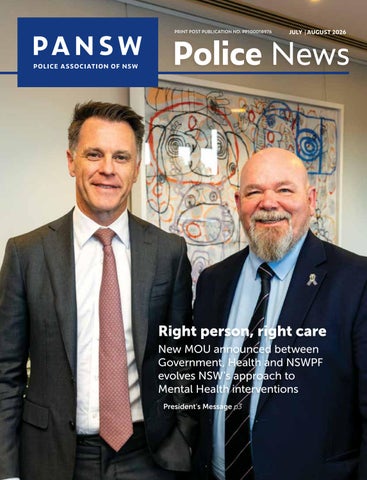
Right person, right care New MOU announced between Government, Health and NSWPF evolves NSW's approach to Mental Health interventions President's Message p3
A practical SUV that’s never boring Mitsubishi Outlander PHEV ES
Novate & save $17K^
Drive your tax down
in tax over 5 years
Upgrade your drive, for less Isuzu Ute MU-X LS-M RWD
Novate & save $22K^ in tax over 5 years
Go off road in comfort Ford Ranger Bi-Turbo Wildtrak Double 4X4
Novate & save $24K^ in tax over 5 years
with a novated lease Car & Bike Premium EV of the Year award winner
BYD Sealion 7 Premium
Novate & save $40K^ in tax over 5 years
See deals
^Estimated income tax and GST savings over a 5-year novated lease term, compared to a non-packaged personal finance arrangement. Comparison based on 2025-26 income tax rates, $100K salary, 15K annual kms, NSW location. Assumptions used to calculate potential savings available upon request. The example is provided for your information and to illustrate scenarios. The results should not be taken as a substitute for independent professional taxation and financial advice. For the purposes of this example, we have not taken into account the impact of salary sacrificing gross salary for fringe benefits on the calculation of your superannuation guarantee contributions. This calculation also does not take into account the impact of any tax offset to which you may been titled. All reasonable care has been taken in preparing these materials; however, SG Fleet Group provides no warranties and makes no representation that the information provided is appropriate for your particular circumstances or indicates you should follow a particular course of action. Visit website to customise calculations.
CONTENTS
Contents Vol 109 / No.4 July - August 2026 MANAGEMENT TEAM
Mr P. Gooley - Secretary Mr P. Hannen - Asst. Sec. Organising Ms K. Membreno - Asst. Sec. Industrial Mr R. Del Vecchio - Asst. Sec. Admin Mr. B. Lee - Asst. Sec. Legal Services Ms C. Prosser - EA and Events Coordinator CPOB
Mr J. Goddard - Lead Organiser Ms R. Neil - Senior Industrial Officer Ms A. Reece - Industrial Officer MEMBER SUPPORT
Mr I. Johnstone - Member Support Coordinator Mr. E Murphy - Member support officer TEAMS CENTRAL METRO/SOUTHERN
Mr R. Sheraton - Organiser Ms. C. Palma - Industrial Officer Ms S. Minahan - Industrial Officer NORTH WEST METRO/NORTHERN
Mr. M. Guerrera - Organiser Ms A. Fleming - Industrial Officer Mr L. Solomon - Industrial Officer SOUTH WEST METRO/WESTERN
Mr M. Evans - Organiser Mr P. Richardson - Industrial Officer Ms E. Hampson - Industrial Officer NON L AC (SPECIALISTS)
Mr A. Stokes - Organiser Mr B.Henry - Organiser Mr. D.Chilvers - Organiser Mr J. Ludkin - Organiser Mr A. Boromisa - Industrial Officer Mr T. McGregor - Industrial Officer Ms K. Young - Industrial Officer LEGAL SERVICES
Ms K. Lally - Senior Coordinator Ms E. Hagan - MET Officer Ms C. Jones - MET Officer Ms C. Young – Solicitor Ms C. Hatzigeorgiou – Solicitor Ms S. George - Paralegal Ms B. O’Reilly - Acting Senior Legal Clark Ms C. Crasto – Legal Clerk REL ATIONSHIPS & STRATEGY
■ Executive Member / Samuel Davis p2 ■ President's Message p3 ■ Pay Rise Effective 3 July 2026 p4 ■ Snow Allowance p5 ■ Police's Administrative Burden p6-7 ■ Court of Social Media p8-9 ■ “Swarming” Shoplifting Incident p10 ■ WHS regulation meets Robotcop p11 ■ Law Enforcement Conduct Commission p12-13 ■ Touching the Future via Goulburn
p15-17
■ Support for the Office of DPP p19 ■ Exemplary Service Awards
p20-21
■ Wrap of Associates News p26-31 ■ Class 370 is incoming p32 ■ Crossword p33
Mr T. Bear - Manager RESEARCH + COMMUNICATIONS
Mr A. Skinner - Engagement Manager Dr K. Linklater - Research Officer Ms E. King - Media + Comms Officer Mr M. Rowland - Comms Officer Ms K. Makhoul - Social Media Ms B. Golledge - Research Officer
Cover NSW PREMIER CHRIS MINNS, PANSW PRESIDENT KEVIN MORTON and PANSW EXECUTIVE MEET TO DISCUSS MOU GOVERNING MENTAL HEALTH FIRST RESPONDERS
INFORMATION ORGANISING CENTRE
Ms K. O’Leary - Supervisor Ms K. Puckeridge Mr H. Spiby Ms. E. Guirguis Ms C. Crasto Ms A. Johnson - IOC
Crossword solution DOWN 1) BANGS 2) HAIRDRESSER 3) BEARD 4) SHAMPOO 8) WAXING 9) FOILS 10) HANDLEBAR 12) SIDEBURNS 15) MIRROR 16) AFRO 17) APPOINTMENT 21) TONSURE 22) COMB 23) GEL 28) RAZOR ACROSS 3) BUZZCUT 5) FADE 6) SCISSORS 7) CROWN 11) MULLET 13) CLIPPERS 14) CONDITIONER 16) AFTERSHAVE 18) BLOWDRY 19) BRUSH 20) PONY TAIL 24) SALON 25) TRIM 26) HIGHLIGHTS 27) BARBER 29) PART
ADMINISTRATIVE SERVICES
Ms N. Scott - Supervisor Memberships Ms J. Jacka - Admin Officer Ms. C. Brett – Senior Admin Officer Ms A. Rutter – Admin Services Clerk Ms N. Hawley – Admin Services Clerk
Advertisers Alert: The Police Association of NSW is the publisher of PANSW Police News. The Police Association does not accept any responsibility to any advertiser or consumer in respect to advertising appearing in PANSW Police News. For enquiries re advertising in this publication, please contact the publishers via: elyssa.king@pansw.org.au
THE POLICE ASSOCIATION PUBLISHES THE PANSW POLICE NEWS IN ACCORDANCE WITH ITS PRIVACY STATEMENT WHICH IS AVAIL ABLE ON THE ASSOCIATION WEBSITE. PANSW POLICE NEWS IS THE OFFICIAL JOURNAL OF THE POLICE ASSOCIATION OF NEW SOUTH WALES PO BOX A1097, SYDNEY SOUTH, NSW 1232 / (02) 9265 6777 / WWW.PANSW.ORG.AU / POLICENEWS@PANSW.ORG.AU ISSN0047-9934 PUBLISHED SIX (6) TIMES A YEAR. CONNECT WITH YOUR ASSOCIATION, FOLLOW NEWS ITEMS ON PANSW SOCIAL MEDIA:
facebook.com/pansw.org
@PoliceAssocNSW
@policeassociation_nsw
linkedin.com/company/pansw
Disclaimer: Police Association of New South Wales (“Publisher”) advises that the contents of this publication are the sole discretion of the Police Association of New South Wales and the publication is offered for information purposes only. The publication has been formulated in good faith and the Publisher believes its contents to be accurate, however, the contents do not amount to a recommendation (either expressly or by implication) and should not be relied upon in lieu of specific professional advice. The Publisher disclaims all responsibility for any loss or damage which may be incurred by any reader relying upon the information contained in the publication whether that loss or damage is caused by any fault or negligence on the part of the publisher, its directors and employees. Copyright: All advertisements appearing in this publication are subject to copyright and may not be reproduced except with the consent of the owner of the copyright. Advertising: Advertisements in this journal are solicited from organisations and businesses on the understanding that no special considerations other than those normally accepted in respect of commercial dealings, will be given to any advertiser.
PANSW Police News July-August 2026
1
EXECUTIVE
Executive Officers Executive Committee
PRESIDENT
VICE PRESIDENT
TREASURER
Kevin Morton
Ian Allwood
Roger Campton
NW MET REGION AREA 1
NW MET REGION AREA 2
SW MET REGION AREA 1
SW MET REGION AREA 2
SOUTHERN REGION AREA 1
SOUTHERN REGION AREA 2
NORTHERN REGION AREA 1
NORTHERN REGION AREA 2
Aaron Rynehart
Darren McCaughey
Stephen Waddington
Elise HulleyThomas
Angus Longley
Kelly Hallinan
Paul Ireland
Steve Kendell
WESTERN REGION
COMMISSIONED OFFICERS REGION
CENTRAL MET REGION AREA 1
CENTRAL MET REGION AREA 2
NON LAC REGION AREA 1
NON LAC REGION AREA 2
NON LAC REGION AREA 3
NON LAC REGION AREA 4
Chris Jordan
Peter Foran
Samuel Davis
Graham Condon
Justin Saunders
Christine Woods
Peter Gurr
Nikki Lucaci
Central Metro 1
Executive Member Samuel Davis ■ I started my career at Miranda LAC
in 2013, then moved onto the PTC Proactive Unit from 2014 to 2017. I transferred to Mascot, which became South Sydney PAC, where I spent the bulk of my career, including various secondments and relieving roles, until my promotion to Sergeant at Surry Hills PAC in 2025. Policing has always been more than a job to me, and I’ve tried to reflect that through ongoing education. Alongside my Associate Degree in Policing Practice from the Academy, I hold a degree in Policing from Western Sydney University, a Criminology degree from UNSW, and a Diploma of Theology, each of which has shaped how I think about the people we serve and the profession we represent. My involvement with the PANSW began when South Sydney PAC was formed and a call went out for branch participation. I put my hand up and became Vice Chair in 2019, eventually growing into the Chair role. Moving through different secondments gave me the opportunity to bring what I’d learned in my own
2
branch to help others navigate their own challenges and I found I genuinely loved that work. Attending my first PANSW conference in 2024 was eye-opening. Seeing the depth of work happening behind the scenes made me want to be part of it at a deeper level, and standing for the Executive felt like the natural next step. I’m keen to learn the role properly before charging ahead, but my passion for member advocacy isn’t new. I’ve been supporting my colleague and friend Ben Bryant at court for some time now, well before joining the Executive. To me, that’s the core of what we do: when our members are thrown to the wolves, they need to know someone has their back. Beyond individual cases, I’m frustrated by the lack of movement on the new uniform and am very interested in a reworking of the first response agreements. The biggest challenge facing us, and policing broadly, remains retention. We have commands sitting below 60% staffing and a worrying vacuum of
PANSW Police News July-August 2026
SAMUAL DAVIS (L) SUPPORTS BEN BRYANT (R) AT DOWNING CENTRE
experienced senior officers. Recruitment numbers at the Academy look encouraging, but if we continue losing good officers who can train the next generation, we risk compounding that problem for years to come.
PRESIDENT’S MESSAGE
PANSW President Kevin Morton
Right Person Right Care A key PANSW reform close to sign-off by all stakeholders
5/7/26 PANSW EXECUTIVE MEET NSW PREMIER CHRIS MINNS TO DISCUSS M.O.U. BASED ON UK's 'RIGHT PERSON, RIGHT CARE' MODEL
■ It has been a busy period since my last
column, and I hope members have been able to stay up to date with the many issues affecting our workforce through the Around the Grounds editions that continue to be published each fortnight. The challenges facing our members are broad and varied, and these regular updates have proven to be an invaluable way of keeping everyone informed about the industrial, legal and welfare matters that impact police across New South Wales. Building on this commitment to communication, we will also be commencing Regional Forums across all areas of the state, beginning with the Northern Region on 6 August 2026. These forums will provide Branch Officials and members with comprehensive updates on key industrial, legal and welfare issues, while also offering valuable insight into current campaigns and matters affecting both the NSW Police Force and our membership. Most importantly, they provide an opportunity for members to engage directly with their Association representatives, ask questions and raise local concerns. I would now like to address an issue that has been of particular concern to me over the past few months. Increasingly, I feel that the reputation of police officers is under siege. Almost every day I am alerted to instances of police being criticised on social media, targeted by sections of the media, and, more concerningly, physically assaulted while carrying out their duties. Some may argue that being assaulted is simply part of the job. While policing is
undoubtedly a challenging profession, no member should accept violence, abuse or disrespect as an unavoidable workplace condition. I cannot help but feel that the growing level of hostility directed at our members during interactions with the public is fuelled, at least in part, by commentary circulated on social media and in some media publications. That is my personal view, but when four of our members are seriously assaulted within the space of seven days, shortly after police have been subjected to intense criticism online simply for doing their job, I believe it is necessary to call it out for what it is. Too often, commentary is based on incomplete information, designed to generate attention rather than provide balanced reporting. When individuals or organisations choose to publicly criticise police actions before all the facts are known, they contribute to a narrative that undermines confidence in frontline officers. Our members deserve respect. I will continue to advocate strongly on behalf of police and call out those who seek to build their profile by unfairly attacking officers who are simply carrying out their duties in the interests of community safety.
Mental Health Since becoming President, one of my key priorities has been returning police to their core duties and advocating for work to be transferred back to the government agencies best equipped to provide those services. The issue of mental health responses remains one of the most significant
examples of this challenge. A number of recent high-profile critical incidents involving mental health call-outs have once again highlighted an important reality: while police will always attend where there is a risk of harm or injury, the primary responsibility for assessing and treating mental health patients should rest with health professionals. The Minns Labor Government's recent announcement regarding a health-led response to mental health emergencies is a positive step in the right direction. The initiative is expected to reduce the number of mental health-related incidents requiring a police response by providing additional resources to NSW Health for triaging and assessment. Specialist health teams will also be better positioned to attend incidents, provide expert support and, where necessary, coordinate transport to appropriate health facilities. Importantly, this approach has been shaped by the United Kingdom's Right Care, Right Person model, which the PANSW has strongly advocated for over an extended period. We will continue to keep members informed as further details regarding the staged rollout become available and encourage your feedback on how these changes operate in practice. This reform should not only improve outcomes for vulnerable people experiencing mental health crises but also address the ongoing criticism directed at police in an area that is not our speciality and was never intended to be our primary responsibility.
PANSW Police News July-August 2026
3
INDUSTRIAL
Kirsty Membreno PANSW Assistant Secretary – Industrial
PANSW Police Officer Pay Rise Effective 3 July 2026 Your pay from 3 July 2026 will include the third salary increase delivered under the historic four year pay agreement secured by the PANSW in 2024.
Salary Increase The following salary increases apply from 3 July 2026: • Non-Commissioned Officers will receive a 5% increase to salary and salary-related allowances. • Inspectors will receive a 3.5% increase to salary, which also flows through to the Non-Renewal Benefit (NRB). • Superintendents will receive a 3% increase to salary, which also flows through to the Non-Renewal Benefit (NRB). For members who have not yet reached the top of their incremental scale, a further salary increase will be received on your incremental date during the financial year. One of the key objectives achieved through the 2024 Award was ensuring: • An annual pay increase for all officers; and • Two salary increases in a year for officers progressing through the incremental scale.
increased salary. In line with the Pay Day Superannuation legislation commencing on 1 July 2026, employer superannuation contributions are now paid each pay period. Members should therefore be able to view fortnightly contributions being credited to their superannuation accounts. The concessional contributions cap has also increased to $32,500 from 1 July 2026, providing additional opportunity for members to make concessional superannuation contributions up to the annual cap (inclusive of the employer contribution).
Rank Probationary Constable Senior Constable (Year 5) Sergeant (Year 5) Detective (Year 8) Inspector (7th Year) Superintendent (8th Year)
Paid Parental Leave payments; these contributions will be calculated and paid automatically into your nominated superannuation fund following the end of the relevant financial year.
What Will You Be Paid From 3 July 2026? The table below provides examples of loaded salary outcomes following the increase Members can also use the PANSW Salary Calculator to determine their salary progression under the Award. To obtain accurate results, please enter the
Loaded Salary $92,576 $139,688 $157,203 $150,463 $215,291 $261,813
Increase $4,407 $6,651 $7,486 $7,165 $7,280 $7,625
Allowance Increases All salary-related allowances will increase by 5%, including (but not limited to): • Shift penalties
Commonwealth Paid Parental Leave
Following the increase:
The Commonwealth Paid Parental Leave Scheme has been enhanced for children born or adopted on or after 1 July 2026. Eligible parents can now share:
• A 12-hour night shift will attract more than $100 in shift penalties.
• 130 days (26 weeks) of paid parental leave based on a five-day work week
• Field Training Officers will receive just over $47 extra per shift.
• 20 days are reserved for the partner
• Field Training Officer Allowance (FTOA) • Special Duties Allowances
Superannuation
• Payment of $200.94 per day, or $1,004.70 per five-day week, before tax
The 12% employer superannuation contribution, which has applied since 1 July 2025, will now be paid on your
• In addition, the 12% superannuation contribution now applies to Commonwealth
4
PANSW Police News July-August 2026
rank and increment level you held on 30 June 2024. The calculator will then display the salary outcomes applicable throughout the 2026–27 financial year. To learn more about your pay and entitlements, you can access all the Award 2024 information, including the salary calculator, facts sheets and videos via the PANSW website, www.pansw.org. au - or call on 9265 6777.
INDUSTRIAL
Kirsty Membreno PANSW Assistant Secretary – Industrial
Snow Allowance 2026 Season Dressing warm is key to staying Operational ■ The Snow Season runs
Cold Climate Uniform
from the Friday of the long weekend in June to the Monday of the long weekend in October. However, the allowance should be paid beyond those dates in the event of an early-season opening or an extension of the season. The allowance is paid to each officer attending to duties related to policing during the annual snow season. It is also agreed that this allowance is paid where accommodation is provided which is self-contained, meaning it allows access to proper meal storage and preparation areas commensurate with a ‘living away from home’ situation where officers can be selfsufficient. This includes;
Don’t forget that officers working in Cold Climate Areas are also entitled to additional uniform items. In stations considered ‘Category 1’, this should include a pair of gloves and four pairs of winter weight socks. ‘Category 2’ areas are also entitled to gloves, socks, and a fur-lined cap. ‘Alpine’ areas should receive all of the above along with: • a pair of waterproof boots • an alpine beanie • four alpine snow skivvies • an alpine snow vest • a snow/rain jacket and • snow/rain pants. Note: See clause 65.4–65.6 of the Crown Employees (Police Officers – 2024) Award to check which category your station falls under.
• All officers who perform duty from Jindabyne Station and are temporarily housed in the police barracks at the station. • Officers stationed at Perisher Valley and accommodated at Perisher Valley in accommodation paid for by NSW Police. • Officers stationed at Adaminaby and accommodated at Adaminaby in dwellings rented by NSW Police. • Officers who perform temporary duty at Jindabyne, Thredbo or Perisher Valley and are accommodated in dwellings rented by NSW Police. The allowance should apply to each day an officer is present in the temporary location, including days the officer may be on Rest Day, RLDs or Sick Leave etc. It is not paid on days when the officer leaves the temporary location, including Rest Days, RLDs, Sick Leave, etc. Officers must inform their supervisor when they
More resources on PANSW Portal HISTORIC PHOTOS OF NSW POLICE AT WORK IN THE SNOW
leave the temporary location so that the necessary adjustments can be made to the daily payable allowance. Payment forms part of the Travel Module on SAP to make payment available either by cash advance or subsequent EFT. If it is proposed to pay this allowance into the officer’s salary, sufficient advances should be paid in cash to accommodate the period between taking up duty and the pay period containing the allowance payment. Note: The allowance is adjusted in accordance with annual movements in the March food and non-alcoholic beverages Sydney CPI figure. The rate for 2026 is set at $128.30 per day.
The PANSW Portal is your source for the latest news and resources. Under the Resources section, you can find several relevant fact sheets to ensure that you are up to date with your entitlements and obligations. Again, there is something for everyone, from annual leave and overtime to working in the heat and meal allowances claims. To view this website section in the navigation bar, you will need to log in to the Portal. Access the invitation sent to your nominated email address by searching the subject line ‘Welcome to the new PANSW Portal’ in your inbox. Once you’ve logged in for the first time, you will only need your registration number and nominated password.
PANSW Police News July-August 2026
5
REFORM
Elise Hulley-Thomas PANSW Executive - SW Metro Region Area
Frontline Policing and Organisational Priorities Managing the Administrative Burden Staffing shortages and 'paper work' continue to drag Police away from the main game.
Start of the shift You arrive at the station half an hour before your shift starts to ensure you are ready to go. You get dressed, load yourself up with all your appointments. Have you got your notebook, BWV, MobiPol - everything else you need for the shift? What’s on your WORKOFF? How many briefs are due? How many outstanding jobs are on CAD? Don’t forget to check your emails. Sift through the SHELTER shift emails. Should I put in for some more User Pays? Don’t forget you need to follow up from that job last shift. There’s a handover for your crew to complete. We’ve got a hospital guard on, so you’re down a car. Operation SURGE is running, so ADVO/bail compliance checks need doing. If you can conduct some proactive patrols in this location that would be great. There’s a likelihood of prisoner transports to Amber Laurel, if there are beds available. And if you haven’t completed the latest round of mandatory PETE courses, those need to be finalised as well. Beep, beep! The radio operator broadcasts another priority job. And off you go. You’re 10 minutes into your shift. This snapshot is repeated across commands, across shifts, and across the state. It demonstrates the pace, competing demands, and constant mental triage that define frontline policing before the first job is even finalised. What is increasingly evident is that frontline policing is no longer just operationally demanding. It is administratively demanding as well. The resilience displayed by police, both young and experienced, deserves
6
recognition. For years now, officers have continued to perform under increasing pressure, adapting to whatever is placed in front of them with limited resources.
Increasing Demand, Finite Resources Staff shortages remain the biggest challenge of the NSWPF. Jobs are increasing not only in volume, but in complexity. Investigations require more documentation, more checks, more oversight, and more reporting. Administrative obligations attached to policing functions continue to expand, often while operational capacity remains unchanged. Every individual requirement may appear reasonable. However, collectively, they consume significant time, attention, and cognitive capacity across a shift. This creates an environment where frontline police are constantly balancing operational policing with increasing administrative workload. Modern policing is rightly held to a high standard. Accountability, transparency, and evidence-based practice are essential in maintaining public confidence and improving outcomes for both the community and police. These expectations are important and necessary. The challenge is ensuring the systems designed to support policing do not unintentionally reduce frontline capability. At the 2026 Biennial Conference of the PANSW, held in May, Assistant Commissioner Jason WEINSTEIN acknowledged the importance of being careful when implementing new initiatives highlighting that they can have unintended consequences on other aspects of policing causing further inefficiencies.
PANSW Police News July-August 2026
Impact on the Frontline Time spent managing administrative requirements can reduce opportunities for proactive policing. Supervisors increasingly balance operational leadership with compliance responsibilities and reporting obligations. Officers spend more time behind computers and less time visible in the community. We have already seen the impacts on the front line. We’ve seen the quality of briefs decrease, failed prosecutions and matters withdrawn increase, investigations are delayed, decrease in proactive policing, increased fatigue and frustration and the scrambling to ‘get out of GD’s’. The concern is whether the cumulative administrative burden is beginning to impact the organisation’s ability to deliver its core operational function effectively.
Recognising the Foundation: Frontline Capability Maintaining alignment starts with recognising that frontline capability is the foundation of the organisation. The ability to respond quickly, investigate effectively, manage risk, and engage with the community in real time is what the public ultimately relies upon. Timing matters. Coordination matters. Understanding the cumulative impact of multiple initiatives matters. Ensuring that new administrative requirements are balanced against existing operational workload is critical to maintaining frontline effectiveness. Many commands operational capacity has consistently remained low for years now, with some dipping below 50% and yet the requests to provide officers to other commands, operations
REFORM
At the end of the day, the community does not see our internal reporting frameworks, compliance processes, or administrative priorities. They see whether police turn up.
Back to Core Business
and staffing orders continues. Several motions relating to this were raised at Conference.
So How Do We Fix It? There is no single solution to reducing the pressure and administrative burden on the frontline. The demands placed upon policing are real, community expectations remain high, and accountability will always be essential. However, there are practical ways the organisation can better align frontline policing with organisational priorities. First, we need to assess cumulative impact. An example that comes to mind: DV legal action rates and the push to reach them has resulted in an increase in matters withdrawn at Court due to insufficient evidence. A brief is however ordered (time), involved officers are rostered for Court having an overall impact on the roster and the capability of meeting first response. LA rates also don’t take into consideration the socio-economical environment of individual commands. Before introducing new operations, reporting requirements, or compliance frameworks, there should be greater consideration of what already exists at the frontline level. A key question should always be asked: What operational work will stop, slow down, or be deprioritised if this additional requirement is introduced? Frontline capacity is not unlimited. Neither are the sections that support the frontline. Second, systems and processes should continue to be streamlined wherever possible. Reducing unnecessary duplication means improving efficiency so accountability can coexist with operational effectiveness. This is also seen in other sections not just the frontline.
AUTHOR, ELISE HULLEY-THOMAS AT PANSW's 2026 CONFERENCE
Third, frontline police should continue to be involved earlier in policy and operational planning discussions. The frontline is often where initiatives succeed or fail in practice. Supervisors and operational police can quickly identify where processes may create duplication, unrealistic expectations, or operational inefficiencies. That operational insight is valuable and should form part of future planning. I was pleased to hear that operational Custody Managers were invited, along with the PANSW, to discuss with Senior leaders the challenges of the charge room and develop new Custody Management SOP’s. Finally, we must continue protecting operational policing time. Every hour spent managing unnecessary administrative process is an hour not spent on proactive policing, victim engagement, investigations, or visibility in the community. Operational time is one of the organisation’s most valuable resources and should be treated accordingly.
The Police Association of NSW remains committed to supporting the frontline. Advocacy regarding the reduction of unnecessary administrative burden, often referred to as “blue tape”, is ultimately about improving operational capability and protecting the wellbeing of members. Conference provided a platform for delegates to focus on blue tape, technology, workforce allocation/ workload analysis and recruitment and retention. The NSWPF has consistently demonstrated its ability to evolve, adapt, and improve. Across the organisation there are capable leaders, experienced operators, and committed teams all working toward the same objective: delivering effective policing outcomes for the community. The opportunity, moving into the future, is to ensure organisational priorities and frontline realities remain connected. Because policing has not changed at its core. We are still here to protect life and property, respond to incidents, support victims, and hold offenders accountable. Organisational processes and priorities should strengthen that mission. At the end of the day, the community does not see our internal reporting frameworks, compliance processes, or administrative priorities. They see whether police turn up. They see how quickly we respond. And they see whether we get it right when it matters most.
PANSW Police News July-August 2026
7
NEWS
Elyssa King PANSW Media & Communications Officer
Police should not be tried in court of Social Media PANSW President Kevin Morton spoke-out after politicians jumped on the bandwagon ■ Two police officers were walking
down High Street in Penrith on June 23 for an unrelated matter when they were flagged down by a local business owner. A 47-year-old man was reportedly behaving aggressively towards a member of the public when the business owner asked him to leave the premises. The two officers then engaged with the individual, who begins to escalate in his behaviour, and failed to comply with the direction to move on. An interested bystander pulled out their phone and begins filming midway through the interaction. The opening frames of the footage appears to show one of the officer’s pushing the man and swearing at him. The situation de-escalated and the man collected his shopping trolley and moved on and no further action is taken by the police officers. The video was later uploaded online and quickly went viral, attracting widespread attention across social media platforms as members of the public weighed in on what they believed had occurred. The actions of police are more heavily scrutinised than ever before. Officers are accountable to numerous policies, procedures and must answer to a number of oversight bodies. All of this exists to ensure professional standards of conduct are maintained. Beyond their training and formal mechanism, the trained cameras and probing microphones of the news media, with their enduring fascination with crime and punishment, has provided an additional layer of scrutiny. Traditionally, journalists trained in ethics were committed to verification, consultation and fact checking with multiple sources before a story went to air. These safeguards are meant to reduce bias in the angle of the piece and ensure audiences are presented with the fullest picture of the events that have occurred. 8
The Media’s Lense
Political Grandstanding
The digital age has added a new frame of perspective to the media landscape, placing a camera in the hands of the public. Breaking news can be recorded and broadcast to thousands of people within a matter of minutes. Social media has amplified voices that once may have been ignored and allowed individuals to document alternative perspectives that previously may have been overlooked, at best, or actively avoided. But social media has also presented significant challenges. As with all other forms of media, a camera’s trained focus is selective and subjective. Choices around editing footage can completely alter the perspective on the story and influence how viewers perceive an event. In many instances, the footage shared online lacks the context necessary to give a full account of the events that have occurred. Unlike a professional discipline, social media users are generally not bound by professional standards requiring them to verify information before publishing it. A video can be uploaded instantly to a personal account, accompanied by a user’s interpretation of the events rather than facts established through investigation. The challenge doesn’t end there. As viewers, our ability to critically assess what we are viewing appears to have diminished. Whether our attention spans have been shortened due to excessive consumption of short form content or a fractured tendency to accept what we are shown at face value, many users are now willing to form strong opinions with limited background knowledge. A brief clip is treated as the complete story. Comments sharing these opinions are posted without factual evidence, condemning individuals online without all of the information about the circumstances.
The acceptance of misinformation, amplified through the echo chamber of social media comment sections, can have far-reaching consequences. The public outcry raised from the viral video came to the attention of Federal Liberal MP Melissa McIntosh, who shared in a social media post that she had written to the Nepean Police Commander and the NSW Police Minister. State Labor MP Karen McKeown had also asked for the matter to be reviewed. When asked by the Daily Telegraph, a police spokesperson said that the body worn footage of the incident was being reviewed by a Commander. While public accountability is important, the situation shows how quickly attention generated on social media can influence public and political discourse before a full assessment of the facts has taken place. Clips of police officers shared following the Bondi Terror Attack were examples of how quickly this can escalate.
PANSW Police News July-August 2026
All Of The Facts Police Association of New South Wales President Kevin Morton criticized what he described as the tendency for police actions to be judged based on short social media clips that do not present the full context of an incident. He argued that officers should not be tried in what he referred to as the "court of social media" before all relevant information has been considered. “I've had enough of our police being portrayed in the court of social media where all the facts aren't known and I will call out publicly any politician who then uses it to grandstand as we lead into a state election in March next year. “If any politician wants the true facts, I would be happy to take their call.” Morton later expanded on his concerns through a video shared on the Police
NEWS
Before drawing conclusions it's worth asking a simple question: are we seeing the whole story? Often, the answer is no.
(left to right) SHARING THE VIDEO WHILE SPINNING A PERSONAL BRAND / FEDERAL LIBERAL MP MELISSA McINTOSH JOINED IN / FOR GOOD OR ILL, MANY AUSTRALIANS GET THEIR PRESPECTIVES FROM PHONES
Association's social media platforms. The video response attracted hundreds of comments and further discussion about the incident. During his response, he shared that the individual was now sitting in a cell on bail refused unrelated matters. In an interview with the Daily Telegraph, PANSW President argued that the viral social media clip failed to show important aspects of the interaction. He said that the footage did not capture the man’s behaviour towards the officers, including abusive language directed towards the female officer. “The man is not homeless, is facing court on charges of possessing a knife at Nepean hospital and has several apprehended violence orders against him for threatening people including a female worker at the Department of Community Justice. Two days later he was arrested for breaching an AVO.” he said. Whether or not these details ultimately justify the officers' actions is a matter for the appropriate review processes.
However, they illustrate a broader point: a short online clip rarely provides a complete understanding of a complex interaction.
Rarely Seen Scenes Morton also highlighted another aspect of the encounter that was not visible in the footage that spread online. According to the Police Association, members of a young homeless family who witnessed the incident were frightened by the man's behaviour and later thanked the officers for their assistance. Morton stated that, after the interaction concluded, the officers personally paid for a meal for the family. He said this was an example of genuine community policing that received little public attention because it lacked the sensational appeal that typically drives social media engagement. These quieter acts of service rarely go viral. They do not generate headlines, provoke outrage or attract millions of views. Yet they are often representative
of the work police officers perform every day within their communities. This does not mean police should be exempt from scrutiny. Accountability is essential in any democratic society, and public confidence depends on transparent review processes when concerns are raised. However, accountability must be based on evidence rather than assumption. Social media can be a powerful tool for transparency, but it should not replace investigation, due process or common sense. Before drawing conclusions about any incident, particularly one involving law enforcement, it is worth asking a simple question: are we seeing the whole story? Often, the answer is no. And that is precisely why police officers should not be tried in the court of social media.
PANSW Police News July-August 2026
9
NEWS
Elyssa King PANSW Media & Communications Officer
Officer Injured During Sydney “Swarming” Shoplifting Incident Successful frontline policing, serious injury, social media and bail made easy ■ On 8 July 2026, a police officer was
hospitalised after being struck over the head with a vodka bottle while intervening in a shoplifting incident on Sydney’s North Shore. The plainclothes officer was one of three police officers who entered a bottle shop after reports of a “swarming” theft involving five teenagers. “Swarming” is a growing crime trend in which groups of young offenders use their numbers to overwhelm retail staff before stealing goods and fleeing. The tactic has targeted bottle shops, supermarkets and electronic retailers, where offenders can quickly take merchandise before staff can respond. The trend has also been linked to social media, with some young offenders allegedly recording and sharing their crimes online to gain attention and notoriety. The teenagers involved in the incident reportedly had their faces covered and were not expecting police to enter the premises. While some members of the group fled immediately upon seeing the officers, others remained and became involved in a violent confrontation. During the struggle, one of the officers was allegedly struck in the head with a bottle of vodka. The injured officer was hospitalised following the attack. The incident serves as a stark reminder of the dangers police officers face while carrying out their duties. What may initially appear to be a property offence can escalate within seconds into a violent and unpredictable situation. Police officers are frequently required to place themselves between offenders and the community, often with little regard for their own safety. Footage of the incident was later broadcast by Channel 9 News, providing a confronting insight into the level of violence directed towards police. PANSW President Kevin Morton described the footage as difficult to watch and praised
SCRAMBLING TEENAGERS LEAVE AN OFFICER INJURERED
the actions of the officers involved. “It was great work by our police officers,” He said. “These swarming offences are where juveniles go into a premises, overwhelm the shop owners and take what they can.” The footage highlighted the growing boldness of some young offenders and the increasing challenges faced by frontline police responding to youth crime incidents. The PANSW President also expressed concern regarding
10 PANSW Police News July-August 2026
the consequences faced by some juveniles involved in such offences. It was reported that four of the teenagers involved were released without charge. “They don’t have to admit guilt, they get a caution, and sometimes we see quite often that they will post about it on social media,” Mr Morton said. The incident has reignited debate about youth offending, repeat juvenile crime and the role social media plays in encouraging unlawful behaviour. Police believe some swarming offences are being coordinated online, where young people are encouraged to participate in thefts and assaults as part of group activities designed to attract attention and views. Despite the risks associated with frontline policing, officers across New South Wales continue to demonstrate professionalism, courage and commitment every day, respond to incidents in order to keeping the community safe. Reflecting on the seriousness of the incident, Mr Morton emphasised that the outcome could have been far worse. “Our officer was seriously injured, but it could have been so much worse,” he said. “He could have been killed.” The injured officer, an experienced member of the NSW Police Force, has since returned to work. The teenager alleged to have assaulted the officer has been charged with four offences, granted bail and is scheduled to reappear before the court next month. While the officer’s recovery is welcome news, the incident serves as a reminder of the dangers police officers face on the frontline every day. It also highlights the importance of addressing emerging crime trends and ensuring offenders are held accountable for their actions.
INDUSTRIAL
Leo Solomon Industrial Officer
Could Robocop (AI) be compliant with the recent WHS Amendments? ■ In February 2026, the NSW Parliament
passed the Work Health and Safety Amendment (Digital Work Systems) Act 2026, making New South Wales the first state in Australia to provide regulation for work health and safety (WHS) risks arising from artificial intelligence (AI), algorithms, and automated systems. “This is a breakthrough for hundreds of thousands of workers,” said Mark Morey, Secretary of Unions NSW. “By explicitly holding employers responsible when AI and digital systems harm workers, NSW is setting a proper standard for workplace safety in the digital age.” The legislation amends the current Work Health Safety Act 2011 (NSW) (the act) to explicitly require Persons Conducting Business of Undertaking (PCBU) “that any digital work system used, including any work allocated by the digital work system, does not risk the health and safety of a worker.” Section 19 of the act now sates the PCBU’s primary duty of care includes: “(c1) the health and safety of workers is not put at risk from the use of digital work systems by the business or
undertaking…” Digital work systems is defined as “an algorithm, artificial intelligence, automation or online platform.” It also provides the right to a person who holds a WHS permit “to access and inspect a digital work system relevant to a suspected contravention of the Act.” The inclusion of AI as potential risk to work health safety gives members more rights, requiring a PCBU to consider the risks (and provide a safe system of work) using digital work systems with regard to: • excessive or unreasonable workloads for workers at work in the business or undertaking, • the use of excessive or unreasonable metrics to assess and track the performance of workers at work in the business or undertaking, • excessive or unreasonable monitoring or surveillance of workers at work in the business or undertaking, • unlawful discriminatory practices or decision-making in the conduct of the business or undertaking. Members now have the right to be
consulted on the above risk too as per section 47-49 of the WHS Act. This brings us to the big question, what are your rights when Robocop shows up at your command: • NSWPF needs to assess and mitigate risks with Robocop’s introduction; • NSWPF need to consult with affected workers about WHS regarding Robocop (explanation of the systems, research, testing, etc); • If Robocop is allocating work, that the allocation is not excessive, unreasonably monitored, unlawfully discriminating or unreasonably tracking performance. • NSWPF are required to provide access to Robocops systems (his coding, memories etc) if they are suspected to be unsafe. This is major win for members, that protects the rapid implementation of Ai, and allows members to be front and centre in assessing the appropriateness of WHS with the continuing development of new technologies.
PANSW Police News July-August 2026
11
LEGAL
Angus Skinner PANSW Engagement Manager
Obstinate Ignorance? Does that sound like the Law Enforcement Conduct Commission?
■ A police officer sits in the witness box.
Counsel Assisting is asking pretty hostile questions, insinuating the officer has done the wrong thing. Outside, a scrum of cameras is waiting to film him leaving, and put him on the nightly news again. The officer is a senior constable. Or was. 7 years in the cops, but he has since left the job. It became harder and harder to keep the motivation it takes to be a cop, given the investigations and proceedings he has been through. 3 years ago, he was called to a mental health incident. By the end, a patient attempted to use an edged weapon. With the split seconds available, in the confined space and with others present in the room, the officer assessed he had no choice but to use his firearm. He is trained to keep people safe from a person with a weapon. That’s why he was called to this job. He has agonised every night since whether he did the right thing, but he knows one thing for sure. He tried to do the right thing. He did not wake up that morning and decide he wanted to hurt someone. He did not decide that in the car on the way there. He did not decide that as he came through the door. He only did it when it became necessary to protect the others in the room. Now, a room full of lawyers have spent days questioning his competence. His state of mind. His decisions. His training. They seem to be suggesting if he had done another half day of training (with role-plays) on the specific mental illness this person had, he could have deescalated the situation. He didn’t even know the exact mental illness the person had. And he has learnt through these proceedings, that multiple medically qualified experts had been failing to deescalate this man’s behaviour for years prior. What chance did he have? Health taking primary responsibility for mental health incident response, and alleviating police from that workload is nearly a reality in NSW. NSW is very close to implementing a model similar to Right Care Right Person, 12
POLICE CAN EXPECT COURTS TO FOCUS ON LAST MOMENTS RATHER THAN YEARS OF COMPLEX SYSTEMIC FAILURE
which was highly successful in the United Kingdom. At its core, this is model that ensures Health personnel hold primary responsibility for responding to mental health related incidents, and police only attend when necessary for safety or a crime is involved. The benefits of this reform, if done right and properly funded are potentially enormous and include: • Significantly alleviating police workload: last year police officers attended 70,000 mental health emergencies/incidents, hundreds of thousands of concern for welfare, and tens of thousands of mental health transports. Health will become the primary agency responsible for a huge amount of those incidents under the new model, freeing up police to focus on their core duties and reduce workload pressures. • Better services for people with mental illness: people with a mental illness deserve a health service. Mental health should not be unofficially criminalised by sending a cop to a person that needs a doctor or a counsellor. This reform makes a far more appropriate pathway for people to access the support they need. • Safer response, less legal peril: police have so often been called to attend
PANSW Police News July-August 2026
incidents that require health expertise, qualifications and years of experience. The presence of police uniforms, vehicles and arms and appointments can inherently escalate a situation. This creates an incident that is potentially unsafe for members of the public, people with mental illness, and the police officers involved. If use of force becomes necessary, it can then result in years of investigations, coronial inquests and legal proceedings, that severely impact officers’ careers and lives. This reform reduces those incidents. Incidents where weapons or violence are involved will always require police to attend. But the hundreds of thousands of incidents that start off innocuous at first, and only escalate with police presence? They can be avoided. They can be handled more appropriately. In 2023, the PANSW called on the NSW Government to implement the Right Care Right Person model, due to its considerable success in the United Kingdom. That call began in this very publication; PANSW Police News Magazine. As a result of that advocacy, NSWPF sent a delegation to the UK and subsequently recommended that model for NSW. Through years of collaboration between the NSW Police Force, NSW Health and NSW Government, we are now incredibly close to implementation of that model. As NSW approaches key milestones regarding funding and agreement of new procedures, it is crucial that the NSW Government maintain its commitment to best practice and providing the funding necessary to achieve it. And it is at this moment that the Law Enforcement Conduct Commission chose to commence a review into Mental health and policing interactions in NSW. The review will assess NSWPF policies, systems, and training. The LECC explicitly states: “The Commission cannot make comments or recommendations about whether
LEGAL
'... without any intention to actually make things better for people with mental illness, (suffering) at the end of years of other systems’ failures'
MEDIA SCRUM: EAGER END USERS OF A PROCESS WITH LIT TLE INTENTION TO ACTUALLY MAKE THINGS BET TER FOR PEOPLE SUFFERING AFTER YEARS OF FAILURE
agencies other than police should be first responders in NSW.” At a time when NSW is so close to implementing crucial reform that will hugely benefit people with mental illness, police resources, and the safety of police officers, the LECC chooses to commence a review that deliberately ignores the direction of that reform. The PANSW considers the timing and severe limitations of the scope of this review to be obstinately ignorant to the overwhelming consensus that this reform is in the interests of everyone involved. What the LECC hopes to achieve by reviewing the policies, systems and training currently in place, right before fundamental and far-reaching reform, is difficult to ascertain. Our best guess; this is a last chance for the LECC to criticise police officers put in impossible
situations. The last chance to recommend police do even more training to make them quasi-mental health professionals. It is LECC’s last chance to justify its existence with investigations that are easy to splash on the pages of the newspaper without any intention to actually make things better for people with mental illness, or respect that police act in seconds at the end of years of other systems’ failure. Or maybe worse, the last chance to derail the reform. Hopefully we are incorrect and pleasantly surprised by this review, but we will prepare for that assumption. The PANSW has made a submission to the LECC as part of this review, making 3 things clear: • The decision to conduct this review at this time is hugely cynical and potentially irresponsible.
• Any recommendations which increase the training requirements, workload responsibility or accountability for police in relation to mental health incidents are clearly against the intended policy direction of NSW, and • The LECC needs to reflect on its own practices and procedures, and how they impact on the mental health of police officers involved in dangerous or traumatic incidents, not because they set out to hurt anyone, but because they were duty bound to attend and resolve dangerous incidents. The PANSW will utilise all available avenues, including publicly campaigning if required, to ensure the positive pathway that NSW is on is not interrupted by this unnecessary and irresponsible review.
PANSW Police News July-August 2026
13
Supporting those who protect our communities Caring for others is your super power. Being super helpful is ours. Join today at aware.com.au Consider if Aware Super is right for you and read the PDS and TMD at aware.com.au. Issued by Aware Super Pty Ltd (ABN 11 118 202 672, AFSL 293340) trustee of Aware Super (ABN 53 226 460 365). AS454 0726
Police shop at Police Shop
Based at Goulburn Police Academy, and everywhere online from Boot Polish to Plush Toys www.policeshop.com.au 14
PANSW Police News July-August 2026
TRAINING
Peter Gurr PANSW Executive Member – Non LAC 3
NSW Police Academy expansion highlights need for improved support for Instructors & Recruits NSWPF touches the future through its Academy, Trainers and Students ■ The NSW Police Academy continues to play a vital role in preparing the next generation of police officers, with increasing recruit numbers reflecting the ongoing demand for frontline policing across the state. The recent addition of an extra recruit class demonstrates the organisation's commitment to strengthening workforce numbers and addressing future operational requirements. While the expansion is a positive step, it has also placed additional pressure on the resources and personnel responsible for delivering training at the Academy. Motions passed by elected delegates at Conference 2026 directed The Police Association of NSW (PANSW) to engage the NSWPF and Government on behalf of members to ensure the increased training demands are matched by appropriate support and remuneration for those tasked with delivering recruit education. Instructors and staff seconded to the Academy have made significant contributions to the success of recruit training programs, often relocating from their home commands to fill critical roles. However, concerns remain regarding the adequacy of travel entitlements, accommodation arrangements, and financial support available to members undertaking Academy duties. With the introduction of the additional recruit class, many instructors and support staff have experienced increased workloads and extended periods away from their families and home workplaces. Members have raised concerns about the costs and challenges associated with travel and temporary accommodation while fulfilling secondments at the Academy. PANSW has consistently highlighted that members performing
ling from various locations across New South Wales. In addition, PANSW has strongly advocated for a review of secondee payments to ensure members are adequately compensated for the additional responsibilities and disruptions associated with Academy postings. Competitive and equitable remuneration is critical in encouraging skilled and experienced officers to accept instructional roles, particularly at a time when policing commands across the state are also experiencing staffing pressures. The Academy’s ability to deliver STUDENTS & TRAINERS: GOULBURN ACADEMY SHOOTING RANGE 29/7/26 high-quality recruit training is dependent upon attracting these important roles should not be and retaining capable instructors financially disadvantaged because of who possess extensive operational supporting organisational priorities. experience and specialist knowledge. As These motions are crafted by your recruit numbers continue to grow, it is delegates, speaking directly to the prioriessential the support provided to these ties of our members. From advocacy at members grows alongside organisational the Branch level to speaking to the floor expectations. at Conference, the process highlights PANSW remains committed to working the functional effectiveness of union constructively with NSW Police Force principles in action. It shows how the to secure improved travel entitlements, issues that impact our members, raised appropriate accommodation standards, by your elected officials, are transformed into the strategic direction of the PANSW. and fair secondee payments. Ensuring members are properly supported Your Executive then continue to meet while undertaking Academy duties will bi-monthly and work tirelessly behind strengthen the training environment, the scenes to ensure that the Association improve instructor retention, and pushes for better outcomes to improve ultimately contribute to better outcomes working conditions and entitlements for for recruits entering the profession. our members across the state. The expansion of recruit training is The Association has therefore cona positive investment in the future of tinued to advocate for improved travel policing. Equally important is ensuring entitlements that properly recognise the members responsible for delivering that time and expense incurred by members training receive the recognition, support, required to attend the Academy. This inand conditions necessary to continue cludes ensuring reimbursement arrangeproviding the high standard of instruction ments are fair, consistent, and reflective expected throughout the NSW Police of the realities faced by members travelForce.
PANSW Police News July-August 2026
15
16
PANSW Police News July-August 2026
Firing Range, Goulburn Police Academy, July 29, 2026
PANSW Police News July-August 2026
17
CONFERENCE
77 th Commissioned Officers Dinner On behalf of the Executive and Management of the Police Association of NSW, you’re invited to join us at the upcoming 77th Commissioned Officers Dinner
Friday, 23 October 2026 Three course dinner and beverages, Police Band, Dinner guest speaker and Pre-dinner beverages Location: Grand Ballroom,
Sheraton Grand Sydney Hyde Park 161 Elizabeth Street, Sydney Time: 7.00pm for 7.30pm Attire: Mess Dress, Miniatures and other Decorations or Black Tie Tickets: $120 for Members & Associates (and their partners) or $150 for non-members Book now: QR code (below) or https://www.trybooking.com/events/landing/1581818
18 PANSW Police News July-August 2026
LEGAL
Elyssa King PANSW Media & Communications Officer
Know Your Rights & Obligations If you're subject of a complaint, or a witness in the process, your Association is ready to help ■ The high-visibility nature of op-
complaint or investigative processes. it is imperative that every member is erational policing inevitably results in a However, members should understand familiar with their rights and obligations significant number of complaints being that the booklet is intended as a guide and seeks advice as soon as a complaint made each year. Police officers interonly. It does not constitute legal ador investigation arises. act with members of the community vice and should not be relied upon as To support members facing these in a wide variety of circumstances. As a a substitute for independent legal or challenges, the Association operresult, it is highly likely that at some stage professional assistance tailored to an ates a comprehensive Financial Legal during a policing career an officer may individual’s circumstances. Assistance Scheme. This scheme is debecome the subject of a complaint or be Because every complaint matter is signed to assist members who encouncalled upon as a witness in ter work-related legal a complaint investigation difficulties. Support is involving another officer. available through the If you find yourself inAssociation’s in-house volved in a complaint matlegal practice and ter, whether as the officer through an external concerned or as a witness, panel of experienced you may be required to legal firms with experparticipate in an interview, tise in police-related provide a statement, or matters. This ensures supply information relevant members have access to the investigation. In to professional reprethese circumstances, it is sentation and advice essential that you underwhen required. stand your rights and obIt is important to ligations. Members should recognise that the contact their Association Association’s support as soon as possible for is guided by its comguidance, assistance, and mitment to profesreferral for independent sionalism, integrity, legal advice. and accountability. The Complaint investigations Association strongly can be complex and may supports the concept of extend beyond a single the Professional Police process or jurisdiction. A Practitioner and is commatter that begins as an mitted to protecting the (main) ROLE PLAYING A COMPLAINT SCENERIO / )insert) QR LINK TO ONLINE BOOKLET internal complaint may rights of members who also become the subject of perform their duties criminal investigation, coronial proceeddifferent, members are strongly encourlawfully and ethically. However, it is not ings, industrial action, or another form aged to contact the Association in the prepared to support officers who are of external review. In some situations, an first instance whenever they become found guilty of criminal conduct or seriofficer may need to respond to multiple aware of an investigation or potential ous misconduct. investigations arising from the same incomplaint. Early advice can help officers Ultimately, the Association’s policy is cident. Each of these legal environments understand the process, protect their leto ensure all members are afforded the has different procedures, requirements, gal interests, and ensure they meet their same legal rights and protections availand potential consequences, making acprofessional obligations appropriately. able to every member of the community. cess to accurate advice and experienced Complaint matters may be dealt with in By understanding their rights, meeting legal representation critically important. a variety of internal and external fotheir obligations, and seeking assisTo assist members in understanding rums, including criminal courts, coronial tance early, officers can better navigate these issues, the PANSW has published inquiries, industrial tribunals, professional complaint processes while maintaining the updated Know Your Rights and standards investigations, and disciplinary professional standards and protecting Obligations booklet. This publication proceedings. The outcomes of these their interests throughout their careers. provides general information regarding processes can have significant implicaTo access a copy of the booklet, visit the rights, responsibilities, and entitletions for an officer’s career, reputation, our website or contact the IOC on info. ments of police officers involved in and personal wellbeing. For this reason, centre@pansw.org.au PANSW Police News July-August 2026
19
EXEMPLARY SERVICE AWARD
Chris Jordan PANSW Executive Member - Western Region
Exemplary Service Award Tony Borland 'Godfather' of the Western Region / 31 years of union activism
■ It was my pleasure at
including Rod Sheraton, the recent PANSW 2026 Matt Thompson, Peter Conference to present the Richardson, Paul Hannen, Exemplary Service Award to Pat Gooley, Leo Solomon, long-serving member Tony Kirsty Membreno, Jon Borland. Goddard, Ian Johnstone, The Western Region delRod Harty, Casey Palma, egate has spent more than Peter Remfrey and Cath three decades as an active Prosser. Last but not least, Branch Official. Throughout he thanked his Western his years of service, Tony Region delegates and has earned the respect of Branch Officials for assisting colleagues across the state and inspiring him. through a combination of “31 years of union activism integrity, dedication and has been a long time… quiet leadership. He has with many faces, many never sought recognition memories and many or personal reward for his battles. One thing that efforts, instead choosing to brings us together is the focus on supporting memblue family…we are all bers and strengthening the united to better the cause.” Association. He said. When asked about his “The Association staff achievements over the and their infinite wisdom… period, ‘Borlo’ would be the thank you. We can’t do PANSW PRESIDENT KEVIN MORTON PRESENTS TONY BORLAND WITH HIS AWARD last person to speak about this without you taking himself. He is always the first those battles up for us His legacy will be hard to match. to downplay his character, his long-term and helping us out. Thank you for Wherever his career has taken him, influence and his extensive efforts in your tireless support and sharing your he has focused on maintaining the looking after the members in blue on the knowledge.” strength of the Branches along with frontline. He spared only a few brief words for guiding newer Branch Officials with his He is happy to speak about his history. himself, accepting the honour with outstanding knowledge and experience. From 1988-1990 he was a Branch Official heartfelt thanks. He has always put the success of the at Bathurst, then he moved to The Rocks The commitment to service runs in Branch first. Late last year, Tony stepped in Sydney until 2003. After regaining his the family. Among those applauding in down as Chairperson of the Branch to senses, he returned to Western Region the audience was his father Ian Borland. make way for the next generation of and Bathurst until 2007 before moving to The former Inspector was a longBranch Officials to step foward. Orange. serving Branch Secretary at Bathurst and Tony is a man of great wisdom who has Because he won’t say it, I will: Borlo was instrumental in fighting for better influenced me hugely. He was always is nothing short of the Godfather of counselling and peer support services ready to share his knowledge and answer Western Region. Whether advocating on for officers who were involved in critical the phone, at any time of the morning or behalf of members, mentoring Branch incidents. He served on the PANSW’s evening. Many of our conversations have Officials or sharing the lessons gained Executive for more than a decade before guided me in performing the role that I through decades of experience, Tony being named a Life Member of the do today as an Executive Member for the has consistently led by example. His Association. Western Region. approach has helped build a strong Thank you Tony for your outstanding In typical fashion, Tony began by culture of support and activism within service to the Association. thanking some of the individuals who Western Region that will continue well helped him over his decades of service into the future. 20 PANSW Police News July-August 2026
EXEMPLARY SERVICE AWARD
Peter Foran PANSW Executive Member - Commissioned Officers Branch
Exemplary Service Award Guy Guiana “It’s been an honour and a privilege to be involved with this group of people".
■ The Commissioned
times would continue Officers Branch has after hours when he always held a special was always ready to place within history lend an ear to his fellow within the Police Commissioned Officers Association of New when they needed South Wales (PANSW). advice or when he While commissioned would provide much officers were needed intel to the originally excluded PANSW staff during from membership critical incidents or when the Association major events. was formed, the His determined focus PANSW PRESIDENT KEVIN MORTON PRESENTS GUY GUIANA WITH HIS AWARD establishment of the on the betterment of Commissioned Police conditions for his fellow outstanding contribution to policing and Officers’ Association in Commissioned Officers to the Police Association has spanned 1920 ensured that senior police leaders will be felt long after his retirement. He’s had a dedicated voice. The merger of the decades. provided statements in Award claims to Guy dedicated 38 years of service to the identify the role of senior leaders and his two organisations in 1999 ushered in a people of New South Wales as a police new era of police unionism and brought advice on numerous policies has meant officer. Throughout his distinguished New South Wales in line with most that his legacy will be etched into the career, he served in both metropolitan policing jurisdictions around the country. history of the PANSW. and regional commands, earning a As senior leaders within the Upon accepting his Award, Guy joked organization, the Commissioned Officers reputation as a respected leader, trusted that when he received a message saying mentor and passionate advocate for have provided a unique perspective. that he was registered for Conference, his colleagues. For the entirety of his Their vision and leadership expands he thought that a mistake had been policing career, Guy was a member of across all ranks to capture the vision made. the Police Association of New South of the entire organization. Their voices “I recognize the value of the Wales and became one of the stalwarts have often lent a note of challenge to Association and have always talked it up of the Commissioned Officers Branch, the chorus on the floor at Conference, with the naysayers who would complain serving for more than two decades as an but also bring a sweeping knowledge about what they didn’t get.” active Branch Official. of operational policing and policy from “It’s been an honour and a privilege to Throughout his career in both a position of leadership that has been a be involved with this group of people. metropolitan and regional commands, valuable addition to the conversations My only regret with being involved with Guy was known for being passionate that have led to strategic outcomes. the Association is that I didn’t come to it about taking care of his people. A mentor sooner.” It is fitting, therefore, that those to junior staff, he used his considerable who have dedicated themselves to He thanked Kevin Morton, Pat Gooley, knowledge to help to guide them strengthening both the profession and Jon Goddard, Ian Johnstone, his fellow through the promotions process as they the Association are recognised for their CPOB members and all the Association were supported to ascend through the service. Few individuals embody that staff. ranks. commitment more fully than retired This readiness to be of assistance at all Chief Inspector Guy Guiana, whose PANSW Police News July-August 2026
21
HERE FOR OUR OWN Policing isn’t your average 9 to 5. So we’re not your average bank. Banking built for you, not for everyone. What you get with Police Bank: • Work with NSW Police? Get paid a day early when you bank with Police Bank yes, you read that right! • No monthly or annual fees on our Easy Access Account • Your overtime, penalty rates and shift allowances are considered when you want to borrow.
Scan the QR code to find out more.
policebank.com.au T&Cs, eligibility and lending criteria apply. Visit policebank.com.au for more details. Police Bank Ltd. ABN 95 087 650 799. AFSL/Australian Credit Licence No. 240018.
22 PANSW Police News November-December 2024
MONEY MATTERS
Greg McKenna, CEO of Police Bank
Promotions, transfers & pay rises ... great opportunities to strengthen your financial future ■ A promotion. A transfer. A move into a specialist command. Even the guaranteed pay increases ahead for NSW Police are an opportunity to strengthen your financial position. You may not expect your bank to encourage you to pay off your home loan sooner or reduce a personal, car or motorbike loan. But if you're able to do that, you'll save on interest, improve your financial resilience and create more opportunities to build wealth over time. We speak to many members who spend what they earn – and sometimes more. As a younger man, I've been there myself. After almost 40 years in banking and finance, my experience is that your future self will thank you for putting at least some of every pay increase to work for tomorrow.
Here are four ways to make the most of a higher income. 1. Save part of your pay rise before you spend it A promotion often comes with a bigger pay packet. It’s tempting to celebrate with a new car, more holidays or higher day-to-day spending. There’s nothing wrong with enjoying your success, but it’s worth pausing before making permanent lifestyle changes. Take time to understand what the increase really means for your household budget. Will new responsibilities bring extra childcare, travel or other costs? Is the additional income consistent? Are there tax implications? One of the smartest financial habits is delaying major spending decisions
goals much easier. 4. Use the moment to take stock
while you assess the real impact. Even directing part of your pay rise towards savings, super or paying down debt can make a significant difference over time. 2. Rebuild your emergency buffer Last year, our financial survey with the Police Association showed many members understand the importance of having money set aside for unexpected events. We’ve spoken before about why an emergency fund matters. Life rarely follows a perfect plan, and savings provide breathing room when circumstances change. With the cost of living still high, many people have dipped into their savings just to keep up. A pay rise is an ideal opportunity to rebuild that buffer before thinking about longer-term investing. 3. Enjoy today, while planning for tomorrow Advancing your career is something to celebrate, and the extra income should help you and your family enjoy life. We’re certainly not suggesting you save every dollar. Instead, think about where you’d like to be financially in one, five or 10 years, then work backwards. If you’re already on track, that’s fantastic. If not, even small changes today can make achieving those future
Police officers spend their careers solving problems for others, which often leaves little time to focus on long-term personal finances. That’s completely understandable. A pay rise, promotion or transfer is a natural time to review your financial position. Look at your budget, borrowing, savings goals and retirement planning, and ask whether your money is working as hard as it could be. Sometimes a simple conversation can provide the clarity and confidence needed to make better financial decisions.
Final word Higher income is always welcome, particularly while household budgets remain under pressure. Whether you use that extra money to reduce debt, build savings, grow your super or start investing will depend on your personal goals. The important thing is making a conscious decision, rather than letting higher income simply disappear into higher spending. At Police Bank, we’re proud to support NSW Police members and their families through every stage of their careers, wherever the next chapter takes you. For more tips on managing your finances, visit www.policebank.com.au or follow us on our socials. © 2026 POLICE BANK LTD. ABN 95 087 650 799. AFSL/AUSTRALIAN CREDIT LICENCE NO. 240018. THIS ARTICLE IS INTENDED TO PROVIDE GENERAL INFORMATION OF AN EDUCATIONAL NATURE ONLY. THIS INFORMATION HAS BEEN PREPARED WITHOUT TAKING INTO ACCOUNT YOUR PERSONAL OBJECTIVES OR FINANCIAL SITUATION.
PANSW Police News July-August 2026
23
Scan to support the Police Family
PARLIMENT
Pat Gooley PANSW Secretary
PANSW response to NSW Legislative Council Privileges Committee Report ■ The Police Association of NSW holds serious concerns regarding the report released by the NSW Legislative Council Portfolio Committee No. 5 – Justice and Communities”. It is important to note that this report reflects the view of the Committee majority and was not a unanimous finding. That fact alone demonstrates that there are differing views about both the process undertaken and the conclusions ultimately reached. The Director of Public Prosecutions (DPP) occupies one of the most significant statutory offices in New South Wales. The office is entrusted with making decisions regarding the commencement and maintenance of the most serious criminal prosecutions in the state, the overwhelming majority of which arise from investigations conducted by our members. The Director is required to make these decisions impartially, independently and based solely on the evidence and the public interest, free from external pressure or influence. The Director also plays an important role in considering and commencing prosecutions involving police officers and other public officials when circumstances require. For that reason, the independence of the office is not simply desirable—it is essential. Public confidence in the criminal justice system depends upon the community knowing that prosecutorial decisions are made without fear, favour, political influence or improper interference. The PANSW regularly disagrees with decisions made by the Director and officers within the DPP. Like many stakeholders in the justice system, there are occasions where we believe different decisions should have been made. However, when disagreements arise, we address them through appropriate and established channels. We engage directly and professionally with the Director, advocate for legislative reform where necessary, and pursue policy improvements through transparent and constructive means. What we do not do is seek to undermine the independence of the office itself.
The PANSW strongly supports and demands the continued independence of the DPP. Our members, and indeed the wider community, should be deeply concerned if that independence is diminished, or even if a perception emerges that the Director or officers of the DPP are vulnerable to political influence or interference. Public confidence is not only lost when institutions become compro-
DPP SALLY DOWLING OUTSIDE THE SUPREME COURT of NSW
mised; it is also eroded when reasonable people begin to believe that independence may no longer be assured. As a society, we rightly place great importance on maintaining judicial independence. It is a fundamental pillar of a fair and democratic justice system. However, it is inconsistent to demand the protection of judicial independence while allowing the independence of other critical participants within that same system to be weakened. The DPP, like police officers, performs a function that requires impartiality and freedom from political pressure. These institutions do not operate in isolation. Public confidence in the justice system depends upon confidence in all of its participants. There are numerous examples from overseas jurisdictions where prosecutors and law enforcement leaders have become politicised or are perceived to be
politically aligned. In such environments, public trust deteriorates rapidly, confidence in decision-making is undermined, and the legitimacy of the justice system itself is called into question. These are outcomes that New South Wales should be vigilant to avoid. The PANSW understands and supports the Parliament’s responsibility to oversee public agencies and statutory office holders. Appropriate oversight is both necessary and beneficial in a democratic society. At the same time, we are acutely aware of the limitations of oversight mechanisms and have witnessed the damaging consequences that can arise when oversight is perceived to exceed its proper role or become politicised. The fundamental principles of procedural fairness must remain at the centre of any oversight process. Individuals who are the subject of adverse findings should be afforded a proper opportunity to respond before those findings are published. Those responses must be genuinely considered, and conclusions should be supported by compelling evidence proportionate to the seriousness of the allegations and findings being made. Regrettably, there appears to have been a different approach adopted by the majority of this Committee. If such treatment can occur in relation to a statutory office holder of this seniority and importance, then it is reasonable to be concerned that the same approach could one day be applied to police officers and other public servants. The PANSW does not expect the Committee to revisit its conclusions or reconsider its report. However, we do expect that this report will ultimately take its place alongside other examples where concerns about fairness, process and overreach have overshadowed the findings themselves—reports that remain unactioned, gathering dust on the shelf, while confidence in the oversight process is diminished rather than strengthened.
PANSW Police News July-August 2026
25
ASSOCIATES
Detective Inspector Paul Quigg
Family of League Committee 24 years ago NSW Police Rugby League players organised, to support mates off the field
POLICE RUGBY LEAGUE COMPETITION BEGAN IN 1970 PIT TING TEAMS FROM POLICE DISTRICTS AND REGIONS AGAINST EACH OTHER
■ The Family of League exists to ensure
those most in need in the rugby league community can access financial, social, and emotional support. First established as the Men of League Foundation by rugby league greats Ron Coote, Jim Hall, and Max Brown in 2002, the organisation was built on the values that have always underpinned rugby league – teamwork, mateship, resilience and giving back. Today, as the Family of League, it continues to embrace these same values while supporting a broader and more inclusive rugby league community. As an independent grassroots organisation, Family of League was created to provide a helping hand and a shoulder to lean on when life becomes challenging. For more than 20 years, it has provided over 10,000 hours of volunteer service and $10 million of financial support to those in need of assistance. Funds to support these important wellbeing initiatives are raised through a combination of grants, sponsorships, membership fees, public donations, and a wide range of fundraising activities. These funds have enabled the organisation to provide practical assistance and compassionate care to thousands of individuals and families throughout the rugby league community. The Family of League has grown into a network of more than 6,500 members and volunteers who share a passion for rugby league and a strong commitment
to supporting one another. Whether you are an ex-player, administrator, referee, or club volunteer or family member, the Family of League works to protect and enhance the lives of members of the extended police rugby league family while respecting everyone’s dignity. The Foundation has provided support in many forms, including assistance with surgery, rehabilitation, specialist medical treatment, mobility equipment and home modifications. Volunteers also conduct wellbeing visits to homes and hospitals, helping reduce social isolation while promoting mental health awareness and connection. These initiatives reflect the organisation’s belief that caring for people extends well beyond the playing field. The official NSW Police Rugby League competition commenced in 1970 and since this time, police rugby league amongst the police districts and regional communities has been highly competitive. The elements of the game, from the camaraderie of team work to the commitment to maintaining fitness, are all so central to what makes policing great. The Police Association of New South Wales (PANSW) has maintained a longstanding connection with police rugby league and has consistently supported the sport through sponsorship and participation at the annual NSW Police Rugby League Carnival. PANSW Life Member Stephen McDonald has been a passionate advocate for police rugby league over many years and currently
26 PANSW Police News July-August 2026
serves as President of the New South Wales Police Rugby League. At the recent NSW Police Rugby League Carnival at Newcastle, the NSW Police – Family of League Committee was formed. These individuals will continue the organisation’s commitment to assist police officers and their families involved in police rugby league who are facing tough times. The members of the NSW Police Rugby League Committee are: • Superintendent Paul Simpkins APM – President • Superintendent Kylie Endemi APM • Detective Inspector Paul Quigg – Secretary and Wellbeing Officer • Detective Sergeant Sean Hampstead • Detective Sergeant Stephen McDonald • Sergeant Rod Silva • Detective Scot Murray The NSW Police – Family of League committee will be available to provide support, a helping hand or a shoulder to lean on for anyone involved in NSW Police Rugby League whether it be as a player, coach, trainer, committee member or supporter. For more information, you can get in touch with me on 0404 824 838 or via email at quig1pau@police. nsw.gov.au
ASSOCIATES
Brett Henry / Jeff Ludkin PANSW Organisers
Digging Deep for a Polar Plunge Police brave cold conditions to support Special Olympics Athletes
■ More than 160 NSW Police within the Special Olympics comofficers, emergency services munity. personnel, Special Olympics athThe Wollongong event marked letes and community members the first Polar Plunge for 2026, embraced freezing conditions on with similar events scheduled to the South Coast recently, taking take place in 25 locations across part in the second Wollongong Australia throughout the year. Polar Plunge and raising a record Twelve of those events will be amount of money for Special held in New South Wales, includOlympics athletes. ing future plunges in Batemans Held at the Wollongong Bay and Goulburn. Continental Pool on Saturday 4 Speaking at the event to July 2026, the event attracted NSW Police Media, Assistant 165 participants willing to leave Commissioner Cassar praised the their comfort zones behind community for rallying together and plunge into the icy water in to support Special Olympics support of a worthy cause. The athletes. “What we’ve seen here community’s generosity saw today is the strength of our commore than $41,800 raised, signifimunity,” Assistant Commissioner cantly exceeding the inaugural Cassar said. “People from all event’s total of just over $28,000 backgrounds have come toin 2025. gether for a common purpose. The Wollongong Polar Plunge Emergency service personnel, is organised as part of the Law community members and athEnforcement Torch Run (LETR), letes have stood side by side to CoP MAL LANYON GREETS PANSW ORGANISERS BRET T HENRY & JEFF LUDKIN / BARANGAROO a charitable movement involvsupport a cause that makes a real ing members of the NSW Police difference in people’s lives.” Southern Region Assistant Commissioner Force and other law enforceParticipation in national events Joe Cassar APM, who joined fellow ment agencies. The organisation works requires athletes and their families to officers to support Special Olympics throughout the year to raise funds and cover a range of expenses, including awareness for Special Olympics Australia, athletes and celebrate the community’s travel, accommodation, uniforms and outstanding fundraising efforts. Teams helping athletes with intellectual disabilimeals. from the NSW State Emergency Service ties access sporting opportunities, comWith record participation numbers, petition pathways and support programs. and Fire and Rescue NSW also stepped increased fundraising and overwhelmup to the challenge, demonstrating the The event continues to grow in popuing community support, the 2026 strong partnership that exists between larity, bringing together people from Wollongong Polar Plunge has further ceemergency services organisations across all walks of life for a unique fundraismented its place as a highlight on the lothe region. ing challenge that combines commucal fundraising calendar, helping ensure While participants braved the icy condi- Special Olympics athletes can continue nity spirit, teamwork and a willingness tions, fundraising efforts remained at to endure the winter chill for a greater to compete, develop and thrive. the heart of the event. The Shellharbour purpose. More than $32,000 was raised when Club team achieved the highest fundrais- NSW Police Commissioner Mal Lanyon A total of 25 teams participated in this ing total of the day, collecting close to year’s plunge, representing emergency plunged into the icy waters of Sydney $5,500 for Special Olympics athletes and services, local businesses, sporting Harbour on Sunday 19 July. PANSW programs. groups and community organisations. Organisers Brett Henry and Jeff Ludkin Special Olympics Illawarra athlete The NSW Police Force was strongly repalso joined in for the plunge. Fraser King led the way as the event’s resented with teams from Wollongong Those wishing to support the cause highest individual fundraiser, raising Police District, Lake Illawarra Police or register for future events can visit the almost $3,500. His efforts highlighted District and the Southern Region Seals. Special Olympics Australia Polar Plunge the commitment of athletes themselves Among those taking the plunge was website. in supporting opportunities for others
PANSW Police News July-August 2026
27
ASSOCIATES
Elyssa King PANSW Media & Communications Officer
Retirements, Reunions & Memorials Important milestones and passages
Chief Inspectors Tracy & Stuart Trevallion PANSW was in attendance as 78 years of Policing marched off for the final time with Chief Inspectors Tracy and Stuart Trevallion finishing up their careers with a March Out at Mascot Police Station. The Chief Inspectors who met at the Goulburn Academy in 1987, careers have taken them across the state in general and specialist roles. Both Officers
were presented with their retirement watches and we wish them all the best in retirement.
Vale Superintendent Stan Single This morning the greater NSW Police family came together In Gunnedah to farewell retired Superintendent Stanley Kenneth Single registered number 14592. Stan served the NSW Police Force from 1971 to 2014 retiring as the Commander of Orana. Testament to the esteem Stan was held and being over a decade into retirement his funeral service was attended by all ranks of the force, senior Constable to two serving and one retired deputy commissioner. Away from his policing career Stan was the creator of the Commissioners Batons that are held by every single Police Force in Australia and convey the names of officer who have passed in the line of duty each year on the Wall to Wall Ride to Canberra. He created the idea and hand crafted each baton.
CHIEF INSPECTORS STUART and TRACY TREVALLION
60 Year Reunion - Class 106 of 1966 When: Wednesday 16th & Thursday 17th September 2026 Where: Club Mingara, Tumbi Umbi, Central Coast Contacts: Lee Rankin 0407 206 327 / lvrankin@bigpond.com Irene Juergens(IJ) 0402 063 140 / tomsie3@bigpond.com Phil Martin 0413 771 770 / phil.martin@optusnet.com.au RSVP: Please advise if attending so a booking can be made. Accommodation is available at Encore by Mingara which is adjacent to the Club Phone 02 4327 1000
28
PANSW Police News July-August 2026
Stan was a member of the PANSW for over 55 years and his legacy will live on each year as those batons are conveyed. Stan lost his wife of 55 years just last October and he now is at peace and reunited with the one he called “his girl”
From the MEMORIAL for SUPERINTENDENT STAN SINGLE
ASSOCIATES
Mick Timms PPN Writer
Retired Police Officers + Watches The first thursday of September
Retired Police Day is coming
also on hand. Official proceedings culminated with the presentation of a watch to retired Sergeant Matt Rees by PANSW Executive Member Nikki Lucaci, in recognition of his 33 years of service and membership of PANSW. “Thank you, Nikki, for making this special day even better,” Matt said.
Retired Police Day, held every year on the first Thursday of September, is rapidly approaching. Commands throughout the state are hard at work planning their events for 2026. The day was created by then Commissioner Andrew Scipione APM in 2012 “to Watch Presentations honour the contribution, sacrifice and ongoing legacy PANSW members who retire of retired NSW police officers upon completion of 20 years’ who provided diligent and continuous membership ethical service over many or have been discharged years”. medically unfit with less than Commands may not all 20 years’ service due to a workbe holding their events on related infirmity are entitled to Thursday 3 September and receive a gift, usually a Citizen retired members should check watch. Alternatively, contact social media and look for info.centre@pansw.org.au. advice from their RFPA/PANSW A suggestion to Commands Associate Branches for timings organising Retired Police Day is and locations. to liaise with their local PANSW Camden and Campbelltown branch officials as these days Police Area Commands, for can be a suitable occasion example, have been alternating to make a presentation to (Top) RETIRED SERGEANT MAT T REES, A DOG AND THREE MATES. (Bottom L) MERV LANE, TRAFFIC hosting duties for their members who, for whatever AND HIGHWAY PATROL COMMAND ASSISTANT COMMISSIONER DAVID DRIVER AND JOHN LOVAT T AT combined Retired Police Day, A RECENT RETIRED AND FORMER OFFICERS DAY HELD AT THWP. (Bottom R) SERGEANT MAT T REES reason, missed out on PRESENTED WATCH BY PANSW EXECUTIVE MEMBER NIKKI LUCACI held a few weeks after the receiving their watch. official date, for MacarthurInvestigation duties were invited to the based attendees. This allows the Celebrating Members in Command’s Huntingwood facility for Commands to hold a better day which PANSW Police News a barbecue lunch. Retired members fits in with local planning. renewed acquaintances with their former PANSW Associate membership helps Retired Police Day events are held colleagues including current Traffic and former police officers maintain a link to at local police stations and specialist Highway Patrol Command members the profession they served in and the commands. This can result in retired also in attendance. This encapsulates organisation that helped protect them. members having to make a choice as to Commissioner Scipione’s intention of PANSW Police News features stories which event to attend. having an event where retired officers about former members who made an Traffic and Highway Patrol Command, a and today’s serving police can meet and impactful contribution to policing and to popular destination for retired members, learn from each other. celebrate the accomplishments others has been holding events for many years, Some 130 retired officers and a dozen have made in their lives beyond the culminating in the 100 Years of Road prospective recruits were invited to the badge. If you know of someone who Safety dinner last year. The Command event. Assistant Commissioner David should be celebrated in these pages, has a developed a lengthy email contact Driver APM spoke about the Command’s please email policenews@pansw.org.au list. activities and achievements. Current and with details. On 11 June, retired and former historic police vehicles and equipment officers along with current police were on display, and the Police Shop was interested in Highway Patrol or Crash PANSW Police News July-August 2026
29
ASSOCIATES
Sonia Roberts PPN Writer
Meeting new friends A long career, thousands of lives saved, road-safety in Tehran, and now leisure & learning with new friends
■ “Where there are no strangers, only
friends you have yet to meet.” This inscription on the business card of Superintendent Merv Lane APM says plenty about how he shaped his retirement. The former Commander of the Traffic Services Branch (now Traffic and Highway Patrol Command) joined the NSW Police Force as a cadet when he was 15 and a half-year old. After 40 years of service, he retired in 1996. In 2010, Merv and his wife Mary decided they needed a sea change and made their way to the NSW Central Coast. “It has provided us with a great environment and lifestyle and a big part of that was joining the Terrigal 50+ Learning & Leisure Centre,” Merv said. “Being involved with the centre keeps us active in many ways along with increasing and diversifying our circle of friends. “The centre’s motto of ‘Where there are no strangers, only friends you have yet to meet’ really summed up what we were looking for in the next stage of our lives.” In 2011, Merv became the Senior Vice President of the centre and President in 2015. For his work with the centre making him a Life Member in 2020, named as Central Coast Council’s Volunteer of the Year (2021) and the NSW Government Terrigal Senior of the Year (2022). The Terrigal 50+ Leisure & Leaning Centre is a not-for-profit organisation run by approximately 40 volunteers. At the end of 2025 it had approximately 1323 members. Mary is a co-convenor of the craft program at the centre and was recently made a Life Member. For anyone thinking of retiring or disengaging, Merv’s thoughts on a way forward are simple. He said it was important for people not to isolate themselves and to seek out new interests and hobbies.
Watershed moment in road safety Merv stays connected with many former colleagues including attending a recent retired and former officers’ function at the Traffic and Highway Patrol Command. He spent most of his service attached to the Traffic Branch with the latter part of his career devoted to road safety and enforcement strategies along with the identification and acquisition of enforcement technologies in consultation with road safety and law enforcement agencies nationally and internationally. After he retired, Merv worked as a road safety consultant from 1996 to 2012, including speaking at a road safety conference in Tehran. “My greatest satisfaction in retirement was knowing the contribution I had made to road safety, enforcement practices and reducing the number of lives lost on NSW roads,” Merv said. “I would like to acknowledge the work done by highway patrol officers and continuing to be done by those who choose road policing as a career. “People should recognise that Random Breath Testing was introduced in 1982 to combat the rising number of lives lost on our roads. In 1978 this was nearing 1400 and rising. “It is now in the 300s with a target of zero road deaths somewhere in the future. “Random Breath Testing is credited with being the most effective initiative ever introduced in any form of policing. “When you look back at everything that was going on in road safety and road policing at that time, RBT really was the watershed of road safety in NSW.”
(Photo) MERV LAND AT THE RECENT RETIRED AND FORMER OFFICERS DAY HELD AT THWP.
30 PANSW Police News July-August 2026
“People should recognise Random Breath Testing was introduced in 1982 to combat the rising number of lives lost on our roads. In 1978 this was nearing 1400 and rising. It's now in the 300s
PANSW Police News July-August 2026
31
NEWS
Elyssa King PANSW Media & Communications Officer
Class 370 Information Session ■ Tuesday July 28 turned on a classic
Goulburn Winter's Day, -2 overnight, followed by a sunny day struggling to reach 12 degrees. Familar weather for a generation of NSWPF Academy mid-year students. At 4pm more than 320 students from
Class 370 filled the Academy's largest auditorium for PANSW’s membership information session where the Field Organising team, supported by Executive Member Peter Gurr, Assistant Secretary Legal Ben Lee, and Organiser Jeff Ludkin, laid out the benefits of membership,
outlining support the Association gives all members throughout their careers - including legal assistance, industrial and welfare support. Below is end of Ben Lee's presentation, as featured in PANSW's news report of the event, posted on Facebook
"I certainly wouldn't be treating you seriously if I came here and pretended what you're going to walk into is the world's easiest job, I would say to you, it's probably the world's best job. You'll never find a profession that will generate crazier, weirder, or wilder stories. You'll be the life of every party. You'll only ever be introduced by your profession. You'll be somebody who everybody knows because of what you do, and you'll have an exposure to things you wouldn't even dream of as you're sitting here. We (PANSW) want you to do it feeling safe, happy, comfortable, enthusiastic, but above all protected in what you do. Great that you've chosen this profession. Welcome to the Association, and the police force family." Ben Lee 28/7/26 32
PANSW Police News July-August 2026
MEAL-BREAK CROSSWORD
20
22
21
23
24 25
26
27
28
29
Down 1) Hair cut straight across the forehead, also known as a fringe. 2) Salon worker who cuts and styles hair. 3) Facial hair requiring regular grooming. 4) Hair-washing product used before many cuts. 8) A painful method to defoliate body parts.
16) Hairstyle that became a symbol of Black pride during the 1960s.
11) Australia's "business & party" hairstyle. Business in the front, party in the back.
17) Scheduled time for a haircut.
13) Electric tool for close cuts and fades.
21) Cutting or shaving a monk' scalp to show religious devotion.
14) Product applied after shampoo to soften hair.
22) Tool used to untangle and part hair.
16) The finishing touch to a close shave.
23) Hair product that provides firm hold to a style.
18) Drying and styling hair with a hairdryer.
28) Tool used for shaving.
19) Grooming tool with bristles.
Across
9) Hair colouring technique using folded aluminium.
3) A quick haircut done with clippers.
24) Business where hair is cut and styled.
10) Style of moustache favoured by Australian Fast Bowlers.
5) Haircut featuring hair disappearing to skin.
25) Simple haircut to tidy the ends.
12) Facial hair extending down from the ears.
6) Barber's primary manual cutting tool.
27) A man who specialises in men's haircuts and shaves.
15) What you're shown before leaving the chair.
20) Long hair held back with a single tie.
7) Circular area on your head where hair grows outward in a swirling vortex.
26) Lighter strands added to hair's colour.
29) Line dividing hair into sections.
PANSW Police News July-August 2026
33
T&Cs apply, see https://www.visa.com.au/promotions/vcarb-tc.html. 5 x $60+ eligible spends required to enter. Each $60+ spend must be in a single transaction. Open to AU res 18+ eligible VISA card holders + can travel to Singapore in Oct 2026. Starts: 1/7/26. Ends: 11:59pm AEST 23/8/26. Draw: L3/162 Collins St Melbourne VIC 3000 on 3/9/26 at 1pm AEST. NSW Authority: TP/04034. Permits: ACT TP26/01304. SA T26/1005. Promoter is Visa AP (Australia) Pty Ltd (ABN 20 134 885 564). Credit provided by Police Bank Ltd. ABN 95 087 650 799 AFSL/Australian Credit Licence No. 240018. 25 Pelican St, Surry Hills NSW 2010 AUSTRALIA. Fees, charges, terms and conditions apply. Police Bank lending criteria apply. Police Bank is not liable for any acts or omissions that may arise in relation to this promotion. Prizes are not redeemable or exchangeable for cash except as expressly stated in the Promotion Terms and Conditions.