Mr. E Murphy - Member support officer TEAMSCENTRAL METRO/SOUTHERN
Mr R. Sheraton - Organiser
Ms. C. Palma - Industrial Officer
Ms S. Minahan - Industrial Officer NORTH WEST METRO/NORTHERN
Mr. M. Guerrera - Organiser
Ms A. Fleming - Industrial Officer
Mr L. Solomon - Industrial Officer
SOUTH WEST METRO/WESTERN
Mr M. Evans - Organiser
Mr P. Richardson - Industrial Officer
Ms E. Hampson - Industrial Officer
NON LAC (SPECIALISTS)
Mr A. Stokes - Organiser
Mr B.Henry - Organiser
Mr. D.Chilvers - Organiser
Mr J. Ludkin - Organiser
Mr A. Boromisa - Industrial Officer
Mr T. McGregor - Industrial Officer
Ms K. Young - Industrial Officer
LEGAL SERVICES
Ms K. Lally - Senior Coordinator
Ms E. Hagan - MET Officer
Ms C. Jones - MET Officer
Ms J. Whalebone - In House Counsel
Ms C. Young – Solicitor
Ms C. Hatzigeorgiou – Solicitor
Ms S. George - Paralegal
Ms B. O’Reilly - Acting Senior Legal Clark
Ms C. Crasto – Legal Clerk
Ms J. Jacka – Legal Clerk
RELATIONSHIPS & STRATEGY
Mr T. Bear - Manager
RESEARCH + COMMUNICATIONS
Mr A. Skinner - Engagement Manager
Dr K. Linklater - Research Officer
Ms E. King - Media + Comms Officer
Mr M. Rowland - Comms Officer
Ms K. Makhoul - Social Media
Ms B. Golledge - Research Officer
INFORMATION ORGANISING CENTRE
Ms K. O’Leary - Supervisor
Ms T. Fletcher
Ms K. Puckeridge
Mr H. Spiby
Ms. E. Guirguis
Ms C. Crasto
Ms A. Johnson - IOC
ADMINISTRATIVE SERVICES
Ms N. Scott - Supervisor Memberships
Ms J. Weber - Senior Admin Officer
Ms. C. Brett – Senior Admin Officer
Ms A. Rutter – Admin Services Clerk
Ms N. Hawley – Admin Services Clerk
Advertisers Alert: The Police Association of NSW is the publisher of PANSW Police News. The Police Association does not accept any responsibility to any advertiser or consumer in respect to advertising appearing in PANSW Police News. For enquiries re advertising in this publication, please contact the publishers via: elyssa.king@pansw.org.au
Contents
■ Executive Member / Ian Allwood p2
■ President's Message p3
■ Bondi Shooting Timeline p4-11
■ PANSW Organisers Bondi Report p12-15
■ Centrespread p16-17
■ Vale Peter Meagher p19
■ Know your rostering entitlements p20-21
■ Money Matters p23
■ Branches, Conference, Motions & Delegates p25
■ Coroner's Court in Lismore p27-29
■ Greg Casey Pracademic p30
■ Detective Chief Inspector Rod Grant: Retired p31
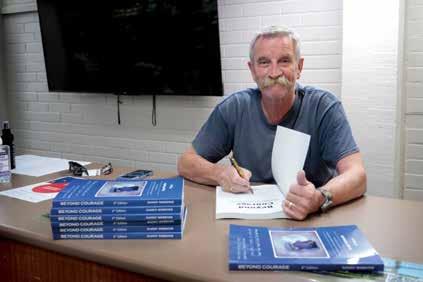
■ Danny Webster's book Beyond Courage p32
■ Crossword p33
Disclaimer: Police Association of New South Wales (“Publisher”) advises that the contents of this publication are the sole discretion of the Police Association of New South Wales and the publication is offered for information purposes only. The publication has been formulated in good faith and the Publisher believes its contents to be accurate, however, the contents do not amount to a recommendation (either expressly or by implication) and should not be relied upon in lieu of specific professional advice. The Publisher disclaims all responsibility for any loss or damage which may be incurred by any reader relying upon the information contained in the publication whether that loss or damage is caused by any fault or negligence on the part of the publisher, its directors and employees. Copyright: All advertisements appearing in this publication are subject to copyright and may not be reproduced except with the consent of the owner of the copyright. Advertising: Advertisements in this journal are solicited from organisations and businesses on the understanding that no special considerations other than those normally accepted in respect of commercial dealings, will be given to any advertiser.
Executive Officers
Vice President & Acting President of PANSW
Ian Allwood
■ It was an honour to serve as Acting President of the Police Association of NSW from December through to January, a period traditionally marked by reduced staffing and increased operational pressures across policing. Despite this, the Association remained fully operational throughout the Christmas and New Year period, ensuring our members continued to receive the representation, support and advocacy they rightly expect.
The PANSW office maintained business continuity on behalf of members during this time, responding to enquiries, managing ongoing industrial and welfare matters, and ensuring urgent issues were addressed without delay. This commitment reflects the Association’s core purpose: to stand with our members whenever the need arises, regardless of the calendar.
During this period, Police Association Organisers were exceptionally busy, responding to numerous critical incidents across all policing regions of New South Wales. Organisers attended
incidents in person and worked around the clock to provide welfare support, industrial representation and legal assistance to members involved. Their work ensured that members and their families were supported during some of the most confronting and challenging circumstances encountered in policing.
The Bondi Beach terrorism incident stands as the single largest and most significant event the PANSW has responded to in its history. The sheer scale and complexity of the response required an immediate, coordinated effort by the Association to support members who were deployed, impacted or personally affected. As Acting President, I was extremely proud of the professionalism, resilience and dedication shown by our Organisers and staff in responding decisively on behalf of the membership.
Equally, the leadership and support demonstrated by the NSW Government and the NSW Police executive during this critical event were clearly evident. Their actions and engagement with affected
members were heartfelt and widely appreciated across the organisation. In moments such as these, the importance of unity, collaboration and genuine care for our people cannot be overstated. I extend my sincere thanks to the Association’s staff and Organisers who continued to prioritise member welfare during this demanding period. Most importantly, I acknowledge the professionalism and courage of our members, who continue to serve the community with dedication, often at significant personal cost. The PANSW remains steadfast in its commitment to supporting you whenever and wherever the need arises.
PANSW President Kevin Morton
A unique summer for Police
■ For all of our members who worked during the festive season, thank you for your hard work and dedication. You will, as always, be out and about protecting the community as others spend time with family and friends, and the team at PANSW will be there to support our members with what they need.
You will find within this edition an article by the Vice President Ian Allwood on the tragic events at Bondi Beach. Further on in the magazine, you will read a detailed account of the support that the PANSW has provided to involved officers via Organising, Welfare and Legal advice. Through our Welfare Assistance Scheme, we continue to support Probationary Constable Jack Hibbert and Constable Scott Dyson throughout their recovery, and we thank all members who have generously supported their fundraisers.
to her family.
For this reason, the Police Association, police officers, and members of the community will want to show their support for her and her family at this time of need.
Flowing on from this with Operation Shelter, there is some information about rostering.
With staffing issues compounding across various Operations and balance shifts within your Command, it is important to be aware of your entitlements and to contact our Industrial staff if you have any concerns.
Commissioner Lanyon supported this when addressing the PANSW Executive at the December 2025 meeting. We are conscious of officer burnout and also the need for rest and respite with your loved ones at this time of year.
If you require advice on rostering and staffing, please contact the PANSW on (02) 9265 6777 or email info.centre@ pansw.org.au
Amy Scott
I believe I speak for many members who have known Amy personally when I say that long before the incident at Bondi Junction, Inspector Scott had touched the lives of many police officers and community members. Her devotion to policing is only matched by her devotion
The fundraiser set up by NSW Police Legacy is a way for everyone to show their support.
As a member, Amy is also receiving support with her treatment through PANSW's Welfare Assistance Scheme. We will offer all the support we can to her and her family during this challenging time. If you know of a member who requires assistance, please contact our Welfare Support team on (02) 9265 6777 or via info.centre@pansw.org.au
Members and their families enduring a cancer diagnosis can also access dedicated support programs through Osara Health. Contact the PANSW or go to the Member Benefits Section of the PANSW Portal to access this support.
Conference 2026
With 2026 here, it is time again for the Police Association of NSW's hallmark event being its Biennial Conference. You will find an article in this magazine by one of our Executive members that breaks down the significance of this meeting. Held in May and again hosted in Wollongong, it is pivotal in shaping our organization's strategic direction.
Every member has received, via email and the PANSW Portal, information on how to nominate to become Delegates and/or Executive members for the next two years with nominations closing at midday 16 February. These are the people who will represent your Branch/Region at Conference and bring to the table the important issues that will set the direction of the Police Association over the years ahead. Your Organiser and Industrial team will always be available to answer any questions you may have.
Hard work continues
2026 may see us face new challenges as law enforcement is put under the microscope, but we must not lose sight of the ongoing issues, and we must continue to advocate at all levels of the NSWPF and the NSW Government. Ensuring you can do your job effectively and efficiently remains a priority for the Police Association. Blue tape projects in technology, policy and legislation must still be driven during this year.
Our campaign on prisoner management and prisoner transport is still full steam ahead.
The pushback on work from other Government agencies continues, and this year the focus needs to be on the mental health jobs we attend. In 2025, we had discussions with stakeholders from NSW Health and other government agencies, and it is now time to see positive outcomes for our members in reducing this workload.
At a Federal level and in my role as the President of the Police Federation of Australia, I will continue to advocate for the introduction of the Blue Card for our members. Another issue I see is vital to the Federal Government's role in the recruitment and retention of our members.
OPERATION SHELTER'S HIGH VISABLITY PATROLS PLACED UNIQUE DEMANDS ON MEMBERS
Elyssa King PANSW Media & Communications Officer
Bondi Shootings a timeline
All Sydneysiders will remember where they were on the evening of Sunday, 14 December 2025
■ Glancing at my mobile, I noticed breaking news alerts beginning to ping from mainstream media outlets. The headlines read that shots were being fired on Bondi Beach.
Speaking to my parents, one a former police officer and the other a civilian in the NSWPF, I recall saying, ‘There is a mass shooting happening in Bondi’. Seconds later, I heard sirens as police cars raced through my area toward the city.
About 6.47 pm, police received a number of reports of shots being fired at Archer Park – a grassed area just north of Bondi Pavillion. Officers attached to Eastern Suburbs Police Area Command, surrounding commands and specialist police responded promptly and located two men using long arms to fire into crowds of people. Multiple officers exchanged fire with the two men. Police officers, both on and off duty, raced to confront the gunmen, whilst also shielding civilians who were running from the beach and into the surrounding streets. In the aftermath, our members have told us they needed to identify the threat and protect those at risk.
after graduating from the Academy, while the other had just 14 months of experience. After both officers were shot, an off-duty police officer quickly secured his own children and came to their aid, pulling one of them from the dangerous situation while gunfire continued.
said in an interview with news.com.au in the days that followed.
“On the night of the attack at least 50 or 60 police officers, most of them off duty, heard about what was happening and turned up because they thought they could help and would be needed.
People as far away as Newcastle, Sutherland, and Western Sydney.”
During the incident, one shooter – a 50-year-old man – was shot by police and died at the scene. Video footage showed police performing CPR.
The other shooter – a 24-year-old man – suffered critical injuries and was taken to hospital under police guard.
Two of the officers – a Constable and Probationary Constable who were amongst the first on the scene and to engage with the shooters – suffered gunshot wounds. One of the officers had been on the job for only four months
They were transported to separate Sydney hospitals in a serious but stable condition.
Young officers were seen supporting senior members as they neutralised the threat, even withholding members of the public who attempted to attack the body of the deceased and injured shooters. Police then turned to assist other emergency support services in tending those who were injured and even killed. They were seen driving ambulances to nearby hospitals to ensure ambulance officers could continue treating patients with critical injuries.
“The blue family is all behind each other and behind the community,”
Police Association of New South Wales (PANSW) Acting President Ian Allwood
PANSW Organisers and Legal practitioners were on scene with the multiple officers directly involved and witness officers standing with them as they commenced the long journey of what is expected to be the largest Critical Incident investigation in the state’s history, and a full coronial investigation. The Organising, Welfare and Legal teams continue to work with all directly involved officers as they progress through interviews and procedures attached to the Critical Incident.
A PANSW Organiser was appointed as the liaison officer between the PANSW and the NSWPF Commanders, regarding both the Critical Incident, and the status and welfare of the injured officers and their families. This crucial role enabled real-time information sharing and ensured that all involved members, whether involved in the Critical Incident or criminal investigations, to be properly represented and supported.
As holding statements were prepared, text messages and calls began to appear from journalists looking to confirm whether the police officers who had been shot were dead, as the media attempted to piece together the tragic
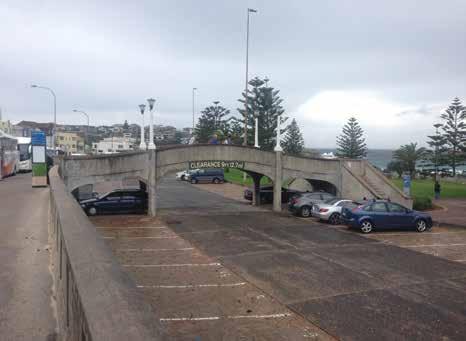
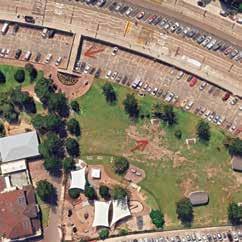
PEDESTRIAN BRIDGE SOUTH OF CAMPBELL PARADE, NORTH OF BONDI PAVILION AND ARCHER PARK, VIEWED FROM CAMPBELL PARADE JUST NORTHWEST OF THE BRIDGE / PHOTO CREDIT PHILIP MALLIS
Today is another example of the danger NSW police regularly face as part of their job. They do it without faltering. They didn't falter today.
situation that had unfolded.
At the first press conference held later that evening, the media were seeking answers, with the number of casualties and details of the events still unconfirmed. On social media, the identity of a person believed to be one of the gunmen was already circulating.
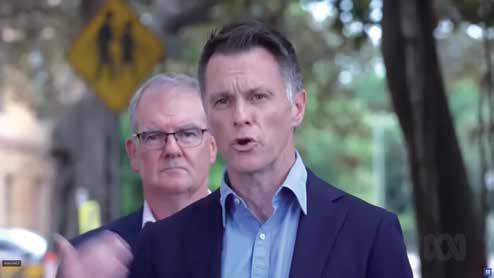
Premier Chris Minns said: “This cowardly act of terrifying violence is shocking and painful to see and represents some of our worst fears about terrorism in Sydney.”
“This attack was designed to target Sydney’s Jewish community on the first day of Hanukkah. What should’ve been a night of peace and joy celebrated in that community with families and supporters has been shattered by this horrifying, evil attack.”
Along with sharing the outpouring of love from the community and the bravery of ordinary individuals, prior to handing over to NSWPF Commissioner of Police Mal Lanyon, the NSW Premier emphasised: “I can assure the community that this will be met with a massive police and public order response. Today is another example of the enormous pressure and responsibility…the danger that NSW police regularly face as part of their job. They do it without faltering. They didn’t falter today. We need them.”
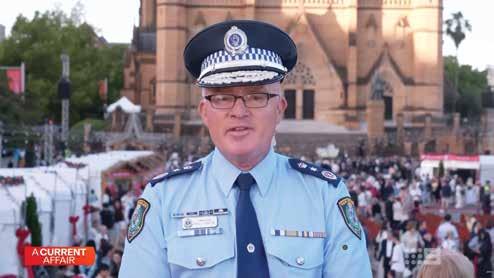
As a result of the circumstances surrounding the incident, Commissioner Lanyon declared the incident to be a terrorist incident at 9.36pm and invoked special police powers for investigations: “There has been a massive police response, and as journalists, you have seen how promptly and quickly the police responded. I am incredibly proud
of the professionalism of our police and emergency services responders. They have done a fantastic job.”
He said that police had learnt from the last tragic events that occurred at Bondi Junction Westfields last year. “We have learnt a lot from that and tonight
ambulance, police and other emergency responders acted promptly and professionally. This type of disgraceful activity…and the taking of innocent lives is unacceptable to New South Wales. It’s not our way of life. I’ve been very clear since I’ve been the Commissioner that as a Police Force we won’t stand for this type of violence. The police are investigating thoroughly. We have acted promptly. We have taken decisive action. Can I just ask for calm within the community … allow the police to do our job.”
When asked by members of the media about failures in the response and cross-agency intelligence sharing, the Premier said: “In the circumstances, it’s reasonable that the Government and the police conduct an investigation and it will of course be a full inquiry. But when you’re looking at several hours after this horrifying event, it’s important that the
police focus on community safety right now and ensuring that the immediate vicinity is locked down, the public…those that have been injured are transported to hospital and that there is not an immediate ongoing threat.”
“There will be plenty of time for a thorough investigation, I can assure the public that that will take place but we need to let the police do their job tonight.”
A significant crime scene was established, closing Bondi Beach and surrounding roads, with Detectives from the Joint Counter Terrorism Team commencing an investigation into the incident. The immediate area was locked down with additional police on patrol to ensure the community's safety. Two improvised explosives were reportedly found at the scene by the Bomb Disposal Unit, who removed them and rendered them safe.
On Monday morning, it was confirmed that as a result of the incident, 14 people died at the scene and 42 people –including four children – were taken to hospitals across Sydney. Police were later told two other people died in hospital.
Along with a brief social media update, the PANSW provided members with a detailed email update on the Critical Incident. Importantly, this included information on the status of the two injured officers, who had undergone surgery at separate Sydney hospitals and remained in a serious but stable condition.
Members were informed that family and colleagues surrounded both officers at the hospital. The PANSW’s Member Support Team was activated
VICTIMS OF NSW's WORST MASS SHOOTING: (left to right / top to bottom) MATILDA, EDITH BRUTMAN, DAN ELKAYAM, BORIS AND SOFIA GURMAN, ALEXANDER KLEYTMAN, RABBI YAAKOV LEVITAN, PETER MEAGHER, REUVEN MORRISON, MARIKA POGANY, RABBI ELI SCHLANGER, ADAM SMYTH, BORIS TETLEROYD, TANIA TRETIAK and TIBOR WEITZEN.
and attended both hospitals on the night and again as the two injured officers continued treatment. The PANSW activated the Welfare Assistance Scheme for both families to assist with accommodation, travel, and meals, allowing them to focus solely on the recovery of our brothers in blue.
In the communications, Acting President Ian Allwood thanked all members on and off duty who attended the scene and those who provided remote support to coordinate the emergency response. He said that many more lives would’ve been lost without the swift and effective response of our members and that our thoughts remain with our involved members, their colleagues and families at this time, along with the extended policing family. Any members requiring support regarding these events were urged to contact the Employee Assistance Phoneline (EAP) at: 1300 667 197 or their local PANSW Branch Welfare Officers to activate welfare assistance.
Heroes
had a go and no doubt, their actions saved many, many lives,” he said.
He said it is important to remember “these young fellas are someone’s sons, someone’s husbands, someone’s brothers, they are mates of people,” who simply went to work that day and called on the community to thank any police officers they see out and about.
He said that both officers were undergoing treatment in what would be a lengthy recovery process and had made slow but steady progress over the days that followed. However, they were undergoing daily treatments and surgeries for complex injuries and would require extended stays in the hospital and extensive rehabilitation.
ask for anything more - having our Jack home, especially for Christmas, truly feels like a miracle. We are deeply grateful for the overwhelming support, kind messages, and well wishes from the community, Jack’s colleagues, friends, and the emergency services. The care and dedication shown by the medical staff has been nothing short of exceptional.”
“We kindly ask that our family’s privacy be respected as we focus on Jack’s recovery and spend this special time together. Thank you again for the compassion, love, and support shown to our family. “Jacko you’ve shown strength of a different degree, we are so glad you’re home buddy.”
Speaking with presenter Nat Barr on Channel 7’s Sunrise on Tuesday, 16 December 2025 at Bondi Beach, PANSW Acting President Ian Allwood praised the “heroic” actions of the two officers who had sustained gunshot-related injuries.
“They pull up, and someone starts raining rounds down on their police truck. Those two young heroes with no preparation, bearing in mind that the two cowards who did this had preparation. They had time to plan what they were going to do. They got to a fortified position.” Allwood said.
Despite being “outgunned”, both officers got out of their vehicle and “went towards the danger” in what Allwood described as “amazingly heroic” actions. “That would have been horrific for those young blokes to go through that,” Allwood said.
The PANSW Acting President said he was “in awe” of the pair's heroism. “They
Family, friends, and colleagues surrounded the two injured officers in the hospital. The Acting President visited both families to offer ongoing support from all members of the PANSW.
In the background, the PANSW worked with NSW Police Legacy to set up fundraisers for both police officers, which both families have endorsed.
At the time of writing, each officer's fundraising page has raised over $630,000, with a huge outpouring of support from both the blue family and the wider community.
After more than a week in hospital, Jack’s family shared the exciting news that he was being released from hospital just in time for Christmas on Tuesday 23 December 2025: “While he is home, he is still recovering and will need space, support, and continued positive thoughts during this time. As a family, we couldn’t
On the same day, 25-year-old Constable Scott Dyson’s family also shared an important update: “Scott has been in a medically induced coma since the event on Sunday 14 December 2025, and has undergone surgery almost daily. Our family would like to share that Scott has been getting stronger each day, and today (Tuesday 23 December 2025), he was woken up for the first time. There is still a long way to go in his recovery, but this is a positive sign. We would like to thank the public for the support, messages and well wishes shown to Scott and our family during this difficult time. We are also grateful for the tireless work of his medical team.”
“Our focus remains on Scott’s continued recovery and we kindly ask for our family’s privacy to be respected.”
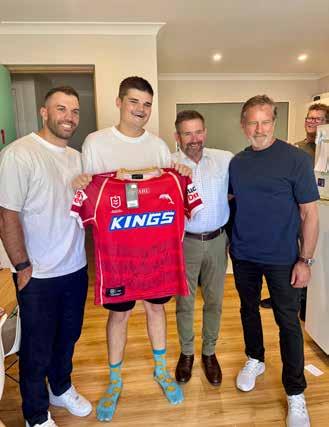
A massive Dolphins fan, the 22-year-old Probationary Constable was presented with a special jersey signed by the team as an early Christmas present. PANSW Acting President Ian Allwood dropped in to chat with Jack and his family, alongside Australian business personality and entrepreneur Mark Bouris representing the NRL (and serving as an Ambassador for NSW Police Legacy) and Sydney Roosters captain and Kangaroos legend James Tedesco (see page 15).
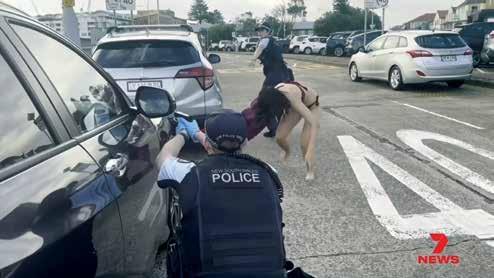
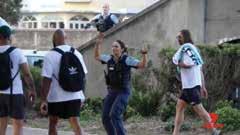
TWO WAY TRAFFIC: AS BEACH GOERS MAKE A FRANTIC ESCAPE, NSW POLICE OFFICERS MOVE FORWARD. (Photo Channel 7 News)
The PANSW shared an update on the injured officers’ status on Christmas Eve, along with information that Constable Dyson had woken up from a medically induced coma, via social media channels to inform members and the public. The story was picked up by traditional news outlets, including Channel 7, Channel 9, news.com.au, Sky News and the Daily Telegraph in the days that followed.
Hundreds of comments read as a lengthy personal letter, with members of the public thanking the officers and the wider NSWPF for their commitment and professionalism, some friendly supporters chucking up their fins and also sledges about Constable Dyson’s choice of NRL team, with the majority sharing how happy the news had made them to read on Christmas and Boxing Day as the ultimate spreading of joy. In a time where the role of police has also been criticised, it was an uplifting moment of support and acknowledgement of the bravery and professionalism of our police officers.
Media speculation
of locations across the Eastern Suburbs, particularly Jewish places of worship and other important sites for the Jewish community, to ensure that the broader community felt safe enough to go about their daily lives.
“We continue to work through the motive of this tragedy and will continue to do so. And I think it's really important that our investigators continue to be given time to do that. This is a very complex investigation, and [it is] important that we do it thoroughly.”
Commissioner Lanyon said.
While iterating that information would not be provided that would impact the ongoing investigation, Commissioner Barrett confirmed that early indications
He's an Israeli national. So, [inaudible] what do you say to him that the police didn't do their job and fire back at that gunman?
Commissioner Lanyon: I can't comment in relation to that actual report. What I'll say is that I'm incredibly proud of our police officers. They were confronted by two men armed with long arms. Our police at the scene were armed with pistols. That is –
J: Can you just outline when did the first police officer arrive at the scene?
CL: I don’t have that in front of me. That's obviously part of the investigation. I've been really clear. Both the critical incident investigation and the JCTT investigation will be thorough. Journalists continued to press the Commissioner with questions about the number of police at the festival, despite the Commissioner stating that an investigation was underway.
In the days that followed the attack, the media speculation surrounding the police response continued. At a press conference on Tuesday 26 December 2025, Premier Minns and Prime Minister Anthony Albanese addressed the media, along with Commissioner Lanyon. Australian Federal Police Commissioner Krissy Barrett also addressed the media for the first time.
In his update, Commissioner Lanyon stated that two parallel investigations were underway: a critical incident investigation into the police's role in the matter and a joint counterterrorism investigation. The crime scene, where forensic and ballistic examinations continued to be conducted, remained in place in Campbell Parade and down around Bondi Beach.
Through Operation Shelter, static patrols or guards were present at a range
and alleged evidence had provided investigators with a swathe of evidence pointed to a terrorist attack inspired by the Islamic State, allegedly committed by a father and son who had aligned themselves with a terrorist organisation, not a religion.
“This investigation will be highly visible, precise and it will operate around the clock. The New South Wales Joint Counter Terrorism Team investigation will leverage all unique powers, capabilities and international networks.”
Commissioner Barrett said.
The media continued to press Commissioner Lanyon for specific information about the policing response. Journalist: Commissioner, [inaudible] told the Seven Network this morning he saw four police officers at the scene in Bondi. None of them fired a weapon and he was saying he didn't understand why.
J: How many police were at the festival?
CL: previously that they received taskings to go to the Bondi Beach. So, there were police moving through there at all times.
J: How many were at the scene? How many were at the scene?
CL: I can't tell you at any particular time. As I said, they received taskings. So, we had police moving through the area regularly.
J: The Commissioner, were there two officers posted there for the festival? And were those two officers the ones that were injured?
CL: I don’t have that information for you at the moment, Damien. What I'll say is we had an appropriate policing response to ensure that police were moving through there, working closely with the community. We take safety very seriously and I think you've seen that from the New South Wales Police. We are here
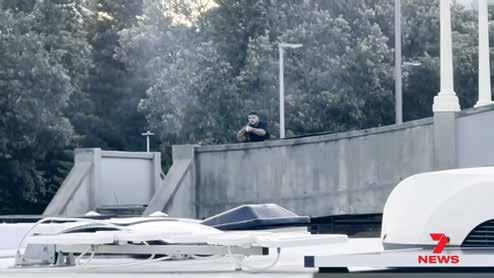
SHOOTERS' PLAN WAS OCCUPY ELEVATED FOOTBRIDGE, ARMED WITH HIGH POWERED RIFLES & HOMEMADE BOMBS (Photo Channel 7 News)
to support the community. We're here to keep the community safe. Had there been intelligence that there was a particular threat at that location or to that event, we may have had a different policing response.
J: Were they the ones patrolling? Were they the ones that were in the vicinity or were they first responders?
CL: Large number of police responding there at the moment. I don’t want to give information about that whilst the critical incident investigation closes.
NSW Premier Chris Minns interjected at this point to address the journalists: Chris Minns: I feel it's incredibly important of me, as the Premier of New South Wales, to respond to some of these questions. The New South Wales Police acted with bravery and integrity. They didn't take a backward step. They engaged the gunmen on the footbridge with handguns. The offenders had long range rifles and New South Wales police officers were responsible for killing one of them and shooting the other one and as a result saving many, many people's lives. Now there are two officers in critical care in New South Wales hospitals at the moment. They weren't shot in the back as they were running away, they were shot in the front. I'm sorry to be graphic about it, but if there's any suggestion that New South Wales Police didn't live up to their responsibilities to the people of this state, it should be rejected because it's not consistent with the facts. New South Wales police officers, some of whom had been in the job for a number of months, put their lives on the line to save people in this state. And I think this rush to conclusions before all the facts are known, in my view, is disrespectful to their actions on Sunday.”
J: How many police were stationed there? How many police were stationed there? Was it a failure of staffing?
Headlines for the remainder of the day highlighted the Premier’s impassioned defence of the police response. Sharing a clip on our social media channels, the PANSW reinforced its support of the Premier’s strong stance: “The PANSW rejects attempts to use this tragedy to cast doubt on the dedication of our members. When sharing on social media, it’s important to focus on the facts. In a moment of extreme danger,
they responded exactly as they should have - quickly, courageously, and with absolute professionalism. We commend their actions and continue to offer our
full support, especially those who were injured while doing their jobs.”
The role of social media
On the evening of the terror attack, police appealed to anyone in the Bondi Beach area with mobile phone or dashcam footage relevant to the incident to upload it to their website.
Footage shared on social media highlighted the platform's power as the ultimate source of breaking news, with videos from the scene showing our members' responsiveness and effectiveness in real time.
When asked about the impact of staffing levels on the policing response, Acting President Allwood said in an interview with news.com.au the day after the attack: “We are being stretched, worrying about road tolls, meeting the demands of protests every weekend, we just can’t be everywhere. You can’t expect to have police officers on every corner; we are stretched to breaking point."
With a key focus on recruitment and retention over the last few years, it is well documented that demands placed on our police resources in New South Wales have already extended the workforce who are still required to manage an unrelenting workload. With staffing levels remaining down but slowly rising (and the last class from the Academy forming our largest group in a decade), our police officers have been tasked with managing weekly protests, multiple operations, and even Nazis over the last two years alone.
As we saw during the response to the Bondi Terror attack, the police response to emergency situations remains outstanding.
Combating misinformation
Along with being a legitimate source of breaking news, isolated clips circulating on social media have also contributed to the spread of misinformation.
In a press conference on the day following the attack (Monday 15 December 2025), a journalist said: Journalist: Eyewitness reports last night included that police, up to four police, were standing around one of the active shooters. Not giving fire back, standing, just standing there. An eyewitness said that it was like they froze –“
NSW Premier Chris Minns interrupted the reporter:
Chris Minns: “I am not going to speculate on that right now. What I will say is that there are two New South Wales Police officers in critical condition in New
South Wales hospitals who stepped into the breach and could have lost their lives last night. I'm not going to go into the circumstances of police officers that returned fire, but I can tell you their bravery, their courage in these circumstances saved countless lives. And I would just urge everybody, don't jump
to conclusions at this point. It's important that we have a full and comprehensive investigation, but certainly don't run down the police at this early hour.”
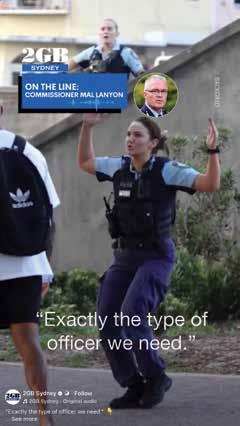
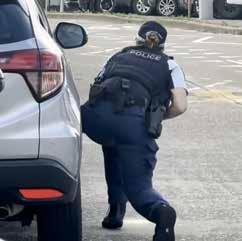
In the days that followed on social media, a cropped photo of an unnamed police officer with her arms in the air drew criticism from online commentators from Australia, the USA and Canada who said that it looked as though she were surrendering.
On Wednesday, 17 December 2025,
Commissioner Lanyon was quick to correct the record and speak in support of the police officers who attended the scene during an interview with 2GB.
Commissioner Lanyon: “Our officers do receive active armed offender training. It is actually based on crowded places, things like shopping centres and the like. It revolves around having a number of officers attend the scene, enter a formation and then go forward in that perspective.” He said in response to questions about the training that General Duties police undergo in responding to an active shooter.
“What we saw on Sunday was something completely different. This was a chaotic scene where we had two armed offenders with evil intent in an elevated position armed with high powered long arms. It was simply not possible for police to congregate in that sort of fashion and go forward. That’s why I am incredibly proud of our officers… they continued to go forward until the situation was resolved.”
When asked about misinformation about the photo of the female officer, the Commissioner immediately addressed the speculation, providing additional details not shown in the circulating image.
CL: “It is one of the challenges with social media…a lot of things came out very quickly. Some photos have been put up online that are completely out of context. If I can just address one of those…there is a young female police officer with her hands up and that has been wrongly presented as someone surrendering. That officer attended that scene with her partner in a motor vehicle. They were fired upon as they attended. There are bullet holes in the front windscreen of the vehicle that she attended and she thought she was going to die at that location. To her ultimate credit, and to the greatest respect of myself as her Commissioner, she continued to perform her duty.”
The cropped image failed to show the civilians walking in front of the officer that she was attempting to direct away from the bridge in the minutes after the attack. In the full photograph, another female police officer can also be seen behind her, offering assistance and directing the public.
CL: “Her hands were up in the air at that stage as she was giving an indication to members of the public to continue
CoP WAS QUICK TO CONFRONT BAD ACTORS MAKING FALSE or MISLEADING CLAIMS ABOUT POLICE ACTIONS
moving because she was trying to prevent further harm. That type of misinformation, that type of taking situations out of context, is incredibly harmful. She is exactly the type of police officer that we need in this Police Force, and my concern is that this type of misinformation and misrepresentation will tend to lead officers to leave the Police Force because they don’t feel supported.”
Our social media channels have also been used to highlight our members' bravery and correct misinformation. We stand by the Commissioner's comments in support of those officers who attended Bondi in every respect.
Long Arms
Following the attack, the possibility of General Duties police carrying long-arms weapons was raised. “Absolutely. We continue to review the type of weaponry that we have. Our job is to keep our police safe but also the community safe.”
Commissioner Lanyon responsed to the question in an interview on 2GB on Wednesday 17 December 2025.
“Traditionally, police have only carried hand guns as our engagement has traditionally been at close quarters. Obviously, the type of violence that we are seeing at the moment, the types of crimes that have been committed around the world, change some of that. We’ve recently rolled out long arms to some of our tactical officers to ensure that they are better equipped. We will certainly continue to review that with the Police Association. I’m committed as the Commissioner to ensure that our officers are as safe as they can possibly be and so that they can keep the community safe.”
Advisory Group. The Committee is a collaborative partnership of the NSW Police Force, the Police Association of NSW and experts in the field, with the intention of identifying the most appropriate future access to long-arm weapons across all duty types in the NSW Police Force. As with all Critical Incidents, the PANSW reviews and advocates for members to identify and implement equipment improvements for those on the front line.
Protecting the community
Sunday 21 December 2025 marked one week following the attack. A vigil was held in Bondi, with hundreds of
as they come together to grieve. Tonight is about standing with the community, safeguarding the space for a respectful vigil, and ensuring everyone feels supported during this incredibly difficult time.”
PANSW Acting President Ian Allwood attended the vigil on behalf of PANSW and spoke with many members, many of whom were visibly emotional, including some who had been involved in the Bondi Junction Critical Incident over a year ago. Still, they remain focused on ensuring that members of the public could pay their respects to those who have lost loved ones and share quiet moments of grief with friends, family and members of the Bondi and wider Sydney community without compromising their safety.
members of the community gathering to remember those who had lost their lives and promote unity. The police presence was understandably heightened.
Operation Shelter
Operation Shelter officers have conducted more than 2600 proactive taskings since the Bondi terror attack.
The operation was first established in October 2023 to coordinate the gathering of intelligence and the response to protest activity, to ensure the safety of the community, reduce antisemitic and anti-social behaviour and other hate crime activity.
Commissioner Lanyon briefly attended the meeting of the PANSW’s Executive on Thursday 19 December, taking time out of his relentless schedule to address the PANSW Executive members and staff on developments since the terror attack. As a result, the Executive endorsed the Commissioner's position to immediately reconvene the Long-Arms Review &
Commissioner Mal Lanyon said in a statement: “This afternoon and into the evening, there will be a heightened police presence in Bondi and the surrounding areas under Operation Shelter. I want to reassure the community that this does not reflect a heightened security alert. We know how deeply this tragedy has impacted Jewish families, friends, and the wider community who stand with them. Our priority is ensuring that everyone can come together to honour the victims and support one another without fear. You will see more officers than usual, including some carrying long-arm firearms. While our priority is keeping the community safe, it is equally about helping people feel safe
As part of the NSW Police Force’s commitment to ensuring community safety following the Bondi Beach terror attack, Operation Shelter has been strengthened, with an increase in support and resources.
As of Wednesday 24 December, officers had conducted more than 2600 proactive taskings across more than 3200 police shifts, including static and mobile patrols of key locations, including Bondi Beach, places of worship in Sydney’s Eastern Suburbs, inner west, and Sydney’s west, as well as aged care facilities and hospitals.
Resources assisting with the operation include officers attached to Central Metropolitan, South West Metropolitan and North West Metropolitan Region, Public Order and Riot Squad, Tactical Operations Unit, PolAir, Traffic and Highway Patrol Command, Marine Area Command, Rescue and Bomb Disposal
TRAGEDY WAS MET WITH ACTS OF GREAT COURAGE - MANY LAUDED, SOME UNKNOWN EXCEPT TO A FEW
Unit and the Dog Squad.
Since its establishment, 18 people have been charged with 34 offences related to Operation Shelter.
Operation Shelter Commander, Assistant Commissioner Stephen Hegarty, said Operation Shelter will remain in place as long as it’s required. “The main purpose of Operation Shelter is about keeping the community safe and ensuring they feel safe too,” Assistant Commissioner Hegarty said.
“Whilst police are conducting proactive taskings within the community, officers are also monitoring anything that poses a risk to NSW. We won’t tolerate any behaviour that threatens social cohesion in NSW.”
During a period of already heightened activity for our members, it was reported that hundreds of additional officers were being rostered across the state each day in support of the Operation. Leave for a number of officers had been cancelled, with detectives and support staff redeployed on high visibility shifts where required.
In an interview with the Daily Telegraph on Christmas Eve, the Premier said that NSW police were “working around the clock” and “the government will provide everything that they need to continue with this work”.
Dog Command, Marine Area Command, and PolAir.
Following the Bondi Beach terror attack, the NSW Police Commissioner authorised for long-arm weapons to be carried by specialist police during New Year’s Eve events in Sydney to provide a sense of security to crowds.
Minister for Police and Counterterrorism Yasmin Catley said New Year’s Eve should be remembered for the right reasons and that comes down to the choices people make and whether they follow police directions. “Police will be out in force across NSW. They’ll be highly visible in busy precincts, transport hubs and event locations - including
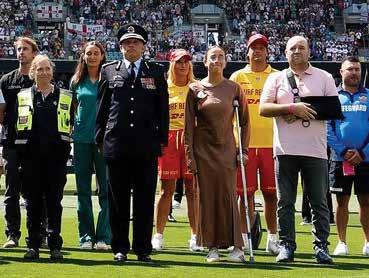
2026 for the Ashes test. Representatives from emergency services, including police and ambulance service attendees, and hero Ahmed Al-Ahmed were cheered by the crowd of just under 50,00 on day one of the Pink Test. Police roamed the area to ensure that the event ran smoothly. Public Order and Riot Squad officers were also present with visible long-arm rifles.
Assistant Commissioner Leanne McCusker APM, commander of Counter Terrorism and Special Tactics, said the increased visibility of long-arms is not due to a specific threat. “I want to emphasise that there is not any active or imminent threat,” she said. “All PORS officers are rifle trained and have been for some time, this does not reflect any recent change in capability or weaponry.”
While New Year’s Eve is always one of the biggest policing operations of the year, uniformed and specialist officers were out in force to ensure that the community felt safe.
More than 2,500 officers in uniform and plain clothes were seen conducting high-visibility patrols in the Sydney metropolitan area.
The increased police presence reassured the community that officers were there to assist, and not because of any greater, active, ongoing or imminent threat. General Duties officers from every Police Area Command and Police District across the state were assisted by specialist officers attached to Traffic and Highway Patrol Command, Police Transport Command, the Public Order and Riot Squad, Operations Support Group, Licensing Police, Mounted and
Sydney Harbour - to keep people safe. While most people are celebrating, thousands of police, emergency service and transport workers will be working through the night. They deserve respect and their directions must be followed. Make good choices and you’ll have a great night. But if your behaviour becomes aggressive, dangerous or reckless, police will respond and it will not be tolerated.”
The evening was largely incident free. Across the Sydney metropolitan area, more than 38 arrests were made, including more than nine in the Sydney CBD and foreshore areas for various offences, including assaults, affray, assault police and offensive conduct.
Uniformed and Mounted Police conducted high-visibility patrols as a capacity crowd attended the Sydney Cricket Ground on Sunday 4 January
Commissioner Lanyon said police want to reassure the public that they can gather in large crowds without concern. “Many people may not be used to seeing police carrying rifles at sporting events, but our objective here is to help the public feel safe and police will be out in force,”
Commissioner Lanyon said. “The difference will be in the visibility of long-arms and a stronger presence. Police will otherwise be targeting antisocial and unsafe behaviour as usual,” he said.
At a time of year when workload pressure remains unrelenting, our members continued to show their professionalism and maintained a strong presence to ensure the public’s safety, providing support to the community as numerous memorials and funerals were held in Bondi and the Eastern Suburbs along with various locations around Sydney for the victims of the attack. A police presence was also required with major events and ongoing operations.
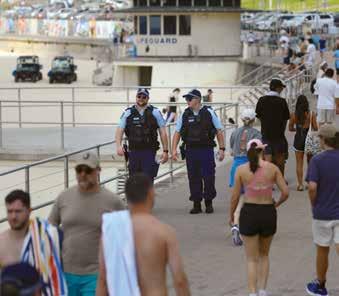
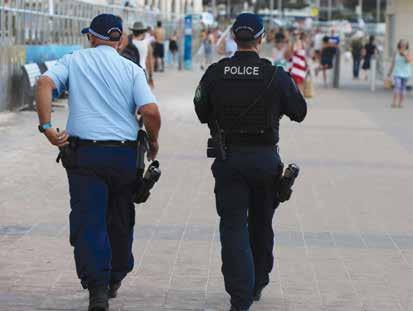
OPERATION SHELTER / ONGOING HIGH VISABLITY PATROLS
Elyssa King PANSW Media & Communications Officer
PANSW Organisers Bondi Report
Events triggered a large inflow of practical, legal & welfare support for effected members
As part of your PANSW membership, Critical Incident support is available to every police officer in this state, but they hope they never have to use it.
The numbers are unfortunately rising annually; the PANSW has supported members in 222 critical incidents that have occurred between 2020 and 2025. In 2017, 20 Critical incidents were declared, compared to 47 in 2025.
Being involved in a critical incident is one of the most difficult experiences a member can face. Members go from being in charge of a situation and making decisions to being on the other side of the table in what can only be described as a melting pot of policy, procedures, legislation and oversight, where the police officer’s actions, following their training with split-second decision making, will be analyzed under a microscope for years to come.
“The first hours of a critical incident investigation are intense for members,” PANSW Lead Organiser Jon Goddard recounts. There is a lot of worry, anxiety and often because it is the first one that they have experienced with little knowledge of exactly what is going to happen next.
That is where PANSW Organisers, part of the Field Services team, play their most important role: reassuring members that they are here for them and that their job is to ensure they are looked after throughout the process. They are there solely to support the involved member. The Organisers have lived experience in this space as either directly involved officers, investigators of such incidents and often times both.
“Cops know cops, which is why, unless you have marched off the parade ground at Goulburn and have extensive policing experience, you cannot be an Organiser with the Police Association of NSW”. Assistant Secretary Organising Paul Hannen said.
Like any other Sunday, until
With 24/7 call-out response available to members, every Organiser is use to their
phone lighting up at odd hours of the evening. None could have anticipated what was unfolding would be one of the largest critical incident investigations in this state’s history and unlike anything that the team had had to navigate before.
The first information that a major incident was unfolding on Sunday, 14 December 2025, came through a team group chat.
“Within minutes, I started getting messages from different Branch Officials in the city that were working, telling me
about what was unfolding. I knew in my head that I needed to make myself available and get into the city.” PANSW Organiser Rod Sheraton recalls.
“Allocating resources for an incident like this isn’t simple. My call log for the hour after the incident was over forty phone calls received and made.” Jon said. “What I did know was that I had a large number of involved officers, a large active crime scene and from the initial reports, at least two officers in critical condition heading to the hospital. I already had the Central Metropolitan Organizer on route, but then recalled Specialist Organiser Ash Stokes as well, based on the number of officers we were dealing with.”
When Rod arrived, the entire bottom floor of the Bondi Police Station was packed with police officers. The involved officers and witness officers were
isolated in an upstairs office. The area was so crowded that some were lying on the floor or under desks. Downstairs, many off-duty officers who had heard what had occurred showed up ready to assist or check in on their colleagues, filling the room.
“We spoke to the group together and told them that we were there for them, that we were going to help them through the night and told them what to expect as part of the process. It was important that they knew off the bat that we were there to help them through it.” Rod said.
The process of a critical incident investigation can be confronting for a police officer already under stress. Explanations of the steps involved by current and former police officers can help reduce tension, as they know what to expect and are better prepared for the extensive process ahead.
“It gives them that bit of confidence that they are going to be okay and they’ve got the right people around them supporting them.”
A critical incident team from the State Crime Command’s Homicide Squad (operated through Strike Force Belen) was formed to lead the investigation into the circumstances surrounding the police involvement in the incident. The investigation will be reviewed by the Professional Standards Command and overseen by the Law Enforcement Conduct Commission (LECC).
Specialist Organiser Ash Stokes coordinated discussions with the Critical Incident Investigation Team, drawing on his experience in large-scale matters involving the state's specialist units over the past decade.
“The smooth and timely exchange of information between the Senior Critical Incident Investigator, Professional Standards Command Reviewing Officer and the involved officers is vital for all parties when it comes to these investigations. Waiting around for hours is not good for our members and neither is not knowing what is going on. Nothing is more frustrating for members.” Ash said. As the night stretched on, Rod re-
BONDI FORESHORE / FOOTBRIDGE and ARCHER PARK marked
Many off-duty
officers showed up ready to assist their colleagues
mained with the involved officers. A decision was also made to recall Northern/ North West Region Organiser Mathew Guerrera to assist. Simple tasks like bringing food, mobile phone chargers, or clean clothing to the involved officers, who are required to remain within the Police Station for many hours as part of the investigation, are vital to ensuring members are in the best place as the processes are undertaken.
For some officers, this would be their first critical incident in their short careers. Others had unfortunately been through the process before.
“A few of the officers had also been involved in the Bondi Junction Westfields critical incident. They’ve dealt with that, and then this happened not long after … they’ve experienced a lot in a short period of time. Some of their colleagues had been shot and were in the hospital… they were heavily affected by what had happened to them.” Rod said.
PANSW Lead Organiser Jon Goddard was appointed as the liaison officer between the PANSW and the NSWPF Commanders, regarding both the critical incident and the status and welfare of the injured officers and their families. This crucial role enabled real-time information sharing and ensured that all involved members, whether in critical incidents or criminal investigations, were properly represented and supported.
PANSW Member Support Officer Ed Murphy was sent to St. Vincent's and Royal Prince Alfred hospitals, where the injured officers had been transported, enabling important updates on their status to be provided. This created a channel for their colleagues, who were still recovering from the shock of what had occurred, to receive significant updates.
After providing initial legal assistance that would provide the foundation of support throughout the process, the involved officers were released around 3 am, a testament to the operational effectiveness between PANSW and NSWPF. Due to legal precedents, members
cannot rely on the NSWPF to provide representation in the event of a workrelated legal matter arising, including matters that extend to operational decision-making. Often, the legal liability and interests of the NSWPF and the involved officer differ, requiring members to obtain their own independent legal counsel. The PANSW operates a comprehensive financial legal assistance scheme to assist members who may encounter job-related problems.
The scale of the Bondi Terror Attack
meant this investigation would not be a one-day job. As history shows, the aftermath of the Lindt Café Siege in 2014 required ongoing support for the involved officers for many weeks, months, and years.
A 5am meeting on Monday morning outside the Sydney Police Centre shaped the next phase of the PANSW response to support the directly involved officers, witness officers and seriously injured officers Scott Dyson and Jack Hibbert and their families as they lay in hospital.
On Tuesday morning, after getting a few hours of rest, Rod went straight back to Bondi. None of the involved officers were present, but he wanted to make a point of speaking with as many of the officers on shift as possible. Touching base was important in letting members know
that the PANSW Organisers would be there not just on the night of the incident, but throughout the entire process.
“I wanted to get back to see the police who were there working that day to follow up on how they were doing and to let them know that we were going to be supporting their workmates.”
Ash reconnected with the investigators and continued working through the process. During this period, the Organisers made phone calls to the involved officers to check in on their welfare, keeping them informed about the stages of the critical incident process, and outlining the support services available to assist them. Their Commands were also in regular contact, supporting their taking the required leave.
The process of organizing the 16 interviews to follow over the next three weeks had to strike a fine balance between managing the involved officers’ desire to get them completed, while ensuring the necessary fatigue management to keep them as rested as possible and able to give the most accurate account of the events that occurred.
“A lot of involved officers in a critical incident become quite anxious about being interviewed. They’re worried and they want to get it done with and experience the relief that comes with that.” Rod explained.
The Organisers remained in regular contact with the involved officers throughout this process, whether by phone or by meeting for coffee or a meal. The Organisers' experience as former police officers means they strike a comfortable middle ground: ensuring the involved officers have someone to speak to who has experience in dealing with critical incidents. This ensures they are not left carrying the weight of the event alone, while also allowing them to begin relaxing as they move through and beyond it.
In the weeks that followed, speaking with the involved officers, Rod shared that seeing negative media coverage of the police response and social media
THE SHOOTING ENDED INSIDE 7 MINUTES (Photo Channel 7 News)
misinformation being challenged by the Commissioner and Premier made the officers involved feel supported. The PANSW stands by the Commissioner's comments in supporting those officers who attended Bondi in every respect.
RPA Hospital
As one of PANSW’s newer Organisers, Brett Henry is aware that the role's job description is difficult to confine to a single page.
Attending the Royal Prince Alfred hospital on the Monday morning, his role was as the liaison for the family of injured officer Probationary Constable Jack Hibbert. Jack sustained two bullet wounds - one to his head and another to his shoulder. He was taken to the ICU where he underwent multiple surgeries.
To speak to any of the Field Services team, the practical support can include (while not being limited to) organizing accommodation, keeping the seat next to the bedside warm so that tired family members can duck away for a moment to grab a coffee or something to eat, being a spokesperson between the family and the NSWPF and even acting as a shield from journalists waiting outside to grab a comment.
The list of tasks is ever-evolving, but a small effort that wouldn’t require a second thought when compared to the experience of a police officer confronting the worst moment of their career and life. It pales in comparison to the reality of loved ones who are dealing with the jarring news that their son, partner, friend or colleague has been seriously injured on duty, with the treatment process its own system to untangle and the possibility of recovery stretching into the unknown.
and lows. The term "support person" is inadequate to describe the level of personal investment required when you become embedded as a confidante, advocate, and trusted source of strength over a few sleepless, worrisome days. Being able to share a meal together, or drive family members between the hospital and other locations, or even playfully sledging about the footy, adds a sense of togetherness and normality to a life-altering situation.
During the first few days, Jack’s Dad introduced Brett to him as the Association representative assisting the family. While
one of his eyes and he now faces a long and challenging recovery ahead, with additional surgeries required. Still, the medical updates continued to be a wonder. “They were doing some more testing and he was actually picking up shadow out of that eye… which was unbelievable,” Brett recalls.
Many of his colleagues who were present on the night of the incident have visited the hospital and given testaments to Jack's bravery during the incident, describing his devotion to his community. They described how Jack acted, he moved toward people in need, not away from danger, and continued helping others while seriously injured.
“You’re walking into a room with total strangers. Their son has just been shot and no one knows what to expect and how they're gonna be reacting.” Brett said. As a father, that statement carries even greater weight. “I've got a daughter in the job. That could quite easily have been me sitting there in that situation, not knowing what to do.”
Navigating the peaks and valleys of the officer’s treatment within the same walls means the Organiser shares their highs
lying in the hospital bed with his eyes shut, still intubated and not even fully conscious, Jack raised his hand to shake Brett’s. By all accounts, it was an absolute testament to Jack’s character, which has been an incredible source of strength for everyone around him.
Brett would be on the journey with the family as Jack’s condition progressed. Through Member Support Officer Ed Murphy, he provided the worried family with heartening updates on his partner Constable Scott Dyson’s condition.
Although miraculously surviving, Jack's injuries have resulted in a loss of vision in
After his discharge, Brett was fortunate enough to spend time with Jack and his family on Christmas Eve. In a surprise organised by the PANSW, he was presented with a Redcliffe Dolphins jersey signed by the Queensland-based team. Being a part of the family’s celebrations as they welcomed Jack home for the holidays, sharing their happiness, is a moment that will remain with everyone who has had the privilege of being a part of their journey.
“To be able to support someone's family in going through such a traumatic thing, not just the involved officer, is special.” Brett said.
St Vincent's Hospital
PANSW Member Support Officer
Ed Murphy went to St Vincent's Hospital following reports that one of the injured officers had been transported there.
The hospital was surrounded by journalists seeking access and answers to the threads of truth and misinformation that were circulating. At the time, it was uncertain whether there was a third shooter involved or if other attacks had been planned in different locations.
He was approached by the media, who asked him whether he could confirm whether the officers involved were deceased or not. His reflection is that they were doing their job the same way everyone else at the scene was trying to piece together what had happened. “They’re just looking for information like we all were in different ways. It’s a live
L>R SYDNEY ROOSTERS CAPTAIN JAMES TEDESCO, PROBATIONARY CONSTABLE JACK HIBBERT, ACTING PANSW PRESIDENT IAN ALLWOOD and MARK BOURIS (Dec 24, 2025)
scenario, it’s unfolding and everyone is just doing the best that they can.”
He would offer welfare support to one of the first police officers on the scene, Constable Scott Dyson, who was critically wounded with gunshot wounds to the body.
His pregnant partner Jessica, a NSW police officer, was conveyed by police car from the Coffs region to be by his side. Access to the hospital was almost locked down. Ed liaised with one of the nurses to arrange for the head of ICU to take the family up once they arrived. He spent the remainder of the first evening at the POC with Lead Organiser Jon Goddard.
Following the incident, Scott was placed into a medically induced coma, undergoing numerous surgeries almost every day that followed. The days that followed were challenging, with changes in the status of his condition suggesting that Scott was not expected to survive. From a welfare perspective, much of Ed’s time was spent liaising with the family, organizing accommodation, and being of assistance in whatever way was practically required.
“You can't imagine what it's like for someone to be thinking their partner's not going to make it through the night.”
experience, knowledge that they’re all in it together for the long haul and understanding.
On Tuesday, 23 December, two days before Christmas, Scott woke up. Ed remembers vividly how excited Jess was, having never heard her sound so happy.
After he was moved from the ICU to the ward, Ed spoke to Scott on speakerphone for the first time, which was a great moment: hearing his voice, sharing a joke and checking in on how he was recovering in a more personable way.
On Thursday, 15 January 2026, PANSW Executive Member Oliver Behrens shared a photo of Scott upon his discharge from the hospital. It was all smiles at Eastern
the scope of the roles of the Member Support Coordinator and Member Support Officer isn’t limited to a typical job description or typical work hours. Applications are handled confidentially and will be unique to the individual in terms of what they need to support them. The details in the story to follow are vague for this reason, but highlight how the support provided isn’t a onesize-fits-all approach to enhancing a person’s wellbeing following a traumatic event.
A member involved in a critical incident was recently flown back to their hometown to spend time with family and friends after accepting a regional posting. While it may seem like a small thing, it will greatly help ensure the young person’s welfare continues to improve after experiencing one of the most challenging events of their career.
The welfare advice offered is wellintentioned and practical, though at times challenging for loved ones who are rightfully focused on the wellbeing of the injured officer, to hear and follow. Simple reminders of the importance of snatching broken sleep where you can, taking time to shower, getting something to eat, and turning their phone off when the missed calls and text messages become too much, seem impossible to implement in practice when your son, partner, or family member or colleague is lying in a hospital bed beside you. As former police officers with experience in dealing with major incidents, the Organisers try to offer that advice from a place of lived
Suburbs PAC with the Constable dropping into Bondi Police Station to catch up with his brothers and sisters in blue who were beyond thrilled to see him. His journey to recovery is far from over, with more surgeries yet to come, but he will be recuperating at home surrounded by his family.
While most of what happens occurs behind the scenes, this provides a tiny glimpse into the PANSW’s welfare assistance activations. The PANSW operates a generous Welfare Assistance Scheme to assist members who find themselves and or their families in circumstances beyond their control, are experiencing hardship and in need of immediate short-term aid. While the scheme is discretionary,
“What we’re trying to do is help them on their worst day, whether it be something like this, or an injury or some tragic news that you've got a terminal diagnosis. We often work in the gray. If in doubt, reach out and we will try to find a way to help” Ian Johnstone said.
Critical Incident
In what will be the state's largest critical incident investigation, the Association’s role is to ensure procedural fairness in investigations, access to legal advice, recognition of entitlements, and welfare support for members' families. With intense ongoing media interest surrounding the Bondi Terror Attack, the Coronial Inquest to follow the critical incident investigation, and the prospect of state and federal Royal Commissions looming, the road ahead for the involved officers, witnesses and injured officers will be a long one. As they face the challenges ahead, they can rest assured that the PANSW will be standing beside them every step of the way, along with having the first support of their brothers and sisters in blue and the wider community.
AFTER 31 DAYS IN HOSPITAL, CONSTABLE SCOTT DYSON VISITS BONDI STATION TO CATCH-UP WITH MATES (Jan 15, 2026)
Fate delivered one of NSW's best marksmen
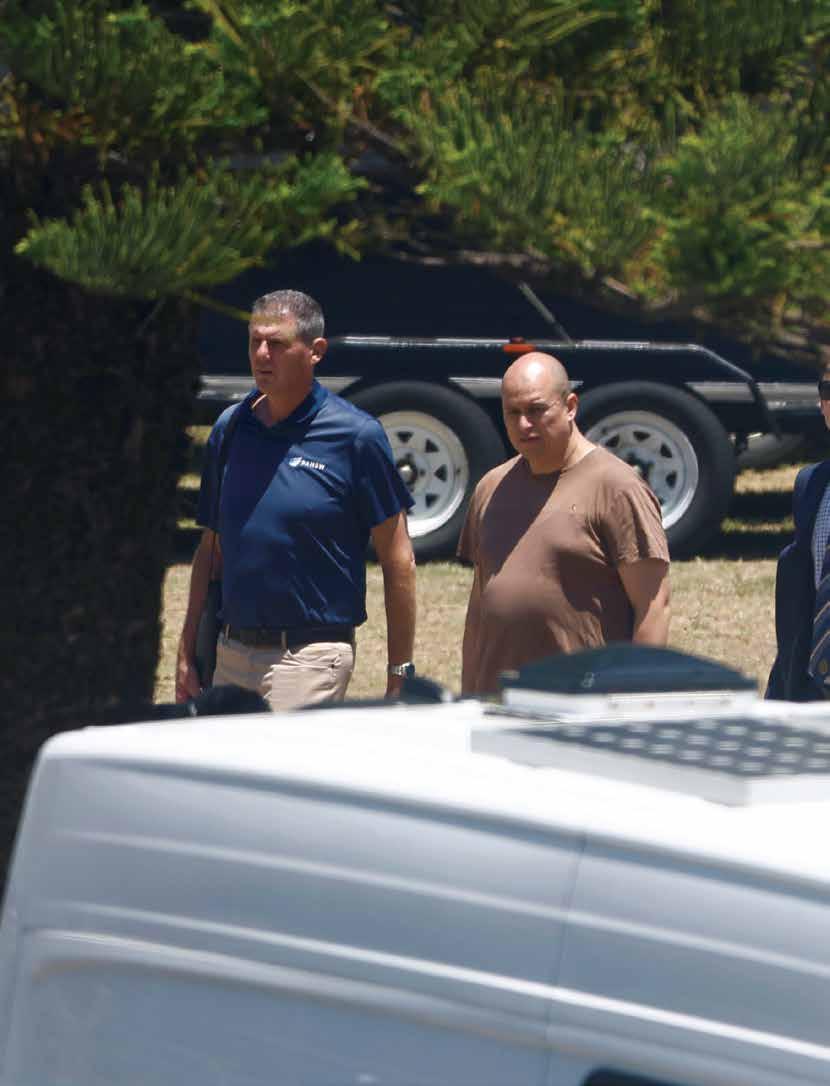
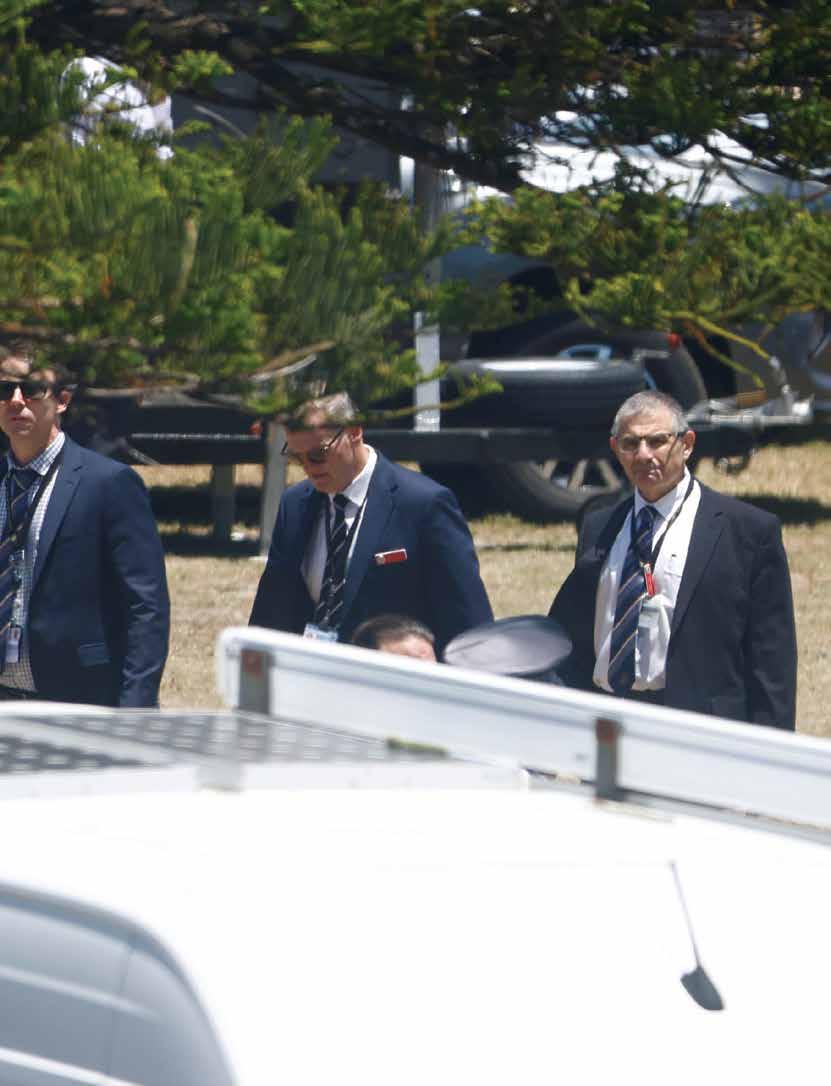
Acknowledged by his peers as an elite shot, Det Snr Const C. Barraza had been attached to Eastern Suburbs Police Area Command only a few weeks, when on Sunday December 14, 2025 he joined fellow officers running towards danger across the beach's foreshore. Faced with two shooters firing high-powered rifles from higher ground, he positioned himself by a small tree, then made a remarkable 41 metre shot with a handgun, hastening the end of NSW's worst mass killing. Pictured here walking-through the crime scene with Critical Incident investigators, accompanied by PANSW Organiser Rod Sheraton (far left)
Elyssa King PANSW Media & Communications Officer
Vale Peter Meagher
'Remember
■ In the days that followed Sunday 14 December 2025, we were deeply saddened to learn that retired NSW Police Officer Detective Sergeant Peter Meagher was one of the 15 victims killed during the Bondi Terror Attack. Retiring as a Detective Sergeant, Peter gave nearly four decades of his life to serving the community through his policing work.
He will be remembered in retirement for his passion for photography. He was volunteering as a photographer for the Chanukah by the Sea event.
His involvement with the community extended to active involvement in sport, as a First Grade Manager over the past decade and as a loyal club volunteer of the Randwick District Rugby Union Football Club. ’Marzo’, as he was universally known, previously served as a highly respected long-term referee who was highly respected in Sydney Rugby circles.
“The tragic irony is that Peter spent so long working in the dangerous front line as a police officer, but was struck down in retirement while voluntarily taking photos at what was supposed to be a joyful community event in his hobby. It is really difficult to comprehend.” Randwick Rugby Club General Manager Mark Harrison said.
A statement from Peter’s family shared through the NSWPF said:
“Our family is heartbroken by the loss of our beloved Peter. He was a cherished brother, husband and uncle whose kindness, generosity and love touched everyone who knew him. Our lives have been changed forever.”
“We are grateful for the outpouring of support from friends and the community. As we begin to come to terms with what has happened, we ask for privacy and the space to mourn together as a family. We also ask that the media respect our wishes and remember Peter for the life he lived, not for the way it ended.”
“Peter was a member of the NSW Police
Peter for the life he lived, not for the way it ended'
Force for 35 years, rising to the position of Detective Sergeant, until he retired in 2020. In retirement he became a freelance photographer and was on assignment in Bondi on Sunday to photograph the Chanukah celebration. Peter also spent countless hours doing volunteer work in retirement including in various roles for his beloved Randwick Rugby Union Football Club.”
“When you think about Peter, it would be great to think about the life he lived which was a full and rewarding one, one that he managed to squeeze into 61 years, rather than the way he died. Our thoughts are with all those who have been affected by this tragedy.”
In a special sitting of NSW Parliament on Tuesday 23 December 2025, the NSW Premier Chris Minns and Opposition Leader Kellie Sloane, amongst others present, paid tribute to those who had lost their lives in the attacks:
“We remember Peter Meagher, a former cop who gave decades of service to the people of this State. He was a local
photographer and a legend at the Galloping Greens Randwick Rugby Club. He was one of five boys. It seems as though the Meagher family knew pretty much every single person in Maroubra and the Eastern Suburbs. They went to Marcellin College Randwick—an amazing family, who will miss their big brother.” Premier Minns said.
“Peter Meagher was a husband, cherished brother and uncle. He served for 34 years in the NSW Police Force, retiring as a detective sergeant. He kept our community safe for many years. He was enjoying his retirement and was at Bondi taking photographs.” The Opposition Leader said.
The PANSW sends our condolences on behalf of our members to his wife Virginia, his brothers Greg, David, Andrew and Paul, their extended family, to his former policing colleagues and extended network of friends through the sporting community.
Surrounded by loved ones, a mountain of friends and former colleagues, Peter’s funeral was held on Wednesday 7 January 2026 at St Mary’s Cathedral in Sydney. His police service badge was among the items placed with his casket during the service.
PANSW Secretary Pat Gooley and Acting President Ian Allwood were attendees, with guests including Prime Minister Anthony Albanese, GovernorGeneral, Her Excellency the Honourable Ms Sam Mostyn AC, NSW Premier Chris Minns, Police Commissioner Mal Lanyon, Deputy Commissioner David Hudson, Deputy Commissioner Peter Thurtell, the head of the State Crime Command Scott Cook, Australian Federal Police Commissioner Krissy Barrett, and Police Minister Yasmin Catley.
Hundreds of police officers performed a guard of honour as Peter was farewelled for a final time. His funeral was the last to take place in connection with the attack.
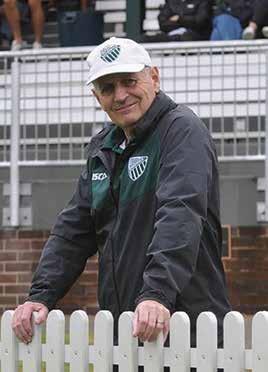
PETER MEAGHER ATTENDING A GALLOPING GREENS' GAME
Kirsty Membreno Assistant Secretary - Industrial
Know your rostering entitlements
Member's time has become a precious policing resource
■ The NSW Police Force has been impacted by workload demands including manning planned protests, strengthening Operation Shelter following the Bondi terror attack and adequately rostering police in their Commands. Staff shortages, coupled with these demands on policing, have stretched resources.
Since December 2024, the Relief Pool concept has expanded to enable officers on leave, including annual leave, to be utilised across NSWPF at any location on a voluntary basis.
User pays shifts were expanded for many protest operations, giving officers flexibility with shift options.
Since the Bondi incident, the impact of Operation Shelter on rosters has been significant with many officers undertaking multiple cancelled rest shifts either on the operation or to fulfill rostered shifts in their home Command.
The PANSW has encouraged the use of the Relief Pool (using officers on leave who agree to be included) and overtime shifts, with the cancellation of rest days.
The PANSW advocated to ensure shift lengths for Operation Shelter were inclusive of travel time and were rostered.
Working different shifts
For hours performed in excess of the normal approved roster (in accordance with the approved flexible roster), overtime may be payable for the excess hours on top of the member’s standard rostered shift.
For example, a Detective working 9.5 hours as a normal rostered shift being used for a protest or special event for a 12 hour shift is entitled to overtime provided the roster is not altered for any future shifts (i.e. working 7 hours the following day where there is mutual agreement with the officer to balance the hours to 228 hours).
If an officer doesn’t want to work a shorter shift at another time they cannot be made to. If they want to be paid and continue to work 9.5 hours for all other shifts that must occur.
We continue to receive calls about rosters being altered without agreement
to avoid paying overtime; this should not be occur unless the officer has agreed to change future shifts.
The practice is as per the Award and outlined below:
• Officers normally rostered for 9.5hour shifts required to work 12-hour shifts to assist in other duty types (e.g, fulfilling staffing orders, FRPA, etc) may be entitled to overtime depending on what occurs with the remaining shifts in the roster.
• Future shifts can only be adjusted from their normal flexible rostered shift by mutual agreement with the officer to maintain their total hours at 228 over the roster period.
• Alternatively, officers may choose to maintain their normal flexible roster shift length, e.g, 9.5-hour shifts for remaining shifts, in which case overtime is payable once hours exceed 228 hours.
• Importantly, shifts cannot be altered (reduced) without the officer’s agreement
A roster dispute occurred recently where the Command decided to include 12-hour shifts on a usual 9.5-hour flexible roster. This cannot be done without consultation and a majority vote of the affected members. The Command is
now consulting with members in accordance with the Flexible Rostering Guidelines.
Roster entitlements
This busy time of year for police calls for a reminder of your roster entitlements. The information below is a guide:
• Officers are to complete an average of 38 hours over a rostered week, which is Sunday through to Saturday. Most areas have a 6-week roster period, which helps identify average weekly hours, rest day entitlement, and complete weekends and Sundays off.
• Non- Commissioned Officers (NCOs) are entitled to two rest days in seven calendar days or four in fourteen calendar days
• NCOs will have an average of 1 complete Sunday off per fortnight (midnight Saturday to midnight Sunday) and 1 complete weekend (midnight Friday to midnight Sunday) per month off duty, averaged over no longer than 12 weeks.
• Clause 49.7 of the Award states that where practicable, officers should receive more than 24 hours notice of a change of a rostered shift, or the deferment or cancellation of a rest day. Changes of shift without 24 hours’ notice can only be approved by a Commissioned Officer (CO) for genuine operational reasons after all other reasonable options have been exhausted.
• An NCO required to perform a shift on a rostered rest day who is not notified of such a change of rostered duty at least 24 hours before the commencement of the altered shift will be paid at overtime rates for the duration of the shift (in lieu of the rest day).
• Overtime rates are: first two hours at time and one half, double time thereafter. Further, any overtime worked on a day which is a gazetted public holiday is payable at double time for the first two hours, then double time and a half.
• Officers maybe be requested to change the normal length of shift worked within their Command/Unit to perform shifts for Operations, including an increase in normal shift length.
OPERATION SHELTER REQUIRED POLICE TO PATROL SENSITIVE SITES
User-pays shifts were expanded for many protest operations, giving officers flexibility with shift options
• Where this occurs, officers must be consulted and agree on either: payment of the extra hours worked, which is overtime (hours above the 228 hours in the roster), or reducing a future rostered shift to ensure the average of 38 hours (228 over the roster) is being worked. Officers may elect to retain their usual flexible roster for remaining shifts and receive overtime pay.
• Officers are required to have ten hours break between rostered shifts. If there is not 10 hours rostered off duty, any time that impairs the 10-hour break is payable at overtime rates.
• Officers may be recalled to perform duties for their Command/Unit during this period . Clause 53 of the Award covers the entitlements and payments for an officer recalled to duty between shifts, including those recalled from annual/extended leave or from a scheduled rest day.
Where an officer works so much overtime between the conclusion of their rostered shift and the commencement of the next shift that they do not have 10 hours off duty, they should be released to have a 10-hour break. If they are directed to continue working any such time is payable at double time until they are released from duty.
• If recalled from annual/extended leave, an NCO may elect to recredit the full days' leave (normal shift length) or be paid a minimum of 8 hours at the rate of time and one half (in addition to the ordinary rate). Time in excess of 8 hours worked will be paid at double time.
• Once an officer has commenced working a shift, that rostered shift cannot be altered.
Public Holidays
NCOs rostered to work on days gazetted as a public holiday will be paid at
time and one half (half time in addition to the normal rate) for the hours worked.
An NCO rostered to take a public holiday as a rest or recurrent leave day and who is subsequently required to work that day without 24 hours’ notice is entitled to payment at overtime rates. Officers required to work overtime on public holidays will also see payment made as double time for the first two hours worked, with any further hours being paid at double time and one half until completion of the overtime.
Shift Allowances and the Field Training Allowances are paid in addition to the Public Holiday rates.
If you require advice on rostering and staffing, please contact the PANSW on (02) 9265 6777 or email info.centre@ pansw.org.au
SYDNEY'S LARGE MAY-DAY PARADE, MARCHING UP ELIZABETH STREET into CITY - 01/05/2025
Greg McKenna, CEO of Police Bank
Retirement doesn’t plan itself – but you can
Money Matters brought to you by Police Bank
■ Retirement can feel abstract – a “future-me problem”. When you’re working shifts, managing fatigue, keeping the community safe and juggling family life, it’s natural to feel unsure about whether you’re on track. Do I have enough super? Will I pay off my home loan? What will life after the uniform look like?
These are big questions, and they can feel overwhelming if you’re trying to answer them alone.
While we can’t predict exactly what retirement will bring, a few meaningful steps now can vastly improve your financial future. With a clear plan – and a commitment to act – your future self will be better off.
1. Assess
Think of this as your situational awareness briefing. Start with the basics:
• What age do you want to retire?
• What lifestyle do you want?
• What will life look like outside the uniform?
• And importantly – what income will you need?
Your retirement outcome is shaped by three things: how much you invest, how long it’s invested, and the return you earn over time. Markets can be unpredictable, but time in the market/ savings account and the compounding effect of that through time tends to reward consistency – which is why starting early, and contributing regularly to your retirement savings, can make a profound difference.
This is also the moment to have an honest conversation with yourself about what future you actually wants. Clarity helps guide the steps you need to make now to give yourself more choices later.
2. Plan
A good plan relies on systems, not willpower. Here are four practical steps:
• Make your money behave automatically: When you’re tired after
night shift or deep in paperwork, automation protects your future self. Set automatic transfers into super, savings, or investments so decisions you make once keep working in the background.
• Use the tools available: Calculators from your super fund, Moneysmart or here at Police Bank can show how salary-sacrificing adds up, the impact of working one more year, or whether your current settings align with your goals.
• Put pay rises to work: Police officers know their pay increments years in advance. If you can direct even one of those annual increases toward your future – super, mortgage reduction, or savings – you materially shift your retirement position.
• Build a buffer: Life happens – injury, burnout, family changes, rising expenses. Without a buffer, these can derail even well-laid plans. Recent research we conducted with PANSW shows many officers have already taken steps to build an emergency fund. This is great to see. Even small amounts, contributed consistently, can give you financial room to move when you need it.
3. Act
Money worries come up a lot in conversations with members. But once you’ve assessed and planned, the next step is the one that makes the difference: act.
I won’t pretend to know your situation – nor would I tell you exactly what to do. But the principles are clear. The sooner you start, the more time in the market and compounding work in your favour. Automate what you can, stick to your goals, and let momentum carry the load. Your job is to begin.
4. Review
Starting earlier is always better, but today is the next best day. A review doesn’t have to be complicated. Every so often, check in on:
• Your super fund’s projections, and contribution and investment settings.
• Whether Police Bank can support you with budgeting, debt reduction or preretirement planning.
• Whether independent financial advice may help.
• Government tools like Moneysmart for additional modelling.
If you’re unsure where to begin, please reach out. We help officers prepare for retirement every day.
Conclusion: Start small. Start now.
Retirement planning isn’t about perfection – it’s about preparation. No matter where you are in your career, one small step today can meaningfully improve the retirement you’ll enjoy tomorrow. Future-you will be glad you made the effort.
For more tips on managing your finances, visit www.policebank.com.au or follow us on social media.
FIVE STEPS TO HITTING YOUR FINANCIAL BULLS EYE
Branches, Conference, Motions & Delegates What does this mean to me?
■ At this time of the year, the average member PANSW member has heard the terms ‘Conference’, ‘Motions’ and ‘delegate’ many times -- and I would wager that not everyone is aware of their importance in shaping the future of policing. These terms are vital to the PANSW as an organisation and consequently, every member. To put them into context, we need to understand the meaning of these terms and their impact on how the organisation functions.
Branches / The grassroots
Every member of the PANSW belongs to a branch. This is either the Police District/Police Area Command you work in, or Specialist Unit. Each of these branches belong to an ‘area’ and are represented by an Executive Member. These are representatives who work in that area and represent you at the PANSW Executive table. The branches include positions – Chairperson, Administrator and Vice Chairperson – all with important roles to play. The branches are the conduit between the members and the PANSW Executive. There is nothing that speaks louder than when branches come together and unite, pushing for the same cause, demanding change.
Conference / A time to unite
Motions / Setting the direction
Setting the direction of the PANSW is done by the passing of ‘motions’ at Conference. These motions are initially generated by the ‘branches’, voted upon at branch meetings and then presented to Conference by the delegates. The delegates act as the conduit between the branches and present the motions from the branches to every delegate in the
How does this impact me?
The uniform and appointments you are wearing, the vehicles you are driving, the annual leave you take, the specialist allowances, shift allowances, pay increases, promotions processes, policies et cetera. All of the entitlements afforded to you as an employee of the NSWPF, at some point in the history of Conference were included in motions pushed by a delegate at Conference.
Should I nominate?
Conference provides the opportunity for the membership to unite and drive change. The Conference is held every two years over a four day period. Most importantly, Conference sets the goals, parameters and the direction for the PANSW Executive. The PANSW relies upon the delegates at Conference to move and speak to motions, generated at a branch level, ultimately indicating to the Executive, what the membership believes should be focused on moving forward.
room. As a democratic organisation, the motions are voted on and if the majority of delegates agree with it, then it is passed onto the Executive of the PANSW for them to progress into the future.
Delegates / The voice
Each area (region/specialist unit) is allocated a number of people who work within that area. These are ‘delegates’. The delegates are elected and represent their area at Conference. The number of delegates varies from area to area and are determined by the number of members from those respective regions/ specialist unit. The delegates, not only move and speak to motions, they are also in a position to vote for or against the motions and represent you.
In a perfect world, every branch would be represented by someone who would put the interests of their respective branch first. Some considerations that should be made before nominating for the position of delegate: Am I an active member within my branch? Am I willing to stand and speak on behalf of my branch? Can I commit to the dates of Conference? If the answer is yes, then you will need to nominate when the forms are sent out in early 2026. If the answer is yes, then you will need to nominate, using the forms sent to all members on 2 February via email, and accessible on the PANSW Portal, with nominations closing on Midday 16 February.
If being a delegate is not for you but you want to ensure you are well represented, you need to vote for your preferred representative when the elections are held prior to Conference.
Conference is a very rewarding experience that shapes the way the PANSW conducts business. It is important that you understand it, engage with your branches, discuss motions and identify the level of representation you are willing to perform. If you require further information, reach out to your branch representatives, PANSW Organisers or your Executive members who are all willing to answer any questions you may have.
DELEGATES BRING REALWORLD CONCERNS TO CONFERENCE & SET PANSW'S DIRECTION
Michael Rowland PANSW Media & Communications Officer
These matters are never simple
An increase in critical incidents means more matters will be heading to the Coroner. For some the wait will be more than five years, placing a unique burden on police officers involved.
Phillip Walton died on the night of March 19, 2023. He was fortyeight years old. He died in Casino Police Station after being arrested following an alleged assault at a local circus. A Critical Incident was declared. Because of the fatality, events around Phillip’s death would be examined by a Coroner. Two and a half years later, a five-day hearing is convened in Lismore presided over by Deputy State Coroner, Magistrate Kasey Pearce.
The day before, PANSW Organiser Mathew Guerrera had driven eight hours from Sydney to support the three officers appearing at the inquest. Four officers and been called to appear but one had since left the NSW Police Force and given medical leave not to appear. All are PANSW Members.
On the morning of the first day, Mathew sits with the three—two Senior Constables and their Senior Sergeant—eating breakfast at the local café. Lismore has a small population, many are in the cafe getting coffee. Mathew and the officers sit at the back. Their conversation is easy and relaxed. I mostly listen, but back in Sydney I had been told the case would be straightforward. I repeat this. I’m quickly corrected by the Senior Sergeant, a man with 36 years’ experience. He says, “Coronial matters are never straightforward.” Of course, he’s right. At the appointed time, we cross the road to the courthouse. Another wait, then we enter.
In court, the three NSWPF officers are represented by the same barrister and solicitor, appointed by the NSW Police Commissioner through the Office of General Counsel (OGC). Two paramedics will also be giving evidence. Finally, there is Phillip’s family’s barrister and Counsel
Assisting the Coroner. It’s a full bar. Mathew sits in the gallery with the officers. Also attending in support are the Command's Inspector, Detective Inspector, and Libby Matthias, a NSWPF mental health clinician. Also present are Homicide Detectives and NSWPF Training Experts who will be called as witnesses. Across the aisle sit members of Phillip’s family and a local journalist.
The day begins with Counsel Assisting the Coroner delivering a history of Phillip Walton, before moving onto events surrounding his death. In brief: Phillip Walton was born in South Australia. He had struggled with mental health and drug use from the age of 14. Growing into a big man, he drifted east through a series of menial jobs (supermarkets, circus hand), before eventually settling in the Northern Rivers.
On the day of his death, he’d eaten a hash cookie before attending a travelling circus. While watching the show, he
became disturbed and exited the tent. Outside, he assaulted a circus worker. The circus called triple zero. Two officers attended and soon located Phillip walking along a road. The first officer left the truck to engage, but Phillip charged at him. The officer sidestepped. Missing his target, Phillip fell to the ground. The officer approached him a second time but was drawn into a grappling match with the larger man. The second officer came about and deployed her Taser, then pepper spray, then a second Taser. Phillip punched her in the head. After a protracted struggle, Phillip was handcuffed. Circus staff and bystanders helped the officers load Phillip into the truck, where he kicked and shouted during a short drive to Casino Police Station. At the station, the arresting officers strategically receded to the background, leaving the Senior Sergeant to settle Phillip. He became calmed and was seated in the charge dock. The station called paramedics requesting a mental and physical assessment. An ambulance team of two arrived. The assessment took 45 seconds and was conducted from outside an open door with Phillip seated in the dock. The paramedics then left. Soon after, Phillip started hitting his head with force against the surfaces of the cell. Officers removed him to prevent further harm. While being held, he died. Officers began CPR. Paramedics were recalled, but Phillip couldn’t be revived. An autopsy revealed he had heart disease, brain damage from multiple historic concussions and toxic levels of chemicals in his blood. The cause of death was most likely a cardiac episode. Counsel Assisting the Coroner delivered this biography and narrative of events for much of the morning, after
MORNING OF TESTIMONY BEGAN WITH COFFEE AND RAISIN TOAST
The tragedy and waste of it wasn’t lost on anyone
which available video was shown— but not before the Coroner paused proceedings three times to check on the welfare of Phillip’s family. She explained they were free to walk out if the hearing became too distressing, particularly during the video. The Coroner’s concern for the family was exemplary, but I make this observation: the same concern wasn’t afforded to police.
Court then watched multi-camera video spanning Phillip’s entry into the station, the brief health assessment, his violent self-harm, the officers’ attempts to stop him, his death, and urgent attempts to revive him.
Phillip’s history delivered by Counsel Assisting painted a picture of a man who’d charged at life, like a bull in a China Shop. Then possibly no one was more surprised than him, realising too late he’d become the China Shop in that metaphor. Phillip was chief protagonist of events on his final evening. The tragedy and waste of it wasn’t lost on anyone: the court, his family, or police whom fate delivered front-row seats.
Do courts re-traumatise police, or are Police immune?
hint of fracture of fatigue in them, but my abstract conversation with Libby was sobering.
completed evidence, the part of the story focusing on Phillip’s arrest at the circus. All Officers returned next door to the station. Court had adjourned but their work day still had several hours to go.
Day two begins the same way. Mathew buying breakfast. Everyone sitting at a back table. Relaxed banter. Practical support. No talk about the day ahead—just turning up for each other. We then cross the road and enter court, for proceedings to begin around 10am. The second day’s evidence will be from the second Senior Constable and the Senior Sergeant, covering Phillip’s time in Casino Police Station. During the first break, I find Libby with a follow-up question from yesterday. She knows this group of officers as above average resilient— why? What qualities or behaviours make any group of officers more, or less resilient? Libby is a subject expert; I’m sure she could write a book in response. She does better than a book. She gives me a simple checklist which I write on the back of my hand.
Libby Matthias had travelled to attend the whole Lismore inquest. Libby is a NSWPF mental health clinician, alert to the risks for officers around critical incidents. Libby said she considered this group of officers appearing before the Coroner to be very resilient. Only one of the group had left the force. I asked what the norm was. Libby said that in the two years following a critical incident, a ballpark figure of 50–60% leaving the job would be close. Later, Jon Goddard, PANSW’s lead organiser, concurred, noting it is difficult to pin down an exact number but over 50% sounded right.
The officers appearing in the Lismore Coroner’s Court set a benchmark for professionalism and courtesy. I saw no
The level of trauma police are exposed to in their workplace—and then reexposed to in courts—is consequential to their wellbeing and ability to work.
Regarding Courts re-traumatising officers, PANSW’s Head of Legal, Ben Lee, recently wrote in Police News: “As police officers, few things test resilience more than the adversarial process of litigation (even in an inquisitorial jurisdiction). Whether a coronial inquest, civil proceedings, disciplinary hearing, or criminal trial, the courtroom can feel like a second workplace—where the stakes are high, scrutiny relentless, and the emotional toll significant.” (PPN Sept–Oct 2025).
The first day of inquest wrapped around 4pm. Only one Senior Constable had
Three things:
• meaningful relationships (friends and family)
• good leadership at work
• understanding your needs and being proactive in getting those needs met - a whole coda in three lines. Sitting in court, some of these qualities are easy to see. The officers trust each other. The Senior Sergeant’s leadership is understated but impressive. Command sits with them in court, as does Mathew representing PANSW, as does Libby. The day continues. Testimony centres on Phillip’s time in and around the charge dock. Crowded seconds are examined in minute detail. Chaos is measured with a clean, straight ruler. The Barrister acting for Phillip’s family
Only in one sense had this been a straightforward matter
is understandably zealous. He leaves no stone unturned, no imputation unimpugned. This hardball approach is characteristic of Barristers for the family. Officers are pressed to critique themselves, criticise each other, and in this case offer professional opinions about the paramedics. A small community of first responders, who acted in good faith, is pushed hard to throw each other under a bus.
With a twinge of irony PANSW’s Head of Legal, Ben Lee, had previously described the Coroner’s Court as a ‘therapeutic jurisdiction’. He’s right, it can be brutal, and the Senior Sergeant’s words ring true, coronial matters are never straightforward, even when they’re straightforward.
The day ends with evidence from the Senior Sergeant, concerning Phillip’s journey through Casino Police Station. The camera coverage is deep. What’s striking on video is the successful de-escalation strategy of arresting officers by stepping back, and the emotional intelligence with which the Senior Sergeant treats Phillip during processing—careful to explain what is happening and what will happen next. He is insightful as he asks Phillip’s about his medical history. Clear and focused in tone. All of this visibly calms Phillip. It's only after paramedics leave that Phillip’s demons reappear, spilling into a violent rage and self harm, leading to his death. When Phillip’s life disappears, the Senior Sergeant calls out to him like a sailor lost overboard. CPR begins, but Phillip can’t be revived. There is no question we are watching officers do their best, executing considerable training, in one of the toughest jobs on earth.
Tragedy in the flesh leaves a mark. Watching it again, repeatedly on video, in an adversarial environment, must be scaring. The day’s questioning had been unrelenting, but now, under instruction, the barrister representing the family formally thanks the Senior Sergeant for his conduct toward Phillip. An uncanny way to end day two. Police evidence is now complete. The two paramedics will appear tomorrow.
Only in one sense had this been a straightforward matter. OGC represented the officers as there was no dispute around facts or conduct. No one had been ‘hung out,’ so no need for PANSW legal to step in. But a straightforward matter only better illustrates the unique emotional and legal burden police carry when things go wrong—its weight and longevity.
The genius of Libby’s list cannot be overstated:
• meaningful relationships
• good leadership at work • understanding your needs and being proactive in meeting them.
PANSW Organiser Mathew Guerrera’s practical support exemplifies how PANSW places ticks in two of Libby’s columns. PANSW will be there when a Critical Incident is declared, standing with members, providing practical support and legal advice, and through PANSW's forums members are further connected to the whole. It's a meaningful relationship: and if good leadership goes missing, PANSW will strongly advocate for its return.
That leaves just the last item. Only we can tell what we need in and around trauma, but once you catch that tiger's tail, PANSW will be a resource for you.
A footnote to day two: Phillip’s mother and stepfather sat in court throughout. They saw everything and heard everything. Possibly the most significant event of the second day occurred outside, on the courthouse steps. As everyone exited, Phillip Walton’s family approached the Senior Sergeant to thank him personally for the care Phillip was afforded at Casino Police Station. His death is a calamity, a tragedy—but it occurred amongst decent people. After two days of talking, that needed to be said too.
The Coroner’s findings will be delivered in 2026. Three years after Phillip’s death. PANSW’s advocacy around wellness and welfare continues, including the stresses of litigation.
APOLOGY: POLICE EXPERT WITNESSES ARE ALL HANDSOME PEOPLE, ANY FAILURE TO CAPTURE THIS IN SKETCH IS FAULT OF ARTIST
Mick Timms PPN Writer
Greg Casey Pracademic
■ “I've been told I'm one of a rare group of 'pracademics'someone who has brought the experience of a practitioner into the academic realm,” said retired Highway Patrol Sergent Greg Casey.
In November, the University of Western Sydney student submitted his PhD thesis, on the enforcement of heavy vehicle fatigue and the barriers truck drivers face regarding compliance. Subject to the approval of his examiners, he expects to have his PhD conferred mid-year, earning the title of ‘Doctor’.
Greg’s interest in heavy vehicle safety began during his 15 years in the Wagga Wagga district, where Australia’s most important interstate freight corridors traverse. “I came into contact with a lot of long-distance truck drivers, either when I stopped them for some reason or worst case, when they crashed,” Greg told PANSW Police News . “Each time I attended a crash or witnessed some dangerous driving behaviour, it motivated me to keep trying to do something about it. And with the volume of trucks on these highways, there was plenty of motivation."
pass on at least some of my knowledge before I left."
Greg wanted to enforce the laws effectively and learn more about heavy vehicles. He researched legislation, driving hours, oversize movements, load restraints and vehicle standards. “When I transferred to the HWP at Huntingwood, I took the opportunity to attend load restraint workshops and was trained in Engine Control Unit downloads so I could enforce speed limiter compliance,” Greg said. “I'd like to think I was able to
After leaving NSWPF in 2021, the PANSW associate member embarked on his studies. “I've completed my thesis by publication, so instead of a 130,000-word thesis too long to read, I've published four papers in peer reviewed academic journals. These papers describe the four stages of my thesis combined with an overarching statement, make up my thesis document,” Greg said.
Greg described his studies as “a lot of hard work, but at the same time, interesting and rewarding. - You need a real passion to stay motivated and to keep driving you on, so while it was exhausting at times, I was always keen to turn my computer on in the morning and continue with it."
Greg said he’s not looking for a fulltime job but wants to make truck driving
"a lot of hard work, but at the same time, rewarding"
a safer occupation for drivers and all road users. He will look for opportunities to “advocate for truck drivers and to make the ecosystem within which they work more amenable to safe driving”. He speaks fondly of Dr Ray Shuey, Victoria Police Assistant Commissioner for Traffic, who completed his own PhD after retiring in 2003, and was active in road safety until his death in 2024. “Ray understood my background and what I was trying to achieve. He introduced me to several Australian and international contacts with interests in road policing, road safety research and in the transport industry.
A member of the Australasian College of Road Safety (ACRS), Greg has presented at forums, including the 2025 Australasian Road Safety Conference in Perth, alongside global road safety’s best. “It still seems bizarre that I can just go up and speak to acclaimed experts as a fellow ACRS member,” Greg said.
“But it was after the Perth conference that any feelings I had about being an impostor amongst this distinguished group of pioneering researchers evaporated. It really hit me when several of those same researchers approached me because they'd heard about my research and were keen to know more.
Greg Casey is Deputy Chair, ACRS Heavy Vehicle Safety Network.
GREG CASEY, USING HIS UNIQUE LIVED EXPERIENCE TO MAKE A WORLD OF DIFFERENCE
Sonia Roberts PPN Writer
“Ask for help before you need it”
■ The biggest lesson Detective Chief Inspector Rod Grant learned in nearly four decades of policing was always asking for help before you thought you needed it.
Rod retired after 39-and-a-half years of service in October 2024. To many, he is known for his work on cases such as the 1992 abduction, rape, and murder of Ebony Simpson and the “Baby in the Suitcase” which evolved into a multijurisdiction inquiry into the deaths of Khandalyce Pearce and Carly PearceStevenson.
Rod believes one of the key parts to his long service as a police officer was ensuring he had a “full life outside the cops.”
“This was definitely a redeeming quality for me. I could live a normal life with my family and friends without them thinking I was something or someone special. One of the biggest parts of that was developing an interest in caravanning. Like so many people, we started camping when our kids were younger. We took with us whatever we could fit in the car, which grew over the years as space and comfort requirements changed."
“Caravaning - it takes me away to where I want to be. My children sometimes follow in their vans with their kids, I see them teaching their kids what
we taught them. Even chatting about it makes me smile.Even though my policing days are behind me – my new job is becoming my favourite. A full-time grandparent of nine.”
The open road calls Rod in other ways through spending time riding his motorcycle – including the 2025 Wall to Wall Ride for Remembrance. On the ride with Rod were his two sons-in-law along with his mate since childhood, Bob. “Motorcycle riding is one of my passions and it helps keep my head in a good place,” he said.
The proudest moments
Even though some remember Rod’s work as a police officer by the cases that became part of Australia’s true crime history, his career highlights came from time spent working in remote NSW.
In 2016, Rod became the Crime Manager at Central North Police District. Before he started, there had been seven domestic violence related homicides. Taking a personal vow to reduce that number, he would meet with as many local community leaders and services as he could each morning. “We'd put in a plan every day to help someone. I met with the local magistrate to bring in special alcohol restrictions on those with Apprehended Domestic Violence Orders
(ADVOs) or charged with domestic violence offences.
“During my three years in that area there were no domestic violence related homicides in the command. The Commissioner reviewed what we were doing as domestic violence and other crimes dropped dramatically. Eventually, Safety Action Meetings (SAMS) were adopted across the state and chaired by every Crime Manager with members of related authorities on DV,” Rod said.
Rod’s time as the Investigations Coordinator at State Crime Child Abuse Squad for Southwest Sydney and the Illawarra to Shoalhaven (2019-2024) also ranks highly when he assesses his professional achievements. “It takes a special officer to do what I call, the hardest job in the cops. They are some of the bravest people I know,” he said.
For those starting their policing career, Rod’s advice is simple – keep all your friends from before you started in “the job.” - You are about to be a cop. Don't let that change who you are as a person. Let it make you grow and if you don't really want to help those who can't help themselves - leave now. Keeping all your friends is important – especially the ones from before you were a cop. They will keep you real to you,” Rod said.
ROD GRANT (FRONT) AT THE 2025 WALL TO WALL RIDE FOR REMEMBRANCE. ACCOMPANYING ROD ON THIS RIDE WERE HIS TWO SONS-IN-LAW AND MATE SINCE CHILDHOOD, BOB.
Beyond Courage
PANSW Assistant Secretary Raff Del Vecchio sits down with Beyond Courage author Danny Webster to discuss his passion as the latest edition of the book is published. PANSW is proud to be associated with the publication of this worthwhile history.
Raff Del Vecchio: How did you get involved with writing Beyond Courage?
Danny Webster: Back in the 1980’s I visited the Goulburn Police Academy Library with a view to finding a book on New South Wales police who had been killed on duty, or who had died as a result of their police duties. I soon discovered that no such book existed, although some other states had remembered their fallen police with such publications. And I wondered why someone hadn’t written a book for us – for the New South Wales Police. Ten years later I was still wondering. And nothing had changed.
Then, in the early 1990’s I was having a conversation with a friend, well-known Australian author the late Edgar Penzig, and I asked him if he’d consider writing a book on police in our state who had lost their lives in the service of the community. His reply was unexpected: he said, “Why don’t you write that book? You have the interest and the passion for it, and those are the important things to do the job.”
That certainly inspired me to at least consider it and so I contacted Lloyd Taylor (PANSW) to get his thoughts on the idea. Thankfully, he was very positive and assured me that I would get every encouragement, support and assistance from the Association. And indeed, I did! Through the now four editions of Beyond Courage the support from the Association has been outstanding and unwavering. And I am extremely thankful for that.
RDV: What’s your greatest legacy or achievement in writing the book?
DW: The book has done very well over the almost thirty years it has been in print, and I feel certain that police officers, their families and descendants will find the updated and rewritten Edition 4 to be a fitting remembrance of all of those mentioned in its pages.
Again, I cannot thank the Police Association of New South Wales enough for their interest and full support for Beyond Courage and for their efforts in ensuring that it is readily available to, and affordable for, those who wish to acquire a copy.
RDV: How can people buy the book?
DW: The book can be purchased via the Police shop in Goulburn or online through the Police shop website.
RDV: What were some of the challenges faced when pulling together the book?
DW: In the early days, researching the police deaths was quite arduous as I had to travel to libraries, court houses, museums etc to find information which either had to be photocopied or I’d have to make lots of notes. That made things time-consuming as well as adding travel and associated costs to the experience. Don’t get me wrong, I loved doing it, but with the development of on-line internet
services such as Trove and State Archives sites I’ve been able to do far more research and do it faster and far easier from my home computer. This has also allowed me to supplement the accounts of most of the deaths with contemporary newspaper articles which I think people will find interesting. Obtaining photographs has been difficult as well. I think I have 186 portraits out of 464 police officers listed in the book. I’d love more, but as I said, they’re usually very difficult to track down. Plus, of course, anything earlier than the 1850’s is almost impossible given that photography in Australia was fairly rare and expensive back then. On the other hand, actually writing the book was the easiest part for me. I was given some very good advice (Edgar Penzig again) years ago which was always uppermost in my mind, and that was to “write the book you would like to have read”. So I did just that, and I’m happy and comfortable with the way the stories present. Hopefully, readers are happy with it as well. It’s not an academic work; it’s a history of real people. That was the aim and has been the result, I feel.
RDV: Any plans for other publications?
DW: No, not at present. I love writing and I’m fascinated with history, but nothing has grabbed my imagination recently. Photography takes up quite a bit of my time these days - particularly in the football season – so I guess retirement for me means just doing the things I love and see what happens down the track. You never know though, there could be another book in me before I get too old.
DANNY WEBSTER SIGNING COPIES OF BEYOND COURAGE AT IT'S LAUNCH
9. Researchers prefer term "shark incident" over what other widely used two word term (5,6)
10. Verb used to describe the killing of an undesirable animal population (4)
11. After Great Whites, second most dangerous shark to Australian beach goers (5,5)
13. Perth suburban beach where shark fatal attacks occurred in 1925, 2000 and 2011 (9,5)
14. The type of safety barriers first installed off beaches in the 1930s (5,4)
16. Australian scientist famous for her shark research and advocacy (7,6)
17. New technology used to detect sharks along beaches (6)
18. Word describing population levels of Great White Shark: clue V... (10)
19. Shark species also known as the “white pointer” (5,5,5)
21. Australian state with the highest recorded number of shark incidents (3,5,5)
23. Waterproof, floatable devices that transmit a, distress signal: Initials PLB (8,7,7)
Down
1. Deep ocean current along the length eastern Australia: initials EAC (4,10,7)
2. Australian Prime Minister who disappeared while snorkelling in Victoria (6,4)
3. Biggest species of living shark in the ocean (5,5)
4. Coastal activity most often linked to shark encounters (7)
5. Season when shark attacks peak in Australia (6)
6. After sharks, second most dangerous genus to Australian beach goers (9)
7. What happens to a beach after a shark is sighted (6)
8. Biggest species of shark ever (extinct) (9)
12. Which Spielberg film is referred to as "the world's most expensive hand-held movie" (4)