
Number 53 April/2026


Number 53 April/2026
The world has been facing, for about two months now, a scenario of uncertainty resulting from the conflict in the Middle East involving the United States and Iran, still without a clear outcome. Although negotiations are ongoing, the parties have not made progress toward an agreement. At the same time, restrictions on the navigation of oil tankers through the Strait of Hormuz are keeping oil prices at elevated levels. The longer this situation lasts, the greater the likely impact on global transportation costs — whether by land, air, or sea. In Brazil, the effects are already beginning to show in official inflation. In March, the index rose by 0.88%, with diesel fuel standing out, up 13.90% in the month, and gasoline increasing by 4.59%. Rising logistics costs pressured the food and beverages group, which carries the greatest weight in the IBGE’s IPCA index, advancing 1.56% in the period. As for aviation kerosene, the adjustment applied in April — above 50% — is expected to impact inflation in the following months.
Given this scenario, the Central Bank has adopted a more cautious stance regarding monetary policy. In the latest bulletin, the reduction of the Selic rate from 15% to 14.75% per year had already been mentioned. However, the minutes released later indicate a tendency to maintain interest rates at the next meeting, conditioned on greater stability in the international scenario and a clearer assessment of the war’s effects on domestic prices. Thus, the Brazilian economy is expected to face, in the coming months, not only high interest rates but also inflation that pressures household budgets, especially in the main consumption groups. A mitigating factor is the exchange rate behavior: unlike previous crises, the dollar has been
depreciating, while the real has strengthened above the global average, driven in part by the attractiveness of domestic interest rates close to 15% per year.
In retail, even before this context, there were already warning signs. Spending has been prioritized in essential sectors such as supermarkets and pharmacies, to the detriment of segments more dependent on credit, which are slowing down or contracting. In February, according to IBGE, sales fell 2.2% when vehicles and construction materials are included. In the so-called restricted retail segment, variation was practically stable, with a slight increase of 0.2%. Industry also contracted, with a drop of 0.7% in February and an accumulated decline of 0.2% in the two-month period. The services sector, in turn, showed greater resilience, with growth of 1.9% in the second month of the year.
The main factor sustaining economic activity has been the labor market. The unemployment rate reached 5.8% in the quarter ending in February, the lowest level in the historical series for this period. In addition, total labor income reached its highest value ever recorded, increasing resources available for consumption. The combination of labor income and access to credit has allowed consumption to be maintained in essential retail segments and has boosted tourism, which has been standing out relative to the overall economy.
According to a monthly survey by FecomercioSP, national tourism revenue reached R$ 22.3 billion in February, Carnival month, the highest value ever recorded for the period and a growth of 6.7% compared to the previous year. The result was mainly driven by a 14% increase in accommodation services and 6.9% growth in passenger air transport. This performance also suggests demand exceeding supply, putting pressure on prices, especially hotel daily rates.
Part of this consumption, as observed in tourism, is financed through credit. In this context, a point of attention arises regarding household indebtedness. In March, according to CNC, 80.4% of Brazilian households had some type of debt, above the 77.1% recorded in the same period last year, representing the highest level in the historical series. Delinquency, in turn, remains relatively stable, just below 30%.
Even so, the growth in indebtedness — often directed toward current expenses — combined with rising inflation, may gradually increase the number of delinquent households if families’ repayment capacity deteriorates. This is a movement that, while
Regional Tourism: According to a FecomercioSP survey, 18 of the 27 states recorded higher revenues in February. Highlights were the Northeastern states, with a 22% increase in Bahia, followed by 19.6% in Rio Grande do Norte and 18.2% in Alagoas. The period was marked by Carnival, with strong demand for beach and sun destinations. Rio de Janeiro, an important gateway for foreign tourists, also grew by 15.3%.
not alarming at the moment, deserves monitoring. From a broader perspective, Brazil continues to face the challenge of low economic growth, with fiscal imbalances resulting from spending exceeding revenue, which pressures public debt and keeps interest rates at high levels. Added to this is the uncertain environment generated by the implementation of tax reform and legislative proposals under discussion, such as reducing working hours without reducing wages. Although the scenario is not necessarily negative, it is difficult to foresee, in the short term, a more consistent boost to the country’s economic growth. MARCH/2026
2
Harvest: The national cereal harvest estimated for this year stands at 348.4 million tons, an increase of 0.7% compared to last year. The main crops — soybeans, corn, and rice — have favorable projections. The problem is that prices for these commodities are similar to those seen last year or even lower, and the weaker dollar reduces the profit potential for Brazilian producers.
3
Delinquency: According to the Central Bank, the percentage of outstanding household credit balances overdue by more than 90 days was 6.9%. Although not very different from recent months, it is the highest level since 2012, signaling greater difficulty in balancing household budgets.
• Consumer Confidence (ICC): Consumer confidence in São Paulo showed a slight decline in March, down 1.2%, returning to 125.9 points from 127.4 points in February. Even so, the current level is 9.3% higher than in the same period last year. Higher fuel and food inflation tends to pressure household budgets and negatively impact confidence in the coming months.
• Business Confidence Index (ICEC): Business owners in São Paulo’s commerce sector were less optimistic in March, at 102.9 points, a slight drop of 0.4% from the previous month, but up 4.9% year-over-year. High interest rates and higher-than-expected inflation tend to reduce consumers’ purchasing power, with potential impacts on retail sales.
Note: ICC and ICEC range from 0 to 200. From 100 to 200 points is considered optimistic, while below 100 points is pessimistic. Although these indicators are from the city of São Paulo, they follow the same trend as what is happening in the rest of the country, since the city, the largest in Brazil, represents 11% of national GDP.
Brazil’s tourism sector posted solid growth in the first quarter of 2026, according to a survey by PANROTAS covering the country’s 33 largest companies across three segments: tour operators, airline consolidators and travel management companies (TMCs).
The PANROTAS IDET (Tourism Economic Performance Index) will be published monthly, with the goal of improving predictability and data intelligence across the sector.
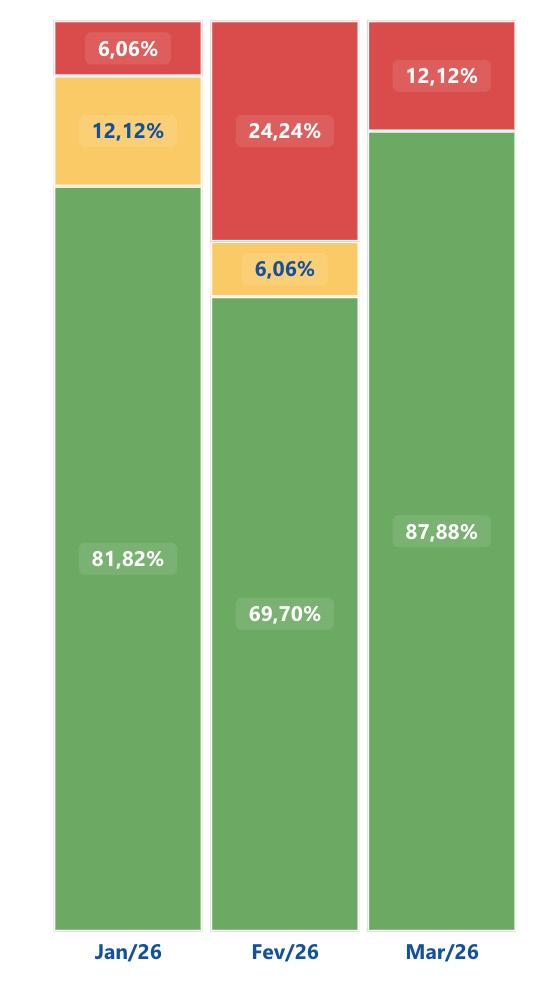
March data show a clear acceleration in sales. Among the 33 companies surveyed, 87.88% reported higher sales compared to the same month in 2025, while 12.12% posted declines.
The result marks a significant improvement from February, when 24.24% of companies reported lower sales and 6.06% remained flat year-over-year. At the time, 69.70% recorded growth. February’s performance is typically affected by Carnival, a period when business activity slows and most travel has already been booked in advance.
The IDET will track monthly performance across each segment—operators, consolidators and TMCs—as well as provide a consolidated view of the industry. It also measures business sentiment, hiring trends and expected performance.
In March, companies reporting growth posted an average increase of 33.74%, while those experiencing declines saw an average drop of 10.57%.
Air ticket prices rose sharply again in March, reflecting global pressures linked to the conflict in the Middle East. Higher oil prices have directly impacted aviation fuel costs.
Data from Brazil’s National Civil Aviation Agency (ANAC) show the average domestic airfare reached R$ 707.16 in March, up 17.8% year-over-year. Yield rose even more steeply, climbing 19.4% to R$ 0.5549 per kilometer. Although the average price of aviation fuel stood at R$ 3.60 per liter in March—down
13.7% from a year earlier—the outlook shifted quickly. In April, Petrobras announced an increase of about 55%, in line with international oil trends.
Fuel now accounts for roughly 45% of airlines’ operating costs, up from just over 30% previously, according to the Brazilian Association of Airlines (Abear). The group warns that sustained increases could limit the launch of new routes and reduce flight availability nationwide.
Brazilian spending overseas reached US$ 6.04 billion in the first quarter, a 21.9% increase compared to the same period in 2025, according to the Central Bank. It is the highest figure ever recorded for the first three months of the year since the series began in 1995.In March alone, spending totaled US$ 1.99 billion, also a record for the month. The rise comes as the Brazilian real strengthened against the U.S. dollar, making international travel more affordable. The dollar fell below R$ 5 for the first time in two years, boosting confidence among travelers— even in a presidential election year.
Brazil sent approximately 153,700 travelers to
the United States in March, up 2.4% from a year earlier. The figure follows 153,000 passengers in February and nearly 200,000 in January, confirming a steady upward trend in outbound travel to the U.S.
Corporate travel also showed resilience. TMCs affiliated with Abracorp reported revenue of R$ 3.57 billion in the first quarter, a 12.4% increase compared to R$ 3.18 billion a year earlier. Air transport remained the dominant segment, generating R$ 2.16 billion in revenue, up 16.36% year-over-year. The hotel sector grew 7.58% to R$ 1.04 billion, while other services rose 9.37%. Some segments posted particularly strong gains, including transfers (+37.73%) and travel insurance, which more than doubled (+124.17%). By contrast, leisure travel packages (-24.12%), cruises (-36.62%) and rail (-74.77%) declined. Industry analysts point to two main drivers behind the results: rising airfares linked to global tensions and a shift in traveler behavior. While demand remains strong, passengers are increasingly adjusting routes rather than canceling trips—benefiting European and U.S. carriers in particular.
This report is produced by PANROTAS and FECOMERCIOSP to support your business decisions. The contents are valuable assets to Destinations and Travel Organizations, both domestic as well as international. For further information please contact ri@fecomercio.com.br redacao@panrotas.com.br