Number 57
July/2026



Number 57
July/2026
June brought a brief respite for the Brazilian economy— but it was short-lived. Inflation came in below expectations, with the IPCA (Brazil’s official consumer price index) rising just 0.16%, compared with the market forecast of 0.31%, driven by lower food prices and slower fuel inflation. The 12-month inflation rate eased from 4.72% to 4.64%, signaling the beginning of some relief. Following the peace agreement between the United States and Iran, oil prices were moving toward the US$70 per barrel range, which would have provided additional room for price moderation. That scenario, however, reversed quickly. The conflict resumed. Despite the peace agreement, renewed attacks reignited tensions in the Middle East, erasing expectations of stability. Oil prices, which had been approaching US$70 per barrel, surged back to nearly US$85, wiping out much of the relief achieved in recent weeks. As a result, pressure on fuel prices—and consequently across the broader inflation chain—is once again back on the radar.
Against this backdrop, Brazil’s Central Bank kept the Selic benchmark interest rate at 14.25% per year at its latest Monetary Policy Committee (COPOM) meeting and is not expected to make significant changes in the near term. High interest rates remain necessary to contain inflation, but the cost is evident: expensive credit, weaker consumer spending, and postponed investment.
The economy continues to show signs of fatigue. Retail sales fell 0.6% in May, bringing year-to-date growth to just 1.3%. The services sector expanded a modest 0.4% during the month and is up 1.9% in 2026. Industrial production increased 0.2% in May and 1.4% year-to-date. While most indicators remain positive, growth is steadily losing momentum, suggesting that high interest rates are effectively slowing economic activity. In retail, sectors that rely most heavily on consumer credit continue to face the greatest pressure.
A concerning report from FecomercioSP reinforces this picture. Household credit overdue by more than 90 days reached a record level during the first four months of 2026, totaling R$250 billion. Online sports betting is likely contributing to this financial imbalance, placing additional strain on household budgets and weakening consumer spending.
Tourism remains the exception. The sector posted another record month in May, generating R$23 billion in revenue—an increase of 4.2% year over year. Growth has been fueled by the continued rise in international arrivals: 5.3 million foreign visitors traveled to Brazil during the first half of the year, nearly half of them from South America. Part of this expansion, however, also reflects higher prices. Airfares have risen significantly due to the increased cost of aviation fuel (jet fuel), a direct derivative of crude oil. Although tourism still represents a relatively small share of Brazil’s economy, it continues to expand at a robust pace.
On the fiscal front, the government continues to increase spending during an election year. Public debt reached 81% of GDP in May, compared with 75% a year earlier—a six-percentage-point increase in just 12 months. Programs designed to stimulate consumption and renegotiate household debt support economic activity in the short term but also heighten investor concerns over the country’s ability to restore fiscal balance.
Adding to the challenges, the United States confirmed a 25% tariff on Brazilian exports, with exemptions for products such as beef, coffee, orange juice, and oil. Implemented under Section 301 of U.S. trade legislation, the measure reduces the competitiveness of Brazilian manufacturers while increasing political tensions between two of the Americas’ largest trading partners. The Brazilian government responded by announcing it would invoke its Reciprocity Law and take the case to the World Trade Organization (WTO).
The second half of the year begins under a cloud of uncertainty. The election calendar is expected to delay
important decisions while encouraging additional public spending, as the government continues its expansionary fiscal policy with little indication of adjustment—even as public debt has climbed six percentage points over the past year. Internationally, geopolitical tensions remain elevated. The renewed conflict involving Iran and new U.S. trade tariffs add external risks largely beyond Brazil’s control. Domestically, Brazilian businesses face a demanding adjustment agenda. Tax Reform is entering its regulatory phase, requiring companies to review processes, systems, and pricing strategies—an effort that will consume both time and resources. At the same time, discussions over changes to working hours and labor regulations, regardless of their merits, are creating uncertainty about future labor costs and
1
June Inflation (IPCA): The decline in inflation was largely driven by food prices, which registered deflation of 0.24%.
Ground coffee fell 3.72%, fruit prices declined 1.58%, and meat prices dropped 0.64%, although carioca beans surged 8.31%. Fuel prices also eased, with ethanol down 3.09% and gasoline falling 0.12%. Housing costs moved in the opposite direction, rising 0.63%, mainly due to higher electricity prices. Airfares also increased sharply, up 7.12% during the month.
The market’s current forecast is for Brazil’s 2026 inflation rate (IPCA) to reach 5.30%.
the regulatory environment. It is this combination—high interest rates, geopolitical conflict, trade tariffs, tax reform, labor reform proposals, election uncertainty, and fiscal concerns—that continues to discourage business investment. When companies lack visibility and predictability, economic growth inevitably slows. That is precisely what current indicators suggest: increasingly modest economic activity, consumer spending constrained by debt and expensive credit, and a productive sector operating cautiously. Brazil has the size and potential to grow well above the global average, yet it continues to fall short of that opportunity. Ultimately, the burden falls on Brazilian workers, whose purchasing power continues to erode while conditions for entrepreneurship and investment become increasingly challenging.
2
Agricultural Production: IBGE’s June estimate revised Brazil’s grain harvest to 347.4 million metric tons, down 0.8% from the May estimate of 350.4 million tons, but still 0.4% above the 2025 harvest.
Soybean production continues to reach record levels, now estimated at 174.8 million tons, representing 5.3% growth over 2025.
The primary concern now centers on the next crop cycle. A potential Super El Niño could disrupt rainfall patterns, reduce agricultural output, and place upward pressure on food prices in 2027.
3
Delinquent Household Credit Reaches Record High: According to a FecomercioSP survey based on Central Bank data, household credit more than 90 days overdue reached R$247.6 billion during the first four months of 2026—the highest level since the series began in 2004.
The total increased 50.7% year over year, equivalent to nearly the entire volume of delinquent household credit recorded nationwide in 2018.
Every region of Brazil posted record levels, led by the Center-West (+69.3%) and the South (+66.1%).
Legend: Green, Red and BlackThe data get better, worse and equal than the previous month.
• Consumer Confidence (ICC): The Consumer Confidence Index (ICC) rose 2.9% in June, increasing from 120.6 to 124.1 points, and is now 9.9% higher than a year ago.
The monthly improvement likely reflects temporary relief following the peak in fuel prices and the beginning of moderation in food inflation. Even so, the outlook remains challenging for Brazilian consumers.
• Business Confidence Index (ICEC): The Business Confidence Index (ICEC) fell 1.1% in June, declining from 94.9 to 93.8 points, and remains in pessimistic territory.
Compared with June 2025, when the index stood at 101 points, confidence has fallen 7.1%.
High interest rates, rising household indebtedness, the World Cup’s impact on consumer spending patterns, global uncertainty, and the upcoming elections continue to weigh on business sentiment.
Consumer Confident Index (ICC) and Comerce Businessman (ICEC)
Both the ICC and ICEC range from 0 to 200 points. Readings above 100 indicate optimism, while below 100 indicate pessimism. Although these indicators are calculated for the city of São Paulo, they generally reflect nationwide trends, as Brazil’s largest city accounts for approximately 11% of the country’s GDP.
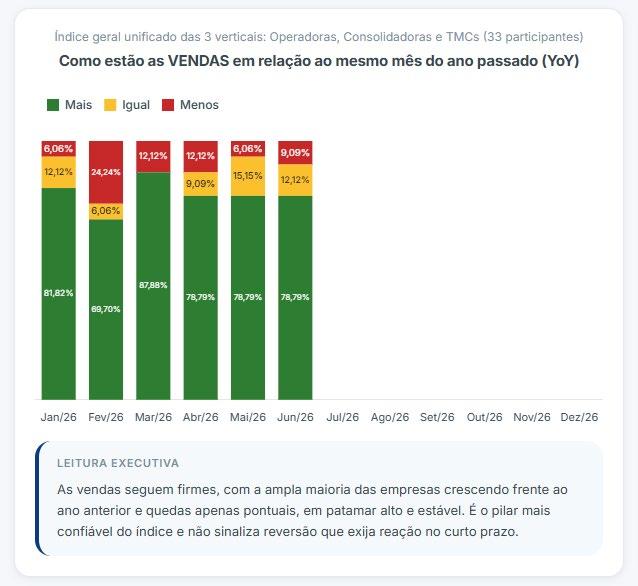
The sixth month of the year was a very positive one for the tour operators participating in the monthly IDET PANROTAS market sentiment survey. None of them reported a decline in sales compared to the same month last year. Among consolidators, however, about 18% of respondents said sales were lower than in the same period of 2025.
The year continues to be a good one for Brazil’s travel industry, although not without some specific challenges.
According to the IDET PANROTAS (Tourism Economic Performance Index), compiled monthly with 33 of the country’s largest travel companies, 72.73% of businesses across all verticals reported higher margins
than a year ago, the best result of the first half of the year for this indicator. Confidence for the next six months also reached its highest level of the year, with 45.45% of executives expecting a better business environment. Despite Brazil’s election season (with wellknown frontrunners and no major surprises expected unless a late challenger emerges), the FIFA World Cup (where Brazil was eliminated early), and the conflict in Iran (which disrupted or limited access to the airports of Doha and Dubai), Brazil’s travel industry continues to grow.
Among the main headwinds are the Iran conflict—which prompted Brazilian travelers to seek alternative routes to Asia, driving up airfare to Europe and the United States—and
the following factors:
• Around a 5% decline in Brazilian travel to the United States.
• The U.S. dollar and the euro remain at relatively high levels, encouraging travelers to seek greater value while further accelerating the luxury travel segment. Europe became the preferred summer destination for Brazilians, as many avoided traveling to the U.S. during the World Cup period.
• A new 25% U.S. tariff on Brazilian products, once again affecting trade between Brazilian companies and the United States, despite nearly 2,000 product exemptions.
• The tariff dispute has also fueled another round of political and economic tensions between the two countries, which have already experienced several tariff-related disputes throughout the year. Further developments remain to be seen.
Looking exclusively at consolidators, 90.91% closed June with higher margins than in June 2025, the best first-half performance for this vertical under this indicator. None of the respondents reported lower margins. However, as noted above, the share of companies with lower sales than the previous year doubled compared to May.
Although consolidators sell a wide range of travel products, air travel continues to account for the largest share of total sales volume.
Since the topic is consolidators, it is impossible not to mention what became the largest executive reshuffle in the history of Brazil’s airline consolidation sector, which unfolded in June and July following the resignation of Luciano Guimarães from BeFly, whose
portfolio includes Flytour Consolidadora as one of its flagship companies.
More than 70 Flytour Consolidadora employees—most of them in leadership positions—followed Guimarães to his new employer, Sakura Consolidadora, and more are expected to make the same move in the coming weeks. The situation is similar, though not identical, to what happened when Guimarães left CVC Corp to join BeFly.
At the same time, BeFly also lost another 60 employees following the departure of Jazz Side from the holding company, in addition to a few employees from other business units.
Appointed interim Vice President, Sylvio Ferraz is leading BeFly’s organizational restructuring. At the time this edition of the BOM Report went to press, the company had not yet announced Guimarães’ permanent replacement. The market continues to closely monitor developments within the BeFly ecosystem, currently Brazil’s third-largest travel distributor, behind only Decolar and CVC Corp.
Among tour operators, if 18% rated May as “Very Poor”—the worst performance recorded by any vertical during the first half of the year— in June there were no negative assessments. A total of 90.91% of operators sold more than in June 2025, the best result of the semester and the strongest performance among the three industry verticals during the month.
Seasonality? The World Cup effect? The approach of the vacation season and yearend travel planning? Probably a combination of all these factors.
For the third consecutive month, Travel Management Companies (TMCs) posted
the highest average sales growth among all verticals, nearly 40% year over year in June.
For the second straight month, no company in this segment reported having fewer employees than a year earlier.
Looking ahead, not a single executive in the TMC segment expects business conditions to worsen over the next six months, making it the only vertical to report such unanimous optimism in June.
• Following LATAM’s announcement, Abra Group, parent company of Gol and Avianca, also placed an order for up to 45 Embraer E195 aircraft. Twenty of these could eventually join Gol’s fleet. Azul had previously been the only Brazilian airline operating Embraer jets, while LATAM is expected to begin operating the aircraft by the end of the year.
• Brazil, Argentina and Paraguay are moving forward with the implementation of an Open Skies policy, which will facilitate flights both between and within the participating countries.
According to Brazil’s Ministry of Ports and Airports, other Mercosur members are also expected to join.
• LATAM reached the milestone of serving 30 international destinations from Brazil with the launch of three additional routes. Alongside its existing 27 destinations, Cape Town (South Africa), Punta Cana (Dominican Republic), and Ushuaia (Argentina) now complete the airline’s
international network from Brazil.
• Brazil’s hotel industry has become increasingly dissatisfied with Booking.com and has decided to take action against the OTA over the mandatory increase in commission rates charged on hotel bookings in the country.
• Brazilians continue traveling to Europe— now even more than to the United States—but growing concerns remain over long immigration lines and bureaucratic border procedures. Visa requirements are not the main obstacle for Brazilian travelers (as demonstrated by the approximately two million who travel to the U.S. annually), but airport delays and excessive bureaucracy inevitably affect the overall travel experience.
• Historically, the second half of the year is the strongest sales period for Brazil’s travel industry, and 2026 will feature a packed calendar of major events, where PANROTAS will either participate alongside partners or provide exclusive coverage. In Brazil, these include Abav Expo (São Paulo), BTM (Fortaleza), and Festuris (Gramado, Rio Grande do Sul). Internationally, coverage will include the GBTA Convention, ILTM North America, ILTM Cannes, WTTC Conference, and Phocuswright Conference. PANROTAS will also host its own second-half events: PANROTAS Next (São José dos Campos, Salvador and Maceió), Travel Tech Hub Day (August 24), and MOVE –Decisions that Drive Corporate Travel (October 5), an event exclusively for travel managers.
This report is produced by PANROTAS and FECOMERCIOSP to support your business decisions. The contents are valuable assets to Destinations and Travel Organizations, both domestic as well as international. For further information please contact ri@fecomercio. com.br redacao@panrotas.com.br