
Number 53 May/2026


Number 53 May/2026
The international scenario continues to be marked by uncertainty surrounding the war in Iran, now entering its third month with no significant changes so far. Ongoing tensions in the Middle East continue to keep oil prices at elevated levels, above US$ 100 per barrel, directly affecting transportation, fuel and global logistics costs. In Brazil, these impacts are already being reflected in inflation. In April, the country’s official inflation index (IPCA) rose 0.67%, mainly driven by higher fuel prices. Gasoline prices increased 1.86% during the month and remained the single biggest contributor to inflation, while diesel prices jumped 4.46%, following another strong increase in the previous month. This situation raises concerns because fuel prices affect the economy in several ways. Besides increasing household expenses, more expensive diesel raises freight and transportation costs, while higher aviation fuel prices tend to increase travel costs over the coming months.
The main relief factor has been the exchange rate. The US dollar weakened globally, while the Brazilian real appreciated and was traded below R$ 5 per dollar — a level not seen for several years. A stronger real helps reduce inflationary pressure, especially on imported goods and products linked to the dollar. Economic activity, however, remains relatively weak. Brazil’s Central Bank economic activity index (IBC-Br) showed 1.3% growth in the first quarter, indicating only moderate expansion. March posted stronger numbers partly due to calendar effects, since Carnival took place
in February this year, unlike last year. In this context, industrial production increased 4.3% year over year, retail sales grew 4% and services advanced 2.3%.
In Tourism, a survey by FecomercioSP showed revenues of R$ 23.6 billion in March, a new historical record and a 1.2% increase compared to the previous period. Most tourism segments posted positive results, although the accommodation sector stood out negatively, with a 9.4% decline. In this case, the calendar effect worked in the opposite direction, since hotels generally benefit more from long holiday weekends. Within the tourism industry, one of the main concerns is the increase in aviation fuel prices, which have risen more than 50%. This directly impacts airline operating costs and may eventually be passed on to ticket prices, potentially affecting travel demand in the medium and long term. Brazil’s Central Bank remains in a difficult position. On one hand, inflation has accelerated again and is approaching the upper limit of the official target range. On the other hand, the economy still lacks stronger momentum. At its latest meeting, the Monetary Policy Committee (Copom) reduced the benchmark interest rate (Selic) to 14.50% per year, marking the second consecutive cut. However, room for further reductions appears limited while the global environment remains unstable.
One advantage for Brazil at the moment is that, in addition to the weaker US dollar, there is no single global economy clearly outperforming the others. With interest rates close to 15% per year, Brazil remains attractive to international
investors, helping support the stronger real and preventing even higher inflationary pressure. At the same time, Brazil’s 2026 presidential election is increasingly becoming part of economic discussions. There are concerns that short-term measures aimed at easing prices could be adopted, while political uncertainty surrounding the electoral campaign may
increase caution among businesses, consumers and investors.
Overall, the Brazilian economy continues to grow at a slow pace, with no clear signs of stronger acceleration. With interest rates still very high, inflation pressured by fuel costs and significant external uncertainties, the country is expected to remain in a low-growth environment in the short term.
Air Transport Sector: Demand for domestic air travel increased 6.8% in the first quarter of the year, while seat capacity grew 5.1%, keeping aircraft occupancy rates high, above 82%. However, rising aviation fuel prices are already pressuring airline profit margins and may slow sector growth during the second half of the year.
Labor Market: Brazil’s unemployment rate stood at 6.1% in the quarter ending in March 2026, below the level recorded in the same period last year. Average real income reached R$ 3,722, up 5.5% year over year, showing that the labor market continues to support consumer spending despite higher inflation.
3
Household Debt: According to the Consumer Debt and Default Survey (Peic), conducted by CNC – National Confederation of Commerce, 80.4% of Brazilian families had some type of debt in March, the highest level in the historical series. Of these, 29.6% had overdue payments and 12.3% reported being unable to pay their debts. In addition, 19.2% commit more than half of their income to debt payments, in an environment still pressured by high interest rates and inflation.
• Consumer Confidence (ICC): The index reached 121.1 points in April, down 3.8% compared to March, although still 9.1% higher year over year. The second consecutive monthly decline reflects growing concerns about the war in Iran and inflation, especially higher fuel prices, which directly affect household budgets.
• Business Confidence Index (ICEC): The index returned to pessimistic territory at 99.7 points in April, down 3.1% from March, although still 2.1% above the level recorded one year earlier. As with consumers, global tensions are making retailers more cautious, especially given inflationary pressure and still-high interest rates.
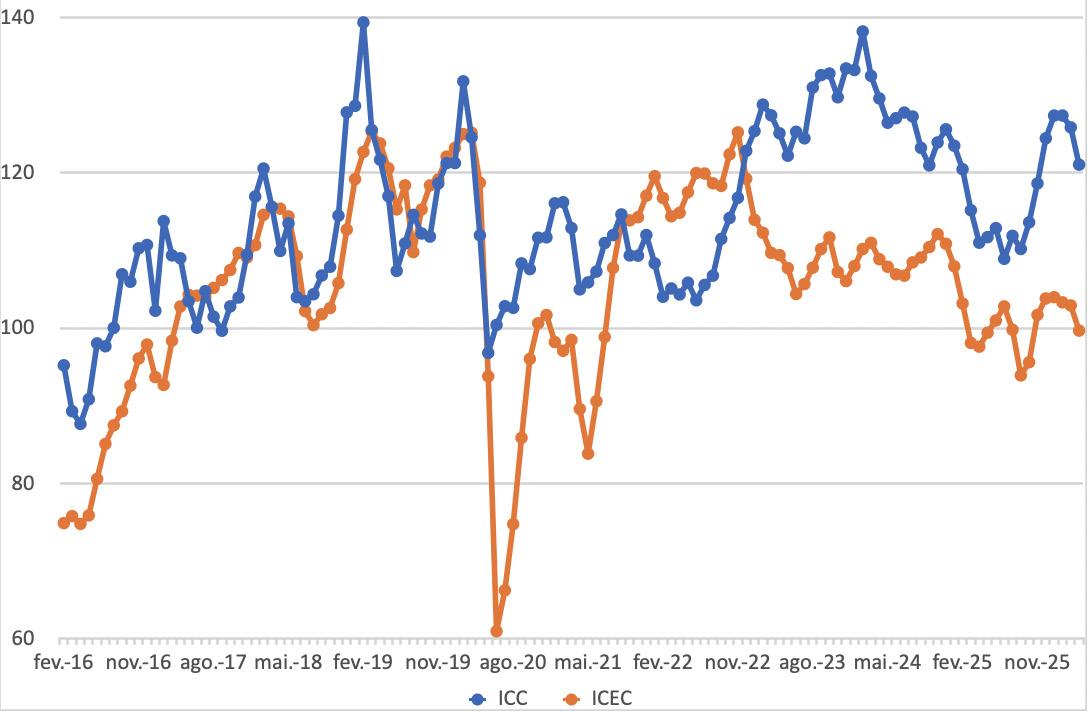
Note: Both ICC and ICEC range from 0 to 200 points. Readings between 100 and 200 indicate optimism, while levels below 100 indicate pessimism. Although these indicators are based on the city of São Paulo, they broadly reflect trends across Brazil, since the country’s largest city represents approximately 11% of national GDP.
Represented by editor-in-chief and CCO Artur Luiz Andrade, PANROTAS Portal editor Pedro Menezes, reporter Beatriz Contelli and Adrian Bertini, PANROTAS took part in another edition of IPW 2026, held in Fort Lauderdale. As it has done since the 1980s, PANROTAS launched during IPW its English-language publication dedicated to presenting Brazil and the country’s tourism market to international companies interested in doing business with Brazilian travel companies.
The Brazilian Overview 2026/2027 features data and analysis on the Brazilian economy, information about the country’s international air network, the profile of Brazilian travelers in the United States, a list of international destinations represented in Brazil and airlines operating international flights from Brazilian airports, as well as exclusive research and data that help international partners better understand Brazil and its travelers.
“When we present some of the data featured in the Brazilian Overview — information that may seem obvious or recurrent to us — international companies are often surprised and eager to learn how to attract Brazilian travelers,” says PANROTAS editor-in-chief Artur Luiz Andrade. “The United States remains a dream destination for Brazilians, as shown in
one of the studies featured in this edition. What destinations need is to maintain a presence in Brazil, train travel advisors, place products from different niches on the shelves of travel companies and, above all, remain consistent and committed to the Brazilian market in the long term. We have many flights to the United States, and Brazilians are not intimidated by connections or long distances. But they do want to feel safe, fulfill their travel dreams and make their time and investment worthwhile,” says Andrade.
“Florida is the best example of a destination that truly understands Brazilian travelers and has maintained a presence in Brazil for decades, during both good and challenging times, consistently investing in and believing in this market. The results speak for themselves. Brazil is Florida’s largest source market for international visitors,” he adds.
During IPW 2026, Florida also announced the first-ever Florida Huddle in Brazil, scheduled for June 2027 in São Paulo. No other destination could launch something so ambitious in Brazil — only Florida, which has invested in the Brazilian market for years.
This year’s edition — whose digital version CAN BE ACCESSED HERE — highlights several key facts:
1
Brazil ranked among the Top 4 longhaul source markets for the United States, with 1.9 million visitors in 2025.
2
Brazil became Florida’s number one international source market in 2025, surpassing the United Kingdom.
3
Twenty Brazilian cities offer international flights, most with direct links to the United States and others connected through South and Central American hubs such as Lima, Bogotá and Panama City.
4
Brazil has South America’s largest international air network, with flights to 35 countries. Colombia ranks second, with connections to 31 countries.
5
Seventy-five percent of tourism sales in Latin America are made through indirect channels, including travel agencies, tour operators, OTAs and consolidators.
6
Brazil is currently the world’s 11thlargest economy and is expected to surpass Mexico by 2028 as Latin America’s largest Travel & Tourism economy.
7
Brazilians spent US$ 21.7 billion abroad last year, the highest amount in a decade.
8 Brazilians’ favorite international destinations are the United States, Argentina, Portugal, Chile and France.
9
Thirty-three airlines currently operate international flights from Brazil. The carriers with the largest number of weekly international flights are LATAM Airlines (423), Gol Linhas Aéreas (161), Copa Airlines (95), TAP Air Portugal (95), Aerolíneas Argentinas (80), JetSMART (73), Avianca (60), Azul Linhas Aéreas (53), American Airlines (41) and SKY Airline (32 weekly flights).
10São Paulo leads Brazil’s international air market with 58.32% of all international flights and 62.65% of total seat capacity. Rio de Janeiro ranks second with 22.26% of flights. Florianópolis comes third with 3.25%, followed by Brasília (3.14%), Recife (2.21%) and Belo Horizonte (1.77%). This means that more than 80% of Brazil’s international air capacity remains concentrated in São Paulo and Rio de Janeiro.
11
GRU Airport offers international flights to approximately 60 cities worldwide, while Rio de Janeiro serves just under 30 international destinations.
12
According to exclusive research released in the Brazilian Overview and conducted by Travel Leaders Hub, the United States is the next international destination planned by Brazilian travelers.
13 The list of most-booked destinations is followed by Italy, Portugal, Orlando, Canada, New York, Mexico, Disney, Argentina and Chile.
14
When asked about dream destinations, Brazilians once again ranked the United States first, followed by Italy, Japan, Disney and Orlando.
15
The Brazilian Overview 2026/2027 also includes additional data on aviation, an events calendar, PANROTAS products, a list of Braztoa tour operators, exclusive articles and research.

CLIK HERE TO READ IT NOW
This report is produced by PANROTAS and FECOMERCIOSP to support your business decisions. The contents are valuable assets to Destinations and Travel Organizations, both domestic as well as international. For further information please contact ri@fecomercio. com.br redacao@panrotas.com.br