FOCUS TOPICS MEN’S HEALTH • NEUROLOGY
June/July 2026 >> $5 ON ROUNDS
HHS Accessibility Rule: FastApproaching Compliance Deadlines for Healthcare Providers In May 2024, the U.S. Department of Health and Human Services (HHS) updated section 504 of the Rehabilitation Act. The rule, titled “Nondiscrimination on the Basis of Disability in Programs or Activities Receiving Federal Financial Assistance,” established, in part, enforceable standards requiring healthcare providers and organizations (collectively “healthcare providers”) to ensure individuals with disabilities had access to: 1. Exam tables and weight scales, and 2. Websites, mobile apps, and kiosks
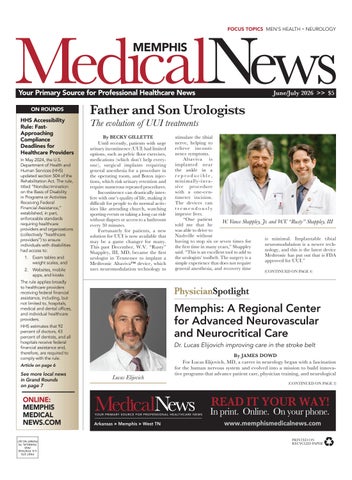
Father and Son Urologists The evolution of UUI treatments By BECKY GILLETTE Until recently, patients with urge urinary incontinence (UUI) had limited options, such as pelvic floor exercises, medications (which don’t help everyone), surgical implants requiring general anesthesia for a procedure in the operating room, and Botox injections, which risk urinary retention and require numerous repeated procedures. Incontinence can drastically interfere with one’s quality of life, making it difficult for people to do normal activities like attending church, watching sporting events or taking a long car ride without diapers or access to a bathroom every 30 minutes. Fortunately for patients, a new solution for UUI is now available that may be a game changer for many. This past December, W.V. “Rusty” Shappley, III, MD, became the first urologist in Tennessee to implant a Medtronic Altaviva™ device, which uses neuromodulation technology to
The rule applies broadly to healthcare providers receiving federal financial assistance, including, but not limited to, hospitals, medical and dental offices, and individual healthcare providers.
Memphis: A Regional Center for Advanced Neurovascular and Neurocritical Care Dr. Lucas Elijovich improving care in the stroke belt
Article on page 6
ONLINE: MEMPHIS MEDICAL NEWS.COM
(CONTINUED ON PAGE 4)
PhysicianSpotlight
HHS estimates that 92 percent of doctors, 43 percent of dentists, and all hospitals receive federal financial assistance and, therefore, are required to comply with the rule.
See more local news in Grand Rounds on page 7
stimulate the tibial nerve, helping to relieve incontinence symptoms. Altaviva is implanted near the ankle in a reproducible, minimally-invasive procedure with a one-centimeter incision. The devices can tremendously improve lives. “One patient W. Vance Shappley, Jr. and W.V. “Rusty” Shappley, III told me that he was able to drive to Nashville without is minimal. Implantable tibial having to stop six or seven times for neuromodulation is a newer techthe first time in many years,” Shappley nology, and this is the latest device said. “This is an excellent tool to add to Medtronic has put out that is FDA the urologists’ toolbelt. The surgery is a approved for UUI.” simple experience that does not require general anesthesia, and recovery time
Lucas Elijovich
By JAMES DOWD For Lucas Elijovich, MD, a career in neurology began with a fascination for the human nervous system and evolved into a mission to build innovative programs that advance patient care, physician training, and neurological (CONTINUED ON PAGE 3)
READ IT YOUR WAY!
In print. Online. On your phone. Arkansas > Memphis > West TN
www.memphismedicalnews.com PRINTED ON RECYCLED PAPER
PRST STD U.S. POSTAGE PAID FRANKLIN, TN PERMIT NO.357
2 > JUNE/JULY 2026
memphismedicalnews.com
Memphis: A Regional Center, continued from page 1
Your patients shouldn’t have to wait any longer. Living with hip or knee pain changes everything. Getting relief shouldn’t mean waiting months for a consult. OrthoSouth’s growing team of joint replacement specialists helps patients move more quickly from consultation to treatment.
Over the past 16 years, Elijovich has helped shape Memphis into a regional center for advanced neurovascular and neurocritical care.
sciences across the Mid-South. Today, Elijovich serves as a neurologist at Semmes Murphey Clinic and holds faculty appointments in the Departments of Neurology and Neurosurgery at the University of Tennessee Health Science Center (UTHSC). He also serves as director of Neurocritical and Neurointerventional Surgery for Le Bonheur Children’s Hospital’s Neurosciences Institute, and as co-director of the Le Bonheur Vascular Anomalies Center. Over the past 16 years, Elijovich has helped shape Memphis into a regional center for advanced neurovascular and neurocritical care, while training the next generation of specialists in a field where expertise remains in high demand. Born in Buenos Aires, Argentina, Elijovich moved to the United States with his family when he was three years old. Medicine was a familiar part of life from an early age. Both of his parents were physicians, with his mother practicing critical care medicine in Argentina before pursuing psychiatry in the United States, and his father specializing in hypertension research. After growing up in New Jersey, Elijovich attended Tufts University, where a formative undergraduate experience helped set his career path. A neuroanatomy course sparked a deep interest in the structure and function of the brain and spinal cord. The opportunity to study physical specimens and explore the complexity of the nervous system convinced him that neurology offered the intellectual challenge and clinical impact he was seeking. memphismedicalnews.com
“The study of the brain and spinal cord fascinated me,” Elijovich said. “When I went to medical school and got to examine physical specimens, I was hooked.” Elijovich earned a medical degree at the University of Texas Medical Branch in Galveston before beginning neurology residency training at New York University. As his interests increasingly centered on cerebrovascular disease, stroke, neurocritical care, and emerging endovascular treatments for neurological conditions, Elijovich knew he wanted additional training beyond traditional neurology. To pursue those interests, he completed a fellowship in stroke and neurocritical care at the University of California, San Francisco. “It was a very special place in terms of how they trained residents and fellows,” Elijovich said. “The collaborative culture and multidisciplinary approach to patient care left a lasting impression on me.” Following UCSF, Elijovich returned to New York for additional training in interventional neuroradiology under Dr. Alejandro Berenstein, one of the field’s pioneers. The experience provided exposure to advanced techniques that were helping redefine the treatment of stroke and other neurovascular disorders. The combination of neurology, critical care, and minimally invasive intervention would become a defining feature of his career. In 2010, Elijovich joined Semmes Murphey Clinic, drawn
orthosou th. o rg | 901.937.3242 SCAN TO LEARN MORE
ORTHOPEDICS & SPINE
2026
OrthoSouth Germantown ASC has been named a Best Ambulatory Surgery Center by both Newsweek and U.S. News & World Report.
(CONTINUED ON PAGE 5) JUNE/JULY 2026
> 3
Father and Son Urologists, continued from page 1 Shappley, who practices with his father, W. Vance Shappley, Jr., MD, said when his father first implanted devices for UUI, batteries had to be changed every 16 months. The Altaviva battery will last about 15 years and only needs to be recharged once or twice a year. “Almost 30 years ago, Medtronic introduced InterStim™, a sacral neuromodulation device to treat UUI,” the younger Shappley said. “While sacral neuromodulation technology still works extremely well, it isn’t always as convenient and requires a 20- to 30-minute operation under general anesthesia. Some patients are at an age where the risks to cognition from general surgery are significant. I had a patient like this who opted for the Altaviva and he is delighted with the results. We didn’t have this technology until this past year. When I tell patients the solution might be relatively easy, a light comes on. I love the opportunity to give someone who is taking medications that haven’t worked for a long time and do something that can provide excellent outcomes for a better quality of life. It is very rewarding. I absolutely love that part of my practice. My dad and I enjoy what we do for a living, and like to provide medical advances such as this.” A frustrating aspect of being a urologist is that, for a variety of different reasons, people are often uncomfortable discussing the urinary tract and the male reproductive system. Patients might even have an appointment but find themselves embarrassed to talk about it in an office setting with a stranger. “When it comes to leakage of urine, it is embarrassing to a lot of people,” Shappley said. “Incontinence is a very significant quality-of-life issue, affecting them every day. Incontinence is an extraordinarily common and severely underreported problem— half of people in America may have an issue with it at some point in their lives. Men can be reluctant to see a doctor
about it. It might be a family member who notices odor, or the number of diapers he uses. You can ask him if he has any problems with incontinence and he will say, ‘No.’ But then a family member will pipe up and say, ‘What about the four diapers you are using per day?’” Often patients have comorbidities including life-threatening issues like diabetes or untreated hypertension. When seeing a primary care doctor, the patient is likely to focus on the most serious, life-threatening issues while dodging quality-of-life issues like incontinence. Primary care doctors have limited time and may not inquire about incontinence if it hasn’t been brought up. Vance Shappley has often had a female patient tell him that her husband needs to come in because he is leaking urine. “It might take a little coercion to get him in,” Shappley said. “Many times, patients might opt for medications instead of something that might be a greater benefit because of work and family responsibilities.” Urology is a rapidly changing specialty. When the father and son first started practicing together, the son benefitted from his dad’s decades of experience, and the father learned from the latest his son had learned at medical school. As children, the son and his brother often accompanied their dad to the hospital for rounds and emergencies, spending many hours haunting the nurses’ stations and doctors’ lounge. Rusty Shappley grew up knowing he wanted to be a surgeon but initially gravitated to neurosurgery. At medical school, after spending time with the different specialties, he decided urology was the best fit. “I found it very engaging,” he said. “I listened to my gut and did what I wanted to do. I also knew I wanted to work at a destination close to family, so I was happy to return to Memphis from Boston. Having someone with decades of experience to consult with
Altaviva™ is implanted near the ankle in a reproducible, minimally-invasive procedure with a one-centimeter incision. The devices can tremendously improve lives. has been incredibly valuable throughout my career. It’s been fun working together. Since I joined 18 years ago, we merged with The Urology Group, successfully recruited, and are now the largest urology practice in the area.” Some people believe incontinence is just a part of getting older. “But just because a medical problem is very common doesn’t mean you just have to endure it,” said Vance Shappley, who will soon also be certified to implant Altaviva. “Men are coming around to deciding hormonal replacement is okay. With UUI, you see people avoiding activities that they love. People are delighted to learn there is a solution that can give them back freedom from needing to be near a bathroom every 30 minutes.” Patients are evaluated and managed with the options of medicinal therapy before moving to surgical intervention, as recommended by the American Urological Association guidelines, which the Shappleys rigorously follow for a variety of conditions. Vance Shappley, who completed his medical education at University
of Tennessee Health Science Center, has 60 years of experience. Rusty Shappley, who graduated from Duke University and Columbia University College of Physicians & Surgeons in New York, is married to Rebekah Shappley, MD, a pediatrician who is an assistant dean at UTHSC. The couple have three boys ages 8, 10 and 12. Vance’s younger son, Robbie Shappley, JD, MBA, works as a hospital administrator for University of Southern California. Shappley credits his dad with pioneering The Urology Group’s interest in the latest medical innovations. “One thing my father has always done is stay abreast of trends,” Shappley said. “He was the first urologist in the area to adopt electronic medical records, the first to hire Physician Assistants, and the first in the area to implant the InterStim device decades ago. He is always interested in urology improvements. As we encounter newer technologies like the Altaviva device, we continue to explore them together.”
G. Coble Caperton Licensed Tennessee Attorney
46 years of experience
Practicing in the following areas: • Business and Commercial Law • Family Law • Personal Injury • Contracts Rule 31 General Civil/Family Mediator
901.526.6701 4 > JUNE/JULY 2026
memphismedicalnews.com
Memphis: A Regional Center, continued from page 3 by the opportunity to build programs and help expand neurological services in a city with a rich neurosurgical tradition. Coming to Memphis offered a different challenge than simply joining an established practice. His experiences at UCSF demonstrated how integrated neurological and neurosurgical programs could improve patient care, education, and research. Memphis presented a chance to apply those lessons in a growing academic and clinical environment. Working closely with colleagues at Semmes Murphey Clinic and UTHSC, Elijovich helped strengthen the academic connections between neurology and neurosurgery while advancing neurocritical care services throughout the region. Among his most significant accomplishments has been helping establish a neurocritical care fellowship training program at UTHSC. Building one required collaboration across institutions, faculty recruitment, curriculum development, and the creation of clinical experiences capable of training future specialists. The result is a program that has become a key component of neurological education in the region. Today, the fellowship stands as one of the few programs of its kind in the Southeast and provides advanced training for physicians managing critically ill patients with stroke, traumatic brain injury, intracranial hemorrhage, and other complex neurological conditions. “There were opportunities to build a clinical program and put things in place that weren’t here,” he said. “We were able to build a neuro critical care fellowship training program from scratch.” The effort reflects Elijovich’s belief that patient care and physician education must evolve together. Academic partnerships between Semmes Murphey Clinic and UTHSC have been instrumental in that growth, allowing physicians to combine high-level clinical practice with teaching and mentorship. As stroke care continues to evolve, specialists increasingly rely on multidisciplinary teams that integrate neurology, neurosurgery, neurocritical care, and endovascular intervention. And Elijovich’s career has memphismedicalnews.com
spanned that transformation. His training and leadership roles position him at the intersection of these disciplines, helping develop systems of care that improve outcomes for patients with some of the most time-sensitive and complex neurological conditions. “The biggest challenge is patient access to care, so clinical care has been a big focus,” Elijovich said. “It doesn’t matter if a facility is there if patients can’t get appointments in a timely manner. We make ourselves available to ensure that we offer clinical care when it’s needed.” The ability to bridge multiple specialties has become increasingly important as advances in imaging, intervention, and critical care continue to reshape neurological practice. Now midway through his second decade in Memphis, Elijovich remains focused on building programs that expand access to advanced neurological care while preparing future physicians to meet the challenges of an evolving field. From his early fascination with neuroanatomy at Tufts University to leadership roles in stroke, neurocritical care, and neurointerventional medicine, Elijovich’s career reflects both the rapid growth of neuroscience and the importance of collaborative program development. “We’re very involved in men’s health and neurology on a day-today basis because we live in the stroke belt in the southeastern U.S. We have better treatments today, but prevention is key,” Elijovich said. “I always tell patients to take care of themselves and get moving to help reduce the risk of strokes. A good half-hour walk several times a week is a great place to start. Do what you can and build on it.” In addition to his passion for helping patients, Elijovich hopes to help strengthen the city’s reputation as a center for neurological and neurosurgical excellence. And he plans to continue that work for a long time to come. “Memphis is home and it’s where I plan to stay; it’s not a stop on my professional journey,” Elijovich said. “I’m involved in fulfilling and important work, and I love this community. There are so many positive things here and we want to keep working to make it even better.”
The Million Dollar Question How Much Do You Need to Save for Retirement? According to a recent survey by Fidelity, Americans say they plan to have saved an average of more than $1.4 million for retirement. Although reaching $1 million is a very significant milestone, inflation unknowns, rising health care costs and longer lifespans can make $1 million saved for retirement seem inadequate. Retirement saving is less about reaching a specific account balance and more about the income your savings can generate once you stop working. What really matters is whether your savings, combined with other sources like Social Security, can support your lifestyle month after month. Focus On Closing Your Retirement Income Gap Many financial professionals recommend that you aim to replace 70%–80% of your preretirement income, though your needs may vary. Retirement income gap refers to the shortfall between the income you expect you’ll need in retirement and the income your savings and other sources (like Social Security) are projected to provide. For example, if you estimate needing $5,000 per month in retirement but your combined income sources are projected to generate $4,000, your retirement income gap would be $1,000 per month. Identifying this gap early allows you to adjust your plan — such as increasing contributions, delaying retirement or revisiting spending
assumptions — to help stay on track. Chirag Chauhan, AIF®, CFP®
Use A Retirement Needs Calculator One of the best ways to estimate “how much is enough” is by using a retirement needs calculator, such as those provided by your retirement plan recordkeeper. These tools help translate your savings into a projected monthly income and identify potential gaps. Most calculators use a few key assumptions, including: • Current age and retirement age • Income and contribution rate • Current savings balance • Expected investment returns • Inflation rate • Estimated Social Security benefits • How long you’ll need income in retirement. By adjusting these inputs, you can see how small changes — like saving 1% more or retiring a year later — can meaningfully impact your future income. Bringing It All Together Rather than chasing a “magic” number, focus on building a plan that supports your future lifestyle. Regularly reviewing your progress, increasing contributions when possible and using planning tools provided by your plan recordkeeper can help you pursue your goals.
Informational Sources: Fidelity: “Is $1 Million Enough to Retire?” (March 18, 2026); The Motley Fool: “How Much Do I Need to Retire Comfortably?” (March 4, 2026); Thrivent: “Retirement Income Planning Calculator” (2026; accessed April 1, 2026). LPL Financial and its advisors are only offering educational services and cannot offer participants investment advice specific to their particular needs. If you are seeking investment advice specific to your needs, such advisory services must be obtained on your own separate from this educational material. © 2026 Kmotion, Inc. All rights reserved. This newsletter is a publication of Kmotion, Inc., whose role is solely that of publisher. The articles and opinions in this newsletter are those of Kmotion. The articles and opinions are for general information only and are not intended to provide specific advice or recommendations for any individual. Nothing in this publication shall be construed as providing investment counseling or directing employees to participate in any investment program in any way. Please consult your financial advisor or other appropriate professional for further assistance with regard to your individual situation.
Chirag Chauhan, MBA, AIF®, CFP® is the managing partner of Bluff City Advisory Group in Memphis, Tennessee. For more info, please visit bluffcityadvisory.com.
JUNE/JULY 2026
> 5
HHS Accessibility Rule: Fast-Approaching Compliance Deadlines for Healthcare Providers By DEBORAH de QUEVEDO, JD, BSN, Patient Safety Risk Manager II, The Doctors Company
In May 2024, the U.S. Department of Health and Human Services (HHS) updated section 504 of the Rehabilitation Act. The rule, titled “Nondiscrimination on the Basis of Disability in Programs or Activities Receiving Federal Financial Assistance,” established, in part, enforceable standards requiring healthcare providers and organizations (collectively “healthcare providers”) to ensure individuals with disabilities had access to: 1. Exam tables and weight scales, and 2. Websites, mobile apps, and kiosks The rule applies broadly to healthcare providers receiving federal financial assistance, including, but not limited to, hospitals, medical and dental offices, and individual healthcare providers. HHS estimates that 92 percent of doctors, 43 percent of dentists, and all hospitals receive federal financial assistance and, therefore, are required to comply with the rule.
Accessible Medical Diagnostic Equipment Requirements
Medical diagnostic equipment (MDE) must meet the following requirements: Scope: HHS has mandated that all healthcare providers’ offices, clinics, emergency rooms, hospitals, outpatient facilities, and multi-use facilities that use exam tables and weight scales have at least one weight scale and one exam table that meet the standards for accessible MDE. • Weight Scales: To ensure equitable care, at least one wheelchair-accessible scale is required, with platforms large enough to weigh patients while seated. If a standard wheelchair scale is not available, integrated alternatives— such as scales built into patient lifts, hospital beds, or exam tables—may be used. See specific accessible weight scale requirements at Access to Medical Care for Individuals with Mobility Disabilities. • Exam Tables: Fixed-height exam tables and chairs are often inaccessible for people with mobility disabilities. Adjustable-height exam tables are needed so patients can transfer safely from wheelchairs, especially when the table can be lowered. Support features, such as side rails or handles, are important for stability during transfers and exams. At least one accessible exam table is required and should be able to lower to the height of a wheelchair seat (17 to 19 inches from the floor) and 6 > JUNE/JULY 2026
include elements to stabilize and support a person during transfer. See specific accessible exam table requirements at Access to Medical Care for Individuals with Mobility Disabilities. Exceptions: This rule provides exceptions when compliance is proven by the healthcare provider to result in a fundamental alteration in the nature of a program or activity, or in undue financial and administrative burdens. Where an exception does exist, the healthcare provider must nevertheless ensure that individuals with disabilities receive the benefits or services provided by the healthcare provider. Qualified Staff: Healthcare providers must also ensure their staff can successfully operate accessible MDE, assist with the transfer and positioning of individuals with disabilities, and fulfill the access obligations for existing MDE. Deadline: The deadline for accessible MDE is July 8, 2026. By then, facilities must have at least one accessible examination table and one accessible weight scale in place.
Accessible Web, Mobile App, and Kiosk Requirements
Scope: Section 504 requires that any patient-facing website content, mobile apps, or kiosks provided by a healthcare provider through contract, licensing, or other arrangements must be readily accessible to and usable by individuals with disabilities. This requires the following: • Websites and Portals: Items such as patient portals, mobile apps, online scheduling, bill-pay systems, telehealth platforms, EHRs, and prescription refill forms must be accessible to disabled users and meet the Web Content Accessibility Guidelines (WCAG) 2.1 level AA standard. Providers cannot delegate this responsibility and must
verify that vendors meet these legal requirements to avoid significant penalties. • Kiosk: Any programs or activities provided through self-service transaction machines, such as registration, check-in, or form completion, must be accessible. Exceptions: This rule provides exceptions for archived web content, preexisting conventional electronic documents, content posted by a third party, password-protected individualized documents, and preexisting social media posts where compliance would result in a fundamental alteration in the nature of a program or activity or in undue financial and administrative burdens. Where an exception does exist, the healthcare provider must nevertheless ensure that individuals with disabilities receive the benefits or services provided by the healthcare provider to the maximum extent possible. Notwithstanding the May 2026 compliance extension for web, portal, and mobile app accessibility, healthcare providers have an ongoing obligation to ensure that their programs and activities using web content and mobile applications are accessible to individuals with disabilities in accordance with their other obligations under section 504. Deadlines: The digital accessibility compliance deadlines are: May 11, 2027, for healthcare providers with more than 15 employees May 10, 2028, for healthcare providers with less than 15 employees
Conclusion
Accessible healthcare provider offices and clinics are critical to ensuring people with disabilities can receive proper medical care. When accessibility barriers exist, individuals with disabilities are less likely to obtain routine preventive care, increasing the risk that minor health issues go undetected
Compliance Deadlines • Accessible exam table and weight scale requirements: July 8, 2026 • Accessible web, mobile app, and kiosk requirements:
and become serious or life threatening. Ensuring accessibility is both a legal requirement and a medical necessity that supports early diagnosis, timely treatment, and better health outcomes.
The guidelines suggested here are not rules, do not constitute legal advice, and do not ensure a successful outcome. The ultimate decision regarding the appropriateness of any treatment must be made by each healthcare provider considering the circumstances of the individual situation and in accordance with the laws of the jurisdiction in which the care is rendered.
PUBLISHER Pamela Z. Haskins pamela@memphismedicalnews.com EDITOR P L Jeter editor@memphismedicalnews.com PHOTOGRAPHER Greg Campbell ADVERTISING INFORMATION 501.247.9189 Pamela Z. Haskins GRAPHIC DESIGNER Sarah Reimer sarah@memphismedicalnews.com CONTRIBUTING WRITERS Deborah de Quevedo James Dowd Becky Gillette All editorial submissions and press releases should be sent to editor@memphismedicalnews.com All press releases sent to Memphis Medical News for Grand Rounds placement are the responsibility of the sender for accuracy. Subscription requests can be mailed to the address below or emailed to pamela@memphismedicalnews.com. Memphis Medical News© is now privately and locally owned by
May 11, 2027: Healthcare providers with more than 15 employees
Ziggy Productions, LLC. P O Box 164831 Little Rock, AR 72216-4831
May 10, 2028: Healthcare providers with less than 15 employees
President: Pamela Z. Haskins
NOTE: On May 11, 2026, HHS published an Interim Final Rule delaying the web and mobile app accessibility compliance deadlines for entities receiving federal financial assistance. The new deadlines were extended by one year to May 11, 2027, for entities with more than 15 employees and May 10, 2028, for those with fewer than 15 employees.
Reproduction in whole or in part without written permission is prohibited. Memphis Medical News will assume no responsibility for unsolicited materials. All letters sent to Memphis Medical News will be considered the newspaper’s property and unconditionally assigned to Memphis Medical News for publication and copyright purposes.
memphismedicalnews.com
memphismedicalnews.com
GrandRounds West Cancer Center & Research Institute First in Region to Offer Daraxonrasib, Breakthrough Therapy for Pancreatic Cancer West Cancer Center & Research Institute has announced it will be the first cancer center in the Mid-South to offer Daraxonrasib, a next-generation targeted therapy representing one of the most significant advances in pancreatic cancer treatment in years. Daraxonrasib is designed to interrupt key cancer-driving pathways associated with some of the most aggressive forms of pancreatic cancer. Early clinical data has shown meaningful improvements in tumor response, disease control, and survival, thus offering new hope for patients facing a historically difficult-to-treat diagnosis. “This therapy marks a turning point in how we approach pancreatic cancer,” said Dr. Axel Grothey, (Director, GI Oncology Research Chair / Molecular Tumor Board – West Cancer Center). “For decades, treatment options have been limited. Daraxonrasib gives us a powerful new tool – one that may extend survival
and improve quality of life for patients who urgently need better treatment options.”
UTHSC Research Program Passes Landmark Trial for Cardiac Amyloidosis A new diagnostic tool developed at the University of Tennessee Health Sciences may soon make it significantly easier for physicians to detect cardiac amyloidosis, a progressive and frequently underdiagnosed disease caused by abnormal protein deposits in the heart. The tool is a novel imaging technology, a radioactive molecule that, when injected into a patient and scanned, lights up amyloid deposits in the heart, making a disease that was once nearly invisible on imaging clearly visible for the first time. Bayer announced on May 7, 2026, that the Phase 3 REVEAL study — a large, multisite clinical trial evaluating the molecule’s performance — confirmed that the investigational PET imaging tracer iodine-124 evuzamitide detected cardiac amyloidosis with strong sensitivity and specificity in patients with suspected disease.
The tracer was evaluated across 19 U.S. centers against standard clinical diagnosis methods. Iodine-124 evuzamitide was developed by Jon Wall, PhD, and colleagues in the Amyloidosis and Cancer Theranostics Program at the UT Health Sciences College of Medicine – Knoxville. Working in partnership with the UT Research Foundation, Dr. Wall, Emily Martin, PhD, Steve Kennel, PhD, Alan Stuckey, and Tina Richey co-founded a UT startup to advance the technology toward clinical application. The company, now Attralus, Inc., shepherded it through clinical development. The compound was subsequently acquired by Bayer AG, which announced topline results of the Phase 3 REVEAL study. “Our first-in-human study of iodine-124-evuzamitide, performed at UT Medical Center in collaboration with the Cancer Institute and the Department of Nuclear Medicine, brought patients from all over Tennessee and the U.S.,” Dr. Wall said. “We are so grateful for the enthusiastic involvement of the patients and their families, without whom we could not have achieved this milestone and
hopefully approval of this imaging agent by the FDA.” The tracer is designed to visualize amyloid deposits throughout the body with greater precision than existing diagnostic approaches, giving clinicians a direct molecular window into a disease process that was previously difficult to see clearly in living patients.
UT Health Sciences Joins National Initiative to Advance Nutrition Education in Healthcare Training The University of Tennessee Health Sciences is among more than 70 academic healthcare institutions in 36 states that have committed to a new Department of Health and Human Services initiative to strengthen nutrition education in the nation’s healthcare training programs. UT Health Sciences Vice Chancellor for Research Jessica Snowden, MD, a pediatrician, was the only representative of the academic healthcare institutions chosen to speak about The Advancing Nutrition Education Across the Medical Continuum initiative during a press continued on next page >
memphismedicalnews.com
JUNE/JULY 2026
> 7
conference Monday in Washington, D.C. The initiative encourages America’s leading medical education institutions to add comprehensive nutrition education and training into their curriculum. “Nutrition is not a side issue in healthcare, it’s fundamental to many of the things that we need to have a healthy lifespan,” Snowden said. The HHS initiative asks participating institutions to work toward providing a minimum of 40 hours of required nutrition education in health professional training or a 40-hour competency equivalent across all four years of medical education starting this fall. The intent is to reinforce the critical role of nutrition in improving patient outcomes and advancing public health. More than 70 institutions in 36 states have committed to the initiative. This equates to 52,000-plus students receiving enhanced nutrition education, according to HHS. UT Health Sciences, which added nutrition education into its medical school curriculum in 2018, was highlighted Monday for being among 19 institutions joining the initiative recently. “Nutrition is fundamental for any major health outcome that we see,” Snowden said. “At the same time, many of our communities that bear the highest burden of these chronic diseases face significant barriers to accessing healthy foods and evidence-based support. It’s our job, as the people who train our healthcare providers, to make sure we can bridge that gap.” Snowden said programs at UT Health Sciences integrate nutrition science, culinary medicine, and lifestyle interventions. “Our learners want more opportunities to develop those skills in culinary medicine, whether it’s in our elective or in our many student interest groups across all levels of training and across all of our colleges, because we recognize the importance of food as medicine for our patients,” she said. Additionally, she said academic institutions have a unique role to play in improving public health. “One of the things that is most exciting for me about this particular initiative is the opportunity to connect scientific evidence and nutrition education with real-world implementation. As universities, we help generate the evidence that informs what’s going to move forward. We train the workforce, we evaluate outcomes to help you figure out what works and what doesn’t work, and importantly, 8 > JUNE/JULY 2026
we can help you figure out how to scale things so that they are implementable in a variety of communities. Our community partners are equally important because they’re the ones who help us guide these solutions to be practical, trusted, and responsive to local needs.”
AMA Strengthens Opposition to Corporate Practice of Medicine CHICAGO – Physicians and medical students at the Annual Meeting of the American Medical Association (AMA) House of Delegates adopted
a sweeping policy refining the organization’s longstanding opposition to the corporate practice of medicine. The new policy establishes some of the most specific AMA guidance to date intending to protect physician
autonomy and patient care from corporate influence. The policy significantly revises previous policy concerning corporate investors and corporate entities in physician practices. The new language reinforces that physician practices should remain under the ownership, governance, and clinical control of licensed physicians, and it explicitly opposes corporate arrangements that are thought to allow non-licensed entities to exercise direct or indirect control over medical practice.
Clinical Research Center, Neurology Clinic, PC research@neuroclinic.org 901-300-2755
memphismedicalnews.com