FOCUS TOPICS ORTHOPEDICS • PEDIATRICS • HEALTH LAW
August/September 2026 >> $5 ON ROUNDS
Autism Spectrum Disorder: Has it Lost its Meaning and is it Leading to Misdiagnosis? Since autism entered the DSM in 1980, its definition has widened steadily. Kanner’s 1943 concept of autistic aloneness and insistence on sameness became, by DSM-IIIR, a “triad of impairments” spanning social interaction, communication, and repetitive behavior. Editorial on Page 3
The Dos and Don’ts if You Receive a Notice of Intent to Sue Letter: Part 2 This is a follow up to last September’s article. There was a very important “Don’t” that needs further addressing: (do not) ACCESS ANY RECORD THAT IS NOT YOURS AND IS NOT AT THE CLINIC. It’s law, not medicine, but it’s in your best interest to keep reading.
PhysicianSpotlight
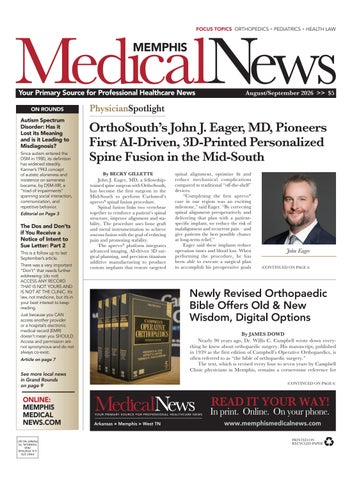
OrthoSouth’s John J. Eager, MD, Pioneers First AI-Driven, 3D-Printed Personalized Spine Fusion in the Mid-South By BECKY GILLETTE John J. Eager, MD, a fellowshiptrained spine surgeon with OrthoSouth, has become the first surgeon in the Mid-South to perform Carlsmed’s aprevo® spinal fusion procedure. Spinal fusion links two vertebrae together to reinforce a patient’s spinal structure, improve alignment and stability. The procedure uses bone graft and metal instrumentation to achieve osseous fusion with the goal of reducing pain and promoting stability. The aprevo® platform integrates advanced imaging, AI-driven 3D surgical planning, and precision titanium additive manufacturing to produce custom implants that restore targeted
John Eager (CONTINUED ON PAGE 4)
Newly Revised Orthopaedic Bible Offers Old & New Wisdom, Digital Options
Just because you CAN access another provider or a hospital’s electronic medical record (EMR) doesn’t mean you SHOULD. Access and permission are not synonymous and do not always co-exist.
By JAMES DOWD Nearly 90 years ago, Dr. Willis C. Campbell wrote down everything he knew about orthopaedic surgery. His manuscript, published in 1939 as the first edition of Campbell’s Operative Orthopaedics, is often referred to as “the bible of orthopaedic surgery.” The text, which is revised every four to seven years by Campbell Clinic physicians in Memphis, remains a cornerstone reference for
Article on page 7
See more local news in Grand Rounds on page 9
ONLINE: MEMPHIS MEDICAL NEWS.COM
spinal alignment, optimize fit and reduce mechanical complications compared to traditional “off-the-shelf” devices. “Completing the first aprevo® case in our region was an exciting milestone,” said Eager. “By correcting spinal alignment preoperatively and delivering that plan with a patientspecific implant, we reduce the risk of malalignment and recurrent pain – and give patients the best possible chance at long-term relief.” Eager said these implants reduce operation times and blood loss. When performing the procedure, he has been able to execute a surgical plan to accomplish his preoperative goals
(CONTINUED ON PAGE 6)
READ IT YOUR WAY!
In print. Online. On your phone. Arkansas > Memphis > West TN
www.memphismedicalnews.com PRINTED ON RECYCLED PAPER
PRST STD U.S. POSTAGE PAID FRANKLIN, TN PERMIT NO.357
Help your patients move beyond joint pain. 51
MILLINGTON
ARLINGTON
14
40
S GERM ANTOW N RD
When you refer patients to Campbell Clinic for a hip or knee replacement, you can count on our team of orthopaedic experts to provide the best possible care.
SAM COOPER BLVD
• Specialists with decades of joint replacement experience
MIDTOWN
POP LAR AVE
EAST MEMPHIS (MENDENHALL & POPLAR)
• Multiple convenient locations across the Mid-South
WOLF RIVER
240
• Same-day outpatient procedures for faster recovery at home • Simple referral process and 24/7 appointment scheduling
GERMANTOWN
COLLIERVILLE 385
SOUTHAVEN
OLIVE BRANCH
7
278
Start your referral at CampbellClinicReferral.com Midtown | East Memphis | Germantown | Wolf River Oxford | Arlington | Collierville | Southaven Olive Branch | Millington
CAMP-1018 Memphis Medical News Print Ad_v1.indd 1
2 > AUGUST/SEPTEMBER 2026
8/20/26 8:09 AM
memphismedicalnews.com
Pediatrics
Has Autism Spectrum Disorder Lost its Meaning Leading to Misdiagnosis? Has the definition of autism widened so broadly that overdiagnoses and misdiagnoses have harmed individuals? Professor Dame Uta Frith, one of the world’s foremost developmental psychologists has written an editorial addressing the issue. Her pioneering work at UCL in the 1960s and 70s helped establish the cognitive foundation of autism research, including co-developing the landmark Theory of Mind deficit and Weak Central Coherence theories of autistic cognition.
Autism Spectrum Disorder: Has it Lost its Meaning and is it Leading to Misdiagnosis? By UTA FRITH (Condensed)
The Autism Spectrum May Be Splitting in Two Since autism entered the DSM in 1980, its definition has widened steadily. Kanner’s 1943 concept of autistic aloneness and insistence on sameness became, by DSM-IIIR, a “triad of impairments” spanning social interaction, communication, and repetitive behavior. DSM-IV added Asperger disorder for individuals with intact language and intelligence-a major expansion. DSM-V folded everything into a single category, autism spectrum disorder (ASD), collapsing the triad into a dyad and allowing diagnosis at any age or intelligence level, with symptoms countable “by historical report” even if not currently present. Each revision lowered the threshold further. Is autism a genuine biological entity? It’s widely accepted as a neurodevelopmental condition with strong genetic roots-twin studies confirm high heritabilitybut there are still no objective biomarkers, and whether it’s a single unifying construct remains unsettled. Lorna Wing’s spectrum metaphor, borrowed from the color spectrum, was meant to describe a family of related presentations sharing a common core, not memphismedicalnews.com
a simple mild-to-severe gradient. This is not to be confused with the idea of a spectrum where there is no categorical distinction between autism and non-autism. Here, one can be a little bit autistic and definitely autistic. But this is not the same as the clinical autism spectrum, where everyone is definitely autistic, even when this is manifest in different ways.
Prevalence, unevenly ASD prevalence has risen dramatically-from roughly 0.04 percent in a 1966 Middlesex study to about 1.76 percent in recent UK schoolchildren data, with national estimates near 2 percent. But the increase isn’t uniform. It’s concentrated in specific groups: a Swedish population study found individuals with intellectual disability fell from 55.8 percent of ASD cases in 2001 to just 6.7 percent in 2020. A UK primarycare study tracking 65,665 patients from 1998-2018 found the prevalence rise was specifically driven by people diagnosed after childhoodespecially females. A U.S. study confirmed a steady 20-year climb in adolescent- and adult-diagnosed females. Two spectrums, not one Recent genetic research suggests these aren’t just late bloomers catching up. A 2025 study found the early-diagnosed profile carries a high density of polygenic markers for social-communication deficits and repetitive behavior, while the later-diagnosed profile correlates genetically with ADHD, major depression, and PTSD-raising the possibility of diagnostic misclassification rather than delayed recognition. A separate Swedish study of nearly 3 million people found the classic 3:1 male-tofemale ratio holds for diagnoses before age 15, but flattens to near 1:1 after 15-a discontinuity hard to square with simple “catch-up.” Together, these findings support treating early- and late-diagnosed autism as two increasingly distinct populations, no longer sharing
Continual loosening of diagnostic criteria has diluted ASD’s clinical meaning, even as the core features of “classic” autism likely remain detectable within a more tightly defined category.
the core features that originally defined the category.
What’s driving the change Several cultural forces plausibly explain the growth of the late-diagnosed group: Inclusiveness. Wing’s original push to widen an overly narrow, unfair diagnostic net may have tipped into overinclusion. Looping. With no biomarker to anchor the category, autism has escaped clinical control. What autistic people write and post shapes textbooks and diagnostic instruments, which reshapes how people understand and present themselves-a self-reinforcing cycle philosopher Ian Hacking called “looping.” Social contagion. Behaviors modeled online spread through social networks-not fakery, but a natural pull toward group alignment. Medicalizing that spread risks overdiagnosis, though some of the surge may also reflect genuinely unmet mental health needs currently being funneled into the autism category rather than others.
Lived experience. Subjective self-report is valuable but risky as a diagnostic basis alone-it can pathologize normal variation and, by definition, excludes nonverbal and intellectually impaired individuals from the narrative. Search for identity. Online questionnaires and social media have made self-diagnosis common, disproportionately among people with the cognitive capacity for selfreflection-shifting focus away from the most impaired. “Hidden” girls. If the female surge were pure catch-up, we’d expect more early-diagnosed girls too-but that hasn’t happened. The standard explanation is that girls mask more effectively. An unexplored alternative: these cases may belong to a different diagnostic category altogether. Masking. DSM-V’s allowance for symptoms “masked by learned strategies” can, taken to its logical end, justify diagnosis even with zero visible symptoms. Masking is distinct from compensation (learning explicit workarounds); (CONTINUED ON PAGE 4)
See Dame Frith’s full editorial at: https://www.cambridge.org/core/journals/ psychological-medicine/article/autism-spectrum-disorderhas-it-lost-its-meaning-and-is-it-leading-to-misdiagnosis/ AF834026D004D42B1963BEA515495AC6 Psychological Medicine Published online by Cambridge University Press: 04 August 2026
AUGUST/SEPTEMBER 2026
> 3
Has Autism Spectrum, continued from page 3
OrthoSouth’s John J. Eager, continued from page 1
it depends entirely on subjective reports of exhaustion-symptoms common to many other conditions. Harm avoidance. Psychologist Nick Haslam’s “concept creep” describes how ordinary struggles like social anxiety get reframed as clinical symptoms, echoing medicine’s broader shift toward never missing a diagnosis at the cost of false positives-which, once given, are hard to undo. Underlying all of this is autism’s transformation into a genuine cultural phenomenon-37 movies, endless online content, and platforms like TikTok generating both information and folklore about the condition.
The aprevo® platform integrates advanced imaging, AI-driven 3D surgical planning, and precision titanium additive manufacturing to produce custom implants that restore targeted spinal alignment, optimize fit and reduce mechanical complications compared to traditional “off-the-shelf” devices.
Social model versus medical model The neurodiversity movement reframed autism as difference rather than disability-a powerful destigmatizing tool that fits the late-diagnosed group far better than the early-diagnosed one. But it carries a tension: advocates argue autism isn’t a disorder while relying on a disorder-based diagnosis to claim accommodations, suggesting the movement functions as much as identity politics as clinical science. Conversely, adults who receive an ASD diagnosis often report profound relief-the label itself can feel therapeutic. Psychological research on “essentialism” may explain why: people (even young children) respond to categorical labels as revealing a true, generalizable cause of behavior, more satisfying than a vague personality description. This may be why
self-diagnosis rarely satisfies-people want the perceived authority of a medical label.
Could comorbidities save the unified spectrum? Comorbidities are common in ASD-one Swedish study found over half of cases had four or more; a Simons Foundation database study found 74 percent had at least one. But comorbidities aren’t evenly distributed: intellectual disability and language delay cluster in early-diagnosed cases, while anxiety and mood disorders cluster in late-diagnosed ones, especially females. Rather than unifying the spectrum, this pattern seems to reinforce the split. Toward precision Continual loosening of diagnostic criteria has diluted ASD’s clinical meaning, even as the core features of “classic” autism likely remain detectable within a more tightly defined category. The path forward requires greater diagnostic precision-more weight on objective observation, more scrutiny of contraindications-and a fresh effort to identify the actual causes of distress in late-diagnosed individuals, who likely need different supports (anxiety treatment, burnout prevention, resiliencebuilding) than early-diagnosed individuals need. Splitting the spectrum, rather than stretching it further, may be the only way to prevent misdiagnosis, direct people toward the right support, and stop the field from neglecting those with the most severe impairments.
utilizing more minimally invasive techniques. This technology allows him to avoid performing larger dissections and multiple spinal osteotomies which are typically needed in adult spinal deformity correction surgery. Eager said the procedure has proven clinical impact with data from more than over 500 patients across multiple centers showing aprevo® has delivered the targeted alignment with 82 percent of personalized implants achieving alignment within 5 degrees of surgical goals. Enhanced Graft Contact provides 94 percent average implant-to-endplate contact at one year. About 96 percent of personalized implants have zero subsidence at one year. There is also less than a two percent rate of revision for mechanical complications in
adult spinal deformity cases. Eager said there are five steps in the personalized process: • CT Imaging to create a detailed 3D spine model. • AI-Based surgical planning for alignment restoration and optimal fit. • Surgeon review and approval of the personalized implant design. • 3D printing in titanium to exact specifications. • Hospital delivery for use in the planned fusion procedure. Eager is often asked how spinal fusion performs compared to disc replacement which involves the removal of the degenerative disc and implantation of an artificial disc. In Continued on next page >
G. Coble Caperton Licensed Tennessee Attorney
46 years of experience
Practicing in the following areas: • Business and Commercial Law • Family Law • Personal Injury • Contracts Rule 31 General Civil/Family Mediator
901.526.6701 4 > AUGUST/SEPTEMBER 2026
memphismedicalnews.com
both cases, the surgeon is performing a decompression of the spinal cord and/or nerves while seeking to maintain or improve spinal alignment. Artificial disc replacement can provide critical pain relief while preserving the natural motion of the spine. The procedure has been around for a long time with major improvements in recent years. “It has evolved significantly over the decades, primarily with advances in materials and engineering,” said Eager. “This allows for better bone integration, improved wear characteristics and expanding indications to multi-level procedures. Implants have improved to provide a more secure attachment to the vertebral bodies with advanced coating surfaces such as porous-coated titanium and hydroxyapatite which encourage osseous integration. “Articulating components have transitioned from early metal-onmetal or rubber components to more highly durable, highly crossedlinked, ultra-high molecular weight polyethylene and ceramic cores. This newer generation of implants allows for precision sizing and provides a better anatomical fit. Companies have introduced bearing footprints with lower profiles and plates to more closely match the patient’s anatomy and restore disc height.” With disc replacement surgery, the recovery time for patients to return to activities is generally quicker than with fusion surgery. After disc replacement surgery, patients can expect to spend at least one night in the hospital. However, in select patients, these surgeries may be performed as an outpatient procedure. Patients resume normal activities of daily living immediately after surgery. However, rigorous activity is usually restricted for up to six weeks. Candidates for either spinal fusion or disc replacement are first treated with a conservative approach utilizing non-surgical care. Only after these methods have failed to relieve a patient’s symptoms do they consider proceeding with surgery. “It is possible to treat disc pathology conservatively with physical therapy, targeted injections and observation,” Eager said. “Good candidates for disc replacement are patients with degenerative or herniated discs who have preserved spinal motion and minimal arthritis. Disc replacement is designed to preserve the motion of the spine. The outcomes are just as good as with fusion surgery but with the added benefit of motion preservation. If a patient has minimal spinal motion or diffuse arthritis, they may be better served with a fusion surgery. Additionally, if patients exhibit any evidence of memphismedicalnews.com
spinal instability, they would be indicated for spinal fusion as opposed to disc replacement.” Some common misconceptions about disc replacement surgery are that it is new and experimental, which is far from the case. This surgery has been proven to have long lasting, significant therapeutic results. “There are inherent risks with any surgery,” he said. “Risks with artificial disc replacement include issues such as subsidence and the implant components wearing out over time. An artificial disc replacement is designed to last a patient’s lifetime. Clinical data has shown implant survival rates surpassing multiple decades. Some patients have kept their original implants 20 to 30 years. Wear-and-tear biomechanical testing suggests the implants can last 40-plus years.” Eager personally has not seen an implant fail requiring another surgery, but catastrophic failure could require revision surgery necessitating the removal of implants and transition to fusion surgery. “It goes back to the implant design which can withstand everyday mechanical stressors,” Eager said. “In addition to disc replacement preserving motion and reducing pain, it reduces the stress at adjacent levels. This important aspect of disc replacement surgery seeks to mitigate the risk of wear and tear above and below the surgery site to reduce the chances of adjacent segment disease.” It is also a faulty notion that this procedure is primarily for younger people. Eager said age can play a role in determining candidacy if the bone quality is adversely affected, and if there are multi-level arthritic joints and loss of motion. Disc replacement is most commonly performed in the cervical spine, which requires a smaller implant, and in the lumbar spine, which requires larger implants for a better anatomical fit. Eager specializes in the diagnosis and treatment of neck and back pain, as well as musculoskeletal oncology. In addition to spinal fusion and disc replacement, his areas of expertise include degenerative spine conditions, minimally invasive spine surgery, spinal deformity, spine trauma, spinal tumors and revision spine surgery. He is dual-fellowship trained in complex spine surgery and musculoskeletal oncology. Prior to going to medical school, Eager had a career in aviation as a licensed commercial pilot and flight instructor. He still flies when time permits, but keeps very busy with his medical practice and family.
Dr. Richard Moran COLLIERVILLE
Dr. Grant Newman COLLIERVILLE
Dr. Lauren Mitchell COLLIERVILLE
Dr. Daniel Chatham ARLINGTON
Dr. Melanie Smith ARLINGTON
Dr. Jessica Wilson COLLIERVILLE
Dr. Brennan Lum ARLINGTON
Contact us to schedule your child’s appointment today.
Dr. Keith Owen BARTLETT
(901) 757-3535 Dr. Jennifer Lum ARLINGTON
pedseast.com
Dr. Marie Thompson BARTLETT
Dr. Samantha Ouyang GERMANTOWN
Dr. David Yanishevski GERMANTOWN
Dr. Elisa Benaim BARTLETT
Dr. Shazia Hussain GERMANTOWN
Dr. Robert Higginbotham GERMANTOWN
Dr. Andrew Irwin GERMANTOWN
AUGUST/SEPTEMBER 2026
> 5
Newly Revised Orthopaedic Bible, continued from page 1 Feedback flows constantly from a global network the editors call the “Campbell Club,” with more than 100 surgeons who weigh in on what should change in the electronic version between editions and what should be addressed in the next full edition. But for Azar, Sawyer and Throckmorton, the scale of the undertaking comes back to a single audience. “It’s not about us individually, it’s about what we all do together,” Azar said. “The end user is the patient, and we’re committed to them.”
Beyond Campbell’s Concepts, the 15th edition reflects how orthopaedic surgery itself has evolved. In addition to the three primary editors, the book now relies on designated section editors overseeing individual subspecialty areas, a structural change that Azar believes has sharpened the quality of the content.
Frederick Azar PUBLISHER
orthopaedic surgeons and residents around the globe. The newest edition, released in March 2026, covers a wide range of orthopaedic subspecialties. Translated into multiple languages, the text is read on every continent. “We’re fiduciaries of the work that Dr. Campbell began nearly a century ago,” said Frederick Azar, MD, one of three physicians who edited the new edition alongside Drs. Jeffrey Sawyer and Thomas Throckmorton. “Our text is prepared by our physicians and references not only what we do here, but also work being done around the world.” That distinction matters to Azar. Unlike some multi-author surgical references, the text is written entirely by Campbell Clinic surgeons, with a significant number of the clinic’s physicians contributing to the 15th edition. Each chapter follows a standardized template, with updated techniques, illustrations and bulleted text designed for quick clinical reference. A popular component of the 15th edition is Campbell’s Concepts, a new feature distilling the essential knowledge the clinic’s surgeons have developed to optimize patient outcomes. “We wanted to cover the latest things we’ve learned in the last five years,” Azar said. “Readers can go right to specific procedures and what we’re doing in Memphis, what’s time-tested and what’s novel.” 6 > AUGUST/SEPTEMBER 2026
The new edition also leans further into digital delivery than any before it. Every purchase includes an eBook version giving readers full access to the text and references, along with the ability to search, customize content, take notes and highlights, and have material read aloud. New high-quality videos and treatment algorithms round out the expanded digital package. “Most people are not looking for four print volumes, though that’s still part of the offering when you get it,” Azar said. “The team worked closely with the publisher to curate more video content and make the digital version nimbler, so residents and practicing surgeons alike can access what they need faster.” Beyond Campbell’s Concepts, the 15th edition reflects how orthopaedic surgery itself has evolved. In addition to the three primary editors, the book now relies on designated section editors overseeing individual subspecialty areas, a structural change that Azar believes has sharpened the quality of the content. “Subspecialties is where ortho and residents are going,” Azar said. “This helps meet that need.” Azar also points to sweeping changes in clinical practice since earlier editions, from the shift toward same-day outpatient joint replacement to an expanded focus on optimizing patients before surgery. A great deal has changed, including the inpatient setting, from
when Azar joined the Campbell Clinic more than three decades ago. The facility’s physicians pioneered outpatient hip replacements, he noted, and the new edition reflects current thinking on identifying which patients are best suited for it. There is also guidance on addressing comorbidities such as smoking and obesity ahead of elective procedures to improve outcomes. Other areas that have changed dramatically since the last edition are Orthobiologics, including stem cell therapies, along with robotics in orthopaedic care. “Orthopaedics has always been fast to adopt technology,” Azar said. “But rather than including a technique simply because a physician somewhere has tried it, our edi torial team vetted new procedures against the level of evidence behind them. Before we publish it, we fully research the information.” Between editions, the Campbell Clinic Foundation, which provides research, editorial and administrative support for the publication, also produces Campbell Core, a companion resource that distills information from the text’s authors on the 100 highest-volume orthopaedic procedures. “Because of technology, the world is smaller now and we can get information in real time and make changes,” Azar said. “The process has become markedly more efficient since electronic publishing and improved connectivity has reshaped how the team works.
Pamela Z. Haskins pamela@memphismedicalnews.com EDITOR P L Jeter editor@memphismedicalnews.com PHOTOGRAPHER Greg Campbell ADVERTISING INFORMATION 501.247.9189 Pamela Z. Haskins GRAPHIC DESIGNER Sarah Reimer sarah@memphismedicalnews.com CONTRIBUTING WRITERS James Dowd Becky Gillette Jennifer Harrison All editorial submissions and press releases should be sent to editor@memphismedicalnews.com All press releases sent to Memphis Medical News for Grand Rounds placement are the responsibility of the sender for accuracy. Subscription requests can be mailed to the address below or emailed to pamela@memphismedicalnews.com. Memphis Medical News© is now privately and locally owned by Ziggy Productions, LLC. P O Box 164831 Little Rock, AR 72216-4831 President: Pamela Z. Haskins Reproduction in whole or in part without written permission is prohibited. Memphis Medical News will assume no responsibility for unsolicited materials. All letters sent to Memphis Medical News will be considered the newspaper’s property and unconditionally assigned to Memphis Medical News for publication and copyright purposes.
memphismedicalnews.com
memphismedicalnews.com
The Dos and Don’ts if You Receive a Notice of Intent to Sue Letter: Part 2 By JENNIFER HARRISON This is a follow up to last September’s article (https://memphismedicalnews.com/article/1553/ the-dos-donts-if-you-receive-a-noticeof-intent-to-sue-letterhyperlink) included below to Part 1). There was a very important “Don’t” that needs further addressing: (do not) ACCESS ANY RECORD THAT IS NOT YOURS AND IS NOT AT THE CLINIC. It’s law, not medicine, but it’s in your best interest to keep reading. Just because you CAN access another provider or a hospital’s electronic medical record (EMR) doesn’t mean you SHOULD. Access and permission are not synonymous and do not always co-exist. Examples of when they do co-exist: 1. A provider is treating a hospital patient and has login access to the EMR. Of course, the provider has permission to access the patient’s hospital EMR for purposes of care and treatment.
2. A provider needs to access the hospital’s EMR to electronically sign behind another provider and/or document an Addendum. 3. Oftentimes, after care and treatment, a provider may need to access the EMR to review and sign a Death Certificate. In these examples, access and permission accompany each other. An example/scenario of when they would not co-exist (again, for an individual physician in the context of a hospital patient): Provider’s care and treatment are over. Provider receives a Notice of Intent to Sue (NOI) letter and a medical authorization. Other providers and/or a hospital are identified in the NOI letter. Upon receipt of the NOI letter and thinking you may be sued for an act or omission that caused injury to a patient, one of your first burning desires may be to access the patient’s hospital EMR. Please don’t. You may still have access to the hospital EMR, but this does not mean you still have permission.
There are some options in this scenario and neither includes you accessing the EMR: 1. Your attorney uses the medical authorization to request records directly from the hospital. If the receiving hospital determines the core elements of HIPAA are met (HIPAA-compliant), the hospital (or third-party vendor used by the hospital) should produce records. If your attorney obtains medical records that are necessary to investigate and evaluate the claim(s), the investigative function of the Tennessee Healthcare Liability (THCLA) is satisfied. 2. If the receiving hospital determines that the medical authorization is not HIPAA-compliant, the request will be rejected in writing. Consequently, no records are produced or obtained, no investigation or evaluation is completed, and Defendant/provider is prejudiced.1 Put a pin at “prejudiced”. The investigative function of the statute is frustrated, and Plaintiff’s
lawsuit is subject to dismissal. 3. The medical authorization is glaringly deficient/not HIPAAcompliant. Tennessee law does not require your attorney to test the validity of the authorization by requesting records and getting rejected. If the authorization is not HIPAA-compliant, Defendant/ provider is prejudiced, the investigation function of the statute is frustrated, and Plaintiff’s lawsuit is subject to dismissal. So, why does this matter TO THE PROVIDER? In scenario #1, whether you accessed the EMR may not become an issue. However, it will still be known. At a minimum, the hospital will know because it most likely has an audit trail showing every time you accessed the EMR, date and time you accessed it, the part of the record accessed, how long you were in the record, and (sometimes) what computer was used to access it. In scenarios #2 and #3, your attorney will likely (and quickly) argue that Plaintiff did not substantially continued on next page >
memphismedicalnews.com
AUGUST/SEPTEMBER 2026
> 7
comply with the THCLA, you were not given the requisite permission to request and obtain the hospital’s complete records, you were prejudiced, and the investigation function of the statute is frustrated. Pin: “Prejudice is relevant to the determination of whether a plaintiff substantially complied with Section 121, but it is not a separate and independent analytical element.” Martin v. Rolling Hills Hospital, LLC, 600 S.W.3d, 322, 325 (Tenn. 2020). If your burning desire got the best of you and you accessed the hospital’s EMR upon receipt of the NOI letter, your “prejudice” argument may have either lost some steam or disappeared altogether. Your opponent’s argument may be: Defendant reviewed the EMR so no harm, no foul. Turn the NOI letter over and let your attorney try to get the records. Finally, your login/password is yours only, and accessing a patient’s EMR outside of care and treatment may violate HIPAA protections, be addressed in hospital Bylaws, policies and procedures, and/or an employment agreement. If you access a patient’s EMR outside of care and treatment, you are subject to inquiry as to why you accessed the patient’s EMR.
Key takeaways: • Read the original article from September 1, 2025.
financial, or professional advice. While every effort has been made to ensure the accuracy and reliability of the content, the author and publisher make no representations or warranties of any kind, express or implied, about the completeness, accuracy, or suitability of the information contained herein. Any reliance you place on such information is strictly at your own risk. The views expressed are those of the author and do not necessarily reflect the official policy or position of any affiliated organization. Always consult with a qualified professional before making decisions based on this content.
Jennifer Harrison is the Managing Shareholder in the Memphis law office of Hall Booth Smith, PC. She is a former CVICU nurse and occupational health nurse. She has a Master of Law in Trial Advocacy and is licensed to practice law in Tennessee, Arkansas and Mississippi. She is also a Certified Civil Mediator in Tenn. and Miss. She has been recognized as one of The Best Lawyers in America, Peer Reviewed by Martindale-Hubbell, and as a Tennessee Super Lawyer. Earlier this year, she was recognized and highlighted in the Memphis Business Journal as “Women Who Lead.” After more than 20 years protecting healthcare providers’ interests, she still enjoys integrating medicine and law and utilizing her combined experiences to be a staunch and zealous advocate for her clients.
Alzheimer’s Disease Research Study Are you or someone you know showing signs of Alzheimer’s Disease? You may be able to participate in the M25-804 Research Study if you are:
• Whether the statutory medical authorization is HIPAA-compliant or not is irrelevant in terms of accessing another provider or hospital’s EMR.
• Between the ages of 50 and 90 • Known to have increased risk of, showing signs of, or diagnosed with Alzheimer’s Disease
• Access and permission are not synonymous. • If you are denied the opportunity to request and obtain complete records and then sued, your attorney may be successful in seeking dismissal of the case against you. • If you get an NOI letter then access the EMR, you may blow your dismissal argument. • Outside the context of a lawsuit, you are subject to provider or hospital inquiry if you access a patient’s EMR for a reason other than care and treatment. • Just because you can access the EMR doesn’t mean you should.
The information provided in this article is for general informational purposes only and does not constitute legal, 8 > AUGUST/SEPTEMBER 2026
If you qualify and choose to participate, you will receive all study-related visits, tests, and study drugs at no cost. You may be reimbursed for travel expenses. If you are interested in participating, the study doctor or staff will review additional study criteria with you.
For more information, please contact: Clinical Research Center, Neurology Clinic, P.C.
email: research@neuroclinic.org or call: 901-300-2755 M25-804 Patient Recruitment Poster | V1.0 | 11Mar26 | ABBV-US-0593-RM
memphismedicalnews.com
GrandRounds Charles W.M. Roberts, MD, PhD, Named President/ CEO of St. Jude Children’s Research Hospital The Board of Governors of St. Jude Children’s Research Hospital has announced Charles W.M. Roberts, MD, PhD, executive vice president and current director of the St. Jude Comprehensive Cancer Center, as its next Charles W.M. Roberts president and chief executive officer. As the organization’s seventh president and CEO, Roberts will be tasked with overseeing a global organization devoted to advancing cures and means of prevention for pediatric catastrophic diseases around the world.
OrthoSouth Expands Eastward with New Collierville Clinic The new clinic, located at 511 Market Blvd, Suite 103, will open its doors on September 14, 2026, marking OrthoSouth’s 10th clinic location as it continues expanding access to its service-centric brand of world-class orthopedic care across the greater Memphis area. The Collierville clinic will be anchored by the group’s newest surgeon, Dr. Wells Prather, MD, joined by a rotating group of orthopedic and spine subspecialists, including: • J. Ross Bailey, MD – Total Joint • Patrick M. Curlee, MD – Orthopedic Spine • Thomas V. Giel, MD – Sports Medicine • Peter R. Henning, MD – Hand, Wrist & Elbow • William Trey Hester III, MD – Foot & Ankle • Seung-Jae “Tex” Song, DPM – Podiatry • Jason A. Weaver, MD, FAANS – Neurosurgical Spine In line with the group’s philosophy regarding convenient access to world-class orthopedic care, the Collierville team will offer walk-in visits, same-day appointments, and on-site physical therapy, giving area residents an expedient connection to comprehensive musculoskeletal services, close to home and right in the heart of town.
Your patients shouldn’t have to wait any longer. Regional One Health Reveals First Look at New Campus Regional One Health unveiled the first renderings of its planned new campus, offering the community its first look at the future of healthcare in Memphis and the Mid-South. The renderings showcase a striking 600,000+-square-foot building inspired by Memphis itself, featuring a distinctive facade that reflects the rhythm, movement and resilience of the city. Designed to create a welcoming experience for patients and families while improving energy efficiency and comfort, the campus will serve as a landmark connecting Downtown Memphis and the Medical District. The facility is designed to support Regional One Health’s mission for decades to come while creating a more modern environment for care, education and innovation. The facility will house Regional One Health’s nationally recognized trauma and burn services, Women’s and Infants Center, expanded emergency department and observation unit, rehabilitation hospital, oncology services and comprehensive imaging capabilities. The future campus will be located on the historic Commercial Appeal property along Union Avenue, creating a new gateway between Downtown Memphis and the Medical District. The project transforms a site that helped tell Memphis’s story for generations into a place dedicated to caring for the community’s future. The facility will include more than 315 beds, modern clinical spaces and infrastructure designed to support high-quality patient care, workforce development, education, research and future innovation. The need for a new campus is driven by sustained growth in demand for Regional One Health’s services. Momentum is already underway, with demolition activities in progress and planning efforts advancing toward construction. Beyond healthcare, the project is expected to support nearly
Living with hip or knee pain changes everything. Getting relief shouldn’t mean waiting months for a consult. OrthoSouth’s growing team of joint replacement specialists helps patients move more quickly from consultation to treatment.
orthosou th. o rg | 901.937.3242 SCAN TO LEARN MORE
ORTHOPEDICS & SPINE
2026
OrthoSouth Germantown ASC has been named a Best Ambulatory Surgery Center by both Newsweek and U.S. News & World Report.
continued on next page > memphismedicalnews.com
AUGUST/SEPTEMBER 2026
> 9
GrandRounds 10,000 jobs, generate more than $117 million in additional tax revenue and contribute an estimated $4.8 billion in economic impact across the region. Pending final approvals and development milestones, groundbreaking is anticipated in summer 2027, with the new campus projected to be complete in 2030. Additional project updates and opportunities for community engagement will be shared as planning and development continue.
Saint Francis Expands Robotic Surgical Capabilities with Acquisition of ROSA Robot Saint Francis Healthcare advances its surgical technology with the acquisition of the ROSA® Robotics Knee System, manufactured by Zimmer Biomet. This latest addition to the hospital’s robot fleet further solidifies its commitment to providing patients with minimally invasive surgical options. The ROSA® Robotics Knee System is a medical device designed to enhance the precision and efficiency
10 > AUGUST/SEPTEMBER 2026
for knee replacement. It combines advanced robotics and artificial intelligence to assist surgeons accurately during surgeries. With its capabilities, the ROSA® Robotics Knee System has the ability to improve patient outcomes, reduce recovery times, and minimize the risk of complications. It also does not require CT scans potentially reducing unnecessary radiation exposure. The first surgery was performed by Dr. Ross Bailey who said, “The ROSA® Robotic Knee System is a game-changer in the world of robotic-assisted surgery. Its versatility and precision make it an invaluable tool for our surgeons, allowing us to provide the best possible care to our patients. We are thrilled to integrate this technology into our surgical practice.”
College of Nursing Launches Online RN to BSN Degree Program The University of Tennessee Health Sciences College of Nursing has opened an RN to BSN program for registered nurses (RN) to earn
their Bachelor of Science in Nursing (BSN) degree completely online in just 12 months. Applications are open, and the deadline is Nov. 1. Classes begin in January 2027. One unique facet of the program at UT Health Sciences is that BSN graduates can bridge directly to college’s Doctor of Nursing Practice (DNP) program. A nursing career often starts with a diploma or associate degree, but it doesn’t have to end there. RNs who earn the BSN can take their careers anywhere. A BSN degree or higher is required for administrative nursing positions or nursing roles in research, consulting and teaching, according to the U.S. Bureau of Labor Statistics. The RN to BSN is a bridge to a broader career for RNs who have entered the nursing profession by earning a diploma or an associate’s degree in nursing. Data from the American Association of Colleges of Nursing 2025 Survey shows the number of students in RN to BSN degree-completion programs increased last year
following five consecutive years of decline.
Regional One Health Closes Extended Care Hospital Regional One Health has made the difficult decision to close the Regional One Extended Care Hospital (LTAC), an independent 30-bed longterm acute care hospital that cares for patients with complex medical conditions. The closure will take place in September 2026. “We are committed to a thoughtful and respectful transition process. All patients will complete their plan of care prior to the closure. We are offering support for affected staff, including actively identifying other open positions within Regional One Health. Since opening in 2014, the Regional One Extended Care Hospital
memphismedicalnews.com
GrandRounds (LTAC) has delivered high-quality, compassionate care to patients. We are proud of the dedication and expertise of the team. The decision reflects challenges in the current healthcare environment and is aimed at optimizing resources and enhancing patient care across the hospital system. Regional One Health continues moving forward on schedule with plans to build a new, modern hospital to support the longterm health of our community and promote medical innovation,” said a spokesperson for Regional One Health.
Options Coming for Adult Early-stage Memory Loss The Avaline at River Oaks, a Claiborne Senior Living community, will open Tempus Engage in September 2026, a new level of memory support for residents in the early stages of memory change. It brings memory support to residents sooner, offering extra assistance while they keep much of their independence. Tempus Engage is intended for those who need some additional support day to day but do not yet require full memory care services. The program comes as the need for memory care continues to grow across the Memphis area, and The Avaline at River Oaks aims to remain a resource for local families. Tempus Engage offers residents a familiar routine, a supportive community, and gentle assistance that respects their daily choices and routines. Tempus Engage is part of Tempus, Claiborne Senior Living’s signature memory care program. With Tempus Engage, The Avaline at River Oaks will offer two levels of Tempus care, allowing support to adapt as residents’ needs evolve. Both levels share the same philosophy, standards, and care team. Residents who eventually need additional support can transition from Tempus Engage to full Tempus memory care without leaving familiar people and routines. This continuity eases the transition for residents and their loved ones. Tempus Engage is built on four pillars: Belonging and Connection, Embracing Their Potential, Family Partnership, and Specialized Team Training. Together, these keep memphismedicalnews.com
residents active and connected, build on each person’s strengths, and equip families and staff to support them well. Families who would like to learn more can call (901) 286-2648 or visit theavaline.com/river-oaks to schedule a visit.
Baptist Memorial Announces Executive Promotions Baptist Memorial Health Care recently made leadership changes, including the appointments of Paul Cade as vice president/metro market leader and Sam Lynd as administrator and CEO of Baptist Memorial’s flag- Paul Cade ship hospital, Baptist Memorial Hospital-Memphis. Lynd most recently served as CEO of NEA Baptist, which included the hospital and clinics, in Jonesboro, Arkansas. He joined Baptist Memorial in 2011 as a Frank Groner Administrative Fellow and earned an MBA and Master of Health Administration from the University of Alabama at Birmingham. During the last 15 years, Lynd has held progressive Sam Lynd leadership roles, including CEO of Baptist Memorial Hospital-Tipton in Covington, Tennessee; system service line administrator for emergency services; and chief operating officer of Baptist Memphis. Cade served in a dual role as Baptist Memorial vice president and metro market leader and Baptist Memphis’ administrator and CEO for the past three years. With this promotion, he will now focus full time on his market leader responsibilities. Cade began his career at Baptist Memorial in 1993, serving in several leadership roles at Baptist Memorial Hospital-Golden Triangle in Columbus, Mississippi, before becoming the administrator and CEO of Baptist Memorial HospitalForrest City. Cade returned to Baptist Golden Triangle as associate administrator in 2004 and served as administrator and CEO from 2008 to 2023 before moving to the Memphis metro market.
Breaking Down the Real Costs of Purchasing a Home You’re finally ready to move up from your rental unit to your own home. Before you start searching for a home, understand how much money you’ll really need. Be prepared for the myriad expenses that you must add to the purchase price to see the whole picture. Home ownership has several advantages over renting, including lower monthly payments, deductible mortgage interest, and the accumulation of equity. But there is a definite price to pay for these benefits, including the expenses we detail here. The biggest spend is your initial equity. There are two costs that constitute the beginning equity in your home. The first is earnest money, typically $500 to $2,0001 , that ensures your commitment to the deal. You can get a refund if the deal falls through due to no fault of your own. The other initial spend is your down payment, which typically ranges from 3.5 to 20%. You make the down payment at the closing. Your mortgage covers the difference between the purchase price and the initial equity. Fees, fees, fees. It seems like every time you turn around, you’ll encounter another fee. Sellers typically pay the broker’s fee, but if you use a buying agent, expect to pay up to 3%2 of the purchase price. Frequently, mortgage lenders charge an origination fee up to about 1% for the privilege of lending you money. You’ll encounter various other fees, such as those for inspections and surveys. Often, you’ll be asked to pay points, which is prepaid interest on the mortgage loan3. Other fees may be charged by a homeowner’s association, a title company, the recorder of deeds, and others.
Don’t forget the insurance and taxes. You won’t be able to get a Chirag Chauhan, mortgage without first AIF®, CFP® getting homeowner’s insurance, with an average annual premium of approximately $1,200. You may also need flood insurance, based upon your location. Many lenders require you buy private mortgage insurance at an annual cost of 0.5 to 1.0% if your down payment is below 20%. You may also want to buy title insurance to ensure you have clear title to the property. Many folks purchase title-lock insurance to cover losses from mortgage fraud due to identity theft. Figure move-in costs and initial repairs. Unless you do it yourself, it may cost you several thousand dollars to engage a moving service – the cost depends on the distance to the new property and how much stuff is being moved. In addition, you may face immediate repair expenses for problems that the seller has not agreed to fix before closing. Expensive repairs can include a new roof, new HVAC, structural changes, expansions, landscaping, etc. You may also have to pay a fee for a building permit. The worst-case scenario involves necessary, unexpected repairs not identified in the engineer’s inspection report. Buying your first home is an enormous step. That’s why it’s essential to have your finances in order first. A well-rounded financial plan will show you how much home you can afford without shortchanging your retirement and other life events. Contact me today to review your financial plan and ensure you are on solid ground before making an expensive commitment. Together, we can find the financial comfort zone for your home purchase.
LPL Financial Professionals do not offer mortgage or lending services. We suggest that you contact a mortgage or lending professional regarding those services. This material is for general information only and is not intended to provide specific advice or recommendations for any individual. This material was prepared by LPL Financial, LLC. Citations: 1 https://www.hud.gov/topics/common_questions 2 https://www.thebalance.com/how-do-buyer-s-agents-get-paid-1798872 [3/26/22] 3 https://www.bankrate.com/mortgages/closing-costs-vs-prepaids/ [6/27/22]
Chirag Chauhan, MBA, AIF®, CFP® is the managing partner of Bluff City Advisory Group in Memphis, Tennessee. For more info, please visit bluffcityadvisory.com.
AUGUST/SEPTEMBER 2026
> 11
12 > AUGUST/SEPTEMBER 2026
memphismedicalnews.com