V VERITAS
VERITAS
December 2025 Volume 6 Issue 1
Mission Statement
In Silicon Valley, and specifically in Palo Alto, we are lucky enough to have the opportunity to grow from some of the most progressive minds in assorted STEM fields, with a thriving community of students who are ready to share their discoveries with the rest of Paly. At the same time, many students might also feel intimidated by, or disinterested in these fields despite its proximity to and importance in our daily lives.
Veritas hopes to bridge the gap by repackaging scientific content to be interesting for all, promoting open-mindness with a flexible approach to scientific education, and embracing new approaches to science and technology without hinderence by tradition.
We believe science and technology are a common thread that impacts everyone’s lives and holds the potential to unify communities just like other forms of entertainment, like music, movies, and sports just to name a few.
Advertising
The staff publishes advertisements with signed contracts providing they are not deemed by the staff inappropiate for the magazine’s audience. For more advertising with Veritas, please contact palyjournalismincubator@gmail.com
Publication Policy
Veritas, a science and technology magazine published by the students in Palo Alto High School’s Incubator Journalism class, is a designated open forum for student expression and discussion of issues concerning its readers. Veritas is distributed to its readers and the student body at no cost.
Printing and Distribution
Veritas is printed two to three times a school year by aPrintis in Pleasonton, California. All Veritas Work is Available at issuu.com/ palyveritas.
For the full list of publication policies, visit palyveritas.com
2 December 2025
Arjun Jindal
William Xue
Business Manager
Richie Zhang
Staff Writers
Julia Curtis Noah Espinoza
Doreen Hou
Arjun Jindal
Veronica Qiu
Priya Tamura
Juni Thurson
William Xue
Xander Yap
Amily Zhang Adviser
Paul Kandell
Letter to the
Editors
The staff welcomes letters to the editors. We reserve the right to edit all submissions for length, grammar, potential libel, invasion of privacy, and obscenity. Send all letters by mail to 50 Embarcadero Road, Palo Alto, CA 94301, or email veritaspaly@gmail.com
@paly.magazine issuu.com/palyveritas palyveritas.com
IN THIS ISSUE
Letter From The Editors
Dear readers,
Welcome to our second edition of 2025! We are excited to return with another issue of Veritas after our summer issue.
As Palo Alto High School’s science and technology magazine, we have decided to focus on how various advancements can influence student’s lives, and projects students around campus are working on.
This April, we present stories about local news (p.6), a new robot cafe (p.14), and a look into how babies can look in the future through gene selection (p.18). We also review the usage of AI for personal therapy (p. 16), Openmind’s plans for its future (p.20, and what Santa Clara’s new Microcenter showcases (p.22).
On campus, we also give an insight to student skincare routines (p.8), what the Environment and Medicine Club is working on (p.10), and projects that engineering students recently showcased.
This edition, like past ones, offers a mere glimpse into all the scientific and technological developments of our world. As these advancements continue to affect our community —situated at the heart of Silicon Valley— in unprecedented ways, we want Veritas to be a guide for you in this ever-changing world.
Enjoy!
— Arjun Jindal and William Xue, Editors-in-Chief
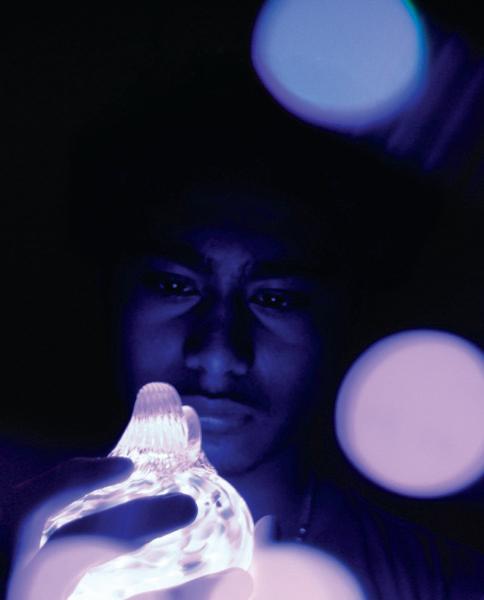
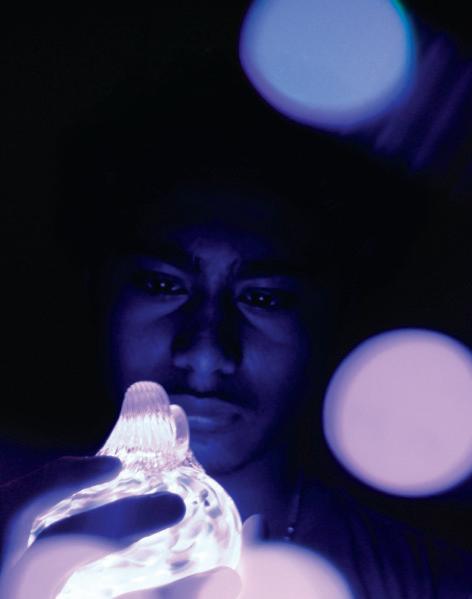
On the Cover
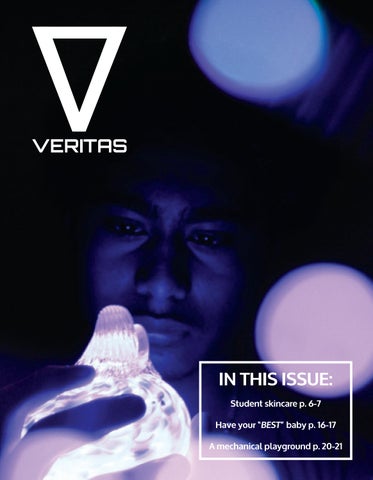
For this issue’s cover, Veritas chose to explore the theme of emergent technology pushing boundaries and growing ever more additive. Expressive of this is muse James Otahiva gazing into an illuminated glass lantern, repressing Eve’s bite into the apple of forbidden innovation.
LOCAL STEM NEWS
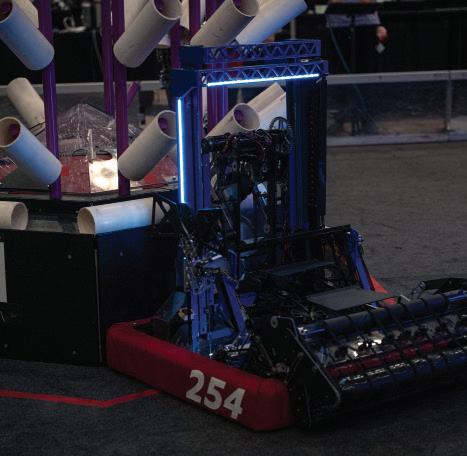
FRC Team 8 compete on international stage
Bubble Theory
In a recent interview with OpenAI investor and podcaster Brad Gerstner, OpenAI CEO Sam Altman became visibly irritated after being pressed about the company’s rising costs and relatively modest revenue figures.
OpenAI, now considered the world’s most valuable private company, is spending heavily on new AI infrastructure as it pushes toward more advanced systems. Microsoft recently reported that OpenAI posted an estimated $11.5 billion loss last quarter, raising concerns about whether the company can sustain its current pace of investment. Despite having roughly 800 million active users on ChatGPT, only about 5% pay for a subscription, leaving the company’s path to profitability unclear.
During the BG2 podcast interview, Gerstner asked how the company could commit to an estimated $1.4 trillion in long-term spending with roughly $13 billion in revenue. Altman abruptly cut him off, saying “Enough,” and offered to help Gerstner sell his shares, adding that many others would “be thrilled to buy.”
The controversy intensified when OpenAI CFO Sarah Friar told
Students from Paly Robotics at Palo Alto High School competed in the international off-season robotics tournament Chezy Champs, held earlier this year at Bellarmine College Preparatory in San Jose. Their alliance secured a fourth-place finish among more than 40 elite teams.
Students participated on two teams: Peninsula Robotics, which welcomes high-school students from across Silicon Valley and competes at the highest levels under the FIRST Robotics Competition framework, and the East Palo Alto Churrobots, whose mission is to provide hands-on STEM opportunities and mentorship for students in underserved communities.
The event at Bellarmine allowed students to test advanced mechanisms, practice real-time strategy and refine alliance-selection decisions in a high-pressure yet educational setting. As the teams look toward the official spring season, the experience is expected to sharpen both their competitive edge and their technical skills. Ultimately, Peninsula Robotics was selected by the fourth alliance and finished the event in fourth place.
LEFT — Finalist and host team, “The Cheesy Poofs” retracts their elevator after placing a gamepeice on a scoring location. (Photo by Divij Motwani).
The Wall Street Journal she hopes the U.S. government will “backstop” financing of the company’s $1.4 trillion data center buildout, saying federal guarantees would “really drop the cost of financing.” The comment sparked immediate backlash, with critics suggesting the company might be seeking a government bailout.
Friar quickly walked back her remarks, clarifying that OpenAI is “not seeking a government backstop” and acknowledging that her word choice “muddied the point.” She said she was referring to a public-private partnership to build American technological infrastructure.
The tense exchanges circulated widely on social media, fueling ongoing debate about whether an AI investment bubble is forming. Altman has previously acknowledged that investors may be “overexcited” about artificial intelligence, warning that some could lose significant amounts of money.
Market reaction was swift, with Microsoft, Nvidia, Oracle and Broadcom — all OpenAI partners — seeing stock declines of 6% to 20% in the days following the controversy.
OpenAI has not publicly disclosed detailed financials. However, recent reports suggest the company is considering a future public listing at a market capitalization of 1 trillion dollars.
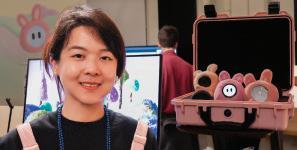
Founders. Inc Demo Day
Forty hardware entrepreneurs demonstrated working prototypes Thursday at Founders Inc.’s Blueprint Festival, concluding a 38day intensive building program at the venture firm’s Fort Mason laboratory.
The Nov. 7 event transformed the organization’s 42,000-square-foot campus into an interactive showcase where attendees tested robots, athletic wearables, miniature humanoid devices and land-traversing drones. The demonstrations featured products that ranged from $1,000 mini humanoids to performance enhancement glasses for athletes.
Founders Inc. selected the 50 participants in early October from hardware builders working to move beyond the blueprint stage. The entrepreneurs utilized the facility’s 3D printers, CNC machines and soldering stations throughout the program, with several founders completely
Heat falls on ICEBlock

pivoting their original concepts during the sprint, according to event organizers.
“We try to minimize the friction between you and building something great,” organizers said in promotional materials for the event.
The model has attracted technical founders in emerging technology sectors, with some participants joining other accelerators like Y Combinator before returning to continue building at the Fort Mason facility.
Thursday’s festival coincided with Fort Mason Night Market, which featured live music, DJs, food trucks and local artisans. The event was free and operated on a first-come, first-served basis.
Founders Inc. focuses on supporting what it describes as prolific builders with strong technical backgrounds and unique perspectives in emerging technology markets.
ABOVE — Founder Natalie Yeo shows off her product to prospetive investors and customers. (Photo by Arjun Jindal).
ICEBlock and similar apps that allow users to anonymously share the locations of immigration agents are still removed from the Apple app store. Although the app can no longer be downloaded, the app itself still works for users who already have it installed.
On Oct. 2, Apple removed ICEBlock and similar apps following pressure from the Trump Administration. Google soon followed suit. According to the Associated Press, Apple said it removed ICEBlock because the app violated company policy “because its purpose is to provide location information about law enforcement officers that can be used to harm such officers individually or as a group.” According to a statement on the ICEBlock website, the app intends to fight the ban. “Capitulating to an authoritarian regime is never the right move,” ICEBlock stated. “This is protected speech under the First Amendment of the United States Constitution.”
Student Skincare
Popular products and the science that makes them work
If you walk down the skincare aisle of any beauty store, there are a plethora of products advertising everything from brightening to anti-aging to plumping. With so many options, how do Palo Alto High School students find products that work?
Sophomore
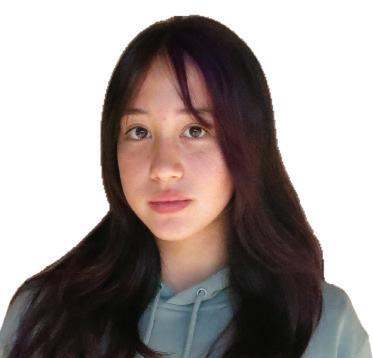
Zoey Meixner found her favorite skincare product while halfway across the world.
“I was in Japan and had seen so many good things online about Senka’s cleansers,” Meixner said. “I got the ‘acne care’ version rather than the original since my skin isn’t the most clear.”
The active ingredient in Senka’s acne care cleanser is salicylic acid, which is commonly used in anti-acne products. According to CeraVe’s website, salicylic acid is a beta-hydroxy acid that helps acne-prone skin by exfoliating when applied topically.
“This chemical exfoliant works by loosening the bonds (or ‘glue’) that holds your skin cells together,” CeraVe states. “This, in turn, helps eliminate dead skin cell buildup that can clog your pores and result in acne.”
SENKA — Sophomore Zoey Meixner started using Japanese brand Senka’s products after seeing it recommended online.
December 2025

Students find recommendations online, from professionals, or through trial and error. A dermatologist shares the science of skincare, explaining how active ingredients work. Understanding the science behind skincare can help find products that fit individual needs.
JuniorJonathan Mazor-Hoofien has used skincare since middle school to combat his acne, building a regimen from drugstore products. His routine consists of a cleanser, tretinoin to combat acne, and a moisturizer.
Stanford dermatologist Amy Adams agrees that expensive brands aren’t necessary for an effective routine.
“Many products are available at basic drugstores, such as from Neutrogena, Laroche Posay and Olay,” Adams says. “There are facial moisturizers with sunscreen, products for acne-prone skin, and products for sensitive skin.”
Mazor-Hoofien also says he notices how when companies market their products to shame acne-prone skin, people begin to equate the clearness of their skin with their self-worth.
“It’s [viewed as] an outward manifestation of the quality of who you are and how clean you are,”

Text by JULIA CURTIS
JuniorZoe Quintana’s favorite products were handpicked by an esthetician. To meet Quintana’s needs, her esthetician –– a licensed specialist who prescribes products –– recommended the brand Face Reality.
According to its website, some of these products aren’t available for purchase online, only through a “certified acne expert” for professional guidance, due to a higher concentration of active ingredients.
“I use a serum, a toner, a moisturizer, an SPF, and a facewash,” Quintana says. “I think it [my acne] has gotten better [since I’ve started using Face Reality products], but it’s not totally gone yet.”
Stanford dermatologist Amy Adams encourages the daily use of SPF to combat medical and physical risks.
For sunscreen, it is important to use one with broad-spectrum ultraviolet protection--both UVB and UVA, which cause DNA damage that can contribute to skin cancer risk,” Adams says. “Sunscreens work to either reflect/ shield (mineral sunscreens such as zinc and titanium oxide) or absorb (chemical sunscreens like avobenzone, octinoxate) UV light.”

FACE REALITY —
Junior Zoe Quintana uses Face Reality products, curated by an esthetician to combat acne.


Mazor-Hoofien said. “We have this crazy obsession with cleanliness.”
Mazor-Hoofien encourages simplicity when making a skincare routine, as this “obsession” is rarely beneficial.
“Just start with a small routine, and don’t have 20 million steps,”
Mazor-Hoofien said. “Don’t think about it so hard. Don’t let it define you so much.”
UP&UP — Junior Jonathan Mazor-Hoofien uses products from Target’s brand up&up to keep his routine affordable.
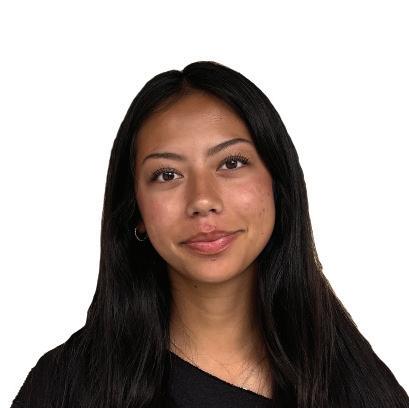


Senior Emmett Stewart sought profes sional help from Elisha Marie, a skin and body shop in Palo Alto. The shop offers services such as facials and massages, and features its own line of skincare products. Stewart uses several products from Elisha Marie’s acne-safe line.
According to Elisha Marie, the line includes salicylic and glycolic acid serums to refine pores, improve skin texture, and exfoliate.

“I use facewash, toner, moisturizer, and pimple patches when needed,” Stewart says. “They [the products] do work. They keep breakouts to a minimum.”
According to Elisha Marie, the products containing chamomile essential oil, antiox idants, and peptides are used to soothe and hydrate sensitive skin, while vivtamin C helps prevent photoaging caused by sun exposure.
ELISHA MARIE — Senior Emmett Stuart uses Elisha Marie products to help with acne.

Planting Seeds of Change
Paly students renovates sustainability education for next generation
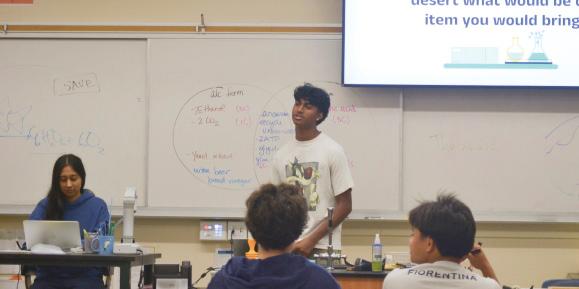
Inside a classroom, the club members of Paly Enviromental and Medicine club are actively reflecting on what they did well or things they can improve on for their recent effort in spreading environmental awareness at local elementary schools. It is only the one of many events that the presidents have planned for this year.
Sophomore Anika Dephande, the co-president of the Paly EnvMed club, said that the initiative to create this club is to bridge the gap with the fallout in climate advocacy within the Palo Alto Unified School District since the COVID-19 pandemic.
“Since COVID, it [education on sustainability] hasn’t really ramped up to the point at which we would want to,” Dephande said. “We thought we be that change and push for the district to implement more changes and increase education in our youth.”
Last year, in an effort to spread awareness to the younger generation, the club hosted a climate workshop at Palo Verde Elementary School with 72 third graders.
“We are able to go through a presen-
tation about our club and what we do, and how eating healthy helps the environment and public health,” Dephande said. “We also did a sprouting activity.”
Outside of the school level, the club also advocates for sustainability at the Palo Alto Unified School District’s office.
According to Dephande, the group has successfully pushed forward the creation of sustainability manager, a position that the district is now in the process of filling.
Dephande and Sidharth Iyer, the president of the Paly EnvMed Club, said that they are continuing the elementary school program this year but making it bigger.
“We are planning on making it [the outreach program] a little bigger,” Iyer said. “[...] we just talked to the Walter Hays principal, and we’re planning on presenting it to the fourth and fifth graders.”
The club also attempts to reach an audience beyond elementary school. Dephande said they are hoping to reach middle schools this year as well.
“I think one of our biggest goals is eventually we want to break into middle school,” Dephande said.
In effiort to reach their high school audience, the club uses its presence on social media.
To ensure their impacts on sustainability and environmental protection last, Iyer and Dephande take a two-way approach.
“We’re only here for four years, [but] the district will have structural changes that will last for a really long time, ”Dephande said.
Beside imposing structural changes in district, they also educates younger generation to continues their effort.
Iyer said they hope the momentum from their visit to elementary schools and middle schools will be able to inspire those students to start or continue the club when they reach high school.
Finally, Dephande said that the club is for anyone who wishes to participate in increasing sustainability within their community, with a bonus of earning volunteer hours.
“They [club members] will be able to participate in a lot of events and be the change”, Dephande said. “They will be able to see a tangible change in Palo Alto and especially in PAUSD.”
MACHINES GONE WILD
Students turn simple physics into creative contraptions
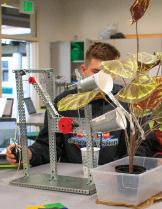
SPLASH – Senior Sean Lehman said he enjoyed learning while thinking of an unconventional way of doing an everyday task. “I’ve never seen a cooler way to water a plant,” Lehman said. “Also, while you’re making a plant watering project like this, you can learn about physics and engineering. Plants need water, so why not come up with a fun way to do it? That’s what makes this better than normally watering the plant.”

Water splashes over the tabletop, and laughter fills the air in room 551 as Principles of Engineering students showcase their compound machines through a demonstration.
Principles of Engineering teacher Katie Widen said this was the first time the students showcased their machines.
“I really like giving them [students] the chance to build stuff and apply what we’ve learned for the last 12 weeks into a project,” Widen said. “This year is the first year we’re doing a big demo day.”
Senior partners Jack Spitzer and Sean Lehman said their machine was designed to water plants by releasing weights through gravity.
“We’re making a machine where dropping a one-kilogram weight waters a plant,” Spitzer said. “We used a pulley, a wheel and axle, a gear system, and a lever.”
The goal of students’ compound machines is to complete a task by connecting different types of motion and simple machines. Working in small groups, students at every table in the room were prepared to present and explain their machines.
Junior partners Meghana Konduri and Elaine Kim said their machine uses different mechanisms to draw lines with a pencil.
“We chose to make our project consist of drawing lines on a piece of paper,” Konduri said. “Essentially, it starts with a pulley, where it transfers motion to a lever, which turns a gear system that finally brings the pencil down.”
Kim said their idea for a drawing machine came to mind after their unsuccessful attempt to erase lines on paper.
“Originally, we were going to do a project where it [the machine] would erase a straight line, but we found that the friction force was too big,” Kim said. “So, we changed our design to draw a straight line instead, which worked out for us.”
Widen said that seeing everyone’s project unfold is a moment she takes pride in.
“I really like today because of them [students] showing their projects off and seeing everyone be really proud of the work they’ve done,” Widen said. “It wasn’t until today that some of the projects really fully worked for the first time, so it’s just been exciting watching the power of perseverance.”
Junior Leonardo Arroyo said it was his first time attending a demonstration workshop like this, and it made him more interested in engineering.
“It’s my first time seeing something like this,” Arroyo said. “I liked seeing the different projects that the kids have come up with. I think what they’ve done is very creative, and it’s also very interesting to see how they’ve done it.”
Widen said that some goals for next year include a larger demonstration day to reach more audiences.
“I want to have a bigger demo day where we can maybe set up in the gym,” Widen said. “I’d like to get more people to see what we’re doing.”
According to Widen, the goal of the demonstration day was to see how her students’ work can inspire others.
“I’m very proud of my students,” Widen said. “They work really hard and really applied what we learned in class. I hope everyone is inspired to take one of my engineering courses because they’re super fun and super hands-on.”
Brewed by Bots
At Yummy Future, custom-built robots take on the role of baristas, reshaping how coffee is made through a fully automated system
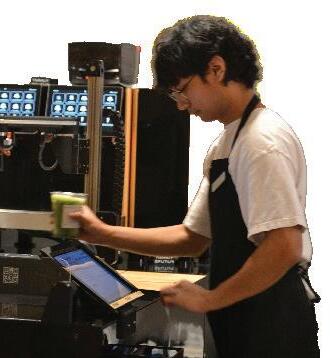
At Yummy Future in downtown Palo Alto, robotic arms shift and twist as they assist the human employees in delivering a perfect cup of latte, from getting ice cubes to transferring the cup across stations.
Yummy Future’s robotic technology optimizes the cafe’s efficiency, quality and food safety by automating repetitive tasks, like scooping syrup and stirring drinks without spilling a drop.
Jack Cui, CEO and co-founder of Yummy Future, said the inspiration for the robot cafe stemmed from greater societal challenges. He believes the company’s approach reflects broader global trends,
“I’m looking at the bigger issues we face together as a society,” Cui said. “Labor shortage and an aging population are one of the main challenges we face as our generation, so we are looking at a declining birth rate. You must keep the same level of productivity with the same amount of population, and we have to come up with a productive improvement, so robotics is definitely one of the solutions to do that.”
According to Cui, Yummy Future settled on Palo Alto because of its central location as a hub of high-tech innovation and home to many leading technology companies. He emphasized that the region’s entrepreneurial environment and ac
said. “We have been attached to Silicon Valley based on fundraising efforts, and we’ve been receiving all the investment.
Cui said Yummy Future is part of Y Combinator, a three-month program that supports startups and small businesses. The program allowed the team to refine their engineering, business model and longterm deployment strategy.
“We’ve been participating in Y Combinator — it is in the center of innovation, so we have all the ecosystems like the VC ecosystem supporting startups like us to grow,” Cui said.
According to Cui, the robot design has changed what it takes to become a barista. He explained that this shift opens the door for beginners, students and newcomers to participate in café work without years of technical practice.
“The amount of skill required to be a professional barista has decreased by 100 times,” Cui said. “For example, a student can come to the shop, press a button and the drink is ready to be made. It [the robot] has a much better memory than normal humans, and it doesn’t make any mistakes, so there’s no training effort.”
Beyond making the job more accessible to more people, the robot has massively increased Yummy Future’s productivity and efficiency because of how straightforward it is to handle the robot.
“Previously, you had to be mechanically well functioning to be a really good barista — you have to be able to do repetitive work over and over again without any mistakes,” Cui said. “Human-wise, it improves product per worker productivity by four times, and our average is one minute per drink, so in terms of productivity gain, that’s a huge productivity gain.”
Despite the potential of this technology, some setbacks come with such a largescale project, ranging from building the robot from scratch to optimizing the cafe’s business strategy.
Text and Photos by VERONICA QIU and AMILY ZHANG
MEASUREMENT
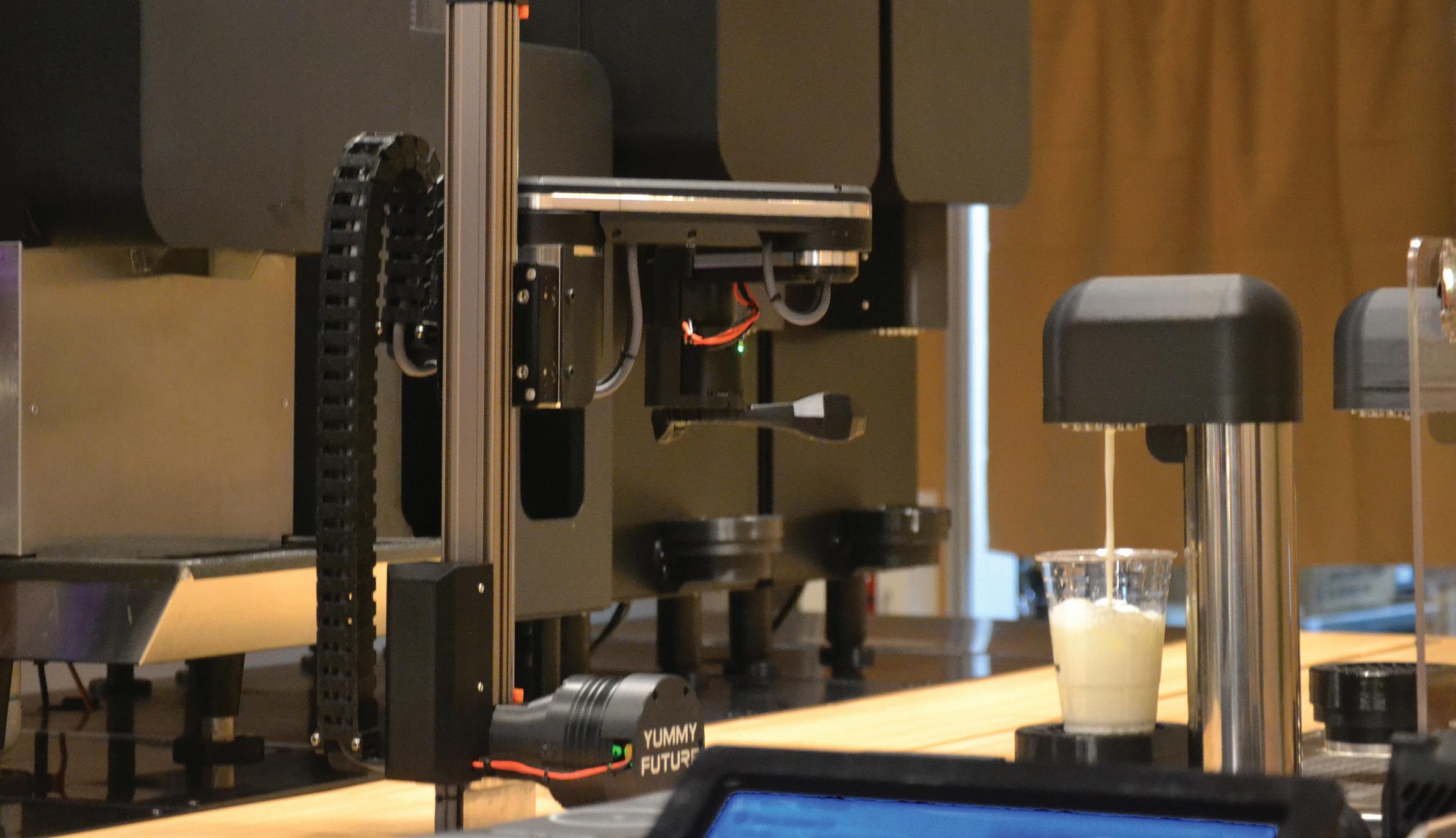
MONITORING (ABOVE) — Yummy Future’s robotic arm waits patiently for milk to fill the cup before transferring the drink to the next station. The robot uses cameras and sensors to verify the drink’s cup, ice, color and fill level with automatic retry if needed. The system is engine ered and tested to bring an accuracy rate of 99.7% for all recipes.
“The biggest challenge is just the grandness of such a big project,” Cui said. “We design the robot, we manufacture it, we program it, we build the operating system for it, we deploy to the shop, we build a shop for it, and then we start to sell to customers. You have to do marketing and fundraising as well, so it entails so many aspects.”
Other than obstacles to creating a startup, the robot itself brings many technical challenges. The team regularly troubleshoots mechanical systems, updates software and refines the automated workflow to prevent small issues from disrupting service.
“What happens is that everything is built from scratch, so you have limited time to test,” Cui said. “The robot keeps failing, so we have designed something like the SpaceX rocket engine system. We call it smart rerouting in the system and it dynamically routes the most efficient locations. We have been facing small mechani-
cal failures, but you have robust redundancy built into the system, allowing you to make mistakes.”
However, Cui is optimistic about robotics becoming more widespread in various industries, beyond the world of coffee. He envisions a future where automated systems support workers across sectors, improving reliability and reducing strain on overstretched labor forces.
startup, the robot itself brings many technical challenges.
“[The robot] has a much better memory than normal humans, and it doesn’t make any mistakes.”
“It’s not just in coffee,” Cui said. “I’m a huge bullish person on robotics usage in our world. Basically, it will be incorporated into the restaurant industry. It’s a special machine—it’s like power, it’s like the electricity for us.” fundraising as well, so it entails so many aspects.”
— Jack Cui, CEO and co-founder of Yummy Future
“What happens is that everything is built from scratch, so you have limited time to test,” Cui said. “The robot keeps failing, so we have designed something like the SpaceX rocket engine system. We call it smart rerouting in the system and it dynamically routes the most efficient locations. We have been facing small mechanical failures, but you have robust redundancy built into the system, allowing you to make mistakes.”
However, Cui is optimistic about robotics becoming more widespread in various industries, beyond the world of coffee.
Other than obstacles to creating a
COORDINATED CREATION (LEFT)— A barista handles intermediate steps as he works alongside Yummy Future’s robot to create a customer’s matcha latte. The new robot cafe in downtown Palo Alto uses a fine-tuned robotic arm to help make their drinks with efficiency, consistency and precision.
“It’s not just in coffee,” Cui said. “I’m a huge bullish person on robotics usage in our world. Basically, it will be incorporated into the restaurant industry. It’s a special machine—it’s like power, it’s like the electricity for us.”
Text by JUNI THURSTON and PRIYA TAMURA
ARTIFICIAL ATTACHMENT ARTIFICIAL ATTACHMENT
A rise in chatbot use for emotional support sparks concern
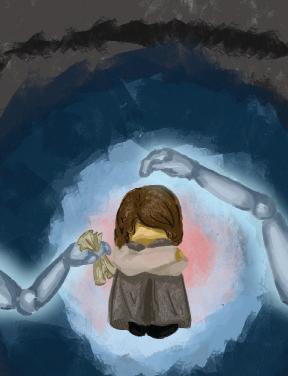
They’ll listen when you need it most, they’ll be accessible to hear your deepest secrets and they’ll remember every detail. Ultimately, they’ll be the hand reaching back out when you can’t find anyone else. But when the text chat stalls and you’re left looking into the black screen, you’re alone again.
Since advanced artificial intelligence chatbots were released to the public in 2022, researchers have raised concerns that the methods these chatbots use to interact with their users foster parasocial dependency, increased loneliness and even potential danger to the user.
The Stanford Institute of Human-Centered Artificial Intelligence says there is a growing trend of people using AI chatbots as therapists for emotional or social support.
such conversations.
“If we have models that aren’t able to recognize the nuanced nature of suicidal ideation, then it may encourage that kind of behavior,” Moore said. “When we move into unverifiable domains, such as these social and emotional domains ... it concerns me that we differ too much to the language model.”
Adeli said these limitations stem from one of AI’s current core principles: to stimulate continued participation.
“[AI is] optimized for engagement, not patient outcomes,” Adeli said. “[There are] no mechanisms to measure or improve mental health results.”
The thing that concerns me ... is the way that the AI just wants to please you, and will say anything to please you or keep you using it.
—Roxanne Lanzot, Paly computer science teacher
According to Ehsan Adeli, a Stanford professor who leads a research group developing AI algorithms related to medicine and mental health, the rising use of AI therapy raises serious concerns about reliability and safety.
“It [AI] lacks full context, personal history, and health records,” Adeli said. “[It] cannot detect nuance in mood, tone, or risk of harm, only based on chat histories. [It] may give generic or misleading advice and reinforce dependency without real-world support systems.”
Additionally, Jared Moore, a Stanford researcher who created a class on the philosophy of AI at the University of Washington School of Computer Science, says that these large language model chatbots lack the nuance necessary to engage in
These tools have been especially prevalent among younger generations. Junior Isabella Zheng, president of the Palo Alto High School Clinical Psychology Club, said younger audiences are more susceptible to engaging in potentially unsafe AI use.
“Especially common in the stage of adolescence, AI chatbots’ ability to personify empathy and responsiveness could be very attractive,” Zheng said. “It’s important to be aware that AI lacks real empathy, and is trained on a variety of datasets across the web and internet, … therefore, there remains a possibility that AI will be able to produce harmful outputs sometimes and exacerbate its client’s symptoms.”
Therapy and professional mental health care are generally quite expensive, keeping therapy out of reach for many. AI therapy, however, does not have that same cost barrier. According to Therapy Route, a website that helps people find therapists, the average therapy cost in 2025 is $100 to
$288 per session.
Paly computer science teacher Roxanne Lanzot said she finds the shift toward a more human-like AI troubling, especially when users begin to rely on AI for the kind of empathy and understanding that only human relationships can provide.
“What we’re seeking from humans is companionship, friendship, understanding, compassion or advice,” Lanzot said. “The thing that concerns me … is the way that the AI just wants to please you, and almost will say anything to please you or keep you using it, or keep you communicating with it. A good friend or a good therapist, that’s not what they’re about.”
Despite this, Moore said that there are still many reasons why people may turn to AI for social and emotional help.
“They [AI chatbots] are available and they’re accessible, and people may feel shameful about sharing some of the things that they’re experiencing,” Moore said. “Also, you hear about the loneliness epidemic, people not having close companions with whom they could be sharing some of these things. There’s a culture of isolation.”
Moore says that despite being broadly opposed to the broader use of large language model chatbots for therapy, he still recognizes potential use cases in more specialized situations. To Moore, caution is key when it comes to AI therapy.
“Using a language model to simply paraphrase the things that you’re thinking about or feeling … is a more circumscribed use case, one with fewer degrees of freedom, and that seems more appropriate to me,” Moore said. “I worry when we start sharing and trusting the model, we move towards a direction in which we can let it lead the conversation, and so I would just be very cautious about letting it lead.”

According to a recent study in the Journal of the American Medical Association, more than one in eight youth from ages 12 to 21 in America reported having used generative AI for mental health advice.
Embryo genetic selection companies give parents new powers
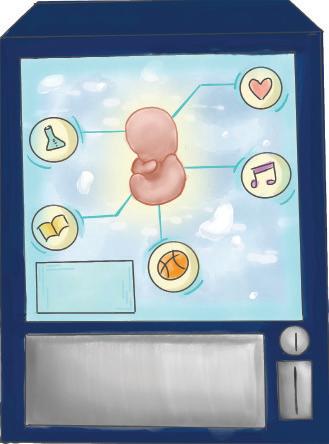
“Have your best baby,” running across the homepage of Nucleus Genomics, captures a new chapter in reproductive technology: using DNA to predict and select the next generation.
But as embryo genome screening companies promise parents more control over their children’s genetic traits, the line between prevention and perfection begins to blur.
Biotech companies like Nucleus Genomics and Orchid are marketing new tools that let parents analyze embryo genomes during In Vitro Fertilization. These services can detect monogenic disorders such as cystic fibrosis, as well as predict predispositions for complex conditions like breast cancer and diabetes using Polygenic Risk Scores.
Now, the same technology is being promoted as a way to go beyond disease detection by allowing parents to select embryos for non-medical traits like height, eye color, or even intelligence.
But what does it mean to pick the “best” baby, and should we even try?
According to Jan Liphardt, scientific advisor for genetic selection company Orchid and Associate Professor of Bioengineering at Stanford, Orchid’s technology can sequence the entire genome of an embryo, allowing parents to detect risks for serious health conditions.
“Not only is Orchid able to look at individual genes, but, by virtue of its amplification technique, Orchid is able to get whole genome sequence data for the entire genome of specific embryos,” Liphardt said. “The information you get out of that [PRS] is not a simple yes or no answer; it’s risk — for example, our risk of developing diabetes in 70 years from now.”
According to Hank Greely, director of the Center for Law and the Biosciences at Stanford, genes influence multiple traits at
Art by DOREEN HOU
Text by PRIYA TAMURA
once, which can lead to significant tradeoffs when selecting an embryo.
“Most genetic allele variations in genes do more than one thing, and sometimes they do a good thing, and sometimes they do a bad thing at the same time,” Greely said. “If you pick a set of a particular embryo based on a Probability Risk Score for high IQ, maybe it also has a high risk of schizophrenia or a high risk of early onset cancer.”
Greely said PRS is not as predictive as it’s marketed to be, especially for traits like high intelligence.
con Valley beliefs about merit and success,” Elinson said.
Greely said he attributes much of this enthusiasm to the region’s faith in genetics and technology.
“The information you get out of that [Polygenic Risk Scores] is not a simple yes or no answer; it’s risk — for example, our risk of developing diabetes in 70 years from now.”
–Jan Liphardt, Associate Professor of Bioengineering at Stanford
“PRS is not universally believed in by geneticists — I think there are a lot of geneticists who think it is, but it needs to be proven better,” Greely said. “The most optimistic people involved in PRS for intelligence will say, ‘We could make a three or four IQ point difference.’ Well, a three or four IQ point difference is less than the difference you get if you take the IQ test two days in a row.”
For many families, however, PRS embryo selection is just good parenting.
Janet Malek, a clinical ethicist and professor of medical ethics and health policy at Baylor College of Medicine, said parents’ desire to select the “best” embryo is an extension of common efforts to maximize their children’s success and opportunities.
“There is something very reasonable about parents wanting to do what’s best for their kids,” Malek said. “Why is it okay to get them tutors, to take them around and make sure they have opportunities to play sports and play music, but it’s not okay to choose their genes in a particular way?”
According to a Wall Street Journal article titled “Inside Silicon Valley’s Growing Obsession With Having Smarter Babies,” written by Zusha Elinson, Palo Alto may be especially receptive to this kind of thinking.
“The fascination with what some call ‘genetic optimization’ reflects deeper Sili-
“It [embryo genome selection] is a product of a combination of an overly strong belief in genetic determinism, and in a population that is especially predisposed to think that technology is always going to work,” Greely said. “They [buyers] are rich people who want the very best for their kids and are technophiles.”
Palo Alto High School senior Amalia Tormala, president of Paly’s Black Student Union, said because of its hefty price tag, genetic optimization technologies risks only benefiting the wealthy, and exacerbating economic inequalities.
“As it gains popularity and becomes slightly more mainstream, genetic optimization will likely primarily be available to the wealthy, which very well may further the socioeconomic disparities that are already incredibly present in an area like Palo Alto,” Tormala said.
According to Murphy Haliburton, professor of Anthropology at Queens College and Gunn High School alumni, eugenics is the effort to intervene in human heredity to improve the human population. Haliburton said while he acknowledges the ideological parallels, embryo genome sequencing will be applied in isolation for each customer.
“If people are trying to find a gene for intelligence, well, that’s what eugenicists did,” Haliburton said. “These things look like eugenics, but it will probably be done on an individual consumer sort of basis rather than a state level force policy. So maybe we can give it a new name.”
According to Greely, embryo screening companies operate in an emerging industry with few safeguards to ensure safety or effectiveness.
“It is deeply unethical to sell something that doesn’t work, that you know doesn’t work, by misleading people into thinking it works, or by being overly optimistic and not being skeptical enough,” Greely said. “Orchid doesn’t have to prove to anybody that their test works or that it’s safe, and I think that’s a mistake.”
Despite these ethical dilemmas, Greely said he predicts that IVF and embryo selection will become the default method for reproduction, first for health reasons, then for enhancement.
“As it gains popularity and becomes slightly more mainstream, genetic optimization will likely primarily be available to the wealthy, which very well may further the socioeconomic disparities.”
–Amalia Tormala, senior
Tormala also said she saw similarities from these new technologies and previous genetic optimization movements.
“I find it somewhat offputting,” Tormala said. “To me, it mirrors a lot of the 19th and early-20th century eugenicist ideologies that were so present in Palo Alto.”
“We will get there in 30 to 40 years, but we will get there not because of an enhancement, but because of a desire for healthy kids,” Greely said. “If IVF and hence PGT were cheap, easy and comfortable, I think a lot of parents would do it just to avoid that 1 or 2% chance [of an embryo with a rare monogenetic disease], and along the way, they would also maybe get to select embryos that would have dark eyes or straight noses or curly hair.”
Stop typing take your robot on a Walk
The boundary between artificial intelligence and the physical world is dissolving. San Francisco startup OpenMind is betting that the next intelligent robots won’t only live in a chat box, they will walk through streets, notice and act freely.
Even as companies race to build more advanced machines, the real missing piece is the software that lets robots interpret their environment and work side by side. Today, robots generally operate on their own, with no simple way to share what they’ve learned or team up with machines built by others.
Paly Junior Reed Truong, a member of Paly Robotics, said the unified approach could reshape how teams build and program machines.
“OpenMind is creating a system where everything is integrated and is running off the same software so I think it’d be really efficient because everything is built off the same architecture and can talk to each other, which is really useful and unique,” Truong said.
OpenMind is positioning itself to solve that gap with two products: OM1, the company’s open-source operating system, and FABRIC, a decentralized coordination network. OM1 serves as the “brain” — a hardware-agnostic intelligence layer that can run on humanoids, quadrupeds, drones, and other platforms. FABRIC forms the “nervous system,” giving robots a way to iden tify themselves, exchange information securely, and collaborate across different environments.
Founder and CEO of OpenMind Jan Liphardt said OM1 Beta is designed to pull together the chaos of real-world sensory data and turn it into something robots can actually use.
“The software stack allows humanoid and quadruped ro bots to fuse data from many sensors, build a picture of the world around them in terms of rooms, objects, people, audio and other data inputs,” Liphardt said.
Once a robot understands its surroundings, Liphardt said the system hands decision-making off to large language models.
“Then we turn over the keys to large language models,” Li phardt said. “Instead of a large language model simply generating text, we directly connect it to a fully functional autonomous humanoid, allowing the large language model to roam free in parks in San Francisco.”
For students who work with less ad vanced hardware, the idea of a robot that can adapt to messy environ ments feels like a major shift. Junipero Serra High School se nior and robot icist Stepan Standyk said most robots fail the moment anything

unpredictable happens.
“I’ve worked on school robotics teams for years, and everything feels so brittle,” Standyk said. “You bump the robot, the lighting changes, someone walks in front of it, and the whole thing collapses. What OpenMind is doing feels different because it seems they aren’t doing script-based actions.”
Students watching the industry’s direction say the technical progress is exciting, but they aren’t ignoring the stakes.
Palo Alto High School junior Jennifer Wang, a Paly Robotics member, said the coming shift raises concerns.
“After generative AI, robots are the next step, and I feel like a lot of the tasks people do every day can be automated, but it’s just a question of whether it’s ethical or not,” Yang said. “If the robot can do harm and it does do harm, then whose responsibility is it? In a court of law, can you argue that it’s the company’s responsibility for not making it properly?”
ics, Liphardt said OpenMind has decided to release its software publicly, allowing developers to trust and improve the machines.
“Some people think that there’s a zeroto-one momment in humanoid robotics where there’s nothing, and then bam — all of a sudden thre is a lot of humaniods and I don’t think thats true at all.”
-Jan Liphart, Ceo
“I think it’s very important that humans everywhere have the sense that they’re able to look into the brain of the machines, figure out what’s going on, make changes, contribute, find bugs, as opposed to it being this black box, so we just open-sourced the whole thing,” Liphardt said.
Liphardt said that even if the technology accelerates quickly, humanoid robots won’t appear all at once. Instead, Liphardt said he expects a slow, steady rollout similar to the adoption of autonomous vehicles.
“Some people think that there’s a zero-toone moment in humanoid robotics where there’s nothing, and then bam — all of a sudden there are a lot of humanoids, and I don’t think that’s true at all,” Liphardt said. “If you think about Waymo … that’s an example of where in one area, transportation, it’s taken a decade plus to go from the lab to an absolutely amazing technology that is many times safer than humans actually taking the wheel. That sort of

A new tech playground
MicroCenter offers a tech oasis for PC enthusiasts
The Santa Clara Microcenter is lit up with RGB lights flashing in every direction. Every kind of technology fills the shelves: keyboards, mice, sticks of RAM, and more.
Between the sprawling products, Dan Ackerman, Microcenter News Editor-in-Chief, said Microcenter provides a place for people to access a variety of technology products conveniently as well as providing an in-person experience.
“We find that a lot of people are in cities that don’t have a store that’s anything like MicroCenter,” Ackerman said. “And they really want a place where they can go and they can see a wide variety of tech products.”
Stepping into the shop is like
entering a workshop for tech enthusiasts. It’s a hub for custom PC building, stocked with every conceivable component that brings a unique vision for everyone. Instead of looking for listings online, the store offers an in-person experience. You can get hands-on experience by touching and comparing components side-by-side to guarantee for a compatible build.
“A great example is keyboards and mice,” Ackerman said. “It’s not out of the question to spend $100 on a mouse or $200 on a mechanical keyboard, but … if I was doing that, I would want to be able to go to a store and actually touch it and feel it, or try out different types of switches on the keyboard, different types of key caps to see what really suited my style.”
Palo Alto High School senior Matthew Wei values the depth of stores’ offerings.
“You usually have to buy a lot of stuff online, and there’s not really a different place you can go if you need something quickly or you’re just missing a part,” Wei said, “Micro Center has a lot more specialty stuff; they just have a larger store so they have more stock.”
Microcenter has hired tech experts to offer the best advice for their customers and give customers the experience to observe the assembly process of their PCs.
“The people who work in the stores are all tech fans and tech experts,” Ackerman said. “And what I really like is especially at the Santa Clara store, and a lot of our newer design stores, is when you bring your parts over to have a PC assembled. Since it’s open air, it’s all right there in the open. Because of that you can sit there and watch them work on your
Text by DOREEN HOU and XANDER YAP
comes to the Bay Area
PC.”
Wei also said that it’s a really good place to see the products in person, even if you end up buying them online.
“I think it’s worth it to go over, but I think if you’re trying to save costs, then you probably just go over, pick out what you want to buy for like form factor reasons and stuff, and then you just buy it online.”
Microcenter puts a big focus on the longevity of its tech products. The company values how to make people more likely to maintain their products in an effort to increase sustainability. The company has partnered with iFixit, an American how-to website that publishes free wiki-like online repair guides and teardowns of consumer electronics and gadgets.
“We’re big believers in the right to repair, in empowering people to
maintain and repair and upgrade and improve their products,” Ackerman said.
“In fact, we have a new partnership now with iFixit, which is really one of my favorite organizations.”
Aside from the custom PCs, the store offers many other tech products. One feature is a 30-foot-tall 3d printer filament storage robot.
“What you do is you walk up to this big wall of almost like paint chip style samples that are all printed, they’re like little rectangles, and they’re all printed with the actual 3d filaments,” Ackerman said. “You pick your filament slots, you scan it, and then this gigantic machine just delivers it to you.”
Ackerman said he is excited to open their shop in the Bay Area and that the store offers opportunities for people to get exclusive items within
the tech field.
“I’m very excited that we are back in Santa Clara,” Ackerman said. “And I’m also excited that we get to do special events at this store. That’s one of my favorite things. Nvidia actually just released the GTX Spark, which is their mini AI supercomputer. And Micro Center is the only retail store where you can get that to celebrate that launch.”
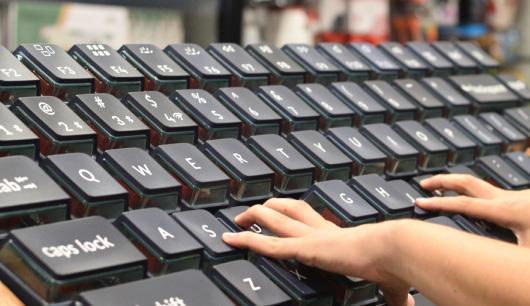
TOP LEFT — This giant keyboard is on display inside of the Santa Clara Micro Center. Although it is not sold in stores, the keyboard functions. (Photo by Doreen Hou)
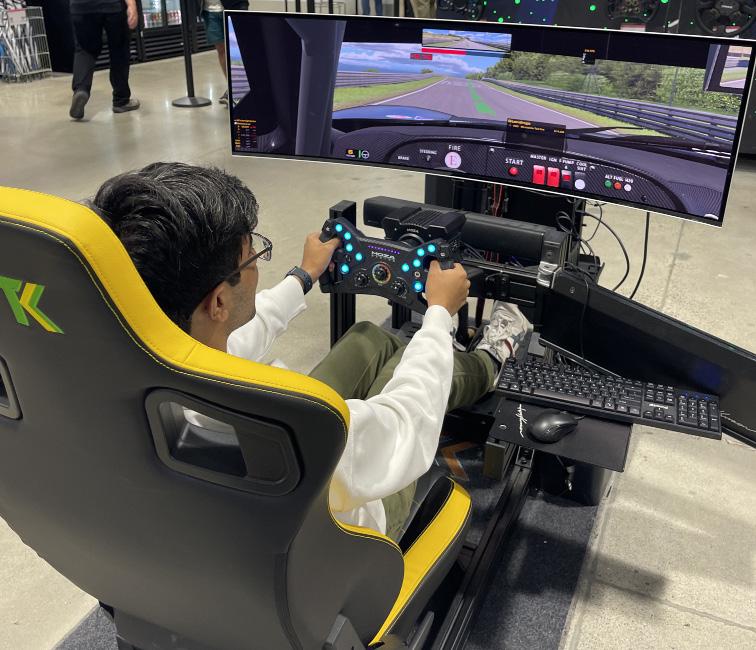
TOP RIGHT — Paly 2025 graduate Divij Motwani uses the racing simulator at Micro Center. This is one of the many technologies that Micro Center displays. (Photo courtesy of Arjun Jindal)
Photo by DOREEN HOU
GALLERY
The beauty of science in images






ADVERTISE WITH THE INCUBATOR
PUBLICATIONS:

Anthro, Ink, KPLY, Proof, Chomp, Veritas, Via Verde, The Paly Voice