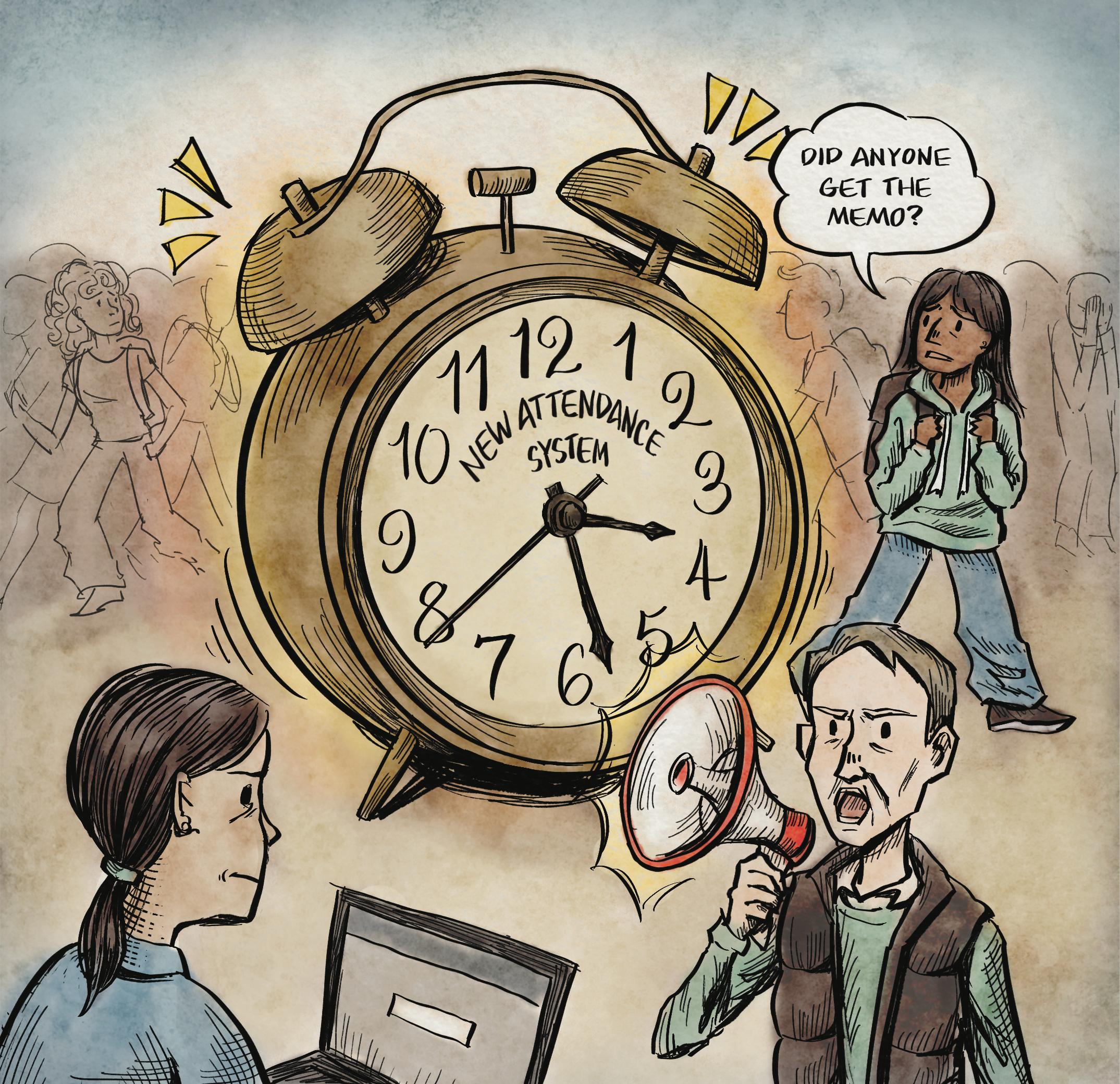
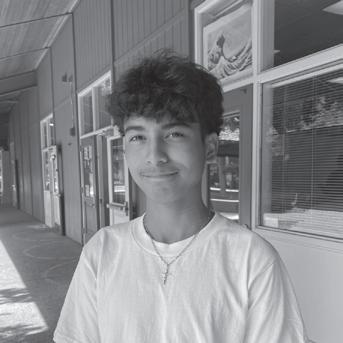
In an e ort to automate attendance tracking and keep better track of student bathroom breaks, teachers began using an attendance kiosk system for student attendance on Aug. 19. e system is set up as a scanner and Chromebook where students can either type their ID number or scan their ID card to check into class.
Assistant Principal LaDonna Butler, the administrator in charge of rolling out the new system, said she hopes it will increase safety around campus, streamline administrative tasks and decrease inaccuracy and distractions.
“I got wind of teachers having to take notes when students were entering and leaving for the bathroom, which doesn't allow for the teacher to focus on their instruction,” Butler said.
“It’s very distracting. It takes away from not only the teacher’s preparation, but also all the other students that are sitting there.”
Butler said the system is meant to assist, rather than replace, teachers in taking attendance.
“We've asked our teachers to be mindful — it's still their responsibility for attendance and (for) students who are coming into class,” Butler said.
Butler also said the system is in phase one. e second phase will involve replacing paper hall passes for students who want to go to the tech center, the wellness center, meet with administrators or counselors, and for journalists to conduct interviews.
AP Computer Science teacher Roxanne Lanzot said due to the system, she doesn’t have to repeatedly change and save her attendance when students come in late. However, she said the system has also made it harder for her to learn student names.
“I was forced to look at the student's picture, look at their name, acknowledge that they were here,” Lanzot said. “My brain's not doing that work anymore.”
And for junior Simone Batra, scanning her ID or typing in her ID number can be inconvenient.
“At times, I have to double check to make sure it's scanned in because some teachers have turned their option to silence, so you can't really hear whether or not you scan in, and then there comes the panic with, ‘Oh, shoot, this computer thinks I'm not here,’” Batra said. Regardless of the inconvenience, Lanzot said the system is helping reduce tardiness.
“I have one class where I have some commonly tardy students, and I can already see them hustling to class faster because they know that it's not going to be like, ‘We can just convince her of this or that,’” Lanzot said. “ ey're like, ‘No, we better have our butts in there and scanned.’”
While the system encourages punctuality, Batra said this can feel pointless when students have to wait in line to scan in.
“ e idea of having a computer watching you and staring you in the face (will) de nitely scare students into being on
time, but I don't think that's the right way to go about this,” Batra said. “ at's not what's going to set them up for success later in life.”
Psychology teacher and technology teacher on special assignment Chris Farina, who helped beta-test the system last April, said he doesn’t think it will directly change student tardiness, but he does think it will help administrators prioritize students who need intervention.
“It can tell you if you're looking at a student who is chronically one minute tardy or chronically 18 minutes tardy because it can tell you when they actually checked into class,” Farina said. “If administration is just trying to gure out who they should talk to to try and address chronic tardiness, they want to be able to focus on kids that are chronically 18 minutes late.”
Additionally, the attendance kiosk tracks bathroom breaks, creating a seven-minute hall pass for a student who checks out of class to use the restroom.
Farina said during betatesting last year, the bathroom pass helped minimize disruptions in his classroom.
Batra, however, isn’t so sure.
“It kind of defeats the purpose of what it was meant to do because teachers still want students to tell them where they're going, which makes total sense,” Batra said.
Lanzot said this element makes her a little uncomfortable.
“Our bodies aren't all the same, so people have di erent needs about what they need to do in the bathroom and how long that's going to take,” Lanzot said. “ e students shouldn't have to disclose exactly why they needed a few more minutes in the bathroom. at's your private, personal business, and I would hate for students to feel any kind of embarrassment over why they needed more time in the bathroom.”
Batra agrees and said though it is a good concept, the seven-minute time limit on bathroom breaks is unreasonable.
“We're not robots; we don't get things done within ve minutes and come back,” Batra said. “ e limit should be extended to at least 12 minutes to give students ample time to go wherever they need to go, do what they need to do and then have time to come back. Otherwise, you're just panicking and stressing, and that's what we want to eliminate here.”
Butler also said the system will not mark a student tardy or create punishment for bathroom breaks longer than seven minutes.
“Right now, we have a system where, if students are absent or tardy a certain amount of times, then
they go and have a conversation with your admin and a campus supervisor,” Butler said. “ at is always: One, why is it happening? Two, how can we support?”
Butler said the system is not supposed to stress students out.
“ e system is not designed to have a ‘gotcha,’”
Butler said. “It allows for the teacher to feel secure that she knows her student is on a bathroom pass and on their way to the restroom. Also, campus supervision and administrators will know if a student is on a pass, and if it gets beyond a threshold, then that says, ‘Is this student OK?’”
And Butler said the system has helped decrease student roaming.
She also said the system could help build trust between students and sta , especially when students need to inform teachers why they may have taken longer to use the bathroom.
“We want to make sure students understand we're not looking to bring a hammer down, but what we are looking for is students to be accountable,” Butler said. “I think that we should trust adults enough, especially because we take care of you students for eight hours a day, and I'm hoping that we have enough trust built that we're able to say, ‘I have personal need.’”
Still, Batra sees privacy issues with the system that bother her.
“ e teacher-student relationship is kind of broken by a computer,” Batra said. “I don't like that the school can track where I'm going and see where I am at all times. It's not like I'm doing anything wrong.”
e Associated Student Body freshmen elections for president and vice president concluded on Aug. 28 with freshmen Annie Meng elected president and Helen Li elected vice president.
According to Meng, equal representation is one of her priorities. She said she wants to make sure every student has a voice.
e feeling of being excluded and left out is something I never want anyone to feel at Paly,” Meng said.
In addition to representation, Li said another goal of the student body team is to boost freshman class spirit.
“According to upperclassmen, freshmen have consistently been the least spirited class in the past, so I thought I could help encourage more participation among my peers,” Li said. “We have never had anything like (the rst week rally) before Paly, and I had so much fun.” She said school spirit is about “showing up to rallies and other events ready to give it your all.” Meng said school spirit also involves unity and comfort among peers.
“To me, school spirit means that everyone feels a powerful sense of synergy and oneness together,” Meng said. “Everyone is proud of how far they have come and support each other to achieve a common goal. (We have) some pretty fun socials planned, like an instant ramen social and a boba social planned.”
In addition to Spirit Week, Meng said her goals go beyond helping the freshman class acquaint themselves with each other. She would also like to work to make lunch lines and bike cages less crowded.
Campaigning was a new experience for both of the candidates, and Li said she had a lot of friends who helped her.
“I was planning on a poster that had my friend’s handprints on it, and they would write a trait that made me quali ed for president on their handprints,” Li said. “After I had planned it out, I brought paints and brushes to school where, during lunch, my friends and I had a lot of fun making the poster.”
However, Meng said the process of running for o ce was time-consuming.
“Balancing sports, extracurricular activities and homework all while leaving hours to work on my posters took a big toll on my sleep schedule and left me very little time to study for tests and quizzes,” Meng
Looking forward, Meng said she is excited to take on an ASB leadership role and help lead this year’s rallies and events.
“I’m looking forward to getting to know more of my classmates and bringing up freshmen participation at rallies, socials, dances and other events,” Meng said. “When planning, I want to be a leader everyone can look up to (and make) sure all perspectives are taken into consideration.”
Zoya Prabhakar Sta Writer
Annika Chu News/Opinion Editor
Five school board candidates vie for three seats
Five candidates are running to ll three seats on the Palo Alto Board of Education in the Nov. 5 election. Rowena Chiu, Nicole Chiu-Wang, Chris Colohan, Alison Kamhi and Josh Salcman are campaigning to occupy the seats currently held by board president Jesse Ladomirak and trustees Jennifer DiBrienza and Todd Collins. e school board meets semimonthly, with each meeting following a preset agenda and typically holding an open forum for community members to speak about their concerns.
According to DiBrienza, the focus of the board trustees is to approve an annual budget, write and update district policies, establish the goals and priorities of the district and supervise the district superintendent.
Rowena Chiu
Chiu is a Palo Alto Uni ed School District parent and former Ohlone Elementary School Parent Teacher Association president who has lived in Palo Alto for 15 years. Chiu said she is committed to addressing the concerns of parents with children in special education and mental health programs.
“I learned how to bring a lot of the skills that I’ve used in global advocacy to advocate about a very local issue,” Chiu said.
“I got a bit bitten by the bug of looking holistically at the issues of the district and why parents and students and teachers are disenfranchised.”
As a sexual assault and suicide survivor, Chiu said she hopes to increase awareness of these issues in the district.
“I do a lot of work around suicide prevention among young people, understanding where that’s rooted and where the mental health issues start, and how can we genuinely provide young people with support so that it doesn’t get to that stage,”
Chiu said.
If elected to the board, Chiu said she hopes to give students more opportunities to express their views and improve the board’s transparency.
“To be able to empower students and give them more voice and more advocacy and more opportunity to actually make real change makes such a huge di erence,” Chiu said. “It’s not about me coming and speaking on their behalf — it’s about platforming them to speak on their own behalf.”
Nicole Chiu-Wang
Chiu-Wang, a PAUSD parent and tech entrepreneur, lost in the 2022 school board election.
However, knowing the impact she could have on the community, she said she immediately prepared to run again this year.
“My parents were career public servants and very much imbued an importance in serving our community,” Chiu-Wang said. “So when I moved here knowing that we were going to plant roots here, I thought, ‘How can I contribute?’ I think I have a unique background and perspective and commitment that would serve me well on the school board.”
Chiu-Wang said she plans to advance early childhood education, promote mental health and wellness, restructure the annual budget and improve the district’s relationship with the teachers’ union.
Luca Vostrejs Lifestyle Editor
“I want us to move past the divisions because our students feel it, and they feel the e ects of the divisions,” Chiu-Wang said. “Ultimately, our number one priority is to serve our students — to serve all students — and make sure they all can thrive during the time that they’re at PAUSD.”
If elected, Chiu-Wang said her longterm goal would be to serve two terms over the next eight years to advance PAUSD.
Chiu-Wang said, “Hopefully during that time, I’ll be able to in uence decisions made along the way that implement early childhood education and even improve what we already currently o er.”
Chris Colohan
Almost a decade ago, Colohan left Google to become a stay-at-home dad. He then worked on the Duveneck PTA board for seven years.
“Being a (PTA) president during the pandemic … was remarkable because of how much I learned about other people’s families and their issues and anxieties,” Colohan said. “So I’ve been heavily involved in that aspect of community building and of our schools.”
Since then, Colohan has worked as a PAUSD substitute teacher for every grade, teaching at all 15 of Palo Alto’s schools.
Colohan said his primary goal, if elected, is to emphasize the idea of strong, e ective management, which involves spreading awareness of others’ responsibilities and trusting they will perform their duties in the district well.
Colohan also said he plans to improve the district’s budget and attract and maintain good teachers.
e rst bill in the country that would prohibit schools from disclosing a student’s sexual orientation, gender identity or gender expression without consent became law in California on July 15 when Gov. Gavin Newsom signed California State Assembly Bill 1955.
e bill was rst proposed by Assemblymember Chris Ward (D -San Diego) and is the rst bill in the country to outlaw such outings.
Ward’s LGBTQ caucus consultant Natalia Garcia, who worked on AB 1955, said the bill was created to expand on the state’s current LGBTQ+ protection laws.
“Nationally, for a couple of years now, there’s been a growing attack on LGBTQ folks,” Garcia said. “(In 2023), over 500 anti-LGBTQ+ legislation throughout the nation passed. Kids have the right to come out to their parents on their own time, in their own manner. Frankly, schools shouldn’t be getting involved in family matters, such as talking about gender and sexual orientation.”
Among the states with new LGBTQ+ legislation, eight have passed forced outing laws for transgender students, meaning, unlike California’s new law, teachers must notify a student’s parents if they identify with a gender that does not align with their sex at birth.
In March of 2023, Assemblyman Bill Essayli proposed California State Assembly Bill 1314, which would require school faculty to notify parents about gender identity changes within three days. Garcia said the potential that the California legislature could pass forced outing legislation concerned LGBTQ+ students and their supporters, prompting AB 1955. ere was an increase in mental health issues amongst LGBTQ or a bunch of students in general and increased calls to the crisis hotlines because people were stressed about the implications of forced outing policies and the rhetoric that was around it,” Garcia said.
History teacher Eric Bloom said he’s thankful for the new law since he said forcible outing would obstruct an inclusive and safe learning environment.
“(I hope to) drive the school district to be in a better place where every single student ourishes … but not only as individuals,” Colohan said. “I actually care about the achievement of the community as a whole because I think it’s important for students to learn things, but I also think it’s really important for them to learn how to interact with other folks.”
Alison Kamhi
Since she moved to Palo Alto 25 years ago, Kamhi, a parent and legal program director for the Immigration Legal Resource Center, has engaged in policy work for unaccompanied immigrant minors.
“I do immigrants’ rights policy at the state and federal level,” Kamhi said. “ rough that work, I know that all change starts local, so I’m really excited to bring those skills to our school board and to make our schools even better.”
As a prior member of the PAUSD Ad Hoc Child Care Committee, Kamhi’s campaign has three main principles. e rst concept is the idea of safety, starting with preventing gun violence, increasing bike safety, providing mental health resources, advocating for special needs and eliminating hate speech. Her second campaign principle is providing opportunities for every student to excel and be successful. Kamhi’s last principle and highest priority is building mutual trust within our community.
Kamhi said, “ ere’s a lot of divisive rhetoric in the world, in our country, in our state, in our district and community, and so (I’m) really wanting to bring people together on shared values.”
“It would be a very di cult law because it counters building an atmosphere in my classroom,” Bloom said.
“I’m not hired just to teach — I’m hired to create a learning environment. I’m going to create a space here that is going to be the most productive for as many kids as I can.”
Sophomore Summer Mehta, co-president of the Gender Sexuality Alliance club, is also thankful the law passed and said AB 1955 provides students with a safe school environment that protects their identity.
“Whether it’s for safety, because of familial disowning or the hatred that comes from less-inclusive parents when they realize they have transgender children, allowing students to be able to express their gender identity in schools without the fear of being outed is really important,” Mehta said.
While the bill prevents school board members or administrators from requiring the outing of transgender students, Garcia said teachers can still out students under certain circumstances.
“(If) a student is a threat of harm to themselves or to others, or the student is getting bullied, the teacher is going to want to tell the parents what’s going on to ensure the health, safety and wellbeing of the student,” Garcia said. “Teachers are professionals that use their best judgment on conversations, not just as it relates to forced outings, but to threats of safety and what not.”
In fact, Garcia said creating a safe environment for students is one of a teacher’s primary responsibilities.
“To make a safe and supportive environment, (teachers) really need to make sure that kids aren’t singled out,” Garcia said. “It’s simply by using a kid’s proper pronouns or simply referring to a kid by their name. Teachers use kids’ nicknames all the time, even if it’s not their legal name. Just basic human dignity is really how teachers can create a safe and supportive environment.”
Mehta said most Paly teachers provide an inclusive environment for LGBTQ+ students and simple acts can go a long way in helping students feel even more comfortable.
“ e majority of them are very inclusive,” Mehta said. “It could be as easy as having a poster with a pride ag on it to show your allegiance or your allyship — to
Josh Salcman
Salcman, a father of three and 10-year PTA member, has spent almost a decade in Palo Alto. Salcman said his experience of raising children with special needs and disabilities enables him to better help and understand their challenges.
“ at also gives me the ability to empathize with families that have kids who might be neurodivergent,” Salcman said.
Salcman also said he plans to work with the district to improve individual learning by taking students’ strengths, di culties and personal motivations into consideration.
“I would be interested in exploring ways that we can potentially bring some exibility back into the way that we work with individual students and try to really meet the student where they’re at so that we can try to help them become the wholest version of themselves that they can be,” Salcman said.
To further enable student input, Salcman said, if elected, he will prioritize improving trust and communication between the district and community.
“I’m very focused on increasing the level of trust that the di erent people involved in our educational ecosystem feel with regard to the other people that are in that ecosystem,” Salcman said. “ at’s going to involve shifting the way that the district communicates its decision-making processes and also the way it invites people into those processes.”
Saal Sta Writer
show that it’s a safe space. Surveys are very helpful as well as just respecting pronouns, especially if a student transitions within high school.” Fletcher teacher-librarian Kristen Lee, who serves on Palo Alto Uni ed School District’s LGBTQ+ Council and is Fletcher’s GSA advisor, said clubs like Mehta’s GSA, are important resources in supporting transgender and LGBTQ+ students. “GSA needs to be active, present and visible so that kids know
ART BY CHERIANNE YOON
Dalia
Increase in Chromebook requirements for classroom meant to combat cheating, AI
Isabella Bian Newsletter Editor
In an attempt to combat the rise of cheating via arti cial intelligence and reduce distractions from personal computers, an increasing number of teachers now require students to use school-provided Chromebooks in their classes. e speci c requirements vary by teacher, with some requiring Chromebooks for every class, others only mandating Chromebooks for testing and still more not mandating Chromebooks at all.
In an Aug. 30 opt-in Schoology survey conducted by e Campanile, 93.3% of the 45 respondents said they had at least one class that requires Chromebook use, while 60% of respondents said they were only required to use Chromebooks in some classroom situations.
Although mandatory Chromebook policies receive mixed reviews from students, some teachers say they minimize distractions and promote productivity.
English teacher Alanna Williamson said requiring Chromebooks was an additional step she took this year to minimize outside distractions from apps and websites.
“As more (teachers) have taken away cell phones in class and added (a) cell phone policy, this is the next step for us to (ensure) everyone’s on task,” Williamson said.
But English teacher Hunter Reardon said technical problems exclusive to Chromebooks have slowed down his class.
“Every single day I have at least one student, and usually more than one student, who has some kind of issue with their Chromebook,” Reardon said. “‘It’s not turning on. It turns on, but it’s going really slow. It needs to be reset. e internet isn’t connecting.’ Just all these di erent issues that I think are tied in some way to technology.”
Junior Kathryn Chen said she has also found the process of checking out a loaner Chromebook can delay learning.
“If you want to get a loaner Chromebook, you have to leave class, leave your collateral item like your phone or your wallet, come back to class, and then go back and pick it up before the next period starts,” Chen said. “It takes time that could be otherwise spent on getting homework done or class instruction.”
And Reardon said personal devices such as Apple laptops have resources to help students create high-quality work that are not available on a Chromebook.
“I have plenty of situations, especially ninth grade, where I assign some creative projects where students have many more options for what they are able to create when they have access to a MacBook,” Reardon said. “ ey have access to the native desktop version of Adobe Suite, and they might have access to video editing software like iMovie. ey just have more choices.”
Although personal devices may provide additional bene ts, Williamson said requiring Chromebooks is the most
sensible policy to minimize distractions because it utilizes school resources.
“People got them for free from the school, so we should use the resources that the school has already given us,” Williamson said.
In addition, Williamson said the lockdown browser feature on Chromebooks helps mitigate cheating, a prevalent issue in her classes in recent years.
“We know workarounds, and there are ways that people can cheat on lockdown browsers, but it does make it a little bit more challenging,” Williamson said. “We
will still be looking at people’s screens, but this is a good safety net.”
Reardon thinks old ways to prevent cheating may be better, though. Instead of mandating Chromebooks, he said he has moved to paper assignments to prevent digital distractions.
“Do students also nd ways to do things other than classwork in the middle of class on Chromebooks?” Reardon said. “Absolutely. Half of the students in my classes have found a way to play Tetris. I don’t think changing the device they’re on is going to x that problem. What does x that problem is closed Chromebooks and work on paper.”
Reardon also said he is bothered by the restriction of student choice that comes with a mandated Chromebook policy.
“In order for 33-plus people to sit in a room together and learn something in an organized fashion, there need to be rules,” Reardon said. “ ere need to be systems in place that take away from student autonomy. at is just part of making public school work. But I don’t believe in taking away student autonomy when it’s not absolutely necessary. And I think this is one of those cases where personal choice should win out.”
Regardless of potential drawbacks to a mandated Chromebook policy, Williamson encourages students to have an open mind.
“Just give it a chance,” Williamson said. “I understand why it’s annoying, but I think we’ll all get used to it. Just like any new thing, change is hard, but I don’t think it’s going to be bad.”
Assembly Bill 2927, passed on June 29 by the State Assembly, will add nancial literacy as a high school graduation requirement for the class of 2031. e law allows districts to substitute either a local graduation requirement or an economics class for nancial literacy.
Economics teacher Grant Blackburn said Paly is leaning toward making Economics an elective
and making a nancial literacy class a requirement because it is vital for teens to learn about personal nance.
“You shouldn’t just be lucky enough to have been born with parents who know about this stu , and you learn about it through your parents,” Blackburn said.
“Everyone should know how to do this stu , and hopefully, that means people fall to scams less often. People make better nancial decisions.”
Senior and co-president of the economics club
Karen Yang said she does not think replacing Economics with a nancial literacy class is smart, though, since Economics teaches a critical way of thinking.
“It gives you this model that is simpli ed, but it can be applied to many areas,” Yang said. “It gives you a better understanding of why people made these decisions and what are the bene ts or losses and ‘is this an ecient way of allocating resources’ when politicians or companies make decisions that impact our nancial situations.”
While Blackburn supports teaching students about nancial literacy, he is concerned about replacing Economics as he said he doesn’t know how getting rid of that class will impact students’ knowledge of the world.
“Economics can help you with understanding why pollution happens, understanding why people make the choices they make, why monopo-
lies and oligopolies are good for business, but bad for consumers,” Blackburn said. “ ere’s so many di erent topics that economics covers that are really important.”
Yang agreed and said economics explains theories that underlie what people might think of as their best nancial decisions.
“For example, understanding scarcity is a little farther from how we manage our money in our daily lives, but the concepts are important if you want to put your decisions into a bigger picture,” Yang said. “Even if you want to do stocks or bonds, you need a more coherent theory, like a model, in your mind.”
In addition to understanding stocks or bonds, Yang said economic understanding is fundamental in her everyday life.
“Since we’re learning in school, we have a lot of time,” Yang said. “It would make sense for us to build a more fundamental theory and then get into the practical stu because you can’t spend a whole semester just remembering stu that might not be applicable to you.”
Yang also said although economics is popular as a college major, it also sounds foreign, which could scare people from taking it.
“Financial literacy is really direct in that you’re going to be able to understand how you manage your bank accounts, how you do savings and the rates that give you the highest return,” Yang said. “But (economics) is hard to really summarize and be taught to people in one or two lectures, so if Economics becomes an elective, then people might not have the interest and time to ever get to know it.”
Blackburn agrees and said in the wake of poor nancial advice proliferating online, he has noticed trends that could lead to students making ill-advised decisions.
“People are on their phones a lot, which means they’re on their social media a lot, which means they tend to make a lot of impulsive decisions,” Blackburn said. “ e biggest concern that I would have is helping anybody, not just students, to be less impulsive, to be more deliberate about the decisions they make, especially when they’re on a platform like social media, whose whole job is to get you to click.”
While junior and Economics Club vice president Jerry Yan said he understands why it’s necessary to have nancial literacy as a graduation requirement, he said he would still prefer taking an economics class over a nancial literacy one because economics is necessary to understand the news and get the best deals.
“I know a lot of kids on Roblox, and they spend $1,000 for one day,” Yan said. “I don’t think that’s a good nancial decision, and I can see why Gavin Newsom signed the bill, but from that, I think there are better moves, but this is a move to stop kids from buying $1,000 of Robux.”
Yan also said he thinks nancial literacy should be integrated with either Living Skills or Economics.
“You learn about more practical things — it’s easy to understand, easy to digest,” Yan said. “ at’s why it’s a one-semester course. I believe that we could still stu a little more things into Living Skills, but I also think that you could probably stu economics and nancial literacy into one course too.”
Annika Chu News/Opinion Editor
ART BY CHARLOTTE LIU
ART BY CHERIANNE YOON
THE PRICE OF
As a longtime resident and former mayor of East Palo Alto, Ruben Abrica remembers when he could have bought a home in his city for just over $200,000. at was in 2009. Today, he drives through the same neighborhood, where the same house is listed for $1 million.
land for the construction of Highway 101. In order to understand East Palo Alto’s place in the Bay Area, Abrica said it is important to understand the historical di erences between Palo Alto and East Palo Alto.
e rst thing to know is that Palo Alto is in Santa Clara County, and East Palo Alto is in San Mateo
known as the Tinsley program after former parent Margaret Tinsley, brings up to 135 students each year from East Palo Alto and East Menlo Park to other school districts, including PAUSD.
“ e Tinsley program was the result of a desegregation lawsuit that was led by some families in the Ravenswood School District in East Palo Alto,” Abrica said. “Ravenswood School District covers East Palo Alto and East Menlo Park.”
e lawsuit said racial di erences between Palo Alto and East Palo Alto create a segregated school system. And a settlement order in San Mateo County Court in response to a petition led by Margaret Tinsley and other parents of the Ravenswood School District sided with the plainti s.
“ e student population of respondent Ravenswood City School District elementary schools is predominantly minority, while the student populations in the elementary schools of the other respondent school districts are predominantly white,” the petition states.
“Because of the interdistrict racial imbalance in student enrollment, minority students are realistically isolated, and so a segregated school system exists.”
East Palo Alto still struggles with issues that have been around since its inception, including the annexation of some of East Palo Alto’s
101 deeply hurt East Palo Alto as a city.
“ e result of that in the ‘50s and ‘60s was you had businesses displaced from East Palo Alto, so the economic engine of the community was basically cut out from under its feet,” Lopez said. “It was for the sake of the wider region’s ability to have transit and to have connections between the major cities of the Bay Area, but they left us cut in half.”
Villalobos said Palo Alto’s housing was rife with redlining — preventing certain groups of people from living in certain areas — which was mainly meant to keep African Americans out of traditionally white neighborhoods.
“Redlining was reinforced by many of the banks, where they speci cally were not lending money to African American families to get homes in di erent parts of the cities because they believed that it would lower property values,” Villalobos said.
Palo Alto residents even took redlining one step further with “blockbusting,” a practice where whites would move out once an African American family moved into the area.
Another factor increasing gentri cation in East Palo Alto is a change in community perception. In 1992, East Palo Alto was known as the
of In 2010‚ the median price was $250‚000 Palo Alto. In number surpassed RISING PRICES
But Villalobos said as more tech workers came into Silicon Valley in the 2010s, a lot of them chose to reside in East Palo Alto because of lower housing prices. “When Facebook and all those other tech companies moved in that area, where were these people going to go,” Villalobos said. “ ey started to see East Palo Alto
Murder Capital
OF PROGRESS
the US. e homicide rate was 175 murders for every 100,000 people, while the nationwide rate was 9.3 murders for every 100,000 people — almost 20 times less. Lopez said East Palo Alto’s infamous violence pushed down property prices.
“People move into an area for the quality of the
median house $250‚000 in East In 2024‚ that surpassed $1 million. PRICES
“I got really lucky being able to join the PAUSD, and I feel like I t in really nicely,” Kim said.
However, not all students have the same experience. Magana said the separation between Tinsley and nonTinsley students is noticeable.
“We have the same opportunities, but I feel like we
“If we’re the only ones building for this segment of the population, that’s going to hurt us,” Lopez said. “I want to emphasize, it’s not an East Palo Alto issue; it’s a regional issue. In the past 10 years, for every unit of housing that we’ve created, we’ve created nine jobs. So we have a one-to-nine housing job ratio. If other cities
TERMS & DEFINITIONS
REDLINING: a form of racial discrimination in housing.
GENTRIFICATION: a process whereby an influx of wealthier people causes increased property prices‚ driving locals out.
WHITE FLIGHT: the sudden exodus of white people from areas becoming racially diverse.
Senior Justun Kim and junior Khrisar Magana, both Paly students who live in East Palo Alto, along with junior Adan Perez, who previously lived there, have all been part of the Tinsley program.
Kim said attending Palo Alto Uni ed School District o ers many advantages over Ravenswood, such as access to high-quality resources like public libraries and advanced academic programs.
“East Palo Alto has many less facilities compared to Palo Alto, and students there don’t have as many opportunities,” Kim said. Despite living in East Palo Alto, Kim said he is grateful to be attending Paly through the Tinsley program.
2000. A lot of that has to do with the Tinsley program,” Lopez said. “ is (causes) a disparity in resources because as a result of opting your student out, the school loses funding.”
ART BY JEFFREY FAN
Additionally, Lopez said the Tinsley program hurts the spirit of the city because students are scattered for their education.
“Remember, East Palo Alto, at one point, did not have a high school for 20 plus years,” Lopez said. “ ink about the impact that makes when you have your student body scattered in all corners of the county and of the peninsula – the lack of unity, the lack of cohesion, the lack of having a common experience – and how that then troubles the ability to organize civically, to lead, to govern, because everybody has their own story about school.”
Despite East Palo Alto’s historical problems and weaker tax base due to tech companies, redlining, racism and a freeway, the city passed the 2024-2028 A ordable Housing Strategy in February, an e ort to build more low-income housing to accommodate the needs of renters in East Palo Alto.
STORY BY ALEX ISAYAMA, GAVIN LIN, NAVEEN NARAYANASWAMI
Caltrain’s long-overdue electri cation is the future of accessible, smarter, greener transit
I’m sitting in a window seat on the Caltrain — the hum of the motor blends with the soft chatter of passengers and the occasional jingle of a phone noti cation. As the train glides along the tracks, I look out at the blur of cars stuck in tra c on El Camino Real, inching along as we breeze past them. I’ve ridden this train countless times, but this trip feels di erent somehow, like I’m not just being propelled toward San Francisco. I’m being propelled into the future.
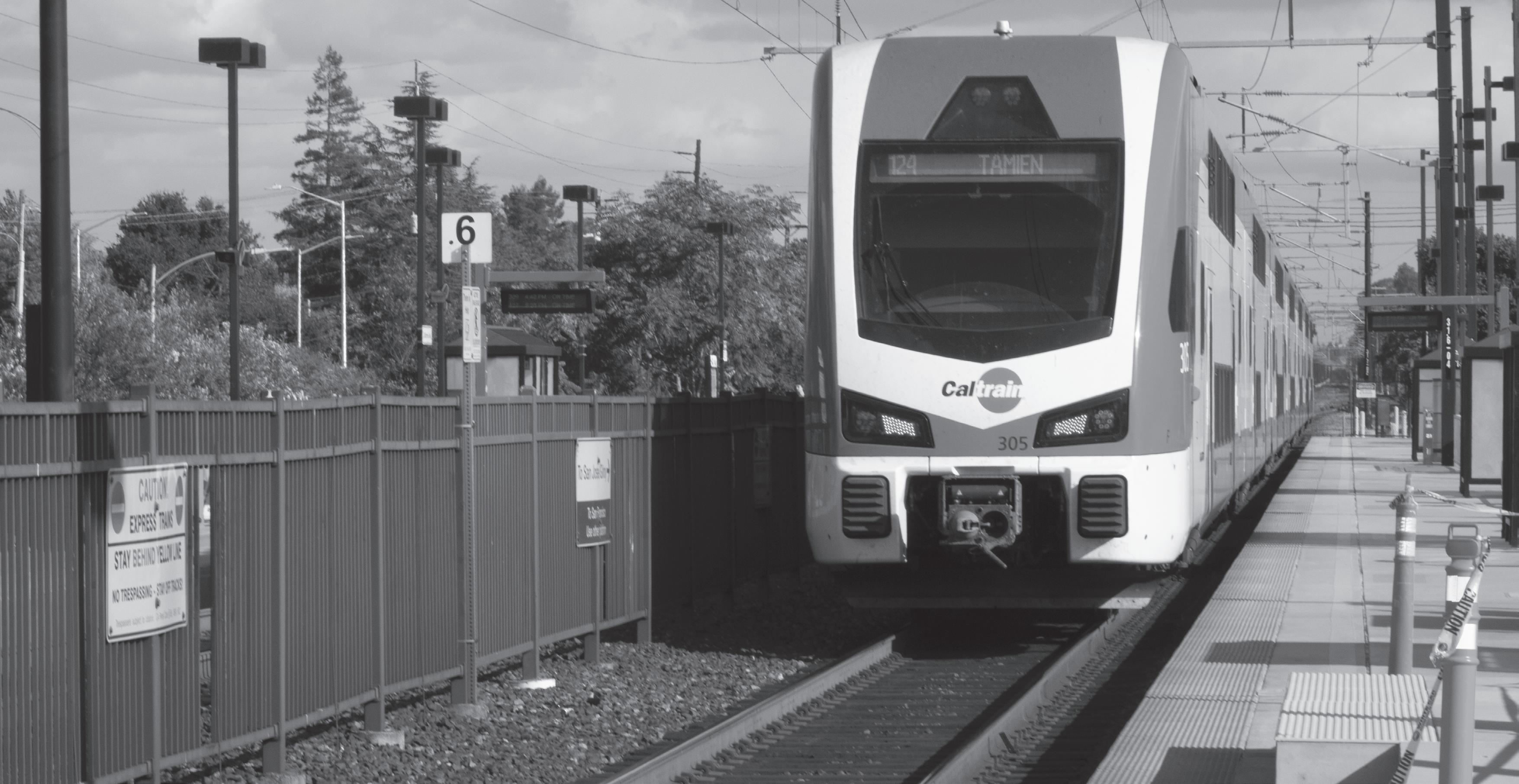
Despite electri cation proposals as early as 1992, the $2.4 billion Caltrain Modernization Program to electrify all Caltrains nally began construction in 2017 with complete electri cation scheduled for Sept. 21. is iteration of CalMod consisted of overhead electri cation lines from San Francisco’s 4th and King Street station down to San Jose’s Tamien station. It also included the purchase of 23 new electric train sets to replace the diesel eet.
is upgrade is expected to reduce carbon dioxide emissions by 250,000 tons each year, the equivalent output of 55,000 cars. Additionally, the electricity used to power the new lines will only be bought from net-zero emission sources.
e impact of this is substantial, but especially for Caltrain. In general, trains are more e cient than cars, but that only applies when they’re actually carrying passengers. And Caltrain was running lines with half-empty cars and ine cient diesel engines before this upgrade, making it actually less e cient than other transport options. Even with low ridership, the Caltrain continuously passed by Paly, creating signi cant disruption. e diesel trains rattled class-
is fall, grab your best girl friends or your toxic boyfriend and go see “It Ends With Us.” Maybe wear your favorite oral prints or bring ve tissue boxes because the lm is an emotional rollercoaster that’ll have you awe-ing, cringing and crying. Based on the novel by Colleen Hoover, “It Ends With Us” was released in theaters on Aug. 9 and stars Blake Lively and Justin Baldoni. e plot follows protagonist Lily Bloom (Lively), a orist, through her new relationship with neurosurgeon Ryle Kincaid (Baldoni, who also directed the movie).
While the two fall in love, instances of domestic violence occur. As Lily grapples with her predicament, the story ashes back to a younger Lily in her rst relationship with the homeless but compassionate boy-next-door, Atlas Corrigan (Brandon Sklenar).
My friends and I were super excited to watch “It Ends with Us,” especially those of us who had read the book and enjoyed it. Before watching the movie, I had doubts about the movie’s accuracy in relation to the book’s descriptions of characters.
While the movie itself was beautifully
rooms, constantly causing classes to pause throughout the day until the noise stopped. But with the new electric trains, even sitting in my class in the back of the 800’s building, the noise of a train passing by is barely noticeable. is noise improvement, combined with electri cation, allows for faster, more e cient service without disruption to nearby communities. In addition, people like to look at top speed as the main factor in judging transportation options, but the diesel Caltrain was too weak to even reach its 79 mph top speed between closely spaced stops.
Just like an electric car, electri cation o ers a substantial increase in torque, allowing the trains to increase speed and substantially cut down travel time. at means a trip from Palo Alto to San Francisco drops to below 40 minutes on the express train. Additionally, the local train from San Jose to San Francisco decreases from 100 to 75 minutes.
More importantly, the new trains allow for an increase in service. Palo Alto is already one of the few lucky stations to receive four stops per hour during peak hours, and service during the weekend is doubling from the previous once per hour. e California Avenue station is getting more trains during peak hours and o hours as well as the weekend. And16 other stations will now have four stops during peak hours, and every station will have trains that stop every 30 minutes at all times. is is the most important change. In addition to the convenience of Palo Alto Link, it’s now possible to just show up to your
executed, several similarities and di erences distinguish the movie from the book.
First, some of the scenes of Lily and Atlas’ childhood were removed from the movie, which took away from the youthful magic of their story. e movie had fewer scenes displaying the healthy relationship between Lily and Atlas, and instead focused on the more abusive and toxic relationship between Lily and Ryle. In addition, the domestic violence scenes with Lily and Ryle were downplayed heavily from the book’s descriptions.
e cinematography of the movie made the scenes of domestic violence confusing so that viewers who didn’t read the book might only realize late into the movie that the incidents Ryle named “accidents” are actually deliberate violent acts. While the obfuscation of Ryle’s aggression portrays Lily’s initial desire to forgive Ryle, it minimizes the severity of the domestically violent situation in the book.
Another contrast from the book was the characterization of Lily Bloom. When the original casting decision came out that Lively was to play Lily, many fans of the book — myself included — were skeptical of the choice. Lily Bloom is written as a younger woman in her mid 20s, while Lively is in her late 30s.
Additionally, Lily is a redhead while Lively is — and almost dened by it from her breakthrough role as Serena Van der Woodsen in “Gossip Girl” — a natural blonde. Although Lively did
nearest station — a train comes by within a few minutes, whisking you o to your destination faster than ever before.
Previously, whenever I wanted to take the Caltrain, I had to consult the schedule ahead of time and plan my entire trip around the train time. Now, the combination of speed and service eliminates the inconvenient sacri ces I used to have to make just to take the train, making it one of the best options for travel to San Jose or San Francisco.
I expect these improvements to boost ridership immensely, which would prove the value of the investment in train electri cation and pave the way for transportation improvements across the nation, beginning with Los Angeles’ Metrolink.
But it doesn’t end there. ose who have been following the California High Speed Rail saga from the beginning know that there has been slow movement on the project since the passage of Proposition 1A in 2008 where California voters approved the state’s High Speed Rail authority.
I have had cautious optimism that the state-wide high speed rail project would be completed by the time I go bald, but the success of electric Caltrains might change things. e success of Caltrain is directly tied to high-speed rail, and once high-speed rail is ready for wider service, it will share the corridor from San Jose to San Francisco thanks to Caltrain’s new electric infrastructure.
Caltrain modernization shows the potential to reform our transportation and take cars o the road at a time when it’s critical to the future of our planet.
Rohan Bhatia Sports Editor
dye her hair for the lm, it was di cult to unsee her blondeness.
Similarly, the costuming of the movie further ruined the aesthetic of Lily. I found the mismatched patterns and baggy pant out ts of the movie more eccentric and hippie than I would have imagined the wardrobe of the simplistic and humble Lily described in the book. e movie has also been shrouded in controversy. Having allegedly bought production rights from Colleen Hoover, Baldoni, the actor who plays Ryle, was also the director and was the original producer of the lm. But when Lively was cast as Lily, she agreed to take the role only if she was granted a producer credit as well.
e rumors that followed say that Baldoni and Lively’s creative visions for the lm clashed, creating a divide among the cast, resulting in the entire cast unfollowing Baldoni on Instagram. In the press tours that followed, Lively and Hoover were interviewed and photographed with the rest of the cast, while Baldoni was always seen alone.
Another controversial aspect of the movie was shown in interviews with Lively where she chose to promote the movie with a lighter touch, speaking of it almost like a rom-com. An example of this was when she told viewers to bring their best girlfriends and wear their favorite oral prints, undermining the serious tone of the movie. She also used the press to promote her new hair care line and her husband’s new movie rather than to address the issue of domestic violence that the movie depicts.
In interviews about the movie, Lively does not seem to be promoting the movie as it is: a heartbreaking story of domestic violence, leading me to wonder about the impact of her choice on viewers. Even the decision to omit the essential element of domestic violence from the trailer was odd. Perhaps it was meant to preserve
an element of surprise, but instead it dumbed down the message of the story. Meanwhile, Baldoni’s interviews are more serious, as he speaks truthfully about the struggles of playing an abusive character and brings awareness to the issue of domestic violence. ese contrasting messages led viewers and the media to call out Lively for not taking the movie’s central message more seriously. ese critiques also line up with old interviews that deem her an outof-touch “mean girl.”
While the movie portrays the harsh reality of domestic violence and its victims, marketing the movie as a rom-com and using the press for personal promotions is ignorant. A topic such as domestic violence that is not often enough acknowledged, shouldn’t be portrayed lightly. e message Lively sends, intentionally or not, is disheartening to generations of women who face domestic violence and sends the wrong message. e movie aimed to bring Lily’s journey to life on screen, but the end product’s accuracy is questionable. While the movie was stunning, missing elements from the book and having controversial press that mislabels the overall message is disappointing. With all of this in mind, “It Ends With Us” is still a worthwhile watch and soulful experience.
If you or someone you know is in an abusive relationship, you can get help by calling the National Domestic Violence Hotline at 1.800.799.SAFE (7233) or texting “START” to 88788. eir website is https://www.thehotline.org/
e newly electri ed Caltrain passes by Paly at the Palo Alto station. With the newest iteration of CalMod, noise pollution generated by the train and ride duration have decreased signi cantly. “Now, the combination of the speed and service eliminates the inconvenient sacri ces I used to have to make just to take the train, making it one of the best options for travel to San Jose or San Francisco,” Campanile writer Rohan Bhatia writes.
Zoya Prabhakar Sta Writer
ROHAN BHATIA/THE CAMPANILE
Cancel culture should be more forgiving to public gures
My eyes are glued to the screen of the most recent MrBeast video, where I watch two of his contestants bicker. I scroll down to the comments, hoping to nd any hints as to what will happen. What I’m met with, though, is everything but
Making California the rst state to allow college athletes to pro t from their Name, Image and Likeness, the California Senate passed Bill 206 in July of 2021. As many other states soon followed suit, the bill changed the paths taken by hundreds of thousands of athletes in the United States on their next step in college athletics.
According to the National Collegiate Scouting Association, a college athletic recruiting platform designed to help studentathletes nd the right college for them, NIL deals allow athletes in college to earn money for promoting brands. In the past, student-athletes’ “right of publicity” was taken advantage of, as these athletes often never saw a dime of the money earned by brands they may have been required to wear. Even after decades and over $1.7 billion put into giving collegiate athletes the money they deserve from NIL deals, it is still one of the most nationally discussed debates in college sports. e two biggest reasons for the debate involve status and wealth between universities and di erentiating amateur and professional athletes. Colleges such as the University of Oregon target a massive number of high school and transferring college athletes partially because of the $23 million” NIL valuation they have from sponsors such as Nike. According to Sports Illustrated, Oregon also has and will continue to receive more than $100 million from Nike’s CEO Phil Knight strictly for the athletic teams and facilities.
It is almost impossible for poorer programs such as Ohio State with a $20
valuation to compete with money from major athletic programs like Oregon when trying to o
In
According to the Pew Research Center, the term “cancel culture” has multiple meanings, depending on who’s de ning it. For example, Pew Research found most Democratic women in their 30s de ned cancel culture as “a movement to remove celebrity status or esteem from a person, place or thing, based on o ensive
On the other hand, Republican men in their 50s de ned it as “trying to silence someone that does not have the same belief as you. Basically, (it’s) taking their First
To me, cancel culture is society’s way of ganging up on people — oftentimes
For example, in 2020, Lana Del Ray was criticized after some fans interpreted her lyrics as anti-feminist, even though this was not the singer’s intention.
In her own defense, Del Ray wrote in an Instagram post, “Now that Doja Cat, Ariana (Grande), Camila (Cabello), Cardi B, Kehlani and Nicki Minaj and Beyoncé have had number ones with songs about being sexy, wearing no clothes, f–king, cheating etc – can I please go back to singing about being embodied, feeling beautiful by being in love even if the
of the pedophile allegations against Ava Kris Tyson, one of MrBeast’s long-time collaborator, as well as for many
But is cancel culture really the best solution? Sure, there are cases where ill-natured actions or behavior need to come to light, as in the case of But there are also an equal number of cases where people cant reasons, with a growing portion coming from online content.
If we take opportunities to gang up on a person for a misstep, we may become bullies ourselves. If we don’t give people the bene t of the doubt, we risk becoming ignorant. ere is a line between bringing criminal acts to light and being too harsh on the people we hold up on pedestals. We should take what others say with a grain of salt and give people chances, not punishments.
Cynthia Huang Lifestyle Editor, Social Media Manager
Dear Editors,
e recent Spotlight article “ e Compensation Conundrum” (May 21, 2024) is an excellent bit of reporting on a topic near and dear to my heart, public employee compensation. As the Director of Research at public watchdog website Transparent California I’m responsible for collecting almost three million compensation records a year, it’s great to see your reporting team do such a detailed job of discussing the details on negotiations between the Palo Alto Uni ed School District and their teacher’s union. In these “negotiations” keep in mind employees on both sides gain nancially. “ e district management team has a team that represents our Board of Education in the process” doesn’t note management is negotiating for their own raise also. ere is no o cial “me too” raise in PAUSD but by coincidence in the 5/21/24 meeting the same percentage increase approved for the union was applied to management. In 2022 the Deputy Superintendent made total compensation of $368,384. is “negotiation” resulted in a raise of about $15,000/year. Do parents understand that connection?
e PAEA president is quoted saying “we want to attract and retain the best educators for our students.” Certainly we do, but this is a frequent union talking point never supported with data demonstrating a problem exists. I would recommend the Spotlight ask for it. In past analysis I’ve done using actual data the number of “fully quali ed” applicants sees very little change over time. In my own district that number tends to show 4-5 qualied applicants per position. In private industry most HR professionals would not call that “a problem”.
Trying to look at whether educators are leaving for higher pay is harder. In private industry exit interviews nd thWis, but most school districts don’t track such data. Which doesn’t stop people who bene t from increases making that claim. Most districts have a “seniority cap” preventing more senior teachers from transferring their full seniority into a new district, resulting in a pay cut for doing that. is puts a huge damper on departures by more senior teachers. Hunter Reardon feels pay is not keeping up with in ation. Actual PAUSD pay records – available at Transparent California – show the median total compensation of a full-time PAUSD certi cated employee rising from $121,960 in 2013 to $166,067 in 2022, a growth rate of 3.5% per year. During the same period in ation in the area has run 3.3% per year. Clearly compensation has most certainly kept up with in ation, even exceeding it by a small amount.
Lastly, it would be nice to see a comparison between the average PAUSD teacher vs. comparably educated private workers. Median PAUSD pay-only is $128,119. e US Census Bureau says comparably educated private workers in Santa Clara County make $145,464. By that measure teachers are indeed “underpaid” in PAUSD, but that doesn’t account for the additional bene ts teachers receive toward retirement. is adds about 19% more than private employees receive, an extra $24,000. In 2022 PAUSD teachers were compensated about $5,000/year higher than they would be if they were working in private industry.
Sincerely, Todd Maddison Transparent California
ART BY CYNTHIA HUANG
ART BY TERESA WANG
Rahul Shetty Photo Editor
New attendance system awed, needs revision
To reduce classroom downtime and streamline student attendance, administration implemented a new attendance system at the start of this school year.
Instead of teachers manually taking attendance, students now must sign in digitally at the beginning of class by scanning their ID barcode or typing their ID on a designated Chromebook. Teachers can also track bathroom breaks with the new system which limits hall passes to seven minutes and up to three students per class at a time.
Despite good intentions, e Campanile thinks the new system is an ine ective strategy to optimize class time and should be discontinued.
A recurring theme among recent district policies has been an absence of timely communication with teachers.
Although the scan-in system was beta-tested starting last April, many teachers said they were unaware of its details until just a few days before school began. is pattern was also seen last year; teachers were not consulted — and largely unaware — when the late-start Monday policies were announced.
Due to this lack of communication and collaboration on the part of the district, the new attendance system has failed to meet e ciency expectations. Students arriving at the same time, occasionally faulty scanners and late teachers often result in
delays in logging in and falsely registered tardies and absences.
Students also sometimes forget to sign in, creating extra work for teachers who then have to manually take attendance afterward.
When teachers don’t catch these mistakes, students must go through the hassle of getting their attendance corrected and cleared by the attendance o ce through a paper pass system.
Not all teachers even use the new system, a testament to its ine cacy and lack of administrative attempts to get teacher buy-in and feedback. While we acknowledge the system does work well for some teachers, others have told e Campanile that it makes it harder to learn student names and more di cult to track class attendance. Some teachers are even requiring students to arrive ve minutes early to sign in, which seems like a regression from our previous attendance system. While problems with the system may dissipate with time, overall it is inconvenient for both students and many teachers.
We do commend the PAUSD and the Paly administration’s desire to combat chronic tardiness and unregulated in-class breaks, and the system does show promise on those fronts. Computer science teacher Roxanne Lanzot said she noticed chronically tardy students making a greater e ort to arrive
To combat online distractions and cheating, an increasing number of classes have instituted Chromebook requirements for in-class work and assessments.
In an opt-in Schoology survey conducted by e Campanile on Aug. 30, 93.3% of 45 respondents said they had at least one class that required Chromebook usage, and 51.1% of respondents said three or more of their classes required Chromebooks. As a result, many students who choose to use their personal devices such as Apple or PC laptops must now also bring their Chromebooks.
In light of these new policies, e Campanile urges teachers teaching the same class to agree on and implement a standardized Chromebook policy. If students are taking the same course, they should all be subjected to the same technology requirements to avoid subjectivity due to inconsistent standards.
In addition to standardization, we advocate for minimal required Chromebook use since bringing two devices to school is an unnecessary hassle. For routine in-class assignments, a Chromebook requirement is ine cient. Applications from Adobe Creative Cloud and video editing software are di cult or impossible to install on Chromebooks but are incredibly useful for creative projects. In addition, some classes have to modify their curriculum since some applications are blocked on Chromebooks. e Campanile thinks Chromebooks
on time, attributing this to the fact that students cannot negotiate their tardiness with a computer attendance system.
But here is another example of a lack of clear communication. ough students are not marked tardy for spending longer than seven minutes on the bathroom break, many mistakenly think they will be. e administration’s failure to communicate this has left many students, especially those with health accommodations, feeling rushed or stressed by the alleged seven-minute bathroom and water time limit imposed on students.
is limit can also be seen as an invasion of privacy; a student’s bathroom break is their personal business, and the system could introduce uncomfortable discussions addressing the length of the breaks of those who need more time. ese time limits within the system also seem arbitrary — journalism classes, for example, will eventually have 10-minute passes for interviews during class time, yet this duration is often insu cient as interviews can take upwards of 30 minutes.
In an e ort to balance the advantages of the system with overcoming its aws, e Campanile proposes a compromise. Use the new attendance system exclusively for tardies and bathroom breaks and explicitly remove a time limit from the digital passes.
Regardless of the administration’s intentions, one thing is certain: Teachers and students alike are tired of the lack of timeliness and communication from the district and Paly admin. Restoring trust with the sta and student body is essential for the success of any new administrative policy.
are slower and more prone to technological issues than personal devices, causing unnecessary class delays. at said, e Campanile does recognize the value of requiring Chromebooks for digital tests, particularly the Lockdown Browser application, which is an e ective solution for cheating. Transitioning back to paper tests seems counterproductive as many standardized tests, including essay-intensive AP tests, are slowly shifting toward digital formats.
So to nd a compromise that balances allowing students to use their own devices when needed with digital assignment integrity, e Campanile proposes two alternatives.
e best alternative would be for classes to adopt classroom Chromebook carts for students to check out for in-class assessments. Students who do not have access to a personal device or prefer to use a Chromebook would still be able to check one out.
However, for students who primarily rely on their personal devices, schoolprovided Chromebooks often sit unused at home. By reclaiming these devices, the school should have enough to provide shared carts to meet teacher demand. A cart system would ensure Chromebooks are available when needed without unnecessarily encumbering students who prefer to use personal devices.
ART BY DORIAN LUO
B1 B1
TLifestyle
Amplifying youth voices
Lifestyle Amplifying youth voices
he presidential election is just around the corner, and the media blitz following candidates is in full swing. While the majority of students can’t vote yet, there are still many ways for students to get politically involved and support candidates and issues they care about
Junior Will Stover, an intern for Mayor Greer Stone and California State Senator Josh Becker, said his advocacy work involves interacting directly with local politicians.
“I sent out an email to every single city council member on the city council,” Stover said. “He was vice mayor at the time, and he was the only one that actually replied to me and gave me the opportunity to intern with him.”
Since then, Stover has worked on a project with Stone to help immigrant communities receive equal access to community information. Now, with the help of Becker, he’s focused his attention on a plan to install electric vehicle charging stations across California to make using EVs more convenient andmate change. “What I’m the senator is championing rst-in-thecountry hybrid EV gas station model,” Stover implementing fast EV chargers in gas stations with on the gas roofs to
replicate a gas station experience for EV charging.”
Junior Bela Meyers said she has had a similar experience working with a representative from House Representative Anna Eshoo’s o ce in support of a bill addressing climate change and economic injustice.
“It’s good for us to learn that we can always advocate for ourselves and make a di erence,” Meyers said. “Often, adults are likely to think twice when they hear powerful stories from our perspectives (as teens) rather than from other adults.”
Stover also said his political work has focused on developing the youth voice in politics.
“My work with the mayor is really focusing on youth engagement and breaking down the myth that youth cannot be involved in politics and activism,” Stover said. “What I’m doing is saying, ‘Hey, the youth have a voice and say in politics. We’re not as secluded and unheard of as you think we are.’”
Palo Alto Uni ed School District school board trustee Jennifer DiBrienza said stories like Stover’s and Meyers’ are becoming more common.
“Your generation does care a lot,” DiBrienza said. “Young people are active members of the community — they are out there protesting against gun violence, for climate (change), for electric buses, against racism. We’ve had kids come to us for all sorts of di erent things. e future a ects you, and that’s why you should care.”
Stover agrees and said it’s important for students to start getting involved, even if it seems hard.
“We have the opportunities to be heard, but we don’t always take them,”
Stover said. “We have to re ally step out of our comfort zone. Regardless of the voting age, it’s our job as people and citizens of the United States to be informed about these topics.”
Even without the ability to vote, U.S. Government teacher Adam Yonkers said high school students can still par ticipate in a democracy in meaningful ways.
“Campaigns really, really want volun teers, so that’s a great way to carve out some time on the weekends,” Yonkers said. “Show up to an o phone banks. Canvass, attend meetings, attend protests, write letters. tons of ways to get involved.”
DiBrienza said youth can learn a lot from participating in a democracy such as getting familiar with issues and candidates.
“If there’s a candidate that really inspires you, you can get involved by working with them,” DiBrienza said.
“You can go to marches and really edu cate yourself. Democracy doesn’t work if the citizens aren’t educated.”
Yonkers said that youth engagement in the issues they care about is crucial for the health and future of democracy.
“You’re going to inherit this country. You’re going to be voting, and there’s a lot of power and responsibility in that,” Yonkers said. “It’s the voter’s job to vote and be informed and engaged. It’s their job to not just consider it to be a nui sance but really embrace the fact that people have died for and beaten up and sent to jail for wanting their rights.”
Elise Andrade Sta Writer
K-pop, K-culture skyrocket in popularity globally
e moment the school bell rings for lunch, the dance studio transforms into a stage for senior William Tu, as the rest of the students of the K-pop club gather to dance. e room buzzes with anticipation as the beat of the latest K-pop hit lls the room, prompting the dancing.
Over the past few years, K-pop and South Korean culture have skyrocketed in popularity on social media, especially since the pandemic, which saw an exponential increase in screen use. As people spend more time online, many are discovering K-pop’s vibrant and eye-catching music videos, as well as K-dramas with their unique approach to universal topics and charming characters.
Tu, president of the K-pop club, said the genre has become his favorite since he was rst introduced to K-pop by his friends, who eventually encouraged him to join Paly’s K-pop club.
“I really like to dance, so when I rst heard about the K-pop club, I really wanted to try (it) out,” Tu said. “I see a lot of choreography videos of these K-pop idols on YouTube, and I really like the way that the dance positions work and play out, and (I also like) being able to be a part of that with other people who have shared interests.”
Tu said signi cant di erences exist between Western pop music and K-pop, some of which make K-pop more appealing to them.
“(Most K-pop idols are) in groups (while) most Western artists are soloists,” Tu said. “In (K-pop) choreographies, it doesn’t revolve around one person. Every-
one gets their turn to be in the center, and there’s a lot of variation to what these songs sound like. ey’re not all love songs, which is something that is really repetitive in Western music.”
Senior Aether Yun, who is also a member of the K-pop club, said they became interested in K-pop in seventh grade, attracted by the cohesiveness of the music.
“I really like the consistency,” Yun said. “Sometimes Western artists will have each album sound a little bit di erent whereas for Kpop, they have a feel for at least a good couple of albums in a row.”
History teacher Katya Villalobos said she was introduced to K-pop through her nieces, with the unique, catchy rhythm grabbing her attention.
“I really like the beats and K-dramas,” Villalobos said. “I thought they were much more interesting. ( ey had) really good storytelling and really good acting. e stories have very universal themes, but are presented from a Korean perspective.”
Villalobos said immersing herself in K-pop and K-dramas pushed her to dive deeper into South Korea’s history and culture.
ey allowed me just to see things that I had never seen before,” Villalobos said. “(I) became much more aware because I was doing my own research. It’s opened people to more di erent perspectives.”
Villalobos also said she is fascinated by the growth in South Korean soft power — the use of a country’s cultural and economic in uence to in uence individu-
als in other countries — speci cally due to the rise of South Korean culture on social media.
“What’s amazing to me is how Korean culture really spread all over the world,” Villalobos said. “And I think that has made people more interested in Korean culture. Tourism has increased, and I just think it’s amazing how it exploded.”
said she looks forward to the future of the
Villalobos
“People were so surprised when ‘Parasite’ won the Best Picture award,” Villalobos said. “It opened the world to what kind of movies and television Korea is producing. I think that
ART BY CHERIANNE YOON
Cherianne Yoon
New math teacher uses passion for music to interact with students, grow community
As sleep-deprived students slowly
le into the brightly lit classroom, the latest album of the week — handpicked by math teacher
Alexander Dade from his giant vinyl collection — blasts from the speaker, waking students from their daze and lling the classroom with the pop-synthy, happy-go-lucky vibes of Carly Rae Jepson’s 2015 album “Emotion.”
Every week, Dade brings a new vinyl to class and sets it on the whiteboard beneath a detailed review, background information, a rating out of 10 and a list of favorite songs.
e tradition started last year while Dade was still student-teaching, a program where aspiring teachers re ne their skills by working with a mentor teacher in a real classroom. At the end of the year, he sent out a student survey: “Next year I’m gonna have my own classroom. What’s one thing I should continue to do?” About half the students responded, “Continue doing the Album of the Week (with the caveats that there should be less pop and EDM).”
Dade said e Album of the Week has helped him connect with his
students and that some of his students listened to albums for the rst time because of him, while others discovered a new favorite song, album or band.
“It opens up a lot of opportunities for students who may feel shy or unsure,” Dade said. “It opens up the door for them to say, ‘Oh my gosh. I loved that Arcade Fire album growing up,’ and it also gives me an excuse to play music in class. I think music is a powerful tool for creating those kinds of bonds.”
Dade said he tries to nd creative ways to bring his personality and passion to every class to create an atmosphere that allows students to open up. “ e way that I show affection for people is by sharing
things,” Dade said. “Giving people the ability to experience (something) for the rst time is one of the ways that I have kept all my friends throughout the years, so when I got into teaching, (I thought), ‘Why does everything have to be about math?’”
Dade, who graduated from Stanford University three months ago, said his teaching style also draws from his experiences as a student himself.
“As with anything that we love, there’s that aspect of understanding all the downsides,” Dade said. “I have this passion for the subject, but I also
have this sympathy for the frustrations that can come with math, and helping students through those frustrations while also giving them a reason to care enough to do so is a big part of my style.”
Dade also said he didn’t feel appreciated by many of his teachers when he was in high school.
“ at was something that kind of stuck with me as I decided that I wanted to be a teacher: I don’t want to (be that distant),” Dade said.
Dade said a few of his English teachers were a signi cant in uence on his teaching style because they went out of their way to make connections with him.
“( ey) just created an atmosphere where … I wanted to learn, not only because it was stu I was interested in, but because I cared about the person who was teaching it. I didn’t want to let them down,” Dade said. Although math may not be quite as personal as English, where students and teachers often engage in class discussions on personal topics, Dade said he is still determined to get students involved, whether it be through his Album of the Week, a silly class banner or future interactive projects.
“I think music is a powerful tool for creating those kinds of bonds,” Dade said. “It just
As I walked into my rst class on the rst day of school this year, nothing seemed out of the ordinary. e chairs were there and so were the tables. e carpet was still intact, which is great. It wass not until I looked closely that I realized the recent changes: a lusciously new, green quad outside and a new, funny blue clock on the wall. It seems every year, Paly introduces changes to the classroom or campus. Don’t get me wrong, I’m in favor of many of them and nd the updates to be proof of a school that cares. So, I wanted to give my takes on the more recent changes in the past year or two.
It’s been a while since these clocks arrived, but I still remember the time before digital clocks. I sat at a certain angle in World History to that old-timey clock, so it always looked ve minutes behind. Now, though, I can gladly count the seconds down second by second: 3:29:58, 3:29:59 . . . until the wonderful sound of the bell. I feel I’ve been pampered a bit much, because every time I see regular clocks, it takes me a second to remember how to read them. Speaking of, I’ve been wondering if someday kids will even remember how to use a circular clock — not a rectangular one — and one with hands! How scandalous.
I also appreciate the newer Chromebooks we’ve gotten. I sure was shocked when I got mine. It even came with a charger, nice. At rst, I wasn’t sure we all needed one, but now I’m con dent that every student has put it to good use. After all, mine is keeping the shelf underneath it free of dust, while the charger is taking up an unused charging outlet. I think it’s a great piece of decoration, and I highly recommend future homeowners consider investing in a Chromebook.
Some other nice features it comes with are the assorted array of custom apps and browsers that are only available on Chromebooks. How exclusive! I mean, where else can you get a Secure Test Browser? De nitely not on your shiny new MacBook Pro. I’m also especially jealous of the pens that come with the Chromebooks, allowing for touch-screen functionality. I’d have never thought of having touch-screen computers. It must be a new trend because I recall Apple copying it too. Talk about plagiarism.
From all the time I’ve spent here, there always seems to be construction somewhere, and the most recent victim was the Tower Building. It’s one of the most notable buildings on campus, just behind the portables. Before the Tower Building was nished, it came with a lot of amenities: a covered fence with holes in the fabric you could peek through to see the bursting new quad, which was full of a range of colors. Light brown dirt, gray concrete, the full range, really. When the building was nally opened, I was tempted to explore it, but it turns out I really miss the fence. Change is hard.
When the Tower Building opened, so did the upper quad. I remember when it rst came to life: students having picnics and lying on the grass for hours, basking in the sun. I remember feeling mesmerized by it, watching its perfect greenness blowing in the wind. I thought it was a match made in heaven. Now, don’t worry, even after a year, it still has some good legs on it. Sure, there are patches of brown and death, but you know what they say: If it still works, don’t x it. Besides, it was also brown and dead during construction, so I consider it to be the full circle of life. at wraps it up for my thoughts on these recent, or not so recent, updates to Paly. I’m sure next year when students walk into classrooms, they’ll see even bigger and better changes. Maybe we’ll get three story portables, who knows?
makes them more happy to be here. It makes them more willing and wanting to do well, and it also makes it easier for me to help them again. It’s just a win, win, win.”
After experiencing the thrill of the Bay Area at Stanford’s Graduate School of Education, Dade said he couldn’t resist the pull of Paly’s unique programs and opportunities, such as glassblowing and journalism. Dade said the environment inspires him to pursue his own dreams and goals, like perhaps starting the school’s rst archery team.
“A school like Paly would be ripe for something like that, which — whether it’s because of funding or just because of school culture and vision — might not be possible elsewhere,” Dade said.
So far, Dade said he’s impressed by how Paly’s community fosters student success, both inside and outside the classroom.
“I was hoping for a school that was very academically rigorous, while also pursuing social lives and promoting student wellness,” Dade said. “So far, I’ve found that that is pretty much the case. And the one thing that’s caught me o guard is just how nice all the students are. It’s kind of wild.”
Riding o the momentum of his smooth transition into full-time teaching, Dade said he hopes to continue teaching at Paly long-term.
“I’m excited to be here as a rst-year teacher,” Dade said. “Honestly, I don’t think I could have asked for a better school to be the rst school where I start my career.”
Ethan Chan Sta Writer
ETHAN CHAN/THE CAMPANILE
Cynthia Huang Lifestyle Editor
Cat adoption center opens in Stanford Shopping Center
Isabelle Carlsen Business Manager
Near the outskirts of Stanford Shopping Center’s vine-lined corridors, crowds of people line up in front of Mini Cat Town, a new cat adoption center. Framed with tall glass windows, cat toys are scattered around the oor with cat beds lined along the pillows of sofas.
Kneeling outside and seeing the kittens play with one another, Erika Lee, a visitor, said she enjoyed watching the cats from outside.
I have been both to this location and Milpitas and have loved getting to see these kittens play with one another and snuggle up in their beds,” Lee said. “Having this opportunity to see them through the glass makes me just want to go inside and play with them.”
Due to its popularity, Mini Cat Town at Stanford has a daily waitlist for visitors allowing them to wander around the mall while waiting or sit right outside and enjoy the view of cute kittens. For a 30 minute session, visitors pay $15 and must sign a waiver at the door, put on foot coverings, sanitize their hands and wear a lanyard displaying the time their session ends.
Manager Ava Etemad Rezai said Mini Cat Town is also run by volunteers who walk around and ask visitors if they would like to have a cat brought to them or to be placed on their lap for a cuddle.
Typically, on weekends, we will have more (volunteers) than week days because a lot of our volunteers are high school students,” Rezai said. “We’re really popular on the week ends and get a lot of foot tra volunteers are really wanted during the week as well. It really is a good oppor tunity for students who need volunteer hours.”
Mini Cat Town
2015 in the South Bay, and since then it has expanded to tions around the Bay Area.
It was founded as a non-pro t by three likeminded sisters, Tram and oa Bui, who wanted to
create an adoption center for stray kittens.
“It’s our only Mini Cat Town (on the Peninsula), so I really hope this one stays open because people living here wouldn’t have to
Stanford Shopping Center has had a promising start, with Stephen Across the Bay, Mini Cat Town has already had 216 adoptions this year and nearly 2,200 total since 2015 according to its website. rst opens at
“When I’m opening the store, (the cats are) wide awake, hungry ow of guests comes in the morning, and by 3:30 they’re knocked out because they’ve spent Toby Rober, an Animal Care Alliance Manager, said many of
other cats and children and adults makes them happy totion are usually between two to nine months old, while other locations generally house older
we have them as two neutered,” Rober said. “We don’t have cats being spayed or neutered under that age, just because it’s ough the kittens are initially small, Rober said they grow quickly and often get adopted within four weeks at a location. He also said volunteers miss the adopted cats but are also happy to see them start a new chapter in their feline
talities and injuries if provisional licenses hadn't been implemented.
Yet, junior Kensie Pao said many students ignore these restrictions.
As the bell rings, crowds of students rush out of their classrooms, creating stampedes in the parking lots. Starting her car, junior Keerthi Raj attempts to back out. She slows down, cautious of the hoards of students in the area, and nds herself stuck between a never-ending line of cars turning onto Churchill Avenue.
After getting her license midway through her sophomore year, Raj has been driving to school.
“A lot of people drive or are driven to Paly, and (the parking lot) is usually packed, but relatively safe,” Raj said. “People can be aggressive when they want to get somewhere fast, which sometimes makes leaving Paly di cult or scary because people will cut you o .” Math teacher Zachary Barnes said he has rsthand experience with the chaos of Paly drivers and parking lots.
“I was walking to my car one day and as I got closer, I saw someone scratch my car as they drove by,” Barnes said. “It didn't a ect me too much because my car is pretty old, and the person didn’t stop anyway, but it de nitely happens a lot in the parking lots here because of how packed they are.”
Although the incident with Barnes was a parent, many new student drivers also drive to school. As a new driver, Raj follows her parents’ guidelines.
“I can't drive after 12 a.m. unless it's an emergency, and I can only have four passengers in the car, so no cramming people in,” Raj said. “My parents don't want me to speed, and they want me to be a defensive driver. Otherwise, they don't mind if I take the car.” ough Raj’s parents set family rules, according to the California Department of Motor Vehicles, minors are issued a provisional license with more speci c restrictions.
During the rst 12 months of possessing a license, provisional drivers cannot drive between 11 p.m. and 5 a.m. and can’t have passengers under 20 years old, unless accompanied by by someone who has a driver’s license and is over the age of 25. According to the DMV, there would have been a 13.7% increase in fa-
“It is very common for students to drive other students with their provisional license,” Pao said. “I would say most people who get their license will drive someone illegally within the rst week of having their license, and you see it happening every day. Some people even drive without their license.”
Similarly, senior Tyler Kramer said that many students drive their friends around, often during school.
“Almost everyone I know drives minors with their provisional license,” Kramer said. “I think Paly’s driving culture is heavily in uenced by the fact that we have an open campus and how close we are to nearby restaurants like Chipotle and Panda Express.”
Although Pao does not have her license, she often gets rides from her licensed friends.
“If there's an event that I have to go to, for example my sports practices, and my parents can't take me, my friends take me even though it's usually illegal,” Pao said.
“If we are going somewhere for fun, they will also drive me illegally. Having your license is really helpful.”
While driving friends with a provisional license is illegal, Raj said it’s not uncommon or too serious.
“Many people illegally drive their friends, but I don't think it's as big of a deal because my friends don't distract me when I’m driving,” Raj said.
Although Kramer agrees, he has gotten in a few accidents, including two fender benders. As a result, he thinks that fewer people should be driving to school.
“I think it's unfortunate that so many people drive to school — it creates a lot of tra c and accidents,” Kramer said. “Palo Alto gives us a lot of access through other forms of transportation, for example, bike paths and sidewalks to walk on.” Pao has similar ideas, regardless of the fact that she is illegally driven by her friends. ere should be more sensitivity around driving people illegally,” Pao said. “I only let someone drive me that I completely trust. I think there is a practicality to it which destigmatizes it, but people still need to be aware of who they let drive them.”
“It’s super nice being able to watch them grow, being able to name them, and then watching them go to really good houses, even though we will miss them,” Rober said.
While Mini Cat Town might seem like a cat cafe, Rezai said the store is much more than that. It also serves as an adoption center to encourage visitors to bring home cute and playful kittens.
“We are only here guaranteed for a year and a half, and I’m hoping we can extend it,” Rezai said. “ is place and its other locations have been successful, and I hope others can see that as well. ey’re starting to get a lot of foot tra c. People can see this place is super popular, and I hope it stays as we get to see cats go to their forever homes.”
Lifestyle
24 hours in Palo Alto: a local’s guide
WMeryem Orazova Sta Writer
riter’s note: is column was inspired by e New York Times’ “36 Hours” travel series. Whether you’re a local or just passing by, Palo Alto o ers something unique for everyone in the span of the day.
8 a.m. - Start with breakfast at Coupa Café
Begin your day in downtown – the center of Palo Alto – with breakfast at Coupa Café. is cozy spot is a favorite among high school students, Stanford University students and techies alike. Try the avocado toast with a strong morning co ee brewed to perfection or a hot chocolate if you’re feeling something sweet. Sit outside and people-watch; you’ll learn about that new start-up, AI gossip or hear high school students frantically stressing about their grades.
9:30 a.m. - Explore Stanford campus
you can visit the Stanford Bookstore and walk around Tresidder Memorial Union Square, a primary meeting spot for Stanford students.
12:30 p.m. - Lunch at Zareen’s
Head over to California Avenue for lunch at Zareen’s, a local favorite known for its outstanding Pakistani and Indian cuisine. is spot o ers avorful and satisfying meals with a casual setting and buzzing atmosphere. Make sure to try their thalis (metal round platters with meat), yellow basmati rice and daal. For drinks, order a mango lassi or a hot chai tea. e mix of customary spices and natural ingredients and the extra step Zareen’s takes to grill their meats – something you won’t nd at a lot of other places — makes the food worth the extravagant Bay Area prices. Bonus points if you’re visiting on a Sunday – you’ll nd an amazing farmers market on Cal Ave. with fresh produce.
Walk through the historic Palm Drive gates to reach Stanford University, a must-see destination. Start at the iconic “Oval,” the heart and oldest part of campus, as you are dazzled by the Romanesque and Mission Revival architecture. Make sure not to miss the Hoover Tower and the incredible mosaics of the Stanford Memorial Church.
11 a.m. - Wander the Cantor Arts Center
Located on Stanford Campus, the Cantor Arts Center is a treasure trove of culture and history. Spend an hour exploring the extensive global collections, which range from ancient Egyptian artifacts to contemporary works. Afterward, step outside to the Rodin Sculpture Garden, which houses an impressive collection of the French sculptor Auguste Rodin’s works, and enjoy pieces like the famous “ e inker.” If you’re not into museums,
2 p.m. - Visit the HP Garage
After lunch, take a short drive or bike ride to one of tech’s most historic sites: the Hewlett Packard Garage. Known as the “Birthplace of Silicon Valley,” this demure garage is where Bill Hewlett and Dave Packard started their company, HP, in 1939. Although you can’t go inside, the exterior is worth checking out. A quick stop here will give you a sense of the humble beginnings that led to the tech boom in our own backyard.
3 p.m. - Pit stop at Café Venetia
Back in downtown Palo Alto, take a quick break at Café Venetia and unwind from your busy day. is Italian café o ers incredible co ee, so it’s the perfect place to recharge.
4 p.m. - Hike at the Stanford Dish
Afterward, go over to the Stanford Dish, a popular hiking spot that has stunning views of Stanford Campus and the south bay. e loop is 3.7 miles long and lets you take in the natural beauty of the area. You’ll see the titular Dish, a 150-foot
diameter radio telescope funded by the United States Air Force to detect Soviet radio bouncing signals.
5:30 p.m. - Dinner at Pizzeria Del na
For a post-hike dinner that really hits, head to Pizzeria Del na, a popular spot known for its thin-crust pizzas inspired by the best of Naples and New York. o ers seasonal ingredients and a variety of toppings, like funghi and caciocavallo cheese. Pair your pizza with a salad or a side of arancini. e low-key, lively ambi ance makes it an amazing place to relax and talk after a long day.
7 p.m. - Evening stroll on University Avenue
After dinner, take a leisurely walk down University Av enue, downtown Palo Alto’s main street. boulevard is charming at night with its twinkling lights and little, bustling cafés. Stopping by for a late-night co ee or simply enjoying the lively yet relaxed atmo sphere of one of these cafes is the perfect way to soak in the city’s charm before wrapping up the day.
8 p.m. - Catch a movie at the Aquarius
End your day with a movie at the Aquarius cozy little cinema that screens both smaller big-name releases. e theater’s central location just o University Avenue and broad lm selection makes for the ultimate nightcap.
10 p.m. - Late-night treat at Salt & Straw
If you’re still up for a sweet treat after the movie, head to Salt & Straw, an artisan ice cream shop from Portland, Oreg. known for its (very) creative and seasonal avors. Whether you’re in the mood for a classic scoop of the “Chocolate Gooey Brownie” or something more adventurous like the “Cinnamon and Honey Fried Chicken,” this Campanile sta favorite has you covered. It’s the perfect spot to indulge
The Crossword
C1
Sports
Girls Score Touchdown Girls Score Touchdown
Only two years ago, schools across the country celebrated the 50th anniver sary of Title IX, the landmark legisla tion protecting female athletes from sex-based discrimination in federally funded educational programs.
Continuing its focus on expanding girls sports, the California Interscholastic Federa tion Council voted to add girls a statewide sanctioned sport in February of 2023. California is now one of 12 states that have sanctioned girls
Athletic director Jennifer Crane said Paly introduced the sport at the start of this school year, marking a huge moment in its sports history.
“It’s amazing to see the in terest in female sports and the excitement behind starting it,”
Crane said. “ ere are a lot of athletes and stakeholders that are very excited for this across the state.”
from fall 2023 to fall 2024 to ensure the sport “I had always wanted to play a team sport
Girls eld hockey starts season o strong in upper league
Girls varsity eld hockey kicked o the season with a win and a tie, scoring 9-0 against Monta Vista and 2-2 against Carmel in their rst non-league games. After reaching the playo s last season, the team moved up from the El Camino league to the De Anza league. Junior Sarah ieman said that due to roster changes and a new division, the upcoming season will look very di erent from last year’s.
“We are playing much tougher schools this season, and it’s going to be di cult,” ieman said. “We have a lot of new players and a new coach, but it is going really well so far, and I think we are going to do great.” ieman also said the new division will be challenging considering the overall inexperience of the players.
a really young team, so we are still building that team chemistry, but I look forward to building a connection with all the players and the new coach.”
Senior Polina van Hulsen, one of the three captains, re ected on the new coach, Claire Doyle.
“Last year she was the JV coach, but our old coach went to graduate school, and she stepped in — It’s been great,” van Hulsen said. Van Hulsen said she’s looking forward to seeing the lengths the team will go this year and taking the team’s game to another level.
“In all the preseason games, we have a winning streak, and practices are looking really good,” van Hulsen said. “We are getting to what it takes to be at the level that we need to be.”
Senior Lucy Gri n dribbles the ball up the eld and prepares to pass to her teammate. “We have a lot of new players and a new coach, but it is going really well so far, and I think we are going to do great,” junior Sarah ieman said.
Amaya Bharadwaj Sta Wrtier
by not winning, but I still think I have a big role in keeping everyone’s heads up,” quarterback Jeremiah Fung said.
Starting the season at 2-0, the football team had high hopes in its home opener against 1-1 Christopher High School. But Christopher had other ideas. ey pulled away late in the third quarter for a 31-21 in a back-and-forth battle, with both teams putting up big numbers.
Sophomore Quarterback Justin Fung said hard work on the eld plays into the leadership role he takes on for the team despite the team’s loss and him being one of the younger players.
“I think a big part of having a leadership role as a younger player on the team is gaining respect from everyone else,” Fung said. “I just have to work hard to gain that respect from all the other players, then keep working to build, and not lose that respect is key.”
Fung also said the Christopher game matched his expectations and goals on an individual and team level.
“My role in leadership in the rst three games went really well,” Fung said. “In the third game, we came up a little short by not winning, but I still think I have a big role in being the quarterback and keeping everyone’s heads up, staying positive and trusting in my teammates to do the job even after a loss.”
And Assistant Coach Aray Romero said just three days in, he’s already impressed with Fung and the players’ ability and camaraderie.
“My goal coming in was to make this young class more well-rounded,” Romero said. “Running routes, catching the football, having more of a brotherhood in general. We talk about ‘One Ship,’ and that’s what it’s all about. Staying together while showing the league that we are like that. We are not just a pushover, and we can come to play with the best.”
Rahul Shetty
Photo Editor
Referees share triumphs, di culties on the eld
With his whistle between pursed lips, Mac Parfet, an o cial for the Northern California Football O cials Association, concentrates intently on the play unfolding from the sidelines of the game.
A player from Terra Nova intercepts the ball inside the end zone. Parfet prepares to blow his whistle, but to the surprise of the crowd, the Terra Nova player tries to run the ball out instead of taking a knee and starting fresh from the 20-yard line. e player is hit, and the ball slips out of his hands. e o ensive team swiftly clutches the ball and pounces on their newfound opportunity. Touchdown.
Parfet had resisted the urge to blow his whistle early during a time of crucial decision-making, and ultimately made the right call by letting the play nish. While the Terra Nova crowd erupted in anger, a smile brimmed on Parfet’s face as he silently celebrated his successful e orts as a rst-year o cial.
O cials are facing a daunting time of uncertainty with the United States facing a national referee shortage. According to the Sports Policy Center, there have been 50,000 retired referees between 20182021. A leading cause of leaving o cials has been the verbal and physical abuse.
Parfet said he started o ciating when his children’s youth sports leagues needed referees.
“I enjoyed getting out on the eld and running around, and part of ofciating was giving back to the sport,” Parfet said. “I enjoyed the mental challenge of understanding the rules well enough to be a very good o cial at a high school level.”
But along with the bene ts of being an o cial, dealing with di cult spectators, players and coaches is an all-too-familiar part of the job. In fact, President and O cial at Silicon Valley Sport O cials Association Michael Adam said furious spectators have been increasingly vocal.
“It’s one thing to root for your team, but it’s been getting more personal over the years,” Adam said. “It’s driving away a
lot of the o cials that may not have the thickest of skin.”
Parfet agrees and said many high school football fans, players and coaches expect the same calls on the eld as they see in college and professional football, even though high school football follows a di erent rulebook.
“ e issue is that we’ve put professional sports upon such a high pedestal that when they come down and see a high school game, the expectation is the same, and it’s not,” Parfet said. “ e fans are not really yelling at you. ey are yelling because the call didn’t go their way. So our society needs to be able to handle perceived negative criticism, and the other side of the equation is the fan base needs to lighten up and not be so intense.”
In order to deal with issues like these, Tom Emery, a retired o cial and President of Peninsula Sports Incorporated, an organization that trains and assigns o cials, said the United States Soccer Federation has created a structured guideline for its o cials for di using tense situations and preventing escalation.
“You use various techniques and communication, staying calm,” Emery said.
“You don’t want to go face to face with a coach or a spectator, you always stand shoulder to shoulder. We’ve learned to teach our referees to never engage with fans or spectators because you can never win.”
Emery also said his organization trains its o cials to deal with inappropriate behavior from coaches who try to convince o cials to reconsider a call.
“We have a really good message that we print on a card, and we give it out to o cials to kind of use as a reminder of how you want to handle the situation,” Emery said. “ e card says, ‘Coach, your behavior is not appropriate. Please stop. If you continue, we’re going to have to ask you to leave. Do you understand? ank you.’”
Adam said disagreements between fans, players, coaches and o cials are expected
and said o cials are open to dialogue and will treat people with respect as respect is reciprocated.
“I always have a discussion with the coaches during pregame,” Adam said. “I tell them that my doors open, and when I get a quick chance, I’ll come over and answer any question you have, as long as you don’t get personal.” Adam also said perfect games are nearly impossible to call because o cials are human and will inevitably make mistakes. He said when this happens, o cials have to learn from their mistakes and keep moving forward.
“ ere’s never been an egregious foul that I think cost the game that I either called or didn’t call,” Adam said. “Over 30 years, there have been a ton of calls I’ve missed. I don’t take them lightly. I review game lm of myself all the time because I’m probably my own harshest critic.”
To prevent invalid calls, Emery said California mandates 20 hours per season of training hours including quizzes, exams on the eld, scrimmages and evaluations throughout the season. He also said he always retains the mindset that there is more to learn while o ciating.
“In my rst year there were a couple times when I just had a really rough game, and I would end up calling a mentor to
talk things over,” Emery said. “I can still remember a lot of calls where I didn’t know what I was doing.”
Speaking about Paly’s athletic community in particular, Adam said he is impressed by the caliber of our players and programs.
“You guys have great coaches,” Adam said. “You treat the o cials very well. It’s always been respectful. Your administration has been great. You guys do it the right way.”
But Parfet said that for every four ofcials retiring, only one new o cial steps onto the eld. He also said he encourages students to consider becoming student ofcials by contacting the athletic director.
“Anybody in the business knows that the game is not sustainable with this kind of reduction in o cials,” Parfet said. “We need your help and support for all of the youth sports in high school. By becoming an o cial, you can demonstrate to an employer that you have a job that has accountability. At the end of the day, if we don’t get o cials out there on the eld or on the court, the games won’t be played.”
Heather Song Managing Editor
Christopher’s quarterback rolls out for a pass. Despite starting the season 2-0, Paly lost this game 31-21. “We came up short
RAHUL SHETTY/THE CAMPANILE
Mac Parfet, an o cial for Northern California Football O cials Associations, makes a call. “I enjoy getting on the eld and running,” Parfet said.
RAHUL SHETTY/THE CAMPANILE
Rohan predicts: Euro soccer leagues
This time last year, I predicted the results of the English Premier League 2023-24, and I did the impossible. I was 100% right … if you only look at the top three. My top 10 predictions were overall passable, but my bottom 10 was downright appalling. So I gured, why not lean into it and do what I’m good at: looking at the top four of the best soccer leagues around Europe.
In the English Premier League, it’s clear Manchester City will pull o the ve-peat. In fact, they may be turning what was once the best league in the world into a farmer’s league, as Erling Haaland is simply a machine that can’t be stopped inside the six yard box. Haaland has managed to bag seven goals in his rst three matches with no signs of slowing down. In second place will be Liverpool. A lot of people assumed Arne Slot would have a di cult transition given how long Jurgen Klopp held the job, however with players like Trent Alexander-Arnold, Luis Diaz and Mo Salah consistently proving their worth, the second spot is a cinch.
After a second-place nish last season, Arsenal will clutch the third spot with solid performances from Bukayo Saka, Declan Rice and Kai Havertz. In fourth place will be Chelsea. Simply put, Enzo Maresca is an accomplished manager. If they don’t manage top four with their double decker bus of players, and the skills of Cole Palmer, that’s just an embarrassment. Next, looking towards La Liga. It’s simple: Real Madrid is building a team that’s unfair to anyone in their path. Yes, Mbappe is having a slow start, but when he gets going, he is the best player in the world and will have no trouble shutting down the haters. With players like Vinicius and Bellingham behind him, the top spot in the La Liga is barely a battle. is isn’t to say Barcelona is going to go down without a ght. With four goals and one assist in four games, Robert Lewandowski is starting o the season strong at the ripe age of 36 New signing Dani Olmo and youngster Lamine Yamal are on re, coming o their historic Euros victory, and they will help the team secure second.
Atletico Madrid was disappointed to fall behind Girona last year, but they have clearly shown their desire to be back to battling the giants with big spending on Julian Alvarez, Alexander Sorloth, Robin Le Mornand and Conor Gallagher. ey will easily win “the best of the rest” competition to secure third place. e fourth and nal Champions League quali cation spot might be even tighter than the top spot, with Athletic Club, Real Sociedad and Girona
all ghting to claim it. But with Girona losing Savinho and Artem Dovbyk, and Athletic Club managing to hold on to Basque native Nico Williams, they are the clear front-runners. Over in Germany, things are interesting for the rst time in years. Xabi Alonso’s historic unbeaten run to the title disrupted Bayern’s 11-year win streak. ey will hope to do it again to keep Harry Kane trophyless, but it won’t be easy. Bayern’s addition of Michael Olise and Joao Palhinha are big signings that will play a role in the outcome. Olise and Palhinha were two of the most criminally underrated players in the Premier League. However, the manager question is more interesting. Vincent Kompany hasn’t shown conviction in his job, whereas Xabi Alonso is coming o maybe the most impressive year a coach can have. But don’t count out the third horse in this race, Dortmund’s Nuri Sahin. Following a historic appearance in the Champions League nal, Dortmund have quietly had one of the best transfer windows in all of Europe, bringing in Maxmimilan Beier and Serhou Guirassy, two of the Bundesliga’s most slept on players for a combined total of $40 million. Now that’s business. Even as a fan of a Premier League team, my attention will be turned to the Bundesliga for a tight three-way title ght, with my money on Bayern for the top spot, followed by Leverkusen and then Dortmund. Whoever is in fourth will be at least 10 points behind the top three, but I have my money on VfB Stuttgart. Now over to Italy. Serie A has been the hottest league with di erent winners in the past three years due to the league’s volatility. Napoli, the winner two seasons ago, will be hoping to rebound after falling to ninth place last season. But they won’t make it back to the top four.
My Serie A winner is Inter Milan. As long as they have Lautaro Martinez, they will be my favorite. Lautaro is a machine, and with no other major departures, Inter Milan are the clear favorites. In second I will go for Juventus. ey have struggled to rebound since their nine-title run ended in 2021. But big money signings like Teun Koopmeiners, Douglas Luiz and Khephrem uram and a Coppa Italia all point to a return to the podium. In third place I will go for the dark horse, Atalanta. eir season ew under the radar with a Coppa Italia nal and not to mention their Europa league victory in a dramatic nal with Leverkusen, thanks to a strong performance by Ballon D’or nominee, Ademola Lookman. In France, things are simple. Even without Mbappe, PSG are title favorites by a long shot. e hospital’s favorite patient, Ousmane Dembele, might have a solid season if he doesn’t blow his limbs again. Bradley Barcola, who has four goals in three games, and Joao Neves are working to ll the shoes of Mbappe, and will help carry PSG into rst. Marseille will slot into second. Roberto De Zerbi is an extremely undervalued coach, and has shown his tactics and business with Brighton. My pick for the third spot is AS Monaco, despite the loss of Wissam Ben Yedder. e rest of the team has chemistry and skills despite the absence of stars. In the fourth spot I see Lens. Coming from Reims, new manager Will Still has Ligue 1 experience, and the team has enough strength to get to the top 4, including a deep run in the Conference League. While my predictions o er a glimpse into what will be o ered by the best footballers in Europe, this game is known for nothing if not its unpredictability. While my eyes will be on even more teams this year, that just means more surprises, drama and embarrassing predictions.
Rohan Bhatia Sports Editor
“As a dancer, I think it’s really important for us to get representation in the Olympics, but I think this year it was not very good because a lot of people were making fun of it, and the way it was portrayed in the media was not very realistic. But I think other sports should also get the opportunity to be in the Olympics because they have really hard-working athletes.”
— Zoe Sherer (‘26)
“Including new sports in the Olympics is a great way for other lesser-known sports to be showcased and other people to know about them. Even watching them this year, I learned about di erent sports that I had no idea about. Although, I do think the actual Olympics is becoming a very long event, and that’s also kind of confusing when you don’t really know what counts as an Olympic event anymore.”
— Ava Knapp (‘26)
“I think it’s good, but that one Raygun person ruined it.”
— Micah Williams (‘27)
“I think it’s dumb, because in breakdancing all you do is dance. Anybody can dance and anybody can be in it, so I think it should be something for fun and not a sport.”
— Bryan Jaime (‘28)
“Breakdancing being introduced into the Olympics could be a really good idea because some of the breakdancers are really talented, and the things they do are really cool. But I think at this Olympics, it got a lot of attention for the wrong reasons, so it tainted the sport and the experience in the Olympics. If they have a clearer explanation of what the rules are and do a better job of tryouts and quali cations for being in the Olympics, it could be a really cool sport.”
— Megan Lemoine (‘25)
GRAPHIC BY ROHAN BHATIA
New AI bill introduces safeguards to enhance consumer protection
After a long day of school, junior Nathan Mourrain opens up his computer and stares blankly at the daunting list of tasks that seem to stretch on inde nitely. e endless scroll of menial chores blurs together, each item adding to his mounting frustration. Seeking a way to lighten the load, Mourrain turns to AI, something that has recently become more integrated into his daily life.
“As a high schooler, I have seen AI used in emailing others, in applications for job positions, and anything that has to do with writing, thanks to (Large Language Models),” Mourrain said.
While students like Mourrain nd AI useful for help in lightening their workload, there is fear about how AI companies are moving forward at lightning speed without considering the full implications of their progress. at’s the issue that California Senate Bill 1047, the country’s rst comprehensive legislation on arti cial intelligence, hopes to address.
But the bill, approved by the California State Assembly on Aug. 29, is already raising concerns among companies developing advanced AI technologies.
Known as the “Safe and Secure Innovation for Frontier Arti cial Intelligence Act,” SB 1047 targets “frontier models” — AI systems that require substantial computational power, costing $100 million or more to train. e bill mandates that developers complete thorough safety checks before releasing their technology and implement measures to minimize societal risks.
Companies that fail to adhere to these regulations will face signi cant nes: 10% of the cost to develop and train their AI model for the rst violation and 30% for subsequent violations.
Research from the Walton Foundation and Impact Research shows that 63% of teachers use AI for curriculum development, and 42% of students rely on it for schoolwork. is trend is driven by AI technologies like LLMs, which understand and generate human-like text. Popular examples include ChatGPT and Bard.
And Computer Science teacher Christopher Bell said AI has become more accurate and e cient every year.
“You will see that now we have a lot less errors and a lot better results coming out,” Bell said. “So, AI (like Chat GPT) has de nitely improved from the year and a half it has been out.”
However, regulation has failed to keep up with the rapid advancement of AI.
Mental health issues among American teenagers have surged, with anxiety and depression increasing by over 50% in the past decade. Each year, one in six youth aged 6-17 face a mental health disorder, and suicide rates have risen by 62% in the last 20 years.
e mental health crisis impacts youth signi cantly more than the elderly.
According to the World Happiness Report, Americans aged 60 and older are among the 10 happiest groups globally, while those aged 15 to 24 rank 62nd. is is especially true in Palo Alto, where Motoko Iwata said stress and unhappiness among teens are rising.
“ e teenage mental health crisis is a huge issue across the country,” Iwata said.
While past research suggested that happiness gradually decreases until the rock bottom “midlife crisis” before increasing again, recent studies have found that teenagers today are more unhappy than adults at midlife ever were.
AP Psychology teacher Christopher Farina said one possible factor is the increased exposure to negative news.
“We tend to pay more attention to negative events than positive ones because it has helped our ancestors survive (from an) evolutionary perspective,” Farina said. “And when you guys are looking around at your world, you’re able to pay more attention to the negative things that are happening, like wars or the economy.”
Advanced Authentic Research and Early Childhood Development teacher Hilary McDaniel said preliminary research has shown that cell
phones reduce student interaction and increase feelings of isolation, especially among teenage girls.
“It used to be that I would walk into a classroom and students would talk to each other, and I’d have to quiet the class down to get their attention to start class,” McDaniel said. at doesn’t happen anymore. ey’re all on their cell phones. ey’re not conversing with one another. ey’re not forming relationships with one another — they’re not present in the moment.”
According to Farina, this decrease in social interaction could lead to decreased levels of happiness.
“It is the quality of your relation ships, if your social relationships,” Farina said. “If have a decent number of good social relationships that you maintain, that contributes more to your happiness than anything else.”
McDanalso said many students are pressured to excel academically from a young age to get into college, contrib uting to the decline in happiness.
“Some parents will be like, ‘What academic camp should I put my kid in so I can make sure they get ahead on their skills?’ and their kid is in second grade,” McDaniel said.
According to Forbes, the increasing competition for college admissions is
Because of this, Mourrain said he was glad to see SB 1047 introduced.
“It’s good to institute these sorts of protections before it actually reaches an uncontrollable level where we see the split of AI into tons of di erent domains — be it professional, recreational or other,” Mourrain said. e bill has also garnered support from politicians. Sunny Gandhi, Vice President of Political A airs at Encode Justice, voiced his enthusiasm for the bill in a press release from Senator Scott Weiner.
“SB 1047 represents a critical step towards responsible development and proactive governance,” Gandhi said. “ is bill is a forward thinking approach that protects the public from potential AI related harms.”
Junior David Wu, who is the president of AI Club, said he isn’t as enthusiastic, and instead concerned with SB 1047’s potential negative impact on society.
“Cost of training is not a good measure of impact on society — rather, models that are used in sensitive applications, for example, criminal justice systems, medicine, may
also causing students to apply to more schools, which in turn raises competition and lowers acceptance rates.
“Paly students have a big xation with (their college being) the most rigorous place (they) can go, and that can lead people to environments that aren’t best matched to who they are and who they want to be and can just continue to push them to the edge academically,” Farina said.
Iwata agrees and said she sees the college admissions process weighing on many of her peers and a ecting their mental health.
“I’ve noticed my peers losing self-con dence with the college race and becoming more stressed, putting
need to face additional scrutiny to ensure compliance with existing laws regarding sensitive applications,” Wu said.
Wu also said legislation like SB 1047 places unfair blame on the developers of AI instead of addressing misuse by users.
“For AI companies, it’s impossible to ensure that a tool has only positive impacts — placing blame on developers will only limit the ability for AI tools to move society forward,” Wu said.
But Mourrain said regulation is crucial for managing AI as many users lack understanding of its capabilities.
“For example, when you go on a rollercoaster, you expect to be safe,” Mourrain said. “Although there are regulations, it’s designed in a way where you’re not in danger, you won’t get hurt and random death is almost non-existent.”
SB 1047 now awaits Gov. Gavin Newsom’s signature. He has until Sept. 30 to sign the bill into law or veto it.