Tuesday, May 23, 2023
New multivariable calculus class. A2
SPOTLIGHT Students navigate complex 504 plan process. A4-5
LIFESTYLE
Elon Musk takes on Twitter. B2

Tuesday, May 23, 2023
Elon Musk takes on Twitter. B2
Palo
To acknowledge its unique curriculum, Paly's Early Childhood Development program was presented with the Ho mann Award for Curriculum and Instruction on May 10. e award gives more exposure to the under-recognized ECD program, director Hilary McDaniel said.
McDaniel said fostering an interactive environment is a priority in her curriculum.
e Ho mann award recognizes ve (high school) programs in Santa Clara County,” McDaniel said. “ e award recognizes two primary areas. Our primary areas were curriculum and instruction because it is so unique to have this hands-on learning portion built into the curriculum.”
To engage students further, McDaniel aims to connect textbook learning to real-life experiences in the preschool classroom.
“A key aspect of the ECD curriculum is thinking about how I can help (students) tie what they’re reading in the textbook to what they’re seeing in a (preschool class),” McDaniel said. “We’re really trying to bring to life what they’re reading.”
Junior Samantha Mann, an ECD 1 student, said a signi cant part of the program is working with young children.
“We go to the preschools two times a week,” Mann said. “It's di erent because we get to interact with children who don’t know as much about the world as we do. We get to teach them, and they teach us about how they learn and how they think.
at’s really di erent from the other CTE classes.”
Greendell Principal Nikole Manou said the ECD program bene ts everyone involved.
“I see it as a reciprocal relationship,” Manou said. “ e younger students are getting something out of it, and the high schoolers are getting something out of it.”
e ECD pathway branches into three classes:
ECD 1, ECD 2 and Child Development. e classes follow the psychological development of children and focus on e ectively teaching and interacting based on age.
McDaniel said she hopes winning the Homann award increases exposure for ECD.
“I am hoping the ECD pathway will continue to attract as many students as possible because it’s a unique opportunity for anyone who doesn’t want to spend time sitting at a desk," McDaniel said. “You’re still learning, but you’re actively learning and you’re in the eld working with children. It’s di erent. It’s unique.”
With COVID-19 waning, the district will alter the 2023-2024 PAUSD Promise by replacing the goal of Healthy Attendance with the goal of Innovation.
e PAUSD Promise outlines the district’s priority areas with strategic plans and metrics to monitor progress. e current PAUSD Promise goals are: Serve and Celebrate Others, Mental Health and Wellness, Early Literacy, Equity and Excellence and Healthy Attendance.
e Innovation goal states: “We strive to empower all PK12 students to become self-directed, lifelong learners with the skills, agency, and e cacy needed for positive self-transformation. PAUSD fosters an instructional approach that prepares students for a self-managed life, accurate self-re ection, and critical social awareness.”
School Board member Shana Segal said community input is central to the PAUSD Promise.
“We’re getting input hopefully from our students (and) our parents,” Segal said. “It is important to make sure all of the voices of our stakeholders are heard and the feedback that we get will really help improve education.”
Assistant Superintendent of Innovation Jeong Choe said healthy attendance will no longer be a separate goal because it was introduced as a response to COVID-19 to increase online school attendance.
“At that time, we were promoting students to be on campus so they can have social interactions,” Choe said. “And with academic challenges associated with virtual learning, that's when it got introduced.”
Key strategies for the drafted Innovation goal include providing clearer information for programs such as dual enrollment, career opportunities, certi cations and special education alternatives.

Choe said one major aspect of Innovation that will be based on feedback is deciding how to use AI in classrooms.
“Either we have to embrace it or we have to not use it,” Choe said. “We will have a committee, so it won't be one person's decision, but collective thought and a diverse perspective to gure out how we can incorporate technologies into our education practices.”
Segal said adapting to new technology could be bene cial to current education practices.
“It appears (AI) is being embraced, and I want to make sure there is a balance between authentic learning and the technology,” Segal said. “But I am certain that we will achieve that with community input and professional development.”
Another aspect of Innovation is changing grading practices. Choe said the district plans to integrate systems it has introduced in the past.
“ e theme I've noticed on the curriculum is using evidence in our grading practices,” Choe said. “We worked on standardsbased grading before, and (we’re going to) revisit where we left o and (see) how we can do this better.”
Choe said the grading changes along with improving CTE pathways are e orts to help students.
“We've been implementing industry certi cation,” Choe said. “We want to prepare students not just for academics, but also careers and then higher employability because in the end, many students are going to go to university and try to get a job.”
Superintendent Don Austin said at the April 18 Board meeting that Innovation can improve education practices.
“One thing I’ve told our entire team: ‘You’ll be in big trouble if you talk about moonshots,’” Austin said. “ at is not what Innovation is about. It’s about strategically stretching to the next places that make sense.”
Ultimately, Segal said the goal of Innovation is to inspire students to learn.
“I want students to love learning,” Segal said. “I want students to exit (high school) feeling like they can take on the next challenge and have the self-con dence and the resilience to go out in the world, both to fail and succeed and keep going.”
Ti any He Senior Sta WriterDean Jennifer Martínez wrote a letter to the community outlining the future of free speech at Stanford.
Controversy arrived at Stanford Law School on March 9 when students protested against a talk by 5th Circuit judge Kyle Duncan. Tim Rosenberger Jr., president of the Stanford Federalist Society, invited Duncan to discuss gun control and social media regulation. But during Duncan’s speech, students opposed to his views arrived and administrators intervened, leading to federal marshals escorting Duncan o campus. e incident has sparked an extensive debate on the future of free speech at Stanford and other college campuses.
Rosenberger said he invited Duncan because of his status and legal knowledge.
“ is is a judge who sits one level below the Supreme Court, nominated by the president and con rmed by the Senate,” Rosenberger said. “ is is a serious person with important things to say, and we wanted him to speak at Stanford. Specically, we wanted to hear about some issues going through the 5th Circuit right now, namely gun control and social media regulation.”
According to e Hill, Duncan is a prominent gure in the conservative legal movement, especially in anti-LGBTQ cases. He served as the general counsel for the Becket Fund for Religious Liberty during a Supreme Court case against the contraceptive mandate in ObamaCare.
On the day of the speech, Rosenberger said he discovered posters across campus with what he said were obscene messages directed at the Federalist Society and Duncan.
“ ere were signs with headshots of everyone on my board saying we should be ashamed,” Rosenberger said. “Other posters listed supposed wrongs the judge had committed without any evidence or sources. One poster even implied that the judge’s decisions and work with the Federalist Society led to transgender suicides.”
Rosenberger said Stanford did little to mitigate con ict besides setting up a location on campus for students who felt uncomfortable with Duncan’s visit.
e school had set up a safe space for students upset by the judge’s visit, but it became a rallying point for the mob,” Rosenberger said. “When the judge entered the building, a gauntlet of people yelled things at him. e comments became more aggressive as he moved closer to the event room.”
As protests escalated, Rosenberger said Tirien Steinbach, Associate Dean for Diversity, Equity, and Inclusion, approached Duncan with pre-written remarks about how his work upset students. Although Steinbach did not ask Duncan to leave, Rosenberger said her remarks failed to support free speech.
Steinbach, though, said many students on campus felt unsafe with Dunan’s presence on campus due to his previous legal decisions and wanted Duncan to reconsider his speech.
“Do you have something so incredibly important to say about Twitter and guns and COVID that it is worth this impact on the division of these people who have sat next to each other for years?” Steinbach said.
Following the incident, Steinbach was put on unpaid leave by Stanford Law School. In addition, Stanford Law School
“I believe our commitment to diversity and inclusion means that we must protect the expression of all views,” Martinez said. “While some of you may disagree with my views, I look forward to continuing the conversation about how we can create a learning environment that both respects freedom of speech and ensures that we support all of our diverse community members on their path to becoming lawyers.”
However, Gunn senior Paul Kramer, founder of the nonpro t Youth in Policy, said Steinbach’s actions have damaged Stanford’s commitment to free speech.

“(Students were) trying to silence the conservative voice, which is dangerous to discourse,” Kramer said. “Discourse is incredibly important at Stanford Law School because those are the future people making our laws.”
But English 10A teacher Lizzie Dekraai said she disagrees with the notion that students were silencing Duncan. ey actually didn’t disrupt the speaker,” Dekraai said. “He went in, intending to give a speech, but then he just jumped straight into Q&A. ere was a back-and-forth Q&A, and the judge called people idiots, morons and bullies.”
Kramer said the root cause of the protest is that universities are incubating students in political bubbles and creating students who become close-minded to opposing opinions.
“(Libreal organizations) on Stanford’s campus have hosted dozens of speakers just as polarizing,” Kramer said. “ e only di erence is that a much smaller population of conservatives is willing to protest, typically because they’re used to a majority liberal campus and not being exposed to di ering opinions.”
Regardless of the protests’ root causes, Rosenberger said he is hopeful that the incident will help Stanford reshape its policies surrounding freedom of speech.
“I think there’s some plan in that letter to have a committee of faculty that looks into the culture of speech and policy around speech, and that’s probably worthwhile,” Rosenberger said. “ e university has said that Steinbach did not follow the existing policy by scolding the judge rather than getting things back on track.”

As part of the National High School Journalism Convention in San Francisco, 120 Paly journalism students traveled to the city on Friday, April 21. e Journalism Education Association and the National Scholastic Press Association hold the convention twice a year, once in the spring and once in the fall, in varying locations. At conventions, which span three or four days, students attend workshops on topics such as design, writing and editorial leadership. Because the convention was so close to Palo Alto this spring, students only attended one day of the convention.
Paly journalism adviser Brian Wilson said despite the many logistical hurdles of organizing the trip, he enjoyed planning it.
“ e whole thing is a huge, fun, challenging puzzle to put together, from getting the train tickets to making sure the lunches are secure to talking to students about how to get to sessions,” Wilson said. “It’s an immense amount of work, but it’s also kind of fun to do because we know people are going to have a good time when they’re there.”
Wilson also said he, along with fellow Paly journalism advisers Paul Kandell and Rod Satterthwaite, are all part of the local committee for planning the convention. As a result, Wilson said he had additional responsibilities beyond organizing Paly students.
“I was so busy coordinating not just Paly students, but also, because the Paly advisers are all part of the local committee of the convention as a whole, we had a lot of responsibilities throughout the day to make sure everything was running smoothly,” Wilson said.
Wilson said he noticed Paly students stepped up, not only in attending speaker sessions and workshops, but also in representing Paly journalism as a whole.
“Paly students had a nice opportunity to impress and show people they’re leaders, talk in sessions, help out other students, provide examples of their publications, meet new people and just generally be good people,” Wilson said. “I really saw that, and I thought that was a great part of it.”
Senior Madelyn Castro, a member of the journalism Incubator class, said she enjoyed going to the convention as a school because she could connect with others from the journalism program and grow as a student journalist.
“It was like a little community we all got to travel with, and it felt like we were really building bonds,” Castro said. “( e convention) also helped me re ect on my own work and helped me view things a little di erently, especially with photography.”
In addition to building inter-publication relationships with fellow Paly journalists, Castro said she also was able to meet journalists from all across the country.
“My favorite part was hanging out with all of the students in between sessions because we got to have a nice, relaxed time together but also talk about what we learned and how we were going to apply it to our lives,” Castro said. “I met some people from Virginia, which is where I’m originally from, so that was cool. I met people from Kansas and a whole bunch of other places I’ve never been to or even thought had impressive journalism programs, and it was cool to see other people who used di erent ways to get to the same place.”
According to the journalism convention website, people from 37 states, England, Canada and Taiwan attended the convention.
Junior Emma Tyler from Westside High School in Omaha, Neb., said she traveled three and a half hours to attend the convention with her school.
“We ew in here,” Tyler said. “We left at 4 a.m., and we have a lot of people who have never been to California.”
Beyond attending the convention, Tyler said she and her schoolmates explored the Bay Area and visited San Francisco attractions such as Alcatraz, Golden Gate Bridge and the Wharf. She said the convention was both fun and insightful.
“I really went here on a whim because I love San Francisco, and I want to go with my friends, so it was less of a business expense, and it was more just for fun,” Tyler said. “But now that
I’m here, I would say if people have the opportunity to really just collaborate with any individuals from other parts of the country on something they’re passionate about, it (would be) a really interesting and eye-opening experience. I got a lot more out of it than I was expecting to.”
Tyler said collaboration was one main takeaway from attending the convention. She attended a newsmagazine spread design critique session, where she said she gained valuable feedback from other student journalists.
“I used to look at certain journalists from other schools as if it’s kind of competitive, and we never really collaborate with other schools or other journalists,” Tyler said. “But being here and hearing people’s insights on my design, (I realize) people having di erent eyes on it is a good thing. It kind of taught me to reach out and work with other people.”
On Saturday, April 22, the convention held its awards ceremony from 4-6 p.m. and 20 Paly students won individual contest awards, and six students won NSPA Best of Show awards.
In the NSPA Best of Show publication awards, Ink placed ninth in the Literary Arts Magazine category. C Magazine, Viking, [proof] and Anthro placed second, fourth, sixth and seventh, respectively in the Specialty Magazine category. And
JULIA SATTERTHWAITE/USED WITH PERMISSION
among publications at schools with 1,800 or more students, e Campanile placed ninth in the Newspaper category while Verde placed rst in the Newsmagazine category.
Next spring, the convention will be held in Kansas City, and Wilson said he hopes students will attend.
“Typically, at least pre-COVID, we would tend to take a smaller group of students to the conventions that were further away,” Wilson said. “We might talk to our students and open it up to a group of not 120, but maybe 20 or 25, who are interested in going. If that’s the case, we would get the full convention avor of being there ursday, Friday and Saturday, getting a chance to see more of it instead of just doing a oneday (trip).”
Overall, Wilson said the trip was a success both for the students attending and for him as an organizer.
“It was just one of those magical, fun days,” Wilson said. “I think people had a great time, and it was one of those things where everything felt like it went right.”
Justin Gu Senior Sta WriterPAUSD has partnered with Foothill Community College to o er in-person multivariable calculus classes on Paly’s campus next school year. is move comes in response to parent concerns about the lack of student access to advanced math o erings. e class will be taught by Foothill instructor from 4:45 p.m. to 7 p.m. on Mondays and Wednesdays.
In an email to e Campanile, Superintendent Don Austin said the district has been working to provide higher-level math courses, particularly after the district was successfully sued by a parent for non-compliance with the California Mathematics Placement Act of 2015 regarding math laning.
By establishing a separate MVC class on Paly’s campus, students will no longer have to take the class online or on Foothill’s campus as required in previous years
According to Austin, Foothill will screen students to ensure they meet the prerequisites for the course.
Jeong Choe, PAUSD Director of Innovation and Agility, said guidelines from the California School Boards Association on concurrent and dual enrollment classes changed in December “ e reason why MVC is a (single credit) concurrent enrollment, not a dual enrollment class, is that it’s a class taught by a college instructor, funded by colleges and not aligned to high school content standards,” Choe said.
According to a CSBA slideshow, dual enrollment is de ned as a course that is aligned with high school curriculum and taught by a teacher who meets both high school and community college teaching requirements.
Choe said MVC at PAUSD has not undergone the approval process for dual enrollment. District Board Policy 6143 states that to classify as dual enrollment, a course must be approved by the PAUSD board, the University of California O ce of the President and aligned with the community college curriculum. Currently, MVC meets none of these criteria.
“If a PAUSD teacher with both college and high school credentials was willing to teach this class, and once the course goes through the necessary approvals and alignments, then the course could be o ered as a dual enrollment course during the school day,” Choe said.
Despite MVC being once again o ered to students, Avery Wang, a PAUSD parent who was an adviser to the PAUSD math placement lawsuit, said the district removed dual enrollment from MVC without a clear reason.
“ ey started giving a whole series of di erent reasons, saying the rules (changing MVC from a dual enrollment course to a concurrent) changed and that the instructor had to be high school credentialed,” Wang said. Wang also said he and other community members are concerned about when the class
will be taught.
“ ey are o ering it at a very inconvenient time,” Wang said. “ at means no extracurricular activities for anyone wanting to take this class.”
However, Choe said MVC has never o ered during school hours. Paly and Gunn used to have di erent schedules until 2018, resulting in Gunn students having to leave during school hours to attend the after-school MVC class at Paly. Choe also said teaching the class during the school day would not meet regulations outlined in Non-College and Career Access Pathways courses. According to California Community Colleges, CCAP classes are designed to expand enrollment opportunities for students who may not be college-bound or are underrepresented.
“Education Code 76004 allows (CCAP) classes to be closed just for high school students,” Choe said. “However, Non-CCAP courses such as MVC are open to all Foothill students. Foothill is not able to close this section on our campus.”
Choe also said community colleges have di erent requirements for teachers, only requiring them to have a master’s degree. is
creates additional barriers to Foothill o ering the class during the day at Paly.
“If anyone (with a master’s degree) can come in and teach at a high school, that defeats the whole credentialing process that (high school) teachers go through,” Choe said.
Choe said the district has been working on MVC o erings for some time. In an email obtained by e Campanile through a public records request, Choe asked that the district o er on-campus MVC classes on Feb. 25, 2023.
“We’ve been asking Foothill for a couple of additional (classes) on campus for the past few years,” Choe said. “ is started long before the open letter from the community.”
But Wang said the district is making decisions that negatively a ect 7% of the senior class.
“PAUSD is supposed to serve all students,” Wang said. “A lot of parents are spending a lot of time developing anxiety and frantically trying to gure out what to do next.”
Choe, though, said the district is working with Foothill to improve the educational experience for all students.
“We don’t have the capacity to meet all of the unique student needs, but we (are) trying to leverage Foothill’s resources,” Choe said. “Now that Foothill understands our needs, they’re willing to group students in sections they want to be placed in.”
A Break with a Pro speaker leads a critique session. “I used to look at journalists from other schools as if it’s kind of competitive, and we never collaborate with other schools or other journalists,” Nebraska student Emma Tyler said. “But being here and hearing people’s insights on my design, (I realize) people having di erent eyes on it is a good thing. It kind of taught me to reach out and work with other people.”Julian Hong &Tyler Wong News/Opinion Editor & Photo Editor
Fox News and its parent company Fox Corp. reached a $787.5 million settlement with electronic voting company Dominion Voting Systems on April 18 to avoid a trial regarding Fox News’ role in spreading misinformation during the 2020 presidential election.

Dominion Voting Systems led a lawsuit against Fox News for $1.6 billion in 2021, alleging Fox News anchors made false claims about the company’s voting technology during the 2020 election.
According to Dominion Voting Systems, certain Fox News anchors claimed Dominion technology directly switched votes from President Trump to President Biden.
Gregory Miller, co-founder of the Open Source Election Technology Institute, a Palo Alto-based nonpro t working to increase transparency in voting technology, said the settlement ultimately came down to a business deal.
“As much as America hoped the Dominion versus Fox lawsuit was going to be their ability to hold Fox accountable, (the lawsuit) was a transactional matter between two companies,” Miller said. “Dominion was able to make a compelling case that their brand had been materially damaged by incessant misinformation that Fox was all too willing to proliferate for the sake of their viewing audience.”
Ted Glasser, Professor Emeritus of Communication at Stanford University, said the case centered around the de nition of actual malice, referencing the 1964 Supreme Court decision of New York Times vs. Sullivan.
To demonstrate actual malice was committed, Dominion had to prove Fox had real intent to cause damage to their company or recklessly disregarded the truth.
“ is (lawsuit) involves libel,” Glasser said. “In particular, the standard of liability described in a famous
Annika Chu Sta Writer
Due to decreasing enrollment, the board of eduction voted to create an early enrollment deadline and allow Palo Alto city employees to enroll their children starting of next school year. e vote also makes it easier for school employees to send their children to PAUSD schools.
Board President Jennifer DiBrienza said enrollment trends across the district are decreasing due to a declining birth rate, the exorbitant cost of living and families leaving during COVID.
Board of Education Trustee Jesse Ladomirak said enrollment has been steadily decreasing for years, a re ection of similar rates across the state and the country and said the board’s actions would redistribute enrollment around di erent school sites.
“What we’re trying to do is not close any neighborhood schools, but to do that, we need to kind of beef up enrollment at some,” Ladomirak said.
DiBrienza said roughly 90% of the districts in California are state-funded, meaning their budget from the state depends on the number of students enrolled.
However, for PAUSD, the declining enrollment does not change the district budget.
DiBrienza said PAUSD is a communityfunded district, so even with a declining enrollment, the tax base, or the money the district gets from the county for taxes levied on every house in the city, continues to increase.
Juana Briones principal Katy Bimpson served as leader of the committee that presented three options for the Board to vote on
decision in 1964 said the press is protected from coverage of public a airs, so long as they don’t engage in actual malice.”
Glasser said the goal of the trial would have been to decide whether Fox News’ false claims were unintentional or deliberate.
“ e judge had already ruled that the statements at issue were false,” Glasser said. “What the jury (would have) needed to do is decide whether Fox engaged in a reckless disregard of the truth or whether they knowingly published (false statements).”
According to court documents led by Dominion, multiple private emails and text messages between some Fox News anchors prove that the Fox News hosts knew they were propagating false information.
Former late-night anchor Tucker Carlson said the allegations against Dominion were “absurd” in a private text message to his producer.
“(Dominion’s) attorneys could make a pretty strong case that some of the people on the air for Fox who made those statements either had serious doubts about the truth of the statements,” Brenner said. “ at showed up
in the disconnect between what they were saying or writing o air versus what was on air.”
U.S. Government and History teacher Adam Yonkers said the settlement demonstrated the lengths Fox was willing to go to avoid a trial.
“Seven hundred million dollars is a lot of money,” Yonkers said. “It really shows you that (Fox News) was really unwilling to go to trial and reveal other secrets.”
Miller said Fox News’ false claims about faulty voting systems stemmed from the misinterpretation of previous scienti c research on election voting security systems.
“Many years ago, the computer science community was looking at election systems and began to realize that the equipment itself is vulnerable in design,” Miller said. “(Fox News) took that information and weaponized it, converting it into allegations that (the election technology) had actually been exploited.”
Despite the momentous settlement, Miller said the Dominion lawsuit will not increase the public’s trust of the validity of elections.
“ ese lawsuits have done nothing to ease the apprehension and mistrust that has been sown in the public today about whether or not they can trust in the elections and their outcomes,” Miller said.
Furthermore, Miller said these cases are exacerbating the problem of decreasing election o cials.
“Now there is a mass exodus of election o cials from the profession, who are tired of being threatened, berated, accused, pressured and tortured,” Miller said. “ e Dominion suit has magnied the issue.”
Yonkers said restoring America’s trust in the election process is crucial to maintaining democracy. “ e American public needs to restore its trust in the outcome of elections,” Yonkers said. “ ere is this idea within our democracy that the majority rules and there will be a transfer of power between parties. If we happen to lose sight of that, then we as a country are worse o .”
ART BY TERESA WANGrelated to declining enrollment. She said one option the board voted on was to set an early enrollment deadline because schools often scramble to create combination classes in August due to late enrollment.
“Any family who registered after that deadline would then go to schools that had space,” Bimpson said. “It would stabilize enrollment at sites, and then it would be equitable for the enrollment across the city.”
Another tenet of the plan involves decreasing the hours a PAUSD employee has to work to enroll their child in a PAUSD school if they don’t live in Palo Alto.
DiBrienza said the lowered percent -- form 80 to 75 -- would give the district the bene t of being able to decide which school the child could go to.
“We (can) better support the sta and hopefully are more likely to retain them to stay here a long time because not only are they invested in the district with their students, their kids are,” DiBrienza said. “It also gives us some exibility in making sure that we can ll classes that we need to ll so that people don’t need to leave their neighborhood school and go to some other school.”
Meb Steiner, a special education paraeducator and president of the classi ed employees union for the district, said many people support this idea, and that the district’s plan is a positive step toward helping the teacher’s union.
“For classi ed employees, it is a big help,” Steiner said. “Just by lowering it even to .75 full time equivalent, so working 30 hours a week, opens it up to our aides at the elementary level and opens it up to more people to have the option to do that.”
Ladomirak said the third change was accepting the children of the City of Palo Alto
employees who don’t live in Palo Alto. “ ose children don’t have neighborhood schools, so the district will have sort of complete freedom to place them wherever there’s room for them,” Ladomirak said. “So that will help with that balancing of enrollment at different schools.”
DiBrienza said accepting the children of more city workers will allow the city to recruit more successfully. ere were some positions that the City of Palo Alto was having a lot of trouble lling, and in an attempt to recruit more people, they can now say, ‘If you come and work here in Palo Alto, your child can go to PAUSD,’” DiBrienza said.
PAUSD board trustee Shana Segal said the changes will be implemented for the 2023-24 school year.
“It’s also important to note that we will vote on this every year, so this isn’t ongoing,” Segal
Holden Lee Lifestyle, Sci/Tech Editorsaid. “If we hit a number that keeps us sustainable in terms of keeping our schools open or if something else changes that would a ect our decision-making, we do vote on this every year.”
Ladomirak said when schools get too small, they can lose critical resources that a ect students in their learning because reading specialists, therapists and psychologists are allocated based on the number of students.
She said if a school gets too small, it might not have a full-time sta person in one of those areas, which can impact their ability to serve students.
“What we’re trying to do is keep enrollment high enough at all of the schools so that all of the resources are able to be accessed everywhere,” Ladomirak said. “ e hope is that by balancing enrollment, we’ll be able to improve the quality of or prevent from detracting from the quality of the education.”







For Lori McCormick’s son at Fletcher Middle School, his Academic Success class — a key part of his Section 504 plan — seems almost too good to be true. In the small, cozy classroom, he receives 2-1 individualized attention from teachers who are supportive and caring. He has focused time to nish all his week’s homework. And as a sort of protective shield, he has the opportunity to retake any sections on his math tests, removing the stress of any potential simple mistakes.
McCormick said having testing accommodations as part of a 504 plan has been transformative for her son’s academic journey.
“It’s a huge relief. I don’t think he would be as con dent today if you didn’t have accommodations. His academic support team at his middle school is solid. ey’re educators that care deeply about his success, and he knows that he can lean on them for support,” McCormick said. “It’s the reason why he still hasn’t given up on himself academically.”
However, securing these accommodations was no small feat. While PAUSD excels at educating many students, parents like McCormick say those needing special accommodations often face signi cant challenges and families face additional costs to access the same quality of education. McCormick said for her son, the process was taxing both nancially and emotionally.
“We started asking for additional support in rst grade. He got his IEP at the end of fth grade,” McCormick said. “I pretty much blacked out (the costs of getting an accommodation) because it was so traumatic. It was several thousands dollars, somewhere in the $7,000 to $9,000 range, and I was looking at changing school districts and physically moving our family away.”
Under Section 504 of the Rehabilitation Act of 1973, every quali ed student with disabilities is protected from discrimination in federally-funded education programs. Public schools create 504 plans for students, which are personalized learning plans that outline student-speci c accommodations to ensure equal learning opportunities.
504 plans are di erent from Individualized Education Plans, which are given to students whose learning disabilities a ect their performance substantially enough to require specialized instruction, while 504s are meant for students whose disability interferes with their learning. IEPs also o er modi cations while 504s o er accommodations, which public school attorney and special education expert Miriam Kurtzig Freedman said vary drastically in their intention despite their similar sounding designations.
“An accommodation is a change in a course, test or requirement that a student with a disability needs in order
Freedman also said since the Rehabilitation Act became law, the number of 504 plans has far exceeded the expected amount. “We expected one or two percent of students to need accommodations,” Freedman said. “Now in some schools the number is higher than 30 percent. Not because kids are more disabled than before, but because the system is broken.”
Once a student or parent requests an evaluation for a 504 plan, Jason Krienke, Greene Middle School’s 504 lead, said a Section 504 team performs an in-depth analysis on the student’s background to determine if they qualify for accommodations.
“ e team assesses a student’s eligibility for a 504 plan by reviewing their educational and assessment information including grades, test scores, medical records, teacher reports and other assessment information,” Krienke said.
Paly school psychiatrist Pamela Lin said Paly also runs numerous internal assessments and utilizes reports from medical professionals. Afterwards, a Section 504 team consisting of counselors, psychiatrist, teachers and parents determine whether accommodations are appropriate for a student.
“We do cognitive testing, academic testing, and then we have a rating scale survey that looks into ADHD symptoms, anxiety symptoms or depression symptoms,” Lin said. “We look at medication side e ects, hearing and vision and some students have unique health needs that we need consultation with outside providers.” e evaluation process varies for each student, ranging from simple to complex depending on their unique circumstances. Junior Kat Farrell said her 504 team evaluated her for dyscalculia by monitoring her behavior in many di erent ways.
“ ey observe you in your classroom, how you interact with your peers, how you listen to the teacher and how you get your work done,” Farrell said.
Students can also submit outside medical evaluations for consideration. Morrissey-Compton Educational Center is a Bay Area non-pro t that provides diagnoses and evaluations for students with learning disabilities –– According to Executive Director Dr. John Brentar, the evaluation process by medical professionals involves three to ve testing sessions with interviews, IQ testing, academic assessments, processing tests and mental health screenings.
However, demonstrating evidence of a learning disability does not always warrant a testing accommodation. Brentar said schools often look for how a student’s condition may lead to

Acquiring
A common criticism of testing accommodations is its lack of accessibility, which perpetuates racial and socioeconomic disparities between students nationwide.
According to a 2012 study by e Advocacy Institute, while
Utilizing a testing accommodation and balancing the playing feld

to 13.3% of Hispanic students, 11.6% of African American students and 8.2% of Asian students.
Freedman said the inequity could be due to less familiarity with the system in lower-income communities, where there are typically more minorities.
“Many families of children who live in areas of poverty may be unaware about requesting accommodations for their children,” Freedman said.
Dr. Monica McHale-Small, Director of Education at e Learning Disabilities Association of America, said insu cient resources for those with learning disabilities lead to disproportionate numbers of 504 plans in lower-class communities.
“What we’re seeing is not necessarily an overidenti cation of middle and upper middle-class kids. It’s an under-identi cation of kids from less nancially secure environments where there’s a shortage of school counselors and psychologists,” McHale-Small said. “ ere’s a lot of kids in under-resourced schools who have learning disabilities or ADHD and never get diagnosed, and therefore, never get an IEP or a 504 plan.”
Costs for testing accommodations can add up, creating roadblocks for lower-income parents. Representatives from two disability advocacy organizations cited evaluation costs that ranged from $2,000 to $7,000.
Responses to a Schoology survey of 47 students conducted


Strategy Katie Featherson said when testing companies consider accommodations, they strive to nd the balance between eligibility and appropriateness to ensure test validity and allow individuals to accurately display their academic aptitude.


“We have to keep some processes to make sure that it’s fair and equitable,” Featherson said. “What we’re really trying to do is to balance fairness and equity by aligning with what happens at school, then we’re making sure that it’s people that really need these supports that are asking for them. And that way we can work together to make sure, it’s just not someone who’s maybe trying to just do better on the test.”
Featherson also said ACT has increased its reliance on local schools when considering accommodations in an attempt to be as cooperative as possible.




e ACT is governed by federal law around this, so that gives us guidance about what we have to legally do,” Featherson said. “In the last several years, we’ve taken a di erent perspective and asked, ‘What do our students need for access?’ and ‘How do we make that fair and equitable for all students, not just students with disabilities.’”
However, securing these accommodations from major testing organizations can still be challenging. Senior Anjali Battacharya said despite having testing accommodations at Paly for chronic migraines, she was denied accommodations by the College Board.
“My submission for the accommodations was my 504,” Battacharya said. “I submitted a letter from the neurologist, and they said there wasn’t enough information about my diagnosis, even though it was a medical letter. ey told me you can provide more information and testing and stu that you’ve done, but I don’t have anything more to prove it with.”
McHale-Small said in these types of situations where students are unable to gain accommodations, schools must be proactive and assertive in advocating for their students.
“(Counselors should be) really proactive, and especially in testing accommodations. is is something that is really their value, and they have a lot of power in the process,” McHaleSmall said. “ is is one of their big responsibilities to kids with disabilities. It’s their job to coordinate paperwork and make sure the whole process is happening.”
Despite ongoing challenges and complexities in the system, McHale-Small said testing accommodations are steadily improving by enabling a more level playing eld for students with disabilities. She said although many challenges exist in ensuring equitable and appropriate access to testing accommodations, historical context provides valuable perspective on the progress that’s been made.
Freedman said. “If somebody gives you a freebie with no consequences, and you think it’s gonna help, why would I blame you for going for it?”
While students, school o cials and families are supposed to coordinate with teachers to access 504 accommodations in classrooms, some say they have had classes where their testing accommodations were not honored.
A female sophomore, who agreed to an interview only on the condition of anonymity because she feared resentment from her teacher, said she had a P.E. teacher who continuously disrespected her 504 accommodation during her freshman year.
“I had the accommodation to moderate what we were doing, and my teacher didn’t respect that,” she said. “He put me with the other kids even though I was supposed to be able to go at my own pace.”
Another female sophomore who also requested anonymity because she feared resentment from her teacher said she was accused of cheating on an exam after using her legitimate testing accommodation.
“My 504 says I need (my test) to be read aloud if I want, and my teacher said, ‘No she can’t do that’ to the helper because she said the helper would be telling me the answers by reading the question aloud,” she said.








A male senior said his teacher neglected his accommodations to the point where he was forced to drop the class.
“I had a teacher freshman year disrespect my accommodations blatantly several times,” the male senior said. “I ended up dropping the class because I was having almost daily panic attacks.”
Boyarsky also said some teachers use sly methods to bypass students’ accommodations.
“When teachers don’t follow the accommodations, or more often, nd ways to narrowly get around following them while still technically following the rules, I struggle and spend hours and hours longer on my work than necessary,” Boyarsky said.

Farrell said although dealing with stubborn teachers may be frustrating, students should stand up for themselves when their accommodations are disregarded.
“You are a young adult and you have to advocate for yourself,” Farrell said. “Go up to that teacher and say, ‘ is is my 504. is is a legal document, and the state of California takes this very seriously,” Farrell said.
“Coming from a time before I started my career, I had family members who were told, ‘You can’t come to school,’” McHale-Small said. “And back in the day, schools could say, ‘Sorry, we don’t have any programs for you, you’re on your own.’ So things have de nitely improved, and they’ve improved because of those federal laws. We’re not always implementing them fully, but what is in the law in terms of IDEA and Section 504 are good, and if we follow those laws, kids will succeed more.”
Boyarsky said he values his 504 plan and testing accommodations for reducing the daily challenges that come with being neurodivergent.

students additional time to complete assignments and exams.
The standard extra time for exams is 50% more time than the exam duration. overwhelmed, breaks are an option for students to utilize as support. Breaks allow students to compose and rejuvenate in order to function su ciently in classrooms.

Students may feel disadvantaged in a class for a multitude of reasons including sensitivity to noise or light and anxiety. An alternate testing location permits a reduction in these barriers.
impairments bene t from text-to-speech. It provides support with the reading comprehension that would be challenging otherwise. require assistance to interpret text. Common examples of visual aid include large print, preferential seating, magni cation devices and screen readers.
Students with cognitive disabilities have can write their responses instead of verbally responding. Additionally, students with physical disabilities such as arthritis have can type instead of write.

The availability of medicine bene ts students with certain medical conditions, like diabetes, to manage their blood sugar. For others, it can improve focus by maintaining energy.


When students are inadequately supported by the available accommodations, they are able to reqeust more speci c accommodations. For instance, a student could request a restriction on cold calling.

You deserve a high school education. If there is something outside of your control getting in the way, you deserve to explore whether you’re eligible for testing accommodation to allow you to show, ‘this is what I can do.’
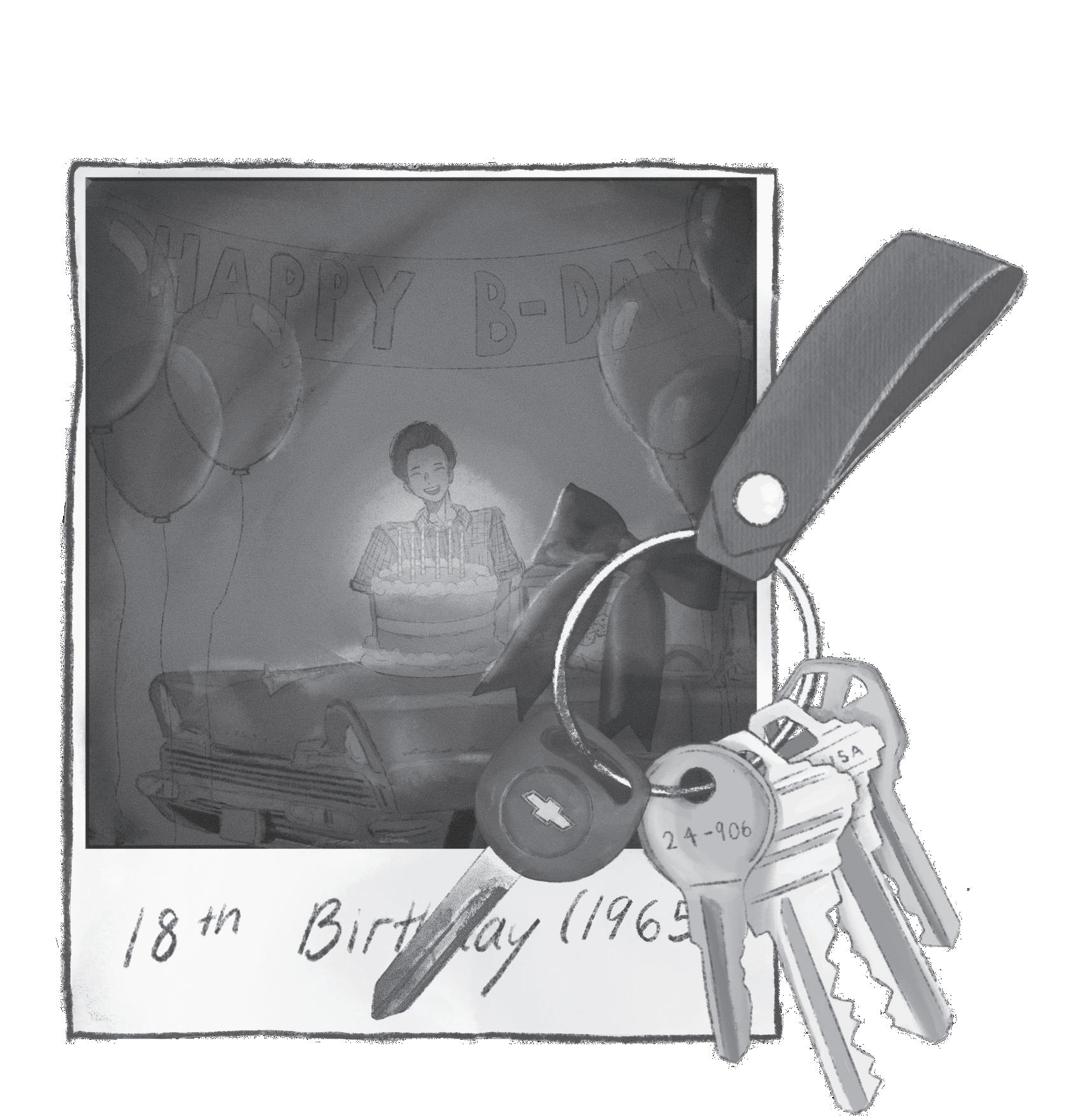
I’m strolling down fourth street with my friends on a bright, cloudless day in San Francisco when a loud rumble stops me dead in my tracks. Slowly, a sleek, scarlet-red Ferrari F40 rolls up to the stoplight and stops mere feet ahead of me. My eyes widen in disbelief, and my heart stops beating for a
can hit an incredible 230 mph. Only about 200 of these cars ever made it to the United States; F40s are desirable to collectors and a well-kept model is easily worth over $2 million.
As I snap out of my trance and turn to see my friends standing at the end of the street with bewildered looks on their faces,
that an attachment to gas cars seems to be reserved for classic, analog cars. To many, the appeal for these older cars is that they are less technologically advanced. ere’s no automatic transmissions, no traction control and de nitely no fancy screens telling you where to go.
People admire these cars for the same reason that some lm over digital photography, or vinyl records over Spotify. Analog cars allow for a pure connection between the car and the driver — a tangible, authentic experience that cannot be replicated by modern technology.
But whenever I try to explain the appeal of analog cars to someone, I get more weird looks. e vast majority of people use cars for their intended purpose—that is, to get from Point
When it comes down to simple transportation, electric cars usually get the job done much better than any classic or even modern gas car. Electric cars are the future for every brand, so they receive the newest, fanciest technology. Many electric cars are regularly given software updates, just like your phone. Electric cars also have fewer moving parts, and need less maintenance. Nowadays, car manufacturers don’t even o er high-end features for their gas cars, as they want to incentivize the purchase of electric models.
It’s also impossible to ignore the fact that you can charge electric cars at home and avoid useless to a faraway gas station, spending hundreds of dollars on gasoline, especially as prices continue to skyrocket.

Most importantly, there’s the obvious reality that by driving electric cars, you’re not spewing greenhouse gasses into the air when you drive. Transportation was responsible for 29% of all greenhouse gas emissions in 2021. 60% of all transportation emissions come from light-duty cars according to the Environmental Protection Agency. Electric vehicles provide a marvelous solution to cut back on emissions.
Even in a state like California, which is widely considered to have one of the biggest car cultures left in the country, it’s impossible to go anywhere without seeing electric cars ruling
But for someone like me, sitting behind the wheel of an electric car is the exact opposite of what I desire. I am lucky enough to have driven many di erent types of cars during my driving journey, and it’s just not enjoyable to be behind the wheel of an electric car. I’ve found that a random Subaru with a six-speed manual transmission is way more pure than even the most technologically advanced Tesla. With my hand on the manual gear lever, I feel connected to the car, and it makes a simple drive a hundred times more enjoyable. However, I know I’m one of few who will ever see it that way. e future of all cars will be electric, and that’s a truth I’ll have to accept.
Deep down, I know that it’s for the best. Despite my infatuation with vintage gas cars, it’s de nitely not a good idea to give your average driver a car with 10 cylinders, no traction control, and no anti-lock braking system. Being obsessed with gas cars is hypocritical given my goal to try and be climate positive. I begrudgingly know that our world and its sustainability should always take precedence over personal desires and
 Rohan Bhatia Sports Editor

A few weeks ago, Secretary of the Treasury Janet Yellen announced that unless Congress takes action, the U.S. government will run out of cash in less than two months. Alarming as it sounds, her statement didn’t exactly trigger the panic that would be expected of an announcement of this magnitude, because this is hardly the rst time this has happened.
Lately, the U.S. has been dangerously short on cash almost every year because of a uniquely American concept called the debt ceiling, which places an upper limit on the amount of debt the country can take on. ough it’s meant to be a reminder for politicians to check the level of national debt, it results in a ridiculous spectacle with terrifyingly large consequences.
ough a debt ceiling is not inherently a bad idea, it is fundamentally incompatible with the way U.S. government spending works.
e U.S. Congress almost always allocates more spending than revenue, causing the government to run a de cit. e president therefore has no alternative but to borrow money to ful ll the budget and raise the national debt.
Only in the U.S. is the necessary borrowing to ful ll the budget not implicitly approved by the legislature. at’s why a Congress controlled by the opposite party than that of the executive can always act “shocked” that “the president’s irresponsible spending has brought the country so close to the debt ceiling once again.”
Of course, both Republican and Democrat-controlled sessions of Congress always fail to mention the elephant in the room — that the president has no actual control over the allocation of money in the budget.
e only solution is for both houses of Congress to agree to raise the debt ceiling, which would subsequently allow the government to borrow more funds.
ough Republicans have been quick to accuse President Joe Biden of excessive spending, the act of raising the debt ceiling isn’t a partisan issue.
Tthe debt ceiling has been raised 78 times, under both Democratic and Republican administrations.
If the debt ceiling isn’t raised, the government is barred from borrowing more money to cover debts already incurred. e U.S. would likely enter sovereign default, meaning the government is no longer able to pay o its debt. is would be the absolute worst-case scenario, as trust in the U.S. economy would collapse overnight, likely plunging the whole world into a recession with destabilized nancial markets.
Sovereign defaults are rare, but have happened more than a few times. e most notable recent examples are Argentina in 2014 and 2020, and Greece in 2015. e consequences for both nations have been grave. Argentina is currently experiencing an annual in ation rate of over 100%, and the Greece regularly reports high unemployment and poor economic growth.
But for a Congress controlled by the opposition, there’s no better leverage than the entire economy to negotiate demands. However, even lengthy debates have consequences. For example, in 2011, the debt ceiling was raised only 2 days before a default was projected to occur following a tense months-long stando between President Barack Obama, a Democrat, and the Republican-controlled Congress. is near-disaster caused the S&P Index to downgrade the country’s credit rating for the rst time, costing American taxpayers more than $1.3 billion.
However, I am more concerned this time compared to 2011 because House Speaker Kevin McCarthy’s power has been signi cantly curbed due to key concessions made during the 15-round long election for Speaker of the House earlier this year.
e Republican delegation as a whole is more radical now than in 2011, and it remains to be seen how negotiations will play out.
Although government spending cannot be reckless, the debt ceiling in practice is the much bigger problem. And unfortunately, abolishing it appears impossible in the short term. Congress loves it because it creates a problem that can be blamed on the president. Not only that, but only Congress can supply a solution.
If nothing else, this impending debt crisis is all the more proof that the debt ceiling must be abolished. Only then can the act of paying o this country’s debt be separated from political squabbling. e U.S. has not missed a single debt payment in its 246 years of independence, and let’s hope this record doesn’t end here.
As we sauntered into the Mountain View Costco, the gray walls of the warehouse matched the overcast sky outside. People stream in and out of the hangar-like doors pushing shopping carts as an attendant checks their membership cards. We surreptitiously blend into the crowd and pass into the store, commonly known for its big deals, big sizes and not big prices — a trademark of American suburbia.
But we did not come to Costco to buy a seven-pound tub of Nutella or a box of aubergine. We previously reviewed IKEA’s Swedish delights, and now, we decided to inspect Costco’s famous culinary o erings. Instead of rating out of ve, our new and improved system features ratings up to six for improved accuracy.
Before trying the store’s hot dogs, pizzas and chicken bakes, we looked for Costco’s world-renowned free sample stations. However, the sample stand we found was giving out Arm & Hammer laundry detergent — not the kind of food sample we expected. Disappointed, we eventually found stands serving almond milk — which tasted as bland as water — pumpkin seeds — which we found exceedingly salty — and tapioca pudding — which tasted as though it were pure sugar. We were disappointed in the strange free sample appetizers Costco had to o er and suspicious of its decision to poison its valuable customers with laundry detergent. 3/6.
After the appetizers, we found Costco’s fast food restaurant. Gaping at its electronic menu, we ordered everything on the menu (as acclaimed food critics would) and then waited
our turn in line. Inside of a kitchen inside the warehouse, six employees bustled around pizza ovens, racks of hot dogs and smoothie machines. When a customer arrived at the front of the line, a worker ful lled their order with the pre-cooked food on the shelves while others cooked more food. rough this e cient manufacturing process reminiscent of assembly-line Fordism, the fast food workers were indeed fast and delivered each customer’s order quickly.
As Costco’s signature item, the $1.50 quarter pound (plus) all-beef hot dog was the rst assailant of our taste buds. It was far cheaper than reasonable, even including a soda in the deal. And possibly large enough for a large American, a deal that no other restaurant can beat. With a meaty texture, the hot dog was rm on the outside and soft on the inside. However, the bun was soggy and required ketchup, mustard and relish from a stand on e hot dog was a good deal, but nothing more than an average hot dog. Given the price, Costco’s signature item deserves a 4.5/6.
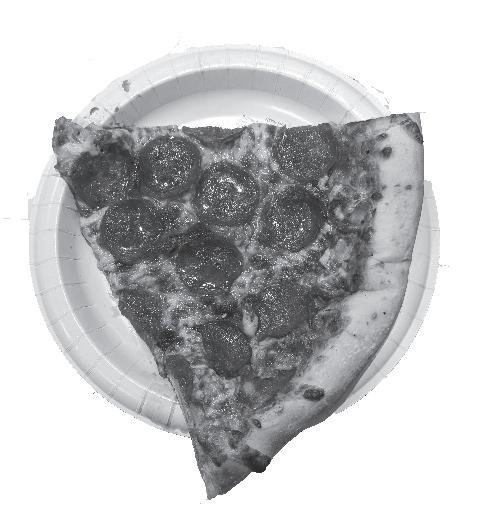
Costco’s pizza is another of its classic items. At $2.49 for a slice of cheese or pepperoni twice as large as an average pizza slice, Costco ers a deal that cannot be beat. But we raised our eyebrows at the greasy mess of pepperoni covered in a sea of orange oil on e crust had already gone soggy and was smeared with grease, and the pizza sagged like a wet piece of paper. e cheese tasted salty and the bread o ered a bland aftertaste. e pepperonis were also soggy and were like miniature in atable pools full of pizza grease, lacking the crispy sear that any good pepperoni pizza should have. We were thoroughly disappointed by the lack of quality, possibly because the slices are idly drowning in grease after they are baked but before anyone orders them. 2.5/6.
While the cheese on the pizza was certainly salty, the $3.99 chicken bake should more aptly be named the sodium bake. What should have been a roll of crispy bread stu ed with chicken pie turned out to be a glori ed Bosco stick with a few chunks of dry chicken thrown in. When we took a bite, our mouths were blasted by the cheese’s intense saltiness, and we immediately reached for the water cup. Somehow, the chicken inside was still dry, and the bread’s blandness contrasted with the ungodly amount of salt used to make it. e chicken bake is one of the most unique items on Costco’s menu, yet also one of the worst. Perhaps Costco should stick to traditional American fast food as bigger and saltier does not necessarily mean better, and the chicken bake is de nitely not worth the price. 2/6.
Churro
After running the gauntlet of salty, greasy food, seeing the exorbitant amount of sugar covering the fried bread twist terri ed us. Even with an electron microscope, it would be impossible to count all of the grains of sugar that overly saturated the $1.49 churro. Despite this, after the initial blast of sugar, the churro lacked sweetness. In fact, it lacked any avor except for the chewiness and burnt aroma of the toasted bread. e burnt ends of the churro were even worse, tasting like hard lumps of burned, amorphous carbon. After many disappointments, it saddened us that even the churro did not meet our expectations. 2/6.
Sundae

We rounded o our meal with dessert, a $2.49 strawberry ice cream sundae that comes served in a plastic cup. Amid Costco’s
greasy menu, the strawberry ice cream (not the vanilla ice cream) is the only source of fruit you’ll nd. e sundae was not actually made with strawberry ice cream, though. Instead it is made with strawberry jam and fruit pieces mixed with vanilla ice cream, which tasted as though it came from a Kirkland Signature carton. Cheap but generic and not the worst thing in the store, the strawberries didn’t make the sundae taste any more like strawberry ice cream. 3/6.
Unlike IKEA, Costco did not provide any entertainment, not even self-operated entertainment. We resorted to admiring the palettes of shaving cream and Starbucks co ee behind the metal chain link fence around the seating area and pondering the meaning of our lives.
We watched as a stream of people walked out of the warehouse through the exit just in front of where we sat, like a stream of consciousness owing through the gates of time. No doubt these people had lives beyond Costco, perhaps even families and children whom they would return home to with the materialistic joys of their purchases. But here we were, eating mediocre ice cream sundaes in a warehouse and watching as life passed us by. 0/6.
In many ways, the work of a critic is easy. However, at Costco, the greasy, salty and questionably healthy food challenged our optimistic view of the establishment, even though its cheap prices are unchallenged. When we walked out, a light drizzle was beginning to fall from the clouds. A cold wind blasted us, but at least it was a relief from the overzealous hot grease. 2.5/6.
I just had a grueling soccer practice, two hours of conditioning and eld work. By the time I get home, eat and shower, it will be almost 10 p.m., and it’ll be well past midnight by the time my homework is done.
I passed out for the night, only to wake up the next morning with a headache and bricks for legs. And as I rushed to throw myself in the shower, scarf down some cereal and bike to school, I remembered why it was so hard to drag yourself out of bed. I had to run the mile in PE after lunch.
Here’s the thing –– I agree with physical education as a required class. I think the tness and cardiovascular health of kids at school is important, and PE is a good way to achieve that goal. ere are many young people who choose to not participate in physically active extracurricular activities, and therefore are at a greater risk of living unhealthy lives. PE is a great solution to that problem.
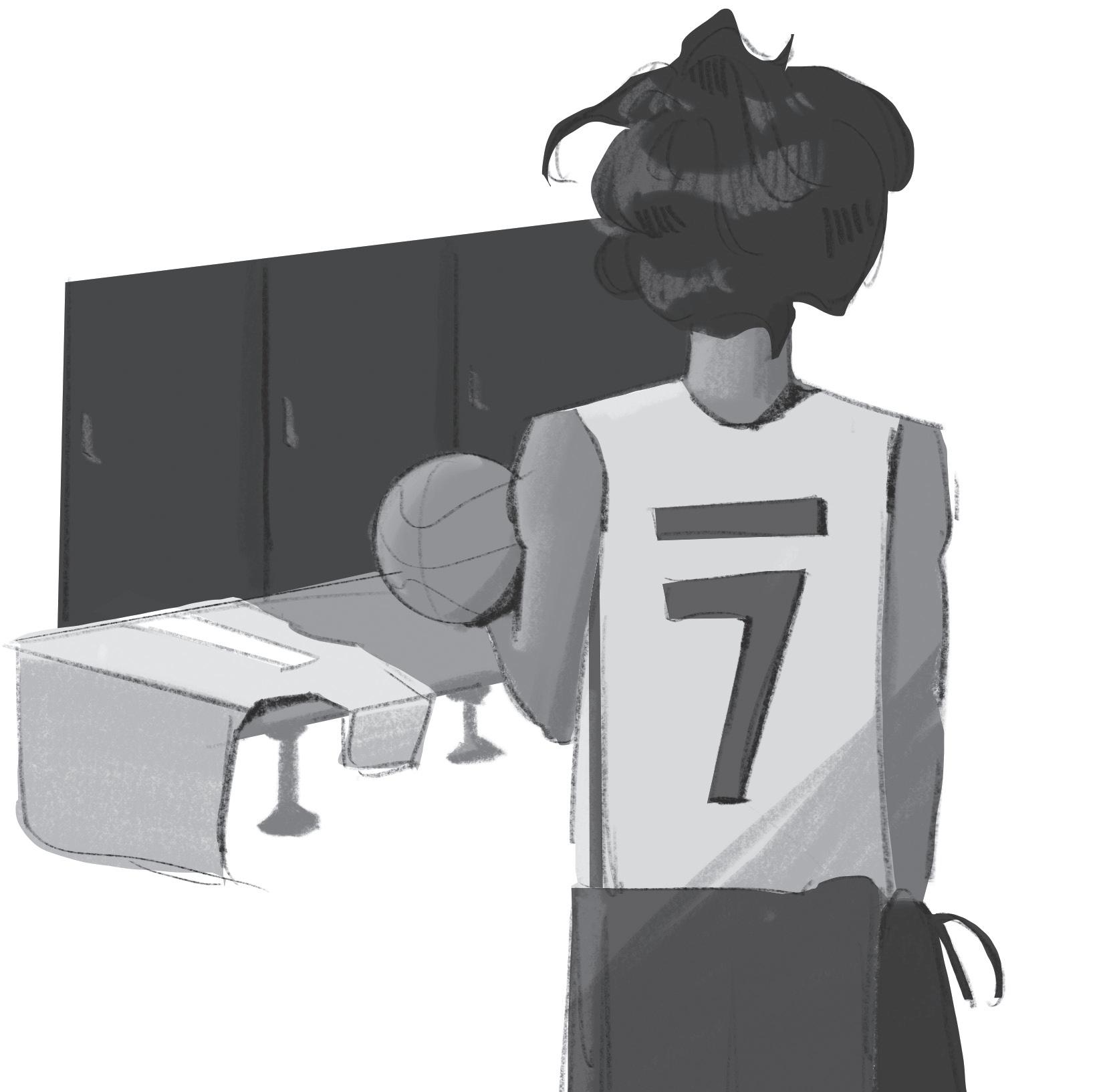
Yet the issue with PE at Paly is that the only way a student can get out of it, besides playing a seasonal Paly sport, which in itself is a huge commitment, is if they have a minimum of three years of prior experience in the activity, which must include yearround training with a 5-6 day per week average. On top of that, students have to train a minimum of 15 hours per week under a quali ed trainer, who, of course, will have to be in contact with PAUSD for updates.
ere are students who don’t meet these criteria who would bene t much more from a prep period than a PE period. Take my situation. I played two hours of soccer daily, yet still never quali ed to skip PE. Instead of having a valuable 90 minutes to get ahead on school work, I’m stuck doing jumping jacks and playing pickleball on my already weary legs. It’s not only unfair to student athletes, but it also discourages them from picking up sports, destroying the point of physical education. Moreover, mandatory PE perpetuates the stereotype of
athletes being dumber than their non-athlete counterparts. By making student athletes exercise during school, they are compromising both their physical and mental health. As a result, athletes have less time to spend on other activities, including homework, spending time with friends and family and maybe most importantly, sleeping.

I have played soccer since I was 4 years old and played varsity this year. I also played (somewhat) competitive baseball until 10th grade. What I found, is that mile day as it has been a ectionately coined, would result in not only a poor performance during after-school practice, but also an unbeatable mental fatigue. I would come home and try to wrap my tired mind around my homework, resulting in both a lack of proper understanding of concepts as well as hours of ine cient work time. And then I would go to sleep, often around 1 a.m..
And yet I never t into the criteria for skipping PE. I wasn’t even close, as I averaged 12 hours a week of physical activity. Compared to 3 hours and 45 minutes of PE –– including time to change twice, pack things up and prepare for class –– my 12 hours of intense exercise is quite the feat, and should be enough to warrant skipping PE and getting a prep. ose who pass the testing standards, especially those who fall into the “Viking” category of those standards, should be able to skip PE for sure. Simply put, the restrictions on skipping PE need to be loosened. It doesn’t make sense to have athletic kids in a class
that was designed for those who aren’t as physically active. It’s important for students to be supported by school programs, not brought down by them. PAUSD should lower requirements for independent study as a substitute for PE, so student-athletes are encouraged to continue their sport and be supported with an extra prep period.

In order to promote inclusivity and ensure fair learning opportunities and outcomes in the classroom, e Campanile urges administrators to allocate more resources to the special education department to reinforce eligibility requirements, streamline the process of obtaining a 504 and better support students who are legitimately eligible for a 504 plan.
Section 504 of the Rehabilitation Act, introduced in 1973, guarantees rights to people with disabilities and also o ers learning plans to students with disabilities in public education to ensure they receive proper accommodations.
While Section 504 was introduced to bring down barriers in education, a lack of overall accessibility to 504 plans contributes to wide racial disparities in student participation in the program, continuing to perpetuate inequitable conditions at school.
According to e Advocacy Institute, students who have learning plans under Section 504 are overwhelmingly white. Paly is no exception. Of the 315 students with 504 accommodations, 58% are white, 18% are Asian, 12% are Hispanic or Latino and 1.5% are Black. Moreover, a larger percentage of white students have 504 plans than any other racial group: 26% of white students at Paly have 504 plans compared to 8.2% of Asian people. is disparity in 504 accommodations may stem from multiple factors, but racial biases and cultural di erences in students of color can make them less likely to be diagnosed with learning disabilities. A primary way students begin the testing process is when teachers identify them as potential candidates to receive 504 accommodations.
However, due to implicit biases, students from some racial backgrounds may be underidenti ed by their teachers, inherently placing them in more constrained educational environments than their peers.
Parents from di erent backgrounds may also be averse to or unfamiliar with the process of having their children diagnosed with learning disabilities, preventing these underrepresented students from getting a potential diagnosis.
But even after students have been given the green light by their teachers or parents to begin testing, the process can be a nancial burden for students from low-income backgrounds, giving them even fewer opportunities to be diagnosed with learning disabilities.
In order to be eligible for 504 evaluation, students often need diagnoses from a physician. Such psychological evaluations can cost upwards of thousands of dollars out-of-pocket, and students at Paly have said the process is expensive.
In addition, for parents who are unfamiliar with the school system, the idea of a 504 plan and the months-long process to obtain it may seem daunting and not worth the e ort. A student’s nancial situation, cultural background and racial identity should never be a barrier to their education, and as a solution to increase the accessibility of 504 plans, e Campanile thinks the district should
o er to cover the cost for any student who wants to be tested for learning disabilities. is would serve as a rst step toward standardizing the process of obtaining 504 plans and eliminate the opportunity for students to obtain diagnoses through private practitioners which often results in overdiagnosis and bene ts those of privilege.
Similarly to how eyesight and hearing testing is conducted in PAUSD elementary schools to detect potential learning disruptions from an early age, ADHD tests or other 504 eligibility tests could be o ered by school psychologists for students who request it.
e Campanile also recognizes that increasing student accessibility to 504 plans poses the risk of misuse. 504 plan rates are often disproportionately high in high-income areas, and while nationally, around 2.3% of students have 504 plans, in Palo Alto, 16% of students have them. In some high-income areas, over 30% of students have 504 plans — telltale signs of a broken and exploitable system. Regardless of this potential for abuse, e Campanile thinks in order to increase the credibility of 504 accommodations, o ering free educational evaluations through the school district would help prevent students from circumventing standardized systems and allow access to opportunities for marginalized communities.
TEXT BY RACHEL FEINSTEIN ART BY RACHEL LEEEditors-in-Chief
Christie Hong • Lucy Li • Dhruv Shetty
Hannah Singer • Nidhi ummalapalli
News/Opinion Editors
Olivia Atkinson
Julian Hong
Sports Editors
Rohan Bhatia
Neel Sharma
Business Manager
Gabriella Gulman
Managing Editor Lucas Yuan
Margot Blanco
Isabella Bian
Annika Chu
Lillian Clark
Dinu Deshpande
Rachel Feinstein
Erik Feng
Cayden Gu
Jessica Bae
Janya Jain
Stanford law students disrupted a scheduled March lecture from visiting conservative judge Kyle Duncan to protest his stances on the transgender community, gun control and social media.
During his talk, Duncan, who has defended Louisiana’s gay-marriage ban and dismissed the concept of gender-identity and chosen pronouns, could not give his prepared speech due protesters’ repeated interruptions. When Duncan called for assistance in restoring order, Tirien Steinbach, Associate Dean for Diversity, Equity and Inclusion at Stanford, said Duncan’s beliefs hurt many people in the room.
While e Campanile recognizes it was within Steinbach’s rights to speak out against Duncan, we think Steinbach overstepped her
authority. Since Steinbach was in a position of power and responsible for restoring order during the lecture, she should have used her authority to encourage political discourse on both ends of the ideological spectrum.
Following the disruption, Stanford Law School Dean Jenny Martinez criticized students’ behavior. She said humans should “replace condemnation with curiosity, invective with inquiry.”
e Campanile agrees and thinks everyone should have the right and the opportunity to share their beliefs, even if they don’t align with the majority opinion.While protesters disagreed with Duncan’s views, they were not entitled to shut his lecture down. By shouting vulgar comments and heckling him during his speech, students were
not exercising their rights to free speech, but were encouraging censorship of the conservative viewpoint.
Unfortunately, it seems like some universities and colleges are incubating students in a political bubble, and college free speech controversies like this one are a re ection of the US’s trend toward increasing polarization. Political polarization refers to the divergence of opinions towards the extreme, opposite ends of the ideological spectrum. More action must be taken to confront this political polarization occurring on college campuses as the rst step in addressing nationwide polarization and political intolerance.
To tackle this issue, e Campanile urges colleges to hold seminars or discussion-
based classes to encourage respectful political discourse. We think students should not be put down for asking questions because fostering curiosity and understanding opinions in a conversation is necessary to address polarization.
e Campanile also urges law schools to emphasize a curriculum that is more tolerant of di erent perspectives.
While increasing the political diversity of professors would be di cult, encouraging the diversity of guest speakers would be more achievable and would expose students to a wider range of perspectives. Colleges must assume responsibility and educate students so they are studying all sides of an issue and can remain impartial when needed in their future professions.
Lifestyle, Sci/Tech Editors
Alec Bonnard
Holden Lee Kate Xia
Art Director
Rachel Lee
Social Media Manager
Heather Song
Photo Editor Tyler Wong
Writers
Justin Gu
Lucas Guan
Elizabeth Gulman
Ti any He
Claire Jittipun
Albert Jung
Lea Kwan
Naveen Narayanaswami
Henry Liu
Gavin Lin Shamsheer Singh
Shiki Toyama
Luca Vostrejs
Jerry Xia
Brianna Zhou
Illustrators & Photographers
Albert Jung
Sophia Kelly
Ivy Lee
Jada King
Adviser

Rodney Satterthwaite
Teresa Wang
Katie Wu
Cherianne Yoon
Letters to the Editors: Email all letters to editors to theeds24@googlegroups.com. e Campanile prints letters on a space-available basis. We reserve the right to edit submissions. e Campanile only prints signed letters.
Advertisements: Advertisements with e Campanile are printed with signed contracts. For more information regarding advertisements or sponsors in e Campanile and their size options and prices, please contact e Campanile Business Managers by email at campanile.ads@gmail.com.
Note: It is the policy of e Campanile to refrain from printing articles that misrepresent or attack speci c individuals within the Palo Alto community. e Campanile would like to thank the PTSA for supporting the mailing of our newspaper.
Our Vision Statement:
e Campanile has upheld the highest standard of student journalism for the last century by engaging the community through various mediums of storytelling. Our coverage of news, culture and athletics aims to represent the diverse perspectives of our student body.
Designer and former Twitter employee Danny Yee turns on his monitor and scrolls through his Twitter feed. He smiles as he reads the latest news on SpaceX’s starship launch and laughs as he watches a video that applies a new AI image recognition model to a segment from “ e O ce.”
Twitter is Yee’s favorite platform to catch up on the latest science, engineering and technology developments. And like many other Twitter users, the platform’s focus on delivering real-time, breaking news gives Twitter part of its popular appeal.
However, Tesla and SpaceX founder Elon Musk recently became Twitter’s owner and CEO, closing a deal to buy the company for $44 billion, and he has made changes that some users like Yee say could change the platform’s direction.
While Musk says he bought Twitter to promote free speech on the platform, software engineer Yanning Chen, who worked at Twitter until Musk’s takeover, said Musk’s primary goal is pro t.
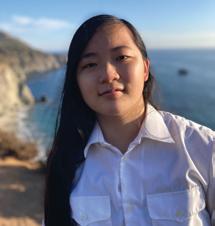
“When the acquisition happened, Twitter transitioned into a platform dominated by Elon’s own ego,” Chen said. “He desperately wants to monetize it because he spent $40 billion to buy it out. ere’s lots of bricks in the engineering infrastructure and also relationships with existing advertisers are not going well, therefore a lot of money has been pulled from Twitter.”
Although Musk may be on monetization, Chen said many of the CEO’s new policies are hurting Twitter’s advertising revenue, which dropped over 50% since Musk took over. Chen said Musk lowered the strictness of Twitter’s content lters, originally to promote free speech, but these altered lters have threatened brand safety for advertisers, driving them to other platforms such as Facebook and Google.
“Lots of advertisers just decided to leave the platform because it has almost become an industry standard that platforms should guarantee brand safety, however, Twitter has just breached that,” Chen said.
In addition to revenue issues, Chen said Twitter moved its backend infrastructure from an on-site data center to cloud servers in 2020. According to Chen, Twitter is paying for costly cloud hosting services, and it is di cult for the company to switch back to cheaper self-hosted servers.
“When Elon realized (cloud servers) cost too much and wanted to migrate things back
to the on-premise data center, we realized that the people who were in charge of the on-premise infrastructure were already gone,” Chen said. “ e institutional knowledge did not exist anymore, and nobody knew how to maintain those jobs.”
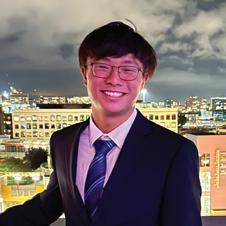
And according to Chen, engineers have also been leaving Twitter because it has become a more challenging environment to work in since Musk took over.
“In a meeting, some top engineers got red because they just explained the truth that (some of Elon’s tweets) don’t seem to be that popular anymore,” Chen said.
Chen also said Musk has not encouraged employees to challenge his ideas, focusing on executing his monetization and feature plans as e ciently as possible. An email sent to Twitter’s press account with a request for comment received an autogenerated reply with a single poop emoji.
Designer Danny Yee, who worked at Twitter until 2021, said Musk has also strayed away from the company’s original mission of being an inclusive and diverse platform for communication because of his monetization e orts.
“Towards the end of my time at Twitter, there was a big push to encourage healthy conversation on the platform,” Yee said. “We were making big strides there, and that was indicative of why you saw big advertisers showing up on the platform.

ey thought it was a safe and healthy place to be.”
As a frequent Twitter user, Yee said he noticed more toxic content from accounts he was less interested in immediately after Musk took over.
“I was seeing more voices from people that I didn’t follow,” Yee said. “ ey tended to be politically di erent from what I saw before. ere were a lot more conservative voices, and it did feel like they were more toxic conversations on the platform. More recently, though, that has fallen o , and I’m starting to see more of the things that I enjoy seeing.”
Senior Rigel Cierniak, who also uses Twit ter frequently, said they noticed that political discussions on Twitter have become more polarized. ere are di erent bubbles that people isolate themselves in, but I think (Twitter) has become increasingly polarized,” Cierniak said. “I’m not sure if this is because of Twitter itself or if it’s a wider political thing, but I de nitely notice more radical opinions on both the left and the right.”
Cierniak said Twitter has also been more unstable due to fewer content restrictions and

features, such as image cropping, and feature changes without prior warning.
“One time, images were down for an entire day which was not something that happened super regularly before,” Cierniak said. “Content regulation has been a lot more (relaxed) in di erent ways, which could be good or bad, but I’ve noticed more hate speech. Also, a lot of features are being changed and removed without notice when normally there would be a testing period.”
But according to Yee, Musk’s style of experimentation and rapid iteration could improve the company in the long run.
“It’s great to see that they’re testing out features,” Yee said. “ ey seem to be testing a lot more features that support creators in a good way, which I think is great because YouTube and TikTok do that better.”
And Cierniak said Musk’s content changes will not a ect how they use the platform.
news and updates on the topics he follows.
“One of the things that Jack Dorsey was fond of saying about Twitter was that if you’re trying to gure out what’s happening in the world, (browsing Twitter is) actually easier than looking out your window,” Yee said. “I love that about Twitter.”
Ultimately, Yee thinks Twitter is an e ective platform for public discourse, which will continue to grow, but Musk could pay more attention to the voice of the community.
“Twitter is not rocket science,” Yee said. “I love seeing what Elon Musk is doing in his leadership at SpaceX and Tesla, but Twitter is not the same type of thing as Tesla or SpaceX. It really is more about community and relationships, and I don’t think the current leadership of Twitter is recognizing how important that is.”
Textbooks lay scattered across the desk as I furiously scribble in the margins of my notebook. Glancing up at the clock on the wall of the library’s silent room, a wave of panic washes over me while I calculate how many more hours I have until midnight to complete this assignment.
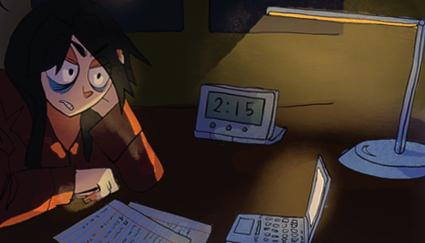
As I turn back to my desk, I hear the rattle of ice from boba drinks as a group of students stroll into the room. Frustrated by the distraction, I return to staring at the scrabble of words on my page, desperately trying to recollect my thoughts and focus on the task at hand.
After having completed AP exams and the majority of my tests, I can happily report all my studying paid o Now that the school year is practically over, we should all give ourselves a pat on the back for making it to the end.
Here is where I could make the typical belabored point that I overburdened myself, and that people shouldn’t take on such strenuous course loads, but I won’t. While that opinion is valid, letting students push themselves is not necessarily a bad thing. Instead, confronting adversity can be a valuable lesson.
Yes, students should always prioritize their mental health, that should always come rst. However, rather than warn against overburdening, we should change our mindset to embrace failure.
Adolescence is a critical time in our lives not only for experimentation and learning our limits, but for maturing. Students shouldn’t be deterred by low test scores or negative feedback.

Instead, we should learn to embrace challenges and learn from our mistakes.
Although it can be hard to see it in the moment, each push backward that you overcome is a testament to your courage. Persevering through failure is even more impressive than succeeding the rst time.
e stakes of high school are relatively low compared to repercussions later in life, so tackling adversity in our youth while we still have a safety net will help strengthen resilience.
In my experience, I’ll be honest and say I had a hefty workload and received my fair share of slaps in the face. However, learning to push through and keep my head above water taught me invaluable lessons such as how to manage my time, study e ectively and set boundaries for myself. But above all, it gave me a sense of pride I hadn’t previously experienced.
It’s the lessons students learn from struggling through problems and working hard, not the scores, that have the most meaning and impact on their future.
It is also important to realize everyone else is facing their own struggles. Some are just better at hiding it than others. We shouldn’t use failure to compare ourselves to others. It manifests itself in all kinds of forms. So be reassured in knowing that what you are experiencing is normal, and you should be proud of yourself for persevering through your hardships.
It’s OK to make mistakes and grow from them, and you shouldn’t be deterred from confronting failure.
Lillian Clark Senior Sta Writer

“Don’t push yourself to take the hardest classes possible. Sign up for classes that you are passionate about and that you would enjoy taking.”
— Ankai Jin“Study hard and pay attention in all your classes, because everything is interesting and all knowledge can be used somehow or lead to new interests, and make the most out of every opportunity,”
— Phela Durosinmi“Don’t rush through your time in high school. Just focus on what is going on now because it goes by very fast.”
— Grace Corrigan“Make the connections you can here and take advantage of what this community has to o er, but don’t expect (high school) to be the answer to when you will make it or break it.”
— Katie Firtch“Be empathetic, loving and compassionate to those around you. Moments of kindness build up, and you can change someone’s life.”
— Noah Boyarsky
“My favorite part about being with the band is making ri s with my bandmates,” Cudahy said. “We build o each other.”
AG- at minor chord ri , providing a melancholic yet comforting tone, emanates from the front of the quad.

Junior Maximilian Rabbitt-Tomita strums his guitar and sophomore Dexter Cleveringa sets the beat with his drums.
Students gather around, cheering and clapping in eager anticipation of the performance.
Leaning into the microphone, sophomore Clay Cudahy starts to sing, beginning his band’s live performance of their self-composed “Awful Sounds.”
An exuberant reaction follows from the audience as the student alternative rock band, e Riot, nishes their piece.
Rabbitt-Tomita, the rhythm guitarist, said the satisfaction of providing others with entertainment is his favorite part of playing in the band. “ e best thing about being a musician is playing for other people,” RabbittTomita said. “ at’s the whole reason you do it. It’s really fun playing music. It’s a surreal feeling.”
Cleveringa said e Riot, as a collective, focused more on recording than performing this year.
“We have a single coming out soon,” Cleveringa said. “We’re in the very last stage of production and mixing. We used to play our own little shows at Lytton Plaza, and those were really cool, but we had a guitarist move to New York since then. He had all (our) PA equipment.”
Rabbitt-Tomita said the band hopes to provide professional-grade recordings in the future. is summer, we’re going to do a recording session in Oakland at a place called Tiny Telephone,” Rabbitt-Tomita said. “We’ve been funded to record at a professional studio, which would be fun.”
During their weekly meetings and occasional summer sessions, RabbittTomita said the band members share and combine their compositions.
“We have a melody, a structure and chords,” Rabbitt-Tomita said. “It’s fun writing music because you can just get creative with it.”
Alternative rock can encompass various styles, including indie, britpop and grunge. us, Cleveringa said the band draws from a diverse range of inspirations.
“My favorite artists to listen to are probably either Noel Gallagher or Damon Albarn, but our best in uences come from di erent musicians and di erent artists,” Cleveringa said. “I also listen to a little bit of hip-hop, a little bit of trip-hop (and) some Latin music.”
Cudahy said the band formed in middle school through a shared passion for music and joint sessions with Cleveringa.
“We wanted to imitate our favorite bands,” Cudahy said. “It started when I got together with Dexter, our drummer. We’ve grown to include more people over the years.”
Rabbitt-Tomita, who joined the band three years ago, said his interest in music started at a young age, with inspirations from alternative and grunge rock musicians.
“I had been a part of a separate band in middle school, and did a lot of indie alternative stu ,” Rabbitt-Tomita said. “I always wanted to emulate my favorite bands: e Killers, Nirvana, or e Clash.
Ultimately, Rabbitt-Tomita said students should follow their passions and do what did,” RabbittTomita said. “Over time, (music is) something I’ve kept doing and enjoyed. worked Don’t hold back.”
Walking into a classroom in April and May is always a tragic sight. Blue Kleenex boxes sit in every room as sni y students ll trash bins with crumpled tissues.
For some students, allergy season means getting up every once in a while to get a tissue. For others, it means packing portable tissues in their backpack in case teachers have yet to stock up for the allergy apocalypse. (Personally, I prefer to snack on tissues to silence others.)
As someone who has experienced a wide variety of allergy-induced symptoms, I’ve seen how people react to various stages of allergies. Walking through the tissue usage spectrum, people range from the “literal immune system” to the “mass producer of bodily uids coming out of the nose.” For those lucky enough not to consider themselves allergic to any form of pollen, congratulations –– you have pollen privilege. People don’t spot your allergies because they are less noticeable than Waldo.
For those who get minor symptoms and, at most, get up once during class for tissues, you should get a handkerchief. I don’t know how they work, but they seem pretty appropriate, given the minuscule amount of uids coming out of this group. is level is what people typically think of when they think of allergies. However, there are two more levels.
For students who are heavily allergic to pollen, bring tissues from home and employ the advanced technique of “multiple tissues, one trip” to last them through a given period, I feel for you. e number of times these people get up to get tissues becomes not only noticeable but a little absurd to others who don’t have allergies. is phase is usually where I am at the start of the allergy season, and getting up constantly is annoying and embarrassing.
Finally, there is the “are you sick” category. When you have a bad day with allergies and generally have extreme symptoms, you may end up glued to the tissue box for nearly the whole day. People will mistake your reaction for sickness, and it’s hard to concentrate on anything else when your nose is a water fountain. Please be kind to the human sinks.
No matter where people are on this list, please sympathize with anyone with allergy symptoms. When I’m having a bad day, I question how it is possible for my nose to produce so many uids when I’m already dehydrated.
And when antihistamines don’t work, I like to shock my immune system with vitamins from my multivitamin tablets and then completely bombard the system with 9000% vitamin C and 6000% vitamin B-12 tablets, which actually seems to work.
Disclaimer: Just because my immune system responds to vitamin overload does not mean it works for everybody. Please do not pop pills after reading this article. e next time somebody (repeatedly) gets up to blow their stu y nose, just be thankful it’s not you with th(yet).
Lively music and loud laughter ring through the new Los Altos and Palo Alto locations of e Penny Ice Creamery as customers ood the shops to get a taste of the fresh, scratch-made ice cream, originally located in Santa Cruz.
Zachary Davis, the co-owner of e Penny Ice Creamery, said he decided with his coowner Kendra Baker to form a food business together and established the ice cream shop in 2009.

“We were going to start a bakery at rst but decided to open an ice creamery because we thought it would be best to make one product and do it really well,” Davis said.
One of the workers behind the counter is the Director of Operations, Rahul Bhambhani. Bhambhani said the brand philosophy of Penny’s makes it more than just an ordinary dessert store.
“I was a guest at the ice creamery long before I joined the team,” Bhambhani said. “I liked how it was made from scratch in Santa Cruz with locally sourced ingredients.”
Davis said one objective that Penny’s has worked towards since it rst opened doors is maintaining a strong connection with local communities.
“We are always trying to give back more than we take out,” Davis said. “We’ve hosted fundraisers and donations with local schools and organizations to spread our joy.”
Bhambhani said e Penny Ice Creamery to feature local produce by keeping their supply chains as local as possible.
“One main brand philosophy is to feature artisans, growers, foragers and to have a net-regenerative impact on our community,” Bhambhani said. “We don’t just go into a new community with the intention of making money.”
In the spirit of giving back, Bhambhani said e Penny chooses to work with local growers in the community to give them a spotlight.
ere are many places that do farm-totable, but as far as ice cream goes, I don’t think many businesses o er that,” Bhambhani said.
“When you enter our store, you’ll see the speci c farm names written under the avors because we want people to know that the ingredients in our ice cream are not sourced from random places outside of the area.”
Unsurprisingly, the current avors o ered at the shop re ect the brand’s loyalty to its partnerships with local farmers.
“We always have our fresh mint chip ice cream, which is from Sea to Sky Farm in Santa Cruz, and we also have our ‘Bee’s Business’ ( avor), which uses oranges from Abounding Harvest Mountain Farm close to Los Gatos,” Bhambhami said. “In addition, we have our ‘Chamomile Dried Apricot’ and we source the apricots from Sea to Sky Farm.”
Bhambhani said one unique avor customers love is the candy cap mushroom, which is sold exclusively in January.
“Kendra, the owner (of Sea to Sky Farm), goes and forages them from the Santa Cruz mountains,” Bhambhani said. “It has a really nice buttery avor. People tend to see it and

think it’s really weird, but then they try it and think it’s amazing.”

According to Davis, the labeling of speci c farms comes hand in hand with e Penny’s second brand value, which is transparency.
“We want to create our operations around making everything from scratch so that it is clear to us and the guests where everything is coming from and where it’s being made,”
Davis said.
Bhambhani said the unique qualities of the store would not exist without the wealth of agriculture surrounding the Bay Area.
“We are from a very agriculturally rich region in California,” Bhambhani said. “We are very close to Watsonville, which has a lot of agriculture, and there are lots of local farms in Santa Cruz. e owner has a great relationship with many farms in this region, so we strive to mix various products such as berries, citrus, dates (and) candy cap mushrooms into our products.”
The PAUSD Promise, a set of guiding principles that Palo Alto Uni ed Schools uses to guide its policies and practices, says one of its missions is for its students to maintain healthy attendance.
In other words, the district wants every student in class as long as they are healthy.
However, in a survey conducted by e Campanile through Schoology, over 40% of the 36 students who responded said they have skipped a class to catch up on school-related work.

e survey also indicated students feel the need to cut class when they have multiple tests on a single day, as many say they cannot study for that many tests in one day.
Senior Alexis Carey said he has skipped classes because of his rigorous extracurricular schedule.
“Sometimes there simply wasn’t enough time in the day to get the studying done that I needed to, so I would skip class,” Carey said.
Other students, including sophomore Aiden Chen, say they never skip classes to study for tests.
Most of those surveyed agreed skipping classes for academic purposes is OK, and 80% of students who say they have never skipped a class think skipping classes for academic purposes is acceptable.
Carey said skipping classes should not be taken lightly, however. ere are certain situations where skipping class is necessary or bene cial,” Carey said. “But it’s also wrong, and I do feel guilty when I skip class.”
Assistant Principal Erik Olah said administrators are aware that students occasionally skip classes to study. He also said this is not a new issue.
“We used to call it strategic cutting, where the student would skip a class to go study,” Olah said. ey would pick classes where they thought, ‘Yeah, it’s no big deal if I missed this one today.’”
According to the Campanile Schoology survey, students also sometimes skip school to catch a mental health break.

“Paly culture can tear you to pieces,” an anonymous senior said in their survey response.
Olah said he hopes the district has put enough measures in place to help students who are struggling in tough situations, which may lead to skipping class.
He also said if students ever feel overwhelmed, they should reach out for help by going to the Wellness Center or talking to their counselor.
“I would love it if no student felt like he or she would have to skip a class to study,” Olah said. “Hopefully, we have measures built in, so that we can be on top of the situation before it becomes overwhelming.”
ART BY RACHEL LEEIn the event of a house re, people may or may not nd enough time to grab a couple of valuable items before they evacuate. It might be a framed photo, stu ed animal or even a wallet.
ART BY RACHEL LEESenior Catie Nudelman said the simple presence of her dog, Boomer, has had a signi cant positive impact on her life.
However, many pet owners’ rst thought might be to swoop their furry friend out of the burning building.
Humans have often instinctually bonded with animals, and as more animals have become domesticated, owning a pet has increased in popularity. With this, a pet’s importance can often be overlooked and underappreciated.
“Boomer cheers me up by just being so adorable and so loving and always being excited to do anything whether that’s going on a hike, going to the beach, or just getting ready to eat dinner,” Nudelman said.
“He is genuinely so happy every day, and it has de nitely brightened my days.”
“Waking up to him and coming home (to him) every day brings me happiness,” Nudelman said. “Having a dog does decrease my stress because they’re just such carefree,
loving animals that de nitely bring a lot of joy to the environment.”
Nudelman also noticed that Boomer has helped her family get together more often and have something to bond over.
“I think my mom and I got a lot closer when we got a dog because we were able to bond over how much we love him,” Nudelman said. “We are able to get out more and go on walks with him, which feels great.”
Nudelman said having Boomer, who is a rescue dog, has had its obstacles, but she is glad she is able to provide him with a loving home.
“I didn’t grow up with him, but having a rescue dog has de nitely taught me how to deal with dogs that come from di erent homes,” Nudelman said. “But, I know that we’re giving him a forever home, which feels great.”
Senior Jia Hiremath, who has provided temporary homes for many foster puppies, said she also noticed friends and family coming together more often when she fostered a litter of puppies for two months.
“All my friends wanted to see them, and they were so fun and en-
ergetic,” Hiremath said. “ e litter of puppies brought smiles to everyone’s faces when they saw them. ey were always super happy and they made everyone else really happy, too.”
Johanna Ehrlich, Paly parent and member of Pet Partners, a pet therapy organization, brings dogs to Paly’s campus every week to help students relax and alleviate stress. She said she enjoys watching students interact with the dogs.
“ e reason I come is for the reactions of the kids,” Ehrlich said. “Everyone just relaxes, and whatever was on their mind just disappears and they are able to completely de-stress. Even just petting the dog is really therapeutic, and it helps get

their mind o their stress, especially during or before exams.”
Nudelman agrees and said she has noticed Boomer helping her reduce stress and is always around to cheer her up. She said Boomer is an amazing friend and constant companion throughout her days.
“Waking up to him and coming home (to him) every day brings me happiness,” Nudelman said. “Having a dog does decrease my stress because they’re just such carefree, loving animals that de nitely bring a lot of joy to the overall environment.”
Brianna Zhou Senior Sta WriterThe vibrant virtual realm, teeming with viral dance routines, crafty political satire and a medley of memes — otherwise known as TikTok — is junior Hope Van Riesen’s digital lifeline.
To end her bustling school day, Van Riesen always has one constant ritual of a swift dive into the app.
But recently, this teenage sanctuary has come under siege.
Like many TikTok users, Van Riesen is outraged at the discussions at the state and federal level to remove the platform from the screens of all Americans. TikTok, a popular shortform video app, quickly became one of the most downloaded apps on both the App Store and Google Play just three years after its launch. Its popularity and the fact that it is owned by the Chinese company Bytedance, raised questions about the potential for the Chinese government to exploit and access user data collected by the app.
But Van Riesen said the e orts to remove TikTok because of concern about its data and privacy practices are seemingly going too far. e government shouldn’t be able to ban an app just because they don’t like it or are worried about national security,” Van Riesen said. “It’s important to protect our
privacy, but we also need to protect our right to express ourselves.”
However, junior Michael Cohen Wang, who does not use TikTok, said Chinese ownership is a dangerous aspect of the social media app.
“It’s important to be aware of the potential risks of using apps like TikTok,” Cohen Wang said. “ e Chinese government’s ability to access data from Chinese companies creates a unique risk for TikTok users, and many people don’t seem to (understand) that.”
Since other social media platforms follow similar privacy and data collection policies, though, Van Riesen said TikTok should not be the only targeted app.
“As long as there is full transparency between the users and the company’s usage of the individual persons’ data, then it is not as dangerous, considering all social media apps collect data,” Van Riesen said. “If one app is getting called out, it should be the same for all the others as well.”
Cohen Wang said TikTok’s overall in uence on users from it’s quick popularity is a di erent kind of concern since it had been developed in just over 200 days but gained over 100 million active users within its rst year.
e most alarming part of TikTok is its impact on consumers, as the format of short content is super fast-
paced,” Cohen Wang said.


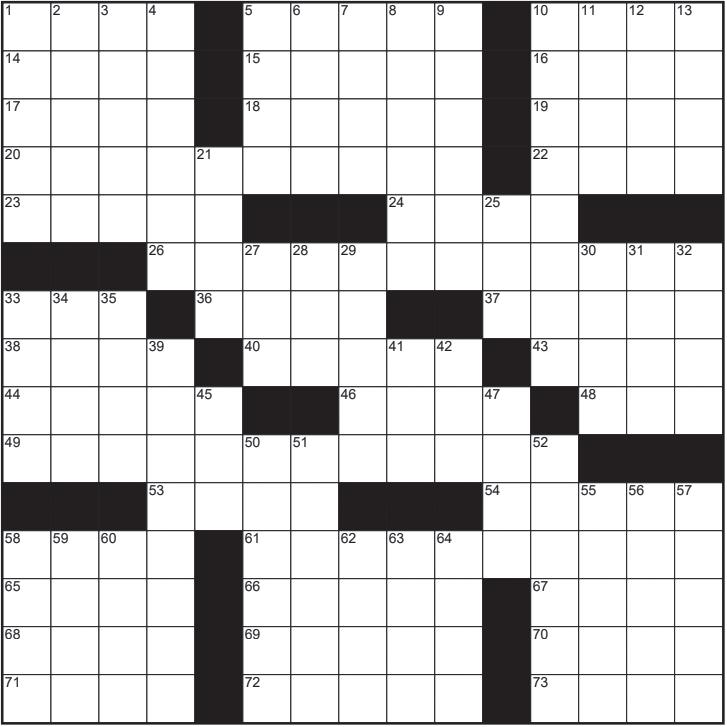
“ ough YouTube Shorts and Instagram Reels are just as addictive, TikTok has a worse reputation because a bunch of bad trends came from TikTok like the devious lick trend.” e Biden administration has said it will continue to scrutinize the app’s security and privacy practices, but it remains unclear whether the app will be banned in the United States or be forced to sell to an American company.
Regardless, the controversy surrounding TikTok has raised important questions not only about the intersection of technology, privacy and national security, but the e ects it has on users’ mental health as well.
Mental Health & Wellness Coordinator Eva Martinez said her concerns about TikTok and all social media apps go beyond those of lawmakers, citing the correlation between social media and mental health, as well its direct e ects on teenagers.
“ e positive and negative e ects of social media usage can vary based on the individual,” Martinez said. “It’s important for students to strive to keep a balance in their lives and check in with themselves about how they’re feeling about their social media usage.”

After a erce battle in the fth set, boys volleyball (7-8) fell short against number one seed Los Altos (14-1) on May 2. Paly held a 2-0 lead following the rst two sets, but Los Altos rallied and won the nal set by two points.
Despite going into the game knowing Los Altos was a formidable opponent, head coach Ed Yeh said the team put in maximum e ort and intends to improve on its ne mechanics.
“ ey kept the energy as much as they could,” Yeh said. “Every time we try to improve on little things. A lot of these kids came in skilled, so we just have to tune up their skills and have them work as a team.”
Junior Cal Currier said losing a 2-0 lead lowered the team’s motivation.
“We won the rst two sets, but then they won the third and fourth, and we lost our morale after that,” Currier said. “It was really hard to turn the energy back up on the court.”
Although his team lost, Yeh said he was impressed that it took the number one seeded team to the fth set.
“ e boys did really well. We took Los Altos to ve sets twice, so we deserve to be out there,” Yeh said.
Currier also said the team played well despite having a height disadvantage in the SCVAL league.
“We are the shortest team in (SCVAL), and we’ve done really well for the height we have on our team,” Currier said.
Considering the game was senior night, Currier said the seniors deserve credit for their hard work and contributions to the team.
“Some of our best players are seniors, so working to replace them next year is going to be really di cult,” Currier said. “I’ll miss them so much. I love the way they play, and they’re really good people.”
Yeh said the seniors came far this year, and he is sad to see them go.
“I’m proud of all of them. I’m proud of their e ort, and I’m proud of their attitudes,” Yeh said. “Some of these kids have been here three or four years, and I probably see them more than any teacher on campus. I’m going to miss them all.”
Giants fan and junior Maximilian Rabbitt-Tomita said bad calls are a part of baseball that robots can’t replace. Additionally, Rabbitt-Tomita said missed calls are an inevitable byproduct of human refereed sports and a concept fans must live with to keep baseball authentic.
“I think they are just a part of the game,” RabbittTomita said. “If you don’t like it, you have to move on even if a devastating call happens. Robot umpires take away from the sport. (Missed calls) are a necessary evil in baseball because they keep many important aspects of the sport intact.”
Rabbitt-Tomita also said strike and ball calling in baseball should continue to be subject to umpires’ decisions. “ e strike zone should be uid in nature,” Rabbitt-Tomita said. “ e umpire choosing whether a pitch is a strike or ball is an important aspect to baseball. It’s not just a rectangle, and what gets called, goes.”
While professional baseball has an abundance of subjective calls within its rules, this is true of other sports too, including at the high school level.
Varsity water polo player and junior Mary Henderson said in her sport referees call plays from above the surface of the water. Henderson said this can interfere with their judgment because they cannot always see what is happening beneath the surface.
“(Water polo) is very di erent because it is under the water,” Henderson said. “ e refs can’t dictate what happens under the water unless they can see an obvious suit hold or kick.”
In addition, Henderson said referees often misread player contact due to the chaotic nature of water polo, making it hard for referees to understand the intricacies of con icts between players, which ultimately leads to unfair calls.
“A lot of times, (referees) only see the result of initial contact because it’s hard to see everything going on in a con ict,” Henderson said. “ ere are so many players and everyone is constantly in contact with each other so it’s hard to make good calls.”
Henderson said subjective refereeing can lead to ejections and even suspensions depending on the situation, and players tend to be penalized for arguing against calls.
“You have to go with what the ref says, and if you argue, most of the time it is a red card,” Henderson said. However, Henderson said the powers given to referees are necessary to help keep water polo safe.
A sport that is currently revolutionizing their approach to refereeing in sports is soccer. rough the use of technological refereeing assistance, o cials in the sport say they want to try to eliminate subjective calls like o sides and out of bounds.
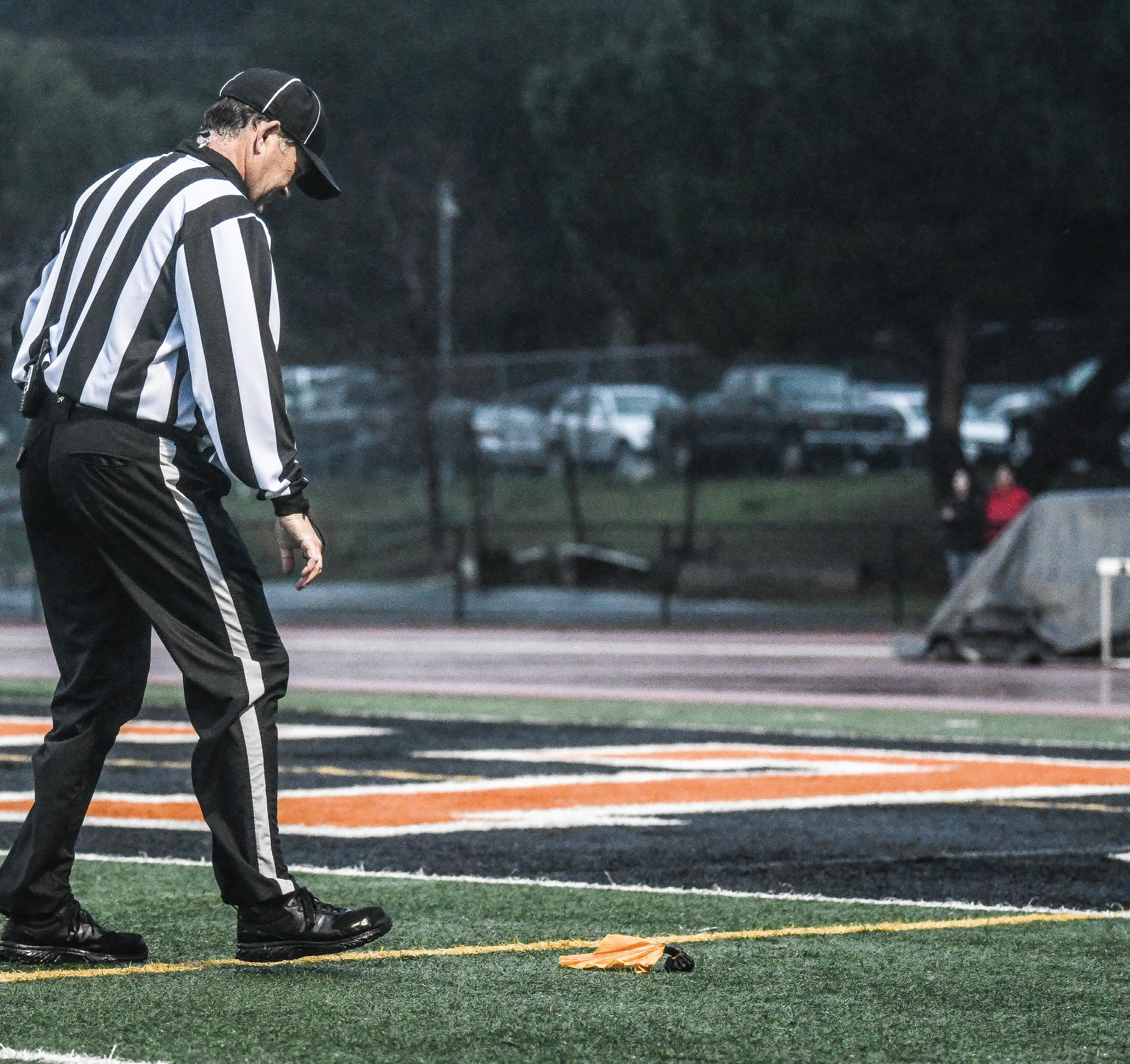
ough professional leagues in soccer try their best to eliminate subjective refereeing in close calls, student leagues are not always a orded the same luxury.
Sophomore Ben Levav said his sport is subjectively o ciated. Levav said unfair factors in professional leagues and in his league work in ways to make games closer and more competitive.
“I think in (professional games), many (calls) are based o of where the ref is from or if they are getting paid by a team,” Levav said. “At my age, we are always refereed unfairly against us. e better team is usually getting unfair calls in order to make games more even because we are kids. If one team is destroying another, the other team will be gifted with calls that help them score.”
Levav said even some of the best referees in youth soccer have biased calls and are quick to pick sides or hold grudges against teams. Additionally, he said referees often ignore each other and skip over potentially important calls.
“Even refs in (club leagues), who are seen as the best, are not coordinated very well,” Levav said. “ e assistant referee will say one thing, and the referees will just ignore what the technology is saying and make calls depending on how players, coaches and parents are treating them.”
Neel Sharma Sports Editor
ough earthquakes are the most common disaster to strike the Bay Area, a new form of disaster struck on May 12 with such force that it took the dignity and pride away from an entire population, thoroughly and swiftly.
e Golden State Warriors lost in round two of the NBA Playo s. After a 4-2 series loss against LeBron James’ Los Angeles Lakers, many basketball fans across the country foresee the ickering end of e Dubs’ Dynasty. Yes, you read that correctly — a team that started its season 2-10 (with a .3% chance of making the playo s according to a Lakers analytic team) has now defeated the reigning NBA champions and might have proven to the world that they, too, are looking to form their own dynasty.
As a devoted Warriors fan, I was utterly devastated by the loss and could only stare at my TV in agony as ESPN sports commentator Scott Van Pelt gleefully displayed Lakers’ highlights in front of what he probably thought were LA fans.
irty minutes passed at rst, then an hour, and then it was 1 a.m., and I continued to sit in a confused daze, racking my brain for reasons to dislike yet another Los Angeles team.
Eventually, my head realized something that my heart couldn’t quite grasp: no team is beating the Lakers this year. Whether they’re facing the Nuggets in the Western Conference Finals, or what I predict to be the Celtics in the nals, LeBron James will frolic into his tropical summer in Cancún as a champion and not a runner-up.
From a legendary eight-seed run by the Miami Heat to a Corgi Prophecy in the Warriors, this playo has been one of the most action-packed of all time. I will thus give my predictions for the rounds left in the playo s: the East and West Conference Finals, and the NBA Finals. ese two rounds will consist of the nal four teams left in the playo s: the Boston Celtics, Denver Nuggets, Los Angeles Lakers and Miami Heat.
In the Eastern Conference Finals, the Boston Celtics will face o against the Miami Heat. ough the Heat have had
star player Jimmy Butler to push them through the rst two rounds of the playo s and defeat the previous number one-seeded Milwaukee Bucks, basketball is not a oneman show, and Butler alone will not be enough to overcome the star power of the Celtics.
e Celtics will win this series due to Jayson Tatum’s high scoring ability and the depth of its lineup as opposed to the Heat, who are missing key players.
e Western Conference Finals is a simpler discussion. Don’t get me wrong, the Denver Nuggets are one of the best teams in the NBA, but come playo time, they are simply not experienced or skilled enough to beat James and the Lakers.
At a glance, because the regular season record of the Nuggets established them as e Best in the West, many might assume that they are in fact the best basketball team in the West.
After Russell Westbrook left to play for the Clippers in February, the Lakers got D’angelo Russell, who turned out to be a great addition, contributing to the team’s best record in the NBA. is Lakers team is a di erent team from the regular season one because of the new team chemistry and upgrades from trades. Because of their recent triumphs, I do not see LeBron James’ Lakers losing to
Nikola Jokic’s Nuggets. ough Jokic has been the MVP of the NBA for two out of the last three seasons, his team lacks the experience and will necessary to beat James, who is widely considered to be the GOAT (Greatest Of All Time) of basketball. e Nuggets simply do not have enough playo experience to outplay this adaptive Lakers team. is NBA Finals will serve as the cherry on top for the Lakers to nish o a season lled with ups and downs and LeBron James will nish this season as a world champion for the fth time.
e playo resumé of the Lakers will be one of the best in modern NBA history and in an almost picture-perfect fashion, I predict this nals game will feature the biggest rivalry in NBA history: Celtics vs. Lakers. Both teams are currently tied for 17 league championships. is NBA Finals will serve as the cherry on top for the Lakers to nish o a season lled with ups and downs. e Lakers will win the NBA Finals for all of these reasons and LeBron James will nish this season as a world champion for the fth time.
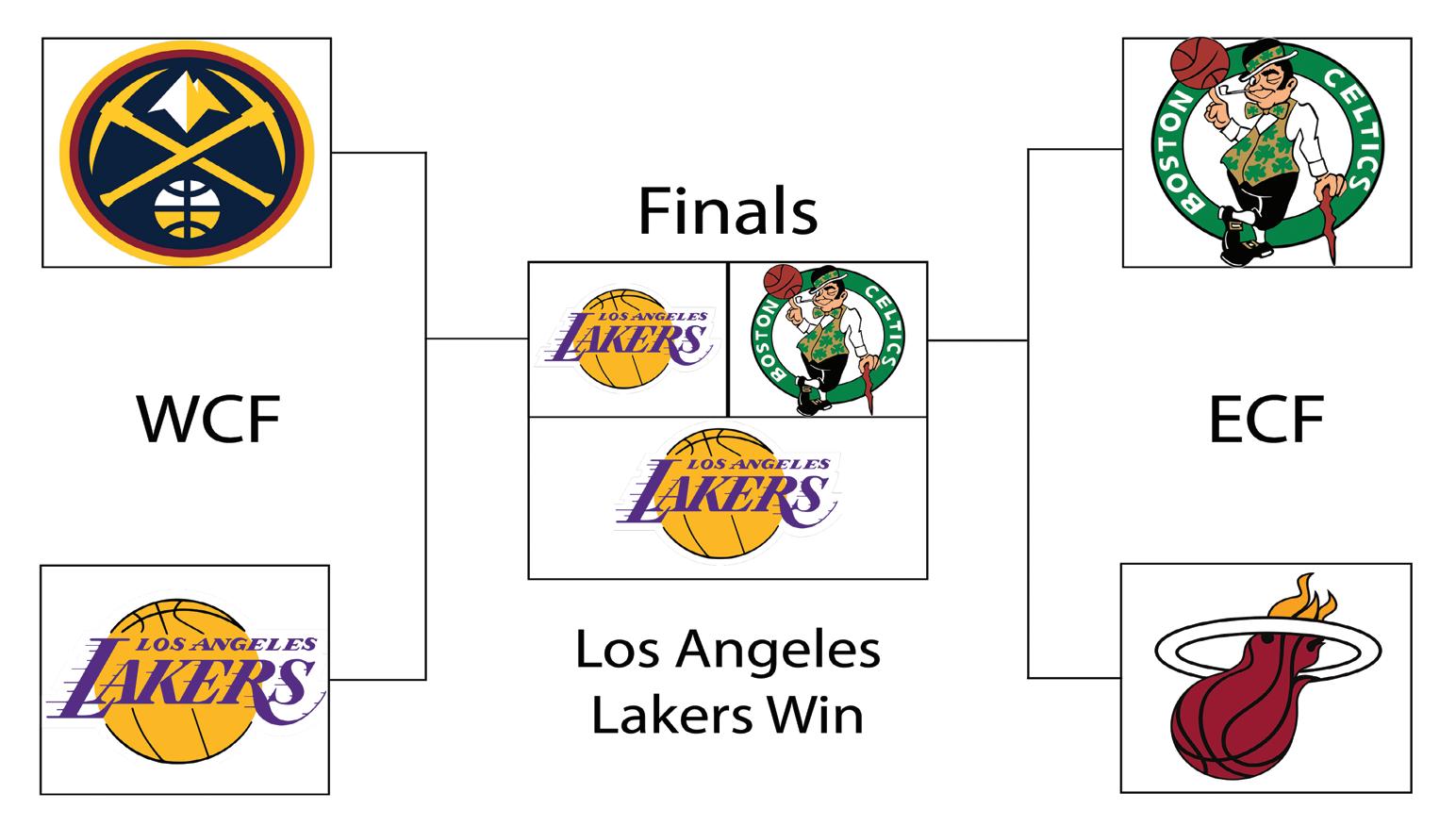
Senior Caleb Chan casts his line and waits to feel a bite on the other end. e sounds of his dad and friends talking mu e the background as he looks out over the rippling water.
Seconds later, a sudden tug brings him out of trance. Chan holds his breath as he feels for a con rmation of a sh on the line. ere is.
He skillfully reels in the line and nally pulls the sh o . After a quick picture to remember the moment, and a toss into the bucket, the dinner plan for the night is set.
Chan is one of many students who sh and is part of the shing club, run by senior co-presidents Niko Shieh and Jared Noyman.
Shieh said he started the club because he wanted to get more involved in shing and try to bring the school together through a common hobby.
“It feels like a bunch of people sh at Paly, but they’re scattered all over the place,” Shieh said. “ ere’s certain groups of people that sh, and (individual) people who sh, but it’s not like everyone knows everyone who shes. It’s not like a group or culture, really.”
Instead of having meetings in a classroom at school, the club takes trips together.
“We weren’t getting much done in school meetings, so we moved towards just doing the out of school stu ,” Shieh said. “We usually go surf shing in San Francisco or in the bay somewhere, where there’s space for everyone to sh together.”
Senior Tyler Mosto zadeh, who has been shing for more than ve years, said he enjoys a variety of types of shing.
“Usually I go bass shing, and sometimes I go y shing depending on the spot and how
I feel,” Mosto zadeh said. “ ey’re so di erent. Fly shing is a lot more technical and bass shing is very active unlike a lot of other types of shing.”
Mosto zadeh said he likes to go shing with friends but also enjoys going alone when he has to because of the peace and quiet.
“I usually go to a nice lake like Mammoth or Tahoe to y sh with my friends,” Mostozadeh said. “But if I’m on a family vacation or a trip without those people, I like going on my own as well. It’s almost just as cool to go and enjoy it solo.”
Many shers echo that love for spending time in nature and in new surroundings. Shieh said one of his favorite things about shing is the change of scenery.
“For me, a lot of the enjoyment is more of a patience and relaxation thing,” Shieh said. “I love being in nature so much because it’s just nice to have a change of pace sometimes.”
Chan said shing helps him feel more connected to nature.
“It’s a really cool feeling to watch the sh in nature, and see them darting around under the water,” Chan said. “Being able to catch one and hold it in your hand after seeing that is a really cool but weird feeling.”
Chan, who enjoys trout shing, said he nds the process of shing rewarding.

“ e way I like to sh is generally trout shing in lakes or rivers,” Chan said. “Being able to catch my own sh, go home and cook them up my way is what makes shing so real to me.”
Despite a well fought match on May 3, the girls lacrosse team lost 13-6 to Gunn in its nal conference home game of the season. is loss marked the end of a challenging season for the girls where they nished 9th in the Santa Clara Valley Athletic League.
Despite the season-ending loss, junior Scarlett Cummings said she is proud of her team for its perseverance and hard work, especially during times when things were out of the team’s control. “ e season was de nitely fun, but (our team) took a lot of tough losses and dealt with a good amount of issues during it,”
Cummings said. “Despite this, we improved our ability to work together the most.”
Cummings also said the team established connections because they had similar passions and goals, which was her favorite aspect of the season.
“Being able to establish strong relationships with my teammates and my coach was incredibly fun to build more friendships while sharing the same interest,” Cummings said. “ I am looking forward to playing with the same people (next season).”
Junior Sarah Bakhash said her favorite part of the season was seeing everyone improve.
“All of our early morning practices and hard work really paid o and being able to witness this improvement through games and throughout the season was rewarding,” Bakhash said. “I’m proud of how hard everyone worked and how together, we im-
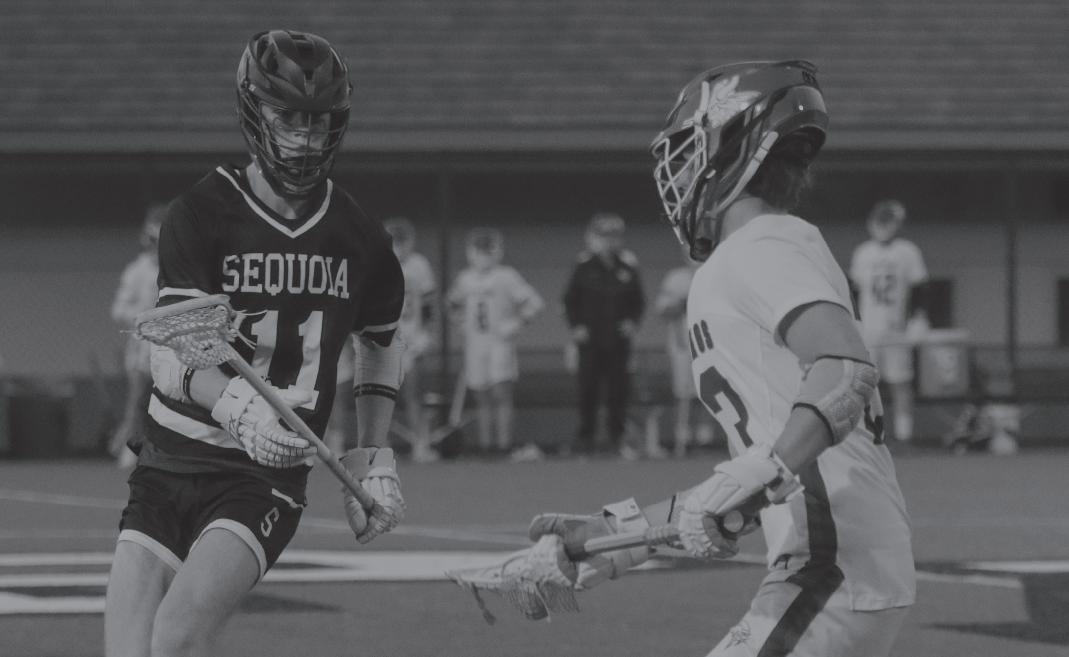
e boys varsity lacrosse team lost narrowly to Sequoia, 10-6 on April 28. e game started out with Paly ahead, but after some back and forth goals, Sequoia established a strong lead.
Paly was able to narrow the lead to as close as 7-6, but wasn’t able to secure overtime or a win.

Senior captain Asher Friedman said the rst half of the game went well for the team.
“We had a strong rst half,” Friedman said. “I think we came out of it up three (to) two, I want to say, (and the) defense was playing really strong.”
Friedman said the team wasn’t able to maintain the lead throughout the second half of the game due to mistakes on both o ense and defense. “ en (in the) second half, (we) kind of fell apart,” Friedman said. “( e opposing team) had the ball for most of the time, and I think we really had to counter that with long positions on o ense. But, we really didn’t, so our defense got tired and they gave up.
(We had) some sloppy goals, and then on o ense again, we
weren’t able to take care of the ball.”
Head coach Ed Hattler said the team needs to work on technique to be prepared for the next game.
“We have to take care of the little things: picking up ground balls, and keeping possession of the ball,” Hattler said. “We made some mistakes.”
Friedman agreed, and said that in order to improve, the team needs to work on retaining possession of the ball.
“I think winning ground balls (is really important),” Friedman said. “Ground balls are extra possessions, and so if we can have the ball in our stick on o ense more, we will
score more, and we’ll win more games.”
Despite this loss, Hattler said the season has been an enjoyable one for him and the team.
“Season’s gone good,” Hattler said. “ e guys have had fun, and we’ve gotten a lot better as the season has gone on.”
Friedman also said the season has been good especially with di erent people who joined the team.
“I think (the season has) been a lot of fun,” Friedman said. “I mean we’ve had a lot of new faces, a lot of young guys, a lot of players stepping up, and I think everyone’s having a lot of fun.”
proved the team. Whether it was sportsmanship or a rainy day practice, we all were a part of it.”
Bakhash also said the team worked hard together to meet the expectations presented by head coach Kaitlin Chiu during practices.
“We implemented more strategy in the way we played and made sure each team member understood what was happening on the eld,” Bakhash said. “ rough team bonding, and more intricate drills, our team became stronger.”
Bakhash said she is looking forward to practicing with the team next season and building o of the work and improvement it has made.
“Of course, it won’t be the same without the seniors,” Bakhash said. “But I’m excited to be practicing again in a safe, positive atmosphere.”
Despite a season of struggles, the badminton team defeated Wilcox and Cupertino in its nal two games, avoiding relegation to a lower league.


According to coach Rodolfo Suarez, the team won the El Camino league last season, and were promoted to the more competitive De Anza league.
Suarez said the team has struggled this season due to a combination of joining a di erent league and losing players.
“We lost a lot of seniors from last year,” Suarez said. “On top of that, we moved to a tougher league, so it’s been hard to come by wins.”
After losing their rst eleven games, the team’s wins against Cupertino and Wilcox were just enough to tie for last place.
Sophomore and varsity singles player Abhimanyuw Deshpande said the team understood the importance of their situation and trained hard to win their nal games. “We started ramping up training and work outside of practice,” Deshpande said. “Our extra training de nitely helped us against Wilcox. We didn’t want to get relegated.”
Suarez said a tie at the end of the season would normally result in a drawn out process to determine who gets relegated to the lower league, but the team was able to avoid that because the winner of the El Camino league chose to stay down.
“If the record is tied, there’s a discussion and a coach’s meeting, where you make your case why you think you should stay,” Suarez said. “At the end of that conversation, all the coaches in both leagues vote, and that’s how you decide who stays. is season, though, we lucked out a bit. ”
Suarez said next year, the team will have better chemistry, resulting in a more successful season.
“A lot of the players know what to expect, and I just hope to make that more concrete,” Suarez said. “Like setting expectations about commitment to the team. Making sure our players are being committed, they’re working hard, they’re training, and just doing more drills to get us prepared for next season.”
Elizabeth Gulman Sta Writer Gabriella Gulman Business Manager
Fhelmets clunking on the ground and the cheers from the crowd under the Friday night lights. For most, when football season draws to a close, so does this familiar sound. However, once the winter season begins, Shah packs away his football gear and brings out his basketball gear, in preparation for the next season on the court.
According to Shah, being a multisport athlete isn’t just about transitioning from one sport to another but applying similar techniques to both sports.
“I think almost all techniques I use in basketball could transfer from one sport to another,” Shah said. “ e footwork drills during football practices help me stay in shape and keep my agility intact during the o season.”
According to a study published by the National Library of Medicine, athletes who specialize in multiple sports have a higher participation rate in games, longer athletic careers, and experience fewer injuries compared to single-sport athletes. study, which included multi-sport and single sport high school students, Sophomore Poppy Barclay, who plays both varsity lacrosse, said both sports have similar footwork and rules.
“Field hockey and lacrosse are both stick sports,” Barclay said. “Although the techniques for using a hockey stick and a lacrosse stick are
No matter how hard I close my eyes, if you asked me to imagine an apple, all I would be able to see is the static of a TV screen. As a kid, I thought counting sheep was just a metaphor because, climbing into bed each night, I could only count to 100 in the darkness. Although I know what sheep look like, I cannot picture one in my head to this day. My condition, which a ects around 2% to 5% of the world population, was named aphantasia in 2015, based on Aristotle’s term for the mind’s eye –– phantasia. Variations in the ability to conjure images, sounds or feelings from imagination were rst identi ed by British psychologist Francis Galton in 1880, but were not further investigated until 2005 by Adam Zeman, Honorary Professor of Neurology at University of Exeter and Sergio Della Sala, Professor of Human Cognitive Neuroscience at University of Edinburgh.
While aphantasia only impacts a small population, Della Sala said the ability to produce mental images is a spectrum.
“Aphantasia is a variation of normality, such as height,” Della Sala said. “At one extreme are people with very limited visual imagery, (and) at the other extreme are people whose visual imagery is extremely rich, a condition we labeled as hyperphantasia.”
Della Sala said multiple regions in the brain are involved in mental imagery, and the combined activation of those regions allow people to produce images in their mind. Aphantasia is likely due to a lack of images, not decreased introspection.
“Visual imagery needs the interaction of several areas of the brain including the visual areas located in the back but also areas sitting in the parietal lobe and frontal lobe,” Della Sala said. “ e orchestrated activity of all these areas together allows us to retrieve images from our stored knowledge and see and reshape them.”
ese areas include the parahippocampal area, which is active when remembering places or scenes, the lateral occipital, which is active when remembering objects and the fusiform face area, which is active when remembering faces.
Emma Megla, a cognitive psychology PhD student at the University of Chicago said for people with aphantasia, certain brain regions may not function simultaneously.
“For those with normal imagery, there are functional connections in the brain,” Megla said. “If one area is active, another area is also activated, forming connections between memory regions and visual regions. ose with aphantasia might not have these uctuations.”
From a study conducted by Joel Pearson, an imagery researcher at the University of New South Wales, measuring skin conductance levels, Zeman from the University of Exeter identi ed that due to the lack of simultaneous uctuations in di erent brain regions, those with aphantasia are unable to produce voluntary visual imagery.
e skin conductance levels, which refer to the electrical properties of the skin when producing sweat, work to nd the presence of a physiological fear response every time a
Space Exploration Technologies Corporation launched its Starship rocket on the morning of April 20. Flames followed in its wake as it soared into the air. But four minutes in, it tumbled out of control and exploded.
Plans for a heavy-lift rocket have been in place since 2005, with its ultimate goal being multi-planetary colonization.
e rocket, at 394 feet tall with 33 ring engines, is the most powerful space vehicle ever own. Its predecessor, Falcon Heavy, is the second most powerful space vehicle with 27 engines and half the lifto capacity.
e rocket exploded during its inaugural launch while attempting to detach from its two components, otherwise known as stages.
Mechanical engineer and 2018 Paly alumnus Jacob Zajac shines more light on the di erent components, or stages, of the rocket.
“ e rocket starts on the launchpad fully loaded up with fuel. At ‘lifto ’ the rst stage ignites and carries the rocket up through the atmosphere,” Zajac said. en the rst stage runs out of fuel and the second stage, which sits on top of the rst, detaches. e second stage ignites and brings the payload into space.”
Having exploded quickly after its launch, Starship was 150 miles short of its intended altitude. A tornado of debris was launched into the air when it took o
“If you look at some of the pictures of the launch pad that were posted on Twitter, there’s a giant crater that formed below it,” former SpaceX intern and 2018 Paly alumnus Devin Ardeshna said. “All that debris had to go somewhere, and you can see some of it raining into the sea during the launch. ree engines were gone as soon as the rocket took o , so I think there’s a good chance some concrete
change in levels occurs –– yet subjects showed unusual results.
“When asked to read a series of scary descriptions, such as a swimmer’s view of an approaching shark, which would evoke vivid imagery in most of us, people with aphantasia failed to show the marked change in skin conductance observed in control participants without aphantasia,” Zeman said. “ is di erence was not because of an overall reduction in emotion as the aphantasic participants showed a normal reaction to photos of scary scenes.”
erefore, when storing information, Megla said people with aphantasia are less reliant on their episodic memory system, which contains visual memories.
“ ey rely more on their semantic memory system, which contains general knowledge, verbal labels and your understanding of categories,” Megla said. “ ey might even have an enhanced semantic memory to make up for their visual impairment.”
Della Sala said people with aphantasia experience less vivid emotions when recalling memories because of their reliance on
pieces just hit those engines and killed them.”

Following the launch, Starship tumbled out of control shortly before SpaceX called for it to self-destruct. Ardeshna said that some suspect the hydraulic pressure unit, which is supposed to send pressure to the engine’s gimbal — a device that keeps the rocket oriented correctly.
“ ere was also an explosion right above the engines part of the way through the launch,” Ardeshna said. “Some people are saying it was related to a hydraulic pressure unit which would control the engine’s gimbal. Eventually the rocket lost control and started spinning.”
Regardless, Ardeshna said it was impressive to see the rocket stay together before it exploded.
Aerospace and Robotics Club Co-President and junior Mike Song said he thinks the launch achieved its purpose of testing boosters.
“ e point of this launch was to prove the concept of the boosters as well as getting the rocket to take o and clear the launch pad,” Song said. “It did all of that, so all the major goals were accomplished through this launch.”
Boosters are essential for SpaceX’s goals.
“A booster is a rocket whose job is to give something a boost into orbit,” Zajac said. “It takes a lot of fuel to get through Earth’s atmosphere, but maneuvering in space is relatively easy, so the booster is designed with big engines and lots of room for fuel to take care of the rst step.”
While some may have wanted Starship to work perfectly, Ardeshna said it was only a hope and not an expectation.
“I don’t think anyone at SpaceX expected this launch to work perfectly,” Ardeshna said. “It’s better to blow up a rocket and analyze the data to gure out what you need to do di er-

the semantic memory system to store information. eir ability to relive autobiographical events can be less e cient (than people without aphantasia) because mental imagery seems to be necessary for a strong sense of reliving one’s own experiences,” Della Sala said. “High vividness during visual imagery reminiscence elicits stronger emotional reactions.”
Megla said that although people with aphantasia are able to recognize imagery, their lack of visual remembrance means they are unable to recall those same images from memory. In a study by Wilma Bainbridge at the University of Chicago, when participants with aphantasia were shown a photograph for 10 seconds and asked to draw it from memory, they remembered fewer objects than those without aphantasia. However, when asked to identify the image from a selection, they did as well as the control group. “ ey use less color, they remember less objects from an image and they tend to use more words,” Megla said. “ ey can’t remember the visual details of the objects, so they have these labels for what was in the image, but we nd that they have good spatial memory.”
Not only does aphantasia a ect visual imagery, but Zeman said that those with the condition may also experience impairments in other senses. While people without aphantasia may have a “voice” in their head or are capable of imagining scents, many with the multisensory condition are unable to experience the same phenomena.
“(Most people) can hear the sound of distant thunder, feel the touch of velvet or imagine running for a bus by engaging auditory, tactile and motor imagery,” Zeman said. “Half of (our respondents with aphantasia) lacked imagery in all sense modalities.”
While many of the e ects of aphantasia seem impairing, Della Sala said the multisensory condition is another way of experiencing and learning, since most people with aphantasia do not even realize they have it until later in life.
“People with aphantasia perform tasks requiring visual imagery by using alternative non-visual strategies,” Della Sala said. “ ey can rely on verbal coding to get by in our everyday life even with the absence of an e cient visual imagery system.”
Aphantasia, like many other invisible conditions, has not stopped those a ected by it from pursuing activities or careers. In fact, they still nd ways to thrive in creative environments that require imaginative thinking and thought processes, such as Co-Founder of Pixar Ed Catmull and Glen Keane, an Oscar winner and character animator at Walt Disney Animation Studios.
While it might take me longer to nd a trigonometry ratio since I cannot rotate the triangle in my head, I do not see my condition as a disability. Rather, I am lucky to say that I will never have a song stuck in my head for more than ve seconds and each person, whether or not they have a condition, can discover their own method of e ciently completing tasks –– mine just happens to not involve picturing objects in my mind.
ently because otherwise, you’re just guessing what the problems are going to be because there is so much that’s unknown.”
ough the launch was unsuccessful, Ardeshna said SpaceX’s technology has improved signi cantly.
“We actually stopped one of the robotics competitions sophomore year to watch a Falcon 9 launch because they were somewhat novel back then,” Ardeshna said. “Now, they’re on track to have 100 Falcon 9/Falcon Heavy launches a year.”
However, Ardeshna said there are still issues to work through, especially with the cost of resources.
“Right now it is so expensive to send things into orbit,” Ardeshna said. “Starship is targeting a 10-100 times reduction in cost, which would be game changing.”
e ultimate goal SpaceX CEO Elon Musk has in mind for the SpaceX rockets is to allow humans to inhabit other planets.
e rocket is not the only thing preventing Musk from achieving his goals.
“It takes so much beyond a capable rocket to start a colony on another planet,” Ardeshna said. “You need to nd a way to protect people from radiation during the trip and on the planet, construct a habitat and make it selfsustaining.”
While Song said SpaceX may not be able to achieve that particular goal, Starship has a lot of potential to reach its inter-planetary goals.
“I don’t know if (Musk) is going to Mars, but I think the rocket has lots of potential and can go to the moon and farther,” Song said. Regardless, Ardeshna said SpaceX’s rapid trial-and-error process allows them to reach ever closer to achieving the goal of multiplanetary habitation.
“If you look at Falcon it took a few failures to get things working too,” Ardeshna said. at is the SpaceX way: continue blowing up rockets until everything works.”