Tuesday, March 14, 2023


Tuesday, March 14, 2023
Santa Clara Superior Court judge has sided s in a case against the Palo ed School District and its method of placing students in high school math classes. A court order, signed by Judge Carrie Zepeda on Feb. 6, requires the school district to revise its ninth grade math placement policies to comply with California Education Code and the Math Placement Act.
Judge Zepeda found that PAUSD violated two education codes mandated by the state, including the 2015 Math Placement Act which “requires school districts to develop, establish, and implement fair, objective and transparent mathematics placement policies for ninth grade students that consider multiple objective measures as e judge also ruled the school district violated EDC 51228.2, which states that school districts cannot force students to repeat classes if they have already completed the UC-approved equivalent.
According to the writ of mandate issued by Judge Zepeda, “PAUSD must adopt a math placement policy that uses multiple objective academic measures.”
Palo Alto parent Avery Wang, an adviser to the lawsuit, said parents led the lawsuit to ensure a quality education for their kids.
“We’re just very upset that this was happening,” e current math placement policy) lowers the amount of education that kids are getting. Coming out of Palo Alto, PAUSD used to have a really great reputation.”

Wang said PAUSD schools and the opportunities they provide are the main reason many families move to Palo Alto despite the high cost of living, and he wants to ensure all students are receiving the best
“I’ve even heard, in fact, the only reason some people want to live in Palo Alto is the excellent schools,” Wang said. “But as a result of what's been happening and kids being held back, they're not getting the education they deserve.”

Paly parent Edith Cohen, the lead plainti in the lawsuit, said putting advanced students in courses where they already know the material is detrimental for students. She also said she is disappointed that it took a lawsuit for the district to comply with state law.
In his weekly email update sent to district families on Feb. 24, Superintendent Don Austin attributed much of what led to the lawsuit to poor website design.
“After reviewing the District website and informational materials regarding math placement and pathways, I can see why there was a degree of confusion," Austin wrote in the update. "Despite the best e orts of everyone involved, the explanations of our placement process were cumbersome and wordy. e governing policies were di cult to nd, and the explanations were often confusing. As a result, the website was completely redesigned and organized to be user-friendly and cleaner."
Austin did not respond to interview requests, and Principal Brent Kline said PAUSD would not comment on Judge Zepeda’s ruling. Greene Middle School math teacher Kourtney Kientzy and Paly Math Department Instructional Lead Natalie Docktor said they did not know how the district would respond to the writ of mandate. e judge’s ruling gave the district until March 8 to present to the court an acceptable math placement policy, but as of March 10, PAUSD had not submitted a new policy, according to an email from Cohen. A hearing for PAUSD’s lack of compliance with the writ of mandate was scheduled for March 13.
Editor’s note: e nal version of this article was written on March 12 with the most up-to-date information available. A more recent version re ecting the March 13 hearing will be posted on thecampanile.org as more information becomes available.
Tyler WongFallen trees and harsh weather conditions from a Feb. 21-24 storm caused power outages and school and highway closures in Palo Alto, East Palo Alto and Menlo Park. According to PG&E, which spans across Central and Northern California, coming winter storms could cause more outages in the Bay Area.
Power was eventually restored to 4,000 PG&E customers in East Palo Alto and Menlo Park by 6 p.m. on Feb. 23, and Highway 101 reopened to tra c after an initial weather-related closure on Feb. 23.
Outages also forced Nixon and Escondido to shut down for a day, and students in the Ravenswood School District in East Palo Alto returned to classes on Feb. 24, after roughly 48 hours of power outages.
History teacher and East Palo Alto resident Grant Blackburn said his power outage lasted over two days.
“I got a notice around 2:20 p.m. on Tuesday when the wind storms were happening that I had lost my power,” Blackburn said. “When we went home on ursday, the power nally came in at 8 p.m.”
Blackburn said the prolonged outages meant his refrigerator and freezers could not run, causing some of his food to spoil.
“(My wife) had to drive to Mountain View to nd a Safeway that had bags of ice
and put those bags of ice in the freezer and the fridge,” he said. “Before she left to get the bags of ice, we both went and threw a bunch of stu out.” ousands of people across Palo Alto, Stanford and Menlo Park experienced power outages on Feb. 21 according to the Palo Alto Utilities, including a brief 25-minute outage in Midtown Palo Alto a ecting 3,380 people. Palo Alto Utilities also reported more small-scale outages and road closures on Twitter during a subsequent storm from March 9-11.
Xiaomei Zhang, a Palo Alto resident and Paly parent, said extra precautions were necessary to get through the night without power.
“(At 4 p.m.), the power went out,” Zhang said. “I went to the garage to get the emergency supplies and camping supplies out. e lighter would not auto-start so I (had) to use the match to cook dinner.”

With the outages causing signi cant problems for many families, Blackburn said he considered himself fortunate.
“We’re lucky that we have camping equipment, a replace, a gas stove, a gas water heater so we could make do,” Blackburn said. “ ere are some families that live in this area (who) lost more food than we did, and the ones that have babies have to spend money staying at a hotel. ere are some people who couldn’t a ord to do these things.”
Dinu Deshpande Sports EditorBased on his concerns related to what he said was its negative messaging, Principal Brent Kline said he will allow students to post to what used be called e Wall of Rejection as long as it is rebranded as e Wall of Redirection.
e Wall of Rejection is a tradition where seniors post their college rejection letters on an outside wall of the Haymarket eatre and often annotate them with responses to the college’s reasons for rejecting the student.
ASB President Ashley Meyer said despite administrative concerns, the Wall of Rejection is meant to unite seniors.
“Rejection is tough and everyone goes through it,” Meyer said. “It’s to have that outlet of putting your feelings onto a wall and feeling connected towards other students who also were rejected,” Meyer said.

Kline, who initially had all letters removed from the wall, said students did not follow school policy when it came to the Wall of Rejection.
“You can’t just put stu up here at school without going through the proper channels,” Kline said. “To me, it felt like (the Wall of Rejection) had a
very negative connotation, and I thought, ‘Why would you want to do that?’”
But after talking with ASB, a joint decision was made to reinstate the wall as the “Wall of Redirection.”
“When I brought students into the conversation, they made me see it di erently, and that’s why we revised it,” Kline said.

e name change sparked controversy, though, in part because of a rumor that the wall would also have to include acceptance letters, which senior Anjali Bhattacharya said would contradict the purpose of it.

“It could actually have the opposite e ect, because then someone who got rejected from a school might see someone’s acceptance, which defeats the point,” Bhattacharya said.
ART BY RACHEL LEE
But Kline said the only change he wants to see is the name.
“It’s the same thing, but we are trying to make it more positive this time around,” Kline said. “With this, a rejection letter is an opportunity to pursue something else. ere’s something else meant to happen, (and) that’s when the conversation moved to the idea of turning it into a Wall of Redirection versus a Wall of Rejection.”
Meyer said she is satis ed with the joint compromise and the positive connotation the new name carries.
“Now, it’s looking at the wall as redirection instead of rejection because rejection is redirection, leading you to di erent opportunities,” Meyer said. “Now, it’s rejection on a more positive note and not seen as negative.”
The decision by district o cials to eliminate the moderate to severe special education classes at Ohlone and Escondido Elementary School and consolidate them into the programs at Nixon and Barron Park has upset sta and families of the students who will need to move schools.
Mild to moderate special education programs will continue to be o ered at Ohlone and Escondido.
PAUSD Director of Special Education
Amanda Boyce said the revised special education programs will o er two distinct classes based on grade level, a style that best aligns with the needs of special education students.
e model we are moving towards in terms of having a kindergarten-through-second and third-through- fth-grade program is going to best serve our moderate to severe students,” Boyce said.
Boyce also said this restructured program will allow special education teachers to better focus on individual students.
“Most of our students in our moderate to severe learning centers are being taught in a single classroom with six grade levels,” Boyce said. “Students will bene t in terms of the teacher’s focus.”
But Elisabeth Doxsee, an Ohlone instructional assistant in the moderate to severe special education program, said she was disheartened when she heard about the district’s decision.
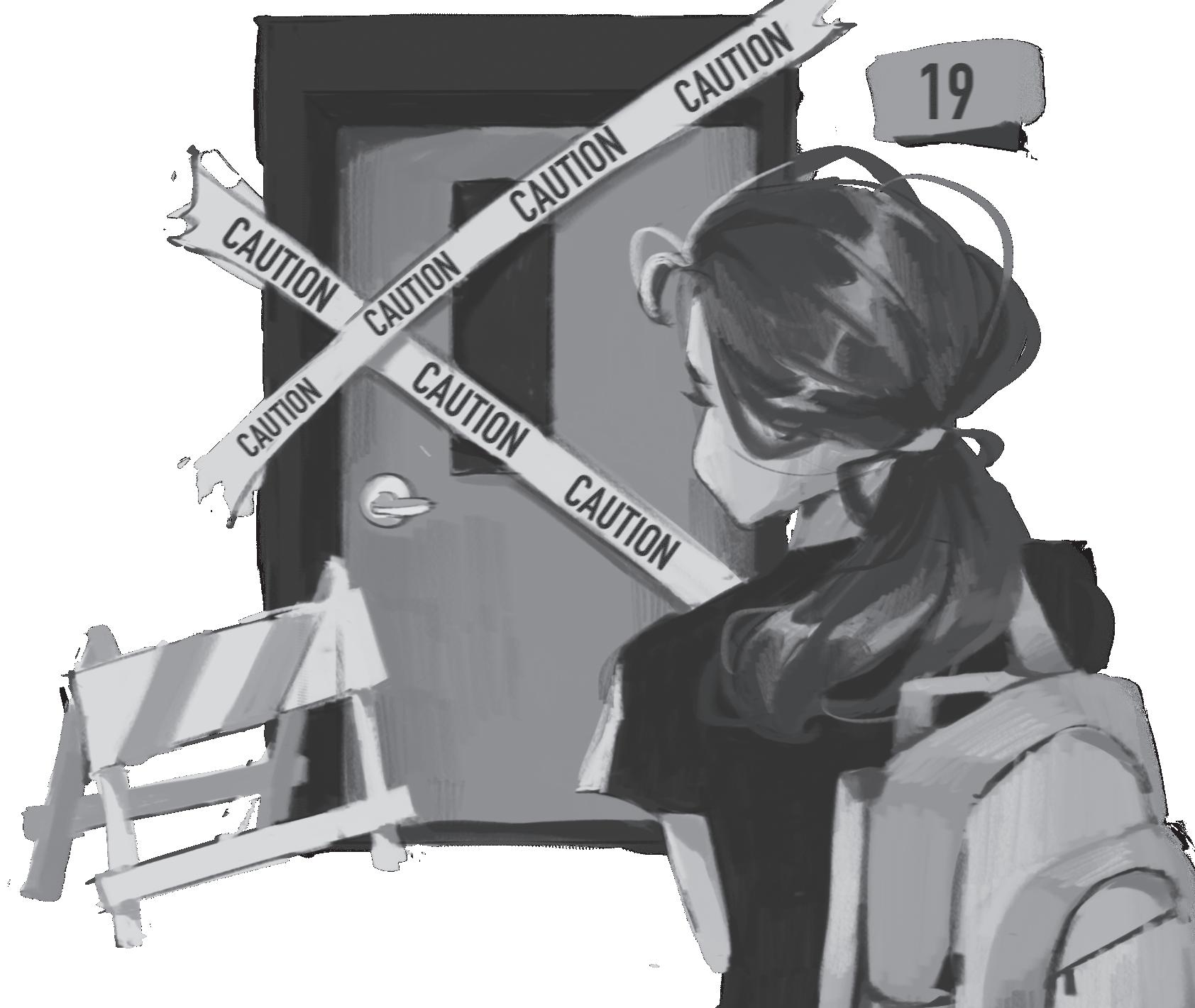
“I was very disappointed,” Doxsee said.
“I am a proponent of the style of learning at Ohlone, with our project-based learning, emphasis on social emotional learning and mixed grade levels.”
Doxsee also said Ohlone is a better choice for moderate to severe special education students for many other reasons.
“One of the beauties of being on an open single-level campus like Ohlone is that we can stand in our special ed classroom, and within our line of sight, watch our students walk to their gen-ed classroom, which promotes their independence,” Doxsee said. “ e Nixon campus in particular concerns me because of the multiple ights of stairs and the pods where you need to have a sta member with some of our students for safety reasons, which limits their independence.”
Boyce, though, said the plan has been in development for a long time.
“ is conversation has been ongoing for a few years,” Boyce said. “It’s the ongoing charge of our special education department to constantly discuss how to best serve students in our various programs in special education.”
Board of Education Vice President Jesse Ladomirak said the inconvenience for families who need to move away from Ohlone and Escondido contributed to the delayed decision.
“(Our) sta was very aware that having to move children was going to be the number one challenge of the restructure,” Ladomirak said. “Part of the reason it’s taken so long is the awareness of how challenging it would be to move families.”
Boyce said one way the district determined which schools would retain their special education programs was by minimizing the number of a ected families.
“We looked at how many kids would be disrupted if we relocated a program next year (to determine) which decisions would minimize that impact,” Boyce said. “ e combined number between Escondido and Ohlone is somewhere around 15 (families).”
And Ohlone Principal Elsa Chen said there was justi able disagreement by parents who wanted their children to remain at their cur rent elementary school.
“ is move, as with any change, is understandably di cult and de an emotional one,” Chen said. “It’s never easy to see a part of one’s school com munity leave.”
Ohlone Parent-Teacher Association President Rowena Chiu said she agreed with the decision to create two separate special education classrooms but was still upset about the lack of communication with the parents and sta of Room 19, the special education classroom at Ohlone.
“I appreciate that the school district has not taken this decision lightly,” Chiu said. “How ever, I do think that they have acted in a way that is reprehensible. I don’t believe they properly consulted with the teachers, the sta and the families within Room 19. As a community member, I think what is happening is unfair.”
But Boyce said that, in a Janu ary meeting, the decision was brought to the attention of the Community Advisory Committee, a group of volun teer parents who advocate for special education students. Ohlone, though, does not have a parent representative on this committee
Even though a special education committee was consulted, Doxsee said she wanted professional consultation as well.
To prioritize pedestrian and cyclist safety, the Palo Alto City Council voted at its Feb. 13 meeting to spend a $160,000 grant from the U.S. Department of Transportation to redesign roads throughout the city.
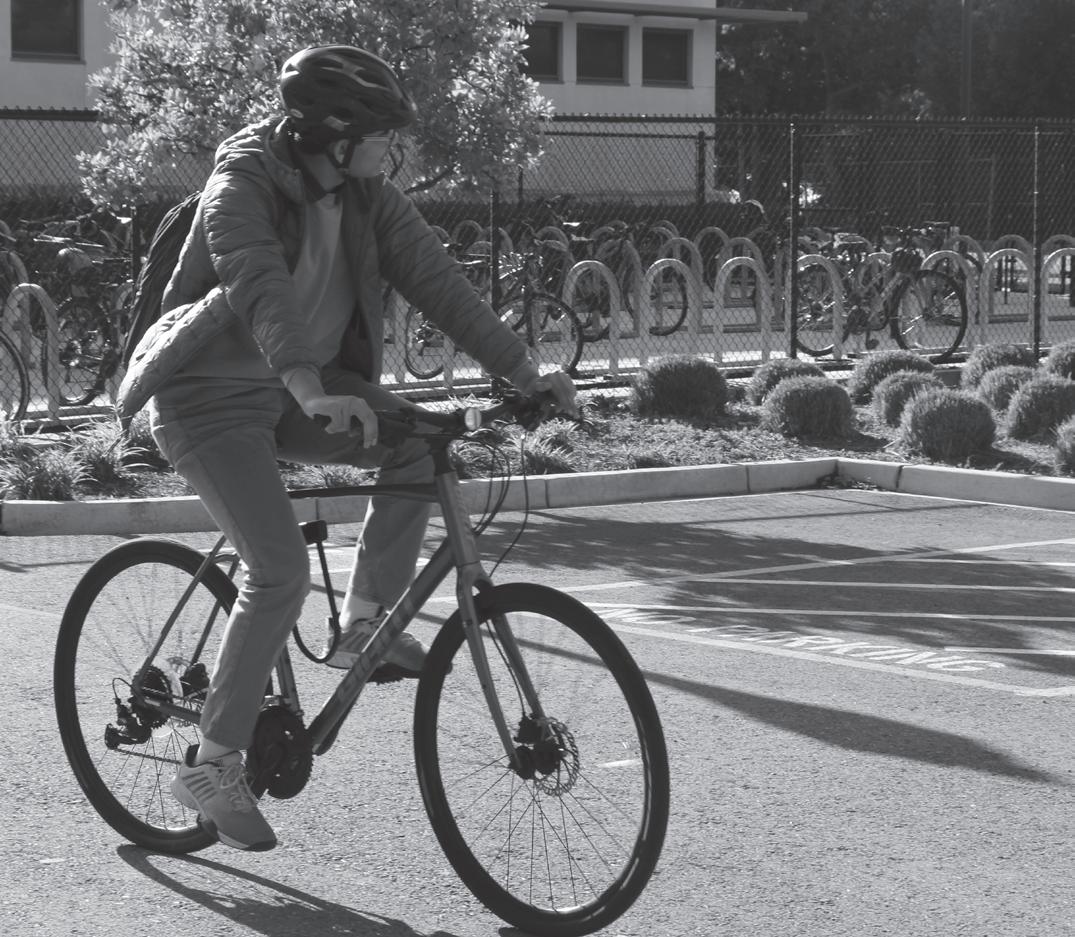
e council hopes this “safe system” policy will help prevent crashes and reduce the harm caused if a crash does occur.
Council of PTA Safe Routes to School Chairperson Arnout Boelens, who led the advocacy for the policy, said the city should add extra bike lanes on busy roads.
In other places, he said well-designed roundabouts could lessen the severity of crashes by safeguarding against head-on collisions. If there are crosswalks in the middle of a street, he also said it would be bene cial to put them on speed tables to encourage people to slow down and decrease the likelihood of pedestrianvehicle accidents.
Boelens said the safe systems approach to road safety is a di erent way of implementing safety than has traditionally been used in the US.
“ e founding principle is that humans are vulnerable to injury and everyone on the road makes mistakes, but if someone makes a mistake, (with the ‘safe systems’ policy), it never leads to severe injury or fatality,” Boelens said. “Starting from that principle, you try to make the roads safer by accounting for things that could go wrong.”
Councilmember Julie Lythcott-Haims said the policy focuses on pedestrian and cyclist safety.
“It’s meant to get us to this goal of zero tra c fatalities,” Lythcott-Haims said. “Some people may think this is wishful thinking, but there are other jurisdictions that have achieved this by designing their streets, cycling areas and pedestrian areas more carefully.”
Councilmember Greg Tanaka said he thinks the city should implement protected bike lanes, where the car parking and the bike lane are swapped, so bikes are not immediately next to moving tra c.
“A lot of people don’t want to bike because they don’t feel safe,” Tanaka said. “In our city, we don’t have as many protected bike lanes as other cities, so people are biking (alongside) cars.”
Palo Alto Transportation Planning Manager Sylvia StarLack said the “safe system” distributes the responsibility for transportation safety between drivers, vehicle manufacturers, policy makers, law enforcement and those who help design the
“(PAUSD) consulted the CAC. I know they advocate for special needs, and that’s awesome,” Doxsee said. “ ere was no input from any of the sta or professionals involved. I was very surprised that there was no input from the teachers.”
Because of this, Chiu said she thinks the district didn’t properly consider the impact of moving children out of Ohlone, a choice school where admission is determined by a lottery system.
“It’s possible the school district saw it as purely an administrative decision which they made according to convenience, logistics and practicality in terms of the needs of the district,” Chiu said. “I don’t think they have properly considered the personal implications to the families a ected.”
Doxsee agrees and said she thinks the interests of the district don’t align with the needs of the students of special education students and parents at Ohlone and Escondido.
“I think the best interests of the students would be served at a campus like Ohlone: socially, academically and logistically,” Doxsee said. “I think that the district’s emphasis is on geography, logistics and nance. And those two interests don’t always meet.” e Escondido principal and two special education teachers did not respond to interview requests for this story.
Dhruv Shetty Sta Writersystem. is division of accountability means all stakeholders will need to make changes.
Star-Lack also said the “safe system” policy prioritizes redundancy. e safe system approach works by building and reinforcing multiple layers of protection to prevent crashes from happening and minimizing the harm caused when crashes do occur. “If one thing fails, that shouldn’t be the only thing that keeps someone alive. ere should be another layer of protection,” Star-Lack said. “ e other part of the approach is when something goes wrong, there would be an investigation, monitoring and changes in design, to prevent another collision of that kind, so it’s an iterative approach to improving our system.”
Star-Lack said while the council has not adopted the entire “safe system” policy yet, the city will start implementing elements of the approach because of its success at the state and federal level.
“For example, we will develop a safety action plan with the Safe Streets For All grant that we just received from the Federal
Department of Transportation, and that grant requires us to use the safe systems approach in development of the action plan,” Star-Lack said.
Boelens said he received 16 letters of support from attendees at PTA meetings and collected over 450 signatures on a petition asking the council to adopt the “safe system” policy. He said he is excited to get more people on board with programs improving pedestrian safety.
“Palo Alto is exceptional in the U.S. for how many students walk and bike to school, so we hear many complaints from students (about) intersections or places they don’t feel safe,” Boelens said. “A policy like this could provide (the) foundation to nally start addressing all these issues. Hopefully it will be safer for everyone, including our PAUSD students on the road.”
Freshman Claudia Wol de Tourreil, who usually bikes to school every day, said she thinks having many safe routes for people to get around is critical.
She said parts of her route are di cult to navigate for bikers, meaning she either has to cross a lot of major intersections or train tracks, which are both inconvenient and hazardous.
“I think that if there were more safe intersections, it would make biking a lot easier, because a lot of times I avoid the railroad crossings by biking all the way down to California Avenue,” Wol de Tourreil said.
Lythcott-Haims said the City Council hopes to implement the “safe system” to ensure Palo Alto continues to be a city where students walk and bike to school.
e safer our roads are, the more con dence parents and students can have in the fact that when a kid leaves home to walk or bike to school, they’re going to come home safely,” Lythcott-Haims said. “It’s going to instill con dence and a sense of security that this is a bikeable, walkable city.”
Lythcott-Haims said she thinks the policy is a recommitment to the fact that no matter how advanced technology gets, at the end of the day, City Council will help residents get from one location to another in a safe manner.
“ e safety of the people who live, work and go to school in Palo Alto is our highest priority,” Lythcott-Haims said. “ e safe systems approach really puts individual human beings at the center of our focus when designing transportation systems.”
Many bike routes cross over major intersections and train tracks, creating dangerous conditions. “I avoid these by biking all the way down to California Ave.,” freshman Claudia Wol de Tourreil said. ART BY KATE XIA Annika Chu Sta WriterHundreds of Chinese Americans gathered in central Dallas on Jan. 29 carrying signs that read “Stop Chinese Exclusion” and “Stop Asian Hate.” e reason behind this event? Texas Gov. Greg Abbott tweeted that he would sign a bill that would ban all Chinese citizens from buying property in Texas.
Although Abbott said the law’s intent is to protect American domestic security from foreign espionage -the law also applies to Russian, Iranian and North Korean nationals -- the legislation mainly a ects the 235,000 Chinese-American residents who live in the state. e bill does not provide exceptions for legal permanent residents, dual citizens or green card holders.
While experts say a similar law is unlikely pass in California, if it did implementation of it could devastate the real estate market since over 15% of home buyers in the Bay Area are Chinese citizens. Realtors say Palo Alto’s housing market could bear the brunt of such e ects since it is an attractive location for families to move to, located in the heart of Silicon Valley and boasting some of the best public schools in the nation.
With Palo Alto real estate prices more than doubling in the past decade, the appeal of the city is evident.
Erika Enos, a longtime realtor and Palo Alto resident, said the Bay Area’s wellestablished Asian communities make Palo Alto’s real estate market especially appealing to newer Asian immigrants because they providing a sense of security and familiarity.
“Besides the climate and the culture, part of it too is the diversity, which makes it appealing because it makes people who come to this area feel safe,” Enos said.
Enos said many wealthy Chinese families also want to diversify their assets outside of the
volatile Chinese realestate market. Investing in property abroad is seen as a stable investment that can protect and build their wealth.
“I had a listing in 2016 where the people who bought the house were Chinese immigrants, and they got their down payment from their (extended) family in China putting their money together,” Enos said. “It was a form of investment for their whole village.”
However, Enos said since these properties are often viewed as investments rather than homes, many of them are left empty.
“I had a listing where a woman bought a house in College Terrace,” Enos said. “She never saw it. She just bought it because she needed to park some money somewhere because she was in Beijing.”
As long as the practice of foreign investment is ongoing, Enos said those who are not
an active part of the community change the dynamic of the area.
“Property is what creates the culture,” Enos said. “Once you allow people who don’t have a stake in the betterment of the culture to take over, you lose control.”
According to the National Association of Realtors, Chinese residents are twice as likely as Americans to pay in cash, which is an attractive factor for many sellers in real estate transactions because cash transactions are more stable and guaranteed compared to a loan. Enos said this factor contributes to the exclusion of low-income residents who are essential to the Palo Alto economy from purchasing a ordable housing.

“It’s all supply and demand, and it’s taken away from people who actually live here from being able to buy because people come in with cash,” Enos said. “People would prefer to have cash rather than a buyer getting a loan.”
However, direct foreign purchases from China have slowed down after Chinese President Xi Jinping announced regulations in 2017 on foreign currency exchange, limiting exchanges to $50,000 annually.
DeLeon Realty CEO Michael Repka said the demographic of his buyers has shifted away from Chinese citizens who reside in China.
“ e makeup of the buyers (has) changed,” Repka said. “Seven years ago, we were seeing a lot of people coming from China and buying here directly. Now, the majority of our clients (have) lived in the United States for several years, and they aspire to (move) to Palo Alto.”
Candy Wan, a sophomore who moved from China in 2016, said her family moved mainly for the education of her siblings and herself.
“Because my brother was almost collegeage, my parents wanted him to get into a better college in the U.S.,” Wan said. “My mom also wanted us to get used to living in
the U.S. so me and my sister could both get into better colleges too.”
Courtney Charney, a realtor in Menlo Park, said while foreign investment from China will continue to play a role in the market, it is important to note the positives of the increase in foreign investment from long-term residents.
“A common thread among these families that are coming is that they’re seeking something better for themselves and their families,” Charney said. “Whether it’s education, whether it’s job opportunities, whether it’s political climate. at’s why the law in Texas strikes me as so sad because if you look at their contributions to our schools, to our communities, to our job force, it’s a very real positive impact.”
After a six-month community engagement process, Latino mixedmedia artist Rayos Magos revealed his completed sculpture, “Te Veo, Te Escucho, Te Honro (I see you, I hear you, I honor you),” at City Hall’s King Plaza on Feb. 24. e sculpture will be on display for approximately nine months.
is sculpture is part of the Dr. Martin Luther King Jr. and Coretta Scott King artist in residency program which the City started in 2021 to engage community members in conversations regarding equity, culture, identity, inclusion and belonging in Palo Alto.

Magos said the goals for his project, which he titled “Rituals of Resilience,” include conducting interviews with Latinx/BIPOC community members and service providers, contacting local mental health non-pro ts, facilitating community workshops, and creating interactive and site-speci c artwork inspired by community input around the subject of equity in Palo Alto.
“I really wanted to focus on Latinx and people of color that lived at or worked in Palo Alto to uplift their stories and hear from essential workers, because through all of their sacri ce, we were all able to have a lot of the resources we didn’t have as readily available as we had previously,” Magos said.
Palo Alto Public Program
Director Elise DeMarzo kicked o the reveal event by welcoming community members and said the King residency program is intended to help artists amplify di erent aspects of equity and belonging in the City.
For his sculpture, Magos said he decided to focus on mental health, equity and belonging. e sculpture is assembled from various metal panels that were spray-painted yellow, each containing symbols including hearts, hands, eyes, kneeling gures and teardrops.
“ e heart is o ering my love for my community, and the hands that are holding it represent change and transformation,” Magos said. “ is kneeling gure, the hands and the teardrop in the hand is symbolic of the pandemic and the sadness and grief from losing family members and community members and also losing normal everyday activities. e side panels also have ears which symbolize listening, being open and being willing to learn something.”
Fletcher seventh grader Noa Zeitlin said she was inspired by the sculpture’s ability to capture the e ects of COVID-19 on mental health.
“( e sculpture) adds color to the community,” Zeitlin said. “It’s really cool how someone can express themselves through art.”
Magos said he conducted interviews and workshops to guide his artwork. During these workshops, participants were encouraged to re ect on their experiences during COVID-19 by answering prompts that evoked themes related to emotions, objects, places, activities, people and relationships.
“I was inspired by the various stories that I heard from people during various workshops I ran,”
Magos said. “Many of the themes (expressed in the sculpture) came from my workshops and interviews, and I took that information and translated it into the sculpture.” e project, which took approximately six months to complete, involved Magos working with a team of artists to transform his artwork into a 3D model. ere were people who fabricated it, so they cut (it) out and then welded it together,” Magos said. “Since it’s public art, the process was long and the city had to approve the sculpture to ensure it was safe.”
Before Magos began creating the sculpture, he worked as a mental health specialist and left his job temporarily to focus on his art.
Magos said he initially felt uncertain about leaving his previous job, but he still enjoyed the opportunity to create art for the community.
“I’m really fascinated (by) public art,” Magos said. “It evens the playing eld and allows everybody to come into a space to enjoy arts, whereas my experience previously has been mostly showing galleries.”
Under the sculpture, Magos included English and Spanish quotes, and he said he hopes that his sculpture will add a new light to the community and that individuals will be curious not only about the sculpture but also the meaning behind it.
Magos said, “Hopefully, it gives people hope, builds community (and) sparks conservation and dialogue.”
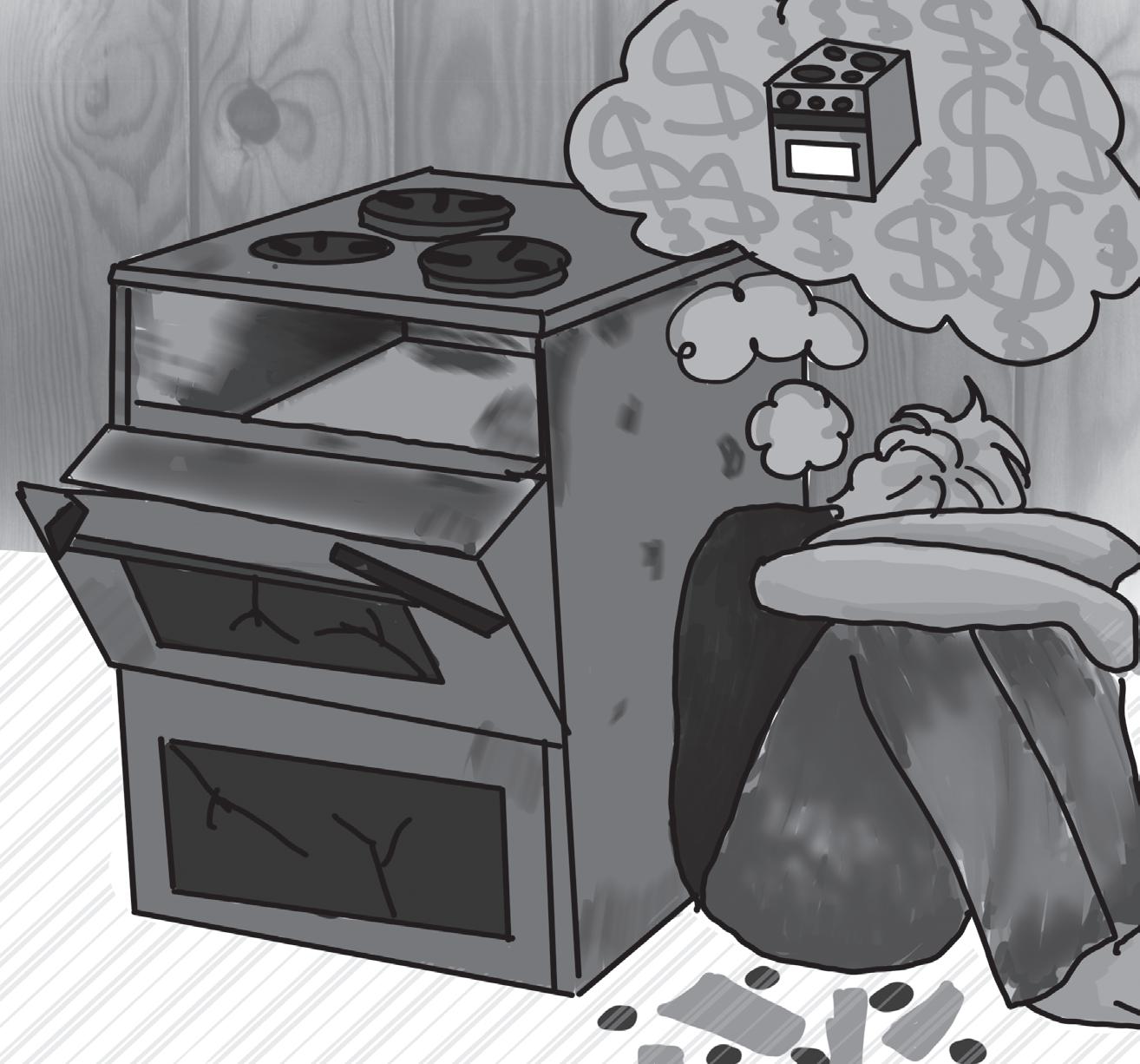
In response to spikes in utility bills, the Palo Alto City Council is considering a rebate deal that could give residents up to a 20% refund on their January or February gas utility bills.
e rebates are preliminary and will be nalized following a recommendation from the Finance Committee about whichever month has a higher gas bill.
At its Feb. 13 meeting discussing the 2024-2033 Long Range Financial Forecast, City Council proposed a 12-14% rate decrease from the current 2023 gas utility rates and a rate increase of 12-14% for electric utilities, both tentatively scheduled for July 2023. e council voted 6-1 to approve the LRFF with council member Greg Tanaka dissenting.
Tanaka said in the meeting that he does not see o ering rebates as an e ective way to o set the high utility bills.
“Minus 14% is good, but not compared to the fact that we just doubled the rates,” Tanaka said. “ at seems out of whack, especially (because) we’ve been seeing prices fall like a rock for natural gas. e rates keep going up, even though some of the underlying commodities are not.”
According to the 2024-2033 LRFF forecast related to electric
utility costs, “in the longer term, load increases are expected to roughly balance increases in utility costs associated with electri cation, leading to only modest increases in rates.”
However, Tanaka said some people may not be able to a ord the shift to electri cation.
“We have to factor in people who have nancial hardships,” Tanaka said. “I got emails from people saying that they turned o all the heaters in their house. We don’t want people freezing. I don’t think that’s the right way to get people to go from gas to electric.”
Junior Zachary Spain said gas rebates may prove to be ine ective since they encourage the use of environmentally-damaging energy sources.
Instead, Spain said the city should leverage high gas prices to incentivize the use of renewable energy sources for its utilities. “ ey should be focusing more of their e orts on renewables because (gas rebates are) promoting the use of fossil fuels,” Spain said.
Paly Alto resident Nick Wells said gas rebates send a mixed signal to residents as to what energy source they should prioritize.
“

ere de nitely is a contradiction,” Wells said. “I’m not sure what Palo Alto is after with these particular incentives, but it’s very uncharacteristic of Palo Alto.”

The U.S. Department of Agriculture’s Food and Nutrition Service proposed updates to the national school nutrition standards on Feb. 5, calling for a reduction in the amount of sugar and prioritizing whole grains.
In compliance with this new regulation, Food Service Assistant Rosa Rivas said the school is working to provide healthier breakfast and lunch options.
e main focus for the coming months is to reduce the amount of sugar in our breakfast items,” Rivas said. “Paly is already piloting freshly made oatmeal at breakfast with pepitas and dried fruits, as well as the vegan entree pilot.”
e USDA regulation stems from a long history of e orts to improve school meals. It rst started with the National School Lunch Program, which was signed into law by President Harry Truman in 1946 as a means to improve student health.
According to the USDA, the NSLP has grown to become the second largest food and nutrition assistance program in the U.S.
Seventy-four years later, the COVID-19 pandemic marked a turning point in school lunches as students faced heightened levels of food insecurity. Students increasingly relied on schools to receive breakfast and lunch. As a result, schools became a distribution center for
community meals and a way to support students through the pandemic.
While the current federal government program requires free meals in all public schools only through the 2022-2023 school year, California became the rst state to pass a Universal Meals Program that goes beyond 2023.
e Universal Meals Program, part of a wider e ort to improve California’s education system, requires all public schools in the state to provide a nutritiously adequate breakfast and lunch for students each school day. In 2022, the state invested an additional $650 million into the program. Simultaneously, PAUSD receives a federal grant from the USDA to serve
school meals.
PAUSD
Food Service Consultant Alva Spence said the district has tried to use federal grant money from the USDA to improve the quality of its meals.
“If (the district) wants to provide at least 40% or more of our entrees as scratch-cooked (meals), there’s a whole other side of funding that we have access to,” Spence said.

As of February, Spence said 54% of the lunch entrees served at Paly are made from scratch and prepared on site by the cafeteria sta in the Student Center Kitchen.
A Schoology survey of 27 PAUSD parents conducted by e Campanile on Feb. 21 revealed that only one of the 27 parents thinks their student’s school cafeteria has enough healthy lunch options.

Stella Sze, a parent of an eighth grade student, said she is concerned about the portions of the food being served for brunch and lunch.
“(My concern) is really more from hearing my daughter come home and saying she’s really hungry,” Sze said. “I don’t know if it’s a matter of the type of food that she gets at
school, or if she’s just growing and needs more food in general.”
Sze also said she is worried that the student meals currently o ered could lack nutritional value.
“( e school lunch) doesn’t sound like it is the healthiest because (my daughter) says there’s fried or packaged foods that are provided,” Sze said.
Marsha Habib, a mother of children in elementary school and a member of the Farm Service Agency County Committee, an organization that supports agricultural producers’ involvement in local communities, said she would like to see more locally-sourced fresh produce in school lunches.
“Pre-packaged food items that are wrapped in plastic (are) not very healthy as they are loaded with sugars and preservatives,” Habib said.
However, Rosemarie Dowell, the district Health Services Coordinator, said that plastic packaged foods are necessary at the moment.
“We don’t like the plastic,” Dowell said. “We’ve just had trouble nding a di erent alternative.”
Despite her concerns about health, Habib said there have been major improvements in the district’s menus since the pandemic.
“I’ve noticed since (COVID-19) and the start of free lunches, the menu has improved from being mostly cheese and bread,” Habib said. “ ere’s now more fresh produce like salad on the menu.”

Regardless of the content of cafeteria meals, students including junior Carissa Tsui said it’s often the accessibility of the cafeteria that makes school lunches appealing.
“I don’t want to spend money every day (on lunch), and it takes a lot of time,” Tsui said. “On days when I don’t have a prep, I just get school lunch.”
However, Tsui said she thinks there is a lack of variety in the meals o ered.
“For the non-vegetarian o erings, the meals are lled with protein and carbs and lack vegetables,” Tsui said. “My vegan and vegetarian friends also say the vegan and vegetarian selection is not ideal. It’d be nice to have more balanced meals for everyone regardless of their dietary restrictions.”
Despite the school’s e orts to improve food quality, of 82 students who responded to a survey conducted through Schoology on Feb. 21, 40% said they don’t think they have healthy options at school, and 37.5% said they are unsure whether or not the district o ers healthy options.
To encourage positive reform for PAUSD’s food service and to improve communication among parents, students and sta , PAUSD Food Service Consultant Alva Spence formed a Menu Advisory Council in October 2022. e group now consists of PAUSD faculty, parents and students.
Joslyn Leve, a parent on the Menu Advisory Council, said the council serves as a valuable platform for the community to provide direct feedback about school lunches.
“ e council formed after (the) Director of Student Nutrition Services, Alva Spence, wanted a place where she could hear direct feedback and have a problem-solving session,” Leve said.
Leve said the Menu Advisory Council meets once a month to discuss menu changes and make suggestions.
“(Spence) reports on some of the things that she has implemented and the results of them, and then she opens up
the oor for people to give suggestions or concerns that they have,” Leve said. Spence said the council connects her with parent concerns, which she directly takes into account.
“In our last meeting, the parents wanted to see more entree salads at the elementary level,” Spence said. “So we created a survey that will go out to all elementary levels, asking that very question.”
Spence said the district is already piloting new ideas to make meals fresher and to help reduce waste.
“Paly is already the site piloting freshly made oatmeal at breakfast with pepitas and dried fruits, as well as the vegan entree pilot,” Spence said. “We have a pilot at Addison Elementary where they’re using a dispenser for milk, they don’t even have any cartons anymore. ey have stainless steel cups, and it’s organic milk.”
Innovation continues at the middle schools too, as Spence said
she also meets with a group of students at Greene Middle School to discuss the development of school lunches.
“Since the rst meeting we had with (Greene Middle School), they’re piloting a full build-your-own salad bar,” Spence said.
e kids go through and there’s noodles, there’s quinoa, there’s rice and there’s di erent proteins.
Additionally, studentrun groups such as the Paly Plant-Based club are focusing on the goal of increasing plant-based brunch and lunch options at Paly. e club is meant to advocate for students such as Tsui who would prefer more robust meal options.
“From around January to April 2022, we were working with nutrition services,” senior and co-founder Morgan Greenlaw said. “Speaking with (Spence), we were able to get daily plant-based options in April and May.”
Senior and cofounder of the Paly Plant-Based club
Gabriela Hakeman said Nutrition Services has responded well to feedback from students and is excited to make innovative changes to the menu regardless of di culties.
Furthermore, Hakeman said certain plant-based options can be a ordable.
“Plant-based foods can be even cheaper than animal products,” Hakeman said. “It’s just the issue with expanding the options and o ering more than two or three meal options.”
Students who think the cafeteria has healthy options..............................................
22.5% Students who don’t think the cafeteria has healthy options...................................... 40% Students who are unsure about the availability of healthy options........................... 37.5% Survey of 82 students conducted by e Campanile through Schoology on Feb. 21.

orts to improve school meals, Hakeman said legislation restricts the school’s ability to provide plant-based meals.
“We’re a public school, so (the) USDA regulates the budget of the school cafeteria,” Hakeman said.
“Nutrition Services is already on a really tight budget, and all school meals are free now in California, which restricts the budget even more.”
plant-based meals or to purchase more equipment.”
According to Spence, at Paly, the number of students getting school lunches on a daily basis jumped from about 100 students pre-pandemic to about 400 now.
54%

Spence said additional funding for food services would expand options for students.
“It opens up the doors for me to be able to bring in more chefs,” Spence said. “ ere’s more money for me to be able to get di erent products, have more
At Gunn, student demand for lunches has increased from 350 to 700 students since the pandemic.
Leve also said the main challenge schools face is having enough sta and resources to provide for students.
“It’s not just about the dollars available per student,” Leve said. “You need the sta who could cook the meals and deliver the meals, and we don’t have the kitchens to cook them individually.”
Fairmeadow Principal Iris Wong said the lack of an onsite kitchen prevents her school from exploring healthier options.
“It would be much more convenient to have an onsite kitchen at Fairmeadow, as that would bring the option for us to pilot new foods or have a salad bar, for example,” Wong said.
And, according to Spence, due to the Universal Meal Program, it has been hard for food services to predict food needs.

“We have no idea how many students are going to eat each day,” Spence said. “We’re thinking from history, this number has always been 200. And suddenly there’s 400 students lined up because for whatever reason today they want that item, and it’s very challenging because it’s always a moving number.” e nutritional standards set out by the USDA require public schools to regulate the
Nationally, other groups have worked to improve student access to fresh meals. e Factory Farming Awareness Coalition has taken on a national role in improving sustainable food systems.
Kiely Smith, Program Manager of the Advocacy Institute at the Factory Farming Awareness Coalition, said her group often attempts to get students to help enact change.
“We have a lot of students who are part of the Advocacy Institute who will do some kind of advocacy project,” Smith said. “A couple of the nonpro ts that we work with have helped empower our students to start campaigns on their campuses.”
Smith also said the Advocacy Institute has been successful at numerous schools including nearby Milpitas High School.
“Students through the Advocacy In stitute have successfully worked on getting a meatless Monday and tried to increase the availability of plant-based foods on their campus,” Smith said. “We’ve seen new menus rolled out which really entails students working with their campus cafeteria a lot of times to make some improvements.”
Although budget restrictions and a lack of resources have kept PAUSD from improving their menu, other Bay Area districts have taken steps to upgrade their meals through di In 2020, the Los Gatos-Saratoga Joint Union High School District contracted chef and nutritional consultant Paul Boundas to pioneer the process of serving entirely fromscratch meals for students.
Boundas, who has been working in the restaurant industry for over 10 years, said he uses his expertise to take a novel approach to school food services.
“We try to operate schools as if they’re restaurants,” Boundas said. “ at means getting rid of processed foods, cooking from scratch and bringing in trained people, chefs and food service sta .”
Boundas said most school programs, includ-
ing PAUSD, are currently based on processed rather than fresh food models, something that costs more money.
“Whole foods are a lot cheaper to buy than processed foods,” Boundas said. “For example, if you’re serving breaded chicken strips that are frozen and processed, those are $40 a box for a 10-pound box. But fresh chicken breasts or thighs for $40 will get us 40 pounds.”
However, Boundas said while the ingredients for making fresh meals may cost less money, they require more workers. ere are seven or eight people in this one ey have a manager, a head cook and cafeteria assistants.”
According to Spence, although PAUSD has hired a manager, the district is not yet able to shift to Los Gatos’s model. ere are multiple reasons for that,” Spence said. “You can bring the chef in, but you’re still going to have to get the level of the sta up to the level of a restaurant.” Looking forward, Dowell said the district is constructing additional kitchens to minimize the need for transferring meals from school to school. However, Dowell said reform takes time, and Paly and JLS will remain the primary But help may be on the way. Leve said the district announced at the last board meeting that it may consider bringing in outside resources for food services.

“It was recently put in the new budget for next year that there was actually ($180,000) put in for nutritional consultants,” Leve said.
Spence remains optimistic that PAUSD will achieve a food service model like Los Gatos has one day.
“We can do it,” Spence said. “But it will be in place when some of these students that are asking for the Los Gatos quality will be in college.”
850 maximum calories per high school meal.
amount of sugar, sodium and non-whole grains in their meals to protect student health.
Dowell said these restrictions also limit the district’s ability to meet student and parent requests for di erent kinds of school meals.
“ e hard part is that when we want to come up with creative or thoughtful food items, they don’t always t within all the rules,” Dowell said. “ ere’s de nitely no exibility around that.”
In addition, Spence said USDA portions and calorie limits make her job more challenging.
“( e USDA) said 650 (calories) is still the ceiling (in elementary and middle schools),” Spence said. “But, you can give more of (grains). at in itself is already a challenge of trying to balance. en, if I give this extra roll to try and ll the child up, am I going to go over the cap of calories? It’s a ne line game for us.”
“ e main focus for the coming months is to reduce the amount of sugar in our breakfast items. Paly is already piloting freshly made oatmeal at breakfast with pepitas and dried fruits, as well as the vegan entree pilot.”
of Paly lunch entrees are made from scratch.— Rosa Rivas, Food Service Assistant Text by Julian Hong, Lucy Li & Shiki Toyama Art by Kate Xia

Walking into class two minutes before the bell rings, I eye my teacher’s computer, a bright red dress on the screen catching my attention. Scrolling through a clothing website, she stares intently at her screen, not acknowledging me. As soon as the bell rings, she stands up from her desk and walks out of the classroom, letting us know she is going to the bathroom.
is happens a lot, with this teacher sometimes leaving class
all students should be given a consistent, standard way to give feedback to their teachers so we can practice advocating for our education.
In an opt-in Schoology survey conducted by the Campanile, 88.5% of the 82 students who responded said they would support a formal, standardized feedback system for teachers that could be monitored by administrators and include an option for anonymity.
how well a teacher may teach, students will have a limited connection with their teachers. is lack of communication may cause some students to feel uncomfortable asking questions and reaching out for help, leading to lower successes for both teachers and students. ough students know where they are struggling, teachers may be unaware that their teaching is ine ective for some students, so implementing a formal feedback system will allow teachers and administrators to illuminate potential causes for lower and higher success rates. is information would be instrumental in improving education systems because teachers can more e ectively learn and improve their teaching methods.
In my math class, for instance, my teacher creates a class discussion board for each unit, where the class can comment and answer questions about the lessons or assignments. is strategy has been extremely bene cial because students get immediate feedback and feel more connected to the classroom. Although developing such a system would have major ts, the process of establishing it would play a crucial role in its success.

Anonymity should be an option to ensure all students feel comfortable giving teachers feedback. Especially in a competitive school where grades are emphasized, an anonymous feature would help students who are worried about their performance in school if their criticism is traced back to them.
Having an anonymous system would allow students to freely comment without having to worry about it impacting their ough anonymity poses a possibility for exaggerated or false claims, when a large-scale system is created, the legitimate comments will vastly outweigh the small minority that are false. at being said, if students feel the need to intentionally harm or negatively portray their teachers through false claims, why they would want to do this to their teacher is another, deeper issue that should be analyzed.
Allowing for administration’s oversight is equally important. If the feedback system is not monitored by administration, some teachers may not take feedback seriously, defeating the purpose of the system. If enough of the same criticism is received, administrators should be alerted to this so they can
In an ideal school, students and teachers should have a cial relationship where students can learn from their teachers, and teachers can also learn from their students from a positive cycle of constant feedback and improvement.
On a broader scale, the action of allowing students to give feedback to their teachers instills an important idea in their minds. Students are shown that their opinions matter and their concerns are taken seriously.
When students are punished for sharing their legitimate worries, they learn to avoid tension instead of advocating for what they think is right.
As a school that emphasizes academic growth and engaging classroom environments, we need to encourage students to utilize their right to speak out through implementing a standardized teacher feedback system, especially when the issues on their mind are not only a ecting their performance in high school but also in their lives after graduation.
Iam not a believer in the American Dream. Aside from purely hard work, there are too many factors that contribute to success to not ignore them.
But as a child of two Asian immigrants, I recognize that the Dream brought my parents to America, and I make it my goal to accomplish what they set out for. As a result, I nd more and more work piling up, not just for me, but also for my peers who set out to do the same.
Stemming from traditional Asian values, education is seen by many as the pathway for upward social mobility. Parents often toil long hours just to make enough in America to pay for their children’s education and future. ey see their children as the generation for success, and as a result, they expect their kids to reciprocate the e orts by exerting an equal amount of energy to succeed academically.
I know this story all too well. Growing up in an environment where success was measured in relation to my peers, I’ve heard countless parents compare their children, looking for the best classes and extracurricular activities and learning how to boost our college applications. My sense of pride began to directly vary with my academic success, and I felt the incessant pressure to maintain that identity.
Yet, what I’ve never heard many families discuss is the mental health of the kids. Nobody ever talks about the e ects of burnout and anxiety created as a result of these arduous lifestyles. And even when children do bring the subject up, parents often brush it o as “lazy” and their complaints as “excuses,” telling them to toughen up.
In the Asian American community, mental health is often seen as taboo, and kids are instructed to suppress their anguish. Crying is labeled as weak and childish and seeking help a weakness. As the West begins to increase its emphasis on mental health, my generation is stuck choosing between traditional familial beliefs and society’s values.
e intense pressure to succeed academically only serves to increase anxiety. For instance, the Bay Area is home to some of the most competitive schools in the nation and stories of the select few that get o ered admission to prestigious universities arise every year.
In a bid to become one of these “model children,” many students overload themselves with a ridiculous number of AP and Honors classes, far more than they are capable of handling. And when they inevitably struggle to keep up, they nd themselves with a terrible sleep schedule, a poor social life and deteriorating mental health.
Access to mental health care has never been more important.
e CDC’s Household Pulse Survey found roughly 40% of young adults showed symptoms of anxiety stress disorder. Yet, even with increasing awareness, the stigma around mental health means Asian Americans still seek to get help much less than the average white American.
According to the American Psychological Association, Asian Americans are three times less likely to seek help than the average white American.
Moreover, other pressing issues exist, such as suicide. According to the CDC, suicide was the leading cause of death among Asian American males ages 1-19 and the second leading cause of death among Asian American females ages 1-19.
Living in America is already the rst step toward improving our broken system of beliefs. Hailed as the land of freedom, America certainly puts a greater emphasis on individual freedom and opportunity. It encourages Asian American teenagers who may be on the verge of seeking help. Without the fear of judgment or discrimination, America has already helped many students advocate for their own well-being, but there is still a long way to go.
e parents of the Asian community mean well, and countless of them already make every e ort to support their
ART BY RACHEL LEEchildren academically. But there’s a facet to our identity that many don’t understand.
We shouldn’t have to hold back tears of pain or anguish. Expressing our emotions allows us to connect with others and is what makes us human. Our generation can put an end to the stigma around mental health. We can help turn this silent community to one that supports our future.
If you or someone you know is experiencing a mental health crisis, you can call the National Suicide Prevention Lifeline at 800273-8255 or contact the Crisis Text Line by texting “HELLO” to 741741.
Lucas Yuan Sta Writer
With a devious smile forming on my face, I looked at my computer screen as plans started to form in my head. e Labor Day weekend seemed like the perfect opportunity to explore the open road and enjoy the beauty of nature on a camping trip, and I was doing just that — just with a di erent means of transportation than the typical four-wheeled automobile.
Instead of driving, I came up with the idea of attempting my rst long-distance public transit trip with the concession that I would provide text message updates to my family along the way and meet them at my destination.
While some of my friends have assumed that environmental concerns motivated me to ride public transit, I wanted my experiences to demonstrate that public transit has more to o er than being “green.”
I, as a certi ed non-idealistic teenager, nd the humorous, irrational and frustrating nature of public transit as its most appealing aspect. Transit provides one of the few opportunities in my life to strive not for perfection or grades but instead to be foolish and embrace the wonders of delays and railroad single-tracking. My itinerary for my trip was as follows: bike across e Bay, ride the BART to Oak-
land, take the Amtrak Capitol Corridor train to Sacramento and ride a bus to South Lake Tahoe.
I started my journey by pumping my legs and chasing the sunrise to cross e Bay on my bicycle. However, as I would soon realize while standing in front of a gated community and scrambling to search Google Maps, navigating a perfect, memorized route proved to be harder than I anticipated. Panting and shaking, I eventually arrived at the Union City BART station in Fremont with only ve minutes to spare and a full dose of adrenaline.
ough commuter rail and the BART metro lines can rival driving times during rush hour tra c, railroad track maintenance meant that on this day, BART shut down trains between the Union City and South Hayward stations, instead requiring users to board a bus to cross the gap and adding half an hour in delays.
While I had anticipated trouble, 30 minutes of delays seemed a little too close to the lessthan 35 minutes of bu er time I had allotted to make the next connection at Oakland.
Yet, with all my frantic pacing around the BART car and sprinting up the subway steps,
ART BY KATIE WU
I maintained my composure in what I viewed as a test for my future adulthood: dealing with situations I am unprepared for.

I could have easily saved four hours of my life and some considerable stress by driving, yet my perfect 16-year-old judgment and eagerness for adventure made me choose not to.
Pedaling as quickly as I could between the Lake Merritt and Oakland Jack London stations, a train appeared at the edge of my vision with its onboard plaque reading “Train #728 to Sacramento.” I was safe, albeit thanks to luck.
e next two legs of the journey, an Amtrak train to Sacramento and a thruway bus to South Lake Tahoe, proved to be less hectic. I parked my bicycle in the Amtrak passenger car, ordered a breakfast sandwich and stared out the window for a few minutes before collapsing onto the tray table in front of me.
As exhausted as I might have been, I regarded my sacri ces as worth my energy and a way to engage in the thrill of commuting rather than the destination.
Amtrak trains and long-distance buses o er the chance to make additional memories both from and beyond my trip to Tahoe. On a train to Fresno, I learned more details about college life from a Bakers eld graduate student.
I once discovered the travails of running a local shop and the rise of standardized corporations by talking to a Puerto Rican named Charles on a bus in Houston. Chatting with other public transit riders helped me better understand the perspectives of people I normally might not meet.
While public transit in the United States struggles with on-time reliability, buses and select trains partially make up for the costs by providing complimentary Wi-Fi. Trains o er a smooth enough ride to study or read as well as onboard dining and restrooms that reduce the need for extra stops.
I typically buy coach seats even for multi-day travel because of my frugality
and insistence on being economically selfsustainable. Although sleeping in trains and buses involved 11 p.m. attempts at ignoring chatty couples behind me, 3 a.m. supermarket restroom breaks and 6 a.m. wake-up times, I nd my experiences more humorous than annoying. Private rooms with beds and complimentary meals are also available onboard for anyone willing to spend the money. ough I usually prefer walking and cycling for practical and economic reasons, public transit o ers the allure of adventure and extends the range of places I can visit independently. If anything, my grievances with public transit — delays, noise, missed and almostmissed connections — have made me more compelled to continue riding public transit for the memories I make along the way. Amtrak, in my opinion, is a better cruise on land that o ers varied scenery and greater sustainability in a less-touristy environment.
I have exclusively walked, cycled and ridden public transit for almost a year, but I do not expect anyone to follow my actions nor do I encourage hate toward or vandalism against users of any mode of transportation, automobiles included.
Public transit is more of a useful tool than a panacea to every problem, a tool one can use for anything from bus commutes to school to long-distance travel for vacations. Whether you want to earn your independence without the hassles of a driver’s license, avoid tra c, ride a “self-driving” bus or train, save money, go on an irrational adventure or reduce your carbon footprint, public transit can bring something to anyone with an open mind.
Henry Liu Sta Writer
WE'VE GOT SALADS AND WHOLE GRAINS, OR YOU CAN CHOOSE A LIFETIME OF HEALTH PROBLEMS.

The U.S. Department of Agriculture’s Food and Nutrition Service proposed a modi cation to the national school nutrition standards in February that requires schools to reduce the amount of sugar and sodium in school lunches and prioritizes whole grains.
To comply with this new regulation, PAUSD Food Service Consultant Alva Spence told e Campanile the district is developing healthier lunches and reducing the amount of sugar in breakfast items.
For instance, she said Paly is already piloting freshly made oatmeal with pepitas and dried fruit along with new vegan entrees.
However, students and parents still have concerns about the quality and quantity of unhealthy meals.
e Campanile commends Nutrition Services for their e orts to meet the USDA mandate by producing healthier and more nutritious meals.
We further urge PAUSD to consider community concerns when developing menus.
Of 82 students who responded to a survey conducted through Schoology in February, 40% said they don’t think they have healthy breakfast and lunch options at school.
In addition, in a survey of 27 PAUSD parents conducted through Schoology by e Campanile in February, only one thought their student’s school cafeteria has healthy options.
However, students and parents often make complaints without recognizing the hard work the Nutrition Service Team is putting in to improve school meals.
For instance, Spence said she is working with students from Greene Middle School to implement a salad bar and with students from Paly to pilot vegan entrees like the popular Better Bean soup, served with a vegan grilled cheese sandwich.
Spence also said the number of students getting school lunch on a daily basis has increased signi cantly since the pandemic.
e number of students who get school lunch has gone from 100 students pre-pandemic to around 400 now at Paly and from 350 to 700 students at Gunn.
In an e ort to focus more on students’ individual needs and reduce the burden on teachers, PAUSD has decided to move the moderate to severe special education classes currently held at Ohlone and Escondido Elementary Schools to Nixon and Barron Park for the 2023-2024 school year.
While Ohlone has one combined special education class for kindergarten through fth grade, at Nixon and Barron Park, the program will be split into one class for kindergarten through second and another class for third through fth, a move the district says will allow teachers to pay more individual attention to each student.
Nixon and Barron Park are also more centrally located elementary schools within PAUSD. Mild to moderate special education classes will continue at Ohlone and Escondido.
However, the decision, unveiled to parents and teachers during a meeting in February was met with concerns about the quality of education at the new schools and the lack of consultation with teachers and families before making the decision.
While e Campanile applauds the district for providing students with a more individualized education, we ask PAUSD to more thoroughly consider the learning environments of each school and give opportunities for parent and teacher input prior to making these kinds of decisions. According to Elisabeth Doxsee, an instructional assistant at Ohlone’s moderate to severe special education program, Ohlone has many facilities that Nixon lacks.
For example, Ohlone is an open, single-level campus, allowing teachers
e Campanile praises Spence and her team’s e orts to not only escalate meal production, but also their determination to feed every student who needs a meal.
Even with these e orts, though, students often say they are still hungry with a single serving from the cafeteria. Spence said part of this is because the USDA requires high school meals to be under 850 calories.
Given that the current meals often don’t e ectively satiate student hunger, e Campanile suggests Nutrition Services invest in more nutritious alternatives that still abide by government restrictions including more whole grains.

A report from the Harvard University School of Public Health nds whole grains are more lling than the re ned grains which are often found in school lunches. Although whole grains are often more expensive than re ned grains, e Campanile thinks it is worth the expense to prioritizing student health and help prevent student hunger.
In addition, school lunches often lack options for students with dietary, cultural and religious restrictions. e few vegetarian options such as the black bean and corn salad over spring mix or the hummus box with assorted vegetables are healthier than the meat options, which are heavy on carbohydrates, but are not as lling.
e Campanile thinks the district should prioritize the production of balanced meals that are still nutritious including heartier plant-forward options.
In this way, students can consume a lling and healthy meal regardless of their dietary preferences. Students and parents should also realize their calls for healthier school meals are valid and being addressed by the Food Services Team at PAUSD as quickly as possible.
e Campanile asks the community to recognize the hard work that is being done to prioritize healthier meals and realize certain requests take time to develop or may be unfeasible for the district at the moment.
At the same time, e Campanile urges the district to prioritize the development of lling cafeteria options that accommodate dietary restrictions so all students can receive a hearty and nutritious school meal.
to watch their students walk to their general education classes, which helps promote their independence. Nixon, meanwhile, has multiple ights of stairs, requiring a sta member to escort students to their general education classes, limiting their independence and creating safety risks.
Besides safety, Ohlone also has a farm that is used by the special education programs as an opportunity for project-based and social emotional learning. Amanda Boyce, a director of special education at PAUSD, told e Campanile that only 15 families will be inconvenienced by the relocation to Nixon and Barron Park.
She also said the district has o ered to provide transportation services for the families a ected. But for many of the parents of the students a ected by the change, the district didn’t spend enough time considering the emotional challenges of a new location for their student.
For students with moderate to severe learning disabilities, a change in their learning environment and routine can be more di cult and disruptive than for other students, something that parents of special education students will have to navigate come next school year.
Because of this extra challenge, parents and teachers say they were not properly consulted prior to the decision. Boyce told e Campanile that the Community Advisory Committee, a group of parents who advocate for special education students, was consulted about the decision at a meeting in January. However, the teachers, sta and families in the special education classroom at Ohlone did not receive
communication from the district before the decision was made and announced. e Campanile thinks clear communication between the district, teachers, sta and parents directly a ected by changes to the special education programs is imperative.
Parents and teachers in the special education program should also be given opportunities to provide feedback prior to the district reaching any decisions to ensure the best interests of the students are met and prioritized.
While e Campanile praises PAUSD for separating the moderate to severe special education program into two classes based on grade level, we think the district should consider implementing this split model at Ohlone instead because of its more optimal learning environment and community for special education. We acknowledge that splitting the combined class into two requires more classes and potentially more teachers, but Doxsee told e Campanile that there are multiple additional classrooms available at Ohlone, and that the sta there would welcome supporting more moderate to severe special education students. Hosting the moderate to severe special education program at Nixon and Barron Park may align with the district’s emphasis on localization and nance. However, the social, academic and logistical needs of the students should always come rst.
To ensure their education is prioritized, PAUSD should welcome hearing from the teachers, sta and parents who work with special education students every day and who largely believe special education should remain at Ohlone and Escondido.
TEXT BY GABRIELLA GULMAN & SHAMSHEER SINGH ART BY RACHEL LEEEditors-in-Chief
Margot Blanco • Rachel Feinstein • Cayden Gu
Justin Gu • Jerry Xia
News/Opinion Editors Ti any He
Hannah Singer
Sports Editors
Dinu Deshpande
Brianna Zhou
Business Manager
Shiki Toyama
Managing Editor Erik Feng
Olivia Atkinson
Rohan Bhatia
Alec Bonnard
Annika Chu
Lucas Guan
Elizabeth Gulman
Gabriella Gulman
Julian Hong
Jessica Bae
Lifestyle, Sci/Tech Editors
Lillian Clark Christie Hong
Art Director Rachel Lee
Photo Editor Tyler Wong
Assistant Photo Editor Kate Xia
Writers
Claire Jittipun
Albert Jung
Lea Kwan
Holden Lee
Lucy Li
Henry Liu
Gavin Lin
Neel Sharma Dhruv Shetty
Shamsheer Singh
Heather Song
Nidhi ummalapalli
Luca Vostrejs Lucas Yuan
Naveen NarayanaswamiIllustrators & Photographers
Grace He
ea Phillips
Ariana Cao
Nikki Goel
Janya Jain
Jada King
Adviser Rodney Satterthwaite
Teresa Wang
Katie Wu
Letters to the Editors: Email all letters to editors to theeds23@googlegroups.com. e Campanile prints letters on a space-available basis. We reserve the right to edit submissions. e Campanile only prints signed letters.

Advertisements: Advertisements with e Campanile are printed with signed contracts. For more information regarding advertisements or sponsors in e Campanile and their size options and prices, please contact e Campanile Business Managers by email at campanile.ads@gmail.com.
Note: It is the policy of e Campanile to refrain from printing articles that misrepresent or alienate speci c individuals within the Palo Alto community. e Campanile would like to thank the PTSA for supporting the mailing of our newspaper.
Our Vision Statement:
e Campanile has upheld the highest standard of student journalism for the last century by engaging the community through various mediums of storytelling. Our coverage of news, culture and athletics aims to represent the diverse perspectives of our student body.
Paly eatre’s second production of the year, “Mamma Mia!,”
premiered at the Performing Arts Center on March 3.
Set in 1999, 20 year-old Sophie Sheridan (junior Zoe Hayward) lives on a Grecian island and will soon be married to her ancé, Sky (senior Gavin omas). Determined to have her biological father at the wedding, Sophie sends an invitation to three potential men: Sam (junior Matthew Arradaza), Bill (junior Kyle Vetter) and Harry (senior Kyle Xu,), in hopes of recognizing her biological father once she sees him. But when the three men arrive, Sophie can’t tell them apart and the plot unfolds.
“Mamma Mia!” is Paly eatre’s rst musical since Spring 2019, meaning no current students have performed in a Paly musical. Senior stage manager Sonja Meyers said that the play expanded her theater portfolio.

“It’s been pretty cool to learn about how the production process of musicals
di ers from plays,” Meyers said. “It’s always fun to work on a production that’s wildly di erent from everything else I’ve done.”
With a cast of 57, senior student publicity manager Katelyn Fong said that organizing the play was not easy.
“ at’s a lot of people to try to t in on one stage and to get to work with each other,” Fong said.
Working together since December, junior assistant director Jack Champlin said having a student-run cast has been one of the best aspects of the production process.
“Everybody has something to do, some kind of role,” Champlin said. “And if you stick with Paly eater long enough … you’ll be able to take on some of this responsibility for yourself. It’s incredibly rewarding.”


In the end, Fong said that all the time and e was worth it.
“It’s a lot of work and a lot of responsibility,” Fong said. “But it’s really cool to be able to point something and say, ‘I made that.’”
GREG BRAIL/USED WITH PERMISSION
Senior So a Wang, junior Zoe Hayward and freshman Aashi Agarwal look at a journal during rehearsal. “A student-run production is incredible,” junior assistant director Jack Champlin said.

Showings of “Mamma Mia!” continue on March 18 at 7:30 p.m. and March 19 at 2 p.m. in the Performing Arts Center. Tickets are $10 for students or seniors and $15 for adults, for sale on the Paly
Yuan
Lucas Sta Writere clock closes in at half-past midnight as junior Emma Zhang closes her AP Chemistry textbook and shu es through her notes for tomorrow’s class. Like many of her peers, Zhang feels pressured by the strenuous AP Chemistry curriculum, dreading the upcoming Advanced Placement exam.
Taking AP Chemistry, a class containing college-level curricula approved by the College Board, Zhang said she often feels frustrated by its impact and the way AP courses are emphasized at Paly.
“We are pressured to take it, and it impacts our other classes,” Zhang said. “I can’t focus on my other classes because I’m too busy worrying about my AP classes the most.”
Zhang also said other programs handled by the College Board, like the SAT, negatively impact high school students.
“( ese standardized tests) defeat the purpose of having a GPA, which basically shows your accomplishments over your four years in high school, but the SAT trophies what you can achieve in just three hours,” Zhang said.
Zhang’s perspective is echoed by many of her peers who say the College Board’s monopoly over standardized testing has caused great discontent, leading them to feel overwhelmed by the high cost of exams and the lack of transparency in the grading system.
Junior Vivian Tan said she thinks College Board has furthered unrealistic and unhealthy high standards at Paly, where students often think good is just not good enough.
“College Board greatly contributes to the competition at Paly,” Tan said. “I personally felt pressured to take more AP classes even if I didn’t have a passion for an area, and I think some students are ashamed of being in a normal lane rather than an AP lane.”

Despite the consequences of heightened academic expectations, AP Computer Science teacher Roxanne Lanzot said she thinks the resources o ered by the College Board are helpful.
“What I appreciate about teaching (AP) tests is the College Board does an excellent job of giving teachers a lot of resources so that if you put in the work, you can really prepare your students for the exam,” Lanzot said.
However, Lanzot said that because public education is free, College Board tests should also be made more accessible for students.

“Students shouldn’t have to pay to take AP exams, and you shouldn’t have to pay to take the SATs, and the district shouldn’t have to take that burden upon themselves either,” Lanzot said. “If we want an
equitable pathway toward higher education, then one thing that can be changed is (that) they just do not charge for AP exams.”
AP Macroeconomics teacher Debbie Whitson said she appreciates the availability of rigorous classes but worries that students are discouraged to try di erent subjects that align with their interests just because they do not get AP credit for them.
“I wonder if that’s driving students to work too hard in high school as opposed to just waiting until they’re older and in college to explore another curriculum,” Whitson said. “I like the choices and options for rigor for students who want to challenge themselves and are ready and interested and passionate, but there’s a little bit of concern as it feels like it’s being forced down people’s throats.”
And Whitson said students often unnecessarily overburden themselves with AP courses to stand out and appear more academically appealing to colleges.
ere’s a little bit of a misconception amongst students because there are still so many di erent college programs that t so many di erent kids, and there are so many alternatives to college or community college,” Whitson said. “I feel like we get really stuck in one direction (at Paly), and I don’t know if the College Board has created that or if that’s just us wanting the most rigorous ways to stand out.”
e College Board did not respond to interview requests for this story.
Scrolling through my Instagram feed, it seems like there’s a mass shooting somewhere in our country every other week. One month ago, 11 people died in the Monterey Park shooting; just a few days later, another shooting in Half Moon Bay claimed an additional seven lives. Like all dutiful screenagers, I shared the tragic stories with my friends, but over the span of around 10 minutes, I moved on, nding a cat video more entertaining. Looking back, I’m ashamed of my response. Our emotional desensitization to violence is a major problem. When we are bombarded with negativity, we turn o our emotional receptors as a natural response to
According to the National Library of Medicine, the average 18-year-old now shockingly consumes over 6,000 videos of is high number is partly due to the media’s exploitation of humanity’s innate negativity bias, drawing on people’s natural attraction to danger in order to make a pro t. However, external factors have also contributed to the rise of violence content.

Social media has allowed people to share videos globally with the click of a button. e issue is that algorithms on these apps are designed to addict viewers and thus recommend violent topics to attract our attention. Regarding movies and TV shows, an American Academy of Pediatrics study recently found the lms has doubled since 1950, and gun violence in PG-13 lms since 1985 has is means younger audiences are exposed increasingly earlier to extreme brutality in their daily
As we can guess, viewing traumatic content repeatedly is detrimental to human health. In a Schoe Campanile in February that received 60 student responses, 63% of students said they feel stressed after watching violent videos. Such stress can even have physical e ects on students. An article from the Journal of Youth and Adolescence said exposure to violence leads to a rise in cortisol levels and blood pressure in the short
With repeated stress, these levels can increase permanently, leading to a plethora of other problems like depression, hypertension and learning di culties.
However, the main e ect of emotional desensitization is a lack of empathy. A study from the Journal of Adolescence found “violence in screen-based media may a ect empathy by desensitizing viewers to the true consequences of violent actions.”
A lack of empathy can harm our moral compass as a whole. Data from the National Library of Medicine said that our relationships with our friends and family su er when our empathy levels decrease because it becomes more di cult to listen or trust one another, leading to a lack of mutual support.
However, there is still hope. e best way to maintain our empathy is to live in the real world and to spend less time on our devices. Being exposed to less violence has been found to be the most e ective way to re-sensitize ourselves.
At the same time, we should not shelter ourselves from violence, as it is a part of the human experience.
e news has the right to cover violent events because those events are generally important to highlight. For example, a lot of the systematic change that occurred because of the Black Lives Matter movement occurred because of the traumatic videos that broadcast horri c police brutality to the world.
Rather, it is important to give yourself time to process these events. Talking about your reactions with others can also help you to fully empathize with the real-life people in the situation.
e only way we can regain our empathy is through taking action. e littlest things, like taking a break from your phone or giving yourself time to process events instead of scrolling to the next attention grabber, can make all the di erence.
Four heavy sighs break the library’s silence, drawing looks from nearby tables directed toward the crowd of juniors hovering around a computer lined with red. Just a few seconds ago, the S&P 500, an index of the 500 biggest stocks in the U.S. stock market, made the computer glow green. Each of the students return to their seats, typing furiously as they attempt to sell their shares in individual index funds before losing thousands of more dollars. e money, however, is fake. e surge in student investment, fueled by new mediums of investing including non-fungible tokens and cryptocurrencies, continues to inspire student groups to promote investing in high school. After participating in the market simulation organized by one of these groups, the Financial Intelligence for Teens non-pro game for her friends using the website MarketWatch. simulation provides each player with $100,000 in virtual money to invest in a virtual market that re market. Starting o friends, Kim said the allure of investing led her to quadruple the amount of players in her game in less than one week.
“(Investing) is almost like gambling where you can make or lose money with very little e of that is enticing for a lot of people, especially in the Bay Area, since there is a possibility that you could make money.”
Gunn sophomore Gabby Skinner is the CEO of Invest Bright, an organization that teaches middle and high schoolers She said she attributes the surge in the popularity of investment to many students’ nancial safety nets and lack of risk involved. “ at low-stakes time to start experimenting (with investing) is high school because you’re not an adult yet, and you don’t have to worry about your other assets like a house or car,” Skinner said. “You can start working, get a bit of money, and if it goes well, you can make a lot of money, and that could help you a lot in the future. If it doesn’t go well, you’re a high schooler, and it’s OK, you lost a bit of summer job money.”
Students, however, are not only investing in the stock market; some

Growing up, students have been reared under the in uence of their parents, and many have adopted their opinions and world views. But as students make the transition to adulthood, they are confronted with the task of making their own decisions and determining what parts of their identity they want to keep or change.

Foothill College psychology professor Nick Tuttle said it can be di cult for children to discover their identity does not match with their parents’ world views.
Asian American and queer identifying senior Ash Mehta said their parents have had an in uential role on their world view. As Mehta has gotten older they have expanded their identity. However, the root of their ideas are still based on their parents’ initial opinions.
“As I have gotten older, I’ve had a lot more opportunities to develop my own thoughts and opinions, but the basic framework I approach life with still comes from the way I was raised,” Mehta said.
Senior Noah Boyarsky said he has become more critical of his parents’ opinions and prefers to nd his own information.
“My parents’ beliefs were my starting point,” Boyarsky said. “I’ve since done my own research to gure out how much of those beliefs I’m going to carry with me.”
Tuttle said parents can play an integral role in establishing a safe environment for their
have placed their money in cryptocurrencies and non-fungible tokens.
ough NFTs and crypto are both based on blockchain technology, the latter is often thought of as an alternative form of money while NFTs can represent unique assets like art or music.
Although NFTs o er students the ability to invest in collectibles, Skinner said students new to nance should avoid investing in them.
“
e stock market is reliable since it is government backed,” Skinner said. “In general, (while) it’s best to learn about NFTs
“It’s a little bit too volatile for me to be spending my own money, but I am really interested in those analytical funds,” Kim said. “Right now, I will be exploring those funds with fake money or through simulations.”
In the university’s newsroom questionnaire, UC Berkeley professor Christine Parlour addressed concerns about NFTs’ volatility and lack of regulation by saying cryptos will be managed by exchange-traded funds in the future.
“We have a lot of attempts to start up exchange-traded funds that track cryptos, and these are under the usual regulatory umbrellas,” Parlour said.
ese ETFs provide investors with data about the price movements of cryptocurrencies, which helps with the volatility. As for the lack of regulation, several cryptocurrency ETFs since October 2021 have been formally approved by the U.S.
Kim and Skinner, however, said students must make an independent decision about their risk tolerance once they have an understanding
“You should analyze individual funds and understand if they’re doing well or not, or else you’re just choosing your favorite companies,” Skinner said. “It’s important to research and talk
Kim also said though Living Skills classes nance, PAUSD should consider adding classes to promote nancial literacy as revised and specialized content would bene t the student body in the long run. ere isn’t any mandated nancial literacy) class besides Econ,” Kim said. “Given that nance) is something the vast majority of Americans have to work with as adults, it’s good to understand how stocks work. Without it, people can spend too much money or take big risks since they don’t understand the trade, or they don’t rationalize beforehand. It can be easier to make big decisions as a kid knowing that you have a big safety net under you, and that can be
Kim said to get involved with investing, students should consider which ts their schedules and then experiment with a simulation before investing real money.
“Familiarize yourself with the types of investing and funds out there,” Kim ere are long-term funds or investing styles, and then there’s also day trading or hybrids. I would say play it safe, and if you want to explore the risky side, you can do so in a simulation.”
children that allows them the opportunity to explore their identity.
“It is like building a house. You have to build the foundation before you get to the roof: identity,” Tuttle said. “In their early years, children learn to build trust. If I ask for something, I’m going to get it. I’m going to be safe.”
Boyarsky said parents play an in uential role in their children’s lives because they look up to them for support. As a result, it can be hard for children to voice new opinions that di er from their parents for fear that they won’t be accepted.
“Everyone wants their parents’ support and love,” Boyarsky said. “One easy way to get support from your parents is to be what they want, like agreeing with them.”
Non-binary identifying freshman An Nguyen said the desire to t in can push people to change their own identity. However, they said that wanting to stand out can be just as strong of a motivator.
“You shouldn’t really need to change yourself for other people, but people still do because they want to be accepted,” Nguyen said. “I gaslit myself into thinking I was a di erent gender and sexuality because I wanted to be special.”
According to American psychologist Carl Rogers’ self-concept theory, there is a di erence between one’s real and ideal self. e desire to be special or obtain a dream-self pushes people to change who they actually are. However, Tuttle said there is only so much someone can change about their identity. He said social media platforms such as Instagram
and Tik Tok can be harmful to youth as they can create unrealistic expectations.
“You have something that’s so susceptible to editing: (People) airbrush their abs, put a lter or only present themselves with full makeup,” Tuttle said. “ e gap between your (real self) and what you see as ideal becomes (unattainable).”
But Mehta said nding an inspiring gure to look up to can help in shaping a positive identity goal.
“I had a couple of LGBTQ+ teachers at school that, at least from what I’ve seen, felt relatively safe to be out,” Mehta said. “ at provides positive role models.”
Mehta also said it is important to nd a supportive community where an individual can feel comfortable expressing their true self.
“I found a community of people who were all socially progressive with the attitude of not really caring about my sexuality,” Mehta said. “As a result, I don’t feel I need to t in in terms of my sexual orientation.”
Senior Megha Madhabhushi said she reconnected with her roots when she nally found a group of friends she could relate to because of their shared life experiences.
“I realized that there was a sense of security, in that they went to JLS and were all Asian,” Madhabhushi said.
“Surrounding myself with Asian girls (allowed me) to reconnect with my identity.
Mehta said regardless of who or what is in uencing a person, identity consists of many layers, some of which are xed at birth and others that can change over time.
“ ere are some parts of my identity that are constant and unchangeable, like being Indian American and being lesbian,” Mehta said. “And then there are smaller parts of your identity that can also be acquired, like being someone who likes being outdoors.”
Tuttle said that in order to nd your identity you need to feel comfortable being open with yourself and exploring what your real identity is.
“You’ve got to be humble,” Tuttle said. “Realize that you don’t have the answers, but you’re here to gure these things out.
At the crack of dawn, a vanity mirror illuminates an iridescent glow on sophomore Diana Landa. She unzips her makeup bag and begins setting her selected products along her desk. As she prepares to record a video, she gently positions her phone against the wall. She starts o her video with a passionate, “Get ready with me!” During her recording, Landa feels comfortable speaking her mind as she goes about her makeup routine, spicing up her commentary with her opinions on makeup brands and TV shows and her plans for the day.
Recently, many teenagers like Landa have added to the prevalence of Get Ready With Mes and Storytimes. Rather than putting energy into creating an over-the-top video, all it takes to produce a viral video now is a phone with a camera and the desire to share thoughts.
In uencers like 22-year-old Alix Earle and 25-year-old Kirsten Titus have gained rapid fame on social media for sharing stories about their life as they do their makeup or cut fruit.
e casual interactions between creator and viewer has led to the hashtag GRWM (Get Read with Me) having 74.8 billion views and the hashtag StoryTime having 318.7 billion.
Sophomore Aditya Romfh said viewers’ reactions to these videos pique his interest because it creates a sense of community.
“I like to see how people react in the comment sections of those videos and see if I can relate to their experiences,” Romfh said.
However, with the demand for sponsorships, many content creators are using their platforms for money. Sophomore Vit Do said she prefers the casual setting of GRWMs and Storytimes because of the absence of nancial motives.
“GRWMs foster a sense of relatability especially in a world with sponsored posts (are) trying to get you to buy everything,” Do said. “It feels like you’re on FaceTime with your friend and people seek authenticity.”
Landa said she thinks GRWMs bring the atmosphere of a real-life conversation when the toxicity of social media becomes excessive.
“It feels like I’m talking to someone inperson when I’m getting ready,” Landa said. “Sometimes, social media can be toxic, and taking a break is best.”
Senior Johannah Seah said she thinks GRWMs and Storytimes are relaxing and personal.
“It feels relaxing having such a casual and chill video,” Seah said. “It feels personal in a sense where you can hear about how the person is doing.”
Other than the storytelling aspect, another common appeal of GRWMs is learning about makeup and skincare. Junior Kat Farrell said she uses GRWMs to gain inspiration and keep up with trends.

Similarly, Do said GRWMs are helpful tools when trying to search for a product used by speci c creators.
“If you want to know the products a certain person uses, it’s a great way to nd out,” Do said. “It makes being exposed to them convenient since it limits the e ort of having to do your own research.”
Do also said people often search for products by speci c creators because of the large impact that content creators have on their audience.
“People are also easily in uenced by people they view consistently online.” Do said. “ ere is often a level of trust between fans and creators.”
Although the GRWM and Storytime community is lled with big-name in uencers, smaller creators also play a large role. Since these casual videos lack complexity, swarms of Gen Z have started posting their own videos.
Landa said that smaller creators appear on her feed more than bigger creators.
“I’ve watched GRWM videos on all platforms for a while and most of the GRWM and storytime videos on my For You Page are lmed by random people,” Landa said.
An in ux of teenagers like Landa have hopped on the trend and lmed GRWMs. Landa said she prefers to upload her GRWMs on a second account to keep her anonymity.
not and share an interest in the same thing,” Mershon said. “You do not need any experience or materials and can come whenever to learn.”
Additionally, her motivation to post comes from the uplifting comments she receives.
ough some users decide to upload their recordings on social media, others like junior Caroline Jittipun said she chooses to send her Storytimes to her friends only.
“I post storytimes for my friends because I don’t see them all the time,” Jittipun said. “It’s a fun way to update them on how I’m doing.”
Some people post GRWMs for their own enjoyment. Seah said the ability to rewatch and re ect on her videos is what persuades her to record.
“It’s nice to lm a process such as doing makeup and then look back on it to both learn and appreciate my work,” Seah said.
Since it can be hard to get vulnerable face-to-face with someone, Romfh said he thinks some creators record and post
Johnson said she crochets things that she’ll wear or use frequently including hats, scarves, bags, sweaters and even dog collars.
ARTthese videos as a means to safely express their emotions.
“Teens might share storytimes to get something o their chest,” Romfh said.
Although this trend is prevailing, many trends eventually come to an end. Romfh said he thinks these casual chatting types of videos will continue and evolve.
“Like all trends, (GRWMs) will either ‘die-o ’ or evolve into another,” Romfh said.“When people participate in the trend, they feel like they’re participating in a larger purpose which is a part of the crave. So, I think that most teens will always embed stories within videos.”
Heather Song Sta WriterNeedle in hand, junior Leah Mershon gracefully loops her yarn around the hook and pulls it through on the rst stitch.
She repeats the process, the rhythmic sound of the hook clicking, until the yarn slowly starts to take shape into a small pink heart.
Mershon, who is the president of the Crochet Club, said she learned to crochet during the pandemic to help relieve stress.
“For me, it’s just a really relaxing thing,” Mershon said. “It’s really nice to watch a show or a movie in the background and be able to do something with my hands.”
Mershon said she started the club because she wanted to share her creativity with others. Additionally, she said the club provides a comfortable place for all members, but no experience is needed to join.
“ e environment is very welcoming, and it is a lot of fun to connect with people you normally would
Sophomore Maya Dakua, who joined the club this year and attends meetings regularly, said the club is a serene place to hang out and learn a new skill.
“It’s peaceful here,” Dakua said. “Sometimes they have new projects, and I can learn something new.”
Vice President and Media Director Coral Johnson, who joined the club to share her interest with the student body, said the club recently made over 250 hearts and gave them away to students and sta
“On Valentine’s Day, we walked around the school and handed it out to everyone we saw,” Johnson said.
As Media Director, Johnson said she contributes to the club’s Instagram account, which often receives thousands of views per post.
Johnson also said she uses social media platforms including Pinterest and Instagram for inspiration and said she studies books on stitching to boost her creativity.
“I recently made this tank top with a bunch of lace work on the bottom, and that was hard for me because I'd never done lace before,” Johnson said. “I had to be willing to unravel my project multiple times and redo it until it was right.”
Crochet is also popular among adults. Assistant Principal Secretary Vallen Queen, who started crocheting because of her experience with sewing, said she was aware of crochet’s popularity when she was growing up.
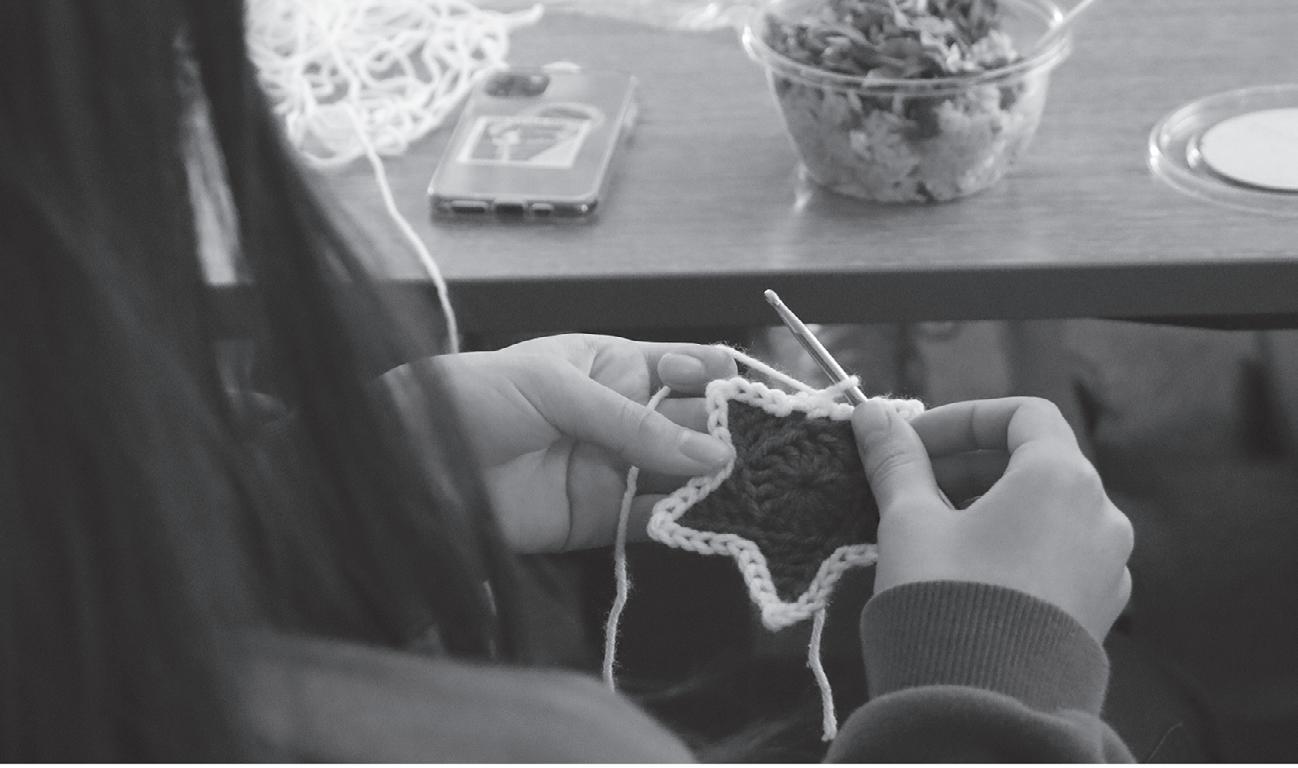
“During Biden’s inauguration, I saw Kamala Harris’s stepdaughter wearing crochet sweaters,” Queen said. “I'm like, ‘Oh my gosh. ose are just like what we used to wear back in the day.’ And ever since then, I've seen a lot recently.”
Queen said she crochets toys and accessories, including hats for her great nieces and nephews.
“I have four great nieces and nephews, and I do a lot of stu for
them,” Queen said. “I’m doing a bear right now. I just did a bunch of hats.”
Johnson agrees with Queen in that crochet has become popular as people increasingly want to make or wear the craft.
Johnson also said, for those who crochet, she encourages them to take the time to enjoy the experience
instead of focusing only on the end result.
“It’s important to slow down and actually enjoy the process instead of rushing to create the product,” Johnson said. "Crochet isn’t about that. It’s a very slow art form, and only focusing on the nished product is not going to get you anywhere.”


When people think of IKEA, they think of sleek, modern furniture, and warehouse shelves stacked with crates. Yet, when we arrived at the welllit lobby with the one-way escalator, we strode past the lengthy return line and eager shoppers perusing interior designs for a grander prize — the even longer line at the food court.
IKEA’s Swedish dining experience starts with, in a traditional consumerist fashion, picking up a shopping cart, but for your food: three stacked metal tray holders provide a unique solution for holding food from the bu et. Widescreen TVs surround the bu et bar, wrapping around three walls and displaying the best deals for desserts, salads and entrées. e clink of pans and buzz of chatter ll the warehouse-like room.
e salmon let presented an initially appealing alternative to the meatballs. Regretfully, like the mashed potatoes, it was just as disappointing, even when drowned in the gravy (seriously, who puts gravy on sh?). And surprisingly, the gravy added a new, needed avor to the sh. Believe us.
e (likely poorly paid) chef really wanted to make sure the sh was cooked all the way through, out the other side and back again. Luckily, the side of vegetable cake stole the show, with its cheesy, yet vegetable-forward interior melting in your mouth (as the sh should have). ankfully, the gravy stayed away from this side, leaving it unharmed. Not to mention, we didn’t receive that much food for the expensive $10 price. IKEA should consider renaming the salmon dish to vegetable cake with a side of salmon.
First, we waited in line for 10 minutes before arriving at the self-serve dessert bar. At IKEA, ordering dessert comes rst and starts with the deal of the century: a gooey chocolate cake for only 99 cents. e cake o ered a rich chocolate avor with a thin, crunchy crust. e value makes it good for people concerned about their spending, earning the cake a gooey 4.5/5.
If gooey chocolate is too cheap for your re ned taste, IKEA also o ers a slice of “conspiracy” chocolate cake for $3 (apparently, it costs more to have a conspiracy).
e suspicious-looking cake turned out to be the most generic-tasting sponge cake in existence. With layers of spongy and gooey chocolate, the conspiracy cake’s taste unravels like the logic of a real conspiracy.


And nally, just before the checkout line, we arrived at the soup and fruit station that indeed served soup and fruit, a most interesting IKEA combo. Unfortunately, there was no employee to operate the ladle, so we had to learn how to work the enlarged spoon. e tomato and feta soup was lukewarm and suspiciously lacked feta cheese. e orange liquid was acidic, as though it were red vinegar — too acidic for two basic food connoisseurs.
For our entrée, a smiling yet probably poorly paid chef o ered us the most authentic (and de nitely not culturally appropriated) Swedish Meatballs dish with gravy, mashed potatoes and peas. e eight delicious meatballs on the plate were seared with a crisp skin, covered in savory gravy and paired with cranberry jam on the side. A couple meatballs might have been a little too saturated with sodium chloride (in simple words, salty), but the tart jam complemented the saltiness well. e side of aky, powdery mashed potatoes was somehow cooked with even less avor than the mushy peas (0/0; how do you rate peas?), even when drenched in the gravy. Of course, for the inexpensive price of $8 with an option to get four extra meatballs for only $1 more, IKEA’s classic Swedish meatballs did not disappoint.



IKEA does not feature any live performances or music; instead, it opts for a more economical, self-entertainment pamphlet that requires the customer to operate it. e pamphlet proved to be quite amusing, allegedly containing photos of “Sweden” and a description of the country’s Christmas, mid-summer and Halloween traditions. We were not able to verify the purported location of the photos, leaving the authenticity of the pamphlet up for interpretation.
e pamphlet states that the photos were indeed from the Nordic country. However, while the photos were colorful and the text educational, IKEA demanded that we download their app and join their rewards program, IKEA Family, with numerous ad breaks in the booklet featuring the IKEA app. ey even o ered a free co ee every time you visit the restaurant with IKEA Family, which is a quite generous o er if you can stomach the wait every morning.
7.

While IKEA’s cafeteria is not a gourmet restaurant, it does o er great deals on a variety of traditional Swedish dishes that lead to an enjoyable experience, even though it may lack service t for the bourgeoisie. But, after all, IKEA was not built for the bourgeoisie — in our capitalist society, IKEA champions the cause of the proletariat, reminding us that, quoting the highly esteemed IKEA founder Ingvar Kamprad, “Wasting resources is a mortal sin,” and a ful lling life/meal doesn’t always have to be expensive.
Erik Feng & Jerry Xia Managing Editor & Editor-in-Chief58 Hunter constellation

61 Acronym for bad PC data



62 Social gathering for men only
64 Home of the Taj Mahal
65 British fellow
66 Sicilian active volcano
69 WNW’s opposite
Physical education teacher Stacey Kofman said ag football has become more popular as an alternative to tackle football for safety reasons.
Girls ag football became the newest high school-sanctioned sport in California, available for students as soon as this fall.
e California Interscholastic Federation, the governing body of high school sports in the state, approved the move in a unanimous 1460 vote on Feb. 3.
Lawrence Mincey
Jr., chairperson for the California Association for Health, Physical Education, Recreation and Dance State Council on Interscholastic Athletics, said allowing for the sanctioning of girls ag football will enable players to not only reap the bene ts of tackle football, even beyond its technical skills, but also pave a new path.
“Being able to showcase one’s speed, agility and coordination and being able to garner and foster lifelong relationships while competing in one of the fastest growing sports in the world (seems to be) an exciting proposition,” Mincey said. “In addition, the girls who compete will be pioneering a new and exciting movement within the game of football.”
Allied organizations of CIF are able to propose and vote on changes at CIF meetings.
Mincey said he was a voting member of CIF’s Federated Council as the liaison between the council and CAHPERD.
“ e process of approving the sanctioning starts with CIF member institutions presenting the idea to the CIF Federated Council for it to become an agenda item, (which) occurred in the winter session of the CIF Federated Council meeting,” Mincey said. is was followed up by a meeting to pitch the initiative and nally, the vote.”
“While the sport of tackle football has seen a decline in the last 10 years due to the increased research and education on concussions, ag football lacks the collisions and contacts on the eld,” Kofman said. “Even though incidental contact occurs, the rates of concussions are much less than tackle football.”

Despite the decline of tackle football, Paly has a history of resilience and success with the sport, JV football coach Jason Fung said.
Fung also said the level of participation uctuates every year for the team.
“Unfortunately, it follows student interest. COVID-19 didn’t help the football program, but now it’s coming up to the surface again,” Fung said. “I had my biggest class of freshmen last year, which is a good starting point.”
Paly football won a state championship in 2010 and has won multiple CCS titles –– the most recent one being last season’s Division V championship.
Head football coach Dave DeGeronimo, who has coached football for 15 seasons, said ag football has only been a part of the physical education curriculum for underclassmen and in club-based activities outside of school.
“ e only ag football history here at Palo Alto is the Powder Pu Game that used to be played during Homecoming Week and in our PE classes,” DeGeronimo said. e recent decision from CIF has the power to change that. Mincey said adding ag football as a sanctioned sport within the state will allow young women to strengthen their skills and interact with teammates and coaches throughout the process.
ey can train and gain a foundational foothold in the competitive levels of the game in the same way that athletes (do in any other sport). is will also help the coaches have a profound e ect on the lives of their athletes,” Mincey said. “ ere are plenty of people who have never played ag football, but now those people could even pass on their newfound knowledge of the game to the next generation.” Kofman said creating a ag football program at Paly depends on student interest as well as season timeline and the availability of o cials and coaches.
Regardless of participation at Paly, Kofman said girls ag football can help the Athletics Department work to increase the representation of women in sports that are historically male-dominated — including football — through coaching.
“Seeing more women in coaching positions across the board is evidence that women can coach and play in these male-dominated sports like football,” Kofman said.
Fung said while girls can participate in tackle football, there traditionally has been a lack of female representation on the team, but unique solution.
ag football is that it has less violence as a no-contact sport without tackling,” Fung said. said although coaches and the Athletics
Department have mixed feelings about the introduction of another sport when the department already has funding and resource issues, it could ultimately be an enriching space for girls.
“If ag football is o ered in the fall, eld hockey participation could be negatively impacted, and the same would happen with lacrosse if o ered in the spring,” DeGeronimo said. “And even though eld space and scheduling for practices will be a greater challenge, overall, there should be excitement for this growing girls sport.”

Mincey said providing more opportunity for girls in sports is a huge positive, regardless of challenges, in both their current and future lives.
“With the successful push from the university NAIA level to incorporate womens ag football as an o cial sport, players in California can continue their ag football careers into college and beyond,” Mincey said. “We can begin to establish a space (for women) to hold a bigger role in our country’s most popular sport.”
Advancing to the CIF Division I Championships before falling to Cardinal Newman High School 60-35, the girls basketball team (20-7) made major headway this season, head coach Scott Peters said. e team nished second in league and third in CCS’s Open Division tournament.
Peters said he scheduled 12 games with public and private schools during the preseason to help the team prepare for the regular season.
“I try to pick tough teams,” Peters said. “I picked Sacred Heart Cathedral, San Ramon Valley (and) Menlo. Some of the other good public school teams we played (were) Evergreen and Branham.”
During league play, Peters said the team su ered tough losses to Los Gatos.
“Our goal every year is to win league, and this year we won second place to Los Gatos,” Peters said. “Losing to Los Gatos and losing league is painful. Sometimes you don’t meet your goals, but you got to continue on and work hard.”
At the end of the season, Paly was one of eight girls basketball teams placed by CCS into the Open Division tournament.

“You’re divided into two pools, and you play three games,” Peters said. “Both this year and last year we played the same teams. Sacred Heart Cathedral, St.
Ignatius and Pinewood. is year we went 2-1. Last year we went 1-2.”
During the Open Division tournament, Paly defeated Sacred Heart Cathedral 68-51 and St. Ignatius 47-33 but lost to Pinewood 54-46.
Peters said even qualifying for Open Division is a major achievement for the team. ose were hard teams, and we did fairly well,” Peters said. “It’s an accomplishment for us as a public school team to compete with those teams.”
Sophomore and small forward Katherine Garr said she appreciates Peter’s guidance throughout the season.
“He always gives me really good tips that I don’t see,” Garr said. “Like, if I do something that I didn’t know I did wrong, he’ll tell me to do it di erently.”
Overall, senior and point guard Kaella Peters says the season was successful, but there’s room for improvement.
“ ere (were) just a couple (of) games where we had some stu to work on, but we’ve gotten better as the season has gone on,” Peters said.
Claire Jittipun Guest Writer Vostrejs Guest WriterUsing what senior captain Jackson Martin said was energy and drive, the boys basketball team nished the season 19-7, placing second in the league.
e team also advanced to the CCS Division I semi nals before falling to Bellarmine College Preparatory.
“Our goal is to just play the way we love to,” Martin said. “We all know the game and are doing our best to put it all together. If we can play the way we are supposed to, we can be a very hard team to beat.”
is mentality propelled the team to victory in a January crosstown rivalry game against Gunn. Down 15 points in the fourth quarter, coach Je LaMere said the team prevailed 51-47 as a result of its positive energy.
“It was a testament to our team and their toughness to continue to battle when you’re down in the fourth quarter,” LaMere said. “I’ve been in a lot of games, and I’ve been doing this for 30 years at all di erent levels. is has to be right up there with one of the better ones I’ve been a part of.”
As the season progressed, Paly won two of the three games leading up to the Division I CCS playo s. In the quarter nals game, the team narrowly defeated Wilcox 56-55. LaMere said he attributes this win to the team’s relentless energy and perseverance.

“Even though we were down eight at halftime, our kids showed a lot of heart, and they didn’t give up,” LaMere said. “We spoke about how this is our last opportunity to be together as a team, (so) let’s not make this our nal day together.”
With 21 seconds left, Martin made a corner three o of an out-of-bounds play, closing the gap to 53-52 and
putting Paly two points away from the win. After fouls on both sides, the score was tied 55-55. Sophomore Jorell Clark was fouled once more with three seconds left, and he made a free throw to win the game.
“We knew going into the game that it was all or nothing,” Martin said. “At times, it felt like the game was over and so was our season, but just like with Gunn, we knew we could come back and turn the game around. We de nitely did that tonight, and, in my opinion, (it) was an even more electric game than Gunn.”
e team then advanced onto the CCS semi nals where it lost to Bellarmine 56-40 on Feb. 23.
“Overall, it’s been a tremendous season,” LaMere said. “I’m proud of these guys. ey had an amazing game against Wilcox in the quarter nals to advance, and we’ve really had a tremendous season.”
Sweat beads down sophomore Joseph Kessler’s face as he sprints around the soccer pitch. Dribbling the ball, he dances around defenders before crossing into the box. Kessler may just sound like any other soccer player. e di erence? He doesn’t play competitive soccer and isn’t even on the soccer team.
Facing frustration with limited options for casual sports, a group of sophomores has created an independent soccer league, allowing students to immerse themselves in this competitive outlet while avoiding the drawbacks that they say comes with school sports.

Many high schools, colleges and universities o er intramural leagues, an opportunity for students to play organized sports in a recreational environment.
However, Paly typically does not o er many opportunities for competing in intramural sports. e senior spikeball tournament that wrapped up two weeks ago is one of few this year, and it was only available to seniors.
Kessler said he was frustrated with the lack of ASB-sponsored intramurals.
“I dislike that Paly doesn’t o er more intramural sports since it’s a good way to build a better community for the school,” Kessler said. “Intramural sports are a good way for students to build relationships while having fun and competing.”
At the moment, one of few options for students who enjoy sports is to join an o cial school sports team, but these teams often have selective tryout processes and upwards of 10 to 15 hours of practice each week.
e dedication required makes it nearly impossible for those who are more casual about a sport to just have fun playing.
One of the new league’s commissioners, sophomore Dexter Cleveringa, said he was motivated to start the league to help relieve people from the pressure of school sports.
“ e idea stemmed from playing sports with friends in a low-stress environment, something that gets away from the high intensity conditions of high school sports,” Cleveringa said.
Sophomore Roan Haney, who is also a league commissioner, said he wanted to create the soccer league to allow students to enjoy the sport leisurely.
“It’s great to try new things and have fun learning new skills, so I started this league for people who want to do that,” Haney said.
To emphasize the league’s casual and low stakes nature, the commissioners modi ed the rules of the game.
e goals are 50 yards apart, as compared to the usual 120 yards. e game is played in two halves that are each 30 minutes instead of 45. If the two teams are tied after 60 minutes, the game goes straight to a penalty shootout rather than extra time.
Kessler said his experience in the soccer league is more oriented towards fun.
“ ere is no practice required, so it is very easy for people to just play in the games,” Kessler said. “ e focus of the league is to not have people with signi cant soccer experience dominate. We just try to have a good time.”
Cleveringa also said the league is a great opportunity to meet new people.
“We thought the league would be a lighthearted and fun way to bring di erent friend groups together,” Cleveringa said.
Girls lacrosse faced a problem as the 2023 season approached: the team had no coach. However,the problem was resolved when Kaitlin Chiu, a former Paly lacrosse player who graduated in 2017 and was a Division III player at Smith College, stepped in.
Chiu said she became a coach to return her gratitude to the Paly lacrosse program while pursuing her passion for the sport. Chiu also said a former lacrosse coach allowed her to pursue this opportunity.
“I felt like the Paly program really gave me a lot and allowed me to pursue my passion for lacrosse,” Chiu said. “I owe a lot to (former coach) Jamie Nesbitt for allowing me the chance to go and play in front of a huge platform, essentially giving me a lot of exposure, and so I felt I owed it to Paly lacrosse to come back and dedicate my time.”
During the pandemic, Chiu was unable to compete in college lacrosse. She said she wanted to make up for the lost time by sharing her knowledge and experience with the team.

“I’ve had one or two club seasons under my belts, and so I gured I’ve learned a little bit,” Chiu said. “I’ve seen how others coach, and I’ve also had plenty of other coaches that I look up to. I wanted to take that knowledge and impart that on the girls at Paly.”
e team also had trouble nding JV coaches, which left many players including junior Aspen Stitt feeling worried.
“It was pretty stressful especially because it took us so long to get JV coaches,” Stitt said. “If we didn’t get one, JV would have been discontinued, and we would have had to cut people from the team,”
Despite the obstacles the team faced, Stitt said she is hopeful this season will re ect positively on the team and the new coach.
“Kaitlin has helped our team grow through individual strength and team energy,” Stitt said. “We are all learning a lot from her every day, and I am so excited to see how we develop as a team throughout the season.”
Junior Gabby Loops said the team dynamic has improved from last year when the team had two coaches who employed di erent training styles.
“Last year, we had two coaches on varsity who were more intense, which was good, but this year’s energy
At the same time, students who are frustrated with the lack of sports options at Paly may not have to wait long for new opportunities. ASB Vice President Felicia Lee said there are plans in the works for more recreational sports.

“We are collaborating with the ultimate frisbee team for Primetime,” Lee said. “We’re also thinking of taking the volleyball net out to the quad.”
However, even with ASB creating new events, Cleveringa said he thinks it is important that students are the ones controlling the league rather than ASB.
“Our league works because we’re pretty casual and make it up as we go,” Cleveringa said. “We can schedule games working around our extracurriculars. A larger organization like ASB would have to satisfy the needs of a
feels better,” Loops said. “Kaitlin is a very supportive coach who brings good energy to the team, so we are very happy to have her.”
Chiu said she wants to bring her passion for the sport to the team, inspiring players to feel that same passion through creating a tight-knit community. e program at Paly impacted me, so I want to give that back to the girls and try to create a really fun community that is driven towards not necessarily just winning, but playing for the love of the sport,” she said.
Chiu said she hopes to model a commitment to the girls through the expectations she sets. She said she sets rules for practice, such as being punctual.
“I want us all to start on time,” Chiu said. “ at’s a hard rule that we show up to practice and we’re ready to go because we only have one and a half hours three times a week to work together as a team and learn about each other and how we play.”
Additionally, Chiu said she hopes to become a role model for her players as she has undergone the same academic challenges and can relate to her players. She also said she hopes to create an environment where the girls can forget their stresses, have fun and learn when they step on the eld.
“As soon as you walk onto the eld, you’re here to have fun,” Chiu said. “You’re here to learn, you’re here to play a sport that you are super interested in and one day you will maybe learn to love (it) if not already.”
broader population, (and) scheduling would be far more di cult.”
Sophomore Ella Hwang participates in the league, and she also said she enjoys it more because it isn’t run by ASB.
“It’s more laid back,” Hwang said. “We can (play games) whenever we want.”
Because students run the show, Haney said the commissioners are able to e ectively create an opportunity for anyone to play sports for enjoyment.
Haney said, “Everyone takes it light-hearted and has a lot of fun, and we make things easy with no skill requirement to play.”
Rohan Bhatia Sta WriterDespite a rst match loss for both boys and girls varsity track and eld teams against Homestead on March 1, coach Michael Davidson said his goals for this season are to prepare the new players for high school sports and go as far as possible in the postseason.
e boys varsity team lost 66-61, and the girls varsity team lost 64-62.
“One of the rst goals is to help the youngsters get acclimated to high school track and eld and then more importantly into being competitive,” Davidson said. “Our goal this year is to be as competitive as we can be, qualify as many as we can to the postseason and (move) onto state.”
Davidson said he plans to achieve these goals by utilizing the teams’ experienced coaching sta “It comes down to basics and training on helping them go step by step,” he said.
Senior and co-captain Kyle Park said people often think running goals are just about becoming faster, but in his mind working together as a team is a big goal for the season as well.
ere is a misconception that the whole point of running is to get out there and run as fast as possible and defeat everyone,” Park said. “While it is important, I think ultimately the goals for the season are to create a
team that works cohesively and runs as a unit and runs together.”
To make sure the team has good chemistry, Park said the athletes stay together through conditioning and tness.
“We make sure that everyone stays at practice and no one leaves during time trials or workouts to go and do their own thing,” Park said. “I think when we all work together as a team, it’s going to be a lot better, (and) a lot more cohesive.”
Senior and co-captain Elizabeth Fetter said the team also does activities outside of practice in order to maintain a positive community and have fun.
“We have fun pasta feeds (where) we hang out before each meet (and) eat pasta,” Fetter said.
Davidson said the team has a lot of potential to do well, as long as the players put in the work.
“
ere’s a lot of talent, period,” Davidson said. “If this team decides to go to work, and really put the work in like some of them are doing, (there’s) some great potential to have some great performances this year.”
Scrolling through Instagram, senior Ella Rosenblum sees young women promoting the value of “gentle workouts” like Pilates and long walks, bringing to light a new workout trend.
Every year, new workouts ow in and out of the public eye. In past years, high-intensity interval training and weight training have been seen as the most e ective ways to exercise by many health experts.

However, more recently, there has been a rede nition of e ective exercises.
On Instagram and TikTok, Pilates, yoga, inclined treadmill and long walks have taken over.
Physical Education teacher Sheri Mulroe said it is important that people have diverse workouts to promote wellbeing.
“(Gentle workouts) are known as low-intensity steady state workouts or LISS, and they are part of a wellrounded person,” Mulroe said.
Rosenblum is a certi ed yoga instructor and said while she enjoys practicing yoga daily, she also prioritizes weight training and cardio to diversify her workouts. She said the rede nition of e ective workouts can be bene cial when taken lightly.
“It feels like every week someone on TikTok is saying that there’s a di erent way that is best if you want results,” Rosenblum said. “ e main issue is that people go to the extremes. ey don’t just say something like, ‘It can be good to include Pilates,’ they say things like, ‘Weight lifting will ruin your body. Pilates is the only way to see results.’”
According to Tia Lynn Lillie, director of DAPER Academic Programs at Stanford, Pilates and walking can be great forms of exercise when used in combination with other workouts. ere is a place for (gentle workouts),” Lillie said. “For example, if you’re doing cardiovascular and strength training during the week, weekends are a great time to take it easy and go for a light walk or do some yoga.”
Rosenblum said her workout schedule aligns with this idea.
“I usually alternate: one day heavier weights at the gym, and the next day I do something like a long run or something fun like skateboarding or roller skating,” Rosenblum said. “I absolutely love yoga as something I do in addition to higher-intensity things like heavier weight lifting and cardio.”
Rosenblum said she appreciates not only the physical aspect of yoga but also the mental bene ts it brings.
“It’s not just about the physical with yoga. It’s mental,” Rosenblum said. “I’m not even that spiritual of a person, but something about it feels spiritual, and it’s great.”
Mulroe said this is a critical part of working out because, without enjoyment, there may be no motivation to continue.
“If you like it, you can do it,” Mulroe said. “If you’re like, ‘I should really do this,’ but you don’t like the (type of workout), you’re not going to do it.”
While workout trends may ebb and ow, the important part of exercise is to take care of yourself and listen to professional sources such as the CDC, Lillie said.
e CDC does a great job in (showing) this is how much you need to do for moderate intensity, this is how much you need to do if you’re vigorous intensity (and) this is how much you need to do per week,” Lillie said. “And that’s super important for strengthening our heart and decreasing our risk of cardiovascular disease.”
Mulroe agrees and said it’s also important to listen to reputable trainers, no matter the trend or form of exercise.
“Anyone can post anything on the internet,” Mulroe said. “All the reels I see on Instagram are being posted by (random people) ... some people will see a person and think, at person looks amazing’ and do (the exercise) to look a certain way instead of to feel a certain way.”
Lillian Clark Lifestyle, Sci/Tech Editor
After nishing last season with a league record of 5-9 and placing sixth in SCVAL, the girls lacrosse team hopes to build strong team spirit in order to improve the team's performance, according to junior and co-captain Katie Yen.
Yen said the team lost a lot of seniors from the previous season, which means focusing this year’s team on building stronger bonds between players both on and o the eld will be critical for the team to have a successful season. “It would be really good to work on team chemistry and dynamics,” Yen said. “All of the underclassmen have really stepped up, and it’s really cool to see their improvements so far.”
Junior Scarlett Cummings said that at practices, the team has been good at focusing on conditioning, drills and scrimmages to prepare for upcoming games.
“In addition to conditioning, we’re also focusing on playing with uidity because I think that’s really important in a game scenario,” Cummings said. “We’ve been doing a lot of passing to get our stick skills back up.”
Cummings also said the team needs to collectively put forth its best e ort during practice in order to prevent mistakes during a game.
“It’s important that we solidify our skills into one group because lacrosse is not only a sport where you need to be good individually,” Cummings said. “You need to work with others as one.”
Sophomore Poppy Barclay, who moved up to varsity this year, said the team has also started conditioning and weight training in addition to practicing game-like situations.
“(Conditioning will help us) outrun and outlast our opponents on the eld and use speci c game plays in our upcoming games,” Barclay said. “My biggest goal is to have a lot of fun, work hard, and hopefully we’ll win some games too.”
Following an 11-10 win in the season-opening scrimmage against Valley Christian on Monday, Feb. 27, senior Asher Friedman said the boys lacrosse team (1-1) is excited about its strong start.
team to its rst-ever CCS appearance following a 3rd place nish in league (6-6).
At the end of a 4-1 rainy loss to Serra on Feb. 23, senior and captain Sal Meehan said the team plans to focus on limiting strikeouts in critical situations and scoring more runs, which was their weakest point.

Despite the loss, Meehan said he is grateful for the opportunity to play a strong team.
“Matching up and playing a game against a talented team like Serra was a great opportunity to see where the team is at moving forward,” Meehan said. “It was evident that we need to focus more on trying to put the ball in play with two strikes. Our team is preparing for the next game (by) working on our two strike approach and limiting the strikeouts.”
At the same time, Meehan said the team performed well defensively.
During practices, sophomore Henry Harding said now that the team better understands its strengths and weaknesses, it will train harder to prepare for the rest of the season.
“We are going to be upping the intensity on all of our practices from
here on out, and we are also going to be working on having a better approach at the plate so we can start scoring some more runs,” Harding said.
And the approach seems to have worked.
After switching up the training routine, the team scored 13 runs in a win against Monterey and seven runs in a win against Leland.
With only two returning starters and several younger members, Meehan said gaining experience is important at the early stages of the season so players can learn to work together and build chemistry, preparing them for the CCS playo
“ e more games we play together, the more experience and better we will get come playo Meehan said.
Meehan also said the team hopes to work on fostering better teamwork and bonding outside of games.
“A goal I have for the rest of the season is continuing to strive to
Friedman, who has committed to Oberlin College for lacrosse, said it was clear from the energy in the post-game huddle that the game set the tone game) was a great into the season,”
“It showed us what we had to work on more to have a successful season.”
Junior Tyler Harrison said a late surge from Valley Christian kept the game tight throughout. “It was a little too close for comfort, but returning players stepped up today,” Harrison said.
e departure of coaches D.J. Shelton and Alfredo Rico-Torres left the team with a new coaching
On top of that, many underclassmen have replaced last year’s 12 seniors who led the lacrosse

While setbacks are to be expected, coach Ed Hattler said he is excited by the newfound team chemistry.
is team has a lot more energy this year. You can see it when they go and have fun every time,” Hattler said. “We share the ball beautifully, which is why we have a diverse group of scorers.”
Sophomore and second-year player Milo Sabina said the group is ready to replace the graduates. “Last year we had a lot of seniors carry this team so this year we are a little less developed, but it’s still ‘go big or go home,” Sabina said.
Despite the loss in experience, Harrison said he has high aspirations for the team.
“I love the competition; we’re gonna bring it all season,” Harrison said. “ e goal is to maintain the high level we had last year and make CCS after losing a lot of our core.”
While many sing the praises of applications like ChatGPT, a manifestation of textual AI, there are a plethora of innovative implementations of AI which may have a direct impact on people’s retail and consumer experience.
Companies like Standard AI are leveraging AI to modernize retail operations through practices like self-checkout and autonomous shopping.
Standard AI retro ts existing retail stores with AI-vision-powered ceiling cameras that can track shoppers and accordingly build a cart as customers pick up or put down items in the store.
Once customers are done shopping, they tap out of the store with their credit card and the receipt is automatically sent to them via text or email.
Director of Engineering at Standard AI
Mohit Singh said the implementation of this technology targets issues faced by an increasing number of brick-and-mortar stores.
“Shoppers interact with stores in so many ways — apps, cash, card, ordering ahead, asking for restricted items — that it is important to meet them where they are and accommodate their preferences,” Singh said. “As their expectations for convenience increase, so does the size of the tech stack.”
Singh said satisfying shoppers often requires building a tech stack around a myriad of vendor solutions.
“We have heard for years that retailers want vendors who can do more; they nd it frustrating when they have to piece together a tech stack with dozens of vendors and rely on dated legacy solutions with few alternatives,” Singh said. “Retailers now have the ability to understand shopper behavior, assist sta with operations, understand inventory levels in real-time and more e ectively personalize the digital experience and they can do it with a single product.”
Singh said Standard AI has launched multiple operational stores and is working with international retailers.
“Shoppers love it,” Singh said. “With an autonomous checkout, they do not have to wait in lines, making the experience signi cantly better.”
Along with the e ciency it provides, Singh said there are additional bene ts for retailers.
“As we have rolled out our system, we have seen a 20% increase in basket size of our customers,” Singh said. “We can provide retailers with insights and analytics to a level of detail they did not have access to before. We have been able to reduce 10% of out of stocks that occur in stores and we have been able to drive a 27% boost in impulse buys with the analytics we provide to the retailer.”
Additionally, Singh said this level of automation helps address the consistent shortage of labor in today’s retail environment.
“Hiring and retaining talent is an existential crisis for retail, one that threatens to limit growth and store performance,” Singh said.
In the future, Singh said the overarching ambition of Standard AI is to deploy the use of this transformative technology in other types of consumer environments.
“Our system is powered by a computer vision system which can be extended to verticals way beyond retail to gyms, warehouses, cafes, restaurants and many more,” Singh said.
Technology-driven consumer experiences are also becoming increasingly popular in restaurants. Companies like Toast, Ziosk and Oracle are building automated menus, order placement, payments and tipping.

Eric Neilson, Vice President of Engineering at Ziosk, said the company delivers tabletop devices to franchise-based restaurants.
“Speci cally around the tabletop devices, we collect data and analytics on how people interact with those devices, track things like how large a typical check is at a table and track the average tips,” Neilson said.
Neilson said restaurants generally receive more positive feedback when customers interact with technology.
Senior Annelise Balentine reaches for her plastic jar of melatonin gummies before climbing into bed. e clock reads 12:14 a.m., a couple hours earlier than when she usually goes to sleep. Balentine’s eyelids grow heavier by the minute, and she quickly falls asleep. According to the CDC, the number of young people like Balentine taking melatonin supplements increased 530 percent from 2012-2021.
With the increasing number of students who use melatonin to try to fall asleep, psychology teacher Christopher Farina said people should also consider the supplements’ adverse e ects on the biological clock.
Farina said peoples’ bodies already produce a natural level of melatonin to help them feel sleepy.
“It’s produced up in the brain, as opposed to other hormones which are produced throughout the whole body, so the structure that secretes it is particularly sensitive to light,” Farina said. “When there’s not as much light hitting your eyes, then your body will secrete more melatonin.”
Although many students may take melatonin supplements to help them go to sleep, Farina said there is no concrete evidence that it actually works.
e research is pretty mixed on whether or not over-thecounter melatonin really works or not,” Farina said. “It seems like on average it probably doesn’t do much, but there could be a lot of individual variation within it. For some people it really can make a di erence, and for others it really doesn’t make a big di erence.”
But Balentine said taking melatonin supplements does help her fall asleep faster.
“I consume melatonin about once or twice a week, and its e ects are helpful,” Balentine said. “I take it when I know I have to wake up early or just want to go to bed earlier because I usually go to bed at 1 or 2 a.m. with my normal sleep schedule.”
However, Farina said the e ectiveness of over-the-counter melatonin may be the result of the belief that it works.
“It is also important to note that it could be the placebo
brings convenience and e ciency to the checkout process.
“It is easier to use, especially in large groups, so everyone can pay for their own food separately, instead of having to split the bill at the end,” Parigi said. “And once you are done eating, you can leave instead of having to ag down a waiter.”
Junior Katie Yen, who served as a hostess at downtown Palo Alto’s New Orleans-themed Cajun restaurant Nola, said tabletop ordering also provides advantages for the restaurant sta
“At Nola, there are hostesses who handle reservations, servers who help people order and answer food or drink related questions and food runners who bring the food from the food window to the customer’s table,” Yen said. “I nd that this system works really well, especially when it is busy because waiters and servers are able to focus on other aspects of their job, like bussing tables and answering questions, rather than spending most of their time taking orders.”
Yen said the transition to tabletop ordering proved easier for those well acquainted with technology.
“Because of the pandemic, many restaurants switched to similar ordering procedures, and I have found that younger age groups who are more comfortable with technology can easily use these systems,” Yen said. “However, as a hostess, I noticed that older age groups struggled and demonstrated frustration with this system.”
And Parigi said elements of the restaurant experience have been sacri ced in order to achieve the convenience.
“A lot of times, it feels as though the experience is the same as if you just ordered from home,” Parigi said. “I feel like that defeats the purpose of dining out in the rst place.”
ART BY GRACE HE“When you provide a very smooth, seamless technology integration with a restaurant, people tend to have a more positive experience, and we can see a higher guest satisfaction with our customer survey data,” Neilson said. “Our data shows that tips are better with tabletop paying devices and make for happier customers and happier servers too.”
Neilson said Ziosk has improved its devices to better address customer’s needs through years of iterative design.
“We have learned over the evolution of the technology what is important to both the restaurant and the customer,” Neilson said. “Battery life, ruggedization and an intuitive user experience were the core design considerations.” Technologies like Ziosk have also transformed the dining experience. Junior Elsie Parigi said QR code and tabletop ordering
e ect, where taking it externally makes you feel like you’re doing something,” Farina said. “ en you have the expectation of feeling sleepier, which makes you more likely to fall asleep.”
While taking melatonin can be convenient, Farina said if someone is having trouble falling asleep, that could mean there are other factors melatonin-users should consider such as sleep hygiene.

“It’s ne if you use it every once in a while, like when you’re traveling to di erent time zones, then it can be helpful to get you on that circadian rhythm to reset your biological clock,” Farina said. “But if you are using it every night to get to sleep then there are probably other things you could be doing better.”
Student ca eine consumption can also contribute to sleep troubles. While young people may rely on co ee or energy drinks to avoid falling asleep in classes after a long night of homework or studying, Farina said ca eine works in the brain by keeping people feeling alert and awake.
“(Ca eine) is an adenosine antagonist, so it blocks neurotransmitters, which are what help you feel sleepy — it essentially prevents sleepiness,” Farina said. “If you can’t clear the ca eine from your system in time to go to bed, then it’s going to delay what’s called sleep onset, or how long it takes you to fall asleep.”
Although senior Aryan Jain said he consumes co ve times a week, he has not noticed changes in his threshold for ca eine.
“Overall, I haven’t become tolerant to ca eine yet, so it’s really bene cial toward helping me stay awake, especially during tough school weeks when I need to stay up late studying,” Jain said. “I try to not have ca eine later than around 4-5 p.m. because I notice the e ects lasting around six to eight hours for me, and it has impeded my ability to sleep before.”
Farina said variation in tolerance levels of ca eine can a ect how much someone should consume.
“Some people are not sensitive to ca eine and can have a cup of co ee after dinner and be ne,” Farina said. “Other people might have a cup of co ee with lunch and will struggle to fall asleep even eight to ten hours later.”
As companies accumulate data about user preferences, Neilson said they can parley this information into training AI and Machine Learning models that will continue to enhance the consumer experience.
“Imagine a diner booking a table at a restaurant, being greeted as they enter and having their table and their favorite appetizer waiting for them when they get to the table,” Neilson said. “Or maybe you’re vegan, and we know this because you either put this in your preferences or it’s noticed by your orders, so when you look at a menu on the Ziosk device, it only shows you vegan entrées. We can use machine learning models to try to predict what we think a customer might like based on their previous orders.”
While technology creates issues of data privacy and increasing automation raises concerns about the future of the workforce, Singh said when it comes to the implications of AI on the consumer experience, society is just scratching the surface.
Singh said, “ ese technologies are advancing at an exponential rate. e possibilities are endless.”
Shamsheer Singh Sta WriterFarina also said regardless of how much ca eine or melatonin people take, their biological clocks will not be permanently changed.
Farina said, “ ere’s nothing you can really do to permanently alter your circadian rhythm since it’s dependent on the sun, and that stays consistent.”
Brianna Zhou Sports Editor ART BY JESSICA BAE