The Campanile
If enacted, Assembly Bill 2097, proposed by Democratic Assembly member Marc Berman, will require all California school districts and charter schools to ofer a computer science class by the 2026-2027 school year, making the class a graduation requirement by the 2030-2031 school year. Twenty-seven other states currently require high schools to ofer some kind of computer science course, and fve of those states — Arkansas, Nebraska, Nevada, South Carolina and Tennessee — require students to complete a computer science class to graduate. In California, 45% of high schools ofer computer science as a course, which is behind 40 other states. With California and the Bay Area at the forefront of innovation through technology, proponents of the bill argue that the next generation of students must be equipped with the skills needed to thrive in these career pathways. Tose planning to work in the Bay Area should be educated on at least the basics of computer science.
Computer Science teacher and CTE Instructional Lead Christopher Bell said since technology has drastically advanced in recent years, computer science knowledge will be required in many career felds.
“Since we have an outburst of AI that's going to be going into every realm and CS has been integrated into every feld
Moreover, Berman said AB 2097 can help close the existing gender and diversity gaps, ensuring all students in California have easier access to computer science classes at their schools. In doing so, proponents of the bill argue students can be better prepared to seek a wider array of jobs in diferent pathways after high school.
Even in Silicon Valley, Lanzot said there is still progress to be made to ensure everyone has equitable access to computer science literacy. She said even though Palo Alto boasts many professionals involved in tech, there are still many who haven't been exposed to computer science, thus lowering chances of entering the technological workforce.
“ Te children of engineers get the exposure to engineering and then have the opportunity to become engineers themselves,” Lanzot said. “But there are many people who live in our community who aren't engineers, and their children deserve the opportunity given the wealth of knowledge and job opportunities here.”
But senior Spencer Wu-Chin said students are already concerned with having less elective spots in their schedule, so they shouldn’t be forced into taking computer science, especially if they do not want to go into a career path that requires a heavy amount of computer science.
“ Te problem is that we have so many graduation requirements and it makes things very limiting,” Wu-Chin said. “ Te problem with making a whole new class (mandatory) is that it makes it harder for students to pursue things that they're interested in or pursue their own passions.”
Bell said if the bill passes, teachers may push the initiative to create new computer science courses or change the prerequisites of the current CS classes ofered at Paly.
“ Tis is something district teachers have been talking about for a long time, with computer science being such a fast-moving feld and with the need for all students to have some sort of understanding of how code and technology works,” Bell said. “Right now, Paly’s requirements are actually above the UC requirements for graduation, but the issue is we've never wanted to add a graduation requirement without removing something in exchange.”
Bell said the limited number of qualifed teachers in California, as well as America as a whole, will pose a problem for all school districts if the bill is passed.
“Across the state, we already have a shortage of teachers, and then you need to have teachers that are credentialed in CTE or have some supplemental credentials that they can get for our district,” Bell said. “However, we have a lot of

because the CDE has not yet released the reporting guidelines.
Teatre teacher Sarah Termond said the grant enables the theatre program to experiment with diferent crafts by bringing in professionals to teach and guide.
“We could use that funding to bring in someone with an expertise on a subject to help support us on a show,” Termond said. “For example, if we were working on a production with content that we wanted to bring an expert in or we're dabbling with adding projections to some of our shows, they could come in and do that.”
Junior Polina van Hulsen, who is taking AP Art Studio and Design, said she would like to see digital art incorporated into general art classes.
choices in middle and high schools if there was an opportunity to add a new section without supplanting current courses. In K-5 schools, additional Spectra Art and music classes were added.
Termond also said the money could be used to hire experts who have experience in multicultural theatre to broaden students’ perspectives of art.
while the other 30% will go to schools based on their number of low-income students.
Under this division, PAUSD is receiving $1,239,309 in preliminary funding for arts and music in schools from Proposition 28, which has yet to be distributed among the schools. However, districts with more than 500 students must allocate 80% of funding for staf and 20% for materials.
Additionally, funds must supplement, not replace, current programs.
In response to Te Campanile’s public records request, PAUSD refused to disclose the preliminary stafng and school site expenditure plans for the use of Proposition 28 funding during the 2024-25 school year, citing that no supply or materials funds have been spent
“Right now we have access to digital iPads, but having more focus on the digital art side and Photoshop courses incorporated into one of the main pathways could be interesting as well,” van Hulsen said.
In an email response to Te Campanile, Amanda Bark, the Manager of Policy & Compliance at the PAUSD District Ofce, said middle school music and drama teachers who hold two outside of schools productions/performances per semester will receive a stipend of $2,095 per year out of Proposition 28 funds during the 2023-2024 school year.
Additionally, PAUSD VAPA Director Kelly Martin wrote in an email reply to Te Campanile that PAUSD identifed specifc needs within the district’s arts programs for the 2023-24 school year. Previous grants were spent on stafng in areas based on student elective
“If I wanted to teach students about a form of theatre from a country that isn't my country of origin and that I didn't study in college, I could use that money to fnd someone who can bring that expertise,” Termond said. “ Te money to hire outside people has sometimes felt like one of the hurdles in the way of doing that work, so I'm excited that now there is a source of funding that seems (to be) made for bringing in those voices and experts.”
Termond said the additional funding will primarily beneft lower-income districts, as barely one in fve California high schools do not have a full time arts or music teacher, according to an EdSource interview with Los Angeles Unifed Superintendent Austin Beutner.
“For some schools, it's really going to be the diference in whether or not after-school programs happen,” Termond said. “ Tat's what has gotten theatre teachers really excited about (Proposition 28), because we all want every kid to have access to (theatre).”
Van Hulsen said funding the arts programs provides students with the chance to develop a creative outlet, which is limited in other classes.
“For people that are creative-minded like me, (arts programs) are a really good creative outlet for selfexpression,” van Hulsen said. “It's super important to have that ability to express yourself. I feel like most of the time, we're so busy with other classwork to have the opportunity to still be in the school environment and express ourselves creatively.”

Palo Alto High School, 50 Embarcadero Road, Palo Alto, CA 94301 Vol. CVI, No. 6 PALO ALTO UNIFIED SCHOOL DISTRICT PALO ALTO HIGH SCHOOL 50 EMBARCADERO RD. PALO ALTO, CA 94301
NEWS SAT returns as mandatory at several colleges. A2 SCI/TECH Hidden disabilities afect students. C4 Tuesday, March 12, 2024 LIFESTYLE Students pursue activism via boycotting. B1 P A I D PALO ALTO PERMIT #44 NON-PROFIT ORG U.S. POSTAGE Te California Department of Education is distributing $1 billion to Visual and Performing Arts programs across the state. Te funding aims to increase arts education in low-income areas and establish more equitable state-wide programs for students with little exposure to the arts. Voters approved the arts funding in Proposition 28 by 64.4%, the largest margin of success for an education initiative in California’s history. Te grant, which comes from the state’s General Fund — a pool of money for revenues that are not designated for a specifc purpose — is divided. 70% of it will go to schools based on their share of student enrollment statewide,
funding
support for the arts, regardless
its allocation within the district. Tere is also just that nice vote of confdence that the voters of the state want to see more arts in schools,” Termond said. “When you're an elective teacher, you often feel like you're fghting to hold on to your program to prove that it's relevant and prove that it's useful. A new source of funding like this coming in to give some extra lifeblood (gives) that feeling that people in California want their public schools to have arts programs.”
Termond said the
is a sign of
of
KATE XIA/THE CAMPANILE Holden Lee Lifestyle, Sci/Tech Editor
science
graduation requirement State approves grant funding for visual, performing arts education programs
BY RACHEL LEE
Michael Najar directs Paly Choir's production of the Madrigals. “We all want every kid to have access to (theatre),” theatre teacher Sarah Termond
said.
Computer
as potential
ART
Proposed bill to extend District of Choice program
District 29 California State Senator Josh Newman proposed a bill that would extend the District of Choice program indefnitely in California’s public schools and provide reimbursement for transfer students to the receiving schools on Jan. 3. Newman said the program allows students to choose which school district they wish to attend.
“(District of Choice) is a program that allows districts to establish themselves as a district of choice, and in doing so, they are authorized to accept students from neighboring districts,” Newman said.
While increasing choices, Newman said the program also increases transfer efciency.
“(Te program) streamlines the interdistrict approval process, and the districts that have done this largely have areas of specialization, and a substantial number of students come from other districts to bene programs,” Newman said.
According to Mercury News, there are currently 9,600 students enrolled in the program with 45 par ticipating districts. A 2021 Legislative Analyst O found students in the program gained access to an aver age of fve to seven courses not ofered in their home districts.
Ron Tibodeaux, director of Pupil Services and Secondary Education at Walnut Valley Unifed School District, said many families have benefted from the program.
“We have a lot of testimony from a lot of diferent families that reach out to us and thank us for providing opportunities that they would not have had otherwise,” Tibodeaux said.
Newman also said the goal of the program is to expand equity and allow families to make more decisions about the education of their children.
“(Te program’s goal is) to give students and their families more choices by way of educational options without being restricted by their geography or by their residential ad dress,” Newman said. “It’s a great thing that a student can go get the high school education that they would like.”
According to Tibodeaux, many students move school districts to access certain programs, such as Walnut Valley’s orchestra.
“ Tose are the types of things that have attracted certain kids and families to certain districts as part of a district of choice program,” Tibodeaux said. “If you have a standout program in a particular area, like the orchestra, that might be a reason that a family would come.”
Newman said the proposed bill plans to address the extensions of the program made in the past.
Te bill that we’re doing right now would remove that (sunset clause) and it would make the program permanent in California,” Newman said. “One of the challenges was that the program was extended periodically, so there wasn’t sufcient certainty for parents to make sure that their child could enroll and fnish a course of study ––
that are gonna make reasonably big investments to accommodate district of choice students.”
Not only does the program positively impact students, but it would also increase healthy competition between public schools, according to Newman.
“If we provide incentives for schools, both to attract students and retain (them), I think it’s a positive dynamic,” Newman said. “ Te philosophy here is (to) create standards within the public system to aspire to excellence (with) the best possible educational experi-
nce and curriculum so that the students stay in the
public system and they take advantage of everything that the system ofers.”
In addition to providing students with more educational opportunities, Tibodeaux said joining the District of Choice program has helped combat declining enrollment.

“It’s too scary. But there are politicians out there whose statements need scrutiny.”
Alarmed by the widespread misinformation in today’s media, Gavin Newsom passed Bill 873 on Oct 13, requiring schools to revise curricula to implement media literacy education across English, math and science. Tis bill went into efect on Jan 1, 2024.
Paly alum Jasper McEvoy said the media plays a crucial role in people’s lives.
“We’re all online more than ever before in critical parts of our lives,” McEvoy said. “Our communities and (part of) our democracy happen online.”
However, recent studies indicate a lack of media literacy among the population.
A 2016 Stanford study concluded that 82% of students mistook an advertisement as a news story, and the United Nations found that 17% of TikTok posts either misconstrued the Holocaust or denied it entirely.
Journalism teacher Paul Kandell said more questionable claims often had more political controversy, making it difcult for teachers to discuss.
“(Te claims are) so often political that I’m sure teachers are loath to bring up important sourcing in an English class or even a social studies class because they don’t want to get into the politics,” Kandell said.
Librarian Sima Tomas said while media literacy was already implemented in the Paly curriculum, a majority of students could beneft from a greater focus on the subject.
“Many students could beneft from more specifc and thoughtful language around how to talk about their evaluation (of media) so that it’s not just a gut feeling,” Tomas said.
Tomas said the need for the ability to accurately pinpoint and articulate misinformation in media is exacerbated by the rise of artifcial intelligence.
“As we move forward with AI, social media and the images we get, it’s going to become harder and harder (to discern reality) because fake things are going to look better and better,” Tomas said.
McEvoy said critical thinking skills are the core skills of media literacy.
“We really want to teach people core critical thinking skills,” McEvoy said. “Be-

ing aware and making smart decisions, carefully reading things and understanding the consequences of not asking smart questions or not analyzing information you fnd.”
However, since the bill does not call for a specifc plan or curricula to be used across the school systems, media literacy implementation is currently unclear. Kandell said there are many diferent ways media literacy could be more integrated. He believes journalism programs are a successful example of literacy because the courses force students to stake their names on the truth of their story.
“Journalism education is the best tool for media literacy development,” Kandell said. “We just can’t do journalism education to the vast scale that we need to use for the global media literacy campaign that our democracy and society needs.”
Tomas said she believes media literacy education could be embedded into existing assignments like projects.
Recently, she worked with a physics teacher who is making his students experiment with electromagnetism to test the validity of tinfoil hat conspiracy theories.
Tey’re getting the chance to actually (fnd) any authoritative evidence that suggests that cell phones are dangerous and under what circumstances,” Tomas said. Tey’re doing writing, reading and source evaluation, and part of the assignment is actually going in and using criteria to evaluate the sources and explain why the sources they’ve used are reliable.”
McEvoy said he has been working on a video game named Agents of Infuence that teaches media literacy to children in an interactive manner.
“It’s a story driven game,” McEvoy said. “It’s constructed so the episodes are designed to take place within one classroom period. And it’s designed to cover a particular media literacy topic while furthering your planning on core critical thinking skills.”
McEvoy said he encourages students to pause and think about nuances in works of media.
“Interpret the research you do and think before posting or sharing something,” McEvoy said. “Understand that with your ability to reach people online, you have (the) responsibility to understand what you’re sharing and where it came from.”
“Student enrollment is what gives a school their budget, so when students leave the district, the budget for the school becomes lower as well,” Tibodeaux said. “When we went to District of Choice, that allowed us to be able to bring in students to our school district during times when our enrollment was going down.”
According to Mercury News, the bill would also reimburse receiving districts, specifcally basic aid districts, for transfers. Basic aid districts do not receive state funding because property tax revenue exceeds the state calculation, which takes in multiple factors such as average daily attendance or the amount of high-need students.
Chief Business Ofcer of PAUSD Carolyn Chow said as a basic aid district, PAUSD rarely receives money from transfer students.
“When students transfer to PAUSD from other districts, PAUSD does not receive any additional funding since we are communityfunded,” Chow said. “Normally, both districts have to agree when we ask them to reimburse us for the transfer. Generally, we don’t receive anything, and we just receive the student.” Newman said reimbursements are a new factor that his legislation is trying to address.
“One of the recent extensions allowed for the program to continue, but it actually did so in a way that made it more expensive for the receiving district,” Newman said. “(Te bill) amends some of the formulas around funding for district choice students. Tat should make it more attractive for a school district that’s not receiving substantial state money. It’ll make it easier for them to absorb and accommodate students, so they’ll get 75% of the average daily attendance for a student coming in.”
Currently, the bill is undergoing legislative processes, and Newman said the bill won’t have efects for a while.
“If it passes, it won’t have any immediate change on the program because the sunset’s not for a couple of years,” Newman said. “But what it will do is it’ll remove that deadline and it’ll create a permanent feature in California’s education system. It’s important that we focus on quality but also equity and access in public education.”

Paly hosted CHSSA Speech and Debate State Qualifers from March 1 to March 3 for the frst time.
Speech and Debate Program Director
Kyle Hietala said he was excited for the qualifers to be hosted at Paly.
“It’s really an honor for us to host,” Hietala said. “We have a really strong group of students competing this year.”
Sophomore and debater Motoko Iwata said Hietala worked hard to make the tournament happen.
“Kyle, who runs our program, works really hard whenever we have tournaments, and he’s been really active in helping manage tournaments,” Iwata said. “I’m really excited for us to be able to host.”
Jon Jovy Telebrico, the debate coach for Crystal Springs, and a member of the Parliamentary Debate Topic Committee, said Paly was an ideal location for holding State Qualifers.
“(Te debate) league is pretty scattered –– we have schools up the peninsula,” Telebrico said. “Palo Alto is a central location.”
Telebrico also said he was grateful to Paly for volunteering. “To have other schools in our league volunteering their space, their time, their volunteers — I think that’s really meaningful,” Telebrico said. “It adds weight to the work that’s being done here and the stakes of the tournament.”
Hietala said he is grateful for the volunteers who made the event possible.
“We have over 35 people volunteering this weekend, which is amazing,” Hietala said. “It’s a big team efort. I’m really grateful… that so many people are involved.”
Sophomore Aaron Shone, who volunteered at the event, said he wanted to give back to the debate community.
“I wanted to do something to give back to the team that has helped me so much
and especially Kyle, who has done a lot,” Shone said. “Even when he was really busy, he was helping me with my case writing.”
Tis weekend’s State Qualifers is the only path to moving on to the State Championship for many debaters in the area.
Owen Chun, a senior at Archbishop Mitty High School, said this might be his last debate tournament in high school. “I’m a little nervous and a little excited,” Chun said. “I’m a senior so this might end up being the last tournament I go to if I don’t qualify. I’m looking forward to competing.”
Iwata said regardless of the results, the tournament was a good learning opportunity.
“Obviously, the goal is to qualify for states,” Iwata said. “Other than that, I think this is a really good learning opportunity to be able to debate with more people at a very competitive level.”
Tough State Qualifers is an important tournament, Telebrico said debate is more than just competition.
“My favorite thing about debate is that it empowers students in ways that are totally unexpected,” Telebrico said. “I’ve seen so many students come through this activity and take away so many tangible and meaningful aspects, both in terms of rhetoric, delivery or argumentation generation. It’s been really fantastic.”
Paly students Christopher Choi, Holden Lee, Anya Lee, Mihir Menon, Sophia Kim, Sarabeth Huang, Joseph Sun, Amily Zhang, Motoko Iwata, Xander Yap, Marcus Ling, Katie Wu and Sammi Wu all qualifed for the CHSSA State Championship.
Tuesday, March 12, 2024 News Te Campanile A2
Gavin Lin Assistant Managing Editor
Lea Kwan Staf Writer
ART BY CYNTHIA HUANG
ART BY IRIS TANG
GAVIN LIN/THE CAMPANILE
Sophomores Jerry Yan (left) and Brian Liu (right) prepare for an upcoming debate round. “We have a really strong group of students competing this year,” Program Director Kyle Hietala said.
Cynthia Huang Staf Writer
Colleges reinstate standardized testing requirement for 2024-2025 admissions
After four years of testoptional college admissions, SAT and ACT scores will be reinstated as a mandatory requirement for several schools beginning the 2024-25 admissions cycle with the goal of evaluating students more accurately, according to Stanford Professor of Economics Caroline Hoxby.
Hoxby said standardized tests such as the SAT allow for every student to gain admission to selective institutions, regardless of wealth and afuence.
“We expect, on a very frm evidentiary basis, that making the SAT optional will cause selective colleges to enroll fewer students from disadvantaged backgrounds,” Hoxby said.
According to a Te New York Times article, after COVID-19 prevented students from taking standardized tests and raised equity concerns regarding access to standardized testing, schools opted to make sending in SAT and ACT scores optional.
Recent announcements from Ivy League schools including Yale University and Dartmouth College indicated that they have joined other institutions such as the Massachusetts Institute of Technology and Georgetown University in requiring mandatory standardized test score submissions.
Yale, however, is also allowing students to submit AP or IB scores, according to a recent admission announcement.
Sophomore Nathan Mourrain said the decisions made by these institutions have sparked controversy and discussions across the country due to their implications.
“Standardized tests are a huge topic of discussion in the academic community right now,” Mourrain said. “It defnitely favors some while not favoring others, and it’s really hard to fnd a universal agreement.”
In response to these concerns, some schools such as those in the University of California system

and Caltech University, which permanently eliminated the option to submit test scores in 2021, have advocated for diferent alternative methods of evaluating student capability, according to a CalMatters article.
Tis includes holistic admission processes that evaluate a broader range of factors beyond standardized test scores.
Jesse Rothstein, the Carmel P. Friesen, chair of public Policy at the University of California, Berkeley,
wrote in an email that standardized testing tends to reveal greater socioeconomic divides among applicants than other admissions factors.
“Racial and socioeconomic gaps on the SAT are larger than on other available admissions measures,” Rothstein said. “Most notably, high school GPA.”
Alternatively, Mourrain said this criticism is not solely applicable towards standardized tests, and that other factors also play a role in exacerbating socioeconomic disparities.

“ Tere are tons of activities that disproportionately afect (the admissions process),” Mourrain said. “Maybe a school cannot aford certain sports equipment or facilities which other schools have, which infuences the ability of those athletes to make it into top schools.”
As the debate over the role of standardized testing in college admissions continues, the decisions made by institutions like MIT will likely infuence other schools, according to a Forbes article.
Students showcased their unique skills and talents at Paly’s Got Talent, hosted by ASB on Tursday from 5:30 - 7:00 p.m. in the Performing Arts Center.
Te 11 student performances featured a variety of acts ranging from contemporary dances to mental math, according to Sophomore Class President David Wu.
Junior William Tu, who performed a choreographed dance of “Ditto” by South Korean girl group New Jeans with members of the Palyce Club that practices K-pop dances, said they enjoyed the opportunity to put their moves on display.
“We thought (the talent show) would be a good place to showcase our skills and advertise our club more,” Tu said.
Wu, who organized the event, said he was inspired to re-launch Paly’s talent show after seeing similar shows on TV and wanted to add the event as part of ASB Studios, an ini-
Mourrain said the SAT provides an objective baseline for schools to reference.
“Standardized testing simply gives us a way to evaluate each individual student regardless of ethnicity or economic advantage or disadvantage,” Mourrain said. “You need some basis of evaluation for certain things.”

tiative which aims to foster interactive experiences for the student body through live events.
“ Te exciting (talent) shows on TV inspired me to bring this back,” Wu said. “I wanted to bring that same excitement to the Paly community.”
At the end of the show, audience members were invited to vote for their favorite performances of the evening. Te frst, second and third-place winners took home prizes including an ice-cream machine, wafe machine and speaker, respectively. Sophomore Ivy Lee placed frst with her vocal rendition of Te Little Mermaid’s “Part of Your World,” Palyce Club’s “Ditto” dance scored second and senior Mina Baba took third place with her Chopin piano performance.
Holden Lee Lifestyle, Sci/Tech Editor
Dozens of students performed and presented aspects of their cultures at Paly Teatre’s frst International Night on Friday at 7:00 pm in the Performing Arts Center.
Senior and event organizer Athya Paramesh said the event intended to celebrate a diverse array of ethnicities and cultures. “ Tis event is about celebrating diversity in the performing arts realm, so we wanted to just be able to showcase all of the incredibly diverse languages (and) performances on campus because we have such beautiful diversity,” Paramesh said.
Senior Eloise Dumas, who presented a speech on Peruvian music, said she wanted to expose the audience to the musical nuances between diferent cultures.
“People came up to me and said they learned a lot,” Dumas said. “I wanted to do something about Peruvian culture (because) that’s a really cool part of my identity. I feel like a lot of people aren’t even aware of the diferences in music that exist across cultures.”
Senior Saumya Kundu, who performed an Indian classical dance and her own choreographed dance to send a message about mental health, said she was able to connect with the audience.
“I was really proud of my second dance because it was my own choreography and I got really cool comments about it,” Kundu said. “I was trying to relate it to the audience with (the dance) being about mental health and an English song, so I wanted them to feel like they could understand what was going on.”
Paramesh said the event exceeded her expectations and provided students with a way to connect with others.
“Other people get to celebrate other cultures and learn from one another,” Paramesh said. “ Tis night has been pretty incredible. I just loved the passion that everyone put into it. Everyone has just been super kind about helping out. I could not have been more proud.”
Tuesday, March 12, 2024 News Te Campanile A3
Cynthia Huang Staf Writer
CYNTHIA HUANG/THE CAMPANILE Freshman Ivanka Kumar performs a Ukrainian song. “We wanted to just ... showcase all of the incredibly diverse languages (and) performances,” senior Athya Paramesh said.
AVA LIN
ART BY
Senior Saumya Kundu and freshman Katya Kuykendall emcee the event. “ Te exciting (talent) shows on TV inspired me to bring this back,” Sophomore Class President David Wu said. “I wanted to bring that same excitement to the Paly community.”
HOLDEN LEE/THE CAMPANILE
Meryem Orazova Staf Writer
Finding
STORY BY OLIVIA ATKINSON, ANNIKA CHU, ALEX ISAYAMA
ART BY CHERIANNE YOON

As chatter fies across the spread of meals, senior Anna Van Riesen fnds herself absorbed in conversations including a variety of cultures, faiths and traditions. She looks up at her mother, a pastor who organized the gathering, reminiscing over her parents’ profound impact on communities across the world. From practicing Catholicism in Korea to Protestantism in Nigeria, each dinner guest brings a unique perspective to the table.
Van Riesen said growing up in a multi cultural church environment enabled her to realize the impact religion has in shaping lives.
“Seeing so many diferent people in my community who (come from) so many diferent walks of life was kind of like see ing diferent models of what my journey could look like,” Van Riesen said.
Religion is defned as the belief and worship of the supernatural, such as a fgure like God. According to a 2019 survey conducted by the Pew Research Center, 67% of teenagers ages 13 to 17 in the United States considered themselves to be religious. In the Bay Area, 35% of people actively practice religion, lower than the national average of 84%.
Sociology teacher Benjamin Bolanos said religion helps people understand and fnd meaning in their lives.
“(Religion) is something we have created as humans to institutionalize values and norms for a world we can’t see,” Bolanos said. “Religion gives us a sense of who we are in this world.”
“A lot of people within my church are very pro-life, but I know a bunch of other youth like me have very diferent opinions regarding those kinds of topics,” Acosta Ramos said. “I keep religion close to my heart, but I also sort of have my own ideals. We should be welcoming of all people and not be hateful of anyone, and also allow people to be able to have rights and autonomy over their body.”

Bolanos also said religion can be useful for youth specifcally because it provides them with structure.
“Religion gives you boundaries,” Bolanos said. “It gives you a sense of belonging (and that) there’s something bigger than you, which for some people is comforting.”
Students’ experiences with religion
Sophomore Ella Segev, who identifes as Jewish, said her religious community is supportive and understanding when she faces challenges.
“All my friends (who) are Jewish understand me in ways that many of my other friends don’t, because we grew up with a lot of the same values, lessons and morals from our

Junior Noah Kim, president of Paly Christian Sent Club, said religion has allowed him to gain a meaningful outlook nd joy in the small moments. is life is short,” Kim said. “Once I die, I’m going to heaven, so why do I worry about this stuf now? Yes, it’s stressful –– I need to work hard and try my best, but it’s not the end of the world if I don’t (succeed).”
Sophomore Arjun Jindal, who identifes as Hindu, said follows a vegetarian diet because of Ahimsa, a principle of nonviolence and respect for all living things in Hinduism.
Jindal said he appreciates the lifestyle and does not mind the restrictions his religion has on his diet. “My family had an infuence on how I personally practice my faith,” Jindal said. ey (taught) me that every soul is the same. (Regardless of my diet), (Hinduism) makes me more mindful of other living things.”
Sophomore Evanllelyn Sanchez Vargas, who identifes as Catholic, said she feels liberated from societal pressures when involved with her faith.
“Religion can be an escape from the stress that teens have in today’s society because when I wasn’t as connected to my faith, I felt a lot more stress,” Sanchez Vargas said. “And when I started connecting more, I felt more liberated.”
Acosta Ramos also said her religion has enabled her to stay culturally connected to her Mexican roots.
“A lot of Mexicans practice religion, even if they loosely practice it, it’s something that’s still very embedded into the culture,” Acosta Ramos said.
Sean Michael Cameron, a religious studies student at Stanford who recently converted to Buddhism from catholicism, said the transition has allowed him to reevaluate his perspective of himself and further discover his identity.
“I found that Buddhist practice was a very helpful set of skills and tools to really get acquainted with myself,” Michael Cameron said. “ Tat helped me learn to be more authentic, or truthful, around other people.”
Segev, who grew up in a secular environment, said being surrounded by others who have diferent beliefs broadened her perspective and taught her to embrace her Jewish heritage.
“ Tere’s an understanding (that) you have to stick together and you have to be close with your people or else there will not be a community or religious space for us,” Segev said.
Sanchez Vargas said attending a public school has allowed her to explore her faith, while still feeling comfortable enough to talk openly about her religion with others.
“From what I’ve heard from other friends when they go to Catholic schools, they tend to distance themselves later from the religion because they feel like it’s being pushed on them too much,”
said. “I’ve mixed what my education says and what the Bible says to create something for myself.”
Kim said because religion is not discussed in-depth or often enough within PAUSD, the subject can cause tension between him and his non-religious classmates.
“Religion isn’t really discussed since in the Bay Area, (religious people) are a minority,” Kim said. “I do wish that more people were Christian. Tere are views that I believe in that I know my (non-religious) friends don’t –– there’s a barrier between us.”
While many hold stereotypes about Christians, Kim said he tries not to be infuenced.
Tere’s pressure from outside friends or people (saying) ‘since you’re a Christian, you’re supposed to be perfect,’” Kim said. “(While) yes, we try to do our best to not sin, we’re still not perfect. We’re still human. Everybody sins and makes mistakes.”
Adults refect on youth devotion
David Howell, Senior Pastor at the First Congregational Church, said while religion can be an ambiguous concept for younger members of society, youth prefer to practice their faith through tangible means, such as community service.
“Especially in this community, religion is often seen as an exercise in hypocrisy or a waste of time,” Howell said. “Faith for (high schoolers) is actually going out into the world and making a diference. Young people in our church are interested in how faith translates into action in the world and how faith makes a diference in the world.”
Howell said teenagers are likely to spearhead faithrelated service events to fnd their individual purposes within the larger umbrella of religion.
35% of people in the Bay Area practice religion compared to 84% of Americans.
Sanchez Vargas said. “But (for) me going to a public school, I feel like religion isn’t pushed on me, and it’s my choice to follow it.”
However, freshman Sofa Rodriguez, who also identifes as Catholic, said navigating religion in a public school can be challenging.
“ Tere are parts in academics where it made me question religion because in science when we talk about evolution, it doesn’t really say much about it in the Bible,” Rodriguez
“If you go help somebody, serve meals to somebody or build something for somebody, you know that it mattered that you were there,” Howell said. Samina Sundas, Executive Director of the American Muslim Voices Foundation, said service holds a fundamental place within Islam. She said these beliefs have guided her approach to motherhood, ensuring her children value aiding others.
“Islam teaches you to be the best human being you can be,” Sundas said. “My religion teaches me to reach out to other people and build friendships. It says, ‘if you save one life, it is as if you have saved humanity.’ I raised (my children) with my Islamic values so if they see somebody here who needs something, they would stop whatever they’re doing and take care of (them).”
Christy Augustine, a Paly parent who identifes as Catholic, said that Catholicism teaches youth important lessons.
Tuesday, March 12, 2024 Spotlight Te Campanile A4
Finding Faith

Uzma Minhas, Paly parent
“(Catholicism) can help you establish very good values in life and understand a sense of community, a sense of contributing to the world like service work and a sense of what it means really to take care of others,” Augustine said. “ Tose are all very valuable things that religious communities ofer as you’re growing up.”
David Booth, Rabbi of Kol Emeth Congregation, also said many teenagers view religion as a subcategory of their identity, which is diferent from other age groups.
“Judaism is a very powerful and frequently accessed app within their system of thought, but it’s one app among many, so it’s not always opened as often and it doesn’t necessarily infuence the way they may engage with other things,” Booth said. “Because it’s an app, you can then go to another app when it’s an operating system. You’re always operating within it to some degree.”
Uzma Minhas, a Paly parent who identifes as Muslim, said her children had a positive experience regarding religion within PAUSD.
Tere was a PE teacher who actually emailed (me) saying that he was going to accommodate my kids, and even talked about the benefts of fasting during the class,” Minhas said. “(My children) had teachers that have just been so sensitive during the month, and have asked ‘is it okay if I bring in snacks?’ during Ramadan.”
However, Minhas said she recently noticed a negative change in attitude towards Muslim students in PAUSD.
“I’ve lived in Palo Alto for over 10 years now,” Minhas said. “(My religious experience) was always positive, but the last few months have been very challenging with the rise in Islamophobia, anti-Arab and anti-Palestinian hate.”
Misconceptions about religion
Bolanos said although he respects individuals’ faiths and religious beliefs, he is apprehensive of those who impose their values onto others without their consent. He said when individuals begin to examine their own religious identities, their curiosity is often shut down in the name of tradition.
“All of us go through, even if we’re not religious, a period of questioning,” Bolanos said. “What happens in (conservative) institutions is this constant (pressure) making sure people don’t deviate, making sure people stick with the program.”
Bolanos said students should question religion and reconsider their ideology to determine whether they agree with their learnings, and if they want to continue practicing this religion for the rest of their lives.
“It’s surprising to me that kids have any kind of faith at this age,” Bolanos said. “(Tis is) a period where they’re questioning things and may not really be sure what they believe. I think that’s fne because (religion) is such a private matter. As you’re moving away from your parents, thinking what they believe in, and you’re trying to adopt your own values and norms.”
Van Riesen said a common misunderstanding with religion is the belief that students adhere to it solely because their parents are religious and have imposed their values on them.
“I think there are some families that really push religion as something that is like, ‘you’re wrong if you don’t believe what we believe,’” Van Riesen said. “But my parents were like, ‘We want you to believe what you believe because you’ve put a lot of thought and genuinely chose it.’”
Howell said his church includes a diverse group of people. And while Church members learn diferent methods or ap proaches to faith from each other, many Christians are often misunderstood as sharing the same perspective on certain issues.
Te Christian Church especially, has the problem that (the) loudest voices within the community (and) country tend to be very conservative,” Howell said. “ Tat doesn’t really re community or our church.”
Instead, Howell said his church values helping oth ers and being inclusive, and that exclusion and condamnation are not true Christian values.
“People who are part of our church are tremendously passionate about serving the community and serving people in need,” Howell said.
Furthermore, Michael Cameron said religion is everywhere, no matter how secular a community attempts to be. Tus, understanding religion can help people analyze political and social structures.
“We’re always in something that we can call a religion,” Michael Cameron said. “It’s an inevitable way in which humans organize ourselves. Tere’s still a lot to be learned just about very practical afairs, like how our social, economic and political systems work.”
Minhas said learning about diferent religions can provide people with greater empathy for one another.
“It’s important to know about all the di because we live in a global world,” Minhas said. “Having that


Tuesday, March 12, 2024 Spotlight Te Campanile A5
—
California should pursue Vote 16, lower voting age for local elections
Afew weeks ago, I pre-registered to vote, confdent that California would allow 17-year-olds who become adults by the general election to vote in the upcoming primary election on March 5.
As expected, I was able to fully pre-register to vote in less than fve minutes. But to my surprise, I learned I would be unable to vote in the primary I was eager to participate in, even though I will be 18 by September.
As a result, in November, many other current 17-year-olds and I will only be able to vote for assembly members, congressional representatives, a presidential candidate and ballot measures, among other options that we did not have a voice in choosing.
With March 12 marking the end of California’s 2024 primaries, the state should revisit how it views youth voting. Californians who are 55 and older make up half of likely voters but represent only 35% of the state’s adult population, while young adults from ages 18 to 34 constitute only 18% of likely voters but 31% of adults, according to the Public Policy Institute of California.
In addition, according to Who Votes for Mayor –– a project dedicated to analyzing local elections ––in San Jose mayoral elections, voters who are 65 and older have nine times greater of an electoral impact than voters aged 18-34, and in San Francisco, their electoral impact is four times greater than that of young voters.
Despite being a pioneer in progressive reforms that increase voter turnout, California trails D.C. and 18 other states in allowing 17-year-olds to vote in primaries in addition to European and South American countries –– many of which even allow 16-year-olds to vote.
I believe California should pursue Vote 16, a national campaign advocating to lower the voting age for local elections. Just like adult citizens vote for their country’s leader, high school students should be able to vote for their school district’s board. After all, it doesn’t make sense that the people who are afected most by the result of an election don’t decide it.
New Jersey’s largest city recently became the most populous community allowing 16-year-olds to vote in the United States. Similarly, among other Alameda county cities, Oakland and Berkeley passed Measure QQ in 2020, allowing 16-year-olds to vote in school board elections, even though it has yet to be put in place.
Similarly, Proposition 18 is a legislatively referred constitutional amendment that would allow 17-yearolds who will be 18 by the general election to vote in the primaries.
Notable supporters of Proposition 18 include Governor Gavin Newsom, Assemblymember Evan Low, Assemblymember Kevin Mullin, Senator Alex Padilla, Te League of Women Voters of California and Te California Democratic Party.
Also, California prioritizes voting engagement, ranking 7th in ease of registering to vote, according to a study done by Liebert Pub.
Considering that the younger people start voting, the more likely they become lifelong voters, Proposition 18 and Vote 16 would do well to further California’s goal of increasing voting engagement.
However, neither Proposition 18 nor Proposition G, Vote 16’s initiative, passed when they were last voted on. In 2020, 44% of Californians voted for Proposition 18 and 49.2% of San Franciscans voted for Proposition G.
Te most common argument against lowering the voting age is that only adults are mature enough to vote.
While it’s reasonable to worry about the maturity of younger voters, there is little cognitive or maturity diference for voters like myself in the short time between the spring primaries and the autumn general election.
Tere is almost no value in granting general election votes to newly-turned 18-year-olds without granting them a say in the fnal candidates. Te legal precept inaugurating adulthood at the age of 18 should not afect voter eligibility as 17-year-olds can drive, work without any restriction on hours, pay taxes (if they earn enough) and be convicted for crimes as adults.
Another common worry among opponents of Proposition 18 is that 17-year-olds would blindly copy their parents’ votes if allowed to vote. Of course, teens would be heavily infuenced by adults around them, but that isn’t to say they wouldn’t be able to form their own unique opinions either. Political socialization infuences everyone, regardless of age, so why bar teens from voting?
With civic engagement curricula ––like the High School Voter Education Weeks, which was initiated in 2022 by the Oakland Unifed School District to support Measure QQ –– young voters will be properly informed and provided help pre-registering to vote.
If California wants to optimize voter engagement and decrease the age skew in voter participation, there is a clear solution — follow the footsteps of many other cities, counties, states and countries in lowering the voting age.
 Alec Bonnard Lifestyle, Sci/Tech Editor

Classes should ofer improved independent learning opportunities to nurture growth, foster collaboration
 Naveen Narayanaswami Staf Writer
Take a look around a classroom and, chances are, you’ll see math worksheets and notes turned into art canvases with doodles scrawled in blue ink.
You’ll also see students starting the day with cafeinated drinks to prepare for the long day ahead.
However, if you look closer and see the infexible curriculums that force students to adhere to rigid learning styles, the problem is clear: most Paly courses sacrifce individual growth and nurturing academic curiosities for meeting state guidelines.
For example, my friends and I used to enjoy reading, spending sunrise to sunset reading every summer day. However, after being forced to read “To Kill A Mockingbird,” what used to be a pleasant hobby has become a chore.
And between extracurricular activities and school work, there is almost no free time that I even want to spend reading, let alone a required book.
Although group projects and in-class activities prove helpful in learning to think critically and provide us with the opportunity to engage with course material, I fnd that our courses lack independent learning opportunities.
For instance, English classes could encourage students to test the waters with
ART BY CHARLOTTE LIU

diferent genres and allow them to read according to their pace. When students fnd the right book, these independent reading assignments could boost creativity and engagement.
If students were able to choose what books they read, even if there are some requirements as to what those books are, students would be challenged in new ways.
Students do not need to have independent reading constantly, but incorporating this more into English classes would provide multiple rewards.
According to Education First, a website dedicated to creating programs and sharing information about learning, independent reading has numerous benefts including improving focus, writing skills, critical thinking and open-mindedness.
Additionally, being able to fnd excitement and intrinsic curiosity in books is irreplaceable and allows students to have fun while honing their decision-making skills and discipline. It is natural that there are students who would try and purposely choose short books or diferent books that would not be a sufcient substitute for English books. However, if the teachers were to approve the books, this would ensure that the students would get a good read.
However, certain books expose students to history and lived viewpoints which is essential in an increasingly polarized society, so I agree that some books should remain mandatory.
I believe that occasionally, we should have independent reading assignments, more for pleasure than learning.
One might question how teachers would know if the students were doing the reading since it is independent. However, if students were required to give summaries of certain chapters, teachers could deduce whether students were actually reading. Additionally, to ensure that the students truly read the book, the teacher can also ask more in-depth questions about writing tools like fnding fgurative language and analyzing it. I’m sure plenty of students at Paly truly enjoy reading and would fnd their curiosity and interests increasing by having the time
and encouragement to read the books they want to read.
But due to the academic pressures and shuttling between classes and extracurriculars, many students are unable to read as much as they want to.
However, by integrating more independent reading assignments into our curriculum, students could kill two birds with one stone: completing school work and nurturing their own curiosity.
Another way students can take advantage of their interest in subjects is by taking elective oferings in their preferred subject.
While science and humanities enthusiasts have an array of electives to choose from at Paly, there is an extremely limited variety of math electives at Paly. Specifcally, Paly ofers one math elective: AP Statistics. Due to these limited course oferings, students may not fgure out if they truly enjoy math during their high school experience.
Time and time again, I see students struggling with math and wondering what the real-world application of math is, so being able to take classes rooted in application would help students understand whether or not they are interested in mathematics.
So, I propose Paly should not only ofer more math electives for students to take, but also focus on integrating real-world application into the courses.
For instance, engineering classes, which are heavily rooted in math, would open new doors for many dedicated, math-loving students at Paly.
Over my years in school, I’ve noticed that students are more focused when they are learning about topics they are interested in. By having more math electives, we give more opportunities for students to enjoy their classes.
In general, independent learning through various methods in Paly is crucial for both the personal and the academic growth of students.
In English, more independent reading would boost a variety of skills in students which can help them down the road in life. Additionally, students should be ofered more electives to take in order to fnd more interesting math classes.
Tuesday, March 12, 2024 Opinion Te Campanile A6
ART BY RACHEL LEE
Athletic department should post weight room schedule
Leaning against the cold gray walls, I sit slouched outside the weight room, jolting upright at the sound of every footstep, hoping to hear the jangle of keys. Like the fanatics who camp outside stores hoping to snag a deal on Black Friday, dozens of other students and I wait outside the weight room, scrambling for our backpacks as soon as we hear a door open.
But unlike the people camping outside for a onetime sale, we wait year-round hoping the day we sit outside the weight room, it will be open.
Opened in 2017, the weight room, situated on the lower level of the Peery Family Center, was available to all students from Monday to Friday after school, and in recent years, it has been open to all students from Monday to Tursday. However, on Jan. 29, the athletic department introduced the Strength and Conditioning Program for sports teams to receive extra training, which runs every Monday, Wednesday and Friday, restricting public access to only Tuesdays and Tursdays.
Te Strength and Conditioning Program requires coaches to request certain time slots for personal training sessions with the Strength and Conditioning coach. However even if sessions are not reserved, the weight room will be closed, restricting access for the general public regardless of if the new resources are actually being utilized. Neither Assistant Principal LaDonna Butler nor Athletic Director Jennifer Crane agreed to comment on how many sessions the Strength and Conditioning Coach has led so far.
In Palo Alto, paying for a gym membership during the school year costs hundreds, if not thousands, of dollars, not to mention the transportation time and costs. Without convenient access to a gym, many students are unable to work out anymore, losing all the mental and physical health benefts that come from weightlifting.
In particular, working out is an integral part of many students’ lives, especially because it is associated with improved physical performance and mood and bone development, ofering students a break from the hectic high school experience. Physical activity also reduces symptoms of depression and lowers risk for diseases such as coronary heart disease, diabetes and cancer.
While strengthening sports teams through the Strength and Conditioning Program is valuable, cutting of athletic resources from the rest of the student body is unfair. In an interview with Te Campanile, Butler said the current program utilizes the athletic department’s stipend for its intended purpose of developing the Strength and Conditioning Program. Te intent to advance athletes’ training with the program is commendable, but Paly’s million dollar weight room should be accessible to all students instead of only prioritizing certain athletes. Since many students on sports teams do not participate in school sports year-round, even these students will have restricted access when their sport is not in season.
Many students also have after school commitments, so having only Tuesday and Tursday as options limits students and can prevent us from going all together.
Instead, the weight room should be open to all students from Monday through Tursday for at least one hour, then the Strength and Conditioning Program can run afterward, in the morning or on Fridays.
Even if the program continues as it is, the weight room is still run inefciently during the two days set aside for all students. Sometimes the weight room is not even open on Tuesday or Tursday, and it can take an upwards of 45 minutes for an adult supervisor to open the weight room.
When I visit the weight room, more often than not, I have to wait at least 30 minutes before being allowed to enter, and it is extremely frustrating and disheartening to see the same hardworking students sit outside the weight room every day. Sometimes the weight room does not even open on Tuesday or Tursday, and we are almost never notifed about these closings, causing us to waste valuable time.
I recognize staf members are not always available to supervise, so to minimize this issue, I urge the athletic department to post a public schedule with exact opening and closing times, reserved training periods and the available supervisors at given times.
Before the construction of the weight room, Dave Peery, whose family was the donor for the Peery Family Center, said in an interview with Palo Alto Online that his family funded the construction of the gym not just for the enrichment of student athletes, but also for the support it would provide for the wider Paly community, including non athlete students.
“It’s not really about sports or athletics per se,” Peery said. “ Tis is much more about providing balance in the lives of our busy youth. Additionally, these facilities will be available to the broader community.”
I hope Paly can continue the Peery family’s legacy of supporting everyone in our community because I believe the implementation of the Strength and Conditioning Program and the lack of communication about weight room openings deviates from the original purpose of this enriching facility.
As a school that prioritizes and consistently advocates for mental health and the wellbeing of students, admin should strongly consider the perspectives of students advocating for increased transparency from the athletic department, especially because we are actively trying to improve our physical, mental and emotional health through the weight room.

 Meryem Orazova Staf Writer
As I navigate my way around campus, swapping stories with friends about the recent chemistry lab and the nearly impossible trig test, one recurring detail stands out to me –– the striking disparities between our supposedly “identical” classes.
Most people enrolled in the same classes as their friends would expect their academic experiences to be consistent to them.However, many students, including myself, often encounter unexpected diferences in curriculum, performance evaluation and assignments –– ultimately raising questions about fairness and equity in our education.
For example, the grading style across the teachers in Chemistry Honors difers signifcantly, with diferent tests determining our fnal grade. In my class, we are rarely given pop quizzes — and if we are, we’re given a heads up. On the contrary, my peers are given pop quizzes every unit we cover.
Each unit, when my peers heard about this, the sense of disbelief and frustration I felt around me was substantial.
Because my peers are given more pop quizzes, they feel additional stress is put on them, which is ultimately unfair.
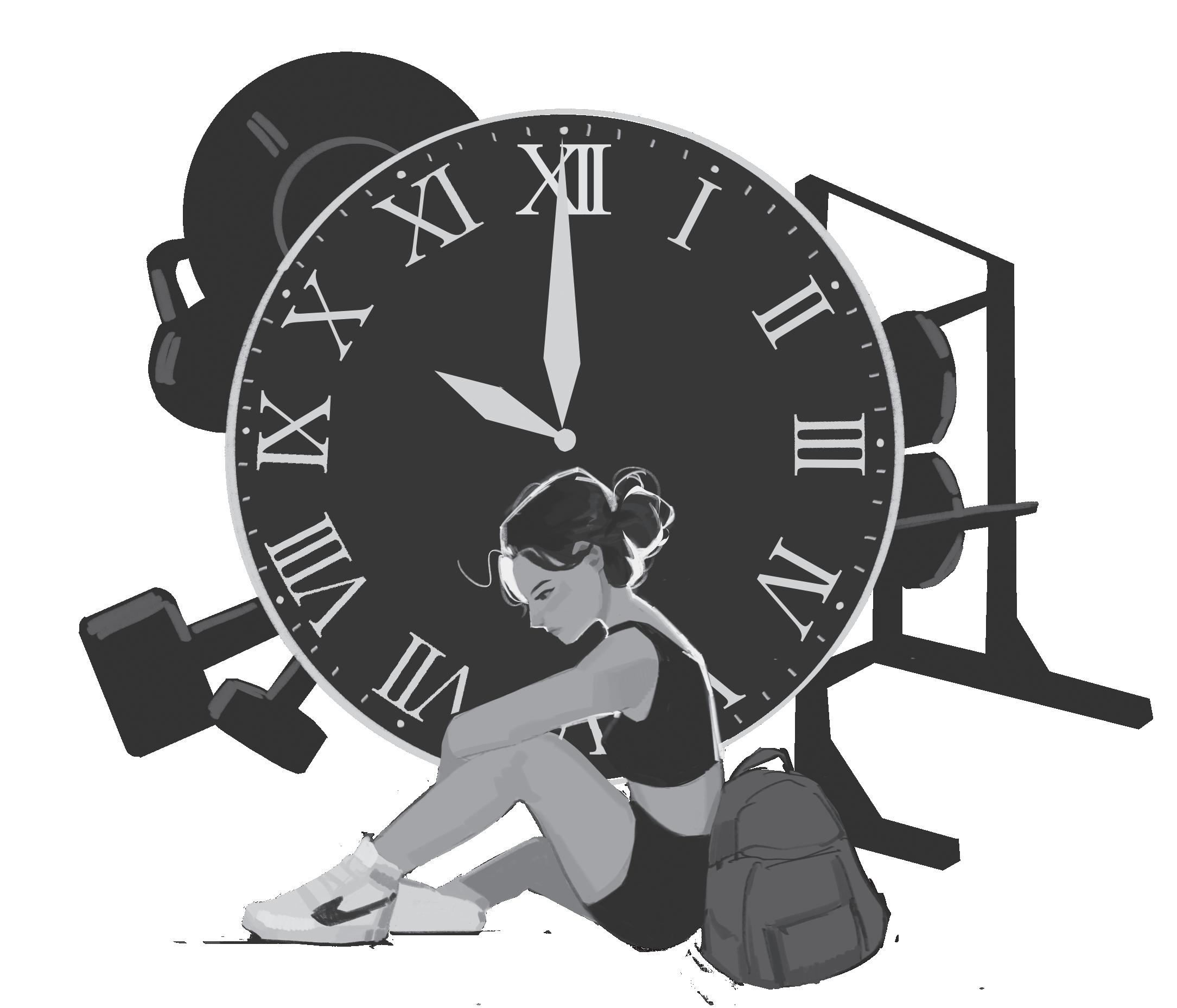
When I frst tried out for Paly lacrosse last year, my weeks were flled with school, two hours of tryouts daily, and studying for three unit tests, an essay, and plenty of homework. Tat week, I woke up sleep-deprived and attended class, unable to pay attention and learn. Tat was the worst week of my entire school year.
I started losing sleep, staying up every night to study and fnish my homework on time. After school, the little time I actually had to complete my schoolwork was wasted because my lack of sleep hindered my productivity. I would then go to tryouts tired and stressed, and come home afterwards just to struggle more — I was trapped in a vicious cycle.
In the end, the overall stress impacted my physical and mental well-being, and drastically harmed my performance in tryouts and summatives. Tough I reached out to a few teachers asking if I could push my tests to the following week, the response I received from all was the exact same –– they refused and told me I would have to fgure out how to balance my classes with sports. Many teachers also told me that if they delayed my test, they would have to allow the same leniency to everyone else for equity purposes.
As a freshman who had never played a school sport before, I had zero experience in managing my time. Although I have since improved my time management skills, I desperately needed an extension at that mo-
ment. Unfortunately, this situation is pretty common at Paly, and probably plenty of other high schools as well. Tis experience helped me realize that teachers should be required to accommodate their students, especially when extracurricular activities get overwhelming. I understand that being obliged to the needs of students may be difcult, especially when we are all asking for diferent things. As a solution, I propose a three-day rule –– if the teacher receives an email from both the parents and the coach stating that the student has a valid confict and might need additional time for work, then they can get an extension of three days. Tis would not only greatly beneft the overall mental health of the student body, but also improve grade averages and test scores. With the option for an extension, students would get more sleep and study time, allowing them to reach their full academic potential and perform better.
In the past, PAUSD has emphasized improving student mental health. Te PAUSD promise, a set of guidelines outlined to maximize student outcomes, was created to provide students with the tools for success in wellness and safety. However, students cannot maintain their mental health when so many teachers fail to provide an adequate space to grow and learn in such a stressful environment.
High school is supposed to prepare people for the real world — and to a certain degree, it does. But this
When one of my peers asked his teacher the reasoning behind why they are given those quizzes, the teacher responded telling them that they weren’t my teacher. As a result of the response, they ultimately feel like they have no voice for any change to be made.
In addition, after switching teachers in my current Contemporary World History class due to a scheduling confict, I found myself facing a vast diference between both teachers’ approaches to grading systems and testtaking yet again.
While my frst history teacher let us take tests with notes, where I could bring virtually anything to help as long as it was on paper, I was forced to adjust to this new class where we do not have notes. We also have map tests for each continent we study, again, something I did not have in my previous class.
Both are valid approaches to teaching, but I believe course expectations should maintain consistency to establish equality within the history department.
Many teachers purposefully incorporate variability into their teaching styles and implement certain practices if they believe it will beneft classroom learning. However, it is imperative for them to recognize the impact of their instructional practices on students’ learning experiences, and to strive towards standardizing class curricula and performance evaluations within their departments.
Without unifying curricula and grading practices, the disparities that exist between teachers and their classes create a sense of unfairness among students.
It’s not simply a matter of academic preference –– it’s about ensuring that every student, regardless of their teacher, has access to the same opportunities for growth and success.
In a school as hypercompetitive and academically cutthroat as Paly, it is only expected that students would try and take advantage of these disparities. Te unfortunate reality is that often, students attempt to switch classes to get a better teacher and an “easier” class. Tis further promotes a culture of dishonesty, discouraging integrity within our students.
To address these issues efectively, there should be more collaboration within departments.
For example, teachers could dedicate a period of time, like before school on late start Mondays, and dedicate it to talk about inconsistencies between teachers and curricula. Tis would allow teachers to share their best practices and work collaboratively to establish clear expectations and promote fairness across all classrooms.
Prioritizing these principles, teachers can create an environment where every student can thrive and succeed by providing equal opportunities, regardless of the classroom they fnd themselves in.

doesn’t make extensions unrealistic, because at the end of the day, we are still teenagers, and having a cushion to fall back on is helpful for us to learn from our mistakes, rather than just sufer from their consequences. If we bomb a test only to get an unrecoverable grade drop, we’ll most likely be unable to bounce back from it.
Even though it is difcult to accommodate everyone, teachers should still work with the students even if many people need an extension. Although accommodating multiple schedules would be difcult for teachers, the issue could be avoided if teachers were more prepared while making the syllabus. Since Paly gives teachers a schedule of the year with events like sports
tryouts, and other crucial events, if teachers adjusted their class based on the schedule, then students could have ample time to study. Balancing extracurriculars and academics remains the predominant focus of our large student body — yet reaching that precarious equilibrium cannot be fully achieved without a change in student and teacher expectations.

Tuesday, March 12, 2024 Opinion Te Campanile A7
ART BY TERESA WANG
Sofa Singer Staf Writer Kate Xia Lifestyle, Sci/Tech Editor ART BY KATE XIA
More colleges should reinstate standardized test requirements
Citing the goal of increasing diversity among applicants and the desire for a more holistic evaluation process, Brown University, Dartmouth College and Yale University announced last month they would return to a policy of requiring applicants to submit standardized test scores as part of the admissions process starting with the 2024-25 school year.
Te Campanile applauds this decision as an important step toward identifying and encouraging students from low-income backgrounds to apply to elite schools and expanding equity in higher education.
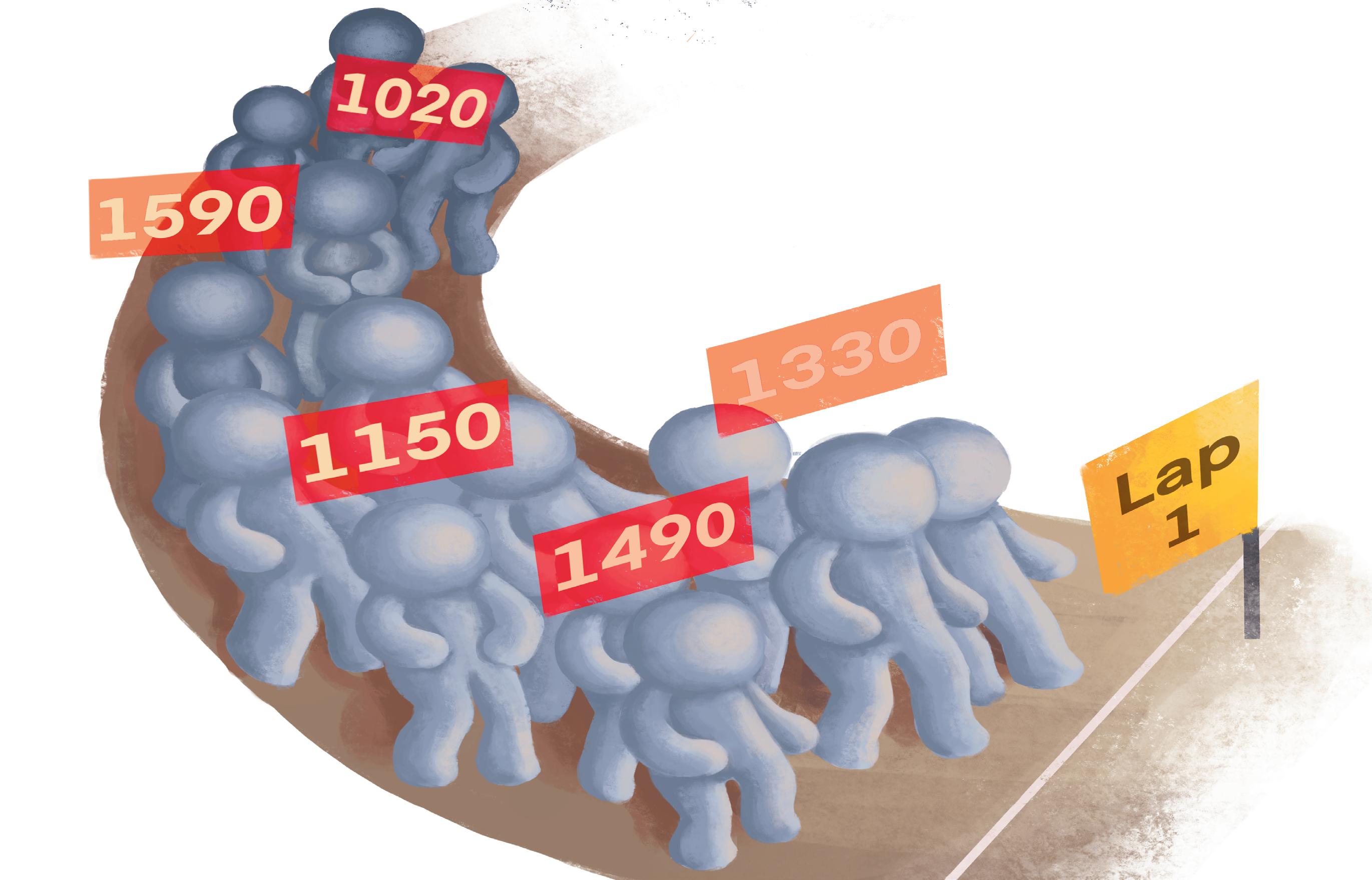
According to Paly’s school profle from the 20222023 academic year, the average SAT score of a Paly student is 1384 — a score placing us at the 93rd percentile and far exceeding the national reported average of 999.
So we recognize privileged students like us have more opportunities available to help us score higher on standardized tests, and we recognize that being from a wealthy area our perspectives and experiences are vastly diferent from other students.
If the goal of higher education is to level the playing feld for students from disadvantaged backgrounds, then colleges should look to recent research indicating test scores are the best indicator of a student’s potential, even when controlling for factors like wealth.
According to a study from the Association for Psychological Science, test scores carry the highest predictive power for college success, and two
students from diferent socioeconomic backgrounds who have similar SAT scores are predicted to perform with the same amount of success in college.
For under-resourced students who lack access to expensive test prep like private tutoring or summer classes, online organizations such as Kaplan Test Prep, Te Princeton Review, and Prepscholar ofer free prep courses, practice tests and study guides.
According to a study conducted by Khan Academy, utilizing the educational organization’s free SAT prep course for six hours is associated with a 90-point average score increase and preparing through the course for 20 hours is associated with a 115-point average score increase.
Te Campanile believes evaluating students’ potential through their test scores is more fair and objective compared to nonacademic factors such as essays and extracurricular achievement, the latter of which can be signifcantly more favorable for more privileged students. According to the US Census Bureau, even shortterm periods of poverty can result in signifcantly
lower rates of extracurricular participation, and being able to participate in after-school activities is a luxury that requires having fnancial means and a supportive family structure.
In addition, a study conducted by Stanford’s Center for Education Policy Analysis found a stronger correlation between household income and the quality of college essays than household income and SAT scores.
Tus, placing more weight on nonacademic factors in the admissions room can make it more difcult for low-income students to demonstrate their strength as applicants, ultimately hurting the same population we are trying to help. When building a college class, the admissions process should be designed to scout for promising and highachieving students from a variety of racial, ethnic and socioeconomic backgrounds. In accordance with recent studies and with the goal in mind of increasing opportunities in education, Te Campanile believes requiring students to submit their standardized test scores is a good step in that direction.
CS literacy bill needs reconsideration
Assembly Bill 2097, proposed by California State Assemblymember Marc Berman, will require all California school districts and charter schools to ofer a computer science class by the 2026-2027 school year and make the course a graduation requirement by the 2030-2031 school year if enacted. In a February press conference, Berman said AB 2097 would provide students with skills necessary to enter the computer science workforce, supposedly a “more lucrative” feld, and close statewide inequalities.
“Not only will AB 2097 help provide the workforce needed for California to remain competitive with other states and other nations, but it is also crucial in closing the existing gender and diversity gaps,” Berman said. “If we truly value equity in our schools, we need to ensure all students have access to computer science education.”
While the evidence remains unclear as to how prioritizing computer science over other felds will directly close the existing identity-based inequities, the former part of Berman’s rationale is clear: California is one of ten states that has not mandated computer science. According to the proposed bill, as of January 2023, California has over 45,000 open computing jobs with an average salary of $153,544, though there were only 9,339 graduates in
computer science in 2020. However, it remains unclear whether the open computing jobs were entry-level and whether the graduates refected students from California-based schools.
Additionally, the bill argues that while 49% of the high school population are female students, only 30% of students enrolled in a computer science course are female. Te Campanile agrees that ofering STEM courses to a wider array of students would beneft all students and potentially encourage more female students to pursue STEM felds. However, we believe that mandating a computer science course strictly in hopes of reducing gender gaps in the workforce will not yield as much fruit as prioritizing structural inequities, and the mandate also unjustly highlights computer science as opposed to other STEM felds.
Placing an emphasis on computer science for the sake of graduates’ average salary marks a shift in educational priorities to encourage students to pursue felds that earn more money.
Te Campanile believes that all offered courses are deserving of students’ time, so mandating computer science disincentivizes students from pursuing CTE courses besides computer science and decreases students’ autonomy over their course load.
Additionally, among student opinions, some found only a few concepts to be particularly meaningful and disagreed with the standardization of a course.
As such, we believe that if any skills need to be particularly highlighted, they be ofered as part of the required Living Skills course or future media literacy course, if possible.
Paly currently ofers more graduation requirements than is expected of a California public school, with another on the way. Since the state has mandated schools ofer an Ethnic Studies course as a graduation requirement from the 2030-2031 school year onward, we believe that placing computer science on equal footing with ethnic studies devalues other VAPA and CTE courses. While Te Campanile understands the high demand for computer science graduates and praises the state’s initiative to democratize access to computer science while catching up to other states that have required literacy, we believe that mandating the completion of a course isolates the subject as being more important than other ofered felds of study.
While some opponents of the bill argue that computer science is becoming an oversaturated feld, with too many people and too few

occupational roles, the lucrative job prospects and supposed job openings stated earlier disprove the claim, and there is little empirical data supporting the idea that the feld is becoming oversaturated.
However, shifting focus toward the course itself, computer science courses teach important skills in literacy and systematic problem-solving skills.
As such, we strongly urge the state to enact the frst half of the bill, requiring schools to ofer the course to students in all California public and charter schools.
In sum, we propose California mandates schools ofer the course, but not as a graduation requirement. Not only would requiring a computer science course for graduation stunt the academic growth of students hoping to pursue other felds of study through their CTE graduation requirement, but it also ofers little substantial quantitative benefts for the general California population.
As such, we believe it is necessary to introduce students to the feld as an ofered class, not a required one.
In the name of student autonomy and promoting both the STEM and humanities courses to an equal extent, we believe it is unnecessary to promote computer science over other felds of study.
Adviser Rodney Satterthwaite
Letters to the Editors: Email all letters to editors to theeds24@googlegroups.com. Te Campanile prints letters on a space-available basis. We reserve the right to edit submissions. Te Campanile only prints signed letters. Advertisements: Advertisements with Te Campanile are printed with signed contracts. For more information regarding advertisements or sponsors in Te Campanile and their size options and prices, please contact Te Campanile Business Managers by email at campanile.ads@gmail.com.
Note: It is the policy of Te Campanile to refrain from printing articles that misrepresent or alienate specifc individuals within the Palo Alto community. Te Campanile would like to thank the PTSA for supporting the mailing of our newspaper.
Our Vision Statement:
Te Campanile has upheld the highest standard of student journalism for the last century by engaging the community through various mediums of storytelling. Our coverage of news, culture and athletics aims to represent the diverse perspectives of our student body.
Tuesday, March 12, 2024 Editorials Te Campanile A8
LIST BY LUCA VOSTREJS AND RAHUL SHETTY ART BY CHERIANNE YOON ART BY JANYA JAIN Janya Jain Sophia Kelly Aurelia McKinney Ava Lin Charlotte Liu Dorian Luo Angela Rao Anya Rasmussen Iris Tang Teresa Wang Katie Wu River Wu Illustrators & Photographers Editors-in-Chief Christie Hong • Lucy Li • Dhruv Shetty Hannah Singer • Nidhi Tummalapalli The Campanile Writers Amaya Bharadwaj Isabella Bian Isabelle Carlsen Annika Chu Elizabeth Gulman Alex Isayama Albert Jung Lea Kwan Henry Liu Meryem Orazova Rahul Shetty Sofa Singer Shamsheer Singh Luca Vostrejs Cherianne Yoon Naveen Narayanaswami News/Opinion Editors Olivia Atkinson Julian Hong Sports Editors Rohan Bhatia Neel Sharma Photo Editor Tyler Wong Social Media Manager Heather Song Lifestyle, Sci/Tech Editors Alec Bonnard Holden Lee Kate Xia Managing Editor Lucas Yuan Assistant Managing Editor Gavin Lin Art Director Rachel Lee Business Manager Gabriella Gulman Cynthia Huang

Student-run clubs champion social change
In a wave of teal, Paly students rush to cram into the football feld’s student section before kickof as senior Tate Hardy hands out teal ribbons and wristbands to commemorate Ovarian Cancer Awareness Month.
Hardy, who is the president of the Women’s Health Awareness Club at Paly, scheduled the Teal Out theme for a football game between Paly and Sacred Heart to raise awareness for a variety of women’s health topics.
“I created the Women's Health Awareness Club to support the women around me and educate my peers,” Hardy said. “(I wanted to) create a more comfortable community around various health topics such as mental health, consent education, ovarian cancer, breast cancer and heart health.”
Hardy said many students did not know about ovarian cancer prior to the event because it is underrepresented in schools, and her mom’s struggle with ovarian cancer motivated her to spread awareness to others.
Hardy is among several other Paly students who have also raised awareness about topics they are passionate about through school clubs. Senior Grace Gormley is the president of Best Buddies Club, which is dedicated to making Paly a more welcoming place for students with disabilities.
“We host events to help support the kids here with disabilities and help form friendships,” Gormley said. “It is just a place where people can relax, let their guards down, forget about school and just have some fun.”
Outside of school, Gormley said Best Buddies Club hosts several events to increase skill-development opportunities for students with disabilities.
Tere's a cafe in Palo Alto called Ada’s Cafe, and they employ people with disabilities so (employees) can learn really valuable skills, get an independent job and support themselves,” Gormley said. “Last year, we did two cooking classes with them.”
Gormely also said she recommends joining clubs to fnd people interested in advocacy.
“Clubs are a really amazing way for kids to build that team of advocacy,” Gormley said. “ Tey're a way to band together like-minded students who are interested in getting to know other kids who share their passions.”
Another club at Paly aimed towards increasing inclusiveness for students with disabilities is the Accessibility and Inclusion Society of Palo Alto.
Junior and club president Kira Loginova said she created AISPA in 2024 due to the lack of representation of individuals with disabilities in Palo Alto. Loginova has a hypermobile condition and started the club to advocate for change.
“As a disabled person in the Paly community, I've noticed that the accommodations for us are quite lacking,” Loginova said. “We really have no advocacy group within Palo Alto for that.”
Loginova said the club raises awareness about students with disabilities to make Paly more accessible.
“ Tere are terribly inaccessible areas,” Loginova said. “Our school is heralded as being one of the best school districts for disabled students, but the bar is very low. Our elevator permit is three years out of date.”
Heather Song Social Media Manager
As the clock slowly ticks, sophomore Teresa Wang repeatedly taps a pencil on her desk and holds her head heavily in her hand, staring blankly at the worksheet in front of her.
Losing patience at her inability to grasp the concepts, her eyes quickly dart to the hypnotizing warm light radiating from her phone. Tempted by her diminishing attention span and the reward of Instagram
While AISPA is dedicated to giving disabled individuals a voice, Artruism at Paly is a club that advocates for students through art. According to senior and club president Katie Wu, Artruism collaborates with other organizations to raise awareness about mental health.
“We designed stickers to raise awareness about mental health,” Wu said. “We've also created letters to send to veterans.”
Wu said Artruism at Paly is also about supporting and helping students throughout the school year.
“A big project that we do every year is designing postcards that are mailed to every single student at Paly to encourage and motivate them during big testing seasons like fnals week,” Wu said.

While Artruism at Paly conducts advocacy outside of school, the Paly Gender Sexuality Alliance focuses on change inside of school.
e club president, a freshman male, who asked to remain anonymous due to fear of discrimination, said the club increases advocacy for LGBTQ+ students during school hours by creating a safe space for discussion and support.
“We have a supportive space for queer students to decompress and talk to each other,” the anonymous freshman male said.
In addition, the anonymous freshman male said GSA raises awareness about the experiences of LGBTQ+ students through increasing education for
Te anonymous freshman said GSA plans to host events to raise awareness about the experiences of LGBTQ+ people in the future.
“We're planning on doing a Day of Silence event so we can bring awareness to the silence faced by LGBTQ individuals when they're forced to be quiet about their identities,” the anonymous freshman male said.
Although several clubs at Paly raise awareness about social or mental health issues, the Paly ECO Club focuses on working towards environmental change.
According to senior and club president Sophia Lee, the Paly ECO Club helps students pursue personal projects.
“Our mission is to provide students who have a passion about the environment plenty of resources to get them started on this journey of environmental advocacy,” Lee said.
Lee said the club’s biggest undertaking was petitioning for sustainable transportation in PAUSD from June 2021 to February 2022.
“We accumulated over 500 signatures,” Lee said. “Eventually, we got two new electric school buses at PAUSD.”
Lee said she learned about the importance of youth advocacy from participating in the Paly ECO Club.
“More and more people are saying how strong youth can be for all sorts of diferent types of advocacy,” Lee said. “My takeaway from that is to never be too worried about our generation because the youth right now are doing a lot for the world.”
 ART BY CHARLOTTE LIU
Reels, she drops the pencil and eagerly extends her arm to reach the phone.
A research study conducted by Microsoft in 2004 and 2023 found that the average time a person stayed on any given screen in 2004 was 2 minutes and 30 seconds. In 2023, however, the number was down to 7 seconds.
Wang said many students are partially attributing the decline in attention span to the regular usage of short videos, also known as short-form content, on popular platforms such as Tiktok, Instagram and YouTube.
ART BY AURELIA MCKINNEY

“After watching a ton of these Instagram Reels, I tend to get more impatient when I’m trying to do longer tasks like homework because I’ve been trained to digest really fast content,” Wang said.
Junior Richelle Wong said even in shortform media, videos often contain stimulating features to keep users engaged.
“I’ve noticed that a lot of the time, people only watch the Instagram Reel if there’s (another) video,” Wong said. “For example, Subway Surfers (in the background) keeps them entertained. Versus if a Reddit story video is only reading the text, it’s not very entertaining and people don’t watch it.”
Wong also said popular YouTube creator MrBeast progresses in the YouTube algorithm by condensing longer-form entertainment into short-form videos.
“I watched a MrBeast documentary where he said in order to be competitive in the YouTube video market, he has to basically do what an entire show would do –– which would take like 40 minutes per episode –– and condense it into a two-minute YouTube short to keep people’s attention,” Wong said.
Wong said MrBeast makes his longer videos actively engaging by rapidly changing topics to keep his audiences’ attention.
“MrBeast makes these 20-minute long videos and I don’t even look at how long the video is because every fve seconds, there’s a new jump cut and every two minutes, it’s a whole new scene,” Wong said. “Since (the video) is super interesting the entire time, I completely forget that the video is actually 20 minutes long, and I probably wouldn’t have clicked on (the video) if I saw that it was that long.”
Sophomore Sthavyashri Chaithanya said she’s recently noticed short-form content’s
negative infuence on her classmates’ attention spans. “If (students) aren’t allowed to use their phone in class, they play Tetris or games, or read comics, webtoon or something like that in class,” Chaithanya said. “ Tat happens in my classes a lot.”
Chaithanya said she foresees a bleak future for students’ attention spans as technology and social media evolve.
“In 10 years, when there’s more technology and more social media, students might not even be able to take a normal test because you need to have time and patience to do a test or to really understand the problem,” Chaithanya said. “Even doing daily academics is going to be a problem.”
Dr. Tammy Tran, a postdoctoral fellow of memory and neuroscience at Stanford, said research is still in its early stages, and the infuence of short-form content on attention span can’t yet be concluded. “ Tis is an active area of research and people are exploring this, but at this moment, it is unknown how long-term usage of TikTok might afect attention,” Tran said.
But Chaithanya said she uses specifc strategies to mitigate her declining concentration when studying.
“If I’m sitting for a long time, I feel a little bit irritated or agitated so I try to go for a walk and then drink water,” Chaithanya said. “In general, knowing I’m going to be relaxed (and) happy (after studying) makes me persevere.” Similarly, Wang said teachers can lessen students’ declining attention span by creating a more captivating learning environment inside the classroom.
“ Te reason why I see a lot of students sneak on their phone in class is just because the teacher is not engaging the students
enough, they are talking too much or they just teach in a way that’s boring,” Wang said. “If teachers really project that they want you to learn, it’ll decrease the likelihood of students being distracted.
Math teacher Sarah Brankis said it is more and more common nowadays to see students give up when encountering a difcult problem, but she tries to regain students’ attention by incorporating brain breaks that involve some sort of physical activity.
“We sometimes play ‘head, shoulders, knees and toes’ to get blood fowing and get them out of their seats,” Brankis said. “I notice that the phone break sometimes isn’t enough of a change for them, so the physical act of getting up and spinning around helps them get back on track whenever we do sit back down. Not only are we having fun while we do this, but it really does help shake things up enough that their focus returns.”
For students who struggle to concentrate in class, Brankis said she suggests bringing in fdget toys and reaching out to teachers for breaks.
“You have to work with your brain to fgure out what it needs to be successful, then learn how to advocate for yourself in asking for what you need,” Brankis said.
In the meantime, Tran said she recommends students be actively aware of their use of short-form content to limit issues with their attention spans.
“I would recommend looking at the TikTok Use Scale, flling it out and grading it yourself,” Tran said. “It could provide a clear, unbiased perspective to whether you may or may not be excessively consuming shortform content. You can also use other apps to limit your time on the app.”
Lifestyle Te Campanile Tuesday, March 12, 2024
 ART BY DORIAN LUO
Boycotting rises in popularity
Swiping through his friends’ Instagram stories, sophomore Aaron Shone feels a sense of déjà vu wash over him. Dozens of reposts of the same green and white infographic in support of boycotting Starbucks remind him of the whirlwind of similar stories last year, when the company’s union and wage issues made national headlines.
In the last few months, thousands of posts and videos encouraging boycotts against Starbucks and other corporations have gone viral on social media platforms in response to their alleged support of Israel.
Boycotts against Starbucks began after the company sued the Workers United Union, a group representing thousands of Starbucks baristas across the United States, for posting a message that read “Solidarity with Palestine!” on X, using the company’s name and logo. Starbucks has since clarifed they “unequivocally condemn acts of terrorism, hate and violence” in a letter to employees from Starbucks Executive Vice President Sara Kelly in October. Te company has also claimed to maintain a non-political stance, and has not donated to or supported either side of the confict. However, boycotters believe Starbucks shutting down union voices who are in support of Gazans to be anti-Palestinian.
McDonald’s also missed a key sales target last month after the company’s Israeli branch said it gave away thousands of free meals to soldiers in the Israeli Defense Forces, an act that McDonalds said was conducted independently and separate from the company. Boycotts subsequently swept across the globe, especially in Malaysia, France, Indonesia and the Middle East, afecting the company considerably, according to McDonalds’ Chief Executive Ofcer Chris Kempczinski.
Junior Samantha Fan, who started boycotting Starbucks and McDonalds in early January, said boycotts are efective means of supporting humanitarian causes.
“(Boycotting) is a simple thing that you can do that doesn’t really inconvenience you in any way, to help the people who are sufering currently in Gaza,” Fan said. “Sadly, I can’t donate money or anything like that, but making sure I’m not giving my money to corporations that contribute to the sufering of those people is something I feel like I should be (doing).”
Sophomore Alice Shefer, who is also boycotting Starbucks and McDonalds due to her disagreement with the corporations’ political statements and treatment of workers, said she thinks boycotting is an accessible form of protest.
“Boycotting is a very impactful, but also lowaction form of protest,” Shefers said. “A lot of people don’t want to go to actual protests for fear of police or how it’ll be perceived. But boycotting is a really good form of action through inaction because it doesn’t require you to do anything special — you just don’t partake in things that you might usually do and might usually not do.”
Fan said the boycotts haven’t made a signifcant impact on her day-to-day life as she hadn’t patronized the stores previously.
“I also don’t go to those stores often, but now I’m just making a more of a conscious decision to avoid them, especially when I’m traveling,” Fan said.
Sophomore Aaron Shone, who is also boycotting Starbucks and McDonalds due to the companies’ alleged antiPalestine stance, said boycotting empowers youth to take political action when they cannot vote.
“(Boycotting) shows that we are holding (Starbucks and McDonalds) accountable,” Shone said. “Even beyond the sales, (boycotting) is symbolic because it’s something younger people, who cannot vote and who cannot choose their representatives, are able to control when it comes to international issues. It’s taking (the issues) back into our own hands and being able to actually have a say in how things are done.”
Shone also said part of his reason for boycotting Starbucks was the company’s historic antiunion tactics, including having been accused of closing some union-stronghold cafes and spying on, harassing and fring union activists.
“Even if you look before what’s happening right now (with) the attacks on Gaza, Starbucks has been union busting for years,” Shone said. “Now, I know I’m planning on never supporting them ever again.”
And Shone said he acknowledged fnding alternatives to companies he politically disagrees with can be difcult, especially considering afordability.
“I didn’t consume many of these companies like McDonald’s or Starbucks before, so (boycotting) hasn’t impacted me in a big way because there are a lot of substitute companies,” Shone said. “(Boycotting) probably afects me a little less because I come from a place where I can aford these alternatives —
Writers’ Note: Earth Day is just around the corner (well, a couple corners), and we strongly encourage everyone to participate. Te health of our planet has a direct impact on our lives and future, and we urge people to embrace their civic duty as citizens of the world and forge a path toward a sustainable future. No, this column was not written by Swedish climate activist and extraordinaire Greta Tunburg, but honestly, we’re not far of In fact, we spent countless hours engineering revolutionary solutions to climate change.
ART BY RACHEL LEE

that’s why I choose to do it because it’s something I can do.”
While Shefer said she gets the majority of her information about boycotts from social media, she said she takes steps to verify information.
“I always look for the verifed checkmark,” Shefer said. “But even then, some news providers on social media could be false, so I always either actively go in search of something else, or I’ll wait until I see something else that corroborates that (information).”
Shone also said social media platforms are used to spread information and support for boycotting.
Trough the online community, when I’m making Instagram posts bringing awareness (to the confict in Gaza), there are people flling up my DMs (who) also support this (boycotting),” Shone said. “I fnd it really encouraging because I know I’m not the only one out there — there are thousands, millions of people across the world who are also boycotting.”
Shone said he hears of protests from social media primarily because there is a lack of coverage of protests by mainstream media, especially in regards to the Israel-Hamas confict.
“Mostly I hear about it from social media frst and then I like to do my own research,” Shone said. “But right now, there’s a lack of mainstream media coverage about many protests, like how a man literally set himself on fre a couple of days ago to condemn the ongoing campaign within Gaza right now.”
Regardless of the overall monetary impact that individual boycotting has on corporations’ profts, Shefer said the act still makes a diference.
“No matter how small any action is, it’s still a good action to take,” Shefer said. “ Tere is something to be said about the power of not doing anything, which is again a way of doing something. Even the small stuf is really important. Sometimes it might seem like it’s not doing anything, but it is.”
Meet Earth, the perfect candidate for sustainable life. It’s a world of wonders, where oceans hold mysteries deeper than the cosmos and a backdrop painted by Bob Ross provides us with a brilliant blue sky, the Burj Khalifa and endless expanses of land.
But times are changing. Te planet is rapidly heating, and islands and low-elevation countries are disappearing into the ocean. Do we truly want a modern-day Atlantis to happen? Again?
How do we go about inducing global cooling? Since current techniques have little efect, common sense suggests that radical eforts are needed to save our Earth from its impending doom.
Fortunately, recent breakthroughs from “scientists” Lucas Yuan and Holden Lee have unearthed the secrets to solving climate change — and it starts with you.
What sets Copenhagen, a leader of climate change eforts, apart from a place like Qatar? While Google points to elevation, weather and culture, we think the answer is much simpler: Copenhagen has an abundance of trees.
Trees are nature’s personal janitors. Tey take in your waste and spit out oxygen. It’s like having an air purifer without paying the electricity bill.
Deforestation has profound consequences for the planet and its inhabitants. Cutting down trees is like cutting your own hair — it’s almost always a bad idea (take notes guys).
Drawing from Copenhagen’s playbook, we frst recommend planting trees. It’s important to keep in mind that reforestation isn’t just about planting trees –– it’s also about sending a message. So be bold with your planting! Plant them in your car! Plant them on your roof!
Also, rather paradoxically, we should also be using paper straws instead of plastic ones.
While paper straws are made from cutting down trees, using them feels like you’re making a diference.
Whenever the straw gets too soggy, just make sure to rip the top of so you’re left with a fresh straw.
Finally, to mitigate the destruction of trees, it is imperative society understands the importance of reusability. Please try to reuse your toilet paper and tissues as much as possible to avoid single-use. Leaving them out to dry seems to work best because sunlight is the best disinfectant.
Rohan Bhatia Sports Editor
A black hat, red shirt and black pants with Nike logos stitched in white is the most deadly sight in golf. Add the famed green jacket and Masters Trophy with the Augusta National clubhouse on top and you have the iconic scene: Tiger Woods winning the Masters Tournament for the ffth time in 2019.
However, following his return to golf at the Genesis Invitational in February for the frst time since his injury at the 2023 Masters, Woods wasn’t donning the iconic Nike badge, but rather the logo from his newly released apparel brand: Sun Day Red.
Since Woods’ frst professional appearance in golf 27 years ago, Nike has partnered with Woods in an iconic brand relationship worth over $660 million. However, Woods began wearing FootJoy shoes for more stability during his 2022 return to golf, following his 2021 car crash and subsequent recovery. Nike also began scaling back their golf equipment production in 2016 as they prepared to exit the sport, which was also the reason why they couldn’t ofer Woods a lifetime contract, according to an article from SportsPro Media. Despite claiming he was still committed to Nike after the Genesis Invitational, the partnership ofcially ended after Woods’ Jan. 8 announcement.
Freshman Maxwell Liu, who plays varsity golf for Paly, said seeing Woods without the Nike logo is dispiriting.
“It’s a little disappointing since we’re so used to seeing Tiger and Nike together during their decades long partnership,” Liu said.
However, in the Sun Day Red launch on Feb.13, Woods said his departure from Nike allowed him to release his own apparel line in conjunction with sports equipment company TaylorMade Golf.
“It’s the right time in my life,” Woods said. “It’s transitional, I’m no longer a kid anymore. Life changes, I have kids now, and this is an important part of transitioning into this part of my life, to have a product and a brand that I’m proud of.”
Te Sun Day Red brand, represented by a Tiger with 15 stripes –– one for each of Woods’ major wins –– will be marketed as a lifestyle brand, including athletic apparel and casual wear according to TaylorMade Chief Executive David Abeles. Te line will include Woods’ famous red polo, and will also expand to hoodies, outerwear, footwear and cashmere sweaters.
Woods’ new independence allows him to follow the footsteps of other athletes, such as Roger Federer’s RF collection with Uniqlo, Serena Williams with her brand, S by Serena, Tom Brady with Brady Brand and many more.
According to an article by the New York Times, Woods’ partnership with TaylorMade allows him to branch out from Nike and release his own high-end clothing, with prices of polos expected to range from $115 to $175, and cashmere sweaters from $250 to $350.
While the frst drop is scheduled for May 1st, junior and varsity golfer Justun Kim, among other students, said the release of Woods’s brand is overhyped.
“ Tis isn’t much more than a gimmick,” Kim said. “Aside from Tiger’s name, the brand ofers nothing outstanding. Te brand’s hope of success solely stems from Tiger’s identity — nothing else.”
Junior Anika Nair, who plays varsity girls’ golf for Paly, said Woods’s brand doesn’t feel distinctly special or indemand.
“I think the market for celebrity brands is already extremely over-saturated and launching another brand is unnecessary, especially with clothing that is not particularly unique or original,” Nair said.
Kim also said he believes Woods’ clothing brand will have little impact on how Woods is remembered.
“I think it’s great that he’s continuing his legacy even after his prime, but it’s not much,” Kim said. “He’s a legend, that’s true, but a clothing brand won’t make (him) any more legendary.”
While Liu said he understands how the launch may be underwhelming, he is excited to see how Sun Day Red grows.
“It’s just cool that (Woods) continues to be involved with the sport,” Liu said. “I’m excited to see what he will do with the brand.”
Each year, oil and natural gas companies emit millions of tonnes of carbon dioxide into the air.
Tese greenhouse emissions contribute to ocean acidifcation and rising sea temperatures, which destroy marine ecosystems. Emissions also have negative impacts on land, as natural disasters, such as wildfres, only become more frequent.
But while it’s really not your fault that these oil and gas companies are destroying our planet, it certainly is your responsibility to act.
To really show your dedication against this corrupt system, you should take action.
We highly recommend throwing tomato soup on a Van Gogh painting because the best way to stop Big Oil is to frst destroy 19th-century oil paintings.
Second, you must also stop listening to Taylor Swift songs. Not only will doing so improve your mental health because her songs are breeding grounds for migraines, but you will also show your solidarity with our local team who was sadly beaten by Taylor (Oh, and the Chiefs).
Most importantly, we urge you to make the eco-friendly decision to not fy around the world in a private jet and emit 138 tons of CO2 in three months to see your partner.
Dear readers, let us raise a toast to Earth. We know that saving the polar bears might be a tricky feat, but it’s not impossible. Remember: change is certain, but progress is only made if you embrace your civic duty to preserve the world we call home.

 Lucas Yuan Managing Editor
Holden
Lifestyle, Sci/Tech Editor
Lucas Yuan Managing Editor
Holden
Lifestyle, Sci/Tech Editor
Tuesday, March 12, 2024 Lifestyle Te Campanile B2
Lee
Holden Lee Lifestyle, Sci/Tech Editor
Presidential elections raise mixed opinions
The 2024 presidential election is rapidly approaching. With incumbent Joe Biden leading Democratic primaries and Donald Trump leading Republican primaries, a Biden-Trump rematch is potentially on the horizon this fall. History teacher John Bungarden said he fnds the results of recent polls for former president Donald Trump and President Joe Biden disturbing.
“Polls say right now it’s a close race,” Bungarden said. “ Tat’s disconcerting given the number of things Trump has said.”
Sophomore Ryan Leung, who identifes as moderately conservative, said he agrees with some of Trump’s ideas, but not necessarily his values.
“I believe we should secure our border and we should be hard on China,” Leung said. “But I’m not a big fan of what (Trump) says. He said he would have a stronger Black base because of his convictions (and it’s)pretty crazy he said that.”
Senior Jonathan Liu, who describes himself as a neoconservative — a person who supports intervening in world events and a free market — said Trump’s policies will eventually hurt America.
“(Trump) promises extremely high tarifs and he promises essentially removal from Ukraine and even Israel,” Liu said. “Ultimately, it’s not going to help us in the long run, and it’s only going to make America seem weaker.”
Bungarden said Nikki Haley, the former United States Permanent Representative to the United Nations, is becoming a more prominent fgure in the Republican party. Although Haley won the Vermont primary on Tuesday, she decided to drop out of the Republican primaries the next day.
Bungarden also said Haley might be working herself into a better position for the 2028 elections.
“If Trump does what he’s done in the previous three election cycles and very much trash Republican possibilities, maybe (Haley’s) positioned to be the person to pick up the pieces (in 2028),” Bungarden said.
According to a New York Times/Siena poll last month, over 70% of voters in battleground states –– swing states where turnouts are unpredictable –– said Biden is
too old to serve another term. But Liu said despite Biden’s age, he is a stronger candidate than Trump for the presidency, as there is already a lot on the line for democracy.
“I know there are a lot of concerns about Biden being too old, but when it becomes an existential threat to our democracy and essentially our nation, it becomes a matter of national necessity to vote for Biden,” Liu said. “Because if we don’t, we’re all screwed.”
Junior Max Beach said he’s also more worried about presidential candidates’ competency than their age.
“I’m not necessarily in favor of an age limit for presidency, but more so a competency test to be able to prove that you’re actually able to be competent in ofce and actually have some knowledge about what you’re saying and doing,” Beach said. “I think Biden is more of a mouthpiece for the Democratic Party. He’s not his own person.”
But Bungarden said Biden has done well in his four years of the presidency.
“All private accounts say that (Biden is) doing really good,” Bungarden said. “Surely he’s done well, it’s been an excellent four years in terms of things he has accomplished given the dysfunction of Congress.”
Bungarden also said Biden needs to publicize his wellbeing more in campaigning.
“On the other hand, if (Biden) really is as sharp as he is being described in private meetings, then the folks around him need to put that on display,” Bungarden said.
Biden and Trump are closer in age than many think — Trump is 77 while Biden is 81. Nevertheless, according to a New York Times/Siena poll last month, voters are much more concerned about Biden’s age.
Beach said Trump sometimes seems like he doesn’t age due to his unfaltering energy.
“Trump, while he is old, is still very competent,” Beach said. “He’s always talking. He has a very strong, passionate personality and, if anything, people have said he doesn’t really age.”
Liu said he supports Biden’s foreign policy agenda regarding the recent wars in both Israel and Ukraine.
“(Biden’s) work in Ukraine is incredibly impressive and professional and although there’s a lot of debate over Israel, I think

Biden is taking the best stance possible with the hand he’s given,” Liu said. “He’s done a good job responding quickly.”
But Bungarden said the Republican party hasn’t attacked Biden’s stance on the U.S.-Mexico border as much as they should, and that makes them seem unserious about the issue.
Te border is supposed to be the big vulnerability for Biden,” Bungarden said. “And yet the Republicans have, as an electoral calculation, refused to address it. Tey’re not really serious about the problem.”
Leung said it is an issue that Biden hasn’t competed in any presidential debates.
“He hasn’t even had any debates yet,” Leung said. “He’s with the other Democratic candidates. If you’re so locked in, you should (debate).”
With increasing public scrutiny through the media, Bungarden said Trump’s legal troubles would have disqualifed him from becoming president in the past.
“A lot of things (Trump) said would have formally disqualifed guys for the
Oval Ofce,” Bungarden said. “(Tey) aren’t anymore.” Beach said Trump’s actions are more important than his words, especially because he is more of a face than a politician. “He’s not a politician. He’s a businessman and a media personality, ” Beach said. “Put that aside and look at what he’s actually done. Once you make a rational decision based on the policies alone, what he’s done is very good for this country.”
Bungarden said he thinks Republicans this election aren’t actually interested in government.
“ Te Republicans do not show interest in governing,” Bungarden said. “ Tey have an interest in performative behavior –– their most prominent voices are performers, more than they are politicians.”
Due to this new performative nature of many politicians, Bungarden said many politicians are less formal and serious than they used to be.
“What I grew up with… in terms of politics was serious people trying to do serious things,” Bungarden said. “At the mo-
ART BY RIVER WU
ment you have a sense of, these are deeply unserious people trying to get a sound bite onto Fox.”
In the end, Leung said other people might be better candidates for the presidency.
“Nikki Haley would be a pretty good Republican candidate,” Leung said. “Or Dean Phillips on the Democratic side or somebody else, because none of the Democrats are stepping up.”
Beyond the diferent values of all the candidates, Beach said this election will have wide implications all throughout America.
Tis is a very important election for modern American history,” Beach said. “It’s going to have a rippling impact on future politics and the scope of the country, regarding foreign and domestic spheres, the economy, and basically just any facet of the American government.”
Gavin Lin Assistant Managing Editor
Books, movies provide romance tropes, unrealistic expectations

As rain taps steadily on the windows in front of her, junior Lava Serohi wraps a white, fuzzy blanket around her shoulders. She snuggles closer to her sister on the couch, getting ready to watch “10 Tings I Hate About You.” When her sister presses play on the remote, the TV lights up and two characters — the couple-to-be — fll the screen.
According to Te Numbers, romantic comedies, also known as rom-coms, typically make up 4.4% of flms produced in a year, whereas in the late 1990s and early 2000s, rom-coms made up 18% of flms produced in 2001. Furthermore, box ofce revenue from rom-coms has decreased from over $250 million in 2019 to over $86 million in 2023.
Sophomore Amily Zhang said this change is largely due to the rise of TV, creating easily accessible, readily available programs which you can watch from the comfort of your own home.
“In rom-coms, there are certain scenes that can be awkward if you watch them in public,” Zhang said. “So many people prefer watching through streaming platforms like Netfix as they are more accessible and easier to use.”
Serohi said many streaming platforms have outcompeted movie theaters, which has also led to the decline in box ofce revenue for rom-coms.
“Whenever I go watch a rom-com at the theaters, my friends and I always end up laughing together at the happiness shown on the big screen,” Serohi said. “ Tis is why so many people race to the movie theater when a new rom-com comes out and force their friends to go with them to experience it.”
During holidays such as Valentine Day and Christmas, Serohi said theaters often show more rom-coms because people are more likely to go with their loved ones.
“ Tese holidays are the only times when genuinely liking a rom-com is acceptable as everyone is wishing their story was like the one on screen,” said Serohi.
“Otherwise, for the rest of the year, you are confned to your bedroom if you want to watch rom-coms.”
Both Serohi and Zhang said they believe the decrease in rom-coms stem
from one main issue, being the transition from the movie theater experience to the comfort of watching at home. But Zhang said another issue can be attributed to the negative stigma surrounding rom-coms, therefore harming the viewership and production of rom-coms.
While rom-coms from the 2000s typically featured slow-burn romances and cheesy, feel-good scenes, Zhang said modern rom-coms include more sexually explicit scenes, shallow characters and weak plots, making the flms less fulflling to watch.
“Many rom-coms nowadays have taken out the traditional, classic parts of rom-coms that are wholesome and pure, innocent love and instead have introduced these ideas of casual dating and hook-up culture which connects them more to reality,” Zhang said. “While this can bring in a broader and more diverse audience, the majority of those watching rom-coms want to see the picture-perfect relationship.”
Furthermore, Zhang said with romcoms repeatedly bringing extravagant love plots to life, watching too many can blur the lines between realistic and fctional love.
“Rom-coms let you dive into a world that you could never experience in real life, making them so appealing, (yet) they often lead to people our age having an altered perception of what a relationship is supposed to be or have greater standards for a partner,” Zhang said.
Because many modern rom-coms are transitioning to even more polarized stereotypical plots and characters, Zhang said the popularity of rom-coms are continuing to decline due to the lack of originality, personality and sentiment.
“While rom-coms are still enjoyable, they don’t have the same popularity they had in the past since so many have adopted more realistic plots,” Zhang said. “I hope producers begin making more romcoms with a more classic plot, wholesome romance and innocent love as I feel they would attract more of an audience.”
Isabelle Carlsen Staf Writer
Tuesday, March 12, 2024 Lifestyle Te Campanile B3
ART BY AURELIA MCKINNEY
Taste testing viral infuencer snacks, beverages so

fter successfully infiltrating the entertainment industry with clickbaits and scams, many YouTubers try to insert themselves into the food industry hoping to farm even more money from their naive subscribers. To protect these gullible members of our society, we have taken it upon ourselves to review some of the most popular YouTubers’ snack brands –– from Chamberlain Coffee to Feastables.
We started by trying our luck with the Vanilla Latte from YouTuber Emma Chamberlain’s brand, Chamberlain Coffee. With 12 million subscribers, Chamberlain
sleep schedule. Because of this, we expected a satisfactory drink. However, we were proven horribly wrong. We started by inspecting the packaging, which recommended us to “shake well,” and we soon discovered why. Opening the can of coffee, we were greeted with a sweet smell, similar to that of raw cookie dough.
But as soon as we poured out the coffee, white chunks of a mysterious substance oozed out in a muddy-looking liquid. A white film quickly formed on top of the coffee, as if we hadn’t shaken the bottle at all.

Despite the initially pleasant smell, the drink barely had any flavor of coffee and instead tasted like bitter mud, a problem with most pre-packaged coffee.

As much as we disliked the coffee we actually agree with some of Chamberlain’s statements about her brand. Her website states the purpose of Chamberlain’s drinks are to, “...enjoy every sip, slurp and spill.” While we definitely would not agree with the first part, we absolutely will enjoy every spill when it comes to this abhorrent drink.
YouTuber MrBeast has announced the retirement of his old chocolate bar formula, recently introducing a supposedly improved chocolate formula instead. He describes it as “the best tasting chocolate ever made by We decided to put his claim to the test by trying his new Feastable’s Milk Crunch bar, as we assumed it was akin to a real Crunch bar. Since he is known worldwide for spending millions of dollars on his extravagant videos and gaining an astonishing total of 242 million subscribers on YouTube, we expected the
When we initially grabbed the bar off a shelf at Walmart, we were impressed by its high-quality packaging and sleek design. Unlike a Crunch bar, the Feastable chocolate bar was purely chocolate while the thin bottom
layer had crisped rice sparsely mixed in. As we started to indulge, there was an apparent imbalance between the crisped rice and chocolate.
Despite this, we were pleased by the results of his improved chocolate formula which was notably rich and creamy, and, for this, we applaud MrBeast’s efforts. To claim this is the “best tasting chocolate ever made by mankind,” however, seems to be another marketing ploy to cater to his 8-year-old subscribers.
Rating: (7/10)
Already famous as Tiktokers, YouTubers, failed singers, dancers and reality show stars, there is no reason for the D’Amelio sisters to launch a product in the snack industry. Yet they did, leaving us with no choice but to taste a flavor of their Be Happy popcorn brand. We decided to go with the savory flavor Nice Spice.
them into a bowl and stir well. Instead of resulting in us being happy, we desperately want the popcorn to be gone.
Rating: (2.5/10)
To finish off our hearty meal, we tried another product from Feastables –– Karl Gummies, created by MrBeast’s close friend and Minecraft YouTuber Karl Jacobs. Compared to the other snacks, we were not impressed by the packaging. Once opened, we noticed a moist and sugary substance coating the inside of the bag, along with the gummies which were stuck together in a clump at the bottom.

At first glance, this product caught our attention because of its appealing packaging. The vibrant orange and yellow shades complemented each other well, and the bubble font really did make us want to be happy. Our expressions shifted as we opened the bag, hit with a whiff of potent spice. The packaging promised “Xtra large” popcorn, but the kernels still aren’t visible under a microscope. Sure enough, as we placed a kernel in our mouths, we began to regret all the decisions that brought us to this moment. It seemed as if the bag had been opened, forgotten about for a week, then left to sit there and rot.
However, we do commend Be Happy for its simplistic recipe. To recreate its taste, simply use the secret ingredients: every expired spice in your house, dump
The Crossword

As we pulled a gummy out, we realized the gummies were not a bright teal but a swamp green. Although the blue raspberry flavor was not as bad as “Vanilla Latte,” eating the gummy was like chewing on a rubber tire. We discovered their slogan was “Feast Like a Beast,” which we really resonated with. While eating, we sure felt like a Loch Ness Monster that found a glob of bluegreen debris at the bottom of the swamp.
Rating: (2.1/10)
While we wish we could end on a good note, there is simply nothing but terror in any of these YouTuber snack brands. We hope they immediately discontinue all their brands and stick to what they do best ––talking to themselves and posting it online.

 Heather Song Social Media Manager
Kate Xia Lifestyle, Sci/Tech Editor
Heather Song Social Media Manager
Kate Xia Lifestyle, Sci/Tech Editor

Tuesday, March 12, 2024 Lifestyle Te Campanile B4
you don’t have to Across 1 Addams Family 5 Australian oil sources 9 Kim and Ye 14 Theory of form 15 Elena Gilbert 16 Cold War strategy 17 Grieving at dawn 18 Flowering indigo source 19 Change 20 Modifed subject 23 Worth 100 tetri 24 Feminine impressionist 26 Rosetta, Palermo 28 Not their month 29 6.02 x 10^23 30 Crimean War nurse 38 thecampanile.org 39 Full of sugar 40 Likes Hermione 41 “Grasshopper” computer scientist 45 Father’s physique 46 CAASP preference 47 Suggesting mode 49 Operated a Lockhead Electra 56 Union shield 57 10^4 Hz protozoa 60 Restaurant instructions 62 Dress for Less 63 4/7 trash 64 Meuse meets Ourthe 65 Anti-CO2 66 Gossip medium 67 Hearing ability 68 Multiple, Sam and “Ella” 69 The Big Board Down 1 Free Photoshop 2 Needs deodorant 3 Large polychaete 4 Broke opera composer 5 Requires a majority vote 6 Math competition 204 7 Ignite2 8 Which trial 9 Arithmetic ADHD 10 Done with a paring knife 11 Does the heavy lifting 12 20 year cycle 13 MBTI category 21 Rich in oil 22 Lord mackerel 25 Norse sea, travel 26 Marshal squirrel 27 133.32 pascals 31 Queen of Heaven 32 Passport printer 33 Rabbit musician 34 Hat, golf 35 This clue: xiyxurWrhg 36 Found in llamas 37 Split when damaged 42 0.1 miles away 43 Pen brand 44 Currency exists 48 Deadly animal without teeth 49 Consumed on Nov. 1 50 Governess to 7 children 51 For duvet feathers 52 9.8 location 53 A door 54 3 days, 3 nights 55 Banned during UK drought 58 Created by ERISA 59 We Can Do It! 61 Enhances skin PUZZLE BY KATE XIA AND ISABELLA BIAN
KATE XIA/THE CAMPANILE
Sports


Junior Kinga Czajkowska sprints down the track toward the fnish line as her dad, coaches, and hundreds of fans cheer her on. Te buzzing environment pushes Czajkowska to fnish the race, as she recalls wanting to leave the California State Track and Field Meet ––the pinnacle of her season –– without any regrets. Her eforts culminated in an impressive time of 4:48 for 1600 meters, the equivalent of a 4:49 mile — an achievement that awarded her ninth place in one of the most elite competitions in the country and frst place in the Paly record books.
Just 70 years ago in 1954, Diane Leather Charles was the frst woman to run a subfve mile ever.
Czajkowska now stands among an elite group of high school girls to accomplish this feat and said female athletes have made immense progress in recent years.
“We have had a huge jump
since the frst woman to run a sub-fve mile did so in 1954, and now you’re seeing athletes go sub 4:30 at collegiate meets,” Czajkowska said.
Paly Athletic Director Jennifer Crane, who played Division 1 feld hockey at UC Berkeley from 2004 to 2008, said facilities and resources have signifcantly improved for women in sports since her collegiate days.
“We used to have kilts as part of our uniform, so we would wear skirts, but now the skirts have evolved to be tennis skirts and they look more athletic,” Crane said.
Tey have locker rooms now, but when I was at Cal, we didn’t have a locker room dedicated to just feld hockey.”
Michael Davidson, Head Coach for track and feld, said he has witnessed the unifying of the girls and boys on teams over the years.
“When I frst came here, the girls had a separate coach, and they were their own small group,” Davidson said. “Having the girls and boys (track and feld) teams integrated lets the girls have a greater sense of opportunity to compete against the boys, and have a better measuring stick.”
For Crane, Women in Sports Day, celebrated on Feb. 7, serves as a testament to how far women have come in the sports arena.
“(Te day) is a reminder that women haven’t always had the same opportunities in athletics as men have,” Crane said. “It’s a reminder to take advantage of the opportunities we have now.”
While Women in Sports Day has recently begun gaining more attention, Czajkowska said the celebration of women in sports should not just be assigned to a singular day.
“I didn’t even know (Women
in Sports Day) existed until a year ago,” Czajkowska said. “I don’t think the moment is that important, but making sure there are equal opportunities (for men and women) is a very noble cause.”
Sophomore Nicole Krawczyk, the youngest person on Team USA to qualify for the World Junior Badminton Championships, said having Women in Sports Day is necessary to help defy stereotypes.
“Girls are usually seen as weaker, so having recognition that women can play sports, do good in their sport and are just as strong (as men) is important,” Krawczyk said. Krawczyk said she would advise young girls to be self-assured and not let stereotypes hinder their ambitions.
“Some advice I would give to young girls in their sport would be to stay self-determined and to not let other people’s opinions defne them,” Krawczyk said. “Even if they face obstacles, they shouldn’t let that stop them because they can do more than they think they can,”
Czajkowska said to end the cycle of negative gender stereotypes, women’s and men’s sports need to be given an equal amount of airtime.
“I know that people will say, ‘Oh, more people are watching (men’s) sports,’ but it’s a self-perpetuating cycle because if ESPN Plus will give more attention to men’s basketball, more funding will go there,” Czajkowska said. “Most of the funding ends up going to predominantly guys sports like football and men’s basketball.”
Crane said an important step in the right direction is being made this year, as the Athletic Department is preparing for the introduction of girl’s Flag Football as a statewide sanctioned sport.
“We’ve got the wheels going, and we’re going to be looking for a coach in the next couple of months,” Crane said. “We’re excited to see how many new female athletes it brings out to play another sport.”

As the 2023-24 National Football League season ended, critics and fans were left with the opportunity to refect upon the year’s biggest moments, such as pop star Taylor Swift and Chiefs tight end Travis Kelce’s budding romance, or how the Dallas Cowboys managed to lose once again in the divisional round. Or when Patrick Mahomes, defying all odds, pulled of not only a Super Bowl victory but earned the Super Bowl Most Valuable Player award as well. In recent years, the NFL MVP has been regarded by fans as an award predominantly given
to quarterbacks. But it wasn’t always this way. Before the year 2000, the MVP award was given to multiple other positions. Tis included placekickers, who would never be considered to be a candidate for the MVP award this year. Senior and varsity football player Watson Koegler said although quarterbacks are invaluable to a team’s success, the MVP award should be more open to other positions.
“Just of of how football works, everything that goes good or bad for a team is usually put on the quarterback or coach,” Koegler said. “But players like Tyreek Hill and Christian McCafrey have a very similar impact on the game than quarterbacks do, if not more.”
ART BY SOPHIA KELLY

Koegler also said this tradition may not accurately refect team dynamics and fails to properly acknowledge the contributions made by other players.
“(Hill and McCafrey) are the best players on their team, and even the best players in the league, but they have no shot (at winning MVP) because they aren’t playing quarterback,” Koegler said. “For these positions, it can be degrading knowing that you are not even able to compete for the MVP award just because you’re not a quarterback.”
Seeing how the MVP is one of the most prestigious awards given out in the NFL, Science teacher and San Francisco 49ers fan Michael Lupoli said there are cases to be made that the only position it should be designated to is the QB.
Lupoli also said restricting the MVP award to quarterbacks makes sense because the skill it takes to be a quality quarterback is unparalleled.
“Since quarterbacks have to touch the ball on practically every play and are often making critical decisions, (his job) can greatly afect the outcome of the game,” Lupoli said. “ Tere are many more opportunities for a quarterback to make a mistake that would hurt their team, and many more opportunities to play impressively and really help their team. In other skill positions, it’s less frequent that they touch the ball, and while a great player can infuence the game, there are just fewer opportunities to do so compared to a quarterback.”
Varsity tight end and 49ers fan Joseph Kessler said the title of MVP has shifted from its original purpose as a skill award to becoming a means of advertisement for the NFL.
“(Quarterbacks) are leaders and are involved in every ofensive play,” Kessler said. “When that happens, they become the center of attention, making them a perfect marketing spotlight for the NFL to grow as a league.”
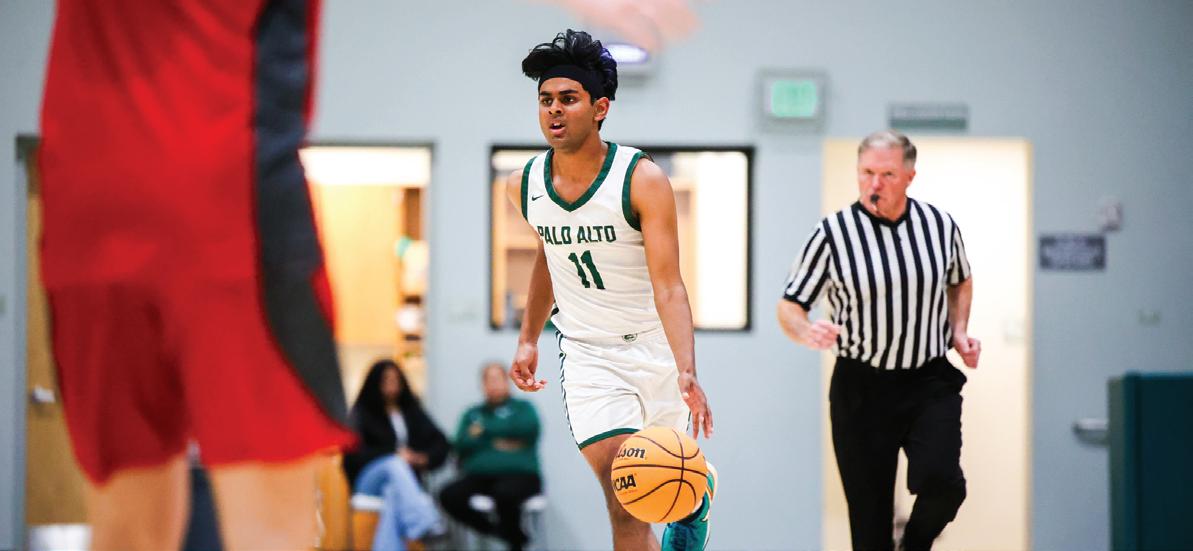
In the frst round of the Division IV CIF state playofs, boys basketball beat Ripon 60-58.
Te third quarter featured a game-winning 24-point charge for the team. Going into the game, senior forward Alaap Nair said the team knew Ripon was a formidable opponent.
“When they’re hitting 75% of their three pointers we knew they were going to be doing good ofensively,” Nair said. “Basketball is a game of runs. We were more persistent and that’s (why) we got the win at the end of the day.”
Because a loss in state playofs would result in the team’s elimination, Head Coach Jef LaMere said having a one-game tournament mindset is crucial.
“You keep winning little tournaments, and before you know it, you’ve done something great,” LaMere said.”
LaMere said this mindset was demonstrated through Paly’s nine-point comeback.
“(Tis game) shows the toughness of these guys and the grit to be able to come back from a defcit like that,” LaMere said.
As Paly moves on to round two of the state playofs, LaMere said he is proud of how far the team has come.
“It’s been an amazing season and they’ve done such a great job,” LaMere said “To see where our team is now from the start of the season and to be able to compete at the state tournament is incredibly gratifying. It’s a dream come true and as a player and a coach, that’s what your program strives for –– these moments.”
Te Campanile Tuesday, March 12, 2024
Luca Vostrejs Staf Writer
Senior Alaap Nair drives the basketball up the court. “We were more persistent and that’s (why) we got the win at the end of the day,” Nair said.
Amaya Bharadwaj Staf Writer
ART BY KATIE WU & LUCY LI
ART BY KATIE WU
LUCA VOSTREJS/THE CAMPANILE
Rahul Shetty Staf Writer
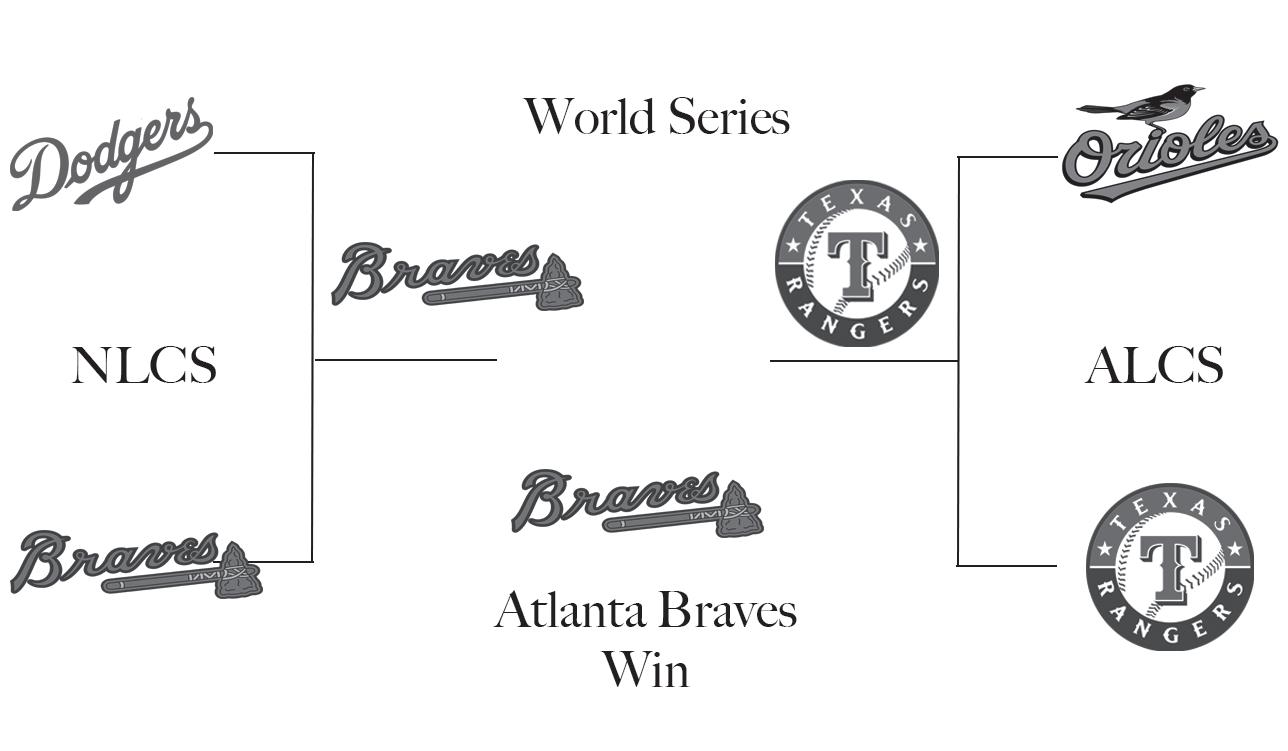
Neel Predicts: Texas Rangers, Atlanta Braves to World Series
SEvery baseball enthusiast knows that spring training plays an important role in establishing a trustworthy young core for teams to rely on during the season.
But what fewer people understand is the power of the way-too-early prediction.
Based on what I have seen so far in spring training, prospect rankings and rosters, these are my predictions for the 2024 MLB season.
To fairly assess the performance of the teams in the MLB, I will look at the two best teams in each division.
Starting of in the East, let’s go to the two best teams in the National League east division –– the Philadelphia Phillies and the Atlanta Braves.
Not only do both of these teams have strong postseason performances in the past three years (Braves winning 2021 World Series and Phillies being in the 2022 World Series), they also have future Hall of Famers riddled throughout their rosters, like Bryce Harper, Trea Turner and Ronald Acuña Jr..
On the Phillies, Trea Turner and Bryce Harper represent some of the best players in the MLB, while on the Braves, Ronald Acuña Jr. is arguably the best current player in baseball.
In the American League east, the two main contenders are the Baltimore Orioles and the New York Yankees.
Tough the Yankees are easy to count out, they made large moves this ofseason and have added Juan Soto to their already-stacked roster. Tough their pitching was questionable last year, they added Marcus Stroman who can
transform their team into a real threat with a more complete pitcher rotation.
Te Orioles on the other hand, are dependent on Adley Rutschman, Austin Hays and Gunnar Henderson as their main three producers. Not to mention, they got Corbin Burnes, winning pitcher of the Cy Young Award in the ofseason.
Additionally, they have an amazing young core and have the best rated prospect in baseball ––Jackson Holiday. He could serve as another source of star power for this Orioles roster.
Meanwhile, in the Central divisions, the competition is relatively low as compared to the rest of the league. In the NL Central, I believe the Cubs and Brewers will be the two main contenders. Tough the Reds could potentially have a playof season, they lack the star power these other teams have.
Te Cubs have a stellar defense with key felders like Dansby Swanson, Cody Belinger and Mike Tauchman.
Additionally, Justin Steele and Shota Imanaga will be great starting pitchers for this season. On the Brewers, Christian Yelich will be their main piece ofensively. However with the
After placing third overall at CCS on Feb. 18, freshman Brian Miller Jr., sophomore James Otuhiva and senior EJ Rudolph-Harris are moving on to compete in the State Championships for wrestling. Wrestling coach Jonathan Kessler said the performance was a historical win for the Paly wrestling team.
“We fnished third overall in team scores,” Kessler said. “Just behind Gilroy and Los Gatos, and that’s our highest placing in our program’s history.”
Te third place fnish included the eforts of the three state qualifers.
Rudolph-Harris said he is proud of his teammates Miller and Otuhiva for qualifying as underclassmen. “I’m incredibly proud of James and Brian,” Rudolph-Harris said. “James is the frst sophomore and Brian is the frst freshman ever to qualify (for states).” Miller said he encountered challenging opponents at CCS, but he was able to work through the matches.
“I started out the gate with two really hard matches and from there, I just kept the ball rolling and kept working hard,” Miller said. Despite the obstacles, Miller said he appreciates all of the support he has received from the team after qualifying.
“I really appreciate how the coaches and everybody has been making me feel good about (qualifying),” Miller said. “My dad, especially every time we’re in the car and we’re talking about wrestling, is always saying how crazy it is that I made it.”
Miller also said support from his family helped him succeed.
“I started out with some success, placing in every tournament, having my family behind me the whole
addition of Rhys Hoskins and Sal Frelicks last year, they could be a deadly team this season. Additionally, they have Jackson Chourio, who is one of the best prospects in the league. In the AL central, the main contenders are the Twins and Guardians.
Te Twins have a decent pitching core led by Pablo Lopez and have core ofensive producers in Carlos Correa and Byron Buxton. For the Guardians, they have elite hitters in Jose Ramirez and Josh Naylor, and have a well rounded team overall.
But in the West, the story becomes complicated. While the San Francisco Giants repeated another mediocre ofseason, the Los Angeles Dodgers put together one of the most stacked rosters of all time.
Regardless of the Dodgers’s success in the ofseason, they are still mere contenders for the World Series. Why? Because the MLB Postseason has so much unpredictability, it’s unfair to say one team will most likely win the world series. However, the Dodgers are currently predicted to be the best team in baseball this year. In the NL west, the Dodgers and Diamondbacks will be the best two teams. Te Dodgers have stars in Shohei Ohtani, Freddie Freeman,
Mookie Betts, Clayton Kershaw and Tyler Glasnow. Equally as strong, the DiamondBacks have great pitching in Zack Gallen and have a solid ofensive core in Lourdes Gurriel Jr., Corbin Carrol, Christian Walker and Ketel Marte –– not to mention, Merril Kelly and Eduardo Rodriguez will be elite for their pitching side behind Gallen.
In the AL West, the two best teams are going to be the Texas Rangers and the Houston Astros. Tough I want to put faith into the Mariners, I strictly believe that the Texas Rangers and Houston Astros both represent some of the most elite teams in the 2020’s.
Also, the Astros are not quite done despite losing Dusty Baker to the Giants. Tey still have Justin Verlander, Jose Altuve, Yordan Alvarez, Alex Bregman, Framber Valdez and Kyle Tucker to push them into the playofs.
Additionally, how could I count out the Rangers? Tey not only won the World Series last year, but also have an elite lineup with Cory Seager, Adolis Garcia and Marcus Semien.
Teir pitching rotation is even more impressive with Nathan Eovaldi, Max Scherzer, Jacob DeGrom and Andrew Heaney as their top four starters. But to go to the World Series I choose the Atlanta Braves from the NL and the Texas Rangers from the AL.
To win the world series, I believe that the Braves will win their second world series title in the past four years.


way,” Miller said. “My whole family is really supportive of the wrestling and I think the biggest part of that is just having a good support system.” Rudolph-Harris also said he couldn’t have qualifed without the team’s support.
“I wouldn’t have accomplished this goal without my teammates like Nick Quiroz,” Rudolph-Harris said. “He didn’t make it, but I wouldn’t be here without him. He’s my drill partner and one of my closest friends –– he’s supported me all the way.”
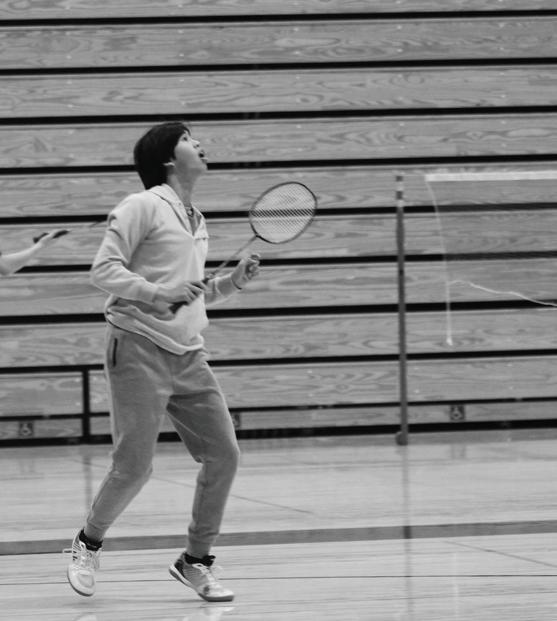
Sophomore Nathan Lee practices his swing at badminton practice.
“Our development and JV players are getting a lot of attention from our coaches,” Assistant Captain Abhi Deshpande said.
Amaya Bharadwaj
Badminton kicked of their season with 120 sign-ups for a traditionally 48-person team, according to junior and Varsity Badminton Assistant Captain Abhi Deshpande.
Deshpande said sifting for dedicated players among the sign-ups is crucial for the team’s progress.
“A key to success is fnding out who’s committed to the team and trying to help them (become) better players,” Deshpande said.
Sophomore and badminton player Venkatesh Bharadwaj said it can be challenging to accommodate a large number of participants due to the small number of courts in the big and small gyms.
“It’s been kind of difcult because we only have six courts, but we’re making it work,” Bharadwaj said. “It’s pretty organized and everyone’s putting in the efort so it’s all good.”
Bharadwaj said it is important to integrate newcomers into the team by helping them improve with experience.
“We are trying to develop all of our players and get a few wins,” Bharadwaj said. “Hopefully by the time they become sophomores, juniors and seniors, they can be a crucial part of this team.”
Deshpande said the team has shifted their focus this year to making sure the new players are becoming more prepared for the season.
“We’re focusing more on improving our new players,” Deshpande said. “Our development and JV players are getting a lot of attention from our coaches.”
Deshpande said his personal goal for the season is qualifying for CCS this year.
“I mostly look forward to playing my games, getting wins and hopefully going to CCS with my doubles partner,” Deshpande said.
Te badminton team is gearing up for their frst ofcial game of the season against Lynbrook on March 7.
Sports Te Campanile C2 Tuesday, March 12, 2024
amazing
start
pring is a season known primarily for
weather, colorful fowers, and of course, the
of the MLB season.
Freshman Brian Miller Jr. pushes a sled at wrestling practice in preparation for the State Championships. “I really appreciate how the coaches and everybody has been making me feel good about (qualifying),” Miller said. “My dad, especially every time we’re in the car and we’re talking about wrestling, is always saying how crazy it is that I made it.”
GRAPHIC BY NEEL SHARMA
Staf Writer
AMAYA BHARADWAJ/THE CAMPANILE
GAVIN LIN/THE CAMPANILE
Gavin Lin Assistant Managing Editor
Neel Sharma Sports Editor
Students ofer solutions to reform All-Star game competitiveness
Neel Sharma Sports Editor
The NBA All-Star game once represented a fun venue for stars to put on a show of the highest level of defense and ofense synchronized to create an enjoyable viewing experience. However, in the 2024 All-Star game, there were many complaints with the players’ performance and overall scheme of the game.
Senior and NBA fan Avi Verma said the recent manner of the All-Star game was a letdown to fans.
Tis year’s game was similar to the ones in the last two years,” Verma said. “It was very uncompetitive with little action going on on the ofensive end.”
Te lack of defense can be seen in the almost combined 400 points allowed in the 2024 game. Verma said because there are no set expectations in terms of scoring, players don’t seem to have defensive and ofensive adjustments during the game.
Te threshold of points is too arbitrary and it fosters an ofensive minded game that messes with the defensive rhythm,” Verma said. “If you let the game roll out like a normal game with normal refereeing, you would see a more realistic basketball game.”
Additionally, Verma said there should be a monetary incentive for players to try in the All-Star game.
“Whether it’s giving them money or doing a system like the play-in system, then players can be more inclined to try during these games,” Verma said. “Sometimes there is too much emphasis on the fnals, and not on other events like these.”
Junior and NBA fan Alexander Benkard said the lack of defense from the players is due to infuence of Lebron James and Stephen Curry.
“Lebron frst started a trend about not participating in the dunk contest,” Benkard said. “ Tis took away a lot of enthusiasm around the All-Star weekend and due to Curry’s transformation of the three point shot, a lot of defense simply doesn’t exist around the perimeter.”
Benkard also said players who fear injury should still treat the game as any other.
“Even though there is a relatively low risk of injury, players need to try during the All-Star game in order to give the fans what they want,” Benkard said.
Senior and NBA fan Ben Wolfe also said players should treat the All-Star game as any other regular season game when prepping their mentality.
“If these superstars can try their hardest in useless regular season games and in practice, they should also try when they get on TV (and) simply play their hardest,” Wolfe said.
Wolfe said he believes the game should be attached to an incentive.
“I think the winners of the All-Star game should be granted home court advantage during the fnals,” Wolfe said.
In the past, the All-Star game has always been dangerous for players. If they get injured in a low pressure game, they may miss important games for no reason. However, Verma said he believes the philosophy pushed by Miami Heat guard Jimmy Butler

that players have an obligation to try their best at every game applies in the All-Star game as well in addition to other conficts.
“You can follow what Jimmy Butler says –– players have a personal responsibility to show up to every
game,” Verma said. “You have people who are paying hundreds of dollars for these All-Star game tickets, and they come to see their favorite players. Tough there is injury risk during the game, at the end of the day, the NBA is a form of entertainment.”

team, embracing a multi-role play style.
Lining up to home base, catcher Buster Posey of the San Francisco Giants raises his bat as thousands of fans line the stadium, waiting in apprehension.
Te pitcher unloads the ball and Posey’s bat connects with a bang, sending a white blur out into the San Francisco Bay.
Junior Kevin Migliore, a catcher on Paly’s junior varsity baseball team, cheers as Posey runs a ring around the feld in celebration of a home run.
As a baseball player, Migliore said attending sporting events and watching players, including Posey, inspired him to become a catcher.
“I looked up to a couple of players when I was younger,” Migliore said. “Buster Posey was a major league baseball catcher and Mike Trout played center feld. Posey, being a catcher, infuenced my decision to play as one.”
However, students’ inspiration abounds of of the professional feld, too. Freshman softball player Kiara Tzeng said she takes inspiration from collegiate games, especially with the team at UCLA among others.
“I look up to the UCLA players because that’s where my parents went, so I watched a lot of their games,” Tzeng said. “For example, I look up to Rachel Garcia, who graduated a while ago, and also Maya Brady, who also graduated a few years ago from Paly.”
Like Migliore, Tzeng said watching other athletes play inspired her to become a pitcher and hitter on Paly’s
“I admire how Rachel Garcia would both hit and pitch, which is what I do,” Tzeng said.
Beyond professional and collegiate leagues, students also fnd inspiration closer to home. Junior Charlie Harrison, co-founder of the Paly ping pong club, said he and his friend Dean gained experience from enjoying the sport as a pastime, constantly encouraging and challenging each other to improve.
“I met Dean, (who) was already playing ping pong and I not just learn from him, but lead with him,” Harrison said. “ Te game’s competitive nature makes us push ourselves to develop new skills and combat each other’s approaches at the table and feld.”
Senior Scarlett Cummings, a lacrosse player, said she looks up to her family for support and strength.
“My dad played lacrosse in college, and he’s always been a big inspiration in my life,” Cummings said. “My freshman year I wanted to fnd a fun way to gain community at school and meet new people, so (lacrosse) was a great way to get outside when we were all kind of locked down in our houses.”
Overall, Cummings said she enjoys the process of playing her sport and remains optimistic for the team’s chances in the future.
“We as a team are always optimistic and I try to keep (that energy) throughout everything,” Cummings said. “I met a lot of high school-long friends that (are) special. It was the best decision I’ve ever made.”
Track and feld starts season at Rustbuster, prepares for quad meets, new league season
Girls lacrosse looks to bounce back in their frst league game against Los Altos after starting of the season without a win in the frst few matches, according to senior and attacker Alice Lifshitz.
Lifshitz said despite their recent losses, the team still brings their best for every game.
“We’ve been working really hard,” Lifshitz said. “With league games approaching we’re hyped to put practice into gameplay. Te energy is so high right now and we’re excited to give every game our all.” Senior and midfelder Ellie Roth said the team is ready for any challenges that come up along the way.
“I feel very confdent in our team at this point,” Roth said. “Everyone is putting in the work, and we’ve gotten close as friends beyond just teammates.”
With the team’s impressive incoming underclassmen, Lifshitz said this season may be the best yet.
Tere are a lot of new players on our team, and it has been so fun playing with new teammates and making friends,” Lifshitz said. “Everyone is just really excited to put all of their efort into every practice and game. Te sportsmanship and team bonding is also the best Lifshitz also said her main goal for her senior season is to make lacrosse stress-relieving and fun.
“I have so much love for the sport and the girls truly make it feel like family,” Lifshitz said. “As a senior, I’m excited to make the most of my last season. Te seniors have a goal of making lacrosse enjoyable and a break from the stressors of life –– we hope that the underclassmen carry that positive attitude into next season after we graduate.”
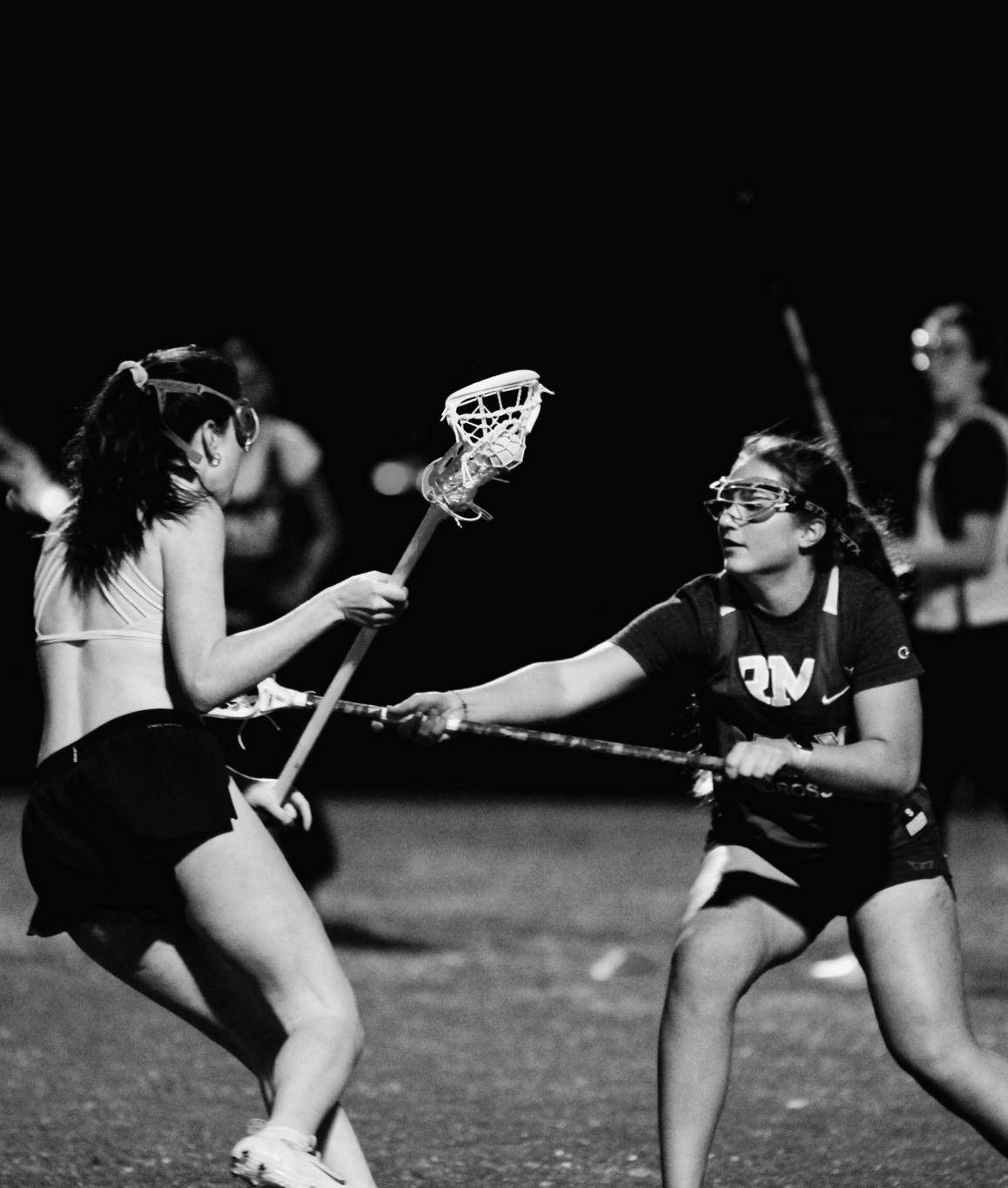
Roth also said she hopes to make the most of her last season on the team.
“From morning practices to senior night, I am soaking in every second knowing I’ll remember (lacrosse) for the rest of my life,” Roth said. “Lacrosse has always been my escape from stress, and even more provides such a wonderful sense of
community and opportunity to give my all to something I care about. I am immensely excited for the rest of the season and I can’t wait to make lasting memories.”
Track and feld prepares for its frst-ever quad meets between Lynbrook, Los Gatos, and Homestead following their frst meet of the season, the Rustbuster Invitational, on March 2.
Senior and jumper Hailey Kleiner said the Invitational was an exciting frst meet with a positive community.
“
Tere was great competition and the environment was incredibly supportive,” Kleiner said. “Meets like these always bring the whole team together as one since for practices we’re mostly separated by our events, so I’m looking forward to other competitions this season.”
Kleiner said the upcoming quad will serve as half of all league meets in the upcoming season.
“We’ve been getting ready to compete in it since the beginning of the season, and people are eager to give their best performance with what they’ve learned and practiced over the past few months,” Kleiner said. “ Te energy is ramping up, and I look forward to the friendly competition with the other schools.”
Jump Coach Ed Givens said with Rustbuster done, athletes now know what to expect for the upcoming meets.
Te only diference is that an invitational is run slightly diferently than a dual, tri or quad meet,” Givens said. “Since this is a league meet, we have to calculate what points we need to win the meet. (It is) much easier when it is a dual meet with only two schools,
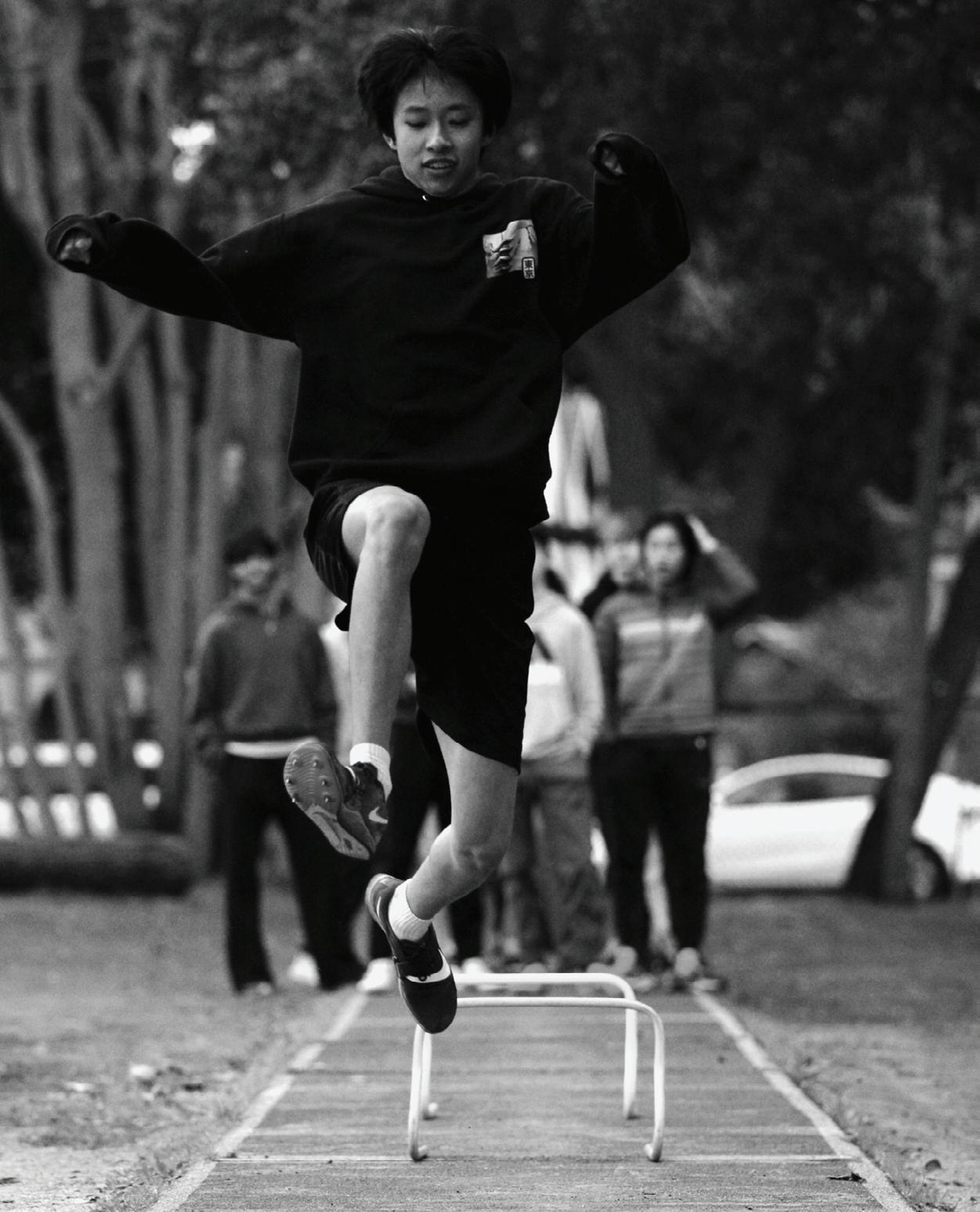
but with a quad meet, three other schools have to be taken into consideration.”
Kleiner also said it’s always exciting to meet the incoming freshmen through the activity, which allows her to encourage and motivate them.
“As a senior who’s participated in track since freshman year, track
has always been a safe space for me, where I can push myself to improve my skills alongside others who strive to do the same,” Kleiner said. “ Te community of coaches and teammates is great, and I always look forward to practices where I can work towards my personal goals for improving my performance in my events.”
Tuesday, March 12, 2024 Sports Te Campanile C3
Senior Ellie Roth goes against sophomore Natalie Dymmel in practice. “ Te community of coaches and teammates is great,” senior Alice Lifshitz said.
IRIS TANG
Tyler Wong Photo Editor
ART BY
Freshmen Jasper Zhang practices the long jump. “ Tere was great competition and the environment was incredibly supportive,” senior Hailey Kleiner said.
ART BY ISAAC LIU
TYLER WONG/THE CAMPANILE
TYLER WONG/THE CAMPANILE
Tyler Wong Photo Editor
Henry Liu Staf Writer

Science & Tech

Students form addictions to video games
As senior Hahn Ng stares into his PC monitor, fake fans on the video game Rocket League cheer, and he shudders from the sound of crashing cars. He’s well into his sixth hour of playing and still isn’t tired due to the adrenaline from winning games and playing with his friends.
Ng is not alone in his enjoyment of video games, however, and according to Dr. Daniel Alanko’s research, over 90% of American children over two years old play video games, and children eight to 17 years old play an average of two hours a day.
According to a 2016 study by Dr. Charlotte Wittek and colleagues, while the number of gamers worldwide has been steadily increasing since 2013, so has the number of children with video game addictions — bringing the total number of people classifed as being addicted to video games up to two percent.
Dr. Bradley Zicherman, part of Stanford Medical’s Child and Adolescent Recovery Clinic, said a child is considered addicted to video games when playing starts to produce functional impairments in their life.
“If you’re going to bed at really inappropriate times, such as one, two or even fve in the morning because you can’t shut of the system, (that can be an addiction),” Zicherman said. “When you’re unable to go to school, isolating from family and possibly friends, not really getting out of the house, nor getting any exercise and (have) limited physical activity, that can lead to the development of cooccurring depression and anxiety disorders. ”
Because of the threats addiction poses to youth mental health, Zicherman said he is worried about increasing cases.
“When I started of (at Stanford), most of my cases were for substance addiction,” Zicherman said. “However, because I was
getting so many requests for screen and video game addiction, I’ve had to pivot. Maybe 20 to 30% of my clinic is now dedicated to screen addiction.”
Zicherman said a major cause of the rising number of cases is that game companies incentivize kids to keep playing their video games.
“Games are designed to create a rush of dopamine, and most games, to an extent, are developed based on what I call a variable reward system, which is the same way slot machines are developed,” Zicherman said. “ Tere’s something about them that is designed to bring you back. You don’t know what’s going to happen, you don’t know when you’re going to get the reward you’re looking for. So you keep pulling the slot machine lever, eventually getting a reward.”
A male junior, who considers themselves addicted to video games and only agreed to be interviewed if they remained anonymous due to fear of stigmatization, said the addictive efects of video games drastically afect their school and social life.
“Instead of doing work or more productive assignments, I’ll play video games with no enjoyment because it’s just become such a big part of me,” the junior said. “I used to just stay home and play video games, and make up excuses to keep playing instead of hanging out with friends.”
Zicherman also said one of the best ways to prevent addiction is to limit screens from a young age.
Te adolescent brain doesn’t fully develop until you’re about 25,” Zicherman said. “ Te last aspect of the brain to develop is your frontal cortex, which is responsible for executive functioning and being able to make good, reasonable decisions. Naturally, it’s going to be really hard for any teenager to control impulses around video games.”
Zicherman said although the American Academy of Pediatrics doesn’t have strict

guidelines, they still have recommendations for families to limit screen time.
“Once you hit the age of fve or six, what they’re recommending is that you need to work as a family towards a media plan,” Zicherman said.
However, while video games raise concerns, Ng said students can strike a balance to keep certain benefts of video games without indulging in unhealthy habits.
“It’s made me gain a lot of friends and spend a lot of good time with them,” Ng said. “However, I understand that there are limits and I want to be smart with my time, especially at the start of senior year. At the end of the day, you’re just playing for fun with your friends.”
Apple’s Vision Pro lacks comfort, integrates augmented reality well
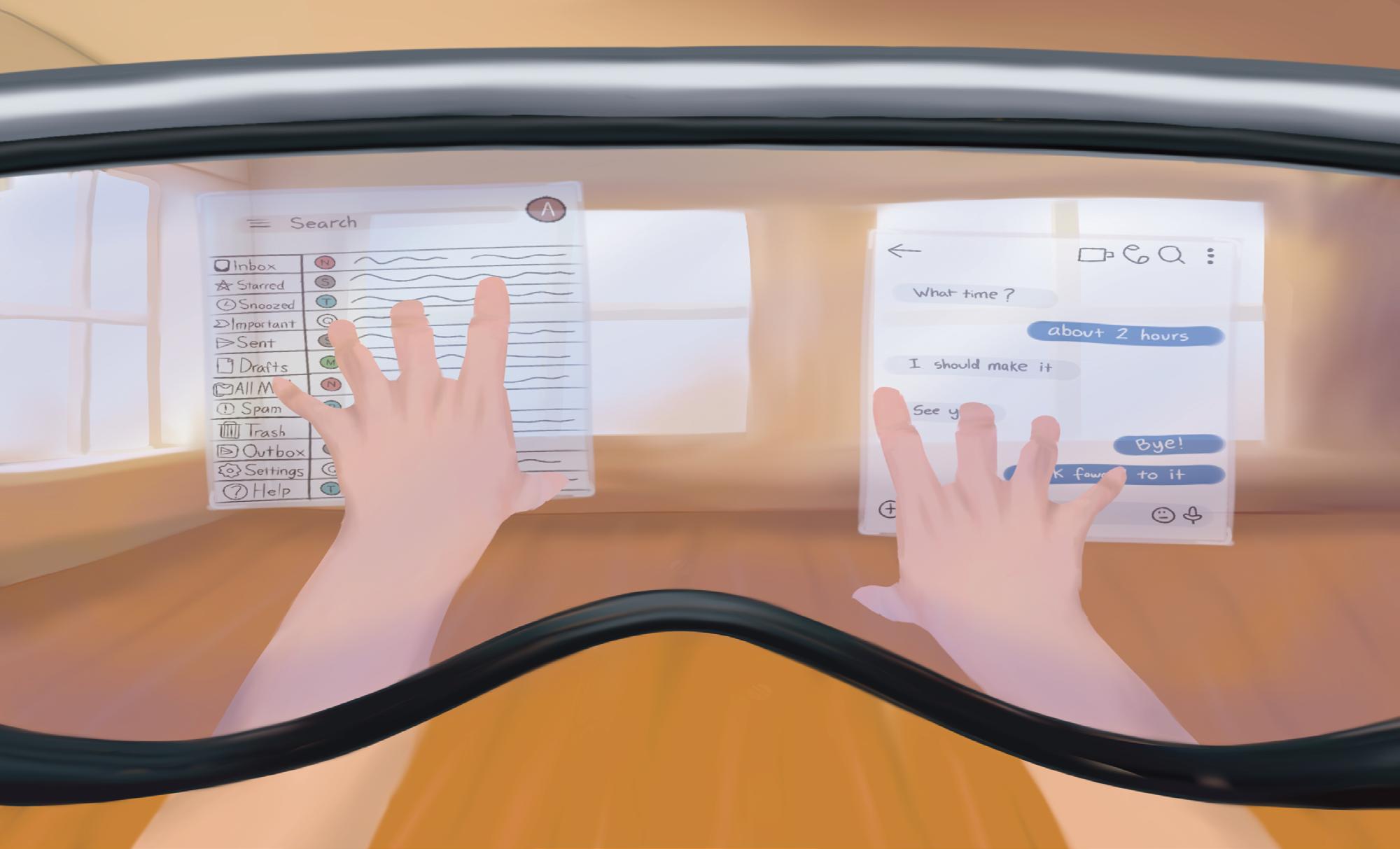
Unboxing the Apple Vision Pro feels like stepping into the future: a moment charged with anticipation, the air thick with the promise of entering new realities. Te release of this new, cutting-edge device by Apple, costing a whopping $3,500, invites tech enthusiasts to quite literally put on rose-tinted glasses and immerse themselves in an alternate reality.
Yet, looking beyond the shimmering facade of aggressive marketing campaigns, I decided to test the Vision Pro and determine whether this futuristic money-eater stands truly as a beacon of progress. As technology constantly invites trendy paths for futuristic comfort and efciency, is the Apple Vision Pro truly a game-changer, or is this promise of revolution just another high-priced consumerist gimmick in the ever-expanding tech universe?
Announced in June 2023, Apple marketed the Vision Pro as a “spatial computer” that integrates digital media with the real world, enabling a three-dimensional user interface and multitasking via foating windows in the user’s surroundings. With options to interact with the real world using tabs or tune it out using virtual environment immersions such as canceling and transparency, the Vision Pro appeals to those seeking a gadget for both entertainment and business workspaces.
For a quick rundown of its design and functionalities, I’ll debrief the main functions of this device. Te Vision Pro serves as a portable cinema and multimedia device, with customizable virtual screens allowing content viewing like an iPhone or computer. With 12 cameras and six microphones to capture 3D photos and videos, you can essentially relive sentimental memories in three-dimensional space. Although using graphic chips and tech for processing puts from 2023, the display has more pixels than a 4K TV providing quality imaging per eye.
It has a precise eye and hand-tracking technology to eliminate the need for controllers. Lastly, there are two audio pods for spatial audio, an external battery, and virtual avatars for realistic calls that allow 3D interactions, among numerous other functionalities.
Te frst time I put on the headset, I was simply excited, and I didn’t feel any discomfort as it reminded me of any other VR headset.
With its unique singular strap that goes behind rather than around the head like all other headsets, the design was diferent and simplistic.
Despite my eyes being inches away from the screen, I did not feel eye fatigue while it was on, and the quality of the images was truly detailed and precise. However, this headset is heavier than other headsets around, and after half an hour, I felt the weight diference from my face and neck, forcing me to take breaks.
I then tested sounds, and given the speakers weren’t even covering my ears, I was amazed by the spatial audio’s ability to replicate depth and direction. But its impressiveness was marred by the fact that the sound could be heard by people all around, so I would recommend using earphones or headsets with the Vision Pro. Speaking of what people can hear outside, the screen of the Vision Pro stands out for its size. Te design of the Vision Pro is reminiscent of huge black ski goggles, and it unfortunately detracts from the immersion. While it’s on, you’ll notice there is a limited feld of view compared to Apple’s competitor, the Meta Quest 3. Te technology of the Vision Pro is not something out of the ordinary, using essentially the same concepts as phones and iPads, using cameras on a screen. Tere are standard built-in apps such as photos and notes, and it is an extension of movable monitors like a laptop that foats. One drawback is that you can’t rearrange the apps, and
there isn’t a large enough inventory of apps that are useful at the moment. However, the FaceTime function is quite distinct. By using AI images, the Vision Pro creates a realistic image of the user, and despite the hilarious, horrible rendering, it’s arguably more realistic than the Meta avatars that resemble Wii characters from the early 2000s, meaning Apple’s rendition is a huge step in digital calls that utilize artifcial intelligence. I found three additional larger issues that take away from a revolutionary experience: the battery life, the comfort, and the price, of course. Te battery pack can run for around two hours before you need to switch them, meaning unless you are constantly charging it or carrying numerous batteries on the go, it’s unideal to take the Vision Pro outside for long periods. Additionally, the comfort level needs to be fxed. Within 30 minutes, I started to feel weighed down by the headset, and it was difcult not to take a break after an hour. With the uniquely designed straps combined with the heavier device, the Vision Pro can quickly become discomforting to keep on because of the strain.
And last but defnitely not least, the price. Te Apple Vision Pro currently sits at around a $3,500 price, but after adding storage and accessories like straps, or lenses for people wearing glasses, the whole package can cost as much as $4,500. It is also notoriously more expensive than Apple’s competing headsets, like the Meta Quest 3 which starts at $499, nearly ten times cheaper, and even Meta’s highest-end headset, the Quest Pro, at $999. To compare, according to CNBC, even the infation-adjusted prices of the frst-generation iPad and iPhone were $499. Although the Vision Pro has extremely pricey parts, it is once again a frst-generation model, and the “Pro” means it’s Apple’s more expensive-end model. I fully expected the Vision Pro’s faws in augmented reality.
But considering it’s the frst model, I feel more game-changing ideas are being presented, though the product is still lacking enough support and integration of the new concepts. Currently, there are free demo experiences interested people can schedule in stores, and it’s a great opportunity to take a peek at Apple’s new direc tion in integrating one’s lifestyle and tech.
Given the advanced technology and func tions of the Apple Vision Pro, as well as the many drawbacks of its comfort, view range, and price, I concluded that the f generation of the Vision Pro is a truly remarkable and unique device, but not yet vital enough to justify its price and shortcomings. However, I fully expected the Vision Pro’s faws in augmented reality. Considering it’s the frst model, I feel more game-changing ideas are being presented, though the product lacks enough support and integration of the new concepts.

Te word “disability” often leads people to imagine wheelchairs, prosthetics and handicapped parking, but in reality, at least 10% of Americans have a disability that can not be discerned with the naked eye, according to a 2015 University of Massachusetts Amherst survey. Asthma, forms of cancer, eating disorders and mental health conditions are all part of a long list of hidden disabilities.
However, the actual number of people with seemingly invisible disabilities varies, as some people are either unaware of them or are unwilling to disclose them. Stanford radiologist Peter Poullos said a common misconception and attitude toward hidden disabilities is “if you look fne, you are fne.” He said many assume that if a person does not have visible signs of a disability or illness, they do not face strenuous challenges or impairments that afect their day-to-day lives.
“People with disabilities that are easy to understand are given more credit,” Poullos said. “ Tis is the case with physical disabilities where people in wheelchairs can be seen as ‘courageous’ or ‘inspirational,’ whereas those with less readily understandable or undiagnosed illnesses are told that it is all in their head.”
Poullos also said many people with hidden disabilities even face skepticism from their own physicians and family members, rather than empathy or understanding.
“Behaviors or needs associated with hidden disabilities can be misinterpreted as laziness, rudeness or lack of interest,” Poullos said. “I met a woman who was fred from her job after having an absence seizure during lunch and zoning out for around a minute. Her colleagues at the table thought she was ignoring them and being rude.”
Sophomore Kate Nelson, who has type 1 diabetes and uses a Continuous Glucose Monitor and insulin pump, said having diabetes signifcantly afects her day-today life, even though others may not be able to see her challenges physically. “I do cross country and track and feld, and exercising with diabetes can be really challenging,” Nelson said. Nelson also said it is crucial that schools provide the help required through disability accommodations programs, which can help close gaps in the education system.
“I can get testing accommodations, such as (extensions or) extra time,” Nelson said. “If my blood sugar is out of a safe range then I can take tests at a diferent time.”
In her experience, Nelson said her diabetes is recognized and understood by peers and educators for the most part, and she has never been given a reason to feel uncomfortable about the medical devices on her arms or disclosing that she has diabetes.
Te biggest thing about diabetes is that people are confused when comparing type 1 and type 2 (diabetes),” Nelson said. “However, a majority of the time people who try to talk to me about diabetes make an efort to either be well-informed going into the conversation or actually seem to pay attention when I’m trying to explain to them what I have.”
Furthermore, Poullos said schools can better support students with hidden disabilities by educating staf and students about hidden disabilities and should strive to make personalized accommodations. Poullos said, “ Te area (of hidden disabilities) is continuously evolving, and advancements in technology, policy and societal attitudes hold the potential for

Te Campanile Tuesday, March 12, 2024
ART BY TERESA WANG
BY
Julian Hong News/Opinion Editor
ART
ANYA RASMUSSEN
Albert Jung Staf Writer
ART BYCHERIANN E Y NOO
Cherianne Yoon Staf Writer
