
BOARD FACES BROWN ACT
&
alo Alto parent Alan Crystal led a Brown Act complaint against the Palo Alto Board of Education on Feb. 21. e board has 30 days from the initial ling to respond — otherwise, the Santa Clara District Attorney’s o ce could step in to investigate the complaint and potentially force a revote on the board’s approval of the required freshman ethnic studies course scheduled to begin next school year.
e 2023 vote was held on Oct. 11, 2023, during the approval of Board Policy 6146.1, which said “Beginning with the 2029-30 school year, a student (must complete) a one-semester course in ethnic studies to graduate from high school.”
DiBrienza said she assumed BP 6146.1 was referring to the 2028-29 school year when the board voted 5-0 to approve the requirement for the class of 2030. " e board made in September of 2023 that their intention was to make it a requirement for the class of 2028 or for the class of 2029," DiBrienza said. "What I believe happened was that months earlier, that had been put in as a placeholder — when they were talking about ethnic studies, the state law said that it was mandated by the class of 2030 … So when they were drafting that policy, and they were making various changes to the graduation requirements, they stuck that in there … and then in September, we had this discussion where we said 2028 or 2029, and that document didn’t get updated to re ect that, and we missed it.”

Crystal said board member Josh Salcman’s deciding vote in favor of requiring ethnic studies for the class of 2029 was in uenced by the assumption that voting against the requirement would be reversing a previously approved mandate. Salcman did not respond to requests for an interview. Crystal's complaint also says the board violated California Government Code Sections 54952.2 and 54953 which says “a majority of the members … shall not, outside a meeting authorized by this chapter, use a series of communications … to discuss, deliberate, or take action on any item of business that is within the subject matter jurisdic

they received a response on Nov. 29 in which the district said it was exempt
Trump signs executive order to remove diversity, equity, inclusive intiatives
President Donald Trump signed an executive order, “Ending Illegal Discrimination and Restoring Merit-Based Opportunity,” in late January to remove diversity, equity and inclusion initiatives in federal government operations and among federal contractors.
e order has received pushback, with the attorneys general of 16 states signing a document in February advising states to “continue to implement these policies and programs to advance their business objectives and help ensure they remain compliant with state and federal civil rights laws.”
e Feb. 13 document also criticized the executive order for con ating “unlawful preferences in hiring and promotion with sound and lawful best practices for promoting diversity, equity, inclusion, and accessibility in the workforce,” arguing that the latter is protected under civil rights laws and is critical in reducing workplace harassment.
But a day later, the Acting Assistant Secretary for Civil Rights Craig Trainor from the Department of Education sent a Dear Colleague letter which justi ed Trump’s executive order as an extension of the June 2023 Supreme Court ruling in Students for Fair Admissions v. Harvard.
Trainor’s letter speci ed that federal law “prohibits covered entities from using race in decisions pertaining to admissions, hiring, promotion, compensation, nancial aid, scholarships, prizes, administrative support, discipline, housing, graduation ceremonies, and all other aspects of student, academic, and campus life.”
e letter ended by giving educational institutions two weeks to comply with the order or risk losing federal funding.
Palo Alto Uni ed School District is among many districts that use DEI programs. According to Assistant Superintendent of Equity and Student A airs Yolanda Conaway, PAUSD employs a district-wide integrated framework to identify certain groups that are struggling to meet metrics and expected outcomes.
“We disaggregate the data by group (and) identify the trends within those
groups that have struggled,” Conaway said. ”Our data suggests that some needs are not being met. We can prioritize those groups by being very intentional about the steps we’re taking to support those particular groups.”
Regardless of how the district chooses to comply with Trump’s order, Principal Brent Kline said PAUSD likely won’t face a signi cant hit from the potential loss of federal funding.
“It’s not a huge amount, and it’s not huge because (federal funding) is designated for foster youth, English language learners (and) low income students, and we don’t have a lot of
those students,” Kline said. “I worked at a school in Washington. It was close to 70% low income students, so that kind of program will get a signi cant hit.”
Conaway con rmed that PAUSD only receives 1-2% of its budget from federal agencies.
“We are mostly funded by property taxes,
and as you can probably imagine, since it’s super expensive to live in this area, we receive quite a lot of money in property taxes,” Conaway said. “So we are fortunate because it gives us a nice pot of money to really do some amazing things, which is why we have such amazing programs. But it also protects us somewhat from the ups and downs of budget planning from the federal level and even at the state level.”
grated Framework for Transformation and is aimed at promoting educational equity by focusing on diversity, inclusion and justice across the educational system.

e Santa Clara County Registrar of Voters denied a Notice of Intention to recall Palo Alto Board of Education Vice President Shounak Dharap on Feb. 21. According to Steve Goltiao, the associate communications o cer from the Santa Clara County Registrar of Voters, the notice fell short of the 30 quali ed names, addresses and signatures required.
Out of over 50 community members directly involved in the recall, e Campanile spoke to a group of ve PAUSD parents who agreed to an interview only on the condition they stay anonymous due to safety concerns for their children. e group said they are planning on re ling the Notice of Intention. is recall is led by concerned parents, educators, and community members who believe in preserving high academic standards, fairness, and transparency in our education system,” the group wrote in an FAQ released to e Campanile. “It is a grassroots e ort, independent of political parties, and focused solely on the well-being and success of students.” Board President Shana Segal said the recall is unnecessary.
“Speaking as an individual and not on behalf of the board, I believe the recall campaign against Shounak Dharap is not in the best interest of our students, teachers, sta , or community,” Segal wrote in a statement to e Campanile. “ e process would divert valuable time and resources from our students and lead to greater divisions within our communities. While I recognize the frustrations of some in our community, I encourage us to listen, engage respectfully, and work together toward solutions that strengthen our schools.”
After the notice was sent to Dharap on Feb. 18, one of signatories, who requested anonymity due to fear of retaliation, said Dharap sent the notice to some of his supporters, who published the Notice of Intention on social media with the addresses blurred out.
As a result, the signatory said the original 30 signatories will not all resign the notice
“It was inciting people against us, and the document hadn’t been publicly led yet, and so it wasn’t publicly available — it’s not against the law to show our names, but the way that it was used to scare people and to intimidate us — nobody could argue that it wasn’t the way she used it,” the signatory said.
According to California State Recall Procedures, if the NOI is led successfully, for a school district like PAUSD with over 10,000 but less than 50,000 registered voters, signatures from at least 20% of registered voters must be collected and submitted to election Dofcials within 120 days to le the recall petition. After determining signature validity, the governing body must issue an order to hold a recall election.
e Notice of Intention lists several grievances against Dharap, including “undermining excellence and merit” after he voted to de-lane middle school math courses in 2020 and high school biology courses in January. PAUSD high school parent Jian W., who requested to only use their last initial to avoid retaliation, wrote in an email to e Campanile that they disagreed with Dharap’s votes.
“My child not only has worked hard to be in honors classes but actually loves math and science, just like some kids love theater and sports,” Jian W. said. “She shouldn’t be punished for enjoying these topics and wanting to learn as much as she can, just like athletes shouldn’t be prevented from the lead role in a Paly theater production or playing on the Gunn varsity football team.”
Dharap said the notion that de-laning lowers the bar for excelling students is false.
“We’re the number one school district in California now,” Dharap said. “Our test scores have only gone up. Fifteen percent more students are college and career-ready than when I rst got into o ce … We’re expanding advanced math o erings. Based on climate surveys and Healthy Kids surveys, students are thriving, they’re high achieving, they’re happy and they’re well prepared for college. I would say that holding me responsible for something is interesting, given that, for the (decision to de-lane) biology, for example, Shana voted for it, and Alison voted for it too. I have no power to accomplish anything on my own. I’m a single board member out of ve.”
e notice also stated Dharap had “failed to provide responsible oversight of curriculum,” particularly with the merging of Biology Honors and Biology because, according to the FAQ, “the science department changed the Honors Biology curriculum so that both Honors and regular Biology became the exact same course” without “openly discussing this shift with parents and students.” Dharap said this was false.
e teachers said that over time, to meet the changing requirements, the Bio H and the Bio classes for
Conaway also said one way the district has decided to use its money to focus on marginalized groups is through plans like SWIFT, a district-wide equity program. SWIFT stands for Systemwide Inte-
“If you look at the PAUSD promise in the SWIFT plan, all of those elements that are in there come with some level of expenditure,” Conaway said. “For example, we have to have funds to train sta right to be what I call equity literate, which means, do they have the skill to recognize even subtle biases and inequities? at requires training because it’s not natural, no matter what background you’re from.”
According to Conaway, students, particularly students of color, often talk about biases and microaggressions they experience at school, which highlights the need to focus on such issues.
“Training teachers how to recognize that and then how to respond to that is extremely important because those types of incidents actually a ect the school climate signi cantly in order for us to create a positive and safe school climate,” Conaway said. She said practices to increase equity also include engaging parents.
“We found that our families sometimes have struggles that may impact learning, so some of the work that we’re doing also is asking, ‘How do we engage families? How do we provide parent education? What type of parent education is necessary for students to thrive?’” Conaway said.
But Conaway said schools relying on a higher percentage of federal funding will have to make di cult decisions, putting them in a much tougher position.
“My advice to other organizations is that, sometimes, you can do some really good work to create diversity, equity and inclusion in a way that does not violate any policy,” Conaway said. “Also, sometimes you can do this work and not name it diversity, equity, inclusion. You just do the work. You do the right thing.”

freshmen had become closer and closer in similarity to the point where it made sense to have a single class,” Dharap said.
PAUSD parent Nana Chancellor, said they were against the recall.
“ is recall threat is yet another distraction from serving our students,” Chancellor said. “Recalls should be used for egregious behavior — not political revenge, retaliation or policy di erences. I support Trustee Dharap 100% and look forward to hearing our school and city leaders speaking out against it.”
e group also alleged Dharap “repeatedly ignored parental and student safety concerns at Hoover Elementary,” referring to the installation of gender-neutral bathrooms on the campus. Dharap disagreed.
“ is is expressly false because I actually listened to the student and parent concerns,” Dharap said. “I brought it back to the district, and the district then changed its approach and included both gender-neutral and gender-separated restrooms.”
e group also claimed Dharap contributed to and “dismissed concerns about declining enrollment” because he “suggested that families seeking stronger academic opportunities look outside PAUSD” instead of “working to improve academic rigor within the district.” Dharap attributed declines in enrollment to other reasons.
“Enrollment increases and declines over a period of years, over time,” Dharap said. “ ere are so many fac-
tors that contribute to it, but by and large, it’s because people are having fewer kids and young families can’t a ord to live in Palo Alto.”
e group also alleged Dharap “created division and hostility,” especially toward the Asian community by engaging in “dismissive and exclusionary tactics that undermine fair representation.” In response to controversy over the reassignment of board member Rowena Chiu from her prior duties, Dharap said the con ict with Chiu has become unnecessarily racialized.
“I don’t agree that this is an Asian, non-Asian issue — I think that’s a harmful narrative,” Dharap said. “I say that as an Asian man, and I say that as someone to whom many Asian community members have reached out saying ‘We feel really concerned about this perceived narrative that there is something anti-Asian going on because we don’t agree that that’s the case, but we don’t want to speak out, because it just will create further divide.’”
After the initial notice failed to circulate, Dharap said the focus should shift back to prioritizing students.
“Tensions have run high recently. We’ve all played a part in that, myself included,” Dharap wrote in a statement to e Campanile. “Now, we all share a responsibility to restore a sense of unity in our community
that’s the past forward for us: leaving this
and refocusing
our students and schools.
…
recall behind
on
Together.” Kamhi and Salcman did not respond to requests for comment. Chiu declined to comment on the story.
Lea Kwan Sta Writer
ART BY CYNTHIA HUANG
Board Vice President Shounak Dharap listens to debate at a school board meeting on Jan. 23. Dharap was the subject of a potential recall vote, but the Santa Clara County Registrar of Voters denied the Notice of Intention for the recall. “Tensions have run high recently. We’ve all played a part in that, myself included,” Dharap said. “Now, we all share a responsibility to restore a sense of unity in our community … that’s the past forward for us: leaving this recall behind and refocusing on our students and schools. Together.”
ARYAN KAWATRA/USED WITH PERMISSION
Alec Bonnard, Holden Lee & Kate Xia Editors-in-Chief
Federal government cuts $1.5 billion in scienti c research grants
The Trump administration froze $1.5 billion in National Institute of Health funding grants on Jan. 27, stalling around 16,000 proposals. According to NPR, the funding freeze was partially lifted on Feb. 26 by the Trump administration, allowing grants to be reviewed again.
en, on Feb. 7, the NIH proposed a policy to cap the indirect cost rate—the rate of reimbursement for research expenses such as personnel, maintenance, equipment and accounting—for new and existing scienti c research grants with research institutions and universities at 15%, compared to an average rate at 30% today. e cut would not change the NIH’s overall funding budget, but it would redistribute the funds away from indirect costs, aligning with the Trump administration’s broader federal funding cuts.
Kenneth Curr, associate professor of biological sciences at Cal State, East Bay, said funding for research is divided into two types: direct costs and indirect costs.
“Direct costs have everything to do with the actual science itself, buying the reagents, paying for the personnel, buying equipment that is needed for the experiments to be done,” Curr said. “Indirect costs are a substantial amount of the grant, and that has to do with paying the establishment itself. So if you’re doing some work at Berkeley, they’re giving you the lab space, they’re providing you the electricity, they’re providing you the water, they’re providing you the safety, they’re providing you the way of ordering and getting your products and all this stu —that’s indirect costs.”
According to a notice from the NIH, indirect costs are hard to oversee from the NIH and average around 27-28%, with some organizations having rates up to 50 or 60%. e NIH is “obligated to carefully steward grant awards to ensure taxpayer dollars are used in ways that bene t the American people and improve their quality of life,” particularly for “new or inexperienced” organizations. On Feb. 10, District Court Judge Angel Kelley temporarily blocked the NIH’s proposed policy until she makes a nal ruling.
NBC reports that of the $35 billion in NIH grants awarded in 2023, $9 billion was spent on indirect costs, which account for personnel, maintenance, equipment, and accounting. Furthermore, the university “that houses that scientist’s work receives an additional percentage for those indirect costs,” although how much each institution receives varies by grant and university. For example, Stanford can receive up to $54 for every $100 in direct costs, although for many grants, this fraction is lower.
As a result, if the policy is upheld by Kelley, universities would face reimbursement cuts that would either force them to raise tuition or reduce the number of research projects to compensate for the nancial losses. Many medical labs across the country would also face challenges from the reduced funds.
David Mayo, the senior director for research administration at the California Institute of Technology, said indirect costs are calculated using a government-approved rate applied to direct expenses such as salaries, supplies and equipment. However, Mayo said the blanket cap fails to account for varying research costs in di erent cities and states.
“When the government said in the memo, 15% at, does it cost the same in research salaries at Stanford, Caltech or UCLA as it does at Kansas State?” Mayo said. “Salaries are going to be lower in lower-cost areas. at’s why indirect cost rates di er from universities, and the indirect cost calculation recognizes that things don’t cost the same everywhere.”
Curr said the NIH’s funding is vital for scienti c research at universities.
“NIH is important for state schools, but it’s incredibly important for schools like Berkeley, Stanford (and) UCSF who are pretty much 100% dependent on NIH funding,” Curr said. “ ere’s private funding that they can get—if you’re into drug development, you might be able to get some money from pharmaceuticals. However, that’s a con ict of interest, because the drug companies are paying you money to test their drugs. at’s why NIH is best, because it’s a non-biased association.”
Biology teacher Nicole Loomis said the policy would signi cantly impact graduate and PhD students, who need research to obtain their degrees.
“Already, universities have said, ‘We’re not going to admit any PhD students until this is sorted out.’ So it’s going to trickle down, and it’s going to have huge impacts,” Loomis said. e budget cuts will not only a ect medical labs, but also many research institutions, particularly in funding payment for sta , supplies, equipment and lab maintenance. For example, according to NPR, Harvard’s NIH funding would drop from $135 million to $31 million under this new policy.
Mayo also said the NIH’s proposal was unexpected.
“On Feb. 7, after NIH closed, (was) when they issued the memo to go into e ect the next Monday,” Mayo said. “No warning, no opportunity to ask questions, so it was problematic. Universities were speci cally targeted in the memo, not just NIH grants. It was reducing the amount it would reimburse universities (for research).”
Chemistry teacher Aparna Sankararaman said the policy could restrict freedom within research.
“When I was working in a research lab a long time ago, at that time where there was no threat to the budget, it was already pretty competitive to try to get funding,” Sankararaman

said. “If the budget cuts pass for NIH, I think it’s going to get worse. Labs are going to have to cut back on a lot of ideas. Unrelated research often leads to big breakthroughs, and with budget cuts, that freedom to explore is going to get severely curtailed.”
Curr said researchers may seek alternative funding solutions or adjust the way they present their grants.
ere’s gonna be other solutions (to funding), but they’re also gonna have to change the way that they look at their research,” Curr said. “ ey’re gonna make sure that the project grants that they write up are going to try to be 100% fundable. Now it’s like, ‘We’re not going to put in anything in there that could be too experimental.’”
Mayo said nothing has changed for research yet at some universities due to the temporary block.
“It’s not a ecting anybody directly, but what some institutions did, especially if they were heavily NIHfunded, is that they put hiring freezes,” Mayo said. ey stopped hiring people because they didn’t know if they’d be able to pay them. So has it a ected CalTech? No, and it hasn’t a ected a lot of institutions, because the block went into place so quickly and for the institutions basically it’s business as usual until something changes.”
However, Mayo said if the policy is passed, funding issues may arise.
“If we do have to deal with it, we’re going to have to gure out if we can literally a ord to do business with NIH,” Mayo said. “So if we’re now submitting proposals to NIH where we’re not going to get reimbursed for the full cost of doing that project, why should we submit it at all, because if we don’t get reimbursed from NIH, there’s nowhere else to get the money unless we increase tuition, (which is) not a good option.”
Sankararaman said a future with private funding could mean chasing pro t over discovery.
“If you work for a private company, you have to follow that company’s vision, that company’s ideas and that company’s role for pro t,” Sankararaman said. “You don’t get as much creativity as if you were in an academic institution. e diseases that are going to get looked at, mostly in the medical eld, will be the trendy ones.”
Curr said this cut could exacerbate a bias towards medical research, neglecting other scienti c elds.
“In the last 20 years, there’s been a new discipline called translational medicine, which goes directly from the lab into the clinic,” Curr said. “ at’s probably where we’re headed now, and it’s going to be harder for people who are understanding basic science to get funded. Basic sciences are the understanding of how something happens or why something happens. And some people that are outside of science don’t see the need for it.”
Curr said ultimately, this cut may cause the US to fall behind in scienti c innovation.
e people that are making these decisions have to be aware that if you stop, if you slow down the progress of research … it’s all going to slow down,” Curr said. “But that doesn’t mean that other countries are going to slow down with it. China (and) Russia have very good science programs. All of them are still going to move ahead. What’s going to end up happening is the US will slowly fall behind.”
Loomis said the policy re ects a broader distrust of the value of science in America.
“While skepticism is obviously warranted in science, they don’t necessarily all have the critical thinking skill development to really understand how science works or what they actually should be skeptical of, as opposed to what’s being ampli ed on the internet by people who really don’t know what they’re talking about,” Loomis said. “So I think it’s only going to increase the erosion of trust in science, which is very unfortunate, and it threatens our place in the world as a dominant producer of innovation in medicine.”

In a February marketing stunt, language learning app Duolingo announced that Duo — its cheeky, foreboding green owl mascot— had died. In an Instagram post, the company jokingly suggested “Tbh, he probably died waiting for you to do your lesson, but what do we know.” e true cause of death was later revealed in a eulogy on YouTube from Duolingo Co-Founder and Chief Executive O cer Luis von Ahn.
“Duo was hit by a Cybertruck,” von Ahn said. “It looks like, in fact, every character at Duolingo is dead. On behalf of their friends, family and Dua Lipa, we honor their memory.”
Von Ahnon said people should continue learning
Duolingo in Duo’s honor.
“We’re excited to rise up to the occasion in the face of our twerking, fuzzy, lime green, ctional, crusty owl friend,” von Ahn said. “So in his honor, let’s open up the app, do a lesson and share your fondest memories.”
While the app remained
platform.
Junior Akio Altekar-Okazaki, who has a 482-day streak on Duolingo, said the event was surprisingly motivating. A streak refers to the number of consecutive days a user has completed a lesson on the Duolingo language learning app. e whole situation with Duolingo being dead was so funny that it actually made me want to participate more,” Altekar-Okazaki said. “I found myself doing extra lessons and challenges just to contribute, and the community e ort made it even more motivating.”
Junior Jonathan Bakhash, who has a 1053-day streak, said Duo’s death spurred many people to get back in the game.
“Duolingo has been kind of dead recently,” Bakhash said. “I used to do a lot of lessons every day to learn, but now I’m just trying to keep my streak. When I saw Duolingo’s Instagram posts, though, I started getting back on track.”
After users hit the 50 billion XP goal, Duolingo revealed in an Instagram Reel that Duo had been resurrected. In a YouTube video titled “it’s time we talk,”
had to do something drastic,” Duo said. “So I thought, why not kill one green bird with two stones.” Indeed, Duolingo did kill one green bird with two stones. Not only did Dua Lipa respond to Duolingo saying “Til’ death duo part” on X, their marketing strategy delivered results. According to TechCrunch, Duolingo’s monthly active Android users increased by 25%, global downloads on Android rose by 38% and web searches surged by 57%. e strategy of using largescale, time-limited community events to boost engagement is a tactic commonly seen in many video games, such as Fortnite’s seasonal events or Pokémon GO’s global challenges. In the future, Bakhash said he hopes Duolingo continues its clever and quirky marketing tactics. “ ere’s really no other educational platform like Duolingo,” Bakhash said. “ ey should keep it up with their funny encouragement because it’s working.” And as Duo himself put it: “I guess you could say, I put the fun in funeral.”
Cynthia Huang Lifestyle Editor
Alex Isayama Sci/Tech Editor
Lifestyle
Designer Dupes
As sophomore Stella Guo walks down the aisles of her favorite thrift store, a designer Hermes bag catches her eye — or at least what looks like one. Upon closer glance, however, she notices the bag’s imsy, thin fabric and poorly stitched seams. e realization hits her hard: it’s a dupe.
A dupe, short for duplicate, is a product intentionally designed to replicate an original design. is is not to be confused with counterfeits — illegal copies that are designed to deceive consumers. e concept of dupes can be traced back centuries as craftsmen and artisans aimed to copy high-end products of the time for their clientele.
With recent advancements in technology and production processes, dupes are now easily accessible at all price ranges. Guo said these knocko s exist mostly due to the excessive prices of original designs.
“High-end brands make things for people who want and have the ability to a ord their products,” Guo said. “Dupes make it more accessible, but I’m always unsure about the quality.”
Popular brands known for their dupes include Shein, Temu, Forever21 and Zara, which all o er high-end designs at a lower price. However, with such an abundance of dupes in the fashion industry, it is easy to wonder if duping is actually legal.
Mark Lemley, a professor at Stanford Law School and an expert on intellectual property – the protection of creations of the mind, such as inventions, designs, and artistic works — said traditional copyright law does not o cially exist in the fashion industry.
“I think all design builds on what came before,” Lemley said. “We can reasonably distinguish between exact copies, which don’t advance fashion design, and new designs that build on the work of others. Everyone builds on previous works in some way, and it’s important that intellectual property doesn’t get in the way.”
However, Lemley said there are opportunities for design protection, especially for luxury labels.
“While copyright law has traditionally not protected fashion, luxury brands can sometimes use trademarks to protect their designs, particularly things like purses that come with logos or have consistent, recognizable shapes,” Lemley said.
Kal Raustiala, a UCLA professor of comparative and international law, said in some ways, these dupes can actually bene t the fashion industry.
“Copying functions is an important element of — and perhaps even a necessary predicate to — the apparel industry’s swift cycle of innovation,” Raustiala said. “(Copying) is not very harmful to originators. Instead, it may actually promote innovation and bene t originators.”
Lemley also said luxury designers may even bene t from a limited amount of counterfeits circulating the market.
“(Luxury brands) face counterfeits, but to a certain level, counterfeiting may simply increase awareness and excitement of the brand,” Lemley said. “But too much would saturate the market, especially since part of what luxury brands are selling is the appearance of exclusivity.”
On the other hand, Guo said dupes can present signi cant challenges for younger, mom-and-pop businesses.
“I think it hurts the fashion industry in a way that some small designers’ designs can get stolen without the credit, and it can really impact their businesses negatively,” Guo said.
A recent development in the fashion industry, “fast fashion,” allows companies to produce quickly and cheaply to keep up with the latest trends. It’s a global market that is forecasted to reach $185 billion by 2027.
Lemley said fast fashion brands can copy designs at an unprecedented speed.
“(Fast fashion) means that the window of time before counterfeits come out has shrunk, which can make it hard to distinguish yourself,” Lemley said. “ at said, my sense is that luxury brands are still making sizable profits in this new environment.”
Not only is fast fashion changing the pace of the fashion industry, according to the Plastic Collective, but it is also extremely harmful to the environment. Fast fashion manufacturing requires high energy consump-

tion, excessive water use, toxic chemical discharge and waste generation, producing 92 million tons of textile waste annually.
“Because fast fashion makes buying (these higher-end clothes) very cheap, it is easy for consumers to overbuy the items and create lots of waste,” Guo said.
Guo said as the industry evolves, brands must nd ways to protect creativity while adapting to changing consumer demands.
Gotta collect ’em all: the passion behind
As senior Rory Akin opens his closet, he isn’t met with a typical array of clothes or dusty boxes. Instead, he sees his array of periodic elements — ranging from copper to radioactive uranium — all tucked safely within the shelves. Staring at the results of his hard work after years of searching for and purchasing these elements, he gleams at them with pride.
Collecting is a hobby that often starts at a young age, whether it’s rocks, coins or stu ed animals. For Akin, he said he started collecting elements about ve years ago.
“I don’t remember exactly how I got into it, but I’ve been very into science for pretty much my entire life,”
Akin said. “I managed to get my hands on some element samples, and it just snowballed from there.”

So far, Akin said the most prized item in his collection is his uranium.
“My one gram of nearly pure uranium metal, which I think is around 99.9% pure, is my pride and joy,” Akin said. “I think it was legal, but I got it from a somewhat sketchy website sold by an element collector. It’s really hard to get radioactive samples, and uranium is one of the only ones you can get legally that’s radioactive.”
Beyond Akin’s metals, card collectibles can be just as rare and costly.
“A pack of Pokemon cards, especially nowadays, is like $10 per and you get 10 cards each,” senior Aiden Chen said. “I think I have a bare minimum of 1000 cards in my drawers, so it’s quite a lot.”
Senior William Tu said he started collecting stu ed animals in kindergarten and has continued to accumulate them.
“A lot of the time I get them as gifts, but sometimes I like to go out and buy them,” Tu said. “I recently went to San Francisco with some of my friends, and I got a penguin from Daiso.”
Unlike stu ed animals — which you can commonly nd in most stores locally — Akin said the hardest part of being an element collector, along with the danger and cost, is nding rarer elements.
“It’s really hard to nd a bunch of relatively pure samples for some speci c elements,” Akin said. “Like you can get copper every day, but the ones that took me
quite a while to nd on web websites were osmium and, of course, the uranium. It’s just really hard to nd them, because not a whole lot of people are going, ‘Hey, you know what I want today? I would like to get one gram of a platinum group metal that no one uses except for pen nibs.’” rough his collection, Akin said he has bonded with his dad.
“My dad thinks it is great,” Akin said. “He’s contributed a large amount of the samples I have. He’s into STEM too, and he had some tangentially related stu that has now been passed down to me.”
For Chen, he said his Pokemon cards also have built relationships with his peers.
“It allows me and my friends (to have) something to talk about, something to show o to each other, and, to a lesser extent, play the actual Pokemon (trading card) game,” Chen said. “I think I got an adequate amount of utility and joy out of whatever I bought. And also getting that rare pull is always just an amazing feeling.”
Tu said that though he probably cannot bring his entire collection to college, he hopes to keep at least some of it in his dorm room.
“It’s physically a burden to bring all the stu ed animals to college, especially since I should try to save space, but I think I’ll start a new collection, or bring some of the smaller stu ed animals that are hand size, like the plushies or key chains,” Tu said.
As he leaves for college, Akin hopes to continue to grow his element collection.
“I’m going to try to get as much of the periodic table as I can, but I’m not going to be able to make any sig-
collecting
ni cant steps until I get a job,” Akin said. “It’s not legal, healthy or possible to collect all the elements, but I want to get all the ones that it’s reasonable for me to collect.” Akin also said his collection represents his future aspirations.
“I’m going to be majoring in physics, and I hope to go into nuclear physics.” Akin said. “Getting into chemistry was the start of the road that led me there, and so it’s very meaningful to me.”
Looking at his collection now, Chen said his Pokemon cards serve as a nostalgic reminder of his childhood and happy memories.
“I think nowadays it’s more of a reminder of my old, now-sort-of-foreign childlike innocence, where I just collected cards for the sake of collecting cards, not because I’m addicted to gambling or because I wanted to get the rarest thing, but because I liked Pokemon,” Chen said.
While Chen’s interest in collecting physical Pokemon cards has gradually faded over the years, he still engages in online Pokemon games.
“I don’t think I’ll go back to collecting physical cards,” Chen said, “I don’t feel the need to have physical merchandise, but I think with the new mobile game — the Trading Card Game pocket, which is just literally a mobile version of the game where you don’t have to spend money to get packs and get cards — it de nitely helps me get back into collecting again.”
“If I think I will wear or use (the dupe) often then I consider if it’s worth it to get it,” Guo said. “However, there are always more a ordable brands out there making necessities without having to dupe high-end designs.”
Cherianne Yoon News/Opinion
Mirai Matsuzawa Sta Writer
ART BY REINA LIM
CTRL + Alt + Date
Amid a hookup culture full of situationships, sneaky links and friends with bene ts, many teens wonder if they can nd stable and loving relationships like previous generations did.
Regardless of how relationships work in any generation, though, child and teen therapist Dr. Candace Pierce said romantic relationships are a big part of adolescence.
“Younger teens can sometimes get very roped into a romantic relationship and kind of give up school and everything else,” Pierce said. “As teens get older, they still can do that. Some people do it if they don’t have enough of an identity in high school to ground themselves.”
With relationships being integral to a person’s identity, early childhood and adolescent development teacher Hilary McDaniel said the volatile nature of teenage relationships can often have negative impacts.
“I think what teens have a really hard time with is having relationships without drama,” McDaniel said.“Sometimes they’re just so drawn to it. (Teenagers should) have the courage to say what they want and need without all the extra drama.”
Yet, teenage relationships weren’t always this complicated. McDaniel said technology has signi cantly changed younger generations’ communication and their relationships.
“When I was growing up, we had to call people on the phone, and even then our parents were like, ‘Don’t do it over the phone. Do it in person,’” McDaniel said. “Now it is not even about calling them on the phone. It’s texting. ere’s so much that is lost. Over the phone, you can’t read body language, and over text, you can’t read tone of voice.”
No matter what form it comes in, sophomore Maria Uribe said communication is everything when it comes to high school relationships.
“A lot of high school relationships end because people don’t know how to talk about their feelings or set boundaries,” Uribe said. “I think that a lot of people also isolate themselves from their friends when they get into a relationship, which I think isn’t healthy at all. And honestly, most high school relationships don’t last forever, so it’s important to enjoy the moment but not let it take over your entire life.”
In addition to technologies, Pierce said the pandemic also impacted the nature of current teenage relationships.
“I feel like teens that have gone through it, in some ways, are maybe trying to make up for lost time,” Pierce said, “ ere might be a greater need to have relationships because there was this huge amount of time that people missed out on being social.”
An unexpected di erence, McDaniel said, is this generation of teenagers are statistically less sexually active than their parents’ generation during adolescence.
“A lot of people would say that it’s a good thing,” McDaniel said. “I’m not sure that it is, in the sense that, does that mean more teenagers are watching porn? And if they
are watching porn, does that mean that they are exposing themselves to unhealthy perceptions of what sexual relationships should look like, and then does that lead to unhealthy views of what relationships look like?”
But Uribe said there are also other reasons for teens delaying sexual activity.
“People are a lot more focused on school, and careers now,” Uribe said. “People aren’t really looking for a high school sweetheart and save those thoughts for college.”
In comparison to this generation, Pierce said older generations had more long-term high-school relationships.
“To nd somebody in high school and then keep that relationship and say, ‘I married my high school sweetheart.’ Well, I don’t know that that happens very much anymore,”
Pierce said. “But I think it could have happened when the parent’s generation were teenagers.”
Because of more casual high school relationships and a growing acceptance to talk about it, McDaniel said hookup culture has been on the rise.
“I think that the di erence is, with the whole sex-positive movement and the pushback against slut-shaming, there is maybe more openness about hookup culture amongst high school students,” McDaniel said.
Pierce also said hookup culture was previously scorned, but is now more positively perceived.
“ ere was a lot more judgment about it back then, more than there is now, certainly by peers and some parents,” Pierce said.
While people complain about the toxicity of informal relationships, McDaniel said she wonders if younger generations will succeed in nding genuine intimacy. But society may be moving the needle.
“Maybe (true intimacy) is not the goal anymore,” McDaniel said. “Maybe systems are changing. ere is some data that suggests that unmarried women without children are the happiest group. e inverse is true for men, though. So that’s gonna come into clash.”
As societal norms shift and evolve, McDaniel said relationships will remain a key factor in adolescent development. Relationships having adapted already from the parents’ generation to current teens, Pierce said no one knows what the future will hold for hookup culture and true love alike.
“I feel like there’s some sense on the part of young people now that the world is just a less safe place,” Pierce said. “ ere’s not as much time to do things the oldfashioned way. And maybe people feel like they just need to take pieces of life as they come no matter if it’s the traditional way or not.”
Zoya Prabhakar Sta Writer


Zoey
& Shaurya ummalapalli Guest Writers
For photography teacher Kenna Gallagher, photography is a key tool for capturing memories, whether it’s through documenting historical events or marking the highlights of a sports game.
“(Photography is) just a beautiful way to transport people into somebody else’s shoes, and then for the photographer to share that with a wide audience. It’s such a lovely creative outlet,” Gallagher said.
Living in a time of 0.5x zoom sel es, day-to-day life updates on Snapchat, and attempts to create a perfect Instagram pro le, many photographers say their creative outlet has become more prevalent than ever.
e rst photo was taken in the early 19th century and took eight hours to produce. It wasn’t until the late-19th century when camera technology evolved to become smaller, more usable and more a ordable to the middle class.
e use of photos in journalism became popularized in the post-World War II era, notably with the rst American all-photographic magazine “Life” launching in 1936. Today, almost 5 billion photos are taken every day, a result of the ubiquity of smartphones with built-in high-quality cameras.
Junior Kensie Pao said varying viewpoints often helps to improve circulation of information.
“A lot of photos are normally posted online or on Instagram accounts such as the New York Times (and) the Washington Post, and I think that really just gives people an outlet to see so many di erent photos happening simultaneously all at once,” Pao said. “You obviously can’t be everywhere, and you can’t see everything in detail, but having photos tell the story with di erent angles really allows people to see the world through di erent perspectives.” Pao also said photos can capture experiences words cannot describe.
“I think photography can tell a story in a way that words can’t alone,” Pao said. “ ere’s a lot of di erent things that go into just seeing a photo visually. And I think when you have a story written, it really doesn’t come to life until you have some sort of photo to go along with it.”
Freshmen photographer Riaan Shah said a large part of the storytelling comes from photography’s ability to evoke emotions in an audience.
“Photography helps us express our ideas through things that aren’t just writing,” Shah said. “It can imply emotions and help everyone understand the message. I think a photograph can leave a lasting impact on someone if they really understand it because of how it truly conveys (a) moment and all the emotions in it.”
Compared to videos, Pao said photos bring out these emotions in di erent ways.
“Something I think is really special about photography is you get really up close and capture a very speci c moment in a harsh, detailed manner,” Pao said. “It’s something that’s not really replaceable by art or just seeing a video.”
Gallagher also said photography is more accessible to the average person than other forms of art.
“You don’t need to know how to write,” Gallagher said. “You don’t need to know how to form a sentence structure. You don’t need to use technology. It’s just an intuitive process. Now you just need access to an editing program and an SD card and a camera, and the rest you can gure out on your own. You can teach yourself how to be an incredible photographer.”
Gallagher also said the deliberate choices a photographer makes when shooting or editing emphasize its beauty as an art form.
“ e way you edit expresses the emotions that you felt or that were present at that time and space,” Gallagher said. “ e (angle) you took the photo can convey a whole di erent meaning — the intention comes through. It’s just so broad in the way you can approach it. It’s a visual means of expression.”
Meixner
ART BY REINA LIM
Lifestyle
e shifting landscape of youth entertainment
It’s Sunday night and for a young Mark Ewen this means turning on “ e Wonderful World of Disney” on his family’s fuzzy television screen, sitting at the foot of his parents’ bed. Even now, at age 61, Ewen said he still remembers this weekly tradition, which was the highlight of every week.
While many adults today have lived through the development of entertainment into what it is today, primarily dominated by on-demand streaming services like Netflix and HBO Max, the majority of younger generations are unaware of the quick evolution of entertainment from limited cable channels to on-demand services.
Ewen, a PAUSD parent, said the rise of the digital age has reduced children’s outdoor and interactive playtime, activities he often enjoyed as a kid given his limited access to entertainment.
“We didn’t have instant and unlimited access to media through phones, and laptops and tablets did not exist at that time,” Ewen said. “ ere’s an element of losing that in-person, threedimensional interaction with the human being.”
During the early days of television in the ‘50s and ‘60s, the entertainment industry was popularized by appointment television, sometimes called scheduled media. e Big ree commercial broadcasting networks, NBC, CBS and ABC, also took control of television for kids during this time through Saturday morning cartoons like “ e Flintstones” and “Scooby-Doo.”
In the ‘80s, the booming growth of cable channels provided a previously unprecedented surplus of options. Cable television became widespread and entertainment culture evolved, providing more choices and niche channels from cooking shows to the “Simpsons” to Disney Junior.
Additionally, MTV, an American cable channel dedicated to playing music and music videos, gained popularity along with the rise of cable programming, providing reality shows, documentaries and more.
PAUSD parent Linor Levav said the growth of videocassette recorders, devices for recording and playing back TV programs, popularized rewatching shows in the late ‘70s.
“We had VCRs, so people could record things,” Levav said. “As kids, Saturday morning cartoons were a big deal … so we would go and you’d park yourself from about 8:30 or 9 in the morning until noon, and you could watch three hours of cartoons for children. Years and years later, there was actually a company that was aggregating the content from all these classic cartoons, and they called themselves Saturday Morning TV, and they were distributing these cartoons that all of my generation grew up with on Saturday mornings.”
At the turn of the century, on-demand streaming services like Net ix, YouTube and Hulu emerged. Levav, who was the vice president of content strategy and acquisition at Joost, one of the rst peer-to-peer television technologies launched in 2007, said initially, major media companies were skeptical about streaming.
“When I joined (Joost), it was called the Venice project,” Levav said. “It was very secretive. Everybody wanted to know what it was. Everybody knew they were on to the next big thing.
And the idea at the time was basically what Hulu became … We were the ones that really started the vision of people (starting) to watch long-form content … It sounds crazy because you take it for granted, but it didn’t exist.”
e rise of streaming services has also caused a decline in the popularity of traditional TV. e U.S. Media Consumption Report found the percentage of people who watch TV for over three hours a day declined throughout 2024 from 64% to 61%. And the percentage of Americans not watching any live TV increased by 4% in 2024 to a total of 24%.
In recent years, COVID-19 intensi ed this trend, with binge-watching becoming more prevalent due to stay-at-home orders and the growth of services like Net ix.
Levav said entertainment consumption used to be a cultural and social experience with everyone remembering the last episodes of all of the same shows, but now that aspect is lacking.
“You had a very shared cultural conversation,” Levav said. “ e Super Bowl now is one of the last things that’s true about. Even the Oscars have declined in popularity, but there were these moments in time when quintessential shows were part of the zeitgeist … What I observe generally is most (of the younger generations don’t) have the attention span anymore to watch a full two-hour lm. What makes me sad is that there’s something lost for the art forms that are out there.”
Given the new prevalence of mobile devices, junior Jonathan Bakhash can see the truth in Levav’s analysis.
“My parents (used to) put (shows) on, and me and my siblings would group around and watch it,” Bakhash said. “I’d say we de nitely do less of that now.”
Junior Zoe Sherer said she hopes future generations will be able to control their screen time to strengthen social skills and avoid missing out on opportunities around them.
“A big part of being a kid and growing and learning (and) is about play and interacting with the world around you,” Sherer said. “I see all these people at restaurants (where kids) are just on their iPads to distract their kids, and that’s taking away valuable experience.”
For Levav, re ecting on the advancement of entertainment, she thinks people

are aware of the drawbacks of accessibility, but she hopes everyone also recognizes the bene ts. “ ere are a lot of things that are amazing about where technology has evolved and how we have access,” Levav said. “If you think about it, you pretty much can nd any
kind of content you want anywhere. I think that’s incredible.”
Elise Andrade Sta Writer
When Kendrick Lamar took the stage in the Super Bowl halftime show, 133 million Americans sat in anticipation for a national tradition to begin. On the surface, Lamar’s show served as popular entertainment, yet upon closer examination, many viewed his performance as a carefully constructed criticism of race, identity and social justice in America at a time when diversity and equity initiatives are being repealed by the government. e themes in the halftime show included references to mass incarceration, racial inequality and unity. is was conveyed through the set built to resemble a prison yard, the choice of lyrics and the red, white and blue out ts that the dancers wore. Lamar’s performance was not the rst time artists have used music to convey messages. Music has long been a form of art used to fuel social movements, according to Berkeley eater and Performance Associate Professor Angela Marino.
“Music can bring people together and create an expression that is forging a position that people may want to take in the world,” Marino said. “It can bring a commonality. As people come together and do that, they nd each other, and they nd the ways that they may want to express themselves through music. (Musical) styles then become a part of the language that can expand and even ourish in times when there’s social change at hand.”
Marino said groups throughout history have used music as a form of rebellion during times of oppression.
“ e New Song, or Nueva Trova movement, is known for lifting the spirit in times of really deep repression through Latin America,” Marino said. “Folks in the U.S., in some ways, are part of that new song movement. It was very popular through the ‘60s, ‘70s and ‘80s, singers like Silvio Rodriguez touched the heart by singing about ordinary life and the commitments that people make to political change.” Jazz is another example of an art form that has fueled a social movement, as it re ected the values of the movement, inspired protest, and provided a voice for Black artists. Professional musician and San Jose State Professor of Musicology and Music eory Tom Langan agrees that music inspires change.
“Music brings comfort,” Langan said. “During the civil rights marches like
Montgomery, when people got thrown into jail, they sang songs to bring comfort to themselves while they were imprisoned.”
ARTBYCHERIANNEYOON

One person who particularly contributed to music that serves as a form of protest is activist, singer and songwriter Joan Baez, who graduated from Paly in 1958. Singing at numerous civil rights marches and rallies through the mid-1960s, Baez used her platform to raise money through free appearances at civil rights and anti-Vietnam War protests to advocate for change.
“If you think about Joan Baez — where she was performing and how the contexts of those performances were taking place — you had such a strong anti-war movement,” Marino said. “It was in and through these gatherings that (that) kind of music became so close to people’s hearts and minds. In a way, it was bringing forward the kind of music that would come out of that movement.”
Beyond Joan Baez, director and founder of the Bay Area Music Project Lorrie Murray said other artists had an immeasurable impact on the Vietnam War.
“Whether it was Bob Dylan or Neil Young who were singing about when students protested at their own college and were shot at by campus police, you can’t say that music ended the Vietnam War, but it certainly changed young people’s perspectives on war and our government,”
Murray said.
Sometimes, regardless of the lyrics, the act of performing a song can be a protest itself. Langan said there have been many di erent examples of high-pro le performances that challenged the status quo. “ e last fascist government in Europe was Spain,” Langan said. “Pete Seeger got invited to come and perform in Spain in the ‘70s or ‘80s, and the government gave him a list of songs that he couldn’t sing. So he went out on stage and he told people, ‘ ey said I can’t sing this song, so I’m not going to sing.’ And he just started playing his guitar, and the audience — which was tens of thousands of people —
started singing them with him.” Langer also said lyrical symbolism can convey deeper meaning in a performance.
“When Nelson Mandela was imprisoned in South Africa, they allowed him to play a song,” Langan said. “ e song he chose was ‘Jolene’ by Dolly Parton. e people who were there — both the guards and the other prisoners — remember it as being extremely moving. Even though the subject matter, on its face, is a woman who is afraid to lose her partner, to the people there, it was all about what they loved. It was received as ‘We’re all South African, and we all live in South Africa, and please don’t take away this place and these people we love.’”
However, Murray said the power of music to in uence social movements has lessened in the digital age.
“ ere are so many streaming services, and nobody buys an album anymore,” Murray said. “People are creating every single day from their bedrooms and posting into YouTube or Bandcamp, so it’s hard for artists to break through. And the attention span is just so short. You’re not going to Amoeba Records anymore and sifting through albums or CDs and listening to music and talking about it with peers anymore.” Langan agreed and said the digitization of the music industry has hurt artists’ ability to create authentic music.
“Music has been so devalued,” Langan said. “It’s harder now than it’s ever been for artists to make a living. It’s really hard to sing a song about working conditions if your sponsor is someone who has sweatshops. ey might not want to pay you if you’re singing songs that say you should pay workers more and take better care of people.”
On a sunny Sunday morning, sophomore Cole Kristo erson rolls up to My Gym — but not for leg day or chest day.
It’s Kristo erson’s workday at the children’s activities center in Midtown Palo Alto.
At My Gym, Kristo erson leads kids in energizing tness games, gymnastics, arts and crafts and music games.
While some students use their weekends to catch up on sleep or relax, Kristofferson juggles school responsibilities and part-time jobs.
Between his job at My Gym, academics and baseball, Kristo erson said he rarely has any free time.
“I pretty much don’t have days o anymore,” Kristo erson said. “I’m either working, going to school or playing baseball every day.”
Despite his exhausting schedule, he said that all of the work is worth the e ort.
“It has taught me a lot of good skills,” Kristo erson said. “Not only working with kids, which is important, but also dealing with parents and learning how to handle real responsibilities.”
Freshman Tomas Marcello Madeira, who is a part-time soccer referee, said in order to balance work with school he is careful with how he schedules his week.
“I manage my time by only taking the job opportunities that I can take, which is when I am not busy over the weekends,” Madeira said.
While he enjoys refereeing games, Madeira said it is not always an easy job.
“I have faced a couple of challenges such as refereeing a high-level team, where the game is faster and more competitive,” Madeira said. “ ere was a lot of pressure to make the right calls and keep both teams happy. Often, parents will disagree with a call and yell at me, regardless of whether they’re right or wrong.”
Despite the challenges from parents and players, Madeira said that the experience is rewarding.
“I think working as a student has helped me a lot by making money and taught me a lot about how committed you have to be to work,” Madeira said. “I’ve become more resilient to criticism, as I’m used to people yelling or talking down to me, and have learned to not take it personally. Refereeing has
also strengthened my time-management skills because I have to balance my own soccer practice, games, schoolwork and refereeing. Working this job has made me realize the importance of hard work, showing up on time and being dependable.”
Librarian Sima omas said afterschool jobs can provide students with valuable life skills.
“I think after-school jobs are an excellent way for young people to gain real-world experience and a more global understanding of society,” omas said. “A job also provides practice with time management skills and planning that will help an individual throughout their life.”
When she was in high school, omas said she learned soft skills by working at a diner and makeup salon.
“Both jobs not only provided pocket money and savings, but also gave me insight into working with all sorts of di erent colleagues and customers that helped me mature, develop independence and a more con dent sense of self,” omas said.
One thing to look out for, omas said, is potentially unsafe work environments.
“I hope the restaurant scene is less rife with harassment today, especially towards young women, than it was when I was waitressing several decades ago,” omas said. “Work environments should be safe.”
For Kristo erson, having a job is all about gaining valuable life skills, real responsibility and time management. He said side hustle experiences can shape students into more capable and independent young adults.

Kristo erson said, “Although the workload may be a little demanding, the whole thing is worthwhile due to the lessons learned, and especially the paychecks earned.”
Dalia Saal Sta Writer ART
Kane Do Sta Writer
Nijiya Market: a hidden gem for discovering your next favorite Japanese snack

TWe started o with a strong choice in the Next up was the Orihiro Purun Konnyaku Jelly, a fruity confection that provided a nice change of pace from the crunchy crackers. is snack comes in a large plastic bag with adorable, bottle-shaped plastic packets of jelly inside — not so environmentally friendly, but we’ll give that a pass because the jelly, though sometimes hard to squeeze out of the packet, was delightfully chewy. avor, reminding us of a cold, cial grape, couldn’t compare to the texture. Perfect for hot summer days, this snack can also solve late-night cravings.


Rating: (7/10)
e bar was left high after the rst two snacks and the daifuku did not disappoint. Some say your eyes eat before your stomach, and ours sure did as they admired the colorful white, green and pink packaging. Daifuku is a dessert with red bean paste covered in a thin layer of sweet mochi. With a slightly chilled, delicate texture and a strong mochi aftertaste, the snack left us wanting more even after it was gone — which didn’t take long. We recommend this snack for any mochi fans, though fair warning: the strong red bean avor might be an acquired taste.
Rating: (9/10)


ese honey-gold, citrus- avored jellies, coated with a clear rice wrap, looked delicious, but sadly, the good ends there. e jellies were too sweet, making the candy taste more like condensed sugar than yuzu. e jelly clung to our teeth, providing an unsatisfying bite. With its comparatively high price, this candy let us down.
Rating: (4/10)
Hopeful for redemption, we moved on to these bite-sized brownies topped with chocolate chips. Unfortunately, they tasted slightly dry and more like a dense chocolate cake than a brownie. Unfortunately, the brownie was one-dimensional, with a at, weak chocolate air. We would have preferred a more moist, layered dessert.
Rating: (6/10)
After eating four sweets in a row, we decided to open the signature pink and white package of Calbee Shrimp Chips. We were immediately hit with an intensely umami smell. ese golden chips were incredibly light, crispy and unsurprisingly addicting. A symphony of avor, they had a solid crunch and left us wanting to buy a couple dozen more bags.
Rating: (10/10)
After the shrimp chips we decided to try a salmon onigiri from the refrigerator section of the supermarket. e rice ball was hefty and cold to the touch. But it mostly consisted of cold rice, with a thin
layer of seaweed on the outside and barely a spoonful of salmon. e salmon was avorful and tasted like vinegar and soy sauce. However, its avor couldn’t surmount the stale rice, leaving the onigiri avorless and disappointing.
Rating: (5/10)
Last but not least, we opened up a bag of Mizuho Hand Made Rice Crackers and were instantly greeted with a strong whi of soy sauce. ese carefully shaped orangecolored crackers came wrapped in seaweed and had a loud, satisfying crunch, giving us a strong sense of nostalgia.
Rating: (8/10)
Nijiya Market o ers an amazingly diverse selection of authentic Japanese snacks, ranging from fruit jelly to seafood onigiri. We had a great time exploring the store, choosing our snacks and tasting them. However, a few snacks just let us down. Visiting Nijiya Market is an inexpensive way to explore Japanese food and nd your new go-to snack, especially if you go with friends so you can sample more.
Rating: (8/10)


Isabella Bian Newsletter Editor Gavin Lin Managing Editor
GAVIN LIN/THE CAMPANILE
A RTBYCHERIANNEYOON
GRADE DECEPTION
Pens scratch against paper as the clock ticks down. Five minutes left. Five minutes before they fail their test. eir head spins and eyes blur as they stare at the blank page. ey can already envision the look on their parents’ face when their grade comes out.
Desperate, a freshman student -- who asked that their name not be used -- reaches over to tap their lab partner’s shoulder. e teacher, lost in a stack of tests, doesn’t notice a thing. It would take half a second. No one would ever know. ey know cheating is wrong, but that is not enough to stop them.
And their situation is not unique.
With rising academic pressure and advancements in arti cial intelligence reshaping education, upholding academic integrity has become a growing concern. In a Feb. 19 Campanile optin Schoology survey with 69 student respondents across all grade levels, 65% of students said they have cheated and 81% of them said they have seen others cheat, including using arti cial intelligence, copying answers or sharing information before a test.
But math department Instructional Lead Natalie Docktor said cheating is not a new issue.
“It’s expected that kids cheat, sadly, when they get stressed over grades,” Docktor said. “Who knows what motivates them. But it happens in all the classes, and I think all the teachers are trying to take steps to alleviate it like collecting cell phones, separating desks and di erent (test) versions.”
Christopher Bell, career technical education instructional lead and computer science teacher, said cheating undermines the purpose of school.
“Anytime someone cheats, they have an issue where they’re depriving themselves of knowledge,” Bell said. “We’re all about helping people gain knowledge here.”
For many students, the pressure to succeed is overwhelming. An anonymous freshman said the expectation to excel academically — from parents, peers or students themselves — pushes students to make di cult choices.
“People who cheat are often desperate people who nd themselves in a very stressful situation,” the freshman said. “ ey can’t deal with the moralities at the moment. ey don’t even think of it. Imagine a sleep-deprived teen, struggling in their classes, in

a stressful situation because they have a test the next day, and they just can’t get a bad grade so that their parents don’t get angry or for their own sense of self worth. So they turn to the only possible solution in their eyes.”
Because of this, an anonymous senior said cheating is a rational response to the cutthroat academic environment.
“People have to do what they have to do,” the senior said. “Maybe if we didn’t have any high stakes tests that make kids stressed, kids wouldn’t feel the need to cheat.”
AP Environmental Science Teacher Nicole Loomis agrees.
“Academic integrity has always been a challenge, especially for highly competitive students who are under a lot of pressure from either their parents, themselves or their friend group,” Loomis said. “ ey feel like if they don’t get an A, they aren’t going to be able to have a successful life, which is not true.”
Still, Loomis said cheating in her class can lead to long-term consequences.
“When I write a college recommendation, they ask about your integrity,” Loomis said. “If I’ve caught you cheating, I need to give you the lowest mark. People don’t necessarily realize it at the moment, but that could end up on your college application.”
Although AP Psychology teacher
Christopher Farina agrees that a competitive school environment can contribute to the prevalence of cheating, he also said the problem is more systemic.
“( ere is) a very strong valuation on the outcome as opposed to the process,” Farina said. “I think in general, high schoolers are struggling to see, ‘Why is it important for me to build these skills? Why can’t I just focus on getting the grade that I want?’”
But for Docktor, the problem is inherently a social one.
“What kind of person do you want to be?” Docktor said. “Because school is about learning … (if) you want to be a person of integrity, you’re not going to feel good about cheating.”
And for science department Instructional Lead and AP Chemistry teacher Aparna Sankararaman, it is academic integrity that should in uence students’ moral compass.
“What concerns me more than knowledge retention is the ethical impact of cheating,” Sankararaman said. “If a student gets away with cheating for years, they might develop an attitude of ‘I can get away with anything.’ In the real world, dishonesty can lead to serious consequences, like losing a job. e bigger lesson isn’t just about academic integrity but about preparing students for life beyond school.”
But for Nadine Je erson, a supervisor in the Testing Center, student entitlement is the root of cheating.

“Students feel they have a right to do whatever ... ‘If I get caught, I get caught. If I don’t, then I think I’m getting myself ahead,’” Je erson said.
Regardless of the cause, cheating not only impacts the student but also slows down the whole class. Bell said when students get caught, teachers have to talk to administrators and often hold student-parent conferences.
“It brings in hours of additional work that then harms students in other ways,” Bell said. “Every time there are students that are caught cheating, it a ects the entire classroom because the teacher now has to do a whole lot more work.”
Since the rise of generative AI like OpenAI’s ChatGPT, students have increasingly used the tool to complete assignments, shortcut homework, and even write essays. While AI can be used to accelerate learning, Farina said the sta have had growing concerns about students using the tool inappropriately.
bit easier (for teachers) in some at all.”
Sankaraman also said the use her chemistry class.
“In AP Chemistry, many of the deep understanding, and AI tends misconceptions,” I don’t use for much.”


ere has been demand among a lot of teachers,” Farina said. “How do we catch students that are using AI in ways they shouldn’t be, and how do we deter students from using AI in ways they shouldn’t be in the rst place?”
According to the Campanile’s Schoology poll, nearly 44% of students reported using AI to brainstorm ideas while 27.5% said they have used AI to generate text before modifying its output.
English teacher Hunter Reardon said the advent of easilyaccessible AI has led to an increase in cheating.
“I think (cheating) has gone up from almost never to slightly more often than that,” Reardon said. “ e reasons that a student might try to cheat haven’t changed, though. It really just comes down to the tools that are available that make it easier.”
In response to students’ use of AI to cheat, Reardon said he has returned many assignments to paper as a preemptive measure.
“ e goal in an English class is to help students learn how to write and how to think critically about what they’re reading,” Reardon said. “Because I do so much on paper in my classes, I think I might have less AI use on my assignments versus what I’ve heard from some other colleagues.”
Beyond English, Bell said the nature of some classes makes it harder for students to cheat with AI.
“Some assignments are more easily done with AI,” Bell said. “(AP Computer Science Principles) is block based. You’re not going to get that from ChatGPT or Gemini. So it makes it a little
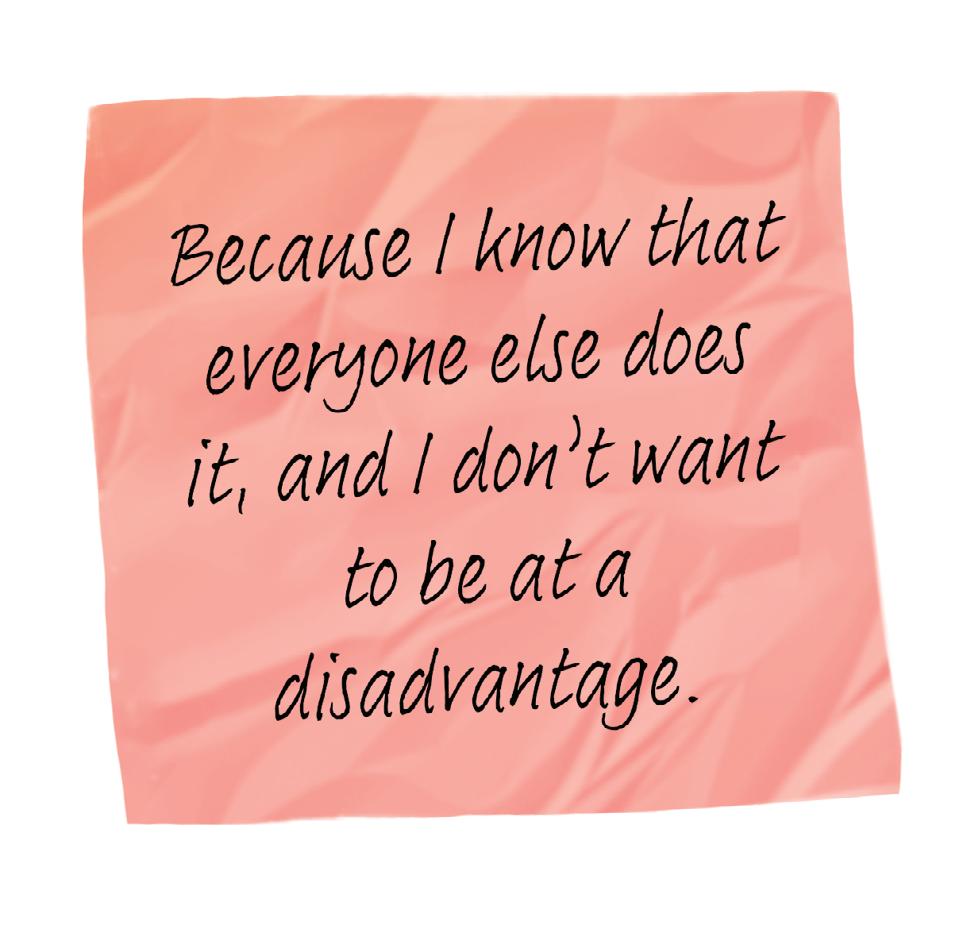
WHY DID YOU CHEAT?



Farina their students relatively
“It’s submits AI,” Farina the interactions with them And tools available said she and penalizing “It’s there aren’t consistently,” too many But deterred permanently landscape inappropriate
“Since ChatGPT came around, number of academic dishonesty every single year,” Farina said. “ just a really big temptation.”
According to the Paly Student of academic dishonesty in which unfairly in order to gain an advantage test, thus undermining the integrity handbook says this includes giving about a test, using AI to complete with other students without teacher authorization, among other things. However, the policies regarding academic integrity can vary across departments, teachers and even assignments within a class. Farina said for a rst o ense, adheres to the district guidelines.
“It goes up through admin and parents have to be contacted,” Farina said. “If it’s a formative assignment, just have to redo it. If it’s a summative assignment, then they get no lower 50% of the grade taken away, and also have to redo the assignment.”


Sankararaman said her approach based on assuming student innocence.
“Every student starts the year my trust, and if they violate it, we a conversation,” Sankararaman said. don’t enter the school year with of expectations for punishment. encounter cheating, I handle it based on context and severity. For example, glancing at someone’s test might innocent mistake, while taking a of a test is a serious violation.” Docktor said she uses a more faire approach to proctoring assessments because she thinks cheating carries
“I don’t make it a big priority
Docktor said. “I think kids have (choose) if they want to live up Farina also said the severity of from assignment to assignment.
“On one assignment, it may just case, use AI, have some fun,” Farina trying to assess everything that generate ideas, to organize ideas, to edit it into a nal format. I want you.”
However, based on the Campanile cheating may not necessarily be 7% of students who have cheated Docktor, who has been teaching surprised.
“I still feel a lot of cheating is Docktor said.
“I’ve caught some of cheating gets by.”
DECEPTION
cases, but we’re not immune to it of AI doesn’t concern her much in the concepts require tends to reinforce common misconceptions,” Sankaraman said. “Since grade for grammar or phrasing, AI writing clarity doesn’t concern me
Farina also said if a teacher knows students well, cheating through AI is relatively easy to catch. pretty obvious when a student submits something that was generated by Farina said. “It just doesn’t sound like interactions that you’ve been having them for weeks and months on end.” although there are AI detection available to teachers, Sankaraman she worries about unfairly accusing penalizing students. di cult to regulate AI use because aren’t reliable tools to detect it consistently,” Sankaraman said. “ ere are many false positives.” the threat of detection has not deterred students. Farina said AI has permanently changed the academic landscape despite attempts to curb inappropriate use. around, there’s been a spike in the cases that I’ve been dealing with e inappropriate use of AI is still
Student Handbook, cheating “is a form which an individual acts dishonestly or advantage on an assignment, project or integrity of an assignment or exam.” e giving or receiving verbal information complete schoolwork and collaborating teacher things. regarding across he guidelines. and Farina assignment, they summative lower than and they assignment.” approach is innocence. year with we have said. “I a list If I based example, might be an photo laissezassessments carries its own inherent consequences. for me to be their monitor,” integrity or they don’t. ey to that integrity.” of his cheating policies can vary just be a creative exercise, in which Farina said. “Another time, I’m you’ve learned about the ability to ideas, to express those ideas and then want to see that whole process from Campanile survey, policies to prevent e ective. e poll showed that only cheated have been caught. teaching at Paly for 37 years, isn’t happening under the radar,” blatant cheating, and I’m sure a lot
“Sometimes, students will just look at the paper next to them, and sometimes they’ll talk to people in a previous class about what’s on the test,” Loomis said. “Sometimes people have tried to come in with a crib sheet that has notes on it or has answers on it.”
As methods of student cheating change over time, Loomis said teachers must constantly work to develop new ways to counter cheating.
“ e biggest impact that I think students really feel is that they’re getting a zero on that assignment, and that’s impacting their grade,” Loomis said.
Loomis also said randomized questions help prevent students from nding the answers beforehand.
“With the questions jumbled and the answer choices jumbled and drawing from a test bank that has more questions than they’re actually going to answer, it’s a way to randomize it a bit more,” Loomis said.
Meanwhile, Bell said teachers can also prevent cheating through project-based assignments, which forces students to work creatively.
“But that doesn’t mean that there can’t be cheating,” Bell said. “(Students refer) to past people’s work or friends’ work, depending on the course.”
Bell said when students get caught, teachers have to talk to administrators and often hold student-parent conferences.
“It brings in hours of additional work that then harms students in other ways,” Bell said. “Every time there are students that are caught cheating, it a ects the entire classroom because the teacher now has to do a whole lot more work.”
And Farina said moving away from high-stakes assignments and towards ones with multiple opportunities can decrease student stress, taking away the desire to cheat.
“You can make an attempt, and if you don’t get a grade that you like, then you get to take another attempt,” Farina said. “Maybe you get a B, C or D on that paper when you rst do it, but you will have an opportunity to revise it with feedback. e only incentive (to cheat) is just that it saves you time and the criticism that you’re gonna get.”
Loomis said she agreed that a mindset shift could bring long term change, especially as it relates to college admissions.
“ e idea that everybody needs to go to one of the top 25 schools is not realistic,” Loomis said. “It’s better to go to a school that is a good t for you and your goals.”
And the anonymous senior said focusing only on the numbers is detrimental to teens’ mental health.
“We could x the system with less emphasis on grades,” the senior said. “We’re teenagers. Our prefrontal cortexes are not nished developing. is is not the right way to teach students. You have to put more on the learning and less on the numbers.”

To best combat cheating, an anonymous sophomore said they think students need to rethink the way they manage their academic responsibilities.
“If students were properly taught how to manage their time, study e ectively and choose their course di culty according to their level, there would hardly be any reason to cheat,” the sophomore said.
However, the anonymous senior said cheating might be an unsolvable problem.
“Maybe there’s no way to x cheating,” the senior said. “You can’t incentivize students in any way except for punishment. ere has to be a better way than giving people value based on how well they do on a test and making that their de ning feature.”
One way students could lessen the temptation to cheat, Bell said, is if they would learn to ask for support when they need it.
“Do what you can right now and get that knowledge lled in,” Bell said. “Once you start cheating, your knowledge has now got gaps and holes, which means it’s going to be harder to dig yourself out.”
But the anonymous senior said pressures to succeed academically, especially at Paly, often overshadow any other moral priorities.
“(Paly) is a very competitive school and many students aim for top colleges,” the senior said. “Parents push their kids so hard that sometimes it feels like if you bring home a B, they won’t love you the same — and a lot of time, that’s the harsh truth.”
ABOUT ANONYMOUS SOURCES: While e Campanile tries to limit its use of anonymous sources, due to potential repercussions from cheating, all the students interviewed for this story agreed to be interviewed only if their names weren’t used.
STORY BY ETHAN CHAN, GAVIN LIN & MERYEM ORAZOVA
Loomis said she has used a variety of
nd workarounds.

Executive order prohibits transgender women from competing in NCAA sports
Lucas Lai Sta Writer
President Donald Trump signed an executive order titled “Keeping Men Out of Women’s Sports” on Feb. 5 prohibiting transgender women and girls from competing in women’s collegiate sports in the National Collegiate Athletic Association. e executive order ful lls a central promise of Trump’s 2024 presidential campaign.
e NCAA currently governs 1,100 American universities, and schools that do not comply risk losing federal funding.
“We strongly believe that clear, consistent, and uniform eligibility standards would best serve today’s student-athletes instead of a patchwork of con icting state laws and court decisions,” NCAA President Charlie Baker said in a Feb. 6 statement. “To that end, President Trump’s order provides a clear, national standard.”
Varsity girls volleyball coach Chris Crader said while the issue has many layers, he agrees the executive order does standardize rules.
“I don’t feel like the government needed to make a blanket rule, but I also think the NCAA is in a pretty weak state right now,” Crader said. “Di erent states have di erent laws, so this order does provide one, clear solution.”
Nearly 80% of Americans do not think transgender female athletes should be allowed to compete in women’s sports, according to a recent New York Times and Ipsos poll.
Former University of Kentucky swimmer and conservative activist Riley Gaines, who has become an outspoken opponent of trans women in women’s sports, attended the signing ceremony and praised the trans sports ban on social media.
“I can’t even begin to tell you how vindicating it feels knowing no girl will ever have to experience what my teammates and I did,” Gaines posted on X, formerly known as Twitter.
For those opposed to the new order, Crader said the solution might be that each sport has its own criteria.
“It’d be nice to have the same rules across all 50 states, and across sports,” Crader said. “But as we learn more about what advantages, or not, that transgender women have, I think that each sport could be di erent. For example, being taller is an advantage in basketball or volleyball, but is probably a disadvantage in gymnastics or diving or maybe wrestling. So the fairest solution might be that each sport might have di erent eligibility requirements.”
Many who support the executive order, though, say male bodies are biologically advantaged.
“No amount of activism, corporate pressure or lies can erase reality — men are biologically di erent from women,” U.S. Rep. Nancy Mace, R-S.C said in a Feb. 4 press release.
Many students echo this sentiment, including sophomore JV volleyball outside hitter Elena DeLorenzo.
“(Male bodies) are usually a lot taller, and they also can jump a lot higher, so they automatically have an advantage, which I feel is really unfair,” DeLorenzo said.
While some opponents of transgender athletes competing in women’s sports argue transgender women have athletic advantages, the reality is more nuanced according to a cross-sectional study published in the British Journal of Sports Medicine. is study concluded transgender women had reduced athletic capabilities and were not as advantaged as before their physical transition and after undergoing gender-a rming hormone care. However, the authors of the study recommended further longitudinal studies be done on the subject before making de nitive conclusions.
Dr. Audriana Mooth, a sports medicine fellow at Stanford University, said gender-a rming care can decrease the athletic advantages of transgender women, but without a consistent level of change in performance.

“Trans women undergoing gender-a rming care with hormone therapy tend to develop decreased muscle mass, increased fat mass and decreased hemoglobin concentrations, which can decrease muscle strength and maximal oxygen carrying capacity and thus can impact athletic performance,” Mooth said. “Not everyone has the same change in these factors, and everyone also has di erent body types to begin with so there are many confounding variables.”
While both the study and Mooth found that transgender women have no signi cant athletic advantages, other studies say there is insu cient data to point one way or another.
Beyond athletics, Mooth said the bene ts of letting transgender women participate in women’s sports are important to consider and that the evidence to ban them is not su cient.
“From a medical standpoint, we don’t have data to support banning transgender athletes from women’s collegiate sports in regards to athletic performance or advantage,” Mooth said. “We do have data that gender-a rming care and participation in sports improves the mental health and safety of transgender individuals, so my standpoint as a sports medicine physician would be that we should not ban transgender women from competing in collegiate women’s sports.”
While many support this executive order, it has faced resistance. Two transgender public high school students in New Hampshire are challenging this executive order. Parker Tirrell and Iris Turmelle, students at Plymouth Regional High School and Pembroke Academy, respectively, had previously
sued New Hampshire education o cials over a state law that prevented them from competing on girls’ sports teams at their public high schools. On Feb 12., their lawyers from GLBTQ Legal Advocates & Defenders and the American Civil Liberties Union of New Hampshire amended the complaint, asking to expand the case to challenge Trump’s executive order. Chris Erchull, Senior Sta Attorney at GLAD Law, one of Tirell and Turmelle’s representatives, thinks that the executive order is another action meant to exclude transgender people from society.
“ e Trump Administration’s executive orders amount to a coordinated campaign to prevent transgender people from functioning in society,” Erchull said in a Feb. 12 statement. “School sports are an important part of education — something no child should be denied simply because of who they are.”
Some feel that the executive order is meant to target transgender people’s rights, as Baker testi ed to Congress in December, saying that he was aware of “less than 10” transgender athletes among the more than half a million student-athletes governed by the NCAA.
Crader said one problem he sees with this executive order is that it is another challenge for a community already facing immense di culties.
“I did see this order as another blow to an already hurting community, which is tough,” Crader said. “ e combination of executive orders regarding transgender individuals, and the lack of empathy within them, has saddened me.”
Ultimately, Mooth said that she thinks that while people’s stances on this issue can be polarized, it is important to approach the discussion with an open mind.
Mooth said, “While there are certainly opposing views, we should all approach this issue with compassion and empathy, and base our decisions o of available evidence.”
As the bell for seventh period rings, sophomore Ayelet Ra alin gears up for a dance class lled with music, movement and fun. She laughs through an engaging and intense warm-up with her friends, thrilled to have a brain break at the end of the day. Ra alin is one of many Paly students taking an alternative to the regular physical education classes. While students can’t get a prep period for these
classes for in-season sports, students who take them say they o er unique experiences.
Between yoga, dance and athletic conditioning in the weight room, there is room for students who don’t want to take conventional PE to still meet graduation requirements.
Dance teacher Alyssa Bond said in her class students focus on movement, music and having fun.

“Dance is just a chance to move your body to music, express yourself and participate in art while you’re working on your physical tness,” Bond said.
e dance class focuses on participation rather than performance, cycling through di erent styles throughout the year. e class explores hip hop, jazz, tap and musical theater dance and sophomore dance student
Ayelet Rafalin said she enjoys the class because of the positive environment.
“I am happy with my decision to do dance for my second year of PE because Ms. Bond creates a really chill environment for the class, and it’s just a fun class for the end of the day,” Rafalin said. “I love the people and how every class is run. It’s a very organized routine but still fun.”
Although some students do dance to replace a year of PE, students do have the choice to continue taking dance through another course. While Dance
2 can also ful ll visual and performing arts graduation credit.
Bond said she has some students who take dance mainly to get out of PE, but she also has students who take dance to pursue their interests.
“A good chunk of the students that choose dance really want to dance,” Bond.“ ey want to move their bodies to music and listen to music. But I’m not blind. I get my share of students who just don’t want to run.”
In addition to dance, students can also take Yoga as a PE alternative.
Sheri Mulroe, who teaches the Yoga class, also said some of her yoga students take the class because they don’t want to run, but mental health and meditation aspects also draw in students.
“Pretty much always the piece that sticks with the kids the most is the meditation piece, which initially was quite surprising to me, because it’s something we do for ve or 10 minutes each class session,” Mulroe said. “But I think learning di erent breathing techniques can help students with any stressful situations, irritating things or anxiety provoking experiences.”
Mulroe said Paly’s yoga class was rst created to address student mental health concerns. ere is a mental health struggle within our population in the district and at Paly,” Mulroe said. “One of the reasons was to work on addressing that in some way. Clearly, we’re not reaching every student, but people talked about wellness and actually doing something about wellness in schools.”
Mental health, however, is not the only appeal to students.Sophomore yoga student Kaavya Chittoor said she did not enjoy a traditional PE class but likes yoga because it allows her to get t in a new way.
“I didn’t like PE at all, so it’s good for there to be other options for people who feel the same way. I thought yoga would be something I enjoyed more,” Chittoor said. “I think we receive the same amount of physical activity as those in PE but in a di erent way.”
Despite this, Mulroe and Bond both said the physical rigor of dance and yoga is often questioned, but both also said their classes incorporate strength and conditioning that physically challenges students.
And Mulroe said she enjoys seeing Yoga students excited about the curriculum.
“I love to teach it because I’m o ering an opportunity for someone to learn something they can do forever,” Mulroe said. “So when I see that kids are excited about what they’re learning, that’s really exciting for me, seeing kids just adopt the practice and take it quite seriously.”
Athletic conditioning teacher Jason Fung also feels passionate about the impact of his class on students.
“I love it,” Fung said. “It’s been my passion for many years, even before I started teaching. I was a personal trainer before teaching. I want to make sure kids understand how all lifts work and what they are used for. I’m glad we o er a weight room, and I can unload my knowledge of how to lift and lift properly, it’s something we could all use. ere are adults that still don’t know how to workout. is class o ers up an opportunity for kids to lift and learn.”
Fung said his class begins with an introductory lesson to everything tness-related including nutrition, water intake, hydration and BMI.
By the end of the year, students have a personalized workout plan that meets their individual needs and goals.
After that, Fung said the curriculum is primarily composed of strength and cardio training.
“We do a variety of running such as stadiums, intervals and long distance runs,” Fung said “So we do a variety of di erent things that PE does touch on, but we go in depth a little more. Since you don’t get a prep, you’re really taking the class for what it’s worth. My goal and the class’s goal is ultimately getting you to enjoy the workouts and enjoy what you’re putting together for yourself.”
Sophomore Jacob Molina said he took athletic conditioning for multiple reasons, but the biggest reason was to put on muscle.
Molina said, “I’ve been a scrawny kid my whole life, so the con rmation that you look better and more in shape is just a really great feeling. at is what I hoped for when I decided to take the class. And I’m really grateful to have the weight room as a PE alternative.”
Zoya Prabhakar Sta Writer
ARTBYANGELIKAGERA
Super Bowl halftime show delivers star-studded entertainment
The lights dimmed as the crowd went silent and 133 million viewers watched in anticipation from home –– the largest viewing star of the halftime show, rapper Kendrick Lamar, who performed with his album partner SZA.
Junior Harrison Lan said he enjoyed this year’s half time show because it appealed to a wide range of audiences.
because this one’s about sending a message and about the United States government, compared with the previous one, which was just about focusing on perfor mance,” Lan said. “ brought in the older generation that is not into football as much but also want to watch Kend rick perform because (he) was popular decades ago.” Junior Chloe Chan said the performance was an opportunity for a larger audience to explore a new type of music.
“ certain popula tion of people who will favor the perfor mance more than others, but I think it’s also a great chance for people from di learn more about the rap culture,” Chan said.
Junior Sthavyashri Chaith anya said she liked the perfor mance because it re recent online feud between Lamar and Drake, another popular rapper.
just all one color. It is very basic, and I would like to see more.” And Chan said the halftime show improved the experience of this year’s

“For this year’s Super Bowl, the Chiefs weren’t doing really good during halftime … it gave the audience the ability to relax a bit because they (were) zoning out and watching the performance rather than being super focused
For Lan and many others, the halftime show was the main attraction of
“I wouldn’t (watch the Super Bowl) because I’m not as into the foot,” Lan said. “I think the halftime performance really pulls me in, because I want to see the artist perform. e most interesting part about it is it’s a private concert for this big artist, and I think it really caters to everyone in the United States that enjoys watching stu on TV.”
Chaithanya also said the halftime show plays a vital role in keeping the audience engaged for the second half of the “Rappers give a lot of hype to the audience because it’s upbeat, and they do a lot of singing or talking,” Chaithanya said. “Since the Super Bowl is also a competitive sport, the halftime show gives everyone a break from it and makes them even more energized before they come to the nal half.”
Chaitanya also said the Super Bowl provides artists with a
“It gives them an opportunity to perform in di erent places because artists usually perform at concerts, but a Super Bowl is a place for football,” Chaitanya said. “If an artist performs in di erent areas they can increase their popularity and also send an opportunity to Lan said this year’s halftime show left a lasting impact, distinguishing
“I really enjoyed this Super Bowl halftime performance because it showed a lot of the current issues, and it got more political than the past Super Bowls,” Lan said.“ e past Super Bowls were focused on performance, while this year’s Super Bowl was about sending the message about how people are oppressed and how the government is functioning as well and to create a change.”
Amaya Bharadwhaj Writer

“Kendrick Lamar isn’t popular in general, but over a couple years he’s been really popular, especially (with) the con ict between him and Drake
ARTBYANGELIKAGERA
After getting o to a slow start, varsity baseball defeated Monterey High School 9-6 in its second game of the season on March 3.
Senior and co-captain Isaiah Walker said the game was rough at rst, but the team was able to turn their performance around.
“While we did not start out on the right foot, we ended great through the team’s good e ort and hard work,” Walker said. “It always feels good to come out with a win to help us stay motivated to play even better the next game.”
Senior in elder and out elder Dexter Cleveringa agreed and said the team did a good job of increasing runs toward the end.
e game probably should not have been as close as it was, but I think we were pretty strong, especially in the later innings,” Cleveringa said. “Last year, we struggled with putting up runs late in the game, so it was de nitely nice to see improvement in that area.
Cleveringa also said that pitching was key to the win.

“I’m very happy with the performances we’ve been getting out of the pitchers, especially Jackson Ehrlich tonight,” Cleveringa said. Despite the win, Walker said the team can always improve by making small adjustments.
“We got to get back to the drawing boards, as even though we did good, there’s always room to improve,” Walker said. “As a team, I think we just got to get ahead of batters more as it would allow us to start strong. For me, I want to just get behind this team and be able to help the guys.”
As the team looks ahead, Cleveringa said he thinks keeping up their intensity and staying sharp on the basics will be key to a successful season.
Cleveringa said, “I think that if we can keep that energy and momentum going forward while also executing the fundamentals, we should be successful in the upcoming games and will be geared up to have a great season ahead of us.”
Isabelle Carlsen Business Manager

Online workouts grow in popularity
Bright white LED lights shine down on nowsenior Jacob Kinsky as he reracks his weight after performing his rst bench press. A video blares through his phone, explaining proper squat form for his next set of exercises.
“Especially when I was just beginning to work out, and I was learning how to properly do exercises and just learning what exercises to do, I used YouTube videos and online tutorials a lot as a very helpful resource for me to start lifting and getting better,” Kinsky, who is now a senior, said.
Similarly, PE and yoga teacher, Sheri Mulroe, said Peloton introduced her to online workout tutorials.
With a fresh roster, new team dynamics and high expectations, the badminton team is looking to replicate last year’s success where the team advanced one pair to CCS.
Senior captain Aavriti Katariya said the team has a strong lineup of dedicated players.
“ e goal is to win,” Katariya said. “It’s now or never. I hope we can be the top team in the upper league.”
Head coach Gabe FossatiBellani said he has introduced a new method that includes players during the lineup selection, ensuring a comprehensive and thoughtful process.
“We have a meeting with captains and seniors, where I’ll make my case, and I’ll get feedback on the match lineup,” Fossati-Bellani said. “ at’s a new way to try and
get everyone involved in ensuring that we’re on the same page, because there’s an element of strategy in how and where you put your best players or your best teams.”
In addition to improving game strategy, Katariya said team bonding is a focus for the season.
“I want to plan potlucks, maybe even a cohesive trip to Great America,” Katariya said. “I also want us to go to team tournaments together as well. I think some of my favorite memories on the team come from bonding on bus rides.”
Although logistical challenges remain, Katariya said she is focused on making communication and scheduling clearer for everyone on the team.
“In previous years, it’s been pretty unorganized, and I want to hopefully bring more organization so people know what’s going on, instead of having to be confused about match or practice schedules,” Katariya said.
e team is eyeing some major matchups this season, particularly against Gunn, Lynbrook and Milpitas High Schools. Katariya said these key rivalries push players to improve both on and o the court.
“It brings out competitiveness, and you strive to be the best version of yourself,” Katriya said. It teaches us to not only stay persistent on the court, but also outside, for example, it’s easier for me to push through a school exam.”
e team’s rst home game is set for ursday at 5 p.m., and a strong home crowd can make a huge difference. Leung, a mixed doubles player, said that even small gestures of support can have a meaningful impact.
Leung said, “Whether it’s the pow-wow before the rst matches, cheering for our team members from the sidelines, or even just wearing the same color, support is always crucial for the team’s success.”
“A number of years ago, I became aware of Peloton, which is an online platform, and I utilized some of their content because I got the bike and thought that was fantastic,” Mulroe said.
According to Statista, the amount of people who use online tness resources is set to increase by over 23% from 2024 to 2029. is growth is equivalent to almost 44 million users.
However, Luiz Lodino, head boys varsity soccer coach and Orange eory Fitness coach, said after the COVID-19 pandemic, he has seen a decrease in the use of online workouts.
“During the pandemic, we accepted the fact that we have to work together with others on screens and that’s what it is, but at that moment that you can have someone physically present coaching through a hard workout or getting through a hard workout with you, the majority would choose the latter,” Lodino said.
Mulroe said this rise in the use of online workouts can have positive bene ts on people who are uncomfortable working out in public gyms.
“I see it being amazing, because there’s a signicant population of people that don’t want to work out in front of people,” Mulroe said. “So in that regard, I think it’s really good.”
In addition to those bene ts, Kinsky said gym in uencers and tness videos have led to a greater awareness of good health.
“It’s de nitely brought a lot more publicity and recognition and just a lot more awareness to working out,” Kinsky said. “It’s probably a lot of publicity, a lot of awareness, a lot more people are working out and getting healthier and achieving their goals.”
However, Kinsky said gym in uencers can have a negative impact on the community through setting unrealistic expectations.
“I think there is a little bit of this gym culture that has been created, of body dysmorphia, and people thinking, they, after six months, are gonna look like this very famous gym in uencer who has been lifting for 10 years that has this really great body,” Kinsky said.
It is not just these standards that can have negative e ects on the gym culture and industry. Mulroe said online workouts can bring up safety issues, especially for beginners.
“My major concern is the injury risk,” Mulroe said. “Again, on the Peloton platform, they have a lot of strength classes, and a lot of them move really fast. So you’re picking up these dumbbells that could be 35 pounds, which is not insigni cant, and swinging them around.” In addition to safety issues and unrealistic standards, Lodino said it can be hard to be consistent with online tness journeys.
“In my experience, it is very hard to stick with a solid, solely online tness routine,” Lodino said. “I used to coach via zoom, and this service is no longer available. For instance, if I need to coach someone in Hawaii, and I do have clients there, I have to y there to make it happen.”
Despite the strengths and weaknesses of online tness, Lodino said he thinks in-person gyms will continue to thrive. Lodino said, “ e tness industry is growing by the minute, and gyms won’t (be leaving anytime soon).”
ISABELLE CARLSEN/THE CAMPANILE
CINDY LIANG/THE CAMPANILE
Cindy Liang Sta Writer
Sophomore Keira Tung prepares her birdie for a serve. “ e goal is to win,” Katariya said. “It’s now or never. I hope we can be the top team in the upper league.”
Senior Jonathan Nguyen waits for the next play. “We got to get back to the drawing boards (because) there’s always room to improve,” Walker said. “As a team, we just got to get ahead of batters more as it would allow us to start strong.”


Egg prices surge amid bird u outbreak
Sophomore Aina Arnquist didn’t think much about her grocery trip — until
e bird u strains that we’re concerned about are ones that are called H5N1,”
U.S., and they’re just starting to do some more surveillance studies to see if asymp
extent of transmission in communities and among animals.”
bility of mutating and becoming a public health concern.

In 1949, the United States began a nuclear arms race against Russia at the height of the Cold War. e next craze was going to space. And now, it appears to be arti cial intelligence. As far as the history books go, innovation has gone hand in hand with competition, with the United States always racing to be at the forefront of the next technological breakthrough.
Christopher Bell, AP Computer Science teacher and Career Technical Education Instructional Lead, said the creation of AI can be traced back to California.
“We started it all here in Silicon Valley, and it would be nice for us to continue being the go-to places for arti cial intelligence and just computer science innovation in general,” Bell said.
However, as the United States led advances in AI technology, its rivals on the international stage, like China, have also invested more in research and development.
Over the past ve years, the United States has invested $12 billion into AI technology, mainly dedicated to research and development.
Furthermore, China created a $8.2 billion AI investment fund in January in response to recent U.S. trade restrictions that barred Chinese companies from using U.S. semiconductors.
Sophomore Ayaan Nagrani, president of the Code Crusaders club, said this arms race demonstrates the cyclical nature of technological competition in international relations.
“It kind of shows how history kind of repeats itself,” Nagrani said. “With the Cold War, many years ago, the new technology was nuclear weapons, and it was just a really big race surrounding who can be better than the other person. It’s happening again with AI now.”
Instead of competing with countries like China, Bell said collaborating would be more bene cial.
“Putting up barriers and walls and just trying to stop others from achieving doesn’t really help us all,” Bell said. “It only helps one subsection, and we move slower.”
But Nagrani said this constant competition is simply part of how people behave.
“It shows human nature,” Nagrani said. “When two groups of people get their hands on the same thing, they’re consistently going to try to be better than the other person. If one person improves, the person will keep developing.”
Junior Duncan Sego, the president of the Current Events club, said advancements in Chinese AI challenge American companies to innovate. He cites DeepSeek AI as a Chinese large language model that competes with ChatGPT.
“It’s really funny that DeepSeek AI came out at a fraction of the cost, with a fraction of the time, with a roughly equal product compared to a lot of the American companies who are demanding billions and billions of dollars from the U.S. government,” Sego said.
As a result, Nagrani said he thinks this race will push AI companies to sacri ce quality for speed.
“I don’t think that there’s going to be a clear winner in the long term for the AI arms race,” Nagrani said. “People are just going to keep developing and getting better than the other, which I don’t think is really a good thing, because competition fuels corporations to cut corners and develop inadequate AI models that might be inaccurate or might have biases.”
Sego also said he was also concerned about the loss of human labor due to AI development.
“I don’t think (the bene ts of AI) outweigh how important it is to have enough jobs in the country and de nitely in the world,” Sego said. “Regardless of whether it’s most e cient, people need to be working. ey need to generate income, and they need to be able
“Right now, there’s very little risk among transmission in general,” Blumberg said.

“And the concern would be that if the virus evolves, if it mutates and develops more e cient transmission to at’s what could break out more in the general population, and that’s where it could cause even the next pandemic. at would be very concerning. And obviously that happened a lot with Blumberg said it’s important to spread awareness and implement mitigation measures before the virus mutates and spreads further.
“I would hope that those who are in charge would prioritize transparency and making the information available as well as prioritizing something as important to this that has the potential to cause a pandemic to make sure that we have appropriate resources dedicated to monitoring and researching,” Blumberg said.
Although mitigation measures might reduce the spread and mutation of avian uenza, Arnquist said she worries about another public health emergency under the leadership of U.S. Secretary of Health and Human Services Robert F. Kennedy, who has historically opposed the use of vaccines.
“Because of the lack of support for vaccines in our current administration, it could cause more people to get the illness and the illness to spread quicker, and it could prevent immunocompromised people, and others, from getting life-saving medication,” Arnquist said. “ e bird u epidemic is really something we should be more concerned about, and we should be making an e ort to limit its spread.”

to spend income for this economy to work. AI is trying to get in the way of that.”
And Nagrani said he was concerned about the privacy trade-o s of AI.
“ e competition between governments is somewhat scary,” Nagrani said. “I question their ethics to protect the data of users.”
Moreover, Bell said concerns about data privacy can also be applied to other forms of technology.
“Any advancements, especially in technology, are way faster than our government because it takes a long time to see if there are positive or negative e ects that should then be regulated,” Bell said. “Does that mean that we should slow down? Maybe. But at the same time, data privacy and data concerns are a very big issue, and we have not had comprehensive legislation passed at all in this country in regards to our data protections.”
However, junior and president of the AI Club David Wu said it’s important to recognize that AI is not inherently bad.
“I think safety is de nitely very important when developing AI technology, but I think it’s also important to realize that AI is just a tool,” Wu said. “Every tool can be used for good or for bad, just like electricity or cameras. I don’t think we should be limiting our development of AI just because we have some unknown fear.” In the end, Nagrani said AI has great potential to improve life if developed correctly.
“I think it’s de nitely a worthy investment,” Nagrani said. “Signi cant research and funding should be put into it, and corners should not be cut there. I’m just curious to see the future of the AI arms race and the developments that’ll come from it.”
ART BY MAX WAKENSHAW
Elise Andrade Sta Writer
Isabella Bian Newsletter Editor

A Culture of Comparison

Cynthia Huang Lifestyle Editor
Our math tests are back, and I sneak a glance at everyone else’s papers, trying to gauge if I did well or not compared to everyone else. Judging, weighing, evaluating. He’s got at least ve APs, but does he have better extracurriculars than me, though? What’s his SAT score? What sort of college will he go to? Will he go to a “better” college than me? ese thoughts constantly crowd the back of my mind, consciously or not.
Comparison is present in nearly every aspect of our lives from the moment we enter the social world. As little children, we compare lunches, how many friends we have, whose art project looks better. As we grow up and grades and academics come into play, it’s a comparison of that, too. We use others to gauge how well we’re doing relative to the conglomerate soup. But in this game we play, we actually devalue ourselves by setting unrealistic expectations.

Editor
Streaming services were once seen as the solution to media piracy, granting easy access to entertainment at a reasonable price. However, with soaring prices, fewer ad-free options and content spread out across a growing list of platforms, consumers seem to be returning to piracy.
When YouTube TV launched in 2017, it cost $35 a month. Now, it’s reached $82.99 monthly. Over the last 13 years, the standard monthly subscription for an ad-free Net ix subscription has jumped from $7.99 to $17.99. As a result, piracy has been on the rise, with pirated videos receiving over 230 billion views in 2024 — more than 80% of which are part of illegal streaming services.
To combat piracy, Net ix employs digital watermarking techniques to trace the source of any leaked content, and several major studios won $30 million in a 2023 lawsuit against illegal streaming sites. While the entertainment industry has continuously waged war against piracy, it’s also fueling its growth. By prioritizing pro ts over customer satisfaction, streaming services are creating conditions that make piracy appealing for consumers in the rst place.
With the increasing number of subscription streaming services, the fragmentation of content has fueled intense competition. As each platform seeks to di erentiate itself, each one has to ght for exclusive rights to popular shows and movies. is has led more consumers to pirate their favorite content that might not be available on the services they subscribe to. If someone wants to watch “Squid Game,” “Avengers: Endgame” and “ e O ce,” they are forced to subscribe to three separate streaming services, or they could resort to illegal streaming platforms that o er all of them in one place.
One choice seems obviously simpler than the other.
A 2023 survey found that 54% of Americans think there are too many streaming services. If the entertainment industry wants to reduce piracy rather than perpetuate it, it’s essential that they rethink their approach to streaming.
While it may not be feasible to have a single, allin-one subscription service, the industry can focus its e orts on bundling services, such as what companies like Disney+ are doing by integrating content from other services like Hulu. Seventy-seven percent of Americans support the idea of combining services into one platform for easier access to their favorite content, and 66% said they would pay more for a streaming service that combines di erent platforms.
e entertainment industry needs to acknowledge the solution to pirating isn’t to spend resources on reducing the availability of illegal content — it’s to meet the needs and expectations of consumers through more accessible, legal options.
To win in this comparison game, we’d have to be the absolute best in every single category: wealth, appearance, intelligence, popularity, athletic ability — the list goes on. But how is meeting every criterion possible? It’s not. And when we compare ourselves to people who we perceive to have achieved “perfection,” we neglect the nuances and individuality that come with imperfection.
According to a 2014 National Institute of Health report, human nature is inherently comparative, as “all judgments and evaluations are relative in nature and hence rely on comparisons.” For example, judging whether you’re tall or not requires comparison to others to determine that fact. Comparison will always exist, but there are forms of comparison that we feed ourselves like a nasty infestation, with each o ense worsening our mindset. At some point, we internalize lessons of comparison and make them personal.
My own mindset has changed since I began high school. Even when I’m enjoying some of the hobbies I cherish, some part of me thinks: “It’s not good enough.” But why isn’t doing what I love not “good enough?” is shift over the past few years is scary, and I don’t think it’s going away the moment I step out of school.
As we age, comparison no longer becomes a simple, lighthearted matter of seeing who’s taller. It’s wedged itself deep into not just my mind, but everyone’s minds, as we blossom into adulthood and lose the values of ourselves that we have in our lives.
Instead of thinking about why we enjoy the hobbies we love, comparison culture has pressured us to follow cookie-cutter formulas. At times, following a checkbox seems more important than following yourself — taking di cult classes you hate just for the sake of academic prestige. Or choosing to go to the gym and lift weights because it’s what everyone else is doing, versus enjoying exercise you actually love like hiking. Or perhaps choosing to work overtime because everyone else is and they’re going places in life. I have made some of these choices, and because of them, I’ve neglected myself.
In the end, comparison isn’t doing us any favors. Judging our own path based on how others walk shouldn’t a ect us, and doing so only veers us o our own road. Unfortunately, there’s no simple solution to this problem. But there are steps we can take in shaping our mindset. Next time you see someone online showing o , ask yourself, “How does this a ect me?” And when you realize it doesn’t, let it go and scroll past.
ey say comparison is the thief of joy, but really, it’s the thief of self.
e district o ce crackled with tension at a Feb. 11 Palo Alto Board of Education meeting, while words were red across the room. As community members listened, some in de ance, others in quiet frustration, murmurs of discontent grew louder with each heated exchange. Recent divisions in our district demonstrated during this meeting have drawn PAUSD’s focus away from students. After attending the board meeting in-person, listening to the meeting transcript and interviewing community members, I have come to the conclusion our community needs to stop this division and make students the forefront of discussion.
Since board trustee Rowena Chiu’s controversial decision to share a social media post from a group called Asians Against Wokeness, and the recent attempt to recall board Vice President Shounak Dharap, our community has engaged in unnecessary mudslinging. And with this polarization, parents and community members are politicizing students’ needs to shape their personal agendas.
is is not to say the debate surrounding Board of Education decisions is invalid. Rather, the divisive and disrespectful manner pervasive throughout these conversations –– whether it’s inappropriate use of social media or yelling during meetings –– go against what students are supposed to learn in our district: respectful disagreement, empathy and civil discourse.

Debates are healthy, but not in the way they are currently being carried out. Our community has failed to model how to productively navigate differences in opinion, and in doing so, we have forgotten the core of all of our polarized discussions –– students.
During the Feb. 11 board meeting, important student issues were brought to the table including a Partners in Education presentation, a policy on protecting education for undocumented immigrants and LGBTQ+ students, as well as the Local Control and Accountability Plan’s mid-year report. While hours were spent promoting or defending parent opinions on Chiu’s actions, these other topics that impact students directly received mere minutes.
Also at the Feb. 11 meeting, Superintendent Don Austin shared in his Superintendent’s Report the results of a Jan. 15 student advisory meeting, which consisted of Austin and 20 students, including me.
During this student advisory meeting, which Austin intentionally made student-led, we dove into debate about school policies and issues that a ect the student body at large. We conversed on timely and relevant topics such as school borders, phone policy, evidence-based grading and AI use in classrooms.
In contrast to recent board meetings, the student advisory meeting –– solely with Austin and students in attendance and without community interference –– was one of the best ways to promote student voices in a
time when students are not at the forefront of discussion. It provided direct and necessary feedback from our student body to the leader of our district. Austin not only put trust in students to lead the meeting, but he also put trust in students’ voices and provided an opportunity for us to express ourselves. e students and Austin fostered an environment that allowed for nuanced, respectful and civil discussion that focused on the needs and the desires of students, something conspicuously missing from community discussions.
Moving forward, our community should take inspiration from these civil discussions between students, and more private student-advisory meetings should be held with administrators in order to provide students an opportunity to have more direct in uence in their school experience.
Whether intentionally or unintentionally, the community is constantly adding fuel to the ames of divisive conversations. In light of this, I encourage everyone to keep respectful dialogue in mind and consider if your contributions are truly helping or hurting those at the heart of our discussions, the sole reason anyone is arguing in the rst place: the students.
Student journalism has taught me to let interviews drive the narrative. Maybe our community should let student voices drive the conversation too.

ART BY ANGELIKA GERA
Luca Vostrejs Lifestyle Editor
BY
Annika Chu News/Opinion
Parents shouldn’t have access to their child’s Schoology

It’s a familiar moment, anxiously sitting in front of a computer checking my Schoology grade for a recent test, only to later gure out that my parents already saw my grade.
Whereas grades once arrived by mail just twice a year, allowing students at least some control over when (or if) their parents saw them, now, in an era where schools have created parent portals for guardians to immediately check their child’s grade, some monitor their child’s progress as closely as their own work emails.
While parental involvement in a child’s education can be bene cial, granting parents unrestricted access to grades does more harm than good. It undermines student independence, creates unnecessary stress and fosters an unhealthy learning dynamic.
A 2024 study done by the Department of Psychology at Christ University in Bangalore, India surveyed 466 18 to 25-year-olds in India and found heightened perceptions of parental expectations were linked to increased fear of negative evaluation.
When students internalize high parental expectations, they often develop a perfectionist mindset and unrealistic standards. Parental pressures also easily create a cycle of micromanagement, where, instead of working for the purposes of education, students feel motivated by fear of parental disappointment.
Misunderstandings can also arise if parents see a low score without any explanation. Many teachers readjust grades throughout the semester, so one low score does not necessarily communicate a student’s ability.
Instead, parents should talk to their children about academic performance. is would be more comprehensive and account for di culties that can’t be conveyed through a progress report. Or, parents can also wait for quarter reports to come in the mail.

Protecting all opinions under First Amendment is critical for progress

In 1913, women marched to Washington D.C., demanding equal rights. In 1963, Martin Luther King Jr. led a di erent march, where he delivered his famous “I Have a Dream” speech. Both of these were landmark movements that paved the way for a future of equality. And both of those movements were incredibly contentious. e rights of women were commonly disregarded as those of homemakers. ey were seen as naturally inferior. When nonsegregated schools opened in Little Rock, Arkansas, just six years before the “I Have a Dream” speech, the vitriol towards the new students was so bad the National Guard was sent in.
America is a very progressive country, and that is largely due to the protections given in the First Amendment: Freedom of speech, so you can say what you want; freedom of expression, so you can rally behind what you believe in; and freedom of assembly, so you can march for those beliefs. ese freedoms gave the protection for minority movements to ourish, and yet today they are eroding. Opinions are immediately classi ed as “liberal” or “conservative” and are in many instances shunned, if not banned from being discussed. Many workplaces have policies that allow them to re people for what they say due to it re ecting badly on the company. But “re ecting badly” is a very broad term and is often left up to the employers to decide. Tesla recently red an employee for talking badly about Elon Musk. People have been red for both speaking for and against politically charged issues like transgender rights and abortion. College freshmen are rescinded for making posts deemed o ensive.
ese policies and norms go against what the First Amendment was designed to protect. As an extreme case, look no further than the landmark case National Socialist Party of America v. Village of Skokie, 1977, where a group of Nazi supporters attempted to march through the village of Skokie, Illinois. Skokie housed many victims of the Holocaust, and people understandably took legal measures to attempt to prevent the movement from occurring. e NSPA sued, and it went to the Supreme Court, which ruled in favor of
the NSPA. e swastika was deemed a symbol that fell under the freedom of expression, and the NSPA was allowed to march.
e case was important because it rea rmed that people were allowed to express themselves, even if those expressions could be extremely unpopular for very valid reasons.
Because in a world where we have freedom of worship, we have no true way to tell what is “right” and what isn’t. By my, and probably your, de nition, Nazis marching with swastikas in a village where there are Holocaust survivors is beyond a terrible thing to do. But the marchers didn’t think so. And so the law protected them, because they were doing what they thought was the right thing, and administrative bodies didn’t have the right to say otherwise. And while the First Amendment can lead to what are in my opinion terrible things like that occurring, they have also led to many extremely progressive movements that are what I believe are great steps for human rights.
e Women’s Su rage Movement. e Civil Rights Movement. More recently, the LGBTQ+ movement and the BLM movement. ese movements have led to revolutionary change that catapulted an entire group of people into a much more equitable position than before. Many attempts were made to stop those movements, and many protections were levied to ensure that those movements could continue, grow, and ultimately triumph.
And that’s the thing. Which movements were more “right” is entirely based on our own moral compasses. And just as we should not have penalized people in the past for opposing segregation and supporting women’s rights, we should not penalize people for expressing opinions we vehemently disagree with. Because freedom of speech means freedom to say what you believe in, even if others don’t.

Instead of keeping track of the grades in real time, parents should make it a point to have an open-door policy with their children. Students should feel comfortable discussing academics with their parents without the fear of being reprimanded for their grades. Trust-based conversations can allow students to learn in a safer environment rather than in one where they’re constantly scrutinized.
While PAUSD will likely continue to give Schoology access to parents, students can manage stress created by this by attempting to set boundaries with their parents regarding when and how their grades are discussed, practicing self-re ection, prioritizing healthy lifestyle habits and asking for help from teachers when needed, allowing students to take control of their learning without feeling like they’re under a microscope.
Parents should play a signi cant role in their child’s education, but it does not mean they have to dictate their child’s every move. Instead, parents should provide assistance in the form of guidance and encouragement rather than monitoring.
Although this transition may be hard for some parents, any step toward a more open-door approach is progress toward their child’s academic success.
While it is possible students, left on their own, will disregard academic obligations, schools should concentrate on teaching responsibility rather than enabling dependence.
Parents should still be able to check a child’s grades if the student allows, but giving parents the ability to check at any time shouldn’t be the default, especially if a student already has a tumultuous relationship with their guardians, making it even harder for them to focus on their education.
If students are struggling, many will naturally turn to their parents for assistance, as long as their parents remain an open door, ready to help.
Learning should be a process of personal growth, and schools should encourage students to take responsibility for their own education while parents should trust their children to communicate about their own progress and when they need support.
By shifting the focus from monitoring to meaningful support, we can create a healthier learning environment for all students.

Lunar New Year always lled me with excitement. I would button up a brand-new qipao, a traditional Chinese dress, bought from Chinatown the weekend prior and run around the house with my cousins until dinner time where I would snack on dumplings and fortune cookies. At the end of the night, we would receive the most anticipated gift: a red envelope lled with money from my grandparents.
Like many other kids of East Asian cultural backgrounds, Lunar New Year is an important holiday to myself and my family. Despite Asians having a massive population in the school district, I’ve noticed that there is no formal celebration or recognition of Lunar New Year and other major Asian holidays in PAUSD, beyond student-planned events. Lunar New Year is a California state-recognized holiday, yet employees do get time o to celebrate. PAUSD should be giving time o to students and sta to celebrate the holiday with their families, similar to how we are given time o to celebrate winter religious holidays and New Year’s day.
As a kid, home wasn’t the only place where I celebrated Lunar New Year. When I attended Ohlone Elementary School, I was in the Mandarin Immersion Program. e Mandarin Immersion cohorts learn the typical elementary school curriculum but in two languages with a 70 Mandarin to 30 English language split.
Lunar New Year is most passionately celebrated across Asia. In these East and Southeast Asian cultures, it is the biggest holiday of the year. And it is about togetherness — we hold large family dinners and celebrations over the course of two weeks, celebrating by spending time with family and preparing for an auspicious new year. e exact dates of the holiday change each year, because it is based on the lunar calendar, though it generally falls at the end of January to mid-February. Lunar New Year is not typically covered by winter break, but as the largest holiday in many Asian cultures, many people take the rst day of Lunar New Year o to partake in traditional rituals and celebratory practices.
Americans have also begun recognizing the holiday. On Sept. 9, 2023, New York Governor Kathy Hochul signed legislation making Lunar New Year a statewide public school holiday. is past Lunar New Year, district sta and students enjoyed time spent with family and friends, visiting burial sites, cleaning homes and other time-consuming activities that the holiday traditionally holds.

e Mandarin Immersion Program has an emphasis on celebrating and learning about Chinese culture and holidays. We would make dumplings, black sesame paste- lled rice balls and moon cakes and celebrate in traditional Chinese clothing. After six years in the program, I nished elementary school with a special understanding of Chinese language and culture, which taught me the importance of celebrating and understanding my own Taiwanese heritage. Even beyond the Mandarin Immersion Program, it had been a tradition that at Ohlone the Lunar New Year was celebrated by the whole school. On the rst day of Lunar New Year, all the students and sta would gather on the blacktop for the dragon parade. In the parade, student council members would le under a fabric dragon covered in glitter glue and sequins, holding poles above their heads and following the pearl baton of the student council president. During lunchtime, students would participate in calligraphy set up for noon art, and there was even one instance where the school brought in lion dancers and a student performing group from Beijing.
Despite the Asian American and Asian Paci c Islanders comprising 40% of the population in the district, I’ve observed that there is no formal schoolwide recognition of major Asian holidays like Lunar New Year. It was a big shift for me, to go from formally celebrating Lunar New Year at school with my teachers and peers, to celebrating only with my family.
On Feb. 10, 2024, Gov. Gavin Newsom o cially declared Lunar New Year a state holiday. However, employees do not get paid time o , and they must take a personal leave to celebrate the holiday. I can understand why the district may not want to give extra time o for the Lunar New Year, but I encourage people to consider the number of people making it a holiday would positively a ect; many students would be able to invest more time in their own cultures and traditions. Many more would be able to have more time to re ect and take a breather from academic stress.
Because our district has such a large Asian American population, the majority of whom celebrate Lunar New Year, PAUSD should recognize it districtwide and give students the rst day of Lunar New Year o . Holidays should be celebrated, and lled with excitement, and not stress of missing school to spend time with family and friends. If PAUSD gave time o to students and sta , many students across a broad range of cultures would greatly bene t from being able to celebrate the most prominent holidays to themselves, their families and their culture.
ART BY ANGELIKA
GERA
ART BY ANYA RASMUSSEN
Lea Kwan Senior Sta Writer
Leilani Chen Guest Writer
Cindy Liang Sta Writer
EHCYBTRA R I ANNEYOON
Trump’s attack on DEI harms American values
Throughout history, America has been referred to as a melting pot, where diverse cultures and traditions have blended to form a unique national identity. Diversity is a cornerstone that has been the country’s pride for centuries and is the foundation upon which it has been built.
But on Jan. 21, President Donald Trump dealt a crushing blow to this principle by signing an executive order to remove diversity, equity and inclusion initiatives in federal government operations called “Ending Illegal Discrimination and Restoring Merit-Based Opportunity.”
A month later, the Department of Education issued a Dear Colleague letter that gave educational institutions two weeks to remove the use of “race in decisions pertaining to admissions, hiring, promotion, compensation, nancial aid, scholarships, prizes, administrative support, discipline, housing, graduation ceremonies, and all other aspects of student, academic, and campus life” as a condition of federal funding pursuant to the Trump’s executive order. Among the key reasons in removing DEI, according to a fact sheet released by the White House on Jan. 22, was to “protect equal opportunity.”
However, the executive order’s e ect on racial diversity will have lasting impacts on life in the workplace, school and on opportunity for all Americans. For that reason, e Campanile condemns the executive order for undermining the values of inclusivity within America. However, we a rm the removal of race-based academic programs by the Department of Education as we think other metrics, such as socioeconomic status, provide a more objective metric for supporting students equally.
Fundamentally, DEI is a framework that seeks to include individuals from all backgrounds — of varying ethnicities, socioeconomic backgrounds and more. But the Trump administration’s de nitions of DEI, particularly seen in the Dear Colleague letter, seems to emphasize race as the primary category targeted by DEI initiatives, while in reality it is only one factor. With a vague de nition of DEI and thus a vague understanding of what is being banned, the law can be enforced as freely as Trump and his cronies interpret, which we think is an overreach of executive power. e Campanile also supports diversity and inclusivity in the workplace and in education because of the tangible bene ts DEI initiatives bring to organizations. A 2015 report by McKinsey on 336 public companies found that those in the top quartile for ethnic and racial diversity in management were 35% more likely to have nancial returns above their industry mean. And those in the top quartile for gender diversity were 15% more likely to have returns above the average.
Also, according to a 2016 Harvard Business Review article, teams with diverse backgrounds focus more on facts than opinions and process facts more carefully. ey are also more innovative because diverse teams bring di ering perspectives and experiences to the table during the brainstorming process.
While the White House fact sheet claims the executive order is “restoring the values of individual dignity, hard work, and excellence,” it errone-

ART BY CHERIANNE YOON

ously frames DEI as an agent of lowered performance standards. e suggestion that diversity is evidence of incompetence and unfair treatment is inaccurate as empirically, diverse teams do perform better, not worse, than their non-diverse counterparts. While e Campanile does support diversity and inclusivity as a principle to be upheld in our society, focusing solely on race-based academic programs is not optimal. For example, PAUSD’s Systemwide Integrated Framework for Transformation, which makes e orts “to reduce disparities that ow along the lines of race/ ethnicity, disability, and socioeconomic status,” may perpetuate ideas that certain races perform poorly and need additional support.
When students are in an environment where stereotypes about their racial group impact their education, their performance will drop, according to research conducted on stereotypes by social
psychologists in DEI.
Race is not a predictor of academic performance, and other factors provide a more logical and statistically reliable explanation.
Socioeconomic status, for example, is shown to have a “medium to strong” relation with academic achievement, according to a 2005 study by an assistant professor at New York University. ose who are socioeconomically disadvantaged may have access to fewer academic-support resources. If we want to best support students who are struggling the most, socioeconomic status provides the best way to identify these students.
e Trump administration’s attack on DEI ignores our country’s founding principles of inclusion and tolerance, and framing DEI as being just about race ignores its many other important aspects. When data proves diverse teams thrive, the executive order ignores the facts and steers America away from progress.
Lawmakers should ensure passage of TikTok ban
President Donald Trump issued an executive order pausing the ban on TikTok for 75 days on Jan. 20. e ban, which originally forced the Chinese parent company ByteDance to sell TikTok to an American company or shut down services in the United States, was originally upheld by the Supreme Court, but the Trump administration has since said that it will attempt to keep the platform operational. With the temporary suspension of the ban, e Campanile calls on lawmakers to revisit the ban and ensure its passage to protect American youth, prioritize data privacy and maintain stable public discourse.
First, the ban would help shield young Americans from addictive algorithms. TikTok’s recommendation engine, like many others, has been tailored to maximize users’ engage-
ment. According to Pew Research, American users spend an average of one to two hours per day on TikTok, and TikTok is the world’s most downloaded social media app. With its reach, our sta nds the addictive properties of the algorithm worrying. According to Guillaume Chaslot, the founder of Algo Transparency, a research institute that studies the impact of algorithms, TikTok can be used to micro-target teens based on their personal information, increasing their addiction to the platform. Amnesty International, an international nongovernmental organization focused on human rights, found that TikTok’s algorithm pushes children toward content that harms their mental health, including content related to self-harm. A ban would also send a clear
message: American data must be protected. ByteDance adheres to Chinese data protection laws where the government’s legal framework allows broad access to data held by domestic companies. According to the U.S. House of Representatives’ Energy and Commerce Committee, “the CCP requires companies, like TikTok’s parent company ByteDance, to secretly share access to a U.S. business or individual’s data without their knowledge or consent.”
With a vast user base, TikTok can collect sensitive data including location, browsing habits and even biometric details that could put people at risk if TikTok uses the information for targeted misinformation. Hence, banning TikTok will prevent American users’ data from being exploited for political and nancial gain.
We think banning TikTok will help decrease political misinformation and polarization. Research by the Network Contagion Research Institute, a center dedicated to nding misinformation, found while roughly 80% of Instagram search results on Chinese political topics were negative, only 20% of similar content on TikTok had a negative tone, suggesting that TikTok skews content to minimize criticism toward the Chinese Communist Party.
Among large social media sites, TikTok stands out for its pro-CCP algorithm that can in uence the American public with an antiAmerican political stance. According to the BBC, TikTok has also been used to share AI-generated videos of young people being sent to con icts zones if the Conservative Party won the UK’s parliamentary elections. Given that TikTok is now the second most popular source of news after X, formerly Twitter, and is owned by a Chinese parent company, e Campanile is concerned about the e ect this may have on young adults who consume news on TikTok.
We, however, acknowledge that a ban on TikTok may have unintended consequences. e Campanile understands there are legitimate free speech concerns with a ban, and the creators and small businesses that use the app will be impacted. Additionally, users may migrate to apps such as RedNote with similar issues and data privacy concerns. Nonetheless, these concerns do not outweigh the serious risks TikTok poses as the world’s most downloaded social media app. e Campanile urges lawmakers to enact a ban that will protect youth and democracy in an increasingly connected digital world.

The Campanile
TEXT BY LUCAS YUAN ART BY CHERIANNE YOON