August 2026
CONTENTS
03 Comment 05 News
REGIONAL REPORT: LATIN AMERICA 10 Votorantim Cimentos: Building A Sustainable Future Álvaro Lorenz, Votorantim Cimentos, sat down with World Cement to discuss the company’s 90 year journey and its transformation into a global force shaping the future of sustainable construction. AIR CANNONS & SILO CLEAN-OUT 15 Safety By Design Janie Whisenhunt & Connor Shelton, Dracyon Corp, discuss how engineering innovation is improving worker safety, maintenance accessibility, and material flow reliability. 19 Conquering Clogs Travis Miller, Martin Engineering, outlines how automated air cannon technology and predictive monitoring can reduce clogging risks and prevent unsafe hopper and silo unclogging practices. GRINDING & MILLING 23 Beyond Grinding Thomas Fahrland, Loesche GmbH, explores how the demands placed on grinding technology have changed as producer expectations continue to evolve.
DRIVES & MOTORS 33 Dynamic Drives Roger Ekström, ABB, demostrates how liquid-cooled variable speed drives are enhancing efficiency, reliability, and sustainability in cement production.
ALTERNATIVE FUELS & RAW MATERIALS 36 From Waste To Resource Holcim Mexico explores how circular economy strategies and co-processing technologies are transforming waste into sustainable building materials across Latin America. 41 Re-engineering The Flame Dr S. B. Hegde, Jain College of Engineering and Technology, explains how leading cement plants are re-engineering combustion systems to turn high alternative fuel usage into a reliable and competitive operational advantage. AI, SOFTWARE, & PROCESS CONTROL 47 Vision Driven Kilns Pinak Dattaray, Ripik AI, examines how real-time visual monitoring is transforming kiln control and reducing energy consumption. CARBON CAPTURE 51 Solving The Carbon Puzzle Vicary Gibbs, Cool Planet Technologies, explores the role of advanced membrane technologies in accelerating carbon capture deployment across hard-to-abate industries.
28 Forging Fineness In West Africa Olaf Michelswirth, InterCem, outlines how two West African cement plants are combining high-fineness grinding with sustainable, logistics-ready design.
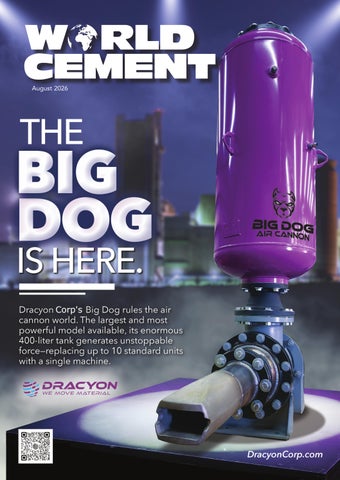
ON THE COVER Dracyon introduces the Big Dog, the industry’s largest and most powerful air cannon. Discover how its 400 l design delivers exceptional material flow performance, replaces multiple conventional units with a single installation, and helps cement producers reduce maintenance, improve reliability, and maximise operational efficiency.
August 2026
The industrial world has changed. So have we.
Carbon Re is now Gigaton. Because a name should be as big as the problem it's solving. Our AI Self-Learning Control system sits at the heart of cement plant operations. Adaptive. Explainable. Built for cement.
COMMENT
Managing Editor: James Little james.little@palladianpublications.com
Senior Editor: David Bizley
david.bizley@palladianpublications.com
Assistant Editor: Alfie Lloyd-Perks alfie.lloyd-perks@palladianpublications.com
Production: Iona MacLeod
iona.macleod@palladianpublications.com
Sales Director: Rod Hardy
rod.hardy@palladianpublications.com
Sales Manager: Ian Lewis
ian.lewis@palladianpublications.com
Sales Executive: Sebastian d’Entrecasteaux seb.dentre@palladianpublications.com
Head of Events: Louise Cameron louise.cameron@palladianpublications.com
Event Coordinator: Chloe Lelliott chloe.lelliott@palladianpublications.com
Digital Events Coordinator: Merili Jurivete merili.jurivete@palladianpublications.com
Digital Content Coordinator: Kristian Ilasko kristian.ilasko@palladianpublications.com
Video & Motion Graphics: Amélie Meury-Cashman amelie.meury-cashman@palladianpublications.com
Digital Administrator: Nicole Harman-Smith nicole.harman-smith@palladianpublications.com
Administration Manager: Laura White laura.white@palladianpublications.com
Reprints
reprints@worldcement.com
CBP019982
SUBSCRIPTIONS
Annual subscription (published monthly): £160 UK includingpostage/£175 (€245) overseas (postage airmail)/US$280 USA/Canada (postage airmail). Two year subscription (published monthly): £256 UK including postage/£280 (€392) overseas (postage airmail)/US$448 USA/Canada (postage airmail). Claims for non receipt of issues must be made within 4 months of publication of the issue or they will not be honoured without charge. Applicable only to USA and Canada: WORLD CEMENT (ISSN No: 0263-6050, USPS No: 020-996) is published monthly by Palladian Publications, GBR and is distributed in the USA by Asendia USA, 17B S Middlesex Ave, Monroe NJ 08831. Periodicals postage paid at Philadelphia, PA and additional mailing offices. POSTMASTER: send address changes to World Cement, 701C Ashland Ave, Folcroft PA 19032 Copyright © Palladian Publications Ltd 2026. All rights reserved. No part of this publication may be reproduced, stored in a retrieval system, or transmitted in any form or by any means, electronic, mechanical, photocopying, recording or otherwise, without the prior permission of the copyright owner. All views expressed in this journal are those of the respective contributors and are not necessarily the opinions of the publisher, neither do the publishers endorse any of the claims made in the articles or the advertisements. Uncaptioned images courtesy of Adobe Stock. Printed in the UK. Palladian Publications Ltd 15 South Street, Farnham, Surrey GU9 7QU, UK Tel +44 (0)1252 718999 Email: mail@worldcement.com Website: www.worldcement.com
August 2026 World Cement
W
DAVID BIZLEY, SENIOR EDITOR
ith a regularity approaching that of Swiss train timetable, the UK has once again changed Prime Ministers, making the latest incumbent the seventh in the post in just 10 years. For those readers based outside of the UK you might be wondering: “What on earth is going on over there?” Well, unfortunately, we don’t really know either. Once a democracy reaches the stage where a leader’s time in office can be reasonably measured against the shelf-life of salad ingredients, government turmoil can begin to feel like little more than background noise. Anyway, this week’s holder of the highest office in the land is Andy Burnham, former Mayor of Greater Manchester and a Member of Parliament (MP) before that, who was recently catapulted into the top seat of a nuclear power, permanent UN Security Council Member, and the world’s fifth largest economy after getting the support of roughly 0.05% of the electorate. No, that’s not a typo. Now, I know what you’re thinking; this all sounds terribly like sour grapes on my behalf; that I’ve exaggerated things; that what I’ve outlined above sounds rather more like North Korea than Northern Europe and can’t be true. Now, admittedly, the full story is a tad more complicated: Burnham recently won a local by-election for the constituency of Makerfield with 54.8% of the vote (24 927 votes as compared to the full UK electorate of ~48 million) after the previous MP for the region resigned specifically to allow Burnham to stand in his place, thus giving him the chance to become an MP and contest the leadership of the ruling Labour party. After it became clear to Keir Starmer (last week’s PM) that he had no support from his own party, he resigned. Ultimately, as nobody else from within the Labour party launched a leadership bid, Andy Burnham walked into the job unopposed. And that, dear readers, is the state of the UK political system today: working as designed, if not as intended. We need not get into the fact that another controversial (to put it very mildly) political figure is currently fighting an election campaign against a man dressed as a bin. Not only would you not believe me, but I haven’t allocated any money for libel suits in this month’s costs. The trouble with all these political manoeuvrings is that each change of leader brings a new round of uncertainty, which raises concerns for industries (like cement) that have long-term investments and major commitments dependent on ongoing government support. And as we’ve seen in recent years, a change in PM (even if the ruling party stays the same) can lead to a significant change in the direction of government and very real consequences for all concerned. For further reading on this point, I suggest you check out the Wikipedia page entitled ‘Premiership of Liz Truss’ – it won’t take you too long. It’s far too early to judge our current Prime Minister, but in his first speech on the job, Andy Burnham promised to re-industrialise Britain “using public procurement to back British industry.” That certainly sounds promising for the UK’s cement industry as it struggles to raise production levels over those of the 1950s, pressured by painfully high energy prices, and undercut by cheap foreign imports. Time will tell. 3
BUILT FOR TOMORROW. PROVEN TODAY.
LOESCHE is your long-term partner for future-ready cement production.
www.loesche.com
NEWS
Cemex receive €200 million to promote carbon capture project in Alcanar
Cemex España Operaciones, S.L.U. has been a beneficiary of an aid of €200 million within the framework of the PERTE of Industrial Decarbonisation (Line 1), intended for the development of SOMZERO, the carbon capture project that the company promotes in its factory in Alcanar (Terres de l´Ebre, Tarragona). The project contemplates an initial investment of more than €450 million and will accelerate the decarbonisation of the Alcanar plant to be one of the first cement factories in southern Europe to achieve carbon neutrality and produce cement without CO2 emissions. The granting of this aid represents an important institutional support for a strategic initiative for the transformation of the cement industry and for the progress of Spain and Catalonia in meeting their climate neutrality objectives. Given the scope and technological ambition of SOMZERO, the project will need to continue to have institutional support, additional financing mechanisms, and an adequate regulatory framework to ensure its development and entry into operation within the period provided for in the call. Thanks to the implementation of advanced carbon capture technologies and innovative solutions for the transport and permanent storage of CO2, SOMZERO has an initial objective of capturing more than 500 000 tpy of CO2, thus addressing the emissions inherent in the cement manufacturing process that cannot be reduced by other initiatives and technologies. “This grant of European public funds represents a milestone for Cemex and a recognition of the role that industry can play in the transition to a low-carbon economy. SOMZERO shows that it is possible to combine sustainability, innovation, and industrial competitiveness,” said Fernando Enríquez, Vice President of Operations of Cemex EMEA. “The decarbonisation of essential industrial sectors requires a long-term vision, a facilitating regulatory framework, public-private collaboration, and adequate technological proposals to address ambitious objectives. This project places Spain and Catalonia in a European leading position in the development of carbon capture and storage solutions applied to industry. August 2026 World Cement
SOMZERO will be developed at the Alcanar factory, a key facility for Cemex’s activity in Spain and already an engine for the economic and social development of Terres de l’Ebre. The project will contribute to strengthening competitiveness, promoting new value chains linked to the decarbonised economy, and generating specialised employment. SOMZERO is part of Futuro en Acción, Cemex’s global sustainability strategy, and reinforces the public-private collaboration and the integrative vocation necessary to move towards a more competitive, resilient, and climate-neutral economy. This project has received funding within the framework of the Strategic Project for Economic Recovery and Transformation (PERTE) of Industrial Decarbonisation, promoted by the Ministry of Industry and Tourism and financed by the European Union through the NextGenerationEU mechanism. The aid is channelled through SEPIDES, E.P.E.
Catch4Climate Pure Oxyfuel plant officially inaugurated The CI4C (Cement Innovation for Climate) Pure Oxyfuel plant in Mergelstetten (state of Baden-Württemberg) has been officially inaugurated, marking a major milestone in the decarbonisation of cement production. The pioneering facility was realised under the lead of thyssenkrupp Polysius, together with thyssenkrupp Calvion, in close collaboration with the CI4C consortium (Buzzi SpA – Dyckerhoff GmbH, Heidelberg Materials AG, SCHWENK Zement GmbH & Co. KG, and Vicat S.A) and additional project partners. As part of the ‘catch4climate’ initiative, the plant represents a semi-industrial-scale demonstration facility for carbon capture technologies in cement production. With an investment of more than €120 million and a dedicated kiln line with a capacity of around 450 tpd of clinker, the installation provides an important platform for research, validation, and further development. At the core of the plant is the Pure Oxyfuel process from thyssenkrupp Calvion. “For the first time, Pure Oxyfuel is being demonstrated at industrial scale in a cement plant. This achievement reflects the dedication, expertise and pioneering spirit of everyone involved in the project. At thyssenkrupp Polysius, we are proud to 5
DIARY
NEWS
FICEM Technical Congress 31 August – 04 September, 2026 Mexico City, Mexico https://ficem.org/eventos-ficem
POWTECH TECHNOPHARM 2026 29 Sept. – 01 Oct., 2026 Nuremberg, Germany www.powtech-technopharm.com
Carbon Capture Technology World Expo 20 – 22 October, 2026 Hamburg, Germany www.carboncapture-expo.com
29 October, 2026 Virtual Conference More details to come.
AUCBM AICCE29 23 – 25 November, 2026 Cairo, Egypt www.aucbm.net
TÜRKÇİMENTO 01 – 05 December, 2026 Antalya, Turkey https://teknikseminer.com.tr
6
have translated a bold vision into operational reality and to contribute a technology that can help transform one of the world’s most challenging industries to decarbonise,” said Christian Myland, CEO of thyssenkrupp Polysius. By replacing ambient air with pure oxygen in the clinker burning process, the technology significantly increases the CO2 concentration in the exhaust gas, creating the conditions for capturing nearly 95% of CO2 emissions from cement production – including unavoidable process emissions from limestone calcination. thyssenkrupp Polysius led the overall engineering, plant design, and execution of the facility, successfully translating an innovative concept into industrial-scale reality. The Pure Oxyfuel technology developed and implemented within the CI4C project will be further advanced within thyssenkrupp Calvion, ensuring continuity and focused development beyond this milestone. With the transfer of the technology into thyssenkrupp Calvion’s portfolio, the focus is now on advancing, scaling, and commercialising Pure Oxyfuel solutions. Calvion will further develop the process to support carbon capture deployment across cement and other hard-to-abate industries. “This inauguration is much more than the opening of a pilot plant. It demonstrates that Pure Oxyfuel has reached industrial reality. The global cement industry has been eagerly awaiting this milestone, and we are proud that thyssenkrupp Calvion will now take the technology to the next stage – further developing, scaling, and commercialising Pure Oxyfuel for customers around the world,” said Lukas Schoeneck, CEO of thyssenkrupp Calvion. Cement production is responsible for 8% of global CO2 emissions and represents roughly one-quarter to just under one-third of direct industrial CO2 emissions, particularly due to process-related emissions that cannot be avoided by conventional measures. Technologies like Pure Oxyfuel are therefore essential to achieving deep decarbonisation in the sector. The inauguration of the CI4C plant underlines thyssenkrupp’s commitment to driving sustainable innovation and represents an important step toward climate-neutral cement production at scale.
WCA President outlines vision for the future of the global cement industry at annual General Assembly The World Cement Association (WCA) concluded its 9th General Assembly (GA), held virtually on 21 July. The GA brought together representatives from WCA Member organisations to review the Association’s achievements over the past year, approve key resolutions, and discuss priorities for the year ahead. The GA opened with welcome remarks from WCA President Wei Rushan, who highlighted the WCA’s 10th anniversary and paid tribute to the Association’s founding vision of creating the world’s first international organisation dedicated exclusively to the cement industry. Looking ahead, Mr Wei described the WCA’s first decade as an important milestone and encouraged members to continue World Cement August 2026
NEWS
working together to address the opportunities and challenges facing the sector. “A decade is a milestone, not an ending point. As one of the oldest building materials in human civilisation, cement is still evolving and innovating today. I look forward to continuing our journey together. Let the WCA not only witness the history of our industry, but also create a better future,” expressed Wei Rushan. Members also reviewed the Association’s activities over the past year and approved the resolutions presented during the General Assembly. The WCA announced the re-election of Board Directors: Mr Mohamed Naciri (General Manager of CIMAT), Mr Teng Yongjun (Chairman of Shandong Shanshui Cement Group), Mr Peter Hsu (Vice President Board Member of Asia Cement Corporation), and Mr Hoggui Mohammed Laid (CEO of Spa Biskria Cement). In addition, the WCA is pleased to welcome Mr Rizki Kresno Edhie Hambali (President Director of PT. Solusi Bangun Indonesia Tbk) as a newly appointed Director. The appointments were agreed in a unanimous vote at the General Assembly. The event followed with two insightful presentations from leading industry experts. Mr Jim O’Brien from CSR Consulting presented on ‘Tracking Industry Sustainability Indicators to 2030 and Beyond.’ Drawing on decades of industry experience, Mr O’Brien explored how benchmarking and consistent sustainability indicators can help measure progress, identify best practice, and accelerate the industry’s transition towards a more sustainable future. Commenting on the importance of benchmarking, Mr O’Brien said: “From a lifetime in the industry, I’ve seen first-hand the value of how benchmarking performance drives continuous improvement. When companies can measure themselves against best practice, they gain both the insight and impulse to do better.” Mr Xuwei Jiao from CBMI Construction Co., Ltd. shared a technical presentation on ‘Scaling Up LC3: CBMI Project Delivery Experience and Lab-to-Pilot Capabilities.’ The presentation examined the practical challenges of scaling LC3 technologies from laboratory development to commercial implementation, drawing on CBMI’s engineering expertise and project delivery experience. 8
Sinoma EC’s 13 MW ORC WHPG project fully completed, set for full commercial operation The landmark 13 MW ORC waste heat power generation project of Sinoma EC for Riyadh Cement Company (RCC) in Saudi Arabia has been fully completed and successfully put into grid-connected power generation, marking a milestone achievement in project construction. As the first ORC low-temperature waste heat power project in Saudi Arabia’s cement industry and a large-scale benchmark waste heat power station in the global cement sector, the project supports two 5000 tpd clinker production lines. It adopts advanced organic rankine cycle (ORC) technology to efficiently recover medium and low-temperature waste heat from cement kilns and maximise the utilisation of industrial waste energy. Since power generation commenced this February, the unit has maintained stable operation with consistent parameters and favourable working conditions, fully meeting design criteria and verifying equipment reliability and system compatibility. The project has steadily supplied clean electricity and generated sound commercial revenues for the client, substantially cutting the plant’s external power purchase costs. It delivers dual benefits of energy conservation, carbon reduction and cost optimisation, aligning closely with the green and low-carbon transformation goals of Saudi Vision 2030. During construction, the project team overcame challenges including extreme summer heat, stringent local codes, and complicated overseas coordination, and completed all construction work to high standards under rigorous safety and quality control. Currently, the project boasts excellent operational indicators and meets all acceptance requirements. It is about to embark on official performance tests prior to full regular commercial operation. Serving as a demonstration project for low-temperature waste heat utilisation in the Middle Eastern cement industry, it demonstrates Sinoma EC’s core technological strengths and overseas execution capacity, consolidating its leading position in international industrial energy conservation and laying a solid foundation for further expansion in the Middle East’s new energy and low-carbon market. World Cement August 2026
Martin Engineering provides comprehensive live and on-demand training on topics such as belt conveyor operation, equipment maintenance, safety protocols, material flow issues, and much more. Our online video sessions and webinars plus e-books, articles, and blogs deliver a variety of expert instruction options to help protect workers, prevent equipment failure, and maximize operational efficiency. Visit foundations.martin-eng.com/knowledge to learn more.
10
Votorantim Cimentos: Building A Sustainable Future
Álvaro Lorenz, Votorantim Cimentos, sat down with World Cement to discuss the company’s 90 year journey and its transformation into a global force shaping the future of sustainable construction. he history of an organisation is, more than anything, a reflection of its ability to evolve with the world around it. On January 18, 1936, in the town of Votorantim, in the interior of the state of São Paulo, Brazil, the kiln of the Santa Helena Cement Plant produced Votoran Cement for the first time. At that time, almost all the cement used in Brazil was imported, and the country depended on external solutions to build its basic infrastructure. Votorantim Cimentos was born from this entrepreneurial purpose: the belief that it was possible to do things differently and that national growth could – and should – be driven by innovative and creative solutions. In 2026, Votorantim Cimentos, celebrating its 90th anniversary, is not only a witness to the development of generations, but is a global player
11
operating in nine countries in Latin America (Argentina, Bolivia, Brazil, and Uruguay), North America (Canada and the US), Europe (Luxembourg and Spain), and Asia (Türkiye). Votorantim Cimentos went from being a local business to becoming a Brazil-based multinational company with over 13 000 employees and an installed capacity of 54 million tpy of cement. And the question that drives Votorantim Cimentos today is no longer 'how to build?' but 'how to build sustainably?' The challenge of decarbonisation is key to Votorantim Cimentos’ strategy for the coming decades. Reflecting on this nine-decade trajectory requires recognising that resilience and strategic agility have
Cajuina wind complex – credit Votorantim Cimentos.
CN Tower in Canada – credit Michal Stipek.
Maracanã Stadium – credit Erica Ramalho. 12
been fundamental to crossing borders. What began as a response to the need for infrastructure in Brazil has expanded to iconic projects around the globe: from the Maracanã stadium and the Itaipu dam, major construction projects in Brazil, to the imposing CN Tower in Canada, to the modern high-speed rail lines in Spain and Türkiye. This expansion has not only been geographic, but also portfolio wide. Today, Votorantim Cimentos is a building materials and sustainable solutions company operating in the segments of cement, concrete, aggregates, mortars, agricultural solutions, logistics, and waste management.
Sustainability as a competitive advantage
For a multinational company like Votorantim Cimentos, sustainability is not just a concept – it is at the heart of its decisions. In 2025, the company achieved record financial results, with global net revenue of R$29.4 billion and net profit of R$3.2 billion. These figures are even more significant when analysed in conjunction with its environmental performance. Votorantim Cimentos ended last year with net emissions of 552 kg of CO2 per t of cementitious materials, representing a cumulative reduction of 27.7% compared to 1990, the baseline year for measurements. The world produces approximately 4.2 billion tpy of cement and about 14 billion m3 of concrete annually. Cement and concrete are essential inputs for the growth and development of society in areas such as housing, education (schools and universities), basic sanitation (water and sewage treatment plants), and entertainment (parks, stadiums, theatres, arenas, and shopping centres), among others. Furthermore, cement and concrete have technical characteristics that differentiate them and give them an advantage over other materials, including resistance to fire and weather events, thermal mass, resilience, and durability. Like other large-scale industrial activities, the cement industry also produces CO2 emissions, primarily due to the nature of its production process, in which limestone (the basic raw material of cement), along with other components, is subjected to high temperatures inside the kiln to form calcium oxide (calcination), which will then combine with other materials to produce the clinker. It is in this stage that the largest share of emissions occurs. At Votorantim Cimentos, the climate change agenda also means competitiveness. With the expansion of regulated carbon markets, the increasing demand for more sustainable products, and the challenges brought by climate change, the most competitive businesses will be those with the lowest intensity of greenhouse gas emissions. As a building materials and sustainable solutions World Cement August 2026
company, Votorantim Cimentos is part of the solution for the decarbonisation of the planet. The commitment is clear: to offer society carbon-neutral concrete by 2050. To achieve this goal, Votorantim Cimentos’ decarbonisation strategy is based on four main pillars: co-processing, use of alternative materials, energy efficiency, and disruptive technologies. Co-processing is a tangible example of a circular economy. In 2025, Votorantim Cimentos achieved a global thermal substitution rate of 32.3%. In Spain, at the Toral de los Vados Plant, Votorantim Cimentos reached a historic milestone: an alternative fuel use of 80% for an entire month – the highest co-processing rate achieved by the company – after investing in new cement kiln precalciners. In Brazil, progress in the vertical integration of Verdera, Votorantim Cimentos’ waste management business unit, included the inauguration of a site dedicated to processing used tyres in Cuiabá (in the state of Mato Grosso, Brazil), transforming waste that would take centuries to decompose into energy for kilns. This is a win-win-win solution: it reduces the use of fossil fuels, decreases the impact on landfills, and increases operational competitiveness.
Innovation and energy efficiency: the path to 2030 Votorantim Cimentos’ 2030 Sustainability Commitments include stringent global targets, such
as achieving 475 kg of CO2 per t of cementitious materials and increasing thermal substitution to 53%. To achieve these goals, energy efficiency and the use of renewable sources are also crucial. In Brazil, Votorantim Cimentos started operations, ahead of schedule, at the Paracatu Solar Farm (in the state of Minas Gerais), which has more than 770 000 solar panels across 700 hectares. At the beginning of 2026, Votorantim Cimentos signed a contract with Auren Energia for the acquisition of wind energy from the Cajuína I complex, which will help power sites in the Brazilian Northeast and Southeast. With this agreement, more than 90% of all electricity consumed by Votorantim Cimentos in Brazil will come from renewable sources. Technical innovation also plays a vital role in reducing environmental impact. Lowering ‘clinker factor’ (referring to the main cement component that generates the most emissions during calcination) is a priority. In 2025, Votorantim Cimentos’ average clinker factor was 72.5%, and its goal is to reach 68% by 2030. A successful example is Turkey, where Votorantim Cimentos has reduced this factor by nine percentage points in the last five years through substitution of clinker for supplementary cementitious materials. In Spain, Votorantim Cimentos’ Blenture cement line already accounts for more than 50% of its revenue in the country, offering solutions with a carbon footprint 30% lower than the market standard.
GET OPEN GEAR OIL SAVES CEMENT PLANT NEARLY $100K/YEAR Converting to LE’s Pyroshield® Syn XHvy Open Gear Lubricant (9011) for its ball mill and kiln open gears helped a cement plant lower operating temperatures and vibrations, extend service life, reduce energy use, and save nearly $100,000 annually on lubricant cost alone.
SCAN FOR FULL STORY
CONTACT US TO GET RESULTS LIKE THESE
www.LElubricants.com | 800-537-7683 | info@LE-inc.com | USA
Furthermore, Votorantim Cimentos is at the forefront of concrete paving technology. Concrete roads are 13% more eco-efficient than asphalt roads, in addition to being more durable and safer. In 2025, Votorantim Cimentos pioneered the use of a special cement for highways in Brazil, reducing the maintenance time of concrete slabs from five days to just five hours, using sensors for real-time monitoring. This type of solution demonstrates how engineering can be a direct driver of sustainability and productivity for national infrastructure.
Santa Helena Cement Plant – credit Memória Votorantim Collection.
Social legacy and governance as foundations
Votorantim Cimentos believes that being a Brazil-based multinational company in the 21st Century requires a deep commitment to human capital and diversity. A company is only sustainable if its surroundings are too. Votorantim Cimentos is proud to have surpassed, ahead of schedule, its global target of having 25% of leadership positions occupied by women, reaching 26% in 2025. More than just statistics, diversity of ideas and experiences is what fosters the innovation needed to face climate challenges. In 2025, Votorantim Cimentos’ external social investment totalled R$19.5 million, focusing on local development, education, and health in the communities it operates in. Programmes such as Valor VC, which empowered more than 300 people to generate income in Brazil, and housing improvement initiatives in partnership with Habitat for Humanity connect the purpose of Votorantim Cimentos’ business to real social transformation. The decarbonisation journey also demands rigorous transparency and governance. Votorantim Cimentos maintained its investment grade rating from the three main global credit risk rating agencies (Moody’s, S&P, and Fitch), reflecting its solid financial discipline and strategic liability management. Furthermore, the company's active participation in COP30, held in Brazil, reaffirmed its leading role in the global discussions about nature-based solutions and the development of roadmaps for climate neutrality in the sector.
A vision for the future: the next 90 years
Tyre shredding unit in Cuiabá Verdera – credit Votorantim Cimentos.
Votorantim Cimentos Santa Helena Plant – credit Votorantim Cimentos. 14
Looking to the future, Votorantim Cimentos recognises that the road ahead is long and will require technological developments and continuous investment. Votorantim Cimentos’ 2024 – 2028 R$5 billion investment plan currently underway in Brazil is proof that it continues to believe in the potential for growth, combined with structural competitiveness and the decarbonisation agenda. Votorantim Cimentos reaches its 90th anniversary with the energy of someone beginning a new chapter in its history. It went from being a small plant in the interior of Brazil to helping realise dreams on four continents. Votorantim Cimentos' commitment for the coming decades is to ensure that every t of cement produced by the company carries not only the strength and quality that have brought the company this far, but also the promise of a more sustainable and resilient world for future generations. After all, Votorantim Cimentos has been building the future for 90 years. World Cement August 2026
Janie Whisenhunt & Connor Shelton, Dracyon Corp, discuss how engineering innovation is improving worker safety, maintenance accessibility, and material flow reliability. aterial buildup has challenged the cement industry since the first preheater towers and storage silos were constructed. Today, compressed-air cannon systems remain one of the safest and most effective technologies for preventing buildup when properly engineered, installed, and maintained. Modern systems, such as the Dracyon Big Dog® Fill-and-Fire air cannon system, demonstrate how engineering advances can improve cleaning performance while reducing worker exposure, simplifying maintenance, and increasing process reliability. As cement plants have become larger, hotter, and more complex, the role of the air cannon has evolved. Today's systems must
15
do more than simply dislodge material. They must improve maintenance accessibility, reduce downtime, support safer work practices, and deliver consistent cleaning performance Table 1. Air cannon safety design considerations and associated hazards. Safety design considerations
Potential hazards if not addressed
Proper pressure relief valves
Vessel rupture
Pressure gauges
Failed fittings or connections
Periodic inspection
Over-pressurisation
Corrosion monitoring
Improper modifications or undetected deterioration
Moisture removal
Corrosion, freezing, or reduced firing performance
Manifold-level isolation or isolation valves
Unsafe maintenance and uncontrolled release of stored energy
Figure 1. Badly placed air cannons. 16
throughout their service life. Safety is no longer something applied after installation – it must be engineered into the system from the start.
Engineering safety across the service life
The most important safety question is not how an air cannon performs on its first day of operation, but how safely it can be inspected, isolated, maintained, and rebuilt throughout its service life. Equipment placement, maintenance accessibility, stored energy, firing controls, and inspection requirements all influence worker exposure to heat, confined spaces, elevated work areas, and other hazards common to cement plants. Ultimately, the safest air cannon system is not the one with the smallest pressure vessel or the greatest firing force. It is the one that delivers reliable cleaning while exposing the fewest people to the fewest hazards. That philosophy defines modern air cannon engineering. A conventional 70 l air cannon typically remains pressurised between firing cycles, meaning stored compressed air energy is continuously present. This requires proper pressure-vessel protection, leak management, and lockout/tagout procedures before maintenance in accordance with Occupational Safety and Health Administration requirements under 29 CFR 1910.147. The Dracyon 400 l Big Dog Fill-and-Fire System operates differently. The system is pressurised only immediately before firing rather than remaining continuously charged. This significantly reduces the duration of stored energy while minimising the continuous air leakage associated with permanently pressurised receivers. A properly engineered Dracyon Fill-and-Fire installation can also reduce the total number of cannons required, decrease maintenance points, enable remote mounting, and reduce worker exposure to hot, elevated, or difficult-to-access process equipment. Ultimately, the safest air cannon system minimises stored energy, prevents buildup before manual intervention is required, and allows maintenance to be performed from accessible locations using proper isolation and lockout procedures. The result is improved worker safety, greater maintenance accessibility, and enhanced equipment reliability. The installations shown in Figure 1 illustrate why accessibility is a safety issue, World Cement August 2026
not just a maintenance inconvenience. Common challenges include: f Working at height. Cannons mounted high on preheater towers often require ladders, scaffolding, or man lifts for routine inspection or repair. f Heat exposure. Technicians may have to work near hot ducts, cyclones, or kiln components operating between 600˚F and 1000˚F, increasing the risk of burns and heat stress. f Confined access. Structural steel, piping, and platforms can make it difficult to safely reach valves, hoses, and fittings. f Poor lockout access. If isolation valves are located at the cannon, manifold, or plant air supply, proper lockout/tagout procedures become more difficult and time-consuming. f Emergency repairs. Inaccessible installations can encourage temporary ‘quick fixes’ rather than proper maintenance, increasing the likelihood that leaking or malfunctioning cannons remain in service. f Extended outages. Simply reaching the cannon can consume more time than the repair itself, increasing outage duration and labour costs. One of the greatest safety improvements available today is the use of remote-mounted air cannon systems. This includes the Dracyon 400 l Big Dog Air Cannon System, which is designed to address the larger, hotter cement plants with the most demanding buildup challenges while allowing maintenance to be performed from safer, more accessible locations. Benefits include: f Reduced worker exposure near hot vessels. f Easier inspection. f Maintenance from accessible platforms. f Reduced confined-space exposure. f Reduced fall hazards. August 2026 World Cement
f Reduced need for cranes and scaffolding.
Safety extends beyond air cannons
The best way to ensure safety with air cannons is to consider the entire material flow system. While proper lockout/tagout procedures are essential, well-designed access doors are equally important. Poorly designed doors allow false air to disrupt the process, promote buildup, and extend outages, increasing manual cleaning, heat and dust exposure, work at elevation, and confined-space entries. In contrast, tightly sealing access doors improve process stability while reducing hazardous maintenance activities such as HPWW and Cardox.
Figure 2. Remote-mounted Dracyon Big Dog multiport air cannon system, demonstrating how a single Fill-and-Fire receiver can distribute cleaning energy to multiple nozzles while relocating maintenance to a more accessible location. Table 2. What should be inspected? Safety
Performance
Process
Pressure vessels
Air leaks
Buildup patterns
Pressure relief valves
Valve operation
Cannon placement
Isolation/manifold valves
Fill pressure
Nozzle selection
Gauges
Firing frequency
Firing sequence
Lockout/tagout capability
Nozzle wear
Requiring HPWW
Structural supports
Nozzle alignment
False air
Flexible hoses history
Tank drainage/moisture
Maintenance history
Piping & connections
Solenoids and controls
Process conditions 17
All Dracyon Big Dog air cannon systems incorporate a water separator. Humidity itself is not the problem – condensed liquid is. Water reduces usable air volume, promotes corrosion, and can prevent the cannon from delivering a consistent, high-energy discharge. Preventing ‘ghost firing’ – when a cannon fires without delivering sufficient cleaning energy – helps reduce buildup, unexpected blockages, manual cleaning, and emergency outages. Effective cannon sequencing reduces unnecessary firing, compressed-air consumption, equipment wear, and operator intervention. The goal is not to fire more often, but to fire more effectively. When sequencing is poor, leaking cannons often remain in service after their cleaning effectiveness has declined. Operators hear the cannon fire and assume cleaning is occurring, but the buildup receives far less energy than intended. Air leaks further reduce firing pressure and cleaning effectiveness while increasing compressed-air demand. Plants often compensate by increasing firing frequency, accelerating equipment wear without addressing the underlying problem. The true cost of ghost firing is not the compressed air – it is the gradual loss of cleaning performance that leads to larger deposits, increased maintenance, process instability, and ultimately, production losses. Ghost firing creates a double penalty: the plant pays for compressed air while receiving little useful cleaning and increasing maintenance-related safety risks.
Inspection programme
Unlike pressure vessels, there is currently no industry standard specifying inspection intervals for air cannon systems. As a result, many plants inspect cannons only after a failure occurs or a buildup problem develops. While common, this reactive approach is far from ideal for long-term reliability. When maintenance resources allow, many facilities perform basic walk-by inspections to identify obvious issues such as loose piping, damaged hoses, or audible air leaks. These inspections can detect problems before they lead to equipment failure but provide only a limited assessment of overall system performance. Facilities that burn alternative fuels or routinely experience severe buildup can benefit from a more proactive inspection programme, including comprehensive system evaluations every six months. However, limited maintenance resources and competing priorities often make it difficult to thoroughly inspect even the most critical components. 18
Ironically, the nozzle – the component responsible for converting stored compressed air into effective cleaning energy – is often the most overlooked. Despite its critical role in cleaning performance, it is frequently the least inspected component in the entire air cannon system.
What should be inspected?
Most maintenance personnel can determine whether a cannon fires. A qualified inspector determines whether it is actually cleaning. That distinction is critical. An air cannon inspection should do more than verify operation – it should confirm the system delivers the energy needed to safely and effectively remove the intended buildup. A qualified inspection evaluates the complete system, including pressure vessels, valves, nozzles, controls, air leaks, firing sequence, installation geometry, maintenance accessibility, and cleaning performance. The result is a safer, more reliable system that reduces compressed-air waste, minimises manual cleaning, extends equipment life, and improves process reliability. In many cases, the ROI is realised long before equipment replacement is required. Safety is not achieved by adding more procedures – it begins with better engineering. Properly designed air cannon systems reduce worker exposure, improve maintenance accessibility, minimise stored energy, and deliver reliable cleaning performance throughout the life of the installation. When safety and performance are engineered together, everybody wins.
Air cannon safety principles
Dracyon has established a number of core safety principles: f Design for safe access, not just installation. f Minimise stored energy whenever practical. f Protect every pressure vessel. f Isolate, lock out, and verify before maintenance. f Eliminate unnecessary worker exposure. f Inspect performance, not just operation. f Prevent buildup rather than remove it manually.
References
1. Occupational Safety and Health Administration (OSHA). *29 CFR Part 1910, Subpart D – WalkingWorking Surfaces*. 2. Occupational Safety and Health Administration (OSHA). *29 CFR §1910.146 – Permit-Required Confined Spaces*. 3. National Institute for Occupational Safety and Health (NIOSH). World Cement August 2026
Travis Miller, Martin Engineering, outlines how automated air cannon technology and predictive monitoring can reduce clogging risks and prevent unsafe hopper and silo unclogging practices. lockages in hoppers or silos lead to costly unscheduled downtime, compromise safety, and increase operating costs. Material can naturally accumulate in several ways. The prime cause of clogging is moisture, but material size, metal grain, static/magnetic attraction, loading patterns, spout configuration, and long-term settling also contribute. No matter how well the vessel flows initially, bulk material will scratch and wear the inner walls over time, leading to buildup, requiring a flow solution (Figure 1 & 2). Buildup reduces the vessel’s capacity, while the material's flow volume generally remains unchanged, resulting in clogging and
19
unscheduled downtime. Pressure to quickly resume production can lead to unsafe practices such as confined-space entry, workers striking the outside of the wall with tools, or jabbing at the clog from below. All of these methods potentially
end in equipment damage, injury, or fatalities. However, automated methods for material flow management, such as air cannons, are well-tested preventive measures that mitigate safety issues associated with clogs at production chokepoints.
When gravity is the point and the problem
Gravity is the primary force driving flow through a hopper or silo. Gravity does not prevent all material from collecting on vertical surfaces, nor does it effectively dislodge material. As Perry’s Chemical Engineers’ Handbook points out, “To flow, the bulk solid is compressed laterally and expands vertically. As a result, the major principal stresses act horizontally at the centreline. This state of stress is called the passive state. A peak stress, called the switch, occurs at the hopper-cylinder interface.”2 To simplify, dry bulk material wants to spread out horizontally. As the material falls vertically through the hopper or silo, the compression sends the greatest force toward the centre. The hopper's angle further compresses the stream, but it wants to spread out and move up the sides. Deviate from the original specification – elevated volume, moisture, or a different material grade – then buildup and clogging result. Figure 1. A worker with a shovel and a rope harness clears an Uzbekistan cement silo in 2026.1
Figure 2. The material properties and environmental factors that cause clogs require a flow solution. 20
Unsafe unclogging is not unusual
Bulk-handling industries such as mining, quarries, cement, and agriculture all use silos and hoppers to store and transport materials. Although the materials will vary, the consequences of clogging are the same, as are the risks of injuries and fatalities from clearing buildup and obstructions. Unfortunately, many maintenance staff still engage in risky behaviour. Pressure to meet production goals and inadequate safety training are the two main culprits behind the disregard of best practices in unclogging a hopper, bin, or silo. Some of these dangerous activities include: f Confined space entry. Safely entering a confined space requires training, certification, and constant supervision. Workers should always have the proper tools, personal protective equipment (PPE), and knowledge to avoid being buried by falling material or a sudden discharge (Figure 3). f Striking the wall. A common practice of striking the wall of the vessel with a mallet can put the worker near the system during a dangerous sudden discharge. Pounding the wall can create an uneven surface that supports further buildup (Figure 4). f Clearing from below. Clearing an obstruction from below using a long tool or a high-pressure air/water wand is dangerous. Like striking the wall, a sudden surge can World Cement August 2026
occur; in fact, that is the point. A worker positioning themselves near the spout is dangerous, but directly under it is inviting a serious workplace incident. f CO2 blast system. Some silos and hoppers include slots for CO2 blast system tubes. These are explosive devices that release CO2 at high pressures (~34 000 to ~40 000 psi) to fracture obstructions. CO2 blast system tubes are generally safe when stored and handled properly. However, if the tubes are incorrectly maintained, damaged, or mishandled, they can discharge prematurely or explode. They may damage the vessel over time and are used when a clog occurs, not as a preventative measure (Figure 4).
of the buildup. Typically, one air cannon can keep 1.5 – 2 m2 (15 – 20 ft2) of vessel wall free of material. Air cannons with an air volume of 50 l (1.75 ft3) have shown good results in silo and hopper applications. They can be installed at multiple heights around the vessel, providing a timed, sequential approach. The benefits of air cannons include safety, low long-term cost, and ease of maintenance. Well-designed air cannons have positive firing solenoids to avoid misfires. Since valves are common wear parts, choose cannon designs that place valves at the rear for easy access. Because heated, highly abrasive, or corrosive materials can erode nozzles more quickly, necessitating frequent changes, operators should consider a
A blast of efficiency with air cannons
Air cannons are pressurised tanks of varying sizes that shoot a powerful blast of air, which dislodges adhered or clogged material to support material flow. Connected to the plant’s compressed air system, a valve fires the cannons using a solenoid or manual mechanism. Air passes through a nozzle and is distributed depending on the shape and direction of the nozzle. It is recommended that the nozzle be pointed toward common collection points in the direction of the flow. The number of air cannons installed depends on the spout’s size, shape, and the nature
Figure 3. Certification for confined space entry is as much for the benefit of the plant as the safety of the staff.
Fast. Fair. Flexible. Wherever you need him: the new InterHop Highest flexibility, fast truck loading and dust free operation – the raw material receiving hopper InterHop guarantees all of this! 30 tons of material can be unloaded in less than 30 seconds. Truck loading is possible as well as direct feed via belt conveyor to raw material silo. The InterHop impresses with a flexible design. It is a tailor-made solution developed according to the client’s requirements. Contact us: The InterCem professionals will also find the right solution for your requirement.
intercem.de
Y-pipe assembly to enable faster, safer nozzle replacement (Figure 5).
Automation technology to the rescue
Figure 4. A silo spout with visible hammer marks and a CO2 blast system slot with safety flange.
Traditional air cannon inspection methods often require maintenance personnel to manually trigger the systems while visually monitoring pressure gauges. However, partial nozzle blockages and performance degradation can go unnoticed for extended periods, leading to reduced effectiveness, excessive compressed air and energy consumption, and a higher risk of production interruptions. The N2® Air Cannon Intelligence (ACI) System provides cement plant operators with continuous monitoring and detailed performance analytics via a secure web-based dashboard and mobile interface. Each air cannon in a plant is fitted with an ACI sensor that measures firing characteristics to diagnose underlying problems. This enables maintenance issues to be resolved before they cause unscheduled downtime and, crucially, allows air cannon arrays to be optimised for performance. The system operates independently of plant Wi-Fi or control networks, and installation can typically be completed without a plant shutdown.
Conclusion
Figure 5. Rear valves & Y-pipes (background) can improve safety and reduce maintenance time.
Persistent clogging can significantly increase operating costs. To avoid downtime, safety issues, and increased labour associated with hopper and silo obstructions, installing air cannons is a safe, effective, and cost-effective solution. They pay for themselves both in production returns and peace of mind.
References
1. 'A Cement Plant Employee In Namangan Died In A Bunker', Kun.uz, News of Uzbekistan. Jan, 2026 – https://www.youtube.com/watch?v=ytB41hitlBo 2. PERRY, R. H., Don W. GREEN, D. W., and SOUTHARD, M. Z., (editors), 'Bulk solids flow and hopper design', Perry’s Chemical Engineers’ Handbook. 9th ed. Section 21.20, pg. 1869. McGraw-Hill Education, 2019 – https://studylib.net/doc/27672560/ perrys-chemical-engineers-handbook-ninth-editioncompressed
About the author
Figure 6. Martin’s N2® ACI sensor measures air cannon firing characteristics. 22
Travis Miller leads Martin’s efforts to advance material flow efficiency and reliability. He began his career at the company in 2004 as a Product Development Engineer and later took on product and design engineering leadership roles, contributing to key innovations and team development. In 2022, he moved into his current global leadership position, where he continues to strengthen product performance and engineering strategy. Travis holds a Bachelor of Science in Mechanical Engineering from Bradley University. World Cement August 2026
Thomas Fahrland, Loesche GmbH, explores how the demands placed on grinding technology have changed as producer expectations continue to evolve.
uring discussions with cement producers around the world over recent years, one observation has become increasingly clear. While the fundamental objective of cement grinding has remained unaltered, the expectations placed on grinding technology have changed dramatically.
23
A decade ago, discussions were primarily centred on throughput, product fineness, specific energy consumption, wear rates, and equipment availability. These parameters remain fundamental today and always will. However, they no longer define investment decisions on their own. Today's discussions with clients increasingly focus on different questions, like: How can grinding technology support lower clinker factors? How can it process an expanding range of supplementary cementitious materials (SCMs)? How can it consistently achieve very high OPC fineness while maintaining high plant productivity? How can it influence particle size distribution to optimise cement and concrete performance? How can it contribute to reducing the overall carbon footprint of cement production? The focus of the discussion these days is not only on machine performance, but increasingly on cement performance as well. Cement producers are no longer investing simply in grinding equipment. They are investing in the capability to manufacture high-performance, low-carbon cements while maintaining productivity, flexibility, and consistent product quality.
Recognising this shift fundamentally changed the direction of Loesche's technology development. Rather than asking how a vertical roller mill (VRM) can grind more efficiently, Loesche started years ago with a different question: What do modern high-performance and low-carbon cements require from today's grinding technology? Answering that question requires much more than incremental equipment improvements. It requires a fundamentally different understanding of the grinding process itself.
Understanding the language of the mill
For more than a decade, Loesche has continuously expanded its research activities to better understand the dynamic behaviour of VRMs. This work combines operating experience from hundreds of industrial installations with university research, Digital Twin technology, AI-supported process analysis, and advanced process modelling. The objective was never to develop new machine components for their own sake. Instead, the goal was to understand how the mill behaves under changing process conditions and why. At Loesche, this is often described as understanding the language of the mill. Every VRM operates within dynamic limits. Self-excited vibrations are a natural characteristic of VRM operation and ultimately define the stable operating window of the mill. As these limits are approached, grinding pressure, throughput, or product fineness must be reduced to maintain stable operation. For decades, these dynamic limits represented one of the fundamental constraints of VRM technology. The demands on modern cement types are constantly Understanding these interactions increasing. fundamentally changed the direction of Loesche's development work. Rather than accepting vibration behaviour as an unavoidable operational limitation, Loesche set out to understand its root causes and identify engineering solutions capable of significantly expanding the stable operating window of the mill. The first visible result of this work was the new Dual Module concept, which significantly reduces self-excited vibrations and enables the mill to operate under The heart of a LOESCHE VRM – the grinding chamber. 24
World Cement August 2026
considerably more demanding conditions while maintaining stable operation. However, this was only the first outcome. The same research demonstrated that the geometry of the grinding track plays a decisive role in the dynamic behaviour of the mill. Consequently, Loesche fundamentally redesigned the grinding track geometry to further stabilise the grinding process, reduce vibration levels, and expand the mill's stable operating window under demanding operating conditions. Together, the Dual Module concept and the new grinding track geometry considerably expand the stable operating window of the VRM. Depending on production priorities, this additional operating margin can be utilised to apply higher grinding forces, increase throughput, or achieve substantially higher product fineness than previously possible. Equally important, the improved process stability further reduces the already very low demand for water injection required for grinding bed stabilisation. This helps prevent prehydration and preserve the cement's full reactivity potential. At the same time, it supports the cost-effective production of particularly fine cements that can contain a higher proportion of cement substitutes in order to reduce the clinker content. These developments are not isolated engineering improvements. They demonstrate a different engineering philosophy, one in which a deeper understanding of mill behaviour
is systematically translated into practical engineering solutions that provide cement producers with greater operational flexibility and greater control over the performance of the final cement product.
Optimising the grinding environment
Reducing vibration levels and hence expanding the operating window of the mill represented only one part of Loesche's development programme. The same research activities also revealed considerable potential to further improve the grinding process by optimising the internal process environment of the mill. Based on findings from industrial operation, pilot plant investigations, and advanced process analyses, Loesche engineers systematically re-evaluated the complete airflow concept of the VRM. Rather than optimising individual components, the objective was to improve the interaction between gas flow, material transport, drying, classification, and overall process efficiency. One important outcome was the redesign of the gas inlet arrangement. An optimised ring duct, a revised louvre ring configuration, and newly developed flow-control elements create a considerably more homogeneous airflow around the grinding track. At the same time, local gas velocities at the louvre ring outlet are significantly reduced, resulting in substantially lower pressure losses throughout the mill.
LOESCHE’s improved VRM. 26
World Cement August 2026
Further improvements to the mill housing geometry and the internal flow path towards the classifier contribute to a more uniform gas distribution and improved classifier feed conditions. Together, these developments create a significantly more stable process environment while reducing unnecessary energy losses. The practical benefits are obvious. Lower pressure losses directly reduce the power demand of the mill fan, thereby improving the overall specific energy consumption of the grinding plant. At the same time, stable operation can be achieved with lower gas volumes and higher dust loads, resulting in increased process efficiency without compromising drying performance, material transport, or product quality. The significance of these developments extends well beyond energy efficiency. More stable process conditions and improved classifier efficiency provide greater control over material fineness, particle size distribution, and contribute to consistently high cement quality across a wide range of cement types and product fineness levels. Like the developments described in the previous chapter, these innovations are not isolated design features. They represent the practical application of Loesche's engineering philosophy: understanding the complete grinding process and systematically translating that understanding into technologies that enable cement producers to manufacture better, more competitive, and sustainable cement.
Beyond grinding – understanding the bigger picture
The developments described in this article represent only one part of a much broader technology strategy. Over the past decade, it has become increasingly clear that the future of cement grinding cannot be considered independently of the developments in cement production. The requirements placed on modern grinding systems are no longer driven solely by grinding technology itself. They originate from the industry's transformation towards lower carbon emissions, higher clinker substitution, new SCMs, alternative binder systems, and increasing expectations regarding cement and concrete performance. For this reason, Loesche has deliberately expanded its research and development activities far beyond VRMs. Today, Loesche's expertise extends across the entire cement value chain, from clinker production and process optimisation to technologies for increasing thermal substitution rates (TSR), calcined clay production, concrete recycling, the utilisation of SCMs, including steel slags, and the development of future binder concepts. At the same time, dedicated material specialists continue to investigate the interaction August 2026 World Cement
between raw materials, grinding technology, cement properties, and concrete performance, providing valuable insights into how future grinding technologies must evolve. This broader perspective enables Loesche to support customers well beyond the supply of grinding equipment. Increasingly, Loesche supports customers through feasibility studies, process optimisation programmes, pilot projects, and the industrial development of new cement concepts. Loesche's objective is not simply to optimise individual process steps, but to understand how every stage of cement production influences the final product, and how grinding technology can deliver the greatest overall benefit. Loesche believes that the next generation of grinding technologies will only be developed successfully through a comprehensive understanding of the complete cement value chain. Every new requirement placed on a VRM originates somewhere else – in the kiln, in the raw materials, in evolving SCMs, in new binder systems, or, ultimately, in the performance requirements of the concrete. Only by understanding these interactions can meaningful technological progress be achieved. The technologies presented in this article do not represent the final destination of Loesche's development journey. Rather, they mark another important milestone in the continuous evolution of VRM technology. Building on this foundation, Loesche is already bringing the next generation of VRM technology into industrial operation. While it is still too early to discuss technical details, the first industrial installations are entering service. Their operating experience is expected to demonstrate that the practical limits of VRM technology can be extended even further, creating new opportunities for producing the next generation of high-performance, low-carbon cements with even greater efficiency and flexibility. The transformation of the cement industry requires more than advanced equipment. It requires partners who understand the complete production process, anticipate future technological challenges, and continuously translate research into practical engineering solutions. With expertise spanning the entire cement value chain – from clinker production and alternative fuels to grinding technology, cement performance, and concrete performance – Loesche works to support cement producers not simply as an equipment supplier, but as a long-term technology partner in meeting the changing demands of modern cement production. Ultimately, the future of grinding will not be defined by the technologies developed, but by the cement performance they enable. 27
28
Fineness Forging
in West Africa Olaf Michelswirth, InterCem, outlines how two West African cement plants are combining high-fineness grinding with sustainable, logistics-ready design. he cement industry worldwide is undergoing profound change. The highest demands on cement fineness, the consistent reduction of CO2 emissions, and an increasing focus on sustainability are shaping investment decisions across the industry. In West Africa, additional framework conditions apply: challenging logistics, fluctuating availability of raw materials, and the need for robust, highly available plants. With two recent reference projects in West Africa, InterCem is demonstrating how modern cement plants can meet these requirements from a technical, economic, and ecological perspective.
Two projects – one clear philosophy
Both plants follow a clear guiding principle: maximum product quality with a minimal ecological footprint. Modern grinding technology enables extremely high cement fineness while significantly reducing energy consumption. This sustainably lowers CO2 emissions per tonne of cement – a decisive factor for future-proof cement production.
Project 1: proven performance in continuous operation
The cement grinding plant has been successfully in operation for two years and represents a reference for reliable high-performance plants under demanding conditions. The plant is designed for a throughput of approximately 360 tph and features a modern vertical roller mill that achieves the highest cement fineness with optimised energy consumption.
29
Particular attention was already paid to raw material logistics during the design phase. Due to regional conditions, the entire plant was consistently designed with generous storage capacities. Clinker and additive storage facilities enable stable production even when
Project 1 master layout.
raw material supply fluctuates. Local conditions were not only considered – they were met with precision. The result is a highly available plant that consistently delivers high-quality cement and features a significantly reduced CO2 footprint. Scope of supply: f 2 truck unloading stations (700 tph). f 1 raw material storage with a capacity of 35 000 t. f 1 clinker dome with a capacity of 100 000 t. f 1 grinding plant with a VRM (390 tph). f 4 cement silos of 5400 t each. f 5 packing lines. f 10 truck loading stations. f Corresponding truck scales, laboratory equipment, electrical equipment, and automation as well as all related facilities. The steel construction, the entire sheet metal fabrications, the subsystems, the complete engineering, the erection supervision, and the commissioning are also included in the scope of supply and services.
Project 2: the latest project – sustainable, dust-free, and future-oriented
Project 1 plant overview.
Project 2 master layout.
Project 2 plant overview. 30
The second project is the most recent, and at the same time, the most ambitious project within a whole series of plants realised by InterCem in West Africa. The plant sets new benchmarks in sustainability and logistics. With a grinding capacity of approximately 300 tph, the plant is specifically designed for maximum efficiency. Modern grinding technology allows the production of extreme cement fineness, strengthening competitiveness in the regional market. A key distinguishing feature is the extended plant concept, which goes beyond classical cement grinding. In addition to the production facilities, the plant design provides for the future integration of harbour and unloading logistics solutions. The layout and engineering allow large quantities of raw materials to be received and processed directly once such logistics are implemented. The plant concept foresees dust-free unloading via hopper and crane systems, designed to meet EU-level environmental and occupational safety standards. When implemented, these systems will allow the safe and efficient handling of large material capacities while minimising environmental impact. Scope of supply: f Engineering, documentation, supervision, and commissioning. f 1x clinker dome for 100 000 t. f 1x raw material shed for 60 000 t. World Cement August 2026
f Bulk material handling equipment (bucket elevators, belt conveyors, air slides, etc.). f 1x grinding plant with VRM for 300 tph or 2.2 million tpy. f 4x cement silos for 5400 t each. f 2x bulk loading. f 1x packing plant with: » 4x 8-spout roto packer (Haver & Boecker). » 8x truck loading lines (Haver & Boecker). » 8x truck scales entry/exit. f Electrical equipment and automation. f Laboratory equipment.
In addition to grinding, the plant was designed to accommodate extensive harbour operations. Dust-free unloading systems with hopper and crane solutions enable the emissions-free unloading of large volumes. This improves environmental and occupational safety while simultaneously increasing handling capacity. All plants are based on EU engineering standards, from planning through implementation to commissioning. The result is durable, low-maintenance plants with high availability and low environmental impact.
Sustainability as a technical standard
Conclusion
Both projects demonstrate InterCem’s focus on CO2 reduction and sustainability. Energy-efficient grinding processes, optimised material flows, and well-designed storage concepts sustainably reduce emissions while simultaneously improving operating costs. The plants were designed and implemented according to EU engineering standards. This quality feature is reflected both in the service life of the plants and in their high availability. Sustainability is not an add-on, but an integral part of the overall design.
Sustainability, logistics, and EU engineering
The most recent project in West Africa in particular symbolises a new generation of cement plants.
The two projects in West Africa clearly demonstrate what InterCem stands for: technical excellence, sustainable concepts, and tailor-made solutions for demanding markets. The highest cement fineness, reduced CO2 emissions, and efficient logistics were successfully combined.
About the author
Olaf Michelswirth studied mechanical engineering in Paderborn and obtained a degree as a graduate engineer. After years of experience in the cement industry, he became General Manager of InterCem Engineering in 2005, applying his expertise to many projects all over the world, at the moment, particularly in Africa.
XR CLASS
Often copied, never equalled! Energy efficient Powerful Durable
Test the machine using your own materials.
THE BEST WASTE SHREDDER ON THE MARKET
Flexible finance options available
Roger Ekström, ABB, demonstrates how liquid-cooled variable speed drives are enhancing efficiency, reliability, and sustainability in cement production. he cement industry faces growing pressure to enhance operational efficiency, extend equipment lifespan, and meet environmental standards. ABB’s liquid-cooled low-voltage ACS880 variable speed drives offer a compact, robust, and energy-efficient solution for controlling electric motors – well suited to the demanding conditions found in cement plants. This article highlights the advantages of liquid-cooling in variable speed drives and the key application areas. An electric variable speed drive (VSD), also known as a variable frequency drive (VFD), controls the speed and torque of electric motors by adjusting the frequency and voltage of the power supplied. These drives reduce power consumption by matching motor speed to actual load requirements and provide precise control over motor operation, improving system performance. Soft starting and stopping reduce mechanical stress and wear on equipment.
33
Cement production environments are harsh – characterised by high temperatures, heavy dust loads, and limited space. Traditional air-cooled VSDs often struggle in these conditions, facing cooling inefficiencies, frequent maintenance, and vulnerability to airborne contaminants. ABB’s ACS880 liquid-cooled (LC) drives are designed to operate in such environments, featuring a fully enclosed, liquid-cooled architecture that promotes reliable and optimal performance and long service life.
Advantages for the cement industry Superior heat dissipation Liquid cooling systems can be up to 3500 times more efficient than air cooling in terms of heat transfer. This means the cooling liquid can absorb nearly 3500 times more heat per unit volume than air before its temperature increases by 1˚C. Up to 98% of all heat losses from the ACS880LC drive are transferred to the coolant
in the closed-loop liquid cooling system and are exported from the drive outside the electrical room, significantly lowering internal temperatures and extending component life. Only 2% of the heat losses are released to ambient air through the drive cabinet, significantly reducing the need for external air-conditioning systems. Fully enclosed design The ACS880LC drive features an enclosed cabinet with no air intakes or filters, protecting internal components from cement dust, corrosive gases, and moisture. This design enhances reliability and uptime, even in the most challenging environments. Compact footprint Compared to equivalent air-cooled drives, the ACS880LC offers a smaller footprint and lighter weight, making it easier to install in tight control rooms. It is ideal for retrofits or power upgrades, delivering more output from the same space. Lower maintenance The liquid-cooled system minimises mechanical components like fans and filters, reducing maintenance needs. Most service can be performed on the drive cabinet and its liquid-cooled power modules with cooling lines intact, minimising downtime. The front plates of the power modules can be opened, allowing many internal components to be replaced, without removing the modules from the cabinet or draining the cooling system. ABB’s liquid cooling system uses a predefined, ready-mixed coolant as the heat transfer medium, ensuring reliable operation and corrosion-free cooling.
Countering cement industry challenges ACS880LC liquid-cooled power modules in two frame sizes for power range 45 – 6000 kW.
ACS880LC fully enclosed liquid-cooled drive cabinet. 34
ABB's ACS880LC drive is designed to deliver high performance across the cement production process in applications such as: f Crushers, mills, and high pressure grinding rolls (HPGRs): ensures smooth operation with high torque precision under variable load conditions, protecting against mechanical stress. f Kilns and preheaters: provides precise control of rotation and airflow to optimise heat transfer and material flow, ensuring efficient and stable operation. f Conveyors: offers controlled acceleration and braking, increasing belt life and reducing mechanical failures. f Ventilation fans: maintains optimal airflow while saving energy by adjusting fan speed to match process requirements. World Cement August 2026
f Slurry and water pumps: adjusts flow precisely to system demand, improving efficiency and reducing wear. Wherever you find motors driving heavy-duty tasks, there is an opportunity for these drives to boost reliability and reduce energy consumption.
Reliability in demanding environments
Reliability is critical in cement plant operations, where unplanned downtime can lead to significant production losses and increased maintenance costs. ACS880LC drives are built with reliability at their core, featuring robust components and advanced thermal management. Rigorous testing, including marine-grade standards, ensures compliance with vibration, corrosion, and temperature requirements. Coated circuit boards, minimised airflow, and long maintenance intervals (up to nine years) make them a trusted choice for high-priority operations. Because the liquid-cooled cabinets are fully enclosed and require no forced airflow, internal components are shielded from dust, corrosive gases, and moisture – conditions that typically challenge air-cooled systems. The absence of air intakes and cabinet fans further reduces the risk of contamination and mechanical failure, ensuring consistent performance over extended periods.
The cost-saving edge
By drastically reducing the need for HVAC systems and frequent maintenance of air filters, liquid-cooled drives cut down on both capital and operational expenses. Additionally, captured waste heat can be repurposed for other plant uses, such as utility water pre-heating, turning a byproduct into a resource. Total cost of ownership (TCO) is a key concern for plant managers. With higher efficiency, no need for air-conditioning, longer component life, reduced space requirements, and fewer unplanned shutdowns, ABB's liquid-cooled drives are proving to be a smart investment. Another significant advantage is the integration of predictive maintenance technologies. By continuously monitoring drive performance and system health, predictive diagnostics can anticipate potential issues before they lead to costly downtime. This proactive approach reduces the likelihood of unplanned outages, lowers maintenance costs and extends the operational life of critical components – directly supporting a lower total cost of ownership. Plant managers not only gain peace of mind but also benefit from more predictable budgeting and streamlined operations. August 2026 World Cement
Versatile drive solutions for diverse industry needs
The ACS880LC offering provides tailored benefits for both EPCs and end users through complete drive cabinets manufactured by ABB, and for OEMs and panel builders through the option to use the liquid-cooled power modules to create their own complete solutions by manufacturing cabinets by themselves. ABB’s drive cabinets undergo extensive type testing to meet the stringent requirements of product standards, directives, and quality assurance systems. But ABB goes further in testing – for example, by performing additional short-circuit and arc fault tests to ensure that the cabinets remain safe and reliable under all operating conditions. Each liquid-cooled drive cabinet is engineered to order by ABB, ensuring sufficient technical support for the customer throughout the specification and design process and an optimal mechanical fit for its intended application. This is particularly beneficial in brownfield projects, where cabinets can be customised to match existing space constraints and cabling layouts. Options include L- or U-shaped cabinet designs with corners, H-shaped configurations, or back-to-back arrangements, offering flexibility for retrofit installations. The liquid-cooled power modules are designed for seamless integration into custom cabinets, enabling OEMs and panel builders to tailor solutions for specific applications. These modules can be installed in hermetically sealed enclosures, making them well suited for use in extremely harsh environments or even potentially explosive areas. In addition to the power modules, ABB offers a range of installation accessories that simplify and accelerate the panel-building process. Comprehensive technical support is available during the engineering phase, including assistance with the design of the cooling circuit.
Conclusion
In an industry where uptime is critical, ABB’s ACS880LC drives offer a future-ready solution. Its liquid-cooled design not only withstands the rigours of cement production but also delivers performance, efficiency, safety, and flexibility that air-cooled systems cannot easily match.
About the author
Roger Ekstrom is a Global Product Manager for low-voltage AC drives based in Helsinki, Finland. With 20 years of experience in industrial product development, he specialises in high-power drive solutions for heavy industries, including cement, mining, and metals. 35
36
Holcim Mexico explores how circular economy strategies and co-processing technologies are transforming waste into sustainable building materials across Latin America.
L
atin America is currently living through a quiet, compounding crisis. Every single day, the region generates an overwhelming 541 000 t of municipal solid waste, a figure projected to balloon to 670 000 t by 2050. Across the continent, more than 35 000 t of this daily refuse remain uncollected, and a staggering 90% of the region's municipal waste ultimately ends up either dumped in open-air landfills or burned. Simultaneously, the traditional linear economy model of ‘take, make, and dispose’ is exhausting the region's natural resources and worsening its carbon footprint. However, a radical industrial shift is underway. Geocycle, Holcim’s strategic circular economy arm, has moved beyond traditional boundaries by innovating in waste management. Armed with
state-of-the-art infrastructure, Geocycle is transforming waste into valuable resources that can be seamlessly reintegrated into new production processes. Operating at the intersection of the environmental crisis and the decarbonisation imperative, Geocycle has established itself as the definitive benchmark for Latin America. It demonstrates how waste streams like biomass, industrial waste, and sorted municipal solid waste can be systematically transformed into new materials to reduce dependence on non-renewable natural resources.
Inside the cement kiln
Currently, thousands of tonnes of daily waste possess no viable traditional recycling route due to a lack of sorting at the source, complex
37
Waste management platform, Tabasco.
Sustainable construction in Mexico.
Sustainable construction by GP Vivienda.
multi-material compositions, or high sorting and recovery costs. In the waste hierarchy, just after traditional recycling, ‘co-processing’ stands as the most sustainable alternative for many different waste streams. In co-processing, energy recovery and recycling of the mineral content of the waste occur simultaneously with the production of clinker. The conditions inside a modern cement kiln are extreme: f Material temperatures must reach 1450˚C to trigger the clinkerisation reaction. f Gas temperatures inside the kiln exceed 2000˚C. When pre-processed waste (a formulated waste mix created by Geocycle) enters the cement kiln, it performs a dual function: First, its energy content is used to replace carbon-intensive fossil fuels such as petroleum coke and coal. Second, its mineral fraction becomes incorporated into the clinker, contributing essential components including calcium, silica, alumina, and iron. What truly sets this process apart from an environmental standpoint is that it leaves no residues. The ash produced from the burnt waste is entirely integrated into the final product. This process can be compared to traditional incineration in several key ways. Traditional incinerators burn waste at much lower efficiencies, leaving behind piles of highly polluted ash that must still be buried in specialised landfills. Cement kilns, however, operate like an industrial digestive system, recycling 100% of the minerals. Inside the kiln, the combination of blistering heat, extended exposure, and a naturally alkaline environment acts as a built-in safety shield. It instantly neutralises harmful acidic gases and prevents the creation of toxic pollutants like dioxins, creating a thoughtfully designed closed-loop system where waste simply disappears.
Building resilient communities through circularity
Holcim recycled aggregates plant. 38
The theoretical brilliance of co-processing is matched by its operational scale. In 2025 alone, more than 550 000 t of industrial, commercial, and municipal waste were managed by Geocycle Mexico. This replaced roughly 37% of the fossil fuel consumption in Holcim’s World Cement August 2026
cement kilns, directly reducing its CO2 emissions by 1.5 million t. The technological ceiling continues to be pushed; today, two cement kilns in Mexico are operating above 60% thermal substitution rate, meaning that more than half of their total thermal energy requirements are covered entirely by alternative fuels derived from waste. The success of Geocycle is not confined solely to its environmental impact, but extends to its social footprint as well. One of the best examples is ‘Mi Comunidad Sostenible’ (‘My Sustainable Community’), a flagship initiative conceived between Nestlé, Geocycle, and the Holcim Mexico Foundation in 2020. f The blueprint. Cuautlapan, the first project under this initiative, is recognised today as Mexico's first zero-waste community, benefiting over 8000 residents. f The impact. By integrating the local community into the circular value chain, 248 t of waste were diverted from the streets in the first five years of the initiative – equivalent to the community producing zero garbage for 62 consecutive days.
From clinker reduction to circular building materials
Another important lever to lower CO2 emissions in the cement industry is reducing the clinker
factor (the amount of clinker in cement). Since clinker production requires both high-temperature processing and the calcination of limestone, lowering the ratio of clinker in the final product plays a key role in Holcim's decarbonisation roadmap. Under its global NextGen Growth 2030 strategy, Holcim is systematically reshaping the emissions profile of its products. In line with this commitment, Holcim maintains its global target of net-zero emissions by 2050 and projects a 30% reduction in its CO2 emissions by 2030 compared to a 2020 baseline.
Sustainable product lines & operational milestones Low carbon cement & concrete Holcim has introduced concrete and cement formulations (ECOPlanet and ECOPact) that reduce CO2 by at least 30% and up to 50%, respectively, compared to conventional alternatives. The company aims for these sustainable solutions to account for over 50% of its total net sales by 2030. Upcycling urban debris Mexico generates over 10.15 million tpy of construction and demolition materials (CDM), most of which are illegally dumped. Using ECOCycle® technology, Holcim captures this urban debris, processes it, and reintegrates it as recycled aggregates
FROM DOWNTIME TO RELIABILITY An exclusive Cement & Aggregates industry convention Thursday 22 October 2026 Hilton at St. George’s Park - Burton upon Trent
Rising costs, ageing assets, skills shortages and sustainability targets are reshaping our industry. Join leading experts from World Cement, Heidelberg Materials, Mainstream UK and SKF as they share practical insights, lessons learned and proven strategies to improve reliability and plant performance. Why Attend? • Learn how industry leaders are reducing downtime and increasing uptime • Discover what world-class reliability looks like in practice • Gain real-world insights from cement producers and industry experts • Network with maintenance, engineering and operations professionals One Day. Industry Leaders. Actionable Insights. If reliability is critical to your operation, this is an event you cannot afford to miss.
More info and signup: https://skf.li/o4gltuvl
into new concrete. The global goal is to recycle 20 million tpy of demolition materials by 2030. 100% electric logistics Holcim recently inaugurated Mexico’s first 100% electric concrete plant. This facility is supported by a growing fleet of over 140 low-emission electric vehicles, including mixer trucks and front loaders, ensuring that the journey from plant to construction site is completely decarbonised.
Holcim Ramos Arizpe Cement Plant.
Recygénie, 100% circular construction, France.
Libertad Dam with Holcim sustainable concrete, Nuevo León.
Vallejo Concrete Plant, Mexico City. 40
Conclusion: overcoming regulatory bottlenecks for a circular future
The technological viability of a circular, low-carbon cement industry is no longer up for debate; it is an established reality. Turning waste into progress is highly scalable, provided the proper incentives are in place. Currently, Mexico's legislative framework caps the use of recycled materials in construction at a meagre 20%, restricting them strictly to non-structural elements. This stands in stark contrast to European regulatory frameworks. For instance, France’s 'Recygénie' project, a social housing complex constructed with 100% recycled concrete, has proven what is possible when policy aligns with innovation. To unlock the full potential of the circular economy, governments must modernise their frameworks by introducing: f Robust Extended Producer Responsibility (EPR) laws. f Definitive regulations for processing construction and demolition waste into new building materials. f National Emissions Trading Systems (ETS) to meaningfully incentivise carbon mitigation. The paradox of opening new mines to extract virgin materials while simultaneously burying millions of tonnes of perfectly viable secondary resources is an economic inefficiency that Latin America can no longer afford. Forward-thinking industry players are not waiting for the law to catch up. The strategic integration of Geocycle within Holcim Mexico’s core operations proves that sustainability is a calculated mitigation of operational risk and the ultimate baseline for future competitiveness. By transforming the very concept of ‘waste’ into an infinite industrial loop, Holcim is drafting the blueprint for a resilient, self-sustaining Latin American economy, one that builds the future without destroying its own backyard. World Cement August 2026
Dr S. B. Hegde, Jain College of Engineering and Technology, explains how leading cement plants are re-engineering combustion systems to turn high alternative fuel usage into a reliable and competitive operational advantage. n my decades of working with cement plants across Asia, Europe, and the Middle East on optimisation and operational excellence, I have observed a consistent pattern. While most plants proudly celebrate rising thermal substitution rates (TSR) of 50 – 70%+, very few openly discuss the hidden operational challenges that accompany higher alternative fuel (AF) usage. AFs do not simply replace coal or pet coke. They fundamentally alter flame characteristics, heat transfer mechanisms, and secondary/tertiary air behaviour inside the kiln. If not properly
managed, these changes quietly erode the expected benefits – lower fuel cost, reduced CO2 emissions, and stable clinker quality. This is one of the most critical yet under-discussed aspects of modern pyro-processing. This article shares practical, field-tested insights with detailed technical tables, CFD modelling applications, pre calciner temperature optimisation strategies, AF drying technologies, feed systems, and high-ROI actions to help plant teams turn this challenge into a real competitive advantage.
41
The fundamental shift in combustion behaviour
Conventional fuels ignite rapidly and release energy in a sharp, concentrated zone – almost like a high-intensity torch. This creates intense radiant heat precisely where it is needed for efficient clinker formation in the burning zone. AFs (refuse derived fuel (RDF), solid recovered fuel (SRF), biomass, tyres, plastics) behave very differently. Their higher moisture content (typically 10 – 40%), larger and more heterogeneous particle size, and variable calorific value result in delayed ignition, prolonged combustion time, and a much longer, lazier, and cooler flame – more akin to a wood bonfire than a precision burner.
This ‘bonfire effect’ is not a minor inconvenience. It fundamentally alters the thermal profile of the kiln. The burning zone shifts downstream, radiative heat transfer (which normally accounts for 70 – 80% of total heat transfer inside the kiln) decreases significantly, and the delicate balance of secondary air from the clinker cooler and tertiary air to the pre calciner becomes unstable. Many plants fail to recognise this shift until operational problems become visible in the form of higher free lime, coating rings, or increased refractory wear.
Flame characteristics: conventional vs. AFs
The differences in flame behaviour are far more than visual and have direct, measurable consequences on kiln performance, clinker quality, and overall energy Table 1. Comparative flame characteristics – efficiency. conventional fuel vs. high AF operation. The drop in peak temperature and Conventional radiative heat transfer is particularly High AF (45 Critical operational Parameter fuel (pet coke/ damaging because clinker formation +% TSR) impact coal) relies heavily on intense radiation in the sintering zone. Plants often respond Ignition 5 – 6 m (up Burning zone shifts by increasing total fuel input or oxygen 3–4m distance to 56) downstream enrichment to compensate – actions that partially defeat the economic Flame Short & 20 – 50% Reduced heat and environmental objectives of AF length concentrated longer intensity substitution. Peak flame temperature
Higher
100 – 200˚C lower
Lower radiative heat transfer
Heat transfer efficiency
High (70 – 80% radiative)
Significantly reduced
Increased specific fuel consumption
Flame stability
Very stable
Less stable, flickering
Quality variations & coating instability
Burner momentum: the most critical control parameter
Burner momentum (N/MW) is the single most important operational lever available to plant teams for controlling flame shape and combustion efficiency with high
Temperature contour plot (CFD) showing heat distribution differences. 42
World Cement August 2026
AF usage. It quantifies how forcefully the primary air jet entrains secondary air and shapes the flame. Operating below the required momentum is one of the most common reasons plants struggle to cross 40 – 45% TSR sustainably. Low momentum leads to incomplete combustion, high CO emissions, and coating formation, while excessively high momentum wastes fan power and can increase NOx generation. The practical target of 10 – 12 N/MW for high-AF operation strikes the optimal balance in most kilns.
Made in Germany. Since 1968.
Advanced CFD modelling techniques for kiln flames
Computational fluid dynamics (CFD) has evolved from a research tool into a practical, day-to-day operational necessity for plants running high AF ratios. Modern 3D Eulerian-Lagrangian multiphase models accurately simulate gas flow, heterogeneous particle trajectories, ignition, volatile release, char burnout, and radiative heat transfer. Key modelling techniques: f Turbulence modelling (Realisable k-ε or RNG k-ε) for reliable flow field prediction. f Combustion modelling (eddy dissipation concept) to handle complex AF chemistry. f Radiation modelling (discrete ordinates) for accurate heat transfer calculations. f Particle tracking for realistic simulation of AF particle size distribution and burnout. CFD enables virtual testing of burner designs, AF injection positions, and operating conditions before any physical modification. Plants that conduct quarterly CFD updates have consistently achieved 15 – 25% reduction in flame length, improved heat transfer efficiency, and stable operation at higher TSR levels without quality compromise.
Precalciner burner upgrades and temperature optimisation
The pre calciner, operating at lower temperatures (~850 – 900˚C), is the ideal location for lower-grade AF. However, high substitution rates introduce temperature fluctuations, poor fuel dispersion, and incomplete combustion, which increase thermal load on the rotary kiln and reduce overall efficiency. Proven precalciner burner upgrades: f Satellite burners installed in the kiln hood or riser duct to provide additional oxygen and momentum. f Multi-channel precalciner burners allowing independent control of axial, radial, and swirl air. f Targeted oxygen enrichment lances for precise temperature stabilisation. f Optimised multi-point fuel injection guided by CFD analysis. These upgrades, when combined with real-time temperature monitoring and automated air/fuel
GRAVIMETRIC DOSING SYSTEMS Reliable solutions for accurate bulk material dosing and weighing. » Continuous control of material flow
and throughput » Adapted to project-specific bulk materials and process requirements » Supporting stable production processes » Proven in industrial applications worldwide
DI MATTEO Group Germany info@dimatteo.de www.dimatteo.de
ratio control, help maintain stable pre calciner temperatures (±10 – 15˚C) and support TSR levels above 60 – 80% in the pre calciner, while protecting overall kiln stability.
This resulted in significantly higher AF substitution, improved flame shape, better cooler performance, a 5% increase in production, and lowered specific energy consumption.
AF preparation: drying technologies and feed systems
Case study 2 Another plant successfully achieved 100% AF in the main burner by installing high-momentum multi-channel burners (10 – 12 N/MW) and satellite burners. Daily clinker output increased by 37% while maintaining excellent clinker quality and process stability.
Proper AF preparation is fundamental to consistent combustion and kiln stability. High moisture content delays ignition, reduces effective calorific value, and increases specific fuel consumption, while inconsistent particle size leads to poor burnout and operational instability. Reliable feed systems (rotor weigh feeders close to injection points, anti-bridging silos, and low-pulsation transport) are equally critical to prevent kiln instability.
Real plant case studies Case study 1 One plant upgraded its kiln burner momentum from a very low 1.3 N/MW to 10 – 11 N/MW for heterogeneous AF including plastic pellets.
Case study 3 (CFD application) A mid-sized plant conducted a detailed 3D CFD study before burner upgrade. Post-implementation of the CFD-recommended modifications, flame length was reduced by 15%, heat transfer improved, and TSR increased by 12% without any rise in free lime or refractory wear.
Case study 4 (Pre calciner + AF preparation) A plant facing temperature fluctuations installed targeted oxygen enrichment and optimised fuel feed points after CFD analysis, combined with improved AF drying and sizing. This Table 2. Recommended burner momentum levels delivered stable pre calciner temperatures for different fuel mixes. (±10˚C), an additional 8 – 10% TSR, and Recommended a 6 kcal/kg reduction in specific fuel Fuel type Purpose momentum (N/MW) consumption. Coal/pet coke
6 – 8 (up to 9 – 11)
Sharp, stable flame with quick ignition
Practical high ROI actions for plant teams
From my extensive hands-on experience, successful high-TSR operation requires a coordinated set of actions addressing High AF Strong mixing and combustion aerodynamics, fuel quality, 9 – 14 (target 10 – 12) (45 – 60%+ TSR) complete burnout and process control. Below is a detailed breakdown of five proven, high-return High-plastic / Better dispersion of 10 – 11+ actions with specific capital cost components large-particle AF difficult fuels for a typical 4000 – 5500 tpd kiln Table 3. Common AF drying technologies. line (2025 – 2026 international pricing, Moisture Technology Principle Advantages Disadvantages Capital cost including reduction engineering, Hot air Uses kiln equipment, Belt dryer through waste heat, Larger footprint To <10 – 15% Medium installation, and belt low OPEX basic civil works). Critical analysis Direct/ Rotary drum High Higher energy Mediumand implementation indirect To <10% dryer capacity use High insights: hot gas Mixed fuels (30 – 40% AF)
8 – 10
Smooth transition
Flash dryer
Highvelocity hot air
Very fast, compact
Higher energy for fines
To <8 – 12%
LowMedium
Fluid-bed dryer
Fluidised hot air bed
Excellent mixing
Higher maintenance
To <8 – 10%
Medium
44
Action 1 Modern multi-channel burners with adjustable axial, radial, and swirl channels deliver World Cement August 2026
consistent 10 – 12 N/MW momentum. This upgrade provides the fastest visible improvement in flame shape and combustion efficiency. Action 2 This is often the largest but most strategic investment. It includes shredding, efficient drying (preferably waste-heat belt dryers), homogenisation, and precise dosing systems. Plants investing here achieve the most stable kiln operation and maximum TSR potential. Action 3 A high-impact, relatively low-capital intervention. Real-time monitoring combined with periodic CFD analysis shifts operations from reactive to predictive. Action 4 Oxygen enrichment and satellite burners provide targeted support for difficult AF particles. When CFD-optimised, these systems deliver excellent returns in both TSR and production capacity. Action 5 The highest ROI action with the lowest capital requirement. A structured weekly protocol for adjusting burner parameters based on current fuel blend keeps the kiln optimised continuously and should be the first step for most plants.
Overall strategic recommendation: The greatest value is realised when these actions are implemented as an integrated package rather than in isolation. A phased approach – starting with Action 5 and 3, followed by 1 and 2 – delivers the fastest payback and highest overall return.
Emissions implications of high AF usage
While AF delivers substantial CO2 reduction, the increase in CO, NOx, and trace pollutants is a real operational challenge. Incomplete combustion (long flames, low momentum) is the primary reason for elevated CO and VOCs. Leading plants mitigate this through high-momentum burners, CFD-optimised combustion, and strategic oxygen enrichment. Proper AF preparation combined with modern emission control systems allows plants to stay well within regulatory limits while achieving high TSR.
Conclusion and way forward
In 2026, high AF usage is no longer a simple fuel substitution exercise. It demands complete re-engineering of combustion aerodynamics, supported by proper AF preparation, advanced feed systems, CFD modelling, pre calciner burner upgrades, and robust emissions control.
Plants that master flame shape, burner momentum, heat transfer, and air dynamics achieve sustainable high TSR with consistent
quality and strong economics. Those that treat AF as ‘just another fuel’ often remain stuck at 30 – 40% TSR while facing rising costs and operational instability. Plant leadership should Table 4. Typical emissions impact – conventional fuel vs. high AF initiate a comprehensive operation (50 – 70% TSR). combustion systems audit focusing on burner Conventional High AF Typical Main mitigation Parameter Unit fuel (coal/pet (50 – 70% momentum, air dynamics, change strategy coke) TSR) AF drying, and feed systems. Such a review typically pays Higher TSR kg/t -15% to for itself many times through CO2 820 – 880 680 – 760 + process clinker -25% improved efficiency and efficiency reduced downtime. Low-NOx
NOx
mg/Nm³ at 10% O2
350 – 600
450 – 850
+20% to +80%
burners, SNCR, flame optimisation
CO
mg/Nm3
500 – 1200
+50% to
3000
+150%
150 – 600
+20% to +100%
Raw meal sulfur control, bypass system
20 – 80
Significant increase
Complete burnout via CFD & oxygen support High combustion temperature + carbon injection Activated carbon injection + baghouse
SO2
mg/Nm3
VOCs / total organics
mg/Nm
Dioxins & furans
ng/ Nm3(TEQ)
< 0.1
0.1 – 0.8
Moderate increase
µg/Nm3
5 – 15
10 – 40
Increase
Mercury (Hg)
3
100 – 400
< 10
Higher burner momentum,
800 –
better AF prep
About the author
Dr S. B. Hegde is a globally recognised cement industry leader with nearly four decades of experience in cement manufacturing, pyro-processing, sustainability, and operational excellence. A former President of Manufacturing in the cement industry, he currently serves as Professor at Jain College of Engineering and Technology, India, and Visiting Professor at Pennsylvania State University, US. He advises cement companies worldwide on decarbonisation, AFs, digital optimisation, and advanced clinker manufacturing technologies.
Bar chart comparing CO2, NOx, and CO emissions before/after optimisation. 46
World Cement August 2026
Pinak Dattaray, Ripik AI, examines how real-time visual monitoring is transforming kiln control and reducing energy consumption.
espite decades of investment in automation and advanced control, kiln energy performance continues to be constrained by process variability and delayed observability. Continuous visual monitoring and real-time analytics of in-kiln conditions now provide deeper process understanding, enabling plants to operate within a stable thermal window. This shift supports the transition from reactive control to predictive stability and drives sustained reductions in energy consumption.
47
Persistent process challenges limiting kiln energy efficiency
While control systems and automation have advanced significantly across the cement industry, sustaining optimal kiln energy performance remains a challenge due to several critical process gaps: f Limited real-time visibility of the burning zone. Most kilns still operate with indirect signals, while flame behaviour, coating condition, and heat distribution remain largely qualitative. f Delayed quality feedback. Free lime and clinker mineralogy are lab-based, resulting in
f f f f
reactive fuel adjustments and conservative operating margins. Thermal instability. Frequent hot-cold cycles increase fuel consumption and reduce process efficiency. Over-firing as a safety strategy. To avoid quality risks, operators often run kilns slightly hotter, leading to excess energy usage. High process variability. Variations in feed, draft, and combustion create oscillatory kiln behaviour. Operator dependency despite increasing automation. Shift-to-shift differences in
The system continuously classifies kiln conditions such as dusty, healthy, or hot to support operator decision-making.
Variations in clinker composition and kiln feed ratios influence combustion stability and thermal efficiency. 48
World Cement August 2026
decision-making impact stability and energy performance.
Stabilising kiln operations
Vision analytics introduces a continuous, real-time layer of process observability by converting visual and thermal behaviour inside the kiln into structured and actionable intelligence. By analysing flame morphology, luminosity, dust intensity, and thermal distribution, the system classifies kiln conditions in real-time – such as healthy, dusty, or hot – providing a standardised and objective view of kiln health across shifts. This enables faster and more structured decision-making by supporting operators with clear insights and timely corrective actions: f When the kiln is hot, real-time alerts enable operators to reduce coal or fuel feed and optimise air distribution. Draft and feed adjustments help restore thermal balance, preventing prolonged over-firing and unnecessary fuel consumption. f When dusty or unstable conditions are detected, operators can stabilise draft, improve combustion, correct feed consistency, and optimise air-fuel mixing. This restores stable flame and heat transfer, reducing process drift and thermal variability.
fuel and air adjustments, reducing unnecessary energy input while maintaining product quality. f Reduced process variability. Faster response to disturbances in feed, combustion, and draft improves thermal consistency and stabilises kiln performance. f Standardised and consistent operations. Structured kiln health indicators support uniform decision-making across shifts, reducing dependency on individual experience and improving operational discipline. f Sustained energy efficiency and reliability. Improved combustion stability and heat transfer translate into lower specific heat consumption, better clinker consistency, and enhanced refractory life.
Real-life case study
Vision Analytics was deployed at a large kiln operation to improve visibility into burning zone conditions and stabilise combustion dynamics. Continuous monitoring of flame morphology, luminosity, and dust intensity enabled early detection of abnormal kiln conditions and supported faster operator interventions. As a result, the plant achieved measurable improvements in kiln stability, fuel consumption, and overall thermal efficiency, as summarised in Table 1.
These insights can also be integrated with existing plant PLC and control systems to enable closed-loop stabilisation, allowing corrective actions to be automatically executed within defined operating limits. Continuous monitoring ensures the kiln operates within the optimal thermal window, reducing variability, improving fuel efficiency, and enhancing overall process reliability.
Key benefits in kiln energy optimisation
The following summarises the key operational and energy efficiency benefits achieved through the application of Vision Analytics in kiln optimisation. f Continuous real-time visibility of the burning zone. Structured monitoring of flame behaviour, dust intensity, coating evolution, and thermal distribution provides objective insight into combustion and heat transfer across the kiln. f Early and predictive process awareness. Visual combustion and thermal patterns act as leading indicators of clinkerisation efficiency, enabling proactive control without waiting for laboratory feedback. f Improved thermal stability. Continuous kiln condition classification supports operation within a narrow and stable thermal window, reducing hot-cold cycling and improving process efficiency. f Optimised fuel utilisation. Early identification of abnormal thermal conditions enables timely
BE A WASTE TRANSFORMER.
READY FOR 100% FOSSIL FUEL SUBSTITUTION. FIND OUT MORE LINDNER.COM
Table 1. Operational improvements observed before and after Vision Analytics deployment. Metric
Before Vision Analytics
After Vision Analytics
Improvement
Number of overheating events (per month)
60 – 70
22 – 28
~60%
Total hot kiln hours (per month)
~180 – 200 hours
~45 – 55 hours
~70%
Kiln operating time in optimal thermal window
55 – 60%
80 – 85%
~25%
Average coal consumption
~7200 tpm
~6850 tpm
~350 t
Specific heat consumption
790 – 810 kcal/kg clinker
750 – 770 kcal/kg clinker
~5%
Monthly coal savings
–
~350 t
Direct energy reduction
Coal price
US$120 per t
US$120 per t
–
Monthly fuel cost savings
–
~US$42 000
Financial impact
Annual fuel cost savings (per kiln)
–
~US$500 000 – US$550 000
Strong ROI
Conclusion
Optimising kiln energy consumption requires a shift from reactive control to continuous process stability. Real-time visual monitoring brings greater transparency to the burning zone, enabling faster and more consistent corrective actions. By sustaining operation within an optimal thermal window, manufacturers can reduce variability, improve fuel efficiency, and enhance clinker quality. As the cement industry advances toward digital and sustainable operations, continuous process intelligence will be critical to achieving long-term performance gains.
About the author
Pinak Dattaray is the Founder & CEO of Ripik.AI, building AI technologies that are transforming industrial operations. An alumnus of IIT Delhi and IIM Calcutta, he is a recipient of the Economic Times 30 Under 30, DAAD Scholarship, and OPJEMS Scholarship.
Global coverage of the Cement Industry
• • • • • • •
International cement news Regional reports Market analysis Event previews and reviews In-depth technical articles In-depth regional analysis by key players in the industry Comprehensive technical reviews on all aspects of cement production, from the quarry face to despatch
Register at www.worldcement.com
Solving The Carbon Puzzle
Vicary Gibbs, Cool Planet Technologies, explores the role of advanced membrane technologies in accelerating carbon capture deployment across hard-to-abate industries. any companies operating in emissions-intensive industries are working to solve the challenges represented by large scale decarbonisation. To navigate the journey successfully, however, there are still many obstacles to overcome in terms of both time and cost. The global cement and lime industries have, to date, limited direct experience of carbon capture, utilisation, and storage (CCUS) given its relative infancy as an industry and the limited number of CCUS
51
technologies available at scale today. When this is combined with regulatory, transport, utilisation, and market differences and uncertainties, it is clear that industry leaders still have a highly complex series of challenges to solve.
CCUS considerations
Many emitters are going through a process of technology selection involving multiple technologies, to better understand the dynamics of an emerging sector. Selection choices and deployment times are critical to the success or otherwise of many large-scale businesses. Move too soon or select the wrong technology and company returns could be damaged, giving competitors the advantage. Conversely, wait too long and the market opportunity may lapse with emissions regulations forcing closure of multiple plants. The first mover advantages for those that partner with optimal solution providers delivering low-cost capture across full scale deployments could shine a light on the industry’s future winners.
A question of compromise… or not?
A variety of technologies exist today, albeit at differing Technology Readiness Levels (TRL), most of which are burdened by at least one or more major hurdle to overcome including: f Energy consumption. f Plant footprints. f Noxious emissions during use. f Scalability (techno-operational limits to maximum operational capacities). f Resilience to varying operating conditions of industrial processes. f Regulatory uncertainties.
f Product purity specification. f Cost uncertainty. Membranes have been used for gas separation for many years, however, in recent years there have been considerable advances in membrane technology used for CO2 separation and capture. Membrane based carbon capture systems, while not yet as advanced as some of the solvent-based options, now appear to represent an increasingly interesting and competitive set of performance criteria. Within the field of membranes there are now several distinct and quite different technologies emerging too. Cool Planet Technologies has developed a highly effective solution diffusion membrane carbon capture system, which it believes is on the cusp of solving many, if not all of the industry’s challenges. This solution has gained industry attention as Cool Planet is working closely with industrial partners, including Holcim and CRH in cement, and Carmeuse in lime, to evaluate, scale, and deploy its advanced technology. Collaborating with Hereon, the leading German R&D institute focused on membrane research, Cool Planet has developed a scalable, modular system using the advanced, class leading PolyActive™ membrane and a unique in-house designed compact capture module. This solution can be deployed in a scalable manner ranging from 10 000 tpy to installations well in excess of 1 million tpy. PolyActive membranes have been systematically developed both in the laboratory and in the field for some 15 years. The membrane has an excellent optimisation of selectivity (the preferential selection of CO2 in comparison to other gases)
Cool Planet Technologies carbon capture process.
The membrane cartridge and module technology. 52
World Cement August 2026
and permeability (the volume of CO2 that flows through the membrane in a given time). PolyActive is a thin film composite membrane produced as flat sheets. It is a solution diffusion membrane meaning the transportation of CO2 through the membrane occurs via pressure gradient driven diffusion as opposed to facilitated transport membranes, where a chemical reaction takes place in the membrane. Consequently, the PolyActive membrane is highly resilient to industrial flue gas compositions which include compounds such as NOx and SOx. Unlike facilitated transport membranes, PolyActive is also tolerant to varying operating conditions, facilitating its application in a wider variety of industrial settings and locations where operating conditions and seasonal temperature changes create significant challenges to alternative technologies. Cool Planet’s capture plants have a fast turndown, turnup, and response times and can accommodate operational fluctuations including the cyclical nature of lime plant operations. Cool Planet and Hereon have an ongoing research and development programme together to further optimise and enhance the properties of the PolyActive membrane and capture process.
A complete capture solution
Carbon capture is not necessarily part of a cement or lime company’s core business and
Cool Planet works with emitters to provide a compact, highly energy efficient end of pipe carbon capture solution capable of meeting pipeline, sequestration, and even food grade specifications. The system is competitively advantaged for flue gases with CO2 concentrations ranging from 10% upwards, as it requires significantly less energy than amine-based capture systems. Critically, the process does not utilise solvents in the capture process, which can generate emissions during use and require disposal afterwards. Cool Planet’s engineering teams collaborate closely from first concept to delivering an operational plant. Whilst the solution is already an economically advantaged one, Cool Planet’s engineers work with emitters to determine whether higher CO2 concentrations can be achieved through plant adaptations and/or integration with the emitter’s operations, thereby driving greater efficiencies and reducing costs. For example, benefits can be achieved by reducing false air within a plant, which increases CO2 concentrations in the flue gas and improves capture plant efficiency. Lime operations can benefit from oxygen enrichment in the combustion process, which significantly increases CO2 concentrations in the flue gas, resulting in more efficient capture operations, a smaller footprint, and reduced costs.
KILN SERVICES. DONE RIGHT.
Shutdowns • Alignments • Installations • Maintenance • Repairs Parts • Emergency Callouts • Grinding & Resurfacing
NAK-KILN.COM
Cool Planet can also offer advice and assess risk to emitters across the capture, offtake, and sequestration/utilisation chain. Finally, the company can also provide operational support and maintenance for the project on an ongoing basis. The capture process is at its core a simple three step process.
Pre-processing The pre-processing is designed by Cool Planet and is tailored specifically to the characteristics of the emitter’s flue gas emissions, utilising proven, well established equipment and process technologies. The typical pre-treatment unit cools the flue gas and removes the particulates to ensure optimal conditions for input into the membrane separation units. Separation The membranes are packed into proprietary high-density, low-cost cartridges and modules jointly developed by Cool Planet and Hereon, which fit into a standard 20 ft (6 m) ISO container. Capture capacity is scalable and can be readily increased by adding additional membrane containers. These membrane modules can be arranged in series or cascade, depending on the operational requirements and project objectives, with respect to recovery and product purity. Energy recovery is also integrated into the capture process.
Pilot unit operations at Holcim's Höver Plant in 2022.
Post processing The post-processing and purification of the captured CO2 is designed by Cool Planet and tailored to the emitter’s requirements, using proven, well-established equipment and process technologies suited to the volume of CO2 captured and the specification required for onward transportation, sequestration, or utilisation. As no chemicals are utilised in the capture process, there are no residual capture chemicals requiring subsequent removal.
Operational challenges The installation of Cool Planet’s 10 000 tpy capture plant at Holcim’s Höver Plant.
Cool Planet’s carbon capture membrane module at a live testing event in 2025. 54
Onsite space for a retrofit capture plant can often be at a premium at many cement and lime plants and the installation of a tall tower required by conventional capture technologies may not be viable. The compact and low-rise footprint of the capture solution helps to overcome these space issues and the structure of the plant also allows for flexibility in arranging the capture plant around existing facilities. The capture plant is self-contained and has no requirement for waste heat from the cement and lime plant for efficient operations with the extra complexity and cost that this can entail. However, some installations may benefit from heat recovery where the techno-economic benefit can be demonstrated through the Pre-FEED and FEED phases of a project design. Plants are also designed to operate, if required, continuously for up to 5 to 7 years to match the operational maintenance cycle of some clients’ plants. On changeout the membrane cartridge is replaced in its entirety World Cement August 2026
to reduce downtime and a new cartridge with the latest generation of membranes is loaded. This results in existing users of the technology benefitting from ongoing membrane upgrades built on Cool Planet's R&D programme and avoids emitters being potentially encumbered by outdated capture technology. Capture plants operate primarily in an autonomous mode with control and monitoring systems fully integrated into the existing control rooms of cement and lime plants. The straightforward nature of the technology relieves plant operators of the requirement of specialist knowledge to operate the capture plant on a day-to-day basis.
Scaling challenges
While some technologies are still in the laboratory phase of demonstration, this capture technology has over 15 years of R&D and testing through five pilot projects in coal fired power, cement, and steel. A plant attached to a gas boiler is now entering its twelfth year of operations. Importantly, a modular design allows for a phased approach to deployment of a carbon capture plant which also allows for stepwise progress to be made in the decarbonisation journey of the emitter, whilst markets continue to develop transportation and utilisation options. Whilst emitters are still working with the dilemmas of technology selection, a phased approach to carbon capture deployment is often the optimal technical and economic solution incorporating risk mitigation. This is especially important for early adopters as CO2 export infrastructure is still currently underdeveloped. The use of export pipelines with associated send or pay commitments to shippers and sequestrators may be required, which for a full-scale deployment will consume significant credit capacity. Cool Planet is currently working on several scaling projects, including the following: f 100 000 tpy plant forecast to be operational in cement by 2030. f 100 000 tpy plant forecast to be operational in lime by 2031. f 800 000 tpy plant forecast to be operational in cement by the mid 2030s. Cool Planet is also participating in the new EU-funded Project ICO2NIC that aims to capture and valorise waste CO2, making CCU economically viable. The ICO2NIC consortium will establish a comprehensive value chain, from the CO2 emitter Holcim to the end consumers, including consortium members, Procter & Gamble and Tüpras. Cool Planet’s role within the consortium is to capture the CO2 August 2026 World Cement
which is being undertaken by a capture plant utilising 4th generation membrane modules.
Manufacturing
To ensure a sufficient supply of high-quality PolyActive membrane and modules for this rapid scaling programme, Cool Planet is investing in its own highly automated production facility in Austria. The output from this manufacturing facility will be capable of supplying sufficient membrane to decarbonise over three major cement plants a year.
Commercial deployment at Holcim’s Höver Cement Plant
In 2022, Cool Planet conducted a highly successful pilot at Holcim’s Höver cement plant in Germany that was reported by Holcim as having “…extraordinarily positive results…”. Consequently, design work progressed through 2023 and 2024 which has led to the construction of a commercial plant to capture 10 000 tpy at the Höver site, and operations are expected to commence in mid-2026. The plant will capture CO2 from the flue gas which will subsequently be processed through a liquefaction plant on site to demonstrate the project’s ability to produce export/food grade CO2.
Operational demonstration
Cool Planet conducted several pre-operational demonstrations of its 3rd generation membrane module which is now being deployed in the Höver Cement Plant. These demonstrations were conducted at a test site in Grimsby, UK, during 2025 and were attended by interested parties from over 20 different companies and associations. The tests validated the scalability and performance of the membrane process at flow rates of up to 37 000 tpy of CO2 captured and recovery rates of 95% CO2. This was achieved under a range of conditions designed to represent industrial emissions from a wide range of sectors, including lime, cement, steel, and waste-to-energy.
Conclusion
Despite the many challenges society is facing in tackling climate change, it is clear that both industrial emitters and those developing carbon capture solutions are making great progress in developing low cost to implement and operate, compact, and operationally robust solutions. Whilst there are still many hurdles to overcome it is clear that there is a bright future ahead for hard to abate industries. 55
AD INDE X CemAI
25
www.cemai.com
DI MATTEO www.dimatteo.de
Dracyon Corp. dracyoncorp.com
FCT Combustion www.fctcombustion.com
FICEM Technical Congress 2026 congresotecnico.ficem.org
Gigaton gigaton.co
InterCem intercem.de
Lindner Recyclingtech GmbH www.lindner.com
LOESCHE www.loesche.com
Lubrication Engineers www.lelubricants.com
43
OFC, 07
45
32
02
21
49
04
Maerz www.maerz.com
Martin Engineering www.martin-engineering.com
NAK Kiln Services nak-kiln.com
Sika Services AG www.sika.com
Sinoma Energy Conservation, Ltd. www.sinoma-ec.cn
SKF www.skf.com
UNTHA untha.com
World Cement www.worldcement.com
13
IBC
09
53
OBC
IFC
39
31
50
Lime Kilns
Leading Technology Driven by Responsibility
As the innovative and passionate world leader, we have been setting
standards in the design and construction of kilns for the lime industry for more than 60 years. Our wide choice of kiln types combined with our
process know-how and advanced technology provides you with all options for future-proof investments in new kilns or upgrading existing lime plants. maerz.com