Durham’s gender pay gap revealed
Becks Fleet News EditorDurham University’s most recent gender pay gap report –published annually online on the UK Government website – has revealed that the median hourly pay for women working at Durham University is 23.5% lower than the median hourly pay for men. This equates roughly to women earning 76p for every £1 earned by men.
When using the mean rather than the median, the hourly gender pay gap is 21.1%. This is a fall of 1% from the 2021/22 academic year.
The median pay gap is slightly increased from the previous report last year, which stated that the median hourly pay for women working at Durham University was 20.1% lower than the median hourly pay for men. However, it has fallen since the report prior to that, where the figure was 28.3%.
University’s interim degree plans leave students in a state of limbo
 Daniel Hodgson, Emily Doughty and Ben Webb
Editors-in-Chief and News Editor
Daniel Hodgson, Emily Doughty and Ben Webb
Editors-in-Chief and News Editor

Many third years at Durham University have been left feeling unsure of their post-Congregation future, as there is no guarantee that all finalists will graduate in the coming weeks.
An email sent to all third years in the University on 31st May, signed by Tony Fawce , Pro-ViceChancellor of Education and Joe McGarry, President of Durham SU, detailed a proposed plan for the manner in which finalists will receive a classification at the end of their degree in light of the UCU marking and assessment boyco
In addition to interim degree classifications and transcripts
being provided depending on the number of credits a student has, it has since been communicated that progressing students who have an incomplete set of marks will be “pending”. Further explanations for finalists and continuing students are being communicated from the University on 20th June.
Joe McGarry has since spoken to Palatinate and expressed his surprise at “how slow the University worked to come up with a mitigation process and how late they left to start it”.

On Monday 12th June, the University sent emails to all years to confirm the date that their awards would be published. In their communication to continuing students, the University said that “no-one will be prevented from progressing solely as a result of the
marking and assessment boyco ”.
Alongside this, the 31st May email to finalists clarified that all students will be able to a end Summer Congregation Ceremonies as a celebratory event. However, all degrees will be conferred in absentia at a later date.
It has caused a large degree of concern for some students, who are worried about how it will affect their future endeavours after university. Palatinate has spoken to students across multiple year groups about their fears.

A third year English student said the 31st May announcement “added unnecessary stress to an already stressful time”. They went on to say the situation “was not good enough. It feels like there is room for such
Additionally, the report has revealed that men occupy nearly 60% of the upper hourly pay quarter – the 25% most highly paid staff at the University – and women occupy nearly 65% of the lowest hourly pay quarter. Since last year, the representation of women in the upper pay quartile has increased by 3%, and has reduced in the lower pay quartile by 2%.
Durham’s hourly median gender pay gap is higher than some other universities. Both Oxford and Cambridge Universities have reported median gender pay gaps of under 15%, with Oxford stating that their hourly pay gap is 13.6% and Cambridge that theirs is 9.2%. The figure is also higher than other local universities, with Newcastle University’s median gender pay gap being 14.2%, and Northumbria University’s being 17.5%.

Durham University has argued that this pay gap is due to the higher percentage of women employed in lower pay quartile roles compared to other universities, as the hourly pay gap figures take into account wages paid across the full organisation.
As the percentage of women in lower-paid roles is higher than at some other universities, the average pay for women is lower than the average pay for men.
In response to this report, A Durham University spokesperson said: “Durham University is commi ed to promoting an inclusive and supportive environment for all our staff and students. This includes the University actively promoting equality in the workplace.
“The University’s gender pay gap is mainly due to the structure of our workforce. Our college system means that we have more lower graded job roles than other universities of a similar size. And unlike many other universities, we only outsource a very small number of graded roles.
“Closing the gender pay gap is not a quick and easy fix. It requires a meaningful, consistent, and sustained shift in what we do. The changes that we are making at Durham are authentic and deeprooted and will take time to make a difference.
“But change is happening. We were one of the first Russell Group universities to permanently change our pay scale so all employees are paid above the ‘real living wage’. Female representation in the University’s lower pay quartiles reduced by 2% in the last year, while female representation in the upper pay quartile increased by 3%.
“A comprehensive action plan has been developed that identifies steps being taken to help reduce the gender pay gap. This includes changes to our recruitment and selection processes and activities and greater transparency and benchmarking when making decisions on pay.
“It is also important to recognise that the gender pay gap is not equivalent to equal pay. Equal pay is a legal requirement that men and women employees in similar roles must receive no less favourable terms and conditions, including pay.
“Durham does not have an equal pay issue. We are not complacent on the gender pay gap and continue to work hard in this area.”
Durham’s Official Student Newspaper celebrating 75 years Thursday 15th June 2023 | No. 863
An Indigo farewell for Editor Charlo e Profile chats to Max Fosh p11 FREE www.palatinate.org.uk
Durham University say that “change is happening”
continued on page 4
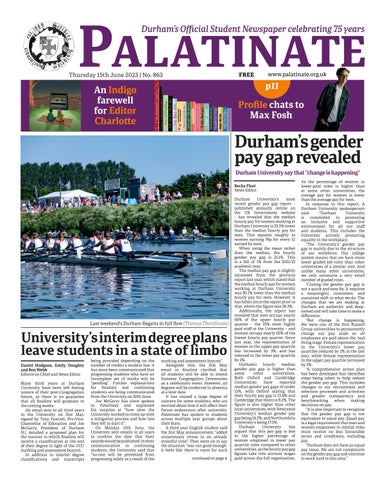
Last weekend’s Durham Rega a in full flow (Thomas Thomlinson)
The new normal: uncertainty
Ever since the pandemic restrictions started easing, a phrase has strayed into maintream usage, u ered by government officials and college porters alike. That term is the ‘new normal’.
While the mainstay of life may be as it was before 2020, looks can be deceiving. In this job, you speak to a lot of people and some local businesses tell me how even in the postpandemic world, they are still required to do things differently.
The global emergency status a ributed to the coronavirus by the WHO was officially rescinded on 5th May 2023, the day after our most recent print edition. A lot has changed since the ‘highest level of alert’ was declared at the end of January 2020. We had our print funding cut in its entirety, which has been far from ideal and is an unfortunate ‘new normal’ for us. Yet, we are still here and don’t plan on going anywhere anytime soon.
Much bigger than this, however, is what appears to be the ‘new normal’ for students. As well as local business, I’m lucky enough get insight into students’ lives on a daily basis and many experiences over the last three years (particularly poignant for finalists) have been nothing short of disgraceful.
Much of the pandemic has been a case of learning on the job for the University, and it could be argued that this is no one’s fault. The same cannot be said
of the ongoing strikes, and now the marking and assessment boyco - these occurences are simply shocking. There is no one opinion on this ma er and varying people hold different individuals and institutions accountable for the disruption. However, as our polls have demonstrated time and time again, students as a collective do not put the blame at the foot of lecturers.
While doing my research for some of this week’s news, there were a lot of experiences to digest. One friendly source inside the UCU described the reality of the situation: “I don’t think anyone has any idea what will happen, because the management have not been making robust plans for these eventualities.”
a detrimental effect on the student body and yet it persists.
The University told us seconds years in their communications earlier this week to “be reassured that, even in cases where outcomes are pending, no-one will be prevented from progressing solely as a result of the marking and assessment boyco ”. I hope this is the case, but there is precedent for things to change, as was the case in April when the University announced that no assessments would be cancelled, before promptly cancelling Physics Level 4 vivas.
In other words, anything can happen. Yet, there is at least one thing that should not be allowed to happen: this feeling of uncertainty becoming a ‘new normal’ for students.
This edition marks the end of my time as Editor-in-Chief of Palatinate, a role that it has been a true honour to hold. I am extremely grateful to have worked with such an incredible Editorial Board.
of working alongside two incredible co-editors, Nicole and Emily. The advice and mentorship that Nicole offered me has been invaluable. To this day, she is still there to turn to, for which I’m thankful.
Emily meanwhile has worked tirelessly alongside me to keep improving the paper. I know I leave Palatinate in safe hands.
Finally, I must thank my housemates who have put up with me making this paper my singular personality trait. In particular, I must thank Neha, whose patience and kindness has helped me through the ups and downs of the past six months, and for who I’m eternally grateful.
Editors-in-Chief
Daniel Hodgson & Emily Doughty editor@palatinate.org.uk
Deputy Editors
Elle Fitzgerald-Tesh & Arjun Seth deputy.editor@palatinate.org.uk
News Editors
Ben Webb, Becks Fleet & Nicole Ireland news@palatinate.org.uk

News Reporters
Lucy Baldwin, Nina Bu erfield, Maxim Meinertzhagen, Samantha Webb, Elliot Burrin, Sophia Lieuw Kie Song & Josie Sherman
Investigations Editors
Tiffany Chan & Joseph Manley investigations@palatinate.org.uk
Satire Editors
Sascha LO & Rory Cronin satire@palatinate.org.uk
Comment Editors
Josie Lockwood & Holly Downes comment@palatinate.org.uk


Deputy Comment Editor
Duru Akin & Emily Lipscombe Profile Editors
William Rome & Alice Theakston profile@palatinate.org.uk
Science & Technology Editors
Cameron McAllister, Will Brown & Cas Gudgeon scitech@palatinate.org.uk
Politics Editors
Madeleine Ballay & Alex Everest House politics@palatinate.org.uk
Deputy Politics Editors
Guy Seagers & Liam Hannon
Puzzles Editors

Sophie Sherra & Lucy Hagger puzzles@palatinate.org.uk
Sport Editors
Oliver Jervis & Sanjay Suri sport@palatinate.org.uk
Deputy Sport Editors
Maddie Parker & Joe Harston
Sport Reporters
Joseph Saunders, Tom Ewart Smith & Seb Thompson
Indigo Editors
Charlo e Grimwade & Cameron Beech
For all Indigo enquiries: indigo@palatinate.org.uk
Deputy Indigo Editor
Melissa Rumbold
Features Editors
Roshni Suresh Babu & Siobhan Eddie
Creative Writing Editors
Theo Mudhir & Elizabeth Buckley
Stage Editors
Amelie Lambie-Proctor & Ayasha
Nordiawan
Stage Reviewer
Rae Rostron
Music Editors
Tom Harbo le & Isabella Harris
Visual Arts Editors
James MacFarlane & Camille Hine
Books Editors
Ruhee Parelkar & Annie Pickup
Style Editors
Caitlin Ball & Elif Karakaya
Food & Drink Editors
Millie Adams & Eve Kirman
Travel Editors
Lydia Doye & Lily Lake
Film & TV Editors
It appears to be an accepted ‘new normal’ that students miss weeks of teaching over the academic year and it’s relived with a feeling of deja vu.
Now we find ourselves in a position that is foreign to us students, where some of our work is simply not being marked. It is having
There are far too many people to thank for their support over the last six months, starting of course with my parents, grandparents and occasionally my sister!
On the paper, all of the Editors that I have worked under deserve tribute. Toby, Max, Poppy, and Joe each brought something different heading up the paper and I learnt so much from all of them in order to be a be er journalist.
I have had the privilege
Daniel Hodgson Editor-in-ChiefAlice Purves & Jacob Dax Harris
Interview Editors
Lo e Micklewaithe & Charlo e
Rodney Photography Editors
Thomas Tomlinson & Nathan Becke photography@palatinate.org.uk
Illustration Editors
Rosie Bromiley, Victoria Cheng, Anna Kuptsova & Isobel Warwick illustration@palatinate.org.uk

Palatinate is published by Durham Students’ Union on a fortnightly basis during term and is editorially independent. All contributors and editors are full-time students at Durham University. Send le ers to: Editor, Palatinate, Durham Students’ Union, Dunelm House, New Elvet, Durham, DH1 3AN. Alternatively, send an email to editor@palatinate.org.uk.
Media Officers
Veronese,
Business Manager
Social
Luca
Olivia McCoy & Jessie Hoyle
advertising@palatinate.org.uk
Advertising and Sponsorship Officer Rachal Limbu
Thomas Simpson
Treasurer Freddie Corrin
Palatinate Editorial Board
(Rosie Bromiley)
Inside 863 1-6 News
Comment
Profile
Politics
SciTech 18 Satire
Puzzles
Horoscopes
Sport Indigo 2 Editorial 3 Features 4 Film & TV 5 Music 6-7 Style 8 Stage 9 Interview 10 Travel 11 Books 12 Creative Writing 13 Food & Drink 14-15 Visual Arts
Many experiences over the last three years have been nothing short of disgraceful
7-9
10-11
12-14
15-17
19
20
21-24
2 Editorial Thursday 15th June 2023 | PALATINATE
Photography
16
Covid-19, classes and crises: student class of 2023 speaks out about their experiences
Ti
ffany Chan Investigations EditorAs the 2022-23 academic year draws to a close, the incoming batch of graduates have had some time to reflect on the wave after wave of events that have marred their university experience. 47 finalists from a range of subject degrees and colleges took the opportunity to tell Palatinate about what they thought of their time at Durham University.
It is worth noting that these students are not necessarily representative of the entire student body, however their testimony provides a large insight into the impact of certain events on a year group’s teaching and learning.
Many of the students graduating this year either had their A-levels cancelled due to Covid-19 and went through a first year during the height of lockdown, or were thrown into this new way of life in the la er half of their first year at Durham. Alongside the various events of the past 2-3 years such as strikes and housing crises, it’s safe to say that the cohort of 2023 has had an abnormal university experience.
43 out of 47 students believed that they deserved some form of compensation for any lost experiences like teaching hours, moving lectures and seminars; the other 4 responded with “maybe”.
Furthermore, 39 students enjoyed university more when COVID restrictions were lifted. 3 enjoyed university less, and 5 enjoyed university the same.
These results correlated with the fact that 33 students felt that they did not have time to enjoy a “normal” university experience in terms of academics or extracurriculars. 8 felt otherwise, with 6 answering “maybe”.
26 students answered that their final year (2022-23) had the best university experience for them, citing reasons like the lack of Covid-19 and “zero restrictions”, leading to things being “somewhat normal” again. However, a Maths and Physics student at Josephine Butler college chose this year but said that “it’s still been rubbish”. A Psychology student from John Snow said their decision may be subject to change due to the onset of marking boyco s, so “it probably turned into the worst [year] as I am unlikely to even graduate”.
An English student at John Snow said that their first year (2020-21) was actually the best year as they made friends in their accommodation; “however, Covid-19 and strikes drove most of my friends to drop out of university altogether”.
Nevertheless, this was the minority response, with 26 students saying that 2020-21, usually their first or second year at university, was their worst year. A PPE student at John Snow said that first year “wasn’t really a university experience at all”. Florence Clifford,
an English Literature and History student from Hatfield, said that “The whole experience was largely miserable, entirely under Covid-19, cooped up inside and with no help or understanding from college or the university”.
Madeleine Hamilton, an Anthropology student at Collingwood, said that first year was her worst year in retrospect. “Although there were many highlights of first year at the time, in hindsight it is shocking that we paid the same amount and there were no extra curricular activities or social activities available, bar a few events at the end of the year. Luckily I got on really well with my flatmates as it would have been hell if not”. A Psychology student at John Snow also cited the lack of activities in first year, saying that “I paid a very large JCR levy only to have an online freshers week, entirely on Zoom”.
Conversely, a Behavioural Sciences student at Hatfield said that although “every year” was their worst year, they felt third year stood out because “The assessment format changed and we were never prepared for this change despite promises of mock exams to help us adapt. We were left in limbo for a long time about how our finals would be conducted, and the department were not accommodating when students voiced their concerns”.
have deferred a year in hindsight of experiences that had impacted their time at Durham. 22 did not feel this was necessary, and 14 answered “maybe”.
With regard to whether or not their university experiences had prepared them for life after graduation, 20 students said that they were either uncertain or not confident that they were ready for post-university life. An English and History student from St. Cuthbert’s said that they were “not exactly” sure if they were ready, “but I think that’s regardless of whether I had a ‘normal’ university or not and also due to the non-vocational nature of my degree”.
An English student from Van Mildert said, “my social skills have been drastically underdeveloped without the normal uni experience - I still feel incredibly nervous to a end in person meetings. University, especially in the college experience, felt more like the final step of education than the first step into adulthood - as though it was a continuation of high school and not an initial introduction to living as an adult”.
more online approach, increasing engagement and flexibility. You develop independence in your academics and a range of other skills. It builds resilience and adaptiveness”.
A Theology and Religion student at Collingwood said that while “it has prepared me for “distance working” and I’m grateful that we have introduced Google Teams and Zoom into everyday office life”, “the social skills and ability to network and be independent I hoped to develop at university just simply never happened”.
Lucy Bernadez, an English and Philosophy student at Josephine Butler, said that her experience was “incredibly disappointing” and that the “lack of sympathy and help offered from the University has been appalling”. She added, “If anything the University has made things harder for us, for example the lack of concern for the housing crisis and cost of living”.
Despite the differing opinions about year-to-year experiences, 39 students felt that other cohorts had a be er university experience than them, with life under Covid-19 being a major reason. An English student from Stephenson said, “no other year group started uni going straight into lockdown, and I cannot stress enough how terrible that was for everyone’s mental health. The year after us still had some lectures online but they weren’t locked down in halls, which was the main issue”. Benjamin Naughton, a Maths and Economics student from St. Cuthbert’s, said, “If they didn’t have a year of Covid-19, they categorically had a be er experience. Especially if their first year wasn’t Covid-19, as we didn’t have the opportunity to meet anyone or have much fun”. However, this did not equate to a strong desire to have started university later than they had. Only 11 students felt that they should
An English student from Stephenson shared their belief that university education in general was not adequate to prepare students for real life. Being a mature student, they felt that “No practical employable skills are taught. This is why graduates can’t get jobs as employers want experience of actually doing the job! Qualifications are necessary but everyone has a degree, so only through volunteering and actually pu ing the time in, in your chosen field will you get a role”.
The majority, 27 students who felt ready for “real life” had a variety of reasons for feeling prepared.
An international History student said, “studying abroad has really toughened me up”. A Psychology student from St. Chad’s said that this was only because of “the experiences I’ve had in third year”. Miss Leason said, “Many businesses and organisations have shifted to a
Some were more pessimistic about their role in the wider world. Mr Naughton said that going through university as affected by Covid-19 and the strikes “probably prepared me be er in hindsight. I’ve become more resilient and have realised that there are loads more people who I get on with than I had previously thought”. Madeleine Pope, a Modern Languages and Culture student at Collingwood, said that their university experience “has prepared me for life if we define life as an isolating, dog-eat-dog world. It’s made me more resilient although this has been achieved in less than optimal ways”.
Responding to the claims by the questionnaire’s respondents, a Durham University spokesperson said: “During the Covid-19 pandemic, our top priority was the health, safety and wellbeing of our students, as well as our staff and the wider community.
“We offered extensive support to our students, including with their academic study, personal wellbeing and extra-curricular activities. Indeed, we were one of the first UK universities to resume extracurricular activities as we piloted the ‘Test to Release’ scheme.
“Aware students would want to be kept up to date, we communicated with them frequently throughout the pandemic, both directly and through our colleges and student leaders.
“Our approach to the management of the pandemic was validated by independent assessors, including the British Safety Council which undertook a health and safety audit and confirmed that all required measures were in place.
Miss Leason said that being a first-generation scholar, she did not know what to expect before a ending and university “was probably worse than I’d imagined”, but at the same time “it has enabled me to become more independent and take care of my mental health and well as become an all round be er person”.
Like Miss Leason, though,
“We also received much positive feedback from our students, for example in the International Student Barometer where Durham was higher than the Russell Group average for student satisfaction on both how the University was managing the pandemic and how it was communicating with them about it.
“Also the Times and Sunday Times Good University Guide 2021 commented: ‘Durham is one of the winners in our analysis of the handling of the Covid-19 pandemic on Britain’s campuses’.”

3 PALATINATE | Thursday 15th June 2023 News
43 out of the 47 students answered that they believed they deserved some form of compensation for any lost experiences like teaching hours or seminars(Amana Moore)
27 students felt ready for “real life” and had a variety of ways to be prepared
SU President: the system of higher education is ‘broken’
Continued from front error. For this to happen to our specific cohort is frustrating...there is no consistency and it seems deeply unfair as some departments will be disadvantaged.” The University said that they wished to communicate as much key information as possible, as soon as possible.
For those who would have not reached the credit requirement many thought that the update added li le for them.
Caleb Tu , a third year politics student at Collingwood, called the May update “somewhat useless”.
An Archaeology student has expressed her concern to Palatinate in regards to the “higher-than-normal final average mark requirement for interim classifications” mentioned in the email to all finalist students. This higher than expected mark requirement may mean that they “only just miss out” on an application in the short term, and, if they achieve a be er classification later on, this “will be too late” and they would’ve already lost out. This student doesn’t “understand why the Uni has chosen this”, wondering why the University doesn’t instead “look at treating their staff be er” - in allusion to the UCU demands.
Ma hew, a third year international student told Palatinate that the boyco had more impact on him as an international student becayse he was unable to take the bar exam
in Singapore without a classified degree. He said as an international student he felt that he had it “tough” due to the impact of Covid and the impact the boyco could have on his friends ge ing visas.
Many students also believed the University should be doing more to organise, with a third year Philosophy student saying the University was “not cooperating with the lecturers and paying them a fair wage”. Another third year student who studies music said that Durham could be doing more, following the model of Cambridge University and urging the UCEA to negotiate in a public manner. They called it a “reflection of how much the uni cares about the staff ” that they did not try and fix industrial relations “knowing full well the plan of strike action and boyco ”.
either that or the management is just terrible”.
In his 12th June communication with students, Tony Fawce reiterated that “This is a national dispute, involving 145 universities, and it is not in our power to resolve this at local level”.
Some students are disappointed with the UCU and the actions that lecturers have taken. A third year Classical Civilisation student at St. Chads College said: “I had compassion with the staff as when they did their strike they seemed like they really wanted to keep teaching us. But after this disruption they have proved they don’t care.”
any grades given to students can be increased but not decreased.
the system of higher education is “a bad system” and a “broken” one, and “it is a shame that our students have become collateral in that”.
He said that the SU has been trying to encourage the Durham University Vice-Chancellor Karen O’Brien to “publically encourage renegotiation” regarding the marking and assessment boyco but as of yet “she has failed to do so”.
Ma hew also echoed this saying “Just pay the staff more. It really isn’t that difficult. If the Uni can charge crazy fees for both international and home students, and buy an overpriced new business school, they can definitely afford to pay the staff more. It’s
The only finalist who Palatinate spoke to who was happy about the decision was a third year Geography student who said “I know that my grades aren’t that good but if I graduate with a transcript instead of grades, I can apply to grad schemes I’d think I normally wouldn’t be able to apply for. Maybe I’m subconsciously happy the inevitable is being delayed. It’s a bit weird, but whatever.” Palatinate spoke exclusively to SU President Joe McGarry, following the 31st May email. Mr. McGarry said how “There seems to be a general sense across universities that they were hoping the boyco would be resolved by UCU to UCU and it wouldn’t actually come to a head.”
Most positive however, according to Mr. McGarry, is the no detriment policy brought in for the interim degrees. This means that
“All universities are judged on grade inflation” and this is something that is a “concern” of the University and Durham is particularly “concerned about their reputation (...) not just thinking about current students but the students applying in 10 years. To protect future students they were always going to be cautious about this.”
The SU President argues that the no detriment policy is the “best way” for students to be protected from issues surrounding the interim classifications and the SU “is always aiming to fight for current members” so this is something they pushed.
He also suggests that “it will be interesting to see how the marking and assessment boyco affects first and second year students as well” as the SU has received criticism from students asking “why they have been prioritising finalists”.
Mr. McGarry believes that the reason for the marking and assessment boyco and further UCU industrial action is because
The SU President stated that the best way for students to aid the marking and assessment boyco ’s removal and either the same for interim classifications or its greater success, is to write a formal complaint to the University and “do all we can” to get the University to push the case for re-opening negotiations.
On the marking and assessment boyco , Raj Jethwa, Chief Executive: of UCEA “HE institutions respect employees’ right to take lawful industrial action, but the marking and assessment boyco is a choice made by UCU and in turn by its individual members. Students have no such choice and that is why HE institutions with a duty to protect students will withhold pay for partial performance. It is wrong for UCU to encourage small numbers of its members to try to inflict damage on students in pursuit of a higher pay award that is simply unaffordable.”
Durham UCU were contaced for comment, however they did not respond by the time of going to print.
Durham University 2023 college rankings revealed
Emily Doughty, Nicole Ireland and Ben Webb Editor-in-Chief and News EditorsPalatinate can reveal the official popularity rankings of all Durham Colleges, according to how many applications they receive from incoming students each year - a year on from University College’s win.
In 2020, the University removed the single preference system that provided admissions staff
with the information needed to place students in their preferred college, allowing the 2021 and 2022 entrants the ability to rank every college. University College placed first in the rankings, followed by Collingwood, St Chad’s, and St Mary’s.
St Cuthbert’s has dropped from second to fifth, with St John’s out of the top nine rankings for the second consecutive year.
University College has remained the number one choice since 2016, although in 2020, Collingwood
came within eight offers of placing above them.
Despite St Cuth’s dropping three places this year, the Bailey college came second in the weighted rankings, meaning it was the second most popular college for student’s second, third, fourth, and fifth-place college. This is similar to the previous year, where St Cuthbert’s remained the most consistently popular college at the University across different preferences.
This year’s Freedom of
Information request has provided details of the most polarising college as well, with Hatfield, ranking this year in ninth, its lowest ranking across the recorded years, also having the largest increase in lastplace rankings over the past two years.
Participation in the ranking system has picked back up after dropping considerably after the implementation of the multiple choice system. Last year, more than 10,000 applicants listed their top three colleges, with only 4,500 ranking all 16.
This figure has improved this year, with more than 7,000 students commi ing to ranking all colleges according to their preference, potentially through an increased importance placed on each college being used in some cases.
Van Mildert College remains outside of the top nine colleges, despite consistently remaining in the 10th, 11th, or 12th spot throughout the last 7 years of data, whilst the two Mount Oswald Colleges,
John Snow and South, remain those colleges with the greatest upward trend in the last five years - Snow rising from 14th to 6th and then back to 7th over the past 6 years.
4 Thursday 15th June 2023 | PALATINATE News
Many students believed the University should be doing more to organise with academic staff
Most positive, according to Mr. McGarry, is the no detriment policy
Selected 1st Weighted University University Collingwoood St Cuthberts St Chad’s Collingwood St Mary’s St Chad’s St Cuthbert’s St Mary’s Josephine
John’s
Snow Grey South Josephine Butler Hatfield John Snow Rank 2017 2018 2019 2020 2021 2022 1st University University University University University University 2nd Collingwood Collingwood Collingwood Collingwood St Cuthbert’s Collingwood 3rd Josephine Butler St Mary’s St Mary’s Hatfield Collingwood St Chad’s 4th St Mary’s Josephine Butler Josephine Butler St Mary’s St Chad’s St Mary’s 5th Hatfield Hatfield Hatfield St Cuthbert’s St Mary’s St Cuthbert’s 6th St Chad’s St Chad’s St Chad’s Josephine Butler John Snow Josephine Butler 7th Stockton Campus St John’s St Cuthbert’s St Chad’s South John Snow 8th St Cuthbert’s St Cuthbert’s St John’s St John’s Hatfield South 9th Grey Grey Grey John Snow Josephine Butler Hatfield
Butler St
John
marking and Assessment boyco is the last resort”: Dr Sol Gamsu on the UCU Marking Boyco
Emily Doughty, Daniel Hodgson & Becks Fleet Editors-in-Chief and News EditorDr Sol Gamsu is an Assistant Professor in the Department of Sociology at Durham University, and the President of the Durham branch of the University and College Union. Recently, Palatinate spoke to him about the ongoing Marking and Assessment Boyco and the impact on students and staff
First, Dr Gamsu described the Marking and Assessment Boyco as a “last resort”: “The Marking and Assessment Boyco is, if you like, the last resort and it is in many ways the nuclear option… on the ‘four fights’ (casualisation, pay, workload and equalities) we remain in dispute nationally with the employer’s organisations.
“There has been very li le meaningful progress on that side of the dispute. There has been progress made around pensions which is that there has been a commitment by the employers to restore pension benefits that were cut last year as long as they are deemed to be affordable.”
“It is not clear at the moment whether Durham is using their voice amongst the employers to try and get them back to the negotiating table, and that is what is needed at this point.”
He went on to discuss casualisation: “To give an illustration of what casualisation means, we had a general meeting where we had Mary Foy (MP for the City of Durham) visit and she asked for examples of what casualisation means and why people are out on strike and so on, and someone responded saying that they’d been on a series of fixed term contracts. It’s quite common in the sector to have both teaching sta staff on a series of fixed term contracts for one, two, maybe three years which employers use to avoid having to make people permanent.
“That is precisely what this dispute is about – casualisation is rife, it is unacceptable, the precarity is deeply damaging to people on a personal level and I know this because many of my friends, people that are close to me, have been and still are in that position. It is toxic to people’s lives as well as their financial position. I don’t think students deserve to have their staff treated so poorly.”
Dr Gamsu was also asked about what he would say to students who are impacted by the Marking and Assessment Boyco : “One of my colleagues has said that students should demand for all summative work they submit to be marked by qualified staff. The University should put emphasis on researchlevel teaching and that means it has to be marked by people who do that research.
“I think none of us take this action lightly. It is also worth
students knowing that this is the first national Marking and Assessment Boyco since 2006.”
He also further discussed the reasons for the marking boyco : “Staff have had their pensions cut by 35%, they work on precarious contracts, there is a continuing and persistent gender and ethnic pay gap, most staff work over their contracted hours on a regular basis and the university relies on the goodwill of staff to do that.
“The struggles that [students and staff ] are facing are fundamentally linked because the process of marketisation which has removed forms of democracy within institutions, brought in tuition fees and increased competition between universities – these problems affect both students and staff alike and the only way we can get out of those is by seeking to contest and fight against those processes together.”
When asked how students can support the UCU, Dr Gamsu said: “I’d advise them to email the Vice Chancellor and ask her what she is doing to get negotiations restarted. If she can fly round the world and talk to various donors, then why can’t she raise her voice internally within UCEA to get negotiations back going?
“I said before that this is the first national Marking and Assessment Boyco in 18 years, people do not get to this point of being so angry and frustrated and fed up overnight and nor did students with tuition
County Durham News Rocking Horse Rehearsal Rooms to move to Coxhoe
is easy, but they are personally financially insulated from the decisions that they take that effect both their staff and their students.”
Since the dispute is national Durham University cannot individually negotiate with the Durham UCU and therefore could not bring an end to the dispute locally.
Durham University has also made the decision to deduct 50% of pay from staff partaking in the marking boyco , a decision they say was taken due to the impact on students, especially finalists. On this pay deduction, Dr Gamsu said: “We will support people through using our local hardship fund [A UCU fund to assist striking staff in financial difficulties] but that won’t cover all of the losses that people will sustain.

Casualisation is rife, the precarity is deeply damaging to people
“Students only need to think what it would mean to them to lose 50% of their income. Even if a proportion of that is paid back, that is still going to have a big effect on your budget for the month. So, rather than simply sending an email and telling UCEA nationally to get that to the negotiation table, the senior management of this university would rather take 50% of the pay of staff who participate in the Marking and Assessment Boyco
“That really is damning judgement on them, to be quite honest. How is that a sensible solution to this situation? It’s not. It’s going to severely damage the relationship between management and their staff and that is not something that they should do lightly.”
Josie Sherman News ReporterThe popular Rocking Horse Rehearsal Room and Studio is having to relocate to Coxhoe, moving from Durham’s city centre after 12 years. Since 2011, the well-loved space has been located on Frankland Lane and welcomed over 300 artists into the local area. Around 40 local musicians also use its rehearsal rooms each week, providing the Durham community with a vital space to explore their creativity through affordable facilities.
In early 2022, Rocking Horse Rehearsal Studio was first threatened with the prospects of closure, sparking owner Rich Combstock to start a year-long campaign to keep the building from destruction.
Although ultimately unsuccessful, the independent music project has found a new home in Coxhoe, moving into a bigger space only around fifteen minutes away by car.
Mr Combstock has said that the new space is a “significant upgrade on the current site as there’s more space and it will be better suited to our needs”.
The new site is set to have more communal areas and outdoor space, as well as better music facilities. The Coxhoe venue will also include a new room that will be large enough to host concerts, acting as a cultural hub for the local citizens.
Currently, the Rocking Horse have begun a new fundraiser, which hopes to raise £5,000 to help aid the move and construction of the new studio.
Plans for new housing estate in Gilesgate approved
Nicole Ireland News EditorA new housing estate will be built near Durham despite concerns of overpopulation.
Up to 470 homes will be built in the Gilesgate area, on land off Sherburn Road, south of the Dragonville area.
Members of Durham County Council’s planning committee backed the scheme, as both developers were praised for their work with local councillors and residents.
However, some residents raised concerns that the proposed size of the new estate is not big enough to house the 470 homes.
John Ashby, of the City of Durham Trust, said: “The root cause of the problems with the application is trying to cram too many houses on the site. It’s now all too clear that 470 is far too many, [it] is demonstrably out of scale and this should be a robust ground for refusal.”
The managing director at Miller Homes, Patrick Arkle, added: “We’re really excited about the opportunity to create a sustainable community.”
Cllr Carl Marshall said members would be “mad” to vote against the proposal. He said: “We’ve got a well-designed estate; we need to get on and allow the developers to deliver the housing that is needed to take the county forward.”
Durham’s Yorkshire Trading Company closes permanently
Becks Fleet News Editor
parents to complain in writing to the Vice Chancellor. They can ask their SU officers to raise it, I know they already have been but there is no harm in asking again.”
Dr Gamsu also criticised the University leadership: “Students have to get angry ultimately at the people who control the situation and that is the [University] Vice Chancellors across the country who are refusing to negotiate. Let’s be clear about who the Vice Chancellors are and who senior management are across any institution – these are very highly paid people, who are earning six figures and are in many cases insulated from the decisions they make. I am not saying their job
In a statement to Palatinate Durham University said “As a staff community, we are commi ed to supporting students on their journey to graduation. The University is wholly motivated by a desire to graduate students. We are therefore very concerned that the Durham UCU Commi ee would seek to alarm and mislead students in this manner.
“Statements in the Durham UCU Commi ee’s document are demonstrably inaccurate and misleading. They are likely to unse le students unnecessarily. We will provide detailed information on each of these points in our updated Frequently Answered Questions. In the meantime, we remind students that all summative assessments will ultimately contribute to your final degree classification.”
(Image: Thomas Tomlinson)
Durham’s branch of the Yorkshire Trading Company chain, closed permanently last weekend. Its last day of operation was Saturday 10th June.
The store, which opened in 2020 and sold items such as clothing, pet goods and cooking equipment, was based in the building formerly occupied by M&S.
It has made way for the Stack leisure development, which was approved by Durham County Council earlier this year and is planned to open this winter.
It was previously said that there were plans to keep Yorkshire Trading Company in Durham City, but nothing has been announced as of yet.
The building, which will be
heavily renovated in preparation for the new entertainment venue, will include several bars, a stage for performances and independent food outlets.
The owners of the Stack development, Danieli Group, have claimed that the new complex will create more than 170 jobs.
Danieli Group chief executive Neill Winch said that “Stack Durham will be a focal point and an attraction offering a wide mix of street food and a variety of live entertainment for people of all ages”
Local councillor Carl Marshall added that “This isn’t just an establishment that’s going to attract stag and hen do’s, it’s going to really diversify the offering in Durham and the wider county.”
Yorkshire Trading was contacted for comment but had not responded by time of print.
5 PALATINATE | Thursday 15th June 2023 News
“The
Only 67.2% of exams held online this year, despite University pledge to make online exams standard
Lucy Baldwin News ReporterData reveals that nearly 1/3rd of undergraduate exams at Durham University were held in person this year. This comes despite the University agreeing that the open 24-hour online format should become standard practice following the pandemic.
Of the 2/3rds of online exams that were taken this year, some were also timed, rather than following the 24-hour format that the University is moving towards.
At a Senate meeting in Michaelmas 2022 the University agreed on the proposal that: ‘examinations should be delivered online in an open format over 24 hours as standard’. This proposal was sponsored by the acting ProVice Chancellor (Education) Tony Fawce
However, the proposal did continue by acknowledging that not all exams would be taking place in the open 24-hour online format, stating: ‘examinations can be held with a timed format (either physically or synchronously online) where there is a need driven
by accreditation requirements and/or assessment design’.
This comes despite mixed feedback in favour of open 24-hour online exams in the University’s Student Exam Survey from July 2022.
Thank you to our graduating editorial board members
Durham University did not respond to Palatinate’s request for a comment on this ma er.
The University’s decision to continue holding some exams online following the pandemic is in line with other Russell Group Universities. Palatinate found that of the eleven Russell Group universities who responded to their FOI request, all had continued with some online assessments in 2022-2023.
However, from our data Durham reported the second highest proportion of undergraduate online exams in 2022-2023, with only Queen Mary University of London holding more exams online at 71%. In comparison, Oxford University only held 20% of their undergraduate exams online this academic year.
It is important to note that these comparisons are limited as online assessments take different forms (some are timed, for example).
As we celebrate the final print edition of this academic year, Palatinate would like to thank all our editorial board members, contributors and readers who are graduating. A special thank you must go to our editorial board members, who have worked tirelessly this past year to make Palatinate and Indigo what they are. Your unrelenting passion, invaluable knowledge and dedication to Palatinate and Indigo have been undeniably indispensable, and we could never thank you enough for being part of what makes Palatinate such a joy to be part of. From all of us at Palatinate and Indigo we wish you the greatest success in your life after Durham.


This found that while over 70% of students in the faculties of Arts and Humanities, Social Sciences and Health and the Business school preferred the open 24-hour online format, only 48% of Science students preferred it.
In addition, a number of other universities have medical schools as well as courses in subjects like dentistry and veterinary medicine with these practical subjects often being less likely to be assessed online.
Exam concessions leave dyslexic students at “major disadvantage”


which dyslexic students struggle with due to their disability.


knew my disability”.
Editor
Becks Fleet NewsDurham University’s exam concession towards students with disabilities – particularly those with dyslexia – have been seen by some as leading to such students being unfairly treated when their exams are marked, by not informing examiners of their disability in advance, and not informing disabled students of this policy.
This system has not been implemented by Durham University. The Geography department’s online pages say that “A common question asked by students with dyslexia or a similar specific learning difficulty (SPld) is whether their work is marked differently or more leniently to allow for their disability while at University?
“At Durham University, the answer to this question is no. Any work submi ed by students with dyslexia or similar condition is not marked any differently or any more leniently than those students without dyslexia.”
When asked if her previous grades have been amended to account for her disability, she said that “I don’t think they have been amended yet (if they will be at all) as I’ve just filled out the SAC form for one module’s summative essay. Hopefully that one will be.”
She also argued that the University’s recommended strategies were ineffective in a high-stress environment such as a timed exam, and as such she is still left with a major disadvantage compared to non-disabled students.
The system of informing examiners about a student’s disability has been implemented by other universities such as Oxford and other Russell Group institutions, and applies to students’ work when it is both anonymous and non-anonymous. In the case of dyslexia, this is said to help reduce the disadvantages dyslexic students face at university by allowing examiners to be put more focus on critical engagement and exam content rather than on a student’s spelling, punctuation and grammar (SPAG), something
Palatinate spoke to a thirdyear student who discussed her experiences with ge ing support for her dyslexia. Until her third year at Durham, the student – who asked to remain anonymous –believed that her work was marked with her disability in mind. The University did not make her aware that examiners were not told about her disability. She did not become aware of this until feedback from an exam described her writing (which had SPAG errors due to her dyslexia) as “lazy”. She was then referred by her academic advisor to the disability support service, who made her aware of the policy for the first time.
She told Palatinate that “I didn’t realise that in order for my dyslexia to be taken into account in the marking that I had to fill out a SAC form otherwise the marker wouldn’t know.
“It was never made clear to me that that is what I should’ve been doing to make sure the marker
In response to these claims, Durham University said in a statement that: “We have a dedicated Disability Support Service – a friendly, approachable team of professionals who work with disabled students to discuss any academic difficulties encountered in relation to their disability throughout their time at Durham.
“We work with students to put a personal and tailored Disability Support Plan in place, which outlines agreed reasonable adjustments, including exam concessions.
“Much more information is available on our website and Sharepoint site”
On the website, Durham University also state that current exam concessions available to students include “additional time, use of a word processor (to type answers) or rest breaks”, and that “Exam concessions do not apply to any exams which have a 24hour window or more, as they are deemed an inclusive method of assessment.”
Palatinate and Indigo graduates 2023: Elle Fitzgerald (Deputy Editor-in-Chief), Alice Purves (Film & TV Editor), Holly Downes (Comment Editor), Tom Harbo le (Music Editor), Eve Kirman (Food & Drink Editor), Oliver Jervis (Sport Editor), Charlo e Grimwade (Indigo Editor), Roshni Babu (Features Editor), Melissa Rumbold (Deputy Indigo Editor), Thomas Simpson (Business Manager), Isabella Harris (Music Editor), Josie Lockwood (Comment Editor), Sacha LO (Satire Editor), Siobhan Eddie (Features Editor), Annie Pickup (Books Editor), Rosie Bromiley (Illustrations Editor), Anna Kuptsova (Illustrations Editor), Isobel Warwick (Illustration Editor), Tiffany Chan (Investigations Editor), Thomas Tomlinson (Photography Editor), James Tillotson (ExPalTV Station Manager and Ex-Photography Editor), Nicole Wu (Ex-Editorin-Chief), Theo Mudhir (Creative Writing Editor), Sophie Sherra (Puzzles Editor), Ruhee Parelkar (Books Editor), Joe Rossiter (Ex-Editor-in-Chief), Paddy Stephens (Ex-Deputy Editor-in-Chief), Adelaine Zhao (Ex-Deputy Editor-in-Chief), Caitlin Ball (Style Editor), Victoria Cheng (Illustrations Editor)


6 Thursday 15th June 2023 | PALATINATE News
Nearly 1/3rd of undergraduate exams at Durham were held in person this year despite the University agreeing that the 24 hour format should become standard
Any work submi ed by students with dyslexia or similar condition is not marked any differently than those without dyslexia.A selection of our Palatinate 2023 graduates (Thomas Tomlinson)
Interim degree announcement is disappointing for humanities finalists
Caitlin Ball
The message from the Pro-Vice Chancellor of Education and the SU President that arrived in my inbox on the 31st of May certainly put the ‘bi er’ in bi ersweet as I prepared for my last ever round of post-exam celebrations. Along with every other fatigued finalist, I a empted to digest the information that the culmination of the past three years of my life would be ‘pomp and ceremony’, but quite possibly not the degree I had worked and paid for.
With full transparency, I write this article from the perspective of a humanities finalist with no idea what my life will look like come September. I despair at the way in which I am now being joined in this predicament by so many of my peers, a great number of them grad job offer-holders and mastershopefuls.
‘It is highly regre able that the UCU have chosen to take this course of action at a national level,’ explained Academic Registrar, Dr Monika Nangia, in a further email to finalists on the 9th of June. While


interim degrees are the University’s answer to a problem that they claim they are powerless to ‘resolve locally’, it is the powerlessness I feel as a student, and the way in which my voice seems to be the quietest of them amongst this national dispute directly affecting my future, that is most ‘regre able’ to me.
I know I am not alone in holding the view that academics and university staff are being unfairly treated and deserve to have their requests met. I agree with UCU arguments that staff working conditions are student learning conditions, and I share their frustrations.
by The Tab, only 31.2% of Durham students support the marking and assessment boyco , as opposed to the 70.2% who supported the strikes that occurred in February this year. Finalists are being continually assured that the University is ‘doing all [it] can to avoid and limit disruption.’ While ‘interim’ degrees should only last until the industrial action ballot closes in late September, the disruption they may cause to graduates will be felt well beyond this. As the Pro-Vice Chancellor of Education explains, ‘the purpose of interim awards is to help students transition to the next stage of their lives, be that in employment or further study’. While the University has ‘guaranteed’ that interim classifications will act as a baseline, their decision to raise grade boundaries will certainly disadvantage finalists for whom those crucial few marks may mean the difference between a graduate job or unemployment.
However, after dealing with Covid-19 disruption, two years of heavy industrial action, and now the prospect of graduating without a degree at all, I know I am also not alone in finding it challenging to remain as sympathetic as I once was.
According to a study conducted
Even so, a minimum of 60 credits are needed for an interim award. While I try to remain optimistic, this is a challenge when dissertations are worth 40 by themselves. I sympathise in particular with my housemate, who completed a triple module worth 60 credits as part of her History degree this year alongside a dissertation, and fears being unable to apply for a masters this summer.
I never worried about the ‘quality of a Durham degree.’ This is a national issue affecting 145 UK universities — we aren’t the only ones taking hits to our academic qualifications. For many, the worry lies in the possibility of not receiving a Durham degree at all. The thought of countless Billy B allnighters with nothing to show for it on graduation day.


For everything interim degrees are promising us, uncertainty remains, and it continues to present us with our biggest problems But as a 2020 fresher, I suppose it’s nothing we haven’t dealt with before.
A place for debate? Kathleen Stock at the Oxford Union
Siobhan Eddie
On Tuesday 30th May, Dr Kathleen Stock appeared at the Oxford Union. The polemical gender-critical feminist was invited to address the Union regarding her views on self-identification as a criterion for gender recognition and spoke about the protection of single-sex spaces. These very views were the ones that led to the anonymous campaign that forced Stock to resign from the University of Sussex in October 2021.
In the weeks leading up to Tuesday’s Union debate, Oxford University’s LGBTQ+ Society called upon the Union to rescind Stock’s invite, in a le er signed by 100 academics and staff. In response, Prime Minister Rishi Sunak, amongst others, came out in support of Stock’s appearance, stating that her views on the topic should be heard and debated. The debate was accompanied by the
sound of 200 trans-rights activists protesting outside the chamber in a “Trans+ Pride” demonstration, and was interrupted by trans-activist, Riz Posnet, gluing themself to the floor of the chamber near Stock’s feet.
No doubt, parallels can be drawn with events that occurred rather closer to home. In the same year as Stock’s resignation from the University of Sussex, Durham University’s South College became the focus of national a ention.

After The Spectator and The Sunday Times columnist, Rod Liddle, was invited by South college principal, Tim Luckhurst, to speak at the college’s Christmas Formal, students were left shocked and angry by Liddle’s claims. He said that “a person with an X and Y chromosome … is scientifically a man, and that is pre y much, scientifically, the end of the story”, and that “colonialism is not remotely the major cause of Africa’s problems”, both of which were made, Liddle then explained, to emphasise the importance of intellectual tolerance.
The similarities between Liddle and Stock’s appearances are clear, but it is the differences that are, in my view, more significant. While
the debate surrounding gender identity is becoming increasingly emotive, and at times even toxic, what happened at the Oxford Union on Tuesday was evidence of healthy debate.
There were, admi edly, a few protesters questioning why Stock had been given a platform to speak at all, following the LGBTQ+ Society’s call for the Union to
organisers insisted that their aim was not to stop Stock from speaking, but rather to “celebrate trans+ joy, power, and lives”. Amiad Haran Diman, president of Oxford University LGBTQ+ Society and the leader of the march, stated that they would “make sure that the event [went] ahead”, because they “believe[d] in the rule of law”. Indeed, the actual disruption to the event was minimal, and Stock herself remarked that Posne ’s action was the kind of thing that she and her peers would have done while at university.
The very fact that the LBGTQ+ Society was able to organise a peaceful “Trans+ Pride” protest exemplifies one of the key differences between Stock’s appearance at the Union, and Liddle’s speech at South College. Members of the Oxford community were given ample opportunity to prepare for Stock’s Union speech, and to think seriously about whether they wanted to a end.
reaction as “pathetic”, the students can certainly be forgiven for feeling that they had almost been ambushed by Liddle’s after-dinner speech. People like Liddle and Stock must be allowed to express their views, but no one should be forced to listen, particularly on a topic as difficult and emotive as this.
Whether one agrees or disagrees with the strength of the student reaction to Liddle and Stock, it is not only the content of the discussion that ma ers here, but also its context. The Oxford Union, which will celebrate its bicentennial year in 2023, began as a “forum to uphold free speech” and to debate issues that could not be discussed in the university’s colleges.
“rescind its misguided invite”, but on the day itself, the demonstration’s
By contrast, students at South College were not made aware beforehand of who would be speaking at the 2021 Christmas Formal. Thus, although at the time Luckhurst branded the student
This is exactly the sort of place where people like Stock should appear. For someone whose views are so often misunderstood, Stock’s appearance is precisely what is needed to move past the toxic impasse that has been reached. It is unclear if we will ever emerge from this incensed stalemate, but, while the South College Christmas Formal was perhaps not the time or the place to try, the Oxford Union most certainly is.
Comment 7 PALATINATE | Thursday 15th June 2023
I know I am also not alone in finding it challenging
For many, the worry lies in the possibility of not receiving a Durham degree at all
People like Liddle and Stock must be allowed to express their views, but no one should be forced to listen(Gordon Griffiths via Wikimedia Commons)
Artificial intelligence will make the world a better place if used correctly
Amelie Macpherson

Artificial Intelligence has been the centre of discussion amongst students and news sites alike over the past few months, with reactions to the capabilities of the technology ranging from amazement to slight fear.
There is no doubt that AI is revolutionary, with the ability to grant access to world-leading intelligence and pa ern recognition to anyone with a mobile phone, and an algorithm that provides essaylength answers to any question. ChatGPT is already transforming how we solve problems and reach answers, besting Google with instant language translations and mathematical solutions. It goes without saying that access to this type of technology will change the world.
But we must look past the shiny exterior of AI. I’m not talking about the possibility of machines gaining sentience and taking over the world, but the potential of AI to disrupt our global order by giving humanity the ability to cause destruction in the most quick and efficient way.
A study run by Goldman Sachs places the economic growth as a result of AI at around a 7% increase in world GDP, which equates to a $7 trillion increase by 2033. This is a leap that can only be compared to the force of globalisation, and AI technology will similarly result in income growth for the global middle class, pulling millions out of poverty. As more research and development goes into AI, we will get
to a place where we can ask their algorithms to solve any problem for us, ranging from how to get to the nearest supermarket to how to find the best way to phase out carbon emissions in our current economy. We could very well find ourselves in what I like to call a ‘post-problem reality’ where we have the answers to anything at our fingertips.
In terms of what AI means for students, a pressing concern is that we may not have a job market to graduate into as machines take over the economy. However, the chances of this are slim. An example discussed in the Economist earlier this week highlights how AI will create the need for more lawyers, as the new technology will generate 100-page contracts in seconds, resulting in more for people to argue over. Likewise, any jobs that require human contact and communication, such as those in the fields of medicine, management, consultancy, and teaching cannot be replaced by an algorithm. If jobs are doomed to be taken over by AI, it will happen at a speed that allows time for the creation of new jobs in a
Yet, we may end up in of global disorder. central worry shared by experts is that there is no way to stop Generative Pre-trained
Transformers’ (GPT) problem solving algorithm from being used by bad people for destructive purposes, despite the measures put in place to prevent harmful outputs. If ChatGPT could tell us how to use our resources to stop world hunger, it could also cient way to rob a bank, or how to commit a crime without ing caught. AI in the hands of terrorists, gangs, or the socially disruptive could result in a new level cient and planned
Additionally, from a geopolitical perspective, a technology as powerful as AI could exacerbate global divides, with ‘switched’ communities with no access to the
internet falling further behind. Those who hold the monopoly on AI technology could exploit it for power and money, worsening socioeconomic disparities. Ian Bremmer, an American political scientist, has recently discussed his opinion that the worst-case scenario is a war to prevent
technological breakout, in which political tensions between the world superpowers – China and the US – over the perceived threat of AI technology ratchets up to the point of war.

However, the potential downsides of AI outweigh the very real benefits it can provide for us.
I expect that we will see some level of global disorder come to fruition, as humanity is nothing if not reliably destructive, but I am optimistic that the forecasted reduction in global poverty, disease, and hunger as a result of economic growth will make the world a be er place.
Does AI threaten the future of journalism?
ChatGPT
In the ever-evolving world of technology, it's no secret that artificial intelligence and machine learning are changing the game for industries and journalism is no exception. With the rise of software chatbots like ChatGPT, we may soon find ourselves saying goodbye to the traditional methods of reporting. These chatbots use natural language processing (NLP) to create articles and reports that sound indistinguishable from those wri en by humans. As AI technology continues to advance, it's clear that software like ChatGPT will be the future of journalism.
At first, the notion of robots replacing human journalists feels frightening. Human journalists can empathise with their subjects and analyse information in a way that machines simply can't replicate. But the truth is, technology is advancing far too rapidly for us to ignore. This is not necessarily a bad thing.
In theory, a chatbot could gather and analyse information from multiple sources in a ma er of seconds, creating a comprehensive report that would take a human much longer to compile. And since chatbots don't have the same biases or agendas as human journalists, the resulting articles and reports would be completely impartial.

With media literacy being more important than ever, chatbots offer a way to democratise information access. Because chatbots don't require any expertise to operate,
anyone with an internet connection could theoretically generate news reports in real time. This could be particularly important in areas with limited internet access or where journalists face significant risks to their safety.
Ultimately, the rise of software like ChatGPT proves that journalism, like so many other industries, is ripe for disruption. While the thought of machines replacing human reporters may feel daunting, we should embrace the potential benefits that this technology offers. Whether it's faster, more comprehensive reporting, or greater accessibility, chatbots represent the future of journalism.
ChatGPT the journalist: a cat with a lion's roar


Emily Doughty
ChatGPT seems like the future for writing. It is a way of producing work that reads as if a human had wri en it for a fraction of the cost and a fraction of the speed. In the time it took me to write this sentence, ChatGPT could have finished this whole article and could have started working on the next one. It is the perfect solution for an industry which is suffering from revenue problems, increased
costs of staff and the growing beast that is the 24-hour news cycle.
However, looking at journalism in that way ignores the core of what the profession is. While an undeniable part of the industry is the mass-produced celebrity gossip, there is a much more important part. The real beating heart of journalism is its ability to find the injustices in the world and reveal them, the ability to change opinions through comments and to educate others. It makes professions and topics, which may have been seen as inaccessible, free for all. It holds those in power accountable and prompts real change within the world.
While ChatGPT may be able to write an article, the limits that remain mean it can never fully replace journalists. It can’t talk to sources who may feel threatened into silence. It can’t go to protests
or war-torn countries and enable people to be heard. It doesn’t exist in the world and can’t see the injustice around it and work to build an investigation to reveal it. This is the true power of journalism and can never be replaced by AI.
So will ChatGPT impact journalism in ways that we can only dream of? Yes, it will. Talk to anyone who works in the industry you will hear stories of its uses as a way of writing the bare bones of a story, or used to come up with a headline or used to find the right pacing for a script. However, it is unfair to say it will replace the power and impact of humans. ChatGPT needs to be viewed as a tool to aid in reporting, not a thing to be feared. With the existence of ChatGPT, the future of journalism is safe even as technology develops.
Thursday 15th June 2023 | PALATINATE Comment
8
(This is Engineering via Unsplash)
(Headshot: Sanjay Suri via Fotor AI Image Generator)
Elle Fitzgerald
India train crash: to modernise or preserve?
Grace Sargent
The train crash in Odisha, which has killed over 260 people and injured over 1,000 more, has sparked questions regarding the safety of India’s railway system. Critics argue that the current government drive for modernisation has left lines defective and suggest that new railway policy should prioritise passenger safety after so many accidents.
Prime Minister Narendra Modi was supposed to be inaugurating the new Vande Bharat Express: a set of high-speed trains connecting new routes. Instead, Modi had to travel to Odisha to address his people after one of the deadliest train crashes in Indian history. This dichotomy demonstrates India’s current dilemma: to prioritise modernisation through new highspeed trains, or to preserve and repair current infrastructure to ensure these tragedies do not occur. Arguably, the Bharatiya Janata Party’s strategy of pursuing modernisation to improve railways has compromised passengers’ safety by not repairing faulty lines.
It is currently believed that the train crash in Odisha was caused by signalling errors, resulting in a high-speed collision and derailment into the course of another train. The death toll continues to rise as many casualties remain in hospital: the crash in Odisha has been deemed the worst in two decades. Resultant calls for resignation have been directed at India’s Railways Minister Ashwini Vaishnaw, who has been protected by the Prime Minister against his critics.
India has one of the largest rail networks worldwide with 40,000 miles of tracks and 14,000 passenger trains. However, most train infrastructure remains in place from the British colonial era, which created the foundations of Modi’s modernisation drive to renew the country’s transport infrastructure.
Keir Starmer does not seem to care
Guy Seagers
It’s been more than a decade since Nick Clegg abandoned his pledge to abolish tuition fees in 2012. I’m sure many of us remember the viral videos of his begrudgingly cryptic words of regret: “We should not have made a promise we were not absolutely sure we could deliver. I shouldn't have commi ed to a policy that was so expensive when there was no money around.”
Modi’s drive for modernisation has one fundamental flaw: it has not improved passengers’ safety. Between 2017 and 2021, over 100,000 people have died in railway accidents in India.
This disaster is not a surprise. In February, a railway manager from Mysuru wrote to Indian Railways raising concerns regarding flaws in the system. India has been continuously affected by railway disasters, the worst occurring in 1981, killing around 800 people.
Instead of a desire to break the trend, the government is focusing on compensation and moving on. Families of those killed will receive one million rupees, those seriously injured 200,000 rupees and those minorly injured 50,000 rupees. Meanwhile, the government is keen to avoid blame.
Modi’s infrastructure policy has
railway connecting New Delhi and Mumbai. Other initiatives include the world’s tallest railway bridge in Kashmir, as Modi prioritises the external aesthetics of his policies rather than the safety of his citizens. Moreover, whilst railway spending has increased by $30 billion in the last fiscal year, money for track renewal, maintenance and safety measures has fallen. Whilst tracks continue to be used by both passenger and goods trains,
Though Clegg’s apology has a nice catchiness to it when auto-tuned, his words have a haunting irony looking back today. The results of austerity measures sanctioned and enacted by Clegg and David Cameron signalled what felt to many like class war. And now, with the chances of real tuition reform off the cards for the parliamentary opposition, the sense of the poorest in society taking on the economic burden of a corrupt system seems apparent once more.
Clearly, the bored and recycled rhetoric of the last decade hasn’t outworn the current leader of the Labour Party. Far from it — Keir Starmer has abandoned around half of the pledges he made in his 2020 campaign for leader in strange appeals to the political right. His reasoning? “Difficult choices” spurred by a “different financial situation”. Now, with an abandonment of the pledge to make higher education free and available to everyone in the country, it’s becoming harder and harder to see the Labour leader as having a moral compass aligned anywhere other than his own political advancement.

back borrowed money, how likely are you to stand up to oppressive or indecent conditions that come with your mode of income? How likely is it also that your employer will find it easier to coerce you to work longer hours or within unsafe conditions? People are ge ing more and more crippled in their ability to make meaningful decisions in their lives because of the cloud of debt which hangs over the younger generations.
Britain’s world-class universities are already under threat from bad managers who cut pay and force workers to strike in order to desperately recruit new staff. Jo Grady, UCU General Secretary, has publicly called Starmer’s abandonment of a “toxic system of tuition fees” as “disappointing”. Yet, though the institution is deeply entrenched in the functioning of our society, higher education seems undeserving of serious reform to Starmer, who naturally paid no tuition fees himself. Don’t forget, the state is active in its subsidisations — it simply doesn’t see young people ge ing an education as worthy of funding. We often pay high rents to landlords, who are subsidised by the state; We often get low wages from employers who are subsidised for that pay by the state. Starmer has no problem with this inequality, and you will never hear him highlight it.
focused upon economic prosperity rather than passenger safety.

Railways form a fundamental aspect of the Prime Minister’s aim to create a $5 trillion economy by 2025. Thus, colonial-age lines are neglected, remain unrepaired, and new high-speed tracks are prioritised. In February, the Prime Minister inaugurated the first 861mile section of the high-speed
they remain overused, less maintained, and continuously deteriorating. India’s railway policy has prioritised a gilded exterior over a truly working system. The situation has been registered as a criminal case of “death by negligence” with the Prime Minister affirming “Those found guilty will be severely punished.” Clearly, the government is a empting to avoid blame, sending their own agency, the Central Bureau of Investigation (CBI), to investigate in Odisha. However, whilst service has resumed along the route (with ne ing placed over debris which remains on the side) questions about India’s railways continue. Is the government the guilty party for prioritising modernisation over the safety of the 13 million passengers the railroads carry every day?
What seems plainly obvious as we approach the 2024 election is that Starmer has no fundamental objections to the type of society we currently live in, a society revolving around credit. The high growth rates seen after the second world war — growth despite the post-war economic sha ering of Europe — have now been replaced with ever-increasing debt. We are indebted to banks, credit card companies, governments and land-owners. We go into debt when we want to buy somewhere to live, and we are now in debt when we want to get an education.
It’s not hard to identify how the pervasiveness of debt impacts people’s lives, breeding pressure and constraint. A graduate may well face an employer, themselves indebted, who is highly aware of the fact that their new employee is easier to push around because of their financial burdens.

When you’re constantly faced
Despite the fact that many jobs in the UK require some elite education, the debt that comes with gaining this often puts people off or saddles graduates with such gigantic tabs that their ability to utilise this education is limited. Go speak to some freshers by the law department and you’ll hear of ambitions to use quality legal knowledge helping the needy and underprivileged; Come back in three years and you’ll find the same people heading off to work for enormous metropolitan firms. Why? Because the vast majority of those students now hold tens of thousands of pounds worth of debt and need to properly support themselves.
This ultimately speaks to the wider issue at hand, that student debt is an ideological tool which coerces complicity from the young and vulnerable towards a corrupt system which exploits them. Leave university in 2023 and you are indebted, limited in your financial freedom and highly vulnerable. Keir Starmer, it seems, is not opposed to this at all. He will voice no fundamental objections to such a system and would rather harken to Blairites and the political centre in tragically transparent expediency. Well, Starmer, keep this in mind: if you don’t care about students like me then students like me won’t care about you.
9 Comment PALATINATE | Thursday 15th June 2023
(Starmer: Jeremy Corbyn via Flickr. Background: Rishabh Sharma via Unsplash. Sign: Duncan Shaffer via Unsplash. Stocks: Adam Smigielski via Unsplash)
Instead of a desire to break the trend, the government is focusing on compensation and moving on
Whilst tracks continue to be used... they remain less maintained... and continuously deteriorating
Profile
Journalism Past and Future: Profile speaks with John Ryley and Waylon Cunningham
Profile interviewed Waylon Cunningham about his work as a young investigative reporter, discussing his background and journalistic values

Oliver Jervis and Emily Doughty
The immediate impression Waylon Cunningham gives is of a man with abundant charisma, that innate characteristic capable of carrying an individual through the trials and tribulations of life with a fervent hunger for more. The Texan, in Durham to receive the inaugural Sir Harold Evans Investigative Journalism Fellowship, lectured Durham’s Institute of Advanced Studies about the vocation that inspires him each day, investigative journalism. Throughout the allo ed time provided for his discussion of surreptitious gangs discovered in the Los Angeles Sheriff ’s Department, Cunningham provides a gripping insight into how he reconciles the two co-existing pursuits of ‘truth’: academia and journalism. He was enthusiastic to discuss a range of invigorating topics when Palatinate was fortunate enough to speak with him.
important vessel for highlighting those from these diverse backgrounds, who remain a minority in newsrooms. “There need to be more avenues for journalists from underrepresented backgrounds to work their way up. It used to be that you worked at a very small paper and worked your way up. Now you go to a fancy school and get an internship. That’s all well and good, but not if you don’t go to a fancy school.” The Fellowship provides him with a nearunique mentoring experience with senior editors at Reuters alongside an investigative project with them.
He is particularly animated when discussing his investigative work into Tesla alongside Pulitzer Prizewinner Steve Stecklow. “It turns out the employees have access to video recordings.…They would circulate, internally, embarrassing footage of people being intimate in a garage or tripping on a sidewalk. That was an investigation…I would not have had the opportunity to work on outside of Reuters. It has been a tremendous opportunity.”
During his time in Britain, Cunningham has noted the differences and similarities with American media coverage. Although unfamiliar with recent changes in Britain, notably the emergence of GB News, the San Antonio Report veteran was eager to opine on the subject. He sees American media as more homogenous, whereas British media diverges between the “much shriller” and “more opinionated” tabloid media which “is really fixated upon punditry about stuff that does not ma er” and the “phenomenal investigate reporting that I don’t think I would’ve seen in the US”, noting The Times’s investigation into forced installation of pre-paid energy meters. “I’m a huge fan of that” style of reporting, he comments.
afield, revolving around aggressive purchasing of low-rent flats by amateur investors and consequent neglect for the property’s conditions. This “is a phenomenon that I was chasing for a year, and I would love an opportunity to chase again. I would also love it if any journalists wanting to chase this stuff get on it. I’m not going to guard this angle as it is hiding in plain sight.” Cunningham has evidently considered extensively the legacy of
at Durham
experiences in journalism
Cunningham’s focus moves immediately from the small corridors of Durham to his day job. He argues that “there’s a lot of corruption in Texas. Police corruption is a big problem there. That was a big topic for me growing up and that is something that really pushed me into the track of journalism.”
It is remarkable how he zeroes in immediately on practical, commonplace issues, perhaps a product of his background. He “grew up in a very small town – a rural area. So, I find myself a li le bit of odds with a lot of national journalism culture in the UK and US. Here it is London-centric and in the US it is New York and LA[-centric]. I find that I, myself, come from outside that bubble.” He is eager to include more individuals like himself, noting the tragedy that “a ton of journalists who come from underprivileged backgrounds have had to drop out of journalism even though they are stars – phenomenal hi ers – because of job security and funding. It is so much easier to get a job doing PR.”
The Fellowship is clearly an
He does not see a binary between ‘regular’ news and ‘investigative’ journalism, instead identifying “a spectrum. All reporting at its best is investigative reporting – even dayto-day deadline journalism. …If you take the slightest bit of scrutiny or the slightest bit of fact-finding you are doing investigative journalism.” He concludes that “All good journalism is investigative journalism”, with pieces labelled as investigations a by-product of a more generous time allowance.
He takes a similarly nuanced approach to my question of whether all stories were simply a ma er of a predatory instinct or the good fortune of being in the right place at the right time. He argues that “It’s both. You can…try to make yourself be in the right place at the right time. It takes tenacity; it’s going to take a lot of fact finding; it’s going to take a lot of news judgement, to be able to say there is something going on here that people are not talking about, or powerful people are trying to keep out of sight that has a great deal of moral urgency. [Those are] the key two words: moral urgency.”
I ask what story of moral urgency plays upon his mind. He cites an emerging housing scandal in San Antonio, and perhaps further
Harry Evans, a Palatinate alumnus in whose honour the investigative journalism fellowship is named. He considers Evans “an exceptional journalist” as he not only had the prerequisite of “curiosity” but added to this “a real fire for moral urgency. Harry Evans was not a journalist in the sense that he was looking for a story. He was looking for the importance of the story – a story that was being suppressed, and a story that needed to be told.”
We finally turn our conversation to ask the crucial question regarding his stay in the United Kingdom: his thoughts on Durham. Cunningham’s answer was not unlike that of his compatriot and former Chancellor of Durham University, Bill Bryson. “It’s a beautiful postcard town. When I was here in January, my wife and I ate in the TGI Fridays which we found delightfully corny. It would be like going to a British pub in the US and having a photo of Princess Diana on the wall. “Our waitress asked if we were from Texas and said it was such a magical place. In the background was the cathedral! When we think about Texas we think about highways and McDonald’s!”
Cunningham ended our conversation on an ambiguous note, when discussing his future plans upon completion of the fellowship: “My wife seems to like London and I certainly wouldn’t mind staying a li le bit longer. Long term, [we’ll be going] back to the US. For now, it remains to be seen.” But some things remain more certain. For any gamblers reading this piece, a safe bet would be on another investigation leading the way.
Daniel Hodgson, Emily Doughty and William Rome
Even when he was a student at Durham, John Ryley had an acute understanding of the gravity of current affairs, recognising that he was living through history. Alongside his appreciation of “walking through the snow” in winter, marvelling at the “beautiful” Cathedral and prison – and of course drinking beer at Klute – he notes the Falklands War as one of his most memorable moments at the University. Whilst a fresher editing the alternative prospectus, the war against the Argentinians began and he “remember[s] walking out of Dunelm, [the] Student Union, and thinking wow, this country’s at war, and that was all a very big deal.”
This sense of curiosity has characterised his media career. He started on local radio, before moving to the BBC “against the odds” thanks to his selection on a graduate programme, ultimately ending up on the 9 O’clock News. Yet, although this proved decisive in his career and gave him a role in momentous historical events including the fall of the Berlin Wall, he emphasises that he sought more: “I didn’t feel…that I was used in the ways I might have been used” and “got a bit bored”. He therefore secured a more involved role on ITV’s News at 10, where he “really learned the cut and thrust of daily journalism”, before ultimately moving on to the “fantastic” Sky News where he spent 28 years.
His time at the sharp end of
televisual journalism taught him several important lessons. Effective journalism requires compelling “eyewitness reporting” but he has unsurprisingly mastered the art of transferring these stories to television. He notes the importance of “delineat[ing] very clearly
for your audience at home the different strands of the story”, weaving a narrative of “simple elements”. Yet, he qualifies this with the acknowledgment that effective journalism skills are nothing without the decisive trait of adaptability: “it’s not the cleverest or the strongest that succeed, it’s those most adaptable to change.” His nuanced understanding of the requirements of modern journalists is reflected in his three firm pieces of advice for aspiring journalists – “never give up”; “push your luck – be memorable” (even if this is his notoriety for scruffiness!); and finally the need for a “specialism you can talk about.” The legacy which Ryley leaves behind is testament to the importance of those principles and of a career spent in a profession about which he is clearly so passionate.
10 Thursday 15th June 2023 | PALATINATE
All good journalism is investigative journalism ...
If you take the slightest bit of scrutiny or the slightest bit of fact-finding you are doing investigative journalism
There need to be more avenues for journalists from underrepresented backgrounds to work their way upWaylon Cunningham (Waylon Cunningham)
Profile was fortunate enough to speak to John Ryley, the outgoing head of Sky News, about his time
and
It’s not the cleverest or the strongest that succeed
Max Fosh: “Going viral completely alters your perception of what’s possible”
Profile speaks with YouTuber, comedian and viral sensation, Max Fosh about faking his way to London fashion week, internet success and breaking into comedy.
Alice Theakston
Max Fosh: the world’s richest man (briefly), a top model (albeit a fake one) and a once hopeful mayoral candidate for London, is an ever-growing figure in social media and comedy. So much so when I first reached out to Max, I was confident he’d say no to an interview. With a successful YouTube channel and impressive online presence amassing some 300 million views across his profiles, Max Fosh is a busy man. However, within a day, he’d responded and agreed to an interview, all through Instagram DMs.
Perhaps best known for his inability to differentiate between grapefruits and pomegranates, Max’s internet journey first began in
explains the origins of the series to me. Noting the issues with Newcastle University’s ‘Bigg Market Banter’ only releasing episodes on a three-month cycle with overly long run times, Fosh plainly remembers thinking “, this could be condensed so much be er into a short version and uploaded more much frequently” and thus, StreetSmarts was born. Se ing himself the target of one upload a day during the 2017 Newcastle freshers’ week, he later took the series on tour with some 80 episodes, including one at Durham. However, despite the success, Fosh is remarkably humble. When I questioned if he expected the positive response, he emphatically states, “genuinely no”. Instead, he feels “the positive response was just over a long period of time slowly growing”. Although he does note, “it also kind of helped that Facebook
making the videos in 2017, so I was being promoted by a few big Facebook pages that picked it up early doors”, he clearly feels the key to his success lies in repetition as he just “kept constantly making videos”. This series led to his larger YouTube platform growing. Here, it is so apparent Fosh takes great pride in his work. Indeed, he explains whilst his videos can appear like ideas quickly realised, his content can take upwards of 3 months to make and publish, citing his ‘Welcome to Luton’ video as one such example that he is clearly
YouTubers Zac and Jay, Fosh rapidly rose to internet fame. The experience was clearly a formative one. Indeed, he cites it as the
moment he realised social media could be a viable career. “(Going viral) completely alters your perception of what’s possible … it was just a cool experience”. However, the experience wasn’t without its drawbacks. Fosh notes, social media can so easily descend into a numbers game. “That’s a larger problem with social media - numbers are infinite, you always want more, and you’re never happy with the amount that you have … you very much feel like the rat in
the experience with the cocaine bu on, you just want more and more”. However, it is clear to me, Fosh has found a way to make his online space a positive one. Indeed, despite his unique background as a former Harrow student denoting him as simply the ‘posh one’, he aims to always “radiate positivity, kindness and ultimately silliness”. Pivoting away from simply YouTube alone, Fosh is branching out into other venues with his live comedy show, Zocial Bu erfly garnering positive reviews. He unpacked his writing process with me, carefully explaining crafting the show took some two years to truly understand and create a story. Pulling from the experience of his team, who possess a more traditional comedy background, he outlines very clearly he doesn’t worry about negative reviews. When I questioned if his status as an internet influencer ever leads to a feeling of being pigeonholed or dismissed, Fosh explained he can’t change the opinions of others, instead maintaining his impressive focus on his own career progression and making the best content he can. Perhaps it is in this steadfast commitment to his own sense of self and his stress on constant kindness that his true success lies.
Quickfire
Perfect meal deal?
“I like the chicken, bacon and mayo kind of paste they give you in Tesco, peach iced tea and some BBQ hula hoops — absolutely banging.”
Favourite university you visited on the StreetSmarts tour?
“Manchester and Edinburgh, I wasn’t massively ingratiated by Oxford.”
Dream video collab?
“Bo Burnham or Casey Neistat.”

Favourite band?
“Bear’s Den, just folky boys with a guitar.”
Any advice for students trying to break into the comedy or online space?
“Bring value, be valuable... make 100 videos and try and make each one 1% better, something will come off it in the end.”
Profile 11 PALATINATE | Thursday 15th June 2023
A larger problem with social media –numbers are infinite, you always want more, and you’re never happy with the amount that you have...you just want more and more
Facebook was quite a big thing backMax Fosh (Max Fosh)
Perhaps it is in this steadfast commitment to his own sense of self and his stress on constant kindness that his true success lies
Politics Domestic
Policy and problems... preparing Manifestos, five point programs, promises?
Will DixonBritish politics, by nature of its largely moderate two-party system, has been built on consensus. After Labour’s win in 1945, the public supported the mixed economy, where the Conservatives accepted and developed institutions like British Rail and the NHS. 34 years later, Margaret Thatcher upended the economic consensus, with her signature scepticism over trade unions and a faith in free markets that new Labour would continue. So, 44 years after Mrs Thatcher, are we due a new, post-Covid consensus?
In the run up to the local elections, Rishi Sunak and Sir Keir Starmer both published their five pledges, which aside from housing and the green economy, don’t differ much in substance and in practice. Mr Sunak’s methodology behind his two big pledges - growing the economy and reducing inflation - would have been traditionally monetarist, yet the Conservatives have had somewhat of a midterm crisis. After the collapse of the economy under Liz Truss’s government, and the subsequent crumbling of her leadership, the Conservatives have been exploring price caps for supermarket essentials, promised to rip up the railway franchise model and embraced windfall taxes on oil and gas - more Jeremy Corbyn than Margaret Thatcher. especially under the more Blairite

shadow chancellor Rachel Reeves, have struggled to maintain a policy gap; instead, Sir Starmer is keen for you to see him as more competent than Mr Sunak at managing the economy, and the latest round of YouGov polling puts the Labour leader out front. They have different aspirations for economic investment: Mr Sunak wants Britain to be a technology hub, whilst Sir Starmer describes his vision of the UK as becoming a “green superpower”. But when it comes down to the nuts and bolts of fiscal policy, so far both have promised reducing borrowing in day-to-day spending. Some are already describing this realignment as ‘Reevuntism’ – combining the chancellor and his opposition equivalent’s name – a far cry from Thatcherism.
There are, however, some emerging dividing lines that Sir Starmer intends to win with: a suspiciously similar offering on housing, the environment, and education to that which Sir Tony Blair used in 1997. Sir Keir’s major local election message was greater house building through reformed planning rules, a contrast to what

government has already a empted through schemes like the Lifetime ISA, or reducing red tape (which both parties are wary of since the financial crisis), Sir Starmer likely holds the advantage.
He supports some tuition fee reform, which will come as welcome relief for universities having to deal with strikes and fees that have been capped for a decade. He also argues that replacing
government in a empting to display his promised “integrity, professionalism, and accountability” by reaching his set goals on reducing inflation and limiting ‘illegal’ migration. According to The Telegraph, he is also hoping to cut taxes if inflation falls enough by up to 2 pence in the pound in an a empt to throw some red meat at the right of his party. The OECD, a club of developed nations, has forecast inflation to fall from 6.9% to 2.8%, but has cautioned cu ing taxes when monetary and fiscal policy have to remain so tight. The government has pinned the fall in inflation on more people ge ing back to work due to their childcare offerings, but inflated supermarket prices and low public sector pay growth even before the rise in inflation are still unresolved.
Rwanda, Labour have had li le to criticise aside from the lack of safe routes.
Also, in what is seen by many as dog whistle politics, Mr Sunak’s contribution to the so-called ‘culture wars’ has been a ‘Free Speech Tsar’ with the power to fine universities or student unions for “blocking speakers without good reason”. This is despite regulator the Office for Students only having received 60 complaints over the last four years. In the past year alone, 80,000 students have joined calls for compensation due to lost learning over strikes and Covid, and as such many argue that government has picked the wrong focus for reforms.
the loan model with a reformed graduate tax will leave more money in the pot for universities by more fairly and consistently collecting repayments from graduates.
Over the past week, he has also been keen to put forward his green agenda by promising to stop new oil and gas projects in the North Sea. Instead, he has promised to focus more on nuclear power, which he says will create extra, greener jobs, after the GMB union criticised him for undermining the largely Sco ish workforce. In response, the business and energy secretary, Grant Shapps, said that reducing what we get from the North Sea could make us more reliant on energy from abroad, linking it to the security concerns at the start of the Ukraine war over Russian energy.
Mr Sunak has put his chips on his
On immigration, Mr Sunak’s more pragmatic policies of negotiating the return of Albanians migrants, allowing British police to work alongside the French to break up criminal gangs across the channel, and more funding for the National Crime Agency have, in his view, contributed to a 20% reduction in crossings. He has also been working to reduce the £6mn spent a day on hotel rooms, by pu ing migrants in barges docked in the Tees Valley and Liverpool Docks. Aside from
Whoever gets the keys to Number 10 next year will be greeted with an increasingly clunky machine of government. A report from the Public Accounts Commi ee found that huge delays and backlogs over healthcare, the courts, the police, the railways, driving licences and passports are down to systemic issues within their respective services. Regardless of the policy offerings and differences between the main parties that will unfold in the next election campaign, it seems politics has reached a point of consensus on something: it’s time for change.
Rishi Sunak and Sir Keir Starmer both published their five pledges, which aside from housing and the green economy, don’t differ much in substance and
12 PALATINATE | Thursday 15th June 2023
Sir Keir Starmer (via Wikimedia Commons)
for the 2024 general election
Affordable housing: an electoral ba le field?

Amber Tait
The United Kingdom’s housing crisis has been a topic of concern for a long time and now appears to be taking centre stage in the electoral ba le ground between the Conservatives and Labour. The shortage of affordable housing to buy, as well as rent, has resulted in a situation in which even those on higher-than-average incomes cannot afford to get onto the property ladder, and those who require social housing have li le to no access to it, forcing them to endure a never-ending search for a property in the private sector, when they will be pit against those with much higher incomes.
It is undeniable that the housing crisis in this country needs to be dealt with urgently; but what are the key political parties aiming to do?
The Conservatives have abandoned a key policy they were elected on; PM Rishi Sunak succumbed to pressure to make the Tories’ promise to build 300,000 new homes every year advisory rather than mandatory. The Government has, however, the government has successfully kept the number of new homes being built per year above the lowest level reached in 2010, and the Department of Levelling Up has proposed a new Renters Reform Bill. This bill would abolish Section 21 ‘no-fault’ evictions, end fixed-term tenancy agreements, and move to periodic tenancies, allowing tenants to have more security in homes they rent, and forcing landlords who don’t adhere to proper standards to up the quality of their properties.
A study conducted by HeriotWa University identified that 145,000 affordable homes per year will be needed until 2031 to keep up with the demand for housing. Currently, the government only provides funding for 36,000 affordable homes per year to be built. The Labour Party’s current
manifesto presents the problem of affordable housing as central to their electoral strategy: they pledged in spring 2022 to build an average of 155,000 new publicly rented homes per year and to establish a new English Sovereign Land Trust which would prioritise the building of affordable homes over profit for the construction industry. This could result in new homes being built that are affordable for firsttime buyers, which could make a drastic change to the housing crisis - for example, the Local Government Association estimates that over 20,000 affordable homes
have been lost since 2015 due to office-to-residential conversions that fail to provide properties that are affordable due to a lack of regulation.
The Conservatives’ lack of progress in providing affordable housing during their term in offi it is fertile ground for Labour to provide a popular alternative to what is widely considered an issue of national importance, but that is not especially polarisingunlike Brexit, migration or economic policy. Both parties will seek to present themselves as ‘the party for affordable housing’, but so far it is too early to predict the outcome of this particular electoral ba le.
Reflections on the Special Relationship
Callum Tilley
The UK government has signalled that it is no longer actively pursuing a trade agreement with the United States, abandoning its previous stance that a US-UK deal was a diplomatic priority following Brexit. The talks were initially halted due to the pandemic and concerns about certain American agricultural products meeting UK market standards (such as the well-known chlorinated chicken debacle). However, hopes for revived trade negotiations emerged after the Windsor Framework helped ease tensions between Washington and Whitehall.
The government maintains that the UK’s current trade relationship with the US, valued at approximately £279 billion, is already significant, and a Free Trade Agreement (FTA) would not necessarily bring much additional economic value. Nevertheless, the UK government currently forms agreements with individual US states, which are less lucrative than a formal congressional trade agreement.
While the government is capable of establishing bilateral trade agreements – two new FTAs with Australia and New Zealand respectively take effect soonthe promise of a US trade deal
played a fundamental role in the Brexit campaign. The prospect of renewing the “special relationship” and achieving transatlantic economic prosperity outside the EU was touted as a reason to leave the bloc. With the collapse of the trade deal, it begs the question of whether yet another Brexit promise is going up in smoke.
with the United States is another example of a promise that was made and then broken, leaving Britons feeling disillusioned after voting for an idea that was never delivered. This is reflected in recent polls, with a YouGov survey indicating that 62% of respondents consider Brexit more of a failure than a success, while only 9% believe it has been successful. Clearly, broken promises, including the failed US trade deal, have contributed to this increasingly jaded view of Brexit.
This situation also raises doubts about the nature of the “special relationship” itself. What makes the current situation so special?


on the UK government enacting policy that is acceptable to them? If our “special relationship” depends on pleasing the US, can it truly be considered a healthy one?
What makes the current special relationship so special?
to be a weakness.
Perhaps, following our departure from the EU, we have become a less valuable diplomatic partner to the US, which suggests that the promised post-Brexit trade agreement was never likely to materialise.
Much like the promises for the additional £350 million per week for the NHS instead of Brussels, the lack of changes to the Northern Irish border, and continued participation in EU research schemes, the postBrexit political landscape has witnessed many unfulfilled pledges made by the Vote Leave campaign. The failure to secure a trade deal
The UK government doesn’t have a deal with the US (despite securing agreements with other countries), and if anything, Brexit has frayed relations between the two nations. The White House’s disapproval of the chaos caused by Brexit in Northern Ireland has been evident, and it is only now, with the Windsor Framework drawn up, that both Congress and the Administration are content to return to a more normal and less strained relationship. Indeed, Rep. Brendan Boyle (D – PA) told the FT that the Windsor Framework removed the “major irritant” in the two countries’ relationship.
This itself says much about our ‘special relationship’ – is the US’ friendship and goodwill contingent
Returning to the failure to secure a trade deal, it also reflects a decline in US-UK relations. It is evident that we are no longer a preferred partner in foreign policy when it is less beneficial for America. A relationship that lacks mutual benefits ceases to be a genuine relationship. This reflects the UK’s decline on the world stage more generally; after leaving the EU, we have reduced diplomatic influence on the Bloc, and the US perceive this
However, this does not mean that our relationship with the US is completely severed. AUKUS is a recent example of Washington prioritizing relations with the UK (as well as Australia), even to the detriment of the Franco-British relationship. It is noteworthy that we damaged our ties with our geographically closest ally to strengthen ties with the US. We still have strong connections with America through numerous international organizations like the UN and NATO, and our shared history is too robust to be completely overshadowed by the fallout from Brexit. Nonetheless, it does represent a decline in the British-American bond compared to the past. Whatever the reasons may be, the failure to secure a British-American trade deal marks a deterioration in the special relationship and yet another broken Brexit promise, resulting from both the realpolitik of transatlantic diplomacy and the Eurosceptic campaign’s inability to deliver on its pledges to the British people.
preparing
145,000 affordable homes per year will be needed until 2031 to keep up with the demand for housing.
Even those on higher-thanaverage incomes cannot afford to get onto the property ladder
The promise of a US trade deal played a fundamental role in the Brexit campaign
13 PALATINATE | Thursday 15th June 2023 Politics Domestic
The Dragon and the Porcupine: why an invasion of Taiwan is not so straightforward
Will HolmesGiven the intractable nature of the Taiwan-China dispute, it is tempting to succumb to the conclusion that conflict over Taiwan is inevitable. Outright war, however, remains unlikely. Both sides are acutely aware of the disastrous costs of a full-scale war across the Taiwan Strait, and both sides are aware that the war would yield li le, if any, strategic or economic benefit.
At the beginning of April, the Chinese military began a series of integrated military drills around Taiwan, including forces from all major branches of the People’s Liberation Army (PLA). These in effect amounted to and indeed were reported as a blockade of Taiwan.

Although the PLA has demonstrated their ability to successfully blockade the islands of Taiwan, an invasion and occupation would be considerably more challenging. It would require an immense operation integrating all the various branches of the PLA, a military which hasn’t seen major active duty since its invasion of Vietnam in 1979.
The PLA’s Navy (PLAN) may be the largest in the world, however it relies heavily on smaller classes of ships, such as frigates, corve es and over 300 coastal patrol ships, none of which would be considered major surface combatants. Most analysts would not consider the PLAN to be a true blue water navy of the sort required for a major naval assault. For any invasion to be successful, the PLAN would
need to secure the Taiwan Strait to maintain supply lines from the mainland to the islands.
The PLAN would also be responsible for ferrying troops across the strait. Given their shortfall in amphibious landing vehicles, the PLAN would have to rely on commercial ships to ferry troops and supplies across the notoriously perilous strait. These vessels would require a port in which to harbor, most of which will likely have been marked out and made redundant by Taiwanese forces in advance of any invasion.
Then there are the general logistical and technological challenges. The structure of the PLAN, which largely resembles that of the Russian military, is untested. Many analysts have noted
the Russian army’s organisational difficulties and lack of mobility. In particular, the failure to delegate tactical decision making to NCOs has hampered Russia’s forces. The PLAN will hope that they do not suffer the same organisational burdens.
Taiwan meanwhile has adopted what’s become known as a ‘porcupine strategy’: trying to make any invasion and challenging and costly as possible, delaying the resistance’s collapse until external aid can arrive. To that end, they have invested in large inventories of anti-air and anti-ship missiles in the hope that these would be able to hold off any invasion force transiting the strait.
It should come as no surprise that, in the wake of such a violent
contest, casualties would be immense. Civilians, stuck between Formosa’s western coast and the mountains to the east, would be trapped. The island’s infrastructure would be crippled, and the economy paralysed. Industries like Taiwan’s strategically important semiconductor manufacturing facilities would likely be destroyed.
In addition to all these challenges, China would also have to manage the diplomatic and economic blowback of an invasion. Western nations would likely be joined in opposition by South East Asian nations who, though happy to accept economic and cultural ties with China, are fiercely resistant to encroachments on their sovereignty.
Given the high costs of an
invasion, the low strategic benefits, and the immense difficulty of occupying Taiwan, it is unlikely that China’s historically pragmatic leadership would choose this course of action. Not willingly at least. There remains the possibility that the CCP’s leadership are pressured into acting, whether it be by a rogue military general or by the nationalist sentiment they have stoked for the past decade.
A more likely strategy from the CCP is to operate within what scholars and analysts have labelled ‘the grey zone.’ This describes the space between peace and war in which states compete, or actions short of war for which there is no obvious military response.
China is an expert practitioner in this field. Rather than launch an outright invasion across the strait, China could instead seek to annex one of the islands nearer their shores or enact a protracted blockade. From there they could slowly escalate the conflict, gradually eroding Taiwan’s sovereignty while at no point taking any action extreme enough to a ract the united ire of the international community of the kind seen in Ukraine.
Strategic ambiguity has served the United States well for nearly five decades, but the current policy leaves a worrying amount of room for the CCP to exploit. External powers need to clearly and jointly delineate their responses to grey zone activity relating to Taiwan. If the Western alliance and South East Asia is serious about deterring China, then perhaps they should say that.
Will Uganda’s anti-LGBTQ+ law spread across an entire continent?
Alice WeldonOne of the harshest anti-LGBTQ laws in the world has been enacted in Uganda with the possibility of the death penalty being imposed for aggravated cases.
This law is a revision of the 2014 Anti-Homosexuality Act, which intensified penalties for same-sex conduct and prohibited the promotion of homosexuality. However, it was overturned by a court on procedural grounds. The current bill represents an even more concerning revision, surpassing the previous legislation in severity. Uganda’s President, Yoweri Museveni, signed the bill, a move that has garnered substantial criticism from Western nations and put Uganda at risk of facing sanctions from aid donors.
The death penalty is now imposed for cases where an individual is infected with a lifelong disease such as HIV or for engaging in homosexual relations with a minor. This poses a significant threat on the health of the Ugandan LGBTQ community as it deters
people from accessing essential health services due to the fear of facing capital punishment. More than 92% of Ugandans living with HIV were ge ing antiretroviral medication by 2021 and 95% of those receiving treatment had their viral load reduced. This new law will be detrimental in the advancement of this HIV treatment.
Homosexuality in Uganda is already illegal; however, this new legislation puts the LGBTQ community at much greater risk. The development represents a notable regression in the advancement of rights not only within Uganda but also potentially throughout the wider African continent. Many human rights
advocates claim that as antigay sentiment rises, Uganda’s enactment of a measure banning homosexuality might serve as a catalyst for similar expansive legislation across Africa. With the exception of South Africa and the French Islands of Mayo e and Réunion, homosexual, lesbian and transgender rights in Africa are significantly limited. For example, the Kenyan high court upheld regulations that make gay activities illegal in May 2019 and there are already regulations against homosexual unions in more than 30 African countries. This new Ugandan legislation may spur other African countries to further infringe the rights of the LGBTQ community, causing a domino effect across the continent. This is especially likely for its neighbouring countries of Tanzania and Kenya. Subsequent to the new law, a Kenyan member of Parliament, George Kaluma declared that “Kenya is following you in this endeavour to save humanity”.
However, in this situation, there is a chance that South Africa’s constitution and its influence across Africa may provide a
glimmer of optimism. South Africa has the ability to campaign against this anti-queer legislation due to its influence, leadership and expertise across Africa. This could stop other states across Africa following the example of Uganda, and thus stopping the potential domino effect across the country.
of this bill, denouncing it as a “tragic violation” of human rights. He further states that his administration will assess the implications of this law on the relationship between the United States and Uganda. These ramifications may encompass the imposition of sanctions and restrictions on entry into the United States for individuals implicated in grave human rights violations or instances of corruption. The United States holds a prominent position as a trading partner of Uganda and every year, Uganda receives billions of dollars in international aid; nevertheless, donors are now likely to take unfavourable action against the country.
In a Twi er statement, US Secretary of State Antony Blinken strongly urged the Ugandan government to thoroughly consider the repercussions of implementing this legislation, emphasising that the bill has the potential to undermine progress made in combating HIV and AIDS.
US President Joe Biden has recognised the severe ramifications
Many Ugandans will be left with no other option than to flee their country. If the country’s neighbours and allies take no action, this legislation will allow a grave violation of human rights to unravel, damaging the lives of so many innocent queer people. In a world where culture wars have seemed to define politics across the globe, perhaps it should be a warning to other countries travelling in a similar direction.
14 Thursday 15th June 2023 | PALATINATE Politics
International
5
South Africa has the ability to campaign against thisNumber of African countries which can prescribe capital punishment for homosexuality A military drill in Taiwan (Taiwanese Defence Military News Agency via Wikimedia Commons)
ADHD diagnoses on the rise: a deep dive into the recent discourse
Katherine DeckDiagnosis of a ention-deficit hyperactivity disorder, more commonly known as ADHD, has seen a steady increase over the past few decades, with the periodic updates to official diagnostic criteria and gradually increasing awareness over time widely recognised as contributing factors. However, this fails to explain the recent surge both in media a ention around ADHD and the demand for psychiatric assessments. With an estimated 20.4% increase in ADHD medication prescriptions from 2021 to 2022, how did one condition suddenly gain traction so quickly?
Known by most for its dancing trends, the video-sharing giant TikTok has gained notoriety for circulating medical information, with ADHD being the latest condition at the forefront of internet discourse. Via an algorithm designed to deliver uniquely personalised content recommendations, finding others with shared lived experiences has never been easier, giving rise to communities among a multitude of demographics. This platform has undoubtedly played a substantial role in the recent explosion of ADHD awareness, the positive impact of which cannot be understated. Lightbulb moments have been sparked for many individuals previously unaware of the condition, who find themselves resonating with those detailing the difficulties associated with living in a society built for neurotypicals. Often prompted to seek professional diagnosis, countless people are finally receiving explanations for lifelong struggles that in many cases had been dismissed as personal character flaws in the past.
While a catalyst for public awareness, the unmoderated dissemination of user-generated content is not without drawbacks: concern has been raised over the perpetuation of misinformation, with a recent study in the Canadian Journal of Psychiatry estimating as many as half of videos on the platform to be misleading, based on analysis of the top 100 videos about ADHD. This poses justified cause for concern among medical professionals, however to what extent can TikTok and other social media platforms be held responsible for the current surge in ADHD diagnoses?
Experts believe the origin of this phenomenon is far more multifaceted and cannot simply
be a ributed to internet virality alone. Rather, NHS services are growing increasingly strained by the challenges of “remedying decades of underdiagnosis”, says NHS psychiatrist Dr Mike Smith. The prevalence of ADHD has been continually underestimated as a direct consequence of research sparsity, particularly regarding the diversity possible within the presentation and manifestation of symptoms.
Historically, research has focused on ADHD in white, hyperactive, school-age boys – a basis that has shaped problematic stereotypes seen to this day. Since then, ADHD has unequivocally been shown to affect people of all gender identities, with women and individuals assigned female at birth on average experiencing more internalised, ina entive type symptoms than males, whose symptoms are typically more externalised and easily identifiable. As both social media and the scientific understanding around ADHD evolve, the persistence of systematic underdiagnosis, particularly among marginalised groups, can be confronted head-on.
Assessment at a private ADHD clinic can exceed a staggering £1,000, not accounting for the recurring cost of medication, which can span anywhere from £25 to over £200 monthly. Aiming to investigate the conspicuous issues within the landscape of ADHD diagnosis and treatment in the UK, a documentary released last month by the BBC triggered a tidal wave of discourse among both the ADHD community and general public alike. The premise of this investigative journalism piece involved a reporter masquerading under the guise of a patient, demonstrating the ease with which a diagnosis could be obtained from private psychiatry clinics.
to the assessors’ questions whilst expressing shock and concern at the supposedly alarming rates of positive diagnosis seen at the clinics throughout recent years, effectively pointing towards mass reckless overdiagnosis as the culprit for the “scandal”.
Critics quickly pointed out the seemingly cherry-picked negative experiences that ultimately painted a gross misrepresentation of the incidence of medical malpractice. A quick search of one clinic put to shame, ADHD 360, reveals a mostly positive 4.7 star reception on Trustpilot, based on upwards of 2,500 patient reviews.


and charities had offered guidance during the making of the episode, all of which were declined by BBC Panorama – a shocking revelation given the monumental reach of the reputable current affairs broadcast. In a statement by ADHD UK, CEO and co-founder Henry Shelford brands the show as “misleading and harmful to people with a disability”, following a survey of 1580 ADHD participants, where 89% of respondents believed the stigma surrounding ADHD has increased due to the Panorama episode.
In the UK however, as increasing numbers of teens and adults are struck with the realisation that they may have been living a lifetime of undiagnosed ADHD, a “massive mismatch” is created between demand and capacity, wherein the NHS “simply doesn’t have enough clinicians to delivery good quality clinical work”, according to consultant psychiatrist Dr Ulrich Muller-Sedgwick.

Waiting times for an ADHD assessment on the NHS routinely span several years – a crisis only growing bleaker in the absence of adequate investment into the infrastructure of mental health services across the UK. Patients are understandably turning to the only alternative: going private.
Starting with a three and a half hour long in-person consultation with an NHS psychiatrist – a scenario criticised as woefully unrealistic by many – the reporter maintained clear transparency around his motivations, disclosing his suspicion that he does not in fact have ADHD. Afterwards, the psychiatrist elaborates on the significance of symptom frequency and impact on day-to-day life, concluding that although the reporter occasionally experiences mild signs characteristics of ADHD, there is no evidence for a diagnosis in this case. With this knowledge in mind, the reporter approaches a series of private clinics as an “undercover ADHD patient”, providing generally affirmative responses
Interestingly, despite the continuous emphasis on increased diagnoses, no elaboration was provided as to why demand for private NHS assessments has risen in the first place. The virtually non-existent discussion of the condition itself effectively reduced ADHD to “having a messy bedroom” and “being a bit fidgety”, while medications were referred to as “powerful drugs” capable of ruining lives, conveniently omi ing the profoundly positive effects they can have on an individual’s quality of life. Such baseless fearmongering around the use of stimulant medication needlessly compounds the existing stigma surrounding medication in psychiatry.
In the aftermath of its airing, it was further revealed that several specialist ADHD organisations
What could have been an opportunity to shed a light on a mental health crisis managed to deal tangible real-life damage to those living with ADHD. Many patients are having their diagnoses questioned, some are having their access to medication removed, while others are seeing their shared care agreements being cancelled altogether.
Ramifications are even being felt in the workplace, with one Twi er user detailing the removal of their reasonable accommodations in light of the documentary – a blatant violation of the Equality Act. Taking this all into account, it becomes understandable how the journey of a confidently neurotypical reporter skipping the miles-long queue in the name of poorly-executed investigative journalism has left a sour taste in the mouths of those desperately awaiting diagnosis.
SciTech
(GDJ, Pixabay)
15 PALATINATE | Thursday 15th June 2023
Countless people are finally receiving explanations for lifelong struggles
SciTech VR has a problem, and nobody has solved it
Will Brown SciTech EditorI was ten years old when Google Glass was announced. I watched the concept videos and advertisements with astonishment at the futuristic technology on display. But the world evidently was not ready for Google Glass: it sold poorly, was heavily criticised, and was discontinued in 2015 – less than a year after it was publicly released. Google Glass ultimately went nowhere.
Except it didn’t. Google Glass was relaunched as the Enterprise Edition in 2017. Redesigned specifically for businesses, the Enterprise Edition provided easy access to information for employees – such as those working in manufacturing or logistics. It was not a best-seller, but it wasn’t meant to be. Although the Enterprise Edition is now being discontinued, it illustrated a key point: the user base for smart glasses is not necessarily the general public.
This is the crux of the problem: nobody is sure what virtual/augmented reality is best suited for. Is it the next

level of video gaming? The perfect productivity tool? The ultimate immersive experience for media?
Nobody is sure, but it seems that most of the major players in VR are focusing on two areas: businesses and gamers.
the decision to target the Vision Pro in the same market demonstrates where Apple are expecting this device to be popular. Adverts for the Vision Pro focus on managing spreadsheets, not saving the world.
shift in the landscape, but I’m still not certain it is going to go mainstream for some time now. It will undoubtedly be picked up by the die-hard tech fans, but I think that the problem of utility remains.
It is undoubtedly businesses that Apple are targeting. Recently announced at their Worldwide Developers Conference, the Vision Pro has prompted much discussion – particularly around its price tag of US$3,499. This might seem extortionate, but those familiar with Apple’s naming conventions recognise that this headset is not targeted at the masses. Take, for example, the Mac Pro: a computer designed for professionals that need significant computing power that costs $7,199.00 at its cheapest.
Whilst this convention is not universal (the AirPods Pro, whilst expensive, are not as extortionate),
It is similarly businesses that are being targeted by the other major player in virtual/augmented reality: Meta. The Meta Quest 2 (formerly Oculus) has placed a significant focus on the possibility for meetings and human interaction, which ties nicely in the company’s consistent a empts to make the Metaverse a thing. But Meta are also targeting gamers, a market that currently untouched by Apple’s Vision Pro. Gaming and VR has had a complicated relationship. It has been the ‘next big thing’ for over a decade now, promising to revolutionise the industry and ultimately barely scratching the sides. It was hailed as a major innovation, and expected that we would soon be exclusively playing in virtual reality. We might have countless VR headsets now, ranging from the VIVE to the PSVR, but VR gaming ultimately remains li le more than a gimmick. None of the major developers are making games for it, and so virtual reality continues to exist primarily to play either Beat Saber or yet another rerelease of Skyrim. So where does virtual reality go from here? I think Apple’s involvement represents a landmark
You could work on your spreadsheets in a virtual environment, but you’re ultimately doing the same thing you were doing on your laptop. You could recreate a cinema experience to watch a film, but is it all that different to watching it on your TV? You can have a meeting in a virtual room with avatars, but it’s probably simpler to just set up a Zoom meeting. With a US$3,499 price tag, these are the sort of questions that people are going to be asking.
This isn’t to say that I think VR is useless. I’m excited about VR, and the tech enthusiast in me is excited to see what happens with the

technology. Even if it doesn’t go mainstream just yet, there will nevertheless be interesting developments and exciting breakthroughs. Whilst the Vision Pro might be targeted towards the professionals for now, but I would not be surprised if we saw a strippedback version of the Vision Pro that was kinder on the bank account after a few years. It gives time for users, developers, and Apple to identify what works about virtual/ augmented reality and to work to accommodate that. Once that process is complete, I think we will be on a path towards smart glasses that offer genuine utility. I would not be surprised if smart glasses came to replace the smartphone in a decade’s time.
What threat does AI pose? Perhaps an existential one

The human brain is widely considered ‘the most complicated thing in the universe’. By thinking about innate intricacies of every person you know, it is perhaps not surprising that the brain poses such an enormous scientific challenge. It must be flexible enough to allow for every minute detail of every unique human personality whilst simultaneously controlling those vital functions found in everyone – breathing, sensing and thinking. Of course, the complexity arises from the unimaginably large number of interconnected neurons in our brains and this complexity presents a huge barrier towards understanding the brain’s operation.
Like so many complex problems, analogies are useful. In The Idea Of Brain, Ma hew Cobb discusses how people have often used the current technological paradigm to describe the brain. For example, in 1917, as telephones began to become a prominent feature of modern life, physiologist Professor Arthur Keith a empted to describe the functioning of the brain and spinal cord by drawing parallels to human-operated telephone
exchange centres. As technology has progressed, the analogies have updated too. We can now easily think of the brain as some enormously powerful central processing unit (CPU) and that our central nervous system acts somewhat similarly to a computer. But we now encounter a serious problem – what happens when the predominant technology of the time is also too complicated to understand?
This is exactly what has happened with Artificial Intelligence. The new tools, currently exemplified by text and image generating tools like Chat-GPT and StableDiffusion, show incredible promise and produce remarkably human-like outputs but their fundamental operating procedures are largely unknown. They are constructed using neural networks, algorithms designed to spot pa erns in a manner loosely based on how neurons in the brain operate. This is all part of the current machine learning model in which a computer program can be trained on a huge set of input data and then make decisions based on the pa erns it spots in that data. The italicised words in this paragraph are all words that, before the advent of AI, could be applied to human brains and so indicate a linguistic flip. It used to be that we described the brain (something we don’t understand) with references to telephones (a technology we understand). Now we describe AI (a technology we don’t understand) with reference to the brain (something we also don’t understand but feel a bit more familiar with).
What do we do when we don’t
understand a technology? We hypothesise about the dangers. With the growing prominence of AI, the existential risk it poses has begun to be hotly debated. Professor Stephen Hawking said in 2017 that “I fear that AI may replace humans altogether”. More recently Dr Geoffrey Hinton, a pioneer into neural network research, warned of the existential risk posed by AI being exploited by “bad actors”. The two warnings highlight two very different, but very real risks posed by artificial intelligence.
What happens when the predominant technology of the time is also too complicated to understand?
Beginning with Hinton’s warning of bad actors, he is alluding to AI’s ability to produce enormous amounts of very human-like content. It is not difficult to imagine how the new generative AI tools like Chat-GPT or StableDiffusion can allow spammers to send out extremely convincing scam messages, causing financial ruin for many but also eroding any trust that people may have in

the digital world. Furthermore, it is also not farfetched to imagine a nefarious political campaign creating videos claiming to capture an opponent in a compromising position or of that same opponent saying something they have never said. Politicians and celebrities are particularly susceptible to this as they appear in countless hours of media appearances, producing a large dataset to train machine learning models. Clearly, generative AI already poses a severe risk to the democratic norms.
As artificial intelligence gets smarter, it stops being specialised to particular tasks and is instead able to outperform a human in every single possible task. If the AI becomes be er than humans at designing new AIs, a technological singularity has been reached. At this point, the artificial intelligence rapidly improves its intelligence and becomes superintelligent. General AI would presumably have complete control of every system on Earth and all its resources. In this situation, and what Hawking was warning about, humanity would not go out in a blaze of glory fighting Terminators or Ba le Droids but instead would instead fade away due to obsolescence – much like how the population of horses reduced once they were no longer needed for transport.
This bleak outlook is not a certainty. It depends crucially on whether a general AI is possible at all. The current impressive tools make it seem like anything is possible with generative AI but actually using the tools reveals
glaring issues, most notably the so-called “hallucinations”. After being asked a question which doesn’t make sense, the AI will produce something without critically assessing if the question or its response was logically sound. Current AI doesn’t reason but only spots pa erns. For a truly general AI, it would have to learn how to reason, and this is only possible once we understand how our own brains do it – reasoning is something that humans do quite well!
16
Cameron Sco
Thursday 15th June 2023 | PALATINATE
It has been the ‘next big thing’ for over a decade now(Pexels, via Pixabay) (Will Brown with Dall-E 2)
FDA grants Musk’s Neuralink approval for first human trials
Cas Gudgeon SciTech Editor

Solar panels aren’t a ‘ecodisaster’ but need to change
A recent article from BBC News, despite its somewhat inflammatory title, has raised some excellent points around the upcoming issue of electronic waste created by the solar industry, and what must be done now to mitigate it.
The article, penned by Daniel Gordon, highlights how the relatively short lifespan of solar panels will soon become a major problem unless governments start building up the infrastructure needed to recycle them now.
The solar panel industry has been growing exponentially since the first commercial panels were introduced, and in 2021 over 1000 TWh of energy was generated by solar for the first time, an increase of over 22% from the previous year (BP Statistical Review of World Energy, 2022). Whilst renewable energy is becoming one of the most vital tools for reducing carbon emissions, it is true that current solar panels are generally only guaranteed to work effectively for up to 25-30 years, although there are examples of them generating electricity for longer (3540 years).
Solar panels are made up of photovoltaic (PV) cells that convert sunlight into electrical energy. PV cells can be made from a range of materials, but most commercial cells are made up of silicon layered with metal, glass and plastic. Like any electrical component, they often use rare elements such as silver. PV cells become less effective over time, and can eventually fail, due to exposure to the elements: UV radiation, heat, moisture, and mechanical stresses can all cause the panels to degrade. The National Renewable Energy Laboratory said that the majority of studies report discolouration/ browning and delamination as reasons for the degradation of solar panels, with corrosion due to salts, acids, or pollutants also being a significant factor. A recent review suggests that these external stress factors could be exacerbated by poor processing, often identified as the biggest internal cause of solar panel failure.
A combination of these different stresses means that after a few decades in service many solar arrays need to be decommissioned. However, there hasn’t been much need to do this until fairly recently, meaning the technology is not very developed and if action is not taken the world could be quickly
overwhelmed with solar panel waste. Ute Collier, deputy director of the International Renewable Energy Agency, stated that "by 2030, we think we're going to have four million tonnes [of scrap] - which is still manageable - but by 2050, we could end up with more than 200 million tonnes globally.”
The solution to this problem is not to slow down on solar energy - we need as much renewable energy as we can get if we are to avoid catastrophic climate change - but instead to build the infrastructure now so that we do not become overwhelmed in the future. Luckily, there should be a step in the right direction happening soon, as the world’s first factory solely for solar panel recycling will be opened in France later this year by a company called ROSI. It is hoped that eventually they will be able to recover a majority of the materials put into the solar panels, including precious materials such as copper and silver, for use in future solar panels. This will be crucial as we transition towards renewable energy, as many of these elements (especially silver, which is important for many commercial solar cells) are already becoming scarce and thus much more expensive.
solar arrays need to be decommissioned

Electronic waste in general has become a huge problem over the last decade and this has driven up prices for precious metals such as nickel and lithium that are commonly used in electronics. This can partly be a ributed to the massive cultural problem of single-use items that are thrown into landfill rather than being repaired or recycled - less than 20% of e-waste is recycled. Governments must act now to create infrastructure for the recycling of electronics. The precious minerals that we need for making new electronics must be harvested from old devices and recycled, otherwise subsidising very expensive materials will cost governments much, much more in the long run.
Elon Musk’s brain implant startup, Neuralink, received approval from the U.S. Federal Drug and Food Administration (FDA) for its first human clinical study on May 25. The company is currently valued at around $5 billion according to Reuters, though following the study’s approval Neuralink shares have been privately marketed to investors at $55 per share, totalling a $7 billion valuation. Just two years ago, the startup was valued at $2 billion in a private fundraising round.
2018 it was reported that Neuralink had caused the death of over 1,500 animals over the course of animal testing. Others have noted additional concerns related to data privacy. L Syd M Johnson, a neuroethicist at the Center for Bioethics and Humanities in SUNY Upstate Medical University, said of privacy concerns, “Things to look out for are: will Neuralink have access to the brain data of the people that they implant these devices in? What are they going to do with it? And how are they going to protect user privacy?”
Moreover, there have been increasing calls for the regulation of new neurotechnology devices, and in particular for the safeguarding of patients who may become physically dependent on such devices if they are ever implanted. At present, regulatory frameworks do not exist to protect patients from the fallout that occurs when medical device manufacturers collapse. Robert Levy, a neurosurgeon and former president of the International Neuromodulation Society, became chairman of Nuvectra’s medical advisory board in 2016. Nuvectra designed and manufactured spinalcord stimulators which were implanted to manage chronic pain such as cluster headaches. In 2019, when Nuvectra filed for bankruptcy, the device has been implanted in at least 3,000 people.
collapsed in 2019, leaving him to fend for himself. “I had one thousand thoughts and panic that threatened to overtake me some days. Especially when I was doing very badly — it was hard to keep these thoughts in check and not fall back into old pa erns. I knew that the stimulator had to be replaced every few months, after a year at the latest, because of ba ery failure. How would I be able to manage in the future without the company?”
Sim Desai, chief executive of the online trading platform Hiive, has described the demand for Neuralink stock as “tremendous”, though others such as Arun Sridhar, who was involved with launching Galvani Bioelectronics and Verily Life Sciences, criticised the valuation, saying “A study to assess safety and tolerability is in no shape or form valid to justify a $5 billion valuation”.
Neuralink is currently in the process of developing a brainmachine interface (BMI) device, which is sewn into the brain surface and connects to external electronic devices, as well as a robot which can perform the operation to implant the device. Musk has stated that the device has a broad range of potential therapeutic applications, in conditions such as blindless, paralysis, and depression. Controversially, Musk has further said that he hopes to develop a ‘general population’ BMI device, which could be used to augment normal human cognition.
Neuralink’s previous bids for clinical trials were initially rejected by the FDA, which cited “dozens of deficiencies” that needed to be addressed prior to human testing. The company is also notorious for its allegations of animal cruelty, and in
“If you think about it, it’s unbelievable. Establishing a business that has a health-care product that patients depend on, implanting thousands of those devices, and then disappearing from the market without any obligation to maintain those devices — it’s outrageous,” said Levy in correspondence with Nature.
Markus MöllmannBohle is a 57-year-old electrical engineer, who lives with a miniature radio receiver on the inside of his cheek. It helps him manage the debilitating pain caused by his recurrent cluster headaches. The device was designed by Autonomic Technologies (ATI), a California start-up which
Despite these concerns, many are eager to participate in the clinical trials being held by Neuralink as well as other neurotechnology companies, including those without any particular medical condition. Brock Brown, a 27-yearold programmer, wrote in correspondence with the Rolling Stone, “Ever since I first heard about Neuralink, I’ve been hooked by the idea of being able to tinker around with my own brain.” “I can’t shake the feeling that we’re on the cusp of something the same magnitude of when the cells decided to team up to become animals. We might be on the brink of a change so profound, it could strip all the fluff, all the deception. It could lay us bare, giving us the chance to live raw, authentic lives.”
Elon Musk at the launch of Neuralink (Steve Jurvetson via Wikimedia commons)dia commons)

17 SciTech
Madeleine Perry
PALATINATE | Thursday 15th June 2023
After a few decades in service many(Nazrin Babashova, via Unsplash)
Establishing [...] a health-care product that patients depend on, implanting thousands of those devices, and then disappearing from the market without any obligation to maintain those devices — it’s outrageous
A study to assess safety and tolerability is in no shape or form valid to justify a $5 billion valuation
New Durham group chat uncovered: where male students rate girls
Sascha LO
Back in 2020, a group of male Durham students from Hatfield were found to be competing in a ‘sleep with the poorest female fresher’ competition when their group chat was exposed. In 2023, another group of male Durham students from Trevelyan College were also found to be rating women. This time, on the basis of intelligence. The group chat, titled ‘I love Robert DeNiro 69’, appears to be positively discussing fellow female students’ achievements, wit, and kindness of spirit. Quoted texts found in the investigation include: ‘she really spoke up in the seminar today’, ‘I’m so proud of her’ and ‘she has a really great set of principles’. Shockingly, the purpose of this chat seems to be to upli women. The boys still occasionally resort back to
Rowing Regatta Revelations are rife
Rory Cronin
Just days before Durham's annual rowing regatta, a volunteer meeting was crudely intruded upon by an intimate video of a man practicing, as the rowers in attendance might say, his stroke rate. Branded a disgrace by officials, many of the volunteers were le askance at such a brazen display during what was supposed to be a classy affair organised around bullet pointed queries on finger-less sandwhiches. One might think that the weathered souls of Durham's rowing ranks would take a little immodesty with some humour.
objectifying their fellow students. Yet, instead of exiling the offending members of the group, they tend to self-correct. For instance, when user1378 said, ‘her smile really lights up a room’, the boys responded by asking him to focus on her internal accomplishments instead of her outward appearance. When user7265 said, ‘I just want to squeeze her gigantic tush until there is no tomorrow’, the boys asked him whether squeezing her intellect in a friendly debate would be more satisfying. User7265 responded, ‘not sure’.
Other compliments include, ‘she has a really big brain’, ‘god her thoughts are just massive’ and ‘I wish I could be inside her mind’. Yet, woke feminist critics claim that the whole scheme is a bit patronising.
Admittedly, their ‘who
Durham rowing harbours promiscuity and the loosest moral of any society since Durham students discovered charity fashion shows
can sleep with the most intelligent fresher’ is a bit misjudged.
do something vaguely intelligent does beg the question, do these boys think that most women are quite dim?
This became apparent when the boys gave a Cannes-style 7-minute applause break to a first-year anthropology student upon correctly tying her laces.
A message from: your College Men’s Rugby Club Captain on the “new and improved” floodlit rules
Furthermore, congratulating their female classmates whenever they
However, an official investigation into the vent has now begun and the results are less than amusing. Palatinate has uncovered what many have long suspected: Durham rowing harbours promiscuity and the loosest morals of any society since Durham students discovered charity in the form of taking their colothes off in fashion shows (apparently more dignified than Only Fans).
Such revelations is leading many to take issue with those frequenting our waterways in the early hours clad only in lycra and Sudocrem. Why, many ask, the need for punishingly early starts if not for debauchery and debasement?
What's more, it does not take a professional to make the leap between the impertinence of a lucra onepiece and the antics of the Regatta's zoom call. Lead a

What grad scheme are you going to leave uni with?
What subject do you study?
A. Economics, Accountancy, Physics or Maths
B. Classics, Geography or Pyschology
C. PPE, Politics or History
D. Philosophy, English or Anthropology
Where are you from?
A. A university town
B. Nowhere near London
C. Home Counties (especially Surrey)
D. Central London (especially Islington)
What's your relationship status?
A. Going steady with your partner from first year
B. Single. You're focues too much on your studies for a relationship
C. You have a new tinder/Jimmies fling once a fortnight
D. Your partner goes to a different school
Thus far, female students have responded positively to the chat, and advised its implementation in other colleges. However, they have suggested a few revisions to the existing format. Firstly, the addition of a female identifying member to oversee the chat. Secondly, the censoring of words including: ‘tits’, ‘tiddies’, ‘big-ass bazongas’ and ‘them juicy jugs’. Thirdly, any male member must publicly state that they are a feminist. Unfortunately, the final revision was too far for these boys. According to the group admin, ‘whilst we do definitely agree with female equality, we think feminism has gone too far’.
rower to water in an outfit that would make a love Island contestant blush and one can't halep to expect a scandal. Fittingly, thanks to such outfits and the perennial stench of river, Durham's clubs have become similar in many ways to Love Island; isolated and shameless. Rowers don't have the luxury of taking things slowly when romance starts at 6:30am.
Of course, Durham rowing isn't all depravity and oars. Most would distance themselves from the public exhibitionism of the few. There are plenty of upsides to travelling backwards, shouted at by a diminutive cox should that be your thing. For now however, this author will be sticking to catching his crabs from the safety of the bank. I hear North Road is popular for that sort of thing (fish monger-wise).
What's your favourite part of an English Breakfast?
A. Sausage
B. Toast
C. Hash Brown
D. Vegetarian Black Pudding
If you got mostly ... you are...
A. Finance Grad Scheme in the City a er a successful Spring Week
B. Masters (not at Durham hopefully)
C. Your dad pulled in a couple favours and got you a job at Deloitte
D. You're unemployed because you are going to be an 'artist' (Your parents are rich)
Caleb Tu
We have been bestowed with a few commandments for us to heed when watching our brave li le soldiers out on the field this term. Whilst occupying a position somewhere between Oliver Cromwell and the Unabomber, we’d be wise to listen. Failure to comply means withdrawal from the Floodlit, and I speak for all of us when I say I’d rather go to a lecture than see that happen.
Crowd Stewards. They insist that I need to provide two sacrificial lambs with li le or no training to police around 100 or so drunk spectators. Don’t worry though, you’ll be given a hi-vis to wield authority. Your job will be to singlehandedly tell a large crowd of people to stop being abusive, mean, or anyway verging on the naughty- encouragement is tolerated. Cleaning the mess after the match is also expected of volunteers.
No alcohol. As opposed to some tipsy indiscretion next to the rubber crumb with a tin of Guinness, they would prefer it if you were to get hammered on Ace cider and stumble down the thin cliff edge above the A177 beforehand. This is evidently much safer. If any alcohol is found on your person, you may be asked to return home up said dark and dangerous chasm alone with any offending alcohol- this route, not being University property, has no restriction on alcohol, so drink away!
No offensive chanting. Durham University is more than comfortable when your sexism, homophobia, and general class-based bigotry is done in your college or extortionately overpriced private domicile, but god forbid it should happen where the public, or worse: journalists and wealthy university investors, can see it. They advise you to save it for socials or the South College Christmas Ball as is University etique e. Swearing is also banned so we plan to speak solely in French to avoid detection from the security.
Miscellaneous: no public urination, no throwing of objects, no gambling, no arson. This means we will have to disband the role of public urination secretary. This role will be replaced with four welfare officers.
Yours censored-ly, Your Club Captain
Palatinate Satire
18 Wednesday 14th June 2023 | PALATINATE Satire Editors: Sascha LO &
visit
Rory Cronin For more,
www.palatinate.org.uk/category/satire
I just want to squeeze her gigantic tush until there is no tomorrow
Palstrology
Gabi Gordon and Eve Kirman, a prophetic pair, look to the stars to offer some much-needed end-of-term insight
Aquarius
20th Jan – 18th Feb
Summer balls and events are in full swing, making it the perfect time to bid farewell to Facebook. No one thinks your drunk Overheard posts are funny, not even you when sober.
Pisces


19th Feb – 20th Mar
Whilst telling ‘harmless’ white lies has always been a fun pastime for pisces, be careful, karma may be coming your way.
Aries


21st Mar – 19th Apr
Saturn begins its retrograde journey later this week meaning you’ll be feeling more sociable than usual. Use this time to connect with those friends that may be a bit more hard work - aka the ones you’ll be way too ‘busy’ to see 1-on-1 this summer.
CUTHS
QDear Violet, I have found myself in a rather dire situation. Last week, I a ended a sports social. I was dressed up as a cow, and wore a fluffy cowprint bucket hat. The hat got passed around many people. I believe it was worn at least thirteen times at Jimmys. Unfortunately, I have since realised that I am suffering with headlice, and fear I may have spread it across the entirety of Durham. What is my moral responsibility in this situation????
Dearest reader,
A head full of lice is not how any student wants to end their term. I certainly empathise with your dilemma.
First and foremost, I think you should focus on treating the li le friends currently making themselves comfy on your head. Then, if you feel brave and bold enough, you may wish to consider going public on Overheard or Tindur to spread the word about your current condition.
We can also hope that anybody reading this who has recently stolen a cow hat may whip out their nearest available comb.
Ultimately, I think it can be widely agreed that you are not truly at fault here. Surely, anybody who dares step foot into Jimmys is aware that there is a slim possibility that they will leave with headlice.
Taurus

20th Apr – 20th May
You have recently reconnected with an old flame, and while that comfortable feeling may make them seem like the right one for you, it’s important to remember why things didn’t work out the first time.

Gemini 21st May – 21th Jun
As the sun moves towards Cancer, you’ll feel yourself becoming more grounded in your emotions. Brace yourself for a wave of introspection that may leave you speechless for once.
Cancer
22nd Jun – 22nd Jul
With exams over, you’re beginning to feel more nostalgic. But don’t get too sentimental at summer events, drowning everyone in a sea of tears. Remember, people want to enjoy their break, not play therapist to your emotional rollercoaster.
AIDANS
QDear Violet, I am endeavouring for some advice. I have acquired a rather dreadful sunburn, having fallen asleep on the racecourse. With summer ball and graduation only weeks away, I need some tips on how to best conceal my pinkness, and to avoid being one big peely piece of flesh.
I want to look as pre y as possible, and this is not the start to hot girl summer I had been hoping for. I am merely very burnt, sorrowful, and bathing in self-hatred.
Dearest reader, This is why Aunty Violet is so adamant about her SPF!
Factor 50 is a must in the lethal British heat, you truly are a very silly sausage.
However, I shall strive to support you through this and guide you to smooth skin of a uniform colour once more.
First of all, you’re going to scour Boots for some aftersun. Think aloe vera, cold flannels, popping paracetamol, and staying out the sun for a couple of days. No scratching!
Some strange (tried and tested) cures in case you begin to get desperate: an oatmeal bath, a sprinkle of cornstarch, snack on cherry tomatoes and pomegranate seeds!
Worst comes to worst, you will merely need to slather foundation from head to toe and hope for the best.
Leo
23rd Jul – 22nd Aug
Despite now being peak time for socialisation, you’re feeling more closed off than ever. So go ahead and indulge in your mysterious seclusion.
Virgo
23rd Aug – 22nd Sep
The search for internships of late has begun to run dry. It seems like your CV could use a boost of excitement and flair. Changing the font from Comic Sans to anything else might help.
Libra

23rd Sep – 23rd Oct
Post-exams have left you feeling adrift, with a lack of purpose and your mind lost in the clouds. However, fear not, for planning an all college bar crawl might just be the catalyst to reignite your sense of usefulness.
Ask Aunty Violet

Have
Scorpio
24th Oct - 21st Nov
You’ve made it to the other side of exams, but don’t celebrate too soon. The UNIverse may still have a surprise coming your way…
Sagi arius
22nd Nov - 21st Dec
Later this week you’ll be feeling more keen to put your vulnerable side in the spotlight. However, if this means admi ing your prefer the name King Pong over Wiff Waff it may be be er to keep your feelings to yourself.
Capricorn
22nd Dec - 19th Jan
It’s time to take the pressure of your love life this week and give yourself more alone time, after all can you really see it lasting the summer?
PalatiDates
It’s the final PalatiDate of the year - will Kara and Freddie find that special connection on their coffee date?
Freddie on Kara
First impressions? Upbeat and a very pre y smile.
What topics arose? America, music, freshers’ week experiences; but most importantly whether or not me and the men I know shave their armpits, a topic we stuck with for a while.
How would they describe you?
Charming and confident, but she did judge my bacon sandwich with no sauce whatsoever, and fair enough.
How would you describe them?
Above all else, lovely. Really easy to talk to, and seemed genuinely interested to get to know me more.
Best part of the date? Her showing me Castle’s norman chapel, was just very cool.
Did they meet your expectations? Any surprises? I was hoping for either a disaster that resulted in good Palatinate content, or actually meeting someone I quite liked, and I think I did.
Is a second date on the cards?
If we can find a time before summer, then why not?
Marks out of 10: 8
Kara on Freddie
First impressions? Cute.
What topics arose? Everything under the sun, from what we study to armpits.
How would they describe you?
Probably talkative and weird.
How would you describe them? Gentlemanly and smart.
Best part of the date? Walking around after we ate and exploring different parts of the castle/University Library.
Did they meet your expectations? Any surprises?
I didn’t have any expectations. It was a nice date, and we got along well (I think).
Is a second date on the cards? Yeah I’d be down.
Marks out of 10 : 7 Signups for PalatiDates are available on Palatinate’s website


19
(Images: Nicole Wu)
PALATINATE | Thursday 15th June 2023
Aunty Violet?
out the form via the QR code!
a problem for
Fill
Trivia
1.In what country is the Ashes taking place this summer?
2.In which year did Wimbledon equalise prize money for men and women?
3.Which day is the longest day of the year?
4.How many times has Elton John headlined Glastonbury (before 2023)?
5.What drink is traditionally mixed with Pimm’s to create the beverage?
6.At 1.34 miles, where is the longest pleasure pier in the UK?
7.What was the most popular ice lolly in the UK in 2022?
8.Who was the last women from the UK to win Wimbledon?
9.Who is taking over Jeremy Paxman as the new host of University Challenge?
10.Which two hotly anticipated films are being released on the 21st of July?
Chess Puzzle

White to move and get a winning position.

Words
Word Search
Maths Maze
MATHS MAZE = 1. 5000, 2. 600
Kg7 3.Rxf4) (1...Bg7 2.Nxe7+ Kh8 3.Qxf4)
For online versions, answers and more puzzles, head to www.palatinate.org.uk/category/puzzles @palatinatepuzzles Puzzle Editors: Sophie Sherra and Lucy Hagger
This Word Search is themed around the months of Summer!
Sudoku 863 This trivia is about the Summertime! 20 Thursday 15th June 2023 | PALATINATE
6 8 7 3 9 3 9 4 5 4 9 8 3 5 9 2 3 6 9 6 3 8 7 6 8 2 8
Puzzles
H O S E W T U Y C O E R G R E H I L L D F I E C N L E I C P N A C O E N D A Y E I A D W E A A B P A S U N N Y F ANSWERS: TRIVIA = 1. England, 2. 2007, 3. June 21st, 4. 0 - -nev er, 5. Lemonade, 6. Southend, 7. Magnum, 8. -Vir ginia Wade, 9. Amol Rajan, 10. Oppenheimer and Barbie. WORDSEARCH = HOLIDAY - from top left diagnol , BEACH = one up from bo om right up, PICNIC = from bo om left up, SUNNY = two in from bo om across, TRIP = two in from top right down CHESS PUZZLE = 1. 1.Nf4 (1...Qxc4 2.Nxh6+
to find: HOLIDAY BEACH PICNIC SUNNY TRIP
squared cubed
? ?
÷ 8 ÷ 3 + 16 squared25 x 2 + 2 ÷ 10 cubed x 5
Is De Gea’s time at Man United over?
Zack Crawcour looks at the potential replacements in goal
Manchester United’s goalkeeper David De Gea has been criticised heavily throughout the season. The Red Devils finished the season with more clean sheets than any other team and as a result De Gea was awarded the prestigious Golden Glove. However, many fans and pundits argue that Man United’s exceptional defenders are the reason why De Gea won the award and that they should be commended instead.

So, why is De Gea being criticised? Well statistics alone show that he is severely underperforming compared to his Premier League counterparts. For starters, he has made the most goal-costing errors out of any Premier League keeper this season, level with To enham’s Hugo Lloris.
Passing and distribution has become a fundamental skill that keepers must master in this new era of football. Keepers who excel in passing, such as Ederson, start countera acks as well as pressure opposition defenders. De Gea’s passing statistics are weak, with a measly 72% pass accuracy compared to his Liverpool counterpart Allison Becker’s 85.7%.
Manchester United manager Erik Ten Hag’s style of play focuses on transition football, building an a utilising the entire team. A keeper who feels comfortable passing the ball around the back as well as having a high pass accuracy is crucial for Ten Hag’s philosophy and is required if the club wish to improve next season.
Therefore, Man United will likely delve into the transfer market to try and find a replacement for Gea Summer. But are the candidates?
The most likely replacement for De Gea is David Raya. Raya already has an impressive resumé, starting for Brentford, consistently performing and overachieving in his last couple seasons, but also being selected for the Spanish national team — a team for which De Gea has not been selected recently.
David Raya’s 2022/23 season statistics
are astounding, ranking first in total saves and second in crosses caught. He is already an established shot-stopper, but what makes his game so unique is his ability to excel when it comes to passing. Brentford’s goalkeeping coach Steven Drench describes Raya as “like an extra outfield player” and this is apparent when it comes to his passing statistics. Raya completed more long passes and overall passes than any Premier League keeper last season. He has evolved quickly to meet the demands of current football whilst at the same time excelling at the most important keeper trait: saving. Therefore, he would be a fine addition to the Man United squad, adapting to their style of play, as well as bringing his own specialties to further improve their team.
United’s other option is FC Porto’s starter: Diogo Costa. This young and talented keeper has been gaining an impressive reputation at a staggering rate. At only 23, he was recently selected to start for the Portuguese national team. But why is he so sought after? Costa is similar to Raya, excelling in shotstopping, keeping 16 clean sheets in his 2022/23 campaign with Porto.
Costa is also gifted when it comes to passing, showing his impressive distribution in the Champions League earlier this year. Costa fits the mould of the player that Ten Hag is looking for and although he is still young, he has already proven he has what it takes to compete at world level.
Ultimately, Man United need an upgrade this summer. The club will most likely prioritise the signing of Raya as he has already proven himself in the Premier League. However, Costa, and his vast potential, could be a great backup signing in case the Raya deal falls through.
Roland-Garros is once again facing criticism over the gender bias in its scheduling, but this year, following accusations of sexism in both Madrid and Rome, the culture feels markedly different.
The French Open has faced controversy over the last few years as a result of several scheduling decisions which left female tennis players playing in less viewed conditions, either on smaller courts or out of prime-time hours.

In 2019, the women’s semi-final matches were rescheduled due to weather conditions, with one being played on the 5,000 seat Court Simonne Mathieu, while the men’s matches went unaltered on the 14,000 seat Court Philippe-Chatrier. Women’s Tennis Association CEO Steve Simon was among those who spoke against the decision, citing that there were many other options which would have allowed all the semi-finalists to shine.
The concern with this year’s scheduling began in 2021, when the tournament introduced daily ‘prime time’ night sessions to its programme, for which separate tickets would be sold. In 2021 and 2022 only one of the ten slots were allocated to women’s matches, a pa ern which is confirmed to have been repeated in 2023.
Speaking on the prime time matches in 2022, WTA founder and former American number one Billie Jean King said “We should have more matches, but I think Amelie [Mauresmo] will take care of that next year, knowing her. She’s a winner.”
Mauresmo is the former French number one and current tournament organiser of the French Open. She was one of the most critical voices of the scheduling decisions made in 2019, going so far as to call them a ‘disgrace’.
However, she faced significant criticism last year for stating that the men’s game was more interesting too. Two-time RolandGarros champion Iga Świątek called the comments “surprising and disappointing” and, though
Mauresmo argued they were taken out of context, she later apologised.
This year, when speaking provisionally on the scheduling for the tournament and the division of women’s and men’s night sessions, Mauresemo said she could not predict what the allocation would be, but rather that each day the organisers would assess the draft and select the ‘match of the day’ for the evening slot.
She later added that, regarding the gender split, it is challenging from an organisational standpoint to justify scheduling the women’s matches later, as the women’s threeset matches are shorter, and, with fans buying separate tickets for the night sessions, it’s imperative they get their money’s worth.
can let the women play more in the night sessions because they play a maximum of three sets.”

In Sabalenka’s post-match interview the first thing she thanked was the ‘amazing atmosphere’ and, when prompted to the fact that this was the first women’s night match, Sabalenka added “I know, that’s why I didn’t expect [so much support]”. Sabalenka didn’t expect a high turnout or supportive atmosphere at her first grand slam since winning in Melbourne. Her lack of expectation reflects how major tournaments are failing elite female players. This kind of institutional bias has been present in competitions throughout the year. In fact, former world number three Pam Shriver tweeted “Madrid and Rome and been fiascos for women’s tennis.”
To those of you not following the tour, allow me to mention just two of the fiascos to which Shriver is referring. In Madrid, instead of the typical young volunteers from tennis academies, models were appointed as ball girls for the tournament in what was called “a resurrection of extinct Formula One grid girls that nobody asked for.” Then, in the women’s doubles final, both the winners and runnersup were denied the opportunity to address the audience without warning or explanation.
There is much to dissect in that statement. Women play a bestof-three match, which is usually shorter than the men’s best-of-five. However, when comparing this evening match between Aryna Sabalenka and Sloane Stephens, in actuality, it was only five minutes shorter than Jannik Sinner’s clash with Alexandre Muller, and just 17 minutes shorter than Alexander Zverev and Alex Molčan’s duel. Furthermore, Sabalenka won in two sets.

Moreover, so far as players’ experience is concerned, many have commented that playing late into the night leads to unfavourable playing conditions and health repercussions. In a press conference that began just before 1:30am, Zverev said players were tired and it was unhealthy for them to be playing this late adding “I think you
There is an illusion of equality in tennis, particularly because Grand Slam prize money has been equal since 2007 and many major competitions followed suit. However, the tour is entirely different. In 2022 it was found that across the entire tour, male players received 75% more in total winnings.
Female players are not demanding domination. French player Alizé Cornet said she was hoping “at least two” night sessions would be women’s matches this year. Women are begging for 20% of the limelight, and even that is not being realised.
Billie Jean King makes it incredibly simple: “They should have the same number of women’s matches as they do men’s. Real easy. If we keep treating us like secondclass citizens, we will stay secondclass citizens.”
21 PALATINATE | Thursday 15th June 2023 Sport
Ella Al-Khalil Coyle
This kind of institutional bias has been present in competitions throughout the year(Saul Tevelez via Flickr)
Roland-Garros television scheduling continues to sideline women’s tennis(Nmatiny via Flickr)
Financial accessibility issues persist on every single front
Continued from back
participants at any skill level below the verge of national competition:
“Every student, at every skill level, should have access to the sports facilities and experience we can provide. Ideally, this would be without needing a scholarship in the first place, but if the current system is failing to reach people or support them as effectively from undergraduate to postgraduate - as seems to be the case - then it needs to be looked at.
When approached for comment, the University gave the following reply:
“Durham features the UK’s largest university sports programme and was named Times and Sunday Times Sports University of the Year 2023. Sport is at the core of Durham student life, with a huge range of sporting opportunities available.
“Whether students are looking to keep fit or be part of a team, they will have the chance to join in and give it a go. We offer 54 sports at university representative level, 18 College sports and an increasing variety of non-competitive physical activity opportunities.
“The sporting facilities and sector-leading programmes at Durham enable participation levels unrivalled anywhere else in the UK and offer students the opportunity to continue to pursue a passion or try something new at an affordable level.
“We have recently invested £35 million in our Sports and Wellbeing Park, to make sure that our world-class facilities enable us to remain one of the UK’s foremost universities for sport.
“20% of all our UG students (home and international) received some form of financial aid in the academic year 2021/22. This includes bursaries, grants, hardship fund awards, scholarships, and Durham Grant Scheme.”
Beyond issues concerning Team Durham’s scholarships, Palatinate also recently received testimonies regarding subscription fees and hidden costs present in Durham’s elite sport clubs. Several have increased substantially over the last three years, which fees even doubling in some squads. This has shown a rise exceeding contemporary inflation levels. Canoeing, for example, have seen their fees rise from £30 in 2019, to £60 in 2022.
Many felt that such costs in their club were justified; however, most talking to Palatinate at the time held positions within their respective club’s executive commi ee. When discussing these cost-related issues with Palatinate, some nonexecutive commi ee club members expressed frustration with the handling of funding.
One women’s basketball club member, who wished to remain anonymous, stated the following when asked if they believed such fees were justified:
“No, the cost of the club is not, in any way, justified if you participate on our team. The subs that we pay are to cover bus transport to away games, any court hire (which I
believe is free for DU sports) and referees. The problem is that you’re funding all the other teams, which have much higher expenditure. We were also made to pay higher subs this year in order to pay off club debt that had been piling up from other years.
“The girls on the second team have ended up paying much more money than necessary for our team to run- in order to cover costs of travel and refs for the men’s and women’s 1st teams and to pay off debts we never created.”
Whether this is an issue from Team Durham or individual sports societies is up for debate. “Sports clubs are managed by students, with university support. Clearly, participation costs for different sports vary depending on the type of sport. Most teams offer ways to spread costs to students over the year.
“Many of our University clubs also operate introductory programmes for beginners / novices, providing students with a further opportunity to try out a sport for the first time with potential progression routes either into university teams or into the College Sport programme. The club subscriptions for these activities are also often at a reduced rate or for a shorter time commitment.”
Some clubs have additionally decided to reduce the benefits of being a club member. This year, for example, Durham University’s Netball Club have removed a discount for Maiden Castle’s gym that was previously offered to participants despite an increase in fees, with the 1st and 2nd teams being charged £130 for membership. However, as would be expected, fees were found to vary between respective clubs. For women’s football, costs stood at £170 per season for all teams. This amount would be halved for any injured beyond half a season. Table Tennis, moreover, provide their players with the opportunity to pay such fees via installments – a practice that is followed, either formally or informally, by several other clubs.
Nevertheless, a particular problem of pervasive concern that has been exacerbated this season is the increased detriment caused by the hidden costs of participating in university-level sport. Such costs have included kit purchases and travel costs.
Following the collapse of PlayerLayer during the course of the last financial year, the University were forced to enter a one-year deal with Castore and Kitlocker. This deal came into effect at the beginning of the present academic year.
At the time of this deal being introduced, many complaints existed in relation to the costs of new kit, with several clubs forcing players to purchase fresh playing outfits for the sake of uniformity. It is unclear whether a renewed deal will be agreed by Team Durham; nevertheless, Palatinate presently understands that there is optimism at Maiden Castle that such a contract will be concluded shortly, and the University are exploring alternative options.
“We are currently working with university student clubs to introduce a new Team Durham membership, which would give each student member access to all BUCS sport, facilities managed by the University, discounts on Castore kit and discounts on physiotherapy and massage treatment. The launch of this new membership scheme is designed, in part, to address the disparity in what students currently pay depending on their sport whilst also streamlining the charging process and enhancing transparency.
“We are working with team captains and treasurers to give students clear expectations of the cost of any given sport over the year.”
In relation to travel costs, it was found that these were subsidised by Team Durham on an inconsistent basis following applications by club executive commi ees. Nonetheless, the majority of such costs are paid for by club members across the organisation as a whole. This again, therefore, impacts student pockets if they are seeking elite-level participation in Durham University sport.
Regarding these specific issues in Team Durham clubs, Lonsdale told Palatinate:
“It is important that the price of
sports at university is as affordable and transparent as possible so that all students are able to participate without worrying whether they can afford to. Anything students involved think would help to mitigate these issues the SU is more than open to supporting.
have to support everyone. It’s worth emphasising again, anything that the SU can do to ensure this is the case we will.”
Intercollegiate sport is typically integral to the Durham University experience. Whether this is in relation to the Floodlit Cup, or the provision of an excuse for regular social activity, it is essential for the soul of these common communities throughout the University. Despite this fact, Palatinate can reveal that Common Rooms are presently being forced to pay increasing fees for general participation in college sport with li le to no direct support from the University.
“It is important that we support our phenomenal student athletes, cultivate their talent, and help them reach their potential. Durham using their facilities to do this is something which makes sense and should be endorsed. This does not mean that all the a ention should be focused exclusively at the top though. Anyone familiar with football, for example, knows that Sunday league is where the real magic happens and that the grassroots level is the backbone of the sport.
“I have friends playing sports who otherwise wouldn’t have, had they not been able to start at the beginner/’non-elite’ level, and it’s a huge part of their lives here now. The mental health benefits and broader social and cultural experience sport helps to provide should not be limited to the best students skill wise, nor just those who can afford it, so we absolutely
At the beginning of this academic year, Durham University was declared Sport University of the Year for 2023 by The Times and The Sunday Times Good University Guide. Such a prestigious achievement came on the back of the University finishing 3rd in the BUCS League in 2021/2022, with Durham having not finished below the top three since 2012.

Another major factor on this front was Durham’s high participation rates, with supposedly 75% of students engaging in sport from college to university level. The vast majority of such students naturally play at college level due to the selective fashion of Team Durham’s clubs.
In addition to these costs, football clubs in particular are required to pay the Football Association (English football’s governing body) £30 per team for obligatory affiliation. This payment is understood to be standard practice across the country.
Meanwhile, the payment of officials is another source of monetary payment for college clubs. In the document seen by Palatinate, Team Durham at present
22 Thursday 15th June 2023 | PALATINATE Sport
Common Rooms are being forced to pay increasing fees for general participation in college sport
Several subscription fees have increased substantially over the last three years
front at Durham University
through the running of a Common Room. When speaking to Palatinate, the aforementioned JCR Executive Commi ee member stated that, despite the provision of this Composition Fee, the vast majority of subsidisation arises via the revenue produced by membership levies and other sources of income developed without the University’s influence.
Previously, this miscellaneous income would have included revenue from college bars. Yet, in recent years the University has successfully sought to centralise the handling of this form of business, leaving Common Rooms financially bereft.
Furthermore, college Common Rooms are beginning to openly voice their frustration at the University’s supposed lack of increased financial support for these organisations, with this irritation culminating in the SU’s Referendum concerning a call for Durham University to support the financial sustainability of the la er.
In an open le er to their members, the Sports Captains and Sports and Societies Commi ee of St Aidan’s JCR a empted to epitomise the feelings of those involved in college sport on the ma er:
“Routes to accessing sport in Durham must improve”
Sport Editor
Oliver Jervis comments on sports accesibilty in Durham
In William Shakespeare’s notorious The Taming of the Shrew, the fiendish Petruchio famously asks: “What, is the jay more precious than the lark because his feathers are more beautiful?” This quote and question has remained with me since first reading it, due to its conveying of a fervent desire for justice beyond the inescapable allocation of varying beauty and talent between individuals.
options for those of similarly underrepresented backgrounds desiring to involve themselves in new, more exotic sports. Unable to afford the kit for fencing? Sounds like a ‘you problem’. Not sure how to finance the purchase of a rowing blazer? The sport simply isn’t for you. That is the position many are in at the moment, and it will remain as such until university intervention is observed.
Overall, this decision – for that is what it inevitably is at some level within the University executive –is the clearest indication that the interests of those in the relative socio-economic pits are not practically in the forefront of the current chieftain’s mind.
fundamentally negated. Vouch for inclusivity, and watch your prestige tumble down the all-important BUCS rankings. If you were faced by the blue pill or red pill, which would you decisively take?
This is, nonetheless, a damaging misconception. We are not, despite the protestations of an outspoken and increasingly worrying fringe, experiencing the viral effects of a universal matrix. Sport, alternatively, typically rewards those who see the two aims as intertwined.
(Joe Harston) do not invoice Common Rooms for such fees, with these instead being provided on the day of matches. The highest fees are incurred on T20 Cricket sides, who are required to pay £20 each match, whilst the lowest amount is presently £8, paid to unqualified hockey officials.

Financial support for college sport provided by the University presently arrives in the form of the ‘Composition Fee’, which is supplied to every Common Room in the form of a grant. The size of this fee is supposedly calculated according to how many students are members of each Common Room, with these bodies having full discretion over how they allocate such funding so long as this relates to their charitable aims.
“At Aidan’s, the JCR subsidises college sport for all JCR members. Ideally, it would be able to make college sport free for all levy payers. But, it can’t do that because the University’s funding for all common rooms has been consistently cut. The University’s unfair funding system means that we get a smaller grant than any other JCR in Durham. This means the levy has to be higher and additional subs are mandatory. This referendum is the first step to changing that.
“If Durham wants the collegiate system to thrive, if it wants to invest in what students actually care about, then it needs to invest in our common rooms. Properly funded common rooms mean properly funded, accessible clubs. We all want to cut the cost of the JCR Levy, to make college sport accessible to all.”
This referendum passed in the campaign’s favour. It is understood by Palatinate that no deal has yet been agreed with the University on this ma er.
In a statement made to Palatinate in relation to the financial accessibility of Team Durham, the Student Union’s Opportunities Officer, Jack Ballingham, said:
Do not worry, for I am not about to embark on a boorish literary critique of Shakespeare’s illustrious works. Instead, this quote’s relevance lies somewhere within the current state of the cost of sport in Durham. It is more than evident, as many have identified already (including the Student Union’s representatives in the adjoining investigation) that financial access to Durham’s sport scene is heavily dependent on athletic skill and merit beyond any other quality. In other words, the flasher your feathers, the more precious you are to the hidden-away offices of Maiden Castle.
Firstly, there is the temporary suspension of the Racecourse scholarship to consider. As one of only two sport scholarships offered to students of underrepresented backgrounds, this is almost certainly a lifeline for those seeking to establish their sporting prowess despite whatever hurdles they have faced in their lives thus far. It is, therefore, a major cog for social mobility and representative of sport’s inherent capacity to act as a social vehicle when all other avenues to the top are severely inhibited or rather bluntly blocked.
Moreover, with the current rate that is offered, there exists the potential for any recipient of the aforementioned scholarship to accumulate £6000 in grants during their undergraduate studies. That is no light penny by any margin and stands as an emphatically welcome opportunity for those who would otherwise be deprived of the chance.
On the other hand, is this not one subjectively poor decision within a wave of ultimately successful leadership from a sport-based perspective? Should the significant achievements a ained by Team Durham during this academic year truly be marred by the ripple caused by such a minor, exclusionary revocation?
For example, it is admi edly appropriate to refer to The Times and The Sunday Times ‘Good University Guide’ naming Durham as its Sport University of the Year due to high student participation in this remit, with around 75% of students enjoying some form of exercise within the current population. Moreover, the University has encountered sustained excellence on its courts, pitches and fields without active student memory of it being otherwise, finishing 3rd in the BUCS League in 2021/2022, and having notably not finished below the top three since 2012.
Other accolades accumulated during the present academic year have included DUAFC M1s winning the BUCS National Cup for the first time in their history, whilst Durham University Volleyball Club has brought about a raft of achievements in the form of clean sweeps and u er on-court domination.
In a recent Palatinate investigation, it was found that only 96 Team Durham athletes identify themselves as disabled. 261 students regarded themselves as either Asian or Asian British, and only 34 classified themselves as Black, Black British, Caribbean or African. These numbers are staggeringly low for an area of social life that is usually so diverse.

It would be wrong to say that efforts are not being made on behalf of Team Durham. For example, the DU Women In Sport initiative is helping to integrate more females into elite-level sport and is a cause that merits deserved acknowledgment.
Nevertheless, 1087 universitylevel athletes regard themselves as female. That is almost half of the entire total. The right efforts are being made, but occasionally they are concentrated only on easily fixed problems that still reward the BUCS league table rankings. More must be done in other areas, even if the university’s sport standings are potentially affected in an adverse fashion.
It would also be apt to mention the present issues surrounding the funding of college sport. Despite the integral role played by this product of collegiate university life in the a ainment of the extremely valuable ‘Sport University of the Year’ title, due reward has not been provided by the University Executive. This is, however, a more political issue representative of the current warring factions between those at the top and those at the grassroots level. Regardless, the value of this concept deserves recognition. Without the suitable funding of beginners in various sports, the entire system will suffer. That is not a result to be desired by anyone.
In turn, some Common Rooms choose to use this funding to significantly subsidise the costs of college sport for their members, However, as it stands, Grey College JCR is the only organisation that ensures all college sport is accessible, free-of-charge beyond the payment of their standard JCR membership levy. Alternatively, all other colleges seek to use these funds to mitigate the costs of college events, membership levies, and the multitude of fees that come about
“Durham has a reputation for poor accessibility, and the hidden costs of groups like Team Durham contribute to this situation. Durham University has a duty to be transparent about the cost of participation, as do all of our societies, clubs and other groups.
“The focus on elite sport is symptomatic of an obsession with league tables that extends to the wider Russell Group – sport has benefits beyond competition and should be recognised for its intrinsic value to wellbeing and student community. University sport, both amateur and professional, should be accessible to all who want to participate.”
Nevertheless, that golden opportunity has been tangibly revoked by the University for the upcoming academic year due to a lack of alumni funding. The rung in the sporting ladder has thus been regre ably removed, with this posing as the excuse. It is a dark turn for a university already obviously abundant with elitist jibes and the highest rate of private school students in the Russell Group. The road is further shrouded by the already prevalent inaccessibility present in rugby as a sport, for which the scholarship is preferred. Such efforts are hampered to a fresh extent when considering the lack of available financial
These examples are only two of many, with the logistics of print meaning the entire list cannot be published here. Nevertheless, the point still stands: Team Durham are outstanding at what they do.
However, it is the silent stories of hardship and inaccessibility which should speak loudest in these quarters. That is, of course, a ma er of opinion. This view is reliant on what aspect of sport ought to be treated as a priority. The choice, it appears, is simple: success, or inclusivity.
Unfortunately, the University see this issue as exactly that: a binary choice that is inherently mutually exclusive. Turn for success, and the interests of minority groups are
Ultimately, this commentary sounds not too dissimilar to the findings of an officious inquiry into the state of sport in Durham. It is not intended to be. Instead, it is merely an avid addressal of a worrying trend that is not being appropriately quashed. Rumours of further financial costs for athletes throughout Durham do not help relieve these concerns whatsoever. Sport is not only about success on the field. It is about a wider criteria by which to assess achievement. Genuinely listening to the concerns and interests of others, especially if they are in a minority position, is a start. There is always work to be done. The beauty of feathers is not of absolute importance.
23 PALATINATE | Thursday 15th June 2023 Sport
Sport is not only about success on the field
College Common Rooms are beginning to voice their frustration
Sport

Is De Gea’s time at Man United over?

Page 21
Roland-Garros scheduling nightmare
Ella Al-Khalil Coyle investigates how women’s tennis still faces equality issues.

Page 21
The financial toll of sport at Durham Uni
Following a Palatinate investigation into the financial accessibility of sport in Durham, it has been revealed that the cost of participation in this area is increasing at all levels.

From college to elite level sport, several issues coexist in relation to the costs of subscription fees, hidden costs for participation, the recent removal of a scholarship typically endowed to students from underrepresented backgrounds, due to a lack of alumni funding, as well as the allocation of income in a manner that prioritises top-level athletes over their clubmates.
These revelations have come about following a rollercoaster year for sport in Durham, with the University being named ‘Sport University of the Year’ by The Times and The Sunday Times due to high levels of participation, whilst also being subject to scrutiny due to a flailing booking system at Maiden Castle which was later rectified after a separate investigation conducted by Palatinate
Alongside this, a Freedom of Information request by Palatinate showed that only 34 current Team Durham athletes regard themselves as being Black, Black British, Caribbean, or African, and only 96 members stating that they are disabled.
Complaints in relation to a culture of sexual harassment, bullying and intimidation have additionally been reported concerning a Team Durham staff member in the past academic year.
However, subsequent to extensive research by Palatinate, it has been identified that various problems exist in relation to financial accessibility to sport in Durham at all relevant levels.
Palatinate received testimonies regarding subscription fees and hidden costs present in Durham’s elite sport clubs. Several have increased substantially over the
last three years, which fees even doubling in some squads at a rate exceeding inflation. This has left some members feeling as though such rises are unjustified, although efforts for subsidisation are also present in some clubs.
College sport has additionally been financially impacted by rising participation costs, with Common Rooms across the city currently picking up the buck for several fees imposed by Maiden Castle and other relevant sport organisations. When talking to Palatinate, one anonymous JCR Executive Commi ee member overseeing their body’s financial dealings revealed that college clubs are at present forced to pay for costs such as pitch hires, league entries, and match officials, all while receiving li le support from the University.
The University have recently revealed the suspension of their Racecourse scholarship for the 2023/24 academic year due to “alumni funding ending” which,
according to their website, is “specifically designed to offer further opportunities to applicants from lower family income households.”
This scholarship is designed for undergraduates with a preference for rugby and is part of “approximately 12 sporting scholarships per year which entitle the chosen athletes to £2,000 on an annual basis throughout their undergraduate career.”
The University was approached for comment. “The Racecourse Scholarship is funded by Durham alumni. Funding is currently fully allocated for two students for the duration of their studies at Durham.
“The Racecourse Scholarship is currently on hold pending discussions to secure additional funding. We are hopeful of a racting more support from donors to fund future awards.
“We are commi ed to supporting the best students irrespective of financial circumstances. We have numerous opportunities available, further information can be found at
our newly revised website.

The other scholarships available are:

The Vice-Chancellor’s scholarship, which is intended for applicants who demonstrate quality at the very highest national level.
The Palatinate scholarship, which is allocated to those competing just below national level.
The Weldon-le Huray scholarship, which is also provided to those a ending Durham from underrepresented backgrounds.
It is understood that all postgraduate scholarships remain untouched for the upcoming academic year. These scholarships in particular do not appear to exist on a category-based level and range from £8000 - £15000 in financial support. Other recipient benefits include access to physiotherapy, workshops, video analysis, nutrition advice, as well as anti-doping advice.

According to the University’s website, these scholarships “are targeted to support high-level NCAA or international athletes.” Moreover, Palatinate understands that these

scholarships are significantly dependent on alumni funding.
The Students’ Union’s incoming president for the next academic year, Dan Lonsdale, expressed their disappointment at hearing this news to Palatinate:
“My initial reaction is not one of surprise, however, given it is perfectly in keeping with the general a itude of Durham University towards these students.
“Across the University we are seeing systems vital for supporting and facilitating access for minority students taken away, which tells us a lot about the priorities of this institution. Further excluding these students from the wider university experiences their peers are able to enjoy is deeply unfair and something Durham should amend, not exacerbate.”
Lonsdale also conveyed frustration in relation to the lack of financial provisions on offer for athletes not achieving such lofty sporting heights, with no scholarships available for Continued on Page 22
24 Thursday 15th June 2023 |
Oliver Jervis, Sanjay Suri and Joe Harston Sport Editors and Deputy Sport Editor
(Oliver Jervis)
Zack Crawcour discusses the future of the 2023 Golden Glove winner.
@PalatinateSport @PalatinateSport sport@palatinate.org.uk
(Banner images: Nmatiny and Si.Robi via Flickr)