THE MAGAZINE FROM PALAIS DES THÉS
Issue 97 Winter 2026

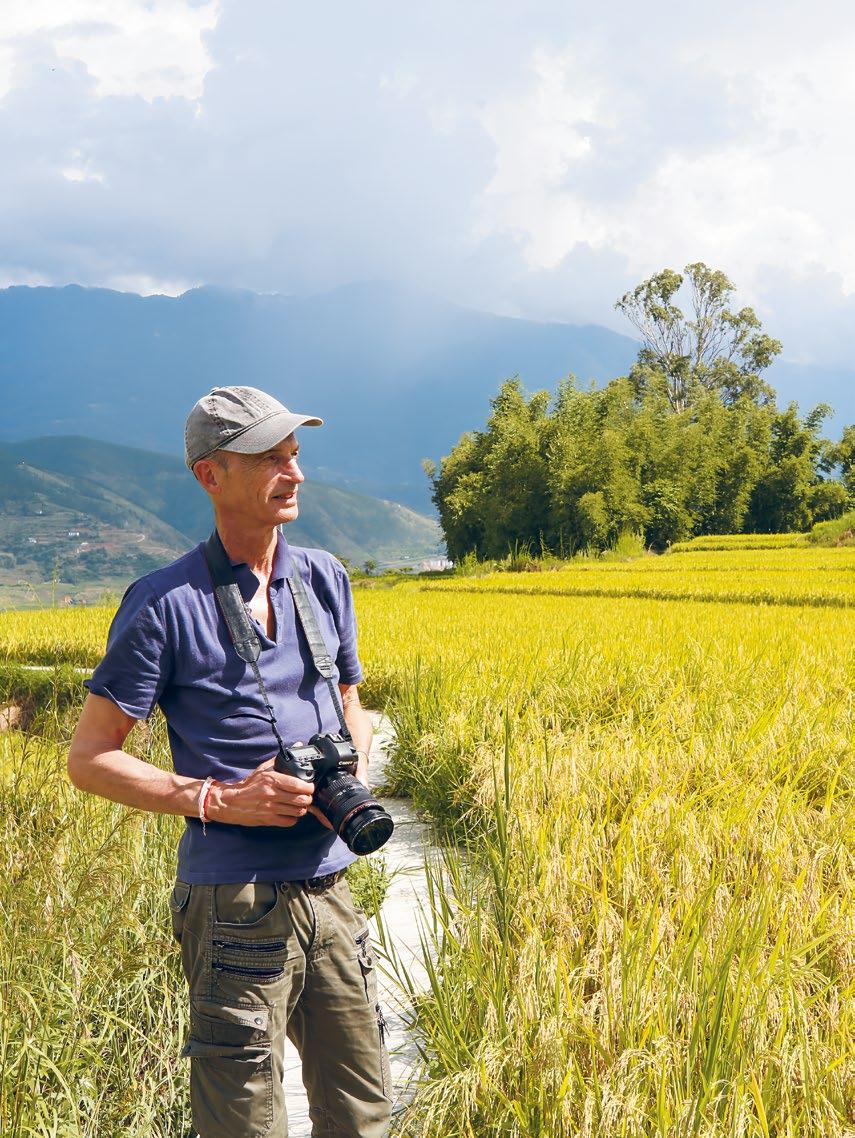
François-Xavier Delmas and Mathias Minet
Palais des Thés founder and Tea Explorer, and Mathias Minet, partner and Vice President.
THE MAGAZINE FROM PALAIS DES THÉS
Issue 97 Winter 2026
François-Xavier Delmas and Mathias Minet
Palais des Thés founder and Tea Explorer, and Mathias Minet, partner and Vice President.
Palais des Thés will soon be celebrating its fortieth anniversary. Over the past four decades, the company has been built alongside farmers, our customers and partners, with everyone who helps bring our vision to life, whether in our warehouses, our stores, at the Tea School or our head office.
When building a business, you inevitably think about the future. Today, we’re beginning to shape the next forty years – and beyond! In imagining what lies ahead, we wanted to reinforce our commitments. That is why we have decided to launch an endowment fund, designed to safeguard the spirit and values of Palais des Thés, to ensure the company remains independent and stays true to its core values and high standards. This initiative helps define the long-term framework for our business and strengthens the founding values that have guided us from the very beginning.
We care deeply about the environment and recognize our responsibility towards the planet. We are passionate about working hand in hand with small producers. We build relationships grounded in trust and goodwill. We strive to share our passion and expertise with as many people as possible. We remain firmly committed to sustainable development.
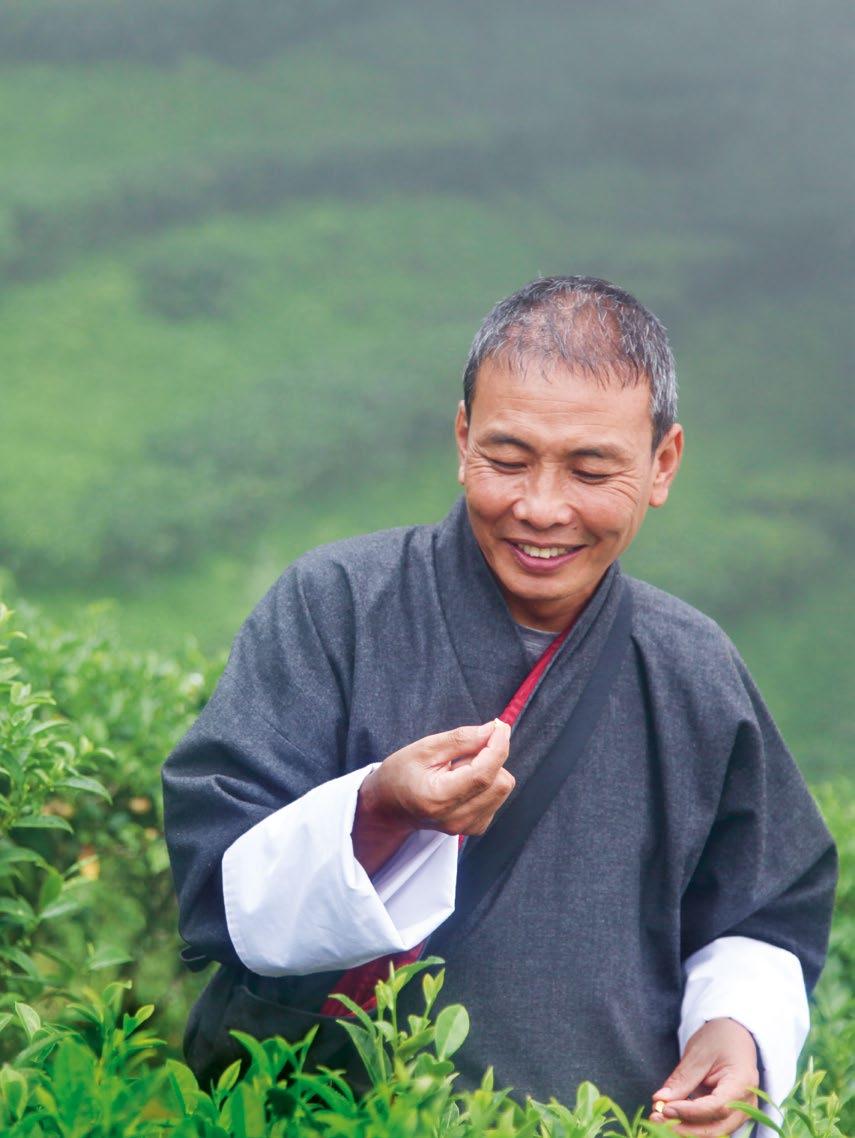
Ugyen, a guide in Bhutan, became a Tea Explorer for the duration of our trip.
We can contribute to a fairer, more compassionate world by reducing our human impact on nature, protecting vulnerable communities and regions around the world, and implementing philanthropic initiatives aligned with our values and convictions.
This is no small undertaking. In our view, it is essential if we are to continue making a meaningful, lasting difference. It is not about making charitable donations simply to ease our conscience or make ourselves feel good. Rather, it is about offering real support to communities in need – whenever possible, communities we know personally. This could be by sending agricultural engineers to help small producers improve the quality of their teas or achieve organic certification; by continuing our support for Karuna-Shechen, the charity organization founded by Matthieu Ricard; and by supporting cultural initiatives through patronage, including institutions such as the Louvre and the French Natural History Museum.
Together, we aim to pursue business growth that remains ethical and inclusive, contributing to a fairer, more compassionate world.

By François-Xavier Delmas
By Elena Di Benedetto
By Evelyne Eybert
CONTRIBUTORS

Evelyne Eybert
Evelyne is Head Trainer at the Tea School and earned her Master Tea Sommelier diploma in 2025. She is passionate about Chinese teas and enjoys practicing the different tea ceremonies.

Elena Di Benedetto Elena obtained her Master Tea Sommelier diploma in 2024 and is an expert in Taiwanese oolong teas. She considers every cup to be a source of discovery, whisking her away to faraway lands.

Bénédicte Bortoli
Bénédicte is an editor and author of numerous illustrated books. She also lends her pen to chefs and artisans, and has a particular interest in the gastronomic approach to tea.
Bhutan is a place that has long stirred the imagination of the Tea Explorer in me. For decades, I dreamed of venturing into the mountains of Druk Yul (“Land of the Thunder Dragon”). For just as long, I longed to uncover a few hidden tea gardens nestled deep within this misty land of legends. And then, one day, the time came to simply up and go.
By François-Xavier Delmas
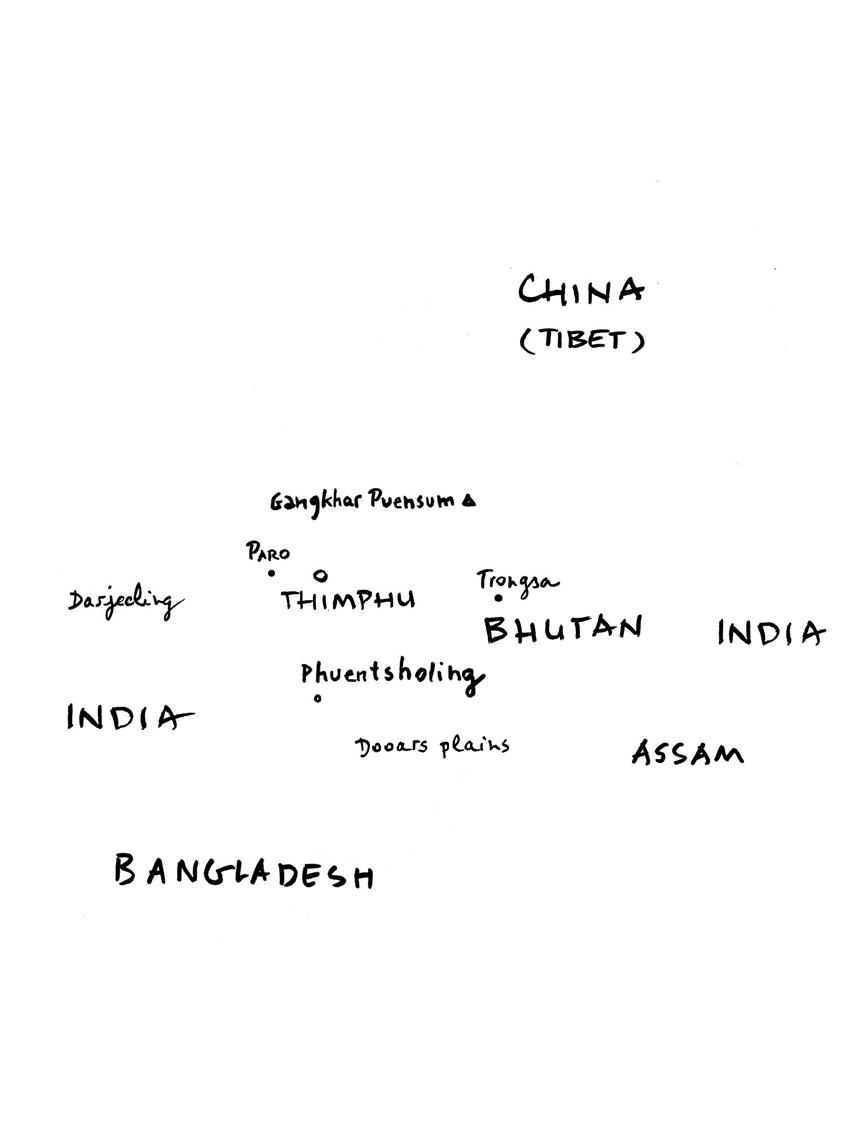
Ihave long dreamed of Bhutan. I have often come close to it. Along its southern border, the Himalayan kingdom stretches beside Assam, India’s largest tea-producing state. To the west, it meets the Dooars floodplains, themselves blanketed with tea gardens. These are two regions I know intimately. A little farther on lies Darjeeling (nicknamed the “Queen of the Hills”), whose prestige radiates across the surrounding slopes. How many times have I stood there, looking from the south, from the west, lost in thought, gazing toward the mountains of the Kingdom of Bhutan, at once mysterious and closed off to the outside world, wondering how I might even begin to search for tea there? It seemed inconceivable that no tea gardens lay hidden along the flanks of one valley or another. Ideas are often cast into the air, only to fall back to earth years later, ripened by a chance encounter, a stroke of luck.
When my Drukair flight landed, Bhutan’s national airline, Ugyen was waiting for me. Paro airport sits at 2,200 meters above sea level, so in Bhutan, you quite literally arrive at altitude. From thereon, the road only climbs, one mountain pass after another. The tea estate which Léo, a fellow Tea Explorer, and I had heard about lies in the very heart of the country. Reaching it would take several days. Detours are part of the journey, and the road itself teaches you about a country, helping you acclimatize. Here, cows are the most common form of traffic. You weave around them, with ravines and rushing mountain streams on either side of the road (it is September, the tail end of the rainy season), alongside steep, forested slopes. Bhutan is roughly the size of Switzerland and home to just under 800,000 people – barely a tenth of the Swiss population – spread across some of the most rugged terrain imaginable. To truly grasp this land, you must understand that nearly two-thirds of the country is blanketed in forests, each more impenetrable than the last, said to be inhabited by fearsome spirits and demons. Who would dare venture into them? Add to this the nationwide ban on hunting in the “Land of the Thunder Dragon,” along with the largely vegetarian habits of much of the population, and it becomes easier to understand how these vast expanses of forest and jungle have remained so untouched, left to formidable wildlife and no less formidable spirits.
Bringing Bhutanese tea to France and the world – now there’s an exciting challenge.
My guide, Ugyen, tells me that Bhutan strictly limits tourist numbers, in order to avoid the overcrowded fate of destinations like Thailand or
“In the land of butter tea, it is easy to forget that tea is made from Camellia sinensis.”
Nepal. He explains that since 1975, only a small number of foreign visitors have been allowed into the country. Independent backpackers must go through an authorized organization, and wild camping is strictly forbidden. Moreover, Bhutan banned the climbing of peaks over 7,000 meters, both out of concern for poor waste management and out of respect for the deities believed to inhabit these summits. Basically, any activity likely to disrupt the natural environment is closely monitored and carefully regulated. Is happiness achieved at this cost? I don’t know. But what I do observe is that this extraordinary kingdom – famous for having replaced gross domestic product with gross national happiness – is sparsely populated, and tourism is deliberately kept to a minimum. Must happiness come from being few? In this remarkable Bhutan, I can’t say whether people are happier than elsewhere, but they are undoubtedly more courteous. It is the only country in the world where, when a road narrows, drivers approaching from opposite directions will each reverse to give way to the other, often insisting that the other go first. Back home, such a scene would feel like a comedy sketch.
When it comes to tea, I was surprised to learn that Camellia sinensis is not grown in Bhutan. Tea thrives just beyond the country’s borders, but not within Bhutan itself (with two exceptions*), and for a very simple reason: if a product comes from elsewhere, why cultivate it locally? The kingdom’s history is deeply tied to that of trade caravans. For centuries, tea made its way into Bhutan on the backs of yaks. Goods from India were traded for those from Tibet: horses for salt, vegetables and fruit for tea, silk for wool, porcelain for spices. Each year, at the end of spring, nomads crossed the highest mountain passes with their yaks laden with all kinds of goods, including bricks of compressed tea. However, this all changed in 1959, when China invaded Tibet. The caravans gradually disappeared and tea had to be sourced in other ways.
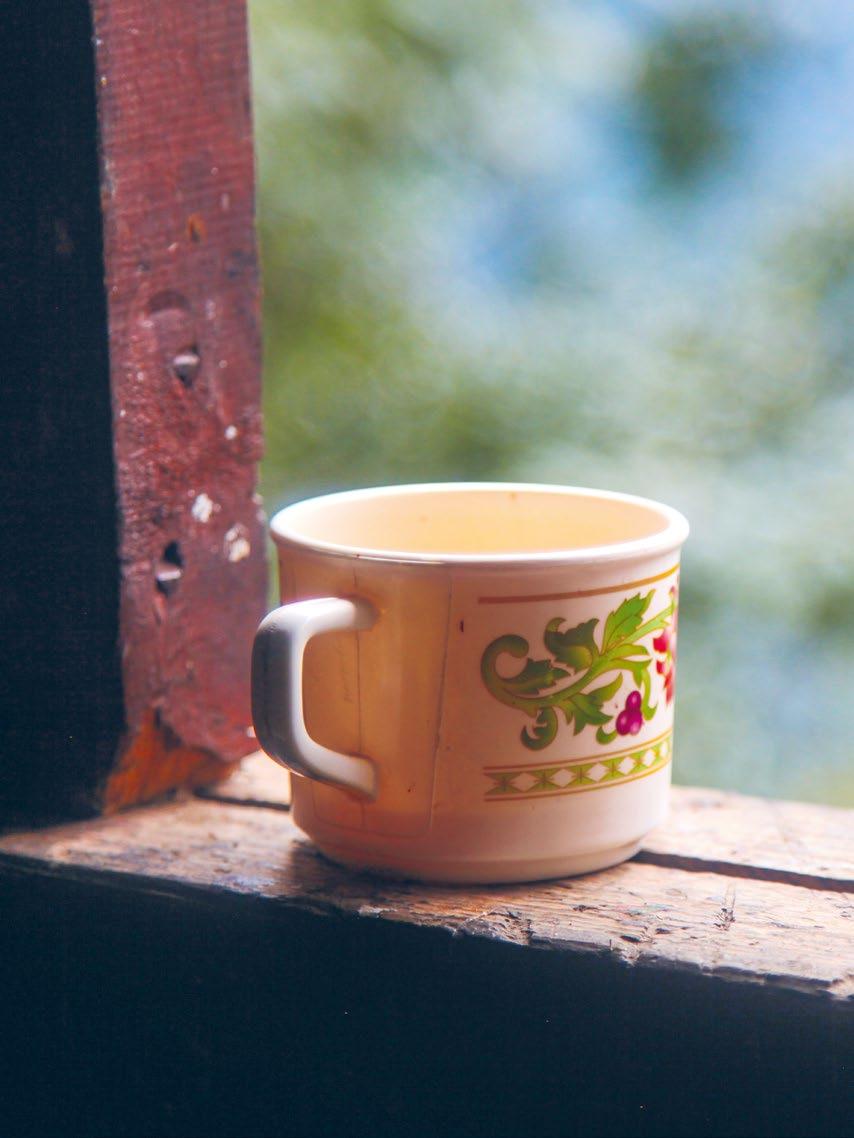
The tea served in Bhutan today is, quite frankly, awful: black tea in a teabag, nothing more than broken leaves sealed in paper. Best avoided. One tea, however, is truly worth seeking out: butter tea. Less commonly offered to visitors but widely enjoyed by locals, it is far more distinctive – and intriguing – than those dreadful industrial blends. In fact, the tea that once arrived by caravan was also prepared with butter, specifically dri butter, made from the milk of the female yak. Salt was also added. These days, when you order butter tea, you’re served a hot, cloudy, salty drink with subtle purplish hues. It is typically served with grains, a handful of which are sprinkled directly into the cup before drinking. The experience is a true culture shock. The recipe comes from far away. It crossed mountain ranges, traveled across high plateaus, plunged into glacial snow, and tumbled down countless slopes before reaching the high valleys of Bhutan. One thing is clear: since the invasion of Tibet, Camellia sinensis leaves have been replaced with other types of foliage. And so I find myself disappointed when, after a long day on the road, I arrive to meet a renowned producer whom Ugyen had
*The two tea estates are located side by side in the Trongsa district (see map opposite).
described as making one of the best teas in the region. After spending the night on the estate and sharing a hearty breakfast – eaten on the floor, as is customary here – I follow my host down a narrow dirt track, a bamboo basket strapped to my back. I search – in vain – for camellia plants. Meanwhile, my host stops in front of a plant I can’t quite identify and begins harvesting huge leaves from various bushes and rowan trees, among others. I watch, dumbfounded. I try to explain that these aren’t tea leaves, but to no avail. She is right to ignore me, because here, the iconic butter tea is made from the leaves of almost any plant. Suddenly, the rather strange purplish liquor staring back at me from the cup makes much more sense.
It will take me many more hours on the road to get a true taste of tea, the real thing. In the meantime, I have plenty of time to share the recipe for butter tea, exactly as I saw it prepared. “Harvest large, mature leaves from rowan trees and other bushes and leave them to dry for twenty-four hours. Meanwhile, place ashes in a bowl or barrel, pour hot water over them, and let the mixture steep for two hours. Strain out the ashes, then boil the dried leaves in the ash-infused water until they turn black and the liquid has evaporated. Dry the leaves in the sun.” All that remains is to make the tea itself. For this, simply boil the leaves again, this time adding salt and bicarbonate of soda, then remove the leaves. Add a knob of dri butter to the pot, blend in a mixer and serve.
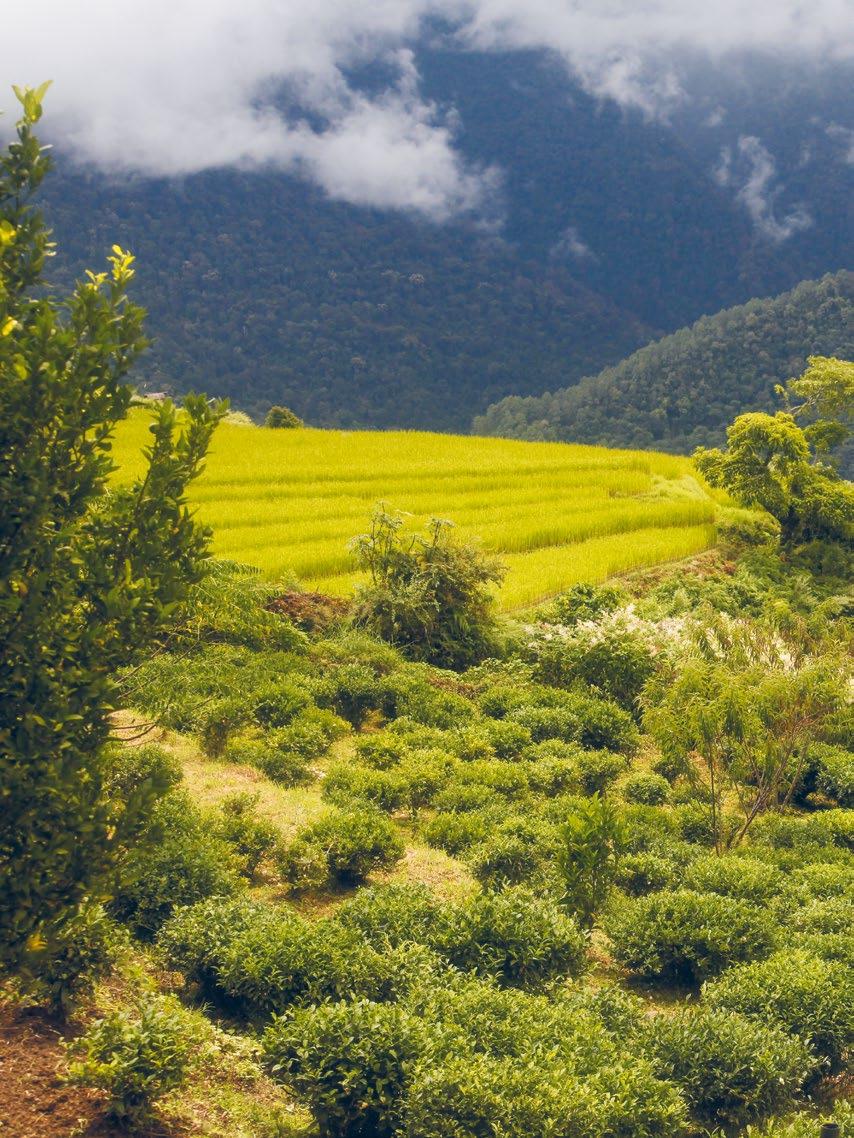
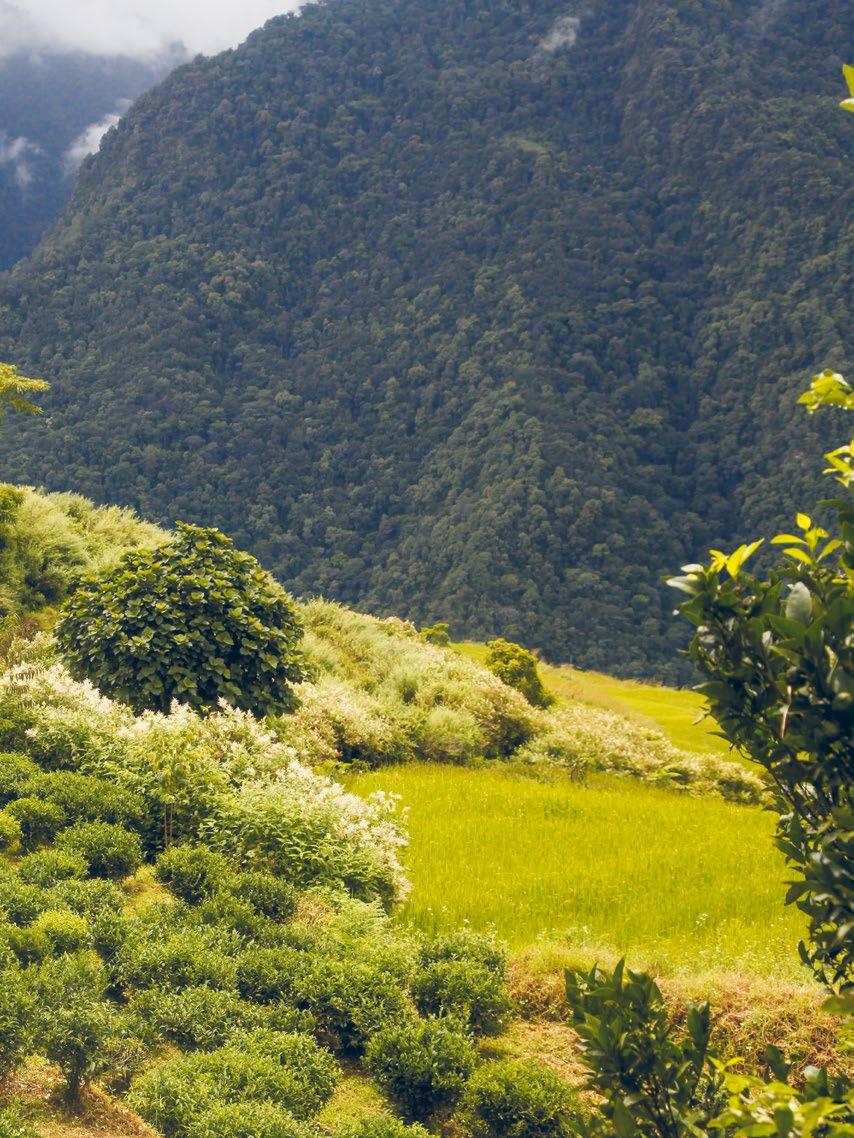
To find Camellia sinensis, or what we more commonly call tea leaves, I must head to the Trongsa dzong (district), to the village of Samcholing, and be prepared to encounter cobras, tiger leeches or even tigers themselves. Here, you’ll find two tea estates: one run by Rinchen and Kinzang, and the other by Dechen. This place feels like the end of the earth. Tea has been grown in Bhutan for less than a century, and in the most discreet way imaginable. However, that began to change in 2008, when a young South Korean agricultural engineer visited Samcholing and taught the forty or so farmers in the local cooperative how to produce green tea. A few years later, another foreign expert came, this time from Thailand, showing the same farmers how to make black tea and partially oxidized teas.
With its pristine natural environment, highly motivated – if still relatively inexperienced – farmers, and young, healthy tea plants, the Samcholing region has everything it needs to produce remarkable teas in the years to come. It is already crafting exceptional teas produced in very limited quantities: total annual production currently amounts to just 2,000 kilograms. Most of it is sold locally, in the capital or to luxury hotels across the country. Palais des Thés is now the leading exporter by volume. Bringing Bhutanese tea to France, helping producers expand their knowledge and encouraging exchanges with growers from other countries such as Nepal –this is an exciting challenge for our teams! While Bhutan itself may remain largely closed to the outside world, a cup of its delicious tea offers an invitation to a spiritual, sensorial and imaginative journey. Simply close your eyes and you may find yourself in Samcholing in the Black Mountains region, or in the sublime wetlands of Phobjikha, scanning the landscape for rare blacknecked cranes as they migrate each year to neighboring Tibet. In Bhutan, biodiversity reigns supreme. •
“Here, tea isn’t made only from camellia leaves!”
If you hike to the Taktsang monastery perched over 3,000 meters high, the monks there will insist on offering you a bowl of butter tea sprinkled with grains.

A codified ritual in Asia, a symbol of refinement and sociability in England, and a source of well-being in the west, tea time is often associated with a slow, considered moment, shared at home or enjoyed in dedicated spaces such as tea houses. And yet, across the world, tea has always been consumed on the move: in cups, thermos flasks or bottles, accompanying drinkers on the road, on public transit, at the office and beyond. The history of tea to go reveals the many faces of this beverage, one that invites contemplation while remaining deeply rooted in everyday life and in our ever-changing lifestyles.
By Bénédicte Bortoli
Until the seventh century, tea – more specifically, green tea – was consumed primarily in its homeland of China for its medicinal properties. The founding text on tea, The Classic of Tea by the Chinese scholar Lu Yu (eighth century), shows that tea was already conceived as something meant to be prepared and enjoyed beyond the domestic or aristocratic sphere. For practical reasons – and long before it spread more widely across Southeast Asia – tea was steamed and compressed to make it easier to trade. During the Song dynasty (960–1279), tea was truly mobile and nomadic: transported in compressed cakes, shared along caravan routes and consumed on the move. It was sold, and therefore drunk, in the street. Street vendors sold infusions outside monasteries and along routes frequented by pilgrims. While monks drank tea for spiritual purposes, helping them stay awake and alert during long meditation sessions, the tea served on the road or in the street was meant to quench thirst and warm travelers during their long journeys.
In Japan, tea was long the reserve of the elite. However, from the fifteenth century it started to appear in working-class street stalls. Unlike traditional tea houses, spaces associated with refinement and codified social rituals, these makeshift outlets and informal ways of drinking tea reflected a more practical, everyday form of consumption. Tea was drunk standing up, from simple bowls or earthenware cups, far removed from the carefully structured rituals of Chinese Gong Fu Cha (“time for tea”) or, in the following century, the Japanese Cha No Yu ceremony (“hot water for tea”), rooted in the contemplation of beauty in the moment.
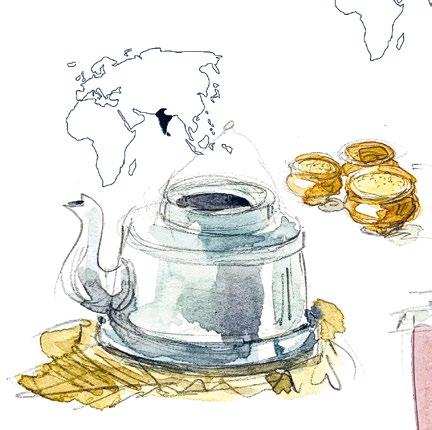
In the nineteenth century, tea production expanded across India on a massive scale with British colonization and the development of the railway network. However, local consumption didn’t truly take off until the early twentieth century. Drawing on long-standing regional traditions of herbal infusions, chai became firmly embedded in postcolonial Indian culture. Armed with a kettle or a pot that simmers all day long, chai wallahs (“tea makers” or “chai vendors”) can be found
Enjoyed on a street corner or by the roadside, hot, milky spiced tea is served in single-use cups.
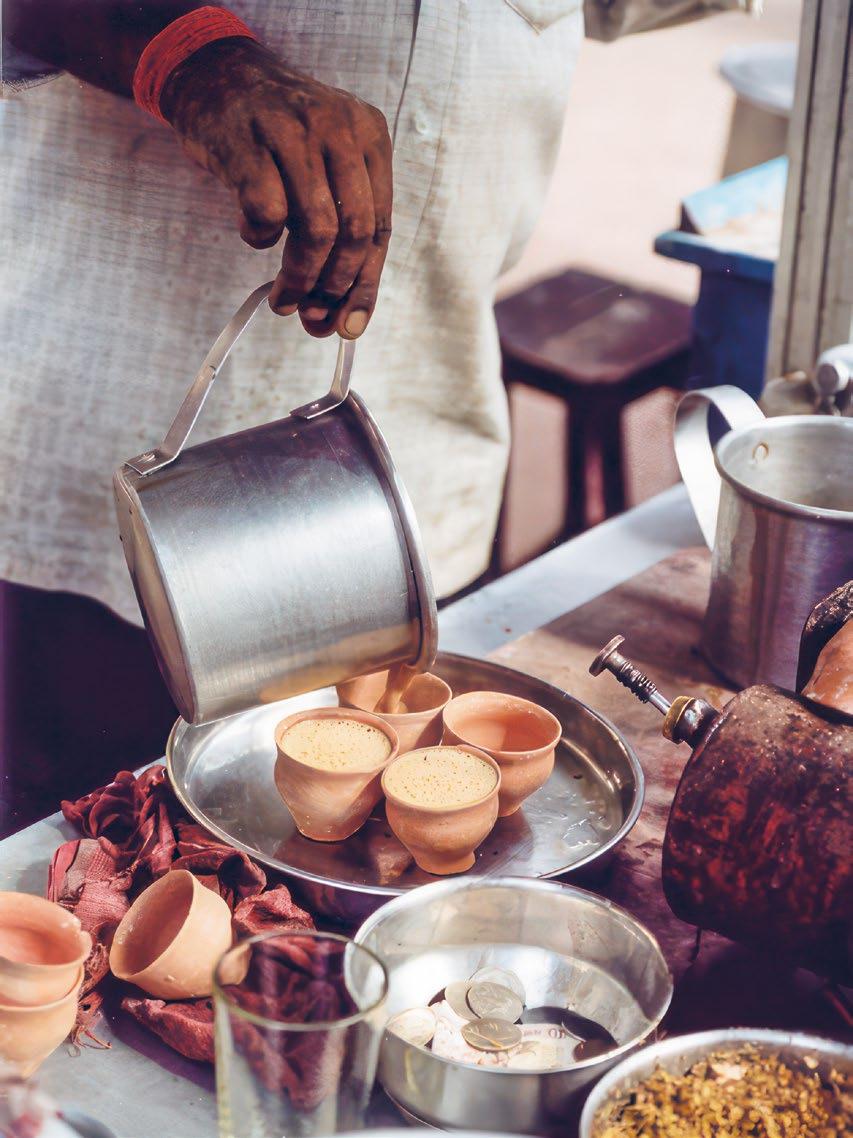
serving throughout the streets, in railway stations, markets and on building sites. Brewed in large pots and served quickly, this spiced milk tea is consumed standing up, as a moment of informal social connection. It is poured into small terracotta cups, ancestors of today’s ubiquitous paper cups, which are traditionally smashed on the ground once finished. Here, all the codes of tea as a sacred ritual go right out the window!
Around the same time in Russia, manufacturers began producing “travel” samovars, fitted with removable legs and handles and designed for easy transport, making it possible to enjoy tea in public, whether on the street or aboard a train.
Tea has long been associated with slowing down, from infusion and ritual to the careful selection of utensils. Time is consciously set aside for both preparation and tasting. The history of tea on the go is also closely tied to the evolution of objects and containers. For centuries, tea was confined to enclosed, protected spaces, shaped by the creation of specialized, often precious and sometimes fragile teaware, along with highly codified preparation methods. With industrialization and the growing mobility of populations, tea gradually moved beyond the domestic sphere.
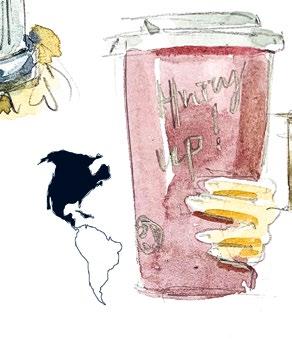
The trend for drinking hot beverages on the go first emerged in the United States with the rise of coffee-to-go culture, made possible by the invention of the disposable cup in 1912. The practice only became widespread in the 1960s, alongside the growth of fast-food culture, particularly in New York. Containers evolved accordingly, embodying the shift from tea meant to be shared to tea enjoyed individually, from ritual to time-efficiency. Each innovation reflects a faster-paced, more mobile and increasingly individualistic way of life. This form of consumption arrived much later in France, primarily in big cities, and has only begun to shape the tea world in recent years.
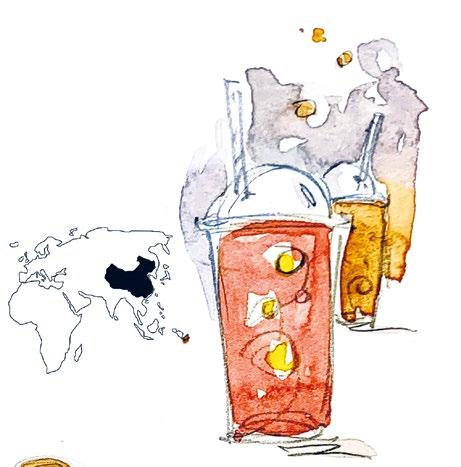
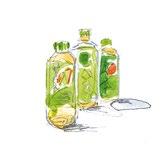
Containers reflect usage: disposable cups, stainless steel bottles, stylish thermos flasks and sealed plastic cups with oversized straws (particularly for bubble tea) have all become standard in the world of tea to go. The Taiwanese technique of heat-sealing plastic cups with a thin film perfectly illustrates how technology has adapted to on-the-go consumption. But these drinks are not always truly tea anymore. While the base is often Camellia sinensis or an herbal infusion, take-away options frequently combine low-quality teas with milk, syrups, flavorings, tapioca pearls, cream and excessive amounts of sugar. In the process, there is sometimes a shift away from the traditional sensorial tasting experience, towards a logic
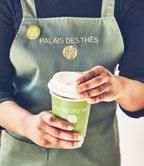
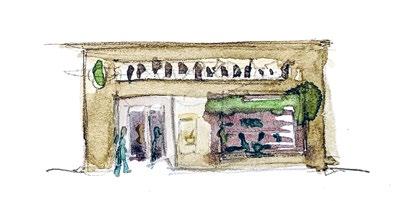
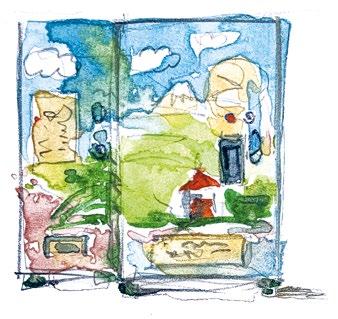
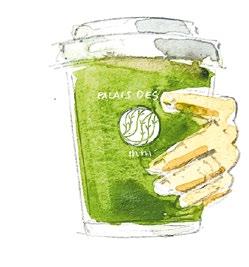
Select Palais des Thés stores in France and Switzerland now offer a refined and original experience for tea lovers who wish to enjoy high-quality teas on the go. Visible from the street, these take-away tea counters invite passersby to step into the world of tea. Alongside matcha lattes, iced teas and chai lattes, all loose leaf teas and herbal infusions available in store can be freshly prepared to order, guided by expert Tea Sommeliers and designed to be enjoyed on the go.
An exceptional tea within everyone’s reach: this is the promise Palais des Thés makes in bringing the finest teas to as many people as possible.

of functionality (hydration, nourishment, energy) and instant gratification, driven by customization and highly Instagrammable visuals.
This shift in format and container design has transformed our relationship with tea. Tea to go no longer invites drinkers to slow down and contemplate: it prioritizes practicality. People drink it while walking, working or commuting. Flavor drifts away from ritual, yet the gesture itself remains a pause in the frenzy of everyday life. By stripping tea of its sacred aura, this evolution has helped democratize the beverage, making it accessible to new drinkers and firmly anchoring it in modern urban culture.
The takeaway tea market is difficult to quantify, as it encompasses a wide range of formats: tea prepared to go (in coffee shops, for example); tea and tea-based beverages sold in cans or bottles in supermarkets; tea sold in train stations, and more. In the early 2000s, the Starbuckization of tea took hold. International chains began turning tea into a mass-market product modeled on coffee, featuring bold flavors, sweetened recipes and seasonal offerings. Tea became something to personalize, almost a fashion accessory as much as a beverage. Yet at the same time, another trend began to emerge: premiumization. A brand like Palais des Thés now offers exceptional teas to enjoy on the go (see pages 16 and 19), while remaining deeply committed to preserving tea quality, aromatic complexity and optimal tasting conditions. This approach seeks to reconcile mobility with high standards, modern life with tradition: offering the experience of a Grand Cru tea without sacrificing freedom of movement.
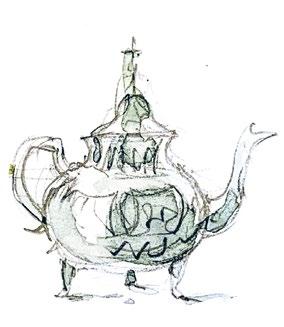
The second most widely consumed beverage in the world after water, tea constantly adapts to our habits and lifestyles. Its takeaway iteration captures the spirit of our time: a continual tension between the urge to go fast and the desire to preserve quality time. There are countless ways to prepare and enjoy tea. Certain ceremonies and rituals (Chinese, Tibetan, Japanese, Moroccan, Russian, English and others) require patience and practice. Yet portability may simply represent a new kind of ritual: a ceremony of modern life, in which each sip reminds us that even in motion, the moment can still be savored. Practical and easy to carry, tea enjoyed on the go can still be a tea of quality. Whether sipped “by a clear pebble fountain,” as in Huangfu Zeng’s poem about Lu Yu, or on a train, in a crowded street or in the comfort of your own home, this moment remains, above all, a promise of pause, a fleeting yet genuine way to slow down without stopping, guided by the simple intention of taking care of ourselves. •
From the streets outside monasteries to modern coffee shop counters and train station kiosks, tea has continually reinvented itself to keep pace with our ever-changing world. Here and elsewhere, in ancient times as well as today, teas of all kinds and qualities are enjoyed in vessels shaped by local cultures and customs. And let’s not forget that for a quarter of the world’s population, tea remains the simplest of drinks – comforting, flavorful and deeply familiar.

The keys to high-quality takeaway tea at Palais des Thés
Loose leaf tea infusion → All of Palais des Thés teas are available to go, including Grands Crus teas.
Made to order, on the spot → Expertly prepared (correct water temperature, brewing time, precise dosing), fast and efficient service.
Personalized service from Tea Sommeliers → Provide help in choosing the tea to go and a reminder of the optimal infusion guide.
The right container → A double-walled, vacuum-insulated cup with a leak-proof lid.
This service is available at Lille-Flandres, Paris Montparnasse and Zurich train stations, as well as in Troyes (McArthurGlen outlet).
First takeawayhigh-quality teas in France

Tea tasting deserves our full attention. It should no longer be seen merely as a ritual or a habit, but recognized as a gastronomic beverage in its own right, one whose richness calls for time, focus and the engagement of all the senses. Such an approach calls for a shared language, allowing the experience to be explored, expressed and enjoyed together.
By Elena Di Benedetto
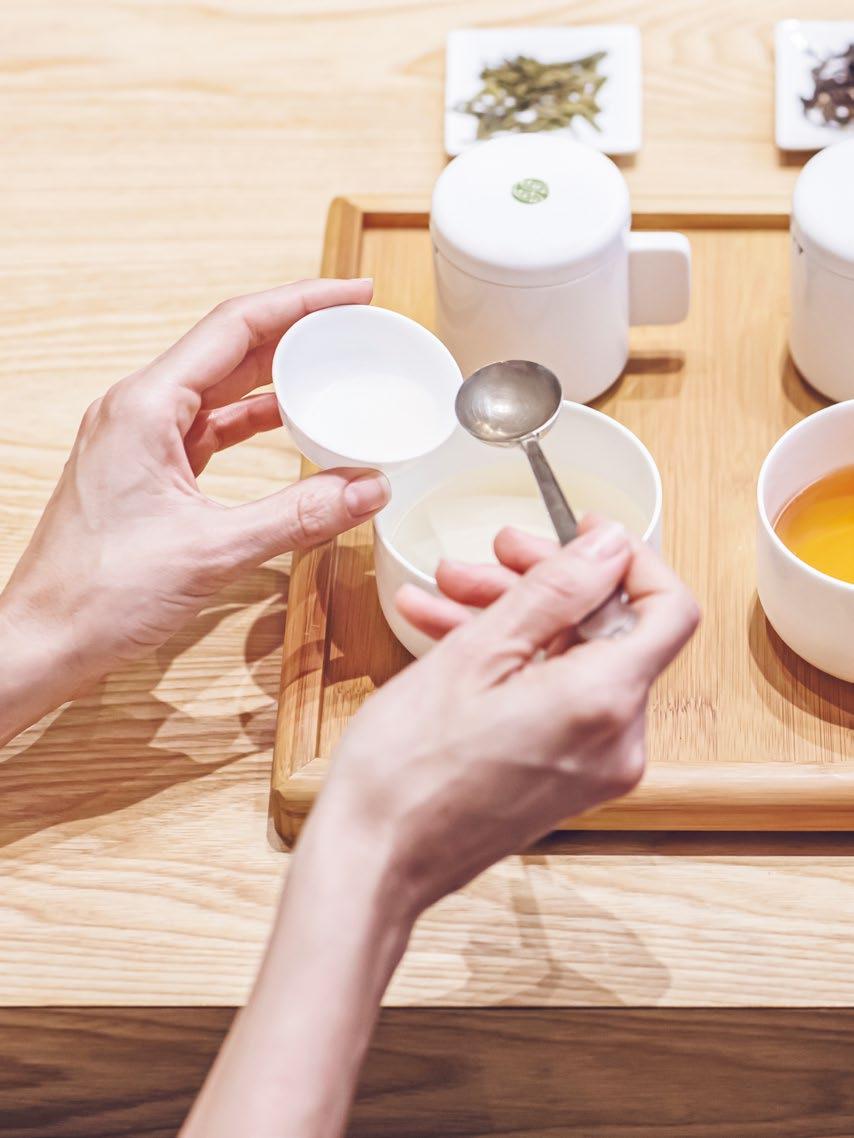
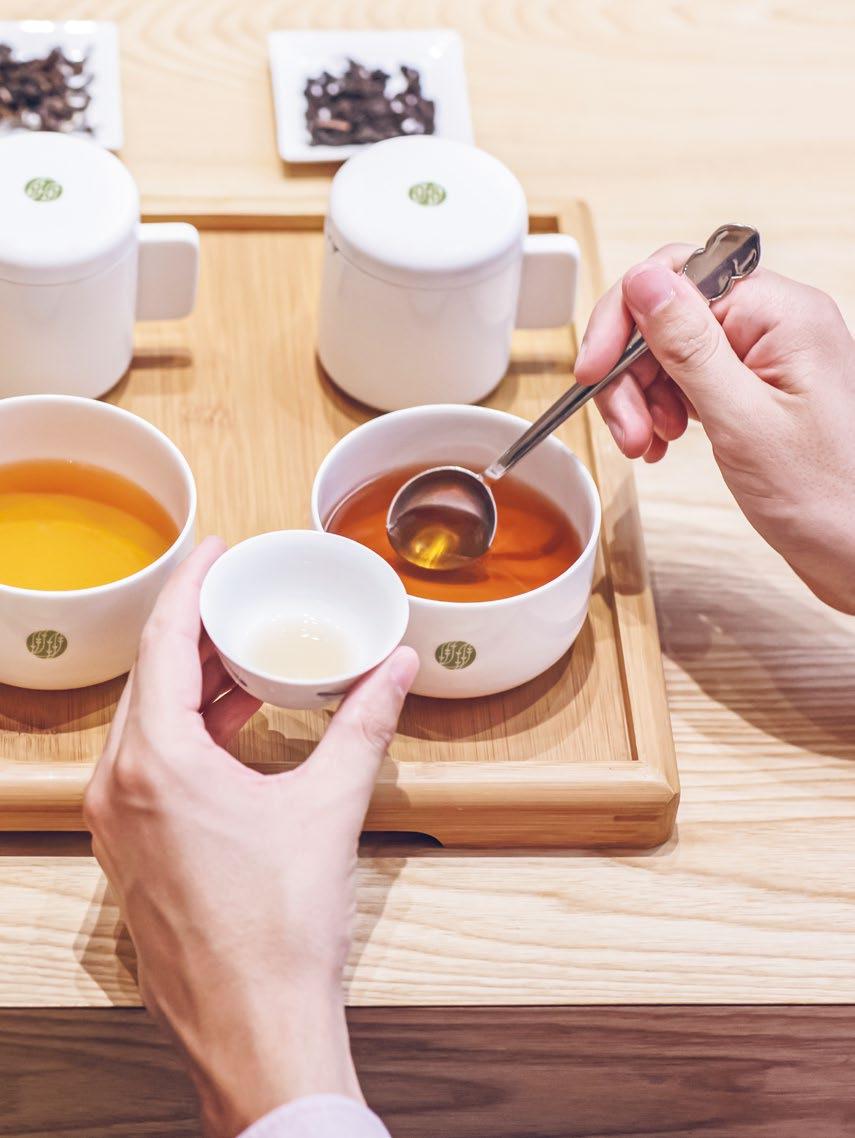
At the Tea School, tea sets are often used to prepare all types of teas and to compare them more easily.
For a long time in the east, tea was both a daily habit and an everyday drink, while in the west (particularly in France and England), it was primarily a social convention. Today, tea is enjoyed all over the world, but learning how to truly taste it is an entirely different exercise. Whether tea is sampled to assess its quality or savored purely for pleasure, appreciation always reflects a relationship to flavor and terroir. As with wine, a precise grammar and vocabulary have developed around tea, especially in France, where a strong wine culture has shaped the language of tasting.
This distinctly gastronomic approach may well be a French particularity. Tasting, after all, implies putting words to the pleasures of the table – and this varies widely from one culture to another. In many parts of the world, inward experience takes precedence over verbal expression; commenting on what someone eats or drinks can feel unnatural, or even improper. As the English saying goes, “Discuss everything but what is on your plate.” In France, however, talking about food at the table is deeply ingrained. It is an integral part of the pleasure of eating and a source of national pride. The same is true for drinks – wines and spirits first, and now tea too.
This fondness for description and analysis has gradually given rise to a multisensory approach to tea tasting, inspired by oenology and quickly adopted across the western world. Vegetal freshness, roundness and length on the palate are all terms that have been borrowed directly from the world of wine, and are now commonly used to describe tea.
At the Tea School, we have turned this approach into a method. Students learn a rigorous process based on observation, aroma, tasting and interpretation. This analytical and educational practice has evolved over the years, giving rise to a shared language among tea enthusiasts, enabling them to express a tea’s distinctive character through sensory imagery, whether in a restaurant or on the shop floor. After all, language is the only tool we have to describe and share the impressions we perceive.
This method follows a descriptive, sensory approach structured around three key stages (textures, flavors and aromatic notes), allowing tasters to articulate precisely the sensations experienced in a cup of tea.
— Textures: Texture refers to the tactile sensations perceived on the lips, cheeks, palate and tongue. Every tea offers a different textural experience, largely due to the presence of tannins. These range from the astringency that creates a drying sensation in the mouth, characteristic of first flush Darjeeling teas or Assam black teas, for example, to the almost creamy roundness of certain Japanese gyokuro. Tea offers an exceptionally broad spectrum of textures!
— Flavors: Sweet, salty, sour and bitter are the four original tastes, to which umami (identified in 1908 and popularized in the late twentieth century) was later added. Among these, saltiness is the only flavor not naturally found in tea leaves.
— Notes: While we don’t necessarily rely on an aroma wheel, as is sometimes done in oenology, the approach is very similar. It centers on retronasal smell: when drinking tea, aromatic compounds travel up through the nasal
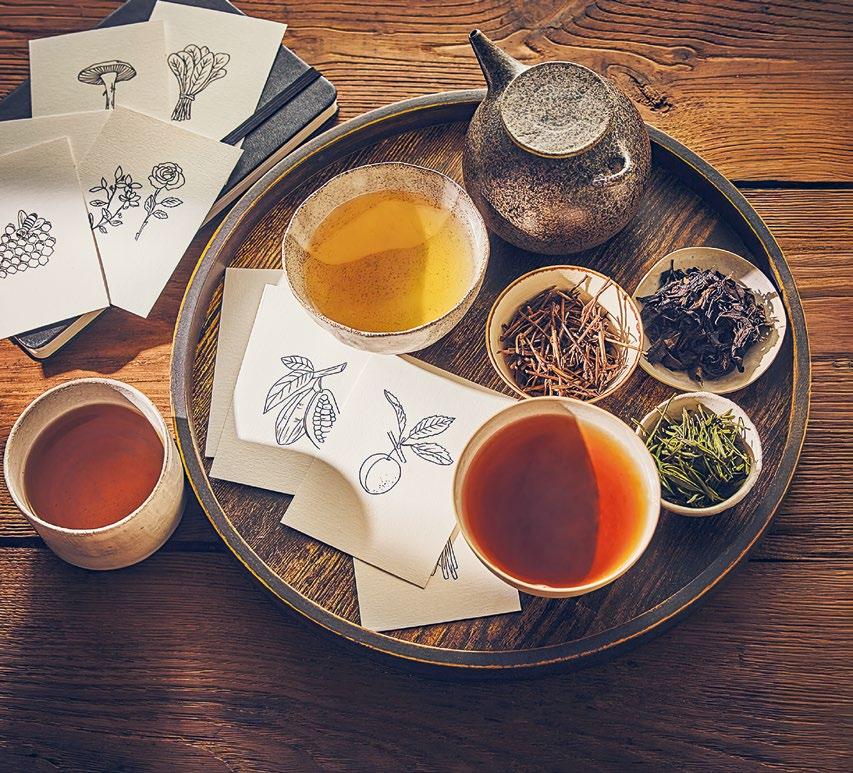
passages, activating the full sensory systems of taste and, above all, smell. This process allows us to identify different aromatic families – floral, vegetal, marine, woody, animal and more. These virtually limitless sensory worlds draw on each individual’s personal sensory memory.
Despite being unflavored, plain teas – particularly Grands Crus teas – offer an incredibly rich aromatic profile, spanning fruity, floral, woody and honeyed notes.
Underlying this method is a clear guiding principle: the ability to express the emotion a tea evokes in a way that can be understood by others. Tea tasting is not merely a technical exercise. It also engages the taster’s sensitivity and intuition, deeply personal elements that are often difficult to convey.
The TFN method is deliberately open, allowing drinkers to appreciate all teas, regardless of color, origin or aromatic profile. This distinctly French
(and more broadly western) approach to tea also reflects a desire for universality. Since the invention of the tasting set in the nineteenth century, the tea world has sought to standardize tasting conditions: the same quantity of leaves, the same volume of water.
This intention was initially driven by trade. Comparing teas for purchase, particularly as the market began to globalize, required a shared framework. This process of standardization ultimately led to the creation of an international standard! This western approach to tasting goes hand in hand with a broader culture of taste rooted in classification and typology.

The next time you drink a cup of tea, try structuring your analysis around these three key parameters: Is the texture more astringent or oily? Does the flavor lean towards gentle sweetness or is there a more pronounced bitterness? And do the aromatic notes evoke forests, the sea, vegetables or pastries?

Founded by Palais des Thés, the Tea School has been training both enthusiasts and professionals in the art of tea tasting since 1999. It offers a chance to discover the distinctive approach of our Master Tea Sommelier instructors, who combine technical expertise with sensitivity and intuition. To find out more or book a course, visit the Tea School website.
It is a Cartesian, almost scientific process, aimed at breaking down the complexity of tea in order to better understand it and, ultimately, share that understanding with others.
That said, this analytical approach is far from being universal. Elsewhere in the world, tea tasting is approached very differently.
— In Japan, the Cha No Yu tea ceremony celebrates subtlety and simplicity. Tasting is a spiritual act, centered on harmony and restraint. The experience can sometimes appear almost austere, unfolding slowly and often in silence. While matcha is the central element, it would be nothing without the ceremony that surrounds it. The aim is to highlight the matcha’s umami – a term which means “delicious taste.” The same holds true for most shade-grown Japanese teas: during tasting, the intensity of umami is prized more highly than aromatic complexity.
— In China, tea tasting is a long, social experience known as Gong Fu Cha (“taking time for tea”). Tea leaves are infused several times in a gaiwan or small teapot, with each infusion revealing new nuances. A tea’s quality is therefore judged by its ability to endure, evolve and continue to surprise over multiple infusions. This method is well suited to all tea colors, and especially to oolong teas rolled into small balls, which offer a particularly nuanced and long-lasting aromatic expression.
— In India, the relationship with tea is entirely different. Initially produced for export to Great Britain, tea was later embraced locally and became an everyday drink. It is typically strong and full-bodied, often blended with milk, spices or citrus. Here, adding ingredients to tea is neither a “failure of tasting” nor a heresy, but simply another way of defining quality: a good tea must be robust enough to stand up to the richness of spices, milk or lemon, and remain present despite the density of the blend.
These differing approaches and practices illustrate just how deeply cultural our perception of taste truly is (see “What makes a quality tea?”, Bruits de Palais, no. 94). What is considered “good” in Tokyo may not necessarily be the same in Darjeeling or in Paris. There are perhaps just as many ways to taste tea as there are tea drinkers. And while great tea traditions have emerged all over the world, they all share a common goal: to appreciate tea and elevate it to the status of a noble, complex and universal beverage. •
Each ISO standard is defined by the International Organization for Standardization and may apply to products as well as services. In the case of tea, ISO standard 3103 was originally developed by the British in the 1980s and officially adopted in 2019. Although it is often presented as a tasting method, it is more accurately understood as a set of standardized brewing guidelines designed to facilitate comparison. Recommendations include using two grams of tea per tasting set and freshly boiled filtered water. While the standard can be useful in certain commercial contexts, it should not be mistaken for a code of proper tea etiquette.
The first sip of a Gao Shan Cha, a Taiwanese high mountain tea, transports you straight into the misty mountain heights blanketed in bamboo forests. Its crystal-clear liquor evokes springs cascading down steep slopes, while its indulgent notes urge you to indulge in the sweet pastries traditionally served alongside it. By Evelyne Eybert

Evelyne Eybert
Head Trainer at the Tea School, Evelyne earned her Master Tea Sommelier diploma in 2025. After studying art history, she joined Palais des Thés, where she enjoys exploring tea tasting and rituals through their cultural, aesthetic and poetic dimensions.
Located in Nantou county in central Taiwan, Shan Lin Xi mountain rises to an altitude of 1,200 meters. This breathtaking environment exposes tea plants to the elements – wind, mist and temperature fluctuations – which slow their growth and force them to adapt in order to survive. This natural selection intensifies and refines the tea’s aromatic profile.
The distinctive character of this Gao Shan Cha is the result of a subtle synergy between terroir, the cultivar used (in this case, qing xin) and, above all, the artisan’s expertise. After withering, the leaves are gently and slowly tumbled, lightly bruising them as they brush against the walls of a rotating drum or basket. The enzyme responsible for oxidation begins to develop, and fruity, floral aromas gradually fill the entire factory. The tea maker’s skill lies in sensing the slightest shift in these aromas, allowing them to determine when to halt the oxidation process. This Gao Shan Cha sits on the lighter end of the oxidation spectrum. The leaves are then repeatedly heated and rolled, forming tightly compacted balls known as “dragonfly heads.”
This exceptional tea calls for a tasting method that truly honors the craftsmanship of the artisans who created it. Through successive infusions, the Gong Fu Cha method allows the tea to gradually reveal the full range of its character. To elevate the experience further, I have chosen the Taiwanese variation of the ritual, a distinctive interpretation that blends Chinese tradition with Japanese influences.
1.
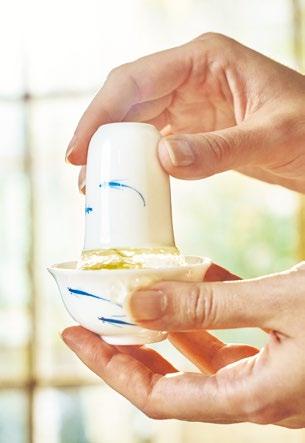
Their encounter shaped the island’s turbulent history, as Japan annexed Taiwan from the late nineteenth century until 1945. Yet this cultural exchange nevertheless gave rise to beautifully refined utensils, including the aroma cup. This vessel places particular emphasis on the sense of smell when tasting partially oxidized teas.
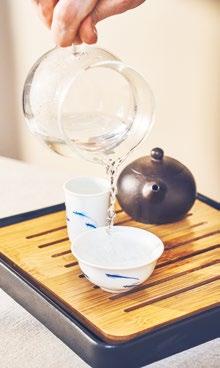
I begin by preheating the teaware, pouring in almost boiling water [1]. I have chosen a small Yixing clay teapot, renowned for enhancing oolong teas. I fill it a quarter of the way up with tea leaves, leaving plenty of room for them to unfurl
and release their full aromatic potential. As the tightly rolled balls tumble against the warm interior of the teapot, the first notes of toast and jammy fruits are released.
away to the high mountains
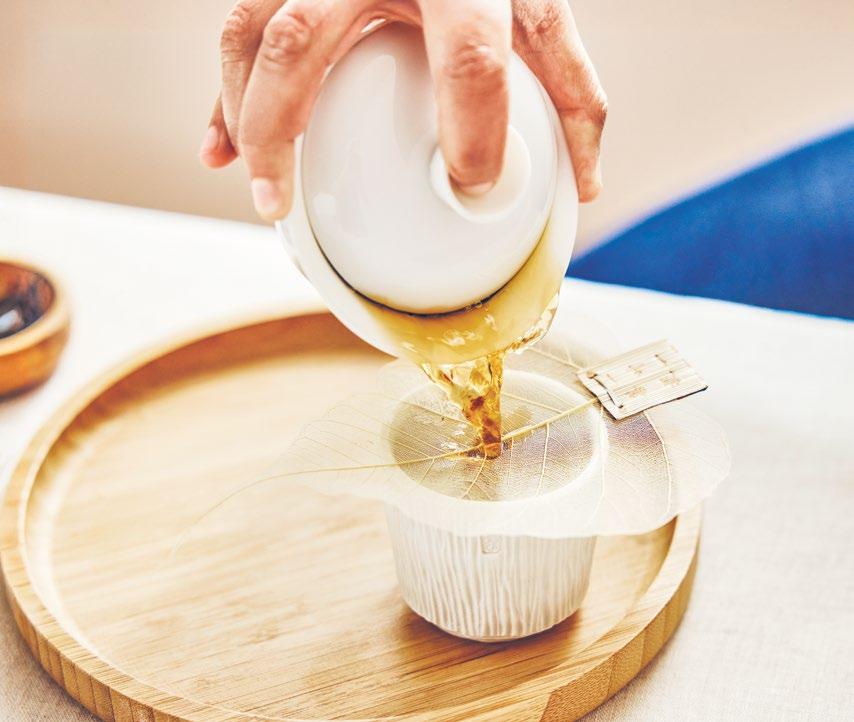
I give the leaves a quick rinse to awaken their aromas, then begin the first infusion, which lasts around thirty seconds. I pour the pale, golden liquor into the fairness pot, then into the tall, narrow aroma cup [2] . After decanting the tea into the tasting cup, I gently roll the hot cup between my fingertips, careful not to burn myself. From the porcelain rise softly spiced, biscuity aromas. The first sip reveals a smooth, creamy liquor filled with initial buttery notes of vanilla and brown sugar, with a vegetal base that acts as a counterpoint, bringing balance and freshness. This prelude makes me want
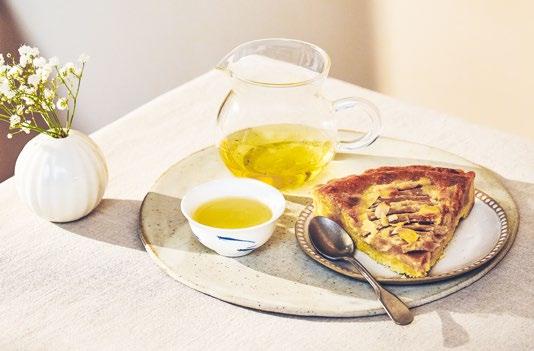
to pair the tea with dessert [3] , such as an almond cake or a frangipane tart. Each successive infusion tells a different story. Delicate white floral notes appear, followed by fruitier accents of apricot and coconut water. In the later infusions, the profile turns increasingly fresh, vegetal and mineral, as if guiding me back to the rocky high mountains where this Gao Shan Cha is grown. •
Gao Shan Cha
ORIGIN Taiwan
BREWING GUIDE
→ Several successive infusions according to Gong Fu Cha method
FOOD PAIRINGS
Almond cake or frangipane tart
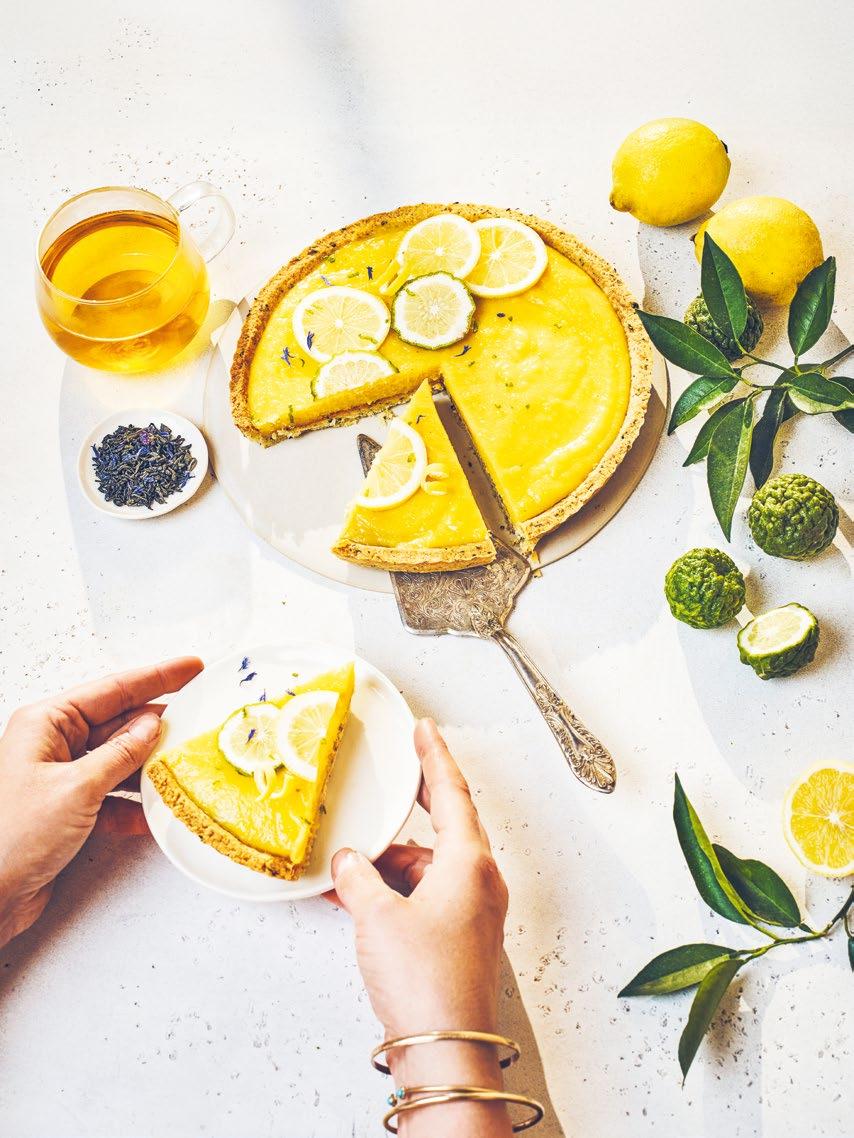
Fragrant and citrusy, the ever-popular Earl Grey pairs effortlessly with both sweet and savory recipes.
Green of London is a delicate Chinese green tea infused with fresh bergamot notes, which heightens the brightness of this pastry classic, adding an unexpected depth and a long-lasting zesty zing.
Serves eight
For the pastry
10 g organic Green of London tea
150 g roomtemperature butter
250 g flour
20 g icing sugar
40 g brown sugar
35 g ground almonds
1 egg
2 tsp honey
For the filling
2 organic bergamots
4 organic unwaxed lemons
150 g butter
10 g organic Green of London tea
4 eggs
200 g sugar
2 g agar agar
Top tip
If you have any leftover pastry dough, simply gather the scraps, roll them out and use cookie cutters to make quick shortbread cookies.
Make the pastry
1. Grind the Green of London tea leaves to a powder, using a pestle and mortar or mixer.
2. Mix the powdered tea with the remaining pastry ingredients to form a dough.
3. Roll out the pastry then transfer to a tart tin, pressing the pastry into the sides. Lightly prick the base with a fork, then chill in the fridge for an hour.
4. Preheat the oven to 160°C
5. Bake the tart shell for twenty-five minutes, until the edges are golden.
Make the filling
1. Take a pan and add the zest of one bergamot and two lemons. Then add the juice of all the bergamots and lemons.
2. Bring the fruit juice and zest to the boil, adding the butter and Green of London tea leaves.
3. Remove from the heat and leave to infuse for fifteen minutes.
4. Mix the eggs, sugar and agar agar together in a bowl.
5. Strain the juice and gradually incorporate into the egg mixture, whisking all the time.
6. Return to a medium heat until thickened to the consistency of a crème pâtissière.
7. Mix using a hand mixer.
Assembly
1. Pour the lemon and bergamot mixture into the pre-cooked tart shell.
2. Leave to set in the fridge for two hours.
A quintessential fixture of five o’clock tea, Earl Grey is the most iconic beverage of British culture and the best-known of all flavored teas. Each cup is the perfect balance of a vibrant aromatic essence and carefully chosen tea leaves. But where does this classic blend, traditionally made with Chinese black tea flavored with bergamot, originate?
The tea world has a way of letting its legends steep – and the story of Earl Grey’s origins is no exception.
According to the most exotic version of the story, during a diplomatic mission to China, a mandarin is said to have gifted Earl Grey with a tea scented with bergamot, either as a gesture of gratitude to the earl or one of his men for saving his son from drowning. Upon returning to England, Charles Grey reportedly asked that this “recipe” be recreated. Yet no historical record confirms that he ever traveled to China, and bergamots (a citrus fruit long cultivated in Calabria) didn’t grow there in any case. A more historically grounded version traces the origin of this tea to the end of the British East India Company’s trade monopoly. In recognition of this act of trade liberalization, the same Earl Grey (who was then serving as British prime minister) was said to have received a shipment of Chinese teas. However, he found them too bitter to his taste, due to the water quality at his estate, Howick Hall, in Northumberland. And so a London-based tea merchant
(often identified as Twinings or Jacksons of Piccadilly) was said to have suggested adding bergamot oil to balance out the taste. Charles Grey’s wife, Lady Grey, then served the flavored tea at receptions in London, which proved to be hugely popular. From these two legends, countless variations have emerged –some more fanciful than others.
The earliest mention of tea flavored with bergamot actually dates back to 1824, with no reference to Charles Grey whatsoever. At the time, this citrus, and more specifically its essential oil (the form closest to the fresh fruit) was valued solely for its powerful aroma, capable of masking the taste of inferior teas. In 1937, a court case even exposed the fraud of a London firm selling an overpriced bergamot-flavored tea falsely advertised as “superior.” Ironically, this very tea went on to become a symbol of refinement. In this sense, the spread of legends surrounding the origins of Earl Grey is above all the story of a commercial invention, one that blends aristocratic prestige with an imagined Chinese origin, steeped in exotic allure. And with
By Bénédicte Bortoli
no registered trademark, this made it incredibly easy to use the name “Earl Grey.”
Long before tea drinkers in London were adding a few drops of bergamot to their cups, its essential oil was typically used to make eau de Cologne. At the beginning of the eighteenth century, perfume maker Farina revolutionized the perfume world by creating a vibrantly fresh eau de toilette with top notes that were lighter than those then in fashion. At the same time, bergamot cultivation in Calabria became industrialized to meet the increased demand of essential oils. This paved the way for food flavorings. In the following century, stabilization techniques developed and distilleries that supplied Grasse and London now offered tea houses more increasingly sophisticated essences, like citrus fruits, jasmine, rose, lavender, vanilla and orange blossom.
Tea has long been blended with other ingredients, like flowers in China or spices in India. But
when perfumers and flavorists began to develop their craft, tea dared to take on entirely new aromas. Camellia sinensis has an exceptional ability to retain fragrance, making it an ideal base for expressive, often fruity notes that were once very difficult to capture.
These days, creating an Earl Grey leaves ample room for imagination and creativity, engaging the senses, memories and a certain poetic elegance. To bring these connections to life, Palais des Thés has chosen to work with high-quality raw materials (single estate teas and carefully sourced bergamots). Traditionally made with black tea, the world of Earl Grey
has since expanded to include green teas and even rooibos, in a constant search for balance between the tea leaf and the essence of the fruit.
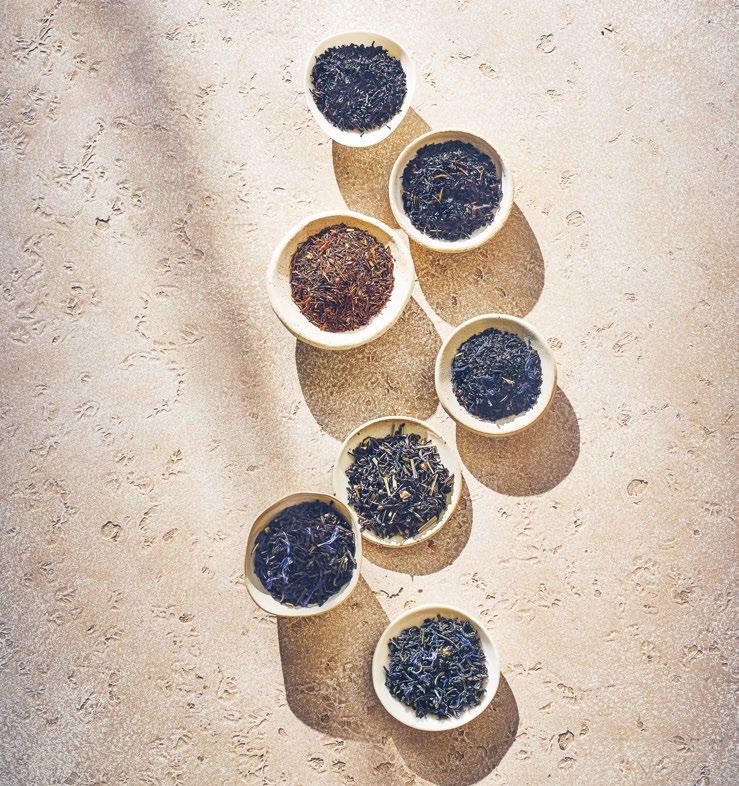
Bridging the worlds of perfume and tea, bergamot offers a distinctive aromatic signature and can become the central element of a scented blend. Palais des Thés has embraced this rich sensory landscape by creating seven unique variations of Earl Grey (see page 38). •
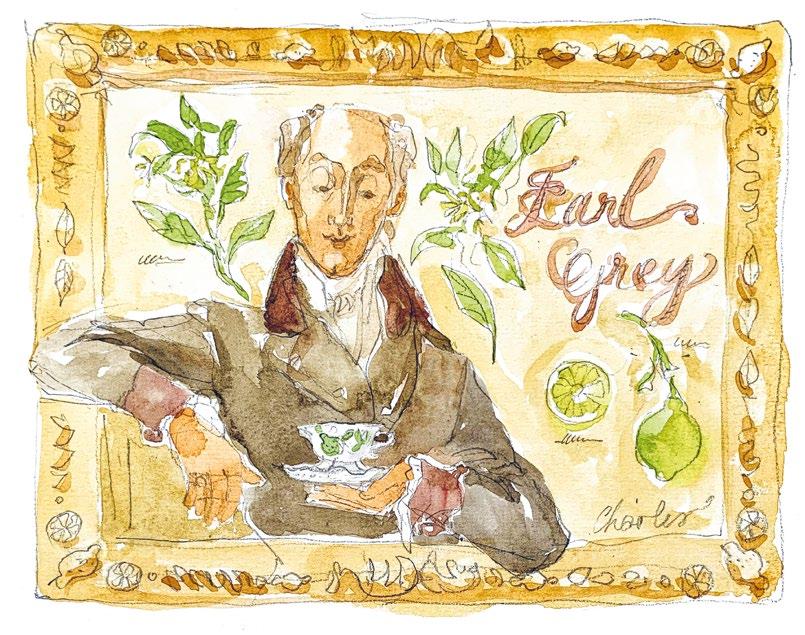
Charles Grey, second Earl Grey (1764-1845), a reformist statesman, could hardly have imagined that his name would become associated with one of the most iconic teas in history, a lasting symbol of elegance and British taste.
To learn more about the history of Earl Grey, listen to season three, episode one of Un thé, un voyage, the podcast by François-Xavier Delmas and Sidonie Bonnec.
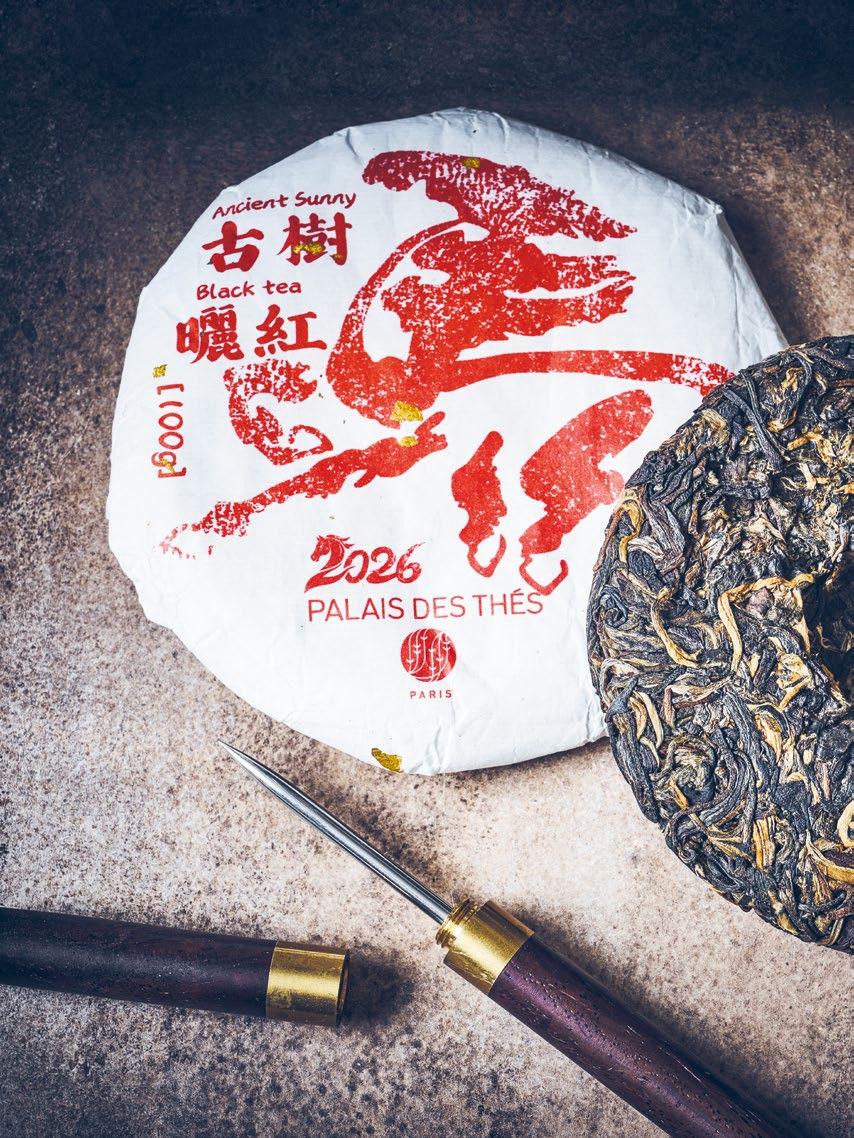
Every Lunar New Year, people across Asia gather together to welcome in new beginnings and fresh hopes for the year ahead. What better way to mark this moment of renewal than with tea – especially the Fire Horse Tea Cake, a black tea with waxy notes of honey and apricot, whose intensity echoes the fiery spirit of the zodiac animal it honors!
By Elena Di Benedetto
In China, Vietnam and even Korea, the Lunar New Year (also known as Spring Festival) is rich in symbolic rituals, like large family meals, red and gold decorations believed to attract good fortune, offerings made to honor ancestors, and the exchange of heartfelt wishes for prosperity. Each year is also associated with a specific animal and element from the Chinese zodiac, shaping its symbolic energy.
In 2026, the Year of the Fire Horse begins on 17 February. A symbol of vitality, freedom and creative energy, this sign encourages us to follow our intuition and give free rein to our passions. Under its influence, the coming lunisolar year promises to be bold and audacious. It is the perfect occasion to gather together to share what we hold most dear, like this compressed black tea cake, whose appearance playfully blurs
expectations with its pu erhlike silhouette.
Adorned with red calligraphy depicting a fire horse, this elegant black tea cake has an unmistakably festive air. Unwrapping the paper reveals a compressed tea that seems to almost shimmer, thanks to its high content of tea buds. Originating in the Yunnan province in southwest China, this black tea is something of a curiosity. It is made from large leaves and long buds harvested from da ye tea plants that thrive deep within the bamboo-covered mountain forests at over 1,600 meters above sea level. The impressive height of these centuries-old plants makes hand-harvesting especially difficult and demanding.
Oxidized and then pressed into a small tea cake (bing cha), this tea borrows both visual and sensory cues from sheng (“raw”)
Despite its resemblance to an ice pick, this tool is designed to break all types of compressed tea cakes (and not just pu erh teas) without damaging the leaves. It allows them to be separated almost one by one, so the tea can be enjoyed with the utmost respect for both the beverage and the artisan who crafted it.
pu erh as well as from mao cha, enigmatic teas prized for their expressive character.
When the time comes to break off a piece of the cake, it is best to use a pu erh knife. This essential tool allows you to gently loosen the long buds and leaves without damaging them, before being used for multiple infusions. Placed in a gaiwan, they quickly tint the liquor with deep amber hues. From the very first sip, the tea’s bold, spirited character fully lives up to its name. Each sip reveals generous notes of forest honey and dried apricots, along with subtle hints of leather or beeswax.
Gifting or sharing tea for the Lunar New Year is always a celebration, and this tea cake is a delicious way to mark the occasion. After three, four or even five successive infusions, warm, animal notes gradually unfold –an ideal way to enthusiastically welcome a new cycle! •
EDITION → REF. 500098 –€32 per 100 g tea cake
Being a force for good is a conviction that guides us every day, and one we strive to put into practice in many different ways. One of these is through our commitment to trusted nonprofit organizations, with whom we host workshops centered around our favorite beverage. These moments offer comfort, while also creating opportunities to share our knowledge of the world of tea with as many people as possible.
It was in this spirit that we embarked on long-term partnerships with charity organizations such as Les Cuistots Migrateurs. Their free culinary school provides certified professional training in hospitality and catering, helping refugees and non-French-speaking foreigners enter the workplace. Several times each semester, we head to their premises in Montreuil to introduce participants to tea, from how it is produced to how it is prepared and served. It is an incredibly enriching experience for both students and volunteer Tea Sommeliers who lead the sessions! The initiative is coordinated by Alexandre Denni, Tea Sommelier and Social Media Manager at Palais des Thés: “Tea has the unique ability to build bridges. During these workshops, a shared language emerges, even when words fail. What moved me most was seeing how the simple act of drinking tea could open the door
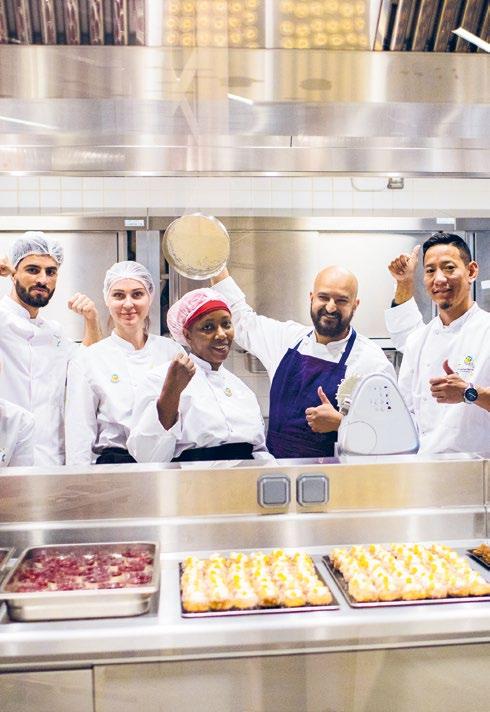
to a story, a memory or a smile. By sharing our knowledge, we receive just as much in return. These deeply human moments give real meaning to our commitment.” Today, these workshops have been adapted for other charity organizations, like traveling tasting sessions for the L’Échappée rose campaign for Tout le monde contre le Cancer, workshops for Ukrainian refugee women with Melograno, and team training sessions for Refugee Food. Each of these initiatives share the same purpose: to be a force for good and to offer support where it is most needed.
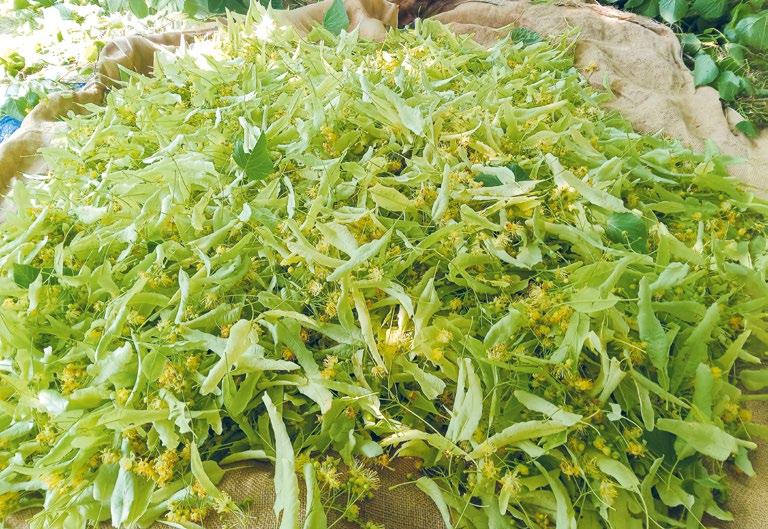
While the majority of our Grands Crus teas are grown in far-off lands, we are paying increasing attention to what is happening closer to home. For several years now, our Tea Explorers – particularly Léo Dugué-Perrin –have been working to promote the depth and diversity of France’s aromatic landscape. This exploration has led to the creation of the first French black and green teas; buckwheat and barley grown in Brittany for grain-based teas; herbal infusions featuring bark chips made from wooden barrels used in winemaking; and now, the discovery of an exceptional lime blossom herbal
tea, Tilleul des Baronnies, harvested in the heart of the Provence. While meeting producers dedicated to preserving the traditional craftsmanship associated with lime tree cultivation, Léo uncovered a rare, ephemeral, handcrafted infusion. “This Tilleul des Baronnies checks all the boxes of a Grand Cru tea. It’s an infusion that fully expresses the potential of the French terroir!” We hope this initiative will inspire others and encourage tea lovers to venture off the beaten track, discovering unexpected tasting experiences that beautifully complement the teas they already know and love.
Journey to the Land of the Rising Sun with two original green teas: one flavored with citrus fruits, the other enhanced with toasted rice. These rare, ephemeral, artisan Grands Crus teas offer a crisp, flavorful tasting experience – like a one-way journey to contemporary Japan.
ORGANIC Shizuoka Earl Grey
A Japanese green tea enhanced with bergamot. A rare pairing!
→ Ref. 100138 – € 32 per 100 g
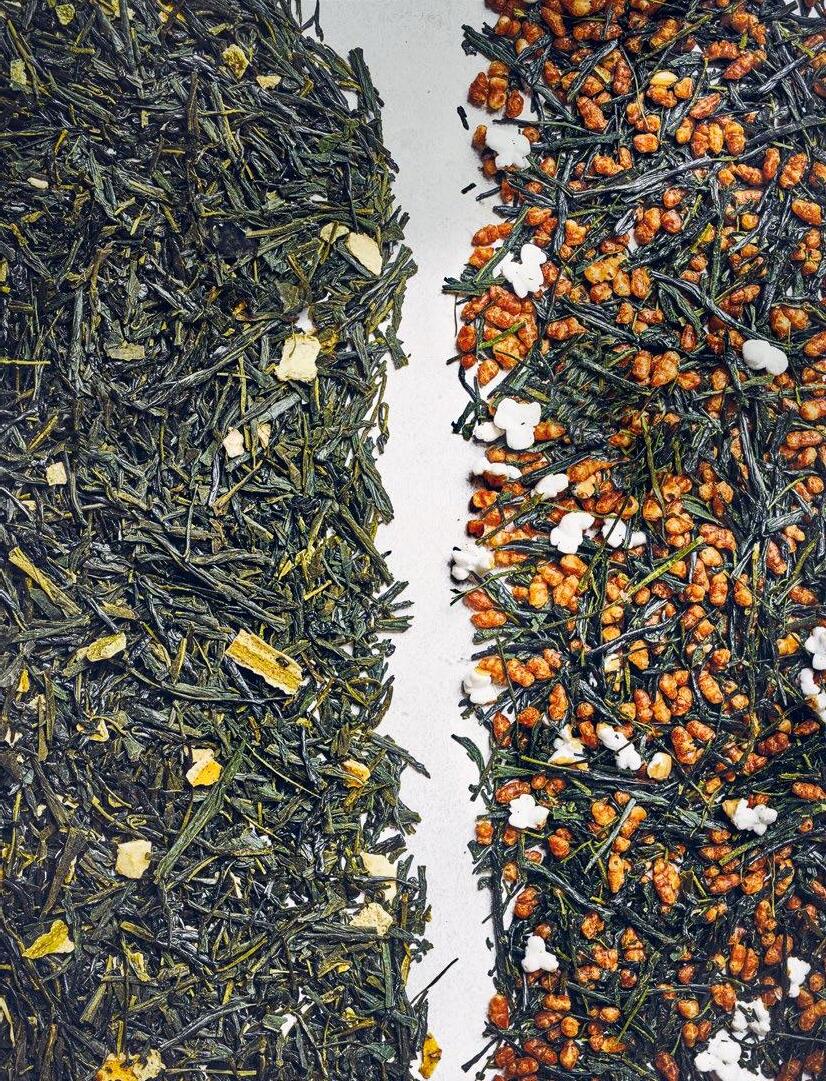
ORGANIC Premium Genmaicha
An indulgent blend of toasted brown rice and first flush ichibancha green tea.
→ Ref. 100155 – € 26 per 100 g
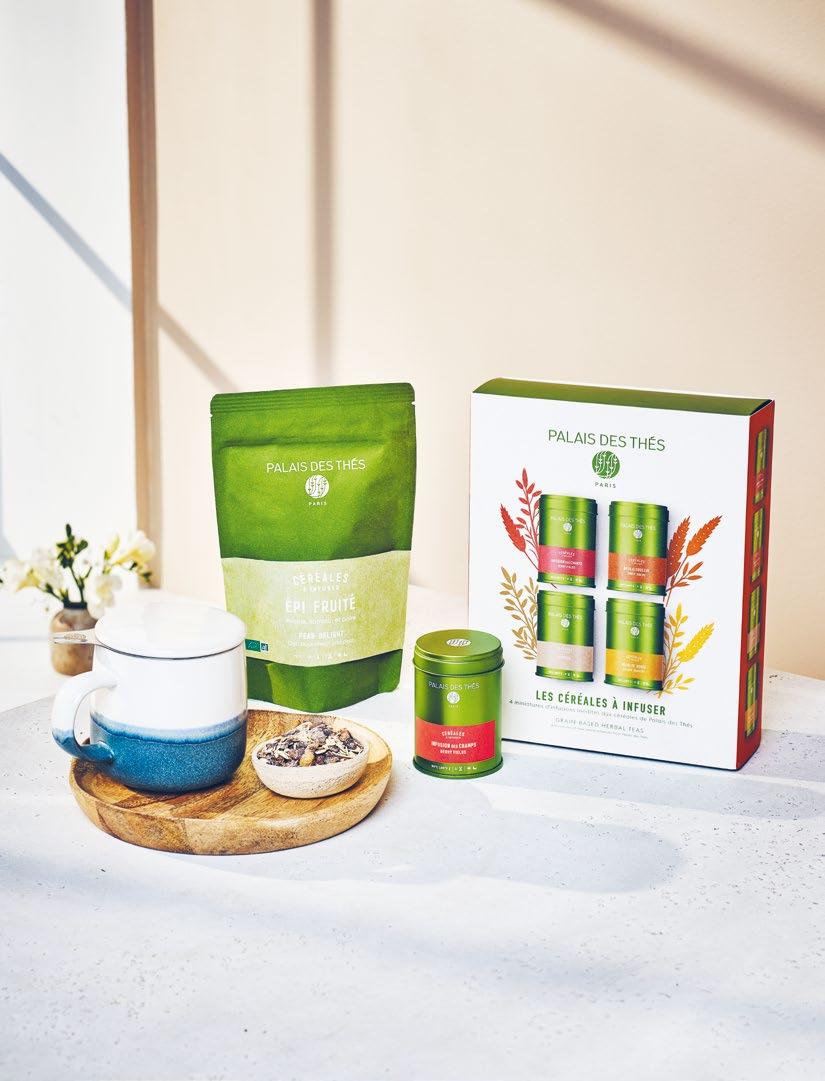
ORGANIC Grain-Based Herbal Teas gift set For a set of four mini tins → Ref. 300092 – € 29.90 Rivage infuser mug → Ref. N370 – € 22
ORGANIC
Limited edition → Ref. 100086 – € 14 per 100 g
ORGANIC Rooibos of Lords
An indulgent and zesty Earl Grey that is naturally theine free.
→ Ref. 9210 – € 11.90 per 100 g
An Earl Grey made with a prestigious first flush Darjeeling base.
→ Ref. 893 – € 14.50 per 100 g
A beautiful Yunnan black tea delicately scented with bergamot.
→ Ref. 803 – € 11.90 per 100 g
Bruits de Palais is a Palais des Thés publication
Editorial team
Lucile Block de Friberg, Bénédicte Bortoli, Mathias Minet
Translation and proofreading
Kate Maidens
Art direction and layout
Prototype.paris
Styling
Sarah Vasseghi
Illustrations
Sabine Forget
Imaging & retouching services
Key Graphic
Palais des Thés
All translation, adaptation and reproduction rights in any form are reserved for all countries.
A bold, full-bodied black tea with bright, zesty flavor, ideal served with milk.
→ Ref. 8010 – € 11.50 per 100 g
Our black tea with the most intense bergamot expression.
→ Ref. 802 – € 10.90 per 100 g
A wonderfully floral creation blended with cornflower petals.
→ Ref. 8080 – € 9.90 per 100 g
A delicately refined green tea version of the iconic Blue of London.
→ Ref. 8090 – € 11.90 per 100 g
Photo credits
François-Xavier Delmas: front cover, p.2, 4, 8-9, 13, 15, 39 • Ugyen Wangchuk: p.6 • Guillaume Czerw: p.16, 23, 24, 26, 27, 29, 33, 36, 37, 38 • Frédéric Lucano: p.20-21, 25 • Boniface Prod: p.25 • Emeric Fohlen: p.34 • Nasha Queruel: p.35 • galitskaya/AdobeStock: p.17
Customer service
+33 (0)1 43 56 90 90
Cost of a local call (in France) Monday to Saturday 9am-6pm
Corporate gifts
+33 (0)1 73 72 51 47
Cost of a local call (in France) Monday to Friday 9am-6pm

Lu Yu