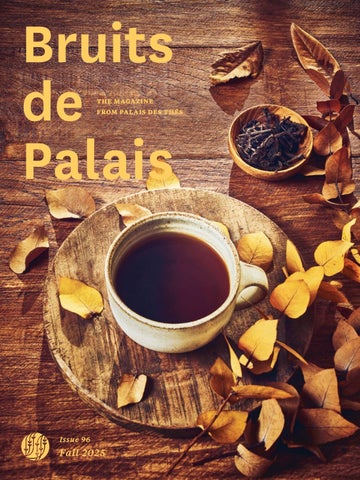
THE MAGAZINE FROM PALAIS DES THÉS

96 Fall 2025


![]()
THE MAGAZINE FROM PALAIS DES THÉS

96 Fall 2025


At Palais des Thés, we believe that innovation is the natural extension of tradition. For almost forty years, we have been committed to honoring tea’s centuries-old heritage while infusing it with a bold, modern edge, attuned to the tastes and lifestyles of our times.
For us, tea is “living”: it has spanned centuries, reinventing itself over again and adapting to the times. This ability to engage with the present fuels our creative philosophy. Each new creation is considered and crafted as an encounter between traditional artisan techniques and contemporary aspirations.
This vision also comes to life in our constant pursuit of unique teas and original herbal infusions, to always offer you new taste experiences. It is in this spirit that we, Tea Explorers, travel the world in search of rare and unexpected teas: from tea infusions made from bark, mushrooms and sunchokes, to teas oxidized in traditional Georgian clay wine pots, and Nepalese black teas delicately scented with Timur berries, or even blueberry leaf infusions crafted in the style of a black tea. These are just a few of the curious and captivating explorations led by dedicated producers – sometimes at our suggestion – that we are proud and delighted to share with you.
Our company’s philosophy is based on a subtle balance. It is about innovating without ever losing sight of what truly matters: offering you the finest teas, while daring to surprise and delight you.
Championing producers’ experiences is also a way of telling their story, like in Georgia, where tea is fermented in the same clay jars that have been used for winemaking for thousands of years.
A commitment to taste, quality ingredients and a deep respect for the biodiversity of tea-growing lands forms the foundation of everything we do, to create the teas and herbal teas of tomorrow. We consider every cup as an opportunity for creativity, where tradition inspires innovation, and innovation pays tribute to tradition.

By Jean-Baptiste Petit
By Elena Di Benedetto
By Geoffroy Gourdet
Evelyne
CONTRIBUTORS

Geoffroy Gourdet
Geoffroy obtained his Master Tea Sommelier diploma in 2023. He used to be a Deputy Store Manager but now works as a trainer at the Tea School in Paris. He loves sharing his passion for tea over a cup of pu erh or oolong tea.

Evelyne Eybert
Evelyne is Head Trainer at the Tea School and earned her Master Tea Sommelier diploma in 2025. She is passionate about Chinese teas and enjoys practicing the different tea ceremonies.
Elena Di Benedetto

Elena obtained her Master Tea Sommelier diploma in 2024 and is an expert in Taiwanese oolong teas. She considers every cup to be a source of discovery, whisking her away to faraway lands.

Alongside several other Palais des Thés store managers, I am about to immerse myself fully in the tea-made-in-France experience, from the picking to the processing of tea leaves. In the heights of Argelès-Gazost in the Pyrenees, Lucas Ben-Moura stands out as a pioneer for tea cultivation in France. Apart from operating this locally-rooted, family-run business, and his commitment to producing tea – in particular, exceptionally good tea –under ideal agroecological conditions, Lucas has also chosen to share his knowledge with fellow growers and Tea Sommeliers alike.
By Jean-Baptiste Petit, Deputy Store Manager of L’Atelier
* L’Atelier du Vrac is a Palais des Thés store which opened in Nantes in 2024. Jean-Baptiste’s parents, Dominique and Philippe Petit, have operated three Palais des Thés stores in Angers and Nantes since 2006.
opposite
Lucas Ben-Moura has been growing tea in the Pyrenees since the summer of 2020.
Ihave drank my fair share of tea over the years. From the very first herbal teas I tried as a child, to later discovering flavored creations and Grands Crus teas, my parents awoke a passion in me for this centuries-old drink. Having opened Palais des Thés stores in Nantes and then Angers, they passed on a passion that eventually became my profession. Yet until now, I had only ever seen tea plants through the eyes of the Tea Explorers, who returned with stories and photographs from faraway lands. Without this new educational experience giving the full leaf-to-cup introduction to tea, I would never have imagined setting foot in a tea garden… in the Pyrenees. Who would have thought that a new tea-producing region would be only a train ride away?
After two years experimenting, the Camellia sinensis has been growing in the Pyrenees – or more precisely, at l’Arrieulat – since the summer of 2020. The farm takes its name from the river which runs the length of Lucas Ben-Moura’s relatively new venture, which stretches across 8,000 m 2 of land. This crazy – and audacious – gamble to acclimatize the tea plant to this mountainous region was all thanks to this young agricultural engineer. It is here on his ancestors’ land that he decided to grow tea plants. He explains to us that everything seemed to point him towards a career in wine-making: his roots in the south-west of France, his academic background and his deep appreciation for the world of wine. His various travels and work experiences on tea farms in Asia (in Indonesia on the islands of Java and Bali, as well as Laos and Nepal) enabled him to discover other types of varietals. Then in 2018, he began clearing an old plot of hillside pasture owned by his family, surrounded by forests and crisscrossed by streams, high above the Argelès-Gazost valley. “All this would not have
been possible without the support of those who sponsored the project, as well as the volunteers who helped in the fields, weeding and mulching. And without this ideal terroir, there wouldn’t be any tea plants, or any tea!” he exclaims. Indeed, the soil here is acidic, mineral-rich, well-aerated and offers good drainage, while the humid oceanic climate provides just the right conditions for tea plants to thrive.
The morning after we arrive, we set off toward the farm at eight o’clock. No sooner have we left our accommodation than the forest envelops us in silence. The trail leading up to the tea plants is inaccessible by car. Only the gentle murmur of the streams and the Azun gave (a regional term for mountain streams) flowing below, as well as the chirping of birds, accompany our walk. If tradition has it that Dragon Well tea (or Long Jing) reveals its true character only when infused with water from the Dreaming of the Tiger Spring, I like to think that l’Arrieulat’s teas draw their leaf-to-cup purity from the surrounding waters.
“I want to develop our terroir’s identity and the unique character of each harvest, using simple, natural and artisanal processing techniques.”
In the distance, the Pyrenees mountains appear. We are only a dozen miles as the crow flies from Lourdes, yet if feels like the edge of the world! At 550 m above sea level, the tea farm is split into several plots. Among the rows, Lucas scoops up handfuls of earth, naturally enriched from years of untouched pastures and grazing livestock, and takes us for a tour through a mosaic of tea plants of varying ages. Altogether, they create a living repertoire of varieties, grown from seeds from China, Nepal, Turkey, Georgia and also from Filleule des Fées, the tea farm belonging to Denis and Weizi Mazerolle, fellow pioneers based in Brittany, as well as from other farms across Europe. In another groundbreaking move, Lucas recently planted seedlings grown entirely in the Pyrenees. This constantly evolving diversity is his way of full-scale testing and improving how these plants adapt to their new region – to our seasons and to an environment which is discovering tea cultivation for the very first time. For a more sustainable approach, and to complement existing species that offer shade and enrich the soil, Lucas has embraced agroforestry. He has planted new tree varieties and fruit trees that will one day diversify his harvest and provide cool shade for his tea plants. His practical wisdom of the land favors both nature and the tea quality.
Lucas Ben-Moura
Here, the six thousand or so tea plants are still young, so grow low to the ground and have light foliage growth. Before the heat oppresses us, we spend almost two hours practicing the art of fine plucking on the oldest tea bushes. This method involves picking only the bud and the next two leaves down. Not only does this harvesting technique produce high quality tea leaves, but it also offers a whole new perspective, one that is often far removed from our experience working in store. Until today, I had never truly considered just how many hours of meticulous, repetitive work is required to fill just one large tin of loose leaf tea that is on display in my store. The modest contents of my wicker basket clearly yield an exclusive, limited-edition tea! We return to Lucas’s production site with a grand total of almost 1.2 kg of freshly harvested leaves between us, which is enough to make 300 g of dried leaves, ready to infuse.


Tea produced artisanally in the Pyrenees
Now it is time to transform our hand-picked leaves using artisanal methods. The afternoon’s program is to discover the first stages of producing a yellow, a green and a black tea. We get to work on the terrace of the family home. It is one thing to know the theory acquired during our training at the Tea School and from books, but it is another to actually handle the leaves – and the fire – with our bare hands!

With our faces burning up working over the wok ovens, I learn how to “fix” the tea, or “kill the green,” to prevent the leaves from oxidizing. We are allowed to touch the leaves with our bare hands, or with protective gloves if preferred. Another batch is drying in a heated cupboard for about two hours. These different methods act as a teaching tool to better understand the differences in flavor created by various drying techniques. The taste test? Wok-drying brings out sweeter, more indulgent notes, thanks to the Maillard reaction.* We set aside some of the leaves for making yellow tea, which undergoes a light fermentation. To encourage this process, the leaves are placed in a sort of large couscoussier, or steamer, where they remain overnight in a warm, humid environment.
The next day, we finish drying the green and yellow teas, and begin roasting the black tea after it has been hand-rolled in a cloth. When hand-rolling, you need to control the amount of pressure applied in order to draw out the juices, and with them, the final aromatic notes. A lightly roasted black tea is Lucas’s favorite. But for all his teas, through trial and experimentation, he seeks to bring out a specific character that will define the distinct style of each type of l’Arrieulat tea . This year, without knowing whether or not they will ever be offered for sale, he produced two micro-batches (200 g) of oolong tea.
It is an incredibly proud feeling to be tasting our “creations”! Of course, I won’t become a tea maker in the space of a few days, but I savor the joy of bringing home a few samples that, beyond the memory of this experience, will enrich my conversations with both colleagues and customers! At every stage of the production process, I take the time to taste, smell, touch and listen to the leaf in all its forms. I fully immerse myself in this unique sensory journey which leaves a lasting impression on anyone truly passionate about tea. I have a deeper understanding of the absolutely vital role craftsmanship plays in the quality of the final brew. An exceptional tea is above all the result of skillfully mastering every step of its making.
*The proteins and sugars present in the leaf are transformed, producing toasted, nutty aromas.
Through continuous testing, Lucas reduced the initial roasting time and prolonged the fermentation of his yellow teas to around sixty hours, to achieve a signature aroma specific to l’Arrieulat.

At l’Arrieulat, only agroecological farming practices are used, which includes no chemically synthesized inputs, regular mulching and growing plants without pesticides.
By getting an insight into Lucas’s daily life, it soon becomes clear that his commitment is also shared by his family, and especially his partner. Mutual aid between other producers, whether neighboring or located further afield, is also vital. For example, next year, the neighboring estate will plant one thousand tea bushes grown from seeds harvested at l’Arrieulat by Lucas himself. The young farmer invests a significant amount of his time, energy and resources. The year 2025 will see the first harvest from home-grown seedlings, meanwhile major building works will kick off! The two-story, 250-square-meter barn will be renovated into a multifunctional space with accommodation, a tea processing facility and a place to host educational training workshops, like the one we are taking part in. While Lucas champions the values of traditional artisanal skills, he is also open to innovation. He recently acquired a new machine that was developed in France, which can dry, steam and roast tea leaves. He has tested various prototypes using different heating technology (traditional hot air, infrared which mimics the heat of charcoal while being more energy efficient, and even high-frequency heating), without compromising on the quality of his tea. He gives us an exclusive taste of a yellow tea dried using the latest method (an equivalent of microwave technology). Lucas is also actively involved in local community through cultural and charity work. His tea is rooted in the region. We share a cup with friends, alongside a sheep’s milk cheese made by the farm down the road, and a steaming bowl of garbure, the hearty Gascon stew.
The great challenge of an initiative like Lucas’s is to make a living from tea – whether it is produced in mainland France or elsewhere in Europe

– while sharing the journey with fellow producers who are equally passionate. Recently, l’Arrieulat has also joined the FierThé program, led by the Breton horticultural center Caté.
Lucas’s farm serves as one of the experimental sites for this collaborative project, which aims to develop a sustainable French tea production sector that meets both organic farming standards and produces teas of outstanding quality in taste and aromas. Lucas wants to produce tea, most importantly good tea, using agroecological practices. The beauty of his teas reflects his daily dedication and production choices, striving to achieve profitability through artisanal, streamlined and sustainable methods. Another challenge common to all farms is consistency in quality. Right now, for Lucas to ensure the longevity of his tea-growing venture, he must sell seeds to professionals, offer consulting services, organize training workshops (such as with Palais des Thés teams) and host guided tours, while also considering diversifying his farm production. It is no different here than anywhere else: profitability remains elusive until the tea plants reach full maturity. Are we witnessing a new way of growing tea in Europe, one that sets a benchmark for agroecology? As I leave l’Arrieulat, I like to think that the future is perhaps taking shape here, on Lucas’s farm or on other farms inspired by this model.
“I really love the tea we make. Now we need to share it with the world and make it known!”
Lucas Ben-Moura
It takes three years for the tea plant to reach full maturity and produce a harvest.

The sensory qualities of a handcrafted, artisan tea depend greatly on the choices made by the producer.
It is heartening and reassuring to imagine that the future could look like this tea farm in the Pyrenees and that not just any tea, but quality tea can be produced here, without the need for ultra-sophisticated machinery. Many passionate men and women have made it their purpose, drawing inspiration from the traditions they witnessed in the oldest tea-growing regions. These curious, generous individuals chose not to keep their bold projects to themselves, but rather to share them with anyone willing to join them on the journey. Altogether, it makes for an inspiring collaborative spirit and teas worth keeping a close eye on. •
Before ours teas arrive in store and then in your cup, they are first bought by industry professionals in all their various forms and also via different channels. Whether purchased directly –or indirectly – from producers (big and small), agricultural cooperatives, state-run agencies or at auction, these transactions reflect a wide range of configurations shaped by country-specific customs, cultural practices and the sourcing philosophy of each tea company.
Originally consumed in its homeland, China, for its medicinal properties, tea gained popularity during the Tang dynasty (618-907) before spreading more widely throughout south-east Asia during the Song dynasty (960-1279). By the thirteenth century, it had become both a commodity for barter and trade, as well as a form of tribute.
Tea hasn’t always been something you could simply buy. Along the routes linking China to Tibet, cha once served as a currency, exchanged for horses, yak hides, salt, spices and more. Compressed into bricks to make it easy to transport, tea traveled from one population to another, crossing cultures along this ancient trade route. This progressive migration by land reached as far as the Ural Mountains, where by the sixteenth century tea had become a widely consumed commodity. It was by sea that the first shipments of tea landed in Europe at the beginning of the sixteenth century, brought by western colonial trading companies.1 The British became avid consumers

of this drink, and with it, London became the center of global tea trade. At the time, the tea market operated under a double monopoly: in China, controlled by the emperor; and in the west, controlled by the East India Company, a British trading company which bought tea in Canton with silver bullion bars, before reselling it at auction in London. From the Far East to the Old Continent, crates of tea made their way across the seas – despite increasingly strained trade conditions. Two major events triggered a collapse in these monopolies – the Boston Tea Party2 (1773) and the First Opium War (1839-1842) – profoundly disrupting not only the tea trade, but global tea farming as well. Tougher negotiations with China led to the expansion of tea cultivation in India, 3 with it eventually spreading throughout all regions with suitable growing conditions, mainly those with tropical and subtropical climates.
Once harvested, tea leaf quality begins to deteriorate quickly. Here, at the fresh leaf market in Fuding, China, Mr. Li must absolutely find a buyer within the next two hours.
Today, the world’s major tea-producing regions are found in Asia and Africa. 4 China offers a wide range of teas whose unique character is deeply
rooted to terroir (such as Long Jing, pu erh, dan cong and wuyi). India is renowned for its black teas produced in Assam, Darjeeling and in the Nilgiris. Sri Lanka and Kenya produce mainly black teas destined for industrial-grade tea bags. Meanwhile, Japan and Korea are reputed for the high quality of their green teas. In recent decades, other, lesser-known tea-growing regions have emerged, such as Nepal, in Latin America (Peru, Colombia, Brazil), East Africa (Malawi, Tanzania), the Golden Triangle (Thailand, Vietnam, Laos) and even mainland France. 5 Within the same country, tea may be purchased for local consumption or for export. This also depends on the type of tea, in what form it is sold, and the organizational structure specific to each producing region.
Tea is cultivated on tea farms with widely varying realities (for example: farm size, yield, tea quality, labor structure, economic model). The global market rests on the coexistence of two main types of tea leaf suppliers, who grow and harvest the leaves before processing them.
Small-scale farmers: Defined by the size of their landholding in hectares, small-scale growers are generally under-equipped in terms of the machinery required for processing their leaves. There are around nine million worldwide and account for 60%-70% 6 of global tea production, representing approximately four million tons of processed tea.
Large plantations: Organized as commercial enterprises, large plantations make up the remaining share of global production, contributing 2.7 million tons in 2022.
Not only is the tea market fragmented geographically, but so too is its supply. Once grown and harvested, the tea leaves are then transformed. Depending on the type of plucking standard and the processing method used, the resulting quality can vary greatly, and consequently, so too can the price. In some regions, small-scale farmers sell their fresh leaves to larger operations, which process them using the “CTC” method (Crush, Tear, Curl). Teas produced this way account for 64 percent of the global tea market.7 This industrial
process using specialized machinery enables large amounts of fresh leaves to be mechanically transformed into small pellets, to be typically used for tea bags. Because of its low added value, this method also yields low income for leaf producers. The resulting flavor is uniform, but the quality is often lower, as the leaves are inevitably broken. Other growers choose to follow what is known as the “orthodox” method. This traditional, artisanal process preserves the integrity of the whole leaf, creating teas that express an infinite aromatic profile.
Globally, tea production employs around 13 million people. 8
From rare and exceptional teas to leaf dust destined for industrial blends, there exists a vast difference in quality and processing techniques, not only between countries, but often within the same region. These methods require different levels of investment and resources, leading to significant variations in production costs and ultimately in purchase price.
Purchasing tea is a practice shaped by a variety of configurations.
Buying from wholesalers: Historically, and still today, many European tea companies source a large portion of their teas in significant volumes from Hamburg, Germany.
Buying at auction: Until 1998, in a ritual unchanged since the late seventeenth century, gentlemen would gather in the heart of the City of London for cup tastings, to sample the teas up for auction the following day. Faced with growing
1. Read Bruits de Palais n° 92, p.20 sq
2. Ibid n° 93, p.30-31.
3. Ibid n° 88, p.30-31.
4. Six countries (China, India, Kenya, Turkey, Sri Lanka, Vietnam) produce almost 90 percent of
global production and six countries (Pakistan, USA, UK, Egypt, Germany, Japan) represent 50 percent of the total value of international tea imports (https:// fr.statista.com).
5. Ibid n° 93, p.14 sq and n° 96, p.6 sq
6. All data is from the 24th Session of the Intergovernmental Group on Tea, Food and Agriculture Organization of the United Nations, (FAO), 2022.
7. Ibid.
8. Ibid.
competition from auctions held at the country of origin (such as in Mombasa, Colombo and Kolkata), the London auctions eventually closed, turning a page in the history of the global tea trade. Around 70 percent of tea is sold at auction.9 While the auction system varies from one country to another, the principle remains the same: organized marketplaces where tea is sold in lots ranging from 50-500 kg to brokers and direct buyers. The largest black tea auction in the world is in Mombasa, Kenya. Others take place in Kolkata, India, and Colombo, Sri Lanka. Producers deliver their leaves to these auction centers.


The tea is then graded, tasted and evaluated before samples are distributed to buyers. Tastings must be completed quickly, as the price is set within forty-eight hours. The batch is then sold to the highest bidder. This system is particularly attractive for companies or countries looking to purchase large volumes, sometimes at the expense of quality. Teas sold at auction are often industrially processed, and batches are often blended, making it difficult to trace their origin.
In Japan, auctions are organized by the Japan Agricultural Cooperative. Typically, the producer who harvested and begins the primary processing stages is not the one who sells the final (refined) product. Here, raw, semirefined teas (aracha) are sold, which are then purchased by companies or other producers who will refine them. Only after this stage is the finished tea made available to international buyers, who participate in the auction via licensed brokers acting on their behalf.
An auction in Colombo, Sri Lanka: each of these boxes contain a small amount of tea leaves and their lot number.
To preserve a tea’s aromatic characteristics, strict storage conditions must be controlled over time (protection from humidity and light, airtight sealing). As such, it is rarely practical to store large quantities of tea and wait for it to gain value. Speculation (buying tea today in the hope that its price will rise in the future) is not a common practice in the industry. However, pu erh is the exception to this rule. This dark tea is often compressed into cakes, and can be aged naturally or by accelerated methods. Over the years, its aromas develop – and so too does its value. In the early 2000s, a speculative bubble burst in China, where certain pu erh teas from the 1950s sold for tens or even hundreds of thousands of euros. Among collectors and discerning tea connoisseurs in China, Taiwan and Malaysia, owning a wellaged pu erh has become a symbol of prestige and elevated social status.
In India, for over 150 years, the most prized tea in the world (Darjeeling) was sold through closed weekly auctions to major buyers from Japan, the US and Europe. They were traditionally held as live outcry auctions in seven centers across the country. However, since 2008, these auctions have moved online in India, and other producing countries have progressively followed suit.
We use this sales channel only on rare occasions, for example, to purchase exceptional teas from the New Vithanakande estate in Sri Lanka. The estate owners often send their finest lots to auction, believing it offers the best price and the easiest way to sell.
Purchasing from private companies or state representatives: This is the case in China, where for a long time it was the only way to purchase tea. As many tea farms are state-owned, cooperatives pay a lease to the government. Tea companies using this channel typically work with brokers who negotiate purchases locally on their behalf. These brokers consolidate selected offerings from various producers, send samples to the buyer along with a price list. After tasting, the buyer either accepts the quoted price or submits a counter-offer.
This method generally involves larger volumes and blended teas.
Direct purchasing from producers or cooperatives: In this kind of forward agreement market, sellers and buyers know one another and work together without middlemen. Buyers need to regularly visit producers at their farms and build close relationships with them. However, purchases are not made on-site. Not only does this prevent buyers from being swayed by personal ties or getting carried away by their emotions in the moment, but it ensures the tea is assessed on how western consumers like to prepare it, taking into consideration factors such as water minerality and temperature, and the amount of tea leaves used. For certain teas, the buyer must act quick once they have received the sample.
“Being a Tea Explorer is no just a job, it’s a lifestyle.”
François-Xavier Delmas
At Palais des Thés, 99 percent of our teas are purchased directly from more than ninety producers. We also occasionally buy directly from cooperatives, particularly in countries like Nepal or in Sri Lanka’s lowgrown tea-producing regions, as this model allows small producers to organize and strengthen their operations. This direct sourcing model is still rare in the world of tea. However, it ensures greater traceability and helps sustain a virtuous cycle (see pages 18-19). Palais des Thés founder François-Xavier Delmas chose to implement this model from the outset. As he did not come from a family of tea merchants, he instead chose to learn directly from the farmers themselves, without the involvement of middlemen.
Unlike coffee or cocoa – whose prices are listed on the New York and London stock exchanges – tea is not priced or influenced by a single, centralized global financial structure. Instead, several key markets, particularly those where international auctions are held, serve as reference points, primarily influencing the prices of lower-grade teas (often CTC teas). These prices fluctuate based on factors such as provenance, quality (grade, aroma, origin), supply and demand, and transportation costs. Few agricultural
“Apart from the reputation of a tea’s terroir, its color and local demand, it’s the quality of the tasting experience that determines its price.”
François-Xavier Delmas
products exhibit such a vast price range between low and high quality as tea does. Tea produced in large volumes for supermarket tea bags averages around $1.50 per kilo, while in China, some teas can fetch up to €10,000 per kilo.
Buying tea directly from producers requires an understanding of cultural practices in order to agree on pricing. For example, when purchasing Japanese Grands Crus teas, the quantity can be negotiable, but rarely ever the price. In China, it is often the opposite: failing to negotiate may be seen as disrespectful by the seller. In India, the process is far more complex. Producers typically do not indicate prices on the samples they send. Instead, buyers are expected to propose what is considered the “right price,” which can result in a lengthy process.
At Palais des Thés, we tend to tell our suppliers that we will not renegotiate the price they have set. Not only does this save time, but it is also a gesture of mutual trust and a way of contributing to a virtuous cycle.
The tea market is distinguished by its geographical diversity and its vast, deep-rooted traditions. From artisanal methods to industrial-scale production, sourcing channels vary according to origin and quality expectations. In recent years, the world of tea has seen a wave of new trends, such as greater traceability from leaf to cup, the emergence of single estate teas with micro-lots (limited quantities, high quality, premium prices), collaborative purchasing between eco-conscious brands and small producers, and the creation of new certification labels. These developments have also impacted how tea is sourced. Ultimately, the conditions under which tea is purchased – and the way one goes about it – reflect the values, responsibility and commitments of a tea brand. •
9. Tero, 2022.
Our rare and ephemeral Grands Crus are exceptional teas of the finest flavor. They embody the special relationship we share with the artisans who produce them, as well as our commitment to offering the highest quality teas to as many people as possible. Our purchasing policy is driven by a determination to secure the finest for our customers, at a fair price for our partners and with a responsibility to protect the planet.
François-Xavier Delmas invented a brand-new profession, that of Tea Explorer. This role has enabled him to build and maintain relationships of trust between many tea farmers, to preserve their artisanal skills while also encouraging innovation by inviting them to experiment with and create unique teas that meet our high standards of excellence. A few years ago, Léo Dugué-Perrin joined him in this mission. They never buy teas before their harvest.
When the samples arrive, François-Xavier Delmas, Léo Dugué-Perrin and their team taste them blind. Each person gives them a score out of twenty, before the origin of the tea is revealed.
Sample tastings and purchases follow the seasonal calendar: March for Darjeeling teas, then April to May for first-flush harvests from China and Japan. Black and oolong teas are purchased throughout the year. Purchases are made based on quality, but even some excellent teas do not make the cut because they are too similar to ones we already have. As our number of stores increase, we can expand our range of exceptional teas.

Random sampling Analysis takes around five days
Systematic controls
6
7
1 From farm…
Sourced in 24 tea-producing countries. 42% of our partner producers have worked with us for over nine years.
cup

For some teas, the decision to purchase has to be made fast. A rare tea is often produced in limited quantities, and it is customary to purchase the entire batch. Paying a fair price helps sustain a virtuous cycle, one that encourages farmers to produce higher-quality teas in exchange for a better price, which in turn improves the livelihoods for tea communities.
Between 10 to 150 samples are received every day. 5 4 3 2
About 1 Grand Cru tea in every 50 is selected. In 2024, we purchased more than 130 Grands Crus teas.
We purchase our teas free on board, meaning the tea becomes our property in the country of origin. The producer hands it over to a freight forwarding agent of our choosing, who then oversees its transport to France. Our tea is transported by boat, provided there is access to a port nearby. Otherwise, it is shipped by air to preserve freshness.
The tea is then transported to our warehouse in the Seine-et-Marne department in France.
When it arrives at the warehouse, each batch of tea is systematically sampled and independently tested, to ensure that they meet strict EU regulations concerning pesticide residue standards in food. In 2018, we created our inhouse SafeTea certification standard. Every batch of tea is tested before being sold in store. Our producers are familiar with our standards, so it has become exceptionally rare for a batch to be rejected.
The tea is then made available to buy in store or online.

Cultivars are to tea what grape varietals are to wine: a fundamental element whose influence is not only variable, but essential. Let’s take a journey through tea gardens across the globe to explore the many nuances of this key component.
By Elena Di Benedetto

When left to grow naturally in the wild, tea plants can grow up to several meters high, like those here in Cao Bo in Vietnam.
If you are a regular reader of Bruits de Palais, the word “cultivar” may already be rather familiar to you. But could you identify its influence on your favorite teas? Let’s dive in to the world of botany to get a better understanding of tea plant varietals and what they bring to every tea tasting experience.
To understand what a cultivar is, let’s go back to the basics of what a tea actually is. All teas come from a type of camellia, not the ornamental Camellia japonica, but the cultivated Camellia sinensis. Tea plants fall into two main cultivated varieties: Camellia sinensis sinensis, originally from China, which produces small-leafed shrubs better suited to cold climates and higher altitudes; and Camellia sinensis assamica, first identified in Assam in northeastern India, but native to the Golden Triangle. This variety yields larger-leafed shrubs that thrive in warmer, more humid environments. While all tea plants come from one of these two varieties, the majority of cultivated camellias used in tea production today are the result of botanical crossbreeding. These cultivars (short for “cultivated varieties”) can be “pure,” meaning they are a hybrid of two plants within the same variety (either sinensis or assamica), or a mix of two plants of each of these varieties. Plants are selected to isolate desirable traits from parent plants, such as resistance to disease, adaptation to soil or climate conditions, and, just as importantly, what it brings to the tea’s aromatic and flavor profile.
Some cultivars define a tea, just as certain grape varieties define a wine. When someone says chardonnay, syrah or chenin blanc, you already have an idea as to what the wine might taste like. The first is often bright and citrusy, the second offers dark fruit flavors and peppery, spicy notes, and the third develops yellow stone fruit aromas with a balanced acidity.
A similar logic applies when it comes to cultivars, which are created to bring out certain characteristics in the cup. For example, although both are hybrids derived from the Camellia sinensis, a jin xuan cultivar from Taiwan will typically produce a creamy, almost milky taste, while a Japanese cultivar like saemidori produces a powerful umami flavor that is highly sought-after in the archipelago.
However, in some cases, the cultivar itself is difficult to identify and its origins cannot be fully traced. For instance, in Georgia, many tea farms popped up in the early 1900s with seeds randomly dispersed by wind. After the collapse of the Soviet Union, they were abandoned and left to grow wild under brambles for decades. So how is it possible to identify these tea plants with such a fragmented history? In instances like these, a tea’s unique flavor profile is less likely due to the variety of the plant itself, and more down to the producer’s creativity and vision.

By definition, cultivars are propagated through cuttings. However, even today the term is sometimes misused, for example, to describe varieties grown from seed.

It remains incredibly difficult to measure the precise influence of each factor – such as the soil, the environment, the plant itself – in a tea’s final flavor. In any case, the cultivar is far from being the only factor that shape’s a tea’s identity. It is the producer who undoubtedly plays the most decisive role in defining the flavor profile.
While the grapevine rapidly made its mark, being exported across the whole world, the tea plant has remained rather rooted, leading a rather sedentary existence. Each cultivar was closely connected to its local terroir and used exclusively to produce the region’s local teas.
In China, tea farmers carefully preserve a wide range of cultivars for experimenting with, like grafting cultivars to create new hybrid tea plants.
It is only in recent decades that producers have started taking inspiration from other farmers, opening up their imagination to embark on fruitful experimentation. For example, this has led to the creation of new tea colors from cultivars traditionally used for just one type of tea (such as the Green Jin Xuan in Indonesia, or the Mount Dahei Red Dragon, a black tea made from oolong cultivars); to experiments with teas of both single-origin varieties and blends; and to cultivars being transplanted to terroirs far from their home soil; or on the opposite end of the scale, to the development of
hyper-local cultivars in emerging tea-producing regions, such as the kolkhida in Georgia (formerly known as “Colchis”), or the trevarez in Brittany.
Would you like to try a cultivar taste test? Here are a few tips to develop your tasting skills with some of the more iconic cultivars.1
In Darjeeling, India: In the Himalayan region, cultivars are named after the estate where they were developed, for example, P132 in Phoobsering, B157 in Bannockburn, and T78 in Tukdah. Let’s focus on the AV2 cultivar (or Ambari Vegetative 2), which was produced following research conducted in 1967 by the renowned Tocklai Tea Research Institute in Assam, using tea plants from the Ambari tea estate in Darjeeling. While first-flush Darjeelings are typically known for their fresh, vegetal notes and subtle almond aroma, those made from the AV2 stand out for their highly sought-after floral, citrus aromas.
In Taiwan and Thailand: Big leaves, no buds. When it comes to oolong teas, it doesn’t take the finest harvest to make an exceptional tea. While the choice of withering and oxidation techniques applied play a key role in shaping the tea leaf, they do not erase the role the cultivar plays on the final flavor. The jin xuan is a prime example of this. Developed in Taiwan in 1980 (hence its alternative name, TTES12, for Taiwanese Tea Experiment Station No. 12), this cultivar naturally produces buttery, creamy and floral aromas. (Re)discover them in our organic Milky Oolong crafted by Madame Ming, a tea with no added flavoring, just pure, distinctive milky notes.
In Japan: Although the archipelago has more than fifty-five official green tea cultivars, no less than 75 percent of all tea plants grown are yabukita! Developed in 1908 by Sugiyama Hikosaburō and only widely cultivated after his death in 1953, this cultivar is a model of resilience. With its long, upright leaves reaching toward the sun, yabukita adapts well to both heatwaves and frost. Try tasting similar teas (such as ichibancha2) made from cultivars that have been hybridized from yabukita (like saemidori, sakimidori, okumidori), and you will begin to recognize the subtle shifts in their aromatic profile, all down to these slight genetic refinements. •

All tea plants come from Camellia sinensis – well, almost all. Some of its wild relatives produce unusual harvests that are nonetheless considered as teas. Take the Camellia taliensis, which is native to the Tali region in southern Yunnan and endemic to the Golden Triangle, and also harvested in northern Vietnam. It is behind one of the most fascinating white teas, the Dragon Scales.
1. Our in-store Tea Sommeliers can answer all your questions. And if you want to learn more, the Tea School offers classes on the tea plant and its cultivation.
2. First-flush sencha green teas, harvested in Japan in spring.

While many tea plants are the result of natural, spontaneous hybridization, creating new cultivars requires a bit of help from science. That is why some prominent tea-producing regions have their own dedicated scientific research centers, such as the DTRDC (Darjeeling Tea Research and Development Center) in north India, and the TRI (Tea Research Institute) in Hangzhou in China, or TRES (Tea Research and Extension Station in Taiwan.
Come with me as I journey into the misty mountains of north Vietnam, to the Hà Giang region, not far from the Chinese border. Here, age-old traditional techniques and exceptionally rare, ancient tea plants come together to produce teas like no other, such as the prized 2023 Cao Bo.
By Geoffroy Gourdet

Geoffroy Gourdet
A Master Tea Sommelier since 2022, Geoffroy enjoys traveling to teaproducing countries to discover all the secrets of this centuries-old drink. He is truly passionate about his job, and seeks to share his knowledge by blending technical expertise and transferring enthusiasm. His favorite way to exchange with others is over a cup of oolong or pu erh – teas which continue to inspire his curiosity and appreciation!
Let’s discover a tea which belongs to the rather vast family of dark teas. This is a fermented tea which is commonly referred to as shu pu erh, although the term originally comes from neighboring Yunnan. In Vietnam, this type of tea is known as Trà Phổ Nhĩ Chín (literally “ripe tea”), although the name pu erh is also widely used.
This tea is crafted from shan tuy ế t , a variety of tea plants found exclusively in northern Vietnam, and which are often several centuries old. Their precious leaves are harvested only by local ethnic communities, like the Dao and the Hmong. Harvesting sometimes requires climbing high into the branches, a task that demands great focus, as these majestic trees can reach several meters in height. Shan tuyết are easily identified by the fine white downy hairs that cover the buds and young leaves, as if dusted in light snow. In fact, this is where part of its name comes from: shan means “mountain” and tuy ế t means “snow.” These ancient trees are living microcosms, as their trunks are covered in thick moss and lichen, and sometimes even
orchids grow on them! Not only do they harbor the history of this rich terroir, but also an entire preserved ecosystem.
After harvest, the leaves are left to wither in the sun for partial fixation, before being rolled and dried. At this stage, the tea is known as mao cha: a tea that can be enjoyed as it is. However, for

1. The pu erh leaves tumble gently into the gaiwan.

our leaves, further steps in the process remain. The leaves are rehydrated and then piled high into heaps in a warm, humid room. Over the course of several weeks, fermentation occurs, carefully monitored under the watchful eye of the tea producer. This method allows the tea to develop layers of aromas and a smooth, velvety texture once infused.
My trip to Cao Bo is still fresh in my mind. I exchanged a few words with the tea estate manager and we shared several teas together. I had a chance to see the processing machines in action, as well as the still-moist leaves drying in the shelter. This farm also produces Trà Phổ Nhĩ Song, black tea and Trà Tiênh – the “fairy tea.” Legend has it that only the fairies know where the tea trees for this rare tea grow.
Despite being little known in the west, Vietnamese teas
are a testament to remarkable craftsmanship. Yet too often, production is absorbed by neighboring markets or destined for export as lower-grade teas. In Hà Giang, tea remains a vital livelihood for entire families, along with rice and cinnamon. What moved me most was the deep, almost sacred bond between the tea makers and their environment, the trees and the whole tea transformation process.

Here, tea is far more than just a drink: it is a heritage, passed down from one generation to the next.
To prepare this tea, I use a gaiwan, just like the tea makers do over there. I fill it one-third full with leaves [1] . The leaves are deep black in color and sometimes clump together – a visible sign of fermentation. Their dark hue stands in striking contrast to the white porcelain gaiwan. After a quick rinse [2], it is time for the first infusion. I take a second to inhale the aroma rising from the partially opened lid. Earthy, mossy notes emerge. And the taste? The tea reveals a smooth, almost creamy texture, a slight sweetness and woody, hazelnut notes, with a touch of licorice and animal tones, like worn leather with a wonderful patina.
This tea is best served after dinner, or even on a rainy day when the world outside seems to be telling you to retreat indoors. I can easily imagine serving it alongside a slice of pecan pie [3] , to enhance the tasting experience. •
2023 Cao Bo pu erh
ORIGIN Vietnam
BREWING GUIDE
→ Several successive infusions according to Gong Fu Cha method
FOOD PAIRINGS Pecan pie
Shining in all its golden glory, the family favorite Sunday roast chicken gets a delicious tea-infused twist! Infused in the soft, gooey caramelized onions, the woody notes of this roasted oolong tea elevates the meat to new heights.
Serves six
35 g organic Imperial
Tie Guan Yin
1 free-range chicken (2 kg)
2 tbsp olive oil
1 level tbsp table salt
1 level tbsp ground pepper
4 large onions
2 garlic cloves
2 tbsp sunflower oil
2 tbsp sugar

1. Put the chicken in a roasting tray and give it time to come to room temperature. Meanwhile, infuse 30 g of organic Imperial Tie Guan Yin in 300 ml of filtered water heated to 90°C for twenty minutes. Discard the tea leaves.
2. Preheat the oven to 200°C.
3. Grind the remaining 5 g of tea to a powder.
4. Rub the chicken with olive oil, salt, pepper and the ground tea.
5. Place it upside down in the tray and cook in the oven for forty-five minutes.
6. Turn half way through cooking and baste with juices from the tin every fifteen minutes.
7. Peel and cut the onions into quarters, then thinly slice to 5 mm-thick half-moons.
8. Heat the sunflower oil in a pan. Add the onions and allow to caramelize for two minutes until lightly browned.
9. Glaze the pan with the organic Imperial Tie Guan Yin to loosen any bits stuck to the bottom on the pan. Add the sugar. Lower the heat and leave to simmer for thirty minutes until thickened.
10. Once the chicken is beautifully golden, add the onions to the bottom of the roasting tray and cook for a final forty minutes.
Serve this dish with roast fingerling potatoes, alongside a cup of organic Imperial Tie Guan Yin that has been cold-brewed for forty-five minutes!

At the end of the nineteenth century, between the fall of the samurai and the rise of rail transport, the son of a samurai was making waves at art salons in the west. The person in question? A Japanese scholar named Okakura Kakuzō. Raised in a cultural intersection, he spoke fluent English and moved in the same circles as intellectual elites, yet he sensed that his country’s true treasures lay elsewhere: in the shadows of tea houses, in the simplicity of an imperfect bowl, and in the steam rising from an infusion...
By Evelyne Eybert
Born in 1862 in Yokohama , a time when Japan was undergoing rapid modernization, Okakura Kakuzō belonged to an era caught between ancient tradition and industrial fervor. From an early age, he understood that art could serve both as a bastion and a bridge. He would go on to become a historian, philosopher and museum curator, but most importantly, a purveyor of a worldview.
It was with the aim of preserving and honoring the aesthetic

and philosophical traditions of his country that Okakura Kakuzō joined forces with fellow scholars, including painters and academics, as part of the nihonga movement. This movement sought to safeguard a traditional style of Japanese painting in the face of growing western influence during the Meiji era (1868–1912). The philosopher outlined his convictions
in the books The Ideals of the East (1903) and The Awakening of Japan (1905), both published in English. While it seemed like an unusual choice at the time, it enabled him to speak directly to an international audience. Okakura Kakuzō was also a pioneer in fostering cultural relations between Japan and the west. His role at the Japanese Ministry of Education took him

to China, the US and Europe. Both the art journal he founded and the Museum of Fine Arts in Boston, where he served as curator, became key platforms for introducing Japanese art to western audiences. His aim to see Japanese culture recognized on equal footing with western culture was a bold challenge, for at the time, artistic movements such
“Tea is a religion of the art of life.”
Kakuzō Okakura (1862-1913)
as Orientalism still held sway. Japan was largely viewed as an exotic land stuck in the past, a country worthy of aesthetic curiosity, but not of equal respect.
It is in The Book of Tea , written and published directly in English in 1906, that Okakura most fully distills his philosophy. In this seminal work, he presents the tea ceremony as a spiritual practice (chadō), in an insightful description that is full of wit. In doing so, he offers readers not only a way to understand the Japanese tea tradition, but also essentially Japanese philosophy itself.
This short and spirited onehundred-page work explores the connections between tea and the Japanese way of life. He offers a pointed critique of the introduction of tea to Europe and America, directly linking it to the history of colonization. One of the key elements of this work is the concept of “teaism,” which is described as an “aesthetic religion” of great importance within Japanese culture. The author then discusses the relationships between tea, Taoism and Zen, providing an enlightening explanation of all the elements
in a tea room. The intellectual emphasizes values such as simplicity, serenity, purity and harmony, both in the design of the space and throughout the ceremony itself. The final chapters are devoted to art and floral arrangements, essential elements of the practice that have influenced a range of artistic fields, including architecture, interior design, painting and ceramics. These chapters also pay tribute to the great tea masters, in particular Sen no Rikyu (1522–1591), who is renowned for having both simplified and codified the cha no yu ritual.1 This insightful work helped secure the tea ceremony’s popularity in the west.
Okakura Kakuzō emerged as a forerunner of Japanese soft power, 2 long before the term existed. He was someone who instilled a taste for Japanese refinement into western cultures, even into some as young and modernist as that of the United States. His influence reached far beyond the circle of tea enthusiasts, resonating with architects, artists and philosophers alike. This perspicuous scholar passed away in 1913, having just turned fifty. And yet his legacy continues to infuse throughout. In every tea ceremony, in every handmade bowl, in the tranquility of a teahouse nestled in a garden, we hear his voice gently whispering: “Tea is more than a drink, it is a civilization.” •
1. Cha no yu: the traditional Japanese matcha tea ceremony, which literally translates as “hot water for tea.”
2. Soft power: a country’s international influence exerted through its culture.
This compressed shu pu erh tea cake is known as Bing Cha. It belongs to the family of dark teas. What makes this tea so special is that it has undergone an accelerated fermentation process. Long overlooked, pu erh – a tea that can improve with age – has in recent decades seen a surge in popularity, so much so that manufacturing techniques have been adapted to meet growing demand.
Originally, pu erh tea was drank by ethnic minorities in the Golden Triangle. It later appeared in China’s south-west Yunnan province, in the town of the same name. In the seventeenth century during the Tang dynasty, tea was consumed like an item of food. It even became a currency, traded by the Chinese in exchange for Tibetan horses. The Tibetans considered tea leaves to be an ingredient, ideal for balancing out their carnivore-heavy diet. To transport large quantities of tea more easily, Chinese travelers came up with the idea of compressing the tea into cakes, which they could then stack and carry on horseback. Legend has it that during these long journeys across what would come to be known as the

“Tea Horse Road,” the tea fermented naturally, developing a unique, characteristic flavor. This happy accident is considered as the birth of these famous pu erh tea cakes. This format still continues to be used today to craft dark teas.
Shu pu erh: accelerated fermentation
What makes dark tea so special is its production process. This is the only tea color that undergoes fermentation. From the same tea leaves, two distinct dark teas can be produced, depending on the method used. Raw or “sheng ” pu erh tea is naturally aged (in a process which can take several years or even decades), whereas with ripe or “shu ” pu erh tea, fermentation is accelerated, in a process influenced by man. Developed in the 1970s, this method was introduced to speed up production to meet rising demand. And it is this second method that defines Bing Cha. The tea is made using huang pian, which means “yellow leaves” or matured leaves. These leaves were traditionally considered to be less valuable, and so were given to farmers
who would consume them as an everyday beverage. Nowadays, they are increasingly appreciated for their smooth, mellow flavor (they contain fewer bitter compounds and are naturally less aromatic than young leaves). A combination of buds and tender and mature leaves are used to make Bing Cha. Once harvested, the leaves are lightly withered before being roasted in a large wok oven, to partially “fix” the leaves, halting enzyme activity to prevent full oxidation. During this step, the low moisture content of the huang pian gives them their distinctive yellow hue. The leaves are then rolled and dried. They are then laid out on the floor and sprayed with water, before being covered with a tarp. The temperature quickly rises, reaching 60°C under the tarp. Microorganisms multiply rapidly and fuzzy coatings and molds begin to appear. Once the desired level of fermentation is achieved, the leaves are spread out in a thin layer and left to dry naturally for two weeks. After this step, the leaves are then sorted by grade, and the huang pian are used to be compressed into cakes.

This accelerated, artificial aging technique produces a Bing Cha with a dark, smooth tea liquor without any bitterness. While the tea usually exudes leathery, almost animal notes, this cake stands out for its earthy, mossy notes and sweet vanilla and caramel aromas, subtly accented with a touch of licorice root. This cake is the perfect introduction to the world of dark teas. The leaves can be reinfused several times and keep exceptionally well.
Next time you have guests over for dinner, surprise them by serving this delicious tea in a glass of wine, paired with a hard cheese, like Beaufort or Comté. The pu erh will beautifully enhance the flavor and character of the cheese. •
The neifei (or “inner ticket”) is a small paper label embedded within the tea cake during pressing stage. It ensures the traceability and authenticity of pu erh cakes, which are often victim to counterfeiting. The neifei of this Bing Cha proudly bears the Palais des Thés logo, in a nod to a tradition deeply rooted in Chinese tea culture and trade.

Last June, two events promoting tea culture took place in France: the Fête du thé in Rennes, organized by the Institut Confucius de Bretagne, and the Paris Tea Festival founded by Maria Kockmann, Tea Sommelier and founder of a specialist tea consulting agency. Talented ceramicists, tea masters, tea growers and leading brands came together over these two weekends, showing just how dynamic the tea industry has become in France. Our teams were present, offering tasting samples of our rare exceptional teas. Meanwhile, Tea Explorer Léo Dugué-Perrin led several talks on his role at Palais des Thés, detailing his many trips to visit tea producers, highlighting the importance of maintaining real and direct trade relationships with tea growers to ensure teas of the highest quality. Both events were truly enriching moments of exchange among passionate tea enthusiasts!
At the Paris Tea Festival, our Master Tea Sommeliers prepared a selection of Grands Crus teas for visitors to try. It was the perfect opportunity to meet and exchange with other like-minded enthusiasts over a cup of tea.
In 2024, while still at the Mirazur (three Michelin stars) and freshly-named pastry chef of the year by Gault&Millau, Marius Dufay joined us for an exclusive tea-tasting session with François-Xavier Delmas, founder of Palais des Thés. This glimpse into the world of tea seems to have profoundly inspired him for the opening of Jacqueline, a refined tearoom inside the brand-new The Chancery Rosewood hotel in London. Each pastry pairs harmoniously with a carefully chosen tea, selected from a menu of over one hundred options, including nearly forty of them from Palais des Thés!

For the past few decades, plastic has been woven into our everyday lives. While useful for its insulating properties, it is nonetheless responsible for significant damage to ecosystems when not recycled correctly.
At Palais des Thés, we are actively re-thinking our relationship with this material, determined to redefine the role it plays in all our products. We encourage tea drinkers to opt for loose leaf tea, because not only does it preserve the leaves’ delicate flavors and aromas, but it also reduces the amount of packaging. Since 2022, we have reduced our packaging waste by forty tons by replacing the plastic inserts in our Advent calendar with cardboard. We have also redesigned our
loose-leaf pouches, reducing their plastic content by 60 percent. And we have created a brand-new, plastic-free tea bag without any plastic wrapper, available in our partner hotels and restaurants. This latter change alone has already prevented forty-eight tons of plastic from being produced. In 2024, thanks to these combined efforts, we successfully avoided generating ninety-two tons of plastic. This is only just the start, we are continuing our research and development in order to create more sustainable packaging alternatives.
Our Grands Crus teas are forever surprising us with their remarkable aromatic profiles. Harvested from bushes nestled deep within the Thai forest, Madame Dara’s White Tea reveals a veil of sweet vanilla notes. While the Cacao des Andes Columbian black tea is enhanced with crushed cacao shells, creating unexpected and indulgent chocolatey notes. Both are teas that whisk you away to faraway lands. Prepare them using a gaiwan according the Gong Fu Cha method, to fully appreciate every nuance of their flavor profile.

→ Ref. 100149 – € 22 per 100 g
1. Mimatsu cup (36 cl)
→ Ref. N372 – € 20
2. Shimo cup (22 cl)
→ Ref. N373 – € 14
3. Yunomi cup (17 cl)
→ Ref. N374 – € 16
4. Nikko cup (11 cl)
→ Ref. N375 – € 15

5. Le Nomade thermal tea flask (35 cl)
→ Ref. Q132 – € 35
6. Tsubomi teapot (60 cl)
→ Ref. M275 – € 190
7. Wazuqu Muji teapot (55 cl)
→ Ref. M276 – € 200
8. Dictionnaire amoureux du thé
→ Ref. 500047 – € 28
Only available in French, from November 13

Bruits de Palais is a Palais des Thés
publication
Editorial team
Lucile Block de Friberg, Bénédicte Bortoli, Mathias Minet
Translation and proofreading
Kate Maidens
Art direction and layout
Prototype.paris
Styling
Sarah Vasseghi
Illustrations
Sabine Forget
Imaging & retouching services
Key Graphic
Palais des Thés
All translation, adaptation and reproduction rights in any form are reserved for all countries.
Photo credits
François-Xavier Delmas: p.4, 14, 16, 20-21, 23, 25 • Guillaume Czerw: front cover, p.2, 26, 27, 29, 33, 35, 36-37, 38, 39 • Rémi Ferodet: p.6, 11, 12 • Louise Marinig: p.10, 13
• @fsamphoto: p.34 • Kenyon Manchego: p.28
Customer service
+33 (0)1 43 56 90 90
Cost of a local call (in France) Monday to Saturday 9am-6pm
Corporate gifts
+33 (0)1 73 72 51 47
Cost of a local call (in France) Monday to Friday 9am-6pm


Okakura k akuzō