CONTENTS
09
16
09 Chilli Milli ads and bubblegum sales - this week in Pakistan’s business and economics twitterverse 11 The glitchy PSX trading system drama
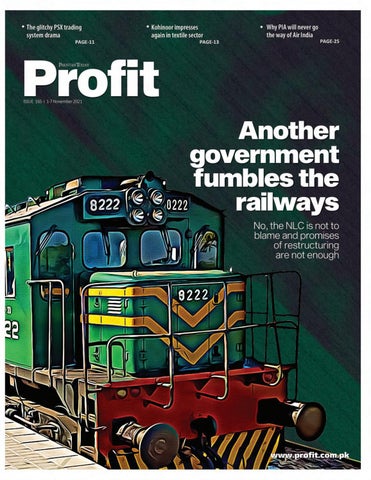
13 13 Kohinoor impresses again in textile sector 16 Another government fumbles the railways 23 Can Changan do for sedans what KIA did for SUVs? Abdullah Niazi
11
25
25
25 Why PIA will never go the way of Air India 30 On what women wear to work, and why it should be simpler Ariba Shahid
Profit
32 Step aside Lucky Cement, Fauji Cement is now #2 in the North
Publishing Editor: Babar Nizami l Joint Editor: Yousaf Nizami l Assistant Editor Abdullah Niazi Reporters: Ariba Shahid l Babar Khan Javed l Taimoor Hassan l Meiryum Ali l Shahab Omer Chief of Staff & Product Manager: Muhammad Faran Bukhari Regional Heads of Marketing: Muddasir Alam (Khi) l Zulfiqar Butt (Lhr) l Malik Israr (Isl) Layout: Ahmad Salahuddin l Photographers: Zubair Mehfooz & Imran Gillani l Business, Economic & Financial news by 'Pakistan Today' Contact: profit@pakistantoday.com.pk
Readers Say Another first, another milestone by my long time friend and Founder @NutshellGroup . Corporate lobbying will take a whole new meaning now, Insha Allah. Congratulations @MAzfarAhsan ; proud and honored to be part of this journey. Apropos: Sons, bribes, perks, and jobs – the murky world of corporate lobbying in Pakistan @RabiaShAhmed, Twitter Corruption is a mindset. We can’t single out one sector or industry. Apropos: Sons, bribes, perks, and jobs – the murky world of corporate lobbying in Pakistan Jasim Afzal, Facebook Totally agree with this article. How does it make sense to encourage corporatisation thru tax breaks for just-listed companies being established businesses + newly flush with cash? Where are the tax breaks startups need instead of paying ~30% corporate tax soon as incorporated? If @ImranKhanPTI is lobbying for the tax credit to come back, there must be some vested interests at play beyond encouraging listing. Some recently listed company looking for a tax break maybe. The tax breaks needed to truly incentivise corporatization should be given post Post-incorporation i.e. right after registering with the SECP. There is a flat tax rate around 30% immediately after you incorporate which for a new business is v high. It doesn’t make any sense to provide these tax breaks to companies who are just listed so established + cash rich. Apropos: Let there be IPOs @nidafg, Twitter Giving short term tax benefits for listing is stupid. Then sponsors list just for the tax and ensure no free float in the market. We need companies to list who need the money for growth capital. We have too many listed companies that don’t have any payout and don’t care for the minority shareholder. For example textile companies, forget cash dividends, they won’t even give bonus shares because they don’t want the minority shareholders to get free shares. Apropos: Let there be IPOs @ayazdawood2, Twitter
facebook.com/Profitpk twitter.com/Profitpk linkedin.com/showcase/13251020 profit.com.pk profit@pakistantoday.com.pk
HOW TO CONTACT
7p
@AribaShahid wrote this piece against tax breaks for new IPOs, but I don’t agree with her. I think there should be tax incentives to have more companies listed. Does this mean you would not want any company that does not need to be listed on the stock exchange? What kind of logic is that? In such a case we would only have companies who need funds and the only incentive for them would be to issue right shares time and again to gain capital. I would not want to invest in such a market. I am currently holding IDYM shares and it has not disappointed me in any way.
As long as a company is listed, it gives an opportunity to buy its shares. Even those with less than 1 million free float are up for sale. One of my largests profits came from a company with only 7 million free float. Apropos: Let there be IPOs @khurramsk, Twitter Documentation of the economy is a must and public listing serves that purpose but I am honestly fed up with the begging tactics being employed by @FarrukhHKhan. He should keep his head down out of shame when we are still below 300K investors. No one will take the market seriously when we are trading at discounts for the majority of the year and the root cause is not having enough of an investor base. So instead of whining, Farrukh would do well to increase the investor base. Waqar zaka has annihilated you and proved that there is a market of people willing to invest but God forbid these people find are spurred into action. Listing is a side thing - exchanges are meant to increase the investor base, and increase volume. That is what will generate the revenue. Apropos: Let there be IPOs @Sabbandkardo, Twitter The other route is asking your social circle to potentially connect you with someone seeking the same thing you are. However, obviously the size and variation of the said social group would then determine how many people you get to meet and the kind of people you are introduced to. Already extroverted and well connected folk don’t really have issues finding people unless they’re very specific on what they want. Apropos: The rishta aunty business playbook @hailroh, Twitter Most of the refineries in Pakistan use outdated technologies. This could be due to the sponsors importing used refineries to maximize profits in a country with lax environmental laws. Over the years these refineries have continued to enjoy high profits without making any concrete long term effort to upgrade or move towards cleaner fuel technologies. Same is the case with Thar Coal where resources are being diverted to develop mines and hence coal based power plants. It would have been a better long term investment if these resources were used to deploy solar or wind based power plants. Also a better foresight by SBP to only allow TERF for these purposes would have reduced import requirements as soon as these plants started producing electricity. Apropos: PRL, NRL & BYCO refute allegation of high carbon footprint Faisal Malik, Website
COMMENTS
IN BRIEF Prime Minister Imran Khan on Thursday appointed Minister of Economic Affairs Omar Ayub the new chairman of the Economic Coordination Committee (ECC). According to a notification in this regard, the premier has reconstituted the ECC of the Cabinet with immediate effect.
“I want to thank HRH Prince Mohammad bin Salman for supporting Pak with $3 bn as deposit in Pak’s central bank & financing refined petroleum products with $1.2 bn. KSA has always been there for Pak in our difficult times including now when the world confronts rising commodity prices.” Prime Minister Imran Khan
The Securities and Exchange Commission of Pakistan (SECP) has decided to launch an inquiry into the suspension of share trading of the Pakistan Stock Exchange (PSX) for around two and a half hours in the middle of the session that occurred on Wednesday.
$356 billion:
The foreign exchange reserves held by the central bank fell 8.6 per cent during the week ending on October 22. According to the central bank, the foreign currency reserves held by the SBP were recorded at $17,146.7 million, down $346 million compared with $17,492.2 million on October 15. The Sensitive Price Indicator (SPI) based weekly inflation for the week ended on October 28, for the combined consumption group has witnessed a massive increase of 1.23 percent, the fourth in a row, while it went 14.31 per cent up on a year-onyear (YoY) basis.
The Pakistani rupee continued to rebound for a second straight day as it appreciated around 0.30 percent to close at Rs172.26 on Thursday, according to data released by the State Bank of Pakistan (SBP). The Pakistan Customs Directorate of Intelligence and Investigation has unearthed a valuation fraud worth billions of rupees within the department. Sources said that Customs Intelligence has sent a report to the FBR chairman on the fraud allegedly committed by senior officers who are now working on important positions in FBR Headquarters, Islamabad.
8
Chilli Milli ads and bubblegum sales
this week in Pakistan’s business and economics twitterverse
P
eople were caught pulling their hair out of their head because of the incessant replaying of the ridiculous Chilli Milli advertisement featuring the ever-annoying Fahad Mustafa this week, but that was not all that was on people’s minds. Falling bubble gum sales taught us a scary lesson, we once again turned to a certain Prince for help, and the PSX’s new system crashed. Ariba Shahid brings you all this and more in this week’s social media roundup.
More than performative wokeness
Enough said
APWA wasn’t performative. It was legit. We’re thankful for all the women at APWA that worked for financial inclusion.
All gifts go to charity
Without commenting on the nature of business, it’s pretty impressive if you manage sales with intense restrictions To all our fellow brokers and journalists: please don’t accept anything that can cloud your judgment. Your word is gold. No one should be able to buy that. This scribe, however, does not think twice before accepting mugs and notebooks. Those don’t really count. Money to make certain tweets, however, very much does count. It is a dishonest practice that is unfair to your readers and unfair to your own credibility.
SOCIAL MEDIA ROUNDUP
09
Chilli Milli ads
Expensive covid tests
Remember when a certain singer who is not worth naming asked everyone to send dancing videos so he could make a music video for the PSL because he couldn’t get over the fact that there were other singers out there that the PCB engaged to sing the anthem for the PSL? As silly and petty as that futile exercise was, it at least planted the seed for a new idea that has now blossomed in the creative minds of us here at Profit. I think we all need to join together for the collective good of the country and make an ad for Chilli Milli. We need to hurry up because I don’t think we want to see Fahad Mustafa between overs much longer, especially when one sees too much of him on a certain channel (still less compared to Wasim badami). {Editor’s note: Any claims of creativity on the part of the staff of Profit are their personal opinions that do not necessarily reflect the views of the organization}
Changing times
For those that don’t know this, the reason grocery stores place bubble gum, chocolates, and other small items next to the cash register is so that while we’re waiting for our turn in line to pay for the things we are buying, we look around and pick up things that attract us. However, we’re so consumed by our phones now that there are massive dips in the sale of bubble gum. Similarly if you’re embarrassed by the contents of your shopping or over how you’ve only bought an item, chances are that you add a pack of gum to it as well. However now when you’ve got a phone to stare at to get over the long wait or avoid meeting eyes with the cashier, bubblegum sales are down around the world. Maybe this is why boom boom bubble gum had to call in the big guns by making Afridi their brand ambassador?
10
It’s been a while. Covid tests aren’t as rare as they were in the past. Why are they still so damn expensive and burn holes through pockets?
SOCIAL MEDIA ROUNDUP
The glitchy PSX trading system drama Stockbrokers want the old system back, but the PSX has already spent money on the new one By Ariba Shahid
C
hanges at the Pakistan Stock Exchange (PSX) aren’t exactly the most exciting events in the world, especially with all the other things going on in the country. And a change in the system used for trading at the PSX would not merit much discussion, but leave it to the good folks over at the stock exchange to keep us hooked with even the smallest changes they make. Since 1977, the PSX has been using the Karachi Automated Trading System (KATS) to execute trades at the stock exchange. Recently, it was decided that the system would be replaced by a new, more sophisticated system from China. Within days, the new system had
STOCK EXCHANGE
wreaked havoc in the shares market because of technical issues, causing trading to be suspended for hours as employees of the stock exchange scrambled to figure out what had happened.
What is the new system?
O
n October 25, 2021 the PSX moved from the KATS system to New Trading Engine (NTS) which they have procured from the Shenzhen Stock Exchange (SZSE), China. For some reference, the SZSE is the world’s third largest exchange which also happens to own a 40% stake in the PSX. The PSX had signed a contract in November 2019 with the SZSE worth $5 million to acquire the trading and surveillance
system in order to improve the operational and technological performance of the exchange. The system was to be introduced in March earlier this year, however, due to stakeholder concerns and requirements that were to be addressed the exchange decided to launch it in October 2021.As per the latest annual report by the PSX, the system has a safe operation record of 17 years without any trading interlude.
What’s happened since the new system came into place?
O
n October 27 2021, trading was suspended for two and a half hours in the middle of a session due to technical glitches in the newly
11
acquired Chinese trading system that had been in use for three days already. Trading stopped between 12 noon to 2:30 pm and resumed at 2:35 pm. However, towards the end of the trading session, the system went down again from 3:30 to 4 pm. It was decided that if the system malfunctioned again, the PSX would temporarily return to the old system, KATS, until glitches were addressed. As per the PSX management, the first halt was “to conduct a detailed review of the issues and protect the interest of the investors”. The suspension was extended later so that the PSX could “review” the issues. According to a report by Dawn, the PSX held 18 mock sessions before formally adopting the platform. But the association of stockbrokers claimed a day ago that none of the mock sessions was error-free. The PSX acquired the new system from the Shenzhen Stock Exchange (SZSE), a related party, for Rs461.26 million, according to its latest annual report.
Thin volumes
T
echnical glitches aside, following the change, the volumes at the PSX have been thin. As per a letter by the PSBA General Secretary, Bilal Farooq Zardi, “Volumes have shrunk dramatically due to hasty decisions based on the impractical system causing revenue loss not only to the Exchange, our members but also to the public at large. We fail to understand the logic behind its abrupt implementation during the rollover week.” It must be kept in mind that the system itself is not used by people that go to the stock exchange to make trades, but by their brokers. As Profit has detailed in an earlier explainer, while some high-end brokers also offer advice, the core role of a stock broker is to buy and sell stocks for a client. This buying and selling takes place completely over a computer system. For the past three decades, the KATS system was being used by brokers and the change in systems has been an implementation they have not been particularly happy about. Stockbrokers are not too keen about the new system despite 18 mock sessions being held before formally introducing the new system. “Prior to the deployment, eighteen (18) mock trading sessions were held for all brokers. All the concerns, enhancements and issues highlighted by the Broker Committee were looked into by PSX and SECP, and as per agreement, most were catered to prior to live deployment, while some were mutually agreed to be delivered post go-live,” said the PSX. However Zardi says that “in this process, 18 mock sessions were conducted and errors,
12
flaws & imperfections could not be addressed/ removed in their entirety. This has compelled us to state that the Exchange is being damaged by unprofessional decision making.” As per a notice by the PSX on October 28, “At the outset, it is important to note that the SZSE NTS is working exactly as per specifications. The processing speed of the system held true in the live environment. Trading activity continued and over 580 million shares traded in the market today.”
Is the SZSE system to be blamed and are the glitches going to be long term?
O
ne would think a system procured from the world’s third best exchange would not be faulty. Truth be told, it isn’t. The issues brokers are primarily facing are more related to the Jade Trading Terminal (JTT), developed by a local vendor for the PSX. The JTT was designed and developed as per the demands of brokers. The PSX said, “In most markets, the front-end trading terminals are developed by brokers themselves as per their requirements. At present, the material issues being faced by brokers in JTT include slow feed, delays in updation of trade and disconnection.” As per whether the issues will persist, the PSX says that the issues are almost resolved. “Currently, PSX IT teams are working constantly on addressing the concerns and issues in JTT that connect to the NTS. RMGS issue was resolved on Monday. The slow feed issue has been mostly resolved and the changes implemented before market open on Thursday. We expect the disconnection issue to be resolved on Friday. The vendor and PSX team are working on the resolution of delays in updation of trade logs and expect to implement some changes on Friday and the rest before market open on next Monday.”
after consultation and with mutual agreement of the Pakistan Stock Brokers Association, the Broker coordination committee, other leading brokerage houses and SECP.” While speaking to Profit, a leading stockbroker while requesting to remain anonymous said, “We’re doing our best to negotiate with the PSX about this change. The new system is just not acceptable. The mock trials themselves weren’t free of error. Why are we trying to fix something that is not broken? We want KATS back and that is a firm stance. Besides, this system relays law data to the SZSE in real time. This makes the PSX vulnerable to attacks.” The fact that not many are happy with the new system can be noted through the fact that five days before the formal launch of the new system, 57 stockbrokers wrote to the PSX expressing their concerns. “We regret to put this on record that this system is not fully ready at this stage to go live. Responsibility for any damages is on the exchange, and not on the market participants, especially when you have already been apprised pertaining to the risk associated with this incomplete system”
Why do brokers even care?
A
broker claims that the thin volumes are no coincidence. “The fact that the brokers are out in public against the system is just the tip of the iceberg. Brokers in Karachi have colluded. They’re trying to use their collective power and of course their influence to go back to the old system. If the PSX has paid millions of dollars for a system used by the world’s third largest exchange, it’s unlikely that it’s not good enough for the PSX.” The new system overcomes the lack of surveillance in the previous one which can help overcome manipulation of shares. This also may be a reason why brokers aren’t too keen on a change of “software”.
What is the actual What do stockbrokers problem? have to say? he actual problem is a lack of
B
rokers have claimed that the NTS lacks basic features and has frequent glitches. As a result, they say it has caused trade execution delays. On October 26, the Chairman Pakistan Stock Brokers Association (PSBA), Aamir Khan, wrote a letter to the SECP stating, “members are facing difficulties in consummating transactions in the recently introduced New Trading System (NTS) by the PSX on October 25, 2021”. However, as per the PSX, “The decision to go live on October 25th was taken by PSX
T
technical expertise with deployment. While we hear news of apps like Facebook being down, it is an anomaly for a securities exchange to shut down in the middle of the day due to a fault. It is unknown whether this is due to the bullying or influence of certain brokers. However, what one does see is the lack of proactive measures or repercussions put in place by the SECP. The fact that the only exchange in the country can be shut for a few hours during trading sessions because of some glitches or pressure groups is not a healthy sign. n
STOCK EXCHANGE
Kohinoor
impresses again in textile sector Nobody was surprised to find out that the organization had done well
I
t seems like Kohinoor Textile Mills is set on its upward trajectory. The company recently released its financial results for the first quarter of fiscal year 2022, and to no one’s surprise, it had done well. According to the report, the company’s sales for this quarter increased by 12.5% year-on-year to Rs7,963 million, while operating profit shot up from Rs782 million to Rs1523 million. And the mill’s net income similarly rose from Rs513 million in 2020 to Rs995 million in 2021. And it was enough for others to notice. In a note sent to clients on October 27, AKD Securities research arm noted that Kohinoor Textile Mills was benefitting from growth in textile exports. Not that Kohinoor has had any trouble figuring out how to make revenue. The mills
TEXTILES
are one of the oldest companies in Pakistan, having been set up in 1953 by the Saigols. The Saigols were initially farmers from the village Khotian, in Chakwal District in Punjab. It was Sayeed Saigol who decided to pack up hig bags and make something of himself, setting up a shoe shop in Calcutta in the 1930s. That morphed into a rubber shoe factory, called Kohinoor Rubber. Demand for his business soared due to the outbreak of World War II, as the British army needed shoes and coats. Anticipating partition in the 1940s, Sayeed again packed up, and left for Lyallpur (now Faisalabad). WIth his younger brothers Yousaf and Bashir, they set up the first spinning mill in Faisalabad – Kohinoor Textile Mills, under the umbrella company Kohinoor Industries. It was to be their flagship company un-
til their much larger investment: the setting up of United Bank in 1958, which is currently Pakistan’s second largest bank. By the 1960s, they had their bank textile mills and investments in printing, sugar mills, and chemicals business. But in the 1970s, nationalization came for their bank, chemicals, ginning and edible oil businesses. Only their textile and sugar mills remained. Various Saigols crop up in different companies , as directors and shareholders, as the company was heavily split up between cousins and family members in the 1970s, with various efforts at consolidation in the decades after. Today Taufeeq Saigol is the CEO of Kohinoor Textile Mills, while Tariq Saigol is the chairman. It is one of the major textile exporters in the country, with the company’s major trading partners the EU and the US. The principal activity of the company is
13
manufacturing of yarn and cloth, processing and stitching of cloth and trading of textile products. Around 50% of its sales come from spinning, 40% from home textiles, and 10% from weaving. Local sales make up 55% while export sales make up 45%. The AKD report looked favourably upon the KTML’ recent financials, as it pointed out that there had been robust growth of 27% year-on-year in textile exports generally, because of US apparel demand, and significant rerouting of orders from China and Vietnam due to a massive energy shortage. There had also been broad based growth in the local spinning segment amid higher local yarn margins. And while the rest of the country had complained about the rupee’s depreciation, export facing companies like Kohinoor were benefiting as well. Finally, there had simply been higher than expected cotton production this year. “We expect KTML to continue the same trajectory of top line growth with fiscal year 2021 2024 CAGR of 10%,” said the report. It likened that growth to that
14
Today Taufeeq Saigol is the CEO of Kohinoor Textile Mills, while Tariq Saigol is the chairman. It is one of the major textile exporters in the country, with the company’s major trading partners the EU and the US. The principal activity of the company is manufacturing of yarn and cloth. experienced in fiscal year 2021 where all the segments such as home textile, spinning, and weaving had jumped more than 30%. According to the report, in the long run, Kohinoor Textile Mills would be oriented towards growth in export sales. Already in 2021, home textile sales were at Rs10.2 billion, of which a whopping 48% came from the US (27% from Asia, and 20% from Europe). In the weaving segment, export sales clocked in at Rs2.34 billion with Europe contributing 85.5% of the sales in fiscal year 2021. “We expect KTML to continue to lever-
age its strong hold in the US market where (US apparel imports have shot up 28.1% in eight months calendar year 2021, with Pakistan apparel exports to US increased by 66.7% year-on-year),” said the report. The report also noted that certain federal government benefits were also now kicking in, such as the financing facilities by State Bank of Pakistan under ETF and LTFF with ~3% and 5% interest rates respectively. There had also been a reduction in the turnover tax from 1.5% to 1.25%. There had also been a release of Rs6 billion to help textile exporters to solve liquidity problems. n
TEXTILES
16
COVER STORY
I
By Shahab Omer n 2017, Profit carried a feature detailing the history, trials, tribulations, and possible revival of the Pakistan Railways. Back then, the railways were going through a rejuvenation under the stewardship of Khawaja Saad Rafique, who was the minister for railways in the Nawaz Sharif
cabinet. It was a good time to look back and reflect at the history of the railways in Pakistan. After a disastrous run under the Pakistan People’s Party (PPP) government from 2008 to 2013, during which time the railways were run by the ANP’s Ghulam Ahmed Bilour in the Gilani led coalition government of the time, it seemed that the fortunes of the national company had turned. Saad Rafique had come in with fresh resolve and taken an organisation sinking in the quicksand of persistent deficits by the horns and within a few years had gotten it to a position where it was turning profits. Now, with the PML-N administration gone, Saad Rafique a distant memory, and the incumbent PTI government already on its second minister for railways, we are standing in much the same position as we were back in 2013. While the Pakistan Railways is in not nearly as much trouble as it was back then, it is still facing increasing challenges and competition. The last time we covered this subject in 2017, Profit detailed the history of the railways from its colonial inceptions to its role in developing the Pakistani economy through the 50, 60s, and 70s and traced this history all the way back to the state that the railways found itself in in 2013, when Saad Rafique took over from Ghulam Ahmed Bilour. The scope of this article is not as grand, and instead it will focus on the current woes it finds itself in. Because in the past four years, under Sheikh Rashid Ahmed and Azam Swati, the railway has lost the luster it had regained and is on the brink of de facto privatization, even if that is not what the government is calling it. The main topic of contention at this hour is the proposed restructuring of the railways, which will leave it completely controlled by private corporations. To understand how things got here, we will look closely at some of the events and challenges leading up to where we are now, including the role of the National Logistics Cell (NLC), a mounting pension bill that keeps inflating the deficit, and how the incumbent government is proposing to restructure the organization so that it does not squander the gains made under the PML-N government. Most importantly, however, we will use the testimonies of both high ranking railway officials and grassroot employees of the organiza-
18
tion to understand the problems the Pakistan Railways currently faces, and whether the solutions being proposed by the government will make things better or worse. We will begin, of course, with why the railway matters so much to the imagination of the Pakistani economy, and then move on to issues
Why the railways matter
T
his is something that needs to be reiterated. When most people in Pakistan think of railways, they think of long journeys being made even longer by delayed trains, extended maintenance stops, and made even more difficult because of uncomfortable conditions. Most people refer to the problems with the railway not because they see it as critical to the economy, but because they see its inefficiencies as an example of why our governance has never worked. The reality is that the railway is not just a symbol, it is a real ticking time-bomb for our economy. Passenger trains are the least of the concern of the railways, because the true profit lies in the carrying of cargo and freight. And that is the second thing that most people do not realise - the railway is supposed to be a profitable organization. The relationship most citizens have with the railways is that it is a mode of transport, and a publicly owned mode of transport at that. When they think of the railways being late, or bad, or uncomfortable they simply put it down to that being part of Pakistan’s poor public transport infrastructure. Which is why when people hear of the railway being in loss or facing a deficit, they do not bat an eye - mostly because they think since public transport is subsidised it is not supposed to be turning a profit. The problem with this perception is complacency. Every year when they go into a deficit, the government gives them money to bring them out of their troubles and they keep chugging along as they were before, not changing the things holding them back. The working culture at the Pakistan Railways has for the past few decades been lazy, bureaucratic, stubborn, and extremely resistant to change. Low wages, poor unionization, little to no accountability, and successive governments wanting to keep this eyesore of an organization out of sight and out of mind has allowed it to become lethargic and inefficient. In reality, the modern Pakistani economy would not exist without the railway. Many of the problems that exist are the same. In the 2017 article in Profit, it was pointed out that trains arriving on time are considered a shock and almost nobody even blinks at the billions of rupees in bailouts (in addition to regular subsidies) that are paid out to the railway
every year. Today, much is the same. It seemed for a while that CPEC and rising economic opportunities would turn the tide, we are much in the same place. But what are the problems that are facing the railway? The first is the NLC, which has been blamed by governments of the past as well, and the second is the creeping deficit and ballooning pension bill that the railway has to deal with.
The state of the crisis
B
y the time the PPP took over in 2008 from General Musharraf, there was still an impression that the national company was worth something and just needed a little dusting up to be brought back to its past glory. These illusions were very quickly shattered. If we look at the numbers, the deficit of the railways had increased from RS 12.6 billion to RS 18.6 billion in in 2008-09, then, in the following year, 2009-10, the deficit reached RS 20.1 billion and in the following year it reached RS 26.9 billion and in 2012-13 it reached RS 30.5 billion. In five years, the PPP government had more than doubled the deficit. A lot has been said in this regard, and there is singular blame often ascribed to Ghulam Ahmed Bilour for this. It is true, his terms saw mammoth decline and under him the railway became a national crisis. Trains were grounded for all intents and purposes, railway employees were unhappy with the minister, and the general sentiment was that the only reason he was not being removed from office or replaced was because he belonged to the ANP, which was a crucial partner for Gillani administration to keep a hold on its coalition in the national assembly. However, the neglect that the railway faced was much longer and had been going on for decades. As the 2017 article went to lengths to explain, there was an accounting trick the government implemented decades ago to make the financial statements of Pakistan Railways look healthier than they really were, and that since 1991, the position of head of the railways has been held, not by a member of the Railway Group of the Civil Service of Pakistan, but by a member of the powerful District Management Group (now known as the Pakistan Administrative Services). But when Ghuam Ahmed Bilour had been asked in 2017 why he felt the railway had been in the dumps during his stint as minister, he did not point to either of these glaring facts which had been muddying the waters for decades and imploded when Bilour took over. Instead, he blamed the National Logistics Cell (NLC), saying the NLC had broken away from competition from the railway for freight. “The main problem with the railway dates back to the creation of the NLC [National Logistics Cell, in 1978]. In truth, since
“Because many such structural changes are being made under this company which will greatly improve the performance of the railways. First of all, FTMC will work as a corporate company instead of a government company and this company will be accountable to its BOD. The second important point is that the company will operate according to market dynamics and all decisions will be made on a corporate pattern,” Habib-ur-Rehman Gilani, Pakistan Railways Secretary
the NLC was formed, it has been working on and using trucks for freight, which has made railways suffer. Freight is the way that railways earn. So, when NLC was formed, freight moved from rail to trucks and it gave Pakistan Railways a major blow,” he said in an interview four years ago.
The NLC
W
hat is the NLC? In the late 1970s, a crisis was emerging at the Karachi port. Back then, the railways carried everything from wheat to consumer goods all across the country, and as far as Afghanistan. It was an impressive network, which had not been updated since we inherited it from the British colonisers. The problem was that the British had designed the railway to transport military equipment, personnel, and rations. That is why during the Raj, the British were very picky about what locals got jobs in the railway because they were afraid of secrets being leaked. So by the late 1970s, with increased economic activities, it was becoming apparent that the railway could no longer sustain the traffic and load being put on it. This came to a head when the port handling system at Karachi came to a standstill. The situation was bad enough that emergency military help was called for and military trucks opened the way for the delivery of goods and helped restore normal port activities. This temporary crisis proved to be an
opportunity. Up until this point, the railway had never had to face any competition. Now, suddenly, there were massive trucks that could carry freight across the country. This was a big thing because, remember, back then the country was not connected by a system of highways as it is now. And while the trucks were more expensive than the railway, they were far quicker and much more efficient. The idea was floated to turn this temporary solution into a modern, integrated, institution and the NLC was established with the objective of creating a land transport infrastructure with the help of which during any natural and human emergency and as required military assets can be transferred quickly anywhere. Later, commercial transport activities were started to make NLC self-sufficient and within two years of its inception, NLC became self-sufficient meaning it was already turning profits. The NLC grew very quickly, and as a semi-military organisation, has found itself growing significantly. It formed its own engineering firm for infrastructural development, created its own polymer company in 1982, and by 1993 the NLC had introduced dry ports that provide business owners with the opportunity to access and penetrate hinterland markets. Since then it has founded its own tolling system, founded a technical training institute, created a driving school to train its fleet, and put its hand in marine and air services. The most crushing blow was in
2009, when they ventured into the railway cargo business and experimented with running the NLC Express Freight Train. In 2014, NLC purchased ten state-of-the-art Korean locomotives and leased them to the railways for ten years. The NLC has grown exponentially with each passing day. Clearly the NLC has proven to be great competition for the railway, especially since it has developed constantly while the railway has fallen into disarray. But the NLC being an alternative to the railway is an insufficient explanation. After all, an NLC truck is still more expensive than a rail carriage. The only reason it would make sense for businesses to move their cargo shipping needs to the trucks would be if the railway was not available, or not reliable, or both. On that front, it appears that chronic underinvestment in infrastructure stretched not just to building new infrastructure, but maintaining old parts of it as well.
Cargo versus passengers
A
nother reason was that the railway, to appease the public, started acting as an organization that focused more on passenger transport than cargo. This is why the NLC which was growing rapidly, while on the other hand the conditions of the railways were rapidly driving it towards deficit as its focus was on passengers instead of cargo.
COVER STORY
“The main problem with the railway dates back to the creation of the NLC [National Logistics Cell, in 1978]. In truth, since the NLC was formed, it has been working on and using trucks for freight, which has made railway suffer. Freight is the way that railways earn. So, when NLC was formed, freight moved from rail to trucks and it gave Pakistan Railways a major blow,” Ghulam Ahmed Bilour, former railway minister
There have been a few incidents in the 2000s that have led the railways to a sharp financial deficit, for example, the railways purchased 69 locomotives from China’s Dongfeng Electric Company in 2003 because they were available at 37 percent lower prices than European and American-made locomotives. Soon these cheap locomotive platforms began to have manufacturing defects however, the company also repaired some locomotives but eventually, 32 of these locomotives had to be scrapped. The deal was struck during the Musharraf regime from 2000 to 2002 under Railway Minister Javed Ashraf Qazi. Sheikh Rashid, who took the office of the Railways Minister in 2006, blamed the use of bad and fake oil for the failure of Chinese locomotives. Very quickly the railway became a carcass and the vultures began to descend. In 2010-11, a scrap scandal worth RS 3 billion was caught in the railways in which the names of the then Railway Minister, Secretary Railways, General Manager Railways and Chief Controller Stores and other officials came to light and the case was investigated by the FIA and NAB. In this scandal, 39,000 metric tons of machinery was handed over to private contractors in the name of scrap. At that time the market rate of scrap was RS 37,000 per MT but four contractors were awarded the contract at RS 28,000 per MT. Thus, the national treasury
20
suffered a loss of three hundred million rupees. The chief controller of stores alleged in a statement that half of the money was distributed by the minister and secretary. The secretary went abroad and the Minister was not questioned and all four contractors plea bargained with the NAB. In February 2012, about 25 km of track was stolen from the Jacobabad section of Larkana. Along with railway officials, the names of DPO and DSP Jacobabad also came to light in the scandal. 153 plates of the stolen railway track were recovered from the warehouse of Misri Shah’s Akbar Market in Lahore and this case was also handed over to NAB. Now where is the role of NLC in all this that it is responsible for the railway deficit? There are also other massive challenges to face. For starters, there is a management crisis in the organization, and the state of the employment problem at railways runs so deep that it also has an extensive problem of ghost employees. The present government had hired Jamshed Inam Sheikh as Human Resource Development Advisor to handle this problem. Sheikh resigned only 10 months later after discovering that there were 3,000 railway employees who were paid by the railways but worked in the homes of officers. He had also declared 422 employees from the railway finance department as surplus. At the same time, a massive reason for the railway being in constant deficit is the
huge pension bill it is constantly paying. “The biggest burden on us is the pensioners. We have 137,000 pensioners and the number of these pensioners and the amount given to them increases every year. If the government takes it on its own, the railways can break even with a little effort,” says the secretary railway. Clearly, the railway has not declined because the NLC came in and broke clients away from it or gave it very hard competition, and even if it had there would have been nothing unfair about it. The problem has been that the railway’s inefficiencies demanded an alternative present itself and the NLC has happily played the part. Similarly, Pakistan Railways Secretary Habib-ur-Rehman Gilani believes that the NLC has no role to play in bringing the railways into deficit or bringing this business down. Speaking to Profit, Gilani said that it was useless to hold the NLC responsible for the destruction of the railways. “If the railways correct their attitude, no one can stop the development of this institution. If our wagons are full and the rates are reasonable, no transporter can compete with the railways. Pakistan is an ideal country for railways because our ports are in the South while the commercial areas are in the middle or in the North and the railways are still a great way to travel this fifteen or sixteen kilometers,” he said.
TEXTILES
Why they can’t keep up - the halting of ML1
C
learly, the NLC has only filled a gap. Railway shortens distances that roads cannot match and there will always be a demand to transport goods across long distances over land through locomotives. However, while the NLC is clearly a sore spot for the railway, it is not the reason for it faltering. During the PML-N era, it seemed that the railway had started covering its losses. This was a combination of Saad Rafique making the organization more efficient through stricter hiring mechanisms and by investing in improving tracks to allow for faster train rides (a project financed through CPEC), encouraging public-private partnerships to allow for the creation of a premium passenger train service, recovering the encroached rail. He also shifted the focus from passenger trains towards freight and cargo, which is the only viable business model through which the railway can really make any money. The improvement was also in no small part due to the ₨886.68 billion (US$8.4 billion) CPEC-financed upgrade of its Main Line One (Torkham to Karachi). Since the new government has come in, however, the ML1 project still seems to be on hold as there is still only talk about the loan that the Chinese bank had to give to start its work, and it seems instead of the railway getting back on track the NLC will have more opportunities to further expand their already substantial empire. Other than the massive expansion, the project also included a dry port with modern facilities to be constructed near Havelian. The initial cost of the project was $9 billion, including the Pakistani government’s equity but it was later reduced to $6.8 billion. The Chinese Exim Bank will provide $6 billion while Pakistan will provide $800 million and most of this money will be spent on lines, fences and civil works.
The response restructuring
A
s the railway once again falters and the much needed expansion of its infrastructure stays at a halt, the railway is bound to go deeper and deeper into a deficit hole as it did back under the Bilour ministry. Meanwhile, the NLC will be trying to pick up the slack. The halting of course begs the question of what exactly the railway has been doing this entire time, and what it has in store to try and control the never ending deficit. One of the key approaches has been a long promised overhaul of the railway and how it is structured.
This restructuring was initially promised by Sheikh Rashid when he took over the railway portfolio. The question arises as to whether the restructuring of the railways will really be effective in getting the railways out of deficit or whether it will flop like the various plans made in the past because nothing has happened in the last three years. The Pakistan Railway Strategic Plan (PRSP) was approved by the Railway Board on May 18, 2018, which set a number of targets. Later, in June 2020, and the cabinet approved the restructuring of the railways in August the same year. and even after more than a year, this restructuring does not seem to be being implemented. Back in August 2020, the plan approved by cabinet had stated that four new companies will be set up and functions of freight, passenger traffic and infrastructure will be separated to steer the rail company out of losses and turn it into a profitable enterprise. As part of the restructuring plan, the government has decided to extend the scope of Pakistan Railways’ board by bringing members from the private sector for innovation in policy making.The time given for this was four months. Essentially, under this new setup of restructuring, the government would be responsible only for the infrastructure and most everything else would be handed off to the private sector. Many railway officials, especially laborers, are angry over this privatization in the name of decreasing the deficit. A senior railway official, speaking on condition of anonymity, informed that when Sheikh Rashid took office, he had also revealed his original plans and he had haughtily said that Pakistan Railways would be present for private investors and if any investor wanted to run a passenger or freight train, the railway tracks would be available for rent. “We became even more concerned when Rashid said that investors could also take
railway stations and build shopping plazas and food streets on railway lands. In simple words, everything from trains to railway lands will be handed over to the private sector. Now, if you think about it, the so-called deficit and destruction of the railways is being justified by the present government so that the privatization policy can be followed and the same has been the case in the past. To this day, the implementation remains undone. Recently, new minister in charge Azam Swat in a letter expressed concern that the implementation of the restructuring is slowing down and its targets seem to be difficult to achieve. The names and objectives of sister concern companies of railways are being changed in the restructuring of the railways and the justification for this is being made so that the companies can make maximum profit for the railways and for this profit the railway trains, lands and key assets will either be outsourced or railway operations will be run under a public-private partnership. However, Gilani denies this and says that there is no slowdown on the issue of restructuring but work is being done very fast. “We’ve improved our rotation policy, trained people, automated, automated HR management, and restructuring is in full swing. Railways is a big company and it takes time to fix things in such a big company,” he maintained.
Understanding the restructuring
T
he Pakistan Railways comprises three functional units. The Operations Unit, the Manufacturing & Services Unit and Welfare & Special Initiative Unit. The Operations unit is directly headed by Chief Executive Officer/Sr. General Manager, whereas the other two units are headed by the General Manager concerned. The Manufacturing and Services (M&S) unit oversees the
COVER STORY
management of the Concrete Sleeper Factories, Locomotive and Carriage Factories. The Welfare & Special Initiative Unit manages all Railway owned Schools, Hospitals and Director Stores and Purchase besides monitoring and execution of projects. Under these wings are the four companies being formed that are part of the restructuring, and to understand the kind of changes taking place, we will take a look at the two companies where there has been significant enough activity to comment on. First of all let’s talk about the restructuring of Pakistan Railway Freight Transport Company (PRFTC) which was formed as per PRSP and now its name will be changed and its new name will be Freight Traffic Management Company (FTMC). Recently, Javed Siddiqui was appointed as the CEO of the company and many controversial questions were raised on his appointment. According to some reports, after Siddiqui’s appointment, many foreign investors had hinted at not investing in the railways. However, Swati has been defending Siddiqui’s appointment since day one and he thinks that Siddiqui is the best for this position. Secretary Gilani also said that Siddiqui is a logistics expert more than equipped for the job, and as far as foreign investment is concerned, it is already very rare in the railways. “Although, we are trying to get foreign investors in the railways and this is the first time in the history of the railways that we have introduced the private sector. The purpose of bringing in the CEO of the private sector is also to solve the problems of the private sector and Siddiqui understands the language of the private sector well,” he said. According to the restructuring plan, FTMC will operate independently under Siddiqui and Siddiqui will be responsible for bringing about change in the company. However, another important point is that the employees of FTMC will definitely not be employees of Pakistan Railways but will be appointed for a period of five years and will be employees of the company. In the restructuring plan, Siddiqui will form a professional team of logistics experts and secure the freight business for the company, while the company will also enter into transport agreements with private parties and private companies interested in operating freight trains and will also work on joint ventures with private parties. The company’s freight business activities will include freight transport, marketing, commercial management, freight terminal management and client coordination. No one from the Minister to the Superintendent will interfere in the affairs of the company but will help and assist the company. However, Siddiqui has been directed by Swati to form an independent board of directors for companies with high
22
quality professionals as per the recommendations of the SECP. Then there is the Railway Constructions Pakistan Limited (RAILCOP). The name of the company is also going to be changed under the restructuring policy, which means that the change is really coming. RAILCOP will now be responsible for developing real estate as well as railway infrastructure. The company will also have an independent board of directors and none of the railway ministers, secretaries, CEOs or senior GMs will be members or chairmen of the board. A temporary board of directors has been formed so that the company can start work. However, once the board elects its chairman, it will either increase the number of members or appoint those with experience in railway infrastructure. But the thing to think about is what the RAILCOP was doing before. This company was incorporated as a Public Limited Company in 1980 under the Companies Act 1913, with an initial investment of RS 0.5 million. The objective of the company was to achieve excellence in Engineering Services with special emphasis on Railway Sector while continuing to keep success and profitability and to perform for PR’s customers the highest level of quality services at fair and market competitive prices. Since its inception, RAILCOP has completed various projects in Pakistan. The company’s data shows that from 1980 to 2012-13, the company earned a total of RS 1.33 billion, while from 2012-13 to 2017-18, it earned a profit equal to this profit, that is, 32 years of profit was equal to 5 years of profit. This company is accustomed to making profit anyway so there was no need to change it or change the name of the company but still the mandate of the present government is to bring change so, wherever possible, change must be made by the government, even if it means changing the name of a company or institution. However, the new name of the company has been suggested as Railway Infrastructure Management Company. Restructuring is really going to be something new with the Railway Estate Development and Marketing Company (REDAMCO). However, the name of the company will be changed to Railway Estate Management Company and its board of directors will also be made independent in which no railway officer or minister will interfere. However, the government is looking for a new CEO for the company and the company will look after the leasing, marketing and management of all
railway lands. Therefore, if the Lahore Central Business District Development Authority (LCBDDA) still wants to build high rise buildings in Mayo Gardens, they will have to contact the CEO of the company and not the Minister of Railways. Assuming that all major assets and earnings have been outsourced by private companies, the process of privatization of railways in the name of Public Private Partnership or JVs is in full swing. However, in this regard, Gilani said that REDAMCO would not have any authority over the issue of leasing of railway lands and the railways would not subdue its land assets under anyone. “REDAMCO is our only marketing agent and we didn’t give this company anything. So far, REDAMCO has not even hired a CEO, but we will see what to do when the CEO comes. The marketing rights of the railways can be given to a company but the railway land has not been given to anyone and will not be given,” he said. The issue of the pension time bomb on the railway, increasing deficits, and other inefficiencies are examples of all that is wrong with the organization that had so much potential and was consistently fumbled and wasted by government after government. There have only been brief moments where it seemed things could improve. The current government’s efforts do not seem to be one of those moments. After all, everyone can make big plans and promises, few end up delivering. n
COVER STORY
OPINION
Abdullah Niazi
Can Changan do for sedans what KIA did for SUVs?
Fu and maybe Pandas. You don’t think of cars. Cars are supposed to be made in Japan or Germany, not China. And even though China is in fact the biggest automotive market in the world, producing a whopping 30 million units per annum, and Changan is the largest automotive brand there – producing 2.8 million vehicles a year, which is more than ten times Pakistan’s total car production, shedding the China tag is difficult for anyone in Pakistan. China is equivalent to cheap in both price and quality in the mind of the Pakistani manufacturer. It is so much so that car manufacturer MG, which is staunchly a Chinese company, pretends to be British to give itself some credibility. The impression is so strong that the franchise store Miniso, which is headquartered in China, pretends to be a Japanese outlet. f you are going from defense to Gulberg and take the cavalry Yet this Chinese car manufacturer that has never before route, on your way there you will see an advertisement for the been heard of in Pakistan is suddenly not just posing a threat to Changan Alsvin. The odd thing about the large billboard ad? the sedan segment and the Big Three, it has the nerve to stand up It does not have a single picture of the Alsvin, it does not have and call out the Big Three for their exclusionary tactics. Where is the Changan logo on it, and seemingly no other embellishthe confidence and the gusto coming from? It could be because in ments or boasts. recent years things seem to be changing. There has been an influx It is a simple white background on which there is a quote of new cars and categories of cars have been entering Pakistan “Please ignore the Changan Alsvins on the road - Sincerely, The that were previously unheard of. Status Quo.” The tongue-in-cheek ad is a dig at Pakistan’s infamous The KIA Sportage has brought in an affordable option for ‘Big Three’ car manufacturers that have for the past three decades had a crossover-SUV within Rs 5 million, which has been preferred a triopoly on the automobile industry - Toyota, Honda, and Suzuki. by a number of people over the Honda Civic and Toyota Corolla On different occasions on different platforms, the big three have been - sedans that are priced around Rs 4-4.5 million. In the same dissected and criticised for their ridiculous pricing, their lack of safecategory, companies like MG and Hyundai have also introduced ty features, and the hold they have on Pakistani car buyers. their own contenders and smaller cars like the KIA Picanto are It is an audacious move. Changan is a Chinese car manufacturalso challenging Suzuki in the hatchback segment. With more er. When you think of China, you think communism, dragons, Kung than 25000 Sportages sold in two years, other players have also been emboldened and the Alsvin seems to be a product of this revolution that was started by all of these players and led by KIA. Changan’s Alsvin is in the same boat. The advertisement from Changan is not just a less than subtle poke towards the Big Three, it is very much a challenge. In January this year, when the car was first released for booking by Changan, it was overwhelmed by 17,000 pre-booking orders Abdullah Niazi and closed bookings. Back then, there had been an outpour of positive feedback and response for is assistant editor at the Alsvin in just over a month since its debut. Changan has had over 29,000 walk-in customers Profit. He also writes for come to 19 of its 3S dealerships all across Pakistan just to have a close look at the vehicle. He addThe Dependent. He can be ed that the company has received over 17,000 pre-bookings for the Alsvin.Since then, the Alsvin reached at abdullah.niazi@ has been a frequent site on the roads of Lahore and by all accounts its buyers seem happy. pakistantody.com.pk And why wouldn’t they be? The cheapest version of the car is priced at Rs 2.2 million, which means that Toyota and Honda both have competition in this price range, and so does Suzuki. Both Toyota and Suzuki have been reacting to these changing market dynamics. Toyota launched the Toyota Yaris. Essentially, they discontinued the cheaper variants of the Toyota Corolla with 1300cc
The Alsvin is popular, cheap, and a quality buy. Will it be enough?
I
COMMENT
23
engines, and launched a new car from scratch that was cheaper. Now, people could either buy a Toyota Corolla in the Rs 3.5 – 4 million range, or a Toyota Yaris in the Rs 2.5 – 3 million range. The move proved to be successful, and the Toyota Yaris has been the most successful selling car in Pakistan this year. The Yaris has only been around for 14 months, and in that time has sold nearly 27,000 units, meaning if it had been around for two years it would have sold as many as 50,000 units in two years. In comparison, in two years the corolla has not even managed to break the 40,000 unit mark and has sold just above 36,000 units. This means that the price range that the Yaris comes in, which is the Rs 2 - 3 million range, is a hot range for which demand is high. The Alsvin fits in this range and is in fact cheaper, with some added benefits that solves a major problem that the Yaris has. What is the problem? The Toyota Yaris is not as prestigious, it does not feel like a separate car and feels more like a Corolla mini which is how Toyota has designed it. Meanwhile the Alsvin is the only sedan that Changan offers and it has a much better design. The Toyota Yaris with its high back lift and suspension makes a not very pretty sight, while the Alsvin is a breath of fresh air and both looks and feels like a compact sedan with a nice, clean, modern looking interior - especially with its large, tablet display which might have been inspired by Tesla models. This means that there is some serious competition in the Rs 2 million to Rs 3 million range. Toyota offered a sedan at just a little
24
China is equivalent to cheap in both price and quality in the mind of the Pakistani manufacturer. It is so much so that car manufacturer MG, which is staunchly a Chinese company, pretends to be British to give itself some credibility over the price of a hatchback. Think of it this way. If you were going to buy a Suzuki Cultus hatchback with a 1000cc engine in 2019, you would be spending around Rs 2 million. Now, you could simply add in Rs 400,000 and get a Toyota Yaris, which is a sedan with a 1300cc engine. The Yaris was also priced just a little lower than the Honda City, which ranges from Rs 2.7 – Rs 3.1 million. And since the Yaris is a newer design, people naturally gravitate towards it. Similarly, if you were buying a Honda Civic for Rs 4 million in 2019, now you can add Rs 500,000 and get a KIA Sportage SUV. Except now, the Changan Alsvin brings an even cheaper option that has more features than the Yaris and also does not feel like a compromise car, which the Toyota Yaris does since it is the smaller version of a corolla and replaced the Xli and Gli variants of the car. Even the Honda City is being affected, and since it has introduced its new variants, its sales have not seen a particular uptick and the sight is possibly less common than that of the Changan Alsvin. The marketing tactics that are being used by Changan are cheeky, and they probably have the Big Three fuming. The
desire to lash out at them is natural, especially considering that the three manufacturers have desperately tried to keep new entrants out of the market over the decades. In fact, the All Pakistan Automobile Manufacturers Association only has Japanese manufacturers as members, which is why numbers for the exact sale of the Alsvin are not available. The lashing out makes sense and is in many ways justified. The ad grabs attention, and to those literate in Pakistan’s automotive industry, it is a very well understood fact that the Big Three are a troublesome force that is finally having to face some competition. The philosophy behind Changan is very clearly one that has come to play, and it is a philosophy based not just on selling cars but on changing the status quo. Pakistan has been suffering from the attention and control of the Big Three for decades now, and finally there are numerous rays of hope that make the future seem not so bleak. So why should these companies not have a bit of fun with their marketing? It is their right, and most importantly, they are staking a claim and announcing they are here to stay. And the increase in choice is something everyone should be celebrating. n
COMMENT
This was always a non-starter, but putting the two airlines side-by-side is still worth it
By Ariba Shahid
T
his is a piece of speculation. For any of our readers that would frown and nod their heads in disapproval after reading this story before sending us tweets and emails about this being speculative, we thought we’d get that out of the way. Nothing has happened, there has been no major change at the Pakistan International Airlines (PIA) that has prompted us to write this, and there is nothing that would indicate something is in the works. However, that does not mean we cannot wonder. The acquisition of India’s national airline by Tata has proven to be a poignant moment in Indian history because after decades Tata has gotten back something that they have started in the Indian subcontinent. And while it is a moment that might make for a movie, what we are thoroughly fascinated with is how different the journey of Pakistan’s national airline has been from the journey of India’s national airline, given the very similar beginnings that the two had.
PRIVATIZATION
Of course, this is a rabbithole that has no end. There are countless ways in which India and Pakistan were on the same footing at the time of partition and even more countless ways in which the two countries have deferred and gone in different directions on so many different subjects and issues. Different industries and businesses are no different. That’s why we at Profit generally try to avoid comparisons to India, because there would be no end to it. But every now and then a proposition is too tantalizing to miss out on. Why has the PIA not had a similar trajectory as the Indian national airline? For this, we will look at two things - the first being a brief history of the airline industry in India, and how it came to where it is today, and the second being why something similar cannot happen to PIA, and even why it will be very difficult to privatize it at all. That is why we are putting side by side a brief history of Air India and a brief history of the Pakistan International Airlines. There are many lessons to be learned from these two airlines, the latter of which saw glory and then caused its own downfall. What were the similarities and differences in their origins, how did
they operate differently, and could they have similar trajectories in the future? The short answer to that last one is no, but the journey to getting to that answer is one illuminating ride.
How Air India began and grew
H
eadquartered in New Delhi, Air India’s saffron tail with a bursting sun is not a particularly common or famous sight. It does not evoke the same kind of acclaim that the tail of Emirates or Qatar or other famous airlines evokes. Yet it has been around for a very long time, and it has gone through a lot to get to the stage it is at today. The company is currently owned by Tata Sons. The interesting thing is that when Air India was founded in 1932, it was also owned by the Tatas and was in fact not named Air India, and was called Tata Air Service. However, the Tatas owned the airline for about 15 years, and have only come to acquire it again recently. The airline was founded by J. R. D. Tata as Tata Airlines in 1932. Tata himself flew its first
25
“The restructuring and business plan will be merged together, through that we will find a way to further improve operations. The business plan will likely be available in November,” Air Marshal Arshad Malik, CEO PIA
single-engine de Havilland Puss Moth, carrying air mail from Karachi’s Drigh Road Aerodrome to Bombay’s Juhu aerodrome and later continuing to Madras. An industrialist, entrepreneur, and an aviator, Tata had won a contract to carry mail for Imperial Airways, a British commercial airline. And on that first mission which Tata flew himself, the then Karachi Drigh Road Aerodrome is now the Jinnah International Airport. Later on the airline launched its domestic flight operations and renamed the company to Tata Airlines. During the Second World War, the airline helped the Royal Air Force. Following that, in 1946 the company became a publicly listed company. In 1948, a year after independence from British Raj and the partition of the subcontinent, 49% shares of Tata Airlines was acquired by the Government of India. The takeover, however, wasn’t exactly pleasant business. The government of India passed the Air Corporations Act in 1953 through which they purchased a majority stake from Tata Sons for Indian Rupees 2.8 crore. J. R. D Tata, however, continued to serve as chairman until 1977. The airline was renamed once again making it Air India International Limited, which made international flights. Indian Airlines, an airline formed through restructuring, undertook domestic operations. Air India International kept adding international destinations and also had the privilege of being the first Asian airline to induct a jet, i.e. Boeing 707-420. The name was changed once more to just Air India, cutting out the international because it felt like a mouthful. Air India also became the first airline to be an all jet airline. Years later, in the early 2000s, talks first arose of re-privatizing Air India. Over the years, the national carrier had not been doing too
26
well. In the backdrop were corruption cases against the then managing director, Michael Mascarenhas, which had been initiated by the Ministry of Civil Aviation which eventually resulted in him getting suspended. In 2004, Air India launched Air India Express as a subsidiary. Air India Express was a budget airline for short distance international flights to the Middle East and other countries in Southeast Asia. Air India, operated on long haul international routes, and Indian Airline operated on domestic and short haul international routes. To keep track of the changes, the original Tata Airlines had now split into three different airlines with three different names with the same parent, until 2007, when Air India and Indian Airlines were merged to form Air India Limited.
Not so smooth sailing for Air India
H
owever, if we talk about finances, the airline wasn’t doing so well. The combined losses for Air India and Indian Airlines were approximately $100 million. Following the merger, things didn’t get better and losses climbed to $960 million by 2009. Massive debt had accumulated which resulted in the State Bank of India calling for the sale of four aircrafts for around $18.75 million. That didn’t stop the debt from growing, debt clocked in at $5.7 billion in 2011. The airline wasn’t running profitably either and had a $2.9 billion loss in 2011. As a result of which the airline even requested money to pay off its debt from the government. In order to get things on track, it went on a cost saving spree which included shutting down hubs and ending flights on less
lucrative routes. The plan was to head for partial privatization of the airline by 2012.The airline also reached out to banks for external commercial borrowing and bridge financing. In 2013, things got somewhat better with the airline managing its first positive EBITDA and 20% growth in its operating revenue year over year.
Time to go private once again
T
he Indian government really didn’t have a choice when it came to selling the airline. It was costing taxpayer money and it cost approximately $2.6 million every day to run the airline. The service standard, the aircraft utilization was low, revenues were dismal and the perception in the public eye was far from flattering. Sound familiar? That is partly why we are even posing this question of wonder, because Air India seemed to be in the same kind of boat as PIA. In 2017, the Indian Government got serious about the privatization, approved the privatization and set up a committee. Many government officials believed privatization was essential for the survival of the airline. The government put out an Expression of interest to sell 76% of Air India which also included Air India Express, along with a 50% stake of AISATS which is a ground handling joint venture with Singapore Airport Terminal Services. The new owner of the airline would also have to deal with debt worth $4.4 billion and put forward a bid before 2018. Pretty sure you can tell that no one was interested in buying an airline that had massive debt. The government gave it another try in 2019. This time, however, they decided to go all in and sell it all, meaning a 100% shares
of Air India and Air India Express including 50% stake of AISATS. The EOI was issued on January 27, 2020. To make the airline seem more lucrative, the government set up a Special Purpose Vehicle to take on the debts and liabilities. As a result of which, anyone who bought the airline would have to deal with $4 billion less debt and liabilities than they originally would have to. The government had to re-issue tenders for selling the airline in September 2021. Spice Jet, an Indian airline through a consortium, was interested in buying the stakes. However, Tata Sons, the original owners of the company were in the running too. On October 8, 2021, Tata Sons was able to buy 100% of Air India, Air India Express and 50% of AISATS for $2.4 billion. Tata Sons used Talace Private Limited, an SPV for this transaction. Tata Sons has taken over approximately 25% of Air India’s debt. In numbers, it has taken over 15,300 crore Indian Rupees worth of debt out of a total of 61,562 crore
Indian Rupees.
Back with the fam
A
fter 68 years in the control of the government which had taken the airline under Jawaharlal Nehru’s government through nationalization, Air India was back in the family. The airline is now in the hands of the founder’s family. “Welcome back, Air India” tweeted Ratan N. Tata in a Bollywood-esque reunion manner where a long lost son returns home. While Ratan and JRD are not from the same branch in the family tree, they were close and of course operated in Tata Sons. While Tata Sons did not have Air India to call their own for all these years, they set up a joint venture with Singapore Airlines which didn’t work out. A second attempt was made in 2012 and Vistara, a domestic airline was launched. This means the Tatas are well aware of modern airline business.
But why would anyone buy Air India?
T
he airline has a fleet of more than 130 aircrafts, has more than 4,400 domestic and 1800 international landing and parking slots at domestic airports and around 900 internationally. The airline also makes more than two-thirds of its revenue through international flights. The airline also has fixed assets such as land, buildings and planes worth more than $6 billion. In addition to which, it also is the proud owner of an ashtray designed and gifted by Salvador Dali amongst 40,000 other pieces of art and collectibles. The Indian market, considering its size, is vastly underserved. This means that there is a strong chance of growth for airlines. With passenger growth of around 20% in India each year, Air India seemed like a nice investment for the Tata Group.
Pakistan’s founder Muhammad Ali Jinnah supported Orient Airways established in 1946 with a personal equity participation by buying airline shares worth Rs. 25,000
PRIVATIZATION
Can this happen for PIA?
P
IA, or Pakistan International Airlines is Pakistan’s flag carrier. It was founded in 1946 at Calcutta, before the partition of Pakistan. Muhammad Ali Jinnah was had thought Pakistan would need their own airline and therefore requested help from Mirza Ahmad Isphani who was a Bengali businesnman. Along with Adamjee Haji Dawood Bawany, a businessman, activist in the Pakistan Movement and the founder of the Adamjee Group, Isphani put up the money that would be needed to financially fund the airline project. Orient Airways, was thus registrerd as the first and only Muslim owned airline in the British Raj. In June, just a few weeks shy of partition, Orient Airways began its operations. Pakistan’s founder Muhammad Ali Jinnah supported Orient Airways established in 1946 with a personal equity participation by buying airline shares worth Rs. 25,000. After partition, Orient Airways began relief operations and flew routes between East and West Pakistan. Commercial traffic wasn’t as expected because British Overseas Airways Corporation (BOAC) and two other competitors were given rights to fly passengers between East and West Pakistan. This continued till 1953. The government of Pakistan had to pick up the losses through subsidies for purchase of three aircrafts worth Rs 25 million. The aircrafts, however, were registered to the government’s newly established subsidiary Pakistan International Airlines. This was a department working under Pakistan’s Civil Aviation Authority. The operation and maintenance of the three aircrafts was PIA’s responsibility. Pakistan International Airlines Corporation (PIAC) was formed through a merger of PIA with Orient Airways in 1953. Following this merger, the government of Pakistan assumed financial control of the airline and Orient Airways retained its name. The chairman of Orient Airways became the CEO of PIA.
28
In 1955, however, Orient Airways and PIA were formally merged together under the Pakistan International Airlines Corporation Ordinance, 1955. That is also when the airline launched its first international route from Karachi to London. In the 1960s, the airline was financially profitable for the first time. PIA expanded its fleet and destinations. It even made a world record for speed for a commercial airline route which is still held by PIA. PIA was having a ball, performance was great, the airline was respected. The uniforms were changed through a competition. The winning entry came in from Hardy Amies, an English Fashion designer and also a Royal Warrant holder as designer to the Queen. PIA continued adding routes and increasing its profitability. And minus a few hijacking attempts, everything was swell. In the late 1970s, the PIA also started providing technical and administrative assistance and leased aircrafts to foreign airlines. These include names like Air China, Air Malta, Philippine Airlines, Somali Airlines, and Yemenia. The airline also set up a subsidiary providing hotel management services in the UAE, a cargo handling station at Karachi Airport, duty free shops, and other services. The airline staff grew to around 24,000 by 1981 making it the highest ratio of employee to aircrafts in the world. Despite reducing staff to 20,000 by 1983, PIA continued to have the highest. ratio in the world. This was also around the time that structural changes were kicked off. PIA operations were decentralized between new departments. This somehow boded well for the airline considering it reported its highest profits in 1981 following which the profits kept on growing. PIA then played a significant role in establishing Emirates airline in 1985, which some say proved to be equivalent to shooting one’s own leg. The PIA then faced turbulence in its operations in the 90s when it had to deal with operating losses and liquidity problems due to pressure groups within the organization. There
were frequent pilot strikes, vendor issues, over staffing, and of course political influence and interference in the day to day running and decision making of the airline. The open skies agreement signed in 1993, however, proved to put more pressure on the financial performance of the airline as 12 private airlines were allowed to operate domestically in Pakistan. To add to that, in the early 2000s, with the Afghan Airspace closed due to the war in Afghanistan, PIA faced problems with its operations. However, a new management coming in and restructuring of the airline resulted in PIA becoming profitable once again by 2003. This was done through bringing costs down. This was not long lived because by 2011, PIA once again became unprofitable and in need of government subsidies. This was due to greater competition from middle eastern airlines, corporate mismanagement, over staffing and rising fuel prices. That is when privatization talks began. However, protests broke out. Moreover, debt kept growing and requests for government bailouts were needed to continue operations. Things did get better in 2019 when better routes were launched, loss making routes were cut back, cargo operations were increased, and employees were made redundant. Then, COVID-19 hit and the aviation industry around the world struggled like it had never before. PIA, however, undertook a number of relief flights to bring back home stranded citizens from lockdown countries. In the meanwhile, PIA also had to deal with a pilot licensing scandal resulting in international bans.
Privatization for PIA?
A
s of late the company is majorly owned by the government with a 86% stake, the remaining 14% lies with private shareholders. The airline remains under the administration of the Aviation Division and is managed by the President, CEO and Board of Directors
JRD Tata, then chairman of Tata Group, on the 30th anniversary day of the inaugural Karachi-Bombay flight Privatization plans began in the 1990s due to persistent losses. The plans, however, were never implemented. The airline, however, began privatization of services through outsourcing non-core businesses such as catering units, ground handling, and engineering. Nothing really worked out with privatization plans beyond that considering the airline name was dropped from the privatization list in 2009. In 2013, efforts to privatize were renewed. The plan was to sell 26% stake of the company to investors. However, this plan was dropped due to heavy protests by the airline union. In 2018, with Imran Khan’s government coming into power, the decision to privatize the airline was reconsidered. The administration thought it would be better to make the airline profitable through a change in management.
Would anyone even buy PIA?
T
ruth be told, the airline has massive debt accumulated over the years which no one would want to take on. In addition to that, PIA also faces the problem of capacity dumping by Middle Eastern Airlines as a result of the open skies agreement with the UAE. To top it off, dealing with unions and the power that they have demonstrated in the past also proves to be a deterrent.
Keeping all this in mind, it is highly unlikely that someone would want to swoop in and buy the airline. The Isphani and Dawood family that helped set up the airline aren’t as big as they were back in the day. Moreover, it is not like Air India, where the Tatas controlled the airline for a long enough time.
Can PIA ever be privatized?
I
n the case of Air India, the Tatas came in to buy back their airline when the government took care of the debt. Something similar can happen for PIA, however that requires major restructuring to deal with the legacy liabilities. The solution had been originally floated around and approved during PM Nawaz Sharif’s government. It was simple, in 2015, the government had decided to convert PIAC into a company through legislation. In April 2021, the plan was revisited under the guidance of Dr Ishrat Hussain, whereby the origination would be divided into two companies and the staff would be slashed by 25%. This would result in the amortization of Rs 457 billion worth of liabilities by 2023. The ECC also agreed to absorb Rs 202 billion of the liabilities as federal government equity in PIA as a non-cash transaction. “The restructuring and business plan will be merged together, through that we will
find a way to further improve operations,” says Air Marshal Arshad Malik, CEO PIA. He also states that the business plan and restructuring is necessary if PIA is ever to be privatized in the future. “The business plan will likely be available in November,” says Malik. Even with a business plan out, the likelihood of it going through is slim considering how political decisions relating to the airline get. To answer briefly, PIA and Air India are two different situations. They have a lot in common considering legacy liabilities, receiving government subsidies, and operating in losses. However, the fact that PIA was never privately owned by a family is a major difference. Moreover, the fact that there is no business family big enough to take on PIA such as the Tatas is also an important thing to note. Moreover, with capacity dumping a problem within Pakistan, why would anyone want to take on global giants as competition. Especially keeping in mind the negative perception PIA already has. When you buy a company, you also buy its goodwill. With a number of aircrashes over the decade, fake degree scandal, bans internationally, and terrible public perception – why would anyone want to burn their hard earned cash to bring glory to the nation’s name again? It makes no commercial sense. Moreover, with the government pushing the aviation sector, it is rather easier to just set up your own airline. n
PRIVATIZATION
OPINION
Ariba Shahid
On what women wear to work, and why it should be simpler Traversing what is and what is not appropriate for work is very different for women than it is for men
B
efore every major interview, summit, seminar, award night, or work dinner, there is one whatsapp message I always find myself sending. What should I wear? The thought is always there and it is always directed towards my colleague Meiryum or other working women I am friends with. Why do I put myself through this ritual no matter what? It isn’t because I doubt my fashion skills. It isn’t because I can’t pick out my own clothes. It isn’t vanity. Everytime I ask because for women there is no knowing what is considered appropriate formalwear for women on different occasions. You see, this is another one of those places in which men have it far too easy. A typical day at work? A collared shirt and formal pants. Business casual? A polo and khakis. A formal event? Throw on a suit, or if you’re feeling really crazy, pair a dress shirt and pants with a
Ariba Shahid
is a business journalist at Profit. She can be reached at ariba.shahid@pakistantoday. com.pk or at twitter.com/ AribaShahid
30
blazer. Work clothes for men are very simple, and they have been defined over the years. The playing field is a little different for women, particularly in Pakistan. For men, the definitions of formal are very easily covered by the way western formal wear is defined. For women in Pakistan, it is completely different because eastern clothes do not have a defined formality to them for different occasions, which is why it could not be a more complex field to navigate than it is right now.
The current scenario
T
his is about it. What do women wear for work in Pakistan and how is that different from what they usually wear? In most cases, the vast majority of women wear Lawn ka Jora to work. Doesn’t matter if they have flowers, vibrant colors, bold prints, or lots of embroidered motifs. That’s just considered the regular. However, that is essentially what they wear at home, when visiting a friend’s house, going to the mall, or eating out. A lawn ka jora proves to be both formal enough for a regular day at work and casual enough for everything else you plan on doing. That, however, doesn’t always feel right. Especially considering the prints. To make it seem more formal, I have personally started wearing monochrome or solid colored outfits with little to no motifs and prints. It does, however, get difficult to manage and of course it does get boring if you’re literally just wearing the same outfit in different colors. Work wear is very easy in most countries considering the dress codes are clearly outlined. If you’re expected to wear formal clothing, you wear a suit or just a buttoned shirt with pants. If you’re allowed to look slightly more casual at work, you could wear a turtleneck or a plain t-shirt. Maybe even jeans, but that depends on where you work.
Is this problem across the board?
W
hat’s interesting is that if you work at an MNC, one of the bigger banks, and at cooler startups, you’re not judged for wearing western clothes to work. Suits, formal shirts with pants aren’t frowned upon. That isn’t the case across the board because in Islamic banks, some brokerage companies, and companies where boomers are on the board, western wear, including suits, is not allowed for women. As someone that interviews, networks and meets various people and various offices, I often find myself dressing up based on whether they are comfortable with me walking in wearing a suit or not. Similarly, if we ignore everyday office wear and talk about events. Those prove to be even
more challenging to dress for. While men simply just put on a suit, it’s not that easy for women. You could go for your trusted lawn ka jora that works in every situation but how do you make it seem more formal or even appropriate in comparison to the lawn ka jora you wear everyday. This is one problem I face when dressing up for an awards ceremony earlier this week. While what you wear is a private matter, one can’t help but stress on the fact that dressing up well has a positive effect on your performance, confidence, and demeanor. If you feel you’re not dressed for a work meeting or event, you’re going to be conscious and definitely not bring your a-game.
The opportunity
T
he Pakistani fashion industry focuses plenty on bridal couture and collection after collection of lawn suits. However, the industry rarely introduces variety or innovation for working women. This of course is not restricted to just clothes but other accessories as well such as work appropriate shoes as opposed to the stone studded chappal that you should wear to a party and not work. The female labor force participation rate rose from under 16% in 1998 to a peak
of 25% in 2015 before declining slightly once again to 22.8% by 2018. That means there are millions of women who are currently working who might not have been, had labor force participation rates for women stayed the same. The total number of women in Pakistan’s labor force – earning a wage outside the home – rose from just 8.2 million women in 1998 to an estimated 23.7 million by 2020, according to Profit’s analysis of data from the Pakistan Bureau of Statistics. That represents an average increase of 4.9% per year compared to an average of just a 2.4% per year increase in the total population. In short, the growth in the number of women entering the labour force is more than twice as high as the total rate of population increase. While not all these women work in the corporate sector, the fact that this segment is rising and has purchasing power means more brands need to step up for working women. Spending on clothing has risen much faster than spending on other categories, rising by an average of 13.5% per year for the past 15 years. Readymade garments are, by far, the fastest growing segment of consumer spending on clothing and footwear. In 2019, readymade clothes account for 37% of total consumer spending on clothing in Pakistan.
The solution
A
ll this means that there is a market out there that needs to be tapped into. While some brands launch a small collection that is for work wear, that is simply not enough or vast enough to actually be considered as dedicated work wear. Not only do brands need to cater to this segment but they need to realize prints, flowers just don’t look professional. While I do not aim at looking down at the women that wear those, I can’t help but draw inspiration from women like Dr Shamshad Akhtar, Hina Rabbani Khar, and of course Sima Kamil and how they’ve managed to maintain a professional appearance throughout their careers. Another thing that needs to be said is the wearing of western wear at work shouldn’t be demonized for women especially in a corporate world where men are expected to wear nothing but western wear. It shouldn’t be used as a radar for morality. In the end, I’d like to say that the reason behind writing this is because in a world where women are rarely taken seriously even when they rise the ranks to the top, the way they look sometimes plays a role in that. When you look professional, you are taken seriously. So if all us women can determine what the right work and event wear is as a working
COMMENT
Step aside Lucky Cement, Fauji Cement is now #2 in the North The merger between Fauji and Askari cement might prove to be a gamechanger
I
n 2012 there was news about Fauji Cement Limited looking into acquiring Askari Cement of the Army Welfare Trust. That, however, did not go through at the time. Instead, this month, Fauji Cement Company Limited merged with Askari Cement. Askari Cement, however, is now a subsidiary of the Fauji Foundation, a Pakistani conglomerate active in financial services, fertilizer, cement, food, power generation, gas exploration, LPG marketing and distribution, security services, amongst many other sectors. Established in 1954 as a charitable trust, the conglomerate has grown over the years. It made very little sense for the conglomerate to have two separate cement companies within its portfolio, especially given the fact that the management of the two was the same. Keeping that in mind, the group decided to amalgamate the two.The pattern of shareholding of Fauji Cement shows that it has a free float of 55%. 48% stake is owned by associated
32
companies and 28% by the general public. After this, FCCL is set to become second biggest cement player in North after amalgamation of Askari cement with and into FCCL and expansions of 2.05mn tons each at D.G Khan and Nizampur site. Furthermore, FCCL market share in North would increase from current 6.7% (11.9% including Askari) to 13.2% which would be second highest after BWCL market share of 19.2% in north region. To highlight, they have only incorporated the impact of FCCL Greenfield expansion of 2.05mn tons as we wait for further disclosure of Askari amalgamation transaction to incorporate this in our valuation. To highlight, post amalgamation synergies would provide further upside to our FCCL Jun-22 TP of Rs27.6/sh.
The timeline
T
he buildup to the amalgamation was quite calculated. In April 2020, Waqar Malik, a civilian joined Fauji Foundation as the managing
Director and also joined Fauji Cement as Chairman. A month later in May, the company announced to the PSX that a resource sharing agreement had been signed with Askari Cement. This was announced following approval from the Competition Commission of Pakistan. A year later in February, Fauji cement announced Greenfield expansion of 2.05 million tons at DG Khan with a CAPEX of Rs 32 billion, and Askari Cement announced Brownfield expansion of 2.05 million tons at Nizampur Site. On 28 October, 2021, Fauji Cement board was directed to proceed with the amalgamation of Askari Cement within Fauji Cement.
What does this merger mean?
T
hrough an amalgamation with Askari Cement, Fauji Cement Company is now set to become the second largest cement player in the North Region.
As a result of this expansion, the output will increase to 10.5 million tons making it bigger than Lucky Cement which currently stood 2nd. This will stand true even after Lucky Cement expands capacity at its Pezu Plant resulting in a capacity of 10.2 million tons. Bestway Cement, however, retains its spot as the biggest player in the north. This also means that the current market share by Fauji Cement would increase from 6.7% to 13.2% following expansion at D. G Khan and Nizampur Site. Moreover, this also gives the company greater negotiating power within the All Pakistan Cement Manufacturers Association given its collective stake.
competition edge. “FCCL reliance on internal power generation to meet its ~70% energy requirement would hold positive for the company as national grid rates are expected to increase due to resumption of IMF program.” While it is true that energy tariffs will increase, it is important to note that the power costs for Fauji Cement will also rise as they rely on coal. “Company fuel cost would remain on higher
side as coal prices are expected to remain elevated till 4QFY22,” says Asif. Askari Cement is a private limited company so not much can be said about its financials. However, Fauji Cement has an earnings per share of 2.5. Profit After tax stands at Rs 3,471 million. The company has assets worth Rs 32,080 million and a debt to tequity ration of 5%. The EBITDA margin stands at 27%. n
The impact
“W
ith increased market share FCCL would benefit from higher demand from private/public sector as we expect domestic demand to increase by 7.7/10.0/6.1% YoY in FY22/FY23/FY24. However, post COD of 4.1mn tons option to export cement production would depend upon economic recovery of Afghanistan,” says Usman Arif, Analyst at Foundation Securities. In addition to this, the company will be able to enjoy its debt free balance sheet and TERF/LTFF facility. This helps keep the interest rate low. “On current debt matrix, FCCL has the lowest debt/ton that would allow it to avail debt at lower markup rates. Company total debt stand at Rs1.1bn at the end of Sep’21 and would increase to Rs20bn in FY24 due to 2.05mn Greenfield expansion (Rs32bn expansion cost). To highlight, FCCL has already secured Rs10bn TERF/LTFF facility to finance its Rs20bn debt component of the expansion,” says Arif. Moreover, this will also enable the Fauji Cement to rely on its internal power generation which gives the company a
CEMENT
ARY to air only pre-apologised-for, pre-penalty-paid shows
By The Dependent
P
akistani TV news channel ARY News has decided to run all its talk shows with apologies running immediately before and after each show airs, in the likelihood the shows faces a penalty by the United Kingdom’s media regulator OfCom. “We have decided that this, perhaps, is the best approach to take regarding this particular issue,” read an internal memo from the channel manage-
34
ment to the Director News and four shift in-charges. “Rather than get into a long and tedious bit of paperwork, it would just be more efficient to do this instead.” “Yes, the fines are quite a lot,” said Babur Khan Javed, media and advertising reporter at Profit, “but hey, the ad revenue of the broadcast in the UK is also huge. Just makes sense for them to do this.” A focus group of typical ARY viewers responded favourably to the decision. “I’m glad that they have decided to do this, rather than not being true to
themselves,” said Dr Muhammad Munir, a London-based ophthamologist. “I’m happy and will still watch.” When Shirin Hassan, another viewer within the focus group was asked whether the clear and up-front apology would affect how she views the programs, she said she couldn’t be bothered. “I smoke a pack a day regardless of how big and scary the anti-smoking photos are on the pack,” she said. “Didn’t work then, won’t work now. Give me those programs.”
SATIRE