CONTENTS
11
18
10 Twitter isn’t real and exporting economists - this week in Pakistan’s business and economics twitterverse 13 The strange case of dost steel
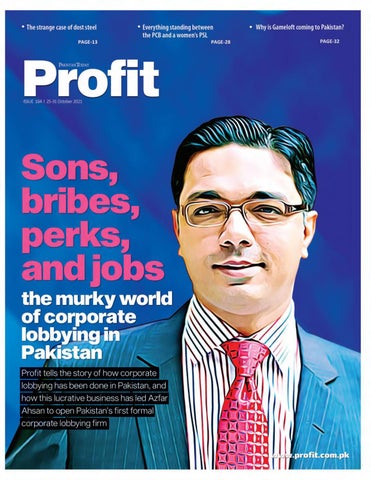
16 15 Let there be IPOs 18 Sons, bribes, perks, and jobs - the murky world of corporate lobbying in Pakistan
13
28
28 28 Everything standing between the PCB and a women's PSL 32 Why is Gameloft coming to Pakistan?
Profit
Publishing Editor: Babar Nizami l Joint Editor: Yousaf Nizami l Assistant Editor Abdullah Niazi Reporters: Ariba Shahid l Babar Khan Javed l Taimoor Hassan l Meiryum Ali l Shahab Omer Chief of Staff & Product Manager: Muhammad Faran Bukhari Regional Heads of Marketing: Muddasir Alam (Khi) l Zulfiqar Butt (Lhr) l Malik Israr (Isl) Layout: Ahmad Salahuddin l Photographers: Zubair Mehfooz & Imran Gillani l Business, Economic & Financial news by 'Pakistan Today' Contact: profit@pakistantoday.com.pk
Readers Say And factual, as opposed to this one sided and mostly inaccurate thread from an anonymous grandma. Apropos: What makes NAB interested in SadaPay? @BNizami, Twitter I think we all know who will get the EMI license first and why. However, who am I to make any 'generalizations!’ Apropos: What makes NAB interested in SadaPay? @Rizvinator, Twitter Although the writing is kind of sensationalised, and this rests somewhere between gossip and actual news, this was a fun read. Apropos: What makes NAB interested in SadaPay? @nidafg_, Twitter This is simply a case of egos being at play and coming before everything else. I’m afraid there is no room for this in business. Apropos: What makes NAB interested in SadaPay? @GlenBayat, Twitter Great article. Genuine question, where does one draw the line between "investigative journalism" and an "op-ed"? I feel that line was quite blurred in this piece. Apropos: What makes NAB interested in SadaPay? @hamzzzaf, Twitter Magazines generally tend to allow for a little more opinionated analysis in their stories than newspapers. This is an important story about two fintech startup founders in Pakistan being less than gentlemanly in their competition with each other. What I did not realise, however, is the degree to which both TAG and SadaPay touted their government connections. Some advice for investors looking to invest in any frontier or emerging market: political connections are a short-term asset and a long-term liability. Always. Doesn't mean you shouldn't invest in a startup: just that the political connection shouldn't be the deciding factor. Apropos: What makes NAB interested in SadaPay? @FarooqTirmizi, Twitter
facebook.com/Profitpk twitter.com/Profitpk linkedin.com/showcase/13251020 profit.com.pk profit@pakistantoday.com.pk
HOW TO CONTACT
8
What makes NAB interested in SadaPay? Is it linked to maligning the competitors ? Who is involved and who is taking on it ? This is a serious matter and could derail investor confidence. Apropos: What makes NAB interested in SadaPay? @ProfZahidAli, Twitter What a mess. Didn’t know the startup scene was so competitive and dirty. Apropos: What makes NAB interested in SadaPay? @razzblues, Twitter
This was disheartening to read. Pakistan’s digitalization is at such an early stage that there is no reason for anyone to treat it as a zero sum game. There is still immense room to grow, so many people still need to be brought into the fold of digital banking. Apropos: What makes NAB interested in SadaPay? @harrisgh, Twitter Both Sadapay and Tag need to get their shit together. There is a lot of room for all of us to grow. Apropos: What makes NAB interested in SadaPay? @Nosh1512, Twitter "It (NAB) is a bloated, vain, arrogant, and deeply misguided institution that is hurting Pakistan on countless fronts and giving grief to innocent people. Their attention is something you wouldn’t wish upon your worst enemy." This is the complete truth, and I want to shout it from the rooftops. Apropos: What makes NAB interested in SadaPay? @mobyjams, Twitter “Nobody wants to be involved with the accountability bureau. It is a bloated, vain, arrogant, and deeply misguided institution that is hurting Pakistan on countless fronts and giving grief to innocent people. Their attention is something you wouldn’t wish upon your worst enemy.” Just read a story on Profit about how they are after a very promising Fintech startup @sadapaypk due to a rivalry between SadaPay and another competitor TAG. Apropos: What makes NAB interested in SadaPay? @MrMAtifAli, Twitter "Koi dhanda chota nahein hota aur dhanday se bara koi dharam nahein hota" Back in the day aunties would find you a spouse for free because "sawab". In a wedding obsessed country it made sense to capitalize. The extent is informal but the potential is huge. Apropos: The rishta aunty business playbook @Ariba, Shahid, Twitter Solid work as always from Ariba. I feel sad seeing rishta groups balloon in size. Quite a few of them have more of an actual user population than well funded startups. Admins use it effectively as a marketing tool. I'd love all schools to be co-ed. There needs to be healthy interaction between boys and girls with a greater emphasis on giving girls more confidence and shaping boys up to be more considerate, sensitive and gentler. But if past 3 years are anything to go by, we aren’t seeing much of a cultural shift. Apropos: The rishta aunty business playbook @IqraYusuf12, Twitter
COMMENTS
IN BRIEF The depreciation of the Pakistani rupee against the US dollar continued on Friday with the local currency losing 0.02 percent as compared to the previous close on the back of higher demand due to import payments. The US currency closed at an all-time high against the Pakistan rupee on Friday, settling at Rs174 in the interbank market compared to Rs173.96 recorded on Thursday.
Rs111 billion:
Federal Minister for Energy Hammad Azhar on Friday announced that a “massive investment” worth Rs111 billion in the power transmission system will be made during the next three years. The announcement was overshadowed largely by Azhar’s recent showdown with TV anchor Shahzeb Khanzada.
SBP Governor Dr Reza Baqir was widely criticised this week for saying that overseas Pakistanis and their families will benefit from the ongoing depreciation of the Pakistani rupee against the US dollar - effectively asking middle class Pakistanis to take one for the team, and exacerbating people over the government’s preferential treatment towards overseas Pakistanis. The SBP released its Annual Payment Systems Review (PSR) for the fiscal year 202021 (FY21), which shows strong growth in digital financial transactions in the country. Number of transactions grew by 60 percent while the volume of transactions grew by 12 percent. The Pakistan Stock Exchange (PSX) has announced revised timings of the market, which will take effect from the date of ‘Go Live’ of the new trading system, planned for Monday, October 25. Key changes include an extension of 30 minutes for continuous trading session, reduction of post-close session to 10 minutes, and a reduction of the break period to one minute.
The Ministry of Finance and Revenue has said that a specific time frame cannot be given for the conclusion of Pakistan’s talks with the International Monetary Fund (IMF). The Pakistani team headed by Finance Secretary Yousaf Khan continues to engage in talks with the IMF in Washington after Adviser to the Prime Minister on Finance and Revenue Shaukat Tarin left for Saudi Arabia
$1.64 billion:
The SBP reserves plunged by $1.646 billion to $17.492bn during the week ended on Oct 15 from over $20bn in August. The State Bank said that reserves decreased mainly due to external debt repayments that included $1bn against Pakistan International Sukuk. During the week the reserves of the commercial banks increased by $4m to $6.835bn.
9
Twitter isn’t real and exporting economists this week in Pakistan’s business and economics twitterverse
T
here was a bit of a scuffle on Twitter this week when in a major boomer moment, an executive tweeted about job retention and how people list their hobbies like ‘chilling’ on their CVs. While there is an extensive rejoinder to this down below, we must stress how important it is for our upcoming young professionals to be paid better and be given more benefits. That said, a lot else was going on this week as well as we considered exporting economists and the SBP found itself in the limelight again. Ariba Shahid brings you all this and more in this week’s social media roundup.
Easy laughs
Secret keeper
What does the SBP really control? Based on my expertise in the Netflix sensation Money Heist, I think they have control of the country’s gold and the nation’s secrets. And maybe some control of money supply. Inflation? Umm I’ll leave that up to you.
Justifying fees
Some jokes just write themselves. Imagine if the FBR was proactive where it needed to be rather than turning itself into a meme. But also interesting to see how beggars aren’t really as poor as we thought they would be. Or is that so?
10
Universities need to work on soft skills. They need to justify their high fees
Economists aplenty
Boring hobbies
My hobbies are boring and I don’t want to tell you what I do in my own time. Why can’t companies rethink their hiring? What in the world even are productive hobbies? {Editor’s note: Some sage advice, when you make a silly tweet there is no need to double down on it. You can retract it, apologise, and move on with your life. We feel it is necessary to remind you that Twitter isn’t actually a real place, so getting defensive about things you say there (particularly stupid things) is not doing you any favours.}
The good old days
This is seventh generation warfare where you send the people that have brought the economy to shambles to another country. We didn’t have to do Afghanistan so dirty. Jokes aside, we have plenty of economists to go around. In fact we have enough to export. After all, everyone on twitter is an economic expert too. In fact, it would be quite nice if some of them went away elsewhere.
Where are the foreign job seekers?
Flashback to when Rehman Malik was minister and we had telephone and internet shutdowns as a response to literally the slightest inconvenience. Would be cool. I wouldn’t have to submit this write up if we didn’t have the internet. Miss those days when this was a valid excuse. Then again, the government would collapse now if Whatsapp was down for the entire day.
Better wages needed
We heard that once this government comes into power people will travel from all over the world to seek jobs in Pakistan. While that hasn’t happened yet in Pakistan, the fact that it is happening in India is a good sign that it is possible once a better environment and opportunities are provided. And no, we don’t think the job of dedicate Pakistan vlogger should count as people coming from foreign countries to work in Pakistan.
Pakistani businesses are sweatshops. Wages need to be better and in line with international standards if prices are kept the same way.
SOCIAL MEDIA ROUNDUP
The strange case of
dost steel
Questions were raised when Dost Steel rallied on the PSC despite consistent losses
I
t is hard to see how anyone could find Dost Steels a good investment. If you look at the graph attached with this story, you can see that since listing on the Pakistan Stock Exchange (PSX) in 2007, the company did not produce anything until more than a decade later in 2018 - and then promptly shut down just a year later. It has made a loss every single year since 2007. And in its recently released financial report for the year 2021, it made its third largest loss, at Rs175 million. So you can imagine that the PSX had a few questions when it saw that the share price of Dost Steel nearly doubled in one day. Here’s what happened: On September 1, 2021, the Dost Steel share price was Rs4.93. This had dropped to Rs3.42 by October 13. Then it climbed to Rs3.6 on October 15, and
STEEL
then shot to Rs4.29 on October 18. On October 18, both Dost Steels financials, and a Letter of Intent dropped. That letter was from Crescent Star Insurance (CSIL), which said that it had sent a letter of intent on October 15 to a group of shareholders - Jamal Iftikhar, and his seven family members - for the entirety of their 24.97% stake in Dost Steels. This was for Rs7.64 per share, and the offer was valid until October 31st. Crucially, the letter was addressed to Jamal Iftikhar and family, at Dost Steels. On 20 October, Dost Steels sent this letter to the PSX: that the company had been informed by the sponsors (Jamal and his family) that the “LOI sent by CSIL is an unsolicited proposal on its own account, hence the same is not acknowledged by the sponsors of the company”. The sponsors then said that the
unusual share price increase was because of CSIL’s actions. Here is when, CSIL got very annoyed, and decided to produce receipts, as they say, and sent a lengthy letter to the PSX, including a photocopy of a shareholding agreement. Essentially, in 2016, CSIL and the sponsors signed a shareholders agreement whereby Jamal Iftikar and his family members (Jamal is also the CEO of Dost Steel) would own a cumulative 14% of the shares, while CSIL would own 29.83%. According to the latest Dost Steel annual report, they now own 26.6% (that same report does not mention CSIL by name). According to the letter, Jamal Iftikar and his family have been trying to sell their share of Dost Steel (24.975) for the last two years, and even signed a term sheet on two occasions which was not made public. CSIL sent a letter
13
of intent in buying out the sponsor shares, in order to ‘protect CSIL stake already invested.’ Why would CSIl want to buy out the sponsors? Well because, Dost Steel sponsors who are also the management - have basically done nothing. According to the letter, “DSL sponsors or current management has continuously failed to present a business plan or strategy if they are willing to to start production of the plant.” They have a point here. It might be helpful to have come contect ont he company here: Dost Steel was incorporated in March 2004, and then converted into a public limited company from 2006, and listed on the Pakistan Stock Exchange Limited in 2007. Dost Steel manufactures steel, direct reduced iron, sponge iron, hot briquetted iron, carbon steel, pig iron, special alloy steel in different forms. Its head office is in Lahore, while its plant is in Phoolnagar. It was a tough time to start a steel company. According to Dost Steel, the company “continued in its default of all of its debt obligations caused due to reason beyond its control, one of the basic causes being the international markets turmoil of 2008, which happened at a very critical stage of your company’s life.”
14
Thus began a long and protracted arguments with banks. Indeed, much of Dost Steel’s history is marked less by the actual production of steel, and more of its dysfunctional relationship with lenders. Consider in 2015, that the Pak Kuwait Investment Company claimed recovery of Rs122.197 million, and that Faysal Bank asked for the recovery Rs.1,287,947,181. Things got so bad that year that the Sindh High Court passed an order for the liquidation of the company, based on a petition filed by one of the creditors of the company. In fcat, the only reason Dost Steel still exists is because the Supreme Court of Pakistan accepted the appeal filed by the company’s directors, and dismissed the case. The company then failed to commence operations, up until February 2018. But the company had been accruing losses for so long, that even the sales it did make never seemed to be able to bring it out of what seemed like a permanent slump. Consider: it made a loss of Rs88 million in 2014, Rs98 million in 2015, Rs30 million in 2016, Rs81 million in 2017, Rs103 million in 2018, Rs313 million in 2019, and finally, Rs214 million in 2020. It had stopped production altogether in 2019, and its number of employees dropping from 131 in 2019, to just 33 in 2020. By 2020, Dost Steel
had accumulated astonishing losses of Rs1,240 million. The liabilities of the company exceeded its current assets by Rs 408 million, and liquid assets by Rs466 million. The auditors pointed out that Dost Steel had been facing long overdue receivables, unfavorable key financial ratios, and difficulty in complying with the terms of loan agreement with banks. A company like CSIL meanwhile, watched this trainwreck from the side, wondering what to do. Apparently CSIL has in the past made several offers to broker a third party deal to rescue stakeholders but this did not materialize, because the sponsors insisted in selling their loan and CSIl stake as debt before issuing shares, and due to a complex shareholding system, which means (according to CSIL) they have no choice but to buy out the sponsors. According to CSIL, they made an advance to a “listed company, not sponsors”. But it claims Dost Steel won’t issue shares because of the sponsors “for the purpose of financial manipulation”. This story won’t end yet: now after sending a public LOI and explaining their side of the story, a hearing has been set at the Lahore High Court on October 27. Wonder what new photocopies CSIL will bring to that hearing n
STEEL
Let there be IPOs The PSX wants more IPOs but has the worst idea to incentivize them
I
By Ariba Shahid
n the past we’ve talked about what IPOs are, why companies go for them, and how one can invest. While there are a number of reasons why a business would consider going public, you would assume tax concessions to be least on the priority list. In fact, given that an IPO means a company is doing well and gaining investment, they should logically be up for more taxation. Right? Wrong, because earlier last week, the managing director of the Pakistan Stock Exchange, Farrukh H Khan, said that the PSX is in consultation with the Ministry of Finance and the Federal Board of Revenue to restore tax credit for companies opting for IPOs. “We look forward to constructively resolving this issue with the support of the Ministry of Finance and FBR for the benefit of investors, companies, and Pakistan’s economy,” he
STOCK MARKET
tweeted. To understand why this is a bad idea and where it is coming from, Profit brings you a brief reminder of what IPOs are, and why giving tax breaks to companies going for them is possibly not the best idea in the world.
What is an IPO again?
T
his is simply a refresher - feel free to skip it. As the name suggests and one might intuitively guess, an IPO is when a private company decides to go public and offers people the opportunity to buy shares or stocks in it. Essentially, an IPO happens when a company is looking to gain capital and turns to the general public for it rather than getting a loan from a bank and increasing their debt. It usually means that a company is looking to expand and expand at a certain rate. An IPO is the first time a company is able to sell securities to the public. IPOs are called Primary Markets. Their purpose is
to bridge companies that need funds with investors.
The tax credit explained
J
ust a little recap, in the past, the government gave companies tax credit for four years when they would go for listing at the PSX. This also included a 20% tax credit on taxable income for the first two years after listing, and then declining to 10% in the next two years. Right before Budget 2021, in March the government took back this incentive. Tax credit on listings under Section 65C has been withdrawn through Second Amendment Act, 2021. Following the budget, Khan has asked the government on more than one occasion to reconsider its stance on the tax credit. As per Khan, the tax credit alone was resulting in a loss of Rs 100- 150 million. However, he went on to say, “On the other hand, it led to higher collection of revenue through capital gains tax
15
The tax credit alone was resulting in a loss of Rs 100- 150 million. However, he went on to say. On the other hand, it led to higher collection of revenue through capital gains tax (CGT) on trading in shares of the same companies at the Pakistan Stock Exchange Farrukh H Khan, Managing Director of the PSX
(CGT) on trading in shares of the same companies at the Pakistan Stock Exchange.” He reminded all those present. It is true that CGT is a big source of revenue. As per the National Clearing Company of Pakistan Limited, CGT brought in Rs 8.8 billion during FY21. In its budget proposal for the year, the PSX claimed that an increased number of listed companies and higher profitability (due to effective corporate governance, better disclosures and availability to raise capital from the market) lead to higher tax revenue for the government, including incremental revenues from CGT. Hence, the exchange believes it is important to get companies to list. In its budget proposal the exchange stated that only 10 listed companies were availing the tax credit. Their financials, however, showed that they have a tax revenue impact of Rs 175 million per annum. “Out of these 10 companies, four are in their fourth or last year of this benefit and four companies have recently listed in the current financial year. In fact, the tax revenue benefit in the medium term is very large as the documentation of the corporate sector increases and hence tax revenue of Pakistan. Further, the CGT collected on these 10 symbols for the eight-month period from July 2020 to February 2021 is Rs176m and, extrapolating based on this average collection of CGT, the tax collection for the 12-month period could be Rs264m compared with the total estimated tax credits of Rs175m availed by these 10 companies,” said the proposal.
Why this doesn’t make sense
I
t’s simple. This is a form of tax arbitrage. Companies that are listing for arbitrage aren’t the companies you want on the exchange. In your effort to bring in more companies to list, you’re actually calling in all the wrong ones. Instead, the PSX needs to sit down and think beyond shortcuts that get the numbers. You could celebrate a record number of listings through this incentive next year, but the question will be, did the PSX do its job of helping only the big businesses that don’t need capital to get listed? Essentially, companies that are listing for the sole purpose of getting tax credit aren’t really going to go public with a large enough free float. These are also the companies that aren’t listing to raise capital, make private equity exits, or add more authenticity and credibility to their name. It is also important to note that if a company is listing for the sole purpose of reaping the gains of tax credit, are they really the safest place to invest? While the PSX is a risky place, and IPOs are risky too, companies that rely on tax credits don’t really have the competitiveness or financial integrity to actually benefit the exchange or more importantly investors. Moreover, if we look at the past, while this incentive has existed, Pakistan hasn’t really seen a spurt in listings due to it. Let’s illustrate that with numbers and a regional comparison. Pakistan has approximately 540 companies listed on the Pakistan Stock Exchange. Let’s
“Out of these 10 companies, four are in their fourth or last year of this benefit and four companies have recently listed in the current financial year. In fact, the tax revenue benefit in the medium term is very large as the documentation of the corporate sector increases and hence tax revenue of Pakistan.” Quote from PSX budget proposal
16
compare the number of listings in South Asia. India has 5,034 companies listed on the Bombay Stock Exchange, 3500 on the Calcutta Stock Exchange, and 1300 on the National Stock Exchange of India located in Mumbai. Bangladesh has 750 listings on the Dhaka Stock Exchange, and 293 on the Chittagong Stock Exchange. Sri Lanka has 285 listed companies, Neal 230, Bhutan 20. Just a small reminder, the PSX is a combination of the Islamabad Stock Exchange, Lahore Stock Exchange, and the Karachi Stock Exchange. The fact that the sole stock exchange in Pakistan has less listings than either of the three exchanges in India, or the Dhaka Stock Exchange is strong enough to show that tax credits haven’t really been as great of an incentive as they are being pushed as. There are multiple other reasons to list your company. The PSX could incentivize more listings through an easier process of IPOs whereby smaller names also get listed. With a recent spurt in startups, the fact that IPOs lead to better and more transparent valuations could also help push up listings. Moreover, the most important reason to list is access to capital. With the policy rate now gradually hinting that it will rise over time, one could say that raising capital through IPOs may seem more attractive. Moreover, the PSX needs to revise its business model and think of listing fees as a major form of revenue and set big targets for itself that are not dependent on concessions. The PSX should be a symbol of competitiveness and financial strength, not an institution that gives candy to lure in babies. Profit has asked the following questions from the PSX on 14 October 2021, but has received no response. 1. Doesn’t the PSX think that this would incentivize listing for tax benefits? 2. Would a company that lists for this purpose rather than raising public funds care about minority shareholder rights? 3. Do you think this will push for tax arbitrage? 4. What is the listing fee for a company? 5. With a current IPO spurt without such concessions, does the PSX really think the decision to fall to the whim of corporations as feasible? n
STOCK MARKET
18
COVER STORY
By Abdullah Niazi
O
n a foreign tour organized and sponsored by the Coca-Cola company, a number of well known journalists and industry professionals found themselves confounded by the special attention that the host was giving to a woman and her kid that were part of the touring group. None of the people on the trip recognised her as a fellow journalist or as anyone they recognised from the company, and the lady did not attend a single one of the events and conferences that the group was there for. One of the people on that trip, who is now the publishing editor of this magazine, inquired from the company’s management who the unknown guests were. It turned out that it was Riji Yusuf, the wife of then Federal Board of Revenue (FBR) Chairman Abdullah Yusuf. A little more digging and one of the representatives of the company told that the MNC often “engaged” Mrs Yusuf, who has no known skills apart from having her husband’s ear, in an unofficial capacity as a lobbyist. This particular example from April of 2005 only scratches the surface of the murky world of corporate lobbying in Pakistan. (More on Abdullah Yusuf and others later in the story.) Lobbying is when corporations or other interest groups try to influence and sway government decision making towards directions that benefit their bottom line. A soft drink manufacturer might advocate for a lower taxation rate on sugar, while a tobacco manufacturer might want a smaller health warning on the cigarette packs. The interests of these large corporations vary according to what their work is, and the decisions that impact their businesses are all made by the government. The problem is not so much with the concept of advocacy and lobbying as it is with the techniques which lobbyists often use, which at times may border on bribery. There is nothing wrong with an industry banding together and presenting their opinions and research to the government but there is an issue with that industry doing favours for people in power or using their personal connections to get the job done. In the United States, lobbying is considered not just a high powered career trajectory but also a well-respected one. Lobbyists run Washington, and a peculiarity of American campaign finance laws means that they can even make monetary contributions to the campaigns of politicians. In Pakistan, things are different. Lobbying does not take place formally, but is instead carried out by trade
20
organizations, regulatory affairs departments, and even by the media. In this story, Profit will look at the tenebrous terrain of corporate lobbying in Pakistan. From fully funded foreign trips to jobs for the children of powerful officials - it is a world of constantly exchanged favours, unsaid understandings, and a never ending cycle of you-scratch-my-back-I’ll-scratch-yours. To understand it, we have gone to four people, all of whom represent different faces of corporate lobbying in the country. There is Fahad Qadir, the former head of Coca Cola Pakistan’s regulatory affairs department. Then there is Ehsan Malik, the CEO of the Pakistan Business Council (PBC). We have Shahid Sattar, the general secretary of the All Pakistan Textile Mills Association (APTMA). And finally there is Azfar Ahsan, the CEO of Nutshell Communications, which is Pakistan’s first dedicated lobbying firm. It is through them that we will tell the story of corporate lobbying in Pakistan, along with all of its trials, tribulations, and successes.
The associations and regulation managers
L
et us tackle the first two kinds of lobbyists that exist in Pakistan. The first are different industry associations and the second are the regulatory affairs departments in different MNCs and corporations. There is an association for everything. Every industry has very specific interests that it needs to have advocated or which it needs protected. For example, while textile manufacturers might be duking it out and competing in the market, in the grander scheme of things, all of them will want more cotton to be grown and for the taxes on cotton manufacturers to be lower. That is a common goal they have. For this purpose, they form coalitions or collectives or associations that work independently from individual textile manufacturers and advocate for the common goals that the industry has. “APTMA represents the larger companies in the textile industry. We have roughly 250 members, and all of the major manufacturers like Bareeze, Nishat, and Sapphire are members of this association, and since we are the second largest sector in the country after agriculture, the work we do here affects around 50 million people,” explains Shahid Sattar, the general secretary and executive director of APTMA. On the other hand, regulatory affairs departments in large companies do much of the same, except they do it to protect the interests of their specific companies rather than the industry at large. Often, these departments and their relevant associations work in close contact with each other. For example, the
regulatory affairs department at Coca-Cola will work closely with the Pakistan Beverage Manufacturers Association. “Our job, essentially, is government and stakeholder relations, which is quite boundless. We have to build a narrative and engage the right stakeholders so we can protect our investments,” explains Fahad Qadir, the former head of regulatory affairs at Coca Cola Pakistan. “We are dealing not just with the FBR but also with the provincial and federal governments and many others.” These two kinds of lobbyists have existed for a long time in Pakistan. Since they are not formally “lobbies” and are instead advocacy groups, they are often not recognised as what they are. The third and final category of lobbyists that we have chosen is a new one - officially declared lobbying firms. Started seven months ago, Nutshell Communications headed by Azfar Ahsan claims to already have 90 regular clients and up to 150 clients overall that they work with. These clients include some of the largest banks in Pakistan, all four major telecom companies, K-Electric, and other major energy companies. Azfar himself does not shy away from the word lobbying, and admits that is exactly what Nutshell communications does. “Public relations companies in Pakistan are unfortunately working simply as post offices. That is why we do not call ourselves a PR company - we hold ourselves to a better standard. We are involved in strategic engagement, and for that we have to do our research and get in touch with the right people,” he says. This is where it gets interesting. All three of these are approaches to the same thing, and all three categories do much the same work. They conduct research, make policy briefs, publish ads and articles in newspapers and essentially try to build a narrative around their beliefs that will become popular and be adopted by the government. However, this is only the very surface level work that they do. Simply publishing an op-ed is not going to get their point across, and what they need to do is to go directly to the stakeholders and the decision makers sitting in the corridors of power.
Finding the fixers
T
his is one of the most important factors in corporate lobbying in Pakistan, not just in the associations but also at large corporations and among professional lobbyists - contacts. You see, if you have prepared a report on cotton growth in Pakistan and need to get it to the commerce minister, you cannot simply walk up to his office, knock on the door, have a small chat and leave the report at his desk. You need to have
Consider this, if I want to meet the finance minister, he is not going to see me unless he knows me from before. If I’m being completely frank with you, then the reason I am good at my job is because I have worked in the government before this and so I know all of these people either from work, or school, or college and that is why they entertain me Shahid Sattar, general secretary APTMA
a person that has an ‘in’ with the minister and can arrange a meeting - essentially you need a fixer. Who could these fixers be? They could be former bureaucrats, other politicians, other cabinet ministers, the relatives of cabinet ministers and serving members of the higher judiciary, retired generals of the Pakistan Army, senior journalists and so on and so forth. This is where people like the earlier mentioned Abdullah Yusuf thrive. They are hired by corporations and associations at high salaries so that they can use their contacts and influence to get those companies or industries profitable deals with the government. Yusuf, who served as FBR Chairman during the Musharraf regime, has since served, just to mention a few, as the Chairman of the Independent Power Producers Advisory Council and as Chairman of the Pakistan Aluminium Beverage Cans Ltd. In his current role as Chairman of the IPPAC, he lobbies for and gets the council meetings with key figures. During his time at PABC, he was being paid a salary of Rs 1 million a month according to one source, for what is a ceremonial role. Why? Because Yusuf made sure that Pakistan imposed a 20% regulatory duty on the import of aluminium tin cans from Sri Lanka despite a Free Trade Agreement with it, which turned out to be a gamechanger and kept PABC in business. Another similar example of a post-retirement corporate lobbyist could be Ashraf Mahmood Wathra, who after serving as Governor of the SBP from 2014 to 2017, was hired within months by the largest bank in Pakistan as senior corporate consultant on international strategy and operations. It was problematic
because it meant that Wathra was, until only a few months ago, regulating his future employers. Who is to say he did not already sense a job opportunity at a big bank and possibly went easy on them to stay on their good side and get the high paying job after retiring as SBP Governor? In more recent times, even tech startups have been known to hire influential people on their boards by offering them high salaries and sweat equity to get them through the regulatory hurdles. “APTMA is not one of those organizations that give bribes, but we do have a relationship with the bureaucracy and government functionaries. You need people that can open doors for you. There is no way to get the job done without them,” explains Shahid Sattar. “Consider this, if I want to meet the finance minister, he is not going to see me unless he knows me from before. If I’m being completely frank with you, then the reason I am good at my job is because I have worked in the government before this and so I know all of these people either from work, or school, or college and that is why they entertain me.” “That doesn’t mean they’ll do what I say, but it at least gives me the opportunity to get some facetime and advocate for my industry. Letter writing does not get you anywhere at all, you need to have connections to actually get your file on the table,” Sattar adds. “Getting your file on the table of the relevant person is considered a real success,” says Fahad Qadir. MNCs like the one Fahad worked for have regulatory affairs departments, which essentially work as an in-house lobbying solution through their regulatory
Azfar Ahsan Azfar started his career in PR by organizing large conferences where he drew big names and big crowds. He is also the founder of Corporate Pakistan Group, which has impressed many because of all the heavyweights that take part in the Whatsapp Group. His new firm, Nutshell Communications, uses the old techniques that Pakistani lobbyists have been using for decades but does not shy away from the term itself.
affairs departments. “In the recent past we had industry wide problems such as the sin tax imposed on our usage of sugar. We had to prepare and present a case to the government to convince them to either not impose the tax, or to also impose it on biscuit manufacturers and the like. Now, when we go to present our case, the government will hear us out because Coca Cola is a massive company, but others without that kind of international recognition will need an inside man to arrange a meeting for them and get in a good word.” “So when you’re constantly fighting battles like these, whether it is against a tax on sugar or it is against a ban on plastics, then you have to know there are people in important places ready to back you. You need to know that if this issue comes up in cabinet, what minister will back you? And to make sure that you have someone on the inside that will raise their voice for you, it is necessary to engage these people,” he explains. In these situations, and when the stakes are this high, associations and corporations alike can be very blatant in hiring people that they might not necessarily bring great skill but bring great contacts and social capital. At one point, in fact, the Supreme Court took notice of why the tobacco industry was consistently hiring the sons, nephews, and other relatives of people heading important regulatory divisions such as the FBR. The tobacco industry is also one of the most blatant in this regard, and even now the brother of Dr Syed Tauqir Shah, the influential bureaucrat whose last posting was as federal health secretary, is the External Affairs Director for the Pakistan Tobacco Company. And since cigarettes are highly taxed and a controversial product, lobbying in the tobacco industry is a must to survive. This happens everywhere and is rampant. In corporations and MNCs, people hire the sons of important bureaucrats and politicians with the idea that the connection will one day come in handy. While there are certain moments in which these sons or nephews may be asked directly to ask their fathers
COVER STORY
There is no research-based lobbying in Pakistan. There are certain individuals that often act as fixers, but they only get you a meeting with the finance minister or the commerce minister. Whether the job gets done or not is completely up to the decision makers then Azfar Ahsan, CEO of Nutshell Communications
or uncles for favours these are rather unlikely. The techniques that are used are more subtle than this, and there is a general expectation that since the relative of a person in an important office is part of an organization, doors simply begin to open for them in an unspoken understanding. Some officials even approach companies to ask for jobs for their children, or for things like money for their wife’s NGO or some charity event. Again, none of this is strictly illegal and is not technically bribery, but it is a more subtle way of greasing palms. And that is because these are MNCs and organizations that represent massive industries, which is why they have some rules and regulations they must follow to keep up appearances. On a smaller scale, where the fixer is someone like a famous journalist or a talking head on television that knows politicians, straight-up cash payments are made. You get paid to arrange a meeting, and if the work gets done you also get a success fee. Then there is another tactic which is even more common. If not the children of people in office, these companies hire recently retired officials that still have links and some pull in the places they just retired from. “These people are often hired on contract for a year or two. You see, since they are recently retired, their coworkers are also due for retirement soon and they can only leverage their influence for so long. But they get hired for a year or two and in that time they get paid in the millions,” says Fahad Qadir.
“Fixing a meeting is not enough, but fixing a meeting is the first step,” says Azfar. His company, Nutshell Communications, recently hired a retired Major General and a recently retired Brigadier of the ISI as part of their strategic engagement division. The Major General, who commanded a division of the Pakistan army once, now commands the strategic engagement division of Nutshell Communications. The hiring of former military officers that have the right connections is very regular, but it is not just the military’s retirement pool that Azfar, the associations, and the regulatory affairs departments go fishing in. Azfar has also hired bigshots from both the corporate world and the civil bureaucracy. All or most of what goes on in this murky world is legal, but that does not mean it is not sketchy.
How much is too much?
T
here is nothing stopping a company or association from hiring people that were part of the civil bureaucracy or the military. Retired officials deserve jobs, and at times they have very specific skills that no one else has. A person that retired as FBR Chairman will know the workings of the board better than anyone else, and thus can offer that expert knowledge as a service to a company that regularly has to deal with the FBR. But how is one to know where the expert knowledge ends and using favours
begins. “There is a fine line between advocacy and lobbying,” says Ehsan Malik, the CEO of the Pakistan Business Council (PBC). The PBC is a large umbrella organisation that advocates for macro policy changes that will be pro business in Pakistan. Since it has a lot of stakeholders, it does not exactly participate in strategic engagement the way the other organizations we have mentioned do. However, they are in the same field and thus see what goes on in the world of advocacy and lobbying. “If you are presenting your research to a government minister or a finance secretary there is nothing wrong with that at all, but the moment you go out of your way to form a social connection with that person or to wine and dine them and ingratiate yourself to them is where the lobbying begins.” The definition is a good one, generally because a lot of lobbying is currying favours and talking to the right people, and the rest is throwing your weight around. “There are so many ways for companies to do this, multinational corporations do not even shy away from using their home countries as a bargaining chip. If at any time their regulatory affairs department is unable to get the job done through their local contacts, they will contact the US Embassy and ask them to exert pressure” says one source. One thing that all sides do seem to agree on, however, is that there is never a sure shot way of getting something done. There will
If you are presenting your research to a government minister or a finance secretary there is nothing wrong with that at all, but the moment you go out of your way to form a social connection with that person or to wine and dine them and ingratiate yourself to them is where the lobbying begins Ehsan Malik, CEO of the PBC
22
TEXTILES
“You need to know that if this issue comes up in cabinet, what minister will back you? And to make sure that you have someone on the inside that will raise their voice for you, it is necessary to engage these people,” Fahad Qadir, former head of regulatory affairs at Coca Cola Pakistan
always be hiccups, and the goal is to at least have a foot in the door. “There is no research-based lobbying in Pakistan. There are certain individuals that often act as fixers, but they only get you a meeting with the finance minister or the commerce minister or whoever it is that you want to meet. But they are simply trying to make a quick buck. Whether the job gets done or not is completely up to the decision makers then,” says Azfar. Fahad Qadir agrees with him. “There is no guarantee that the work will get done. At most you are able to convince a minister of something and they promise to take it up with the Prime Minister. But the stakes are so high and the money involved so much that companies and associations are willing to spend millions to just get a meeting or to get a point across in the hope that we will be able to influence the government. A lot of the time it doesn’t work, but it is an absolutely critical role.”
Could lobbying be formalized in Pakistan?
C
orporate lobbying in the shape of regulatory affairs has existed since forever in Pakistan, and trade and industry associations have been around for even longer. They are very clearly there for a reason, and that reason is to lobby. Call it advocacy, call it strategic engagement or whatever you like but the primary function is to get the government to hear them out and
try their best to convince them to change their policies so that they can increase their profits. Even in the news media industry, organisations such as the All Pakistan Newspaper Society (APNS), act as lobbying groups that advocate for things like more government ad revenue for newspapers and for lowering tax on newsprint - the paper newspapers are printed on. There is nothing legally wrong with this. The sketchy part begins when favours are exchanged, friendships are formed, and the public and the personal mix in an unholy dalliance. What is interesting, however, is the emergence of Azfar Ahsan and Nutshell Communications. As mentioned in the note above, Azfar began by organising conferences. He was incredibly good at this, and even his detractors agree that he was always able to draw the biggest names for his conferences. He also started a Whatsapp group called ‘Corporate Pakistan Group’ for the who's who of Pakistan’s political and business elite. The CPG group has morphed into an association that holds dinners, mushairas, and other gatherings that are used as a social tool by Azfar and others to mingle with other powerful people. It is this very influence that Azfar uses to make Nutshell Communications work, and he is quite smug about it. At one point in the course of our interview with him, he said that it was “tougher to get into the CPG Whatsapp group than it was to get into the Sindh Club or Punjab club.” It is these connections that Azfar is leveraging for his lobbying firm. With
nearly 150 clients as claimed, Azfar has come far and is making a lot of money in the process. According to one source, just one client from the energy sector pays him a retainer of a couple of million rupees every month. Much of what he does is the same old ways of lobbying that have been used for decades, but what he has changed is the attempt to not turn lobbying into a bad word. “Arranging a meeting is no longer enough. You need to go in there with hands full and a lot of noise behind you. Sometimes the client will bring you all the data and you go to the relevant stakeholders with it and other times we have to do the research ourselves and guide the clients,” he says. “We have corporate sector people, we have people from other industries - people that know the ins and outs. We took two people from the military as well and people from the civil bureaucracy. They have their own access and experience that comes in handy. You need all three kinds of these sources in a lobbying firm.” It is the same story - you need these people so that others will pick up your calls. Companies are willing to pay exorbitant prices to get their point across because if the gamble pays off, it is entirely possible that the rewards to be reaped will be massive. “There are no lobbying firms in Pakistan other than us, and the individuals that do it on their own are using their contacts to make a quick buck. Yes, a foot in the door is important, but we can’t push anyone, we can simply try our best to convince them.” n
COVER STORY
IMAGE continues to impress
A
It is particularly impressive for a company that just in 2013 made a massive loss
s this magazine has previously covered, Image Pakistan has done exceptionally well in the last few years, essentially rising out of the ashes of the now defunct Tri-Star Polyester Ltd. But then, in 2021, Image Pakistan not only did well - it hit the ball out of the park, as it were. Last year, it had sales of Rs403 million, and net income of Rs22 million; this year, its sales more than doubled, crossing Rs1 billion, and net income of Rs115 million. It’s such an exceptional set of results that it made people sit up who otherwise do not pay attention to embroidered lawn. Take, for instance, the research department at AKD Securities, an investment bank. More prone to sending its clients analysis of oil and banks, it
24
instead flagged Image Pakistan as one to watch out for, in a note sent to clients on October 21. “Image Pakistan Limited (IMAGE) is poised to be a prime beneficiary of the improving consumer demand, led by the rebound in economic growth,” the report read. It further noted that the company’s sales has grown with a compound annual growth rate of 61% in the last two years, to Rs1 billion, while net income has had a CAGR of 48%, and gross margin has averaged at around 50% for the last three years. Its impressive for a company that just in 2013 had made a loss of Rs113 million (as large as this year’s net income). To recap: Image Pakistan Limited, formerly Tri-Star Polyester Limited, was incorporated in Pakistan as a public limited company in November 1990. The principal activity of the company is manufac-
turing and sale of polyester filament yarn and embroidered fabric. And the shalwar kameez line was started in 1993. It was the era of intelligent brands picking up ont he fact that more and more women were beginning to buy ready-made clothes. And yet Tri-Star Polyester did not fare so well, especially in the late 2000s. Between 2011 and 2015, the company did not sell any clothes at all. In fact, in those years, the company made losses, including a particularly bad year in 2013, where the company made a loss of Rs113 million. The company was most probably negatively affected by the textile crisis of the early and mid 2010s, where the industry lost close to half a million jobs over two years. The year 2016 is also when the company decided, enough was enough. First, it decided to ignore
the polyester fabric aspect of its business, and go all in on its embroidered fabric business. In 2016, Tri-Star Polyester decided to invest in a Rs1.8 billion air looms project at its existing plant in SITE, Karachi. Then in 2017, it started operations to produce embroidered fabric for Image for stitched and unstitched fabric. In 2018, it took a Rs138 million loan from Al-Baraka bank (payable in 2022). And Image took off. The brand pivoted towards a floral and pastel aesthetic, and invested in their separate pants section, which proved popular among young women. In the last five years, sales have shot up from Rs20 million, to Rs200 million in 2017, to Rs403 million in 2020. Similarly, the company has managed to make a profit every year since 2016. But what explains the phenomenal year of 2021? Two words: online sales. That
represent the second big shot in the company’s strategy. The company’s annual report notes: “As we took multiple steps to improve online operating performance, we were able to capitalize on the change in customer shopping patterns and saw a progressive increase in online sales throughout the year.This was a result of strong traffic, active customer growth, improving frequency and lower returns,” This is something AKD Securities also noted, saying “The company boasts of a strong presence online which had helped it grow immensely during COVID-19 with online sales witnessing an increase of 6 times, contributing 65% to the topline.” Image Pakistan went on to add that, “The dramatic increase in the move to online shift, the use of technology to connect suppliers and customers, and the demise of
many high street brands are trends which will never reverse.” This explains why it decided to become Pakistan’s first approved seller on Amazon in June 2021, which AKD thinks will contribute to revenue for sure. Plus, it also helps to focus a little on physical stores as well. According to AKD, the company recently concluded a right share issue of Rs640 million in order to contribute towards capital expenditure for the upcoming stores. Three stores in Rawalpindi, Peshawar and Lahore are expected to open by December 2021, with the total of 10 expected for fiscal year 2022. The company is also expanding into perfumes and Halal cosmetics. That is why both the company and AKD believe that sales for fiscal year 2022 will stand at an astonishing Rs2 billion - wo would have thought? n
POLYMERS
Everything standing between the
PCB and a women’s PSL With the deck already stacked against them, advertisers and marketers cannot seem to look beyond a lack of players - something that would be fixed by such a tournament
A
By Profit
mid news that Tania Mallick, a professional with outstanding credentials has been appointed as the Pakistan Cricket Board’s (PCB) new Head of Women’s Cricket, advertisers and agencies across the country are eagerly waiting for a chance to bid for the media and broadcasting rights of the inaugural women’s Pakistan Super League. “PSL for women sounds exciting and relevant,” said Fatima Saleem, a sports journalist on Geo Super at the Geo Television Network. “It’s high time women in cricket are given the respect they deserve. The recently concluded
28
women’s T20 tournament by the PCB has set a precedent and that there is an interest by the sponsors and fans. The fact that the tournament was being televised the quality of the game was top-notch.” She said that The Hundred played in England has proven that women’s cricket is commercially viable and PSL for women can be groundbreaking for women all around the world and will be the first step towards the growth of the game. She added that fans will get to know their players and engage while hoping that this might lead to women in Pakistan getting their own cricket ground. “It is clear that the time for a local women’s cricket league of international repute is here and the potential to develop it as an
industry can no longer be ignored,” said Rubab Hasan, the marketing and communications director for The IPG Group. “We have seen that the gender gap between men and women in all sports across the world has diminished, and cricket is not an exception. We are witnessing much bigger audiences and a far greater interest in women’s sports with a corresponding increase in the fan base of sporting stars. Given these global trends, it is logical to assume that heightened Interest in women’s sports will soon be visible in the subcontinent too.” Speaking with Profit, Strawberry Sports Management founder Haider Ali Daud shared that a women’s cricket league would be a step in the right direction amid factors such as the unending fervor towards cricket, half of the
“It will take its due course to become a commercial success, but then all good things start small. When it comes to drawing up a business case, at times the emotive element is overlooked or cannot reasonably be quantified. When you take the path less traveled, you are taking on a larger risk for sure. There aren’t enough or even any data points to support your decision” Haider Ali Daud Khan, CEO Strawberry Sports Management
population being female, and the increased recognition of diversity and inclusion as part of the ESG goals across advertisers and agencies. “It will take its due course to become a commercial success, but then all good things start small,” he said. “I am a big supporter of women’s sports, so the idea of a women’s cricket league is definitely a go. When it comes to drawing up a business case, at times the emotive element is overlooked or cannot reasonably be quantified. When you take the path less traveled, you are taking on a larger risk for sure. There aren’t enough or even any data points to support your decision.”
Low supply and the need for affirmative action
I
f there is misconception across cultures with regards to fitness, coupled with archaic cultural norms, it is no surprise that there are just not enough women available to play cricket at an elite level. The advertisers claim that the type of sexism holding back the women’s PSL has less to do with urban advertisers and
agencies and more to do with the parents, siblings, and spouses of our star potential athletes holding back women due to log kya kahengay factor, which has done more to keep Pakistan in 3rd world nation status than our annual brain drain does. “I don’t see any need to invest in this direction,” said Umair Saeed, the chief operating officer of Blitz Advertising. “My reasons are simple: there is a serious lack of quality domestic players to conduct four to six proper teams for any tournament. So before you start thinking of planning a PSL women’s tournament, the PCB needs to cultivate and grow interest in women’s cricket in Pakistan.” However, the log kya kahen ge factor is one that cannot be quantified, even though it exists and is widespread. In such situations, there is a dire need for affirmative action. First, there is a need for this from the cricket board which must give women cricketer’s the same opportunities that their male counterparts have. Strides have been made in this regard over the past few years, but even where it is not profitable or makes market sense it must be done. If there are few women players coming up right now,
then starting a women’s PSL that is well paid will encourage more women to participate as they will see an end goal towards which they can work. The money they make from this will also convince parents and society to accept womens’ cricket as normal and a noble profession. At the same time, media and advertising agencies claiming to be progressive must hold the PCB’s hand in this sort of situation and think of this as a future investment. If a tournament is created, maybe not with six teams initially but with four or even three, and good quality competition is promoted, it will inevitably result in attention towards it and the blossoming of more players. The excuse that there are not enough domestic players for six teams is a lame excuse given that even the men’s tournament started with only five, and it is possible to have a tournament with even fewer teams. This is not even counting foreign players.
What can be done
O
ne of the ways in which the PCB could improve its talent pool for women’s cricket would be to organize and invest more in the
We are witnessing much bigger audiences and a far greater interest in women’s sports with a corresponding increase in the fanbase of sporting stars. Given these global trends, it is logical to assume that heightened Interest in women’s sports will soon be visible in the subcontinent too Rubab Hasan, the marketing and communications director for The IPG Group
MEDIA
A sustained flow of information over time given to the audience about female cricketing stars, their backstories, their achievements, will eventually bring about the interest in the sport. Once that happens, the ratings will eventually increase and a better business case would be made for the same Urooj Hussain, head of MediaVest
under 19 leagues as both a testing ground and a discovery engine for new players across the country. As evidenced by the acceptance of women dominating the social media content creator (SMCC) space - as reported in the first influencer pricing report from Profit - it may simply be the matter of offering women a higher pay bracket for the games, incentivizing enlistment and familial acceptance. “The business success of a sports platform is determined by the quality of the players and the monetization of the league or tournament by means of taking its own as a ‘property,” said Hasan. “Commercial benefits accrue from an agglomeration of TV media deals, franchise sales, sponsorships, viewership, and broadcasting.” She told Profit that the digital trends data from IPG owned Cricingif shows that female engagement rates for the PSL games have comprised of 20% of the male audience, adding that a good quality sporting event, that too of our national favorite, can be well received by any avid cricket fan, irrespective of gender. All Individuals
Average Rtg% Pak Total Urban Pakistan
Women T20 WC 2020 0.45 0.61 PSL 2020 3.30 3.40 Factors holding back the inaugural women’s PSL - bad ratings
According to data from MediaLogic, the 2020 ICC Women’s T20 World Cup had an average rating of 0.45 from the urban populace of Pakistan and a rating of 0.61 from the entire nation. By contrast, the 2020 Pakistan Super League (PSL) has an average rating of 3.30 from the urban populace and a rating of 3.4 from the entire nation. “I reckon we get better ratings for women’s tennis compared to women’s cricket in Pakistan,” said Saeed. “Maybe a lot of it has to do with the quality of production - which has been low for all women’s events produced in Pakistan -, the lack of star pull - there is no female Afridi or even Shinwari -, and a host of cultural factors perhaps.” Mirroring the data from MediaLogic, Saeed told Profit that the ratings for women’s cricket have not been impressive enough to build a sponsorship business case around.
Lack of fitness culture
A
cross third world nations, women tell young girls that working out will make them hulking beats, and playing out in the sun will make them dark. These warnings stem from a culture that values women for being petite, weak, and fair. And these warnings have no basis in science.
Clinical trials and epidemiological studies in health research have found that women derive many health benefits from an active lifestyle, which can prevent a myriad of non-communicable diseases which account for over 60 percent of global deaths, 66 percent of which occur in developing countries. For girls, it can have a positive impact on childhood health, as well as reduce the risk of chronic diseases in later life. Participation in sport and physical activity has been linked to good mental health for women of all ages, including the management of mental disorders such as Alzheimer’s disease, the promotion of psychological well-being through building self-esteem, confidence, and social integration, as well as help reduce stress, anxiety, loneliness, and depression. Karachi-based trainers across Core, Platinum Fitness, and Kore Fitness told Profit that when women do come to the gym, it is usually for the sole purpose of toning before a wedding - their own or that of others - and they shy away from any form of weight lifting, even their own. “Women tend to gravitate towards activities they perceive to be feminine such as yoga, Zumba, and walking which are historically poor with improving long-term bone strength and health,” said a trainer from Platinum Fitness. “On the off chance we have women coming in with an interest towards CrossFit, resistance training, or strength training, and even any martial art,
Supporting women to participate actively in sports & opt for a healthy lifestyle will not only be an optimistic image for the country but also will be a healthier decision for the society Sundus Shahid Bari, a marketing & communications manager with Bholawala Agencies
30
“The recently concluded women’s T20 tournament by the PCB has set a precedent and that there is an interest by the sponsors and fans. The fact that the tournament was being televised the quality of the game was top-notch.” Fatima Saleem, a sports journalist on Geo Super at the Geo Television Network
it is due to the recommendation of a health professional, as a means of mitigating an identified risk factor such as osteoporosis or worse. It is ingrained in our culture to cure rather than to prevent.”
Reasons to believe
A
s reported by Profit, the inaugural PSL tournament had a cumulative rating of 4.8 for the entire nation, which peaked at 8.9 during the 2019 PSL and was projected to be near a 9.5 rating for the entire nation, had it not been for the COVID-19 pandemic. Industry insiders say that there is little to suggest that a women’s PSL would not be able to double its own ratings within five seasons. “Considering how women empowerment and equal opportunities for women are being discussed and highlighted now more than ever in various aspects in Pakistan, I think active participation in sports and activities must be encouraged and supported as well,” said Sundus Shahid Bari, a marketing & communications manager with Bholawala Agencies. “We often compare our living standards & social activities with other progressive countries, having constant thoughts of finding ways to improve ours. Supporting women to participate actively in sports & opt for a healthy lifestyle will not only be an optimistic image for the country but also will be a healthier decision for the society.” She said that a PSL for women can prove to be a great initiative not only for cricket but also for other sports, initiation
of activities such as mixed martial arts, self-defense classes, and more. She added that advertisers that partake in women’s day, mother’s day, and female empowerment positioning should be first in line to offer themselves as sponsors for the inaugural women’s PSL, thereby putting their money where their mouth is. “It’s exciting to imagine a PSL for women,” said Saleem. “Firstly our women will get the exposure they have been fighting for, our girls will be rubbing shoulders with the greats they will be in the same team as other international stars, being mentored and coached by the best in the business, The league will also provide an opportunity for local female coaches to step up their games.” “With ‘femvertising’ trends picking up in Pakistan as seen in the commercials for brands such as Dove, Tapal, or GSK, advertisers and marketers are constantly seeking to explore avenues that represent societal trends and awareness,” said Hasan. “History informs us that sports have served a role in framing social dialogues for nations, a prime example being that of South Africa during apartheid. ‘Desi’ dialogues about patriarchy and women’s role in Pakistan could well do with the support of the cricket fraternity, whilst simultaneously adding commercial value for the sponsors.” She added that the female cricket industry can only evolve from the grassroots level with policy integrations and government support, adding that private companies, global agencies, and specifically the government would be remiss if they
do not invest in creating opportunities for women’s sports. “Historically and especially in Pakistan, cricket has always been a male-dominated field,” said Urooj Hussain, head of MediaVest. “The potential for women’s sports however is immense. The change in perception and interest for women’s cricket will not happen overnight though.” She told Profit that the recipe for growing ratings and audience interest is a mix of sustained coverage overtime via news coverage, talk shows, interviews, and PR mileage to really put women’s cricket in the spotlight. “Right now the coverage and mileage are very sporadic,” she said. “A sustained flow of information over time given to the audience about female cricketing stars, their backstories, their achievements, will eventually bring about the interest in the sport. Once that happens, the ratings will eventually increase and a better business case would be made for the same.” Agreeing with Hussain, Daud told Profit that women’s cricket in Pakistan should be re-evaluated from the perspective of building it bottom-up through the grassroots. “PCB and stakeholders should encourage and enable the setting up of women cricket clubs across Pakistan as an investment towards the communities,” he said. “Sports are transformative when connected with the society.” n Note: Despite repeated requests PCB declined to comment on the story.
MEDIA
Why is
?
coming to Pakistan Are advertisers and agencies in Pakistan ready to direct digital advertising budgets towards mobile gaming ad inventory?
G
By Profit
ameloft, a French video game publisher, has appointed AltTech Digital as its advertising inventory representative in Pakistan. Operating since 1999, the company has been a stable name in the videogame industry since the turn of the millennium and is known across the world for its mobile games such as Asphalt, a series of racing video games. Why would Gameloft want to enter Pakistan? For starters, it is a company that is focused mostly on the mobile games segment - and that is something that has been big in Pakistan for a while. Everyone remembers borrowing phones from their parents to play either pre-installed games in the early 2000s and downloading them after the smartphone revolution. The proliferation of games such as PUBG in Pakistan is also proof that there is a large mobile games market here. Computers and gaming consoles are difficult to come by and expensive when they
are available. That is why a game like PUBG became popular initially - because it was a mobile alternative to the more complex Fortnight, which people played on gaming consoles. According to Gameloft’s pitch desk, they already have nearly nine million monthly active users (MAU) in Pakistan and claim that each user averages seven sessions to a total of 41 minutes per day. “Our mission is to unite brands to the world of gaming, helping them build a meaningful connection with their audience through multiple customs & engaging advertising opportunities across a bouquet of games,” said Florent Vallauri, the managing director of SEA Pacific & Indian Sub-Continent at Gameloft. “Hence, our partnership with Alt Tech Digital is to empower brands in one of the biggest and fastest-growing youth markets in the world and bring the global experience of gaming and marketing to Pakistan.” Aside from creating its own owned games, the company also creates branded games for IP owners such as Lego, Disney. Sega, and Hasbro, with the respective offerings
Use a platform that allows for intent-based segmentation. It identifies three user segments: most likely, moderately likely, and least likely to convert. With a deeper understanding of user intent, you can effectively send more relevant messages — and avoid spamming users with unnecessary notifications KC Karned, tech marketing executive
32
serving as an extension of the existing universe of content created by viewing and buying audiences. Through branded content integrations - meant to be seamlessly integrated - and straightforward mobile advertising, the company works with automotive, consumer electronics, consumer goods, and confectionery companies - to categorize a few - for contextual advertising on its audience.
The good
P
er the pitch deck, which is available with Profit, Alt-Tech Digital will be offering advertisers and agencies the opportunity to reach nine million MAU of which an unsurprisingly 75% are male, with age segmentation claimed to be 34% teens, 29% millennials, 19% preteens, and 18% are Generation X. The company claims to outperform clickthrough rate (CTR) benchmarks in comparison to Facebook, Twitter, Instagram, YouTube, and LinkedIn, attributing this to its mobile advertising inventory that is only accessible through direct deals with resellers such as AltTech Digital, instead of open deals through a supply-side platform (SSP). Speaking with media executives, Profit learned that the company is offering three key performance indicators: brand recall, purchase intent, and brand favorability. Given the relatively nascent stage of maturity with regards to the digital out-of-home (DooH) market in Pakistan, it will be intriguing to see how brand marketers in Pakistan choose to place ads/ banners in games they like rather than games that match their audience. According to the Mobile & Marketing
Hence, our partnership with Alt Tech Digital is to empower brands in one of the biggest and fastest-growing youth markets in the world and bring the global experience of gaming and marketing to Pakistan Florent Vallauri, the managing director of SEA Pacific & Indian Sub-Continent at Gameloft
Association, the ad placement types within mobile games are video, reward-based, pre-roll, interstitials, while the ad formats are playable, in-game, full screen, banners, and native ad units called advergames. “The advertising incentive method monetizes the player’s playtime, which means the players can access the premium modules by watching in-game ads,” says a paper from The Chinese University of Hong Kong, titled The Advertising in Free-to-play Games: A Game Theory Analysis. “Theoretically, players contribute to the profit of the game provider so long as players spend time in the game. This kind of revenue model is distinguished in the F2P games, which is relatively easy to place ads. A large and stable install base can support the long run of the advertising revenue model.” According to Sensor Tower, Pakistan was ranked in 7th place among countries in Asia by downloads in Q1 2021 and was ranked
4th place year-on-year in the same quarter. According to the Mobile & Marketing Association, the most common concerns for advertisers with regards to advertising on mobile games are brand safety, the quality of the ad inventory, and the quality of the app audience. But in Pakistan, annoying ad repetition may hurt the gaming experience.
The ugly
I
n a recent survey of over 2,000 mobile app users, CleverTap found that roughly 17% uninstalled their apps due to excessive advertising. And it is no secret that the rise of ad-blocker software and user churn are consequences of too many advertisements. “Consider how advertisements will interrupt the user experience and work around those critical bottlenecks,” said KC Karnes, a technology marketing executive. “Use a platform that allows for intent-based segmenta-
Source: Sensor Tower
tion. It identifies three user segments: most likely, moderately likely, and least likely to convert. With a deeper understanding of user intent, you can effectively send more relevant messages — and avoid spamming users with unnecessary notifications.” The researchers that authored The Advertising in Free-to-play Games: A Game Theory Analysis paper found that the absence of frequency capping - whereby a limit is set to the number of times an ad is shown to a mobile app user - being implemented created aesthetic fatigue when the same content occurred frequently. A relatable example in Pakistan is the highly annoying nature of OctaFX and SnackVideo ads, that keep showing to YouTube users regardless of the lack of interest shown in watching the entire ad, much less in clicking anything close to the download button. This phenomenon has been repeatedly documented in webcomics and is frequently used as the butt of jokes on the AssHoleDesign subreddit. Research from adQuadrant found that when ads inside apps become far too intrusive to the users, they can get in the way of the experience or flat-out trick users into clicking which brings them away from the app. By doing so the users come to feel disdain for the app and rather uninstall than deal with this practice. The decision-makers at Alt-Tech Digital need to ensure they place a frequency cap on the number of times the same ad can be shown to a mobile game user, lest they risk the app being uninstalled at the behest of reaching an advertising revenue goal. “Gameloft has a wealth of data around their players and their in-app behaviors,” said Adeel Hashmi, consultant at Alt Tech Digital, in a statement to Profit. “This includes and is not limited to the number of players, the demographics of the audience, age, and gender, geolocation, their language based on their device settings, and their tolerance for advertising. The frequency capping is adjusted on a case-by-case basis, powered by a plethora of data points that show us where users drop off on clicks and ad engagements.” n
ADVERTISING
Rising food insecurity means large portion of population safe from food poisoning : SBP Governor
P
By The Dependent
ointing out the silver lining in the current crisis of inflation in the national economy, State Bank of Pakistan Governor Reza Baaqir Reza said that the food-insecure segment of the population is actually safer from food poisoning when compared with the segment of the population that has financial and physical access to food sources.
34
“The statistics are pretty clear on this,” said the central bank chief while speaking to reporters at a press conference. “In fact, I have cleared this statistical aspect from the SBP statistics department.” “In this constant scenario of doom-andgloom, a lot of which is entertained due to political motivations, we should not lose sight of the positives,” he said. “And this is a positive.” “This is the positive, in fact. Because I haven’t been able to come up with something else.”
SATIRE