08 Pakistan’s reliance on palm oil continues to be a heavy burden on our food import bill. Can something be done about it?
10 At Nishat Chunian, falling cotton prices rescue profits
12 As Haval sales soar, Sazgar posts record profits
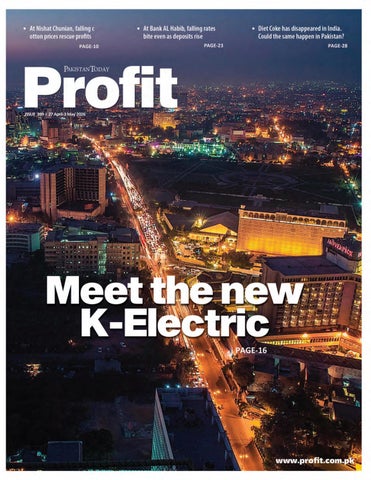
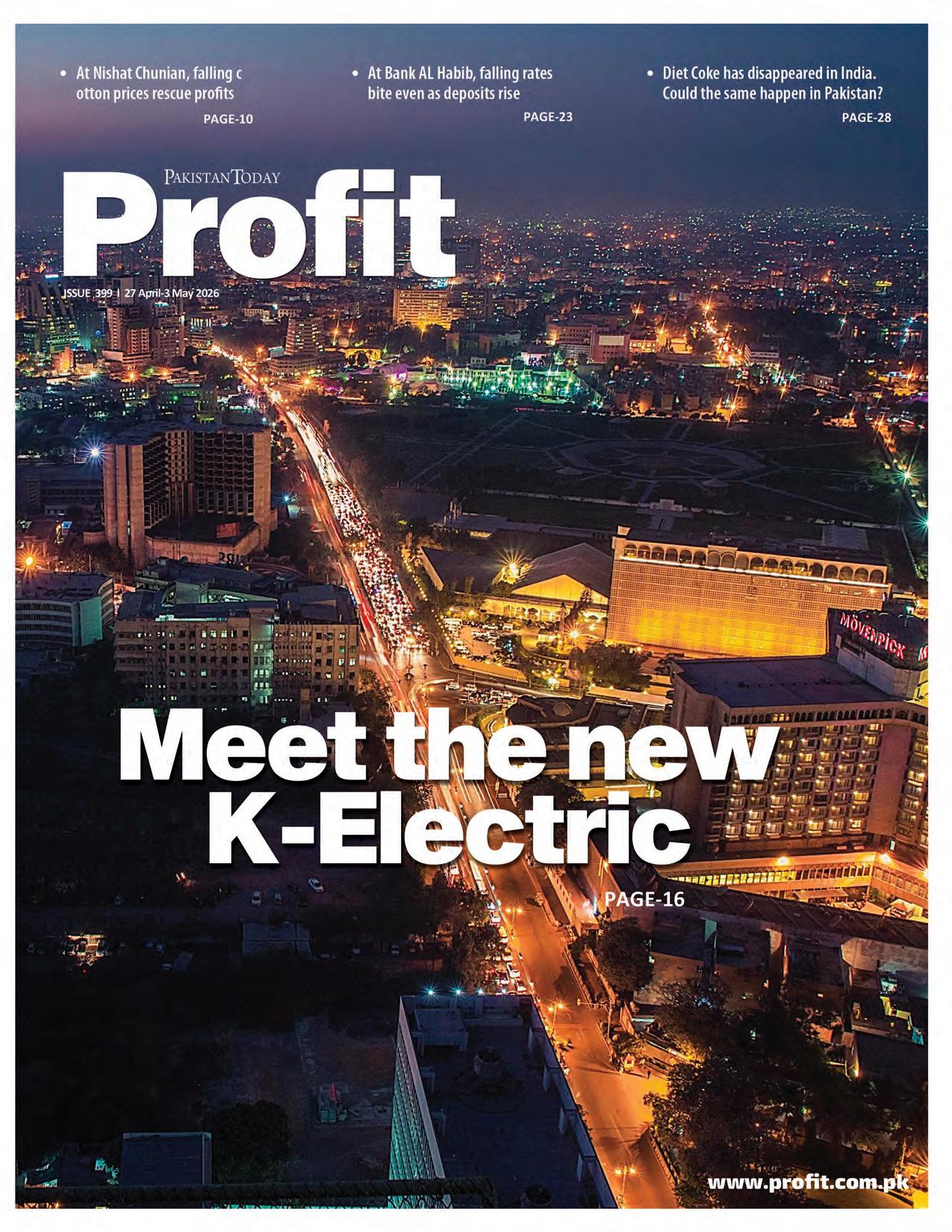
14 For National Bank, 2025 was a stellar year 16 Meet the new K-Electric
At Bank AL Habib, falling rates bite even as deposits rise
The Business of Water Asif Saad 28 Diet Coke has disappeared in India. Could the same happen in Pakistan?
31 The SECP is looking to bring swing pricing to the mutual fund industry. It could have ripple effects for the stock market
Publishing Editor: Babar Nizami - Senior Editor: Abdullah Niazi
Business Reporters: Taimoor Hassan | Usama Liaqat | Zain Naeem | Shahnawaz Ali | Ghulam Abbass
Ahmad Ahmadani | Aziz Buneri - Sub-Editors: Saddam Hussain | Abdul Hameed - Video Producer: Adnan Maqsood Director Marketing: Muddasir Alam - Regional Heads of Marketing: Agha Anwer (Khi) Kamal Rizvi (Lhe) | Malik Israr (Isb) GM Special Projects Zulfiqar Butt - Manager Subscriptions: Irfan Farooq
Pakistan’s #1 business magazine - your go-to source for business, economic and financial news. Contact us: profit@pakistantoday.com.pk
Pakistan’s
reliance on palm oil continues to be a heavy burden on our food import bill.
Can something be done about it?
Palm oil has long been a basic caloric input in the average Pakistani diet and it is all imported from Malaysia and Indonesia. There are ways to reduce the over-reliance.
Yet again has our food imports bill risen. And yet again our food exports. In the first nine months of the current fiscal year, compared to the same period last year, the former increased by 15 percent to USD 7.09 billion, while the latter plummeted by 34 percent to USD 3.8 billion. The food trade deficit by the end of this period stood at USD 3.29 billion.
The import pressure was led by the buying of palm oil, the import value of which in the 9-months amounted to USD 3.023 billion – almost 92 percent of the total food trade deficit. This was a 17.49 percent increase over the amount for the first 3 quarters of the previous fiscal year. If we look at the volumes, they too rose, by 12.81 percent to 2.8 million tonnes. Indonesia and Malaysia remained the top suppliers of this oil, so ubiquitous in Pakistani kitchens, albeit in an altered form.
And this is not simply the story of this year. Palm oil has been a major import item, ever present in huge bold lettering on the list of incoming items. In FY25, for instance, Pakistan imported a record-breaking 3.2 million tonnes of palm oil, worth USD 3.4 billion. This made Pakistan the fourth largest importer of palm oil in the world, trailing India, China, and the EU.
Pakistan’s image has traditionally been that of an agriculture-driven country. The kisaan has been the image we have liked most to project of ourselves, and the land – sohni dharti – has been a staple in our national imagination of ourselves. And not for no reason at all. In fact, agriculture remains the lifeblood of our economy, contributing 23.5 percent to our national GDP, and employing over 37 percent of our total workforce.
So, for a country that relies on production of crops and grows so many crops, why do we import so much palm oil? The short answer
is that we don’t grow much of it at home. But why is that the case? Various efforts have been made to promote the cultivation of oilseeds for decades now, but inconsistent policies and the industry’s infrastructural deficiencies in Pakistan have meant that the cultivation of palm – along with other varieties of oilseeds –has failed to take any meaningful root. Although some oilseeds are grown here, including cotton which is massive, the varieties grown here are not particularly bred for oil extraction. Similarly, land, especially in the coastal areas of Sindh has been assessed to be well-suited to palm cultivation, but challenges remain for the cultivation of palm at any appreciable level, not the least of which are a lack of official will to do so. This would, of course, require investment in research and development of palm varieties amenable to local climatic conditions. But as important would be government-led investment in agricultural infrastructure to support the value
chain of palm oil.
Such measures, if successful, should do much to alleviate our import deficit. Moreover, given the fact that palm oil has since recently been considered as a source of biofuels, its potential to assist in our energy challenges remains massive, not simply as part of a shift towards renewables, but also – again – as an item that would help reduce our fuel import bill.
Why Palm?
The story of palm oil in Pakistani kitchens begins, as so much does, before the partition of Hindustan. In 1930, the Lever Brothers (forerunners of today’s Unilever) introduced into India a variant of plant-based edible oil called Vanaspati. Developed in Europe, Vanaspati was a cheaper and therefore more affordable dupe of the desi ghee, which had traditionally been the staple of rich kitchens. Vanaspati success-
INCREASING FOOD IMPORTS
Total food imports 9MFY26 $ 7.09 billion
Total food imports 9MFY25 $ 6.15 billion
fully duped the texture and taste of this more expensive ghee, and in doing so changed the cooking palette of the South Asian households forever.
The key ingredient in this Vanaspati ‘ghee’ was palm oil. No wonder when the Lever Brothers launched the product in collaboration with a Dutch company called Dada, the logo used had a bright green palm tree in it. The collaboration – called Dalda – was here. And it took the world by storm.
In fact, since the early 20th century, the oilseeds of the palm – along with soybeans –have dominated global demand, and for good reason. The palm seeds, for instance, have a very high oil yield. Compared to brassica seeds – from which mustard oil is derived, and which yield between 0.5 and 0.6 tonnes of oil per hectare – the palm seed can yield up between 3.5 and 5 tonnes per hectare. At the same time, the palm seed has a very high protein content.
Both of these qualities make palm oil a prime source of two kinds of food: one for humans in the form of palm oil and its derivative products, and the other for livestock. We have mentioned above one of the forms palm oil takes in human food chain. For livestock, on the other hand, the food is essentially the dross left after the oil has been extracted. It is called ‘cake,’ and its protein-rich content makes it ideal meal for livestock including poultry and cattle, as well as aquaculture. Taken directly, palm oil products provide much-needed fat to human beings. Taken indirectly, through the consumption of meat, they provide a rich source of protein. In all this we cannot forget the part that oil from such oilseeds play in both both food and non-food industries such as biscuits, tea whitener, soap, cosmetics, pharmaceuticals, paint, fertiliser and biodiesel. Palm oil’s importance, therefore, cannot be minimised.
And this is reflected in the increased consumption of palm oil products both globally and within Pakistan, which over the past 5 decades has increased manifold. This increased consumption is reflected in the massive
DECREASING FOOD EXPORTS
Total food exports 9MFY26 $3.80 billion Total food exports 9MFY25 $5.75 billion INCREASING
amounts of palm oil that we import. These are an ever-present gape in our trade deficit. But at one point or the other, something has to be done about this.
Why No Palm?
In Pakistan, however, you would think that such an important crop would have been considered for cultivation, and you’d be right. We have thought about planting palm seeds, as part of a broader program to promote local oilseed production. In 1989, for instance, the government initiated a 7-year National Oilseed Development Project to encourage the cultivation of oilseeds, but the project ran aground at the back of insufficient seed supply and supply chain issues.
And this has been the story for decades before and since. Not only has there been a sharp lack of consistent oilseeds policy and its consistent application, the efforts to grow these seeds locally have also had to contend with the poor infrastructure surrounding agriculture. This includes deficiencies in procurement chains, quality control, research and development, inefficient extraction, and even marketing and promotion of such initiatives.
To complicate matters, although there is oilseed production here – mainly in the form of cotton, but also some canola, groundnut, sesame, castor and linseed – little is used to extract oil. We have seen the result of this restriction in the form of a heavy dent on our import bill, and the consumption trends don’t appear to be signalling any shift away from palm oil products in our food. In such a context, the need to take sustainable steps to promote the local cultivation of palm becomes even more important.
Although the crop has a long productive lifespan (up to 25 years) and a comparatively short juvenile phase (up to 2 years), and it offers quick returns and consistent yields, growing palm in Pakistan is not as straightforward a proposition as it seems. For one, the cultivation of palm requires specific climate and light
Palm oil imports 9MFY26 $3.02 billion
Palm oil imports 9MFY25 $2.57 billion
conditions, ideally between 25 and 35 degrees Centigrade, between 1600 and 2500 mm of annual rainfall, and over 1800 hours of sunlight every year. And although soil in Pakistan’s coastal regions such as Badin, Thatta, Hub, Pasni, and Gwadar has shown potential for oil palm cultivation, certain climactic bottlenecks dampen the prospects. The annual rainfall in these regions is much sparser than what palm usually requires, and daylight temperatures can even exceed 50 degrees, complicating the whole enterprise.
The answer to these problems lies in the research into and development of locally-adaptable varieties of the palm seed. Imported seeds often thrive in humid tropical areas, and are likely to underperform, if they perform at all, in hot, arid, and saline conditions such as in Pakistan. In such a case, the development of drought-resistant and heat-tolerant varieties, more suitable to our climate, is a necessary step. And this would obviously require investment in local scientific capacities as well as the willingness and ability to see any pilot programs to fruition.
But perhaps as importantly, it would require the political will to develop indigenous varieties and to create an ecosystem of support surrounding palm cultivation that would allow for local processing and value addition as well. Only then we might be able to reduce our reliance on the import of what is the most voluminous food item on our import bill.
This becomes even more important as palm oil has increasingly been considered as part of fuel, most notably in Indonesia. The government there has mandated diesel fuel to contain 40 percent palm-oil-based content. While building a similar value chain in Pakistan might be a thing a little too far in the future, the potential is there. And given the heavy cost of our fuel oil imports, it certainly adds more urgency to the idea of encouraging local palm cultivation. The question remains, as ever: will the government strap up its boots and step in? n
At Nishat Chunian, falling cotton prices rescue profits
Despite falling revenue, the company saw profits rise on the back of falling cotton and energy prices.
For Nishat Chunian, the latest results are a reminder that textile profits are not always made on the topline. In the quarter ended March 2026, the Lahore-based textile manufacturer reported revenue of Rs21.7 billion, down 7% from Rs23.4 billion in the same period last year. And yet, profit after tax rose 33% to Rs642 million, translating into earnings per share of Rs2.67, compared with Rs481 million and EPS of Rs2.00 a year earlier. For the nine months ended March 2026, sales slipped 4% to Rs65.0 billion, while net profit jumped 53% to Rs1.14 billion.
That divergence – lower sales, higher profits – is the story. Nishat Chunian did not grow its way into better earnings. It protected its margins. According to AKD Securities, gross margins in the March quarter improved to 13.0% from 10.5% a year earlier, helped mainly by easing cotton prices and lower energy tariffs. Cost of goods sold fell faster than sales, dropping 10% year on year, which allowed gross profit to rise 16% to Rs2.84 billion despite the fall in revenue. In a business where raw cotton, yarn, power and gas can decide the difference between profits and losses, that was
enough to transform the income statement.
The recovery was not without its blemishes. Operating expenses rose 11% to Rs626 million, which AKD attributed to higher export volumes. Finance costs rose even more sharply, by 27% to Rs1.24 billion, as a 31% increase in average borrowings outweighed the benefit of easing interest rates. That is the less flattering side of the company’s rebound: Nishat Chunian’s operations may have been rescued by cheaper inputs, but its balance sheet still carried the strain of an expensive working-capital cycle.
The tax line was also volatile. AKD noted that the company’s effective tax rate stood at 32% in the quarter, compared with 39% in the same period last year and an anomalous 106% in the preceding quarter, when lower first-half profitability triggered minimum turnover tax. That tax effect helped turn the March quarter into a cleaner recovery than the preceding one, when Nishat Chunian had reported a small loss despite meaningful sales.
For textile companies, cotton prices are not simply an input cost; they are a macroeconomic variable disguised as inventory. Global cotton markets had been subdued through much of 2025. Oxford Economics wrote in
June 2025 that cotton prices were expected to remain under pressure from ample supply and sluggish demand, with only a modest recovery forecast for 2026. The US Department of Agriculture’s 2026 cotton outlook similarly described 2025/26 world cotton production as the second highest in a decade, while world consumption was forecast marginally lower than the previous year.
That backdrop mattered for a company like Nishat Chunian, whose roots remain in spinning and whose largest segment still depends heavily on the spread between cotton and yarn prices. Lower cotton prices can be a blessing for spinners when selling prices do not fall as quickly, and particularly when the company can pass finished yarn or fabric into export or value-added channels. They can also be a curse when they signal weak demand. In Nishat Chunian’s case, the March quarter suggests the former dominated: revenue declined, but the margin improvement was large enough to lift earnings.
Energy costs played a similar role. In January 2026, Pakistan’s prime minister announced a Rs4.04 per unit cut in electricity tariffs for industrial consumers, a move intended to reduce production costs and improve ex-
port competitiveness. For textile mills, which are among Pakistan’s most energy-intensive manufacturers, even modest tariff relief can have a material effect on margins, particularly in dyeing, processing, weaving and spinning.
The relief came at a time when the broader textile sector was struggling for momentum. Pakistan’s textile exports fell 7.06% year on year in March 2026 to $1.33 billion, according to PBS data cited by Business Recorder, and exports during July-March FY26 were down 0.5% year on year. Nishat Chunian’s own 7% quarterly sales decline therefore came in a market that was hardly buoyant.
That makes the second point in AKD’s note important: the revenue decline was not as bad as analysts had expected. The brokerage said the result came in higher than its expectations because of “higher-than-anticipated sales and gross margins”. Revenue still fell, likely because of a decline in domestic spinning sales, but AKD expected export growth to have partially offset that weakness. In other words, the company did not beat expectations because business conditions were strong. It beat expectations because they were less bad than feared.
That distinction matters. In Pakistan’s textile industry, a mild decline can sometimes feel like a triumph. Demand from China, Europe and the US has been inconsistent; regional competitors have advantages in scale, tariffs or energy pricing; and Pakistani mills have had to live with high borrowing costs and unpredictable domestic policy. For upstream textile companies, particularly those exposed to yarn and greige fabric, the environment has been more punishing than for branded apparel retailers or finished-goods exporters. Nishat Chunian’s ability to post higher profits in such a year says less about a booming market and more about management’s ability to survive adverse cycles.
The company has been built for precisely those cycles. Nishat Chunian began in 1990 with a spinning mill of 14,400 spindles and has since grown into one of Pakistan’s largest vertically integrated textile manufacturers. Its own corporate profile describes it as having three operational sites and a workforce of more than 7,000 people, supplying yarn, fabric and home textiles to markets including the US, UK, Europe, Australia, South America and Pakistan.
The company’s founder and principal sponsor is Shahzad Saleem, who founded Nishat Chunian in 1990 after graduating from the Lahore University of Management Sciences. From a single spinning unit, the company expanded into weaving, home textiles, retail and power generation under the Nishat Chunian Group umbrella. Shahzad Saleem is now chairman of Nishat Chunian Limited, while Zain Shahzad is chief executive, bringing with him experience in retail and e-commerce
through The Linen Company.
The Nishat Chunian story is also part of the larger story of Punjab’s industrial families: textile-led growth, backward and forward integration, and diversification into power and retail. The company’s 2025 corporate briefing lays out its expansion path neatly. The first spinning mill came in 1991, weaving followed in 1998, home textiles in 2006, a 200MW independent power producer in 2010, a captive power plant in 2014, and The Linen Company retail business in 2016. Later came Nishat Chunian USA, Sweave Inc for e-commerce retail of home textile products, Nishat Chunian Properties, and TLC Middle East Trading for retail in the UAE.
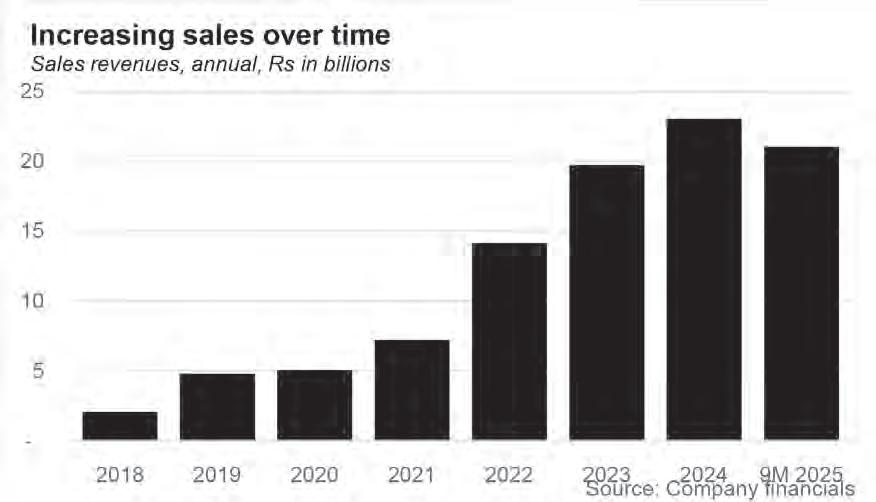
Scale, however, has not insulated the company from volatility. PSX financial data show annual sales of Rs85.4 billion in 2025, down from Rs88.9 billion in 2024, while profit after tax rose to Rs789 million from Rs692 million. The improvement was modest at the annual level, but the nine-month FY26 result indicates a more meaningful earnings recovery. It is the kind of recovery that textile investors recognise: not spectacular topline expansion, but survival through margin repair.
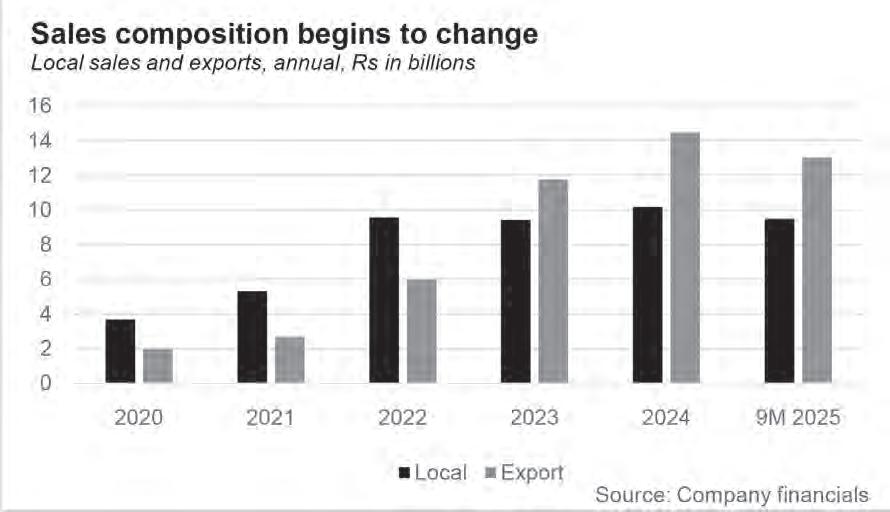
The composition of Nishat Chunian’s revenue reveals why that margin repair is so important. In its FY25 corporate briefing, the company said 63% of sales were local and 37% export-based. Segment-wise, spinning accounted for 57% of sales, weaving 16%, processing and home textiles 27%, and power generation just 0.3%. That makes Nishat Chunian, despite its diversification, still heavily exposed to the economics of yarn.
The spinning division is the company’s historic core. Nishat Chunian says it produces a broad range of ring-spun yarn from Ne 2/1 to 150/1 and open-end yarn from Ne 5/1 to 32/1, with annual capacity of 85,000 tonnes of yarn. It operates eight ring-spinning mills and one open-end plant, and offers carded, combed, compact, slub, core-spun stretch, dual FX, siro-spun, open-end, blended and plied yarns. Its cotton options include Pakistani, US, Australian, Brazilian, US Pima, Egyptian Giza, African, organic, BCI and Primark cottons.
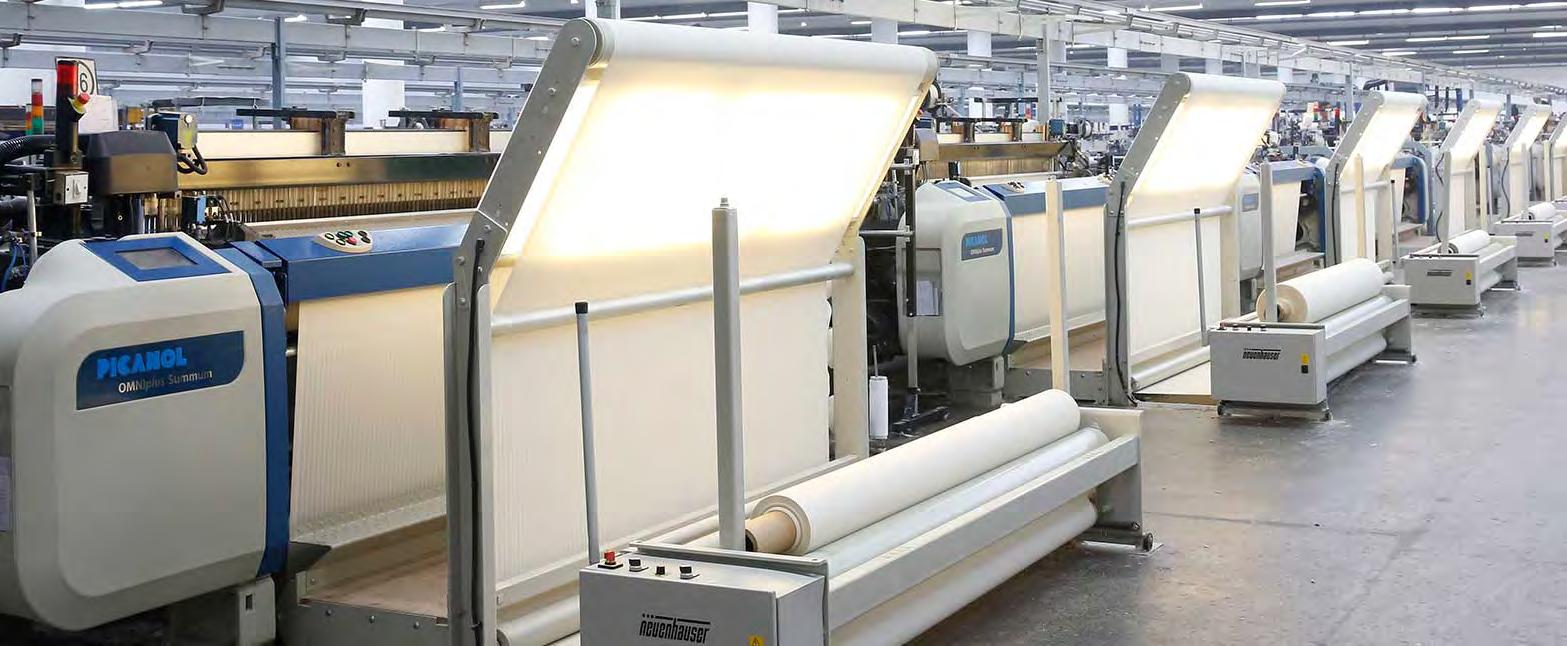
The weaving division, established in 1998, has 379 air-jet looms, including 16 jacquard looms, and annual production capacity of 72 million metres. Its product range extends from percale, twill, drill, Oxford and sateen to herringbone, dobby and jacquard patterns, as well as technical fabrics using materials such as Kevlar, para-aramids and fire-retardant fibres. That technical range matters because commodity yarn and fabric are increasingly hard to defend on price alone.
The home textiles division provides a route further up the value chain. Nishat Chunian’s dyeing and printing plant has annual capacity of 46 million metres with
equivalent stitching capacity, producing dyed sheeting, printed sheeting, bed linen, quilting, embroidery, curtains, table linen, institutional textiles and flannel fabrics. The company says its product range includes high-density fabrics up to 340cm wide, percales up to 600 thread count and sateens up to 1,200 thread count. That product portfolio explains management’s recent initiatives. The company is not merely waiting for cotton prices to remain favourable. Its FY25 corporate briefing says Nishat Chunian plans to expand open-end yarn production, install 22 new looms, upgrade a hanger system in stitching to reduce lead times and improve workflow efficiency, expand retail outlets and introduce new product ranges. It also opened a new UAE store for The Linen Company during the year, strengthening its presence in the Middle East.
Those initiatives point to a sensible strategic direction. Open-end yarn can serve demand for coarse counts and price-sensitive applications. New looms can lift weaving capacity and improve product flexibility. Stitching upgrades can shorten delivery cycles, a critical factor for export customers that increasingly value speed as much as price. Retail expansion through The Linen Company gives Nishat Chunian a branded channel, though one still small relative to the industrial textile base. In a world where upstream margins are volatile, every step closer to the consumer helps.
Yet the latest results also show the limits of strategy. Nishat Chunian’s profit recovery was helped by factors management did not fully control: lower cotton prices, lower energy tariffs and a tax rate that normalised after a difficult first half. AKD maintained a “buy” stance on the stock with a December 2026 target price of Rs84 per share, citing expected improvement in exports, easing input prices supporting margins, and lower finance costs as interest rates decline. But those are still expectations built around a volatile operating environment. The company’s challenge is therefore straightforward but not easy. It must turn a cost-led recovery into a business-led recovery. Falling cotton prices can rescue a quarter. Lower electricity tariffs can rescue margins. A less punitive tax charge can rescue earnings. But durable value will require more exports, better product mix, tighter working-capital management and a larger share of revenue from higher-margin finished goods and branded channels.
For now, Nishat Chunian has achieved something useful: it has reminded investors that, even in a weak revenue environment, Pakistan’s textile manufacturers can still surprise on profits when input costs move in their favour. The result is not a story of booming demand. It is a story of relief – from cotton, from energy, and from expectations that had become too gloomy. In Pakistan’s textile sector, that may be enough to count as good news. n
As Haval sales soar, Sazgar posts record profits
The company has rapidly become one of Pakistan’s most successful assemblers of Chinese automobiles, and its growth shows no signs of slowing down
For a company that began life making three-wheelers, Sazgar Engineering Works is now producing numbers that would make Pakistan’s older car assemblers uneasy. In the third quarter of fiscal year 2026, the Lahore-based automaker reported the highest quarterly profit in its history: profit after tax of Rs6.4 billion, or Rs106.5 per share. For the nine months ended March 31, 2026, earnings rose 16% year on year to Rs14.9 billion, equivalent to Rs246.2 per share. The company also declared a quarterly cash dividend of Rs20 per share, taking its nine-month payout to Rs50 per share.
The result confirms what had already become apparent on Pakistan’s roads: Sazgar is no longer merely an interesting new entrant in the car market. It is one of the country’s most successful automobile growth stories. Net revenue in the March quarter rose 29% year on year to Rs47.4 billion. For the nine-month period, revenue climbed 41% to Rs115.2 billion, exceeding the Rs108.7 billion turnover Sazgar reported for the entire fiscal year 2025. In other words, before the final quarter of the year had even begun, Sazgar had already surpassed last year’s full-year topline. The company’s
own FY25 corporate briefing had shown how dramatic the recent acceleration had been: turnover rose from Rs57.6 billion in 2024 to Rs108.7 billion in 2025, while net profit after tax more than doubled from Rs7.9 billion to Rs16.3 billion.
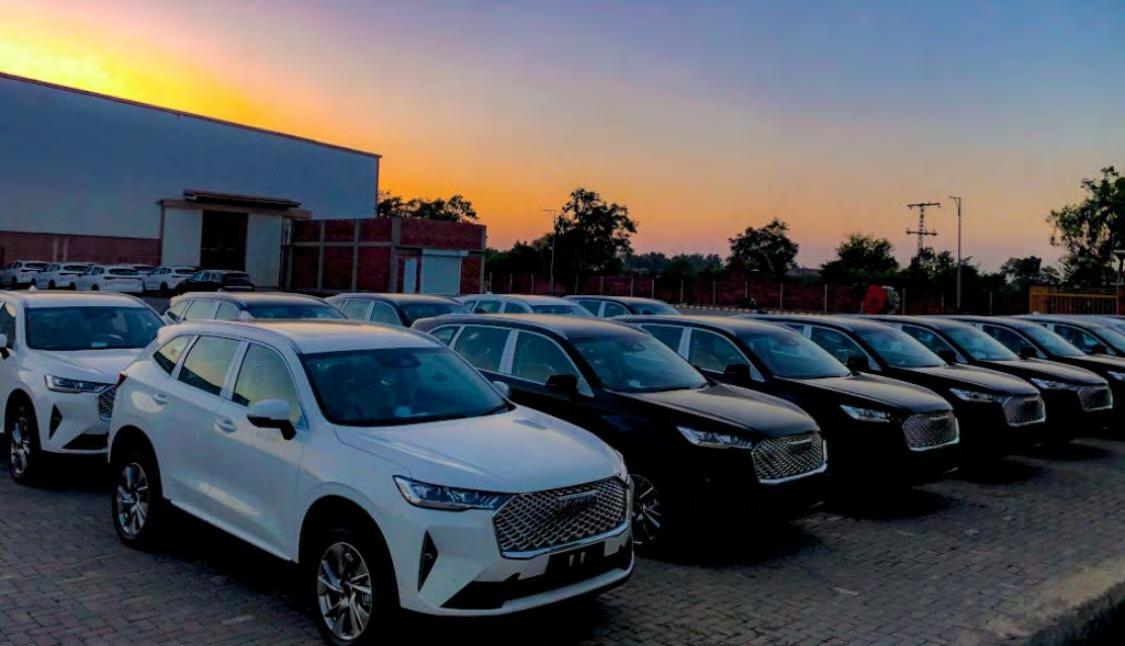
The engine of that growth is Haval. Arif Habib Limited’s result review notes that Sazgar’s quarterly revenue increase was “primarily driven” by a sharp rise in Haval volumes to 5,420 units, up 47% year on year. That is a remarkable number in a Pakistani auto market that, only a few years ago, was still dominated overwhelmingly by Japanese brands and their local partners. Monthly data underline the same trend: in March 2026, Sazgar reported sales of 1,734 units, up 84% year on year and 3% month on month, according to auto-sector sales data cited by Geo News.
The company’s financial statement has the feel of an automaker scaling up rapidly. Gross profit remains large, other income is growing, distribution costs are rising because more vehicles are being delivered, and finance costs, though up, remain small relative to the earnings base. In the March quarter, other income rose 155% year on year to Rs761 million, helped by higher cash and cash equivalents.
Distribution expense increased 63% year on year to Rs1.7 billion, reflecting the cost of moving more vehicles through the system. Finance cost nearly doubled to Rs102 million in the quarter, but on a profit-before-tax base of Rs10.6 billion, it was hardly a constraint.
Yet the result is not a simple story of operating leverage. Sazgar sold many more vehicles, but it also earned less profit on each rupee of sales than it did last year. Gross margin in the third quarter fell to 26.8% from 32.6% in the same period last year. For the nine months, gross margin declined to 25.6% from 30.5%. Net margin also fell, to 12.9% for the nine-month period from 15.8% a year earlier.
That margin decline is the most important wrinkle in an otherwise spectacular result. It suggests Sazgar is not simply passing on every cost increase to consumers. Instead, it appears to be absorbing part of the pressure to preserve demand and keep volumes moving. That is a rational strategy in Pakistan’s automobile market, where vehicles are expensive relative to incomes and financing remains sensitive to interest rates. Price too aggressively, and sales can disappear. Protect prices too much, and margins suffer. Sazgar has chosen volume.
The cost pressure, according to Arif
Habib, came mainly from three sources: the absence of concessionary duties, the impact of rupee depreciation, and a shift in product mix towards petrol variants, which carry different economics from hybrid models. These are not merely company-specific operating issues. They are the result of the policy architecture that has shaped Pakistan’s auto industry for nearly a decade.
Sazgar’s rise was enabled by policy. In 2021, the Ministry of Industries and Production awarded the company Category-A Greenfield Investment status and approved Great Wall Motors as its second principal for the assembly and manufacture of GWM Haval vehicles, in addition to BAIC vehicles. Sazgar said at the time that it expected to begin commercial production of Haval vehicles by June 30, 2022. The company later completed trial operations and prepared for the first locally assembled Haval CKD roll-out in August 2022.
Those incentives were part of a broader effort to break open a market long criticised for being too concentrated. The Automotive Development Policy 2016-21 offered reduced duties and tariff protection to new entrants, helping attract a wave of new brands and assemblers. The subsequent Automotive Industry Development and Export Policy 2021-26 kept some of those incentives alive for new entrants for five years from the issuance of manufacturing certificates or until June 30, 2026, whichever came earlier. Industry commentary has described the earlier policy as reducing duties on non-localised parts and localised parts, while giving new entrants a five-year tariff protection window that helped attract more than $1 billion in realised investment into assembly plants, dealerships and vendor networks.
The problem with policy-led growth is that policy changes. Once concessionary treatment begins to roll off, costs rise. If the currency weakens at the same time, imported kits and parts become more expensive. And if the product mix shifts away from hybrids, which benefit from more favourable tax treatment, the margin profile changes again. The result is precisely what appears in Sazgar’s latest accounts: record profits and record revenue, but lower margins.
The hybrid question is especially important for Sazgar because Haval’s Pakistani appeal has been built partly on the success of models such as the H6 HEV. Pakistan’s auto policy framework has treated hybrid and plug-in hybrid vehicles more favourably than conventional internal combustion engine vehicles. Under the 2021-26 policy framework, duties were reduced to 4% for hybrid parts, 3% for plug-in hybrid components and 1% for electric vehicle parts, while sales tax on hybrids and plug-in hybrids was set at 8.5%, according to reporting on the policy structure. Any move to
increase taxes on hybrids or plug-in hybrids would therefore matter deeply for assemblers such as Sazgar. Business Recorder reported in March 2026 that proposals under consideration included a 3% new-energy vehicle levy on internal-combustion vehicles and hybrids, and an increase in sales tax on hybrid and plug-in hybrid vehicles from 8.5% to 18%.
For now, Sazgar seems to be compensating with scale. The company’s four-wheeler sales reached 10,889 units in fiscal year 2025, up from 5,392 units in 2024, while three-wheeler sales rose to 25,786 units from 15,014 units. Its FY25 corporate briefing attributed turnover growth mainly to higher sales volumes of four-wheelers, particularly Haval vehicles, and said profit improved significantly for the same reason.
That is a striking reinvention. Sazgar was incorporated in September 1991 as a private limited company, converted into a public limited company in November 1994 and listed on Pakistan’s stock exchanges in September 1996. Its network now includes more than 20 four-wheeler dealers and more than 50 booking agents for three-wheelers, and it had 1,552 employees on the payroll as of June 2025. For many years, the company was best known for three-wheelers, automotive parts and tractor wheel rims. Its own segment disclosure now tells a different story: automobiles in four-wheelers, under Haval and BAIC, sit alongside three-wheelers and automotive parts.
The transformation has also required investment. The company’s non-current assets rose sharply in FY25, which management said was mainly because of expansion in four-wheeler manufacturing facilities. It also acquired land adjacent to its car plant, revised its four-wheeler expansion plan, upgraded features of the Haval H6 and Jolion, and identified future priorities that include completing the four-wheeler expansion plan by March 31, 2026, introducing new CKD models of new-energy vehicles such as the Tank 500 PHEV and Cannon PHEV, exploring new export markets and expanding its local dealership network.
That new model pipeline matters. Sazgar’s growth has so far been heavily dependent on the Haval SUV family, but sustaining the pace will require broadening the portfolio. The planned addition of the Tank 500 PHEV and Cannon PHEV would push Sazgar further into higher-end SUVs and pickups, categories where Chinese automakers have been particularly aggressive globally. Profit by Pakistan Today reported that Sazgar planned to launch locally assembled PHEV Tank-500 and Cannon models by March 2026, framing them as part of the company’s next stage of expansion.
Globally, Sazgar is riding a much larger wave: the internationalisation of Chinese carmakers. Great Wall Motor, Haval’s parent, reported 2025 new-vehicle sales of 1.32 million
units, up 7.23% year on year. Overseas sales reached 506,800 units, up 11.60%, while global new-energy vehicle sales rose 26% to 406,000 units. Its Haval brand alone sold 761,487 vehicles in 2025, up 7.69%, and had more than 10 million global users.
The same annual report gives the wider context: China’s automobile sales reached 34.4 million units in 2025, while exports exceeded 7 million vehicles, up 21.13% year on year. Exports of new-energy vehicles doubled to 2.62 million units. That matters because Haval’s Pakistani success is not an isolated local phenomenon. It is part of a global shift in which Chinese automakers, once dismissed as marginal or low-quality players, have become scale manufacturers with competitive pricing, hybrid technology, increasingly acceptable build quality and an appetite for markets underserved by Western and Japanese brands.
Pakistan fits naturally into that strategy. The market is price-sensitive, fuel economy matters, road conditions favour SUVs and crossovers, and consumers are willing to consider alternatives when those alternatives offer better features at comparable prices. GWM’s own account of Haval’s Pakistan launch in 2021 described the H6 and Jolion as part of a push to break the long-term local market situation dominated by Japanese cars. That ambition, at least in the SUV segment, no longer sounds fanciful.
Sazgar’s opportunity is therefore large, but not risk-free. The company’s latest numbers show that demand is strong. They also show that margins are vulnerable to duties, taxes, exchange rates and product mix. Its business risks, listed by the company itself, include availability and prices of raw material and CKDs, currency devaluation, regulatory and taxation policy, and general market conditions. Those are not theoretical risks. They are already visible in the margin decline.
Still, the investment case for Sazgar has changed dramatically. A company once viewed through the lens of three-wheelers and tractor-related automotive parts is now a leading proxy for Chinese automobiles in Pakistan. It is profitable, cash-generative, expanding capacity and distributing dividends. Its quarterly earnings are not just better than last year; they are the best in its history. And while the falling gross margin suggests the next phase will be harder than the last, the volume growth suggests consumers are still coming.
The old Pakistani auto industry was slow, protected and predictable. Sazgar’s rise has been fast, policy-enabled and disruptive. If Haval sales continue at anything close to the recent pace, the company will remain one of the clearest examples of how Chinese automakers are reshaping Pakistan’s roads – not as fringe competitors, but as serious contenders for the mainstream. n
For National Bank, 2025 was a stellar year
The bank’s revenue and earnings grew substantially, even as management prepares for interest rate volatility ahead
For most Pakistani banks, 2025 was the year in which the post-inflation super-cycle began to normalise. For National Bank of Pakistan, it was something rather more flattering: a year in which a lumbering state-owned giant managed to look nimble. The country’s largest public-sector bank reported profit after tax of Rs85.9 billion for calendar year 2025, more than three times the Rs26.9 billion it earned a year earlier. Earnings per share rose to Rs40.38 from Rs12.63, while the dividend was lifted to Rs35 per share from Rs8, a sharp increase for a bank whose shareholder register and governance still carry the unmistakable imprint of the state.
The headline number was impressive. The mechanics behind it were more interesting. Total income rose 32% to Rs311.7 billion, from Rs236.3 billion in 2024. That growth came not because NBP earned more mark-up in absolute terms — mark-up income actually fell by 28% to Rs781.1 billion — but because its funding costs fell even faster. Mark-up expense dropped 42% to Rs532.6 billion, allowing net mark-up income to jump 45% to Rs248.5 billion. In other words, the bank made more money because the decline in what it paid depositors and lenders outpaced the decline in what it earned on its assets.
That is the quiet arithmetic of banking in a declining-rate environment. Pakistan’s policy rate had been cut aggressively from its 2024 peak: the State Bank of Pakistan said in its August 2025 monetary policy report that the policy rate had fallen by 1,100 basis points to 11% between June 2024 and May 2025, before being held at that level in June and July. By December 2025, Reuters reported that the SBP had cut again, by 50 basis points to 10.5%, taking total easing since the peak to 1,150 basis points. For banks with large low-cost deposit bases and sizeable holdings of government securities, that environment can be unusually profitable, provided liabilities reprice faster than assets.
NBP had just such a balance sheet. Deposits rose 15% during the year, from Rs3.9 trillion to Rs4.4 trillion, while the bank’s
CASA ratio — current and savings accounts as a share of deposits — stood at 81%. That ratio matters because low-cost deposits are the raw material of bank profitability. The higher the share of deposits that cost little or nothing, the more benefit a bank can extract from a portfolio of earning assets. Management told analysts that total assets stood at Rs7 trillion at the end of 2025, up 4.8% year on year, while advances were Rs1.6 trillion, up 3.6%.
The income statement also tells a story about restraint. Non-mark-up income slipped 3% to Rs63.2 billion, despite a strong jump in foreign-exchange income, which rose 164% to Rs15.6 billion. Fee and commission income was up a more modest 10% to Rs28.0 billion, while dividend income declined slightly and gains on securities fell 53% to Rs12.7 billion. The bank’s revenue growth was therefore not a broad-based surge across every line. It was concentrated in the spread business, helped by falling funding costs and a large book of interest-earning assets.
The more dramatic swing was in costs. Operating expenses fell 30% to Rs124.8 billion from Rs177.3 billion, pulling the cost-to-income ratio down to 41% from 74%. That is an
extraordinary shift for a state-owned bank with a sprawling branch network and legacy obligations. It was enough to take profit before credit loss allowance to Rs186.9 billion, more than triple the previous year’s Rs58.9 billion. Even a sharp rise in credit loss allowances and write-offs — to Rs8.0 billion from Rs2.3 billion — barely dented the earnings momentum. Profit before tax rose 216% to Rs178.9 billion.
The taxman, as ever, took a large bite. Taxation rose to Rs93.0 billion from Rs29.8 billion. Yet even after that, NBP delivered net profit of Rs85.9 billion. For a bank that has periodically been dragged down by litigation, pension obligations and the inefficiencies associated with public ownership, 2025 looked less like a cyclical recovery and more like a reminder of the raw earnings power embedded in its franchise.
Still, management appears to know that the rate cycle can be both benefactor and executioner. The most revealing comments from the corporate briefing were about the investment book. NBP’s investments stood at Rs4.9 trillion at the end of 2025, up 7% from Rs4.6 trillion a year earlier. The portfolio remained dominated by government paper: treasury bills
made up 27%, Pakistan Investment Bonds 63%, equities 5%, foreign bonds 2%, and other debt instruments 6%.
Within the PIB book, however, the mix was deliberately defensive. Management said 70% of the PIB portfolio was held in floating-rate instruments, with the remaining 30% in fixed-rate securities. Arif Habib’s briefing note added an important detail: the floating-rate PIBs yielded 100 basis points over treasury bills, while the fixed-rate instruments had a weighted average maturity of 2.7 years; the overall portfolio’s weighted average maturity was just 0.7 years.
That is not the posture of a bank making a heroic bet on a single direction for rates. It is the posture of a bank trying to stay close to the market. Floating-rate bonds protect income when rates rise, but they also surrender some upside when rates fall. Shorter maturity portfolios reduce mark-to-market pain and reinvestment risk, but they also make it harder to lock in juicy yields for long periods. In 2025, when rates had already fallen sharply but uncertainty remained over inflation, the current account and IMF-linked policy discipline, that compromise made sense. The SBP itself noted in August that the full effects of monetary easing in Pakistan typically materialise with an 18- to 24-month lag, and that future policy would remain tied to inflation and growth conditions.
For NBP, the risk is not simply that rates rise or fall. The risk is that they move faster than the bank can reprice either side of its balance sheet. Its earnings surge in 2025 came from funding costs falling faster than asset yields. If the next phase of the cycle compresses spreads, the very same arithmetic could turn against it. Management’s emphasis on variable-rate securities is, therefore, best read as a form of self-awareness: the bank is enjoying the harvest, but it is not assuming the weather will hold.
The same prudence appears in the loan book. Management described its approach to advances as one of steady growth and strong provisioning. The advances portfolio comprised 35% corporate loans, 16% Islamic financing, 14% consumer loans and 9% SME loans. NBP also remains the largest provider of agricultural loans, with an agricultural book of roughly Rs133 billion, and management said non-performing loans in that segment remained contained and manageable.
The bank’s most visible growth push, however, is in Islamic banking and distribution. NBP ended 2025 with 1,503 branches, including 312 Islamic branches and 350 Islamic banking windows. Its Islamic banking segment recorded pre-tax profit of Rs14 billion, up roughly 116% year on year. That matters because Islamic banking is no longer a niche in Pakistan. By end-December 2025, Islamic
banking institutions had assets of Rs14.5 trillion, deposits of Rs11.0 trillion and 7,562 branches, according to the SBP’s Islamic Banking Bulletin. Their share of overall banking assets was 22.9%, while their share of deposits was 27.8%.
For a conventional bank with a stateowned legacy, building a serious Islamic banking business is both defensive and offensive. It is defensive because depositors increasingly want Shariah-compliant accounts, and banks that fail to offer them risk losing low-cost balances to Islamic competitors. It is offensive because Islamic financing demand is expanding in sectors such as consumer finance, SMEs, agriculture and government-linked infrastructure. NBP’s branch footprint gives it a distribution advantage that smaller players cannot easily replicate; the challenge is converting that physical reach into modern deposits and fee-generating relationships.
Management appears to understand that branches alone are not enough. The bank spent Rs13 billion on IT-related operating expenditure in 2025, according to Arif Habib’s briefing note, and expects digital and IT investments to support deposit growth. It also wants to increase the tilt towards low-cost deposits. That is the right ambition. Pakistan’s large banks have long relied on physical networks and government relationships. The next contest is over data, payments, mobile interfaces and the ability to turn payroll accounts, pension flows, remittances and small-business balances into sticky, low-cost funding.
There remain reminders that NBP is not a normal private-sector bank. The declared Rs35 per share dividend requires federal government approval, and management told analysts that the process was ongoing. Chase Securities noted that, under the Banks Nationalisation Act, NBP can declare dividends only on audited annual accounts, which restricts its ability to pay quarterly dividends. Management also said dividend payments require both SBP and government approval.
Then there is the pension liability issue, a recurring shadow over the bank. Management said most of the impact from litigation had already been provided for in 2024, when verdicts initially came, and that while some new cases had been added, potential financial impacts had already been accounted for in the financial statements. For shareholders, that reassurance matters. The market tends to apply a discount to state-owned banks not only because of governance concerns, but because liabilities can emerge from places private-sector investors struggle to model.
NBP’s capital position provides some comfort. Its capital adequacy ratio stood at 26.2% at the end of December 2025, down from 27.8% a year earlier but still robust. It also carries systemic importance. In August
2025, the State Bank designated National Bank of Pakistan, United Bank Limited and Habib Bank Limited as domestic systemically important banks for 2025; NBP was placed in Bucket D, with an additional Common Equity Tier 1 capital requirement of 2.5% effective from March 31, 2026. That designation is both a badge of scale and a regulatory burden. NBP is too important to be run casually.
Its history explains why. The bank was established in 1949 under the National Bank of Pakistan Ordinance. NBP’s own investor relations page describes it as a leading commercial bank created on November 8, 1949 and entrusted to act as trustee of public funds and as an agent of the State Bank of Pakistan in places where the central bank does not have a presence. The State Bank’s own history says National Bank was created in November 1949 because Pakistan needed a truly national commercial bank able to take over agency functions from the Imperial Bank after independence.
That origin story still shapes the institution. NBP is part commercial bank, part public utility, part government financial arm. Its services include corporate loans, asset management, leasing, foreign exchange, modaraba, remittances, underwriting, brokerage, agency business and investment advisory services, according to the bank’s investor relations profile. In 2024, its own corporate briefing described the Government of Pakistan holding, along with the SBP, as owning 75.6% of the bank’s shares.
That state lineage has often been a handicap. It can mean slower decision-making, political scrutiny, legacy costs and weaker market valuations. But in 2025 it also meant scale, deposits, public-sector relationships and a balance sheet large enough to benefit materially from a favourable rate cycle. The bank did not need to reinvent itself to produce a stellar year. It needed to keep funding costs under control, avoid a blow-up in credit, manage the investment book sensibly and let its franchise do the work.
The question for 2026 is whether that can continue. A bank can produce one excellent year through the accident of monetary policy. Producing several requires discipline. NBP’s management is talking about the right things: floating-rate securities, short portfolio duration, low-cost deposits, Islamic banking growth, IT investment and provisioning. Those are not glamorous themes. They are the mechanics by which a large bank survives when the rate cycle turns less friendly.
For now, though, the numbers deserve their adjective. National Bank’s 2025 was stellar. The more important question is whether it was the peak of a cycle, or the beginning of a more competent era for one of Pakistan’s most important financial institutions. n
Meet the new K-Electric
Shaheryar Chishty finally has control of K-Electric. Armed with a distribution expert CEO, the power of Thar Coal, and a sea of ideas he wants to get KE involved in everything from providing solar battery solutions to e-bike financing. Can he pull it off?
By Abdullah niazi
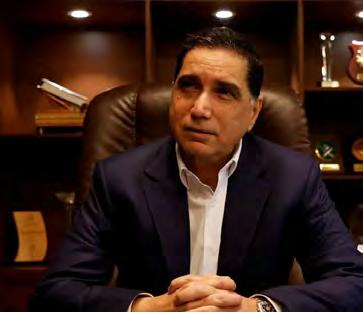
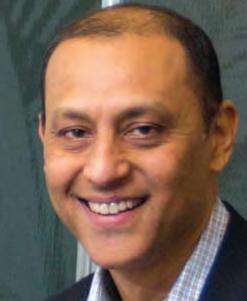
Shaheryar Chishty’s office in Lahore is on the fifth floor of the Hyundai Motors Building right off Kalma Chowk. It is two buildings down from the Kalma terminal of the Daewoo Bus Service. The bus service was Chishty’s first major foray in business, buying it from its South Korean sponsors in 2011.
In the 15 years since he has become one of the most influential and diversified business owners in the country. Daewoo has turned into the country’s premier city-to-city transport service. His private equity firm, AsiaPak Investments, has significant interests in Thar Coal, it owns the Bol Television Network, and in November 2025 partnered up with the Dubai based oil-broker Montage to buy Lotte Chemicals.
And since last week, AsiaPak Investments is also running the show at K-Electric with Chishty as the utility company’s Chairman. The journey to get there has been long and laced with turbulence. It took AsiaPak nearly four years to actually get management control of KE after acquiring the majority stake in the company. Now that Chishty finally has the keys to KE, it is a very different beast to the one he first bought.
A long-standing offer to buy the company by Shanghai Electric has fallen through. Pakistan’s solar revolution has emerged as a behemoth with great promise and great complications. The world itself has changed dramatically. And throughout it all KE has been asleep at the switch. So what will Shaheryar Chishty do now?
Profit sat down with K-Electric’s chairman for a one-on-one interview to understand what the future holds for K-Electric, for Karachi, and for Pakistan.
“I really didn’t think it would take this long”
When Profit first interviewed Chishty in August 2023, it had been close to a year since he bought the majority stake in K-Electric, and he was just getting started on acquiring control of the company he had just bought.
Last week, he told Profit’s correspondent that he knew it would take some time to get the reins in his hand, but he had not imagined a four year struggle. “Things are very different from when we first bought KE. The world is splintering. It feels like a superpower that has been the global reality all our lives is reaching a crescendo. The old uncertainties are slowly changing and new ones are taking their place,” he says. “But new uncertainties give rise to new opportunities.”
Behind Chishty’s desk, a large display
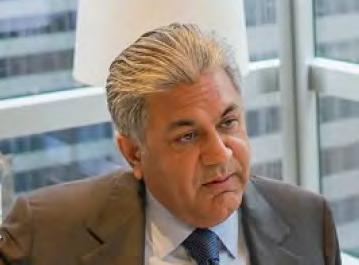
Arif Naqvi was once a posterboy for what Pakistanis could do. His company, Abraaj, managed to turn K-Electric around and secure a deal to sell it to Shanghai Electric, but the government kept delaying approvals. In 2019 Abraaj was caught up in a financial scandal and Naqvi went behind bars. Some argued that had the Abraaj transaction gone through in time, Naqvi could have made an attempt to cover his tracks in time.
wall is lined with pictures of him conversing with politicians, foreign investors, and military leaders along with books and various little artifacts. The story of how he acquired KE is seemingly simple but laced with various hiccups. To cut a very long story (which this publication has told before) short, K-Electric was privatised in 2005 when the government sold 66.4% to a Saudi-Kuwaiti consortium led by Al Jomaih Holding Company and National Industries Group. After the consortium struggled to turn the utility around, Abraaj entered in 2008-09, buying control of the Cayman-based holding company KES Power Limited, which owned the majority stake in KE. At this point Abraaj had around 35% of the stake in KE and Al Jomaih
maintained the remaining 30%. braaj turned the company around and secured a multi-billion dollar deal to sell it to Shanghai Electric, but the sale never went through because of persistent delays from the Pakistan government. Following Abraaj’s infamous collapse, AsiaPak Investments acquired that stake via Sage Ventures in 2022, becoming the ultimate beneficial owner of KE. Al Jomaih resisted, and court challenges blocked board changes and delayed transfer of management control until the cases were withdrawn, clearing the way for Chishty to assume the chairmanship in April 2026.
The process was naturally frustrating. In his demeanor, Chishty is easygoing, well-mannered, and does not mince his words or his feelings. He graduated from Ohio Wesleyan with a degree in economics and a minor in French. He speaks of Karachi’s potential with excitement. His father was a navy officer who retired as an admiral and as such the family spent a lot of time in Karachi. His display picture on Whatsapp is a black-and-white image of his father smartly dressed with the stripes of a Lieutenant Commander speaking with two young children in front of a ship. When Shanghai Electric pulled the plug on their offer to buy KE in September 2025, Chishty was very clear: “I have been frustrated by this entire process but Shanghai’s exit should give the senior leadership in the country a lot of pause and fruit for thought on how the country conducts itself.”
Chishty claims he was never interested in making KE a quick flip. He describes his business philosophy as breathing life back into what he calls “orphan assets.” The plan for KE was the same, and while it might have taken some time and frustration, he now finally has what he wanted.
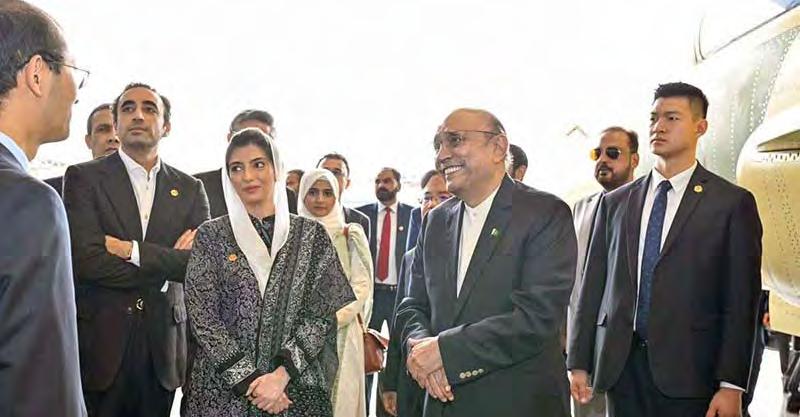
Six days after Shanghai Electric finally pulled the plug on the KE deal that had been stalled since 2016, President Zardari visited their headquarters during his state visit to China. He asked them to once again invest in Pakistan’s energy sector, assuring that any “outstanding issues” will be resolved amicably. Mr Chishty has a long history of working with Chinese investors and any potential future partnerships will be interesting to watch.
“We need to get our own house in order”
“There are some big plans we have for Karachi but the first thing is to sort out the mess at KE,” he says. “Karachi has anywhere between 25 to 30 million people, take your pick, and I have a serious sense of urgency about it.”
What he is referring to is the policy paralysis under which KE has been operating since Abraaj came crashing down. What Abraaj did at KE back in 2009 was nothing short of a miracle. The company pumped $391 million into the company. It then began a turnaround effort the likes of which have never been seen in Pakistan before. Abraaj spared no expense in trying to turn around KESC, investing upwards of $1 billion in the company’s power generation and transmission infrastructure, which brought the utility’s power generation efficiency rate from 30% in 2008 to 37% in 2016, and its transmission losses from 4% to 1.4% in the same period.
But when Arif Naqvi’s Abraaj was implicated in massive financial irregularities and he was arrested, all of their assets including KE were sent to liquidation. Since then, KE has been running with roughly the same strategy that Abraaj put in place almost a decade ago now. This has the effect of the company being able to run business as usual like a normal power company. But, of course, that is not enough for its current needs, which require the company to deal with significant strategic challenges and make important decisions.
“The first thing we need to do is fix our generation problems. We need to get generation costs low. Right now KE is 100% reliant on LNG. It is horrible from a price perspective, from an availability perspective, and also from a forex perspective. We simply do not have the dollars to be able to afford expensive imports to make electricity,” he says. “On top of that we are also reliant almost entirely on Qatar. There is no diversification and that means we are unusually susceptible to shocks.”
The solution, he argued, is looking closer to home. “Look let’s be frank: KE found itself with its pants down. We have seen recently that the entire country’s energy mix is pretty good thanks to solar, CPEC, coal, and nuclear energy. Karachi is entirely reliant on gas. I am not saying we shift away from gas entirely, but the first scramble is to find local pockets of gas. We have reached out to Mari, OGDC, and other upstream players to try to team up on unexplored fields.”
He has also long been a proponent of wind and solar energy. It is not really a difficult problem to crack either. Over the years, KE has become sluggish and inefficient. The number of people wanting electricity has increased. According to Chishty, the solution is to make K-Electric central to a modern, thriving metropolis. And that requires Karachi to change. One of his biggest claims is that the city itself is surrounded by ample area to utilize solar and wind power. The biggest problem with solar and wind is that it is very expensive to set up for the average household. So if a utilities company like K-Electric can harvest this energy it can provide significantly cheaper electricity to households.
“The focus on wind and solar needs to grow. I have rarely seen a city where, just 50 kilometres from the city centre, there is ample sun and ample wind. The beauty is that the wind comes at night and the sun comes during the day.”
Of course, wind and solar alone cannot immediately fix KE’s generation quagmire. And that is where Chishty’s passion project comes in. One of AsiaPak’s key investments is Thar Coal Block 1 (a CPEC “early harvest” project consisting of 7.8 mln tons per annum coal mine and 1,320 MW mine mouth IPP) and Liberty Power Limited (a 235 MW gas fired IPP). He believes that harnessing Thar Coal’s massive potential will be the immediate gamechanger. “There needs to be a massive focus on Thar coal to bring down generation costs dramatically. I want it far below the national average. That is the first task.”
“We can’t forget the good customers”
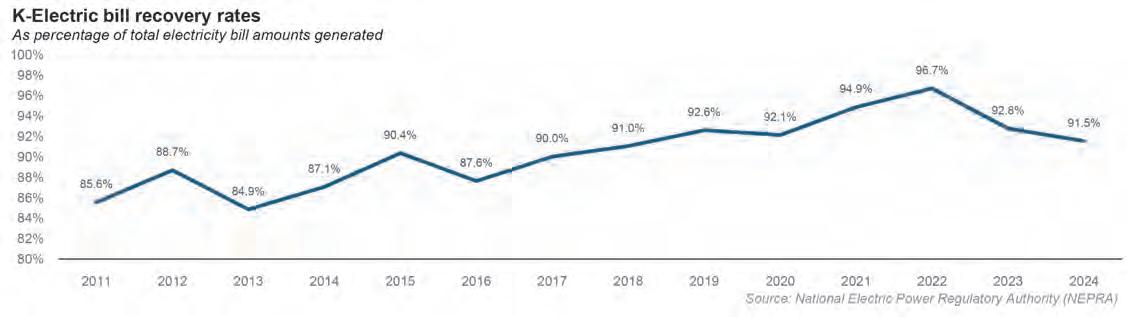
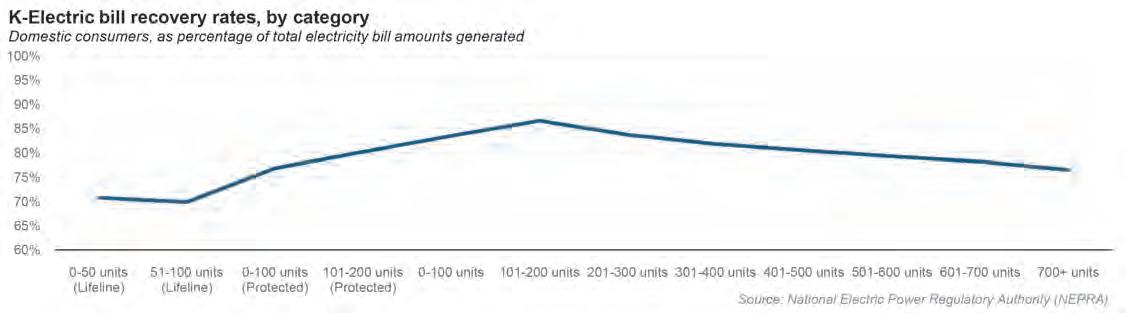
Power generation might be the core of KE’s business, but perhaps the biggest problem to tackle is distribution. In the fiscal year ending June 30, 2024, the latest full year for which data is available, K-Electric’s bill recovery rate – the total amount of bill payments collected as a percentage of the total amount of bills issued – was about 91.5% across all of its customers, according to data from the National Electric Power Regulatory Authority (NEPRA).
That number sounds impressive, and indeed represents a sharp increase in bill recovery rate relative to where the company was privatized in 2005, but is down from the 96.7% it had achieved just two years prior, in fiscal year 2022. And when one looks at the source of this decline, it is driven in a very large part due to a decrease in collections from household consumers, which has seen a relatively sharp deterioration in the past four years, going from 92.2% collection in 2020 to just 82% in 2024.
This is bad, to say the least, and so bad, in fact, that K-Electric has gone from having a bill recovery rate about 700 basis points above the state-owned electricity companies’ average (which basically means all other companies in the country since K-Electric is the only privately-owned electric utility) in 2021 to now being 1,000 basis points below the state-owned companies. It is a 10% drop in just three years.
“Going back to my banking days, I keep thinking of a common problem Pakistani banks would face back in the day. Banks would have bloated books with massive loans, and bank presidents would only have time to focus on the bad loans, and as a result the good customers would also end up getting ignored,” he explains. Before his entry into private equity, Chishty was an investment banker who worked extensively in South Korea and other regions for Citibank among other employers.
“Karachi is a bit of a mix of good and bad. Around 80% of Karachi is like Lahore, Faisalabad, Gujranwala, and other cities:
bill-paying, with an industrial base and very little losses. The remaining 20% is a tough place to be in. The good customers need better service and investment in transmission and distribution.”
The idea is to focus on the good areas first. According to Chishty KE actually has very good data, feeder by feeder. “Up to the curb, we have a good idea of where there is theft, where there are losses, and where there are line losses for technical reasons.”
The first step will be providing smart meters to areas that pay their bills. “There is no point putting a smart meter in a bad customer’s area. But smart meters will have an impact on good customers. It is like the topup model used for phones. With electricity, you get a sticker shock beyond your budget. We need to introduce prepaid meters, smart meters, and similar solutions. That will require focus on technology and also on service.”
He is essentially suggesting a pre-paid model for consumers that will allow them to better manage their electricity consumption and monitor it. For high-loss areas, he said the company would take a tougher approach, though enforcement would require govern-
ment support. And that is the part in the plan where there are serious chinks. Chishty will need the Government of Sindh to implement law and order in Karachi. That, given everything we know about the PPP and the state of Karachi, is a pretty slim hope to bank on.
Chishty claims they know where the losses are and have a pretty good set of data regarding this. One move that clearly indicates the urgency of the distribution challenge is KE’s new CEO. Syed Taha took over the CEO position the same day that Chishty was appointed Chairman of the Board.
Taha is an old KE hand. He began working at KE in 2008 when the company was first bought by Abraaj as their Director of Finance. In 2013 he was appointed the Chief Distribution Officer at KE, a role he stayed in until 2015. This was the peak time in which Abraaj was fixing KE’s distribution mess. Under his leadership, the company’s revenues and profits grew exponentially, while losses declined to 22.9%, marking an 18-year record low. He managed around 8,000 employees out of the company’s total workforce of 11,000, overseeing 29 Integrated Business Centres (IBCs) as well as operation and maintenance centres across the entire distribution network. This network spanned more than 6,500 square kilometres and served the needs of 2.4 million customers.
He is clearly someone that has done this before, and knows Karachi well. Fresh off a six year stint as Managing Director of PSO, Taha’s job as CEO will be to run the whole thing, but it is clear why he was picked: he is from Karachi, he knows the city, he knows KE, he knows the distribution network, and this is not his first rodeo.
“CTY is how we go towards industrialisation”
Generation and distribution are the two core functions of any vertically integrated utilities company. You need to figure out how to make
the cheapest (and ideally cleanest) electricity possible, and how to get it paying customers in a fast and efficient manner. In the case of K-Electric both core components have been diseased, but not necessarily gangrenated.
The plan on both these fronts is clear enough. To offer a quick recap, KE’s new management wants to shift away from LNG by exploring the potential of natural gas, figuring out how to set up plants that can run on Thar Coal, and harnessing both solar and wind energy on the outskirts of Karachi. On the distribution front, they want to install smart meters, improve service delivery (Chishty says he is not interested in facing the special reserve of wroth that Karachi’s residents keep for KE), and root out bad customers.
At the same time he claims K-Electric cannot simply do these two things and survive. He does not want KE to simply produce and supply electricity to Karachi and earn some money. He wants the company to be the engine at the core of the Karachi economic machine. Internally over at KE, this has been branded their “Coal to Yuan” or “CTY” plan.
“We have massive coal reserves, but we do not have foreign currency. If we had the foreign exchange, we would have the resources to tackle many of our other problems. Karachi can play a huge role in this if it has the right facilities. Our biggest constraint is foreign exchange for basic trade. Why can’t we expand our industrial capacity, for example? Whether we like it or not, everything comes back to energy. Muscle is not going to make anything. Electricity will,” says Chishty.
The idea is to unleash cheap energy from Thar Coal and make it a reliable and consistent source for industrialists that want to set up shop in the port city. “Until Reqo Dik develops, coal is our biggest asset. You cannot export it because it is low value-added and bulky. If you make electricity with it, it is a low-ROI business. We want to take the coal, make it into electricity, and provide it to exporters so they can make something with it. If you make something Pakistan is exporting, you are earning dollars.”
Syed Taha is the new CEO of K-Electric. He has been associated with KE in the past and was their head of distribution during the Abraaj era when KE’s losses decreased dramatically.
“What are the three problems industrialists always speak of when you ask them why they don’t grow? The first is credit. I don’t agree with them on that. Why should a poor saver depositing money in a bank subsidise industries with cheap credit? Cost of capital is an expense that businesses need to get on board with. The second is inconsistent policies. We cannot do anything about that either. The third factor is energy. Consistent and cheap energy. And that is something KE is in a position to do something about.”
“Right now, KE’s own house is not in order. But once you have cheap generation and a reliable grid, you can supply industry at reliable and cheap rates. That is when you unleash the true power of Karachi. Industry should be at the port. Produce something to earn or save dollars and yuan. We have 250 million people, massive power capacity, and motorways that are grossly underutilised. All we need to do is take the coal we have, and turn it into something that will eventually earn us Yuans and Dollars.”
“Solar is a reality and so is e-mobility”
Perhaps the biggest way in which Chishty’s gameplane needs to change is in how KE will approach Pakistan’s solar revolution. In October 2022 it was just kicking off. Today rooftop solar has saved Pakistan from the worst of global energy shocks and has become the focus of the international media. In the past four years, KE has failed to recognise the solar boom and adapt with the times.
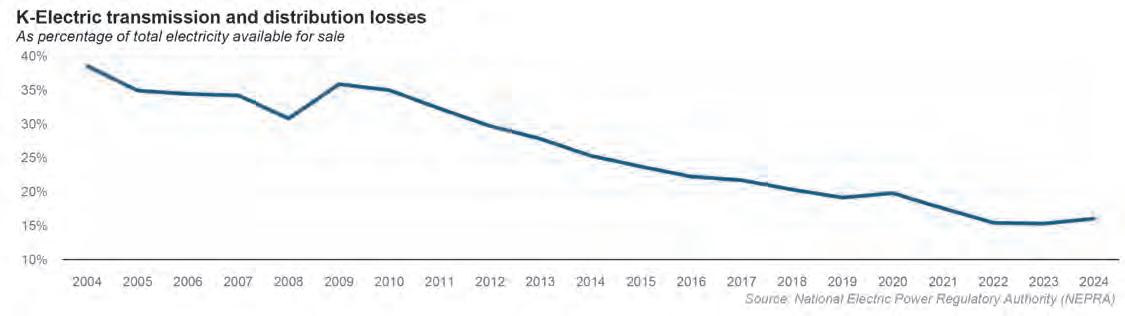
Just take a look at their line losses. We mentioned earlier that K-Electric has gone from having a bill recovery rate about 700 basis points above the state-owned electricity companies’ average (which basically means all other companies in the country since K-Electric is the only privately-owned electric utility) in 2021 to now being 1,000 basis points below the state-owned companies. It is a 10% drop in
just three years.
But K-Electric’s losses are not increasing because more customers are stealing or refusing to pay their bills; they are increasing because its best-paying customers are leaving the grid and so the company is left with a greater proportion of its bad customers.
Where are the good customers going?
Rooftop solar electricity, of course.
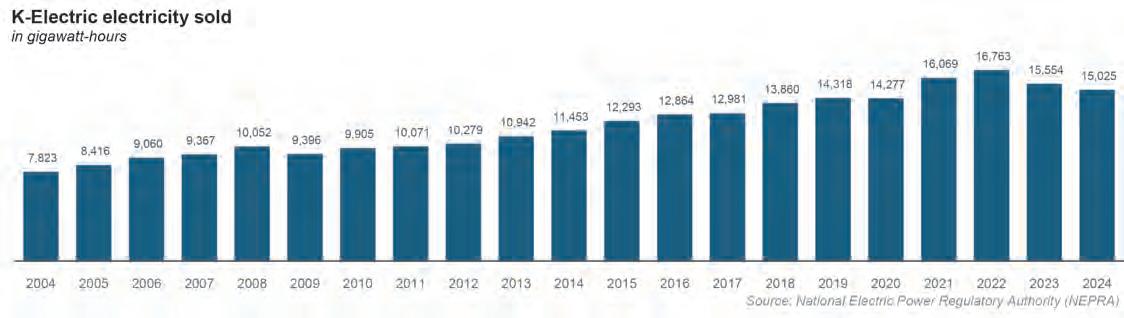
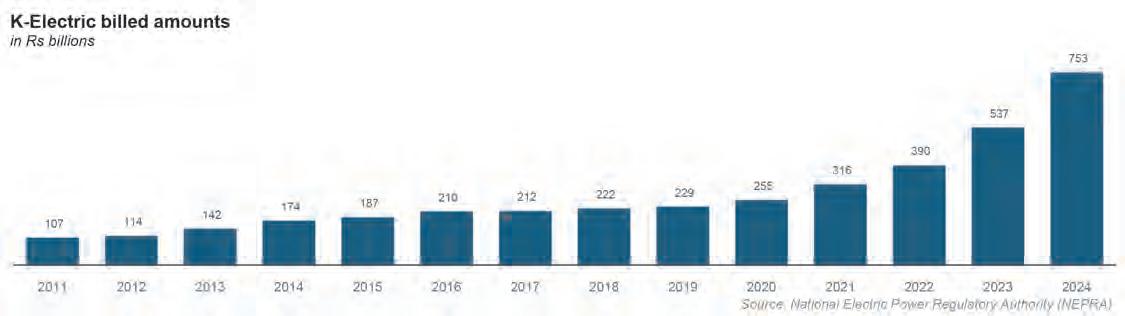
K-Electric in 2025 is a company that is approximately 11% smaller in terms of electricity sold than its peak just three years ago in 2022. The company sold 15,025 gigawatt-hours (GWh) in 2024, compared to 16,763 GWh in 2022, according to NEPRA data.
Karachi’s economy has been hit by the economic downturn of the past few years, but not so badly that it has shrunk by 11%. This reduction in electricity consumption is not just because people are using less electricity (though there is certainly some of that), it is also because they are buying less of it from the grid and producing more of it themselves through solar panels. This is in line with the change in the rest of the country. Total electricity generation for the rest of the grid has fallen by 10.8% between 2022 and 2024, according to NEPRA data.
For Shaheryar Chishty, the solution is in infrastructure. His plan is to make KE part of the ecosystem rather than a competitor. Yes, KE has plans for its own solar plants to add to the generation mix, but they also want to be involved in some capacity or the other when it comes to rooftop solar. “Solar is a reality. You cannot fight it with regulations and administrative red tape. Either you cannibalise yourself or you get cannibalised. In the last six weeks, we saw that solar actually saved Pakistan,” he says.
He said KE could target apartment buildings and poorer high-loss areas through financing, grants or government-backed models. “For starters, KE needs to target apartments and perhaps provide financing to those who cannot afford it. There are also a lot of high-loss poor areas where people cannot
pay their bills. You cannot just switch them off or load-shed them. There is a case to be made for providing them with solar through grants, government support, and similar models.”
“Next comes batteries. Let’s say an upper middle-class street has 20 homes with solar. Consumption is not that high during the day. Perhaps people cannot afford batteries themselves. That is where KE can come in with a street-level battery. We want to be involved in installation, financing, and grid coordination.”
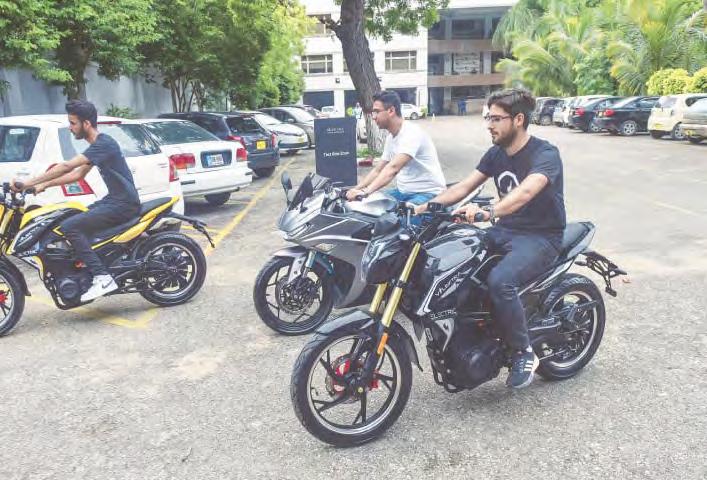
This is all part of the larger plan to turn KE into an engine for Karachi rather than just a utilities company. Perhaps one of the most interesting ambitions Chishty has for KE is e-mobility. “I am not a big fan of electric cars but I am a big fan of electric bikes. I think every bike in Pakistan should be an electric bike because if we can have them powered by indigenous electricity we can survive any storm and any crisis.” There is no concrete plan yet for what he wants to do when it comes to e-mobility but there are plenty of ideas.
“When the Klondike gold rush came in California, very few gold miners made money. It was the people providing equipment, hotels, and other services who did. I am not smart enough to know what the solution is, but I recognise how big the problem is. Each bike consumes petrol. There is no public transport alternative. If we can bring petrol use down, that is something that will be crazy. It goes back to my CTY philosophy. If we can get electricity to battery charging stations and promote e-mobility, then that is a job well done.”
Another idea that seemed interesting was the potential of KE getting into e-bike financing. He argues that banks are unlikely to finance electric bikes because small-ticket lending is difficult for them to service, unlike larger car loans that are easier to process and recover. In his view, informal financing often traps lower-income borrowers, which creates room for KE to use its customer data to identify reliable bill-paying consumers who may be eligible for electric bike financing.
Electric bikes have gained popularity in Pakistan as petrol prices have surged and solar adoption has increased. While the nascent industry is currently a sea of ideas, no clear model has come forward as to how battery charging and swapping can work. As the industry develops, the new KE management feels they have a role to play.
The idea would be to use KE’s base of 4 million customers to run a smart credit algorithm and identify households that can afford such payments. For example, if a household
employs domestic staff, KE could help finance electric bikes for those workers and add the monthly instalment to the household’s electricity bill. Chishty believes this model makes
sense because utility bills already provide a regular collection channel.
Now that the management confusion has finally ended and a new time brimming with ideas has taken charge, there is, at last, a reason for cautious hope at K-Electric. For years, the company seemed less like a utility than a disputed inheritance, passed through holding companies, courtrooms and suspended transactions, while Karachi kept paying for the uncertainty in poor service, weak investment and worsening confidence. Chishty’s elevation to chairman does not solve KE’s problems, but it does end the most corrosive one: the absence of a clear hand on the wheel. The board paralysis has lifted, the management question has been settled, and the new owners can no longer argue that they are waiting for control before being judged.
What follows will decide whether this is a genuine reset or only another chapter in KE’s long cycle of promise and fatigue. Chishty’s prescription is ambitious: cheaper generation, less LNG dependence, indigenous gas, Thar coal, wind, solar, smart meters, batteries, electric mobility and a tougher line on theft. It is a plan that sounds less like routine utility management and more like an attempt to rewire Karachi’s economic engine. The hope, then, is not that KE has suddenly become easy to fix. It is that, after years of drift, there is finally someone visibly accountable for trying. n
At Bank AL Habib, falling rates bite even as deposits rise
The bank’s revenue and earnings declined substantially, driven by a declining interest rate environment even as deposits grew at a healthy pace.
For Bank AL Habib, 2025 was the year in which the blessing of high interest rates turned into a test of resilience. The bank did not suffer from a loss of franchise. It did not see deposits flee, nor did its network shrink, nor did it lose its reputation as one of Pakistan’s better-run mid-to-large private banks. Quite the opposite: deposits rose, the branch network expanded, and the bank continued to lean into trade finance, Islamic banking and digital services. Yet the income statement told a harsher story. Profit after tax fell to Rs30.6 billion in 2025 from Rs39.9 billion a year earlier, while profit before tax declined to Rs65.5 billion from Rs83.8 billion. Earnings per share fell to Rs27.57 from Rs35.87.
That is the paradox at the heart of Bank AL Habib’s latest performance. The bank got bigger in the ordinary sense: customer deposits increased to Rs2.60 trillion from Rs2.28 trillion, a rise of roughly 14%. But it became less profitable because the interest-rate cycle turned against the earnings model that had served Pakistani banks so well during the previous two years. Management was unusually direct about the cause, saying profit declined mainly because of the “significant decrease” in interest rates over the previous two years and slow growth in the bank’s current deposits.
The arithmetic is plain enough. Mark-up earned fell sharply to Rs337.1 billion in 2025 from Rs478.0 billion in 2024. Mark-up expense also fell, to Rs206.5 billion from Rs321.8 billion, but not enough to protect the spread. Net mark-up income declined to Rs130.6 billion from Rs156.2 billion, a drop of about 16%. Total income fell to Rs159.1 billion from Rs181.7 billion. For a bank whose core earnings power rests heavily on its ability to capture spreads between asset yields and deposit costs, that was the decisive blow.
Pakistan’s monetary cycle explains much of the pain. After peaking at 22%, the State Bank of Pakistan’s policy rate was cut repeatedly from June 2024 onward, with Reuters reporting that the central bank had reduced the rate by a cumulative 1,150 basis points to 10.5% by December 2025. The SBP then held the policy rate at 10.5% in March 2026, citing an uncertain macroeconomic outlook.
For borrowers, lower rates are relief. For banks, they are more complicated. Deposit costs tend to adjust, but not always at the same speed or in the same proportion as asset yields. Holdings of government securities reprice. Loan yields fall. Competition for deposits remains intense, particularly for current accounts, the cheapest form of funding. Bank AL Habib’s management was effectively saying that the bank had managed to grow deposits, but not quite in the composition it would have liked. In banking, not all deposits are created equal; a rupee in a current account is worth more than a rupee in a high-cost term deposit.
The bank’s annual results show how this played out. Advances fell to Rs792.1 billion from Rs910.9 billion, while foreign trade business handled by the bank stood at Rs3.5 trillion. That combination suggests an institution still active in its traditional strengths, particularly trade, but cautious on balance-sheet deployment.
The first quarter of 2026 suggests the same pressure has not disappeared. According to AKD Securities, Bank AL Habib posted profit after tax of Rs7.1 billion for 1QCY26, equal to earnings per share of Rs6.38, down 31% year on year but up 35% quarter on quarter. The bank also announced an interim cash dividend of Rs3.50 per share. AKD said the result was above its expectations because net interest income was better than expected, even though
it still declined 3% year on year.
The quarterly numbers again reveal the mechanics of the rate cycle. Mark-up earned fell 11% year on year to Rs82.5 billion, while mark-up expense fell 16% to Rs50.0 billion. Net interest income came in at Rs32.6 billion, compared with Rs33.6 billion in the same period last year. The estimated net interest margin stood at 4.5%, compared with 4.6% a year earlier and 4.4% in the fourth quarter of 2025. In other words, the first quarter showed some sequential stabilisation, but not yet a convincing return to earnings growth.
There was, however, a silver lining: the decline was not as bad as it might have been. AKD noted that the earnings beat came from better-than-expected net interest income. On a sequential basis, net interest income rose 4%, supported by an 8% quarter-on-quarter increase in mark-up earned. That increase was driven by a 5% rise in average investments, funded by an 8% rise in deposits. Deposits reached Rs2.8 trillion by March 2026, up 17% year on year and 8% quarter on quarter, while investments rose 13% year on year and 10% quarter on quarter to Rs2.3 trillion. That deposit momentum is important. A bank that grows deposits in a falling-rate environment is not necessarily in trouble; it is merely being forced to work harder. The challenge is to convert deposit growth into profitable, low-cost funding. AKD’s investment
thesis on Bank AL Habib rests partly on the expansion of its low-cost deposit base, along with asset quality and the bank’s strong position in trade business.
Non-interest income offered some support, but not enough to offset the pressure on spreads. For 2025 as a whole, non-mark-up income rose to Rs28.4 billion from Rs25.5 billion. Fee and commission income was broadly flat, declining slightly to Rs19.1 billion from Rs19.4 billion. Dividend income rose to Rs996 million from Rs868 million. The standout was foreign-exchange income, which nearly doubled to Rs7.4 billion from Rs3.9 billion. But securities income moved the other way, with the bank recording a net loss on securities of Rs87.5 million compared with a gain of Rs142 million a year earlier.
The first quarter of 2026 was more mixed. AKD said non-interest income came in at Rs7.4 billion, down 4% year on year mainly because of lower fee income. Sequentially, however, it improved 18% owing to higher foreign-exchange income and lower capital losses. This is exactly the kind of income mix banks want in a lower-rate environment: more fees, more trade-related flows, more foreign exchange income, and less dependence on the blunt instrument of balance-sheet spreads. But for now, the improvement has not been large enough to fully compensate for the compression in core banking income.
Costs have added another constraint. Bank AL Habib’s operating expenses rose to Rs94.5 billion in 2025 from Rs81.0 billion in 2024, while total non-mark-up expenses rose to Rs95.9 billion from Rs83.0 billion. In the first quarter of 2026, non-mark-up expenses were Rs24.0 billion, up 10% year on year, leaving the cost-to-income ratio at 60%, compared with 53% in the same period last year.
The credit line, by contrast, helped soften the annual decline. The bank recorded a net credit loss allowance and write-off reversal of Rs2.4 billion in 2025, compared with a charge of Rs14.9 billion in 2024. Without that swing, the earnings decline would have looked worse. In the first quarter of 2026, however, the trend reversed again: AKD said the bank booked provisions of Rs982 million, compared with a reversal of Rs1.2 billion in the same period last year.
The bank’s dividend policy remains generous, though lower earnings inevitably narrowed room for manoeuvre. The board proposed a final cash dividend of Rs4.50 per share, taking total dividends for 2025 to Rs15.00 per share, compared with EPS of Rs27.57. For shareholders, that payout helps cushion the fall in earnings. For management, it also signals confidence that the bank’s capital and liquidity remain adequate despite pressure on profitability.
The more strategic story lies in distribution. Bank AL Habib opened 102 new branches
during 2025, bringing its network to 1,326 outlets, comprising 1,323 branches, including 392 Islamic banking branches and two overseas branches, one each in Bahrain and Malaysia, along with representative offices in Dubai, Istanbul and Beijing. The annual report’s branch-network annex similarly states that the bank had 1,323 branches, including two overseas branches and 392 Islamic banking branches, plus three representative offices and 12 booths.
That branch expansion is not merely vanity. In Pakistan, the physical network still matters, especially for deposits, trade services, small businesses, remittances and Islamic banking. The question is whether the new branches can gather sufficiently low-cost deposits to protect margins in a lower-rate world. If they mostly attract expensive deposits, growth can become dilutive. If they attract current accounts, salary relationships and sticky business balances, the network becomes a defensive weapon.
Islamic banking is central to that effort. Pakistan’s Islamic banking industry has been gaining share rapidly: by December 2025, Islamic banking deposits had reached Rs11.0 trillion, while Islamic banking assets stood at Rs14.5 trillion, according to the State Bank’s Islamic Banking Bulletin. Islamic banking’s share of total banking deposits was 27.8%, and its share of total banking assets was 22.9%.
For Bank AL Habib, the 392 Islamic branches are therefore not a side business. They are part of the main contest for deposits. Islamic accounts are also increasingly important in a country where policy, regulation and consumer preference are all nudging the industry towards Shariah-compliant banking. The bank’s governance structure reflects that shift: its board-level committees include an Islamic Banking Conversion Committee, and the annual report describes Shariah Board oversight of the Islamic Banking Division’s products, procedures and compliance framework.
Management has also been investing around the edges of the core franchise. The bank’s IT Committee is tasked with reviewing and recommending IT and digital strategies and providing strategic direction for digital banking, including emerging technologies and new products with an enhanced customer experience. On the product side, Bank AL Habib has been promoting AL Habib At Work, a salary-account proposition aimed at employers and employees that offers bulk account opening, on-site debit card delivery, digitised salary payments and related account benefits.
The bank has also introduced a Freelancer FCY Debit Card for freelancers and IT/ITES exporters, designed to allow international transactions using funds held in USD Exporters’ Special Foreign Currency Accounts. That may sound like a small product, but it fits the
direction of the market. Banks increasingly want to capture foreign-exchange flows from exporters, remitters, freelancers and digital workers. Those flows can generate deposits, foreign-exchange income and customer relationships that are not wholly dependent on the domestic interest-rate cycle.
There is an ESG angle as well. Bank AL Habib said 131 branches had been solarised by 2025, with combined installed capacity exceeding 1.85MW, a 139% year-on-year increase, and that 131 ATMs were operating on solar power. Further solarisation and energy-efficiency investments are planned for 2026. In a country where electricity tariffs are volatile and branch networks are large, solarisation is not merely about green branding. It is also a cost-control exercise.
To understand why Bank AL Habib has room to absorb a difficult year, one has to understand its lineage. The bank’s sponsor, the Dawood Habib Group, traces its banking history to the 1920s and was among the founder members of Habib Bank Limited. The group’s banking interests were nationalised along with other banks in Pakistan on January 1, 1974. Under the subsequent privatisation policy, the group was granted permission to set up a commercial bank. Bank AL Habib was incorporated as a public limited company in October 1991 and began banking operations in 1992.
The symbolism matters. The Habib name is woven into Pakistan’s banking history, from pre-partition merchant banking to the financing of the new state after 1947. Bank AL Habib began with shareholders’ funds of Rs300 million and six branches, with the late Rashid D. Habib as managing director and chief executive. Today, the institution has more than 1,300 branches, Rs3.30 trillion in assets, and one of the more recognisable private-sector banking brands in the country.
The result is a bank that looks conservative, relationship-driven and deeply embedded in Pakistan’s trading economy. That is usually a strength. But in 2025, even those strengths could not fully offset the effect of falling rates. Bank AL Habib’s deposits grew. Its branch network expanded. Its foreign-exchange income improved. Islamic banking and digital products continued to develop. Yet the core spread business shrank, and earnings fell sharply.
That does not make the bank weak. It makes it exposed to the same reality facing much of Pakistan’s banking sector: the extraordinary profits of the high-rate years were never likely to last forever. The next phase will reward banks that can gather low-cost deposits, grow fee and trade income, manage costs, and deploy assets without chasing risk. For Bank AL Habib, 2025 was not a crisis. It was a reminder that when rates fall, even a good deposit franchise has to work much harder for every rupee of profit. n
Saad
The Business of Water
How government failure created a market for a basic human necessity
In theory, my house has a ready water supply. Like most homes in Defence Housing Authority (DHA) Karachi, it has a municipal water connection. Pipes run into the house, and the system is meant to be managed by the Cantonment Board Clifton (CBC). On paper, the system works. In reality, the pipeline rarely carries water.
When residents complain, the response is often slow or inconsistent. Occasionally the authorities may send a small tanker, perhaps once or twice a month at an additional fee of course! But that is nowhere near enough to meet the needs of my household. The result is predictable.
Like many others in the city, we end up buying private water tankers to fill the underground tank. Water that should arrive through public infrastructure becomes something we must purchase in the market.
This domestic inconvenience reflects a much larger structural issue. Karachi’s population has expanded dramatically over the past several decades while water infrastructure has struggled to keep pace. The city faces a persistent water shortfall, forcing residents and businesses to rely on alternative sources.
In other words, when the public system stops delivering water, the market begins to sell it.
The writer is a strategy consultant who has previously worked at various C-level positions for national and multinational corporations
What appears at first to be a simple household problem is actually part of a much larger phenomenon, the emergence of a private water economy operating alongside the state’s own system.
When governments step back, markets move in
For most of modern history, providing clean drinking water was considered one of the most basic responsibilities of government.Cities invested heavily in reservoirs, pipelines, treatment plants, and distribution networks because safe water was essential for public health, economic activity, and urban life itself.
In economic terms, water was considered a public good, something too fundamental to be left entirely to markets. But maintaining these systems requires constant investment and effective governance. In many countries, rapid urbanisation, population growth, and aging infrastructure have placed enormous pressure on municipal water networks.
Once public supply becomes unreliable, a predictable pattern emerges. Private markets begin to fill the gap. And that is where Karachi’s parallel water economy comes in.
Karachi provides a particularly clear example of this transformation. The city’s water demand far exceeds the official supply. As a result, large parts of the population rely on tanker deliveries to supplement or replace municipal water. The tanker economy has therefore become an essential part of daily life. But tankers represent only one layer of the emerging water market.
Another is the rapidly expanding bottled water and filtration industry where multinational companies operate through premium brands, while local brands compete across retail markets. Alongside these formal companies, hundreds of neighborhood filtration plants supply drinking water to nearby residents.
Together, tanker suppliers, filtration plants, and bottled water companies form what can only be described as a parallel water distribution system. What should be a public utility increasingly behaves like a market.
The global bottled water boom
This dynamic is not unique to Karachi or Pakistan. Across the developing world, declining trust in municipal water systems has helped fuel the explosive growth of the bottled water industry. Global corporations such as Nestlé, PepsiCo, and The Coca-Cola Company dominate this market.
The economics of this business are striking. The water itself costs almost nothing. Most of the expense lies in packaging, logistics, and distribution. In effect, companies are selling certainty and convenience rather than water itself. The global bottled water market is estimated at over $300 billion annually, according to industry estimates, just one part of a much larger and less visible private water economy.
That is the paradox of the modern water economy. From a business perspective, water represents a remarkable commercial opportunity. From a societal perspective, however, it reveals something more troubling. The rapid growth of private water markets often reflects
not the success of markets, but the failure of public systems.
And this is not unique to water. Similar to many other countries, we have already moved down the same path with other essential services, such as electricity. Yet despite private participation, the fundamental challenges of reliability, affordability, and access often persist.
As evident, the presence of private players does not automatically resolve structural weaknesses in the system. Because once markets begin supplying a service, the urgency to fix the underlying public infrastructure can diminish.
Consumers adapt. They find work-
arounds. They pay for alternatives.
And over time, what began as a temporary gap becomes a permanent parallel system. That is the risk with water. If tanker deliveries, filtration plants, and bottled water continue to expand without corresponding improvements in public supply, the system does not get fixed, it simply gets bypassed.
This raises a more fundamental question. As societies, are we trying to solve the problem of public service delivery, or are we simply learning to live around it? Because if we are really trying to solve the problem of public service delivery, then the growth of the private water business cannot be a sign of progress. n
COMMENT
Diet
Coke has disappeared in India. Could the same happen in Pakistan?
The global prices of aluminium coil have increased sharply following the US-Iran war. Pakistan’s local beverages industry has some key advantages over India.
ByAbdullah Niazi
Diet Coke has disappeared in India. Quick commerce apps show it as unavailable, supermarkets say supply has been strangled since mid-April, and Coca Cola suppliers in India said the company had notified them it was rationing supplies or not fulfilling some orders due to a can shortage caused by the US-Iran war.
What has happened in India is a combination of factors. For starters, Diet Coke has been unusually impacted because it is only sold in cans in India. On top of this, delayed shipments from the Gulf caused by the Iran war, a 20% increase in global aluminium prices, and increasing demand for Diet Coke in India have all led to the product disappearing from shelves.
But could the same happen in Pakistan? Just right off the bat Pakistan will not face a Diet Coke shortage primarily because the drink is sold both in cans and in plastic bottles here. Not only is it sold in half litre and 330ml plastic packaging, Coke Pakistan has also introduced it in its 1.5 litre plastic packaging. So even if an aluminium shortage hits Pakistan, Diet Coke and all other canned beverages will remain safe.
That does not mean similar concerns do not exist in Pakistan. For aficionados that prefer the “canned taste” of Coke Zero and Pepsi Black, caterers that find it easier to provide cans at events over glass bottles, and for any patrons of Murree Brewery and other beverages that are simply better in a can even the thought of such a shortage might cause laments similar to the ones seen
in India by the legions of Diet Coke fans.
The good news is there is nothing to worry about. Since 2017 aluminium cans for drinks have been sold by Pakistan Aluminium Beverage Can Limited. PABC has a production capacity of 1.2 billion cans a year. Since going public in 2021, PABC has ramped up production and targeted export markets like Afghanistan and Central Asia. They import aluminium coils majorly from South Korea and China. While PABC has also been hit by the same global factors as India, its focus on exports means they have excess supply if anything, especially considering their exports have been impacted by the closure of the Pakistan-Afghanistan border.
The crisis in Pakistan is different. It has more to do with rising costs, shrinking gross margins for PABC, and excess capacity at a time when we should be ramping up exports.
The situation in India
According to a recent report by Reuters, Diet Coke has run short because of delayed shipments from the Gulf caused by the Iran war. The Gulf accounts for around 9% of global aluminium production, which has been trapped since the end of February by Iran’s de facto blockade of the Strait of Hormuz.
For Coca Cola, India is an increasingly important market and Diet Coke an increasingly significant product. Coca Cola reported sales of INR 50 billion Sugar-free products are a growth category: India’s reduced-sugar food and beverage market will be worth $4.7 billion by 2030, more
than double its size from 2023, Grand View Research says. Since cans for Diet Coke are imported, the Diet Coke shortage was due to some consignments of imported cans being delayed. The shortfall cannot be met locally since production of cans and bottles in India has also become more expensive because of an energy shortage.
“There is some production happening, but it’s being rationed as the company can’t meet all the demand,” said one executive quoted anonymously by Reuters. According to another Indian news organisation, Open, Diet Coke sales in India actually doubled last year, as low-sugar beverages surged to represent 30% of Coca-Cola India’s total volumes in 2025 — up from just 5% in 2020.
Why Pakistan is different
Pakistan will not face the same issue. Not only is Coke Zero (that is the branding it is sold under here in red cans with black lettering rather than the silver “diet” cans sold in India) sold in bottles in Pakistan, it is also not a significant product in Pakistan. Overall “sugar-free” and “diet” carbonated beverages make up only 2.7% of Pakistan’s total market according to a Euromonitor report from December 2025. Diet Coke is only 1.3% of the overall market.
Then, of course, there is PABC. The company has not only successfully provided cans to both Coke Pakistan and PepsiCo, it has also gained a list of clients that includes companies like Murree Brewery. Their sales have gone up consistently, from around Rs 7 billion when they first went public in 2021 to close to Rs 24 billion in their results for 2025. Some of this has to do with inflation, considering the global increase in prices of aluminium. Over the years, a big part of PABC’s success has been their ability to export their products to Afghanistan and Central Asia. Exports have continued to make up a larger share of their sales.
In 2020, they had close to Rs 4 billion in local sales and Rs 2 billion in export sales. In 2024, local sales were worth Rs 10 billion while exports came in at Rs 14.5 billion. Breaking down exports to regions, out of the total exports, Rs 12 billion were made in Afghanistan alone. This makes up around 83% of total exports. Rs 12 billion of export means that
every month the company is selling Rs 1 billion worth to Afghanistan alone.
However, the past couple of years have proved challenging for PABC because of external circumstances. The company has largely been importing aluminum coils, the main component used to make cans, from a South Korean company called Novelis. However, there are indications that in the last few years they have relied more on China. In their annual reports for both 2024 and 2025, they said that “rising raw material costs remained a concern, particularly due to China’s removal of processing rebates on aluminium coil exports, which led to an increase in global aluminium prices during the year.” This could either indicate that they are buying more from China, or that China’s significant presence on the international market is making prices higher even from their vendors.
Couples with this PABC have faced border closures that impact their booming export business. At the nine-month mark ending September 2024, their export sales had been Rs 10.63 billion. At the nine-month period ending September 2025, these were Rs 13.01 billion — marking a year on year increase of nearly Rs 3 billion for the same time period.
However, at the end of the year 2025,
PABC’s overall export sales stood at Rs 14.01 billion compared to Rs 14.45 billion in December 2024. Overall exports in the last quarter were only Rs 1 billion, down from the average of around Rs 1.44 billion per quarter. This was mostly because of the conflict between Pakistan and the Afghan Taliban which started in October 2025. The border has remained closed since.
PABC has made it clear that they are being impacted both by the border closure and international price exposure. The company’s CEO, Zain Ashraf Mukty, wrote in his message in the annual report that “the closure of the Afghan border in October 2025 significantly impacted export
volumes, given the Company’s exposure to Afghanistan and Central Asian markets.”
The director’s report also pointed out that “The ongoing war involving Iran and other regional parties has heightened volatility in global energy and commodities markets including aluminium.”
As things stand, PABC has more free capacity than they would like. They are a significant exporter and access to their markets has been disrupted because of security concerns. As of now, the government has made it easier to export to Central Asia through Iranian land routes. However, that still leaves the Afghanistan market open. For canned drinks lovers in Pakistan that is good news. But for PABC, it is a headache that persists.
While the challenges persist, PABC has managed to keep up their sales volumes. with net sales reaching Rs. 23.99 billion. As the CEO’s message in their annual results clarified, “domestic volumes improved during the year, reflecting gradual recovery in local demand. Margins were impacted due to higher input costs and the recognition of impairment on slow-moving inventory linked to export market disruptions, reflecting a prudent and realistic approach.”
Profit reached out to two senior executives at PABC for comment. One declined to comment and the other did not respond. n
The SECP is looking to bring swing pricing to the mutual fund industry.
It could have ripple effects for the stock market
The mechanism looks to impose a penalty on redemptions rather than spreading the cost over all the unitholders. Implementation will be the key challenge
By Zain Naeem
Mutual funds investing in the capital markets of a country are beneficial for everyone. Mutual funds are a very important conduit as they are able to pool together the funds of smaller investors together. Once they are able to gather all these funds, the funds are able to invest in asset classes that the individual investors cannot do on their own. For this service, they charge a management fee based on the assets held under their management.
Due to the size of investments that the funds are able to make, they also have the ability to move markets and take them into a direction that their investment mandate dictates them to do so. In a developing capital market like Pakistan, this sway over the markets becomes more pronounced. With each investment being made or being withdrawn, there is a likelihood that the market would not be able to absorb the shock of a large position being bought or being dumped.
This is not to say that the funds are look-
ing to make a huge splash by themselves. The goal of the fund is to be able to get in and out of their position with the least amount of market impact possible. However, the ripple effects of any move they make is expected to reach much wider and deeper than they would want.
When things are moving under their normal circumstances, the funds are given to the asset management company over a long period of time and these funds are raised before any investment is carried out. Once most of these funds are locked in, the fund manager would start to deploy these funds into investments in the manner set out by the investment mandate and as discussed in the fund manager meetings. This allows for the impact of any such investment to be minimized as it is spread out.
The impact becomes magnified in the case of volatile markets which lead to investors panicking and looking to redeem their investment back. The recent conflict in Iran gives the perfect example of this. When the market crashes by almost 10% in a day, many investors feel that they need to take out their investment before it loses more value the next day. In such a situation, a run is triggered where massive redemptions start to take place.
The situation is made worse when the fund manager starts to foresee a run taking place and starts to dump investment in the market in order to procure the funds which would be required for a redemption. This leads to a downward spiral where the selling leads to more stocks falling and triggering more funds to dump their positions as well. Slowly, the market crash spreads to all the shares and the volatility starts to go haywire.
While the whole market is seeing the index plummet, the investor who has asked for a redemption is also forcing the fund management to bear the cost of all the trading costs that are being incurred. Just like the damage being caused to the index is significant, similarly these costs can start to rack up as well as unusually high volume of trading is being carried out. The other unitholders in the mutual fund are bearing the brunt of these costs as the fund has no other option but to charge these costs to all the unitholders evenly. It penalizes the investors who are in it in the long run by making them pay for costs someone else is generating.
Due to the unfairness of such a model, the Securities and Exchange Commission of Pakistan (SECP) is now looking to put into place
At present, some investors use mutual funds, particularly equity funds, as a trading instrument. This behavior creates impact costs and commission expenses, which are effectively shared by all unit holders. The SECP is seeking to discourage this through the introduction of a swing pricing mechanism, under which these costs would be borne by the redeeming investors instead. If implemented, this could reduce such trading-oriented behavior
swing pricing in the mutual fund industry. How will this work, where else is it being practised and what are the pros and cons of it being put into place?
What is swing pricing?
Swing pricing is a risk management mechanism in mutual funds which adjusts a fund’s Net Asset Value (NAV) upwards or downwards based on high trading activity. This trading activity usually takes place in the form of inflow or outflow taking place at the fund itself. The aim of this pricing is to force investors buying or selling the units of the mutual fund to bear the costs that they are triggering like trading costs, brokerage fees and other fees associated with their activity. This mode of pricing penalizes only the investor carrying out the trading while protecting long term investors from dilution and dilution costs.
“Principally swing pricing is a good concept as it helps shift trading costs (like brokerage) from long-term investors to the investors buying/selling on a particular day, ensuring fairness and protecting overall performance “ states Salman Muslim, CFO and Company Secretary, Faysal Asset Management Limited.
Fund dilutions take place at a fund when there is a purchase or sale of securities in a fund portfolio leading to trading costs such as brokerage commissions, transaction charges, taxes and spread effects. Spread is effect has an impact on the NAV as it is calculated using mid day or last day’s trading prices while the investment manager buys or sells it at the next day’s prevailing price.
These fees are expected in an actively traded fund where the mandate allows for daily trading to be carried out on a frequent basis which leads to dilution taking place. These costs should not be expected in a fund which looks for long term growth and shareholders are not expected to foot the bill for regular trading being carried out.
This is where swing pricing comes in. Swing pricing protects long term investors when any such dilution costs are triggered due to funds coming into or going out of the fund in the form of subscriptions and redemptions. There are two mechanisms that are used in swing pricing. Either funds can have full swing pricing or semi swing pricing. In full swing, the NAV is adjusted every dealing day regardless of the size of shareholders’ activity.
In semi-swing pricing, the daily shareholders’ activity is compared to a predetermined swing threshold. The NAV is only adjusted once the activity moves past the set threshold as it is considered material then. This means that rather than doing it daily, the NAV is only adjusted when it is seen that trading costs are material. The rationale of this approach is that under the threshold, the fund can cover the costs with the cash balances it has and no additional funds are required. The NAV is only adjusted once the shareholder activity passes a certain percentage of the fund’s net assets.
Once the swing price is triggered, the NAV per share of the fund moves up or down by certain basis points to create a new notional bid or offer price given by the fund which ensures that the trading costs are being borne by the subscribing or redeeming investors rather than them being shared among the other shareholders.
Illustrating this point with an example, an open end fund publishes its bid and offer for a unit of its mutual fund as Rs 10 to buy a unit and Rs 9.8 to sell the unit back to the fund management. In case the swing price is triggered, the investor might have to buy a new unit for Rs 10.05 or sell it to the fund for Rs 9.75. In this case, rather than being quoted the exact NAV value, a notional value is quoted which the investor has to accept or take in order to carry out the subscription or redemption in the fund.
The basis point adjustment that has been carried out is known as the swing factor and is applied on the NAV. This acts as an estimation
of the costs of trading which looks to capture the impact of spreads, transactions costs and relevant taxes. The NAV which is published by the fund at the end of the day will include this adjustment and any investor who wishes to get new units or redeem their units will have to take this price into account.
At this point, it might seem that setting the threshold is an arbitrary decision and it has to be carried out by the management of the fund after taking the average shareholder activity into account. The reason for putting this pricing in place is to protect the long term investors and so a threshold will be set where shareholders are protected while the NAV volatility is minimised.
But can this pricing mechanism be beneficial for the capital market in large as well?
Studies carried out on markets where open end funds use swing pricing has shown that the capital markets also benefit when mutual funds put this mechanism into place. The purpose of swing pricing is to allow the fund to be able to manage the liquidity that is available to it and look to discourage large investors from dumping their position as they will be penalized with an additional fee. As the pressure for redemptions start to decrease, there is less likelihood of a run being triggered.
There is an incentive in capital markets to be the first mover. In stressed markets, every investor wants to minimize his losses and try to gain the first move advantage. By being the first to call for a redemption, an investor can decrease his losses compared to someone who asks for the redemption much later. Swing pricing reduces this incentive by transferring any additional costs to the investor.
In terms of the market, this disincentive becomes a net positive as the market will not see a run being triggered as more and more investors look to redeem. Asset management companies will see a decreased interest in redemptions which can be covered by the funds they have on hand. Even if some selling has to be carried out, it will not be of the same magnitude as one that
Yousuf Farooq, Director research at Chase Securities
Principally swing pricing is a good concept as it helps shift trading costs (like brokerage) from long-term investors to the investors buying/selling on a particular day, ensuring fairness and protecting overall performance
Salman Muslim, CFO and Company Secretary of Faysal Asset Management Limited
would take place without swing pricing.
Studies carried out in European markets have shown that funds operating with swing pricing see lower redemption outflows compared to US funds which did not have any similar measures in place. This impact was seen in both bond and equity markets taking into account the taper tantrum of 2013 or the pandemic taking place in 2020.
In terms of the funds themselves, a lower amount of redemptions also mean that the funds themselves end up making better returns as there is a decrease in dilution of existing investor’s value. In traditional pricing, all the costs that are incurred by the fund are spread across all the unitholders. In the long run, this decreases the return being earned by the fund itself. In the case of swing pricing, as the incentive to trade is lower, the fund ends up earning a higher return.
The contagion effect
The biggest benefit that can be seen in the market is the fact that it will lead to fewer runs being triggered in the future. The primary goal of this measure is to look to discourage trading from taking place and encourage long term investing. Many of the investors start to use equity mutual funds as a trading instrument rather than a long term asset that they retain for a longer period of time.
Due to the short term focus of the investors, there is a higher likelihood that they will look to enter and exit the market at multiple occasions. This adds volatility into the market which adds distortion and white noise where it should not exist in the first place.
Consider the recent market drop that took place at the Pakistan Stock Exchange. As the market starts to fall, investors look to redeem their position as they feel that they will end up losing money if they wait another day to redeem their position. They contact their fund and ask for a redemption to be carried out.
This is one large investor at one fund which has asked for a redemption. Now multiply this as many investors would look to do the same across the capital markets. Till a point, the asset managers might feel that they have
the funds to cover the redemptions. Once that threshold is crossed, they will start to panic and start to sell some of their shares in the market in order to liquidate more funds.
As they start to sell, the market falls further and more investors start to ask for redemptions. This triggers more selling. The market drop which was started by a few stocks now starts to spread throughout as shares with fundamental strength are also seeing a sell off. As the drop starts to gain momentum, the share prices keep falling up to the point where the market has to be halted.
All this can be tampered down if the investors know that they will be taking a loss anyway if they look to redeem their investment. The volatility that has impacted the market can be decreased, the focus of the investors can be turned towards long term investment and the market will see fewer fire sales being triggered due to herd mentality.
Yousuf Farooq, Director research at Chase Securities says that “(a)t present, some investors use mutual funds, particularly equity funds, as a trading instrument. This behavior creates impact costs and commission expenses, which are effectively shared by all unit holders. The SECP is seeking to discourage this through the introduction of a swing pricing mechanism, under which these costs would be borne by the redeeming investors instead. If implemented, this could reduce such trading-oriented behavior.”
A word of caution
While the benefits of such a measure can seem to be overwhelmingly positive, there needs to be certain caveats that have to be kept in mind as well. First of all, the measure used by many of the fund managements is to use partial swing pricing which only gets triggered when an arbitrary threshold is crossed. The setting of this threshold and the triggering of it is subjective to the approach of the fund management itself. There is no hard and fast rule that can be applied and there will be trial and error that would need to be exercised.
The asset management company might have to change the threshold over time as well
considering the conditions of the market in order to make sure that the benefits of this measure are realized. Inflexible and strict adherence might end up hurting the fund in the long run so a slider approach will have to be put into place.
The swing factor that is being used by the fund will also have to be large enough to penalize the investor accordingly as well. A swing factor which is too low might fail to meet the requirements imposed by a fire sale being carried out. The swing factor needs to be large enough to encompass all dilution costs in order to protect the other investors from any additional costs as well.
Muslim adds this use for caution when he says that “(swing pricing) concept requires complex calculation and hence difficult to understand for common investors. In addition, the use of discretion by fund managers may introduce subjectivity in the process of NAV calculation.”
Research has also shown that funds are able to utilize more of their funds during swing pricing as they do not have to hold a large cash buffer under stressed circumstances. As the fund is able to deter redemptions from taking place, there is a decreased need to have a large cash reserve present for redemptions. Again this needs to be said with a disclaimer that the fund will need to determine their own needs in order to ascertain what is a safe buffer. Not implementing this measure properly might lead to selling off being triggered by a large redemption at the fund.
In terms of the asset management companies, there is some trepidation that is being felt. At this point, only a concept paper has been released which provides the sandbox in which the pricing mechanism will be established. The stakeholders of the mutual fund industry are being asked to provide their recommendations as to how to go forward in relation to the mechanism.
Farooq adds that “some asset management companies are skeptical and concerned about how this will be implemented. It might also discourage certain types of investors to invest in equity mutual funds. But this seems like a well intended step to protect smaller investors.” n
#PakPositive!
Newly-minted Pakistani billionaire’s company one of top reasons for upcoming mass unemployment of Pakistani/Indian programmers
By Profit
FEATURE: When Sualeh Asif left Pakistan for a scholarship at the prestigious Massachusetts Institute of Technology (MIT), his peers and elders thought that the Karachi kid has done well for himself and has made it big. Little did they know that this wasn’t even the beginning of the story for Pakistan’s newest billionaire.
At MIT, Asif founded the AI-enabled programming automation company called CursorAI, which, along with other giants like Claude, Microsoft Copilot and OpenAI, has started rendering the world of professional computer programming completely different from the time before them. It will also render vast numbers of Pakistani and Indian programmers without a job
within the span of only a couple of years.
“Look, the bulk of these programmers work on freelancing sites like Fiverr, UpWork and the like,” said Sarah Albert, a knowledge industry economist based out of Washington D.C. “These are the programming versions of odd jobs. You know, your regular mom & pop store looking for some cheap coder to make a simple-to-use database for them, or a small app looking for bug fixes. These are going to be a piece of cake for companies like CursorAI.”
“They have been easy to do for a couple of years now; it’s only that the end users are just getting comfortable with them,” she continued. “As they say: the programming language of the future is going to be English.”
However, the woes of programmers
aren’t only limited to the one-off freelance variety. “Increasingly, the permanent jobs that require full-time coders are also being done away with,” said Albert. “Soon enough, only senior engineers will be required to oversee the work of robot coders. Expect a lot of those H1B visas to lapse. Sad, but this is just the way the cookie crumbles.”
With SpaceX’s almost certain $60 billion acquisition of CursorAI, Sualeh Asif’s net personal worth is set to swell to more than $1.3 billion. When asked to comment about Asif’s stratospheric personal wealth, his Nixor College, Karachi classfellow replied: “^$%^ him. I lost my software development job at KaraTech last August. Shoulda slapped him a couple of times more on that basketball court while I still had the chance.”