CONTENTS
10
10
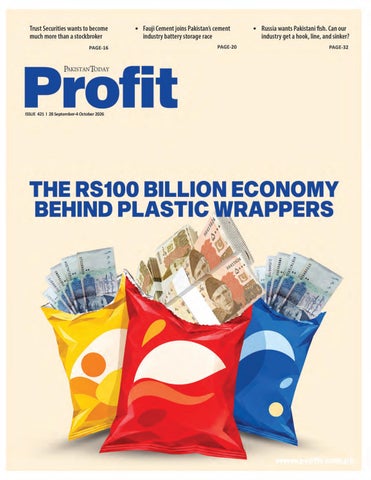
10 The Rs 100 billion economy behind plastic wrappers 16 Trust Securities wants to become much more than a stockbroker 18 Fauji Cement joins Pakistan’s cement industry battery storage race
20
20 The case of the deepfake Arif Habib being used to sell a Ponzi scheme 22 The state of play in the electricity distribution company privatization process 27 Competitive Pakistan Muhammad Azfar Ahsan
18
30
32
30 Can Pakistan Build Data Centres Without Deepening Its Water Crisis? Zahra Niazi 32 Russia wants Pakistani fish. Can our industry get a hook, line, and sinker? 36 What Chashma-1’s 427-day run says about Pakistan’s energy future
Profit Publishing Editor: Babar Nizami - Senior Editor: Abdullah Niazi Business Reporters: Taimoor Hassan | Usama Liaqat | Zain Naeem | Shahnawaz Ali | Ghulam Abbass Ahmad Ahmadani | Aziz Buneri - Sub-Editors: Saddam Hussain | Abdul Hameed - Video Producer: Adnan Maqsood Director Marketing: Muddasir Alam - Regional Heads of Marketing: Agha Anwer (Khi) Kamal Rizvi (Lhe) | Malik Israr (Isb) GM Special Projects Zulfiqar Butt - Manager Subscriptions: Irfan Farooq Pakistan’s #1 business magazine - your go-to source for business, economic and financial news. Contact us: profit@pakistantoday.com.pk
10
The Rs100 billion economy behind plastic wrappers Launched in 2015, the IPAK Group has overtaken the incumbents of Pakistan’s plastic film sector in terms of capacity, sales, and size. Last year, they exported their $37 million worth of products to 39 countries. But exactly what goes on behind the scenes of the humble wrapper?
By Abdullah Niazi
W
hen you open a single packet of crisps, you are interacting with at least four major parts of Pakistan’s economy. Perhaps the most obvious one is agriculture: the crisp you’re about to grab by the handful started off as a potato in a field. From there it was picked, graded, washed, and taken to a facility where it was peeled, cut, fried, and seasoned. This is the second major sector of the economy that comes into play: manufacturing. Multinationals like Pepsico and local players like Ismail Industries have facilities spread in different parts of the country where they prepare these snacks. The third is retail. Whether it is a Kiryana store, school canteen, a Foodpanda dark store, or a nationwide chain like Imtiaz — you’re not buying it directly from the factory. Each sector has its own supply chains, logistics, crises, middle-men, transporters, distributors and the like. It is a vast cast of characters that relays a potato from farm to grubby hand. And perhaps the most innocuous of part of the entity chain that brings you that instant, salty, gratification is packaging. Most of us probably only think of the wrapper in terms of how empty they are compared to what we remember from a few years ago. While the shrinkflation is real, these wrappers are part of a wider industry that is worth close to Rs 200 billion. This segment of the larger packaging industry is called Flexible Packaging Films. Using basic plastic resins, the industry creates multiple kinds of plastic packaging. In something like a packet of crisps, the outer layer, the shiny inner layer, and the thin layer between are all distinct products. The manufacturers of these flexible packaging
COVER STORY
materials sell them in massive rolls to the downstream industry which prints, cuts, and provides the final packaging solutions to large manufacturers. You interact with these products every single day. They are present in the wrapping on your handsoap, in the thin film on cigarette packings, and the shinysilky wrap-around labels you find on plastic bottles. This ubiquity makes the product low visibility and high stakes. The industry was first established in Pakistan during the 1990s by (no surprises for guessing) Syed Babar Ali’s Packages Group, which introduced a subsidiary by the name of Tri-Pack Films. This joint venture between the Packages Group and the Mitsubishi Corporation of Japan was, for the longest time, the main supplier of plastic packaging film to Pakistan’s manufacturing ecosystem. It has a production capacity of close to 90,000 tonnes across different categories of flexible packaging and spent most of its history operating as a sole provider in Pakistan. But in the last few years it has been replaced by a new contender: IPAK. The company was founded in 2015 by Navid Godil, who was also one of the co-founders of Al-Shaheer Limited, the Pakistani meat exporter. It began operations in 2021 and was listed on the Pakistan Stock Exchange (PSX) in 2024 with an over-subscribed IPO that raised Rs 1.77 billion. IPAK has overtaken Tri-Pack in terms of capacity, sales, and profitability. It has also managed to become a significant exporter. IPAK has a foothold in 39 countries including high-end markets like the European Union. In the recently concluded financial year 2025-26, IPAK increased its exports by nearly 30% to around $37 million. And to hear Navid Godil speak of it, exports are a big part of the company’s future plans. As Pakistan’s processed food sector continues to experience growth in demand and the international demand for packaging materials also continues, just how high can IPAK and Pakistan’s flexible film industry go?
A marvel of transatlantic engineering
I
t might not be the most glamorous product, but flexible film has changed how the modern world works. Biaxially Oriented Polypropylene (BOPP) film was first commercially manufactured in the early 1960s, but did not become a part of everyday consumer life until the late 1970s and early 1980s. The original base polymer was discovered by a petroleum plant worker in Bartlesville, Oklahoma in 1951. At this point this was still just a material. The “flexible” part of it came in 1963, when Italian chemicals giant Montecatini
12
Montecanti Chemicals was founded in 1888 and considered a “quasi-monopolist of the Italian chemical industry” in the time between World War I and the end of World War II. The commercial manufacturing of BOPP was one of its last hurrahs before it went defunct in 1966. established the world’s very first commercial production plant dedicated specifically to stretching the film in two directions to create BOPP at their plant in Novara. Simultaneously, engineering firms like Brückner-Maschinenbau in Germany perfected the specialized stretching machines that allowed the Italian technique to be manufactured at a massive scale globally. The invention of BOPP might have led to the humble wrapper, but it is an example of the kind of transatlantic engineering that was invisibly changing the world at the height of the Cold War. For audiences that do not know a world before BOPP, it is the glossy (and relatively stiff) plastic film used in snack packs, biscuit wrappers, labels, tapes and overwrap. What seems like the mere crinkly outer wrapper was a marvel in the 1960s that allowed food companies to keep moisture out of their products and allow for high quality printing and branding all in one. That means it allowed the FMCG sector a longer and more hygienic shelf life and cheaper branding space. On a manufacturing level, the product was simple enough if you had the right machines. Plastic resin is melted and pushed through a flat die into a sheet. In BOPP, that hot sheet is stretched in two directions, lengthways and sideways, which lines up the molecules and makes the film thinner, clearer and stronger. The roll is then treated so that ink and glue can stick to it, slit into smaller
rolls and sent to converters. These converters print the design, add adhesives, combine different layers and supply the finished packaging material to food, tobacco, personal-care and pharmaceutical companies. Over time CPP, or cast polypropylene, also entered the mix. BOPP is the glossy outside of the pack, CPP is the shiny inner layer. The outside layer provides printability, and another microscopic aluminium layer is added in a vacuum to create the familiar silver shine inside, say, a packet of biscuits.
A virtual monopoly
T
he BOPP technology was such that it made its way across the world pretty quickly. It had arrived in Pakistan by the 1980s. Initially most of these BOPP rolls were imported. The first recognisable player in the business was Macpac. The company is still around today, although it is the smallest of the listed players. Its founding family had been working with packaging films before the sector became a formal corporate industry, and Maqbool Elahi Shaikh is described in the company’s own filings as one of the country’s early pioneers of BOPP, metallised and CPP films. But the real inertia in the industry showed up when the Packages Group stepped up to the plate. Syed Babar Ali has spent his century-long life creating compa-
nies, products, and institutions out of the most harmless products. Thus it should be no surprise that his imprint is on every packaging wrapper you see on any FMCG product in the market. Incorporated in 1993 and brought into production in 1995, Tri-Pack was a joint venture between Packages Limited, Mitsubishi Corporation and other investors. Macpac responded by incorporating in 1993 and later listing itself on the stock exchange. In the initial days it became clear what the distinction was. Tripack was going to provide bulk, cheap orders of BOPP and Macpac was going to do more specialised work which included some level of imports. They were the service providers for niche grade plastics and other customised products. Tripack was designed to industrialise
Syed Babar Ali has spent his centurylong life creating companies, products, and institutions out of the most harmless products. Thus it should be no surprise that his imprint is on every packaging wrapper you see on any FMCG product in the market.
the material for a much wider Pakistani market. The timing made sense. The 1990s were messy and politically unstable, but they were also the years in which private banks, private credit and private industry began to re-enter the centre of economic life after the older nationalised model had started to loosen. Consumer brands were popping up for the first time and they needed local suppliers and packaging options. Tripack sold rolls of their film to printers and processors. These downstream players managed to get these new consumer products packed and in stores. Demand kept increasing over the years. Tri-Pack started with one BOPP line of 5,400 tonnes a year. By 2001, it had added a second line and doubled BOPP capacity to 10,800 tonnes. The Musharraf years after 9/11 meant the dollars were flowing in. A banking boom kept the industries pumping out the black smoke and urban consumption rose as Pakistan partied off the spoils from the War on Terror. Pakistan’s middle-class consumer economy was beginning to look different:
more snacks, more shampoos in sachets, more labels, and with it more of a need for the invisible films that held all of this together. By 2004, Tri-Pack had installed a third line of 16,000 tonnes at Port Qasim, and from that point it became the industry’s dominant force. Macpac remained in the market, but it did not match Tri-Pack’s scale. Its more interesting move came in 2003, when it set up a CPP plant, giving Pakistan an early domestic source of the softer, sealable layer used inside laminated packs. But that line was halted after a fire in 2007, weakening Macpac’s ability to challenge the incumbent just as the market was expanding. Tri-Pack responded by moving into CPP itself. Its Bin Qasim CPP plant entered production around late 2008, allowing it to supply both the printable outer film and the sealable inner film to converters. By the early 2010s, the sector was not technically a monopoly, because Macpac existed and had real expertise. But commercially, Tri-Pack operated like the default supplier of Pakistan’s flexible film economy. By 2015, Macpac was adding value through metallised films, but exports were still negligible and the industry remained mostly domestic. And that is when a new entrant made the industry do a one-eighty.
Enter Mr Godil
N
avid Godi is soft-spoken, affable, and ambitious. During a recent packaging trade show at Expo Centre in Lahore, he sauntered into the pavilion marked IPAK armed with easy smiles and handshakes. Sure, exhibitions and trade shows are working events but for Mr Godil this was very much a victory lap. Less than a decade ago his company had not manufactured a single roll of
COVER STORY
film. But in its annual financial results for the financial year 2025-26, IPAK posted a consolidated profit after tax of Rs 4.95 billion, up sevenfold from the previous year when it was Rs 66.4 crores. The massive surge in profits came off the back of a 23% increase in overall sales, and a 30% increase in total exports which made up a quarter of the overall sales. Not only is IPAK providing a significant portion of the domestic market, it is exporting to over 40 destinations including markets in Europe and North America. On the sidelines of the exhibition, he spoke to Profit in a casual conversation relating his story and how IPAK came to be. The origin story is as innocuous as the product in question, and Mr Godil is an equally simple founder. A graduate of Karachi University, began his career in 1999 from the Karachi Stock Exchange. He exited the financial market in 2007 to explore business ventures. In 2008, he co-founded Al-Shaheer Corporation Limited. Two years later, in 2010 he set up Universal Packaging Company (Private) Limited that specializes in Rotogravure Printing Packaging. This is part of the downstream film packaging industry we have mentioned above. Tri-Pack would import resin from the Middle East (it is a petroleum byproduct) and produce the film in question. Big and small companies like Universal Packaging would buy rolls of film and then process and
14
A graduate of Karachi University, Naveed Godil began his career in 1999 from the Karachi Stock Exchange. He exited the financial market in 2007 to explore business ventures. In 2008, he co-founded Al-Shaheer Corporation Limited. Two years later, in 2010 he set up Universal Packaging Company (Private) Limited that specializes in Rotogravure Printing Packaging. He set up International Packaging Films Limited (IPAK) in 2015.
print on it before selling ahead to FMCGs and other consumer goods that are packed in this film. It was from this early beginning that Mr Godil first entered the world of packaging. Being involved in the industry made one thing clear to Mr Godil: this industry was essentially a monopoly. Not by some nefarious means on the part of Tri-Pack, but simply because everyone was happy paddling downstream while Tri-Pack kept pumping rolls of film their way. In 2015, he realised the market was ripe to enter. Up until now no one had bothered trying. IPAK entered the market with the advantages of a new mover. While Tri-Pack had older machinery and other legacy costs, IPAK joined the fray with fresh German equipment and pioneered the five-layer BOPP Film technology in Pakistan. This new kind of BOPP was more favourable for the downstream players because it was cost efficient and allowed them to print better and more enhanced glossy images. The company began these operations on 6.9 acres near Manga Chowk on the Raiwind Bypass in Lahore. Commercial production began in 2017 with an 8,700mm Brückner line imported from Germany, carrying a nameplate capacity of 41,360 tonnes a year. This was the base from which IPAK first attacked the market. By 2020, according to the company, it had reached around a third of the local market and had become the
TEXTILES
second-largest player in BOPP. But the plan was never to stop at BOPP, but the way IPAK has gone about expanding is interesting. Rather than including new lines under the same company, IPAK has created subsidiaries. Cast Packaging Films, or CPAK, is its wholly owned CPP arm and began commercial operations in 2021 with 9,900 tonnes of annual capacity. PETPAK, in which IPAK holds 52%, was created for BOPET and began commercial operations in 2024 with 41,920 tonnes of nameplate capacity. Global Packaging Films, or GPAK, was incorporated to add another 59,480 tonnes of BOPP capacity at Quaid-e-Azam Business Park in Sheikhupura. Put together, the group’s capacity rises from the original 41,360 tonnes of BOPP to more than 150,000 tonnes across BOPP, CPP and BOPET.
How IPAK dominated the market
T
he numbers explain just how IPAK bullied its way to the top of the charts. Just look at how its trajectory has gone. In FY2020, when it was still largely just a BOPP producer, the group posted consolidated sales of Rs 7 billion and a profit after tax of Rs 60.6 crores. A year later, as the business started to find its footing and CPAK entered the picture, sales rose to Rs 9.4 billion and profit after tax crossed Rs 1.5 billion. By FY2022, sales had reached Rs 13.1 billion. By FY2023, they were just shy of Rs 20 billion, with profit after tax of Rs 1.89 billion. Much like its entry, IPAK refused to sit still. It continued to add capacity rather than just sitting and reaping the profits and waiting for the coffers to fill up. The BOPP production was always going to be the core for a company in this industry, but the introduction of CPP meant the group could supply the outer and inner sealable layer for film packaging at the same time. PETPAK and GPAK then widened the bet by adding BOPET and another major
BOPP line. It was a very deliberate effort to become a one-stop-shop for the FMCG sector’s packaging needs. And with this complete film lineup assembled, IPAK went for an Initial Public Offering. It offered 70.1 million shares, around 10% of its post-IPO capital, and raised around Rs 1.77 billion in an oversubscribed listing. The money was meant for early repayment of longterm financing that had been taken for GPAK and PETPAK’s expansion. This was the logic of the IPO: the group had already built aggressively, and the listing helped clean up part of the balance sheet while giving the company the public-market profile of a national industrial player. There were some immediate hiccups after this, and the sudden scaling up meant the company suffered a consolidated loss of Rs 57.1 crore in FY 2024. But the company’s path has been pretty clear since then. In FY2025, sales rose to Rs 34.4 billion and the group returned to profit. Actual production rose from 46,573 tonnes in FY2024 to 66,948 tonnes in FY2025. By FY2026, sales had reached Rs 42.2 billion and profit after tax jumped to Rs 4.95 billion as gross margins recovered sharply. Throughout this, the one target that has not shifted has been the focus on exports. In FY2024 export sales were only Rs 1.9 billion. In FY2025 they rose to Rs 7.9 billion, and in FY2026 to around Rs 10.4 billion, or roughly $37 million, marking nearly a quarter of total sales. At the expo in Lahore where Profit spoke to Mr Godil, the IPAK pavilion made its priorities obvious. The walls were full of posters celebrating export destinations, foreign buyers and global reach. It was far from subtle.
Back to the packet
A
ll of this brings us back to that original packet of crisps. That wrapper started with an American polymer discovery, went to an Italian stretching line, and came to Paki-
stan in the form of a JV between Packages and Mitsubishi. For decades, TriPack ruled before an ambitious Lahore-based challenger decided there was more than enough room for a second big player. As we said in the beginning, a basic pack of crisps involves input from at least four major parts of Pakistan’s economy. Profit has covered potatoes, FMCG, and the retail sector in quite some depth in the past. They are the sorts of topics people are naturally interested in because they are visible and leave an impact. But the wrapper we crumple up and throw away is no less important in keeping the whole bag-of-crisps operation afloat. That is what makes IPAK’s rise worth paying attention to. The company did not invent the industry. It entered a space that already existed, saw that it was under-supplied, added capacity aggressively and then went public to support a larger export-facing plan. Whether that plan works over the long run will depend on the usual harsh realities. The industry relies heavily on imported resin price. Energy costs are all over the place these days. And with the world up in chaos, you never know what new crises might hit a business. But for now the arc is clear. Pakistan’s flexible films industry arrived at the right time and complimented the FMCG boom of the 90s. Now, with a new Big Kahuna in town, it will be worth it to see whether the incumbents have something in them to fight back. The plan for IPAK in the meantime seems simple. The domestic market isn’t going there, but longevity is in trying to become an export industry in its own right. So even though the next time you tear open a packet of crisps, the crinkle in your hand may still feel like nothing. But behind that little sound sits one of the more interesting hundred-billion-rupee economies in the country. n
COVER STORY
Trust Securities wants to become much more than a stockbroker
A Rs450 million rights issue has already expanded the small brokerage’s capital base. Now it wants to launch SPACs, enter regulated virtual assets and create room for still more equity.
F
or most of its three-decade history, Trust Securities & Brokerage Limited has been exactly what its name suggests: a relatively small Pakistani brokerage house, facilitating trades on the stock exchange, providing margin financing and earning commissions from clients buying and selling securities. It is now contemplating becoming something considerably more complicated. On September 25, Trust Securities filed three separate notices with the Pakistan Stock Exchange (PSX) which, taken together, amount to something resembling a new strategic direction. The company wants to launch a series of special purpose acquisition companies, or SPACs. It wants to apply for licences to provide cryptocurrency-related custody, exchange, transfer and settlement services under Pakistan’s newly created virtual-assets regulatory regime. And it wants shareholders to approve an increase in its authorised share capital from Rs750 million to Rs1 billion. There is an important qualification to all three announcements: very little has actually happened yet. Trust Securities does not have a virtual-asset licence. It has not launched a SPAC, let alone identified a company for one to acquire. And increasing authorised capital does not itself raise any money; it merely gives the company legal room to issue additional shares later. Nonetheless, the filings are noteworthy because they come after an already unusually aggressive period of capital raising and corporate restructuring at Trust Securities. As recently as one year ago, Trust Securities’ paid-up capital was just Rs300 million. That was the figure before a massive rights issue earlier this year. In January 2026, Trust announced a 150% rights issue, offering 450 million new Re1 shares and thereby proposing to take its paid-up capital from Rs300 million
16
to Rs750 million. By March 24, the company said the entire Rs450 million issue had been subscribed, with the remaining initially unsubscribed shares ultimately taken up as well. The new shares were subsequently credited. Trust Securities therefore already has 750 million shares outstanding. At the September 25 closing price of Rs2.37, that puts its equity market value at roughly Rs1.78 billion. Seen in that context, the latest increase in authorised capital is perhaps more interesting, not less. Trust has just filled virtually all of the Rs750 million ceiling it previously had. It now wants the ceiling raised to Rs1 billion, creating another Rs250 million of room for equity issuance. The company is not saying that it will issue those shares. But it is difficult to miss the direction of travel.
First, the balance sheet
T
he transformation really began before the crypto and SPAC announcements. In December 2025, Trust Securities’ shareholders approved a ten-for-one subdivision of its shares, converting 30 million Rs10 shares into 300 million Re1 shares. The same meeting also approved the creation of a wholly owned technology subsidiary to undertake businesses including software development, systems integration, data centres, digital transformation and data analytics. Then came the Rs450 million rights issue. Trust’s offer document was unusually explicit about what the company wanted the money for. Of the Rs450 million, Rs250 million was earmarked for margin financing, Rs150 million for settlement obligations under the T+1 settlement system, and Rs50 million for technology upgrades, operating expenses and advisory services. Management said the capital was intended to support rising trading vol-
umes, a larger client base and the corresponding increase in liquidity and regulatory-margin requirements. In other words, Trust did not raise capital merely to repair an impaired balance sheet. It was raising money to do more business. The effect was substantial because Trust was starting from such a small base. At June 2025, the company had total assets of just Rs884 million and shareholder equity of Rs382 million. Operating revenue for the year was Rs251 million and net profit was only Rs19.2 million. By March 2026, PACRA reported assets of nearly Rs1.3 billion and equity of Rs867 million, reflecting the enlarged capital base. Feebased income for the first nine months of fiscal 2026 was Rs323 million, already well above the Rs251 million earned during all of fiscal 2025. And the most recent full-year numbers suggest that the core business has had a good year. Results released alongside the September 25 announcements showed fiscal 2026 net income of Rs137.2 million, compared with Rs19.2 million the previous year. Trust remains a small company. But it is a much better-capitalised small company than it was twelve months ago.
Who exactly is Trust Securities?
T
rust Securities was incorporated as a public limited company on October 19, 1993 and is both a Trading Rights Entitlement Certificate holder of the PSX and a member of the Pakistan Mercantile Exchange. Its traditional businesses include brokerage in shares, debt securities and commodities, proprietary securities trading and corporate financial services. The company says the group of sponsors that now controls it took over in 2017, injecting fresh capital and hiring new staff to turn around the brokerage.
There is also considerable continuity in management. Chief executive Abdul Basit joined Trust in 1994 as a settlements manager, held roles including company secretary, general manager and chief operating officer, and became CEO in 2010. The board is chaired by Zenobia Wasif. PACRA said in September that Trust’s board comprises seven directors. The largest shareholder is Junaid Shehzad Ahmed. According to PACRA’s latest September 2026 assessment, Ahmed owns approximately 24.1% of Trust Securities. Muhammad Khurram Faraz owns about 4.1%, while Paramount Commodities owns approximately 5%. Trust’s own website identifies its sponsors as Sikander Mahmood, Ahmed Kamal, Junaid Shehzad Ahmed and Muhammad Shayan Ghayas. Ahmed’s ownership was previously higher. The rights-issue documentation showed him holding 26.93% before and immediately after the rights issue, assuming full subscription to his entitlement. Subsequent PSX disclosures show him transferring shares to fellow director Shayan Ghayas during April and May. PACRA describes Trust as operating eight branches across Karachi and Lahore. The firm’s credit rating is A- for the long term and A2 for the short term, with a stable outlook, while its broker management rating is BMR2+. These are respectable credentials. But none of them makes Trust one of the giants of Pakistani finance. That is precisely what makes the latest strategy interesting.
The SPAC bet
O
f Trust’s two new business ideas, SPACs are the one more closely related to what a traditional brokerage and corporate-finance house already does. A SPAC is essentially a listed shell company that raises money first and finds an operating company to acquire later. Investors are initially betting on the sponsors’ ability to identify and execute an acquisition rather than on an existing operating business. Pakistan formally created a regulatory framework for SPACs in 2021. SECP rules require a SPAC to be a public limited company whose principal business is raising money for a merger or acquisition. The regulatory framework requires, among other things, minimum capital, qualified sponsors and directors and escrow arrangements for investors’ money. For several years, the framework was mostly theoretical. That changed this year. LSE SPAC-I became Pakistan’s first listed SPAC on May 11, 2026. A second, LSE SPAC-II, followed in July. The first vehicle has already moved towards a business combi-
nation, with the Competition Commission approving its proposed merger with Ningbo Green Light Energy in September. Trust is therefore entering the market just as the concept is beginning to move from regulations on paper to actual transactions. The company’s wording is noteworthy. It does not say it wants to create a SPAC. It says it is considering a series of SPACs, through which it would participate in their formation, structuring, public offerings and listings. No size, number or prospective acquisition targets have yet been identified. For a brokerage, there is an obvious attraction. A successful SPAC ecosystem creates fees at nearly every stage: structuring, capital raising, brokerage, advisory work and ultimately merger execution. More importantly, it would push Trust further into investment banking rather than leaving it dependent largely on trading commissions.
And then there is crypto
T
he virtual-assets announcement is the more radical departure. Trust’s board has approved an intention to apply to the Pakistan Virtual Assets Regulatory Authority for three categories of licence: custody services, exchange services, and virtual-asset transfer and settlement services. Trust stressed that it has not commenced any of those businesses and will not do so without regulatory approval. Changes to its memorandum and articles may also be needed and will be taken to shareholders. Timing matters here. Pakistan enacted the Virtual Assets Act in March 2026, creating PVARA and moving crypto from a legal and regulatory grey area towards a formally supervised industry. Final Virtual Asset Services Regulations became effective on August 21. Those rules are not trivial. PVARA lists minimum paid-up capital of Rs200 million for custody, Rs200 million for transfer and settlement and Rs500 million for exchange services. Applicants also face requirements relating to governance, cybersecurity, segregation and safeguarding of client assets, disclosures and anti-money-laundering controls. Suddenly, Trust’s rights issue looks relevant to something beyond ordinary stockbroking. With Rs750 million in paid-up capital, the company is now larger than the headline minimum capital threshold attached to any one of the three licence categories it intends to pursue. That does not mean PVARA will grant a licence, nor does capital alone satisfy the regulatory requirements. But a Rs300 million brokerage would have looked considerably less prepared to undertake this business than the
Rs750 million-capitalised company Trust has deliberately created over the past year.
A small company in an overwhelmingly bank-dominated system
T
here is a broader reason why Trust’s strategy matters. Pakistan’s financial system is still overwhelmingly organised around banks rather than capital markets. At June 2025, banks accounted for 79.7% of total financial-sector assets, according to the State Bank of Pakistan. Even the non-bank financial industry remains relatively modest. Mutual funds had roughly Rs4.5 trillion under management at the end of 2025, while the banking system’s balance sheet runs into tens of trillions of rupees. Brokerage itself is fragmented. The SECP reported 208 registered securities brokers as of March 31, 2026. Trust is only one of them, and certainly not among the largest financial institutions in the country. Even after its rights issue and earnings recovery, a market capitalisation of less than Rs2 billion leaves it minuscule next to Pakistan’s large commercial banks, asset managers and insurance companies. Yet that smallness may partly explain the willingness to experiment. For a major bank, regulated cryptocurrency, SPAC sponsorship or new technology businesses would be additions to an enormous existing franchise. For Trust Securities, they have the potential — if they actually materialise — to alter the composition of the company itself. That does not mean shareholders should treat Friday’s announcements as accomplished facts. They are emphatically not. There is no cryptocurrency licence, no cryptocurrency exchange, no completed SPAC offering and no identified acquisition. The additional Rs250 million of authorised capital is merely permission to issue more shares if the board later chooses to do so. But there is now a pattern. Within less than a year, Trust has approved a technology subsidiary, subdivided its shares, raised Rs450 million through an enormous rights issue, expanded its paid-up capital by 150%, improved profitability, announced plans for multiple SPACs, begun preparing applications for three virtual-asset licences and asked shareholders for another Rs250 million of equity headroom. Any one of those events might be dismissed as corporate housekeeping. Taken together, they look considerably more like a small brokerage trying to turn itself into a broader financial-services platform. n
CAPITAL MARKETS
Fauji Cement joins Pakistan’s cement industry battery storage race
Lucky Cement has already commissioned large-scale storage, Cherat Cement is spending Rs1.85 billion on its own system and DG Khan Cement has just followed suit. Now Fauji Cement is adding 50 MWh of batteries to an already substantial captive renewable-power network. The industry’s solar revolution is entering its next phase.
F
or several years, the race among Pakistan’s cement manufacturers was relatively straightforward: who could generate the largest proportion of their electricity themselves? Companies installed wasteheat recovery systems to capture energy that would otherwise disappear up their kiln stacks. They built coal and gas-fired captive power plants. Then, as the cost of photovoltaic panels collapsed, they covered whatever land they could spare with solar panels. Now the competition is moving to the next stage. On September 22, Fauji Cement Company Limited announced that its board had approved 50 megawatt-hours (MWh) of battery energy storage, split equally between its Nizampur and Jhang Bahtar cement plants. Each site will receive a 25 MWh battery system alongside an additional dedicated 5 megawatts (MW) of solar generation, giving the project a total of 10 MW of new solar capacity. Fauji expects the installations to be completed within ten months of commencement. The company says the batteries will store solar electricity generated during the day and discharge it during evening peak hours, reducing purchases from the national grid when power is expensive. Fauji has not disclosed either the cost of the project or its battery supplier. If this were an isolated project, it would merely be another energy-efficiency investment by one of Pakistan’s biggest electricity consumers. It is not. Fauji is joining a rapidly lengthening list of Pakistani cement companies installing batteries alongside their captive renewable generation. Lucky Cement has already commissioned what is currently one of the country’s largest industrial battery systems. Cherat Cement approved a major battery project in January. DG Khan Cement announced its own solar-plus-storage project one day after Fauji’s disclosure. Bestway Cement, meanwhile, has told analysts that it is evaluating storage to make better use of its very substantial solar fleet. Battery storage, in other words, is begin-
18
ning to look less like an experimental technology for Pakistan’s cement industry and more like the next logical piece of the industry’s power infrastructure. And that has implications far beyond cement.
Solar was only half the solution
T
here is a simple reason cement companies have been among Pakistan’s most aggressive adopters of alternative power. Making cement requires enormous amounts of energy. Raw materials must be crushed and ground. Massive kilns must operate at extremely high temperatures. Clinker has to be ground into cement. Conveyors, crushers, fans, mills and packing systems must run continuously. Electricity and fuel therefore represent a substantial portion of a cement manufacturer’s variable cost base. Even modest reductions in the cost of a kilowatt-hour can translate into meaningful improvements in margins when multiplied across millions of tonnes of annual production. Solar provided an obvious answer to part of that problem. Pakistan has abundant sunshine, industrial plants frequently have access to large parcels of land and photovoltaic panels have become dramatically cheaper. Cement factories also have the advantage of consuming power themselves rather than needing to build an entirely separate business around selling electricity. Fauji Cement has already pushed this strategy unusually far. The company, Pakistan’s third-largest cement producer with annual capacity of about 10.6 million tonnes, says it now has 74.27 MWp of solar capacity and 65 MW of waste-heat-recovery generation across its plants. Renewable sources account for approximately 51% of its power mix, and the company reports 242,846 MWh of clean-energy generation in its latest financial year. The two plants getting batteries already have some of Fauji’s largest renewable installations. Jhang Bahtar has 26 MWp of solar generation and 21 MW of waste-heat recovery, in
addition to other captive generation. Nizampur has 26.2 MWp of solar and 24 MW of wasteheat recovery. Fauji puts total captive-power capability at 63.3 MW at Jhang Bahtar and 50.2 MW at Nizampur. So the new 5 MW solar plants at each location are not particularly dramatic. The batteries are. Solar generation has always suffered from one fundamental limitation: electricity has traditionally had to be consumed when it is generated. A solar plant can produce very cheap electricity around noon. That is not particularly helpful if the cement plant still requires substantial electricity at seven o’clock in the evening after solar production has collapsed. A factory therefore needs another power source — the national grid, gas engines, coal generation or some other captive plant — to fill the gap. A battery changes the timing. Fauji can charge its new systems when sunlight is plentiful and discharge them several hours later. At a theoretical level, 25 MWh represents enough stored electricity to supply a 5 MW load for five hours, though actual usable output will depend on factors including discharge rates, battery efficiency, operating reserves and how deeply the batteries are cycled. That does not make either Fauji plant completely independent of the grid. What it does mean is that portions of the plant’s electricity demand can increasingly be supplied by an internal microgrid comprising solar generation, wasteheat recovery, storage and other captive sources. That distinction matters.
Lucky showed what the model can become
P
erhaps the clearest illustration of where this is heading comes from Lucky Cement. Lucky already operates one of the most sophisticated captive renewable-energy systems in Pakistani industry. Its investments include solar generation at its Pezu and Karachi-area plants and a 28.8 MW wind
project at Karachi. Its latest major addition is a 20.7 MW / 22.7 MWh battery energy storage system, developed with Reon Energy. The purpose of Lucky’s battery goes considerably beyond simply shifting solar power from lunchtime to the evening. Reon says the system is designed to manage electricity from Lucky’s wind and solar facilities, absorb fluctuations in renewable generation and improve the efficiency of the company’s gas-fired generators. Rather than keeping conventional generators running inefficiently at partial load merely to stabilise the captive network, batteries can respond rapidly when clouds pass over solar panels or wind output changes. Reon said after commissioning that the system allows Lucky’s facility to operate on 100% renewable electricity during periods when renewable resources are sufficiently strong, while providing the grid-forming capabilities necessary to maintain the stability of the factory’s internal electrical system. That is an important technological step. The attraction of batteries for industrial users is not simply that they store cheap electricity. They can increasingly perform some of the functions previously provided by conventional power plants: stabilising frequency and voltage, responding almost instantly to changes in load and generation and providing reserve capacity. For a large industrial consumer, that makes greater independence from the external electricity system technologically possible. Lucky’s investment is no longer an outlier. In January, Cherat Cement approved a 25 MW battery energy storage system and an additional 5.4 MW solar plant at its Nowshera factory. Cherat said the combined investment would cost approximately Rs1.85 billion and was intended both to strengthen renewable-energy capacity and reduce power costs. The company expected completion within six months of commencement. Cherat’s 2026 annual report makes clear that management sees the project principally as a way of improving energy reliability and allowing the company to extract more value from renewable generation. The company has also increasingly used hydroelectricity and solar power and has begun replacing diesel quarry trucks with electric vehicles. Then, only a day after Fauji’s announcement, DG Khan Cement announced that it had signed agreements for a 25 MW photovoltaic solar plant combined with a 10 MWh battery system at its Dera Ghazi Khan factory. The suppliers include EBR Energy Pakistan, China’s Sungrow Power Supply and Pragmatic Engineering Solutions. DG Khan expects the system to begin generating electricity in March 2027. The pattern is now difficult to miss. Lucky has storage. Cherat is installing it. Fauji is installing it. DG Khan is installing it. And Bestway — which already operates approximately 112 MW of solar capacity — has told analysts that it
is examining battery-storage options to optimise renewable generation. For an industry that spent the past decade accumulating solar panels, batteries are beginning to look like the natural next purchase.
Why now?
S
ome of the answer is technological. Battery prices globally have fallen dramatically as electric-vehicle production and Chinese battery manufacturing have expanded. Reuters, citing Wood Mackenzie, reported this year that battery-storage costs have declined by roughly 90% since 2010, while global battery-storage installations jumped 43% during 2025. A technology that once made sense mainly for wealthy electricity systems trying to integrate wind and solar is increasingly economical for an industrial customer in Pakistan looking at the difference between the cost of its own solar electricity and the tariff charged by its distribution company. But Pakistan has another unusual ingredient: the grid itself is steadily losing precisely the customers it most wants to keep. The federal government acknowledged the problem unusually clearly in a November 2025 filing with NEPRA. It said electricity consumption had contracted across major consumer categories over the previous three years as users adopted alternative energy sources. Industrial electricity consumption had fallen by 14%, the government said, while net-metered generation had reached 6,035 MW. The Power Division described the resulting economics as a “vicious cycle”: lower grid consumption means fixed system costs must be recovered across fewer units sold, which raises tariffs and creates still more incentive for customers to leave. The distributed-solar boom has since continued at extraordinary speed. By March 2026, the government estimated Pakistan had more than 20 GW of rooftop solar, contributing to reduced requirements for imported LNG and weakening demand from the national electricity system. That creates an awkward situation. Pakistan has spent decades building large power stations, transmission lines and distribution networks to supply electricity to industry. Yet some of its largest, most reliable and most financially capable industrial customers are now investing substantial amounts of shareholder money specifically to reduce the amount of electricity they need to purchase from that system. Solar began that process. Batteries accelerate it.
Batteries attack the grid’s most valuable hours
T
here is another reason storage is especially significant. Solar alone primarily displaces daytime electricity. Indeed, at sufficiently high levels of solar penetration, daytime electricity can become the least
scarce commodity in the power system. Pakistan is already moving towards precisely that problem. Government officials have warned that in some heavily industrialised areas, rooftop solar production could exceed grid demand during some daytime periods, producing what planners call “negative demand”. Evening electricity is different. Once the sun goes down, solar generation disappears while household and commercial demand remains high. Conventional power stations must increase output to compensate. That is why Fauji’s disclosure specifically mentions discharging its batteries during evening peak hours. This is not merely about generating electricity outside the grid. It is about avoiding the grid precisely during periods when grid electricity is most economically valuable. The cement companies are effectively learning to perform energy arbitrage inside their own factories: produce or acquire energy cheaply when it is abundant, store it, and consume it when external electricity is expensive. That moves captive solar from being a supplementary source of cheap daytime electricity towards becoming the backbone of a much more independent industrial power system. Fauji is not going off-grid — but that is the direction of travel It would be an exaggeration to say Fauji Cement is about to disconnect either Nizampur or Jhang Bahtar from the national grid. A modern cement factory consumes far too much electricity, and its electrical loads are too complex, for 25 MWh of batteries to make that possible on their own. But complete disconnection is not really necessary for the economics to change. At Jhang Bahtar, Fauji already has 26 MWp of solar, 21 MW of waste-heat recovery and other captive generation. At Nizampur, it has 26.2 MWp of solar and 24 MW of wasteheat recovery. Each location will now get another 5 MW of solar and 25 MWh of storage. FCCL For increasingly long portions of the operating day, some sections of those facilities may be able to obtain virtually all of the electricity they need without drawing power from the national system. And that is what makes the cement industry’s battery race significant. Cement manufacturers are unusually large, sophisticated electricity consumers. If it is becoming economically rational for them to build not merely generation but generation plus storage plus internal power-management systems, then Pakistan is approaching a point where industrial self-generation is no longer just an emergency backup or a hedge against expensive tariffs. It is becoming an alternative electricity infrastructure. For Fauji Cement, the 50 MWh battery project is simply another attempt to lower the cost of producing a tonne of cement. For Pakistan’s power system, however, it is another warning. First the cement companies built their own solar plants. Now they are building the equipment that lets them keep the electricity for later. n
ENERGY
The case of the deepfake Arif Habib being used to sell a Ponzi scheme
One of Pakistan’s best-known stock-market investors has become the face of an online investment scam he has nothing to do with. The episode illustrates an increasingly dangerous combination: AI-generated celebrity endorsements, fake trading platforms and cryptocurrency.
I
f Arif Habib appeared on your TikTok feed promising that an artificial-intelligence trading system could make you Rs500,000 a week, there would be at least one fairly good reason to listen. Habib is, after all, perhaps the most recognisable face of Pakistan’s capital markets. He began as a stockbroker, served six terms as chairman or president of the Karachi Stock Exchange and went on to build one of the country’s largest financial and industrial groups. He chairs businesses ranging from Aisha Steel Mills to Fatima Fertilizer and remains chief executive of Arif Habib Corporation, the listed holding company of the group. There is only one problem. The Arif Habib in those videos is not Arif Habib. Over the past several months, the Arif Habib Group has been dealing with an increasingly sophisticated impersonation campaign in which scammers have appropriated Habib’s name, photograph, voice and likeness to advertise investment opportunities that neither he nor his companies have endorsed. By September, the problem had become serious enough for companies across the group to begin filing formal warnings with the Pakistan Stock Exchange. On September 18, Aisha Steel Mills disclosed that unidentified people had created fraudulent accounts and pages on TikTok, Facebook and other internet platforms and were making telephone calls to clients of the Arif Habib Group and members of the public. According to the company, the scammers were using Habib’s name, photograph, voice and appearance – including through AI-generated and deepfake videos – to solicit money for fake investment schemes. Aisha Steel said neither Habib, Aisha Steel nor any other Arif Habib Group entity was associated with the schemes. A formal complaint had already been lodged with the National Cyber Crime Investigation Agency on September 4, asking for a case to be registered, an investigation to be conducted and the fraudulent material to be removed or blocked. And the steel company offered one
20
particularly useful piece of advice: for investment-related information and services within the group, Arif Habib Ltd is the authorised entity. Random TikTok accounts featuring an apparently enthusiastic Arif Habib are not. The amusing version of this story is that Pakistan has reached the stage of technological development where even its stockbrokers can have evil AI twins. The less amusing version is that investment fraud is entering a considerably more dangerous era.
The fake Arif Habib started with fake news
T
he September deepfakes were not the first time the group had encountered the scam. Arif Habib Ltd had already warned its social-media followers months earlier that AI-generated videos and posts falsely featuring Habib were circulating online. Then, in July, the operation became easier to see. A website designed to impersonate Dawn published what purported to be a news article announcing that Arif Habib had launched an AI-powered investment platform called BTC+700 Lurot. The story was completely fabricated. It claimed that the platform had been developed under something called the “Pakistan Digital 2030” vision, supposedly with government backing and support from leading Pakistani businesses. A graphic named Pakistan State Oil and the State Bank of Pakistan among the alleged partners, alongside an apparently invented entity called “Pakistan Telecom AI”. The webpage looked sufficiently like a news website to potentially fool someone scrolling quickly through social media. But there were clues. The URL was not a Dawn address. The writing and page formatting did not match Dawn’s normal style. Some of the images appeared AI-generated and included garbled Urdu. And at the bottom sat the part that actually mattered to the scammers: a registration form asking readers to submit their mobile telephone numbers to join the supposed trading platform.
Every road on the fake website ultimately led back to that form. The pitch was spectacular even by the standards of get-rich-quick advertising. Material circulating with the scam claimed the supposed AI system could generate earnings of up to Rs500,000 a week. Arif Habib Ltd issued a PSX notice on July 31 categorically denying that Habib, the brokerage or any other Arif Habib Group company had created, endorsed or sponsored such a platform. By September, what had begun with fake articles had evolved into fake human beings. The group said scammers were now reproducing Habib’s voice and appearance in AI-generated video, maintaining fake accounts on TikTok and Facebook and following up through telephone calls. Arif Habib Corporation made the same complaint to the NCCIA, saying the material was being used to solicit investment funds. It is not publicly clear whether every deepfake video promoted BTC+700 Lurot specifically. The companies have sensibly declined to reproduce the fraudulent scripts in detail. What is clear is that the scam has followed a recognisable progression: steal the credibility of a famous investor, manufacture apparently independent evidence that the opportunity is legitimate, funnel potential victims towards an investment scheme, and then ask for money. Artificial intelligence simply makes the first part much more convincing.
Why Arif Habib?
F
raud has always depended upon borrowed credibility. A stranger sending an email saying he has discovered an investment capable of producing extraordinary returns has an obvious problem: why should anybody believe him? Pretending that Arif Habib discovered it solves part of that problem. In Pakistan, Habib’s public image is unusually useful to an investment fraudster. He is not merely wealthy. He is specifically associated with investing. He spent his career in the securities industry and his name sits atop one of Pakistan’s largest brokerages. Arif Habib Ltd describes itself
as the country’s largest securities brokerage, investment-banking and research firm. That distinction matters. A deepfake of a film star advertising an investment product borrows fame. A deepfake of Arif Habib borrows perceived financial expertise. Scammers elsewhere have reached exactly the same conclusion. FINRA, the US brokerage regulator, says criminals increasingly create fake social-media advertising featuring well-known financial personalities and then direct victims into fraudulent investment clubs and encrypted messaging groups. Advances in generative AI now allow those operators to replace a crudely edited photograph with synthetic video in which the person appears to speak directly to the victim. The con is old. The production values are new.
And somehow, there is usually crypto
T
here is another familiar element in the Arif Habib episode: the fake platform’s name was BTC+700 Lurot. Whether Bitcoin itself was actually involved in the ultimate payment mechanism has not been publicly established. But the branding is hardly subtle, and it places the scheme squarely within one of the largest categories of modern online financial fraud: fake cryptocurrency and AI-trading platforms. Cryptocurrency did not invent investment fraud. Fraudsters have been selling fictional oil wells, fake shares and imaginary trading systems for generations. But crypto has proved exceptionally convenient. A scammer can persuade a victim to purchase digital assets legitimately through an exchange and then transfer them to a wallet controlled by the criminal. Transactions can cross borders rapidly, and there is generally no equivalent of calling a credit-card company and reversing the payment once the cryptocurrency has been sent. Criminal organisations can subsequently move the assets between wallets, exchanges and jurisdictions in an attempt to obscure their origin. Cryptocurrency is better described as pseudonymous rather than inherently anonymous – public blockchains leave transaction trails that investigators can sometimes follow – but that does little to help a victim who has voluntarily transferred funds to a fraudster and discovers the deception days later. The US Federal Bureau of Investigation now describes cryptocurrency investment fraud as one of today’s most prevalent and damaging fraud schemes. Victims are typically shown apparently legitimate trading websites displaying fictitious profits and persuaded to deposit progressively larger amounts of cryptocurrency. The investments do not exist; the criminals control the money.
The numbers give some sense of the scale. The FBI says Americans alone filed 181,565 complaints involving cryptocurrency during 2025, reporting more than $11 billion in losses. Investment fraud accounted for nearly half of all reported scam-related losses. Chainalysis, which analyses blockchain activity, estimates that crypto scams received at least $14 billion on-chain during 2025 and says the figure could eventually exceed $17 billion as more fraudulent addresses are identified. Perhaps more strikingly, it found impersonation scams growing by more than 1,400% year-onyear. That is the ecosystem into which deepfakes have arrived.
AI makes a scalable scam much more believable
U
ntil recently, impersonation fraud had a natural bottleneck: creating convincing evidence. Anyone could establish a Facebook page called “Arif Habib Investment Club”. Producing a convincing video of Arif Habib actually telling viewers to join it was considerably harder. Generative AI is eroding that distinction. Modern tools can synthesise realistic speech, clone voices and animate faces from existing recordings. For prominent businesspeople, the raw material is effectively free. Habib has spent decades appearing on television, speaking at conferences and giving interviews. There are hours of high-quality recordings containing both his face and his voice available online. FINRA warned this June that modern voice-cloning systems can work from mere seconds of recorded speech and that deepfake investment scams increasingly feature what appears to be a well-known business executive or celebrity promoting an exclusive opportunity or supposedly guaranteed returns. The sophistication is important because people do not evaluate information in isolation. A potential victim may first see the video. Then he Googles the platform and encounters what appears to be a newspaper article. Then he visits a polished website. Then someone telephones him. Perhaps a WhatsApp group contains dozens of apparent investors discussing how much money they have made. Each element confirms the previous one. Except the video can be synthetic, the newspaper can be cloned, the trading interface can display invented balances, the callers can be scammers and the other delighted “investors” can be part of the operation. The scam no longer needs to contain one convincing lie. AI makes it increasingly cheap to construct an entire convincing world around the lie. The data suggest that matters economically. Chainalysis says scam operations with iden-
tifiable links to AI-service providers generated, on average, 4.5 times as much revenue as scams without those links in its dataset. It also found substantially higher transaction activity, suggesting AI may allow criminal operations to work on many more potential victims simultaneously. Pakistan’s own cybercrime agency is now explicitly warning about the same problem. The NCCIA says artificial intelligence, deepfakes, manipulated audio and video and identity deception are changing the nature and scale of financial fraud.
The scary part is not that the videos are perfect
D
eepfakes still make mistakes. Lip movements can look slightly strange. Lighting can change unnaturally. Hands, Urdu writing and logos can become distorted. Voices sometimes have unusual rhythm or intonation. Those defects are becoming less useful as a defence. The important technological trend is not necessarily that AI-generated video becomes literally indistinguishable from reality under forensic examination. It only needs to become convincing enough for somebody watching a 30-second TikTok on a mobile telephone. And social media creates precisely those conditions. People watch quickly. Videos are compressed. Screens are small. Content appears amid an endless feed. The supposed celebrity does not have to survive an hour-long interview. He may need to say only three sentences. That changes the burden of verification. For decades, the sensible rule was effectively: seeing is believing. The emerging rule is the opposite. A video should increasingly be treated as a claim requiring independent confirmation. For investors, that means checking whether the same announcement appears on the company’s official website, the PSX or the regulated financial institution supposedly making the offer. Aisha Steel’s notice makes that point explicitly: official information from the group comes through authorised channels, not through unsolicited TikTok advertisements or telephone calls. The Arif Habib scam is therefore interesting not because its underlying promise is novel. It isn’t. Someone is still telling strangers that there is an easy way to become rich very quickly. There is still a supposedly revolutionary trading system. There is still a famous person’s endorsement. There is still a website asking for your telephone number. And somewhere down the funnel, there is a request for your money. Those ingredients are almost ancient. What has changed is that the famous person can now look you in the eye and make the pitch himself – without ever having said a word. n
ARTIFICIAL INTELLIGENCE
The state of play in the electricity distribution company privatization process The government has put FESCO, GEPCO and IESCO – three of the strongest state-owned electricity distributors – up for sale. More than two dozen Pakistani and foreign groups have expressed interest. What they are actually buying, however, depends as much on the regulatory regime Islamabad creates after privatisation as it does on the utilities themselves.
T
he government of Pakistan is attempting something it has discussed for decades but never quite managed to execute: selling control of its state-owned electricity distribution companies. And, perhaps sensibly, the government is starting with the easy ones. The Faisalabad Electric Supply Company (FESCO), Gujranwala Electric Power Company (GEPCO) and Islamabad Electric Supply Company (IESCO) are not the distribution companies usually blamed for the worst excesses of Pakistan’s dysfunctional electricity system. They are, in fact, among its better performers. In fiscal 2025, FESCO reported transmission and distribution losses of 9.02%, GEPCO 10.6% and IESCO 8.61%. All three collected approximately everything they billed: FESCO and IESCO recorded recovery ratios of about 101%, while GEPCO reached 101.5%. By comparison, the weighted-average T&D loss across the state-owned DISCOs was 17.55%, while average recovery was only 96.6%. Those numbers matter because Islamabad has not merely asked private investors to manage these utilities. It is offering to sell them. The government is inviting investors to acquire anywhere from 51% to 100% of the shares in each DISCO, together with management control. Each company is being sold
22
separately. Potential buyers therefore have to decide not merely whether Pakistan’s electricity-distribution business can be made commercially attractive, but which of three enormous regional monopolies they would prefer to own. So far, there appears to be no shortage of interest. Twelve parties submitted expressions of interest for FESCO. Eleven did so for GEPCO. Ten have submitted for IESCO. Some are electricity and infrastructure companies. Others are Pakistani industrial conglomerates whose principal experience has historically been in cement, textiles, fertiliser, power generation or manufacturing rather than electricity distribution. And several want more than one DISCO. Three Turkish companies have entered all three processes. Engro Energy, Sapphire Fibres, Hub Power-related consortiums and Artistic Milliners have also expressed interest across all three in one form or another. That makes the first phase of DISCO privatisation considerably more competitive than might have been expected from an industry whose defining characteristics include regulated tariffs, enormous capital requirements, politically sensitive customers and a long history of circular debt. There is, however, an important distinction. Nobody has actually submitted a binding financial bid yet.
For FESCO, ten parties have passed prequalification and are proceeding into detailed due diligence. GEPCO’s eleven applicants are still being evaluated. IESCO only closed its EOI process on September 21. The auction – the point at which Islamabad will discover what investors are actually willing to pay – is still ahead. What exists today is therefore not a price discovery exercise but an unusually revealing map of who believes there might be money to be made in owning Pakistan’s electricity wires.
FESCO goes first
T
he most advanced transaction is FESCO. That makes intuitive sense. FESCO serves approximately 5.7 million customers across an enormous 44,300-square-kilometre territory, encompassing Faisalabad, Sargodha, Mianwali, Khushab, Jhang, Bhakkar, Toba Tek Singh and Chiniot. Its service territory contains more than 26 million people. More importantly for an investor, it includes Faisalabad. The country’s third-largest city sits at the centre of the country’s textile-manufacturing heartland. Huge textile mills, exporters and industrial businesses operate alongside the millions of domestic consumers in FESCO’s network. That gives the company something
electricity distributors want: relatively high consumption from customers with both the incentive and ability to pay their bills. FESCO sold approximately 14.4 billion units of electricity during fiscal 2025. Its total revenue rose to approximately Rs470 billion, while net profit improved to around Rs9.4 billion. Its balance sheet has also improved, with equity returning to positive territory after capital restructuring and operating improvement. The operational numbers have continued improving since then. FESCO says it ended fiscal 2026 with distribution losses of 7.87%, below the 8.03% regulatory target for the year, while progressive recovery reached 100.39%. For a buyer trying to understand what a privately controlled Pakistani electricity distributor might look like, this is about as clean a starting point as the government can offer. That helps explain the bidding interest. Twelve parties initially submitted EOIs. Ten have now passed the qualification stage: Aktor Elektrik Enerji Yatirimlari, Genvera Enerji and Cengiz Enerji from Türkiye; Engro Energy; Sapphire Fibres; a Hub Power Holdings consortium including Lucky Cement, Kohat Cement and Metro Ventures; Shirazi Investments of the Atlas Group; a Maple Leaf Cement Factory consortium with Kohinoor Textile Mills; a Pakgen-led consortium comprising Nishat Mills, Nishat Power, Nishat Chunian, Lalpir, Pak Elektron and Kohinoor Energy; and Artistic Milliners. The two names from the original twelve no longer in the FESCO competition are China’s Jiang Xi Electric Power Construction and K-Electric. Contemporary reporting indicates K-Electric withdrew; the Privatisation Commission’s prequalification announcement does not give a reason for Jiang Xi’s absence from the final ten. The surviving ten have been given access to the Virtual Data Room and can now conduct detailed buy-side due diligence. This is where the transaction becomes considerably more serious. An expression of interest costs relatively little. Due diligence requires bidders to examine actual assets, receivables, employees, pension liabilities, regulatory assumptions, power-purchase arrangements, litigation, investment requirements and the conditions under which tariffs will be set. Only after that process will it become clear which of the ten remain willing to write a cheque.
GEPCO may actually be the cleaner financial story
I
f FESCO has the attraction of Faisalabad’s industrial base, GEPCO offers a different version of the Punjab manufacturing story. Its relatively compact 17,200-square-kilo-
metre territory covers Gujranwala, Gujrat, Sialkot, Hafizabad, Mandi Bahauddin and Narowal. The government’s investment teaser puts the consumer base at approximately 5.1 million. This is another extraordinarily valuable economic geography. Gujranwala and Gujrat contain large clusters of ceramics, sanitaryware, fans, metal products, appliances and light engineering. Sialkot contains Pakistan’s famous export clusters in sporting goods, surgical instruments and leather products. Unlike some of the country’s more geographically sprawling DISCOs, GEPCO operates across a relatively dense concentration of cities, towns and industrial districts. Its financial performance has also improved dramatically. GEPCO reported electricity sales of approximately Rs325.4 billion in fiscal 2025, with another Rs37.4 billion recognised in government subsidies. Total revenue therefore reached approximately Rs362.8 billion. After losing more than Rs13 billion the previous year, GEPCO reported a profit after tax of approximately Rs13.7 billion. The Finance Division described GEPCO as financially resilient and operationally efficient, though it also highlighted remaining issues including negative equity, pension obligations, subsidy dependence and around Rs93 billion payable to the Central Power Purchasing Agency. Operational performance continued to improve in fiscal 2026. GEPCO says its line losses declined from approximately 10.43% to 9.80%, bringing them into single digits, while recoveries again exceeded 100%. The Power Division said GEPCO fully and promptly paid CPPA-G and contributed nothing to the year’s increase in circular debt. Eleven interested parties have entered the GEPCO process. Three are the same Turkish groups pursuing FESCO: Aktor Elektrik, Genvera Enerji and Cengiz Enerji. The sole Saudi entrant is Al Sharif Contracting and Commercial Development Company. The local applicants are Engro Energy, Sapphire Fibres, Hub Power Holdings with Lucky Cement, Shirazi Investments, Artistic Milliners with the Fatima Group, K-Electric, and a consortium comprising AKD Securities, Fast Cables and Mughal Steel. That list is notable because two bidders that did not survive – or withdrew from – FESCO have turned up again here in different forms. K-Electric remains interested in GEPCO despite leaving the FESCO contest, while the AKD-Fast Cables-Mughal Steel group entered GEPCO without having pursued FESCO. As of September 26, those eleven applications remain under evaluation. The Privatisation Commission has not yet announced the final prequalified GEPCO field.
IESCO is the affluent, increasingly digital utility
T
hen there is IESCO. If FESCO gives an investor Pakistan’s textile heartland and GEPCO offers the country’s dense light-industrial belt, IESCO provides something else: the federal capital and one of Pakistan’s relatively affluent urban markets. Its territory stretches from Islamabad and Rawalpindi through Attock, Chakwal and Jhelum and into parts of Azad Jammu & Kashmir. IESCO says it now directly serves more than 4.2 million consumers; its live consumer database listed approximately 4.31 million accounts in August 2026. The government’s privatisation teaser puts IESCO’s service territory at roughly 23,200 square kilometres, with total power capacity of around 5.2 GVA. Its consumer mix is particularly interesting. IESCO’s December 2024 customer profile showed domestic customers making up roughly 86% of connections but only 37% of electricity consumption. Industrial customers were less than half a percent of accounts but consumed almost 15% of electricity, while bulk supply and supplies to AJK accounted for substantial additional demand. Financially, it is not currently as profitable as GEPCO or FESCO. IESCO recorded about Rs247.7 billion in electricity sales during fiscal 2025, plus Rs83.4 billion in government subsidy, for total revenue of Rs331.1 billion. It generated gross profit of almost Rs37 billion but ended with a net loss of approximately Rs1.4 billion, albeit a dramatic improvement from the Rs15.8 billion loss recorded the year before. Operationally, however, IESCO remains one of the cleanest distribution territories in the public system. Its reported T&D losses were 8.61% in fiscal 2025 against an allowed 7.31%, and recovery was approximately 101%. By fiscal 2026 the company said line losses had fallen further to 7.6%, while recovery remained around 101%. IESCO also gives a potential private operator an unusually interesting laboratory for the electricity system of the future. The Islamabad-Rawalpindi region has seen substantial adoption of rooftop solar, smart metering and electric vehicles. The utility has been deploying advanced metering infrastructure and modernising its distribution network at precisely the moment Pakistan’s model of electricity distribution is beginning to change. Ten parties submitted EOIs by the extended September 21 deadline. Again, Aktor Elektrik, Genvera Enerji and Cengiz Enerji are present. So are Engro Energy and Sapphire Fibres. An Artistic Milliners-led consortium
ENERGY
24
includes Lake City Holdings, Fatima Capital, Din Ventures and Fazal Cloth Mills. A Hub Power Holdings-led consortium includes Lucky Cement, Kohat Cement and Metro Ventures. IESCO has also attracted Novatex, Bestway Cement, and a Hasnaat Brothers Construction-led consortium comprising Dhilal Holding Group, Pak Steel, Bio-Labs and Farid Steel Casting. Those applicants must now be assessed against the government’s prequalification requirements before the survivors get access to detailed due diligence.
The repeat bidders tell their own story
L
ooking across all three transactions reveals something important about how corporate Pakistan views electricity distribution. The three Turkish groups – Aktor, Genvera and Cengiz – have gone after all three. So have Engro Energy and Sapphire Fibres. Hub Power-related groups are present in every transaction, as is Artistic Milliners, albeit with changing consortium partners. This means a meaningful subset of bidders is not simply attracted to one unusually favourable service territory. They appear interested in electricity distribution as an asset class. That is a major conceptual shift for Pakistan. Historically, private capital has entered Pakistan’s electricity sector primarily through generation. Independent power producers built plants, signed long-term power-purchase agreements and sold electricity into a government-backed system. The distributor sat at the other end of that chain. It bought electricity through the centralised market, delivered it to millions of consumers, collected bills and remitted money back through CPPA-G. When consumers did not pay, electricity was stolen, line losses exceeded regulatory allowances or subsidies arrived late, cash stopped moving backwards through the chain. That is how a distribution problem becomes a generation-sector receivable and, eventually, circular debt. Now some of the country’s largest power generators and industrial consumers are considering moving downstream into distribution itself. Hub Power is an obvious example. But Lucky Cement, Kohat Cement, Maple Leaf Cement, Nishat, Sapphire, Artistic Milliners, Mughal Steel, Fast Cables and Bestway are also major industrial businesses with intimate knowledge of Pakistan’s electricity problem from the customer’s side. They have spent years trying to reduce their own cost of grid electricity through captive generation, solar power, wind, waste-heat recovery and, increasingly, battery storage.
Some of them are now considering owning the grid.
But what exactly are they buying?
T
his is where the government’s restructuring plan becomes crucial. Islamabad initially offered investors 51% to 100% of each DISCO’s shares together with management control. But simply selling the companies as they currently exist would saddle buyers with decades of legacy obligations. The government has therefore adopted a familiar solution: clean up the balance sheets first. In August, the Cabinet Committee on Privatisation approved a restructuring plan under which a government-owned special purpose vehicle will receive selected assets and liabilities carved out of FESCO, GEPCO and IESCO. The government says the assets transferred to the SPV will include all land parcels, while selected liabilities will include post-retirement obligations relating to employees who have already retired, together with the corresponding funded amounts. Retirement benefits relating to current employees will remain with the operating DISCOs. The structure is reminiscent of the government’s approach to Pakistan International Airlines: remove legacy items that make the operating business difficult to sell, then invite investors to bid for the cleaner commercial entity. Reports based on Power Division information put the assets proposed for transfer to the DISCO SPV at around Rs350.6 billion and liabilities at roughly Rs313 billion, leaving approximately Rs37.6 billion in net equity inside the government-owned vehicle. The important implication is that the headline purchase price for a DISCO will not tell the entire fiscal story. The state may receive money for the shares it sells, but it will also retain substantial legacy assets and obligations outside the privatised companies. That does not inherently make the transaction unattractive to taxpayers; whether it does depends on the valuation achieved, the liabilities retained and the future losses avoided. But those components must ultimately be considered together.
The hardest part may be the regulation, not the auction
P
rivate ownership alone cannot determine the economics of a Pakistani electricity distributor. NEPRA does. The regulator determines allowed losses, investment requirements and revenue require-
ments. Federal tariff policy then interacts with those determinations, historically through Pakistan’s uniform national tariff system and government subsidies. That means a private buyer cannot simply purchase FESCO and decide to charge Faisalabad consumers whatever electricity price maximises profit. The commercial bargain has to be created through regulation. This is why the Privatisation Commission repeatedly refers to establishing an “equitable, transparent and predictable post-privatisation regime” and why the National Assembly Standing Committee has highlighted NEPRA oversight, reserve prices, financial audits and post-sale regulation as essential elements of the transaction. The government and its adviser also have to answer a more subtle question: what exactly should the new owner be rewarded for? A conventional regulated utility earns a return on its regulated asset base while being incentivised to reduce losses, improve collections, invest in infrastructure and meet service standards. That model can work only if the owner knows with reasonable certainty how efficiently incurred investment will enter the tariff, how quickly tariff determinations will be implemented, what happens when government subsidies are delayed, how uncontrollable power-purchase costs are passed through and who absorbs deviations from loss and recovery assumptions. Those questions are likely to matter more to sophisticated bidders than whether the government’s reserve price is a few billion rupees higher or lower. Indeed, the IMF says the privatisation process was delayed following market-sounding exercises precisely because investors raised concerns that needed to be addressed. The government told the Fund earlier this year that it now expected the first three transactions to be finalised by early 2027.
Why start with the good DISCOs?
T
here is an obvious criticism of the government’s sequence. If privatisation is meant to solve Pakistan’s distribution losses, why sell FESCO, GEPCO and IESCO first? They are not the main problem. In fiscal 2025, PESCO lost 37.15% of electricity moving through its system. QESCO lost 38.38%. SEPCO lost 39.18% and HESCO 27.89%. Recoveries in QESCO were just 38.7%, while HESCO and SEPCO collected roughly three-quarters of what they billed. By comparison, FESCO, GEPCO and IESCO already look almost Swiss. The government’s implicit answer is commercial
ENERGY
practicality. A privatisation programme has a greater chance of establishing a market if the first assets are actually investable. FESCO, GEPCO and IESCO collectively serve more than 14 million consumers across some of Pakistan’s largest industrial, commercial and urban markets. They have strong collection cultures, comparatively low losses and large existing asset bases. If investors cannot be persuaded to buy these businesses under a workable regulatory model, the prospects of persuading them to buy utilities losing a third or more of the electricity they receive would be considerably more complicated. The trade-off is that the government is initially selling some of its better electricity assets while continuing to own the weakest ones. The government’s official roadmap reflects that distinction. The government intends FESCO, GEPCO, IESCO, LESCO, MEPCO and HAZECO for full privatisation. HESCO, SEPCO and PESCO are intended for long-term concession arrangements rather than outright sale. TESCO and QESCO are to remain in government hands for the time being because of their particular operating circumstances. The next stages are already being prepared. The Privatisation Commission is hiring financial advisers for LESCO and MEPCO and separately for PESCO and HAZECO, while Raiffeisen Investment is already advising on HESCO and SEPCO. So FESCO, GEPCO and IESCO are not supposed to be isolated asset sales. They are the test cases.
The larger question: what becomes of a DISCO?
T
here is another reason these transactions matter. The government is simultaneously attempting to change what an electricity distribution company actually is. For decades, the model has been relatively straightforward. CPPA-G buys power centrally and DISCOs deliver it to captive customers in geographic monopolies. The Competitive Trading Bilateral Contract Market, or CTBCM, is intended eventually to break part of that model apart. Under the framework approved by NEPRA, eligible large consumers can increasingly obtain electricity from competitive suppliers rather than being forced to purchase the electricity commodity itself from the local DISCO. The distribution company still owns the wires and can earn use-of-system or wheeling charges for electricity moving through its network. That changes the investment proposi-
26
tion. A future FESCO may increasingly be less like a shop selling electricity and more like a regulated network business providing access to the electricity market. The government’s own investment teaser explicitly identifies potential future revenue from wheeling charges under CTBCM, value-added services, bundled energy products, digital payments and ancillary businesses. At the same time, distributed solar is changing the underlying customer relationship. The industrial groups bidding for these DISCOs know this better than most. Many of them have been installing their own solar systems precisely to reduce electricity purchased from the grid. A buyer could therefore acquire a utility just as some of its wealthiest customers are learning to buy fewer units from it. That means the value increasingly lies in the network itself. Solar panels can replace electricity bought from the grid. They cannot easily replace the poles, substations, transformers and wires that connect millions of homes and businesses to each other and to the broader power system.
Privatisation will not make circular debt disappear
T
he ultimate sales pitch from Islamabad is larger than better customer service. The government wants to stop electricity distribution from feeding circular debt. NEPRA’s fiscal 2025 numbers demonstrate why. State-owned DISCOs collectively recorded T&D losses averaging 17.55% against an allowed level of only 11.43%. The difference imposed tens of billions of rupees of additional costs. Collection shortfalls created another major gap. PACRA estimates that excess losses and under-recovery together contributed close to Rs397 billion to sectoral financial stress during the year. The Power Division says reforms have already reduced broader DISCO losses significantly and that power-sector circular debt has come down from previous peaks. The IMF likewise says stronger DISCO enforcement and operating performance have helped contain circular-debt flows. But privatisation cannot remove every cause. A private FESCO cannot renegotiate the cost of an expensive power plant it did not contract. A private GEPCO cannot determine Pakistan’s exchange rate. A private IESCO cannot prevent electricity demand from falling because households install solar panels. Nor can any owner eliminate circular debt if politically determined tariffs fail to recover costs or government subsidy commit-
ments remain unpaid. What private owners potentially can change is the portion of the problem that occurs inside the distribution companies: theft, billing, collections, staffing, procurement, investment discipline, outage management, metering and network efficiency. That is substantial. It is not the entire electricity-sector balance sheet.
Now comes the interesting part
T
he first phase has demonstrated one thing already: investors are interested. That was not guaranteed. FESCO attracted twelve EOIs and still has ten qualified bidders. GEPCO drew eleven. IESCO drew ten. Turkish strategic investors have repeatedly returned, alongside some of Pakistan’s largest industrial groups. But expressions of interest are cheap. Binding bids are not. The next phase will reveal whether bidders still like these companies after examining pension obligations, labour arrangements, network investment needs, receivables, tariff assumptions and every other item inside the data room. Then comes the genuinely important number: price. For the government, success will require balancing two competing objectives. It wants the highest possible proceeds for taxpayers, but it also needs to leave enough economic upside for a private operator to invest billions of rupees in networks, meters and technology after taking control. For the buyer, the calculation is almost the reverse. The value of FESCO, GEPCO or IESCO is not simply the value of the substations and transformers already in the ground. It is the present value of whatever regulated cash flows Pakistan’s future electricity market permits their owners to earn. That is why the most important part of this privatisation may not happen when the bids are opened. It may happen before then, when Islamabad and NEPRA define what it means to own a Pakistani electricity distribution company. If that framework proves workable, FESCO, GEPCO and IESCO could become the beginning of something much bigger: the transfer of much of Pakistan’s electricity-distribution infrastructure out of direct government ownership and into privately managed regulated utilities. If it does not, even some of the country’s best DISCOs may prove difficult to sell at a price the government is willing to accept. For now, however, the government has achieved something it has talked about for years. The electricity companies are actually on the block. And there are buyers at the door. n
ENERGY
OPINION
Muhammad Azfar Ahsan
Competitive Pakistan
repairing what is broken. It must ask a more demanding question: what does Pakistan have to do for capital, talent, technology, businesses, and global markets to choose it? That is the real test of a competitive Pakistan. A stronger economic model would not simply be better at managing shortages. It would be better at creating value. It would not merely seek foreign capital; it would or decades, Pakistan has treated economic survival as create conditions in which domestic capital remains though it were economic progress. We stabilize the productive, existing businesses expand, foreign investors currency, negotiate the next financing arrangement, manreinvest, and new investors enter because the commercial age the next external shock, announce another reform proposition makes sense. It would not simply seek higher package, and celebrate when the immediate crisis passes. exports; it would develop the quality, reliability, technoloThen, sooner or later, the same vulnerabilities return. We gy, logistics, skills, and scale required to win customers in have become proficient at preventing collapse, but far less successful markets where Pakistan has no special privilege. at building an economy that can generate sustained growth without The economic logic is straightforward. A more repeatedly returning to crisis. productive economy creates greater value from its people, That distinction is at the heart of Pakistan's economic challenge. capital, resources, infrastructure, and technology. That The question is no longer simply how to stabilize the economy. It strengthens businesses, expands exports, attracts capital, is how to build an economy capable of creating value, competing in creates better jobs, raises incomes, and broadens the fiscal global markets, attracting and retaining capital, developing talent, base. The problem is that Pakistan has too often tried to adopting technology, and generating opportunity at scale. Stabilizabegin at the end. We want investment without sufficiently tion can buy time. It cannot, by itself, create prosperity. improving the investment environment, exports without For too long, we have treated potential as though it were an ecoaddressing the cost of production, technology without nomic asset already realized. We speak of our geography, our young changing the systems around it, and growth without population, our natural resources, our entrepreneurial energy, and our confronting the constraints that make it unstable. The strategic location. But geography creates value only when it becomes answer begins with something less glamorous but far more connectivity and trade. A young population becomes an economic consequential: removing friction. advantage only when it is educated, skilled, healthy, productive, and Pakistan's economy carries a friction tax. It is paid connected to opportunity. Natural resources create lasting prosperity every day through delays, approvals, regulatory uncertainonly when extraction leads to value addition, enterprise, employment, ty, unreliable services, complicated procedures, inefficient and exports. logistics, inconsistent taxation, and the administrative The next phase of Pakistan's reset must therefore move beyond cost of doing ordinary business. Each obstacle may appear manageable in isolation. Collectively, they make productive activity unnecessarily expensive. A manufacturer loses time securing approvals. Writer is a public policy advocate, business An exporter waits for documentation. An investor struggles to navigate multiple strategist, and former Pakistan’s Minister for agencies. A business spends resources interpreting regulations rather than expandInvestment. He serves as a strategic advisor to ing. An entrepreneur discovers that the cost of complying with the system can be leading corporate entities, focusing on business greater than the cost of producing the product. These are not minor administrative policy, investment facilitation, and leadership inconveniences. They influence investment decisions, prices, employment, exports, branding. He writes and speaks extensively and ultimately economic growth. on investment, economic governance, The most powerful economic change may therefore be the removal of thoubusiness policy, competitiveness, economic sands of small obstacles that collectively make productive activity unnecessarily transformation, and society. expensive. This should change the way Pakistan thinks about incentives. The first question should not be what incentive the state can offer. It should be what obstacle
F
COMMENT
27
the state can remove. Remove friction before offering incentives. The same principle applies to capital. Pakistan has traditionally measured investment success largely by how much new money enters the country. That is an incomplete measure. The objective should not be to attract capital once. It should be to create an economy in which capital wants to return, expand, and bring others with it. A serious investment environment is one in which domestic businesses reinvest, foreign investors expand existing operations, successful enterprises attract additional capital, and investors can make commercial decisions without depending on personal access to decision makers. Existing investors should not have to repeatedly rediscover how to operate
28
in Pakistan. Their problems should be resolved through functioning systems, clear processes, predictable taxation, and institutions that understand that their primary responsibility is to facilitate productive activity. Capital, however, is not an end in itself. It creates prosperity only when it enters an economy capable of deploying it efficiently. That brings us to exports, where the domestic economy meets the unforgiving discipline of the international market. The international customer owes Pakistan nothing. There is no administrative protection, political access, or guaranteed buyer. A global customer compares price, quality, reliability, delivery time, standards, financing, technology, and after sales service with alternatives from around the world.
The question, therefore, is not simply how Pakistan can export more. The harder and more useful question is: why should a global customer choose Pakistan? The answer cannot permanently be lower wages or lower prices. Competing primarily on low cost is a race Pakistan cannot sustainably win. The country must move from being a low cost economy toward becoming a higher value economy, where specialization, quality, technology, speed, reliability, and knowledge increasingly determine what Pakistani businesses can earn. Pakistan cannot build lasting prosperity through consumption alone, population growth, currency adjustments, or periodic injections of external financing. Sustainable growth requires producing greater value from land, labor, capital, energy, infrastructure, and
technology. That challenge exists across the economy. Agriculture must generate greater value from scarce water and land. Manufacturing must move toward more sophisticated products. Services must become more technology enabled. Logistics must become faster and more efficient. Financial systems must allocate capital more effectively. The government itself must deliver services with fewer delays and lower transaction costs. The shift from low cost to high value will not happen through slogans. It requires businesses that invest in technology, managers who improve processes, workers who acquire relevant skills, institutions that reward innovation, and policies that allow productive enterprises to expand. Technology, particularly artificial intelligence, now gives Pakistan an opportunity to accelerate that transition. AI should not be viewed simply as another technology sector that might generate exports. Its larger significance is that it can transform how the existing economy operates. It can improve agricultural decisions, manufacturing processes, financial services, logistics, education, healthcare, public administration, and thousands of business processes. Pakistan should not aspire merely to become an AI consuming economy. It should use AI to make the economy it already has more sophisticated, more efficient, and more connected to global markets. But no technology can compensate for weak human capital. Pakistan's demographic scale can become an extraordinary economic advantage only if its people are equipped to participate productively in the modern economy. Education, technical training, digital skills, health, workforce participation, entrepreneurship, and access to opportunity are not social concerns sitting outside economic policy. They are part of the country's economic infrastructure. The more important question is no longer how many young people Pakistan has. It is what those young people will be able to do. Why should a talented young Pakistani believe that his or her best future can be built in Pakistan? The answer depends on whether the country creates pathways through which knowledge can become enterprise, skills can become income, and ambition can become opportunity. If those pathways remain weak, Pakistan is not merely losing people. It is losing future entrepreneurs, engineers, researchers, managers, exporters, innovators, and taxpayers. The same transformation is required from the business sector. Pakistan must move from asking what it can produce to asking where it can occupy a valuable position in global value chains. The opportunity is not
limited to exporting more textiles or agricultural commodities. It lies in moving upward: processed food rather than raw agricultural output, higher value apparel and technical textiles rather than basic textile products, specialized manufacturing rather than low value assembly, sophisticated digital services rather than low value outsourcing, and downstream mineral processing rather than simply extracting resources. The objective should be value creation, not merely volume. The regional context makes this transition unavoidable. India, Vietnam, Indonesia, Malaysia, Bangladesh, Saudi Arabia, the United Arab Emirates, and others are pursuing capital, technology, talent, manufacturing, logistics, tourism, and global market access through different models and at different speeds. Investors compare the time required to establish a business, the reliability of energy, the availability of skilled workers, the cost of logistics, the predictability of taxation, the depth of supply chains, the ease of moving capital, and the reliability of institutions. Talent makes similar calculations about income, opportunity, professional growth, quality of life, and the future of its children. Businesses make decisions based on whether expansion is commercially rational. Pakistan does not enter this contest only when it chooses to. It is already part of it. That reality should lead to a focused national agenda rather than another long list of disconnected initiatives. First, Pakistan must become investable through predictability, commercial logic, efficient institutions, and credible rules rather than incentives alone. Second, Pakistani enterprises must become globally capable rather than permanently dependent on domestic protection. Third, exports must become a central measure of economic strength rather than an annual target discussed primarily when foreign exchange is scarce. Fourth, human capital and technology must be treated as productive assets rather than separate policy domains. Fifth, the cost of doing business must become internationally viable, because every unnecessary delay, procedural burden, tariff distortion, unreliable utility, regulatory ambiguity, and avoidable transaction cost ultimately reduces the country's ability to win in global markets. These priorities require a longer horizon than the next budget or political cycle. Businesses need time to invest. Workers need time to acquire skills. Institutions need time to improve. Technologies need time to mature. New markets need time to develop. The objective should therefore be a national economic direction that survives changes in government and remains anchored in measurable outcomes. This does not mean the state should
attempt to run the economy. It means the state must create the conditions in which productive activity can flourish. It should own what it must, regulate what it should, and enable everything else to become more productive. The market cannot compensate indefinitely for an inefficient state, and the state cannot create prosperity by substituting itself for the market. The answer lies in getting the boundary right. The state's job is not to make every economic decision. Its job is to make productive decisions easier, faster, safer, and more predictable. An economy cannot succeed in global markets if the state surrounding it remains slow, fragmented, unpredictable, and excessively dependent on discretion. Businesses cannot plan when rules constantly shift. Investors cannot calculate returns when approvals are uncertain. Young people cannot plan their futures when education does not connect with opportunity. Exporters cannot win customers when domestic systems impose costs their international competitors do not bear. The quality of the economy is therefore inseparable from the quality of the state that enables it. Pakistan's reset should ultimately be measured not simply by whether the economy returns to stability, but by whether it develops the ability to create greater value, participate more deeply in global markets, generate better employment, retain talent, and expand opportunity. Pakistan does not need to become another country. It needs to become a more capable version of itself: a country that converts geography into connectivity, population into human capital, entrepreneurship into globally capable businesses, resources into value added production, technology into economic opportunity, and strategic relevance into commercial relationships. For too long, we have asked how Pakistan can attract investors. The more important question is how Pakistan can create an economy in which capital, talent, businesses, technology, and markets have compelling reasons to choose it. The objective is not simply to attract capital, but to create the conditions in which it becomes productive, businesses expand, exports grow, and incomes rise. The challenge, therefore, is no longer simply to repair Pakistan's economy. It is to build an economy that can create value, compete internationally, generate opportunity, and sustain its own momentum. And that brings us back to the state. An economy cannot reach that destination if the machinery around it remains slow, fragmented, unpredictable, and resistant to change. The next phase of Pakistan's reset must therefore confront not only what the economy needs, but what kind of state is capable of delivering it. That is where the next question begins. n
COMMENT
OPINION
Zahra Niazi
Can Pakistan Build Data Centres Without Deepening Its Water Crisis?
In Pakistan, as elsewhere in the world, one of the pressing debates relates to the water footprint of data centres. To put things into perspective, data centres produce an enormous amount of heat that needs to be continually removed to keep the equipment from overheating. In a typical water-cooled data centre, cold air cools the servers, and chilled water absorbs the heat from the warm air. The heat is then transferred through the refrigerant (a special fluid that absorbs and carries heat) to condenser water (heat-carrying water), which carries it to the cooling tower. From there, it is released outside, with most of the water cooled and recirculated and some lost through evaporation. he world is increasingly moving towards achieving greatAlthough the proportion lost is smaller than the proer degrees of AI sovereignty–that is, the ability to develportion recirculated, it still becomes an enormous amount op, deploy, and regulate AI systems and the supporting when the mechanism is at work throughout the day. One infrastructure. Stanford’s AI Index 2026 notes that ‘AI estimate suggests that each megawatt (MW) of data sovereignty is becoming a defining feature of national centre capacity could consume around 26 million litres policy,’ and ‘state-backed investments in AI supercomof water annually. This amounts to 71,000 litres per day, puting are rising.’ enough to fulfil the daily domestic water needs of nearly Pakistan has not remained detached from this global trend. To cite 600 urban residents in Pakistan, considering the national a recent example, Ignite - National Technology Fund, a Government of benchmark of 120 litres per person per day. For perspecPakistan organisation under the Ministry of IT & Telecommunication tive, a typical medium-sized data centre facility in Pakistan (MoITT), has invited bids to design, deploy, operate, and maintain sovhas a capacity of 6 MW. ereign national AI infrastructure to support the development, training, However, industry experts suggest that the current and deployment of advanced AI models within the country. shift towards alternative cooling technologies, particularly What forms the physical backbone of this AI infrastructure is data air-cooled chillers and free-cooling technologies, should centres. Industry insiders suggest that their capacities will need to be reduce concerns about water security. An example is Sky47 expanded if Pakistan is to pursue such initiatives at scale. Expanding Karakoram-01, the largest data centre in Pakistan, which is domestic capacity will also be necessary to ensure that sensitive governequipped with air-cooled chillers and an inbuilt free-cooling ment and citizens’ data can be stored within the country. The question mechanism. is thus no longer whether data centres should be expanded but how to Unlike in a conventional water-cooled system, the address concerns surrounding their expansion. refrigerant in an air-cooled system does not transfer heat to condenser water, which would carry it to cooling towers, where some of the water evaporates. Instead, the refrigerant carries the heat to condenser coils over which fans blow air to release heat into the atmosphere. Since water does not come into direct contact with the air, water loss is substantially reduced. When the outside temperature is sufficiently low, and an integrated free-cooling system is in place, mechanical refrigeration may not be needed during certain periods. The author is a Research Associate at the The situation, however, is more nuanced than it appears. Data centres are Centre for Aerospace & Security Studies extremely electricity-intensive. According to the United States Department of (CASS), Islamabad. She can be reached at Energy, for the same amount of floor space, a data centre may consume 10 to cass.thinkers@casstt.com. 50 times as much energy as a commercial office building. This can make their indirect water footprint substantial if they draw electricity from water-intensive
T
30
sources, such as thermal or nuclear power plants relying on water-intensive cooling systems. The United Nations Economic Commission for Europe (UNECE) noted that ‘more than 60 per cent of a data centre’s water footprint is attributable to indirect consumption’; studies have also reported similar conclusions. To minimise the direct footprint, the responsibility lies with data centre developers to adopt low-water-use cooling systems and
reuse treated wastewater where feasible, while replenishing any remaining freshwater consumption within the same watershed. Compliance may be ensured by regulators. However, independently minimising the indirect water footprint is more complex. Although data centres can pursue efforts, such as maximising on-site solar generation or shifting possible workloads to daylight hours, their current ability to control the water footprint of grid electricity remains limited. The intermittent
nature of solar energy and the need for data centres to maintain an uninterrupted supply mean they cannot fully eliminate their reliance on the grid. Pakistan’s Competitive Trading Bilateral Contract Market (CTBCM) provides a mechanism through which bulk electricity consumers with a load of 1 MW or above can enter into direct bilateral power purchase agreements with electricity generators or suppliers of their choice; however, although its regulatory framework is in place, the market has not yet been fully operationalised. On the government’s part, the operationalisation of the CTBCM could therefore be fast-tracked, with data centres facilitated to participate in the mechanism. Once operationalised, data centre operators or developers can make use of the mechanism by entering into arrangements with generators or suppliers that do not rely on water-intensive electricity generation. Importantly, however, such arrangements should incorporate the principle of additionality, ensuring that the supply comes from new generation rather than being diverted from the existing grid supply. The bottom line, thus, is that Pakistan can expand its data centre capacity without worsening its water crisis, provided that independent efforts of developers are supplemented by the government’s willingness to facilitate reductions in the indirect water footprint. n
OPINION
Russia wants Pakistani fish. Can our industry get a hook, line, and sinker?
In order to boost our seafood exports, our fisheries industry requires investment in raising quality standards and establishing processing facilities, as well as expansion into sustainable aquaculture. By Usama Liaqat
D
emand for Pakistani seafood in Russia is growing. At a recent seafood exhibition in St Petersburg, a Pakistani company found encouraging signs showing rising demand for Pakistani seafood in the Russian market. Seagreen Enterprises, established in 1983
32
with its main facility located at the Karachi Fish Harbour, was representing Pakistan at the Global Fishery Forum and Seafood Expo in coordination with the Pakistan Trade Mission in Russia. This was after, earlier in April this year, Russia approved 16 local seafood processing plants for exports to Russia, opening up what has been estimated to be a 300 million dollar market for Pakistan’s fisheries exports. It was part of a broader push to
explore non-traditional export destinations, and Russia was singled out as not only an attractive market in itself, but also as a market which could potentially open up other central Asian markets as well. Exports are central to Pakistan’s fish and seafood sector. Our per capita consumption of fish is one of the lowest in the world at 2 kg annually, while the global average hovers around 20.5 kg annually. While this has been called a nutritional failure, it is also the reason
why people engaged in this industry have to look outward to make a buck. However, this has not been a smooth ride. Long bans from lucrative markets on account of poor phytosanitary conditions and unsustainable fishing practices have depressed the potential export value this industry could generate by routing what could potentially cater to higher end markets to cheaper destinations. And when we consider that the practices in Pakistan have themselves been unsustainable, with heavy reliance on overexploited marine fisheries, and a weak coldchain and minimal processing infrastructure, it is no wonder that the industry has found itself in a place of bother. But there are potential ways in which these exports could be transformed into a substantial and consistent source of precious export revenues. This would require investment in quality and hygienic standards across the value chain, which would open up markets hitherto restricted to our products. At the same time, government-led investment into processing capabilities would be required in order to bump the value of our per unit exports. These measures should also be accompanied by investment in sustainable and controlled fish and seafood production ecosystems such as aquaculture, which would reduce the burden on our overexploited marine fisheries, but also make our inland fisheries production much more efficient sources for higher-value exports.
Pakistan’s Fish and Seafood Market
W
ith a coastline over 1000 km long, and a continental shelf spanning over 290,000 square km, the local fisheries industry has a strong basis on which it could be contributing considerably to the national GDP. Yet, as things stand, their contribution
to the GDP stands at less than 1 percent, while supporting nearly a million households, which is more decent. In fact, this divergence too tells a tale, one that we would return to below. There are two major methods of fish production in Pakistan (and in general), but before we proceed, let us remark that total fish production in Pakistan has seen a very marginal increase over the past few years. In fact, it would perhaps be more to the point to say that the production has more or less been constant. According to the government’s numbers, in 2015-16, we produced 788,000 metric tonnes of fish in total. In 2024-25, this number was 847,000 metric tonnes. Over this decade, the CAGR was an embarrassing 0.72 percent. Now, to the methods. The first is fish and seafood that are caught in the seas. This marine capture, as it is called, involves in Pakistan the harvest of species such as shrimp, tuna, mackerel, sardines, and cuttlefish from the Indian Ocean. The other method involves inland fisheries and aquaculture, whereby fish and seafood are harvested from rivers, lakes, ponds, reservoirs, as well as aquaculture
farms, where species are grown in a controlled environment for sale. In Pakistan, inland fishing takes place mostly in Punjab and Sindh, and yields species like rohu, carp, tilapia, and pangasius. If we look at the proportion of each of these as part of our total fish production, we will note that in Pakistan the total fish production is dominated by marine fisheries, which has consistently accounted for 60-65 percent of our total fish production. Inland fisheries account for the other 35-40 percent. To make matters worse, it is estimated that 60 to 90 percent of our marine fish stocks are either fully exploited or overexploited, which has forced fishermen to travel farther out – with boats that are not really state-of-the-art – for diminishing catches. For context, globally aquaculture has been becoming increasingly important, overtaking marine fisheries and accounting for almost half of the total global production of fish. For instance, Vietnam, which is the world’s biggest exporter of fish – exporting 7.2 billion dollars’ worth of fish in 2025 – produces 65 percent of its fish through aquaculture. The reason is that aquaculture usually involves a controlled environment where it is possible to leverage advanced fishing and breeding techniques as well as manage disease and feed disbursement to increase fish yields by multiples. The fact that in Pakistan this hasn’t been adopted at a comparable scale signals our heavy reliance on low-yielding and over-exploited marine fisheries for most of our catch, a fact that is likely to prove unsustainable in the years to come.
The Export Catch
P
akistanis don’t eat a lot of fish. Unlike in the rest of the world, where fish meat is increasingly seen as a healthier source of protein and nutrition, in
EXPORTS
Ponds holding the first stock of shrimps farmed near Muzaffargarh circa 2024. The Punjab Government’s shrimp farming pilot project was launched with the hopes of earning $1 billion foreign exchange annually through exports. The pilot was launched at Jhalarin North, a suburban area of Muzaffargarh. Despite such efforts, aquaculture contributes less than half to Pakistan’s fish production. Pakistan fish is mostly eaten in the winters, and even then, sparingly. The average Pakistani consumes around 2 kg of fish per year, almost ten times less than what is consumed on average globally. And that means that most of the fish we produce is meant for foreign markets, where the demand is higher. Pakistan’s fish exports have been on a gentle rise. As the graph below makes clear, between 2019 and 2025 our fish exports grew from 406 million USD to 489 million dollars in value, and from 177,884 thousand tonnes to 243,050 thousand tonnes. The value grew almost 20 percent, while the tonnage grew by 36 percent. And this disparity like the one between the fisheries
34
contribution to the GDP and towards local employment tells a tale of low value, higher-intensity fishing. If we look at the average export unit price, in FY20 it was 2.28 dollars/kg. In FY25, that had fallen to 2.01 dollars/kg. For perspective, global averages range from 5 to 8 dollars/kg. The conclusion is clear. We are exporting – and earning – more, sure; but it is by selling more of lower-value products, rather than higher-value products. This is a massive missed opportunity. And if we look at our top export destinations, this conclusion is driven home. China – the world’s biggest import of fish – dominates our exports, and its share has risen over the
years to be around 60 percent, according to Pakistan’s Marine Fisheries Department. Thailand is our second largest export destination accounting for almost 22 percent of the total. Other major markets include the GCC, Malaysia, and South Korea. Some of our exports also take the form of tuna that is smuggled across the border to neighbouring Iran. There are two key points that must be noted here. First, our exports to China and Thailand are, for the most part, products very low down the value chain. In fact, what we export is processed and re-exported by these countries, who can then command higher margins on these products. We essentially give up so much of what we can earn by giving up the right (whether willingly or for a lack of adequate processing facilities and cold chain storage) to process and add value to these fish ourselves. The second fact is that our access to more lucrative markets still remains restricted. In 2025, for instance, exports to the European Union came to only 13.2 million USD or about 0.02 percent of our exports by value. And one of the major reasons for this measly amount is that only a handful of Pakistani exporters meet the sanitary and phytosanitary levels required by the EU, Seagreen Enterprises being one of them. In fact, one of the reasons why we export so much of our fish and seafood to China is that these more lucrative markets remain mostly closed to us. And so, the bans on Pakistani seafood are no small matter. In fact, one of the biggest setbacks to the export of our seafood came in 2007 when the EU banned the import of Pakistani seafood on account of poor hygienic conditions. And only – as mentioned – a few Pakistani exporters have subsequently been granted access to this market. Saudi Arabia too placed a ban on our seafood in 2016 over hygiene and safety concerns. While a limited number of exporters have been allowed access to the market, the potential is nowhere close to being realised. While we export around 100 million dollars’ worth of fish and seafood to the wider GCC region, only 15 million dollars is meant for Saudi Arabia. Similarly, we have also seen a ban from the United States, which in 2017, banned the import of seafood from Pakistan because of our failure to implement wide-scale usage of turtle excluder devices (TEDs) in our fishing practices. The ban was reversed in 2025, when the government launched a 9-crore rupee project to protect endangered sea turtles from getting caught in shrimp trawling nets. We have also been banned once, albeit temporarily, from China! This was when coronavirus was detected in a few shipments of Pakistani seafood in 2022. These bans are a sorry tale for an economy that is so much geared towards exports.
Problems and Solutions
T
he main problem besetting our fisheries industry is the problem that suppresses our export proceeds: we harvest low-value, unprocessed fish and seafood that prevents us from earning our true potential. This problem, in other words, is one of a lack of infrastructure that supports value addition. As mentioned before, there is limited availability of cold storage and modern landing sites. Moreover, there is a threadbare cold chain, resulting in an estimated 15-20 percent of fish sent to processing plants becoming spoiled. Not only that, the shortage of proper certified fish exporters with adequate export capability is also a question mark. Seagreen Enterprises, and a handful of others, possess this – but this remains beyond the reach of the multitude, which is then forced to recourse to lower value markets, selling their products to others to make a fortune out of. This lack of support infrastructure also extends to the practices employed by those involved in harvesting the fish. The overexploitation of marine fish stocks urged on by the usage of illegal fishing practices, such as illegal fine-mesh nets, has become a feature of our fish industry. Not only do these practices deplete stocks for the present, increasing costs for those involved in catching the fish who then have to travel farther and wait longer to gather their desired catch, but these practices also disrupt breeding cycles and curb yields over the long term. The other aspect of these practices is the lack of standards maintained throughout the process, which then invoke the ire of increasingly sustainability-conscious high-end markets, especially in the West. Certifications regarding these standards are rare, and this fact is a shackle the industry is weighed down by. This is of course a problem stemming from and affecting those working within the industry, but it is also a problem of governance. Fisheries is a provincial subject, and the lack of adequate coordination and political will to carry long-seeking programs out has meant that implementation of the regulations that do exist is inconsistent, and key measures such as the implementation of net-size restrictions and seasonal bans on fishing often are not properly implemented. On top of that, there’s inadequate oversight over fishing in protected areas, while, according to a report by the Planning Commission, the implementation of Vessel Monitoring Systems, which monitor how well a vessel is adhering to fishing and environmental regulations, is practically non-existent. But these are not problems that cannot be countered. Of course, the first major thing needed would be the development of a support
Vietnam is an incredible example of the success of commercial aquaculture operations. Vietnam generates almost 65 percent of its fish through aquaculture. The country was able to add over 2 million tonnes of fish to its total production between 2016 and 2023, all through inland and marine aquaculture. infrastructure that meets international standards, opening up newer markets for local producers of fish and seafood. This would require robust funding as well as national and international investment to establish such facilities over the large scale. As we have seen with the case of Seagreen, such investments can pay dividends by opening up newer markets. The Russian market also is estimated to open up a 300 million dollar opportunity for Pakistani fish exporters. That is almost 60 percent of our exports. And that would require bringing the base level of our fisheries exporters to be able to compete in these lucrative markets. But adherence to international sanitary conditions and standards is only one part of the process. It would also require the establishment of large-scale processing systems, whereby instead of selling cheap fish to others to add value, we ourselves add value to the supply chain, and reap the exponential benefits this would yield. If this is done in conjunction with meeting the standards of the strictest markets, we might be able to see a total transformation of the contribution of fish and seafood exports to our economy. In other words, we would be exporting more to markets where we can fetch higher prices. Another major way we could actually improve our exports is by investing in aquaculture. Vietnam is an example we would do well to emulate. As referred to above, Vietnam generates almost 65 percent of its fish through aquaculture. In fact, the country was able to add over 2 million tonnes of fish to its total production between 2016 and 2023, all through
inland and marine aquaculture. With its ability to offer a controlled environment where the benefits of the most modern technologies can be fully realised to achieve high yields, the potential of aquaculture cannot be denied. In a context such as Pakistan’s, it would also shift a lot of the burden away from unsustainable – in their current form – practices that dominate our marine fisheries. In fact, aquaculture in Pakistan has recently been seeing a surge, with companies like Dhabeji Aqua Foods investing in large scale shrimp farms run according to the latest technologies. Further investment into hatcheries, enabling local access to cheap baby shrimp, is ongoing. Even the Punjab government, after running a pilot programme for shrimp farming over 100 acres, launched a tech-based shrimp farming initiative in late 2025, which was supposed to cover 5,300 acres in Muzaffargarh and Sargodha. The Federal Planning Commission too recommended cluster-based aquaculture over 1000 square km over 4-5 years, stating that it would require around 1.3 billion dollars in investment, but would according to their projections yield 1.5 billion dollars in annual exports. The ways out are there that might transform our fish and seafood exports for the better. Whether we have the political and institutional will to carry that out remains to be seen. Otherwise, opportunities like the ones in the Russian market might go the way of the old scheme: we sell cheap fish and seafood, others process it and then sell it for more to others. n
EXPORTS
What Chashma-1’s 427-day run says about Pakistan’s energy future
The C-1 Nuclear reactor housed at the Chasmana Nuclear Power Plant near Mianwali has set a record as the longest continuously operating Pakistani nuclear reactor. It has also scored a perfect score on the WANO Performance Indicator Index for six months straight.
P
akistan’s power sector is usually discussed through the pain it creates for consumers: higher tariffs, circular debt, imported fuel costs and the constant feeling that the system is both expensive and unreliable. Against that backdrop, the news that Chashma Nuclear Power Plant Unit-1 has run safely and without interruption for 427 days may seem like a narrow technical achievement, but it is more than that. For a country that has struggled to build an electricity system that is stable, affordable and less exposed to imported fuels, the performance of one reactor near Mianwali offers a useful window into the role nuclear power is beginning to play. Chashma Unit-1, known as C-1, completed the 427-day run during its 18th operating cycle, according to the Pakistan Atomic Energy
Commission. The unit also scored 100 on the World Association of Nuclear Operators Performance Indicator Index in each of the first two quarters of 2026. In simple terms, this means the plant was not only producing electricity continuously, but doing so at a level that met a high international benchmark for operational performance, reliability and safety. That matters because nuclear power depends heavily on operating discipline. A nuclear reactor is a complex machine, but it is also part of an even more complex institutional system of engineers, safety protocols, maintenance schedules, fuel cycles, emergency planning and regulatory oversight. When a reactor runs continuously for more than a year, the achievement reflects the ability of the organisation around it to keep the plant stable, prevent unplanned outages and manage risks
Planning for the Chashma Nuclear Power Plant took place in collaboration with France in 1973 but the site was completed with China joining the project, and later providing the reactor in 1993. It houses four of Pakistan’s six active nuclear reactors.
36
in a sector where mistakes carry unusually high consequences. Pakistan currently has two nuclear power plant sites: Chashma, near Mianwali, and Karachi, on the coast near Paradise Point. Chashma houses four operating reactors, known as C-1, C-2, C-3 and C-4. Karachi has two operating reactors, K-2 and K-3. Together, these six units provide around 3,530MW of nuclear generation capacity to the national grid. The old Karachi Nuclear Power Plant, K-1, is an important part of this history too. Commissioned in the early 1970s with Canadian assistance, K-1 was Pakistan’s first commercial nuclear power reactor and was permanently shut down in 2021 after roughly five decades of service. Its retirement marked the end of Pakistan’s first nuclear power era, while the newer Chashma and Karachi units represent the sector’s current phase. The Chashma complex is especially important because it is the centre of Pakistan’s smaller nuclear fleet. C-1, the unit that has now set the national continuous operation record, is a 325MW reactor. It is not the largest reactor in Pakistan. The Karachi units, K-2 and K-3, are much bigger, with capacities of around 1,100MW each. Yet C-1’s record is significant precisely because it shows that nuclear performance is not only about adding newer and larger plants, but about getting strong output from existing assets through maintenance, technical skill and disciplined operation. In Pakistan, that distinction is often lost. The country tends to celebrate energy projects when they are announced, financed or inaugurated, but the real value of a power plant is created over decades. A plant that is built but frequently unavailable is of limited use to the grid. A plant that runs reliably becomes much more valuable because its fixed costs are spread over more electricity units and its
Pakistan’s first Nuclear Power Plant, KANUPP Unit 1 of 137 MWe, was constructed in the outskirts of Karachi and achieved its first criticality on 1st August, 1971. After 50-year of successful commercial operation, KANUPP Unit 1 power station was permanently shut-down on August 1, 2021 and is being decommissioned. output can be planned with greater confidence. For the grid operator, predictability is not a luxury. It is central to balancing supply, managing demand and reducing dependence on expensive backup generation. This is where nuclear power has a specific place in Pakistan’s energy mix. Unlike solar, it does not depend on sunlight. Unlike hydropower, it is not tied to seasonal river flows. Unlike imported coal, furnace oil or LNG, its day-to-day generation cost is less exposed to global fuel price shocks and exchange rate volatility. Once a nuclear plant is built and fuelled, it can provide steady baseload electricity for long stretches. This does not make it automatically cheap, and it certainly does not remove the need to examine financing costs, safety systems and long-term waste management, but it does explain why countries with serious energy security concerns continue to keep nuclear power in their planning. Pakistan’s own numbers show how much the role of nuclear power has changed. In 2009, nuclear power made up only a small share of the country’s electricity generation, roughly around 2%. Today, it accounts for a much larger portion of the grid. Depending on the dataset and period used, nuclear now contributes somewhere in the mid-to-high teens. The Pakistan Economic Survey for FY2025 placed nuclear’s share at around 19% during July-March, while other international assessments put the annual share closer to 17%.
The exact figure varies because electricity generation changes across months and reporting systems, but the larger trend is clear: nuclear is no longer a marginal source of electricity in Pakistan. This shift has taken place while the rest of the energy system has been under pressure. Pakistan has spent years trying to reduce imported fuel dependence, first by turning to domestic coal from Thar and more recently through a rapid rise in rooftop solar. Both have changed the energy debate. Thar coal has been presented as a local alternative to imported coal, while rooftop solar has allowed households, commercial users and industries to reduce their reliance on the grid during daylight hours. Nuclear sits differently in this story. It is not as visible as solar panels on rooftops and not as politically marketable as coal from Thar, but it offers something both cannot fully provide: continuous low-carbon electricity at scale. That does not mean nuclear power is without problems. Nuclear plants require huge upfront investment, long construction periods and deep technical capacity. They also require public confidence, because safety is not just an engineering matter but a governance matter. Pakistan’s nuclear power expansion has relied heavily on Chinese technology and financing, particularly for the newer Karachi units and the planned Chashma-5 project. This makes the financial structure of future nuclear plants
important. If the country adds more large reactors without matching them to demand growth, tariff affordability and grid capacity, it risks repeating the broader mistakes of the power sector, where capacity was added faster than the system could absorb it. The better lesson from C-1 is therefore not that Pakistan should blindly build more nuclear plants, but that assets already in the system can become more valuable when they are operated well. In a power sector burdened by weak recoveries, theft, losses and capacity payments, efficiency cannot be limited to fuel choice. It has to include plant performance, transmission capacity, demand planning and the financial health of distribution companies. A well-run nuclear plant strengthens the system, but it cannot repair a broken market on its own. The WANO score also deserves to be understood in this balanced way. A perfect score over two quarters is a strong indicator of performance, but it is not a permanent certificate of perfection. It does not answer every question about cost, future outages or long-term economics. What it does show is that C-1 met a demanding global benchmark during the period under review, and for a Pakistani reactor that began operating years before the newer Karachi units, that is a meaningful achievement. There is also an argument here for better public communication around nuclear energy. Pakistan’s nuclear sector is often discussed in highly official language, which makes it difficult for ordinary consumers to understand why it matters to their electricity bill, their economy or the country’s energy security. If nuclear power now provides a substantial share of Pakistan’s electricity, the public should have access to clearer information on plant-wise generation, availability factors, outage history, safety performance and cost. A sector this important should not only be visible when a record is set. Chashma-1’s 427-day run does not solve Pakistan’s power crisis, but it does show what competence in one part of the system can look like. It shows that an older reactor can still deliver strong performance when technical institutions work as they should. It also shows why Pakistan’s energy conversation needs to move beyond the narrow question of how many megawatts are installed. The harder and more important question is how many of those megawatts are dependable, affordable and useful to the economy. For Pakistan, that is the real significance of the Chashma record. It is not just a nuclear milestone. It is a reminder that the country’s energy future will depend less on dramatic announcements and more on the unglamorous discipline of keeping complex systems working well, year after year. n
ENERGY
Give me Margalla-facing REIT units, investor asks broker
By Profit The Securities and Exchange Commission of Pakistan’s (SECP) ambitious drive to modernize the country’s real estate sector faced an unexpected roadblock this week: the immovable force of traditional Pakistani property logic. Efforts to transition capital from informal cash-and-file trading into regulated capital markets hit a cultural wall inside a local brokerage house on Tuesday, when a prominent Islamabad real estate investor refused to purchase units in a newly registered real estate investment trust (REIT) unless the broker could guarantee that his specific units were “Margalla-facing.” The dispute highlighted the core friction surrounding SECP’s latest draft amendments to the REIT Regulations, 2022. While regulators intend to widen the REIT footprint beyond its current Rs82.7 billion market capitalization by allowing funds to hold vacant land and plots, traditional buyers remain deeply resistant to the concept of asset fungibility. “My son told me the government is finally letting people buy land through shares,”
38
said Chaudhry Zafar, a veteran land investor with extensive holdings across Islamabad’s private housing schemes. “I was prepared to put Rs 50 million into the new land fund. But when I asked the broker to assign me the units that face the Margalla Hills rather than the main drain, he told me the stock market doesn’t work that way.” According to witnesses present in the boardroom of Khyber Equities & Securities, Senior Equity Broker Tariq Mahmood spent over two hours trying to explain that a REIT unit represents a fractional, pooled beneficial ownership in a trust, meaning all units carry identical rights and values. “I drew the formula on the glass partition,” Mahmood reported, visibly visibly strained. “I explained Net Asset Value. I explained that Unit #1 and Unit #500,000 are legally identical. He insisted on taking a red marker and physically drawing an ‘X’ on the top-right corner of my glass window, demanding that his Central Depository Company (CDC) statement reflect ownership of that specific corner plot.” For traditional property investors, the abstract nature of capital markets fails to deliver the physical, social, and commercial
benefits historically tied to physical real estate ownership in Pakistan. “In Sector C-14, a Margalla-facing, corner plot commands a 25 percent premium,” Zafar argued outside the brokerage office. “If all these so-called ‘units’ are equal, then SECP is charging me mountain-view prices for ditch land. If I sell 10,000 units on my smartphone tomorrow, how do I know what I’m selling? What do I show my brother-inlaw on Sunday? A smartphone notification?” “The government is offering a clean, documented, and liquid substitute for the traditional plot-and-file habit,” said a senior capital markets analyst in Karachi. “But for the average Pakistani investor, real estate isn’t just an asset classz It’s a physical flex. A stock ticker has no sun orientation.” The meeting concluded without a transaction. According to sources, Zafar offered to pay the broker a 5 percent off-therecord cash commission to manually override the trading system and insert a “Margalla View” tag next to his CDC account number. When informed that such an action was legally and algorithmically impossible, Zafar withdrew his capital and left to meet a file dealer in Sector F-11.
SATIRE