CONTENTS
08
14
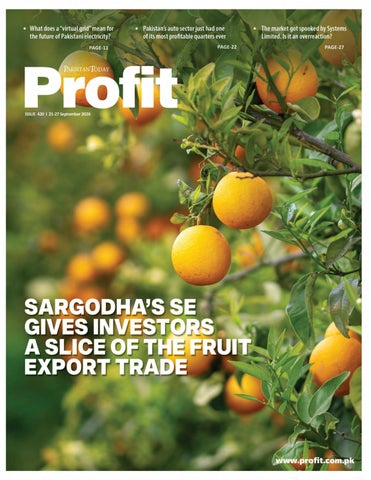
11 What does a “virtual grid” mean for the future of Pakistani electricity? 14 Sargodha’s SE gives investors a slice of the fruit export trade 20 The next move Muhammad Azfar Ahsan
16
22 Pakistan’s auto sector just had one of its most profitable quarters ever 24 The inflation trap facing Pakistani businesses Asif Saad 27 The market got spooked by Systems Limited. Is it an overreaction?
11
24
34
32 Geely to enter Pakistan with three SUVs as Bestway bets on local assembly 34 PTA orders Ufone operator to stop new ONIC sales activations over MVNO license requirements 36 APTMA eyes control in cotton research committee as govt might raise cotton cess
Profit Publishing Editor: Babar Nizami - Senior Editor: Abdullah Niazi Business Reporters: Taimoor Hassan | Usama Liaqat | Zain Naeem | Shahnawaz Ali | Ghulam Abbass Ahmad Ahmadani | Aziz Buneri - Sub-Editors: Saddam Hussain | Abdul Hameed - Video Producer: Adnan Maqsood Director Marketing: Muddasir Alam - Regional Heads of Marketing: Agha Anwer (Khi) Kamal Rizvi (Lhe) | Malik Israr (Isb) GM Special Projects Zulfiqar Butt - Manager Subscriptions: Irfan Farooq Pakistan’s #1 business magazine - your go-to source for business, economic and financial news. Contact us: profit@pakistantoday.com.pk
What does a “virtual grid” mean for the future of Pakistani electricity? Virtual grids might be coming to Pakistan in the future. What are they, and why are they important? POWER
11
T
he government is looking to reform the electric grid to better prepare it for the future. In a recent meeting of the National Assembly Standing Committee on Power, Federal Energy Minister Awais Leghari hailed the coming on of a “battery revolution,” and underscored the need to prepare infrastructurally to deal with it. This would involve not only the installation of grid batteries to expand energy storage and improve the efficiency of our electrical infrastructure, but also the development of virtual grids. Regarding the former measure, the minister directed power distribution companies (Discos) to install grid batteries. As for the latter, he announced that regulations for virtual grids were under development, but were expected to be finalised by the end of the current fiscal year. The need for grid development cannot be underscored enough. Not only is our transmission system famously inefficient and loss prone, costing billions of rupees, but the general cost of electricity is high compared to regional peers, again costing us billions in precious foreign exchange. This need was already there, when the newer phenomenon of solar – mostly rooftop solar – shot up in Pakistan, offering a way out to the millions bearing the costs of inefficient energy systems. But this solar also offers a way out to implement, for once, an overhaul of this wasteful system. With houses increasingly installing solar – by some estimates, 1 in 8 households have already installed solar – and businesses too rushing into the fray, Pakistan finds itself with a massive private, individuated alternative solar grid, estimated to be around 50 MW. Each house with solar installed produces some of its needs at least, supplementing them with grid electricity if needed; in other cases, where the solar production exceeds their consumption, they sell electricity back to the grid. And it is precisely this connection of individual solar installations to the grid – and by extension, to other electricity consumers – that is at stake here, and that can offer a way out. The government with its emphasis
on “virtual grids” and batteries appears to recognise the utility of this arrangement. The rising energy costs, attributable in great part to the rising fuel costs because of the crisis in the Persian Gulf, obviously raise alarm bells to find alternative measures of power generation, to enable a country to be as independent as it can be from frailing supply chains prone to the lashings of geopolitical risk.
What might this new grid arrangement look like?
I
n a traditional grid, the traffic is one way. Power is generated in power plants and then transmitted through high-voltage electric lines into homes and other places where electricity might be needed. This electricity, being consumed, is lost – more accurately, converted into other forms of energy to satisfy needs and desires. Another key point about this traditional arrangement is that large amounts of electricity is not really stored anywhere, so the grid must be active on its feet and constantly respond to shifting demand and ensure electricity is routed to where it is most needed. A virtual grid, on the other hand, relies on the interconnection of various sources of power, known as Distributed Energy Resources, or DERs. In the context of Pakistan, these DERs would certainly include household solar installations with batteries. But these DERs could also include load shifting devices such as thermostats or EV chargers, which can modulate their electricity usage as needed. A key form of the virtual grid is the Virtual Power Plant or VPP. Let us take solar batteries as an example. First of all, these individual batteries – which are too small to matter on their own – are connected to a centralised system. This system is digitally monitored and managed by a grid operator. These diverse power sources are aggregated to form a single final source of power. For example, 1000 home batteries, each of 5kW, can together form a 5MW virtual battery, or a VPP. The grid operator simply manages
this consolidated source through a digital or virtual platform, and if electricity is required somewhere else, can monitor and control this electricity storage and send electricity to where it is needed in real time. The consumer gets paid or is offered incentives for the electricity discharged through their batteries into this virtual grid. The whole system greatly alleviates the need for costly and polluting generation of electricity in powerplants. These VPPs can serve as energy reserves for electric utilities, especially during peak demand hours or emergencies. In other arrangements, these VPPs can also buy electricity when electricity rates drop, store it in batteries, and then sell it to the grid when prices rise. Whatever the arrangement, this distributed source of electricity leverages the excess capacity that’s distributed among individual households to fulfil the needs of the whole grid. It is a two-way street: you may still receive electricity from the grid, but you can also sell it back to the grid. It is also quite possible that for some consumers, it might become a oneway street: you produce more electricity than you need, and sell the rest to the grid. In fact, as Ms. Sonia Dunlop, the CEO of the World Solar Council, pointed out in an interview with Profit, such systems have been functioning in Australia, for instance, where there are entire days, especially in Southern Australia, where the entire electricity grid is run on rooftop solar. The key, however, for this newer system is the large-scale installation of batteries, which the Australian government made a concerted effort to encourage. These batteries since they can be drained when needed permit the flexibility this whole system depends upon. Without such batteries, the system would fall, as there would be no consolidated source of energy that the VPP could draw electricity from.
How important is such grid reform for Pakistan? Very important.
A battery revolution is coming to Pakistan, and work on developing regulations for virtual grids is underway. We expect it to be finalised by the last quarter of the current fiscal year Awais Leghari, Federal Minister for Energy
12
There are entire days now in South Australia, where the entire electricity grid of South Australia is run entirely on rooftop solar. And it absolutely can be done [here in Pakistan as well] Sonia Dunlop, CEO of Global Solar Council
The power crisis in the country is critical, to put it mildly. A straightforward diagnosis is that electricity in Pakistan is just much more expensive than it is in regional economies. While in India and Bangladesh, the per unit cost of electricity hovers at around 9 to 9.5 cents, in Pakistan it is more than double that: 21 cents. Mr Abbas Khan, a consultant with the King Salman Energy Park (SPARK), points out that the high power prices in Pakistan are due more to “pernicious power policies” than to international price fluctuations. He singles out the 2015 Power Policy, whereby over 10,000 MW of “hyper-expensive” power plants reliant on imported fuel were established. Not only were these projects locked into “take or pay” contracts with dollar-based fuel and capacity charges, but they also eschewed reliance upon local power sources, such as the 4000 MW Thar Coal project. So, we are losing money simply because of how our grid system is structured. We buy fuel for our power in dollars but sell this power in rupees. Transmission line losses are not new and have been much bemoaned as a cause of high electricity prices. But according to Mr Abbas Khan, these losses on their own do not explain why the cost of production of electricity is so high compared to regional peers. He points out, again, an “uncompetitive ‘whole chain’ of production” as the main cause of failure. In fact, in the meeting we mentioned at the very start of the story, the Energy Minister did mention the disruption in the Strait of Hormuz as a cause of the current energy crisis, since the cost of imported fuel has risen by over 2x. Loadshedding is needed simply to keep consumption in check and, therefore, electricity prices from rising. This inefficient system becomes an even bigger problem when we consider that currently our per capita consumption of electricity is a measly 0.5 MW. For comparison, Bangladesh is at 0.75 MW, India at 1.6 MW, while Turkey and South Africa are around 3.75 MW. Considering that the demand is depressed in Pakistan, and the advent of new energies, particularly in the form of electric vehicles, this demand will only go up, the need for grid
reform becomes even more important. All this is not simply an issue of convenience, but actually costs real dollars (which is also real inconvenient, to be sure). The balance of payments cannot simply be improved by exporting more, since energy costs (among other costs) these exporters have to bear are much more than their neighbours must. If these exporters are then heavily incentivised, however genuine the need for such measures might be, it would be a way of letting the inefficient system continue to drain precious reserves. Such incentives, if the system is not improved, only increase the future cost of any such incentives. Modernising the grid into a solar-integrated system managed by an Advanced Distribution Management System (ADMS) would, on the other hand, according to Mr Abbas Khan, save us around 12 billion dollars per year. That’s just so much crucial foreign reserves that can then be used for more and better avenues of growth.
What might be the potential hurdles?
T
he first thing would obviously be the money required to effect an overhaul of the current grid. Lithium-ion batteries required for the large-scale deployment of household battery systems or DERs are still expensive for the common solar consumer in Pakistan, though as Ms Sonia Dunlop points out, things are moving in the right direction and prices are falling. On the grid level, the cost of making it smart and also installing large grid-level battery energy storage systems (BESS), has been estimated to 14 billion dollars. That’s not an inconsequential amount to invest upfront, but the potential savings might make the proposition effective. Money is only part of the problem. Technical hurdles are another. In fact, Mr Abbas recognises this: “Implementing connection solar to the grid is fiendishly difficult”. Talent that can handle large scale implementation of this solution is scarce in the country. In fact, even training grid operators to manage a virtual grid with a large fleet of small solar and storage systems is an important investment that would be needed, something that Australia, for in-
stance, was able to realise. But Pakistan is different from Australia, and in a context such as Pakistan’s, where such centralised connectivity is sparse, digitally connecting the batteries of individual households might seem an idea a little far-fetched at the present. This would obviously require political will to plan for long-term solutions, and regulatory structures to ensure the execution of these solutions. The regulatory framework would not only be needed to recognise battery storage as a key part of the grid system, but also lay down requirements and conditions governing the formation of virtual grids and the aggregation of DERs, while working to standardise technical protocols determining the interoperability of various kinds of smart grid devices. Until now, the adoption of solar and storage systems has taken place almost solely due to the desire and will of individual persons or organisations. It has been organic, but for it to truly translate into an actual national-level solution, the government would have to be proactive and capitalise on this momentum. This would involve not only investing in the technical aspects of the modernisation of the grid and the integration of battery storage systems into the national grid, but also require investment in the broader ecosystem of solar and battery storage systems. Ensuring the access of these advantages to those who cannot afford to install solar, for instance, must be part of such a strategy. It would also require planning for the future. One of the most important concerns would be recycling of all these solar panels that Pakistanis have been importing. Once their lives run out, would we be forced to import them again, or would we by then become smart enough to invest in recycling facilities to make this reliance upon solar energy a more sustainable phenomenon. In order to make the grid smart, the government would have to think smart and long-term. After all, the potential offered by connecting the grid to solar and battery systems and making it digitally connected is too immense to be squandered. n
POWER
Sargodha’s SE gives investors a slice of the fruit export trade
14
Founded in 1998 as Shaheen Enterprises, SE Fruit and Vegetable is proof that Pakistan’s ability to create high quality produce can be turned into serious export earnings if the supply chain network and value addition is there. As the company heads to the PSX, investors will let their verdict be known
I
By Zain Naeem
t is a testament to the growth of the Pakistan Stock Exchange that the latest of its many recent Initial Public Offerings (IPOs) is coming from a company that exports fruits and vegetables. For years, PSX listings came from familiar sectors such as finance, cement and textiles. Recent offerings from credit scoring, technology, consumer goods show that pool widening. But it is particularly heartening to see agriculture take its rightful and long overdue place at the adults table. Food is no sideshow in Pakistan’s export economy. In FY2026, the country earned $5.02 billion from food exports, spanning rice, seafood, fruit, vegetables and meat. That was 16.6% of Pakistan’s $30.14 billion in merchandise exports. It remains well behind textiles, which generated $17.93 billion and nearly 60% of the total, but is still a sizable part of our paltry exports. Despite this, agri has had business with remarkably little representation on the exchange. Most of it has come from fertiliser companies and one could argue (at a bit of a stretch) that Al Ghazi and Millat Tractors kind of count. Wahdat Poultry has also been a recent entry, albeit poultry farming is a more developed part of Pakistan’s pretty diverse agricultural sector. Enter SE Fruits and Vegetable Limited. The Sargodha-based family exporter, whose roots go back to a four person operation, wants to issue 30 million new shares. At its floor price of Rs 40 per share, it will raise Rs1.2 billion. If bidding reaches the Rs64 ceiling, that rises to Rs1.92 billion. This is fresh capital, not an owner cash-out. Each of the four sponsors will be diluted from 19% to around 13%, although together they will retain control. Unlike most IPOs, the company is not planning on using the fresh capital on some shiny new plant or equipment. The proceeds will finance the unglamorous but essential cycle of buying produce in season, processing it, shipping it and waiting to be paid. Fruit exports are a cash intensive business, and for SE Fruits and Vegetables Limited the idea of raising money through equity and giving investors a slice of
COVER STORY
the kinnow is more attractive than taking on the expense of debt. Some of the money will also go towards expanding cold-chain and processing capacity, establishing offices and logistics links in the UAE and Uzbekistan, installing new technology and strengthening energy infrastructure. The pitch is simple: give a nearly threedecade-old family exporter enough capital to fill larger orders and reach bigger markets. Whether that will bear fruit for new shareholders is less obvious. To find out, Profit examines SE’s history, business model, financial fundamentals, valuation and the risks investors will inherit alongside its growth ambitions.
From half a murabba to the world
S
E Fruits is proof that Pakistan’s produce need not end up in the nearest available market. It can be graded, packed and pushed into higher-value markets from Dubai to Vladivostok — provided someone does the unromantic work between orchard and port. That was a less obvious proposition in 1998. Back then, Pakistan already grew about 6.3 million tonnes of fruit and 3.9 million tonnes of vegetables, according to FAOSTAT, yet broad fruit and vegetable exports were worth just under $97 million. By 2022 they were worth roughly $713 million, but the sector has modernised less dramatically than that suggests. The government’s current export strategy estimates that no more than 3% of produce reaches foreign markets and post-harvest losses run at around 40%. There has never been a fruit shortage in the country; the problem has always been the absence of supply chains capable of turning all that fruit into reliable export earnings. Shaheen Enterprises was born into that gap on October 26, 1998. The Sargodha-based Association of Persons was owned equally by four members of one extended family: Shahzad Anwar, his brother Mahmood Ahmad, their nephew Mudassar Nazir and another nephew, Muhammad Asif, who is Mudassar’s cousin. On paper they were partners; in practice, this was a family affair built around Sargodha’s defining crop, the kinnow. Its first market was Dubai, supplied exclusively between 1998 and 2000. Rather than chase foreign supermarkets, Shaheen cultivated importers, wholesalers and distributors that knew how to clear perishable cargo, extend credit and place produce on local shelves. Even today, SE does not generally sell directly to chains such as Lulu, Nesto and Panda; its fruit reaches them through trade partners. This was a sensible, asset-light route into markets a small exporter could not service alone. It also surrendered margin, brand
16
control and the direct consumer relationship. That bargain remains visible: the network is SE’s moat, but dependence on it is a risk. Its ten largest customers generated 83% of FY26 sales; the largest alone accounted for 21%. The map widened in stages: the broader Gulf by 2002; Iran and Russia in 2006; Ukraine in 2007; Indonesia in 2010-11; and the Philippines and Singapore in 2015. Shaheen added another kinnow line in 2008 and later reached large Russian retailers through importers. Bahrain, Qatar, Oman, Bangladesh and Sri Lanka followed. The farming operation is almost comically small beside that footprint. The prospectus puts SE’s orchard at about 14 acres, barely more than half a murabba. That is paltry by the standards of Punjab’s landed elite. But SE’s value lies not in sitting on an estate waiting for
land prices or the harvest, but in grading, waxing, chilling, packing, financing and moving a region’s produce. Punjab’s old landowners, many of whom mistake acreage for enterprise, could learn a thing or two about where money is actually made. The orchard gives SE farm-level knowledge, but barely any volume. In FY24, just 1% of its kinnow came from its own land; 62% was bought directly from other orchards and 37% through middlemen. By FY26, direct purchases had slipped to 54% and middlemen rose to 45%, but growers still supplied the majority. In an economy addicted to layers of aarthis and commission agents it is an impressive supply network. SE is embedded in Sargodha’s orchards and can inspect and aggregate fruit at source. A kinnow tree in an orchard in Lalyani,
A kinnow tree in an orchard in Lalyani, District Sargodha. Over the years, kinnow acreage in Sargodha has decreased from 4.5 lakh acres to 3.5 lakh acres due to virus outbreaks. SE Fruits and Vegetables has a small farming operation of their own which keeps them well aware of the farm level realities that go behind their export operations. District Sargodha. Over the years, kinnow acreage in Sargodha has decreased from 4.5 lakh acres to 3.5 lakh acres due to virus outbreaks. SE Fruits and Vegetables has a small farming operation of their own which keeps them well aware of the farm level realities that go behind their export operations. That combination of control at home and reach abroad is what Mohammad Nadeem, Head of Corporate Finance at Topline Securities, one of the issue’s joint lead managers, identifies as SE’s central advantage. “SE Fruits’ strength lies in its sourcing expertise, access to skilled and experienced seasonal labour, relationships with suppliers that can extend credit, and strong ties with buyers. The importer and trader network built by Shaheen Enterprises since 1998 spans the Middle East, South Asia, Central Asia, the Far East and CIS markets. Together with SE’s sourcing base in Sargodha and its record of maintaining quality and shipping on time, that network underpins repeat business and the letters of intent received for FY2027,” he says. There is a neat logic here: SE removes intermediaries where they blur traceability and take a cut, but uses them abroad where they provide distribution and market access. Its two kinnow lines can handle 36,000 tonnes in a double-shift season. FY26 throughput was 11,600 tonnes, or 32% of capacity. The constraint is not simply land or machinery, but the cash to buy fruit, process it and wait for foreign buyers to pay. Shaheen repaid a Rs50 million bank loan in 2023 and has since operated without borrowings. That kept finance costs negligible, but left growth dependent on equity and
supplier credit — another reason working capital, rather than more machinery, sits at the heart of the IPO. Kinnow is a high-yield mandarin prized for its juice, aroma, easy peel and sharp-sweet taste. SE sells washed, waxed and graded fruit, including larger calibres favoured in the GCC and Far East. The November-to-March crop needs careful de-greening and cold-chain
handling. Blemished, damaged or wrongly sized fruit goes to local buyers or processors; in FY26, the prospectus says rejection from export grade averaged 40%. Afghanistan has traditionally been an important outlet for Pakistani produce, particularly smaller kinnow, and the land corridor into Central Asia. The prolonged border closure since late 2025 has angered traders and removed that release valve. SE sold 930 tonnes to an Afghan buyer in FY25 and none in FY26, yet Far Eastern shipments largely continued. The company is hardly immune to war or borders, but it is proof that Pakistani produce can sell beyond the nearest, lowest-friction market. In 2016, after nearly two decades centred on citrus, Shaheen added mangoes. The crop neatly fills part of the summer gap after the kinnow season and brings far higher realisations. SE exports Sindhri, Fajri, White Chaunsa and Anwar Ratol: Sindhri opens the season; firmer, longer-lasting Fajri can travel farther; and the intensely sweet Chaunsa and aromatic Anwar Ratol are established in Gulf, British and Australian markets. But the mango operation is not yet as deeply rooted at farm level as kinnow. Despite the prospectus’s general language about direct orchard procurement, its own table shows that 100% of mangoes were sourced through middlemen in each of FY24, FY25 and FY26. Mango is therefore the richer segment, but currently has the weaker procurement system.
An Afghan farmer sorts grapes for making raisins inside a tent at Panjwai district in Afghanistan’s Kandahar province on August 5, 2026. Thousands of Afghan farmers have had to turn a bumper grape crop into raisins because there is currently no trade with Pakistan. The extended closure of the Torkham border following attacks by the Afghan Taliban into Pakistan has caused farming communities on both sides serious losses. Fruits and vegetables are among the most traded commodities between the two neighbours.
COVER STORY
It was also the source of big earnings for SE in the latest financial year. Regional conflict pushed freight per tonne up 198% and cut mango exports from 3,500 tonnes to 1,515 tonnes. By keeping Pakistani supply out of Gulf markets, it also lifted SE’s average export realisation 117% to Rs525,230 per tonne. Against an average purchase price of Rs115,000, that produced a disclosed 78% procurement spread. This was not a 78% company gross margin — processing, packaging, freight, labour and overhead still had to be paid — but it explains why mango generated Rs1.24 billion, or 58% of revenue, despite comprising only 28% of volume. Good fruit lingered affordably at home while the smaller quantity making it abroad fetched scarcity prices. That bumper spread should not be mistaken for a normal year. It depends on precisely the volatility that makes this business difficult: weather, crop quality, border access, freight routes and a fruit that deteriorates while everyone argues. Kinnow provides scale and the denser sourcing network; mango provides value but more volatile margins. Potatoes, tested in FY23 and FY24, are meant to fill more of the calendar, but were paused when working capital ran short. The family incorporated SE Fruits and Vegetable Limited in August 2025, completed the transfer of Shaheen’s assets and operations that October, and converted it into a public company in January 2026. Shahzad is chief executive, Mahmood oversees procurement and finance, and Mudassar runs business development. In April 2026, Muhammad Asif gifted his holding to his sister-in-law Yasmin Kousar, now a non-executive director. The four current sponsors each own 19% before the IPO. SE has spent almost three decades assembling a family-controlled network that reaches backwards into Sargodha’s orchards and forwards into foreign wholesale markets.
18
Its opportunity is to put more fruit through an underused system.
Profitable, but cash-hungry
T
he four-person enterprise founded in 1998 has grown into a profitable exporter. Its accounts, however, reveal the tension at the heart of the business. SE can make good money on a shipment and still wait months for that money to reach its bank account. That is simply the nature of trade, which is why fruit export can be a very cash intensive business. The available financial records for the company cover FY2022 to FY2026. Revenue rose from Rs 79.4 crore to Rs 2.13 billion over this period, while profit after tax climbed from Rs10.2 crores to Rs 30.4 crores. The margins are also pretty healthy. Gross margin fell from 37.7% in FY2022 to 24.7% in FY2025 before rebounding to 35.4% in FY2026. Operating margin rose from 14.2%
to 22.5%, while the latest net margin was 14.2%. This is the fruit of doing more than just moving fruit. The company buys produce, grades it, processes it, packs and chills it, then sells into markets willing to pay a premium for what is a value-added product. That premium covers the extra handling and freight, leaving SE with value that an unprocessed sale in a local mandi could never achieve. But the company is far from immune to global shocks. Just look at what happened to it in FY2026. Regional conflict disrupted the normal route through Jebel Ali just before mango season. Mango export volumes fell sharply and freight per tonne nearly tripled. Yet shortages in Gulf markets pushed SE’s average mango selling price up by more than 100%, more than compensating for the extra freight. The company handled the disruption well, but investors should not mistake an exceptional price spike as a given next time there are shipping disruptions. Meanwhile trade receivables reached Rs995.9 million at June 2026 — almost twothirds of total assets of Rs1.52 billion. The prospectus says all those receivables were less than six months old, so this is not evidence of bad debts. It is just illustrative of the long cash cycles that define this business. As Mohammad Nadeem, Head of Corporate Finance at Topline Securities, puts it: “Receivables are high because export sales are seasonal and customers get credit terms at season end. The company is working on tighter credit terms and faster collections. Part of the IPO proceeds is for working capital, which reduces reliance on customer collections to fund the next season” SE carried no bank borrowing in FY2026, although trade and other payables stood at Rs400 million. In other words, debtfree does not mean cash-rich. That is the case for the IPO. SE is not asking investors to plug an operating loss, but to bridge the interval
between buying the fruit and collecting the export proceeds. As the IPO stands, it is essentially bridging the cash gap. As mentioned at the beginning, SE is seeking to raise between Rs1.2 billion and Rs1.92 billion through equity rather than debt. Of the money raised, 78% will go towards working capital, funding the purchase, processing and shipment of produce before customers pay. That essentially means keeping the company liquid and limber to export more than it currently can with cash flow restrictions. Another 13% will expand cold-chain and processing capacity. The remaining 9% will fund overseas offices, reefer containers, technology and energy infrastructure. The idea is that the fresh equity-raised capital will allow SE to operate in a debt-free position. Yes, this dilutes its owners and subjects the family business to greater investor scrutiny, but that should not be a problem for a wellrun company.
What is SE really worth?
W
hen book building begins on Monday, investors will be valuing not only the business SE has built, but the much larger one management says the IPO can create. The prospectus uses a discounted cash flow model, which estimates what future cash flows are worth today. It assumes an 11.53% risk-free rate, a 6% equity risk premium, a beta of one and terminal growth of 4%. Those assumptions produce a cost of equity of 17.53%. With no debt, the model values free cash flow available to shareholders. The result is an estimated equity value of Rs7.96 billion, or Rs84.95 per share: 112% above the Rs40 floor and 33% above the Rs64
ceiling. But a DCF is only as convincing as the forecasts entered into it, and SE’s are ambitious. Revenue is projected to rise from Rs2.13 billion in FY2026 to Rs5.05 billion in FY2027 — growth of 137% in one year — before approaching Rs11 billion by FY2031. The model assumes the dollar reaches Rs 355 by then and FY2027 exports include 12,600 tonnes of kinnow, 7,726 tonnes of mangoes and 10,000 tonnes of potatoes. That is a steep jump. SE recorded exports of 3,600 tonnes of kinnow and 1,515 tonnes of mangoes in FY2026, although another 2,096 tonnes of export-quality kinnow passed through Shaheen Enterprises during the corporate transition. Even after that adjustment, kinnow exports must more than double, mango exports must rise fivefold and potato exports must restart from zero. SE argues that FY2026 was constrained by disrupted shipping and, more importantly, insufficient working capital. It points to letters of intent received from seven customers
covering 68,608 tonnes. Topline Securities explains this by saying the projections are based on letters of intent received in August 2026 from seven customers for 68,608 tons. “Projected FY2027 exports of 30,326 tons cover only 44.2% of those LOIs. The step-up comes from higher volumes, supported by working capital from the IPO proceeds that lets the company buy and ship more in-season. The LOIs are non-binding, so the projection takes a conservative share of them.” That defence has merit, but the last sentence matters most. Letters of intent show demand; they are not confirmed orders. SE also has no long-term contracts with growers or customers. Each season it must secure produce and win sales again, leaving volumes exposed to crop quality, prices, freight and geopolitics. The valuation also leans heavily on the distant future. Of the Rs7.96 billion equity value, Rs4.73 billion — around 59% — comes from cash flows beyond FY2031. SE says alternative routes through Oman, access to 25 markets and its planned Uzbekistan office provide options when Gulf shipping is disrupted. They help, but cannot remove the risks of exporting perishable produce. Still, this is not a paper venture. SE brings nearly three decades of operating history, an entrenched sourcing network, real customers and a profitable business to the exchange. Investors, however, are not merely buying that history. They are funding a rapid expansion built on non-binding demand and management’s ability to turn capital into shipments. The question on book building day is not whether SE can sell fruit abroad. We already know that it can do so very successfully. The question is whether the company can use the interest in the IPO and turn it into cash orders. That will be the crux of the matter for the business and for its new investors. n
COVER STORY
OPINION
Muhammad Azfar Ahsan
The next move
question is why an investor should commit capital, remain, reinvest, expand, and encourage others to follow. An investor needs timely approvals, protected contracts, predictable taxation, understandable regulations, functioning infrastrucor years, Pakistan has become remarkably good at answering the ture, credible security, and resolvable disputes. Investment wrong question: how do we get through the next crisis? The more promotion creates visibility; investment infrastructure creates important question has remained largely unanswered: how do we confidence. build a country that no longer lives from crisis to crisis? We have The same principle applies to domestic capital. Why diagnosed our weaknesses, managed our emergencies, announced should a Pakistani entrepreneur commit capital for the next our reforms, and repeatedly promised a reset. What Pakistan needs now is not twenty years to Pakistan? If our own businesses hesitate to another diagnosis. It needs direction, it needs strategy, and it needs the resolve to expand, modernize, formalize, innovate, or reinvest, that hessee both through. The real question is no longer what is wrong with Pakistan; it itation is itself a measure of economic confidence. A country is what Pakistan will do next. that cannot persuade its own citizens to invest in its future This question was at the heart of the 9th Edition of the Leaders in Islamwill struggle to persuade the rest of the world to do so. abad Business Summit, held last week under the theme “The Next Move”. The Our investment agenda should, therefore, move from Summit brought together policymakers, diplomats, business leaders, investors, promotion to architecture, connecting federal, provincial, and international institutions, technology leaders, and other stakeholders. Across the local institutions around the complete investor journey, from discussions, one conclusion became increasingly clear: Pakistan does not suffer entry and facilitation to operations, problem resolution, reinfrom a shortage of potential, ideas, talent, or resilience. Its deeper deficit is the vestment, expansion, and integration into global value chains. ability to convert these assets into sustained national progress. The second move is to build a national strategy rather Our economic conversations have too often been organized around the than another collection of economic initiatives. next crisis – the next financing requirement, fiscal gap, external account presPakistan needs to decide what kind of country it wants sure, investment announcement, export target, or emergency reform becomes to become over the next twenty years. The hierarchy should the immediate priority. We solve what is urgent and postpone what is importbe clear: national strategy establishes direction, economic ant. Over time, firefighting becomes a governing model. strategy provides the engine, sector strategies define priorThe pause I argued for earlier was never intended to mean inactivity. It ities, institutions own delivery, and measurable outcomes was a call to step back from immediate pressure, examine the country’s architecdetermine success. Stabilization is necessary. Stabilization is ture, and make choices that can survive beyond the next political or economic not development! cycle. A pause has value only if it produces direction. A functioning economy must generate productive The first move is to fix the foundations. investment, productivity, exports, employment, innovation, Political stability, policy continuity, rule of law, predictable taxation, conand fiscal capacity. Pakistan, therefore, needs an economic tract enforcement, security, merit, and effective administration determine the enstrategy connecting fiscal discipline with investment, exports, vironment in which an economy functions. Businesses make long term decisions energy, infrastructure, technology, human capital, and probased on predictability, investors price uncertainty, and citizens decide whether ductivity. to build and invest partly on whether the rules will work tomorrow. But strategy must also be selective. A country cannot Pakistan cannot build a competitive economy on unpredictable rules. We execute one hundred priorities simultaneously. Pakistan have spent years asking how to attract foreign capital. The more fundamental should identify a limited number of national priorities for the next decade and concentrate political attention, institutional resources, and public accountability around them. Those priorities should include macroeconomic stability, investment, exports, energy, human capital, education and Writer is a public policy advocate, business skills, technology and artificial intelligence, agriculture and food security, infrastructure strategist, and former Pakistan’s Minister for and connectivity, and state reform. Each priority must have one accountable institutional Investment. He serves as a strategic advisor to owner, a defined timeline, measurable outcomes, and a mechanism for public review. leading corporate entities, focusing on business The third move is to rebuild the state for delivery. policy, investment facilitation, and leadership We are a country of nearly 260 million people operating in an environment transbranding. He writes and speaks extensively formed by technology, demographics, economics, geopolitics, and business. Yet many on investment, economic governance, institutions still operate through overlapping mandates, outdated processes, administrabusiness policy, competitiveness, economic tive layers, and insufficient specialization. transformation, and society. We do not necessarily need more institutions; we need institutions that work. Every ministry and public body should answer four questions: What outcome is it
F
20
responsible for delivering? What authority does it possess? How will results be measured? Who is accountable when it fails? This requires professional leadership, subject expertise, digital systems, coordination, results management, and merit. Reform is not about redrawing organizational charts; it is about making the state capable of timely decisions and delivery. Local governments must be part of this restructuring. Citizens do not experience the state primarily through Islamabad; they experience it through schools, hospitals, roads, sanitation, water, transport, policing, land administration, and municipal services across all districts. An effective state, therefore, requires empowered, financially viable, and accountable local institutions. The fourth move is to make people and enterprise the engine of growth. Pakistan cannot aspire to become a competitive economy while millions of children remain outside quality education. The often-cited figure of approximately 29 million out-of-school children is not simply an education statistic; it is a warning about the country’s productive capacity two decades from now. Education reform must, therefore, be treated as economic policy. The challenges are learning, teachers, technology, vocational training, employability, and the connection between education and a changing economy. The government cannot create prosperity by itself; the private sector must be at the center. Businesses must invest, innovate, formalize, improve productivity, develop talent, adopt technology, enter global value chains, and compete internationally. Business organizations should become active partners in improving competitiveness and shaping practical reforms. We also need to make Pakistan competitive rather than merely active. Exports must become a central pillar of national economic strategy. Competitiveness of export cannot be created through incentives alone. A globally competitive business requires reliable energy, efficient logistics, access to finance, skilled people, technology, predictable taxation, competitive regulation, and the ability to meet international standards. Agriculture needs productivity, storage, processing, technology, and market access. Manufacturing needs modernization, scale, quality, and global value chains. Services need digital infrastructure, skills, regulatory flexibility, and international markets. Artificial intelligence and digital transformation should become economy wide productivity tools. But technology cannot rescue broken systems. Digitizing an inefficient process merely creates digital inefficiency. We must simplify before we digitize. The fifth move is to institutionalize continuity. The real test of a national strategy is whether the country can continue implementing it after the government that launched it is gone.
Governments will change; political competition will continue – that is the nature of democracy. But national priorities should not be reset every few years. Pakistan needs a mechanism for setting long-term priorities, monitoring implementation, measuring outcomes, and maintaining direction across political cycles. This is ultimately a leadership question. Leadership is not the ability to announce another initiative. It is the discipline to establish a direction, make difficult choices, resist short term pressures, empower competent institutions, and measure success through outcomes rather than announcements. But there is an even deeper question. Pakistan’s problem is not merely that the state is weak; it is that the relationship between the state, the citizen, and the economy has not been redesigned for the Pakistan of today. A state earns legitimacy because citizens experience it as fair, predictable, and capable. A citizen should not need influence to obtain a lawful service. A business should not require personal access for routine approvals. Justice should not depend on social standing. The state must become more enabling. Its purpose is not to regulate every aspect of economic and social life, but to provide the foundations within which citizens and markets can perform: security, justice, infrastructure, human capital, fair regulation, competition, and predictable rules. The state should own what it must, regulate what it should, and enable everything else to become more productive. This is a new state-citizen compact. Citizens need security, justice, basic services, equal treatment, and economic opportunity. The state, in turn, needs citizens and businesses that comply with the law, contribute through taxation, invest, innovate, and participate productively in the economy. This compact must become the foundation of the reset. There is also a hard truth that we must confront. Pakistan does not have the luxury of spending another decade experimenting with short term fixes. Every year of uncertainty carries a cost: capital that is not invested, businesses that do not expand, young people who do not acquire skills, exports that are not created, and institutions that become harder to reform. The cost of delay is not measured only in lost growth. It is measured in lost opportunity. The global order is changing. Geopolitical competition increasingly influences trade, technology, investment, energy, supply chains, and strategic partnerships, while competition for capital, talent, markets, and technology intensifies. Pakistan has geography, strategic relevance, a large domestic market, and important international relationships. But strategic relevance alone does not create economic prosperity. We must convert geopolitical relevance into geoeconomic opportunity. Trade corridors must produce trade;
strategic relationships must produce investment; connectivity must produce exports; technology partnerships must produce capabilities; and diplomacy must open markets. Foreign policy and economic strategy, therefore, cannot operate as separate conversations. Pakistan’s international relationships should increasingly be connected to investment, trade, technology, energy, skills, connectivity, and market access. But there is an essential condition. Before asking the world to invest more in Pakistan, we must make Pakistan more investable. Before asking global companies to trust our institutions, we must strengthen confidence among our own businesses and citizens. Pakistan does not need another decade of managing symptoms. It needs a decade of building capacity, expanding opportunity, and delivering measurable results. The next move should, therefore, be a national course correction: from firefighting to foresight, from adhocism to strategy, from announcements to execution, from discretion to predictable rules, from dependence to competitiveness, and from short term stabilization to long term development. Pakistan has survived crisis after crisis because its people have repeatedly found the resilience to endure what its systems have failed to prevent. But resilience cannot remain a national strategy. A country cannot build its future by continually preparing for the next emergency. At some point, survival must give way to construction, reaction must give way to strategy, and potential must be converted into performance. The next move, therefore, cannot be another announcement, committee, or temporary intervention. It must be a deliberate national commitment to establish priorities, assign responsibility, measure results, empower capable institutions, and remain focused beyond political cycles. Pakistan needs to build an economy in which capital is invested with confidence, businesses compete with the world, young people acquire the skills to shape the future, and citizens experience a state that works. We already know much about what must be done. The challenge now is to summon the courage to act, the clarity to remain focused, and the accountability to measure whether it is working. The choice is no longer between one reform and another. It is between continuing to manage recurring crises and building the capacity to prevent them. History will not ultimately remember how many crises Pakistan managed or how many plans it announced. It will remember whether, when the country reached a moment that demanded a decisive change of course, its leaders and institutions had the wisdom to choose a national direction, the courage to stay the course, and the discipline to transform Pakistan’s extraordinary potential into a stronger, more prosperous future for generations yet to come. n
COMMENT
Pakistan’s auto sector just had one of its most profitable quarters ever
Listed automobile companies earned Rs28.4 billion in the June quarter, up 39% from a year earlier, as vehicle sales rebounded sharply. Volumes are surging, competition is intensifying, and a surprisingly large part of the earnings growth came from income outside the core car-making business.
F
or Pakistan’s automobile industry, the recovery is no longer merely visible in showroom traffic. It is showing up very clearly in corporate profits. The automobile companies represented in the KSE-100 Index collectively earned Rs28.4 billion during the quarter ending June 2026, an increase of 39.2% compared with the same period a year earlier, according to a September 17 research report by Arif Habib Limited (AHL). Combined revenues rose even faster in absolute terms, climbing 33.7% year-on-year to Rs310.9 billion. The numbers represent one of the strongest quarters the listed automobile sector has produced in recent years. The chart on page 5 of the AHL report shows aggregate after-tax profit rising from Rs18.8 billion in June 2025 to Rs28.6 billion in June 2026, broadly consistent with the report’s headline Rs28.4 billion figure after rounding and reporting-period differences. It is also above the Rs27.9 billion recorded in the March 2026 quarter. Yet the more interesting story is not simply that profits went up. The recovery is being driven by a combination of higher vehicle sales, a revival in automobile financing, new model launches and unusually strong “other income” — meaning earnings that, in many cases, came from compa-
22
nies’ cash holdings and one-off items rather than from assembling and selling vehicles. And underneath the industry-wide boom, the fortunes of individual manufacturers are beginning to diverge sharply.
People are buying cars again
T
he most important underlying factor is straightforward: Pakistanis are buying substantially more vehicles. Sales volumes of cars, light commercial vehicles and four-wheel-drive vehicles rose 32.4% year-on-year during the quarter to 62,416 units, compared with 47,155 units during the corresponding period last year. That increase translated directly into higher sales for most manufacturers. AHL points in particular to the rebound in auto financing. Outstanding automobile financing reached Rs381.69 billion by the end of June 2026, up 38% from Rs277 billion a year earlier. The relationship is important in a market where the affordability of monthly instalments can have an enormous impact on new vehicle demand. The recovery extended well beyond passenger cars. Tractor sales rose 42.6% year-on-year to 8,499 units during the quarter, from 5,962 units a year earlier. Truck sales climbed 37.2% to 2,561
units. And the two-wheeler market — by far the largest part of Pakistan’s motor vehicle industry by unit volume — expanded 27.4% to 530,481 units. Atlas Honda sold 465,212 motorcycles during the period, an increase of 28.9%, meaning it slightly outpaced the overall two-wheeler market and gained share. So at the broadest level, this was a volume-led recovery. But it was not equally distributed.
Sazgar is becoming impossible to ignore
T
he standout performer was Sazgar Engineering Works. Sazgar earned Rs8.7 billion during the quarter, up an extraordinary 150.6% from a year earlier. That made it the largest profit generator among the automobile companies included in AHL’s analysis, ahead of both Indus Motor Company, the assembler of Toyota vehicles, and Atlas Honda. The growth is even more striking when viewed through revenues. Sazgar’s quarterly revenue rose 180.7% year-on-year to Rs76.5 billion. Four-wheeler sales increased 2.3 times to 6,549 units, helped by the expansion of the company’s Haval vehicle business and deliveries of the Tank 500. The remarkable aspect of Sazgar’s rise is
how quickly the structure of Pakistan’s listed automobile sector has changed. For years, the sector was dominated in financial terms by the Japanese assemblers and, in volume terms, by Atlas Honda’s motorcycle business. Sazgar’s emergence as the sector’s single largest quarterly profit contributor demonstrates how quickly Chinese-branded SUVs and crossovers have altered the competitive landscape. That growth has not come without pressure. Sazgar’s gross margin stood at 22.3% during the quarter, lower than it might otherwise have been because of what AHL describes as an unfavourable shift in product mix. That is an important distinction. Sazgar is selling many more vehicles and making substantially more money, but the composition of those sales matters enormously to profitability.
Honda stages the sharpest comeback
I
f Sazgar delivered the biggest absolute profit, Honda Atlas Cars delivered the sharpest percentage increase among the major passenger-car assemblers. Honda Atlas earned Rs2.5 billion in its first quarter of model year 2027, three times the Rs829 million or so implied by the year-earlier comparison. Net revenue rose 40.6% to Rs37.2 billion, while vehicle volumes increased 43.4% to 7,918 units. The company’s core margins, however, remained relatively thin. Honda Atlas reported a gross margin of just 7.7%, the lowest among the major companies included in AHL’s sector table. Its profit growth was therefore helped substantially by other income, which surged 277.9% year-on-year to Rs2.09 billion. AHL attributes much of that increase to a one-off gain related to the Special Industrial Development Charge, or SIDC. This theme — booming profitability without a corresponding expansion in manufacturing margins — runs throughout the sector results.
Toyota feels the competition
I
ndus Motor Company was one of the few companies to go backwards. The Toyota assembler earned Rs6.1 billion during the June quarter, down 5.4% year-on-year. Revenue fell 4.1% to Rs66.8 billion, while vehicle sales declined 3.8% to 11,333 units. AHL explicitly attributes the decline in volumes to rising competition. That may be one of the most consequential findings in the entire report. Pakistan’s overall automobile market is expanding rapidly, yet Toyota’s volumes declined. In other words, the problem was not that Pakistani consumers stopped buying cars; it was
that they bought more cars from somebody else. Toyota’s gross margin fell to 10.3%, with AHL attributing the decline partly to a change in revenue mix. Other income still increased 22%, helped by a one-off SIDC gain, cushioning the deterioration in the operating business. For a company long accustomed to operating in a market dominated by a handful of Japanese assemblers, the rapid proliferation of Chinese brands is beginning to show up not merely in market-share statistics but in the income statement.
Tractors recover as well
M
illat Tractors also participated strongly in the rebound. The company’s earnings rose 36.3% to Rs1.8 billion, while revenue increased 50% to Rs18.2 billion. Millat sold 5,784 tractors during the quarter, up 42.4% year-on-year, broadly matching the 42.6% recovery in the national tractor market. Its gross margin of 25.3% was the highest among the companies covered in AHL’s summary. Millat also benefited from a 48.8% reduction in finance costs, highlighting another important feature of the current automobile recovery: the improvement is not confined to retail demand. Companies are also seeing changes in financing expenses and balance-sheet income that materially affect bottom-line profitability.
A mixed quarter for Ghandhara
T
he Ghandhara companies produced more subdued results. Ghandhara Automobiles’ consolidated earnings declined 14.6% to Rs1.6 billion as revenues fell 33.1%. The weakness was largely attributable to lower sales of the T9 pickup, though this was partly offset by 112% growth in JAC light commercial vehicle sales and a nearly fourfold increase in truck sales. Ghandhara Industries, meanwhile, earned Rs1.7 billion, almost unchanged from the previous year despite a 14.4% increase in revenue. Volumes across Isuzu trucks, buses and D-Max vehicles rose 38.3% to 1,536 units. Its other income jumped 233%, primarily because of higher cash balances. Once again, the pattern is clear: rising vehicle sales matter, but large cash piles are also doing a surprising amount of work.
The strange role of ‘other income’
P
erhaps the most revealing number in the entire AHL report is not vehicle sales or revenue. It is Rs11.4 billion.
That is how much the sector generated in other income during the quarter, an increase of 53.5% from the previous year. The chart on page 5 shows other operating income jumping from Rs6.6 billion in March 2026 to Rs11.5 billion in June — the highest level shown in the series going back to December 2023. AHL attributes the increase partly to SIDC-related gains and partly to returns on cash balances. This helps explain an apparent contradiction in the results. Sector profitability surged 39%, but gross margins actually weakened. The aggregate gross margin fell to 15.1% in June 2026 from 18.5% in March and was slightly below the 15.5% recorded in June 2025. In other words, the industry earned much more money even though the amount it made on each rupee of sales before operating expenses generally did not improve. Some of that is simply the mathematics of scale: selling substantially more vehicles at similar margins produces more profit. But some of it reflects unusually strong non-core income. That means the headline 39% increase should not automatically be interpreted as evidence that the underlying economics of automobile assembly improved by the same amount.
A bigger market, and a tougher one
T
he broader conclusion from the quarter is nevertheless difficult to dispute: Pakistan’s automobile market has moved decisively out of the depressed conditions seen earlier in the decade. Consumers are buying more motorcycles, cars, SUVs, tractors and trucks. Financing is expanding again. New models are drawing buyers into showrooms. Listed assemblers collectively generated more than Rs310 billion in quarterly revenue. Yet the recovery is creating a different kind of automobile market from the one Pakistan historically knew. Chinese brands are taking an increasingly prominent position. Sazgar has become the largest quarterly profit earner in AHL’s listed-auto universe. Honda is recovering rapidly. Toyota is feeling competitive pressure even while the broader market grows. And profits increasingly depend not only on how many cars a company sells, but on product mix, cash management, financing expenses and one-off income. That makes the sector healthier in one sense, but harder to predict in another. The easy part of the recovery may have been getting customers back into showrooms. The next stage will determine which manufacturers they actually choose. n
AUTOMOBILES
OPINION
Asif Saad
The inflation trap facing Pakistani businesses I recently came across an interesting way of thinking about inflation. Fabio Panetta, Governor of the Bank of Italy, has borrowed the language of the spaghetti western to describe inflation as the good, the bad and the ugly. “Good” inflation is relatively benign. Prices rise modestly, but wages and productivity broadly keep pace. “Bad” inflation comes from an external shock; an interruption in energy supplies, a poor harvest or a sudden increase in commodity prices which causes a one-off jump in the price level. “Ugly” inflation begins when the process becomes self-sustaining; businesses raise prices, workers demand higher wages, suppliers revise their rates and everyone tries to stay ahead of everyone else. The description struck me because I have been seeing something similar, from a rather different perspective, in my consulting work with different businesses. Pakistani businesses have experienced repeated bouts of what Panetta would probably describe as ‘bad’ inflation; exchange-rate depreciation, energy price increases, imported commodity shocks, taxation and other increases in the cost of doing business. I see the consequences of this becoming embedded in the way businesses operate. Employees expect substantial salary increases because their household expenses have risen. Vendors want to revise prices because their costs have risen. Landlords revise rents and service providers increase fees. Businesses, in turn, try to recover these increases from their customers. From inside a business, it looks like everyone selling to the business wants inflation passed through and everyone buying from the business wants inflation absorbed.
The writer is a strategy consultant who has previously worked at various C-level positions for national and multinational corporations
24
That is the inflation trap facing Pakistani businesses.
When the arithmetic stops working
C
onsider a business with revenue of Rs100 and costs of Rs80, leaving Rs20 of operating profit. If costs rise by 10 percent, they become Rs88. Preserving the same profit requires revenue of Rs108. The obvious response is an 8 percent price increase. But that assumes customers will continue buying the same quantity at the higher price. The customer is living through the same inflation. Household expenditure has risen, disposable income is under pressure and corporate customers have their own budgets to manage. Raise prices and volumes may fall. Hold prices and margins fall. For many Pakistani businesses, part of the response to inflation has traditionally been to pass some of the increase on through higher prices. The ability to do so varies by sector and competitive position, but as long as customers could absorb periodic increases, some margin protection was possible. That becomes harder after successive rounds of inflation have stretched household and corporate budgets. Customers become more price-sensitive and another price increase can begin to cost the business volume. At that point, “our costs have increased, therefore our prices must increase” is no longer much of a strategy.
What are we getting for the higher cost?
S
uppose payroll costs need to rise by 12 percent. Management can regard this as an unavoidable cost increase and try to recover it from customers. But there is another question worth asking; what are we receiving in return for the additional 12 percent? Consider a service business employing skilled people whose market salaries have increased. It could resist those increases, lose its better employees and eventually suffer deterioration in customer service. Or it could increase salaries and accept lower margins. There is a third possibility. The company can redesign the employment bargain. It can pay employees materially more while introducing clearer performance standards, better scheduling, higher utilisation, measurable customer outcomes and greater individual accountability. Roles might be redesigned. Some activities might be automated or eliminated. Incentives can be linked more closely to outcomes rather than activity. The business is then paying more per employee, but it is also getting more value from every rupee of payroll. That is fundamentally different from simply absorbing wage inflation.
In Panetta’s terminology, this is an attempt to turn potentially ‘ugly’ inflation into something closer to ‘good’ inflation; higher wages accompanied by higher productivity. Businesses frequently discuss salary increases and productivity as separate conversations. They should not be. If an organisation is going to reset compensation because the economic environment has changed, that is precisely the moment to reconsider what it expects in return.
Don’t simply pass inflation forward
T
he same principle applies to customers. An across-the-board 10 percent increase because costs have risen 10 percent is administratively convenient but economically crude. Different customers have different price sensitivities and products have different competitive positions. Management therefore needs to understand where it genuinely has pricing power. A consumer business might protect the price of highly visible products while taking more margin elsewhere. A manufacturer might maintain its standard product while introducing a premium version. A service business might maintain its entry price while charging separately for services previously bundled together. Sometimes the answer is not a different price at all. It is a different proposition. A customer unwilling to pay Rs11,000 for yesterday’s Rs10,000 product may still spend Rs10,000 on a redesigned offering. Pack sizes can change, service levels can be differentiated and features separated. This should never become disguised deterioration in quality; charging the same amount for less and hoping customers don’t notice. It should be an explicit redesign of value, allowing customers to decide what they value and what they are prepared to pay for.
Suppliers have to participate too
S
uppliers often present price increases as mathematical inevitabilities. Fuel increased, therefore transport charges must increase. The rupee depreciated, therefore the imported component must cost more. Salaries increased, therefore the service contract must be revised. Businesses need to become more forensic. What proportion of the supplier’s total cost has actually changed? Can specifications or volumes change? Would a longer commitment justify a lower price? Is local substitution possible? The objective is not to squeeze suppliers
until they become economically unsustainable. A fragile supply chain ultimately becomes the buyer’s problem. It is to make productivity a shared responsibility across the value chain rather than allowing every participant simply to pass inflation to the next one. Eventually there is nobody left to pass it to as the consumer sits at the end of the chain.
Inflation consumes cash as well as margin
I
nflation does not only attack the income statement. It consumes working capital as well. If the same quantity of inventory that previously required Rs100 million now requires Rs115 million, the business needs another Rs15 million simply to stand still. Receivables become larger for the same volume of business. A company can therefore report growing nominal sales while becoming progressively more cash constrained. Inventory days, receivable days, supplier terms and SKU complexity become strategic issues rather than merely finance department metrics. A business carrying 90 days of inventory should not only negotiate harder with its bank. It should ask why it needs 90 days of inventory in the first place.
Inflation as a management problem
T
he traditional response to inflation was relatively straightforward. When costs increased, businesses attempted to recover the increase
through higher prices. That works only while customers are willing and able to absorb those increases. The response now has to be more sophisticated. When costs rise, management has to look for productivity improvements, better procurement, changes in product and customer mix, redesign of the proposition and more intelligent pricing. Only what cannot reasonably be dealt with through those measures should be passed to the customer. There is a temptation to regard inflation as something done to a business by the economy; something for the finance department to measure and the sales department to pass on. But businesses cannot indefinitely agree to every increase demanded by employees and suppliers while passing every increase on to customers. Eventually one side or the other will break. The alternative is adaptation. Pay more where necessary, including paying good people more, but redesign jobs so that higher compensation comes with greater productivity and accountability. Challenge suppliers, but work with them to take cost out of the system. Redesign products rather than degrade them. Differentiate pricing rather than impose blanket increases. Release cash trapped unnecessarily in inventory and receivables. Panetta’s good, bad and ugly inflation describes what happens to an economy. For businesses operating inside that economy, inflation can simply be passed on, absorbed or managed. In today’s Pakistan, the last one is management’s most important job. n
COMMENT
The market got spooked by
SYSTEMS LIMITED.
IS IT AN OVERREACTION?
Systems has always been a trail blazer in a sector evolving at break neck speed
F
By Zain Naeem
or nearly half a century, Systems Limited has made a habit of arriving early. Founded in 1977, when Pakistan barely had an IT industry and importing a computer required state permission, it began with a retired IBM System/360 mainframe acquired from WAPDA. From that unlikely starting point, it grew into one of the country’s largest software houses and leading technology exporters, entered the US, Gulf and
PSX
Europe, and introduced employee ownership long before stock options became fashionable in corporate Pakistan. The market rewarded that instinct. When Systems went public in 2014, its book-building was oversubscribed three times. Over the next decade, its share price multiplied nearly 45-fold, creating wealth for early shareholders and making it one of the Pakistan Stock Exchange’s standout growth stories. While peers stalled, shrank or became consumed by boardroom turmoil, Systems kept expanding. It acquired companies and found
new markets, and even when the AI bomb hit the IT industry (which in Pakistan essentially means providing cheap labour), the company was quick to recast it as an opportunity to sell more sophisticated services. That is why its recent dip on the Pakistan Stock Exchange (PSX) looks so strange. After touching around Rs 172 in January 2026, the stock lost roughly 40% from its peak and has struggled to regain momentum. The retreat has coincided with chief executive Asif Peer selling 10 million shares, softer earnings per share, narrower gross margins, higher
TEXTILES 27
finance costs following the Confiz transaction, and a sharp drop in exchange gains as the rupee strengthened. This is merely a possible (and not exhaustive) list of reasons that could have caused the dip. Beyond the company, war around the Strait of Hormuz and wider market uncertainty have made investors quicker to retreat. None of these factors alone explains the fall—and the share sale cannot be treated as its cause—but together they have given a nervous market plenty to brood over. Systems now faces an unfamiliar question: has the market merely been spooked by temporary pressures around an otherwise formidable business, or has Pakistan’s most consistent technology trailblazer finally given investors reason to doubt what comes next? To answer that, one has to return to the discarded machine on which the Systems story began.
The hindered beginning
T
he machine in question had already lived one life. In the early 1970s, the government of Zulfikar Ali Bhutto placed restrictions on the import of computers. The stated aims were to conserve foreign exchange, protect domestic industry and respond to labour-union fears that automation would eliminate jobs. Anyone seeking to bring a computer into Pakistan needed special authorisation from the Ministry of Commerce. In practice, this left most of the machines already in the country with large institutions such as PIA, WAPDA and the military. For anyone hoping to build a software business, the gate was effectively shut. It was against this backdrop that Aezaz Hussain and Syed Babar Ali established
The Central Processing Unit (CPU) of an IBM System 360 mainframe on display at a computer museum. In 1977, the Bhutto government had banned the import of computers into Pakistan without special permission. The only organisations that had access to them were government linked entities like Pakistan International Airlines (PIA) and WAPDA.
28
Aezaz Hussain (Left) and Syed Babar Ali (Right). Mr Hussain was the head of planning at the National Fertiliser Corporation when Syed Babar Ali approached him to help set up Systems in 1977. the first local company to introduce a ‘stock option plan’ as part of its remuneration package for employees it wanted to retain. Systems Limited in 1977. Hussain brought technical expertise, having spent time as an executive at IBM, and the conviction that Pakistan could sell software to the world. Babar Ali brought the commercial judgement and institution-building experience he had acquired through Packages Group. Their project was not a response to an existing market. Pakistan had no meaningful IT industry at the time. It was a bet that one could be built. First, however, they needed a computer. Importing a new machine was all but out of reach, so the founders turned to WAPDA and acquired a retired IBM System/360 mainframe. Once a major technological breakthrough, it had completed its useful life at the stateowned utility. To WAPDA, it was obsolete equipment. To Systems, it was the infrastructure on which an entirely new business could begin. That plan was practical rather than glamorous. Systems used its limited hardware to design and install computer systems, select equipment and deliver large industrial projects for banks, utilities and factories. It was building the plumbing of Pakistan’s early computerisation before terms such as enterprise resource planning had entered the local corporate vocabulary. Hussain also decided that the people building the company should share in its success. Systems adopted employee ownership and distributed stock options long before they became common in Pakistan. The discarded mainframe provided the hardware; shared ownership gave its workforce a reason to keep
expanding what could be built upon it.
The quiet consolidation
T
he technology business that Systems entered bore little resemblance to the industry it operates in today. In its early years, digitisation often meant acquiring a large machine and hiring someone to make it useful. A software company could not easily separate its work from the hardware on which that software ran. Systems’ early contracts reflected that reality. It delivered turnkey computer projects, designed systems, selected and installed hardware, and planned large industrial implementations. Its first clients were banks, utilities and factories looking to computerise functions that had previously been handled manually. Much of this work would later sit under the broad label of what is known as enterprise resource planning, but ERP was not yet part of the local corporate vocabulary. This was steady, largely unpublicised work rather than the rapid scaling now associated with technology companies. It also gave Systems a foothold when Pakistan’s economy began changing. As industrialisation and privatisation gained priority during the 1980s and 1990s, companies started investing more heavily in computerisation. Banks, in particular, expanded and digitised their operations in fits and starts. Systems had already worked with the sector and was positioned to take on more of that business. Banking, financial services and insurance consequently became its largest
vertical—a position the segment retains today. The more consequential adjustment came as the global technology industry began moving from local installations towards services delivered across borders. India’s outsourcing boom had demonstrated the scale of American demand, and Systems wanted access to the same market. Instead of expanding gradually through neighbouring countries, it acquired New Jersey-based Visionet Systems Inc in 1997. The objective was commercial rather than symbolic: establish a base in the world’s largest technology market and use Pakistan as a delivery centre. Aezaz Hussain relocated to run Visionet and remained its chief executive until 2008. The timing made that expansion unusually difficult. The years that followed brought a military coup in Pakistan, the dot-com crash and the September 11 attacks. The crash weakened demand for outsourced technology services, while 9/11 made Pakistan appear riskier in American boardrooms. Systems could build delivery capacity at home, but technical competence alone could not remove the reservations of a prospective US client. The company responded by diversifying its business and conserving both financial and human capital through the lean period. Its next steps were more institutional. Systems converted from a private limited company into a public limited company, widening its shareholder base, and worked with investment banks as it expanded into the UK and Gulf. In 2013, it established the Dubaibased subsidiary TechVista Systems. By then, the business bore little resemblance to the operation built around WAPDA’s discarded mainframe. Systems had moved from installing hardware for local clients to enterprise
software, offshore delivery and international subsidiaries. Its development was not one uninterrupted rise, but a series of adjustments to what technology clients were buying and where they were buying it.
A new chief executive, a public company
B
y 2013, Systems had spent 36 years building a business away from the stock market’s attention. The person chosen to lead its next phase was neither a founder nor an executive recruited from abroad. He was a programmer who had joined the company 17 years earlier. Asif Peer was 34 when he became CEO of Systems. A computer science graduate from NUCES in Karachi, Peer joined Systems as a software developer in 1996. One year later, he completed an MBA in marketing and finance from IBA Karachi. He subsequently moved through the company’s ranks and became chief operating officer at Visionet, where he gained experience on both sides of the outsourcing business: delivering the service from Pakistan and understanding the overseas client buying it. His return to Pakistan and elevation to chief executive marked a generational change at Systems. It was also an unusual succession story in a corporate landscape where leadership frequently passes through family ownership or is brought in from outside. Systems had instead promoted someone whose career had developed inside the company and across its international operations. One year later, that transition was fol-
Asif Peer became CEO of Systems Limited at the relatively young age of 34. With a Bachelors degree in Computer Science from NUCES and his MBA from the IBA, Karachi. He started his career with Systems Limited as a software developer in 1996. His rise to CEO was followed by Systems going public. lowed by a more consequential change. After 37 years as a privately held business, Systems went to the stock market. The company offered 13 million shares at a price band of Rs 25 to Rs 40 apiece, implying proceeds of between Rs 325 million and Rs 520 million. Its book-building was oversubscribed three times. Systems became only the fourth technology company listed on the local stock exchange, following NetSol, Avanceon and TRG Pakistan. The IPO did more than raise capital or broaden the shareholder base. It placed a market value on an ownership structure Systems had been building for decades. At the time of the listing, around 25 current and former employees held 84% of the company’s shares through its stock-option programme. Once those shares became publicly traded, employees who had accumulated equity saw the value of their stakes become visible—and, in several cases, substantial. A compensation policy introduced long before stock options were common in Pakistan had become central to the listing story. The market also began paying closer attention to how Systems made its money. Its model increasingly rested on geographic arbitrage: employ engineering talent in Pakistan, sell technology services to overseas clients at international rates and maintain a presence in the markets where those clients operated.
PSX
Visionet provided the US base, while TechVista anchored the Gulf operation and supported expansion into the UK, Europe and the wider Middle East and North Africa. The difference between the cost of delivery in Pakistan and the rates available abroad created the commercial opportunity. That model naturally raised questions about how much of the gain flowed back to the workforce supplying the labour. Systems’ employee shareholding did not eliminate that question, but it meant that a group of current and former employees participated directly in the value created after listing. The post-IPO era also extended beyond outsourced technology services. EP Systems, a Systems subsidiary, developed OneLoad, a digital wallet and payments platform. In 2020, the International Finance Corporation bought a 20% stake—the IFC’s first fintech investment in Pakistan in more than a decade. The Gates Foundation, Sarmayacar and Shorooq Partners followed with a combined $11 million investment in 2022, providing funding during a difficult period for the sector. In 2025, the State Bank of Pakistan granted OneLoad an e-money licence. Peer therefore inherited one kind of company and, alongside the IPO, began leading another: publicly valued, more closely scrutinised and spread across several markets. Its next reinvention would be driven by a technology capable of disrupting the outsourcing model on which much of that expansion rested.
The “AI first” strategy
T
he advent of AI and its usage around the world should have spelled a downturn for a company which presented itself as the low cost outsourcing hub. AI was going to threaten the entire labour arbitrage model where models could write the code taking the revenue away
30
from the engineers. For Pakistani technology exporters, labour arbitrage has long been a central commercial advantage. A developer based in Pakistan can be paid according to local salary levels while their work is sold to clients in the US, Europe or Gulf at rates benchmarked to wealthier markets. The exporter captures part of that difference, making growth largely a matter of adding engineers, billable hours and foreign clients. AI unsettles that equation because it allows fewer people to complete the same volume of routine coding and support work in less time. If clients no longer need to purchase as many engineering hours, low labour costs alone become less valuable. The opportunity shifts from supplying less expensive labour to providing the expertise needed to use AI for more complex work. Systems flipped the idea on its head by retaining the workforce they had, selling more services per engineer and moving them up the value chain. As the arbitrage opportunity closes, the company is looking towards newer
avenues of generating profits and value. Seeing this move towards AI, Systems decided to acquire Confiz by a merger. Confiz, founded in 2005, is a global technology service company which specializes in retail and consumer packaged goods, cloud, data and AI. It had a presence in America, Europe, South Asia and Latin America and had contracts with Fortune 100 enterprises. The merger would have meant that Systems would issue shares and sell to the owners of Confiz as consideration rather than pay cash for the deal. Even though Confiz would come under the umbrella of Systems, it would still be operated as a separate business unit. The merger meant that System and Asif Peer now resided over a Rs 200 billion company. In the same vein, Systems also announced that it would create a strategic partnership with British American Tobacco to create a shared service footprint that would expand into Europe and the US. This was part of the new strategy at Systems in which a generative AI studio was going to be developed for enterprise AI deployments, LLM operations and building responsible AI frameworks which would guide the strategy forward. Being focused on its workforce, the company was also going to retrain its employees to enable them to embed AI in their service delivery. The clients were not just getting people who would design and work on the systems. The company was being proactive by carrying out a digital transformation which would allow it to capture a bigger piece of the evolving market. Not only has Systems been able to thrive but it has done so in a sector which has lost much of the luster it once had. The IT sector and its listed companies are a shadow of their former selves and have fallen by the wayside one way or another. NetSol technologies used to be a darling of the stock exchange but is a shadow of its former self. TRG Pakistan has
seen a tussle over its boardroom leading to the company being turned into ashes. Avanceon has been a stable player but it has stayed small and catered to its own niche while fintech and e-commerce start ups have failed to achieve the unicorn status they once coveted. The Systems riddle For years, Systems gave investors little reason to hesitate. It expanded, profits followed and brokers issued bullish recommendations. The market priced its shares on the assumption that Systems would keep entering new markets, adding services and converting growth into earnings. That confidence is visible in the shareprice history. Systems traded at around Rs 60 in January 2016 and reached Rs 800 by January 2022. Since it did not cross Rs 200 until January 2020, most of that appreciation came within two years. Investors were paying not only for reported results, but for the growth expected to follow. Corporate actions complicate later comparisons. In March 2022, Systems paid a Rs 10 cash dividend and issued 100% bonus shares, doubling its share count and mechanically halving the quoted price. By January 2025, the stock had climbed above Rs 600 again—equivalent to Rs 1,200 on the earlier share base. Systems later conducted a five-for-one stock split, multiplying the share count again. Its adjusted price of Rs 171 in January 2026 was equivalent to roughly Rs 1,710 on the original, pre-bonus and pre-split base. Then the mood changed. After reaching approximately Rs 172 on January 7, 2026, the stock lost as much as 40% from its peak and spent extended periods between Rs 120 and Rs 150. For a company valued on consistent execution, the decline became a signal in itself. Investors began wondering what the market might have noticed. The most visible source of unease was Asif Peer’s sale of 10 million shares around the time the stock peaked. The transaction cannot be treated as the cause of the decline, nor does
it prove a negative view of the business. But markets read insider transactions for signals, and the size and timing of the sale left an unanswered question just as sentiment weakened. Some of the pressure was external. The war around the Strait of Hormuz has kept the wider market volatile since March 2026, repeatedly overwhelming company-specific developments. That explains part of the nervousness, but the latest accounts provide more concrete reasons for caution. For the half-year ended June 30, 2026, revenue increased by almost 20% to around Rs 26 billion from Rs 21.7 billion. Demand had not disappeared. The concern lay further down the income statement: gross margin narrowed from 25% to 23%, operating profit remained broadly similar after indirect expenses and earnings per share fell from Rs 2.74 to Rs 2.26. Systems was still growing, but the growth was no longer translating into profit as cleanly as before. It is tempting to blame the margin decline on investment in AI and assume profitability will rebound once that spending matures. The available cost breakdown does not establish this. For now, AI expenditure
remains a possible explanation but not a demonstrable one. Two clearer factors sit below operating profit. Exchange gains and other income fell from around Rs 1 billion to approximately Rs 330 million as the rupee strengthened rather than depreciated. Finance costs doubled from about Rs 70 million to Rs 140 million as Systems borrowed more to complete the Confiz transaction. Together, those movements explain much of the pressure on earnings. This is an important distinction. Lower exchange gains remove a benefit that was never part of the core operation and do not necessarily indicate a weaker business. Higher finance costs are harder to dismiss because they result from a strategic choice. Confiz may strengthen Systems in cloud, data, retail and AI, but it must now generate returns sufficient to justify its price and financing burden. The same results therefore support two readings. The bullish case is that revenue is expanding, the core business remains intact and currency and acquisition effects are temporarily obscuring its performance. The cautious case is that margins are narrowing as AI threatens labour arbitrage, Confiz is adding financial and integration risk, and the chief executive’s share sale has unsettled investors. Systems has outlasted import restrictions, the dot-com crash, 9/11 and repeated changes in technology. That history demonstrates adaptability, but it does not guarantee future returns. To regain the market’s earlier confidence, the company must show that revenue growth can restore margins, Confiz can earn more than it costs and AI will create billable value rather than simply reduce the need for billable engineers. The market has not declared the Systems story over. It has (just for now) stopped accepting the next chapter on blind faith. n
PSX
Geely
to enter Pakistan with three SUVs as Bestway bets on local assembly
Bookings for CBU units will open before year-end for one hybrid and two electric SUVs, with eventual plan to target local assembly planned at Port Qasim facility.
G
eely, the world’s eighth-largest automaker by total sales in 2025, is preparing to enter Pakistan with three SUVs through Bestway Automotive, bringing together one of China’s largest car manufacturers and one of Pakistan’s most diversified business groups.
32
The initial line-up will comprise a large hybrid SUV, an electric SUV and a compact electric SUV. The company has yet to reveal their names, specifications or prices, but plans to formally unveil the vehicles soon and begin accepting bookings before the end of 2026. The vehicles will initially arrive as completely built units, allowing Bestway Automo-
tive to introduce the brand without waiting for local production to begin. The company nevertheless says importing finished vehicles is only the first stage of a broader investment plan centred on local assembly. Bestway has acquired an automotive assembly plant at Port Qasim, Karachi, which it intends to use for Geely vehicles. According to
the group, it purchased the facility even before finalising its agreement with Geely, signalling that its move into Pakistan’s automotive industry was not contingent on securing a single distribution arrangement. Muhammad Irfan Anwar Sheikh, Group Managing Director of Bestway Group’s non-banking businesses in Pakistan, described the partnership as an extension of the group’s existing investment footprint. “For us, this partnership is a long-term commitment to Pakistan. Bestway Group has been investing in and building businesses here for decades, across sectors including cement and banking,” he said during a media meeting in Lahore. The Bestway Group is the largest cement manufacturer in Pakistan with over 15 million tonnes of production capacity. The group also owns United Bank Limited (UBL), the largest bank in Pakistan by deposits. “That experience and track record provide reassurance to our stakeholders, partners and customers that we are here to build for the long term. With Geely, we are bringing together that local strength and experience with the technology, safety and global capabilities of a major automotive manufacturer,” Sheikh said. The early use of imported vehicles gives Geely a relatively quick route into the market, but it also makes pricing particularly important. Completely built imports generally face greater exposure to duties and exchange-rate movements, while buyers entering a new brand must also assess parts availability, warranties, maintenance and resale prospects. That makes Bestway’s localisation plan central to the commercial case rather than merely a future expansion option. At the media meeting, Sheikh said Pakistan’s growing range of automotive choices would eventually saturate the market and lead to a survival-of-the-fittest contest in which lower costs would become critical. Localisation, he argued, would be necessary to reach those costs. No timetable has yet been disclosed for the transition from imported vehicles to local assembly. Nor has Bestway specified its planned production capacity, targeted level of local content or the investment required to prepare the Port Qasim plant for Geely models.
Bestway’s local weight meets Geely’s global scale
T
he Bestway Group was founded by Sir Anwar Pervez in 1976 and is headquartered in London. What began as a convenience-store business in the United Kingdom has grown into a multinational conglomerate operating across wholesale, healthcare, cement, banking, insurance, food processing, property, packaging, renew-
able technology, consultancy and automotive ventures. The group reports annual turnover of $7.9 billion, a workforce of more than 63,000 people and a customer base exceeding 12 million across the United Kingdom, Pakistan and the Middle East. Its principal interests in Pakistan include Bestway Cement and United Bank Limited. The group also has operations in general insurance, rice processing, packaging and renewable-energy services. The group describes itself as Pakistan’s largest overseas investor. Sir Anwar currently serves as Founder and Chairman Emeritus, while Lord Zameer Mohammed Choudrey is Chairman of Bestway Group. Bestway Automotive, the subsidiary leading the Geely venture, became the Chinese manufacturer’s sole authorised distributor and official representative in Pakistan after the two sides signed their partnership agreement at Geely’s headquarters in Hangzhou in June 2026. Bestway’s size gives the new venture financial backing and local corporate experience that many automotive entrants must build from scratch. Its presence in banking, manufacturing and other regulated industries could also help it navigate financing, supply-chain development and large-scale investment. But those advantages will not automatically translate into automotive market share. Vehicle distribution depends on a specialised dealer network, trained technicians, reliable parts inventories and consistent after-sales support. Bestway Automotive says its plans extend beyond selling vehicles to developing these capabilities, but the strength and reach of that network will only become clear closer to launch. One positive sign is that the group is planning to run at least some of the dealership network itself. Geely, meanwhile, brings considerably greater automotive scale. Zhejiang Geely Holding Group was founded in 1986 and entered vehicle manufacturing in 1997. Headquartered in Hangzhou, it operates vehicle, battery and powertrain manufacturing facilities alongside businesses in mobility technology, smartphones and satellites. The group sold 3.02 million vehicles globally in 2025, an increase of 39% over the preceding year, according to figures in the media kit. New-energy vehicle sales reached 1.69 million units after growing 90%, meaning electrified vehicles accounted for more than half of its annual volume. Geely reported 420,000 overseas vehicle sales during the year, including more than 120,000 new-energy vehicles. By year-end, it had entered 13 additional markets and built a network covering 88 countries and regions through more than 1,200 outlets. Its wider automotive portfolio includes brands that Geely owns, controls or has strategically invested in, among them Volvo,
Lotus, Aston Martin, Smart, Zeekr, Lynk & Co, Proton and Polestar. It also has interests spanning commercial vehicles, London electric taxis and motorcycle brands. The group says it has invested more than $37.3 billion in research and development over the past decade. Its work covers electrification, hybrid powertrains, connectivity, vehicle safety and intelligent mobility—areas that will form the centre of its pitch to Pakistani consumers.
Entering an increasingly crowded market
G
eely is arriving in a Pakistani car market that offers far more choice than it did only a few years ago. New brands and distribution partnerships have expanded the field, particularly in the crossover and SUV categories, where companies have introduced conventional, hybrid and fully electric powertrains. Electrification has added another layer to that competition. Hybrids offer buyers a way to reduce fuel consumption without depending on public charging infrastructure or changing established driving habits. Fully electric vehicles can offer lower running and maintenance costs, but their appeal depends more heavily on purchase price, charging access, range, battery support and eventual resale value. The result is a market in which buyers increasingly compare not only engine size and price but also battery range, fuel savings, safety equipment, connectivity, software and after-sales guarantees. This plays to Geely’s strengths in new-energy technology, but it also places the company in one of the most competitive portions of the market. More choice does not necessarily mean the overall pool of buyers will expand at the same pace. As additional brands chase a finite number of customers, sales volumes can become fragmented and weaker players may struggle to sustain dealer operations, parts inventories and competitive prices. That is the saturation Sheikh expects eventually to force consolidation. The winners are likely to be manufacturers and distributors able to combine attractive products with lower costs, reliable service and enough sales volume to keep their local operations viable. Bestway’s three-vehicle strategy appears designed to cover distinct parts of that demand. The large hybrid SUV can target buyers seeking lower fuel use without relying on charging, while the electric SUV gives Geely a direct entry into the growing new-energy segment. The compact electric SUV could provide a more urban-focused offering, although its reach will ultimately depend on pricing. n
AUTOMOBILE
PTA orders Ufone operator to stop new ONIC sales activations over MVNO license requirements Regulator settles the debate it started before even a single Onic sim had been sold, and it may not be as bad for PTML
I
n an order passed by the Pakistan Telecommunication Authority, Pak Telecom Mobile Limited (PTML), the licensee that operates Ufone, has been asked to immediately cease new sales, activations, SIM and eSIM issuance, subscriptions and marketing of ONIC.
34
The regulator has concluded that ONIC, as currently structured, falls within the Mobile Virtual Network Operator (MVNO) framework, and that PTML has been running it without the licence such an operation requires. Three years after Profit first asked whether Pakistan’s flashiest “digital brand”
was really a mobile virtual network operator, the answer has arrived from the regulator itself. The existing ONIC customers are not being cut off. They get three months from the receipt of the order to be migrated or transferred over to PTML. But the PTA was explicit that this window exists only to protect people
already on the network. It is not a grace period in which ONIC can keep signing up new ones. PTML now has seven working days to file a comprehensive compliance report confirming that the operations covered by the order have stopped and detailing what it has done to comply. Beyond that, it has exactly two paths. It can strip ONIC back down into an unambiguous PTML product. A brand, in the way “Ufone 5G” is a brand, or by removing the features that make it look like an independently operated business. Or it can keep the structure it has built and go get an MVNO licence for it. One would think that PTML lost this “case”. But the MVNO license that used to be worth $5 million, back when this case started is now a fraction of the cost, at $140,000. So who exactly won? To find out, we need to understand the basics of this debate.
What is the difference?
M
any would wonder what differentiates the two, and they would be right. In September 2023, when ONIC was weeks old and its billboards were still a mystery, Profit ran a feature asking what exactly the thing was. The question was not academic even then. In fact, an executive at ONIC had described his own job on LinkedIn and upon asking, as “Building Pakistan’s First MVNO.” The PTA, at the time, responding to a wave of speculation that a new telecom company had been licensed in Pakistan, had issued a press release clarifying that ONIC was no such thing. It was, in fact, in the regulator’s words at the time, a “new digital product, to cater for the digital segment of the market who prefer convenient digital engagement instead of traditional service delivery.” When Profit put the discrepancy directly to PTML. The company’s spokesperson confirmed, on the record, that ONIC was not an MVNO. It was simply another brand of PTML, no different in kind from Ufone 4G (Now 5G). We noted at the time what made that claim consequential rather than semantic, because an MVNO was then required to buy a licence from the PTA worth $5 million. A “brand” or a “product” carried no such obligation. That was the crux of it in 2023, and it is the crux of it now. PTML’s position has not moved since, but it seems that the regulator’s has. So a Mobile Network Operator (MNO) owns the physical business of mobile telephony. It holds the spectrum licence, runs the radio access network, owns the numbering resources, and answers to the regulator for everything that happens across them. PTML is an MNO. Critically, the licences
belong to PTML, not to Ufone. Ufone is a name PTML trades under, and any other brands under PTML, logically, ought to enjoy the same leisure. But an MVNO owns none of that. The International Telecommunication Union defines it as an operator that offers mobile services without owning its own radio frequency. It typically has its own network code, and in many cases issues its own SIM card. It buys wholesale access from an MNO, and in Pakistan the PTA obligates it to sign an agreement with a host MNO before it can begin operations. The MVNO is, functionally, a separate commercial business riding on somebody else’s towers. The gap between the two categories is where ONIC lived. And the difficulty Profit flagged in 2023 was that the boundary between a “brand” and a virtual operator was genuinely blurry, and no more consistently drawn across jurisdictions than the boundary between a digital telco and a non-digital one. This is precisely the gap the PTA has now legislated its way into.
What the PTA actually found
T
he regulator did not dispute PTML’s ownership of ONIC. It accepted that PTML owns the brand and retains the network, the spectrum and the numbering resources. Its finding was about substance, that the service operates substantially beyond a conventional branding arrangement. The specifics are that ONIC runs customised packages, a separate CRM and billing system, and dedicated digital and customer-care platforms. More significantly, a separate entity, DTMS, performs a large share of what the PTA considers operator functions i.e; marketing, customer acquisition, KYC-related processes, SIM logistics, sales and customer service. Then there is the money. Under a Build-Operate Services Agreement (BOSA) between the two, DTMS takes 55% of relevant revenue for the first three years, with its share tapering off under an agreed schedule thereafter. That is not how a vendor contract works. A company taking the majority of revenue while running acquisition; KYC, logistics and care is, in the PTA’s reading, running the operation. The regulator listed a further set of concerns around SIM issuance and KYC, customer and subscriber information, billing, lawful interception, data localisation and security, quality of service, disaster recovery, business continuity and third-party arrangements. It noted that independent verification of disaster recovery and high-availability testing, RTO/ RPO requirements and SLA performance had
not been fully demonstrated, and that some of the DTMS arrangements had never been completely placed before the Authority. Taken together, the PTA held, these characteristics bring ONIC inside the MVNO Policy Framework 2025.
Three years later, PTML is better off losing
T
he debate itself is not a new one, and nor is the case. In June 2023, PTML informed the PTA of its plan to launch ONIC as an app-based digital product, starting in Karachi, Lahore, Islamabad, Rawalpindi and Faisalabad. The regulator immediately came back with a concern that would sound familiar to anyone who read the coverage that autumn. That ONIC’s presentation could leave consumers with the impression it was an independent company rather than a service attached to a licensed cellular operator. In August 2023, the PTA directed PTML not to launch ONIC until it had supplied complete information for evaluation. PTML took that direction to the Islamabad High Court. In February 2026, the court converted the petition into a representation and returned the matter to the PTA for a reasoned decision. This order is that decision. Throughout, PTML’s argument has been consistent, that ONIC is its digital brand, and the DTMS agreement is an outsourcing and managed-services arrangement, nothing more. The PTA rejected that reading on the substance of the commercial and operational structure rather than on its label. One thing has changed dramatically since 2023, and it cuts in PTML’s favour. The federal government’s MVNO Policy Framework 2025 replaced the earlier 2006 guidelines and has since cut the initial national MVNO licence fee to $140,000, down from the $5 million initial fee prescribed under the 2012 regulations. Apart from that annual obligations run to a 0.5% of gross revenue licence fee, a 1.5% Universal Service Fund contribution, and R&D charges, roughly 2.5% of gross revenue all in, which is consistent with what existing MNOs already pay. The barrier Profit identified in 2023 as the reason nobody would rationally register an MVNO they could simply operate as a brand has fallen by roughly 97%. Which reframes the decision in front of PTML. In 2023, the gap between “brand” and “MVNO” was worth $5 million and today it is worth $140,000, plus a compliance regime. To a global brand like PTML, now a major player in the market, at the helm of both Telenor and Ufone, that sure does not sound like a lot of money. n
TELECOMMUNICATION
APTMA eyes control in cotton research committee as govt might raise cotton cess The cotton research body’s bankruptcy forces the government to hand it to the textile industry; But the industry has already tried agri-research, and failed. What is different this time? Shahzad Paracha and Shahnawaz Ali
A
gainst a sanctioned strength of 752 posts at the Pakistan Central Cotton Committee, the country’s principal body for cotton research and development, only around 27% of employees are currently at work. This is a statistic that gloriously captures, better than any policy document, the condition of Pakistan’s cotton research establishment. And the remaining employees aren’t exactly on a leave. Rather the posts sit vacant, frozen by recruitment restrictions, while several Grade-20 senior positions remain unfilled and the institution that was supposed to arrest Pakistan’s cotton decline quietly has slowly hollowed out. The financial picture is, if anything, worse. Sources tell Profit that PCCC employees went without salaries for around ten months, from July 2025 to April 2026. The cause of the crisis, as explained by a PCCC employee, is that the cotton cess, the levy on each bale of cotton that funds the PCCC, has been frozen at Rs50 per bale since 2011, despite an Economic Coordination Committee decision mandating a 30% increase every three years. That decision was never effectively implemented. Prolonged litigation on PCCC, regarding the levy, from a large number of textile mills beginning in 2016 further eroded collections. No mill wants to pay a levy on each bale and the result is that the institution charged with improving the crop now has Rs2.5 billion in outstanding cess liabilities sitting unpaid in the accounts of textile mills that fought in court to avoid paying them. This is the institutional backdrop against which the government is now moving to offload a significant responsibility in running the PCCC to the All Pakistan Textile
36
Mills Association (APTMA). A move that, sources said, is likely to see APTMA secure majority representation on the institution’s governing board.
A crisis hiding in plain sight
T
o understand what is at stake, it helps to grasp the scale of what has happened to Pakistan’s cotton sector since the PCCC’s finances began deteriorating. Pakistan was once capable of producing more than 14 million 170-kilogram bales of cotton a year. By the 2024-25 season, production had fallen to around 5.2 million bales, a figure the USDA Foreign Agricultural Service confirmed in its February 2025 Cotton Outlook. This represents a fall of roughly two-thirds over two decades. According to a private 2026 analysis which examined Pakistan’s twenty-year production record against competing economies, Pakistan’s harvested cotton area shrank 36% over the period while cotton lint yields fell approximately 18%. The same analysis found that over the same period, Pakistani farmers managed to increase yields in every other major crop: maize by 46%, rice by 30%, sugarcane by 31%, and wheat by 10%. Cotton was the only major crop that went backwards. The USDA’s Foreign Agricultural Service, in its Cotton and Products Annual for 2026, put the structural consequences plainly. Pakistan’s textile sector consumes roughly 10.5 million bales annually while domestic production now hovers near 5.3 million. Imports of 5 to 7 million bales a year have consequently become a regular measure. The textile sector’s cotton import bill has previously crossed $2.5 to $3 billion in difficult years. This also puts sustained pressure on foreign exchange reserves at a time when Pakistan remains under a $7 billion IMF
stabilisation programme. Given that textile is Pakistan’s best foot forward when it comes to global exports, this is as concerning as any survival issue for Pakistan’s economy. Sources confirmed to Profit that cotton cultivation in Punjab has fallen below 2.2 million acres, while around 60% of the country’s cotton-growing area has migrated to Sindh. Punjab’s production declined from 5.2 million bales in 2017-18 to 1.9 million bales in 202425, according to the USDA. The economics driving that shift are not complicated: farmers have been abandoning cotton for rice and sugarcane, crops that offer higher returns per acre on land that could grow either.
The cess and the litigation
T
he Rs50 per bale rate that has funded, or failed to fund, the PCCC was set in 2011 at a time when that figure had some relationship to the cost of running a research institution. It has none now. The ECC’s own decision from that year called for revision every three years but that revision never happened. What happened instead was litigation. Starting in 2016, a significant number of textile mills challenged the cess in court, and the resulting legal uncertainty sharply reduced collections. By the time sources spoke to Profit, the outstanding liabilities of PCCC had accumulated to Rs2.5 billion. In July 2025, APTMA, the infamous private market collective of textile mills, and the PCCC/Ministry of National Food Security and Research arrived at an agreement under which the outstanding arrears would be paid in four equal installments, the first within thirty days of signing. No installment has been paid yet, sources said, despite repeated follow-up by the PCCC. The government’s response has been to bring in the Federal Board of Revenue. A Cabinet Committee on Essential/Cash Crops,
meeting in October 2025, decided that cess collection should henceforth run through FBR, with an MOU to be signed between MNFSR, PCCC and FBR setting out collection procedures. The same committee agreed that collection should proceed in accordance with prevailing law and the 2011 ECC decision, opening the door, potentially, to the upward revision that should have happened three times over by now. If the revision is implemented, and if the additional revenue actually reaches and stays with the PCCC, it would mark a genuine change. But both conditions remain unproven.
APTMA’s newest proposal and the government’s endorsement
T
he proposal that has now reached cabinet-committee level is not new. At the sixth meeting of the Cabinet Committee on Essential/Cash Crops, held on October 22, 2025 under the chairmanship of Deputy Prime Minister Senator Ishaq Dar, APTMA proposed establishing an independent Cotton Board modelled on the system in the United States, to oversee all cotton-related matters. The Ministry of National Food Security and Research informed the same meeting that a merger of the PCCC with the Pakistan Agricultural Research Council was already in progress, and that restructuring would address the textile industry’s concerns. The committee endorsed an industry-led institutional mechanism. The proposed arrangement places ownership of the cotton revival initiative with an industry-led council under APTMA’s leadership, with the institutional mechanism to be finalised at the earliest. Majority representation of the cotton industry is proposed for either the Pakistan Cotton Advisory Council or the PCCC Board of Governors. The proposed PCAC would also include representatives of provincial governments, universities, farmers and the seed sector, and the committee directed that a major portion of the cess collected should flow to cotton research and development, a direction more easily issued than enforced, given the collection history.
Three attempts that did not hold
B
ut there is a small problem with the proposal. And that is that Pakistan has been here before. Three times. The first experiment involved
the PCCC itself. In 2013, the institution was effectively handed over to APTMA. APTMA Chairman Shahzad Ali Malik was appointed Vice President of the PCCC to connect the textile industry’s practical experience with cotton research and production. The experiment, sources said, failed to produce the desired results and the vice presidency was subsequently withdrawn. The experience exposed a gap that is rather easy to overlook from a boardroom. The textile industry has considerable expertise in fibre procurement, spinning, weaving, processing, value addition, exports and international market requirements. Cotton research, by contrast, requires specialised expertise in plant sciences, breeding, genetics, seed development, field trials and multi-year agricultural research programmes. The skills are adjacent in their subject matter and almost entirely different in practice. One is academically a supply chain and textile mechanics, and the other is the hard science of Botany at its core. The second such experiment involved SNIFA Agri Services, associated with the Sapphire, Nishat and Fatima groups under the Pakistan Agricultural Coalition. SNIFA was established to undertake cotton seed research and variety development, involving US cotton breeders and Australian agricultural experts, with considerable private investment. It was eventually discontinued after a few years. What SNIFA discovered is a fact of agricultural research that investment alone cannot overcome. A new variety is not just prepared in a lab and shipped to your nearest village. It must be tested across multiple agro-climatic conditions, evaluated for yield and fibre quality, multiplied at scale, and cleared through quality-control and regulatory requirements before it reaches a single farmer. This process requires an ecosystem of breeders, researchers, provincial agriculture departments, farmers, seed companies, regulators and extension services. A single private entity can not substitute for it. To be fair to SNIFA, a single government entity, cannot either. The third case comes from the field of textile education, back in the day. The institution that is now the National Textile University in Faisalabad was established in the 1950s with significant financial support from textile industry business groups, and a cess was then imposed on the industry to fund it. By 1973, the industry could no longer sustain the institution and administrative control was transferred to the federal government. Running a university, like running a research station, requires systems for academic appointments, curriculum development,
research accreditation, faculty independence and regulatory compliance, that differ fundamentally from the systems required to operate a textile mill. Taken together, the three cases; PCCC in 2013, SNIFA, and the textile university, raise a question the government’s latest proposal does not appear to have answered. Why would this attempt produce a different result?
The larger stakes
W
hile a lot of it is institutional in-fighting none of this is just institutional squabble. The collapse of domestic cotton production carries consequences that run well beyond the PCCC’s salary account, and that should worry every Pakistani. Pakistan’s textile industry contributes roughly 55 to 60% of the country’s total exports, according to APTMA, and the country is the fourth-largest cotton producer in the world. Or at least it was, before the two-decade decline. The International Cotton Advisory Committee’s 2025 data book, puts the productivity gap in stark terms. Pakistani farmers produced around 1.7 tonnes of seed cotton per hectare during the 2024 harvest. China produced approximately 6.6 tonnes per hectare. APTMA has warned, in a letter to the government published in media in May 2026, that delays in implementing the cotton revival plan risk triggering another surge in import bills worth billions of dollars, threatening foreign exchange reserves. The warning is credible, but the solutions proposed usually by the textile industry do not talk about addressing the problem. They usually start and end at requests for a subsidy. With domestic production at roughly half of textile sector requirements, every season that passes without a productivity recovery deepens a structural import dependency that the country’s balance of payments cannot comfortably absorb. The desire for ownership by the industry over the institutions that are supposed to fix it is understandable. But whether ownership and expertise are the same thing, the PCCC experiment of 2013, the SNIFA initiative, and the textile university of the 1950s all suggest they are not, is the question Pakistan’s cotton sector will have to answer again. The government, for its part, has endorsed an industry-led council, directed cess collection through FBR, and set a target of revising the levy for the first time in fifteen years. Whether those decisions translate into a functioning research institution, is another matter entirely. n
State Bank of Pakistan nervously rubbishes ‘costs more to print’ rumours about Rs 10 note
By Profit In an emergency press briefing convened at short notice, officials from the State Bank of Pakistan assured the public that the Rs 10 banknote remains fully operational, legal tender, and financially viable, while repeatedly asking reporters to stop calculating paper ink costs on their phones. The following is a transcript of the proceedings. SBP Spokesperson: Good afternoon, everyone. We have called this conference to address certain unverified, baseless, and frankly hurtful rumours circulating on WhatsApp regarding the Rs 10 note. We want to state clearly, unambiguously, and with total conviction: the ten-rupee paper note is not dead. Please stop handing them back to shopkeep-
38
ers like they are biohazards. Journalist: Sir, if the note is not being phased out, why did internal discussions mention that printing a paper note costs more than its face value? SBP Spokesperson: (adjusts collar) That was a purely hypothetical exercise in sovereign accounting! When we say a note “costs more to print,” we are factoring in... artistic value. Cotton blend integrity. The intangible dignity of carrying Quaid-e-Azam’s portrait in your pocket. You cannot put a price on national heritage, even if that price happens to be Rs 11.40 per note. Journalist: But sir, is it true that a single samosa now costs Rs 40, making the Rs 10 note functionally useless for anything except giving exact change at a toll plaza? SBP Spokesperson: That is a fiscal pol-
icy question for the Ministry of Finance, not a currency durability issue. The Rs 10 note serves a crucial macroeconomic role. It allows citizens to buy a single hole-wali-goli, pay for two minutes of motorcycle parking, or feel wealthy in front of small children. Journalist: So the coin isn’t replacing it? SBP Spokesperson: Coins and notes will coexist in harmony, as long as people stop hoarding the coins in glass jars and throwing the paper notes into washing machines. Effective immediately, the SBP is issuing a directive to all karyana store owners: you do not have the constitutional authority to declare currency invalid at 3:00 PM on a Thursday. Thank you. No further questions. Please accept your Rs 10 daily media stipend in crisp, freshly minted paper notes.
SATIRE